

Running News Daily
Running News Daily is edited by Bob Anderson and team. Send your news items to bob@mybestruns.com Advertising opportunities available.
Index to Daily Posts · Sign Up For Updates · Run The World Feed
Articles tagged #Indiana
Today's Running News
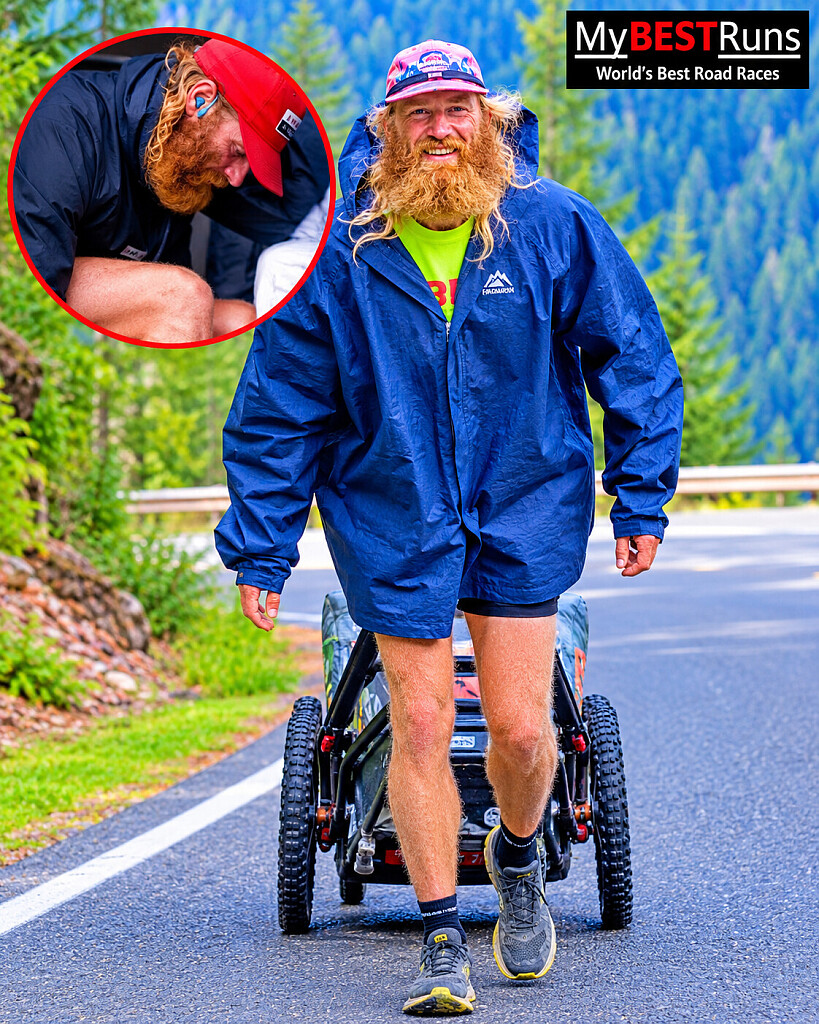


From A Battle With Depression To Running History! Cameron Balser Conquers America In 41 Days, Smashing A 10-Year-Old Record!
In one of the most extraordinary endurance achievements ever witnessed, American ultrarunner Cameron Balser has made history by becoming the fastest person on record to run across the United States, completing an incredible 3,067-mile journey from coast to coast in just 41 days, 16 hours and 45 minutes.
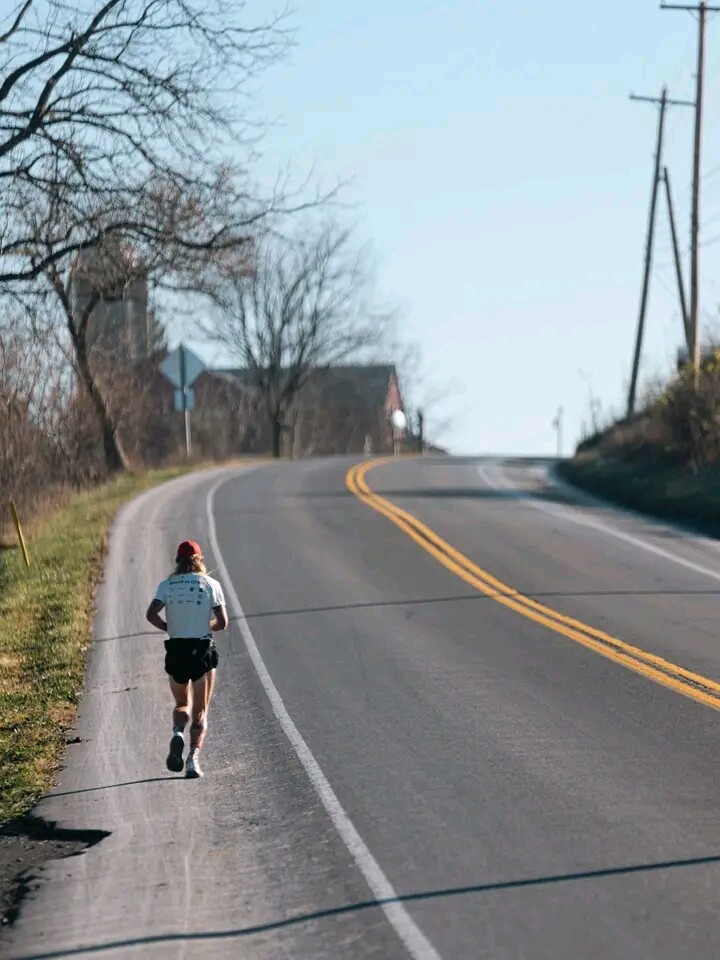
The 35-year-old Indiana native brought his remarkable challenge to an end at New York City Hall at 11:45 p.m. on Friday, November 20, after setting off from San Francisco City Hall at 5:00 a.m. on October 10.
His remarkable performance shattered the previous record of 42 days, 6 hours and 30 minutes, established by fellow American ultrarunner Pete Kostelnick in 2016. Balser finished 13 hours and 45 minutes faster, bringing an end to a record that had stood for a decade.
The numbers behind his achievement are almost difficult to comprehend. Balser averaged approximately 73.6 miles (118.5 kilometres) every day, spending between 15 and 16 hours on the road as he pushed his body across the country. His support crew followed closely, meeting him approximately every five miles to provide essential assistance throughout the demanding journey.
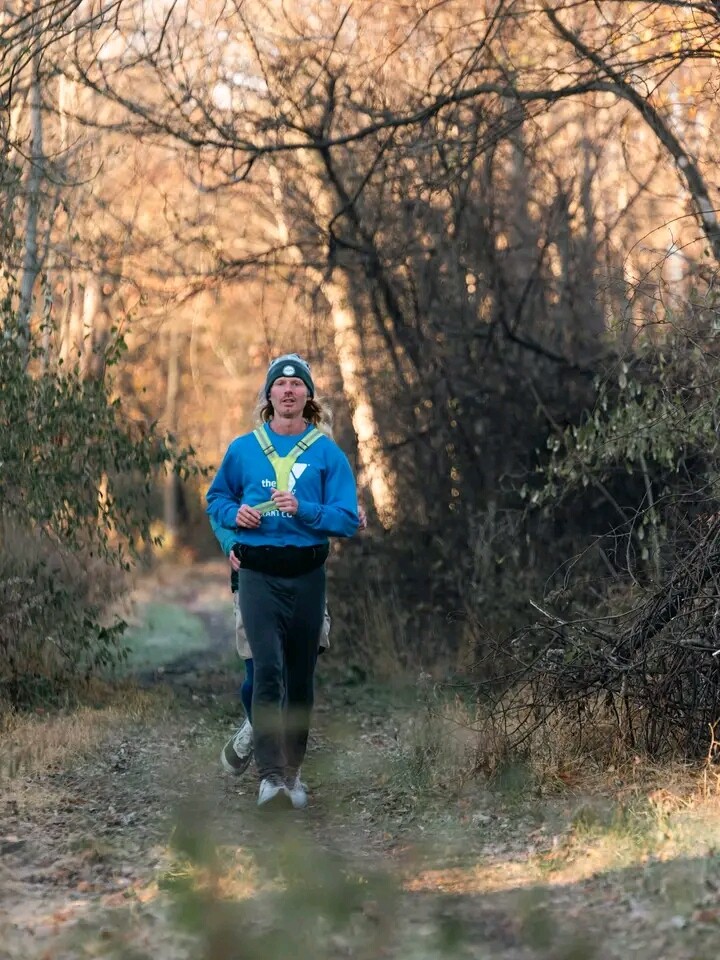
However, the challenge was far from straightforward. He encountered difficult weather conditions in the Rocky Mountains, where heavy rain made a dirt road too soft for his support vehicle, forcing him to cut one day's running short. He also battled through snow while crossing Cameron Pass in Colorado, demonstrating extraordinary determination in the face of unpredictable conditions.
As the miles accumulated, Balser remained committed to his mission, eventually making his way through numerous states before reaching the East Coast. His final kilometres became a celebration of community, with several dozen runners joining him around the George Washington Bridge for the run into Manhattan.
Yet, beyond the extraordinary statistics and record-breaking performance, Balser's journey carries a much deeper personal meaning.
Running has played a significant role in rebuilding his life. In 2017, he experienced a difficult period that led to a hospital stay while battling depression. His subsequent return to running became an important part of his recovery, helping him rediscover purpose, direction and a sense of belonging.
His passion for endurance running has since taken him on remarkable adventures. In 2023 and 2024, he completed an extraordinary 11,170-mile solo journey around the perimeter of the United States, carrying his essential supplies in a cart without the support of a dedicated crew.
This latest challenge, however, was driven by a purpose beyond personal achievement. Through his Breaking 42 project, Balser raised funds for the Grant County Family YMCA in Marion, Indiana, an organisation that supported him during his recovery and holds a special place in his life. He intends for the donations raised through the initiative to benefit the YMCA.
His achievement has also earned admiration from the man whose record he surpassed. Kostelnick publicly congratulated Balser, expressing genuine appreciation for someone willing to pursue a mark that had demanded so much from him to establish. His message reflected the respect that exists within the ultrarunning community, where extraordinary performances often inspire the next generation to push beyond perceived limits.
For Balser, the journey was about much more than taking a record away from another athlete. It was about resilience, gratitude, human connection and demonstrating what determination can accomplish when supported by a community.
Running more than 3,000 miles across an entire country in less than 42 days is an achievement that places extraordinary demands on the human body and mind. But Balser's story also serves as a reminder that running can be much more than a sport; it can become a source of hope, recovery and renewed purpose.
The record-setting performance is still awaiting formal ratification, but his remarkable coast-to-coast achievement has already captured the attention of the running world.
From the streets of San Francisco to the heart of New York, Cameron Balser has delivered a historic performance, proving that sometimes the greatest victories are measured not only by the distance covered or the records broken, but also by the personal battles overcome along the way.
by Erick Cheruiyot for My Best Runs.
Login to leave a comment

Hannah Gapes Makes History! New Zealand Star Ends 22-Year Wait With NCAA Cross Country Title As Kenyan Runners Make Their Mark!
New Zealand's Hannah Gapes delivered a memorable performance at the NCAA Division I Cross Country Championships, conquering a highly competitive women's field to claim the individual crown in Terre Haute, Indiana, with an impressive time of 18:44.3 over 6km.
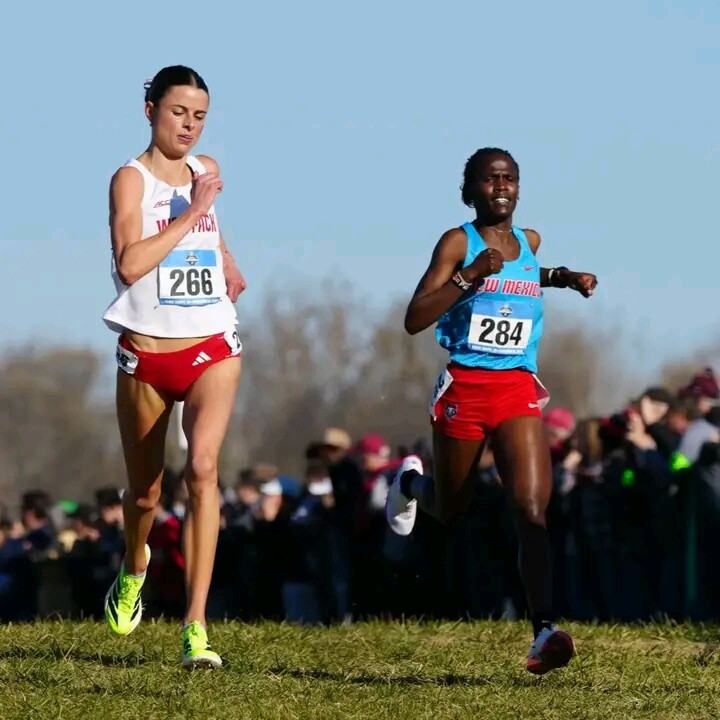
Representing North Carolina State University (NC State), Gapes produced a magnificent performance to bring her collegiate cross country career to a remarkable conclusion, writing her name into the history books with one of the biggest achievements of her running career.
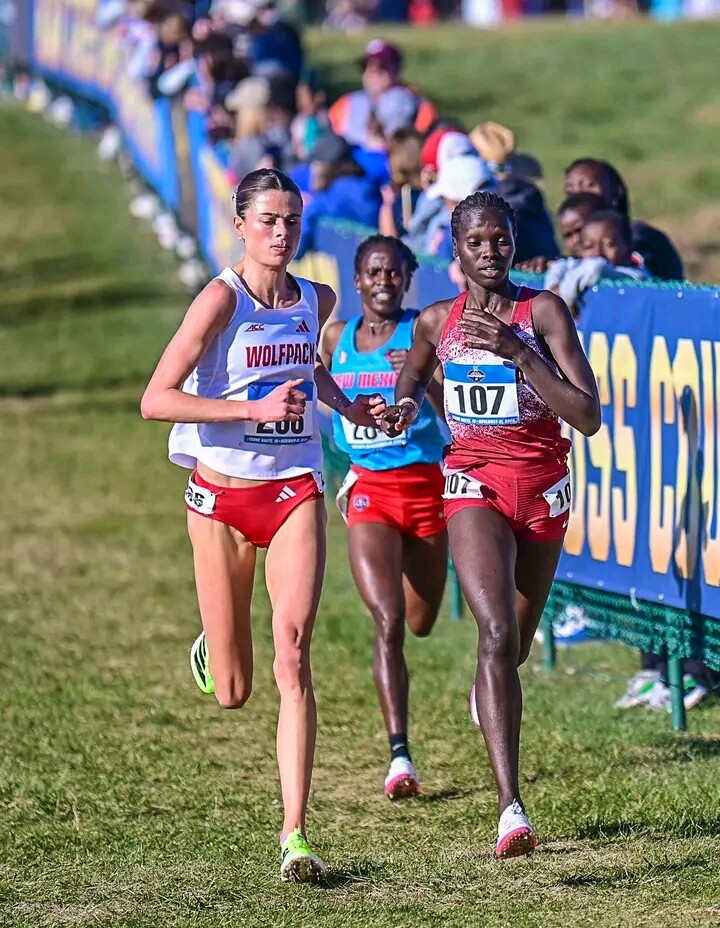
The significance of her triumph was even greater given the history behind it. Gapes became only the second New Zealander ever to win the NCAA Division I women's individual cross country title, ending a 22-year wait since compatriot Kim Smith achieved the same feat in 2004. Remarkably, Smith also claimed her historic victory on the very same LaVern Gibson Championship Cross Country Course in Terre Haute, making Gapes' achievement an extraordinary moment for New Zealand distance running.
Her victory came against a formidable field featuring several outstanding Kenyan distance runners, who once again demonstrated the strength and depth of Kenyan talent on the American collegiate stage.
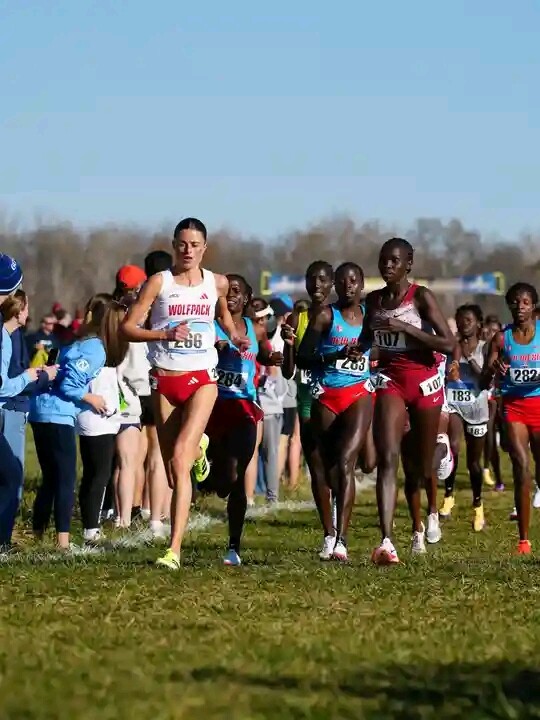
South Carolina's Salma Elbadra secured second place in 18:51.8, while Kenya's Caren Kiplagat of the University of Alabama completed the podium in 18:52.8, finishing just one second behind the runner-up.
Kenyan representation was particularly impressive throughout the top 10. Arkansas' Isca Chelangat finished fourth in 18:56.6, followed closely by West Virginia's Joy Naukot in fifth with 18:56.7. Her teammate Mercy Kinyanjui placed sixth in 18:57.4, while Elizabeth Khatevi of Texas A&M-Corpus Christi finished seventh in 18:57.6.
Billah Jepkirui of Oklahoma State University claimed eighth in 18:59.2, Brighter Jepchumba of Eastern Kentucky University finished ninth in 18:59.4, and Alabama's Cynthia Jemutai rounded out the top 10 in 18:59.8.
The results underlined the remarkable presence of Kenyan distance-running talent in American collegiate athletics, with several Kenyan athletes featuring prominently among the championship's leading finishers.
Beyond the individual celebrations, Alabama enjoyed an unforgettable championship outing, with Kiplagat and Jemutai contributing to the Crimson Tide's historic achievement as the programme secured its first-ever NCAA Division I women's cross country team title.
The championships took place at the renowned LaVern Gibson Championship Cross Country Course in Terre Haute, Indiana, a venue specifically designed for cross country competition and one that has witnessed some of the sport's most memorable collegiate performances.
For Gapes, however, the day belonged to her. She not only secured the NCAA individual crown but also joined Kim Smith in an exclusive chapter of New Zealand sporting history, achieving the feat 22 years after her compatriot conquered the same course.
A historic victory, a remarkable career milestone and another proud moment for New Zealand athletics. Hannah Gapes has officially joined the elite company of NCAA cross country champions.
by Erick Cheruiyot for My Best Runs.
Login to leave a comment
Elsingi Kipruto Conquers The NCAA! Kenyan Star Claims Maiden Cross Country Title With Stunning 28:27.7 Performance!
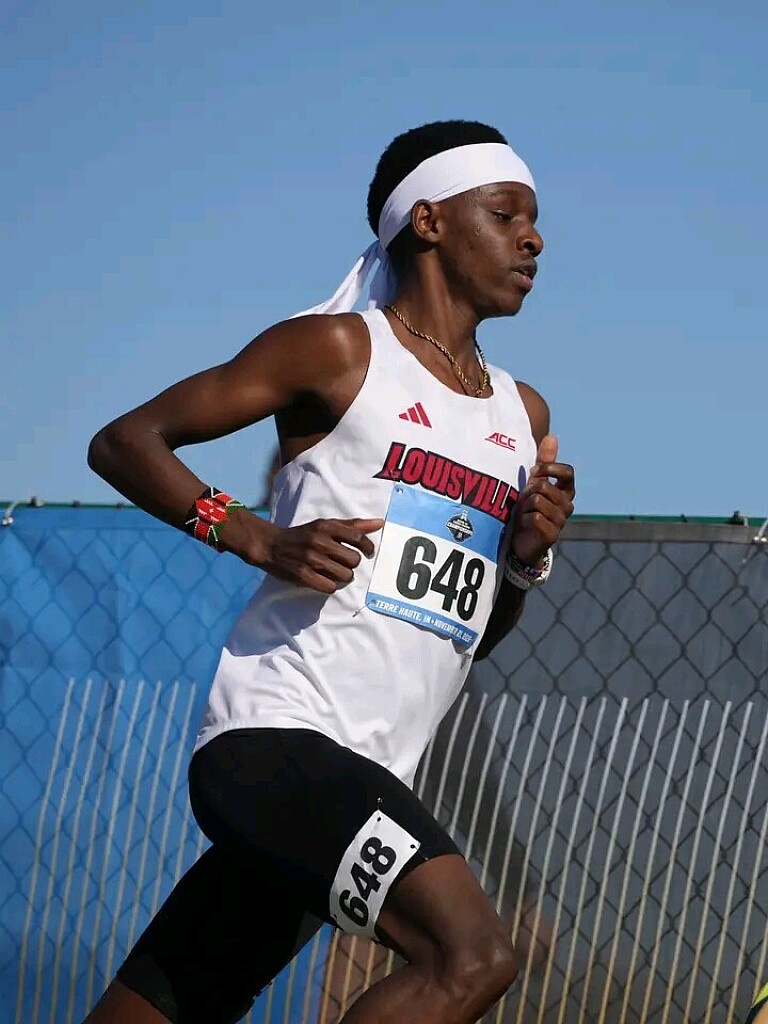
Kenyan distance running has another reason to celebrate! Elsingi Kipruto has delivered a sensational performance to capture his first career NCAA individual cross country championship, storming to victory in the men's 10km race with an impressive time of 28:27.7.
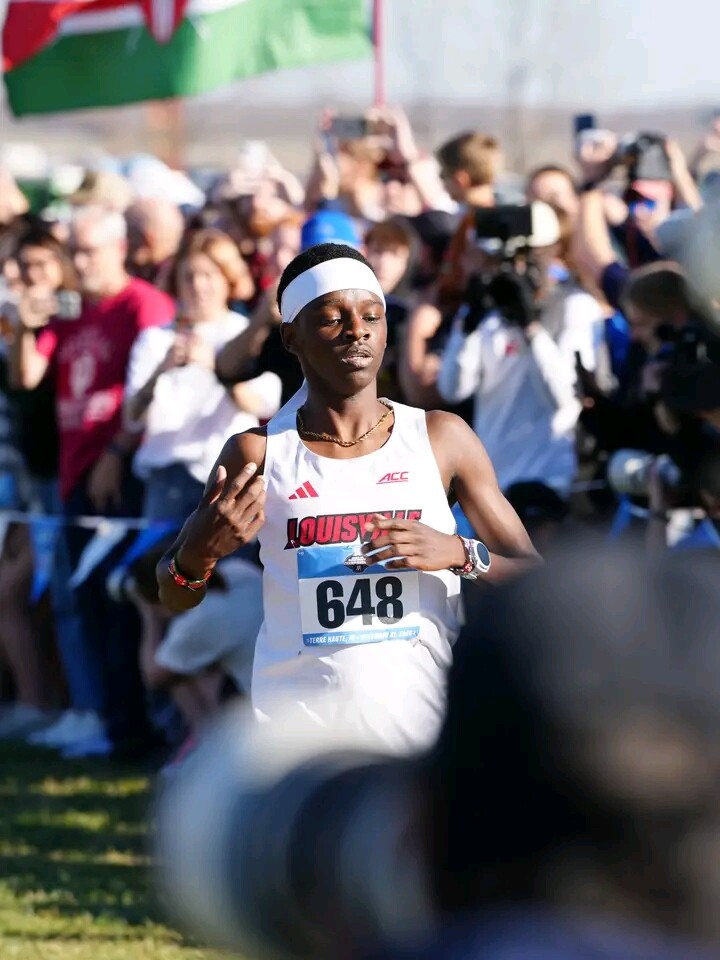
The talented University of Louisville sophomore produced a remarkable display of strength, determination and racing ability to emerge victorious at the 2026 NCAA Division I Cross Country Championships, announcing himself among the leading names in American collegiate distance running.
Representing Louisville, Kipruto demonstrated his class in a fiercely competitive field, holding off a strong challenge from fellow Kenyan Dismus Lokira of Alabama to secure the biggest collegiate title of his career so far.
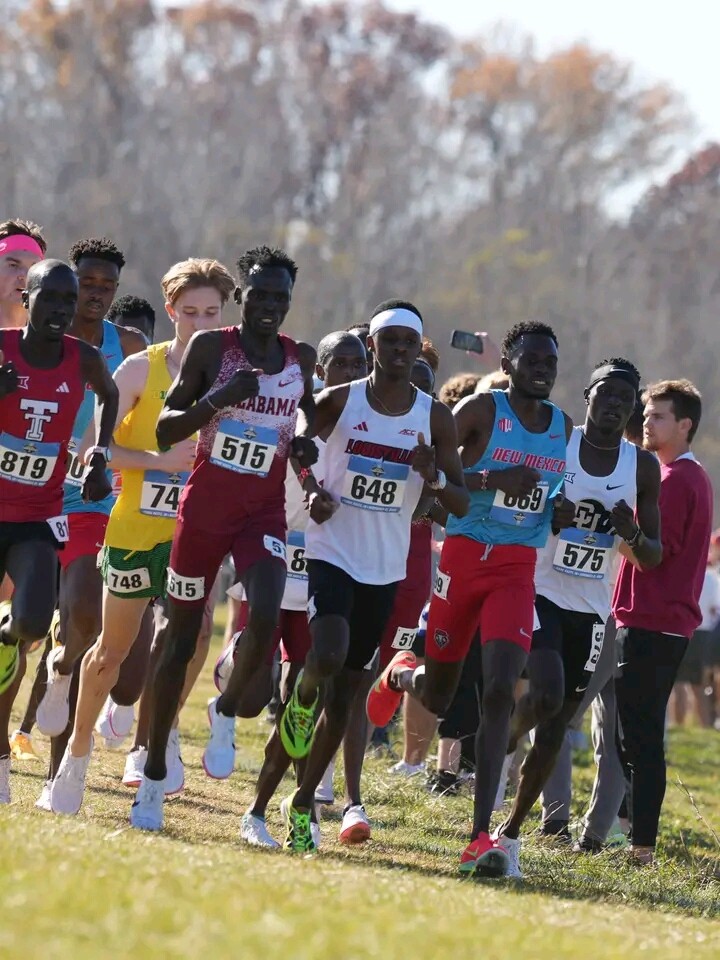
Lokira crossed the finish line in second place with 28:30.8, just 3.1 seconds behind the champion, while Oklahoma State's Denis Kipngetich completed the podium in third after clocking 28:32.5 in an exceptionally competitive contest.
Washington State's Solomon Kipchoge finished fourth in 28:34.8, followed by Alabama's Dennis Kipruto, who placed fifth in 28:36.9. Wake Forest's Rocky Hansen secured sixth in 28:38.4, while New Mexico's Pasanjo Kitonga finished seventh in 28:39.9.
New Mexico also had Collins Kiprotich finishing eighth in 28:43.1, Oregon's Nick Griggs took ninth in 28:45.7, and Vincent Chirchir of New Mexico completed the top ten in 28:50.8.
The championship took place in Terre Haute, Indiana, in the United States. Located in Vigo County, near Indiana's western border with Illinois, the city provided the setting for the country's premier collegiate cross country showdown, where Kipruto rose to the occasion and delivered a performance to remember.
For the Kenyan youngster, this triumph represents a significant milestone in his developing career. Having established himself as a promising talent, he has now added an NCAA individual championship to his growing list of achievements.
At just the sophomore stage of his collegiate journey, Kipruto's breakthrough victory signals an exciting chapter ahead, with the Kenyan star demonstrating the talent and composure to compete at the highest level of collegiate cross country.
A maiden NCAA crown, a spectacular 28:27.7 performance and another memorable achievement for Kenyan distance running! Elsingi Kipruto has conquered the collegiate cross country stage and firmly announced his arrival among the sport's rising stars.
by Erick Cheruiyot for My Best Runs.
Login to leave a comment
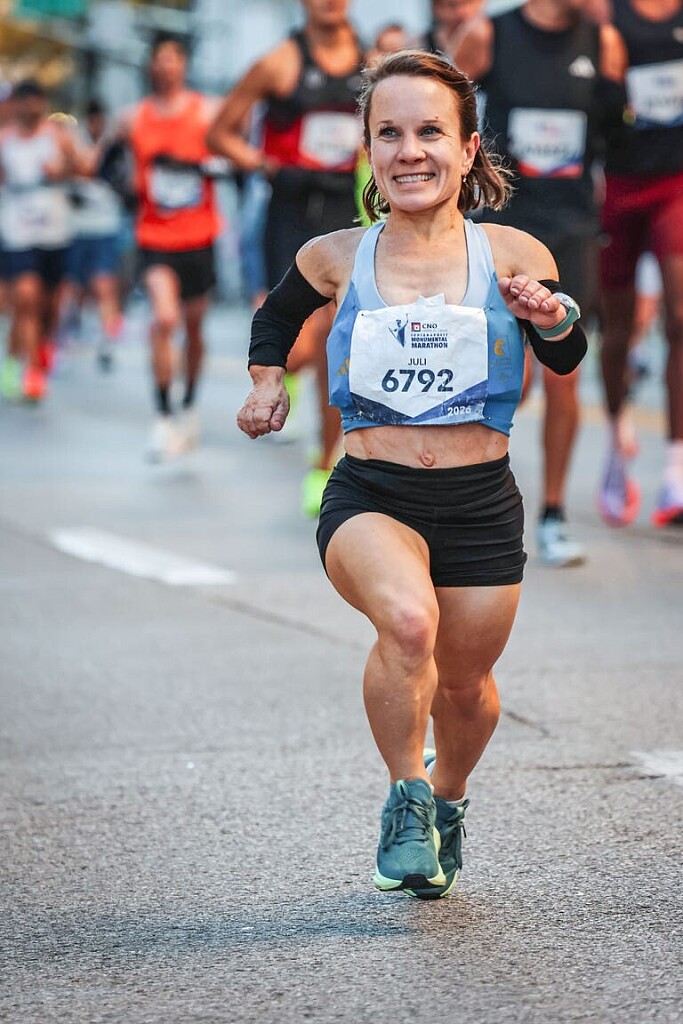
One In A Million! 3-Foot-9 Juli Windsor Runs Remarkable 3:42 Marathon, Sets Provisional American Record And Chases Boston Qualifying Dream!
At just 3 feet 9 inches tall, Juli Windsor is rewriting expectations in distance running, producing extraordinary marathon performances and demonstrating that physical limitations do not have to define the boundaries of human achievement.
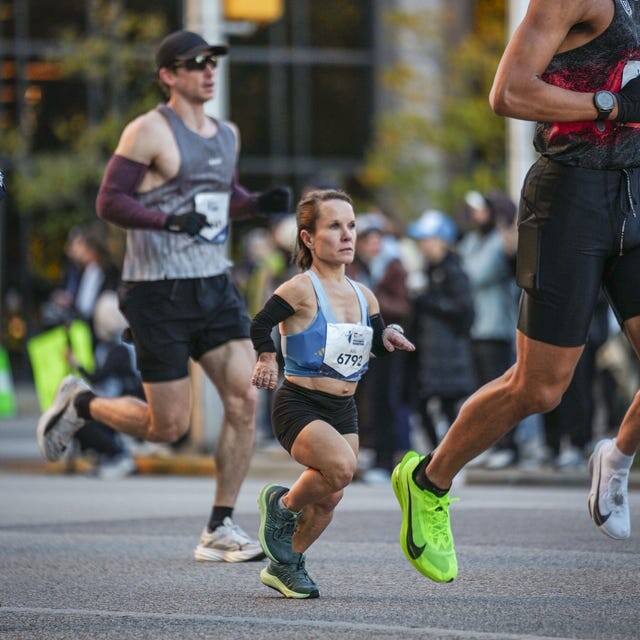
The 39-year-old American delivered another stunning performance at the Indianapolis Marathon on November 7, clocking an impressive 3:42:00 to smash her previous personal best by seven minutes. Her remarkable achievement is also provisionally recognised as a new American record in the T40 para-athletics category, which accommodates athletes with short stature.
Averaging approximately 8:28 per mile, Windsor finished among the top third of competitors in her 35–39 age group, an outstanding result that further underlines the progress she has made since returning to marathon running.
But her ambitions extend beyond personal records. Windsor is now setting her sights on an even bigger challenge: achieving the able-bodied qualifying standard for the prestigious Boston Marathon.
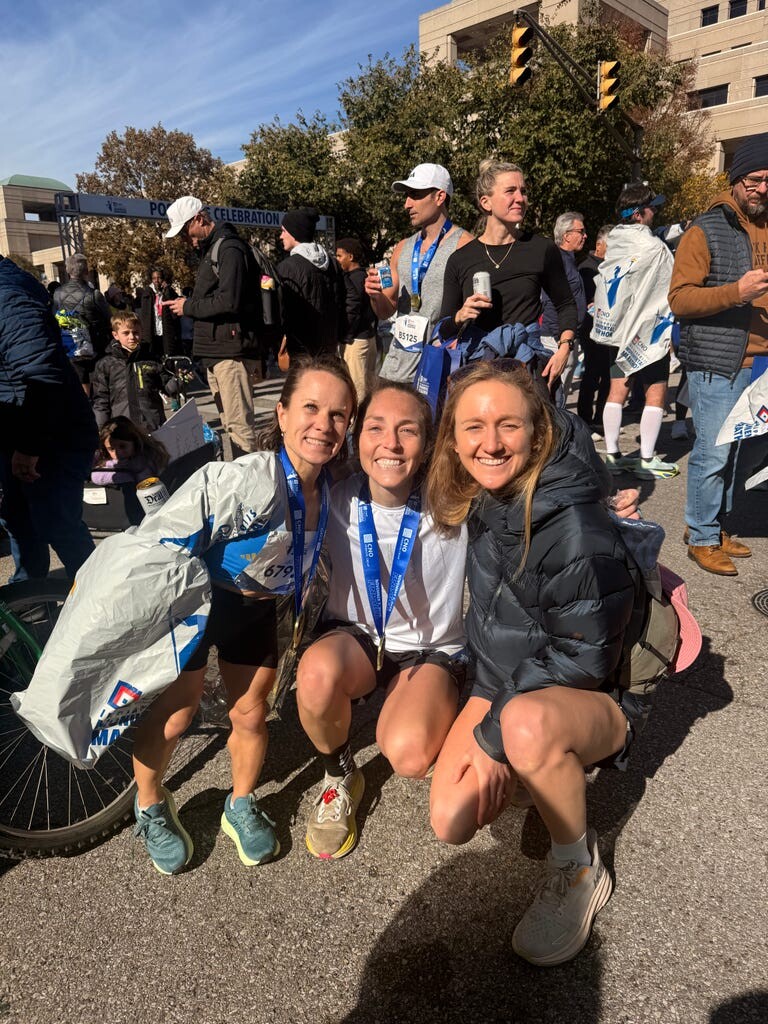
Born with acromesomelic dysplasia, an exceptionally rare form of dwarfism, Windsor has faced challenges that make her achievements in distance running even more remarkable. She has described her condition as so uncommon that, according to what she has been told, she is one in a million.
Outside athletics, she works as a physician assistant in developmental pediatrics, balancing her professional responsibilities and family life with an increasingly impressive running career.
Her journey in athletics began during middle school, when she joined the track team mainly to spend time with her friends. Initially, she had few expectations of becoming a competitive runner. However, an 800-metre race in which she defeated another competitor changed her perspective.
She soon discovered that although she might not have the explosive speed to outrun everyone over shorter distances, she possessed something equally powerful: exceptional endurance, determination and the ability to keep going.
Her philosophy became that she might not outrun her competitors, but she could outlast them.
That discovery eventually inspired her to pursue the marathon, with one particular race becoming the centre of her ambitions: the legendary Boston Marathon.
In her twenties, Windsor dreamed of becoming the first person with dwarfism to complete the prestigious event. In 2013, she came agonisingly close to experiencing that moment, but the tragic Boston Marathon bombings brought the race to an abrupt end as she approached the finish line on Boylston Street. Fortunately, she escaped physical harm, although her dream had to be postponed.
One year later, she returned to Boston and made history, completing the 2014 marathon in 4:43:26 and becoming the first person with dwarfism to finish the historic race.
It was a landmark achievement, but it would be another ten years before she returned to the marathon distance.
Following the 2014 race, Windsor stepped away from marathon competition to concentrate on raising her two children and dedicating time to her family.
However, her passion for running never disappeared.
In 2025, she felt drawn back to the marathon and entered the Spinx Marathon in Greenville, South Carolina. Her comeback was spectacular, as she clocked 4:09:51, taking more than 30 minutes off her previous marathon best.
That performance reignited her ambitions and opened the door to an even more remarkable transformation.
Windsor subsequently began working with Esther Atkins, a former professional marathoner and coach with McKirdy Trained. Atkins recognised considerable untapped potential in her new athlete and believed she could achieve much faster times.
Their partnership quickly began delivering results. At the 2026 Boston Marathon in April, Windsor produced another major breakthrough, recording 3:49:42 and taking her marathon running to an entirely new level.
Seven months later, she went even faster in Indianapolis, bringing her personal best down to 3:42:00 and provisionally establishing a new American record in her para-athletics classification.
Atkins has been particularly impressed by Windsor's willingness to embrace new training approaches, challenge her previous expectations and explore possibilities she had not always considered achievable.
For Windsor, having a coach who believes in her potential has been an important part of the journey. She explained that she is accustomed to expecting more from herself than others expect of her, making Atkins' confidence in her abilities especially meaningful.
Her journey also comes with unique challenges during competitions. At just 3 feet 9 inches tall, navigating crowded marathon courses presents a different experience from that of taller competitors.
Windsor has humorously explained that while many runners can look ahead over the shoulders of those around them, her view is often dominated by the backsides of fellow competitors. It is an amusing but very real reminder of the additional challenges she navigates while competing.
Yet, none of those obstacles has diminished her determination to keep improving.
Reflecting on her achievements, Windsor has spoken about the extraordinary capabilities of the human body, expressing amazement at how much people can accomplish when they challenge themselves and venture beyond what they previously believed possible.
Now, with a 3:42 marathon to her name, her next target is clear: continue improving and pursue the able-bodied Boston Marathon qualifying standard.
From discovering her endurance as a middle-school athlete to overcoming the disappointment of the 2013 Boston Marathon, making history in 2014, taking a decade away from the distance and returning to produce successive personal bests, Windsor has built a remarkable story of resilience.
At 39, she is not simply celebrating a personal record. She is challenging perceptions, breaking barriers in para-athletics and showing that extraordinary achievements can come in the most unexpected packages.
For Juli Windsor, the finish line is no longer just about completing a marathon. It is about discovering just how far she can go.
by Erick Cheruiyot for My Best Runs.
Login to leave a comment

Indianapolis Marathon
Now one of the 20 largest marathons in the US, the Indianapolis Monumental Marathon is the ideal fall marathon for everyone from the first time marathon runner to elite athletes. Starting and finishing at the Indiana State Capitol, the course highlights landmarks and historical neighborhoods throughout Indianapolis. Nationally recognized as flat and fast, this event has hosted Olympians, PR seekers,...
more...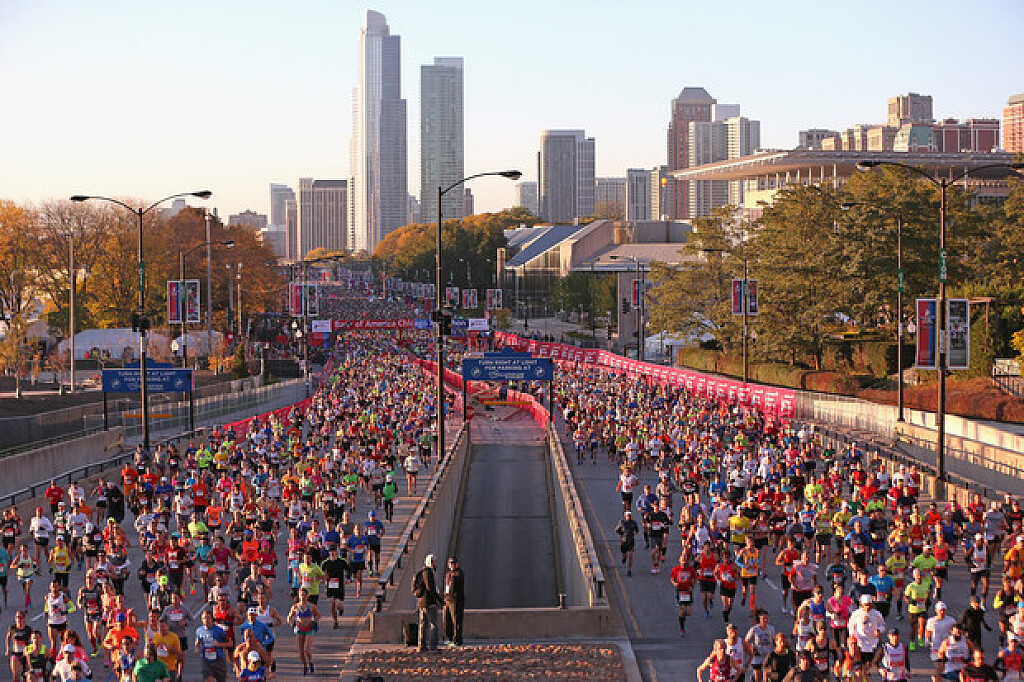
Chicago Marathon 2026: Emma Grace Hurley Makes Her Debut as Clayton Young Battles Injury Concerns
The 2026 Chicago Marathon will provide an important stage for two American distance runners approaching the race from very different circumstances. Emma Grace Hurley is preparing to make her debut over the classic 42.195-kilometre distance after establishing herself among the country’s leading half-marathon runners, while Clayton Young faces a race against time to overcome a hamstring injury that threatens to derail his ambitions.
Both athletes have compelling stories heading into Chicago, but their immediate objectives differ. Hurley is looking to gain valuable experience as she begins her marathon journey, whereas Young must contend with significant uncertainty surrounding his fitness and the potential consequences of racing while injured.
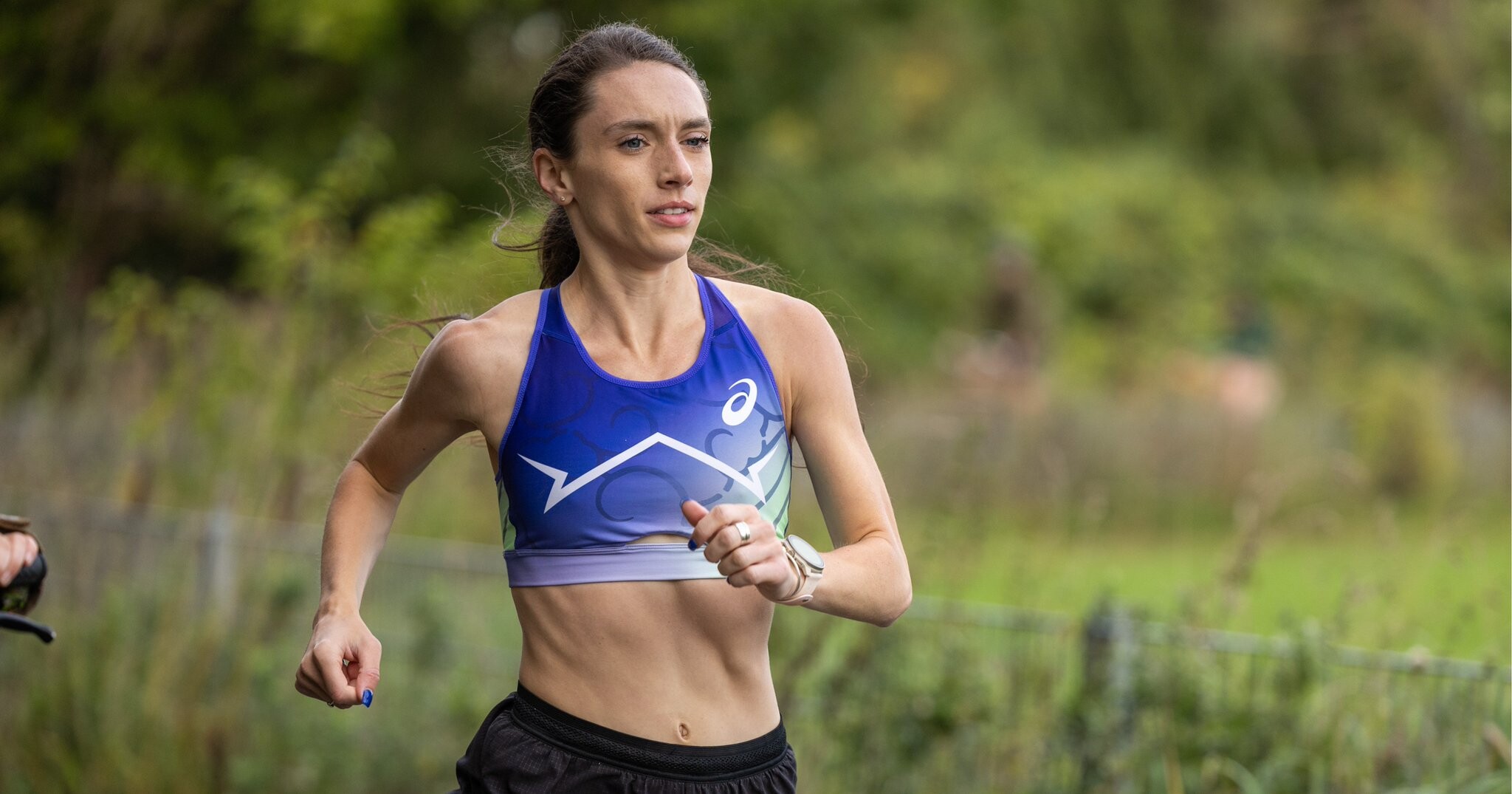
Emma Grace Hurley: A Promising Talent Ready for Her Marathon Debut
Hurley arrives in Chicago following an outstanding performance at the World Athletics Road Running Championships in Copenhagen, Denmark, where she clocked 1:06:23 to finish fifth in the women’s half marathon. Her performance established a women-only American record and contributed to the United States securing the team silver medal.
The result has generated considerable interest in what she might accomplish over the full marathon distance. However, despite the growing expectations, Hurley and her coach, Andrew Begley, have maintained a measured approach, understanding that the transition from half marathon to marathon requires more than simply extending the distance.
Her recent training has offered encouraging indications of her preparation. A demanding workout observed in Indiana, together with training activity shared on Strava, has provided further insight into the work she has undertaken ahead of her Chicago debut.
Nevertheless, the marathon presents a different set of challenges. Athletes must balance pace, endurance, nutrition and energy conservation while preparing for the demanding final kilometres, when even well-conditioned runners can experience unexpected difficulties.
For Hurley, Chicago represents an opportunity to learn those lessons firsthand rather than place unnecessary pressure on herself to produce an immediate breakthrough. Her long-term plan includes two marathons before the 2028 United States Olympic Marathon Trials, making this first appearance an important stage in her development.
Her approach is captured in a straightforward statement: “This one is for learning and the next is for nailing it.”
That philosophy reflects an understanding that building a successful marathon career takes patience, experience and careful progression. While her half-marathon record demonstrates considerable potential, Chicago will offer the first real test of how effectively she can translate that ability to the longer distance.
A strong debut would provide a valuable foundation for her future ambitions, but the experience itself will be equally important as she prepares for the next chapter of her marathon career.
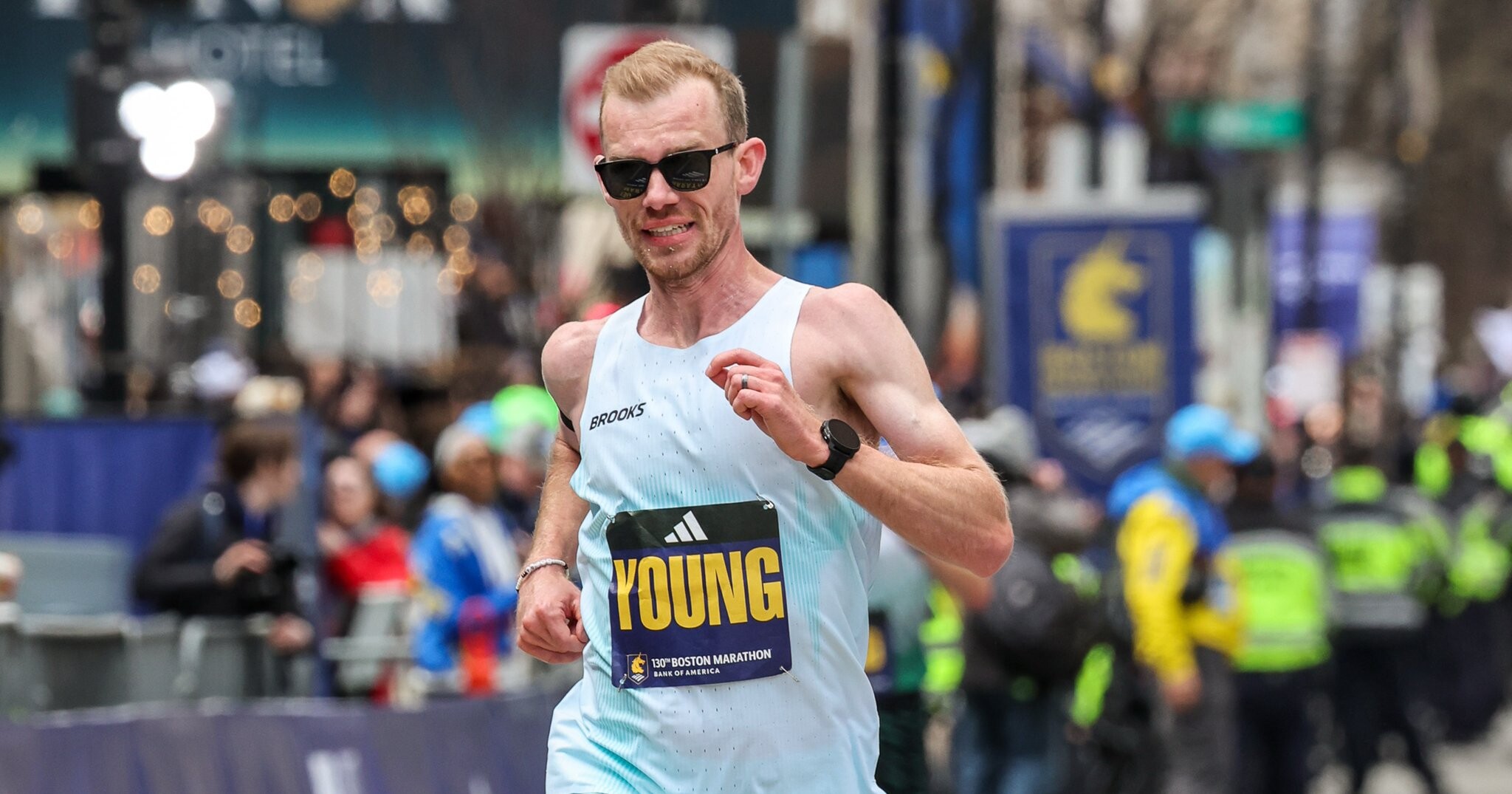
Clayton Young: Hamstring Injury Casts Doubt Over Chicago Ambitions
Young, meanwhile, heads into the Chicago Marathon facing a far more complicated challenge after sustaining a significant hamstring injury during the final stages of the Great North Run.
The American revealed that he suffered a 12-centimetre split tear in his semitendinosus, one of the muscles that make up the hamstring group, during the final 250 metres of the race. The timing of the injury could hardly have been more unfortunate, arriving with the Chicago Marathon approaching and his competitive ambitions still firmly in focus.
Medical advice reportedly differed on how he should manage the injury. One doctor recommended taking four weeks off running, a period of rest that would have ruled him out of Chicago. Another advised a more cautious, day-by-day approach, which Young has chosen to follow.
His recent training activity on Strava and videos shared on YouTube suggest that he has continued to complete substantial workouts. However, evidence of training does not necessarily establish that a serious muscle tear has healed sufficiently to withstand the demands of a marathon.
The injury has placed considerable doubt over his hopes of challenging the American marathon record. More importantly, it has raised questions about whether attempting to race could aggravate the damage and compromise his preparations for the 2027 season and the build-up to the 2028 U.S. Olympic Marathon Trials.
For an athlete with significant long-term ambitions, the decision carries consequences beyond a single race. A successful appearance in Chicago could represent another major achievement, but worsening the injury could potentially cost him valuable training time during a crucial period in his career.
Young is known for his ability to deliver under pressure, making his situation particularly intriguing as race day approaches. However, competing through a hamstring tear of this nature would present an unfamiliar challenge, even for an athlete accustomed to producing strong performances when it matters most.
For now, he remains entered in the race, but his participation and ability to compete effectively remain important questions. His recent workouts may offer encouragement, yet the true condition of the injured muscle and its response to marathon demands will be central to determining what is realistically possible.
Two Americans, Two Very Different Challenges
Hurley and Young illustrate the contrasting realities that elite runners can face ahead of a major marathon. One is entering the distance with momentum, enthusiasm and an opportunity to discover her potential. The other is attempting to navigate an injury that could influence not only his immediate performance but also his longer-term development.
For Hurley, Chicago is the beginning of a new chapter. Her record-setting half-marathon performance has created anticipation, but her emphasis remains on learning, gaining experience and building towards future goals.
For Young, the race presents a more difficult calculation. His competitive instincts and reputation for performing under pressure must be weighed against the risks of pushing through an injury that could have lasting consequences for his season.
Their respective stories will add another dimension to the American contingent at the 2026 Chicago Marathon. While Hurley seeks to establish herself over 42.195 kilometres, Young faces the challenge of determining whether his body is ready to meet the demands of one of the world's premier road races.
As race day approaches, the central questions remain clear: How will Hurley handle her first marathon, and will Young be able to compete without jeopardising his recovery and future ambitions?
The answers will emerge on the streets of Chicago, where preparation, patience and sound decision-making could prove just as important as raw talent and competitive determination.
by Erick Cheruiyot for My Best Runs.
Login to leave a comment

Bank of America Chicago
Running the Bank of America Chicago Marathon is the pinnacle of achievement for elite athletes and everyday runners alike. On race day, runners from all 50 states and more than 100 countries will set out to accomplish a personal dream by reaching the finish line in Grant Park. The Bank of America Chicago Marathon is known for its flat and...
more...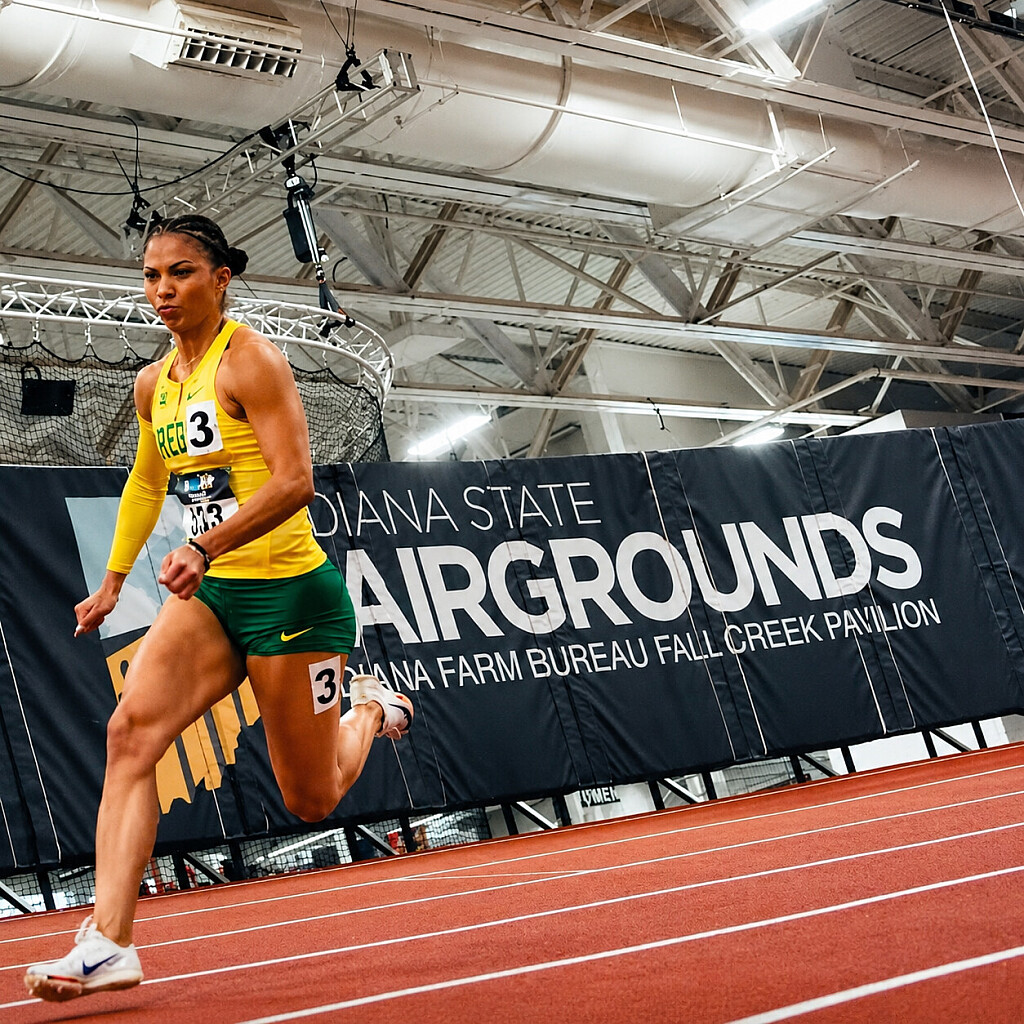
Indianapolis Ready to Take Centre Stage as USATF Indoor Championships Return for 2027 and 2028
Indianapolis is set to become the home of American indoor track and field for the next two years after USA Track & Field confirmed that the city will host the 2027 and 2028 USATF Indoor Championships at the Indiana State Fairgrounds.
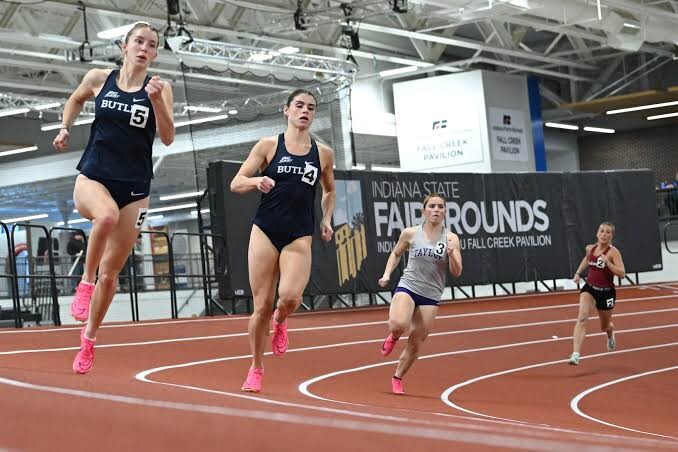
The nation’s leading athletes will compete at the Indiana Farm Bureau Fall Creek Pavilion, with the 2027 championships scheduled for February 19–21, followed by the 2028 edition from February 18–20.
The announcement marks a significant moment for Indianapolis and its long-standing connection with the sport. The 2027 championships will take place 40 years after the city hosted the inaugural World Indoor Championships at the Hoosier Dome in 1987, bringing another major chapter of elite indoor athletics back to a city with a rich track and field history.
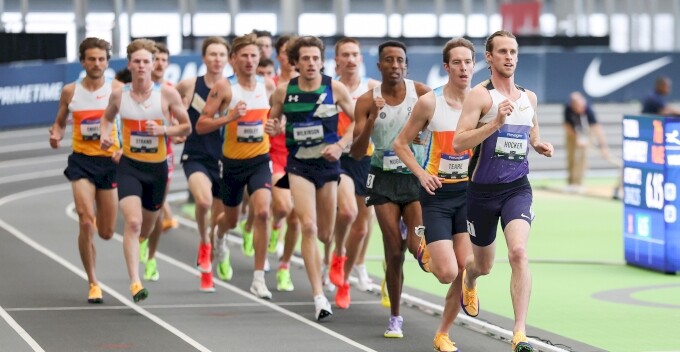
Although Indianapolis is home to USA Track & Field's national office and has hosted major athletics competitions over the years, the upcoming editions will be the first time the city has staged the USATF Indoor Championships. The Indiana State Fairgrounds has nevertheless developed into an increasingly important venue for the sport, providing a major platform for elite indoor competition.
The consecutive championships will give athletes two years of high-stakes competition on one of America's growing indoor stages, with national titles and places among the country's finest athletes once again on the line.
The 2028 USATF Indoor Championships will carry even greater significance, serving as a selection event for athletes hoping to represent the United States at the 2028 World Athletics Indoor Championships in Odisha, India. That will add another layer of intensity to the competition as athletes battle not only for national honours but also for the opportunity to compete on the global stage.
For Indianapolis, the return represents more than simply hosting another national championship. Four decades after welcoming the world's finest athletes for the inaugural World Indoor Championships, the city is preparing to once again place track and field firmly in the national spotlight.
With two consecutive editions now secured, Indianapolis is ready to welcome America's best indoor athletes as they chase national glory, international selection and the chance to create another memorable chapter in the city's proud athletics history.
by Erick Cheruiyot for My Best Runs.
Login to leave a comment
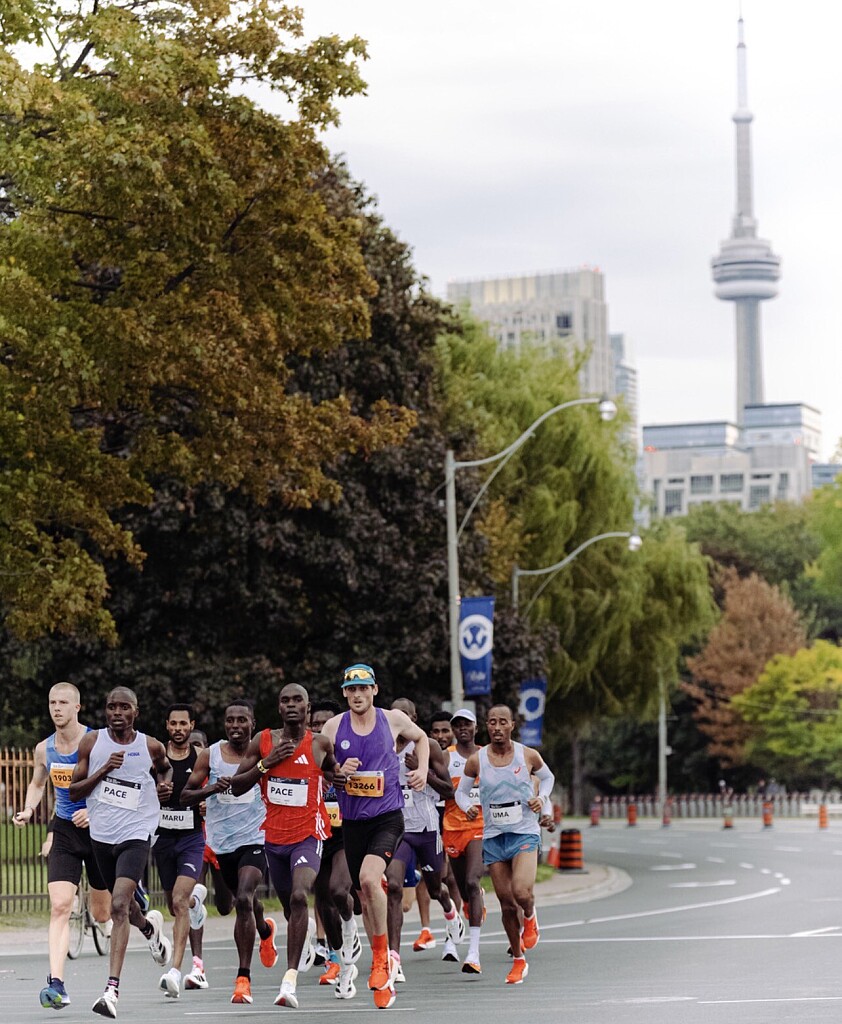
Two London-Area Standouts Set for Marathon Debuts at Toronto Waterfront
Two Canadian distance running stalwarts will make their marathon debuts at the 2026 TCS Toronto Waterfront Marathon October 18. Both make their homes in the London area of southwestern Ontario.
The event is a World Athletics Elite Label race and also serves as the official Athletics Canada Canadian Marathon Championships.
Connor Black and Jeremy Coughler are former training partners and Canadian championship medalists over 10,000m and cross country. They have followed different paths since the retirement of their coach, Dave Mills, although they occasionally meet for long runs while preparing for Toronto.
Coughler still follows a program designed by Mills—a special exception made by his former coach—while Black has worked with two-time Canadian Olympic marathoner Reid Coolsaet for the past two years. Their approaches to the Toronto race could hardly be more different.
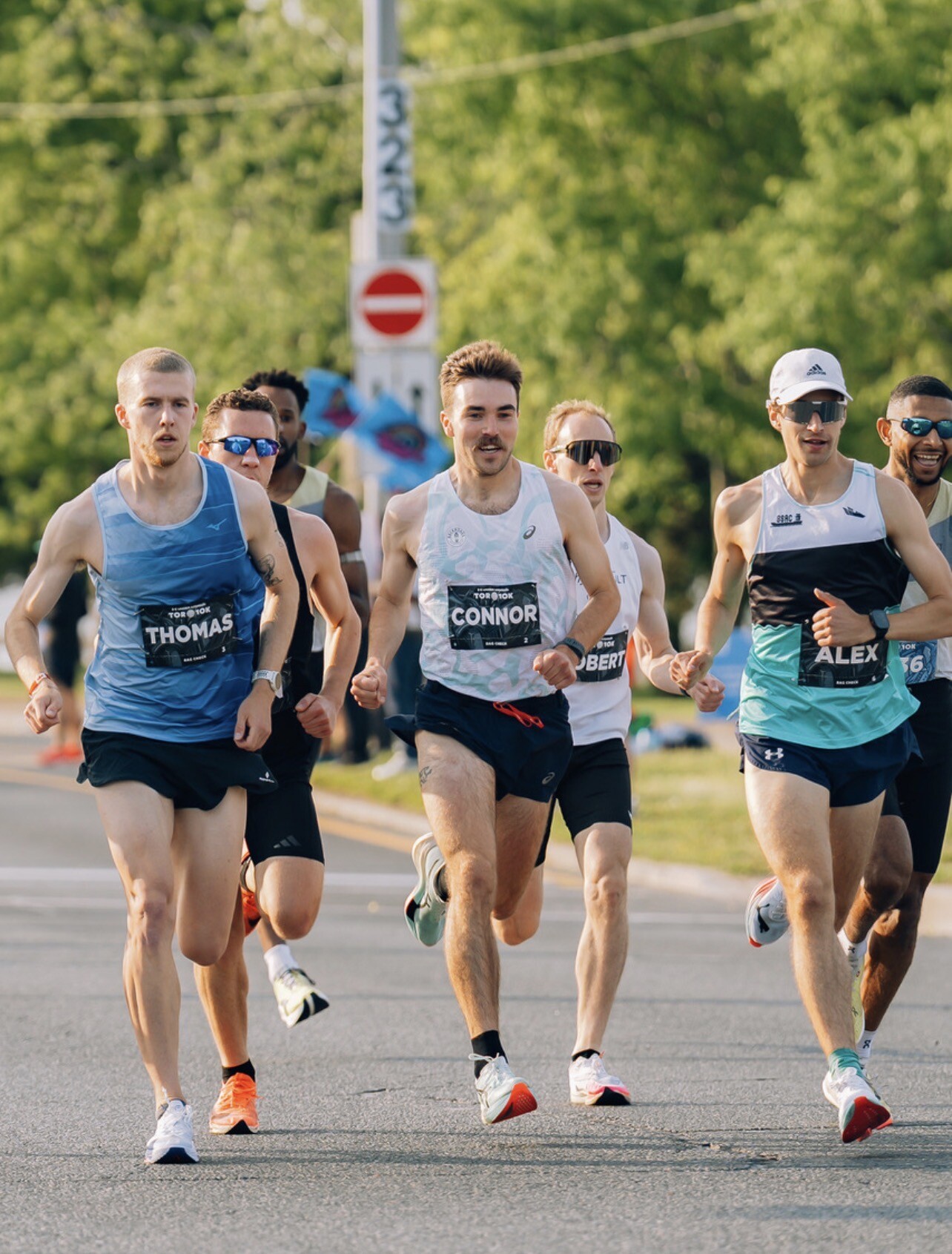
Black, who lives in London—known as “The Forest City”—sees his marathon debut as an important step toward a possible challenge for Canada’s 2028 Olympic team.
“I am 30 years old and I am not making money in the sport, but I still have goals,” Black declares. “My final goal would be to try and make an Olympic team, and I don’t think it’s feasible as an unsponsored track runner targeting the 5K or 10K.
“The marathon is a more even playing field. I can get into any marathon I want, within reason. There are 80 spots in the Olympics. So, if I am going to give it one last shot, it has to be in the marathon.”
At the 2025 Project 13.1 Half Marathon in Congers, New York, Black ran a personal best of 1:03:34 in his first race at the distance. Until then, he had competed primarily over 5,000m and 10,000m. In 2022, he won the Canadian Cross Country Championships.
Black is a secondary school teacher but remains classified as “Long Term Occasional,” meaning he moves from school to school wherever there is an opening.
“Last year I was at Strathroy District Collegiate Institute, which, funnily enough, was where Dave taught for 10 or 15 years,” Black says. “I taught phys ed and math. I can also teach English as a Second Language and biology. I am kind of a Swiss Army knife.”
As he increases his training load for Toronto, completing most of the work by himself, he admits he has reservations about returning to work.
“I am quite nervous to resume teaching,” he reveals. “Recently, my mileage has gone up. When you are starting your build, you are tired. It has been nice having the summer off and being able to focus on training.
“I used to believe you could train like a professional and have a full-time job. I think it’s possible, but if you want to run 200 kilometres a week for the marathon, it is definitely easier and probably better for your performance if you don’t have to work full time.”
Meanwhile, Coughler and his wife, Emma, are chiropractors and partners in Re-Charge Health and Wellness in London’s east end. They are also the parents of a young son, Otto, which means managing their time carefully.
“My wife and I split the work schedule,” Coughler, 30, explains during a day off. “I work Tuesday, Thursday, Friday and Saturday, so I try to do workouts on my days at home—Mondays and Wednesdays.
“If I have something first thing at 7 or 8 a.m., I do a run and then a shakeout between patients or after work. It’s not too bad.”
Running remains important to Coughler, but it is now one of several priorities. He estimates he is running up to 110 kilometres a week, similar to the volume he maintained when finishing third at both the 2023 and 2024 Canadian 10K Championships in Ottawa. He also won the Canada Running Series’ Beneva Spring Run-Off 8K four consecutive years between 2022 and 2025.
Although that mileage is well below what many elite marathoners run, Coughler set a half-marathon personal best of 1:04:33 earlier this year at the Project 13.1 Half Marathon in New York State. The performance earned him eighth place in a strong field. He admits his attitude toward running has changed.
“It’s a shift mentally because I have so much other stuff going on,” he explains. “I am trying to view running as something I do because I love it rather than because it’s my whole life.
“When I was at Indiana University, running was everything. When you run well, it’s great, but when you are not running well, it starts eating you alive.”
With the support and encouragement of Mills, they have mapped out a plan they hope will see Coughler finish his debut in the 2:14 to 2:16 range. He also intends to run more marathons in the future.
“It’s nice knowing there will be a bunch of other Canadian guys who can run around the same time, and that will make it deeper,” he says. “At the front, there are always good Kenyans and Ethiopians running fast. Even if there are a bunch of guys running between 2:12 and 2:20, it would be great.”
The race’s proximity to his home in Thamesford—15 minutes from his practice and about a two-hour drive from Toronto—means Emma, Otto and his parents can accompany him on race weekend. It is one reason he chose the TCS Toronto Waterfront Marathon for his debut.
Coughler is also familiar with the first half of the course, having finished third in the Toronto Waterfront Half Marathon a year ago. Runners in both events follow the same route until the 20-kilometre mark.
Between now and race day, there are many kilometres to be covered. Subject to their schedules and traffic conditions, the two London-area runners will reunite for some workouts.
If all goes well, they will arrive at the starting line ready to join the long list of Canadians who have successfully made the move to the classic marathon distance.
by Paul Gains
Login to leave a comment
TCS Toronto Waterfront Marathon
The Scotiabank Toronto Waterfront Marathon, Half-Marathon & 5k Run / Walk is organized by Canada Running Series Inc., organizers of the Canada Running Series, "A selection of Canada's best runs!" Canada Running Series annually organizes eight events in Montreal, Toronto and Vancouver that vary in distance from the 5k to the marathon. The Scotiabank Toronto Waterfront Marathon and Half-Marathon are...
more...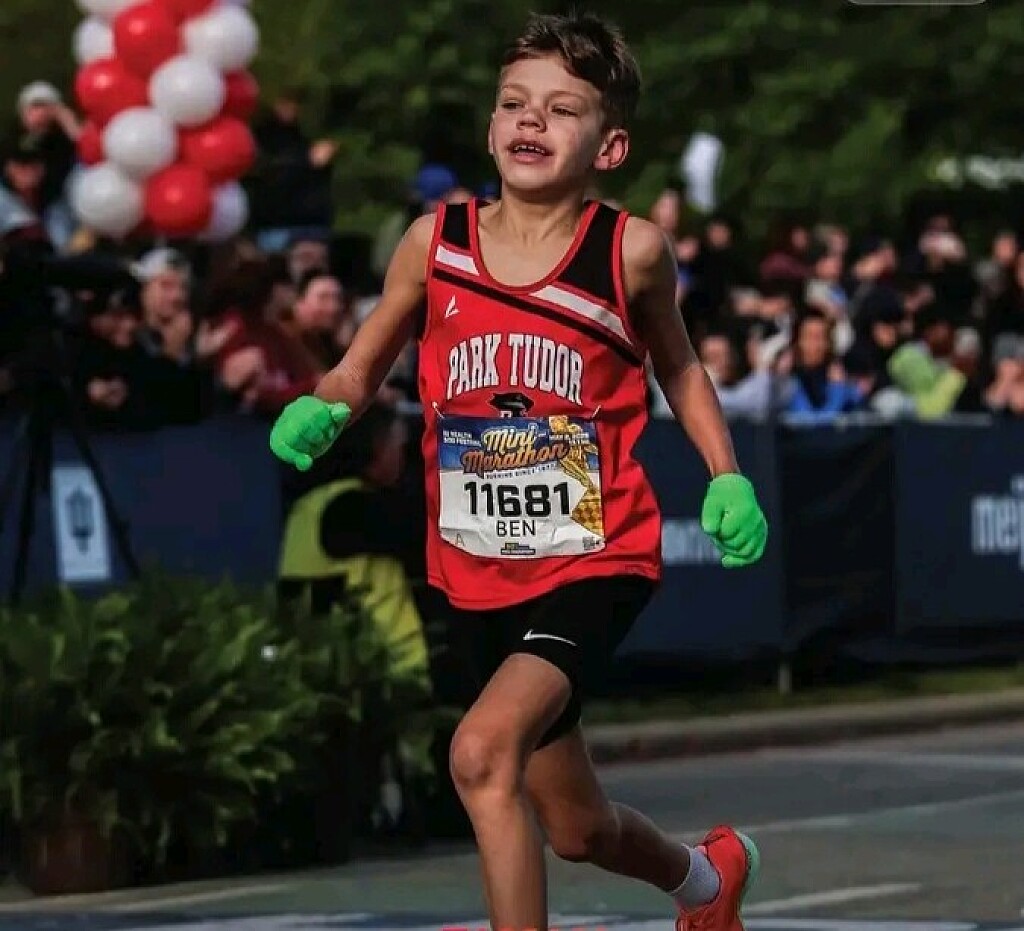
A Record Beyond His Years: 11-Year-Old Ben Dick Rewrites the Limits in Indianapolis
In a performance that has startled even seasoned observers of distance running, 11-year-old Ben Dick delivered a run for the ages at the IU Health 500 Festival Mini-Marathon in Indianapolis—a race traditionally dominated by experienced adult athletes.
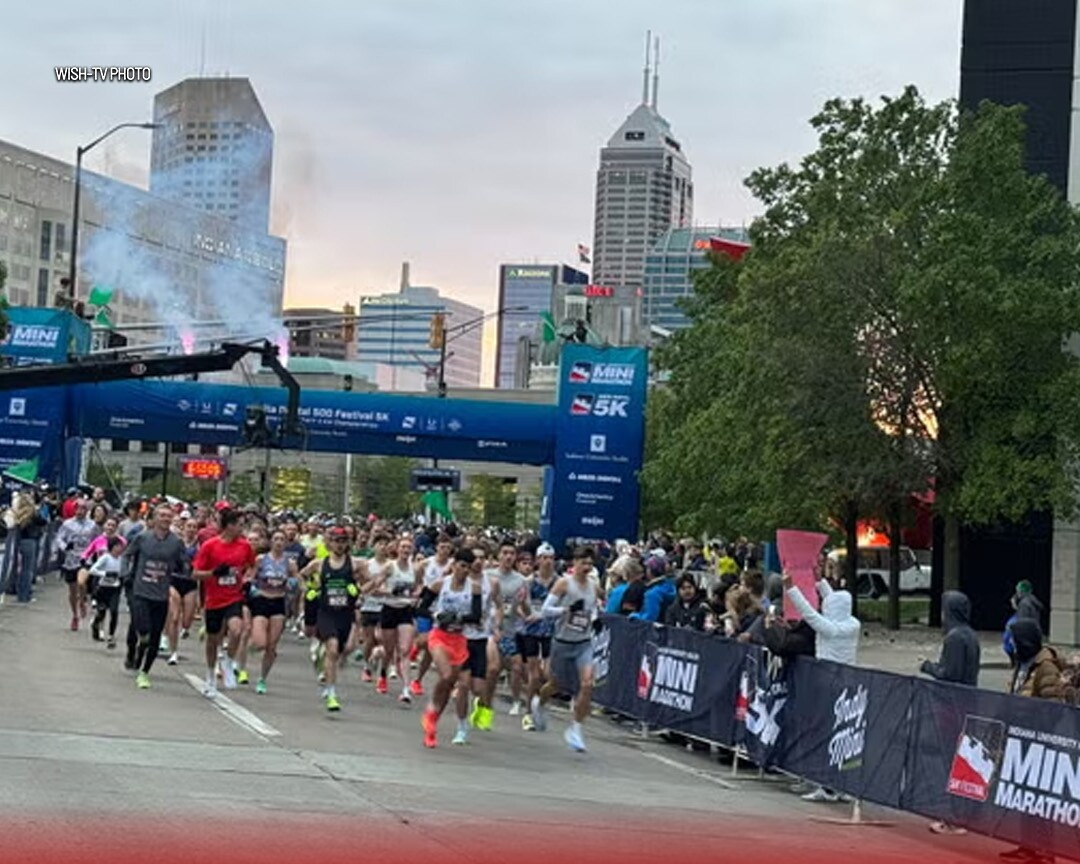
What unfolded on the streets of the city was not just impressive—it was extraordinary.
Clocking a remarkable 1:20:14 for the half marathon distance, the young American set a new world best for the 11-year-old age category, averaging a blistering 6:07 per mile. Against a massive field of more than 22,000 runners, he surged to an astonishing 185th place overall—an achievement that underscores both his natural ability and rare competitive composure.
His race told a story of control, courage, and quiet confidence. Running alongside his father through the early stages, Ben maintained a steady rhythm before making a decisive move around mile seven—pulling away and committing fully to his own pace. From there, he ran with striking independence, holding form and speed deep into the latter stages of the race.
Splits that signal something special:
5 km: 19:54
10 km: 39:31
15 km: 58:21
20 km: 1:16:25
Finish: 1:20:14 (Age 11 World Record)
Each segment reflected consistency beyond his years, with no dramatic fade—only controlled progression toward a historic finish line.
While age-group records rarely capture global headlines, this performance has resonated widely within the running community. It challenges long-held assumptions about youth endurance while also raising admiration for the discipline, guidance, and environment supporting such talent.
Ben Dick’s run is more than a statistic—it is a glimpse into the future of the sport. At just 11, he has already achieved what many never will, not simply by running fast, but by doing so with composure, intelligence, and fearless intent.
For now, the numbers speak loudly. But perhaps even more compelling is the sense that this is only the beginning.
by Erick Cheruiyot for My Best Runs.
Login to leave a comment
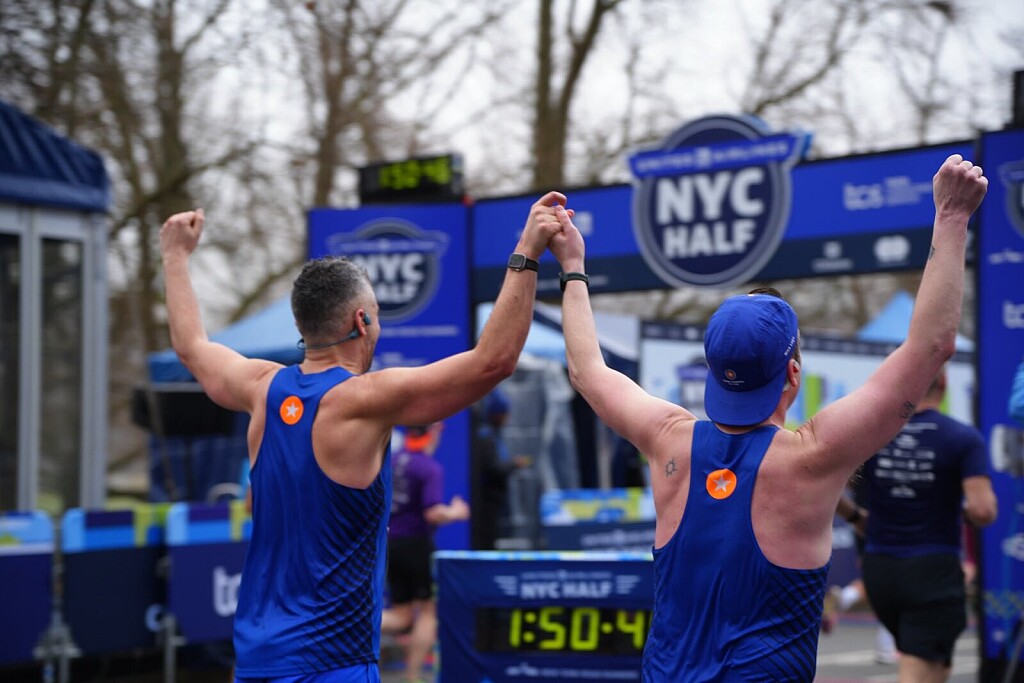
NYC HALF MARATHON 2026 – ELITE MEN READY TO LIGHT UP CENTRAL PARK
The first rays of dawn slice through the towering skyline of New York City, and the streets surrounding Central Park, the iconic venue of the NYC Half Marathon 2026, hum with anticipation. On Sunday, March 15, 2026, fans and runners alike converge on the city’s most famous park, flags waving and cameras clicking, hearts racing in sync with the city’s heartbeat. Volunteers adjust barricades, photographers focus their lenses, and the world’s fastest men stretch with a mix of calm and tension—the calm before the storm. From the leafy loops of Central Park to the bridges spanning the East River, the city seems to hold its breath, ready to witness history.

The air is thick with excitement. Coaches give last-minute instructions; elite athletes exchange polite nods and steely glances, each calculating pace, strategy, and the perfect moment to strike. Sirens echo faintly in the distance, signaling the approaching race vehicles, while the smell of morning coffee mixes with the cool March air. Somewhere high above, the first light glints off glass towers, reflecting the golden promise of competition. In this city of dreams, ambitions, and grit, every step matters—and the men’s elite field of the NYC Half Marathon 2026 is about to prove it.
Race Schedule – Men’s Elite
Date & Venue: Sunday, March 15, 2026 – Central Park, New York City, USA
New York (EDT): 7:00 AM
Kenya (EAT): 2:00 PM (+7 hours from NYC)
Japan (JST): 8:00 PM (+13 hours from NYC)
Thailand (ICT): 6:00 PM (+11 hours from NYC)
Australia Sydney/Melbourne (AEDT): 10:00 PM (+15 hours from NYC)
USA Pacific (PDT): 4:00 AM (−3 hours from NYC)
Champions, Contenders, and Rising Stars
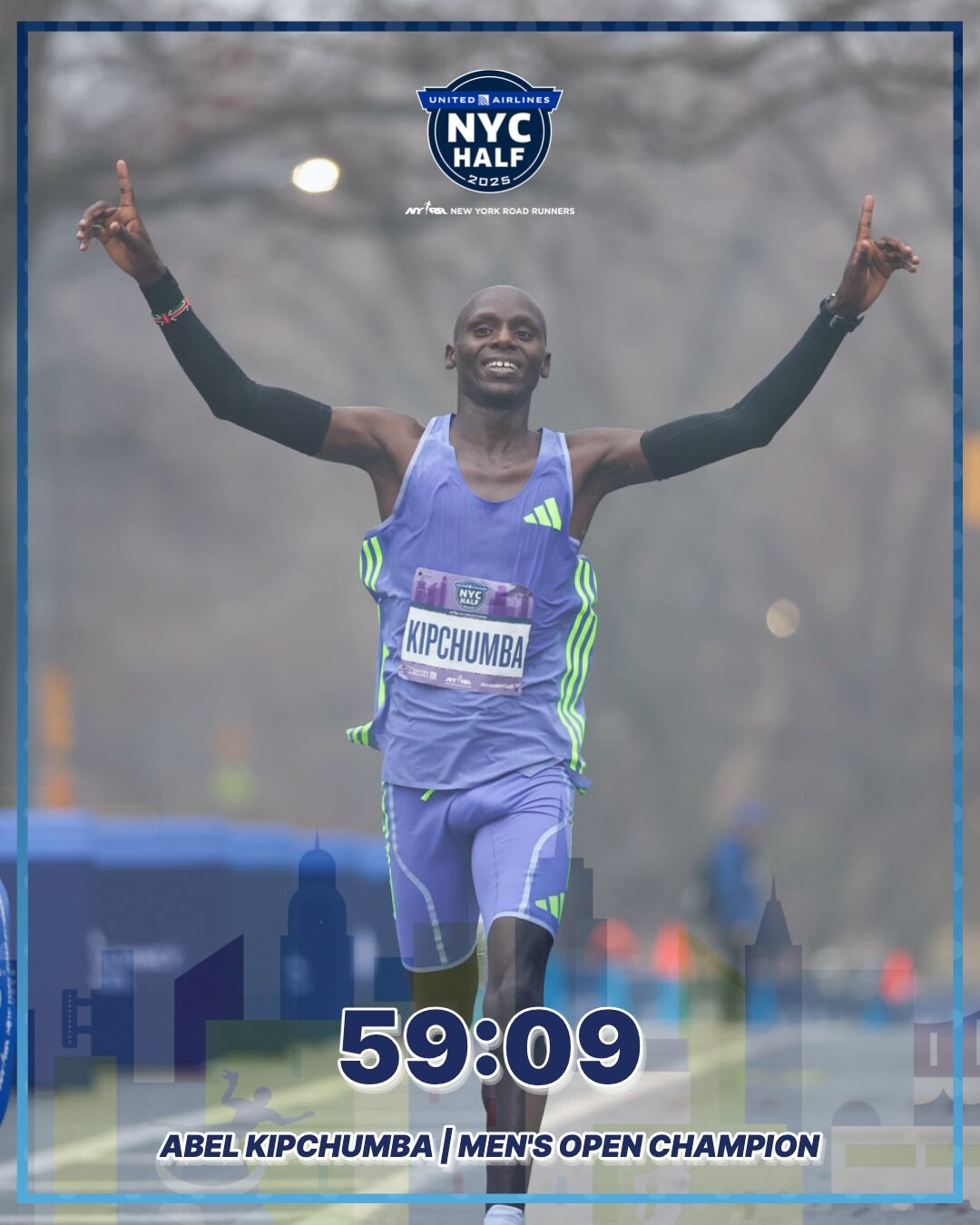
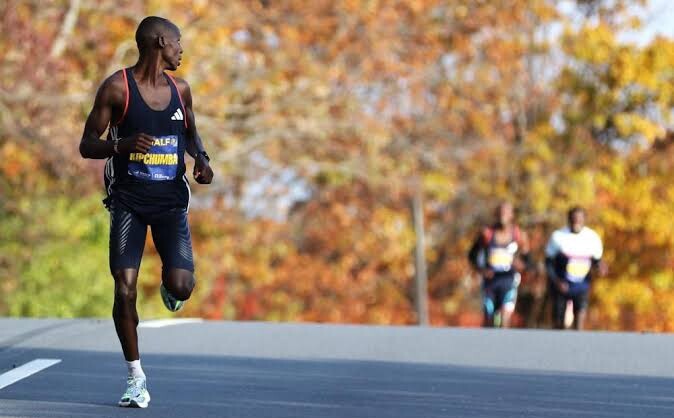
At the heart of this high-stakes drama is Abel Kipchumba of Kenya, last year’s champion, whose lightning-fast 58:07 PB from Valencia 2021 has runners and fans alike holding their breath. Kipchumba returns to defend his crown, but the field has grown stronger, faster, and hungrier than ever.
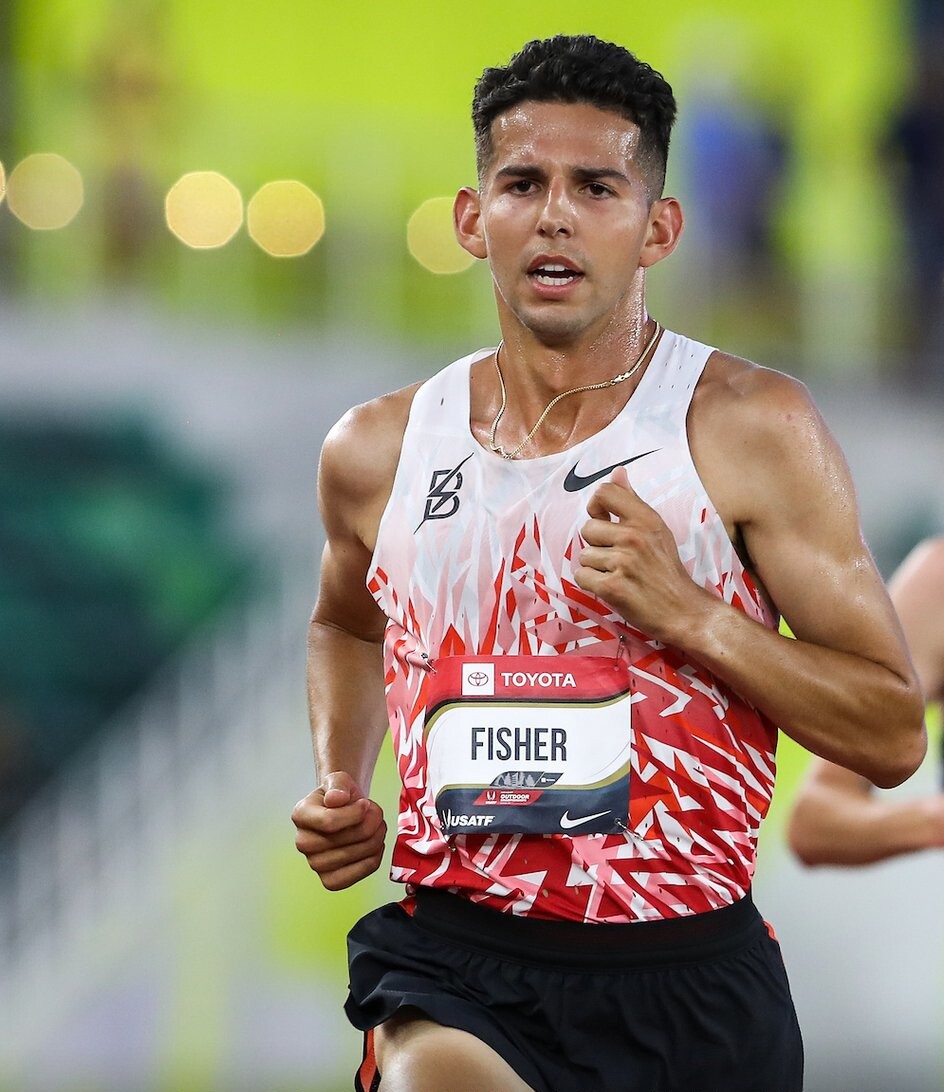
Challenging him will be Daniel Ebenyo of Kenya, bronze medalist at the 2026 World Cross Country Championships, Grant Fisher of the United States, two-time Olympic bronze medalist making his half marathon debut, and Rory Linkletter of Canada, Canada’s national record holder. Each brings a unique blend of speed, endurance, and tactical cunning that could turn any mile into a decisive moment.
Team USA brings an extraordinary depth of talent, including Galen Rupp, Ryan Ford, Alex Maier, Zouhair Talbi, and Joe Klecker, promising a race filled with high stakes, strategic surges, and perhaps a new record etched into the streets of Manhattan.
Men’s Elite Field – NYC Half Marathon 2026
Athlete
Country
PB / Notable Performance
1. Abel Kipchumba
Kenya
58:07 (Valencia 2021)
2. Daniel Ebenyo
Kenya
59:04 (Manama 2022)
3. Adriaan Wildschutt
South Africa
59:13 (Valencia 2025)
4. Patrick Kiprop
Kenya
59:14 (Houston 2026)
5. Mohammed El Youssfi
Morocco
59:21 (Houston 2026)
6. Alex Maier
United States
59:23 (Houston 2026)
7. Galen Rupp
United States
59:47 (Ostia 2018)
8. Ryan Ford
United States
59:48 (Houston 2026)
9. Sondre Nordstad Moen
Norway
59:48 (Valencia 2017)
10. Rory Linkletter
Canada
59:49 (Houston 2026)
11. Patrick Dever
United Kingdom
1:00:11 (Houston 2025)
12. Zouhair Talbi
United States
1:00:41 (NYC Half 2024)
13. Rui Aoki
Japan
1:00:45 (Ageo 2025)
14. Shunsuke Kuwata
Japan
1:00:48 (Ageo 2025)
15. Tsegay Tuemay Weldlibanos
Eritrea
1:00:50 (Houston 2018)
16. Alex Masai
Kenya
1:00:51 (Houston 2026)
17. Jack Rowe
United Kingdom
1:00:53 (Copenhagen 2025)
18. Joe Klecker
United States
1:01:06 (Houston 2025)
19. Peter Lynch
Ireland
1:01:15 (Houston 2025)
20. Camren Todd
United States
1:01:23 (Houston 2026)
21. Hendrik Pfeiffer
Germany
1:01:28 (Larne 2025)
22. Benjamin Preisner
Canada
1:02:25 (Houston 2025)
23. Jacob Thomson
United States
1:02:26 (Riga 2023)
24. Joel Reichow
United States
1:02:30 (Duluth 2023)
25. Max Turek
Canada
1:02:45 (Boston 2024)
26. Haftu Knight
United States
1:02:47 (Chicago 2025)
27. Matthew Leach
United Kingdom
1:02:57 (Houston 2020)
28. Nick Hauger
United States
1:03:06 (NYC Half 2025)
29. Kieran Tuntivate
Thailand
1:03:19 (South Shields 2025)
30. Turner Wiley
United States
1:04:04 (Hardeeville 2021)
31. Owen Ritz
United States
1:04:34 (RBC Brooklyn Half 2024)
32. Evan Sherman
United States
1:04:51 (Indianapolis 2025)
33. Charlie Lawrence
United States
1:05:07 (Houston 2022)
34. Grant Fisher
United States
Debut
35. Gulveer Singh
India
Debut
The starting gun cracks through the morning calm. The elite men surge forward, every stride a blend of power, precision, and daring. The NYC Half Marathon 2026 at Central Park unfolds like a living story—each mile a chapter, each sprint a dramatic twist. Legends may rise, records may fall, but one thing is certain: Manhattan will witness an unforgettable morning of speed, endurance, and sheer determination.
by Erick Cheruiyot for My Best Runs.
Login to leave a comment
United Airlines NYC Half-Marathon
The United Airlines NYC Half takes runners from around the city and the globe on a 13.1-mile tour of NYC. Led by a talent-packed roster of American and international elites, runners will stop traffic in the Big Apple this March! Runners will begin their journey on Prospect Park’s Center Drive before taking the race onto Brooklyn’s streets. For the third...
more...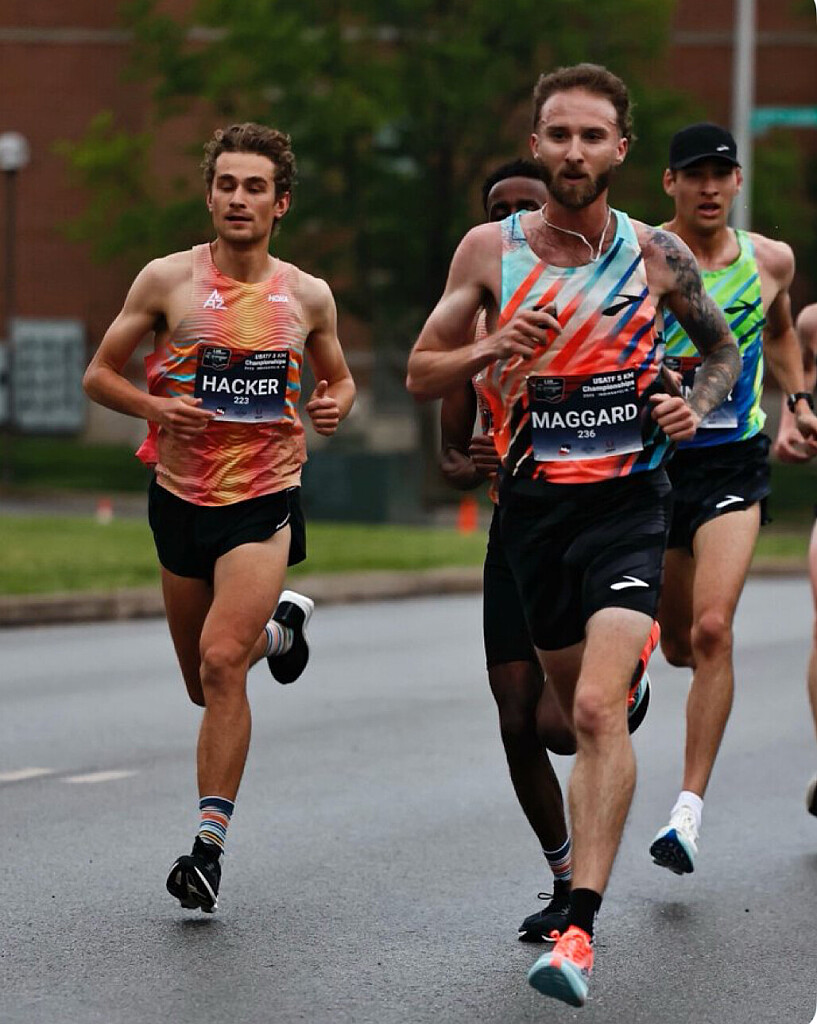
Fast Finishes in Indy as Hacker and Andrews Claim 5K Crowns
On a crisp morning in downtown Indianapolis, the 2025 USATF 5 km Championships delivered thrilling finishes and fast times, with Olin Hacker and Josette Andrews emerging as national champions.
In the men’s race, Olin Hacker of HOKA Northern Arizona Elite made a decisive move in the final kilometer, pulling away from a tightly packed lead group. His surge proved untouchable, and he crossed the finish line in 13:31.93 to claim the national title. Casey Clinger of Brooks was just a stride behind in 13:33.04, with Hacker’s teammate Ahmed Muhumed rounding out the podium in 13:36.88—completing a trio of sub-13:40 finishers.
Men’s Top 10 Finishers
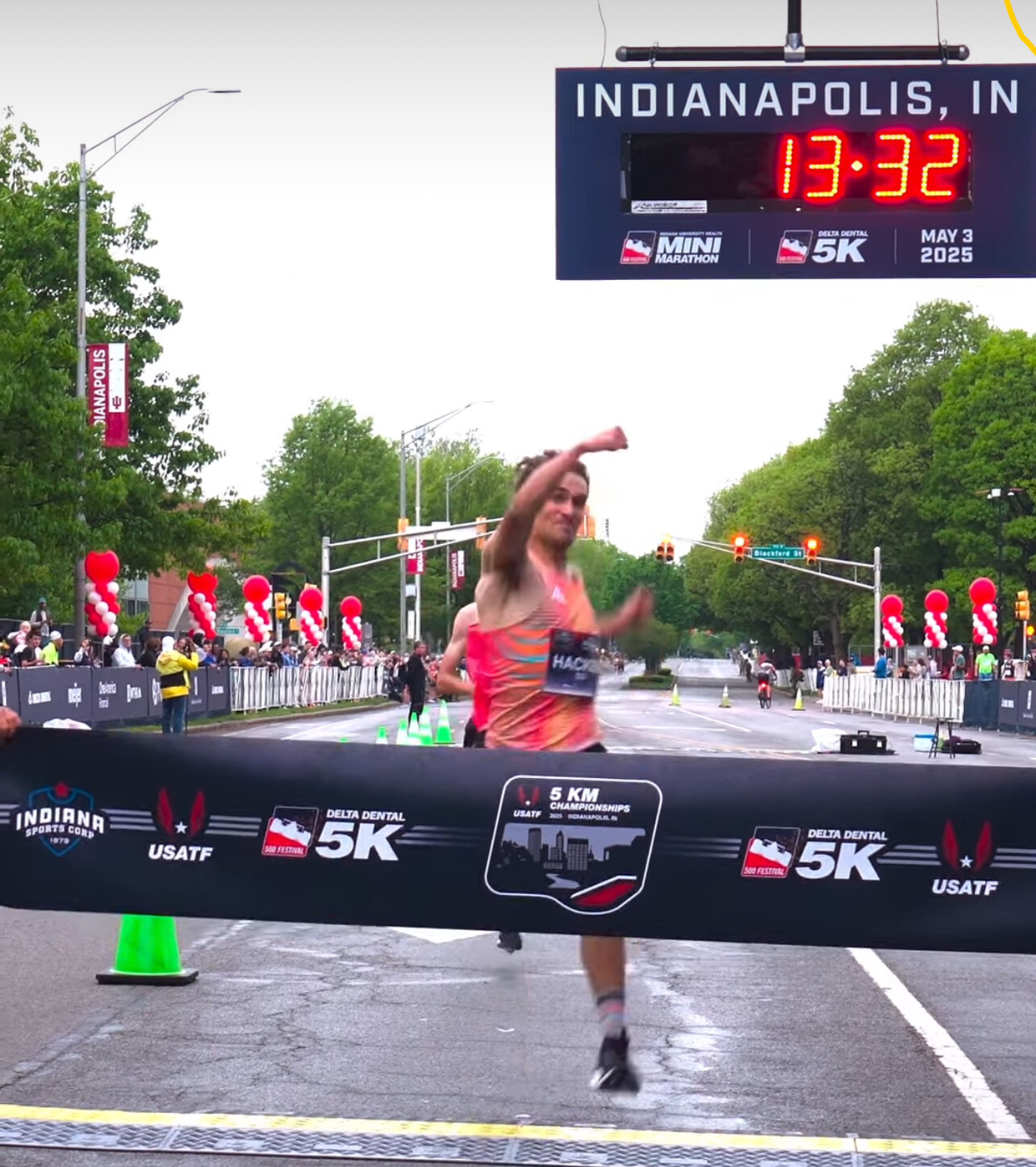
1. Olin Hacker (HOKA NAZ Elite) – 13:31.93
2. Casey Clinger (Brooks) – 13:33.04
3. Ahmed Muhumed (HOKA NAZ Elite) – 13:36.88
4. Morgan Beadlescomb (adidas) – 13:39.50
5. Graham Crawford (Reebok) – 13:42.10
6. Reed Fischer (Tinman Elite) – 13:44.75
7. Sam Chelanga (Nike) – 13:47.30
8. Ben Flanagan (On Running) – 13:49.60
9. Emmanuel Bor (U.S. Army) – 13:52.25
10. Eric Avila (HOKA) – 13:54.80
In the women’s race, Josette Andrews showed impressive strength and timing, kicking hard in the final stretch to take the win in 15:12.34. Emily Infeld of Nike followed closely in 15:14.50, and Karissa Schweizer of Bowerman Track Club secured third in 15:16.75, as the top trio pushed each other to the line.
Women’s Top 10 Finishers
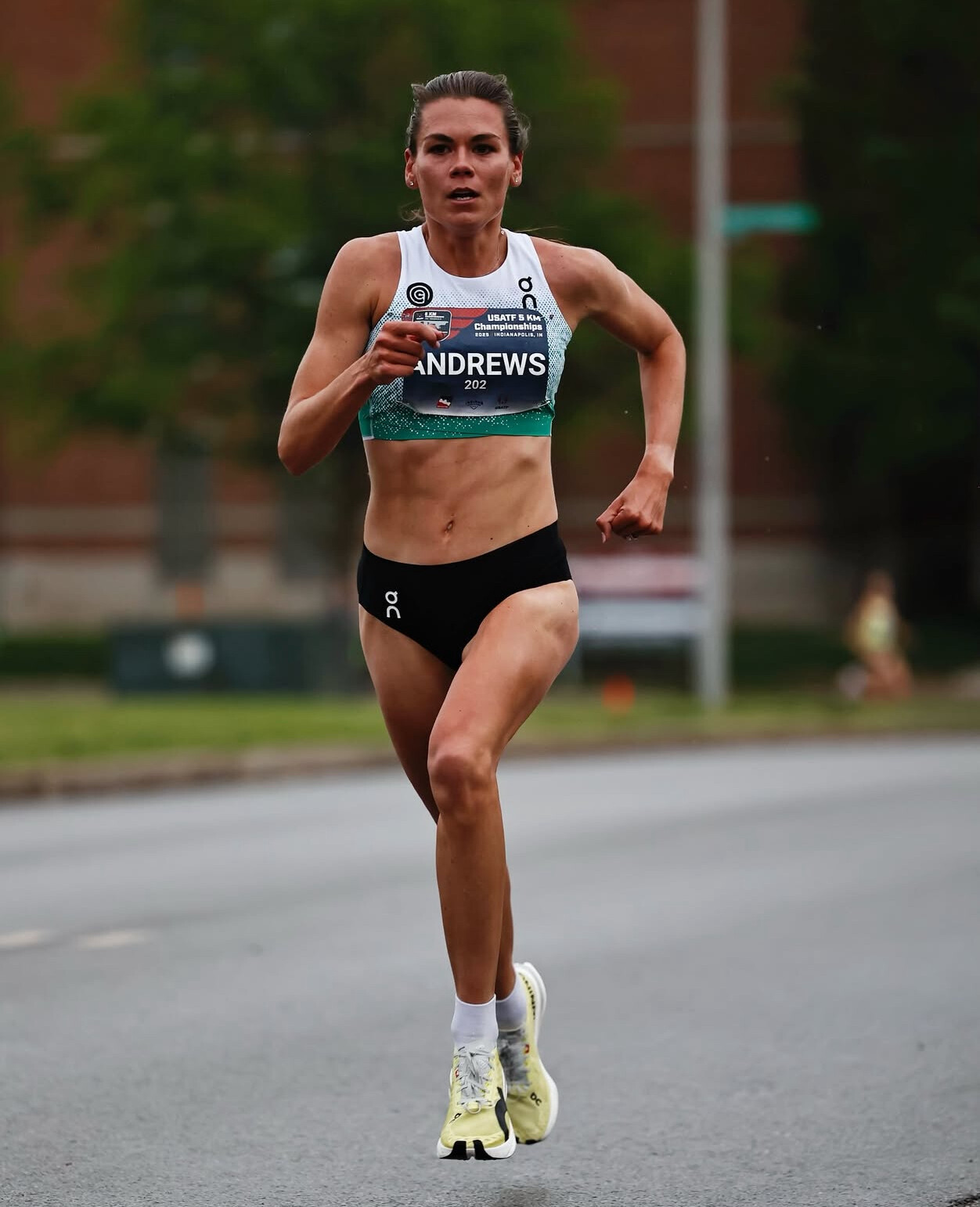
1. Josette Andrews – 15:12.34
2. Emily Infeld (Nike) – 15:14.50
3. Karissa Schweizer (Nike Bowerman TC) – 15:16.75
4. Elly Henes (adidas) – 15:19.20
5. Rachel Schneider (Under Armour) – 15:22.85
6. Abbey Cooper (New Balance) – 15:25.40
7. Molly Seidel (Saucony) – 15:28.95
8. Vanessa Fraser (Nike) – 15:31.50
9. Emily Lipari (adidas) – 15:34.05
10. Natosha Rogers (Hansons-Brooks) – 15:36.60
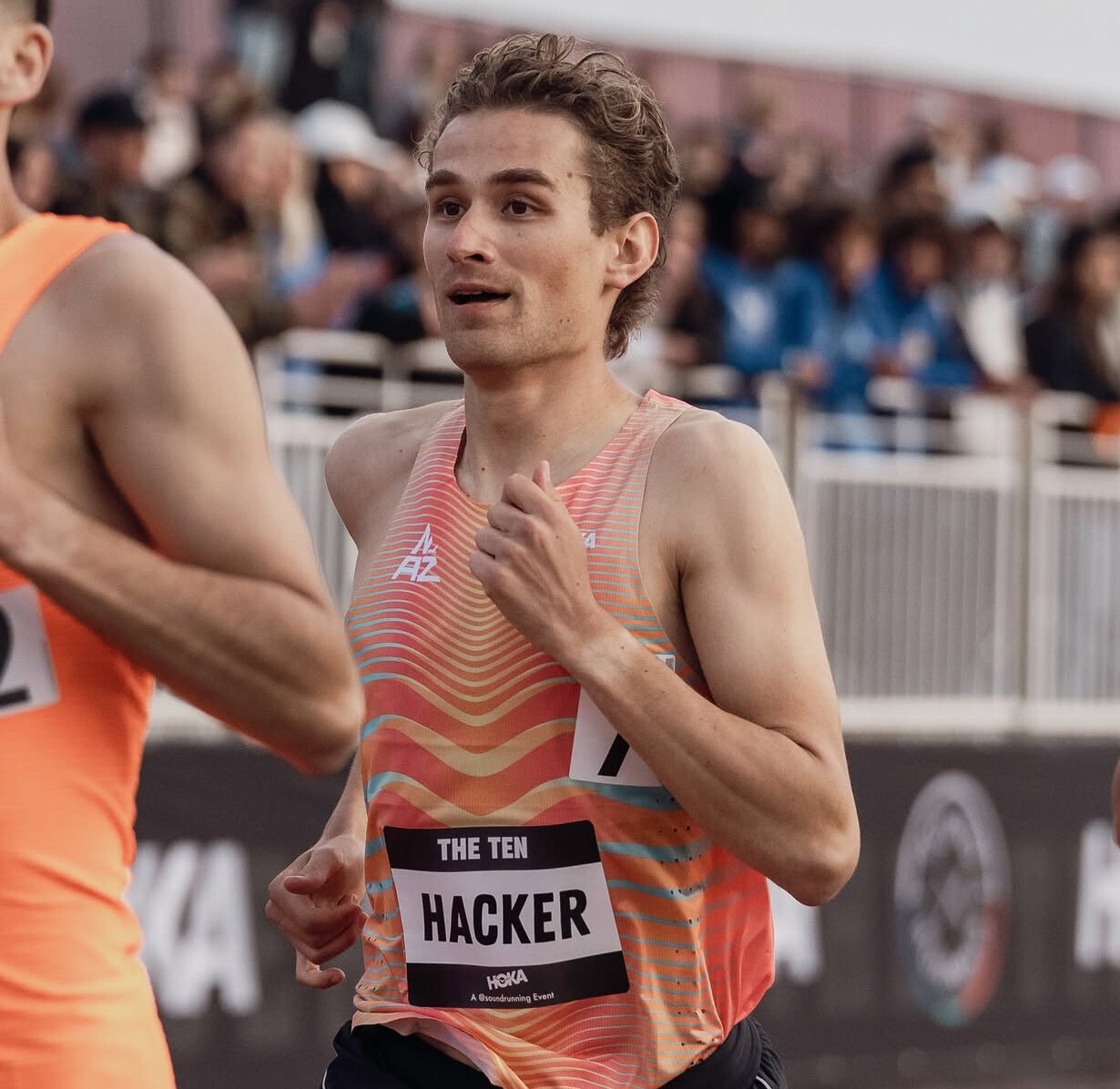
The performances in Indianapolis set the tone for what promises to be a fast and competitive summer racing season across the U.S. road circuit.
by Boris Baron
Login to leave a comment

OneAmerica 500 Festival Mini-Marathon
The mission of the 500 Festival is to produce life-enriching events and programs while celebrating the spirit and legacy of the Indianapolis 500 and fostering positive impact on the city of Indianapolis and state of Indiana. As an organization providing multiple events and programs, many of which are free to attend and impact over 500,000 people annually, our mission to...
more...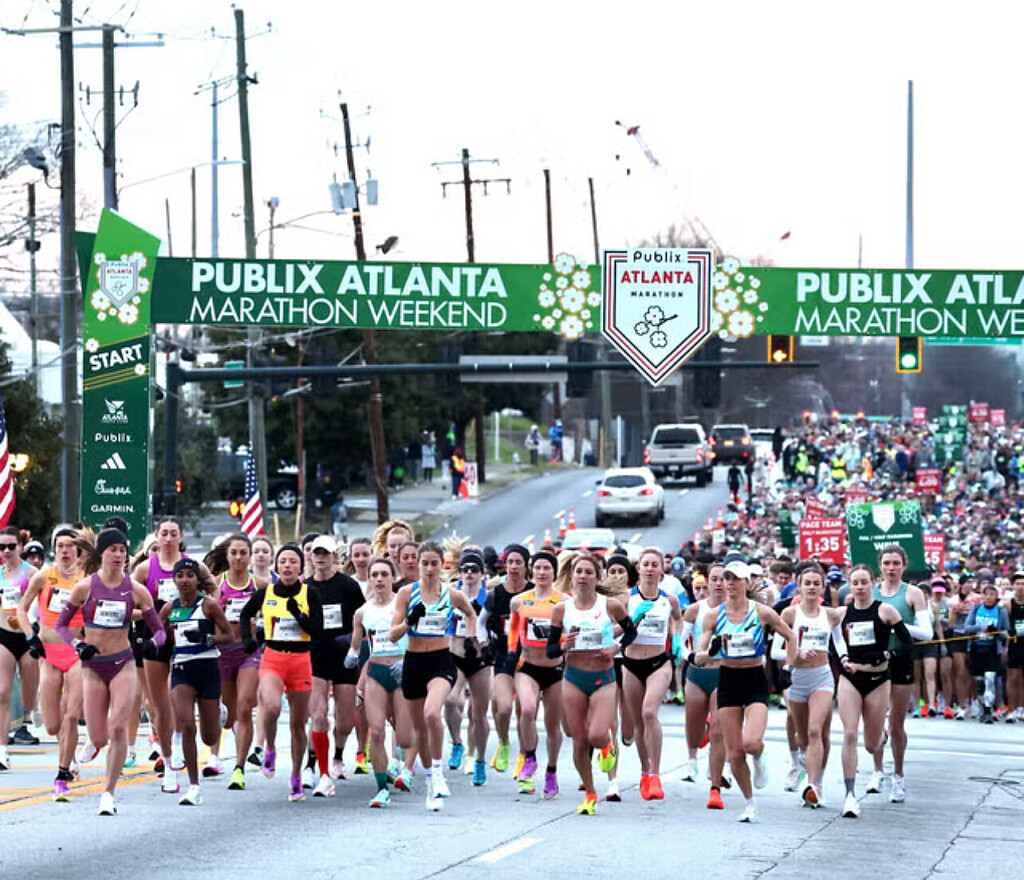
Roe and Maier Dominate USATF Half Marathon Championships
On a chilly morning in Atlanta, runners took to the streets for the USATF Half Marathon Championships on March 2, 2025, battling for national titles and a chance to represent Team USA at the World Athletics Road Running Championships in San Diego this September. With fierce competition and fast times, Taylor Roe and Alex Maier emerged as the day’s champions.
Roe Breaks Away to Claim First National Title
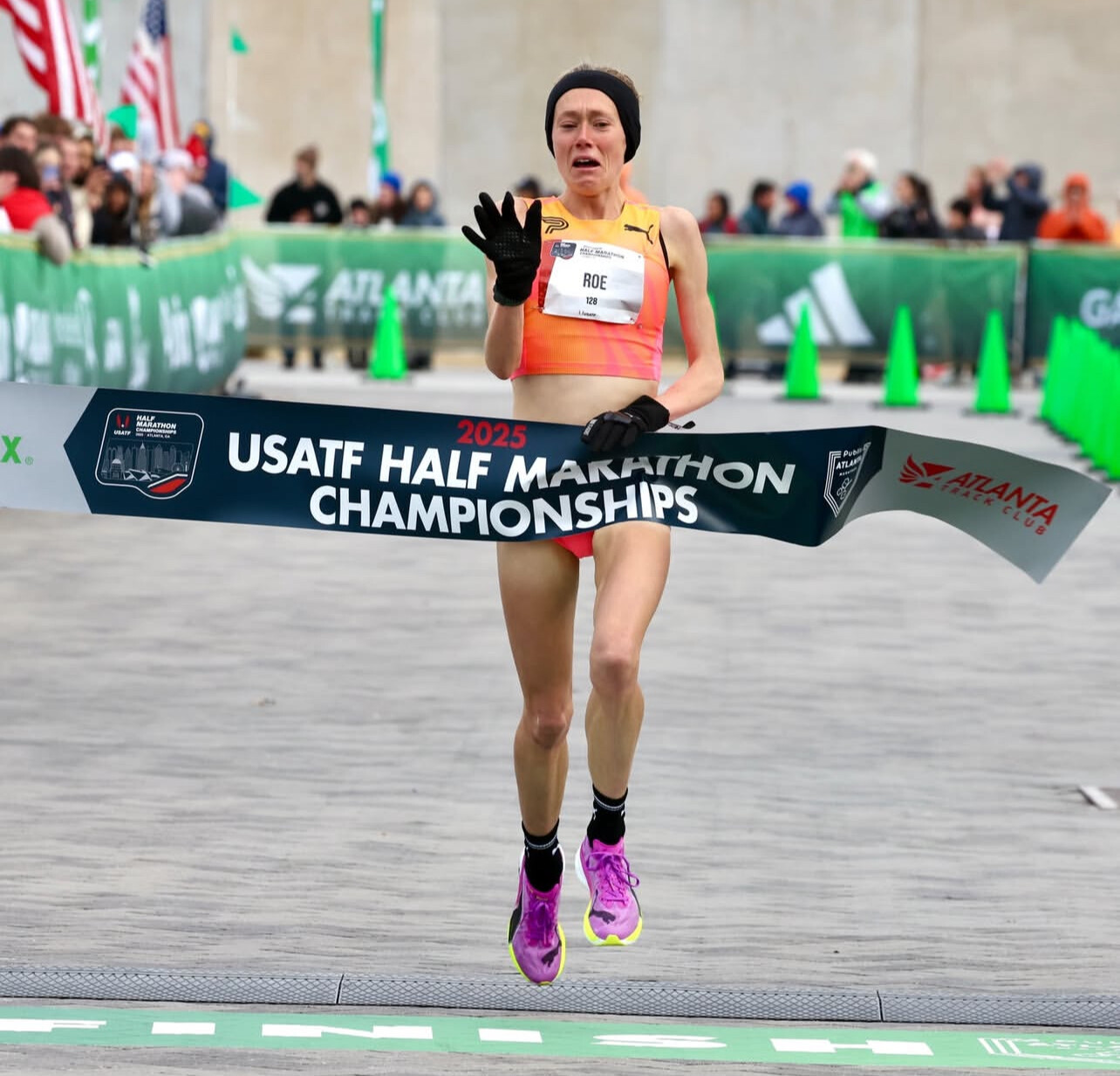
Taylor Roe made a statement in the women’s race, surging ahead in the final miles to secure victory in 1:07:22. The Durham, North Carolina, standout, representing PUMA Elite, held off a strong challenge from Emma Grace Hurley, who finished second in 1:07:35. Amanda Vestri of Blowing Rock, North Carolina, rounded out the podium with a solid 1:08:17.
With their top-three finishes, Roe, Hurley, and Vestri secured their spots on Team USA for the World Championships in San Diego.
Top Five Women:
1. Taylor Roe (Durham, NC) – 1:07:22
2. Emma Grace Hurley (Indianapolis, IN) – 1:07:35
3. Amanda Vestri (Blowing Rock, NC) – 1:08:17
4. Jessica McClain (Phoenix, AZ) – 1:08:37
5. Emily Venters (Salt Lake City, UT) – 1:09:03
Maier Holds Off Late Challenge to Take the Men’s Crown
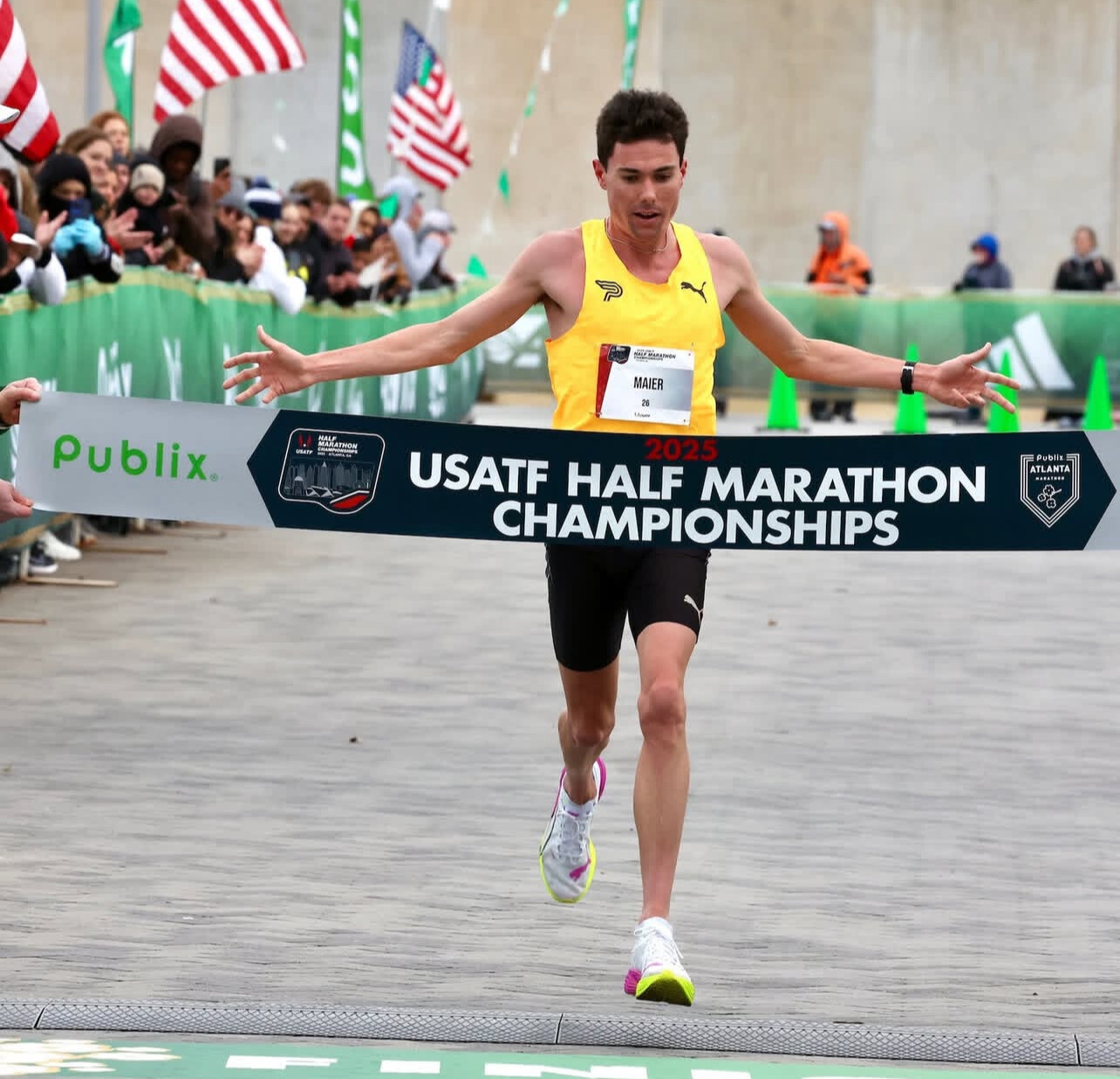
In the men’s race, Alex Maier delivered a strong performance, crossing the finish line in 1:00:48 to claim his first USATF Half Marathon title. The Chapel Hill runner, also representing PUMA Elite, stayed composed as Shadrack Kipchirchir of Colorado Springs pushed hard in the final stretch, finishing just 10 seconds back in 1:00:58. Hillary Bor made it a tight battle for second and third, clocking 1:00:59.
Maier, Kipchirchir, and Bor will now represent Team USA at the World Championships, where they’ll take on some of the world’s best in San Diego.
Top Five Men:
1. Alex Maier (Chapel Hill, NC) – 1:00:48
2. Shadrack Kipchirchir (Colorado Springs, CO) – 1:00:58
3. Hillary Bor (Colorado Springs, CO) – 1:00:59
4. Ahmed Muhumed (Flagstaff, AZ) – 1:01:03
5. Andrew Colley (Blowing Rock, NC) – 1:01:09
All Eyes on San Diego
With the USATF Half Marathon Championships in the books, the focus now shifts to the World Athletics Road Running Championships in San Diego this September. The newly crowned national champions, along with the other top finishers, will have the opportunity to take on the best distance runners from around the globe. If their performances in Atlanta are any indication, Team USA will be ready to make an impact on the international stage.
Login to leave a comment
You Should Stop Showering Between Runs—and My 7 Other Running Rules for 2025
If you’ve been on social media lately, you might have seen your friends making in-and-out lists. It’s been a thing for a few years—maybe less-so now—but the idea is to come up with some trends that you think will be popular and unpopular.
The best ones are fun and off the top of the head. Some of the thought-out ones about culture are kind of annoying. (Yeah, everyone agrees that “being mean” is out in 2025.)
So I took the idea and applied it to my own running. Remember, these are specific to my experience. They’re not mandates or absolutes or even advice.
And at the end of the year, feel free to call me out if I was wrong. I probably was.
Out: Showering between runs
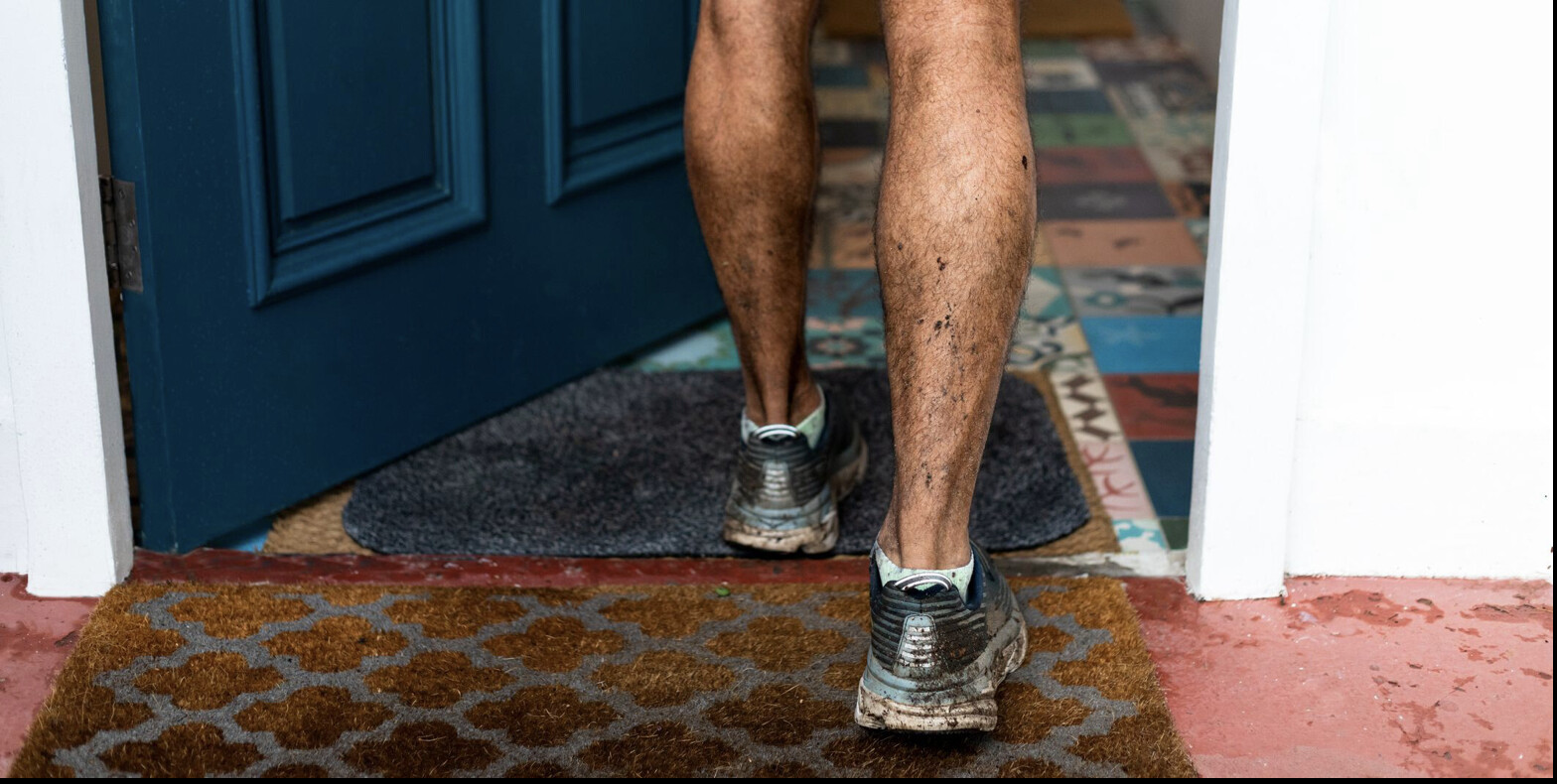
In a normal training week, I run twice a day on Wednesday and Thursday. Those are my recovery days, and I use them as a chance to get ahead on my weekly mileage. Usually, I run between 60 and 85 miles a week during marathon training, so to break it up, I’ll run once before work and then again during lunch or after work. Also known as “doubling.”
But that laundry piles up fast.
So on days when I work from home, sometimes I’ll put off my shower and stay in my workout clothes until my next run or weightlifting session. I live alone, so there’s no one to complain about my odor. (If you live with a roommate, partner, or family, use this strategy at your own risk.)
In: Wearing ugly race T-shirts
Remember the race T-shirts of the 2000s? The ones that looked like they were designed by a middle schooler and had no fewer than 1,000 ads on the back? I’ve gotten so many over the years, and most have gone straight to Goodwill or I’ve used them for yard work. But this year, I’d like to use my race T-shirts for their purpose—and run in them. There’s something fun about wearing an ill-fitting cotton tee with an ad for Jimbo’s Ford Dealership on the back.
Some races are pivoting away from shirts in favor of more environmentally friendly alternatives, but don’t expect them to completely disappear. According to Running USA, 58 percent of participants who took the 2024 Global Running Survey said that commemorative T-shirts are important to their race experience.
Out: Long runs
I’m planning on running Grandma’s Marathon in June, which means I’m building up my mileage now. But I’ve found that long runs are kind of overrated. Hear me out.
During my last marathon training block, I never ran more than 18 miles for my long run. Many programs call for 20 to 23-mile long runs, but my coach and I decided that 18-milers would get the job done. I’ve been running high mileage for close to a decade now, so I have a large aerobic base. The strategy worked, and I ran 2:27:07, hitting my goal of sub-2:28.
Right now, as I build, my coach and I are experimenting with the idea of downplaying the long run. Instead of using it as a key workout (for example, 10+ miles at marathon pace during the run), we’re focusing more on high-volume workouts twice a week, then using the long run just to get time on my feet. Similar to how Jakob Ingebrigtsen, who never runs more than 12.5 miles, trains.
A hard long run takes a large emotional and physical toll on my body, so I’ve found that I respond well when I keep the long run easy and focus on high-volume threshold sessions during the week. Of course, running on tired legs is key to running a good marathon. As I get closer to June, I’m sure there will be weeks where I use long runs as key workouts. But sometimes I need to remind myself that the other six days of the week are just as important.
In: Wearing a T-shirt over a long sleeve
For the past year, I’ve been mulling over buying a running vest. They look cool, but I keep telling myself that I don’t need to buy something that I’d probably only wear on a few runs each year. I live in eastern Pennsylvania, so I’m usually wearing something light in the fall or a full jacket in the winter. Enter, the working man’s vest: the T-shirt over the long sleeve shirt.
The sleeves keeps your arms warm while the T-shirt acts as a protectorate for your torso, insulating (not suffocating) you from the wind. Cooper Teare is a big fan.
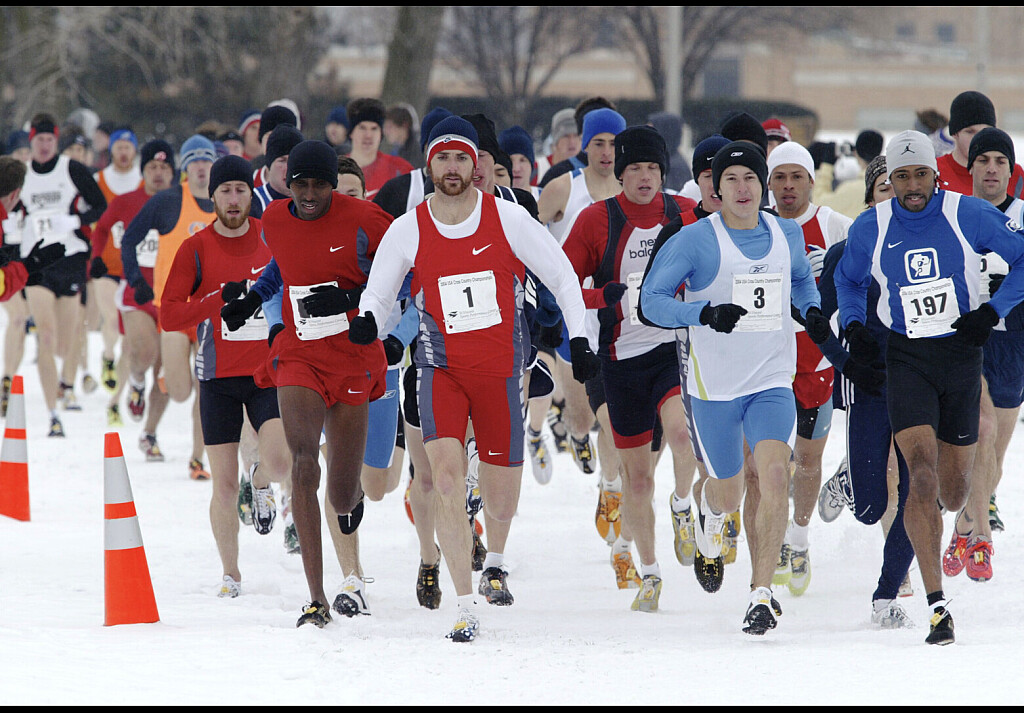
Bonus points if you pair the look with an ugly race T-shirt. And double bonus points if you rock the look in a snowy race, like seemingly everyone did at the 2004 USATF Cross-Country Championships in Indianapolis.
In: Sunscreen
Man, I’m bad at this. If I’m preparing to sit out at the beach or pool, I lather up thoroughly. But if I’m heading out for a 90-minute run, I rarely put on sunscreen, justifying to myself that the route is shady or 90 minutes isn’t that long in the sun.
I’ve gotten better at sun protection—I almost always wear a hat and sunglasses year-round now—but I need to get better at lathering up on a regular basis. If you see me jogging this summer, ask me if I have sunscreen on and, if I don’t, shame me until I turn around and go home.
Out: Marathon bottle service
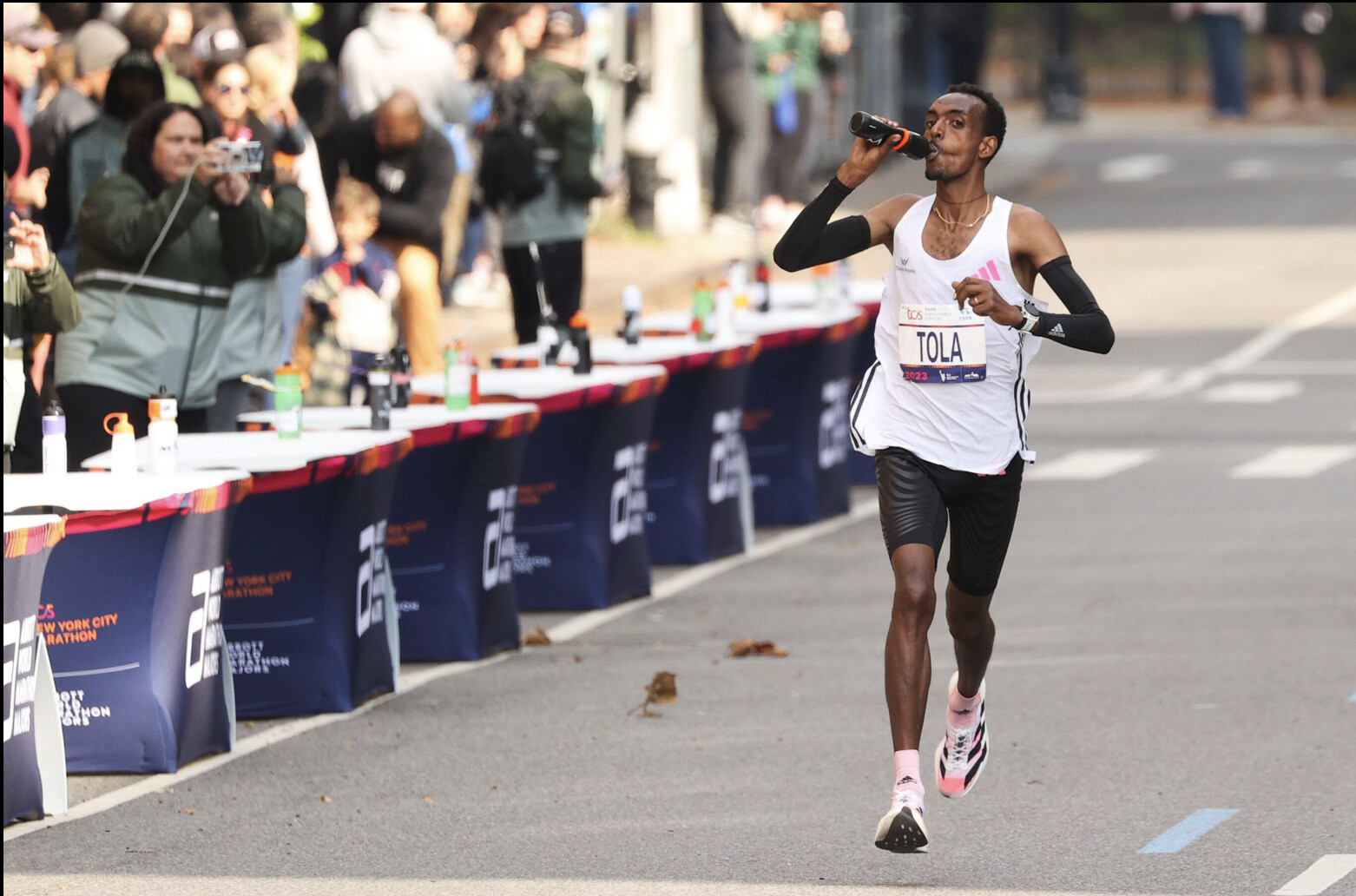
In my debut marathon at Indianapolis in November, I was lucky enough to qualify for the elite field, meaning I got perks like reserved restrooms, a separate warm-up area, and bottle service. For those unfamiliar, bottle service at a marathon is different from bottle service at a Las Vegas nightclub. Instead of access to marked-up Patrón, you get reserved spots on the course where you can stash your race fluid bottles.
Because there’s limited space, bottle stations are typically reserved for the fastest runners at a marathon. Instead of fumbling with the water or electrolyte-drink cups that the masses use, elites can consume whatever they trained with. In most cases, it’s some kind of carbohydrate mix.
At Indianapolis, there were three bottle stations: at miles 8, 14, and 20. I filled mine up with Maurten 160, but honestly, I didn’t feel like the perk was that necessary. I carried eight gels with me, taking them every 15 to 20 minutes, which was plenty. The bottles felt like more of a bonus or palate cleanser. They were cumbersome to hold and drink at race speed, and I found myself only taking a few sips then discarding them. Plus I had to pee the entire race, so I didn’t want to make the situation more dire.
Previously, I thought bottle service was non-negotiable to running a fast 26.2. But my mind has changed. If you envy the pros for their bottle access, don’t worry, you’re not missing out. Gels get the job done.
In: Off-distance races
I’m stealing this one from my 2024 in-and-out list. Off-distance races are events that diverge from traditional race distances (like the 5K, 10K, and marathon). Popular examples include the Bix 7 Road Race in Iowa (a 7-miler), the Boilermaker 15K in New York, and the Manchester Road Race in Connecticut (4.737 miles).
My favorite off-distance event is the Run for the Diamonds in Berwick, Pennsylvania. It’s a Thanksgiving day 9-miler that’s been going strong since 1908. The whole town comes out and cheers the runners up and down the massive hill that’s sandwiched in the middle of the route. Plus, the top seven men and women get real diamonds!
In: Short trail races
Speaking of race distances, let’s make short trail races a thing in 2025. Ultramarathons get most of the attention, but they’re not for everyone. At risk of contradicting myself against my previous “in,” there are plenty of trail options at the 5K, 10K, and half-marathon distance. Local state parks may host them, or sometimes there are running races tied in with mountain bike or cyclocross races. (Fifth Street ‘Cross in Pennsylvania does a great job of putting on both.)
I’d love to jump in a trail half marathon this summer between my two marathon training blocks. There won’t be any pressure to run a certain time, and let’s be real, running on the roads gets boring sometimes.
Login to leave a comment
Former pro runner arrested for relationship with high-school student
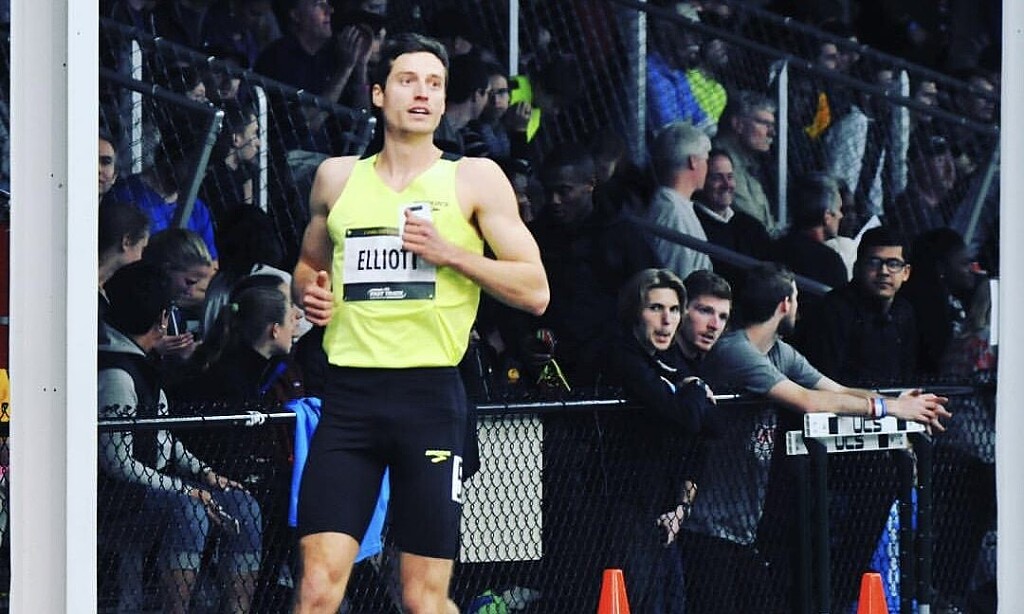
Charlotte, N.C., high school running coach and former elite runner Matthew Elliott was arrested on Wednesday and charged with two counts of “indecent liberties” with a student. Last Friday, the victim, who is now an adult, came forward to the local police department, reporting the inappropriate relationship she had with Elliott, who was her cross-country coach while she was enrolled at the school, Charlotte Country Day.
Reportedly, the victim told officers that Elliott flirted with her and made “numerous advances,” and that they had an inappropriate relationship.
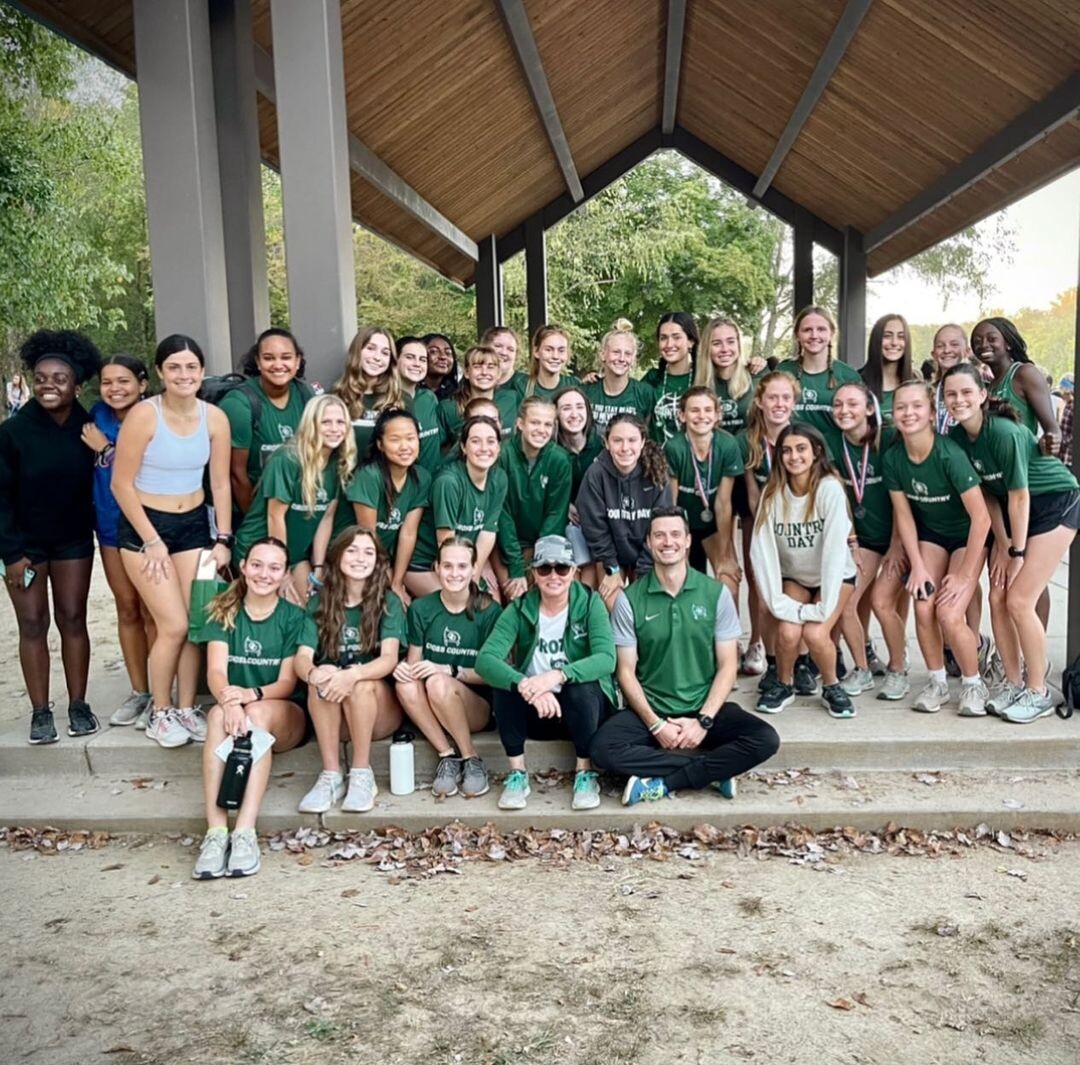
Elliott, 39, had been a coach and a substitute teacher at the high school since 2015. After the allegations emerged, the school terminated Elliott’s employment, barred him from their campuses and informed families and alumni of the misconduct. The statement revealed that the victim attended the school within the past few years.
“America’s fastest kindergarten teacher”
The development comes years after Elliott rose to fame in 2013 after placing fourth in the 1,500m at the U.S. Track and Field Championships, beating elite runners while teaching full-time. An emotional post-race interview with Elliott went viral; the athlete even received autograph requests in the mail. That year, he was referred to as “America’s Fastest Kindergarten Teacher,” and was a cover model for both Runner’s World and Running Times magazines.
Elliott was a kindergarten through third-grade teacher for children with special needs at the Palmetto School in Rock Hill, S.C. The magazine story revealed that the teaching job required Elliott to act as a bus driver as well; he drove the kids to and from their homes before and after school.
During his career, Elliott was coached by American Distance Project coach Scott Simmons and joined the Team Indiana Elite running group alongside athletes such as William Leer. He broke the four minute barrier on multiple occasions and became a Brooks-sponsored athlete.
He set his sights on making the 2016 U.S. Olympic team, and gave inspirational talks to cross-country teams about his journey. In 2021, Elliott was featured in a podcast for The Unearthing Project, where he shared his running and coaching stories. Elliott hasn’t competed since 2019, according to his World Athletics profile.
None of the recent allegations against Elliott have been proven in court. News sources report the former coach was held on a USD $10,000 bond and was released on Thursday morning, but was set to face a judge that afternoon.
by Cameron Ormond
Login to leave a comment
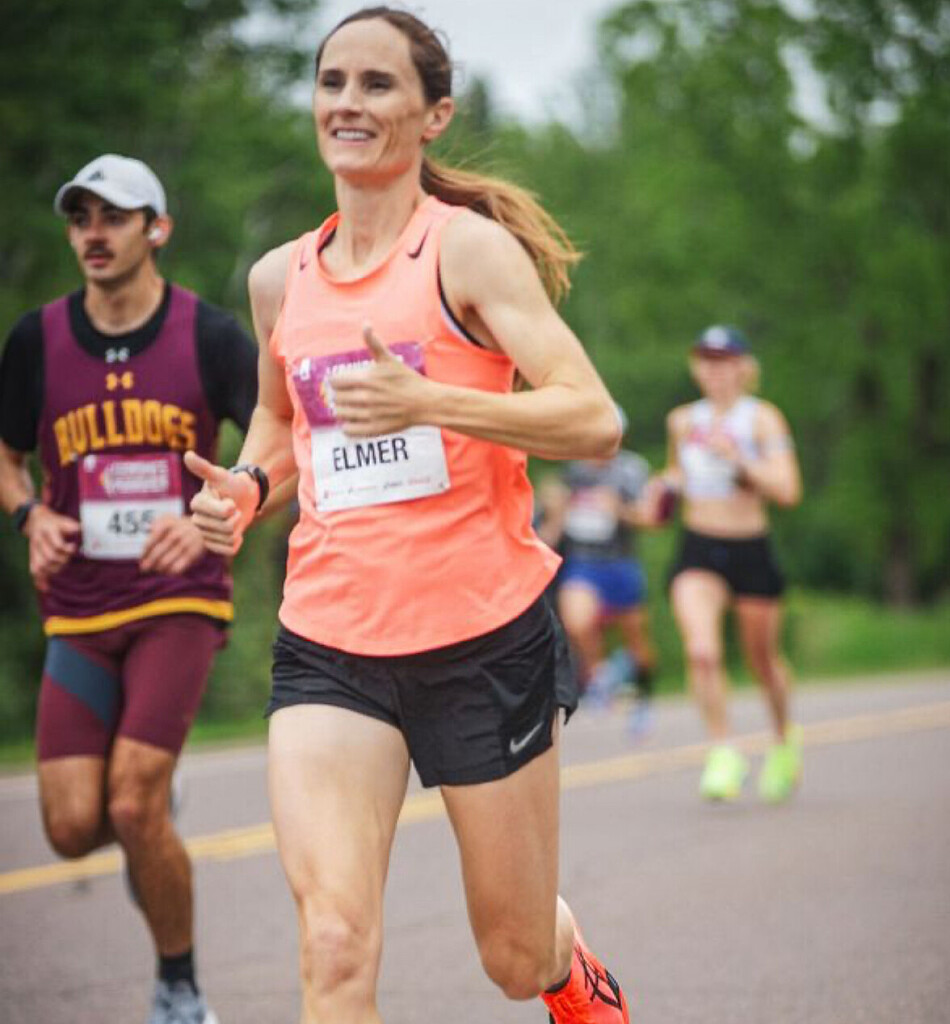
Rena Elmer, a former steeplechaser who’s had two kids since running the 2020 Olympic Marathon Trials, placed seventh at Grandma’s Marathon.
In March, Rena Elmer watched her daughter Taryn—a freshman at Marcus High School in Flower Mound, Texas—run a personal best 5:15 mile in a downpour.
So when Taryn saw the forecast for Grandma’s Marathon this weekend, she had a message for her mom. “She grabbed my shoulders and said, ‘Mom, you’re going to PR,’” Elmer told Runner’s World by phone on Sunday. “I PRed in the rain—you can PR in the rain, too.”
The elder Elmer, who’s 41, took those words to heart. Despite steady showers, she ran 2:35:45—nearly 5 minutes off her previous personal best—and placed seventh in her third marathon.
The time came as a bit of a shock to Elmer. She hadn’t raced 26.2 miles since the 2020 Olympic Marathon Trials in Atlanta, where she ran2:41:22 to place 53rd. In the two years since, she’s had two more children—Jane, born in January 2021, and Jessica, born in December 2022—to add to her previous nine.
In fact, the only time she’d raced in the past four years was in March. Then, she won the Irving Half Marathon in 1:17:58 to gain entry to the elite field at Grandma’s. Based on that, and the times she’d run in training, she expected to be able to run between 2:40 and 2:42.
But all those paces have come in the brutal Texas heat. And though she uses a pace calculator during training to account for conditions, Saturday’s mid-50s temperatures and tailwind at the start left her feeling better than anticipated. She started the first 5K at 6:12 pace and gradually picked it up from there, latching onto other runners as she went and covering the last 10K at 5:44 pace.
“It was incredible—it felt so good, I just felt so powerful and smooth and strong,” she said. “I just love running for that feeling.”
The sport has long brought Elmer joy and carried her through both triumphs and tragedies. After running in high school in Beaver, Utah, she walked on to the track and cross country teams at Brigham Young University. Her junior year, she placed third in the 3,000-meter steeplechase at the 2005 NCAA outdoor championships.
She kept running after graduation, and after narrowly missing in 2008 and 2012, qualified for the 2016 Olympic Track and Field Trials in the steeplechase. There, she made the final and finished 10th.
In between those accomplishments came incredible hardships. She had her first two children—Taryn and her twin brother, Talon—in 2009, and Elmer developed serious complications afterward. And in 2015, two more children later, an abusive situation involving her now ex-husband broke her family apart.
But her sport—and her faith—carried her through. In January 2017, she met Will Elmer, who also had four children. They married and joined their families, and since then have had three more kids.
Elmer switched to the marathon in 2019, and ran 2:40:21 in her debut at the Indianapolis Monumental Marathon to qualify for the Trials.
by Runner’s World
Login to leave a comment
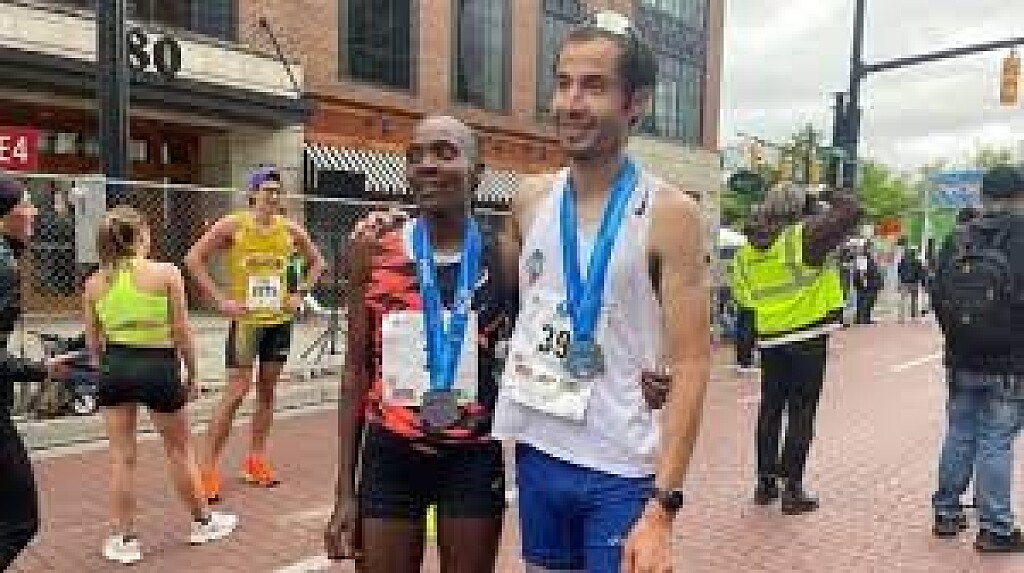
Betsy Saina, Diego Estrada win Amway River Bank Run 25K
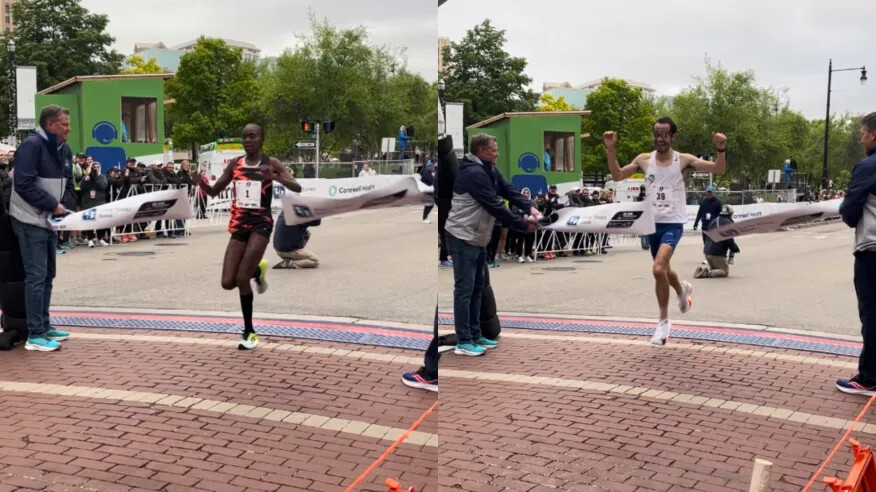
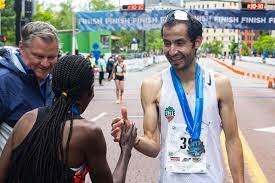
Betsy Saina, now a back-to-back champ, crossed the finish line first to win the 47th annual Amway River Bank Run women’s 25K Saturday, followed by the record-breaking men’s winner Diego Estrada.
Saina finished with a time of 1:22:31.61. Estrada had a time of 1:13:09.51, breaking the American record. Each earned the $10,000 first prize and Saina got a $2,500 bonus for winning the ‘race within a race’ that pits the men against the women.
After winning the River Bank Run for the second year in a row, Saina said Grand Rapids has a special place in her heart.
“Last year, when I came, I won the race, and I felt like it was a special place for me. Honestly, I love Grand Rapids. It’s one of the best cities I like to be in. The people are so nice. Everything is just so perfect for me. That is why I am here,” she said.
Saina, who has a 2-year-old boy, had a message for her fellow mothers.
“I just want to let them know that no matter what, when you have a child, it’s not the end of the career, it is the beginning of it,” said Saina.
At this year’s race, Estrada broke the course record and set a new American record for the 25K. After finishing the race, Estrada fell at the finish line out of exhaustion.
“I was very exhausted. I made sure to put everything I had so there was nothing left in the reserves. So when I finished, I was like I hope it does not hurt because I’m going down,” said Estrada.
He said that he pushed himself hard during the last two miles of the race.
“Well, to be completely frank, when you are broke and this is how you eat, you can’t leave it up to chance,” said Estrada. “I knew I kind of had to suffer and put it down and that is what I did. I made a move.”
The 25K is the largest road race of its kind in the country and the national championship event for USA Track and Field. It has included the “race within a race” since 2015: The elite women get an 10:30 head start on the men to compensate for the average difference in finish times between sexes. If the women hold their lead and finish first, they win. If the men make up that difference and finish before the women, they win.
Tom Davis, from Fremont, Indiana, won the 25K handcycle race. He is a retired two-time Paralympian who started handcycling after he was injured while serving in Iraq.
“I started doing handcycling for therapy. A couple of years after that, I felt like God was telling me to get my bike out, start riding it, and race it and do it to glorify him. I did. It has been about eight years racing at the top level in the world,” said Davis. “I’m out here doing it for fun now.”
Miguel Jimenez-Vergara, from New Jersey, won the 25K wheelchair race. It was his first time participating in the Amway River Bank Run.
“It’s a really, really, really cool course. I have never done it before. It’s my first time coming out. It’s a really cool course with smooth roads and rolling hills. It was really cool,” said Jimenez-Vergara.
He plans to take part in the U.S. Paralympic Trials in Florida in July in hopes of joining the U.S. Paralympic Team this year in Paris.
by Michael Oszust, Rachel Van Gilder
Login to leave a comment

Amway River Bank Run
The Amway River Bank Run presented by Fifth Third Bank with Spectrum Health the Official Health Partner celebrates over 43 years. More than 16,000 people are expected to compete in the event which features the largest 25K road race in the country and offers the only 25K Wheelchair racing division in the world along with a 25K Handcycle division. The...
more...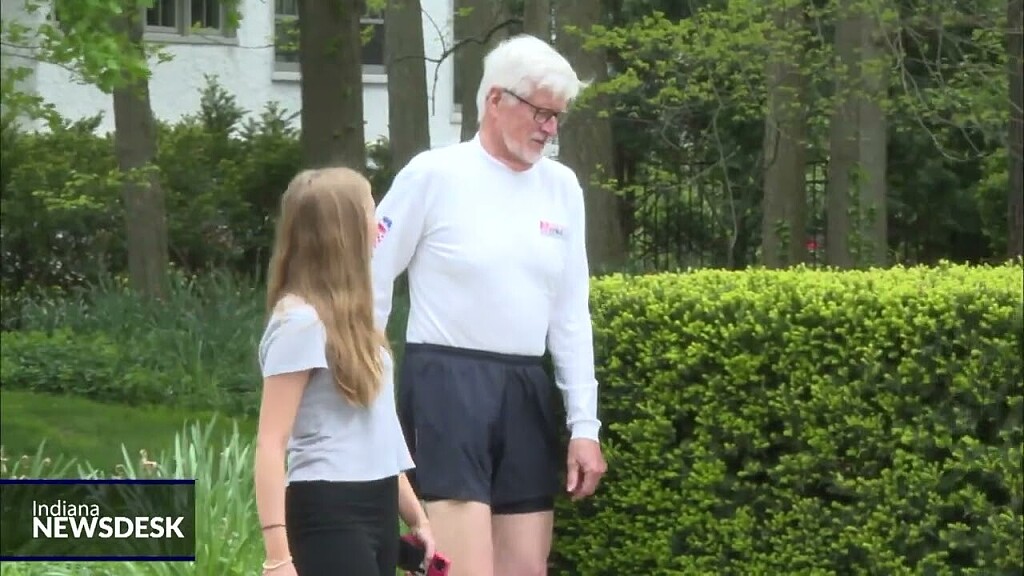
Meet the 85-year-old man who’s run every OneAmerica 500 Festival Mini-Marathon
For most people, running just one marathon is a big achievement.
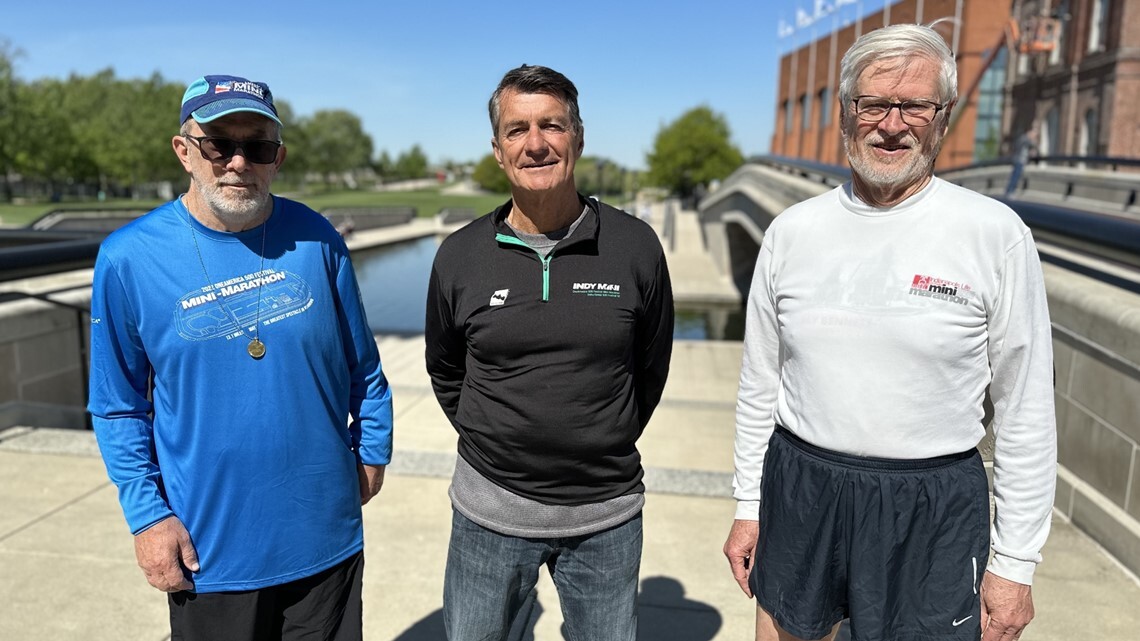
But for 85-year-old Eugene Lausch, running in his 48th mini-marathon Saturday will be just another accomplishment.
The retired lawyer has run more OneAmerica 500 Festival Mini Marathons than nearly everyone in the field. Of the approximate 200,000 runners, Lausch is one of only six who have participated every year since the marathon’s start in 1977.
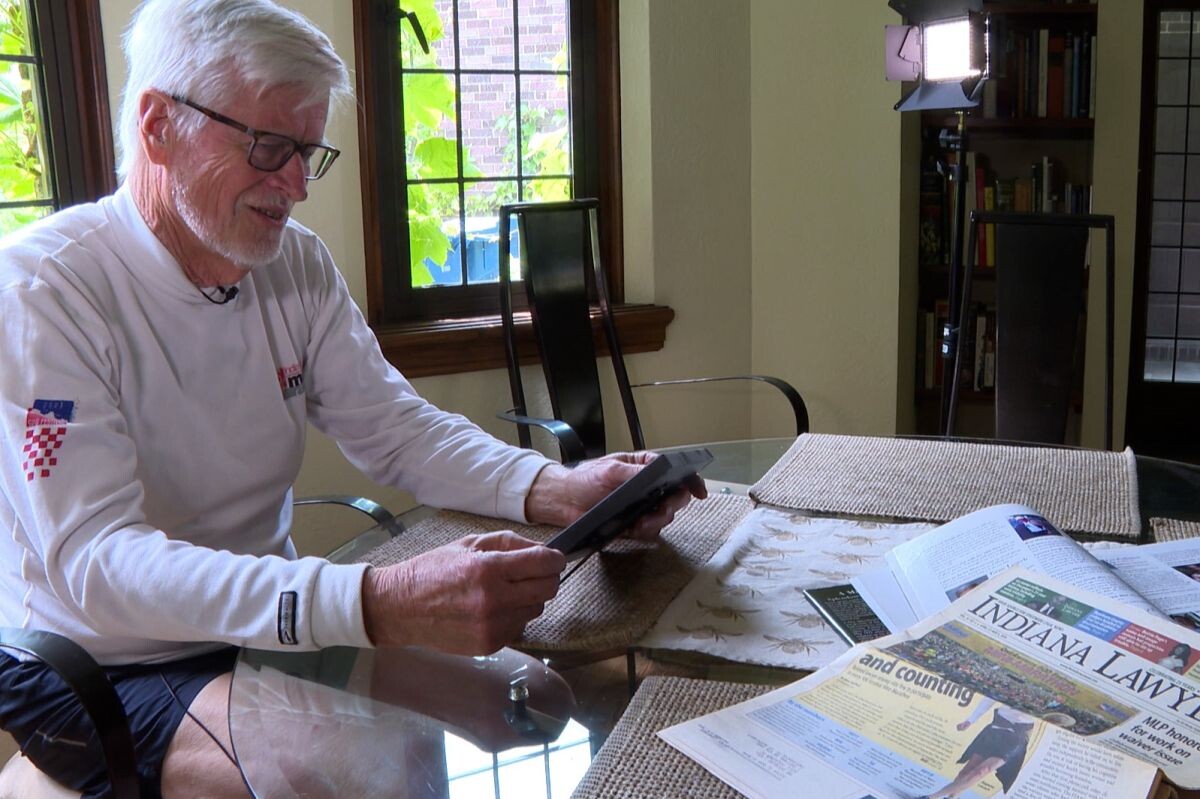
It’s a hobby that came to him almost by accident.
“I desperately wanted to be an athlete when I was a boy and, like every Hoosier lad, I wanted to be a basketball player, but I don't have good hand-eye coordination,” Lausch said.
And since basketball requires a great deal of hand-eye coordination, he settled on running.
And, obviously, the hobby has stuck around.
As a student at Indiana Central University, now known as the University of Indianapolis, Lausch ran track. He went on to compete in the Indianapolis-Scarborough Peace Games and later coached track at the St. Richard Episcopal School in Indianapolis.
But his passion for marathons began in 1977, after being inspired by Olympian Frank Shorter. In the early seventies, Shorter became the first American runner in decades to win the Olympic marathon.
“That was an inspiration for a lot of people, including me,” Lausch said.
And 48 years later, he’s still going.
To keep fit, his regime is simple.
“I walk 23 miles a week,” he said. “Also, I do a considerable amount of outside activity and gardening that I think helps keep me fit.”
And even though Lausch is in better shape than most 85-year-olds, it hasn't always been easy.
In 2019, Laush was hit by a car while crossing the street.
“A car, which I never saw, knocked me down and broke my left hip,” Lausch said. “It was determined pretty quickly that my hip was fractured.”
The doctors told Lausch what he was already expecting, that he couldn't participate in the mini-marathon.
His ongoing streak would have been ruined if it were not for community members, including his granddaughter Claudia.
Several of the runners from St. Richard Episcopal School and Claudia pushed Lausch in a homemade cart for a portion of the mini-marathon that year.
“I must say that it's a bummer to have to be hit by a car and have your hip broken, but I was really buoyed up by the outpouring support,” Lausch said. “I think I really figured out what the Mini was all about.
“I don't think I really understood it before that it is less about winning. It's more about taking the assets you have and making the best of your circumstances.”
What was once a disaster turned into one of Lausch’s fondest memories associated with the marathon.
Lausch’s wife, Carolyn, and their two sons used to join him during the marathon. But now, Lausch runs by himself.
“I'm really happy about being able to continue to run, but I ended up not knowing very many people now who run the mini,” he said.
But even though he may not know everyone, people seem to know him. After his accident in 2019, several people came up to him to wish him well, he said.
“That was very heartening. I appreciated it a great deal,” Lausch said.
For now, Lausch will be walking the mini-marathon. He plans to continue to do it until he reaches 50 straight races in 2026.
by Grace Marocco
Login to leave a comment
OneAmerica 500 Festival Mini-Marathon
The mission of the 500 Festival is to produce life-enriching events and programs while celebrating the spirit and legacy of the Indianapolis 500 and fostering positive impact on the city of Indianapolis and state of Indiana. As an organization providing multiple events and programs, many of which are free to attend and impact over 500,000 people annually, our mission to...
more...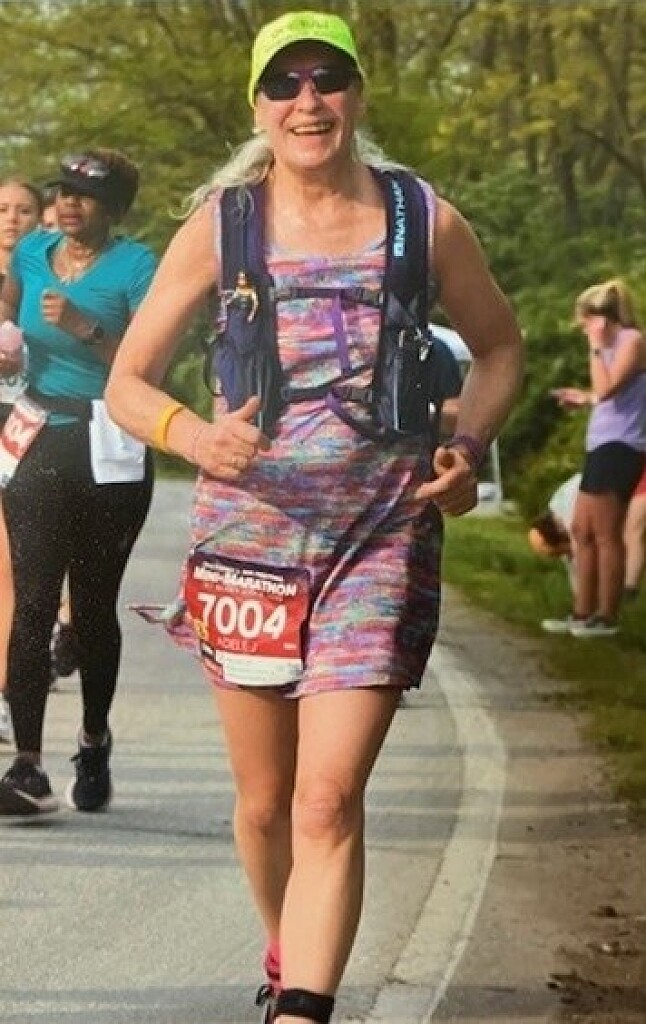
Still running strong: Michigan woman, 73, ready for Indy Mini, her 109th half-marathon
At 73 years young, Adele Pitt is no stranger to darting through the finish line.
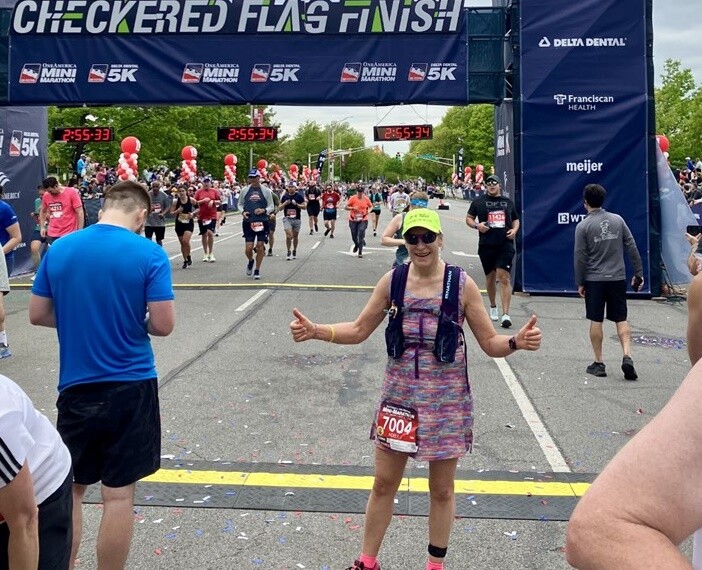
She's gearing up to run her 109th half-marathon in the OneAmerica 500 Festival Mini-Marathon on Saturday, May 4.
"I've run all 50 states and D.C, five continents and a couple islands," she proudly listed.
But the 13.1-mile trek that starts in the heart of downtown Indianapolis is by far her favorite.
"How many people get to run on the Indy 500 track? It's awesome!" Pitt said.
In fact, she loves the "Indy Mini" so much that she's made the trip from her home in Benton Harbor, Michigan, to run almost every year since 2004, only skipping 2018, after she was diagnosed with colon cancer. She skipped that year as she started treatment, but refused to stay down for long.
The diagnosis may have slowed her stride, but never stopped her in her tracks..
She was back the next year, not at full strength, but fully confident she'd "run the cancer away," she said.
"I had a good race that year," she said, looking at a picture from 2019. Pitt loves to look back at race day photos and is now compiling them into a scrapbook.
Now in remission, "Back and Better" seems to be one of her mottos. She's ready to lace up her running shoes, and her running dress (yes, it's a thing, she said) – as she does every year.
"I usually put on a fake tattoo and my mantra is, 'I can, I will, I am and then one foot, one foot, one foot,'" she said. "And that applies to more than just running. It's just one foot at a time, one step at a time."
Still running strong, Adele plans to tackle many more steps, miles and milestones, taking it all in full stride.
"When I got to my 100th race, there were people that were like, 'Well, are you done now?'" she said, gladly telling them, "No, we are never done! We just keep on going."
Login to leave a comment
OneAmerica 500 Festival Mini-Marathon
The mission of the 500 Festival is to produce life-enriching events and programs while celebrating the spirit and legacy of the Indianapolis 500 and fostering positive impact on the city of Indianapolis and state of Indiana. As an organization providing multiple events and programs, many of which are free to attend and impact over 500,000 people annually, our mission to...
more...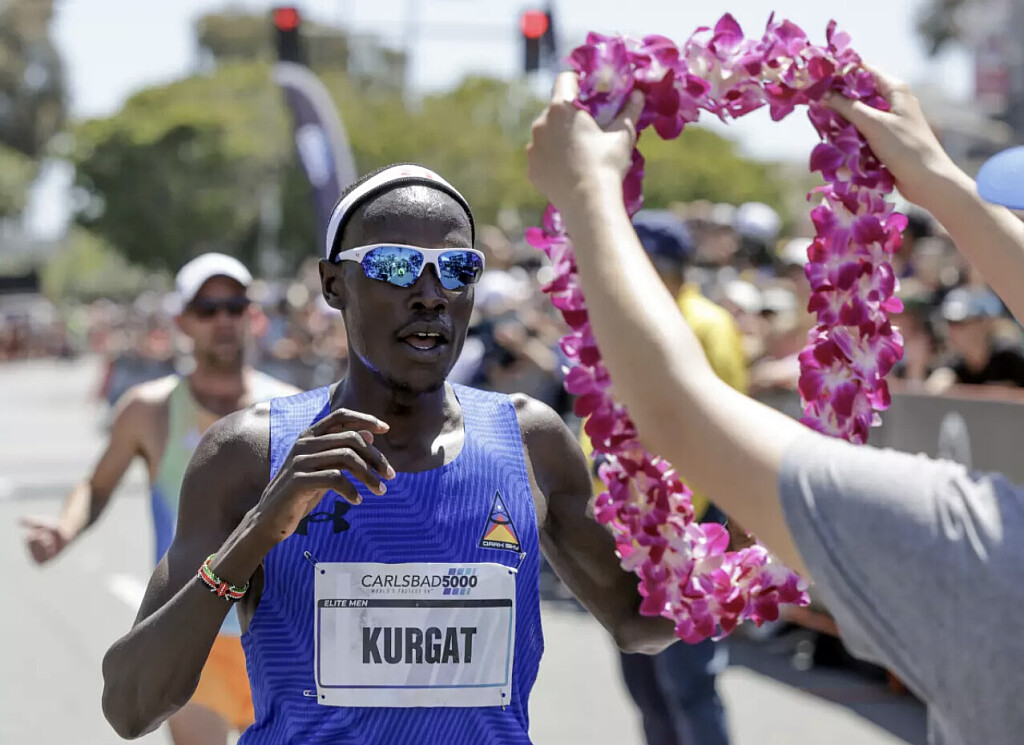
Edwin Kurgat, Laura Galvan defend Carlsbad 5000 championships on race’s new course
Reigning champions Edwin Kurgat of Kenya and Laura Galvan of Mexico successfully defended their titles in the Men’s Elite and Women’s Elite races to cap Sunday’s Carlsbad 5000.
The annual road race in Carlsbad Village, with events throughout the day for runners of different ages and skill levels, featured an updated course that benefited from the picturesque weather.
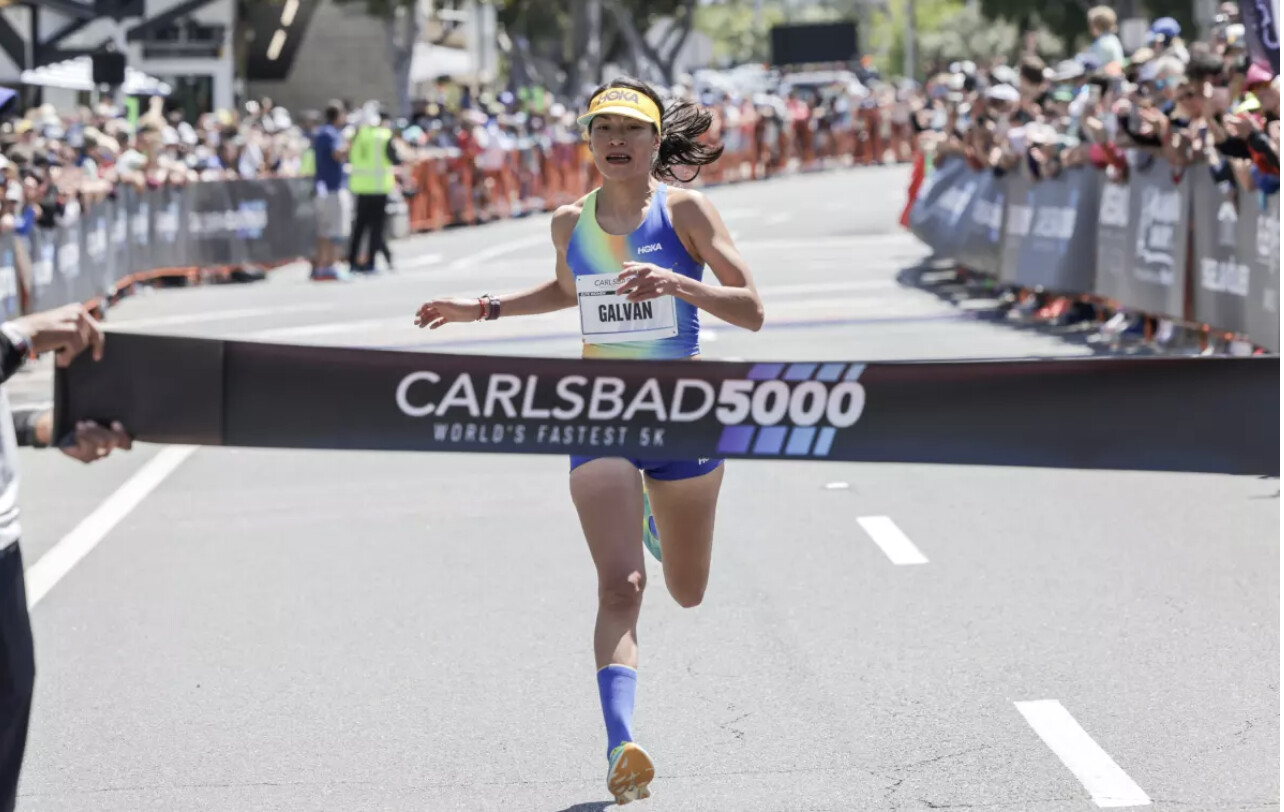
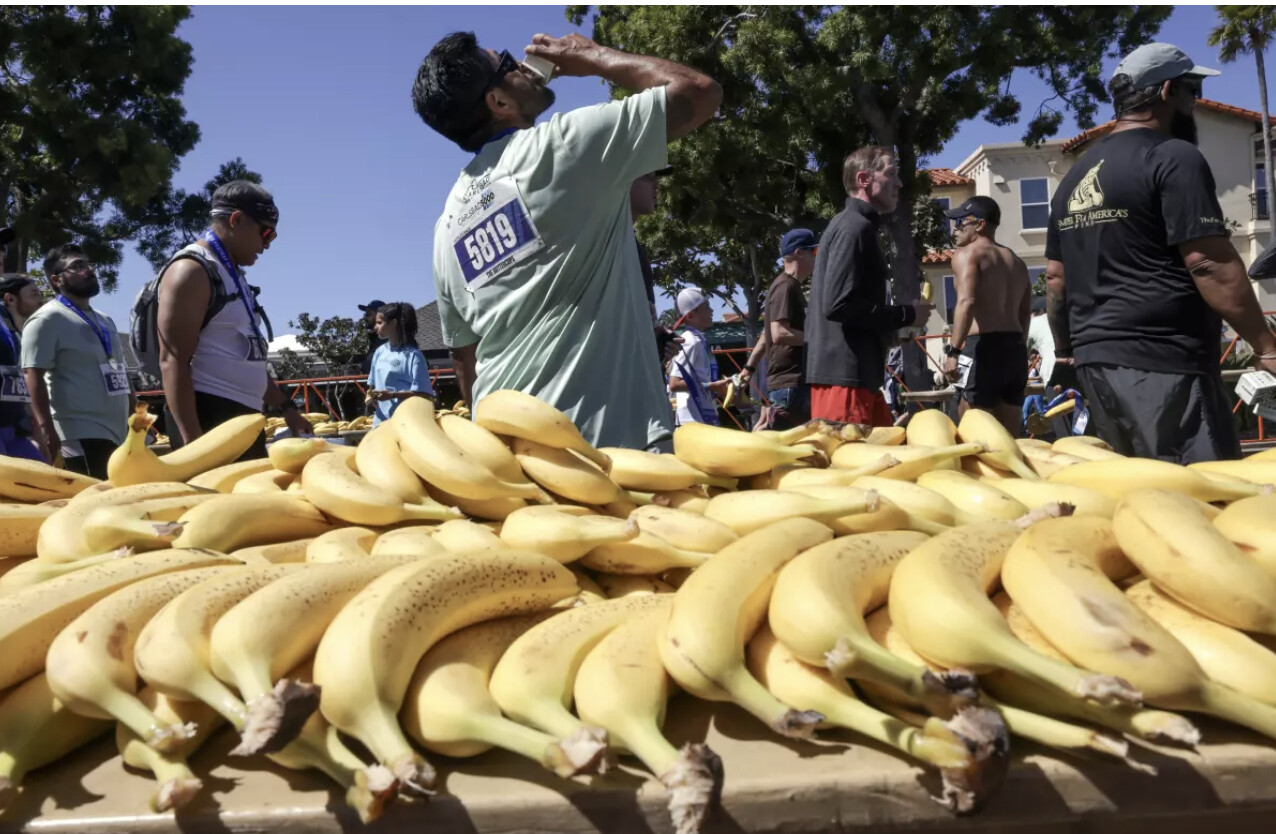
Under blue skies with only wispy clouds, competitors ran parallel to the coastline on Carlsbad Boulevard. They were cheered on both by spectators there to take in the “World’s Fastest 5K” and the beachgoers who became impromptu fans.“The new course is way fun,” said Kurgat. “You don’t have to think about much, so I like it better than last (year’s) course.”
Kurgat’s appreciation for the course manifested in a final time of 13:46.11. His 4:26 pace edged him ahead of New Zealand’s Matt Baxter, who finished second at 13:47.74.
“I felt surprisingly good throughout the entire race,” said Baxter, who ran a 4:27 pace. “I just couldn’t quite hold onto Edwin as we came up that last hill … When I saw him in sights coming through his home stretch, I was giving it everything, because I knew if I was even close to Edwin, it was going to be a day I could be happy with.”
With a mile remaining and the runners coming up the slope, the 2019 NCAA cross-country champion from Iowa State Kurgat gained separation.
Kurgat and Baxter pulled away from American Ben Veatch — who, at Indiana University set the USATF American Junior indoor 5K record with a since-broken 13:57.27. Veatch finished third on Sunday with a time of 14:09.39.
His repeat first-place performance at the Carlsbad 5000 continued an impressive 2024 for Kurgat, who in January ran a 12:57.52 in the indoor 5,000 meters at the John Thomas Terrier Classic in Boston.
An Olympic-qualifying time to his credit, Kurgat’s attention for 2024 turns to Paris and the Oymmpics.
“It’s a big year, Olympic year. I wanted to come here, have some fun, take a quick break and I wanted to use (Carlsbad) as part of my training,” Kurgat said.Likewise, fellow repeat Carlsbad 5000 champion Galvan ran an Olympic-qualifying time during the World Championships last August in Budapest, Hungary.
A native of La Sauceda, Guanajuato, Galvan will represent Mexico in Paris for the 5,000 meters. She has designs on qualifying for the 10,000, as well.
Ahead of competing for the nation this summer, onlookers at the Carlsbad 5000 waved Mexican flags for Galvan on Sunday.
“I really like the atmosphere,” she said. “It was crazier than last year because last year, we had many turns (on the course) ... The crowd was really, really amazing.”An enthusiastic crowd made for a welcoming environment to Galvan amid the intensity of Olympic preparations.
“Stress builds up. Coming here to a race like this makes it fun,” Galvan said. “I said, ‘If I win, great. If I don’t, it’s fine.’ Because what I wanted to do as much as winning was having a good race.”Galvan accomplished her goal of running a strong race, and winning again came with that.
She finished with a time of 15:19, 20 seconds ahead of second-place finisher, Marissa Howard. Carrie Verdon came in third at 15:49.
Each champion’s successful defense ahead of their respective pursuits of Olympic success provided fitting punctuation to an all-around idyllic spring North County day.
San Diego running legend Meb Keflezighi, a part-owner of the race, summed it up this way:
“Great turnout from the crowd, great turnout from the participants and perfect weather.”
by Kyle Kensing
Login to leave a comment
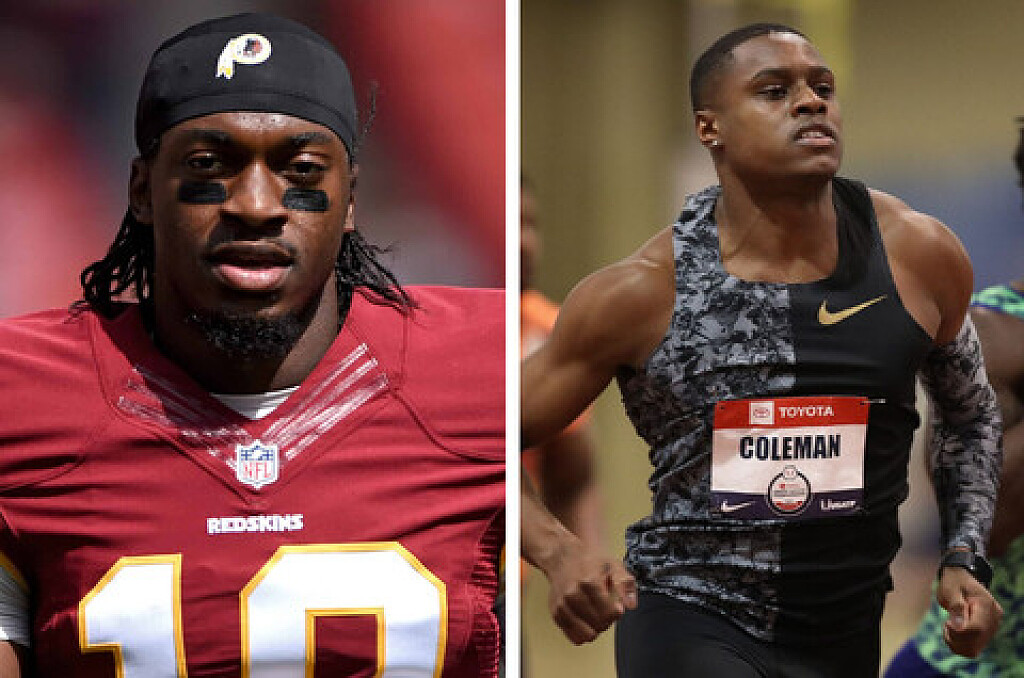
Former NFL player offers world champion Christian Coleman $100,000 to run a 40-yard dash
The newly crowned world 60m champion, Christian Coleman, has been offered USD $100,000 to run a 40-yard dash at full speed. The challenge comes after a University of Texas Longhorns football player Xavier Worthy broke the NFL’s 40-yard dash record (36 metres) at the 2024 NFL Draft Combine on Saturday in Indianapolis.
Worthy, a wide receiver prospect in the 2024 NFL Draft, ran a time of 4.21 seconds on his second of two attempts, breaking the record of 4.22 seconds set by former NFL wide receiver John Ross in 2017. Worthy’s time was instantly compared to the speed of the world’s fastest sprinters, and to prove a point, former NFL quarterback Robert Griffin III said he would give Coleman $100,000 to prove a point.
Coleman previously ran a 40-yard dash during his collegiate track career at the University of Tennessee in 2018, recording a mark of 4.12 seconds. Seven years later, Coleman now has three world sprint titles on his resume, and is widely considered one of the best starters in the world. The argument for Griffin III is that Coleman’s 40-yard dash would show the difference between NFL receivers and world-class sprinters.
On Friday, Coleman reclaimed his world 60m indoor title at the 2024 World Indoor Championships, beating Noah Lyles in the final in a world-leading time of 6.41 seconds. His winning time equates to an average speed of 21 mph (33 km/h) over 60m. When that speed is calculated for the 40-yard dash (36m), it equals a time of 3.90 seconds, well below Worthy’s mark.
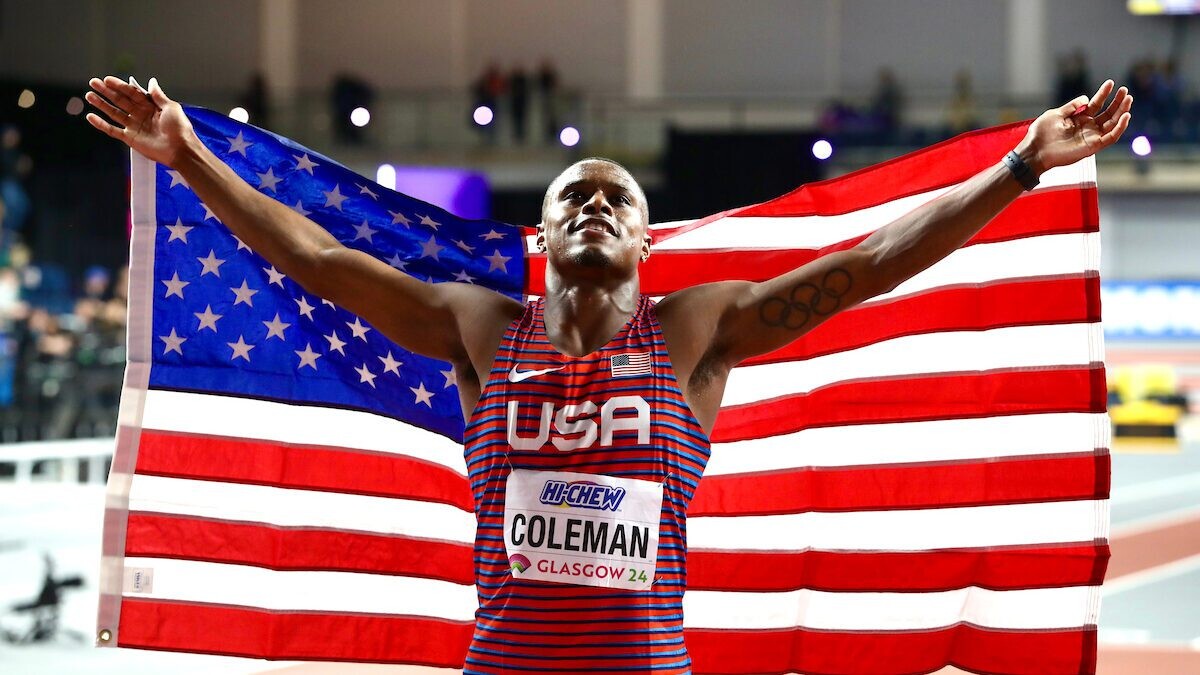
Coleman has not come out and said whether he will take up Griffin III’s challenge, but considering it would be an easy way for him to make $100,000, I don’t see why he wouldn’t. Plus, he would settle the debate once and for all.
by Marley Dickinson
Login to leave a comment
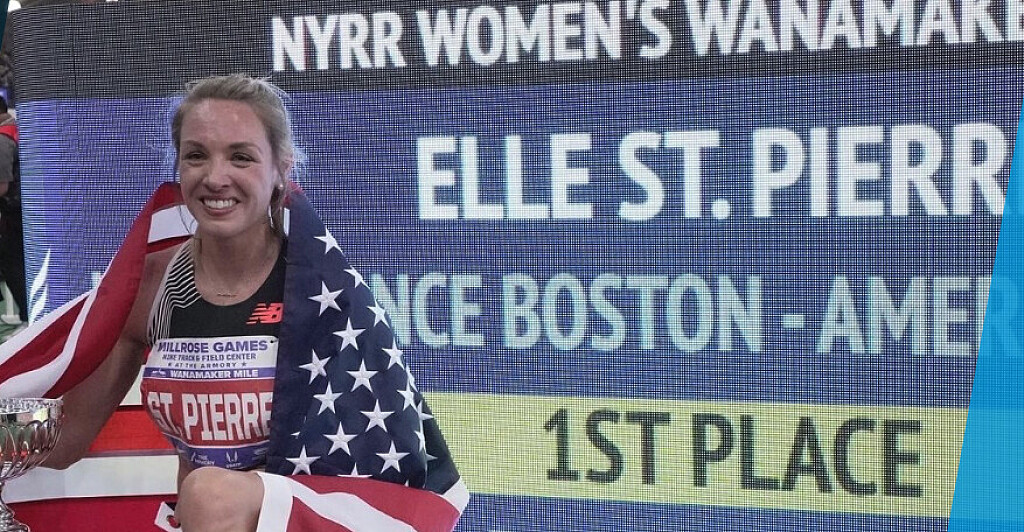
ST. PIERRE'S MILE RECORD EARNS HER USATF ATHLETE OF THE WEEK HONORS
INDIANAPOLIS — Bettering her own American record* in the women's mile, Elle St. Pierre (Enosburg, Vermont/USATF New England) earned recognition as the 5th USATF Athlete of the Week award winner for 2024.In only her second track race since giving birth to a son last March, St. Pierre clipped almost a half-second off her own AR in the mile to win the Millrose Games in 4:16.41. She became the third fastest woman ever and her en route 1500 time of 4:00.34 puts her second on the all-time U.S. indoor performer list.St. Pierre, the 2022 World Indoor Championships silver medalist in the 3000 and an Olympian at Tokyo in the 1500, beat a star-studded field at Millrose, making a strong move with 300 to go to pass Australia's Jessica Hull and take the lead. Her final quarter-mile of 61.33 put away a group of women who behind her set four national records and eight lifetime bests. Other top performances from last week:
Grant Fisher lowered the American best in the men's 2 mile with an 8:03.62 to place second at the Millrose Games. He is now the No. 3 all-time world performer. En route, his 7:30.88 for 3000 moved him to No. 3 on the all-time U.S. performer list.

Alicia Monson lowered the American best in the women's 2 mile at the Millrose Games, placing third in 9:09.70. She is now the No. 5 all-time world performer.
Yared Nuguse won the men's mile at the Millrose Games in 3:47.83, the third fastest time ever indoors, and the second fastest by an American. His en route 3:33.43 for 1500 was the third fastest ever by an American.
Brandon Miller won the men's 600 at the Kirby Elite meet in Albuquerque in 1:14.03, making him the No. 2 all-time world performer.
Nia Akins won the women's 600 at the Kirby Elite meet in Albuquerque in a world-leading 1:24.32 to move to No. 8 on the all-time world performer list.
Grant Holloway continued his 10-year winning streak in the men's 60H with a 7.32 at the Liévin World Indoor Tour - Gold meet in France. He tied the fourth-fastest time ever and only one man besides him has ever run faster.
*All records subject to verification by the USATF Records Committee. Now in its 23nd year, USATF’s Athlete of the Week program is designed to recognize outstanding performers at all levels of the sport. USATF names a new honoree each week when there are high-level competitions and features the athlete on USATF.org. Selections are based on top performances and results from the previous week.2024 Winners: January 17, Weini Kelati; January 24, Cooper Teare; January 31, Nico Young; February 7, Fiona O'Keeffe; February 14, Elle St. Pierre.
Login to leave a comment
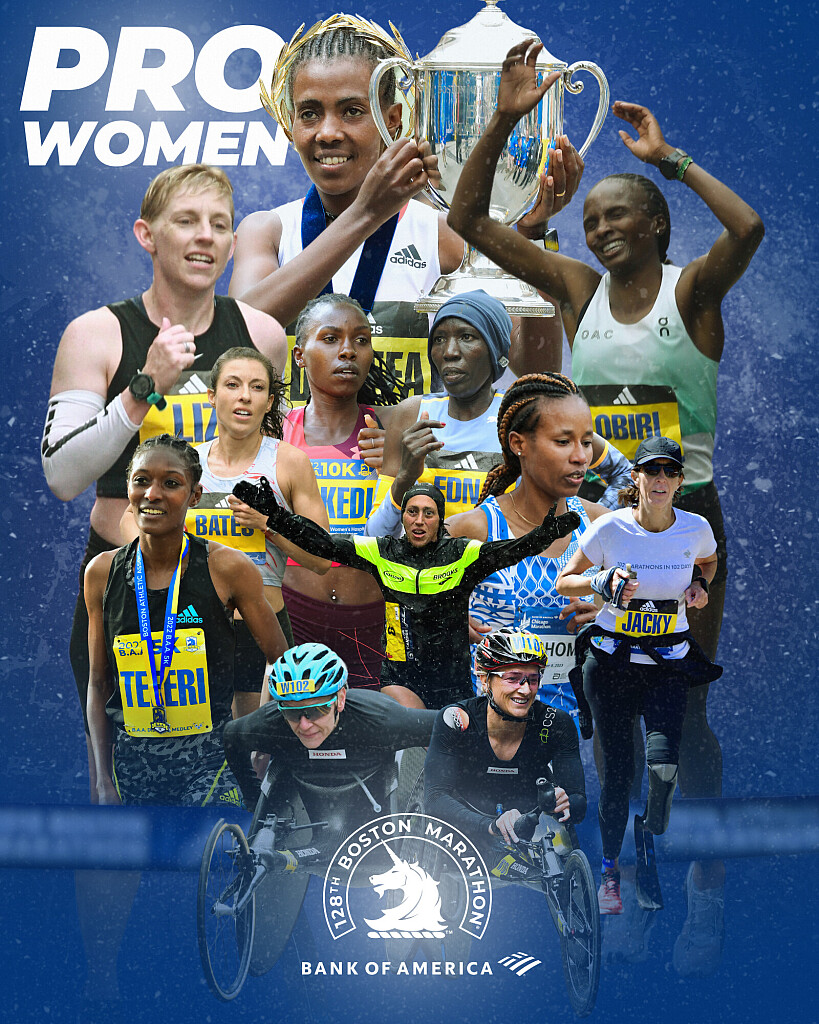
Strongest Women’s Field in the race history at Boston Marathon 2024
The 128th Boston Marathon presented by Bank of America will feature the strongest women’s field in race history, led by defending champions Hellen Obiri and Susannah Scaroni. A total of 19 women with personal bests under 2:23:00 will line up in Hopkinton aiming to earn the Open Division crown, including Olympians, Abbott World Marathon Majors winners, and national stars. In the Wheelchair and Para Athletics Divisions, Paralympic hopefuls from around the world are set to compete.
“The Boston Marathon is proud to showcase the world’s best athletes year in and year out on Patriots’ Day,” said Jack Fleming, President and CEO of the Boston Athletic Association. “This year’s women’s field is exceptionally fast and showcases many who’ve been podium finishers on the global stage. It’ll make for an exciting race from Hopkinton to Boston, and we look forward to crowning our champions on April 15.”
Women from 20 countries will be competing as part of the Bank of America Professional Athlete Team.
“Each year, the Boston Marathon sets the bar higher with an unbelievable level of athletic talent, and its impact on communities around the world,” said David Tyrie, chief digital officer and chief marketing officer, Bank of America. “The 128th Boston Marathon builds on a rich history and will continue to be an inspiration for all athletes.”
HELLEN OBIRI SET TO DEFEND OPEN DIVISION TITLE
Hellen Obiri, a two-time Olympic silver medalist from Kenya now living in Colorado, won the 2023 Boston Marathon thanks to a perfectly-timed sprint in the final mile. Adding to her trophy case, Obiri also took home the 2023 B.A.A. 10K title in June and the TCS New York City Marathon crown in November.
“I am excited to return to the 2024 Boston Marathon to try to defend my title,” said Obiri, who finished last year’s race in 2:21:38. “Boston is an historic race and I would like to add my name further to its history on April 15. Winning such an historic marathon with my family waiting at the finish line was an amazing experience.”
A trifecta of Ethiopians with lifetime bests under 2:18:00 will take to the Boston course. Worknesh Degefa, the 2019 Boston Marathon champion, returns, while 2:17:36 marathoner Tadu Teshome will make her Boston debut and Hiwot Gebremaryam aims to improve upon her eighth-place finish last year. Also from Ethiopia is World championships medalist Senbere Teferi; she won the 2022 B.A.A. 5K in a course record 14:49 and has shown talent at the longer distances. Experienced marathoner Ababel Yeshaneh –second in 2022 and fourth in 2023— will try to become the seventh woman from Ethiopia to win the olive wreath in Boston.
Joining Obiri from Kenya are 2022 World Athletics Championships Marathon silver medalist Judith Korir; two-time Boston Marathon winner Edna Kiplagat; four-time top-ten finisher Mary Ngugi-Cooper; and 2022 TCS New York City Marathon champion Sharon Lokedi. Helah Kiprop, who holds a silver medal in the marathon from the 2015 World Athletics Championships and has earned wins in Tokyo, Copenhagen, and Paris, makes her second career Boston start. From Morocco is 2023 World Athletics Championships Marathon bronze medalist Fatima Gardadi.
Desiree Linden leads the American contingent six years after winning the 2018 title. Linden has finished in the top-five five times, and holds the third fastest time by an American ever on the Hopkinton-to-Boston route (2:22:38). Linden will run her fifth U.S. Olympic Marathon Trials in February. Joining her is Emma Bates who finished fifth last year in the second-fastest time ever by an American woman at Boston (2:22:10).
“At this point in my career it’s an easy decision to return to the Boston Marathon and make it my top priority race of the spring,” said Linden. “I can’t wait to take on the iconic course for an 11th time and have the opportunity to mix it up with some of the best runners in the world.”
128TH BOSTON MARATHON PROFESSIONAL WOMEN’S FIELDS
Women’s Open Division
Country
Personal Best
Worknesh Degefa
ETH
2:15:51 (Valencia, 2023)
Tadu Teshome
ETH
2:17:36 (Valencia, 2022)
Hiwot Gebremaryam
ETH
2:17:59 (Valencia, 2023)
Judith Korir
KEN
2:18:20 (Eugene, 2022)
Meseret Belete
ETH
2:18:21 (Amsterdam, 2023)
Tiruye Mesfin
ETH
2:18:47 (Valencia, 2022)
Worknesh Edesa
ETH
2:18:51 (Berlin, 2022)
Zeineba Yimer
ETH
2:19:07 (Berlin 2023)
Senbere Teferi
ETH
2:19:21 (Berlin, 2023)
Dera Dida
ETH
2:19:24 (Berlin, 2023)
Edna Kiplagat
KEN
2:19:50 (London, 2012)*
Mary Ngugi-Cooper
KEN
2:20:22 (London, 2022)
Nazret Weldu Gebrehiwet
ERI
2:20:29 (Eugene) NR
Ababel Yeshaneh
ETH
2:20:51 (Chicago, 2019)
Vibian Chepkirui
KEN
2:20:59 (Vienna, 2022)
Helah Kiprop
KEN
2:21:27 (Tokyo, 2016)
Hellen Obiri
KEN
2:21:38 (Boston, 2023)
Emma Bates
USA
2:22:10 (Boston, 2023)
Desiree Linden
USA
2:22:38 (Boston, 2011)*
Buze Diriba
ETH
2:23:11 (Toronto, 2023)
Sharon Lokedi
KEN
2:23:23 (New York City, 2022)
Malindi Elmore
CAN
2:23:30 (Berlin, 2023)*
Fatima Gardadi
MOR
2:24:12 (Xiamen, 2024)
Angie Orjuela
COL
2:25:35 (Berlin, 2023) NR
Fabienne Konigstein
GER
2:25:48 (Hamburg, 2023)
Jackie Gaughan
USA
2:27:08 (Berlin, 2023)
Dominique Scott
RSA
2:27:31 (Chicago, 2023)
Grace Kahura
KEN
2:29:00 (Sacramento, 2023)
Katie Kellner
USA
2:32:48 (Berlin, 2023)
Briana Boehmer
USA
2:33:20 (Sacramento, 2021)
Dylan Hassett
IRL
2:33:25 (Pulford, 2021)
Parley Hannan
USA
2:33:43 (Carmel, 2023)
Sara Lopez
USA
2:33:48 (Eugene, 2023)
Annie Heffernan
USA
2:34:33 (Lowell, 2023)
Nera Jareb
AUS
2:35:00 (Queensland, 2022)*
Johanna Backlund
SWE
2:35:10 (Hamburg, 2019)
Argentina Valdepenas Cerna
MEX
2:35:34 (Chicago, 2022)*
Ariane Hendrix Roach
USA
2:35:39 (Sacramento, 2022)
Michelle Krezonoski
CAN
2:36:39 (Sacramento, 2022)
Shannon Smith
USA
2:36:43 (Columbus, 2023)
Caroline Williams
USA
2:37:01 (Sacramento, 2022)
Gina Rouse
USA
2:37:10 (Sacramento, 2023)*
Kim Krezonoski
CAN
2:37:20 (Sacramento, 2022)
Abigail Corrigan
USA
2:37:45 (Sacramento, 2023)
Marissa Lenger
USA
2:38:41 (Chicago, 2022)
Emilee Risteen
USA
2:38:46 (Duluth, 2023)
Isabelle Pickett
AUS
2:38:46 (Valencia, 2023)
Allie Hackett
USA
2:38:52 (Duluth, 2023
Mary Christensen
USA
2:38:55 (Big Bear, 2023)
Olivia Anger
USA
2:39:13 (Indianapolis, 2023)
April Lund
USA
2:39:23 (Houston, 2022)*
Sarah Short
AUS
2:39:51 (Valencia, 2023)
Maura Lemon
USA
2:40:30 (Valley Cottage, 2023)
Sarah Sibert
USA
2:40:31 (Philadelphia, 2022)
Lauren Ames
USA
2:40:34 (Valley Cottage, 2023)
Kassie Harmon
USA
2:41:48 (Utah Valley, 2023)*
Elizabeth Camy
USA
2:42:51 (Sacramento, 2022)*
Alexandra Niles
USA
2:43:23 (Hartford, 2022)*
Amber Morrison
USA
2:43:50 (Sacramento, 2022)*
Mindy Mammen
USA
2:44:01 (Duluth, 2023)*
Ziyang Liu
USA
2:44:56 (Eugene, 2023)*
*Denotes Masters Division (40+)
Login to leave a comment

Boston Marathon
Among the nation’s oldest athletic clubs, the B.A.A. was established in 1887, and, in 1896, more than half of the U.S. Olympic Team at the first modern games was composed of B.A.A. club members. The Olympic Games provided the inspiration for the first Boston Marathon, which culminated the B.A.A. Games on April 19, 1897. John J. McDermott emerged from a...
more...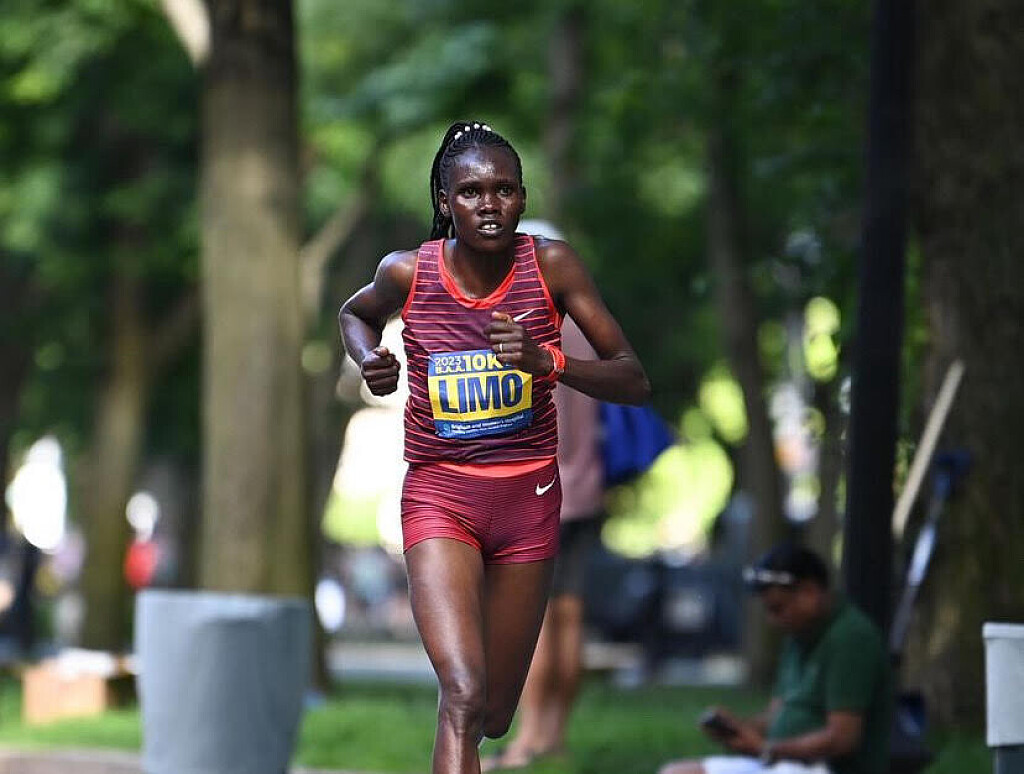
Cynthia Limo wins marathon debut after seven-year break plagued by depression and grief
Resilience defines Cynthia Limo's marathon debut win, overcoming loss and adversity with a powerful performance that inspires and uplifts.
The 2016 World Athletics Half Marathon Championships silver medalist Cynthia Jerotich Limo added another extraordinary chapter to her remarkable journey as she clinched victory in her marathon debut at the Honolulu Marathon on Sunday.
Limo's marathon journey began with a strategic approach that showcased her discipline and meticulous planning.
Running alongside Ethiopians Sintayehu Tilahun Getahun and Kasu Bitew Lemeneh, she patiently waited through the early stages of the race, hitting the 5km mark in 18:17 and slightly picking up the pace through the 10 km mark in 35:59.
The halfway point came and went with no significant changes (1:16:43), and the 30 km mark passed in 1:50:05.
It was after the 30km aid station that Limo began to pull away, leaving Lemeneh behind.
Limo and Getahun then ran together for the next 5km segment, showcasing the incredible endurance they had built over time.
At 35km Limo made her move, steadily increasing her lead. By the time she reached the 40km mark, her lead had ballooned to a commanding one minute and 38 seconds.
Limo finished strong in 2:33:01, running the second half of the race slightly faster than the first and leaving Tilahun in her wake, who finished in 2:35:16.
In her own words, Limo described the decisive moment, saying, "When we got to 35 kilometers, I felt that I was still strong and I knew it was only seven kilometers that remained, so I had to do it by myself. I tried to push and push. I am so pleased."
Limo's impressive marathon debut can be attributed not only to the high mileage she logged during her training in Kenya but also to the speed she honed while competing in various American road races throughout the year.
These included notable wins at the Cooper River Bridge Run 10km in Charleston, South Carolina, the Carmel Half-Marathon in Indiana, the Toledo Half-Marathon in Ohio, and Philadelphia's Broad Street Run 10 Mile.
Reflecting on her marathon success, Limo emphasized the importance of mental fortitude, stating, "I can say that it was not really so hard to do the marathon. It is a matter of making up your mind that you can do the training. And I am so happy that I did that."
What makes Limo's victory even more remarkable is the adversity she has overcome to reach this point.
She took a seven-year hiatus from competitive running, during which she faced the unimaginable loss of a child and battled depression.
It seemed like a comeback was out of reach, but her determination to support her family and her unwavering spirit kept her pushing forward.
From 2012 through 2016, Limo dominated the racing circuit, finishing first or second in an astonishing 43 out of 51 races.
Her list of accomplishments includes numerous victories in races ranging from four miles to 20 kilometers, with 2014 standing out as a year of exceptional success when she won 12 out of 13 races.
Limo's roots are firmly planted in Iten, Kenya, where she resides with her husband, who is a teacher, and their daughters Ann, four, and Rebekah, two.
Tragically, their eldest daughter, Blessed, was born with a spinal birth defect and passed away before her second birthday.
In 2023, Cynthia Jerotich Limo returned to the world of competitive running, putting in the hard work and dedication to regain her form in Kenya.
by Festus Chuma
Login to leave a comment

Honolulu Marathon
The Honolulu Marathon’s scenic course includes spectacular ocean views alongside world-famous Waikiki Beach, and Diamond Head and Koko Head volcanic craters.The terrain is level except for short uphill grades around Diamond Head. ...
more...
Kenyans Paul Lonyangata and Cynthia Limo win Honolulu Marathon
Kenyans Paul Lonyangata and Cynthia Limo patiently waited before making decisive moves to earn convincing wins at today’s Honolulu Marathon in challenging conditions. High humidity and long stretches of strong winds, combined with the course’s notorious hills, led to slow finish times in the 51st running of this race, the fourth largest marathon in the United States.
The race began in the darkness at 5:00 am local time with a fireworks display. Dickson Chumba of Kenya, the designated pacer, set an aggressive early pace for men’s leaders, coming through 5-K in 15:17, which projects to a sub-2:09 time. (The course record is 2:08:00.) In his wake were Lonyangata, fellow Kenyan Reuben Kiprop Kerio, Ethiopian Abayneh Degu and a pair of U.S.-based Eritreans, Filmon Ande and Tsegay Weldlibanos.
Through 10-K, the pace was picking up, with Chumba –a three-time winner of World Marathon Majors races– in front at 30:25. Kerio had drifted back and was 19 seconds behind. But the pace started to lag on an uphill section between 13-K and 14-K and Kerio quickly regained contact with the pack. Meanwhile, Weldlibanos, who had been fighting the flu in the week leading up to the race, was the first casualty, dropping out around 15-K.
During a long stretch along Kalaniana’ole Highway the pace was lagging in the 5:20 per mile range and it was clear that this would be a tactical battle. “This is the graveyard of fast times,” Honolulu Marathon Association president Dr. Jim Barahal, riding in the lead vehicle, lamented of this notoriously windy stretch. “But it means we’re going to have a great finish.”
Indeed, the halfway point was reached in a modest 1:07:19. Chumba stepped off just before 25-K and moments later Lonyangata briefly surged ahead. The field came back to him within minutes, but as the course entered a less windy section, he made what would be the day’s decisive move. His pace quickened dramatically as he covered the 18th mile in 4:49. By 30-K (1:35:51) he had built a five-second lead over Kerio, with Ande another five seconds back. (Degu had dropped out some time after halfway, leaving only three men in the elite field.)
Lonyangata –who had finished second in his previous appearance in Honolulu in 2014, and owns a personal best of 2:06:10 from the 2017 Paris Marathon– continued to press the pace. Ande and Kerio were waging a back-and-forth duel for second place, and by 35-K, they were 21 seconds behind Lonyangata (1:52:14).
Lonyangata continued to look back for signs of danger, but a strong uphill surge as the course passed the Diamond Head volcanic crater for the second time kept him out of reach of his pursuers. “The hills you must run as hard as you can, you push uphill even if it’s hard,” he said.
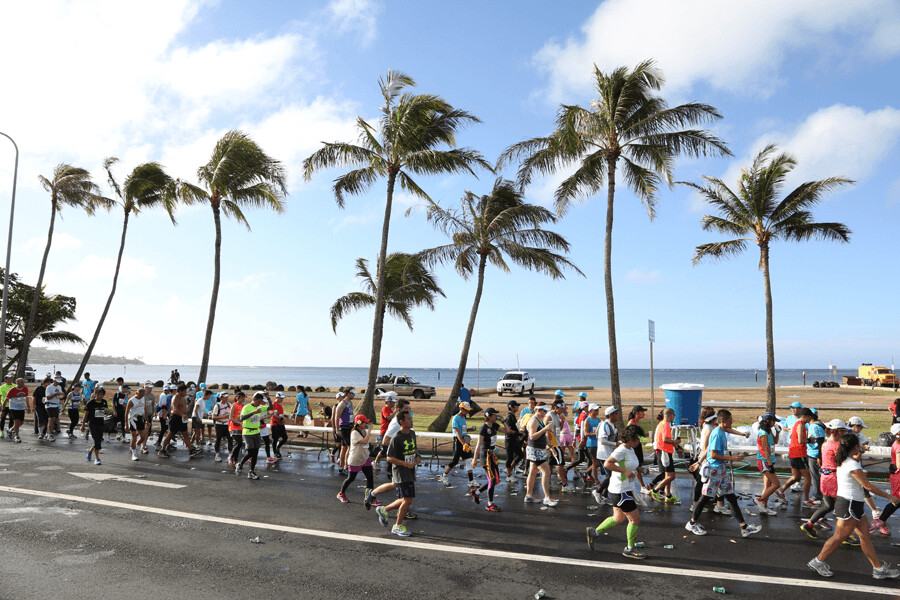
He crossed the finish line in Kapiolani Park in 2:15:42. “When you prepare for everything you know you are ready,” said Lonyangata, who was cleared to compete again on May 25 after serving a 19-month suspension for using a banned diuretic (the Honolulu Marathon has drug testing). “And when you decide when to make the move, you have to go hard.”
Ande made up some ground in the final miles, despite dealing with pain in his foot, and finished 19 seconds back in 2:16:01.
Kerio, who finished second here in 2018 and has served as the pacer four other times (including last year), came home third in 2:17:32.
In the women’s race, Limo was making her marathon debut, and decided to wait slightly longer to make her move. For the early going she ran alongside Ethiopians Sintayehu Tilahun Getahun and Kasu Bitew Lemeneh, who was running her fourth marathon of the year. They hit 5-K in 18:17, then picked up the pace slightly through 10-K (35:59). There was no change at halfway (1:16:43) and 30-K (1:50:05).
Finally, after the 30-K aid station, Lemeneh began to slip behind. Limo and Getahun forged ahead, running together for the next 5-K segment. Finally, at 35-K Limo started to pull away. By 40-K her lead ballooned to a minute and 38 seconds. She cruised home in 2:33:01, running the second half slightly faster than the first and finishing more than two minutes ahead of Tilahun (2:35:16).
“When we got to 35 kilometers, I felt that I was still strong and I knew it was only seven kilometers that remained, so I had to do it by myself,” said Limo, the 2016 World Athletics Half Marathon Championships silver medalist. “I tried to push and push. I am so pleased.”
In addition to the high mileage she logged in Kenya during her build-up to this race, she credited the speed she sharpened while competing in numerous American road races this year, including wins at the Cooper River Bridge Run 10-K in Charleston, South Carolina, the Carmel (Indiana) Half-Marathon, the Toledo (Ohio) Half-Marathon and Philadelphia’s Broad Street Run 10 Mile. “I can say that it was not really so hard to do the marathon,” she said. “It is a matter of making up your mind that you can do the training. And I am so happy that I did that.”
Bitew (2:36:04) held on for third, and Japan’s Yukari Abe, who finished tenth in her country’s Olympic trials in October, took fourth (2:47:32).
Lonyangata and Limo earned $25,000 for their victories, along with a flashy gold medal worth nearly $15,000. They both credited hearty support from fans along the course as well as the throngs of mass-race runners, who were going in the opposite direction on the out-and-back course. (One enthusiastic participant encouraged Lonyangata with an enthusiastic cheer of “Go get that money!”)
“The other runners were so good,” a smiling Limo noted. “They were cheering, they were making us move faster.”
There were 15,594 starters this year, up from 14,645 in 2022.
The companion Start to Park 10-K was run contemporaneously with the marathon, with 6,976 starters and 6961 finishers. Joshua Williams was the fastest athlete in 32:02, but not far behind him was Molly Seidel, the 2021 Olympic bronze medalist in the marathon. Seidel clocked 32:25 and was the fastest woman on the day. She, and training partner Jessa Hanson, were using the race as part of their humidity training for February’s U.S. Olympic Team Trials Marathon in Orlando, Florida.
“It’s so cool to come out and have the whole energy of the marathon around you,” said Seidel, who finished eighth at the Chicago Marathon two months ago. “This is such a fun vibe. I love to come out and race in Hawaii. Honestly, we wanted to get some good humidity racing, get a nice quicker tempo and then settle in. Coming out today was exactly what we needed. I love racing in humidity.”
by Steve Soprano
Login to leave a comment
Honolulu Marathon
The Honolulu Marathon’s scenic course includes spectacular ocean views alongside world-famous Waikiki Beach, and Diamond Head and Koko Head volcanic craters.The terrain is level except for short uphill grades around Diamond Head. ...
more...
U.S. Secretary of Transportation Pete Buttigieg Treasures Time on His Feet
He has toddler twins and a very big job, but the cabinet member makes running a priority.
When you’re a “transportation guy,” as Pete Buttigieg calls himself, there’s no better place to run than Gravelly Point Park, in Arlington, Virginia, under the flight path of planes on final approach at Reagan Washington National Airport.
“It feels as though the planes are trying to land right between your eyes, and then you watch them go over your head,” said Buttigieg, the 41-year-old U.S. Secretary of Transportation. “It’s just really fun and motivating.”
Buttigieg—who in 2021 was sworn in as the youngest member of President Biden’s Cabinet—is (with all respect due to a government leader) a bit of a dork when it comes to planes.
“There it is!” he said, as a United Airbus passed close overhead. “You hear that swizzling noise in the air? That’s wake turbulence!”
“Turbulent” is a word Buttigieg uses regularly, although his political career has been mostly smooth sailing. In 2011, he was elected mayor of his hometown of South Bend, Indiana. Eight years later, he entered the Democratic presidential race as a longshot candidate and won the Iowa caucuses. He ended his bid in March 2020 and endorsed the man who’s now his boss, Joe Biden.
Recently Buttigieg squeezed a midmorning run with this reporter into a typically hectic day at the helm of a 53,000-employee department: getting his two-year-old twins fed, dressed, and off to daycare; meeting with the German minister of transportation; welcoming the newly confirmed FAA administrator to his post; meeting with colleagues at the Commerce Department; talking permitting processes at the White House; and then attending a state dinner for the Prime Minister of Australia. Wardrobe requirements included a suit, running clothes, and a tuxedo.
On days like that, running is a source of satisfaction and stress relief. As a cabinet secretary, Buttigieg is required to train with security; his detail trails behind him on a bike while he runs, or waits by the water’s edge while he swims. (When members of Buttigieg’s open-water swimming group tried to correct a hitch in the Secretary’s stroke, his security team protested, “Don’t fix that! It’s the only way we know which one is him!”)
For Buttigieg, knowing Secret Service members’ jobs revolve around his workout schedule is the ultimate in accountability. “It’s definitely kept me from hitting the snooze button more than once,” he said.
Apart from this interview, conducted at sub-10-minute-mile pace, and the occasional bit of bipartisan “jogging diplomacy,” as he calls runs with members of Congress, Buttigieg tends not to mix work with training. He runs about five days a week, usually early in the morning, when most people are too focused on their own workouts to recognize him.
“I get spotted a little bit, but not enough to disrupt my training,” Buttigieg said. “Once in a while somebody wants to take a selfie when I’m mid-run, and I’m never sure how to handle that. Usually I just do it.”
Humble run beginnings
As a teenager, Buttigieg did not take to running naturally.
“It’s difficult to overstate how unathletic I was,” said Buttigieg, who joined the track and cross-country teams at St. Joseph’s High School in South Bend. “I was the kid who was so far behind at a cross-country meet that I might take a wrong turn because there was nobody left on the course. So it meant a lot to me, years later, when I got to be speedier.”
His progression from back-of-the-packer to one of the fittest members of the executive branch took years. As an undergrad at Harvard, Buttigieg would run on the treadmill or along the Charles River, but never more than three to four miles. At Oxford, where he was a Rhodes Scholar, Buttigieg added rowing to his endurance repertoire. By his mid 20s, running had become a “comfortable habit”—and a gratifying one.
“There’s a level of coordination that I may never have to be good at basketball,” he said. “But running—the more you do it, the more rewarding it becomes.”
When Buttigieg joined the U.S. Naval Reserve in 2009, he excelled at the 1.5-mile run that was part of the requisite fitness test, getting close to a perfect score of 9 minutes flat.
“For a while I was the fastest guy in my unit, which felt great because I was always the slowest guy in my high school,” he said.
In 2014, during a seven-month deployment as a counterintelligence officer in Afghanistan, Buttigieg ran a half marathon at the U.S. base in Bagram. In addition to the typical instructions about course markers and fluid stations, the pre-race briefing included warnings to participants about the potential for rocket attacks. He ran his current PR of 1:42.
A triathlon two years in the making
Buttigieg continued to run throughout his mayorship of South Bend and his 2019–20 presidential run. In 2021, his first year as transportation secretary, he was training for a half-Ironman in Michigan when he and husband, Chasten, adopted premature newborn twins, Penelope and Gus. Suddenly, instead of miles, Buttigieg was counting ounces of formula. Long training runs were scrapped during sleepless nights and Gus’s hospitalization with RSV.
It took until this year before Buttigieg could try another tri. Preparing for a half-Ironman (1.2-mile swim, 56-mile bike, 13.1-mile run) is a major undertaking for anyone. But when you’ve got 2-year-olds, Buttigieg said, “physically redirecting and restraining them is a huge part of parenting.” He followed a 16-week training plan he got online and relied on Chasten to hold down the fort with their kids on weekend mornings while he did long runs or four-hour bike rides.
“I would try to make up for it later in the day, but there’s no way I could’ve done this without Chasten being very supportive,” Buttigieg said. “While there’s an ethos of self-discovery and self-reliance in endurance sports, it really does bring out how dependent you can be on others to support you.”
During the race, held in mid-September in Michigan, Chasten and the kids hung out at a nearby playground—“we were playing with fire when it came to naptime”—and were at the finish line when “Papa” crossed in 6 hours and 31 minutes, largely on the strength of a 2:05 half marathon leg.
“It was pretty thrilling, although there was a fair amount of pain,” Buttigieg said. “But the kids really got into it, and that’s part of why you do this, to be in good health for the people you love.”
Buttigieg said he was wrecked for a couple of days post-race, but he now hopes to take his fitness out for an occasional spin—perhaps a run at a half marathon PR. But he won’t undertake another 6-hour race anytime soon.
“I don’t think I can do something this time intensive again while I’ve got this job,” he said. “It’s too much to ask of Chasten.”
A runner’s perspective on infrastructure
After he averaged about 25 miles per week during his triathlon buildup, now it’s back to shorter workouts for Buttigieg. And with more than 100 miles of traffic-separated pathways up and down the Potomac, the nation’s capital is an endurance athlete’s paradise. “There are few better places to run in the whole world, I would argue,” he said.
The Washington area represents the kind of well-connected, accessible and pedestrian-friendly infrastructure the Department of Transportation wants to build more of through its National Roadway Safety program. For Buttigieg, helping communities around the country build separate paths for running and biking is about a population’s safety as much as its fitness.
“I worry sometimes that a path like this is viewed as purely ornamental,” he said. “I would argue that the recreational case is pretty compelling, but also fundamentally, safety is on the line. The very layout of our roads can either incentivize or discourage active transportation, and they can either make it safer or more dangerous.”
Buttigieg formed a new perspective on road design in 2016, when he was part of a group of U.S. mayors who traveled to Denmark. Buttigieg saw 1970s-era photos of Copenhagen, which now rivals Amsterdam for highest rate of bike commuting, and recognized the look of a lot of car-dependent American cities.
“That’s when the lightbulb went off,” he said. “It’s not some immutable Nordic cultural characteristic that changed things. It was some conscious decisions made by planners to make it more attractive and safer. By doing that, they reduced congestion, they reduced pollution, and over the long run, they increased safety.”
Buttigieg has a lot of priorities beyond encouraging active transportation. He wants to train more air traffic controllers. Strengthen HazMat requirements for railroads. Build more roads and bridges. Budget cuts or a government shutdown would make it harder to accomplish those projects.
When political roadblocks lead to frustration, he works through it with exercise. He is a transportation secretary who gets to where he needs to be, psychologically and physically, by putting one foot in front of the other.
“Especially in the early morning when the dawn’s just breaking over the river here, it’s hard not to feel even in our troubled Washington that there’s some magnificence to our nation’s capital,” Buttigieg said. “You count your blessings after a run, if not always during one.”
by Runner’s World
Login to leave a comment
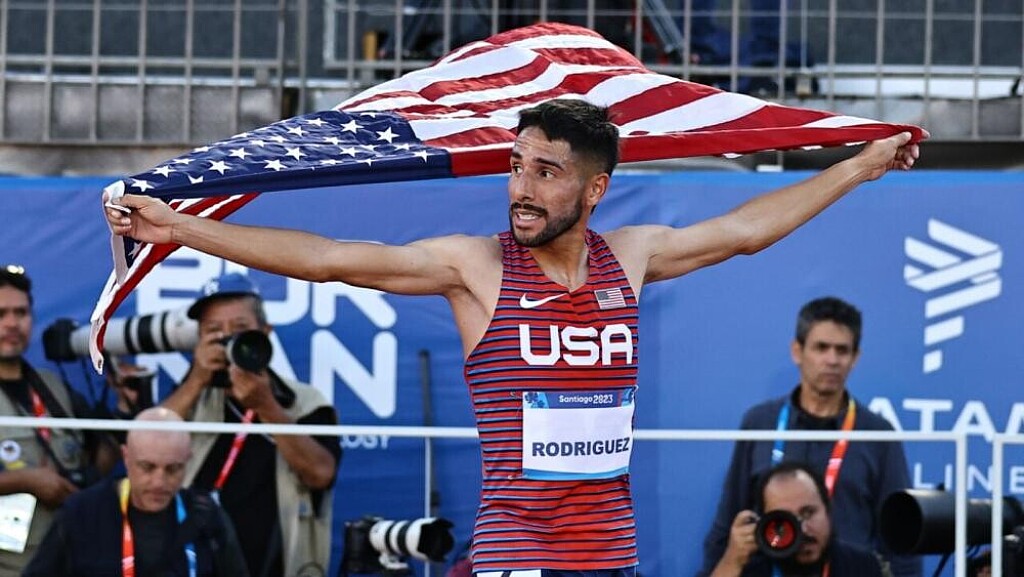
Isai Rodriguez, Sam Chelanga capture gold and silver for U.S. in men´s 10,000 meters at Pan American Games
Isai Rodriguez and Sam Chelanga made history Friday at the Pan American Games, becoming the first American teammates to take the top two spots in the men’s 10,000-meter final at Julio Martinez Pradanos National Stadium in Santiago, Chile.
Rodriguez, an All-American at Oklahoma State, and Chelanga – the collegiate 10,000 record holder from 2010 at Liberty – became the first pair of teammates from any country since 1979 and only the third tandem in meet history to secure gold and silver in the event.
Rodriguez prevailed in 28 minutes, 17.84 seconds, the fastest Pan Am Games winning performance since 2007, and Chelanga clocked 29:01.21, with Guatemala’s Alberto Gonzalez earning bronze in 29:12.24.
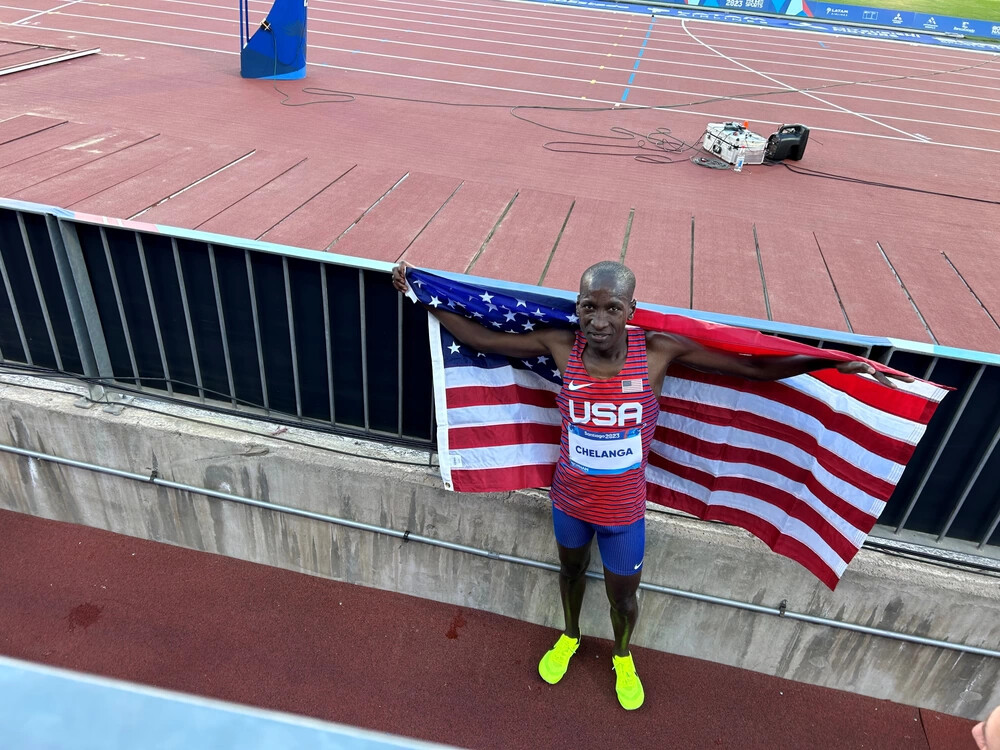
Rodriguez and Chelanga joined Mexico’s Rodolfo Gomez and Enrique Aquino in 1979, along with Luis Hernandez and Gomez in 1975 as the only teammates to sweep the top two spots in the men’s 10,000.
Rodriguez secured the first 10,000 gold for the U.S. since Bruce Bickford triumphed in 1987 in Indiana.
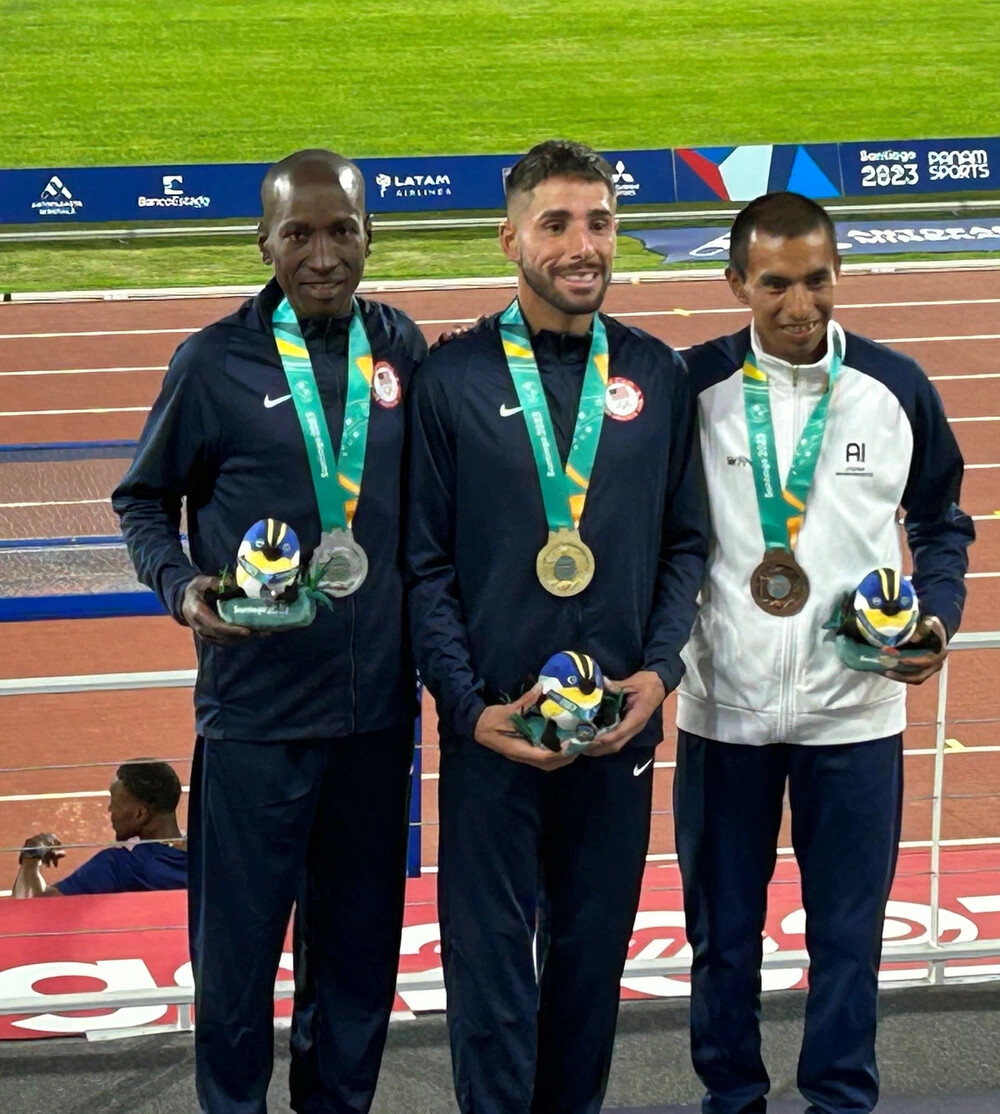
It marked the second straight Pan Am Games that the Americans had two athletes on the 10,000 podium, with Reid Buchanan and Lawi Lalang achieving silver and bronze in 2019 in Peru. The U.S. also had a pair of 10,000 medalists in 1967 in Winnipeg.
The Americans added bronze medals in the women’s 1,500-meter final and javelin throw competition, in addition to the men’s shot put, taking the lead with 19 overall medals entering the last day of the track and field schedule.
Brazil leads with seven gold medals and is second behind the Americans with 18 overall medals.
Darlan Romani triumphed for Brazil in the men’s shot put with a fifth-round effort of 70-1 (21.36m).
Mexico’s Uziel Aaron Munoz secured silver at 69-4.75 (21.15m), with former Arizona standout and NCAA Division 1 champion Jordan Geist edging fellow American athlete Roger Steen for bronze by a 67-4.25 (20.53m) to 67-3.50 (20.51m) margin.
Colombia’s Flor Denis Ruiz won the women’s javelin gold medal with a throw of 207 feet (63.10m) on her opening attempt.
Nebraska teammates Rhema Otabor, representing the Bahamas, and American competitor Maddie Harris captured silver and bronze, respectively. Otabor had a mark of 198-7 (60.54m) and Harris produced a throw of 197 feet (60.06m).
Venezuela’s Joselyn Brea completed a sweep of the women’s 1,500 and 5,000 titles, clocking 4:11.80 to edge Cuba’s Daily Cooper (4:11.86) and American athlete Emily Mackay (4:12.02).
Gianna Woodruff believed she had become the first female athlete from Panama to capture a Pan Am Games gold medal in any event, clocking 56.44 in the women’s 400-meter hurdles.
But Woodruff was later disqualified as a result of Rule 22.6.2, which states that an athlete is penalized after “knocking down or displacing any hurdle by hand, body or the upper side of the lead leg.”
Brazil’s Marlene Santos, who ran 57.18, was elevated to the event winner, with Daniela Rojas from Costa Rica earning silver in 57.41 and Montverde Academy of Florida senior Michelle Smith, representing the U.S. Virgin Islands, taking bronze in 57.53.
Jamaica’s Jaheel Hyde emerged victorious in the men’s 400-meter hurdles in 49.19.
Brazil’s Matheus Lima earned silver in 49.69 and Cuba’s Yoao Illas was the bronze medalist in 49.74.
Cuba’s Luis Enrique Zayas cleared 7-5.25 (2.27m) on his third attempt to prevail in the men’s high jump final.
Puerto Rico’s Luis Joel Castro achieved a 7-4.25 (2.24m) clearance on his first opportunity to capture silver, with Donald Thomas of the Bahamas grabbing bronze after achieving the height on his third try.
Cuba added two more medals in the men’s triple jump final, with Lazaro Martinez winning on his first attempt with a 56-4.75 (17.19m) performance.
Brazil’s Almir Dos Santos secured silver at 55-6.25 (16.92m) and Cuba’s Cristian Napoles took the bronze medal at 54-8 (16.66m), holding off American athlete Chris Benard and his fourth-place mark of 54-1 (16.48m).
by Erik Boal
Login to leave a comment

Pan American Games
The Pan American Games area premier, quadrennial multi-sport event for 41 nations across the Americas, held one year before the Summer Olympics. Organized by Panam Sports, the games serve as a direct Olympic qualifier and feature thousands of athletes competing in diverse sports. The next edition, the 2027 Pan American Games, will take place in Lima, Peru, from July 16...
more...
Foot Pain When You’re Running? This Issue May Be to Blame
These mysterious bumps can cause discomfort and pain, but prevention and early treatment can help you stick to your training schedule.
Picture this: You’re blissfully clocking your miles on a Saturday morning until you feel a small but growing pressure on top of your foot. It’s slight, so you ignore it, but over time that discomfort starts to become more noticeable—and once you take your running shoes off at home, you notice a bulb-like bump on your foot.

What gives? You could have what’s known as a ganglion cyst. These sometimes painful bumps aren’t often talked about in the running community, but they’re one of the most common soft tissue masses found in the foot and ankle, per a 2023 review in the Journal of Clinical Orthopaedics and Trauma. Plus, they can derail your training if not addressed.
Here’s everything you need to know about ganglion cysts as a runner, including how to prevent and treat them.
How might a ganglion cyst show up in runners?
A ganglion cyst develops slowly over weeks or months, but it may grab your attention during a run.
“There will be some soreness associated with a ganglion during a run due to shoe pressure against it,” says Karen A. Langone, D.P.M., a Southampton, New York-based spokesperson for the American Podiatric Medical Association and podiatrist who specializes in sports and fitness medicine. “You might notice a lump on the foot, which can worsen during the run.”
That lump on your foot can be easy to confuse with a number of other conditions. Found along a tendon or near a tendon, a ganglion cyst can be mistaken for an exostosis, for example, which is a benign (noncancerous) bone tumor, per the Cleveland Clinic.
“It might also be confused with a stress fracture of a metatarsal bone,” says Alex Kor, D.P.M., a spokesperson for the American Podiatric Medical Association, a podiatrist at Hendricks Regional Health in Danville, Indiana and team podiatrist for the athletic programs at Butler University. A metatarsal stress fracture is a break in the bone from repeated injury or stress, which can be caused by running.
What is a ganglion cyst?
On the other hand, ganglion cysts are noncancerous bumps that usually appear along your tendons or the joints of the wrists or hands, but they can also occur in ankles and feet, according to the Mayo Clinic. They’re filled with a jellylike fluid.
“A ganglion cyst, like any mass, makes the runner’s foot feel tight,” says Kor. “The pain can be characterized as dull or sharp if mileage is extended or there is increased shoe pressure.”
This cyst is usually caused by a bony point that’s exacerbated by shoe pressure (and possibly by your foot swelling at the end of a run), a tendon that gets overused (which may be the result of tendonitis), or from acute trauma. The fluid in the tendon sheath can “leak out” after overuse or trauma to form the ganglion cyst, adds Kor.
Once one of these things occurs, the inflammation within the tendon sheath accumulates in one area and worsens, forming the ganglion cyst.
Although they’re filled with fluid, they can feel firm to the touch, per Yale Medicine. They can be as small as a pea or as large as an inch in diameter. Sometimes, they can affect joint movement and cause pain if they press against a nerve.
The majority of ganglion cysts occur on the top of the foot or the front of your ankle, says Kor. They are rare on the bottom of the foot.
Risk factors for these cysts include sex and age (most often, ganglion cysts occur in women between the ages of 20 and 40) and osteoarthritis (particularly when they occur in the hands), per the Mayo Clinic.
Should you run with a cyst?
You can continue to run with a ganglion cyst, especially if there is no pain. Even if there is some pain, your level of discomfort will determine the best steps for treatment.
“This is not a condition that will significantly worsen [if you run on it],” says Kor. “In other words, it is not like a stress fracture that can ‘break’ to the point that surgery is needed.”
However, it’s important to check with a doctor to make sure the bump is a ganglion cyst and not something more serious, and to determine ways to avoid discomfort.
Being a runner alone does not increase your risk of ganglion cysts, but your foot shape may play a role. “They are a little more common in very high arched feet and very flat feet,” says Kor.
How can runners treat ganglion cysts?
First, visit your doctor, who may conduct imaging tests like an X-ray and ultrasound to confirm that it is a ganglion cyst (and not something else).
Once the bump has been identified as a ganglion cyst, there are a few treatment options, starting with these less invasive methods:
Padding
This can be placed around (not on) the ganglion cyst to avoid pressure from a running shoe. “A pad or blister bandage directly over the ganglion cyst may worsen the pain,” says Kor. “Typically, a horseshoe pad or donut pad is applied to offload the cyst.”
Icing
You can also ice your foot after a run and on a daily basis for 20 to 30 minutes. Place a towel between your foot and the ice pack to avoid skin irritation. “Ice can cause vasoconstriction to reduce inflammation, swelling, and pain,” says Kor.
Changing Shoes
A supportive shoe has the potential to reduce overuse, which may help in the initial stages of a ganglion cyst, says Kor. A supportive shoe should not bend at the sole (typically, this has nothing to do with the brand name or price of the shoe).
Taking Breaks from Footwear
When you’re not running, avoid shoes that exacerbate the ganglion cyst area. For instance, skip the one-strap sandal that directly rubs the cyst area. Unsupportive footwear, like flip-flops with a flexible sole, can also worsen the cyst.
Adjusting Your Shoe Laces
If the ganglion is on the top of the foot, your shoelace pattern can be changed to avoid direct pressure on the ganglion. For instance, your podiatrist might recommend a lacing pattern often used for patients with high instep (the bony structure on top of your foot).
In this case, cross your laces as usual toward the bottom of the tongue, skip crossing them over in the middle (and instead create a line along each side of the tongue), then finish lacing near the top of the tongue. This offloads the top of the foot that may be affected by the cyst. See an example of how to do it here.
Take Anti-Inflammatory Medication
If approved by your doctor, you can take over-the-counter anti-inflammatory medications to ease the discomfort of a ganglion cyst.
If you’re in pain, it’s worth speaking with your doctor about longer-term solutions for treating the cysts. Kor notes that many runners may see little to no improvement with these conservative options.
If these steps don’t help, your podiatrist might suggest an in-office procedure in which the fluid is withdrawn and sometimes injected with a small amount of cortisone to shrink the remaining cyst—or complete surgical removal of the cyst.
Even surgery isn’t a magic bullet: The recurrence of ganglion cysts after surgical removal ranges from 4 to 40 percent, according to a 2021 study in The Archives of Bone and Joint Surgery.
Clearly, it’s important to speak with your doctor transparently about your pain levels to determine the pros and cons of each treatment. Fifty percent of the time, ganglion cysts resolve on their own, according to a historic study in Current Reviews in Musculoskeletal Medicine.
How can runners prevent ganglion cysts?
Some of the methods described above for treating an early-stage cyst can also be used to prevent one in the first place, starting with your running shoe.
“Ganglions are often found over areas where the bone is prominent and there is aggravation from shoe pressure,” says Langone. “A well-fitting running shoe is an important part of avoiding ganglions, as is altering lacing patterns to avoid painful pressure.”
If your doctor has already aspirated your ganglion cyst and you want to prevent recurrence, a well-fitting shoe and altering lacing patterns may still help—along with icing after runs.
“Over-the-counter or custom-made orthotics can also indirectly help with a ganglion cyst,” says Kor. “There is some indication that increasing support within the shoe can reduce the overuse on a tendon, which may in turn reduce the irritation that contributes to a cyst.”
Your podiatrist can prescribe custom orthotics based on your foot’s specific shape. That said, if a ganglion cyst is already significantly symptomatic, an over-the-counter orthotic will typically not help.
As with most things, prevention and early detection are key. If you start to notice discomfort or an unusual bump, make an appointment with your doctor to discuss treatment options—so you can get back to pain-free miles.
by Runner’s World
Login to leave a comment

Molly Seidel Stunned the World (and Herself) with Olympic Bronze in Tokyo. Then Life Went Sideways.
She stunned the world (and herself) with Olympic bronze in Tokyo. Then life went sideways. How America’s unexpected marathon phenom is getting her body—and brain—back on track.
On a clear December night in 2019, Molly Seidel was at a rooftop holiday party in Boston, wearing a black velvet dress, doing what a lot of 25-year-olds do: passing a joint between friends, wondering what she was doing with her life.
“You should run the Olympic Trials,” her sister, Izzy, said, as smoke swirled in the chilly air atop The Trackhouse, a retail shop and community hub on Newbury Street operated by the running brand Tracksmith. “That would be hilarious if you did that as your first marathon.”
Molly, an elite 10K racer who’d spent much of 2019 injured, looked out at the city lights, and laughed. Why the hell not? She’d just qualified for the trials, winning the San Antonio Half with a time of 1:10:27. (“The shock of the century,” as she’d put it.) True, 13.1 miles wasn’t 26.2—but running a marathon was something to do. If only because she never had before.
A four-time NCAA track and cross-country champion at The University of Notre Dame in Indiana, Molly had moved to Boston in 2017, where she’d worked three jobs to supplement her fourth: running for Saucony’s Freedom Track Club. The $34,000 a year that Saucony paid her (pre-tax, sans medical) didn’t go far in one of America’s most expensive cities. Chasing kids around as a babysitter, driving around as an Instacart shopper, and standing around eight hours a day as a barista—when you’re running 20 miles a day—wasn’t ideal. But whatever, she had compression socks. And she was downing free coffee and paying rent, flying to Flagstaff, Arizona, every so often for altitude camps, and having a good time. Doing what she loved. The only thing she’s ever wanted to do since she was a freckly fifth-grader in small-town Wisconsin clocking a six-minute mile in gym class.
“I was hustling, and I loved it. It was such a fun, cool time of my life,” she says, summarizing her 20s. Staring into Molly’s steely brown eyes, listening to her speak with such clarity and conviction about her struggles since, it’s easy to forget: She is still only 29.
After Molly had hip surgery on her birthday in July 2018, her doctors gave her a 50/50 chance of running professionally again. By summer 2019, she’d parted ways with FTC, which left her sobbing on the banks of the Charles River, getting eaten alive by mosquitoes and uncertainty. Her biggest achievement lately had been being named #2 Top Instacart Shopper (in Flagstaff; Boston was big-time).
The day after that rooftop party, Molly asked her friend and former FTC teammate Jon Green, who she’d newly anointed as her coach: “Think I should run the marathon trials?” Sure, he shrugged. Nothing to lose. Maybe it’d help her train for the 10K, her best shot—they both thought—at making a U.S. Olympic team.
“I’m going to get my ass kicked six ways to Sunday!” she told the host of the podcast Running On Om six weeks before the trials in Atlanta.
Instead, on February 29, 2020, she kicked some herself. Pushing past 448 of the fastest, most-experienced women marathoners in the country, coming in second with a 2:27:31, earning more in prize money ($60,000) than she had in two years of racing—and a spot on the U.S. trio for the 2020 Tokyo Olympics, along with Kenyan-born superstars Aliphine Tuliamuk and Sally Kipyego. “I don’t know what’s happening right now!” Molly kept saying into TV cameras, wrapped in an American flag, as stunned as a lottery winner.
Saucony who? Puma came calling. Along with something Molly hadn’t anticipated: the spotlight. An onslaught of social media followers. And two weeks later, a global pandemic and lockdown—and all the anxiety and isolation that came with it. She was drowning, and she hadn’t even landed in Tokyo yet.
The 2020 Olympics, as we all know, were postponed to 2021. An emotional burden but a physical boon for Molly, in that it allowed her to get in a second marathon. In London, she finished two minutes faster than her debut. When the Olympics finally rolled around, she was ready.
Before the race, Molly says, “I was thinking: ‘Once I cross the starting line, I get to call myself an Olympian and that’s a win for the day.’”
But then she crossed the finish line—with a finger-kiss to the sky and a guttural Yesss!—in third place with a 2:27:46, just 26 seconds behind first (Kenya’s Peres Jepchirchir). And realized: She gets to call herself an Olympic medalist forever. Only the third American woman to ever earn one in the marathon.
Lots of kids have fleeting hopes of making it to the Olympics. I remember thinking I could be Mary Lou Retton. Maybe FloJo, with shorter fingernails. Then I decided I’d rather be Madonna or president of the United States and promptly forgot about it. But Molly held tight to her Olympic aspirations. She still has a poster she made in 2004, with stickers and a snapshot of her smiley 10-year-old self, to prove it. “I wish I will make it into the Olympics and win a gold medal,” she wrote, and signed it: Molly Seidel, the “y” looping back to underline her name. In case there was any doubt as to who, specifically, would be winning the medal.
Molly grew up in Nashotah, Wisconsin, and is the eldest of three. Her sister and brother, younger by not quite two years, are twins. Izzy is a running influencer and corporate content creator for companies like Peloton; and Fritz favors Formula 1 racing and weightlifting and works for the family’s leather-tanning business. The family was active, sporty. Dad, Fritz Sr., was a ski racer in college; Mom, Anne, a cheerleader. You can tell. Watching clips of Molly’s mom and dad watching the Olympic race from their backyard patio, jumping up and down, tears streaming, is the kind of life-affirming moment you wish you could bottle. “I’m in shock. I’m in disbelief,” Molly says into the mic, beaming. “I just wanted to come out today and I don’t know…stick my nose where it didn’t belong and see what I could come away with. And I guess that’s a medal.” When the interviewer holds up her family on FaceTime, Molly breaks down. “We did it,” she says into the screen between sobs and smiles. “Please drink a beer for me.
Molly hasn’t always been unabashedly herself, even when everyone thought she was. A compartmentalizer to the core, she spent most of her life hiding a huge part of it: anorexia, bulimia, anxiety, obsessive-compulsive disorder, debilitating depression.
It started around age 11, when she learned to disguise OCD tendencies, like compulsively knocking on wood, silently reciting prayers “to avoid God getting mad at me,” she says. “It was a whole thing.” She says her parents were aware of the behaviors, but saw them more as odd little habits. “They had no reason to suspect anything. I was very high-functioning,” she says. “They didn’t realize that it was literally taking over my life.”
She wasn’t officially diagnosed with OCD until her freshman year of college, when she saw a therapist for the first time. At Notre Dame, disordered eating took hold, quietly yet visibly, as it does for up to 62 percent of female college athletes, according to the National Eating Disorders Association. As recently as the Tokyo Olympics, she was making herself throw up in the airport bathroom, mere days before taking the podium. Molly hesitates to share that detail; she fears a girl might read this and interpret it as behavior to model. “Having been in that place as a younger athlete, I know I would have,” she says. But she also understands: Most people just don’t get how unrelenting eating disorders can be.
In February 2022, she finally received a diagnosis of the root cause for all of it: ADHD. About being diagnosed, she says, “It made me feel really good, like [I don’t have] a million different disorders. I have a disorder that manifests itself in a lot of different symptoms.”
She waited to try Adderall until after the Boston Marathon in April, only to drop out at mile 16 due to a hip impingement. Initially, the meds made her feel fantastic. Focused. Free. Until she realized Adderall hurt more than it helped. She couldn’t sleep, couldn’t eat, lost too much weight. Within weeks, she devolved. “The eating disorder came roaring back,” she says, referring to it, as she often does, as its own entity, something that exists outside of herself. That ruthlessly takes control over her very need for control. “I almost think of it as an alter ego,” she explains. “Adderall was just bubblegum in the dam,” as she puts it. She ditched the drug, and her life—professionally, physically—unraveled.
In July 2022, heading into the World Championships, she bombed the mental health screening, answering the questions with brutal honesty. She’d been texting Keira D’Amato weeks prior. “Yo girl, things are pretty bad right now. Get ready…” Sobbing on the sidewalk in Eugene, Oregon, she texted D’Amato again. And the USATF made it official: D’Amato would take her spot on the team. Then Molly did what she’d been “putting off and putting off”— checked herself into eating disorder treatment for the second time since 2016, an outpatient program in Salt Lake City, where her new boyfriend was living at the time.
Somehow (see: expert compartmentalizer) mid-meltdown, in February 2022, she had met an amateur ultrarunner named Matt, on Hinge. A quiet, lanky photographer, he didn’t totally get what she did. “I didn’t understand the gravity of it,” he tells me. “I was like, Oh she’s a pro runner, that’s cool. I didn’t realize she was, like, the pro runner!”
Going back to treatment “was pretty terrible,” she says. At least she could stay with Matt. Hardly a honeymoon phase, but the new relationship held promise. “I laid it all out there,” says Molly. “And he was still here for it, for all the messiness. It was really meaningful.” And a mental shift. “He doesn’t see me as just Molly the Runner.”
Almost a year later, on a freezing April evening in Flagstaff, Molly is racing around Whole Foods, palming a head of cabbage, grabbing a thing of hummus, hunting for deals even though she doesn’t need to anymore.
“It’s all about speed, efficiency, and quality,” she says, explaining the secret to her earlier Instacart success. She checks the expiration date on a container of goat cheese and beelines for the butcher counter, scans it faster than an Epson DS3000, though not without calculation, and requests two tomato-and-mozzarella-stuffed chicken breasts. Then she darts over to the beverage aisle in her marshmallow-y Puma slip-ons that Matt custom-painted with orange poppies. She grabs a case of La Croix (tangerine), then zips to the checkout. We’re in and out in under 15 minutes and 50 bucks, nothing bruised or broken.
Other than her body. Let’s just say: If Molly were an avocado or a carton of eggs, she probably wouldn’t pass her own sniff test. The week we meet, she is just coming off a month of no running. Not a single mile. She’s used to running twice a day, 130 miles a week. No wonder she’s spraying her kitchen counter with Mrs. Meyer’s and scrubbing the stovetop within minutes of welcoming me into her new home.
The place, which she shares with Matt and his Australian border collie, Rye, has a post-college flophouse feel: a deep L-shaped couch draped in Pendleton blankets, a bar cluttered with bottles of discount wine, a floor lamp leaning like the Tower of Pisa next to a chew toy in the shape of a ranch dressing bottle. Scattered about, though, are reminders that an elite runner sleeps here. Or at least tries to. (“Pro runner by day, mild insomniac by night” reads the bio on her rarely used account on what used to be Twitter.) There’s a stick of Chafe Safe on the coffee table. Shalane Flanagan’s cookbooks on the counter. And framed in glass, propped on the office floor: Molly’s Olympic kit—blue racing briefs with the Nike Swoosh, a USA singlet, her once-sweat-drenched American flag, folded in a triangle. “I’m not sure where to hang it,” she says. “It seems a little ostentatious to have it in the living room.”
With long brown curls and a round, freckly face, Molly has an aw-shucks look so innocent that it’s hard, at first, to perceive her struggles. Flat-out ask her, though—How are you even functioning?—and she’ll tell you: “I’m an absolute wreck. There’s no worse feeling than being a pro runner who can’t run. You just feel fucking useless.” Tidying a stack of newspapers, she adds, “Don’t worry, I’ve had therapy today.”
She’s watched every show. (Save Ted Lasso, “too sickly sweet.”) Listened to every podcast. (Armchair Expert is a favorite.) She’s got nothing else to do but PT and go easy on the ElliptiGo in the garage, onto which she’s rigged a wooden bookstand, currently clipped with A History of God: The 4,000 Year Quest of Judaism, Christianity and Islam. “I don’t read running books,” she says. “I need something different.”
Like most runners—even the most amateur among us—running, moving, is what keeps her sane. “What about swimming? Can you at least swim?” I ask, projecting my own desperation if I were in her size 8.5 shoes. “I fucking hate swimming,” says Molly. Walking? “Oh, yeah, I can go on walks. Another. Long. Walk.”
The only thing she has on her schedule this week is pumping up a local middle school track team before their big meet. The invitation boosted her spirits. “Should I just memorize Miracle on Ice?” she says, laughing. “No, I know, I’ll do Independence Day.”
Injuries are nothing new for Molly. Par for the course for any professional athlete. But especially for women, like her, who lack bone density—and have since high school, when, according to a study in the Orthopedic Journal of Sports Medicine, nearly half of female runners experience period loss. Osteoporosis and its precursor, osteopenia, are rampant in female runners, leading to ongoing issues that threaten not just their college and professional running careers, but their lives.
Still, Molly admits, laughing: She’s especially accident-prone. I ask her to list every scratch she’s ever had, which takes her 10 minutes, and goes all the way back to babyhood, when she banged her head against the bathtub spout. There was a cracked spine from a sledding incident in 8th grade, a broken collarbone from a ski race in high school, shredded knee cartilage in college when a driver hit her while she was riding a bike. “Ribs are constantly breaking,” she says. In 2021, two snapped, and refused to heal in time for the New York City Marathon. No biggie. She ran through the pain with a 2:24:42, besting Deena Kastor’s 2008 time by more than a minute and setting the American course record.
Molly’s latest injury? Glute tear. “Literally a gigantic pain in the ass,” she posted on Instagram in March. Inside, Molly was devastated. Pulling out of the Nagoya Marathon—the night before her 6:45 a.m. flight to Japan, no less—was not in the plan. The plan, according to Coach Green, had been simple. It always is. If the two of them even have one. “Just to have fun and be consistent.” And get a marathon or two in before the Olympic Trials in February 2024.
She’d been finally—finally—fit on all fronts; ready to race, ready to return. She needed Nagoya. And then, nothing. “It feels like I’m back at the bottom of the well,” says Molly, driving home from Whole Foods in her Toyota 4Runner. “This last year-and-a-half has been so difficult. It’s just been a lot of doubt. How do I approach this, as someone who has now won a medal? Like, man, am I even relevant in this sport anymore?” She pops a piece of gum in her mouth. I wait for her to offer me some, because that’s what you do with gum, but she doesn’t. She’s so in her head. “It’s hard when you’re in the thick of it, you know, to figure out: Why the fuck do I keep doing this? When it just breaks my heart over and over and over again?”
We pull into her driveway. “I was prepared for the low period after Tokyo,” she says. “But this has been much longer and lower than I expected.”
The curse of making it to the Olympics, let alone coming back with a medal: expectations. Molly’s own were high. “I think I thought, after the Olympics, if I win a medal, then I will be fixed, it will fix everything.” Instead, in a way, it made everything worse.
That’s the problem that has plagued Molly for most of her running career: Her triumphs and troubles intermingle, like thunder and lightning. Which, by the way, she has been struck by. (A minor backyard-grill, summer-thunderstorm incident. She was fine.)
The next morning in Flagstaff, Molly’s feeling like she can run a mile, maybe two. It’s snowing, though, and she doesn’t want to risk the slippery track, so we meet at Campbell Mesa Trails. She loops a band around the back of her truck to stretch and sends me off into the trees to run alone while she does a couple of laps on the street.
Molly leaves for an acupuncture appointment, and we reunite later at Single Speed Coffee (“the best coffee in Flagstaff,” promises the ex-barista who drinks up to three cups a day). We curl up on a couch like it’s her living room, and she talks as freely—and as loudly—as if it was. Does she realize everyone can hear her? She doesn’t care. I guess that’s what happens when you’ve grown so comfortable sharing—in therapy, on podcasts, in a three-part video series on ADHD for WebMD—you just…share. Loud and proud.
Mental illness is so insidious, says Molly. “It’s not always this Sylvia Plath stick-my-head-in-a-fucking-oven thing, where you’re sad all the time,” she says. “High-functioning depressed people live normal successful lives. I can be having the happiest moment, and three days later I’m in a total downward spiral.” It’s something you never recover from, she says, but you learn to manage.
“I’m this incredibly flawed person who struggles so much. I think: How could I have won this thing when I’m so flawed? I look at all the people around me, all these accomplished people who have their shit together, and I’m like, ‘one of these things is not like the other,’” she says, taking a sip of her flat white. “I was literally in the Olympic Village thinking: Everybody is probably looking at me wondering: Why the hell is she here?”
They weren’t. They don’t. She knows that.
And yet her mind races as fast as she does. It takes up So. Much. Space. When she’s running, though, the noise disappears. She’s not Olympic Molly or Eating Disorder Molly, she’s not even, really, Runner Molly. “When I’m running,” she says, “I’m the most authentic version of myself.”
Talking helps, too. Molly first shared her mental health history a few years ago, “before she was famous,” as she puts it. After the Olympics, though, she kept talking and hasn’t stopped. The Tokyo Games were a turning point, she says. Suddenly the most revered athletes in the world were opening up about their mental health. Molly credits Simone Biles’s bravery for her own. If Biles, and Michael Phelps and Naomi Osaka, could come clean... then maybe a nerdy, niche-y, unlikely medaling marathoner could, too.
“Those guys got a lot more shit for it than I did,” says Molly. “I got off easy. I’m not a household name,” she laughs. She knows she can be candid and off the cuff—and chat freely in a not-empty café—in a way Biles never could. “I’m a nobody!” she laughs.
Still, a nobody with 232,000 Instagram followers whom she has touched in very IRL ways—becoming an unintentional poster woman for normalizing mental health challenges among athletes. “You are such an incredible inspiration,” @1percentpeterson posts, one comment of a zillion similar. “It’s ok to not be ok!” says another. Along with all the online love is, of course, online hate. Molly rattles off a few lowlights: “She’s an attention-seeking whore,” “Her bones are so brittle she’ll never race again,” “She’s running so badly and posting a lot she should really focus on her running more.” Molly finds it curious. “I’m like, ‘If you hate me, you don’t need to follow me, sir.’”
It’s Molly’s nobody-ness—what Outside writer Martin Fritz Huber called her “runner-next-door” persona, and I’ll just call “genuine personality”—that has made her somebody in running’s otherwise reserved circles.
Somebody who (gasp!) high-fives her sister in the middle of a major race, as she did at mile 18 of the 2021 New York City Marathon. “They shat on me in the broadcast for it,” she says. “They were like, ‘She’s not taking this seriously.’” (Except, uh, then she set the American course record, so…)
Somebody who, obviously, swears like a sailor and dances awkwardly on Instagram, who dresses up like a turkey, and viral-tweets about getting mansplained on an airplane. (“He starts telling me how I need to train high mileage & pulls up an analysis he’d made of a pro runner’s training on his phone. The pro runner was me. It was my training. Didn’t have the heart to tell him.”)
Somebody who makes every middle-aged mom-runner I know swoon like a Swiftie and say: “OMG! YOU HUNG OUT WITH MOLLY SEIDEL!!?” Middle-aged dad-runners, too. “I saw her once in Golden Gate Park!” my friend Dan fanboyed when he heard. “I waved!” Did she wave back? “She smiled,” he says, “while casually laying down 5:25s.”
And somebody who was as outraged as I was that I bought a $16 tube of French toothpaste from my hip Flagstaff motel. (It was 10 p.m.! It was all they had!) “For that price it better contain top-shelf cocaine,” she texted. Lest LetsRun commenters take that tidbit out of context: It’s a joke. It’s, in part, what makes Molly America’s most relatable pro runner: She’s not afraid to make jokes. (While we’re at it… Don’t knock her for smoking a little legal weed, either. That’s so 2009. Per the World Anti-Doping Agency: Cannabis is prohibited during competition, not at a Christmas party two months before it. Per Molly: “People would be shocked to know how many pro runners smoke weed.”)
I can’t believe I never asked to see it. Molly’s medal. A real, live Olympic medal. Maybe because it was tucked into a credenza along with Matt’s menorah and her maneki-neko cat figurines from Japan. But I think it was because hanging out with Molly felt so…normal, I almost forgot she’d won one.
People think elite distance runners have to be one-dimensional, she says. That they have to be sculpted, single-minded, running-only robots. “Because that’s what the sport has been,” she says.
Molly falls for it, too, she says. She scrolls the feeds, sees her fellow pros living seemingly perfect lives. She wants everyone to know: She’s not. So much so that she requested we not print the photos originally commissioned for this story, which were taken when she was at the lowest of lows. (“It’s been...refreshing...to be pretty open and real with Rachel [about] the challenges of the last year,” she wrote in an email to Runner’s World editors. “But the photos [were taken at] a time when I was really struggling and actively trying to hide how bad my eating disorder had become.”)
Molly finds the NYC Marathon high-five thing comical but indicative of a more serious issue in elite running: It takes itself too seriously. It’s too…elitist. Too stilted. “Running a marathon is a pretty freaking cool experience!” If you’re not having fun, she asks rhetorically, what’s the point? Still, she admits, she isn’t always having fun. Though you wouldn’t know it from her Instagram. “Oh, I’m very good at making it seem like I am,” she says.
She used to enjoy social media when it was just her friends. Before she gained 50,000 followers in a single day after the trials, and some 70,000 on Strava. Before the pandemic, before the Olympics. Keeping up with content became a toxic chore. “You feel like you’re just feeding this beast and it’s never going to stop,” she says. She’s taken to deleting the app off her phone, reloading it only to fulfill contractual agreements and post for her sponsors, then deleting it again.
As much as she hates having to post, she enjoys plugging products the only way that feels natural: through parody. As does Izzy, her influencer sister, who, like Molly, prefers to skewer rather than shill (à la their idea behind their joint Insta account: @sadgirltrackclub). “The classic influencer tropes make me want to throw up,” she says (perverse pun as a recovering bulimic not intended). “New Gear Drop!’ or ‘This is my Outfit of the Day!’ Cringe. “Hot Girl Instagram is not how I identify,” she says.
Nor is TikTok. “Sponsors tell me all the time: You should TikTok! I’m like, ‘I am not doing TikTok.’ I know how my brain works. They’ll say, ‘We’ll pay you less if you don’t’—and I’m, like, I don’t care.”
And to those sponsors who ghosted her after she returned to eating disorder treatment, good riddance. “Michelob dropped me like a bad habit,” she says. “Whatever. You have watery-ass beer anyway.”
To those who have stood by her, though, she’s utterly devoted. Pissed she couldn’t wear the Puma panther head to toe in Tokyo, Molly took off her Puma Deviate Elites and tied them over her shoulder, obscuring the Nike logo on her Olympic singlet for all the world to see. Or not see. “Nike isn’t paying my fucking bills.”
The love is mutual, says Erin Longin, a general manager at Puma. After decades backing legends like Usain Bolt, Puma was relaunching road running and wanted Molly as their guinea pig. “She’s a serious athlete and competitor, but she also has fun with it,” says Longin. “Running should be fun. Molly embodies that.” At their first meeting, in January 2020, Molly made them laugh and nerded out over their new shoes. “We all left there, fingers crossed she’d sign with us,” says Longin.
Come February, they all flipped out. Longin was watching the trials, not expecting much. And then: “We were all messaging, “OMG!!” Then Molly killed in London. Medaled in Tokyo. “What she did for us in that first year…” says Longin. “We couldn’t have planned it!”
Then came the second year, and the third, and throughout it all—injuries, eating disorder treatment, missed races, missed opportunities—Puma hasn’t flinched. “It’s easy for a company to do the right thing when everything is going great,” Molly posted in April, heartbroken from her couch instead of Heartbreak Hill. “But it’s when the sh*t hits the fan and they’re still right there with you….” She received 35,000 hearts—and a call from Longin: “You make me feel so proud.”
Does it matter to Puma if Molly never places—never races—again? “Nope,” Longin says.
My last afternoon in Flagstaff, it’s cloudy skies, still freezing. I find Molly on the high school track wearing neoprene gloves, black puffy coat, another pair of Pumas. Her breath is white, her cheeks red. Her legs churning in even, elegant strides. Upright, alone, at peace, backed by snow-dusted peaks. Running itself is what matters, not racing, she tells me. “I honestly don’t give a shit about winning,” she says. All she wants—really wants, she says—is to be healthy enough to run until she’s old and gray.
Molly’s favorite runner is one who didn’t get to grow old. Who made his mark decades before she was born: Steve Prefontaine. “Pre raced in such a genuine way. He made people feel something,” she says. “The sports performances you truly remember,” she adds, “are the ones where you see the struggle, the work, the realness.”
Sounds familiar. “I hate conversations like, ‘Who’s the GOAT?’” Molly continues. “Who fucking cares? Who’s got the story that’s going to get people excited? That’s going to make some kid want to go out and do it?”
I know one of those kids: My best friend’s daughter, Quinn, a rising track phenom in Oregon, who has dealt with anxiety and OCD tendencies. She has a picture of Molly Seidel, and her times, taped to her bedroom wall. This past May, Quinn joined Nike’s Bowerman Club. She was named Oregon Female Athlete of the Year Under 12 by USATF. She wants to run for Notre Dame.
“Quinn loves running more than anything,” her mom tells me, texting photos of her elated 11-year-old atop the podium. “But I don’t know…” She’s unsure about setting her daughter on this path. How could she not, though? It’s all Quinn wants to do. Maybe what Quinn, too, feels born to do.
It’ll be okay, I tell her, I hope. Quinn has something Molly never had: She has a Molly.
Molly and I catch up via phone in June. A team of doctors in Germany has overhauled her biomechanics. She’s been running 110 miles a week, feeling healthy, hopeful. Happy. A month later, severe anemia (and accompanying iron infusions) interrupts her summer racing schedule. She cancels the couple of 10Ks she had planned and entertains herself by popping into the UTMB Speedgoat Mountain Race: a 28K trail run through Utah’s Little Cottonwood Canyon—coming in second with a 3:49:58. Molly’s focus is on the Chicago Marathon, October 8th; her first major race in almost two years.
Does it matter how she does? Does it matter if she slays the Olympic Trials in February? If she makes it to Paris 2024? If she fulfills her childhood dream and brings home gold?
Nah. Not if—like Matt, like Puma, like, finally, even Molly herself—you see Molly the Runner for who she really is: Molly the Mere Mortal. She’s the imperfect one who puts it perfectly: What matters isn’t her time or place, how she performs on the pavement. Or social media posts. What matters—as a professional athlete, as a person—is how she makes people feel: human.
She’d been finally—finally—fit on all fronts; ready to race, ready to return. She needed Nagoya. And then, nothing. “It feels like I’m back at the bottom of the well,” says Molly, driving home from Whole Foods in her Toyota 4Runner. “This last year-and-a-half has been so difficult. It’s just been a lot of doubt. How do I approach this, as someone who has now won a medal? Like, man, am I even relevant in this sport anymore?” She pops a piece of gum in her mouth. I wait for her to offer me some, because that’s what you do with gum, but she doesn’t. She’s so in her head. “It’s hard when you’re in the thick of it, you know, to figure out: Why the fuck do I keep doing this? When it just breaks my heart over and over and over again?”
by Runner’s World
Login to leave a comment
The Road to the Paris Olympics and here is What You Need to Know.
American runners are about to begin training for the U.S. Olympic Trials Marathon
It’s early October, which means it’s the peak marathon season for many runners. But with an Olympic year on the horizon, it also means America’s top marathoners are about to hit the road to Paris.
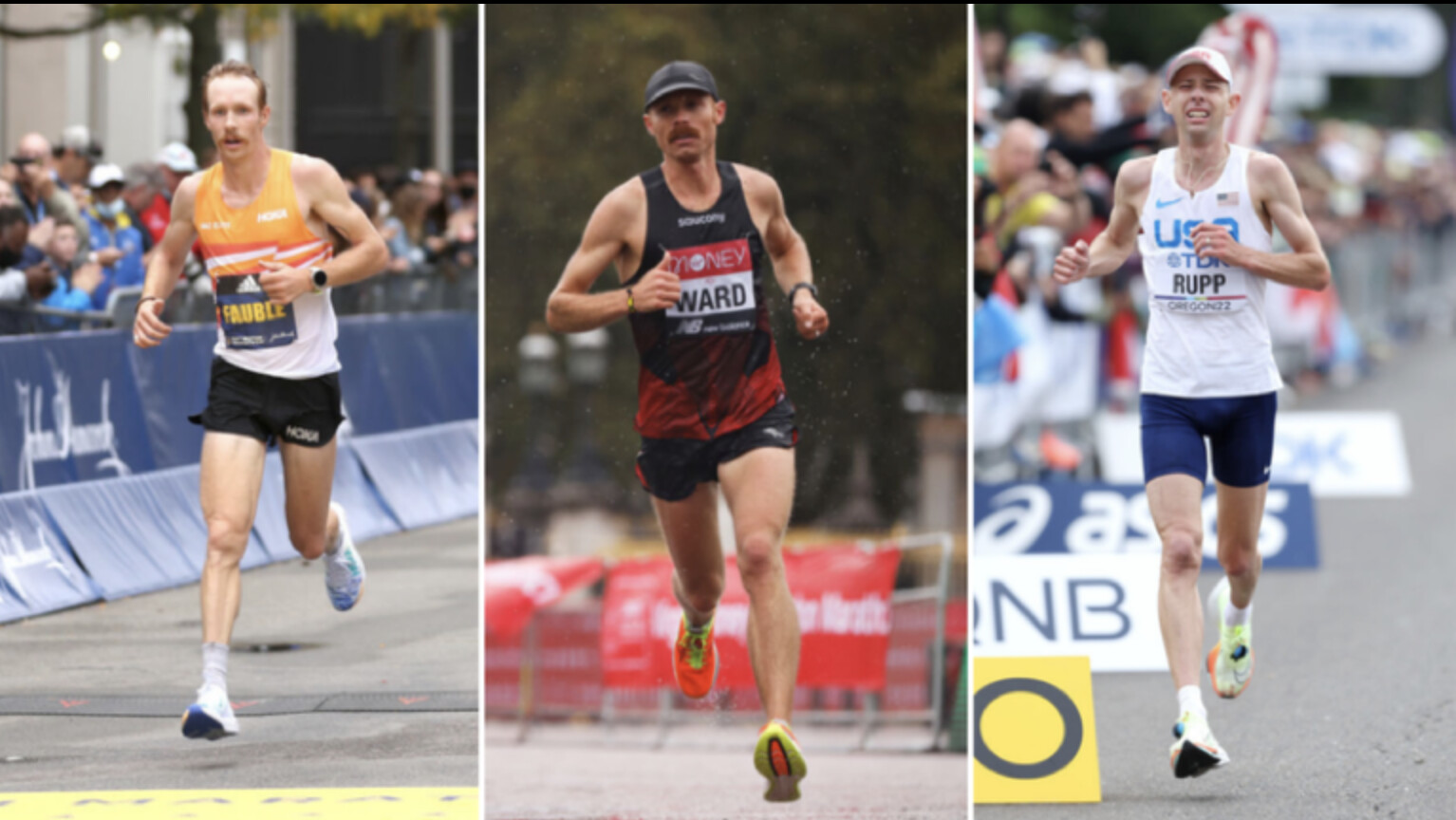
More specifically, the men’s and women’s 2024 U.S. Olympic Trials Marathon races—scheduled for February 3 in Orlando, Florida—are just four months away. And that means the top U.S. runners hoping to represent their country at next summer’s Olympics are about to begin preparing for the all-or-nothing qualifying race that decides which six runners will represent Team USA next summer on the streets of Paris.
Although several top American runners are racing the Chicago Marathon on October 8, even they have their eyes on a much bigger prize next February.
“There’s nothing in my mind that compares with being an Olympian and being in the Olympic Games,” says 26-year-old Utah-based Nike pro Conner Mantz, who returns to Chicago after finishing seventh last year in 2:08:16 in his debut at the distance. “So putting that first has been the plan for a long time. We’re just putting that first and we’re working backwards through the season with other races.”
Registration will open for the U.S. Olympic Trials Marathon in early November for runners who have surpassed the qualifying times in the marathon (2:18:00 for men, 2:37:00 for women) or half marathon (1:03:00 for men, 1:12:00 for women). The qualifying window extends through December 3—the race date of the last-chance California International Marathon, which for decades has been one of the most popular Olympic Trials qualifying races.
In 2020, a record 708 runners—465 women and 243 men—qualified for the U.S. Olympic Trials Marathon in Atlanta just before the onset of the Covid-19 pandemic. But USA Track & Field lowered the women’s qualifying standard by eight minutes from the more attainable 2:45:00 plateau, which means there will most likely be a much smaller women’s field this year.
But even so, amid the handful of runners who have a legitimate shot at making the Olympic team, there will also be dozens of dreamers, wannabes, and just-happy-to-be-there elite amateurs who have worked hard, put in the miles, and earned the chance to be on the start line of the deepest and most competitive U.S. distance-running races that only happen once every four years.
The men’s and women’s races will run simultaneously with the men beginning at 12:10 P.M. EST. and the women starting 10 minutes later. Runners have complained that a high noon start means they will be forced to race in hot, humid conditions. Over the past decade, the average temperature on February 3 in Orlando has been 69.6 degrees Fahrenheit at noon, rising to 73.3 at 4 PM. But actual temperatures have varied drastically, from 81 degrees Fahrenheit at 2 P.M. last year to 56 at the same time the year before. USATF officials have responded by saying that the start times are to accommodate live coverage on NBC and to match the expected conditions in Paris.
Here’s an update and overview of what’s next, who the top contenders are, the course, and what to expect in the next four months.
The 26.2-mile U.S. Olympic Trials course runs through downtown Orlando and consists of one 2.2-mile loop and three eight-mile loops. The marathon course will run through several neighborhoods, main streets, and business districts in Orlando, including Central Business District, City District, South Eola, Lake Eola Heights Historic District, Lake Cherokee Historic District, Lake Davis Greenwood, Lake Como, North Quarter, Lawsona/Fern Creek, SoDo District, and the Thornton Park neighborhood. It will then head east to and around The Milk District neighborhood and Main Street. (Notably, the course will come close to Disney World, which is about 15 miles to the southwest.)
Unlike the Olympic Marathon course in Paris, which will challenge runners with significant hills in the middle, the Orlando course is mostly flat. Each loop has a few minor variations in pitch, but only 38 feet separate the high and low points on the course. Ultimately, though, it’s a spectator-friendly route with chances for family, friends, and fans of runners to see the action several times.
The top women—based on personal best times and recent race results—are Emily Sisson, Emma Bates, Keira D’Amato, Betsy Saina, and Lindsay Flanagan. But the U.S. Olympic Trials races almost always produce surprises with a few great runners having off days and a few good runners having exceptional days, so there is reason to expect the unexpected.
Sisson lowered the American record to 2:18:29 last year when she finished second in the Chicago Marathon. She’s running Chicago again on October 8 along with Bates, who has said she’s hoping to break the American record. In January, Sisson, 31, chopped her own American record in the half marathon in Houston with a 1:06:52 effort, and most recently won the U.S. 20K Championships (1:06:09) on September 4 in New Haven, Connecticut. Bates, also 31, hasn’t raced at all since her sterling fifth-place effort at the Boston Marathon in April, when she slashed her personal best to 2:22:10.
While Chicago will be another good place to test themselves, both have unfinished business after Bates was seventh at the 2020 Trials and Sisson dropped out near the 21-mile mark.
The same goes for Flanagan, 32, who has been one of America’s best and most consistent marathoners for the past five years. She placed 12th at the trials in 2020. She had a breakthrough win (2:24:43) at the Gold Coast Marathon in 2022 followed by a strong, eighth-place finish (2:26:08) at the Tokyo Marathon earlier this year. In August, she ran perhaps the best race of her career, when she finished ninth (2:27:47) at the world championships in Budapest amid hot, humid conditions.
The 38-year-old D’Amato, meanwhile, just capped off another strong season with a 17th-place showing (2:31:35) at the World Athletics Championships in Budapest, a year after finishing eighth in the world championships and setting an American record 2:19:12 at the 2022 Houston Marathon. She was 15th at the Trials in 2020 in 2:34:24, just two years into her competitive return to the sport after having two kids and starting a career in real estate in her early 20s.
“It’s such a huge goal of mine to become an Olympian,” says D’Amato, who lowered Sisson’s U.S. record in the half marathon with a 1:06:39 effort at the Gold Coast Half Marathon on July 1 in Australia. “It’s really hard for me to put words into this because my whole life, wearing a Team USA jersey has been like a huge dream. And when I left the sport (temporarily), I felt like I said goodbye to that dream and I kind of mourned the loss of being able to represent my country. I feel like it’s the greatest honor in our sport to be able to wear our flag and race as hard as possible.”
Saina, a 35-year-old Kenya-born runner who ran collegiately for Iowa State University, became a U.S. citizen in late 2021. She placed fifth in the 10,000-meters at the 2016 Olympics in Rio de Janeiro while competing for Kenya. She’s spent the past several years splitting time between Kenya and Nashville, Tennessee, where she gave birth to a son, Kalya, in December 2021.
She’s returned with a strong fourth-place 1:11:40 result at the Tokyo Half Marathon last October and a fifth-place 2:21:40 showing at the Tokyo Marathon in February. In May, Saina won the U.S. 25K Championships in Michigan. Two weeks ago she broke the tape at the Blackmores Sydney Marathon in Australia in 2:26:47.
Other top contenders include but are not limited to Tokyo Olympics bronze medalist Molly Seidel (who’s personal best is 2:24:42), 2022 U.S. Olympic Trials champion Aliphine Tuliamuk (2:24:37, 11th in Boston this year), Susanna Sullivan (2:24:27 personal best, 10th in London this year), two-time Olympian and 2018 Boston Marathon winner Des Linden (2:22:38), and Sara Hall (2:20:32, fifth at last year’s world championships), plus Kellyn Taylor (2:24:29), Nell Rojas (2:24:51), Sarah Sellers (2:25:43), Lauren Paquette (2:25:56), Dakotah Lindwurm (2:25:01), Annie Frisbie (2:26:18), Sara Vaughn (2:26:23), Tristin Van Ord (2:27:07), and Jacqueline Gaughan (2:27:08).
The list of potential men’s top contenders isn’t as clear-cut, partially because there are so many sub-2:11 runners and several fast runners who are relatively new to the marathon. But all that suggests a wide-open men’s race where more than a dozen runners are legitimately in the mix for the three Olympic team spots. That said, the top runners on paper, based on both time and consistent results over the past few years, are Scott Fauble, Jared Ward, Galen Rupp, Conner Mantz, Leonard Korir, Matt McDonald, and C.J. Albertson.
The 31-year-old Fauble, who was 12th in the Olympic Trials in 2020 and owns a 2:08:52 personal best, has finished seventh in the Boston Marathon three times since 2019 and also finished seventh in the New York City Marathon in 2018. Ward is a 2016 U.S. Olympian and has three top-10 finishes at the New York City Marathon and a 2:09:25 personal best from Boston in 2019. He’s 35, but he just ran a 2:11:44 (27th place) at the Berlin Marathon in late September.
Rupp, who won the past two U.S. Olympic Trials Marathons and earned the bronze medal in the marathon at the 2016 Olympics, is nearing the end of his competitive career. He boasts a 2:06:07 personal best and has run under 2:10 more than any American in history, including when he finished 19th at the world championships (2:09:36) last year. He’s a bit of a wild card because he’s 37 and hasn’t raced since his lackluster 17th-place showing at the NYC Half Marathon (1:04:57) in March, but the world will get a glimpse of his fitness in Chicago this weekend.
Mantz followed up his solid debut in Chicago last fall with a good Boston Marathon in April (11th, 2:10:25) and solid racing on the track and roads all year, including his recent runner-up showings at the Beach to Beacon 10K in August and the U.S. 20K Championships in September.
McDonald, 30, who was 10th in the 2020 U.S. Olympic Trials, has quietly become one of the best marathoners in the U.S. while serving as a postdoctoral associate in chemical engineering at M.I.T. His last three races have clocked in at 2:10:35 (Boston 2022), 2:09:49 (Chicago 2022), and 2:10:17 (Boston 2023). The only other runner who rivals that kind of consistency is Albertson, 29, who has run 2:10:23 (Boston 2022), 2:10:52 (Grandma’s Marathon 2022) and 2:10:33 (Boston 2022) in his past three marathons and was seventh in the U.S. Olympic Trials in 2020 (2:11:49).
The men’s race will likely have a mix of veteran runners and newcomers who have run in the 2:09 to 2:10 range since 2022. Among those are 2020 U.S. Olympic Trials runner-up Jake Riley (2:10:02 personal best), who is returning from double Achilles surgery; 2016 U.S. 10,000-meter Olympian Leonard Korir (2:07:56), who ran a 2:09:31 in Paris in April; Zach Panning (2:09:28, plus 13th at the world championships in August); U.S. 25K record-holder Parker Stinson (2:10.53); Futsum Zienasellassie who won the California International Marathon last December in his debut (2:11:01) and then doubled-back with a new personal best (2:09:40) at the Rotterdam Marathon in the spring; Abbabiya Simbassa, who ran a solid debut marathon (2:10:34) in Prague this spring; and Eritrean-born Daniel Mesfun (2:10:06) and Ethiopian-born Teshome Mekonen (2:10:16), who both received U.S. citizenship within the past year; and solid veterans Nico Montanez (2:09:55), Elkanah Kibet (2:10:43) and Nathan Martin (2:10:45).
Additional sub-2:12 runners who will be in the mix are Andrew Colley (2:11:26), Clayton Young (2:11:51), Brendan Gregg (2:11:21), Josh Izewski (2:11:26), Jacob Thompson (2:11:40), and Kevin Salvano (2:11:49).
As noted previously, some top contenders will season their marathon legs one final time at the flat and fast Chicago Marathon on October 8. An even more select few will opt for the New York City Marathon on November 5. After that, nearly every American with eyes set on an Olympic berth will double-down over the holiday season for that one final, critical marathon training cycle. Expect to see a wide range in heat training, from sauna protocols, to warm weather training trips, to simply an adjusted race day strategy.
Of course, with the Olympic Marathon falling under the purview of World Athletics, qualifying for the U.S. Olympic Marathon team is not quite as simple as finishing on the podium in Orlando. Any American looking to have a breakout performance and finish within the top three at the U.S. Olympic Trials Marathon will need to have run under 2:11:30 for men and 2:29:30 for women within the qualification window, which spans from November 1, 2022 to April 30, 2024. Given the possibility of oppressively hot and humid temps on February 3 in Orlando, they’re best bet is to secure that time now.
These qualification standards are in accordance with a new rule from World Athletics, which allows national Olympic committees to circumvent the typical Olympic qualification process of running under 2:08:10 for men and 2:26:50 for women, or being ranked among the top 65 in the world on a filtered list of the top three athletes from each country. The catch, though, is that three other runners from said country must have met one of these two standards. If this sounds complicated, that’s because it is.
For the hundreds of elite amateurs on the cusp of hitting that coveted U.S. Olympic Trials qualifying time, it’s do or die mode. While a few made the cut at the Berlin Marathon on September 24, one of those opportunities was lost when the Twin Cities Marathon was canceled on October 1 because of excessive heat. Temperatures are shaping up for an auspicious day in Chicago this weekend, and many more will give it a final shot at the Columbus Marathon on October 15; Indianapolis Monumental Marathon on October 28; the Philadelphia Marathon on November 18; and the last-call California International Marathon, a point-to-point race ending in Sacramento, California on December 3.
Ultimately, only six American runners will likely continue on along the road to Paris and earn the chance to run in the men’s and women’s Olympic marathons next August 10-11. For a handful of younger runners, the 2024 U.S. Olympic Trials will be a motivation to reinvigorate the Olympic dream or keep a faint hope alive, at least until the 2028 U.S. Olympic Trials that will determine the team for the Los Angeles Olympics. But for many runners, the journey to the U.S. Olympic Trials in Orlando will lead to the end of their competitive road running careers as new jobs, young families, a switch to trail running, and other priorities will take hold.
“I think the Olympic Trials is an important part of American distance running,” says Kurt Roeser, 36, a two-time U.S. Olympic Trials Marathon qualifier who works full-time as a physical therapist in Boulder, Colorado. “I’m glad that they kept it the same event for this cycle and hopefully for future cycles because it gives people like me a reason to keep training. I’m older now and I’m not going to actually have a chance to make an Olympic team, but for somebody that’s fresh out out of college and maybe they just barely squeak in under the qualifying time, maybe that’s the catalyst they need to start training more seriously through the next cycle. And maybe four years from now, they are a serious factor for making the team.”
by Outside Online
Login to leave a comment
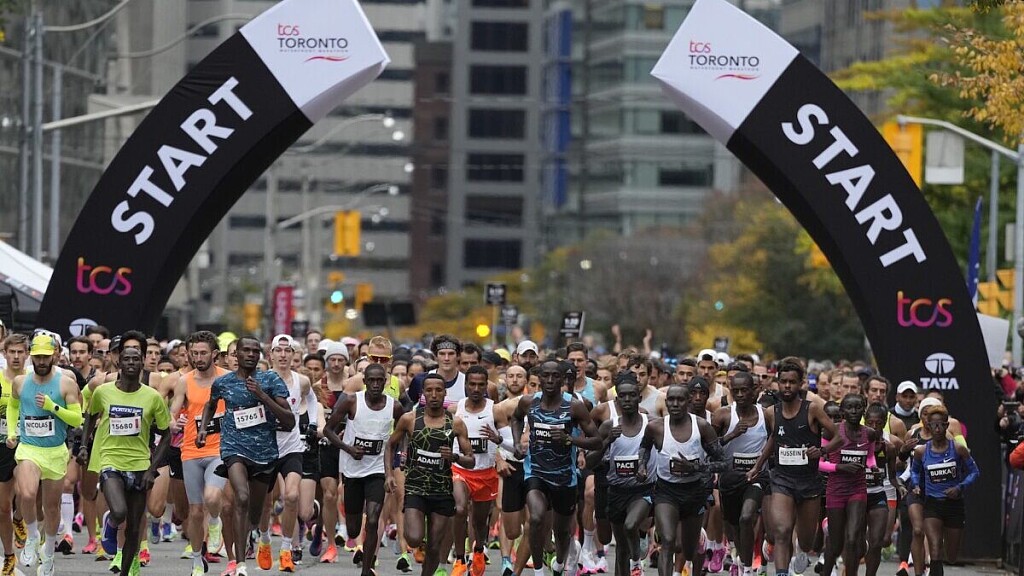
TCS Toronto Waterfront Marathon extends warm welcome to canceled Twin Cities Marathon athletes
The TCS Toronto Waterfront Marathon is extending a helping hand to several elite runners who were affected by the last-minute heat cancellation of the 2023 Twin Cities Marathon last Sunday.
Although Canada’s largest marathon had been sold out for months, marking the first time in the race’s history that the marathon has reached full capacity this early. There ended up being several withdrawals in the men’s and women’s elite fields two weeks before the Oct. 15 race day.
Jim Estes, the manager of the elite program at the Twin Cities Marathon, reached out to TCS Toronto Waterfront Marathon race director Alan Brookes, exploring the possibility of accommodating some of the elite runners. Brookes shared that he and Jim have a close relationship and have worked on elite teams at Chicago and Houston marathons. “We ended up extending three spots to athletes who did not get the chance to run the marathon in Minnesota,” says Brookes.
This period is crucial for U.S. marathoners, as many are shooting to qualify for U.S. Olympic Marathon Trials in Orlando next February. The fall marathon season represents a final opportunity to secure a qualification spot there or to chase an Olympic qualifying time of 2:08:10 (men) and 2:26:50 (women) before the trials.
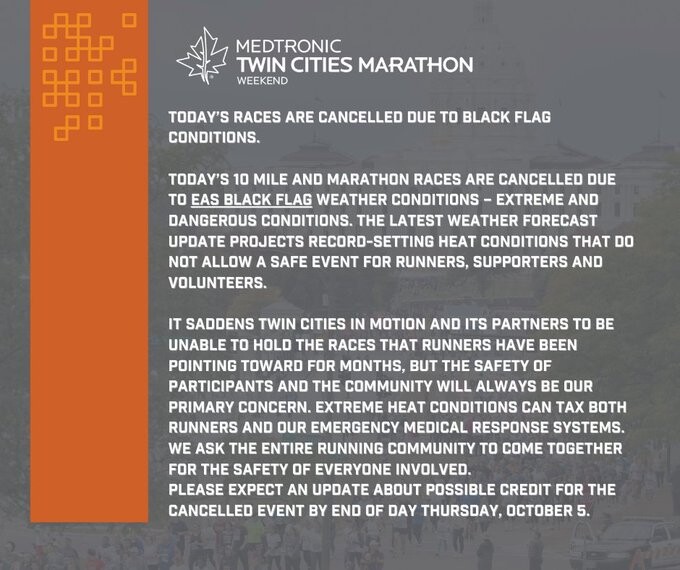
Toronto was not the only marathon to offer invitations. The McKirdy Micro Marathon in Valley Cottage, N.Y., the Indianapolis Monumental Marathon and the Philadelphia Marathon have also offered spaces in their elite fields for athletes originally slated to compete in Twin Cities.
The Twin Cities Marathon was set to host nearly 8,000 runners on Oct. 1 but ended up being abruptly canceled just two hours before its 7 a.m. start due to soaring temperatures. Despite the short notice, many runners who had traveled to Minnesota decided to go ahead with their race on their own. The temperature in Minneapolis–Saint Paul, Minn., reached a high of 27 C (80 F) by 11 a.m. on Sunday.
Eli Asch, the race director of Twin Cities, defended their decision to cancel the race in an interview with Runners World, stating, “We saved lives.” However, Asch did not confirm whether the race would provide refunds or offer credits to the 20,000 registered participants but said the race’s intention is to be “as generous as possible.”
by Marley Dickinson
Login to leave a comment
TCS Toronto Waterfront Marathon
The Scotiabank Toronto Waterfront Marathon, Half-Marathon & 5k Run / Walk is organized by Canada Running Series Inc., organizers of the Canada Running Series, "A selection of Canada's best runs!" Canada Running Series annually organizes eight events in Montreal, Toronto and Vancouver that vary in distance from the 5k to the marathon. The Scotiabank Toronto Waterfront Marathon and Half-Marathon are...
more...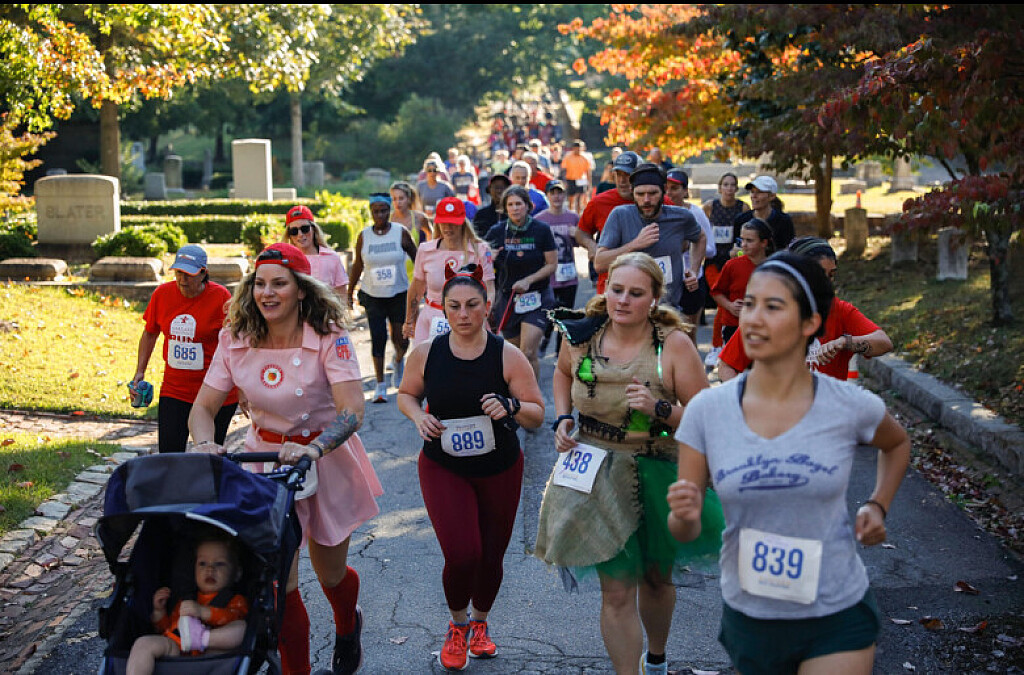
Wait … Is It Okay to Run in a Cemetery?
A strongly-worded sign in Eugene, Oregon, sparked debate: Fair game or a somber spot?
Just south of the University of Oregon, sits the Eugene Masonic Cemetery—a ten-acre hilly plot that’s filled with Douglas Fir Trees and wood-chip trails. In a city renowned for its rich running history, it’s relatively common to see runners using the paths as a neighborhood cut-through or spot to work in some hills.
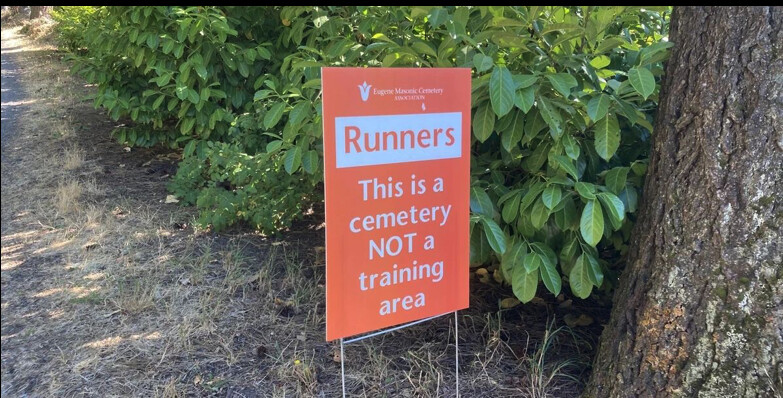
But last month, some residents started to notice red signs: “Runners, this is a cemetery NOT a training area.” The signs prodded discussion on Twitter, with some users scorning them while others emphasized the need to respect the dead. Some pointed out that seven blocks north is the Eugene Pioneer Cemetery, a slightly bigger area, which is a common warm-up spot for athletes competing at nearby Hayward Field.
Cemeteries can be a confusing middle ground between a green space and a solemn place of remembrance, and it brings up an ethical question: When is it okay to run in a cemetery?
Striking a balance
The Eugene Masonic Cemetery is private property—it’s an active burial ground. But Shawn Walker, the president of the Board of the Eugene Masonic Cemetery Association, clarifies that outsiders are still welcome in the space.
“I think it can be helpful for visitors to keep in mind that the cemetery is first and foremost a cemetery,” he said to Runner’s World in an email. “Visitors come to the cemetery to grieve, remember those who have passed on, and seek solace. Other ‘non-cemetery’ related activities are fine and encouraged as long as the activities do not disrupt the cemetery’s primary role.”
Not all cemeteries are privately owned; different types have emerged over the years. Take the Oakland Cemetery in downtown Atlanta. Oakland is the oldest cemetery in the city, founded in 1850, but it’s also the oldest public park.
The City of Atlanta owns the 48-acre space, but it operates differently from a church graveyard or military cemetery (don’t try to run in Arlington National Cemetery). Oakland is a “Victorian rural garden cemetery,” says Sandy White, the Director of Adult Programs and Volunteers at the Historic Oakland Foundation. Early cemeteries were connected with churches, but as cities grew, governments realized they needed more space to bury the dead, says White. But instead of a somber, religious space, these area were also used as parks.
In fact, during the Victorian period (1837 to 1901), it was common for families to visit cemeteries for leisure. During a time when diseases like yellow fever and cholera were rampant, families would pack a lunch and visit their dead relatives. Nowadays, you’re less likely to see a charcuterie board in front of a gravestone, but some cemeteries still retain those park-like qualities.
Fifteen years ago, the Historic Oakland Foundation created the Run Like Hell 5K. “At the time, [the foundation] was really searching for things that would be good fundraisers and respectful of the grounds and of the people that are buried in Oakland, but at the same time, really serve the modern communities that were built up around,” White says.
The race—which features a costume contest—has become the largest cemetery race in the U.S. with 219 runners toeing the line at this year’s April edition. The money raised from the race helps keep the cemetery humming through beautification and preservation projects, and it’s a key part of Oakland’s identity as a public green space.
“It’s every citizen in Atlanta’s park as much as it’s our cemetery,” White says.
Appreciation is key
Ultimately, running in a cemetery comes down to respect.
Walker says the red signs at the Masonic Cemetery were put up after some runners started taking advantage of the open gates. He says training groups would come to the cemetery and disrupt the peace with drills like sprints and chain runs. Sometimes a coach would even shout and whistle at the athletes.
“We felt that this type of activity and training was not consistent with the environment that we believe is important to maintain in the cemetery,” Walker says.
He admits the red signs might come off as harsh, but it’s tough to convey the message clearly.
“We love having visitors in the cemetery and part of our mission is to maintain and operate the cemetery as a resource for the community,” he says. “I believe it can be perfectly appropriate for runners to run in the cemetery as long as their activities are respectful to other visitors and to the space.”
Rob Rueff is familiar with this balance. His favorite race is a small 5K in Franklin, Indiana, called the Sparkler Sprint. Held on the 4th of July, the race is a fundraiser for the Franklin Community High School cross country team. The course meanders through a local park and the nearby Greenlawn Cemetery, and it reminds Rueff of trips to visit his grandparents as a child. In fact—the race literally goes past their graves.
“It’s like I can feel them cheering me on as I reach the final quarter mile of the race,” he says.
For Rueff, the cemetery is a reflective place of solace—but something he can combine with his passion for running. “When I’m training for races and I’ve hit a wall during training, I’ll drive down and run there,” he says. “I’ll make it a point to run by their graves just to check on things. It helps me clear my head and refocus on my training.”
Sarah Lorge Butler contributed to this report.
by Runner’s World
Login to leave a comment

9 Things Every Running Shop Employee Wishes You Knew
Yes, this shoe comes in other colors. No, that doesn’t mean you should buy it.
For two years, I worked at the best run specialty store in Minneapolis-St. Paul, Minnesota. For seven years after that, I worked for a running shoe brand. In that time, I learned there’s a sizable knowledge gulf between folks in the industry and most consumers. Even many consumers who pay pretty close attention to racing and shoe reviews weren’t always up-to-speed on the latest tech, how a certain brand fits or whether they need a neutral. stability, minimal, or trail shoe.

It’s our own fault. Brands create so many SKUs that it can be hard to keep up with each development. Stores stack so many models next to each other on the wall that it can seem impossible to know where to start.
I can ensure you we didn’t keep things convoluted on purpose. On the brand side, we wanted people to feel like they knew enough about our footwear to confidently buy shoes from our website. In the shop, we knew customers appreciated feeling like they were empowered to pick the right pair. If they felt overwhelmed at our store, we knew, they probably wouldn’t come back.
That got me thinking: What else did I wish every runner out there knew about shoes? So I jotted down this list. It’s far from comprehensive. Maybe there’ll be a part two.
Full disclosure: My wife works on the product team for the aforementioned shoe brand. But I think that gives me a valuable window into how brands ideate and produce their products, and I’ll do my best to be objective. Besides, I didn’t consult her on this. To counterbalance this, I’m going to go make some major purchases, also without consulting her!
One person I did consult, since he’s been in the shop game a lot longer than I have, is Jeff Metzdorff, co-owner of Mill City Running and Saint City Running. He will really hate that I called his cross-town rival the best shop in the Twin Cities, but them’s the breaks. In any case, here’s what came up for us.
Your coworker might love Asics. Your run club friend might hate Nike. That doesn’t mean you should buy Asics or avoid Nike. You should try both—and a bunch of others—to see what works for you. (FYI: Sizing can be different from brand to brand, so don’t be alarmed if you’re a full size bigger or smaller than you thought, or even a full size different from brand to brand.)
Every set of feet is different, and shoe choice is highly individual. Anyone who tells you with broad strokes to avoid or buy any one brand across the board might mean well, but they’re probably wrong. (And if they’re right, it’s a coincidence.)
So how do you know if a shoe is for you? It’s simple—if it’s comfortable when you put it on, there’s a really good chance it’ll serve you well. Shoes shouldn’t require a break-in period to feel good. (This is in addition to other considerations you should address before you’re trying them on, like whether the tread pattern will be sufficient for the surface on which you plan to run.)
Not to get all hippy-dippy, but your body is a pretty good judge of this sort of thing—and the (albeit very limited) science seems to agree.
They can absolutely contribute, to be sure, but it’s also tempting (and lazy) to point the finger to shoes alone when injuries happen. They’re part of an ecosystem that includes individual mechanics, stressors, your training, and other factors.
Being in the wrong pair of shoes won’t help your odds of avoiding injury, but if you’re in the wrong pair, you won’t blow out your knee in the first few steps. You’ll get some warning signs before an injury, so make sure you heed them if they appear.
Things like ramping up your mileage too quickly, or neglecting ancillary strength and mobility, probably play a bigger role in injuries than shoe choice alone. You’re not Indiana Jones trying to pick out the Holy Grail, so don’t stress too much.
All it often means is that the shoe contains more physical material like midsole cushion, or more expensive material like carbon fiber, and therefore was more expensive to produce. That doesn’t mean the $200 shoe won’t work for you, but don’t rule out the $130 shoe on this basis alone.
I’ve already covered this on the brand front—that just because your favorite athlete wears Hoka or On doesn’t mean you should—but this applies to shoe type, too. A lot of pros train and race in shoes that are lighter-weight and lower-profile than many of us should be using. They tend to be lighter, more efficient, and in more dire need of shedding ounces. (It’s their job to go fast, after all.) If you try and wear road racing flats in a 100-mile trail race because your favorite pro did it, there’s a good chance you’ll regret it after mile 50.
Of course, there are exceptions, but a lot of pros know very little about the shoes and brands they’re endorsing. So take those endorsements with a grain of salt.
“I need support.” I’ve heard it a thousand times, and I was only working the floor for two years. “Support” can mean more cushion. It can mean more medial stability, designed to mitigate overpronation. For a handful of people, it means the feeling that the arch is hugging the bottom of their foot when they step into the shoe. The list goes on.
Cushion can be good if it’s more comfortable for you – but an ultra-cushioned shoe won’t necessarily prevent injury at a higher rate than its more moderately-cushioned peers.
Medial stability is something pronators might need, although there’s been a move away from overtly-prescriptive footwear in favor of “inherently stable” shoes that work for a broader variety of folks in the last decade or so. (A shop employee should be able to help you decide whether you want a stability shoe.)
As for the arch, an insole that hugs the foot tightly might feel good at the outset, but it could be a one-way ticket to blister city. (Earlier I noted that comfort is king, but here’s one case where comfort now doesn’t necessarily translate to comfort later. Just don’t view arch-hugging fit as a dealbreaker.)
So, are you sure you need “more support,” whatever that means to you? Try some shoes on and find out!
I know, I know. They ruined your favorite shoe. Or even worse, they discontinued it. I certainly won’t try to convince you that the last model didn’t fit you just a little better, or feel a little more right. And this probably won’t ease the pain. But I can assure you that brands aren’t updating their shoes arbitrarily, or—as conspiratorially-minded YouTube reviewers occasionally insinuate—for marketing alone.
When a new shoe hits the market, the brands get a deluge of feedback from customer reviews, media reviews, store staff, and reps in the field. It’s too wide, it’s too narrow, the upper rips after 100 miles—stuff they would’ve liked to catch in testing, but didn’t until their sample size was the entire marketplace.
From the noise, some signals emerge, and they’ll chart a plan to address the most consistent pieces of feedback. It might be delayed by a model, because it’s usually a 12- to 18-month process to brief, build, and iterate a shoe before it launches. So the fifth version of a shoe often addresses the feedback they hear from the third version, for example.
That doesn’t mean you’ll like the new version as much as the old one. It would be ideal if everyone loved every update, but that’s not realistic, so the brands’ big bet is that more people will prefer the new version. That’s just business.
Does that mean they always get it right? (Stares at a pile of unused Hoka Clifton 2s in the corner.) Heck no. But they aren’t doing it just to mess with you. And let’s be real—sometimes your old favorite wasn’t quite as perfect as you remember it.
Where are you now, guy who took that size 8 Brooks Dyad off the wall, squeezed your toes into it, and declared: “This doesn’t fit!” without remorse? Did you think that ruled out the Dyad entirely? Did you tell your friends that Brooks shoes are too narrow? Did you not think we had a size 12 in the back that you could try on? Did you wonder why there was only one shoe, and where the matching half was? I think about you often.
And no, we don’t mind checking for you. If getting the color you want means you’re more likely to run, we’re more than happy to help.
To that end, we know it can be a touch intimidating to make your first run specialty visit. A display wall brimming with technical-looking choices and a floor staffed by serious (nutritionally- and sleep-deprived)-looking runners.
But, don’t be scared. Don’t worry about saying the wrong thing. Good shop staff meets you where you’re at, and wants to help get you on your way to enjoying a new pair of shoes. With any luck, you’ll turn into a lifelong runner and a lifelong customer.
You see, the stores need you more than you need them. If any staff treats you otherwise—and I know it happens—go shop at their competitor across town.
by Outside online
Login to leave a comment
Olympic gold medalist and top coach Harvey Glance dies at age 66
Former American sprinter and international coach Harvey Glance, who helped to propel Grenada's Kirani James to world and Olympic glory, has died at the age of 66 after suffering a cardiac arrest.
Tributes are being paid to the three-time Olympian and Olympic gold medalist following his death on Monday (June 12).
Glance underlined his talents at the Auburn University in the United States where he achieved four sprint National Collegiate Athletics Association titles.
He won the 100 meters gold at the US Olympic Trials in Eugene to secure his place on the team for the Montreal 1976 Olympics.
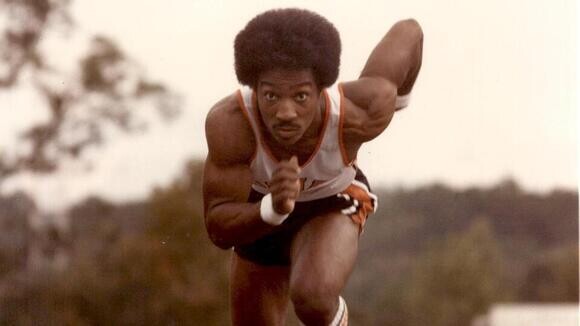
After finishing fourth in the 100m final, Glance teamed up with Johnny Jones, Millard Hampton and Steve Riddick to win the men’s 4x100m title.
Glance claimed 100m silver and 4x100m gold at San Juan 1979 Pan American Games.
He won his first world gold in 1987 when he linked up with Lee McRae, Lee McNeill and Carl Lewis to be crowned 4x100m champions before securing another Pan American Games 4x100m title in Indianapolis that same year.
His coaching career began at Auburn University, first as assistant coach before stepping up to become head coach.
In 1997, Glance became head coach at the University of Alabama where he worked with several top athletics including James.
He was notably the men's assistant coach for sprints and hurdles at the Beijing 2008 Olympics and head men's coach at the 2009 World Championships in Berlin.
After retiring from the University of Alabama, Glance continued to coach James, who claimed the world 400m crown in 2011, the Olympic 400m title at London 2012 and achieved further global medals in the one-lap event between 2015 and 2022.
Grenada’s Minister for Youth, Sports and Culture Ron Redhead was among those to pay tribute to Glance.
"I extend heartfelt condolences to the family, colleagues to the family, colleagues and friends of Mr Harvey Glance, one of our top-ranked athletic coaches, whose untimely passing has truly shocked the entire sporting fraternity," said Redhead.
"Mr Glance displayed the highest level of sportsmanship in coaching athletic greats such as our Olympic champion Kirani James and many other athletes across the globe.
"On behalf of the Ministry of Education, Youth, Sports, and Culture, I offer deepest sympathy to all his loved ones, and I pray that the almighty comforts you in this time of grief and immeasurable loss."
Alabama track and field head coach Dan Waters said Glance had "left a lasting mark" on university's athletics programme and described him as a "true legend in the sport".
"He impacted so many people in the track world, and his spirit will always live with us," added Waters.
"He was such a charismatic person and always left a positive impact on everyone he encountered over the years."
by Geoff Berkeley
Login to leave a comment
At 69, Bobby Kersee is track's 'mad scientist' and as influential as ever
Four years ago, the man associated with speed more than any track and field coach in the world felt himself slowing down, and he did not know why.
Since he was born in Panama in 1954 to a Panamanian mother and U.S. Navy father, Bobby Kersee has always been restless, a self-described wanderer with energy that matched his athletes. But in 2019, feeling unusually sapped, he called his doctor in St. Louis. Blood tests produced results dangerously far beyond the norm. Pancreatitis kept him stuck in a hospital for four weeks.
Once discharged, Kersee gave up red meat and alcohol.
What he would not quit was track.
Forty years after coaching his first world champion Kersee, now 69, paced relentlessly for four hours on Thursday while watching his training group at West Los Angeles College.
“Everyone kind of says the same thing: You know, he's different in terms of he's basically a mad scientist,” said Athing Mu, the 20-year-old reigning Olympic and world champion at 800 meters who switched to Kersee’s coaching in September to expand her range. “He knows what he's doing.”
Under cloudy skies at the track high above Culver City, nine athletes in his training group, dubbed Formula Kersee, ran tailored workouts and waited for his every word, from the barked “let’s go!” to commands about mechanics he hollered to athletes mid-run. He lifted hurdles, held court with reporters and stopped only to film block starts with his iPhone.
At an age when he might have become anachronistic, Kersee and his methods still represent sprinting’s gold standard, associates and athletes say. Invigorated by a training group that describes itself as a family and could be dominant into the next decade behind headliners Mu and 23-year-old 400-meter hurdles world champion and world record-holder Sydney McLaughlin-Levrone, Kersee said his career has no discernible finish line.
His coaching, primarily of sprinters and hurdlers, has brought his athletes at least one gold medal in 10 consecutive Summer Olympics, a litany of world championships and world records and, for Kersee, veneration, criticism and influence.
As the first professional meet held at UCLA’s Drake Stadium since 1990, and a key early tentpole in USA Track & Field’s attempted plan to grow its U.S. fanbase before the 2028 L.A. Olympics, this weekend’s Los Angeles Grand Prix is both a callback to a time when track’s popularity soared and, its organizers hope, a harbinger such times can return.
Outside of Sebastian Coe, the 1984 Olympic gold medalist in the 1,500 who has since ascended to lead track’s global governing body, World Athletics, few figures have spanned both eras as prominently as Kersee.
Athletes and associates credit his ability to turn seemingly outlandish goals and times into tangible results to an ability to know what they need. Malachi Davis, who has overseen McLaughlin-Levrone’s training since she turned professional, likened Kersee to a conductor, his whistle and yellow stopwatch replacing a baton to direct “a beautiful dance of confidence and knowledge.”
Many coaches can teach how to run fast and build a race plan, McLaughlin-Levrone said, but Kersee understands “how to break it down piece by piece.”
Robert Forster, a Santa Monica-based physical therapist who has worked with Kersee’s athletes since 1983, said Kersee understands the “work-rest ratio” better than any coach, and does not overtrain where other coaches might double down on mileage. Forster has seen Kersee send an athlete home to rest just from the look on their face, and likes to tell a story about the 2016 Olympics, that Kersee later confirmed. Allyson Felix, the Los Angeles native who under Kersee became the most decorated athlete in track’s history, was nursing a severely sprained ankle and the physical therapist told Kersee it needed to be iced 20 minutes every hour. Forster did not expect, however, that Kersee would stay up the entire next night icing the ankle as Felix slept.
Kersee was an early adopter of technology, upgrading his video cameras at a Westwood electronics store years before he could film block starts of sprinters Jenna Prandini and Morolake Akinosun on his iPhone and zip the footage to an iPad on the infield of the West L.A. track.
Yet the Kersee mystique has endured as much because of his grasp on psychology as biomechanics — feeling for when to push and when to pull back.
Brandon Miller, a top 800-meter hopeful who began working with Kersee in September, has heard other athletes describe Kersee as “crazy.” He disputes that characterization, but noted that Kersee knows to stoke his competitiveness entering a workout’s final repetition with four words: “OK, what you got?”
“I've never met any coach like him,” Mu said. “He's not going to make you do anything that's for his sake. You know, it's gonna be all for you and the benefit of you and your career. And so, I come in here, I knew that he was very intentional, and that's something I needed, especially if I want my career to be long.”
Raised by a grandmother as an “A-train baby” bouncing between the Bronx and Queens, Kersee lost his mother, Daphne, when he was 14, before moving to San Pedro for high school.
He put himself through college at Long Beach State by working at a youth correctional facility in Whittier, where Kersee watched wards from midnight until 8 a.m. After graduating, he had two jobs: Track coach at Cal State Northridge, and counselor at another youth facility in Chino. He took over UCLA’s track and field program in 1980 and that provided enough money to be comfortable. Coaching Greg Foster to his first world championship in 1983, and watching his athletes win six golds and four silvers at the Los Angeles Olympics one year later, provided the final confidence he could sustain coaching as a career.
But he did not leave behind the edge required to do his former jobs.
“I used to work in the prisons, so you can’t walk into the prisons being Mother Teresa,” he said. “And then I did find myself carrying a little bit too much of that to the track. I had to calm myself down and say, 'Wait a minute, you’re not working with a warden.'”
Once, an elderly woman approached Kersee in an airport in Indiana and told him she did not like what she had seen from Kersee or the other famed coach with the B.K. initials: Bobby Knight. He did not belittle his athletes, he said, but he also didn’t leave room for interpretation about who ran the workout. The edge created a mystique that “he's crazy,” Miller said. “But he's not. I feel like everybody has preconceptions of everybody but you won't really know unless you're there and you're with them every day.”
Just as when he built his vaunted World Class Athletic Club in the 1980s, he will only train those he can coach hard and have chemistry. His athletes typically train Monday, Tuesday, Thursday and Friday. He treats Monday Zoom calls with the group as though he is re-interviewing for the job. It’s more convenient than years before, he said, when he recalled gathering before dawn in Europe to address their complaints with him.
“I think we have that understanding that I’m going to listen and respect them,” he said. “But my job is to get the job done for them individually and collectively but you hired me. And if you hired me, let me do my job.”
That job, essentially, can be reduced to one thing: Imparting confidence in his plan. And no one does it like Kersee, said Davis, who sprinted professionally before aiding McLaughlin-Levrone.
“He's a competition coach, so the time it counts, you feel confident,” Davis said. “And your head coach is basically your general and then competition is basically war. And yes, you prepare for war but that final voice, that presence, that action, that essence, that’s Bobby. And he earned that by what he’s accomplished throughout his career.”
Kersee allows that age has softened him. As McLaughlin-Levrone recalled last August, Kersee earned her trust when he saw her overwhelmed with emotion at a 2020 practice and handed her a paper showing a wheel of emotions, saying he had trouble expressing himself, too.
Though accustomed to criticism of himself for years — he joked he would be buried in a track, and "probably as much as people hate me, they’ll put me in lane one, because I’ll be stepped on the most" — he worries about how the inundation of social media affects athletes’ mental health. He has traveled to support the singing ambitions of Formula Kersee sprinter Chloe Abbott. This spring, a smiling Kersee was featured on TikTok when his athletes remade the opening credits of the 1990s sitcom “Family Matters.”
Four decades into his career, he has “a whole lot of knowledge and a whole lot of patience,” he said. “But still, don’t let grandpa get out of the chair.”
Ato Boldon was never coached by Kersee during his sprinting career but has known him for 31 years, since they overlapped at UCLA, and has seen a “golden-hearted” side to the coach. He also described Kersee’s coaching equivalent as either Knight or San Antonio’s Gregg Popovich.
“Everybody under him wins,” said Boldon. “But it’s not necessarily a democracy.
“... As time has gone on, people are like, ‘Wow he’s so this or he’s so that, he’s so abrasive.’ Listen, do you want results, or do you not want results?”
No one argues that Kersee gets results. The most common criticism is how rarely his athletes compete en route to smashing records and claiming gold.
Among athletes, meet directors, agents and track officials who see a need for the sport’s biggest stars and strong competition to draw in casual fans, it has become a question of how to unite what is best for the top athletes’ futures with what is best for the sport’s growth. The tensions surrounding the discussion are not dissimilar from the way “load management” in the NBA has sparked concerns whether it will turn off fans from the regular season.
Because many top athletes train under Kersee, he has become a focal point. There is also his history of pulling athletes late before a meet, sometimes because of injury, and sometimes as a power play, as in 1994, when a dispute over pay led him to withdraw Gail Devers from a high-profile Los Angeles indoor meet.
The topic reignited last week when he withdrew Mu and McLaughlin-Levrone from the Grand Prix, a meet for which he serves as co-promoter. It came soon after telling Track & Field News in February that even he would like to see McLaughlin-Levrone run more often, and told The Times in March that there was no reason meets in the U.S. couldn’t draw thousands if the sport’s leaders banded together to promote strong competitions.
Asked about the balance of what is best for his athletes, or the sport, Kersee this week called it a byproduct of limited sponsorship money within the sport, which incentivizes performances at the biggest meets, which often require qualification earlier in the season. Only a handful of stars make big money and can afford to be choosy. He contrasted it with the NFL and NBA, where athletes can still earn a paycheck while resting.
“I think it’s a little tougher on our athletes to try to balance out wanting to run for the public and run for our sport and also knowing if I run too much or make one little mistake it might cost me making a team,” Kersee said. “That if I go out there and run five or six races I’m going to get to the point of, 'OK why is he running me so much and she gets injured over there, did she really need to run?'”
McLaughlin-Levrone released a statement after being pulled from the Grand Prix field that she “regrettably” would not be competing, citing her coach’s choice. It also said she trusted his judgment, which the world record-holder echoed again Thursday.
“He has a plan and he is going to work it out to perfection,” said Boldon, who will call Saturday’s meet as part of NBC’s broadcast team. “It might not benefit USATF, it might not benefit the fans, but you tell me, what moment stood out most from last summer's world championships?”
It was McLaughlin-Levrone’s stunning 50.68 time to win the 400-meter world title and lower her own world record. The run cut through the noise to make SportsCenter. It also left McLaughlin-Levrone sore for days, she said. Seeing her parents in the stands, for the first time after becoming the first woman to run under 51 seconds, she told them “that hurt, so bad.”
“We've been very calculated in when we run and I think it's yielded us great results,” McLaughlin-Levrone said. “Bobby always uses analogies and he's like, 'You don't take the Ferrari out every day for a drive. You take it out when it needs to come out and it does its things and you put it back in the garage.' So, your body can only be pushed to a certain level so much in your career.
“You only have so many races in your legs and I think we're really strategic about which ones we choose to run. Obviously I know the sport wants to see a little bit more and I think we're trying to figure out how to do that in a safe way that we can still accomplish our goals and give them something to look forward to.”
For McLaughlin-Levrone and Mu, the question is not whether they will make this summer’s world championships in Hungary, or next summer’s Paris Olympics, but which events — possibly plural — they will run.
When Kersee evaluates whether to bring an athlete into his coaching, he also looks for their potential range. He thought he lost his job coaching Felix when he told the 200-meter star during his interview that he would have her run the 400.
Mu and McLaughlin-Levrone’s youth and potential range is one of the sport’s most speculative discussions; news about their upcoming races create instant headlines. The duo are “two of maybe the most talented athletes he’s ever had,” Boldon said.
Their world championships last summer gave McLaughlin-Levrone an automatic berth into the upcoming world 400-hurdle field, and Mu an entry into the 800. With that secured, Kersee has focused on running McLaughlin-Levrone in the open 400 meters, where Marita Koch’s world record of 47.60 has been effectively unapproachable for 38 years — only four women have run even faster than 49 seconds in the past 20 years. She once thought 47.60 was “impossible.” Not anymore.
“It's a very daunting number to look at, I'll tell you that,” McLaughlin-Levrone said. “But at the end of the day, I think if we can take the 400 hurdles to 50.6, I think 47.6 isn't too far off.”
In addition to her 800-meter world title, Mu once owned the collegiate 400-meter record and ran on the U.S. 4x400-meter relay team that won Olympic gold in Tokyo.
“I'm still super young and I have not touched the surface of a lot of things yet,” Mu said. “But I do have visions, which is like really big goals of competing in obviously the Olympics again, and then worlds and hopefully, doubling up.”
Would that mean the 800 and 400, or the 800 and 1,500?
“Hopefully both,” she said. “I mean, I would love to have a chance to do 4/8 and then go ahead and do the 8/15 at some point.”
Maybe this explains why Kersee moved so quickly across the track during practice. There was no sign he had once slowed down.
“I’m glad,” he said, “I have that Energizer Bunny still in me.”
This story originally appeared in Los Angeles Times.
Login to leave a comment
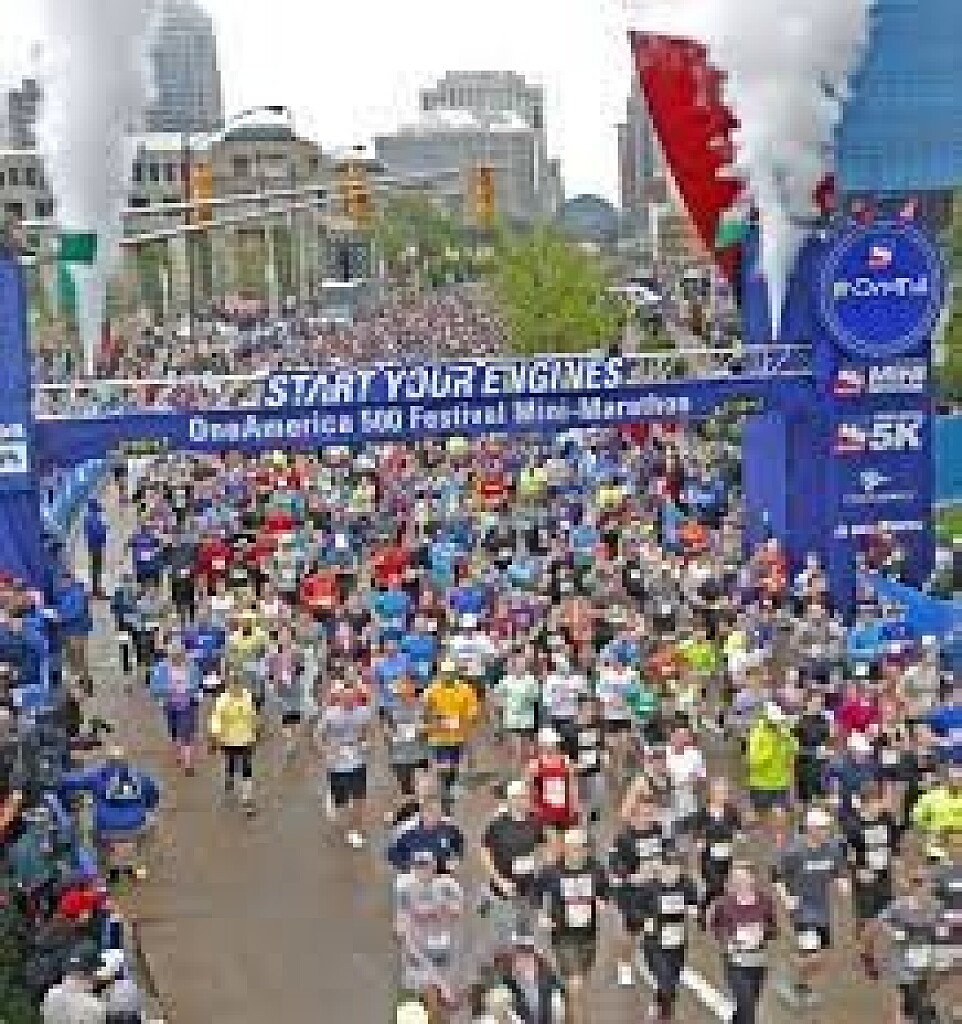
Indy Mini-Marathon named nation's best half-marathon
The Greatest Spectacle in Running is getting national attention.
The OneAmerica 500 Festival Mini-Marathon has been named the nation's best half-marathon as part of USA TODAY's 2023 10Best Readers' Choice travel awards.

According to USA TODAY, the half-marathon is the fastest-growing race distance in the United States with some 2 million runners participating annually.
The public had the opportunity to vote on their favorite race and in the end it was the OneAmerica 500 Festival Mini-Marathon that came out on top.
The marathon, often referred to as the Indy Mini, takes runners through downtown Indianapolis, past historic landmarks and famous sites like the Indianapolis Motor Speedway.
It's one of the nation's largest half-marathons, bringing some 35,000 runners to the Circle City each year. It's also part of the 500 Festival, which leads up to the iconic Indianapolis 500.
The Indy Mini beat the RunTheBluegrass Half Marathon in Lexington, which is known for being "America's prettiest half-marathon," and the Hippie Half, which brings people to Gregory, Michigan every summer to camp, run, listen to live music and enjoy a festive atmosphere.
Login to leave a comment
Nikki Hiltz, Sam Prakel both become two-time winners at Usaft 1 mile road
The USATF Indoor 1,500-meter winners demonstrated they could also rule the roads Tuesday night at the USATF 1 Mile Championships.
Nearly 10 weeks after both winning USATF Indoor titles Feb. 18 in Albuquerque, N.M., adidas professional Sam Prakel and Lululemon athlete Nikki Hiltz each secured their second career national road championships as part of the annual Grand Blue Mile event.
Hiltz produced the fastest performance in the history of the women’s race, which began in 2009, clocking 4 minutes, 27.97 seconds to edge reigning USATF Outdoor 1,500 champion Sinclaire Johnson of Nike’s Union Athletics Club in 4:28.70.
Hiltz, who prevailed in 2019 in Des Moines in 4:29.7, became the only athlete in event history to produce a pair of sub-4:30 efforts, benefitting from a 65-second opening quarter-mile and the pack reaching the midway point in 2:14.
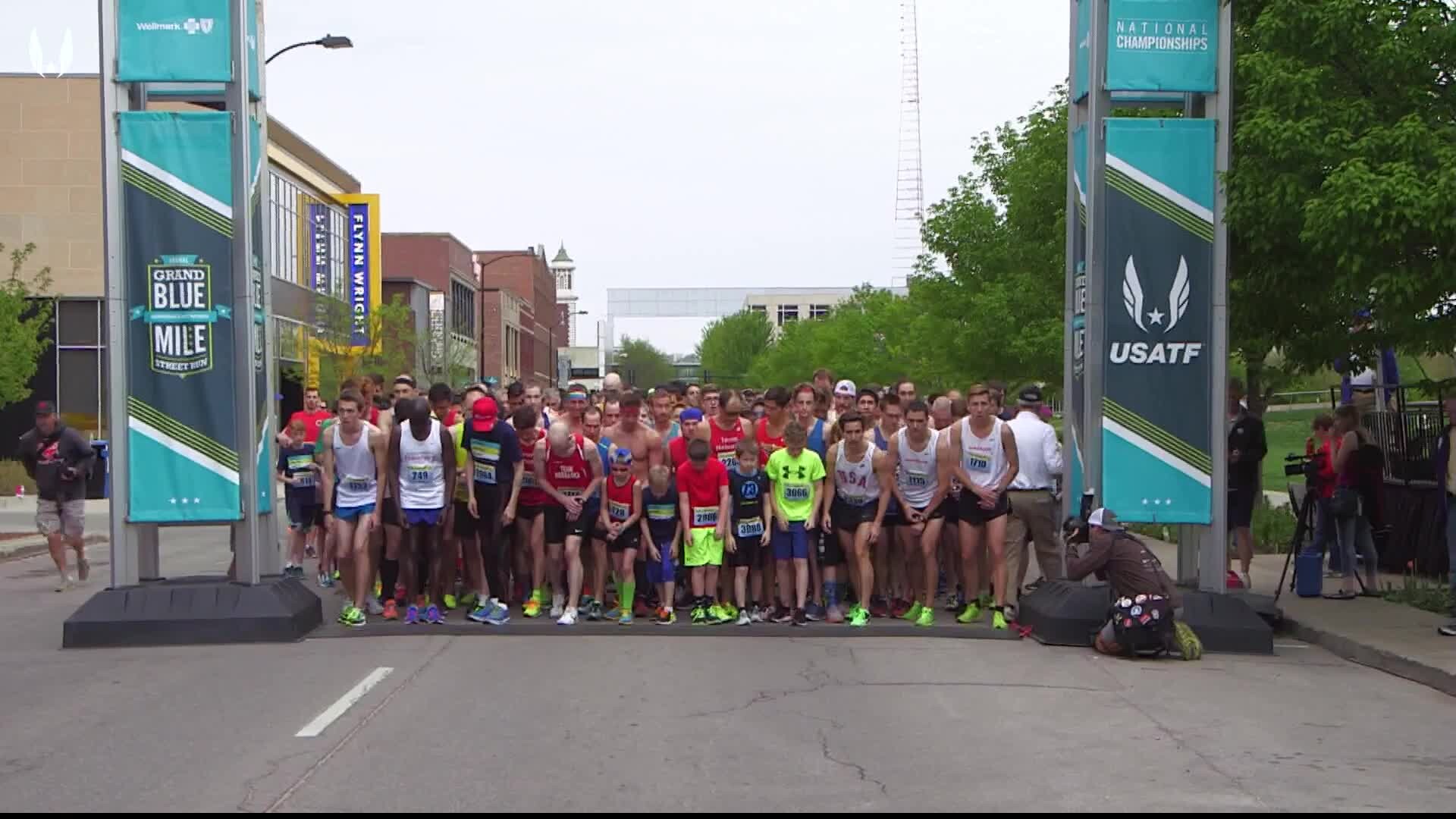
Emily Lipari, who had the previous all-time mark of 4:29.3 in 2020, and Johnson are the only other competitors to achieve a sub-4:30 performance in the race.
Hiltz, who ran a lifetime-best 1:59.03 in the 800 meters April 14 at the Bryan Clay Invitational at Azusa Pacific University, earned $5,000 for the victory and an additional $2,500 for the record bonus. Hiltz also joined Heather Kampf and Emily Lipari as the only three competitors to capture multiple women’s championships in event history.
Addy Wiley, a freshman at Huntington University in Indiana who secured five NAIA Indoor national titles March 2-4 in South Dakota, raced for the first time since that memorable showcase and took third in 4:30.94.
Wiley, 19, became the youngest top-three finisher in event history and achieved the No. 6 all-time performance in the nine years the competition has been held in Des Moines.
Wiley, who placed fourth in the 1,500 at the USATF Indoor Championships in February in Albuquerque, elevated to No. 7 in the history of the national road mile competition, including Sara Hall clocking 4:30.8 in Minnesota to secure the 2011 crown.
Colleen Quigley, representing Lululemon, finished fourth in 4:31.1 in her debut at the event, with Nike’s Shannon Osika and Alex Teubel also being credited with 4:31 performances to secure fifth and sixth.
Alli Cash (4:32), Jenn Randall (4:33), Micaela DeGenero (4:34) and Helen Schlachtenhaufen (4:37) completed the top 10 women’s competitors in the 23-athlete race.
Prakel prevailed in 4:01.21, remaining patient following an opening quarter mile of 61 seconds and a 2:05 split at the midway point, to take control in the final 500 meters and never relinquish his advantage.
Under Armour Mission Run Baltimore Distance athlete Casey Comber edged last year’s champion Vincent Ciattei by a 4:02.88 to 4:02.91 margin to grab second.
Prakel, who ran 13;22.78 in the 5,000 meters April 14 at Bryan Clay, also secured a $5,000 prize for the road mile title, becoming only the third male athlete in event history to capture multiple championships, joining David Torrence (2009-11) and Garrett Heath (2013 and 2015).
Prakel produced the fastest all-time mark in Des Moines with his 3:58.3 effort in 2020. Ben Blankenship holds the meet record with his title in 3:55.8 in 2016 in Minnesota.
Nick Randazzo, Kasey Knevelbaard and Jake Gillum were all credited with 4:04 performances to finish fourth, fifth and sixth, followed by Shane Streich and David Ribich both clocking 4:05 for seventh and eighth, Craig Nowak earning ninth in 4:06 and Colin Abert taking 10th in 4:08 in the 17-athlete race.
Login to leave a comment

Grand Blue Mile
The Grand Blue Mile was created by Wellmark Blue Cross and Blue Shield and the Drake Relays to encourage healthy habits and empower positive change. Held annually since 2010, the Grand Blue Mile has hosted more than 30,000 participants from 26 states, six countries, and four continents. The annual event brings friends and families together to celebrate wellness through a...
more...
Runners set world, state records at Publix Atlanta Marathon
ATLANTA — With nearly 8,000 participants, world and state records were set in the Publix Atlanta Marathon weekend. From distances of 50 meters to 26.2 miles, runners of all ages shattered records.
On Sunday, during the half marathon, Kenyans Nicholas Kosimbei and Dorcas Tuitoek made history. Kosimbei ran the fastest half marathon ever in Georgia shattering the previous mark of 1:03:59 and finishing more than two minutes ahead of his nearest rival with a time of 1:00:36.Tuitoek also shattered the record with a time of 1:08:22 in the women's half marathon race just seven seconds under the Georgia state record set by Molly Seidel last year, who went on to win a bronze medal in the Olympic Games marathon.
Additionally, Matt McDonald of Cambridge, Massachusetts, finished 6th overall in the half marathon at 1:05:32 and Dakotah Lindwurm of Eagan, Minnesota, finished with a time of 1:12:27. Chris Nasser of Atlanta won the Push Assist Division at 1:17:14.
“It’s fun to run by so many of my old spots,” McDonald said. “Almost every mile, I had some memory of some good time in that neighborhood, whether it was Georgia Tech where I did my Ph.D. or Piedmont Park where I did all my workouts.”
Shlomo Fishman of Silver Spring, Maryland, finished in 1st place in the Atlanta Publix Marathon with a time of 2:37:32.
“At Mile 18, I just decided I needed to get out of the rain,” Fishman said, who ran a personal best in his first marathon victory. “So, I picked it up a little bit and just went for it.”
In the women's marathon race, Amanda Furrer of Bethlehem, Pennsylvania, finished in 1st place with a time of 3:02:47, despite starting in Wave C, eight minutes behind the first non-elite runners. “I was alone for a while, so the cyclist on the course just started telling everyone my name. So people kept cheering for me. It was awesome!” Furrer said.
On Saturday, the 5K was won by Luke Mortensen, 39, of Athens, at 16:11 and Ellen Flood, 24, of Atlanta, at 17:25. Flood is also a former Georgia Tech runner.
Atlanta Track Club also hosted the USATF 5km Masters Championships, with 225 athletes ages 40 and over competing for both overall and age-group titles. Bryan Lindsey, 41, of Zionsville, Indiana, and Jessica Hruska, also 41, of Dubuque, Iowa won the overall titles. A world record was set by 97-year-old Betty Lindberg of Atlanta, a legend of the Atlanta Track Club. Her time of 55:48 set a world age-group record winning her 95+ division and destroying the previous mark by more than 30 minutes.
The 3K Atlanta Publix Kids Marathon was won by 13-year-old Nuriel Shimoni Stoil of Atlanta and 14-year-old Valeria Zambrano of Marietta.
Login to leave a comment

Publix Georgia Marathon
The Publix Georgia Marathon & Half Marathon is the perfect opportunity to visit the city of Atlanta. Atlanta's ONLY marathon, the event is a must do for adventure marathoners looking to cover all 50 states. A true Southeast tradition, you'll experience the spirit of the city as you travel through four college campuses, ten welcoming neighborhoods and dozens of iconic...
more...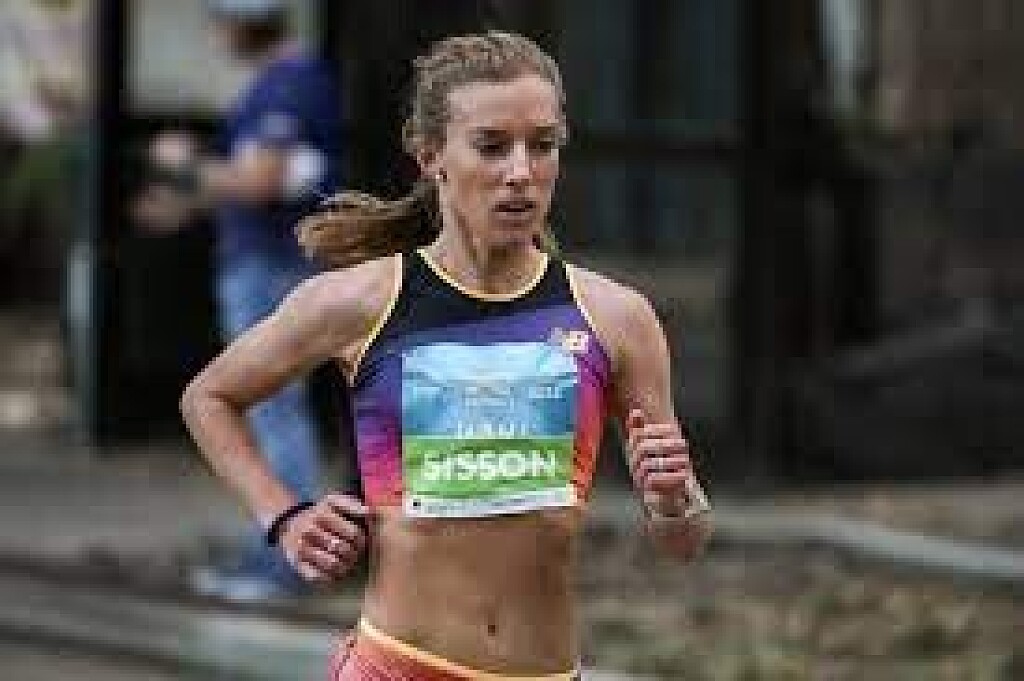
Emily Sisson sets a new half marathon American record in Houston
Emily Sisson shattered her own American record in the half marathon by finishing in 1:06:52. She is now the first American woman to break the 1:07 barrier after placing second behind race winner Hiwot Gebremaryam of Ethiopia, who ran 1:06:28.
Ethiopian Leul Gebresilase Aleme won the men’s half in a sprint finish. He ran 1:00:34—less than a second ahead of runner-up Wesley Kiptoo of Kenya.
Emily Sisson Re-Breaks Her Own American Record
Sisson improved on her record the hard way by going out fast, slowing down slightly through the last sections, and kicking it in towards the finish. After Gebremaryam broke the race open in the first few miles—by 5K, she was already 17 seconds ahead of the chase pack—Sisson ran with Jessica Warner-Judd of Great Britain through 15K. The American record-holder averaged 5-minute mile pace through the first 5K but struggled in the latter half of the course, clocking 5:12 miles around 20K.
“I went out a little too fast the first 5K or so, so the last few miles I was definitely feeling it,” Sisson said on the ABC 13 broadcast.
But Sisson pushed through the discomfort as she neared the finish line to make history once again. “I’m really excited about it. I really wanted to break 67 minutes and I’m happy I did,” she said. “I actually think I could have run a little more evenly so I’m already hoping to run another half and even try to run faster.”
Sisson broke the American record for the first time in May 2022 at the USATF Half Marathon Road Championships in Indianapolis. The Providence College alum won the national title in 1:07:11, four seconds faster than the previous American record set by Sara Hall less than four months earlier at the 2022 Houston Half Marathon.
Prior to the U.S. championships, Sisson came extremely close to the mark on two occasions. When the record was 1:07:25 (held by her former training partner Molly Huddle), she ran 1:07:30 in 2019 and 1:07:26 in 2020.
Last year, the momentum continued in a big way for Sisson when she broke the American record in the marathon. In October, she demolished the time by running 2:18:29 in Chicago—lowering the previous record set by Keira D’Amato at the 2022 Houston Marathon by 43 seconds.
Close Finish in the Men’s Half Marathon
The men’s half marathon featured one of the most exciting finishes of the day. After pulling away from the chase pack together with a few miles remaining, Aleme and Kiptoo battled down to the wire. The East African competitors fought through the homestretch—where Kiptoo kept looking back to assess the distance between himself and his rival—until Aleme sprinted ahead at the last second to claim the victory.
Aleme’s performance follows a breakthrough season, which included a runner-up finish at the 2022 London Marathon in October.
Conner Mantz was the first American to finish after placing sixth in 1:01:12.
Past Greats Return to Racing, While Familiar Faces Make Debuts
In addition to Sisson’s record, there were several other notable performances in the Houston women’s half marathon, including Huddle in her postpartum return to competitive racing. The previous American record-holder finished fifth in 1:10:01 almost nine months after welcoming her daughter. In her 13.1 debut, former 1500-meter specialist and Olympic bronze medalist Jenny Simpson placed ninth in 1:10:35. Also making her debut, Vanessa Fraser finished 13th in 1:11:00. All three had room to spare in achieving the standard to compete at the 2024 U.S. Olympic Marathon Trials.
Three-time Olympic champion Tirunesh Dibaba also made her highly anticipated return. In the Ethiopian's first race in four years, she finished 16th in 1:11:35.
by Runners World
Login to leave a comment
Aramco Houston Half Marathon
The Chevron Houston Marathon provides runners with a one-of-a-kind experience in the vibrant and dynamic setting of America's fourth-largest city. Renowned for its fast, flat, and scenic single-loop course, the race has earned accolades as the "fastest winter marathon" and the "second fastest marathon overall," according to the Ultimate Guide to Marathons. It’s a perfect opportunity for both elite athletes...
more...
Emily Sisson, Conner Mantz, Jenny Simpson, Tirunesh Dibaba Headline 2023 Aramco Houston Half Marathon
The Houston Marathon Committee announced today the elite athletes who will chase the $10,000 first-place prize in this historically fast race. Elite fields for the Chevron Houston Marathon which is held simultaneously on Sunday, January 15, will be announced tomorrow.
American records in the half marathon and marathon were set in Houston last year, but by the end of 2022, Emily Sisson had broken them both. Houston will be Sisson’s first race since running 2:18:29 at the Bank of America Chicago Marathon in October, shattering Keira D’Amato’s record by 43 seconds. Earlier in the year, her 1:07:11 performance in Indianapolis shaved four seconds off Sara Hall’s half marathon record.
“I have really enjoyed racing here in the past and am excited to start my 2023 season in Houston,” said Sisson who finished fifth in the 2019 Aramco Houston Half Marathon. “I felt good coming out of Chicago and am really looking forward to another opportunity to race.”
Sisson will have to contend with one of the greatest distance runners of all time as Tirunesh Dibaba of Ethiopia makes a return to competition after a more than four-year hiatus. The three-time Olympic gold medalist and five-time world champion has not raced since 2018 but says after giving birth to a second child in 2019 and then battling COVID-19, she is ready to add another chapter to her storied career.
“Houston is a famous race and my training has been going well,” said Dibaba, the 2017 Chicago Marathon Champion. “It seemed like the best way to test myself and see what could be next.”
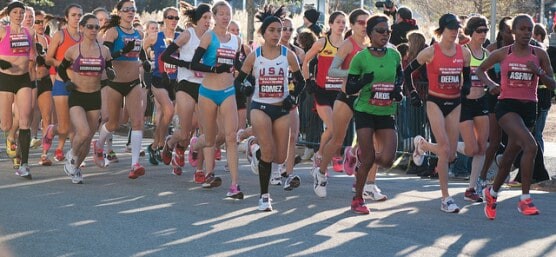
Other top contenders in the women’s half marathon elite field include 2021 Berlin Marathon runner-up Hiwot Gebrekidan of Ethiopia and 2022 World Championship Marathon fourth-place finisher Nazret Weldu of Eritrea. Dom Scott will attempt to break the South African half marathon record of 1:06:44, after a 3rd place finish in Houston last year. The top Americans include 28-time U.S. Champion Molly Huddle who set the then-American record here in 2018, as well as World Champion and Olympic Bronze Medalist Jenny Simpson who will make her half marathon debut.
“All of the racers I am learning from speak so highly of their experience with the Aramco Houston Half Marathon,” said Simpson. “It’s the perfect place for me to make my half marathon debut because the timing, course and organization are so well tested.”
In the men’s race, Edward Cheserek of Kenya, known to fans as “King Ches,” will look to trade in his crown for a king-sized belt buckle. Cheserek is coming off a 1:00:13 half marathon personal best in Valencia last month. “After Valencia this fall, I’ve trained harder and think sub-60 is possible,” said Cheserek, a 17-time NCAA Champion at the University of Oregon. “Houston is known for being a fast course and I want to have a chance at a personal best.”
Cheserek will face off against 2019 champion Shura Kitata of Ethiopia who lines up for his fourth Aramco Houston Half Marathon. With career marathon victories in London, Frankfurt and Rome, Kitata says he “feels home and comfortable in Houston.”
Other contenders to watch are Ethiopia’s Leul Gebresilase Aleme, runner up at last year’s London Marathon, and 2020 Olympian Mohamed El Aaraby of Morocco. The top American in the field is Conner Mantz of Utah. Mantz, the 2020 and 2021 NCAA Cross Country Champion at BYU, made his much-anticipated marathon debut in Chicago last October running 2:08:16, the fastest debut ever by an American-born runner.
Houston-native Frank Lara will return for a second consecutive year. Lara, a former Gatorade Texas High School Runner of the Year, was the top American finisher in the marathon last year. This year he competes in the half marathon.
The HMC is the only organizer to host two World Athletic Gold Label events simultaneously, which are Sunday’s Chevron Houston Marathon and Aramco Houston Half Marathon. These two races will have over 27,000 registrants, with an additional 6,000 registrants in the We Are Houston 5K presented by Aramco and Chevron, held on Saturday, January 14.
“Whether you are an elite athlete or a new runner, our committee is dedicated to hosting your individual pursuits with the utmost care and respect for the extraordinary efforts made to toe the start line with us,” said Wade Morehead, Executive Director of the Houston Marathon Committee.
The Aramco Houston Half Marathon and Chevron Houston Marathon will be broadcast on ABC13 from 7 a.m.-10 a.m., on Sunday, January 15 with a race day recap at 10:35 p.m. Joining ABC13’s Greg Bailey and Gina Gaston as expert commentator will be Des Linden, the 2018 Boston Marathon winner and 50K world-record holder. Linden made the first of her two U.S. Olympic Marathon teams in Houston in 2012. The trio will be joined by long-time analyst and Rice University cross country coach Jon Warren.
by Letsrun
Login to leave a comment
Aramco Houston Half Marathon
The Chevron Houston Marathon provides runners with a one-of-a-kind experience in the vibrant and dynamic setting of America's fourth-largest city. Renowned for its fast, flat, and scenic single-loop course, the race has earned accolades as the "fastest winter marathon" and the "second fastest marathon overall," according to the Ultimate Guide to Marathons. It’s a perfect opportunity for both elite athletes...
more...
Do Runners Drink Too Much Alcohol?
A growing body of research says that no amount of alcohol is good for our fitness and health. It’s time to rethink our relationship with booze.
Pro ultrarunner Coree Woltering doesn’t do anything halfway. “If I’m going to do it, I want to do like 120 percent, no matter what it is,” he says. When he brings that attitude to his running and racing, the results speak for themselves—like setting a new fastest known time on the 1,000-plus-mile Ice Age Trail across Wisconsin in 2020.

However, Woltering also brought that attitude to the bar. “It wasn’t just a ‘let’s have two beers and be done’ thing,” says the 32-year-old from Dalton, Georgia. Two beers at his house would lead to four more at the bar. “Six a night would be normal.” The results were noteworthy—but in all the wrong ways. His training became inconsistent. After long nights out, he’d sometimes skip sessions. When he did get out to run, he found his focus and mental fortitude lacking. Woltering doesn’t take over-the-counter pain management medications like Tylenol or ibuprofen. Instead, he’d slam a beer or two late in a race, hoping to hush the screaming of his feet and legs.
This approach is not unusual, says David Wyrick, PhD, a public health education professor and the director of the Institute to Promote Athlete Health & Wellness at the University of North Carolina, Greensboro. Wyrick studies alcohol use among student-athletes. Pain control is one of three primary reasons athletes report using alcohol (along with stress management and as a way to celebrate). Though, when it comes to pain, “there’s no evidence that alcohol has medicinal benefits,” says Wyrick.
Almost all the benefits Americans attribute to alcohol—that it is good for the heart, helps you sleep, eases pain—are false, says George F. Koob, PhD, director of the National Institute on Alcohol Abuse and Alcoholism. “The truth is, there’s no safe amount of alcohol, not even one drink a day,” he says.
And yet: Running culture—which is otherwise populated by protein-shake-drinking, heart-rate-tracking, health-obsessed fitness nuts—is enmeshed with drinking. From brewery-based runs to the infamous beer mile to groups with the motto “a drinking club with a running problem,” alcohol is as much a part of the fabric of our sport as energy gels. But the fact is, alcohol destroys lives and families. Running culture that glibly celebrates it is feeding that destruction.
Pulling them apart doesn’t mean eliminating alcohol. Koob has spent the last eight years working on issues around alcohol abuse, yet he describes his own approach to alcohol as “one eye open.” A glass of beer or wine every now and then? That’s fine for most runners. But blithely telling yourself beer is a recovery drink because it has carbs and your Tuesday night run ends at a bar? Not so much.
It’s time to take a good look at what we know—and don’t know—about alcohol’s relationship to our health, running performance, and mental well-being.
Booze and Sleep Don’t Mix
Three years ago, journalist Lisa Slade, a 38-year-old recreational marathoner, purchased a Whoop wearable device. Each morning, Whoop prompted her to input data about what she did before bed. Questions included: Did you eat a big meal? Are you under a lot of stress? Did you consume alcohol last night?
At the end of the first month, Slade got a summary of her data. “Pretty much the only thing I noticed that negatively impacted me to an alarming amount was alcohol,” she says. Slade had considered herself a light drinker—maybe a beer while making dinner, or two cocktails if she was out with friends. Even that low dose, though, was affecting her recovery times and sleep quality by as much as 20 percent. “I could tell that I was having a harder time recovering from it,” she says. After “just one or two drinks, I’d wake up and wouldn’t feel so good, like I hadn’t slept super well.”
Emily Capidolupo, senior vice president of data science and research at Whoop, says Slade’s revelation is common among new Whoop users. She adds that many cut back on drinking after a few months of using the wearable, which uses biometric data like heart rate, heart-rate variability, respiration rate, and sleep quality to score a user’s overall recovery. Alcohol “is one of those things we know is bad for us, but we don’t realize quite how bad,” she says. When Whoop presents the data in a tidy end-of-month report, it’s clear for many users that alcohol is a poison. “It’s a fun poison,” says Capidolupo. “But it’s poison.”
When you head out for beers after an evening run, you put an extra task on your body’s to-do list. In addition to recovering, it now must divert energy to breaking down the alcohol entering your bloodstream, inhibiting crucial functions like repairing exercise-induced muscle damage. Alcohol also impacts your immune system, blocking inflammatory responses vital to this process. For chronic drinkers, the negative effect on immunity can lead to more illness and fewer training days.
Compounding the issue, though, is that the most popular time to imbibe is in the hours before bed. Alcohol wrecks sleep quality, says Christopher Winter, MD, a Charlottesville, Virginia–based sleep specialist and host of the Sleep Unplugged podcast. If this seems counterintuitive, and a single beer makes you drowsy, you’re not alone. Alcohol is the most popular sleep aid in the country, he says, but that’s because most people don’t understand the difference between being sedated and being asleep.
Alcohol suppresses your central nervous system. That is not high-quality rest. Since alcohol relaxes a lot of the muscles involved with breathing, you may breathe less deeply as you sleep, lowering your oxygen saturation levels, says Winter. When you’re not getting enough oxygen, your body’s natural response is to wake you up. Alcohol also suppresses deep sleep, which is when your body makes growth hormone.
“If you’re grinding out the miles and trying to recover before a race or your next training session, alcohol impairs your ability to do that,” he says. It may also interfere with the secretion of melatonin, a hormone associated with sleep, which can mess with your shut-eye schedule causing daytime drowsiness and nighttime restlessness—so you reach for another beer. If you do plan to drink, drink less and do it very early, says Winter. “There really is no way to sidestep its negative properties.”
Not being able to fall asleep can cause extreme anxiety, especially as you count the minutes wide awake until the alarm says it’s time to get up. Many people turn to alcohol to dull anxiety, though it’s neither good nor effective, says Winter. It may mask the issue for a night, but it won’t give you the rest you need. If you’re struggling to get to sleep at night, first clean up your sleep hygiene by logging off devices and stress-inducing news sources at least an hour before bed. Consider meditation or quiet journaling, which can help you unwind, says Winter. And if you’re still worried about your sleep quality, take the issue to a sleep specialist.
The Pandemic Didn’t Help
J.R. Jamison, a 43-year-old Indiana-based author and NPR host, took up running 10 years ago and eventually lost 80 pounds. He was healthy and fit and loved how running got him out into the world. But when the pandemic hit, he found it difficult to differentiate between weekends and weekdays.
Jamison admits his weekend drinking habits had always been on the heavy side. But when Tuesday night started to feel just like a Friday night and no one was going anywhere, weekend drinking became everyday drinking. Next thing he knew, the running habit that had changed his life had fallen by the wayside. “There’s no doubt that substance use disorders have skyrocketed since the pandemic,” says Dave Rabin, MD, PhD, a San Francisco–based psychiatrist. A CDC report from August of 2020 found that 13 percent of Americans started or increased their use of substances like alcohol during the first six months of 2020.
Rabin says that, at its core, substance use stems from a human desire to avoid discomfort like stress, anxiety, or lack of control. And if we haven’t learned healthy, long-term strategies for managing discomfort, we look for something to alleviate that discomfort. Alcohol often produces the desired numbing effect.
As Jamison found himself drinking more, he had less energy and motivation. He’d wake up with brain fog and struggle through a day of work. With no impetus to run, and little accomplished professionally, he’d reach for a drink each night.
What’s so insidious about alcohol and other sedatives, says Rabin, is that these drugs numb our frontal-cortex activity, decreasing our insight and judgment. As a result, we unwittingly train ourselves to embrace a casual attitude toward self-reflection—and wind up oblivious to our problematic behavior, he says.
Running, however, does the opposite. It results in a neurochemical response in the brain, with endogenous pleasure molecules, endogenous opioid molecules, and endogenous cannabinoid molecules, plus dopamine and serotonin, all releasing on cue like one glorious feel-good chorus. This is why addiction specialists often recommend it as a coping mechanism for those struggling with alcohol use disorder, says Rabin.
But running won’t help if you can’t summon the motivation to do it. It took Jamison more than a year to rediscover his enthusiasm. As 2021 came to a close, he committed to Dry January. “I didn’t have a drop to drink throughout January, and I started to notice that I wasn’t waking up anymore with headaches,” he says. He started running again. “I liked the way I felt. I was happier. I just decided not to drink again, and I haven’t.”
The Myth of Healthy Drinking
Not long after Lisa Slade saw the effect of alcohol on her Whoop data, she clicked around the Internet looking for more info on why the impact was so dramatic. “We’ve been told our whole lives that a beer or a glass of wine is heart-healthy,” says Slade, who has since cut back her drinking. “But I was reading studies about the effects of alcohol and it turns out that maybe it’s not good for you at all.”
Alcohol is a known carcinogen, a substance that can cause cancer, says Tim Rebbeck, MD, a professor of cancer prevention at Harvard University. When you drink, your body relies on two enzymes to break alcohol molecules into pieces small enough for removal from the body. That breakdown process creates a byproduct called acetaldehyde. Laboratory, animal, and human studies have all shown that acetaldehyde causes DNA damage to cells, and this damage can lead to cancerous tumors. “We are sure that alcohol is a causative factor in some cancers, and it’s supported by lots of different lines of evidence,” says Rebbeck.
Getting the word out that alcohol—like tobacco—is a carcinogen has been difficult for several reasons. For one thing, alcohol is socially acceptable and even socially encouraged. Furthermore, the relationship between alcohol and cancer is more complicated than smoking’s direct link to lung cancer. Head, neck, liver, and breast cancer all have strong links to alcohol, says Rebbeck. But, of course, some people who never drank a drop will still get breast cancer and vice versa. “It’s a complex story, and people have a hard time digesting complex stories,” he says. And how much of a role alcohol played in any one person’s cancer development is an impossible equation to tease out.
As for a glass of wine being heart-healthy, recent research has debunked that advice, says Koob. The early studies concluding that it helps your heart were based on the resveratrol in red wine, but the amount you’d have to drink to get the benefits of the compound would tear your liver up, he says. A 2019 study published in the Journal of The American Heart Association confirms this, finding that heavy drinking is a risk factor for cardiovascular disease.
Even studies that find some benefit to drinking may not hold up under scrutiny. Over the years, a handful of meta-analyses of all-cause mortality among drinkers versus nondrinkers found a “J-shaped curve” between the two. Basically, mortality was slightly higher for nondrinkers, but dipped for moderate drinkers, and then rose sharply for heavy drinkers, forming a J. This would appear to make the “glass of wine for heart health” statement true. But in 2015, researchers took a closer look at these studies. When they teased out exactly why many abstainers did so, they found a confounding variable: These people were eschewing alcohol because of existing health concerns. In other words, they were less healthy than the moderate-drinking group to begin with. When researchers adjusted the data to account for abstainers with outstanding health concerns, the initial hump on the J flattened out.
Studying alcohol use and health effects is difficult, in part because people often don’t remember how much they consumed or because they aren’t being honest about it, says Rebbeck. That makes giving recommendations on how much and how often to drink difficult, too.
Interestingly, not a single expert interviewed for this story told us to stop drinking. Several mentioned that they occasionally enjoy wine and beer. “‘Don’t ever do anything that might harm you’ is not useful messaging,” says Rebbeck. Life is full of things that can harm us. Overly charred toast. Processed meats. The flame retardant on our couches. Uneven sidewalks waiting for unsuspecting runners.
A better approach is to consider your personal risk factors, your tolerance for risk, and the joy that alcohol—in moderation—brings you. If you have a family history of breast cancer, or head and neck cancers, you may decide the risk isn’t worth it. If you don’t, drinking in moderation may be a risk you’re willing to take. However, “limiting your exposure to alcohol is the bottom-line answer,” Rebbeck says. “You are consuming a carcinogen. How much of that do you really want?”
The Longest Race: Sobriety
For Coree Woltering, that amount was zero. On November 1, 2021, Woltering got sober. In past years, he’d taken time away from drinking and seen an improvement in his training. But then he’d go back to drinking—and plunge off the deep end. There wasn’t a happy medium where he just had one beer every other night. “It wasn’t just like I drank to get drunk,” he says. “I really enjoyed the taste of certain wines, certain beers. But that’s part of the problem, I enjoyed it to 150 percent.”
A week of sobriety passed. Then another. He jumped in to crew a friend through an ultra and got offered a shot of Fireball at an aid station. When he turned it down, everyone was surprised. “They’re like, ‘Oh, are you not feeling well?’ I’m like, ‘No, I feel great. I’m just not drinking.’ And everyone’s like, ‘Oh, are you sick?’ ‘No, I’m not sick. I’m just literally not drinking.’” That drinking culture and running culture knot is tight.
In the first month, Woltering focused on consistency. He set a goal to run every day in December and hit 30 of the 31 days. Over time, the awkwardness with friends abated, and Woltering found a community of similarly sober athletes. But his performance wasn’t doing the about-face he’d hoped for.
The second month was the rough one. “It was like, ‘Oh, now I feel every little pain in my body,’” he remembers. And then there was the FOMO. “It’s like, for the rest of my life, am I missing out on all these beers and wine that I haven’t tasted yet?”
It would take Woltering six months to get back to a place where he felt good. Yet he wasn’t seeing the times he’d hit in previous training peaks. That was frustrating. Giving up alcohol was supposed to be this golden ticket to better health.
Finally, eight months into sobriety, things started to click. His times began to improve. Those better numbers bolstered his commitment to the sober path. And then, in October of 2022, three weeks before hitting a year of sobriety, Woltering won the Blue Ridge Ultra 50K. It was his first ultra victory since 2019. He celebrated with cake and ice cream.
by Runner’s World
Login to leave a comment
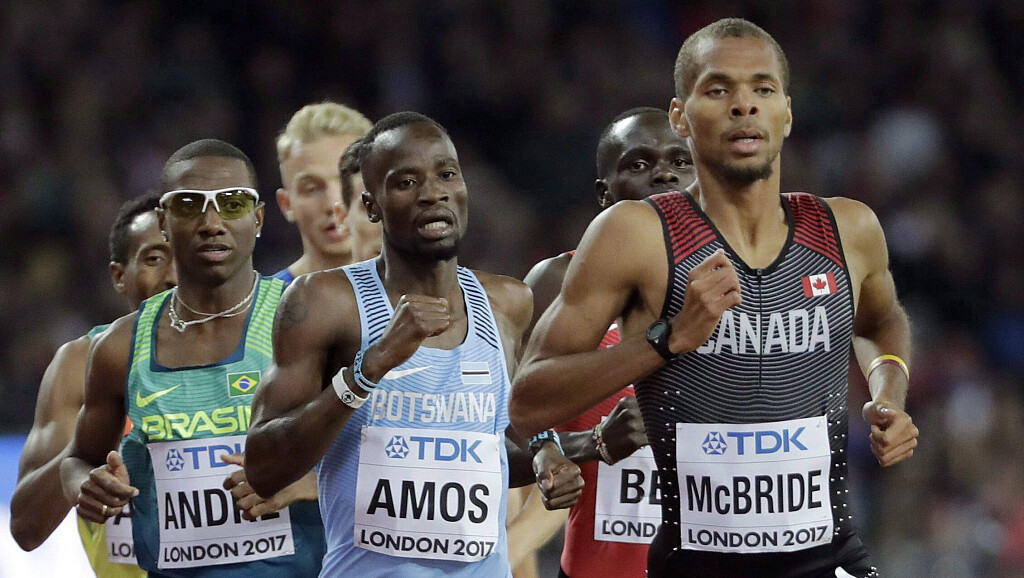
Now healthy, Canadian Brandon McBride sets running priorities for 2023, brightens holidays for others
Fully healed from a broken left foot, Brandon McBride will work to improve his mental strength on the track in 2023, with an eye on qualifying for a fourth consecutive World Athletics Championships next summer in Budapest.
The Canadian middle-distance runner will take a more experienced, strategic and smarter approach to races after falling hard to the track while jostling for position in his 800-meter heat on July 20 at the world championships in Eugene, Ore.
McBride, 28, and Navasky Anderson of Jamaica exchanged shoves near the turn off the backstretch. About 200 meters into the race, McBride said he was bumped during the cut-in and lost control but stayed on his feet before suddenly colliding with others.
The Windsor, Ont., native fell nearly five seconds off the pace and finished eighth, and last, in one minute 57.43 seconds.
"You could say it was a freak accident [but] I take full responsibility," McBride, told CBC Sports over the phone from Victoria. "It could have been avoided if I had raced smarter. I need to approach races as a six-foot-five speed/power athlete [and] have to know I can't fit in certain spaces [between opposing runners]."
Going forward, McBride suggested he would sit at the back of the pack for the "first lap or so" and work his way up from 400 metres.
"That's something I [did] last year," said the two-time Olympian, "but maybe it's something I didn't have the confidence to do during world championships."
McBride encountered a similar situation in the first round at the 2019 worlds in Doha, Qatar, where he allowed Peter Bol of Australia to cut him off and almost tripped 150 to 200 metres from the start. At the time, McBride recalled, he had the utmost confidence in his endurance and speed. He recovered to win the heat while a tired Bol faded to fifth.
"In the future, I would love to have the confidence in myself to allow the individual to go ahead instead of jostling," he said. "You have to protect your space but remember the goal of the race is to finish."
In Eugene, McBride broke the fifth metatarsal, the long bone on the outside of the foot that connects to the small toe. The four-time Canadian champion worked with physiotherapist Mary Brannigan in Windsor during his rehabilitation and Dr. Brian Murer, a chiropractic specialist based in Indiana, who solved overall movement issues the runner was experiencing.
Four weeks into recovery, McBride could walk without issue and returned to his regular training program at the beginning of October.
"Rehab was straightforward, strengthening the muscles and tendons near the bone," said McBride, who ran a Canadian-record time of 1:43.20 in 2018. "[The broken bone] was the most painful experience I've ever had. I couldn't walk for the first 72 hours and it hurt when I was at rest and when I [eventually] moved around on crutches."
McBride moved to Victoria in late November to join coach Mark Rowland, with whom he has worked since November 2021 when he joined Oregon Track Club Elite in Eugene. Five months ago, Rowland accepted a job to coach endurance athletes out of Athletics Canada's West Hub in the B.C. capital. McBride and three others also relocated and live together in a cottage.
These days, McBride runs a combined 21 kilometers across morning and evening workouts and over the past month has experienced his best period of November/December training since turning professional in June 2016.
"Physically, we're [pushing] him a little harder [than in early 2022] and he seems to be responding," Rowland told CBC Sports. "We haven't done the anaerobic speed [workouts] or speed testing because I don't think we've done enough conditioning work to put his body in that position. We'll do that probably in January."
During his downtime, McBride has kept busy with his not-for-profit group. McBride Youth United Association has partnered with several organizations and this week will help 50 families in need ahead of the holiday season.
Care packages, which will be distributed in Windsor through Friday, include cognitive toys, sensory toys, board games, action figures, building blocks, hygiene products, gift cards and food cards.
McBride and the six-member MYUA — which includes his girlfriend, Yesmina Captan — has partnered with the Border City Athletics Club, Border City Boxing Club, Windsor United Basketball Training Facility, Windsor Region Hospital and Eastern Flavours Restaurant and Banquet Hall.
"It means the world to see the direct impact you're making with these kids and their families," said McBride, who has a master's degree in business from Wayne State University in Detroit. "I want to do my best to help the youth of Windsor and their development. It ties in with our mentorship and tutoring services we're going to be offering in 2023.
"I believe every child has greatness within them. They just need an individual or situation to bring out that greatness."
Early in 2020, McBride and Captan purchased grocery cards from FreshCo in Windsor and delivered them to eight families in need during the coronavirus pandemic. Later in the year, McBride delivered over 100 winter coats for children connected to nine organizations.
by Doug Harrison
Login to leave a comment

World Athletics Championships Budapest 23
From August 19-27, 2023, Budapest will host the world's third largest sporting event, the World Athletics Championships. It is the largest sporting event in the history of Hungary, attended by athletes from more than 200 countries, whose news will reach more than one billion people. Athletics is the foundation of all sports. It represents strength, speed, dexterity and endurance, the...
more...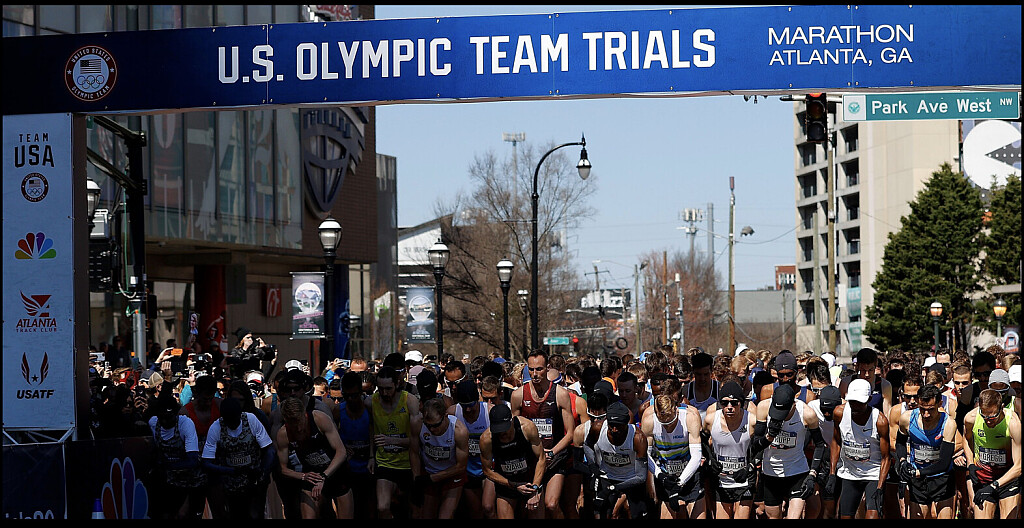
Questions Arise About Selection of 2024 Olympic Marathon Trials Site
The USATF national office overrode a recommendation from its board of directors that Chattanooga host the Trials.
Despite a recommendation from the USA Track & Field (USATF) board of directors that Chattanooga be named the host city for the 2024 Olympic Marathon Trials, the city will not host the event. Instead, Orlando, the only other city to bid on the Trials, was named as the host city.
According to minutes from the October 9 USATF board meeting held in Miami Beach, recently posted to USATF’s website, the board issued “an advisory vote of approval for the 2024 USATF U.S. Olympic Trials - Marathon bid to be awarded to Chattanooga, Tennessee. Final approval still remains with the USATF National Office.”
The vote was unanimously carried with one abstention. But the national office announced on November 8 that Orlando would be getting the nod.
Runner’s World asked USATF spokesperson Natalie Uhl and CEO Max Siegel for clarification on why the national office overrode the board of directors. Uhl referred questions on the matter to Mike Conley, the chairman of the board of directors.
Conley wrote in an email to Runner’s World, “The [United States Olympic & Paralympic Committee] is looking into the matter and until I hear back from them I have no comment.”
The USOPC was unable to provide comment to Runner’s World immediately, but a spokesman said he would do so at a later time.
Multiple sources told Runner’s World both Orlando and Chattanooga performed well at site visits. But late in the selection process, after the board vote, Chattanooga’s bid was disqualified.
Neither USATF nor Conley would confirm that Chattanooga was disqualified nor explain why.
A board member, Jim Estes, had been involved as an advisor on Chattanooga’s bid. Estes had disclosed the relationship from the beginning—board members and other volunteers with USATF are required to file conflict of interest forms and keep them up to date—and Estes recused himself from voting on anything related to the Olympic Marathon Trials. His recusal is noted in the meeting minutes.
According to his LinkedIn profile, Estes previously worked in the USATF national office in Indianapolis for almost 12 years, from 2005 to 2016. For the last four, he was the director of events. He is now a consultant for events in the running industry.
Estes declined to comment to Runner’s World. The chief sports officer at the Chattanooga Sports Commission, Tim Morgan, was directing Chattanooga’s bid for the Trials. He did not return multiple calls and messages requesting comment.
The board bases its vote on recommendations from members of the men’s and women’s long distance running committees, volunteers who visit potential sites and evaluate the bids for what will help produce the strongest Olympic team and be best for the athletes.
At a November virtual meeting of USATF’s board of directors, the topic of the bid for the Olympic Marathon Trials came up again. But the discussion was held in executive session, meaning that what was discussed remains private. The executive session lasted for 15 minutes. Again, Estes recused himself from the session.
A similar disagreement marred the selection of the 2016 Olympic Marathon Trials. For that event, the men’s and women’s long distance running committees recommended that the Trials return to Houston, which had staged a successful Trials in 2012. Siegel overrode that decision and decided the Trials should be in Los Angeles, a larger media market.
That race in Los Angeles went off in warm conditions. February temperatures reached into the mid-70s, and several athletes struggled in the heat, with many claiming inadequate fluids on the course. For the men, Galen Rupp, Meb Keflezighi, and Jared Ward made the team. On the women’s side, Amy Cragg and Des Linden finished first and second, and Shalane Flanagan collapsed at the finish line in third place.
USATF is facing scrutiny about other administrative matters. In November, when the nonprofit organization’s most recent tax forms were made public, it showed Siegel had a total compensation package of $3.8 million in 2021. The chief operating officer, Renee Washington, made more than $1.6 million. Together, those two salaries represented more than 16 percent of the organization’s revenues.
Earlier this month, heptathlete Taliyah Brooks filed a lawsuit against USATF for failing to reschedule the heptathlon during extreme heat at the 2021 Olympic Track and Field Trials.
by Runner’s World
Login to leave a comment
Sophia Kennedy, Daughter Of Bob Kennedy, Looks For Steady Progress As She Prepares For Two National Meets
INDIANAPOLIS – As far as she is concerned, Dad is Dad. But every once in a while, Sophia Kennedy’s father comes up in conversation.
“Oh yeah, my dad ran professionally,” she says.
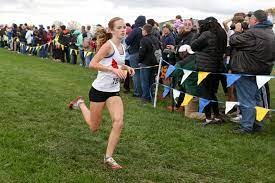
“Who’s your dad?”
“Bob Kennedy.”
After the oh-my-gosh replies, Sophia can’t help but smile.
“That always feels kind of cool.”
Also cool: Sophia Kennedy has qualified for both high school nationals in cross country, the Nike race Saturday at Portland, Ore., and Champs Sports (formerly Foot Locker and Eastbay) on Dec. 10 at San Diego. She is a senior at Park Tudor School in Indianapolis and has committed to Stanford.
For an American distance runner, being Bob Kennedy’s daughter is analogous to being an Obama sister entering politics or an actress whose father is Brad Pitt. Comparisons are inevitable, and inevitably unfair.
Yet by now, 52-year-old father and 17-year-old daughter are so used to it, it is a source of amusement rather than pressure. No one will be another Bob Kennedy. His impact on track and field cannot be overstated.
The two-time Olympian won four NCAA titles while at Indiana University and became the first non-African to run 5,000 meters in less than 13 minutes. His 1998 American record at 3,000 meters, 7:30.84, has been lowered little (to 7:28.48 by Grant Fisher) despite a 24-year span and introduction of super-shoes.
Sophia did not have to follow in those spikesprints. Her twin brother, Marcus, is a soccer standout. No way Sophia was going that route. She was once a goalkeeper “because I was a liability on the soccer field.”
Sophia took ballet lessons, played the clarinet. Her mother, Melina, a former IU runner who once ran for mayor of Indianapolis, and father encouraged the twins to try everything.
“Ultimately, they choose their own passion,” the father said. “We were big on hopefully finding something. Because I think it’s important to life and growth to find something that interests you, whether you’re the best at it or just really enjoy it.”
For Sophia, that became running. She was among the best and really enjoyed it.
Her transformational moment came when she nearly won a two-mile race around school grounds as a fifth-grader. She was outkicked by a boy. Then “it was on,” her father said.
Sophia affiliated with a local club, the Carmel Distance Project, and began winning races. In age-group cross-country nationals, she was 32nd in 2016 and 11th in 2017.
She didn’t have to travel far for competition, either. The Kennedy and Farley families used to live on Pennsylvania Street in Indianapolis homes separated by 73rd Street. Sophia grew up playing with a future Park Tudor teammate, Gretchen Farley, who has also qualified for San Diego.
Bob Kennedy has characterized Farley, a 2:09/4:50 runner who competes in four sports, as “a super talent.”
Sophia said all her parents have ever asked is whatever she does, give it her all.
“My parents have made it super clear, if I’m ever not happy in the sport, I don’t have to keep running,” she said. “It’s just something I’ve come to love because I love the hard work and the opportunities that it brings and the people that I meet.”
Sophia’s progress has not gone uninterrupted.
After setting an Indiana indoor 3,200-meter record of 10:12.32 last Feb. 19, she developed a fever, then an injury. She tried to maintain fitness via cross-training and anti-gravity treadmill. In May, when she began state track qualifications in a sectional, it was her first running on the ground in six weeks.
Given all that, it was redemptive to finish second at state in 10:25.02, or two seconds behind champion Nicki Southerland. Sophia lowered that to a 10:20.13 two-mile in finishing eighth at the Brooks PR Invitational.
Sophia took a measured approach to this cross-country season. Her father has credited her high school coaches, Garrett Lawton and Ryan Ritz, with prioritizing long-term future over short-term success. Sophia does not exceed 40 miles a week, and sometimes runs as few as 30.
“The one thing I realized,” she said, “if I want to be successful, I need to be healthy this year.”
That has been manifested in what is arguably her best run of runs. In a span of six 5Ks over eight weeks – none of which she won – she clocked 17:10, 17:12, 17:25, 17:24, 17:11, 17:23. She was third at state, fifth at NXR Midwest and second at Champs Midwest.
Even her cautious father conceded the daughter is on a trajectory that will accelerate as her strength matches her aerobic capacity. Sophia’s VO2 max is 82. Bob Kennedy’s was 83.
“I’m a little biased. I think you’re going to see huge leaps,” he said.
Sophia has come along during an unprecedented era in Indiana. Not only did Addy Wiley set a national record for 1,600 meters last June, there have been opponents such as Lily Cridge, Southerland, Addison Knoblauch and Farley.
According to inccstats.com, Cridge, Southerland and Kennedy rank Nos. 1, 4 and 5, respectively, in Indiana cross-country over the past 40 years.
Sophia is not intimidated at national meets. She sees such competition regularly. At San Diego last December, she led through a 5:19 mile and finished seventh.
She became the first Indiana girl in 15 years to have four top-five finishes at state cross-country . . . but never has she been a state champion on grass or track.
“She’s generationally great, and hasn’t won one yet. That’s stunning to me,” said Scott Lidskin, who coached Westfield to four state titles in girls cross-country.
Sophia will be surrounded by talent at Stanford. She chose the Farm over Notre Dame, North Carolina State, Virginia and Colorado.
Stanford was 13th in NCAA cross-country with a roster of six sophomores and one freshman. The team did not include two 1:59 freshmen, Roisin Willis and Juliette Whittaker, who won gold and bronze medals in the 800 meters at the World Under-20 Championships. Nor did it include Irene Riggs, a 2023 recruit coming off a 16:02 that was the second-fastest 5K in high school cross country history.
Sophia Kennedy, taking cues from her parents, pleads patience.
“I don’t want to be just a really good freshman,” she said. “I want to be really good in four years and five years and 10 years.”
It is mildly disappointing to be without a state title in Indiana’s single-class system. To win state at 3,200 meters, for instance, she suggested it might take 9:50 to beat Cridge (10:03.16 PB) and win.
No high school girl has broken 9:50 in an outdoor two-mile. Three have done so indoors: Mary Cain, Natalie Cook, Sydney Thorvaldson.
“I’m not looking for these immediate responses in my high school career,” Sophia said. “I want to run better at Nike nationals than I would have at the state meet. I want to be strong for the spring and not get injured.”
And not get caught up in what Dad did, other than to have a long career in the long run.
by Runner’s Space
Login to leave a comment
USA-based Grace Kahura eyes ‘home’ win in New York
Sunday’s New York City Marathon will be a largely Kenyan affair.
Even after the withdrawal of the defending champion Peres Jepchirchir, the field remains open with another Kenyan almost certain to keep the title in the country.
Two-time world marathon champion Edna Kiplagat leads her compatriots Viola Lagat, who was second last year, Grace Kahura, who finished ninth, and debutant Hellen Obiri.
Kahura will be competing in the “Big Apple” for the second time this year, seeking to improve on her personal best time of two hours, 30 minutes and 32 seconds.
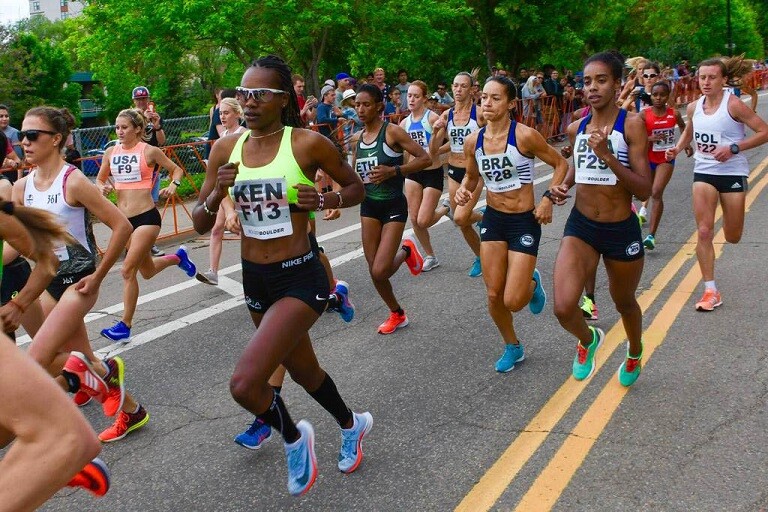
She might not be as well known as the other elite athletes, but she’ll enjoy the advantage of training in Colorado, USA, in perfect pre-race conditions.
Kahura told Nation Sport from her US base recently that she has been preparing for the race in the last four months without any hitches. “The marathon is tough, but I have prepared well and my target is to compete well during the race because I don’t want to mess my body for I know my fitness levels,” said Kahura.
She also said that competing in New York Marathon for the second time is an honour and that she is still in the learning process.
“The New York Marathon course is tough… I used to watch athletes compete in the race and it used to be so windy so I entered last year prepared and I’m glad it wasn’t that bad.
“When going for such race, you have to be prepared for anything because challenges might arise and you have to face them,” she said.
Competing with one of the greatest marathoners of all time, Edna Kiplagat, has also motivated her to even work harder.
“I watched Kiplagat competing while in primary school and competing with her in the same race now has really inspired me.
“My joy is interacting with her as she is full of wisdom and always has good advice on how to be world beater,” she added.
Kahura joined Colorado’s Boulder University in 2016 and graduated last year in Business and Accounting but wants to focus on being a professional athlete.
She was born in Kanjeru in Kiambu County on April 5, 1993, and went to Ngure Primary School and later Kanjeru Girls High School where she sat her exams in 2011.
It is here that her coach, John Mwithiga, popularly known as “warm-up”, took her to a camp where she started training as she waited for a chance to join university. At the University of Colorado, her focus was on education and she only started training seriously after she graduated.
While in school, she competed in Utica Boilmaker 15-kilometre road race where she finished 10th in 2016, before coming in seventh at the Indianapolis One America Festival Mini Marathon the same year.
From then on, she has competed in various races including Grandma’s Marathon in 2018 and 2021 where she finished fourth on both occasions.
She has been training on her own, but under the guidance of Owen Anderson, her American agent whom she says has been sending her training programmes to help her prepare for elite races.
by Bernard Rotich
Login to leave a comment

TCS New York City Marathon
The first New York City Marathon, organized in 1970 by Fred Lebow and Vince Chiappetta, was held entirely in Central Park. Of 127 entrants, only 55 men finished; the sole female entrant dropped out due to illness. Winners were given inexpensive wristwatches and recycled baseball and bowling trophies. The entry fee was $1 and the total event budget...
more...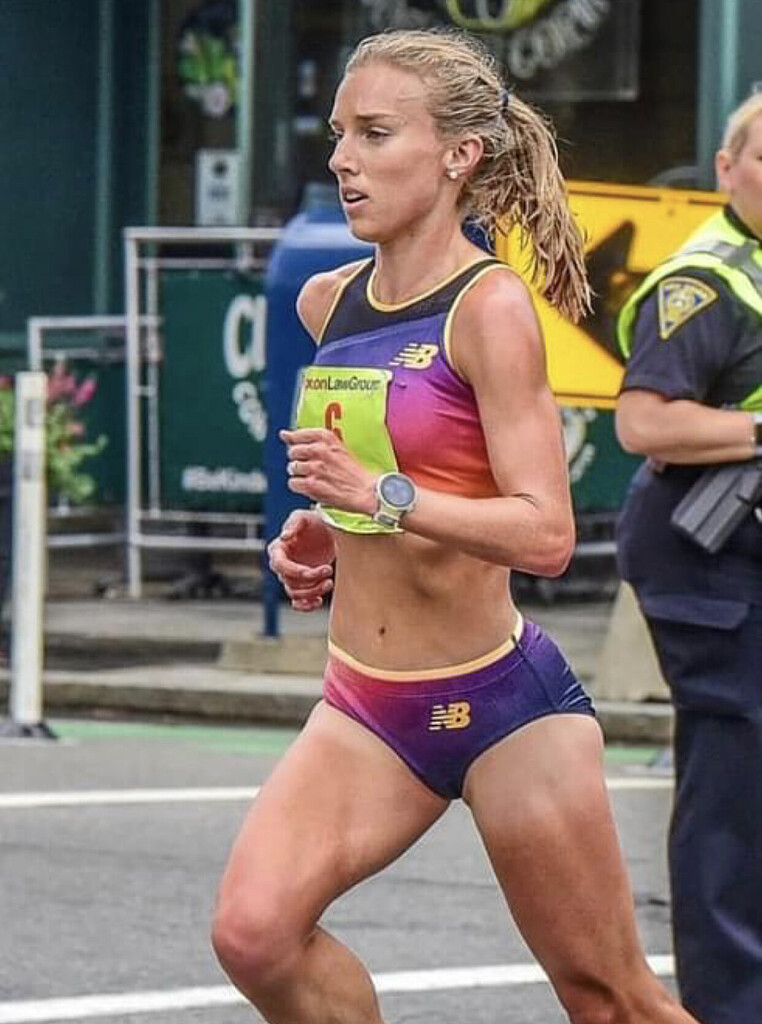
Emily Sisson sets a new American record in the marathon today in Chicago. clocking 2:18:29!
Three days shy of her 31st birthday and with only one previous marathon on her resume, Emily Sisson took to the streets of Chicago and lowered the American women’s marathon record by 43 seconds, becoming the first American woman to run a marathon in less than 2 hours 19 minutes.
Conditions on the Chicago Marathon’s relatively flat course were ideal, with Sisson — who won the 10,000 at the U.S. Olympic Track and Field Trials last summer — finishing second to Ruth Chepng’etich. The Kenyan repeated as the Chicago champion with a time of 2:14:18, fractions of a second off the world record of 2:14:04 set by Kenya’s Brigid Kosgei in the 2019 Chicago Marathon.
Sisson finished in 2:18:29, taking 43 seconds off the American record set by Keira D’Amatoin January in Houston. Before D’Amato, the record had stood for 16 years; now it has been lowered twice in 10 months, something D’Amato expected.
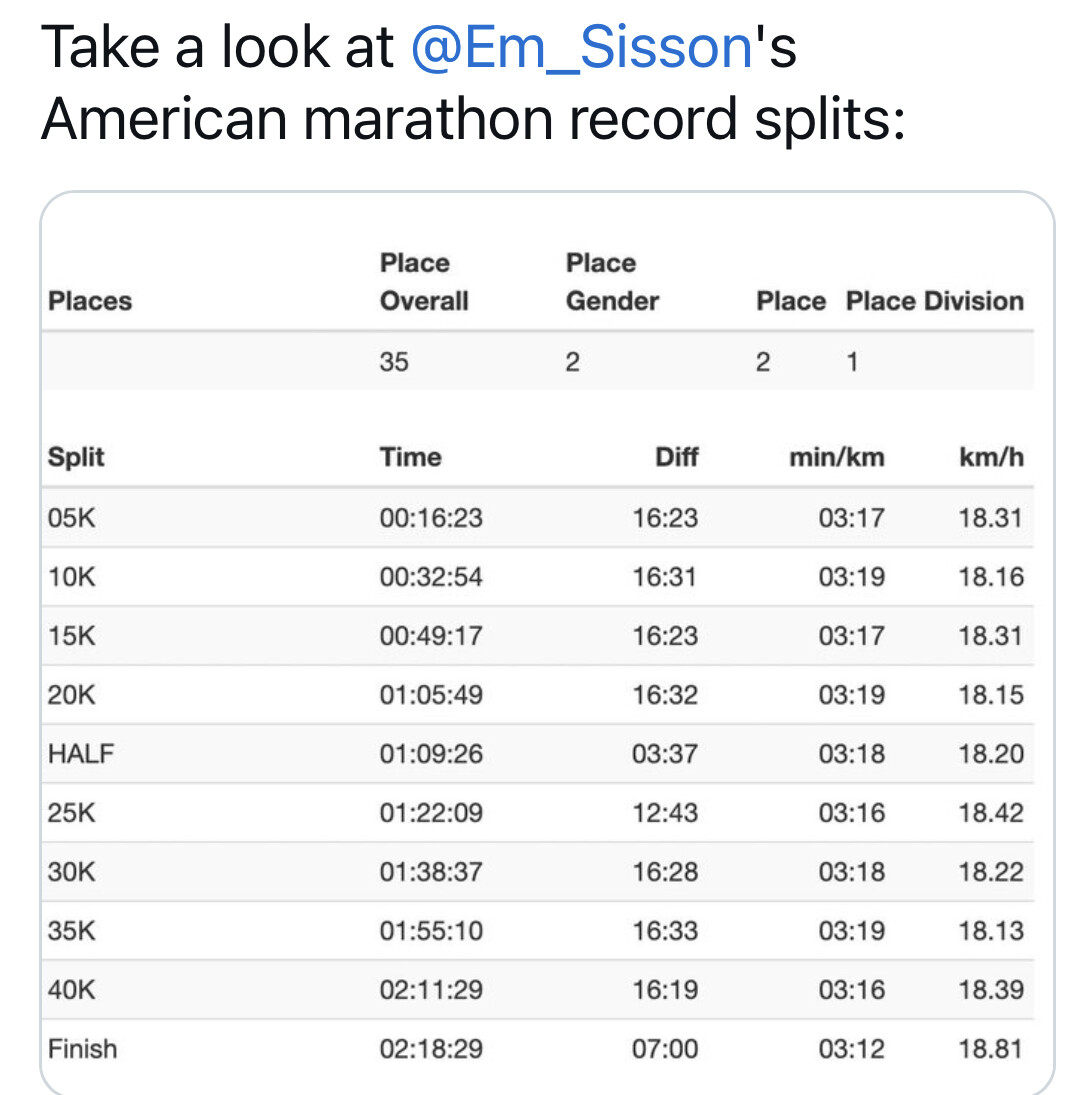
“There’s a number of American women that are also gunning for that record, so I think if I don’t lower it myself, it’s not going to be mine for very much longer,” she said before the Berlin Marathon two weeks ago. D’Amato, who did not run in Chicago, joined Sisson at the finish line, along with Deena Kastor and Joan Benoit Samuelson — women who held the American record before her.
“It’s amazing,” Sisson said, according to NBC Chicago. “I mean, the women standing here today, they’ve all accomplished so much, so just to be amongst them is an incredible honor.”
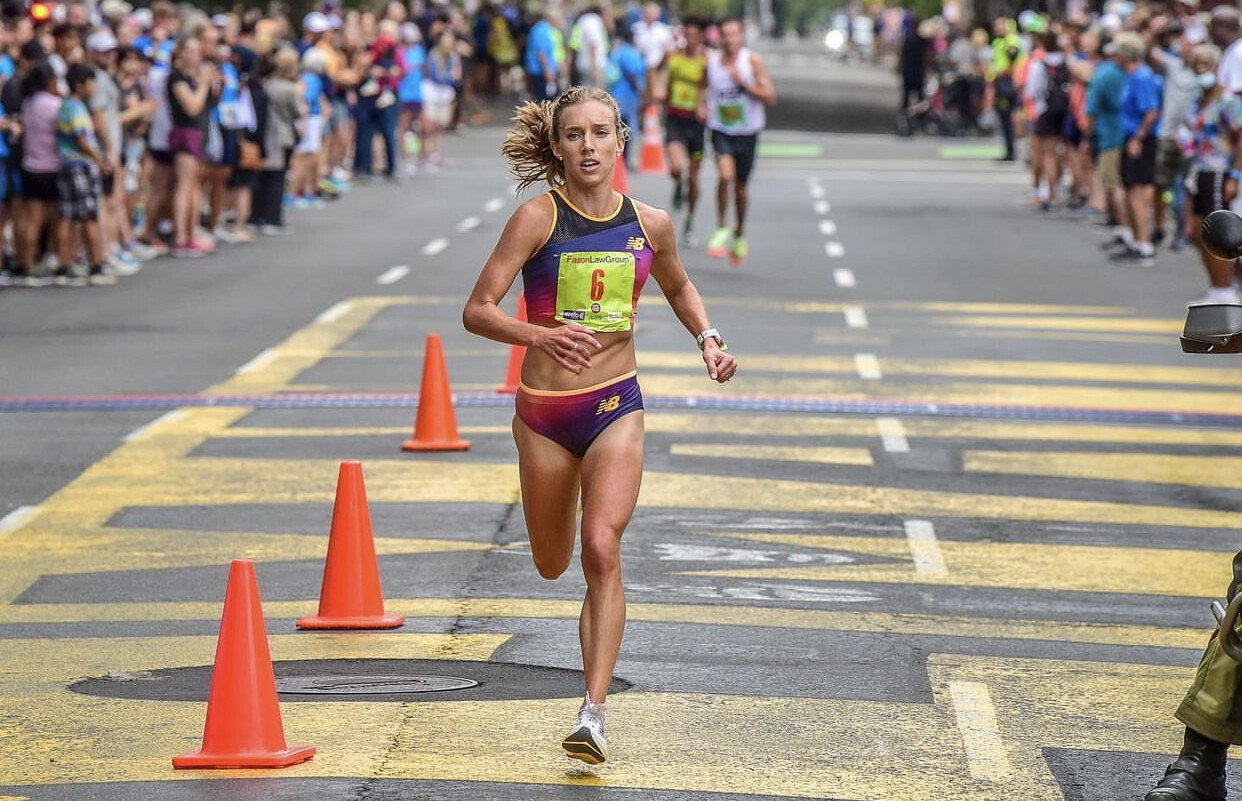
Sisson said she wasn’t aware that the record was in reach until very close to the finish line.
Emily Sisson (born October 12, 1991) is a professional runner for New Balance in Phoenix, Arizona. Emily Sisson was 9th at the 2017 London IAAF World Outdoor Track and Field Championships for 10,000 meters, and won the USATF road 10k Championships in 2016 and 5k in 2018. In the 2019 London Marathon, her first try at the distance, she placed 6th in a time of 2:23:08.
In December 2020, she ran the Valencia Half-Marathon in 1:07:26, narrowly missing the American record set by Molly Huddle in Houston on January 14, 2018. Sisson subsequently qualified to compete at the 2020 Olympics in the 10,000 m run, by coming in 1st place at the US Olympic Trials; she finished 10th at the event. On May 7, 2022, clocking in at 1:07:11 she broke the USA woman's half marathon record at the 500Festival Mini-Marathon in Indianapolis, Indiana.
On October 9, 2022, she broke the American women's marathon record at the 2022 Chicago Marathon, running 2:18:29 to finish 2nd
Login to leave a comment
Bank of America Chicago
Running the Bank of America Chicago Marathon is the pinnacle of achievement for elite athletes and everyday runners alike. On race day, runners from all 50 states and more than 100 countries will set out to accomplish a personal dream by reaching the finish line in Grant Park. The Bank of America Chicago Marathon is known for its flat and...
more...
Can Mantz and Sisson set American records on Sunday at the Chicago Marathon
Conner Mantz and Emily Sisson are looking to set American records at the Chicago marathon on Sunday. Mantz, who comes to his marathon debut with impressive XC and track credentials, has his eye on Leonard Korir’s American debut mark of 2:07:56, which was set in Amsterdam in 2019.
“All of my races and workouts have led up to this distance,” Mantz said. “I get excited thinking about it but I need to remember my first marathon and there are some unknowns.”
Sisson, who set the American women’s record in the half-marathon with a 1:07:11 at the USATF Half-marathon Championships in Indianapolis in May, only has one completed marathon under her belt – a 2:23:08 at London in 2019 (she dropped out of the 2020 Olympic Trials)– but has her eyes on the women’s American record of 2:19:12, which was set this past January by Keira D’Amato in Houston.
“My first marathon experience was really positive, and I really enjoyed it,” Sisson said. “After my first marathon in London I was drawn back to it and really want to see what I can do.
“My main goal is to try to break 2:20. If I’m feeling good and the record is in striking range I’ll take a stab at it. I had a really good buildup without any big setbacks. The weather for the weekend looks great, and I don’t know how many times I’ll have that, so I might as well take a swing at it.”
The temperatures will be in the low-50s at the start of the race and most likely cross the 60-degree mark by the time the men’s and women’s winners will cross the finish line. While it may be a touch humid at the beginning of the race, that isn’t expected to have that much of an effect.
Even more promising is the wind. Chicago is unique among the World Marathon Majors in that much of the course up to the halfway point is run in the core of the downtown area among the tall buildings, which can whip the wind around. It also leaves the potential for the competitors to be dealing with a headwind as they make the final push up Michigan Avenue to the finish.
This year, the predicted 7-12 mph winds will be from the southeast, which could be a bit of an assistance over the final few miles.
The race is set to start at 7:30 AM Sunday, and will be shown locally on NBC and streamed on Peacock.
by Let’s Run
Login to leave a comment
Bank of America Chicago
Running the Bank of America Chicago Marathon is the pinnacle of achievement for elite athletes and everyday runners alike. On race day, runners from all 50 states and more than 100 countries will set out to accomplish a personal dream by reaching the finish line in Grant Park. The Bank of America Chicago Marathon is known for its flat and...
more...
Tim Murphy founder of San Diego Elite Racing Inc has died at age 77
Tim Murphy, founder of San Diego’s Elite Racing, Inc., the man who reinvented running, not once but three times, succumbed to pneumonia Wednesday night (August 17, 2022) passing in hospice care at his home in San Diego, California. He was 77 years old.
Today, though smaller than it once was, the Rock ‘n’ Roll Marathon Series remains the largest purveyor of running events in the world, with 29 events in 16 U.S. states, Washington D.C., and seven foreign countries. But a quarter century ago, who knew what lay ahead in the wild open spaces of the first Rock `n` Roll Marathon?
Some observers even questioned the concept of rock bands strung along the marathon course altogether. What does rock`n` roll have to do with San Diego, much less with running a marathon, the ultimate test of endurance?
Well, on June 21, 1998 the world got its answer. With the snarl of a blistering guitar solo, the tight syncopation of a snare drum, and the slap of millions of accompanying footfalls, the second-wave running boom announced its arrival in San Diego with a carnival of music, endorphins, and sweat. It’s like Tim turned over the calendar two years early to introduce the new century.
“We created a theme marathon without intending to,” said Tracy Sundlun, Tim’s long-time partner at Elite Racing.
NEW DEMOGRAPHICS
No new major marathon had sprung up in the U.S. or the world since the Los Angeles Marathon arrived in 1986. In its first year, LA registered 10,787 runners, making it the largest inaugural marathon in history. Instantly, that number became Tim‘s goal for San Diego to beat LA.
Even before its first steps were run, though, there was the feel of a major marathon about the Rock ‘n’ Roll Marathon. Tim had conceived the idea years before while running the final lonely miles of the Heart of San Diego Marathon out along Friar’s Road to Qualcomm Stadium in Mission Valley. Wishing there were some kind of support along the road to help out, Murphy thought, wouldn’t it be great to have music to run to.
It took a long time for his idea to gestate, but the seed had been planted.
After a decade of developing his reputation as an event innovator, beginning in 1986 with the Carlsbad 5000 just north of San Diego – the event that proved runners in a then 10k / marathon focused world would run a 3.1 mile race, while introducing “spectator running” where the professional field followed age and gender specific races over the same tight-looped course – Murphy’s idea of a musical marathon came to life, born out of two separate, but catalyzing events.
“When they opened the Rock & Roll Hall of Fame in Cleveland (1995), there was so much hype about it,” Tim told San Diego YuYu in 2004. “So I was running along one morning and I thought, “If I lived in Cleveland I would do a marathon that would start and finish at the Rock & Roll Hall of Fame and do a big concert afterwards.”
One year later 273 San Diegans were among the record 38,000 entrants at the 100th anniversary of the Boston Marathon.
“Afterwards, they had this get together and all they could talk about was why there wasn’t a major marathon in San Diego. And all the runners, some of them pretty important, just wouldn’t leave me alone about it. So I essentially dusted off the old idea I had for Cleveland and started.”
With the backing of a set of investors, led by Hollywood A-list producers Frank Marshall and wife Catherine Kennedy – “Jurassic Park”, “Indiana Jones” , “Jason Bourne” – along with celebrity ambassadors like basketball Hall of Famer Wilt Chamberlain, Tim promoted his concept relentlessly at race expos around the country, touting his new baby with posters and ads that said, ‘You missed the first Boston. Don’t miss the first Rock ‘n’ Roll!’
No longer a simple feat of speed endurance, the grueling marathon had been reinvented as a rollicking 26-mile long block party through America’s Finest City.
Despite a 37-minute delay at the start due to some perceived traffic issues on the course – which led to a water-dousing through the first aid station – the high-spirited music rocking the sidelines caused an immediate sensation.
Nearly 20,000 entrants from 30 countries and all 50 states passed the word, ‘You gotta try this one!” And that was before they got to the post-race concert that night featuring Huey Lewis and the News, Pat Benatar, and the Lovin’ Spoonful!
The makeup of year one’s field proved historic, as well. 50% of the field was women, far and away the largest such percentage of any co-ed road race of any distance to date, and a pivot-point in the history of the sport. Before RnR San Diego, the largest percentage of women in a major marathon had been just 23% at New York City. Most road races had only 10% to 15% women at the time.
Rock ‘n’ Roll’s runners were also slightly older than the norm, slightly wealthier, and slightly slower than the average marathon runners.
At a time when road race courses were designed to be minimally visible and impact their communities as little as possible, the initial Rock ‘n’ Roll Marathon layout was designed to be an infomercial for the city, regardless of the potential inconvenience for some.
When city officials asked how long they would have to keep the streets closed, Tim based his projections on the New York City Marathon, saying, ‘we might have 50 or 60 runners who will take longer than six hours 30 minutes. But we’ll just direct them onto the sidewalk, so you can reopen the streets.’ As it turned out, 1500 runners took over seven hours to complete their 26.2 mile journey.
But Tim Murphy wasn’t just in it for the large participation numbers, important as they were. He always had his eye on top talent, too, and urged elite athlete coordinator Mike Long to pull in a world-class field, like he did every year for the Carlsbad 5000 where so many world records were set.
Mike Long, the late Elite Racing athlete recruiter with Rock `n` Roll 1999 champs Tarus & Bogacheva
Nobody knew how fast RnR could be run until young Kenyan, Philip Tarus, busted a 2:10 opener for the men, with Russian women Nadezhda Ilyina and Irina Bogacheva battling just nine seconds apart at the finish for the women in 2:34. That told the athletes of the world, ‘This one is worth having a go,” especially after all the Suzuki products and prize money checks were handed out.
Not since the New York City Marathon’s first five-borough extravaganza in 1976 had a marathon come on the calendar with such dramatic impact: The largest first-time running event in history; the most ingenious show along the sidelines and at the finish ever produced; $18.6 million (net) raised by and for The Leukemia & Lymphoma Society’s Team In Training charity – the largest amount ever for a single-day sporting event; and to cap it off, world-class performances by its champions.
Though the race lost over $1 million in its first year, it instantly became the number one economic impact event in Southern California, generating $39.3 million in its inaugural year, as two-thirds of its entrants came from outside the region. With Murphy’s persistence and the continued backing of his investors, Rock ‘n’ Roll eventually broke even in year three. Thus was the foundation set for what has become a global phenomenon, the so-called second-wave running boom.
Born and raised with two sisters in Denver, Colorado, Tim attended high school in Nebraska where he competed in the 880-yard run and threw the discus. He then spent the first part of his professional life toiling in the health care industry, selling hospital supplies on the road while moving across the country time and time again. Finally, in the late 70s, he decided to abandon the rat race and settle in San Diego where his two sisters lived.
Though he ran track in high school, he wasn’t a distance man. But once in San Diego and introduced to the area’s vibrant running community, like so many before him, he got hooked on the sport. Tim often trained up to 10 miles a day, which led him into the race organization business and the founding of Elite Racing in 1988.
Always more of a behind the scenes workaholic than a flashy frontman, Tim did serve as interim race director for the troubled Chicago Marathon in 1989. But mostly he focused like a laser on the business side of Elite Racing. Tracy Sundlun, former head of New York City’s Metropolitan Athletics Congress, and a former collegiate and club track coach, joined as Tim’s partner in 1997, taking on the role of political go-between and liaison with the sporting world.
Through it all, Tim used his marketing and sales skills to build his race business from a fledgling local concern into the most successful for-profit organization in running.
“We have lost someone who – I don’t think many of the insiders even grasp his importance, his significance,“ said Tracy Sundlun. “Besides Fred Lebow in New York City, Tim was the best retail marketer the sport has ever known. It makes me happy all the people who’ve reached out from all over the world when they heard news of his passing. Tim would’ve felt good knowing the people recognized what he built, what he reinvented.”
Beginning with the Carlsbad 5000 in 1986, Tim bucked the conventional norms of the sport. Nobody thought people would pay to run a 5K. Running at the time was a 10K and marathon trade. But Tim turned it into a 5K and half marathon business and the sport soon followed along.
Ethiopian great Tirunesh Dibaba breaks another world record at Carlsbad 2005 (14:51)
The success of the Rock ‘n’ Roll Marathon in San Diego changed Murphy’s fortunes for good. Over the next several years, Tim developed the brand into a seven event juggernaut that spread from San Diego to Virginia Beach, Nashville to Phoenix, San Jose, California to San Antonio, Texas.
Elite Racing was the first organization to stage more than one marathon in a year, and the first to put on events outside their own home city. Designed as a for-profit company in a not-for-profit industry, Elite Racing was the first organization to build a brand in the sport, though, initially they didn’t realize they were doing it. They were also the first to buy events and the first to sell to private-equity.
When the City of Virginia Beach, VA wanted to start a new marathon on Labor Day weekend in 2001, Tim made a site visit. He realized that with the heat and humidity of late summer in Virginia Beach, and not wanting to conflict with the fall marathons which had been so supportive of his races in San Diego in the summer and Nashville in the spring, there was no way that a full marathon would work. So Tim convinced VB to create the first destination half-marathon, The Rock ‘n’ Roll Virginia Beach Half Marathon. Until then, half marathons were just local training races for marathons.
“Just like with Carlsbad in the 5K, nobody thought people would travel to run a half marathon,“ remembered Sundlun. “When we proposed Virginia Beach, we were one of Runner’s World Magazine‘s biggest advertisers. We said we were going to sell out at 12,000 for the Labor Day weekend race. People at Runner’s World said we were nuts. At the time, the largest half marathon was the Philadelphia Distance Run at 6000, the largest inaugural half marathon was on Long Island at 2900.
“Runner’s World bet us a full, center-spread, double page ad that we wouldn’t hit our number. They didn’t even think vendors would come to a Labor Day weekend race in Virginia Beach. But we sold out by July and eventually got 14,990 entrants. Getting that check back from Runner’s World, that was really something.”
Deena Kastor headlined the inaugural Rock ‘n’ Roll Virginia Beach Half Marathon in 2001, setting an American debut record as a prep race for her marathon debut in New York City that fall. Kenyan superstars Martin Lel and Paul Tergat both tuned up for fall marathon victories with wins in Virginia Beach.
Records were always important to Tim. He would often have side bets with Mike Long about the outcome of races. Two-time Olympic champion and multiple-time world record holder Haile Gebrselassie of Ethiopia broke the half marathon world record at Rock ‘n’ Roll Arizona in 2006 (58:55). And with 16 World Records / Bests and 11 American Records, Carlsbad was always recognized as The World’s Fastest 5K.
“Tim felt if you created special events with a team of people who were passionate about the space they were in, the money would follow,” Sundlun told me. “He also understood that an event was only as good as its weakest link. So he was laser-focused on every aspect of the event, from the expo to the medal to the course to the elite athletes to the give-a-ways to the ads to the water stations, you name it.
“We never had a meeting about what to cut, just about how to improve. Tim understood you had to invest and promote relentlessly. He was tireless in his pursuit of greatness. Good people would join him and he empowered them and got out of their way. But he refused to take no for an answer, and had a single-minded focus.”
Tim even bought television’s Road Race of the Month from Salmini Films in 1991, the series that aired on ESPN for over a decade featuring the best races in the country and around the world. Tim understood that with television as a promotional arm, he could sell more advertising and attract more runners.
The string of happy days ended abruptly in July 2007, however, when Elite Racing’s beloved athlete recruiter Mike Long died suddenly of a heart attack. Mike’s passing seemed to take the spark out of Tim.
Later that year he sold the business to Falconhead Capital for more than $40 million. Elite Racing essentially became the event division of the new Competitor Group, Inc., and Tim moved on. Eventually, after Tracy also left, CGI abandoned the elite aspect of running altogether, before leaving San Diego, as well.
At times, Tim could be a volcanic boss, as his business was his life’s passion. Yet he engendered a deep dedication and respect from his Elite Racing family, out of which 17 marriages were spawned (including my own with Toya), growing families, and lifelong friendships. Tim’s final years were spent quietly, visiting with friends and his two sisters who were with him at the last.
R.I.P., Tim. You were a true visionary who has left a legacy that moved us all both body and soul.
by Toni Reavis
Login to leave a comment
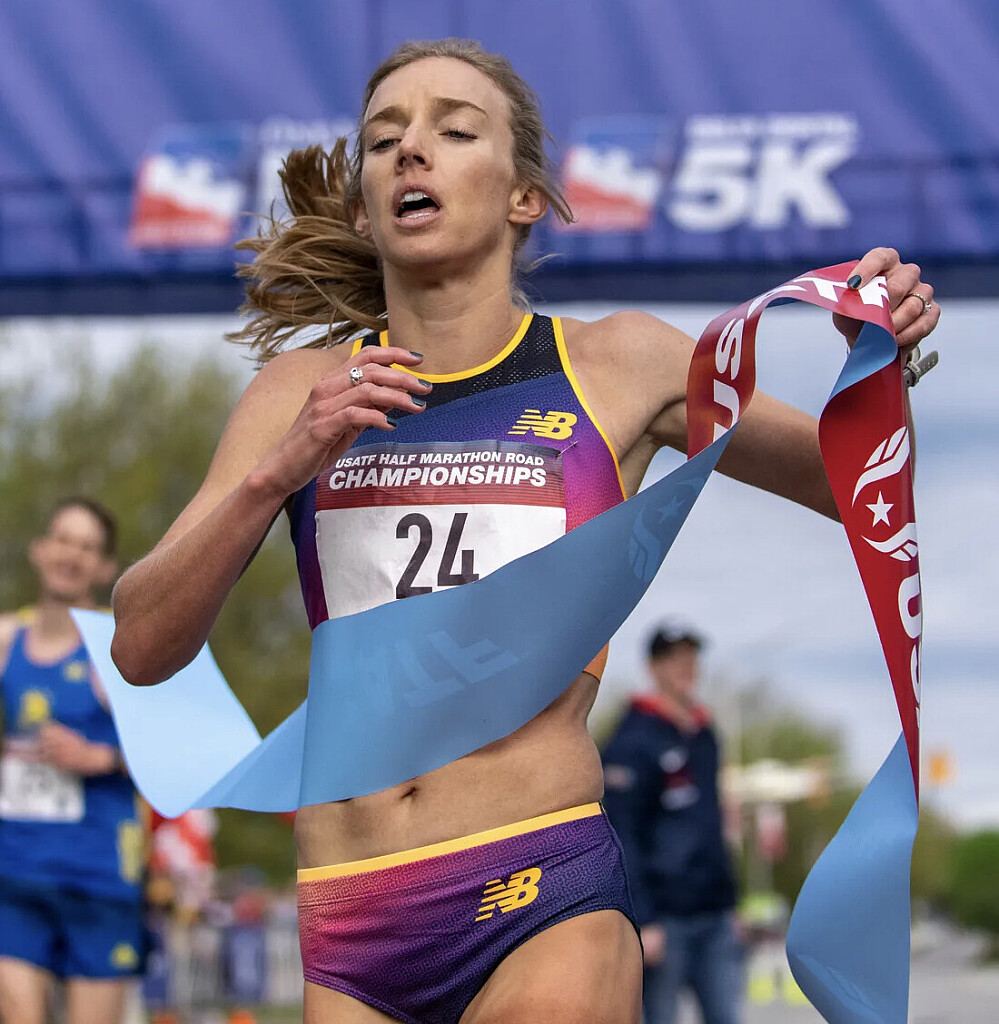
Emily Sisson breaks the American Women half marathon record
Fifteen years after she won a national junior title in Indianapolis on the track, Emily Sisson returned here to set an American record in the women’s half-marathon on the road.
Sisson finished in 1 hour, 7 minutes, 11 seconds in the OneAmerica 500 Festival Mini-Marathon on Saturday.
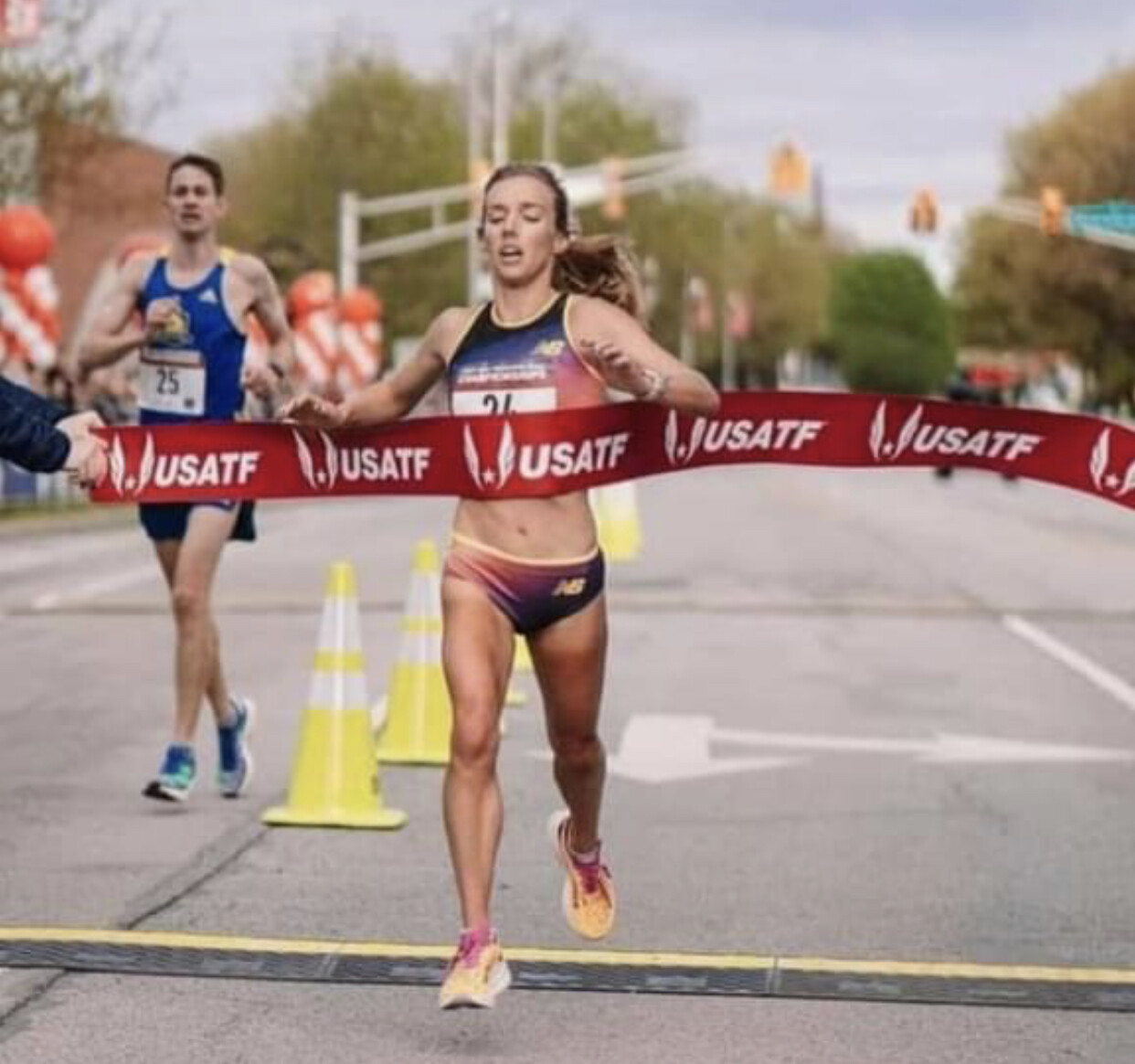
The 30-year-old runner broke the American record of 1:07:15 set by Sara Hall on Jan. 16.
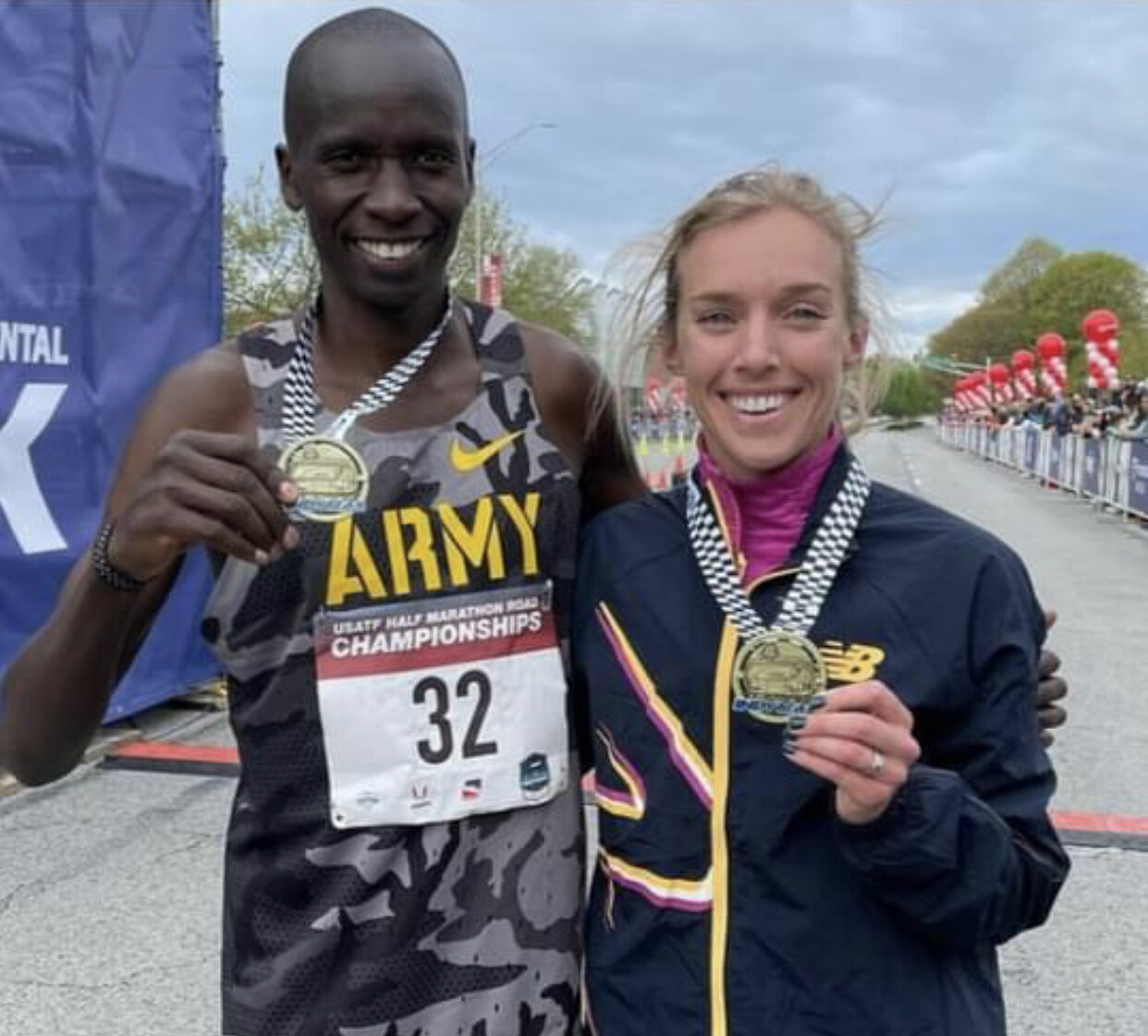
Sisson was paced throughout by male runner Brian Harvey, who finished in 1:07:12.
It was the first in-person Mini since 2019 after the annual race was twice canceled during the pandemic.
Hall’s time had broken the American record of 1:07:25 set by Notre Dame graduate Molly Huddle in 2018. Sisson twice nearly bettered that – clocking 1:07:30 in 2019 and 1:07:26 in 2020 – and finally secured the record on a breezy morning with temperatures in the low 50s.
Sisson, an NCAA and Big East champion while representing Providence, won the U.S. Olympic Trials at 10,000 meters last year and finished 10th at Tokyo.
In 2007, she won a USA junior title in the 5,000 meters at IUPUI’s Carroll Stadium, just a few blocks from where the Mini finished at Military Park.
Andrew (Kremer) Pomaranski, a Bishop Chatard graduate, finished second to Sisson in 1:13:12.
Pomaranski, 39, a mother of three who now lives in Michigan, broke a 10-year-old personal best. She was 10th in January’s Houston Marathon in 2:33:35, third-fastest ever by a native Hoosier. While at Miami (Ohio) in college, she set an American junior (under-20) record in the steeplechase.
Login to leave a comment
OneAmerica 500 Festival Mini-Marathon
The mission of the 500 Festival is to produce life-enriching events and programs while celebrating the spirit and legacy of the Indianapolis 500 and fostering positive impact on the city of Indianapolis and state of Indiana. As an organization providing multiple events and programs, many of which are free to attend and impact over 500,000 people annually, our mission to...
more...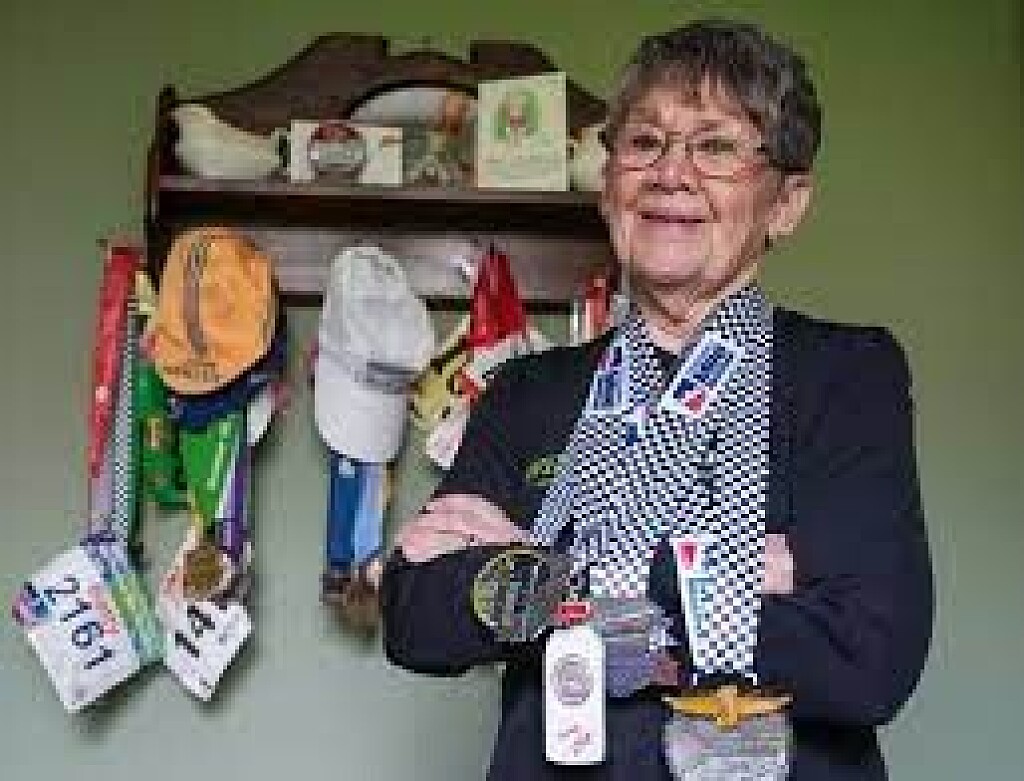
Betty Deer, 80, has been running in marathons across the country since 1986, the Indianapolis Mini Marathon this Saturday will be her last
The running began 48 years ago in a modest neighborhood in New Palestine. Betty Deer was a 32-year-old mother of two girls, a mother who, if truth be told, hoped a jog after dinner might keep those nagging extra five pounds away.
She set out from her driveway that first evening in 1974 and started jogging. A couple of neighbors spotted her and stopped Betty.
"Hey, we'd like to try running, too," they told her.
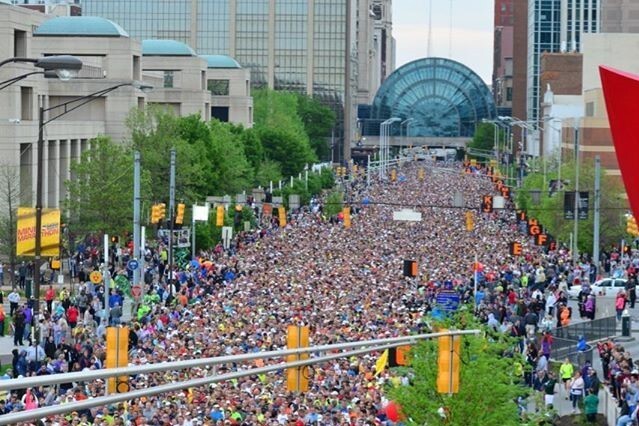
At first, they kept it short, about a mile and a half from the end of the street down to Sugar Creek.
"And then we'd get down there and it was like, 'Well now, you've got to figure out how to get back,'" said Betty. "How do we get back that mile and a half?"

That was Betty Deer at 32. On Saturday, she will run her 34th Mini-Marathon at 80, a race she has finished in the top three in her age division the past 13 years.
It will be a bittersweet day, an end of an era. Betty has run more than 12 full marathons and too many half marathons and shorter distance races to count.
More than 50 medals hang in the den of her Greenfield home. Others are on the desk still wrapped in plastic. Many have been donated to sick kids at Riley Hospital for Children. Some have gone to Goodwill.
But on Saturday, Betty says she will cross the Mini-Marathon finish line one final time.
"I wouldn't count on it," her husband Larry Deer quickly chimes in. He can hardly believe his wife of 61 years would really give up marathoning. "I don't think so. She might have another in her."
No, Betty says adamantly. When she runs long distances, right hip pain nags at her. The foot pain is there, too, and even the Asics shoes she has sworn by for decades aren't giving her relief.
"This will be my last," she said. "It really will be my last."
The neighborhood jogs turned to running with co-workers after Betty clocked out at Community Hospital East, where she was a patient representative before going back to school to get a degree in social work.
"One of the ladies there said, 'You know Shirley runs the Mini. Why don't you do that?'" Betty said. "That's how it began."
It was 58 degrees, drizzling and overcast in May 1986. Betty drove to Indianapolis Motor Speedway where buses picked up runners and shuttled them downtown for the start of the race.
This was the 10th Mini-Marathon; the race began in 1977. It was Betty's first. She finished that race with the best time of her 33 runs: One hour and 59 minutes.
She was hooked.
In the early days of the Mini, Betty ran the entire race.
"It was a mental thing in the beginning. I thought you had to run it," she said. The only time she would walk was to grab a paper cup of water, drink it quickly, and then start running again.
"But now I find out that I do just as well if I walk some of it," she said. On Saturday, she plans to run five minutes, walk 30 seconds, run five minutes, walk 30 seconds the entire race.
Her times have slowed as the years have passed. But it's all relative. Betty remains at the top of her age group. At 64 years old, she finished fourth in her age group, running the Mini in 2:07. Every Mini-Marathon since, she has finished in the top 3.
In 2019, Betty placed first in the 75-79 age group with a time of 2:41:27, beating the next closest competitor by a full six minutes and the fifth place finisher by 32 minutes.
"But I'm not fast. I'm not fast," she said. "See, I don't consider myself a competitive runner."
If not that, then what is she?
As running goes, Betty has been lucky. At 80, she hasn't had to have surgery on her knees or hip. She did have a thyroid issue and a couple of bouts with cataracts.
In the hundreds of races she has competed in, Betty has crossed the finish line every single time, though there was one Mini where she almost didn't.
It was the 10th mile of the race when she broke the third metatarsal bone in her foot.
"I didn't know what to do and I started walking, but it was painful," she said. "And I decided, 'Well, I might as well finish it.' And so I started running and actually it felt better after I started running. And I finished that race."
Betty doesn't have any rituals for the Mini-Marathon, no carb-loaded spaghetti dinners with garlic bread the night before. "It just depends what I feel like eating that night," she said.
In the morning, she usually has half a bagel with a smidge of peanut butter on the way to the race.
Her training consists of some type of workout six days a week. She runs three days, does spin classes and Pilates classes on two days and walks with a neighbor one day.
Betty saves her long runs for Sundays. To prepare for the Mini this year, she ran eight miles on Sundays in January, nine miles in February, 10 miles in March and 11 or 12 miles in April.
This week leading up to the Mini, she ran nine miles on Sunday, took a spin class and a Pilates class Monday and ran three miles Tuesday. She will rest until Saturday.
Now to run her final Mini-Marathon.
"The thing I've enjoyed most is running with my friends," Betty said. "If I'd stop running with them that would be devastating to me. So I'm going to keep running, just not to this level."
by Dana Husinger Benbow
Login to leave a comment
OneAmerica 500 Festival Mini-Marathon
The mission of the 500 Festival is to produce life-enriching events and programs while celebrating the spirit and legacy of the Indianapolis 500 and fostering positive impact on the city of Indianapolis and state of Indiana. As an organization providing multiple events and programs, many of which are free to attend and impact over 500,000 people annually, our mission to...
more...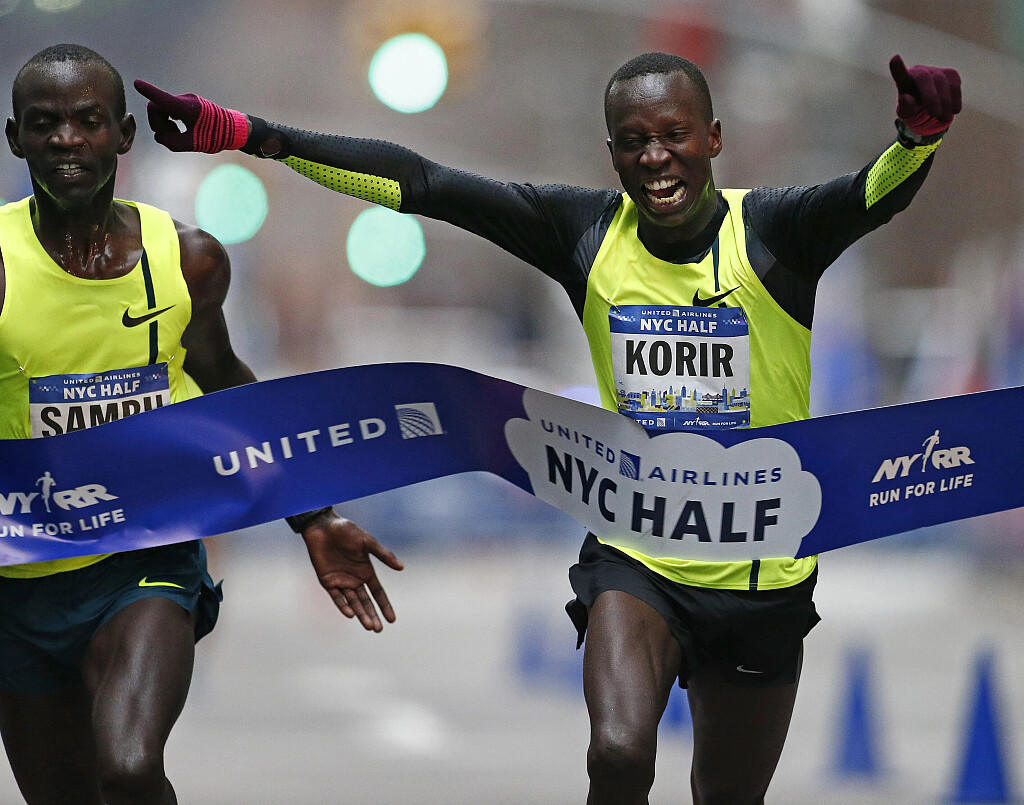
The USATF Half Marathon Championships hosted by the OneAmerica 500 Festival Mini-Marathon are the fourth stop on the 2022 USATF Running Circuit
With $40,000 of prize money on the line and course conditions ideal for fast times, Olympians Leonard Korir and Emily Sisson headline the men’s and women’s field for Saturday’s USATF Half Marathon Championships in downtown Indianapolis, in what promises to be an exciting morning of racing.
Korir (Colorado Springs, Colorado/USATF Colorado) leads a talented men’s field to the start line in Indianapolis. The two-time USATF Half Marathon champion is having a strong start to his 2022 season, with a runner-up effort at the USATF 15 km Championships and a fourth-place finish at the USATF Cross Country Championships, which puts him atop of the USATF Running Circuit overall standings with 19 points, four points ahead of Shadrack Kipchirchir, who is not racing Saturday.
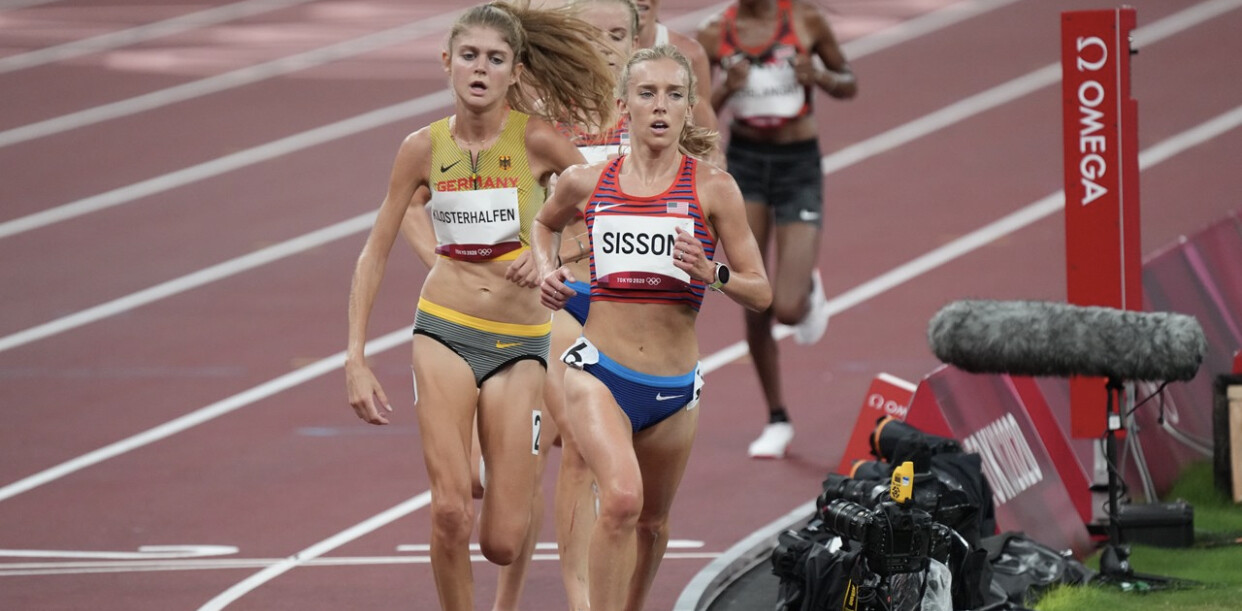
Korir will be joined up front by Futsum Zienasellassie (Flagstaff, Arizona/USATF Arizona), who finished sixth at the USATF 15 km Championships and ninth at the USATF Cross Country Championships. Zienasellassie beat Korir at the 2021 USATF Half Marathon Championships, placing fifth to Korir’s seventh.
At the Credit Union Cherry Blossom Ten Mile Run early last month, Zienasellassie placed an impressive fourth against strong competition, finishing four seconds up on fifth place Reid Buchanan, as well as besting sixth place finisher Lawi Lalang.
Both Buchanan (San Diego, California/USATF Southern California) and Lalang (Colorado Springs, Colorado/USATF Colorado) are entered in Saturday’s contest and will vie for top three finishes. Jacob Thomson (Flagstaff, Arizona/USATF Arizona), who placed tenth at the USATF 15 km Championships, leads the rest of the field, which includes notable road race standouts Noah Droddy (Boulder, Colorado), Sid Vaughn (Flagstaff, Arizona), and Caleb Kerr (Zionsville, Indiana/USATF Indiana). Leading the women’s field, Sisson (Flagstaff, Arizona/USATF New England) seeks to continue her dominance on the roads.
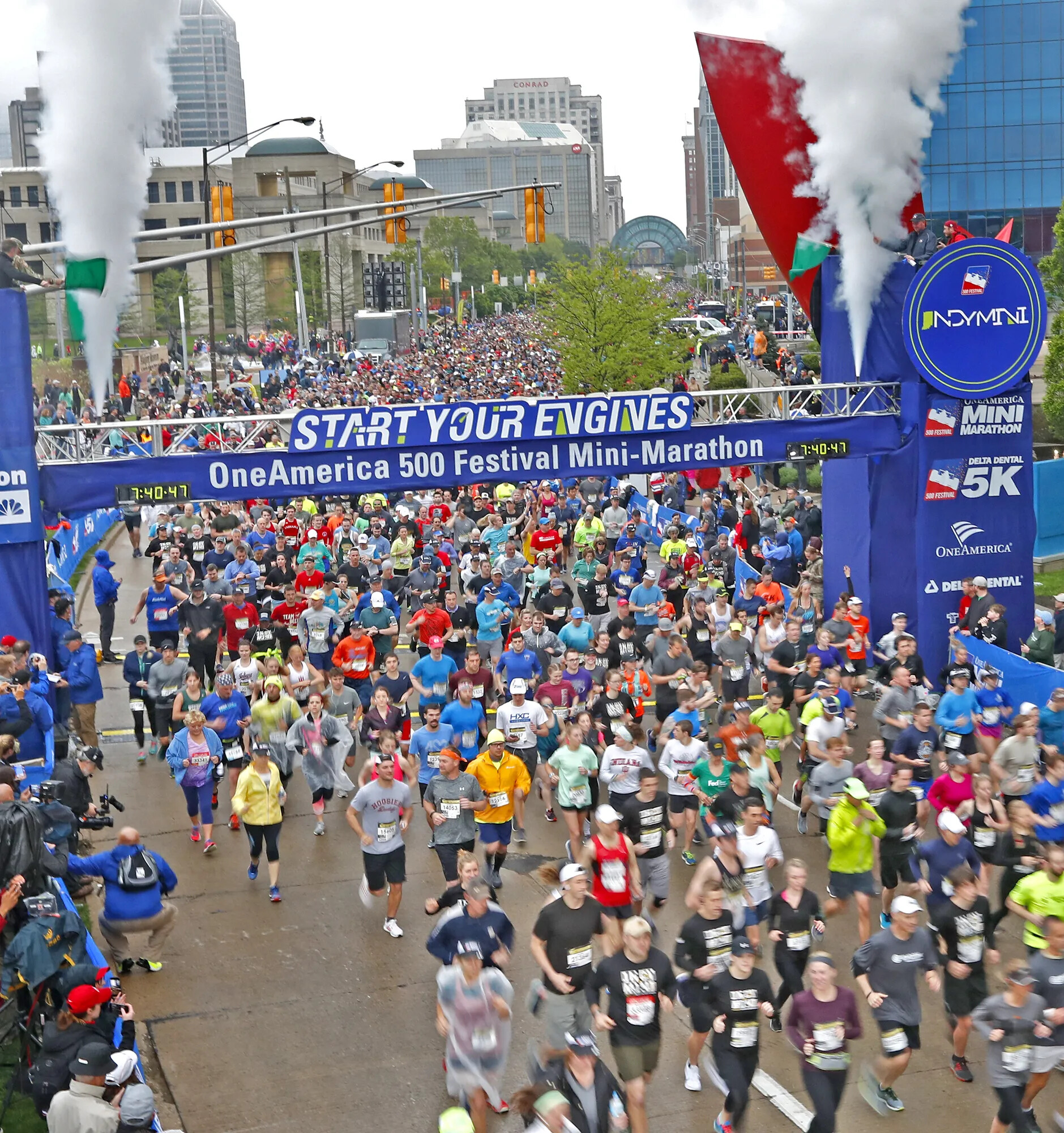
The Providence-based standout has had a quiet start to her 2022, only racing once. That one race though was one to remember, winning the USATF 15 km Championships by nearly two minutes. Sisson currently sits tied for third in the USATF Running Circuit standings with 15 points, only behind Emily Infeld and Emily Durgin, who have 20 and 19 points respectively.
Behind Sisson, notable veteran Allie Kieffer (West Islip, New York/USATF New York) resumes her racing in the United States. Kieffer has raced twice in 2022, once in Great Britain and again in Italy. Her performance at the Roma Ostia Half Marathon in early March was impressive, as she finished fourth in 1:09:17 on the fast Italian course. Kieffer placed fourth in the 2021 USATF Half Marathon Championships in 1:10:44 and will look to improve on that performance on Saturday.
Another top three contender is Tayler Tuttle (Boulder, Colorado/USATF Colorado). Tuttle placed eighth at the Credit Union Cherry Blossom Ten Mile Run last month, while finishing tenth at the USATF 15 km Championships. A top three performance in Indianapolis would move Tuttle into top five on the USATF Running Circuit.
Other key entries include Jane Bareikis (Crestwood, Illinois/USATF Illinois), who has run 1:14 for the half marathon distance twice this year, along with Madison Offstein (Chicago, Illinois/USATF Illinois).
Login to leave a comment
OneAmerica 500 Festival Mini-Marathon
The mission of the 500 Festival is to produce life-enriching events and programs while celebrating the spirit and legacy of the Indianapolis 500 and fostering positive impact on the city of Indianapolis and state of Indiana. As an organization providing multiple events and programs, many of which are free to attend and impact over 500,000 people annually, our mission to...
more...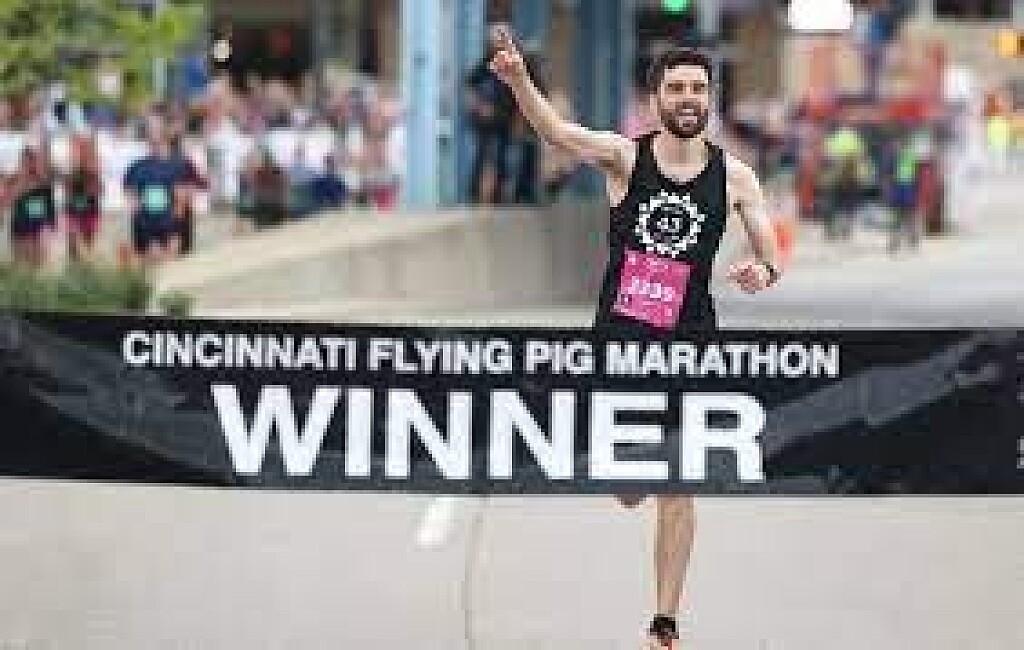
Flying Pig Marathon Weekend Celebrates Hometown Marathon Winners
The 24th running of the Cincinnati Flying Pig Marathon powered by P&G celebrated two Greater Cincinnati runners earning their first Flying Pig marathon wins.
The men’s division winner was 29-year-old Zac Holtkamp of Alexandria, Kentucky, in a time of 2:27:18. Holtkamp won this year’s Heart Half Marathon and in 2020 finished second in the Mesa Marathon with a time of 2:22:29. “I waited until after the Heart Half to sign up for the Flying Pig,” said Holtkamp. “After the Heart Half I thought, OK I can do it.”
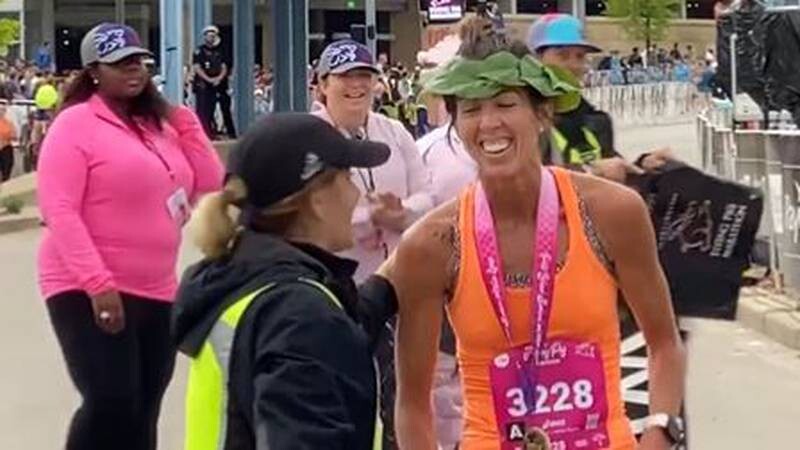
This was Holtkamp’s first Flying Pig after moving back to the area from Arizona. “I held off for years doing the Flying Pig,” he said. “So many people out there cheering me on, people that I knew, people that I didn’t know at all. For me, personally, that’s what keeps me going, every person who cheers for me, it’s like a mini aid station, it keeps me going.”
Second in the men’s division was 24-year-old Will Cadwell of Covington, in a time of 2:28:11. Cadwell won last October’s Fall Flying Pig Toyota 10K and also won the FCC 3 in July 2021. Third was 37-year-old Jeremy Wysocki of Miamisburg, Ohio with a time of 2:35:19.
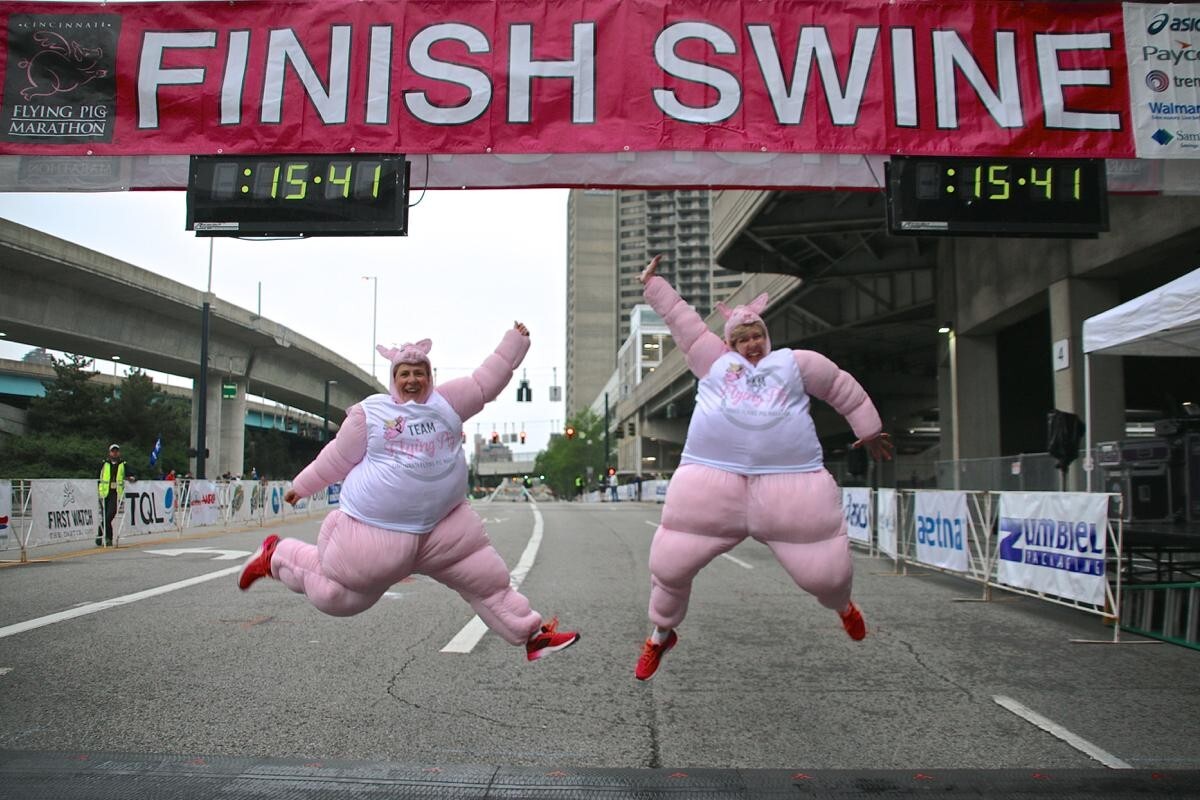
In the women’s division, 34-year-old Grace McCarron of Loveland, Ohio won with a time of 2:50:00 in her first Flying Pig. McCarron won the Glass City Marathon in Toledo, Ohio in 2021. “The atmosphere, the crowd, is just amazing. Often when you do a marathon there are some quiet spots, but here people are cheering all the time,” she said. “You’re out there, you’re working so hard, and to hear those cheers makes all the difference.”
Second in the women’s division was 26-year-old Madeline Dawson, who won the Heart Half Marathon earlier this year. Her time in the marathon was 2:52:51. Pacing third was two-time Flying Pig Marathon winner Anne Flower of Covington, who finished in 2:54:04. Flower won the Big Sur Marathon in California just last weekend.
In the Paycor Half Marathon, Cincinnati native Caitlin Keen, a two-time winner of the Cincinnati Flying Pig Marathon (2018, 2021), won her first Paycor Half Marathon in a time of 1:21:08. The 29-year-old ran a half marathon in Waco, Texas, near her home in Fort Worth, last weekend, but because of a wrong turn, the course was shortened by two miles for the leaders. She made a last minute decision to return to Cincinnati this weekend for the half.
“The experience here is something I never expected. People stop me on the street here and say, ‘You’re Caitlin, I know you, congratulations on winning the Pig.’ I want to be here because that’s how much the people here mean to me.”
Second in the women’s division was 28-year-old Katarina Smiljanec from Covington in a time of 1:24:57. She also placed second in Friday night’s Fifty West Mile elite division. Third in the half was 24-year-old Aimee Piercy from Cincinnati in 1:25:53, who was third in Friday’s Fifty West Mile.
On the men’s side of the Paycor Half Marathon, 43-year-old Josh Whitehead from Huntsville, Alabama, won in a time of 1:12:14. Whitehead has made a remarkable recovery from a bicycle accident in 2020, when he was hit by a car and suffered a broken back, dislocated shoulder and partially collapsed lung.
Second in the men’s division was 30-year-old Eric Gruenbacher of Loveland, Ohio in 1:12:56 and third was 28-year-old Kyle Klingler of Cincinnati in 1:13:14.
The 24th annual Cincinnati Flying Pig Marathon weekend powered by P&G began Friday night with sub 5:00 miles in the newly-configured Fifty West Mile, part of the TQL Beer Series.
This year the elite “dash for cash” mile started inside Cincinnati’s Transit Tunnel off Pete Rose Way and ended at the traditional finish line on Mehring Way. The fastest male among the elites was 22-year-old Andrew Taylor of Hilliard, Ohio, in 4:23. In a near photo finish, second place was 23-year-old Jack Cordonnier from Morrow, Ohio, in 4:25 and third was 28-year-old Charlie Michel of Cincinnati in 4:26.
Among the female elites, 27-year-old Gina McNamara from Washington D.C. won in a time of 4:59. Second among the elites was 28-year-old Katarina Smiljanec from Covington, Kentucky in 5:04 and third was 24-year-old Aimee Piercy from Cincinnati in 5:11.
Saturday’s slate of events began with the Toyota 10K, won by two-time Cincinnati Flying Pig Marathon winner Jack Randall of Cincinnati. The 27-year-old won in a time of 31:45. In another close finish, second place was 29-year-old Logan Barrett of Jeffersonville, Kentucky, just one second behind at 31:46. Third was 23-year-old Walter Ramsey of East Lake Center, Georgia, in 35:46.
In the women’s division of the Toyota 10K, 42-year-old Shawanna White of Columbia, South Carolina, won in a time of 39:35. Second was 31-year-old Ashley Case of Angola, Indiana, in 40:45 and third was 31-year-old Kaitlin Budke from Blue Ash, Ohio in 40:51.
In the sold-out Tri State Running Company 5K, 24-year-old Jakob Mueller from Monroe, Ohio, was the winner in 16:07, with 31-year-old Anders Ludvigsen of Cincinnati second in 17:04 and 38-year-old Bryan Wagner of Lawrenceburg. Indiana third in 17:22.
For the women, 22-year-old Meredith Grace Gieske from Fort Mitchell was the winner in 18:57. Second was 45-year-old Amy Parker of Dublin, Ohio, in 19:26 and third was Abby Mace in 19:32.
Also held Saturday was the First Watch Flying Piglet, Cincinnati Children’s 26th Mile, PigAbilities presented by Goodwill Industries, and the Flying Fur.
by Running USA
Login to leave a comment
Cincinnati Flying Pig Marathon
This beloved race found it's name from Cincinnati's pork history which dates back to the early 1800's. Cincinnati is also known as "Porkopolis."Our weekend line up of events are designed to welcome athletes of all abilities from the Diaper Dash to the full Marathon and everything in-between, we truly have something for everyone. We even added a dog race several...
more...