

Running News Daily
Top Ten Stories of the Week
9/27/2025
These are the top ten stories based on views over the last week.
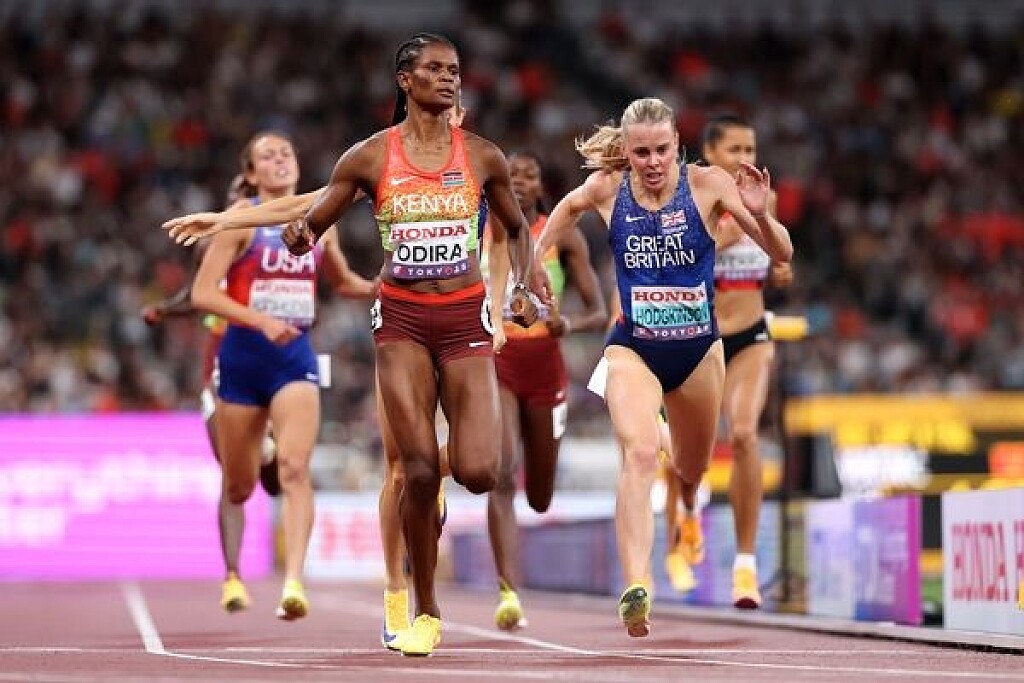


Kenya’s Lilian Odira Stuns the World with 800m Gold in Tokyo as Olympic Champion Mary Moraa Fades
Kenya has a new middle-distance queen. Lilian Odira shocked the athletics world on Saturday, storming down the final straight to win the women’s 800m world title in a championship record of 1:54.62. Her breakthrough run toppled giants and rewrote the script of global middle-distance running.
The 26-year-old, relatively unknown internationally until this season, ran with the poise of a seasoned veteran. She timed her move perfectly, sitting behind Olympic champion Mary Moraa’s blistering first lap of 55.7 seconds. By the bell, Moraa was leading, but the pace proved costly. As the field entered the final bend, Odira powered wide, flying past Moraa and Britain’s Keely Hodgkinson to seize a historic gold.

The victory was as much about composure as it was about speed. Crossing the line in disbelief, arms raised, Odira erased the long-standing championship record of 1:54.68 set in 1983. Kenyan fans erupted inside Tokyo’s Olympic Stadium.
“I waited, I trusted my plan,” Odira said. “I knew the last 200 meters would decide everything. To win against these champions is a dream for me and for Kenya.”
Behind her, Britain’s Georgia Hunter Bell surged to silver in a personal best 1:54.90, edging teammate Hodgkinson by just one-hundredth of a second. Hodgkinson, who has built a career of near-misses, was left with bronze in 1:54.91.
Kenya’s Mary Moraa, the heavy favorite, paid the price for her audacious early pace, fading to seventh in 1:57.10. Her younger namesake Sarah Moraa impressed in fourth with a personal best 1:55.74, while USA’s Sage Hurta-Klecker (1:55.89 PB), Switzerland’s Audrey Werro (1:56.17), and Australia’s Jessica Hull (1:57.30, Area Record) all delivered career-best performances in one of the fastest women’s 800m finals ever. Every athlete broke the 1:58 barrier.
For Odira, this was more than a gold medal—it marked the arrival of a new star. She now joins the lineage of Kenyan 800m greats like Janeth Jepkosgei, Pamela Jelimo, and Mary Moraa. Just a year ago she was best known on the Kenyan domestic circuit. Today, she stands as a world champion, opening a new chapter for Kenyan athletics in the high-octane world of the 800 meters.
The Tokyo final will be remembered for its blistering pace, its drama, and its symbolism: the Olympic champion fading, the perennial silver medalist edged into bronze, and a new champion rising to the top.
As Lilian Odira draped herself in the Kenyan flag, the stadium still buzzing, one thing was undeniable—athletics had witnessed the birth of a new star.
Women’s 800m Final – Tokyo 2025 World Championships (Top 8)
1. Lilian Odira (Kenya) – 1:54.62 (Championship Record)
2. Georgia Hunter Bell (Great Britain) – 1:54.90 (PB)
3. Keely Hodgkinson (Great Britain) – 1:54.91
4. Sarah Moraa (Kenya) – 1:55.74 (PB)
5. Sage Hurta-Klecker (USA) – 1:55.89 (PB)
6. Audrey Werro (Switzerland) – 1:56.17
7. Mary Moraa (Kenya) – 1:57.10 (SB)
8. Jessica Hull (Australia) – 1:57.30 (Area Record)
(09/21/25) Views: 780Robert Kibet
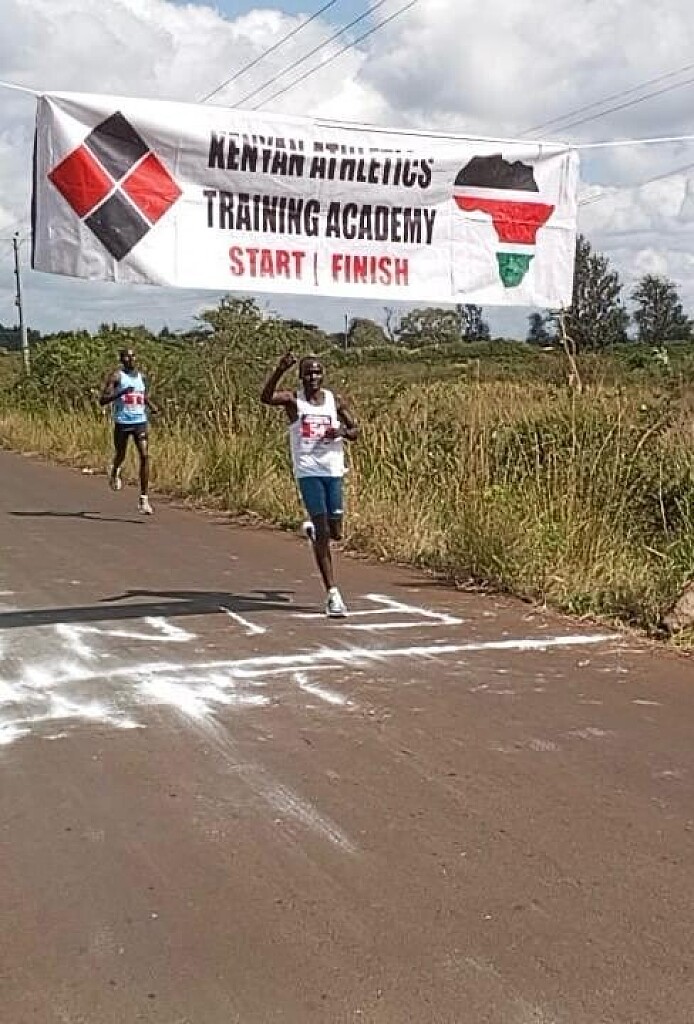
Edwin Soi and Betty Chesang Shine at 5th Annual KATA Double Road Race in Thika
THIKA, Kenya - Running at the Kenya Athletics Training Academy (KATA) has become a magnet for athletes and spectators alike, and today’s 5th Annual KATA Double Road Race proved just that. Energy and motivation filled the air as both athletes and coaches gathered to celebrate one of Kenya’s most innovative race formats.
A total of 97 elite athletes—74 men and 23 women—lined up for the two-stage event (10K + 5K), a turnout that highlighted KATA’s growing influence and its role in setting a new competitive standard.
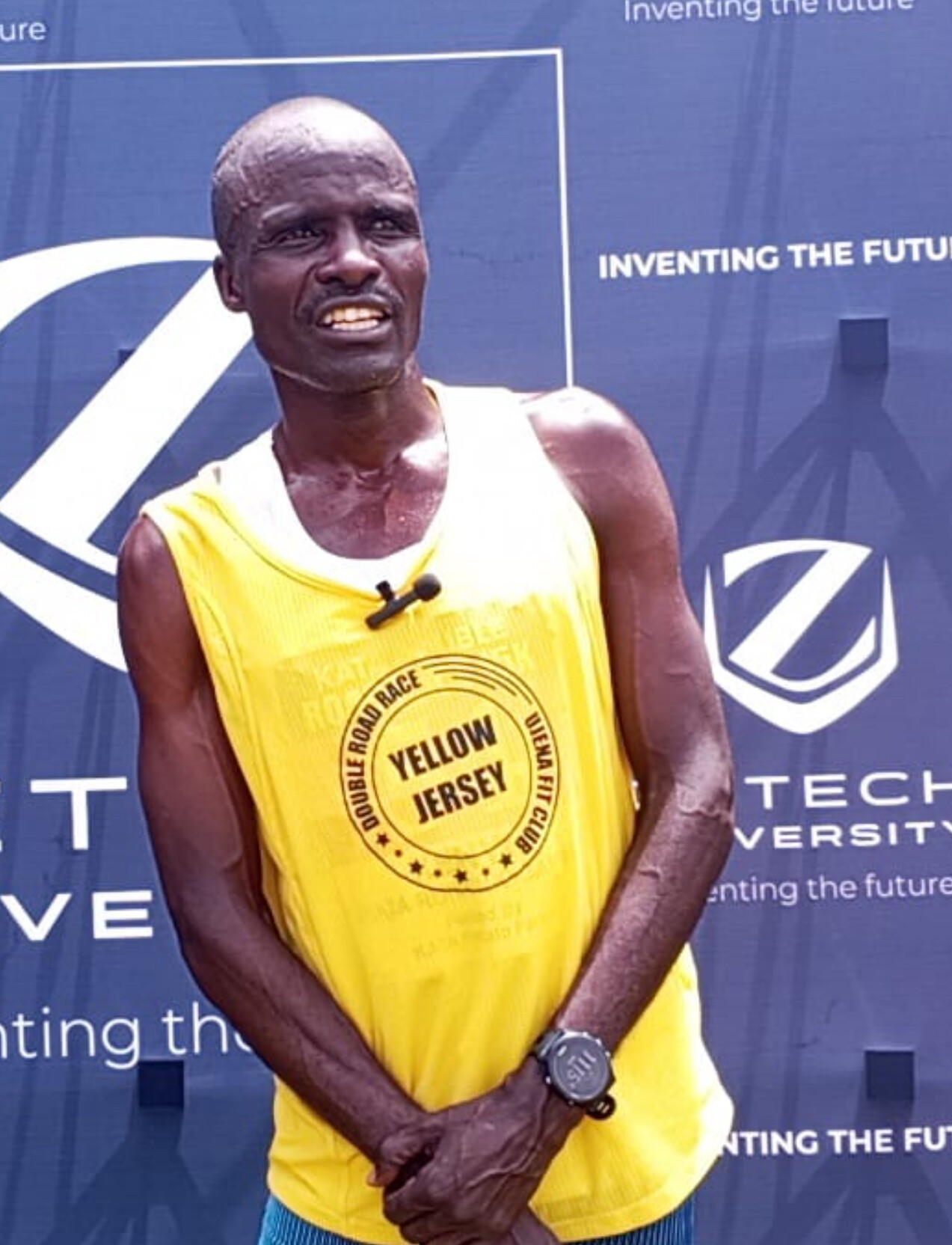
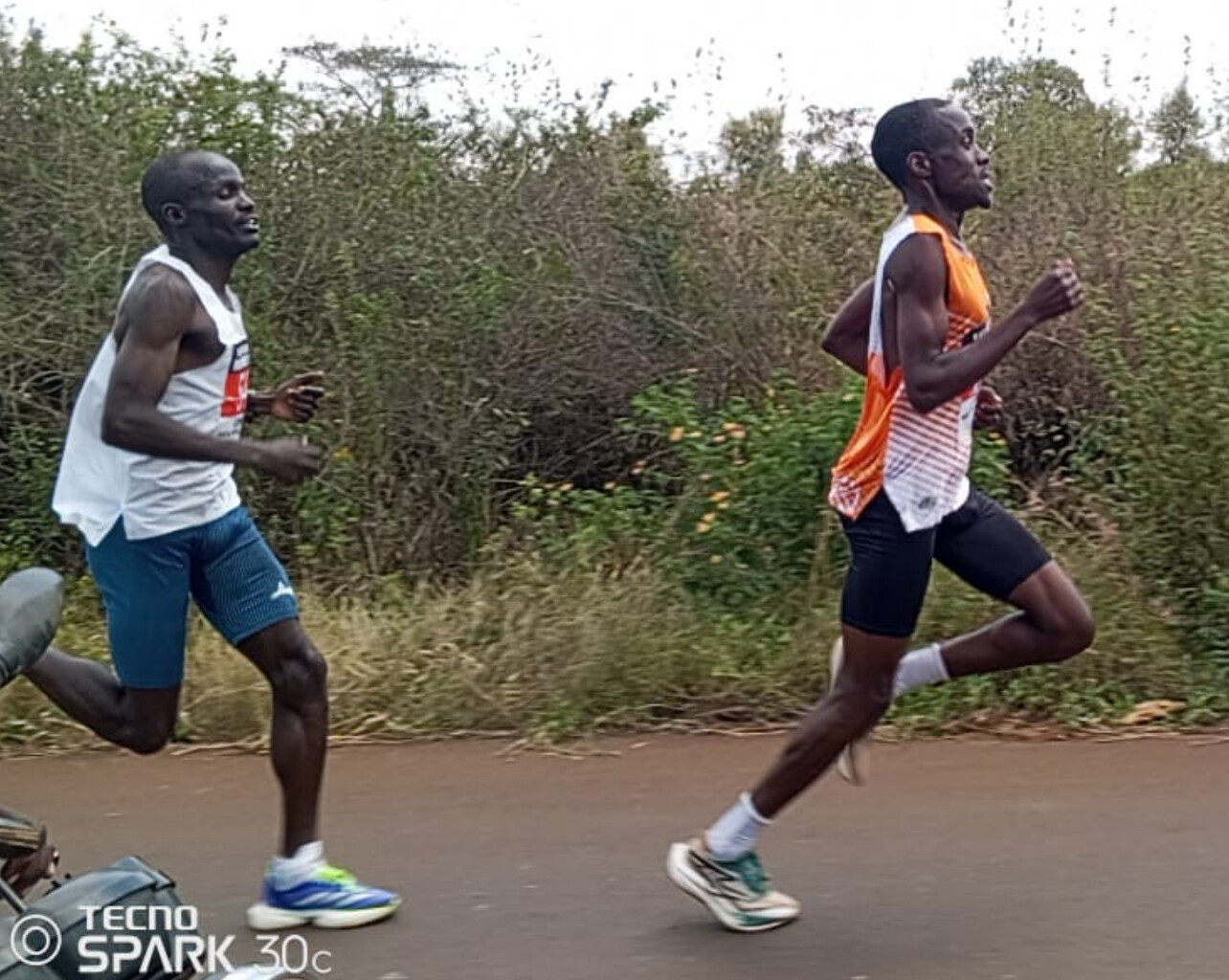
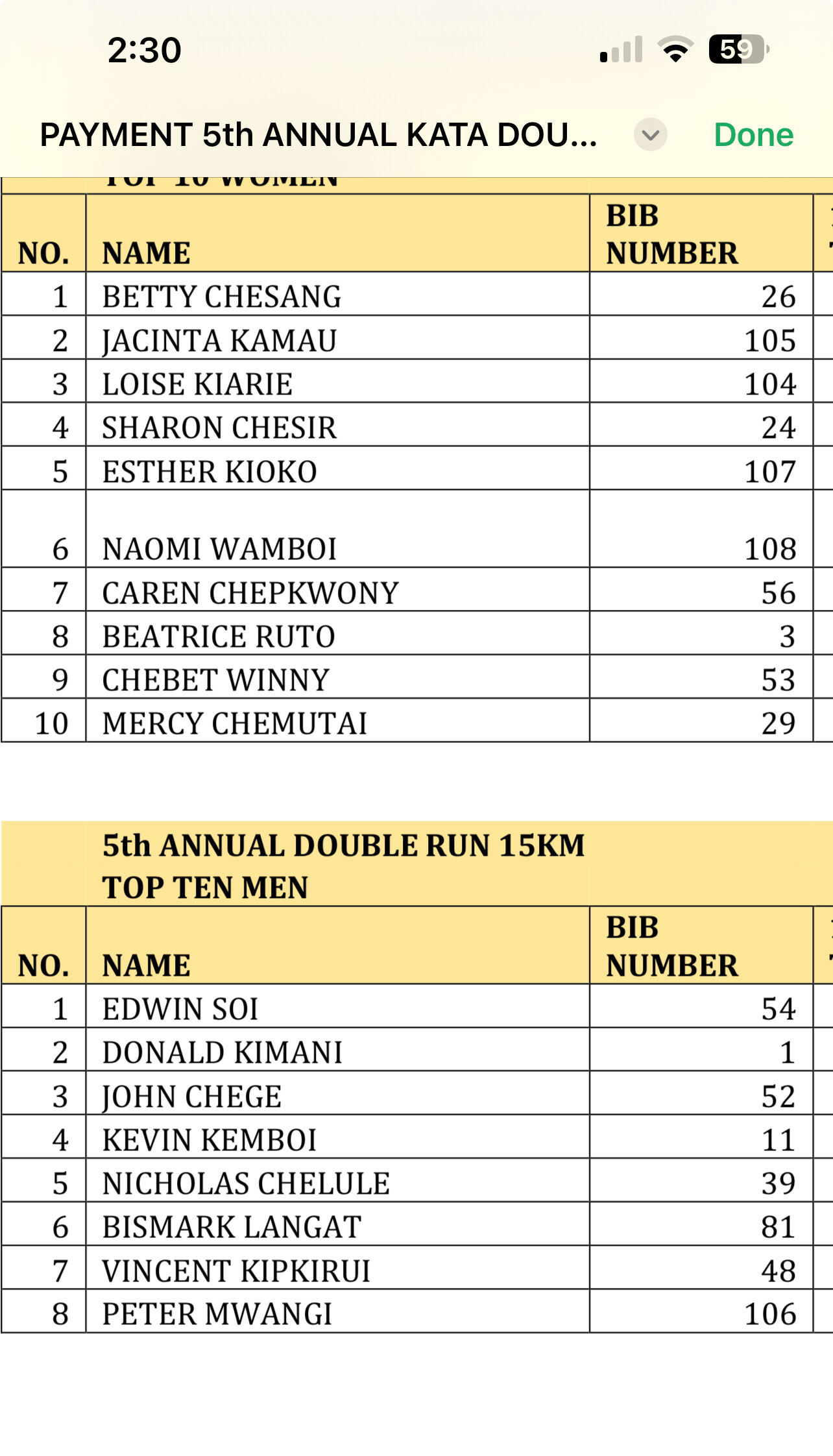
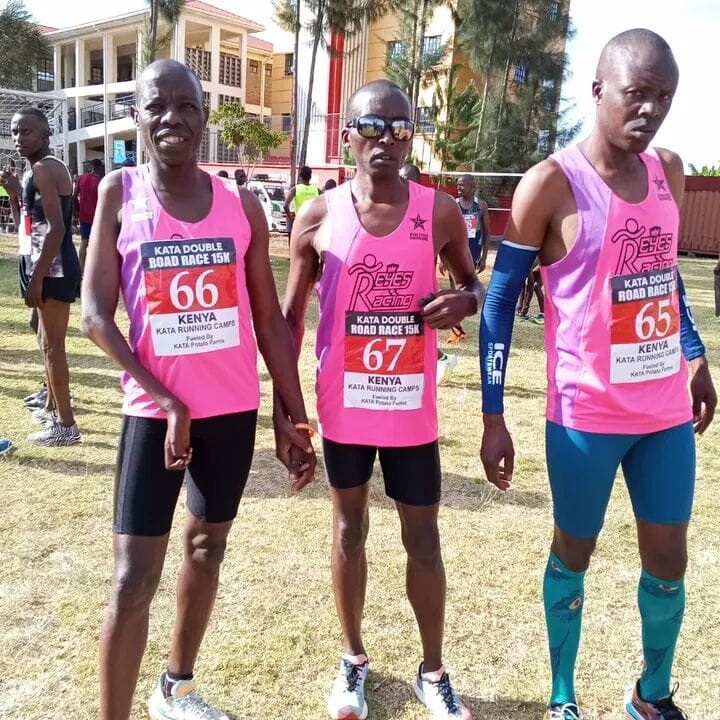


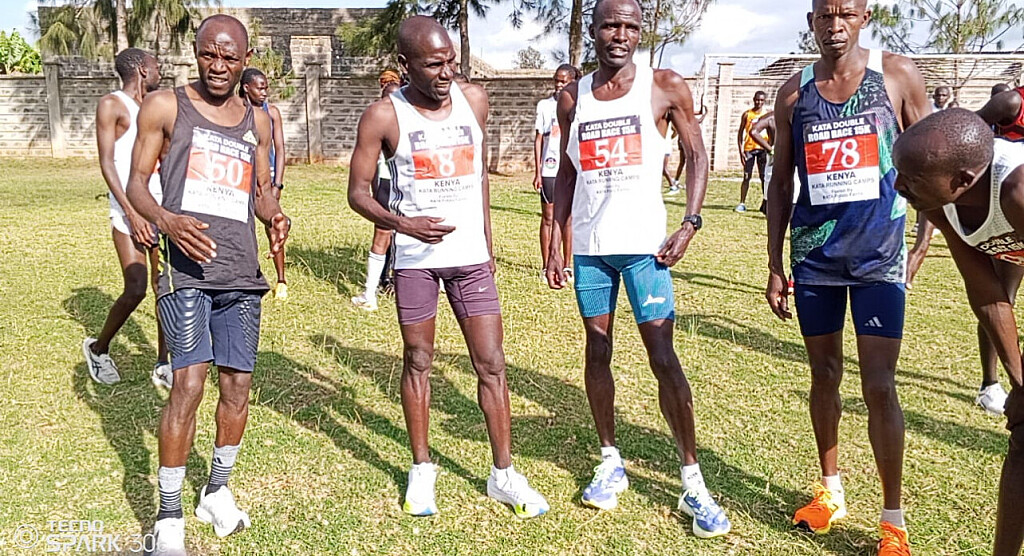
On the men’s side, Beijing 2008 Olympic 5000m bronze medalist Edwin Soi showed his class, taking the overall victory in a combined time of 43:50. He was chased hard by Donald Kimani, who clocked 44:07, while John Chege secured third place in 44:26. Chege, representing KATA Thika, had aimed with his teammates to challenge the world record. However, facing experienced stars like Soi, nerves crept in, and the record attempt slipped away.
The women’s race delivered equal excitement. Betty Chesang claimed the title in 51:32, followed by Jacinta Kamau in 51:50. Loise Kiarie rounded out the podium, finishing in 52:34.
Beyond the results, the day carried an atmosphere of learning and inspiration for KATA’s young and upcoming athletes. With each edition, the Double Road Race continues to grow stronger, reinforcing the KATA spirit: competing hard, learning together, and moving forward.
Also today was the Bob Anderson's Kids Mile and the 5K Run/Walk.
(09/20/25) Views: 626
Coach John and Boris Barron
The fifth annual KATA Double Road Race in the making
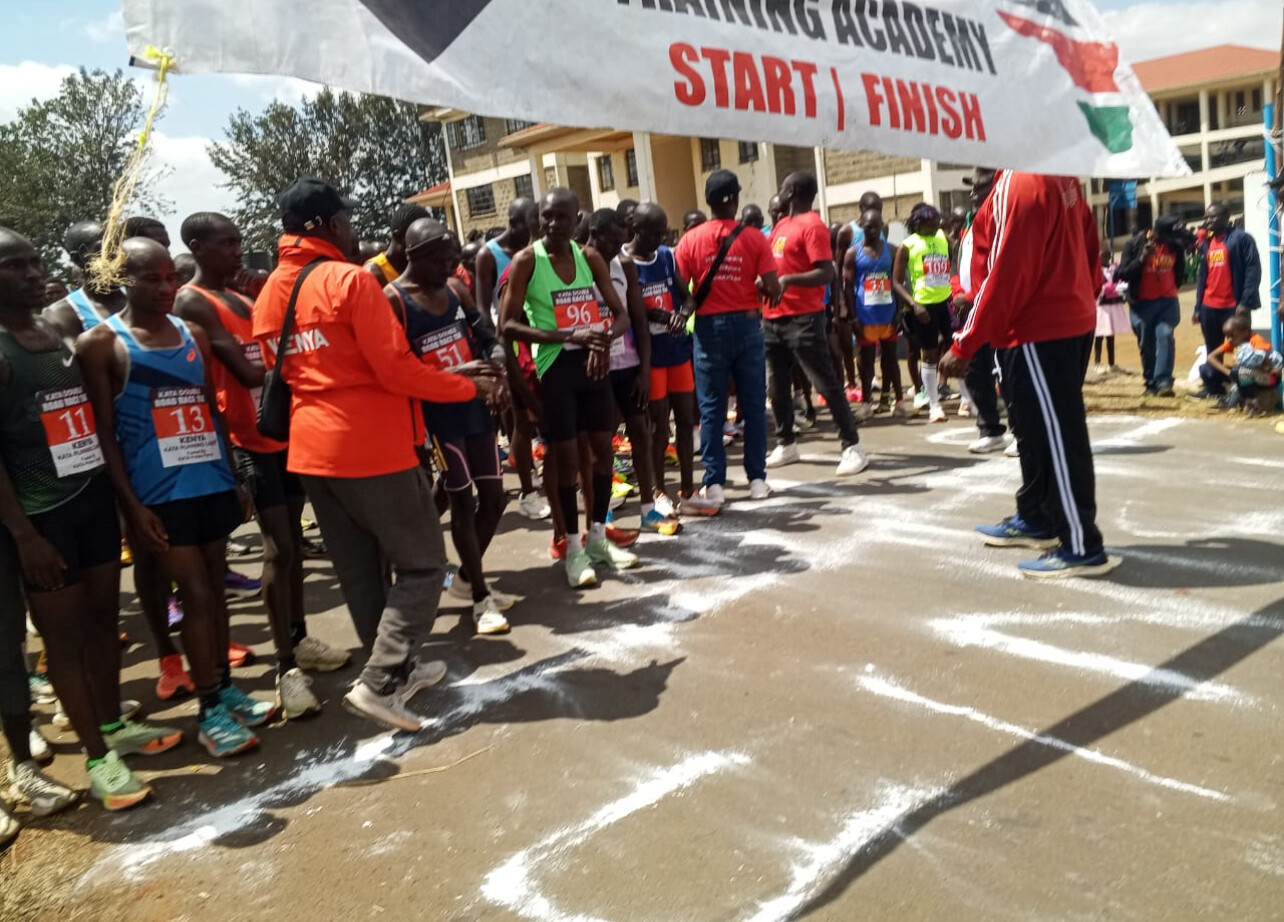
The small town of Thika is alive with excitement today. Athletes, coaches, families, and even farmers have gathered at the Kenya Athletics Training Academy (KATA) grounds for the 5th edition of the Double Road Race—a unique competition that, in just five years, has become a symbol of innovation in Kenya’s running culture.
Unlike conventional races, the Double Road Race challenges athletes to complete two segments with a rest break in between. Final standings are determined by combined times. It’s a test of speed, endurance, and resilience that forces runners to rethink race strategy and dig deeper than ever before.
The Birth of a Vision

The idea for KATA was born thousands of miles away. Bob Anderson, American publisher and lifelong runner best known as the founder of Runner’s World magazine, was inspired by the immense talent in Kenya but also saw structural gaps that held many athletes back.
Anderson’s vision was radical: create a training academy in Kenya that produced champions while also empowering communities. From this dream, KATA was founded in Thika—and one of its cornerstones was introducing the Double Road Race format to Kenyan soil.
Enter Jimmy Muindi: From Star to Mentor
No story of KATA is complete without Jimmy Muindi. The six-time Houston Marathon champion and former coach of world record holder Patrick Makau embodies the blend of experience and inspiration KATA thrives on.
From steeplechase junior champion at the 1992 World Juniors in Seoul to victories in Rotterdam and Honolulu, Muindi’s career reads like a running epic. As a coach, his highest moment came when Makau broke the marathon world record.
“The double tests body, mind, and spirit,” Muindi says. “It forces athletes to dig deep in ways they are not used to. That is how champions are made.”
Coach John Matheri’s Guiding Hand
While Muindi brought international pedigree, respected Kenyan coach John Matheri rooted the project locally. Known for discovering village talent and molding disciplined athletes, Matheri has helped weave community runners into the Double Road Race fabric.
“Returning for the second run after your body is tired teaches resilience,” Matheri explains. “That is what separates ordinary runners from great champions.”
His philosophy has given countless young runners not only a chance to compete, but also recognition and hope.
The Power of Exposure
One of the Double Road Race’s most innovative features is its commitment to visibility. Every runner’s time—first or last—is posted on the official website. For Kenyan athletes who rarely enjoy digital exposure, this is game-changing.
“Even if you are the last, your time is posted,” Muindi emphasizes. “Managers and sponsors around the world can see it. That exposure is priceless.”
In an age where social media visibility can launch careers, Anderson’s decision to democratize exposure has made the Double Road Race a vital platform.
A Vibrant Turnout in Thika
This year’s participation proves the format’s momentum. Squads from across the region have confirmed attendance, including Kata 1, 3, 4, 7, 9, 10, 13, 14, 15, 16 (with an impressive 16 runners), 17, 18, 20, 23, 24, 25, 29, 30, 31, and 32.
Adding further depth, farmers’ groups F20, F24, and F31 are also present—evidence of KATA’s reach beyond athletics and into the heart of Kenyan communities.
As one organizer shared in a WhatsApp update: “What an amazing turnout we are going to have.”
Beyond Competition: Building a Culture
For runners, today is more than a race. It’s a chance to test themselves, mark progress, and belong to something larger. For KATA, it’s proof of concept: grassroots blending with elite, communities meeting global culture, and tradition reimagined through innovation.
The Double Road Race, once a bold experiment by an American visionary, has now become part of Kenya’s running story.
Looking Ahead
Five editions in, the Double Road Race is no longer a novelty—it’s becoming an institution. Under the Thika sun, young runners, seasoned coaches, and cheering farmers weave together a tapestry of resilience and hope.
Anderson’s ambition, supported by Kenyan mentors like Muindi and Matheri, is for KATA to nurture athletes from primary schools to the world stage. With support from federations, sponsors, and government, the academy could become a model far beyond Kenya.
For now, as the second leg unfolds, Thika celebrates not just a race but the journey of an idea that dared to be different. Kenya’s running legacy isn’t only about medals—it’s about reimagining what running can be, and building a future where every stride counts.
Photo Gallery: https://kata.ke/gallery.php?g=1
(09/20/25) Views: 518Robert kibet
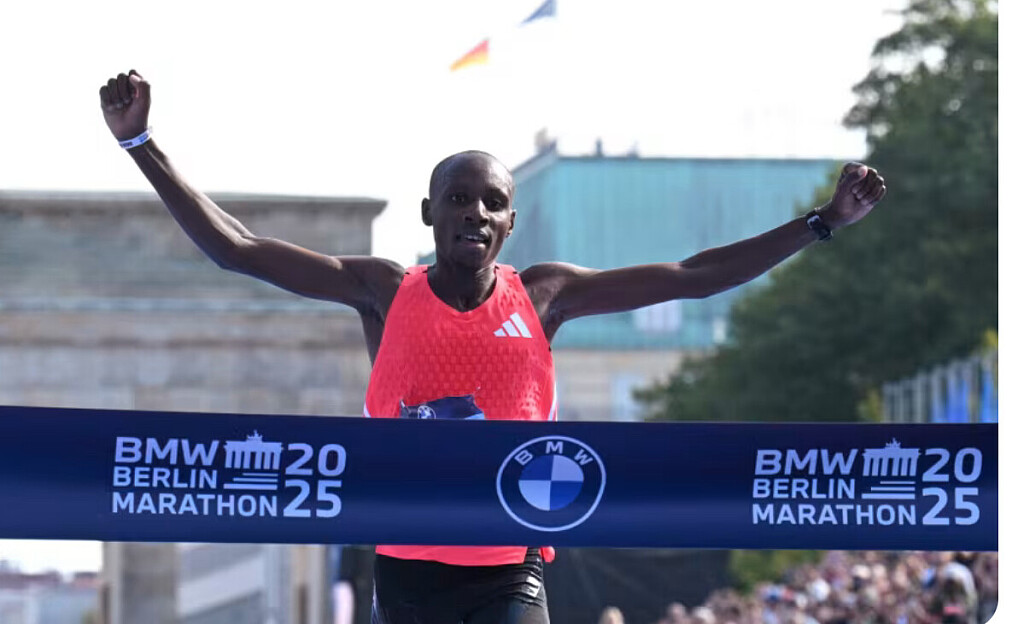
Sabastian Sawe Dominates in Berlin With 2:02:16 Victory
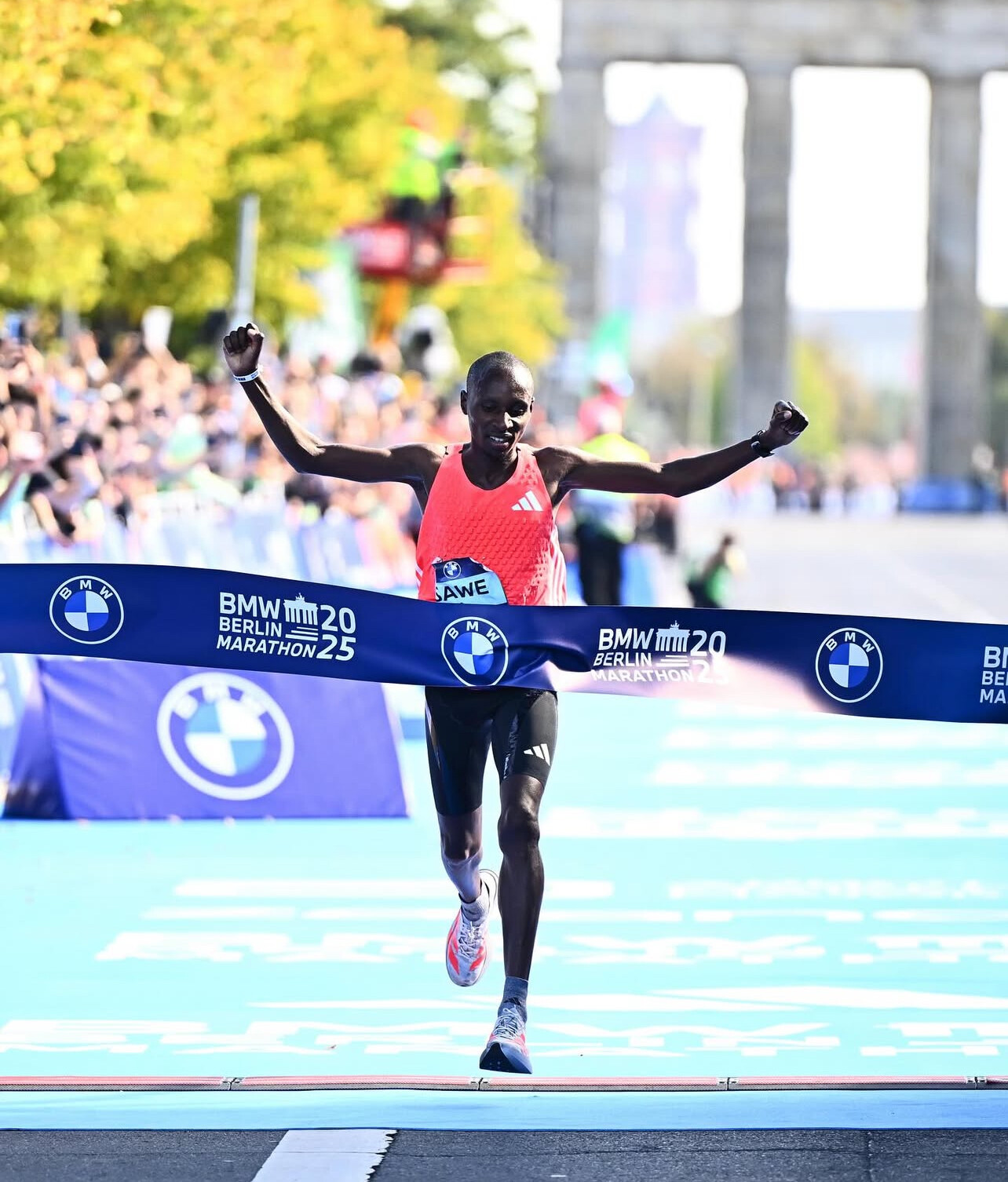
Berlin, September 21, 2025 — The Berlin Marathon once again lived up to its reputation as the world’s fastest stage for marathon running. Kenya’s Sabastian Sawe stormed to victory on Sunday, clocking 2:02:16, the fastest marathon time in the world this year and the fourth-fastest ever run on the streets of Berlin.
Sawe, already the reigning champion from Valencia (2024) and London (2025), extended his unbeaten record over the marathon distance. From the gun, he attacked with confidence, hitting 5km in 14:09and 10km in 28:26, well inside world-record pace. By halfway, his split of 60:16 electrified the Berlin crowds and suggested history might be on the cards.
But conditions proved decisive. Unseasonably warm temperatures — climbing to 25°C (mid-70s°F) — and the loss of his pacemakers before the 23km mark forced Sawe to shoulder the workload alone. Though the second half slowed, he maintained control and powered down Unter den Linden to the Brandenburg Gate, finishing with a commanding lead.
Behind him, Akira Akasaki of Japan impressed with a breakthrough run, finishing second in 2:06:15, while Ethiopia’s Chimdessa Debele held on for third in 2:06:57.
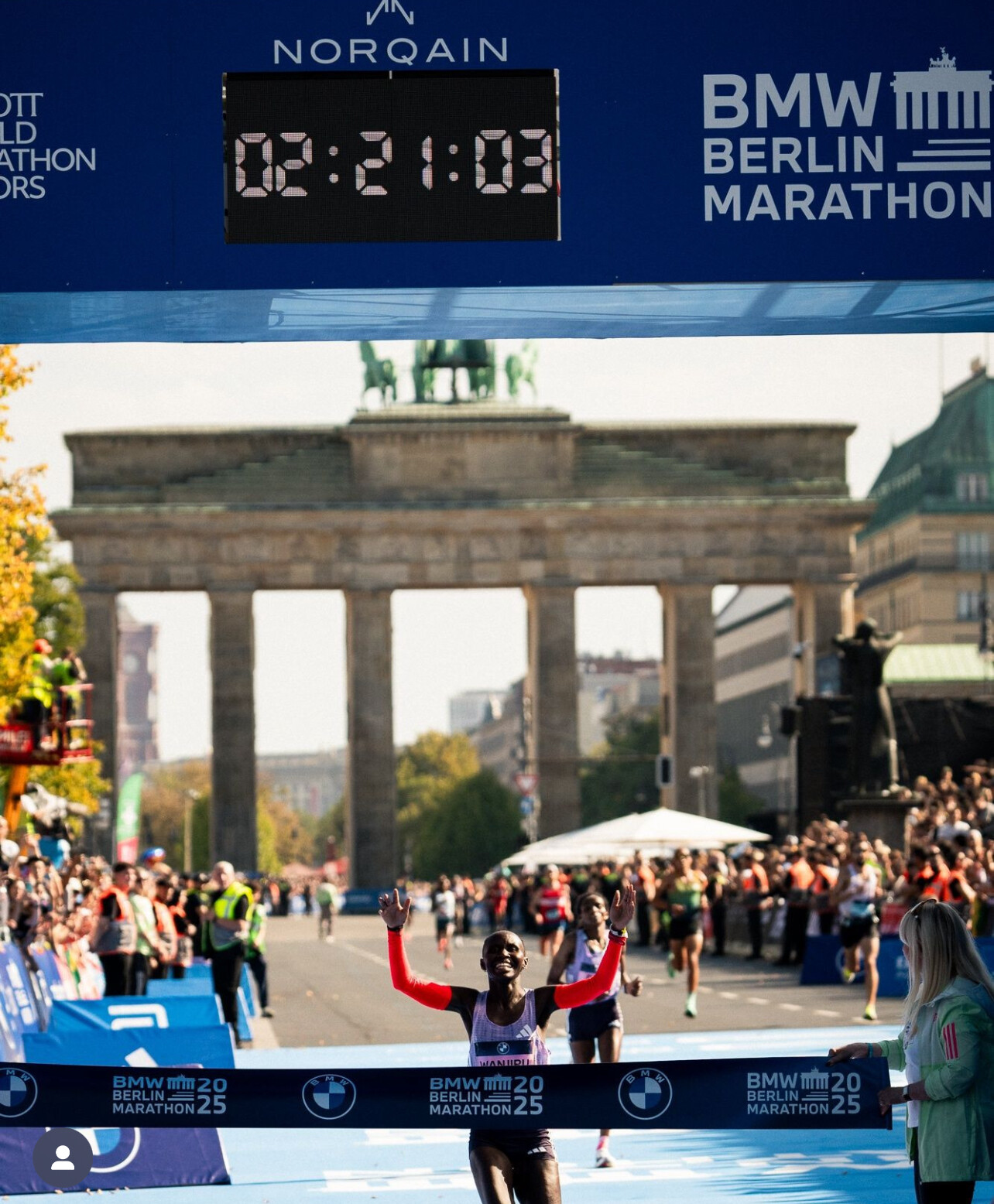
Wanjiru Outkicks Dida in Women’s Duel

The women’s race produced its own drama, with Kenya’s Rosemary Wanjiru edging Ethiopia’s Dera Dida by just three seconds. Wanjiru clocked 2:21:05 after a decisive surge past the 25km mark. Dida followed in 2:21:08, while fellow Ethiopian Azmera Gebru completed the podium in 2:21:29.
“I knew it would come down to the final kilometers,” Wanjiru said afterward. “The crowd in Berlin gave me so much energy.”
Berlin’s Enduring Legacy
This year’s edition was the 51st running of the Berlin Marathon, and once again, the German capital showcased why it is considered the “world record course.” Since 2003, the men’s world record has been broken eight times in Berlin, most recently by Eliud Kipchoge’s 2:01:09 in 2022. On the women’s side, Tigst Assefa stunned the world here in 2023 with her record 2:11:53.
While Sawe fell short of rewriting those marks, his performance in the heat confirmed his status as the man to beat in global marathon running. With three straight victories in world-class fields, he has announced himself as the heir apparent to Kipchoge.
Results at a Glance
Men
1. Sabastian Sawe (Kenya) — 2:02:16
2. Akira Akasaki (Japan) — 2:06:15
3. Chimdessa Debele (Ethiopia) — 2:06:57
Women
1. Rosemary Wanjiru (Kenya) — 2:21:05
2. Dera Dida (Ethiopia) — 2:21:08
3. Azmera Gebru (Ethiopia) — 2:21:29
(09/21/25) Views: 511Boris Baron
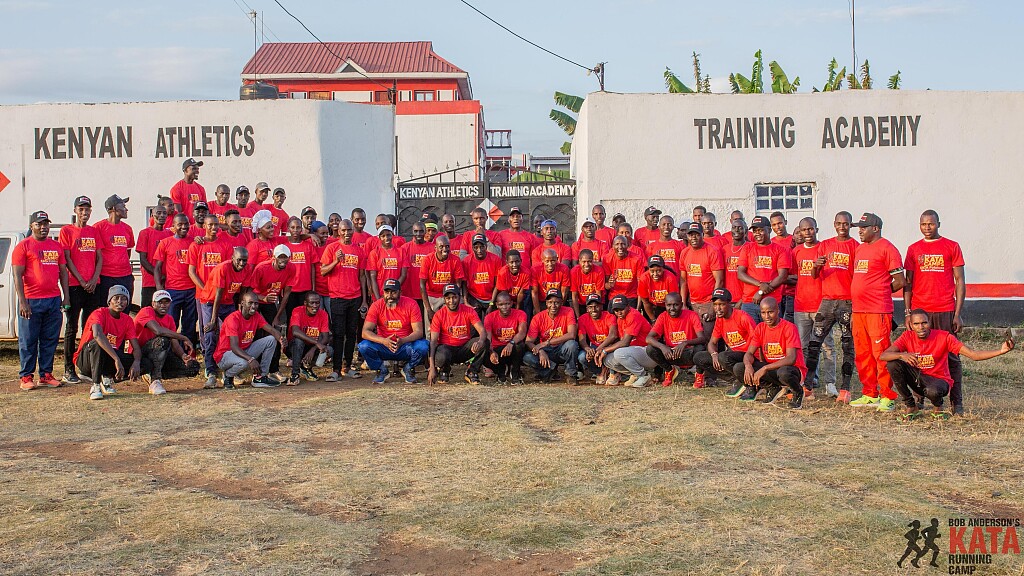
Anticipation Builds for the 5th Annual KATA Double Road Race in Thika
The countdown is over—the 5th Annual KATA Double Road Race takes place tomorrow, September 20, in Thika, Kenya. The unique two-stage event, featuring a 10K run followed by a break and a 5K, promises high drama and fast performances. With the depth of talent assembled, the prospect of a world record is very much on the table.
Since May, the KATA program has experienced tremendous growth. A total of 31 KATA Running Camps have been established across Kenya, alongside 35 stand-alone KATA Potato Farms. Many camps are cultivating three acres of potatoes, providing not only sustenance but also inspiration. The motto rings true: “KATA Potatoes—the fuel of champions.”

On Friday, the energy was already high as athletes, coaches, and supporters gathered at the KATA Running Retreat in Thika, which first opened in 2020. The opening ceremony set the tone for what is expected to be a memorable weekend of racing.
As athletes toe the line tomorrow, anticipation is sky-high. Records may fall, but more importantly, the Double format will once again showcase endurance, strategy, and the unique spirit of the KATA family.

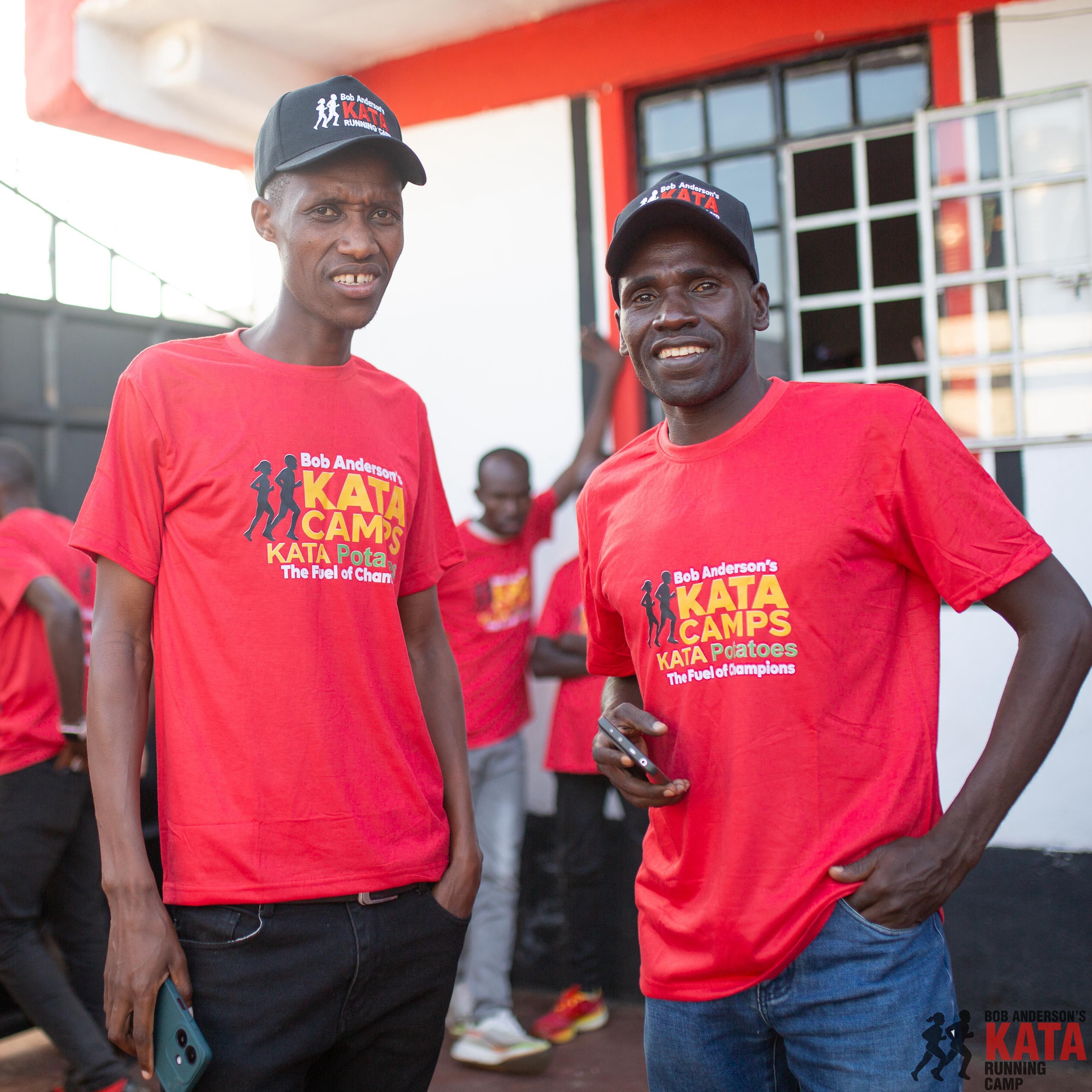
Good luck to all competitors this Saturday in Thika!
(09/19/25) Views: 501Boris Baron

Kenyan Women Make History with Unprecedented Distance Sweep at World Championships
Kenyan Women Make History with Unprecedented Distance Sweep at World Championships
Kenya has written one of the greatest chapters in athletics history. For the first time ever—by men or women—one nation has swept every distance race at the World Championships, from the 800 meters all the way to the marathon. Six races, six gold medals. And they all belong to Kenya’s women.
A Golden Run Across Every Distance
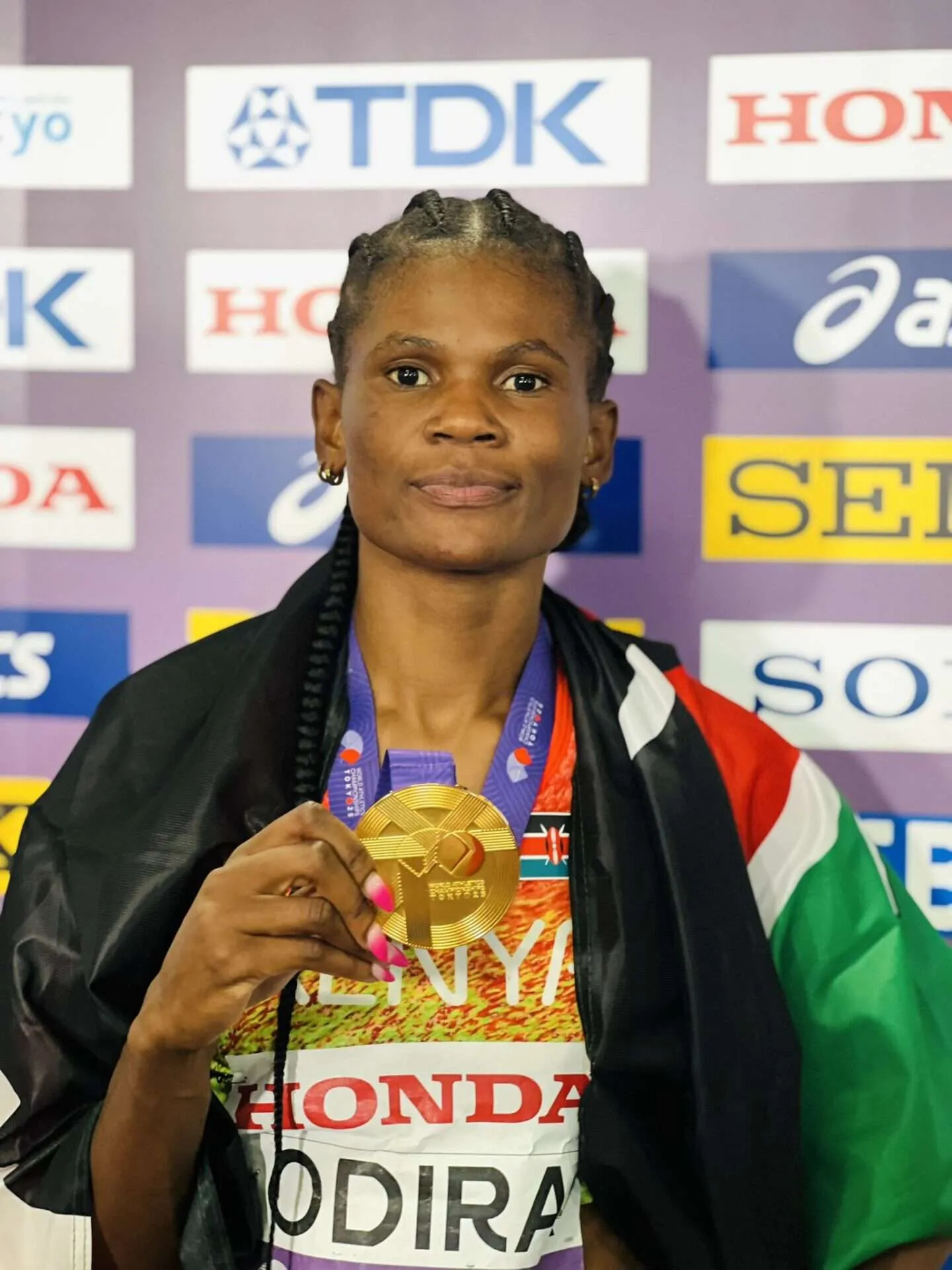
It all began with Lilian Odira, who stunned the world in the women’s 800m. Running with patience and power, she stormed to victory in 1:54.62, a championship record that announced her as the new queen of the two-lap race.
Next came the familiar dominance of Faith Kipyegon. Already a legend of middle-distance running, she defended her crown in the 1500m, producing another masterpiece of speed and tactics with a time of 3:52.15.
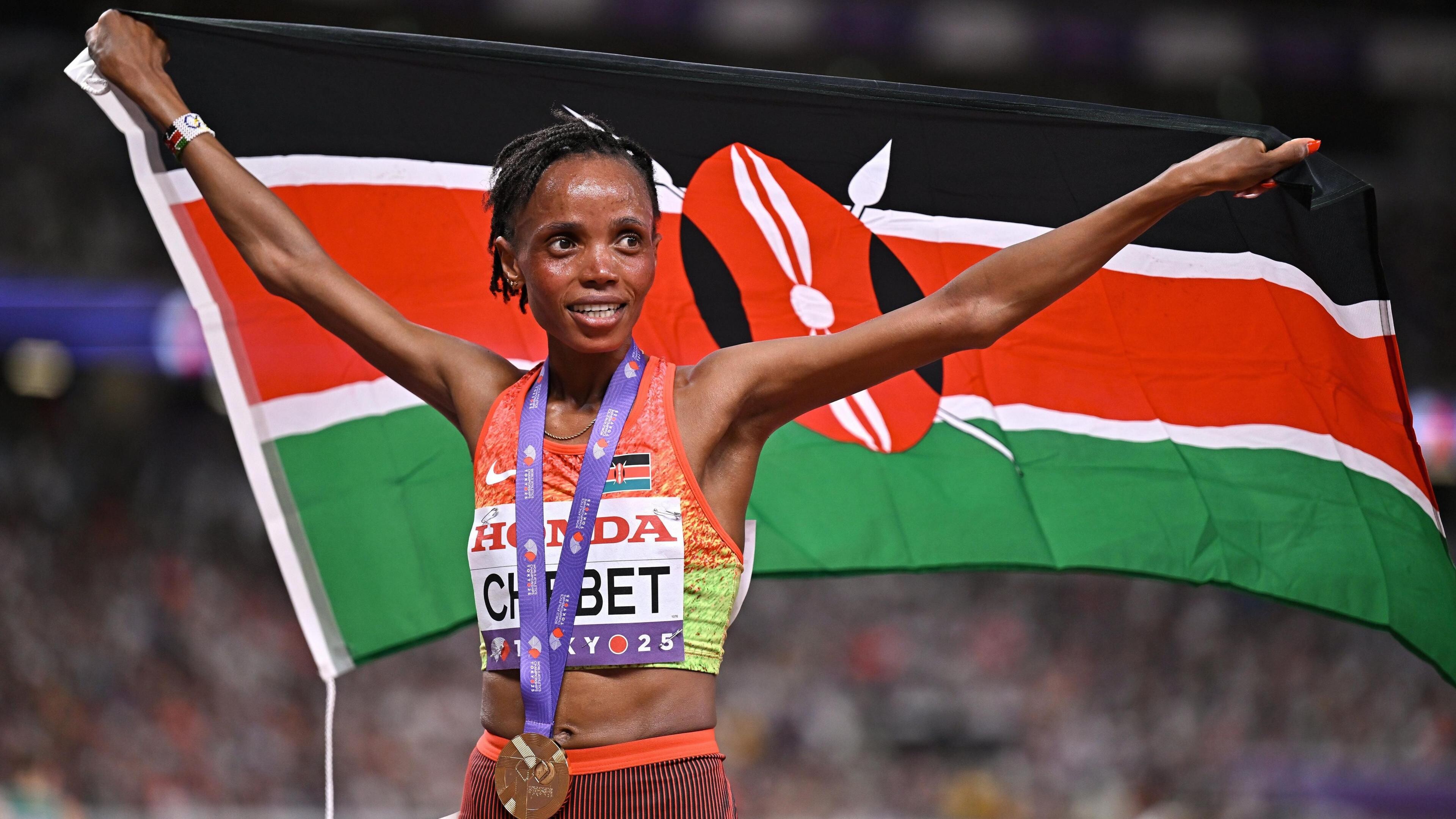
From there, Beatrice Chebet took over the spotlight, showing remarkable versatility and endurance. She claimed double gold in both the 5000m (14:54.36) and 10,000m (30:37.61), solidifying her reputation as one of the greatest all-around distance runners of her generation.
In the steeplechase, Faith Cherotich displayed poise and precision, controlling the race from start to finish to secure gold in 8:51.59.
And finally, in the ultimate test of endurance, Olympic champion Peres Jepchirchir closed the sweep with a perfectly executed run in the marathon, clocking 2:24:43. Her victory sealed Kenya’s clean sweep of all women’s distance races—an achievement unmatched in the history of the sport.
A First in World Athletics History
No nation has ever before captured every distance title at a single World Championships. This is more than a collection of gold medals—it is a powerful statement about Kenya’s depth, resilience, and continued dominance in global distance running.
More Than Medals
This sweep is not just about records and times. It is a story of perseverance, discipline, and national pride. Each champion has walked a different journey, yet together they have created a moment that will inspire generations of runners around the world.
Kenya’s women have redefined what dominance looks like in athletics. They have set a standard so high it may never be equaled.
The world came to watch champions—but what they witnessed was history.
(09/23/25) Views: 170Boris Baron

Harry Styles Runs Sub-3 in Berlin, Becomes Fastest Major Singer to Tackle the Marathon
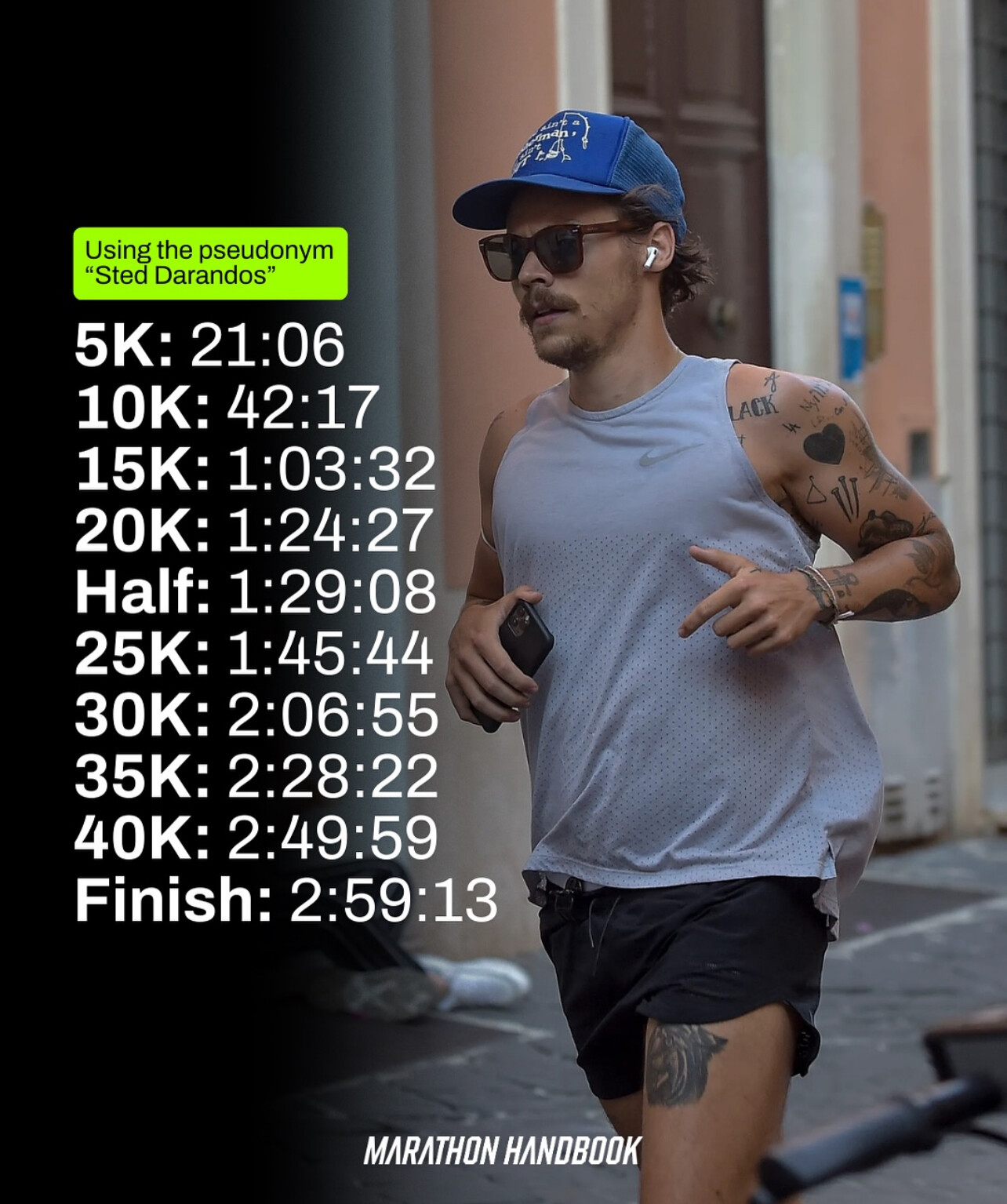
Berlin, Germany – September 2025: Harry Styles has made history on the roads, trading concert stages for marathon streets. The global music icon stormed through the 2025 Berlin Marathon in 2:59:13, becoming the fastest major singer ever to run the 26.2-mile distance.
From Tokyo to Berlin: A Remarkable Leap

Earlier in March, Styles completed the Tokyo Marathon in 3:24:07. That debut alone was a respectable effort, but few expected the pop star to chop off nearly 25 minutes in just six months. His Berlin run showed not only improved conditioning but also a deep commitment to the craft of marathon training.
Breaking the Sub-3 Barrier

Crossing the finish line under three hours is an achievement that sets serious marathoners apart. Fewer than 5% of all marathoners reach this benchmark, placing Styles in the top tier of amateur competitors. His average pace of 6:50 per mile (4:15 per kilometer) required discipline and precision from start to finish.
Although he missed the Boston Marathon qualifying standard of 2:55:00 by just over four minutes, his Berlin time makes it clear he is edging closer to that goal.

Racing Under the Radar
To stay focused, Styles ran Berlin under the alias “Sted Sarandos.” While the disguise may have hidden him from the spotlight, it couldn’t mask his performance. Compared to Tokyo, he ran almost one minute faster per mile, maintaining an average speed of 8.77 mph (14.13 km/h) with consistent 21:14 5K splits.
A True Outlier
The contrast is striking: while the average male marathoner crossed the line in 4:21:03, Styles was already cooling down after achieving a personal milestone. His effort highlights what is possible when talent, dedication, and smart training align.
What’s Next?
With a sub-three-hour finish in his second marathon, Styles has firmly established himself as more than a hobby jogger. The question now is how far he can go—whether that means chasing a Boston qualifier, returning to Tokyo for redemption, or taking on another World Marathon Major.
For now, Harry Styles has earned a place not only in music history but also in the story of amateur marathoning: a performer who turned his passion into a performance of an entirely different kind.
(09/24/25) Views: 158Boris Baron
From Rain to Heat: Sabastian Sawe and the New Chapter of Berlin’s Weather-Tested Records
Fifteen years ago, Patrick Makau braved torrential rain and deep puddles on the streets of Berlin, chasing Haile Gebrselassie’s marathon world record. The conditions ruined his attempt, but Makau still managed 2:05:08—the fastest marathon ever run in such relentless rain. A year later, with fair weather, he returned and broke the world record with 2:03:38.
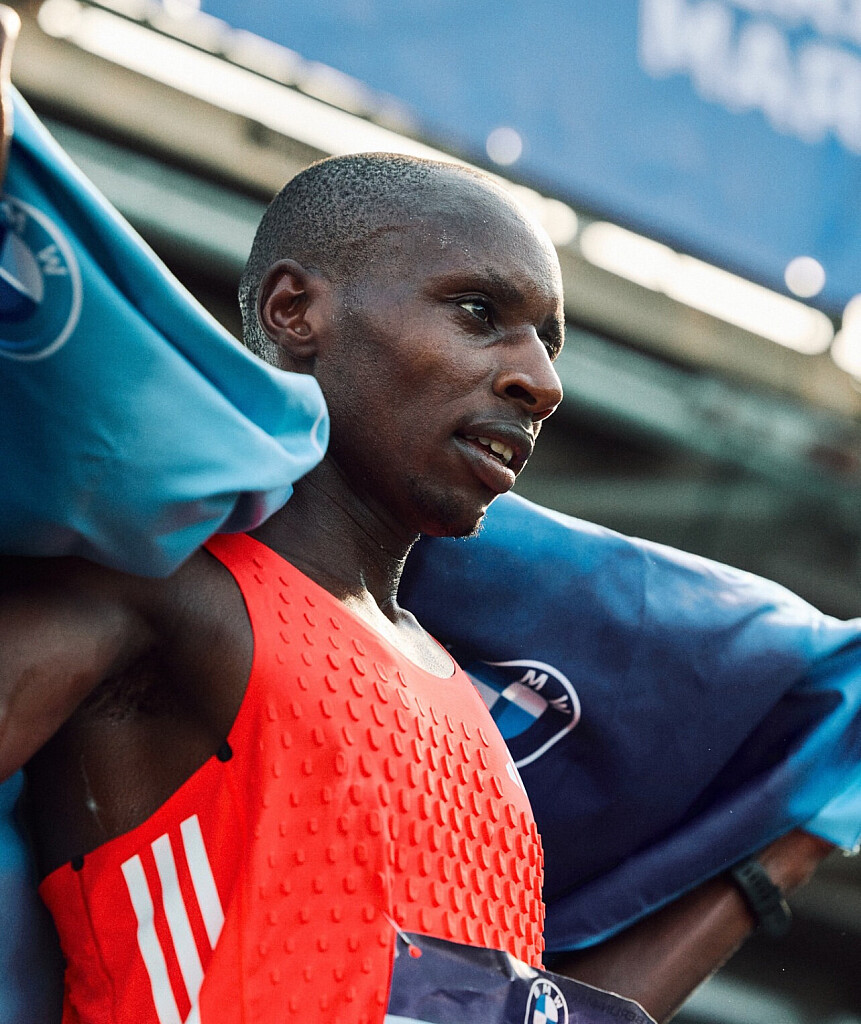
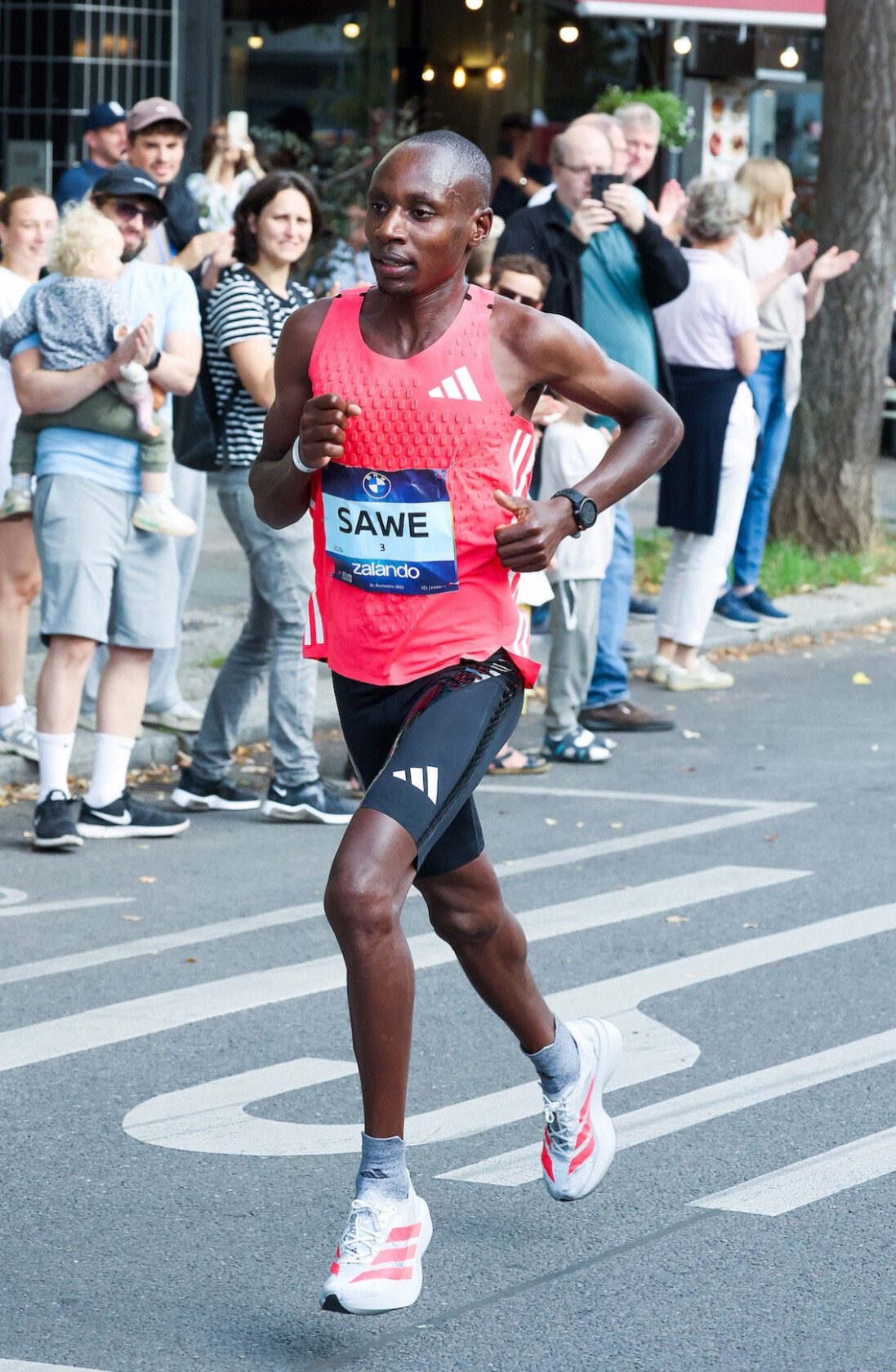
On Sunday in Berlin, history echoed in a new way. This time, it wasn’t rain but unseasonable heat that stood between a Kenyan and marathon immortality. Sabastian Sawe, the 30-year-old rising star, had his sights set on Eliud Kipchoge’s 2:00:35 mark. Instead, he delivered what can only be called a “warm-weather world record,” blazing through the 26.2 miles in 2:02:16. Despite being 101 seconds off the record, it was the fastest time ever achieved in such high temperatures.
The What-Ifs of Berlin
Sawe, whose personal best stands at 2:02:05, was in career-best form. His coach, Italian veteran Claudio Berardelli, admitted the weather stripped away any chance of the extraordinary.

“I know he was in exceptionally good shape. But I do not know what would have been possible,” Berardelli reflected.
The what-if question will linger: how fast could Sawe have run under cooler skies?
From Humble Beginnings to Global Stardom
Born in the village of Cheukta near Eldoret, Sawe’s story mirrors that of countless young talents in Kenya who struggle for recognition. Despite moving to Iten, the mecca of distance running, he was overlooked by managers and coaches. His breakthrough came only after turning to his uncle, Abraham Chepkirwok—Uganda’s 800m national record holder—and his neighbor Abel Mutai, the London 2012 Olympic steeplechase bronze medalist.
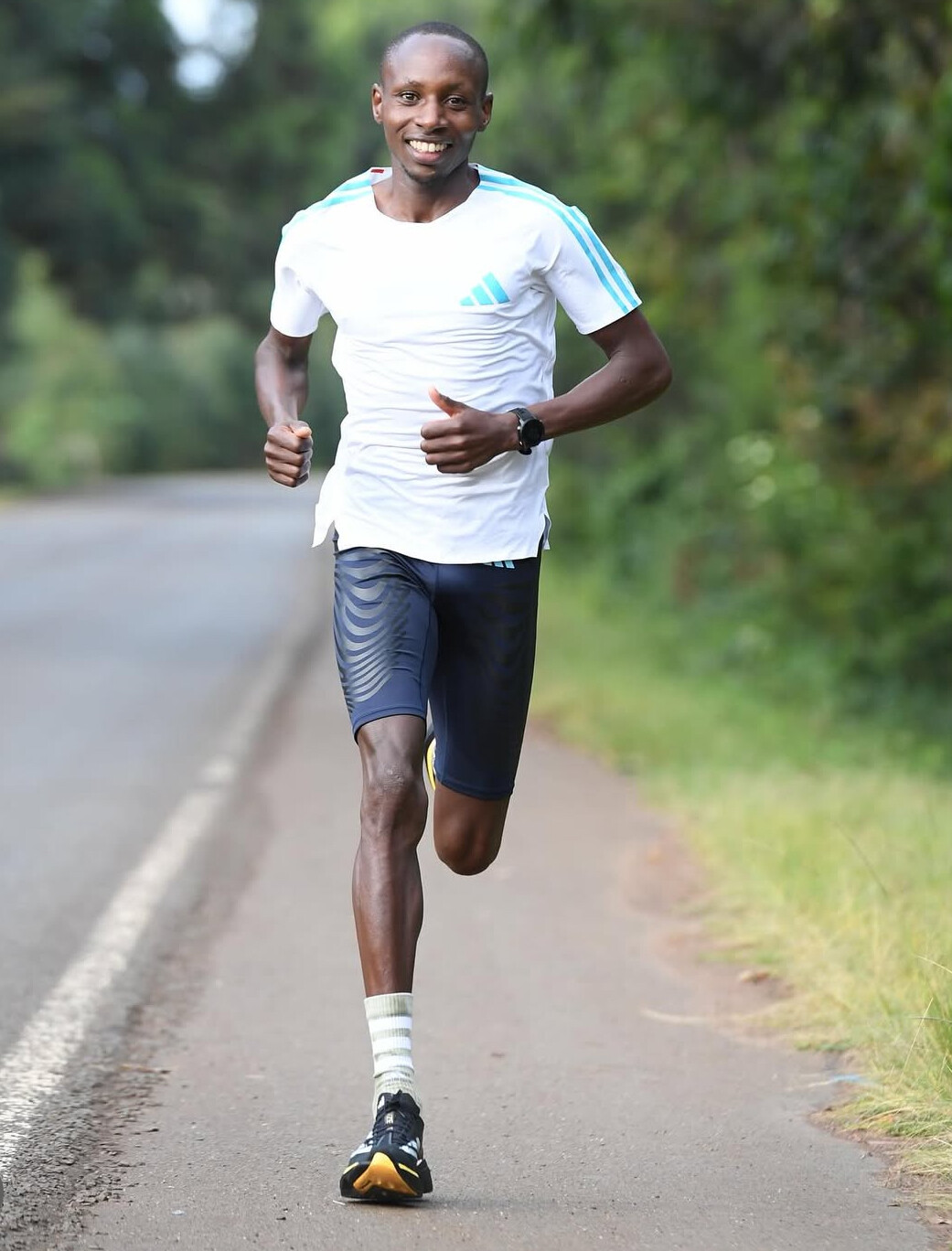
Mutai vouched for him with Berardelli, who placed Sawe in his Kapsabet camp. The rest unfolded quickly. Sawe stunned the field at the 2022 Seville Half Marathon, entering as a pacemaker but leaving with a victory and a world lead of 59:02.
A Gift of Talent and Humility
Berardelli is quick to highlight Sawe’s rare combination of physical and mental qualities:
“He has everything it takes—training ability, mental strength, and humility. I can’t predict what will be possible, but I’m looking forward to finding out.”
Sawe himself remained pragmatic after Berlin:
“I wanted to run really fast and gave it my best, but the weather was too hot. I hope I will have better weather next time. I liked the course, it is very good and fast.”
Berlin: Unfinished Business
Just as Makau returned after the rain to rewrite history, Sawe may yet come back to Berlin with the weather in his favor. With his trajectory and determination, the marathon world could witness a record chase for the ages in 2026.
Until then, Berlin 2025 will be remembered as the day Sabastian Sawe delivered a performance that stood not against the clock, but against the elements—proving once again why the city remains the crucible of marathon greatness.
(09/24/25) Views: 126
Race News Service
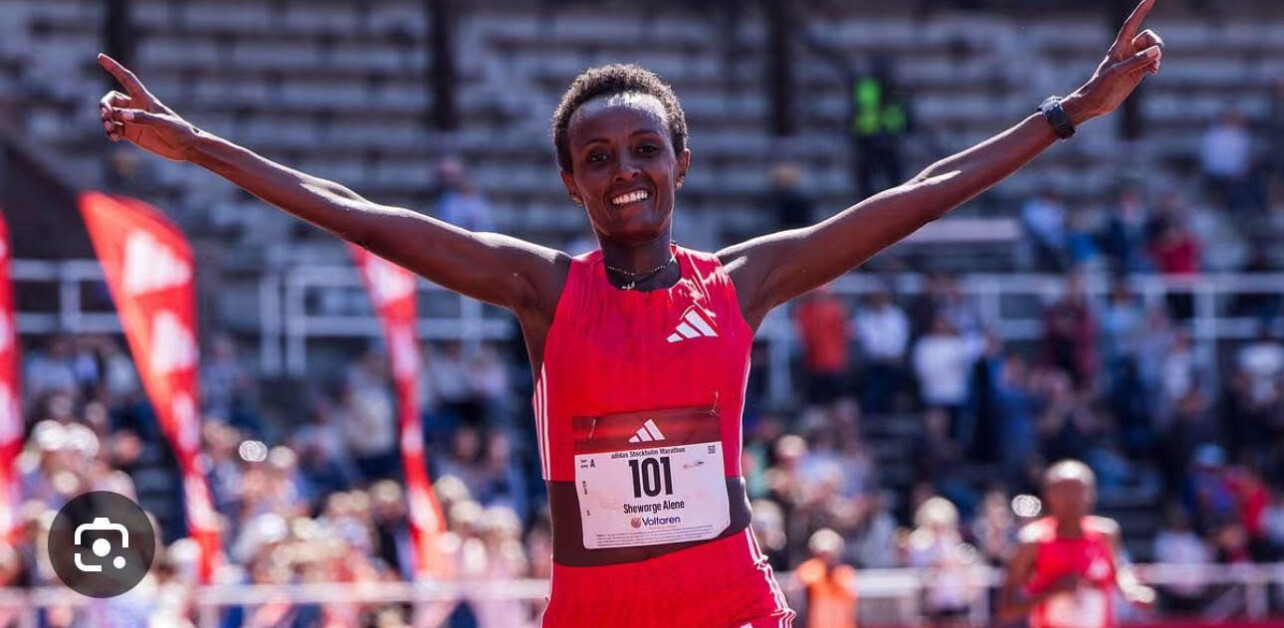
Shewarge Alene, Stockholm Marathon Champion, Passes Away at 30
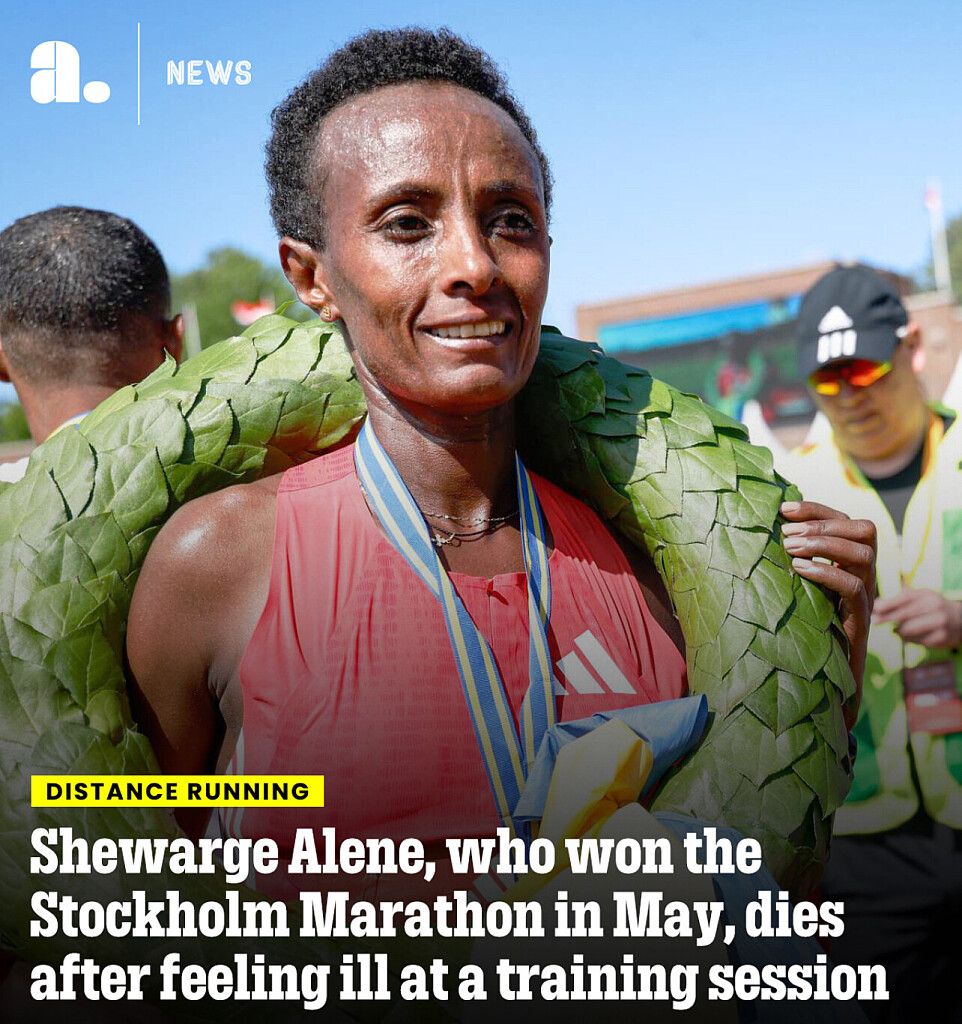
The global running community is mourning the sudden loss of Ethiopian marathoner Shewarge Alene, who tragically passed away at the age of 30 after collapsing during a training session—just four months after her victory at the Stockholm Marathon.
On May 31, 2025, Alene conquered Stockholm with a winning time of 2:30:38, adding another jewel to her outstanding career. The Stockholm Marathon confirmed her passing in a heartfelt statement, remembering her as the champion of their most recent edition.

Alene’s impact on the sport was profound. Beyond her Stockholm triumph, she claimed victories at the Mexico City Marathon and the Santiago de Chile Marathon, among others, amassing an impressive 17 professional wins. Her personal best of 2:27:26 placed her firmly among the top marathoners of her generation.
Her sudden loss is a stark reminder of life’s fragility, even for athletes who appear invincible on the course. Shewarge Alene will be remembered not only for her triumphs, but also for the determination and joy she brought to every race.

Career Highlights – Shewarge Alene
• Stockholm Marathon Champion (2025) – 2:30:38
• Mexico City Marathon Champion
• Santiago de Chile Marathon Champion
• 17 professional marathon victories
• Personal Best – 2:27:26 (Marathon)
A Lasting Tribute
In their statement, the Stockholm Marathon organizers wrote:
“Shewarge Alene will forever remain part of our history. Her victory in May inspired thousands of runners and reminded us all of the power of resilience. Today, we honor not just her achievements, but her spirit. Our thoughts are with her family, friends, and the running community worldwide.”
Her legacy will endure in the marathons she conquered and in the countless runners she inspired.
(09/25/25) Views: 121Boris Baron
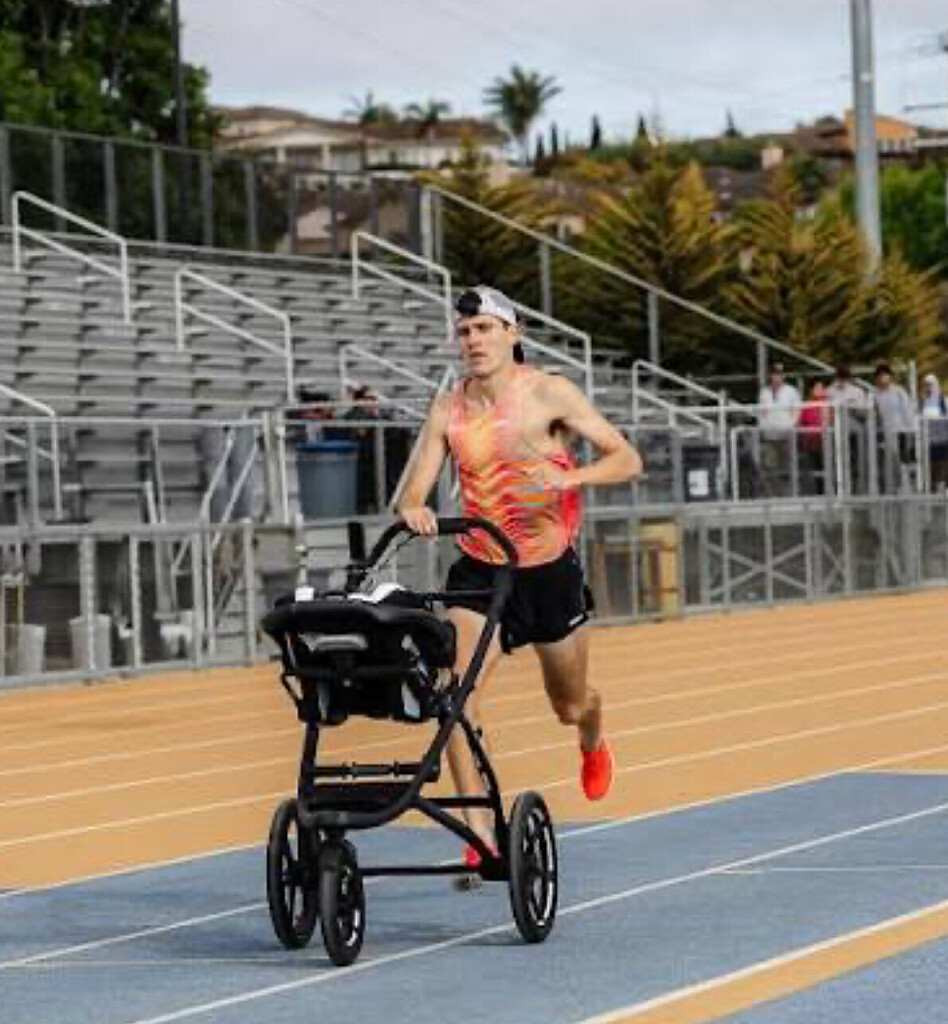
New Baby Stroller Mile World Record Set at 4:26.29
In one of the most unique records in running history, American runner Silas Frantz has set a new Baby Stroller Mile World Record, clocking an astonishing 4:26.29 while pushing his son, Otto.
The feat took place on the track, where Frantz combined world-class speed with the added challenge of safely guiding a stroller for four laps. The video of his record-breaking run has quickly gone viral, drawing awe and admiration across the running community.
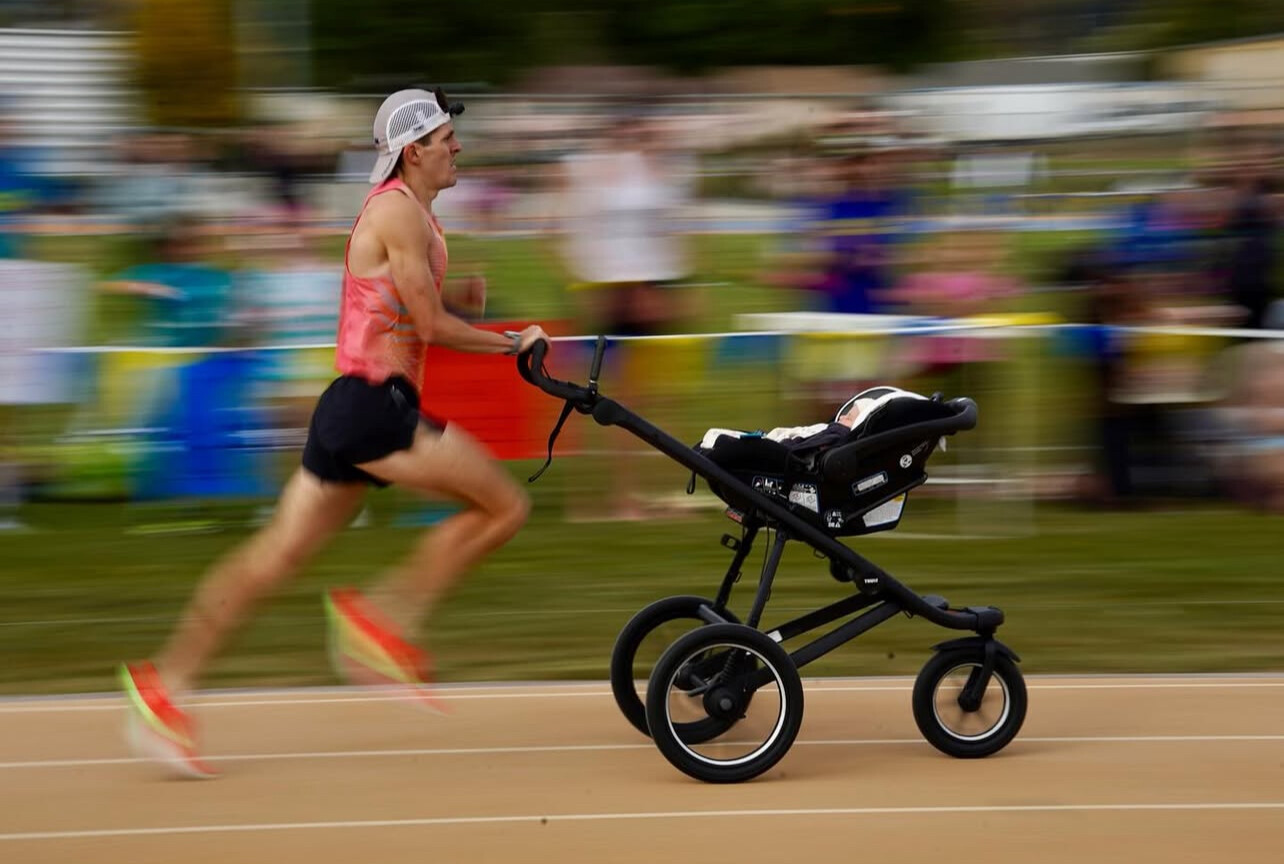
Frantz, a former collegiate standout, showed that fatherhood and elite fitness can blend in extraordinary ways. While stroller runs are often a part of new parents’ training routines, taking it to this level—running sub-4:30 for the mile—demonstrates exceptional strength, coordination, and determination.
A Growing Trend: Stroller Running Records

Running with a stroller has grown in popularity, with both casual parents and competitive athletes incorporating it into training. Records have been tracked for stroller 5Ks, 10Ks, half marathons, and marathons—but the stroller mile is a rarer challenge.
To put it in perspective, running a 4:26 mile solo is already elite territory. Doing it while pushing the weight and resistance of a stroller makes this one of the most impressive niche records in recent years.
Otto: The Youngest Record Holder?
While all eyes are on Silas Frantz’s speed, baby Otto gets to share in the glory—earning the title of perhaps the youngest co-participant in a world record mile. Comfortably bundled in his stroller, Otto looked completely unfazed during the effort, while his dad powered around the track at near-professional pace.
The Viral Moment
Clips of the run shared on social media by @lane.one.run and picked up by Bleacher Report have racked up hundreds of thousands of likes and comments. Fans are calling it one of the most heartwarming and jaw-dropping running achievements of the year.
Community Reactions
“Unbelievable—try running a mile that fast without a stroller first!” one fan commented. Another joked, “Future Olympian Otto already has a world record under his belt.”
Even elite runners chimed in. Sara Slattery, former U.S. Olympian, encouraged a fan who joked about trying the 400m stroller sprint: “You’d kill it!!”
Silas Frantz’s stroller mile record is more than just a quirky achievement—it’s a testament to creativity, family, and the endless ways runners continue to push boundaries.
(09/25/25) Views: 54Boris Baron
