

Running News Daily
Running News Daily is edited by Bob Anderson and team. Send your news items to bob@mybestruns.com Advertising opportunities available.
Index to Daily Posts · Sign Up For Updates · Run The World Feed
Articles tagged #Edwin Soi
Today's Running News
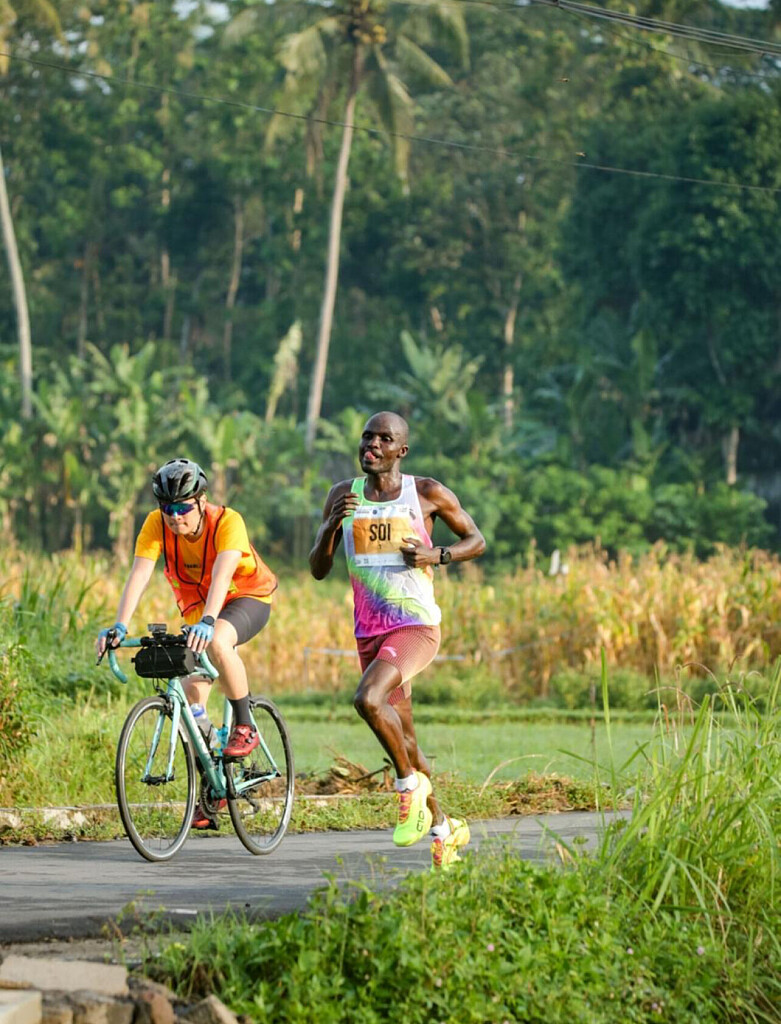


Edwin Soi’s Second Act: Veteran Track Star Turns Mentor While Leading Kenyan Charge at the Borobudur Marathon
In the tranquil dawn surrounding Indonesia’s ancient Borobudur Temple, Kenya’s Edwin Soi—once one of the world’s deadliest final-lap specialists—returned to the global stage with a performance defined by grit, maturity, and renewed purpose. His 2:20:21 fourth-place finish may have placed him just outside the podium, but it became one of the most compelling stories of this year’s Borobudur Marathon.
On a redesigned course rich in culture and punishing in terrain, Soi showed the poise of an athlete embracing the complexities of his second act—a transition from mid-distance brilliance to marathon resilience.
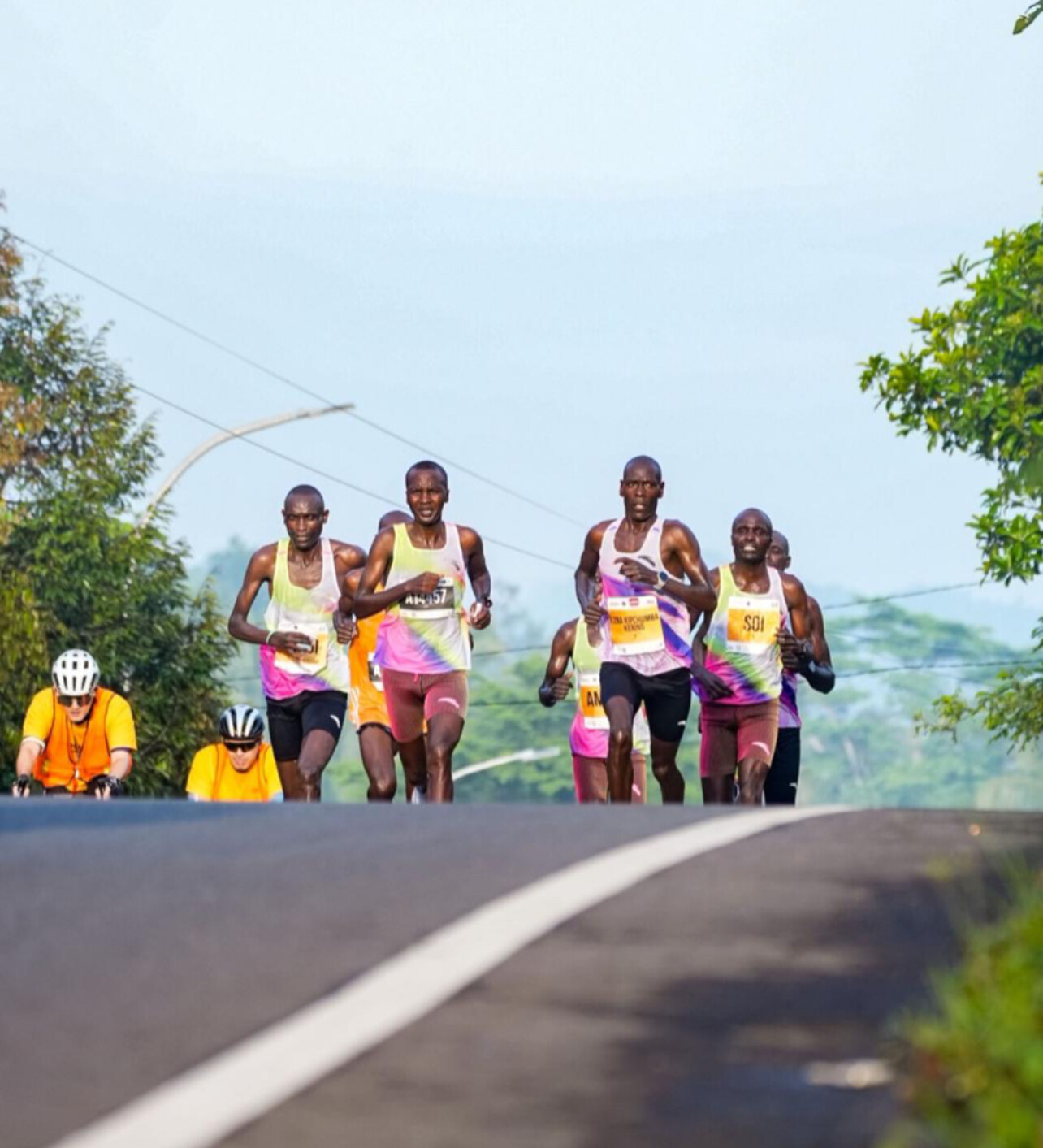
Speaking with My Best Runs after the race, Soi described the deep transformation required to evolve from track icon to marathon contender.
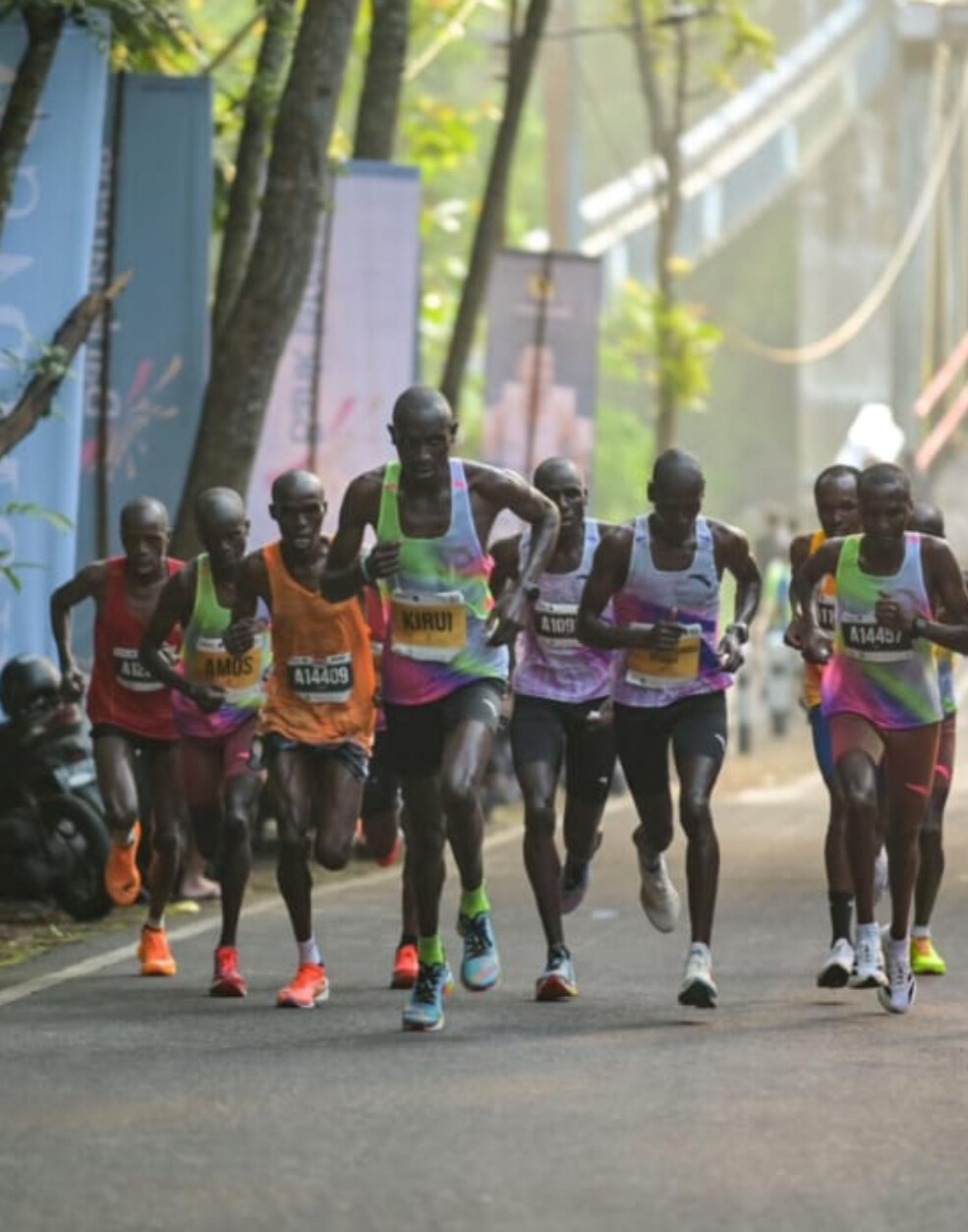
“My career on the track—my Olympic bronze in the 5,000m—was built on the fast finish,” he said. “But the marathon is completely different in the final 5km. You can’t just turn your legs over like on the track; the fuel is nearly gone. The biggest adjustment is shifting from raw speed to relentless endurance.”
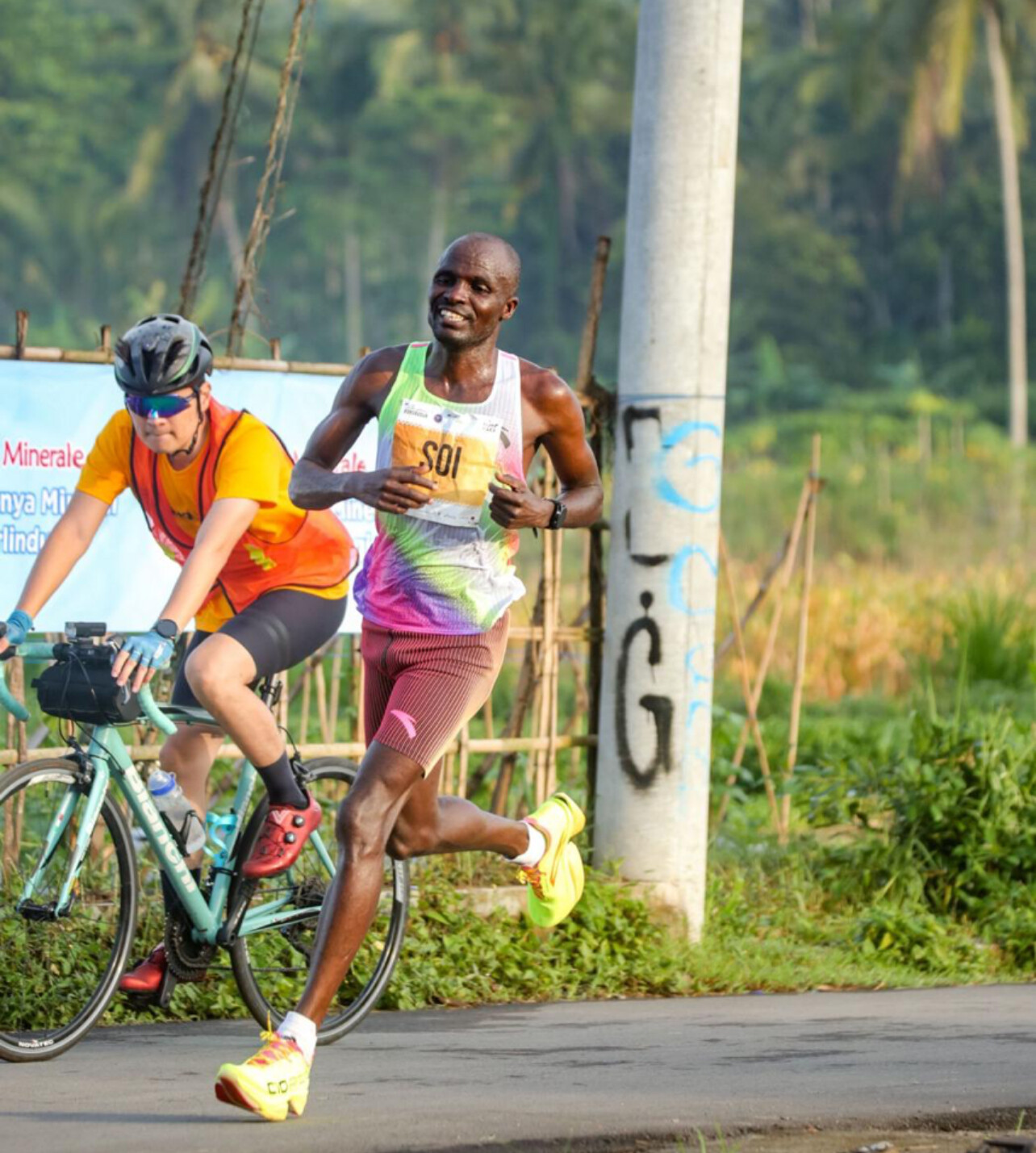
A Course That Demands Respect
The Borobudur route, winding through rice terraces, traditional villages, and the rolling Menoreh highlands, offered no shortcuts—and no mercy. It rewarded steady pacing, intelligent energy management, and deep aerobic strength, qualities Soi has been sharpening as he shifts to longer distances.
“The tropical heat and especially the humidity were the biggest challenges,” he said. “Even with the early start, the air felt heavy and thick as the sun rose. For us, training in the altitude and cooler air of Kenya, it required immense discipline with hydration from the first kilometer.”
The constant undulation of the course forced him into a measured rhythm:
“I had to run more conservatively in the first half to save energy for the inevitable struggle after 25km. But the scenery, the villages, the people cheering… it is one of the most beautiful races I’ve experienced.”
From Track Legend to Builder of Future Champions
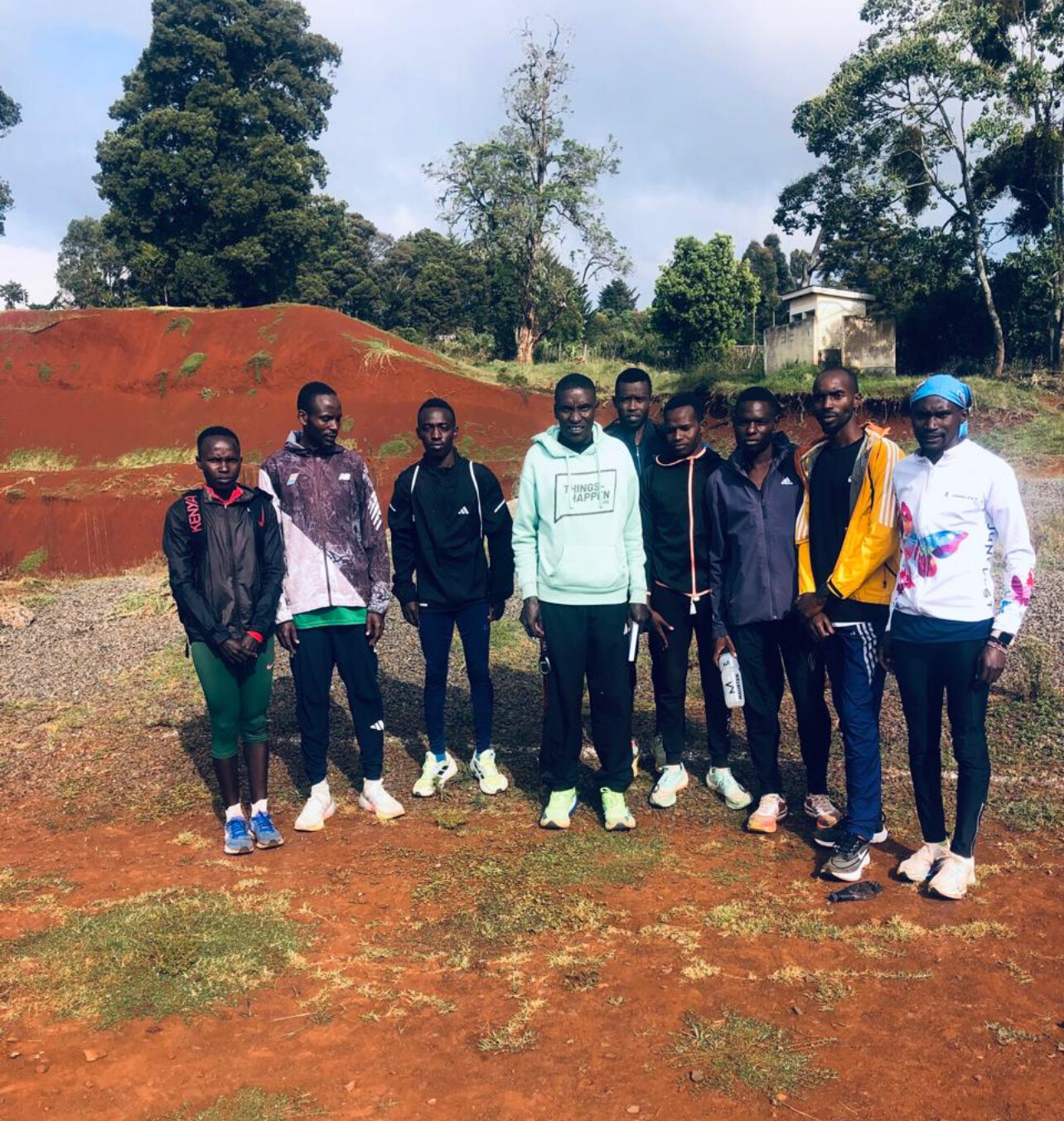
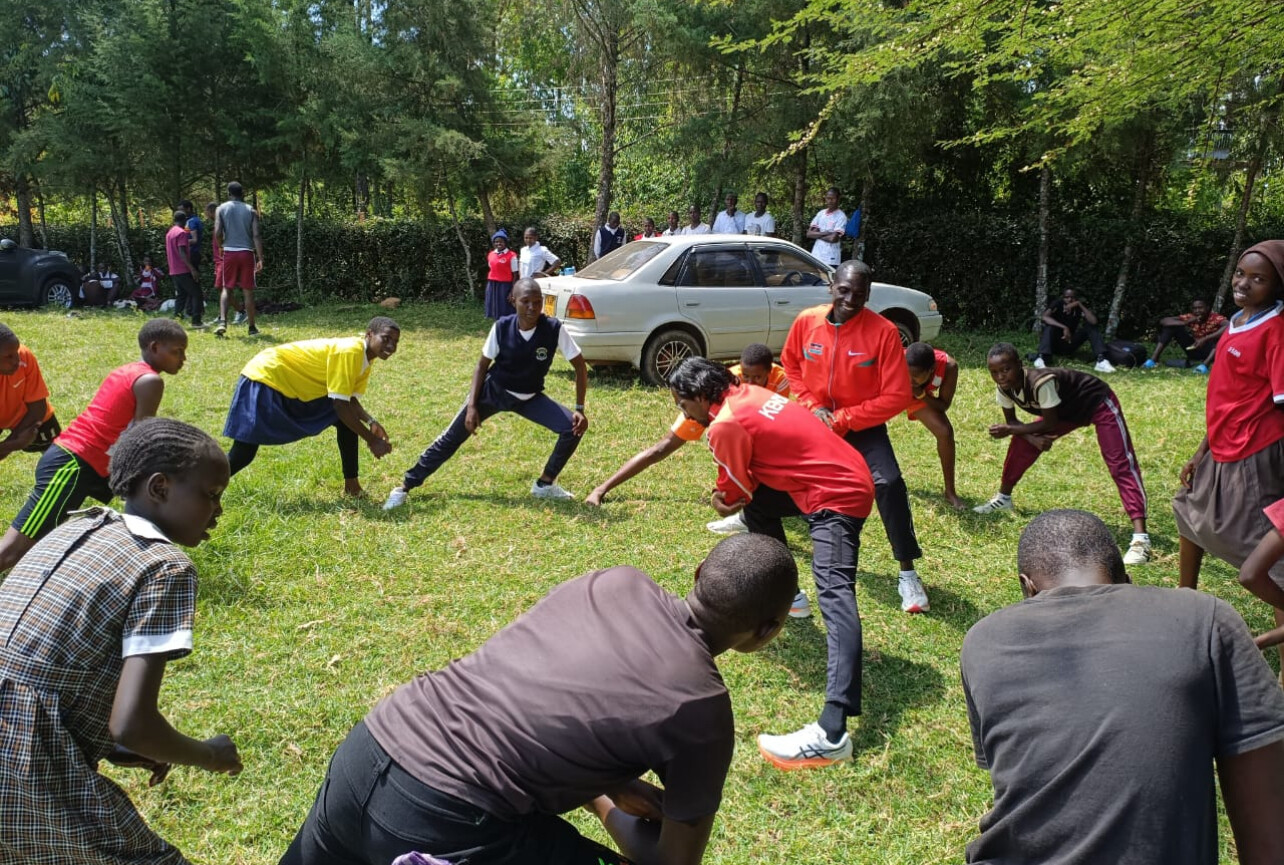
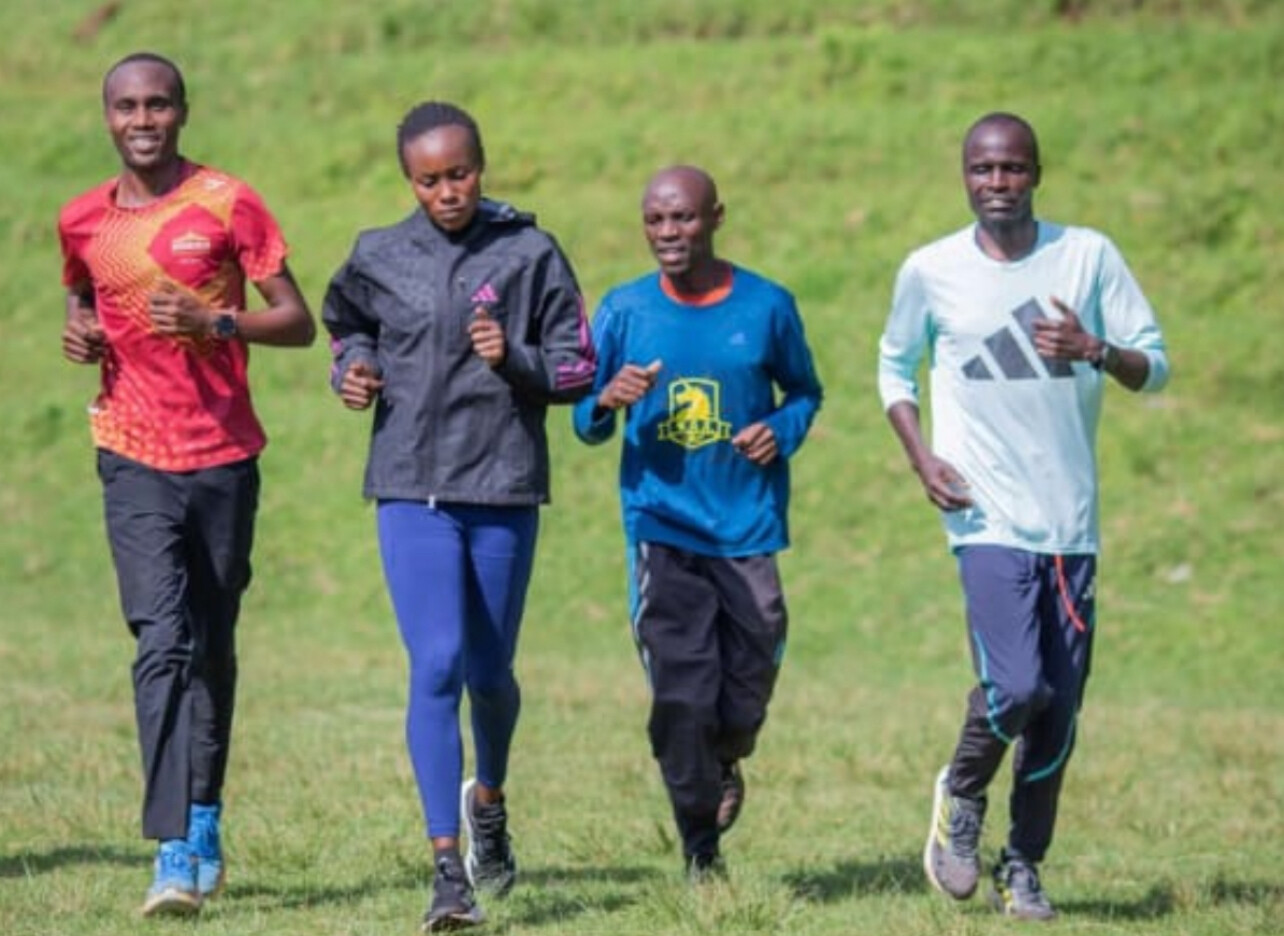
Though he remains globally known for his devastating last-lap kick, Soi’s greatest work today may be happening far from stadium lights. In Kuresoi, through Bob Anderson’s KATA programme, he now mentors a rising generation of disciplined young runners.
“This has been a year of deepening purpose,” he said. “My reflection is less about my personal stopwatch and more about the impact I can have on the future of Kenyan running.”
He still trains at a high level, balancing heavy marathon mileage with the demands of leadership.
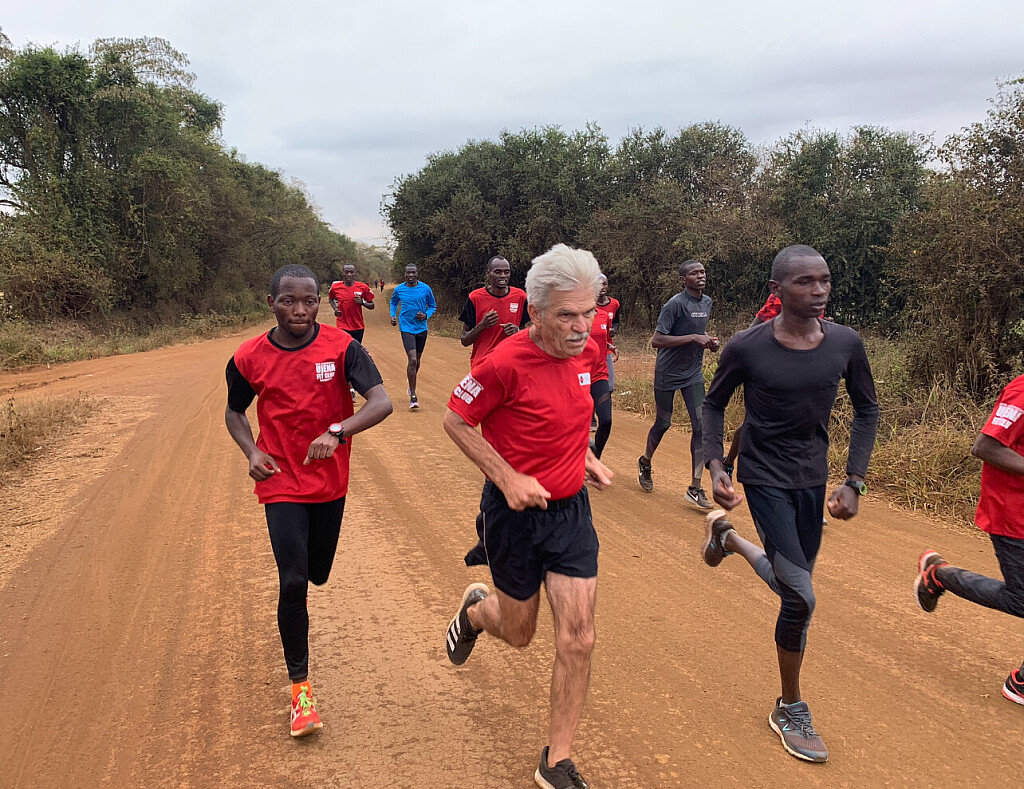
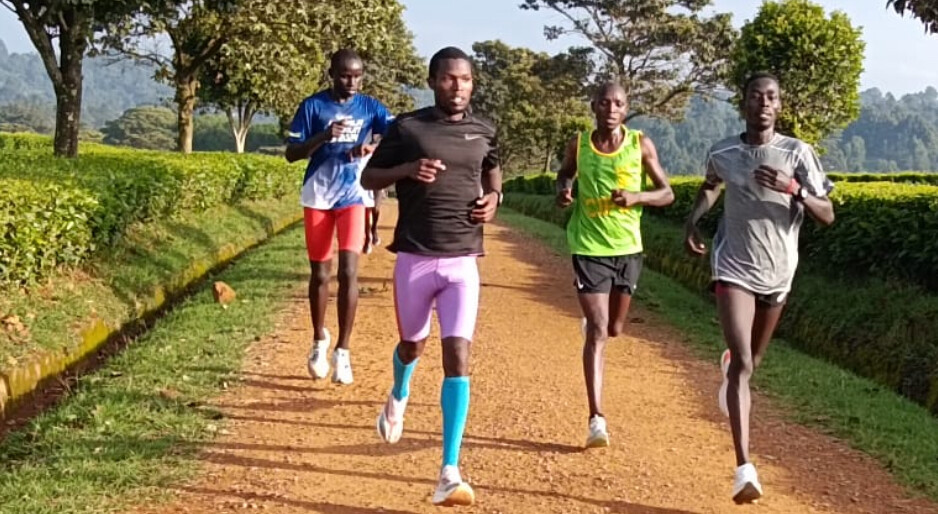
“Running competitively keeps me sharp and helps me understand the sacrifices my young athletes are making. Every morning, I run alongside them—I’m not just a coach shouting instructions; I am a competitor in the pain cave with them.”
On the misty loops of Kuresoi, he passes down the two things that shaped him: the speed of the track and the patience of the marathon.
Kenyan Depth on Full Display
Despite missing the podium, Soi helped anchor a dominant Kenyan performance in Magelang, Central Java, Indonesia, where the marathon began and finished inside the historic Lumbini Park complex at Borobudur Temple.
The top four in the elite men’s marathon—all representing Kenya—were:
1. Ezra Kipchumba Kering (Kenya) — 2:17:33
2. Alex Oloitiptip Korio (Kenya) — 2:17:43
3. Kiprop Tonui (Kenya) — 2:18:01
4. Edwin Cheruiyot Soi (Kenya) — 2:20:21
A Cultural and Competitive Showcase
The 2025 Borobudur Marathon, elevated to World Athletics Elite Label status, attracted more than 11,500 runners from 38 countries. Its scenery, cultural performances, and enthusiastic supporter crowds generated more than Rp 73 billion in economic impact, cementing its place as one of Asia’s rising marathon gems.
A Legacy in Motion
For Soi, Borobudur was more than a race—it was a declaration. A reminder that champions don’t fade; they evolve.
His footsteps now tell two intertwined stories: a veteran still capable of racing among the world’s best, and a mentor shaping futures in the hills of Kuresoi.
As Kenyan runners painted the leaderboard red, green, and black, Soi’s fourth-place finish stood out not for what it lacked, but for what it symbolized: a champion transforming—and lighting the path for those who follow.
by Robert Kibet
Login to leave a comment
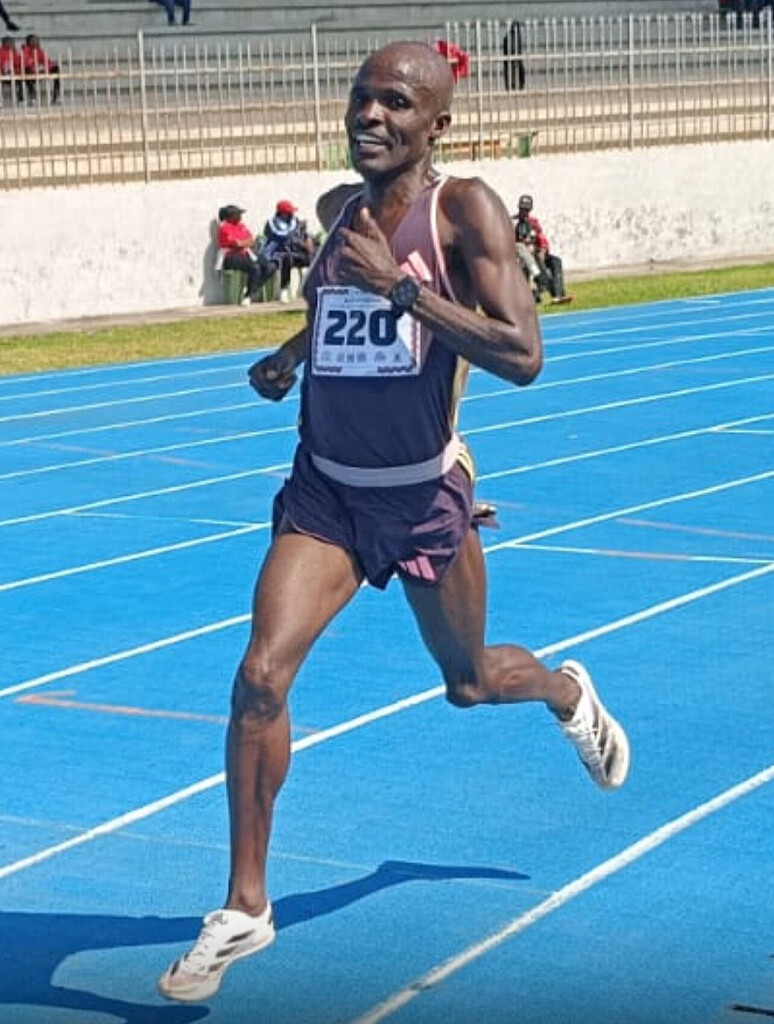
Still Racing Strong, Olympic Medalist Edwin Soi Leads by Example at KATA — Growing Potatoes, Training Hard, and Competing for the Half-Million Shilling Farmer Bonus
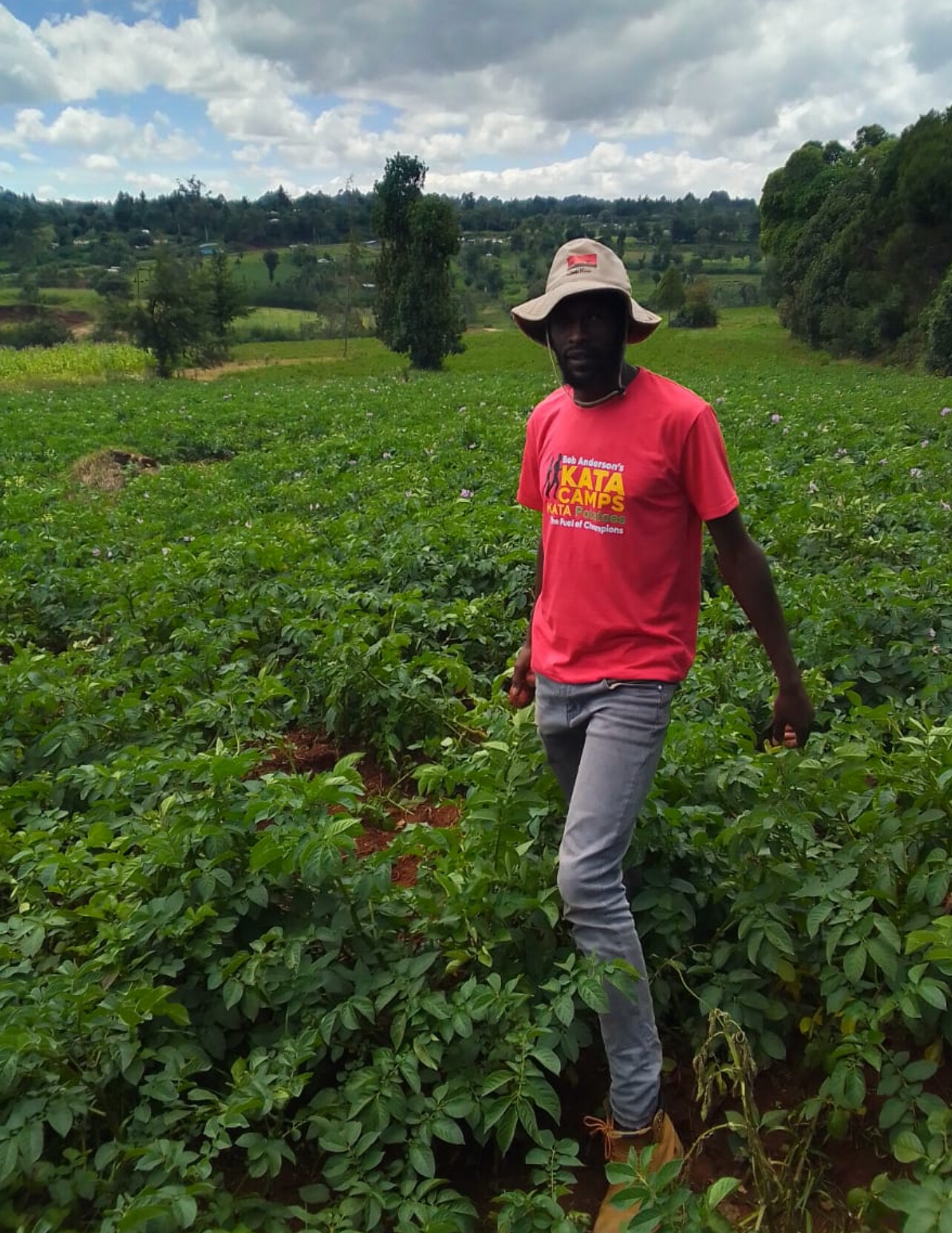
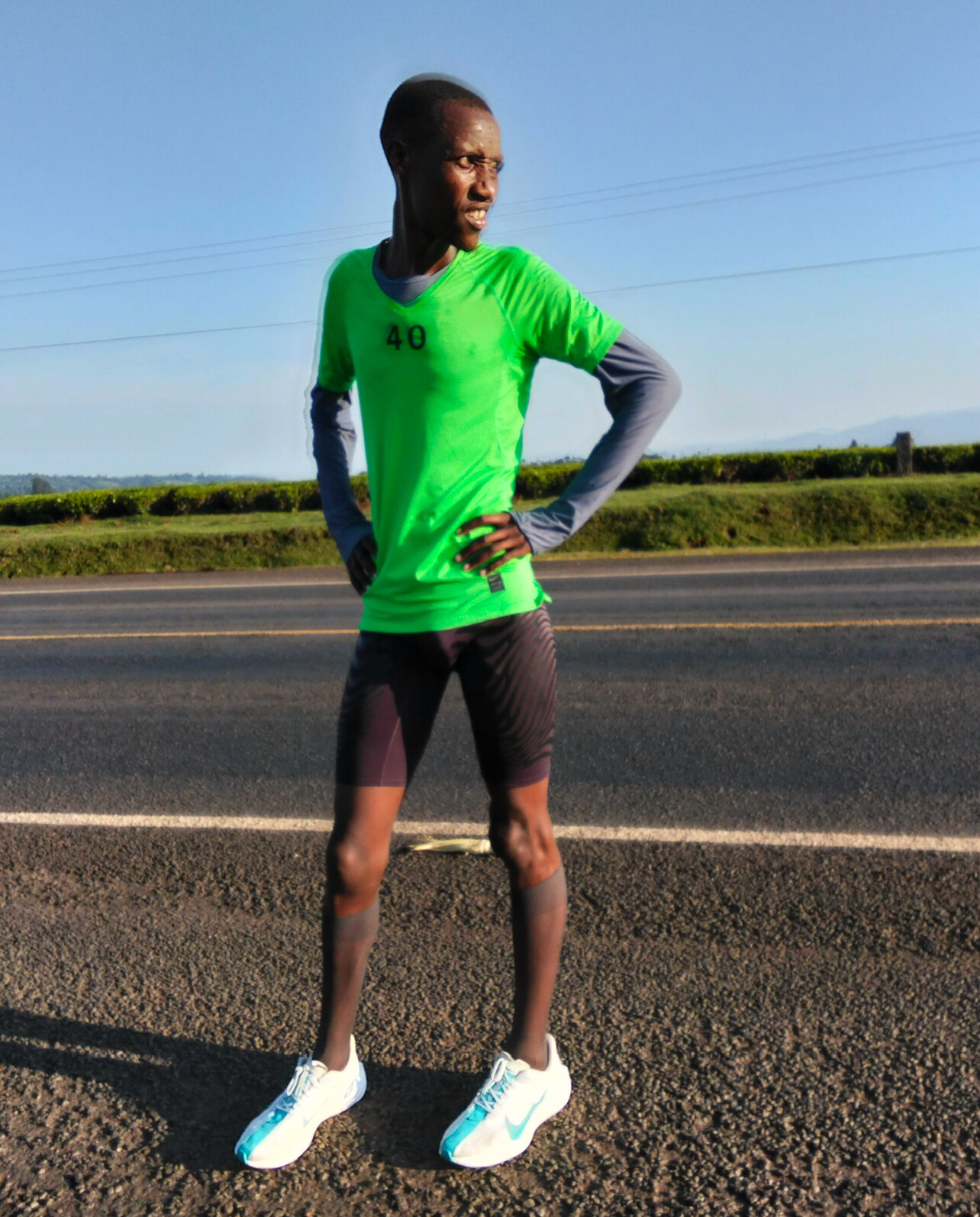
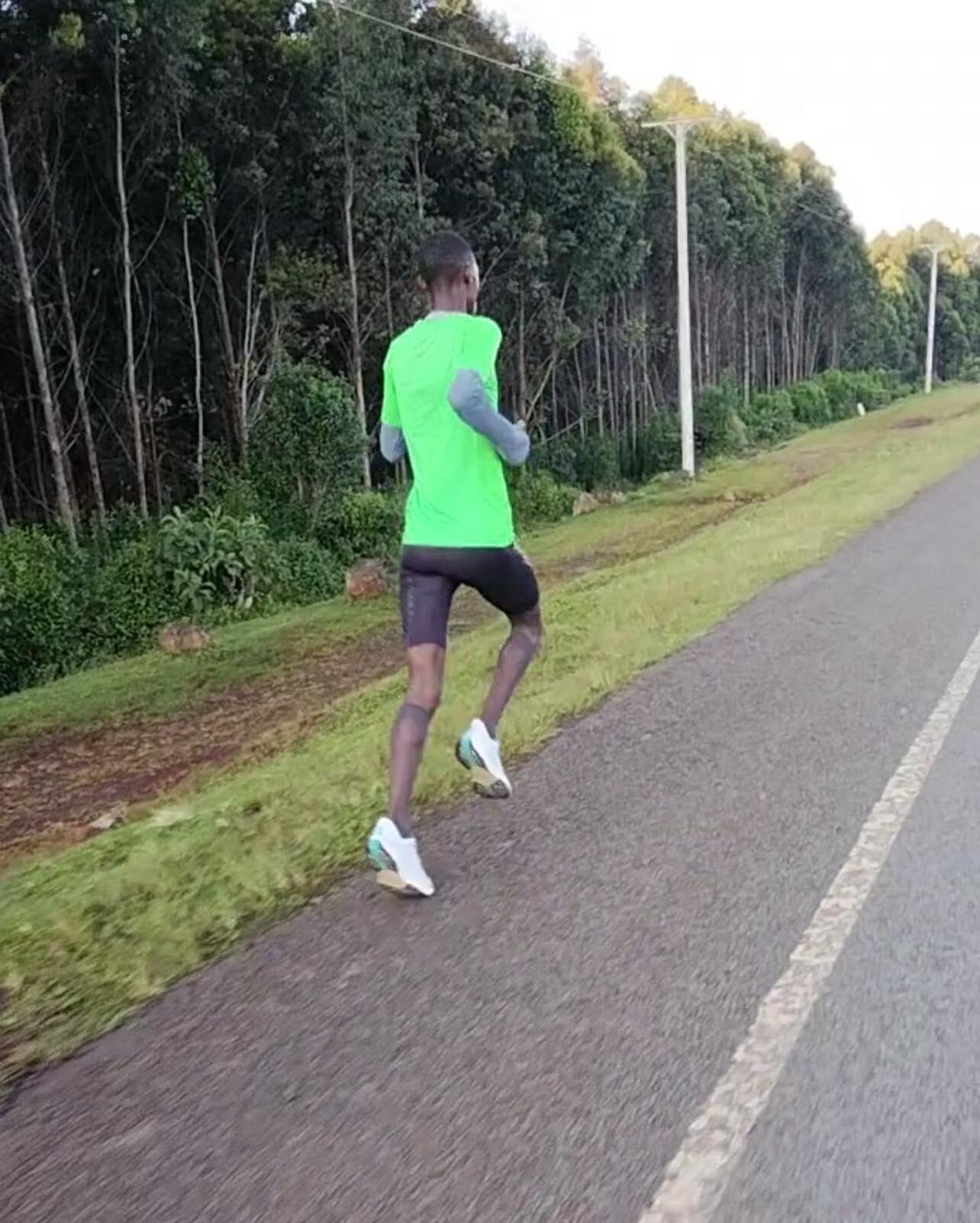
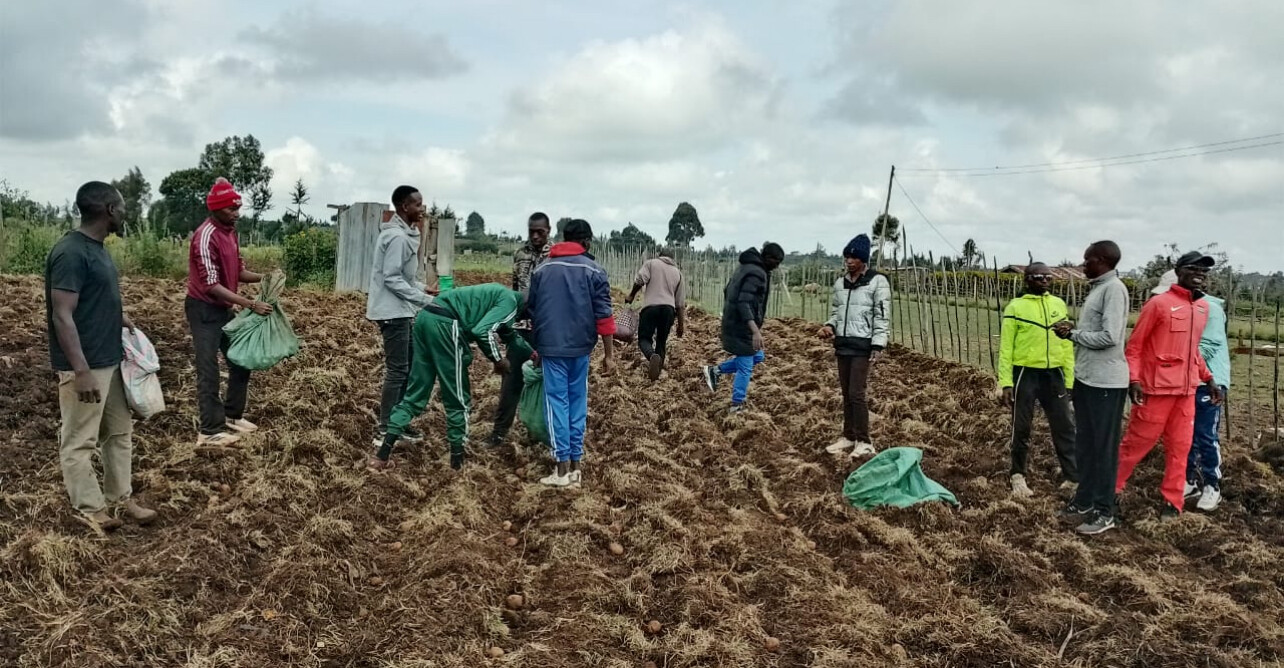
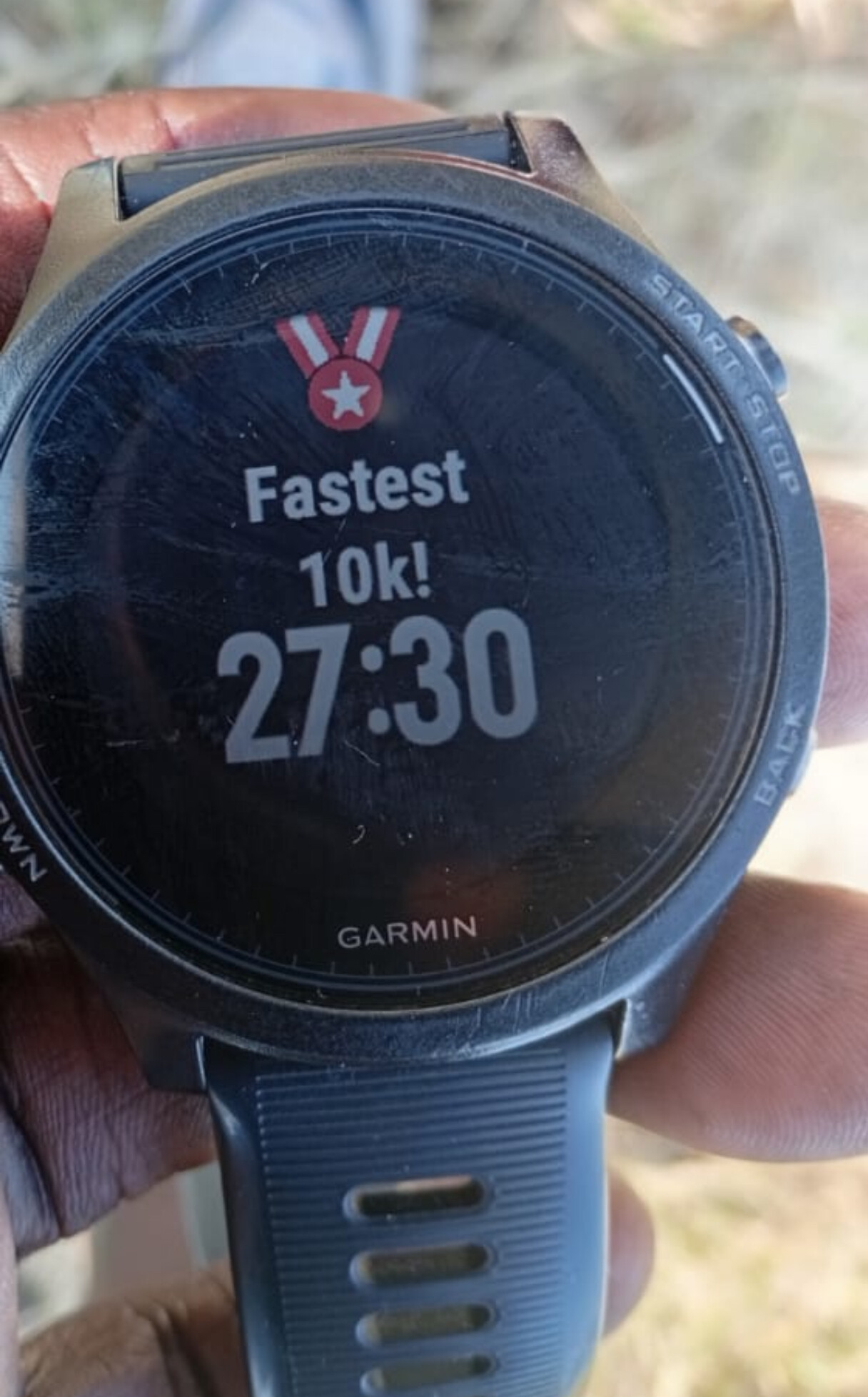
Edwin Soi is a 5000m Olympic medalist and still running well photo of him running 27:30 just a few months back at altitude). He is also one of the KATA Running Camp operators and has three acres of KATA potatoes. He posted this after we announced our new contest for our KATA farmers.
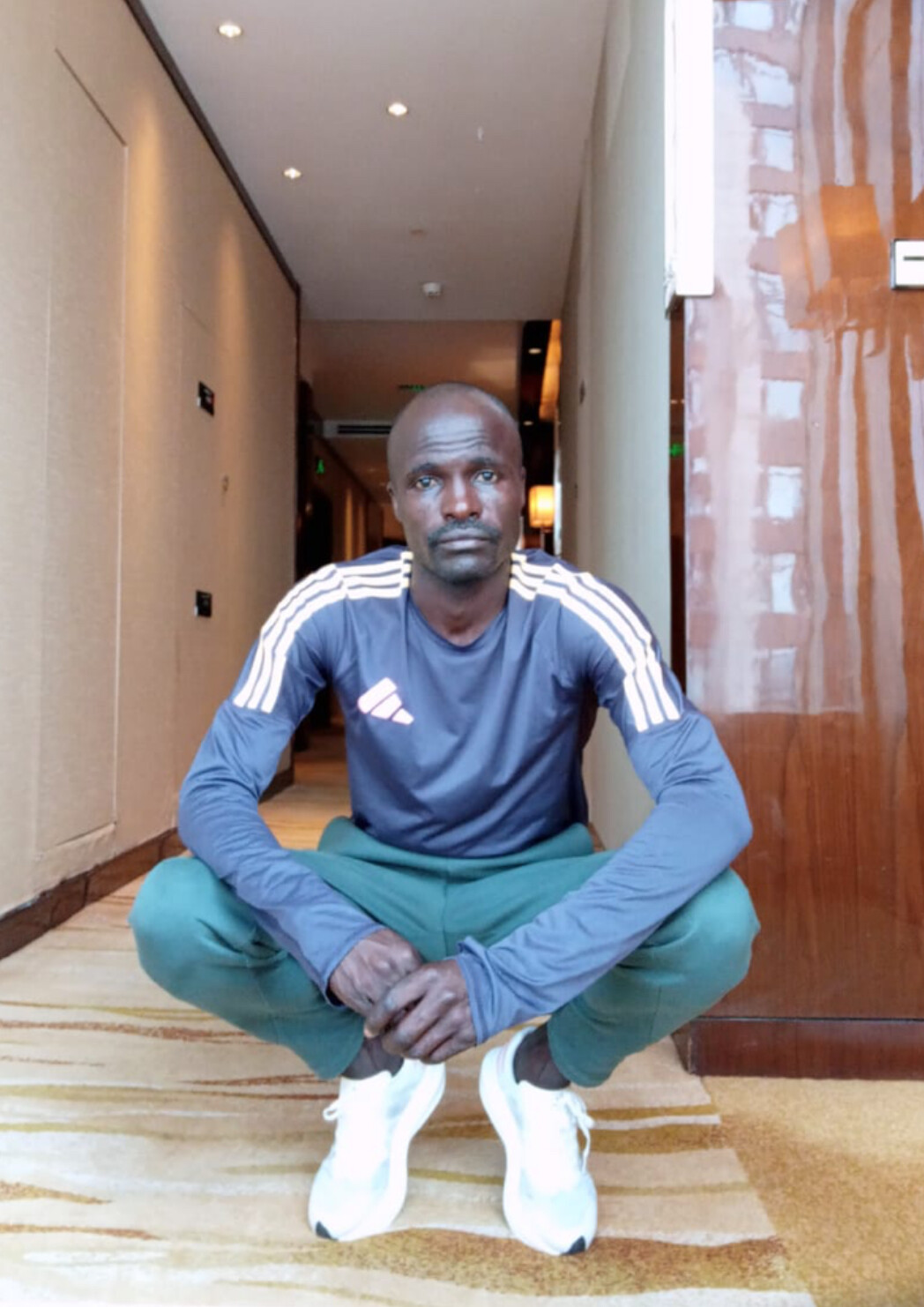
“This is the kind of motivation,” says Edwin that pushes us past our limits. We promise to take this challenge to the top notch in both arenas.

On the farm, we focused on achieving a record potato yield per acre to be a winner in both Contest #1 and Contest #2. On the running field, that spirit translates directly into training harder and competing fiercer.
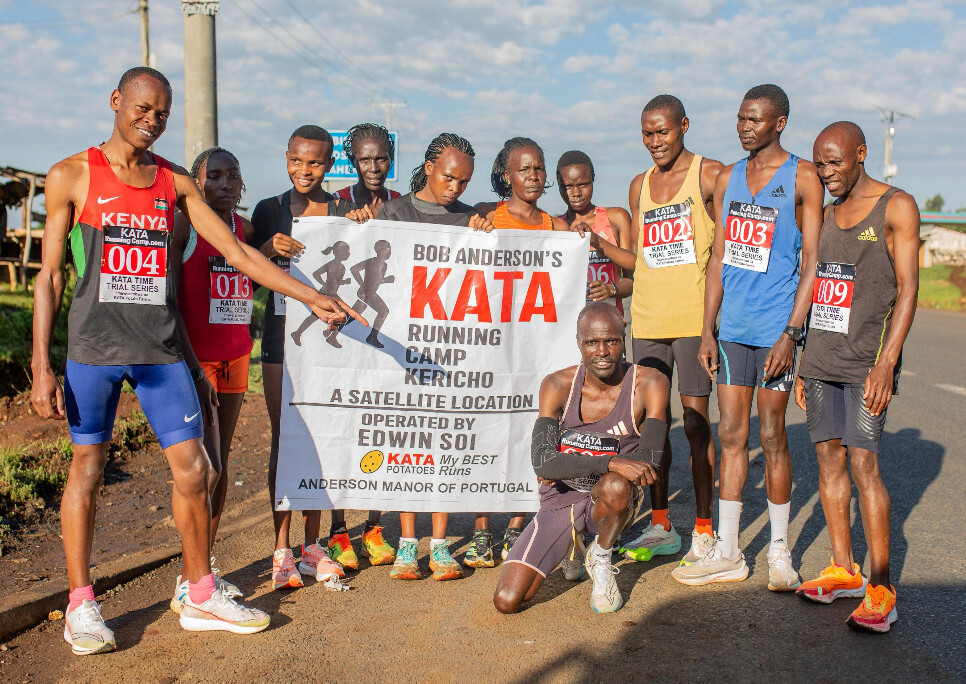
We will not just grow strong; we will demonstrate absolute excellence. Thank you Bob for fueling our drive to be champions. #GoKATA
Here are the details of our new contest:
KATA Potato Farmer Half-Million Bonus! ?
KATA is bringing its competitive spirit to the fields!
Twice a year, five KATA farmers with the best yield per acre will each earn 50,000 KES — that’s half a million shillings annually! ?
Contest #1 closes: Dec 31, 2025
Contest #2 closes: Jun 30, 2026
✅ Yields counted in 50 kg bags sold to verified buyers
✅ One bag kept for personal use not counted
✅ Once funds are received by KATA and confirmed by CTO Dennis, your yield is officially recorded
All results verified by Dennis (CTO), Gideon & John (Sales Directors), and Fridah (Accounts Manager).
Each contest will name five different winners — but a farmer can win both see seasons!
“KATA rewards excellence — on the track and in the field.”
— Bob Anderson, Founder & Director
Additional camps and farms will be added starting in December. Contact Bob Anderson on WhatsApp.
Stay current at www.KATA.ke
by Boris Baron
Login to leave a comment
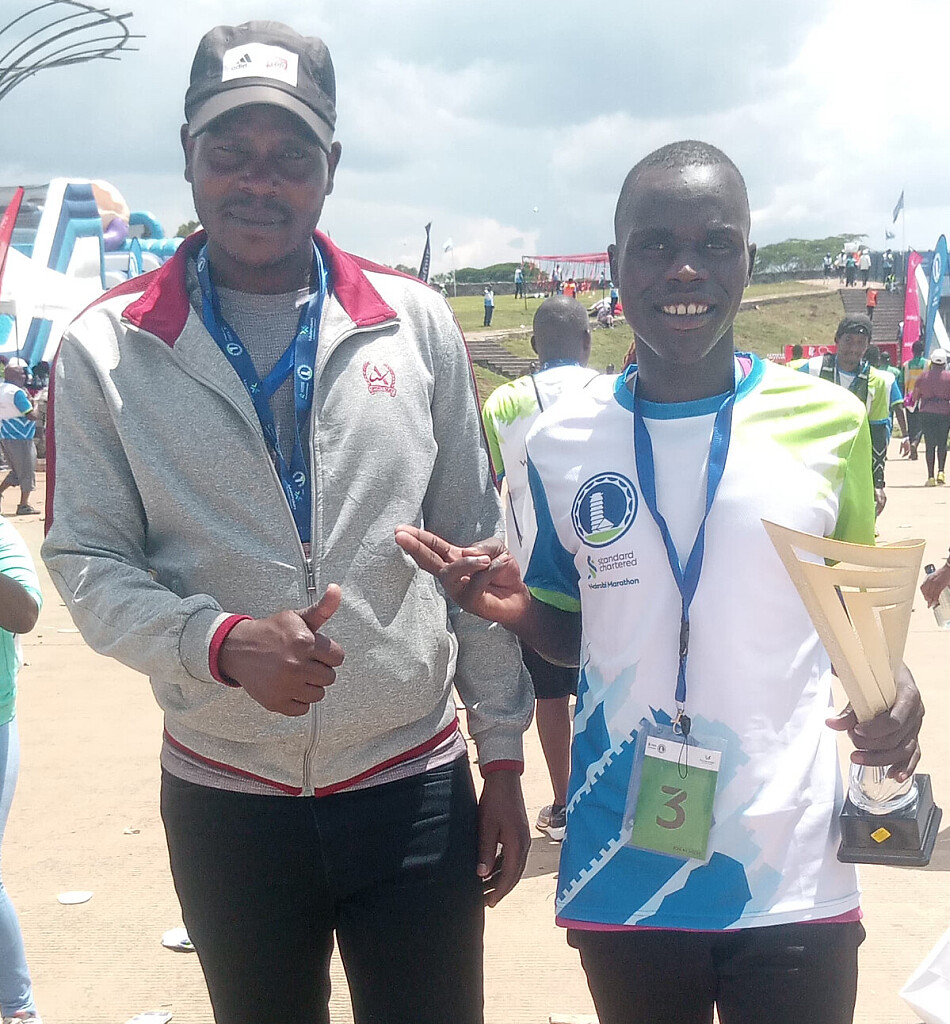
From Charcoal Seller to Champion Coach: The Remarkable Journey of Philemon Kiptoo in Kapcherop
In the cool highlands of Kapcherop, where morning mist drapes over rolling potato farms and runners trace winding red-dirt trails, coach Philemon Kiptoo is living out a dream that once seemed far beyond his reach.
The son of a humble family of nine, Philemon’s rise from selling charcoal barefoot to mentoring Kenya’s next generation of marathon stars is a story of resilience, faith, and the transformative power of community.
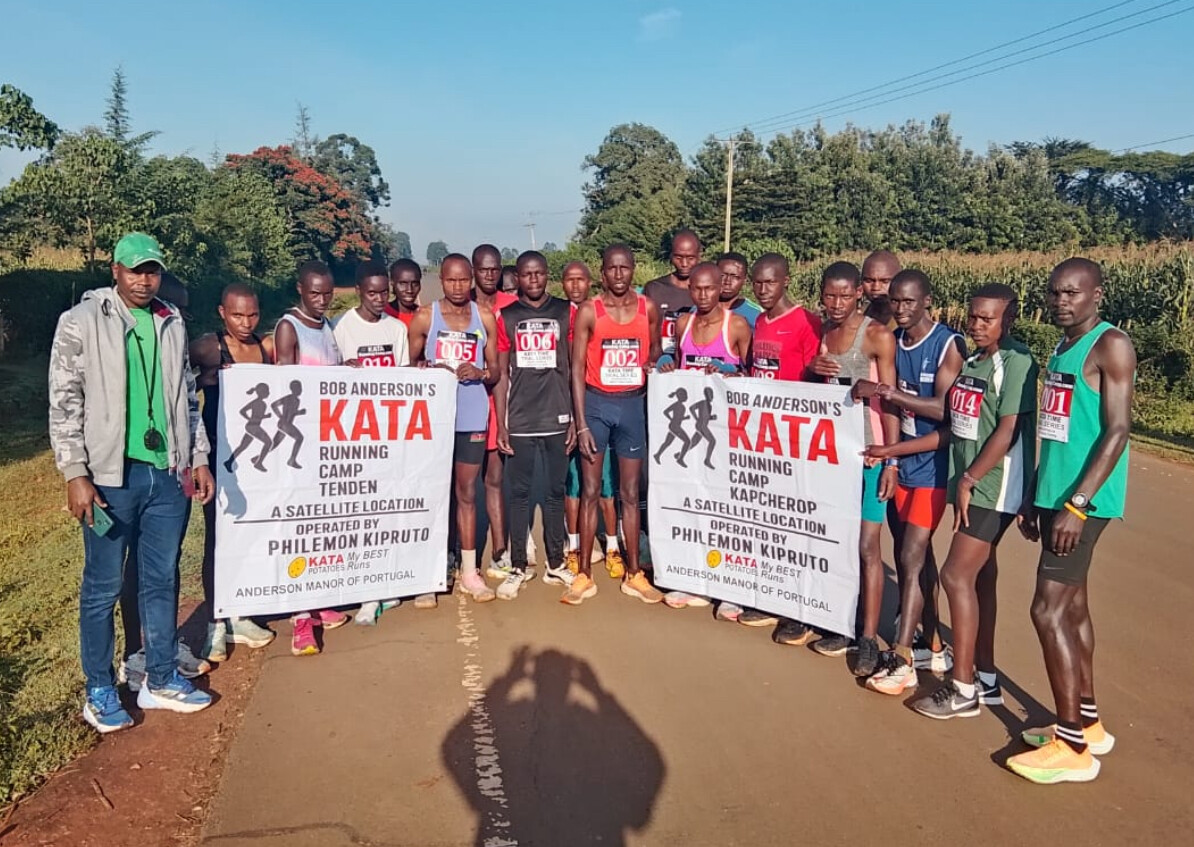
A New Chapter with KATA
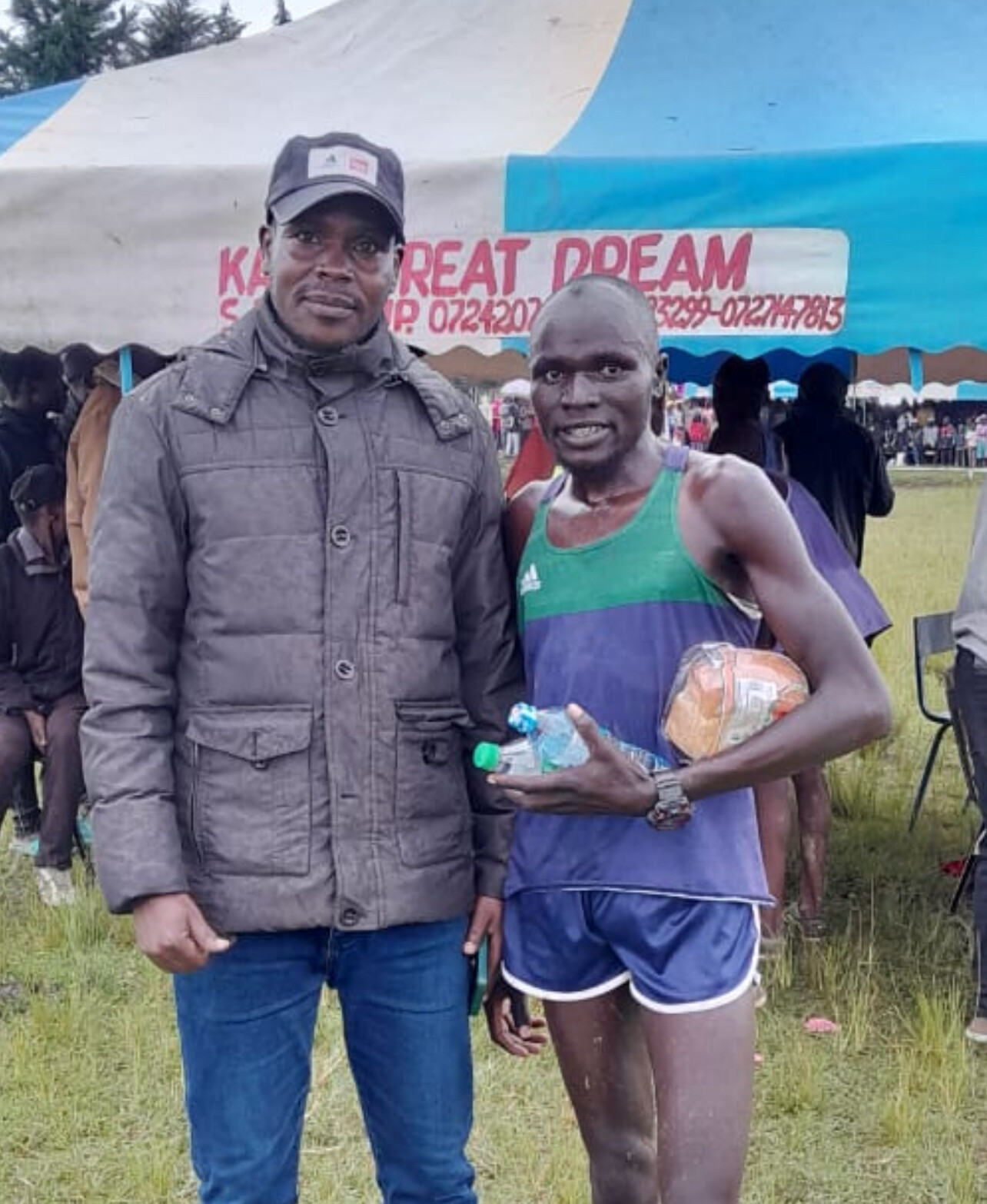
Philemon’s turning point came when he joined the KATA network — an initiative founded by U.S.-based running pioneer Bob Anderson to empower grassroots runners and coaches through mentorship, clean sport advocacy, and sustainable income projects.
At his Kapcherop Training Camp, KATA’s support extends beyond athletics. Through the organization’s integrated potato farming program, athletes earn a steady income that helps cover food, accommodation, and basic gear.
“The support from KATA has made a big difference,” Philemon says with quiet pride. “Most of my athletes come from humble backgrounds like mine. With potato farming and basic support, we can now train without worrying about what to eat or where to stay.”
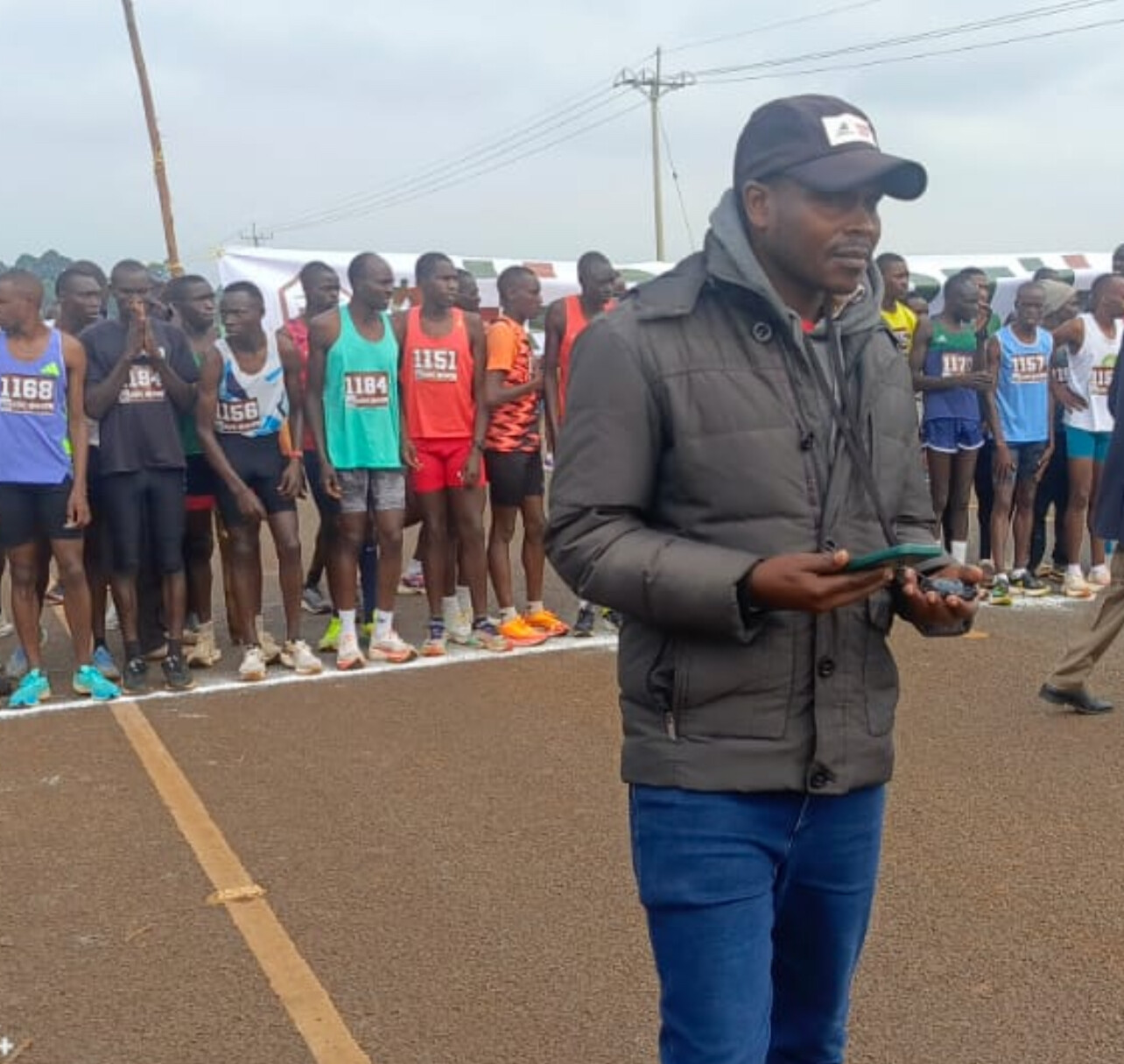
That stability has begun to pay off. At the Standard Chartered Nairobi Marathon on October 26, his athletes delivered impressive performances: Donald Kimaru finished 4th in the men’s marathon; Dancan Kemei and Dennis Kosgei placed 18th and 21st in the men’s half marathon; Beatrice Rutto finished 11th in the women’s marathon; and in the men’s 10K, Leonard Pkorir and Enoch Tanui placed 3rd and 5th respectively, with Evans Kemboi 16th. Donald also on September 20th placed second at the Double Road Race 15k just 17 seconds behind the winner Edwin Soi in the two leg race. The sixth best time ever.
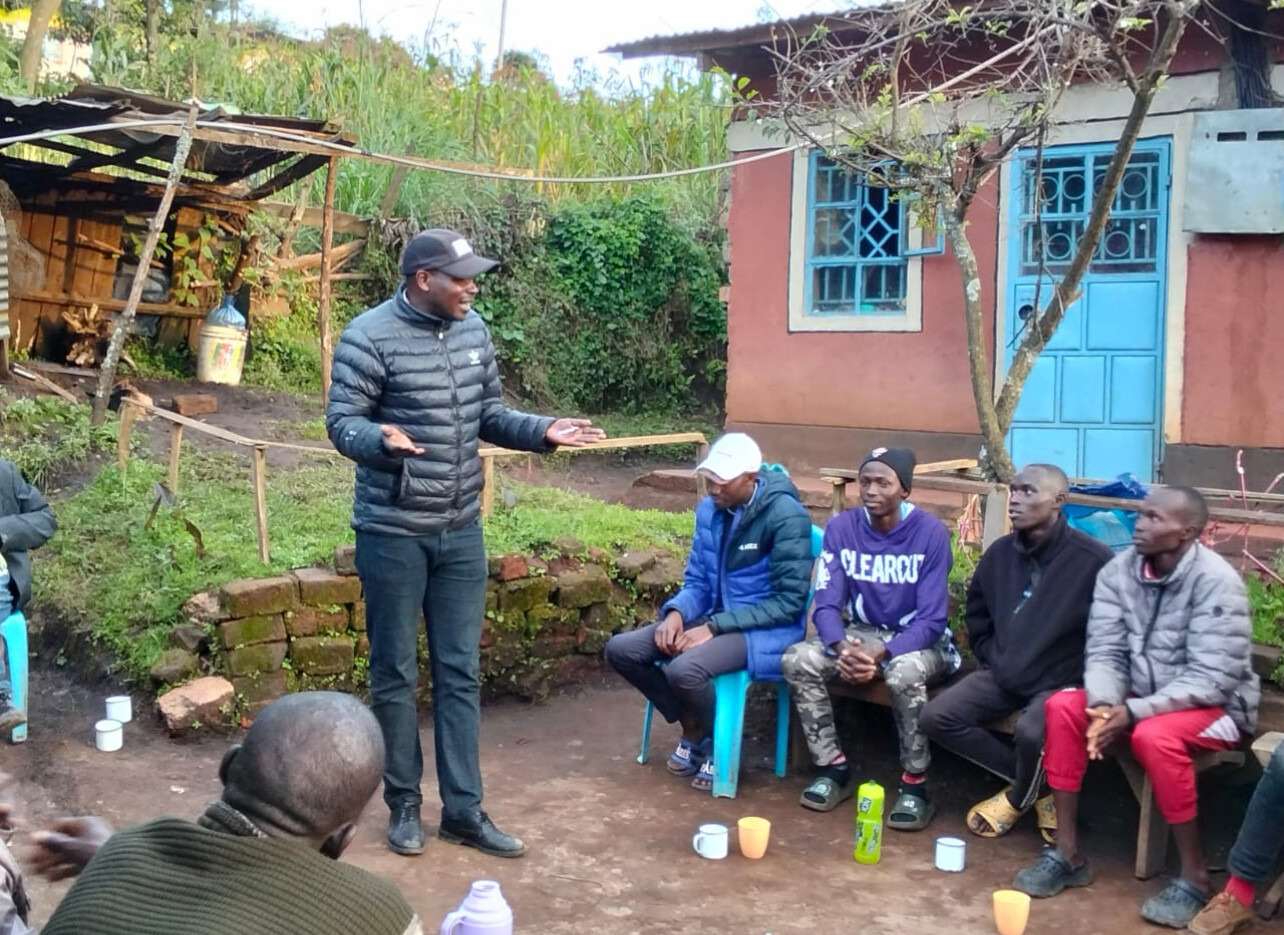
“Each of these athletes represents hope,” Philemon reflects. “With clean training and support, young people from small villages can stand tall on the national stage.”
Humble Beginnings
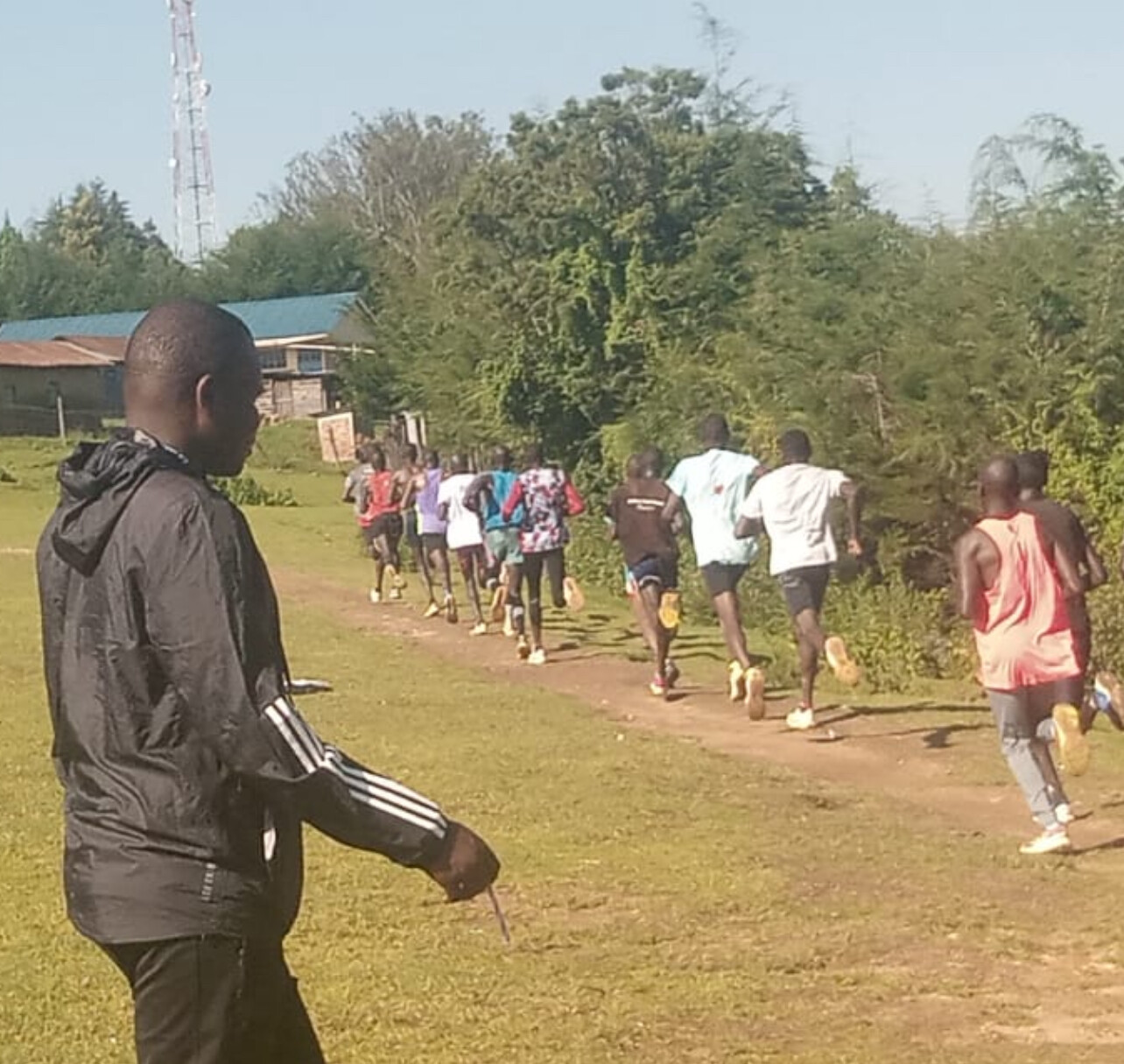
Born in Sing’ore, near the slopes of Elgeyo Marakwet, Philemon’s path to athletics was shaped by hardship.
“I was the last born in a family of nine — three brothers and sisters,” he recalls. “I attended Kobil Primary near Sing’ore Girls and later Kimuron Secondary, but I couldn’t finish because of school fees.”

Returning home to Kapkanyar, he refused to give up.
“In 2007, I started training with no shoes,” he says. “I sold charcoal to buy my first pair of Asics for 700 shillings (about $6).”
Years of persistence paid off when he began racing in 2012, earning his first major result with a runner-up finish at the Kakamega Forest Half Marathon. That breakthrough fueled his dream — not just to compete, but to guide others.
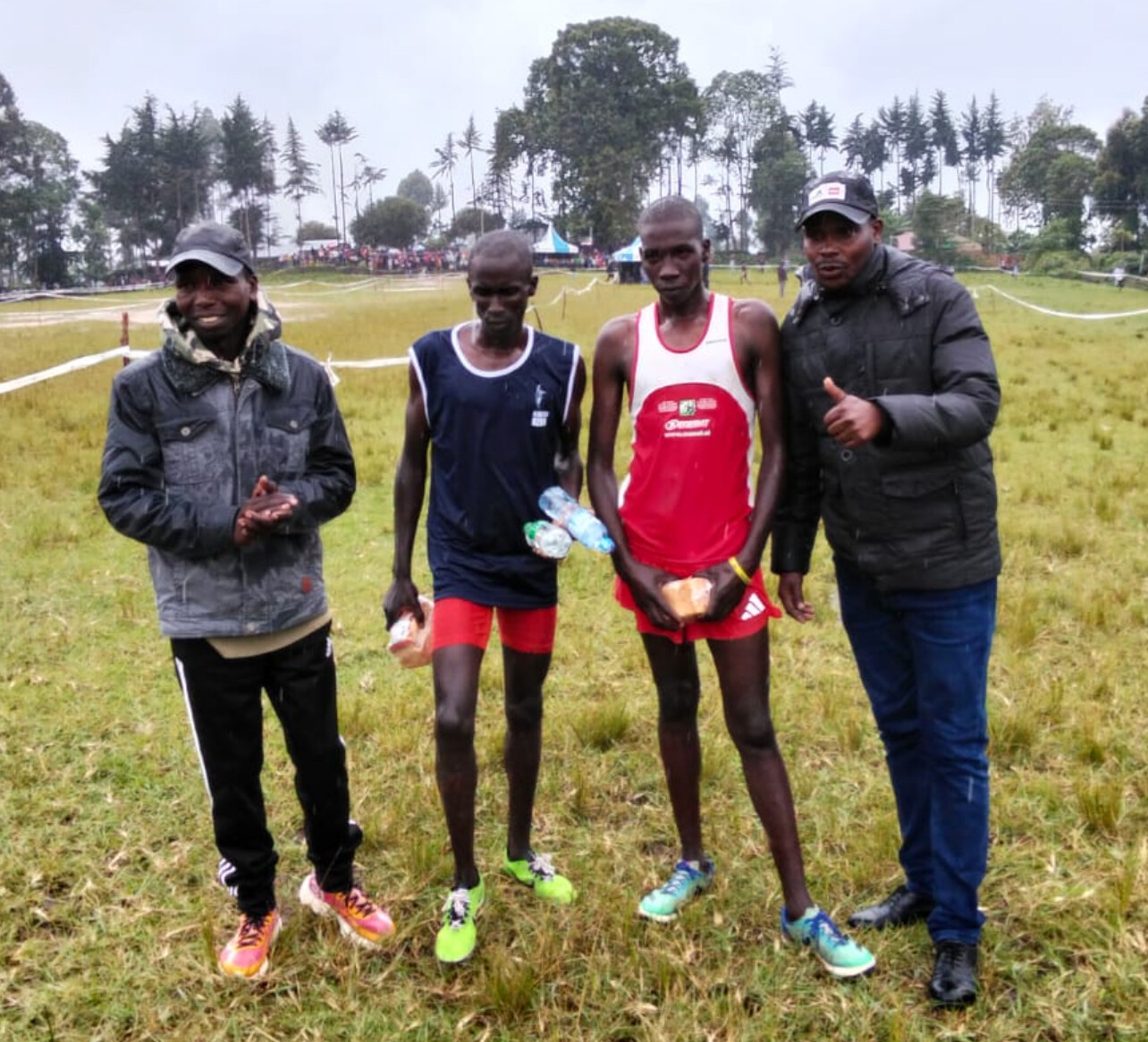
Building Champions
“I started with a few athletes,” Philemon says. “I rented them a small house and bought food — not because I had much, but because I knew what it felt like to need a chance.”
Today, he stands alongside a remarkable family of mentors: four brothers, all coaches.
• Eric Kimaiyo leads the Kapsait Training Camp.
• Andurson Chirchir coaches in Kaptagat.
• Kimutai runs training at Srowback.
• And Philemon oversees the Kapcherop Camp — a thriving hub for emerging distance runners.
Integrity and Clean Sport
What makes Philemon’s story powerful isn’t only perseverance — it’s integrity. A vocal advocate of clean sport, he embodies KATA’s core philosophy.
“We must speak the truth and say no to doping,” he insists. “If you train clean and stay patient, you’ll win with pride. There are no shortcuts to greatness.”
KATA’s influence has reinforced those values, fostering a culture of honesty and teamwork across its growing network.
“Bob Anderson’s support hasn’t just sustained our camp,” Philemon adds. “It has helped shape a generation built on discipline and hard work. We are building athletes who can inspire others.”
A Legacy of Hope
To his athletes, Philemon is more than a coach — he’s a father figure.
“He treats us like family,” says Leonard Pkorir, who won bronze in the Nairobi 10K. “He believes in our dreams even when we doubt ourselves.”
Looking ahead, Philemon’s goal remains simple yet profound: to use running as a bridge to a better life.
“My happiness will be to see my athletes doing great things, helping others, and carrying forward the spirit of running clean,” he says. “That will be my legacy.”
As evening fog rolls across the Kapcherop hills and the rhythmic thud of training shoes fades into the distance, Philemon Kiptoo’s story stands as a reminder that greatness can indeed grow from the humblest soil — when it is nurtured with purpose, honesty, and heart.
by Robert Kibet
Login to leave a comment
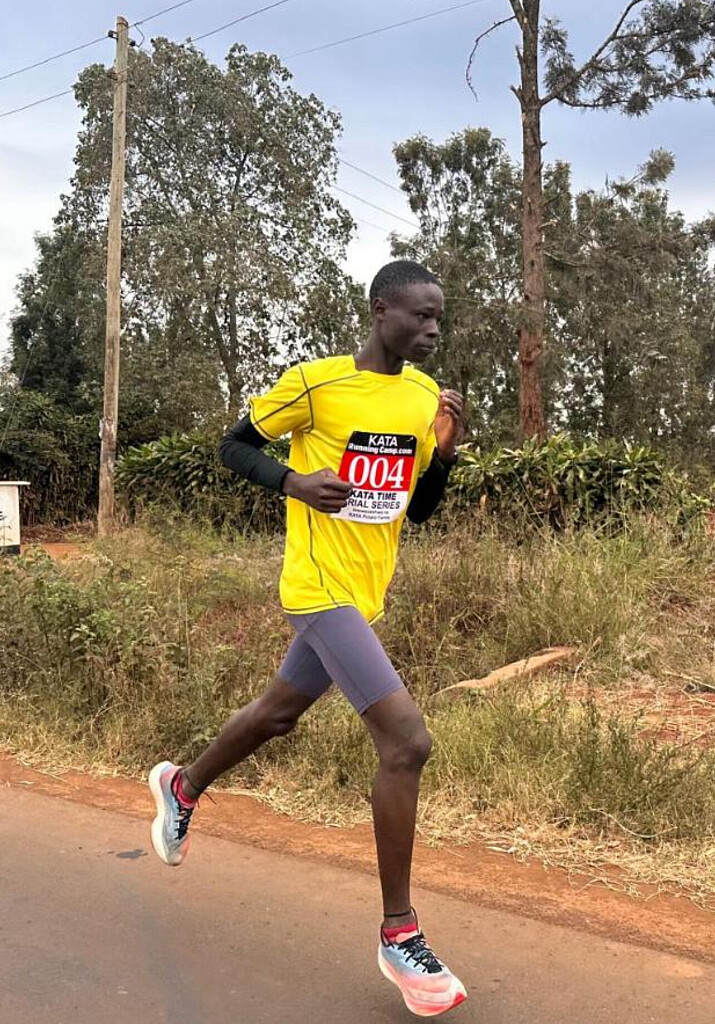
KATA Time Trials Expand Nationwide as 30 Running Camps Prepare for October 15 Event
For years, the Kenya Athletics Training Academy (KATA) in Thika has been the nerve center of monthly time trials — small but highly competitive races that have helped shape Kenya’s next generation of distance-running talent.
This October 15 marks another milestone. For the second consecutive nationwide edition, KATA’s time trials will take place not only at the Thika headquarters but also simultaneously across more than 30 KATA Running Camps throughout Kenya, featuring both 10 km and 5 km races.
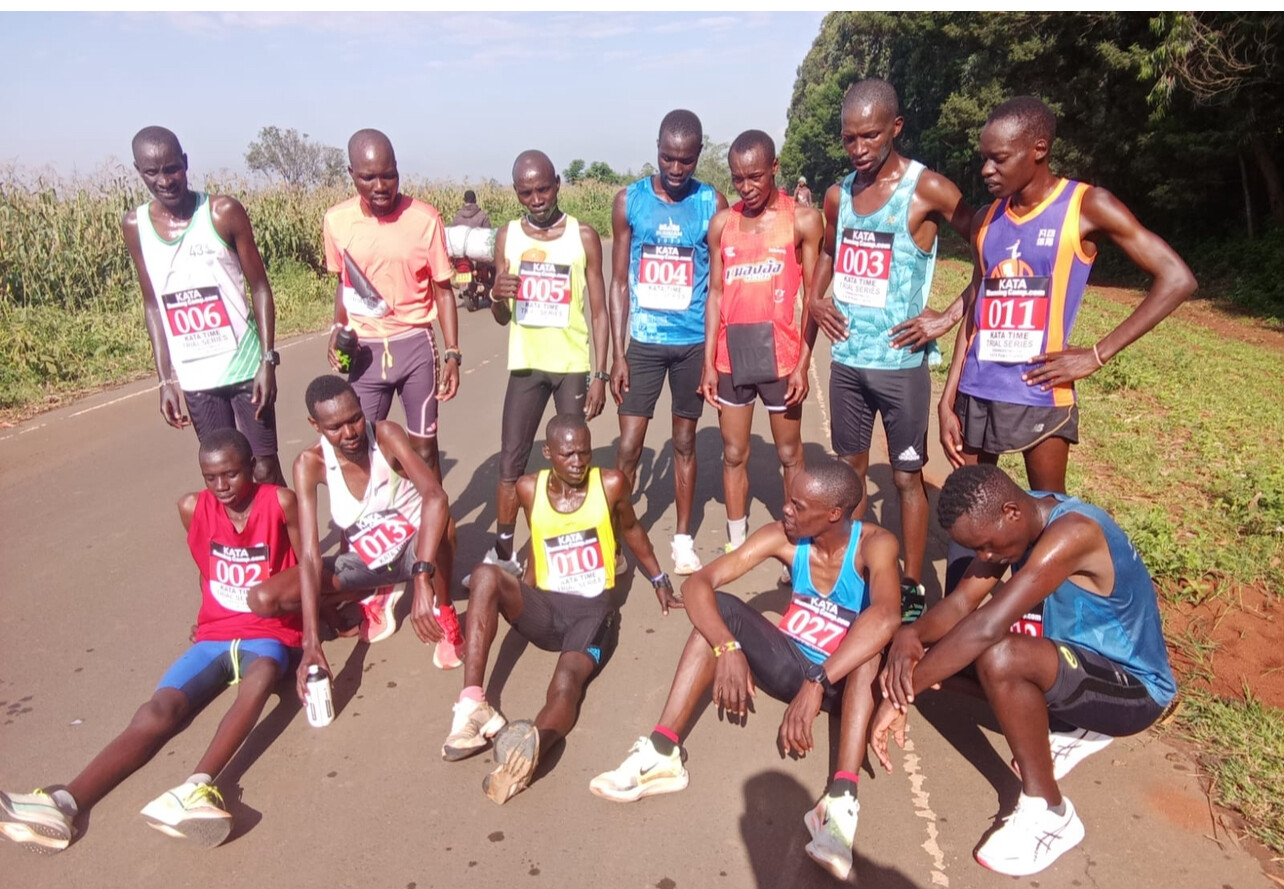
The expansion follows the success of August’s first coordinated nationwide time trial, which confirmed that KATA’s decentralized model can operate effectively across multiple regions. Each camp’s participation is not optional — under the KATA system, all official camps are required to host a time trial every other month as part of athlete development and performance monitoring.
Meanwhile, the Thika headquarters continues to set the standard. It has organized a monthly KATA Time Trial without interruption since September 2021, providing a consistent testing ground for hundreds of emerging athletes.
KATA founder Bob Anderson, who also created My Best Runs, said the approach is about expanding access while maintaining structure.
“The idea was to decentralize opportunity,” Anderson explained. “We want every promising runner, whether training in Thika or a rural camp, to have the same chance to be timed, compared, and supported within the KATA framework.”
Through its network of 30+ KATA Running Camps, the academy has built a national performance pipeline. Each camp conducts its own race under strict KATA guidelines — ensuring accurate distances, verified timing, and documented results — which are then compiled centrally to produce nationwide rankings.
The program is already showing impact. The August trials unearthed new talents now being tracked for mentorship, nutrition guidance, and future competition opportunities.
Head coach John Matheri said the system promotes fairness and progress.
“Before, athletes had to travel to Thika for official trials. Now, the competition comes to them,” he said. “That equal footing is helping identify talent in places we might never have reached before.”
Matheri added that community involvement is strengthening outcomes.
“We expect even faster times this month,” he noted. “Athletes are training with purpose, supported by improved nutrition from our KATA potato projects and the consistent structure that these trials provide.”
Coach Silas Tiren, who leads one of the Rift Valley KATA Camps, said the program has given athletes motivation and accountability.
“These trials are more than races — they’re checkpoints,” said Tiren. “They remind every runner that consistency builds champions.”
From Kapcherop in Elgeiyo Marakwet, coach Philemon Kiptoo emphasized the difference the decentralized system is making.
“Many young runners used to give up because they couldn’t afford to travel for competitions,” he said. “Now KATA has brought the race to their doorstep. That keeps their dreams alive.”
Olympic and World medalist Edwin Soi, a longtime KATA supporter, called the program a bridge between emerging and elite athletes.
“When I look at these young runners, I see myself years ago,” Soi said. “KATA is giving them structure and belief — proof that with discipline and consistency, they can rise to the world stage.”
The October 15 event will again feature 10 km and 5 km distances for men, women, and under-20 juniors. All results from the KATA Running Camps will be uploaded to the My Best Runs database for national comparison and recognition.
As the event approaches, excitement is building across Kenya’s running communities. With standardized guidelines, consistent timing, and grassroots engagement, the KATA Time Trials are evolving into a national benchmark of progress — connecting runners from every region under one synchronized system of excellence.
From Thika’s academy grounds to the mountain trails of the Rift Valley, the whistle will blow on October 15, uniting Kenya’s KATA athletes in a single shared mission: to test, improve, and prove that talent thrives when opportunity is structured.
by Robert Kibet
Login to leave a comment

KATA Time Trial Series
Welcome to the KATA Monthly Time Trial Held at the Kenyan Athletics Training Academy in Thika, Kenya, the KATA Monthly Time Trial is a unique and inclusive event designed to support runners of all levels in achieving their goals and showcasing their fitness. This event offers both 10K and 5K distances on an accurate, certified course, providing participants with...
more...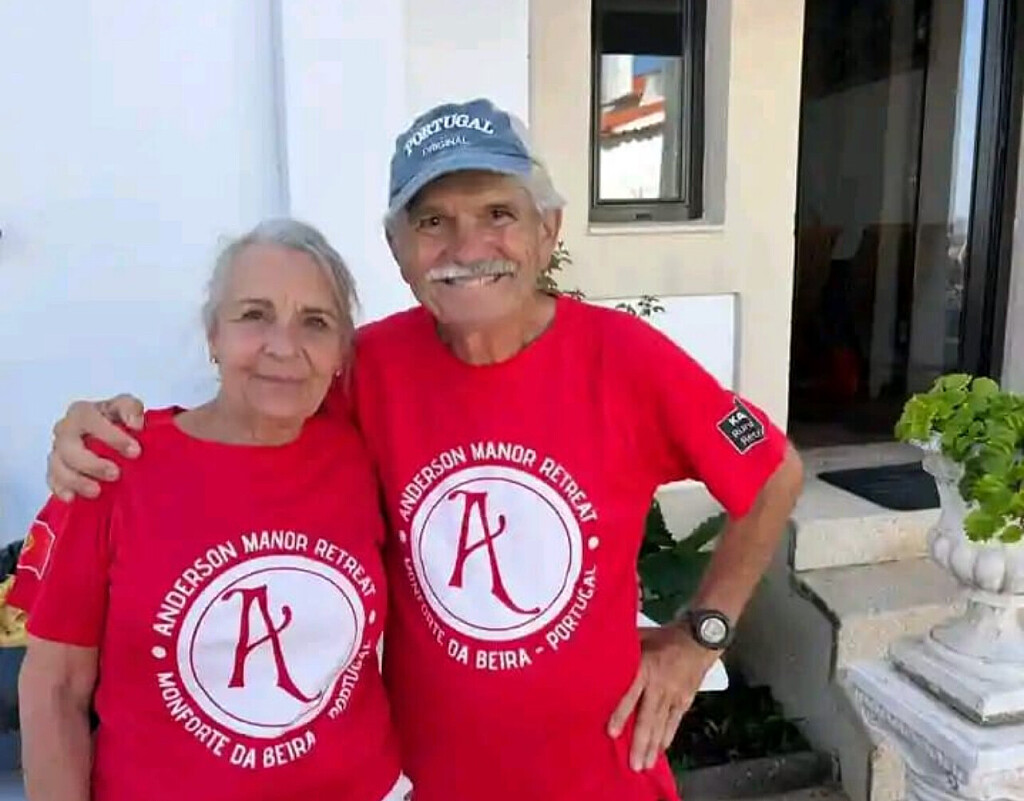
Building the Future: KATA’s Vision to Become the Powerhouse of Athletics in Kenya
KATA founder Bob Anderson has a bold vision — one that unites athletes, coaches, and farmers under a single purpose: to make KATA the powerhouse of athletics in Kenya and a model for the world.
As of today, KATA operates 31 running camps and 65 potato farms across Kenya. Of these, 31 farms are directly connected to KATA camps, while the remaining farms are independent partners within the broader KATA network. Together, they form a growing agricultural foundation that supports both athletics and community development.
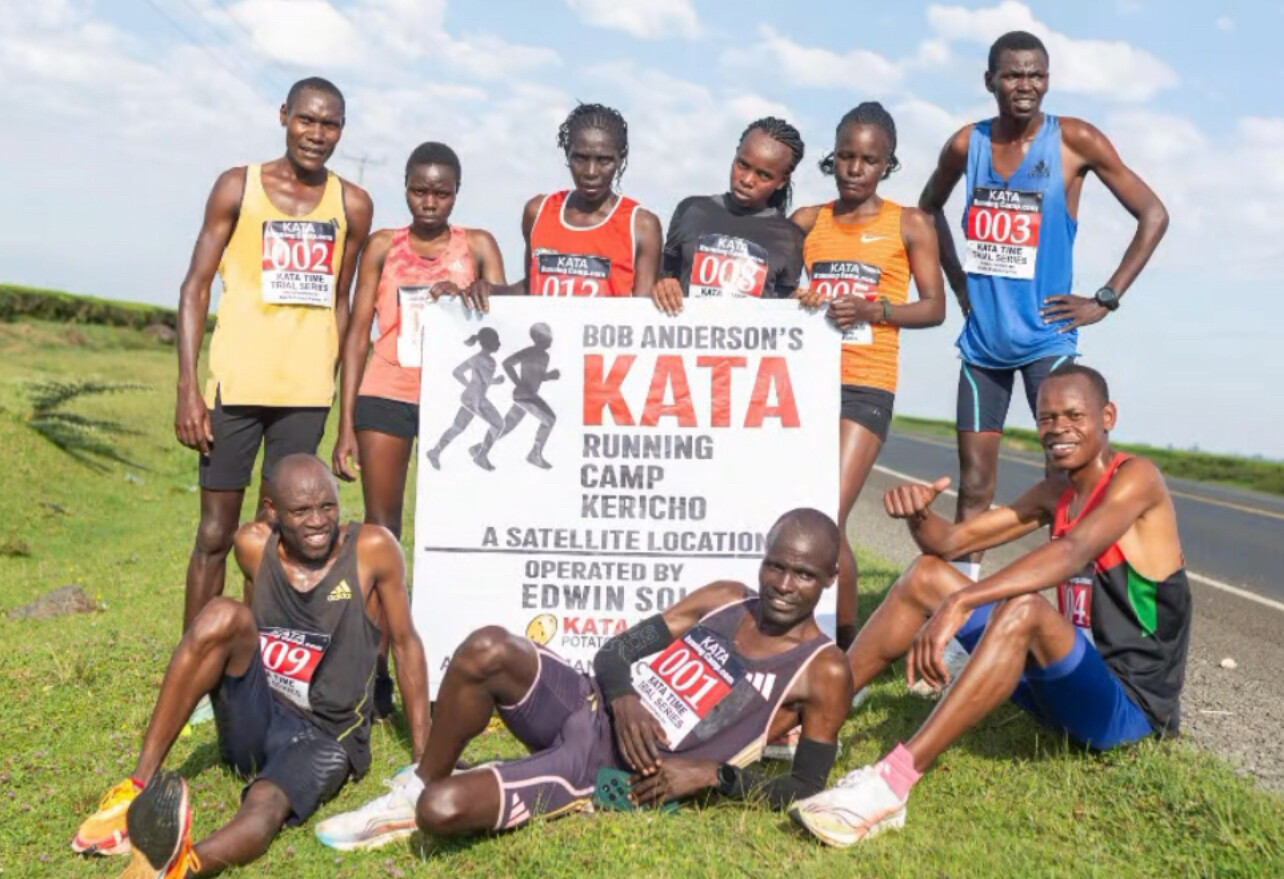
KATA farms currently range in size from one acre to 8.5 acres, combining traditional farming expertise with innovative support for athlete nutrition and sustainability. By the end of 2026, KATA’s goal is to expand to 100 Running Camps and 200 Potato Farms — half directly linked to camps — spanning more than 400 acres of productive farmland.
Another key initiative is the creation of the first KATA Ranch, scheduled for development by early 2026. The ranch will raise 100 or more sheep and goats, providing food, training nutrition, and economic value to the community. A KATA Running Camp will be connected to the ranch, integrating agriculture and athletics into one sustainable ecosystem. The long-term goal is for the ranch to become self-sustaining through the sale of meat and byproducts, ensuring continuous support for KATA programs and local families. Once the first ranch is fully operational, additional ranches are planned for future expansion.
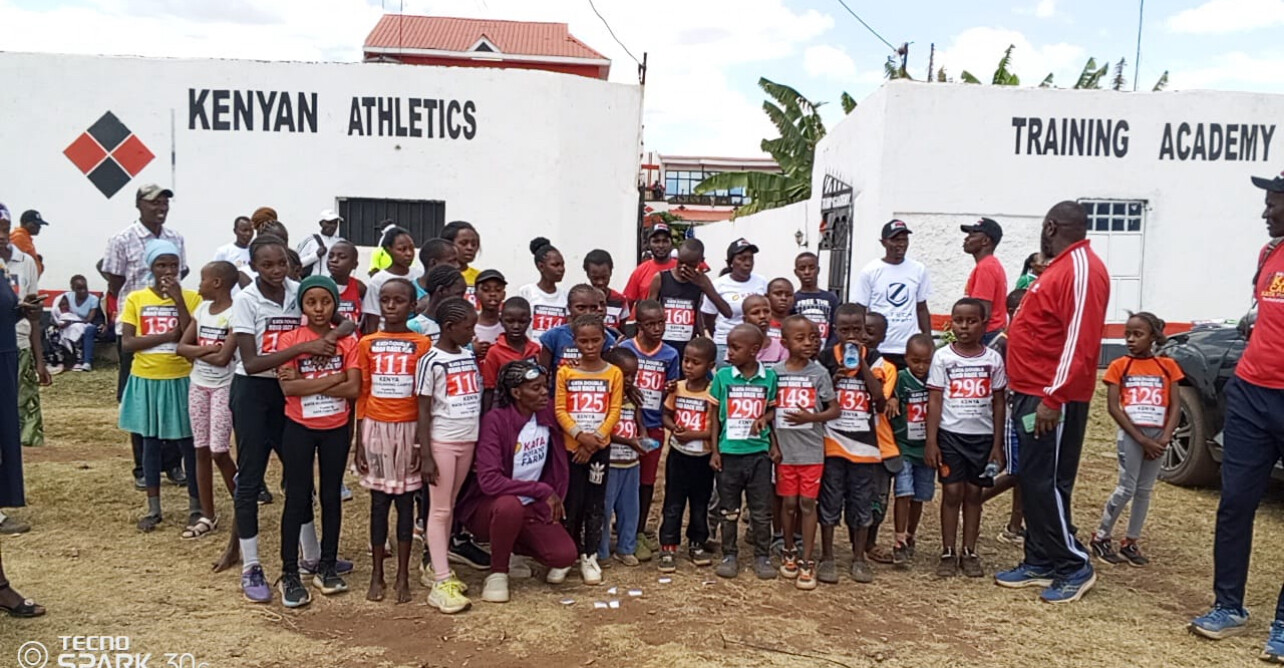
KATA is also preparing to launch a KATA Sports Shop featuring running shoes and gear, and a KATA Market offering healthy, locally sourced food and essentials.
Coming soon and at the heart of KATA’s growth is its flagship product — branded KATA Potatoes, sold at a premium price and marketed as “The Fuel of Champions.” Complementing this is KATA Potato Flakes, an innovative product that reflects KATA’s values of energy, endurance, and excellence.
The KATA Potato Flakes will be sold worldwide as the go-to carbo-loading choice for marathonerspreparing for race day. Just add water from the tap, and in moments, you’re carbo-loading on KATA Potatoes — The Fuel of Champions.
Meanwhile, KATA Thika serves as the local office for Kenya and continues to thrive as the organization’s flagship Running Retreat, offering training stays for athletes from around the world who want to experience the Kenyan way of training — whether for a few days or a few months. The retreat provides access to world-class coaching, structured training, and cultural exchange with Kenya’s elite running community.
At the global level, KATA International is headquartered at the Anderson Manor in Monforte de Beira, Portugal — a 20,000-square-foot historic estate where the last King of Portugal stayed during his hunting trips in the early 1900s. The manor serves as the base for KATA’s international operations, housing both KATA Portugal and the Anderson Manor Retreat, which welcome athletes, artists, and guests from around the world.
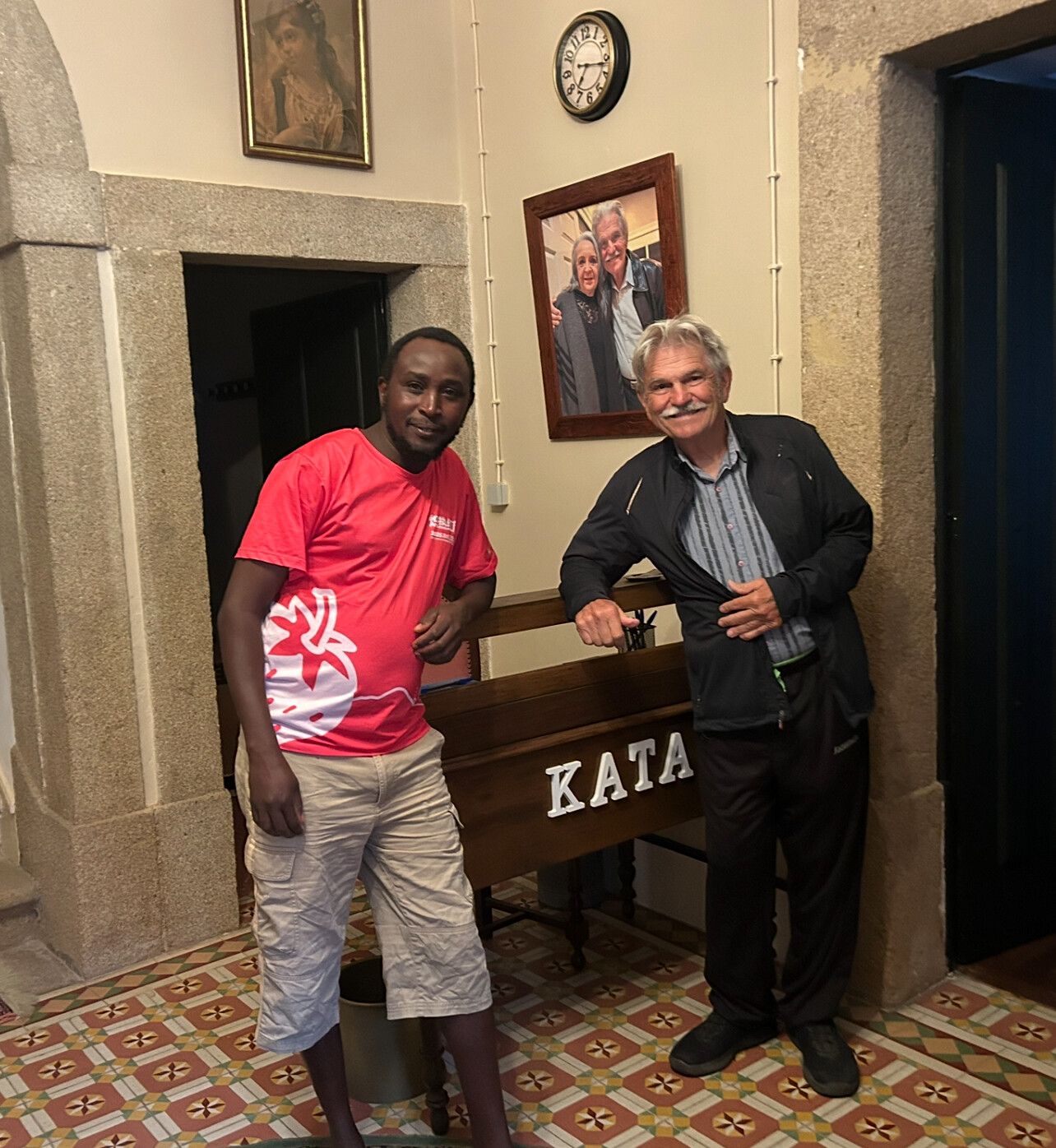
Behind the scenes but very much involved is Bob’s wife, Catherine. (First photo with Bob). Her creative talent adds a great deal to the program. Bob and Catherine have known Coach Dennis since 2021. He has completed two three-month stays at KATA headquarters in Portugal, working alongside Bob. Coach Dennis (4th photo with Bob in Portugsl) was recently promoted to Chief Technical Officer (CTO) and will oversee operations in Kenya.
Development of KATA Portugal began in February 2024, and the project continues to progress strongly. The retreat in Portugal will serve as the European counterpart to KATA Thika, offering athletes a place to train, rest, and connect with KATA’s global mission in a peaceful, historic setting.
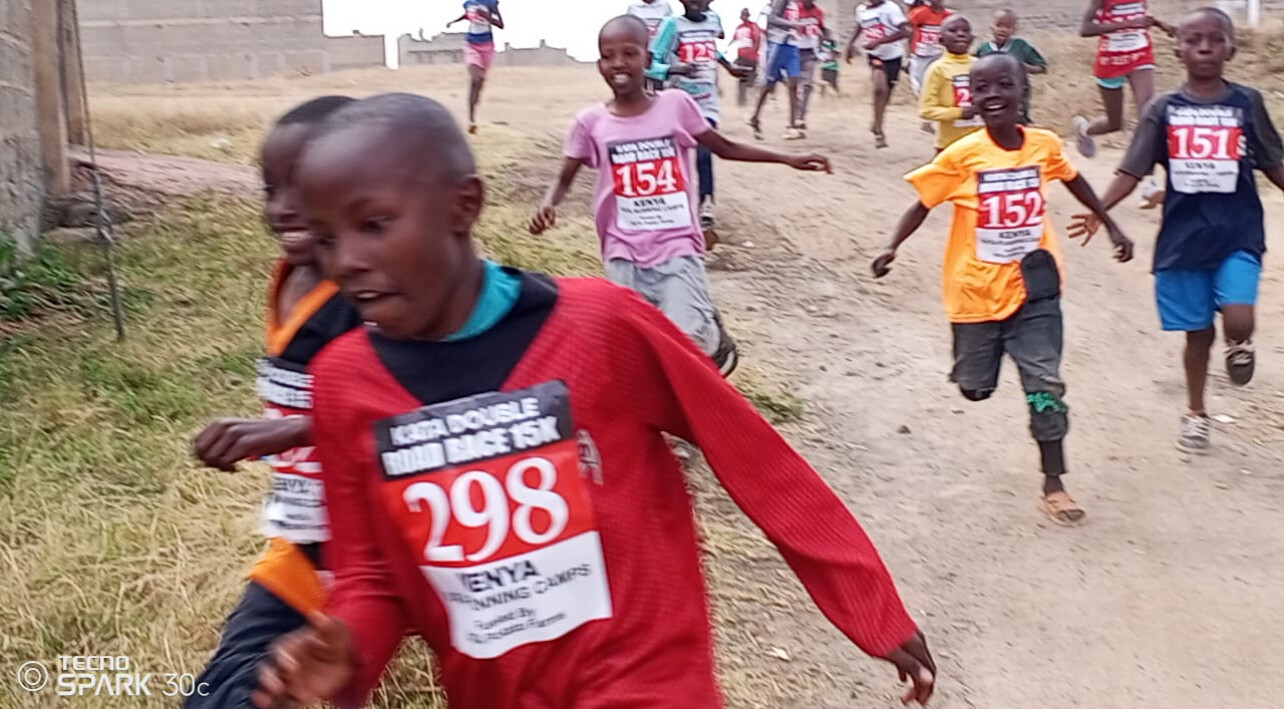
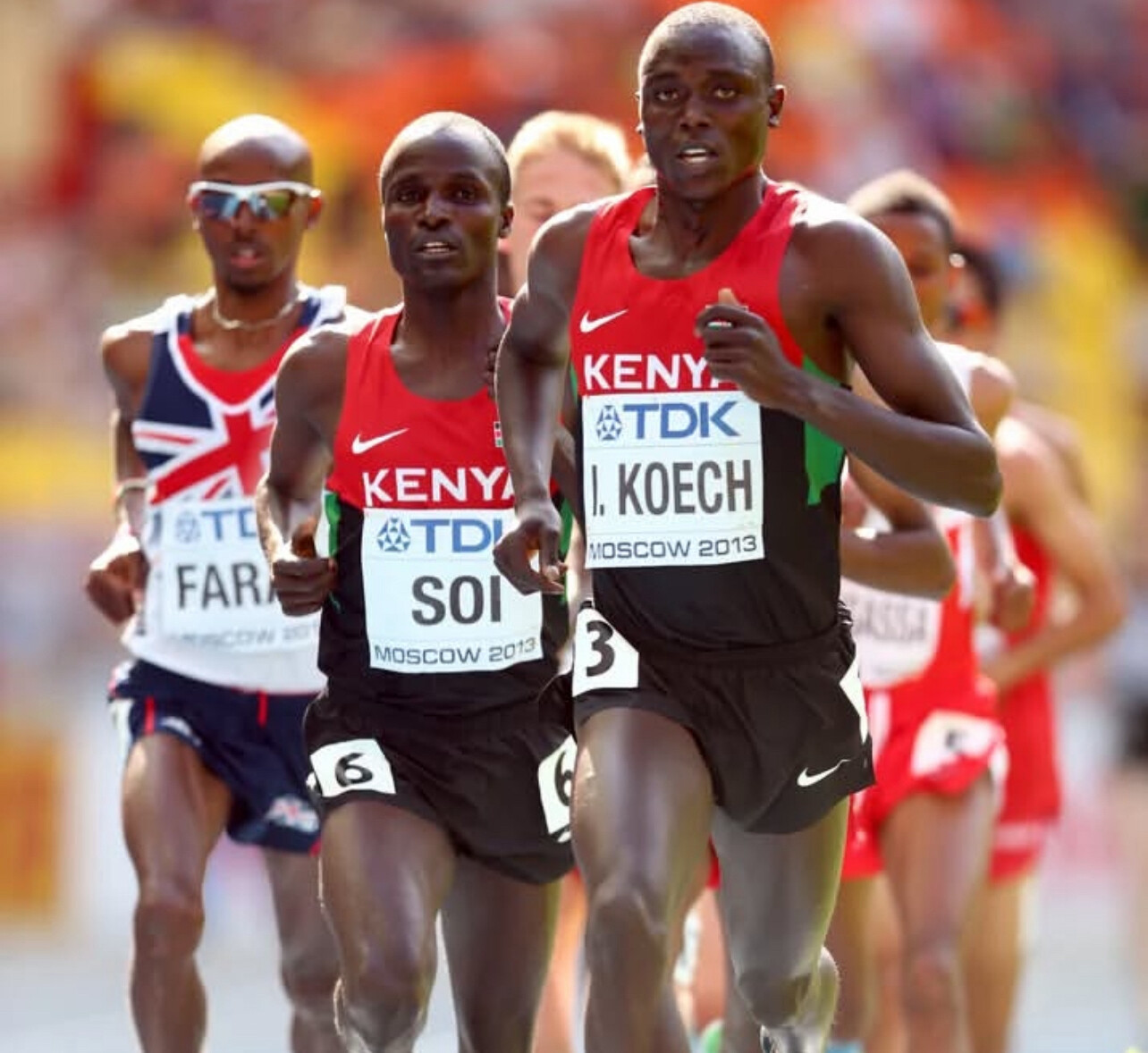
KATA’s vision goes far beyond producing great runners. The mission is to develop world-class athletes, Olympic champions, and future world record holders — combining top-tier coaching, discipline, and holistic training. Already, previous Olympic medalists such as Edwin Soi and Paul Koech are part of the KATA family, operating their own KATA Camps and helping guide the next generation of Kenyan champions.
Anderson also envisions a thriving athletic network of 650 elite runners, 150 youth athletes, and 40+ masters runners, supported by an expanding media presence through My Best Runs and KATA’s social platforms.
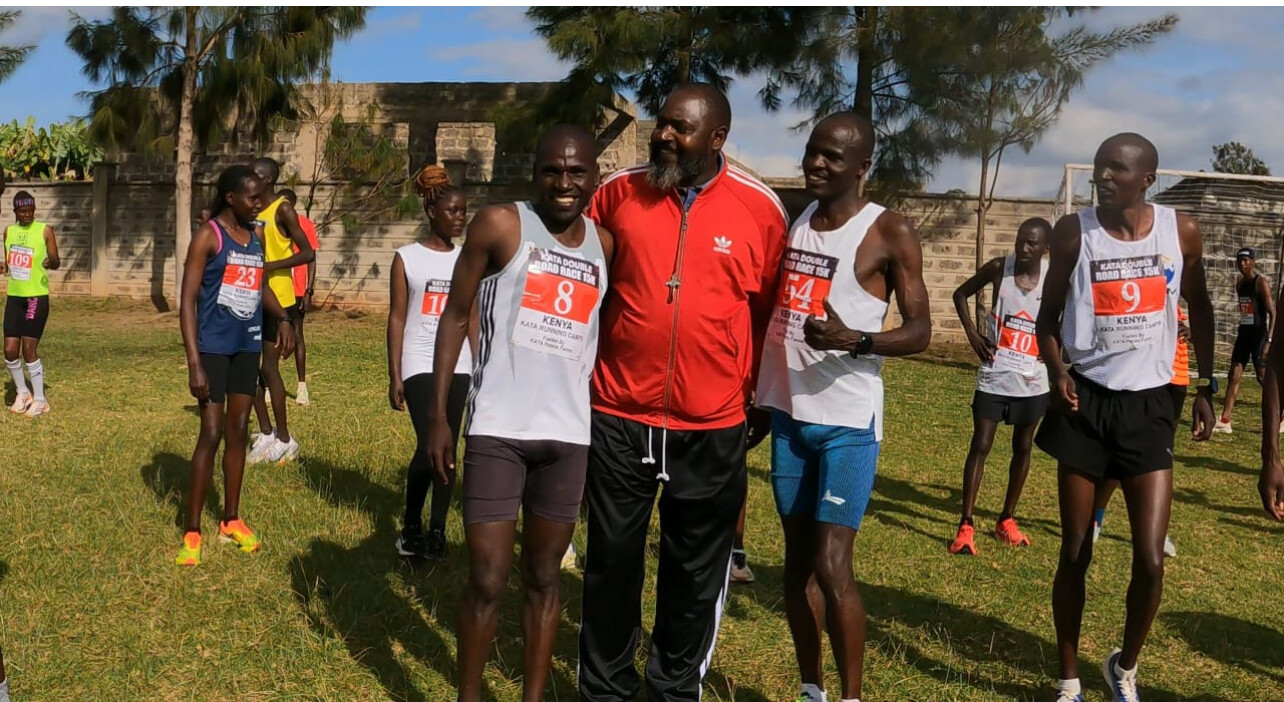
“I want to do something truly special for athletics,” Anderson says. “And it’s the passion and dedication of our athletes, coaches, and farmers that will make this dream a reality.”
“Our KATA family is as strong as its members,” Anderson adds. “As a team, we can make anything happen. In just a short amount of time, we’ve pulled off some amazing things. But our KATA family has only just gotten started. Watch us grow — and join us in helping make a difference.”
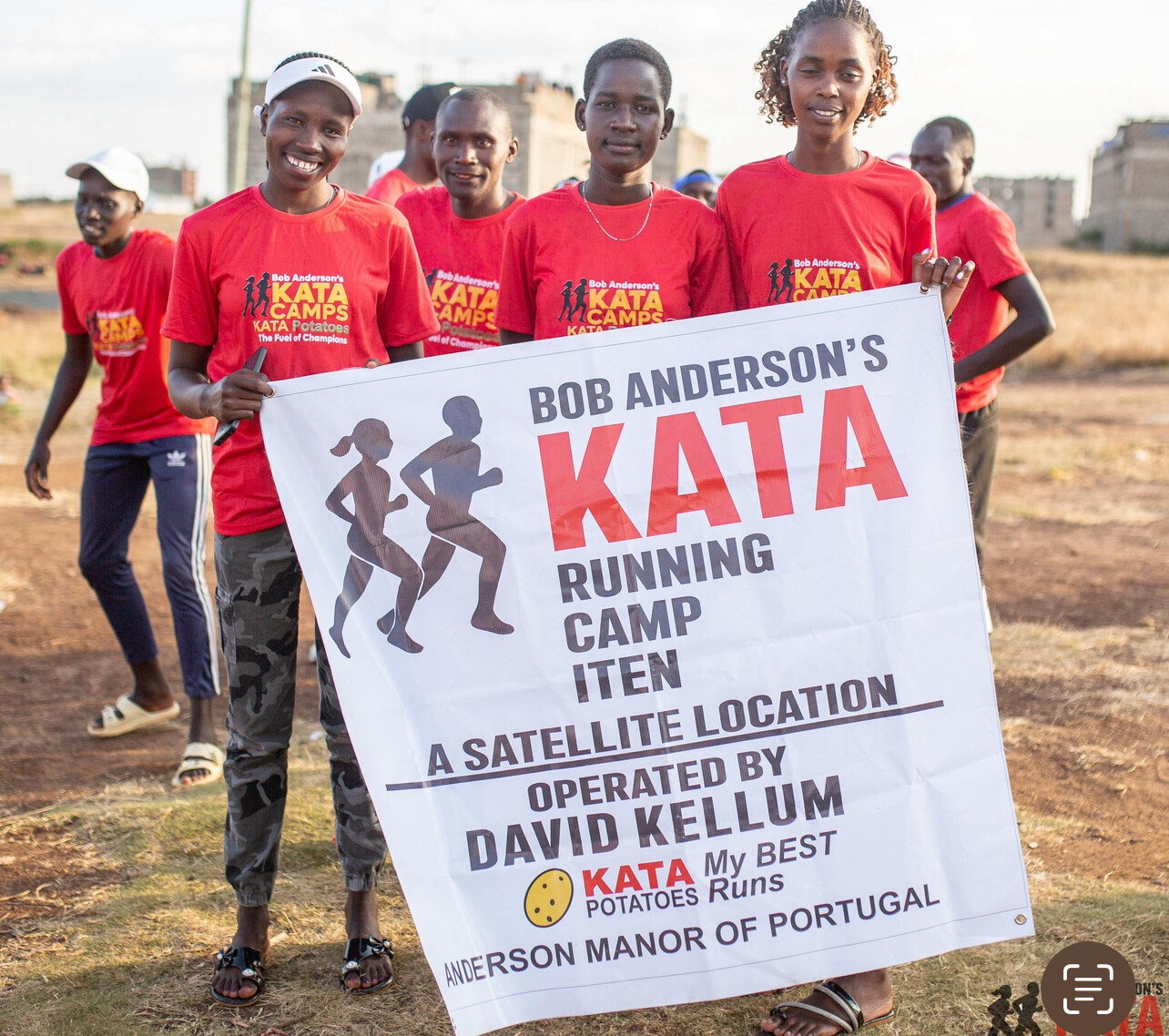
Anderson’s connection to Kenya runs deep. He first visited the country in 1987 and immediately fell in love with its people, culture, and running spirit. Just three years earlier, he had sold the magazine he founded and published for 18 years — Runner’s World, which had grown to a circulation of 2.5 million monthly readers. Runner’s World played a defining role in launching the modern running movement, inspiring millions of runners worldwide.
Although KATA Thika began in 2019, the KATA Running Camps officially launched in May 2025, building upon KATA’s strong foundation in Kenya. Both KATA Thika and KATA Portugal continue to grow as vital pillars in this global vision.
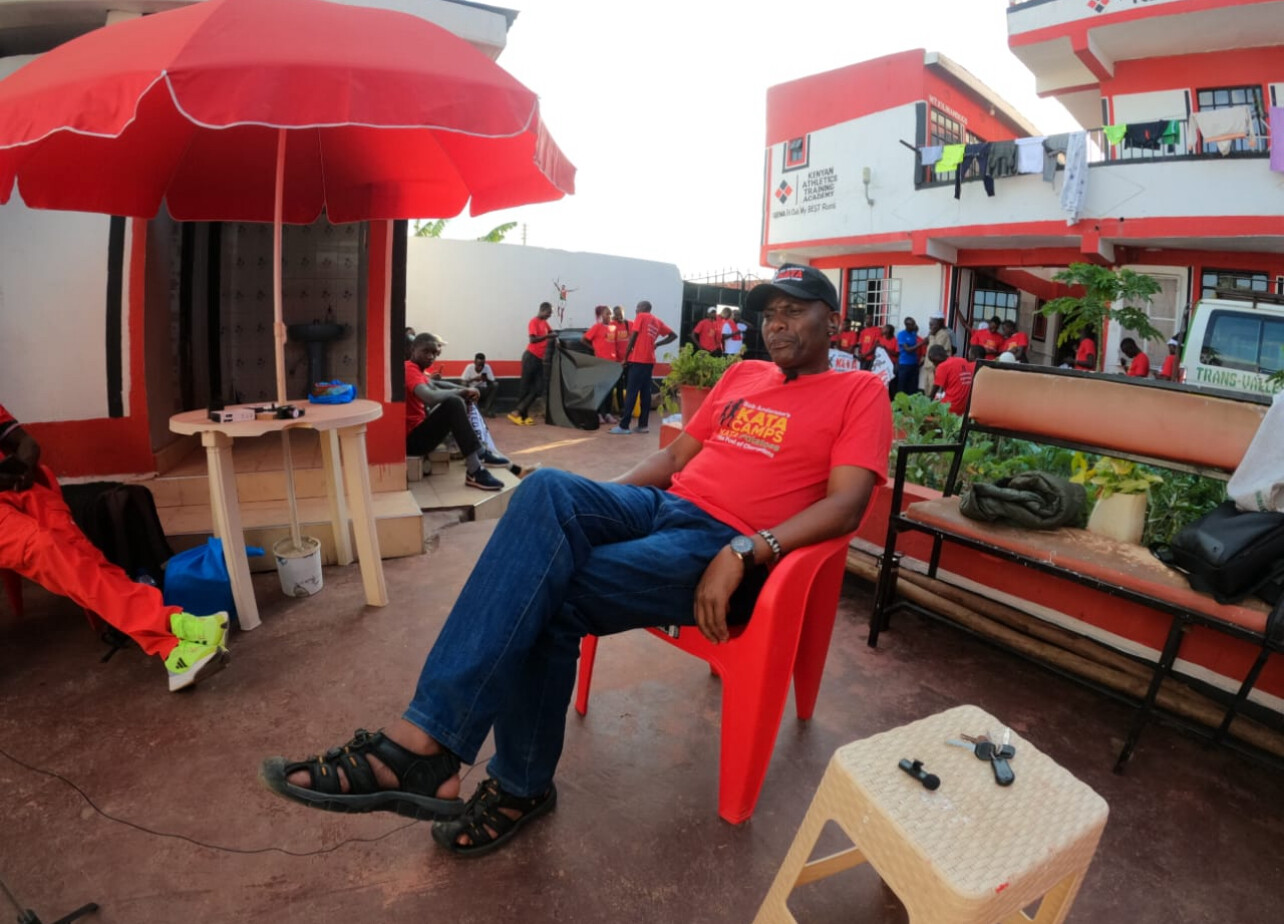
Anderson’s mission is clear: to strengthen the foundation of athletics in Kenya — and after 2026, expand to South Africa, Uganda, Ethiopia, and beyond.
Go KATA — The Fuel of Champions!
by Boris Baron
Login to leave a comment

Building Champions, One Race and One Harvest at a Time: The KATA Story
With 31 training camps across Kenya’s altitude zones and 65 thriving potato farms, the Kenya Athletics Training Academy (KATA) is shaping not only resilient athletes but also sustainable livelihoods. Each KATA camp is not just a training base but also cultivates several acres of KATA potatoes, linking athletics directly with farming and ensuring that athletes’ futures are rooted in more than competition alone.
A Morning of Anticipation in Thika
The sun had barely risen over Thika when athletes began streaming into the venue for the 5th Annual KATA Double Road Race. The crisp morning air carried both anticipation and nerves as runners stretched, laced up, and tested the course that would soon bear witness to their grit.
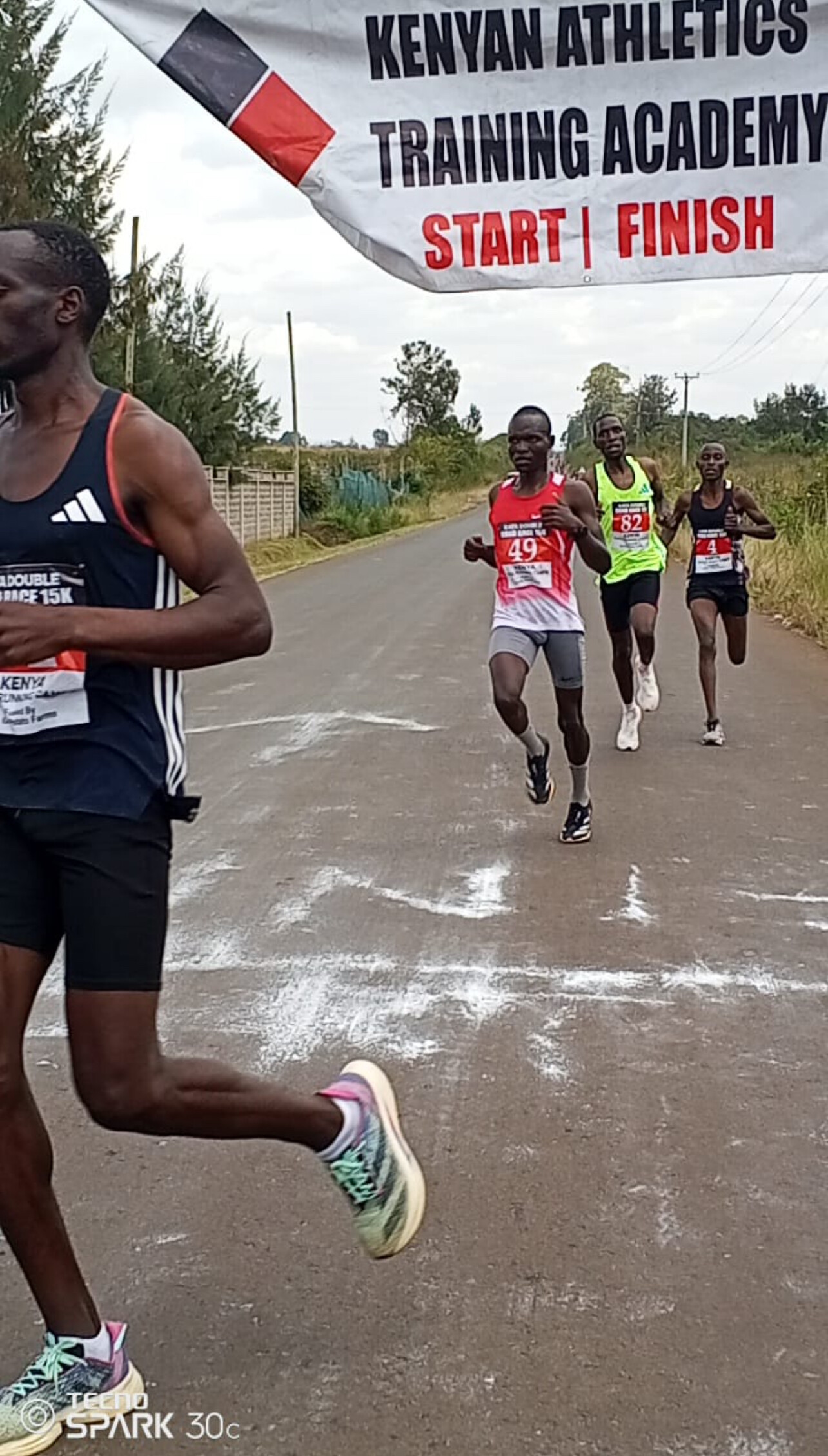
By the time the gun sounded, 97 elite athletes—74 men and 23 women—lined up. For John Matheri, head coach at KATA Thika, the event was more than a competition. It was a lesson in discipline, a test of mental endurance, and a reflection of how far the central region has come in embracing competitive running.
Olympic 5000m medalist and KATA camp operator Edwin Soi emerged as the overall winner, clocking 29:38 for the opening 10K and 14:22 for the final 5K. His combined time of 43:50 was the fifth-fastest ever run for the Double, an event first contested in 2010. On the women’s side, Betty Chesang from the KATA Iten camp was the first across the line in 51:32, marking the sixth-fastest women’s time in Double history.
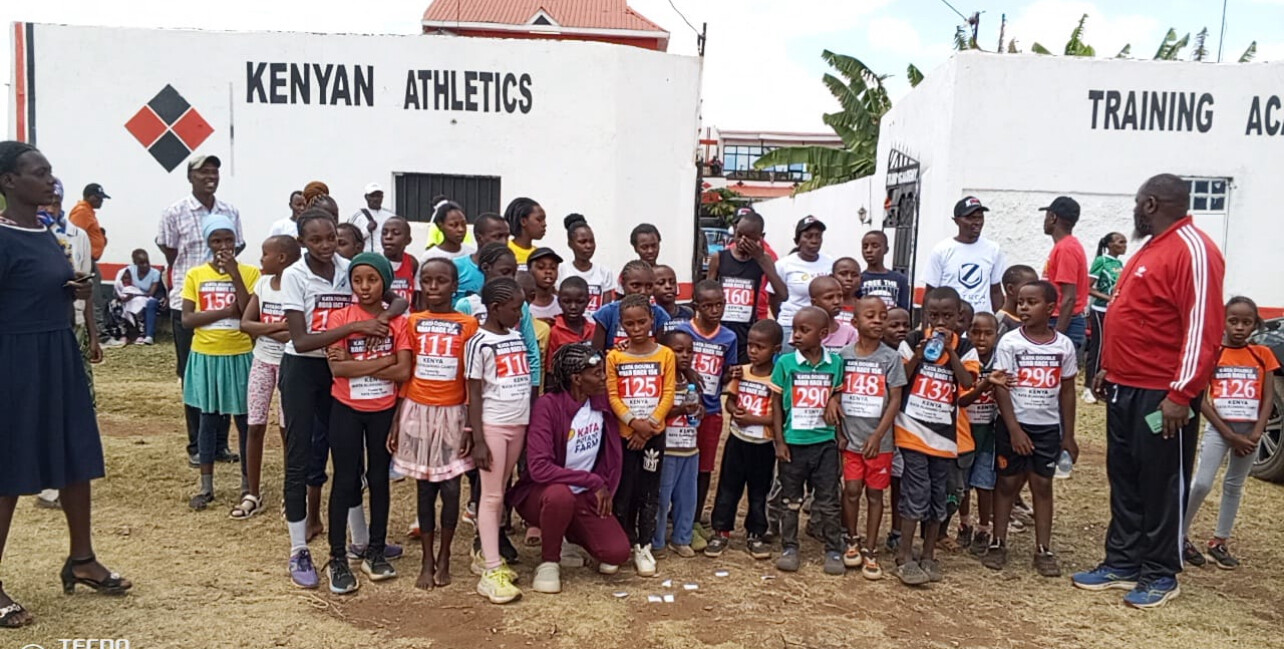
“We concluded the race well, and it was a good one,” Matheri said proudly, watching the exhausted but smiling athletes cross the line. “The turnout was impressive. I want to extend a special thanks to our sponsor, Bob Anderson, for putting together a team of this magnitude. There is no doubt that within the region, KATA has become an icon.”
A Nationwide Network of Camps and Farms
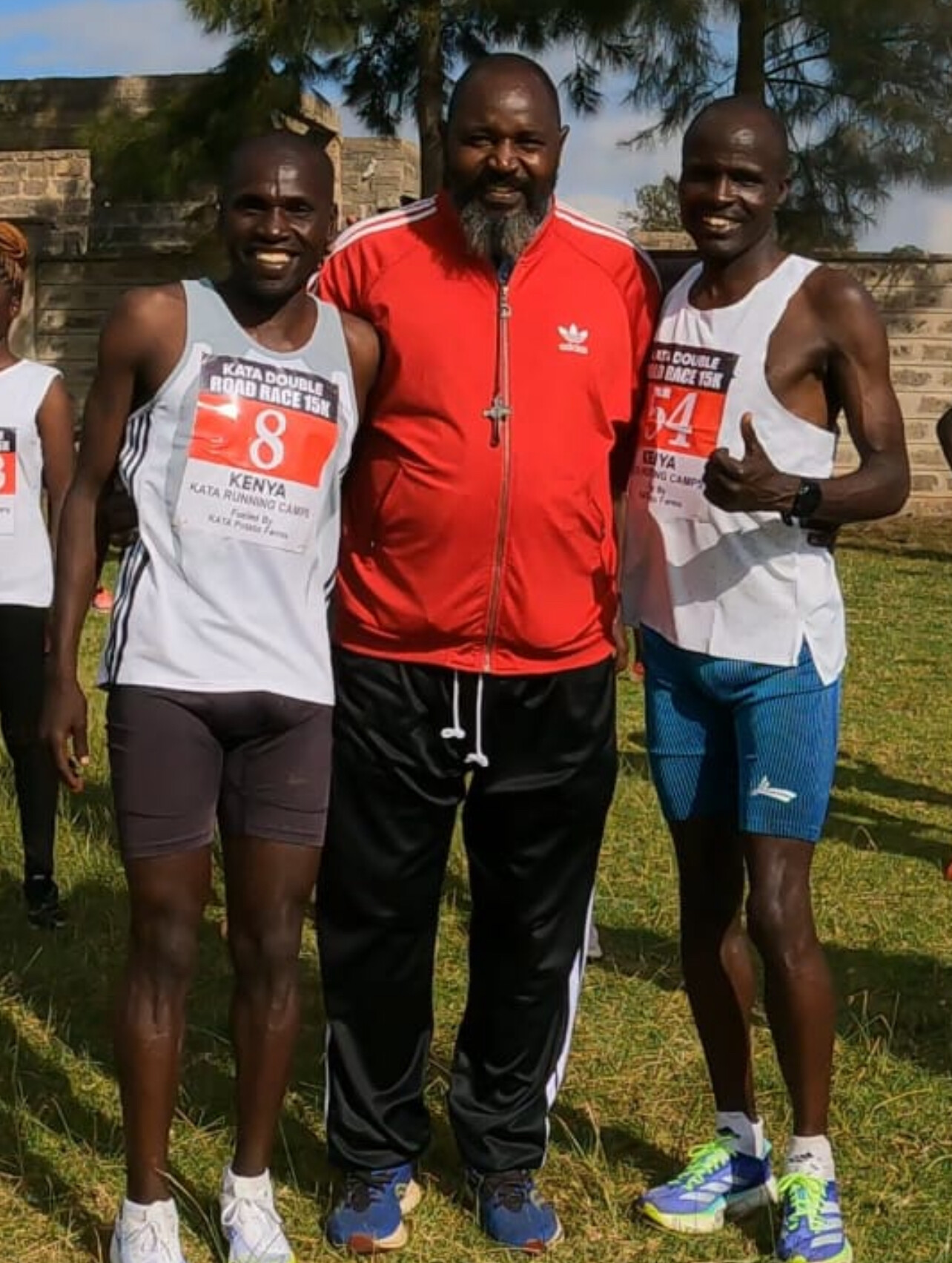
What sets KATA apart is not just its races but the ecosystem it is steadily building for Kenyan athletes. Across the country, 31 KATA-affiliated training camps operate at varying altitudes—from the highlands of the Rift Valley to the mid-altitude base in Thika and lower regions closer to Nairobi. Each camp provides unique conditions that strengthen endurance, adaptability, and competitive edge.
These dual-purpose camps are more than facilities; they are lifelines for athletes dreaming of breaking into the elite ranks. Training at altitude builds strength, while mid-altitude camps prepare runners for race conditions. Together with potato farming, they create a sustainable structure for the future.
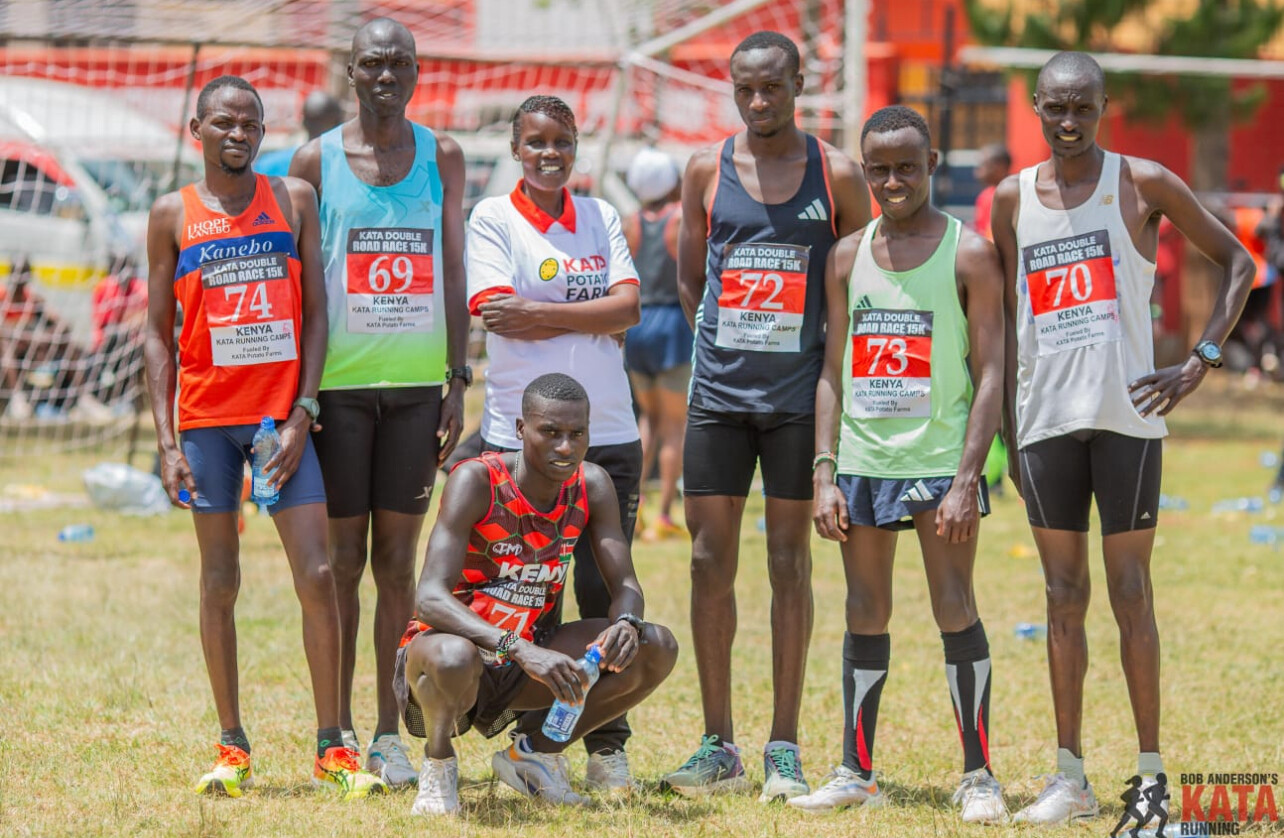
This vision is also embodied in Jimmy Mwangangi Muindi, a five-time Honolulu Marathon champion who famously coached Patrick Makau to the world marathon record in 2011. Having worked at Anderson’s Manor in Portugal, Muindi now leads a KATA satellite camp in Machakos County. For him, KATA is about much more than training.
“KATA is building more than runners,” Muindi reflected. “It is building a family—giving young talents not just training, but exposure, support, and hope. That is how future champions are born.”

Beyond Running: The Potato Farming Project
KATA’s sustainability model is as innovative as its racing format. Each camp is supported by several acres of potato farming, tying athletes’ success to both training and cultivation. The revenue from potato sales funds the future of the running camps.
The model is simple but effective. Bob and Catherine Anderson provide an interest-free loan to establish both the camp and its potato farm. From there, the operator and athletes are responsible for managing their acres and securing their own future. KATA continues to provide exposure and guidance, but the responsibility of growth rests with those on the ground.
“The potato project has given us a chance to think beyond running,” Matheri said. “Athletes train hard, but they also need food security and stability. Farming allows them to eat well, earn a little, and stay grounded.”

KATA Chief Technical Officer Denis Musau, who recently returned from Anderson’s Manor House in Portugal, underscored this vision. “KATA is about creating a legacy. By building projects like potato farming, we empower athletes and their camps to sustain themselves financially. That secures their future both on and off the track. I see a very bright future for the KATA family.”
The Spirit of Participation
What stood out most on race day in Thika was the diversity of the field. Athletes from every discipline showed up, while children and enthusiastic spectators cheered from the sidelines. The energy of the crowd became part of the race’s rhythm, fueling the runners through every stride.
Yet the event also highlighted areas for growth. “Our athletes are very strong athletically, but many are missing mental strength,” Matheri observed. Muindi agreed: “Mental resilience is just as vital as physical training. When athletes panic at the sight of big names, they lose focus. Learning to respect the distance is what unleashes true potential.”
For both coaches, raw talent is not enough. Young athletes are like fabric, Muindi often says—materials that must be carefully tailored to become masterpieces.
Inspiration from the Veterans
One of the most inspiring aspects of the Thika Double was the turnout of established athletes—Olympians and medalists—who lined up alongside the next generation. Their presence was not only symbolic but also a powerful motivator for younger runners.
“It is so encouraging, especially here in the central region, to see our elite and professional athletes turning up in big numbers,” Matheri said. “For the young ones, lining up beside Olympians and medalists gives them a sense of what is possible. It gives them hope.”
Building the Future
For the KATA family, the vision remains crystal clear: to prepare a new generation of Kenyan champions while ensuring they have livelihoods beyond running.
“As a family, we are in good hands. We are looking forward to doing great things,” Matheri said with conviction. His final message was one of determination and gratitude: “We promise to use every ounce of our strength to bring change and positivity to the world of sport. We thank our sponsor, Bob Anderson, for the continued support, and we promise to do everything we can to grow this industry. The journey has just begun, but the future is bright.”
Anderson’s Manor in Portugal serves as KATA’s international headquarters, with Bob and Catherine Anderson based there about 50% of the time. It is from this hub that global strategy and support are coordinated, while Kenya remains the main operational location where athletes train, camps thrive, and races like the Double continue to inspire.
As the last athletes packed up and the crowd dispersed, one thing was clear: KATA is more than an academy. It is a movement—blending sport, sustainability, and community to nurture not just athletes, but Kenya’s enduring legacy of running excellence.
by Robert Kibet
Login to leave a comment
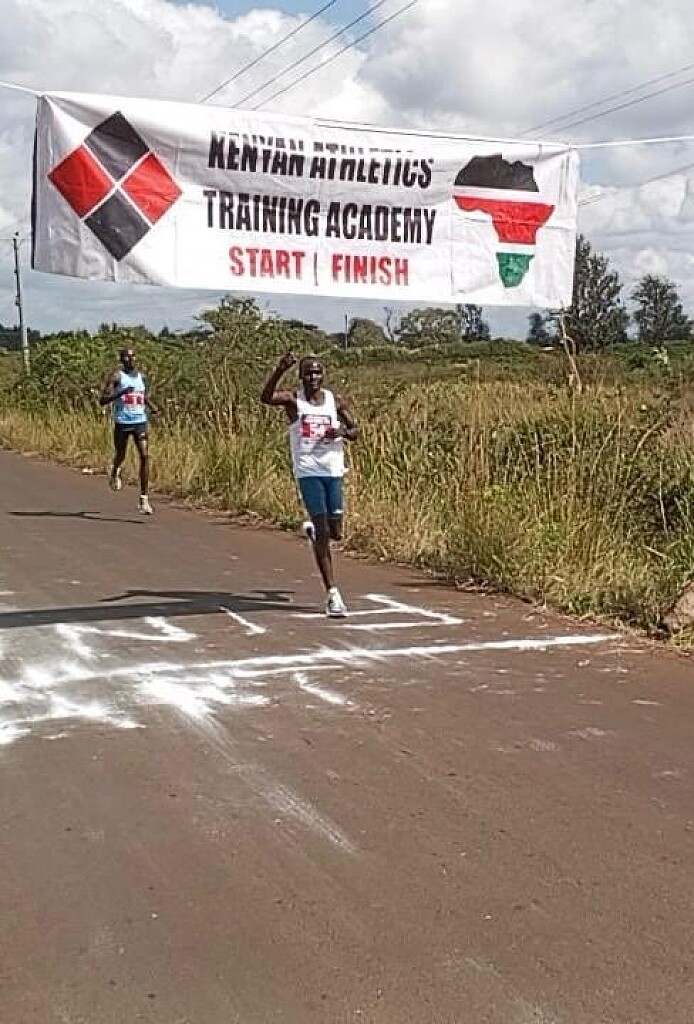
Edwin Soi and Betty Chesang Shine at 5th Annual KATA Double Road Race in Thika
THIKA, Kenya - Running at the Kenya Athletics Training Academy (KATA) has become a magnet for athletes and spectators alike, and today’s 5th Annual KATA Double Road Race proved just that. Energy and motivation filled the air as both athletes and coaches gathered to celebrate one of Kenya’s most innovative race formats.
A total of 97 elite athletes—74 men and 23 women—lined up for the two-stage event (10K + 5K), a turnout that highlighted KATA’s growing influence and its role in setting a new competitive standard.
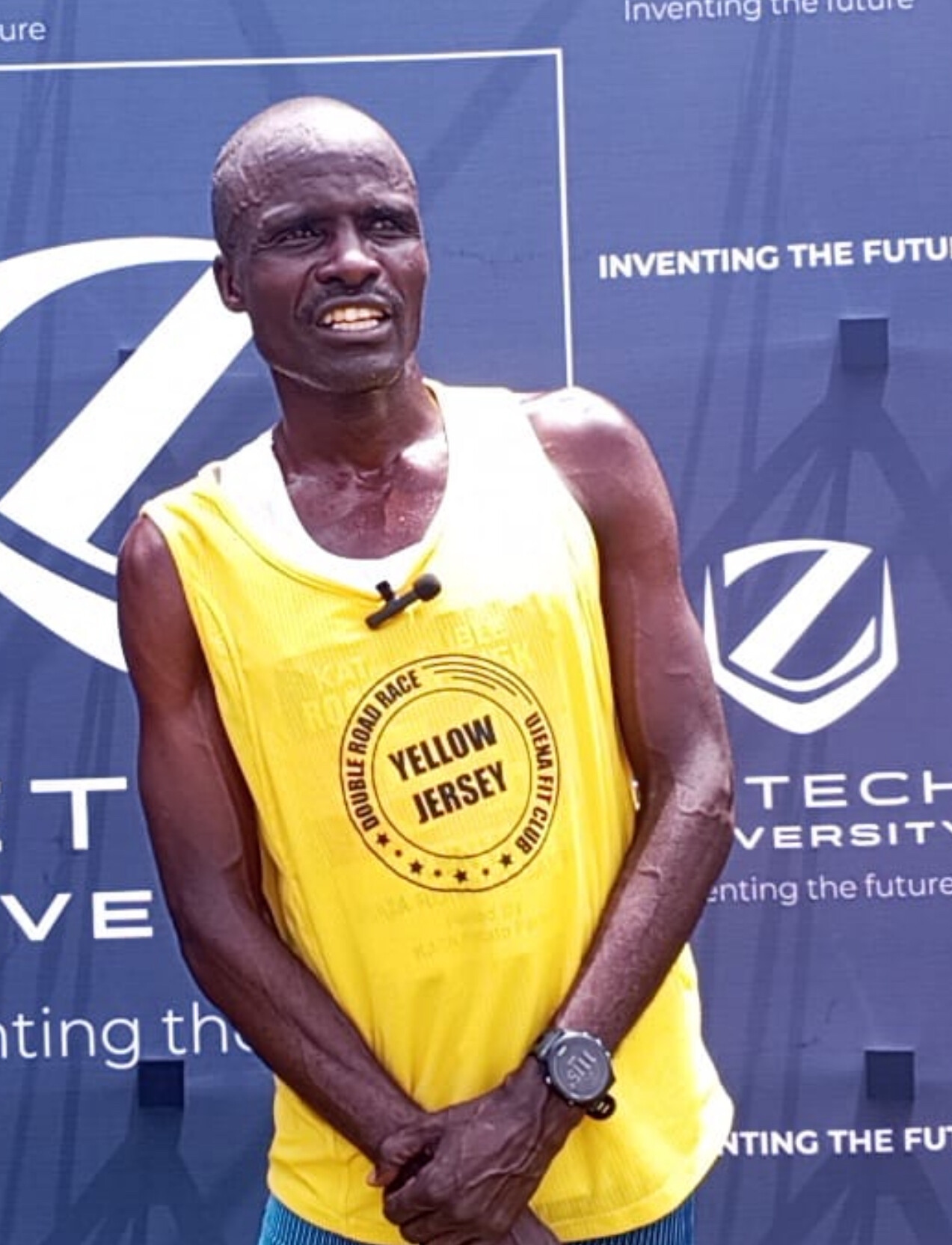
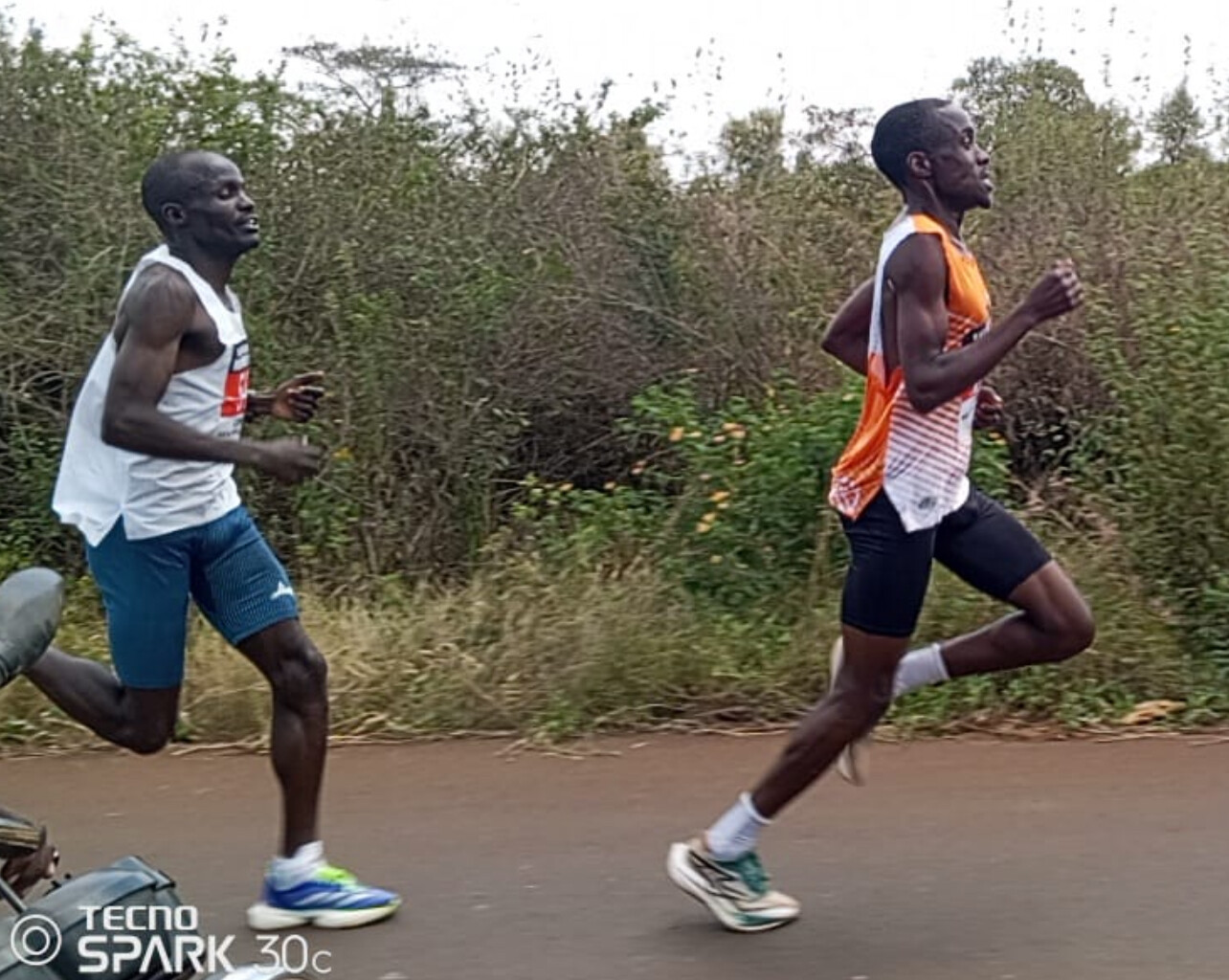
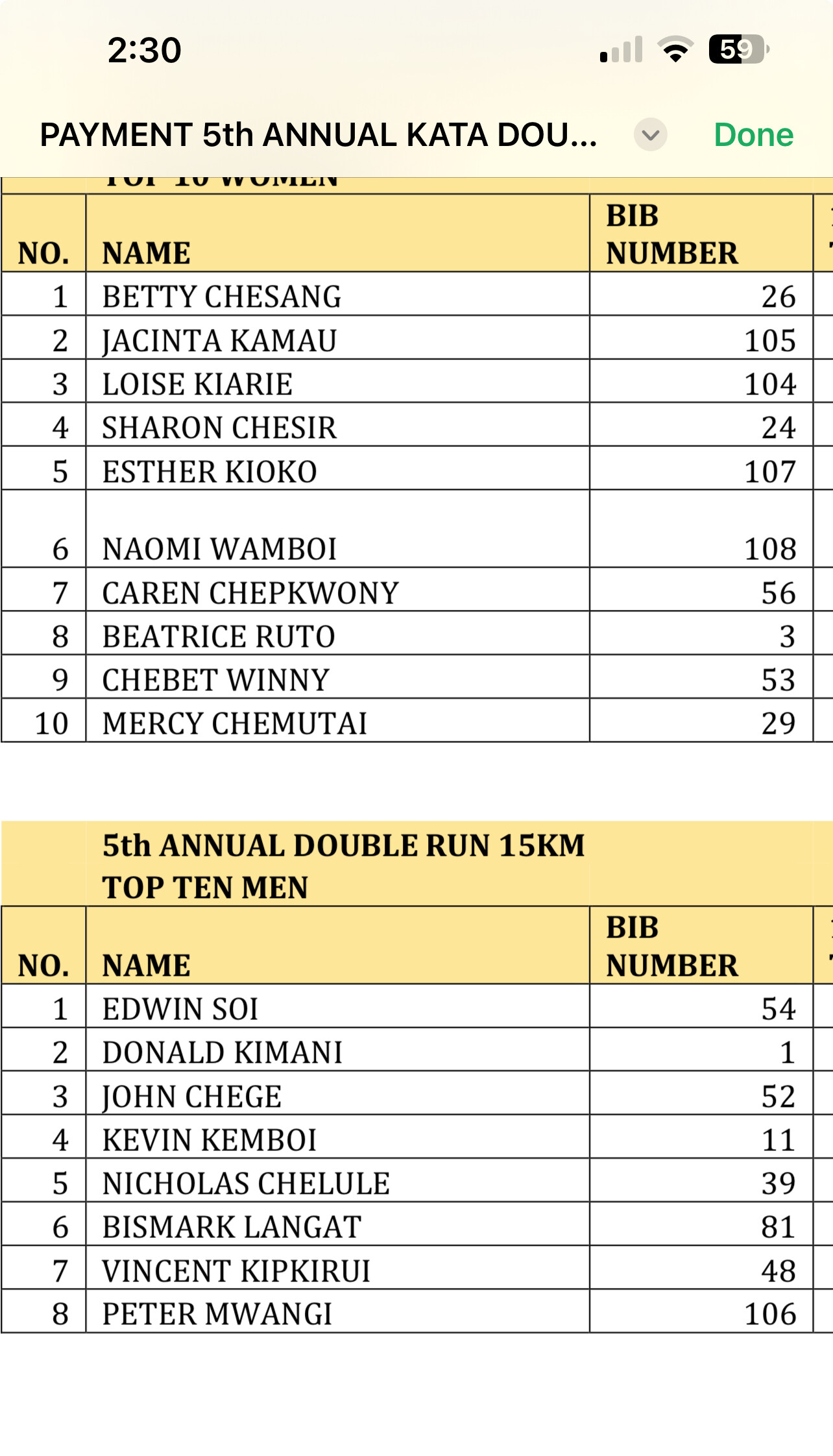
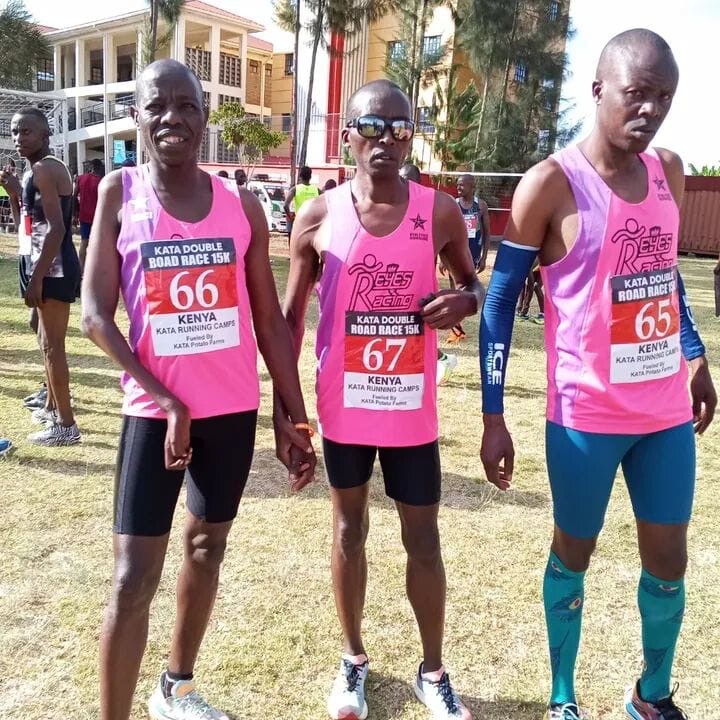
On the men’s side, Beijing 2008 Olympic 5000m bronze medalist Edwin Soi showed his class, taking the overall victory in a combined time of 43:50. He was chased hard by Donald Kimani, who clocked 44:07, while John Chege secured third place in 44:26. Chege, representing KATA Thika, had aimed with his teammates to challenge the world record. However, facing experienced stars like Soi, nerves crept in, and the record attempt slipped away.
The women’s race delivered equal excitement. Betty Chesang claimed the title in 51:32, followed by Jacinta Kamau in 51:50. Loise Kiarie rounded out the podium, finishing in 52:34.
Beyond the results, the day carried an atmosphere of learning and inspiration for KATA’s young and upcoming athletes. With each edition, the Double Road Race continues to grow stronger, reinforcing the KATA spirit: competing hard, learning together, and moving forward.
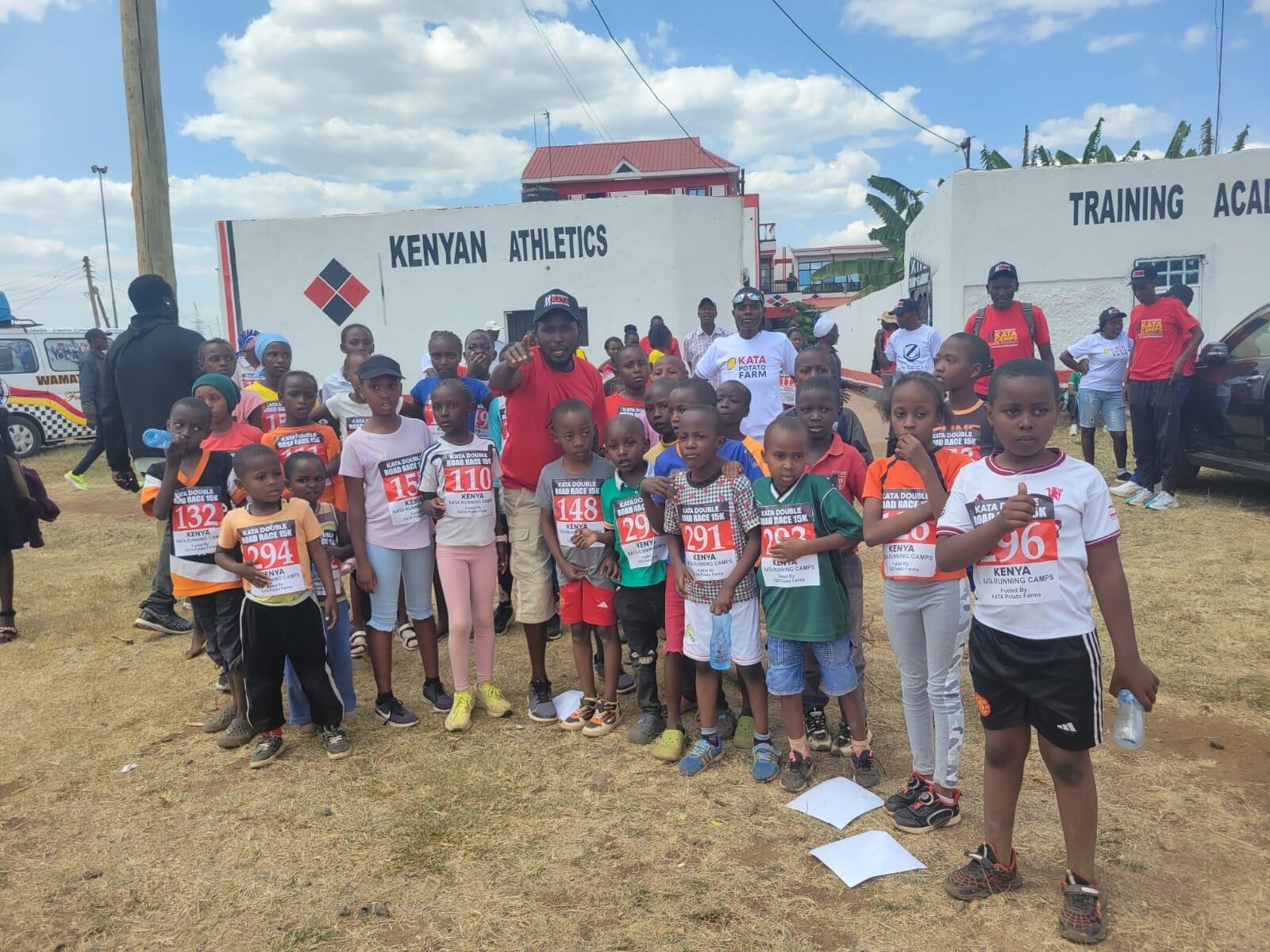
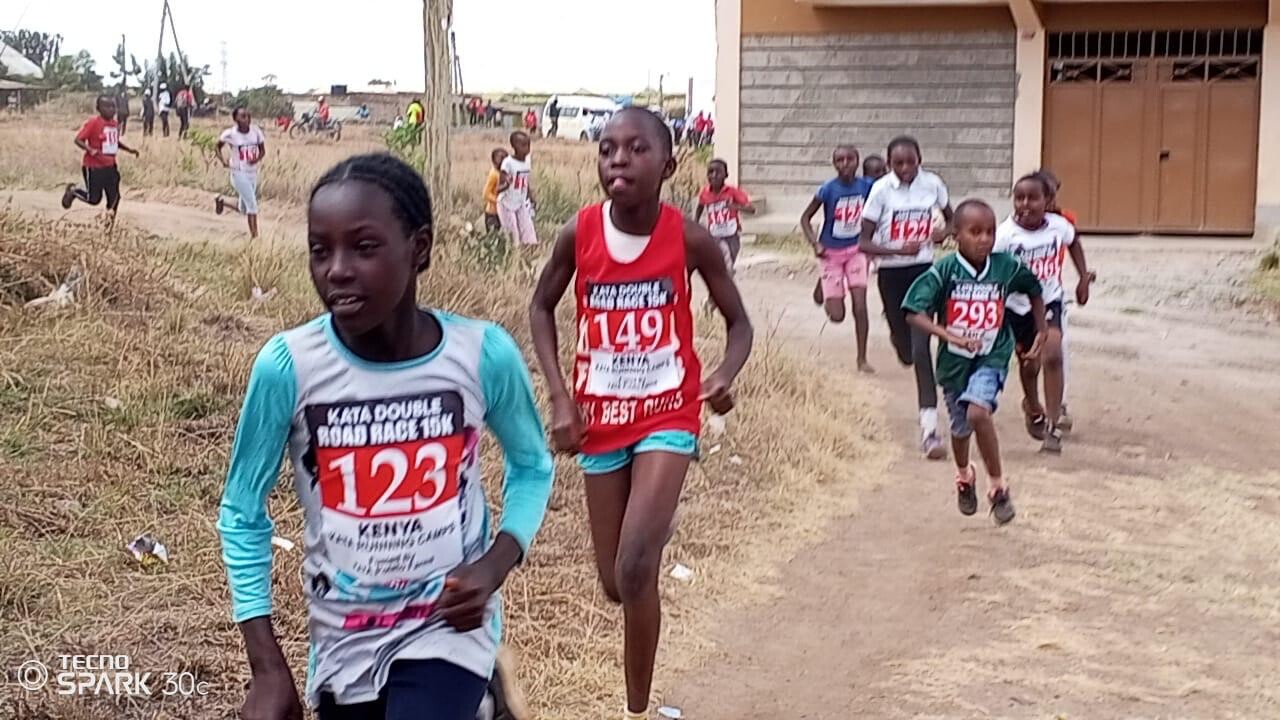
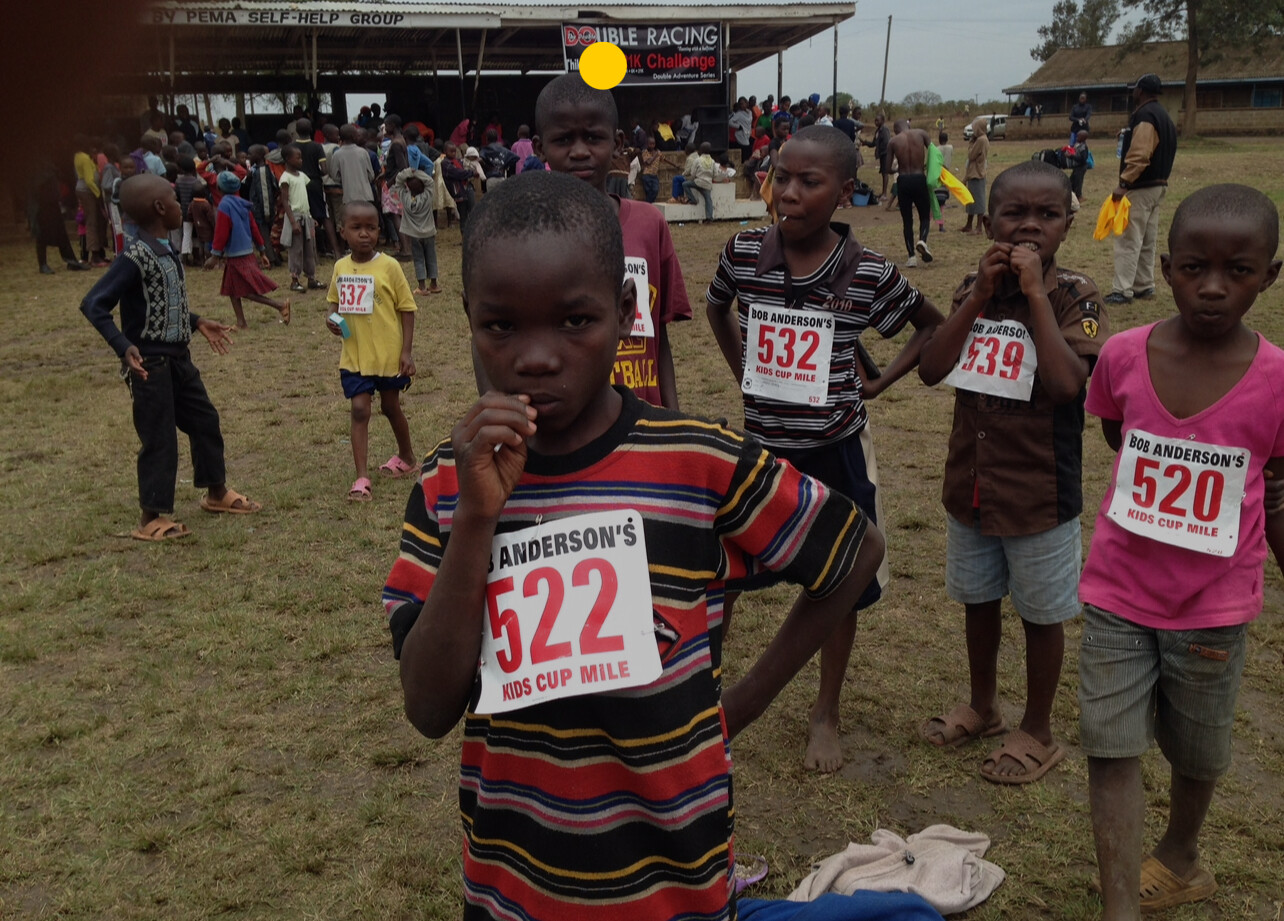
Also today was the Bob Anderson's Kids Mile and the 5K Run/Walk.
by Coach John and Boris Barron
Login to leave a comment
Edwin Soi Going After the World Record at the 5th Annual KATA Double Road Race in Thika Kenya
Over 130 KATA athletes will compete alongside many other runners in a field expected to be the deepest yet, all chasing glory and a share of 100,000 KES in prize money.
When the 5th Annual KATA Double Road Race returns to Thika on September 20, it will not be just another date on the calendar. It will be a celebration of endurance, strategy, and Kenyan running tradition. And at the heart of it all will be Edwin Soi, the Olympic bronze medalist whose longevity and tactical brilliance have made him one of Kenya’s most respected distance runners.
This year’s event also offers a prize purse of 100,000 KES, making the stakes even higher.
“Over 130 KATA athletes are expected to be on the line, joined by many more competitors from across the country and beyond,” says KATA founder Bob Anderson. “I am so proud of our KATA family and what we are building. This is just the beginning—athletics fueled by hard work and growing KATA potatoes.”
The Challenge of the Double
The Double is unlike any other race. Athletes first run a 10K, then take a halftime break where food and drink are provided as they prepare for the second leg. They return to the start line for a 5K. This is a two-leg event, and the times from each leg are added together for the final score.
For Soi—still formidable with career bests of 27:14 (10,000m) and 12:51 (5,000m)—the race is as much about mental strength as physical preparation.
“While others might wonder if they can even start the second race, my mind is already on pacing, form, and tactics,” Soi says. “Years of hard training and the right mental approach make a world record achievable.”
A Visionary Race with Kenyan Roots
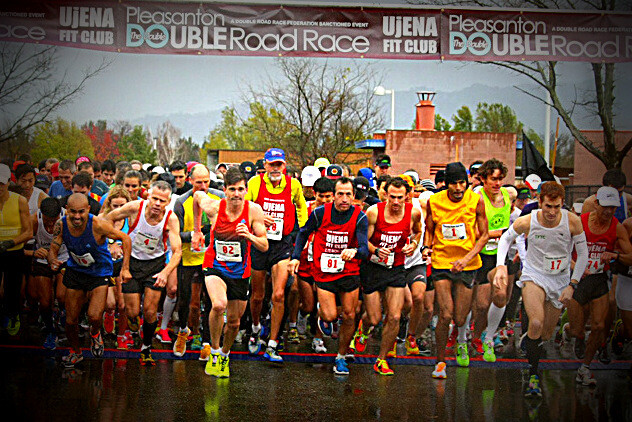
The Double Road Race was created by Bob Anderson, founder of Runner’s World, to combine endurance with strategy. After pilot events in Mexico, the first official Double took place in Pleasanton, California, in 2012 with nearly 1,400 runners (5th photo).
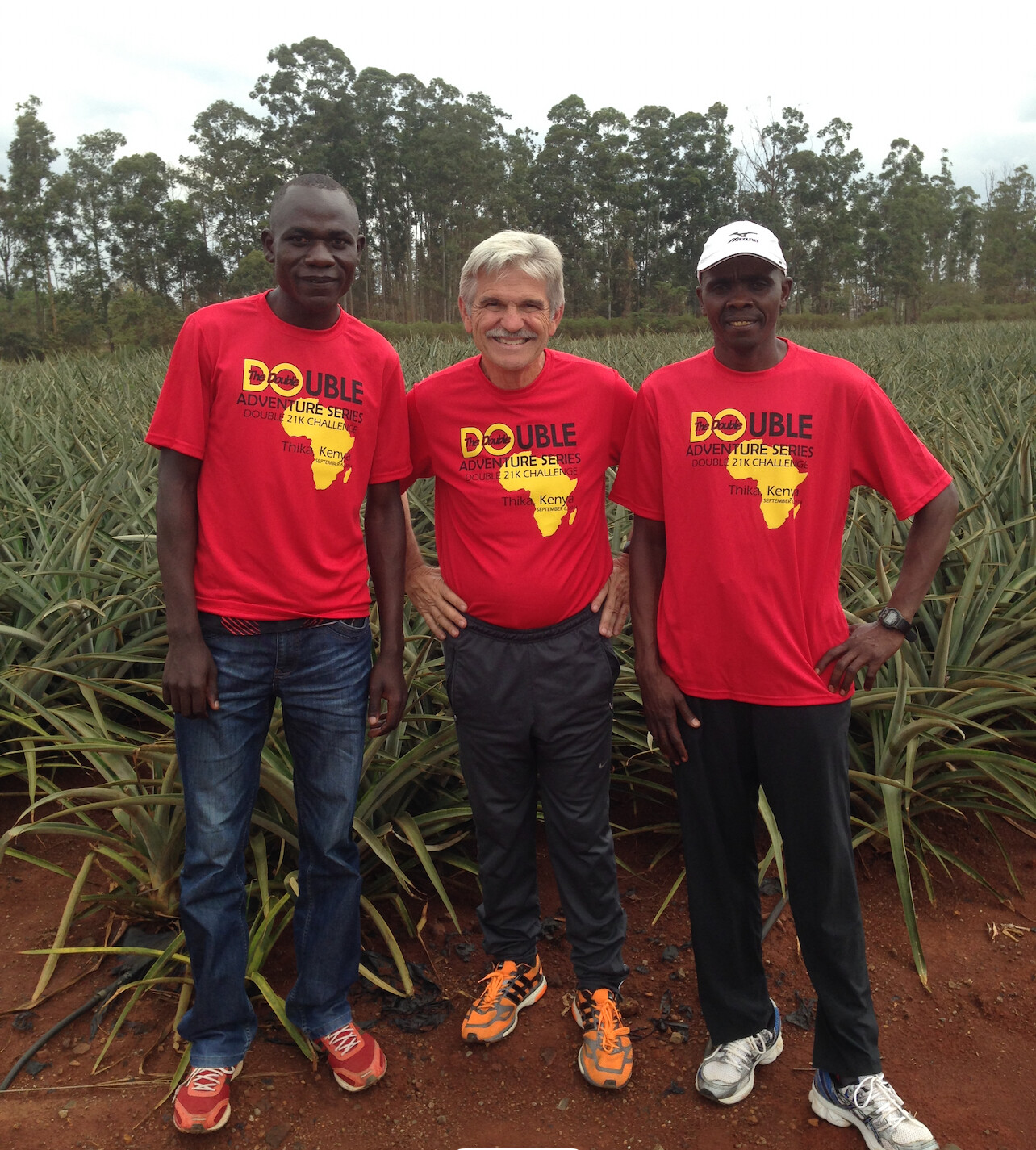
Kenya quickly became a natural home. In 2014, races in Thika and Nyahururu introduced the longer Double 21K. By 2021, the Kenyan Athletics Training Academy (KATA)—also founded by Anderson—hosted Africa’s first Double 15K. Last year, Shadrack Kenduiywo (4th photo) set the world best of 42:34 on the Thika course, cementing Kenya’s place as the epicenter of the Double.
Soi’s Enduring Fire
At 39, Soi has experienced the full arc of an elite career. His defining moment remains the 2008 Beijing Olympics, where he won bronze in the 5,000m behind Ethiopia’s Kenenisa Bekele.
“Just making the Kenyan Olympic team drove me to push beyond limits,” Soi recalls. “I carried the hopes of more than 30 million Kenyans on my shoulders, and that choice ultimately led to my Olympic medal. My life changed—and my legacy changed.”
Since then, Soi has collected world championship medals and road titles worldwide. But today, what sets him apart is not only his victories but also his willingness to mentor and build the future.
Building Futures at KATA
Soi now heads the Kuresoi training camp under the KATA umbrella, guiding a new generation of athletes. His mentorship blends running discipline with life lessons, extending beyond training sessions.
KATA supports athletes with housing, nutrition, and income from sustainable farming projects like potato cultivation—ensuring both food security and financial independence. For Soi, this holistic model is crucial.
“I was fortunate to be mentored, and I feel a deep responsibility to pass that on. My victory will be in their success,” he says.
He also stresses integrity. With doping controversies tarnishing Kenyan athletics, Soi is determined to show that excellence can come from discipline, clean sport, and mentorship.
Why Thika Matters
The Thika Double has become more than a race; it is a stage where Kenyan athletes showcase strategy and resilience to the world. For the community, it is a festival of pride. For Soi, it is a chance to extend his legacy—competing for the clock, for his athletes, and for the values he believes in.
When the starter’s gun sounds on September 20, Soi will not only be racing 10K, resting, and running 5K. He will be carrying with him the arc of his career—from Olympic glory to mentorship—and the hopes of a new generation ready to follow in his footsteps.
The Double demands more than speed. It asks for resilience, intelligence, and composure. And with Edwin Soi on the line in Thika, chasing the world record, it promises to be a race—and a story—that inspires far beyond the finish.
by Robert Kibet
Login to leave a comment

KATA Double Road Race 15K
5th Annual KATA Double Road Race 15K Set for September 20, 2025, at KATA Thika The 5th Annual KATA Double Road Race 15K will be held on September 20, 2025, at the Kenyan Athletics Training Academy (KATA) in Thika, Kenya. The event includes a 10K leg, a break, followed by a 5K leg — a format designed to challenge runners...
more...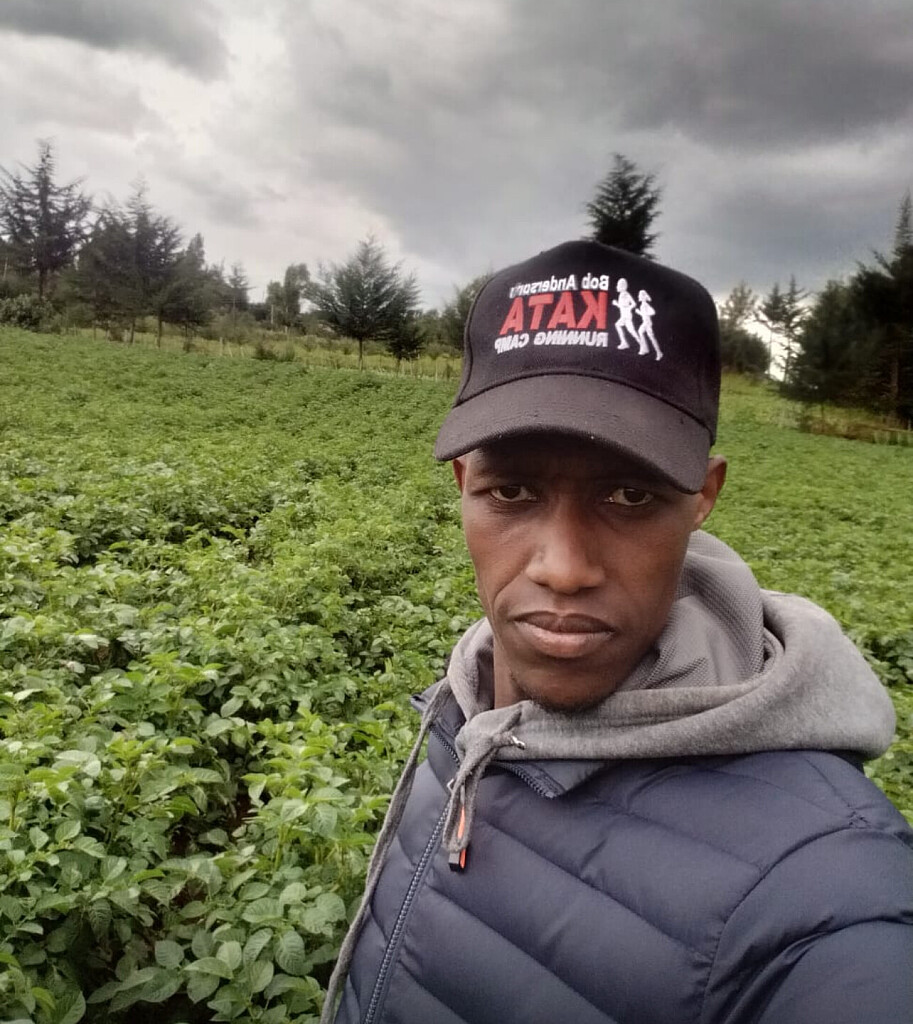
Dreams in Motion, Roots in the Soil: Emmanuel Kiptoo Langat, the Runner Behind Potato Farming Projects
KERICHO, Kenya - At dawn in Kericho’s highlands, the red dirt roads echo with the rhythmic sound of running feet. Among the lean silhouettes slicing through the mist is Emmanuel Kiptoo Langat (Manuu), a 33-year-old road runner whose journey began in the rugged terrain of Chorwa, a small village in Nakuru County bordering Kenya’s vast Mau Forest. His story is not just about chasing personal bests but also about cultivating resilience—both on the track and in his community.
Roots in Chorwa
Chorwa is a remote village in Kuresoi, where life is as harsh as it is beautiful. The nearby Mau Forest shelters wildlife and rivers that feed the Rift Valley, but daily survival was a struggle.
“Life there was very hard—even getting food was a problem,” Emmanuel recalls. School added its own challenges: he often ran 10 kilometers each way just to attend class. What began as necessity became passion. “On sports day, I ran all the way to the national level. That’s when I knew I could run.”

His spark was fueled by Olympian Edwin Cheruiyot Soi, who runs a training camp in Kuresoi with support from the Kenya Athletics Training Academy (KATA). “He motivated me to believe running could change my life,” Emmanuel says.
First Strides in Athletics
In 2016, encouraged by a friend, Emmanuel joined a training camp in Kericho. His breakthrough came at a 10,000m race in Kisumu County. “That race gave me hope,” he says. A highlight followed at Nairobi’s Kasarani Stadium in a 5km race: “I enjoyed it so much. I will never forget that day.”
Challenges were constant. Running shoes were scarce, and he often relied on friends for gear. Yet his times speak volumes: 13:20 for 5000m, 28:04 for 10km, and 63:00 for the half marathon—marks that confirm his talent in Kenya’s deep distance-running field.
Balancing Running and Farming
While pursuing his running dreams, Emmanuel also supervises the KATA potato farming initiative, a project led by Bob Anderson, founder of Runner’s World magazine and the Kenya Athletics Training Academy.
“When I saw this project, I was happy because it could support many athletes,” he says. Emmanuel oversees planting, harvesting, and distribution—work that helps athletes cover food and camp needs. “It’s unique because it gives us stability, letting us focus more on training and performance.”
For him, farming mirrors running: “From athletics I’ve learned discipline and patience. From farming I’ve learned resilience and the value of hard work.”
A Bridge Between Sport and Sustainability
The synergy between running and agriculture provides athletes with more than meals—it provides a safety net. “Farming gives us a stable source of income beyond running. It offers security for the future,” Emmanuel says.
Transformation Through Running
Running has given Emmanuel confidence, friendships, and economic stability. His family, once burdened by poverty, now supports him wholeheartedly. “They see athletics and farming giving me direction and stability,” he explains.
Giving Back and Inspiring Others
In Chorwa, young runners now look up to Emmanuel as he once looked up to Edwin Soi. His message is simple: “Be disciplined, patient, and never give up, because success in running takes time.”
He hopes to mentor future athletes and be remembered not only as a runner but also as “a supervisor who supported others and a role model who uplifted the community.”
Life Beyond the Track
When not training or supervising farms, Emmanuel relaxes by watching football—he is a devoted Manchester United fan. Yet his heart remains tied to running, each stride reminding him of the Mau Forest, his beginnings, and the community he represents.
The Road Ahea
Emmanuel’s eyes are fixed on improving his half marathon and marathon times. His journey reflects more than athletics—it embodies resilience, sustainability, and shared success.
“Running is not just about speed or endurance,” he says. “It’s about rising from hardship, cultivating dreams like potatoes in the soil, and sharing the harvest with others.”
As the sun sets over Kericho’s hills, Emmanuel prepares for another early morning run—carrying not only his ambitions but also the hopes of a community where sport and sustainability run side by side.
by Robert Kibet
Login to leave a comment
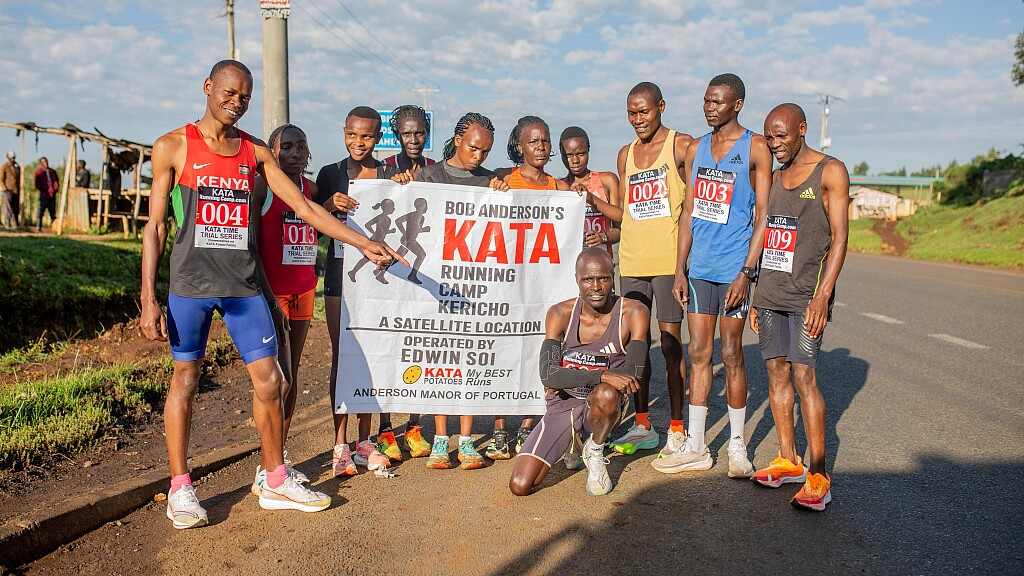
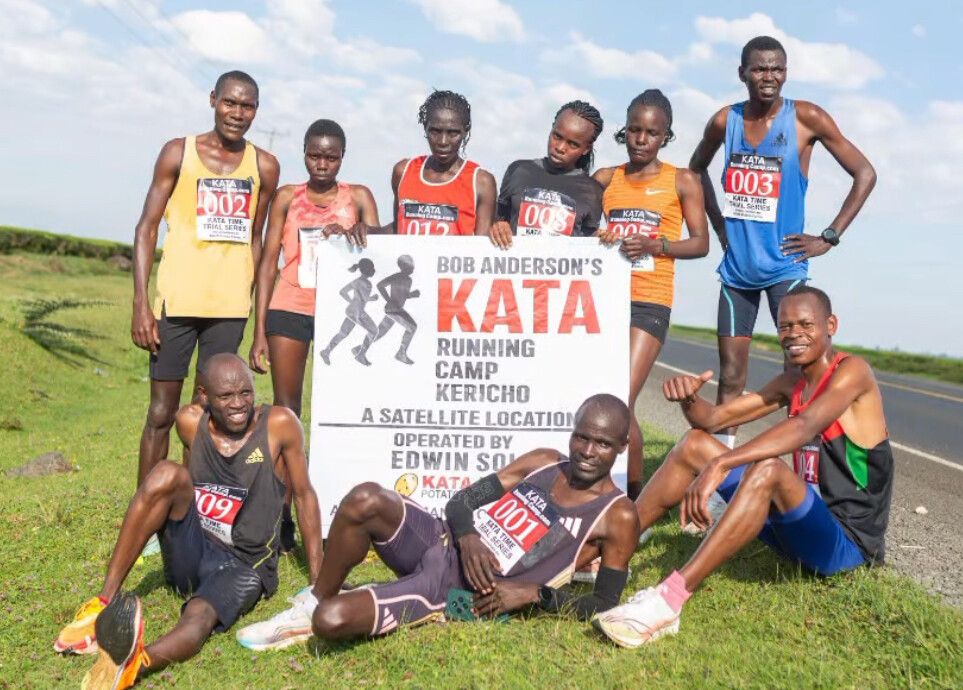
Altitude Excellence: KATA Kericho Time Trial Delivers Standout Performances at Camp K05 Operated by Edwin Soi
Location: KATA Running Camp K05 – Kericho, Kenya (Operated by Olympic medalist Edwin Soi)
Elevation: 2,333m | Weather: Fair, ~21°C
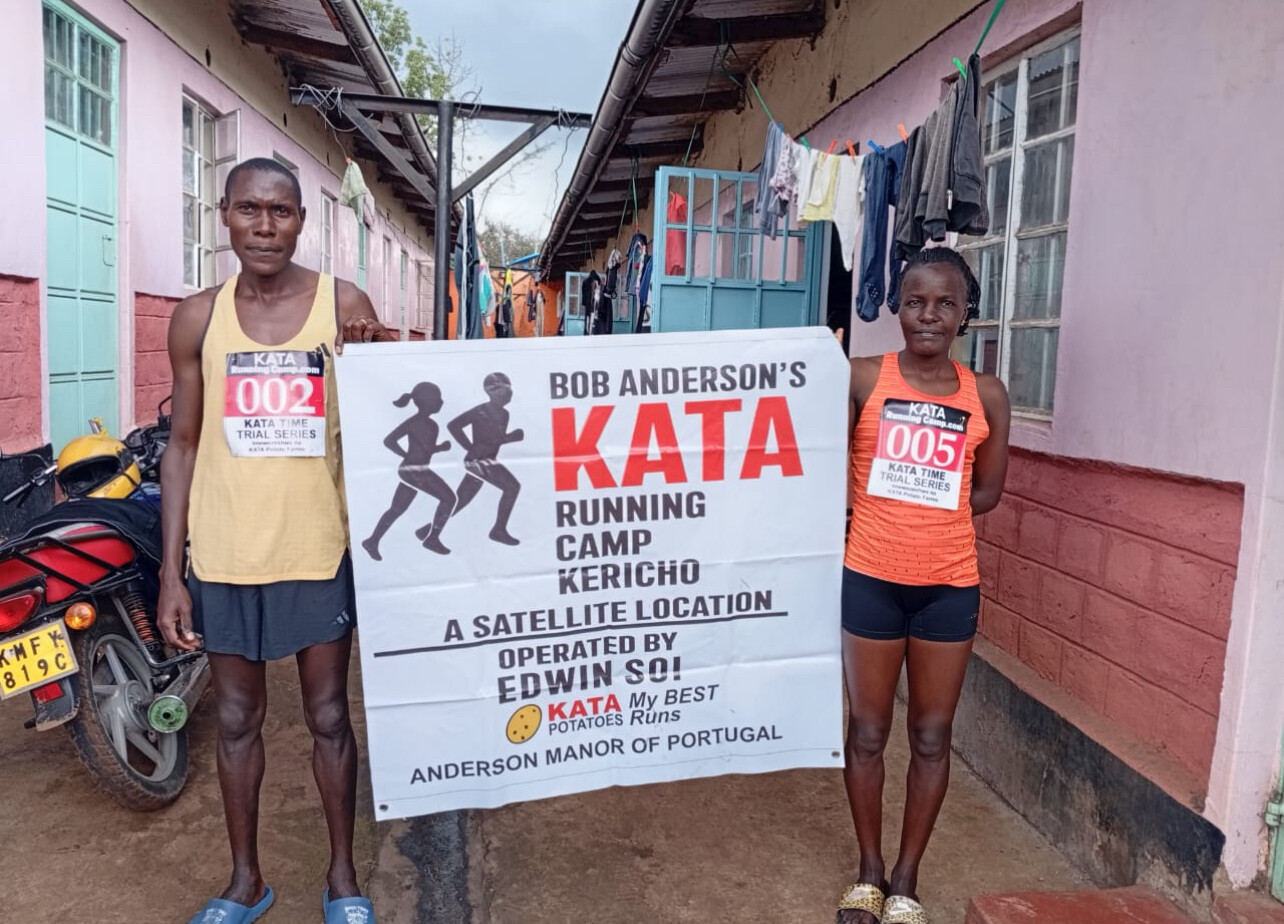
Event Type: Team Time Trial August 13, 2025
Course: Mixed-terrain – 5km for two ladies, 10km for the remaining nine participants
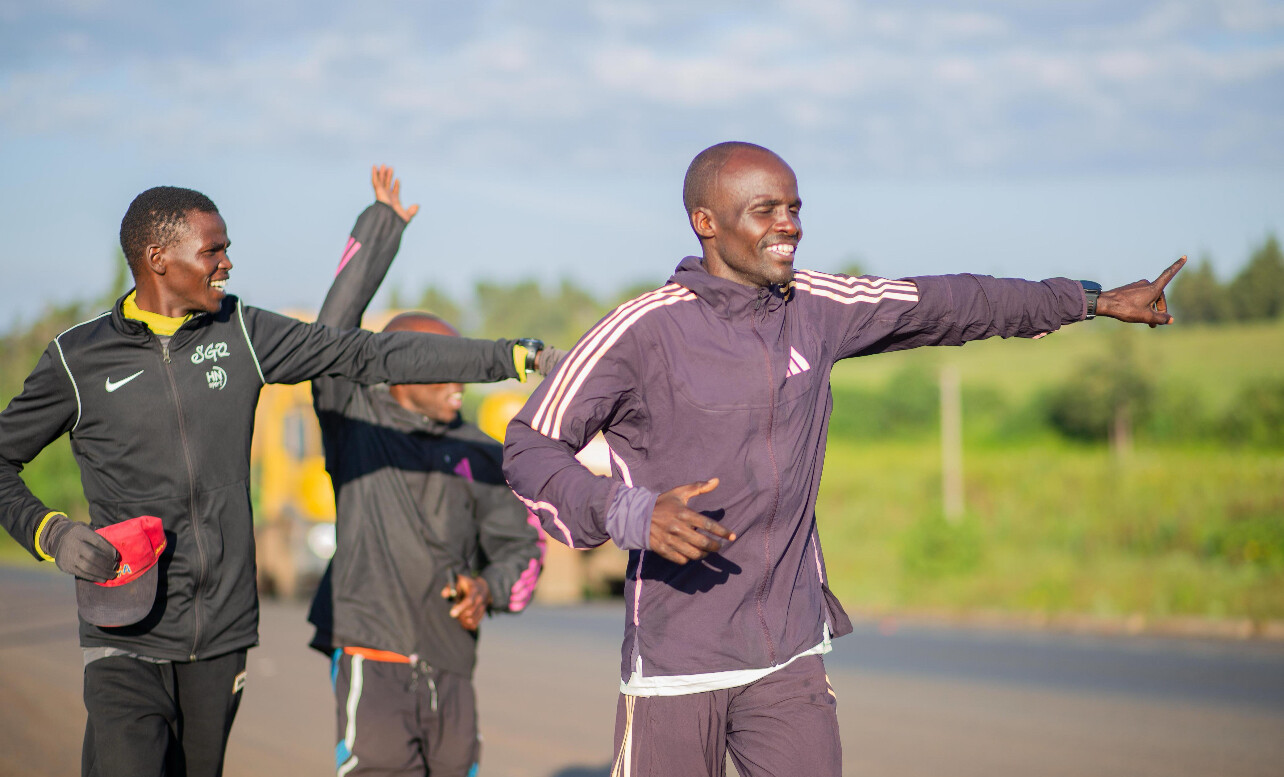
The KATA Kericho Time Trial, held at KATA Running Camp K05 under the leadership of Edwin Soi, was a strong showcase of talent and endurance. Situated at high altitude in Kericho, the camp is part of KATA’s expanding network of running camps across Kenya, combining elite-level training with the KATA Potato Farm initiative.
A total of 11 athletes took part in this test of fitness—two ladies in the 5km race, and six ladies plus four men in the 10km race. Despite the challenging mixed-terrain course, participants delivered exceptional performances, with 95% reaching peak effort levels.

Highlights & Key Observations
• Inclusive Format: The split-distance format allowed athletes of varying strengths to perform at their best, with two ladies in the 5km and nine athletes in the 10km.
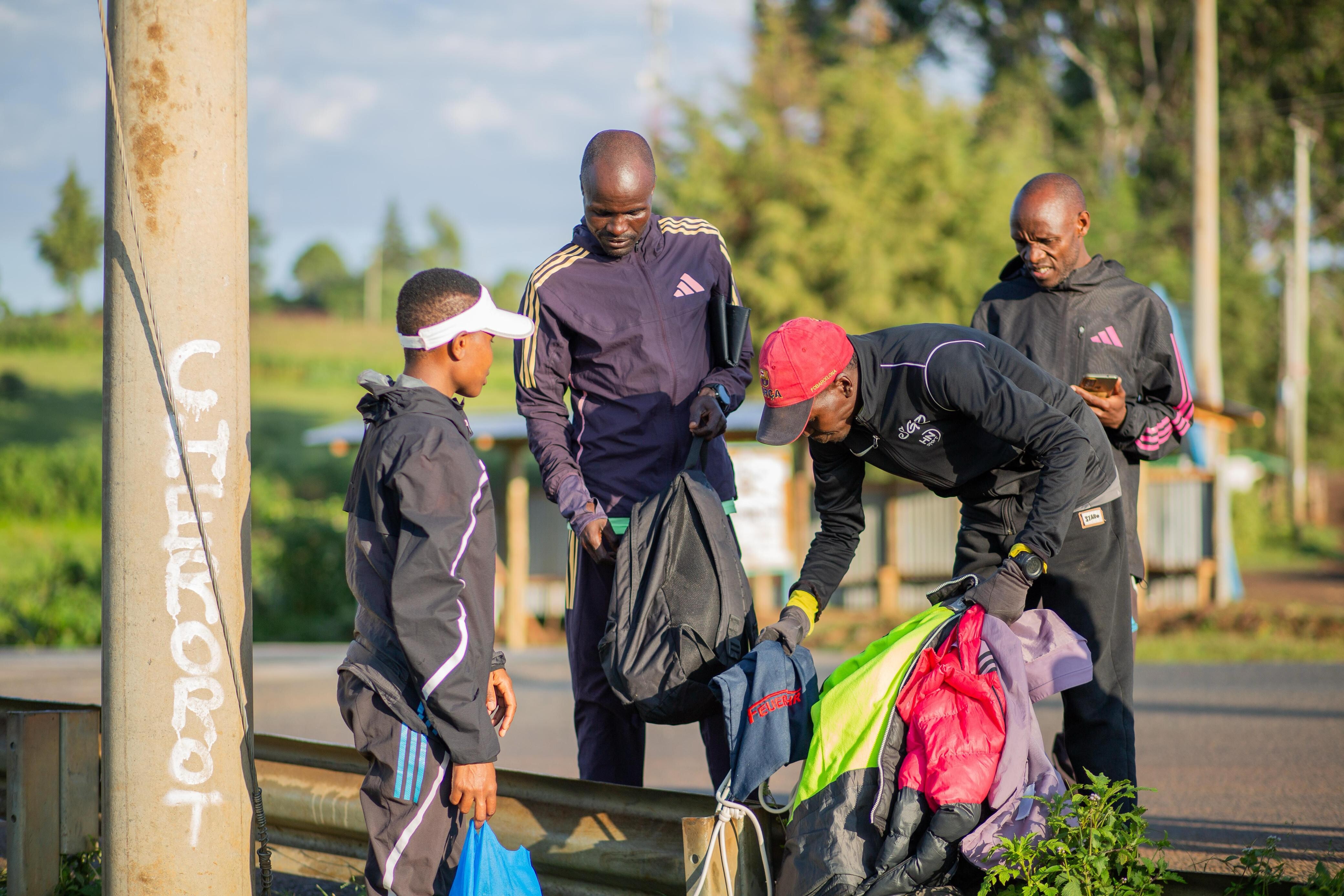
• Progressive Results: Times reflect steady improvement across the group, showing that training methods are paying off.
• Altitude Mastery: At 2,333m, altitude can be a major factor, but the athletes were well-acclimatized and showed no signs of altitude-related fatigue.
• Injury Note: One athlete sustained a hamstring injury and was immediately attended to by the medical team. A recovery plan is underway.
Results
5km Ladies
1. Sharon Cheptoo (DOB 2003) – 16:56
2. Margaret Ndirangu (DOB 2003) – 17:55
10km Men
1. Edwin Soi (DOB 1986) – 28:05
2. Edmond Rono (DOB 1995) – 28:19
3. Isaiah Kipkurui (DOB 1999) – 28:22
4. Gilbert Kenduiywa (DOB 1989) – 29:05
5. Gilbert Korir (DOB 1990) – 29:20
10km Ladies
1. Chebet Winny (DOB 2004) – 32:45
2. Faith Chepkoech (DOB 2004) – 35:05
3. Joice Kirui – 35:20
4. Pamela Cherotich (DOB 1986) – Injured during race
Conclusion
The KATA Kericho Time Trial at KATA Running Camp K05, guided by Edwin Soi, was a clear demonstration of the dedication and progress of the athletes. With continued training, strategic recovery, and strong leadership, this group is on track for even greater success.
by Boris Baron
Login to leave a comment
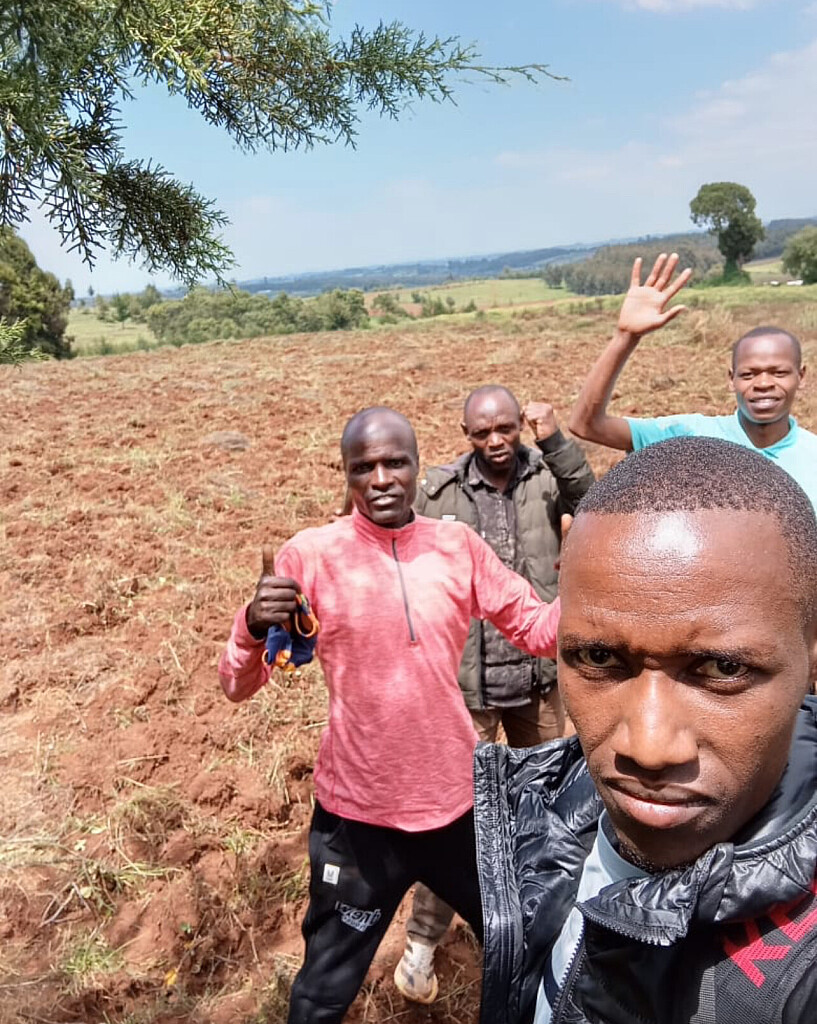
More Than a Medal: How Olympian Edwin Soi is Shaping the Future of Kenyan Running - KATA 05
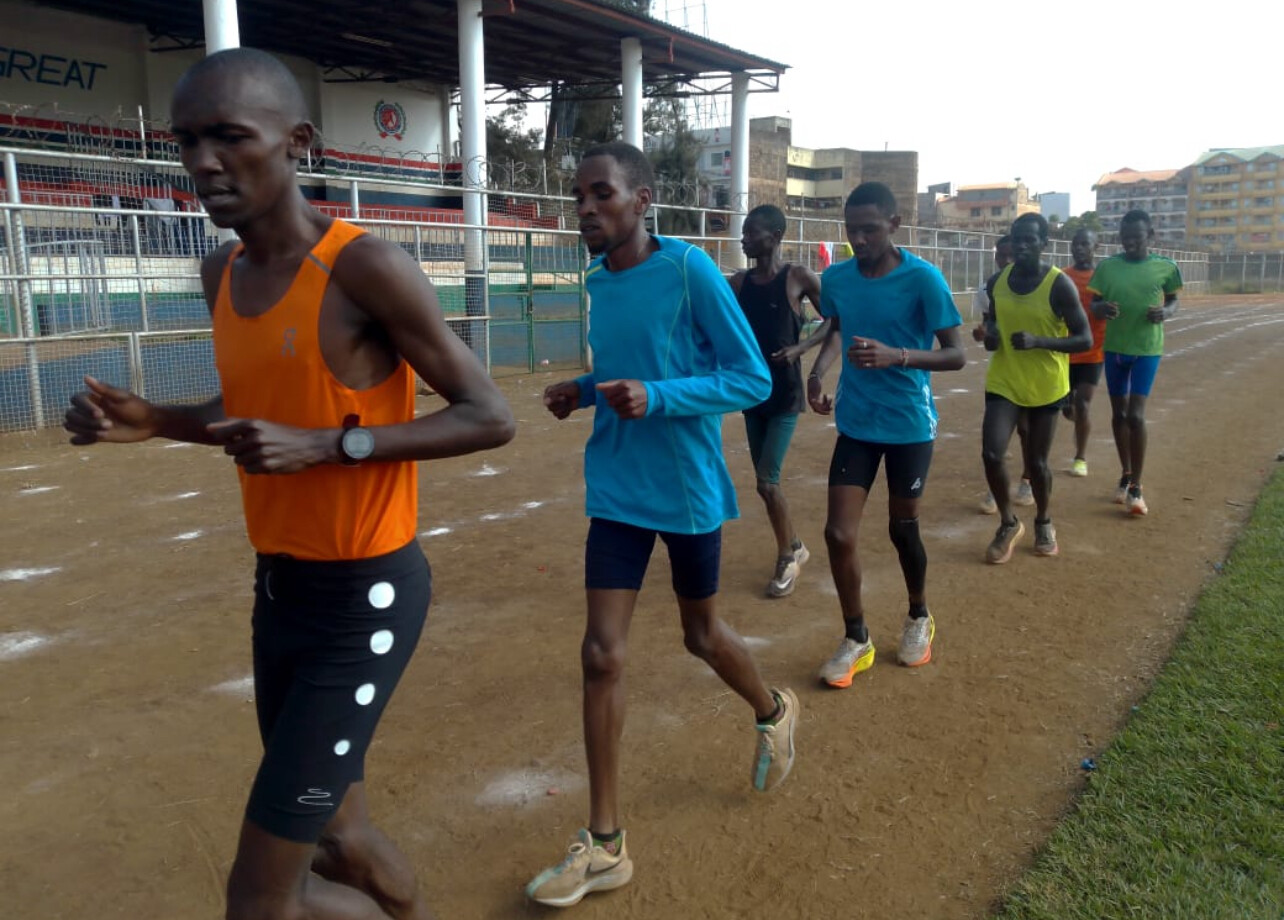
In the misty highlands of Kuresoi, nestled at a staggering 2,700 meters above sea level, an elite training camp quietly hums with the sounds of determination — rhythmic footfalls, laboured breaths, and the occasional cheer of encouragement.
Along reddish-brown murram trails, sandwiched between dense trees of the Mau Forest, young athletes glide through the early morning fog. This is no ordinary running camp. It is the dream and daily labour of Edwin Cheruiyot Soi, one of Kenya’s most decorated long-distance runners, now turned mentor, marathoner, and coach.
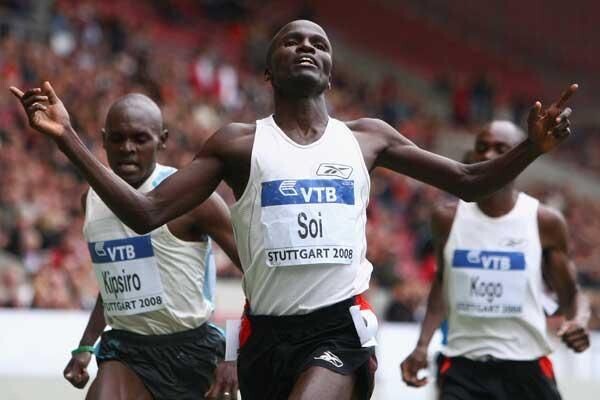
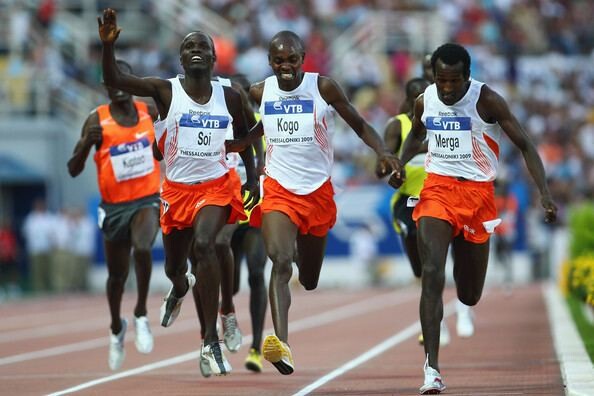
Soi, known for his Olympic bronze medal in the 5000m at the 2008 Beijing Olympics and a glittering career on the track, hasn’t slowed down. While many of his peers have moved on from competition, Soi remains actively racing marathons, coaching, and living side by side with a rising generation of athletes.
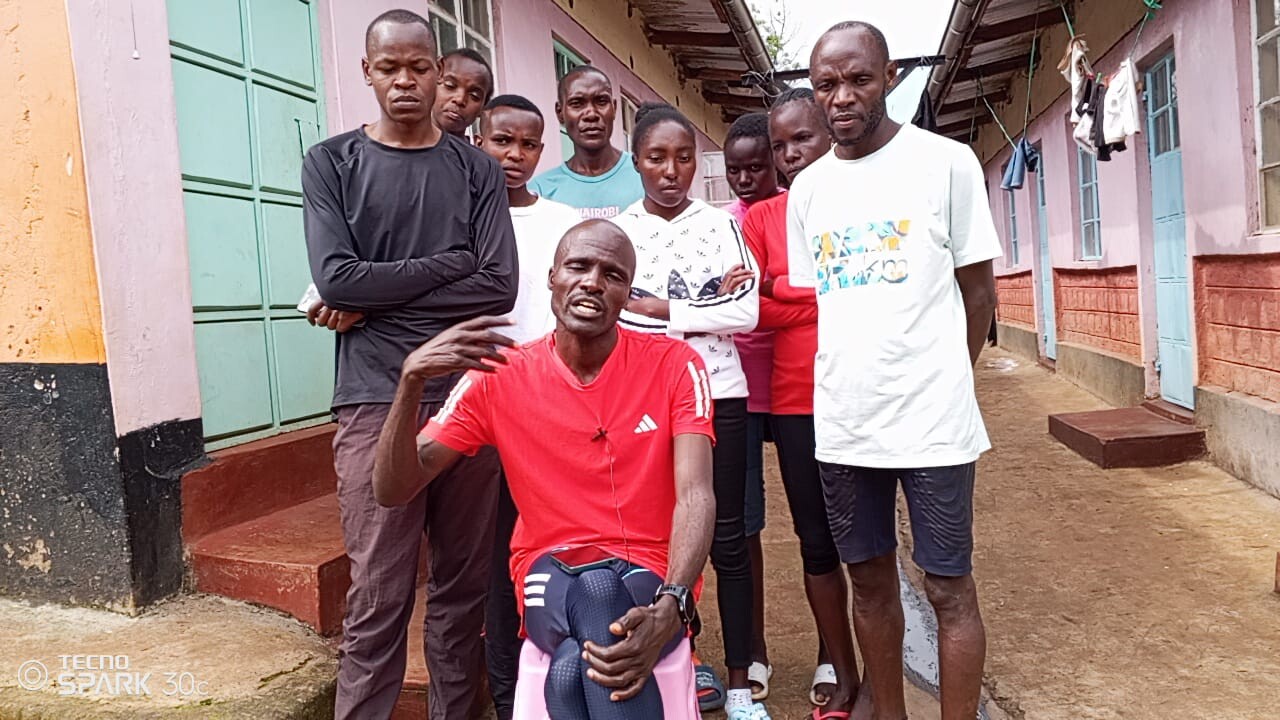
“I have run for long, from World Championships and World Indoors to the Olympics,” Soi says after a long training session. “With all that experience, I saw it wise to share my expertise — not just with young athletes, but with anyone willing to train with discipline.”
Still Racing, Still Leading
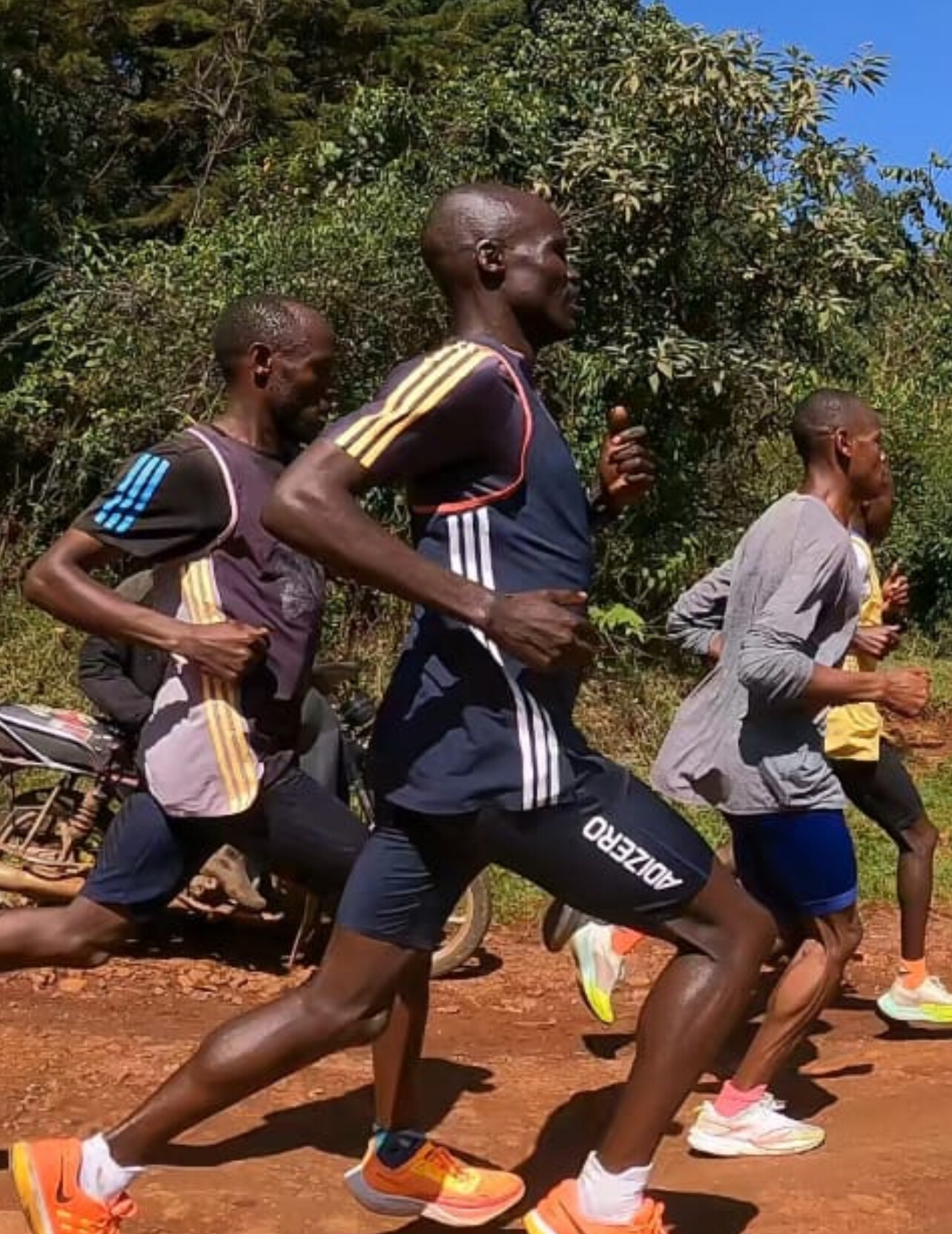
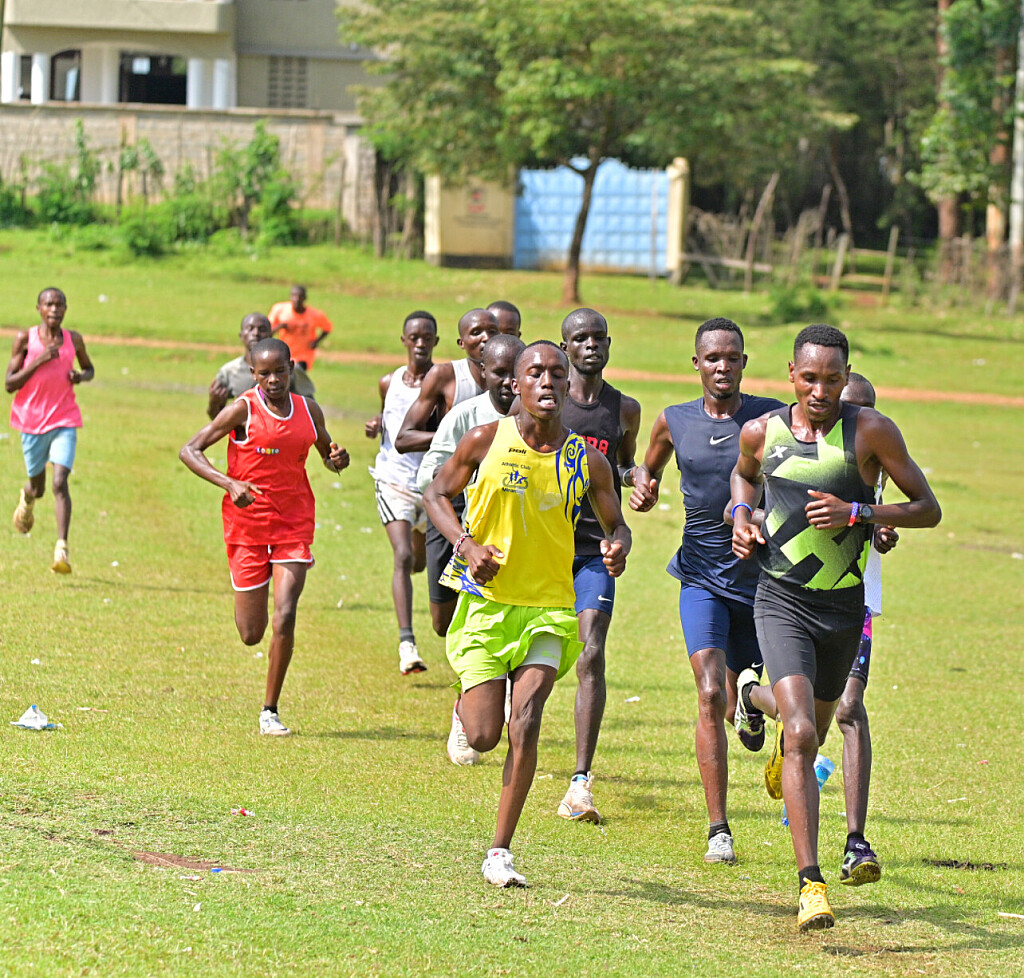
Every morning, Soi joins his athletes in their rigorous routines. From tempo runs along the forested trails to fartlek and speedwork sessions, he leads by example.
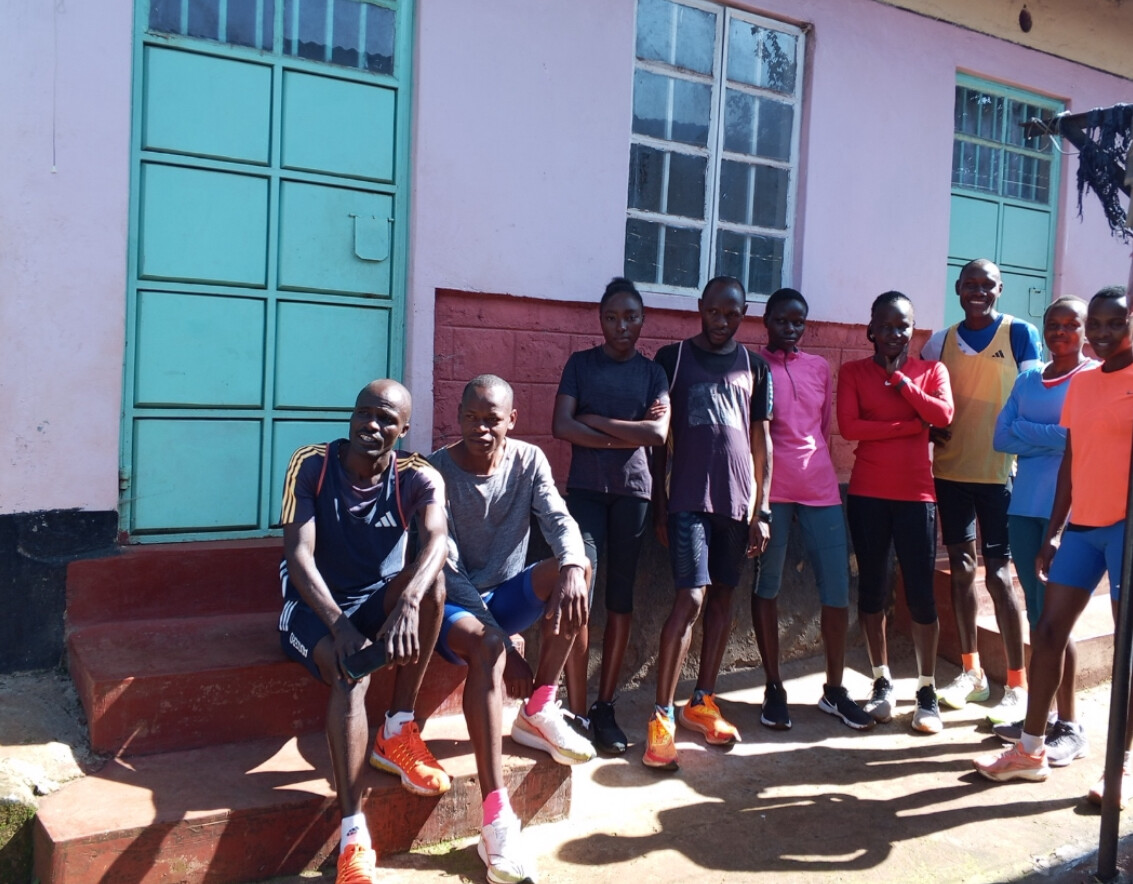
“My athletes don’t just see me as a coach — I run beside them,” he says. “They learn from how I train, rest, and carry myself. That’s leadership by presence.”
For the athletes, it’s not only inspirational — it’s transformational.
Margaret Ndirangu, a promising athlete from Central Kenya, beams with gratitude:
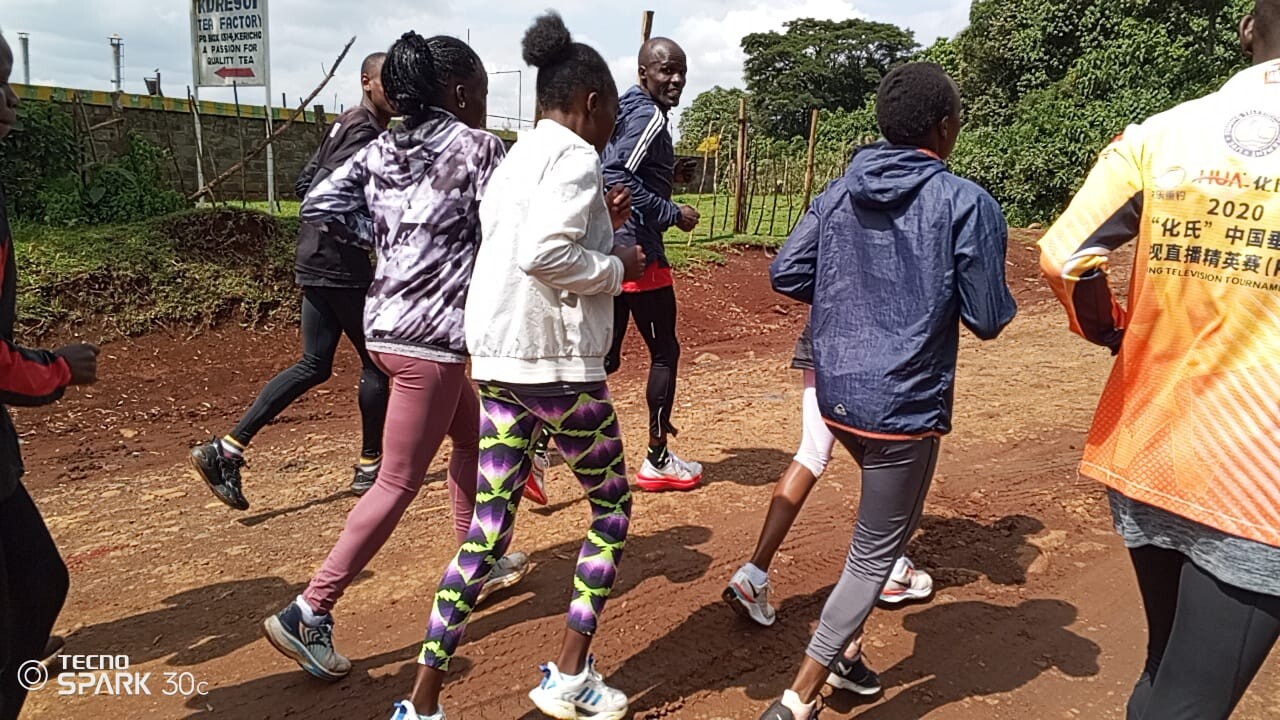
“I have nothing more than joy. Being at Soi’s camp is more than home to me. We eat well, sleep well, and train well. Running alongside an Olympian like Edwin Soi is a huge motivation.”
Gilbert Kenduiywo, a full marathon runner, agrees:
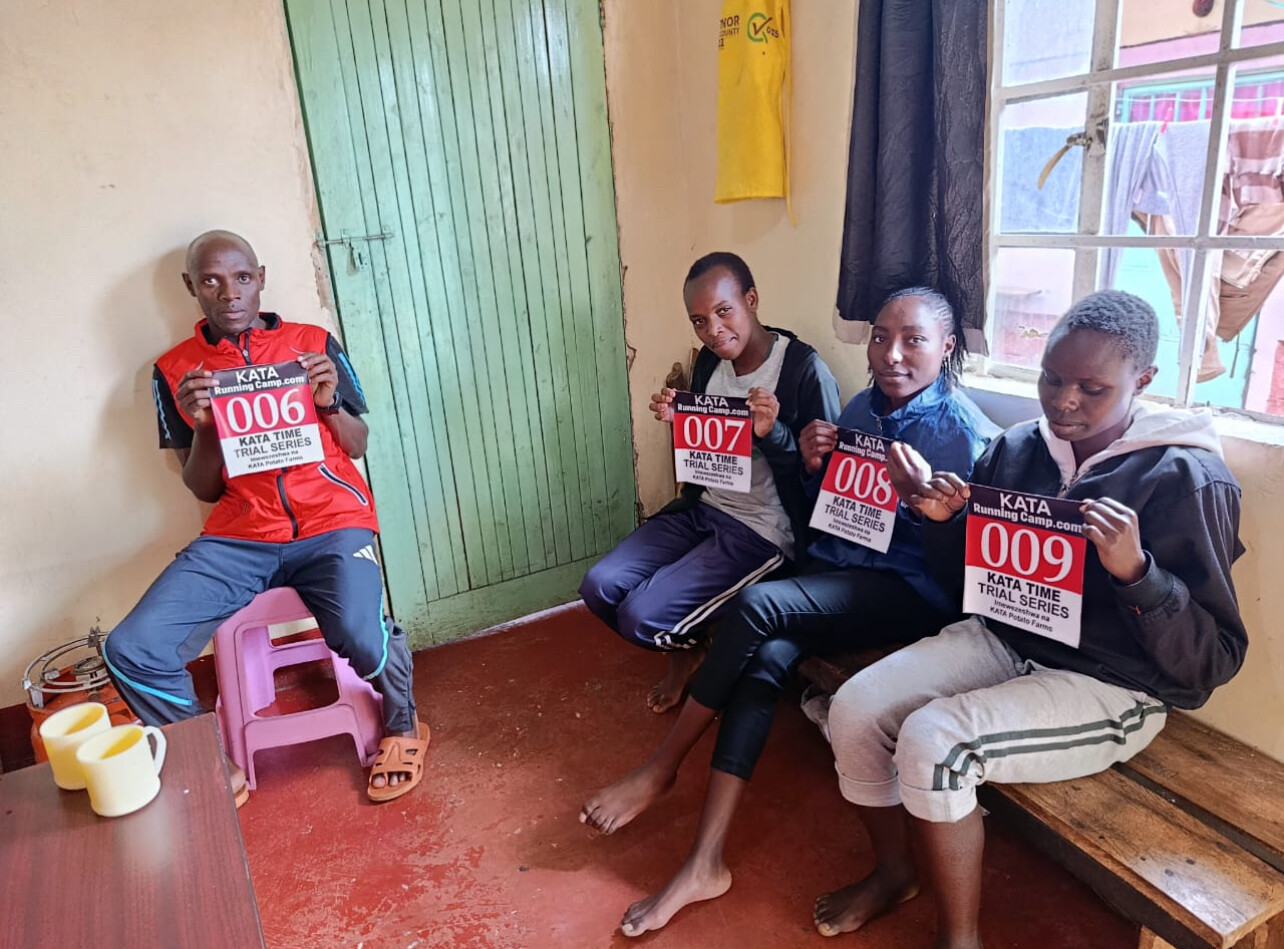
“I thank Soi because he has brought us from where we were, courtesy of Bob Anderson. Running involves dedication, and it is through this that we now have a place to live, eat, and train. I also thank Bob Anderson for the noble idea. Engaging in farming as an income-generating activity after training means a lot to us.”
Kuresoi: Nature’s Perfect Stadium
The rugged beauty of Kuresoi is more than just scenery; it's a natural high-performance lab. The red-earth trails, the crisp mountain air, and the altitude of 2,700 meters form the ideal foundation for endurance athletes.
“Our routes weave through Mau Forest,” Soi says, pointing to a distant hill where runners disappear into the mist. “These aren’t just trails. They’re tests of character.”
The KATA Vision: Running with Purpose
Soi’s training camp is backed by the Kenyan Athletics Training Academy (KATA), founded by Bob Anderson, the visionary behind Runner’s World magazine. But what makes this camp stand out isn’t just the training — it’s the fusion of sport and sustainability.
With support from KATA, Soi and his athletes engage in agricultural projects, most notably the Potato Project. When they’re not clocking miles, runners plant, harvest, and manage farming plots — gaining not only a source of income but vital life skills.
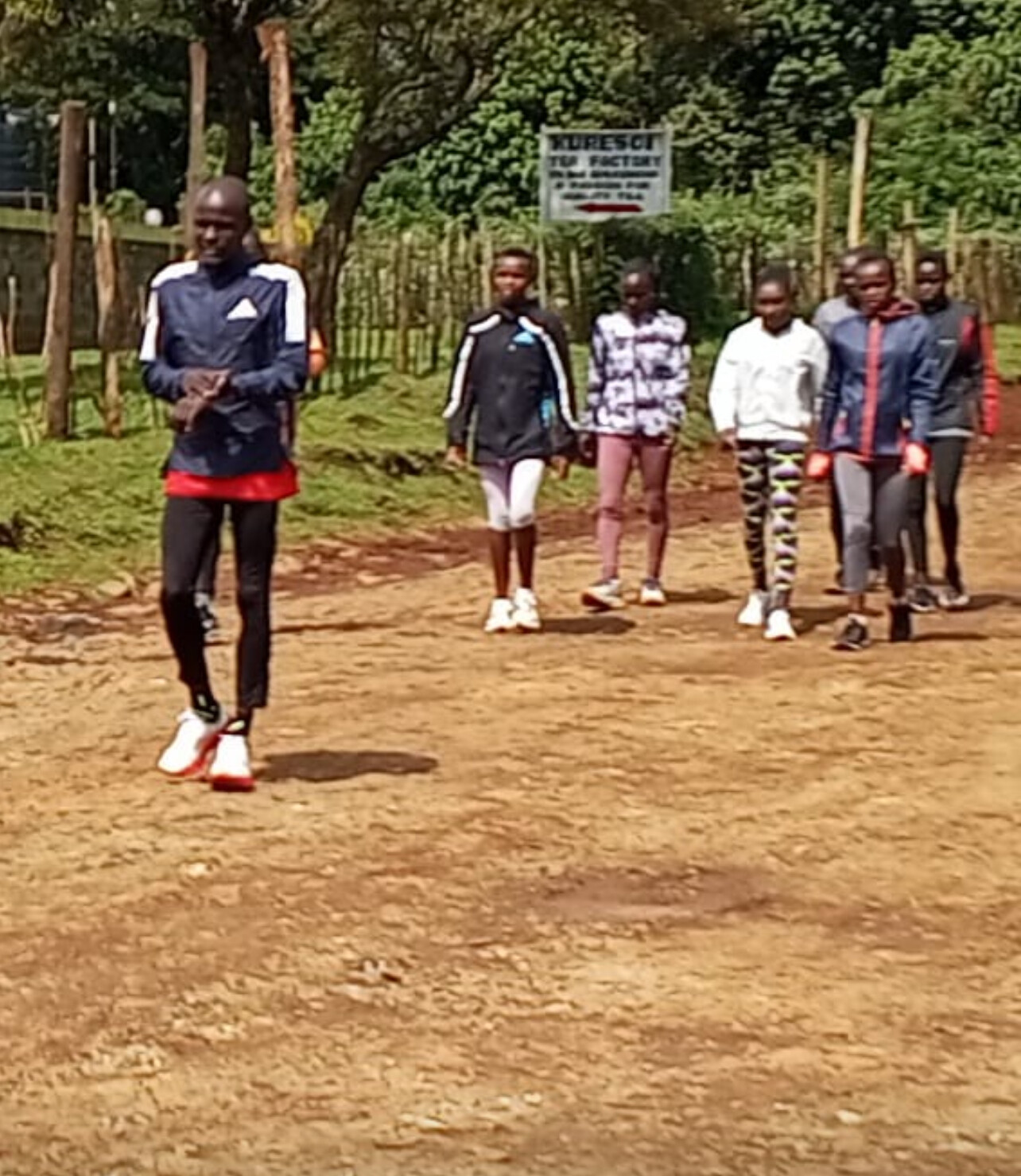
“No one else had thought of supporting athletes this way — giving them both a place to grow athletically and financially,” says Soi. “Bob’s idea came at the perfect time.”
Athletes echo this gratitude.
Edmond Rono, a distance runner from Sotik, shares:
“I used to train in Sotik, but after joining Soi's camp—supported by KATA—I’ve experienced a complete transformation. We stay comfortably and enjoy everything from training, meals, to accommodation. My future now looks bright.”
Isaiah Kipkurui, a road runner, adds:
“The support from KATA through Edwin Soi has meant a lot to us as athletes. Since joining the camp, we’ve seen remarkable improvement in our performance and lifestyle.”
Cheptoo, a 3000m specialist with a personal best of 9:30, also credits the camp for her progress:
“Coming from Sotik and joining Soi’s camp has been a turning point. Accessing proper meals and accommodation as an athlete is a great opportunity. I’m now preparing for the upcoming cross-country races this month.”
And Winny Chebet, a determined 10,000m runner, shares:
“The opportunity given to me through Soi’s camp, supported by KATA, has made me optimistic. I believe my future is bright, and I will be able to hit my running targets.”
Running Clean, Running Proud
While training and farming form the physical and economic backbone of the camp, discipline and integrity shape its soul. Soi is fiercely committed to clean sport — a principle he insists every athlete lives by.
“My athletes know I’m strict,” he says. “There’s no shortcut in this sport. I do not support doping, and I never will. If you want to enjoy the fruits of your labor, you must do it right.”
In a time when Kenyan athletics has been shaken by doping scandals, Soi’s stance is both timely and bold. His camp stands as a model of ethical training, and his leadership provides athletes with more than a place to train — it gives them a moral compass.
Beyond the Finish Line
Soi knows his racing clock is ticking. Though still active in marathons, he estimates he has two or three years left of elite racing. But that doesn’t worry him. His eyes are fixed on the future — one that includes hundreds of young athletes inspired and supported through his camp.
“I’m not just training runners,” he says. “I’m building people. Strong, disciplined people who will take Kenyan running to the next level.”
He acknowledges the crucial role of Athletics Kenya and the Ministry of Sports in establishing youth training camps nationwide. “Their efforts align perfectly with our vision here,” he says. “We’re all working toward the same goal — to empower youth through athletics.”
A Legacy Written in Footsteps
As the sun rises over the Mau Forest and the last runner finishes the morning loop, Soi jogs back toward camp with his group, his figure still strong, still focused. Around him are the dreams of others — a living tribute to his journey.
He’s a man who knows the podium. But today, Soi’s greatest pride isn’t in medals or titles. It’s in the smiles, strength, and discipline of those who now run beside him.
“Running gave me everything,” he says. “Now, I give back — through sweat, through sacrifice, and through the soil we farm together.”
In Kuresoi, the second wind of Edwin Soi is not a comeback — it’s a new beginning, and it’s lifting others with every stride.
by Robert Kibet
Login to leave a comment
Powered by Potatoes, Fueled by Passion: Inside the Rise of KATA in Kenya
THIKA, Kenya, July 18, 2025 — About 40 kilometers northeast of Nairobi sits Thika, a town once best known for its factories. But just outside its bustling center, a quiet revolution is taking place—one that’s redefining how running talent is discovered and developed in Kenya.
Welcome to the Kenya Athletics Training Academy (KATA)—a visionary project founded by Runner’s World and My Best Runs creator Bob Anderson (first photo) and powered by a bold and sustainable idea: combine world-class running with community farming. What began in 2019 as a modest base has grown into a thriving network of athletic development across Kenya.
Thika: The KATA Running Retreat
At the heart of it all is the KATA Running Retreat in Thika, where Kenyan athletes live and train full-time, and where guests from around the world come to “train the Kenyan way”. Situated at altitude, the retreat offers structured training, rest, nutrition, and performance monitoring on a measured course.
Thika is managed by Christopher Kamande (photo 4), who ensures that the vision is executed with care and discipline.
“We provide a safe space for these athletes,” says Kamande. “They get everything they need—meals, coaching, rest, even digital support for their racing profiles. We treat them like the professionals they’re becoming.”
Athletes’ verified performances are uploaded to My Best Runs by Elam Wangwero (photo 5 when he met Bob and his wife Catherine for the first time in 2014), KATA’s digital lead and longtime collaborator with Anderson. “When someone runs 28 minutes here, the world should know about it,” he says.
A Model That’s Growing Across Kenya
Since June 2025, the KATA team has launched a new initiative: combining elite training camps with three-acre potato farms to build sustainable, athlete-driven communities. In just six weeks, 30 new KATA Running Camps and KATA Potato Farms have been established across Kenya, with two more set to open by August 1, bringing the total to 32.
“This gives us 32 KATA Camps and Farms,” says Anderson. “It has been exciting to find operators who share the same passion as I. We have an amazing group of operators—all dedicated to our unique project. They all know how important their three-acre potato farm is, because that’s what will power their camp in the long run.”
At each location, athletes work 25 hours a week planting, maintaining, and harvesting potatoes. In return, they receive free housing, daily meals, and world-class coaching—a holistic model designed to develop both athletes and communities.
“This model gives athletes a chance not just to run, but to build a life,” says Kamande. “It teaches responsibility, sustainability, and teamwork.”
Time Trials that Open Door's
KATA’s monthly 5K and 10K time trials (phot two) certified and measured, are held on the Thika course and have become a trusted platform for athletes to showcase their ability to race organizers and sponsors worldwide. “Our monthly time trials were started September 2021,” says John KATA’s head coach, “we have seen many amazing performances both from our KATA’s athletes and others.” All runners are invited to come run.
“These time trials are life-changing,” Kamande says. “Many of our runners don’t have agents or the means to travel to big races. So we bring opportunity to them.”
Results are published on My Best Runs, offering a transparent, verified path to the world stage.
From 34 Minutes to 27:47
Before the farming project began, KATA was already changing lives—and Peter Mwaniki Njeru (photo three) is one of its earliest and most powerful success stories.
“When Peter first came to KATA,” recalls Anderson, “he was running around 34 minutes for 10K.” Through structured training, support, and work around the Retreat, Peter steadily improved. In 2024, he stunned the running world by winning the Chicago 10K in 27:47.
A Legacy Rooted in Vision
At a time when many athletes in Kenya pay to train, live in overcrowded rooms, and struggle for basic support, KATA is different. Everything—lodging, food, coaching, and opportunity—is provided at no cost to the athlete. And now, through potatoes, the project has a path to sustain itself.
One KATA operator summed it up best in a message to Bob Anderson:
“Your unique approach,” wrote Edwin Soi, “blending athletic training with sustainable farming, is clearly making a significant positive impact on the lives of the athletes and the community. It’s a testament to how innovative ideas, when implemented with genuine care, can empower people far beyond their initial scope.”
As the KATA Running Retreat in Thika and now also in Portugal continues to welcome international guests and the KATA Camps and Farms spread across the country, the mission remains clear:
Empower athletes. Build communities. And grow the future—one step, and one potato, at a time.
by Robert Kibet
Login to leave a comment
From Dirt Roads to Global Dreams: Inside Kenya’s Fastest-Growing Running Movement
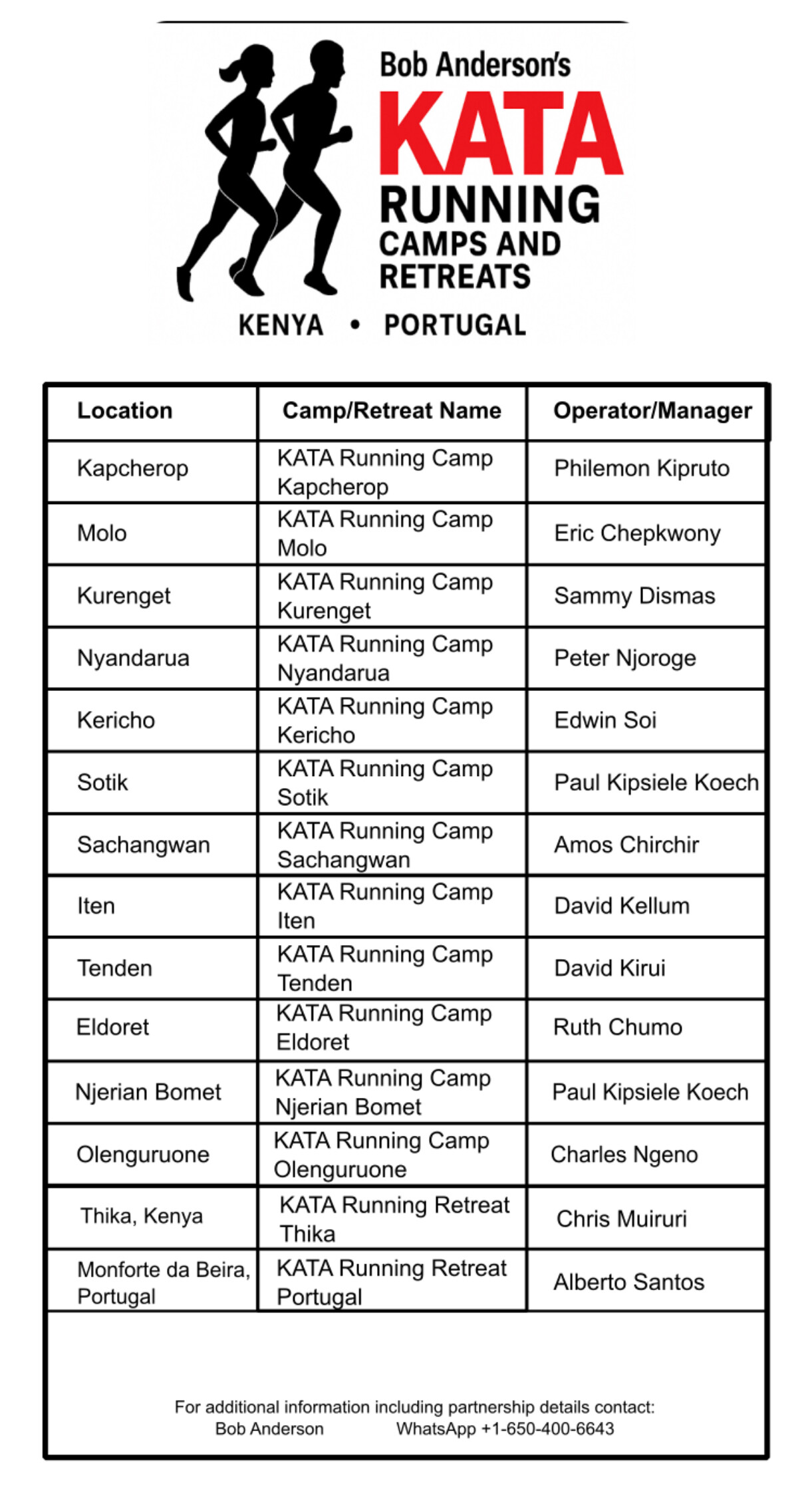
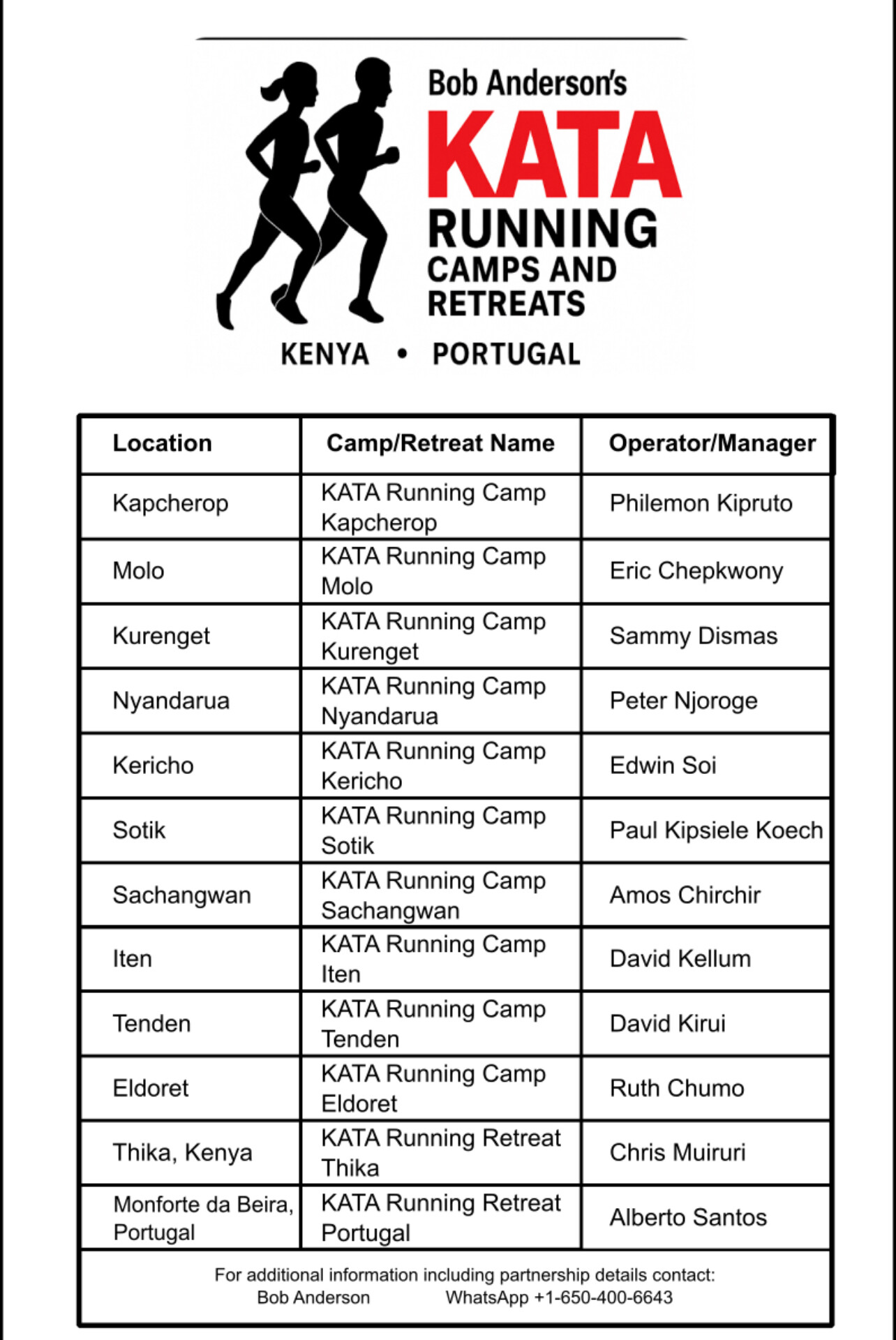
In the heart of Kenya’s Rift Valley and beyond, a quiet revolution in athletics is underway. What began as a modest idea has grown into a dynamic movement that now spans 19 KATA Running Camps and Potato Farms across Kenya—plus two international retreats, including one at the historic Anderson Manor in Monforte da Beira, Portugal.
And it’s happening fast.
“We never planned to expand this quickly,” says Bob Anderson, founder of KATA and a lifelong advocate for long-distance running. “But the momentum of this movement just couldn’t be slowed down. We’ll be confirming one more camp shortly, and additional locations will follow in early 2026.”

KATA—short for Kenyan Athletics Training Academy—is unlike anything else in the world of distance running. It blends elite training with economic empowerment, giving young athletes not only the tools to run fast, but also a system that sustains them—and their communities—beyond the track.
“This is not just sports development,” says Brigid Chebet, a Kenyan journalist who has closely followed the program. “It’s a model of rural transformation through athletics. And Kenya may finally have found a winning formula for generations to come.”
From a Vision to a Movement
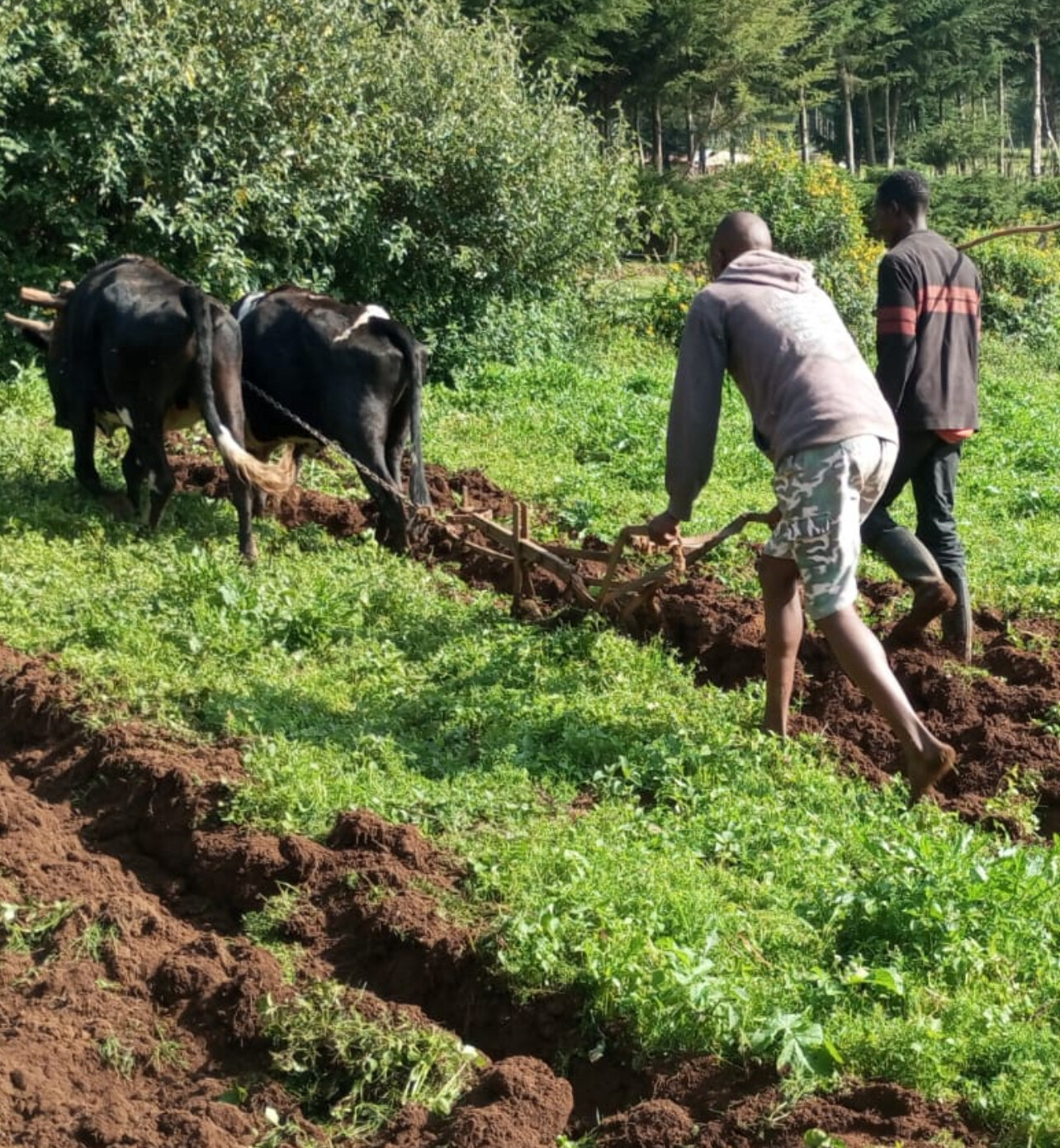
KATA was founded by Bob Anderson, an accomplished American runner who created Runner’s World magazine and later My Best Runs. After visiting Kenya in 2014, he was deeply inspired by the raw talent scattered throughout rural communities—athletes with potential but no pathway.
“He saw a path that few others in athletic management had envisioned—a system that not only trains champions but empowers them economically,” writes Chebet.
That system became KATA: a network of running camps, each paired with a three-acre potato farm. Each camp receives an interest-free loan from KATA to establish operations. In exchange, athletes train full-time and contribute 25 hours a week to the farm. Revenue from the potato harvest supports camp expenses, housing, and meals—creating a self-sustaining ecosystem.
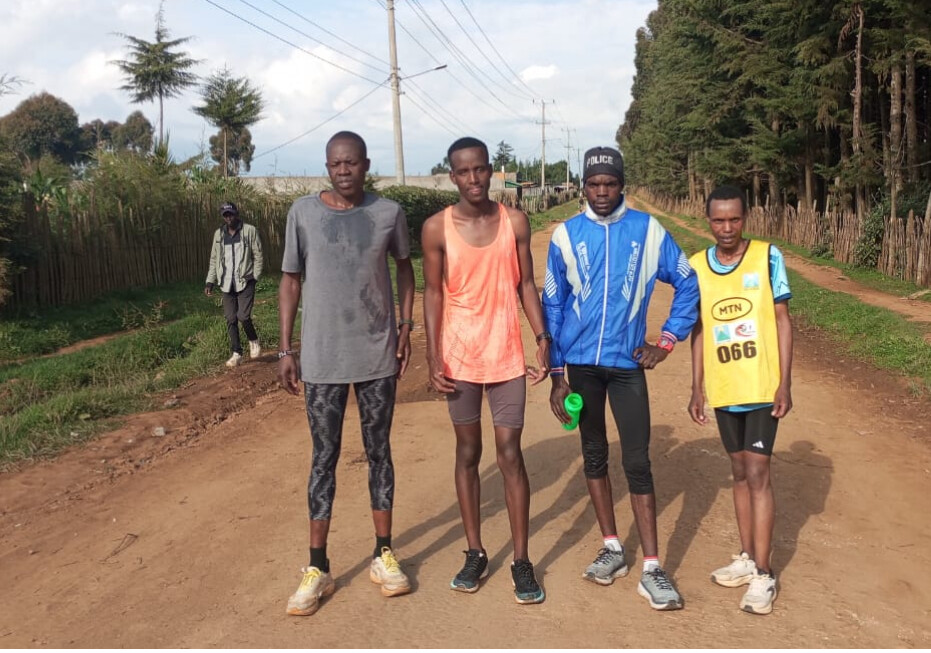
A Growing National Network
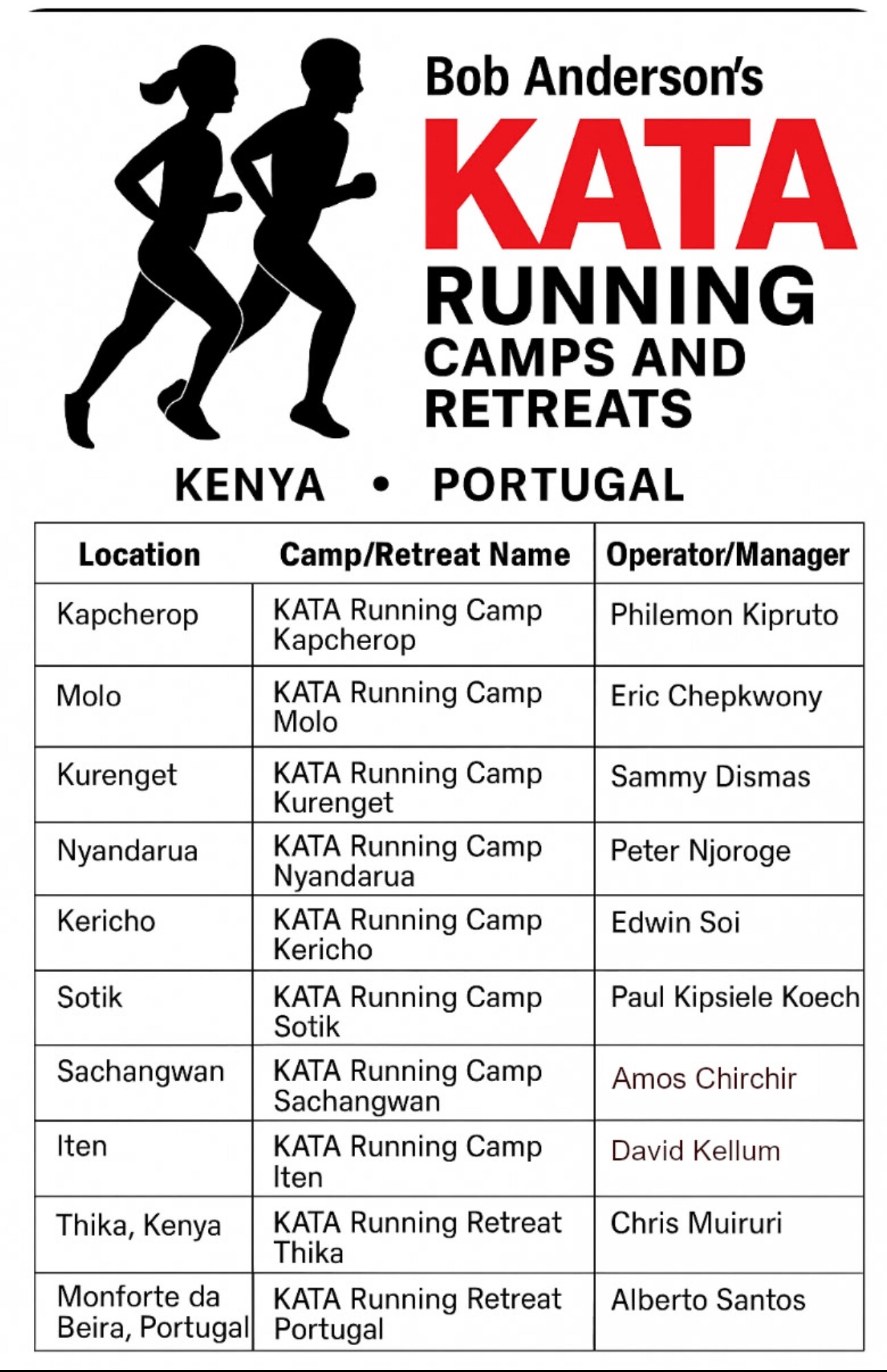
The first KATA retreat opened in Thika in 2019. Today, the initiative includes 19 camps spread across Kenya, each run by an experienced operator—many of them former elite athletes.
|
Location |
Operator |
|
Kapcherop |
Philemon Kipruto |
|
Molo |
Eric Chepkwony |
|
Kurengat |
Sammy Dismas |
|
Nyandarua |
Peter Njoroge |
|
Kericho |
|
|
Sotik |
|
|
Sachangwan |
Amos Chirchir |
|
Iten |
David Kellum |
|
Tenden |
Philemon Kipruto |
|
Eldoret |
Ruth Chumo |
|
Njerian Bomet |
Paul Kipsiele Koech |
|
Olenguruone |
Charles Ngeno |
|
Kapkembu |
Kipyegon Nehemiah |
|
Gasharrarge |
Job Langat |
|
Kaptagat |
Joseph Ngure |
|
Kiambu |
Julius Gacheru Migwi |
|
Kangundo |
Jimmy Muindi |
|
Moiben |
Hillary Kiplagat |
|
Kiptoror |
Caleb Rut |
In addition to these camps, two retreats serve as international training hubs: the KATA Running Retreat Thika, operated by Chris Muiruri, and the KATA Running Retreat Portugal, operated by Alberto Santos. Guests from around the world come to the two KATA retreats to train the Kenyan Way.
Elite Experience, Grassroots Impact
At the heart of KATA’s success is its leadership team. Olympic medalist Edwin Soi, now managing the Kuresoi Camp, brings both credibility and experience. Legendary steeplechaser Paul Kipsiele Koech, who has run under 8:10 in the 3000m steeplechase over 110 times, oversees two KATA camps/farms.
Veteran coach Charles Ngeno, known for his early work with Olympic champion Faith Kipyegon, now heads the Olenguruone camp, ensuring that young athletes from even the most remote villages receive structured training and economic opportunity.
“The new vision embraces sustainability, resilience, and empowerment,” writes Chebet. “It ensures that our athletes thrive both on and off the field.”
Looking Ahead
Anderson and the KATA team have ambitious plans: confirming one more camp this month and preparing for even more in 2026. The goal is clear—build up to 50 self-sustaining running camps across Kenya and replicate the model in other parts of the world.
“We’re not just chasing medals,” says Anderson. “We’re building lives.”

For partnership opportunities or more information, contact Bob Anderson on WhatsApp: +1-650-400-6643
by Brigid Chebet with Boris Baron
Login to leave a comment
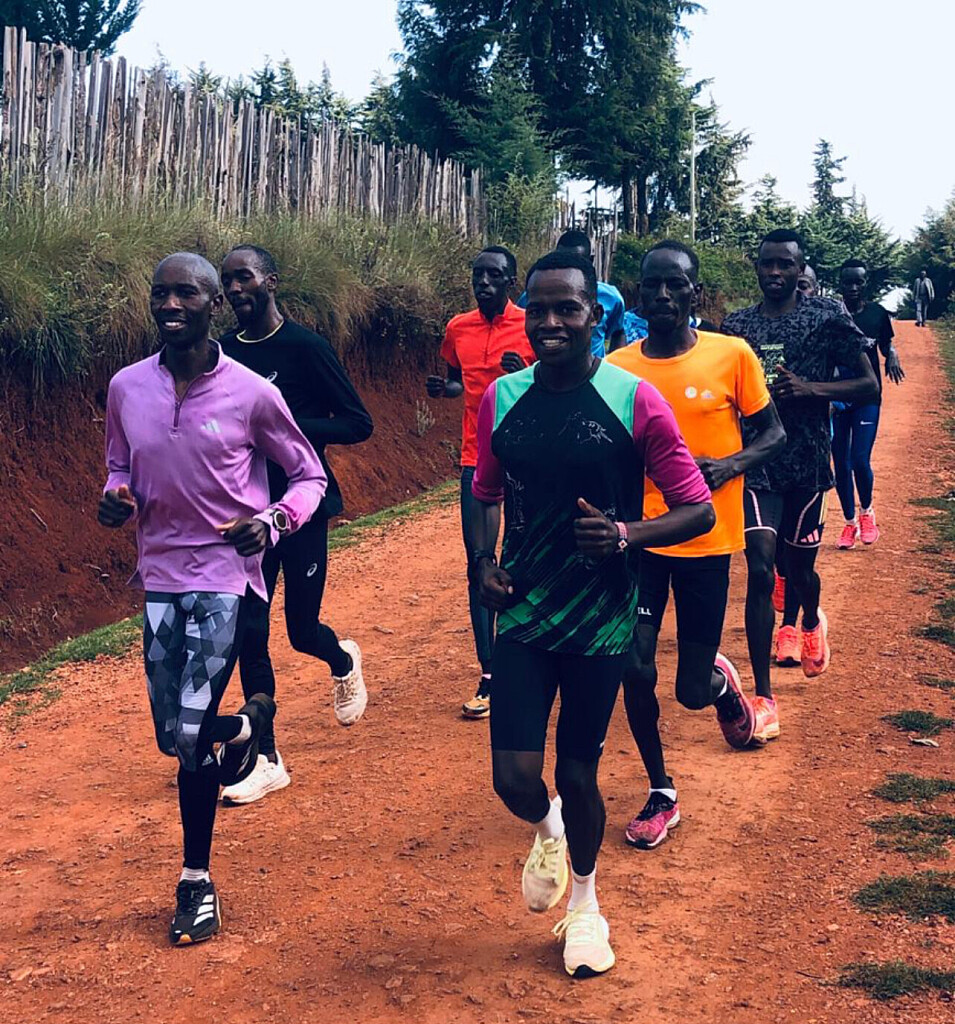
KATA to Launch Eight New Running Camps and Potato Farms Across Kenya by October
Bob Anderson, the visionary founder of KATA (Kenyan Athletics Training Academy) and long-time champion of Kenyan running, and lifetime runner, has announced a bold expansion plan: eight new KATA Running Camps and Potato Farms will open across Kenya by October 1, 2025.
“We want to confirm our next eight camps by August 15,” says Bob Anderson, KATA Director and Founder.
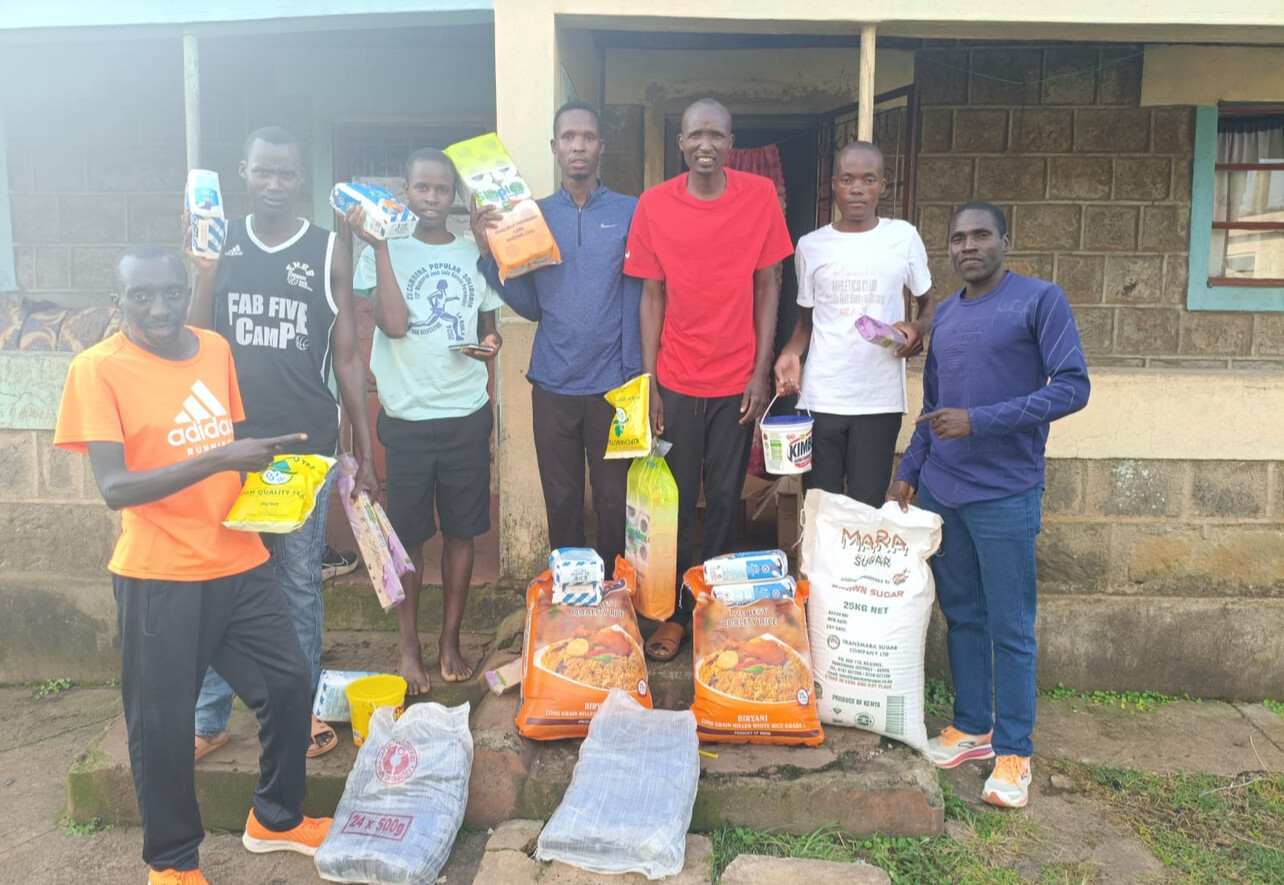
Each new site will combine high-performance athlete training with sustainable agriculture, centering around a 3-acre KATA Potato Farm. The initiative aims to create self-sustaining camps where runners not only train at a high level but also contribute to the farm operations that help support the entire program.
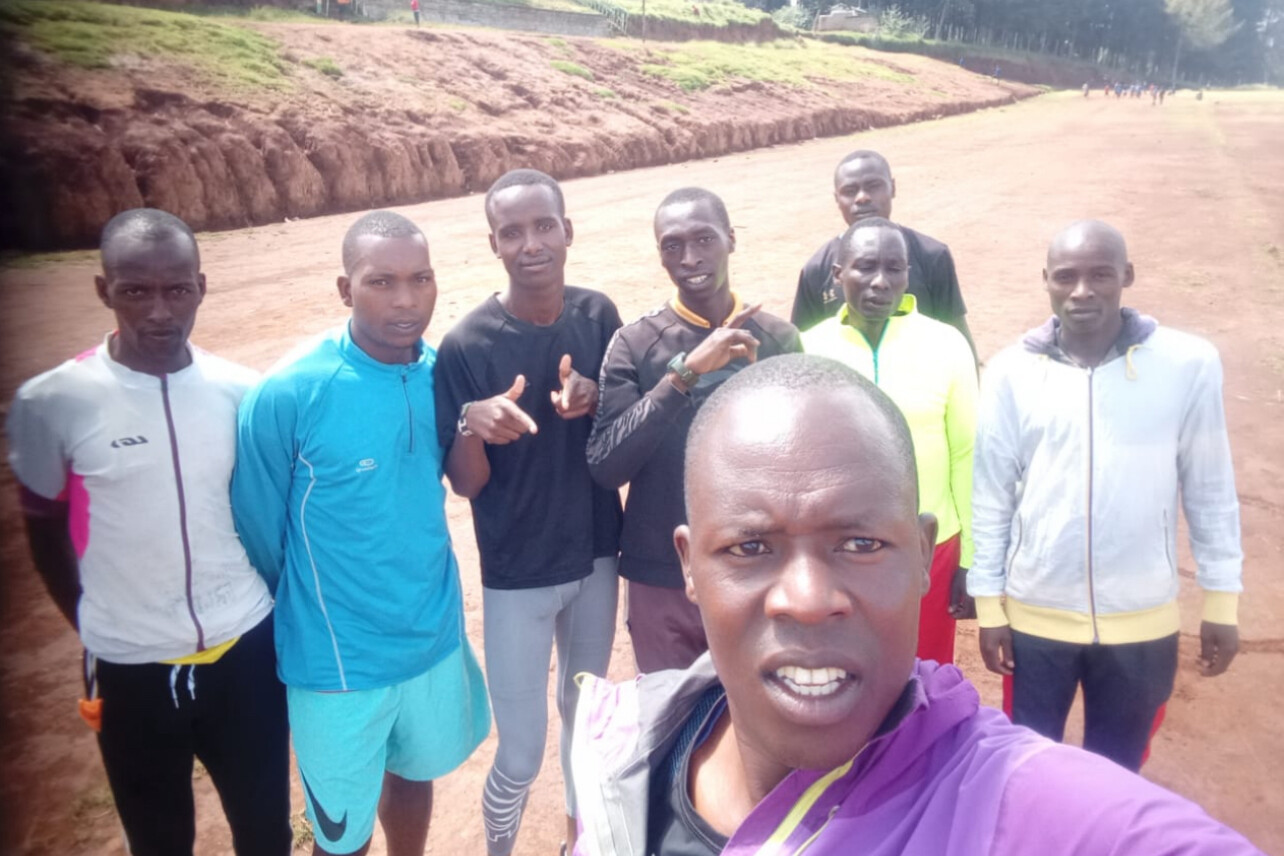
At the heart of every KATA Running Camp is a dedicated operator—often a former elite athlete or experienced coach—who oversees day-to-day operations and athlete development. Our operators are more than just managers; they are mentors, motivators, and community builders. Each operator is carefully selected for their deep understanding of training at altitude, their passion for helping athletes succeed, and their ability to lead with integrity. Many of them have raced at the international level or coached athletes to major victories, bringing invaluable knowledge to the camps. Whether it’s organizing daily workouts, managing food and lodging, or fostering a winning culture, our KATA Running Camp operators are the backbone of our success.
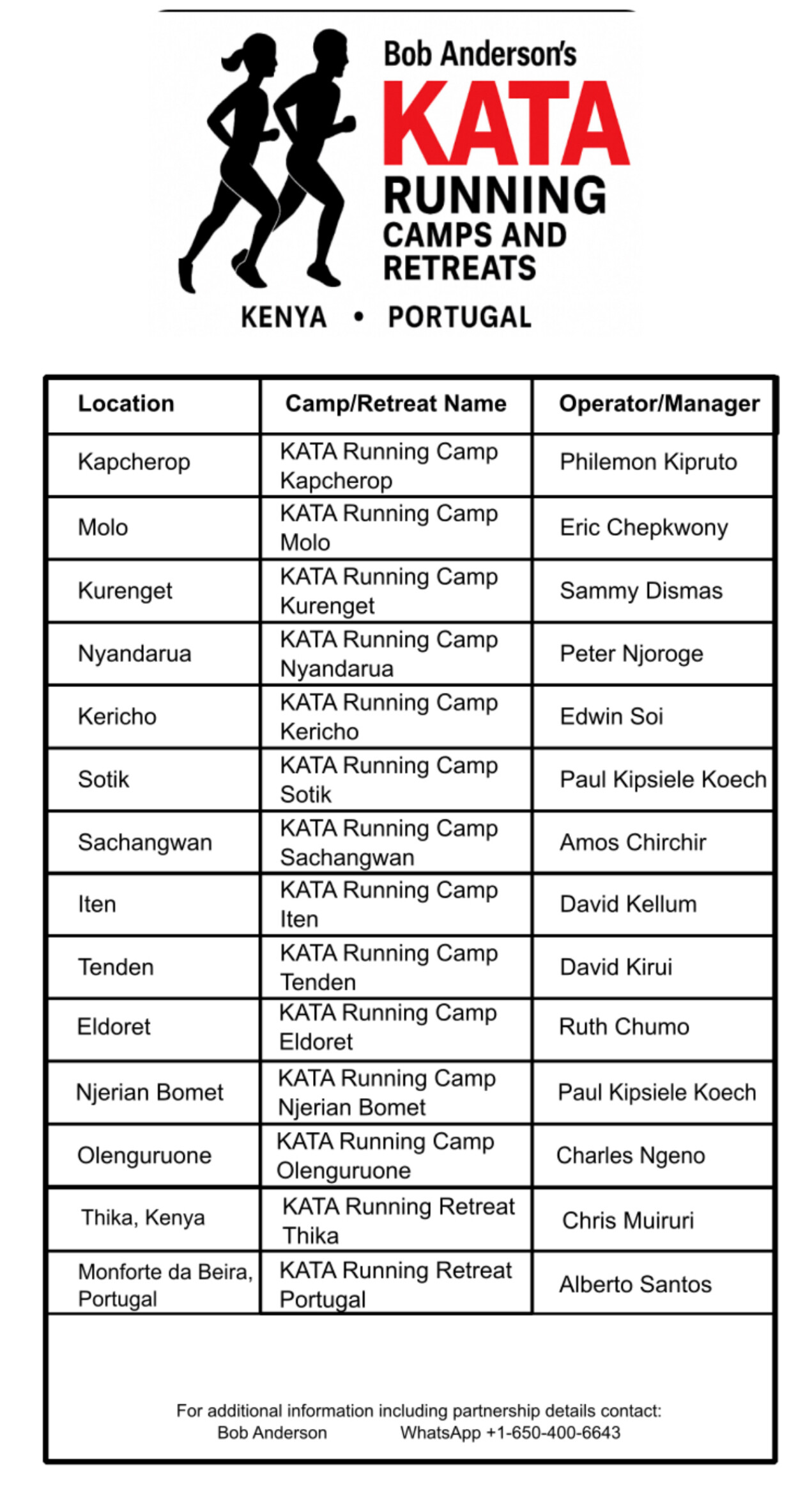
Currently, KATA Running Camps are thriving across Kenya under the leadership of 11 outstanding operators. In Kapcherop, Philemon Kipruto manages a vibrant group of emerging athletes. Eric Chepkwony runs our camp in Molo, and Sammy Dismas leads the program in Kurenget.
Over in Nyandarua, Peter Njoroge is building a strong training culture, while Edwin Soi, Olympic bronze medalist, brings elite-level experience to our Kericho camp. Paul Kipsiele Koech, an iiOlympic medalist, leads not one but two camps—Sotik and Njerian Bomet—where he shares his wealth of knowledge and competitive insight. In Sachangwan, experienced coach Amos Chirchir oversees daily operations and athlete growth, while in the legendary running hub of Iten, former elite runner David Kellum provides mentorship and structure.
David Kirui heads up the team in Tenden, and in Eldoret, Ruth Chumo—a respected coach of both abled and para-athletes—brings technical excellence and inclusivity to her camp. Rounding out our leadership team is Charles Ngeno, who directs the Olenguruone camp and plays a vital role in shaping future champions.
How the Program Works:
Each selected operator will receive:
•An interest-free loan of 350,000 KES as startup capital to establish the camp.
•An additional 300,000 KES interest-free loan to cover the costs of renting and preparing 3 acres of land, fertilizing, spraying, planting, harvesting, and selling the potatoes.
The model is built on long-term sustainability: once established, revenue from the potato farm is expected to fully support each KATA Camp year-round, without additional outside funding.
Work and Training:
KATA athletes must commit to:
•25 hours of farm work per week, in addition to their structured training schedules.
This balance of physical labor and elite coaching is designed to build discipline, character, and community resilience—while helping runners achieve their full athletic potential.
The KATA Running Camps and KATA Potato Farms are headquartered at the Anderson Manor of Portugal, home to the KATA Running Retreat, located in Monforte da Beira in central Portugal. This historic and beautiful estate serves as the ideal European base for KATA. Athletes come here to sharpen their fitness and prepare for peak performances, whether they’re targeting personal bests or major competitions.
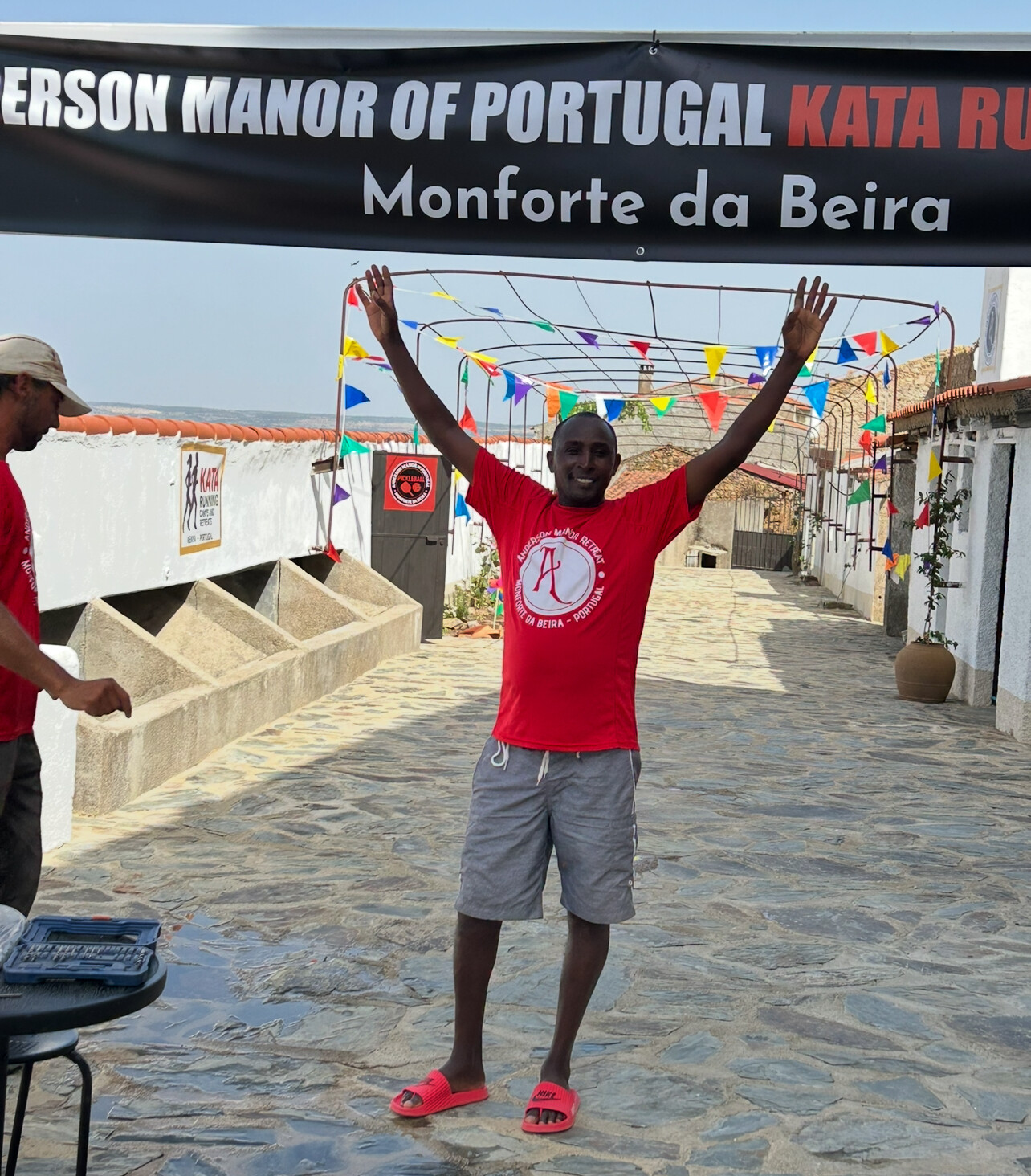
The location is perfect for training—quiet, scenic, and inspiring—and it’s conveniently positioned just 2.5 hours from Lisbon and about 4 hours from Madrid by car. KATA also maintains a local office in Thika, Kenya—site of the original KATA Running Retreat opened in 2019—which supports the growing network of KATA camps across the country.
Interested in Becoming a KATA Camp Operator?
If you’re passionate about athletics, have experience in farming or business management, and want to make a lasting difference in your community, this could be your opportunity.
Contact Bob Anderson directly on WhatsApp (650-400-6643) to apply (text only at this point):
Please include:
•Your full name
•The town where you’d like to establish a KATA camp
•Your background in running, coaching, or athletics
•Experience running a business
•Any potato or farming experience you have
This is more than a training camp. It’s a movement to empower Kenyan runners through purpose, performance, and sustainable agriculture.
by Boris Baron
Login to leave a comment
Support Athletes. Uplift Communities. Help Shape the Future of Kenyan Running
.For decades, Bob Anderson—founder of Runner’s World and a lifelong champion of distance running—has believed in the transformative power of athletics. In 2019, inspired by visits to Kenya dating back to 1987, he launched the Kenyan Athletics Training Academy (KATA) in Thika to give promising athletes the opportunity to rise. In 2024, Anderson expanded the vision internationally, opening a second training retreat in Portugal.
Until now, every KATA camp and retreat has been fully funded by Bob himself. But as momentum builds, he’s extending an invitation: become a KATA Partner and help expand this game-changing model—while earning a meaningful return on your investment.
“We’ve proven the model works,” says Anderson. “Now we want visionary partners to help take KATA to the next level. This isn’t charity—it’s an investment in performance, purpose, and people.”
What Is the KATA Partner Program?
The KATA Partner Program offers a ground-floor opportunity to support elite athlete development and rural progress through a unique model that combines world-class coaching with sustainable agriculture.

Each KATA Running Camp is paired with a three-acre KATA Potato Farm. Athletes live, train, and work part-time on the farm—25 hours per week—in exchange for full room and board plus expert coaching. In return, they contribute 15% of any prize money they earn back to their camp. The rest is theirs to keep.

As a KATA Partner, you help fund and launch a new camp. In return, you:

• Earn a share of revenue from potato farm sales and athlete prize winnings
• Gain naming rights to the camp (e.g., [Your Name or Organization Name] KATA Running Camp)
• Empower athletes and uplift local communities through long-term partnership
Two Pathways to Partnership
International Partner Program
• One-time KATA membership fee: $5,000 USD in 2025
• Fee increases to $6,500 USD starting January 1, 2026
• Annual dues: $1,000 USD (starting year two)
• Share of revenue:
• 15% of potato farm revenue
• 15% of athlete prize money
Kenyan National Partner Program
• One-time KATA membership fee: KES 900,000
• Annual dues: KES 50,000 (starting year two)
• Each additional acre: KES 100,000 (plus KES 25,000 in annual dues)
• Share of revenue:
• 10% of potato farm revenue
• 10% of athlete prize money
This is not a donation—it’s a purpose-driven investment with a guaranteed revenue share. You’re helping athletes succeed and communities thrive, while building your own legacy.
KATA Handles Everything
Whether you want to be hands-on or prefer a passive role, KATA takes care of:
• Finding and securing land and housing
• Recruiting qualified operators (often Olympic medalists and elite coaches)
• Setting up the farm and camp
• Managing all agricultural operations and logistics
Current camps are operated by respected figures like Olympic medalists Paul Kipsiele Koech and Edwin Soi, coaching veterans such as Charles Ngeno, and long-time team members like Elam Wangerwo, who has worked with KATA since 2014.
Why It Matters
This program isn’t just about running—it’s about changing lives. KATA gives talented young runners the platform to pursue greatness while bringing food security and economic opportunity to rural Kenya.
“If you’ve ever wanted to be part of something that matters—something that delivers both impact and return—this is your moment,” says Anderson.
Join the KATA Movement
To learn more or become a KATA Partner, contact:
Bob Anderson via WhatsApp: +1 (650) 400-6643
The next great Kenyan runner is already out there. Let’s make sure they have a place to grow—on the track and in their community.
by Bob Anderson
Login to leave a comment
KATA Running Camps Expand to 10 Locations in Kenya with Ruth Chumo Leading New Site in Eldoret
The Kenyan Athletics Training Academy (KATA) has reached a major milestone with the launch of its 10th KATA Running Camp, as the movement continues to grow rapidly across Kenya. This bold initiative, which blends elite athletic training with sustainable agriculture, is transforming the future of distance running.
The two newest camps are now confirmed:
• KATA Camp 9 in Kamoi, led by coach David Kirui
• KATA Camp 10 in Eldoret, operated by Coach Ruth Chumo
Coach Ruth Chumo brings exceptional experience to the program. Based in Eldoret—the heart of Kenyan distance running—she has built her reputation training both abled and para-athletes at the highest level. Her deep commitment to athlete development and her proven leadership make her a vital addition to the KATA family.
“I am so excited about the group of operators we have put together,” says KATA Director Bob Anderson, founder of Runner’s World magazine. “Each of our operators is fully committed to the program and understands the importance of our KATA Potato Farm component. This provides year-round revenue that allows us to sustain and grow. Every camp already includes top-level athletes, and we’re going to achieve big things.”
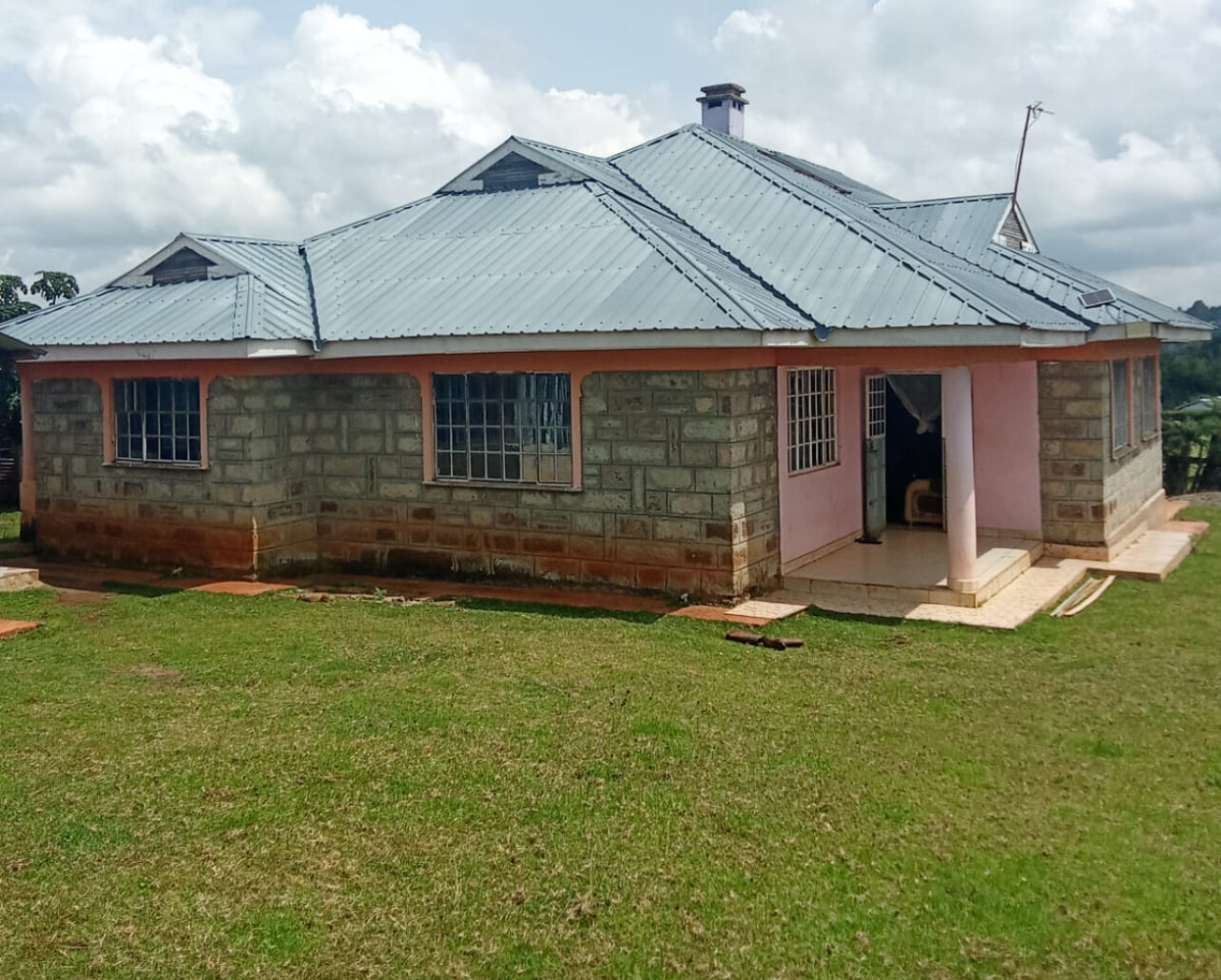
Two of the current camps have already planted their first acre of KATA potatoes, marking an important step forward in the program’s sustainability model. These three-acre farms, tied to each running camp, are a core part of the KATA mission—providing food, responsibility, and revenue that keep the entire system running year-round.
The program is also delivering results on the track. Just last weekend, Olympic bronze medalist Edwin Soi, operator of the Kericho KATA Camp, ran an astonishing 27:30 for 10,000 meters, dominating his race and sending a strong message about the level of athletes being developed within the KATA system.
KATA’s leadership includes two Olympians:

• Edwin Soi, 5000m bronze medalist from the Beijing Olympics
• Paul Kipsiele Koech, one of the most accomplished steeplechasers in history, now operating the KATA Camp in Sotik
Their presence brings unmatched experience, mentorship, and international credibility.
At the heart of KATA is a powerful, dual-purpose model: athletes receive world-class training while also helping manage a working farm. The result is a program that builds champions and sustains itself through community-driven agriculture.
Round Two Begins October 1
The momentum is building. On October 1, KATA will launch Round Two of its program, aiming to establish 10 additional camps by November 1—doubling the total to 20.
“This is only the beginning of our aggressive, unique program,” says Anderson.
The long-term vision: 50 fully operational KATA Running Camps within three years, directly supporting nearly 1,000 elite Kenyan runners.
The KATA Partner Program
To help reach that goal, KATA is inviting select partners to be part of the movement and make a lasting impact.
Each partner:
• Can have their name on a camp. You too can now have your own training camp in Kenya under the umbrella of KATA.
• May choose to be actively involved (like coaching and selecting your own athletes) or take a passive role. (KATA will set everything up.)
• Will share in the gross revenue from the sale of KATA potatoes
• Will also participate in a percentage of prize money earned by athletes at their partnered camp
This is a rare opportunity to support a program built on performance, purpose, and sustainability—while being directly connected to the success of the next generation of Kenyan champions.
Want to get involved?
WhatsApp Bob Anderson at +1-650-400-6643 to learn how you can support or partner with KATA today.
Photos: Paul Kipsiele Koech KATA team in Sofia 2. Ruth Chumo 3. Ruth's KATA Camp outside of Eldoret 4. KATA athletes planting potatoes in Molo under the direction of camp operator Eric 5. KATA ten camps 6. KATA athletes in Iten 7. Preparing potatoes in Kapcherop 8. Paul Kipsiele Koech coaching his KATA athletes in Sotik.
by Boris Baron
Login to leave a comment
KATA Running Camps Launch a Bold New Era for Distance Running in Kenya
In a bold move to reshape the future of distance running, Bob Anderson, the legendary founder of Runner’s World and lifelong runner, has launched a groundbreaking initiative that’s taking root across Kenya. What began in 2019 with the Kenyan Athletics Training Academy (KATA) in Thika, and expanded to Portugal earlier this year, is now flourishing into a national movement—with eight KATA Running Camps already confirmed, and ten expected by July 1, plus two full-service KATA Retreats in Thika and Monforte da Beira, Portugal.
photos: 1. Edwin's KATA team reporting to his camp today in Kericho. 2. Eric's KATA in Molo will be planting their first acre of KATA potatoes tomorrow.

"As far as I know, there’s nothing like what we are doing,” says Bob Anderson. “My team and I believe we’re going to make a big difference in the running world. We’ll have nearly 200 KATA athletes by July. We have so much talent, and with strong leadership and support, we can help them become world-class stars
A Sustainable Model with a Powerful Vision
What sets KATA apart is its innovative self-sustaining model that combines elite athletic training with agriculture and community building.
Each KATA Running Camp:
• Supports 3 acres of KATA potato farms
• Requires athletes to work 25 hours per week on the farm
• Asks athletes to contribute 15% of any prize money earned to support their camp
In return, every KATA athlete receives:
• Free lodging
• Three nutritious meals daily
• World-class coaching
“Within six months, all camps will be fully self-sustaining,” Anderson says. “This is not just a running camp—it’s a lifestyle, a community, and a path to opportunity.
Powered by Champions
Two of KATA’s confirmed camp operators are Olympic medalists who bring unmatched experience to the program:
• Edwin Soi, bronze medalist in the 5000m at the 2008 Olympics, now leads KATA Kericho. He’s still racing—and proving his form. On June 15, he clocked a blazing 27:30 for 10,000 meters on the track.
• Paul Kipsiele Koech, bronze medalist at the 2004 Olympics in the 3000m steeplechase, heads KATA Sotik, bringing leadership, discipline, and deep tactical knowledge.
A Vision for 50 Camps, 1,000 Athletes
Anderson’s vision is as ambitious as it is inspiring:
“We hope to build a network of 50 KATA Running Camps to train nearly 1,000 athletes. At the same time, we’re working closely with local communities to promote healthier lifestyles through running, nutrition, and education.”
Each camp is embedded within its local area—supporting food security through farming, developing young talent, and strengthening communal ties.
More Than a Camp. A Movement.
KATA is not just about producing the next world record holder. It’s about giving hundreds of athletes the opportunity to reach their full potential—on the track, in life, and within their communities.
By combining sport with sustainability, and elite training with grassroots outreach, Bob Anderson’s KATA is poised to become one of the most impactful distance running projects in the world.
by Boris Baron
Login to leave a comment
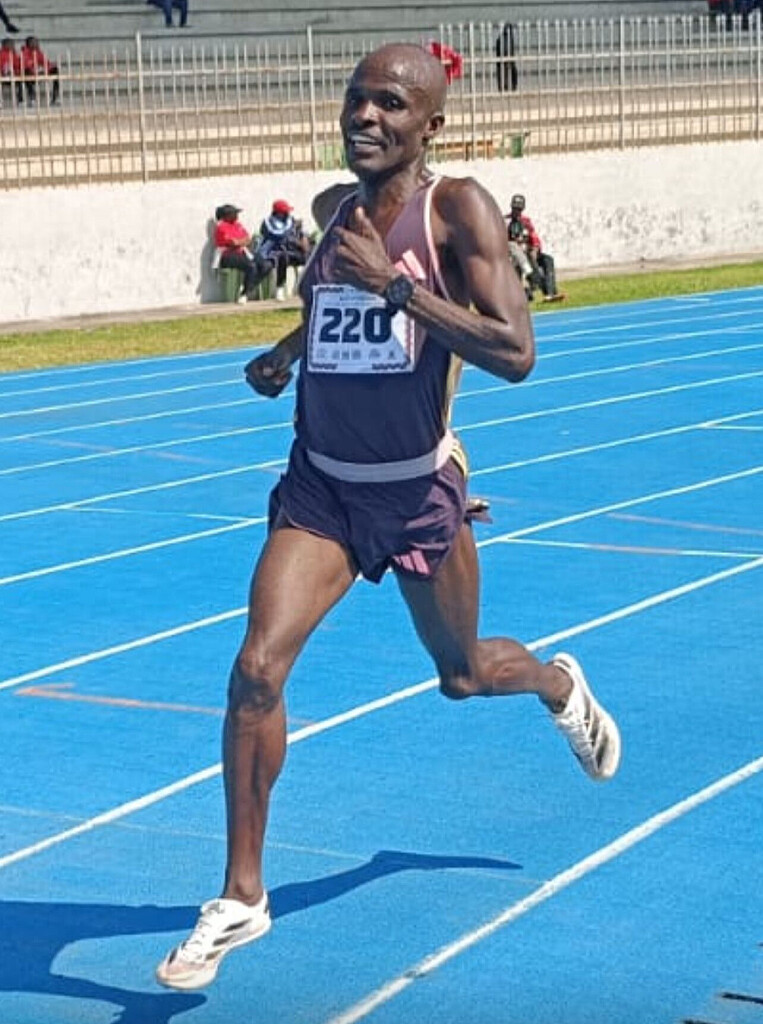
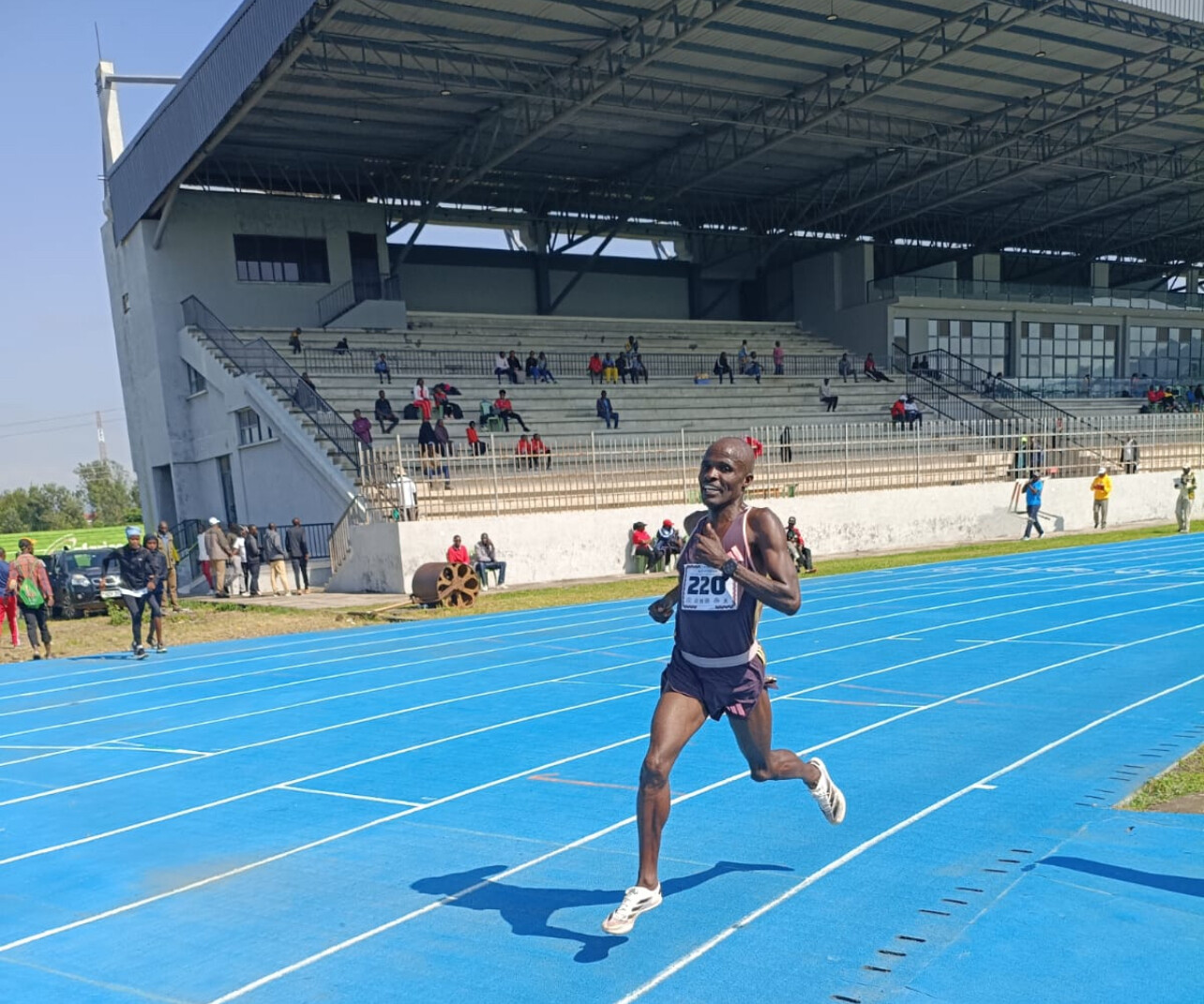
Edwin Soi Blazes 27:30 for 10,000m at South Rift Regional Meet in Nakuru
Veteran Olympian Edwin Soi made a powerful statement in Nakuru County on June 15, dominating the 10,000m at the South Rift Region athletics qualification meet with a stunning time of 27:30. The race, held at Afraha Stadium, served as a regional qualifier for the Kenyan National Trials, which take place July 9 in Nairobi and will determine the team for the World Championships.
Soi, the newly appointed operator of the KATA Running Camp and KATA Potato Farm in Kericho, blew away the field with his performance—remarkable not only for the result but for the circumstances behind it.
“I’m pleased with my time,” Soi said. “I’ve only been doing marathon training and no speed work. When Bob [Anderson], our KATA Running Camps founder and director, asked me a few days ago what I thought I could run, I told him sub-28—and I did.”
Soi’s effort drew praise from Bob Anderson, the founder of Runner’s World and director of the KATA Running Camps initiative. “Edwin just signed on to operate KATA Running Camp - Kericho and has been preparing to officially open his camp on Monday,” Anderson said. “I was very excited to hear of his time this morning. He will be ready to make the Kenya national team.”
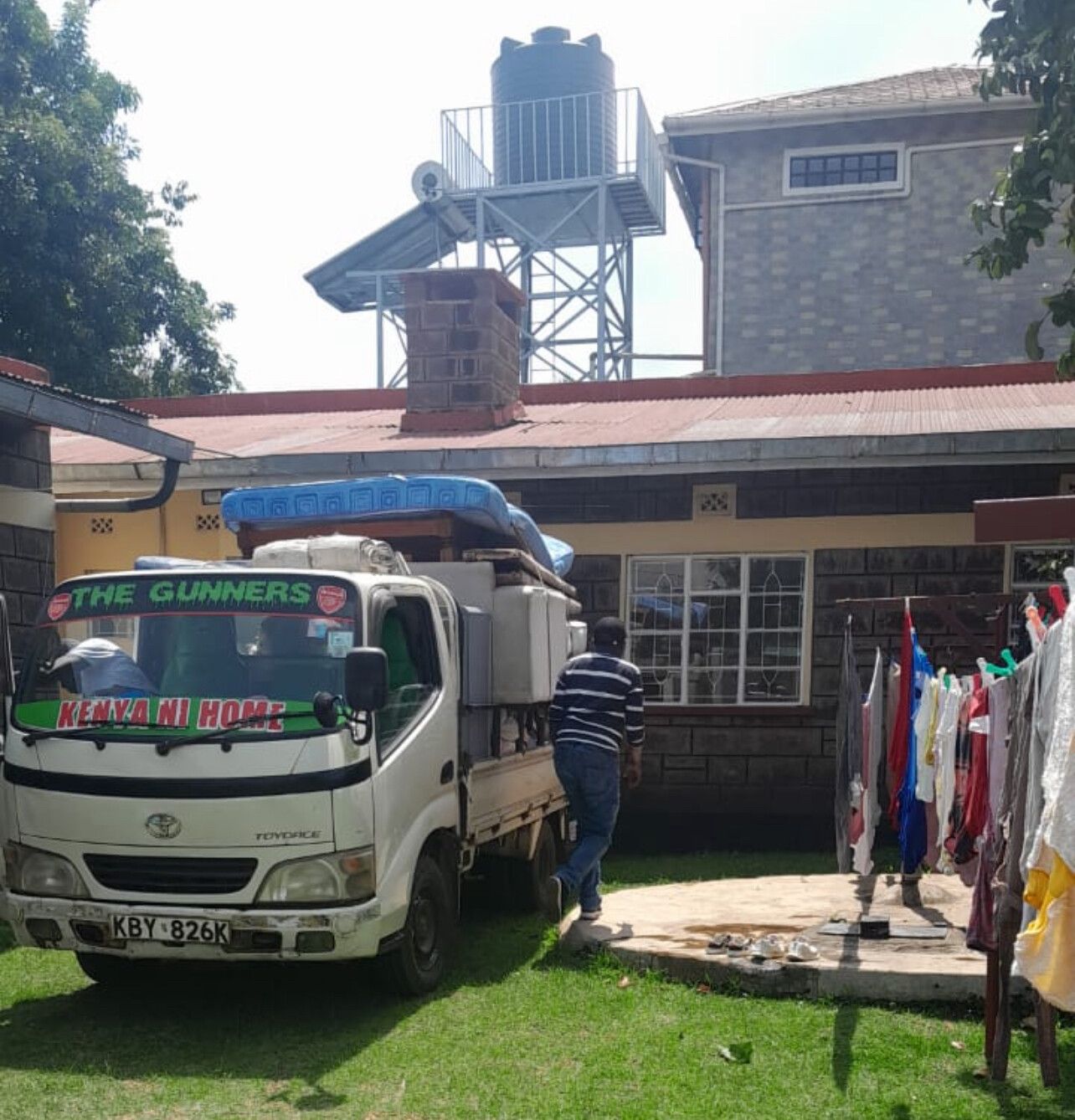
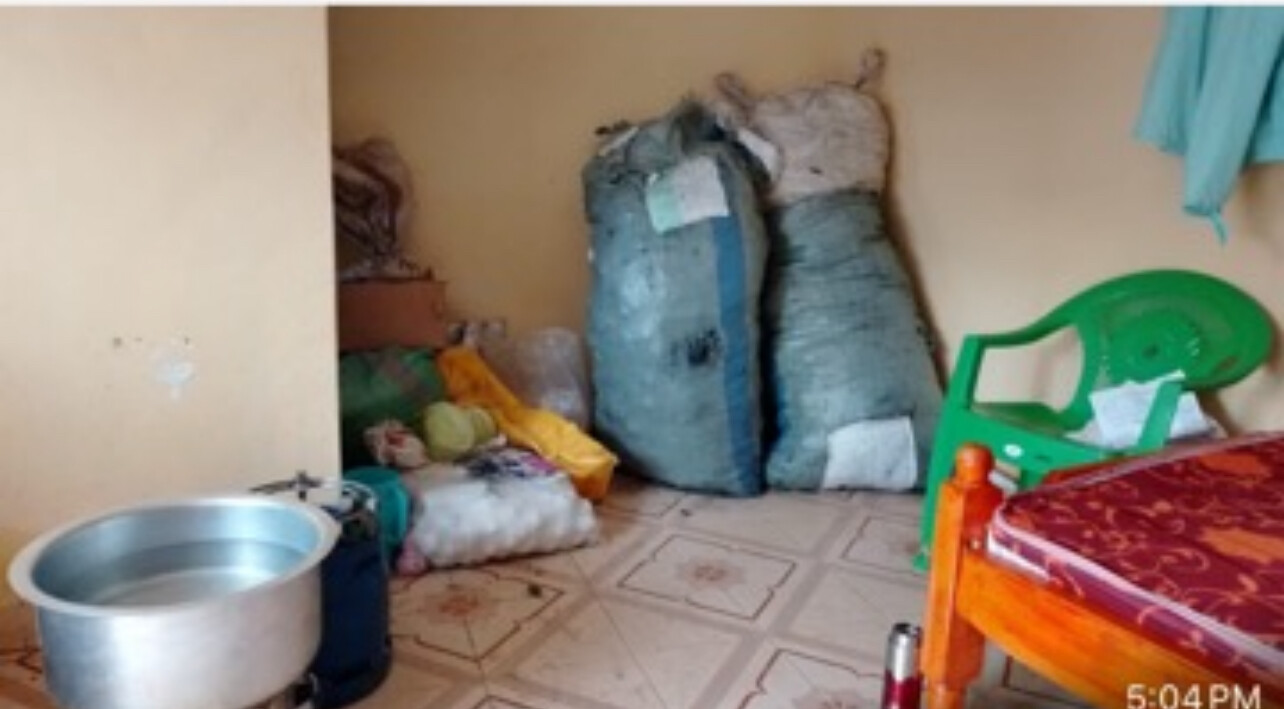
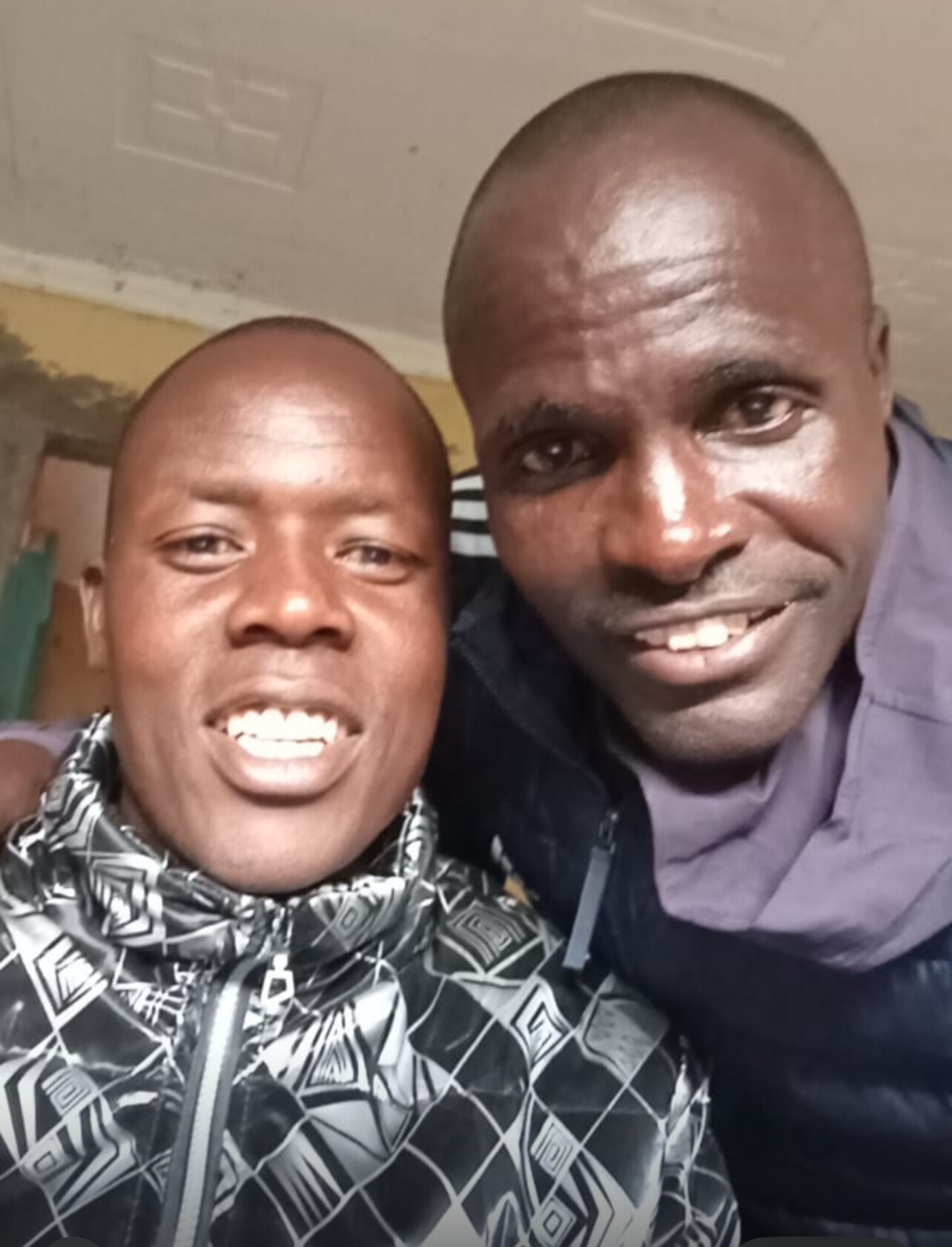
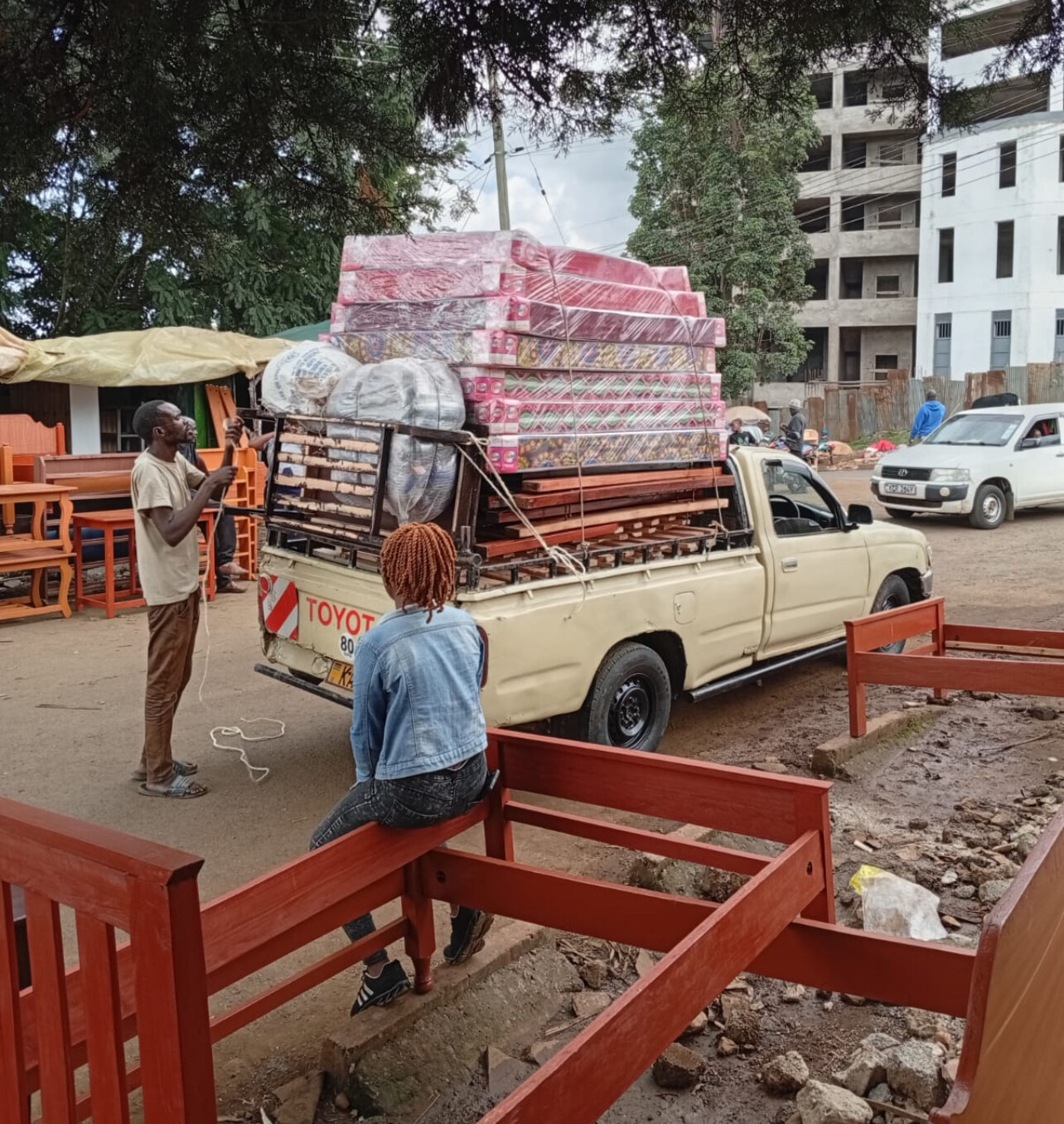
Photo five is Edwin visiting with Job at the KATA Running Camp - Molo. Photo six is Edwin transporting beds to his camp in Kericho earlier in the week.
Soi, who won the bronze medal in the 5,000m at the 2008 Beijing Olympics, has been transitioning to longer distances in recent years, including the marathon. His performance in Nakuru indicates he still has world-class speed and may be poised for another major appearance on the global stage.
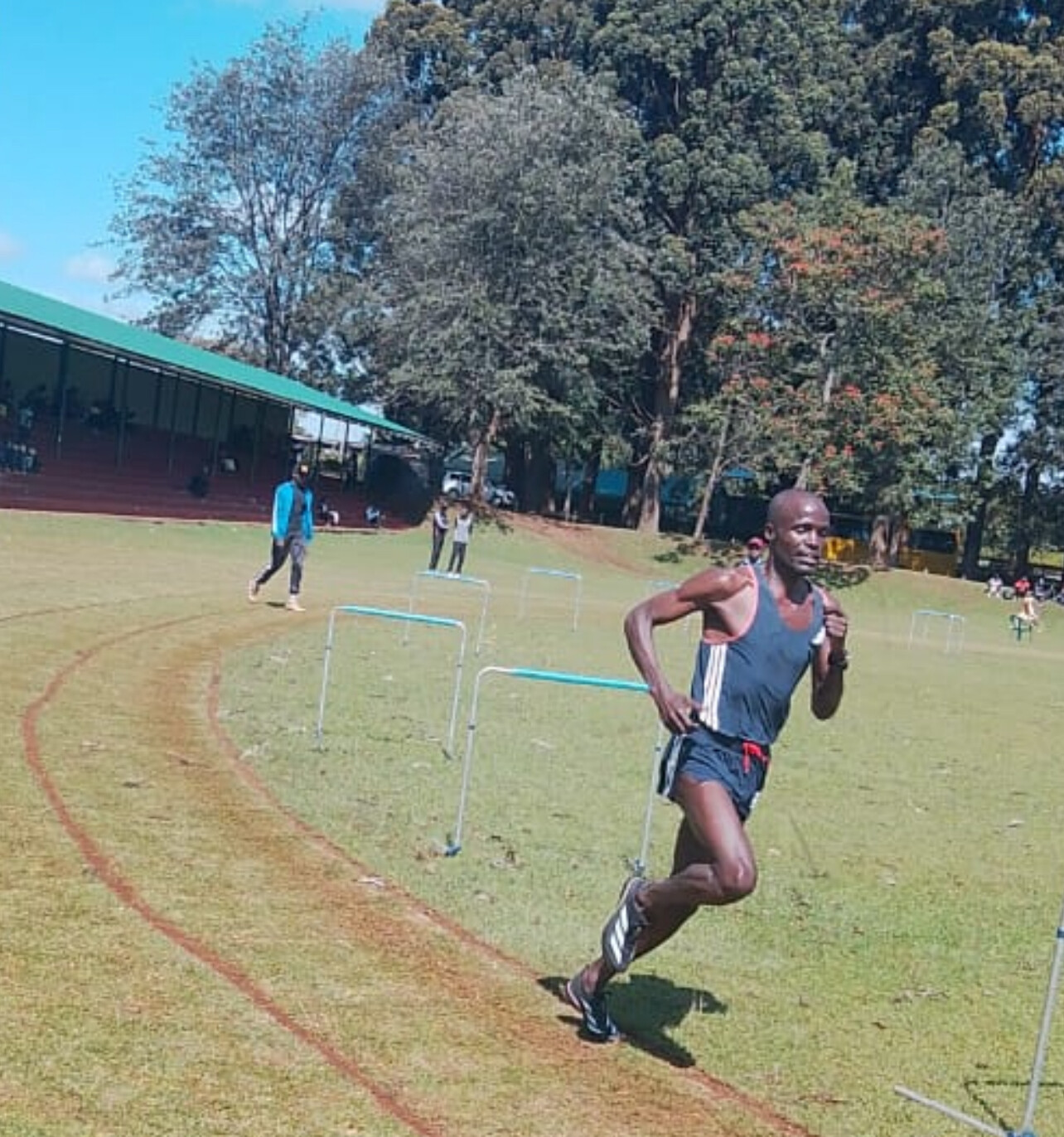
by Boris Baron
Login to leave a comment
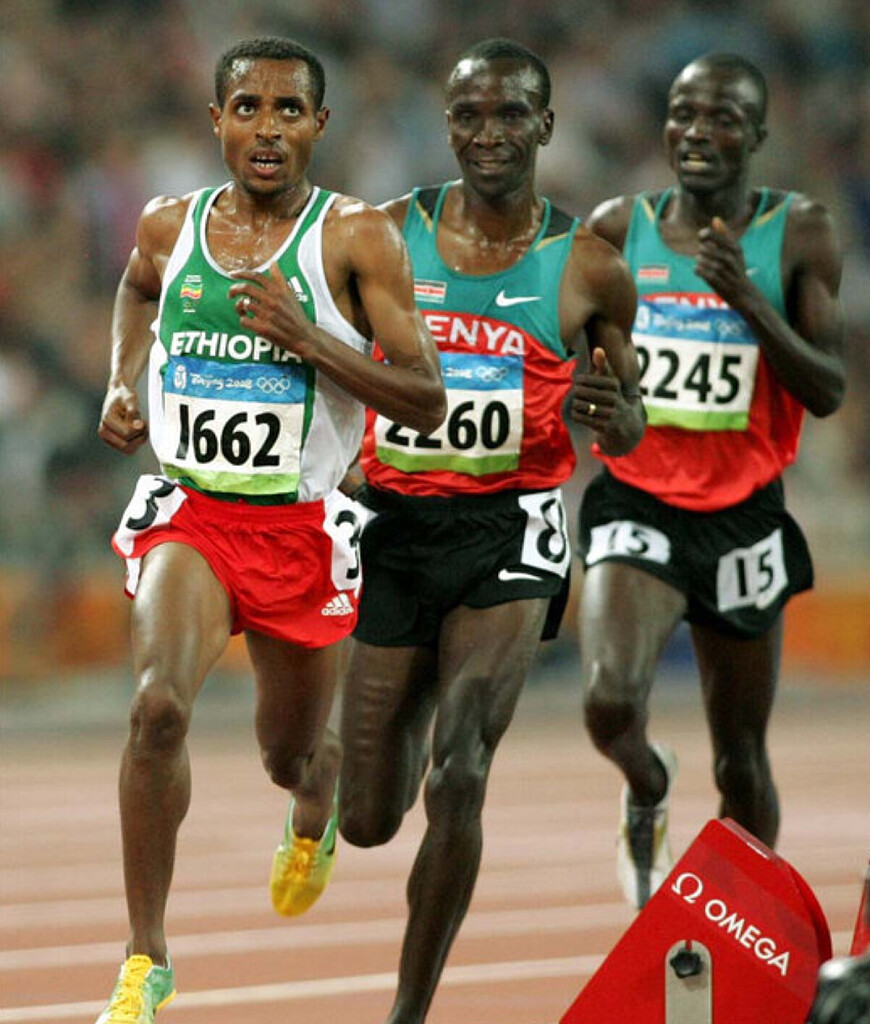
Olympic 5000m medalist Edwin Soi joins new KATA Running Camp in Kericho — a unique Kenyan training program blending elite coaching and community impact.
From Olympic bronze to farming for the future, Edwin Soi’s journey reflects both speed and sustainability.
In the world of distance running, Edwin Soi is a name etched in excellence. At the 2008 Beijing Olympics, Soi captured the bronze medal in the 5000 meters, finishing with a time of 13:06.22behind Kenenisa Bekele and Eliud Kipchoge—an iconic race that cemented his place among the greats of Kenyan running.
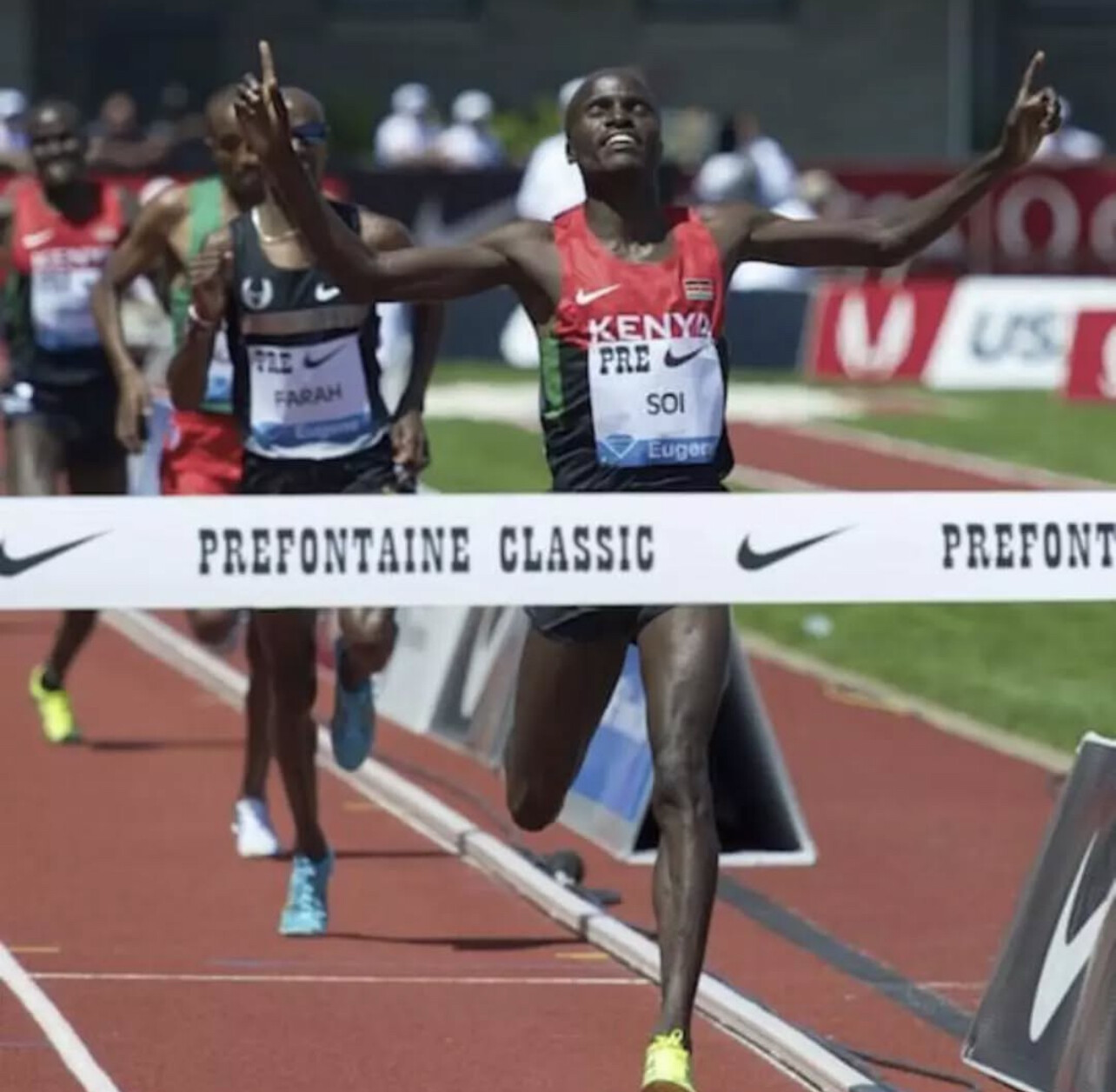
Now, over 15 years later, Soi continues to perform at an elite level. In early 2025, he placed on the podium at a major half marathon in Poland, proving that his speed and endurance have stood the test of time. But the accomplished Olympian is now expanding his impact beyond the track.
This year, Soi has teamed up with Bob Anderson, the founder of Runner’s World and the visionary behind the Kenyan Athletics Training Academy (KATA). Together, they are launching a unique initiative in Kericho, Kenya that combines world-class training with sustainable farming.
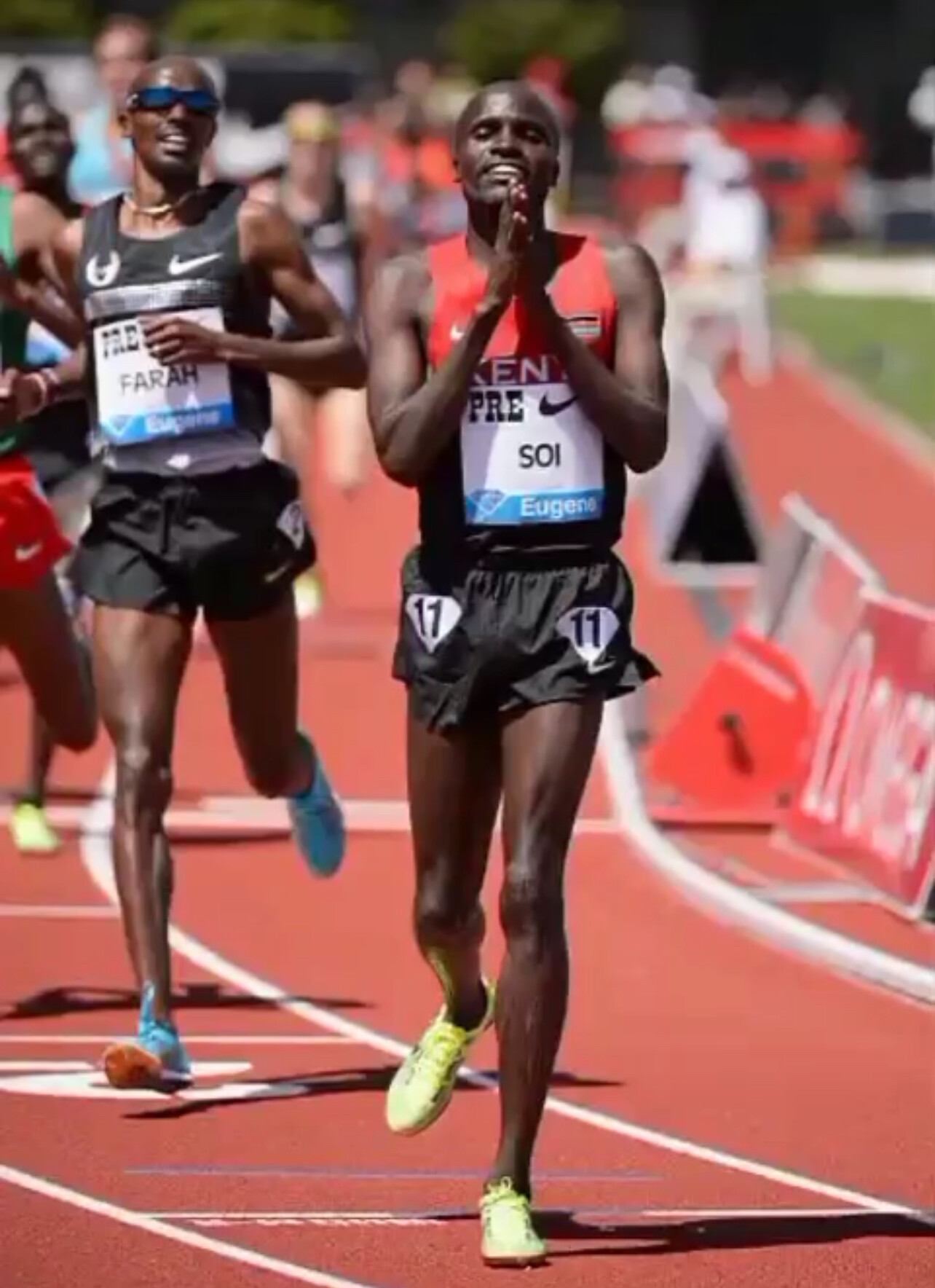
“I am very excited to be working with Bob Anderson on this new, unique program,” says Soi. “Bob has created something very special for athletes, and combining it with his ideas about farming KATA Potatoes gives us the opportunity to be sustainable. It’s perfect.”
A Vision Rooted in History
Bob Anderson’s connection to Kenyan running spans nearly four decades.
“I first traveled to Kenya in 1987 and saw and met many runners. I knew then that a program like what we have now set up was needed,” Anderson explains. “I returned with my wife Catherine in 2014 and met Elam and Joel. That’s when the idea for the Kenyan Athletics Training Academy (KATA) in Thika really started to take shape.”
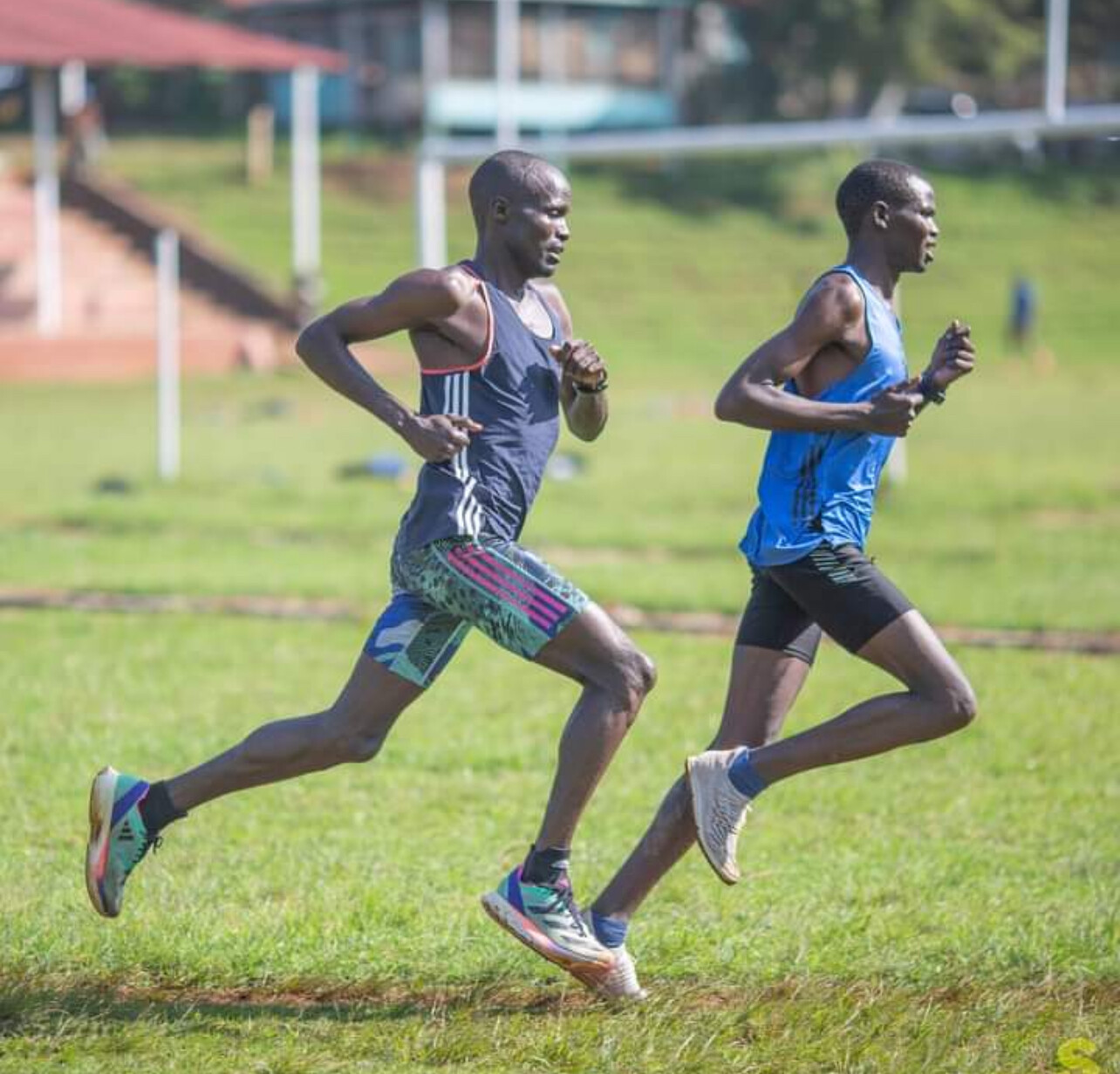
KATA officially opened in 2019, offering elite Kenyan athletes a base to train and grow. But the vision didn’t stop there.
In 2023, Anderson and longtime friend Brock Hinzmann (last photo) a 2:19 marathoner from Los Altos Hills, California, piloted the first KATA farm. The goal was to integrate agriculture into athlete development—creating a model where training and sustainability go hand in hand.
“We established a KATA farm in 2023 working with Brock, but the program needed some refinements. I finalized our new format in May of 2025. I told Edwin Soi about our program and he told me he loved the idea and jumped right on it,” says Anderson.
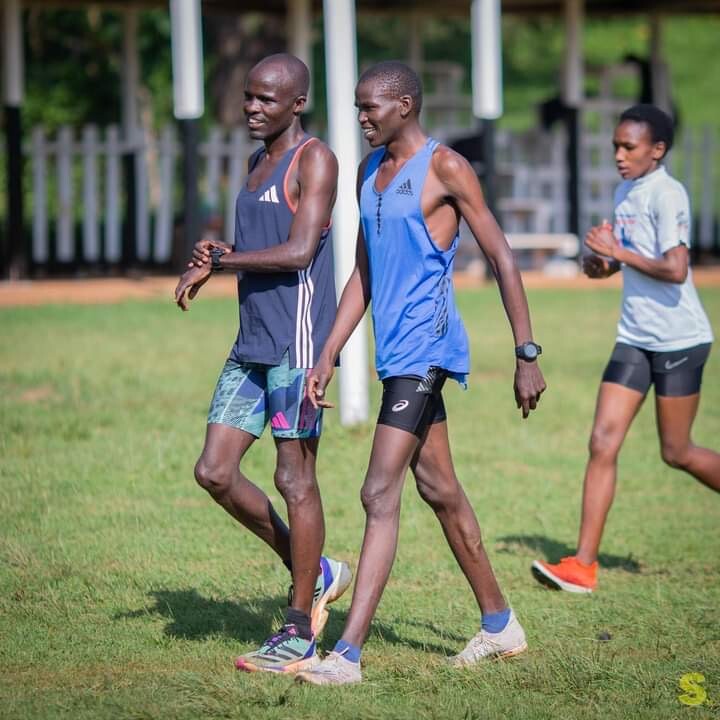
Kuresoi: A New Chapter
Now, with Soi’s leadership, the KATA Running Camp and Potato Farm in Kuresoi is set to become a flagship model for the future. Athletes will not only receive top-level training from one of the greatest distance runners of his generation, but they’ll also participate in sustainable farming practices—planting, maintaining, and harvesting KATA-branded potatoes.
The program provides housing, coaching, food, and competition opportunities—with the added benefit of long-term revenue from agriculture. It’s a model designed not just to develop athletes, but to support their lives beyond running.
“Edwin Soi brings credibility, passion, and wisdom to this project,” says Anderson. “It’s not just about winning races anymore—it’s about building something that lasts.”
Looking Ahead
With KATA camps now expanding across Kenya—including recent launches in Kapcherop, Molo, Nyandarua, and Kuresoi—the partnership between Bob Anderson and Edwin Soi represents a new chapter in Kenyan running. One where elite performance and local empowerment go hand in hand.
Soi’s journey—from Olympic bronze to coaching, mentoring, and planting the seeds of a new future—demonstrates what’s possible when world-class talent meets a visionary purpose.
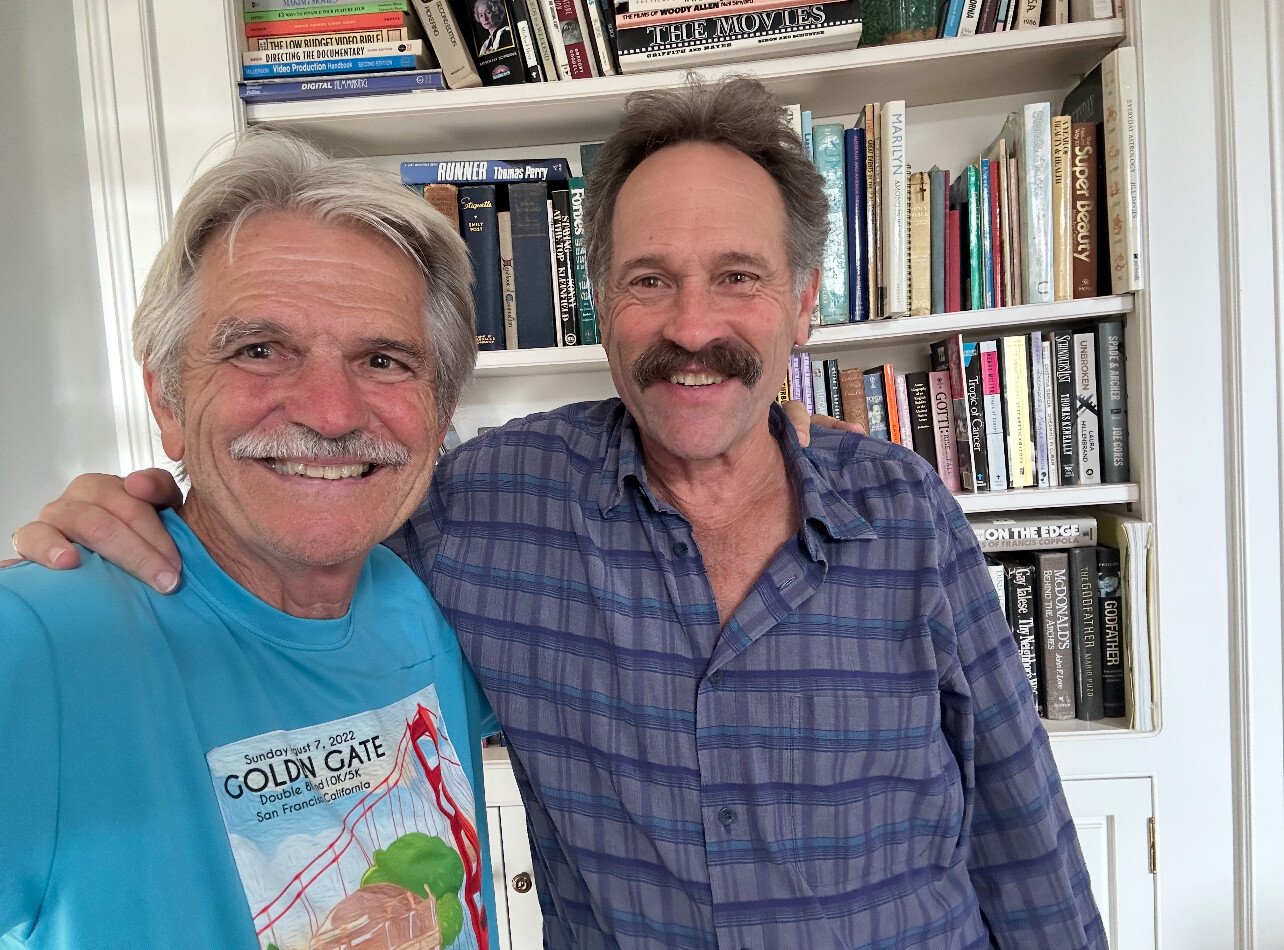
by Boris Baron
Login to leave a comment
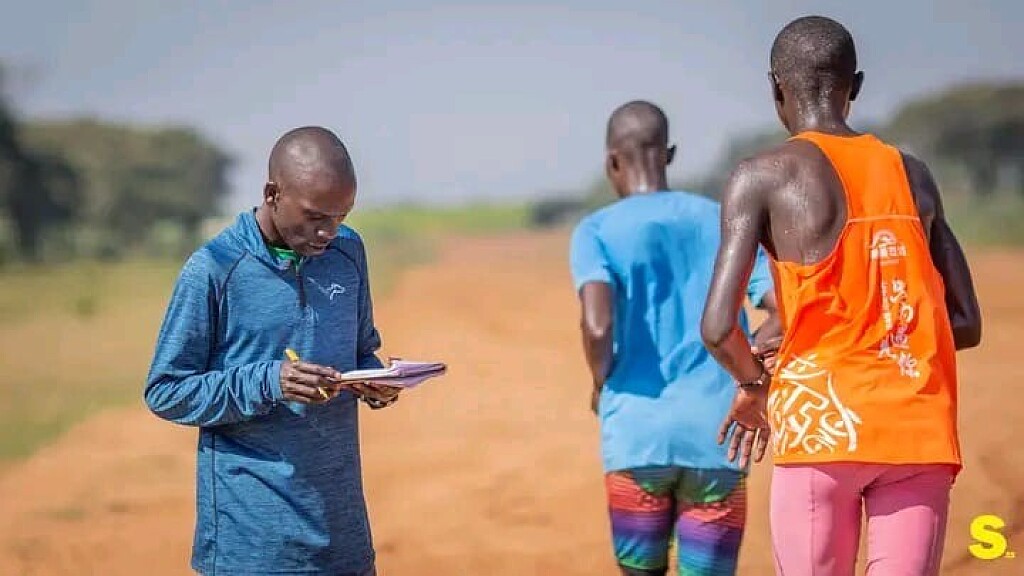
KATA Expands Global Footprint with Five New Running Camps Opening in June 2025
The Kenyan Athletics Training Academy (KATA) is advancing its mission to develop world-class runners and uplift rural communities by launching five new KATA Running Camps across Kenya in June 2025. These new satellite locations build upon KATA’s two well-established international retreats—in Thika, Kenya, and Monforte da Beira, Portugal—forming a growing global network grounded in endurance, discipline, and opportunity.
Five New Camps Opening in June
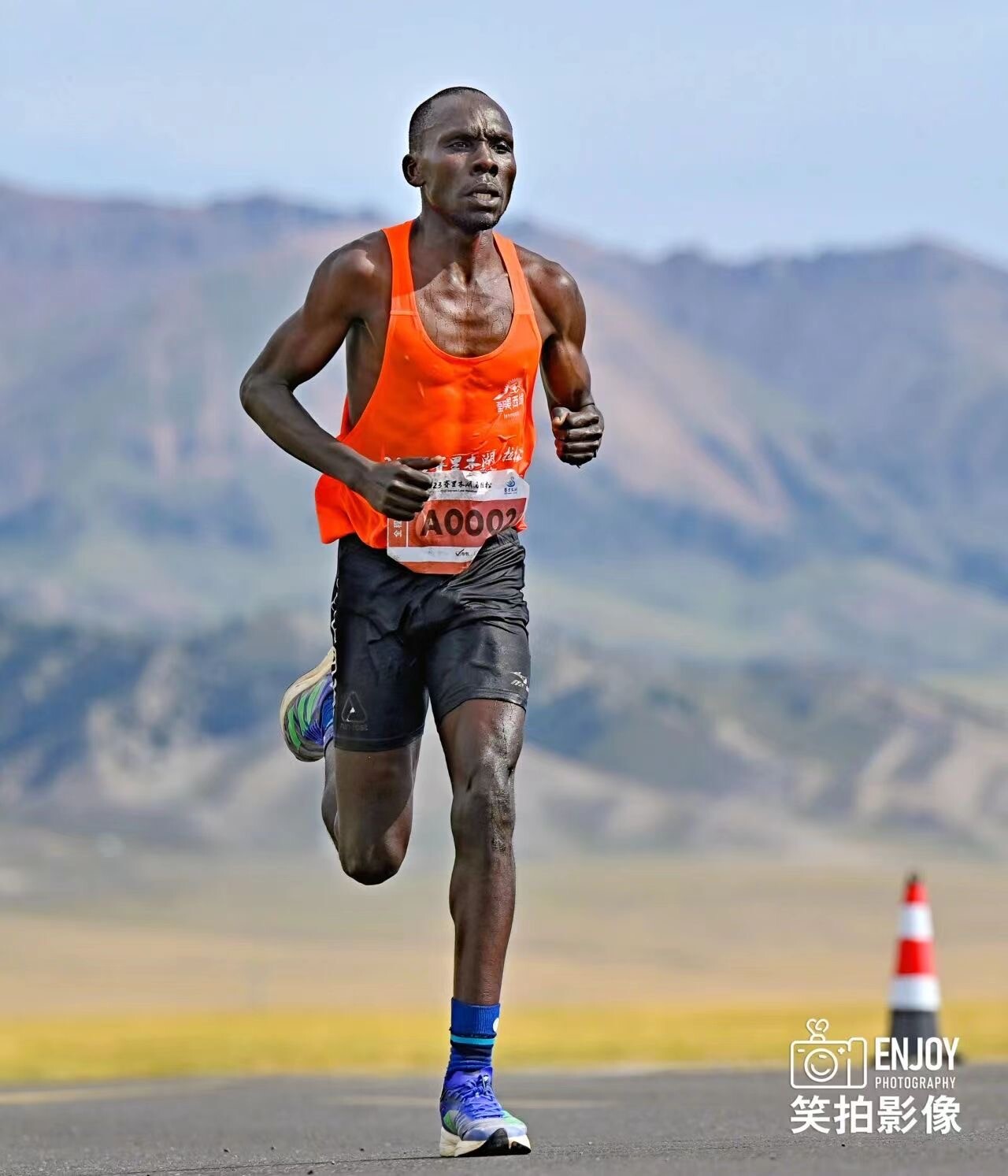
Each new camp will be led by accomplished athletes and coaches who deeply understand the training demands of distance running:
• Kericho, Kenya (~2,500m / 8,200 ft) – Operated by Edwin Soi, Olympic 5000m bronze medalist (2008) and road racing legend. The location offers quiet roads and soft dirt trails, ideal for interval training and long runs.
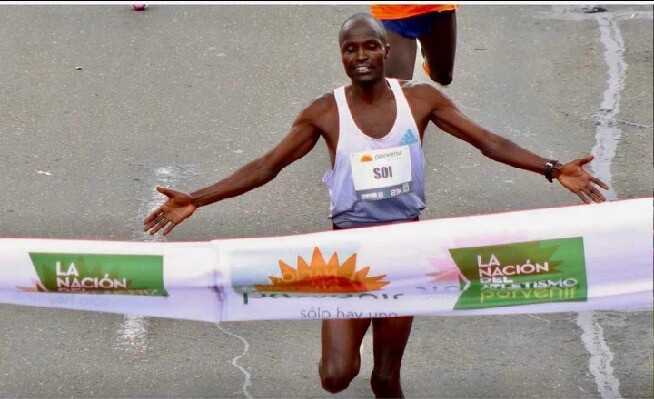
• Molo, Kenya (~2,440m / 8,000 ft) – Operated by Eric Chepkwony, a seasoned distance runner and coach. The terrain features hilly roads and scenic countryside paths that simulate real race conditions.
• Keringet, Kenya (~2,600m / 8,530 ft) – Operated by Sammy Dismas, a world-class runner and proven coach with numerous victories to his name. The camp features a mix of flat and rolling terrain ideal for tempo and progression workouts.
• Kapcherop, Kenya (~2,400m / 7,875 ft) – Operated by Philemon Kipruto, a respected local coach. Athletes benefit from forest trails and undulating village roads perfect for aerobic development.

• Nyandarua, Kenya (~2,300m / 7,550 ft) – Operated by Peter Njoroge, a dedicated coach with strong community roots. The camp includes grassy trails and high-elevation road loops ideal for base building.
Each of these camps blends elite training with mentorship, while also promoting sustainability through the KATA Potatoes project, a unique initiative that connects athletics to local agriculture and economic growth.
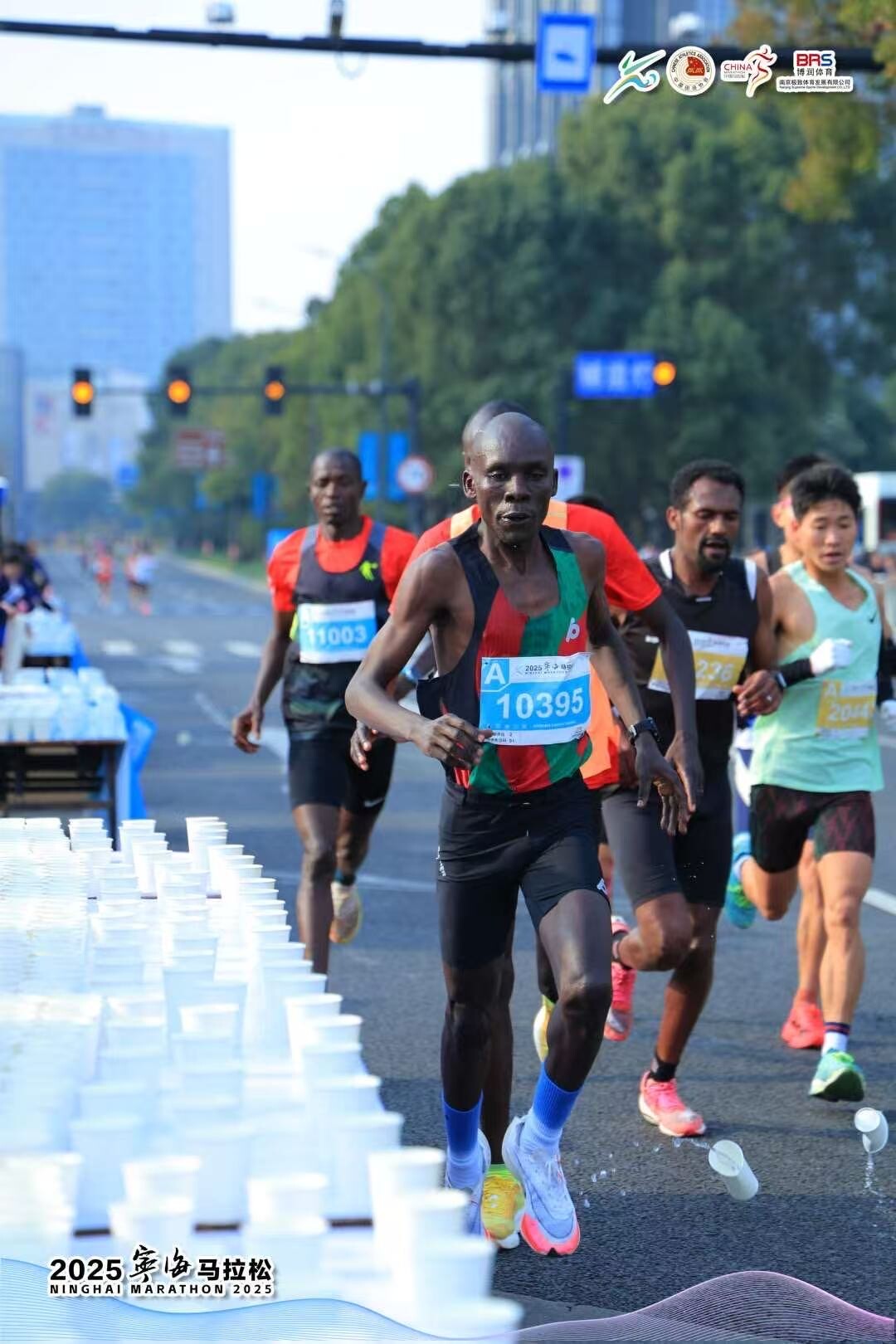
Established KATA Retreats in Kenya and Portugal
KATA’s flagship retreat in Thika, Kenya (~1,530m / 5,020 ft) continues to serve as a high-performance training hub. Managed by Christopher Muiruri, the retreat features a mix of paved loops, dirt roads, and peaceful paths—making it ideal for both elite athletes and visiting guests. KATA head coach John currently trains 20 KATA athletes and works closely with guest runners of all levels.
In 2024, KATA expanded into Europe with a retreat in Monforte da Beira, Portugal (~470m / 1,540 ft). Managed by Alberto Santos, the retreat is located at the historic Anderson Manor, just one hour from the Spanish border. The setting features technical trails, scenic roads, and a wellness-focused environment. Bob Anderson and his wife Catherine now spend about 35% of their time at this location, which serves as a perfect base to teach the Kenyan training philosophy. At least one accredited Kenyan coach is on-site at all times.

A Vision Rooted in Training and Transformation
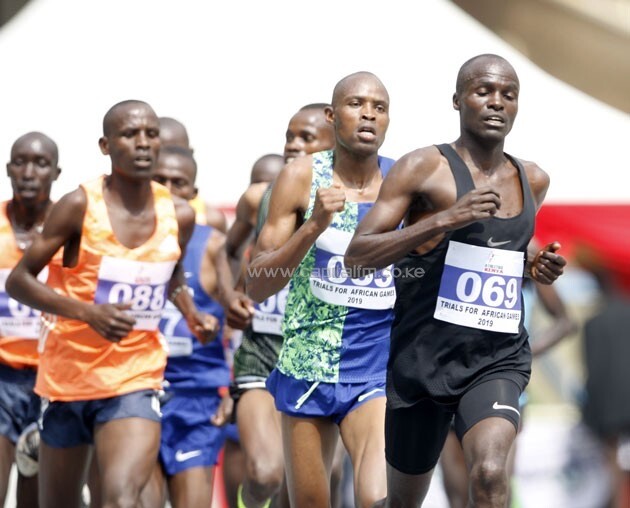
KATA was founded by Bob Anderson, creator of Runner’s World and a lifelong runner—he has been running since February 19, 1962. His vision goes beyond athletic excellence. It’s about building stronger communities through sport and shared purpose.
“This is not just about running fast,” says Anderson. “It’s about building strong roots—on the track, in the field, on the road, and within the community.”
Looking ahead, Anderson adds:
“We’re planning to open another five KATA Running Camps in Kenya by the end of the year. This is a new concept, and the feedback so far has been overwhelmingly positive.”
by Boris Baron
Login to leave a comment
 It's a new dawn for kata. Kata is the best training camp to be - Elam wangwero 6/6 8:40 am  This idea of KATA started with a dream I shared with Elam back in 2014. - Bob Anderson 6/6 11:26 am |
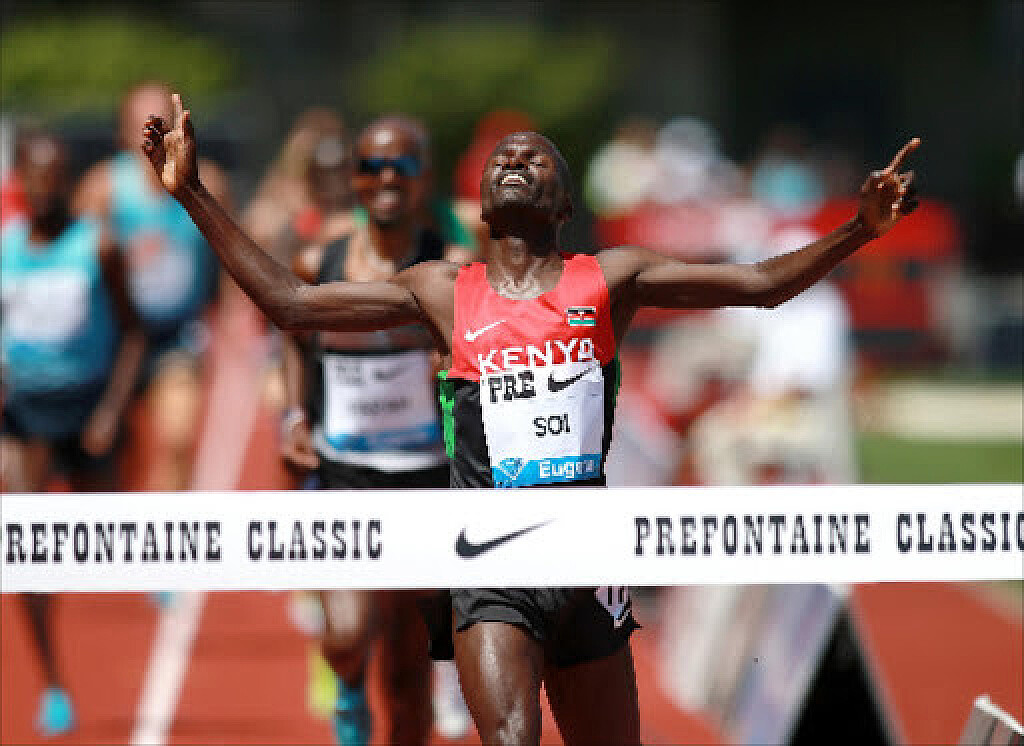
Soi eyes Bogota Half Marathon course record on Sunday
The 2008 Olympic 5,000m bronze medalist Edwin Soi will on Sunday attempt Geoffrey Mutai's Bogota Half Marathon 1:02:20 course record.
Mutai, a two-time New York Marathon champion set the time at the 2011 edition followed by Ethiopia’s Deriba Mergat (1:04:49) and Wilson Chebet (1:04:57).
Soi believes the competitive field and favorable weather conditions make the record within reach.
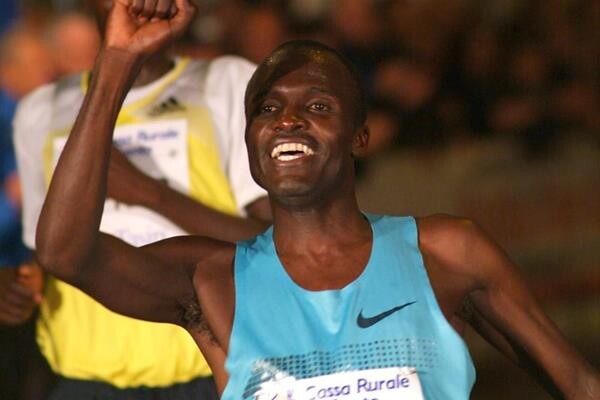
“I believe the competitive field assembled this year and favorable weather make it possible to go for the record,” Soi remarked.
He will be joined by compatriots Philemon Kiplimo, the 2022 Prague Half Marathon champion, Cali 10km Road race champion Ezra Tanui and Yangzhou Half Marathon champion Edward Koonyo.
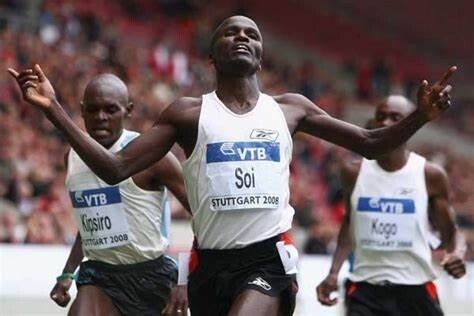
The Kenyans will face stiff competition from Venice Marathon champion Solomon Mutai of Uganda, 2023 Belgrade Marathon champion Chakib Lachgar of Spain and 2022 Hannover Marathon champion Hendrik Pfeiffer of Germany.
“I did not do so well in the race last year. With my preparations this year, I am confident about running well and achieving my target,” added Soi.
He clocked 1:04:55 for third place, trailing Tanui (1:04:50) and Morocco’s Omar Chitachen (1:03:50).
“I have run here three times, winning once. I want to add another win this year,” he revealed.
Soi claimed his first title in 2022 in 1:05:27, ahead of Uganda’s Andrew Kwemoi (1:05:29) and Daniel Muindi (1:06:45).
Napoli City Half Marathon champion Angela Tanui will seek to reclaim her crown in the women's edition.
“I was not 100 per cent ready last year. My preparations before the race were not good either,” Tanui noted.
Tanui placed fifth in 1:16:31 in a race she was bested by Daisy Kimeli (1:15:12), Ethiopia’s Anchialem Haymanot (1:15:34) and Colombia’s Angie Orjuela (1:15:40).
She won the title in 2022 in 1:13:29 with Veronicah Wanjiru (1:15:26) and Ecuador’s Rosa Chacha (1:16:43) trailing.
“I am ready this year. My preparations have been good,” she said.
Tanui will face defending champion Kimeli and the Ethiopian duo of Aberu Ayana, the Lisbon Marathon champion, and Frankfurt Marathon champion Buzunesh Getachew.
by Teddy Muley
Login to leave a comment

Bogota Half Marathon
The Bogotá International Half Marathon, or mmB as it is traditionally known, is an annual road running competition over a half marathon distance 21.0975 kilometres (13.1094 mi) taking place in Bogotá, Colombia in late July or early August. Established in 2000, it holds IAAF Gold Label Road Race status, making it the first and thus far only South American race...
more...
Daisy Kimeli reigns supreme at the Bogota Half Marathon
Kenya’s Daisy Kimeli and Morocco’s Omar Ait Chitachen have reigned supreme in the women’s and men’s races respectively at the Bogota Half Marathon.
Kimeli, 28, was in the leading pack from gun to the 19th km mark where she unleashed a finishing kick to cut the tape in 1:15:13 ahead of Ethiopia’s Anchialem Haymanot who clocked 1:15:36. Colombia’s Angie Orjuela shone on home soil and sealed the podium in 1:15:43.
Defending champion Angela Tanui, who had entered the race with the hope of successfully reclaiming the title but unfortunately missed out on a podium finish. She was leading for the better part of the race but faded as the race intensified.
In the men’s race, Chitachen was in a class of his own as he also controlled the better part of the race before sprinting to the finish line. He crossed the finish line first in 1:03:51.
The Kenyan duo of Ezra Tanui and Edwin Soi finished second and third in respective times of 1:04:50 and 1:04:56.
Soi, the defending champion, had also made a return to the streets of Colombia with the hopes of winning back-to-back titles but unfortunately, the field was too strong for him.
He was also looking comfortable in the leading pack but Chitachen reacted before him and he was forced to settle for third place.
by Abigael Wuafula
Login to leave a comment
Bogota Half Marathon
The Bogotá International Half Marathon, or mmB as it is traditionally known, is an annual road running competition over a half marathon distance 21.0975 kilometres (13.1094 mi) taking place in Bogotá, Colombia in late July or early August. Established in 2000, it holds IAAF Gold Label Road Race status, making it the first and thus far only South American race...
more...
Defending champions Angela Tanui and Edwin Soi to return to Bogota Half Marathon
Tanui and Soi won last year’s edition of the Half Marathon in style, clocking 1:13:29 and 1:05:27 respectively.
Defending champions Angela Tanui and Edwin Soi will return to Colombia for the Bogota Half Marathon on Sunday, July 30.
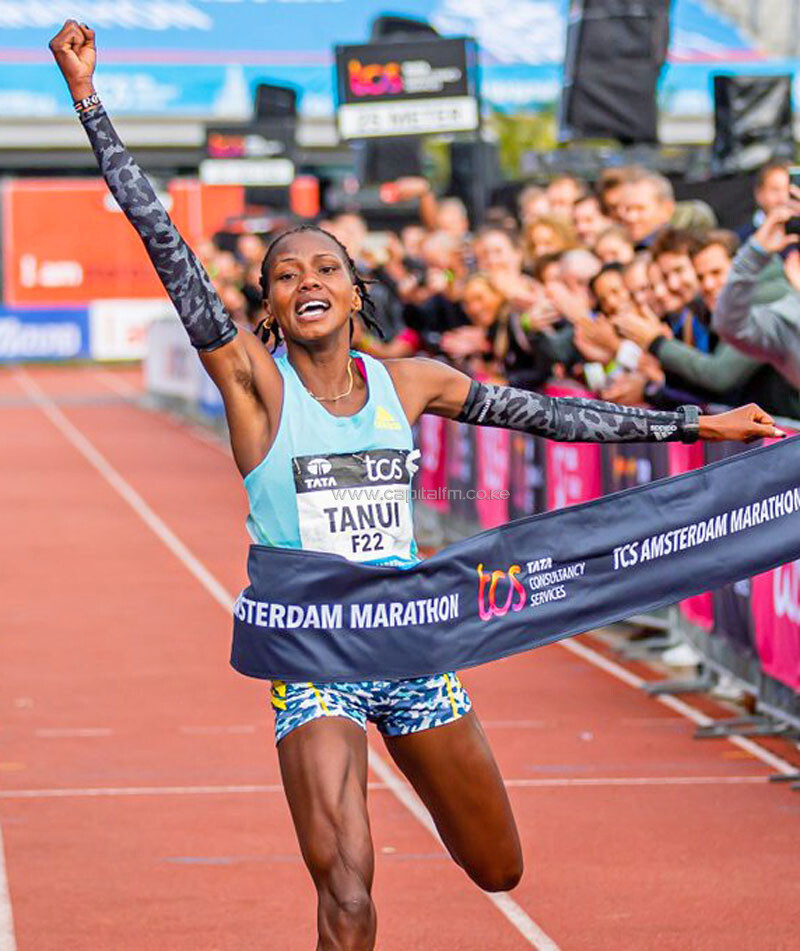
Tanui and Soi won last year’s edition of the Half Marathon in style, clocking 1:13:29 and 1:05:27 in the women’s and men’s races respectively.
Soi is the fastest in the men’s field with a Personal Best time of 1:00:24 and he will be opening his season at the event. He will enjoy the company of compatriot Daniel Muteti who is also among the top entries.
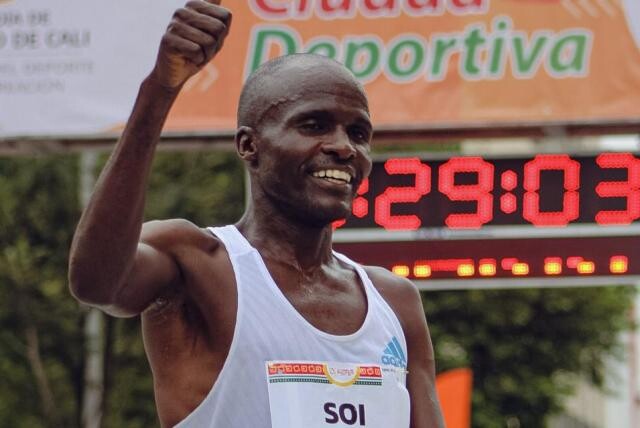
On his part, Muteti will be lining up as the third fastest in the field and so far, this year, he has only participated in two Half Marathons. He opened his season with a 12th-place finish at the Nationale-Nederlanden Warsaw Half Marathon before winning the Cereales Angel Lima Half Marathon.
The Kenyan duo will face a stern test from Morocco’s Omar Ait Chitachen who will be lining up as the second fastest in the field. Chitachen has competed in three races so far. He opened his season with a 16th-place finish at the Osaka Marathon.
He then proceeded to the Xiamen Marathon where he finished third before winning the Rabat Half Marathon.
Another threat will come from Ethiopia’s Sisay Lemma. The 32-year-old Ethiopian has competed in two marathons so far this season. He started off with the Tokyo Marathon which he unfortunately did not finish and then later went for the Prague Marathon where he finished second.
In the women’s field, Tanui will be joined by compatriot Veronica Wanjiru who has also recorded good times over the 21km distance since the season started.
Wanjiru finished fourth and third at the Publix Atlanta Half Marathon and the San Blas Half Marathon respectively.
The Kenyan duo will be up against the Ethiopian duo of Zenebu Fikadu and Anchialem Haymanot who will be looking to give them a run for their money.
by Abigael Wuafula
Login to leave a comment
Bogota Half Marathon
The Bogotá International Half Marathon, or mmB as it is traditionally known, is an annual road running competition over a half marathon distance 21.0975 kilometres (13.1094 mi) taking place in Bogotá, Colombia in late July or early August. Established in 2000, it holds IAAF Gold Label Road Race status, making it the first and thus far only South American race...
more...
Vibian Chepkirui defended her title and smashed the course record at the Vienna City Marathon.
The Kenyan Vivian Chepkirui won with 2:20:59 after a close battle with fellow-Kenyan Ruth Chebitok who finished second in 2:21:03. Sheila Jerotich made it an all-Kenyan podium, taking third place in 2:23:01.
Cosmas Muteti won the men’s race with 2:06:53, which is the second fastest time in the history of the Vienna City Marathon. Fellow-Kenyan Leonard Langat was second in 2:06:59 and Eritrea’s Oqbe Kibrom followed in third with 2:07:25.

Although there was no course record in the men’s race the wider top results were the best ever in the history of the event. There have never been two results below 2:07before in Vienna. And seven times sub 2:10 is also a record for Austria’s prime road race.
A total of 32,000 runners from about 100 nations had registered for the 39th edition of the Vienna City Marathon, including events at shorter distances. Around 8,000 of them competed in the marathon. The Vienna City Marathon is Austria’s biggest sporting event and a World Athletics Label Road Race.
Men’s Race
There was good pacemaking with an even pace in the men’s race for a long time although the 2:05:41 course record was never really threatened. A group of 17 runners including the three pacers passed half way in 63:21 and then went on to a 30k split time of 1:30:12. However when the pacers all dropped out at the same time right after the 30k point the race for victory was on immediately.
It was Oqbe Kibrom who surged ahead instantly. The fastest runner on the start list (PB: 2:05:53) seemed on course for a first Eritrean victory in the history of the race. However with kilometer splits of 2:54 and 2:51 for the 31st and 32k Oqbe Kibrom misjudged his potential and the picture changed.
“I knew he was strong. But I decided not go with him at 30k and run my own pace instead. I hoped to close the gap slowly,“ explained Cosmas Muteti, who soon realised that he did gain ground on the leader. With around five kilometres to go the Kenyan, who is partly coached by former world marathon record holder Patrick Makau and was fifth in Berlin last September, caught Oqbe Kibrom and then moved away from him.
In the final stages fellow-Kenyan Leonard Langat took second place and made up some ground to the leader. “I knew that he was coming nearer, but I was sure to win as I would have been able to put in a sprint if needed,“ said Cosmas Muteti, who wrote history by becoming the 50th runner of the Vienna City Marathon to achieve a sub 2:10 finish.
“This is my biggest victory. I hope to be able to defend my title here next year and then may be break the course record,“ said Cosmas Muteti, who improved his former PB of 2:08:45 by almost two minutes.
Austrian’s Lemawork Ketema was the best European runner in Vienna with a 2:15:42 finishing time in 13th place. However he missed the qualifying standard for the European Championships.
Women’s Race
In relatively good weather conditions but some wind the women’s race developed differently. Defending champion Vibian Chepkirui, who ran only her second marathon after her Vienna debut triumph in 2021, broke away after eight kilometres. At the 10k mark she had a split time of 33:11 which pointed to a 2:20 finishing time.
She was six seconds ahead of fellow-Kenyans Ruth Chebitok and Viola Yator. For an unexpected reason the 27 year-old was then not able to maintain this pace. “My husband and pacemaker Wesley Kongogo had a problem with his shoes and got a blister, so he slowed a bit,“ explained Vibian Chepkirui. While she had a lead of nine seconds at half way, which she passed in 70:38, she was unable to significantly increase it.
In contrast Ruth Chebitok, who had left behind Viola Yator after the half way mark, made up the deficit and was running right behind the defending champion at 35k.
Vibian Chepkirui stayed ahead by a step in the final section and it was with around one kilometer to go at Vienna’s Opera House when she increased the pace again and secured her second Vienna marathon victory.
“I am of course very happy to have won again in Vienna. I want to come back next year and then my goal will be to improve to 2:18,“ said Vibian Chepkirui, who ran 2:24:29 in her debut last September in warm conditions.
Slovenia’s Neja Krsinar was the fastest European runner in Vienna. She finished eighth in 2:35:30.
Results, Men:
1. Cosmas Muteti KEN 2:06:53
2. Leonard Langat KEN 2:06:59
3. Oqbe Kibrom ERI 2:07:25
4. Charles Ndiema KEN 2:08:12
5. Raymond Chose KEN 2:08:32
6. Edwin Soi KEN 2:09:10
7. Noah Kipkemboi KEN 2:09:55
8. Abdi Fufa ETH 2:10:32
9. Abraham Kipyatich KEN 2:10:51
10. Mike Chesire KEN 2:11:32
Women:
1. Vibian Chepkirui KEN 2:20:59
2. Ruth Chebitok KEN 2:21:03
3. Sheila Jerotich KEN 2:23:01
4. Urge Soboka ETH 2:27:13
5. Caroline Kilel KEN 2:29:29
6. Viola Yator KEN 2:30:40
7. Teresiah Omosa KEN 2:31:44
8. Neja Krsinar SLO 2:35:30
9. Kellys Arias COL 2:38:28
10. Chaltu Marame ETH 2:38:34
Login to leave a comment

Vienna City Marathon
More than 41,000 runners from over 110 nations take part in the Vienna City Marathon, cheered on by hundreds of thousands of spectators. From the start at UN City to the magnificent finish on the Heldenplatz, the excitement will never miss a beat. In recent years the Vienna City Marathon has succeeded in creating a unique position as a marathon...
more...
Defending champion Vibian Chepkirui hoping to run 2:20 in Vienna
Defending champion Vibian Chepkirui hopes to make another big step at the Vienna City Marathon, aiming to win her second race at the classic distance as well. The Kenyan believes she is ready to run a time of around 2:20 on Sunday. Such a result would not only smash her PB but the course record of 2:22:12 as well.
It was in September when Vibian Chepkirui won her debut marathon in Vienna with 2:24:19 in very warm weather conditions. While five women feature personal bests of sub 2:25 there are two men on the start list who have run below 2:06. Oqbe Kibrom of Eritrea is the fastest runner in the field with a PB of 2:05:53.
Organisers of the 39th edition of the Vienna City Marathon have registered more than 31,000 entries including events at shorter distances. Around 8,000 of them are marathon runners. The Vienna City Marathon is Austria’s biggest running event and a World Athletics Label Road Race.
The Vienna City Marathon will be streamed live from 8.30 am on Sundayat: www.vienna-marathon.com There will also be English live reporting of the elite races on the event’s Twitter account, which is accessible through the website as well.
"I have very good memories of Vienna and I am happy to be back. It is a good course and the people are fantastic,“ said Vibian Chepkirui, with her manager Julien di Maria of Ikaika helping her to answer the questions during the press conference.

"I have prepared well and because of my training I think that in good weather conditions a time of around 2:20 is possible for me.“ As Julien di Maria explained Vibian Chepkirui became more confident when she saw the result of her training partner Joan Melly last Sunday: She won the Seoul Marathon with a course record of 2:18:04.
“Vibian and Joan always train together in Iten. And they are more or less on the same level. It was only during the final stages of some sessions when Joan was a little stronger than Vibian,“ explained Julien di Maria. Vibian Chepkirui has only run a single international race since her Vienna triumph in September and has fully focussed on defending her title in the Austrian capital.
The 27 year-old was fifth in Spain’s Santa Pola half marathon in January with 69:35. On Sunday she will again be paced by her husband Wesley Kangogo, who also acts as a pacemaker for the group when they are training in Iten.
There are four women with faster personal bests than the defending champion on the start list of the Vienna City Marathon. One of them is Ruth Chebitok, who has run 2:23:29 in Toronto in 2018. “I had injury problems for some time, but then ran quite well in Berlin last year with 2:28:18. Now I am well prepared and confident that I can run a time around my PB again,“ said the Kenyan.
The Vienna City Marathon is among a number of top road races that experienced an unusually high number of late cancellations. Goitom Kifle of Eritrea had to cancel his start because of an injury. He had been the fastest runner on the start list with a PB of 2:05:28. Another one who can not compete in Vienna is the defending champion Leonard Langat of Kenya.
There could still be a winner from Eritrea, which would be a novelty in the history of the race. Oqbe Kibrom is now the fastest runner on the start list with a PB of 2:05:53. The Eritrean, who held the national record for some time with his PB from 2020, looks ahead with confidence.
“I have trained well and hope to run a personal best on Sunday,“ said Oqbe Kibrom. The pace of the leading group will likely be perfect for him as it is planned to pass through half way in around 63:00. An attack on the course record would then still be possible. Ethiopia’s Getu Feleke holds this mark with 2:05:41 from 2014.
Cosmas Muteti might not be a pre-race favourite, but the Kenyan has developed very well recently. Coached by former world record holder Patrick Makau he improved to 2:08:45 in Berlin last year, where he took a fine fifth place in warm conditions. „Patrick is a good coach and I have improved under his guidance,“ said Cosmas Muteti, who targets his personal best on Sunday.
There is also an OPEC Fund Rookie Team competing in Vienna on Sunday. The idea is to give unknown African athletes a chance to compete internationally in Vienna and to support them to hopefully build a successful career. Victor Serem is the most experienced of the group. The Kenyan has a PB of 2:12:00 which he ran in Nairobi in 2019. “This will be my first marathon outside Kenya and I am grateful for the opportunity. I hope to improve to 2:10 on Sunday,“ said Victor Serem. The other three runners of the OPEC Fund Rookie Team are Kenya’s Dickson Kiptoo (PB: 2:23:56 in Eldoret), Fanose Tessema Gonfa and fellow-Ethiopian Chaltu Fikadu Marame.
Elite fields with personal bests
Men:
Oqbe Kibrom ERI 2:05:53
Abdi Fufa ETH 2:05:57
Raymond Choge KEN 2:08:11
Cosmas Muteti KEN 2:08:45
Weldu Gebretsadik NOR 2:09:14
Edwin Soi KEN 2:09:16
Charles Ndiema KEN 2:10:43
Lemawork Ketema AUT 2:10:44
Leonard Langat KEN 2:10:49
Noah Kipkemboi KEN 2:11:09
Victor Serem KEN 2:12:00
Anderson Seroi KEN 2:12:21
Mike Chesire KEN 2:13:28
Tomasz Grycko POL 2:13:30
Solomon Tesfamariam SUI 2:14:51
Abraham Kipyatich KEN Debüt
Timon Theuer AUT Debüt
Women:
Caroline Kilel KEN 2:22:34
Ruth Chebitok KEN 2:23:29
Sifan Melaku ETH 2:23:49
Sheila Jerotich KEN 2:24:15
Vibian Chepkirui KEN 2:24:29
Esther Kakuri KEN 2:26:11
Urge Soboka ETH 2:28:10
Nataliya Lehonkova UKR 2:28:58
Kellys Arias COL 2:29:36
Viola Yator KEN 2:30:03
Teresiah Omosa KEN 2:30:12
Benny Cheruiyot KEN 2:34:18
Neja Krsinar SLO 2:35:44
Login to leave a comment
Vienna City Marathon
More than 41,000 runners from over 110 nations take part in the Vienna City Marathon, cheered on by hundreds of thousands of spectators. From the start at UN City to the magnificent finish on the Heldenplatz, the excitement will never miss a beat. In recent years the Vienna City Marathon has succeeded in creating a unique position as a marathon...
more...
Strong Vienna elite fields could attack course records
Both course records could become a target at the Vienna City Marathon, which features strong elite races on April 24. Kenyans Leonard Langat and Vibian Chepkirui will return to defend their Vienna titles while there are three men on the start list who have broken 2:06 and five women featuring personal bests of sub 2:25.
With regard to these personal records it will be strongest line-up in the history of the Vienna City Marathon which will see its 39th edition next week. Including races at shorter distances more than 31,000 runners have registered for Austria’s biggest running event, a World Athletics Marathon Label Road Race.
“We are very happy that we were able to surpass the mark of 30,000 entries. Compared to our comeback race in September 2021 this is a nice step forward. We feel the enthusiasm of the runners,“ said Kathrin Widu, the General Manager of the Vienna City Marathon.
There has never been an Eritrean winner in the history of the Vienna City Marathon which had its first edition back in 1984. This may change next week though since the two fastest entrants are from this country: Goitom Kifle and Oqbe Kibrom feature personal bests of 2:05:28 and 2:05:53 respectively. Kifle had a fine year in 2021: He was third in Enschede, 14th in the Olympic marathon in Sapporo and then 6th in Valencia, where he ran his PB. With his personal record the Eritrean is a little faster than Vienna’s course record of 2:05:41 by Ethiopia’s Getu Feluke in 2014.
Abdi Fufa of Ethiopia is the third athlete in Vienna’s line-up who has run sub 2:06. A year ago he was second in Siena’s elite only race with 2:05:57. It looks a tough task for Leonard Langat to defend his title in the Austrian capital. The Kenyan improved to 2:09:25 in Vienna last September. But with this PB he is only the eighth fastest athlete on the start list.
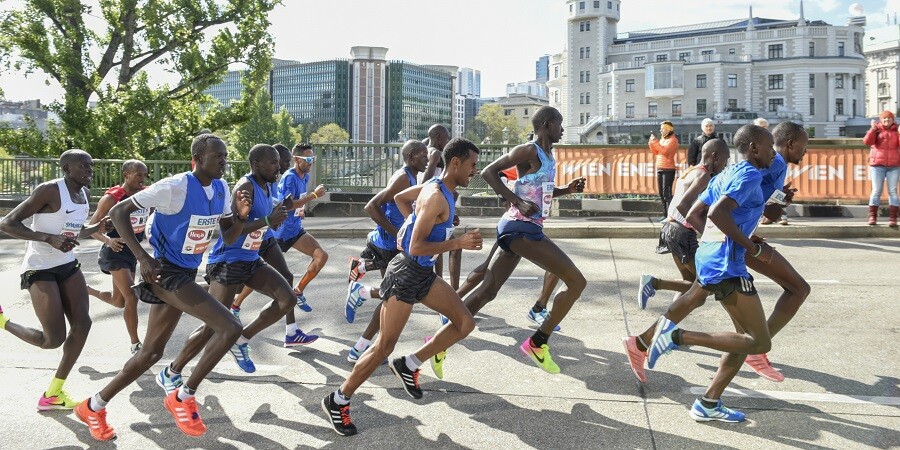
Unfortunately there were a number of cancellations from elite runners recently. Among them are Mekuant Ayenew and fellow-Ethiopian Derara Hurisa, who had originally crossed the line first in last year’s Vienna City Marathon. However he then had to be disqualified for wearing illegal racing shoes and Leonard Langat became the winner.
The fastest runner on the women’s start list is Caroline Kilel, who ran 2:22:34 when she took the Frankfurt Marathon back in 2013. While the Kenyan did not reach these sort of times recently there are other athletes who showed promising last year. Defending champion Vibian Chepkirui may only be number five on the list with her PB of 2:24:29.
However she did run this time last September in Vienna in very warm conditions. Afterwards the Kenyan said that she could have been at least two minutes faster in more suitable conditions.
Vibian Chepkirui could be capable of attacking the course record of fellow-Kenyan Nancy Kiprop who was the winner in 2019 with 2:22:12.
Kenya’s Ruth Chebitok and Ethiopia’s Sifan Melaku are number two and three on Vienna’s start list with PBs of 2:23:29 and 2:23:49 respectively. Sheila Jerotich of Kenya is a contender for victory as well. She took the Istanbul Marathon in November, improving to 2:24:15.
Elite fields with personal bests
Men:
Goitom Kifle ERI 2:05:28
Oqbe Kibrom ERI 2:05:53
Abdi Fufa ETH 2:05:57
Raymond Choge KEN 2:08:11
Cosmas Muteti KEN 2:08:45
Weldu Gebretsadik NOR 2:09:14
Edwin Soi KEN 2:09:16
Leonard Langat KEN 2:09:25
Charles Ndiema KEN 2:10:43
Lemawork Ketema AUT 2:10:44
Jeison Suarez COL 2:10:51
Iraitz Arrospide ESP 2:10.59
Noah Kipkemboi KEN 2:11:09
Ebba Chala ETH 2:11:27
Abraham Kipyatich KEN Debut
Timon Theuer AUT Debut
Women:
Caroline Kilel KEN 2:22:34
Ruth Chebitok KEN 2:23:29
Sifan Melaku ETH 2:23:49
Sheila Jerotich KEN 2:24:15
Vibian Chepkirui KEN 2:24:29
Esther Kakuri KEN 2:26:11
Urge Soboka ETH 2:28:10
Marcela Joglova CZE 2:28:16
Nataliya Lehonkova UKR 2:28:58
Kellys Arias COL 2:29:36
Viola Yator KEN 2:30:03
Teresiah Omosa KEN 2:30:12
Nataliya Lehonkova UKR 2:30:28
Login to leave a comment
Vienna City Marathon
More than 41,000 runners from over 110 nations take part in the Vienna City Marathon, cheered on by hundreds of thousands of spectators. From the start at UN City to the magnificent finish on the Heldenplatz, the excitement will never miss a beat. In recent years the Vienna City Marathon has succeeded in creating a unique position as a marathon...
more...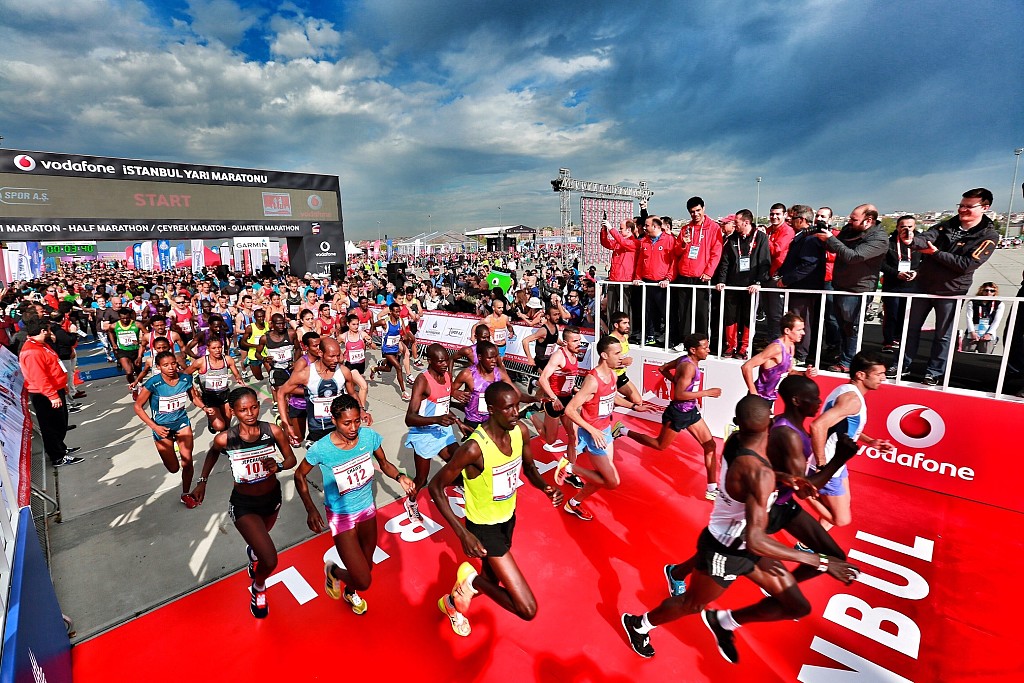
Ethiopia's Hailu Zewdu and Diana Chemtai lead their respective fields for the Istanbul Marathon as the World Athletics Gold Label road race series resumes in Turkey's largest city on Sunday
Zewdu made his marathon debut at the Dubai Marathon in January, clocking 2:06:31 to finish 10th. He'll be joined by compatriot Tsegaye Getachew, the next fastest in the field with a 2:06:50 career best, set at the Valencia Marathon last year where he finished eighth. Earlier in the year Getachew won the Dalian Marathon in 2:11:25, his first and to date only international victory over the distance.
Felix Kimutai, with 2:09:23 credentials, leads the Kenyan contingent. The 31-year-old won here in 2018 and finished third one year ago.
Cosmas Birech, who clocked 2:08:03 to win the Rome Marathon in 2018, is also in the field, along with Edwin Soi, the 2008 Olympic bronze medallist over 5000m, who'll be making his marathon debut.
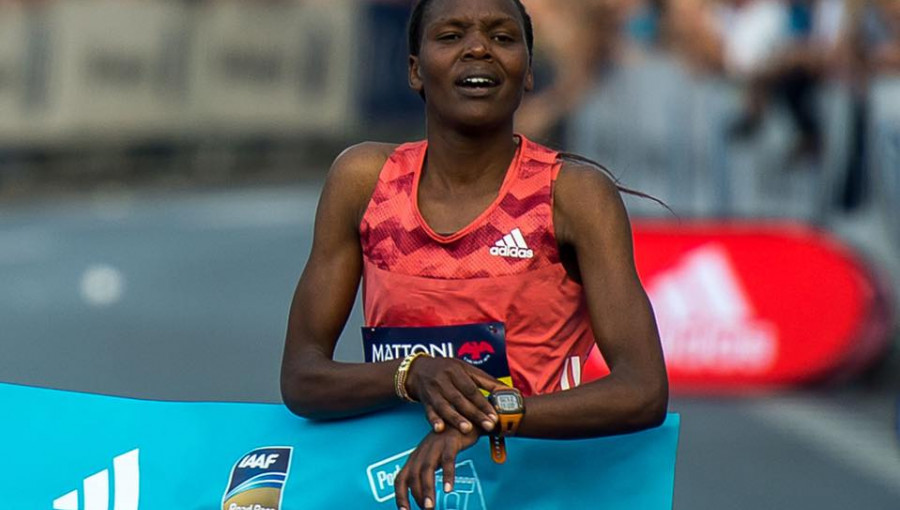
Local hopes will rest with Yavuz Agrali, who set his 2:10:41 lifetime best in Seville in February.
Chemtai, who made her marathon debut last year, leads the women's field. The 26-year-old Kenyan clocked 2:22:07 at last year's Ljubljana Marathon, finishing third. She has a 1:07:07 half marathon best from 2018.
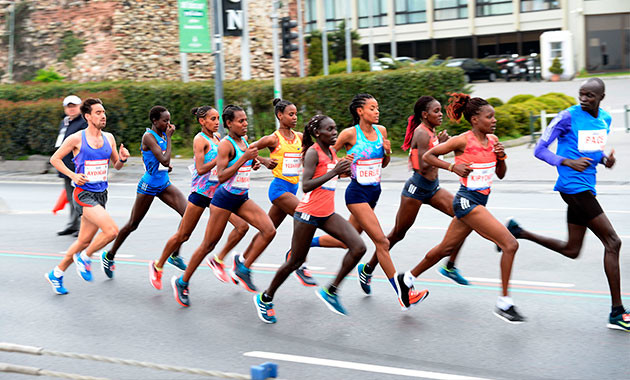
She'll face a pair of formidable Ethiopians, Hiwot Gebrekidan and Yeshi Kalayu Chekole. Gebrekidan has a 2:23:50 career best set in Guangzhou last year while Chekole, 23, has a 2:24:28 best set in Abu Dhabi, also one year ago.
Strict safety measures in place
Organisers have put several measures in place to ensure the safety of all runners, beginning with a cap of 3000 participants.
The start and finish area was moved to a massive open space to ensure a safe distance between the runners both before and after the race. The area will be secured, barring entry to anyone without a clearance code provided by Turkey's Ministry of Health. A negative test for Covid-19 was required to enter the race.
All participants, including the elite athletes, will be required to wear face masks at the start, and will be able to dispose of them in designated boxes at 20 metres, 200 metres and one kilometres from the start.
The gun will sound the start of the elite race at 9am. The mass race will follow with groups of four runners starting every five seconds.
The change in course means that this year, instead of starting on the Asian side of the city and finishing on the European side, runners will first cross from Europe to Asia and then back again. With the change to a much more difficult course, organisers don't expect the race records - Daniel Kipkore Kibet's 2:09:44 set in 2019 and Ruth Chepngetich's 2:18:35 from 2018 - to be under threat.
The accompanying shorter races that regularly attract up to 70,000 participants were cancelled this year.
by World Athletics
Login to leave a comment
N Kolay Istanbul Marathon
At the beginning, the main intention was simply to organise a marathon event. Being a unique city in terms of history and geography, Istanbul deserved a unique marathon. Despite the financial and logistical problems, an initial project was set up for the Eurasia Marathon. In 1978, the officials were informed that a group of German tourists would visit Istanbul the...
more...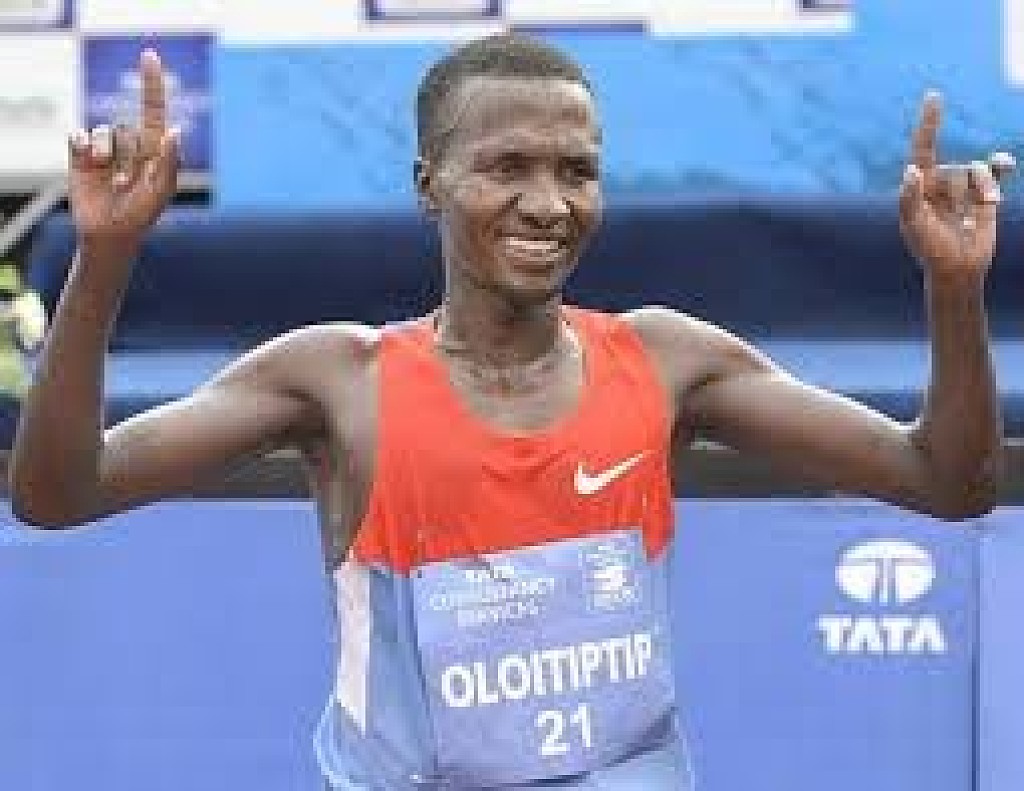
Kamworor remained adamant that Doha is not on his mind as he seeks to reclaim the New York Marathon title
Kenya Defence Forces Alex Oloitiptip is the beneficiary of a slot to represent the country at the 2019 World Championships in Doha, Qatar next month despite finishing fourth during yesterday’s national trials.
Oloitiptip, a 58:51 man over the half marathon clocked 27:29.40 behind race winner Geoffrey Kamworor (27:24.76), Rhonex Kipruto (27:26.34) and Rodgers Kwemoi (27:26.92).
Richard Kimunyan (27:47.86) and Bernard Kimeli (27:53.32) completed the top six places.
Oloitiptip got the rare slot after Kamworor remained adamant that Doha is not on his mind as he seeks to reclaim the New York Marathon title he won in 2017 but lost to Ethiopia’s Lelisa Desisa last year.
In a rare move, Athletics Kenya held the 10,000m race trials during the national trials and it was evident from the onset that the invited athletes were eager to bag a ticket to Doha, save for Kamworor, whose aim was to represent his team, National Police Service and as well fine-tune for New York.
In fine weather conditions, Oloitiptip set the early pace followed closely by 2008 Olympic bronze medallist Edwin Soi and Kimunyan, the 2018 world U-18 3,000m champion.
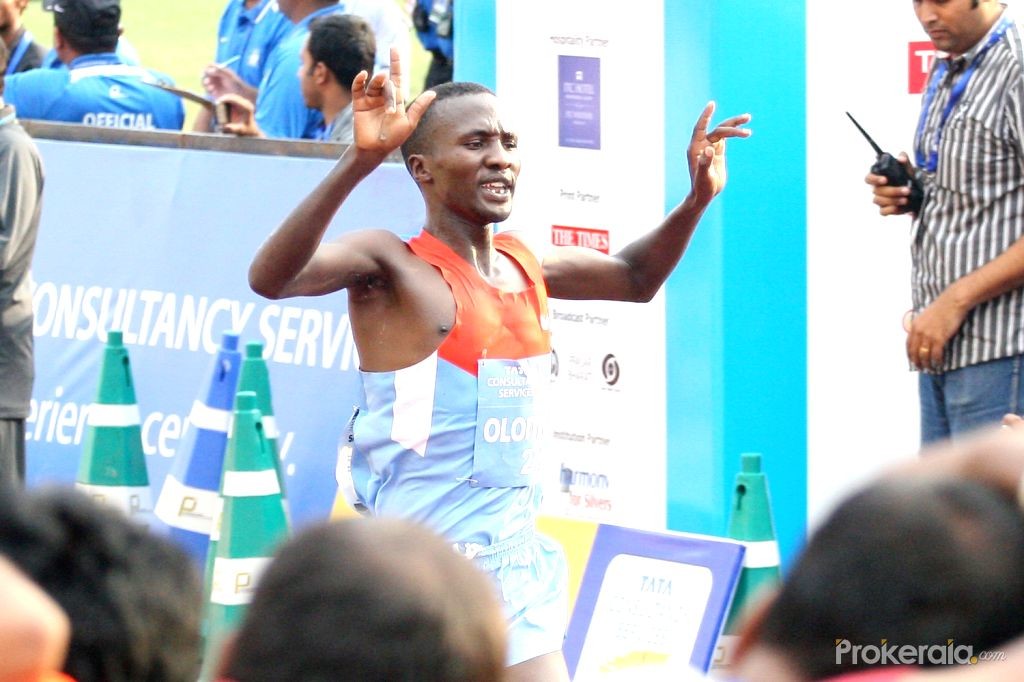
The race went into a single file by the start of the sixth lap with no athlete willing to make the decisive move. Road racer Bernard Kimeli then tried to up the pace in the eighth lap after taking the lead but the chasing pack kept tabs with him for the next four laps.
Kipruto took the lead at the halfway point controlled the race comfortably with Kwemoi and Kimunyan still interested. Kamworor joined the leading pack in the 17th lap and bid his time as Kipruto and Kwemoi tussled for the lead.
At the bell, Kamworor made his move, cruising past a tiring Kipruto and Kwemoi and strode home to victory.
“I was using the event today to test my speed work for the marathon. My body is in good shape and I am confident I can win in New York come November 3,” said Kamworor.
by William Njuguna
Login to leave a comment

IAAF World Athletics Championships Doha
The seventeenth edition of the IAAF World Championships is scheduled to be held between 27 September and 6 October 2019 in Doha, Qatar at the renovated multi-purpose Khalifa International Stadium. Doha overcame bids from Eugene, USA, and Barcelona, Spain to be granted the rights to host the 2019 IAAF World Championships in Athletics. Having hosted the IAAF Diamond League, formerly...
more...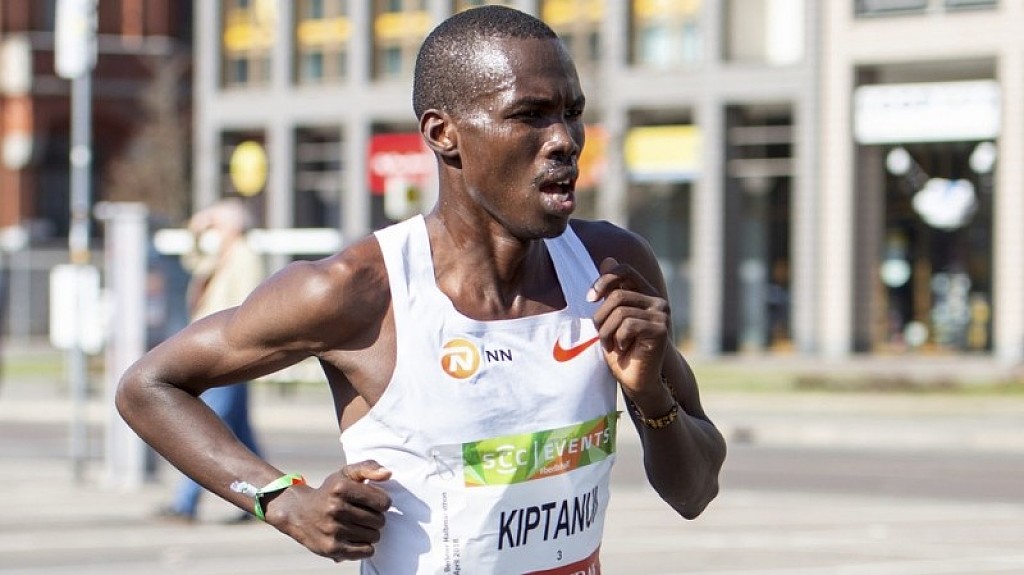
Kenyans Erick Kiptanui and Vivian Cheruyiot lead strong field's for the EDP Lisbon Half Marathon this weekend
The EDP Lisbon Half Marathon field includes 21 male runners with personal bests of under 1:01 and ten in the women's field who have dipped under 1:10.
Erick Kiptanui made his debut over the distance in this race last year, winning in 1:00:05, and went on to improve to 58:42 in Berlin one month later. Two other sub-59:00 runners are in the field: 2013 winner Bernard Kiprop Koech, who has clocked 58:41, and Solomon Kirwa Yego, who set his 58:44 best in the 2016 Rome-Ostia Half Marathon.
But there are more athletes in this race who can produce some surprises. Ethiopia comes armed with Mosinet Geremew, winner of the 2018 Dubai Half Marathon with a 59:11 lifetime best from 2014, and Betesfa Getahun, who has a 1:00:26 personal best. He was third in the Barcelona Half Marathon last month.
Behind Kiptanui, the solid Kenyan contingent includes Micah Kogo, the 2008 Olympic bronze medallist over 10,000m who's clocked 59:07; Simon Cheprot who has a 59:20 lifetime best; Edwin Kiprop Kiptoo, who has a 59:26 best; Nicholas Kosimbei, who clocked 1:00:21 at this race last year; late addition Edwin Soi, the 2008 Olympic 5000m bronze medallist, who improved to 1:00:24 in Granollers, Spain, this year; and Japhet Korir, who has run 1:00:08.

Others to watch include Callum Hawkins of Great Britain, who'll be looking to improve on his 1:00:00 personal best and Abrar Osman of Eritrea, who's clocked 1:00:19.
In the women's field, Vivian Cheruyiot, the 2016 Olympic 5000m champion, is the undisputed star of the field. The 35-year-old, who also won three world titles on the track and the 2017 London Marathon, was second in this race last year clocking 1:09:44. She clocked 1:07:43 at last year's Great North Run, also finishing second.
She'll face a formidable field however, led by Ethiopia's Gelete Burka, who has a solid 1:06:11 lifetime best set last year.
Erick Kiptanui, Vivian Cheruyiot
Login to leave a comment

EDP HALF MARATHON OF LISBON
EDP Lisbon Half Marathonis an annual internationalhalf marathoncompetition which is contested every March inLisbon,Portugal. It carries World Athletics Gold Label Road Racestatus. The men's course record of 57:31 was set byJacob Kiplimoin 2021, which was the world record at the time. Kenyanrunners have been very successful in the competition, accounting for over half of the total winners, withTegla Loroupetaking the...
more...