

Running News Daily
Running News Daily is edited by Bob Anderson and team. Send your news items to bob@mybestruns.com Advertising opportunities available.
Index to Daily Posts · Sign Up For Updates · Run The World Feed
Articles tagged #Wisconsin
Today's Running News
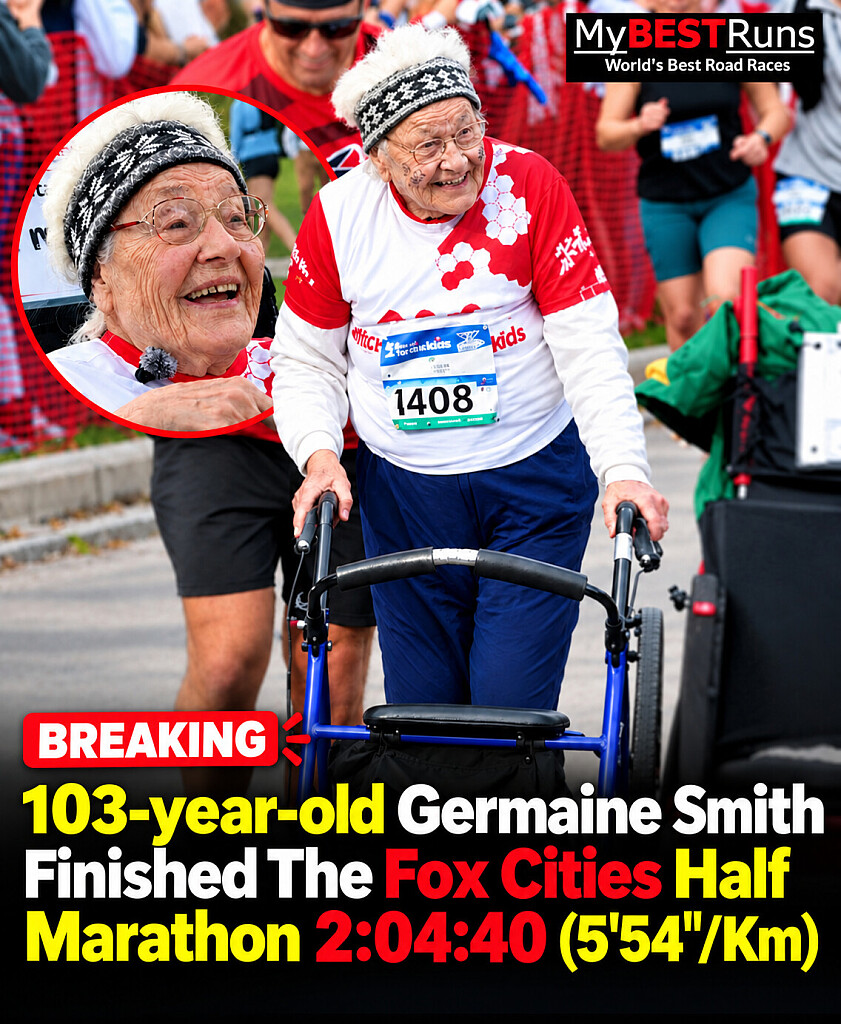


103-Year-Old Germaine Smith Makes History With Remarkable Half Marathon Finish in Wisconsin
At 103 years old, Germaine Smith has delivered an extraordinary reminder that age does not have to stand in the way of pursuing remarkable goals after completing the Fox Cities Half Marathon in Wisconsin in an impressive time of 2:04:40.
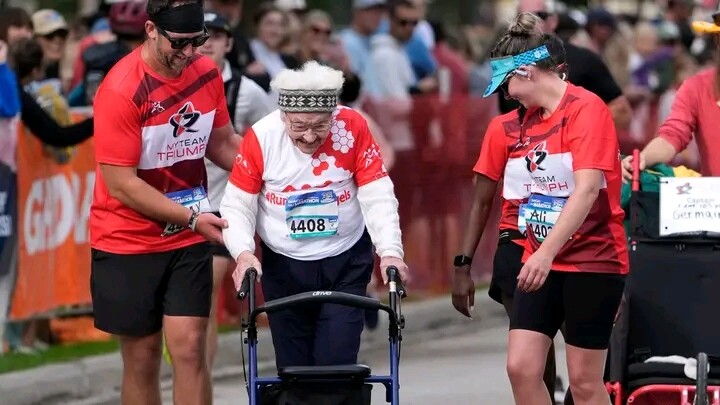
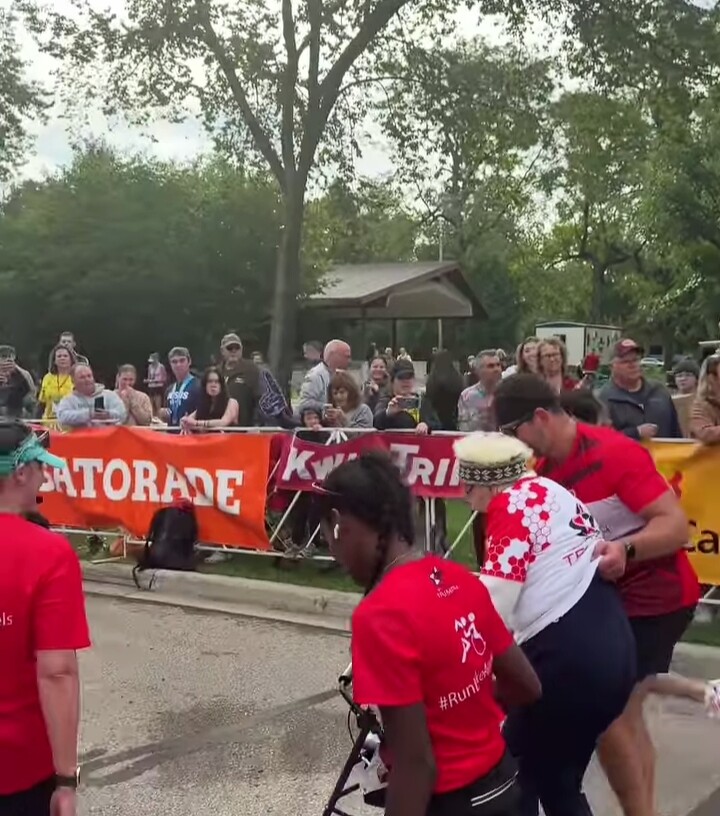
Smith captured attention with her inspiring performance, beginning the race in a wheelchair before getting out and completing part of the 13.1-mile course on foot. Her determination to keep moving forward made her achievement particularly memorable, turning an ordinary race day into a powerful story of perseverance and resilience.
The centenarian's finish was about far more than the time displayed on the clock. At an age when many people have long since stepped away from physically demanding activities, Smith demonstrated a remarkable willingness to remain active and embrace the challenge of completing a half marathon.
Her participation in the Fox Cities Half Marathon offered a powerful reminder that running and movement can remain meaningful at every stage of life. While the race brought together athletes pursuing personal records and competitive goals, Smith's journey stood out for the determination and courage behind her finish.
Completing 13.1 miles at 103 is an extraordinary accomplishment, and her decision to cover part of the course on foot made the moment even more special.
Smith's remarkable achievement is a celebration of the human spirit, showing that the finish line is not always about speed, but also about determination, courage, and the willingness to keep moving forward.
Her story also highlights the inclusive spirit of distance running, where participants of different ages and abilities can share the same course while pursuing their own personal goals. For Smith, the experience was a reminder that taking part in a race can be just as meaningful as competing for a podium position.
At an age when every milestone carries a special significance, Smith's accomplishment offers an uplifting message to people of all generations. Her journey demonstrates that determination and a love for physical activity can continue to inspire others, regardless of age or athletic background.
Beyond the finish line, her achievement serves as a source of encouragement for anyone who has ever questioned whether they are too old to take on a new challenge. Smith's remarkable effort shows that personal victories come in many forms and that the courage to participate can be just as powerful as the achievement itself.
At 103, Germaine Smith has shown that the joy of taking on a challenge has no age limit.
by Erick Cheruiyot for My Best Runs.
Login to leave a comment
Morning people make faster marathoners, study shows
If you’re the type of person who typically jumps out of bed at the crack of dawn, thrilled to greet the new day, and who feels most productive in the morning, you may be more likely to achieve your marathon time goal than your night owl training partner, according to a new study published in the Journal of Sleep Research.
Of course, there are many factors that influence running performance. But there is less data around “circadian preferences” (i.e., whether you identify as a morning person or an evening person) and “sleep inertia” (how hard you find it to transition to being awake, after you get out of bed) as they relate to running performance.
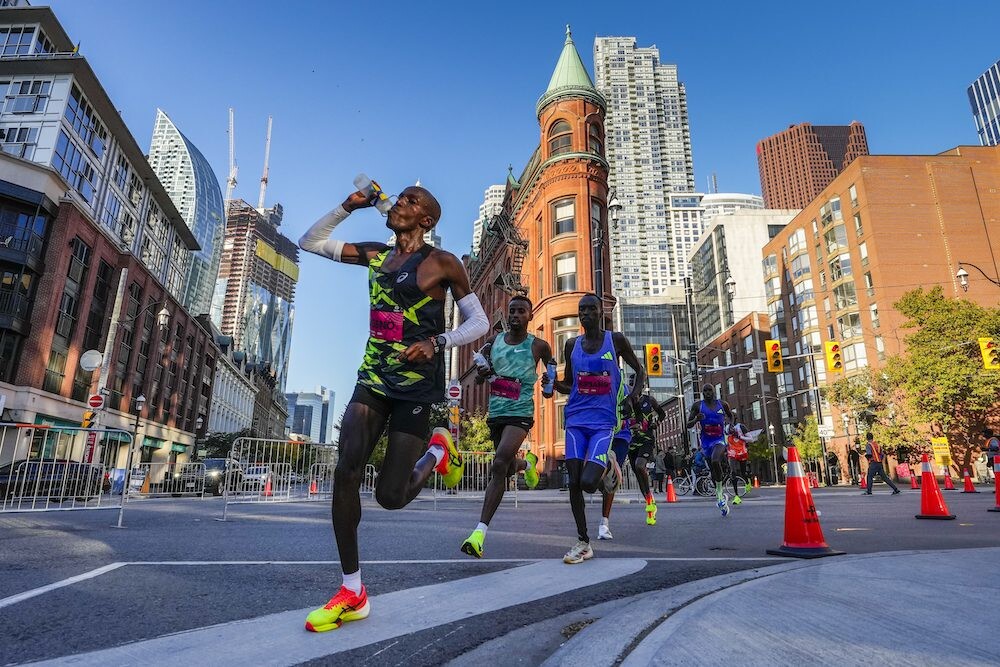
The study was conducted among 936 participants at the 2016 London Marathon. Co-author Jesse D. Cook (a postdoctoral fellow at the University of Wisconsin-Madison and host of the Sleep Research Society Podcast) told Psypost.org marathons are good settings for this type of research, since they typically start early in the morning. (Canadian 1976 track Olympian and professor of kinesiology at the University of Calgary Penny Werthner is also one of the study’s co-authors.)
The data was surprisingly clear: people who identify as morning persons run a whopping 13.9 minutes faster, on average, than people who identify as evening persons, and the more strongly the identification, the greater the difference. Moreover, those who find it takes them more than 30 minutes to transition to being fully alert after waking also ran slower than those who felt alert more quickly, though this connection was less significant than the morning vs. evening distinction. (This correlation makes intuitive sense–if you’re having trouble waking up, you might find that running a marathon more or less immediately upon waking is quite challenging, and would result in slower race times than if you ran it later in the day, when you feel more alert.)

The study also took into account participants’ personal and sleep habits and caffeine consumption, as well as age and sex, to account for these other variables; however, it’s possible that circadian preferences and sleep inertia are also associated with other factors, such as psychological characteristics and how much people train. (Cook emphasized that the study does not show direct causation.)
Cook implied that, while trying to change your body’s circadian rhythms may be not be practical, being aware of your body clock and the possible connection between circadian rhythms and performance could help you perform better. For example, scheduling training runs around the same time as the race start will help you get used to early start times.
by Anne Francis
Login to leave a comment
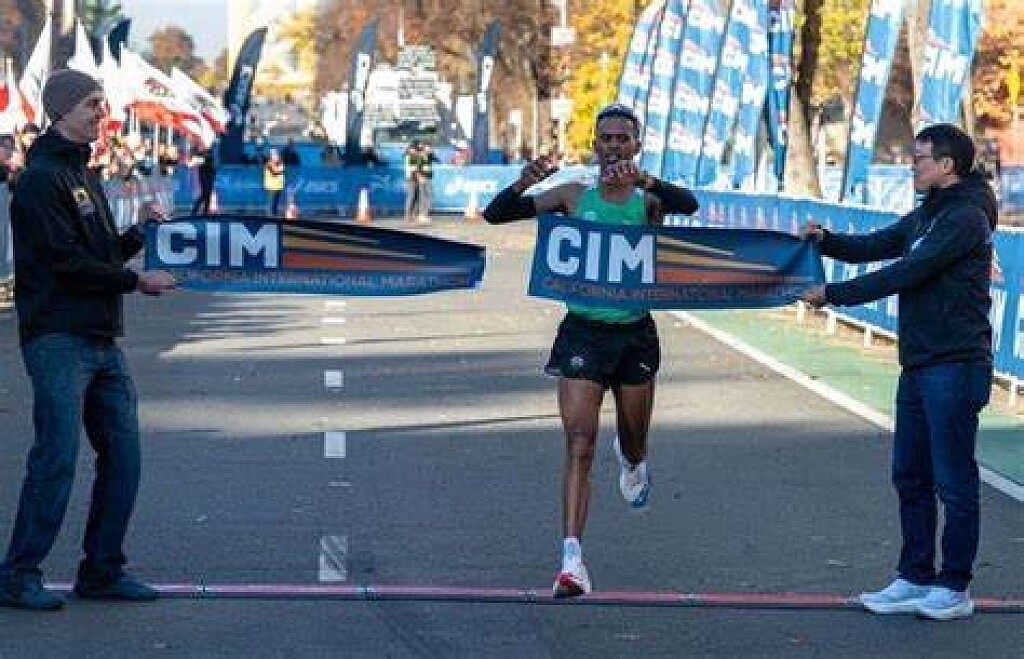
Records fall again as world’s best runners shine at California International Marathon
Tsegay Weldlibanos demolished a men’s course record that stood for more than 30 years en route to victory in his first-ever California International Marathon. British Olympian Callie Hauger-Thackery’s record-smashing pace was just enough to edge Jacqueline Gaughan and take home the women’s CIM title Sunday in Sacramento.
It was a day to celebrate, as is so often the case on one of the fastest marathon courses in the country. Sunny, dry conditions, temperatures a crisp but comfortable high 40s, and a world-class field in peak form led to another record-setting Sunday in the state capital.
Weldlibanos, of Eritrea, who lives and trains in high country Flagstaff, Arizona, turned the notoriously fast Folsom-to-Capitol course into a personal playground Sunday, crossing the finish line at two hours, seven minutes and 35 seconds — three seconds faster than the previous course best set by Jerry Lawlor in 1993.
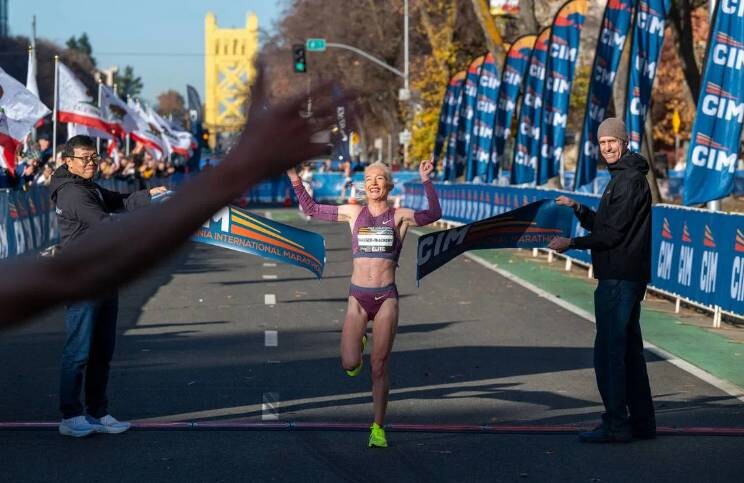
CJ Albertson, the “Fresno Kid” and come-from-behind men’s winner in 2023, missed out on back-to-back wins, taking home a second-place finish and a trip to the podium.
Hauger-Thackery set a blistering pace and needed every bit, her 2:24:28 beating Gaughan’s 2:24:40 by .12 of a second. Stephanie Bruce finished third. One of the fastest British marathoners ever, Haugher-Thackery burst onto the scene in 2023 and earned a spot to represent Great Britain in the 2024 Paris Olympics.
Husband and coach Nick Hauger, who finished third on the men’s side moments earlier, met the women’s winner at the finish in an emotional moment. Hauger was draped in the Stars and Stripes; the Union Jack adorned Haugher-Thackery’s shoulders as the couple embraced in victory.
Fifth-place women’s finisher Brittney Feivor’s cheering section hugged the rail at the finish. Susan Kessler, Feivor’s mother-in-law, traveled from Kenosha, Wisconsin, to watch the former Marquette University standout’s run Sunday.
“It’s exhilarating. We know how much work she puts in,” said Kessler. Feivor logs 50 to 90 miles or more a week in training. “It’s cheering and giving her the support she needs.”
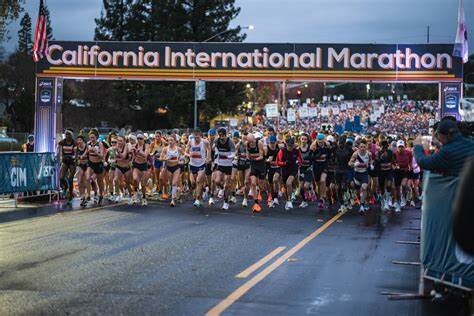
The day didn’t just belong to the elites. As many as 10,000 runners and another 1,000 relay runners were expected to cross the finish line on race day, traveling from across the country and Northern California for the chance to notch a personal best or qualify for marathons on the 2025 calendar.
The California International Marathon is a qualifying race for the Boston Marathon. The 129th running is April 21. It’s a short walk — or jog — from the finish line at Ninth Street and Capitol Mall to a bell at the state Capitol’s west steps. Runners here know what the bell’s peal means: Someone’s going to Boston next year.
On Sunday, that someone was Alex Mills, 23, of Tacoma, Washington, shaking the bell nearly off its moorings as proud family — 10 in all — watched on from the Capitol steps.
Mills, who graduated this year from George Fox College in Oregon, wasted no time. Sacramento was the first marathon for the collegiate cross-country runner.
Mills’ mother, Shelly, and entourage planned their vacation around the Sacramento trip. Now, she said, they’ll have to schedule a second in Boston.
“I’m just happy to get it over with,” said Mills, still draped in his warming blanket.
Sometimes the run is about redemption. Andy Holstrom came down to Sacramento from Portland for this year’s marathon. Holstrom, bib 115, was on the course, wife Rebecca and parents Bob and Marla Mion of Newcastle cheering on from the mall. Andy and Rebecca, expecting a child in April, ran Boston last year, but after a disappointing run in the Bay State, Andy was looking for a personal best in California.
Rebecca, who recently ran an ultramarathon, carried a placard with its own bit of cheeky motivation: “Don’t embarrass our unborn son,” it read. “Run fast.”
Dad-to-be Andy delivered, cracking the 2:40 barrier with a 2:39:12.
Brandon Moran of Boston took the trip west, breaking into the coveted 2:30s, relishing the CIM’s fast downhill after running on Boston’s grueling hills. “It’s been two years since I ran this fast. I’m very, very happy with the result. It’s just the smoothest course I’ve ever run.”
by Darrell Smith
Login to leave a comment

California International Marathon
The California International Marathon (CIM) is a marathon organized by runners, for runners! CIM was founded in 1983 by the Sacramento Running Association (SRA), a 501(c)(3) non-profit organization. The SRA Board of Directors is comprised of runners with a combined total of 150+ years of service to the CIM. The same route SRA management created for the 1983 inaugural CIM...
more...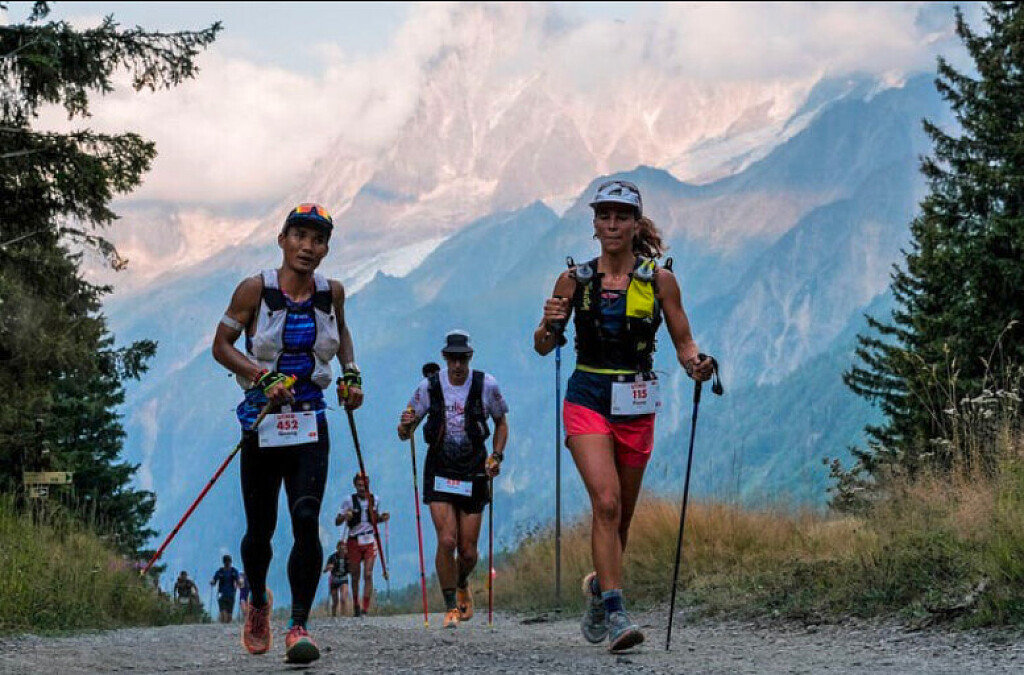
How Recreational Runners Get Through UTMB: 'It's All About Digging Deep into Yourself'
Wearing purple shorts, a blue and white tie-dyed T-shirt, a bright pink hat, a light blue Salomon hydration pack, fluorescent yellow-rimmed Oakley sunglasses, and a pair of Hoka Speedgoat 5 shoes, Chaiwen Chou was a vibe as she crossed the finish line of Ultra-Trail du Mont-Blanc (UTMB) on Sunday afternoon in Chamonix, France.
Chou, who had also freshened up the pink and purple tint of her hair before the race, stood out among the numerous other dusty and weary runners clad in more traditionally colored trail garb as they took their final strides in the epic 106-mile race around the Mont Blanc massif.
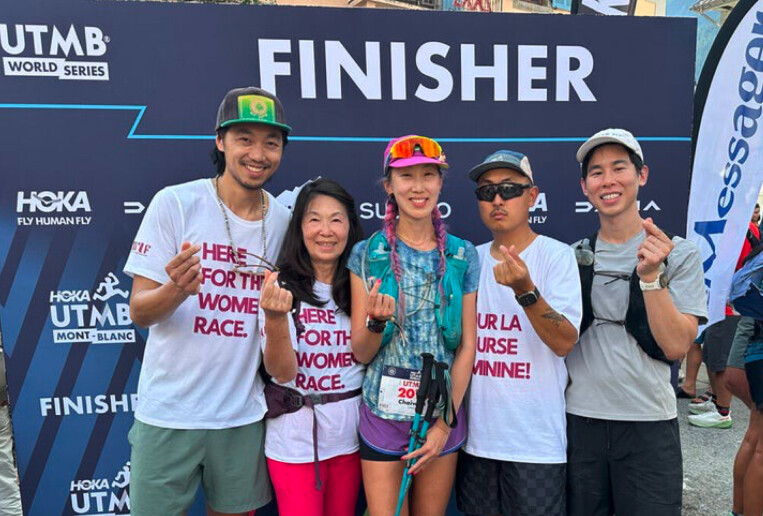
But what was most remarkable about the 41-year-old software developer from New York City was the huge smile on her face and expression of pure joy that emanated from her. When she arrived at the finish line after 45 hours and 15 minutes of running-about 75 minutes before the cutoff-she was beaming ear to ear and greeted with big hugs from her mom, brother, partner, and a good friend who helped crew her on her journey.
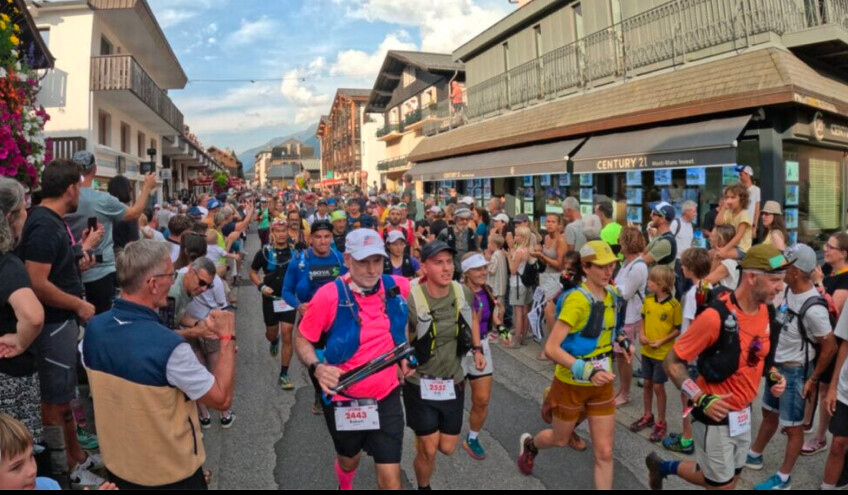
While her interest in running started on a bit of a whim a decade ago, her continued passion and progression have led her to run more than 30 trail running races, including the biggest and most celebrated one in the world. On Sunday, she was one of 95 American runners to complete the grueling UTMB course.
"So when I turned 30, I had this typical New Year's resolution, like, I want to get fit, I want to learn how to run," said Chou, who grew up in Massachusetts. "And then I met a friend who ran, and I started running with him and doing group runs. And then we started running trails, and we specifically entered The North Face Endurance Challenge, and that's where I ran my first marathon, and fell in love with trail running and then learned about ultrarunning and this whole world that I never even knew existed."For many recreational ultrarunners from around the world like Chou, UTMB sits at the top of their lifelong bucket list. It means starting at the same time as the elite professional runners on Friday evening in Chamonix, and maneuvering through the same rugged and aesthetic 106-mile loop with a daunting 32,000-feet plus of climbing and descending. It's historic, and the crowds and the energy around it are unparalleled.
It's also a monumental challenge to complete.
Trail Running's Infectious Buzz
Ultra-trail running is having a moment right now-especially since the end of the Covid pandemic-but it probably started a decade ago as the urge to run beyond the marathon gained mainstream traction and destination races around the world started to become desirable goal races for recreational runners.The North Face Endurance Challenge began as a singular 50-mile championship-style trail race near San Francisco in 2006 with a $30,000 prize purse, but it evolved into a multi-distance race weekend (from 10K to 50 miles) aimed at encouraging runners of all abilities to immerse themselves in the sport. After a few successful years of the event in Mill Valley, California, it expanded to several locations across the U.S.-upstate New York, Madison, Wisconsin, and Washington D.C., among others-and around the world.
Although The North Face pulled the plug on the series in late 2019 with a suggestion that it was going to reimagine the event format, nothing ever materialized after the Covid-19 pandemic temporarily disrupted the world-and specifically running events-in 2020. But those events played a big role in introducing runners and non-runners alike to the unique aspects of trail running, and many of those who caught the bug-like Chou-have continued to chase their passion in global events like the UTMB World Series.
Chou and her friends returned to The North Face Endurance Challenge four years in a row and she upped the ante each time, going from the marathon to the 50K and finally to consecutive finishes in the 50-miler. She competed in the 50-mile race in San Francisco in 2017 and 2019 and then started traveling to other races around the U.S. and eventually around the world. By 2020, she had completed the Madeira Island 115K race in Portugal and the Tarawera Ultramarathon 100-miler in New Zealand.
Once Covid subsided, Chou set her sights on trying to get into UTMB, which she did by collecting running stones and finishing seventh at the Grindstone 100 amid torrential rain storms last September in northwest Virginia. Her training for UTMB was interrupted in February when, just a week after she found out she secured an entry into UTMB through the lottery, she broke her ankle. Then once she got to Chamonix a week before the race, she smashed her left knee on a shakeout run and it swelled up pretty badly.
As such, her UTMB experience was rougher than she had hoped-the 80-degree heat and the 32,000 feet of vertical gain and descent pushed her to her limits-as she had challenges fueling consistently and also got sick several times. But she persevered and reached her primary goal of finishing.
Officially, she was the 1,542nd finisher out of 1,760 runners who completed the full loop. (A total of 1,001 runners started but did not finish.) She did whatever it took and she crossed the finish line.
"So this is the first time I've been in the Alps, and I'm just blown away by how beautiful it is," she said. "Even though I was in pain pretty much the whole race because the climbing and the elevation gain here are insane compared to the East Coast! But it was just so beautiful everywhere. It's pretty crazy. But you get to be out there all day though, so that's fun."Every Runner Has a Story
Becky Convery only started running four years ago in the middle of the Covid lockdown. What started as short, occasional runs turned into a passion for trail running that was fueled, in part, by doing group runs with the Virginia Happy Trails Running Club.
Like Chou, Convery also qualified for UTMB through the Grindstone 100. The 58-year-old Washington D.C. attorney almost quit that race, but she dug deep to finish. During UTMB, Convery dealt with GI issues from early on in the race and couldn't keep any food down. It was so bad, she almost dropped out at the 51.5-mile aid station in Courmayeur, Italy. But then she thought of Wayne Chang, a running buddy from Virginia, who did just that last year and immediately regretted it. With her friend's experience top of mind as she struggled, Convery persevered and finished in 45:27 with an hour to spare."I wanted to quit at Grindtone last fall. I was miserable and just wanted to go to bed, but he wouldn't let me quit," Convery said. "He's like, 'Look, I quit UTMB and I woke up a couple hours later, and I was like, 'Oh my God, what have I done?' So when it got hard out there (during UTMB), I thought of Wayne, and even though I couldn't keep food down, I said to myself, 'What would Wayne do?' He'll kill me if I quit, so I knew I couldn't quit. So I just kept going."
As much as UTMB gets considerable international notoriety for the livestream and media coverage around the elites-and understandably so, it draws many of the world's best runners-at the heart, UTMB is a personal journey of courage, commitment, and hope for most of the 2,800 runners who toe the starting line.
And really, that's what the entire sport of ultra-trail running is all about and what differentiates it from road racing. For many, it's not about racing at all-competing against other runners or even the clock-it's about challenging yourself and the natural terrain in pursuit of a dream that might seem like it's on the realistic edge of your abilities.
"It's all about digging deep into yourself," Convery said. "With this race, it's so international and there are so many nations represented, it's just an amazing time up there. Even though most people don't speak each other's language, everybody gets it. Everyone is pulling for each other. It's a great environment out there. I'm glad I made it."
Going the Distance
That's always been the case for 67-year-old Mike Smith, a retired resident of Santa Fe, New Mexico, who reached the finish line 15 minutes after Convery. It was Smith's second year in a row finishing UTMB, and because he won his age group at the Canyons 100K in April, he'll likely be back next year.
"The best part about it is always the people," Smith says. "But, oh gosh, chasing the time cutoff at that last aid station, that hike up to the La Flegere ski area, that's always a challenge."Smith relishes in those kinds of ultra-trail challenges. By reaching the finish line in Chamonix, he recorded the 224th 100-mile trail race finish of his career dating back to the mid-1990s. According to an ultrarunning history site, he ranks No. 2 in the world in all-time 100-mile finishes and first among 100-mile trail races. (Last year's UTMB was his 205th finish, which means he completed 18 100-mile ultra-trail races in the interim.
"This is always a spectacular finish," said his wife, Sandra, who wrote a book about what it's like to crew her husband at races. "This is one of the most exciting finish lines there is. The finish lines at smaller races are exciting because there's such a close community of people, but here, there are so many people from around the world, and that's just wonderful."
In all, 2,761 runners started this year's UTMB and 1,760 finished, including 95 U.S. runners who reached the finish line (out of 152 American starters) under the cutoff. Frenchman Vincent Bouillard was the overall winner in 19:54:23 on Saturday afternoon, but 20 hours later there were still about 1,000 runners moving toward the finish line and trying to beat the 46.5-hour cutoff on Sunday afternoon. Among the 95 U.S. finishers, 41 completed the course after the 40-hour mark.
Lamont King, 51, a runner from Roseville, California, has watched and been inspired by runners finishing in the golden hour of the Western States 100 as a fan and as a board member of the race for years. So finishing UTMB on his first try in 45:59-about 30 minutes before the cutoff-was a special moment for him.
"The race was very, very tough. We just don't have that kind of vertical in California where I'm from," said King, who has been trail running for 20 years. "But it's just amazing to be in this scenery in the mountains. It's just fantastic, and it makes up for a little bit of pain. I did have to push a little bit more than I probably would've liked, but I got it done. Coming in with all those people cheering for you in that final finish is almost overwhelming. It's just beautiful."
by Trail Runner Magazine
Login to leave a comment

There Are Going to Be People Walking:’ A Look at the Grueling Olympic Marathon Course
Getting to run by all those historic spots requires some epic climbs and descents.The final weekend of the 2024 Paris Olympics will host back-to-back days of thrilling marathons. These prestigious races, set against the backdrop of two of France’s most iconic landscapes—Paris and Versailles—will weave through a tapestry of history, culture, and breathtaking scenery. They begin on August 10 with the men’s race, and then, in a nod to the 40th anniversary of the first women’s Olympic Marathon in Los Angeles, the Paris Olympics will conclude on August 11 with the women’s race for the first time in history.
Here are some of the key details you’ll want to know:
What sites will the runners pass?
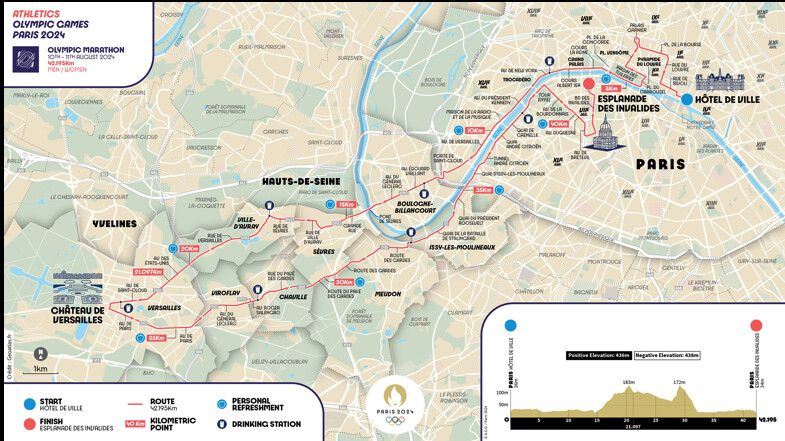
It’s not a bad way to tour the area, and it’s quite different than the Paris Marathon that is held each April. Athletes will find themselves tracing a route that dances through nine arrondissements (neighborhoods) of Paris along the banks of the Seine. The runners will begin at the Hôtel de Ville, or city hall, and then pass landmarks such as the Palais Garnier opera house, Place Vendôme, the Louvre museum, and past the Trocadéro.
Next, they will leave the city to run through historic French towns, including Sevres, on their way to Versailles. The return to the city is a different route and will take them through the Forêt Domaniale de Meudon, a forest. When back in the city, they will be on the Left Bank and run past the Eiffel Tower as well as Parisian neighborhoods. The race ends at the Esplanade des Invalides, in which Napoleon is buried.
This route is based on significant French history. In October 1789, between 6,000 and 7,000 Parisian women, joined by men, marched from the Hôtel de Ville through the city to Versailles. It was because of that march that Louis XVI agreed to ratify the Universal Declaration of the Rights of Man and Citizens. The marathoners are symbolically running in their footsteps.
How tough is the course?
Unlike some more recent Olympics and U.S. Marathon Trials races, this course isn’t a circuit of repeated loops. Instead, it’s a full loop starting in Paris and loops down to Versailles outside of the city.
While the elevation profile for the first nine miles looks fairly tame, once the runners are past the halfway mark the landscape changes. The most notable course feature is the three uphill stretches—they’re incredibly steep and very long.
The first big hill comes just before the 10-mile mark, and it climbs at a 4 percent grade, which is roughly the same as Boston’s famed Newton hills. The difference with the Paris version is that it ascends for about 1.25 miles before it levels off for a bit. (Boston’s longest hill is less than half a mile, according to Sean Hartnett, emeritus professor of geography at the University of Wisconsin-Eau Claire, who specializes in marathon routes and other running competitions.)
The next hill at the 12-mile mark is at 5 percent, steeper than anything on the Boston course and 900 meters long. But those two are just appetizers for the real challenge. That hits just after the 18-mile mark.
Runners will have to climb for 600 meters, at an average grade of 10.5 percent. Yes, picture putting your treadmill at 10 percent and trying to run up it at marathon pace. Hartnett calls it a “doozy” and struggles to find courses to compare it to. The Bix 7 in Davenport, Iowa, perhaps? Then he gives up. “It’s unlike anything in any competitive road marathon,” he said. (You can view a detailed description of the 15K-33K section as mapped by Hartnett here.)
In total, the route will include 1,430 feet of elevation gain. Possibly more challenging is the 1,437 feet of descent. The make-or-break point for the route might be just after that final brutal uphill, when they are bombing downhill—at some points at a gradient of 13.5 percent. Runners will have to be efficient going down, without pounding so much they trash their quads before the final flat stretch before the finish. To put the course into some more perspective, the World Marathon Majors that are considered the hilliest—Boston and New York City—each have an elevation gain of a little over 800 total feet. And for one final nugget, the average grade of the Mount Washington Auto Road Race is 12 percent. The course record for that 7.4-miler is at around 8:00 pace.
This course will make the fastest marathoners in the world look almost human at times.
How do the marathoners feel about the course?
Pat Tiernan, an Olympian for Australia who is running the marathon, made two trips to Paris from his training base with Puma in North Carolina to examine the course. His first trip, in early April, was just to get a feel for the course. The second, in late May, was to train on it.
“The first thing you notice,” Tiernan said in a phone call with Runner’s World, “is that it’s going to be a brutal course. There are going to be people walking.”
If you look closely at the official Strava route, you can spot some U.S. Olympic marathoners on the leaderboards of the course’s toughest segments.
On April 10, U.S. team member Clayton Young did a 12.80-mile run on the hilliest section of the course, where he “pushed the uphills, chilled the downhills.” During the steepest climb—right before the mile 18 split—Young tackled a .44-mile segment in 3:09, giving him a modest average pace (for a world-class marathoner) of 7:01 per mile. But if you look at Strava’s “grade adjusted pace,” which factors in elevation, that 7:01 converts to 5:03 mile pace. His average heart rate was 179 beats per minute.
Dakotah Lindwurm, a U.S. team member for the women, also previewed the course in April in a run she called, “Tour de La Olympic hills ?].” She racked up an impressive 16 “course records” during her 10.87-mile workout, and on the same steep segment that Young ran, she averaged 7:43 pace with a grade-adjusted pace of 5:21 per mile.
Emily Sisson, the U.S. record holder in the marathon, has been training for both the hills and the flats. “We’ve been doing a lot of stuff on hills, because [we] want to come out of the hills into the last 10K feeling good,” she says. “That’s also why you don’t want to slack on 10K work, because it could be quite fast at the end. So kind of trying to do it all.”
Tiernan agreed with Sisson on the unique challenge. If marathoners go too hard through the hills, they could struggle at the end, he said. If they go too easy through the hills and subsequent descents, they might be out of touch by the final 10K. He said the Paris course is as “if you were to do a 10K road race, then go and run a hard 10K hill cross country course, then a 10K road race.”
If nothing else, it could make for some surprises on the podium.
When exactly are the races?
The men’s event happens on Saturday, August 10. If you want to watch live, get your favorite espresso ready. The event begins at 2 a.m. ET/11 p.m. PT in the U.S. The following day for the women’s race, the 2024 Paris Olympics fully conclude in honor of the 40th anniversary of the first women’s Olympic marathon event, won by Joan Benoit-Samuelson. The start time is also at 2 a.m. ET/11 p.m. PT.
Who are the major names in each race?
Both races are packed with star power in the form of returning Olympic champions, world record holders, and World Marathon Majors winners. The biggest storyline in the men’s race is whether Eliud Kipchoge, the two-time Olympic marathon gold medalist who many consider to be the greatest of all time, will be able to retain his crown in what may be his final Olympics at age 39.
The women’s event is even more stacked and should make for quite the event to cap off the 2024 Olympics. Newly ratified world record holder Tigist Assefa of Ethiopia will have to match speed and strategy against the likes of Hellen Obiri and Peres Jepchirchir of Kenya and the Netherlands’s Sifan Hassan, who is running the marathon after racing in the 5,000 and 10,000 meters on the track.
Men’s Marathon Contenders
Eliud Kipchoge, Kenya (2:01:09)
Kenenisa Bekele, Ethiopia (2:01:41)
Benson Kipruto, Kenya (2:02:16)
Tamirat Tola, Ethiopia (2:03:39)
Conner Mantz, USA (2:07:47)
Clayton Young, USA (2:08:00)
Women’s Marathon Contenders
Tigist Assefa, Ethiopia (2:11:53)
Sifan Hassan, Netherlands (2:13:44)
Peres Jepchirchir, Kenya (2:16:16)
Emily Sisson, USA (2:18:29)
Hellen Obiri, Kenya (2:21:38)
Rose Chelimo, Bahrain (2:22:51)
Fiona O’Keeffe, USA (2:22:10)
Sharon Lokedi, Kenya (2:22:45)
Did you know there is a mass participation race?
If not, now you do. It’s called the Marathon Pour Tous, and we’re pretty jealous we can’t run this one. There will be a full marathon and a 10K on the same route as the Olympic marathon on the evening of August 10. Yes, a night race in the City of Lights. More than 20,000 participants are expected for each event.
by Runner’s World
Login to leave a comment
Defending champions return to Bix
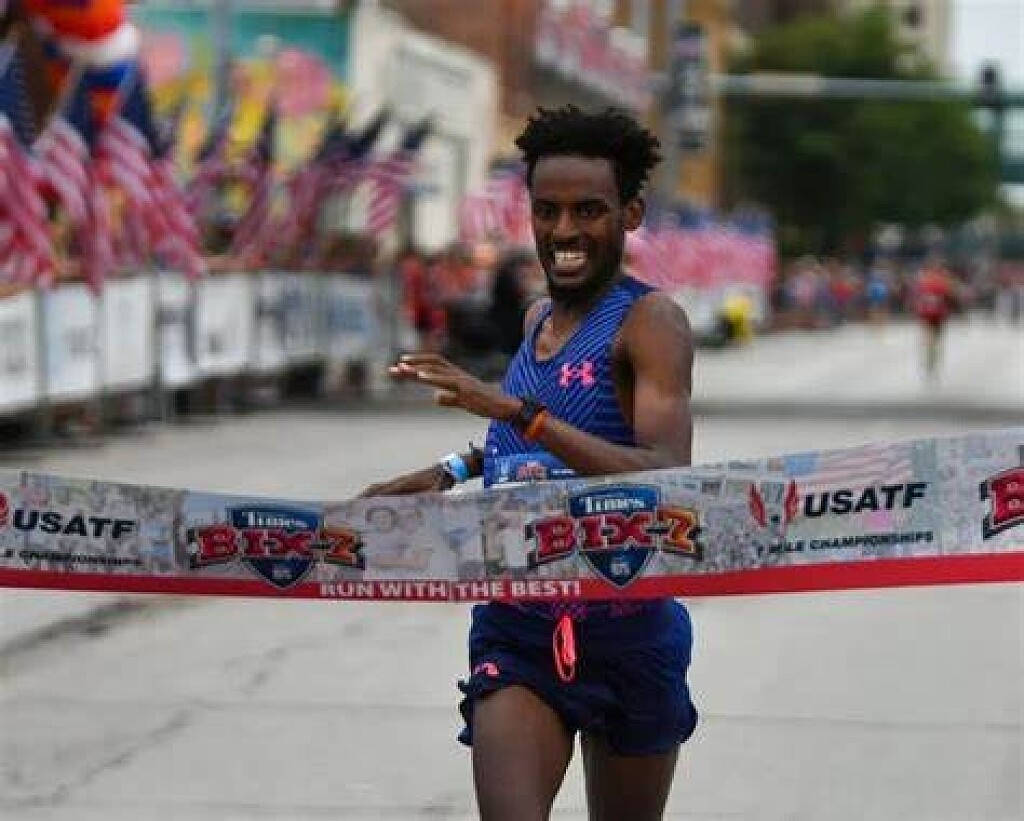
Kellyn Taylor and Biya Simbassa each ran the Quad-City Times Bix 7 for the first time last year.
They clearly loved the course, the atmosphere and just about everything about the annual race through the streets of Davenport.
Both Taylor and Simbassa held off late challenges from other runners, both ran the sixth best Bix 7 times ever by a U.S. athlete of their gender and both plan to return to defend their championships when the race is held for the 50th time on July 27.
It marks the first time in 12 years that both the men’s and women’s champions are returning to defend their Bix titles.
Simbassa admitted he wasn’t really sure how he felt about the Bix 7 course last year when he first saw the endless array of ups and downs in the course. But after holding off Olympian Clayton Young to win, he liked it.
“I mean, now I do,’’ he said after his victory. “It’s a course that’s all about strength and I train for this."
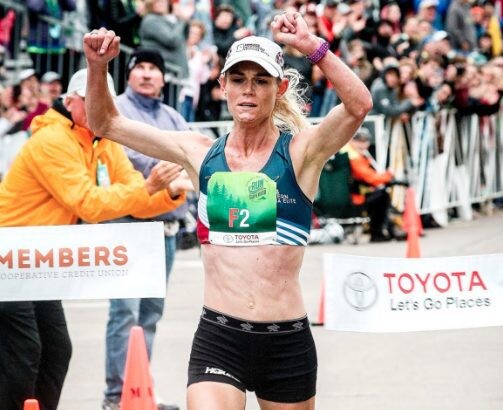
Taylor went through a similar transformation.
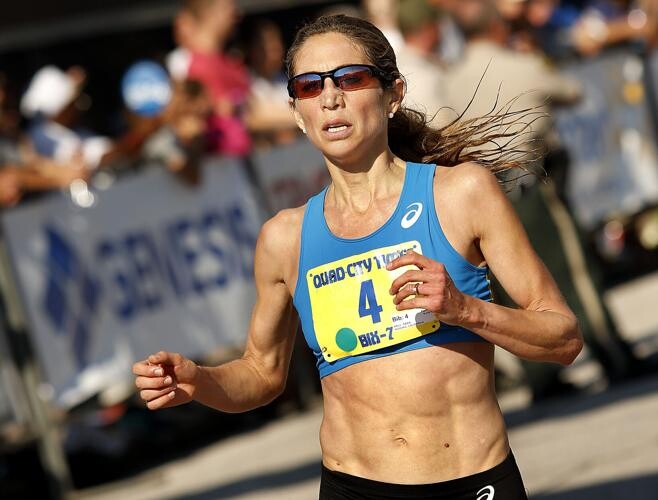
“When I saw the course, I was like, ‘Oh, no. What did I get myself into?’ ” she said. “That’s a super substantial hill right at the beginning and then it rolls all the way through. It’s certainly not easy by any means. I think that works to my favor since I’m more of a strength runner.”
Taylor appreciated more than just the hills.
“The crowds were amazing,” she said. “It’s not what I expected at all — the streets were completely lined, and a race that isn’t a huge marathon, I don’t feel like you see that that often. The crowds were incredible.”
Taylor and Simbassa will be bidding to repeat as Bix 7 champions, something that has been done only seven times in the race’s history, four times by men, three times by women.
Both runners failed to land berths on the U.S. Olympic team, which would have precluded a return to Bix, but they’ve still used their 2023 victories as a springboard to additional success.
Taylor briefly led the New York City Marathon last November before placing eighth, making her the top American finisher in the race. It was the third time she has been in the top eight at New York.
The Wisconsin native, who will turn 38 a few days before the Bix 7, then focused her attention on making the U.S. Olympic team and made a respectable showing in the trials in the marathon, finishing 15th, and the 10,000 meters, placing sixth.
Simbassa, a 31-year-old native of Ethiopia who now lives in Flagstaff, Arizona, attempted to earn an Olympic spot in the marathon but placed 11th in the trials.
However, he has followed that with an ambitious schedule on the U.S. road racing circuit, recording top-five finishes in the Bolder Boulder 10k (5th), Cherry Blossom 10-miler (5th), Gate River 15k (4th), Amway River Bank 25k (3rd) and Houston Half-marathon (4th).
Also included in the field are four former Olympians and nine other runners who have placed in the top 10 at the Bix 7 in the past. Elite athlete coordinator John Tope said even more top runners could be added between now and race day.
Among the top men’s entries are two former Iowa State University standouts.
Wesley Kiptoo of Kenya was the 2021 NCAA indoor 5,000-meter champion and a seven-time All-American for the Cyclones. He was seventh in the Bix 7 two years ago and won the Cherry Blossom 10-miler earlier this year.
Hillary Bor, a Kenya native who is now an American citizen, also attended Iowa State before representing the U.S. in the 3,000-meter steeplechase at the Olympics in both 2016 and 2021. He also is the U.S. record-holder in the 10-mile run.
Other former Olympians in the field are Morocco’s Mohamed El Aaraby and Americans Jake Riley and Shadrack Kipchirchir. Riley and Araby both competed in the marathon in Tokyo in 2021 and Kipchirchir ran the 10,000 meters in 2016.
Riley also is a Bix 7 veteran along with Kenya’s Reuben Mosip and Americans Frank Lara, Andrew Colley and Isai Rodriguez. Lara was second in the Bix 7 in 2021 and eighth a year ago.
Rounding out the men’s field are Raymond Magut of Kenya; Tsegay Tuemay and Tesfu Tewelde of Eritrea; and Americans Nathan Martin, Ryan Ford, JP Trojan, Merga Gemeda and Titus Winders.
The most recognizable name in the women’s field is 41-year-old Sara Hall, the wife of two-time Olympian, U.S. half-marathon record-holder and 2010 Bix champion Ryan Hall. Sara Hall was fifth in the U.S. Olympic marathon trials earlier this year and has two strong Bix 7 efforts on her resume, placing second in 2014 and third in 2017.
She and Taylor will be challenged by three up-and-coming runners from Kenya — Emmaculate Anyango Achol, Grace Loibach Nawowuna and Sarah Naibei. Achol has run the second fastest women’s 10k ever (28:57) and Naibei won the Lilac Bloomsday 12k in May.
Also in the field are Bix 7 veterans Kassie Parker, Jessa Hanson, Carrie Verdon and Tristin Van Ord along with Americans Annmarie Tuxbury and Stephanie Sherman, Ethiopia’s Mahlet Mulugeta and Kenya's Veronicah Wanjiru.
The elite field also includes four legendary runners who have helped build the Bix 7 into the international event that it is. Two-time champion Bill Rodgers, who has run the Bix 7 43 times, will be joined by four-time women’s champion and 1984 Olympic gold medalist Joan Samuelson, two-time Olympic medalist Frank Shorter and Meb Keflezighi, who has two Bix titles and an Olympic silver medal on his resume.
by Don Doxsie
Login to leave a comment

Bix 7 miler
This race attracts the greatest long distance runners in the world competing to win thousands of dollars in prize money. It is said to be the highest purse of any non-marathon race. Tremendous spectator support, entertainment and post party. Come and try to conquer this challenging course along with over 15,000 other participants, as you "Run With The Best." In...
more...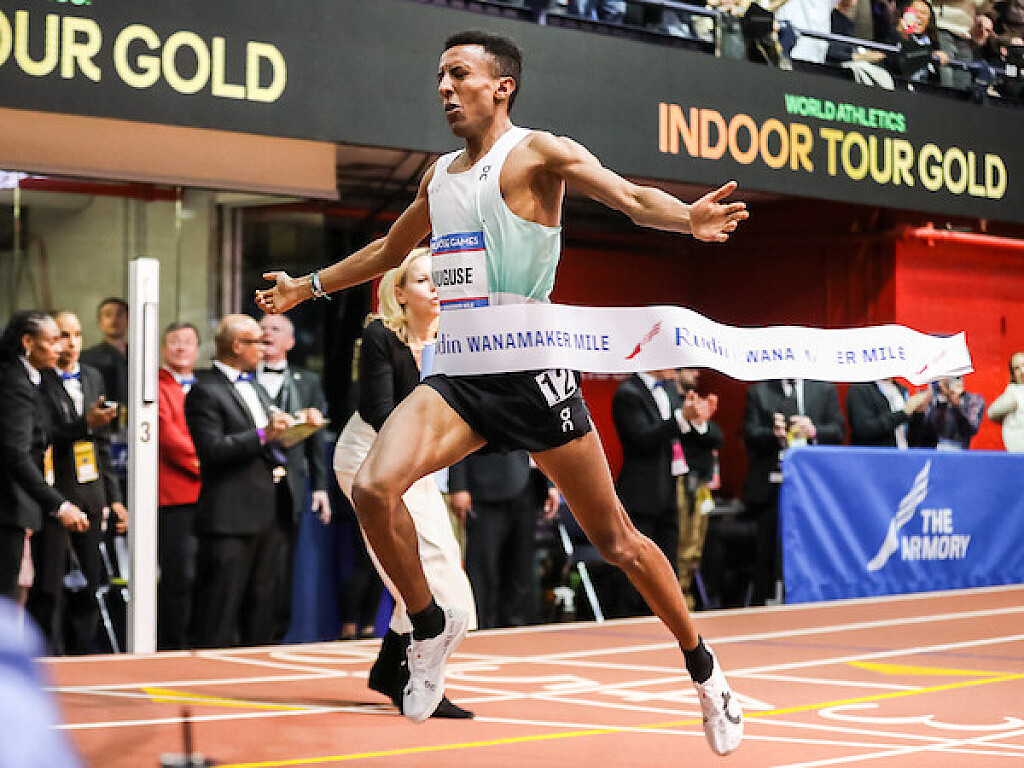
Stellar Field Assembled to Challenge Yared Nuguse in the NYRR Men's Wanamaker Mile
The 116th Millrose Games is now just 19 days away, as the eyes of the global athletics community will once again return to the Nike Track & Field Center at The Armory. As always, the meet will conclude with the NYRR Men’s Wanamaker Mile, a legendary race with over a century of tradition.
The Millrose Games is scheduled to take place on Sunday, February 11th.
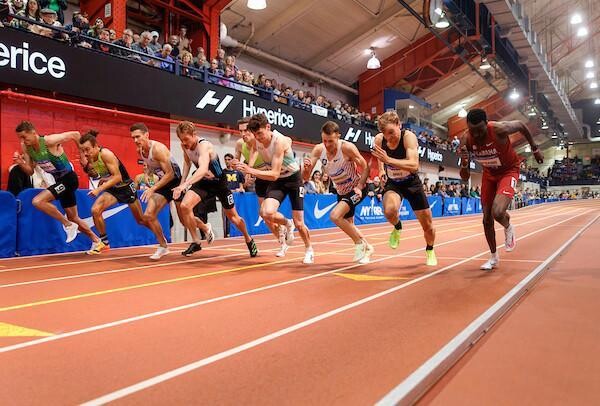
Previously announced as the headliner for this race is defending champion Yared Nuguese, the American record holder in the mile indoors and outdoors. Nuguse has his eyes on the world record of 3:47.01, but he will have to contend with a number of the best athletes in the world if he is to win his second straight Wanamaker title, including two additional 1500m finalists from last summer’s World Championships.
“[The world record] feels like a goal that’s within my grasp of achieving.” said Nuguse. “Not only am I stronger and smarter than I was last year, but I feel like I will be able to attack this race with a lot more confidence to chase the world record. When I went to Millrose for the first time, I was just chasing the American record. So changing that mindset, just seeing how far I’ve come, it feels like a very real possibility at this point.”
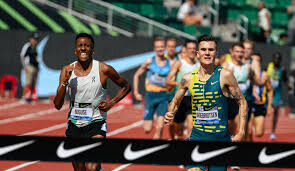
The elite athletes lining up to challenge Nuguse are as follows:
-Mario Garcia Romo was last year’s runner-up, and he is the 2022 1500m champion for Spain and a two-time World Championship finalist.
-Neil Gourley is a three-time British 1500m champion, and he holds the European indoor mile record.
-George Mills placed third in the mile at the Diamond League final, moving up to third on the all-time British list, before also placing second at the NYRR 5th Avenue Mile.
-Hobbs Kessler is the reigning World Road Mile champion, and he also holds the national high school indoor mile record.
-Andrew Coscoran is an Olympian and the Irish record holder over 1500m.
-Adam Spencer of the University of Wisconsin and Australia holds the NCAA 1500m record.
-Sam Prakel is the US Road Mile champion, and he placed fourth nationally in the 1500m.
-Charles Philibert-Thiboutot is a Canadian Olympian and the 2023 NACAC 1500m champion.
The winner of the mile at the Dr. Sander Invitational this Saturday, January 27th will be added to the NYRR Wanamaker Mile field as well.
Stay tuned over the coming weeks before the 116th Millrose Games, as the world-class start lists are finalized. Top athletes already confirmed to compete include Laura Muir, Elle Purrier-St. Pierre, Dina Asher-Smith, Julien Alfred, Alicia Monson, Grant Fisher, Danielle Williams, Josh Kerr, Cooper Teare, Yaroslava Mahuchikh, Christian Coleman, Andre De Grasse, Nia Ali, Chris Nilsen, and KC Lightfoot, with even more Olympians and World Championship medalists still to come.
As always, the Millrose Games will feature the absolute best athletes in the sport, including dozens of Olympians and world champions. The Millrose Games is a World Athletics Indoor Tour Gold meet. With highest-level competition at the youth, high school, collegiate, club, and professional levels, there is truly something for everyone at the Millrose Games.
Tickets can be purchased at https://www.millrosegames.org/
Login to leave a comment

NYRR Millrose Games
The Pinnacle of Indoor Track & Field The NYRR Millrose Games, first held in 1908, remains the premier indoor track and field competition in the United States. The 2025 edition will once again bring the world’s top professional, collegiate, and high school athletes to New York City for a day of thrilling competition. Hosted at the New Balance Track &...
more...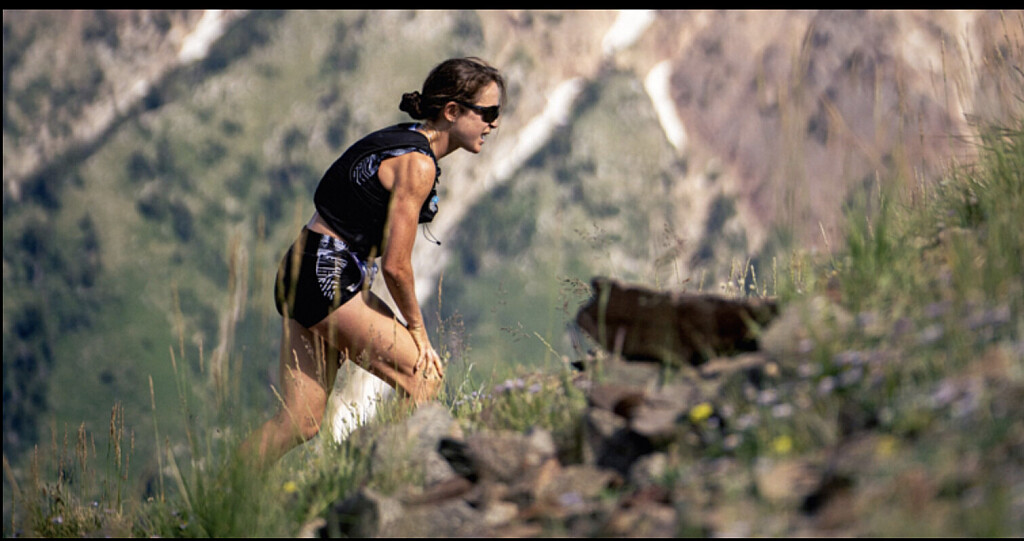
Molly Seidel Stunned the World (and Herself) with Olympic Bronze in Tokyo. Then Life Went Sideways.
She stunned the world (and herself) with Olympic bronze in Tokyo. Then life went sideways. How America’s unexpected marathon phenom is getting her body—and brain—back on track.
On a clear December night in 2019, Molly Seidel was at a rooftop holiday party in Boston, wearing a black velvet dress, doing what a lot of 25-year-olds do: passing a joint between friends, wondering what she was doing with her life.
“You should run the Olympic Trials,” her sister, Izzy, said, as smoke swirled in the chilly air atop The Trackhouse, a retail shop and community hub on Newbury Street operated by the running brand Tracksmith. “That would be hilarious if you did that as your first marathon.”
Molly, an elite 10K racer who’d spent much of 2019 injured, looked out at the city lights, and laughed. Why the hell not? She’d just qualified for the trials, winning the San Antonio Half with a time of 1:10:27. (“The shock of the century,” as she’d put it.) True, 13.1 miles wasn’t 26.2—but running a marathon was something to do. If only because she never had before.
A four-time NCAA track and cross-country champion at The University of Notre Dame in Indiana, Molly had moved to Boston in 2017, where she’d worked three jobs to supplement her fourth: running for Saucony’s Freedom Track Club. The $34,000 a year that Saucony paid her (pre-tax, sans medical) didn’t go far in one of America’s most expensive cities. Chasing kids around as a babysitter, driving around as an Instacart shopper, and standing around eight hours a day as a barista—when you’re running 20 miles a day—wasn’t ideal. But whatever, she had compression socks. And she was downing free coffee and paying rent, flying to Flagstaff, Arizona, every so often for altitude camps, and having a good time. Doing what she loved. The only thing she’s ever wanted to do since she was a freckly fifth-grader in small-town Wisconsin clocking a six-minute mile in gym class.
“I was hustling, and I loved it. It was such a fun, cool time of my life,” she says, summarizing her 20s. Staring into Molly’s steely brown eyes, listening to her speak with such clarity and conviction about her struggles since, it’s easy to forget: She is still only 29.
After Molly had hip surgery on her birthday in July 2018, her doctors gave her a 50/50 chance of running professionally again. By summer 2019, she’d parted ways with FTC, which left her sobbing on the banks of the Charles River, getting eaten alive by mosquitoes and uncertainty. Her biggest achievement lately had been being named #2 Top Instacart Shopper (in Flagstaff; Boston was big-time).
The day after that rooftop party, Molly asked her friend and former FTC teammate Jon Green, who she’d newly anointed as her coach: “Think I should run the marathon trials?” Sure, he shrugged. Nothing to lose. Maybe it’d help her train for the 10K, her best shot—they both thought—at making a U.S. Olympic team.
“I’m going to get my ass kicked six ways to Sunday!” she told the host of the podcast Running On Om six weeks before the trials in Atlanta.
Instead, on February 29, 2020, she kicked some herself. Pushing past 448 of the fastest, most-experienced women marathoners in the country, coming in second with a 2:27:31, earning more in prize money ($60,000) than she had in two years of racing—and a spot on the U.S. trio for the 2020 Tokyo Olympics, along with Kenyan-born superstars Aliphine Tuliamuk and Sally Kipyego. “I don’t know what’s happening right now!” Molly kept saying into TV cameras, wrapped in an American flag, as stunned as a lottery winner.
Saucony who? Puma came calling. Along with something Molly hadn’t anticipated: the spotlight. An onslaught of social media followers. And two weeks later, a global pandemic and lockdown—and all the anxiety and isolation that came with it. She was drowning, and she hadn’t even landed in Tokyo yet.
The 2020 Olympics, as we all know, were postponed to 2021. An emotional burden but a physical boon for Molly, in that it allowed her to get in a second marathon. In London, she finished two minutes faster than her debut. When the Olympics finally rolled around, she was ready.
Before the race, Molly says, “I was thinking: ‘Once I cross the starting line, I get to call myself an Olympian and that’s a win for the day.’”
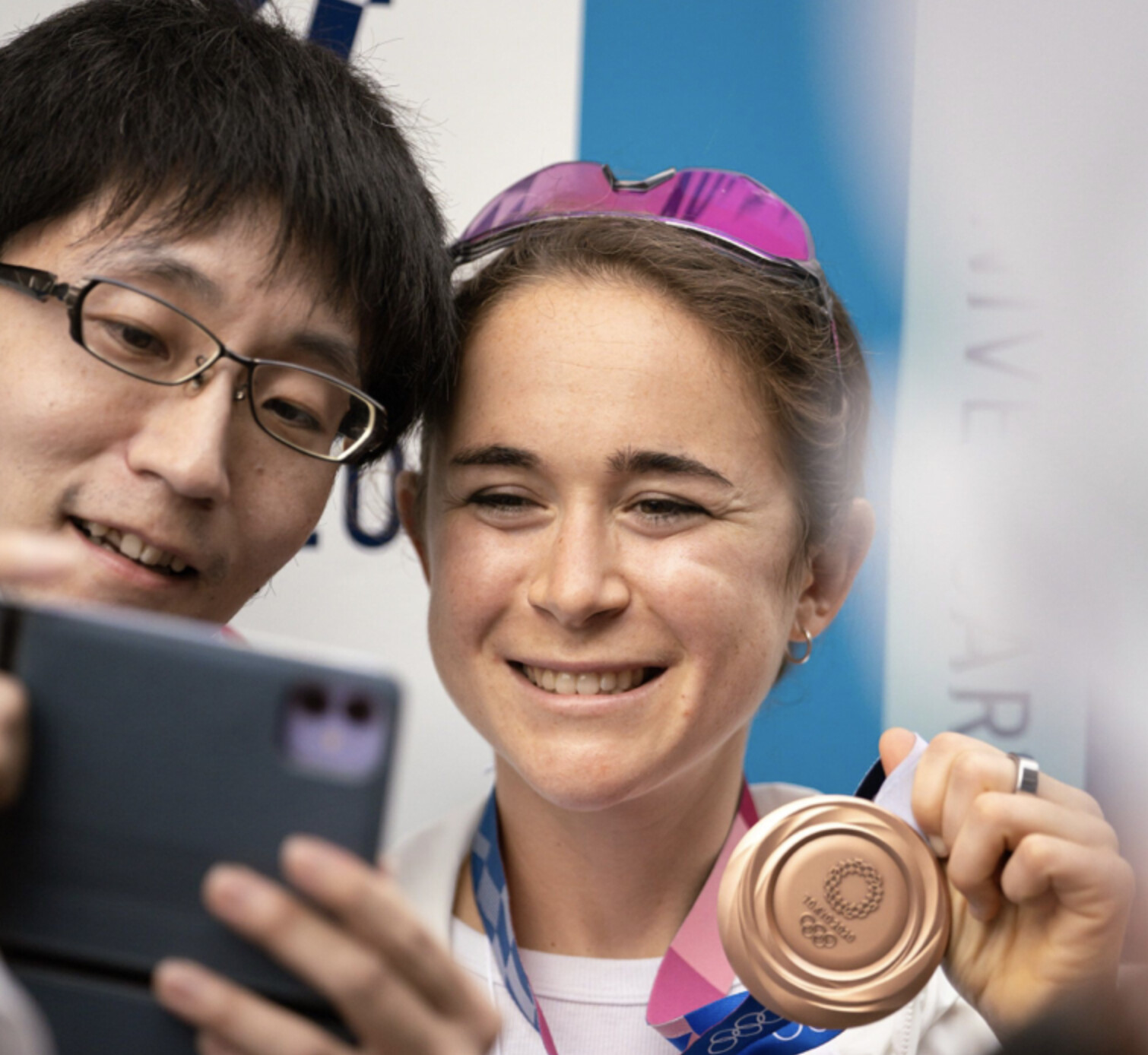
But then she crossed the finish line—with a finger-kiss to the sky and a guttural Yesss!—in third place with a 2:27:46, just 26 seconds behind first (Kenya’s Peres Jepchirchir). And realized: She gets to call herself an Olympic medalist forever. Only the third American woman to ever earn one in the marathon.
Lots of kids have fleeting hopes of making it to the Olympics. I remember thinking I could be Mary Lou Retton. Maybe FloJo, with shorter fingernails. Then I decided I’d rather be Madonna or president of the United States and promptly forgot about it. But Molly held tight to her Olympic aspirations. She still has a poster she made in 2004, with stickers and a snapshot of her smiley 10-year-old self, to prove it. “I wish I will make it into the Olympics and win a gold medal,” she wrote, and signed it: Molly Seidel, the “y” looping back to underline her name. In case there was any doubt as to who, specifically, would be winning the medal.
Molly grew up in Nashotah, Wisconsin, and is the eldest of three. Her sister and brother, younger by not quite two years, are twins. Izzy is a running influencer and corporate content creator for companies like Peloton; and Fritz favors Formula 1 racing and weightlifting and works for the family’s leather-tanning business. The family was active, sporty. Dad, Fritz Sr., was a ski racer in college; Mom, Anne, a cheerleader. You can tell. Watching clips of Molly’s mom and dad watching the Olympic race from their backyard patio, jumping up and down, tears streaming, is the kind of life-affirming moment you wish you could bottle. “I’m in shock. I’m in disbelief,” Molly says into the mic, beaming. “I just wanted to come out today and I don’t know…stick my nose where it didn’t belong and see what I could come away with. And I guess that’s a medal.” When the interviewer holds up her family on FaceTime, Molly breaks down. “We did it,” she says into the screen between sobs and smiles. “Please drink a beer for me.
Molly hasn’t always been unabashedly herself, even when everyone thought she was. A compartmentalizer to the core, she spent most of her life hiding a huge part of it: anorexia, bulimia, anxiety, obsessive-compulsive disorder, debilitating depression.
It started around age 11, when she learned to disguise OCD tendencies, like compulsively knocking on wood, silently reciting prayers “to avoid God getting mad at me,” she says. “It was a whole thing.” She says her parents were aware of the behaviors, but saw them more as odd little habits. “They had no reason to suspect anything. I was very high-functioning,” she says. “They didn’t realize that it was literally taking over my life.”
She wasn’t officially diagnosed with OCD until her freshman year of college, when she saw a therapist for the first time. At Notre Dame, disordered eating took hold, quietly yet visibly, as it does for up to 62 percent of female college athletes, according to the National Eating Disorders Association. As recently as the Tokyo Olympics, she was making herself throw up in the airport bathroom, mere days before taking the podium. Molly hesitates to share that detail; she fears a girl might read this and interpret it as behavior to model. “Having been in that place as a younger athlete, I know I would have,” she says. But she also understands: Most people just don’t get how unrelenting eating disorders can be.
In February 2022, she finally received a diagnosis of the root cause for all of it: ADHD. About being diagnosed, she says, “It made me feel really good, like [I don’t have] a million different disorders. I have a disorder that manifests itself in a lot of different symptoms.”
She waited to try Adderall until after the Boston Marathon in April, only to drop out at mile 16 due to a hip impingement. Initially, the meds made her feel fantastic. Focused. Free. Until she realized Adderall hurt more than it helped. She couldn’t sleep, couldn’t eat, lost too much weight. Within weeks, she devolved. “The eating disorder came roaring back,” she says, referring to it, as she often does, as its own entity, something that exists outside of herself. That ruthlessly takes control over her very need for control. “I almost think of it as an alter ego,” she explains. “Adderall was just bubblegum in the dam,” as she puts it. She ditched the drug, and her life—professionally, physically—unraveled.
In July 2022, heading into the World Championships, she bombed the mental health screening, answering the questions with brutal honesty. She’d been texting Keira D’Amato weeks prior. “Yo girl, things are pretty bad right now. Get ready…” Sobbing on the sidewalk in Eugene, Oregon, she texted D’Amato again. And the USATF made it official: D’Amato would take her spot on the team. Then Molly did what she’d been “putting off and putting off”— checked herself into eating disorder treatment for the second time since 2016, an outpatient program in Salt Lake City, where her new boyfriend was living at the time.
Somehow (see: expert compartmentalizer) mid-meltdown, in February 2022, she had met an amateur ultrarunner named Matt, on Hinge. A quiet, lanky photographer, he didn’t totally get what she did. “I didn’t understand the gravity of it,” he tells me. “I was like, Oh she’s a pro runner, that’s cool. I didn’t realize she was, like, the pro runner!”
Going back to treatment “was pretty terrible,” she says. At least she could stay with Matt. Hardly a honeymoon phase, but the new relationship held promise. “I laid it all out there,” says Molly. “And he was still here for it, for all the messiness. It was really meaningful.” And a mental shift. “He doesn’t see me as just Molly the Runner.”
Almost a year later, on a freezing April evening in Flagstaff, Molly is racing around Whole Foods, palming a head of cabbage, grabbing a thing of hummus, hunting for deals even though she doesn’t need to anymore.
“It’s all about speed, efficiency, and quality,” she says, explaining the secret to her earlier Instacart success. She checks the expiration date on a container of goat cheese and beelines for the butcher counter, scans it faster than an Epson DS3000, though not without calculation, and requests two tomato-and-mozzarella-stuffed chicken breasts. Then she darts over to the beverage aisle in her marshmallow-y Puma slip-ons that Matt custom-painted with orange poppies. She grabs a case of La Croix (tangerine), then zips to the checkout. We’re in and out in under 15 minutes and 50 bucks, nothing bruised or broken.
Other than her body. Let’s just say: If Molly were an avocado or a carton of eggs, she probably wouldn’t pass her own sniff test. The week we meet, she is just coming off a month of no running. Not a single mile. She’s used to running twice a day, 130 miles a week. No wonder she’s spraying her kitchen counter with Mrs. Meyer’s and scrubbing the stovetop within minutes of welcoming me into her new home.
The place, which she shares with Matt and his Australian border collie, Rye, has a post-college flophouse feel: a deep L-shaped couch draped in Pendleton blankets, a bar cluttered with bottles of discount wine, a floor lamp leaning like the Tower of Pisa next to a chew toy in the shape of a ranch dressing bottle. Scattered about, though, are reminders that an elite runner sleeps here. Or at least tries to. (“Pro runner by day, mild insomniac by night” reads the bio on her rarely used account on what used to be Twitter.) There’s a stick of Chafe Safe on the coffee table. Shalane Flanagan’s cookbooks on the counter. And framed in glass, propped on the office floor: Molly’s Olympic kit—blue racing briefs with the Nike Swoosh, a USA singlet, her once-sweat-drenched American flag, folded in a triangle. “I’m not sure where to hang it,” she says. “It seems a little ostentatious to have it in the living room.”
With long brown curls and a round, freckly face, Molly has an aw-shucks look so innocent that it’s hard, at first, to perceive her struggles. Flat-out ask her, though—How are you even functioning?—and she’ll tell you: “I’m an absolute wreck. There’s no worse feeling than being a pro runner who can’t run. You just feel fucking useless.” Tidying a stack of newspapers, she adds, “Don’t worry, I’ve had therapy today.”
She’s watched every show. (Save Ted Lasso, “too sickly sweet.”) Listened to every podcast. (Armchair Expert is a favorite.) She’s got nothing else to do but PT and go easy on the ElliptiGo in the garage, onto which she’s rigged a wooden bookstand, currently clipped with A History of God: The 4,000 Year Quest of Judaism, Christianity and Islam. “I don’t read running books,” she says. “I need something different.”
Like most runners—even the most amateur among us—running, moving, is what keeps her sane. “What about swimming? Can you at least swim?” I ask, projecting my own desperation if I were in her size 8.5 shoes. “I fucking hate swimming,” says Molly. Walking? “Oh, yeah, I can go on walks. Another. Long. Walk.”
The only thing she has on her schedule this week is pumping up a local middle school track team before their big meet. The invitation boosted her spirits. “Should I just memorize Miracle on Ice?” she says, laughing. “No, I know, I’ll do Independence Day.”
Injuries are nothing new for Molly. Par for the course for any professional athlete. But especially for women, like her, who lack bone density—and have since high school, when, according to a study in the Orthopedic Journal of Sports Medicine, nearly half of female runners experience period loss. Osteoporosis and its precursor, osteopenia, are rampant in female runners, leading to ongoing issues that threaten not just their college and professional running careers, but their lives.
Still, Molly admits, laughing: She’s especially accident-prone. I ask her to list every scratch she’s ever had, which takes her 10 minutes, and goes all the way back to babyhood, when she banged her head against the bathtub spout. There was a cracked spine from a sledding incident in 8th grade, a broken collarbone from a ski race in high school, shredded knee cartilage in college when a driver hit her while she was riding a bike. “Ribs are constantly breaking,” she says. In 2021, two snapped, and refused to heal in time for the New York City Marathon. No biggie. She ran through the pain with a 2:24:42, besting Deena Kastor’s 2008 time by more than a minute and setting the American course record.
Molly’s latest injury? Glute tear. “Literally a gigantic pain in the ass,” she posted on Instagram in March. Inside, Molly was devastated. Pulling out of the Nagoya Marathon—the night before her 6:45 a.m. flight to Japan, no less—was not in the plan. The plan, according to Coach Green, had been simple. It always is. If the two of them even have one. “Just to have fun and be consistent.” And get a marathon or two in before the Olympic Trials in February 2024.
She’d been finally—finally—fit on all fronts; ready to race, ready to return. She needed Nagoya. And then, nothing. “It feels like I’m back at the bottom of the well,” says Molly, driving home from Whole Foods in her Toyota 4Runner. “This last year-and-a-half has been so difficult. It’s just been a lot of doubt. How do I approach this, as someone who has now won a medal? Like, man, am I even relevant in this sport anymore?” She pops a piece of gum in her mouth. I wait for her to offer me some, because that’s what you do with gum, but she doesn’t. She’s so in her head. “It’s hard when you’re in the thick of it, you know, to figure out: Why the fuck do I keep doing this? When it just breaks my heart over and over and over again?”
We pull into her driveway. “I was prepared for the low period after Tokyo,” she says. “But this has been much longer and lower than I expected.”
The curse of making it to the Olympics, let alone coming back with a medal: expectations. Molly’s own were high. “I think I thought, after the Olympics, if I win a medal, then I will be fixed, it will fix everything.” Instead, in a way, it made everything worse.
That’s the problem that has plagued Molly for most of her running career: Her triumphs and troubles intermingle, like thunder and lightning. Which, by the way, she has been struck by. (A minor backyard-grill, summer-thunderstorm incident. She was fine.)
The next morning in Flagstaff, Molly’s feeling like she can run a mile, maybe two. It’s snowing, though, and she doesn’t want to risk the slippery track, so we meet at Campbell Mesa Trails. She loops a band around the back of her truck to stretch and sends me off into the trees to run alone while she does a couple of laps on the street.
Molly leaves for an acupuncture appointment, and we reunite later at Single Speed Coffee (“the best coffee in Flagstaff,” promises the ex-barista who drinks up to three cups a day). We curl up on a couch like it’s her living room, and she talks as freely—and as loudly—as if it was. Does she realize everyone can hear her? She doesn’t care. I guess that’s what happens when you’ve grown so comfortable sharing—in therapy, on podcasts, in a three-part video series on ADHD for WebMD—you just…share. Loud and proud.
Mental illness is so insidious, says Molly. “It’s not always this Sylvia Plath stick-my-head-in-a-fucking-oven thing, where you’re sad all the time,” she says. “High-functioning depressed people live normal successful lives. I can be having the happiest moment, and three days later I’m in a total downward spiral.” It’s something you never recover from, she says, but you learn to manage.
“I’m this incredibly flawed person who struggles so much. I think: How could I have won this thing when I’m so flawed? I look at all the people around me, all these accomplished people who have their shit together, and I’m like, ‘one of these things is not like the other,’” she says, taking a sip of her flat white. “I was literally in the Olympic Village thinking: Everybody is probably looking at me wondering: Why the hell is she here?”
They weren’t. They don’t. She knows that.
And yet her mind races as fast as she does. It takes up So. Much. Space. When she’s running, though, the noise disappears. She’s not Olympic Molly or Eating Disorder Molly, she’s not even, really, Runner Molly. “When I’m running,” she says, “I’m the most authentic version of myself.”
Talking helps, too. Molly first shared her mental health history a few years ago, “before she was famous,” as she puts it. After the Olympics, though, she kept talking and hasn’t stopped. The Tokyo Games were a turning point, she says. Suddenly the most revered athletes in the world were opening up about their mental health. Molly credits Simone Biles’s bravery for her own. If Biles, and Michael Phelps and Naomi Osaka, could come clean... then maybe a nerdy, niche-y, unlikely medaling marathoner could, too.
“Those guys got a lot more shit for it than I did,” says Molly. “I got off easy. I’m not a household name,” she laughs. She knows she can be candid and off the cuff—and chat freely in a not-empty café—in a way Biles never could. “I’m a nobody!” she laughs.
Still, a nobody with 232,000 Instagram followers whom she has touched in very IRL ways—becoming an unintentional poster woman for normalizing mental health challenges among athletes. “You are such an incredible inspiration,” @1percentpeterson posts, one comment of a zillion similar. “It’s ok to not be ok!” says another. Along with all the online love is, of course, online hate. Molly rattles off a few lowlights: “She’s an attention-seeking whore,” “Her bones are so brittle she’ll never race again,” “She’s running so badly and posting a lot she should really focus on her running more.” Molly finds it curious. “I’m like, ‘If you hate me, you don’t need to follow me, sir.’”
It’s Molly’s nobody-ness—what Outside writer Martin Fritz Huber called her “runner-next-door” persona, and I’ll just call “genuine personality”—that has made her somebody in running’s otherwise reserved circles.
Somebody who (gasp!) high-fives her sister in the middle of a major race, as she did at mile 18 of the 2021 New York City Marathon. “They shat on me in the broadcast for it,” she says. “They were like, ‘She’s not taking this seriously.’” (Except, uh, then she set the American course record, so…)
Somebody who, obviously, swears like a sailor and dances awkwardly on Instagram, who dresses up like a turkey, and viral-tweets about getting mansplained on an airplane. (“He starts telling me how I need to train high mileage & pulls up an analysis he’d made of a pro runner’s training on his phone. The pro runner was me. It was my training. Didn’t have the heart to tell him.”)
Somebody who makes every middle-aged mom-runner I know swoon like a Swiftie and say: “OMG! YOU HUNG OUT WITH MOLLY SEIDEL!!?” Middle-aged dad-runners, too. “I saw her once in Golden Gate Park!” my friend Dan fanboyed when he heard. “I waved!” Did she wave back? “She smiled,” he says, “while casually laying down 5:25s.”
And somebody who was as outraged as I was that I bought a $16 tube of French toothpaste from my hip Flagstaff motel. (It was 10 p.m.! It was all they had!) “For that price it better contain top-shelf cocaine,” she texted. Lest LetsRun commenters take that tidbit out of context: It’s a joke. It’s, in part, what makes Molly America’s most relatable pro runner: She’s not afraid to make jokes. (While we’re at it… Don’t knock her for smoking a little legal weed, either. That’s so 2009. Per the World Anti-Doping Agency: Cannabis is prohibited during competition, not at a Christmas party two months before it. Per Molly: “People would be shocked to know how many pro runners smoke weed.”)
I can’t believe I never asked to see it. Molly’s medal. A real, live Olympic medal. Maybe because it was tucked into a credenza along with Matt’s menorah and her maneki-neko cat figurines from Japan. But I think it was because hanging out with Molly felt so…normal, I almost forgot she’d won one.
People think elite distance runners have to be one-dimensional, she says. That they have to be sculpted, single-minded, running-only robots. “Because that’s what the sport has been,” she says.
Molly falls for it, too, she says. She scrolls the feeds, sees her fellow pros living seemingly perfect lives. She wants everyone to know: She’s not. So much so that she requested we not print the photos originally commissioned for this story, which were taken when she was at the lowest of lows. (“It’s been...refreshing...to be pretty open and real with Rachel [about] the challenges of the last year,” she wrote in an email to Runner’s World editors. “But the photos [were taken at] a time when I was really struggling and actively trying to hide how bad my eating disorder had become.”)
Molly finds the NYC Marathon high-five thing comical but indicative of a more serious issue in elite running: It takes itself too seriously. It’s too…elitist. Too stilted. “Running a marathon is a pretty freaking cool experience!” If you’re not having fun, she asks rhetorically, what’s the point? Still, she admits, she isn’t always having fun. Though you wouldn’t know it from her Instagram. “Oh, I’m very good at making it seem like I am,” she says.
She used to enjoy social media when it was just her friends. Before she gained 50,000 followers in a single day after the trials, and some 70,000 on Strava. Before the pandemic, before the Olympics. Keeping up with content became a toxic chore. “You feel like you’re just feeding this beast and it’s never going to stop,” she says. She’s taken to deleting the app off her phone, reloading it only to fulfill contractual agreements and post for her sponsors, then deleting it again.
As much as she hates having to post, she enjoys plugging products the only way that feels natural: through parody. As does Izzy, her influencer sister, who, like Molly, prefers to skewer rather than shill (à la their idea behind their joint Insta account: @sadgirltrackclub). “The classic influencer tropes make me want to throw up,” she says (perverse pun as a recovering bulimic not intended). “New Gear Drop!’ or ‘This is my Outfit of the Day!’ Cringe. “Hot Girl Instagram is not how I identify,” she says.
Nor is TikTok. “Sponsors tell me all the time: You should TikTok! I’m like, ‘I am not doing TikTok.’ I know how my brain works. They’ll say, ‘We’ll pay you less if you don’t’—and I’m, like, I don’t care.”
And to those sponsors who ghosted her after she returned to eating disorder treatment, good riddance. “Michelob dropped me like a bad habit,” she says. “Whatever. You have watery-ass beer anyway.”
To those who have stood by her, though, she’s utterly devoted. Pissed she couldn’t wear the Puma panther head to toe in Tokyo, Molly took off her Puma Deviate Elites and tied them over her shoulder, obscuring the Nike logo on her Olympic singlet for all the world to see. Or not see. “Nike isn’t paying my fucking bills.”
The love is mutual, says Erin Longin, a general manager at Puma. After decades backing legends like Usain Bolt, Puma was relaunching road running and wanted Molly as their guinea pig. “She’s a serious athlete and competitor, but she also has fun with it,” says Longin. “Running should be fun. Molly embodies that.” At their first meeting, in January 2020, Molly made them laugh and nerded out over their new shoes. “We all left there, fingers crossed she’d sign with us,” says Longin.
Come February, they all flipped out. Longin was watching the trials, not expecting much. And then: “We were all messaging, “OMG!!” Then Molly killed in London. Medaled in Tokyo. “What she did for us in that first year…” says Longin. “We couldn’t have planned it!”
Then came the second year, and the third, and throughout it all—injuries, eating disorder treatment, missed races, missed opportunities—Puma hasn’t flinched. “It’s easy for a company to do the right thing when everything is going great,” Molly posted in April, heartbroken from her couch instead of Heartbreak Hill. “But it’s when the sh*t hits the fan and they’re still right there with you….” She received 35,000 hearts—and a call from Longin: “You make me feel so proud.”
Does it matter to Puma if Molly never places—never races—again? “Nope,” Longin says.
My last afternoon in Flagstaff, it’s cloudy skies, still freezing. I find Molly on the high school track wearing neoprene gloves, black puffy coat, another pair of Pumas. Her breath is white, her cheeks red. Her legs churning in even, elegant strides. Upright, alone, at peace, backed by snow-dusted peaks. Running itself is what matters, not racing, she tells me. “I honestly don’t give a shit about winning,” she says. All she wants—really wants, she says—is to be healthy enough to run until she’s old and gray.
Molly’s favorite runner is one who didn’t get to grow old. Who made his mark decades before she was born: Steve Prefontaine. “Pre raced in such a genuine way. He made people feel something,” she says. “The sports performances you truly remember,” she adds, “are the ones where you see the struggle, the work, the realness.”
Sounds familiar. “I hate conversations like, ‘Who’s the GOAT?’” Molly continues. “Who fucking cares? Who’s got the story that’s going to get people excited? That’s going to make some kid want to go out and do it?”
I know one of those kids: My best friend’s daughter, Quinn, a rising track phenom in Oregon, who has dealt with anxiety and OCD tendencies. She has a picture of Molly Seidel, and her times, taped to her bedroom wall. This past May, Quinn joined Nike’s Bowerman Club. She was named Oregon Female Athlete of the Year Under 12 by USATF. She wants to run for Notre Dame.
“Quinn loves running more than anything,” her mom tells me, texting photos of her elated 11-year-old atop the podium. “But I don’t know…” She’s unsure about setting her daughter on this path. How could she not, though? It’s all Quinn wants to do. Maybe what Quinn, too, feels born to do.
It’ll be okay, I tell her, I hope. Quinn has something Molly never had: She has a Molly.
Molly and I catch up via phone in June. A team of doctors in Germany has overhauled her biomechanics. She’s been running 110 miles a week, feeling healthy, hopeful. Happy. A month later, severe anemia (and accompanying iron infusions) interrupts her summer racing schedule. She cancels the couple of 10Ks she had planned and entertains herself by popping into the UTMB Speedgoat Mountain Race: a 28K trail run through Utah’s Little Cottonwood Canyon—coming in second with a 3:49:58. Molly’s focus is on the Chicago Marathon, October 8th; her first major race in almost two years.
Does it matter how she does? Does it matter if she slays the Olympic Trials in February? If she makes it to Paris 2024? If she fulfills her childhood dream and brings home gold?
Nah. Not if—like Matt, like Puma, like, finally, even Molly herself—you see Molly the Runner for who she really is: Molly the Mere Mortal. She’s the imperfect one who puts it perfectly: What matters isn’t her time or place, how she performs on the pavement. Or social media posts. What matters—as a professional athlete, as a person—is how she makes people feel: human.
She’d been finally—finally—fit on all fronts; ready to race, ready to return. She needed Nagoya. And then, nothing. “It feels like I’m back at the bottom of the well,” says Molly, driving home from Whole Foods in her Toyota 4Runner. “This last year-and-a-half has been so difficult. It’s just been a lot of doubt. How do I approach this, as someone who has now won a medal? Like, man, am I even relevant in this sport anymore?” She pops a piece of gum in her mouth. I wait for her to offer me some, because that’s what you do with gum, but she doesn’t. She’s so in her head. “It’s hard when you’re in the thick of it, you know, to figure out: Why the fuck do I keep doing this? When it just breaks my heart over and over and over again?”
by Runner’s World
Login to leave a comment
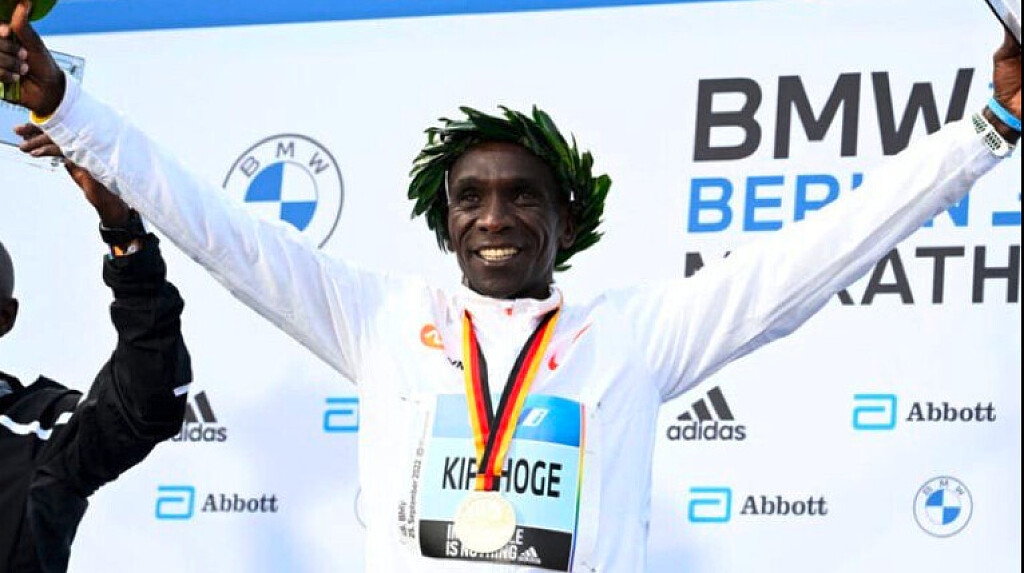
10 Things to Know About the 2023 Berlin Marathon
Here’s how you can watch the race, track runners, and register for next year
More than 45,000 runners are expected to participate in the Berlin Marathon on September 24 in Germany’s capital city. It’s the 49th edition of the race and one of the six World Marathon Majors races along with races in Chicago, New York, Boston, London and Tokyo. The weather forecast is calling for cloudy and cool conditions on race morning in Berlin, so fast times are once again expected.
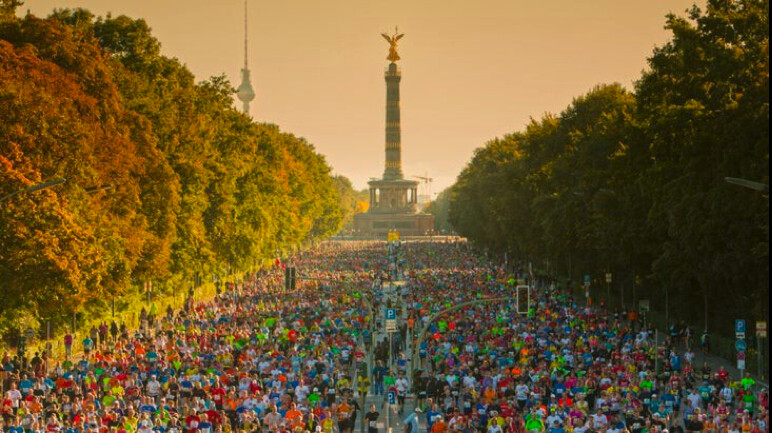

Here’s a rundown of 10 noteworthy elements about this year’s race.
The Berlin Marathon has produced 12 world records—more than any other marathon—since its inception in 1974, including the past eight men’s records since 2003. Kenya legend Eliud Kipchoge lowered the world record for the fastest official marathon ever run (2:01:09) last year in Berlin, and it’s also where he ran the previous world record (2:01:39) in 2018.
Berlin has produced six of the top 10 fastest men’s times in history, including three of the four sub-2:02 efforts (including the 2:01:41 run by Kenenisa Bekele in 2019). It hasn’t been quite as fast for women, however it has been the site of three women’s world records, most recently when Japan’s Naoko Takahashi ran the world’s first sub-2:20 marathon (2:19:46) in 2001. Last year, Ethiopia’s Tigst Assefa won the women’s race in 2:15:37, which, at the time, was the second-fastest marathon ever run and now ranks fifth.
Berlin is the flattest course of all the World Marathon Majors, with a total elevation gain of 241 feet and loss of 260 feet. (The biggest “hills” come between miles 16 and 20, but they max out at less than 30 feet of gain.) Berlin annually produces some of the fastest pro results in the world, in part because it’s a flat course, but also because the race organization provides pacemakers (auxilliary runners who set an optimal pace but only run about a portion of the course before dropping out) so the opportunity for fast times are assured. (There are no pacemakers at the Chicago, New York City Marathon, and Boston Marathon, so those races play out only by the tactics of the runners in the field.) But the fast elite times, flat course, and typically cool weather conditions have attracted age-group runners targeting new PRs, too.
Running legend Eliud Kipchoge, universally accepted as the G.O.A.T. of marathoning, has won 15 of the 18 marathons he has entered, including the past two Olympics. Berlin is where he’s had most of this success, dating back to his first victory in 2015 and he has since also won there in 2017, 2018, and 2022. Can he add one more victory to his total?
He lowered his own world record to 2:01:09 last year by averaging 14:21.4 per 5K, or 4:37 per mile. However, the 38-year-old Kenyan is coming off an uncharacteristically disappointing race at the 2023 Boston Marathon, where he finished sixth in 2:09:23. Will he approach another world record? “My aim is to always run a good race,” he said recently. “Berlin is like home for me. In view of the Olympic Games next year in Paris, I thought about which race could be the best preparation for the Games for me, and Berlin is the best option.”
Including Kipchoge, the men’s field in Berlin includes 10 runners who have run faster than 2:06 and seven more who have broken 2:07, including last year’s runner-up Mark Korir (2:05:58). Kipchoge should be challenged by fellow Kenyan Amos Kipruto, who owns a 2:03:13 from his runner-up showing at last year’s Tokyo Marathon. The winner of the 2022 London Marathon last fall (2:04:39), Kipruto, 31, placed a distant second in the 2018 Berlin Marathon behind Kipchoge (2:06:23) and owns a bronze medal in the marathon from the 2019 World Athletics Championships in Doha.
Other top runners in the field include Kenya’s Geoffrey Kamworor, who ran 2:04:23 to place second at the London Marathon in April, Ethiopia’s Birhanu Legese, who was second (2:02:48) in Berlin in 2019 and Kenya’s Wilson Kipsang, 41, a former winner in Berlin, New York, and Tokyo. However, Kipsang, who lowered the world record to 2:03:23 on the Berlin course in 2013, is coming off a four-year ban for missing drug tests in 2018 and 2019.
Last year, Ethiopia’s Tigist Assefa, a 2016 Olympian in the 800-meter run, entered the race as an untested marathon (with a PR of 2:34:01) and surprised everyone with her 2:15:37 victory in the third-fastest time ever.The 26-year-old is back this year but hasn’t run any races because she’s been sidelined with a few nagging injuries.
Her biggest competitor will likely be Sheila Chepkirui, who holds a personal best of 2:17:29 from last December’s Valencia Marathon. She’s a former African Cross Country Championships winner and was the bronze medalist in the 10,000-meter run at the 2022 Commonwealth Games. Other top women runners include Ethiopians Tigist Abayechew (2:18:03), Workenesh Edesa (2:18.51), and Hiwot Gebrekidan (2:19:10).
Scott Fauble, a three-time seventh-place finisher at the Boston Marathon (including this year in 2:09:44), is racing Berlin with the hopes of securing the Olympic-qualifying standard of 2:08:10. The 31-year-old runner from Portland, Oregon, will still need a top-three finish at the U.S. Olympic Trials Marathon on February 4 in Orlando, but securing the time will give him a leg up on qualifying for the Paris Olympics next summer.
Also racing in Berlin are 2016 U.S. Olympian Jared Ward (Provo, Utah) and 2020 U.S. Olympian Jake Riley (Boulder, Colorado). Ward, 35, owns a 2:09:25 personal best, but he hasn’t run faster than 2:12 since his sixth-place finish (2:10:45) in the New York City Marathon in 2019. The 34-year-old Riley, who owns a 2:10:02 PR, is coming back after having double Achilles surgery in July 2022 to correct Haglund’s syndrome (the second time in his career), and hopes to run in the 2:12-2:14 range. Ethiopian-born Teshome Mekonen, who recently received U.S. citizenship, will also be racing in Berlin. The 28-year-old, who lives in New York City, has a 1:00:02 half-marathon personal best and lowered his marathon personal best to 2:11:05 last January in Houston.
Annie Frisbie is the top American runner in the women’s field in Berlin. The 26-year-old from Hopkins, Minnesota, made her marathon debut at the 2021 New York City Marathon with an impressive seventh-place finish (2:26:18). She’s continued to run well since then, placing 20th (2:28:45) in the 2023 Boston Marathon (2:28:45) and most recently finishing fifth (1:07:27) at the U.S. 20K Championships on September 4 in New Haven, Connecticut. Frisbie was a Wisconsin state champion runner in high school and an All-American runner for Iowa State University.
The Berlin Marathon was started in 1974 by Horst Milde, a German baker and running enthusiast. When it began at the height of the Cold War and East Berlin being sealed off by a wall, the marathon was run only in West Berlin. Since 1990, it has started and ended near the Brandenburg Gate, sending runners on a jagged loop through the city—including the neighborhoods of Charlottenburg, Tiergarten, Moabit, Mitte, Friedrichshain, Kreuzberg, Neukölln, Schöneberg, Friedenau, and Zehlendorf. Runners will pass tourist sites like the Reichstag building, the Siegessäule (Victory Column), Berlin Cathedral, and Potsdamer Platz. Live music is played at more than 60 locations along the course, including at all the famous landmarks.
The inaugural Berlin Marathon had 244 finishers; 234 men and 10 women, and was won by Günter Hallas (2:44:53) and Jutta von Haase (3:22:01), respectively. Last year, the race had 34,788 finishers, including 23,280 men (67 percent) and 11,508 women (33 percent). The last German runners to claim victory were Irina Mikitenko (2:19:19) in 2008 and Ingo Sensburg (2:16:48) in 1980. No American man or woman has ever won the Berlin Marathon.
The Berlin Marathon has an inline skating division for 500 participants that begins at 3:30 P.M. after all runners are cleared from the course. The skater course record of 56:46 was set last year by Belgian Bart Swings, and he’s back this year aiming for his ninth victory. In the women’s race, all eyes are on last year’s winner, Marie Dupuy of France, in 1:11:19. All finishers of the inline skating division are eligible to enter the 2024 Berlin Marathon as runners.
The race, which starts at 9:15 A.M. local time (or 3:15 A.M. ET in the U.S.), will be broadcast worldwide by several TV partners, but not in North America. However, several websites offer live streaming so people can watch the Berlin Marathon from anywhere in the world, especially if you’re a VPN subscriber. Watch Athletics will be broadcasting the race online in real time for free, while FloTrack’s livestream requires a subscription ($29.99 for one month) in order to view their livestream. Runners can be tracked via the Berlin Marathon website’s Results page, or via the BMW Berlin Marathon App app available on Apple or Google Play.
Race day begins with the elite handbike division at 8:50 A.M., followed by the wheelchair and handcycle divisions at 8:57 A.M. Runners are sent off in four waves beginning at 9:15 A.M., starting with the men’s and women’s elite waves. The race has a strict time limit of 6 hours, 15 minutes as well as course closure times at the 33K/20.5-mile mark (3:50 P.M.) and 38K/23.6-mile mark (4:35 P.M.). Runners who have not reached those points by those times can continue on the sidewalks alongside the course or get a ride on the course-sweeping bus.
Entry to the 2024 Berlin Marathon, which is slated for September 29, 2024, will be done via a lottery that will open in October. You can enter the lottery as a solo runner or as a team consisting of two or three people. (If the team is drawn, all persons from the team are included.) Lottery dates for 2024 have not yet been announced, but the draw for the 2023 edition took place in December 2022.
If you’re selected, the registration fee will be about $160 euros. You can also secure a guaranteed spot in the race based on previous marathon times. In 2023, female runners up to 44 years old qualified if they ran faster than 3:00; female runners up to 59 years old qualified if they ran under 3:20; and female runners over 60 years qualified if they ran under 4:10. For men, the qualifying times were 2:45 (up to 44 years old), 2:55 (46-59 years old), 3:25 (60 and older.)
If you don’t get in through the lottery, you may still be able to get into the race via a charity bib or through tour operators.
by Outside online
Login to leave a comment
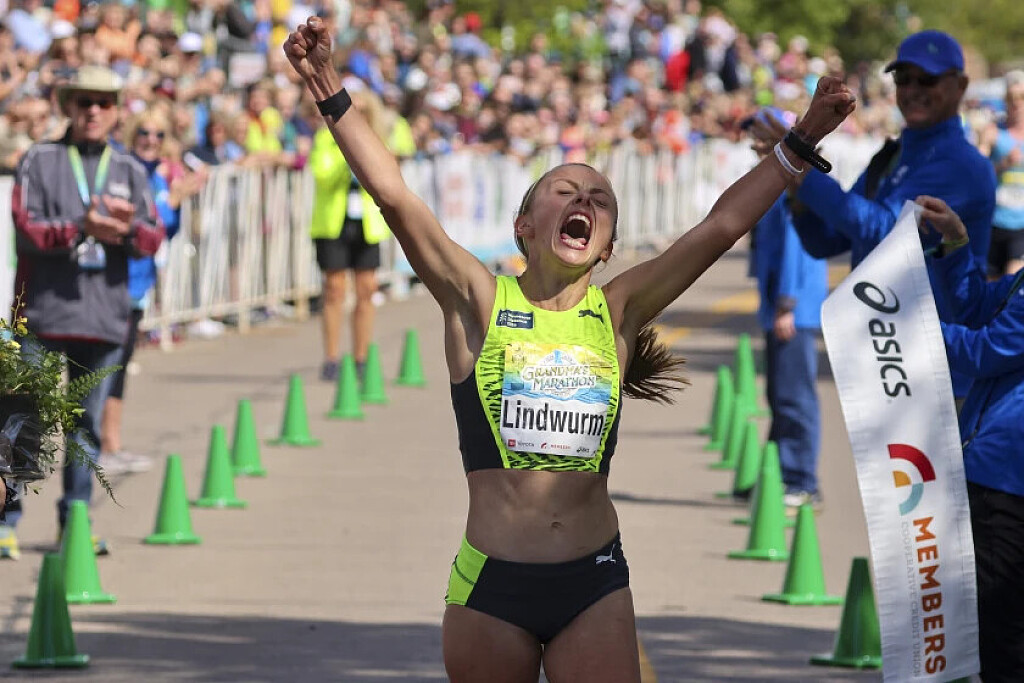
Five elite women to watch in 2023 Grandma's Marathon
Back-to-back defending Grandma’s Marathon champion Dakotah Lindwurm will attempt to become the third woman to ever win the race three times this week, and the first to three-peat since Mary Akor in 2009.
Lindwurm, the former hockey goaltender out of Eagan, Minnesota, is the favorite again in the elite women’s field for the 47th Grandma’s Marathon, which gets underway at 7:45 a.m. on Saturday in Two Harbors. The winner is estimated to arrive at the finish line at Canal Park in Duluth around 10:10 a.m.
Akor, of the U.S., went back-to-back-to-back in 2007, 2008 and 2009, while Lorraine Moller of New Zealand was the first woman to three-peat from 1979-1981.
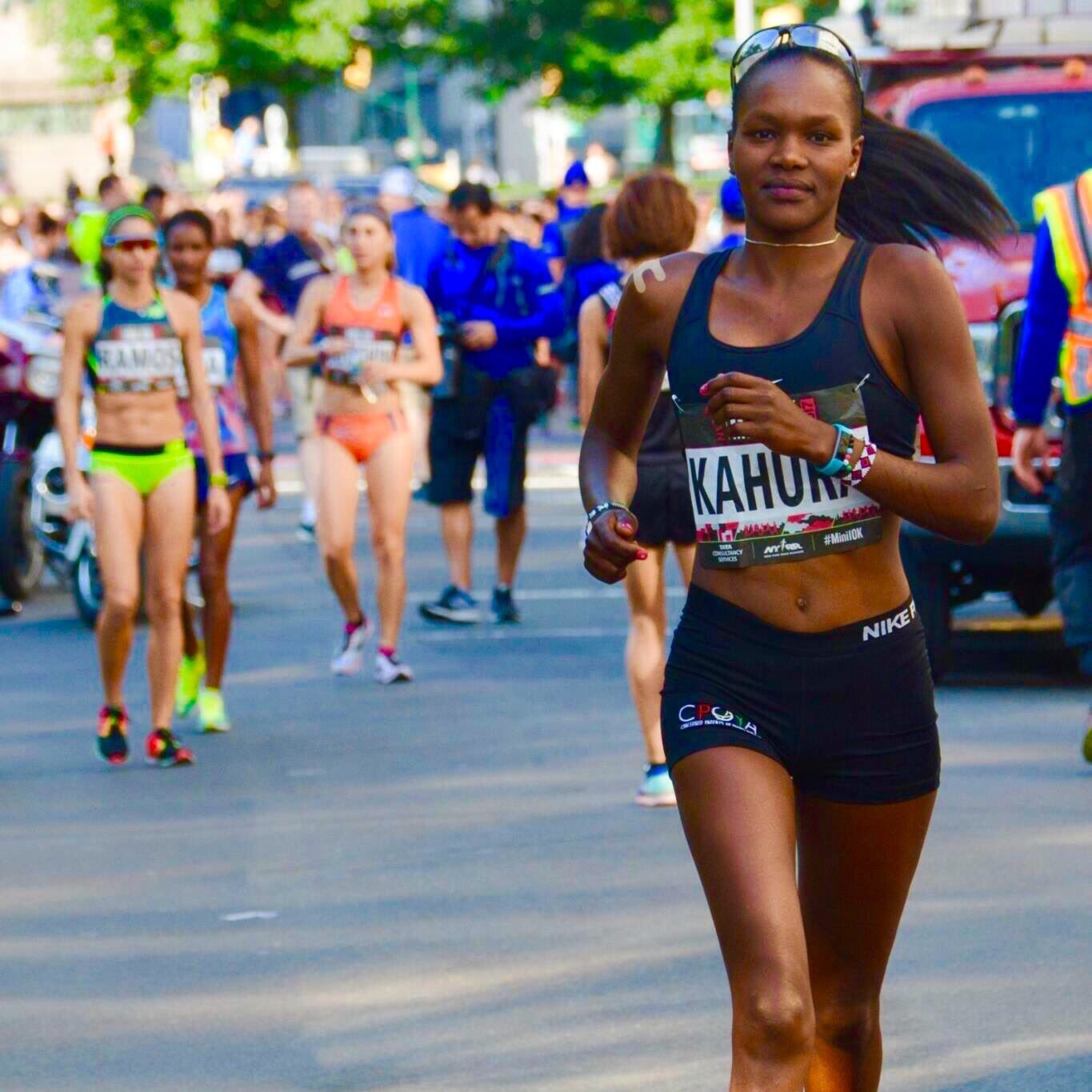
Here’s a look at the top contenders from the women’s elite field that are vying for the $10,000 first-place prize:
Five elite women to watch at 2023 Grandma’s Marathon
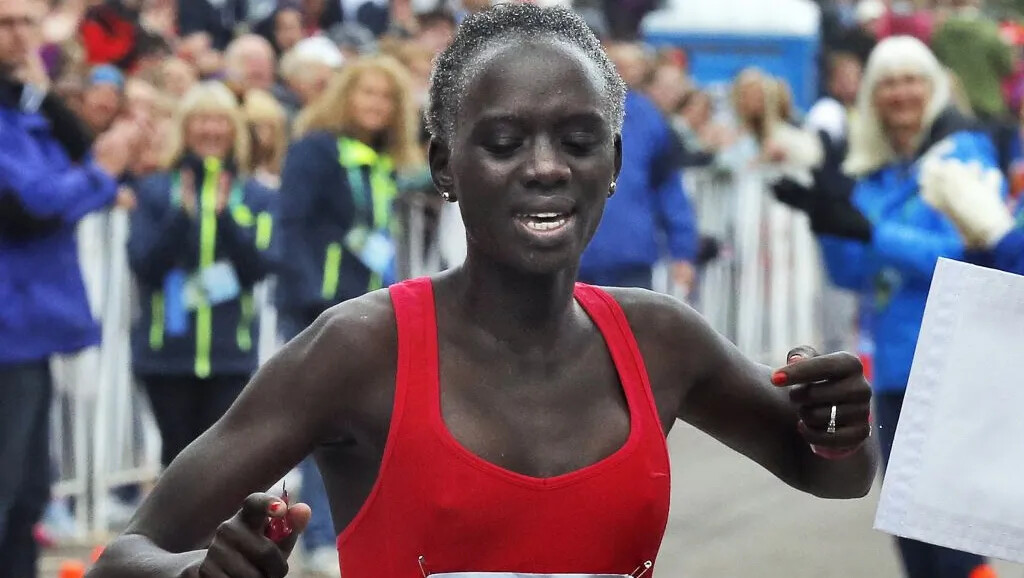
The Defending Champ
Dakotah Lindwurm, 28, United StatesPersonal record: 2:25:01 (2022 Grandma’s Marathon).
Two of Lindwurm’s fastest marathon times have come at Grandma’s, with her winning time last year being the second-fastest time in Grandma’s Marathon history — 33 seconds behind Kellyn Taylor’s record of 2:24:28 set in 2018. Lindwurm, who won in 2021 in 2:29:04, became the first Minnesotan to win Grandma’s Marathon that year since Janis Klecker in 1987. Lindwurm recently finished 26th at the Boston Marathon in 2:33:53.
The Past Champion
Pasca (Myers) Jerno, 36, United StatesPR: 2:33:43 (2014 Grandma’s Marathon)
Jerno is a 2014 Grandma’s Marathon champion, having posted a PR that still stands for her today. The Kenyan-born American beat out then-race record-holder Sarah Kiptoo (whose 2013 time still ranks fourth) for the title that year. Jerno has posted two top-10 finishes since winning in 2014, taking eighth in 2019 (2:36:13) and sixth in 2021 (2:36:48). In 2021, she also posted a seventh-place finish in the Chicago Marathon (2:32:51).
The Contender
Grace Kahura, 30, KenyaPR: 2:30:32 (2021 New York City Marathon)
Whether it’s been Grandma’s Marathon or Garry Bjorklund Half Marathon, Kahura has challenged for the podium, but only landed on it once. That was her Duluth debut in 2017 when she finished third in the half. Since then she’s finished fourth in her last three visits — Grandma’s in 2018 and 2021 and the Bjorklund a year ago. She ran Grandma’s in 2:33:34 back in 2021. That same year she set her PR in New York, finishing ninth.
The Up and Comer
Gabriella Rooker, 35, United StatesPR: 2:29:44 (2022 California International Marathon)
Like Lindwurm, Rooker wasn’t always a runner. Rooker is a three-time NCAA Division III individual and team gymnastics champion from Wisconsin-La Crosse. Grandma’s Marathon in 2021 was her running debut. She finished 26th with a time of 2:56:27, but came in 10th last year in 2:34:59. Her PR in California last year is the second best PR in the field behind Lindwurm, but still 4:43 back.
The Sleeper
Anne-Marie Blaney, 29, United StatesPR: 2:31:32 (2023 Boston Marathon)
Blaney bested Lindwurm back in April at the Boston Marathon, finishing two places higher in 24th and 2:21 faster. This will be Blaney’s first time in Duluth running Grandma’s Marathon, where she will need to shave another 6:31 to match Lindwurm’s winning time last year. Recent marathon results for Blaney include a fourth-place finish at the Ottawa International Marathon in 2022 (2:34:38) and 22nd place in the Chicago Marathon in 2021 (2:40:24).
by Matt Wellens
Login to leave a comment

Grandmas Marathon
Grandma's Marathon began in 1977 when a group of local runners planned a scenic road race from Two Harbors to Duluth, Minnesota. There were just 150 participants that year, but organizers knew they had discovered something special. The marathon received its name from the Duluth-based group of famous Grandma's restaurants, its first major sponsor. The level of sponsorship with the...
more...
13 Races for the Runners Who Love a Beer After a Run
Thirsty for a brew? You can crack a cold one postrun at these races.
Sure, the beverage most closely associated with running long distances is probably water, with sport drinks as a close second. But many other races are being organized around beer. That’s right, runners (like everyone else) love to crack open a cold one, and every year more races pop up in the United States that are geared specifically toward beer.
After all, finishing a race deserves a celebration and there’s no better way to celebrate than cheersing a pint with your best mates (while wearing split shorts and a singlet obviously.) And if you’re ditching alcohol this season, you can still partake in these races in spirit with your favorite non-alcoholic beverage.
For obvious reasons, most of these races save the drinking for after the finish line, but that’s not always the case. And while many marathons give finishers an honorary beer, some of these beer-themed races aren’t so quick to cut you off. Whether you’re a beer snob or just looking for an adventure, these races are a great addition to your racing repertoire, and so we’ve rounded up a list of some of the best around the country.
Here are 13 incredible races that give you the opportunity to sip a brew after you run.
Craft Brew Races
Location: Various in New England Date: Various
Loads of races hand out a beer at the end, but few are actually themed entirely around beer. The Craft Brew Races, a series of beer-themed runs around New England are just that. After the race, there’s a three-hour-long festival where runners can try dozens of local craft beers. Just make sure that if you sign up for the run you also recruit a designated driver to pick you up.
The Louisiana Marathon and Half Marathon
Location: Baton Rogue, Louisiana Date: January 14, 2024
While not technically a brewery-themed race, the 2023 Louisiana Marathon had six beer tags attached to runners’ bibs. Yes, that’s correct. Finishers of this race were treated to a six-pack of beer, and with several local brews to choose from, the variety won’t disappoint. Enjoy some gumbo and a few brews afterward. As they say in Baton Rogue, “Laissez les bon temps rouler!” (Translation— Let the good times roll!)
Yuengling Shamrock Marathon
Location: Virginia Beach, Virginia Date: March 17, 2024
If you’re looking for a great weekend for a beer race, an obvious choice would be St. Patrick’s Day weekend. It is, after all, a holiday celebrated almost exclusively by drinking. Virginia Beach’s race weekend, which includes a full gamut of distances to choose from, is sponsored by Yuengling and passes out beer flights to finishers. Plus, since it’s St. Patty’s, you can roll the postrace celebration into general festivities.
The Growler Team Relay
Location: Ashburn, Virginia & Virginia Beach, Virginia Date: April 15, 2023 and December 9, 2023
Running and drinking are usually more fun with friends, or at least that’s the viewpoint taken by the organizers of these Virginia races. With six legs, each team will race 33.5 miles with anywhere from two to six runners handing off the baton at the checkpoints. When teams finish, each participant receives a pint glass and plenty of beer. What makes the race even more interesting is that the routes you take in each leg are up to you. Sure you’ve got the same start and finish point, but you can get there any way you choose.
Cottonmouth Beerlay
Location: Greenville, South Carolina Date: June 3, 2023
While most races put the drinking at the end of the race, the Cottonmouth Beerlay is here to make things a little more, shall we say, interesting. The 8-mile course consists of four 2-mile loops. Before each loop, the runner must chug down a beer. If you sign up for the race in a relay, that seems doable, but individuals will be drinking at least four beers while tackling the wooded course. If you aren’t deathly ill when you finish, you can always celebrate with yet another beer.
Beer Mile World Classic
Location: Chicago, Illinois Date: July 1, 2023
While the Cottonmouth Beerlay is mostly run and games, the Beer Mile World Classic is a sporting event. These people are serious about running the “beer mile” as fast as possible, and by “beer mile” we mean running four laps around a track while chugging down a beer before each loop. The Beer Mile World Classic has slots early in the day for amateur runners, but as the day goes on, you’ll get to watch some top-notch competition. People train for this believe it or not.
Craft Classic Half Marathon and 5K
Location: Seattle, Washington Date: July 30, 2023
Seattle is a town known for its craft brewery scene, so it makes total sense that it would also host a beer-themed half marathon and 5K. The course is flat and scenic, and there is beer waiting for you at the end (which you’ll need after running in July). It’s said that runners receive a custom bottle opener at the finish. What a cute, useful little prize to win, especially if you already have 500 running T-shirts.
Dogfish Dash
Location: Milton, Delaware Date: September 24, 2023
You need to be 21-plus just to access the website for this race. The Dogfish Dash, which is sponsored by the Dogfish Head Craft Brewery, is a 5K-ish distance race around Milton, Delaware. Obviously, finishers are treated to some of the brewery’s finest beers, but you’ll also get some cool swag. This race prides itself on sustainability as well, meaning that not only do you get reusable shopping bags and water bottles for finishing, but also if you wear a costume made of recycled materials, you get entered for a special prize. Time to start working on your Pepsi can racing shorts.
Time to start working on your Pepsi can racing shorts.
Milwaukee Beer Run
Location: Milwaukee, Wisconsin Date: October 8, 2023
If you happen to be on the other side of Lake Michigan during Oktoberfest, you can run the Milwaukee Beer Run, and let’s be honest Milwaukee knows its beers. The 5K race ends at The Bavarian Bierhaus, where you’ll get a free beer (or root beer for our sober crowd). The race entry also comes with a pass into Milwaukee’s Original Oktoberfest, so you can really keep that energy going all day. Also, there is a .05 mile race (which is 54 yards) for those who want the medal and beer without actually doing much running.
Kona Oktoberfest Run
Location: Royal Oak, Michigan Date: October 8, 2023
Oktoberfest is the St. Patty’s Day of the fall, right? While you might think that this race is put on by Kona Brewing Company in Hawaii, it’s actually hosted by the Kona Running Company in Michigan. The race does, however, come with a plentiful supply of beer, as the post-race festivities include an Oktoberfest event complete with steins of ale and giant pretzels. Runners are also encouraged to run the 5K or 10K wearing Bavarian gear.
Great American Brewery Runs
Location: Various Date: Various
Great American Brewery Runs are almost more of a beer race aggregator than a specific event. They host races all over the East Coast that involve beer, but the specifics and distances vary. There’s a 50K relay, a 5,000 yard dash, and everything else in between. What they all have in common, though, is the inclusion of beer, and how can you say no to that? Might as well sign up for them all.
Shiner Beer Run
Location: Shiner, Texas Date: November 18, 2023
The Shiner Beer Run, which is hosted by the Spoetzl Brewery in Shiner, Texas, is obviously giving out Shiner Bock beer to entrants, and the race ends at the brewery where you can grab food and beers postrace. But, the prerace packet pick up is also at the Spoetzel Brewery the day before, where you can carb load the day before.
The Beer and Bagel Off-Road Race
Location: Various Date: Various
The Beer and Bagel Off-Road Race is sort of a bizarre mixture of things thrown together, but who are we to question it. Beer and bagels—both made of wheat so it works! Plus, there’s also said to be a Sasquatch running around on the course. We’re serious! The series has races all over the Midwest, South, and East, and looks like a great time.
by Runner’s World
Login to leave a comment
Viktoria Brown breaks 72-hour world record, 48-hour Canadian best in Italy
Earlier in March, Whitby, Ont., runner Viktoria Brown broke her own 48-hour Canadian record and 72-hour world record while competing at the GOMU (Global Organization of Multi-Day Ultramarathoners) six-day world championships in Policoro, Italy. Brown ran 364 km over 48 hours and 475 km after 72, beating her two previous records by 11 km and 8 km, respectively. She finished the six-day event with a grand total of 684 km to take home the women’s individual gold medal.
The event in Italy marked the first six-day world championship organized by GOMU, which was founded in 2021. Brown is a vice president, as is Greek ultrarunning legend Yiannis Kouros; Canadian ultrarunning pioneer Trishul Cherns is president. The organization held its first world championship event—a 48-hour competition—in New Jersey in September 2022, and Brown and the team are looking to add 72-hour and 10-day races into the mix in the near future.
Canada didn’t send a team to the GOMU worlds, so Brown competed for Hungary, where she also holds citizenship. She helped lift the Hungarian women to the team world championship to pair with her individual gold medal. Going into the event, Brown’s Canadian 48-hour record stood at 353 km, which she ran in June 2022 at the Six Days in the Dome event in Wisconsin. After two days of running in Italy, she had eclipsed her PB to add another 11 km to her national record, which now stands at a whopping 364 km.
Up next was the 72-hour mark, and Brown had her eyes on her world record of 467 km. She ran that amazing result at the same race where she posted her 48-hour best last June. Just like she did in Wisconsin, Brown charged forward after securing her 48-hour record, and eventually toppled her 72-hour best, too, with a tally of 475 km.
At that point, Brown already had two records in the books, but she was still only halfway through the six-day race. She carried on for another three days, eventually finishing with a phenomenal winning result of 684 km. That’s an amazing total, but even more incredible is the fact that it’s more than 50 km shy of Brown’s six-day PB (and, you guess it, another Canadian record) of 736 km. As with her 48- and 72-hour marks, Brown ran that result at the Six Days in the Dome last year.
Brown says the next race on her schedule is the Badwater 135 ultramarathon in California, but since that isn’t until July, she may take another shot at the 72-hour record with hopes of improving her world record once again.
by Running Magazine
Login to leave a comment
Zach Panning And Sarah Disanza Win Shamrock Shuffle 8k
The winners of the 2023 Bank of America Shamrock Shuffle 8K crossed the finish line Sunday, leading thousands of racers in the unofficial kickoff to outdoor running season in Chicago.
Zach Panning, of Rochester Hills, Michigan, won the race by finishing as the first runner with an unofficial time of 22:48, according to race results.
"It feels good. I was second last year to Tai Dinger, who was second this year, so it’s fun having a little fun rivalry," Panning told NBC 5 at the finish line. "I love Chicago. I ran the marathon last year, and really enjoy it. It’s a beautiful city."
Panning said he plans to focus on the next Olympic trials marathon next year.
Sarah Disanza, who is also from Rochester Hills, Michigan, was the first female finisher in the 8K event, crossing the finish line with an unofficial time of 26:35.
"It’s super exciting. I’ve been coming back from a tendon tear in my foot for a long time, so it was great to get out there and really rip it," she said. "You just have to ask yourself ‘how much do you love it?’ For me, every single day that I was out there cross-training, it was so worth it. It’s my favorite thing in the world, for moments like this and being here with my teammates."
The first to cross the finish line was wheelchair racer and defending champion Samantha Schroth, a Wisconsin native who lives in Chicago.
She finished first in the wheelchair race, with a time of 25:57, faster than her 2022 victory finish. The next wheelchair finisher was Angelo Perez, who crossed with an unofficial time of 40:38.
"Step outside your comfort zone. Everyone has things in their lives they’re nervous about, whether you’re disabled or able-bodied, and you just have to step outside your comfort zone and give it a chance," Schroth told NBC 5 at the finish line. "You never know what’s on the other side. I didn’t think I’d be racing post-injury, but I’m loving every second of it."
The top finishers paved the way as thousands of runners took over Chicago streets on a colder spring day.
Login to leave a comment

B of A Shamrock Shuffle 8K
The Shamrock 8k is a huge celebration of the beginning of running season. It is the world's largest timed 8k, starting and finishing in Chicago's Grant Park. Runners feel the energy of over 30,000 runners and a big cheering crowd (present during the entire course.)The excitement lasts throughout the after-party, where participants find beer, food and live music. The flat...
more...
How 51-year-old Ken Rideout Runs Sub-2:30 Marathons
Relentless dedication and strength training are some of the keys to his success
Ken Rideout insists he’s just an average guy who likes to run marathons as fast as he possibly can.
He admits he’s never been a great athlete, but, at the same time, his commitment to training and his results are extraordinary. The 51-year-old resident of Nashville, Tennessee, has blossomed into one of the world’s top masters runners with a fierce competitiveness that has helped to consistently run some astonishingly fast times at World Marathon Majors races over the past several years.
He won the 50-and-over division at the New York City Marathon (2:33:31) in 2021 and the Boston Marathon (2:30:21) in 2022 and he has come in second in that age division in London (2:29:54), Chicago (2:29:53) and Berlin (2:35:48). He also won the 2021 Myrtle Beach Marathon outright in 2:30:58 just before turning 50.
On March 5, he’ll toe the starting line at the Tokyo Marathon in an attempt to once again compete for a podium finish in his age division. He ran 2:29:14 to win his division in Tokyo.
At 5-foot-10, with a muscular physique, Rideout breaks the mold of both typical elite runners and faster recreational runners. It’s his relentlessness to being the best he can be — including and especially his strength training — that sets him apart as an age-group runner and not any inherent talent as an endurance athlete.
“When I am in a race, my mindset gets to the point that I’m gonna run until I collapse,” Rideout says unapologetically about his steadfast approach. “I’m gonna give every ounce of energy until there’s nothing left to give. Win or die trying, that’s the message. If you have that mindset, you can’t lose.”
Growing up in a troubled family in a rough suburb of Boston and taking up boxing at an early age, Rideout has applied a fighter’s mentality and a notorious work ethic to every challenge he’s faced in life, sometimes to his own demise.
As a teen, he took a job as a prison guard where his dad and brother were incarcerated. He worked his way through college, eventually earning a sociology degree from Framingham State University. Although he became a self-made, overachiever as a financial services sales executive, he admitted he suffered from imposter’s syndrome working alongside many Ivy League colleagues and eventually struggled with burn-out, and was diagnosed with substance use disorder tied to his excessive opioid use.
After working through a recovery program, Rideout found a more balanced path in life, channeling his energy into endurance sports, following a mostly vegan diet and the joy he shares with his wife and their four young children.
Rideout first applied his intensity to triathlon and qualified for the Ironman World Championships three times and won the 40-44 age division at Ironman Wisconsin in 2015 with a 9:36:15 effort. But that sport took too much time away from his family, so he turned his focus to marathons in 2019.
So how does someone who started running in his late 30s and didn’t really focus on it until his 40s become fast enough to run 5:45 pace for a marathon after turning 50? Being unabated in his approach every single day.
“I’ve heard some people say I’m lucky to be able to do this at my age, and I’m like, ‘I’m not lucky,’ I work my ass off every day,” he says. “I eat a perfect diet during the week. I work out twice a day. I’m a freaking lunatic with this stuff. I live this full-time.”
Despite his exuberance and intensity, Rideout says he’s grateful that most of his running brings a Zen-like calm to him. He admits he doesn’t want his energy to lead him to a dark place again. When he can, he listens to podcasts or audiobooks while he’s running because he wants to be able to maximize his time to train and learn something at the same time.
“This is just my outlet,” he says. “Running is one of the things that makes me feel good about myself.”
When Rideout turned his focus to running five years ago, his training initially consisted of a 10-mile out-and-back run with 1,200 feet of vertical gain six days a in the Pacific Palisades neighborhood of Los Angeles. The other day of the week he’d typically run 20 miles as hard as possible. While that helped continue to build his aerobic base and led him to a 2:40 effort at the Los Angeles Marathon, it only got him so far.
In 2019, he hired coach Mario Frailoli, who added structure to his training by increasing the length and adding specificity to his long runs, implementing speedier workouts into his routine and also encouraging him to slow down on his easy days that help optimize recovery. He also makes sure that he stays between 70 and 80 miles per week. Since then, he’s run 2:36 or faster six times, including a 2:28:25 personal best at the age of 48 at the 2019 California International Marathon.
In addition to his run training, he works on strength in his home gym four days a week with a circuit that includes pull-ups, squats, bench press and numerous core exercises, as well as boxing drills — including punching a heavy bag. His functional strength and athleticism are among his biggest assets, something that many recreational runners lack, Fraioli says.
Plus, because he’s not burdened by having 35 years of running in his legs, he still has considerable elastic recoil in his legs. (And yes, his carbon-fiber plated Reebok Floatride Energy X shoes also help, Rideout says.)
“He’s doing it right, and honestly, he has been doing it all long,” Fraioli says. “He has more than 10 years of aerobic development under his belt and a lot of that came on a bike and in the pool. And I think the strength training really just helps to keep him in one piece. It’s giving him that structure and that guidance and honestly just keeping him from, you know, completely running himself into the ground.”
Although he still works in the financial world, Rideout has also helped train mixed martial arts fighters and boxers, and is the co-host of the combat sports podcast, “The Fight with Teddy Atlas.” Because of his success and notoriety, he has been all over the media in recent years, including appearances on high-level podcasts with Rich Roll, Joe Rogan, Samantha Nivens, Dr. Andrew Huberman and Fraioli’s “The Morning Shakeout” weekly running show a couple of times.
Rideout has been eager to share his story — and fans and followers seem to appreciate his vulnerability — but insists he’s not special or extraordinary, especially as an athlete.
“Everyone has what I have. I’m an average guy” says Rideout, who played hockey and football in college. “The only thing I do that other people don’t do is I try as hard as I can, I dedicate myself to being the best I can be. And I would say that if there’s one metric that matters above everything — and you don’t need to be a rocket scientist to know this — it’s that consistency is the most important thing. Show up every day.”
by Outside
Login to leave a comment
Do Super Shoes Give Regular Marathoners a Performance Boost?
Research shows economy gains at slower paces, but they’re smaller and not guaranteed.
It’s no coincidence that running records have been falling in droves in the era of super shoes. While researchers still may not be able to fully explain how the technology works, they have shown that the ultra-compressible foam, curved carbon-fiber plate, and rockered geometry that first appeared in the Nike Vaporfly 4% in 2017 provide competitive runners a 2.7–4.2 percent boost in running economy. In other words, thanks to these shoes, runners need 2.7-4.2 percent less energy to run the same pace—meaning that they can conserve that energy to run farther or expend it to run faster.
One caveat is that, until now, super shoes have been tested only at running speeds of 7:26/mile or faster. Translated into marathon times, that means the science is applicable to someone who runs a marathon in 3:15 or faster—a feat accomplished by only 21 percent of the 2021 Boston Marathon field.
However, new research has finally emerged that looks at whether the majority of runners get an edge from super shoes. The answer: probably yes, but less.
Research for Non-Elites
Dustin Joubert, Ph.D., a kinesiology professor at St. Edward’s University in Austin, Texas, likes to do research, in his words, “for the people.” This is how he came to conduct a study looking into whether super shoes, specifically the Nike ZoomX Vaporfly Next% 2, confer the same running economy advantage to athletes who run at slower paces.
“There’s a lot of people who don’t fit under the umbrella of the speeds that have been tested in all this laboratory research, and a lot of people are asking: Should I spend my money on this? Do they work for slower people?” said Joubert. “That was the next logical question to me.”
To answer the question, Joubert and his colleagues recruited 16 runners—eight men and eight women with prior-year 5K PRs averaging 19:06 and 20:18, respectively—and had them complete two sets of four 5-minute running reps on a treadmill. Each runner ran one set at a 12 kilometers/hour pace (8:00/mile, which would be marathon pace for a runner with a 5K PR of 22:15), and the other set at 10K/hour (9:40/mile, which would be on the slower end of easy pace for that same 22:15 5K runner). Within a given set, the runners tested two different shoes: they ran one 5-minute rep in an experimental carbon-plated shoe, the Nike ZoomX Vaporfly Next% 2, and the other rep in a control shoe, the Asics Hyper Speed. Then, the runners repeated the reps but reversed the order in which they wore shoes (e.g., Asics first, then Nike).
The researchers chose the Asics Hyper Speed as the control shoe because it lacks the technology of the Vaporfly (carbon plate and advanced foam) but matches its mass. This was an important variable to match because mass affects running economy; a heavier shoe will require more energy to move and could therefore confound results. One earlier study compared the Vaporfly to runners’ everyday training shoes, but most regular training shoes are more than 100 grams (3.5 ounces) heavier—the equivalent of about 40 pennies. Imagine lifting those pennies 55,000 times (the average number of steps in a marathon, for men; women take about 63,000 steps). That would require quite a bit more energy!
Economy Advantages for 3:30–4:15 Marathoners
The new study found that, on average, running economy was better in the Vaporfly than in the Hyper Speed. However, at these slower speeds, the improvements were smaller than at faster speeds: runners gained just 1.4 percent in running economy at 8:00/mile pace and 0.9 percent at 9:40/mile pace, compared to the 2.7–4.2 percent advantage runners gained at speeds of 7:26/mile or faster. (And, as we’ll see below, even those improvements came with a caveat.)
Joubert speculates that the reason for this difference comes down to how the foam in the shoes is working. Much of the running economy advantage comes from compressing the compliant/resilient foam in the shoes and then having that energy returned as the foam springs back. A faster runner who is generating larger ground reaction forces will compress the foam more than a slower runner who, because of their speed, isn’t generating as much ground reaction force.
“The shoe is not creating energy for you; it’s only giving back what you put into it,” explained Joubert.
Not Everyone Benefits
Before you decide “an advantage is an advantage,” there is one other finding from this study that should give runners pause. While the results from the 16 test subjects showed a 0.9–1.4 percent average improvement in running economy, one third of the participants actually showed worse running economy when they ran at the 9:40/mile speed in the Vaporflys, compared to the control shoe. This finding diverges from the results of testing done on the Vaporflys at faster speeds, where runners experienced varying degrees of running economy improvement, but no one saw a detriment.
One possible reason has to do with the Vaporfly’s carbon plate. Research has shown that increased longitudinal bending stiffness, or the rigidity of a shoe underfoot, helps to improve running economy at faster speeds by reducing the amount of energy your foot requires as you land and push off from the metatarsophalangeal joint (where your foot connects with your toes). Joubert hypothesizes that, at slower speeds, the stiff carbon plate might stop saving runners energy and instead create a need for more energy in order to get “up over” the plate.
“If the plate’s really stiff, maybe at these slower speeds that’s an impairment to economy,” Joubert said.
Nathan Brown, a doctor of physical therapy at Pineries Running Lab in Stevens Point, Wisconsin, and senior contributor at Doctors of Running, said that this finding in particular helps to reinforce the shoe selection guidance he already offers his patients and the runners he coaches.
“If your goal of picking a shoe for race day is to get faster, but there’s a 30 percent chance that you get worse, I care more about finding the shoe that you like to run in than the shoe that may or may not give you a benefit,” said Brown.
So, Should You Wear Super Shoes?
If you’re an 8:40-9:00/mile marathoner, what should you do? Do you gamble on being in the 66 percent of responders and plunk down your cash for a pair of super shoes? Or do you stick with what you have?
Footwear is ultimately a personal decision, so here are a few more points to consider.
Choose a shoe that’s comfortable.
If a super shoe feels uncomfortable, that might be an indicator that the shoe won’t help you make the economy gains you’re seeking. Joubert guesses that the comfort of your shoes could affect biomechanical aspects of your race-day performance, including economy. “I think if a shoe is uncomfortable, it’s probably not going to be economical,” he said.
Brown emphasizes focusing on comfort and confidence in a race-day shoe rather than “carbon [plate] or no carbon.” To determine whether it’s comfortable, Brown recommends trying your racing shoe in a few workouts and, if your goal race is a marathon, a few long runs in advance of race day.
“You want to feel comfortable [in the] shoe and confident psychologically,” he said. “To know what to expect on a long run from your race-day shoe can be a big deal for performance.”
Don’t wear a super shoe (or any one shoe) for every single run.
Heather Knight Pech, a decorated masters runner and coach for McKirdy Trained and Knight Training, tells every one of her athletes, from high schoolers to masters runners, to invest in a minimum of three pairs of running shoes: a trainer (e.g., Brooks Ghost), a lightweight trainer (e.g., New Balance Rebel), and a race-day shoe (e.g., Nike Vaporfly Next%). She then has them rotate among these shoes for several reasons. First, it decreases injury. Research has shown that runners who rotate their shoes decrease their injury risk by 39 percent compared to runners who wear the same pair for every run.
“Running is a repetitive motion, so you avoid overloading any one muscle, bone, or tendon,” said Pech. “And on the flip side, you’re simultaneously strengthening other structures by rotating your shoes.”
In his physical therapy practice, Brown has found that super shoes tend to reduce the loading on lower leg structures like the Achilles tendon and calf. As a result, he’s noticed a trend in repetitive stress injuries further up the chain, to the hamstrings and hip flexors, in runners who wear that shoe for most or even all of their runs.
The second reason Pech advises runners to rotate shoes is that it forces them to decide between shoes for a given run, which helps them gain a better sense of self-awareness. “We should be very dialed in to how we feel—that’s part of running training and racing,” said Pech. The saying she repeats is: different shoes for different runs for different days.
Look at a variety of styles and brands.
The Nike Vaporfly was the first high-stack carbon-plated shoe on the market, and as a result, it is arguably the most well known. Most brands now have a similar shoe, and while research shows they’re not yet up to par when it comes to running economy, that doesn’t mean different shoes won’t work better for certain runners based on foot anatomy, running stride, and even pure preference.
Pech points out that the Nike Vaporfly is a very high, very narrow, very bouncy shoe. The Saucony Endorphin Pro, on the other hand, she describes as “more stable underfoot, with firmer foam. It’s great for runners who want to feel the ground.” Meanwhile, the Asics Metaspeed, which is also slightly wider underfoot than the Nike Vaporfly, offers two versions between which runners can choose based on their running style: cadence (increasing their turnover) or stride (increasing their stride length).
“I think they’ve all caught up, in that, now, there are different shoes for different people,” said Pech.
Remember: economy isn’t everything.
While running economy does influence running performance, it’s only one small part; how well you eat and sleep, your level of anxiety, how consistently you trained, how well you tapered, and numerous other factors have an equal, if not greater effect on the time you ultimately run in any given race.
Therefore, if you’re a 3:30–4:15 marathoner and don’t want to shell out the money or risk finding yourself in the 33% “anti-responder” group, double down on some basics like pre- or post-run nutrition or even just sleep. Plus, when you beat your Vaporfly-wearing counterparts, you’ll never have to ask, “Was it the shoes?”
by Runner’s World
Login to leave a comment
Do Runners Drink Too Much Alcohol?
A growing body of research says that no amount of alcohol is good for our fitness and health. It’s time to rethink our relationship with booze.
Pro ultrarunner Coree Woltering doesn’t do anything halfway. “If I’m going to do it, I want to do like 120 percent, no matter what it is,” he says. When he brings that attitude to his running and racing, the results speak for themselves—like setting a new fastest known time on the 1,000-plus-mile Ice Age Trail across Wisconsin in 2020.
However, Woltering also brought that attitude to the bar. “It wasn’t just a ‘let’s have two beers and be done’ thing,” says the 32-year-old from Dalton, Georgia. Two beers at his house would lead to four more at the bar. “Six a night would be normal.” The results were noteworthy—but in all the wrong ways. His training became inconsistent. After long nights out, he’d sometimes skip sessions. When he did get out to run, he found his focus and mental fortitude lacking. Woltering doesn’t take over-the-counter pain management medications like Tylenol or ibuprofen. Instead, he’d slam a beer or two late in a race, hoping to hush the screaming of his feet and legs.
This approach is not unusual, says David Wyrick, PhD, a public health education professor and the director of the Institute to Promote Athlete Health & Wellness at the University of North Carolina, Greensboro. Wyrick studies alcohol use among student-athletes. Pain control is one of three primary reasons athletes report using alcohol (along with stress management and as a way to celebrate). Though, when it comes to pain, “there’s no evidence that alcohol has medicinal benefits,” says Wyrick.
Almost all the benefits Americans attribute to alcohol—that it is good for the heart, helps you sleep, eases pain—are false, says George F. Koob, PhD, director of the National Institute on Alcohol Abuse and Alcoholism. “The truth is, there’s no safe amount of alcohol, not even one drink a day,” he says.
And yet: Running culture—which is otherwise populated by protein-shake-drinking, heart-rate-tracking, health-obsessed fitness nuts—is enmeshed with drinking. From brewery-based runs to the infamous beer mile to groups with the motto “a drinking club with a running problem,” alcohol is as much a part of the fabric of our sport as energy gels. But the fact is, alcohol destroys lives and families. Running culture that glibly celebrates it is feeding that destruction.
Pulling them apart doesn’t mean eliminating alcohol. Koob has spent the last eight years working on issues around alcohol abuse, yet he describes his own approach to alcohol as “one eye open.” A glass of beer or wine every now and then? That’s fine for most runners. But blithely telling yourself beer is a recovery drink because it has carbs and your Tuesday night run ends at a bar? Not so much.
It’s time to take a good look at what we know—and don’t know—about alcohol’s relationship to our health, running performance, and mental well-being.
Booze and Sleep Don’t Mix
Three years ago, journalist Lisa Slade, a 38-year-old recreational marathoner, purchased a Whoop wearable device. Each morning, Whoop prompted her to input data about what she did before bed. Questions included: Did you eat a big meal? Are you under a lot of stress? Did you consume alcohol last night?
At the end of the first month, Slade got a summary of her data. “Pretty much the only thing I noticed that negatively impacted me to an alarming amount was alcohol,” she says. Slade had considered herself a light drinker—maybe a beer while making dinner, or two cocktails if she was out with friends. Even that low dose, though, was affecting her recovery times and sleep quality by as much as 20 percent. “I could tell that I was having a harder time recovering from it,” she says. After “just one or two drinks, I’d wake up and wouldn’t feel so good, like I hadn’t slept super well.”
Emily Capidolupo, senior vice president of data science and research at Whoop, says Slade’s revelation is common among new Whoop users. She adds that many cut back on drinking after a few months of using the wearable, which uses biometric data like heart rate, heart-rate variability, respiration rate, and sleep quality to score a user’s overall recovery. Alcohol “is one of those things we know is bad for us, but we don’t realize quite how bad,” she says. When Whoop presents the data in a tidy end-of-month report, it’s clear for many users that alcohol is a poison. “It’s a fun poison,” says Capidolupo. “But it’s poison.”
When you head out for beers after an evening run, you put an extra task on your body’s to-do list. In addition to recovering, it now must divert energy to breaking down the alcohol entering your bloodstream, inhibiting crucial functions like repairing exercise-induced muscle damage. Alcohol also impacts your immune system, blocking inflammatory responses vital to this process. For chronic drinkers, the negative effect on immunity can lead to more illness and fewer training days.
Compounding the issue, though, is that the most popular time to imbibe is in the hours before bed. Alcohol wrecks sleep quality, says Christopher Winter, MD, a Charlottesville, Virginia–based sleep specialist and host of the Sleep Unplugged podcast. If this seems counterintuitive, and a single beer makes you drowsy, you’re not alone. Alcohol is the most popular sleep aid in the country, he says, but that’s because most people don’t understand the difference between being sedated and being asleep.
Alcohol suppresses your central nervous system. That is not high-quality rest. Since alcohol relaxes a lot of the muscles involved with breathing, you may breathe less deeply as you sleep, lowering your oxygen saturation levels, says Winter. When you’re not getting enough oxygen, your body’s natural response is to wake you up. Alcohol also suppresses deep sleep, which is when your body makes growth hormone.
“If you’re grinding out the miles and trying to recover before a race or your next training session, alcohol impairs your ability to do that,” he says. It may also interfere with the secretion of melatonin, a hormone associated with sleep, which can mess with your shut-eye schedule causing daytime drowsiness and nighttime restlessness—so you reach for another beer. If you do plan to drink, drink less and do it very early, says Winter. “There really is no way to sidestep its negative properties.”
Not being able to fall asleep can cause extreme anxiety, especially as you count the minutes wide awake until the alarm says it’s time to get up. Many people turn to alcohol to dull anxiety, though it’s neither good nor effective, says Winter. It may mask the issue for a night, but it won’t give you the rest you need. If you’re struggling to get to sleep at night, first clean up your sleep hygiene by logging off devices and stress-inducing news sources at least an hour before bed. Consider meditation or quiet journaling, which can help you unwind, says Winter. And if you’re still worried about your sleep quality, take the issue to a sleep specialist.
The Pandemic Didn’t Help
J.R. Jamison, a 43-year-old Indiana-based author and NPR host, took up running 10 years ago and eventually lost 80 pounds. He was healthy and fit and loved how running got him out into the world. But when the pandemic hit, he found it difficult to differentiate between weekends and weekdays.
Jamison admits his weekend drinking habits had always been on the heavy side. But when Tuesday night started to feel just like a Friday night and no one was going anywhere, weekend drinking became everyday drinking. Next thing he knew, the running habit that had changed his life had fallen by the wayside. “There’s no doubt that substance use disorders have skyrocketed since the pandemic,” says Dave Rabin, MD, PhD, a San Francisco–based psychiatrist. A CDC report from August of 2020 found that 13 percent of Americans started or increased their use of substances like alcohol during the first six months of 2020.
Rabin says that, at its core, substance use stems from a human desire to avoid discomfort like stress, anxiety, or lack of control. And if we haven’t learned healthy, long-term strategies for managing discomfort, we look for something to alleviate that discomfort. Alcohol often produces the desired numbing effect.
As Jamison found himself drinking more, he had less energy and motivation. He’d wake up with brain fog and struggle through a day of work. With no impetus to run, and little accomplished professionally, he’d reach for a drink each night.
What’s so insidious about alcohol and other sedatives, says Rabin, is that these drugs numb our frontal-cortex activity, decreasing our insight and judgment. As a result, we unwittingly train ourselves to embrace a casual attitude toward self-reflection—and wind up oblivious to our problematic behavior, he says.
Running, however, does the opposite. It results in a neurochemical response in the brain, with endogenous pleasure molecules, endogenous opioid molecules, and endogenous cannabinoid molecules, plus dopamine and serotonin, all releasing on cue like one glorious feel-good chorus. This is why addiction specialists often recommend it as a coping mechanism for those struggling with alcohol use disorder, says Rabin.
But running won’t help if you can’t summon the motivation to do it. It took Jamison more than a year to rediscover his enthusiasm. As 2021 came to a close, he committed to Dry January. “I didn’t have a drop to drink throughout January, and I started to notice that I wasn’t waking up anymore with headaches,” he says. He started running again. “I liked the way I felt. I was happier. I just decided not to drink again, and I haven’t.”
The Myth of Healthy Drinking
Not long after Lisa Slade saw the effect of alcohol on her Whoop data, she clicked around the Internet looking for more info on why the impact was so dramatic. “We’ve been told our whole lives that a beer or a glass of wine is heart-healthy,” says Slade, who has since cut back her drinking. “But I was reading studies about the effects of alcohol and it turns out that maybe it’s not good for you at all.”
Alcohol is a known carcinogen, a substance that can cause cancer, says Tim Rebbeck, MD, a professor of cancer prevention at Harvard University. When you drink, your body relies on two enzymes to break alcohol molecules into pieces small enough for removal from the body. That breakdown process creates a byproduct called acetaldehyde. Laboratory, animal, and human studies have all shown that acetaldehyde causes DNA damage to cells, and this damage can lead to cancerous tumors. “We are sure that alcohol is a causative factor in some cancers, and it’s supported by lots of different lines of evidence,” says Rebbeck.
Getting the word out that alcohol—like tobacco—is a carcinogen has been difficult for several reasons. For one thing, alcohol is socially acceptable and even socially encouraged. Furthermore, the relationship between alcohol and cancer is more complicated than smoking’s direct link to lung cancer. Head, neck, liver, and breast cancer all have strong links to alcohol, says Rebbeck. But, of course, some people who never drank a drop will still get breast cancer and vice versa. “It’s a complex story, and people have a hard time digesting complex stories,” he says. And how much of a role alcohol played in any one person’s cancer development is an impossible equation to tease out.
As for a glass of wine being heart-healthy, recent research has debunked that advice, says Koob. The early studies concluding that it helps your heart were based on the resveratrol in red wine, but the amount you’d have to drink to get the benefits of the compound would tear your liver up, he says. A 2019 study published in the Journal of The American Heart Association confirms this, finding that heavy drinking is a risk factor for cardiovascular disease.
Even studies that find some benefit to drinking may not hold up under scrutiny. Over the years, a handful of meta-analyses of all-cause mortality among drinkers versus nondrinkers found a “J-shaped curve” between the two. Basically, mortality was slightly higher for nondrinkers, but dipped for moderate drinkers, and then rose sharply for heavy drinkers, forming a J. This would appear to make the “glass of wine for heart health” statement true. But in 2015, researchers took a closer look at these studies. When they teased out exactly why many abstainers did so, they found a confounding variable: These people were eschewing alcohol because of existing health concerns. In other words, they were less healthy than the moderate-drinking group to begin with. When researchers adjusted the data to account for abstainers with outstanding health concerns, the initial hump on the J flattened out.
Studying alcohol use and health effects is difficult, in part because people often don’t remember how much they consumed or because they aren’t being honest about it, says Rebbeck. That makes giving recommendations on how much and how often to drink difficult, too.
Interestingly, not a single expert interviewed for this story told us to stop drinking. Several mentioned that they occasionally enjoy wine and beer. “‘Don’t ever do anything that might harm you’ is not useful messaging,” says Rebbeck. Life is full of things that can harm us. Overly charred toast. Processed meats. The flame retardant on our couches. Uneven sidewalks waiting for unsuspecting runners.
A better approach is to consider your personal risk factors, your tolerance for risk, and the joy that alcohol—in moderation—brings you. If you have a family history of breast cancer, or head and neck cancers, you may decide the risk isn’t worth it. If you don’t, drinking in moderation may be a risk you’re willing to take. However, “limiting your exposure to alcohol is the bottom-line answer,” Rebbeck says. “You are consuming a carcinogen. How much of that do you really want?”
The Longest Race: Sobriety
For Coree Woltering, that amount was zero. On November 1, 2021, Woltering got sober. In past years, he’d taken time away from drinking and seen an improvement in his training. But then he’d go back to drinking—and plunge off the deep end. There wasn’t a happy medium where he just had one beer every other night. “It wasn’t just like I drank to get drunk,” he says. “I really enjoyed the taste of certain wines, certain beers. But that’s part of the problem, I enjoyed it to 150 percent.”
A week of sobriety passed. Then another. He jumped in to crew a friend through an ultra and got offered a shot of Fireball at an aid station. When he turned it down, everyone was surprised. “They’re like, ‘Oh, are you not feeling well?’ I’m like, ‘No, I feel great. I’m just not drinking.’ And everyone’s like, ‘Oh, are you sick?’ ‘No, I’m not sick. I’m just literally not drinking.’” That drinking culture and running culture knot is tight.
In the first month, Woltering focused on consistency. He set a goal to run every day in December and hit 30 of the 31 days. Over time, the awkwardness with friends abated, and Woltering found a community of similarly sober athletes. But his performance wasn’t doing the about-face he’d hoped for.
The second month was the rough one. “It was like, ‘Oh, now I feel every little pain in my body,’” he remembers. And then there was the FOMO. “It’s like, for the rest of my life, am I missing out on all these beers and wine that I haven’t tasted yet?”
It would take Woltering six months to get back to a place where he felt good. Yet he wasn’t seeing the times he’d hit in previous training peaks. That was frustrating. Giving up alcohol was supposed to be this golden ticket to better health.
Finally, eight months into sobriety, things started to click. His times began to improve. Those better numbers bolstered his commitment to the sober path. And then, in October of 2022, three weeks before hitting a year of sobriety, Woltering won the Blue Ridge Ultra 50K. It was his first ultra victory since 2019. He celebrated with cake and ice cream.
by Runner’s World
Login to leave a comment
Why Your Local Running Store Matters
If you run, you're a runner.
It doesn't matter what pace you run or how long you go, but it does matter where you buy your running shoes.
There are a lot of places to buy running shoes nowadays-at a big sporting goods shop, at a mall chain store, at an online retailer, at a discount website or at a running specialty store. The best way to buy your next pair of running shoes is to walk into your local running specialty shop and spend a half hour trying on shoes with a knowledgeable shoe-fitter who knows how different shoes fit, feel and ride and what models might be best for the size and shape of your feet and the idiosyncrasies of your running gait.
Not only will you be amazed at how the different shoes feel on your feet, but you're bound to feel energized about your own running. It doesn't matter if you're a young, fast runner, someone who's been jogging forever, a middle-aged back-of-the-packer or a complete newbie to this thing we all love to do almost every day.
That includes Gina Kutz, a Fitchburg, Wisconsin, resident, who decided to go all-in during the peak of the COVID-19 pandemic in the spring of 2020 because she needed to exercise at a time when gyms were closed.
She admits she didn't know anything about running shoes when she walked into a locally owned Fleet Feet store and was fitted for her first pair of running shoes by store owner Jessica Anderson. Kutz learned why some runners need more support and stability from their shoes, why it's best to have a different pair of shoes to run trails or speedier workouts and that most shoes have a lifespan of 300 to 400 miles.
"At that point, I wasn't a runner, so I needed all the help I could get," Kutz recalls. "I was intimidated going into the store the first time, but Jessica made me feel welcome and calm. She not only helped me find my first real pair of running shoes, but helped me start my journey as a runner."
Kutz has since run a marathon, two half marathons and more than a dozen 5ks. She's been back to her local running shop to buy more shoes, sports bras, running apparel and accessories. The more she visited, the more she realized it was less about the gear and more about the vibe.
"It's one of those places you walk into and you're immediately inspired," Kutz says. "It's not about buying stuff, but you just feel good about being around active runners and people who are there to help you with whatever you need."
America's Best Running Stores
Last month, the 50 Best Running Stores in America were announced by a running industry organization that puts on The Running Event trade show in Austin, Texas, every fall. The winning stores will be honored at an industry celebration on December 1, when the 2022 Running Store of the Year will be announced.
"Our team evaluated hundreds of store submissions and had the pleasure of learning about the races, clubs, charitable efforts, employees, and overall culture that make each run specialty shop a true force for good," said Christina Henderson, executive director of The Running Event. "The industry is comprised of extremely passionate and dedicated retailers, and our team knows there are many incredible stores not represented on the list. These winning stores have proven commitment to their customers, employees, community, and growth of the sport that brings us together: running."
The roughly 900 running specialty shops around the U.S. have been the lifeblood of the sport for recreational running for more than 40 years, providing a sense of community and spreading their knowledge and passion to all levels of runners. Yes, many have had a runner-geek quirkiness to them, but the expert shoe-fitters are there to help every runner find their next pair of running shoes.
You can buy bread, milk, vegetables and ground beef at a chain superstore and your local gas station, but you're probably better off going to a bakery, a butcher shop or traditional grocery store for those items. If you're looking for quality and service, you get what you pay for, and the expert shoe-fitting and customer service (not to mention the running smarts, inspiration and encouragement) you'll get at a running specialty store far outweigh the benefits of buying shoes at a discount and getting them shipped free to your doorstep two days later.
"If you don't have a good fit, you don't have anything," said Kris Hartner, owner of Naperville Running Company in suburban Chicago, which has won the Running Store of the Year honors twice. "It's an individual process because every shoe brand and model will fit slightly differently. The best way to find out what works is to try on several models."
In addition to knowledgeable and personal shoe-fitting service, most running stores offer some type of running gait analysis, a great range of models than most online sites, mall shops or big box stores, plus apparel and accessories and loads of inspiration, too.
Big Things Come in Small Stores
Small, independent running shops have always been the heart and soul of running. They're all about community; not only do they support and encourage local runners, but they also assist local schools, races and training programs. Plus, most can point you to local medical professional who can properly diagnose any running-related aches and pains you might have quickly and effectively.
Those are all of the things that Josh and Kara Levinson focused on as they developed the collection of Charm City Run running specialty stores in Maryland and made it one of the running industry's biggest success stories of the past two decades. They opened their first community-based shop in Timonium north of Baltimore in 2002 and saw it thrive based on good customer service and a friendly local vibe.
They replicated that experience and opened new shops around the state with great success, earning national recognition as the Running Store of the Year in 2016. When the Covid-19 pandemic hit, they adapted with improved online sales that allowed them to impart their shoe-fitting expertise, local knowledge and top-level customer service, not to mention free home delivery.
As the pandemic waned, the noticeable increase in recreational running was apparent and the store thrived - a testament to the community connections the stores and its staff had worked so hard to build for years, but also because of how much effort they gave to their local community when adversity struck.
"There was a huge uptick in business," Levinson said. "It was partly that we were offering more to our customers, but I think people really doubled down on local. Nobody wants to see a lot of local businesses go away, but it's not easy to survive. Local stores aren't just going to stay around. They need to be supported. I am proud of our employees and that we have persevered."
by Trail Runner Magazine
Login to leave a comment

Matthew Kimeli (28:38) And Fentyea Belayneh (32:06) Win Beach To Beacon 10k
Beach to Beacon returns after 2-year absence: ‘It’s great to be back!’
A carnival of calves, quads and cowbells came back to this seaside town Saturday, after an absence of 1,099 days.

More than 5,000 runners paraded over the roads of Cape Elizabeth on a warm and cloudless morning in the 24th edition of the venerable TD Beach to Beacon 10K Road Race. Because of the pandemic, the race was canceled in 2020 and held virtually in 2021.
“It’s great to be back!” said Joan Benoit Samuelson, the race founder who grew up in Cape Elizabeth and went on to win the inaugural women’s Olympic marathon in the Los Angeles Games of 1984.
Along the route, which winds onto Old Ocean House Road before returning to Route 77 and continuing onto Shore Road until entering Fort Williams for the finish along a well-watered strip of green grass in sight of the lighthouse, spectators were abundant if not as thick as in past years.
The folks near the Mile 5 marker who grill bacon were back, enticing runners with mouth-watering scents of breakfast. (Beach to Bacon, reads their sign.) Bands and music added merriment and encouragement.
“It was so fun,” said Amy Davis, a Wisconsin native who placed fourth among all women. “The crowds get into it and the community, and it propels you forward. You feel like you’re never alone. That was really cool.”
Davis, 25, is the daughter of Nan Doak-Davis, a former national marathon champion who competed alongside Samuelson back in the day.
Befitting the 50th anniversary of Title IX legislation that opened doors long closed to female athletes, the women’s field on Saturday featured a dramatic race led for long stretches by Standish native Emily Durgin, a graduate of Cheverus High in Portland and the University of Connecticut.
The 28-year-old Durgin, now living and training in Flagstaff, Arizona, was runner-up by nine seconds to Fentaye Belayneh of Ethiopia. In her American road-racing debut, the 21-year-old Belayneh covered the 6.2 miles from Crescent Beach to the Portland Head Light in 32 minutes, 7 seconds.
No American woman has won Beach to Beacon. The only American man to do so is North Yarmouth native Ben True, six years ago. On Thursday night, True decided for health reasons to remain home in New Hampshire.
True’s absence paved the way for Mathew Kimeli, 24, of Kenya to run away from the men’s field. Hampered only by a brief entanglement with yellow caution tape after he turned onto Shore Road in Mile 4, Kimeli crossed the line with arms upraised in a winning time of 28:39.
Belayneh and Kimeli each received $10,000 for their victories. Durgin took home $5,000 for second place and another $5,000 as the top American finisher.
Because her connecting flight was canceled Thursday night, Durgin rented a car with her boyfriend and drove to Maine from Philadelphia on Friday, stopping at her favorite Connecticut diner (in Vernon) along the way.
“It was less stress because I knew I was coming to a familiar place,” said Durgin, whose parents picked up their luggage from the Portland jetport. “If I was going anyplace else, I probably would have gotten back on the plane and gone back to Phoenix.”
Once on the course, Durgin said she was surprised by the relatively pedestrian early pace – the first mile passed in 5:12 – until she realized her competitors were playing it safe amid hot and humid conditions.
“Then I found myself leading the whole race,” she said. “This is the first time that I’ve seen myself in the lead. It was not a super-familiar feeling.”
Kimeli’s time was the slowest for a men’s champion in race history. Belayneh’s was the slowest winning women’s time since 2011.
“The race was humid, and a lot of slopes,” said Kimeli, who was forced to stop to remove the tape from his leg when he couldn’t shake free from it. “Thank goodness we were not in a group. Maybe I would fall down if we were in a group.”
Twenty seconds passed before the surprise runner-up, Athanas Kioko, passed beneath the final banner. A recent graduate of Campbell University in Georgia, the 27-year-old Kioko registered for the race on Monday, picked up his four-digit bib number Saturday morning after a travel nightmare rivaled only by that of Durgin, and picked off two runners in the final mile to beat every invited elite athlete save Kimeli.
Two flight cancellations Friday morning in Atlanta forced Kioko to accept a diversion to Chicago, endure a four-hour layover, and eventually wind up in Manchester, New Hampshire. After a brief night in a motel, some Kenyan friends from Boston picked him up at 4:30 a.m. on their way to Maine. He got his bib at Cape Elizabeth High School less than an hour before the race, hopped on a bus to the start and enjoyed a 10-minute warm-up before the gun fired.
“Due to traveling, my lower back was a bit painful,” Kioko said. “But right now, I’m not tired.”
The Maine resident category saw a pair of first-time winners. Biddeford native Sam Mills, 21, whooped with joy before crossing the finish line in 31:09. Aly Ursiny of Yarmouth, 34, a mother of two who moved here from Boston last winter, was the fastest Maine woman in 36:17.
by Glenn Jordan
Login to leave a comment
TD Beach to Beacon 10K
Joan Benoit Samuelson, a native of Cape Elizabeth, Maine, won the first-ever women's Marathon at the 1984 Olympics in Los Angeles and is founder and chair of the TD Bank Beach to Beacon 10K. "A long time dream of mine has been realized" says Samuelson. "I've always wanted to create a race that brings runners to some of my most...
more...
Whittaker repeats as mile champion in Seattle by edging Engelhardt and elevates to No. 7 all-time outdoor performer with 4:36.23 effort in first girls high school race with seven athletes running under 4:40
Julia Flynn called it.
“I knew it. I knew today was going to be a crazy race,” said Flynn, a recent graduate of Traverse City Central High in Michigan.

That it was. On a cloudy Wednesday afternoon at the University of Washington’s Husky Stadium in Seattle, Flynn was part of the fastest Brooks PR Invitational mile in meet history.
Defending champion Juliette Whittaker of Mount de Sales in Maryland led the charge with a final surge down the straightaway to win in 4 minutes, 36.23 seconds, lowering her own meet record of 4:38.65 from last year.
Six girls quickly followed, all crossing the finish line under 4:40 to make it the deepest girls mile race in U.S. prep history. The boys mile also didn’t disappoint to cap the meet by having junior Simeon Birnbaum of Rapid City Stevens High in South Dakota eclipse the 4-minute barrier and five athletes run sub-4:02 for the first time in a single high school race.
“I predicted Juliette was going to win, but I was like, ‘You know what? Regardless of the winner, we’re all going to get really big PRs,’” Flynn said. “That’s why it’s Brooks PR, it lives up to the name.”
With the girls and boys miles scheduled annually as the last races of the meet, fans at Husky Stadium lined the outskirts of the track down the straightaway, creating an intimate and electric environment for the 12 female runners all capable of winning the event.
“I knew it was going to be a fast race and I knew it was going to be competitive,” Whittaker said. “Just the fact that we came around with a lap to go and all of us were still in the race, was insane, it was really just a kick to the finish.”
With a slight separation from the pack, Whittaker and freshman Sadie Engelhardt of Ventura High in California – who set an age 15 world mile record April 9 by running 4:35.16 at the Arcadia Invitational – came sprinting down the last 100 meters.
Similar to how the New Balance Indoor National mile championship race played out March 13 between the two athletes, Whittaker had a little more left in her to pull ahead of Engelhardt for the victory. Whittaker prevailed by a 4:37.23 to 4:37.40 margin at The Armory in New York.
Engelhardt finished runner-up Wednesday in 4:36.50, while Flynn ran 4:37.73 to set a Michigan state record by eclipsing the 2013 standard of 4:40.48 produced by Hannah Meier of Grosse Pointe South.
Riley Stewart of Cherry Creek High was fourth in 4:38.21, lowering her own Colorado state record of 4:40.66 from last year, when she placed second behind Whittaker.
“I’m feeling amazing,” Stewart said. “I’ve been 4:40 three times now, so to finally get it (under 4:40) and to run with all these amazing girls, I have to say that was probably one of the best miles we’ve ever seen come through here, so just to be part of it is just amazing.”
Samantha McDonnell of Newbury Park High in California placed fifth in 4:38.44, Isabel Conde de Frankenberg of Cedar Park High was sixth in a Texas state record 4:38.55, and Mia Cochran from Moon Area in Pennsylvania secured seventh in 4:39.23. Conde de Frankenberg eclipsed the 2009 standard of 4:40.24 established by Chelsey Sveinsson of Greenhill High.
Every performance achieved from Engelhardt to Cochran was the fastest all-time mark by place in any high school girls mile competition.
Just missing going under 4:40 was Taylor Rohatinsky of Lone Peak High in Utah, clocking 4:41.83 to also produce the fastest eighth-place performance in any outdoor prep mile race.
Whittaker’s winning effort made her the No. 7 outdoor competitor in U.S. prep history, with three of the marks achieved this year, the other two coming from Dalia Frias of Mira Costa High in California (4:35.06) – who also ran the national high school outdoor 2-mile record 9:50.70 to open Wednesday’s meet – and Engelhardt’s victory at Arcadia.
Whittaker, along with Flynn, Stewart, 10th-place finisher Ava Parekh (4:52.09) of Latin School in Chicago and Roisin Willis from Stevens Point in Wisconsin – second place Wednesday in the 400 in 53.23 – are all part of Stanford’s 2022 recruiting class.
Despite having an unusual high school career due to the pandemic, Whittaker said the surge of quicker times and a more competitive environment may be due to the circumstances the pandemic created with more time for training.
“I feel like ever since COVID, honestly we have just surpassed any goals that we used to always set,” Whittaker said. “(Running) 4:40 used to be a barrier that like many people wanted to break, if so, maybe one, but the fact that seven girls (did) in the same race. I’m excited for years to come to keep watching. Sadie, obviously only being a freshman, and like other girls, I’m excited to see what times they are going to run.”
Here is the list of high school girls who have broken 4:40 before this race:
High School Girls Who Have Run Sub-4:40 Miles
Mary Cain — 4:28.25i (2013)
Alexa Efraimson — 4:32.15i (2014)
Katelyn Tuohy — 4:33.87 (2018)
Dalia Frias — 4:35.06 (2022)
Sadie Engelhardt — 4:35.16 (2022)
Polly Plumer — 4:35.24 (1982)
Katie Rainsberger — 4:36.61i (2016)
Kim Gallagher — 4:36.94 (1982)
Sarah Bowman — 4:36.95 (2005)
Arianna Lambie — 4:37.23 (2003)
Juliette Whittaker — 4:37.23i (2022)
Marlee Starliper — 4:37.76i (2020)
Christina Aragon —4:37.91 (2015)
Addy Wiley — 4:38.14 (2021)
Victoria Starcher — 4:38.19 (2020)
Caitlin Collier — 4:38.48 (2018)
Debbie Heald — 4:38.5i (1972)
Ryen Frazier — 4:38.59 (2015)
Taryn Parks — 4:39.05i (2019)
Wesley Frazier — 4:39.17 (2013)
Sarah Feeny — 4:39.23 (2014)
Danielle Toro — 4:39.25 (2007)
Mia Barnett — 4:39.41 (2021)
Katelynne Hart — 4:39.57 (2020)
Cami Chapus — 4:39.64 (2012)
Brie Felnagle — 4:39.71 (2005)
Dani Jones — 4:39.88 (2015)
Angel Piccirillo — 4:39.94 (2012)
Allison Cash — 4:39.98 (2013)
by Mary Albl of DyeStat
Login to leave a comment
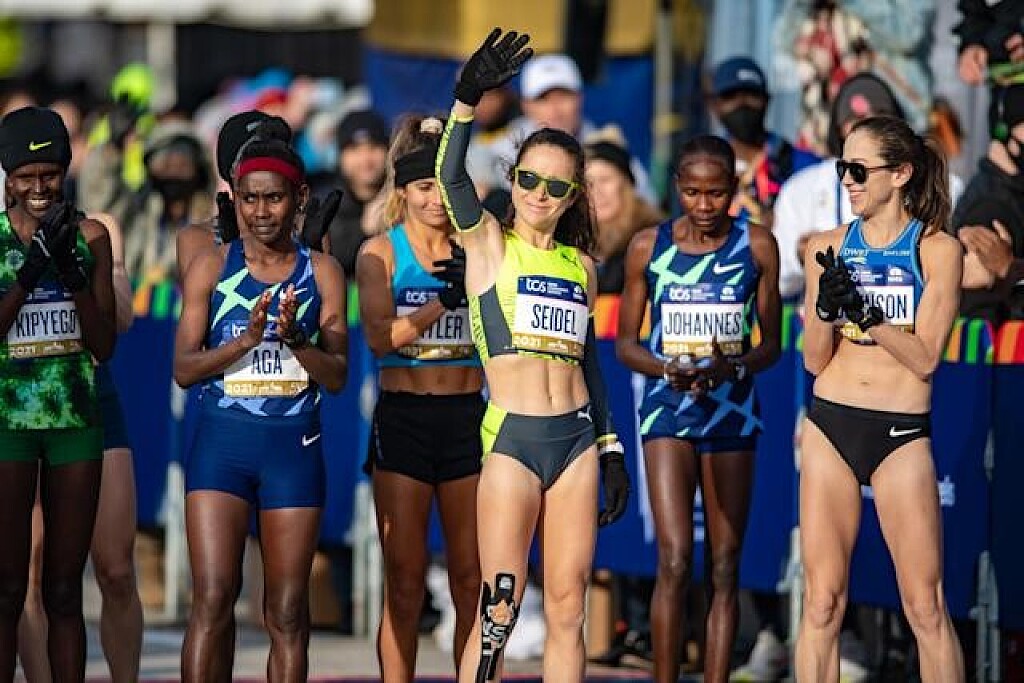
Molly Seidel despite being a favorite for the 2022 Boston Marathon, still struggles with confidence
The 27-year-old battled with an eating disorder to qualify for the USA Olympic team in her first ever marathon. Despite winning bronze at Tokyo 2020 and being a favorite for the 2022 Boston Marathon, she still struggles with confidence.
Molly Seidel is a rare kind of marathon talent.
The Wisconsin native first made athletics headlines when she qualified in second place for the U.S. Olympic team for Tokyo 2020, in her first ever marathon.
Despite this, many onlookers thought that her inexperience would show at the Olympic race in Sapporo. And how wrong they turned out to be.
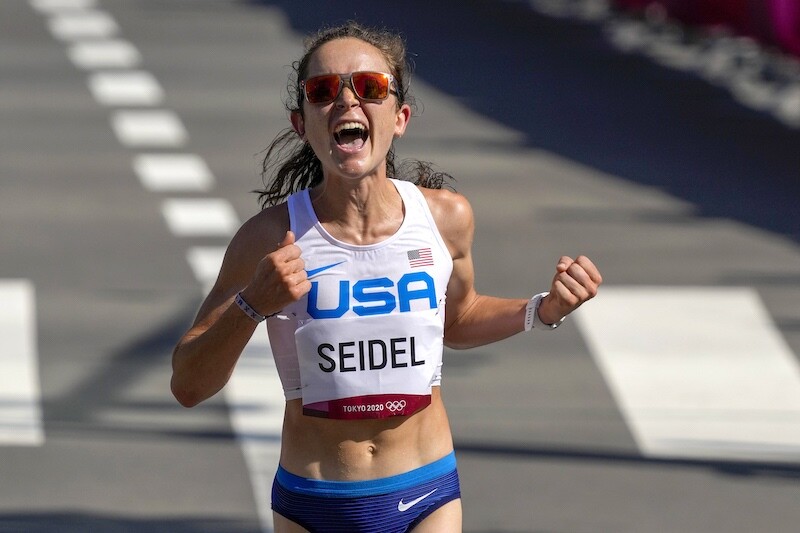
In what was just her third career marathon, she finished on the podium with an Olympic bronze medal around her neck. The only runners to beat her were a triple world half marathon record holder in Peres Jepchirchir, and marathon world record holder Brigid Kosgei.
Using that momentum, Seidel finished fourth at the New York City Marathon in November 2021. Her time of 2:24:42 made her the fastest American woman ever.
On April 18, 2022, she goes to the 2022 Boston Marathon as one of the favorites, seeking the host nation's first win since Desiree Linden in 2018.
But despite her recent successes the American star still struggles with 'imposter syndrome'.
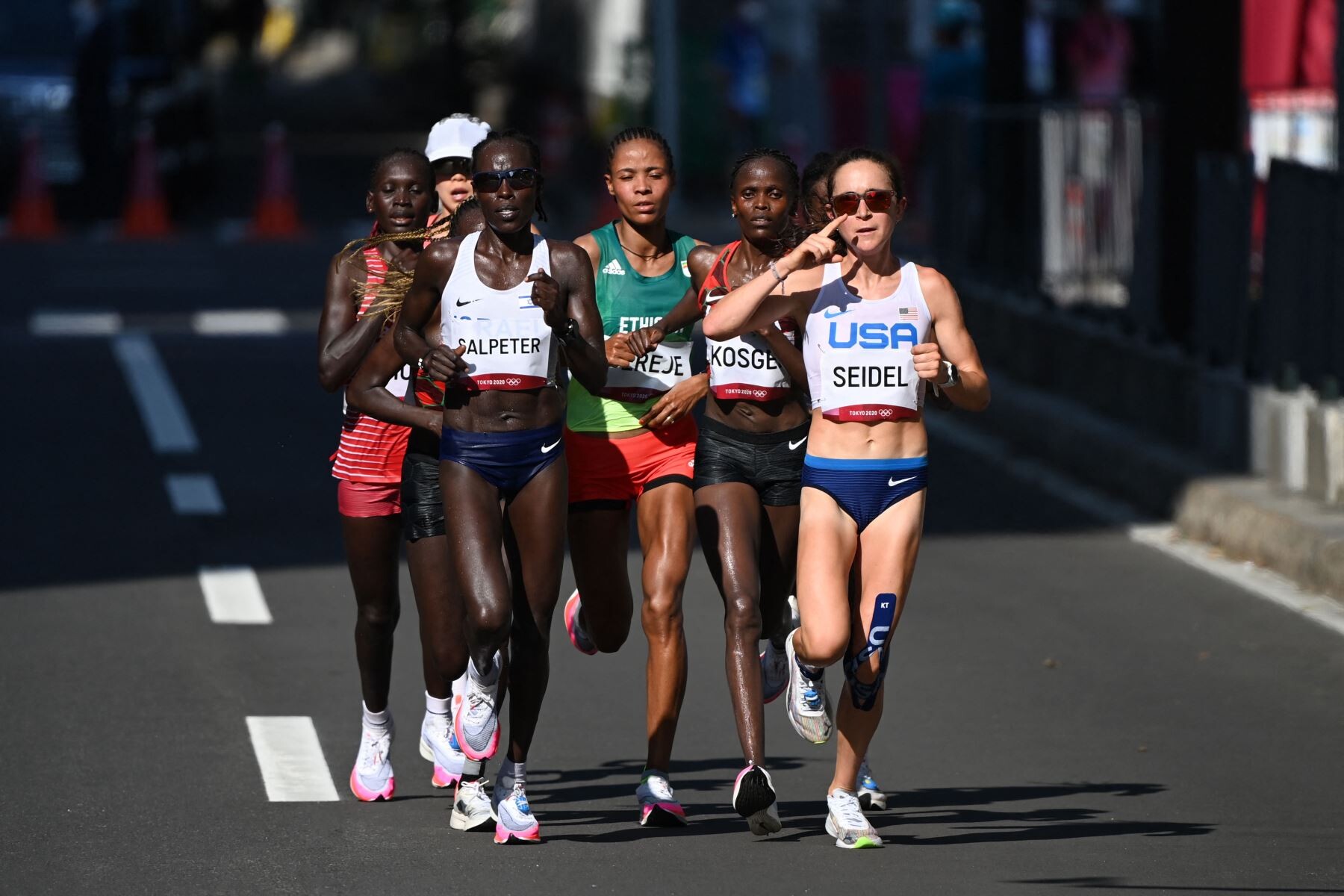
"I struggle with confidence and I struggle with wondering whether or not I belong at this level, whether I belong as a competitor on the world stage," Seidel told CNN.
The making of a front runner
Growing up in Wisconsin, Seidel was always a front runner in school sport. She broke course records and won several state track titles.
The first time her school's cross-country coach Mike Dolan first saw her attack an uphill run, he knew she was special.
“She would be a minute ahead of all the guys and all the girls," Dolan told Milwaukee Journal Sentinel.
"I knew at that time she would be a heck of a runner."
Seidel proved her coach right as she went on to win an NCAA cross country title in 2015, two NCAA indoors (3,000m & 5000m) and an outdoor 10,000m title to become the most decorated distance runner in state history.
Some onlookers even thought she could be a potential U.S. Track Olympic Team athlete for Rio 2016.
Mental health struggles
From the outside, Seidel seemed to be in the best shape of her life, but underneath she was experiencing a deep inner turmoil.
She first went public on her struggles with depression, OCD, crippling anxiety and bulimia in a podcast ran by her close friend Julia Hanlon called "Running On Om", just two months before the 2020 Olympic Trials.
“People who are close to me knew what I was going through during my time at Notre Dame (University), from 2012 to 2016. They knew my OCD had manifested itself into disordered eating,” she revealed in a follow-up interview with ESPN.
“When I was in the NCAA, it was obvious I was battling an eating disorder. It was so obvious that people would write on track and field message boards that I looked sick." - Molly Seidel to ESPN.
“They knew I struggled to eat anything I deemed unhealthy They knew I thought I had to be super lean and super fit all the time, never even allowing myself to eat a bowl of mac and cheese or go out to eat with friends without worrying about what I would order. I've never tried to hide what I went through with my family and friends.”
In 2016 she went into a treatment program for her eating disorder, which she’s still dealing with alongside the anxiety and depression.
When Seidel returned to training, she decided to stop running 5k and 10k and stepped up to the marathon.
“I always kind of dreamed of doing the marathon," Seidel told CNN.
"I think there's just this kind of like glamor and mystery around it, and especially for a younger runner who enjoys doing the distance events in high school, that's kind of the ultimate goal. Everybody wants to do the marathon."
From first marathon to Olympic medal
Her debut 42km race at the USA Trials in Atlanta landed her a place on her nation's Olympic team with race winner Aliphine Tuliamuk and third placed Sally Kipyego.
"I struggled with this kind of imposter syndrome after the trials, specifically as probably the person no one expected to make the team and the person that got probably the most criticism like: Hey, why is this girl on the team?" she continued.
"I think I really struggled with that, and I struggled going into the Games and feeling like I belonged there and trying to prove that I wasn't a mistake on that team."- Molly Seidel to CNN.
Her second marathon effort was the daunting 2020 London Marathon, where she finished sixth .
Then, just 18 months after her first marathon Seidel, who is affectionately known as “Golly Molly” earned bronze and became the third American woman ever to medal in the Olympic marathon.
In November 2021, a broken Seidel returned for her fourth marathon in New York, where she placed fourth with a personal best time despite fracturing two ribs as she prepared for the event.
It was an absolute disaster of a build up,” she recalled.
"It was really hard, not only with the mental stress that we had going on after the Games of just feeling, frankly, no motivation. And just trying to find that drive to re-up for another hard race right after an enormous race that I'd been training effectively two years for.”
Those injuries are now behind the 27-year-old, who has been training in Flagstaff.
Though she dropped out of the New York Half in March due 'setbacks in training', Seidel heads back to Boston where she lived for four years with high hopes for something special.
“Boston was like the place that made me a pro-runner. It was the first place I moved after I finished college.It was the place that kind of like rebuilt me as a runner after going through a lot of challenges through college,” she said to CBS Boston.
“Just getting to do the race in the place that made me the runner that I am and with the people that helped me become the runner that I am, it’s just enormously meaningful to me. That what makes it a lot more special than any other race.”
by Evelyn Watta
Login to leave a comment

Boston Marathon
Among the nation’s oldest athletic clubs, the B.A.A. was established in 1887, and, in 1896, more than half of the U.S. Olympic Team at the first modern games was composed of B.A.A. club members. The Olympic Games provided the inspiration for the first Boston Marathon, which culminated the B.A.A. Games on April 19, 1897. John J. McDermott emerged from a...
more...
Why Run on Trails When You Can Collapse in Snowshoes?
Have you ever realized you were in over your head in a race, moments after the starting gun went off?
That's what happened to me last month, in a 10K snowshoe race at the Winter Mountain Games in Vail, Colorado. Feeling semi-fit and eager to compete in my first snowshoe race in a few years, I toed the line with a few dozen or so other enthusiastic competitors in what might be best considered the equivalent of a trail running race over a snow-covered golf course.
Fifteen seconds after the start, though, the course transitioned from groomed, hard-packed snow to the first of many sections with deep, light, fluffy powder. I watched as other competitors gracefully bounded through the snow in what seemed like a postcard-perfect scene of a bluebird Colorado day.
But amid all the wintry exuberance, it was as if I had been tossed out of a boat and was treading water wearing a heavy pair of hiking boots. As I sunk deeper with every stride, I felt something grab my back leg and was suddenly airborne, momentarily Superman-ing above the pristine layer of snow that the others were methodically dashing through.
And then, Whommppfff! I face-planted into the snow.
To me, snowshoe racing has always been a special kind of Type-2 fun, a unique wintertime activity to whet your appetite for just about any type of endurance racing later in the year. For the uninitiated, it's an easy sport to enjoy. If you can run on trails, you can run on snowshoes.
It's kind of like what cyclocross is for the cycling world. As such, there aren't really any true snowshoe racing specialists, but more a collection of adventurous trail runners, marathoners, triathletes, mountain bikers, and hikers converging in a winter wonderland for some adrenaline-fueled fun.
Sure, there are some great snowshoe racers who excel at dashing through the snow. In fact, Josiah Middaugh, Alex Willis, Seth Wealing, and Meredith Cook were among the local Colorado athletes who were off the front in this race as I was torpedoing into the snow. Middaugh, Nichols, and Wealing are all great trail runners, but have primarily made their mark as Xterra off-road triathletes, while Cook is also an accomplished trail runner.
Middaugh is a six-time U.S. snowshoe champion, and Willis is competing in the 2022 World Snowshoe Championships on Sept. 3 in Argentina. There will be a lot of good trail runners competing in the 2022 U.S. Snowshoe Championships on March 13 in Cable, Wisconsin. And that event made it clear that anyone can enter and everyone is welcome: "There are no Qualifiers or Membership Requirements to compete."
Two years ago, trail runners Michelle Hummel and Joe Gray won the U.S. Snowshoe Championships and then went to Japan, where Hummel won the women's World Snowshoe Championship and Gray was fourth among men. (Gray was the world champion in 2017 and the runner-up in 2018 and 2019.)
Generally speaking, though, most people who show up for a snowshoe race are training for something else. Or, like me, they just want to endure the torturous fun of something new.
I've raced on snowshoes about 30 times, from as short as 1 mile to as long as 20K. I've never been particularly good, but that hasn't stopped me from coming back. When you're fit, it's a fun way to get a winter workout without any stress tied to your summer goal races.
For this race, though, I wasn't that fit, so after my inadvertent crash near the start, I got back on my feet and realized I'd be in for a long, slow jog with amazing mountain vistas.
Most of the athletes were wearing running shoes strapped to lightweight, aluminum 825-inch snowshoes from Atlas, TSL, Redfeather, or OT Racing. I would have been, too, but one of my bindings broke while I was warming up and the makeshift repairs I made with duct tape and zip ties didn't hold, so I had to rent a heavier pair from the Vail Nordic Center.
As the race progressed, Middaugh and Willis pushed the pace, but it was Middaugh's 17-year-old son, Sullivan, who stole the show and won the race in 46:41 - an impressive 7:31 per mile pace. Cook, meanwhile, was the top woman in 1:08:19.
"It's pretty exciting for me to see him pass me in a race and really go for it, and really lay it on the line," the elder Middaugh said. "It's really demoralizing when someone else makes a strong move on me like that, but when it's my own kid, it makes me feel good and bad at the same time. I'll just have to find his weakness the next time we race."
As for me, I definitely found my weakness. I tried to keep pace with Danielle McNair, but she was stronger and more determined than I was, and left me in the snowy dust en route to finishing second among women. She seemed happy and chipper as she passed me, so I did my best to keep a smile on my face and enjoy the views as I slogged to the finish.
"Although it can be an intimidating sport and quite challenging," McNair told me after the race, "I just remind myself that I was brave enough to show up today, and isn't that what most of racing and events are about? I'm never going to be a fasty, but I can show up and challenge myself and rack up smile points."
by Trail Runner Magazine
Login to leave a comment
The mental side of running injuries a new research examines how injury-related psychological distress can impact recovery
While the physical pain that comes with a running injury can be tough to deal with, the emotional and mental anguish of having your training interrupted is often the hardest part. We are now realizing that working on your mental condition while injured doesn’t just make your time on the sidelines easier to handle, it can actually speed up recovery. In a recent study, researchers explored how psychological distress can actually make your injury worse, and delay your return to the roads.
Injury and fear
The “psychological distress” of runners is another way of saying fear. When you have a running injury preventing you from training, a significant part of your stress comes from fear of all the unknowns. Questions like “how severe is the injury?” “How long will it take to heal?” and “How much fitness will I lose?” keep you up at night, distract you from other priorities and consume a lot of your mental energy.
In this new study published in the Physical Therapy in Sport, researchers wanted to determine how much this psychological distress affected runners’ perceived running abilities. To do this, they collected data from runners at their first physiotherapy appointment, which included having them fill out an Athlete Fear Avoidance Questionnaire (AFAQ) for injury-related psychological distress and the University of Wisconsin Running and Recovery Index (UWRI) for perceived running ability.
The researchers found that most athletes experienced significant injury-related psychological distress at the beginning of their treatment, but this generally improved over time. Despite this, they found that athletic fear-avoidance may persist, and athletes with higher athletic fear-avoidance had a lower perceived running ability.
Mental condition and physical condition
While the main job of a physiotherapist is to help athletes improve their physical condition, the authors of the study conclude that therapists should also spend time working on their patient’s mental condition throughout the injury recovery process as well.
Runners should also do some of this work themselves. Injuries can seem like catastrophes when they happen, especially when they prevent you from running your goal race, but it’s important to keep things in perspective. Most injuries aren’t career-ending. You will get back to running again and while it may take a bit of time to re-build your fitness, you will achieve more of your running goals.
In the meantime, focus on doing whatever you can do, whether that’s some form of cross-training or simply staying on top of your physio exercises every day. Just as you’ve gotten through hard blocks of training and rough patches in races, you’ll get through this, too.
by Brittany Hambleton
Login to leave a comment
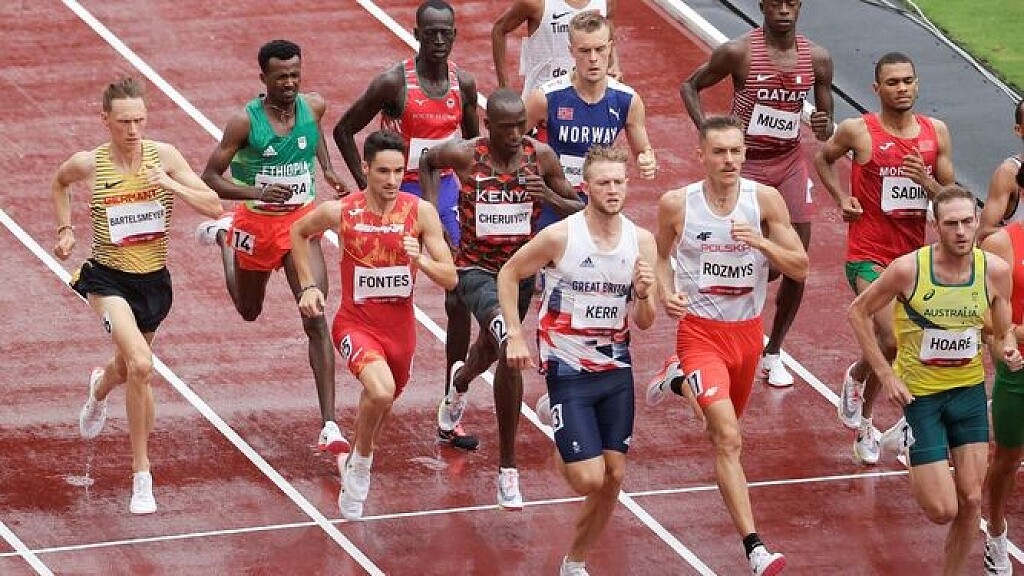
Josh Kerr and Ollie Hoare to clash in men's Millrose mile
Olympic 1500m bronze medalist Josh Kerr and Olympic finalist Ollie Hoare will lead the charge for the WHOOP Men’s Wanamaker Mile at the 114th Millrose Games.
Kerr became Great Britain's second fastest ever 1500m runner with his 3:29.05 medal-winning run in Tokyo. While competing at the University of New Mexico, Kerr was the 2018 NCAA champion in the mile.
“The Wanamaker Mile has always been a staple in my indoor season, there is no race like it,” said Kerr. “I’m rested and ready to get ‘stuck in’ after a successful Olympics.”
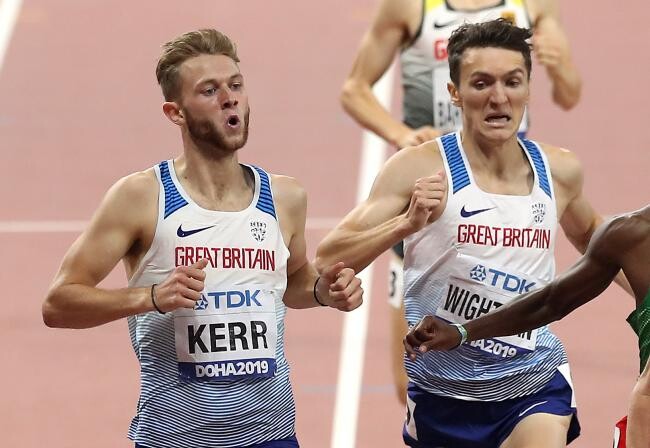
Australia's Hoare, meanwhile, placed second in the 2020 Wanamaker Mile and reached the Olympic final in Tokyo this past summer. He was the 2018 NCAA 1500m champion while at the University of Wisconsin, taking down Kerr in the process.
“The Wanamaker Mile is one of the most prestigious indoor mile races in the world,” said Hoare. “To be able to go and compete again for the third time in this event is a privilege.
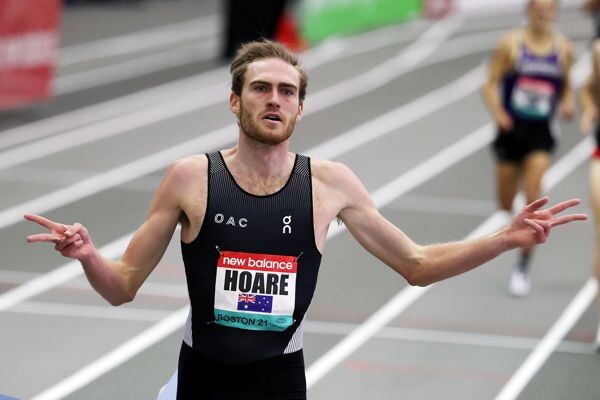
"Coach (Dathan Ritzenhein) and I are happy with where I am right now and I'm confident that I can take on whatever comes at me. Don't be surprised if you see some very fast mile times come out of New York.”
Five-time Olympian Nick Willis of New Zealand will also join the mix. The 38-year-old, who has finished as runner-up at the Wanamaker Mile three times, will be trying for a record 20th consecutive year of running a sub-four-minute mile.
There are talented US runners in the field, led by 2016 Olympic 800m bronze medallist Clayton Murphy, and he will be joined by 18-year-old Hobbs Kessler and world finalist Craig Engels, as well as Ireland's Andrew Coscoran and Canada's Charles Philibert-Thiboutot.
Rounding out the field will be Mario Garcia Romo, Henry Wynne and Colby Alexander.
Other top athletes so far announced for the Millrose Games include 2016 world indoor 60m champion Trayvon Bromell, world 100m hurdles record-holder Kendra Harrison, Olympic shot put champion Ryan Crouser, world shot put champion Joe Kovacs, Olympic 800m champion Athing Mu, Olympic pole vault champion Katie Nageotte and world indoor pole vault champion Sandi Morris.
by World Athletics
Login to leave a comment
NYRR Millrose Games
The Pinnacle of Indoor Track & Field The NYRR Millrose Games, first held in 1908, remains the premier indoor track and field competition in the United States. The 2025 edition will once again bring the world’s top professional, collegiate, and high school athletes to New York City for a day of thrilling competition. Hosted at the New Balance Track &...
more...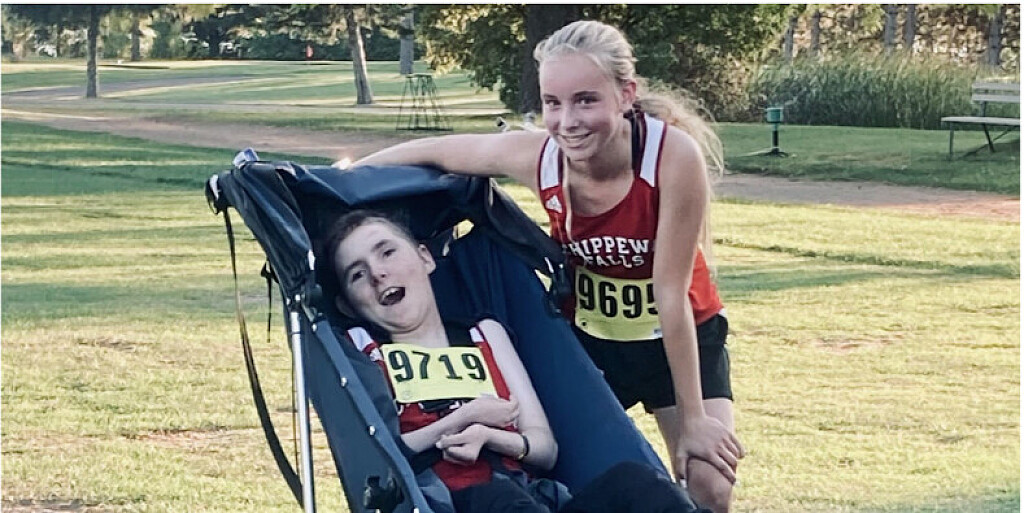
These Wisconsin High School Cross-Country Runners Just Want to Race Like Everyone Else
Susan Bergeman pushes her brother Jeffrey in a chair during every race, but their results don’t count.
Siblings Susan and Jeffrey Bergeman, both freshman at Chippewa Falls Senior High School in Wisconsin, run every cross-country race together.
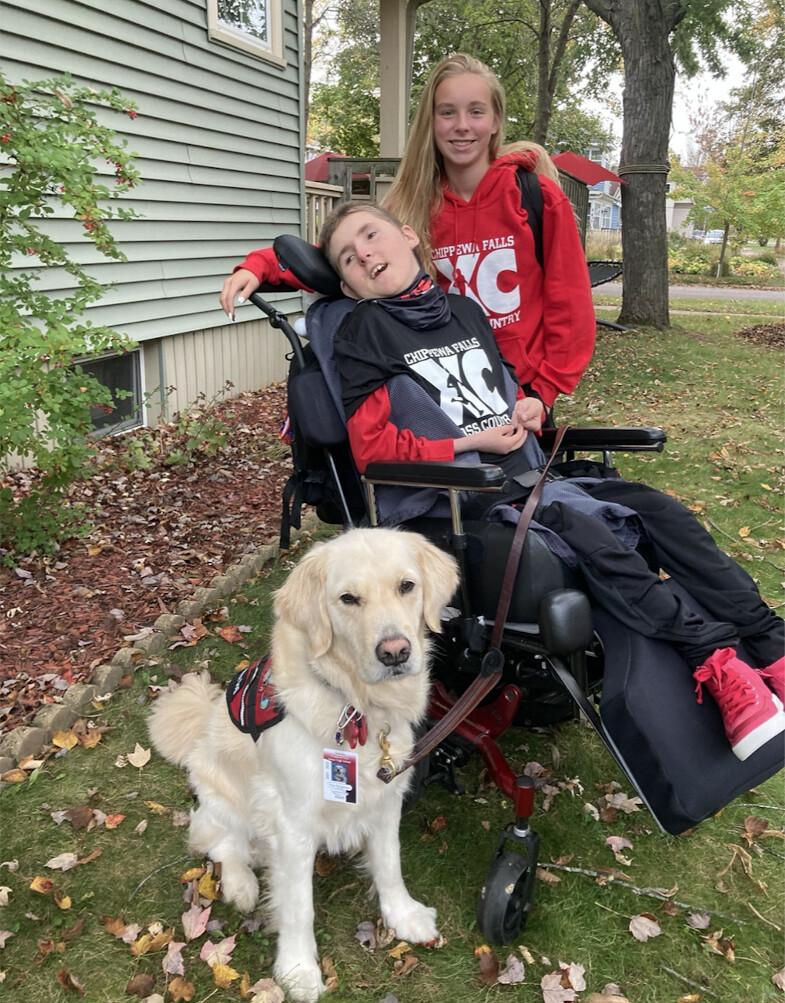
With Susan pushing Jeffrey in a modified racing chair, they start behind everyone else, and they are technically not allowed to pass anyone who isn’t walking. And when they cross the finish line, their time isn’t included in the results.
It’s a unique situation, but one thing keeps them going—they both love to run.
“I like running. Jeffrey likes running. Running is more fun to do together than on your own,” Susan, 15, told Runner’s World. “This was a way that both Jeffrey and I could be involved in a school sport and it was something we could do together.”
When Jeffrey, now 15, was 22 months old, he suffered sudden cardiac arrest. His brain was deprived of oxygen for 20 minutes, leaving Jeffrey with severe brain damage. He would be diagnosed with cerebral palsy.
Unable to compete on his own in athletic endeavors, Jeffrey joined his parents, Jess and Jordan, in a modified racing chair at races they did, ranging anywhere from 5Ks to marathons and triathlons. Susan also loved to run, and, inspired by her parents, she decided wanted to run with Jeffery, too.
Susan and Jeffrey, who are 10 months apart in age, ran their first 5K together at 9 years old in June 2016. A couple of years later, they joined their middle school cross-country team. Since then, with a few exceptions, Susan and Jeffrey have run every practice and every course together, and have participated in preseason runs, summer training, and team-bonding activities together.
To their coach, teammates, other teams, and spectators, they are just part of the team. Yet despite finishing every race, they have not once been declared finishers.
When Susan and Jeffrey started running in middle school, the Wisconsin Interscholastic Athletic Association (WIAA) didn’t have an established division for runners with disabilities who wanted to race. So the WIAA created a classification called a ‘duo team,’ the first and only in the state, for Susan and Jeffrey, and established guidelines that they had to follow, citing safety concerns because of the chair. These guidelines state that they can only pass participants who are walking or injured, and even if they do pass them, they must wait just before the finish line until all other runners finish before they can cross. They also cannot be included in the final results.
“The rule isn’t fair because I should be able to run my race safely and at the pace that I can run without having to slow down just because someone in front of me is a slower runner,” Susan said. “That isn’t what racing is about. I would never try to pass someone if there wasn’t enough space to safely do so.”
The Bergemans understand having guidelines put in place, but, as Susan puts it, “the rules should make sense and be fair.”
“We’re just out there running like everyone else,” Susan said. “Yes, my brother needs a wheelchair to make that happen, but other than the wheels and an accessible bus to get to meets, there really aren’t any other special accommodations that we need.”
The Bergemans’ parents hoped these guidelines would be adjusted after their children proved in middle school that they could compete safely together alongside other runners. But the rules haven’t changed, which means their efforts to advocate for them—and any other duo teams that come in the future—hasn’t stopped. They want to create a pathway for other runners like them who want to compete but are facing bureaucratic hurdles in the state of Wisconsin.
“Our son, who lives his life everyday with disabilities, does not want to be viewed as an ‘exhibit’,” Jess told Runner’s World. “He wants to be viewed as a Wisconsin student athlete, like any other student without disabilities in the state.”
Susan and Jeffrey, who ran a two-minute 5K PR of at the last race of the season, do admit to going around the rules a bit, too. They pass other runners and crossed the line ahead of others. This wasn’t to break the rules for breaking the rules sake; it was to prove a point that they could safely race, and they should be included as official finishers.
“[Susan and Jeffrey] have spent the last few years trying to break down barriers of ‘fear,’ ‘misunderstanding,’ and myths that this ‘might not be safe,’” Jess said. “There was a time when female athletes were not allowed to compete in cross country meets. It was wrong. It took time for society and the sport to grow, but growth and change were necessary and happened ... and it’s time for the WIAA and athletic associations nationwide to work on changing this.”
The Bergemans have the support of their school, their district, and even other teams in the area. In fact, the family is currently working with the local community and boosters to fund equipment needed for students with disabilities to compete, such as racing chairs, for the school to own that any student in the future can use. The Bergemans own the chair the family uses.
“The work of inclusion is not finished until the day when a student with disabilities joining a school team or club is as simple as a decision to make as, ‘Where do I sign up?’” Jess said.
So, Susan and Jeffrey continue to run together, helping each other to the finish line. Susan does that by pushing Jeffrey in the chair, and Jeffrey, despite being nonverbal, does that by vocalizing messages of encouragement via his way of communicating with Susan when she is struggling.
“It’s kinda cool to think that we might be leaving a legacy from what we are doing,” Susan said. “We hope that anyone that might come after us is able to compete without having as many obstacles or barriers to overcome. That they experience a welcoming team like we have, and that they get to have the experience and joy of racing together as equals. It would be fantastic to have more students try out duo team running before we graduate, so that we can race them.”
by Runners World
Login to leave a comment
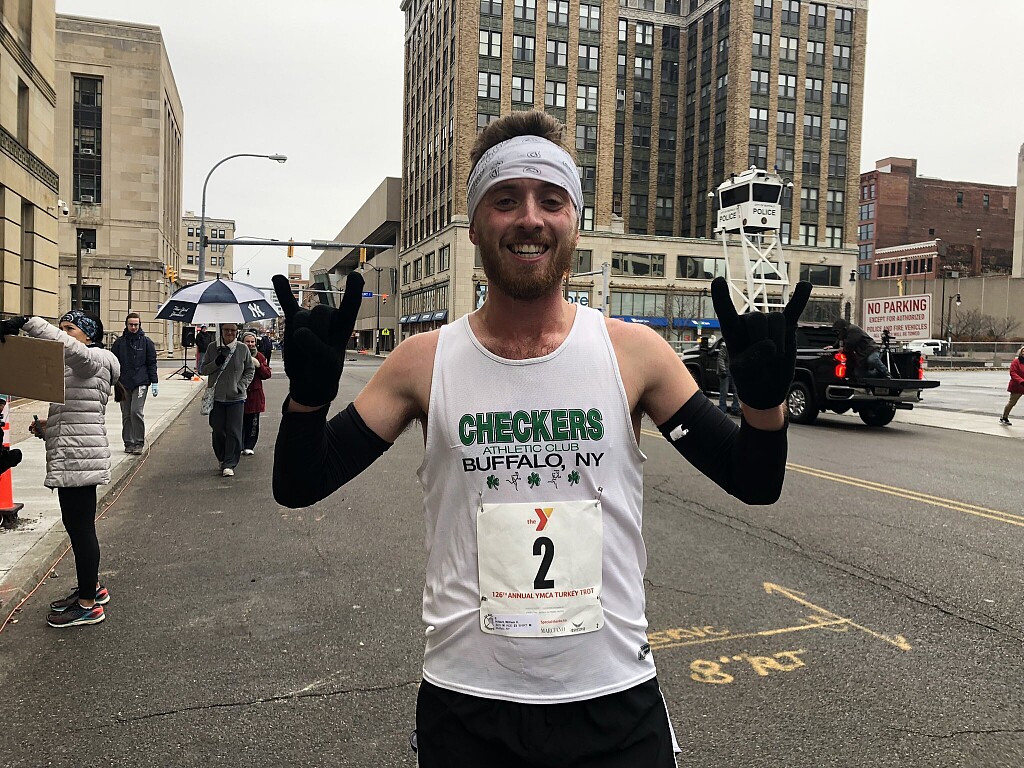
Kenmore’s Liam Hilbert who first ran Turkey Trot at age 9 wins annual race
When Kenmore’s Liam Hilbert says it’s a lifelong dream to win a YMCA Turkey Trot, he isn’t kidding.
Hilbert has run the trot for 15 consecutive years in what has become a family tradition, but he’s only 23. His first one was at 9 years old.
He now has that victory after winning Thursday’s 8K race in 24 minutes, 43 seconds.
After a year in which the in-person field was restricted by Covid-19 protocols, more than 12,000 runners and walkers took to Delaware Avenue for the 126th edition of what is billed as the longest consecutively run footrace in North America.
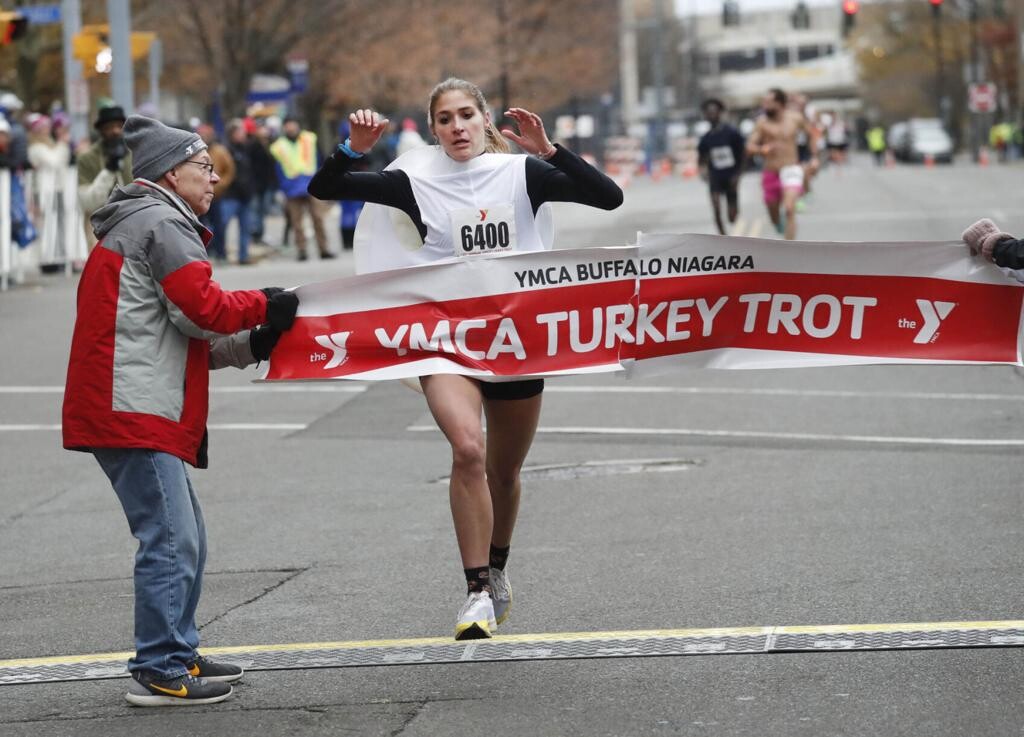
University of Wisconsin runner and Nardin graduate Danielle Orie topped the women’s field in 27:57. Orie was home for Thanksgiving break after running in the NCAA Division I Championships last weekend.
Hilbert is a former Monsignor Martin champion in the 1,600 meters and 3,000 meters at St. Joe’s and went to run at the University at Buffalo. He was the Mid-American Conference outdoor champion in the 10,000 meters last spring.
Hilbert ran the race with his uncle, James Waldron, with whom he had run the his first few Turkey Trots.
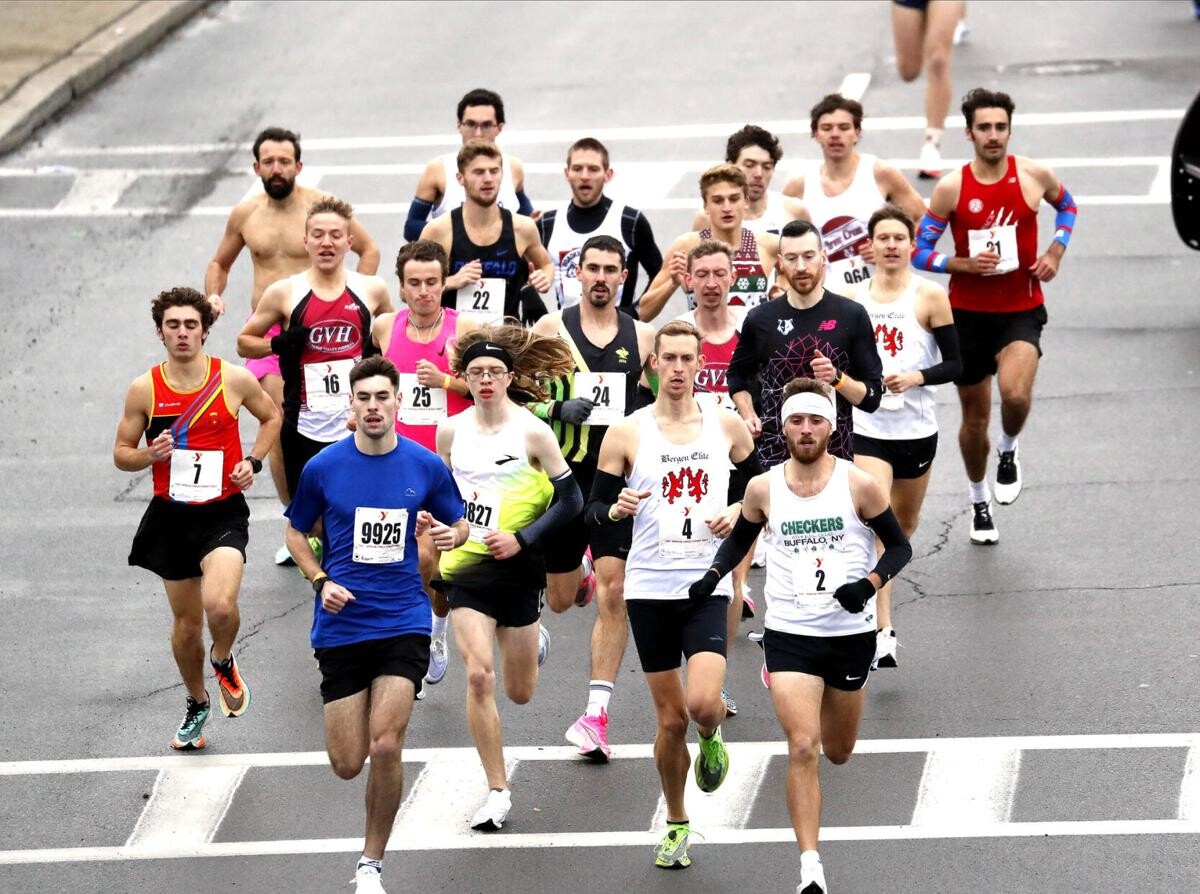
“My family was there to cheer me on,” Hilbert said.
Buffalo’s Thomas Appenheimer was second in 24:27, followed by Steven Haagsma of Gowanda (25:00), Rush’s Brennan Root (25:09) and Rochester’s Paul Suflita (25:28). Appenheimer runs at Canisius College and finished 11th in the Metro Atlantic Athletic Conference championships last month. Haagsma is a former Division III runner at Calvin College in Michigan.
For Orie, it’s been a busy fall in her first year at Wisconsin.
Orie ran for Penn as an undergraduate and transferred in the spring as she pursues her law degree. She finished 25th in the Big Ten Championships and then 22nd in the Great Lakes Region championship to qualify for the NCAAs. She finished 112th, covering the 6K in 20:34.2. Wisconsin finished 12th in the nation.
Sarah Danner of Gowanda was second in 28:21, followed by Pittsburgh’s Margo Malone in 28:38, Alexandra Cadicamo in 28:58 and Glenwood’s Aileen Hoak-Lange in 29:16.
Hoak-Lange, in her 29th consecutive trot, was the top woman in last year’s event as she was selected among 125 in-person runners.
by Robert Kirkham / Buffalo News
Login to leave a comment
YMCA Buffalo Niagara Turkey Trot 8K
The enthusiasm, energy and incredible holiday spirit that radiated down Delaware Avenue tells us that our local Thanksgiving Day run is so much more than just an 8k road race. It is an incredible tribute to all that makes Western New York great – Family, Friendship, and Benevolence. Together with the Y, you are helping to connect those less fortunate...
more...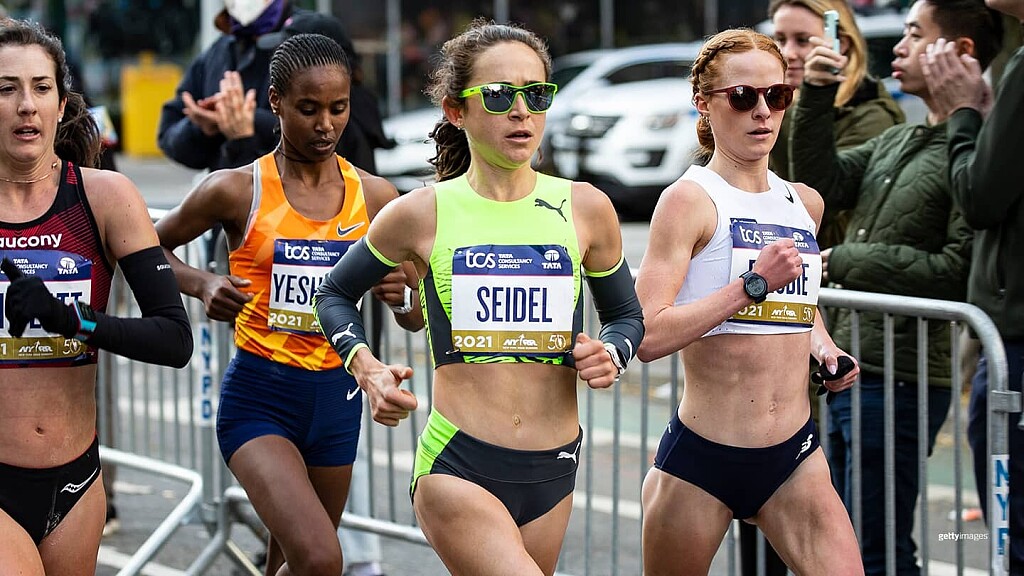
Molly Seidel breaks U.S. record at New York City Marathon – with two broken ribs
Olympic bronze medalist Molly Seidel ran the fastest time ever by an American woman at the New York City Marathon on Sunday, shattering the previous course record by more than a minute.
Then, a little more than an hour later, she revealed she had done so with two broken ribs.
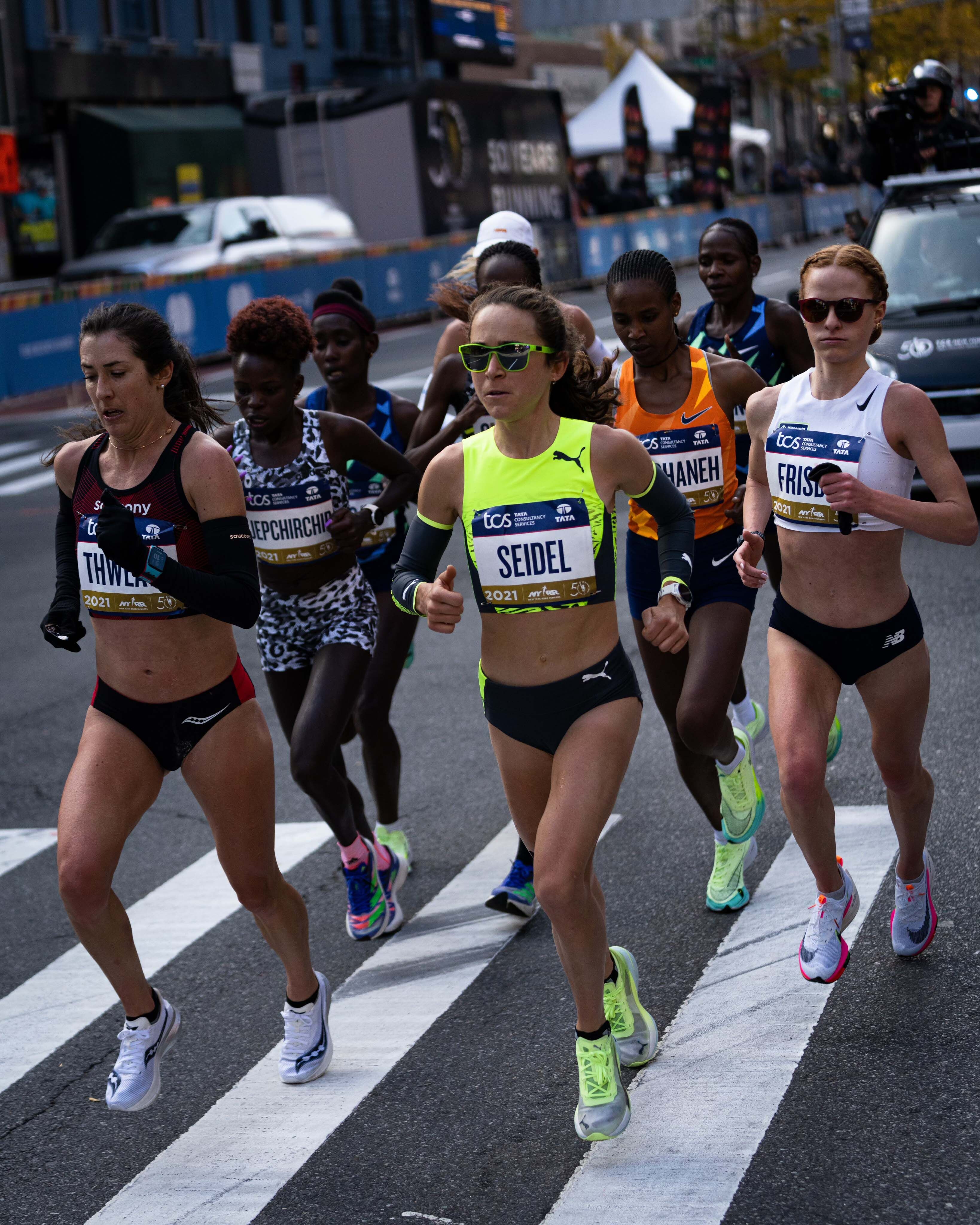
"It started hurting later in the race, like badly," Seidel said. "But I didn't feel like it was messing up my stride or anything. I went all out with what God gave me today. I think I made the most of the situation I was in."
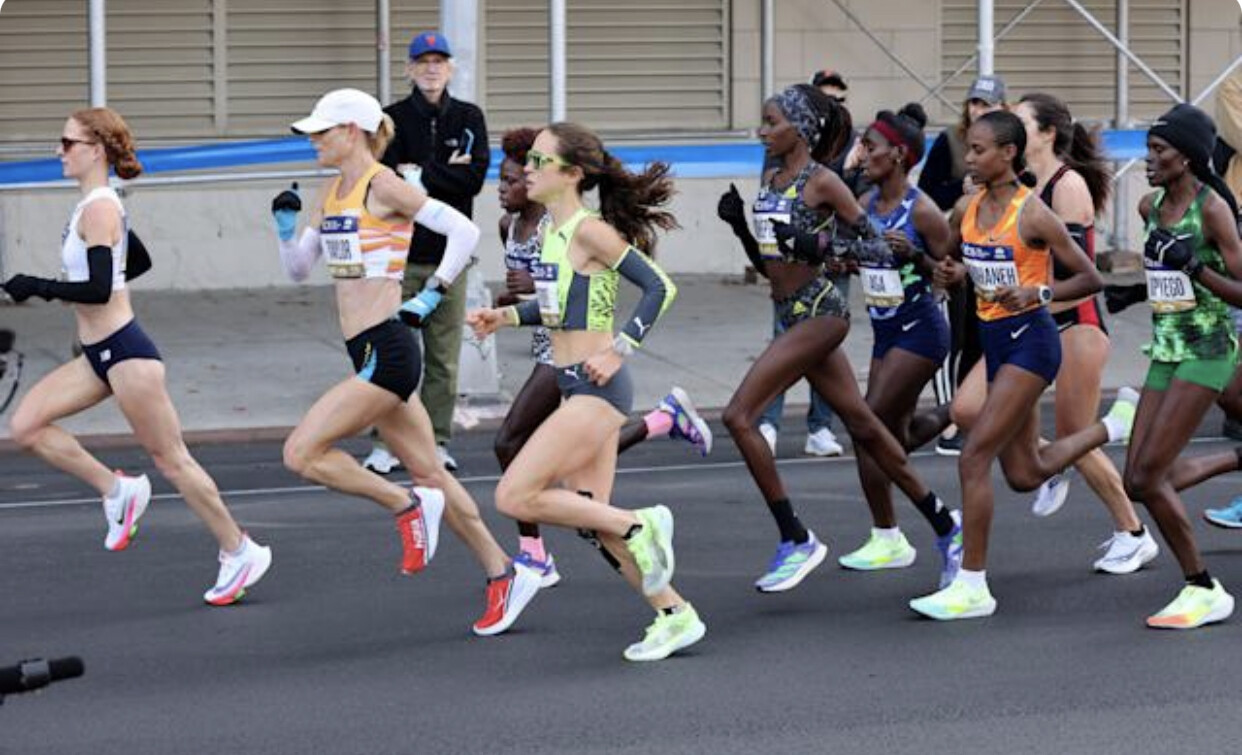
Seidel, 27, declined to specify how she suffered the injury but said it happened about a month ago. And up until two weeks prior to Sunday's race, she said she was in so much discomfort that she considered withdrawing from the event altogether.
After what she described as "frank" conversations with her coach and agent, the Wisconsin native felt healthy enough to give it a go. She credited a team of physical therapists for aiding in her recovery and said she was grateful that she sustained the injury so far in advance from the race.
"(The broken ribs) definitely hindered training a little bit, but it was manageable for the race," Seidel said.
"There's not a whole lot you can do with that. You kind of just wait for it to heal. Luckily it happened far enough out from the race – it was about a month out – so it gave me the time to be able to heal."
Seidel ended up not just running and finishing the race – which was just the fourth marathon she's ever run – but also placing fourth with a time of 2:24:42.
The previous course record had been held by Kara Goucher, who finished in 2:25:53 in 2008.
"I actually didn't know until I crossed the line, that that was what had happened," Seidel said of breaking the American record. "I'm just so incredibly honored. There are so many good women who have run on this course. I think it's really a testament to the women who were in this race, that I was able to just kind of hang onto that group. Obviously I fell off from the main pack, but kind of just kept pushing."
Peres Jepchirchir ended up pulling away to winSunday's race, which marked the 50th running of the New York City Marathon. Jepchirchir and Seidel both finished on the podium at the recent Summer Olympics in Tokyo, with the Kenyan winning gold and the American taking bronze.
Seidel said one of the reasons she chose to compete in New York, despite her injury, was the promise of being able to celebrate the result with her family members, who had to watch her Olympic performance from home due to COVID-19 protocols at the Games.
A reporter asked Seidel how she planned to celebrate.
"Oh my God," she said, "I hope there's a beer waiting for me at the hotel."
Login to leave a comment

TCS New York City Marathon
The first New York City Marathon, organized in 1970 by Fred Lebow and Vince Chiappetta, was held entirely in Central Park. Of 127 entrants, only 55 men finished; the sole female entrant dropped out due to illness. Winners were given inexpensive wristwatches and recycled baseball and bowling trophies. The entry fee was $1 and the total event budget...
more...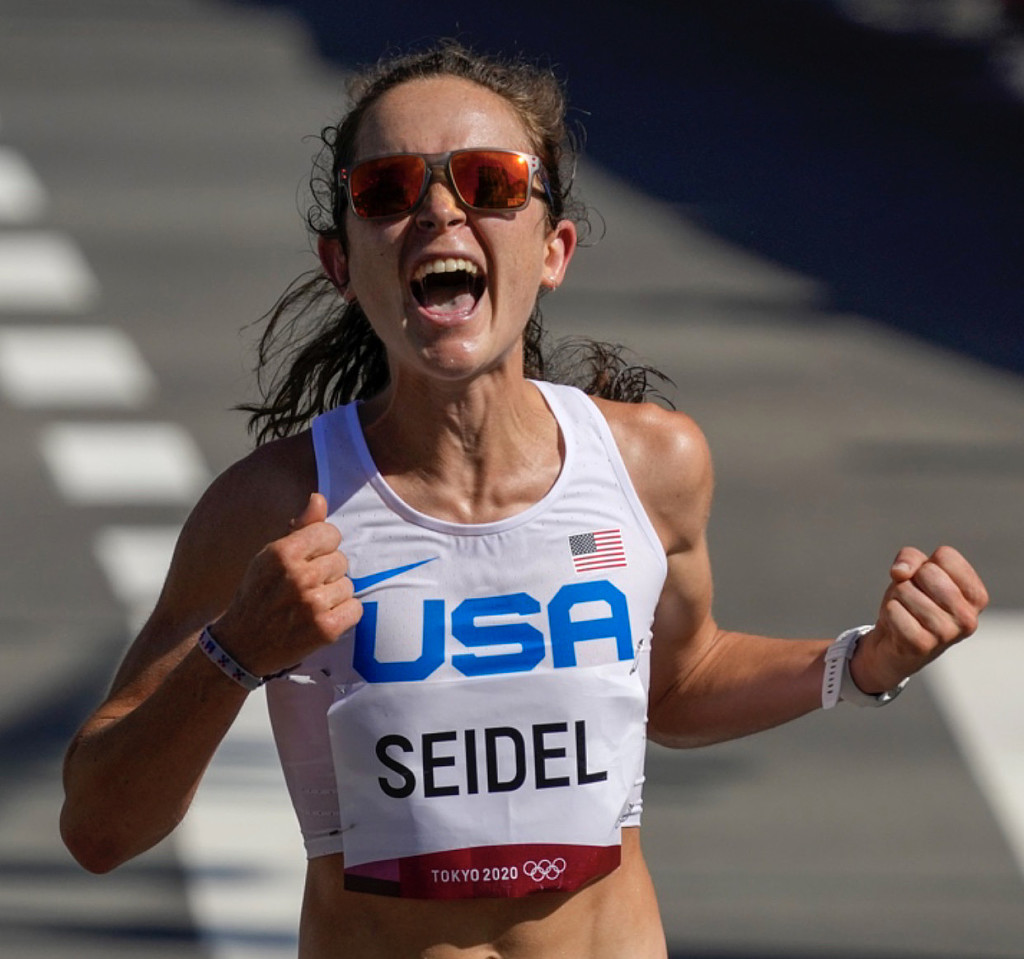
Olympic bronze medalist Molly Seidel to run TCS New York City Marathon
Olympic bronze medalist Molly Seidel is one of several standout American women planning to run the New York City Marathon in November, race organizers announced Wednesday.
Seidel stunned even herself with a third-place finish in Tokyo this month in just the third 26.2-mile race of her career. An NCAA Division I champion at Notre Dame in the 3,000, 5,000 and 10,000 meter events, she is now the headliner for the NYC Marathon’s 50th running in her five-borough debut.
“Since the beginning of 2021, I’ve had two races circled on my calendar: the Olympic Games’ marathon on Aug. 7 and the TCS New York City Marathon on Nov. 7,” said Seidel, 27, who grew up in Wisconsin. “Winning the bronze medal in Sapporo showed that I can run with the best in the world, and on any given day, anything is possible.”
Fellow U.S. Olympians Aliphine Tuliamuk, Sally Kipyego and Emily Sisson will also be in the field, along with 2018 Boston Marathon winner Des Linden.
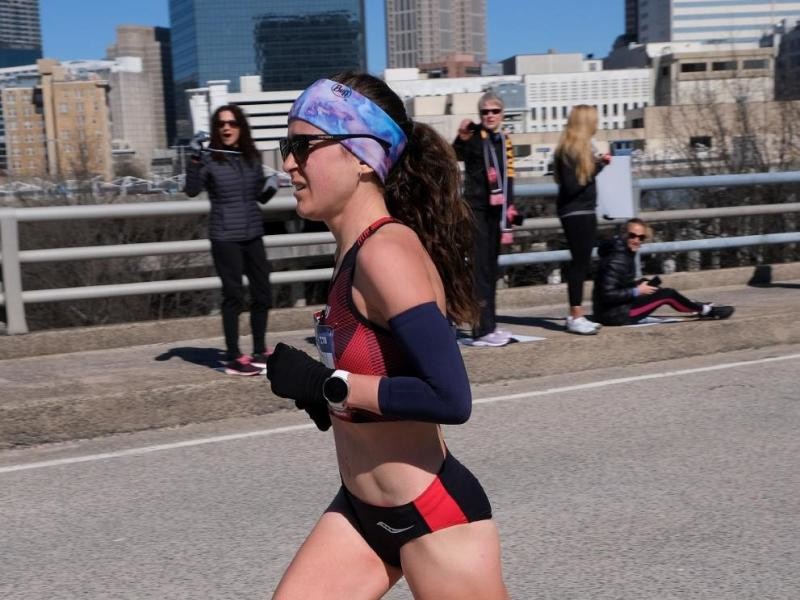
Four-time champion Mary Keitany of Kenya won’t participate for the first time since 2013.
The men’s professional field has not yet been announced.
The 2020 NYC Marathon was canceled by the pandemic, but Gov. Andrew Cuomo announced in June that the 2021 race would go on — albeit with a field limited to about 33,000 entrants, down from 55,000 in 2019.
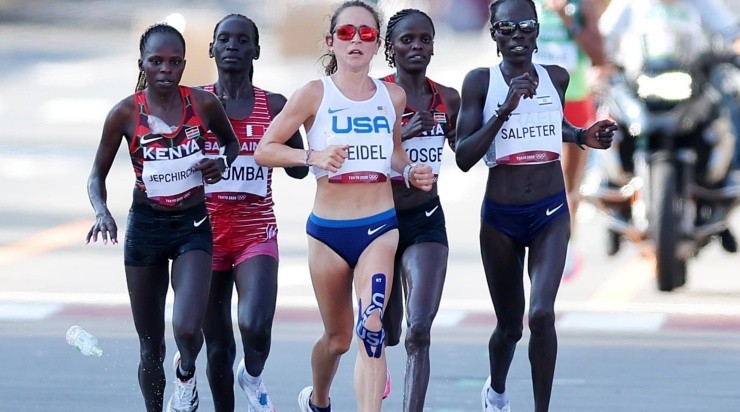
Tuliamuk, who was born in Kenya, won the 2020 U.S. Olympic marathon trials in Atlanta four years after gaining American citizenship. She gave birth to a daughter in January 2021 but still competed in Tokyo. She dropped out near the 20-kilometer mark.
“I want to inspire people, most importantly my daughter, to chase their dreams,” she said in a statement released by the NYC Marathon. “I’m a different athlete and person than I was the last time I ran the TCS New York City Marathon in 2019, so why not fulfill one more dream on Nov. 7?”
Tatyana McFadden is pursuing a record sixth NYC Marathon title in the wheelchair division but hasn’t won since 2016. She won’t have to contend with two-time defending champion Manuela Schär, who is not listed among the competitors.
by Jake Seiner
Login to leave a comment
TCS New York City Marathon
The first New York City Marathon, organized in 1970 by Fred Lebow and Vince Chiappetta, was held entirely in Central Park. Of 127 entrants, only 55 men finished; the sole female entrant dropped out due to illness. Winners were given inexpensive wristwatches and recycled baseball and bowling trophies. The entry fee was $1 and the total event budget...
more...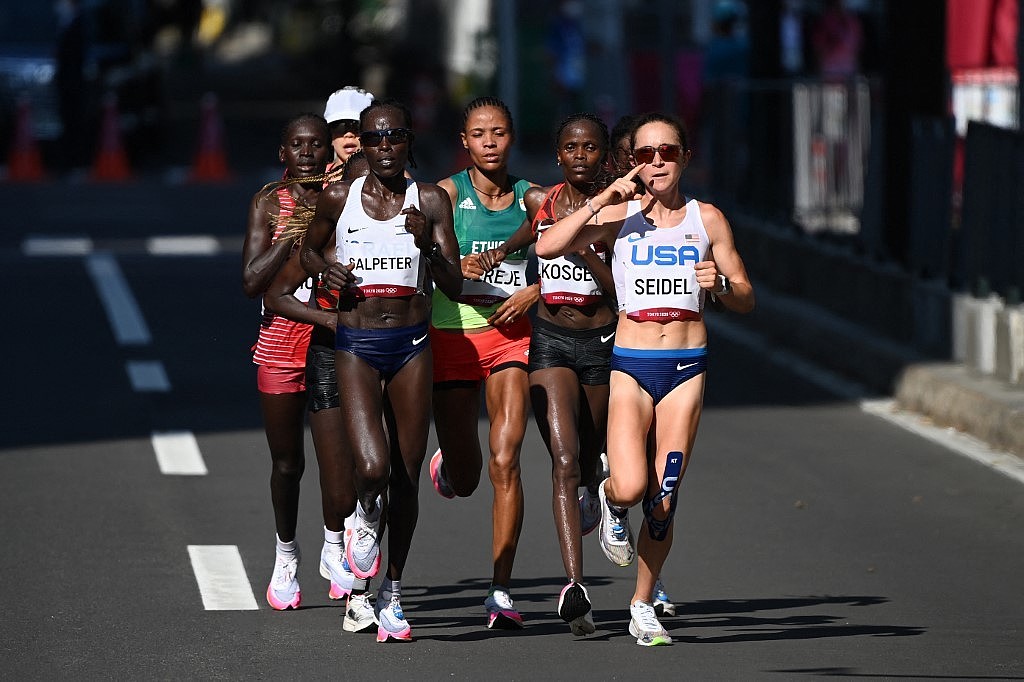
Molly Seidel Shocks the World With Bronze Medal, as Kenya’s Peres Jepchirchir and Brigid Kogei Go 1-2 in 2020 Olympic Marathon
In one of the most remarkable and unlikely runs ever by an American distance runner, Wisconsin native Molly Seidel earned a bronze medal in the 2020 Tokyo Olympic marathon, running 2:27:46 in the heat of Sapporo on Saturday morning. Seidel established herself near the front of the race early, and remained there throughout. Late in the race, Seidel was in a battle for bronze with Israel’s Lonah Chemtai Salpeter, but with three miles to go, Salpeter stopped running, leaving Seidel in bronze-medal position, which she protected to the finish line.
Kenya’s Peres Jepchirchir, the world record holder in the women’s-only half marathon, pulled away from teammate Brigid Kosgei, the marathon world record holder, in the final two kilometers to take the gold in 2:27:20. Kosgei settled for the silver in 2:27:36, her first loss in her her last five marathons.
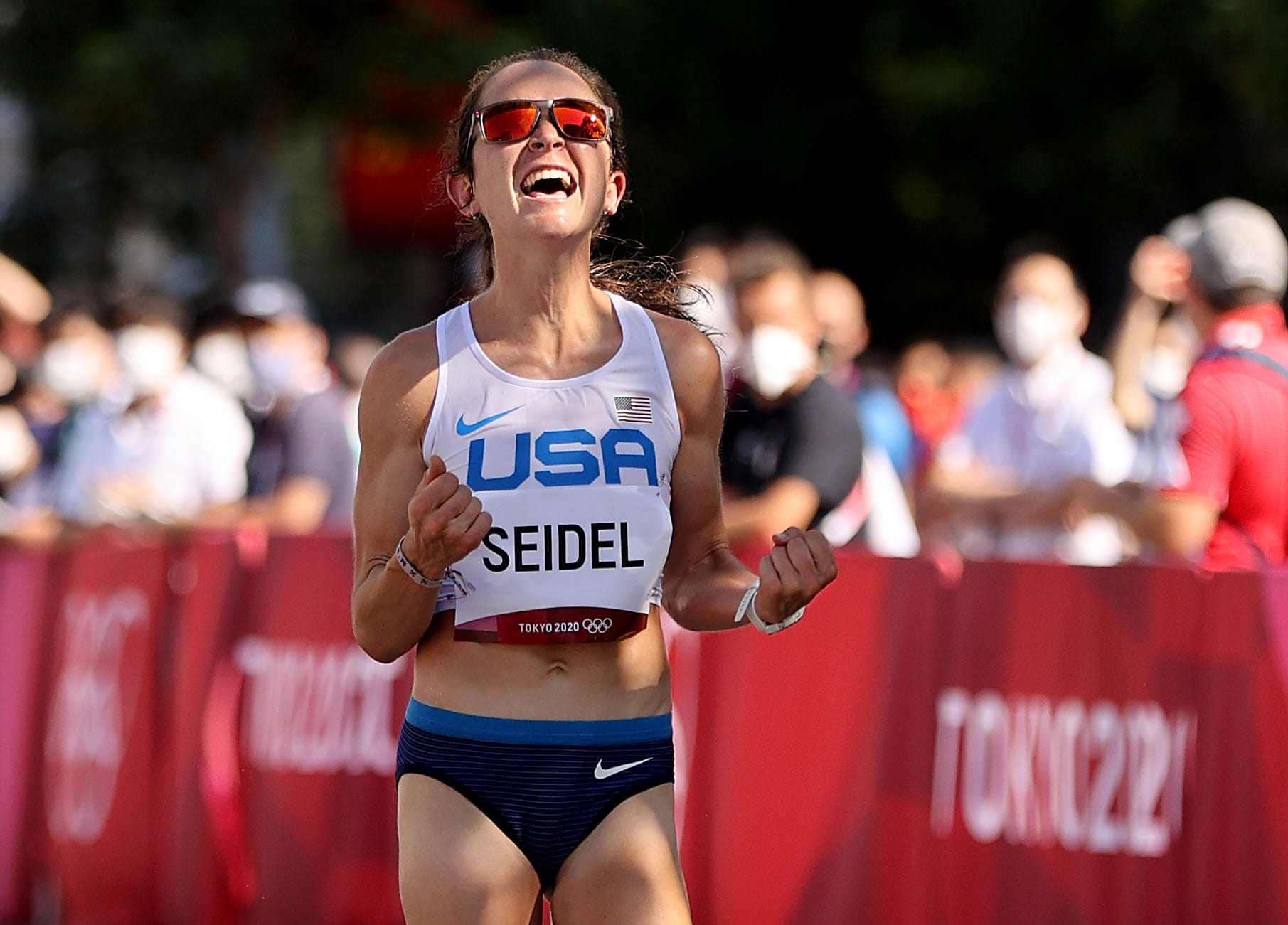
The story for American distance running fans was Seidel, running in only her third marathon of her life (her first was the Olympic Trials marathon in 2020 to get here). Seidel beat five sub-2:20 women. She entered the race with a 2:25:13 personal best and yet was in the conversation for the gold until the final 2k. She joined American running legends Joan Benoit Samuelson (gold in 1984) and Deena Kastor (silver in 2004), as the only American women to medal in the Olympic marathon.
The race
At race time, it was sunny and 76 degrees with 87% humidity, despite the race being moved up an hour because of the heat to start at 6 a.m. local.
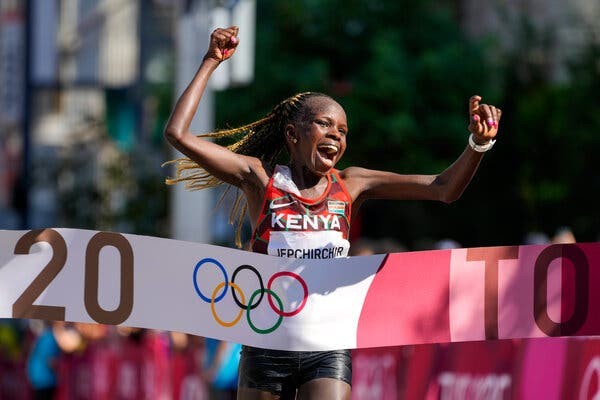
As a result, the race went out slow, with 5K and 10K splits of 18:02 and 36:16 for the leaders (2:32:50 marathon pace at 10K). The lead pack remained about 40 or 50 women strong at the 10-kilometer split, but the effect of the heat was unmistakable, with women applying ice bags on themselves and running wide to get into the shade. By this point, US champion Aliphine Tuliamuk had fallen off the pace (she would eventually drop out).
From there, as the race advanced north on a slight downhill, it picked up. Honami Maeda of Japan took a few turns at the front, as did Americans Seidel and Sally Kipyego, but it was mostly shared. The next two 5K splits (17:31 and 17:41) were quicker and reduced the lead pack to less than 20 women by 20K. Zeineba Yimer, a 2:19 woman from Ethiopia, dropped out at the 17K mark.
The lead group went through halfway in 1:15:14, and the lead group was whittled down to 11 with Ethiopian contender Birhane Dibaba falling off the back.
Americans Seidel and Kipyego remained in the lead pack of 12 at 25K (Volha Mazuronak of Belarus rejoined the lead pack between halfway and 25k), which the women went through in 1:28:51 (2:29:47 pace). Ethiopian Roza Dereje Bekele (2:18:30 pb) and Salpeter (2:17:45 pb), along with the three Kenyans, were pushing the tempo slightly.
After that split, as the women continued to weave through the north Sapporo suburbs and Hokkaido University, racers started dropping off the lead pack like flies: first Kipyego, then Mazuronak and then a big casualty — Ruth Chepngetich of Kenya, the reigning world champ, falling back around the 29K mark.
Meanwhile at the front, Seidel led the entire 18th mile in around 5:26. The lead group of nine went through 30K in 1:46:03 (17:12 previous 5K, quickest of the race). The Japanese spectators pulled for their countrywoman Mao Ichiyama, who was still there.
The 30-35K split was the quickest of the race (16:54) and those five kilometers caused the biggest carnage: four women, including Ichiyama and Dereje, the final Ethiopian, dropped off the lead pack.
Now with the group down to five and less than five miles remaining, and Seidel continuing to run with confidence and share the lead with the two remaining Kenyans, the curiosity surrounding Seidel turned into a real possibility…could she snag a medal?
Bahrain’s Eunice Chumba dropped off just after the 35K mark, making it a four-woman race for three medals: Kosgei, Jepchirchir, Salpeter, and Seidel. Women with personal bests of 2:14, 2:17, 2:17, and 2:25. But in the summer Japan heat, the strongest women would win, not the fastest.
In the 24th mile, the Kenyans finally struck, Jepchirchir throwing in a surge and Kosgei covering it. They opened up a small gap on Salpeter and Seidel immediately, and Salpeter had a few meters on Seidel.Before one even had time to process whether Seidel’s fairytale quest for a medal was coming to an end, her fortunes changed drastically. At the 38-kilometer mark, Seidel caught Salpeter, who was still less than five seconds behind the leaders, but slowing slightly. Salpeter, however, was broken. Within a span of seconds she slowed to a walk and Seidel was into the bronze position, with the leaders still in her sights, Jepchirchir in front and Kosgei sitting on her.
At 40k, Jepchirchir and Kosgei were still together with Seidel only six seconds back, 31 seconds ahead of fourth place, comfortably in bronze position, barring a blowup. Seidel appeared to be closing on the leaders. Could she even get the silver or the gold?
Not quite. Jepchirchir had one final gold-medal move, dropping Kosgei just after the 40K split and quickly opening a 10-second gap. She would extend her winning margin to 16 seconds by running the final 2.195 kilometers at 5:23 pace.
Kosgei was fading slightly but so was Seidel. Both held their positions through the line, as Seidel could not quite summon the finish to get back to Kosgei and finished 10 seconds behind her in the bronze medal position.
Seidel yelled in delight as she crossed the finish line, while Kosgei looked slightly disappointed with the silver. The third American, Sally Kipyego, finished 17th in 2:32:53.
The temperature at the finish was 84 degrees with 67% humidity.
Login to leave a comment

Tokyo 2020 Olympic Games
Fifty-six years after having organized the Olympic Games, the Japanese capital will be hosting a Summer edition for the second time, originally scheduled from July 24 to August 9, 2020, the games were postponed due to coronavirus outbreak, the postponed Tokyo Olympics will be held from July 23 to August 8 in 2021, according to the International Olympic Committee decision. ...
more...
Ethiopia’s Selemon Barega wins gold at 10,000m in Tokyo
Selemon Barega captured gold in an exciting men’s 10,000m final today in Tokyo in 27.43.22, followed by race favourite Joshua Cheptegei and Jacob Kiplimo, both of Uganda, for silver and bronze – the first medals ever won by Ugandans in this event. Canadian record holder Mohammed Ahmed threw in a surge near the end, briefly leading the tightly bunched pack, but ended up finishing sixth in the 25-lap spectacle, with a season’s best time of 27:47.76.
Ahmed managed to stay in contention and out of trouble early on in the race, going with Cheptegei, who took over the lead with four laps to go. With two laps to go, Ahmed took the lead, but in the end was out-kicked.
Ahmed also finished sixth in the 10,000m at the 2019 World Championships in Doha. Despite finishing off the podium, this is an incredible achievement for Canadian distance running. Ahmed grew up in St. Catharines, Ont., and ran at the University of Wisconsin. Since then, he has been training with the Bowerman Track Club in Portland, Ore., and his teammate, Woody Kincaid, finished 15th.
The 2018 Commonwealth Games silver medallist in 5,000m and 10,000m will be on the track again looking to reach the podium in the 5,000m heats on Tuesday, Aug. 3 at 7 a.m ET.
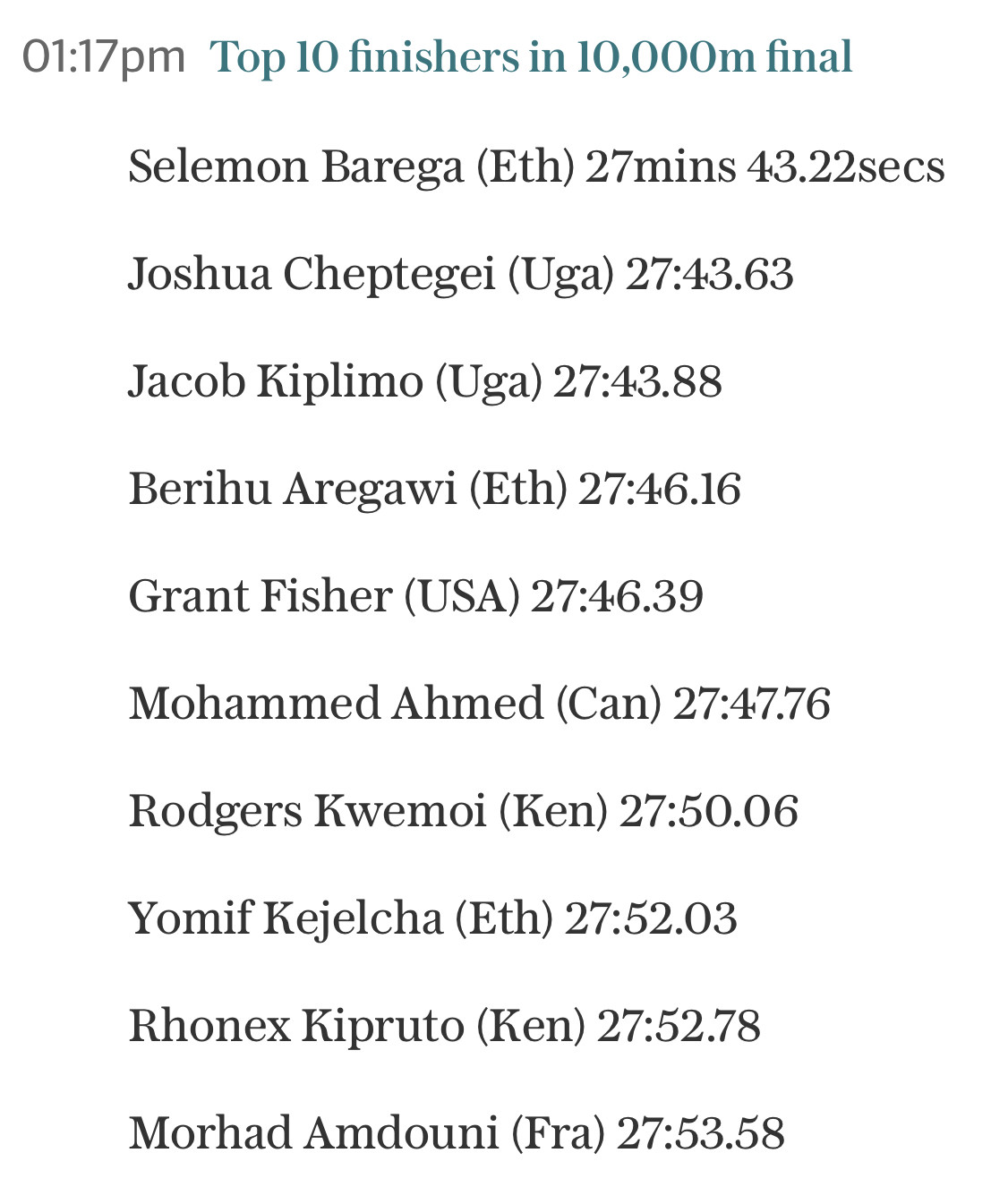
by Marley Dickinson
Login to leave a comment
Tokyo 2020 Olympic Games
Fifty-six years after having organized the Olympic Games, the Japanese capital will be hosting a Summer edition for the second time, originally scheduled from July 24 to August 9, 2020, the games were postponed due to coronavirus outbreak, the postponed Tokyo Olympics will be held from July 23 to August 8 in 2021, according to the International Olympic Committee decision. ...
more...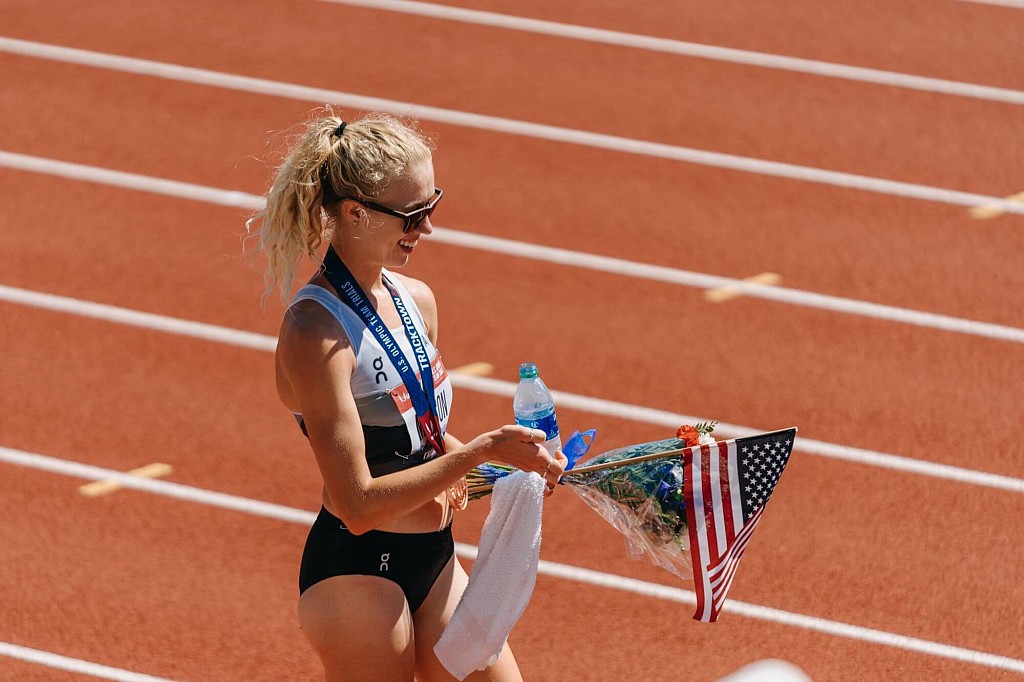
Former University of Wisconsin athlete Alicia Monson qualifies for Olympics in the 10,000 m
Taking the lead in the fifth lap and never letting up, Emily Sisson won the 10,000 in 31:03.82 on June 26 at the U.S. Olympic Track & Field Trials. Despite a start temperature of 85 degrees, Sisson broke the 17-year-old Trials record of 31:09.65, set by Deena Kastor in 2004.
Karissa Schweizer moved from third to second in the final lap, finishing in 31:16.52, and Alicia Monson claimed the third team spot in 31:18.55.
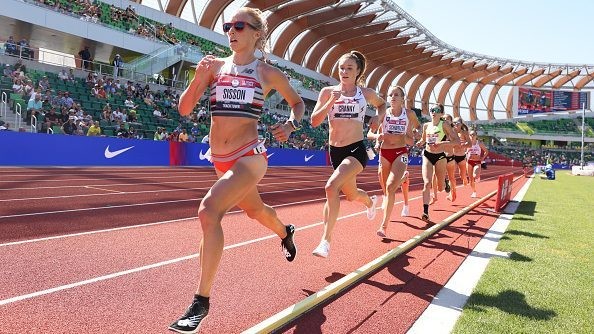
Monson, 23, who runs for On Athletics Club in Boulder, Colorado, also made her first Olympic team. She was wobbly in the final few laps, and after the medal ceremony, she collapsed and started vomiting and had to go to the hospital as a precaution, according to her coach, Dathan Ritzenhein.
“She’s the toughest person, the quietest, toughest person you could imagine,” he said. “I think she’s one of the next greats. She showed it today.”
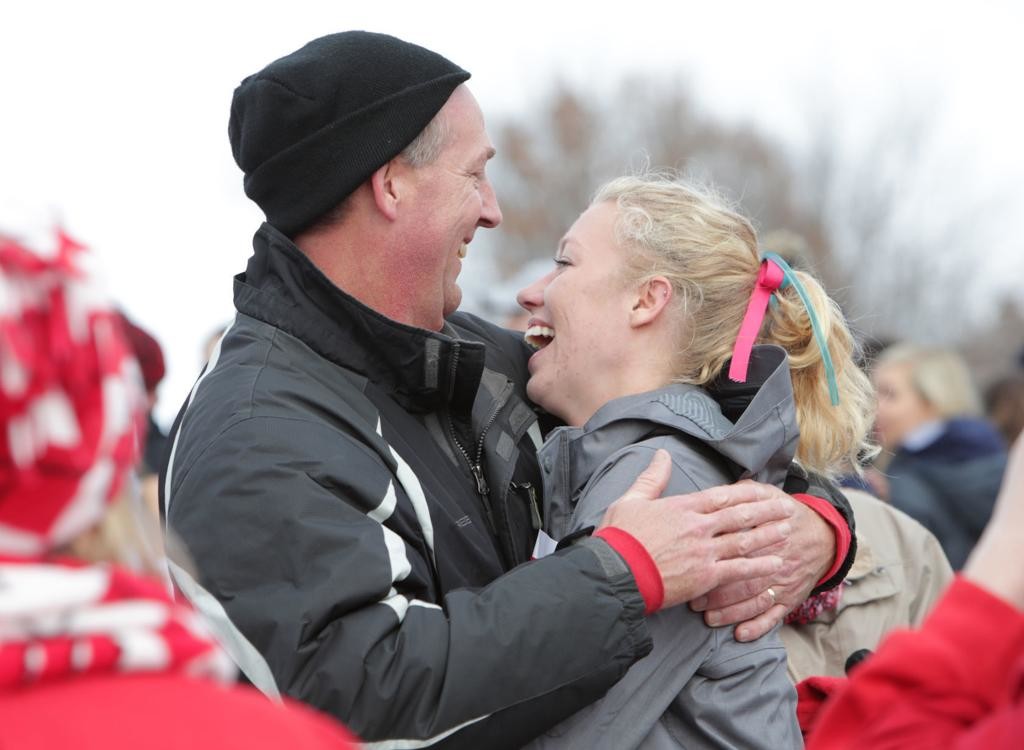
Schweizer also qualified for the 5,000-meter squad on Monday, and she said she was exhausted in the day’s heat. It is unclear whether Schweizer plans to run both events in the the Olympics. If she gives up her 5,000-meter spot, Abbey Cooper will be named to that team. If she gives up her 10,000-meter spot, Niwot native Elise Cranny, fourth in 31:35.22, and Rachel Schneider, fifth in 31:42.92, are eligible to run the 10K in Tokyo.
Cranny and Schneider, however, are also already on the 5,000-meter team. So if Schweizer, Cranny, and Schneider all decide to skip the 10K, then Sara Hall, sixth in 31:54.50, will run the 10K in Tokyo.
by Colorado Runner
Login to leave a comment
Tokyo 2020 Olympic Games
Fifty-six years after having organized the Olympic Games, the Japanese capital will be hosting a Summer edition for the second time, originally scheduled from July 24 to August 9, 2020, the games were postponed due to coronavirus outbreak, the postponed Tokyo Olympics will be held from July 23 to August 8 in 2021, according to the International Olympic Committee decision. ...
more...
Viktoria Brown breaks Canadian W45 100-mile record in North Carolina, running 15:24:23 to beat the previous national record by 14 minutes
Canadian ultrarunner Viktoria Brown recently set the Canadian W45 100-mile record, posting a time of 15:24:23 at a 24-hour race in North Carolina. This is the third ultrarunning record for Brown, who lives and trains in Whitby, Ont., and it beat the previous Canadian best by 14 minutes. She stopped after hitting the 100-mile mark, a distance that was good enough for 11th overall in the 24-hour event.
Brown only started running ultras in September 2020, but she already has three records to her name. Her first came in her ultra debut, when she ran to the women’s 24-hour Canadian soil record at That Dam Hill in London, Ont. Despite never having run an ultramarathon before, Brown excelled, running 213.8K in 24 hours and beating the previous record (which had stood for 36 years) of 210K.
After her performance in London, Brown was invited to run in Kelowna, B.C., in October as a member of the Canadian team at Big’s Backyard Ultra. Again, although she was still so new to the sport, she ran extremely well, completing 34 laps and stopping after 228K. Next up was a 48-hour race in Duncan, B.C., in November, and Brown set another record, beating the previous Canadian 48-hour best by more than 6K with her two-day total of 324K.
Given her previous results in ultras, it shouldn’t have come as any surprise when Brown beat yet another record, this time at the Alexander County 24-Hour race in the U.S. After the race, Brown said she stopped short of the 24-hour cutoff because she didn’t want to push her body too far, as she is training for the Six Days in the Dome race, which will be held in Wisconsin in June. Stopping after just 15 hours meant Brown could dedicate less time to recovering after the race and more time to training.
“I learned what I needed to learn from this one,” she said, referring specifically to a recent asthma diagnosis. After learning that she has asthma, Brown realized she needed to figure out how to race without making the problem worse. Seeing as she set a Canadian record, it’s safe to assume she worked things out on the race course.
As Brown noted on Instagram after the race, she was on pace to break the open Canadian women’s 100-mile record (which belongs to Michelle Leduc at 15:19:45) for most of the race, but she slowed too much in the final kilometres and had to settle for the W45 age group best (a time of 15:38:18 that Bernadette Benson ran in 2014) instead.
While she was disappointed with missing the Canadian record, Brown said she isn’t too upset, and her focus is now set on the Six Days in the Dome. If she wants to break the national six-day best at this event, she will have to run farther than Charlotte Vasarhelyi‘s 2014 record of 734.225K. To run the W45 best, Brown will need to better Kimberley Van Delst‘s record of 547.177K, which she ran in 2017.
by Ben Snider-McGrath
Login to leave a comment
Lithuanian ultrarunner Aleksandr Sorokin breaks 100-mile, 12-hour world records at U.K. race
Lithuanian ultrarunner Aleksandr Sorokin broke the 100-mile and 12-hour world records at an event in Ashford, U.K., on Saturday, setting marks of 11:14:56 and 170.309K in the two categories. These results beat American Zach Bitter‘s world records, both of which he ran at the Six Days in the Dome event in Wisconsin in 2019. According to Centurion Running, the company that organized the elite-only event, Sorokin also broke the 150K world record (10:27:48) and the Lithuanian 50-mile best (5:32:01) on his way to the 12-hour finish.
Sorokin is no stranger to big results, and his resume includes top finishes at the 2019 IAU 24-Hour World Championships, which he won with a total of 278K in 24 hours, and the 2017 Spartathlon ultra in Greece, where he completed the 246K course in a little over 22 hours. His list of accomplishments just got even more impressive, though, with his records from Saturday’s run.
The event, which was dubbed the Centurion Track 100, featured a lineup of just 15 elite runners, each of whom was personally invited to compete. Entrants ran on a regular 400m track, and despite the race’s monotony and repetitiveness, Sorokin thrived, powering through each lap for 12 straight hours. He ran an incredibly even race the whole way, averaging 4:07 per-kilometer pace through 50K (he posted a 3:25:38 split), 4:08 pace after 50 miles (5:32:01) and the same at the 100K checkpoint (6:54:25).
After 100 miles (another 60K of running after he hit the 100K mark in the race), Sorokin faded only slightly, and his overall pace for the record run to that point was 4:12 per kilometre. His 170K in 12 hours works out to 4:14 per-kilometre pace. For context, that’s like running 16 straight 10Ks and finishing each one in about 42 minutes. Sorokin’s results bettered Bitter’s 100-mile record of 11:19:13 and 12-hour record of 168K from 2019.
While Sorokin was chasing down his world bests, Britain’s Samantha Amend was busy working on records of her own. At the six-hour mark, Amend set the W40 British record of 72.995K, and she passed through 100 miles in 14:34:05, breaking the open national record for the distance. Several other athletes set national age group records over the various distances as well on Saturday.
All records set in Ashford are still unofficial, but the Centurion Running website notes that the course was certified by UK Athletics, so the times should all be ratified soon.
by Ben Snider-McGrath
Login to leave a comment
World and British records fall at Centurion 100-miler
Aleksandr Sorokin sets world marks while Samantha Amend breaks national best at ultra-running track event at Ashford in Kent
Aleksandr Sorokin set a world record for 100 miles with 11:14:56 at the Centurion Running Track 100 in Ashford on Saturday (April 24) and then carried on to break another global mark for the furthest distance covered in 12 hours with 105.825 miles (170.3km).
At the same event, Samantha Amend broke Eleanor Robinson’s long-standing UK record for 100 miles with 14:34:05.
Sorokin’s performances beat the previous records of 11:19:18 for 100 miles and 104.88 miles for 12 hours set by Zach Bitter in 2019 in Wisconsin.
The Lithuanian, who won the IAU world 24-hour title in 2019 and who outside athletics works as a croupier in a casino, averaged 6:45 per mile (sub-3hr pace) for his 100-mile effort. This was despite having to finish his final preparations on a treadmill due to being quarantined in the UK on the eve of the race.
He celebrated by striking a Usain Bolt-esque lightning pose on the track and then watched Amend break a national record.
Robinson ran 14:43:40 at Milton Keynes in 1990 but Amend broke that mark by almost nine minutes as she finished under floodlights at the Julie Rose Stadium.
Amend, who works for an IT company and races for Belgrave Harriers, has clearly been building into good form after winning the Dorney Marathon in 2:52:36 at the start of April.
by Athletics Weekly
Login to leave a comment
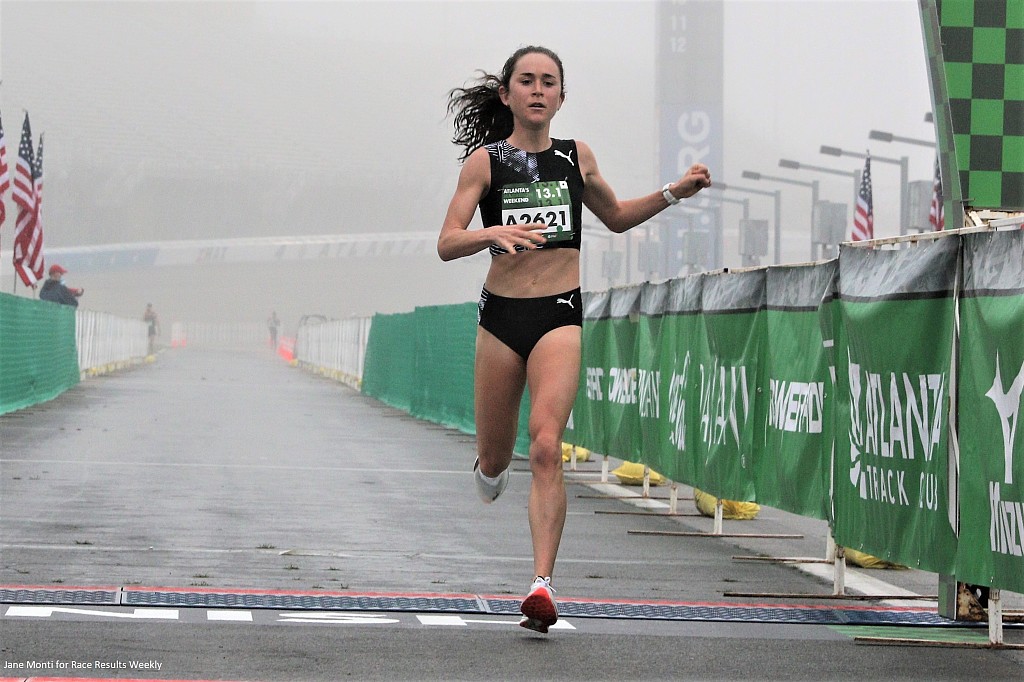
Olympian Molly Seidel wins Atlanta Half Marathon
Boston-area resident Molly Seidel won the Atlanta Half Marathon on Sunday, crossing the finish line of the 13.1-mile race with a time of 1:08.29.
Seidel, a Wisconsin native who lives with her sister in Cambridge, qualified for the postponed 2020 Tokyo Olympics by placing second in the event last year. The Olympics were later postponed due to the COVID-19 pandemic and are now scheduled to begin on July 23.
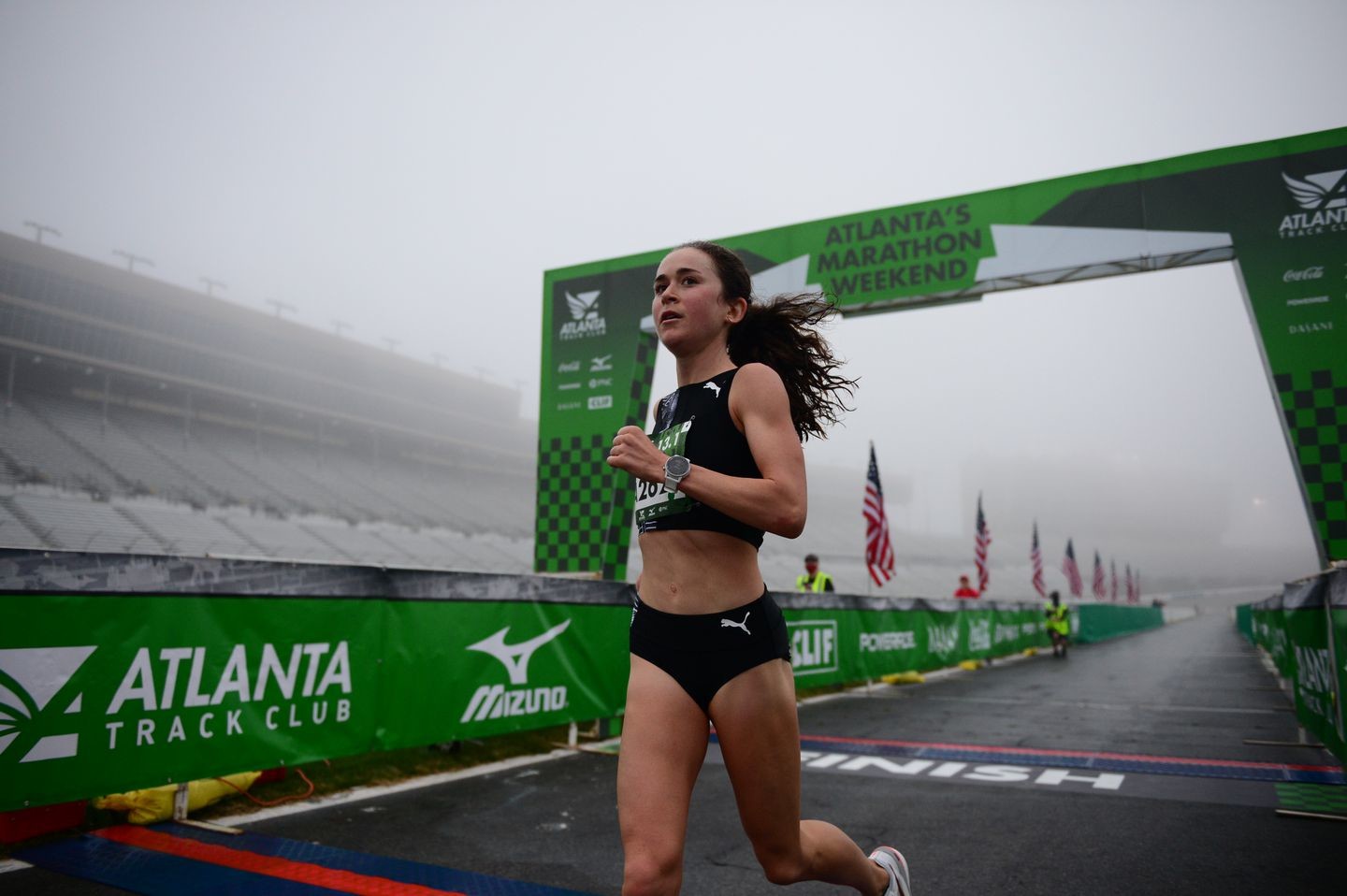
The conditions were cold and humid in Atlanta, but Seidel told the Boston Globe the humidity was good practice for Tokyo.

“It was really cool to be back here a year later under different conditions, but it’s always special to return to the place that it happened,” Seidel told the Globe.
Seidel will now begin a 12-15 week training regime for the Olympics. In September, she told ESPN she traveled to Flagstaff, AZ to train in preparation for altitude, and she used the additional time to “to gain more experience, train for an extra year, nail down my nutrition and run another marathon.”
Seidel competed in the London Marathon in October. She finished sixth overall and was the second-fastest American woman across the finish line with a time of 2:25.13.
by Tom Westerholm
Login to leave a comment
Publix Atlanta Half-Marathon & 5K
The course starts and finishes just outside of Turner Field. The 13.1 mile course gives participants a taste of Atlanta, running past sites such as Centennial Olympic Park, Atlantic Station, Piedmont Park, Oakland Cemetery and of course the Olympic Rings. The Atlanta Halloween Half Marathon & 5K features 13.1 & 3.1 miles of costume fun! This event is more about...
more...
Getting off on the right foot on snowshoes
Snowshoeing can be a relaxing romp in the woods or a serious workout. You may have to widen your stride to avoid stepping on your own snowshoes, and a pair of trekking poles can help your balance, especially on hilly terrain. But mostly it's just like walking.
Choose the right 'shoes
Snowshoes come in different shapes and sizes, even women-specific models. The pair on the left are for deeper snow or heavier people; the pair on the right work best for packed trails or racing. Snowshoes have a weight rating. Consider not only your body weight but the clothes and boots you're wearing and what you're carrying in your pack.
Pack a snack
Snowshoeing can burn up a lot of energy. It's also important to stay hydrated. A waist pack is convenient for carrying water and snacks.
Travel with a friend
Although a solo trip can be relaxing and reflective, there is safety in numbers, particularly when outside in cold weather. Juergen Schroeer of Normal and Patricia Carlson of Bloomington travel together on a trail at McLean County's Comlara Park, northwest of Hudson, during a recent winter
Follow the signs
Some places have marked snowshoe trails, such as this one at Rapid River, Michigan, in the Hiawatha National Forest. But regular hiking trails in parks are generally fine for snowshoeing. Even city parks or public golf courses can be a fun options
Stay off of ski tracks
It's common winter courtesy to stay off ski tracks when hiking or snowshoeing. That's true whether its a track left by a skier on their own or a groomed trail, such as this one at Razorback Ridges in Sayner, Wisconsin, which has both ski trails and snowshoe trails
Don't forget to laugh
Login to leave a comment
Why Running Outside in the Winter Is So Good for You
The mental and physical benefits make it worth the extra effort
Sure, the treadmill can be a valuable training tool in winter. But most of the time, gearing up, embracing the outdoors, and hitting the roads is the better option. What’s the difference, you ask? Training outside any time of year—but especially during the year’s darkest days—unlocks a host of mental and physical benefits. Here are four reasons to take your workouts outdoors this winter.
Amy Kugler understands firsthand how running can help combat seasonal affective disorder (SAD). Back in 2013, when the 30-year-old content strategist had just moved to Seattle, she found herself unconsciously upping her mileage as a way to cope with the lack of sunshine. “The rainy season kicked in around September and it was gray all the time,” she says. “My husband would encourage me to get out the door because he saw that when I returned from my runs, I was much happier.”
Robert J. Stock, a California-based psychotherapist, says that about 5 percent of Americans suffer from SAD, and as many as 10 percent more have a subclinical variant they may not recognize. “There are theories that the lack of light in winter triggers hormonal changes, with the leading belief being that the brain may create less serotonin, one of the important chemicals to create a sense of well-being,” he explains. Running, then, can be a great antidote. “Running outside, preferably in daylight, creates endorphins that give a runner a happy feeling and greater energy rush,” Stock says.
Even with a schedule and climate that often prevents her from training in the sunlight, Kugler feels better after training outdoors through winter. And that's no coincidence. A 2016 Harvard and Syracuse University study showed that the elevated levels of carbon dioxide often present in indoor environments can have negative effects on cognitive function. Translation: breathing fresh, oxygen-rich air—not just exposure to sunlight—can positively affect more than just your mood. “Would I love a sunny day?” she asks. “Yes. But more importantly, I am out there, and the endorphins make all the difference.”
Winter Weather Beats Summer Weather
Truly, it does. Instead of slowing the pace to build endurance in the heat, winter weather makes everything better: you’ll sweat less and remain better hydrated. You’ll feel more energized. Your heart will run slower and you might find yourself adding on a mile or two some days, rather than quitting early. “Breathing in the cold air wakes you up and makes you feel alive,” says Baltimore-based running coach Alison Staples. “I wouldn’t miss it.”
You’ll Feel like a Boss
If you haven’t noticed, there aren’t many people out running on the roads in the middle of winter. If you have the chutzpah to get out there, your tenacity deserves a few pats on the back. When he first arrived at the University of Wisconsin to join the track team, Under Armour runner Morgan McDonald was a bit unsure about running in the cold. Originally from Sydney, Australia, he’d never encountered real winter conditions (the average low temperature in January in Madison, Wisconsin, is a bone-chilling 11 degrees Fahrenheit). “It can be a bit daunting,” McDonald says. “But once you get used to it, you’ll be glad you tried.”
Professional runner and coach Breanna Sieracki, who lives in Minnesota and runs in just about any temperature, agrees. “You have to be tough to get out there,” she says. “It will make you more resilient and ready to handle anything.”
You’ll Make Real Gains
Winter running is about mental toughness, to be sure. You’ll emerge stronger and ready to handle the rough spots in a race come spring. But it also adds up to physical benefits. “With the exception of a few big marathons, like Houston, most of your races will be in warmer months,” says Sieracki. “So winter can be great for base building.” With the break from races, winter is the perfect time to build up your base so that you’re ready for that harder training come spring.
Use this time to work mostly in your aerobic zone, laying down a firm foundation. Think of your training as a pyramid—your wintertime base miles form the bottom layer on which your other efforts can rest. Skip out on this step and spring training and racing won’t get you nearly as far. The case for winter running couldn’t be stronger. As the days get shorter and the temperatures drop, make a plan for joining the ranks of winter warriors. Your mood and your body will thank you.
by Outside
Login to leave a comment
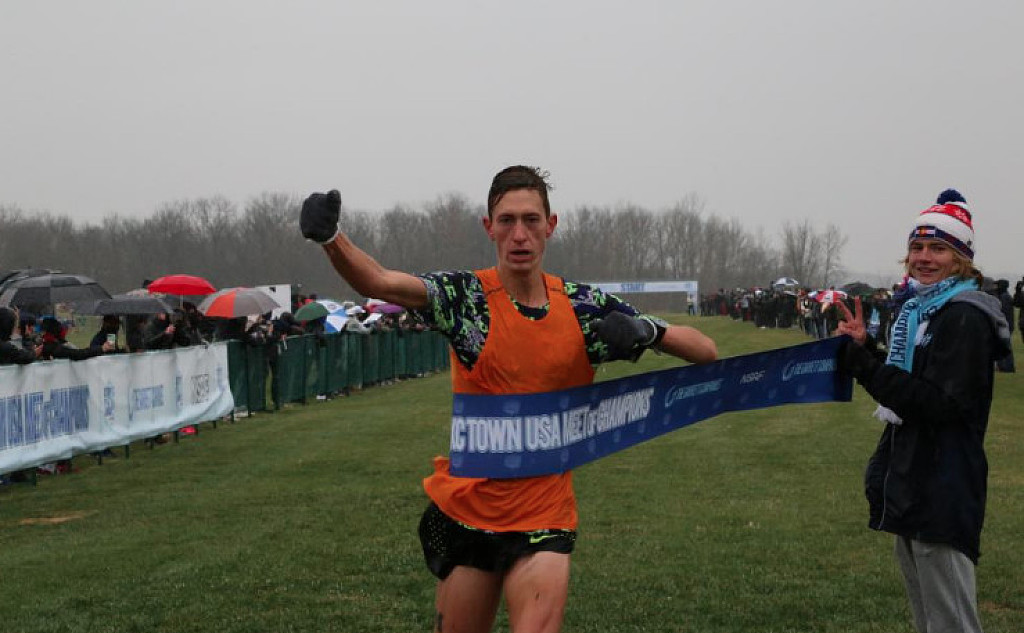
MASON FERLIC OUTKICKS PAUL CHELIMO TO WIN MEN'S 8-KILOMETER RACE AT XC TOWN USA MEET OF CHAMPIONS
Mason Ferlic, the 2016 NCAA Division 1 3,000-meter steeplechase champion and an assistant coach at the University of Michigan, pulled off a huge upset in raw, wet conditions in the men's elite/college/open 8-kilometer race Saturday at the LaVern Gibson Cross Country Championshipship Course in Indiana.
Ferlic and his long strides pulled away from 2016 Olympic 5,000-meter silver medalist Paul Chelimo over the final 1,000 meters to earn an impressive victory at the XC Town USA Meet of Champions, presented by the Garrett Companies.
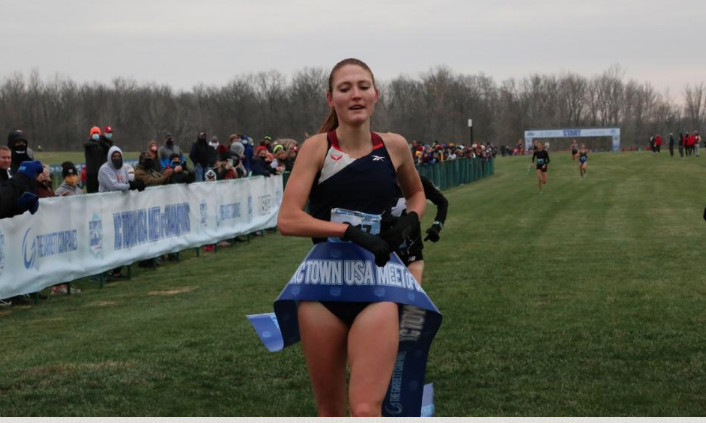
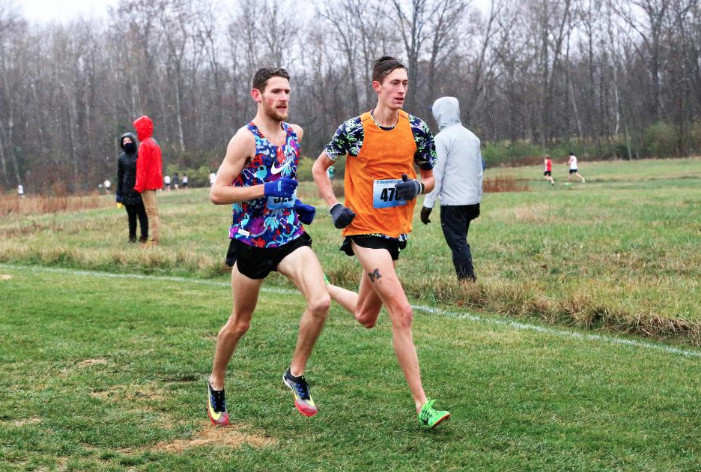
Ferlic and Michigan State runner Morgan Beadlescomb clung to Chelimo, while a large pack assembled behind them.
"That was a fun race," Ferlic said. "Morgan, Paul and I were duking it out since pretty much the first half mile. (I) felt really strong today. Paul was throwing in some surges early. I kind of expected that. It's his racing style. I just stayed patient, absorbed that and realized the guys were hurting a little bit more than I was, and opened it up and put the hammer down with about a K to go."
Although Beadlescomb led Michigan State to the team victory, with the group competing as Go Green placing five athletes in the top 32 to score 27 points, several Wisconsin individuals racing unattached had a strong performance behind the top trio, with Jack Meijer (23:54.6), Jackson Sharp (23:54.8), Shuaib Aljabaly (23:56.8) and Olin Hacker (23:57.8) finishing fourth through seventh overall.
The women's 6-kilometer race that began the two-day event featured a dramatic kick to the finis
Amy-Eloise Markovc, a former University of Washington star, surged past Huntington University (NAIA) sophomore Emma Wilson to win in 20:17.3. Wilson was second in 20:18.7.
"Honestly, it's just a really nice boost of confidence," said, Markovc, who competed in her first event since running a 5,000-meter race Aug. 22 at the Sound Running Sunset Tour in Lake Balboa, Calif.
"We're really just in fall training right now, which includes a lot of mileage and tempos and fartleks and that sort of thing, so we're not really focusing on speed. It was really nice and comforting to see that strength come through, and just knowing that my consistency over the past couple of years has really paid off."
Four years ago on the same course, Markovc placed eighth in the 2016 NCAA Cross Country Championships. Wilson also placed eighth for Greencastle High in the Indiana state final at LaVern Gibson that same fall.
The following year, Markovc took second at the 2017 Division 1 championship meet at E.P. "Tom" Sawyer Park in Louisville, and Wilson won the first of her two Indiana state titles at LaVern Gibson.
Michigan sophomore Ericka VanderLende, who took 25th to earn All-America honors at last year's Division 1 final at LaVern Gibson, was third Saturday in 20:28.8. Michigan State junior Jenna Magness, 46th last season at the NCAA Championships, finished fourth in 20:34.1 and Indiana senior Kelsey Harris rebounded from placing 196th at last year's Division 1 final to secure fifth in 20:42, followed by teammate Sarah Schmitt (20:53.4) in sixth after she secured 58th place at the NCAA final.
Wisconsin, competing as B1G Mack, had five athletes place in the top 30 overall to win the team competition. Lucinda Crouch led the way for the Badgers by finishing seventh in 20:58.2. Crouch took 96th at last year's Division 1 championship race.
Concerns over the Coronavirus appeared to take some toll on the fields. Of the 112 women entered late in the week, 92 finished the race. In the men's race, 154 finished out of 178 names on the start list. Both races were populated by open competitors and college athletes running unattached.
Ferlic's kick drove him to a 10-second victory (23:43.4) over Chelimo (23:53.3), Beadlescomb (23:54.3) and four athletes from Wisconsin who broke 24 minutes.
Login to leave a comment
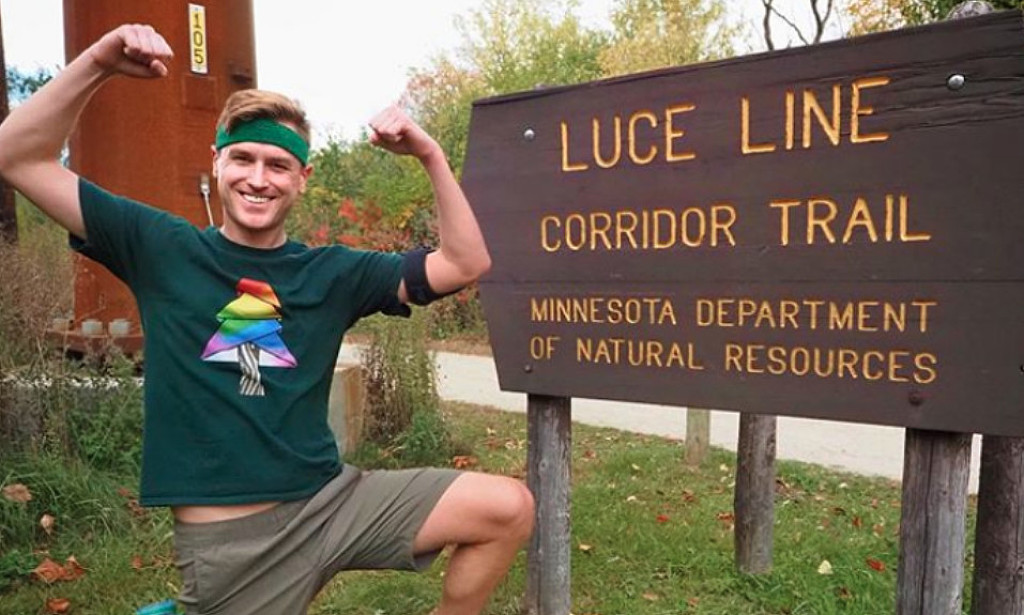
Minnesota man runs cross-state for LGBTQ+ community
Mikah Meyer ran 200 miles across Minnesota to raise awareness for the Outside Safe Space program
Minnesota’s Mikah Meyer recently completed a 38-day, 209-mile (336K) run across his entire state, from the border of South Dakota to the border of Wisconsin. He averaged about 10K a day and spent his nights in a van, all to raise awareness for his project called the Outside Safe Space, a program he created to support members of the LGBTQ+ community. His run didn’t break any records, but it did garner a lot of media attention for the cause, which is extremely important to Meyer (himself a member of the LGBTQ+ community).
Meyer’s run
In an interview with Fox 9 in Minneapolis, Meyer said he only picked up running a couple of years ago when his doctor said he needed to lose some weight. During the pandemic, though, he said “running has been a godsend” for him, as it was one of the only activities he could keep up when everything in the U.S. was shut down. It was on these early-pandemic training runs that he came up with the idea for a cross-Minnesota adventure. He was actually inspired by Terry Fox, which he noted while talking with Fox 9.
“I thought, ‘Maybe I can use my profession, my privilege and my platform to do something to help other people.'” Like Fox, he decided on a long run, and although he didn’t run as far as the Canadian icon did in his Marathon of Hope, the run across Minnesota was still a big project. Meyer said he wasn’t used to running as much as he did while on the road, and his daily average of about 10K was far more than his usual 11K every couple of days when at home. Still, he added that “the easiest part of my journey is the running.” The hardest part was the planning, he said, including where he would park his van to sleep each night, organizing each day with his support crew and promoting the Outside Safe Space. After 38 days on the road, Meyer completed his run on October 11.
The Outside Safe Space
“So often when LGBTQ people leave urban centres,” Meyer told Fox 9, “places where we are often accepted and appreciated, we go out into rural areas, we go out into the outdoors, and it’s less likely that we feel safe or we feel welcome.” After a years-long journey across America to visit all 419 of the country’s national parks in one trip, the outdoors are a big part of Meyer’s life, so he wants to help make these rural areas feel more welcoming for LGBTQ+ people. His plan to make this possible comes in the form of a rainbow-coloured tree, a symbol he donned throughout his run.
As he writes on his website, “The Outside Safe Space tree represents welcome to LGBTQ+ people. Whether you’re an ally or identify as LGBTQ+, wearing or displaying this symbol nonverbally communicates your support for folks being their authentic selves in rural and outdoor places, and outside traditionally welcoming spaces.”
To learn more about Meyer and the Outside Safe Space program, click here.
by Running Magazine
Login to leave a comment
Runners sponsored by smaller companies might be in a better position than those who are signed by major brands
Earlier this week, the Swiss running shoe company On announced that it was starting an elite training group in Boulder, Colorado, called the On Athletics Club. It’s safe to say that this doesn’t seem like the most auspicious time to invest in professional running. Even though the Diamond League—the world’s premier track and field competition circuit—is scheduled to begin an abridged summer season on Friday, this year has seen an unprecedented number of race cancellations and it’s difficult to predict when the bleeding will stop.
International Olympic Committee President Thomas Bach has already gone on record saying that the Tokyo Games, which have been postponed to summer 2021, will not be delayed a second time. If they can’t be staged next August, the Olympics will be canceled outright, thus depriving track athletes of their quadrennial moment in the sun.
According to Steve DeKoker, On’s Global Sports Marketing Manager, the company has long been looking to develop an elite running team and the Boulder-based group represents the most significant move in that direction to date. For now, the On Athletics Club consists of eight runners, all of whom are in their 20s and were standout NCAA athletes (the University of Colorado’s Joe Klecker and the University of Wisconsin’s Alicia Monson are the headliners).
Recently retired Olympian Dathan Ritzenhein will act as coach. It has been disclosed that these athletes will be signing multi-year deals with no reduction clauses (i.e. performance quotas)—a risky move, perhaps, but one that On might currently be well-positioned to make thanks to a potential pandemic-inspired uptick in recreational running.
“Running is kind of experiencing this second boom,” DeKoker told Letsrun.com. “We’ve got all these folks at home who are struggling with different issues, but running is a viable activity for them. Whereas if you’re Nike, and you’re in 50 different verticals, running might be a positive one, but you’ve got a bunch of other sports that are hemorrhaging right now.”
There has been some evidence to bear this out. Nike has reported a 38 percent decline in total revenue through May 31. More specifically, last week, the market research company NPD published an article noting that prominent brands (Nike, Adidas, Under Armour) had an overall sales decline in athletic footwear in the first half of 2020, while several running-focused shoe companies had fared conspicuously well.
Hoka One One and On, in particular, saw year-over-year sales increases of 75 and over 50 percent, respectively. (An On representative has confirmed this, and added that the brand had recorded its highest ever sales month in June 2020.) Matt Taylor, the co-founder and CEO of the independent running apparel brand Tracksmith, told me that “there’s been a noticeable uptick in people running over the last few months,” and that Tracksmith was “seeing this trend reflected” in its business.
While the running industry will never be entirely insulated from the state of the overall economy, there is some logic to the notion that the sport is well-suited to weather a financial downturn. To use DeKoker’s term, running is a “viable activity” for many people because it is relatively cheap, accessible, and offers both physical and mental health benefits during times of uncertainty.
The most recent running boom occurred during the years immediately following the Great Recession; starting around 2008, there was a continual increase in running event participation, culminating in 2013, when a record 19 million runners took part in U.S. road races.
Of course, from a running perspective, one of the uniquely cruel aspects of the COVID-19 recession is that the pandemic has precluded the staging of most mass participation events. The New York Road Runners, the largest non-profit running events company in the United States, laid off eleven percent of its employees and furloughed an additional 28 percent in July. Hence, any discussion about how the pandemic might end up “benefiting” the running industry in shoe or apparel sales must be weighed against this freeze of running events.
For professional runners, meanwhile, the cancellation of big-ticket races signifies a loss in prospective appearance fees and prize money. Some athletes might also be contractually obligated to run a pre-set number of races, which, needless to say, has not been so easy in 2020. That’s why this has been the summer of intrasquad competitions, in which training partners take part in de facto time trials that have been spruced up just enough to qualify as official meets. While some of these events have yielded impressive performances—most notably Shelby Houlihan, of the Bowerman Track Club, breaking her own American record in the 5,000-meters—there have also been farcical scenarios where world-class athletes phoned it in, presumably so that they can reach their race quotas. (Last week, reigning Olympic 1,500-meter champion Matthew Centrowitz “raced” an 800... and ran 3:08. His personal best in the event is 1:44.)
It’s not a coincidence that the most prominent examples of these sham races have involved Nike athletes. After all, the Oregon-based company sponsors far more runners than any other brand. They have the funds to do it, but casting a wide net might also make it more difficult for Nike to offer elite runners the contractual perks of smaller, running-focused companies like Oiselle, On, and, recently, Tracksmith. For now, reduction clauses still seem to be the norm for the typical Nike track athlete. (A Nike spokesperson told me that the company does not comment on athlete contracts.)
Hawi Keflezighi, an agent whose clients include his brother Meb Keflezighi and recent U.S. Olympic Trials Marathon champion Aliphine Tuliamuk, agreed that this was likely to be the case. “I think Nike deserves credit for all the athletes and events that they sponsor, but at the same time, within that business model, if you have a lot of athletes, you can’t be as flexible as when you only have five or ten athletes on your roster,” Keflezighi, whose brother was a Nike athlete for years before signing with Skechers in 2011, told me. He added that, while it’s typical for companies to reassess which athletes they want to sponsor at the end of an Olympic cycle, the current uncertainty surrounding the fate of the Games, and looming recession, mean that conditions for athletes are even more cutthroat than usual.
“I think the bigger brands definitely have tougher decisions to make, just because they have a bigger investment overall,” Keflezighi says. “The athletes with those brands, especially if they are not medal contenders or in a great position to make the US Olympic team—under this environment, those athletes’ contracts are a little bit more vulnerable. If you have a smaller roster of athletes, you might be able to say, ‘Hey, you know what? Let me give that athlete an extra year or two.”
DeKoker echoed this sentiment. “Obviously, performance is going to be a key element, but it’s not the only element with On,” he says. “I do think that, at some of these other companies, it’s much more of a numbers game and unfortunately some athletes are going to be on the losing end of that.”
What will the “numbers game” look like in a worst case scenario where next year’s Olympics ultimately do get canceled? With any luck, we won’t get to find out.
by Outside Online
Login to leave a comment
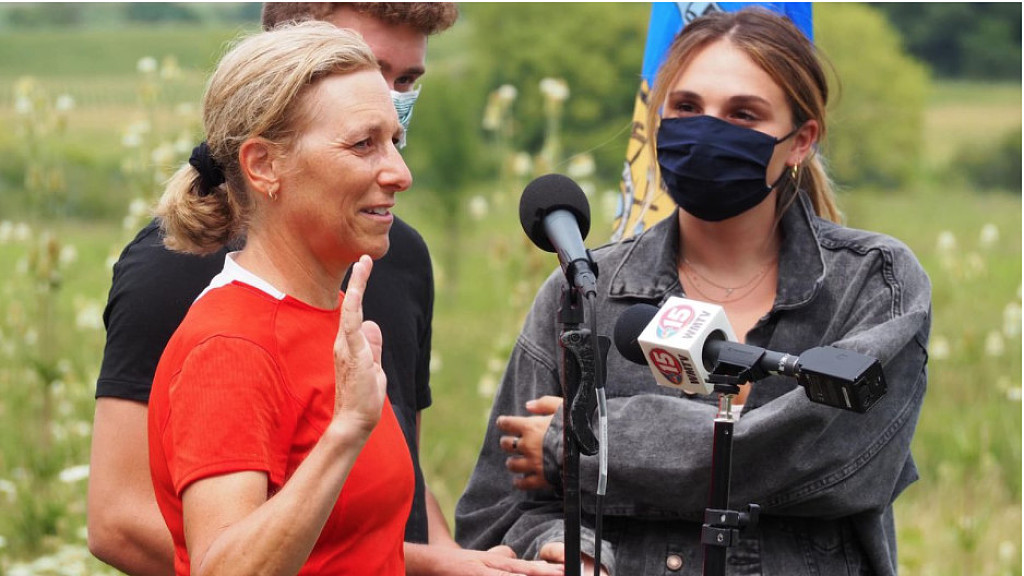
New Wisconsin justice sworn in during ultramarathon
MADISON, Wis. (AP) -- New Wisconsin Supreme Court Justice Jill Karofsky finished her 100-mile ultramarathon Sunday after being sworn in mid-run. Karofsky was sworn in around 1 p.m. Saturday at the 35-mile marker of her route in south-central Wisconsin. State Supreme Court Justice Rebecca Dallet administered the oath of office in Basco. Karofsky began running Saturday at 6 a.m. WMTV-TV reports the run took her about 34 hours to complete. Karofsky shared an image of herself at mile 99 on Twitter around 3 p.m. Sunday. The liberal-leaning Karofsky defeated incumbent Daniel Kelly in April to narrow the court’s conservative majority to 4-3.
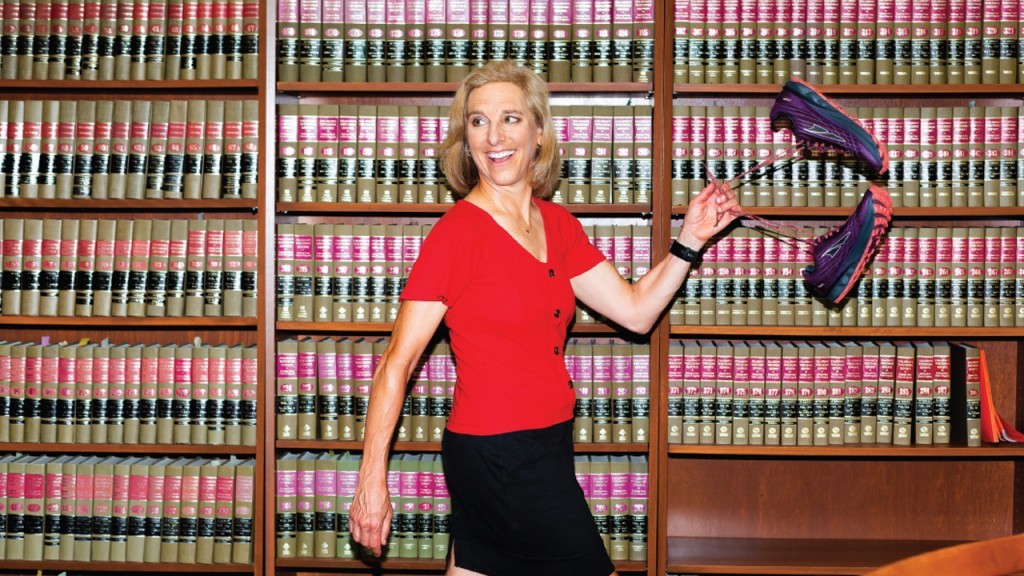
Login to leave a comment
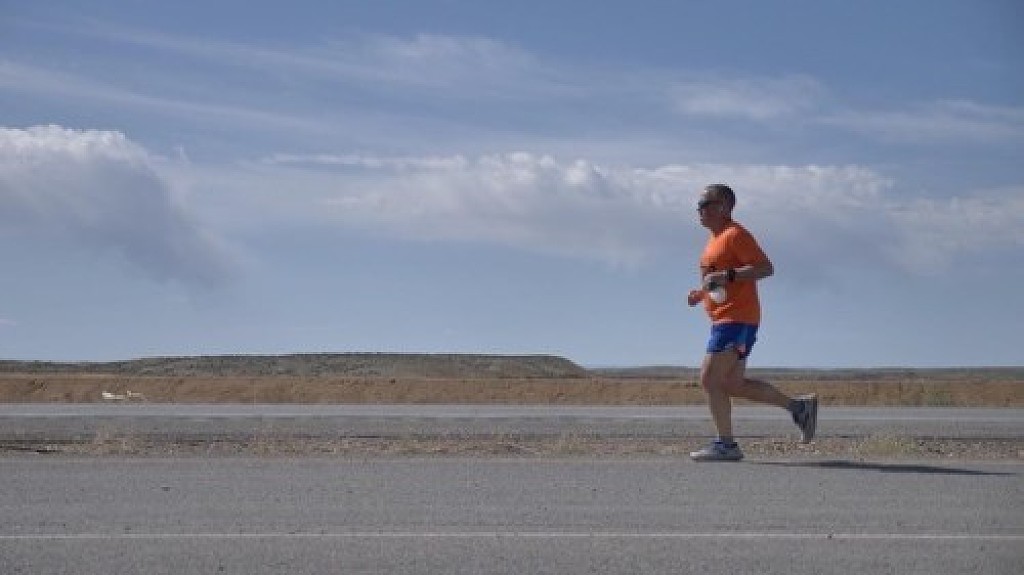
Man running from California to Delaware raising money for kids with cancer stops in Avon’s Nottingham Park
Peter Halper running over 3,000 miles to raise money for kids with cancer
Peter Halper is a man on a mission.
The Wisconsin resident stopped in Avon’s Nottingham Park on Tuesday as part of Emery’s Thunder Run, a 3,076-mile, four-month trek to raise funds for kids with cancer.
He started planning this run two years ago and was originally scheduled to start his run from California to Delaware in April. However, he postponed it to July to allow more information about COVID-19 to come out. He’s received a few questions along the way about running cross-country during a pandemic.
It’s a good question, and I appreciate the question, but we’re not running despite a pandemic, I’m running because of it, more or less because the parents who are going through Neuroblastoma with their kids, they still got to deal with the same problems. Their issues don’t go away, so it just compounded everything for them, so it’s even more important that we continue on,” Halper said.
Halper and his team of rotating volunteers are coordinating the run to raise money for Emery’s Memory Foundation.
“This run is a crazy stunt to help us find real solutions for the childhood cancer crisis,” the Emery’s Memory Foundation website says. “Funds from this run will go to Neuroblastoma research, support families in treatment and raise awareness about Neuroblastoma.”
Neuroblastoma is a form of cancer that starts in certain types of very primitive nerve cells found in an embryo or fetus, according to http://www.cancer.org.
Emery, the foundation’s namesake, is Halper’s sister’s granddaughter, who died at age 3 of Neuroblastoma Stage 4. Halper had never met his great-niece.
“The first time I met Emery was at her funeral,” Halper said. “When I was sitting in the pews, it hit me like a ton of rocks. How are these parents going to do what they are about to have to do? I decided that day that I was going to offer to run for them, for their foundation.”
Generosity from town to town
Halper’s four-month schedule includes running over a marathon a day for six days a week, taking Sundays off — that’s almost 115 marathons in four months. Upon arriving in Avon, he was a little over 1,000 miles into his run.
He will leave the valley and head east, over Vail Pass. Once in Kansas, he’ll take some time to spend some with family there. Halper has four children and is looking forward to seeing his wife.
“I’m not technically in the exact middle, but Denver, Colorado, feels like the middle and it’s kind of a big transition area to the plains so I feel like I’m in the middle,” he said.
However, he is planning to return either before leaving Denver or once arriving in Delaware — the Grizzly Creek Fire canceled his segment from Glenwood Springs to Gypsum.
“If it doesn’t open soon, I’ll go to Delaware, finish and I’ll buy a plane ticket back to Denver the day I get to Delaware, come back here and finish,” he said, adding he wants the run to be as continuous as possible to send a strong message to the parents and children dealing with Neuroblastoma. “We’re willing to suffer for them. We will finish all of it, even if we have to come back.”
Halper has been running for 11 years and has found a unique ability to run long distances.
“I hated running when I first started,” he said. “I’m not a professional runner. I’m not a sponsored runner. I’m a carpenter by trade. That’s what I do at home.”
Running across the western part of the country so far, Halper has noticed a surprising amount of generosity.
“It’s always been the people with the least offering the most,” he said. “I haven’t gone through a town where people haven’t been really generous and kind. I think that spirit is still really strong.”
He says Native American reservations have been hit hard by the COVID-19 pandemic.
“There, you can see it on their faces and the way they carry themselves. Everything’s boarded up that you can tell wasn’t boarded up months ago,” he said.
The Emery’s Thunder Run has a goal of raising $200,000. As of mid-August, it has raised over $109,000. To donate, sponsor a mile or learn more, visit http://www.emorysmemoryfoundation.com.
“I have good days and bad days, like you might expect,” Halper said Tuesday, “but I’m feeling good today.”
Login to leave a comment
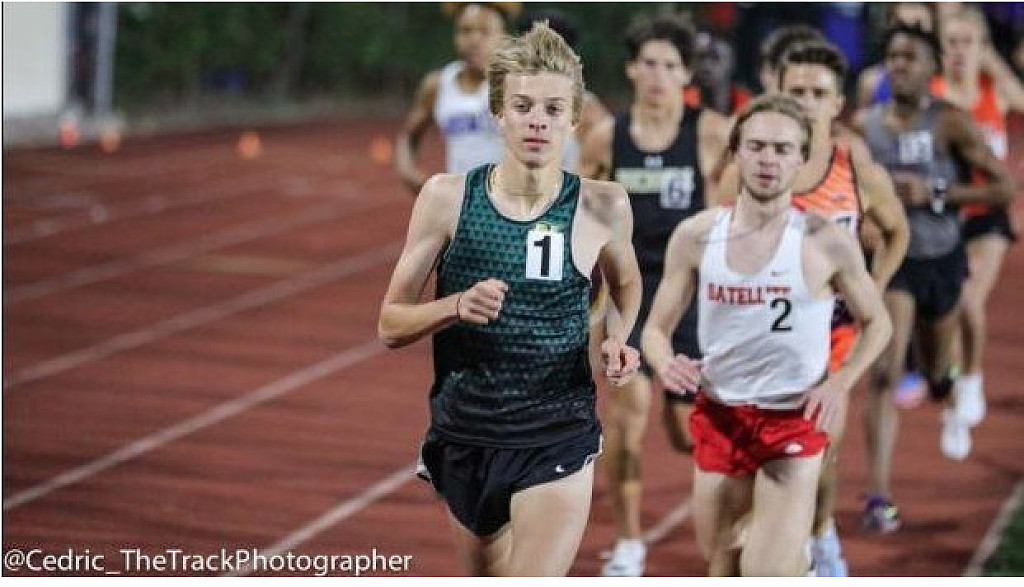
16-Year-Old Rheinhardt Harrison Runs 4:01.34 At Music City Distance Carnival
Rheinhardt Harrison's kick is no secret.
Over the past few seasons in Florida and beyond, the Nease (FL) High School student-athlete has built a strong tradition on finishing hard across a variety of distances.
But on Saturday night in Nashville, Tennessee, the 16-year-old athlete took that strength to a new level, accomplishing an incredible milestone as he scored a new sophomore class record in the full mile with an official time of 4:01.34 at the Music City Distance Carnival at Lipscomb Academy.
Harrison's full performance, which saw a 57.35 second last lap, surpassed Edward Cheserek's former mark of 4:03.29, which was last accomplished in 2011. The mark also landed a new 16-year-old age group record, passing Nathan Green's mark of 4:06.20, which the current Borah High School senior accomplished in 2019.
As this track meet was held on the back end of the 2020 track and field season, Harrison's mark still goes down as a sophomore class record, even though he's within days of beginning his junior high school season.
The performance was in part derived from the field around Harrison, as five men broke four minutes in the mile, including winner Kieren Tuntivate, a Harvard graduate who set a new Thailand national record with a time of 3:57.87.
Harrison was in eighth after the first lap before making his way down to sixth overall, netting a new Florida state record. The time is a current US No. 2 effort.
Of note, particularly, is Harrison's progression from his last race in June, when the Floridian ran 4:09.79 for the full mile at the Desert Dream Last Hurrah Invitational.
But perhaps training has begun to fully kick into gear under Tom Schwartz, the coach of the Tinman Elite professional group in Boulder, Colorado. Schwartz has long coached talented young distance runners, though in recent weeks he's formed a junior group, the Tinman Junior Elite, of which Harrison is a part of.
The Nease athlete was one of a handful of athletes under that junior training group competing on Saturday.
She came agonizingly close.
But few would argue the Moses Brown (RI) School freshman, who is just 15 years old, didn't continue to impress, lowering her personal record under 2:03 as she finished fifth overall in a professional field in a time of 2:02.97.
Biding her time over the first lap, the Rhode Islander ran 60-flat before following in a rather remarkable 62-second quarter, hitting her last 200m in 31 seconds.
While Gorriaran didn't surpass the rather outrageous freshman and 15-year-old age group records, she once again lowered her US No. 1 and re-set her own Rhode Island state record in the process.
Kipyego posts a sub-1:50: Finding himself in Heat 2 of the men's 800m, Darius Kipyego was on a mission.
But while the St. Raphael Academy (RI) junior didn't break 1:48, he did claim another sub-1:50 performance, netting a time of 1:49.98, which secured his second performance under that barrier this season.
Kipyego is now one of just two athletes -- John Lester being the other -- to have run under 1:50 twice over the 2020 season. Kipyego, however, accomplished that feat in two legitimate races, while Lester secured his second performance in a time trial.
Judson Greer goes sub-14:30 in The 5K: Melissa's Judson Greer was aiming for a special performance in the 5K on Saturday.
And the Texan certainly accomplished that feat, posting a US No. 3 time of 14:28.70 in a men's professional field.
Only Nico Young -- who ran 13:50.55 in June, which was the No. 4 fastest performance in high school history -- and Matthew Farrell (14:25.23) ran faster in 2020. Greer's performance will go down as No. 44 all-time for the distance and the No. 1 junior performance of the year.
Greer, like Harrison, is coached by Tom Schwartz of Tinman Elite. Jack Scherer, a high school junior from Oshkosh North in Wisconsin, went 14:45.88.
by Mile Split
Login to leave a comment

Tick Check: A Guide for Running in Tick Country
Growing up, my dad wouldn’t let us bring our shoes inside during the spring and summer. It wasn’t because of how terrible they smelled, but rather because they had hitchhikers lurking! I grew up in Northern Wisconsin, as the daughter of two physicians, and in a hot bed for a variety of ticks. Along with shoes that never came in the house, “tick checks” were not just lyrics in a country song, they were a real thing.
For much of my life, ticks have been a problem in certain areas of North America, Europe, and Asia. Because of their regional geographic limitations, ticks were a vector for diseases that many did not have to worry about. However, as the climate warms, not only does tick population control in their traditional regions become increasingly difficult but they are also finding new habitats to thrive in.

What do we know about these creepy crawlies, what should we be on the lookout for, and what should you do for your own health and safety when running in tick country?
Tiny Vector, Big Problem
What’s a vector? A vector is an organism that can transmit a disease or parasite from one animal or plant to another. Along with ticks, other biting insects such as mosquitoes are excellent vectors. Not all ticks are actively carrying infectious pathogens that they can pass onto you, but when they are, they are capable of causing a wide range of viral and bacterial diseases.
Most ticks belong to one of two families, Ixodidae the hard ticks or Argasidae the soft ticks. Of the 950-plus species of ticks found throughout the world, only about 60 species are known to bite and transmit diseases to humans (1).

That brings up an interesting point. If only 60 species are disease-spreading vectors in humans, then what else do they do and are they good for something? They seem to have two important roles for the ecosystem more broadly. First, they are an important food source for reptiles, amphibians, and bird. And second, through being a disease vector in animals like deer, rabbits, and mice, they help control wildlife populations (9). Ticks can also be used as an ecosystem indicator, meaning that researchers monitor tick populations and their predators to get a sense of the general health and wellbeing of the ecosystem from a diversity perspective.
For the purpose of this article–and knowing that that this shouldn’t take more than one cup of coffee to read–let’s focus on the few most common types of ticks and the specific diseases they carry. In North American those are the blacklegged tick (also known as the deer tick), the lone star tick, and the American dog tick (also known as a wood tick) (3). Ticks are not a uniquely North American problem. The European relative to the blacklegged tick is the castor bean tick (sometimes called the sheep tick). Similar to the blacklegged tick, the castor bean tick is the leading cause of Lyme disease in Europe. In Asia, the longhorned tick is known to carry similar strains of bacteria found in blacklegged and lone star ticks (4). Ah, creepy crawlies!
Where Do These Critters Live?
I grew up in one of the hot beds for ticks in the Upper Midwest of the U.S., but over the past 30 years the real estate for ticks has grown exponentially. A warming climate has made winter survival and migratory animal hosts more plentiful, allowing ticks to travel into previously tick-void regions, and we as humans overlap more and more in the spaces (natural grass and woodlands) where those animals and their hitchhikers reside (5).
What that means is that tick populations are now fairly widespread, particularly over the U.S.’s Northeast, Midwest, South, and throughout the Rocky Mountains. There is a growing tick population (of western blacklegged ticks) in the Pacific Northwest. Curiously enough, one of their main and preferred hosts, is the western fence lizard which carries a specific protein in their blood that neutralizes the bacteria that is responsible for Lyme disease. Essentially, after feeding on this lizard, the tick becomes “cured” of its Lyme disease and so cannot spread it when it meets its next host. So cool!
How Do Ticks Spread Disease?
Most species of ticks live on a two to three-year life cycle that passes through four distinct life stages: egg, larva, nymph–baby ticks, how cute!–and adult. Even at the larva stage, ticks must have a blood meal in order to survive. Although ticks cannot fly or jump, they can detect a potential host by smell, body heat, moisture, vibrations, and even shadows (3). Once on a host, ticks transmit pathogens–generally bacteria–through the process of feeding. Depending on the tick, feeding can last as little as 10 minutes and as much as two hours, after this blood meal–maybe the creepiest thing I have ever typed–the tick will drop off the host to prepare for its next life stage where it will then transmit any acquired disease to its new host. When a tick bites you, it may secrete saliva that has an anesthetic property, numbing you to its presence. Unfortunately that saliva may also contain any pathogen the tick is infected with that it then transmits to you.
The most common tick-borne diseases in the U.S. are Lyme disease, ehrilichiosis, Rocky Mountain spotted fever, tick-borne relapsing fever, and babesiosis. In Europe, the castor bean tick is responsible for two tick-borne diseases, Lyme disease and tick-borne encephalitis (TBE) (7). TBE is a viral infection that affects the central nervous system, encephalitis means inflammation of the brain, and can be fatal if left untreated. In Asia (and Russia), the taiga tick is known to be a vector for TBE. Finally, the most common tick-borne diseases in Asia (carried by the longhorned tick) include Lyme disease, TBE, Crimean-Congo hemorrhagic fever, and a disease known as severe fever with thrombocytopenia syndrome (8).
If left untreated, Lyme disease seems to include a long list of varying secondary symptoms and conditions such as cardiac problems (Lyme carditis), arthritis, severe joint swelling, and facial paralysis or weakness on one side of face. Interestingly, and not a common trait among tick bites, is that some people bitten by the lone star tick will develop an allergy to red meat called Alpha-gal syndrome (6). Most of these tick-borne diseases (aside from babesiosis which is a parasitic infection and requires treatment with antiparasitic drugs and TBE which is a viral infection and has no effective treatment but does have a vaccine in countries where it is endemic) can be treated with a course of antibiotics. Several different antibiotics are effective but deciding the right antibiotic for you (that takes into account your age, gender, other medical conditions, allergies, sun exposure, and more) is an important decision for your physician and care team.
How to Protect Yourself From Hitchhiking Ticks
So, should you never leave your house again? That’s definitely not my suggestion, but there are some things you can do to limit your risk of being bitten by one of these little guys and what to do in case it does happen.
Know Before You Go. Find out what kind of ticks are prevalent in the area in which you will be running. Know that they love tall grass, bushes, and overhanging foliage as a way to meet their new host, so use care to avoid these areas when possible.
Cover Up. Although not always easy when running, consider clothing garments that make identifying ticks easier and that serve as a protective barrier from your skin. This includes tall socks, long sleeves, and light-colored gear.
Add Repellent. If you are running or racing in a high-tick environment, use a tick repellent on your skin and clothing (containing about 20% DEET). Consider pre-treating your clothes with the repellent permethrin for an extended backpacking or camping trip in tick country.
Do a Tick Check. Once inside after your run, examine your gear, pets (ticks love dogs!), and clothing for any hitchhikers. Leave your shoes outside and tumble dry your clothes in the dryer on high for 10 minutes to kill any ticks that have made the journey onto them. Shower as soon as you can to help remove unattached ticks. Finally, perform a standard tick check in high-risk areas such as under the arms, in and around the ears, on the backs of the knees, throughout your scalp and hairline, between your legs, and around your waist.
But What If It’s Attached? If you find a tick that has managed to burrow, you want to remove it, in its entirety, as soon as possible. Using fine-tipped tweezers, pinch the tick as closely to your skin as you can and pull upward with steady pressure. Next, clean the bite area with soap and water. Dispose of the tick by flushing it down the toilet, or you can put it in a jar of rubbing alcohol (my dad’s favorite method). Watch for symptoms of tick-borne disease for the next 30 days, and contact your primary-care provider if you experience a rash, fever, headache, muscle pain, fatigue, or joint pain and swelling.
by I Run Far
Login to leave a comment
Francesca Muccini, the 2017 Vol State champion, is back on top after winning the run across Tennessee Vol State 500K crown in 82 hours
The Last Annual Vol State 500K ultramarathon across Tennessee began on July 9, and only three days later, the race saw its first two finishers cross the finish line in Castle Rock, Ga. First place went to Francesca Muccini, the 2017 Vol State champion, who finished the race in three days, 10 hours, 49 minutes and 40 seconds.
This is a women’s course record and the third-fastest time ever run at the event, regardless of gender. Second place went to Bob Hearn, who wasn’t far behind Muccini, finishing in three days and 12 hours.
The Vol State is a Laz Lake event. Lake organizes many ultra races, including the Barkley Marathons, and they’re all mind-blowing. They’re long, they’re hard and they would make non-runners (and runners who prefer to stick to races that don’t go past 42.2K) shake their heads and ask, “How long did you say it was?” The Vol State fits that bill perfectly, and it’s exactly what ultrarunners around the world have come to expect from Lake. Its 500K course starts in Missouri, takes runners into Kentucky and then crosses over into Tennessee, where participants stay for the bulk of the race. In the final stretch, runners head into Alabama and then Georgia, where the race ends.
Runners have 10 days to finish the race, meaning they have to cover at least 50K per day if they want to make it to Georgia in time. There are no aid stations or volunteers along the course, but runners have the option of racing with a support crew (although some racers choose to run unsupported).
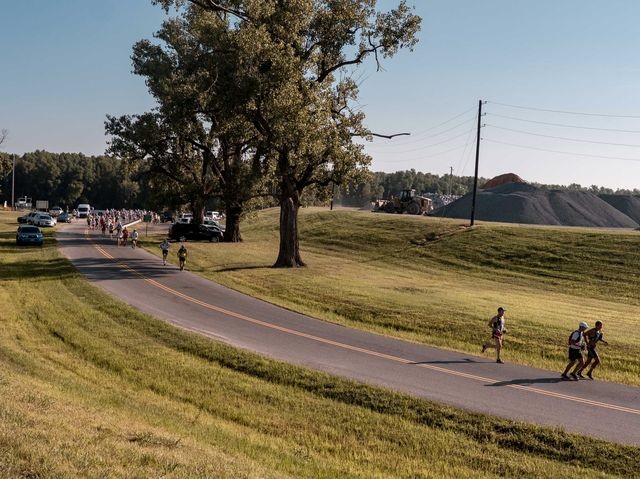
The fact that runners are given 10 days to finish this event and Muccini and Hearn did it in just over three is ridiculous. That means they averaged more than 140K per day as they worked across Tennessee. When Muccini won the race in 2017, she finished with a time of four days and four hours. She also raced the event in 2016, placing eighth overall and crossing the line as the top woman in a little more than five days.
This was Hearn’s first crack at the Vol State, but he’s no stranger to big results either. Earlier this year, he won a 100-mile race in South Carolina, and in 2019, he finished in second place at the Six Days in the Dome event in Wisconsin, where he ran 530 miles in less than a week.
The runners still working away at the Vol State course have more than five days to make it across Tennessee, into Alabama and then into Georgia to finish the race.
by Ben Snider-McGrath
Login to leave a comment

Pac-12 follows Big Ten in moving to conference-only schedule for fall sports
A day after the Big Ten announced it would play a conference-only schedule in all sports this fall, the Pac-12 voted to do the same Friday during a virtual meeting of athletics directors, university presidents and conference officials.
The Pac-12 CEO group's decision will delay the start of fall seasons, including football.
One of the reasons the Pac-12 decided to push back the start of the football season was a concern that UCLA and USC would not be ready to play in early September because of coronavirus cases in the Los Angeles area, sources told ESPN.
The Bruins were slated to open the season against New Mexico State at home on Aug. 29; the Trojans were scheduled to open against Alabama at AT&T Stadium in Arlington, Texas, on Sept. 5.
"USC AD Mike Bohn and I had multiple conversations over the last several months, and we were both planning on playing the football game on September 5 in Arlington," Alabama athletic director Greg Byrne said in a statement. "With the Pac-12's decision to move to a conference-only schedule, we will do our best to adjust. What that looks like is to be determined."
The Pac-12's decision to play only conference games means Notre Dame will not face USC for the first time since World War II. The Irish and Trojans have played each other every season since 1926 except for 1943-45 because of the war. Notre Dame will also lose its rivalry game against Stanford, which has been played every year since 1988, except for 1995 and 1996. Because of the Big Ten's decision, Notre Dame's contest against Wisconsin at Lambeau Field in Green Bay also won't be played.
The move also creates scheduling dilemmas for BYU and Hawai'i, which will both have to find new opponents for each of their first four games. As it stands now, neither school has a game scheduled until the first weekend in October. BYU was scheduled to play Utah, Michigan State, Arizona State and Minnesota the first four weeks and Stanford in the regular-season finale, and Hawai'i was slated to play Arizona, UCLA, Fordham (the Patriot League banned flying for the upcoming season) and Oregon.
"Obviously with three Pac-12 teams on our football schedule, today's decision affects us more than others," Hawai'i AD David Matlin said in a statement. "We are disappointed because not only were we looking forward to opening the season at Arizona, we were excited to host UCLA for the first time in over 80 years and renew a series with Oregon. However the decision was made in the best interest of student-athlete health and wellness and we support that and will move on accordingly with the rest of our schedule."
Colorado State, UNLV, Utah State and FCS program Portland State were all scheduled to play two games each against Pac-12 foes.
The decision also included men's and women's soccer, and women's volleyball, and the league said it was delaying the start of mandatory athletic activities "until a series of health and safety indicators, which have recently trended in a negative direction, provided sufficient positive data to enable a move to a second phase of return-to-play activities."
"The health and safety of our student-athletes and all those connected to Pac-12 sports continues to be our number one priority," Pac-12 commissioner Larry Scott said in a statement. "Our decisions have and will be guided by science and data, and based upon the trends and indicators over the past days, it has become clear that we need to provide ourselves with maximum flexibility to schedule, and to delay any movement to the next phase of return-to-play activities."
The Pac-12 announced later Friday that Scott had tested positive for the coronavirus.
The league said student-athletes who choose not to participate in intercollegiate athletics during the coming academic year because of safety concerns about COVID-19 will continue to have their scholarships honored by their university and will remain in good standing with their team.
"Competitive sports are an integral part of the educational experience for our student-athletes, and we will do everything that we can to support them in achieving their dreams while at the same time ensuring that their health and safety is at the forefront," said Michael Schill, the Pac-12 CEO group chair and president of the University of Oregon.
Officials from the ACC, Big 12 and SEC told ESPN on Friday that they probably will wait until the end of July to make a decision on scheduling for football this fall amid the coronavirus pandemic, if the season can be played. SEC athletic directors are scheduled to meet at the league's office in Birmingham, Alabama, on Monday. ACC officials also are scheduled to meet next week.
Login to leave a comment
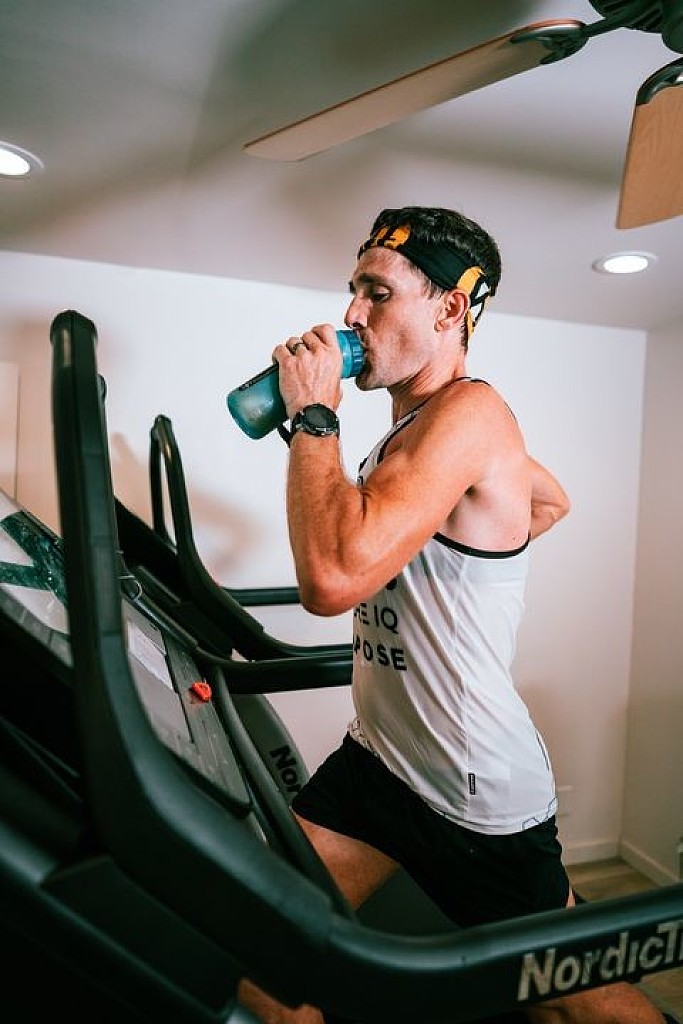
Inside Zach Bitter’s 100-Mile Treadmill World Record
For many runners, running for even 10 minutes on a treadmill feels like torture. But on Saturday, May 16, Zach Bitter spent 12 hours, nine minutes, and 15 seconds on a treadmill. That’s how long the 33-year-old ultrarunner needed to break the 100-mile treadmill world record, averaging a 7:18 per mile pace.
Bitter is no stranger to the distance or that speed. Back in August, he captured the 100-mile world record on an indoor track in Wisconsin, finishing in 11:19:13—nearly an hour faster than he did on Saturday—with an average pace of 6:48.
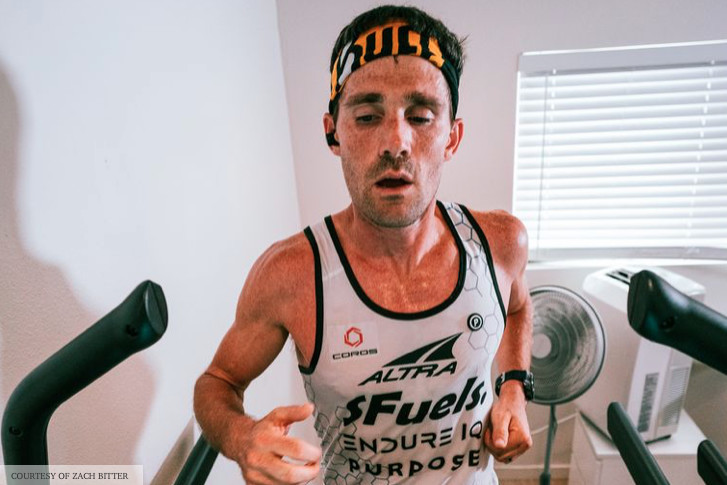
However, though the distances were the same, the approach and execution were completely different this time around.
“The biggest thing was that I needed mental refreshers,” Bitter told Runner’s World. “On the track, I felt anxious if I stopped, like I was wasting time. On the treadmill, it was almost necessary to break, even if I was just switching treadmills.”
Bitter, who had two NordicTrack X22i Incline Trainers treadmills set up in his home for the event, didn’t do many test runs ahead of the event. He did know that the machines would time out after a few hours, so he switched between the two. Also, that gave him a safety net in case one malfunctioned.
He and his wife Nicole, who served as a one-woman crew for him, only ran into two issues. Because they were running the two treadmills, two camera setups, a fan, and an air conditioner in the room, they underestimated how much power was needed.
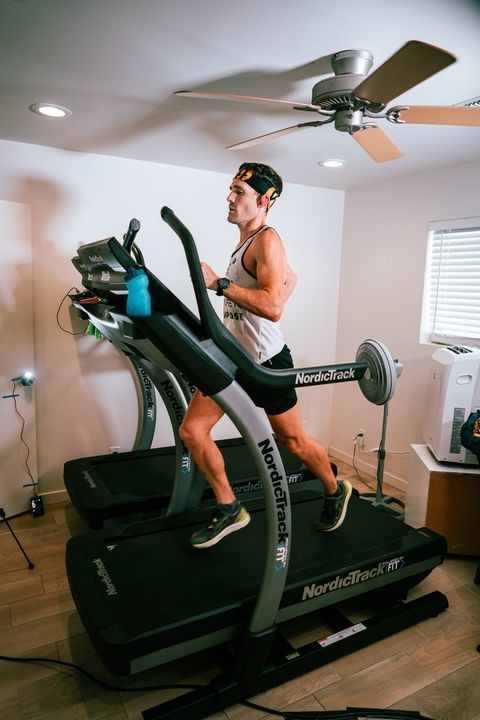
As a result, one of the treadmill’s screens went dark while Bitter was running. The treadmill was still running and counting, but they had to run an extension chord through the house to ease up the power output in the room. Another time, the treadmill briefly stopped counting. Luckily, they noticed and solved the problem.
“We had about four weeks to plan,” he said. “There was plenty of potential for things to go wrong, but luckily, nothing major really happened.”
Overcoming that mental hurdle added an unexpected challenge early on, but a major concern came in the form of under-fueling.
Bitter planned a fueling strategy similar to his strategy during his 100-mile track run last August. But he ran into some problems—the temperature at the indoor track was 60 degrees, a comfortable atmosphere for any run. Despite numerous attempts to mimic that in Bitter’s home with fans and air conditioning, his Phoenix home was more like 70 to 75 degrees throughout the run.
To his surprise, the additional heat wasn’t likely from outside.
“I was talking to Geoff Burns [an ultrarunner and doctoral student in biomechanics] afterward, and he said the one thing I didn’t consider was heat coming from the treadmills,” Bitter said. “Also, since I’m stationary, I’m just swallowing all of my own body heat, because instead of moving like on a track, I’m a little warmer in just a bubble. It was amazing how cool it was even five feet away from it.”
The additional heat meant Bitter was feeling dehydrated in the first couple of hours. Bitter tries to consume only liquid calories when he runs, relying almost entirely on S-Fuel Race+ hydration mix. He was forced to spend the next few hours playing catch-up, consuming electrolyte tabs and boosting his fluid intake to as much as 60 ounces in an hour.
A few hours later, his stomach felt like it was operating normally again.
The early issues were draining, but Bitter still had hours to go on the treadmill. To entertain himself, he would play around with the treadmill paces, typically shooting just above or just below seven-minute pace.
“I just try to keep my mind off the treadmill and the distance,” he said. “If you think too much, you can bite off too much of a chunk at once. It helped to go into a mile at one pace and then switch to another so I could worry about getting through that mile. As the day got longer, I shifted to three or four difference paces within a single mile. Those benchmarks helped me inch closer.”
He also filled his time listening to podcasts, music, and tuning into the live stream to listen to guests like Dean Karnazes, Jamil Coury, and Tim Tollefson talk about his attempt and running in general.
One surprise for fans was the appearance of comedian Bert Kreischer, who Bitter met a few years ago when he appeared on the Joe Rogan podcast for the first time. Kreischer ended up staying on the stream for a couple hours after a seven-mile treadmill run of his own. He spent a lot of time chatting with Courtney Dauwalter, Maggie Guterl, and Sally McRae. All four, along with Bitter’s wife, Nicole, even talked about potentially training Kreischer for a 100-miler himself. It’s still unknown if this will happen, but the trio of female ultrarunners did agree to train him if he did.
“Bert has said he wants to do an ultra,” Bitter said. “He thought about 50 miles in 24 hours on a treadmill. He’s definitely intrigued. I think he’ll do a 50K or 50-miler before he jumps to 100.”
Even with the distractions, the time on the treadmill wore on Bitter. At mile 87, he disappeared into the bathroom for two minutes to eat a lunch-box size bag of Boulder Canyon olive oil and sea salt potato chips.
“I just needed a break from being moved by the machine,” he said. “That was the only solid food I ate during it. In the end, I went through 12 packets of S-Fuel, the potato chips, and eight ounces of soda.”
After earning his second 100-mile world record in nine months, Biller, who stayed ahead of the world-record pace the entire day, he did a couple interviews. When that was finally done, he enjoyed two pounds of ground beef topped with melted cheese and sea salt, and a bag of pork grinds before calling it a day.
“Anything salty and savory,” he said.
A few days after, Bitter is feeling a little better. He isn’t planning to do a long run on the treadmill anytime soon, but due to the Phoenix heat, he will likely be back on it soon for some tempo runs.
by Runner’s World
Login to leave a comment
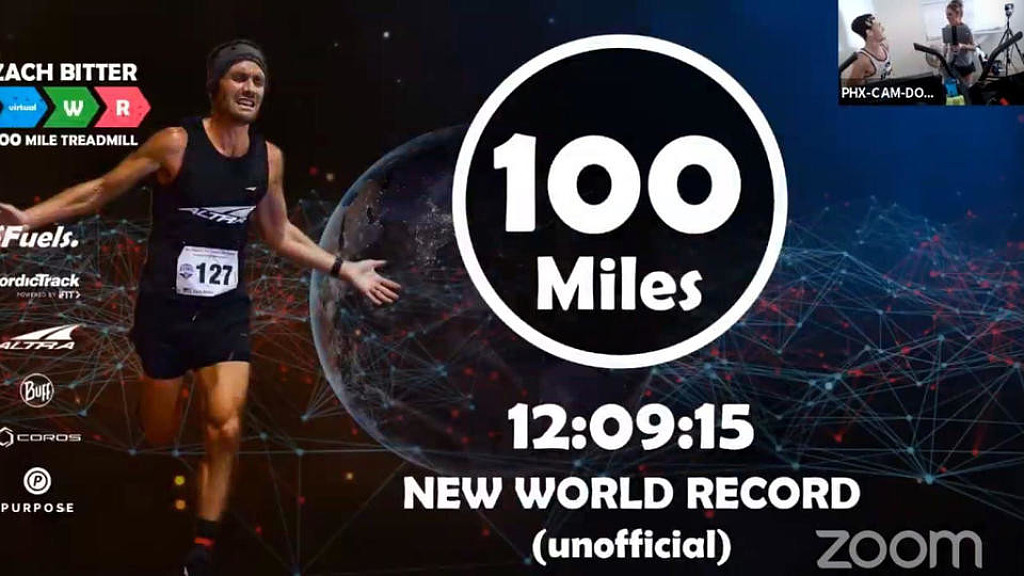
American ultra runner Zach Bitter breaks 100-mile treadmill world record clockin 12:09:15
American ultra runner Zach Bitter spent all day Saturday on the treadmill, starting at 6:30 a.m. PST and running until just after 6:30 p.m.
He ran for 100 miles (160.9K) and set the new treadmill world record for the distance with a time of 12:09:15. He bettered Canadian Dave Proctor‘s previous record (set at last year’s Calgary Marathon expo) of 12:32:26 by over 20 minutes. Bitter averaged an incredible 4:32 per kilometer over 12 hours and 100 miles of running.
Bitter’s average pace of 4:32 per kilometer would have given him a 3:11 marathon, which is a good time on its own, but he ran almost four marathons in a row on Saturday. The run was streamed live on YouTube, and different ultra runners and endurance athletes Zoomed in to chat as Bitter chipped away at his 100-mile trek.
Some of those big names included 2019 Ultra-Trail du Mont-Blanc winner Courtney Dauwalter, Aravaipa Running’s Jamil Coury, Quarantine Backyard Ultra champion Mike Wardian and Proctor himself, who knows exactly what it takes to break the 100-mile treadmill record.
Bitter is already the world record-holder in the 100-mile run, which he set last August at an indoor track in Wisconsin in a time of 11:19:13. He is also the owner of the 100-mile trail record from the 2018 Tunnel Hill trail race in Illinois, where he ran 12:08:36.
Now, he has officially added the treadmill record to his resume. With these three records to his name, it’s fair to say that Bitter is in the conversation for greatest 100-mile runner of all time, if not the outright winner of that title.
Bitter has been running ultra marathons for a decade now, and he’s got plenty of big race wins and results to his name.
He was 11th at the 2018 Western States 100, he took 32nd place at the 2016 Comrades Marathon and sixth at the International Association of Ultra runners 100K world championships in 2014. In 2019, he won three races, including the San Diego 100-miler in California.
by Ben Snider-McGrath
Login to leave a comment
Pregnant mom Meliessa Kegler runs her own marathon
After COVID-19 forced the cancellation of the Milwaukee Marathon, Meliessa Kegler created her own course and ran 26.2 miles, while 19 weeks pregnant.
A countless number of events have been cancelled due to COVID-19, including the Milwaukee Marathon this past weekend.
That didn’t stop 38-year-old Meliessa Kegler of Janesville, Wisconsin. She was determined to run the 26.2 miles even at 19 weeks pregnant.
“I mean, it’s weird. I mean any woman will tell you, pregnancy makes everything weird,” Kegler said with a laugh. “When I originally signed up for the marathon, I guess I was pregnant but I didn’t know, which probably wouldn’t have stopped me.”
She’s been training for months and when the race was canceled, she decided design her own course around Janesville. Kegler mapped out a 6.5 mile loop that she ran four times.
“A marathon is all mental. There is training that goes into it but that last 26.2 miles is just a celebration of what you’ve been through to get to that point,” she says.
by Tim Elliott
Login to leave a comment
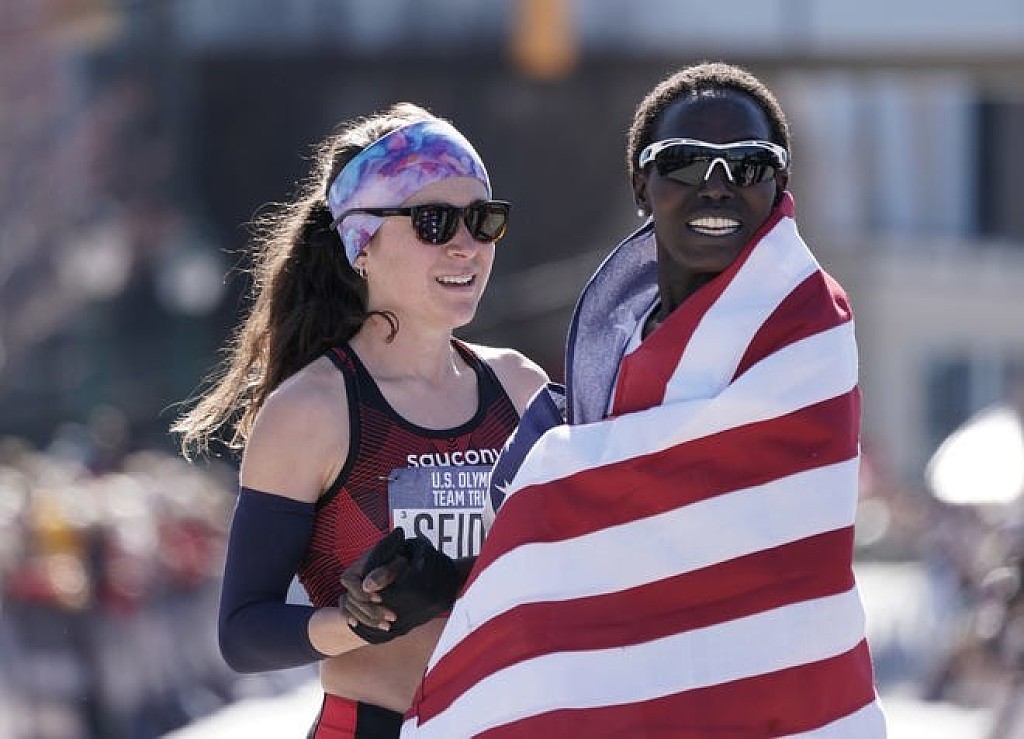
Boston resident Molly Seidel qualified for the Olympic marathon but she’s worried about what happens now
The trials was one of the best days of my life, Seidel said. “To potentially have that taken away is very stressful."
When Molly Seidel reflects on the day she qualified for the 2020 Summer Olympics, she’s reminded of a seemingly distant reality.
“Just thinking back to the huge number of crowds that were there and the hugs after the race,” recalled Seidel in a telephone interview Tuesday afternoon. “Hell, just sitting down at a restaurant afterward. We all went out to a bar that night, too, and shared drinks at the bar. It’s a completely different world than the one we’re in now.”
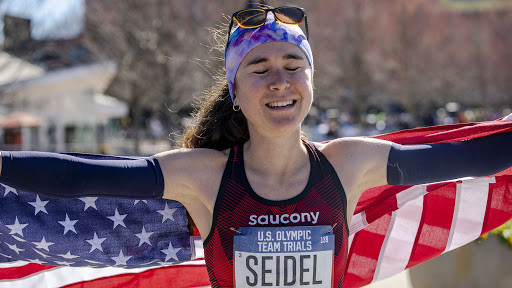
Less than a month ago, Seidel placed second in the US Olympic marathon trials to punch her ticket to Tokyo. The 25-year-old Boston resident finished the race, her first-ever marathon, with a time of 2:27:31, just eight seconds behind Aliphine Tuliamuk.
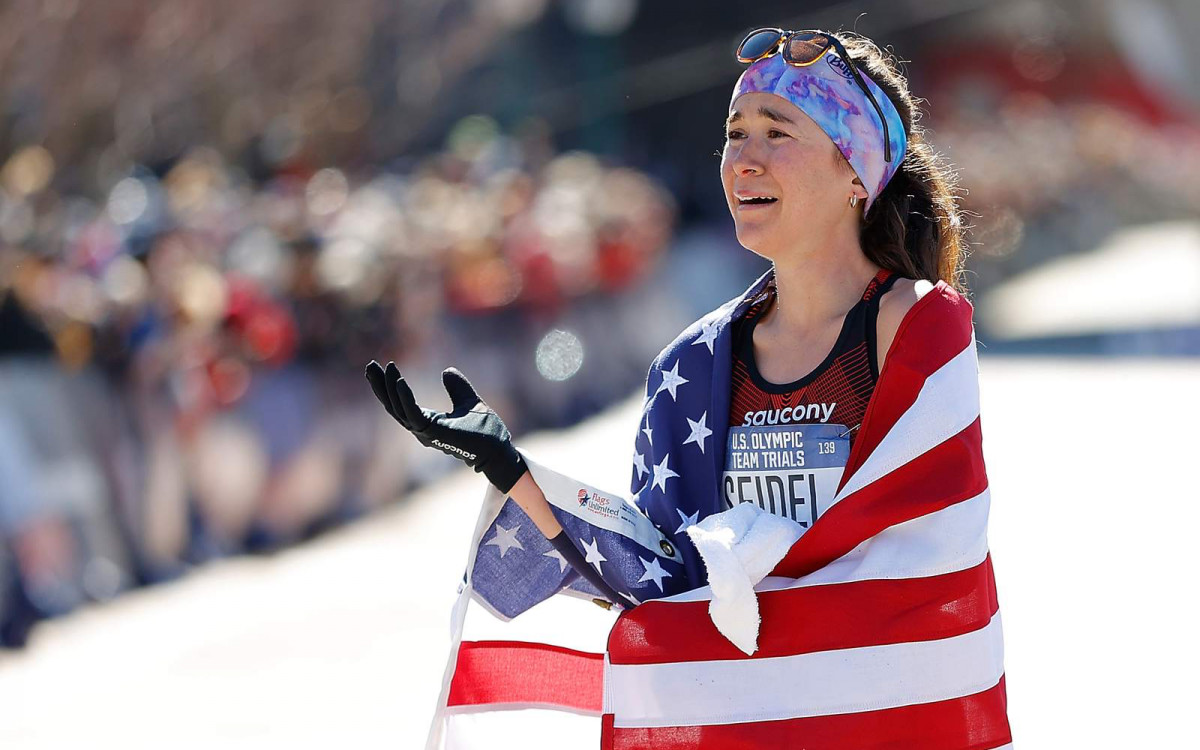
As the threat of the coronavirus escalated rapidly, and the list of postponed or canceled sporting events grew, Seidel started to consider the possibility more and more. Could the Olympics really go on as scheduled?
She wasn’t shocked when the postponement became official Tuesday.
“I just don’t think there is any way we could be planning for an Olympics four months from now, especially when the country is going through such a difficult time and the world is going through such a difficult time,” said Seidel. “It would have put a lot of athletes and spectators and just the general public in a lot of danger.”
While Seidel agrees with the International Olympic Committee’s decision, she is certainly disappointed. She’s also incredibly frustrated. The US Olympic & Paralympic Committee, Seidel says, has not been forthcoming with updates. The lack of communication leaves her worried about her status.
There has been some chatter about whether runners should have to re-qualify, given the extended period of time between the marathon trials, which took place Feb. 29, and the rescheduled Games, which do not yet have new dates.
Seidel is hopeful that won’t be the case.
“The trials was one of the best days of my life,” she said. “To potentially have that taken away is very stressful. I’m hoping that they honor the Olympic trials and keep their current marathon team, but we haven’t heard anything from USOC, USATF, from anybody. It’s been difficult getting the information that we need.”
Fellow marathoner Des Linden, who placed fourth in the trials, doesn’t foresee a re-qualification. Linden recently called Seidel to express her support.
“I haven’t heard anything from governing bodies, and I would imagine that they’re not even entertaining that idea,” Linden said. “I think it’s just kind of interesting talk right now, particularly with so much time on our hands.”
Amid the uncertainty, Seidel is still training. She frequently runs on the Esplanade and will soon ramp up her mileage after recovering from the trials. Her coach, who lives locally, is encouraging her to make the best of the extra year, especially considering the fact she’s participated in only one marathon.
Should road races resume this fall, Seidel is looking forward to gaining more experience at the distance.
In her free time, Seidel enjoys binging “Gilmore Girls,” reading, and practicing her banjo and ukulele. She no longer has a job or a roommate, as Tatte cut most of its staff amid the coronavirus outbreak and her sister moved back to their home state of Wisconsin for the time being. But Seidel’s doing her best to make due.
“It was so weird coming off that huge emotional high at the trials,” she said. “Now, it’s just like, ‘OK, back to quarantine.’”
by Nicole Yang
Login to leave a comment
Tokyo 2020 Olympic Games
Fifty-six years after having organized the Olympic Games, the Japanese capital will be hosting a Summer edition for the second time, originally scheduled from July 24 to August 9, 2020, the games were postponed due to coronavirus outbreak, the postponed Tokyo Olympics will be held from July 23 to August 8 in 2021, according to the International Olympic Committee decision. ...
more...
Nico Young will begin his final high school track and field season and will be going after the 3000m indoor record
The Newbury Park (CA) High School senior and Northern Arizona University signee will go after the American U20 indoor 3,000 meter record of 7:56.31, which was last set by Chris Derrick -- while he was with Stanford in 2009 -- at the Millrose Games on February 8 in New York City.
If accomplished, Young, 17, would also surpass Drew Hunter's national high school 3K record of 7:59.33 for the distance. Hunter accomplished that feat in 2016, becoming the only high school athlete to ever go under 8 minutes indoors -- only two athletes have done it across both seasons; German Fernandez owns the outdoor 3K record in 7:59.83.
But here's the twist.
Young, running unattached, will be entered in the professional field. As per National Federation of High School State Associations (NFHS) rules, Young will be able to race against pros and collegians -- and not lose his remaining CIF eligibility -- based upon the fact that Millrose does not offer a high school race at the distance.
A year ago, all but one runner in the 12-person field broke 8-minutes, with Stanford's Grant Fisher leaning past Wisconsin's Morgan McDonald at the line to win in 7:42.62.
Young has raced once since cross country, putting down a 1,500m performance (outdoors) of 3:52.39 at the Arcadia Winter Championships qualifier on Jan. 25.
And he's still relatively fresh since coming off a record performance at Nike Cross Nationals, where he broke the 5K meet record at Glendoveer and ran a winning time of 14:52.30.
While Young has just one indoor performances overall -- he was eighth in the boys mile at the New Balance Grand Prix in 2019 -- those around him remain confident he will excel in the field. Young's head coach, Sean Brosnan, said Young will not seek out a fast mile in 2020, with focus instead placed on 3,000 and 5,000 meter races.
Meaning: While Young could run fast 1,600 meter and mile races in 2020, his objective will not be on going under 4 minutes for the distance as a high school senior.
In recent years, there have been five sub-8:10 efforts since 2010, including performances from Hunter, Edward Cheserek (2x) and Lukas Verzbicas (2x) -- national cross country champions in high school.
Young ran 8:13.31 for 3K in February of last year at the Rossi Relays. He remains in fitness and has been eyeing several records attempts to begin 2020.
by Cory Mull
Login to leave a comment
NYRR Millrose Games
The Pinnacle of Indoor Track & Field The NYRR Millrose Games, first held in 1908, remains the premier indoor track and field competition in the United States. The 2025 edition will once again bring the world’s top professional, collegiate, and high school athletes to New York City for a day of thrilling competition. Hosted at the New Balance Track &...
more...