

Running News Daily
Running News Daily is edited by Bob Anderson and team. Send your news items to bob@mybestruns.com Advertising opportunities available.
Index to Daily Posts · Sign Up For Updates · Run The World Feed
Articles tagged #Silesia Diamond League
Today's Running News



Ethan Strand’s Stunning Silesia Surge: “I Had Enough Left”
Ethan Strand delivered one of the most impressive finishes of the Silesia Diamond League meeting, producing a spectacular final lap to storm to victory in the men’s 1500m in a season-best 3:30.77.
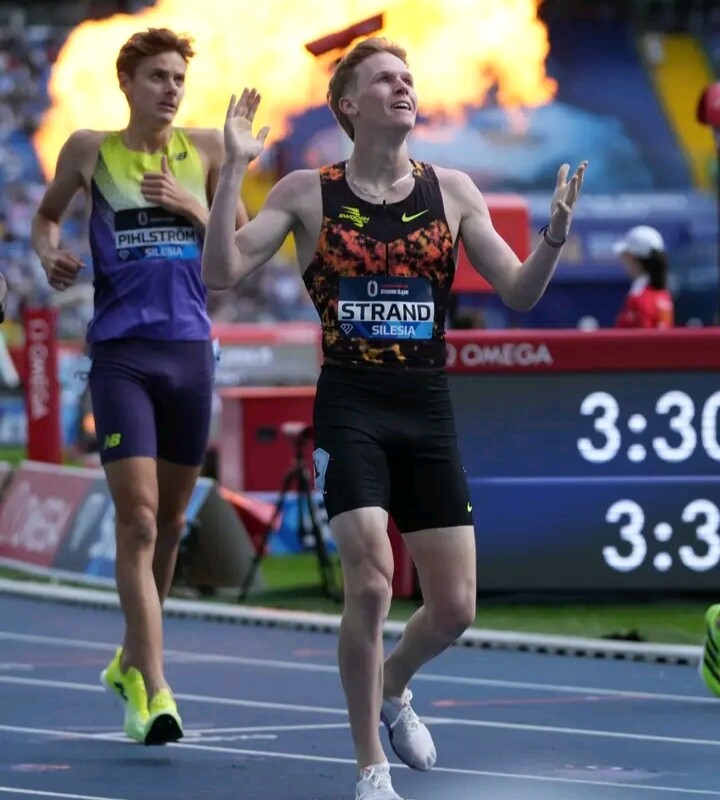
The American’s triumph was not simply about speed—it was a carefully executed comeback built on patience, belief and a powerful reserve of energy saved for the closing stages.
Strand admitted afterwards that he had found himself well back in the field during the race, but remained confident that he had enough left to make his move.
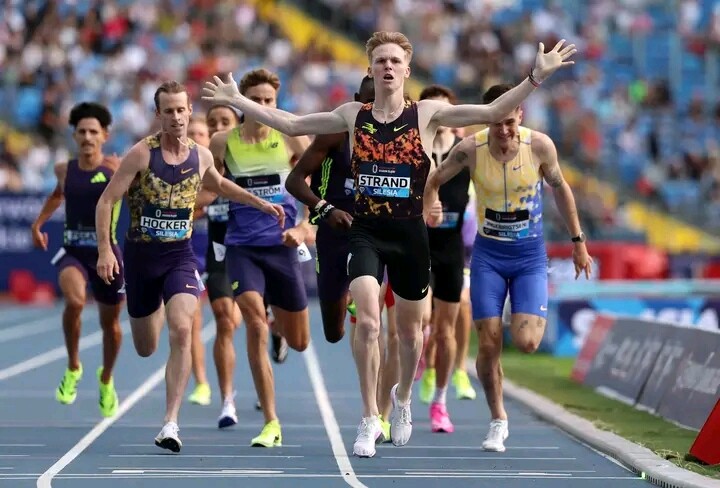
“I was pretty far back and had a lot left, and I had to do a lot of work up through the third lap, and I had enough left,” Strand said after his winning performance.
That reserve proved decisive.
As the race entered its final lap, Strand began to close the gap with increasing urgency. He continued to pick off his rivals before unleashing his biggest acceleration down the home straight, powering away from the chasing pack and crossing the line in style.
His emphatic celebration reflected the significance of the performance—a season's best time and a major victory over a field packed with elite 1500m talent.
Phanuel Koech produced a superb performance of his own to finish second in 3:31.14, narrowly holding off reigning Olympic champion Cole Hocker, who crossed the line third in 3:31.16.
Just behind them was Norwegian superstar Jakob Ingebrigtsen, who made his first 1500m appearance since Tokyo last September. Ingebrigtsen clocked 3:31.19 to finish fourth in a race where less than half a second separated the top four athletes.
The result made Strand the man of the moment in Silesia. While others battled for position throughout the race, the American trusted his strength, stayed composed despite being deep in the field and unleashed his decisive move when it mattered most.
His victory was a powerful reminder that a race can change dramatically in its final 400 metres. Strand may have been “pretty far back,” but he knew he had something left—and when the moment arrived, he produced exactly the kind of finishing speed required to defeat an Olympic champion and some of the world's finest middle-distance runners.
From being buried in the pack to flying down the home straight, Ethan Strand turned patience into victory—and finished the night with a celebration that said it all.
3:30.77. Season’s best. Silesia champion.
by Erick Cheruiyot for My Best Runs.
Login to leave a comment

Shericka Jackson’s Lausanne Return Ends in Heartbreak as Injury Clouds Silesia Showdown
Shericka Jackson’s long-awaited return to the 200 metres ended in heartbreaking fashion on Friday night at the Wanda Diamond League meeting in Lausanne, where the Jamaican sprint star was forced to pull up and did not finish after appearing to suffer an injury.

Jackson had made a promising start and was among the leading contenders as the race unfolded at the Stade Olympique de la Pontaise. But shortly after coming off the bend, the two-time world 200m champion suddenly pulled up, lost her balance and crashed to the track, bringing her comeback race to an abrupt and painful end.

The incident immediately raised concerns for one of the most accomplished sprinters of her generation, particularly after Jackson had already acknowledged uncertainty over her fitness in the lead-up to the Lausanne meeting.
Her withdrawal now casts serious doubt over her scheduled appearance in the women’s 100m at the Silesia Diamond League on Saturday, August 23. Jackson had been set to line up in one of the most eagerly anticipated sprint races of the meeting, alongside fellow Jamaican Elaine Thompson-Herah, Sha’Carri Richardson, Julien Alfred and Melissa Jefferson-Wooden.
Whether Jackson will be fit enough to take her place remains unclear, but Friday’s setback was another difficult moment in what has been an emotionally challenging period for the Jamaican star.
Recently, Jackson revealed that she had not been “ok” as she continues to cope with the loss of her longtime coach and MVP Track Club technical director, Stephen “Franno” Francis. His death has clearly left a profound impact on an athlete who enjoyed some of the greatest successes of her career under his guidance.
Friday’s injury scare added another layer of heartbreak to that difficult journey. For now, the athletics world will be hoping that the setback is not as serious as it first appeared and that Jackson can recover fully.
One of the sport’s biggest stars has already overcome enormous challenges throughout her career. The hope now is that this latest setback will be only a temporary interruption—and that Shericka Jackson will soon be back where she belongs, competing at the very highest level.
by Erick Cheruiyot for My Best Runs.
Login to leave a comment

Jakob Ingebrigtsen Returns To Silesia: Can The Norwegian Reclaim The 1500m Throne?
Silesia has become a special chapter in Jakob Ingebrigtsen’s remarkable career, and on August 23, the Norwegian middle-distance superstar will return to the Diamond League with a question hanging over his comeback: can he return to the top of the 1500m?
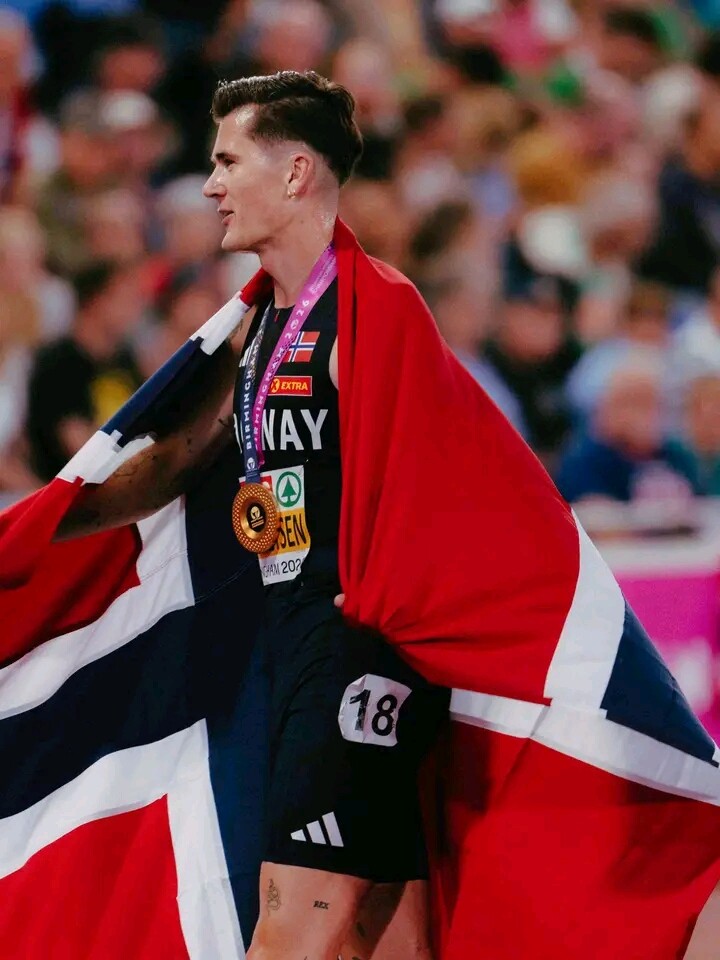
Ingebrigtsen is set to race his first 1500m since the 2025 World Athletics Championships, making his appearance at the Silesia Diamond League one of the most anticipated moments of the meeting.
The Norwegian’s return comes after a fascinating two-year stretch filled with major victories, record-breaking performances and unexpected setbacks.

Since the 2024 Paris Olympics, Ingebrigtsen has experienced almost every side of elite middle-distance running. At the Paris Games, he finished fourth in the 1500m, narrowly missing the podium before quickly responding with a victory in the Diamond League Final later that year.
He then began 2025 in spectacular fashion, breaking the indoor mile world record before going on to claim the world indoor title in the 3000m.
However, his outdoor campaign brought a different challenge. At the 2025 World Championships, Ingebrigtsen failed to advance from the 1500m heats, bringing an unexpected early end to his campaign in the event.
Now, nearly a year later, the 25-year-old is ready to return to the distance that has defined so much of his career.
And Silesia could hardly be a more fitting place for his comeback.
The last time Ingebrigtsen raced at the Polish venue, he produced a performance for the history books. He stormed to 7:17.55 in the 3000m, destroying the 28-year-old world record and once again demonstrating his extraordinary ability to combine speed with endurance.
This time, however, the focus shifts back to the 1500m.
The race will offer Ingebrigtsen an opportunity to measure himself against the world’s best after an extended absence from the event. His tactical instincts, finishing speed and ability to handle a fast pace will all come under the spotlight.
For a runner who has spent years setting the standard in the 1500m, this is more than simply another Diamond League appearance. It is a chance to begin writing the next chapter.
Can Jakob Ingebrigtsen return to the top?
Silesia will provide the stage. August 23 will provide the answer.
by Erick Cheruiyot for My Best Runs.
Login to leave a comment
Ingebrigtsen vs Hocker: Silesia Set for a Blockbuster 1500m Showdown
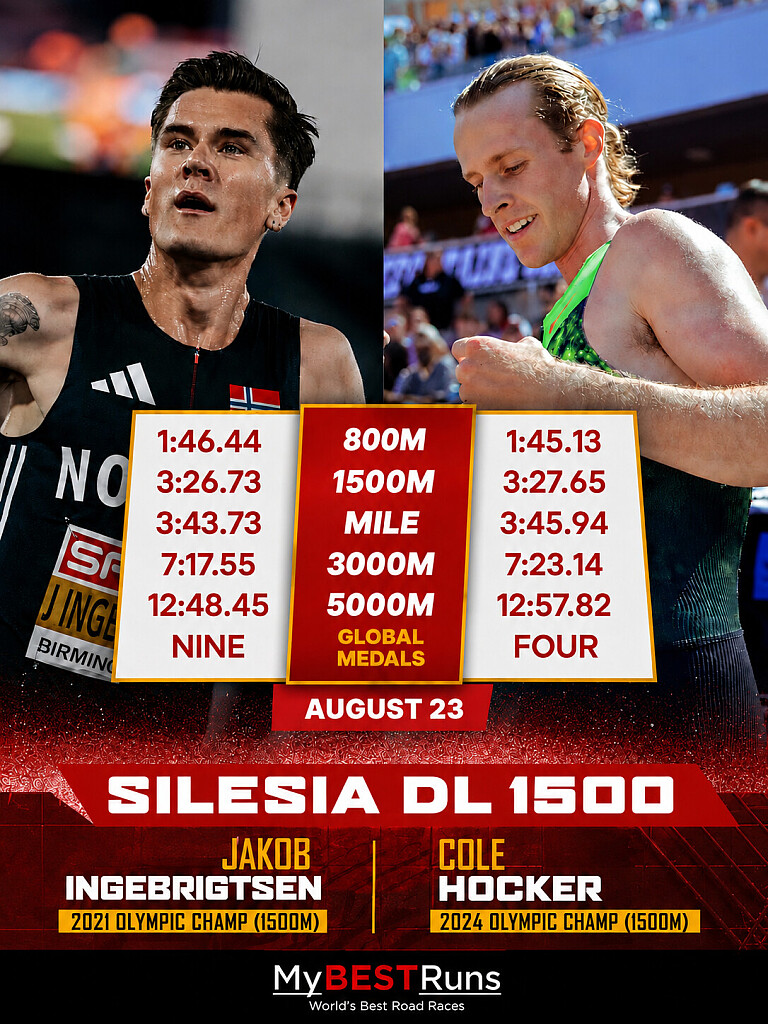
A mouthwatering 1500m showdown is brewing at the Silesia Diamond League on August 23, with two of the biggest names in middle-distance running set to go head-to-head.
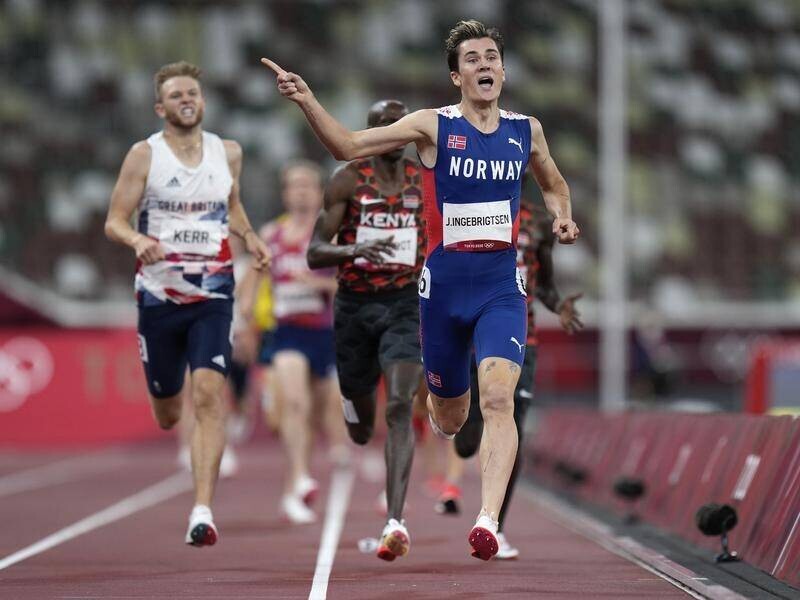
Norway’s Jakob Ingebrigtsen is set to make his return to the Wanda Diamond League in Silesia, where he will face Cole Hocker, the reigning Olympic 1500m champion. The meeting will bring together two athletes who have already shared one of the most memorable 1500m battles of recent years.
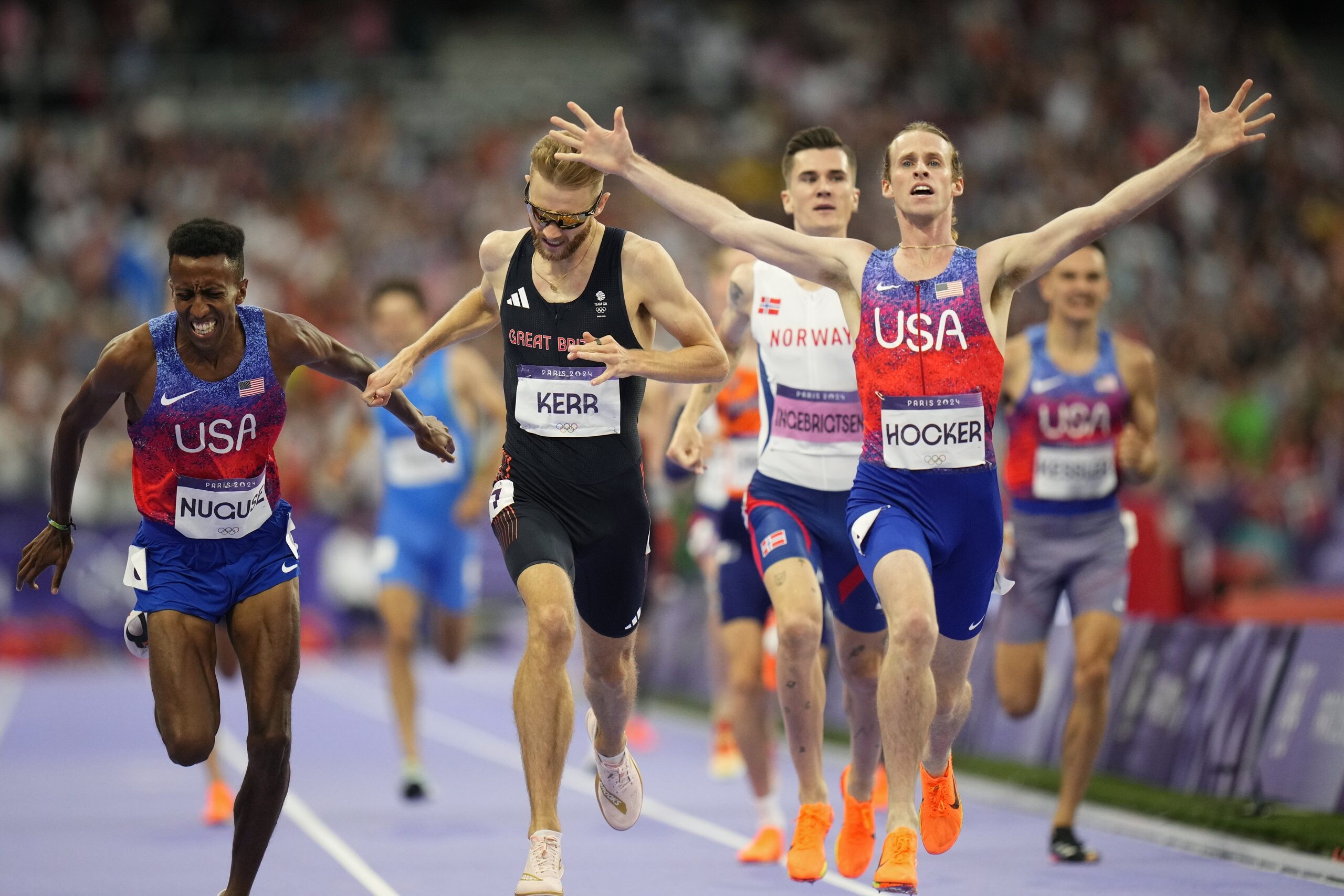
At the Paris 2024 Olympic Games, Hocker produced a sensational finish to take the gold medal in an Olympic-record 3:27.65, while Ingebrigtsen finished fourth in 3:28.24.
More than two years later, the two stars are preparing to meet again, adding another intriguing chapter to their rivalry.
For Ingebrigtsen, the Silesia race will come shortly after his long-awaited return to competition following an injury layoff. The Norwegian made his comeback in impressive fashion at the 2026 European Athletics Championships in Birmingham, successfully defending his European 5000m title.
Ingebrigtsen clocked 13:15.29 to win the 5000m, immediately reminding the athletics world of his extraordinary championship pedigree and competitive instincts after his extended absence.
Hocker, meanwhile, arrives in Silesia as one of the most formidable 1500m runners in the world. His Olympic triumph in Paris established him as the reigning Olympic champion, while his 3:27.65 personal best ranks him among the fastest athletes ever over the distance.
Ingebrigtsen and Hocker bring remarkable credentials to the Silesia showdown. Hocker enters the race as the reigning Olympic 1500m champion with a personal best of 3:27.65, while Ingebrigtsen owns an even faster lifetime best of 3:26.73 and a long list of Olympic and European championship honours. With both athletes capable of producing extraordinary speed over the final stages, the Silesia meeting could deliver another memorable chapter in their growing rivalry.
The Norwegian will also be looking to sharpen his 1500m form after beginning his comeback over 5000m, while Hocker will have the confidence that comes with being the reigning Olympic champion.
That combination makes the Silesia clash particularly compelling. Will Ingebrigtsen's strength and proven championship experience prevail, or can Hocker once again produce the decisive finishing speed that delivered Olympic gold?
One thing is certain: Silesia is set for a 1500m battle that distance-running fans will not want to miss.
Jakob Ingebrigtsen vs Cole Hocker. August 23. The stage is set.
by Erick Cheruiyot for My Best Runs.
Login to leave a comment

Lilian Odira Set for Rabat Diamond League Return as Global Spotlight Intensifies
Kenya’s middle-distance sensation Lilian Odira is set to light up the track once again after confirming her participation at the prestigious Rabat Diamond League on May 31 in Rabat.
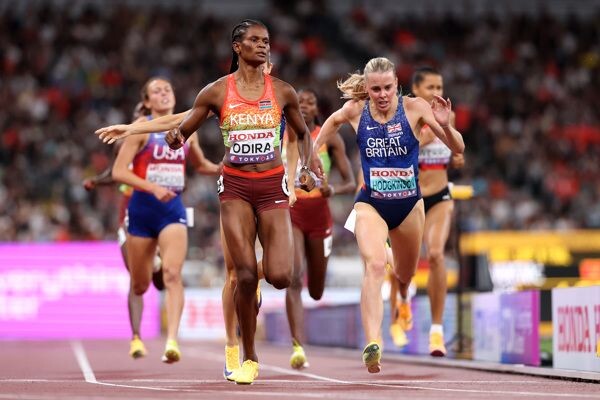
The reigning world 800m champion heads into the Moroccan showdown carrying growing momentum and the confidence of an athlete rapidly establishing herself among the elite names in global middle-distance running. Rabat will mark Odira’s second-ever appearance on the Diamond League stage, another major step in what has become one of the most exciting breakthroughs in world athletics.
Her first taste of Diamond League competition came at the Silesia Diamond League, where she delivered a remarkable performance against a world-class field. Odira stormed to a brilliant second-place finish in 1:56.52, announcing herself on the international stage with authority, composure, and fearless racing instincts.
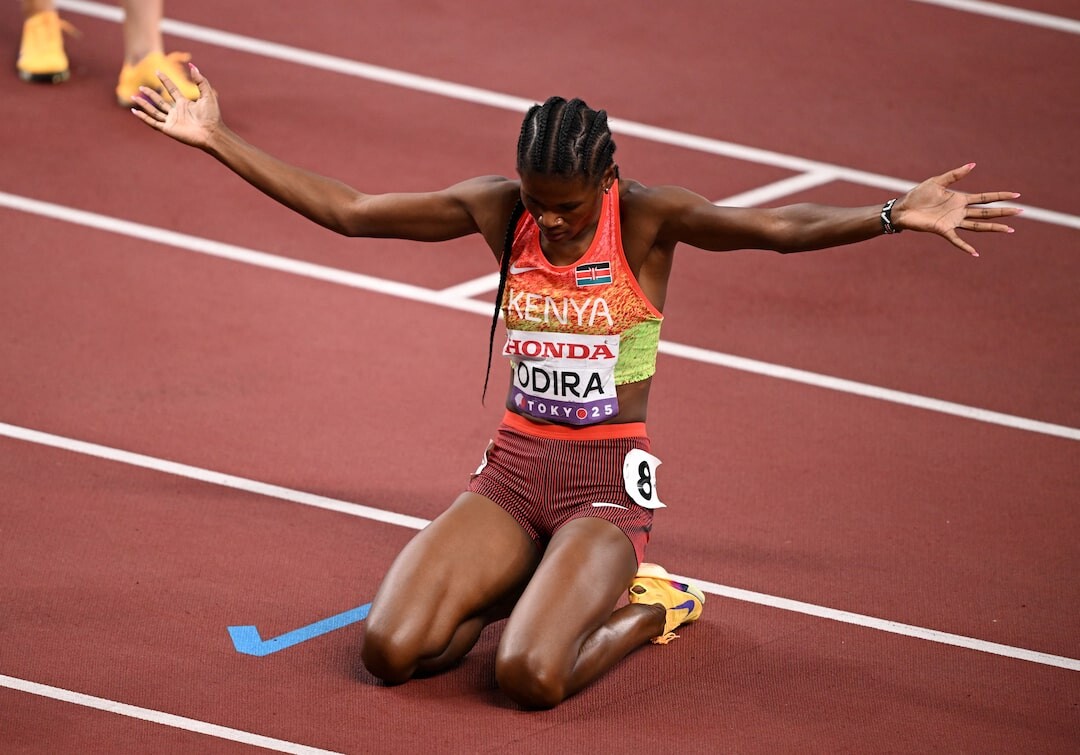
Only British star Keely Hodgkinson finished ahead of her that day, with Hodgkinson producing a commanding 1:54.74 victory. Yet Odira’s performance earned widespread attention across the athletics world, proving she possesses both the tactical intelligence and finishing power required to challenge the sport’s very best.
Now, anticipation continues to build ahead of Rabat, where another high-caliber field is expected to assemble under the lights in Morocco. With the women’s 800m entering a thrilling new era filled with emerging stars and fierce rivalries, Odira’s presence adds even greater excitement to one of the season’s most anticipated meetings.
Athletics fans around the world will be watching closely to see whether the Kenyan champion can produce another statement performance on the Diamond League circuit. At a time when the global women’s 800m is reaching extraordinary levels of depth and speed, Lilian Odira is no longer simply a rising talent — she is becoming one of the defining names of the event.
by Erick Cheruiyot for My Best Runs.
Login to leave a comment

Jakob Ingebrigtsen Returns to Altitude Training in St. Moritz Following Injury and Personal Turmoil
Olympic champion Jakob Ingebrigtsen is heading back to the mountains of St. Moritz to resume altitude training after a difficult first half of the 2025 season marked by injury and family challenges. The 23-year-old Norwegian has been recovering from a strained Achilles tendon that derailed his early outdoor campaign and forced him to miss several key meets.
Recovery First

Ingebrigtsen initially planned to train at altitude in Sierra Nevada in the spring, but his Achilles issue required a change of course. He instead remained home to focus on recovery, missing high-profile events in Oslo, Ostrava, the Pre Classic, and the London Diamond League.

In a recent update shared on social media, Jakob acknowledged the long road back but said he was grateful for the time spent with his young daughter and dogs. “At least I had the best company,” he wrote, sharing photos from a forest outing. His message suggests a turning point in his recovery, both physically and emotionally.
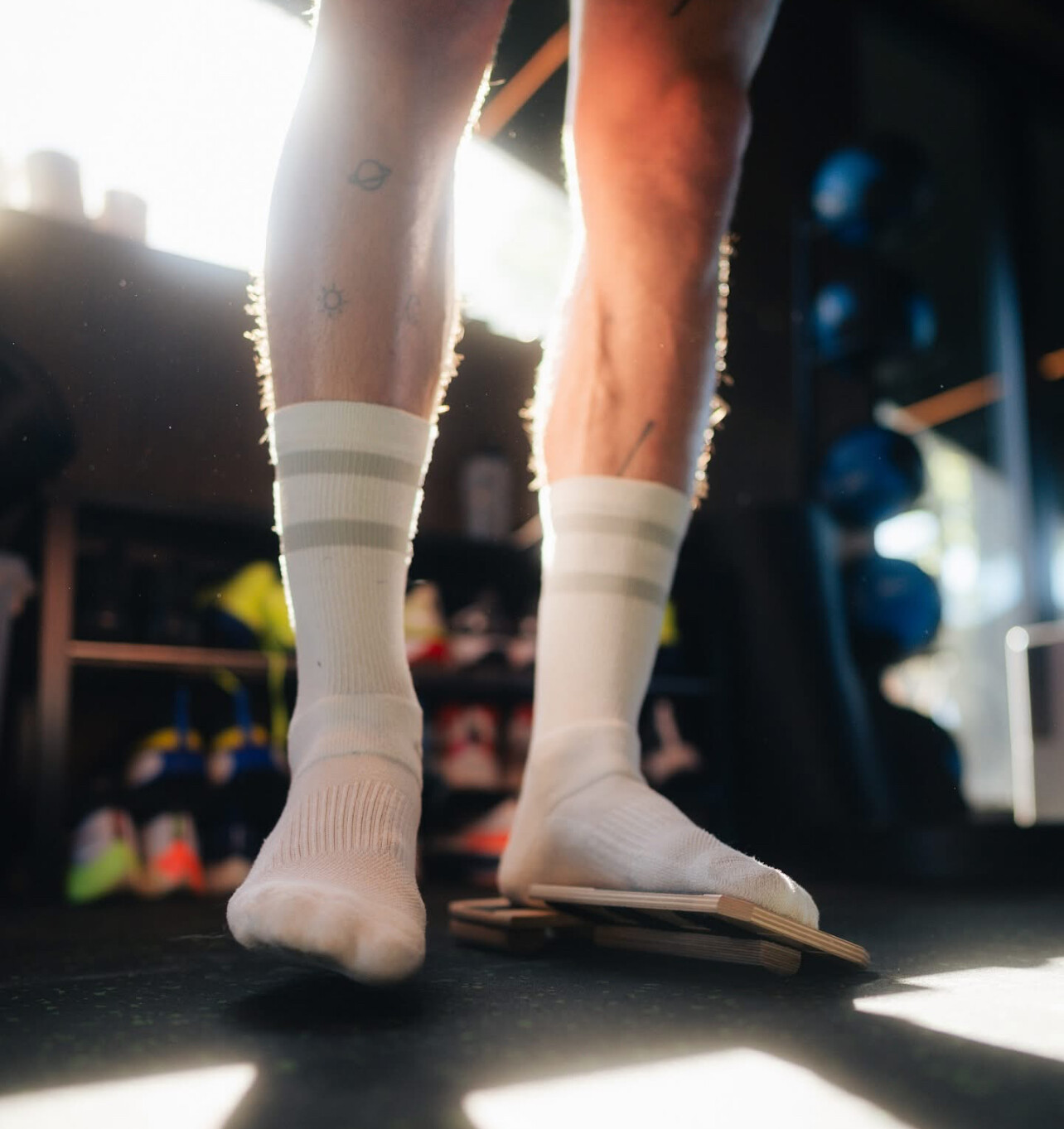
Altitude Training in St. Moritz
Coach Filip Ingebrigtsen has confirmed that Jakob will now join Norway’s altitude group in St. Moritz for a three- to four-week training block. The plan is to carefully build back fitness without rushing into competition. If all goes well, Jakob could return to racing in mid-August, with the Silesia Diamond League meeting in Poland emerging as a likely target.

While his return has been delayed, confidence remains high. Ingebrigtsen’s indoor season earlier this year was exceptional—he broke the world indoor records for both the 1500m and mile. In June, shortly before his Achilles flare-up, he set a new European 1500m record of 3:27.95 and clocked 7:54.10 in the two-mile, a world best.

Personal Challenges and Legal Closure
In the midst of his recovery, Ingebrigtsen also had to navigate a difficult legal chapter. On June 23, his father, Gjert Ingebrigtsen, was convicted of minor assault against Jakob’s younger sister, Ingrid, for an incident involving a wet towel. Gjert received a 15-day suspended sentence and was ordered to pay damages. He was acquitted of similar charges involving Jakob due to lack of evidence.

The verdict marks a formal conclusion to a painful and public family dispute that first came to light in late 2023. With this chapter behind him, Jakob appears ready to shift focus fully back to his training and racing.
Looking Ahead
Jakob Ingebrigtsen’s approach to 2025 has been cautious but strategic. Rather than forcing an early comeback, he’s prioritized recovery, stability, and preparation. If his return to St. Moritz goes as planned, fans can expect to see him back on the track in top form later this summer—potentially just in time to contend for another global title.

by Boris Baron
Login to leave a comment

Newly-crowned world record holder in four-hour police interrogation over feud with his father
The Olympics champion, who set a new world record at the weekend, had to endure a long grilling exercise by Norwegian authorities in a case where his father is accused of abuse.
Newly-crowned world 3,000m record holder Jakob Ingebrigtsen was interrogated by police in Norway over a case where his father Gjert Ingebrigtsen has been accused of mistreating his children.

Jakob Ingebrigtsen was grilled for four hours in Stavanger on Wednesday, his lawyer Mette Yvonne Larsen, saying it was in relation to the case of violence against a family member involving his father that took place between 2018 and 2022.
"There has been follow-up of his previous interrogations and timing of events. It has gone very smoothly,” Larsen told Norwegian media.

"Are there plans for new interrogations? Since he has now been in three long interrogations, and that there will be a subsequent reading of these, I do not think it will be relevant to re-examine him.”
When Gjert Ingebrigtsen was charged with mistreatment of one of his children, the police dropped the cases against several of the other children but the decision was overturned following an appeal by Jakob Ingebrigtsen.
The hearings would be postponed until August after the athlete sought ample time to rest and prepare for the Paris 2024 Olympics in July.
He went on to win gold in the 5,000m, after a disappointing fourth place finish in the 1,500m, and announced his intentions of finishing the season strongly by lowering the 3,000m world record at the Silesia Diamond League in Poland last weekend.
The 23-year-old smashed the 3,000m world record of 7:20.67 set by Kenya’s Daniel Komen in 1996, setting a new mark of 7:17.55, in the Polish city.
Gjert Ingebrigtsen, the father and former coach of Jakob Ingebrigtsen, was charged with one count of physical abuse against a family member by Norwegian authorities.
In October 2023, brothers Henrik, Filip and Jakob Ingebrigtsen came forward with claims of physical violence and abusive behavior by their father and former coach, who has denied all the allegations.
by Joel Omotto
Login to leave a comment

Out of this world!
Jakob Ingebrigtsen obliterates the 3000m world record at the Memoriał Kamili Skolimowskiej with 7:17.55.
He goes more than 3 seconds faster than the previous world record!
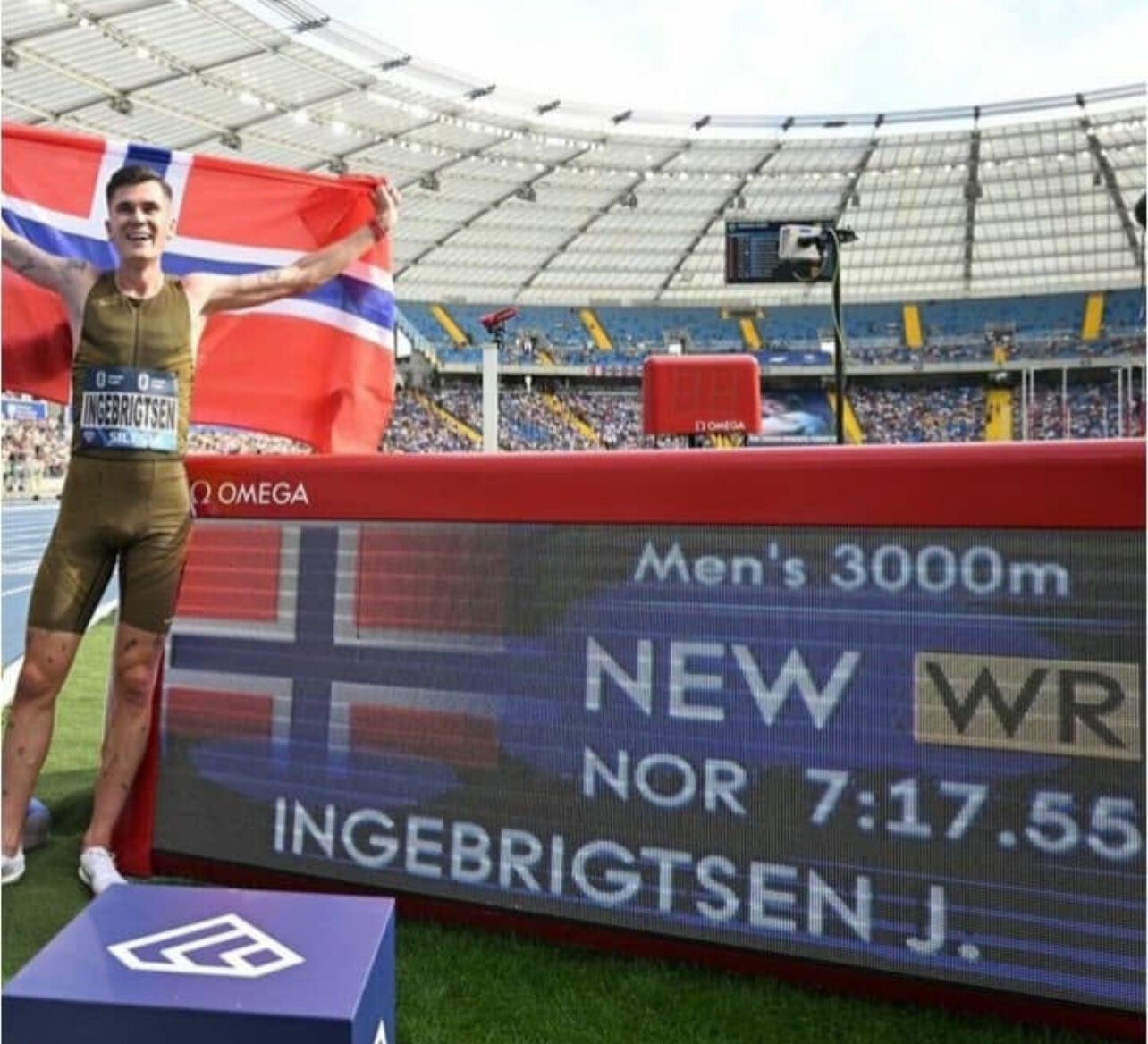
Norway’s Jakob Ingebrigtsen shattered the world 3000m record in the Silesia Diamond League on Sunday (25) afternoon with 7:17.55 to become the first athlete in history to break the 7:20-barrier for the seven-and-a-half lap distance.
The Olympic 5000m champion slashed more than three seconds off the previous mark of 7:20.67 which had stood to Kenya’s Daniel Komen since 1996, the longest standing world record in an individual men’s track event.
But the 23-year-old Norwegian took the record into uncharted territory, churning out the last two laps in 57.46 and 55.47 respectively - 1:52.93 for the last 800 metres - to break away from Ethiopia’s Berihu Aregawi and take a significant chunk of 3.12 seconds off Komen’s enduring record.
“It feels special, amazing. I was hoping to challenge the world record here but based on my training, I can never predict exactly what kind of time I am capable of. I would not have imagined I could run 7:17, though,” said Ingebrigtsen.
. “I would not have imagined I could run 7:17, though. At the beginning the pace felt really fast, but then I started to feel my way into the race and found a good rhythm.
“[The] 3,000 is a tough distance,” continued Ingebrigtsen. “After four-five laps you feel the lactic acid, but you need to get going. The conditions were difficult with the heat today, but it is the same for everyone. Now I want to challenge world records at all distances, but it is one step at a time.”
He finished ahead of a trio of Ethiopians, with the Paris Olympics 10,000m silver medallist, Berihu Aregawi. second in a personal best and the third-fastest time in history (7:21.28). Yomif Kejelcha was third.
Three days ago, the Norwegian had exacted a small measure of revenge over the American Cole Hocker by winning the men’s 1500m in Lausanne in 3:27.83, two weeks after Hocker shocked the Olympic field to win gold in Paris.
He won $50,000 for setting the record.
Login to leave a comment
The Pill That Over Half the Distance Medallists Used at the 2023 Worlds
What's the deal with sodium bicarbonate?What if there was a pill, new to the market this year, that was used by more than half of the distance medalists at the 2023 World Athletics Championships? A supplement so in-demand that there was a reported black market for it in Budapest, runners buying from other runners who did not advance past the preliminary round — even though the main ingredient can be found in any kitchen?
How did this pill become so popular? Well, there are rumors that Jakob Ingebrigtsen has been taking it for years — rumors that Ingebrigtsen’s camp and the manufacturers of the pill will neither confirm nor deny.


So about this pill…does it work? Does it actually boost athletic performance? Ask a sports scientist, someone who’s studied it for more than a decade, and they’ll tell you yes.
“There’s probably four or five legal, natural supplements, if you will, that seem to have withstood the test of time in terms of the research literature and [this pill] is one of those,” says Jason Siegler, Director of Human Performance in the College of Health Solutions at Arizona State University.
But there’s a drawback to this pill. It could…well, let’s allow Luis Grijalva, who used it before finishing 4th in the World Championship 5,000m final in Budapest, to explain.
“I heard stories if you do it wrong, you chew it, you kind of shit your brains out,” Grijalva says. “And I was a little bit scared.”
The research supports that, too.
“[Gastrointestinal distress] has by far and away been the biggest hurdle for this supplement,” Siegler says.Okay, enough with the faux intrigue. If you’ve read the subtitle of this article, you know the pill we are talking about is sodium bicarbonate. Specifically, the Maurten Bicarb System, which has been available to the public since February and which has been used by some of the top teams in endurance sports: cycling juggernaut Team Jumbo-Visma and, in running, the On Athletics Club and NN Running Team. (Maurten has sponsorship or partnership agreements with all three).Some of the planet’s fastest runners have used the Maurten Bicarb System in 2023, including 10,000m world champion Joshua Cheptegei, 800m silver medalist Keely Hodgkinson, and 800m silver medalist Emmanuel Wanyonyi. Faith Kipyegon used it before winning the gold medal in the 1500m final in Budapest — but did not use it before her win in the 5,000m final or before any of her world records in the 1500m, mile, and 5,000m.
Herman Reuterswärd, Maurten’s head of communications, declined to share a full client list with LetsRun but claims two-thirds of all medalists from the 800 through 10,000 meters (excluding the steeplechase) used the product at the 2023 Worlds.
After years of trial and error, Maurten believes it has solved the GI issue, but those who have used their product have reported other side effects. Neil Gourley used sodium bicarbonate before almost every race in 2023, and while he had a great season — British champion, personal bests in the 1500 and mile — his head ached after races in a way it never had before. When Joe Klecker tried it at The TEN in March, he felt nauseous and light-headed — but still ran a personal best of 27:07.57. In an episode of the Coffee Club podcast, Klecker’s OAC teammate George Beamish, who finished 5th at Worlds in the steeplechase and used the product in a few races this year, said he felt delusional, dehydrated, and spent after using it before a workout this summer.
“It was the worst I’d felt in a workout [all] year, easily,” Beamish said.
Not every athlete who has used the Maurten Bicarb System has felt side effects. But the sport as a whole is still figuring out what to do about sodium bicarbonate.
Many athletes — even those who don’t have sponsorship arrangements with Maurten — have added it to their routines. But Jumbo-Visma’s top cyclist, Jonas Vingegaard — winner of the last two Tours de France — does not use it. Neither does OAC’s top runner, Yared Nuguse, who tried it a few times in practice but did not use it before any of his four American record races in 2023.“I’m very low-maintenance and I think my body’s the same,” Nuguse says. “So when I tried to do that, it was kind of like, Whoa, what is this? My whole body felt weird and I was just like, I either did this wrong or this is not for me.”
How sodium bicarbonate works
The idea that sodium bicarbonate — aka baking soda, the same stuff that goes in muffins and keeps your refrigerator fresh — can boost athletic performance has been around for decades.
“When you’re exercising, when you’re contracting muscle at a really high intensity or a high rate, you end up using your anaerobic energy sources and those non-oxygen pathways,” says Siegler, who has been part of more than 15 studies on sodium bicarbonate use in sport. “And those pathways, some of the byproducts that they produce, one of them is a proton – a little hydrogen ion. And that proton can cause all sorts of problems in the muscle. You can equate that to that sort of burn that you feel going at high rates. That burn, most of that — not directly, but indirectly — is coming from the accumulation of these little hydrogen ions.”
As this is happening, the kidneys produce bicarbonate as a defense mechanism. For a while, bicarbonate acts as a buffer, countering the negative effects of the hydrogen ions. But eventually, the hydrogen ions win.The typical concentration of bicarbonate in most people hovers around 25 millimoles per liter. By taking sodium bicarbonate in the proper dosage before exercise, Siegler says, you can raise that level to around 30-32 millimoles per liter.
“You basically have a more solid first line of defense,” Siegler says. “The theory is you can go a little bit longer and tolerate the hydrogen ions coming out of the cell a little bit longer before they cause any sort of disruption.”
Like creatine and caffeine, Siegler says the scientific literature is clear when it comes to sodium bicarbonate: it boosts performance, specifically during events that involve short bursts of anaerobic activity. But there’s a catch.
***
Bicarb without the cramping
Sodium bicarbonate has never been hard to find. Anyone can swallow a spoonful or two of baking soda with some water, though it’s not the most appetizing pre-workout snack. The problem comes when the stomach tries to absorb a large amount of sodium bicarbonate at once.
“You have a huge charged load in your stomach that the acidity in your stomach has to deal with and you have a big shift in the partial pressure of carbon dioxide across the gut,” Siegler says. “And that’s what gives you the cramping.”
A few years ago, Maurten was trying to solve a similar problem for marathoners trying to ingest large amounts of carbohydrates during races. The result was their carbohydrate drink, which relies on something called a hydrogel to form in the stomach. The hydrogel resists the acidity of the stomach and allows the carbohydrates to be absorbed in the intestine instead, where there is less cramping.
“We thought, okay, we are able to solve that one,” Reuterswärd says. “Could we apply the hydrogel technology to something else that is really risky to consume that could be beneficial?”
For almost four years, Maurten researched the effects of encapsulating sodium bicarbonate in hydrogels in its Swedish lab, conducting tests on middle-distance runners in Gothenburg. Hydrogels seemed to minimize the risk, but the best results came when hydrogels were paired with microtablets of sodium bicarbonate.
The result was the Maurten Bicarb System — “system,” because the process for ingesting it involves a few steps. Each box contains three components: a packet of hydrogel powder, a packet of tiny sodium bicarbonate tablets, and a mixing bowl. Mix the powder with water, let it stand for a few minutes, and sprinkle in the bicarb.The resulting mixture is a bit odd. It’s gooey. It’s gray. It doesn’t really taste like anything. It’s not quite liquid, not quite solid — a yogurt-like substance flooded with tiny tablets that you eat with a spoon but swallow like a drink.
The “swallow” part is important. Chew the tablets and the sodium bicarbonate will be absorbed before the hydrogels can do their job. Which means a trip to the toilet may not be far behind.
When Maurten launched its Bicarb System to the public in February 2023, it did not have high expectations for sales in year one.
“It’s a niche product,” Reuterswärd says. “From what we know right now, it maybe doesn’t make too much sense if you’re an amateur, if you’re just doing 5k parkruns.”
But in March, Maurten’s product began making headlines in cycling when it emerged that it was being used by Team Jumbo-Visma, including by stars Wout van Aert and Primož Roglič. Sales exploded. Because bicarb dosage varies with bodyweight, Maurten’s system come in four “sizes.” And one size was selling particularly well.
“If you’re an endurance athlete, you’re around 60-70 kg (132-154 lbs),” Reuterswärd says. “We had a shortage with the size that corresponded with that weight…The first couple weeks, it was basically only professional cyclists buying all the time, massive amounts. And now we’re seeing a similar development in track & field.”
If there was a “Jumbo-Visma” effect in cycling, then this summer there was a “Jakob Ingebrigtsen” effect in running.To be clear: there is no official confirmation that Ingebrigtsen uses sodium bicarbonate. His agent, Daniel Wessfeldt, did not respond to multiple emails for this story. When I ask Reuterswärd if Ingebrigtsen has used Maurten’s product, he grows uncomfortable.
“I would love to be very clear here but I will have to get back to you,” Reuterswärd says (ultimately, he was not able to provide further clarification).
But when Maurten pitches coaches and athletes on its product, they have used data from the past two years on a “really good” 1500 guy to tout its effectiveness, displaying the lactate levels the athlete was able to achieve in practice with and without the use of the Maurten Bicarb System. That athlete is widely believed to be Ingebrigtsen. Just as Ingebrigtsen’s success with double threshold has spawned imitators across the globe, so too has his rumored use of sodium bicarbonate.
Grijalva says he started experimenting with sodium bicarbonate “because everybody’s doing it.” And everybody’s doing it because of Ingebrigtsen.
“[Ingebrigtsen] was probably ahead of everybody at the time,” Grijalva said. “Same with his training and same with the bicarb.”
OAC coach Dathan Ritzenhein took sodium bicarbonate once before a workout early in his own professional career, and still has bad memories of swallowing enormous capsules that made him feel sick. Still, he was willing to give it a try with his athletes this year after Maurten explained the steps they had taken to reduce GI distress.
“Certainly listening to the potential for less side effects was the reason we considered trying it,” says Ritzenhein. “I don’t know who is a diehard user and thinks that it’s really helpful, but around the circuit I know a lot of people that have said they’ve [tried] it.”
Coach/agent Stephen Haas says a number of his athletes, including Gourley, 3:56 1500 woman Katie Snowden, and Worlds steeple qualifier Isaac Updike, tried bicarb this year. In the men’s 1500, Haas adds, “most of the top guys are already using it.”
Yet 1500-meter world champion Josh Kerr was not among them. Kerr’s nutritionist mentioned the idea of sodium bicarbonate to him this summer but Kerr chose to table any discussions until after the season. He says he did not like the idea of trying it as a “quick fix” in the middle of the year.
“I review everything at the end of the season and see where I could get better,” Kerr writes in a text to LetsRun. “As long as the supplement is above board, got all the stamps of approvals needed from WADA and the research is there, I have nothing against it but I don’t like changing things midseason.”
***
So does it actually work?
Siegler is convinced sodium bicarbonate can benefit athletic performance if the GI issues can be solved. Originally, those benefits seemed confined to shorter events in the 2-to 5-minute range where an athlete is pushing anaerobic capacity. Buffering protons does no good to short sprinters, who use a different energy system during races.
“A 100-meter runner is going to use a system that’s referred to the phosphagen or creatine phosphate system, this immediate energy source,” Siegler says. “…It’s not the same sort of biochemical reaction that eventuates into this big proton or big acidic load. It’s too quick.”
But, Siegler says, sodium bicarbonate could potentially help athletes in longer events — perhaps a hilly marathon.
“When there’s short bursts of high-intensity activity, like a breakaway or a hill climb, what we do know now is when you take sodium bicarbonate…it will sit in your system for a number of hours,” Siegler says. “So it’s there [if] you need it, that’s kind of the premise behind it basically. If you don’t use it, it’s fine, it’s not detrimental. Eventually your kidneys clear it out.”Even Reuterswärd admits that it’s still unclear how much sodium bicarbonate helps in a marathon — “honestly, no one knows” — but it is starting to be used there as well. Kenya’s Kelvin Kiptum used it when he set the world record of 2:00:35at last month’s Chicago Marathon; American Molly Seidel also used it in Chicago, where she ran a personal best of 2:23:07.
Siegler says it is encouraging that Maurten has tried to solve the GI problem and that any success they experience could spur other companies to research an even more effective delivery system (currently the main alternative is Amp Human’s PR Lotion, a sodium bicarbonate cream that is rubbed into the skin). But he is waiting for more data before rendering a final verdict on the Maurten Bicarb System.
“I haven’t seen any peer-reviewed papers yet come out so a bit I’m hesitant to be definitive about it,” Siegler said.
Trent Stellingwerff, an exercise physiologist and running coach at the Canadian Sport Institute – Pacific, worked with Siegler on a 2020 paper studying the effect of sodium bicarbonate on elite rowers. A number of athletes have asked him about the the Maurten Bicarb System, and some of his marathoners have used the product. Like Siegler, he wants to see more data before reaching a conclusion.
“I always follow the evidence and science, and to my knowledge, as of yet, I’m unaware of any publications using the Maurten bicarb in a double-blind, placebo-controlled clinical trial,” Stellingwerff writes in a text to LetsRun. “So without any published data on the bicarb version, I can’t really say it does much.”
The closest thing out there right now is a British study conducted by Lewis Goughof Birmingham City University and Andy Sparks of Edge Hill University. In a test of 10 well-trained cyclists, Gough and Sparks found the Maurten Bicarb System limited GI distress and had the potential to improve exercise performance. Reuterswärd says the study, which was funded by Maurten, is currently in the review process while Gough and Sparks suggested further research to investigate their findings.
What about the runners who used sodium bicarbonate in 2023?
Klecker decided to give bicarb a shot after Maurten made a presentation to the OAC team in Boulder earlier this year. He has run well using bicarb (his 10,000 pb at The TEN) and without it (his 5,000 pb in January) and as Klecker heads into an Olympic year, he is still deciding whether the supposed benefits are worth the drawbacks, which for him include nausea and thirst. He also says that when he has taken the bicarb, his muscles feel a bit more numb than usual, which has made it more challenging for him to gauge his effort in races.
“There’s been no, Oh man I felt just so amazing today because of this bicarb,” Klecker says. “If anything, it’s been like, Oh I didn’t take it and I felt a bit more like myself.”
Klecker also notes that his wife and OAC teammate, Sage Hurta-Klecker, ran her 800m season’s best of 1:58.09 at the Silesia Diamond League on July 16 — the first race of the season in which she did not use bicarb beforehand.
A number of athletes in Mike Smith‘s Flagstaff-based training group also used bicarb this year, including Grijalva and US 5,000 champion Abdihamid Nur. Grijalva did not use bicarb in his outdoor season opener in Florence on June 2, when he ran his personal best of 12:52.97 to finish 3rd. He did use it before the Zurich Diamond League on August 31, when he ran 12:55.88 to finish 4th.“I want to say it helps, but at the same time, I don’t want to rely on it,” Grijalva says.
Almost every OAC athlete tried sodium bicarbonate at some point in 2023. Ritzenhein says the results were mixed. Some of his runners have run well while using it, but the team’s top performer, Nuguse, never used it in a race. Ritzenhein wants to continue testing sodium bicarbonate with his athletes to determine how each of them responds individually and whether it’s worth using moving forward.
That group includes Alicia Monson, who experimented with bicarb in 2023 but did not use it before her American records at 5,000 and 10,000 meters or her 5th-place finish in the 10,000 at Worlds.
“It’s not the thing that’s going to make or break an athlete,” Ritzenhein says. “…It’s a legal supplement that has the potential, at least, to help but it doesn’t seem to be universal. So I think there’s a lot more research that needs to be done into it and who benefits from it.”
The kind of research scientists like Stellingwerff want to see — double-blind, controlled clinical trials — could take a while to trickle in. But now that anyone can order Maurten’s product (it’s not cheap — $65 for four servings), athletes will get to decide for themselves whether sodium bicarbonate is worth pursuing.
“The athlete community, obviously if they feel there’s any sort of risk, they’re weighing up the risk-to-benefit ratio,” Siegler said. “The return has got to be good.”
Grijalva expects sodium bicarbonate will become part of his pre-race routine next year, along with a shower and a cup of coffee. Coffee, and the caffeine contained wherein, may offer a glimpse at the future of bicarb. Caffeine has been widely used by athletes for longer than sodium bicarbonate, and the verdict is in on that one: it works. Yet plenty of the greats choose not to use it.
Nuguse is among them. He does not drink coffee — a fact he is constantly reminded of by Ritzenhein.
“I make jokes almost every day about it,” Ritzenhein says. “His family is Ethiopian – coffee tradition and ceremony is really important to them.”
Ritzenhein says he would love it if Nuguse drank a cup of coffee sometime, but he’s not going to force it on him. Some athletes, Ritzenhein says, have a tendency to become neurotic about these sorts of things. That’s how Ritzenhein was as an athlete. It’s certainly how Ritzenhein’s former coach at the Nike Oregon Project, Alberto Salazar, was — an approach that ultimately earned Salazar a four-year ban from USADA.
Ritzenhein says he has no worries when it comes to any of his athletes using sodium bicarbonate — Maurten’s product is batch-tested and unlike L-carnitine, there is no specific protocol that must be adhered to in order for athletes to use it legally under the WADA Code. Still, there is something to be said for keeping things simple.
“Yared knows how his body feels,” Ritzenhein says. “…He literally rolls out of practice and comes to practice like a high schooler with a Eggo waffle in hand. Probably more athletes could use that kind of [approach].”
Talk about this article on our world-famous fan forum / messageboard.
by Let’s Run
Login to leave a comment

Sha'Carri Richardson gets ready for upcoming World Athletics Championships
Sha'Carri Richardson took to social media to announce that she was all set to compete in her next race at the 2023 World Athletics Championships, to be held in Budapest next month.
"My first real season and I'm loving the process of learning myself, pushing myself as well as knowing when to be still", she wrote.

"Budapest UP NEXT", she added.
The 23-year-old won at the Silesia Diamond League in Poland on July 16, where she ran a thrilling dash of 100m in 10.76 seconds. This came after her splendid win at the USATF Outdoor Championships at the Hayward Field in Eugene, Oregon, on July 7, where Richardson completed the race in 10.71 seconds.

The 2023 World Athletics Championships to be held in Budapest will have a star-studded line-up. Along with Sherika Jackson, Sha'Carri Richardson will also be competing with the top Jamaican sprinter, Elaine Thompson, who has won the Olympic gold medal five times, and Shelly-Ann Fraser-Pryce, who has three Olympic gold medals to her name so far.
The face-off between the American and the Jamaican athletes would hence be a show to watch for in Budapest, Hungary.
by Janhavi Shinde
Login to leave a comment

World Athletics Championships Budapest 23
From August 19-27, 2023, Budapest will host the world's third largest sporting event, the World Athletics Championships. It is the largest sporting event in the history of Hungary, attended by athletes from more than 200 countries, whose news will reach more than one billion people. Athletics is the foundation of all sports. It represents strength, speed, dexterity and endurance, the...
more...
World champion Tobi Amusan faces one-year ban for missed drug tests
Nigeria’s Tobi Amusan, the reigning world champion and world record holder in the 100m hurdles, is facing a potential one-year suspension for three missed drug tests within 12 months.
According to a post on Amusan’s Instagram on Tuesday evening, she was charged with missing three drug tests within 12 months. If an athlete misses three doping tests, it can result in a suspension of up to two years, even if the athlete has never failed a drug test. The Athletics Integrity Unit (AIU), the body responsible for handling doping cases in track and field, charged Amusan even though she claims to have been tested within days of her third missed test.

Amusan said her intention is to challenge the charge and have her case decided by a tribunal of three arbitrators before the upcoming World Championships next month. Amusan did not disclose any reasoning for why she missed three tests but advocated that she is a clean athlete and undergoes regular testing by the AIU. She remains hopeful that the situation will be resolved in her favour, which would allow her to defend her world title at the World Athletics Championships in Budapest next month.
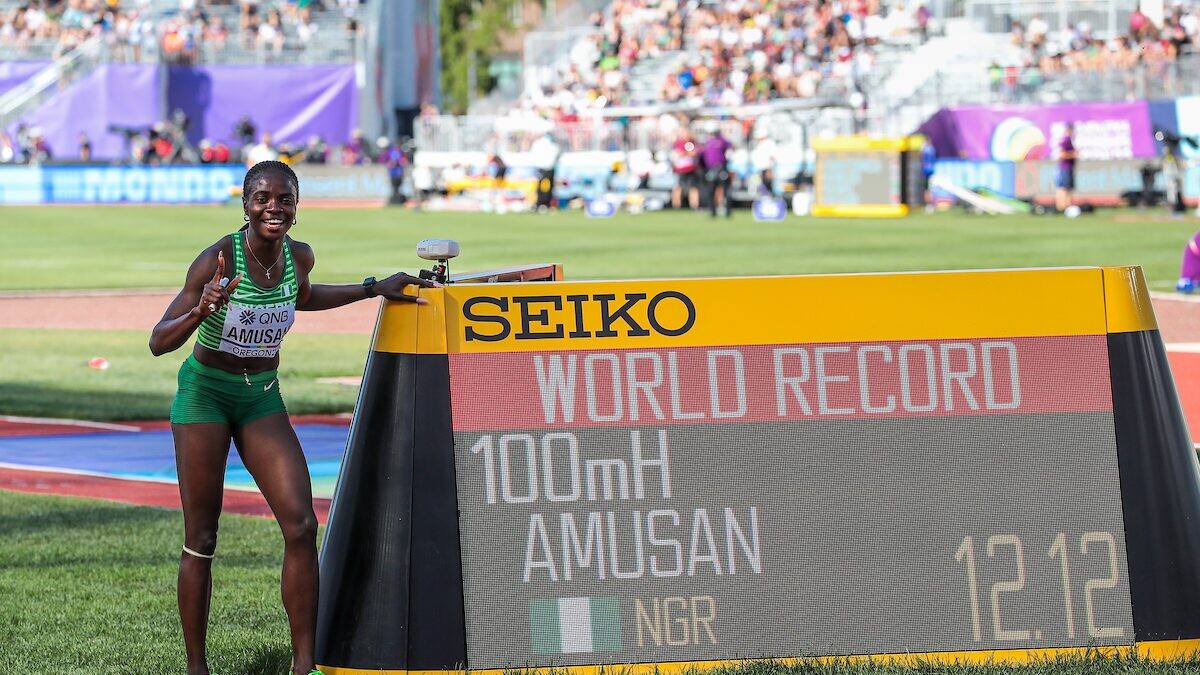
The 26-year-old became Nigeria’s first world record holder and world champion in the 100m hurdles at the 2022 World Athletics Championships, where she clocked a resounding world record of 12.12 seconds in the semifinals and a wind-aided 12.06 seconds to win the final.
This season, Amusan currently holds the second-best time in the world with a recorded time of 12.34, achieved on July 16 at Silesia Diamond League in Poland. The current world lead is held by the reigning Olympic gold medalist in the event, Jasmine Camacho-Quinn of Puerto Rico, who recorded a time of 12.31 seconds in May.
by Marley Dickinson
Login to leave a comment
