

Running News Daily
Running News Daily is edited by Bob Anderson and team. Send your news items to bob@mybestruns.com Advertising opportunities available.
Index to Daily Posts · Sign Up For Updates · Run The World Feed
Articles tagged #Hicham El Guerrouj
Today's Running News
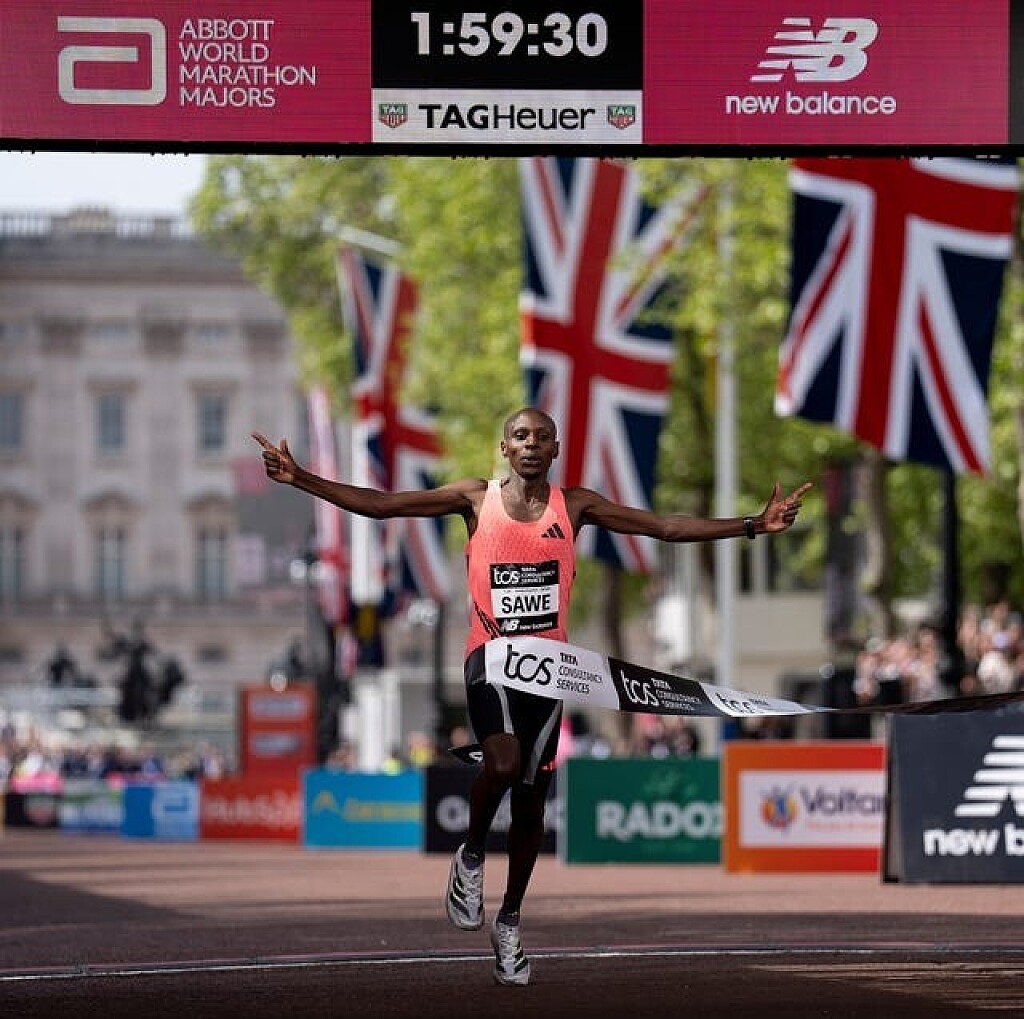


2026: The Year Distance Running’s Impossible Records Began to Fall
Distance running has witnessed extraordinary seasons before, but 2026 is producing something that feels almost unprecedented.
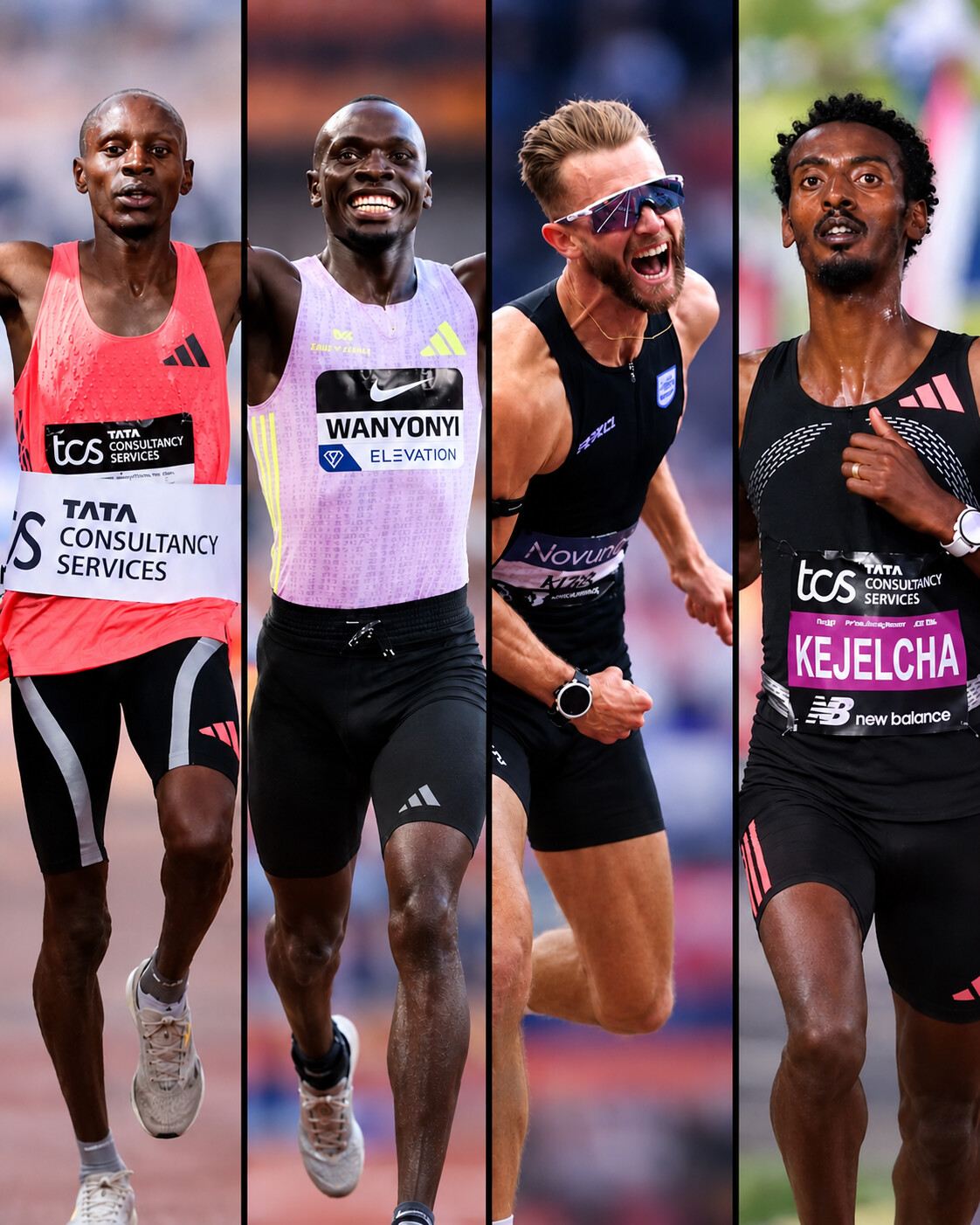
Records that had survived for decades, marks that appeared untouchable and performances that had defined entire generations of athletes are falling at a remarkable rate. In the space of just four months, four historic world records were rewritten, creating one of the most astonishing stretches the sport has ever seen.
And with four months still remaining in 2026, the question is no longer whether this has been an exceptional year.
It is just how much further the boundaries can be pushed.
The extraordinary sequence began on April 26 at the London Marathon, where Sabastian Sawe delivered one of the defining performances in the history of the event. The Kenyan crossed the finish line in a breathtaking 1:59:30, becoming the first athlete to run a marathon under two hours in officially recognised, record-eligible conditions.
Eliud Kipchoge had famously broken the two-hour barrier in Vienna in 2019, proving that such a performance was humanly possible, but the specially organised conditions—including rotating pacemakers and a pace car—meant the time could not be recognised as an official world record.
Sawe's performance was different.
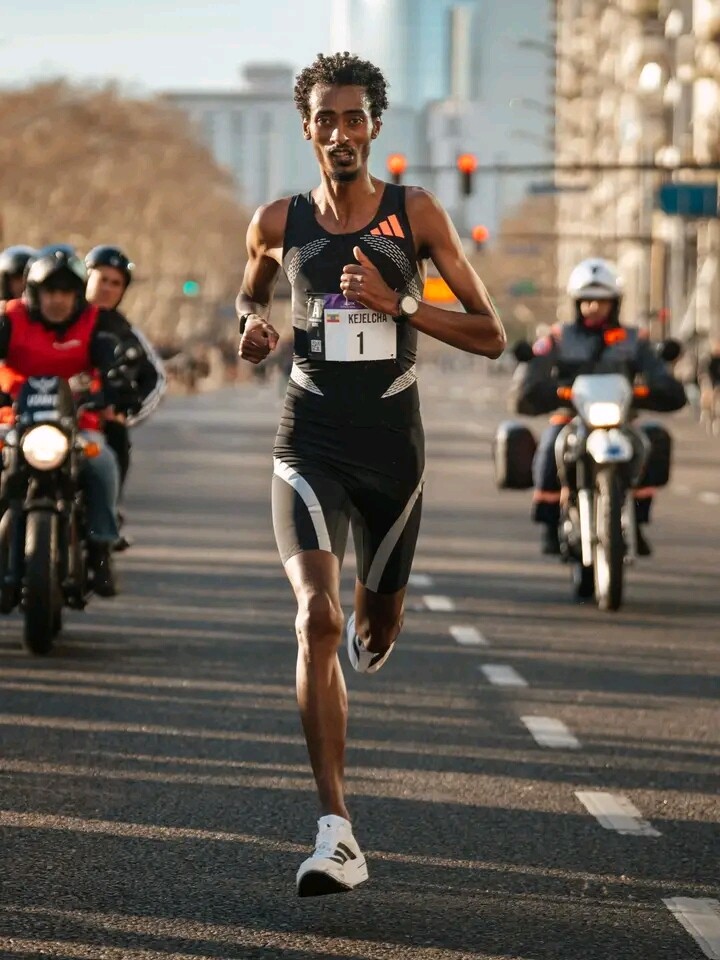
His 1:59:30 came in a conventional elite marathon race, and the historic morning became even more extraordinary as Ethiopia's Yomif Kejelcha finished in 1:59:41, while Uganda's Jacob Kiplimo clocked 2:00:28. In one astonishing race, three athletes went faster than the previous world-record standard.
Then came Monaco.
On July 10, Emmanuel Wanyonyi stepped into completely unfamiliar territory when he lined up for his first-ever 1000m race. What followed was nothing short of spectacular. The Kenyan middle-distance star stormed to 2:11.83, smashing a world record that had belonged to Noah Ngeny since 1999.
The previous mark had stood for 27 years, having been set four years before Wanyonyi was even born. Yet on his debut over the distance, Wanyonyi made history look effortless, while Britain's Jake Wightman also produced a superb performance to move into fifth place on the all-time list.
Just eight days later, London delivered another historic moment.
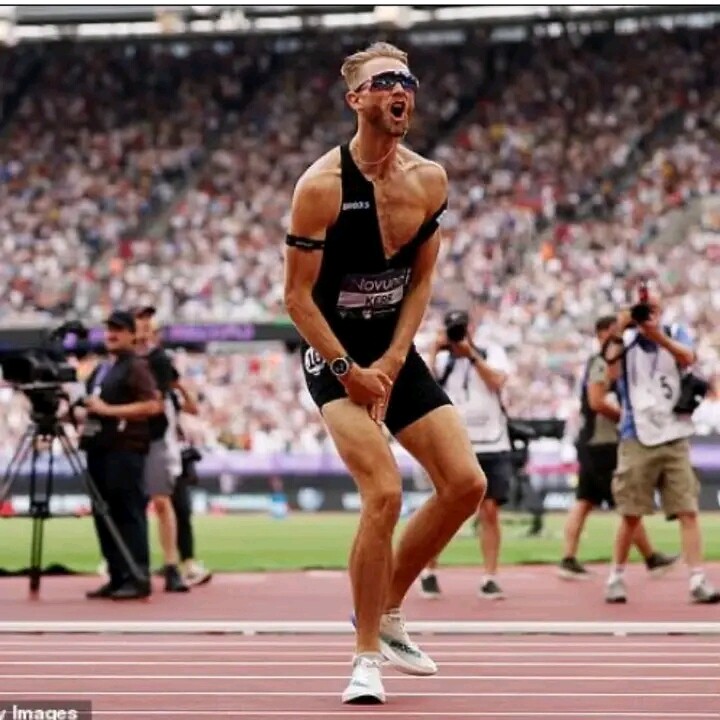
Josh Kerr had spoken openly about his ambitious mission, calling it “Project 222.” On the track, however, ambition turned into reality. The British star produced a stunning 3:42.66 for the mile, finally surpassing Hicham El Guerrouj's legendary 3:43.13 world record.
For decades, El Guerrouj's mark had stood as one of athletics' most iconic standards—a performance that appeared almost immune to the passing of time. Kerr changed that, producing a run that instantly secured its place among the greatest mile performances ever witnessed.
And then, in Buenos Aires on August 23, Yomif Kejelcha returned to the centre of the distance-running world.
Having already played a major role in London's historic marathon, the Ethiopian produced another extraordinary performance, this time over the half marathon. Kejelcha clocked 56:51, becoming the first man in history to break 57 minutes for the distance under valid record conditions.
What made the performance even more remarkable was the manner in which it unfolded. Kejelcha was running alone from around the 7km mark, with no rival beside him and no dramatic sprint finish required. He simply continued driving forward, producing one of the most dominant record-breaking performances ever seen on the roads.
Four historic records.
Four months.
A marathon barrier that had long been considered impossible in official competition. A 1000m record that had survived for 27 years. A mile record that had belonged to one of the greatest middle-distance runners in history. And a half-marathon performance that carried the event into completely new territory.
Distance running is living through a year unlike almost anything the sport has experienced before.
The most remarkable part?
2026 is not over yet.
With four months still remaining, the athletes of this extraordinary era may not be finished rewriting history.
by Erick Cheruiyot for My Best Runs.
Login to leave a comment

Josh Kerr’s Mile Mastery Could One Day Lead Him To The London Marathon
Josh Kerr has conquered one of athletics’ most historic distances. Yet, remarkably, the Scottish star is already dreaming about a challenge that sits more than 25 miles beyond the distance that has made him a global track sensation.
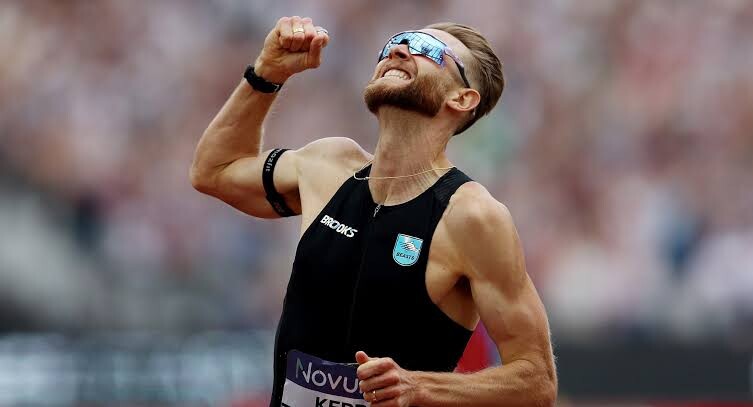
Kerr produced one of the defining performances of his career on July 18, 2026, at the London Stadium, storming to a sensational 3:42.66 in the Emsley Carr Mile to shatter Hicham El Guerrouj’s world record. The Moroccan’s 3:43.13 had stood untouched since 1999, but Kerr finally brought the 27-year-old mark down by 0.47 seconds.
The performance confirmed Kerr’s place among the greatest milers of his generation, but his ambitions extend well beyond the track.
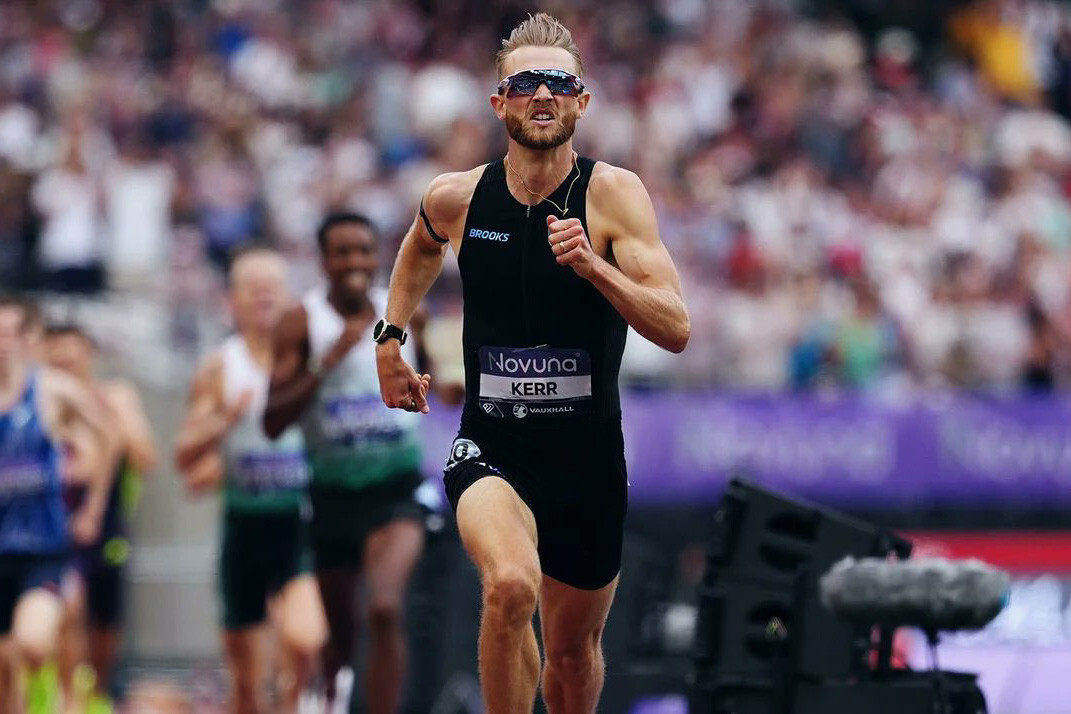
Speaking after his historic achievement, the 28-year-old revealed that the marathon is a distance he has become increasingly fascinated by, with the London Marathon occupying a particularly special place in his long-term imagination. For Kerr, the ultimate attraction would not necessarily be a world-class time, but the possibility of one day winning the race.
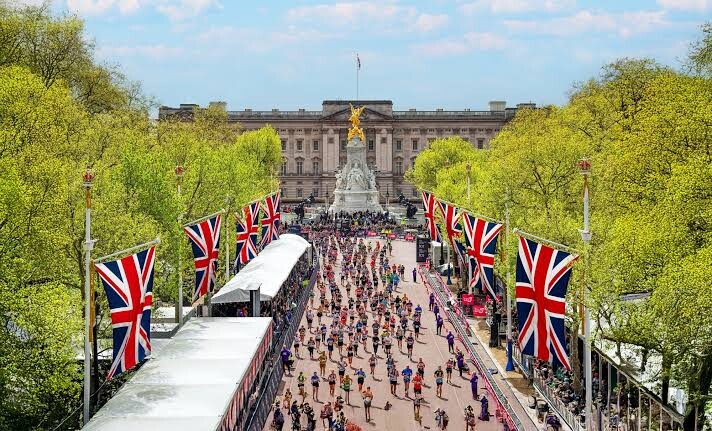
He remains realistic about how distant that ambition is. Kerr has made it clear that there is still important work to be completed on the track, with the Los Angeles 2028 Olympic Games among his major objectives. His marathon dream, therefore, belongs to the future rather than the immediate present.
That patience could prove crucial.
The transition from the mile to the marathon is one of the most demanding changes an elite distance runner can make. It requires far more than simply possessing exceptional aerobic fitness. The marathon places extraordinary demands on endurance, efficiency, energy management and the ability to maintain a high pace for more than two hours.
History, however, has shown that a world-class track runner can successfully make the leap when the timing is right.
Sifan Hassan provides perhaps the most spectacular modern example. After establishing herself as one of the most versatile distance runners in history, competing successfully from 1,500m through 10,000m, the Dutchwoman made her marathon debut at the 2023 London Marathon. She won in 2:18:33 after producing a remarkable finishing sprint, then went on to claim Olympic marathon gold the following year.
Her ability to change gears late in races became one of her greatest weapons. It is also an attribute Kerr knows particularly well.
Kerr has built his reputation around devastating finishing speed. Whether competing over 1,500m or the mile, his ability to accelerate when others are already approaching their physical limits has repeatedly separated him from the field. The question is whether that same weapon could eventually become a decisive advantage over the marathon distance.
Mo Farah's journey offers a more complicated lesson.
The British legend spent years dominating the 5,000m and 10,000m before turning his attention to the marathon. Despite possessing an extraordinary endurance base, Farah discovered that the marathon demanded an entirely different level of preparation. He finished eighth on his London Marathon debut in 2014 in 2:08:21 before eventually improving the British record to 2:06:22 in 2018.
Farah later explained that mastering the marathon took considerable time, underlining just how different the event is from even the longest Olympic track distances.
For Kerr, the physiological challenge would be even greater because his speciality is the mile.
The mile rewards an athlete who can combine enormous aerobic power with exceptional speed. The marathon, by contrast, demands the ability to operate efficiently for a prolonged period below maximum aerobic capacity. Running economy, lactate-threshold ability, endurance and the capacity to preserve energy deep into a race become increasingly important.
That transformation cannot be rushed.
And the marathon landscape Kerr would eventually enter is becoming more extraordinary by the year.
The 2026 London Marathon demonstrated just how far the event has evolved. Kenya’s Sabastian Sawe made history by becoming the first athlete to officially break the two-hour barrier in a competitive marathon, winning in 1:59:30. Ethiopia’s Yomif Kejelcha also finished inside two hours, while three men ultimately finished faster than the previous world record.
That is the standard waiting for Kerr if his distant ambition eventually becomes reality.
For now, however, there is no need to hurry. Kerr has already rewritten the mile record books, becoming the first man to break 3:43 and ending one of the longest-standing world records in modern athletics.
His next chapter is still firmly rooted on the track, where Olympic glory remains a major target. But somewhere beyond those ambitions lies a different challenge: 26.2 miles of London roads, a distance more than 25 miles longer than the event in which he currently reigns supreme.
It may sound improbable today, but Kerr is not dismissing the possibility.
“I promise I will try it.”
And if the day eventually comes when the world mile record-holder lines up on The Mall with the London Marathon title in his sights, it could become one of the most intriguing distance-running transitions the sport has ever witnessed.
by Erick Cheruiyot for My Best Runs.
Login to leave a comment

Josh Kerr Sets His Sights on History: World Record Glory and Olympic Gold Drive Britain's Middle-Distance Star
Fresh from a thrilling victory in the mile at the Glasgow 2026 Commonwealth Games, Josh Kerr has made one thing abundantly clear—his greatest achievements may still lie ahead.
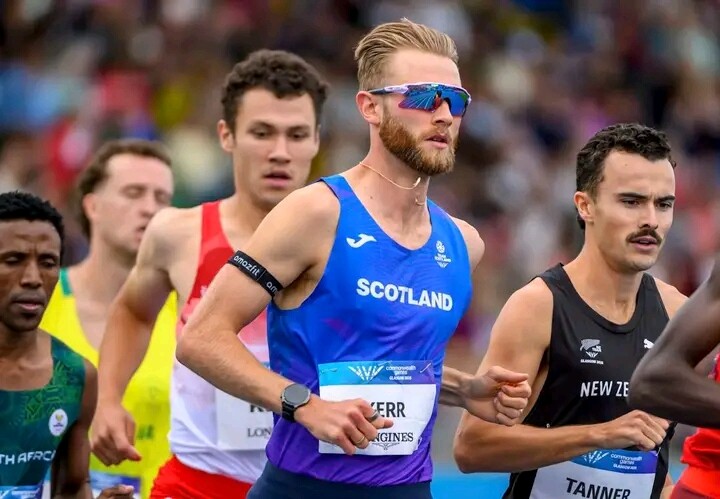
The British middle-distance star has unveiled an ambitious roadmap that could redefine his legacy, with two towering objectives at the heart of his journey: breaking Hicham El Guerrouj's legendary 1500m world record of 3:26.00, set on July 14, 1998, in Rome, and capturing the Olympic 1500m title at the Los Angeles 2028 Olympic Games.
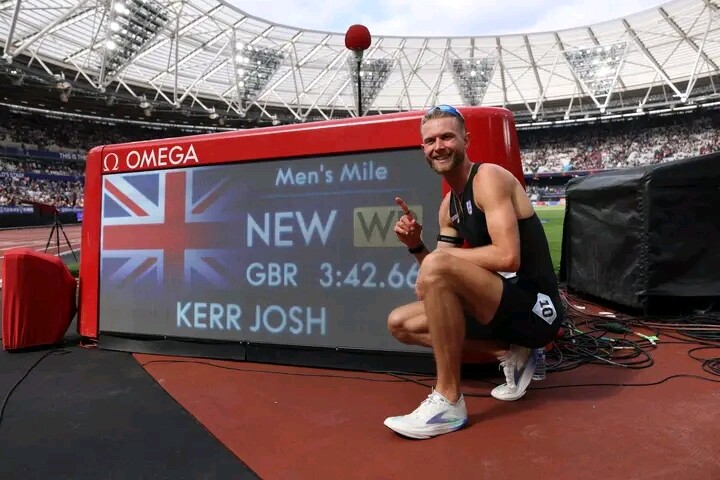
Kerr enters this new chapter with confidence soaring after producing one of the most remarkable performances in middle-distance history. His sensational 3:42.66 during the groundbreaking Project 222 campaign shattered the men's mile world record, ending a 27-year reign and proving he possesses the speed, endurance, and tactical brilliance required to challenge the sport's greatest barriers.
That achievement has strengthened Kerr's belief that the oldest and most revered record in men's middle-distance running is now within reach. For more than 28 years, Hicham El Guerrouj's 3:26.00, set in Rome on July 14, 1998, has stood as the benchmark of excellence in the 1500m, surviving generations of world-class challengers and earning a reputation as one of athletics' most untouchable performances.
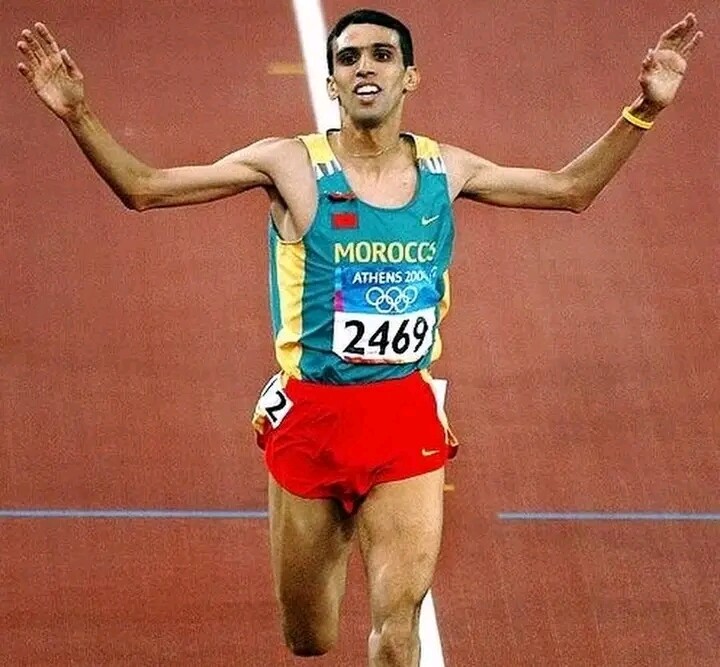
Rather than rushing the attempt, Kerr has laid out a carefully calculated plan designed to maximize his chances of success. His immediate priority is the 2027 World Athletics Championships in Beijing, where he hopes to reclaim the world 1500m title and reaffirm his position among the sport's elite.
Only after that championship campaign will his focus shift toward an assault on El Guerrouj's historic mark. A dedicated world-record attempt is expected later in 2027, built around months of meticulous preparation, altitude training, world-class pacing, ideal racing conditions, and flawless execution—the same ingredients that powered his record-breaking mile performance.
For Kerr, world records are not won by chance. They are earned through relentless preparation, perfect timing, and the courage to attack history when every detail aligns.
Beyond the pursuit of history lies one final prize that continues to fuel his ambition: Olympic gold.
Having earned bronze at the Tokyo 2020 Olympics and silver at the Paris 2024 Games, Kerr now has just one medal missing from an already glittering collection. His ultimate objective is to stand atop the Olympic podium in Los Angeles in 2028, completing a remarkable progression from bronze to silver and finally to gold.
If successful, Kerr would not only cement his place among Britain's greatest middle-distance runners but also become the first athlete to erase Hicham El Guerrouj's iconic 3:26.00 world record since it was established in Rome on July 14, 1998, before completing his Olympic medal collection with the sport's ultimate prize.
The stage is set, the blueprint is in place, and the countdown has begun. The question now is whether Josh Kerr can accomplish what generations of elite milers have failed to do—rewrite one of athletics' most enduring records and crown his career with Olympic gold in Los Angeles.
by Erick Cheruiyot for My Best Runs.
Login to leave a comment
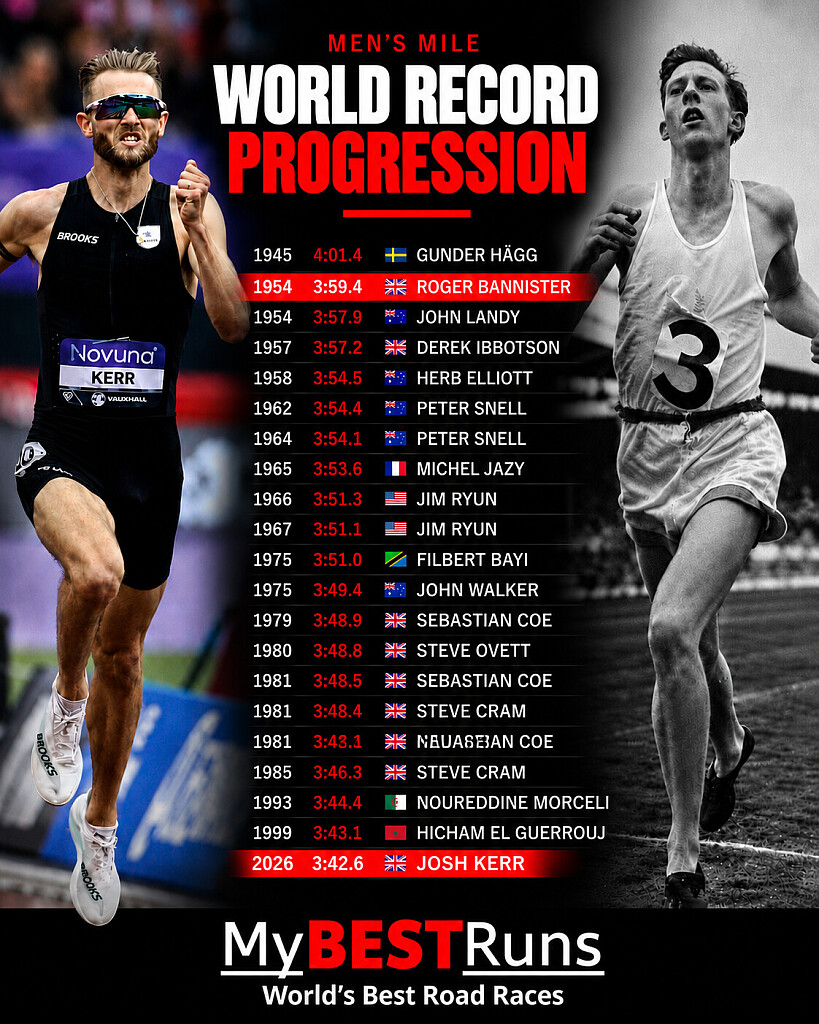
Sir Roger Bannister's Greatest Legacy: From The First Sub-Four Mile To Josh Kerr's World Record
When Sir Roger Bannister crossed the finish line in Oxford on May 6, 1954, in 3:59.4, he did far more than become the first man to run a sub-four-minute mile. He demolished one of sport's greatest psychological barriers, proving that what had long been considered impossible was simply waiting for someone bold enough to achieve it.
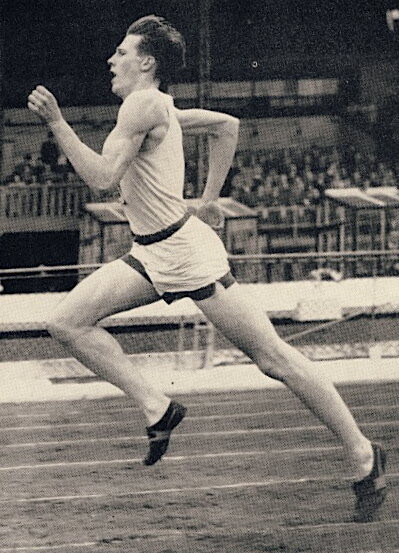
More than seven decades later, that historic run remains the most famous mile ever raced—not because it is still the fastest, but because it transformed athletics forever. Bannister's achievement inspired generations of runners to dream bigger, train harder and believe that seemingly unreachable barriers could be broken.
Today, however, the mile has entered an entirely different dimension.
Josh Kerr's sensational 3:42.66 world record has redefined the limits of middle-distance running. In one unforgettable race, the Scottish star erased Hicham El Guerrouj's legendary 3:43.13 mark that had stood untouched since 1999, proving once again that every era has its athlete capable of rewriting history.
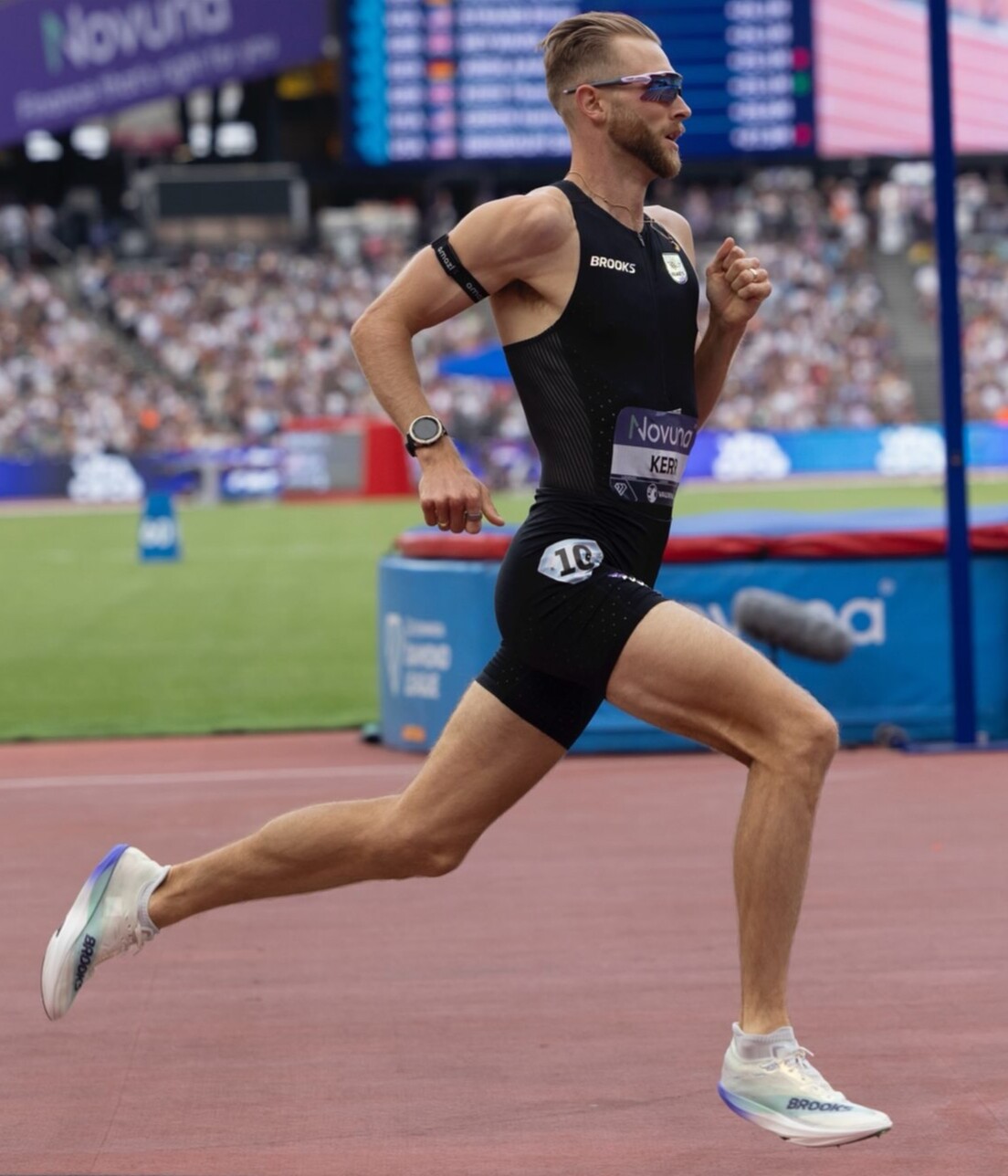
The numbers tell a remarkable story of progress. If Bannister's iconic 3:59.4 were placed in the same race as Kerr's 3:42.66, the man who first conquered the sub-four-minute barrier would finish almost 17 seconds behind. At the pace Kerr sustained, that deficit would amount to well over 100 metres—an extraordinary margin in an event where the world's best are often separated by hundredths of a second.
Yet those statistics should never be mistaken for a comparison of greatness. Bannister and Kerr competed in vastly different eras, under different conditions and with entirely different levels of sports science, training knowledge, footwear technology and track surfaces. Bannister raced on a cinder track wearing heavy leather spikes, balancing elite athletics with his demanding medical studies. Kerr benefits from decades of scientific advancement, world-class support systems and cutting-edge equipment that have helped athletes push the boundaries of human performance.
Every generation has added another chapter to the mile's extraordinary story. Just weeks after Bannister's breakthrough, Australia's John Landy lowered the record to 3:57.9. The baton then passed through legendary names including Derek Ibbotson, Herb Elliott, Peter Snell, Michel Jazy, Jim Ryun, Filbert Bayi, John Walker, Sebastian Coe, Steve Ovett, Steve Cram, Noureddine Morceli and Hicham El Guerrouj. Each champion dared to believe the record could fall again, leaving the event stronger than they found it.
Josh Kerr is now the latest custodian of that legacy. His world record is not simply another fast time—it is the culmination of more than 80 years of relentless progress. Every stride he took was built upon the courage, ambition and achievements of those who came before him.
Perhaps the most fascinating aspect of the mile is how dramatically its meaning has changed. In 1954, the world was captivated by one question: Could anyone ever run under four minutes? Today, the conversation has shifted to how much further the event can evolve. With Kerr already under 3:43, the now-unthinkable prospect of a sub 3:42 mile no longer feels like fantasy but a genuine possibility for the future.
That is the enduring beauty of athletics. Every world record eventually falls, but the performances that redefine belief never fade. Bannister's sub-four-minute mile remains the sport's most iconic breakthrough because it changed the way humanity viewed its own limits. Kerr's 3:42.66 is the newest benchmark of excellence, standing as proof that the impossible is never permanent—it is simply the starting point for the next generation.
by Erick Cheruiyot for My Best Runs.
Login to leave a comment

Is Josh Kerr Ready To Rewrite History Again? Why The 1,500m World Record May Be The Next Great Target
Josh Kerr has already etched his name into athletics history with a breathtaking world mile record of 3:42.66, but the numbers hidden within that extraordinary performance suggest an even greater achievement could be just around the corner.
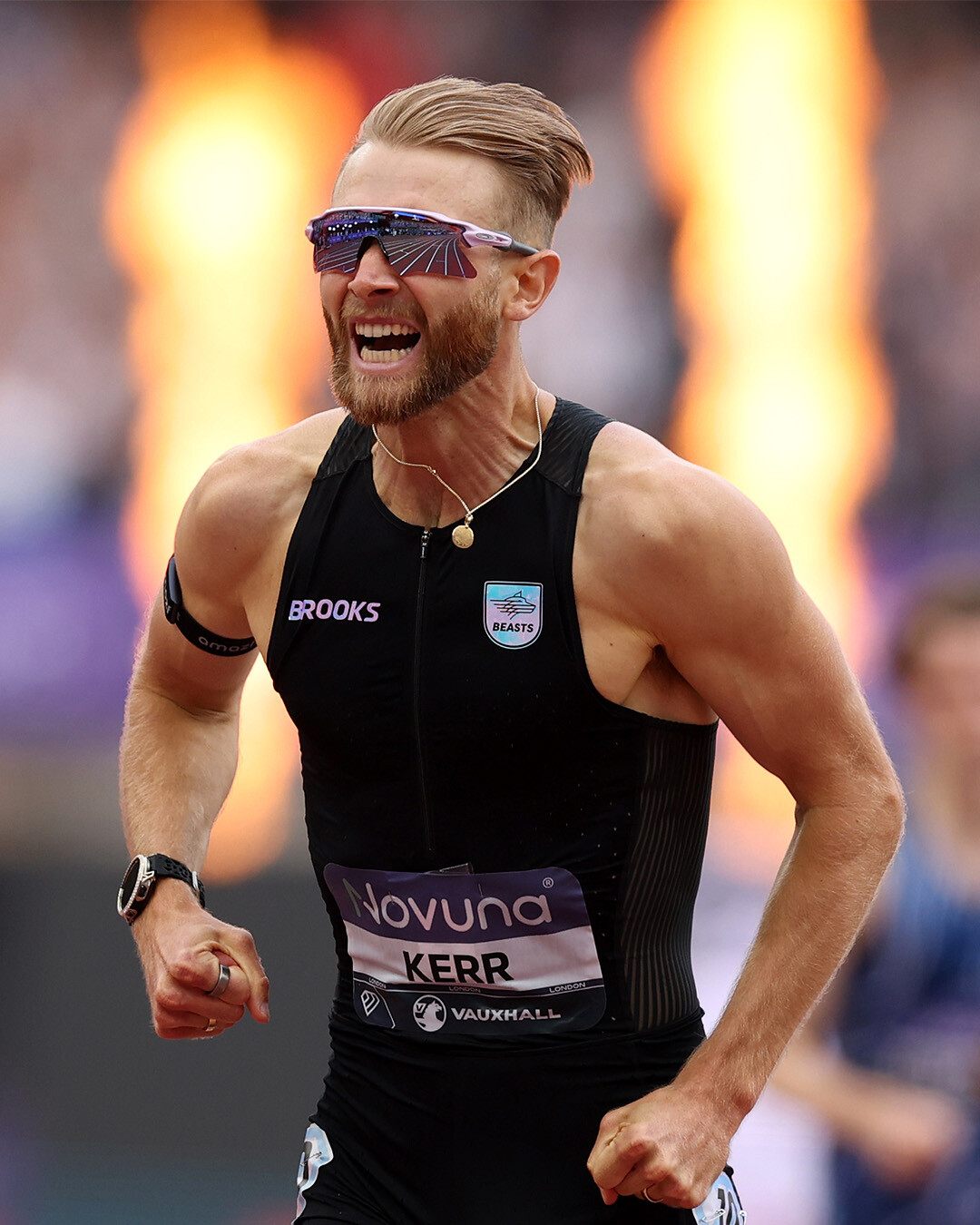
While the world celebrated the fastest mile ever run, another remarkable statistic quietly emerged. On his way to that historic finish, Kerr passed the 1,500m mark in an astonishing 3:27.62—the seventh-fastest performance ever recorded over the distance and just 1.62 seconds outside Hicham El Guerrouj's iconic world record of 3:26.00, which has stood as one of athletics' greatest benchmarks for more than a quarter of a century.
What makes Kerr's split so extraordinary is the context in which it was achieved.
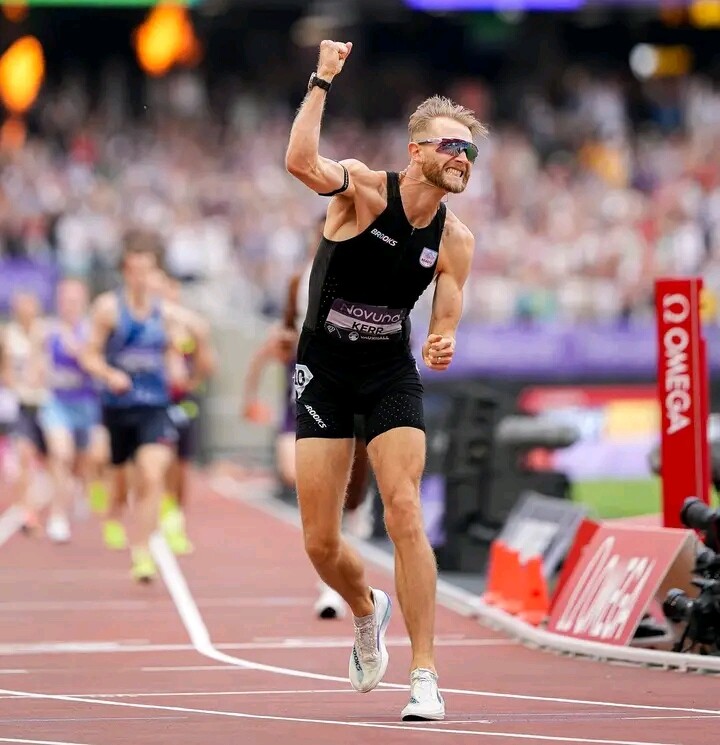
Unlike a dedicated 1,500m race, Kerr wasn't running to the finish line when he reached 1,500 metres. He still had another 109 metres remaining before completing the mile. Throughout the race, he had to carefully distribute his effort, knowing there was still significant work left after crossing the traditional 1,500m distance.
His world-record mile required approximately 724 strides, each averaging about 2.22 metres in length. By the time he reached the 1,500m split, he still had enough energy reserved to launch one final charge toward the mile finish, meaning he could not afford to completely exhaust himself at that point.
That reality has fuelled growing excitement across the athletics community.
Imagine Kerr lining up for a race built solely around the 1,500m. With elite pacemakers setting the perfect rhythm from the gun, competitors pushing the pace all the way to the finish, and no need to save anything for an additional 109 metres, the conditions would be dramatically different. Every stride, every surge and every ounce of energy could be devoted exclusively to chasing one target—the world record.
Many athletics experts believe that under those ideal circumstances, bridging the remaining 1.62 seconds is far from impossible. In fact, they see it as a realistic challenge for an athlete who has consistently demonstrated remarkable finishing speed, tactical intelligence and the ability to perform under immense pressure.
Hicham El Guerrouj's 3:26.00 has long been regarded as one of the most untouchable records in middle-distance running. Yet every era eventually produces an athlete capable of redefining what was once thought impossible.
After witnessing Kerr's astonishing mile masterpiece, the conversation has shifted dramatically. The question is no longer whether he belongs among the greatest milers in history—it is whether he can become the man who finally brings down one of the sport's most enduring world records.
If his latest performance is any indication, the countdown to another historic assault may already have begun.
by Erick Cheruiyot for My Best Runs.
Login to leave a comment
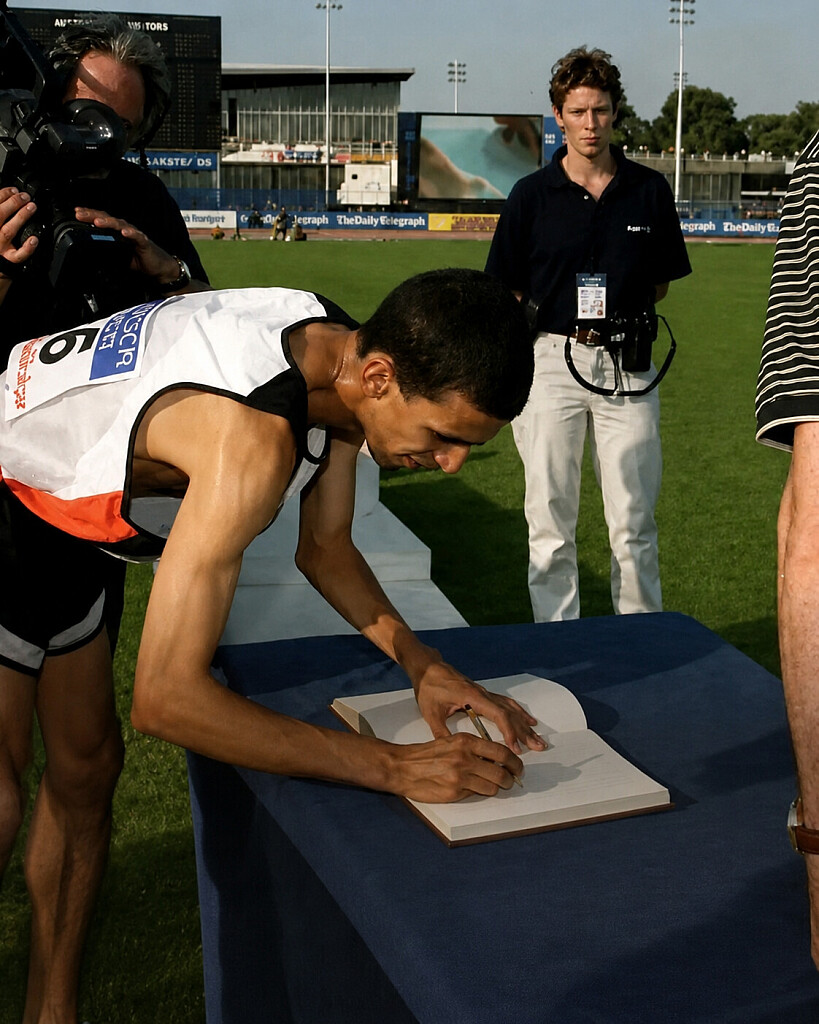
The Red Book Of Legends: How One Signature Became The Mile's Greatest Tradition
Long before digital records, social media posts, and instant celebrations, the Emsley Carr Mile created a tradition that has quietly preserved the history of one of athletics' most prestigious races. It is a tradition built not on medals or trophies, but on ink, leather, and the signatures of greatness.
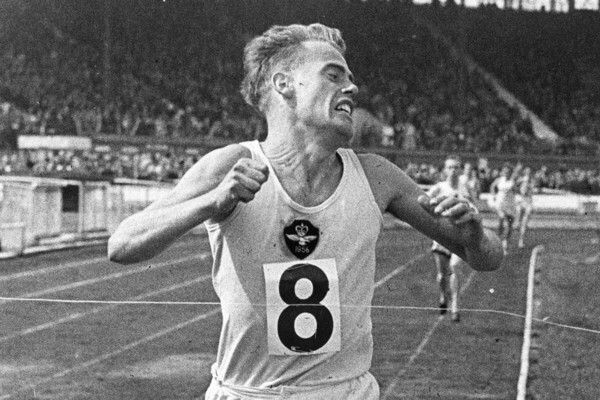
Since the inaugural Emsley Carr Mile in 1953, every champion has been invited to sign the same red leather book—a remarkable archive that has become one of the sport's most treasured historical artifacts.
Bound in luxurious Moroccan leather, the book is far more than a register of winners. It is a living timeline of middle-distance excellence, carrying the names of the athletes who redefined what humanity believed was possible over the mile.
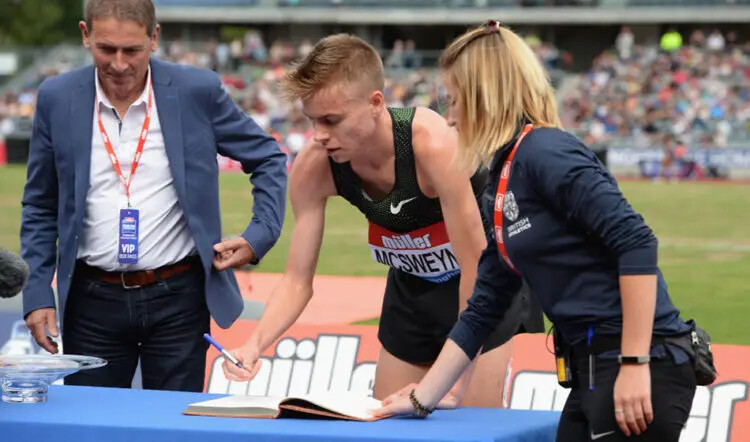
As the pages of the original volume filled, a second volume was introduced in 1980. Yet the tradition never changed. Each year's champion adds another signature, another chapter, another piece of history to a legacy spanning more than seven decades.
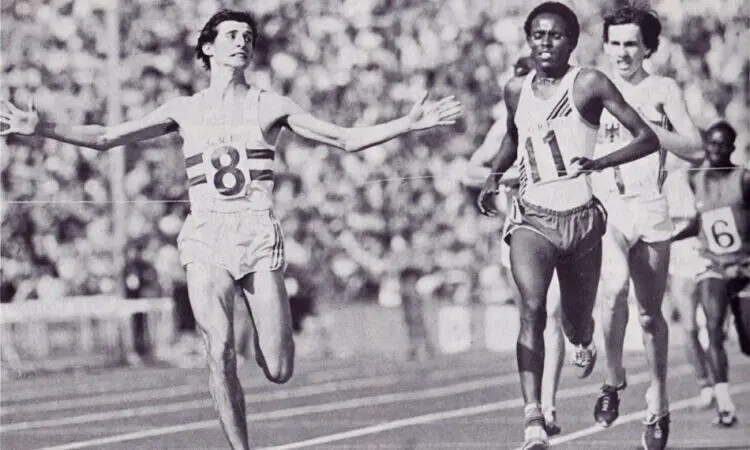
Within its pages are some of the greatest names athletics has ever known. Kenyan icon Kip Keino signed it. Steve Ovett left his mark. So did Sebastian Coe, Haile Gebrselassie, and the incomparable Hicham El Guerrouj. Altogether, the book bears the signatures of eleven Olympic champions and seven men who have held the world mile record—a remarkable concentration of sporting greatness.
Yet one name is conspicuously absent.
Roger Bannister, the first man to break the four-minute mile, never signed the famous book.
Ironically, the Emsley Carr Mile had originally been established to encourage athletes in their pursuit of the once-impossible four-minute barrier. But by the time the race was held for only the second time, Bannister had already etched his own name into sporting immortality with his historic run at Oxford's Iffley Road in May 1954. His career soon moved in a different direction, and the opportunity to sign the book never came. Decades later, the empty space where his signature might have appeared remains one of the sport's most fascinating "what if" stories.
While legends came and went, one man quietly built a record that still stands unmatched.
British runner Ken Wood remains the most successful athlete in Emsley Carr Mile history, winning the race four times between 1954 and 1961. Consequently, his signature appears more frequently than any other in the historic volume—a lasting reminder of an athlete whose achievements deserve far greater recognition.
The race itself has journeyed across some of Britain's most iconic athletics venues, moving from White City to Crystal Palace, then Alexander Stadium, and today the London Stadium. Through every relocation, one constant has remained: the red leather book has travelled alongside it, faithfully collecting the signatures of every new champion.
With each passing year, the book grows heavier—not because of its pages, but because of the extraordinary history they contain.
Now, another chapter has been written.
Fresh from producing one of the greatest mile performances ever witnessed, Josh Kerr has added his name to the same legendary book signed by generations of champions before him. His signature now sits alongside the sport's greatest icons, but with one remarkable distinction: the time attached to his victory is faster than any recorded above it.
The names have changed. The venues have changed. The records have fallen.
But the tradition has endured.
For more than seventy years, one red leather book has silently chronicled the evolution of the mile, reminding every new champion that while records may eventually be broken, true sporting legacy is written one signature at a time.
by Erick Cheruiyot for My Best Runs.
Login to leave a comment
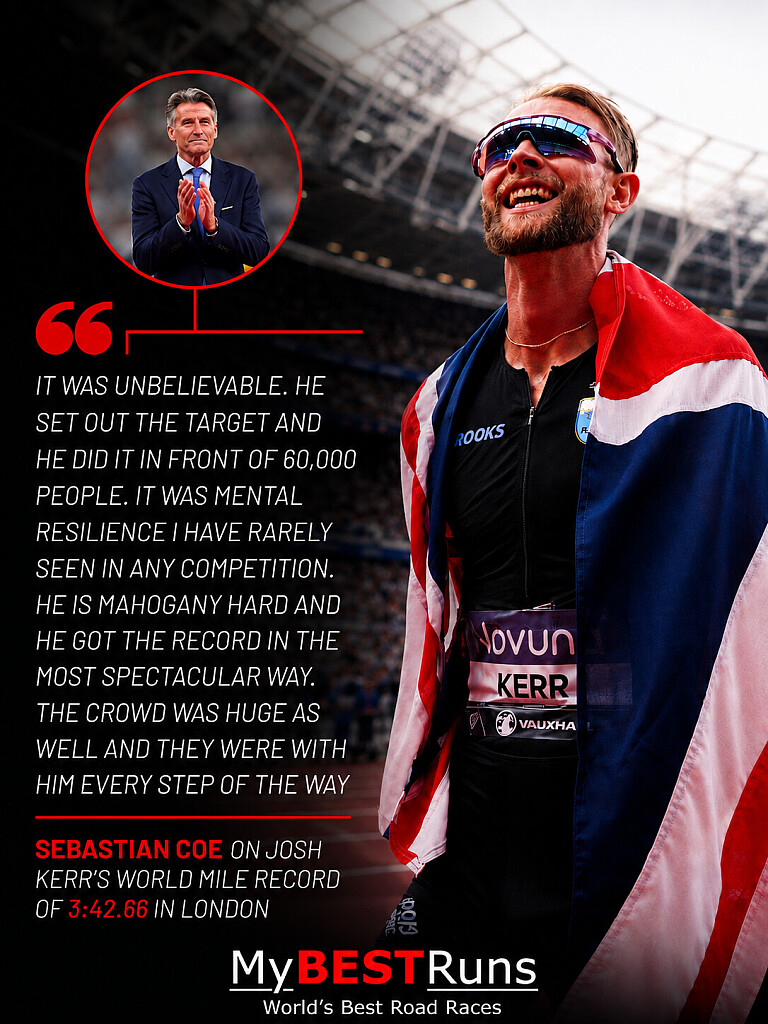
Sebastian Coe Hails Josh Kerr's World Mile Masterpiece: "A Performance Of Rare Mental Resilience
When one of the greatest milers in history stands to applaud a new world record holder, the moment carries extraordinary significance. Sebastian Coe, a three-time world mile record holder and one of Britain's most iconic middle-distance runners, reserved the highest praise for Josh Kerr after his breathtaking 3:42.66 mile world record at the London Diamond League.
For Coe, this was far more than another record falling. It was a performance that showcased courage, composure, and an unwavering belief under immense pressure.
"It was unbelievable," Coe said. "He set out the target and he did it in front of 60,000 people. It was mental resilience I have rarely seen in any competition. He is mahogany hard and he got the record in the most spectacular way. The crowd was huge as well and they were with him every step of the way."
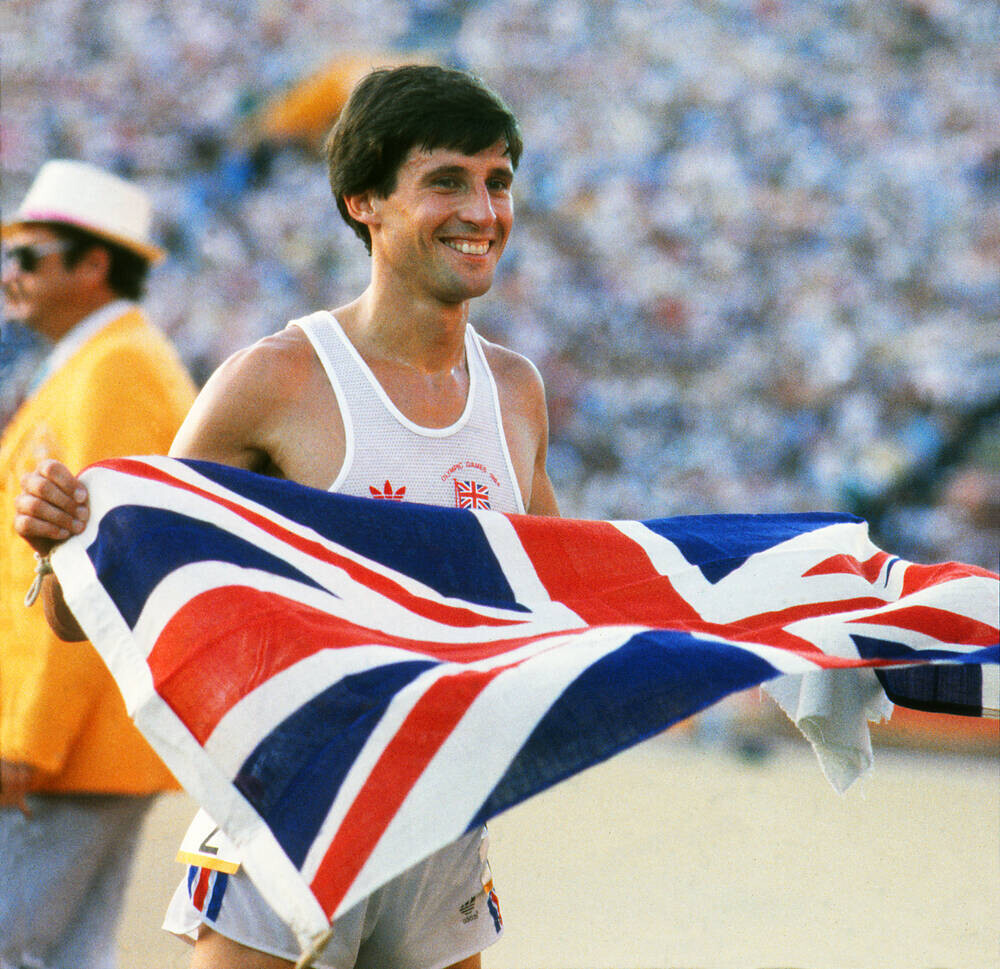
Those words carry exceptional weight coming from a man who understands the demands of rewriting history. Coe himself redefined the mile three times during his legendary career, first clocking 3:48.95 in Oslo in 1979 before improving the mark to 3:48.53 in Zurich and then 3:47.33 in Brussels in 1981. His brilliance inspired generations of British middle-distance runners, and now he has witnessed another chapter being written.
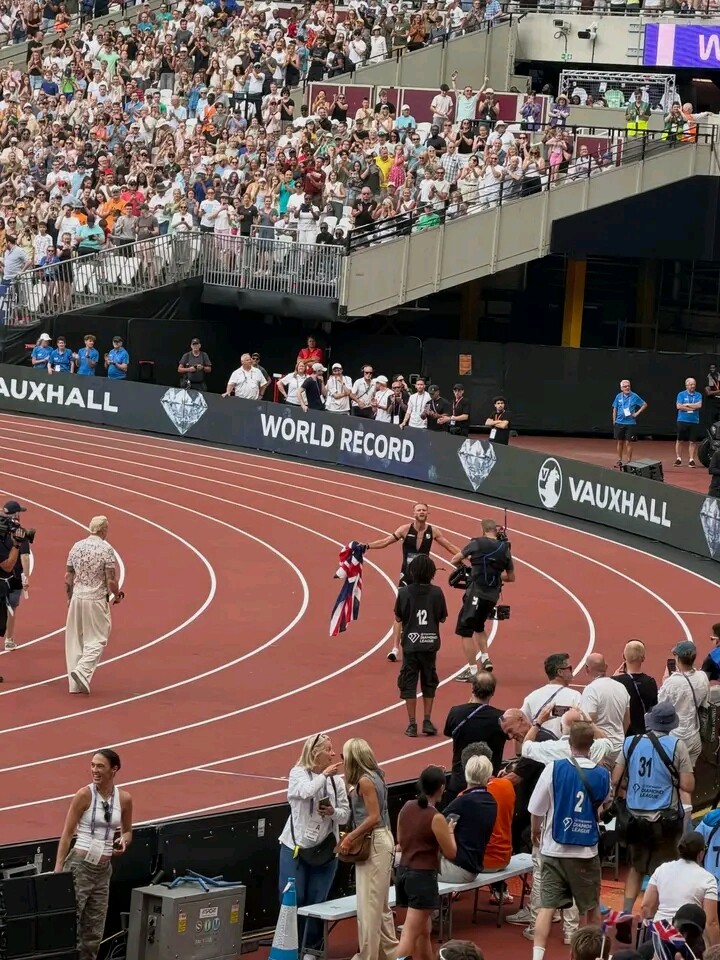
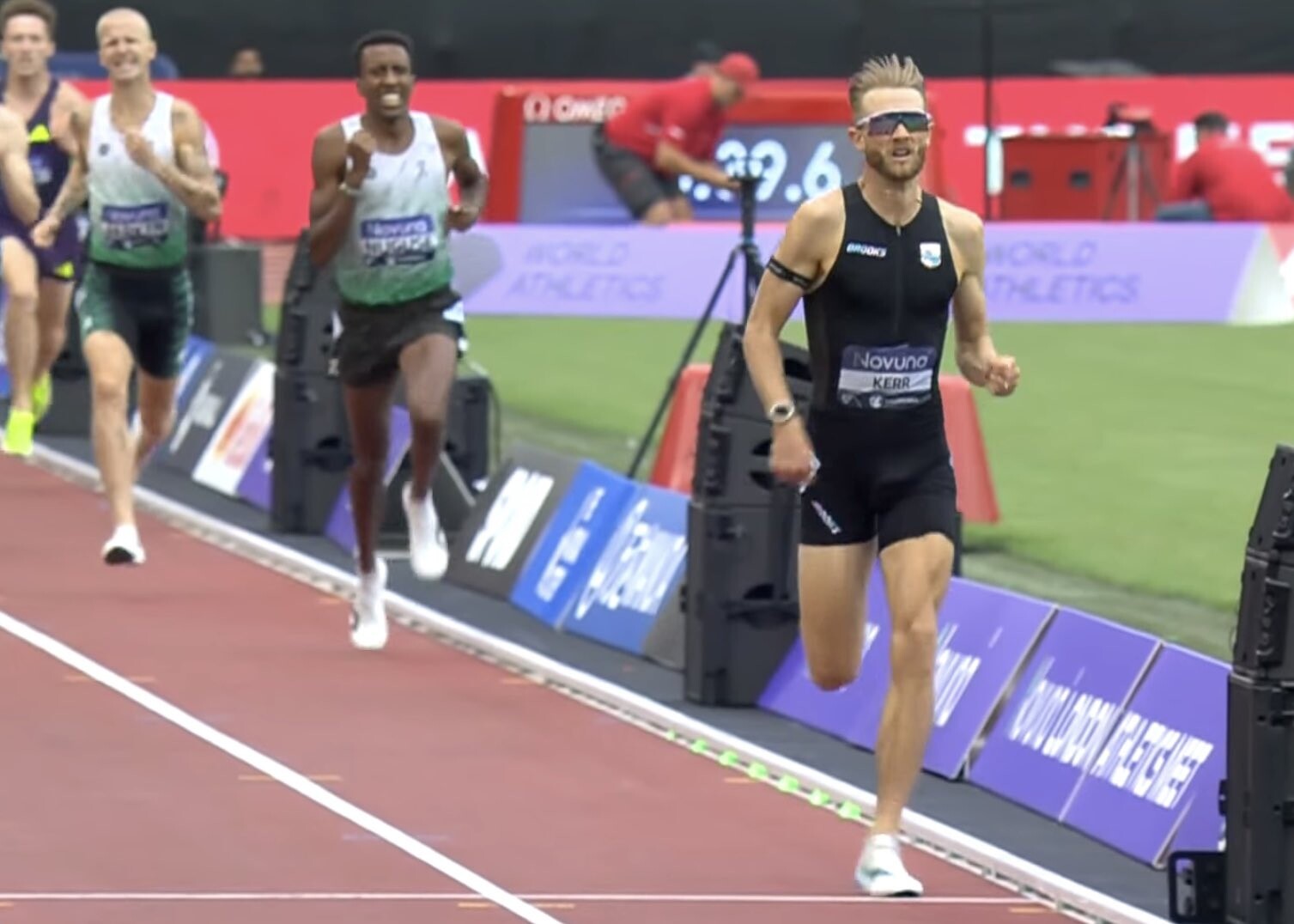
Kerr's achievement was not built on surprise. It was the culmination of meticulous planning, relentless training, and the confidence to publicly declare his ambition before delivering it on the biggest stage. With more than 60,000 fans filling the London Stadium, the Olympic champion embraced the pressure rather than shrinking from it.
Every lap reflected precision. Every stride demonstrated conviction. And when Kerr crossed the finish line in 3:42.66, he not only erased Hicham El Guerrouj's 27-year-old world record but also returned the outdoor mile world record to Great Britain for the first time in nearly three decades.
In doing so, Kerr became the seventh British man in history to hold the outdoor world mile record, adding his name to one of the sport's most prestigious lineages.
What made the performance even more remarkable was its emotional backdrop. Competing in front of a home crowd that roared him through every metre, Kerr transformed the stadium into a theatre of history. The deafening support fueled an unforgettable evening that will be remembered as one of the greatest moments in British athletics.
Coe's tribute perfectly captured what statistics alone cannot explain. World records demand exceptional physical ability, but truly historic performances are forged through resilience, belief, and the willingness to embrace pressure when the world is watching.
Josh Kerr did exactly that. He didn't simply break a record—he produced a performance that united a nation, inspired the next generation, and earned the admiration of one of the greatest milers the sport has ever known.
by Erick Cheruiyot for My Best Runs.
Login to leave a comment

Josh Kerr's Greatest Victory Wasn't the World Record—It Was Inspiring the Next Generation
Josh Kerr had every reason to celebrate.
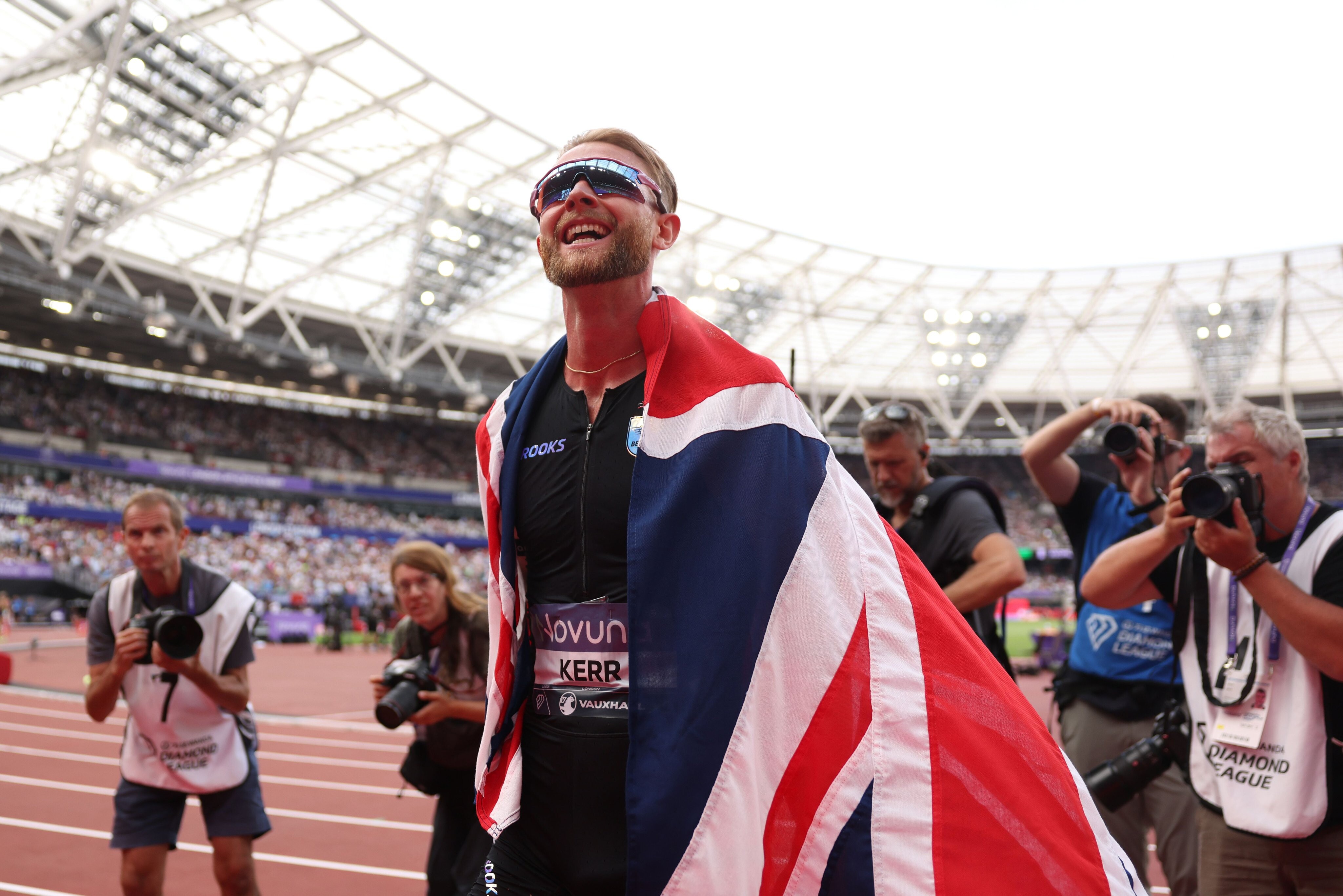
Moments earlier, the British star had delivered the race of his life, storming to a breathtaking 3:42.66 to erase Hicham El Guerrouj's 27-year-old mile world record before a jubilant home crowd at the London Diamond League. Years of sacrifice, relentless training and an unwavering belief in Project 222 had finally paid off, placing his name among the greatest athletes the sport has ever known.
For many champions, that would have been the end of a perfect evening.
For Josh Kerr, it was only the beginning.
Just a couple of hours after rewriting athletics history, Kerr was no longer in the spotlight celebrating his achievement. Instead, he was back on the warm-up track, patiently signing autographs, posing for photos and sharing smiles with young fans who had stayed behind to meet their new hero.
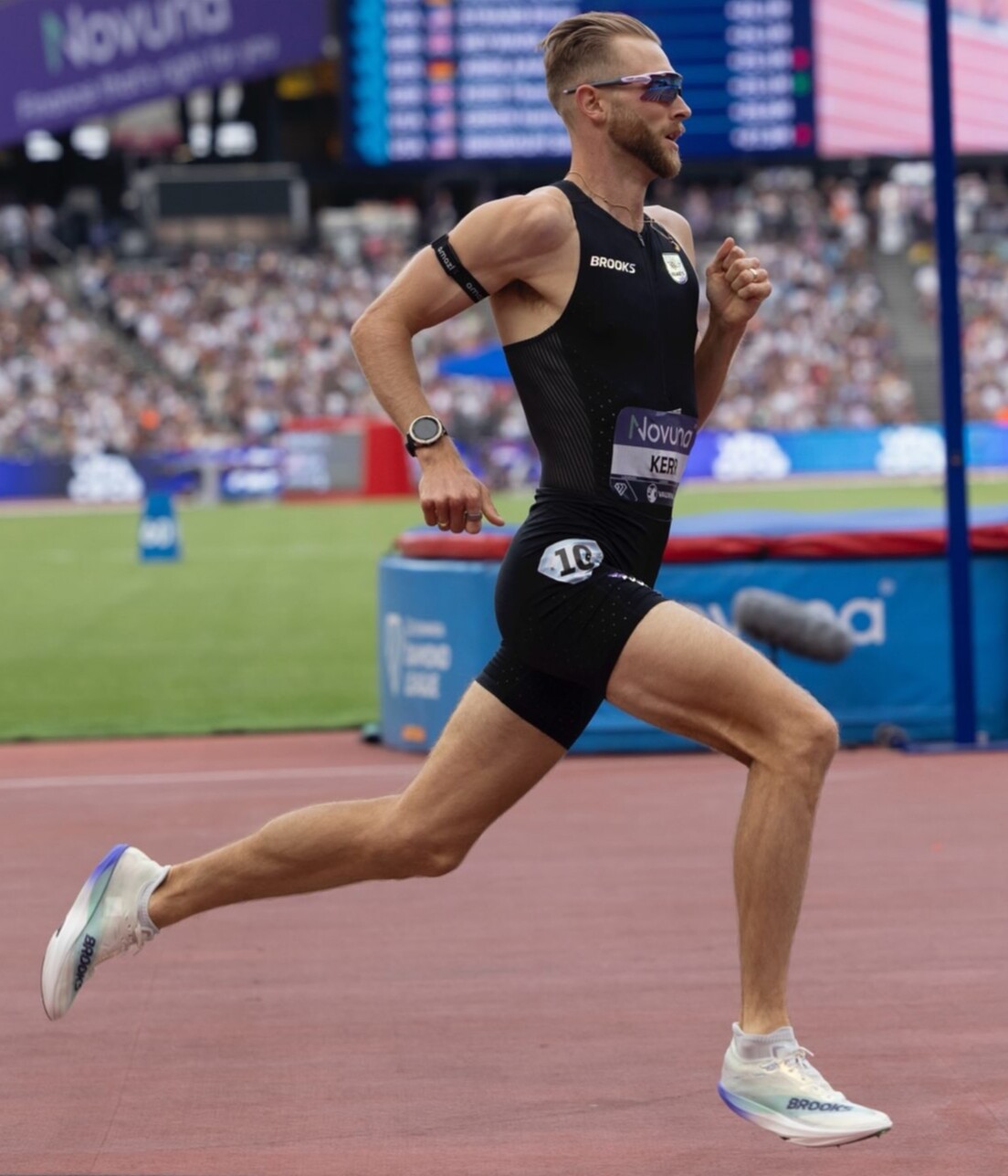
It was a simple gesture, yet one that spoke volumes about the man behind the world record.
The fastest miler on the planet understood that his greatest legacy would not be measured solely by 3:42.66 or by the world record beside his name. It would be measured by the dreams he ignited in the hearts of children who watched him accomplish what many believed was impossible.
Every signature was a reminder that greatness carries responsibility. Every conversation was an opportunity to inspire a youngster to lace up a pair of running shoes, believe in themselves and chase ambitions that seem beyond reach.
Kerr's journey to the top was never an overnight success. It was built through years of discipline, resilience and countless hours of preparation. There were setbacks, doubts and expectations to overcome, but he never stopped believing that one day he could stand atop the sport.
That belief became reality in London.
Yet instead of allowing the world record to define him, Kerr chose to give something back. In doing so, he showed that true champions are remembered not only for how fast they run, but also for how they treat people when the cheering fades.
His unforgettable performance shattered one of athletics' most iconic records. His humility afterwards may prove even more enduring.
Josh Kerr didn't just leave London as the fastest miler in history.
He left as an inspiration to the next generation, proving that the greatest victories are those that encourage others to believe that they, too, can achieve the extraordinary.
by Erick Cheruiyot for My Best Runs.
Login to leave a comment
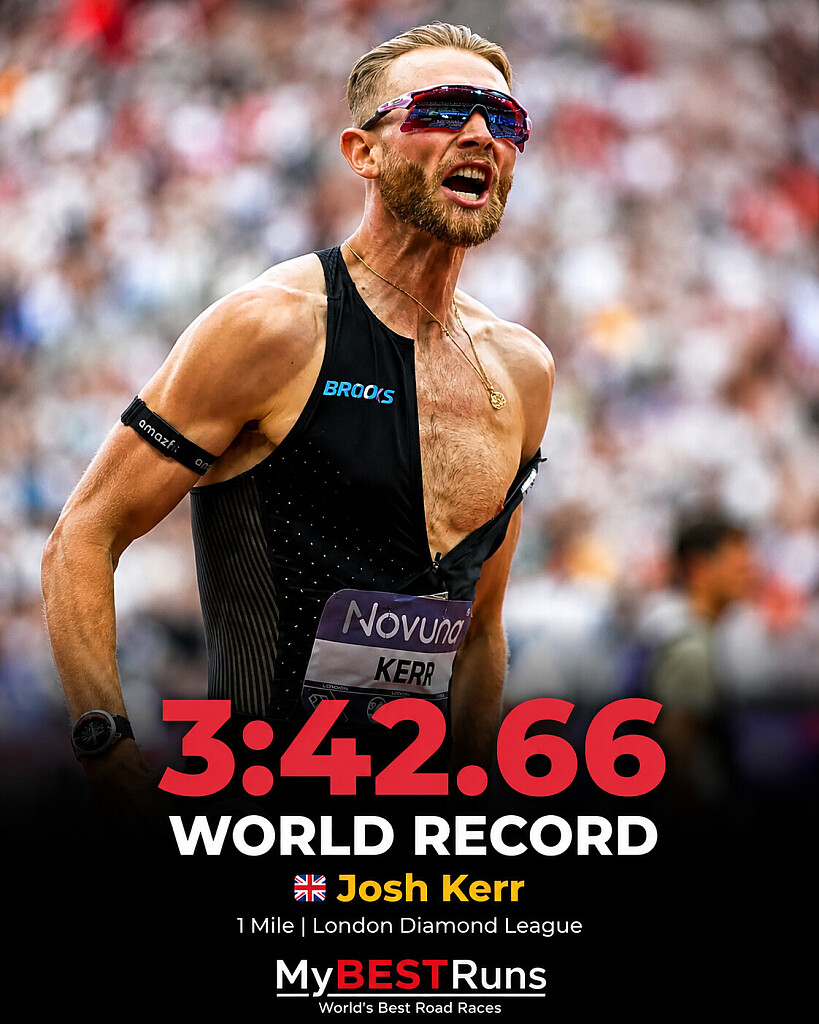
Project 222 shattered: Josh Kerr rewrites history with sensational mile world record
British middle-distance star Josh Kerr has etched his name into athletics folklore after producing one of the greatest performances the sport has ever witnessed, smashing the men's mile world record at the London Diamond League in front of a euphoric home crowd.
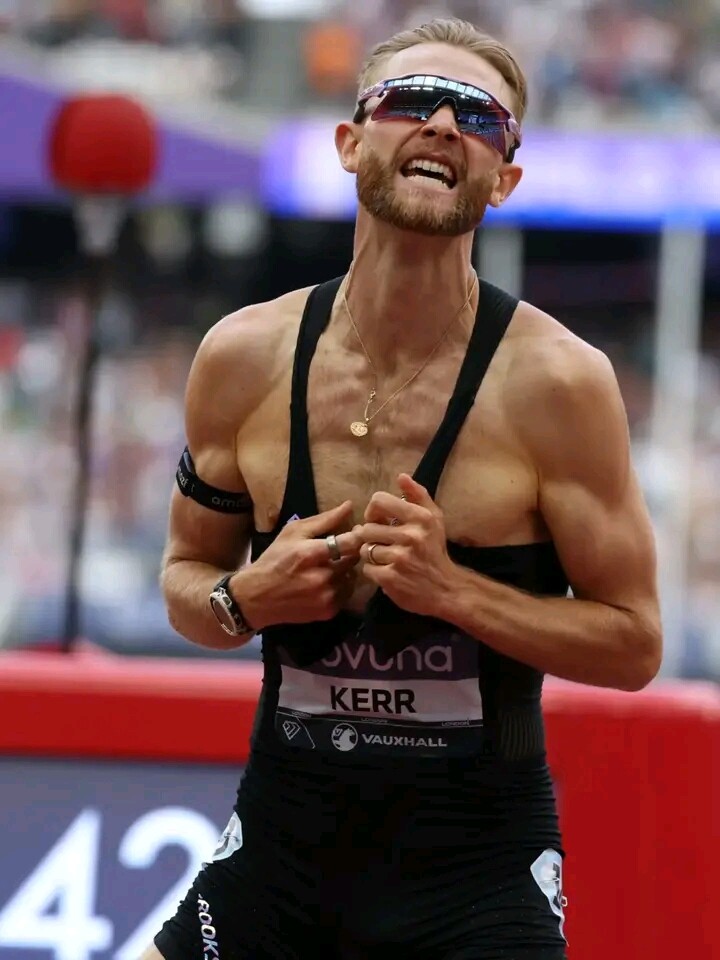
After months of anticipation surrounding Project 222, Kerr delivered on his bold promise in spectacular fashion. The British star stormed to an astonishing 3:42.66—exactly 222.66 seconds—to become the fastest miler in history and finally erase one of athletics' most iconic records.
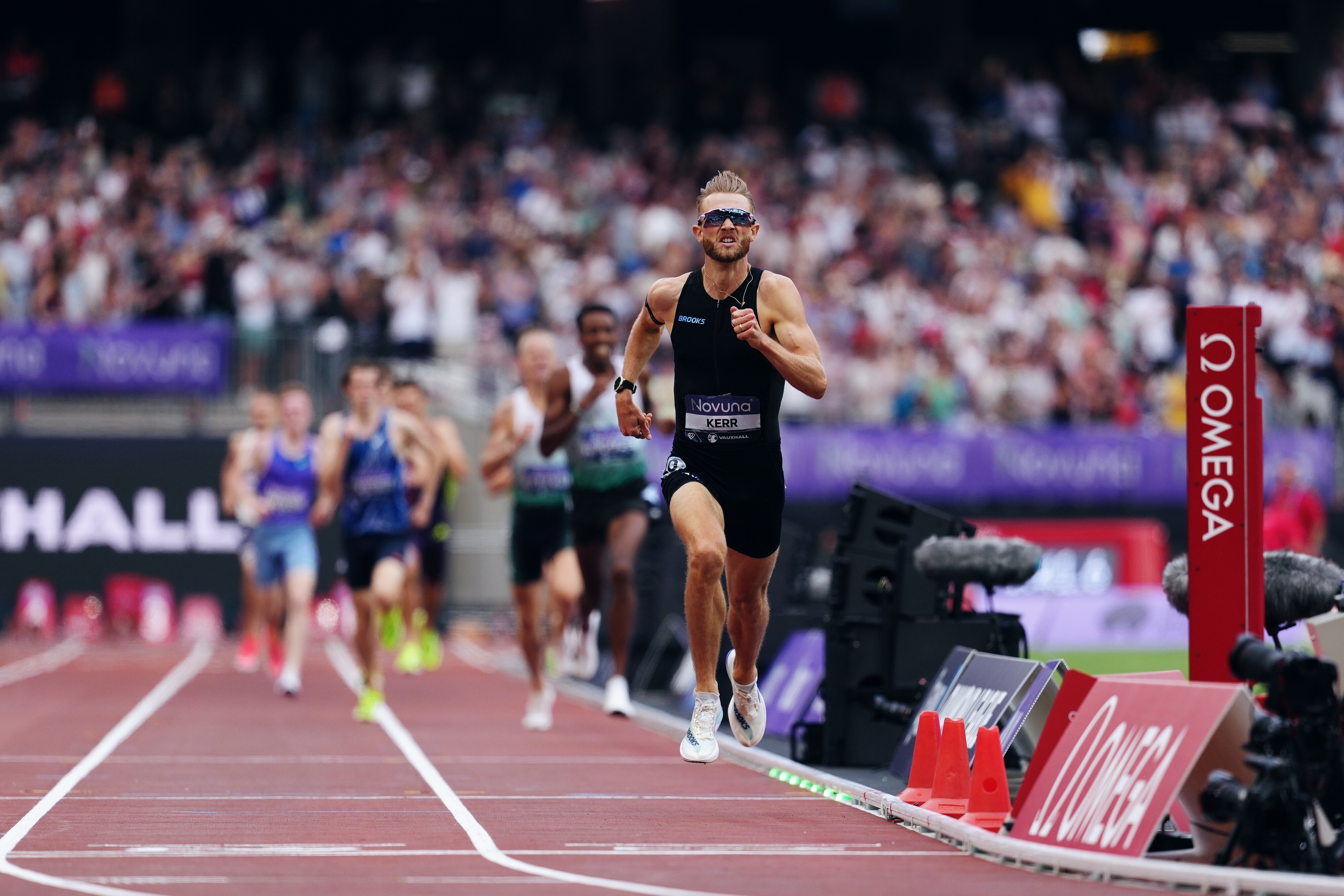
His breathtaking run eclipsed the legendary 3:43.13 set by Moroccan great Hicham El Guerrouj in 1999, a mark that had stood for 27 years and was widely regarded as one of the most untouchable world records in track and field.
From the moment the pacemakers led the field through the opening laps, it was evident that Kerr had arrived with one objective—to make history. Maintaining relentless rhythm and remarkable composure, he unleashed a devastating final surge that carried him across the finish line in record-breaking fashion, igniting wild celebrations inside the London Stadium.
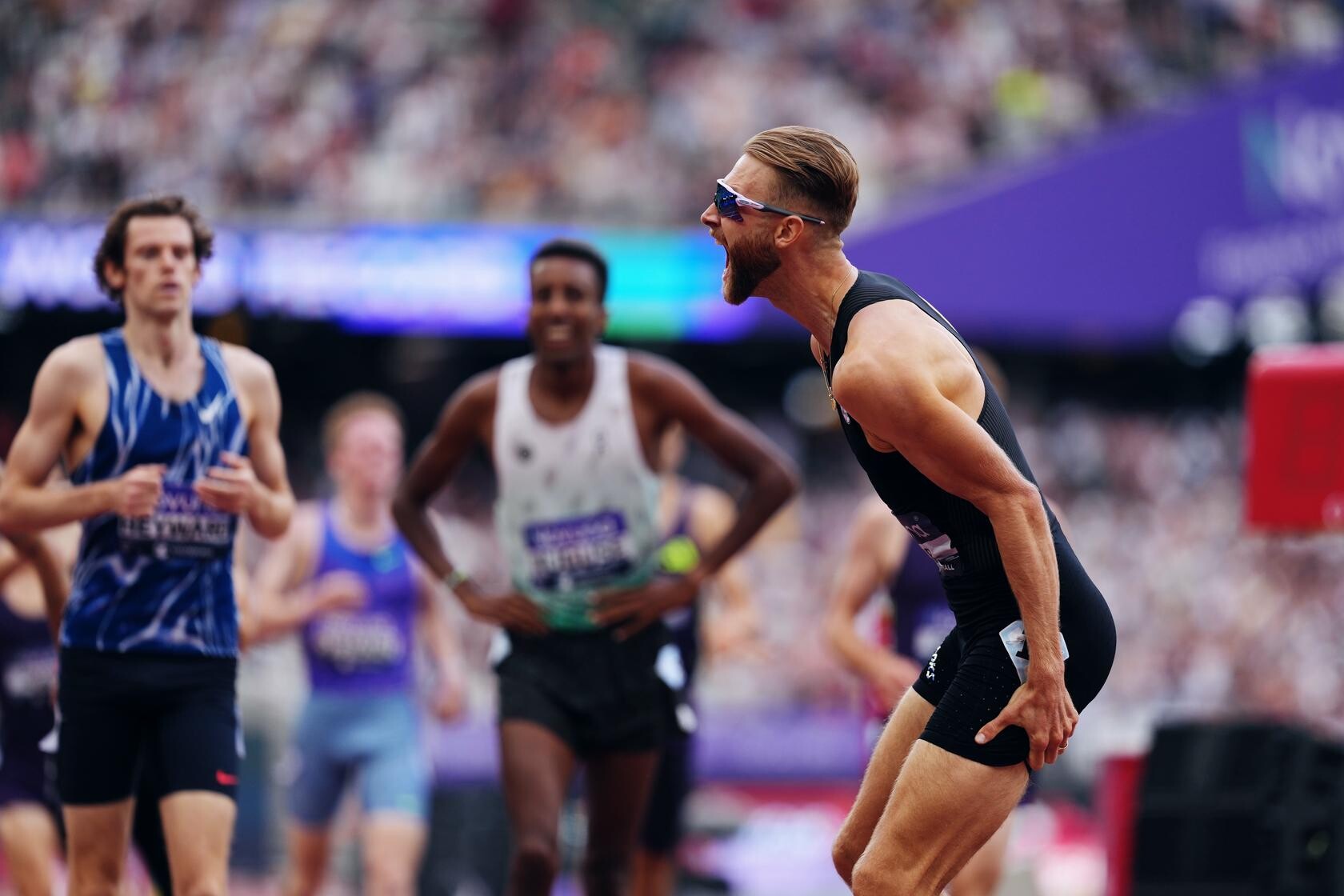
Project 222 was more than a slogan; it was Kerr's ambitious mission to complete the mile in under 223 seconds. On one unforgettable evening, he exceeded even those lofty expectations, stopping the clock at 222.66 seconds and proving that months of meticulous preparation, confidence, and fearless racing had culminated in the performance of a lifetime.
The achievement represents far more than a Diamond League victory. It marks the end of one of the longest-standing chapters in athletics history and signals the beginning of a new era in middle-distance running. Breaking such a revered record on home soil, surrounded by thousands of passionate British fans, made the moment even more memorable.
With his extraordinary 3:42.66, Josh Kerr has not only fulfilled the promise of Project 222 but has also secured his place among the greatest middle-distance runners of all time. On a historic evening in London, he proved that even the sport's most enduring barriers are meant to be broken.
by Erick Cheruiyot for My Best Runs.
Login to leave a comment
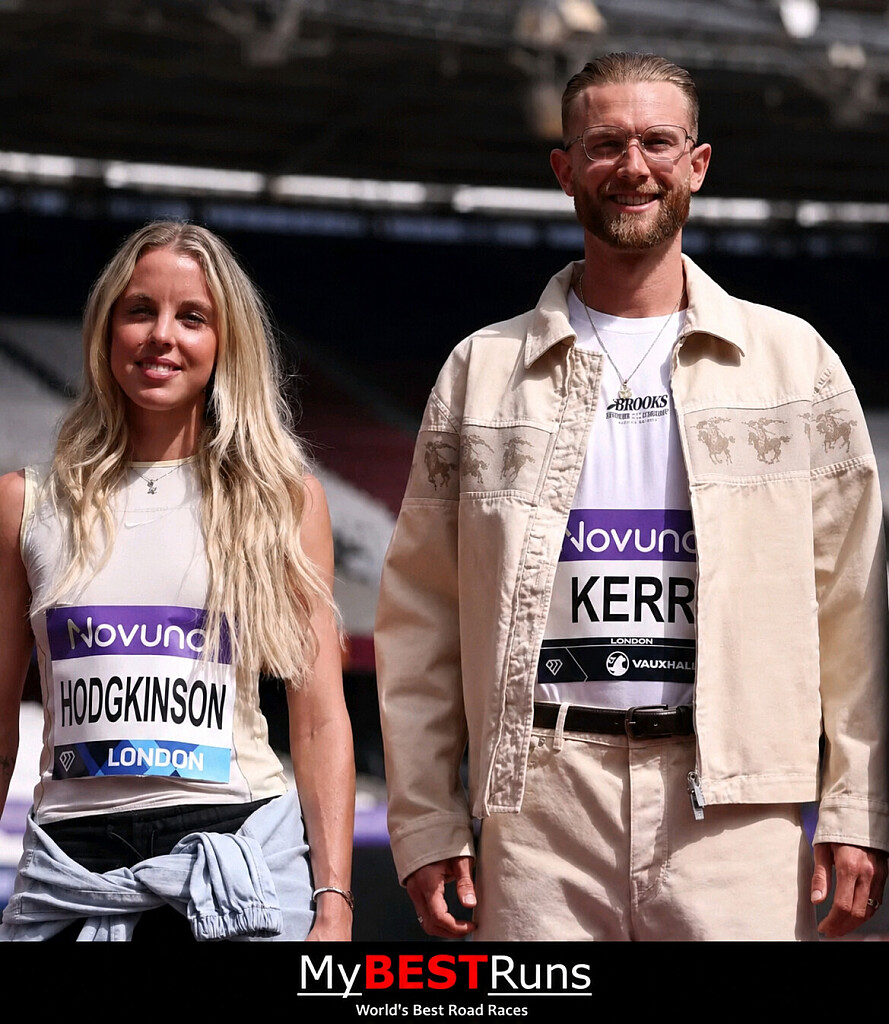
London Awaits: Keely Hodgkinson Seeks a Tough Test as Josh Kerr Targets Mile History
The spotlight will shine brightly on Britain's two biggest middle-distance stars at the London Diamond League, but while they share the same stage, their ambitions could not be more different.

Olympic 800m champion Keely Hodgkinson is eager to measure herself against the strongest possible field rather than race the clock. For Hodgkinson, elite competition is the ultimate catalyst for greatness, and she believes that lining up alongside world-class rivals is the fastest route to producing exceptional performances.
Reflecting on her approach, Hodgkinson explained that she would always choose fierce competition over chasing times alone, insisting that racing outstanding athletes pushes her beyond her limits and allows her to discover another level of performance. With another high-quality women's 800m field assembled in London, she is ready to embrace the challenge once again.

On the men's side, world champion Josh Kerr arrives with history firmly in his sights. The Scottish star will launch his ambitious Project 222 attempt, aiming to eclipse Hicham El Guerrouj's iconic men's mile world record of 3:43.13—a mark that has stood as one of athletics' greatest achievements for more than a quarter of a century.
Kerr enters the race with unwavering belief after months of meticulous preparation. Confident that both his training and physical condition have peaked at the perfect moment, he declared that his body is ready for the challenge, setting the stage for one of the most anticipated mile races in recent years.
As thousands of fans pack the London Stadium, two contrasting missions will unfold. Hodgkinson will seek inspiration from world-class rivals in pursuit of another outstanding 800m performance, while Kerr will chase immortality by attacking one of the sport's most revered world records.
One athlete is searching for the toughest competition. The other is chasing history itself. By the end of tomorrow's Diamond League meeting, London could witness another unforgettable chapter in British athletics.
by Erick Cheruiyot for My Best Runs.
Login to leave a comment

Project 222 Meets Its Biggest Challenge: Yared Nuguse Joins Josh Kerr's Historic Mile Record Chase
The pursuit of one of athletics' most untouchable records has just become even more compelling.
For 27 years, Hicham El Guerrouj's astonishing 3:43.13 mile, set in Rome on July 7, 1999, has stood as the ultimate benchmark in middle-distance running. Generations of world-class milers have chased it, yet none have managed to get within half a second of the Moroccan legend's remarkable performance.
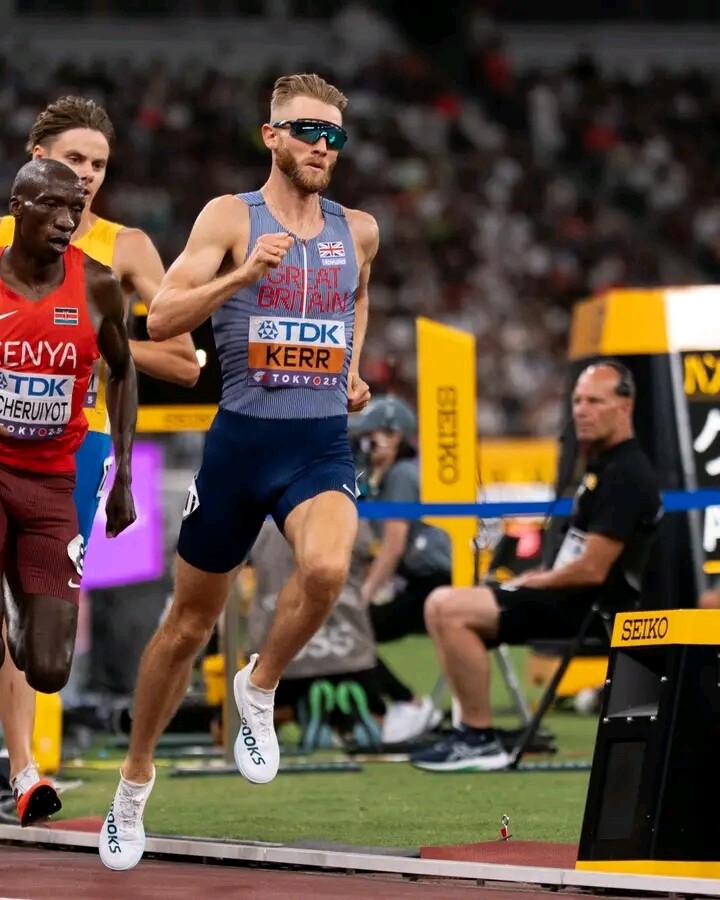
Now, British star Josh Kerr believes that record is finally within reach.
The reigning world champion has spent months preparing for what he calls Project 222—a bold attempt to become the first man in history to break 3 minutes 43 seconds for the mile. The name represents the 222 seconds required to run a 3:42 mile, and every detail of his preparation has been meticulously planned.
From specially designed racing spikes and carefully selected pacemakers to altitude training supported by a chamber installed in his home, Kerr has left nothing to chance. Rather than attempting the feat in a quiet time trial, he has chosen the electric atmosphere of a packed 60,000-seat London Stadium on July 18, hoping the crowd will help carry him into history.
But what was expected to be Kerr's night has suddenly become one of the most anticipated showdowns of the season.
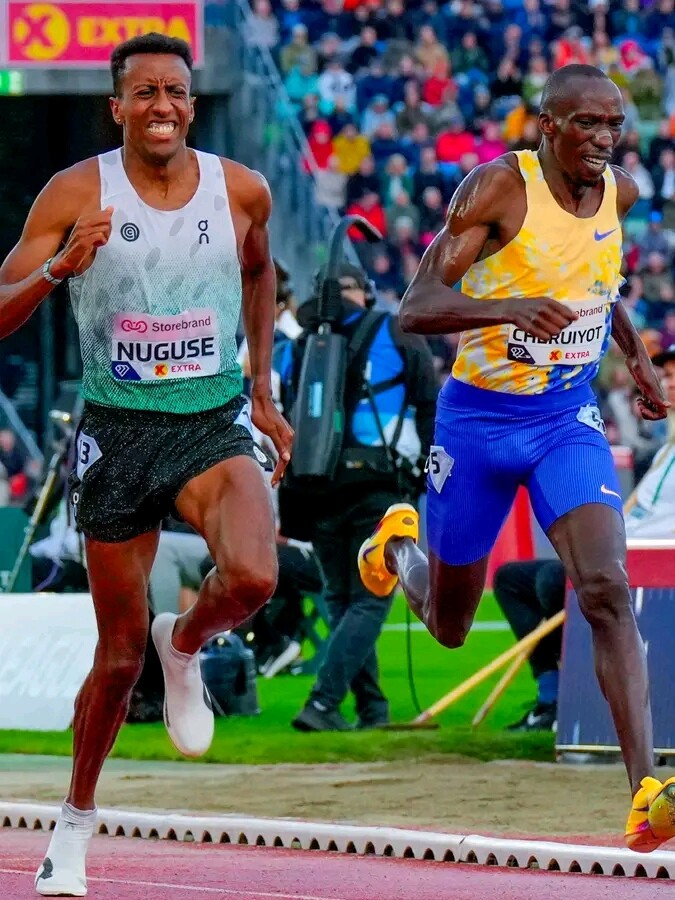
American star Yared Nuguse has officially entered the race, adding another layer of intrigue to an already historic occasion.
On paper, Nuguse holds the stronger credentials over the mile. His personal best of 3:43.97 ranks as the fourth-fastest performance in history, nearly one and a half seconds quicker than Kerr's lifetime best. This season alone, the Olympic bronze medallist has been in outstanding form, claiming two Diamond League 1500m victories before clocking an impressive 3:46.61 mile at the Prefontaine Classic.
Their rivalry has also been fiercely competitive. Nuguse holds a 4-2 advantage over Kerr in regular-season meetings, demonstrating his consistency on the circuit. Yet when championship medals are on the line, the story changes. Kerr has repeatedly found another gear, remaining unbeaten against Nuguse in global championship finals.
That contrast is what makes this race so fascinating.
Kerr arrives with the confidence, preparation and home support to launch an assault on one of athletics' oldest records. Nuguse arrives as arguably the fastest miler in the field based on recent performances, with every intention of spoiling the party.
Whether the mile world record finally falls or survives for another year, London is set to witness far more than a record attempt. It will be a clash between two of the world's finest middle-distance runners, each believing he has what it takes to rewrite history.
On July 18, the stopwatch will decide whether Project 222 becomes reality—or whether Yared Nuguse steals the spotlight in one of the most eagerly awaited mile races of the modern era.
by Erick Cheruiyot for My Best Runs.
Login to leave a comment
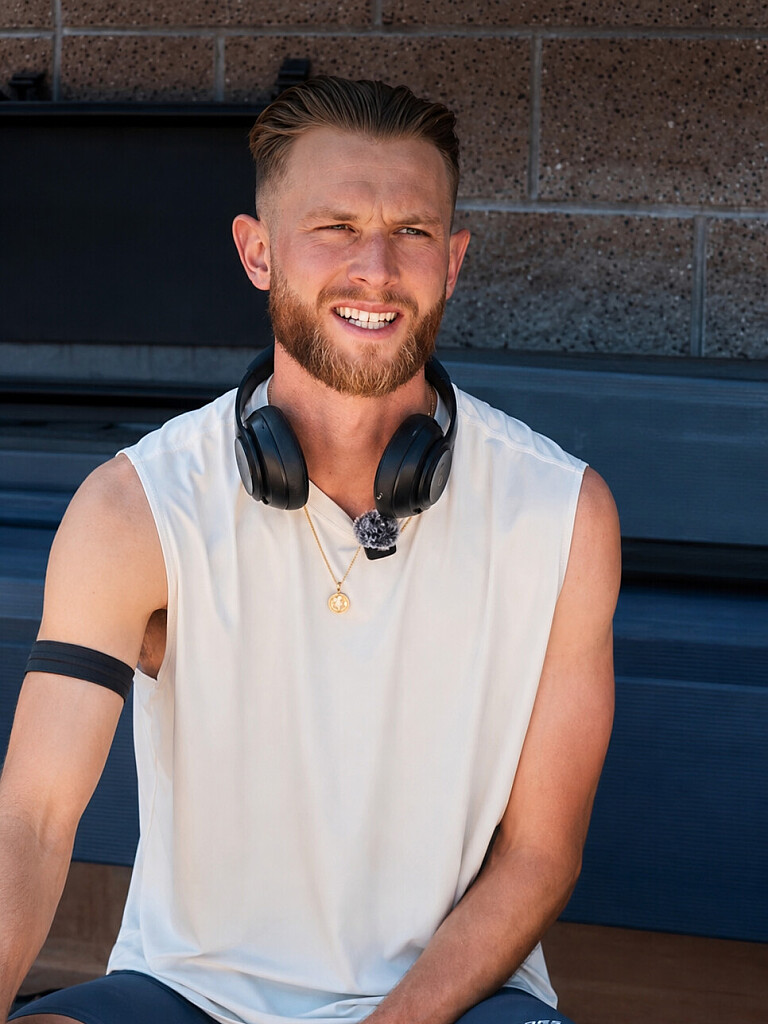
Project 222: Josh Kerr Eyes History as Mile World Record Attempt Draws Near
With just three weeks remaining before his bold assault on one of athletics' most revered records, Josh Kerr has sent an unmistakable warning to the running world.

The reigning world champion has revealed that he recently completed a demanding 4,000-metre training session at projected mile world-record pace—and, remarkably, admitted it felt more comfortable than he had anticipated. It is the clearest indication yet that the Scottish star is peaking at precisely the right moment for what could become one of the defining races in modern middle-distance history.
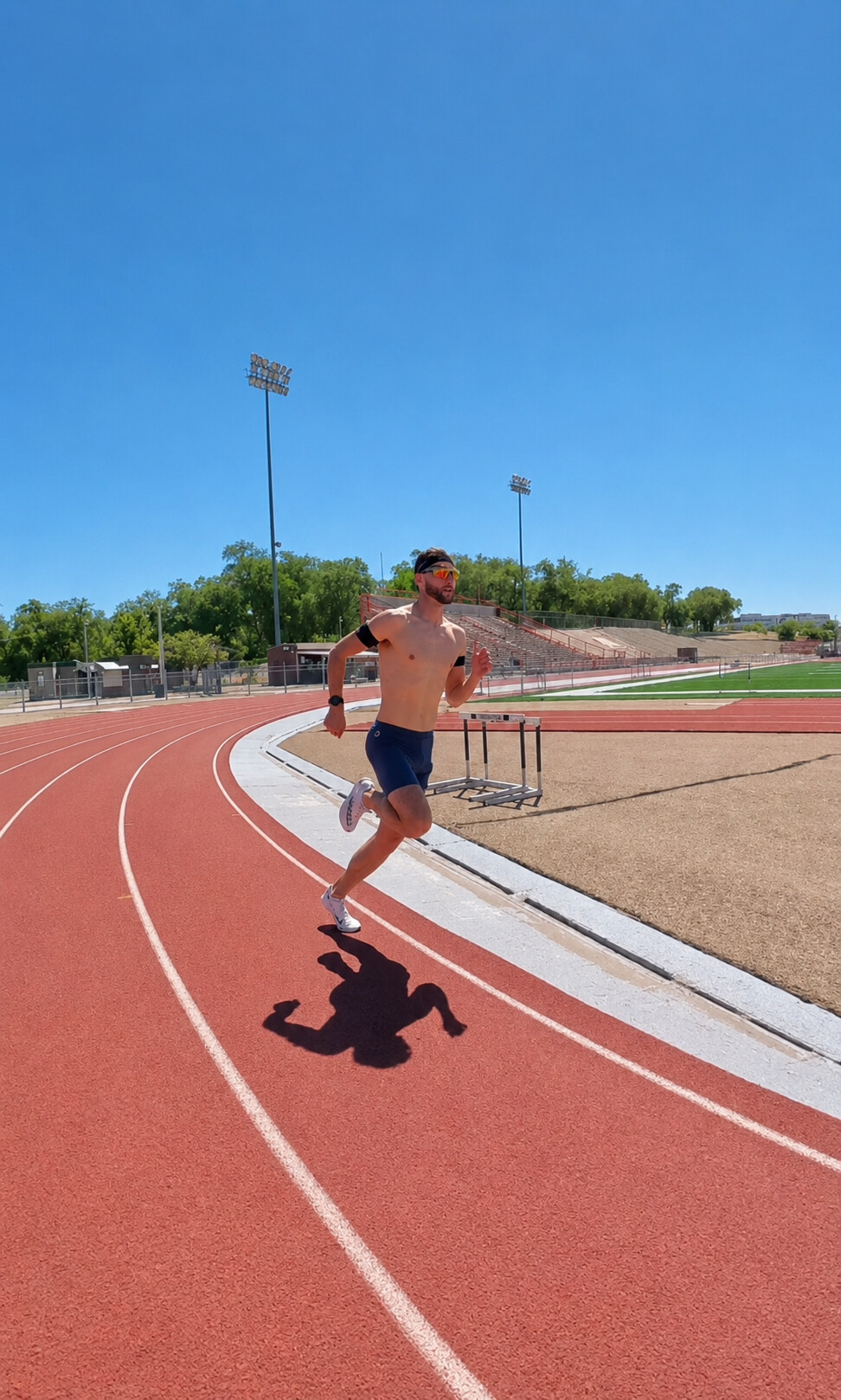
Kerr has set his sights on Hicham El Guerrouj's iconic world record of 3:43.13, established in Rome in 1999. The mark has resisted every challenge for nearly three decades, becoming one of the sport's most enduring achievements. But Kerr is not arriving in London merely hoping to equal history—he wants to rewrite it.
The ambitious campaign has been named "Project 222," a reference to the 222 seconds required to complete the mile in 3:42, a time that would not only eclipse El Guerrouj's legendary performance but establish a new benchmark for the event.
The record attempt is scheduled for Friday, 18 July, at the London Athletics Meet, part of the prestigious Diamond League series. Kerr enters the race already as Britain's record holder with 3:45.34, making him the sixth-fastest miler in history. His latest training session was carefully designed to determine whether he could sustain world-record rhythm over an extended effort—and by every indication, the answer was a resounding yes.
Everything is now falling into place. A packed London stadium is expected to provide a thunderous atmosphere, elite pacemakers have been assembled to deliver the perfect tempo, and Kerr will lace up specially prepared Brooks racing spikes for the occasion.
The ingredients for history are all there.
Now, the athletics world waits to see whether a determined Scotsman can accomplish what no athlete has managed in 27 years—run the fastest mile ever witnessed and usher one of track and field's most iconic records into a new era.
by Erick Cheruiyot for My Best Runs.
Login to leave a comment
Breaking the Barrier: 72 Years Since the Mile Changed Forever
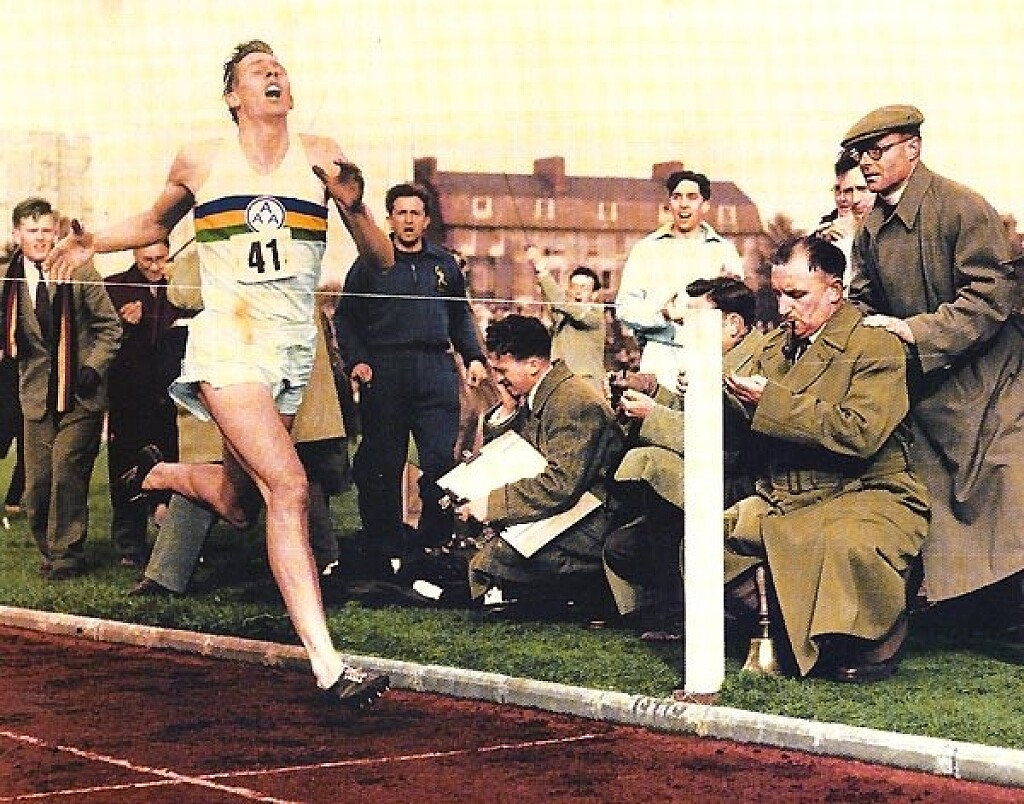
Seventy-two years ago, on a modest track in Oxford, the limits of human endurance were rewritten in a matter of seconds that would echo through sporting history. On May 6, 1954, Roger Bannister achieved what many had long believed impossible—running a mile in under four minutes.
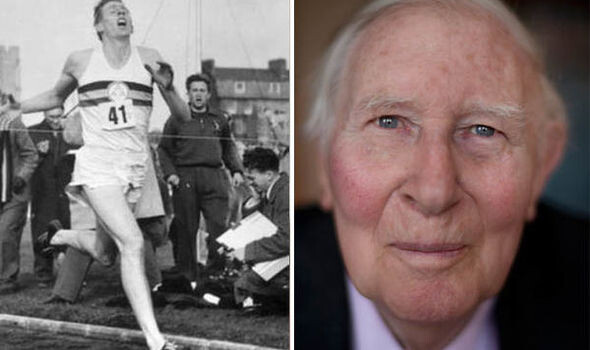
Clocking 3:59.4 at Iffley Road Track, Bannister did more than break a record; he shattered a psychological barrier that had stood like a wall in the minds of athletes and experts alike. The performance was not a solitary feat of brilliance, but a perfectly orchestrated effort. With the steady guidance of pacemakers Chris Brasher and Chris Chataway, Bannister was carried through the early laps at a relentless yet controlled tempo before unleashing his defining kick.
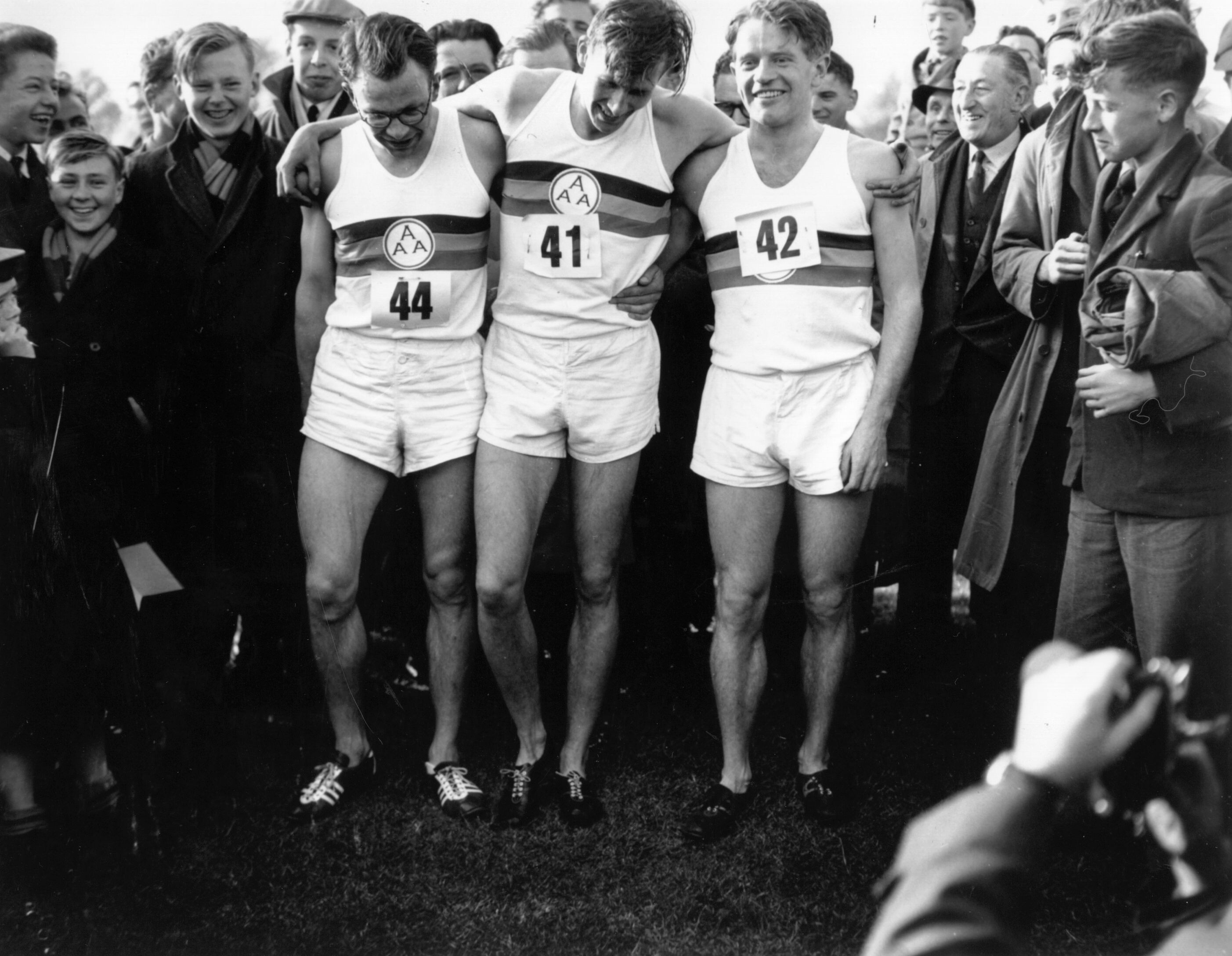
What makes the feat even more compelling is the understated nature of the preparation behind it. In an era long before the science-heavy training systems of today, Bannister followed a remarkably measured approach. During the winter phase of his periodisation, he averaged fewer than 30 miles per week—modest by modern elite standards—and deliberately reduced that load to roughly 15 miles per week as he transitioned into the competition phase of his macro-cycle. It was a philosophy rooted not in volume, but in precision and quality.
His sessions reflected that same clarity of purpose. Among his preferred workouts was a demanding set of three repetitions over a mile and a half, each run at a controlled rhythm comparable to a 14:30 5km pace. It was training designed to sharpen both endurance and efficiency—an early glimpse into principles that would later define modern middle-distance preparation.
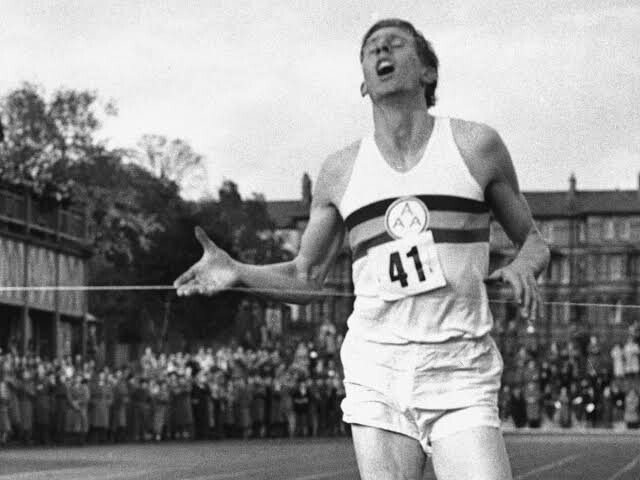
On race day, that discipline translated into exact execution. The pacing plan was meticulous: the halfway point was to be reached in 1:58, a target faithfully delivered before Chris Chataway assumed control of the tempo. By the three-quarter mile, the clock read 3:01, leaving Bannister perfectly poised on the edge of history. What followed was not just a final lap, but a defining surge into immortality.
In the decades since that historic afternoon, the mile has continued to evolve, each generation pushing the boundaries a little further. The world record has been rewritten 18 times, each mark a testament to the relentless pursuit of excellence. Today, the standard is held by Hicham El Guerrouj, whose astonishing 3:43.13 remains a benchmark of sustained speed and precision.
Yet, even as times have grown faster, Bannister’s achievement retains a unique place in athletics lore. It was not merely about speed—it was about courage, innovation, and the refusal to accept perceived limits. His run endures as a reminder that the greatest breakthroughs often begin in the mind before they are realized on the track.
Seventy-two years on, the sub-four-minute mile is no longer a rarity among elite runners, but the moment it was first conquered remains timeless—a defining stride in the story of human potential.
by Erick Cheruiyot for My Best Runs.
Login to leave a comment
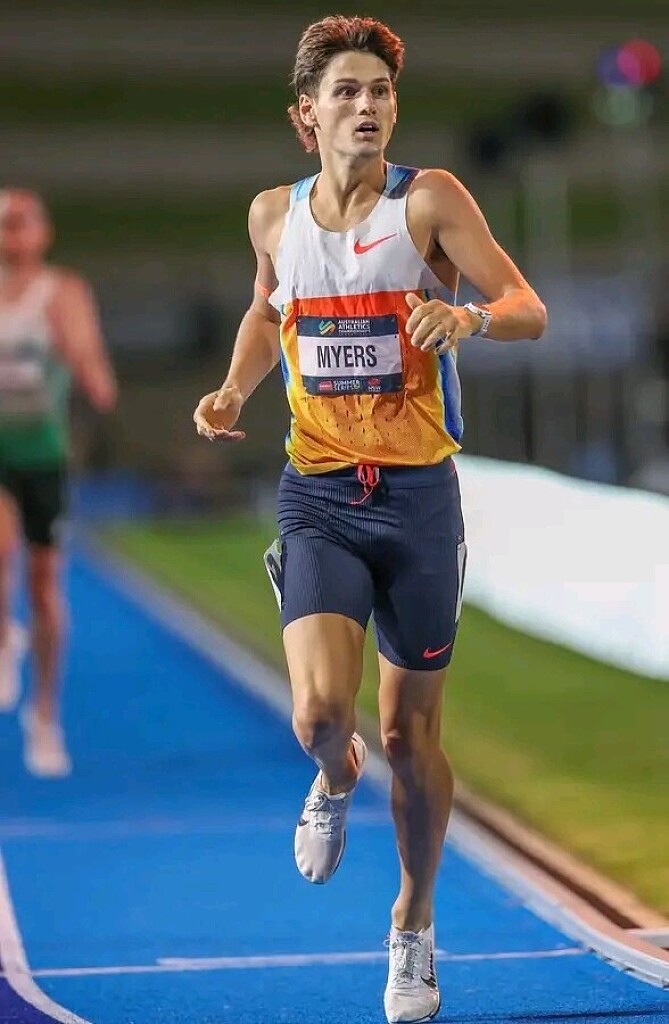
Cameron Myers: The Relentless Rise of Australia’s Middle-Distance Prodigy
At just 19, Cameron Myers is redefining what it means to be a teenage force in global athletics. In an era brimming with emerging talent, the Australian prodigy has quietly—but emphatically—established himself as one of the most formidable middle-distance runners on the planet.
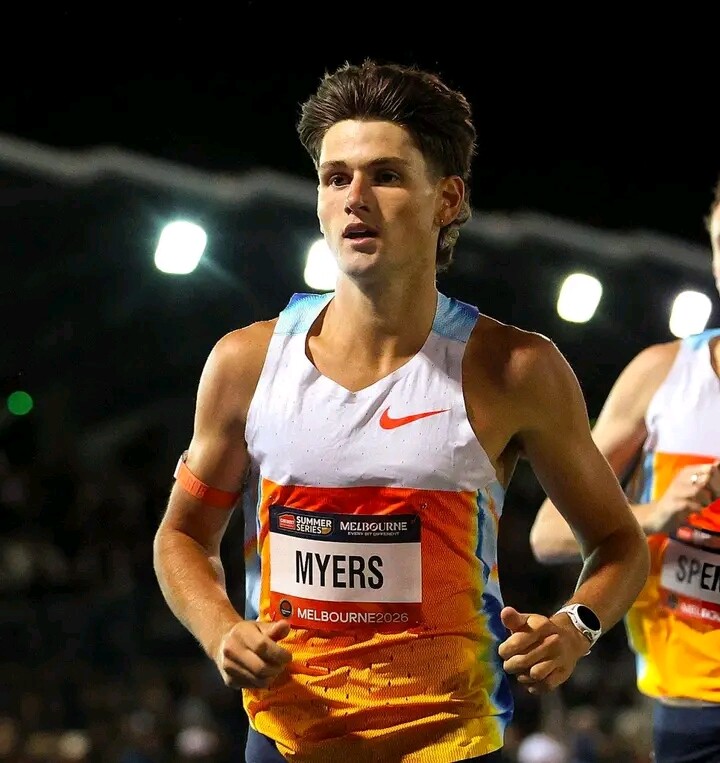
While headlines may drift toward other rising stars, Myers remains unfazed by the noise. His focus is unwavering, rooted not in publicity but in performance. Those closest to him describe an athlete driven by execution rather than attention—a competitor who thrives beyond the spotlight.
That mindset was on full display at the Australian National Championships in Sydney, where Myers delivered a masterclass across two demanding disciplines. In the 1500 metres, he dismantled a world-class field with astonishing authority. Facing a lineup in which half the competitors had already dipped below 3:36, Myers surged to the front early and never relinquished control. By the final lap, the race was effectively over.
He crossed the line in a blistering 3:29.85—an extraordinary mark that not only placed him within touching distance of Ollie Hoare’s national record, but also etched his name into history as the first athlete ever to break the 3:30 barrier on Australian soil. Remarkably, this feat surpasses even the achievements of legends such as Hicham El Guerrouj, the world record holder, who never achieved such a time in Australia.
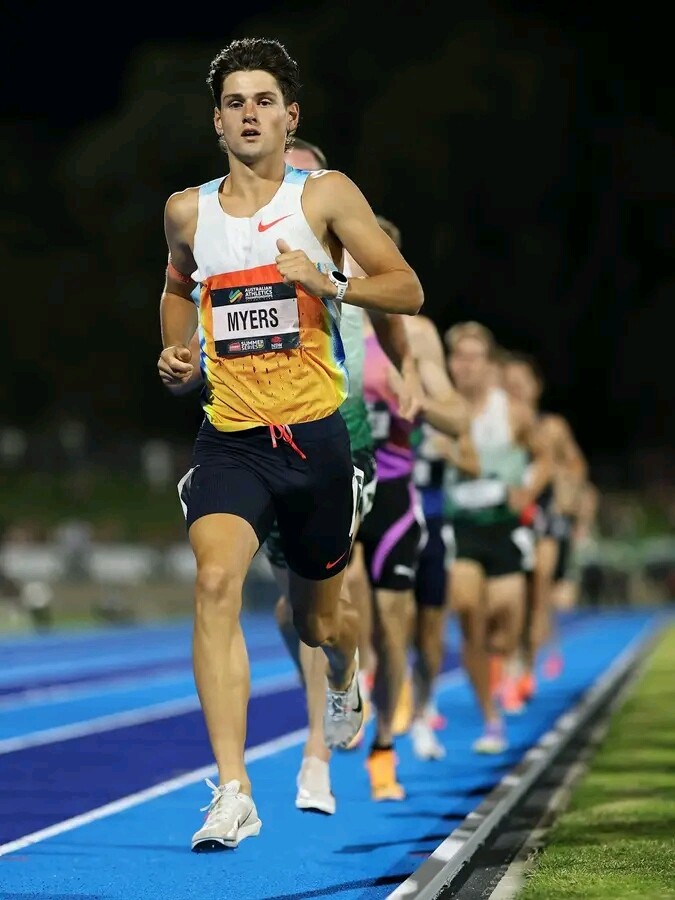
What made the performance even more compelling was the context: no pacemakers, no tactical shelter—just raw, front-running brilliance. Analysts have since suggested it may stand as one of the fastest 1500m races run outside a major championship this century, particularly given the absence of pacing assistance.
Yet Myers was far from finished.
Less than 24 hours later, he returned to the track and delivered another statement—this time over 5000 metres. Demonstrating remarkable endurance and recovery, he surged to victory while obliterating his personal best by an astonishing 20 seconds. It was a performance that underlined not just versatility, but an elite capacity to dominate across distances.
Though Sydney’s modern track surface may have offered marginal gains, it does little to explain the consistency Myers has shown across continents. Earlier in the year, he produced the fastest indoor mile ever recorded by a teenager in Seattle, further reinforcing his rapid progression. He also clocked an impressive 3:30.42 to win the 1500m at the prestigious Maurie Plant Meet—a performance that hinted at what was to come.
Speaking after his historic 1500m run, Myers revealed that even greater performances may lie ahead. He acknowledged that without pacers, he was unable to fully express his current form—a striking admission considering the magnitude of what he had just achieved.
In a sport where hype often precedes substance, Cameron Myers represents the inverse: a rare talent whose results speak louder than any narrative. As he continues to sharpen his craft, the global athletics stage may soon have no choice but to centre its attention firmly on him.
by Erick Cheruiyot for My Best Runs.
Login to leave a comment

“My Race, My Rules”: Josh Kerr Targets History with Project 222 in London
The pursuit of greatness in middle-distance running has long been defined by courage, precision, and a willingness to challenge the impossible. This July, Josh Kerr is preparing to embody all three as he launches an audacious assault on one of athletics’ most enduring records.
Fresh off his triumph at the World Indoor Championships, Kerr has unveiled Project 222—a bold mission to become the first man in history to run the mile in 222 seconds (3:42). If successful, the British star would eclipse the legendary 3:43.13 world record set by Hicham El Guerrouj back in 1999—a mark that has stood unchallenged for over a quarter of a century.
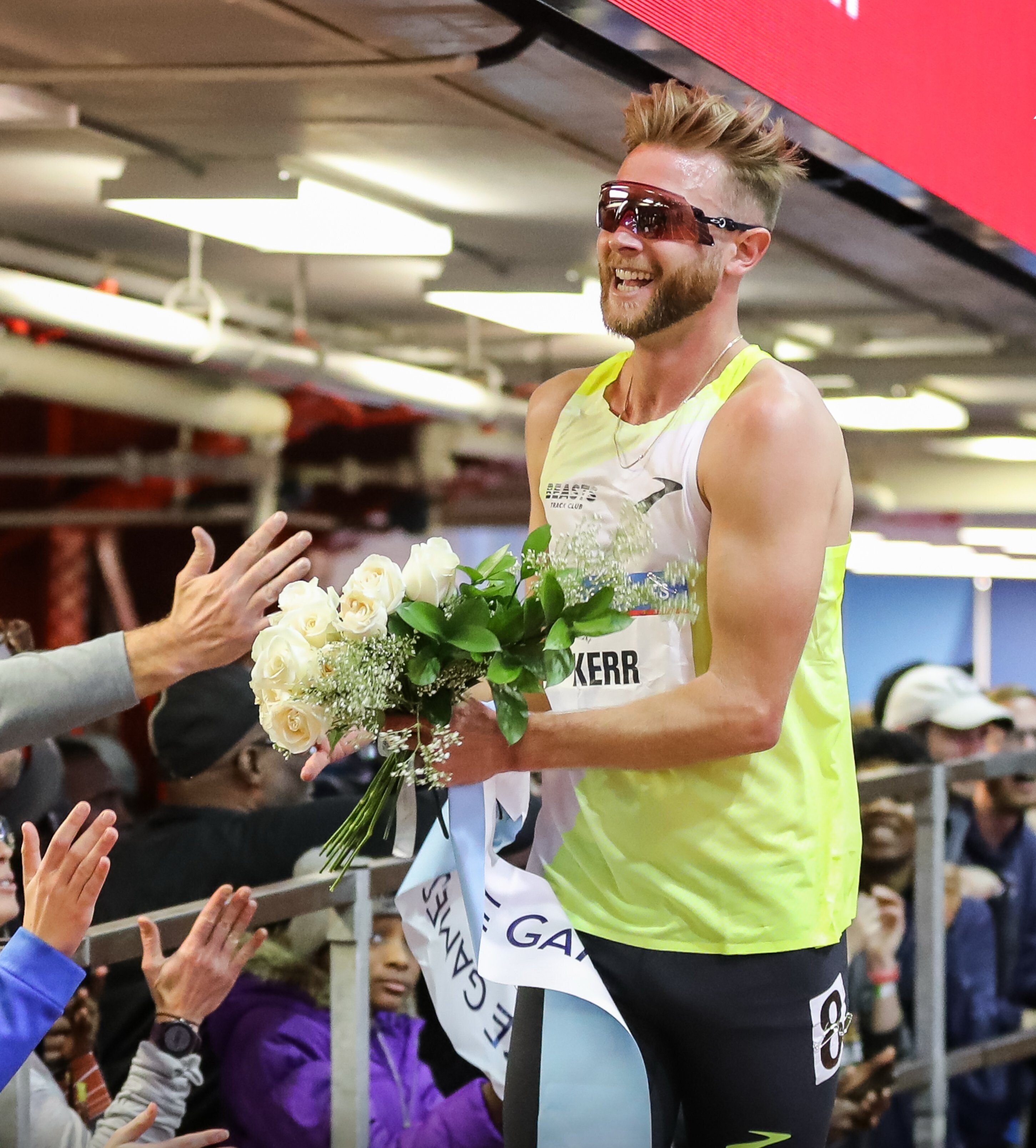
But what makes Kerr’s attempt truly compelling is not just the time he is chasing—it is how he intends to chase it.
Rather than opting for a controlled, pacemaker-driven time trial, Kerr has chosen the grand stage of the London Diamond League on July 18. In an era where record attempts are often engineered under near-perfect conditions, Kerr is deliberately embracing unpredictability—opting for a competitive race environment against world-class opposition, fueled by the energy of a packed stadium.
“It’s my race, my rules,” Kerr declared—an unapologetic statement of intent that underlines his philosophy. For him, breaking the record is not just about rewriting the clock, but about restoring the raw, competitive essence of the sport.
The magnitude of the challenge cannot be overstated. Hicham El Guerrouj’s mile record is widely regarded as one of the most iconic and resilient achievements in track and field history. Generations of elite runners have come and gone without seriously threatening it, a testament to both its brilliance and its difficulty.
Yet Kerr arrives at this moment in peak condition. His recent world indoor title over 3000 meters confirmed not only his endurance but also his tactical intelligence—qualities essential for sustaining the relentless pace required for a sub-3:43 mile.
Project 222, therefore, is more than a numerical target. It is a statement—a challenge to convention, a celebration of competition, and a bid to create history in its purest form: under pressure, in front of fans, and against the very best.
The Date to Watch
Event: London Diamond League
Date: July 18
Mission: The first-ever 222-second mile (3:42)
If Kerr succeeds, he will not only break a record—he will redefine how such records are pursued. And even if the clock resists, the attempt itself promises to deliver a spectacle worthy of the sport’s rich legacy.
by Erick Cheruiyot for My Best Runs.
Login to leave a comment
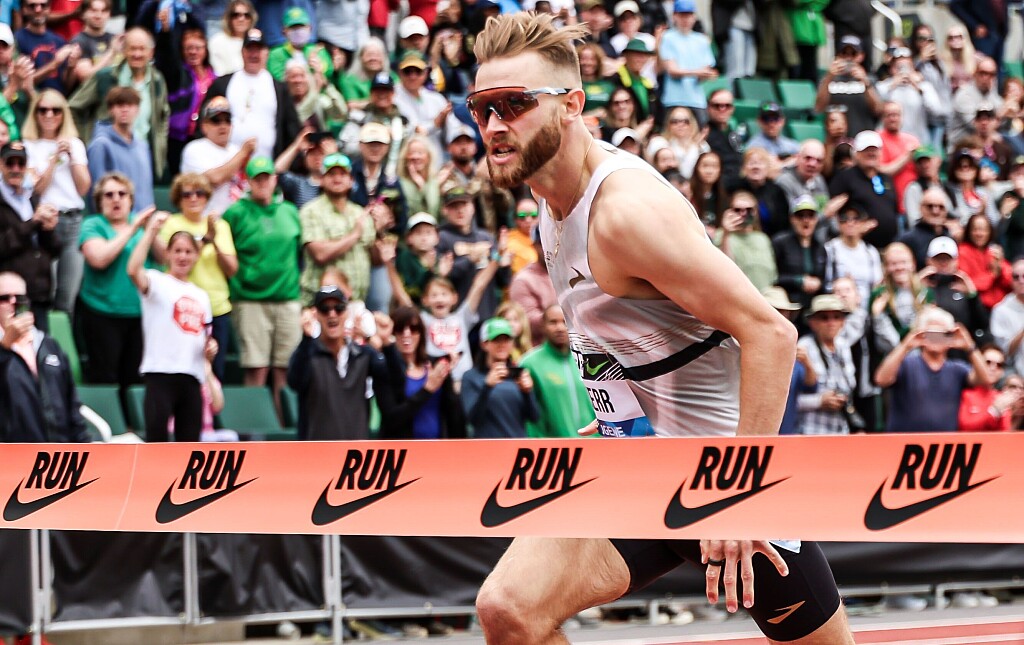
Kerr’s Bold Declaration: Supreme Confidence or a Defining Gamble?
When Josh Kerr speaks, the athletics world listens—and right now, it’s hanging on every word. Following his appearance on The Running Effect, the British star has ignited debate with a strikingly assured message: he believes he has already possessed the fitness required to run a 3:42 mile. Not someday in the future, not after a radical shift in preparation—but already, within reach.
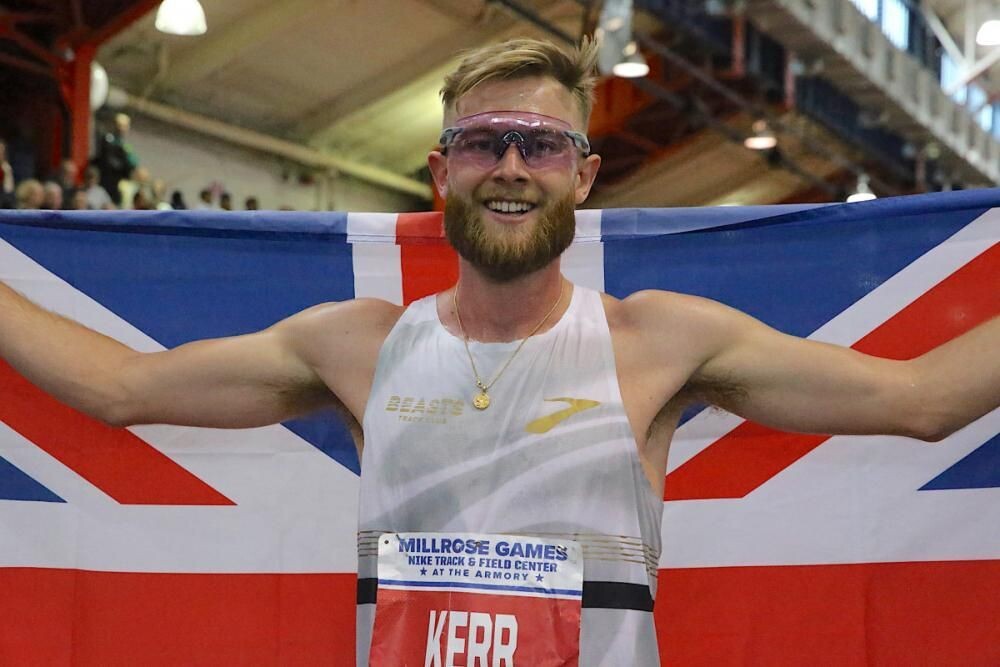
It is a statement that cuts through the usual caution of elite sport. Kerr isn’t pointing to untapped potential or hypothetical progression; instead, he is reframing the narrative entirely. In his view, the barrier has never been physical capability, but rather the precise alignment of execution—race conditions, pacing, and that elusive perfect day when everything clicks into place.
What makes his claim even more compelling is its simplicity. There is no talk of reinventing his training or chasing marginal gains through dramatic change. Kerr insists that returning to the shape he carried into the Olympic final would suffice. For an athlete competing at the razor’s edge of global middle-distance running, such conviction is both rare and revealing.
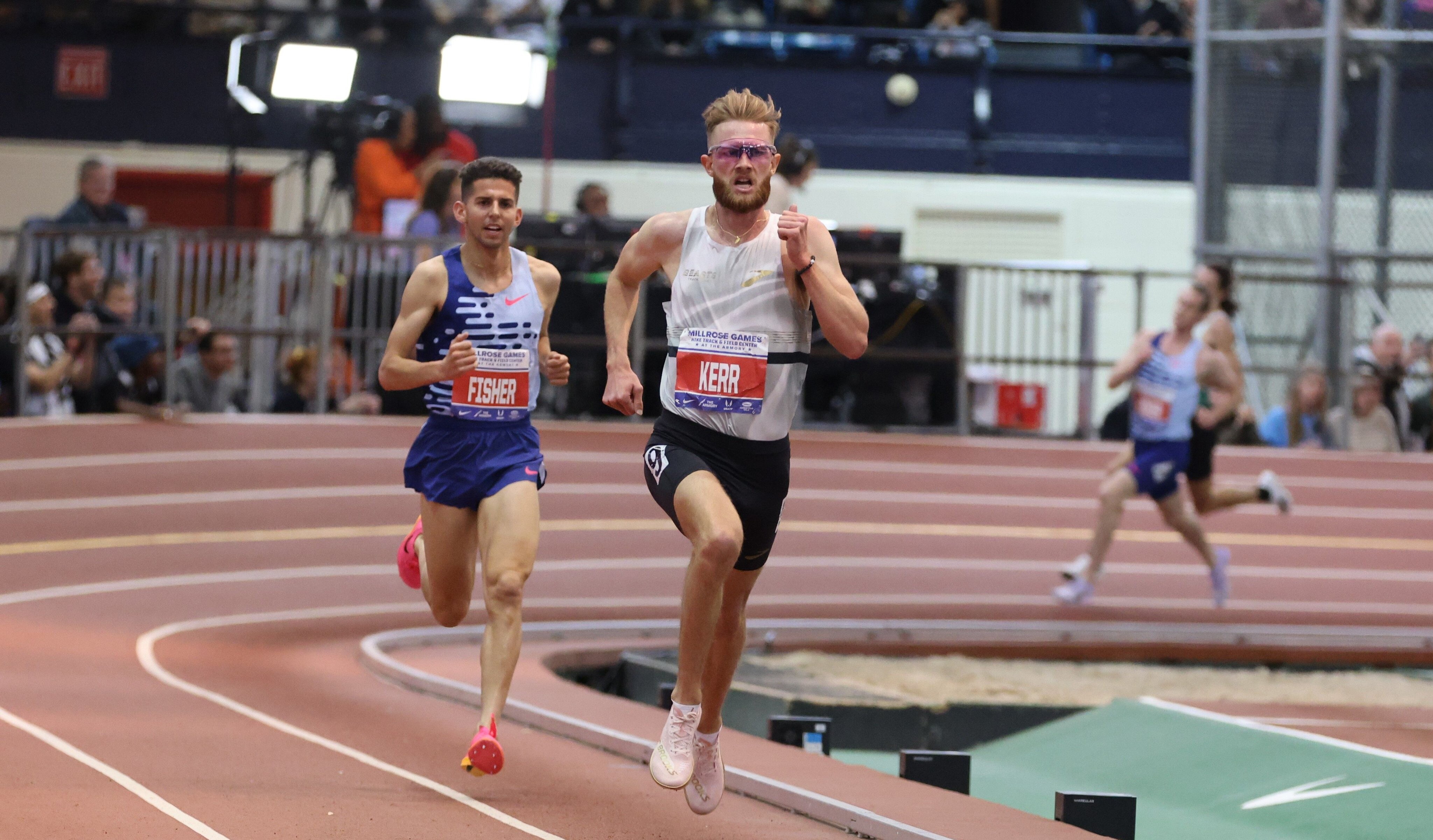
Naturally, any discussion of a 3:42 mile leads directly to Hicham El Guerrouj, whose 3:43.13 world record from 1999 has stood as one of the sport’s most enduring benchmarks. For decades, it has seemed almost untouchable—a performance frozen in time, resistant to generations of challengers.
Yet the landscape is shifting. The modern era has ushered in unprecedented depth, with championship races now unfolding at relentless, record-adjacent pace. Athletes such as Cole Hocker, Yared Nuguse, and Jakob Ingebrigtsen have collectively raised the ceiling, demonstrating that the margins once thought insurmountable are steadily narrowing. Performances from recent global finals suggest that, under ideal conditions, the conversion toward mile-record territory is no longer theoretical—it is increasingly plausible.
Against this backdrop, Kerr’s words feel less like bravado and more like a calculated declaration of intent. Still, they carry risk. In a sport where outcomes are measured in fractions of a second, setting such a towering expectation invites scrutiny. If achieved, it would cement his place among the all-time greats; if not, the weight of his own prediction could linger.
But perhaps that is precisely the point. Great records rarely fall to cautious ambition—they demand a mindset willing to challenge history itself. Kerr appears ready to embrace that burden, positioning himself not just as a contender, but as a central figure in what could become one of athletics’ defining pursuits.
Whether this is supreme self-belief or a gamble that could shape his legacy, one truth is undeniable: the chase for the mile world record is no longer distant. It is accelerating—and Josh Kerr intends to meet it head-on.
by Erick Cheruiyot for My Best Runs.
Login to leave a comment
Breaking Barriers Across Three Frontiers: The Rare Triple of Middle- and Long-Distance Greatness
In the demanding world of distance running, versatility at the highest level is almost mythical. Speed specialists dominate the shorter races, while endurance kings reign supreme over longer distances. Yet, a select group of extraordinary athletes have managed to blur those boundaries—delivering world-class performances across three iconic events: the 1500m, 3000m, and 5000m.
To run under 3:30 in the 1500m, under 7:30 in the 3000m, and under 13:00 in the 5000m is not just a statistical milestone—it is a testament to a rare fusion of speed, stamina, tactical intelligence, and longevity. Across decades of elite competition, only eight men in history have achieved this remarkable “triple crown” of distance running.
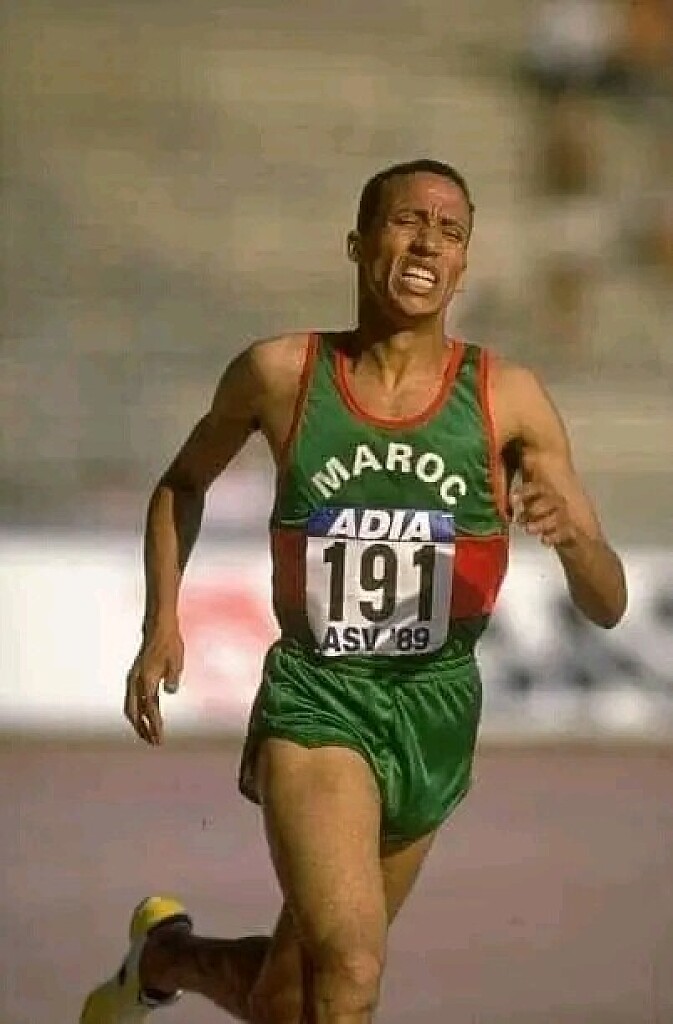
The story begins with Saïd Aouita, the Moroccan trailblazer who set the standard in 1989. Aouita’s revolutionary range redefined what was possible, proving that an athlete could dominate from the metric mile to the longer track events with equal authority.
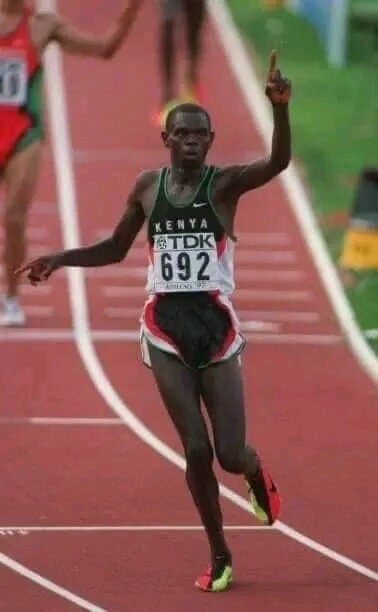
Years later, Kenya’s Daniel Komen elevated the benchmark in 1997, combining raw power and relentless pace to cement his place among the sport’s most feared competitors. His performances remain etched in athletics history as a symbol of controlled aggression and precision.
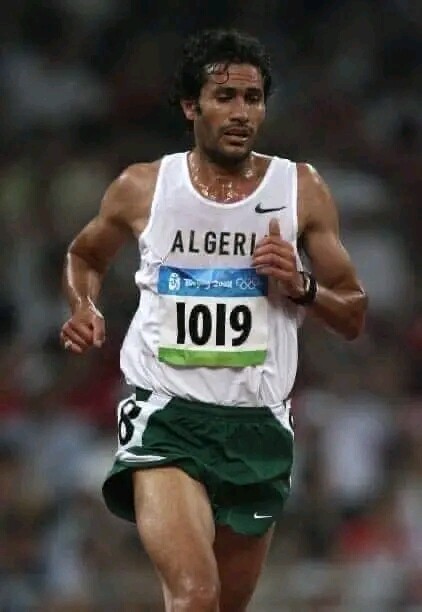
Algeria’s Ali Saïdi-Sief followed in 2001, showcasing a seamless blend of endurance and finishing speed, while another Moroccan icon, Hicham El Guerrouj, added his name in 2003. El Guerrouj, widely regarded as one of the greatest middle-distance runners of all time, embodied elegance and dominance, conquering distances with unmatched fluidity.
Kenya continued its proud tradition through Augustine Choge in 2009, a quiet yet consistent force whose versatility often flew under the radar, and Bernard Lagat in 2010. Lagat’s inclusion was particularly remarkable, highlighting not only his range but also his longevity, as he remained competitive across generations.
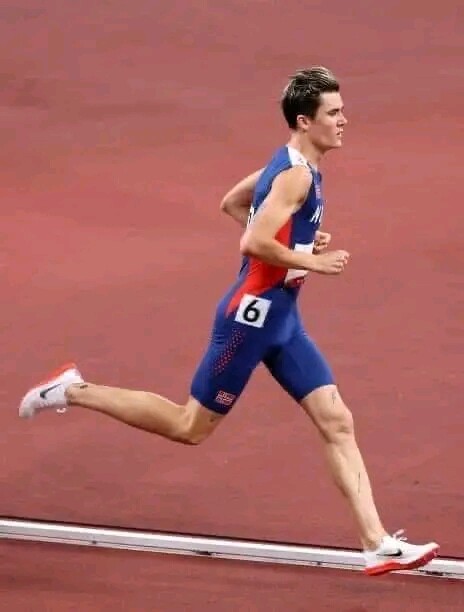
The modern era has witnessed a resurgence of this rare versatility. Norway’s Jakob Ingebrigtsen joined the elite list in 2021, redefining contemporary distance running with his fearless front-running style and relentless pursuit of fast times. That same year, Spain’s Mohamed Katir matched the feat, further proving that the boundaries between speed and endurance continue to be pushed.
What unites these eight athletes is not just their times, but their ability to transcend specialization in an era that increasingly demands it. Each performance reflects years of meticulous training, tactical brilliance, and an unwavering commitment to excellence.
In a sport often defined by margins of seconds, this sub-3:30, sub-7:30, sub-13:00 combination stands as one of the purest indicators of all-around greatness. It is a benchmark that few can approach—and even fewer can conquer.
As athletics continues to evolve, the question remains: who will be next to join this exclusive club? For now, these eight names stand alone, guardians of one of the sport’s most demanding and prestigious achievements.
by Erick Cheruiyot for My Best Runs.
Login to leave a comment
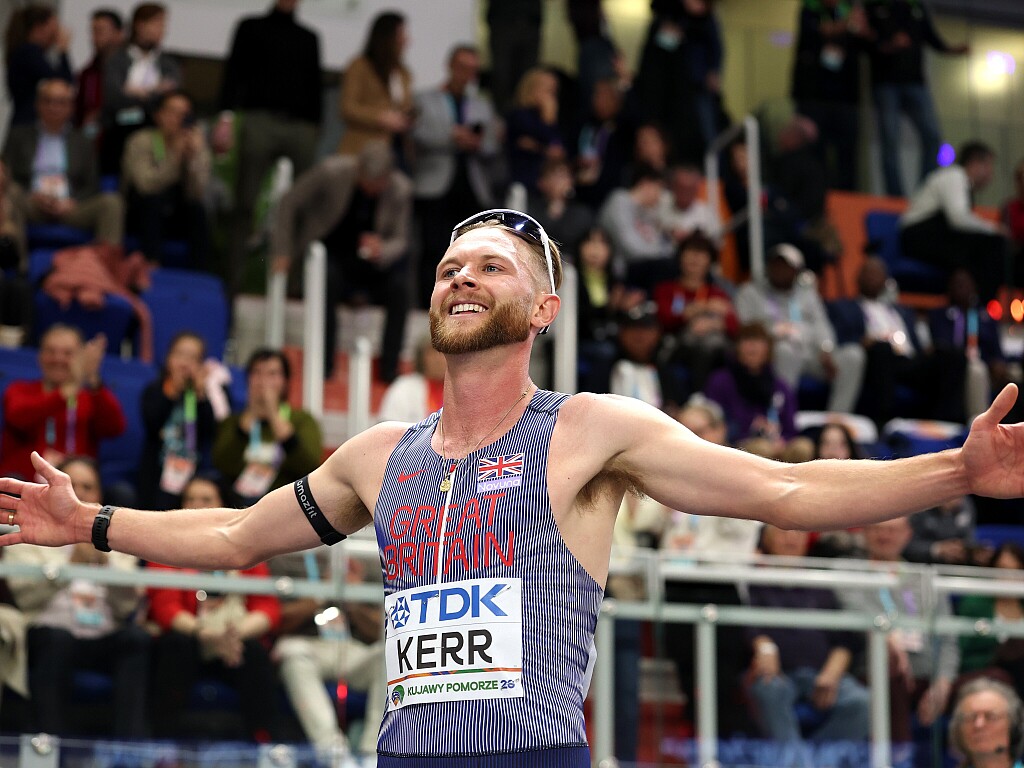
Project 222: Josh Kerr’s Relentless Chase of a 27-Year Mile Legacy
With unwavering belief and calculated precision, Josh Kerr is preparing to confront one of the most revered records in athletics—the 3:43.13 mile world record set by Hicham El Guerrouj in 1999. A performance that has stood unchallenged for 27 years now faces a serious and deliberate assault.
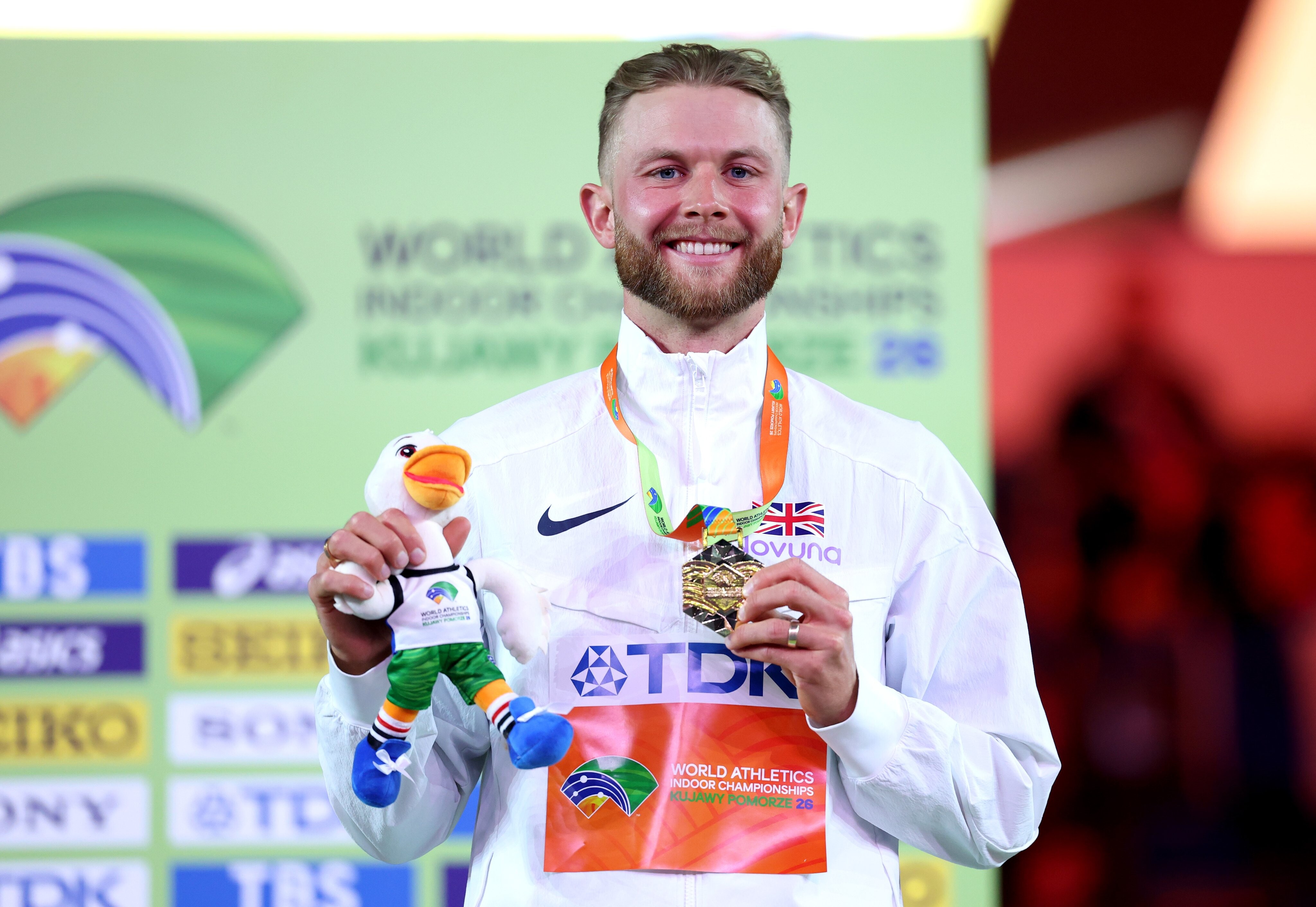
The reigning world 1500m champion and double world indoor 3000m gold medallist has made his intentions unmistakably clear. His campaign, boldly titled Project 222, is centered on a singular objective: to cover the mile in 222 seconds—3:42—surpassing a mark long considered untouchable. It is not merely a target, but a statement of intent.
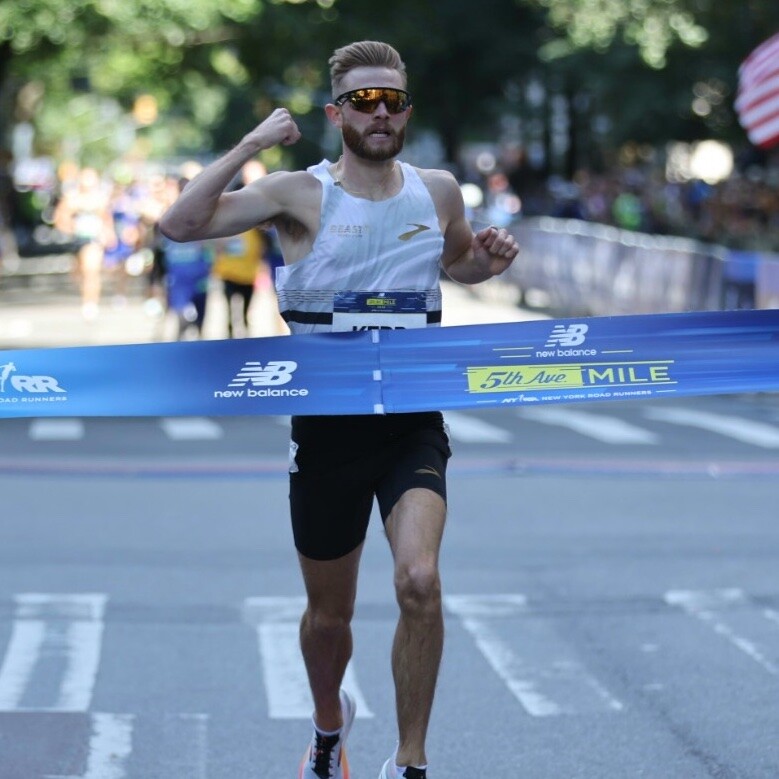
Kerr will take on this historic challenge at the London Diamond League on July 18, 2026, where every variable—from pacing to conditions—must align with near perfection. At this level, the margin between greatness and immortality is measured in fractions, and Kerr must find over two seconds beyond his personal best of 3:45.34, set in Eugene in 2024. That time not only secured him the British record but also placed him sixth on the all-time list—firmly among the sport’s elite.
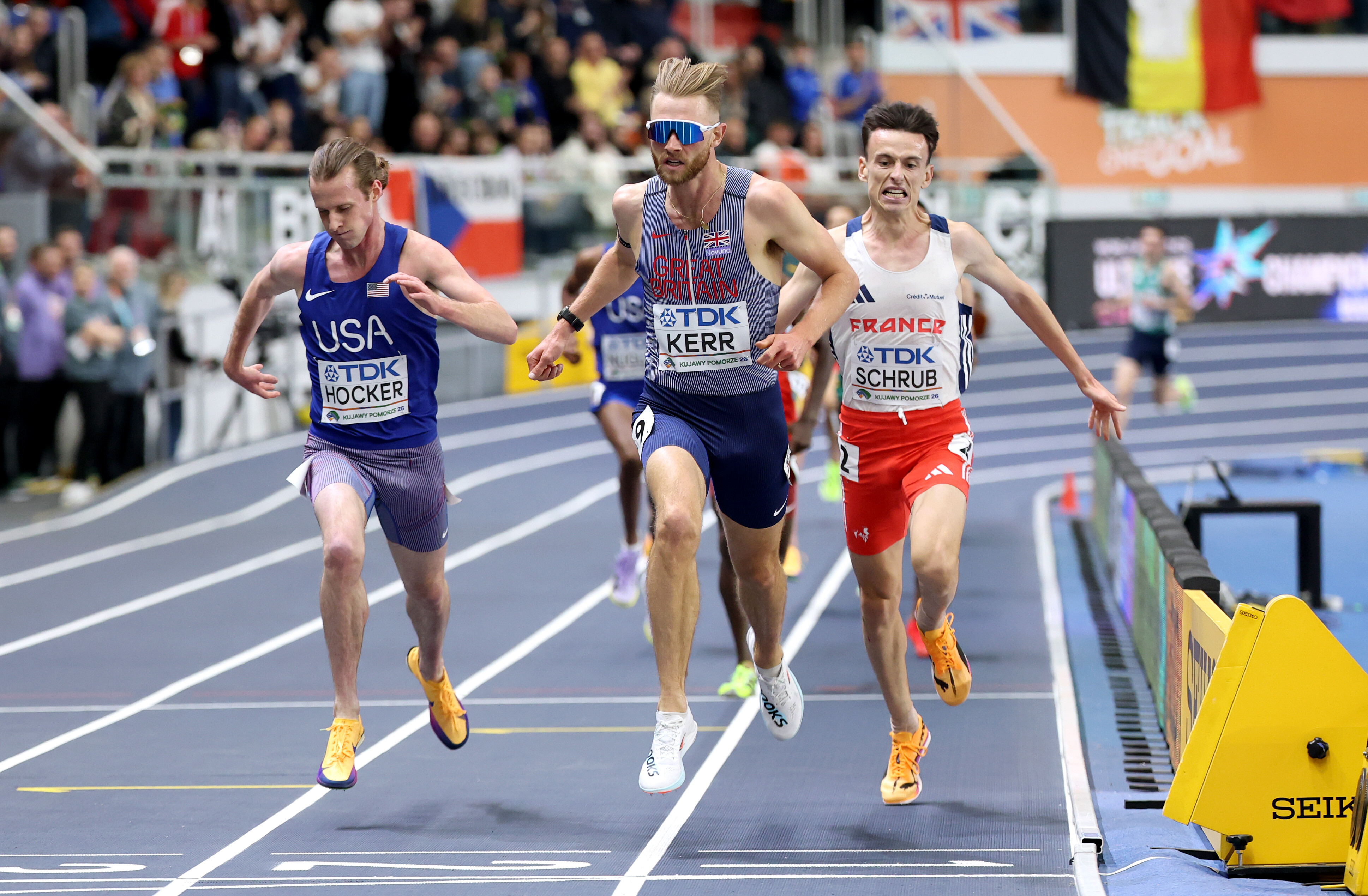
He enters this outdoor campaign in formidable form, having recently claimed his second world indoor 3000m title, holding off a fierce late challenge from Cole Hocker in Toruń, Poland. It was a performance that reaffirmed both his tactical strength and finishing authority—qualities that will be indispensable in his pursuit of history.
Behind the scenes, Kerr’s long-time partner Brooks is committing fully to the mission. The collaboration extends far beyond standard sponsorship, evolving into a comprehensive performance project. At its core is a custom-engineered racing spike, meticulously designed around Kerr’s biomechanics and expected to comply with all World Athletics regulations, incorporating advanced cushioning and a finely tuned carbon plate system for optimal propulsion.

In addition, Kerr has been testing multiple aerodynamic speed suit concepts, acting as the sole athlete refining their design for race-day efficiency. Complementing the physical preparation is a detailed physiological support program from the Brooks Run Research Lab, focusing on sleep optimization, hydration strategies, and recovery protocols—each element calibrated to extract peak performance when it matters most.
As anticipation builds, fans will be given a rare inside look into the journey. A series of behind-the-scenes features documenting Kerr’s preparation, alongside the rich history of the mile, is set to be released across his and Brooks’ platforms in the lead-up to July 18.
This is more than a race. It is a meticulously engineered pursuit of greatness—where science, preparation, and belief converge. And if everything aligns under the London lights, Josh Kerr may not just challenge history—he may finally rewrite it.
by Erick Cheruiyot for My Best Runs.
Login to leave a comment
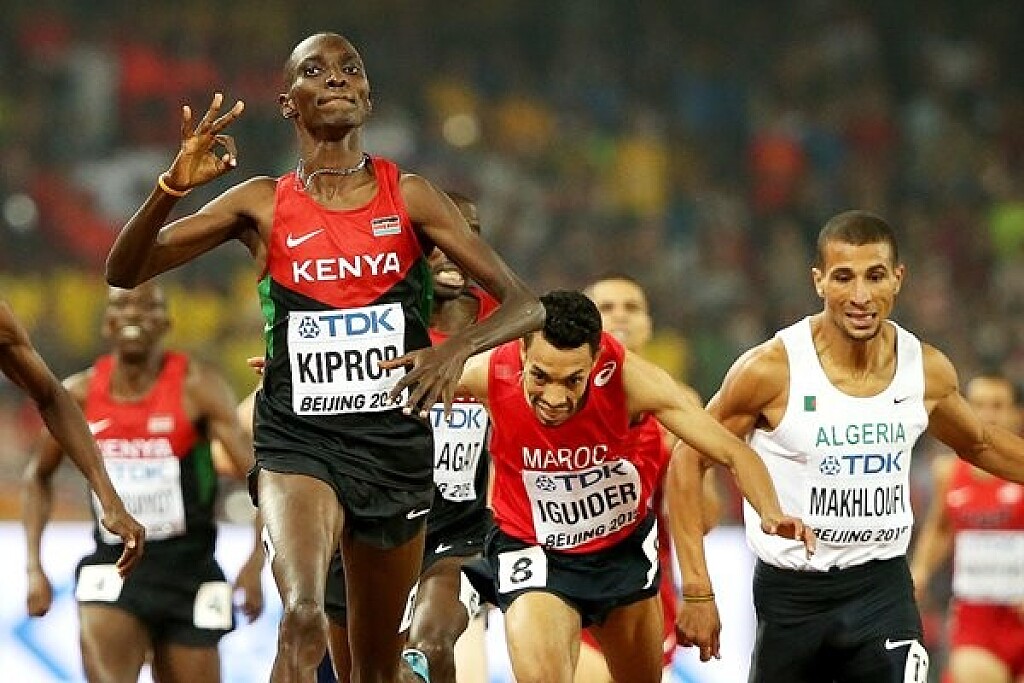
Front-Running Brilliance: The Night Asbel Kiprop Lit Up Monaco with 3:26.69
On a warm summer evening along the Mediterranean coast, the 1500 meters witnessed one of its most breathtaking performances. At the 2015 edition of the prestigious Herculis Monaco, part of the Diamond League circuit, Kenya’s middle-distance maestro Asbel Kiprop delivered a run that still resonates in athletics history.
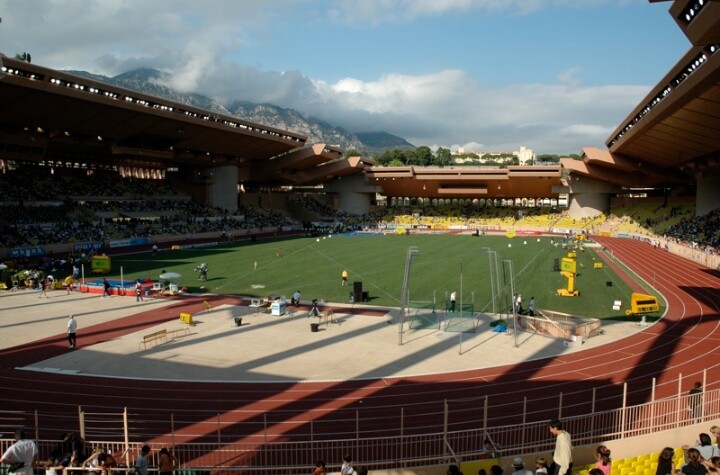
On July 17, 2015, inside the famous Stade Louis II in Monaco, Kiprop stormed to a stunning 3:26.69 in the 1500 meters—at the time one of the fastest performances ever recorded over the distance. The run combined fearless front-running, precise pacing, and remarkable endurance, creating a race that left both spectators and competitors in awe.
From the opening gun, Kiprop made his intentions clear. Rather than relying on his renowned finishing kick, the Olympic champion chose to dictate the pace from the front, relentlessly pursuing the long-standing world record of Hicham El Guerrouj, whose iconic 3:26.00 still stands as the benchmark for the event.
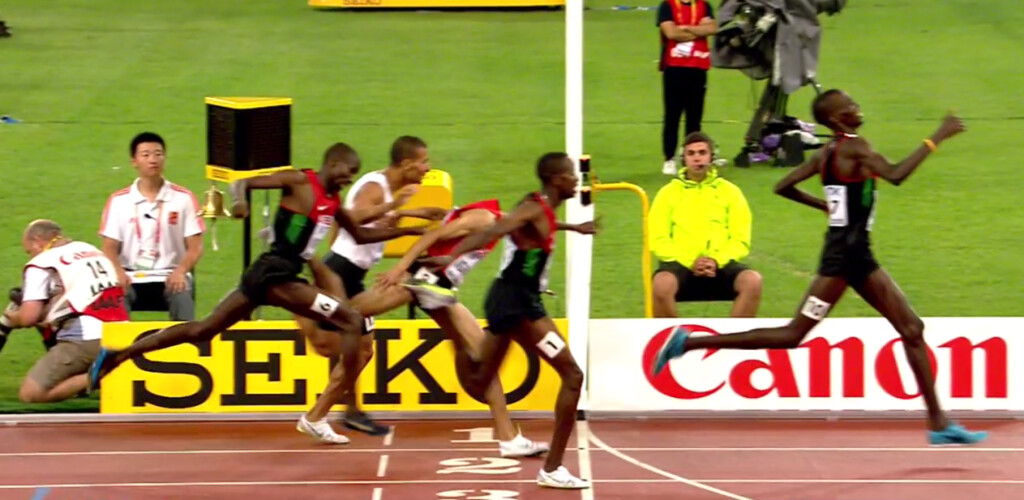
The early pace was sharp and deliberate. Behind the pacemaking assistance of Kenya’s Andrew Kiptoo Rotich, the first lap was covered in approximately 54 seconds, immediately signaling that the race would be something special. By the halfway mark, Kiprop passed 800 meters in about 1:50, maintaining a relentless rhythm that stretched the field.
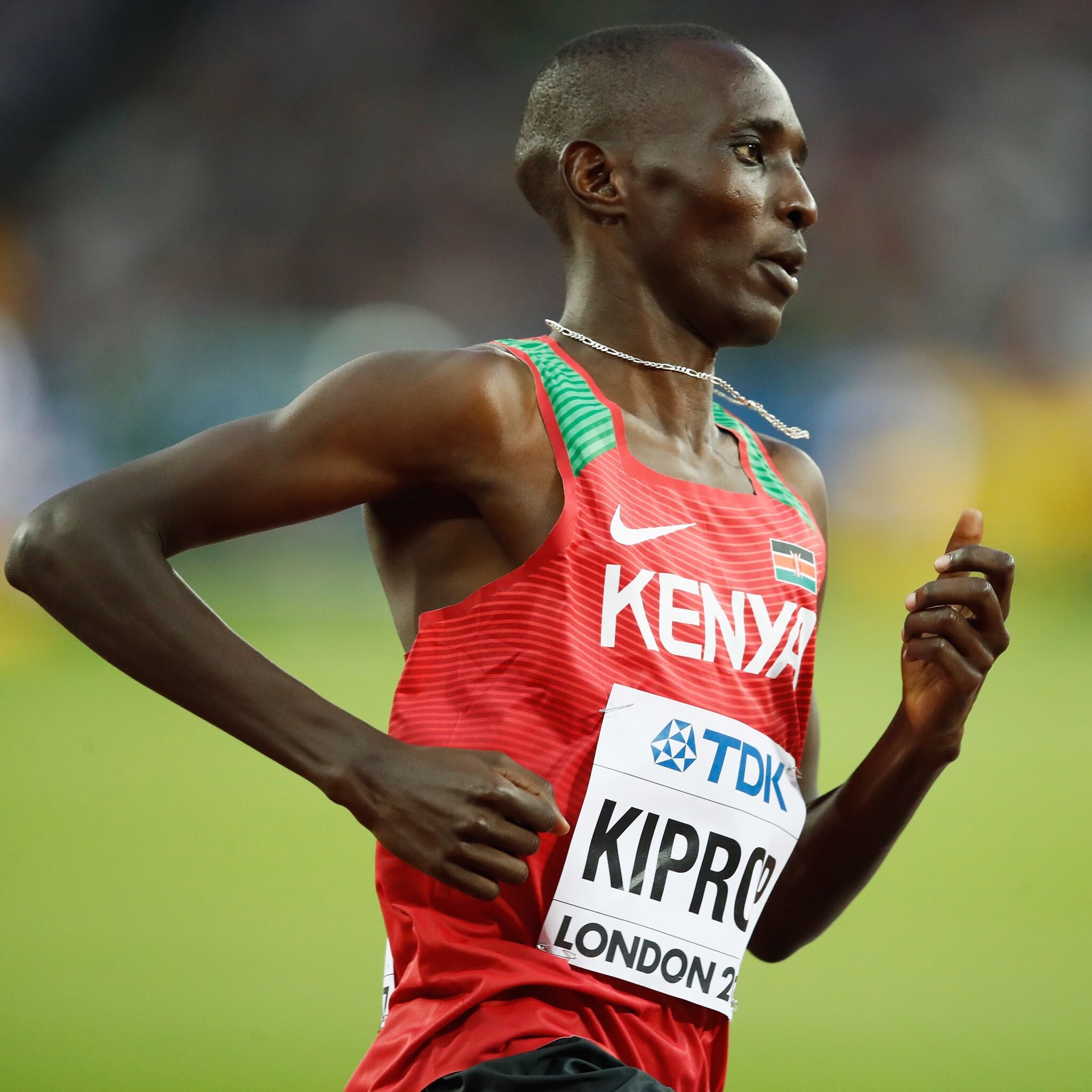
As the race progressed, the tall Kenyan floated around the track with the fluid stride that became his trademark. Passing 1200 meters in roughly 2:45, he remained firmly in control, gliding through the final lap in about 55 seconds to stop the clock at 3:26.69—a performance that etched his name even deeper into middle-distance history.
What made the run particularly remarkable was the margin of victory. Kiprop crossed the finish line more than two seconds ahead of a world-class field. Algeria’s Taoufik Makhloufi finished second in 3:28.75, just ahead of Morocco’s Abdelaati Iguider, who clocked 3:28.79.
The time also stood as a meeting record for the Monaco Diamond League at the time, further cementing the race’s place among the sport’s unforgettable moments.
For Kiprop, the performance was another shining chapter in a glittering career. The Kenyan star had already secured Olympic gold at the 2008 Beijing Olympics and would go on to collect three world titles at the World Athletics Championships in 2011, 2013, and 2015. Known for his elegant stride and exceptional race intelligence, he became one of the defining figures of modern middle-distance running.
Beyond Monaco, Kiprop built an impressive résumé across multiple distances. His personal bests included 1:43.15 for 800 meters, 3:48.50 for the mile, 2:14.23 for 1000 meters, and 7:42.32 for 3000 meters—a testament to both his speed and versatility.
Yet among all his achievements, the Monaco masterpiece remains one of the most memorable. On that night in July 2015, Asbel Kiprop didn’t just win a race—he delivered a performance that showcased the artistry and courage of championship middle-distance running, reminding the athletics world how extraordinary the 1500 meters can be when a great athlete dares to chase history.
by Erick Cheruiyot for My Best Runs.
Login to leave a comment
Chasing 3:26 — The Extraordinary Standard Set by Hicham El Guerrouj
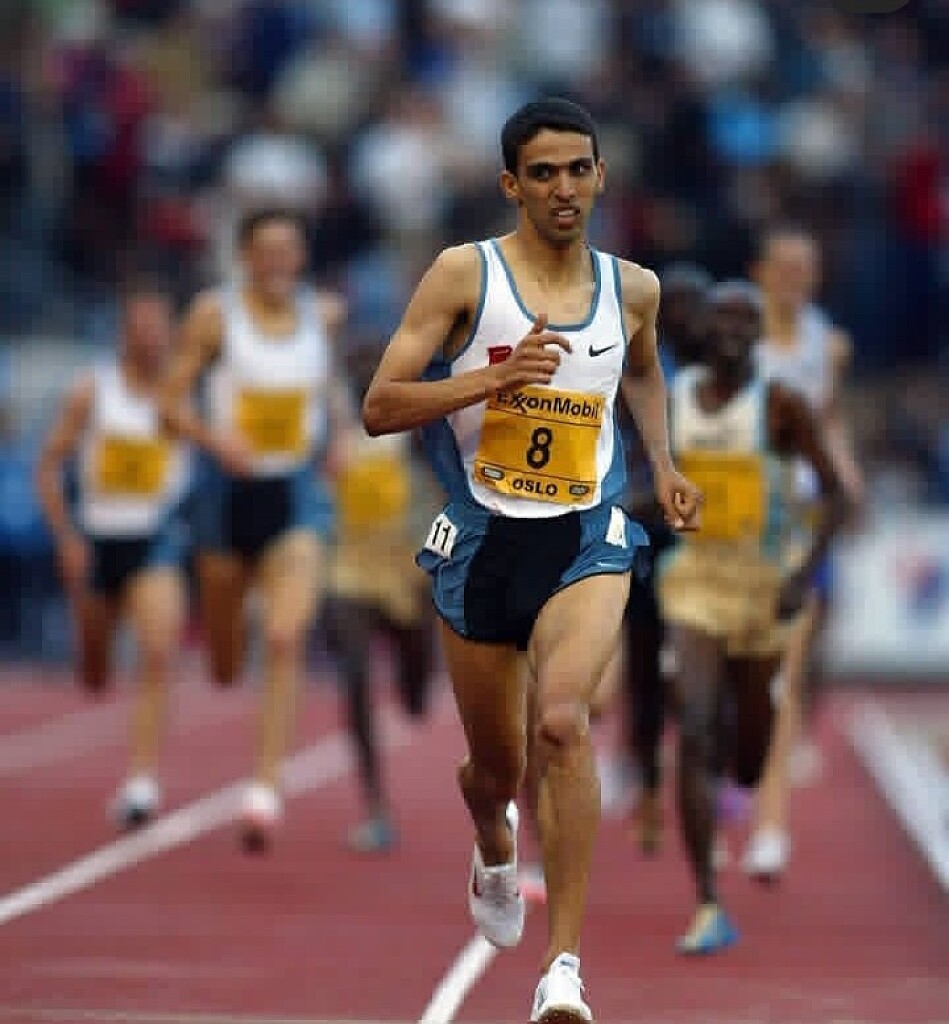
For more than a quarter of a century, the men’s 1500 metres world record has stood as one of athletics’ most revered and demanding achievements. The legendary 3:26.00, set by Morocco’s iconic middle-distance master Hicham El Guerrouj in 1998, remains a benchmark of near-perfect racing — a performance that still defines the outer limits of human speed and endurance over the metric mile’s shorter cousin.
Breaking that mark would require far more than raw talent. It demands a rare combination of physiological excellence, tactical brilliance, technological advantage, and the perfect competitive environment.
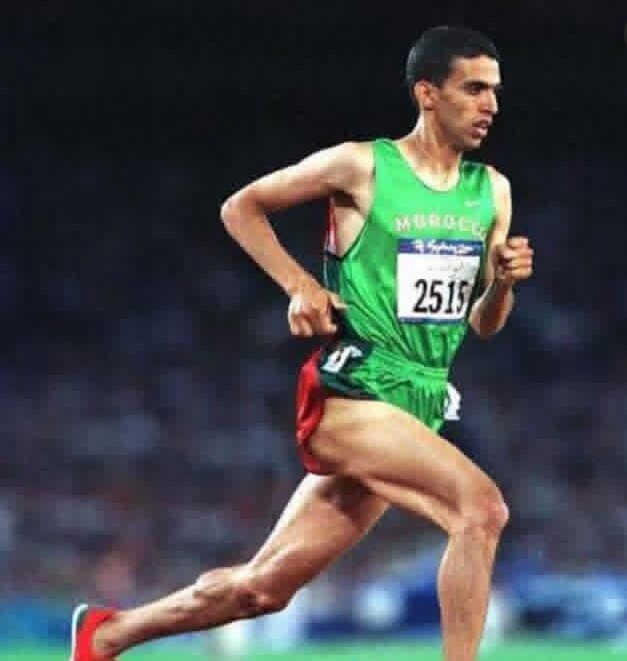
The Pace of Perfection
To surpass 3:26.00, an athlete must sustain an astonishing rhythm from start to finish. The record pace translates to roughly 13.7 seconds per 100 metres and about 54.9 seconds per 400-metre lap. Maintaining that speed over three and three-quarter laps of the track means running close to sprint velocity while preserving enough strength for a decisive finish.
What makes the record even more remarkable is how El Guerrouj completed the race. After already covering the first 1100 metres at blistering speed, he unleashed a final lap of approximately 53 seconds, a finishing surge that would be exceptional even in a fresh 400-metre race. Any athlete hoping to rewrite history must produce a similarly devastating closing kick.
The Physiological Equation
The 1500 metres sits at the crossroads between endurance and speed. Success at world-record level requires a finely tuned balance between the aerobic system — which supplies the majority of energy — and the anaerobic system responsible for explosive surges.
Elite training models typically emphasize high-volume aerobic development, often accounting for the majority of an athlete’s preparation, complemented by intense intervals run faster than race pace. This combination builds the stamina required to maintain record tempo while preserving the speed necessary to finish with authority.
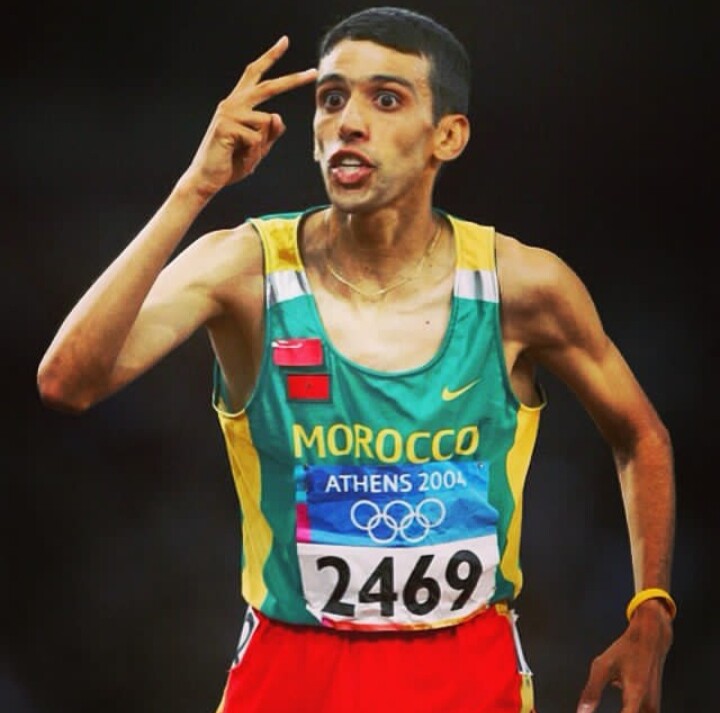
The Importance of Perfect Conditions
Even the greatest athletes depend on ideal circumstances to produce historic performances.
Pacemakers play a decisive role, guiding the early stages of the race and ensuring a consistent rhythm through the first 800 to 1000 metres. Their presence prevents tactical hesitation and shields the contenders from wind resistance.
Environmental factors also matter. Record attempts usually occur in calm conditions, with moderate temperatures and low wind — elements that minimize energy loss and allow athletes to focus entirely on maintaining pace.
Modern technology has further pushed the limits. Advances in carbon-plated racing spikes and highly responsive synthetic tracks have helped athletes convert effort into forward momentum more efficiently than ever before.
The Pressure of Competition
World records rarely happen in isolation. They emerge when elite competitors push each other relentlessly through the final laps. A fast race requires rivals willing to maintain relentless pace and challenge for victory until the final 200 metres.
Norway’s middle-distance star Jakob Ingebrigtsen, who has already run 3:26.73 — the European record — is among the athletes bringing the barrier closer to reality. His performances demonstrate how narrow the gap has become between the present generation and El Guerrouj’s enduring standard.
The Official Path to History
For any performance to replace the record, it must occur at a competition recognized by World Athletics, with fully certified timing systems and immediate anti-doping verification. Only under these strict conditions can a new mark be ratified as the fastest 1500 metres ever run.
A Record That Still Defines Greatness
More than two decades after it was set, 3:26.00 continues to symbolize the pinnacle of middle-distance running. Breaking it will require flawless pacing, extraordinary physiology, fierce competition, and a moment when every variable aligns.
Until that day arrives, the time produced by Hicham El Guerrouj remains not just a world record — but one of the greatest performances in the history of track and field.
by Erick Cheruiyot for My Best Runs.
Login to leave a comment
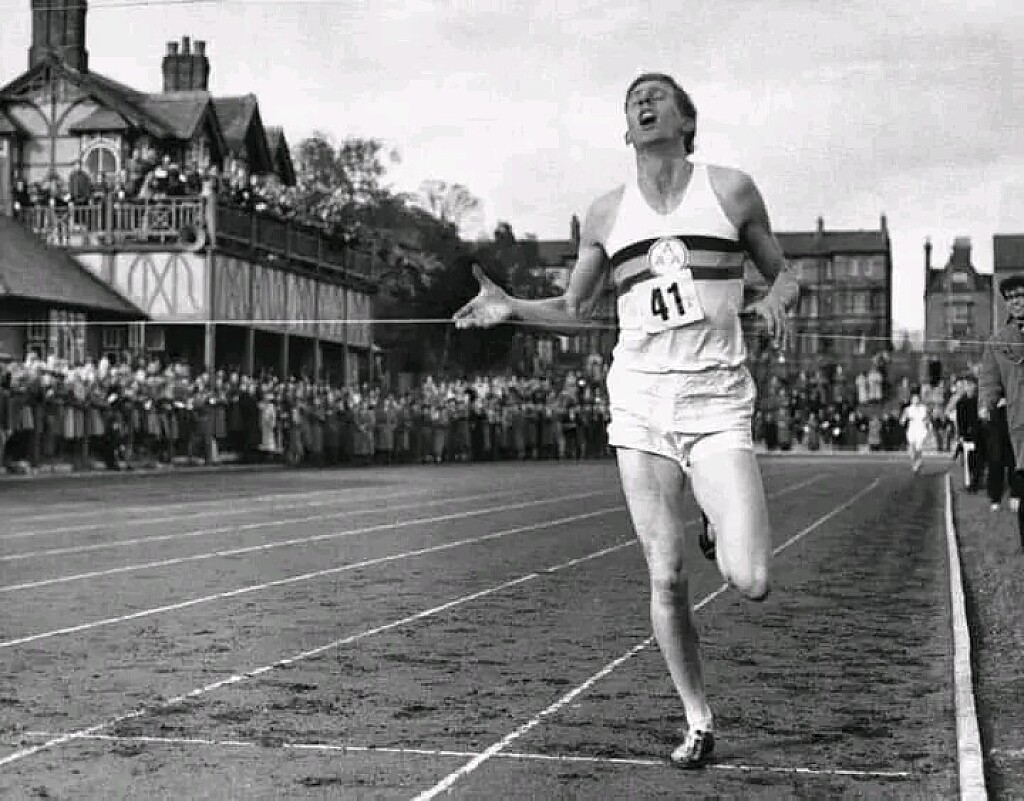
“Beyond Four Minutes: The Legacy of Roger Bannister”
Eight years ago, on March 3, 2018, the world received the sorrowful news that the incomparable Roger Bannister had passed away after battling Parkinson’s disease. There is a profound irony in his story. Bannister was not only a legendary athlete but also a distinguished neurologist who dedicated much of his professional life to treating patients with neurological disorders. Yet, like so many others, he was not exempt from the very illness he spent years studying.
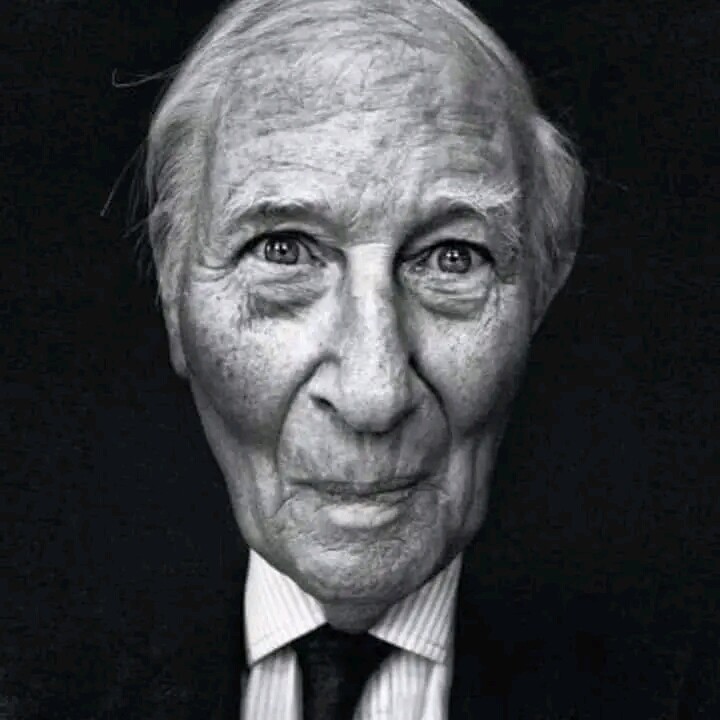
Born on March 23, 1929, in Harrow, England, Bannister would become one of the most iconic figures in athletic history. His signature event was the mile. At the 1952 Summer Olympics, he entered as the favorite to win. Instead, he finished fourth—a result that left him deeply disappointed. He returned home discouraged and told his coach he was finished with competitive running. But rather than allowing him to quit, his coach encouraged him to train harder, to push further, to discover what truly lay within him.
Bannister chose perseverance over surrender.
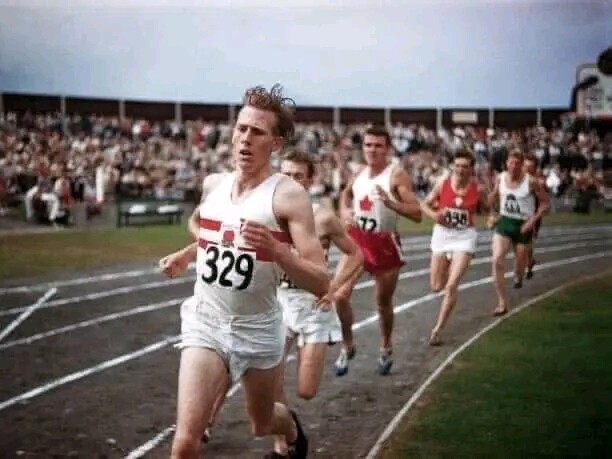
On May 6, 1954, at Iffley Road in Oxford, he achieved what many experts had declared physically impossible: he ran a mile in under four minutes. For years, respected voices in science had argued that the human heart and body were not designed to withstand such strain. Yet in 3 minutes and 59.4 seconds, Bannister dismantled a barrier that had stood not only in record books, but in the collective mind of the sporting world.

The aftermath was astonishing. Within a year, dozens of runners followed his lead and broke the four-minute barrier. Within three years, hundreds had done so. What had once seemed unreachable quickly became attainable. The greatest obstacle had not been muscle or oxygen—it had been belief. Once Bannister proved it possible, the impossible lost its authority.
Although the mile is no longer a feature of the Olympic Games or World Championships, its legacy endures. The current world record of 3:43.13 was set by Hicham El Guerrouj in 1999 at the Stadio Olimpico, a performance that stands as a testament to how far the event has evolved. Yet every stride toward that mark traces back to Bannister’s historic run in 1954.
The story of human progress—whether in science, industry, or sport—is filled with moments when limiting beliefs delayed breakthroughs. Then someone dares to challenge the narrative, and the floodgates open. Bannister did more than set a record; he liberated the imagination of athletes everywhere.
Sir Roger Bannister did not merely run beneath four minutes. He redefined what humanity believed it could endure. His legacy is carried forward in every runner who dares to chase what others insist cannot be done.
by Erick Cheruiyot for My Best Runs.
Login to leave a comment
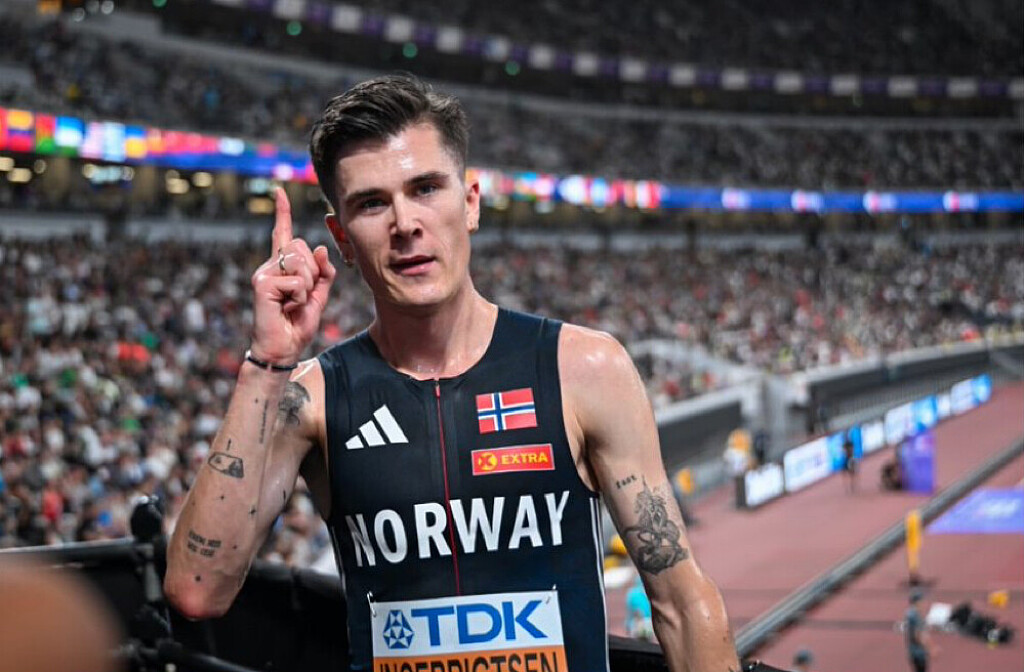
Jakob Ingebrigtsen Has His Eyes on Three World Records in 2026
Norwegian superstar Jakob Ingebrigtsen is already looking ahead to 2026 with one of the boldest ambitions in track and field — to break world records in the 1500 meters, the mile, and the 5000 meters.
In an interview shared by Chris Chavez on X (formerly Twitter), Ingebrigtsen revealed his mindset and meticulous approach to choosing the perfect time and place to chase history.

“I hope to break the world records in the 1500 meters, the mile, and the 5000 meters. If I can do that, I’ll be happy. I’ll have to pick out some meets and dates where I have the best chance to make a good attempt,” he told Norway’s VG.
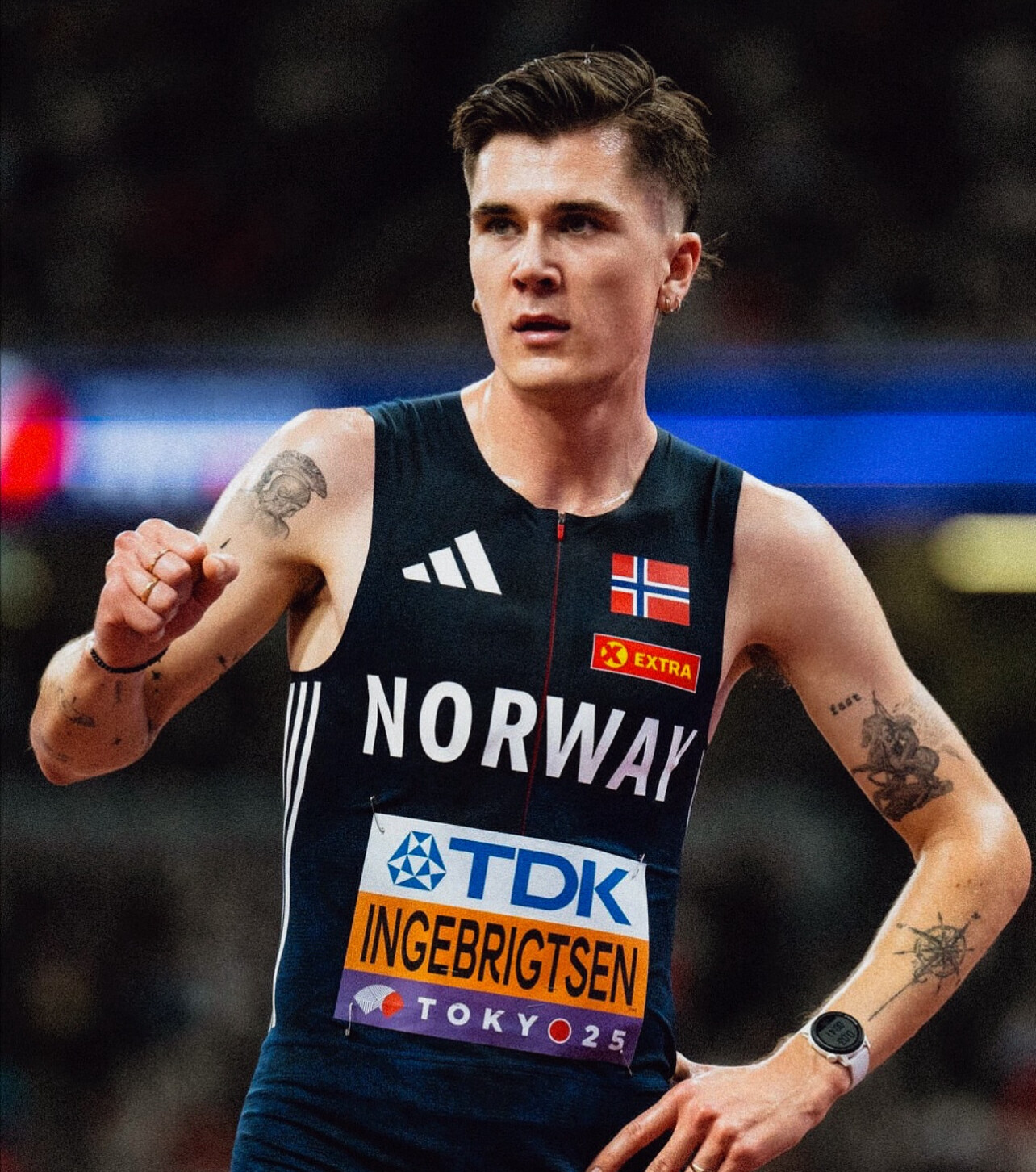
Ingebrigtsen and his wife are already mapping out potential race venues, with Monaco, Paris, Silesia, and Oslo among the leading candidates. Each of these meets has seen lightning-fast performances and could provide the ideal setting for record-breaking runs.
How he stacks up right now:
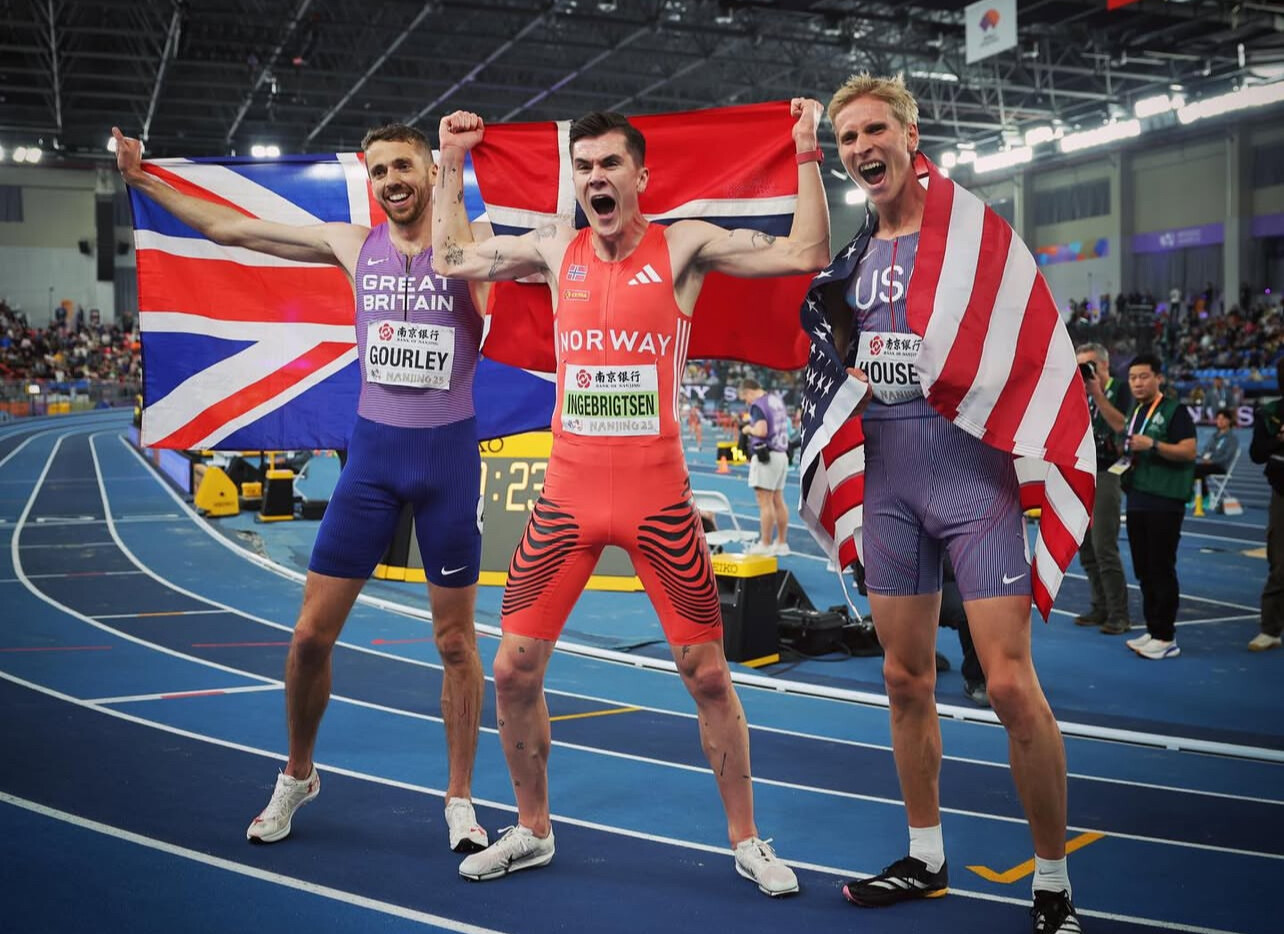
The world record for 1500 meters is 3:26.00, set by Hicham El Guerrouj in 1998. Ingebrigtsen’s personal best is 3:26.73.
The world record for the mile is 3:43.13, also held by El Guerrouj from 1999. Ingebrigtsen’s personal best is 3:43.73.
The world record for the 5000 meters is 12:35.36, set by Joshua Cheptegei in 2020. Ingebrigtsen’s personal best is 12:48.45.
While Ingebrigtsen’s personal bests are already within striking distance of both El Guerrouj’s legendary middle-distance marks and Cheptegei’s long-distance record, breaking all three in one season would be unprecedented.
A Legacy in Motion
At just 25, Ingebrigtsen has already cemented himself as one of the most dominant and versatile athletes in modern track history. From his Olympic gold to multiple World and European Championship titles, his consistency and competitiveness have made him the face of a new generation of runners.
However, much of the 2025 season was disrupted by injury. An Achilles tendon issue forced him to withdraw from major meets and limited his racing calendar. Despite the setback, his ambition remains undimmed.
A sweep of these three world records would not only elevate his legacy but also redefine the limits of what’s possible across middle and long-distance running.
As he carefully plans his record attempts, the world will be watching — because when Jakob Ingebrigtsen sets his mind on something, history often follows.
by Boris Baron
Login to leave a comment
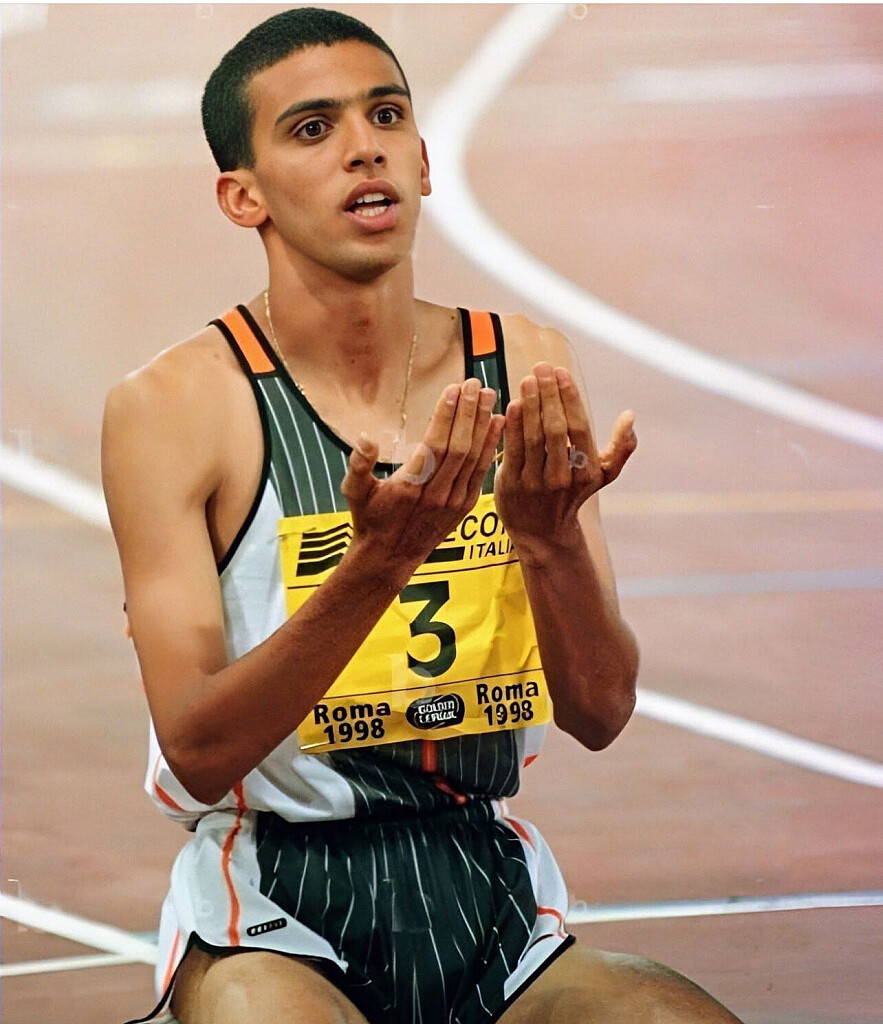
“I Could Have Run 3:24” — Hicham El Guerrouj Reflects on His Still-Unbroken 1500m World Record from July 14, 1998
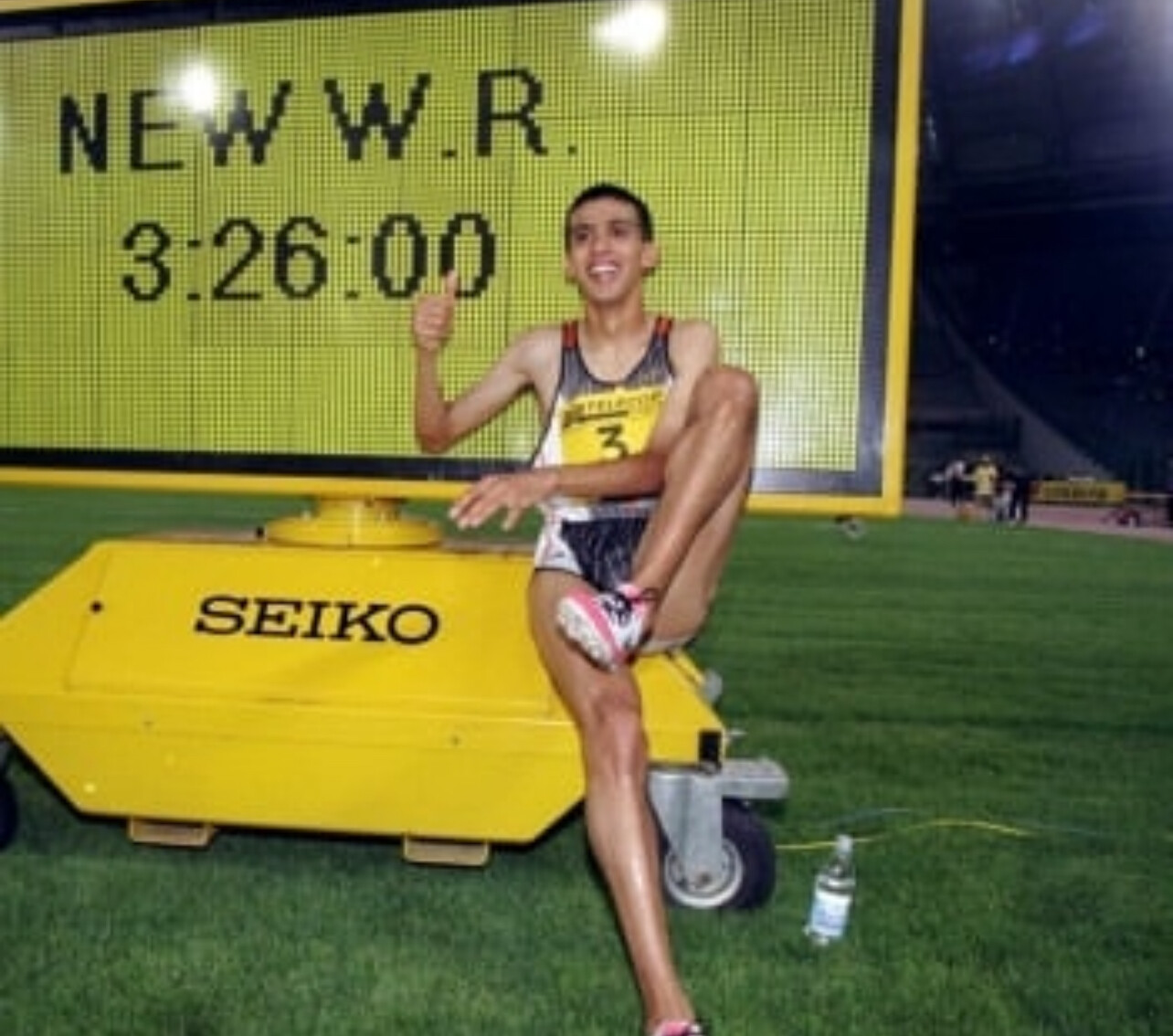
On July 14, 1998, Moroccan middle-distance legend Hicham El Guerrouj delivered one of the most iconic performances in track and field history, running a stunning 3:26.00 in the 1500m at the Golden Gala meet in Rome—a world record that still stands 27 years later.
But according to El Guerrouj himself, that time could have been even faster with today’s advancements.
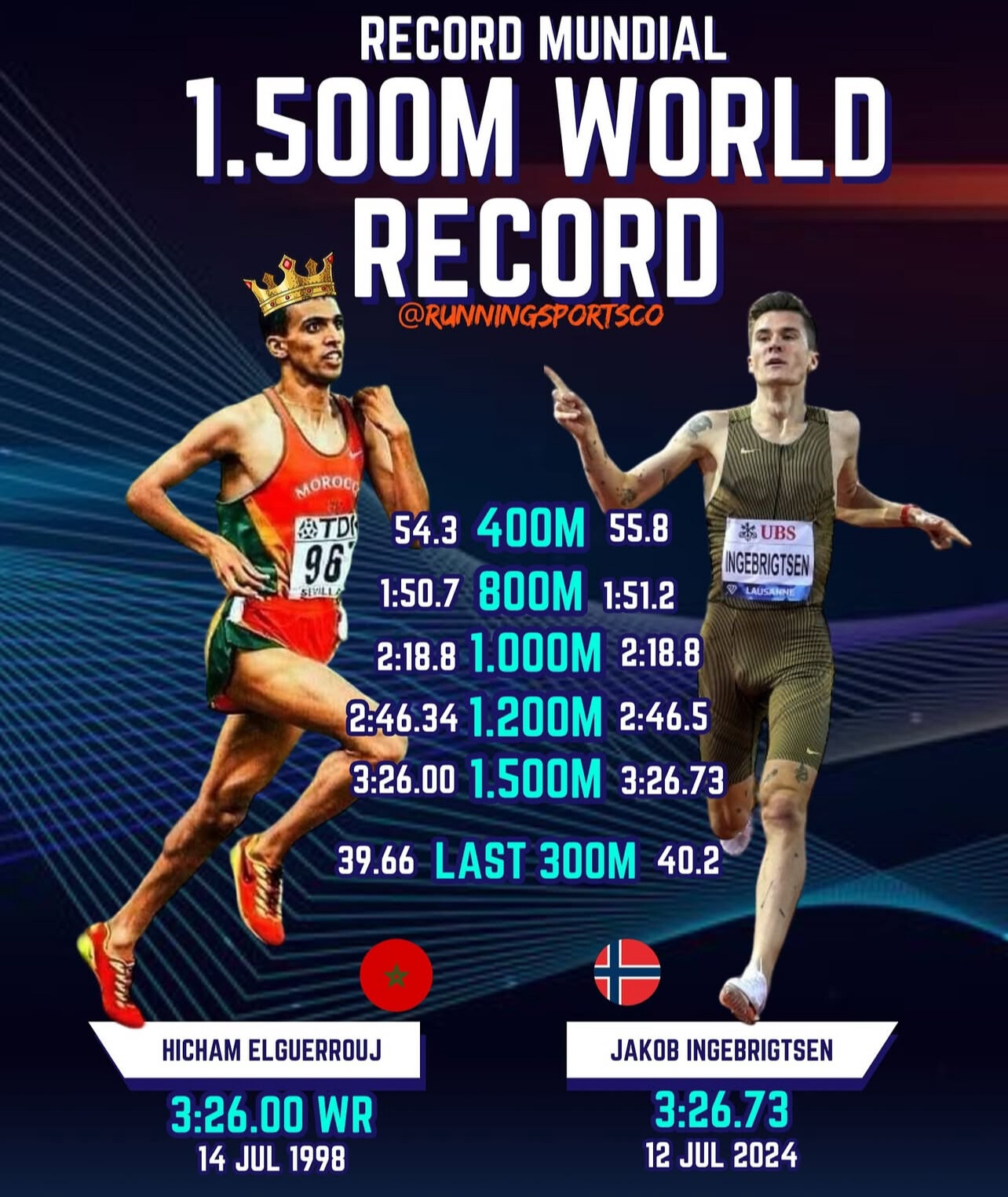
“With today’s technology—carbon-plated shoes, wavelight pacing, and modern training science—I could have run 3:24,” he recently told reporters.
That bold claim holds weight when you look at the splits from that historic night. El Guerrouj covered the final 400m in 53.03 seconds and blazed through the last 300m in 39.66 seconds—numbers that rival top 800m finishes.
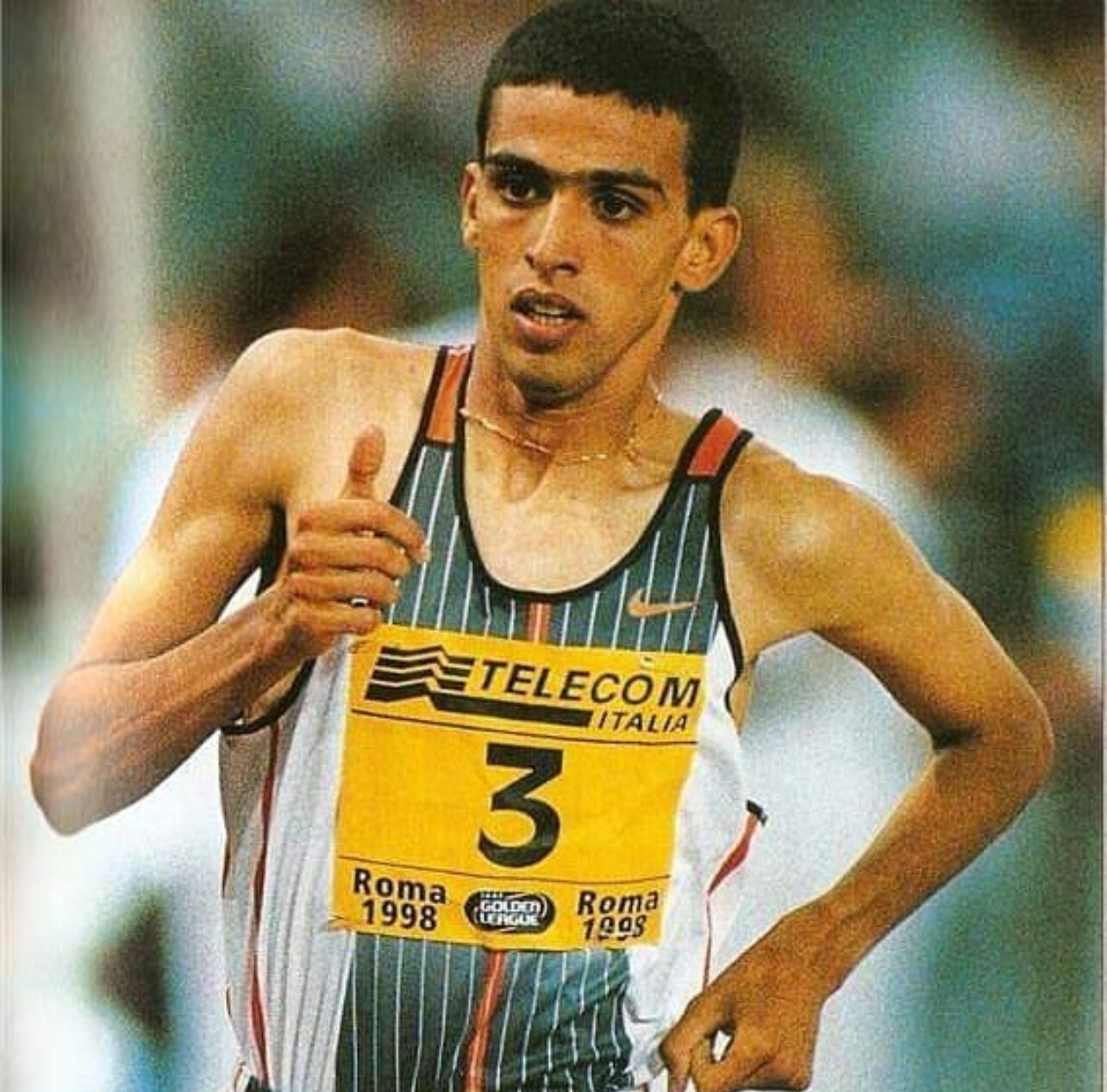
What makes this feat even more remarkable is that it was accomplished in an era before super spikes, pacer lights, and the finely tuned sports science that athletes now rely on. His performance was built on years of focused training, tactical brilliance, and unmatched closing speed.
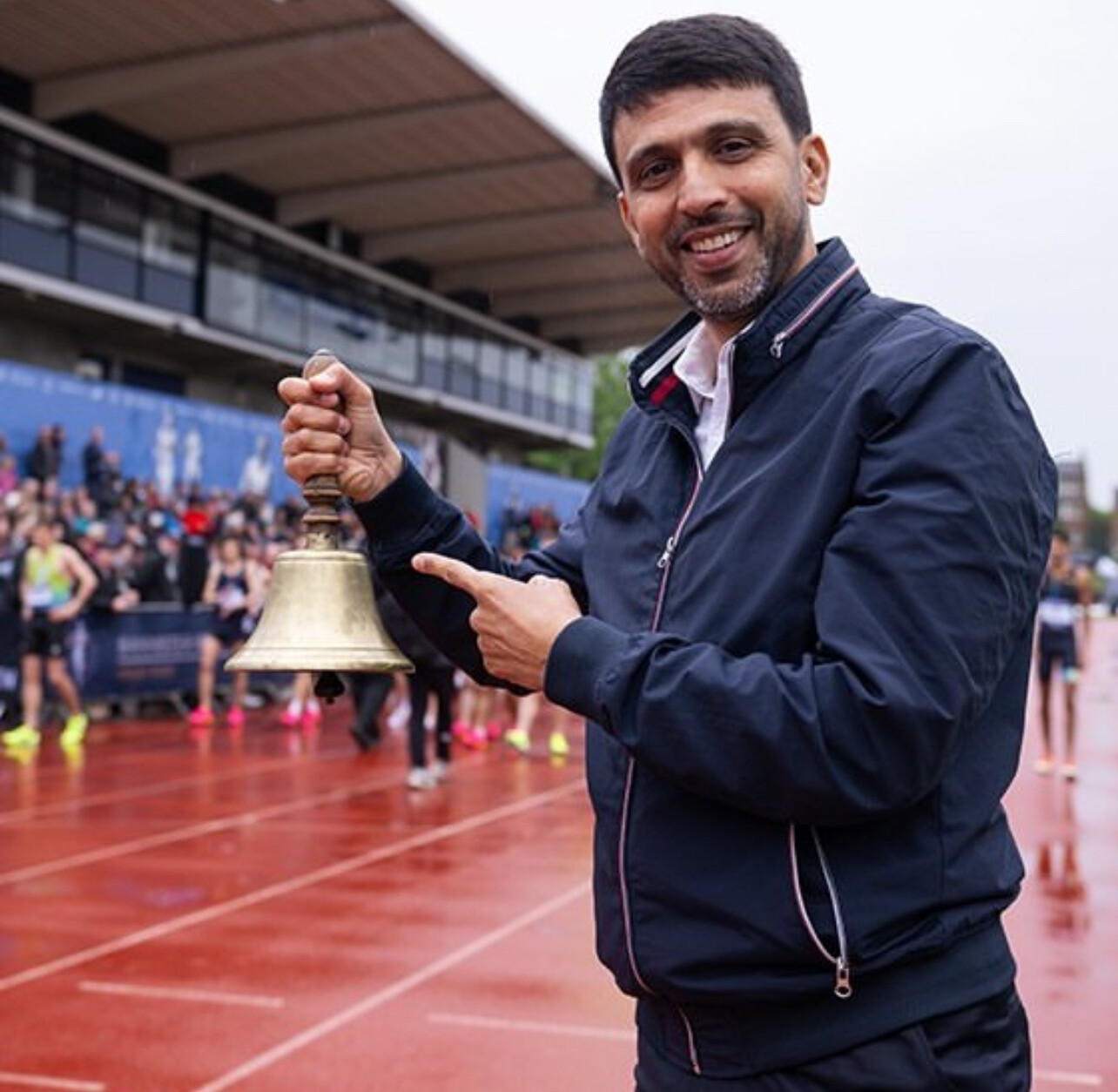
His time of 3:26.00 remains not only the fastest ever run over 1500m, but also the longest-standing men’s world record in any Olympic track distance between 800m and 10,000m.
With today’s stars like Jakob Ingebrigtsen inching closer to the mark, the debate continues: how much faster would El Guerrouj have gone in 2025 conditions?
For now, the record stands—and so does the legend of Hicham El Guerrouj.
by Boris Baron
Login to leave a comment
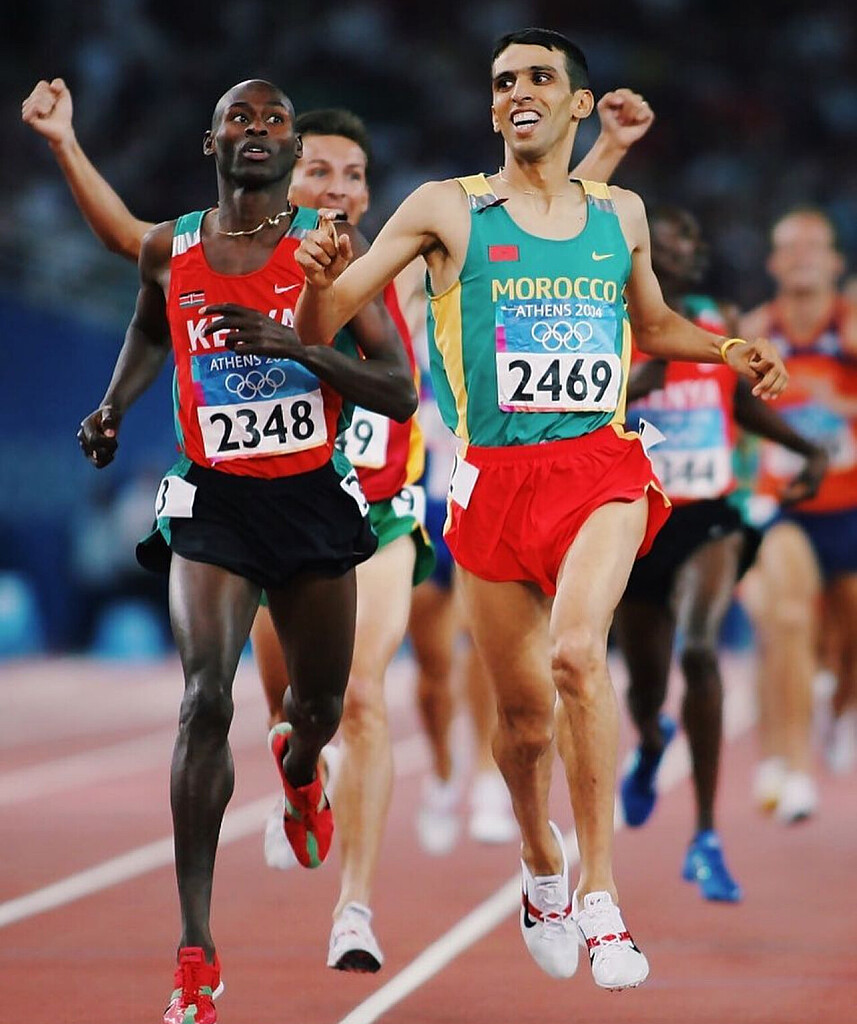
The Fastest Mile Ever Run—And Why It Still Hasn’t Been Broken
On July 7, 1999, under the lights of Rome’s Stadio Olimpico, Morocco’s Hicham El Guerrouj delivered a performance that remains one of the most iconic feats in track and field history. Racing against a world-class field, El Guerrouj clocked 3:43.13 for the mile—shattering his own previous best and establishing a world record that still stands 26 years later.
No man has run faster since.
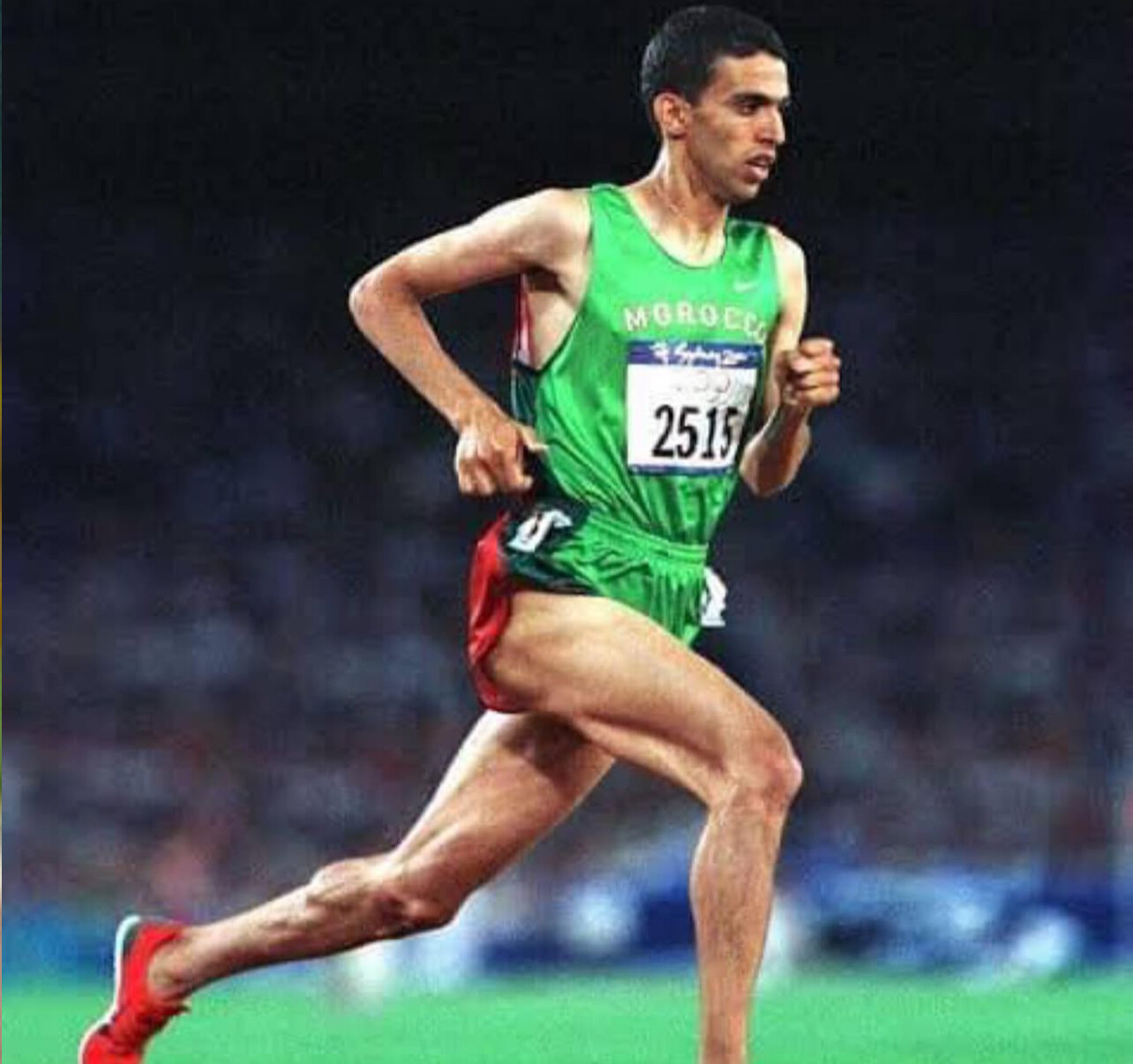
In one of the most thrilling middle-distance races ever contested, Kenya’s Noah Ngeny pushed El Guerrouj all the way to the finish, crossing in 3:43.40—a time that remains the second-fastest mile in history. The duel produced two performances that remain unmatched, solidifying the race as perhaps the greatest mile ever run.
At the time, El Guerrouj was already recognized as the world’s premier miler, having come heartbreakingly close to Olympic gold in 1996 when he tripped with 400 meters to go. But his performance in Rome in 1999 left no doubt about his dominance. Paced perfectly through the opening laps, El Guerrouj accelerated with trademark elegance and blistering speed over the final 400 meters, crossing the line with history behind him.
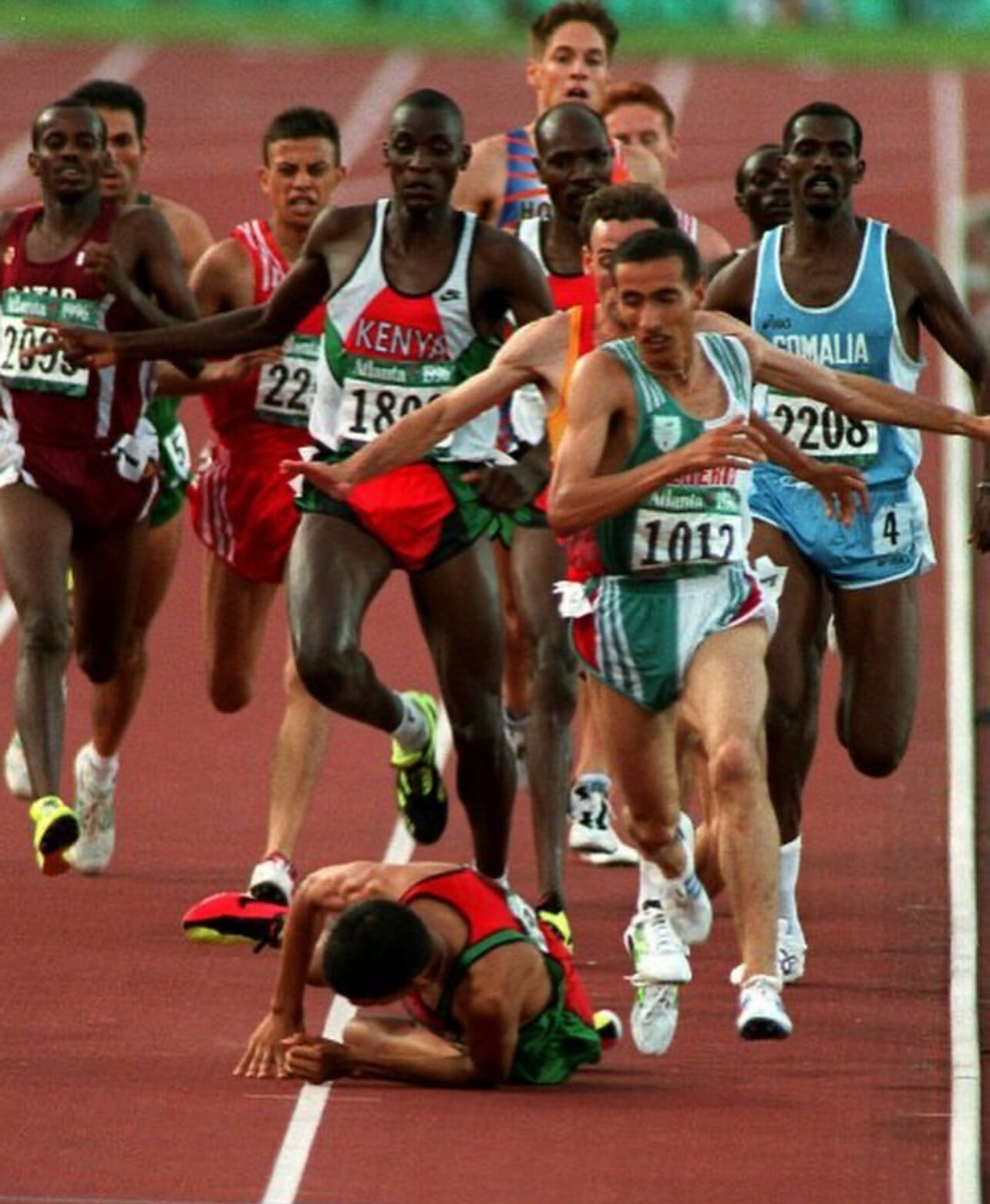
His 3:43.13 replaced the previous world record of 3:44.39, set by Noureddine Morceli in 1993, and it has now stood longer than any other men’s outdoor mile world record in history.
Fast Facts:

• Date: July 7, 1999
• Location: Stadio Olimpico, Rome, Italy
• Winner: Hicham El Guerrouj (Morocco) – 3:43.13 (World Record)
• Runner-Up: Noah Ngeny (Kenya) – 3:43.40 (Still #2 All-Time)
Legacy

El Guerrouj went on to win double Olympic gold in 2004 (1500m and 5000m), capping a storied career. But it’s the 1999 mile in Rome that may be his most enduring legacy. Despite super spikes, faster tracks, and new training philosophies, no one has yet managed to break 3:44 since that night.
As we mark 26 years since this historic performance, the record stands not just as a mark of physical excellence, but as a symbol of the enduring mystique of the mile—track and field’s most storied distance.
by Boris Baron
Login to leave a comment
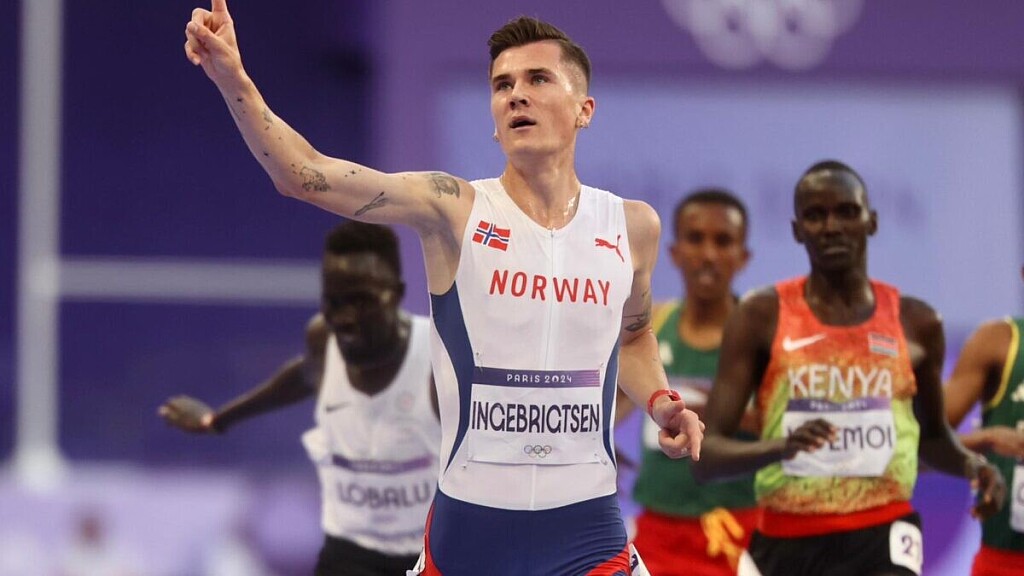
Jakob Ingebrigtsen considering competing at Sunday’s Copenhagen Half Marathon
It’s no secret that Norwegian distance running star Jakob Ingebrigtsen is on a mission to etch his name into the history books by setting as many world records as possible in his career. On Thursday, rumours began swirling on social media that Ingebrigtsen was competing at the Copenhagen Half Marathon on Sunday, marking what would be his debut at the distance. Should he decide to race, the world record of 57 minutes and 31 seconds could be in jeopardy.
On the Copenhagen Half Marathon start list, there is an unnamed athlete with bib number #2 who is the same age as Ingebrigtsen (23).
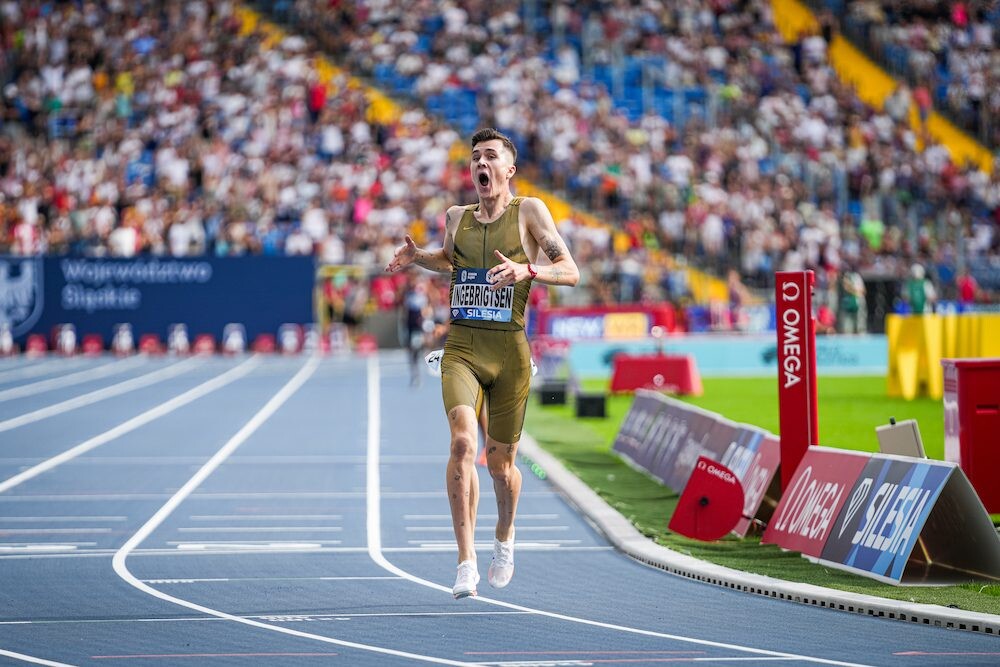
In a press conference ahead of Friday’s Diamond League Final in Brussels, Ingebrigtsen was asked if he had plans to compete in Copenhagen. “I’m focused on tomorrow’s race first, and what happens after that, I’m not sure,” the 23-year-old Norwegian responded, keeping the speculation alive. If the rumours prove true, he could be chasing another world record.
In tomorrow’s race in Brussels, Ingebrigtsen will be vying for his third-consecutive Diamond League title while trying to inch closer to Hicham El Guerrouj’s 1,500m world record of 3:26.00. “I believe it’s possible to break any world record,” Ingebrigtsen said in Thursday’s press conference. “For me, it’s about winning. It’s always exciting to race when there’s something bigger on the line. There’s always the chance of a world record, but likely not tomorrow.”
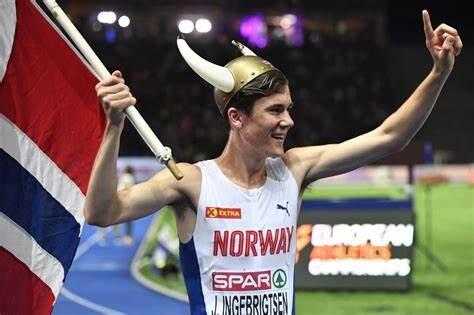
World record watch in Brussels
Meanwhile, the Diamond League Final could witness another world record in the men’s 800m, where Canadian Olympic silver medalist Marco Arop will face off against his rival, Olympic champion Emmanuel Wanyonyi. Both are the fastest 800m runners in the world this year, and they’ll be chasing David Rudisha’s world record time of 1:40.91. Arop will arrive in Brussels in record-setting shape, fresh off setting a North American record in the 1,000m at the Boris Hanžeković Memorial in Zagreb on Sept. 8.
by Marley Dickinson
Login to leave a comment
Copenhagen Half Marathon
The Copenhagen Half Marathon was the first road race in Scandinavia and is one of the fastest half marathons in the world. The Copenhagen Half Marathon has been awarded with the International Association of Athletics Federation's (IAAF) most distinguished recognition - the IAAF Road Race Gold Label. Copenhagen Half Marathon was awarded the IAAF Road Race Bronze Label in January...
more...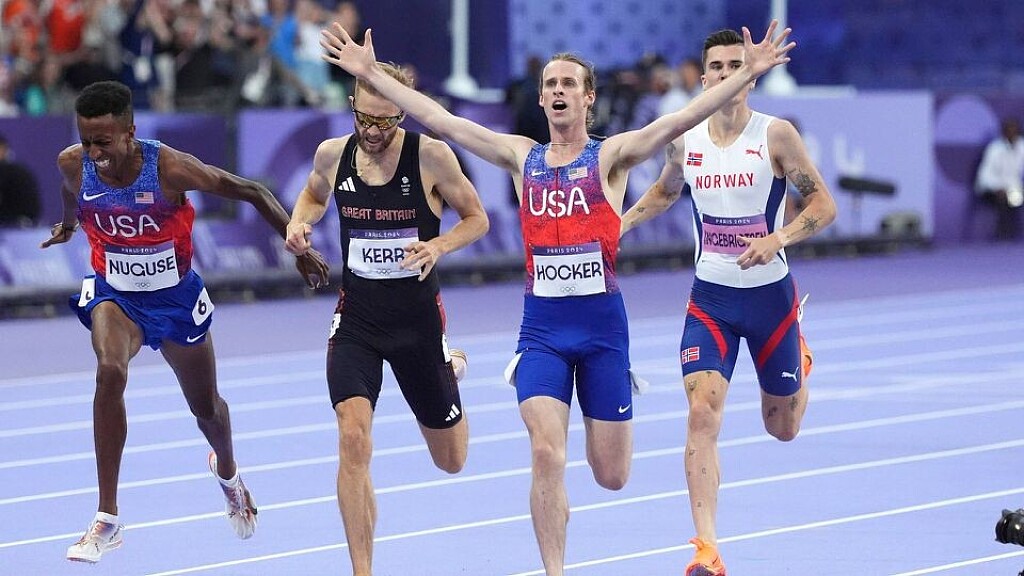
Hicham El Guerrouj’s 26-year reign at risk as 1500m titans eye world record in Brussels
Three top middle-distance runners are set to challenge the long-standing 1500m world record at the Brussels Diamond League.
The men's 1500m world record set back in 1998 by Morocco’s Hicham El Guerrouj will come under serious threat as three of the most promising middle-distance runners—Jakob Ingebrigtsen, Cole Hocker and Yared Nuguse—are set to clash in the Diamond League final in Brussels this Saturday.
El Guerrouj’s incredible time of 3:26.00 has stood the test of time for 26 years with no one able to break the mark that many thought would be surpassed by now.
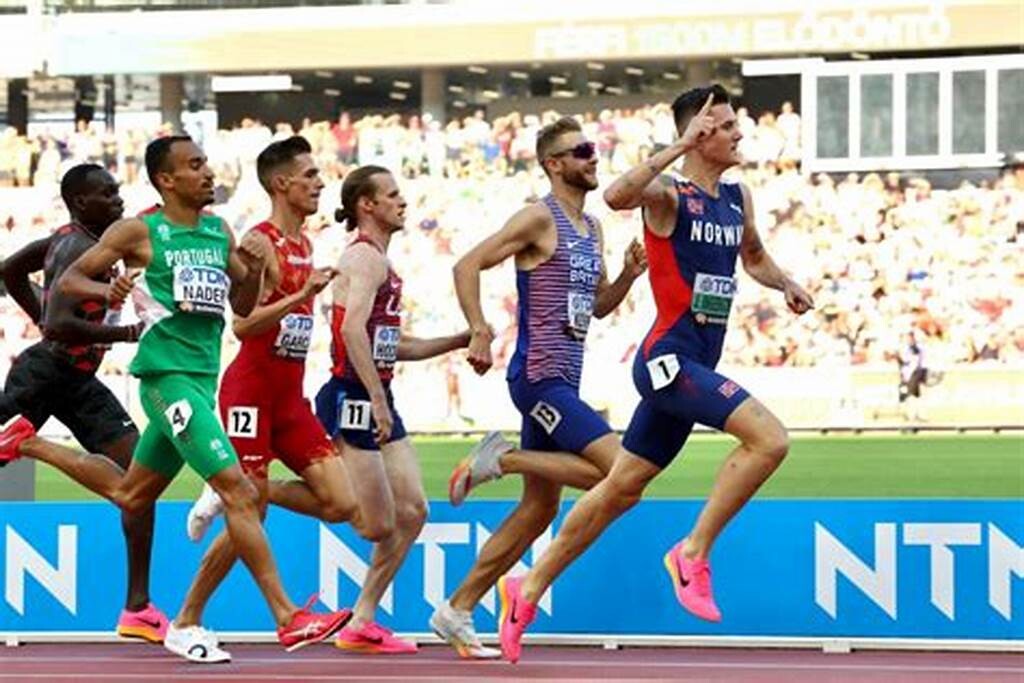
However, the trio of Olympic and World Championship medalists are all in peak form and ready to challenge this long-standing record making this one of the most highly anticipated 1500m races in recent memory.
The Tokyo Olympic champion Jakob Ingebrigtsen, enters the race as the favorite. The Norwegian sensation boasts a personal best of 3:26.73, a mere 0.73 seconds shy of El Guerrouj’s historic mark.
Ingebrigtsen’s dominance over the distance has been unmatched this season, and he has made it clear that breaking the world record is on his radar.
“I feel like I’m in the best shape of my life.The world record is something that has always been in the back of my mind, and I believe this is the best chance I’ve had to go for it," said Ingebrigtsen.
Pushing him to the limit will be the American duo of Cole Hocker and Yared Nuguse. Hocker, fresh off an Olympic season that saw him claim a gold medal in the 1500m is ranked seventh on the all-time list with a personal best of 3:26.73 matching Ingebrigtsen’s time.
Hocker’s confidence has been building all season, and the 23-year-old has openly expressed his desire to break into history.
“I hope to take a stab at the world record, whether it’s this season or next year,” said Hocker.
“But right now, I’m focused on leaving a lasting legacy. The Olympic gold was the first goal, and now it’s time to chase something even bigger.”
Yared Nuguse, ranked ninth on the all-time list, is another strong contender. Nuguse has steadily risen through the ranks with a personal best of 3:27.80 and a season-best of 3:27.80 as well.
The 25-year-old has proven himself capable of competing against the best in the world and could be poised to surprise both Hocker and Ingebrigtsen in Brussels.
The race, however, will be missing one key figure in Josh Kerr, the British 1500m specialist who recently confessed that the mental toll of the season has led him to opt out of the final. Kerr’s absence opens the door for a fascinating showdown between Ingebrigtsen, Hocker, and Nuguse.
In addition to the leading trio, the race will feature strong competition from the likes of Kenya’s Reynold Cheruiyot, a rising star who has posted a season-best of 3:28.28, and Timothy Cheruiyot, the former World Champion.
France’s Azzedine Habz and Great Britain’s Elliot Giles will also be in the mix, having both posted times in the 3:29 range this season.
El Guerrouj’s record-breaking performance in 1998 was the first time a runner had managed to average under 55 seconds per lap for the 1500m.
With athletes now regularly running sub-3:30 times, the level of competition has never been higher. Whether it’s tactical brilliance, pure speed, or a combination of both, this race has all the ingredients to produce fireworks on the track.
by Festus Chuma
Login to leave a comment
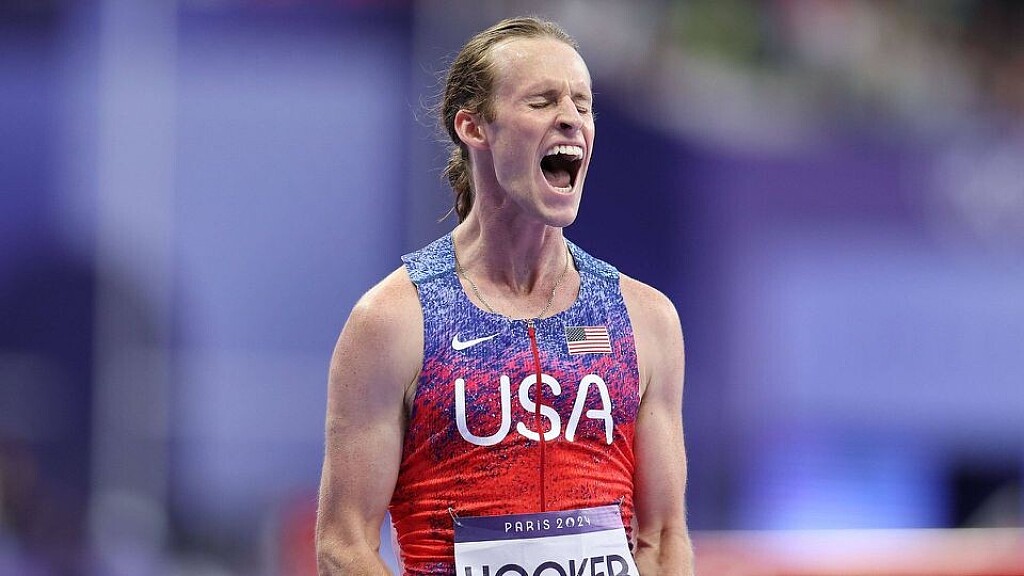
Cole Hocker on why lowering Hicham El Guerrouj's longstanding 1500m record is more than just a dream
Cole Hocker is aiming to break the 1500m record after Olympic gold and has revealed his plans for achieving this historic feat.
American middle-distance runner Cole Hocker has his sights firmly set on breaking the world record in the 1500 meters a mark held by Morocco’s Hicham El Guerrouj for over two decades.
Fresh off a stunning Olympic gold medal victory in Paris, where he beat his personal best by almost three seconds, Hocker is not just basking in the glory of the moment.
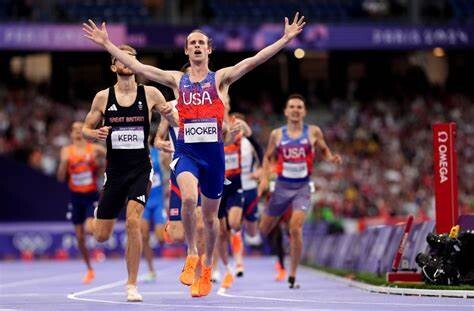
At 23 years old, Hocker's remarkable achievement at the Paris Olympics was a significant upset.
The University of Oregon alum surged from fifth to first over the final 300 meters to clinch the gold in an Olympic record time of 3 minutes, 27.65 seconds.
This victory marked the first U.S. win in the metric mile since Matt Centrowitz in 2016. He outran favorites Jakob Ingebrigsten and Josh Kerr, leaving Ingebrigtsen, who led for the majority of the race, in fourth place.
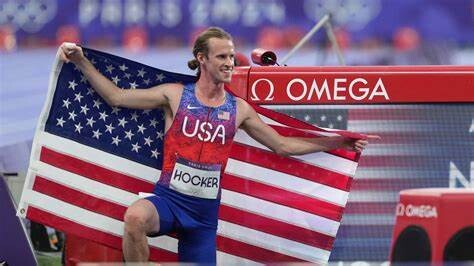
Before his next race at the Luassane Diamond League Hocker expressed his ambitions to push the boundaries even further.
“Two weeks ago I was a 3:30 guy, and that’s a long way from 3:26, and you have to run 3:25 to get the world record, so I’m trying to figure that out. I’ve run 3:27 one time and I want to get comfortable running that," he stated during the pre-race press conference.
Hocker acknowledges that his strength lies in his tactical approach to racing.
"I am a racer, and all my best races come from racing them tactically, so that might just be something I have to learn. I’ve been in races that are set up fast and have done well, but my bread and butter right now is racing," he explained.
“I hope to take a stab at that whether it’s this season or next year, but now I have another goal to set my mind to. It was always Olympic gold, and now I’ve checked that box. I’m really concerned with establishing myself as one of the greatest runners in history, so logically that would be the next step,” he noted.
The current world record of 3:26.00 set by El Guerrouj has stood unchallenged since 1998.
Lowering this record will require not just physical excellence but meticulous planning and preparation.
by Festus Chuma
Login to leave a comment

How Long Does It Take to Run a Mile?
Knowing the average pace can help you set new goals.
The best way to find your average running speed is by tracking your mile pace.
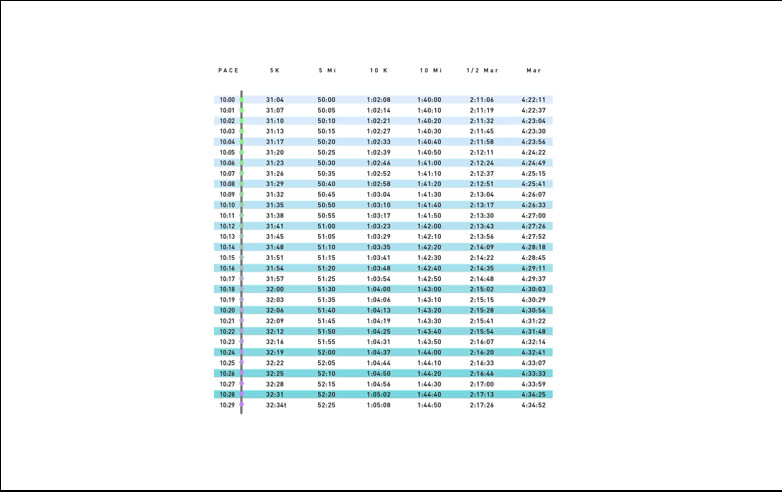
For example, say you go out for a three-mile race. You might start off running fast because of an adrenaline rush, then slow down once you realize you’re running too hard. But toward the end, when the finish is in sight you might catch a second wind and pick up speed again. This all results in different mile times.
Your average mile time, which will be the sum of all your mile times divided by the number of miles completed, may look different than each individual mile. The more you train, not only will your average mile pace drop, but each individual mile time will likely become closer in time to the others.
That’s why tracking your average mile time is a great way to monitor your progress. Plus, when you reach a new barrier—like the first time you run faster than a 10-minute mile, for example—it allows you to search out new goals in your running journey and also scope out your competition.
How long does it take to run a mile on average?
Based on real-life data from all public uploads to Strava from August 1 2022 to July 30 2023, the average mile time across the globe is 10 minutes and 25 seconds (10:25). That number adjusts based on gender: 10:02 for men and 11:17 for women. In the U.S., the average running speed is 9:54 and breaks down to a 9:32 mile pace for U.S. men and 10:37 for U.S. women.
These paces have changed since 2018 when the average global mile pace hit 9:48 and U.S. pace averaged 9:44.
Don’t fret if your current average time is a little off from those marks. Keep in mind that, while sizable, the dedicated Strava community doesn’t represent the entire running community.
What factors affect average running speed?
The following factors play a big role in every runner’s mile speed:
Gender
Age
Weather/wind
Nutrition and hydration
Injuries
Height
Weight
Terrain
The list could go on. Even what you think about or your mindset can affect how fast you run, and that’s under your control. Other factors, however—such as height and age—are things you obviously can’t change.
Also, according to recent number crunching at Runner’s World, based on data from platforms like MapMyRun, even the type of year you’re having has an effect on one’s average mile time and pace. From mid-April to mid-September—during the start and midpoint of the coronavirus pandemic—the average mile pace recorded was 8.5 percent slower compared with the same range in 2019, which the MapMyRun team attributes to a new or returning runner effect.
When it comes to age, one data analysis performed in 2010 and based on 10,000 U.S. runners who completed a 5K showed the average minutes per mile for runners of different ages. The average overall was 11:47 per mile. Men in the 16- to 19-year-old age range finished the run with an average pace of 9:34; women in the same age group finished in 12:09. The numbers gradually increased as the age groups got older.
In most cases, though, the gaps between the finishing times of the different age groups weren’t drastic. And you might not necessarily get slower with age. As Runner’s World has reported, many pro runners and average runners peak in their 30s, and even runners in their 70s can keep getting better with age.
Because of the many variables associated with running pace, it can be difficult to establish an across-the-board average running speed.
How fast should you run a race?
If you’re looking to find out what your average running pace should be to hit a specific time goal in a race, you’re in luck. Our Runner’s World Pace Charts (in both minutes per mile and kilometer) show what time a given pace will produce for six common race distances: 5K, 5 miles, 10K, 10 miles, half marathon, and marathon. As an example in the chart below, if you want to run under 1 hour and 45 minutes for a 10-mile race, you’d need to have an average pace of 10 minutes and 29 seconds per mile to accomplish your goal.
Use our charts as a reference point after you start training so you can know what average pace is necessary (and realistic) for your upcoming goal race.
How can you boost your average running speed?
If you want your average running pace to be faster, there are several steps you can take to improve, like figuring out how to breathe properly and mixing up your types of runs. You should also recognize the importance of nutrition and hydration.
Adopt a holistic approach to your training, doing regular conditioning workouts to improve your strength and flexibility in addition to running, as a stronger, mobile body can help you run faster and avoid injury.
What’s the fastest ever mile speed?
The fastest mile ever recorded was set by Hicham El Guerrouj, a Moroccan runner who ran a mile in 3:43.13 in 1999. Guerrouj was 24 years old at the time.
For women, the fastest mile ever was run by Faith Kipyegon, which she snagged just this month, with a time of 4:07.64.
If you’re looking for the fastest average running paces over the course of 26.2 miles, look no further than the world record holders in the marathon—Eliud Kipchoge (4:37.2 per mile) and Brigid Kosgei (5:06.8 per mile).
And just for fun, if Usain Bolt were to ever keep his jaw-dropping sprint going for a full mile at his peak ability, the Jamaican’s top speed in 2009 during his 9.58 world record 100-meter dash would have put him just over 27 miles per hour.
by Runner’s World
Login to leave a comment
When Will Eliud Kipchoge Slow Down?
What we can learn from the world’s greatest distance runner of all-time while he’s still in his prime
Eliud Kipchoge has expanded the universe of what’s humanly possible in the marathon, and he will forever remain a legend in the sport of long-distance running.
Not only for himself, but especially for those who have come after him. That includes everyone, both elite and recreational runners, who are preparing a marathon this fall or some distant point in the future. His current 2:01:09 world record and his barrier-breaking 1:59:40 time-trial effort in 2019 are legendary feats, both for the current generation of runners and for all time.
The 38-year-old Kenyan marathoner is a once-in-a-lifetime athlete, but time waits for no one, and especially not a long-distance runner. Like all elite athletes, his time at the top is limited, but fortunately, there is still time to immerse in the inspirational examples he’s providing.
Kipchoge recently announced he’ll return to the Berlin Marathon on September 24, where, last year, he won the race for the fourth time and lowered the world record for the second time. It is most likely what will be the beginning of a grand denouement as he goes for another gold medal at the 2024 Olympics next summer in Paris.
Given that he won his first global medal in the City of Light—when, at the age of 18, he outran Moroccan legend Hicham El Guerrouj and Ethiopian legend-in-the-making Kenenisa Bekele to win the 5,000-meter run at the 2003 world championships—it would certainly be one of the greatest stories ever told if he could win the Olympic marathon there next year when he’s nearly 40.
Certainly he’ll run a few more races after the Olympics—and maybe through the 2028 Olympics in Los Angeles—but, realistically, it is the start of a farewell tour for a runner who will never be forgotten.
Don’t get me wrong: I’m not at all writing Kipchoge off. In fact, I am excited to see him run in Berlin and can’t wait to watch next year’s Olympic marathon unfold. But just as we’ve watched Michael Jordan, Tiger Woods, Serena Williams, Shalane Flanagan, Usain Bolt, Allyson Felix, and other elite athletes succumb to the sunsetting of their peak performance level, so too will Kipchoge eventually suffer the same fate.
What I’m saying here is that we still have time to watch and appreciate Kipchoge eloquently working his magic and continue to be inspired in our own running and other pursuits in life. Remember how we marveled at Michael Jordan’s greatest in “The Last Dance” more than 20 years after his heyday? This is the start of the last dance for Kipchoge, who, like Jordan, is much, much more than a generational talent; he’s an all-time great whose legacy will transcend time.
Running has seen many extraordinary stars in the past 50 years who have become iconic figures— Frank Shorter, Joan Benoit Samuelson, Ted Corbitt, Carl Lewis, Steve Jones, Paul Tergat, Catherine Ndereba, Paula Radcliffe, Haile Gebrselassie, Kenenisa Bekele, Mary Keitany, Brigid Kosgei, and Kilian Jornet, to name a few—but none have come close to the body of work and global influence of Kipchoge.
Not only is Kipchoge one of the first African athletes to become a household name and truly command a global audience, but he’s done more than other running champions because of he’s been able to take advantage of this advanced age of digital media to deliberately push positive messages and inspiring content to anyone who is willing to receive it.
Kipchoge has won two Olympic gold medals, set two world records, and won 17 of the 19 marathons he entered, but he’s so much less about the stats and bling and more sharing—to runners and non-runners alike—that “no human is limited” and also that, despite our differences, we’re all human beings faced with a lot of the same challenges in life and, ultimately, hard work and kindness are what put us on the path to success.
How can an average runner who works a nine-to-five job and juggles dozens of other things in daily life be inspired by an elite aerobic machine like Kipchoge?
He is supremely talented, no doubt, but many elite runners have a similar aerobic capacity to allow them to compete on the world stage. What Kipchoge uniquely possesses—and why he’s become the greatest of all-time—is the awareness and ability to be relentless in his pursuit of excellence, and the presence and good will of how beneficial it is to share it.
If you haven’t been following Kipchoge or heard him speak at press conferences or sponsor events, he’s full of genuine wisdom and encouragement that can inspire you in your own running or challenging situation in life. His words come across much more powerfully than most other elite athletes or run-of-the-mill social media influencers, not only because he’s achieved at a higher level than anyone ever has, but because of his genuine interest in sharing the notion that it’s the simplest values—discipline, hard work, consistency, and selflessness—that make the difference in any endeavor.
This is not a suggestion to idolize Kipchoge, but instead to apply his wisdom and determination into the things that challenge you.
“If you want to break through, your mind should be able to control your body. Your mind should be a part of your fitness.”
“Only the disciplined ones in life are free. If you are undisciplined, you are a slave to your moods and your passions.”
“If you believe in something and put it in your mind and heart, it can be realized.”
“The best time to plant a tree was 25 years ago. The second-best time to plant a tree is today.”
Those are among the many simple messages that Kipchoge has lived by, but he also openly professess to giving himself grace to take time for mental and physical rest and recovery. It’s a simple recipe to follow, if you’re chasing your first or fastest marathon, or any tall task in life.
Kipchoge seems to defy age, but his sixth-place finish in the Boston Marathon in April proved he’s human. As much as it was painful to watch him falter, it was oddly refreshing and relatable to see him be something less than exceptional, and especially now that he’s tuning up for Berlin. He has nothing left to prove—to himself, to runners, to the world—but he’s bound to keep doing so just by following the same simple, undaunted regimen he always has.
There will be other young runners who will rise and run faster than Kipchoge and probably very soon. Fellow Kenyan Kelvin Kiptum—who has run 2:01:53 (Valencia) and 2:01:25 (London) in his first two marathons since December—seems to be next in line for Kipchoge’s throne of the world’s greatest runner. But even after that happens, Kipchoge’s name will go down in history alongside the likes of Paavo Nurmi, Abebe Bikila, Emil Zátopek, Grete Waitz, Shorter and Samuelson because of how he changed running and how he gave us a lens to view running without limits.
Berlin is definitely not the end of Kipchoge’s amazing career as the world’s greatest long-distance runner. I fully expect him to win again in an unfathomable time. But the sunset is imminent and, no matter if you are or have ever been an aspiring elite athlete at any level, a committed recreational runner, or just an occasional jogger trying to reap the fruits of consistent exercise, his example is still very tangible and something to behold.
by Outside Online
Login to leave a comment
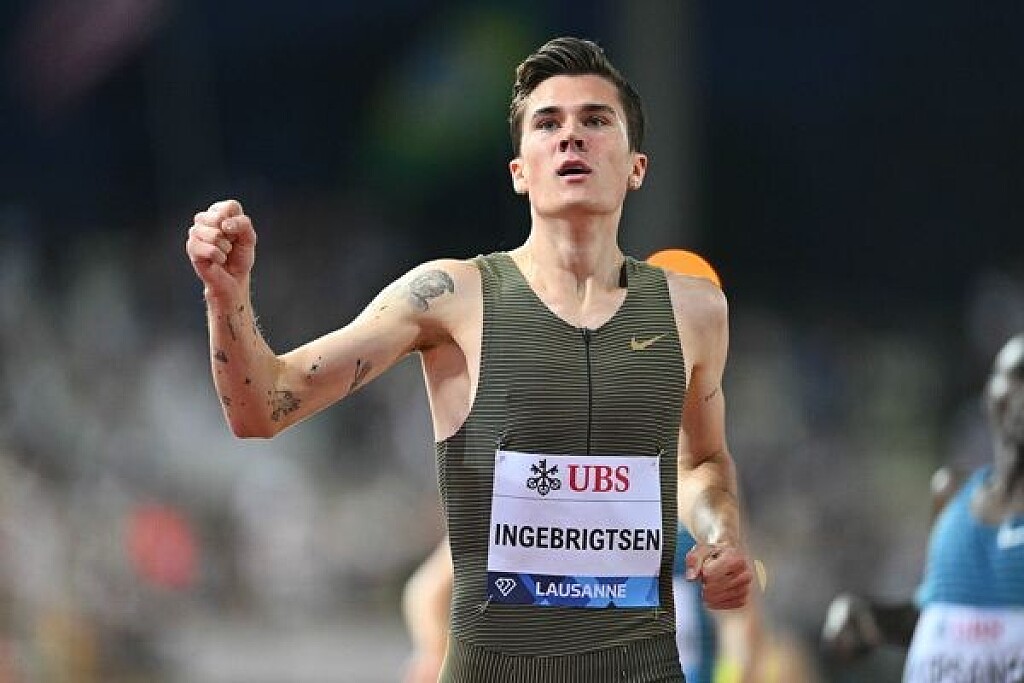
Ingebrigtsen and Girma go head-to-head in hunt for fast 1500m in Lausanne
Jakob Ingebrigtsen and Lamecha Girma both made history earlier this month in Paris, where they set a world two-mile best and a world 3000m steeplechase record, respectively. Now they have the chance to push each other to fast 1500m performances when they return to Wanda Diamond League action in Lausanne on Friday (30).
Norway’s Ingebrigtsen, who broke the world indoor 1500m record by running 3:30.60 in Lievin in February, clocked 7:54.10 in Paris to improve Daniel Komen’s world best for two miles. Despite still having that race in his legs, the 22-year-old improved his own European 1500m record to 3:27.95 in Oslo six days later – a time that places him sixth on the world all-time list.
Although the world record had not been his aim in Oslo, Lausanne’s Athletissima gives Ingebrigtsen another opportunity to take further strides toward Hicham El Guerrouj’s almost 25-year-old world record of 3:26.00.
“I 100% have more left in me,” Ingebrigtsen said after his performance in Oslo. “I just have to keep focused on each race ahead in the build-up to Budapest (World Championships), where it really matters.”
Girma will hope to be up there with him. The Ethiopian 22-year-old stormed to a time of 7:52.11 for his specialism in Paris, taking 1.52 seconds off the world 3000m steeplechase record set by Said Saeed Shaheen in 2004, and then turned his attention to attacking the Ethiopian 1500m record of 3:29.91 at the Continental Tour Gold meeting in Ostrava on Tuesday (27). He still looked like he had plenty left in the closing stages but having to run wide down the home straight, he focused on the win, running a PB of 3:33.15 that he will aim to improve again in Lausanne.
It will be the first time that Ingebrigtsen and Girma have clashed in any discipline.
In Oslo, Ingebrigtsen led the first eight men under 3:30 for the first time in history, and this time the line-up includes two other men who have dipped under that barrier so far in their careers: Britain’s Olympic bronze medallist Josh Kerr and Australia’s Stewart McSweyn. They are joined on the entry list by Ethiopia’s Teddese Lemi, New Zealand’s Sam Tanner and Britain’s Neil Gourley.
In the 5000m – the discipline in which Ingebrigtsen won world gold last year after his 1500m silver – Olympic champion Joshua Cheptegei will take on Olympic 10,000m gold medallist Selemon Barega, world 5km record-holder Berihu Aregawi, Telahun Haile Bekele, Birhanu Balew and their fellow sub-13:00 runner Muktar Edris.
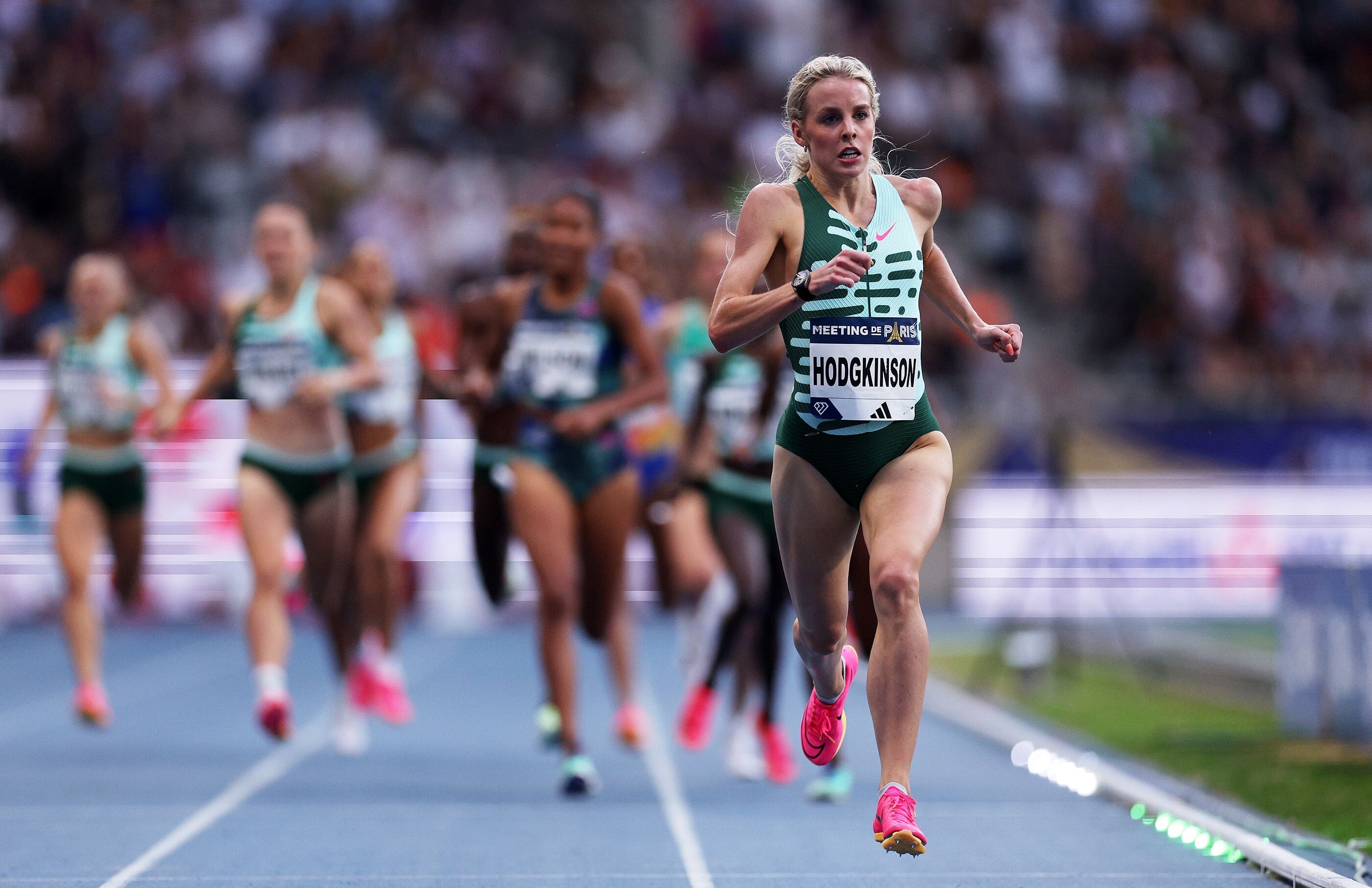
In the women’s 3000m steeplechase, world U20 silver medallist Sembo Almayew is back on the track after her world-leading PB performance of 9:00.71 to win in Florence. The 2021 world U20 gold medallist, Jackline Chepkoech, was second on that occasion and is also racing, along with world record-holder Beatrice Chepkoech and world bronze medallist Mekides Abebe.
The world leader also heads the entries in the women’s 800m, where world and Olympic silver medallist Keely Hodgkinson – who improved her British record to 1:55.77 to win in Paris – will look to make another statement as she renews her rivalry with Kenya’s Mary Moraa.
World bronze medallist Moraa, who won Commonwealth Games and Diamond League titles ahead of Hodgkinson last year, has run a best of 1:58.72 so far this season and the strong field also features Habitam Alemu, Noelie Yarigo, Jemma Reekie, Catriona Bisset, Natoya Goule and Switzerland's Audrey Werro, who recently ran a world U20 1000m record of 2:34.89 in Nice.
by World Athletics
Login to leave a comment
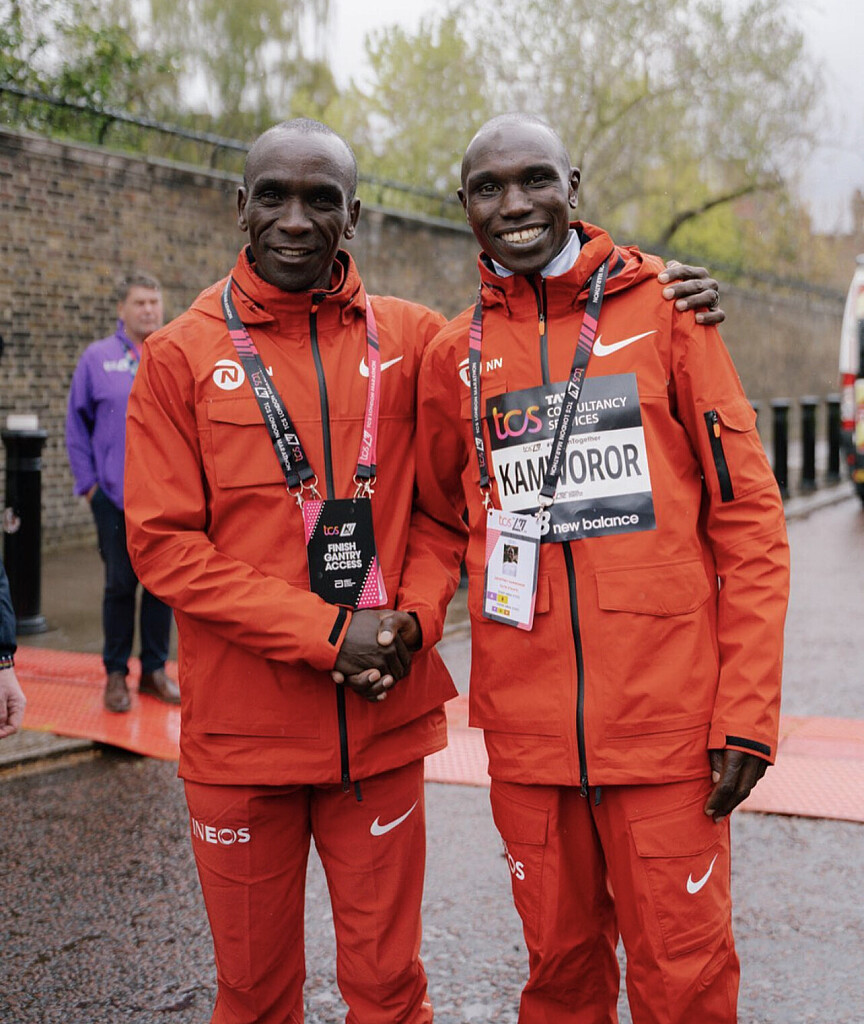
Eliud Kipchoge says he is determined to keep on writing history — and secure a third Olympic marathon crown next year
Eliud Kipchoge is widely regarded as the greatest marathon runner of all time has set himself many challenges in his dazzling career, and remains insatiable despite his two Olympic titles, his world record of 2:01:09 in Berlin in 2022 and an incredible 15 wins in 18 marathons he has entered.
He broke the mythical two-hour barrier over the 26.2 mile (42.195 kilometre) distance in Vienna in 2019, with a time of 1:59:40, but the feat was not recognised as an official world record as it was not in open competition.
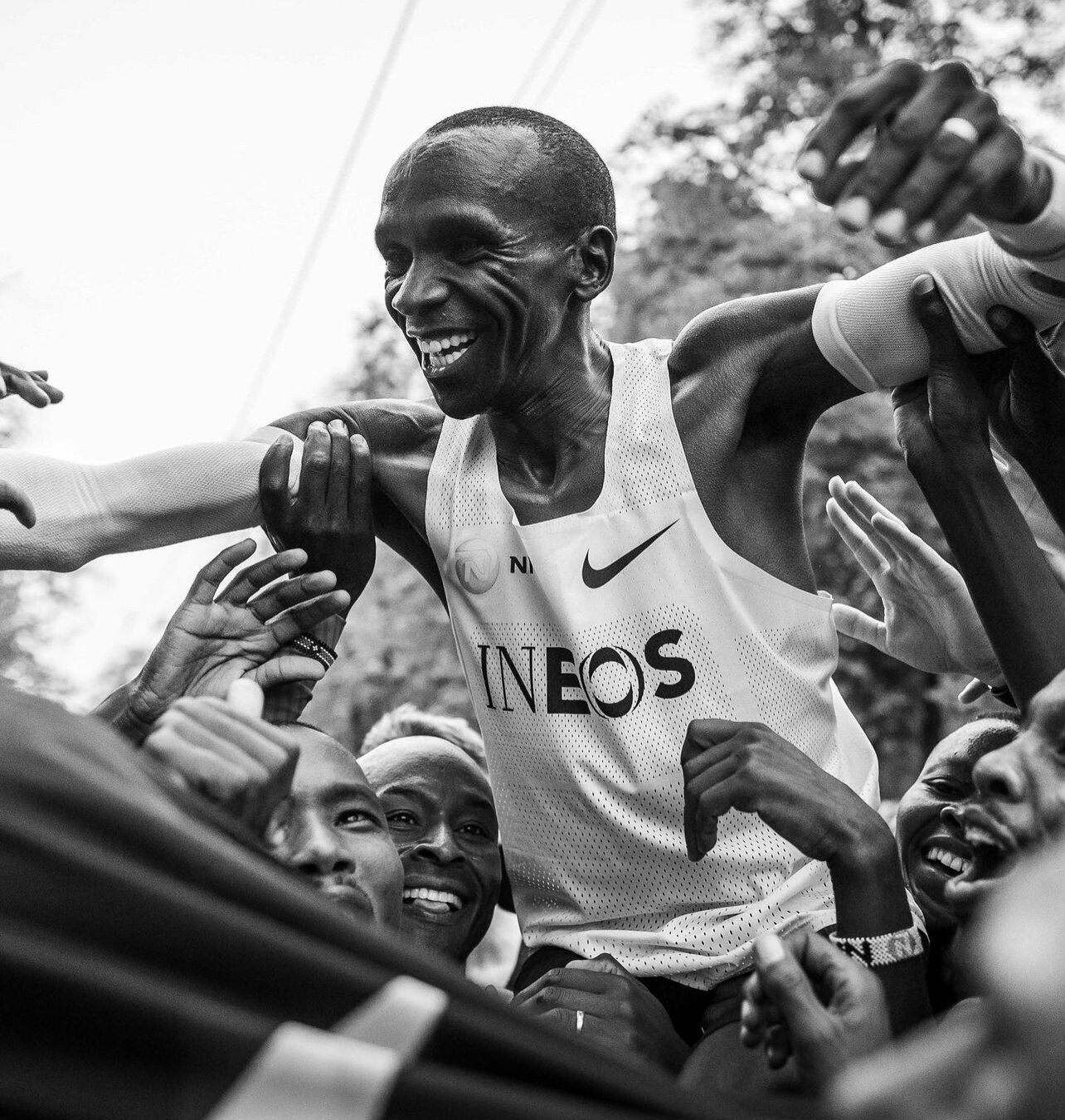
Victory has eluded the 38-year-old in the Boston and New York marathons, which if he won would make him the first man to have all six major titles under his belt.
"The priority now is to focus on the Olympics and win a third time. The other (challenges) will come later," Kipchoge says in an interview with AFP at the renowned Kaptagat training camp in Kenya's Rift Valley.
His two Olympic marathon gold medals in 2016 and 2021 put him at level pegging with Ethiopia's Abebe Bikila (1960, 1964) and Waldemar Cierpinski of East Germany (1976, 1980).
A third gold at the Paris Olympics in 2024 would make Kipchoge the undisputed marathon giant at the Games, and bring him a victory steeped in symbolism.
The French capital was the city where he won his first international crown in 2003 at the age of 18, clinching the 5,000 metres world championship title ahead of sporting legends Hicham El Guerrouj of Morocco and Ethiopia's Kenenisa Bekele.
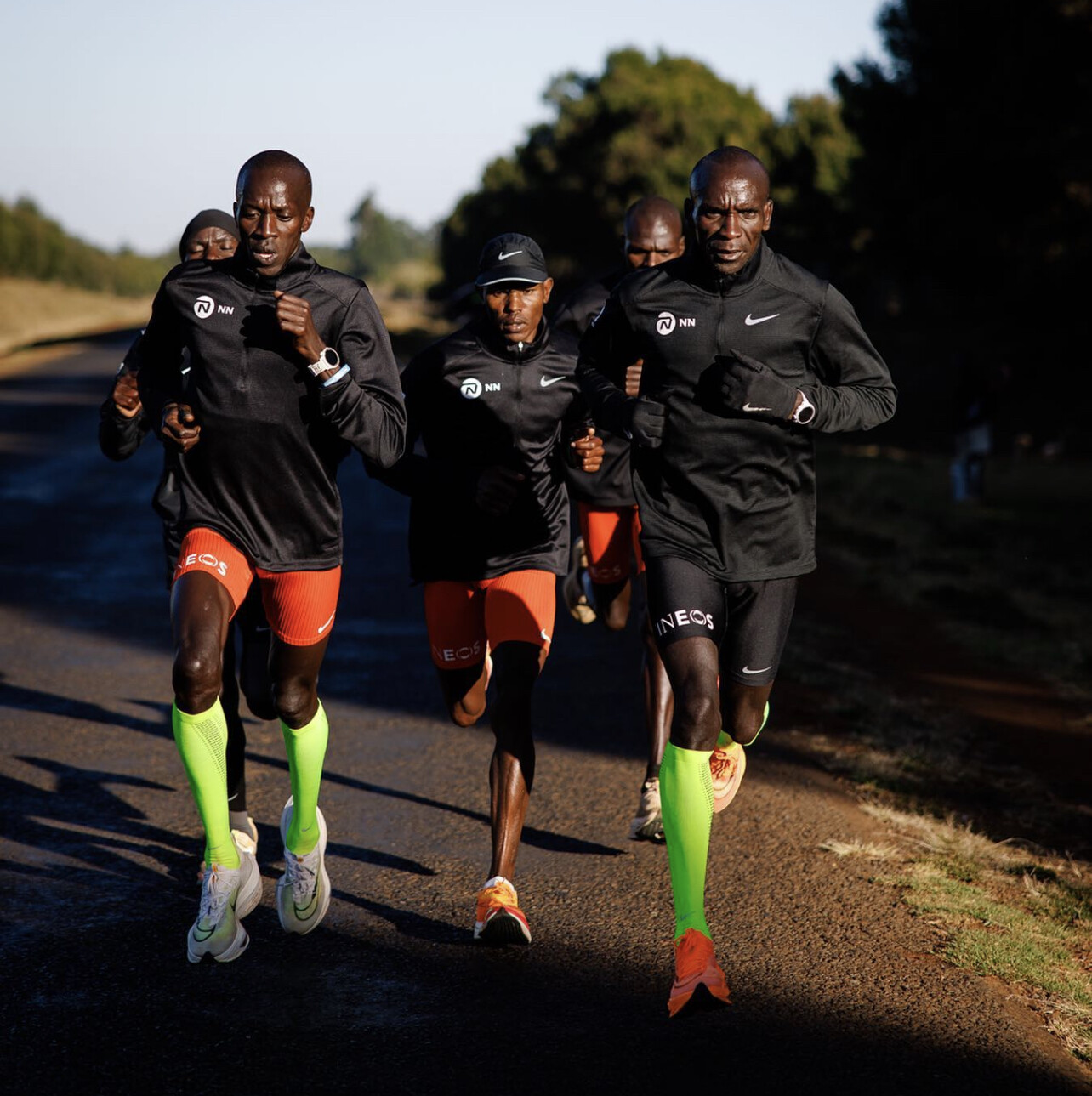
However, Kipchoge does not rule out giving up on his other goals.
"If time comes in to hang the racing shoes, I will say bye to other big things in sport."
'I know myself'
Sitting on a shaded bench in the Kaptagat camp where he has lived and trained for several months a year for 20 years, Kipchoge looks back on his poor showing in Boston on April 17, where he dropped from the lead group in the 30th kilometre and ended up finishing sixth.
This rare failure dampened his spirits.
"I'm trying to forget what has happened in Boston. It's caught in my mind... but I believe that what has passed has passed."
With his lifelong coach Patrick Sang, he has analysed the reasons for his disappointing performance, saying "it's mostly the hamstring".
He brushes aside concerns about his difficulties on hilly courses such as Boston and New York and which will also confront him in Paris.
"It is not really a concern, but I respect everybody's thoughts," he says. "I think it was a bad day and every day is a different day. I'm looking forward for next year.
"Everybody can write anything, you have no control. But I know myself."
'Want to be an inspiration'
Kipchoge is now preparing for his final marathon of the year.
"I'm doing well. My training is going on in a good way," he says.
But he has not yet disclosed which event it will be — Berlin on September 24, Chicago on October 8 or New York on November 5.
"At the end of July, I will know where to go."
He is following his usual training programme, eating up more than 200 kilometres a week on the red dirt tracks of Kaptagat forest, 2,400 metres above sea level.
Among his 20-odd training partners at the camp at the time of the AFP interview were Kenya's new 1,500m and 5,000m world record holder Faith Kipyegon and two-time New York marathon winner Geoffrey Kamworor.
As the respected dean of Kenyan athletics, Kipchoge is happy to see the emergence of 23-year-old compatriot Kelvin Kiptum, who won the London Marathon in April in 2:01:25, the second fastest time in history and just 16 seconds away from his own world record.
"I want to be an inspiration and I trust my breaking the world record twice is an inspiration to many young people. I trust they will want more and even beat my records."
'Prioritise drugs tests'
But in a country where athletics has become tainted by large-scale drug use, Kipchoge laments that "many people are going into shortcuts to advance".
"I think doping is there... It's all more about getting rich."
Kipchoge says the authorities should prioritise testing for performance-enhancing substances, saying it was much more important than education "because everybody who is doing doping knows what is going on".
"Just pump everything in testing, put testing as a first priority and all will be well," he says.
"The moment we prioritise testing and we register those who are handling the athletes across the country, we have the right data to know who is who in the whole country.
"But if we really ignore the people who are working with athletes and athletes themselves, then we are in danger."
Login to leave a comment
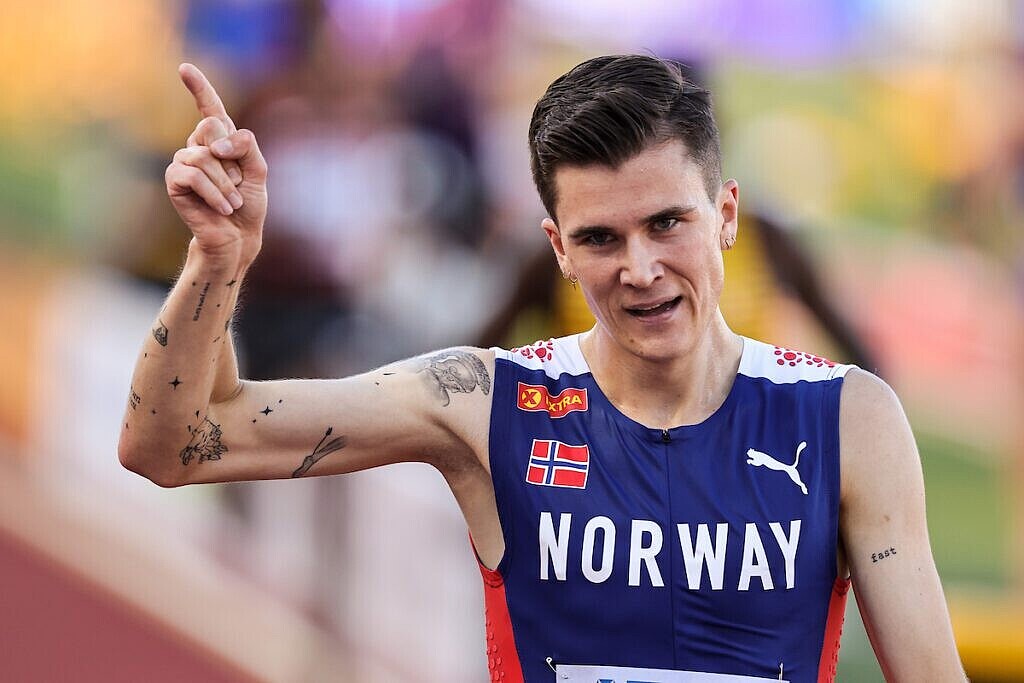
Jakob Ingebrigtsen to chase his national record at Oslo Diamond League
At the Paris Diamond League last week, the incredible Norwegian athlete and Olympic 1,500m champion Jakob Ingebrigtsen achieved a remarkable two-mile world best. On Thursday evening (afternoon for viewers in North America), the 22-year-old superstar will be competing in his home country, aiming to challenge his national record of 3:28.32 at the Oslo Diamond League.
Jakob’s WR bid
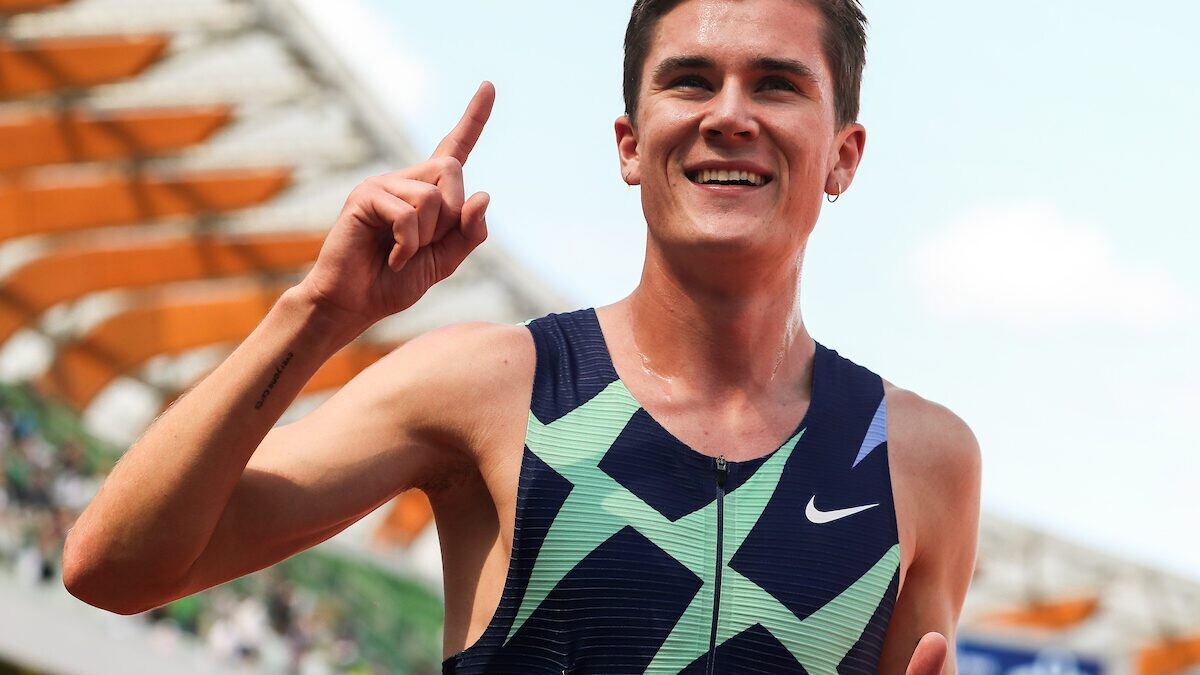
Ingebrigtsen headlines a deep men’s 1,500m field, featuring the silver and bronze medallists from Tokyo 2020, Kenya’s Timothy Cheruiyot and Josh Kerr of Great Britain. Other notable athletes are American Yared Nuguse and Mohamed Katir, who came off a Spanish national record performance over 5,000m in Florence two weeks ago, taking the win in 12:50.79.
During the pre-race press conference, Ingebrigtsen put his confidence on display and said he’s eager to chase a personal best and even take a shot at Hicham El Guerrouj’s 1,500m world record of 3:26.00 “If I break the world record Thursday, I deserve a statue,” said Ingebrigtsen. The Bislett Games meet director responded: “If you do it, I’ll personally set up a statue outside Bislett [Stadium].”
Although there has been a lot of world record talk from Ingebrigtsen and the media, the Wavelight pace in the 1,500m will be set to the meeting record of 3:29.12, going through 800m in 1:52 and the first kilometre in 2:19. Ingebrigtsen will have to close the final 500m in 66 seconds and a sub-53-second final lap if he hopes to take down the world record.
Canadians in Oslo
Two prominent Canadian athletes are competing at Oslo Diamond League Thursday. Olympic 200m champion Andre De Grasse looks to get his season back on track in the men’s 200m. The last year hasn’t been easy for De Grasse, changing coaches, battling injury and a slow start to the 2023 season. In his first three 200m race of the season, he has struggled to dip under the world championship standard mark of 20.24 seconds, a time he has frequently sailed under over the last two seasons. In his first Diamond League race in Doha on May 5, his turnover in the final 70 metres wasn’t there, and he faded to sixth in 20.35. It’s been three weeks since his last race, and he will come into Oslo as one of the favourites on paper, having the second-fastest personal best in the field after the young American, Erriyon Knighton.
Canadian mile and 1,500m record holder Gabriela DeBues-Stafford had a successful outing in her Diamond League return in Florence two weeks ago. After a full year off due to injury, the 27-year-old Olympic finalist ran to a season’s best 4:03.64 over 1,500m. She will come into the Oslo Diamond League as the top-ranked woman in the mile event. This race in Oslo should be more tactical and better suited for DeBues-Stafford’s racing style than the 1,500m in Florence, which resulted in a new world record for Faith Kipyegon.
Two other athletes who will be a tough test for DeBues-Stafford are Jessica Hull, who recently set an Australian record of 3:57.29 in Florence, and Ethiopian rising star Birke Haylom, who ran a giant personal best of 3:57.66 for third place at the Rabat Diamond League. DeBues-Stafford’s mile best is 4:17.87 from Monaco Diamond League in 2019, but any result under 4:23 for her would be a step in the right direction as she continues to prepare for the 2023 World Athletics Championships later this summer.
by Marley Dickinson
Login to leave a comment
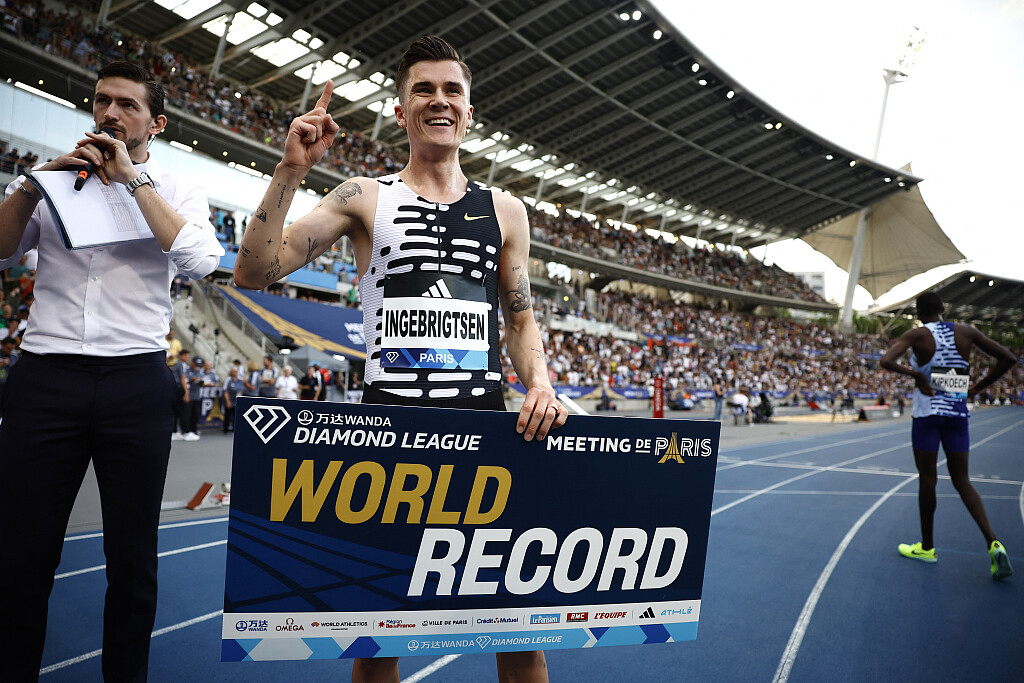
Jakob Ingebrigtsen shattered the two mile world record in Paris
Jakob Ingebrigtsen made history on Friday in Paris, running 7:54.10 in the two mile to break Daniel Komen’s mark that had stood since 1997.
Though the event isn’t frequently run, Komen’s time of 7:58.61 had taken on a mythical quality because of its longevity.
The distance was a perfect combination for Ingebrigtsen who has global gold medals in the 1500m and 5000m.
On Friday, the Norwegian was accompanied by two rabbits from the start and quickly separated himself from the rest of the pack. Ingebrigtsen never wavered from the pace, following the pacers through splits of 2:29.07 for 1000m and 4:56.95 for 2000m.
With 400 meters remaining, Ingebrigtsen only needed a 60-second close to get the record. He had much more to give than that, ripping off a 56-second 400m to obliterate the old mark.
En route, Ingebrigtsen passed 3000m in 7:24.07. That’s the third fastest time in history behind Komen and Hicham El Guerrouj
The race was just the second of Ingebrigtsen’s outdoor campaign. He opened his season with a victory in the Rabat Diamond League in 3:32.59.
Ingebrigtsen also owns the fastest time in history in the indoor 1500m, a 3:30.60 from Lievin.
by Flo Track
Login to leave a comment
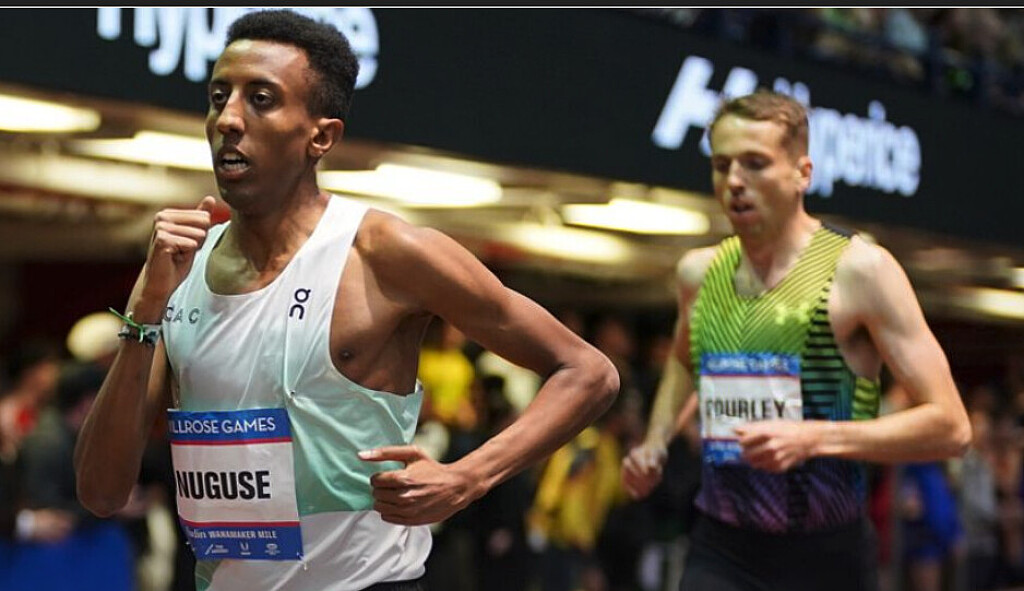
Nuguse breaks North American indoor mile record at Millrose Games
Yared Nuguse ran the second-fastest indoor mile in history as three national records fell or were equalled in a thrilling men’s Wanamaker Mile at the Millrose Games. Alicia Monson also set an area record in the 3000m, while Abby Steiner claimed a US record in the 300m at the World Athletics Indoor Tour Gold meeting in New York on Saturday (11).
In the infield, Ryan Crouser demonstrated his effective new shot put technique and Katie Moon returned to her winning ways in the pole vault before a roaring crowd that also cheered runners in competitions from U8 through high school and college.
As always, the men’s Wanamaker mile culminated the meeting, and Nuguse ran away with the race in a world-leading 3:47.38 to claim his second area record of the season to go along with the 3000m.
Pace setter Erik Sowinski brought the runners through half way in 1:52.99 – just as he had been asked – with Nuguse and training mates Mario Garcia Romo and Olli Hoare in the lead group. But Nuguse turned on the jets and covered the final quarter of the race in 54.23, breaking the meeting record, facility record, and crushing Bernard Lagat’s 15-year-old US indoor record of 3:49.98.
“Running that race the way we did,” Nuguse said, “all three of us right there up for the first half of the race, I felt good knowing I had my closest guys having my back. And then that last part was give it everything I had and I was able to close with something crazy and get it.”
Great Britain’s Neil Gourley ran a PB of 3:49.46 to move to sixth on the world indoor all-time list, and Hoare equalled the Oceanian record with 3:50.83. New Zealand’s Sam Tanner ran a PB of 3:51.70, while Romo’s 3:51.79 was a Spanish record.
Yuguse has now eclipsed Hicham El Guerrouj on the all-time list; only Ethiopia’s Yomif Kejelcha has run faster, clocking 3:47.01 in 2019.
“I’m always excited to see what else I can do next,” Nuguse said. “There was definitely a nice confidence boost. After that 3000m (where he broke the US record), I was feeling pretty confident already, but to do this in the event that I love the most and the one that I feel like I’m going for at the world championships, that makes me feel even better.”
Laura Muir won the women’s Wanamaker Mile in 4:20.15, followed by Josette Andrews in 4.20.88. Muir, the Olympic silver medallist, led for most of the race, then Andrews hit the front with two laps to go. But the Briton kicked again on the final lap and went on to win comfortably.
Sprint sensations
World record-holder Christian Coleman took a bow after winning the men’s 60m in a season’s best of 6.47. “I feel like this is what I do best and I came to put on a show,” he said.
Noah Lyles was charged with a false start and ran the race under protest, clocking 6.53, although the time would not count. Lyles, the US record-holder in the 200m outdoors, admitted a little bit of movement, but said his feet never left the pad. “I got a time that I’m very happy to see,” Lyles said. “Everybody knows I’m just here to play around. I’m not a 60-metre runner, but if I can take some heads, I’m going to do it.”
Jamaica’s Travis Williams was awarded second place with a PB of 6.59, followed by Josephus Lyles, Noah’s younger brother, also with a PB of 6.59. Williams edged Lyles by .003.
Aleia Hobbs set an Armory record of 7.04 to win her fourth straight competition, having clocked a world-leading 6.98 at the end of January. Teenager Tamari Davis was second in a PB of 7.08, followed by Marybeth Sant-Price in 7.11, Mikiah Brisco at 7.13 and 17-year-old Shawnti Jackson in 7.16.
“I don’t think my start was as good as it’s been, but I was patient,” Hobbs said.
In only her second 300m, Steiner broke the US record, clocking 35.54 to easily go under Quanera Hayes’ time of 35.71 from 2017. Steiner held off a spirited challenge from Brittany Brown, who ran 36.13.
“It’s definitely one of those races I think you learn a little bit about every time you run it,” said Steiner, who set the collegiate record in her first race.
Although this 300m is her last of the season, she still wants the world record of 35.45, shared by Shaunae Miller-Uibo and Irina Privalova. “I clean up my start a little bit,” Steiner said, “and I think it’s there.”
World indoor champion Jereem Richards of Trinidad & Tobago ran a season’s best of 45.84 to avenge the previous week’s loss to Noah Williams, who clocked 46.20. In Boston, they were separated by only .004 as both ran 45.88.
Devynne Charlton won the women’s 60m hurdles in 7.91, while Tonea Marshall ran a season’s best of 7.94 and Sharika Nelvis clocked 7.96 to edge Olympic silver medallist Nia Ali in 7.97.
Login to leave a comment

NYRR Millrose Games
The Pinnacle of Indoor Track & Field The NYRR Millrose Games, first held in 1908, remains the premier indoor track and field competition in the United States. The 2025 edition will once again bring the world’s top professional, collegiate, and high school athletes to New York City for a day of thrilling competition. Hosted at the New Balance Track &...
more...
90-year-old man sets new 1500m world record
At a masters athletics meet in Western Australia on Thursday, Perth runner David Carr set a men’s 90+ 1,500m world record (the metric mile) of 7:32.95, breaking the previous record by five seconds. Carr’s world record-setting time equates to a speed of 12 km/h and a pace of around five minutes per kilometre.
Carr, who celebrated his 90th birthday in June, has now broken five 90+ world records this summer: the 1,500m, 3,000m (16:20.96), 5,000m (29:47.83), 10,000m (62:48.93) and 2,000m steeplechase (12:50.43).

The previous 1,500m record, of 7:37.05, was held by Toshio Kamehama of Japan, set at the Japan Masters Championships in 2015.
According to an online age-graded running calculator, Carr’s graded time is faster than Hicham El Guerrouj’s 1,500m world record of 3:26.00. His age-graded result would be 3:16.00, which is remarkable.
Carr has been involved with athletics since 1948; he competed during his service in the Australian Navy and his time as a teacher. In 1974, he began competing in the masters division and went to his first Masters World Championship in 1980, since then he has won a healthy number of gold medals in middle distance events.
The Australian has had several attempts at the 90+ 400m and 800m record, but has come up short. Both the 400m and 800m 90+ records are held by Canada’s Earl Fee, (400m – 1:29.15, 800m – 3:34.93).
by Running Magazine
Login to leave a comment
Ethiopia Has Changed Its Team Again for the 2022 Worlds
On Tuesday, the Ethiopian Athletics Federation announced its team for the 2022 World Athletics Championships in Eugene. If this sounds familiar, that’s because Ethiopia already named its team on June 13…and then updated it four days later to sub in Dawit Seyaum after she ran 14:25 to win the Oslo Diamond League.
Tuesday’s list — which the federation says is the final roster (it pretty much has to be, since entries were due to World Athletics on Monday) — features even more changes, which will have a major impact on Worlds, which begin on July 15 at Hayward Field. Remember, at World Indoor Championships earlier this year in Belgrade, Ethiopian athletes won eight of the 12 available medals across the 1500 and 3000 meters — including all four golds and a 1-2-3 sweep in the women’s 1500. The country is a distance powerhouse.
Here is the full roster, with changes, followed by some analysis on what it all means.
Men’s 800 (no changes)Ermiyas GirmaTolosa Bodena
Women’s 800Habitam AlemuDiribe WeltejiHirut Meshesha (1:58.54 sb) replacing Freweyni Hailu (1:59.39 sb)
Men’s 1500Samuel TeferaTaddese Lemi (3:37.06 sb) replacing Melese Nberet (no races this year)Samuel Abate
Women’s 1500Gudaf Tsegay (3:54.21 sb) replacing Axumawit Embaye (3:58.80 sb)Freweyni Hailu (3:58.18 sb, 4th in Olympics) replacing Ayal Dagnachew (3:59.87 sb)Hirut Meshesha
Men’s 3000 steeple (no changes)Lamecha GirmaHailemariyam AmareGetnet Wale
Women’s 3000 steepleMekides AbebeWorkua GetachewSimbo Alemayehu (9:09.17 sb at age 18) replacing Zerfe Wondemagegn (9:27.75 sb)
Men’s 5,000Muktar EdrisBerihu AregawiYomif KejelchaSelemon Barega replacing Telahun Bekele
Women’s 5,000Ejgayehu TayeLetesenbet Gidey (14:24.59 sb) replacing Gudaf Tsegay (14:26.69 sb)Dawit Seyaum (14:25.84 sb) replacing Fantu Worku (14:47.37 sb)
Men’s 10,000Selemon BaregaTadese WorkuBerihu Aregawi (26:46.13 sb) replacing Milkesa Mengesha (27:00.24 sb)
Women’s 10,000Letesenbet GideyEjgayehu Taye (30:44.68 sb) replacing Girmawit Gebrzihair (30:47.72 sb)Bosena Mulate
Men’s marathonLelisa DesisaTamirat TolaMosinet GeremewSeifu Tura
Women’s marathonGotytom GebreslaseAbabel YeshanehAshete Bekere
Quick Takes
1) Ethiopia’s team just got A LOT stronger and Ethiopia went from no one doubling to a lot of doublers
In recent years, Ethiopia has been reluctant to allow its stars to double at global championships. Last year in Tokyo, Ethiopia had two huge 5,000m medal threats in Selemon Barega (Olympic 10,000 champ) and Berihu Aregawi (the 10,000 4th placer who would go on to win the Diamond League 5,000 title) but neglected to enter either in the 5,000 meters. Of the three men Ethiopia did enter, two failed to even make the final and the third, Milkesa Mengesha, wound up 10th.
The federation took criticism after that misstep and it looked as if it would double down in 2022 as the initial team named in June featured no doublers. But the final squad features five athletes double-entered: World Indoor bronze medalist Hirut Meshesha (800/1500) and Ejgayehu Taye (14:12 pb, #5 woman all-time), Letesenbet Gidey (women’s 5k/10k world record holder), Barega and Aregawi, all of whom are running the 5,000 and 10,000.
2) The meet is more interesting with the Ethiopians doubling; the men’s 5,000 final is now totally stacked
The World Championships are meant to be about the best against the best. When a world final is over, we don’t want to be asking ourselves, “What would have happened if Athlete X was in the race?” But that’s absolutely what we were thinking after the 2021 Olympic 5000 final without Barega. And it’s been an issue for a lot longer than that. Only once in his career did Haile Gebrselassie attempt the 5,000/10,000 double at a global champs (1993), in part because there were still prelims in the 10,000 in those days and in part because he didn’t want to tire himself for the lucrative post-championship meets in Europe.
That shouldn’t be an issue in 2022 (and if it is, it won’t have been the fault of the Ethiopian federation) as the distance finals are much stronger with Taye, Gidey, Barega, and Aregawi doubling up. The men’s 5,000 could be an all-timer. Not only do you have Olympic 5,000 champion Joshua Cheptegei of Uganda, but now we have Olympic 10,000 champ Barega stepping down and Olympic 1500 champion Jakob Ingebrigtsen stepping up. It’s reminiscent of one of the most famous races in track history, the 2003 World Championship 5,000 final in Paris which featured Hicham El Guerrouj stepping up from the 1500 and Kenenisa Bekele stepping down from the 10,000 only for both of them to be defeated by an 18-year-old Eliud Kipchoge.
Having Aregawi in the 10,000 makes for a stronger race as well as he was 3rd at the Ethiopian trials in that event and set a Diamond League record for margin for victory when he ran 12:50 to win the Pre Classic 5,000 by 16 seconds.
3) Gudaf Tsegay’s medal odds went up but her gold medal odds went down
Tsegay is pretty clearly the #2 women’s 1500 runner in the world. She won World Indoors by 5+ seconds and is 3+ seconds faster than the #3 1500 woman in the world right now. But she’s also not close to double Olympic champ Faith Kipyegon, who beat her convincingly at Pre, 3:52.59 to 3:54.21.
Initially, Tsegay was entered in the 5,000 at Worlds (she ran the 5,000 only at the Olympics last year, earning the bronze medal) and while there’s no overwhelming favorite in that event like Kipyegon (well at least until we see how Sifan Hassan looks this weekend), Tsegay is not as good at the 5,000 as the 1500 (as evidenced by her defeat to countrywoman Dawit Seyaum in the 5,000 in Oslo). By running the 1500, Tsegay has a better shot at a medal but her odds at gold are worse.
4) It just got a WHOLE LOT harder for the Americans to medal
An American medal in the women’s 5,000 or 10,000 was already unlikely, so the Ethiopian roster changes didn’t make a huge impact on the chances of Karissa Schweizer or Elise Cranny. But the medal odds of Grant Fisher, who finished 5th in the Olympic 10,000 last year, are way lower today than they were a week ago (a statement also true for his US teammates Woody Kincaid and Joe Klecker).
Last Wednesday, two of the four men who finished ahead of Fisher in the 10,000 in Tokyo were major question marks. Bronze medalist Jacob Kiplimo hadn’t raced on the track all year, while Aregawi, the 4th placer, was named to Ethiopia’s team in the 5,000 only. Since then, Kiplimo ran 7:29 for 3,000 in Stockholm to show he’s very fit right now and Aregawi was added to Ethiopia’s 10,000 squad. Plus Barega was added to the 5,000.
Those developments will make it significantly harder for Fisher (or any American man in the 5,000 or 10,000) to earn a medal. That said, if an American can somehow medal, it will go down as a monumental achievement since no one can accuse these fields of being watered down.
Sinclaire Johnson‘s medal hopes in the 1500 also took a BIG hit. With Tsegay now in the 1500, two medals seem to be spoken for and new addition Freweyni Hailu, who was 4th in the Olympics last year at age 20, is better than Ayal Dagnachew (who is no slouch herself, world junior 800 champ last year and 3:59 this year).
5) Ethiopia needs to figure out a better way to do this
One of the most important jobs an athletics federation has is selecting national teams. And for countries that don’t use a “top 3 at the trials” model — which is to say, every country except for the US — things can get prickly as someone, inevitably, is going to be upset they’re missing out on the team.
There are ways to limit the outrage. The simplest solution is the one USATF has already discovered: hold a trials and just pick the top three finishers. Ethiopia actually did this ahead of the Olympics last year. The problem was, they held all the races on the same day, making it impossible for athletes to try out for both the 5,000 and 10,000 teams.
But even if you don’t want to stage a trials, a federation can avoid much of the backlash by announcing a clear criteria ahead of time and sticking to it. You want to pick the team based off season’s bests? Fine. Just let everyone know before the season starts and let them plan their races accordingly. Transparency and consistency are the keys.
Heck, even if you want to be subjective and use a selection panel, you can at least cut down on some of the drama by letting the athletes know in advance that they’ll have to run a few performances to impress the selectors.
What you don’t want to do is announce a team well before the entry deadline (and three days before two key Diamond League meets featuring most of your athletes) only to drastically change it three weeks later. Which is exactly what happened in Ethiopia, leaving athletes like Telahun Bekele (winner of the 5,000 in Oslo) to think they’re on the team only to yank it away less than a month later.
In the end, Ethiopia ended up picking the team by season’s best except in the 10,000, where it staged a trial race (and the top 3 there were the fastest 3 on the year). If it had just used that criteria throughout the year and stuck to it, there would be fewer angry people right now. The athletes deserve better.
by Jonathan Gault
Login to leave a comment

World Athletics Championships Budapest23
Budapest is a true capital of sports, which is one of the reasons why the World Athletics Championships Budapest 2023 is in the right place here. Here are some of the most important world athletics events and venues where we have witnessed moments of sporting history. Throughout the 125-year history of Hungarian athletics, the country and Budapest have hosted numerous...
more...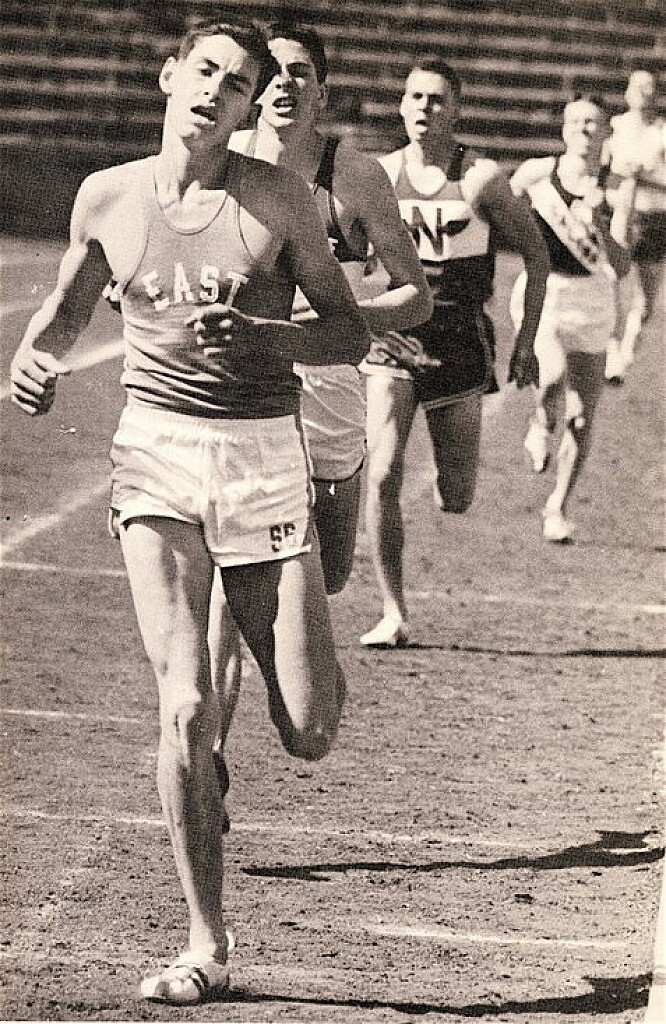
Five high school boys have combined to break the four-minute barrier seven times in 2022 and no one has enjoyed it more than Jim Ryun
Jim Ryun was the first high school boy to break the four-minute barrier in the mile as a Kansas 17-year-old in 1964 and went on to a legendary track and field career that included three Olympic appearances in the 1,500m, a silver medal in the 1968 Mexico City Olympics, and numerous American and world records.
Ryun’s name always surfaces when a high schooler dips under 4 minutes in the mile. And in 2022, his name has been coming up a lot.
Ryun’s career was also in the spotlight earlier this month when he was one of 30 former college track and field athletes inducted into the inaugural class of the USTFCCCA’s Athlete Hall of Fame in conjunction with the NCAA Championships in Eugene, Ore.
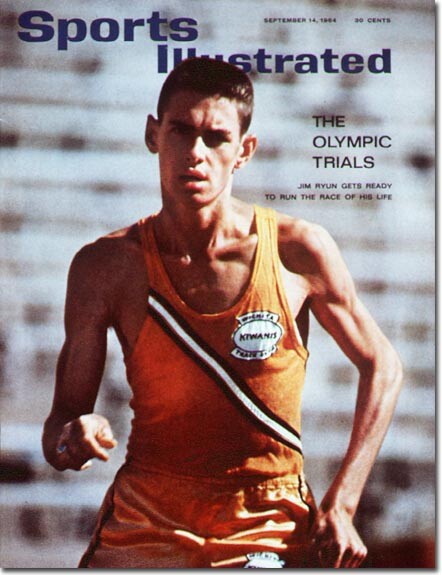
The original 4-minute high school barrier breaker celebrates the resurgence of American high school distance running and says for too long runners were held back in fear of what would happen if they ran under 4 minutes for the mile.
“I think they realize it’s not a barrier that can’t be broken, it’s more of a matter that if you break it,” Ryun said, “will you go on from there, which you can because we’re seeing more and more of them that are doing that.
“It’s not the barrier that it once was, should never have been there. For a long time, there were three of us. Myself, Marty Liquori and Tim Danielson. We were the only (sub) 4-minute milers from high school for years and I think it was the result of people being afraid of that, and coaches saying if you run too fast, too soon you’ll never make it very far.”
Growing up, Ryun often wondered if he would ever be successful in an athletic endeavor. He tried basketball and football and was cut from his church baseball team. At a high school assembly, Bob Timmons, the school’s track and field and cross country coach, encouraged students to run on his cross country team in the fall.
Ryun had never run more than one lap around a track before joining the cross country team, but in one season at Wichita East High School, he went from the last runner on the third-string team to a sixth-place finish at the Kansas state meet.
“Running was so new to me, I didn’t know who the heroes were,” Ryun recalled. “In fact, my first thought was I wanted to be a baseball, football, basketball player. Running, what’s that? So, it took a while. The first book Coach Timmons gave to me was about Emil Zatopek, the great Olympian, so I read that, and it began helping me understand about the sport.”
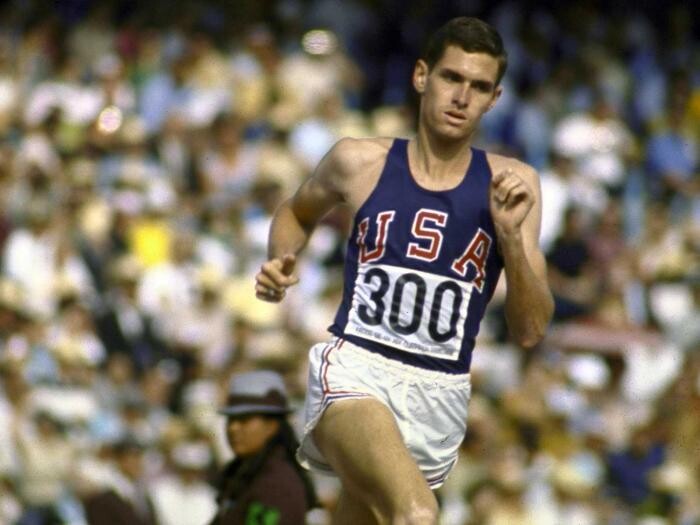
Ryun said Timmons was convinced he could be the first high school runner to break 4 minutes in the mile. That came true on June 5, 1964, when Ryun ran 3 minutes, 59.0 seconds to finish eighth at the Compton Invitational in Los Angeles.
“The goal originally was my coach’s because I was the kid that got cut from the church baseball team, didn’t have great talent and when I started running, I was looking for direction,” Ryun said. "And he began basically teaching me about goals, how to reach goals, and gave me workouts to get there. The night that I ran 4 minutes, 3:59.0, I didn’t sleep that night (before) because I realized that it was his goal.
“But my thought was, what happens if I take ownership, ownership being there’s certain things you as an athlete know you could do like maybe a little extra weightlifting, better eating. It was a transformational moment, because I mean when you finish eighth in a race and become the first kid to run under 4 minutes, that has to change your life – and it did.”
Ryun’s running career took off from there. He made the 1964 U.S. Olympic team in the 1,500m that went to Tokyo and was the last U.S. high school men’s track and field athlete to make the U.S. Olympic team until teenager Erriyon Knighton qualified for the 2020 Tokyo Olympics in the 200m and finished fourth there.
As a high school senior, Ryun broke 4 minutes four more times. His time of 3:58.3 at the 1965 Kansas state meet was the first time 4 minutes was broken in a high school-only meet. On June 4, 1965, Ryun returned to the Compton Relays, the site of his first sub-4-minute mile and ran 3:56.8. A little over three weeks later, he ran 3:55.3 at the U.S. AAU Championships in San Diego and beat New Zealand’s Peter Snell, the 1964 Olympic champion in the 800m and 1,500m.
Ryun, who would stay close to home and attend Kansas University after graduating from high school in 1965, roomed with a former Jayhawks great, Billy Mills, during U.S. training camps leading up to the 1964 Olympics. In Tokyo, Mills stunned the world by becoming the only U.S. athlete to ever win the Olympic 10,000m.
In 1966, Tim Danielson became the second American high schooler to break 4 minutes when he ran 3:59.4. A year later, Marty Liquori ran 3:59.8 to become the third high schooler under 4 minutes.
Ryun and Liquori had illustrious careers after high school, particularly Ryun. At age 19 in 1966, Ryun set two world records, first in the 800m (1:44.9), and then the mile (3:51.3). He was the NCAA indoor mile champion for Kansas in 1967, 1968 and 1969, and the 1967 outdoor NCAA mile champion. In 1967, he set a 1,500m world record of 3:33.1 that stood for seven years.
That same year, he lowered his mile world record to 3:51.1., a mark that stood for almost eight years. Ryun was the last American man to hold the mile world record. He still holds American junior records for the mile (3:51.3) and 2-mile (8:25.1), and his 800m American junior record of 1:44.9 stood for exactly 50 years.
In 2003, ESPN.com ranked Ryun as the greatest U.S. high school athlete of the 20th century, ahead of Tiger Woods, LeBron James, Lew Alcindor (now Kareem Abdul-Jabbar), Wilt Chamberlain, Marion Jones, and others.
After Ryun, Danielson, and Liquori, the 4-minute mile wasn’t broken by a prep athlete again for more than 32 years until Alan Webb ran 3:59.86 at the New Balance Games in New York on Jan. 20, 2001. Sensing something special in Webb, the promoters of the Prefontaine Classic in Eugene, Ore., invited him to run in the Bowerman Mile, the signature event of the meet that has since become a Diamond League event, on May 27, 2001.
Morocco’s Hicham El Guerrouj, still the world record-holder in the 1,500m and mile, won the event in 3:49.92, followed by Kevin Sullivan of Canada and Bernard Lagat, then of Kenya, who later ran for the U.S. They helped pull Webb to a fifth-place finish in 3:53.43, breaking Ryun’s 36-year-old high school record.
“I thought he would. I just didn’t know how much he would break it by," Ryun said. “It was one of those moments in time where he had run well, but he needed somebody to help him get over that finish line, just as I did running under 4 minutes for the first time. You need someone to help set the pace. You can relax a little bit, and he was able to take advantage of that.
“So, there was no real surprise to me. The biggest surprise was that there weren’t more high school boys running under 4 minutes.”
It would be another 10 years before a high schooler would break 4 minutes in the mile. In 2015, Matthew Maton and Grant Fisher, now the U.S. record-holder in the men’s 10,000m, both ran 3:59.38 about one month apart. In 2016, two runners broke 4 minutes, including Drew Hunter, who did it twice in a 15-day span in February indoors, both times in New York.
The 4-minute barrier was broken by high schoolers once in 2017 and again in 2020 during the height of the COVID-19 pandemic. In 2021, Hobbs Kessler ran the fastest high school mile since Webb when he ran 3:57.66 indoors. Kessler later that year broke Ryun’s 1,500m American junior record of 3:36.1 that stood for almost 55 years.
The lack of American high school runners breaking 4 minutes in the mile for decades might be a big reason why U.S. men haven’t enjoyed much Olympic or international success until recently. When Matthew Centrowitz won the men’s 1,500m at the 2016 Rio de Janeiro Olympics, he was the first American man to do so since 1908. At the same Olympics, Clayton Murphy won the bronze medal in the 800m, the first American man to medal in the event since 1992.
And when the World Athletics Championships are hosted on U.S. soil for the first time next month in Eugene, Ore., the defending 800m men’s champion is American Donavan Brazier.
“If you look back in history, you’d see there was a dominance maybe by a country for a time like Great Britain had all those great runners. America at one time was dominant in that area as well,” Ryun said. “So, I think it’s a matter of floating from place to place, and I think it comes down to motivation. How motivated are you?
“Over time you start realizing that motivation has to come down to you be willing to get up, run in all kinds of weather, race all over the world and let those talents be developed that God’s given you. So, it takes time. I think America can come back with dominance, but it also comes down to how motivated you are. I see the Kenyans as very motivated, and America can be just as motivated as you see with these new young runners that are developing quickly.”
That has proven to be the case this season. Seventeen high school runners have broken the 4-minute barrier, and 2022 has been the banner season for it so far with five runners breaking the mark seven times.
“I think a lot of coaches are seeing, too, that kids are just developing a lot faster doesn’t mean you’re going to burn out,” Ryun said. “It means you’ve got great opportunities. Will you decide to keep it going and, in my case, will you take ownership? The coach can only take you so far, but then you have to establish ownership.”
The owner of the fastest prep mile this year is Colin Sahlman, who ran 3:58.81 indoors in February, and, like Webb, was invited to the Bowerman Mile at the Prefontaine Classic. In a field that included 2020 Tokyo Olympic 1,500m gold medalist Jackob Ingebrigtsen, defending World Athletics Championships 1,500m gold medalist Timothy Cheruiyot, and defending 1,500m NCAA outdoor champion Cole Hocker, Sahlman finished 13th in 3:56.24. Of the 14 men who finished the race, seven set personal bests and seven set season bests, including Ingebrigtsen, whose time of 3:49.76 is the fastest in the world this year.
Sahlman’s time moved him to third on the all-time prep list behind Webb and Ryun. Sahlman, who is headed to Northern Arizona University for college, was part of a high school powerhouse at Newbury Park High in Southern California. In 2021, Newbury Park became the first high school team to have four runners break 4:10 for the mile in the same season.
“That mindset has really evolved and developed over these last three to four years,” Sahlman said in a March article in the Los Angeles Times. “It’s just like it’s transformed into something that we never thought was possible. Now we think anything’s possible.”
Gary Martin has also broken 4 minutes twice this year, running 3:57.98 on May 14 and 3:57.89 on June 2 in the Festival of Miles in St. Louis. At the Festival of Miles, Connor Burns ran 3:58.83 to become the first high school junior since Ryun to break 4 minutes. It was also the first time two prep runners broke 4 minutes in the same race.
Those two performances gave the Festival of Miles four prep runners who have broken 4 minutes. That’s where Fisher did in 2015, a feat repeated by Reed Brown a year later.
And one day after Martin and Burns broke 4 minutes, Rheinhardt Harrison ran 3:59.33 in Florida on June 3. On June 15, Simeon Birnbaum added to the list of sub-4 minute runners when he became the second high school junior this season to break the mark with a time of 3:59.51.
Will this high school running resurgence lead to greater U.S. success against international competition and major global championships? Only time will tell.
by Ashley Conklin (World Athletics)
Login to leave a comment
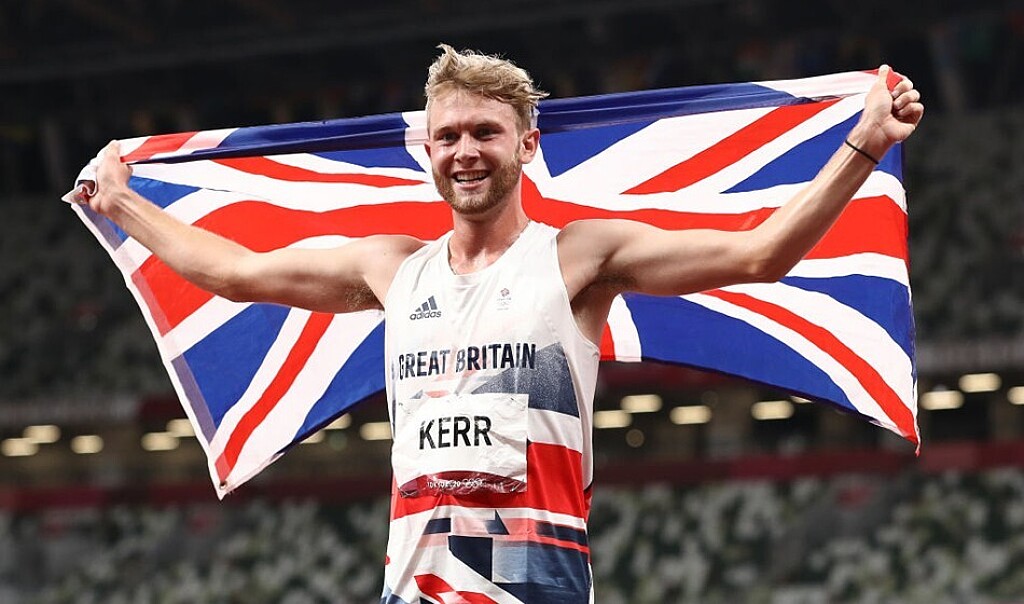
Josh Kerr smashes Peter Elliott’s UK indoor mile record
Olympic 1500m bronze medallist clocks 3:48.87 in Boston to go No.3 on the world all-time rankings
After finishing third in the Olympic 1500m final last year behind Jakob Ingebrigtsen and Timothy Cheruiyot, Josh Kerr boldly stated this month that he is going for gold at the World Championships in Eugene in July.
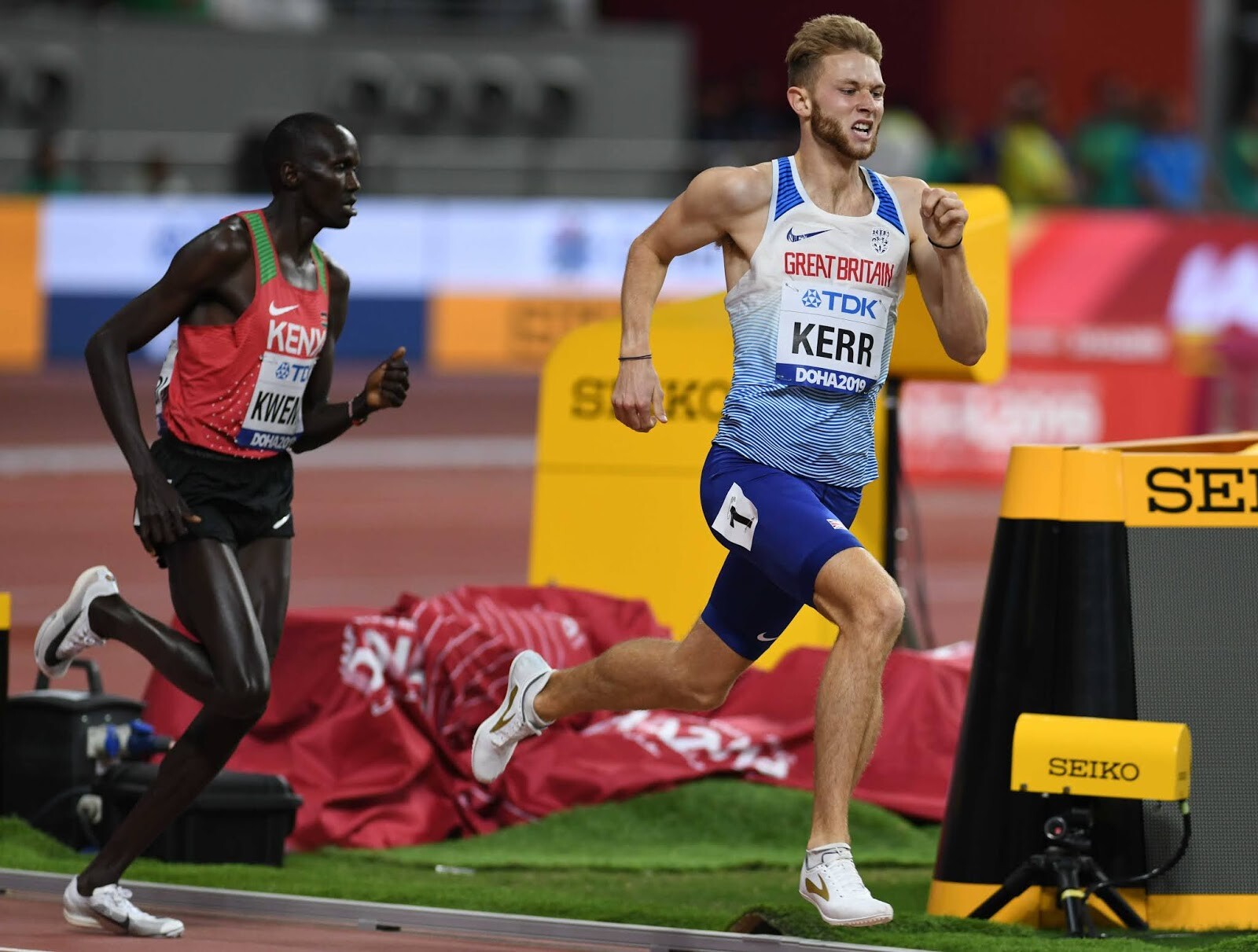
On Sunday (Feb 27) in Boston he showed why he carries such confidence when he ran 3:48.87 for the mile at the Boston University Last Chance Meet.
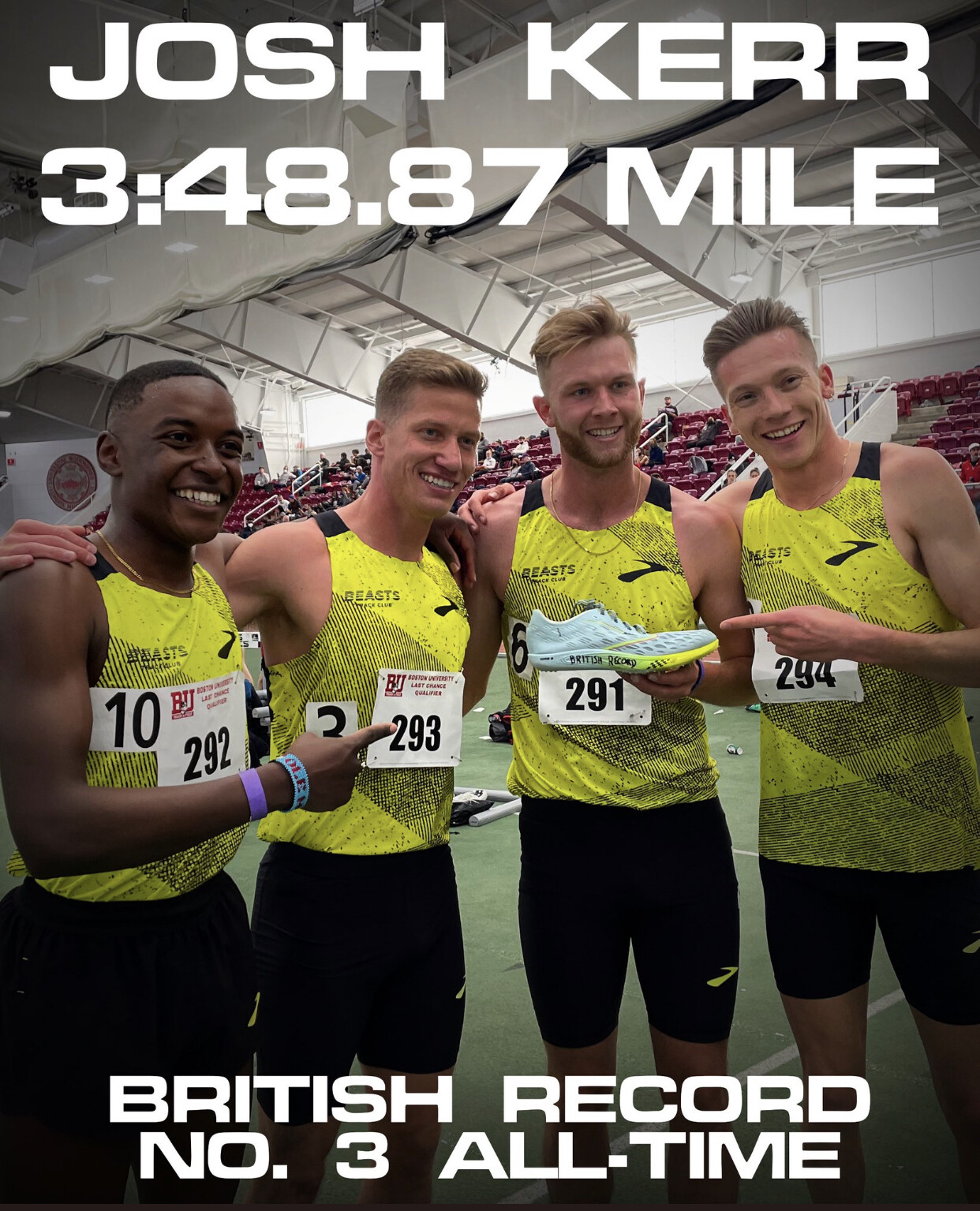
The time puts him No.3 on the world all-time rankings behind Yomif Kejelcha’s world record of 3:47.01 and Hicham El Guerrouj’s 3:48.45.
It also smashes the long-standing British record of 3:52.02 held by Peter Elliott – a mark which was set at East Rutherford in 1990.
Elliott incidentally also holds the British 1500m indoor record with 3:34.20 but it is thought Kerr may have run quicker en route during his mile.
In addition, Kerr’s time is a European record, as it breaks Eamonn Coghlan’s 3:49.78, which was also set in East Rutherford back in 1983. At the time Coghlan was the first man to run a sub-3:50 mile indoors and even now, 39 years later, Kerr has become only the seventh athlete to achieve the feat.
Kerr’s splits saw him pass the first lap in 58.15 and halfway in 1:56.75 before he ran a trademark strong second half of the race to go through three laps in 2:52.04 (55.3) before finishing with a 56.8 final lap.
by Athletics Weekly
Login to leave a comment
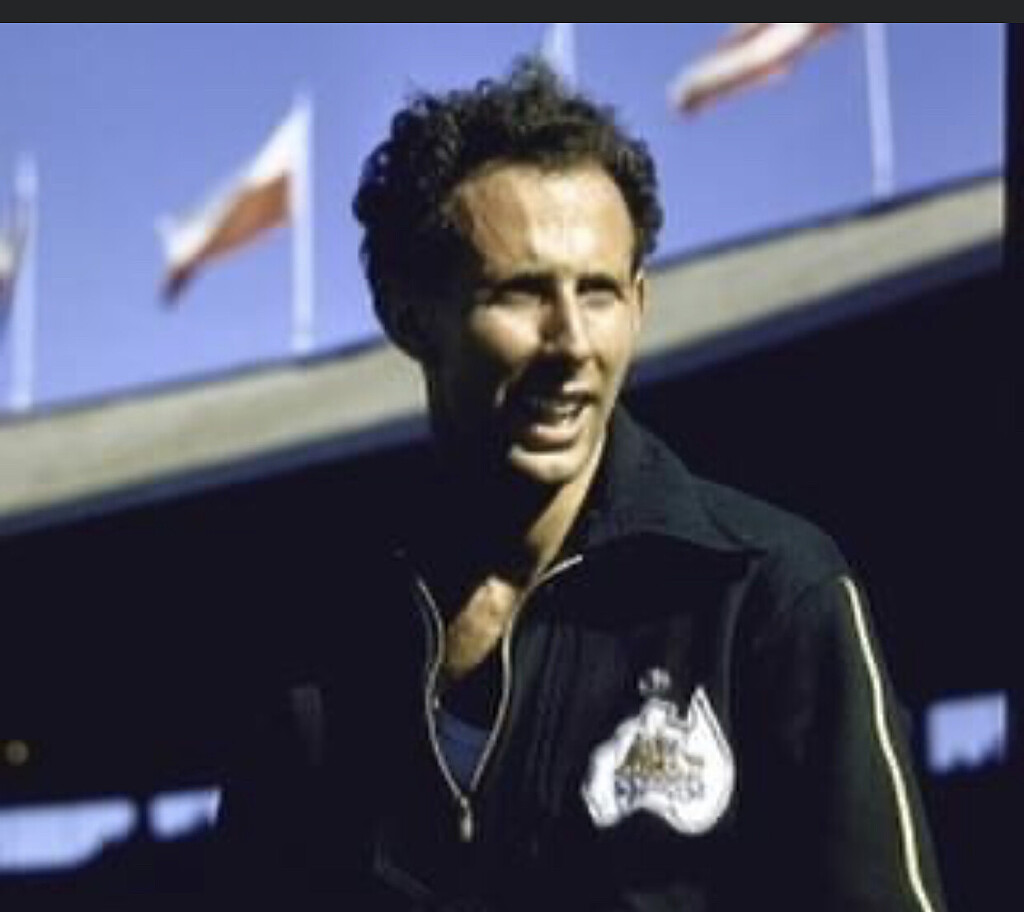
John Landy has died at age 91
John Landy, a scholarly Australian who became the second man, after Roger Bannister of England, to run the mile in under four minutes, and who later dueled Bannister in a race that became known as the Mile of the Century, died on Thursday at his home in Castlemaine, Victoria, Australia. He was 91.
His death was reported by the country’s main public broadcaster, the Australian Broadcasting Corporation.
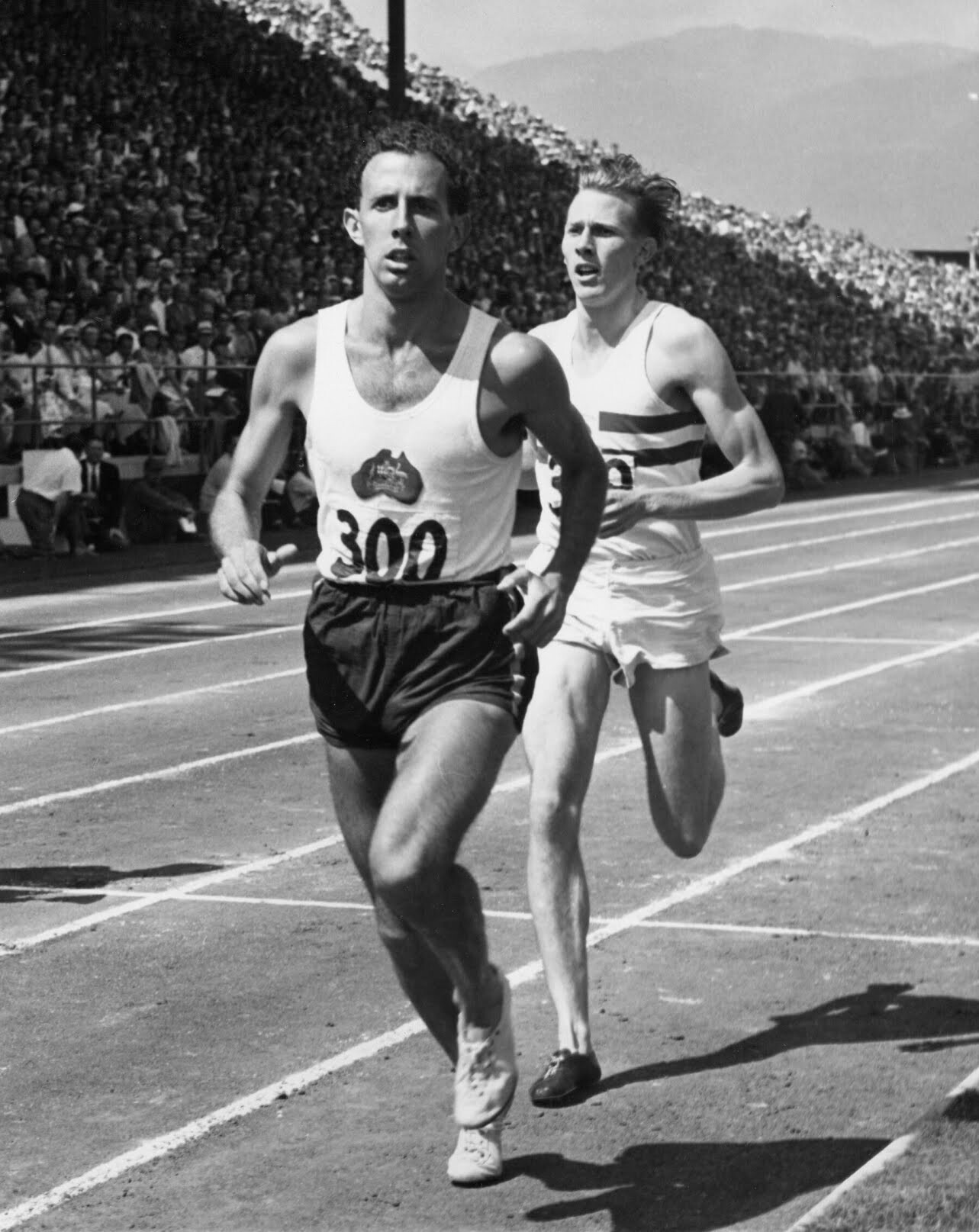
For as long as races were measured in time, running a mile in less than four minutes had remained one of humankind’s seemingly unbreachable barriers. But by 1954, three of the world’s greatest runners — Landy, Bannister and Wes Santee of the United States — had been edging closer to that mark and appeared ready to shatter it.
All three faced obstacles: Landy, at just over 5-foot-11 and 150 pounds, was running on slower grass tracks in Australia; Bannister was deep into medical studies at Oxford; and Santee had to run three relays for the University of Kansas in almost every meet.
Bannister reached four minutes first, running a mile in 3 minutes 59.4 seconds on May 6, 1954, in Oxford. Not to be outdone, Landy, who graduated from Melbourne University that year with a degree in agricultural science, headed for Europe and its faster tracks.
On June 21 — 46 days after Bannister’s historic race — Landy lowered the world record even more, to 3:57.9, in Turku, Finland. (According to the timing rules of the day, which called for mile records to be listed in fifths rather than tenths of a second, the time was listed as 3:58.0; it is now recognized as 3:57.9, the actual time recorded by four timers.)
As Landy saw it, he and Bannister had simply done the inevitable. “Four minutes was not a psychological barrier,” he said. “Someone was going to break it. If there hadn’t been a war, it would have fallen 10 years earlier.”
Landy’s record would last three years; it was broken in 1957 by Derek Ibbotson of England, who ran 3:57.2. (The current record is 3:43.13, run by Hicham El Guerrouj of Morocco.)
by NY Times
Login to leave a comment
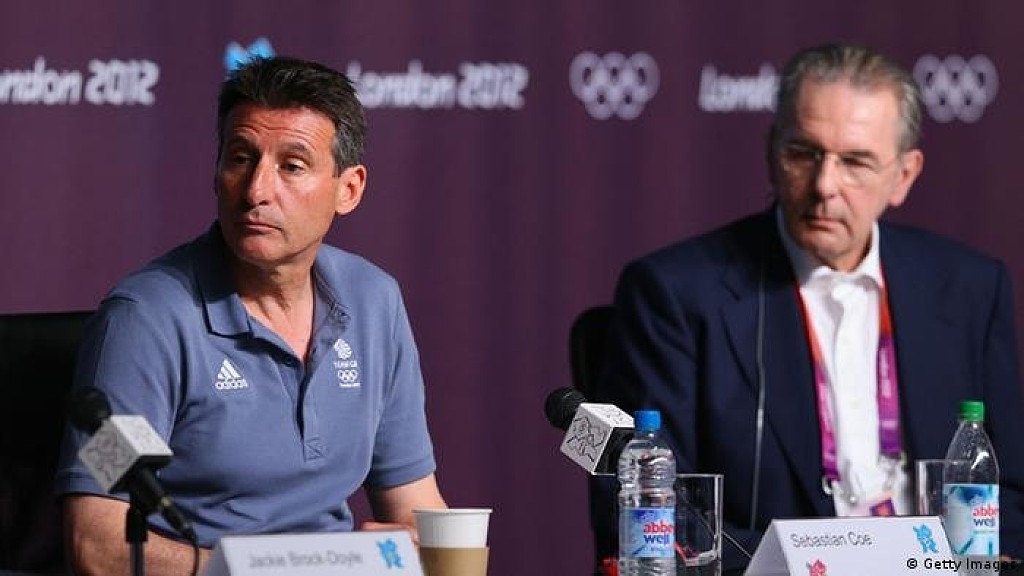
World Athletics President Sebastian Coe has paid tribute to former International Olympic Committee (IOC) President Jacques Rogge, who has died aged 79
Jacques Rogge served as the eighth President of the IOC, from 2001 to 2013, and competed for Belgium in sailing at three editions of the Olympic Games, in 1968, 1972 and 1976.
In 2005 he announced the awarding of the 2012 Games to London, with Coe having led the UK capital city’s bid.

Rogge, who was an orthopaedic surgeon with a degree in sports medicine, was married to Anne, and leaves a son, a daughter and two grandchildren.
“I am beyond sad to hear the news of Jacques’ passing,” Coe said. “I wrote to Jacques and Anne two weeks ago to tell them that all of us at World Athletics missed them at the Tokyo 2020 Olympic Games. I said it wasn’t the same being in the Olympic stadium watching athletics without them.
“I have a mountainous gratitude for his part in the seamless delivery of London 2012. No Organising Committee could have asked or received more. He was passionate about sport and all he achieved in sport and beyond was done with common decency, compassion and a level head. We will all miss him.”
After his career as an athlete, which included becoming a Belgian rugby international, Rogge became President of the Belgian and European Olympic Committees, and was elected President of the IOC in 2001. After his IOC Presidency, he also served as a Special Envoy for Youth, Refugees and Sport to the United Nations.
“First and foremost, Jacques loved sport and being with athletes - and he transmitted this passion to everyone who knew him. His joy in sport was infectious,” said Thomas Bach, who succeeded Rogge as IOC President in 2013.
“He was an accomplished President, helping to modernise and transform the IOC. He will be remembered particularly for championing youth sport and for inaugurating the Youth Olympic Games. He was also a fierce proponent of clean sport, and fought tirelessly against the evils of doping.
“The entire Olympic Movement will deeply mourn the loss of a great friend and a passionate fan of sport.”
In a post on Twitter, World Athletics Senior Vice-President Sergey Bubka said: “Deeply mourn the loss of a wonderful personality, true friend and great leader, IOC Honorary President Jacques Rogge.
“Dedicating his life to the Olympic Movement, he was very special in his human attitude towards others, incredible love for athletes and understanding of the youth.”
Among others to pay tribute to Rogge was Moroccan middle distance great Hicham El Guerrouj, who wrote: “With a heavy heart, I pray for the eternal repose of Jacques Rogge, the former president of the IOC. RIP.”
by World Athletics
Login to leave a comment
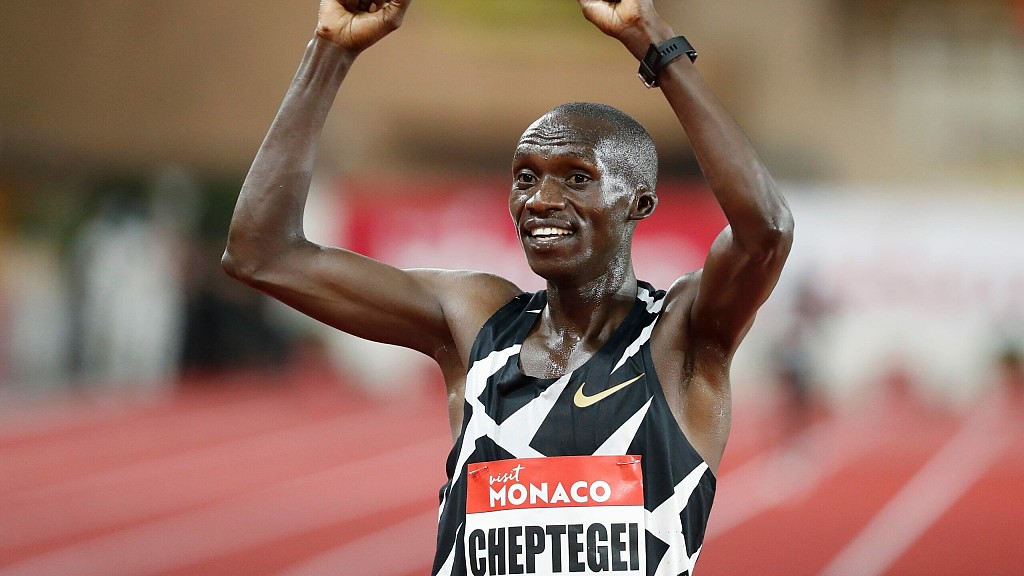
Joshua Cheptegei will go for Komen's legendary 3000-Meter World Record on Wednesday
Last year, Uganda’s Joshua Cheptegei set world records in the 5,000 and 10,000 meters as part of an unforgettable 2020 season.
On Wednesday at the Golden Spike meet in Ostrava, he will try to go one better and become just the third man to hold the 3,000, 5,000, and 10,000 records simultaneously. Yes, that’s right. Cheptegei will attempt to break Daniel Komen‘s legendary 7:20.67 3,000-meter world record which has stood for nearly 25 years — since September 1, 1996.
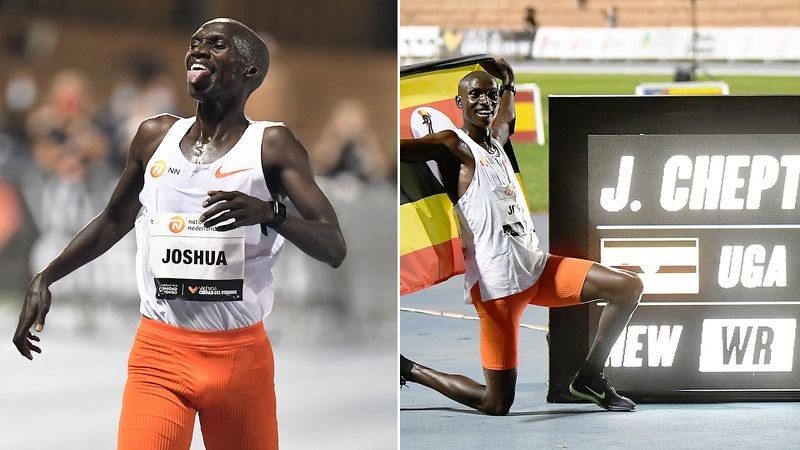
Cheptegei´s camp is under no illusions as to the difficulty of the feat.
“It’s a big ask for Joshua to break [the 3,000-meter world record], we have to be realistic about that,” Cheptegei’s agent Jurrie van der Velden told LetsRun.com. “But we believe it’s possible with the training he’s done. It will be the toughest attempt for him thus far.”
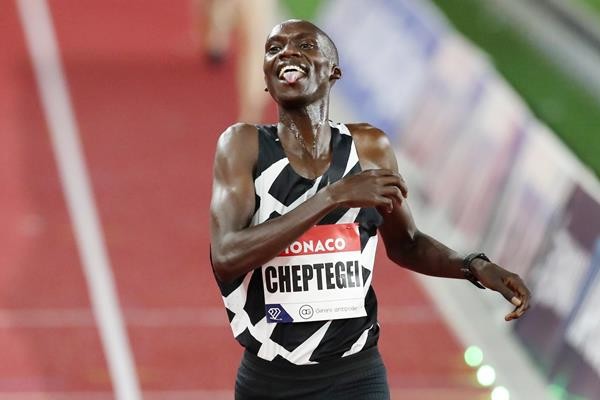
There are several reasons why. First is the 3,000-meter record itself is one of the longest-standing men’s world records and has scarcely been challenged since. Only Hicham El Guerrouj, who ran 7:23.09 in 1999, has come within four seconds of the mark. Even the great Kenenisa Bekele, previous holder of the 5,000 and 10,000 records, never ran faster than 7:25.79.
Second is Cheptegei’s skillset. While the World Athletics scoring tables say 7:20 is equivalent to 12:36 and 26:15 for 5,000 and 10,000 — both marks Cheptegei has bettered — it will be tougher for Cheptegei who, as a distance specialist, is more suited to the longer events. He will need a lot of speed to break 7:20.67 — it’s 3:56 mile pace for seven-and-a-half laps — and Cheptegei, whose 3,000 pb is 7:33.26, has yet to demonstrate the raw 1500 speed of Komen, who had a personal best of 3:29.46.
In Cheptegei’s defense, he has barely raced the 1500. His Tilastopaja profile lists just three races at the distance, the most recent of which was a pb of 3:37.36 on April 24 in Kampala (elevation: 3,937 feet). He will have to run close to that pace for twice the distance to break Komen’s record.
Cheptegei does have a few things working in his favor, however. He has an ace pacemaker in Australia’s Stewart McSweyn, who ran 3:30 and 7:28 last year, and will also benefit from the pacing light system that aided Cheptegei in his world records in Monaco and Valencia last year. The pace is scheduled for 2:26-2:27 per kilometer, with Dutchman Richard Douma serving as the first pacer through 1200 meters before giving way to McSweyn, who will attempt to go through 2000.
Cheptegei also has Nike’s superspikes, which have made Komen’s once-untouchable record seem more attainable. For eight years — from 2012 through 2019 — no man broke 7:28 for 3,000. In the last eight months, five men have done it, all in Nike spikes.
by Jonathan Gault
Login to leave a comment

Jeopardy! contestants stumped by running question-We'll take "what is the 1,500 metre" for $100,000
Most of the time the contestants on Jeopardy! leave us in awe of their seemingly endless knowledge of random facts, which is why there is no better feeling than knowing an answer that none of them gets right. In last night’s episode (with Ken Jennings as the new interim host in place of the late Alex Trebek), runners everywhere finally had their moment when all three contestants on the show demonstrated their extreme lack of knowledge of track and field (and well, distances in general). We know our sport is more niche than football or hockey, but this was just embarrassing.
The question that made runners everywhere shake their heads was:

“Hicham El Guerrouj holds the world records in the mile and this metric track distance that’s just a bit shorter.”
The answer is (obviously) the 1,500m, but before we get into the contestants’ hilariously bad answers, let us first say that we understand Americans don’t use the metric system, so maybe that’s where some of the confusion came from. Still, take a minute to consider they got questions like this right:
“Something ridiculously small such as an apartment may be compared to this sticky item, which is often 0.87 x 0.98 inches.”
Seriously?
(The answer was a postage stamp.)
OK, so on to the answers. It’s obvious that none of these contestants have any running friends, because they’ve clearly never had to sit and listen as we regale them with our running stories, or talk their ear off about track stats. Or they did, but they tuned us out, which, if we’re being honest with ourselves, is kind of fair.
Instead of listing their answers in order, we’ve decided instead to rank them from bad, to worse, to worst:
Liz Fitting’s answer: “what is the 500 metre?”
This answer was at least in the realm of possible track distances (there is, after all, a 600m indoors) so we’ll cut her a bit of slack. But in what world is 500 metres “a bit shorter” than a mile? It’s less than half the distance! Clearly she’s never experienced the pain of being 1K away from a finish line.
Lucy Ricketts’ answer: “what is the 10 metre?”
This answer is just plain ridiculous. The 10 metre? Is she going to track meets for hamsters? (Actually that might be kind of fun to watch.)
Brett Moore’s answer: “what is the 10,000 metre?”
Did he panic and just blurt out the first thing that came to his head? It’s possible. Is this another case of confusion over the use of the metric system? Maybe. Or maybe poor Brett has been claiming he can run an eight-minute 10K his whole life because he was legitimately confused.
So there you have it, runners of the world — when you’re talking to all your friends about your running accomplishments, you can add this one into the rotation. Now we’re going to go find out if hamster Olympics are a real thing…
by Running Magazine
Login to leave a comment

Beers, Bomb Suits and Blue Jeans: The Weirdest Mile-Run Records Known to Man-13 baffling ways humans have covered 5,280 feet
The running and drinking communities have long shared an unlikely Venn diagram. In the 1930s, some athletes would bring beer along for lengthy workouts, believing that its hearty grains might propel them to longer distances. For decades, at the end of the Berlin Marathon, runners who’ve made the podium are given medals and enormous boots of Erdinger. And these days, running clubs like Toronto’s RUNTOBEER start and finish at breweries around the city. Hell, there’s even a craft brewery in Chico, California, called Sufferfest that’s operated by lifelong runners and makes light, low-calorie ales designed for the highly active beer drinker.
Still, there is no greater (nor less subtle) collision of these two disciplines than the infamous Beer Mile, a concept that is arguably more popular than any internationally sanctioned event in the entire sport of track and field. It’s an irresistible blend — the familiarity of elementary-school gym class with the low-class hijinks of college — and it’s at the forefront of an unofficial, utterly unasked-for movement in both the amateur and professional running circles: run four laps hard, but make it weird.
In the last five months, runners have set two new, preposterously specific mile-run records: one while handcuffed, and one while wearing a pair of blue jeans. It would be tempting to laugh these efforts off, if only they weren’t so fast. (The jeans miler rumbled in at an unholy 4:06.) And really, at the end of the day, it’s fun to embrace these races, which wed the appeal of an old, oft-forgotten sport with stunts and gimmicks that thrive on social media.
Which is exactly what we’ve done. Below, find the 13 weirdest mile-run records known to man — including the fastest miles ever run in a bomb suit, with a dog and under the influence of chocolate milk.
Fastest Beer Mile
Corey Bellemore, 4:33
Bellemore actually ran a 4:24 about a year after his 4:33 mark, but got disqualified for leaving a combined 4.5 ounces of beer in his “empties.” Those judges are serious. As is his running ability; he’s an Adidas-sponsored athlete with a personal best of 3:57 to his name. Which is a crucial theme in the world of wacky mile records: always eager for a challenge, the pros inevitably hijack the bonkers creations of layman runners. Just six years ago, for instance, the running world had celebrated its first sub-five beer mile. Check out the full catalogue of all-time bests here, including stats on the favored beers. (Budweiser is currently in the lead, though Bellemore, a Canadian, prefers the craft stuff from Ontario’s Flying Monkeys Brewery.)
Fastest Mile in Jeans
Johnny Gregorek, 4:06
This past May, Asics athlete Johnny “The Jet” Gregorek ran a blistering 4:06 in a pair of Levi 501s. It was enough to beat Dillion Maggard’s former record time of 4:11, and horrify millions across the internet who think wearing jeans on a plane should be a “criminal offense.” Gregorek, who is a middle-distance star with a silver medal from the 2019 Pan American Games, trained for his record by running 100-meter sprints in the blue jeans to break them in. On race day, he also managed to raise $31,000 for the National Alliance on Mental Illness, in an homage to his late brother. Levi’s donated $5,000.
Fastest Walking Mile
Tom Bosworth, 5:31
Of all the feats listed here, this is the only one that doesn’t actually involve running. And yet, it’s also the only one you’re likely to find at a legitimate track meet. Racewalking is very much a sport, despite the fact that it looks like several minutes of that “This one is serious” dash people make for the bathroom after eating bad shellfish. The only rule? Keep one foot in contact with the ground at all times, which distinguishes it from the leaps and bounds of running. Distances usually start at 3,000 meters, and hike all the way up to 100 kilometers (that’s 62 miles), but mile races have some popularity, too. At the 2017 Diamond League in London, British race walker Tom Bosworth clocked in at 5:31, to the delight of a very excited commentator.
Fastest Mile Downhill
Mike Boit, 3:27
We recently covered a virtual, March Madness-style running tournament called “Survival of the Fastest,” in which runners were pitted against each other each week to race a new, specific distance. Downhill racing was allowed in the competition (even encouraged) and by the time the bracket had been whittled down to a final four, every runner involved was hitting start on Strava from the top of a mountain in order to ensure the most competitive time possible. It really does make an absurd difference. Hicham El Guerrouj has holds the official world record for the mile run (3:43), but Mike Boit’s performance in 1983, when he sprinted down a hill through the center of Auckland to a 3:27 finish, is the fastest a human being has ever covered 1,600 meters on his own two feet.
Fastest Mile in Alaska
Ben Blankenship, 3:57
“An Alaskan Mile” was an official selection for the Flagstaff Mountain Film Festival in 2018, and it chronicles an effort by eight elite runners — with Oregon and Olympian pedigrees among them — to become the first to break the four-minute barrier on Alaskan soil. As Trevor Dunbar (one of the runners, the event organizer and from Kodiak, himself) points out, Alaska only has three months where such an accomplishment would be remotely possible, and even then, high winds or even frost could arrive right before the gun goes off. It’s worth the 20-minute watch if you’re interested, but just know that Alaskans were amped to see Minnesotan Ben Blankenship go well under four, setting a new state record.
Fastest Mile on a Treadmill
Anthony Famiglietti, 3:58
It’s Anthony Famigletti’s party, and he’ll run a 3:58 mile on a treadmill if he wants to. A former Olympian who competed in the 3,000-meter steeplechase in Beijing, Famiglietti recruited the fastest American miler ever, Alan Webb (3:46), to help him start breaking four-minute miles into his forties. It worked. This is Famiglietti late last year, on his 41st birthday, running at a 3:58 pace for a full mile on his treadmill. Forget anything you’ve heard about treadmills juicing performance; that’s irrelevant here. Him staying on that machine is akin to deftly canoeing through Class V rapids. And better yet, he got to do it at his own Reckless Running store in Mooresville, North Carolina, which he owns with his wife.
Fastest Mile with a Dog
Anthony Famiglietti, 3:59
More Famigletti. Another impressive sub-four — this one a year earlier, at age 40 — but all credit here goes to Bailey the dog, who casually rolled out of bed to brush against the pinnacle of human athletic achievement, and wanted more. Famigletti affixed Bailey to his waist via a hands-free “bungee” leash (which doesn’t exactly square with our dog running tips, by the way) and ran hard to earn his time. But the fact that Bailey basically dragged an adult 5,280 feet and didn’t once chase a squirrel is the real takeaway here.
Fastest Backwards Mile
Aaron Yoder, 5:54
The Guinness World Record for fastest backpedaled mile ended with the following exchange:
Fastest Chocolate Milk Mile
Mars Bishop, 4:56
On paper, it’s the PG-rated beer mile. But subbing chocolate milk for beer is no joke, and arguably more likely to end in puke penalties. At the 2nd Annual Chocolate Milk Mile in Cranston, Rhode Island, runners slugged cups of the good stuff from East Providence’s Munroe Dairy Farm. A number of runners had to run shame laps for spewing, but runner Mars Bishop torched the track to the tune of 4:56. Because the rules to the Chocolate Milk Mile are exactly the same as the Beer Mile, beermile.com has apparently decided to include the results in its database. (Under beer of choice, they put a chocolate milk logo.) With all respect to Bishop, this record — from 2017 — seems ready to be broken again.
Fastest Mile While Handcuffed
Jeremy Greenwald, 4:52
Save your “running from the cops” jokes, YouTube’s finest have already handled that. Besides, we’re legitimately interested in this from a physical standpoint. Despite the amount of long-distance runners you see without much meat on their arms, the mile is a bang-bang event, where many competitors rely on a dramatic, arm-pumping “kick” in their last lap. To break five with those arms rendered useless is a real challenge. It’s clear from the video that Greenwald, a former Division 1 runner at Georgia Tech, had to rely heavily on his core muscles while keeping his shoulders straight and back; after all, if he fell, the whole thing was over. The previous record for this “event” was 6:37.
Fastest Mile in a Bomb Suit
Daniel Glenn, 8:57
Advanced Bomb Suits weigh 80 pounds, and are reinforced with Kevlar ballistic panels that can withstand blasts traveling at supersonic speeds of over 1,600 m/s. If you’ve seen The Hurt Locker, you have an idea of how serious they are: soldiers routinely get heat exhaustion from just walking around a few paces in one, so for Lt. Daniel Glenn to complete a full mile in one is unheard of. But to do so at the clip of an average American mile time (nine to 10 minutes) is staggering. Even more impressive: he did it in Florida.
Fastest Mile While Juggling
Zach Prescott, 4:43
Yeah, you were probably going to get through your entire life without discovering that “joggling” existed, and you would’ve been just fine. Sorry. Joggling is running while juggling three objects in time, and for decades, Kirk Swenson was the undisputed king of the sport. He joggled a 4:43.8 way back in 1986. Then Boston University runners Zach Prescott came along, and threw three lacrosse balls around en route to a buzzer-beater 4:43.2 victory. Guinness World Records is still in the process of verifying the new record.
Fastest Mile in Death Valley While Wearing a Darth Vader Suit
Jonathan Rice, 6:13
This happened and and there is NOTHING any of us can do about it.
Login to leave a comment
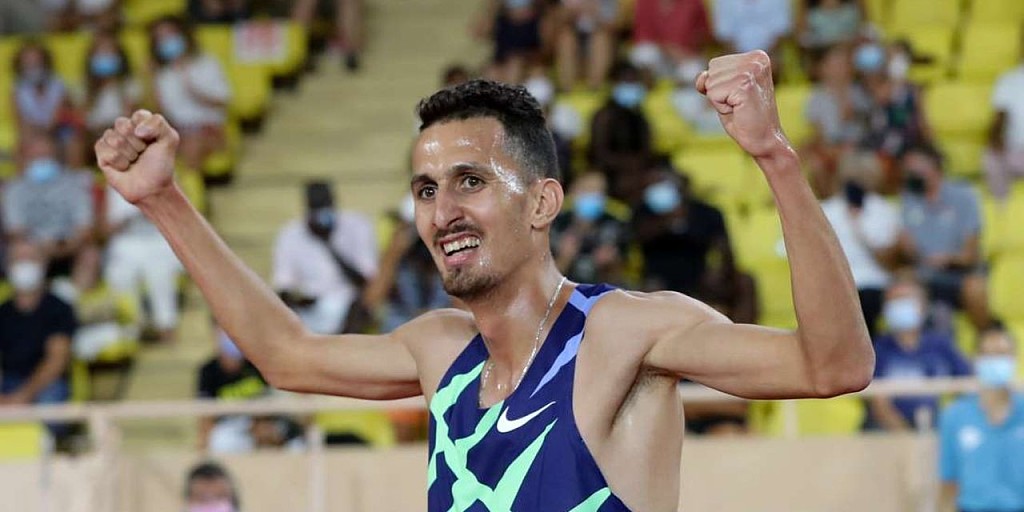
Moroccan steeplechaser Soufiane El Bakkali has huge admiration for Kenyan athletes.
In fact, as the delayed elite season opened with the Monaco Diamond League meeting last week, El Bakkali was excited upon seeing the Kenyan contingent at the Stade Loius II in the heart of the principality.
“The men from Africa!” he screamed and then posed for selfies with the Kenyan delegation headed by coach Bernard Ouma.
“He actually asked for the group photo on our way out of the track,” Ouma added, describing the Moroccan as an “amiable character.”
“We had our last breakfast together in Monaco on Sunday on his way to Paris,” Ouma added on Thursday.
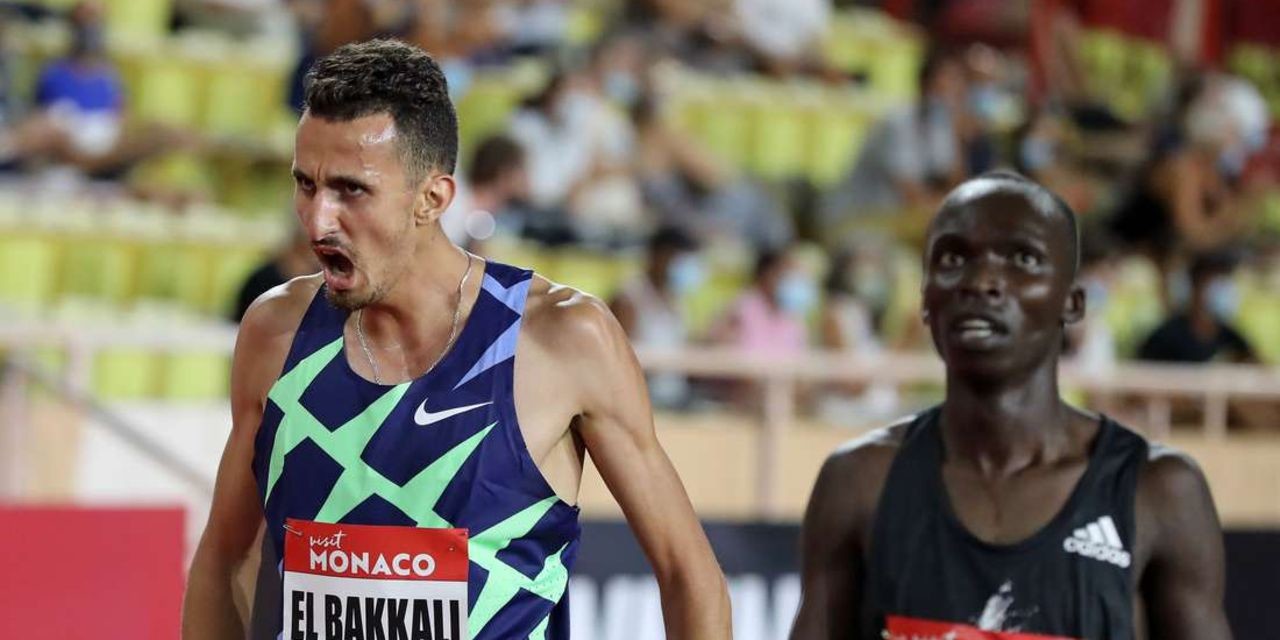
First-placed Morocco's Soufiane El Bakkali competed in the men's 3,000 metres steeplechase event during the Diamond League Athletics Meeting at The Louis II Stadium in Monaco on August 14, 2020.
The 24-year-old Moroccan has now expressed his interest in running with the Kenyans at the October 3 Kip Keino Classic leg of the World Athletics Continental Tour at the Nyayo National Stadium.
This sets up a potentially mouthwatering race given that El Bakkali ran the season’s best (world lead) time of eight minutes, 8.04 seconds to win in Monaco ahead of Kenya’s Leonard Bett (8:08.78).
Morocco's Soufiane El Bakkali (top photo) celebrates after winning the men's 3,000 metres steeplechase event as second-placed Leonard Bett of Kenya looks on during the Diamond League Athletics Meeting at The Louis II Stadium in Monaco on August 14, 2020.
Down with Covid-19, Kenya’s world and Olympic champion Conseslus Kipruto should be fit by then to set up a classic from 4.23pm at Nyayo National Stadium on October 3, according to the draft programme of events. “El Bakkali’s management say he wants to fly from the Doha Diamond League meeting (September 25) direct to Nairobi,” Kip Keino Classic meet director Barnaba Korir confirmed on Thursday. “We are finalising the arrangements for him and this (steeplechase) definitely should be one of the highlights of the Kip Keino Classic.”
With, bizzarrely, Morocco having failed to win a gold medal at the Olympic Games since the legend Hicham El Guerrouj struck a 1,500, and 5,000m double in Athents 16 years ago, the north African nation is banking on El Bakkali to pan the elusive medal at the Tokyo Games, now shifted to next summer.
Olympics 3,000m steeplechase champion Conseslus Kipruto (right), and another athlete during training at St Francis Cheptarit High School in Mosoriot, Nandi County on August 06.
El Bakkali (PB 7:58.15) won silver at the 2017 World Championships in London and followed up with bronze in Doha last year, finishing behind Kipruto and Ethiopia’s Lamecha Girma whom he could face at the Kip Keino Classic on October 3.
He was fourth at the 2016 Rio Games and was the only Moroccan athlete signed up by Visa (credit card) in its promotions for Tokyo 2020.
On Thursday, Ouma, who is preparing his athletes for this weekend’s second Diamond League meeting in Stockholm, said there could also be a possibility of bigger names coming to Nairobi in October.
“It (Kip Keino Classic) will be a very entertaining meet,” he summed it up.
by Elias Makori
Login to leave a comment
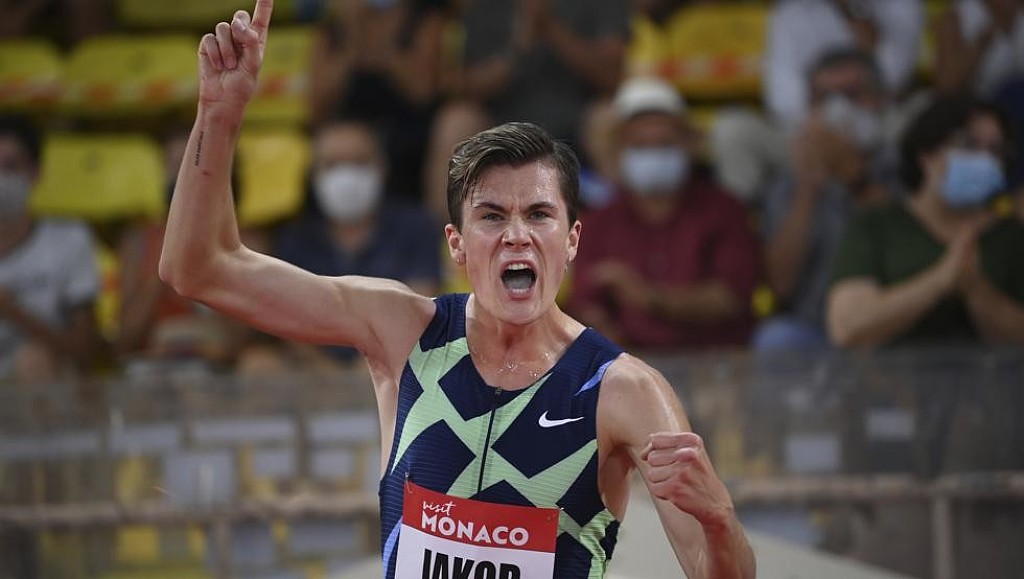
European champion Jakob Ingebrigtsen from Norway set his second European record of the season in the 1500m with 3:28.68 in the Monaco Diamond League on Friday
After breaking the European 2000m record with 4:50.01 at the Impossible Games in Oslo where he had the advantage of being paced by his brothers, Ingebrigtsen was racing against not only his older brother Filip but also the reigning world champion Timothy Cheruiyot from Kenya who was decisively beaten by the Ingebrigtsens in the virtual head-to-head clash between Oslo and Nairobi.
Aided by his training partners who were acting as his pacemakers, Cheruiyot blazed through the early stages in an unfathomably fast pace on his unofficial season’s debut. These exertions appeared to be catching up on the world champion as the pack closed up on Cheruiyot at the bell with Ingebrigtsen looming into view and Great Britain’s Jake Wightman also rounding into contention.
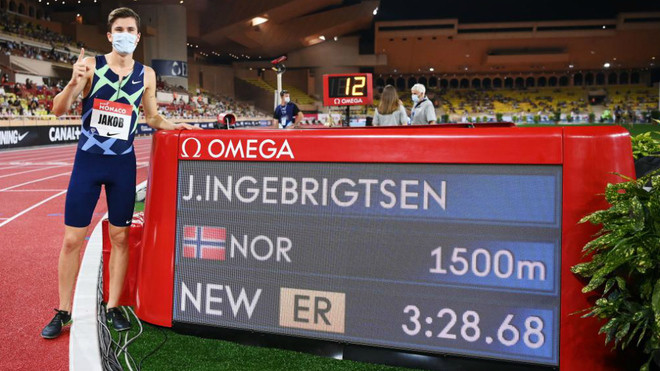
Ingebrigtsen was in position to strike off the final bend but the forward-leaning Cheruiyot kicked away again, holding the Norwegian off to win in a world leading 3:28.45 after an overly exuberant first 400 meters of 52.59. In contrast Ingebrigtsen ran a much more steady paced race and was rewarded with a phenomenally fast time of 3:28.68.
Ingebrigtsen’s time eclipsed Mo Farah’s European record of 3:28.81 which was set in the same stadium seven years ago and the teenager moves to eighth on the world all-time list which is still headed by Hicham El Guerrouj’s world record of 3:26.00.
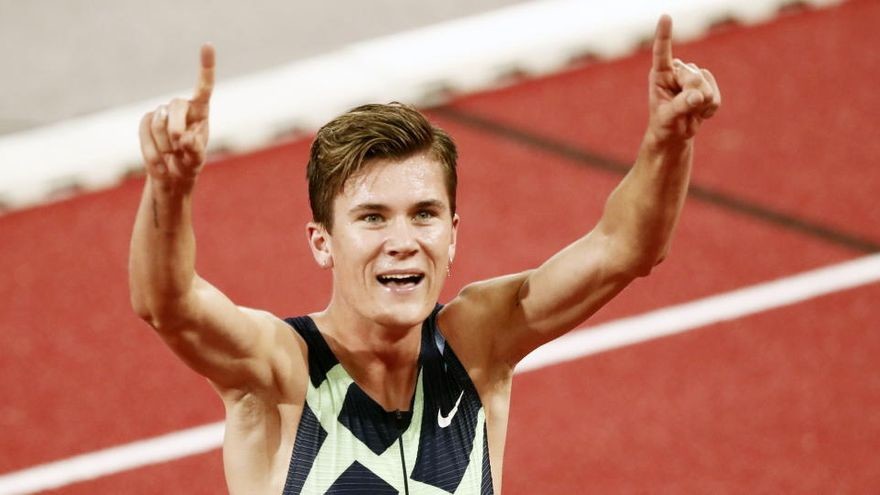
“I felt like I kept the same pace...going from 3:30 to 3:28 it's double the achievement. It's crazy,” said Ingebrigtsen whose previous lifetime best stood at 3:30.16.
Ingebrigtsen was gearing up for not only his Olympic debut in Tokyo as well as the now-cancelled European Championships in Paris where more continental honors must have surely beckoned. Despite the decimation of the summer calendar due to the coronavirus pandemic, motivation has by no means been lacking for the ebullient and popular Norwegian.
“This year I have been doing every session, I never skipped a single one because I was very motivated after Doha. That's why I can run this fast. It's unbelievable to run this fast in one race. It's one shot, one chance,” he said.
The Stade Louis II Stadium is the foremost venue for middle distance runners searching for fast times. Behind Ingebrigtsen, Wightman moved to fourth on the European all-time list - ahead of both Sebastian Coe (3:29.77) and Steve Cram (3:29.67) among others - with a marvelous lifetime best of 3:29.47.
Filip Ingebrigtsen, who had to concede the family record of 3:30.01 to Jakob tonight, almost matched his lifetime best with 3:30.35 in fourth. Reigning European indoor champion Marcin Lewandowski from Poland was seventh in 3:33.99.
Login to leave a comment

Professional athletes who are experiencing financial hardship due to the pandemic now able to register for support from welfare fund
Professional athletes who are experiencing financial hardship due to the coronavirus pandemic will be able to register for a one-off welfare grant from today until May 31.
Two weeks ago World Athletics and the International Athletics Foundation (IAF) announced that a US$ 500,000 welfare fund had been created to support professional athletes who have lost a substantial part of their income due to the suspension of international competition this year.
A working group was formed to oversee the distribution of the funds and it has now finalised the eligibility criteria and application process.
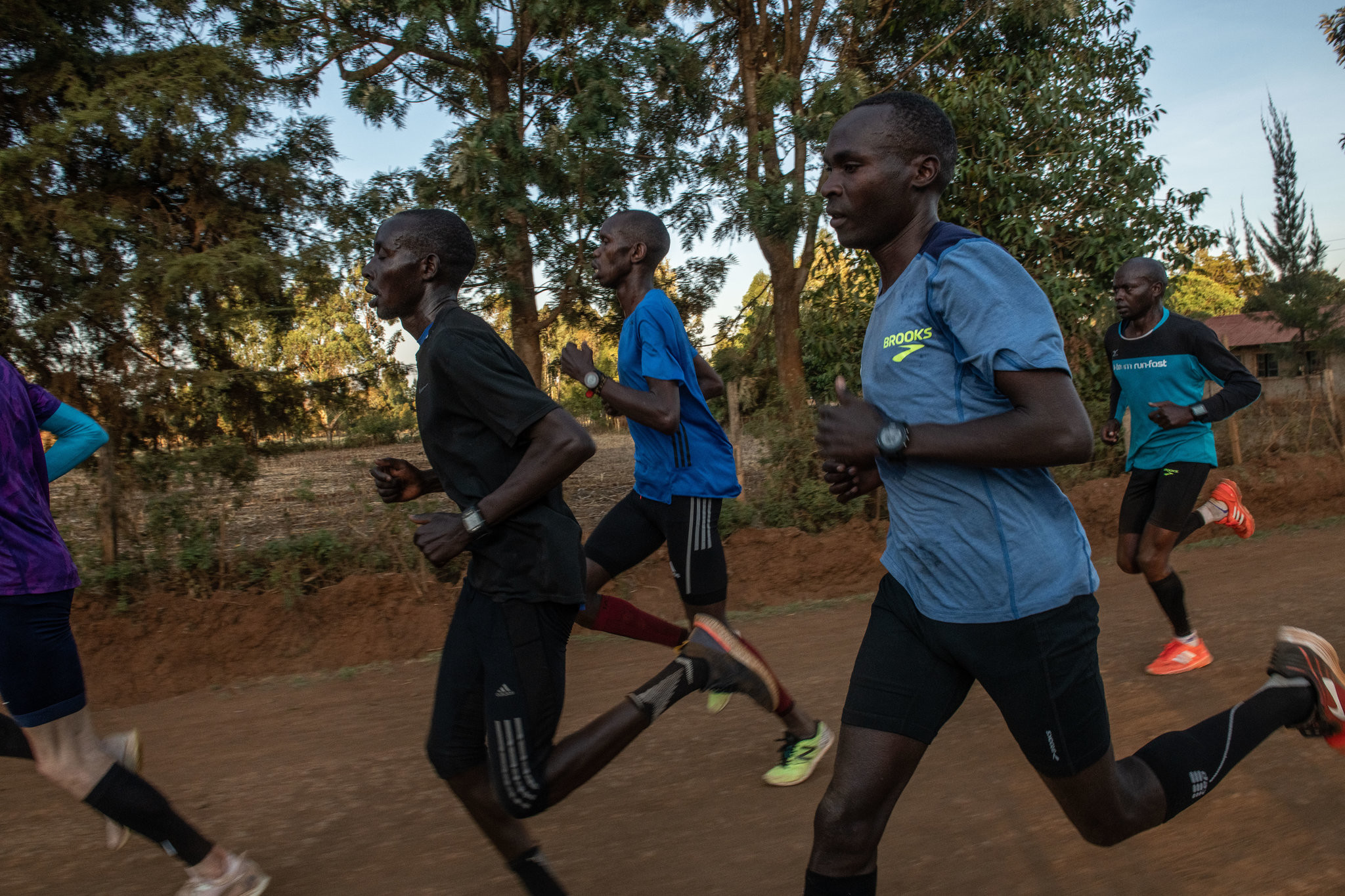
World Athletics president Sebastian Coe, who chairs the working group, said it had been a challenging and complicated task to define the eligibility criteria to ensure that grants from the fund were delivered to the athletes most in need.
“The IAF has allocated a substantial sum to the fund, and we hope to raise more through private donations from friends of our sport, but it has become apparent that the resources must be focused on athletes who are likely to be competing at the Olympic Games in Tokyo next year and are now struggling to pay for basic necessities due to loss of income during the pandemic,’’ Coe said.
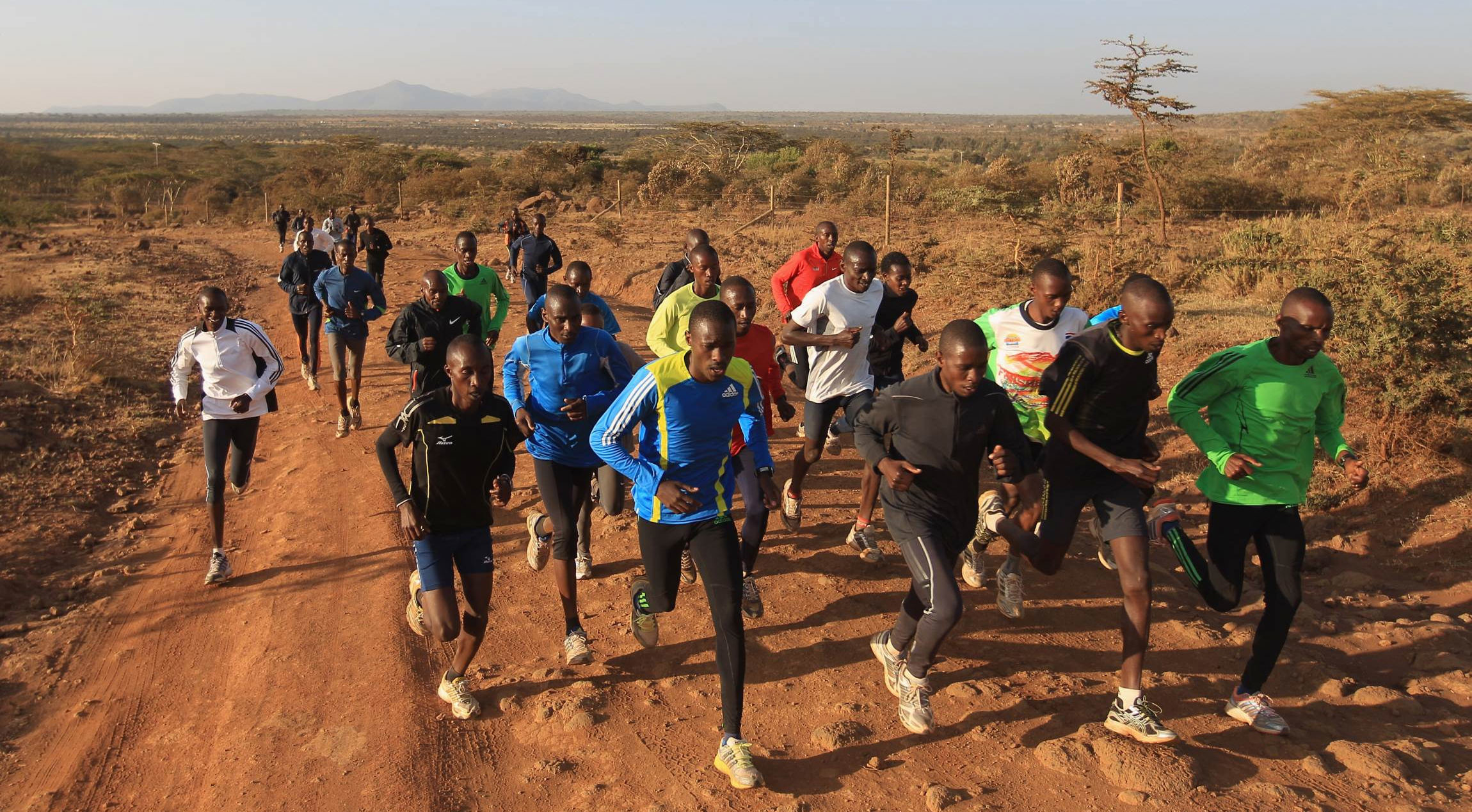
“We know this is a stressful situation for many athletes and we are trying to provide meaningful assistance to as many as possible as quickly as possible so they can continue to train for the competition season we have now scheduled for August to October, and for next year’s Olympics.’’
World 1500m record-holder and Olympic champion Hicham El Guerrouj, who initiated this project and sits on the working group, said the loss of competition had had a huge impact on professional athletes because many relied on prize money to support themselves and their families.
The Fund will support athletes who have met the Tokyo Olympic Games entry standard and will provide welfare grants to be used to cover basic living expenses. The level of grant will be dependent on the number of approved applications and up to a maximum of US$4000. It is anticipated that the grants will be distributed directly to athletes from June.
Only athletes who have been impacted financially to the extent that they are unable to maintain their basic standard of living should apply. All applicants must meet the following eligibility criteria:
Must be qualified (by meeting the entry standard) for selection for the Tokyo 2020 Olympic Games
Must have never had an anti-doping rule violation
Must be able to demonstrate a justifiable welfare need through significant loss of income in 2020 compared to 2019.
To help ensure the fund goes to those most in need, please note the following athletes will not be eligible to apply:
Those ranked in the Top 6 in their event in the World Athletics World Rankings
Those who have finished in the Top 6 positions of any Gold Label Road Race in 2019
Those who have earned more than USD 6,000 in prize money from the Diamond League in 2019
by World Athletics
Login to leave a comment

Athletics Kenya´s president Jack Tuwei welcomed the global fund to bail out athletes during the pandemic by the world athletics
Kenya's athletes will benefit from a 500,000 U.S. dollar global fund, which World Athletics launched on Tuesday to help athletes with their financial needs through the Covid-19 pandemic period.
Athletics Kenya (AK) president Jack Tuwei welcomed the move saying it will help bail out athletes who are most effected by the lack of competition with a complete lockdown of sports competitions globally.
"Certainly this fund will cushion them (athletes) from the effects of this virus. Every sector needs help and we thank World Athletics for coming up with such an initiative for athletes," Tuwei said in Nairobi.
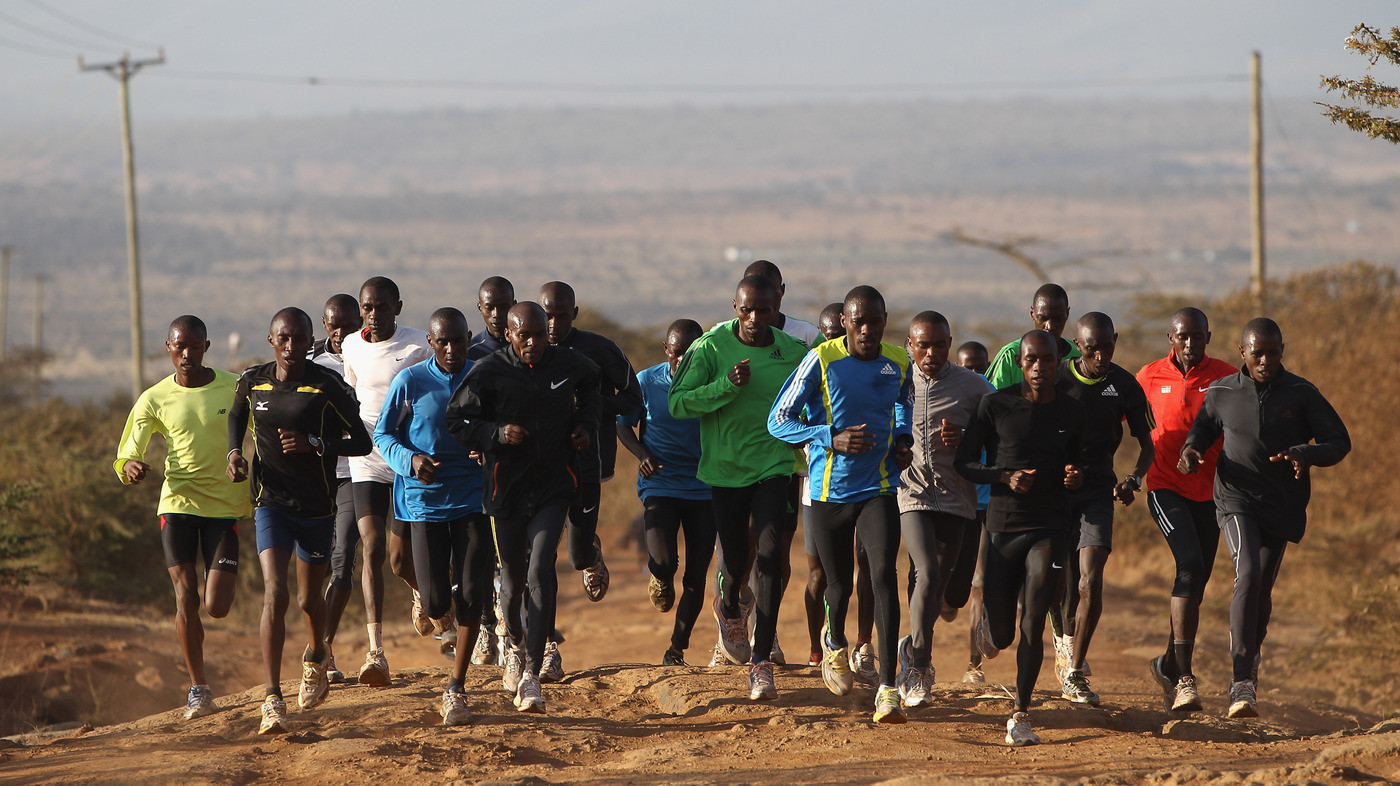
World Athletics President Sebastian Coe said the fund would be used to assist athletes who have lost most of their income in the last few months due to the suspension of international competition while the world combats the global health emergency.
Coe said it was important that the sport supports its athletes who are most in need during the current circumstances.
"I am in constant contact with athletes around the world and I know that many are experiencing financial hardship as a consequence of the shutdown of most international sports competition in the last two months," said Coe.
Most professional athletes rely on prize money as part of their income.
"We're mindful that our competition season, on both the track and road, is being severely impacted by the pandemic. We are hopeful that we will be able to stage at least some competition later this year, but in the meantime we will also endeavor, through this fund and additional monies we intend to seek through the friends of our sport, to help as many athletes as possible," Coe added.
The World Athletics head will chair an expert multi-regional working group to assess the applications for assistance, which will be submitted through World Athletics' six Area Associations.
The members include Olympic champion and 1500m world record-holder Hicham El Guerrouj, and Olympic pole vault champion Katerina Stefanidi among others.
Login to leave a comment
World Athletics has created a fund to support athletes during the pandemic
World Athletics, together with the International Athletics Foundation (IAF), has today launched a US$500,000 fund to support professional athletes experiencing financial hardship due to the coronavirus pandemic.
World Athletics President Sebastian Coe, who also chairs the IAF, said the fund would be used to assist athletes who have lost most of their income in the last few months due to the suspension of international competition while the world combats the global health emergency.
Established in 1986 to support charitable causes involving athletics, the International Athletics Foundation, under the Honorary Presidency of HSH Prince Albert II of Monaco, has allocated resources from its budgets for 2020 and 2021 to assist athletes in need through this process.Coe will chair an expert multi-regional working group to assess the applications for assistance, which will be submitted through World Athletics’ six Area Associations.
The members will include: Olympic champion and 1500m world record-holder Hicham El Guerrouj, Olympic pole vault champion Katerina Stefanidi (representing the WA Athletes’ Commission), WA Executive Board members Sunil Sabharwal (Audit Committee) and Abby Hoffman, WA Council members Adille Sumariwalla, Beatrice Ayikoru and Willie Banks, IAF Executive Committee member and former WA treasurer Jose Maria Odriozola and Team Athletics St Vincent and the Grenadines President Keith Joseph.
The working group will meet this week to establish a process for awarding and distributing grants to individual athletes and to look at other ways to raise additional monies for the fund.Coe said it was important that the sport supported its athletes most in need during the current circumstances.

“I would especially like to thank Hicham for bringing this idea to us, and Prince Albert for his strong support of this project. I am in constant contact with athletes around the world and I know that many are experiencing financial hardship as a consequence of the shutdown of most international sports competition in the last two months. Our professional athletes rely on prize money as part of their income and we’re mindful that our competition season, on both the track and road, is being severely impacted by the pandemic.
We are hopeful that we will be able to stage at least some competition later this year, but in the meantime we will also endeavour, through this fund and additional monies we intend to seek through the friends of our sport, to help as many athletes as possible.
"HSH Prince Albert II added: "I created more than 35 years ago the International Athletics Foundation with the late Primo Nebiolo to encourage and promote athletics and grant financial assistance to athletics federations and the most deserving athletes.
Since its inception the Foundation has distributed for these purposes more than US$30 Million. I am delighted that we can put our resources behind this initiative so we can make a difference to the lives of athletes who are suffering financially at this time.
We hope that this support will help those athletes preparing for international competition, including next year’s Olympic Games, to sustain their training, support their families and that this will relieve them of some stress in these uncertain times.’’El Guerrouj said: “The pandemic is causing economic pain to people from all parts of society, including athletes, and this is a time when we must come together as a global community to help each other.
I am delighted that Seb and World Athletics reacted so positively to my suggestion that we create a fund for athletes, and have made it happen with the support of the International Athletics Foundation.
The suspension of competition has had a huge impact on many professional athletes because they can’t earn prize money so I’m really pleased that we have found a way to assist them.”
by World Athletics
Login to leave a comment
World 1,500m champion Cheruiyot rues missed chance to break record
World 1,500m champion Timothy Cheruiyot has said he had high hopes of peaking at the right time this season to make a serious attempt on the world record.
"When the year started, I had two items I wanted to accomplish - winning Olympic gold and breaking the world record. At the moment, the Olympic dream is gone, moved to 2021 and the dream chance of running at the higher level at full throttle looks bleak," he said on Sunday.
Hicham El Guerrouj's record of 3:26.00 has stood the test of time for over two decades and Cheruiyot, who has seen his rise from obscurity to blossom as a world champion feels he was the man to finally shatter the record.
However, the coronavirus pandemic has nipped in the bud his dream as he has no idea when he will return to action.
Cheruiyot is worried many athletes will struggle to regain fitness and sharpness in competition whenever the ban on sports competition is lifted.
With the shutdown of all training camps in Kenya, Cheruiyot, like many other athletes is facing the prospect of lazing at home in 2020 after the Covid-19 global pandemic wrecked the sports calendar.
Cheruiyot now has turned his focus on staying safe and forgotten his hope of chasing records.
His best time on the miler is 3:28.41, which he posted in Monaco in 2018.
"People break records when they run regularly and competitively at the highest level. So clearly from where we stand that is not going to be the case this year," he added.
Meanwhile, Olympic 5,000m silver medalist Hellen Obiri has urged fellow athletes to follow social distancing and practice good hygiene standards.
Obiri, the world 5,000m champion, who has been forced to amend her training program, says she only has one session in the morning to train.
She believes, like other sectors, sports will have to suffer initially before order is restored. However, she believes she will emerge out of the self-quarantine stronger and ready to battle her way to the top to win the only medal missing in her collection, Olympic gold.
"I have to train alone and it is difficult. It requires a lot of discipline and focus because distractions are many," Obiri said on Monday in Nairobi.
"These are difficult times, which call for special measures. As athletes and role models we must sensitise the need to keep safe and follow government directives. We must be very careful, that is why I can only afford to train once a day."
With no Diamond League meetings and the World Athletics Continental Tour having been postponed, Obiri has had to be careful not to peak too soon.
"There will be time for action and the important thing now is to remain safe and healthy. When everything is done and there is no coronavirus, we will train as a team and compete at the highest stage again," she said.
World Athletics President Seb Coe has said it will be a lot harder to stage all competitions in 2020 when the situation allows and athletes will have to select which events to take part in after Covid-19 is defeated.
Login to leave a comment
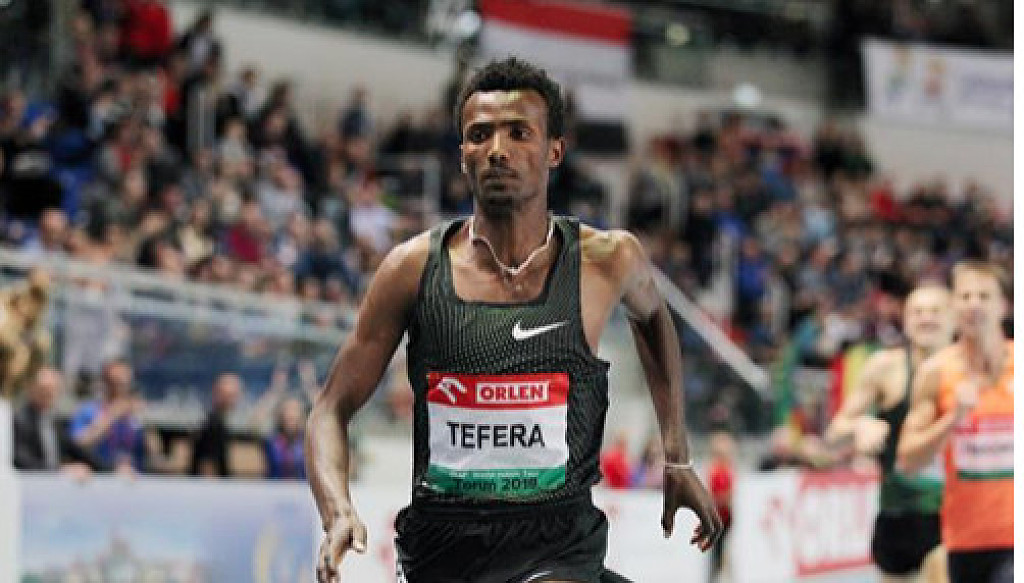
Tefera and Nakaayi join Lievin cast
Organisers of the Meeting Hauts-de-France Pas-de-Calais have confirmed that world indoor 1500m champion Samuel Tefera and world 800m champion Halimah Nakaayi will compete at the World Athletics Indoor Tour meeting in Lievin on 19 February.
Tefera won the 1500m convincingly in Lievin last year, finishing three seconds ahead of his nearest rival. Six days later, he broke the world indoor record for the distance in Birmingham, clocking 3:31.04 to break a record that had stood for 22 years.
Hicham El Guerrouj, who held the world indoor record before Tefera, still holds the Lievin meeting record at 3:32.01.
Nakaayi was a surprise winner of the 800m at last year’s World Athletics Championships, taking gold in a Ugandan record of 1:58.04. The 25-year-old has never competed indoors before this year, but it’s highly likely she will break the Ugandan indoor record of 2:04.57 during her indoor campaign.
Login to leave a comment
