

Running News Daily
Running News Daily is edited by Bob Anderson and team. Send your news items to bob@mybestruns.com Advertising opportunities available.
Index to Daily Posts · Sign Up For Updates · Run The World Feed
Articles tagged #Guinness World Records
Today's Running News



Débora Simas Runs 866.21 Kilometres in Seven Days to Shatter the Women’s Treadmill Record
For seven relentless days, Débora Simas turned a treadmill inside a bustling shopping mall in Florianópolis, Brazil, into the stage for an extraordinary feat of endurance.
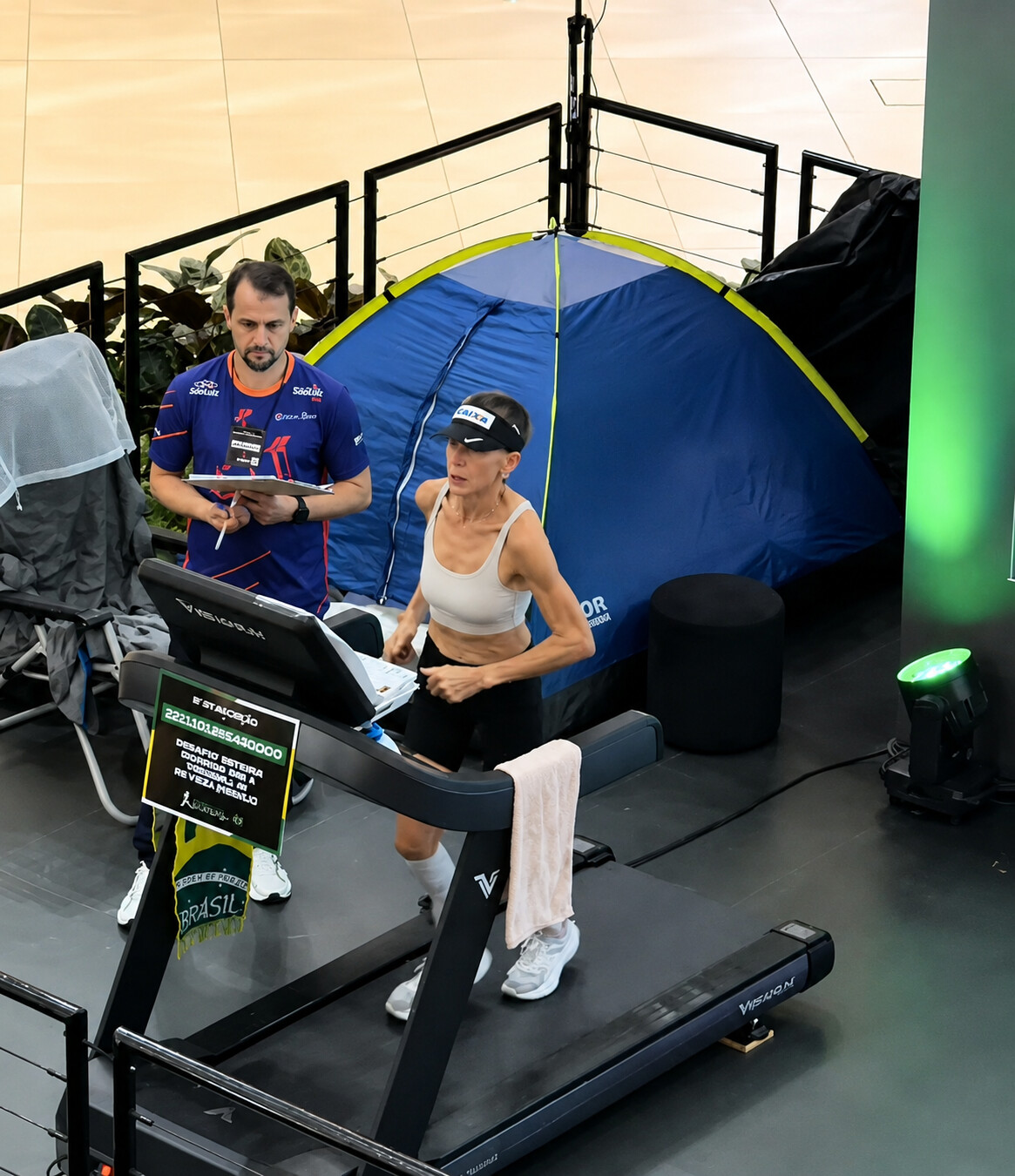
When the clock reached 168 hours at midday on Sunday, the 55-year-old ultramarathoner had covered an astonishing 866.21 kilometres — approximately 538 miles. That distance put her more than 20 kilometres beyond the previous Guinness World Records benchmark of 846.16 kilometres, set by New Zealand’s Emma Timmis in June 2024.
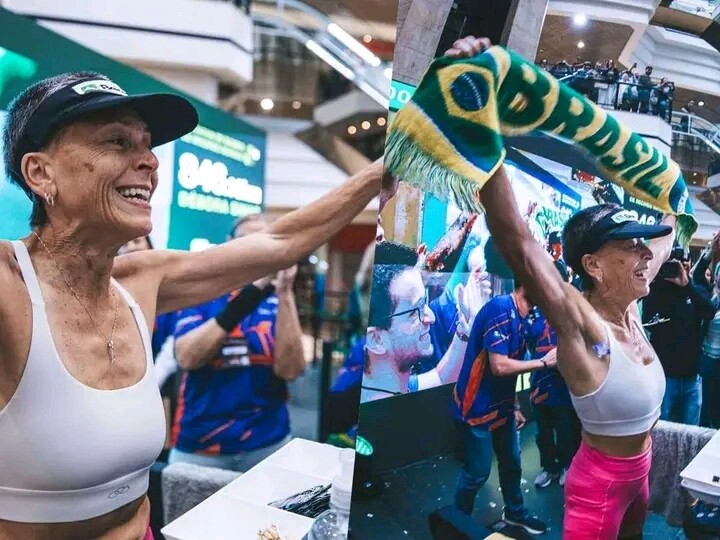
The achievement was the culmination of a challenge that demanded far more than simply running. For an entire week, Simas had to manage the relentless combination of physical fatigue, sleep deprivation, nutrition, recovery and the mental strain of repeatedly stepping back onto the treadmill.

Her temporary home was a tent positioned behind the treadmill, where she grabbed short periods of sleep and attended to essential recovery needs. Food, medical attention and other necessities had to be carefully fitted around the demands of the attempt, while a private bathroom inside the shopping centre provided the only place where she could briefly step away from the public eye.
This was not Simas’s first encounter with the unforgiving nature of seven-day treadmill running. In 2019, she completed 800.61 kilometres over the same 168-hour period at the Beiramar Shopping centre, setting a Brazilian and South American record at the time. Her return seven years later was driven by a very different ambition: to go beyond the world’s best mark.
The preparation behind the attempt was equally remarkable. Simas reportedly spent two years preparing for the challenge while balancing two jobs, often training largely on her own. Every kilometre of that preparation ultimately became part of a much bigger test of patience, resilience and belief.
There were moments during the seven days when the body threatened to take control. At one stage, a severe cramp placed the attempt in jeopardy and forced members of her support team to intervene. Yet Simas recovered and continued, refusing to let one difficult moment derail an effort that had taken years to build.
Her final distance of 866.21 kilometres represents an average of about 123.7 kilometres per day, or roughly 5.15 kilometres every hour across the full 168-hour period. That figure includes the periods when she was required to stop for essential needs, making the scale of the accomplishment even more striking.
Simas now has the number that matters most: 866.21 kilometres. However, there is an important distinction between breaking the previous mark and having the Guinness title officially ratified. Guinness World Records notes that records can change before they are immediately reflected online, and official recognition depends on the verification process.
For Simas, though, the significance of the achievement goes far beyond a number on a leaderboard. Her journey was a battle against exhaustion, discomfort and the powerful urge to stop — a test in which mental strength became just as important as physical endurance.
“I had to face the sleepiness, the pain, the exhaustion, and moments when my head had to be stronger than my body,” she said.
After 168 hours, the treadmill finally fell silent. Débora Simas stepped away having transformed seven days of relentless running into one of the most remarkable endurance performances of her career — and, pending official verification, a new women’s world-best mark for distance covered on a treadmill in one week.
by Erick Cheruiyot for My Best Runs.
Login to leave a comment
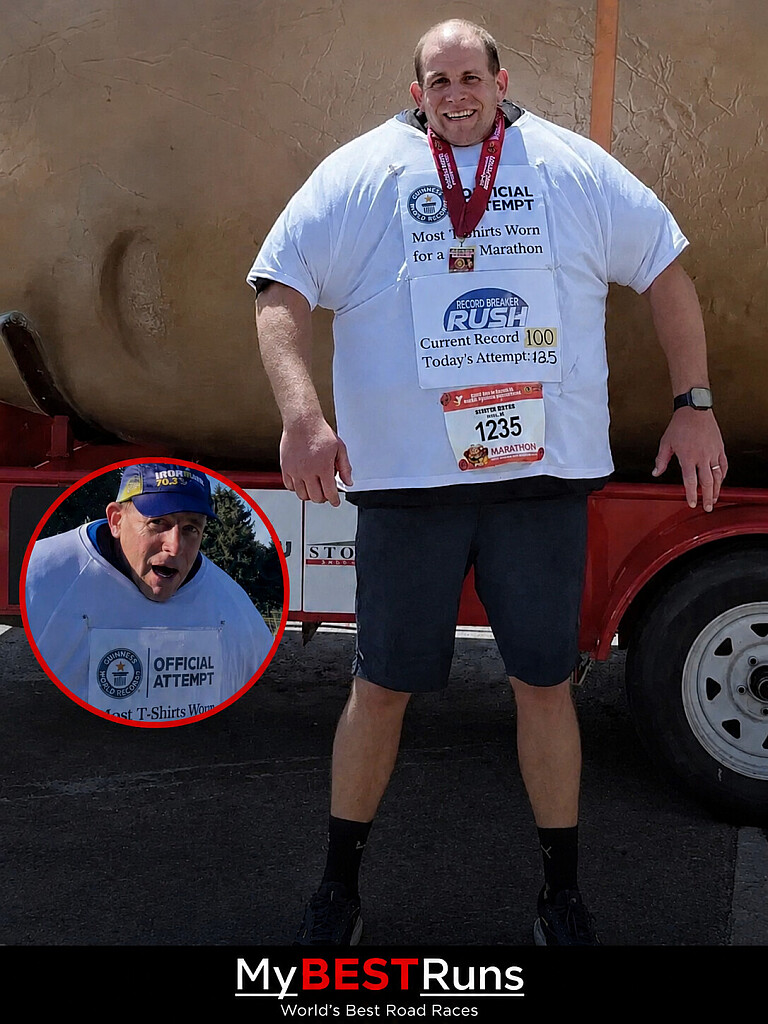
David Rush Sets Guinness World Record After Running Marathon in 125 T-Shirts
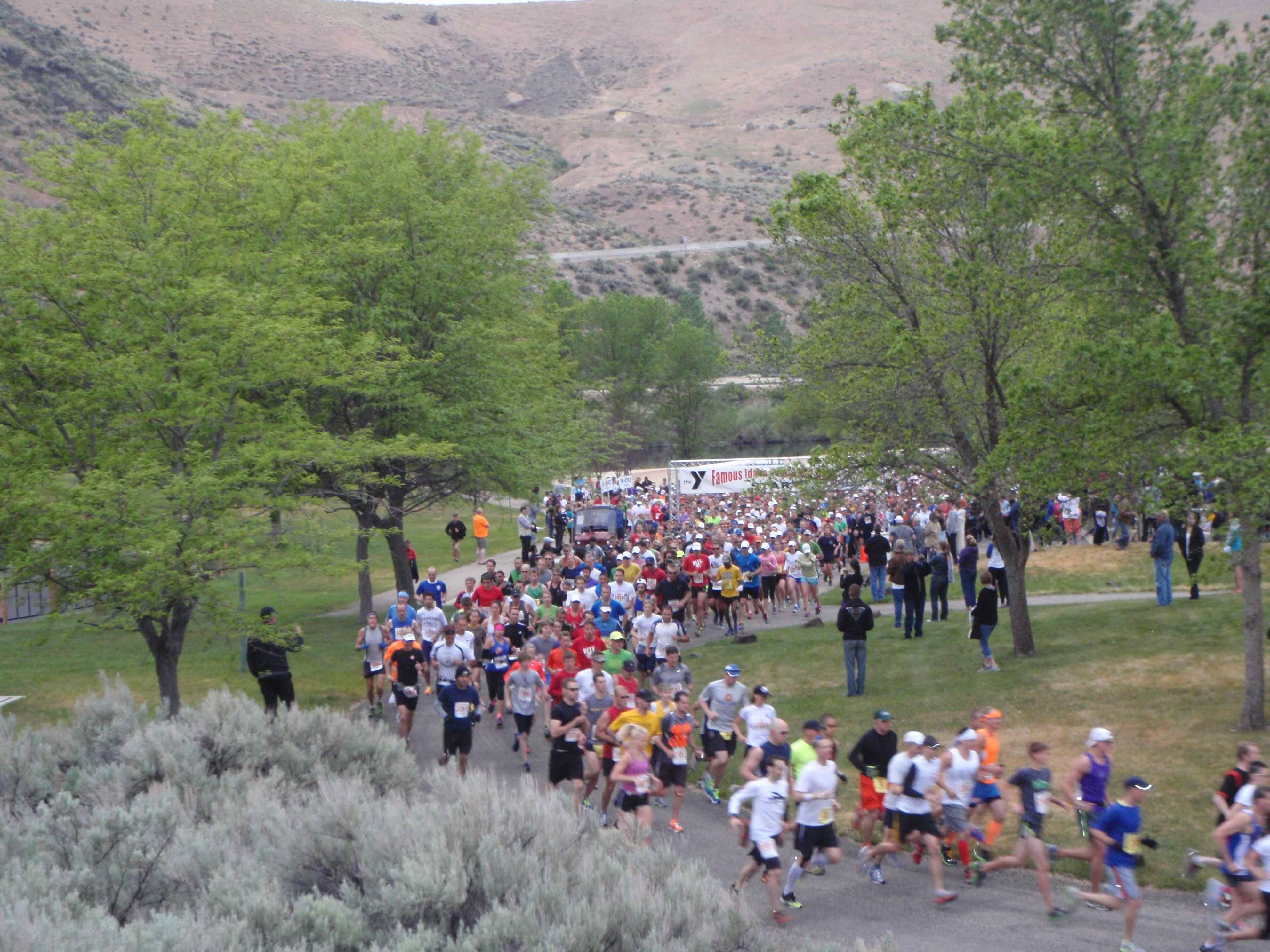
David Rush has turned one of the world’s most unusual running challenges into another Guinness World Record, completing a full marathon in Boise, Idaho, while wearing an astonishing 125 T-shirts.
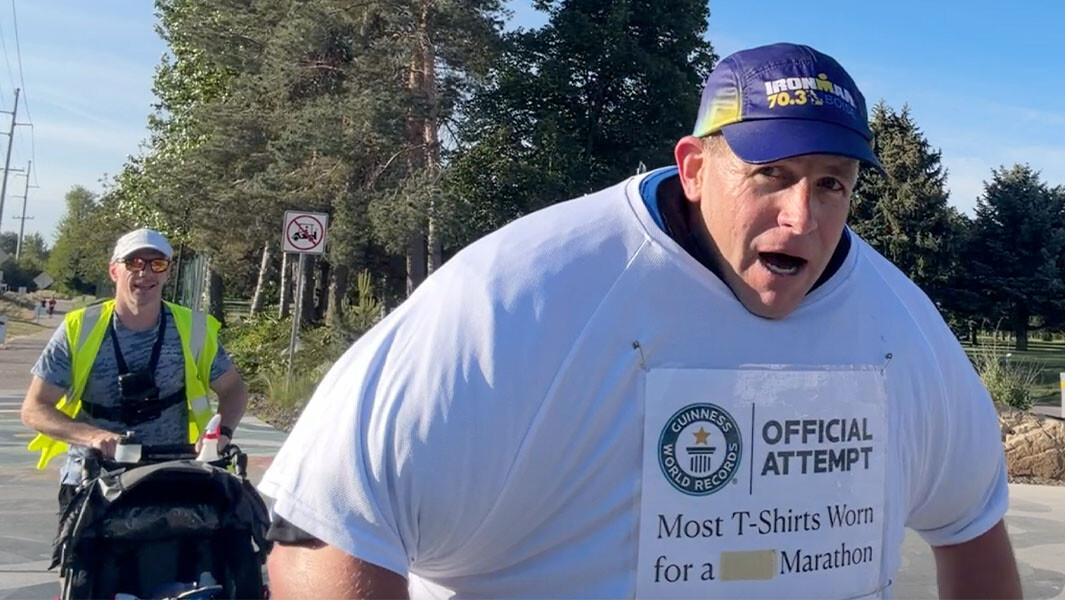
Rush achieved the feat at the YMCA Famous Idaho Potato Marathon on May 16, 2026, finishing the 26.2-mile race in 5:54:50. Guinness World Records officially recognized the performance as the new record for the most T-shirts worn during a marathon, surpassing the previous mark of 100 shirts.
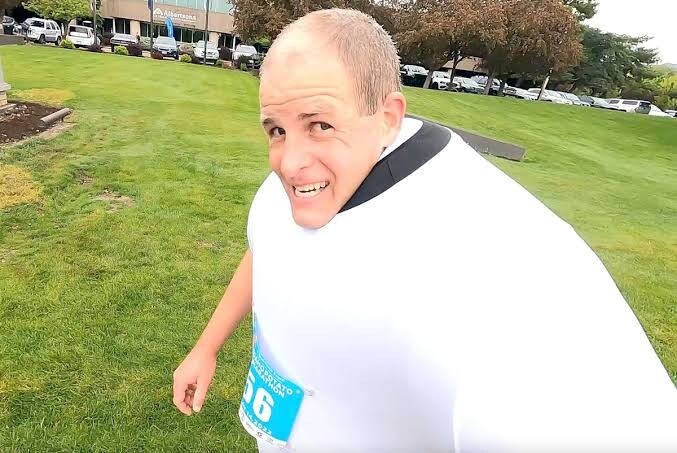
What appeared to be a bizarre running challenge quickly became a serious test of endurance and heat management. As the race progressed, the enormous number of layers trapped heat around Rush's body while restricting his movement. His arms became increasingly difficult to move, forcing his support team to help him with hydration, nutrition and cooling throughout the race.
The weight of the clothing also increased dramatically during the marathon. By the finish, the 125 T-shirts had absorbed enough sweat to weigh 43.4 pounds (19.7 kilograms). Rush also suffered severe chafing, painful blisters and swollen hands as the layers continued pressing against his body for hours.
The most alarming moment came when Rush began overheating after his supply of ice ran out. His support crew became concerned that the situation could deteriorate to the point where he would require medical attention. One of his support runners, Patrick, reportedly rushed into a nearby golf-course pro shop to obtain emergency ice.
Rush later said the additional ice was crucial in preventing what could have become a hospital visit. His team repeatedly used ice and cool water to help bring his body temperature down as he continued toward the finish.
Despite the physical toll, Rush refused to abandon the attempt. He eventually crossed the finish line in 5:54:50, leaving only five minutes and 10 seconds before the marathon's six-hour cutoff.
The achievement was the latest in a remarkable collection of Guinness World Records for Rush, who has built a reputation for pursuing highly unusual endurance and skill challenges. He had already set the men's record for the most T-shirts worn during a half marathon, completing the 2025 Famous Idaho Potato Half Marathon in 137 T-shirts.
This time, however, the challenge demanded far more than simply putting on layer after layer. It required Rush to endure nearly six hours of increasing heat, restricted movement, additional weight and severe physical discomfort while maintaining enough momentum to beat the clock.
In the end, the strange sight of a marathon runner buried beneath 125 T-shirts became a record-breaking achievement — but one that pushed the limits of endurance to an extraordinary degree.
David Rush is now officially the first man to complete a marathon wearing 125 T-shirts, securing a Guinness World Record in one of the most unconventional marathon challenges ever attempted.
by Erick Cheruiyot for My Best Runs.
Login to leave a comment
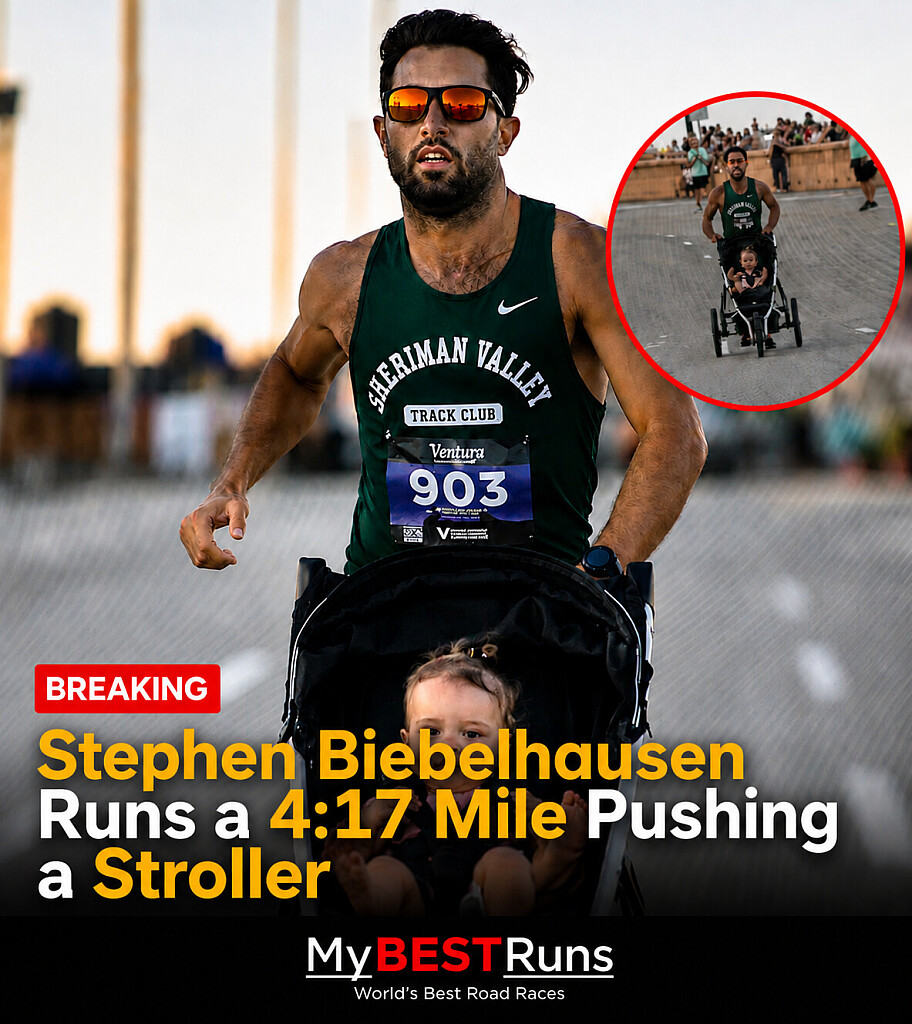
4:17 With A Stroller: Stephen Biebelhausen Chases Down Potential World Record
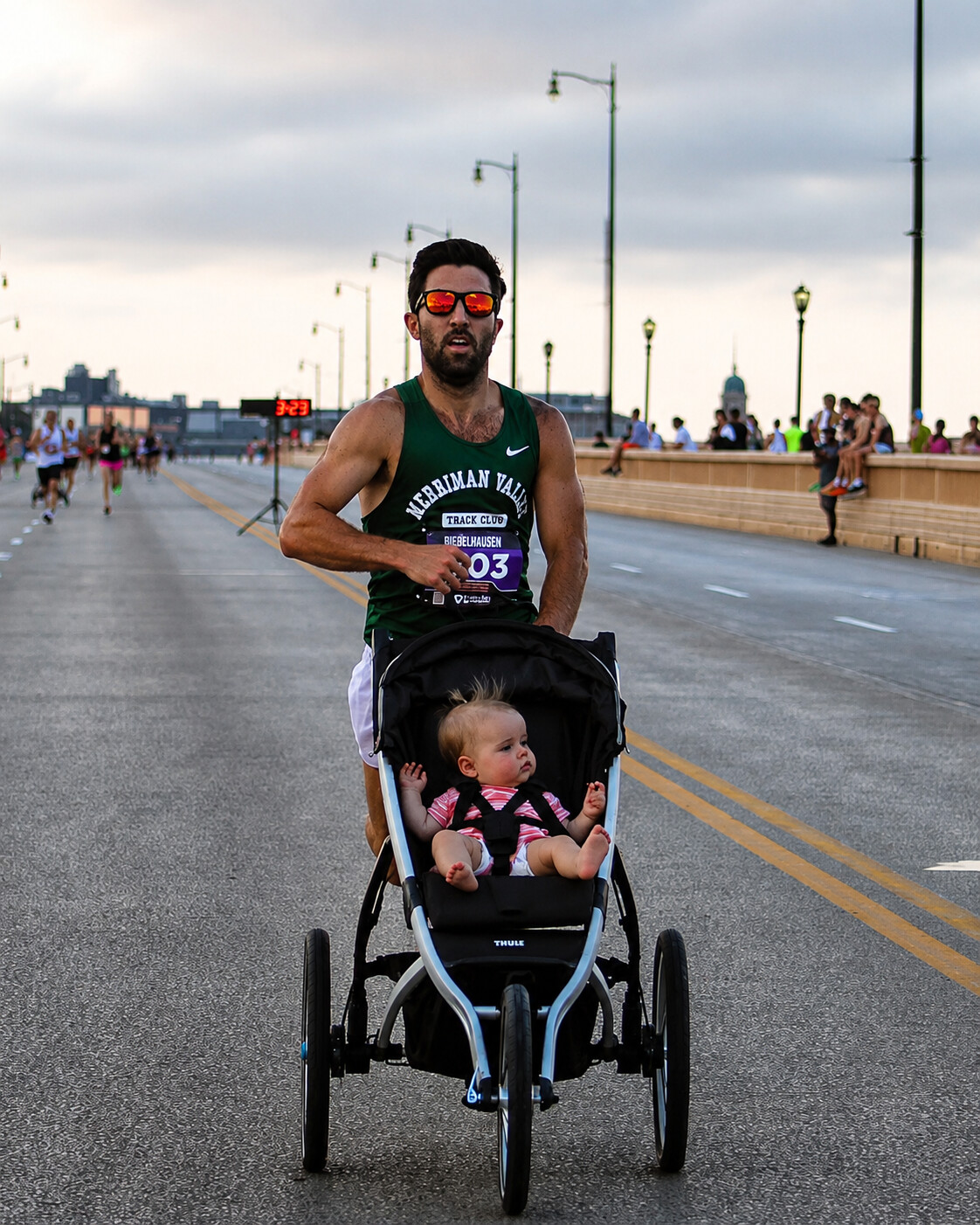
Stephen Biebelhausen has taken stroller running to an extraordinary level after reportedly running a mile in roughly 4:17 while pushing his child at the Guardian Mile in Cleveland.
The former college distance runner produced the remarkable performance on the Hope Memorial Bridge, covering the road-mile course at a pace that, if officially ratified, would dramatically rewrite the men's Guinness World Record for the fastest mile while pushing a stroller.
Biebelhausen's reported time is approximately nine seconds faster than the current men's record of 4:26.29, set by Silas Frantz in Arroyo Grande, California, in June 2025. For a record that is barely more than a year old, an improvement of that magnitude would be extraordinary.
And Biebelhausen had the running credentials to make such a performance possible.
During his college career with the Miami RedHawks, Biebelhausen established himself as a highly accomplished middle-distance runner. He owns a 1500m personal best of 3:48.11, a mark that places him among the fastest athletes in Miami University's history, while he also recorded a 4:06.68 indoor mile.
That background in competitive distance running makes the 4:17 stroller mile even more fascinating. Maintaining a pace of roughly 4:17 per mile is demanding under normal circumstances; doing it while pushing a stroller and a child throughout the race adds an entirely different physical challenge.
Biebelhausen was not the only athlete taking on the unusual challenge at the Guardian Mile. Another runner, also pushing his child, completed the race in an impressive 4:32.
Stroller racing has steadily developed into a genuine record category, with runners testing themselves over everything from the mile to the half marathon. On the women's side, Kaitlin Donner recorded a 5:11 stroller mile in 2024, while longer-distance attempts have also produced remarkable performances, including a 1:08:04 half marathon.
Yet Biebelhausen's reported 4:17 could prove to be the most eye-catching mark of them all.
There is one important catch: the performance is not officially a world record yet.
Guinness World Records must review the documentation and verify that the attempt complied with all of its requirements, including the specifications for the stroller and the minimum weight of the child being carried throughout the distance.
Until that verification is completed, Frantz's 4:26.29 remains the official men's record.
But if Biebelhausen's time is confirmed, the record will fall by a huge margin.
A 4:17 mile is already an exceptional performance. A 4:17 mile while pushing a stroller and a child is something altogether different.
If Biebelhausen's 4:17 is officially confirmed, the Guardian Mile will have produced far more than an impressive road race. It could have witnessed the setting of a remarkable new benchmark in one of running's most unusual and rapidly growing record categories — proving once again that the limits of speed can sometimes be pushed in the most unexpected ways.
by Erick Cheruiyot for My Best Runs.
Login to leave a comment
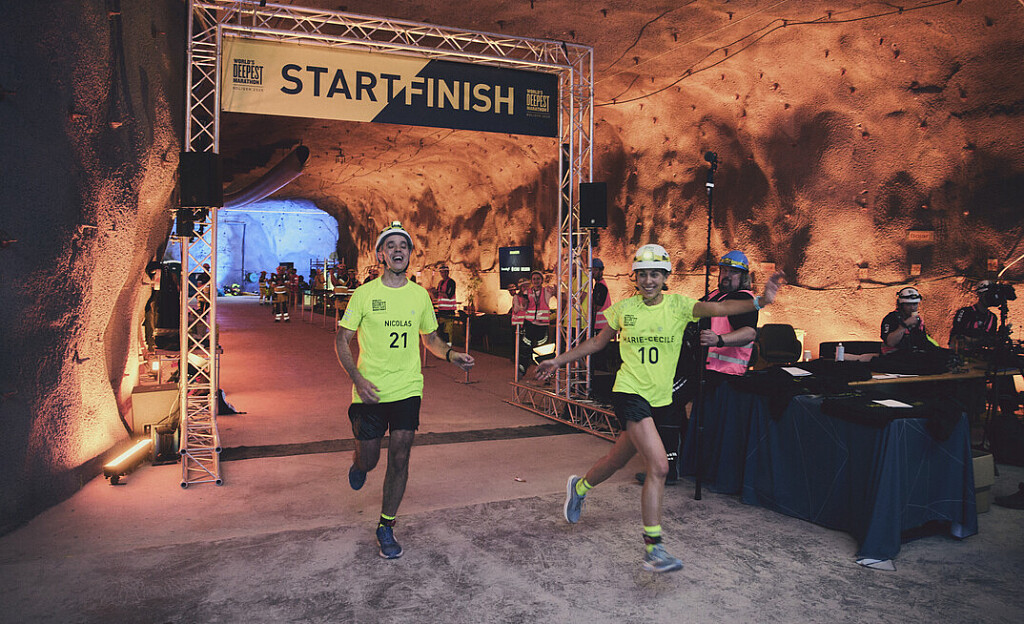
Beneath the Surface: The World's Deepest Marathon Proved the Greatest Triumph Isn't Measured by Time
There were no roaring crowds. No finish-line fanfare. No sweeping landscapes to admire. Not even daylight.
Instead, fifty-five runners descended 1,120 metres below sea level—an astonishing 1,312 metres underground—into Boliden's Garpenberg zinc mine in Sweden to take part in the World's Deepest Marathon, a race unlike any other in history. Staged on October 25, 2025, the remarkable event brought together participants from 18 countries, pushing the boundaries of endurance while rewriting the record books.
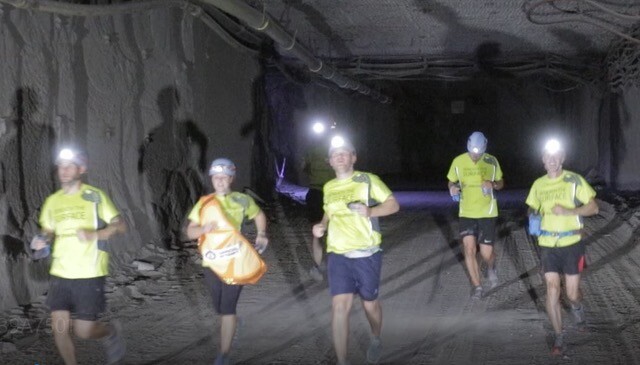
Far removed from the spectacle of traditional marathons, the race unfolded deep within a working mine, where darkness, isolation, and unforgiving conditions replaced the usual excitement of city streets.
The course itself was as extraordinary as the venue. Runners tackled a certified 3.84-kilometre underground tunnel, completing 11 laps to cover the official marathon distance of 42.195 kilometres. Every step was taken in an environment unlike any other, where athletes navigated the pitch-black tunnels wearing helmets and headlamps, relying entirely on artificial light to guide their way.
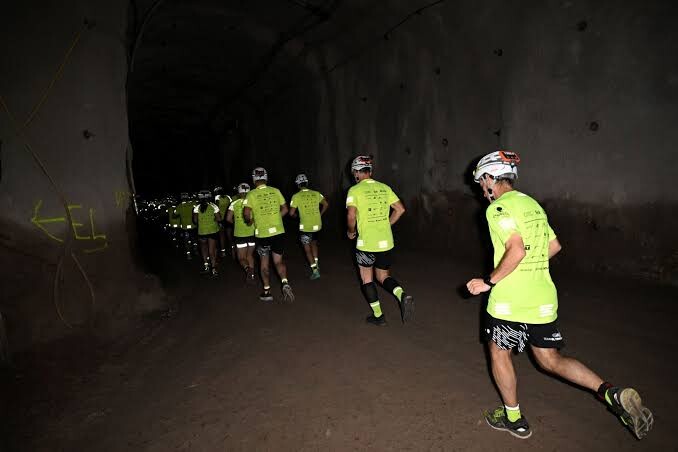
Conditions underground were relentless. Temperatures hovered around 30°C, humidity remained high, and the stillness of the mine created an eerie silence broken only by the sound of footsteps echoing through the tunnels. Dust-filled air and the absence of natural light added another layer of physical and mental challenge, making every kilometre a test of resilience.
The field itself reflected the race's unique spirit. Mining executives, first-time marathoners, and accomplished ultrarunners stood shoulder to shoulder at the start line, united by a shared determination to embrace one of the world's most unconventional endurance challenges.
Remarkably, all 55 runners completed the marathon. The fastest crossed the line in just over three hours, while the final finisher arrived approximately seven hours after the race began. Yet, despite the impressive performances, the event's defining moment had nothing to do with finishing times or records.
Late in the race, one exhausted runner struggled through her final lap, fighting fatigue with every stride. Three athletes who had already completed the marathon noticed her battle. Rather than celebrating their own accomplishments, they turned back into the tunnel and ran the final lap alongside her, offering encouragement until she reached the finish.
They had already finished once.
They chose to finish again.
It was a simple act of selflessness, performed where there were no spectators to applaud and no cameras waiting to capture the moment. Deep underground, where recognition mattered least, the true spirit of distance running shone brightest.
The event also left a lasting legacy beyond personal achievement. The World's Deepest Marathon earned two official Guinness World Records—Deepest Marathon (Individual) and Deepest Underground Marathon Distance Run (Team)—while raising more than US$1 million for charity, proving that the race delivered an impact far beyond the mine itself.
In the end, the world's deepest marathon was about far more than setting records or conquering one of the planet's most unusual race courses. It became a powerful reminder that the greatest victories in sport are often the quietest—found not in medals or headlines, but in the willingness to turn back, lift someone else, and cross the finish line together.
Sometimes, the brightest light in sport shines from the deepest places on Earth.
by Erick Cheruiyot for My Best Runs.
Login to leave a comment
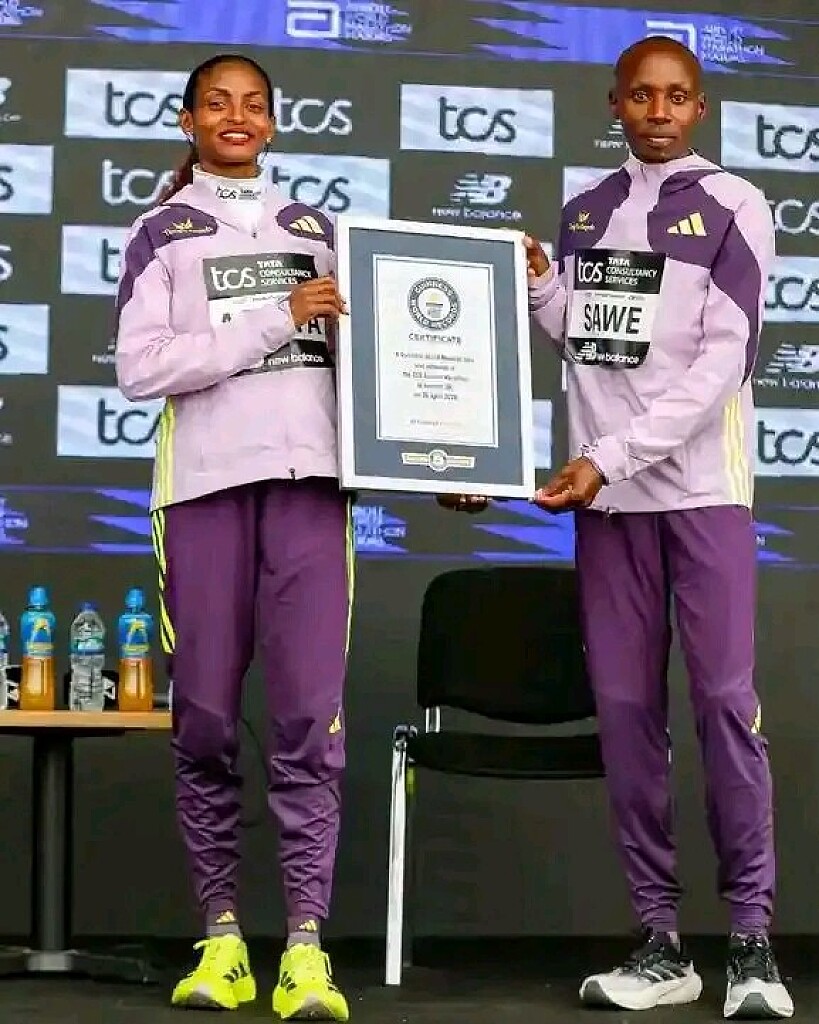
When Legends Rise: Assefa and Sawe Claim Their Place in History
the grand theatre of distance running, where endurance meets audacity, two names have now been carved into the highest tier of human achievement. Tigist Assefa and Sabastian Sawe have transcended victory and stepped into immortality, their performances at the London Marathon 2026 earning them official recognition in the Guinness World Records.
It was not merely a race—it was a rewriting of limits.
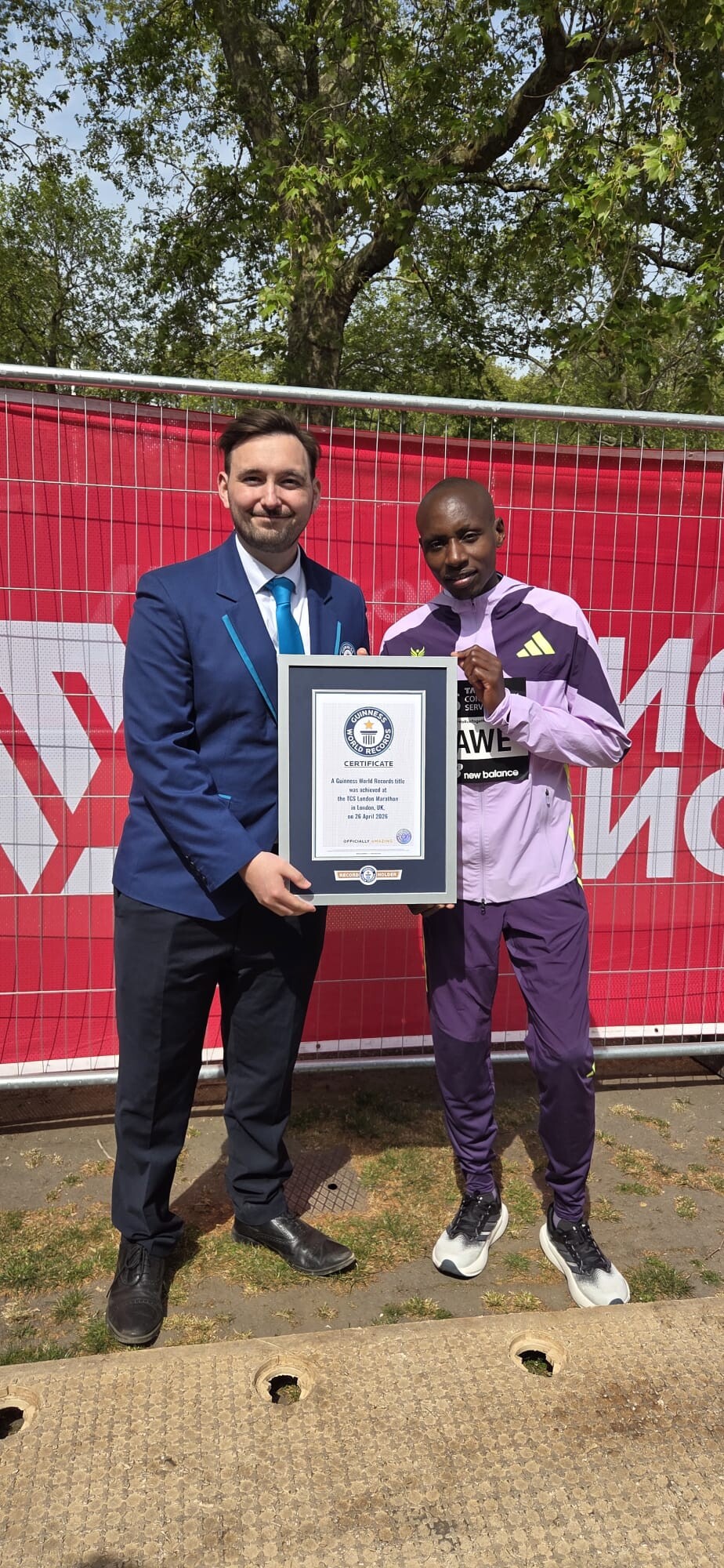
Sawe delivered a performance that defied decades of physiological assumptions. Clocking an astonishing 1:59:30, he shattered the long-standing perception of what the human body can sustain over 42.195 kilometers. The sub-two-hour marathon, once considered an almost mythical frontier, became a reality under race conditions—no pacing formations, no experimental setup—just raw, competitive brilliance. His run was not only fast; it was controlled, precise, and relentlessly efficient, a masterclass in modern marathon execution.
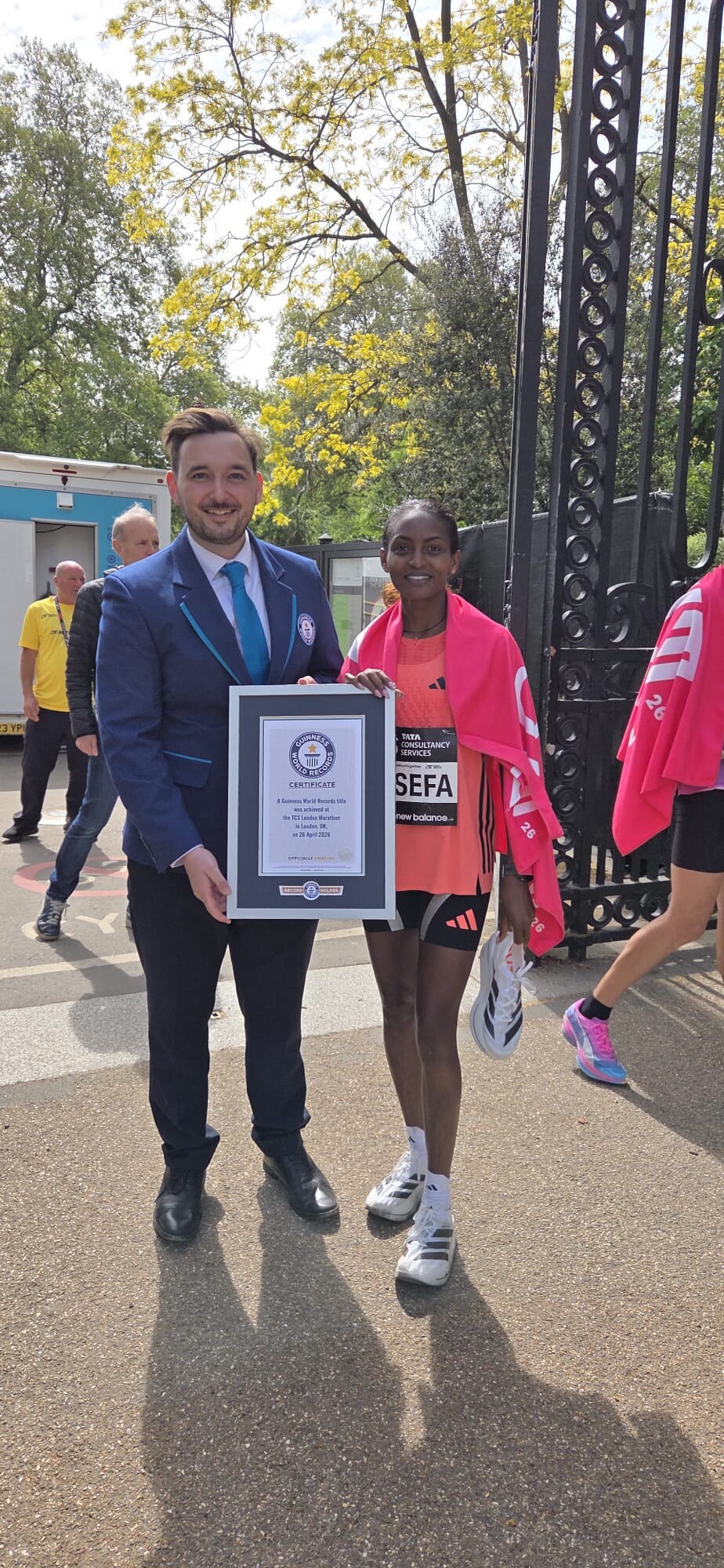
On the women’s side, Assefa produced a run of equal magnitude, though sculpted in a different context. Her 2:15:41 established a new women-only world record, a distinction that strips away the advantage of mixed pacing and places the spotlight squarely on individual strength and strategy. From the opening miles, she ran with authority, balancing aggression with composure, and by the closing stages, her dominance was undeniable. It was a performance defined by clarity of purpose and extraordinary resilience.
Together, these two athletes did more than win races—they expanded the boundaries of possibility. Their entries into the Guinness World Records serve as formal recognition of something deeper: a shift in the narrative of marathon running. Where once there were ceilings, there are now open skies.
What makes this moment particularly compelling is its duality. Kenya and Ethiopia, long-standing rivals and co-authors of distance running greatness, once again stand side by side at the summit. Sawe and Assefa, through different journeys and styles, have arrived at the same destination—global sporting immortality.
In years to come, their times will be chased, analyzed, and perhaps even surpassed. But the significance of this moment will endure. Because records, at their core, are not just numbers. They are declarations—bold statements of how far humanity can go when courage meets preparation.
And on that unforgettable day in London, Assefa and Sawe did not just run fast. They ran beyond history—and into it.
by Erick Cheruiyot for My Best Runs.
Login to leave a comment
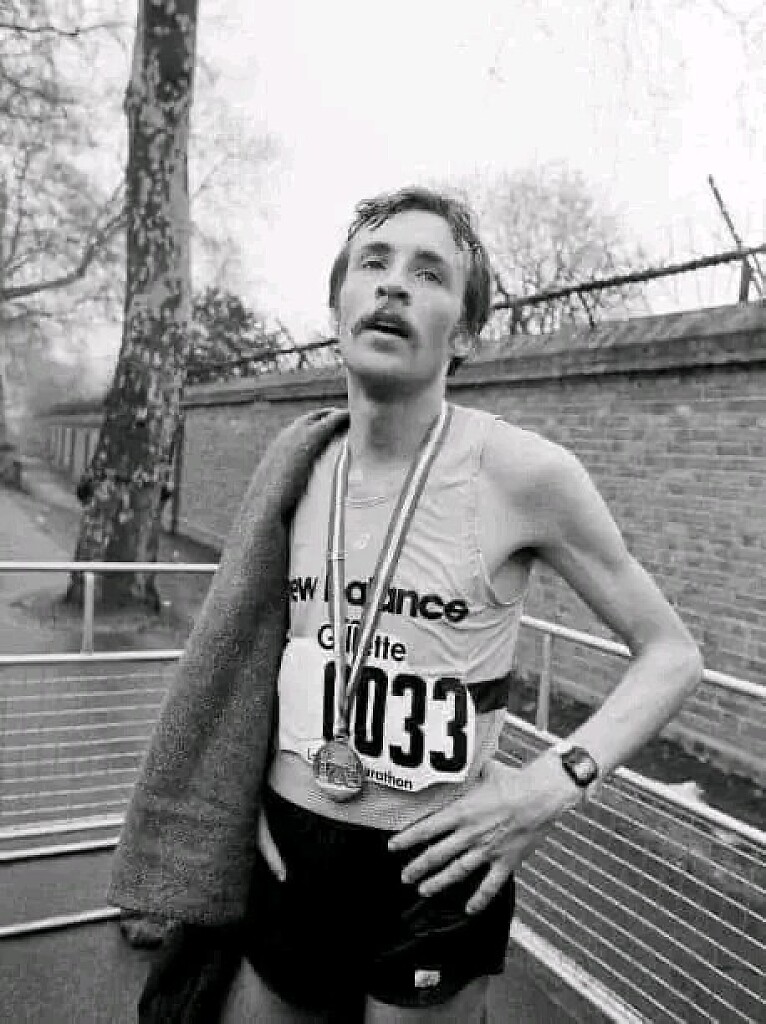
Dick Beardsley: The Relentless Dreamer Who Redefined Marathon Greatness
Born on March 21, 1956, Dick Beardsley carved his name into the golden pages of marathon history through grit, heart, and an unbreakable competitive spirit. His journey from humble beginnings to global recognition is not just a tale of speed, but one of perseverance, passion, and unforgettable moments that still echo across the sport today.
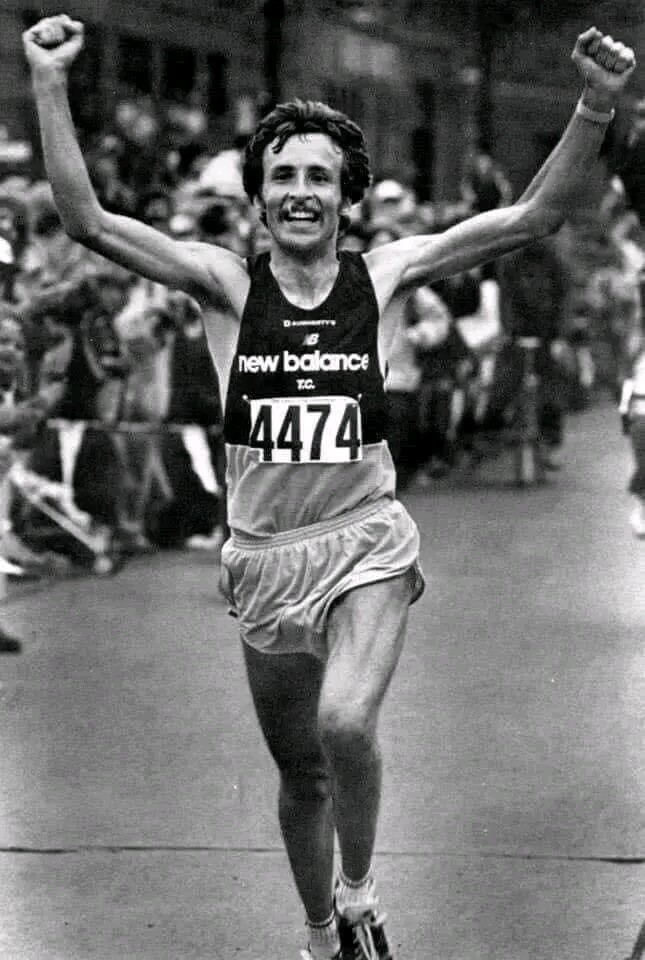
Beardsley’s marathon story began modestly in 1977 at the Paavo Nurmi Marathon, where he clocked 2:47:14. Yet, what followed was nothing short of extraordinary. With each race, he chipped away at his times—2:33:22, 2:33:06, and 2:31:50—demonstrating a rare consistency and hunger for improvement. In fact, Beardsley achieved an astonishing 13 consecutive personal bests in the marathon, a feat so remarkable that it earned him a place in the Guinness World Records.
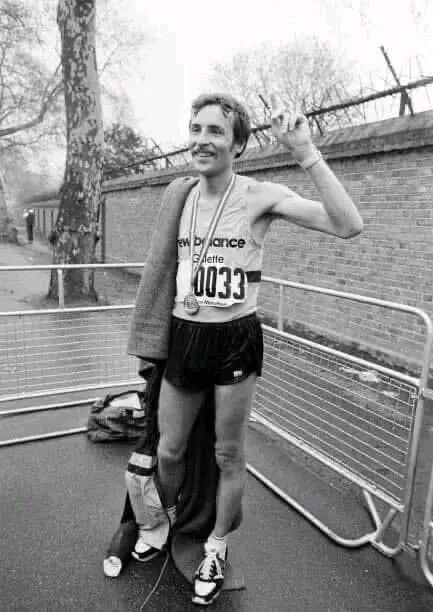
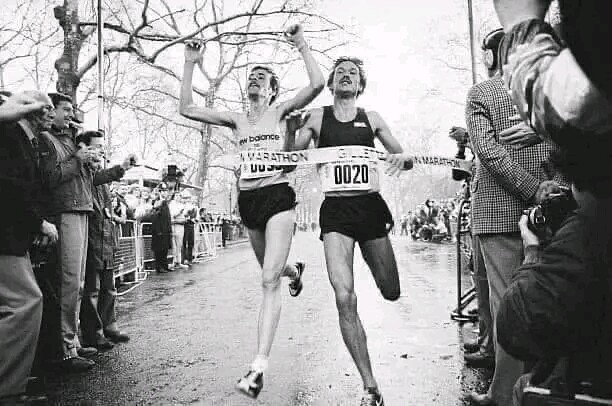
But it was 1981 that truly defined his legacy. At the inaugural London Marathon, Beardsley and Norway’s Inge Simonsen produced one of the most iconic finishes in marathon history. In a rare act of sportsmanship, the two runners crossed the finish line hand in hand, sharing victory in 2:11:48. It was a moment that transcended competition—symbolizing unity, respect, and the pure joy of running. As Beardsley later reflected, it meant everything, as neither had ever won a marathon before.
That same year, Beardsley delivered another masterclass at the Grandma's Marathon, storming to victory in 2:09:37—a course record that astonishingly stood for 33 years until finally broken in 2014. It was a performance that cemented his reputation among the world’s elite.

Yet, perhaps his most legendary race came in 1982 at the Boston Marathon. In what is often described as one of the greatest duels in marathon history, Beardsley went stride for stride with Alberto Salazar in a breathtaking battle to the finish. Though he placed second in 2:08:53, Beardsley’s performance shattered both the course record and the American record at the time. It was not defeat—it was a defining moment of courage and excellence.
His achievements in those golden years speak volumes:
1981
Won London Marathon – 2:11:48
Won Grandma’s Marathon – 2:09:37
1982
Won Grandma’s Marathon – 2:14:50
Position two Boston Marathon – 2:08:53
Beyond competition, Beardsley’s love for the sport evolved into mentorship. In 2003, he founded the Dick Beardsley Marathon Running Camp in Minnesota, creating a space where runners of all levels could connect, learn, and be inspired by his journey. What began at Rainbow Resort now continues near Lake Bemidji, carrying forward his legacy of passion and community.
Dick Beardsley’s story is more than a list of times and titles—it is a testament to the beauty of persistence and the human spirit. In every stride he took, he reminded the world that greatness is not only measured in victories, but in the courage to chase them relentlessly.
by Erick Cheruiyot for My Best Runs.
Login to leave a comment
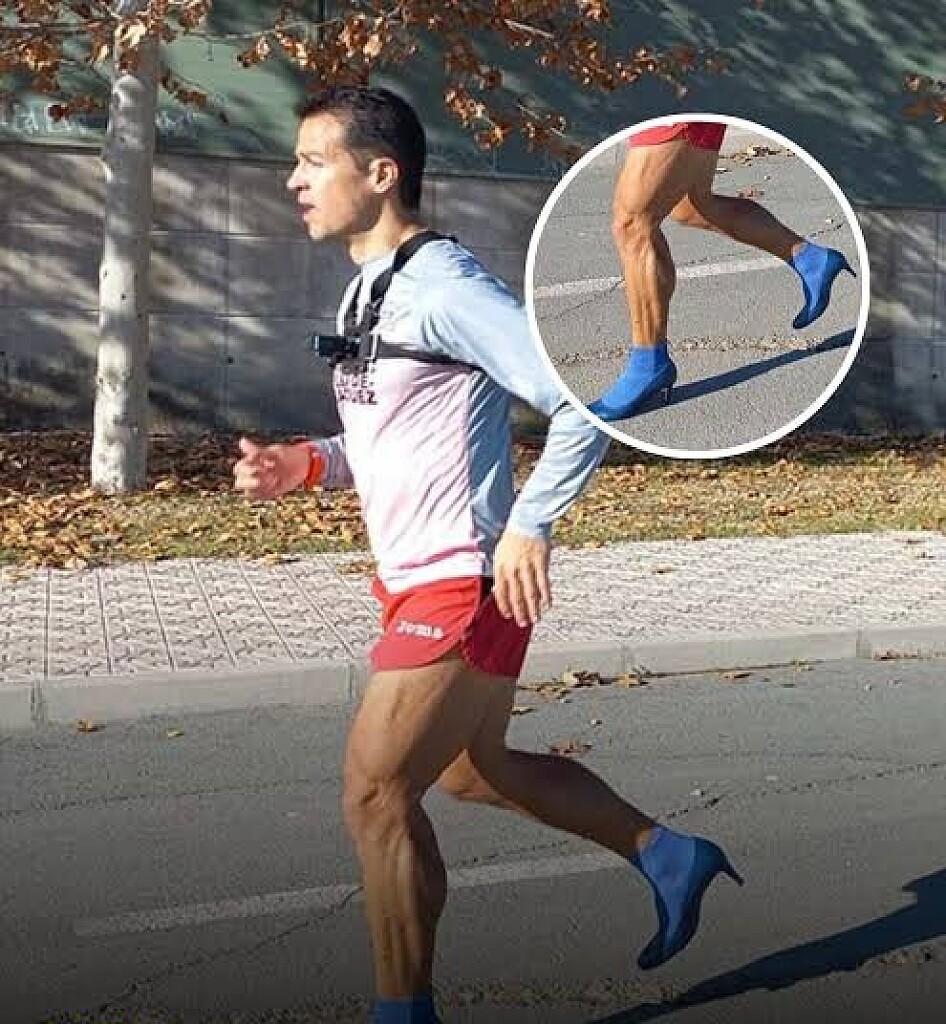
Defying Gravity in Heels: The Remarkable Record Run of Christian Roberto López Rodríguez
In a world where sprinting excellence is often defined by explosive forward motion and finely tuned technique, one athlete has turned convention on its head—quite literally. Spain’s Christian Roberto López Rodríguez delivered a performance that blurred the line between athleticism and sheer audacity, setting an astonishing benchmark that has captivated global attention.
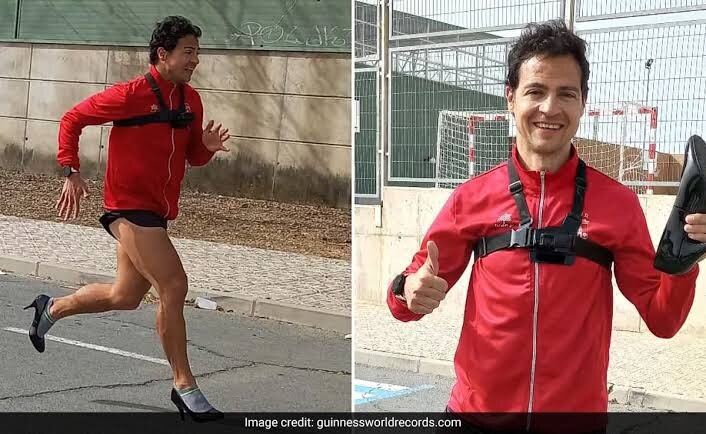
With precision, courage, and an unconventional sense of balance, López Rodríguez etched his name into the record books by completing 100 meters backwards in an eye-catching 16.55 seconds—while wearing high heels. Yes, high heels. Not just any pair, but ones measuring at least 7 centimeters, as required under the official standards of Guinness World Records.
This was no gimmick. It was a test of coordination, nerve, and elite body control. Sprinting in reverse eliminates the advantage of forward vision, demanding acute spatial awareness and flawless rhythm. Add elevated heels into the equation, and the challenge intensifies dramatically—every stride becomes a calculated risk, every footstrike a moment of delicate balance.
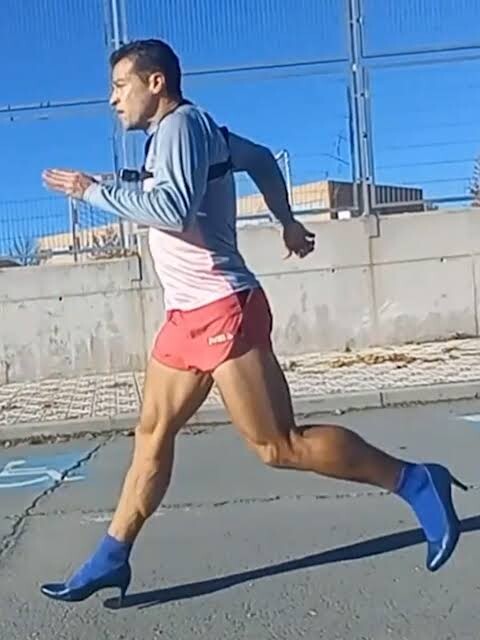
Spectators and fans were left in awe as López Rodríguez powered through the distance with surprising fluidity. His posture remained composed, his cadence sharp, and his confidence unwavering, transforming what could easily have been a chaotic attempt into a masterclass of controlled movement.
Beyond the stopwatch, this record symbolizes something deeper: the evolving spirit of sport. It reminds us that greatness is not only found in traditional arenas but also in daring creativity and the courage to attempt the extraordinary. López Rodríguez’s feat is as much about innovation as it is about performance—a celebration of pushing human limits in the most unexpected ways.
In an era where records are relentlessly chased, this singular achievement stands out—not just for its uniqueness, but for the bold imagination behind it. And as the world continues to marvel, one thing is certain: sometimes, the most unforgettable strides are taken… backwards.
by Erick Cheruiyot for My Best Runs.
Login to leave a comment
From Perth to Bondi on Foot: Goodge Sets New Trans-Australia Record
William Goodge Runs Across Australia in 35 Days
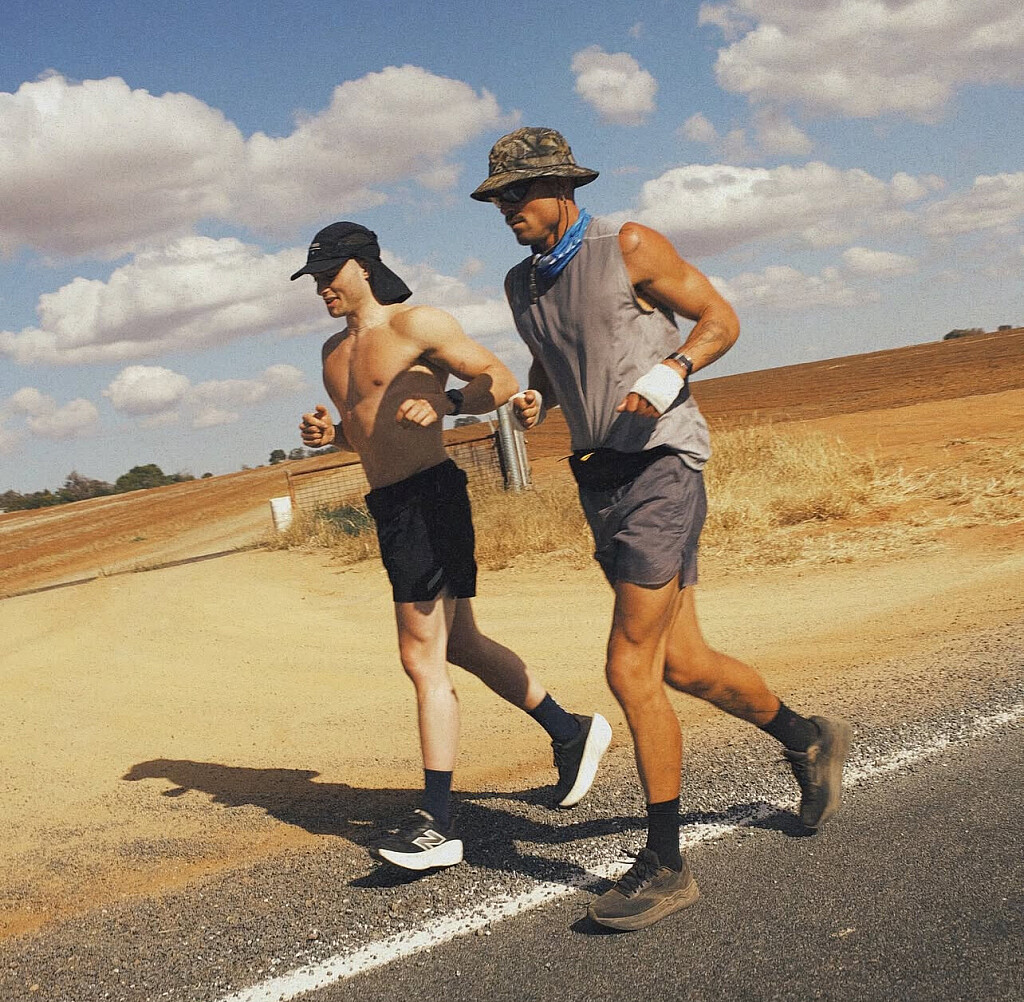
British endurance runner William Goodge has made history by becoming the fastest person to run across Australia, completing the grueling 3,800-kilometer (2,361-mile) journey in just 35 days. His run began at Cottesloe Beach in Perth on April 15, 2025, and ended on May 19, 2025, when he touched the waves of Bondi Beach in Sydney.
Goodge averaged more than 100 kilometers per day—the equivalent of two and a half marathons daily—facing scorching heat, strong headwinds, road hazards, sleep deprivation, and the relentless physical toll of ultra-distance running.
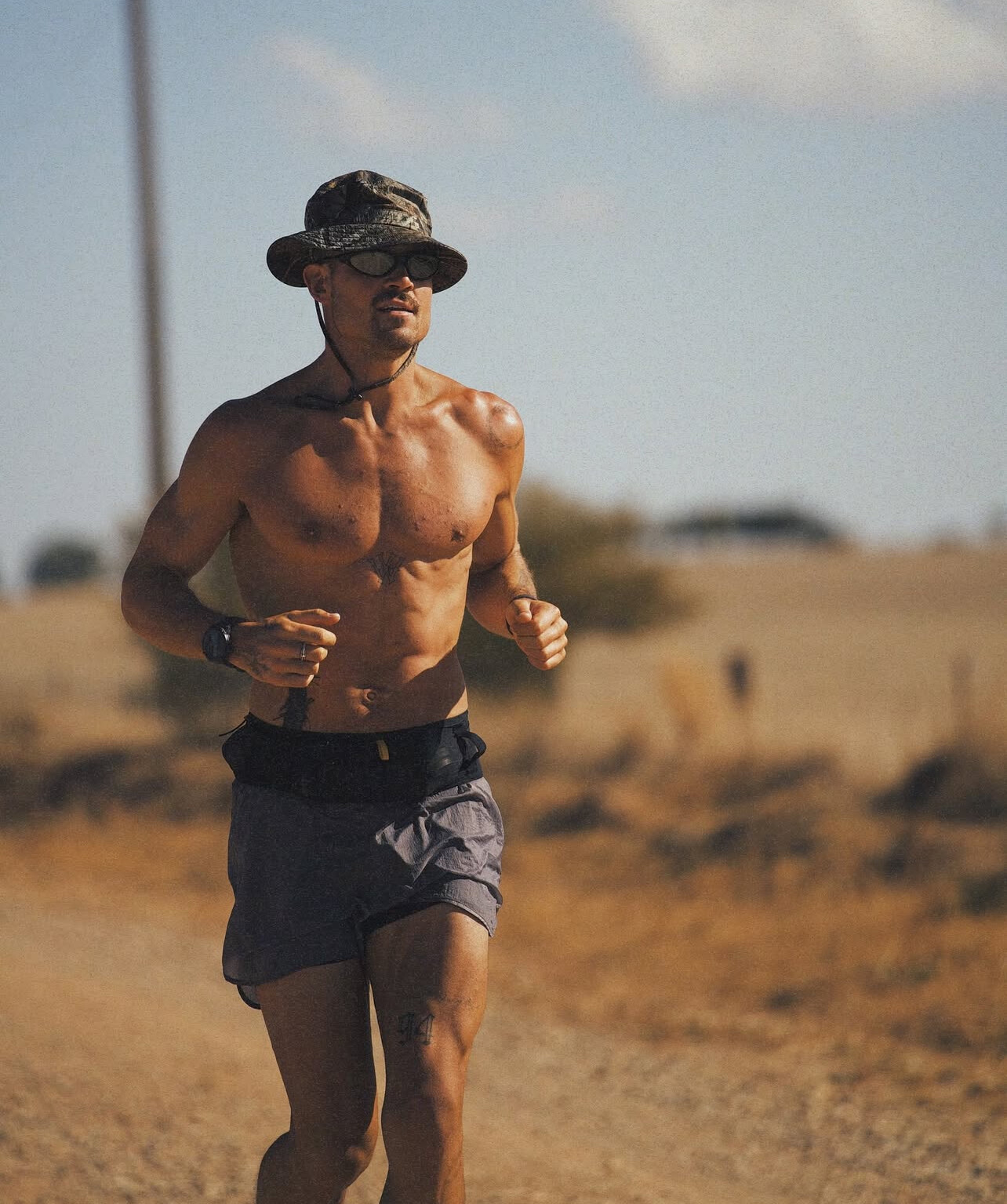
“I wanted to do something extraordinary to honor my mother,” Goodge said at the finish line, where he placed a bouquet of lilies into the ocean in memory of Amanda Goodge, who passed away from cancer in 2018.
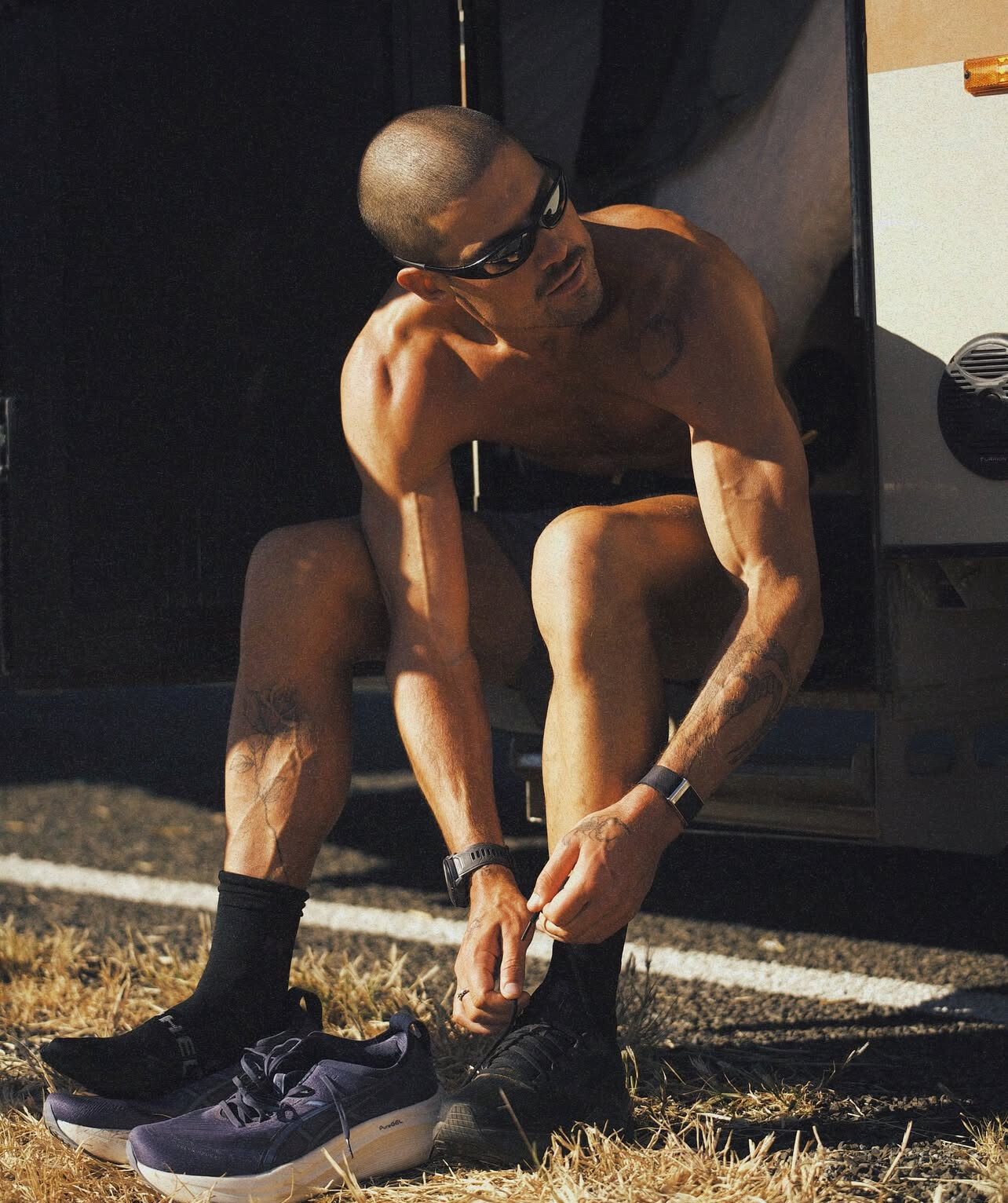
Pending official verification by Guinness World Records, Goodge’s performance would surpass the previous record of 39 days, set by Australian runner Chris Turnbull in 2023.
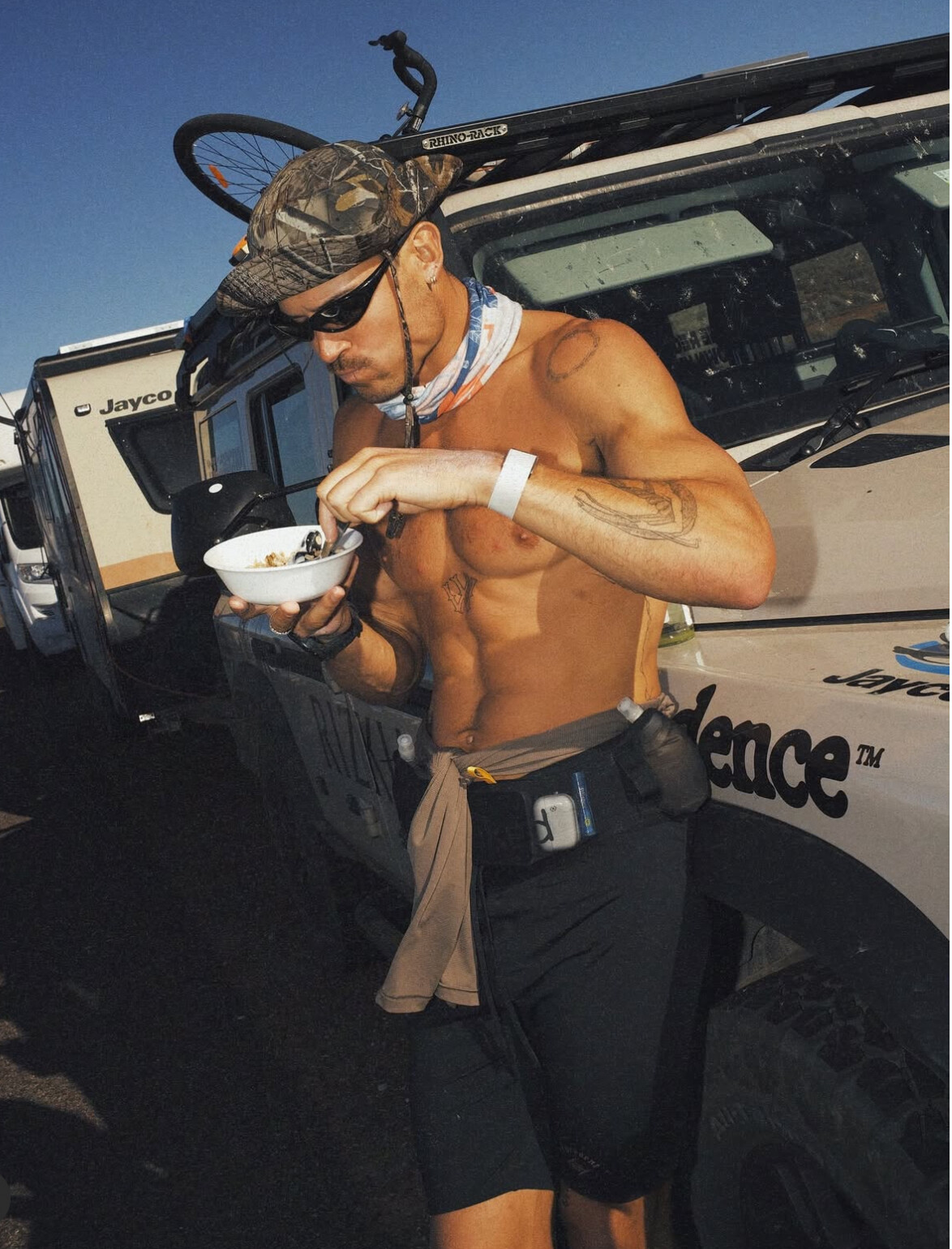
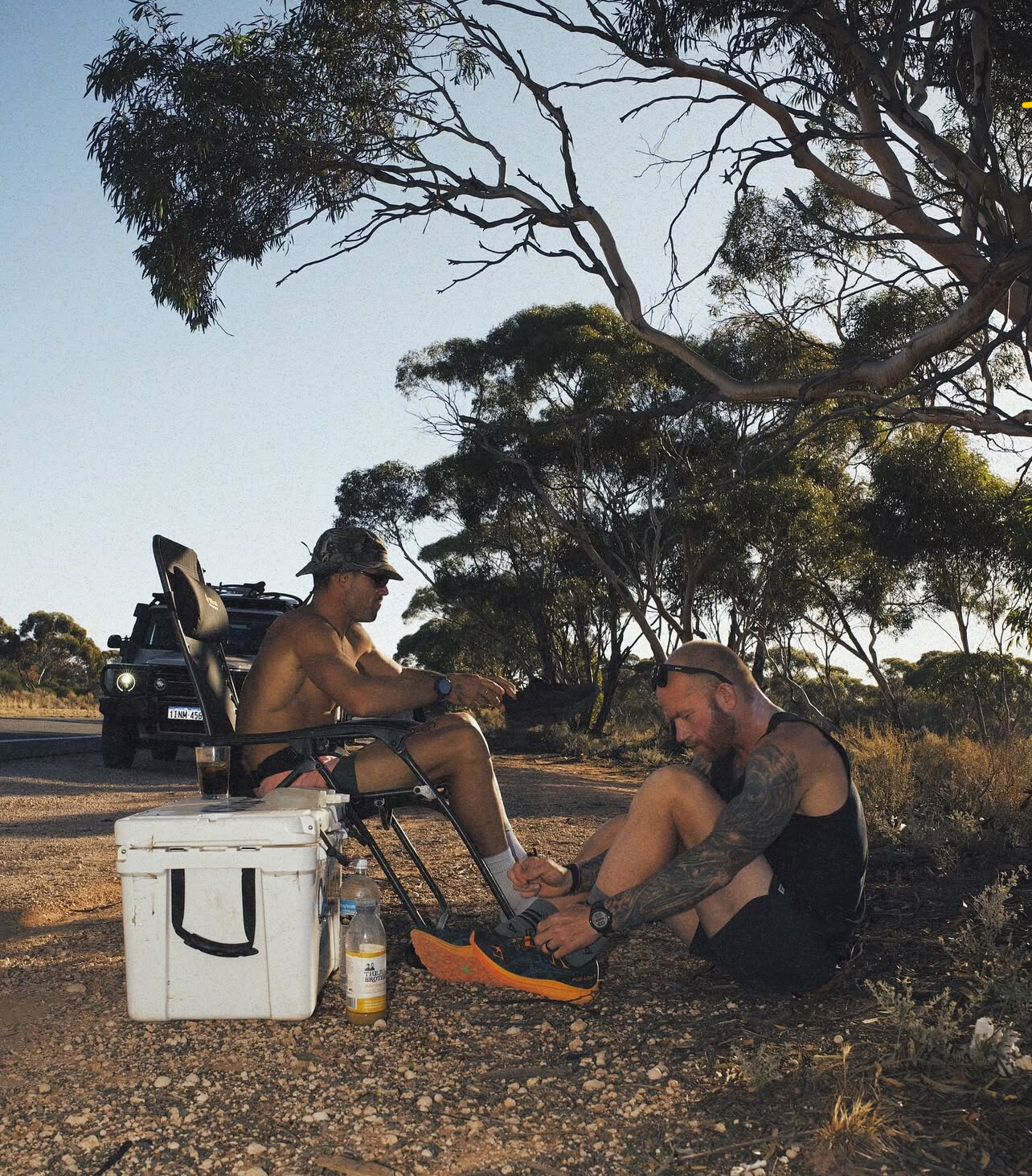
Unlike supported ultra challenges that take place in organized formats, Goodge’s effort was largely self-structured, involving a mobile support team and an immense logistical operation to sustain his food, hydration, sleep, and safety needs on the road.
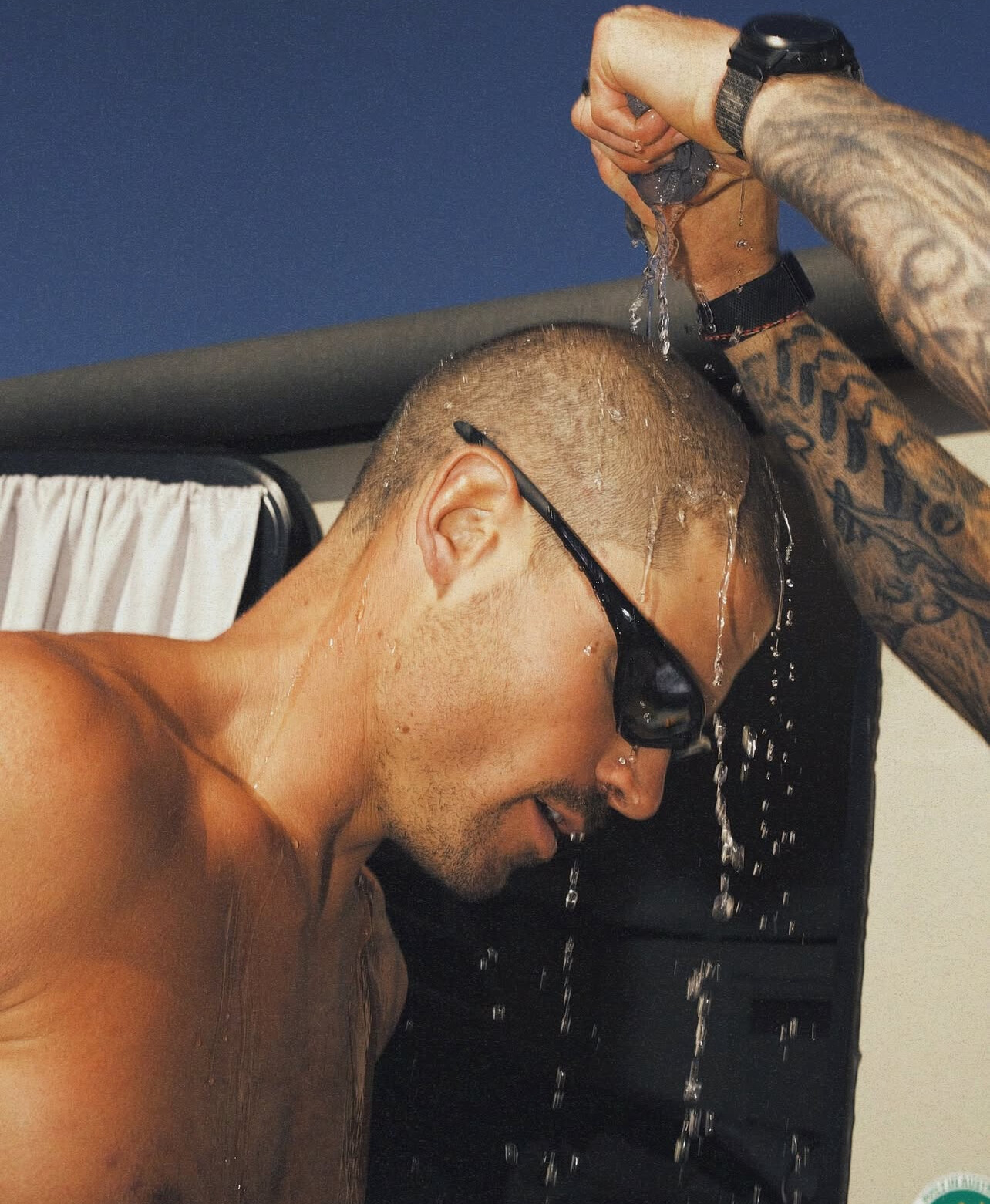
He battled through remote desert stretches, road trains, and a daily regimen that pushed his body and mind to the limit. Along the way, he kept his followers updated through video diaries and social media clips, providing rare insight into the daily grind of a true endurance athlete.

Running With Purpose
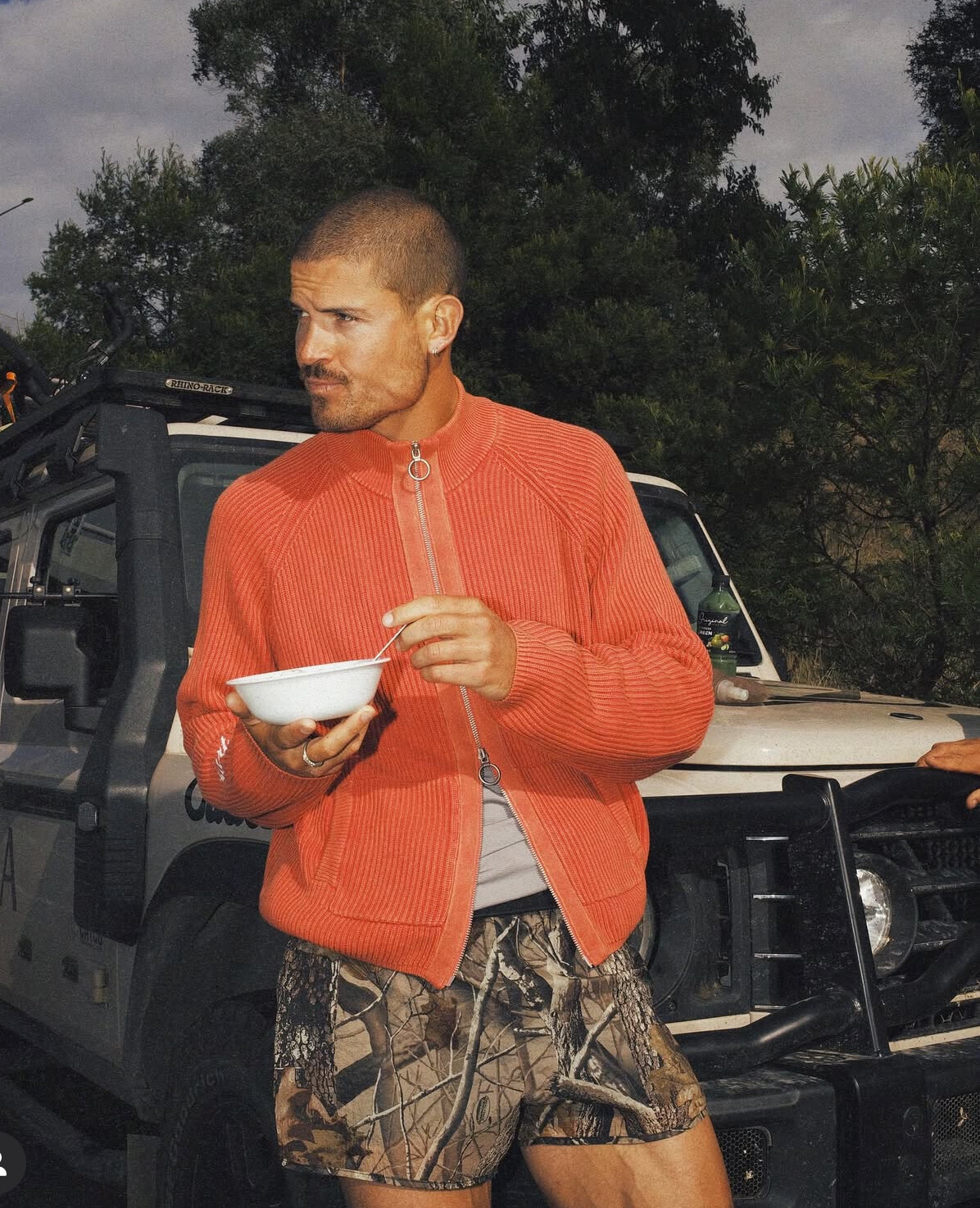
More than a personal challenge, the run served as a major fundraiser for cancer research and a tribute to his late mother. Goodge raised both awareness and donations for Macmillan Cancer Support, the organization that assisted his family during their time of need.
“This wasn’t just about breaking a record,” he said. “It was about showing what the human body and spirit can endure when love is the motivation.”
What’s Next?
With his record-setting run across Australia behind him, Goodge joins a short list of global ultra-endurance icons who have taken on transcontinental efforts. His journey may inspire future attempts—not only across Australia but in other parts of the world where such feats are yet to be fully explored.
by Boris Baron
Login to leave a comment
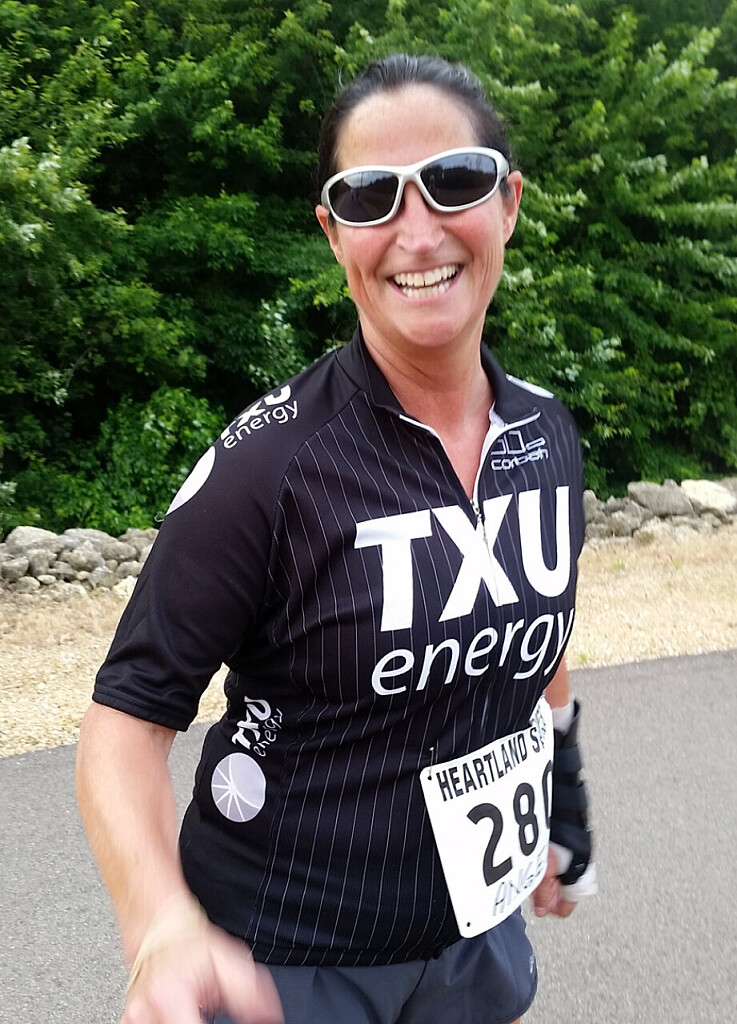
Angela Tortorice’s 1,000 Marathons and a Guinness Record — But Do the Numbers Add Up?
Angela Tortorice, a Dallas-based runner and full-time accountant, has received widespread praise on social media and in the running community for her astonishing endurance achievements. According to Guinness World Records, she holds the title for the most race marathons run in a single year by a woman: an incredible 129 marathons completed between September 1, 2012, and August 31, 2013. Nearly a decade later, she was celebrated again for completing her 1,000th marathon at the Irving Marathon in Texas on April 2, 2022, reportedly making her the first American woman to reach that milestone.
These accomplishments are inspiring — but they also raise serious questions.
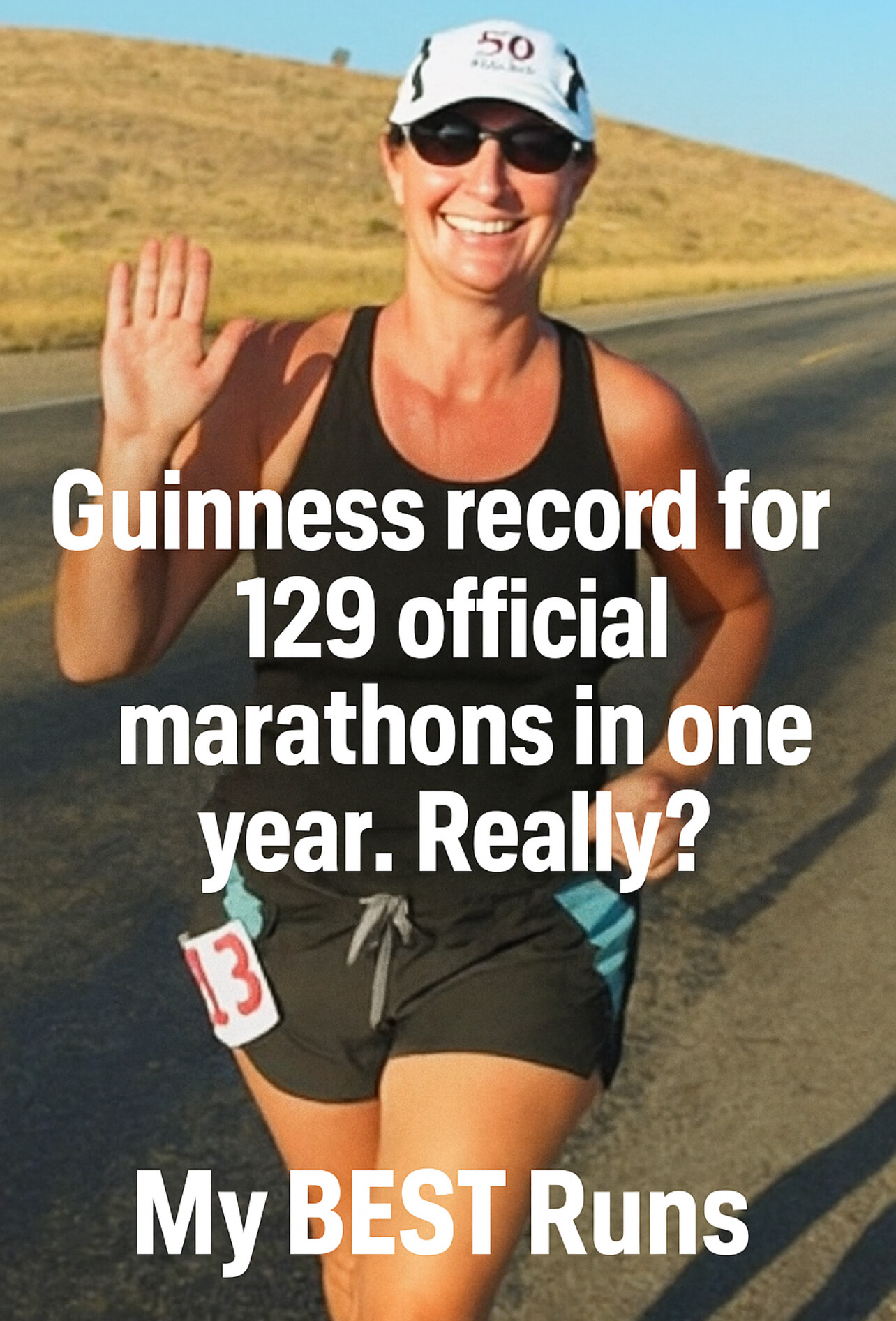
The Math Behind the Record
Completing 129 marathons in 365 days averages to one marathon every 2.8 days. Since most official marathons take place on Saturday or Sunday mornings, a runner could theoretically participate in two marathons per weekend — totaling 104 races per year if no weekends were lookmissed. To reach 129 official marathons, one would need to find an additional 25 races held on weekdays, which is highly unlikely, especially in the U.S. where weekday marathons are rare.
Moreover, Angela reportedly maintained a full-time accounting job throughout this year, making the travel, recovery, and logistics of such a schedule even more challenging.
So how was this record verified?
Guinness Confirmation Process
According to Guinness World Records, all record attempts must be supported with documentation, including:
• Official race results
• Event certifications
• Witness statements
• Media coverage
While Guinness confirmed Tortorice’s record, the details of how each marathon was documented and what criteria defined a “race marathon” have not been made public. Many in the running community are left to wonder: Were all 129 races USATF- or IAAF-certified events? Or did some involve multi-loop courses, self-organized races, or training runs that happened to reach 26.2 miles?
If the latter, should they count toward an “official” marathon record?
The 1,000 Marathon Milestone
Tortorice ran her first marathon in November 1997 at the San Antonio Marathon. Reaching 1,000 marathons by April 2022 spans approximately 24.4 years. To accomplish this, she would have had to average more than 41 marathons per year for nearly two and a half decades — while working full time and recovering from each race.
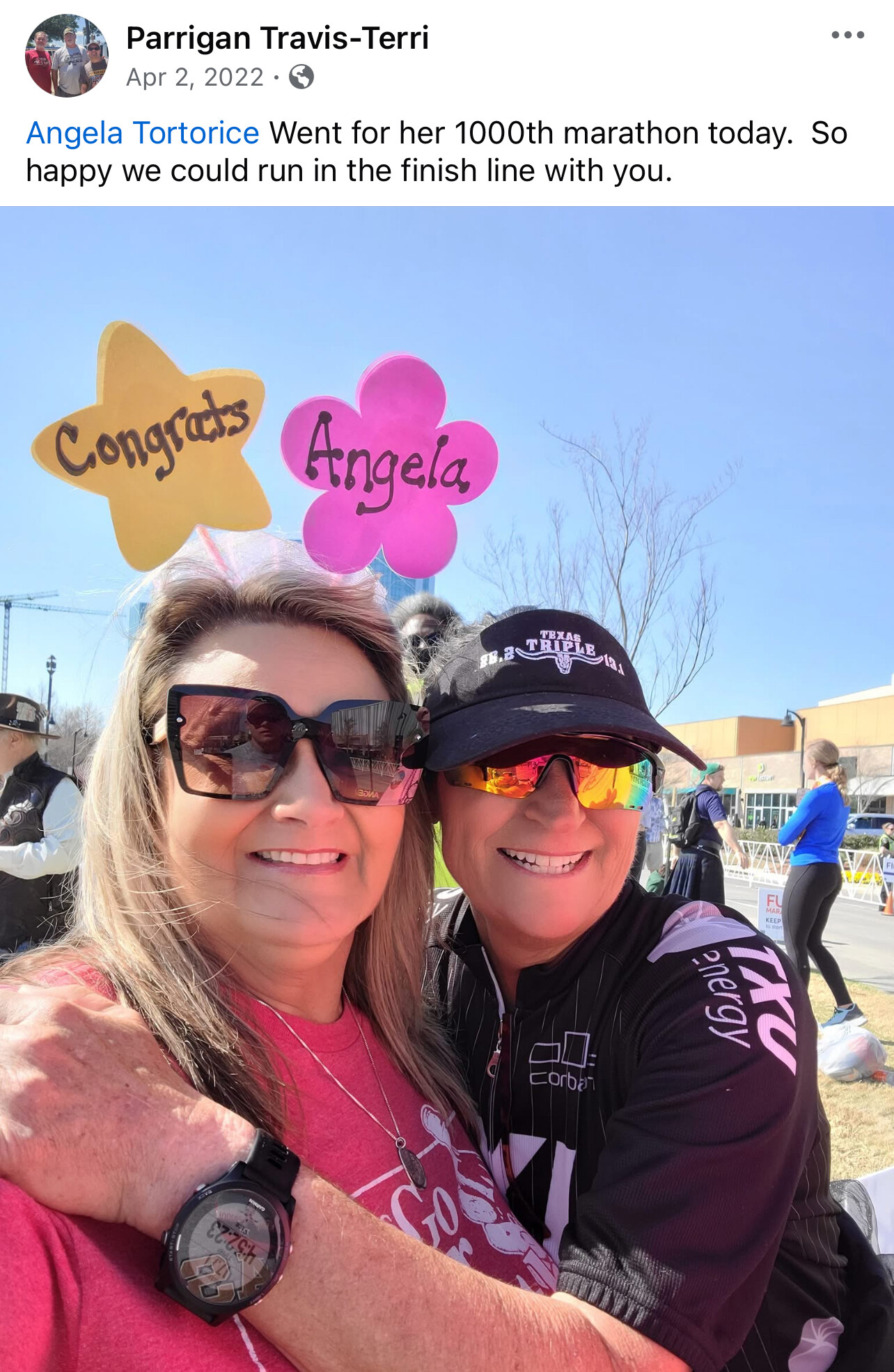
Even with her 129-marathon year included, the pace remains difficult to reconcile with the typical calendar of official events. A search on marathonview.net, a site that tracks certified marathon results, lists only 313 races under her name — far short of 1,000. That gap again raises concerns about how these totals are being calculated and what types of events are being counted.
Ultrarunning Records Raise More Questions
Further complicating the narrative is data from UltraRunning Magazine, which tracks ultramarathon performances across the U.S. According to their published records, Tortorice competed in:
• 6 ultramarathons in 2012, totaling 182 miles
• 5 ultramarathons in 2013, totaling 152 miles
These included timed events like Run Like the Wind (26.7 miles in 6 hours) and longer efforts such as the Sunmart Texas Trails 50K and the Nashville Ultra. Running multiple ultramarathons during the same period she allegedly completed 129 marathons suggests an even greater load on the body — further straining plausibility.
To perform at this level, she would have needed to recover within 24–48 hours, every single week, for a full year, without serious injury. That level of resilience is virtually unheard of in the sport.
A Matter of Integrity
This story began as a celebration of one woman’s determination and consistency. Angela Tortorice clearly has passion and commitment to the sport, and there’s no question she’s run more marathons than most runners will ever attempt.
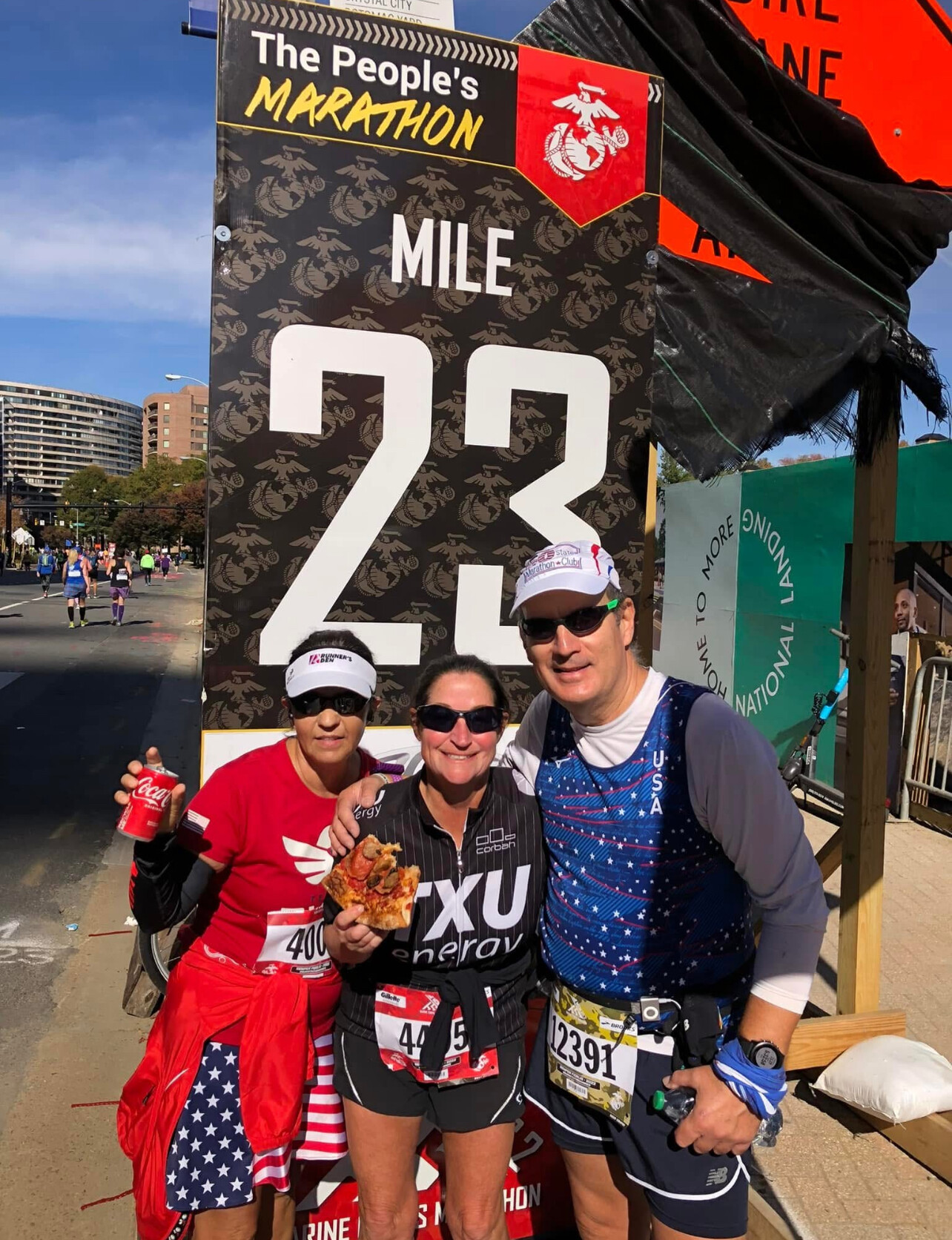
But when numbers like “129 official marathons in one year” or “1,000 official marathons in a career” are published and shared without full transparency, it matters. The integrity of marathon records — and the accomplishments of every runner who pushes through 26.2 miles — depends on clear, consistent standards.
If some of these marathons were self-supported runs or informal events, they are still worthy efforts — but should be categorized appropriately.
800 Marathons by 2019 — Then 200 More in 30 Months?
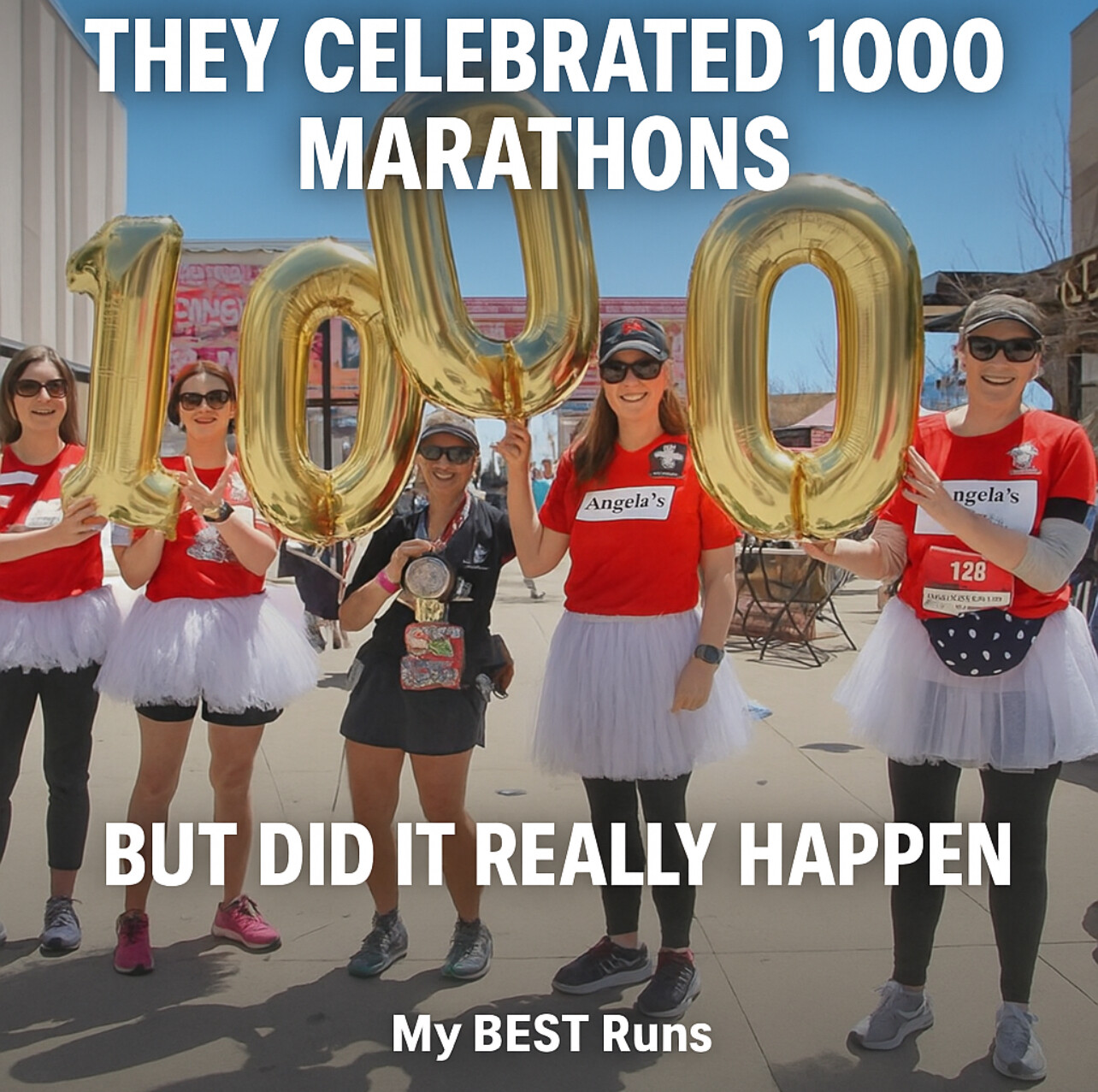
Another milestone adds complexity to the story. On October 5, 2019, Angela Tortorice celebrated her 800th marathon, as shown in a Facebook post and commemorative photo holding a cake at the finish line. That celebration is just 2 years and 6 months before her 1,000th marathon, reportedly completed at the Irving Marathon on April 2, 2022.
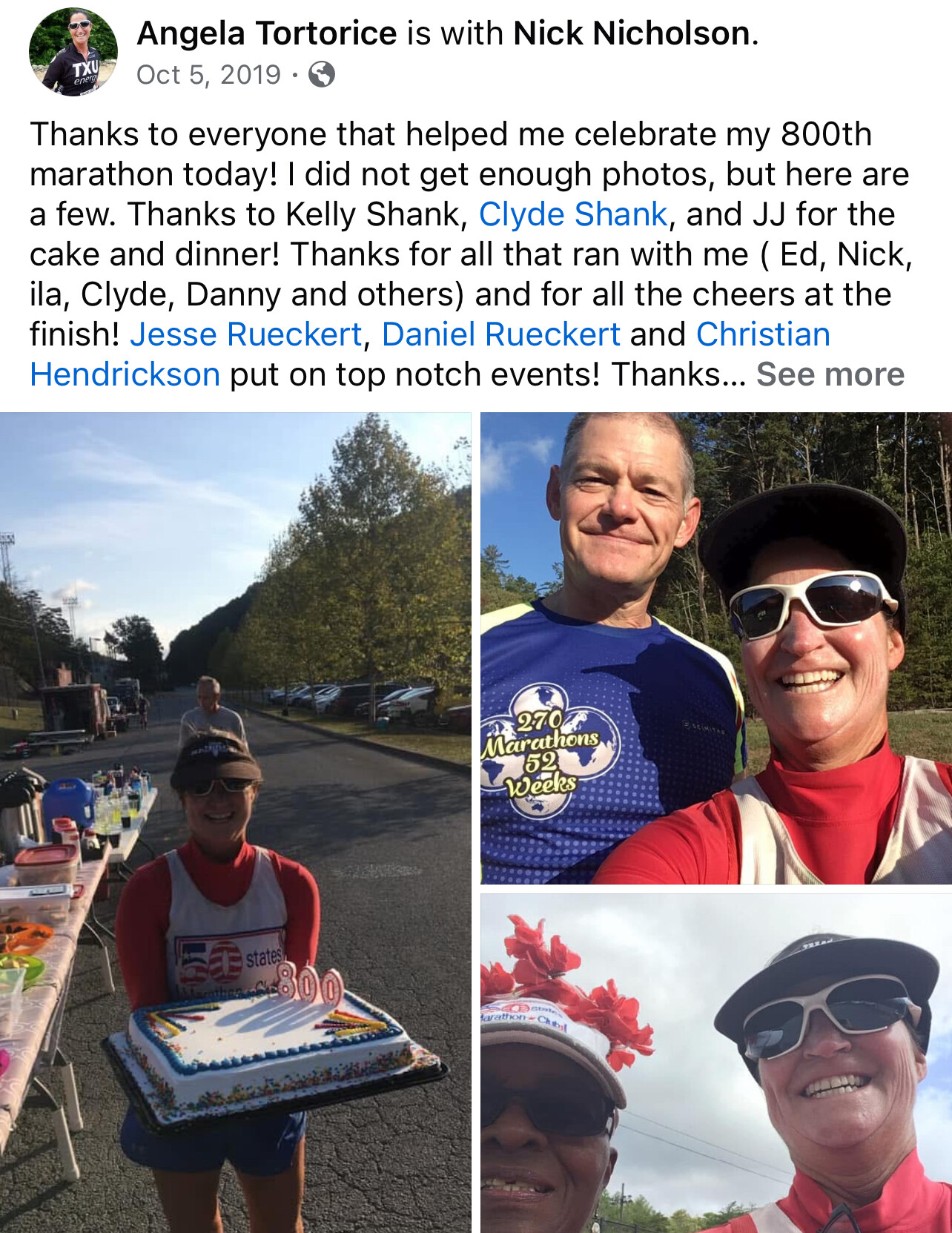
That means she would have completed 200 marathons in just 30 months, averaging over 6.5 marathons per month, or about 1.5 per week, every single week — during the height of the pandemic era when many events were canceled or limited.
Even more striking, race result records from this period show that she was also participating in ultramarathons, including at least one 24-hour race, according to UltraRunning Magazine. These events demand far more recovery than standard marathons. Yet her pace of marathons never seems to slow down.
The Core Question Remains
Angela Tortorice has no doubt logged thousands of miles and displayed a deep love for running. But the record of 129 marathons in a single year, verified by Guinness, was widely interpreted as representing 129 official, certified marathons — the kind that appear in race databases, are publicly timed, and meet governing body standards.
The mounting evidence — including her ultrarunning participation, the 800-to-1000 marathon timeline, and her full-time employment — raises a fundamental question: Were all of these “marathons” part of certified, organized events, or were many informal, self-organized, or private runs?
For a record with such significance, the running world deserves clarity. Not to diminish the accomplishment — but to ensure accuracy and integrity in what we celebrate.
Angela Tortorice has no doubt achieved extraordinary things. But the marathon world deserves clarity: What exactly counts as a marathon in these records? If the claim is that all 1,000 were “official race marathons,” then we must ask — where’s the list?
Until those questions are answered, the celebration must also come with scrutiny. The running community deserves both inspiration and truth.
by Bob Anderson and Boris Baron
Login to leave a comment
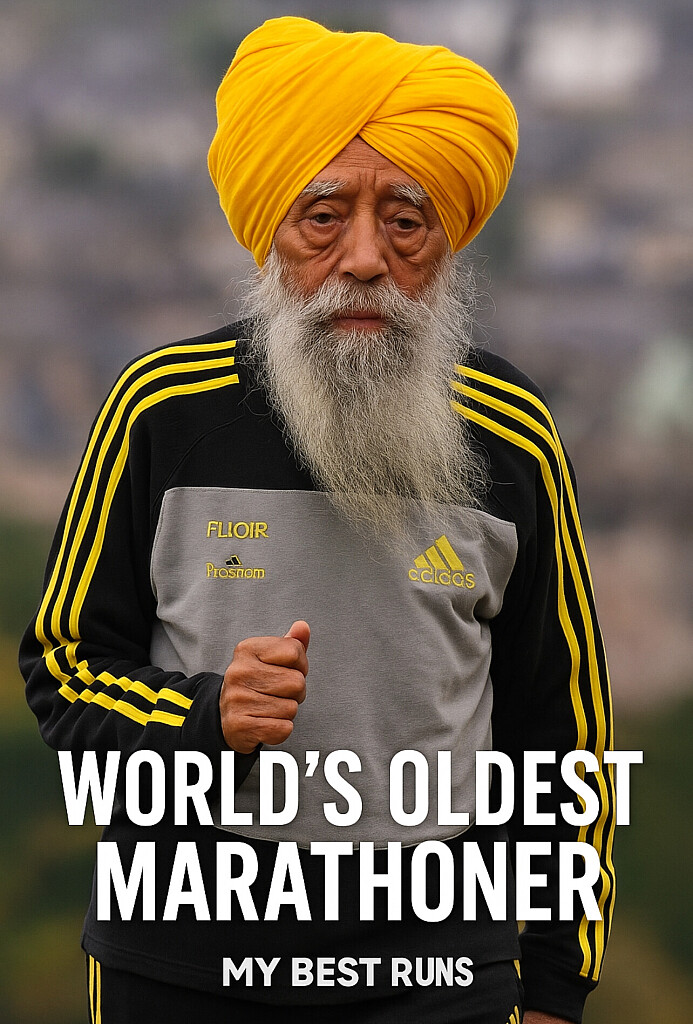
Fauja Singh: The World’s Oldest Marathoner Who Redefined Human Potential Part One
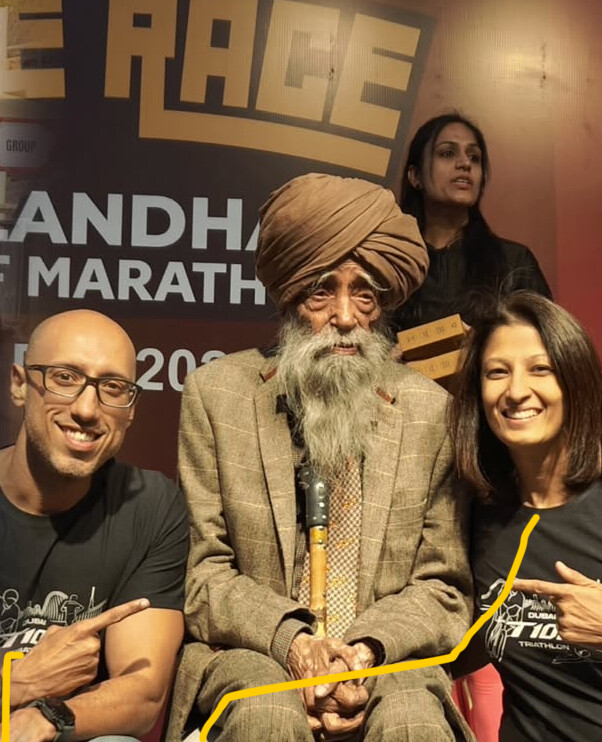
Fauja Singh, born on April 1, 1911, in Beas Pind, Punjab, British India, is widely celebrated as the world’s oldest marathon runner. His remarkable journey from a quiet farming life to global athletic acclaim has inspired millions, proving that age is no barrier to endurance, purpose, or reinvention.
From Tragedy to Triumph
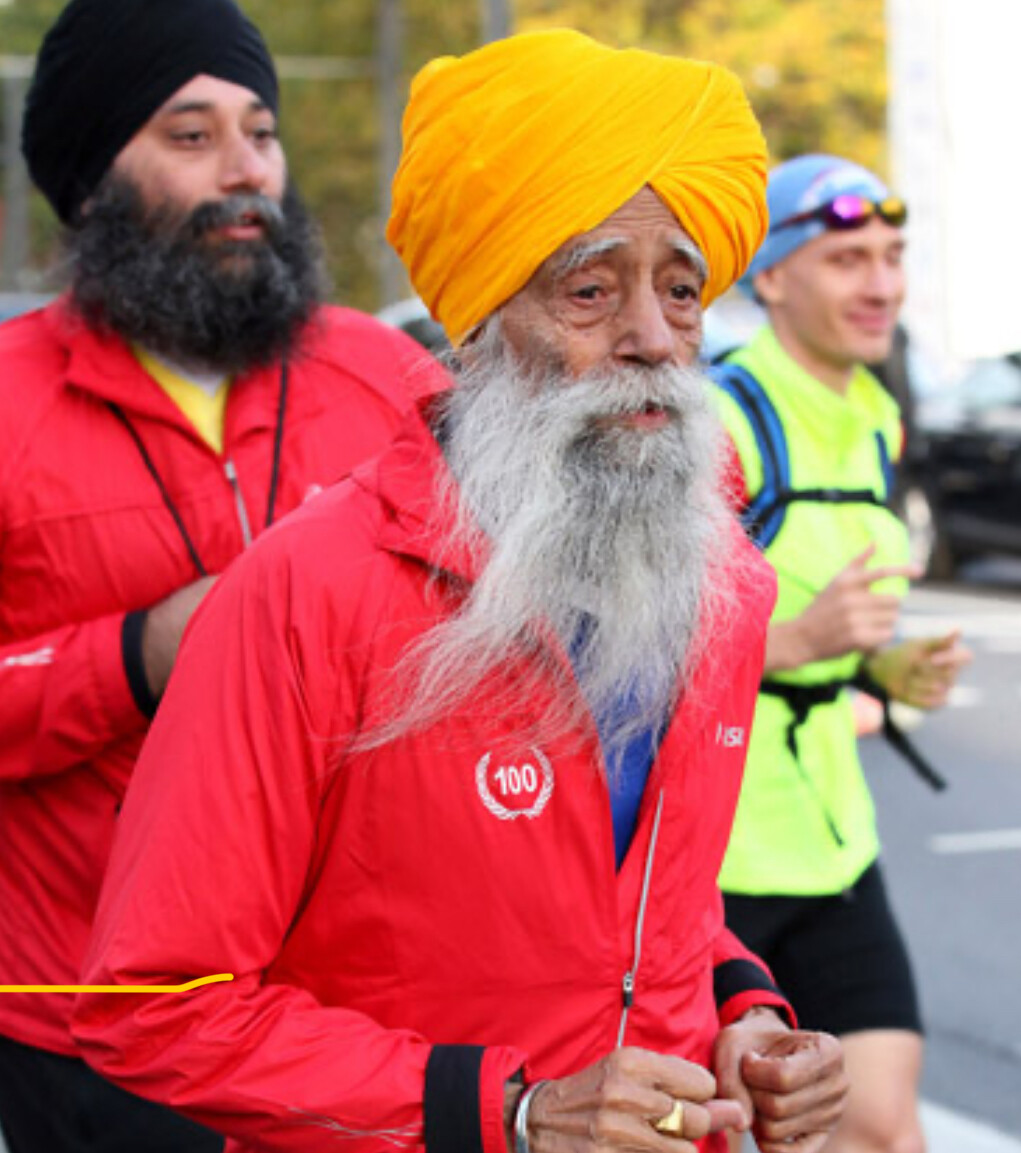
Singh’s path to running began in the wake of personal tragedy. After losing his wife in 1992 and witnessing the death of his son in 1994, he moved to London in the late 1990s. At 89, he took up running as a way to cope with grief and rediscover purpose. In 2000, he completed his first marathon in London, launching a career that would span over a decade.
A Record-Breaking Career
Singh completed nine full marathons between 2000 and 2011, including events in London, Toronto, and New York. His personal best was 5:40 at the 2003 Toronto Waterfront Marathon, setting a world record for the 90+ age group. At 100, he became the first centenarian to complete a marathon, finishing the 2011 Toronto Waterfront Marathon in 8:11:06. Though Guinness World Records did not certify the feat due to the absence of a birth certificate, Singh’s accomplishment remains a historic milestone.
Final Race and Continued Inspiration
Singh ran his final competitive race on February 24, 2013, completing a 10km event at the Hong Kong Marathon in 1:32:28, just weeks before his 102nd birthday. Though retired from competition, he continued to jog daily and participate in community events, promoting health and fitness.
Legacy Beyond the Finish Line
Singh’s influence extends beyond his athletic achievements. He was featured in Adidas’ “Impossible is Nothing” campaign alongside icons like Muhammad Ali and David Beckham. In 2015, he was awarded the British Empire Medal for services to sport and charity. His life story has been chronicled in the biography Turbaned Tornado and the children’s book Fauja Singh Keeps Going.
A Life of Simplicity and Purpose
Singh attributes his longevity and vitality to a simple vegetarian diet, abstaining from smoking and alcohol, and maintaining a positive outlook. He once said, “The first 20 miles are not difficult. As for the last six miles, I run while talking to God.”
Fauja Singh’s journey exemplifies the boundless potential of the human spirit. His legacy continues to inspire individuals worldwide to pursue their passions, regardless of age.
by Boris Baron
Login to leave a comment

Firefighter Dad Shatters 1K Stroller Record with 17-Month-Old Son Riding Shotgun
Toronto’s Brendan Neely just redefined what it means to multitask on the run. The firefighter, carpenter, and father of two smashed the Guinness World Record for the fastest 1-kilometer run while pushing a stroller—crossing the line in an astonishing 2 minutes and 51 seconds.
The record-breaking performance took place at The Hangar sports complex in North York, Ontario, with Neely’s 17-month-old son, Jack, riding comfortably in a Baby Jogger Summit X3 stroller. A Guinness World Records official was on site to verify the feat, which obliterated the previous mark of 3:19 set in 2022 by nearly 30 seconds.
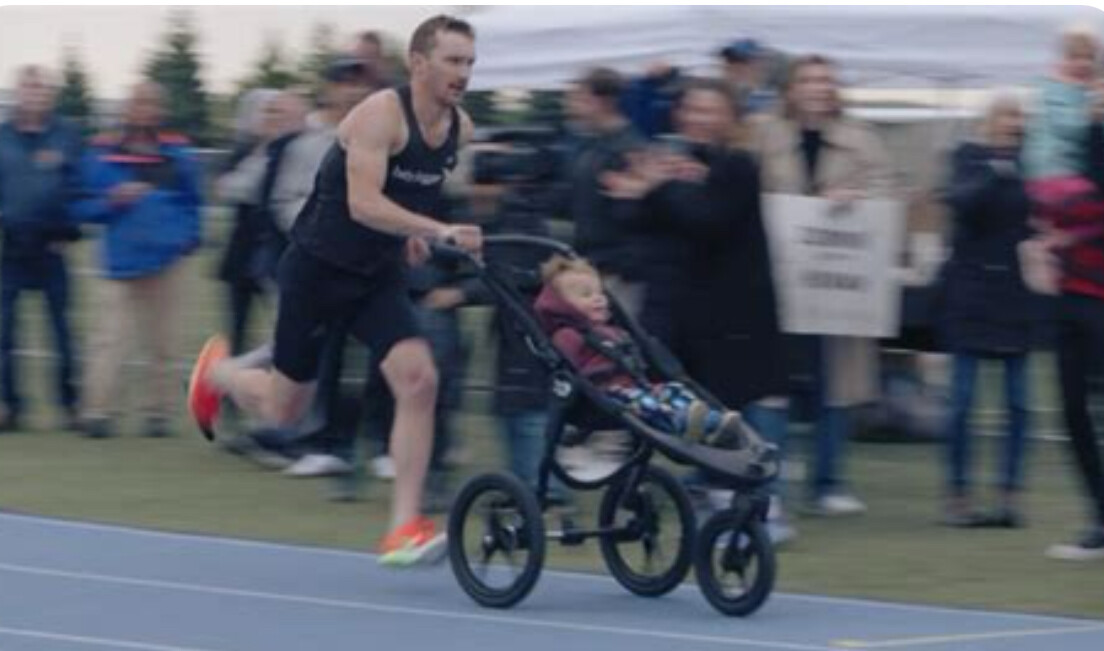
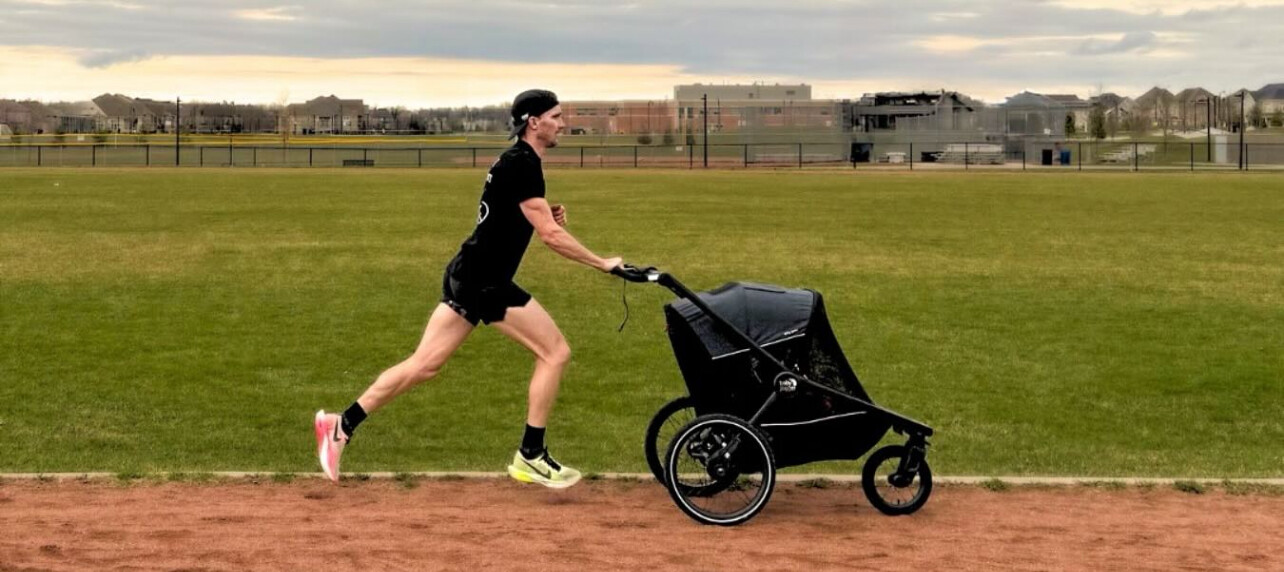
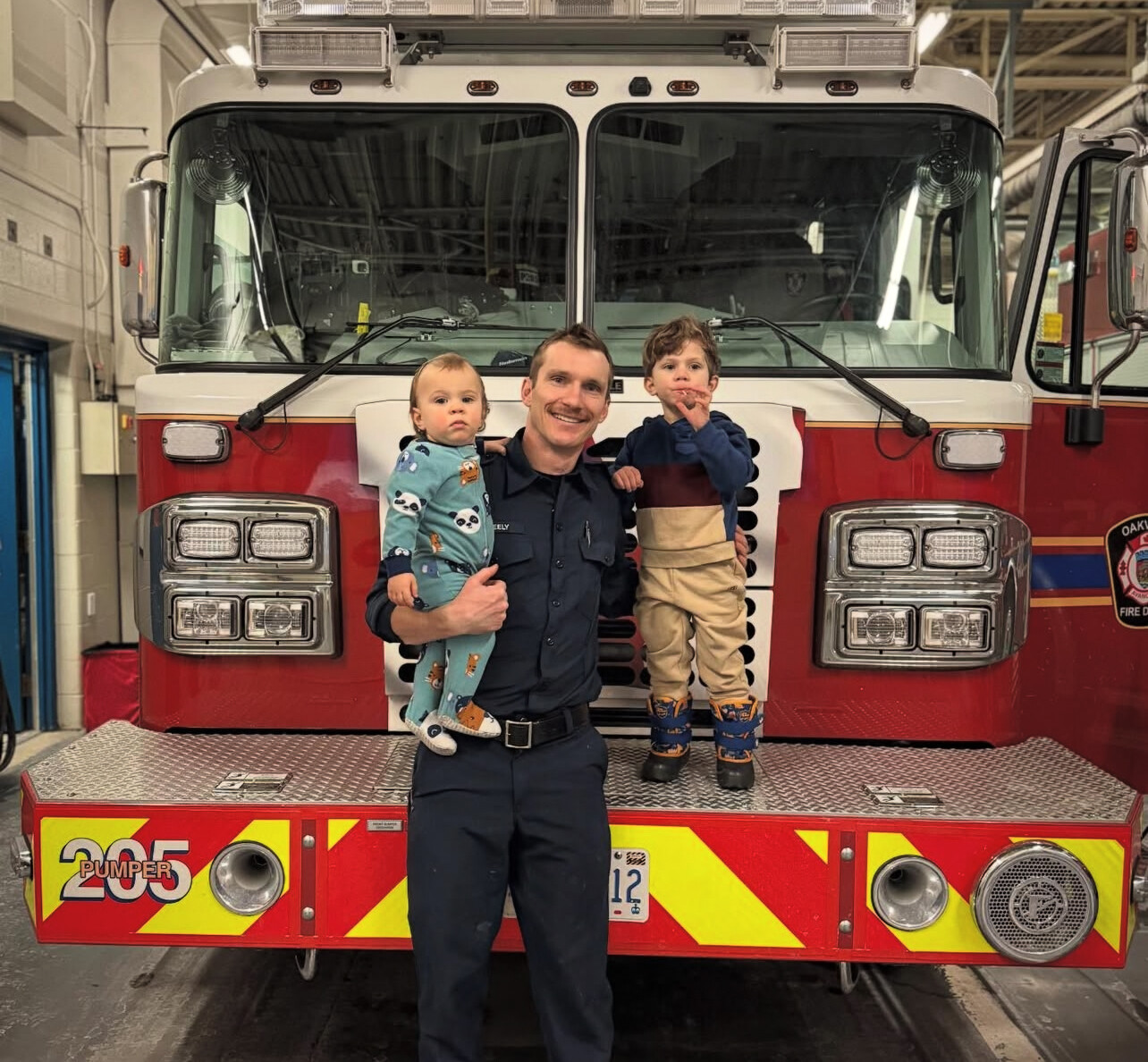
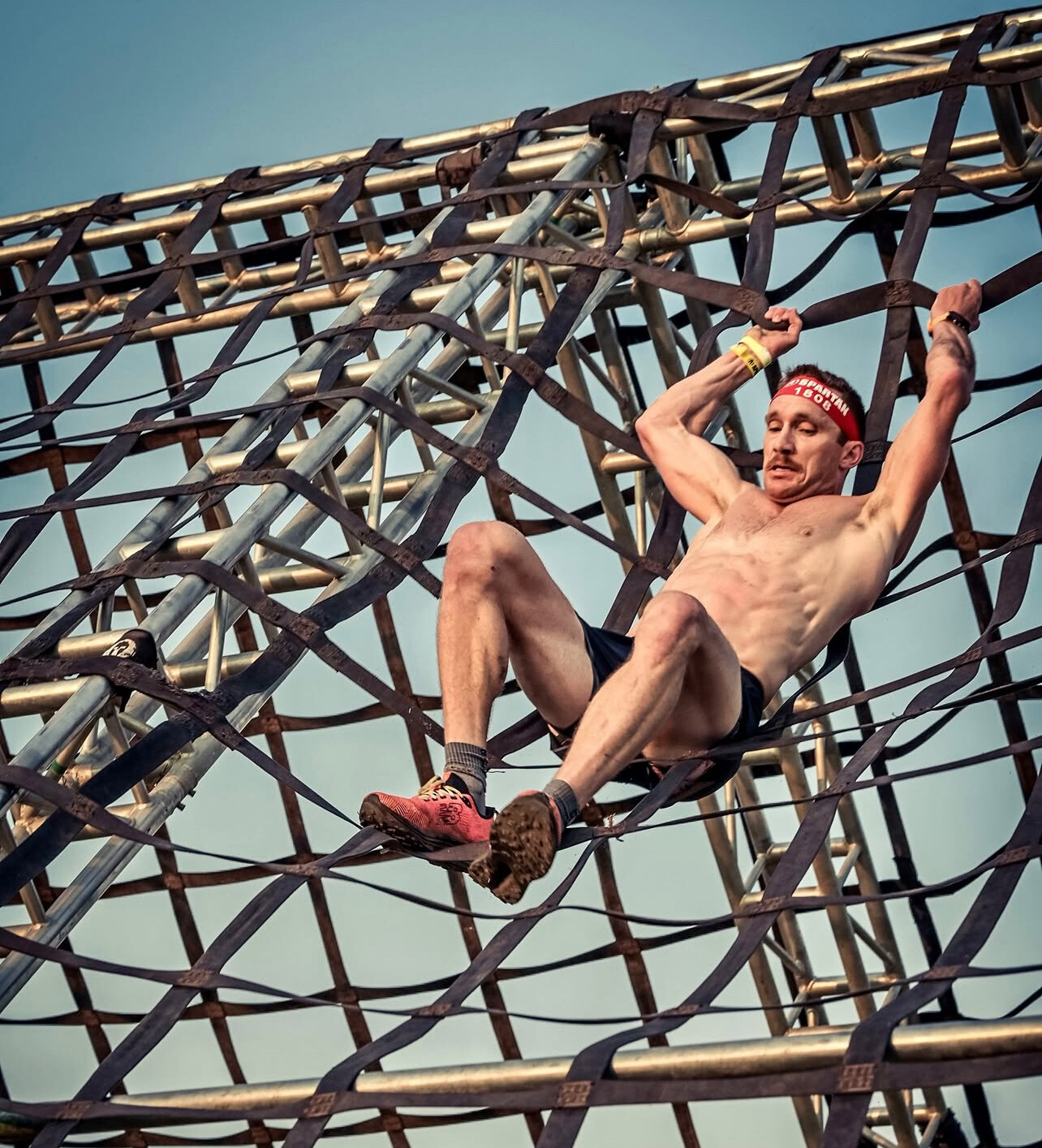
Neely, a longtime trail and obstacle course runner, began training for the attempt in August 2024. Supported by Baby Jogger, he put in hours of stroller runs—often joined by his sons—as part of a uniquely family-focused regimen. “It’s really so much more than the record,” he shared. “Just the amount of hours I put in with these guys is truly what means the most to me.”
What’s next? Neely may be eyeing another stroller record—this time with both of his boys onboard. One thing’s for sure: he’s pushing boundaries in more ways than one.
by Boris Baron
Login to leave a comment
Robert Garside: The Man Who Ran Around the World
An Epic Journey of Endurance and Determination
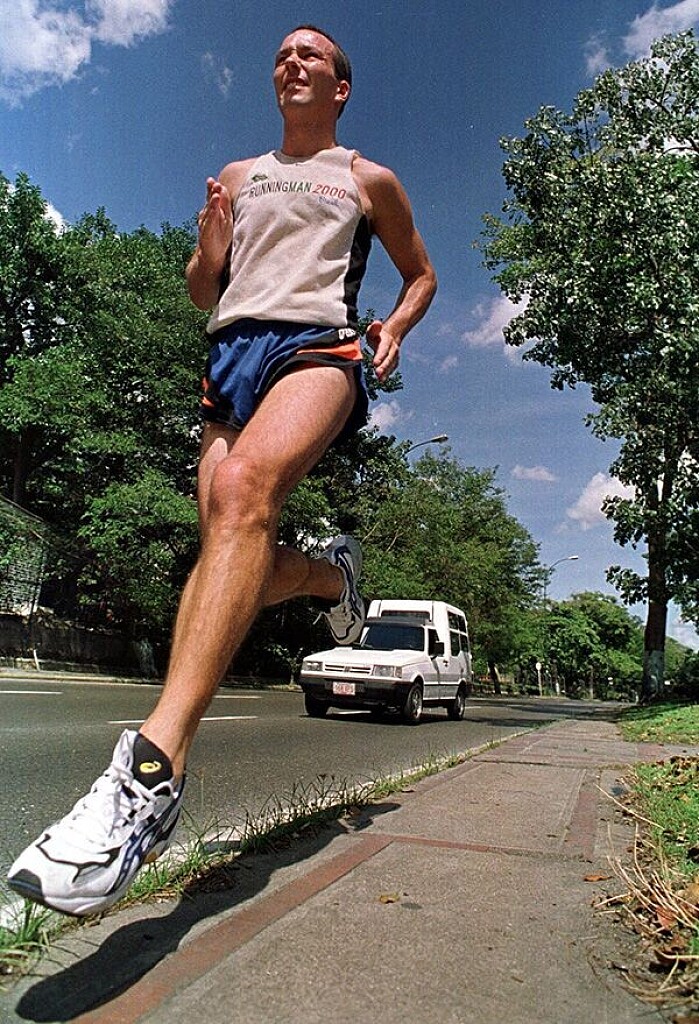
Robert Garside, known as “The Runningman,” holds the distinction of being the first person to run around the world—a feat recognized by Guinness World Records. His journey began on October 20, 1997, at India Gate in New Delhi, India, and concluded at the same location on June 13, 2003. Over 2,062 days, Garside traversed approximately 35,000 miles across 29 countries and six continents.
The run was fraught with challenges, including arrests, injuries, and skepticism from the running community. Despite these obstacles, Garside meticulously documented his journey, providing evidence that eventually led to official recognition.
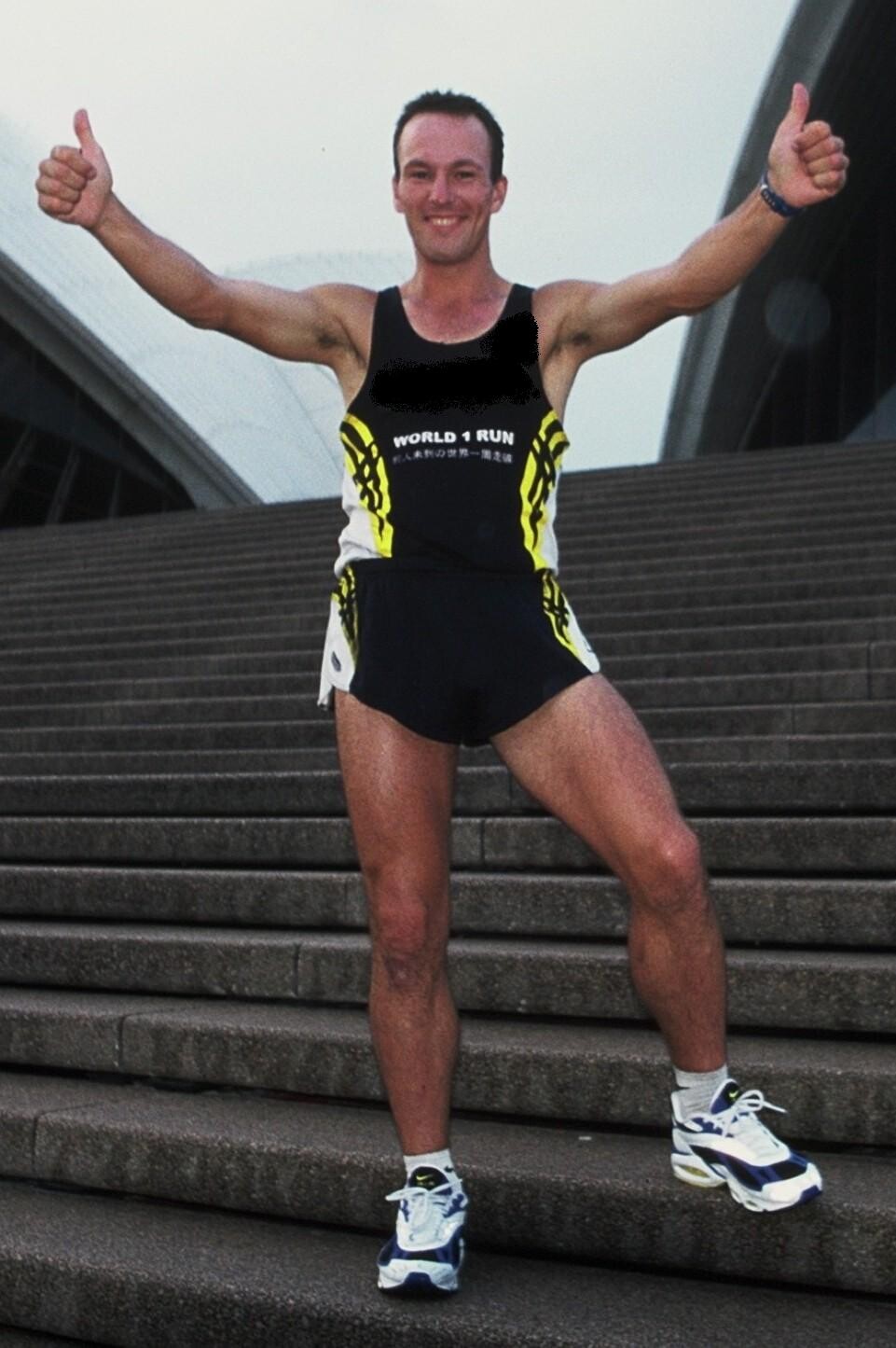
Garside's story is one of resilience and the unyielding human spirit, inspiring runners and adventurers worldwide.
Life After the Run
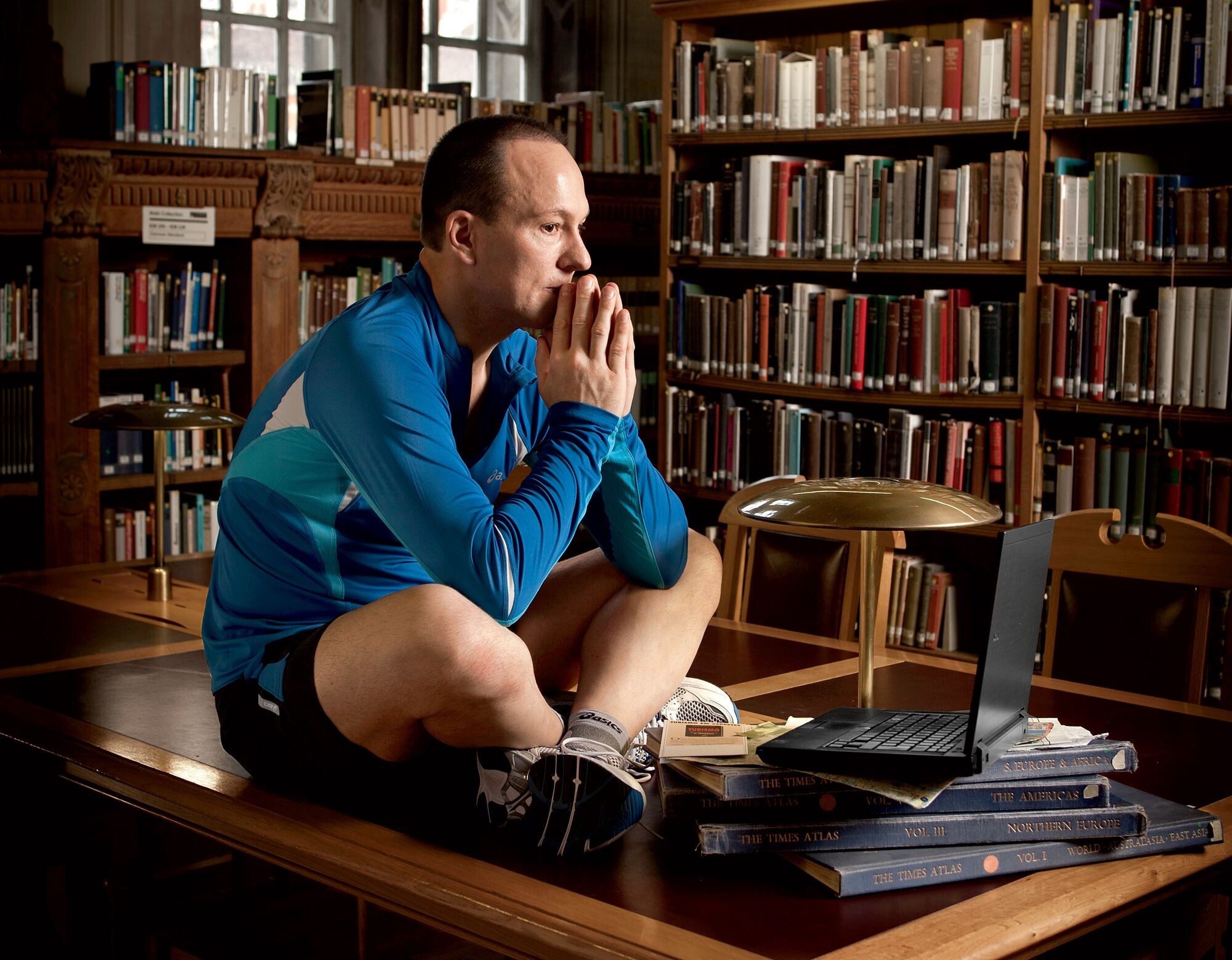
Following his monumental achievement, Garside took time to recover physically and mentally from the rigors of his journey. He later transitioned into a professional career, working as a data engineer. In 2020, he shared on LinkedIn about an opportunity to join the BBC as an apprentice data analyst, indicating his involvement in the field of data analytics.
While Garside has maintained a relatively low public profile in recent years, his legacy endures. His journey continues to inspire discussions about endurance, determination, and the human capacity to overcome immense challenges.
by Boris Baron
Login to leave a comment
Hi! I landed on this account by accident as part of my (on and off!) search, over many years, for my hero whom I followed those many years ago. Please note that the bit "Life After the Run" is very unlikely to be correct - I think you (or AI!) have looked at https://www.linkedin.com/in/robert-garside-7b61b2a3/ _ I will check for completion, but I am pretty sure that this is someone else entirely. Rob Garside, "The Runningman", as far as I can tell, has not just "maintained a relatively low public profile", he has completely disappeared, probably intentionally but for reasons unknown but I can make an intelligent guess. I would personally love to meet him and find out more about his subsequent life (if he is, indeed, still alive) but would intensely respect his privacy. Please see https://www.runnersworld.com/runners-stories/a20962865/redemption-of-the-runningman/ for a more accurate summary (incidentally, from which the last photograph was taken)
If anybody has ANY information about his subsequent life, PLEASE contact me directly - Jim Newmark 7/23 2:19 am |
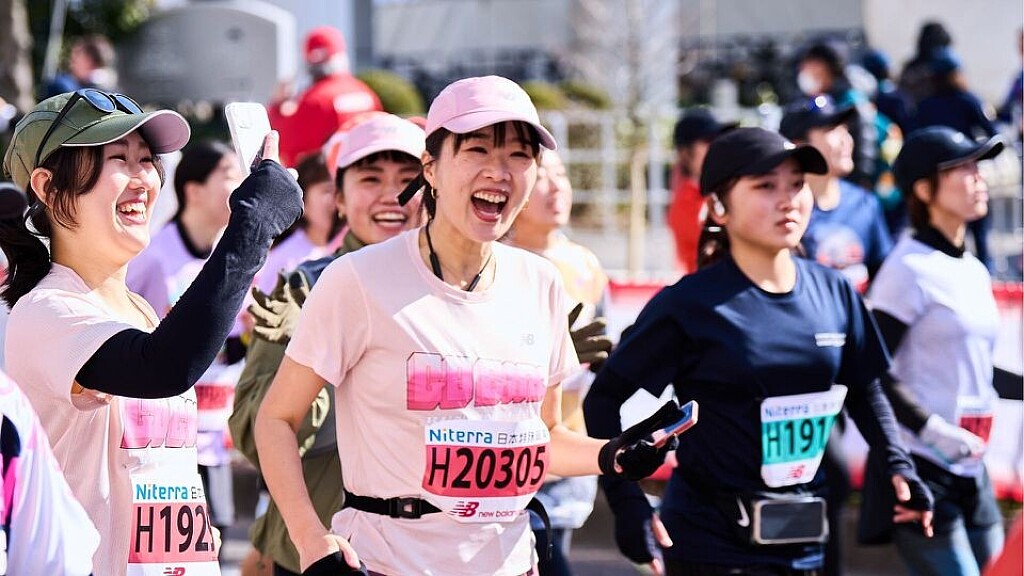
Nagoya Women’s Marathon 2025 opens doors to Kenyan runners
Nagoya Women’s Marathon invites Kenyan runners to join its 2025 race, offering virtual participation and luxurious finisher awards.
Organizers of the Nagoya Women’s Marathon have extended a special invitation to Kenyan runners encouraging them to participate in the highly anticipated 2025 race.
Recognized by Guinness World Records for hosting over 20,000 participants, the event is set to take place in Nagoya, Japan, with an online virtual marathon for international participants unable to travel to the race site.
Registration for the virtual marathon opens on October 18 and will remain available until October 31 allowing 500 entrants to join the race from their home countries.
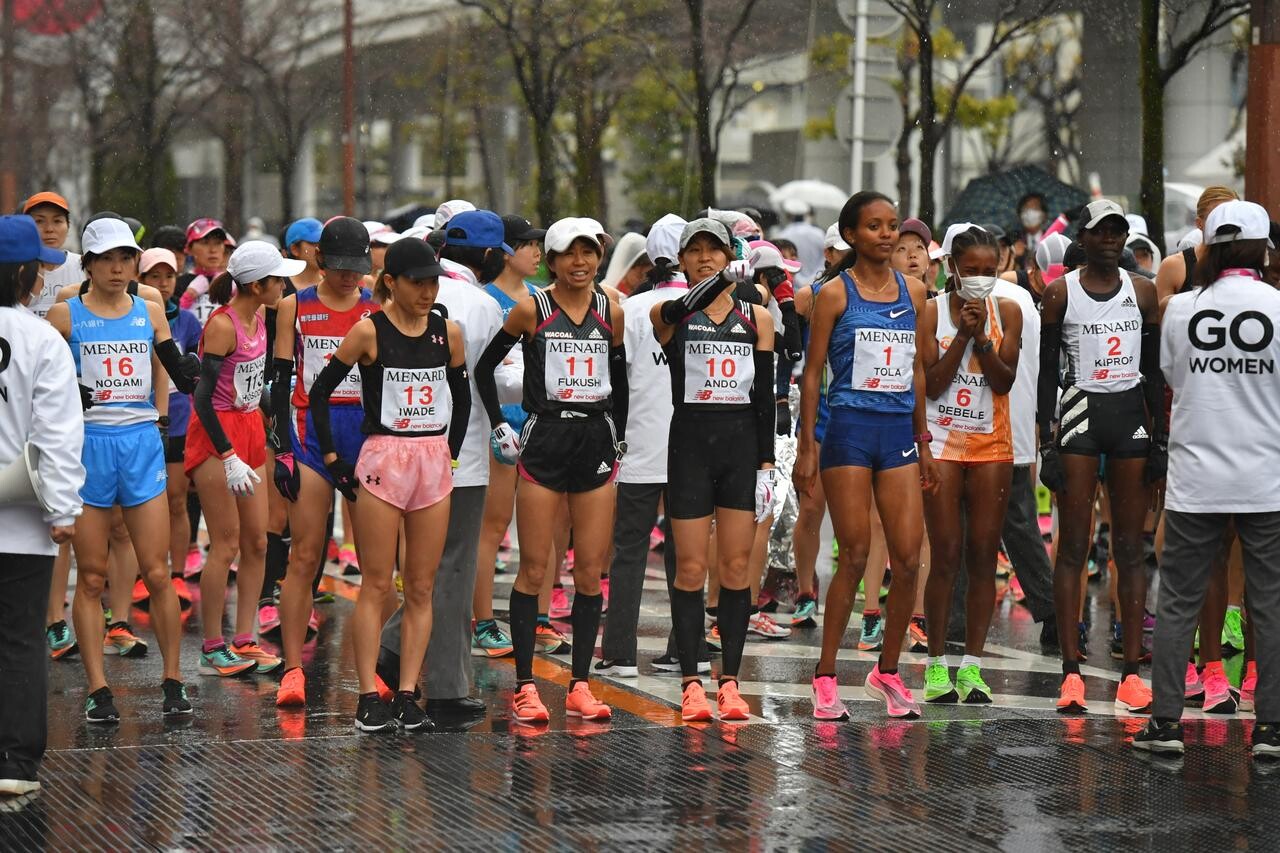
With Kenya’s rich history of marathon champions, the invitation is expected to draw considerable interest.
“We will be delighted to open entries to international runners for Nagoya Women’s Marathon 2025, recognised by Guinness World Records as the largest women’s marathon in the world with over 20,000 participants,” the Marathon’s Race Director said.
“As a sport, running has the ability to bring together people from different countries, backgrounds and cultures, and we look forward to opening our doors to runners from Kenya, which has a world-famous runner community."

Kenyan athletes have long dominated the world stage in distance running, with runners like Brigid Kosgei and Peres Jepchirchir consistently achieving impressive marathon victories.
With this invitation, the organizers of the Nagoya Women’s Marathon hope to add a new level of competition and excitement to the event by allowing Kenyan women to compete alongside elite Japanese and international athletes.
For those who may not be able to make the journey to Japan, the event’s organizers are offering a virtual alternative for 500 women worldwide.
The Nagoya Women’s Online Marathon 2025, which will take place between February 9, 2025, and March 31, 2025, allows runners to complete the full 42.195 kilometers on a smartphone application, providing an opportunity to compete from any location.
“We recognize the importance of sustainability and accessibility in modern sports,” the Race Director explained.
“This virtual race option, born during the travel restrictions of the COVID-19 pandemic, allows women from around the world to engage with the event, even if they cannot physically attend in Nagoya. We believe this alternative offers a world-class platform for women to shine, no matter where they are."
All participants, whether competing in person or virtually, will receive the same prestigious finisher prizes, including a special commemorative tumbler from Baccarat, a French luxury lifestyle brand.
To mark its 260th anniversary, Baccarat has collaborated with the Nagoya Women’s Marathon to provide a unique gift, celebrating the success of every runner.
The elegant tumbler’s design, kept under wraps until now, will be unveiled at the Marathon Expo the day before the race.
The Nagoya Women’s Marathon, launched in 2012, has become a symbol of excellence in women’s running, featuring elite athletes from around the world.
It holds a World Athletics Platinum Label designation, attracting top-tier competitors and fans alike.
Last year, Yuka Ando made headlines by becoming the first Japanese winner in three years, setting a personal best time of 2:21:19.
The organizers are optimistic that the inclusion of Kenyan athletes will add an exciting layer of competition to the race, further elevating its international reputation.
by Festus chuma
Login to leave a comment

Nagoya Women's Marathon
The Nagoya Women's Marathon named Nagoya International Women's Marathon until the 2010 race, is an annual marathon race for female runners over the classic distance of 42 km and 195 metres, held in Nagoya, Japan in early March every year. It holds IAAF Gold Label road race status. It began in 1980 as an annual 20-kilometre road race held in...
more...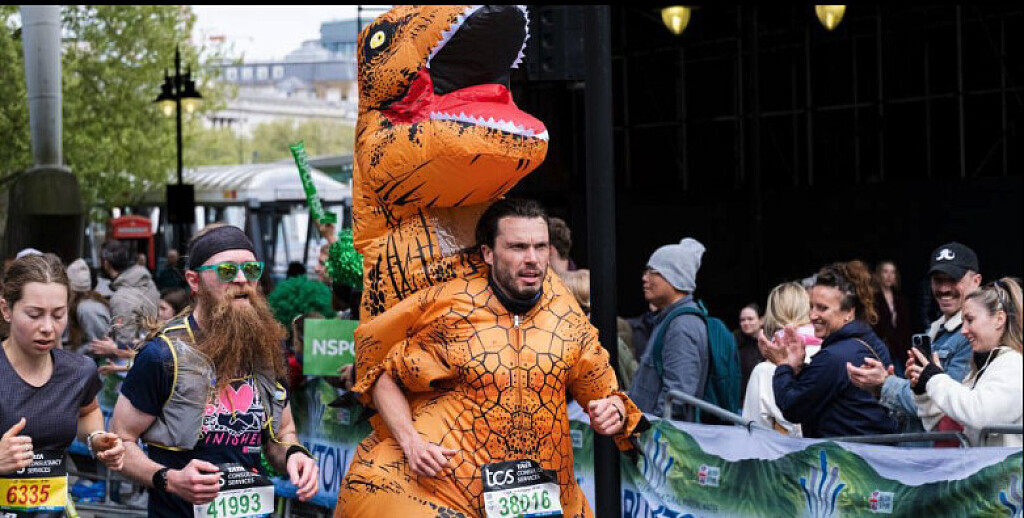
Here are some of the Guinness World Records set at the 2024 London Marathon
Could you beat Lee Baynton’s new record of “fastest marathon in a full-body inflatable costume?”
Each year, the London Marathon sees several Guinness World Record attempts, bizarre and wonderful feats like “the fastest female dressed as stationery (2022)” and “fastest marathon in dressed as a film character (Forrest Gump, 2018),” make history books—and 2024 was no exception. But of the 44 world records set or broken during the race, not all were just for costumed runners.
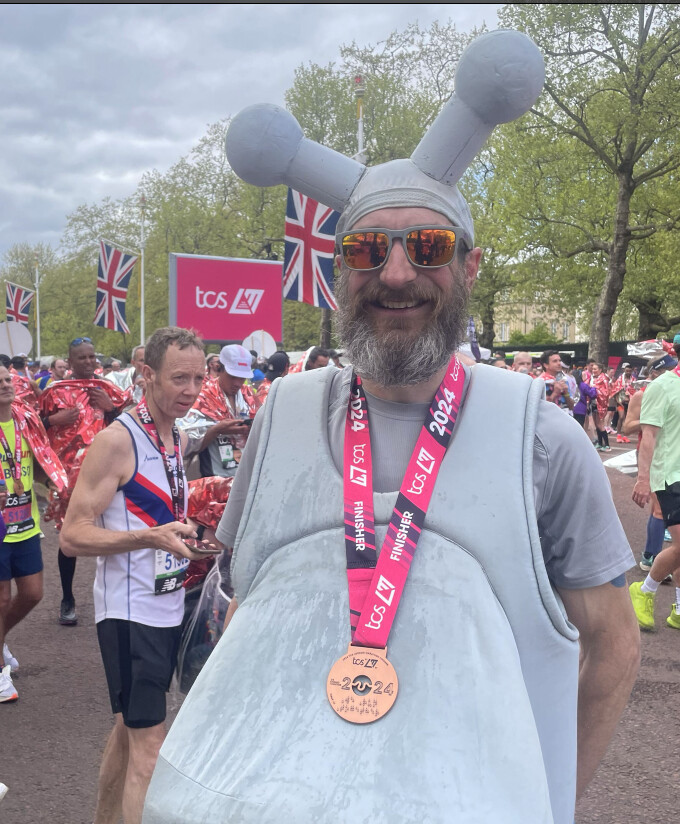
Among the remarkable stories was that of Jono Astle, a Londoner who not only ran the fastest marathon for someone with MS, but also raised a commendable $25,000 for the Multiple Sclerosis Society along the way.
Anthony Bryan, who lost the use of the left side of his body after having surgery to remove a brain tumor as a child, ran the fastest marathon by someone paralyzed down one side of their body, beating the previous time of 5:50. (Bryan, a lifelong supporter of Tottenham Hotspur FC, even met up with Spurs defender Ben Davies before the marathon for some extra encouragement to help him get the record.)
For the costumed runners, the outfits were as varied as the times they ran.
Lee Baynton of Essex ran the fastest-ever marathon in an inflatable costume, clocking a 3:21:07 while raising money for a local hospice. It was Baynton’s sixth marathon, but he said this was his favorite. “All the kids, as soon as they see you, are smiling, high-fiving. Everyone’s cheering and chanting, it’s incredible—I should do this every year,” he told The Independent.
Stephen Cochrane broke the Guinness World Record for the fastest marathon dressed as a scientist, although science could not save him from overheating during the race. “The lab coat gets sweaty, heavy, and you overheat very quickly. By halfway, I was really struggling,” he told the paper.
Simon Killen of Holbeach, England, broke the record for the fastest marathon dressed as a video game character. Ironically, it was not Sonic, but Mario, that Killen chose to beat the previous record of 2:57. It was also Killen’s personal best. No word if he used a mushroom beforehand, though he did complain of cramps.
Some overheated runners could have used a visit from Marcus Mumford, who ran the fastest marathon while dressed as a water tap, with a time of 3:10. Mumford loves plumbing fixtures, previously running London in 2014 dressed as a toilet. “I’m working my way around the bathroom items,” he told The Independent. “People didn’t really know what I was. I was called a weather vane, radio station. It’s all in aid of Water Aid – a fantastic charity.”
The full list of new Guinness World Records titles:
Peres Jepchirchir: Fastest marathon (female, women-only race) - 02:16:16
Richard Whitehead: Fastest marathon (LA3) (male) - 02:42:01
Simone Carniglia: Fastest marathon by a type 1 diabetic (male) - 02:44:33
Stephen Cochrane: Fastest marathon dressed as a scientist (male) - 02:48:51
Simon Killen: Fastest marathon dressed as a videogame character (male) - 02:52:57
Sam Hull: Fastest marathon dressed as a tennis player (male) - 02:59:38
Warren Parish: Fastest marathon dressed as a cheerleader (male) - 03:03:51
Holly Brownlee: Fastest marathon dressed in pyjamas (female) - 03:06:18
Jonathan Astle: Fastest marathon with multiple sclerosis (male) - 03:07:34
Marcus Mumford: Fastest marathon dressed as a tap/faucet (male) - 03:10:50
James Whistler: Fastest marathon dressed as a harlequin (male) - 03:12:00
Alison Stewart: Fastest marathon dressed as a videogame character (female) - 03:19:10
James Applegarth: Fastest marathon in pilot uniform (male) - 03:20:25
Ian Howard: Fastest marathon dressed as a rotating puzzle cube (male) - 03:20:31
Lee Baynton: Fastest marathon in a full-body inflatable costume (male) - 03:21:07
Matt Everett: Fastest marathon dressed as a traffic cone (male) - 03:22:16
Douglas O’Neill: Fastest marathon dressed as a sweet food (male) - 03:28:16
Gilles Dufosse: Fastest marathon dressed as a monarch (male) - 03:32:16
Kate Baldock: Fastest marathon dressed as a Star Wars character (female) - 03:33:12
Toby Norman: Fastest marathon dressed as a three dimensional aircraft (male) - 03:34:27
Ollie Shortt: Fastest marathon dressed as a body part (male) - 03:43:00
Laura Baker: Fastest marathon dressed as a sweet food (female) - 03:45:57
Tom Hall: Fastest marathon dressed as an emoji (male) - 03:50:17
Claire Casselton: Fastest marathon dressed as a skeleton (female) - 03:51:01
Ben Kellett: Fastest marathon carrying a bicycle - 03:54:52
Kimberly Siano: Fastest marathon dressed in a safari suit (female) - 03:54:58
Uilszaya Bodikhuu: Fastest marathon dressed in traditional Mongolian dress (female) - 03:59:56
Jennifer Stack: Fastest marathon dressed as a flag (female) - 04:01:02
Charlie Fitton: Fastest marathon dressed as a snowperson (female) - 04:05:52
Karen Stebel: Fastest marathon dressed as a mobile phone (female) - 04:08:42
Joanne Bridle: Fastest marathon dressed as a clown (female) - 04:16:36
Jani Barré: Fastest marathon in a non-racing wheelchair (female) - 04:19:21
Adrian Bebb: Fastest marathon dressed as a road vehicle (male) - 04:21:41
Andrew Roberts: Fastest marathon wearing chainmail (upper body) - 04:22:24
Alexandra Fresco-Sumner: Fastest marathon dressed as a mechanic (female) - 04:28:58
Caroline Duncan: Fastest marathon dressed in a flight suit (female) - 04:36:16
Emma Whatley: Fastest marathon dressed as a road vehicle (female) - 04:38:30
Andy Fountain: Fastest marathon dressed as a rocking horse (male) - 05:04:52
Phillip Beer: Fastest marathon dressed as a book (male) - 05:08:04
Georgina Box: Fastest marathon in a full-body inflatable costume (female) - 05:10:31
Anthony Bryan: Fastest marathon (CIH) (male) - 05:49:04
Brendan Matthews: Most T-shirts worn during a marathon (male) - 100 T-shirts
Jackie Scully, Frances Walker, Petr Maslov, Aileen Rice-Jones, Daniel Smith, Alex Weight, James Read, Kate Rham, Cameron Sharpe, Michael Edwards: Fastest marathon in a ten-person costume – 06:32:05
Lloyd Martin: Youngest person to complete a marathon (II2) (male) - 06:46:10
by Runner’s World
Login to leave a comment
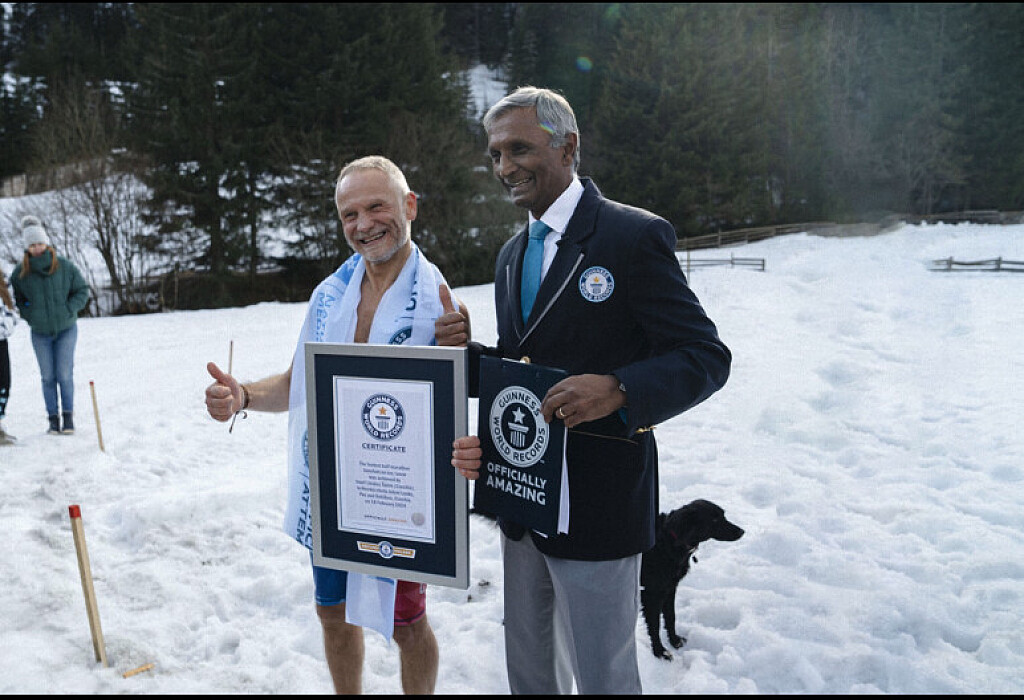
Man Breaks World Record For Fastest Barefoot Half Marathon Run On Ice
Josef Šálek of Czechia ran 1:50:42 in freezing temperatures, wearing nothing but a pair of shorts.
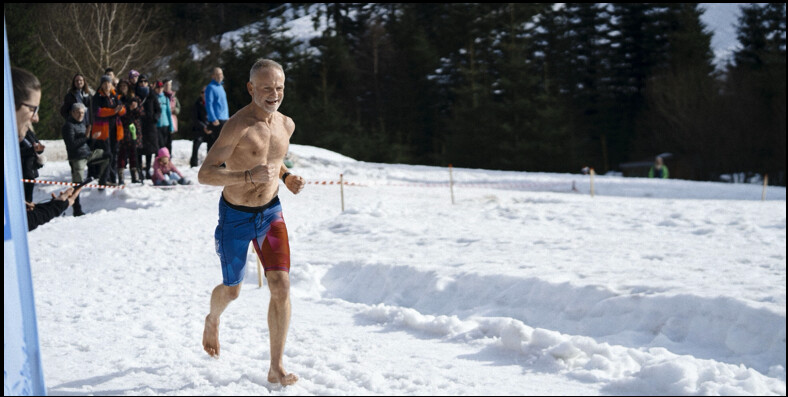
Josef Šálek is the proud new Guinness World Record holder for the fastest half marathon completed barefoot on ice/snow, a feat he accomplished in 1:50:42 clad in nothing but a pair of short tights and an ecstatic grin. The Czech therapist, lecturer, and personal development coach bested the previous record of 2:16:34 set by Dutch runner Wim ‘The Iceman’ Hof in 2007.
It’s not his first world record either. In 2023, the fitness enthusiast proved his extreme abdominal strength by holding a plank for 9 hours, 38 minutes, and 47 seconds, besting the previous record by more than eight minutes.
The new record for the fastest barefoot half marathon on ice was set on an open circuit in a valley near the highest mountain in Czechia (previously referred to as the Czech Republic), measured by a professional surveyor.
Technically, Šálek’s preparation for the record began back in 2013, before he even became a runner. He started hosting workshops where he would walk barefoot over hot coals and glass shards. “I needed to show people how to manage their fears and lack of self-confidence in practice,” he wrote on his website.
Then in 2017, after going through a breakup and struggling with unhealthy eating and alcohol and cigarette use, he decided to try running. It provided a distraction from his heartbreak.
“My communication with my body developed strongly,” he wrote, “and after only a few months I had the need to run barefoot and half-body. Since then, I regularly run several tens of kilometers or marathons year-round barefoot.”
In the two weeks leading up to his official record attempt, Šálek submerged his feet in a tub of ice everyday. The night before, the course froze over and it appeared that it wouldn’t be possible for Šálek to run that day after all, but after volunteers raked the ground, the athlete was able to embark on his mission to embrace the pain cave.
On the course, Šálek zigzagged and adapted his running pattern to keep from slipping on the ice. It was by no means easy—picture running an 8:27/mi average pace over sharp, slick ice whilst barefoot and scantily clad—but thanks to his training and mental fortitude, Šálek conquered his goal, and made it to the finish line with a broad smile on his face. The Guinness World Records official adjudicator, Pravin Patel, was on site to announce Šálek’s successful attempt and to hand him his certificate.
After his abdominal plank world record, Šálek told an interviewer, “I knew that in my case it’s not about demanding physical training, but rather about mastering the process… about my mindset.” One of the mental techniques he practiced was acceptance; he embraced the difficulty of the exercise. Making peace with the physical discomfort probably went a long way in helping him towards his new superlative on the ice as well.
by Runner's World
Login to leave a comment
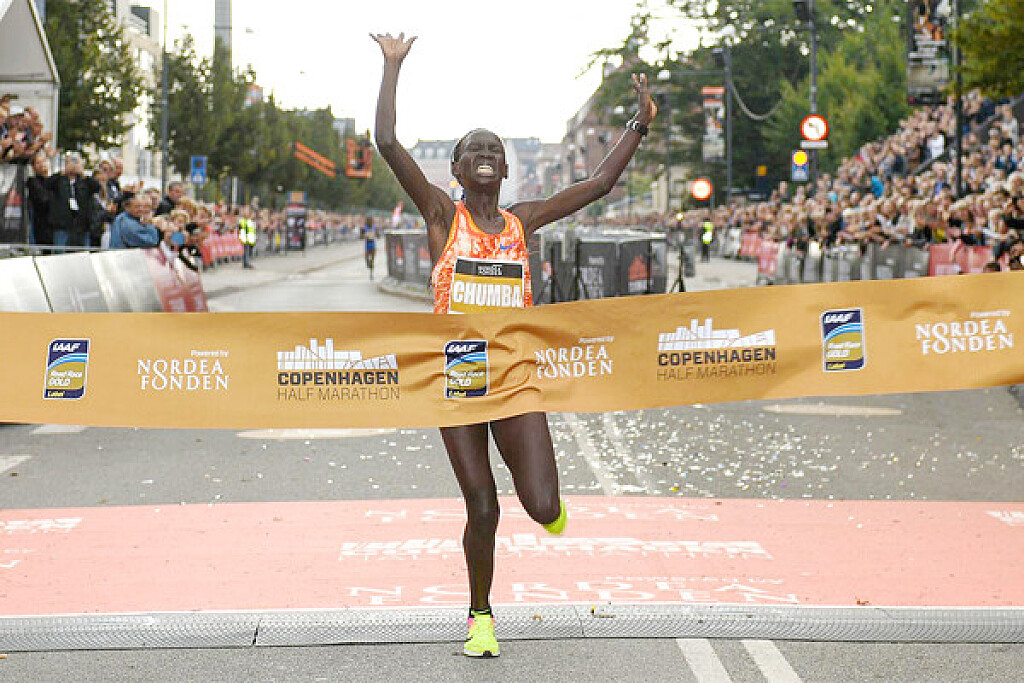
Chumba will go head to head against Gebreslase when the two clash at the Nagoya women’s marathon
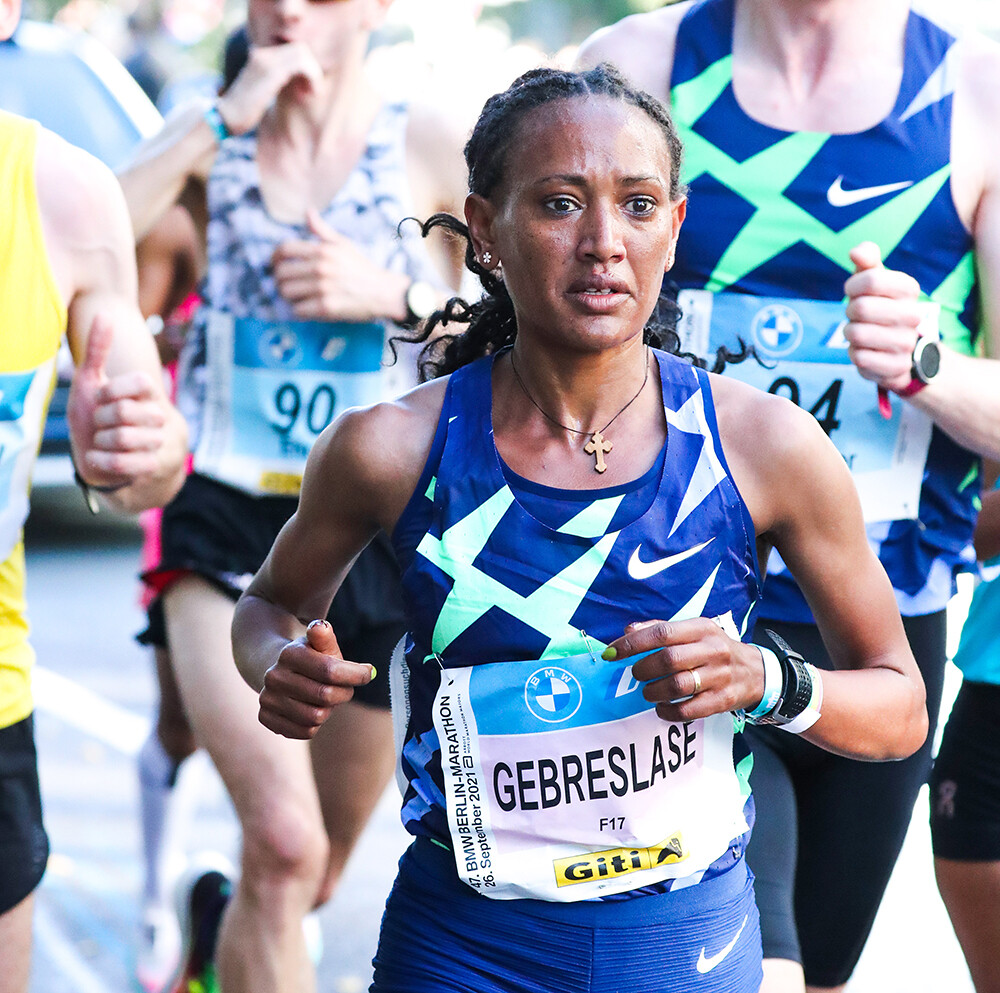
Kenya-born Bahranian Eunice Chumba will go head to head against 2022 World champion Gotytom Gebreslase of Ethiopia when the two clash at the Nagoya women’s marathon slated for March 10.
Nagoya women’s marathon is held annually in Japan and it is the largest women’s race in the world certified by the Guinness World Records.
It was launched on March 12, 2012 with an initial participation of 13,114. It has since grown to be recognized by World Athletics as a Platinum label race averaging 20,000 participants.
Chumba was a silver medalist in the 10,000m at the 2018 Asia Games in Jakarta, Indonesia, where she clocked 32:11.12.
Before that, she had also placed second in the same event in the 2015 Asia Championships held in Wuhan, China in 32:22.29. The 31-year-old further won the 2023 NN Rotterdam Marathon, Netherlands, clocking 2:20:31.
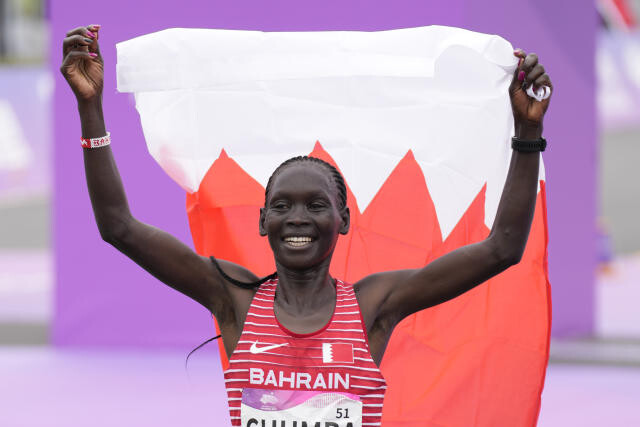
She followed it up with a bronze medal during the Shanghai Marathon, China, in November clocking 2:22:20.
Chumba has also won titles in the Abu Dhabi Marathon (2:20:41) in 2022 and the Copenhagen Half Marathon (1:06:11) in 2017.
In 2021 Gebreslase made her debut in the marathon with an overwhelming victory at the Berlin Marathon, Germany, clocking 2:20:09.
She followed it up with a bronze medal in the Tokyo marathon in 2022 (2:18:18) before winning the title at the 2022 World Athletics Championship (2:18:11) in Eugene, USA.
The 29-year-old also has a title in the Bahrain Half Marathon (1:05:36) and a silver medal in the Ras Al Khaimah marathon (1:05:51).
The two will be joined by the 2020 Napoli half marathon champion Violah Lagat and Kenyan-born Romanian Delvine Meringor.
Meringor won a title at the 2022 Los Angeles Marathon, USA, where she clocked 2:25:04.
The local contingent will be led by Ai Hosaoda who boosts a personal best of 2:21:42. She will be joined by 2016 Japanese champion in the 10,000m Suzuki Ayuko.
by Teddy Mulei
Login to leave a comment
Nagoya Women's Marathon
The Nagoya Women's Marathon named Nagoya International Women's Marathon until the 2010 race, is an annual marathon race for female runners over the classic distance of 42 km and 195 metres, held in Nagoya, Japan in early March every year. It holds IAAF Gold Label road race status. It began in 1980 as an annual 20-kilometre road race held in...
more...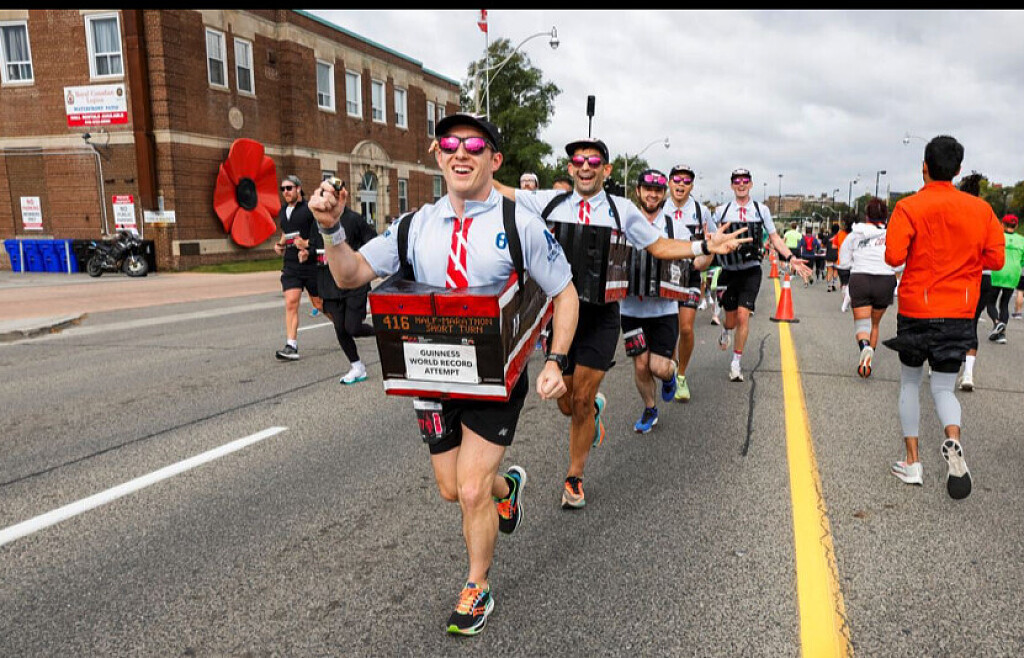
Toronto running quintet sets Guinness World Record in TTC streetcar costume
There were more than 20 Guinness World Record attempts at the 2023 TCS Toronto Waterfront Marathon on Sunday, but one of the most unique records among them was achieved by a group of Toronto runners who dressed up as a Toronto Transit Commission (TTC) streetcar and set the record for the fastest half-marathon in a five-person costume. They completed the race in 1:48:59.
The quintet, consisting of Dekel Chui, Tom Brooks, Andrew Bondoc, Derek Beaton and Jared Nylander, all members of Toronto’s runTObeer run club, crafted their five-person costume from reusable grocery bags, cardboard and blinds from Ikea. They set out to beat the previous record of one hour and 59 minutes, and to their surprise, they achieved their goal by finishing more than 10 minutes ahead of the previous record.
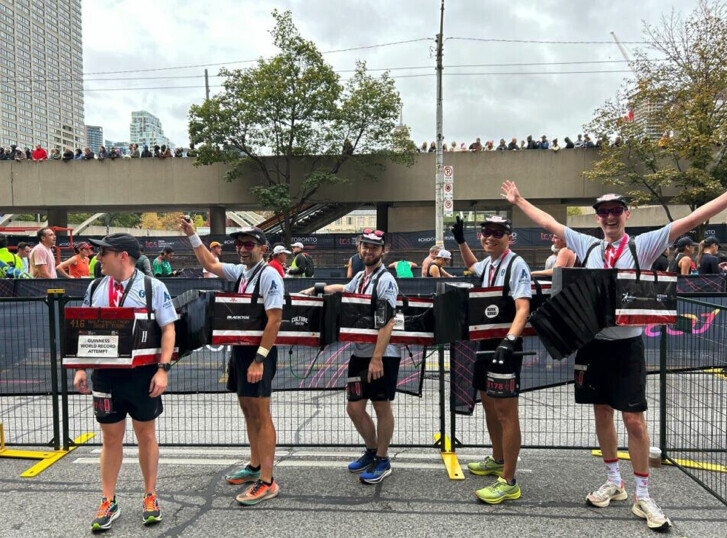
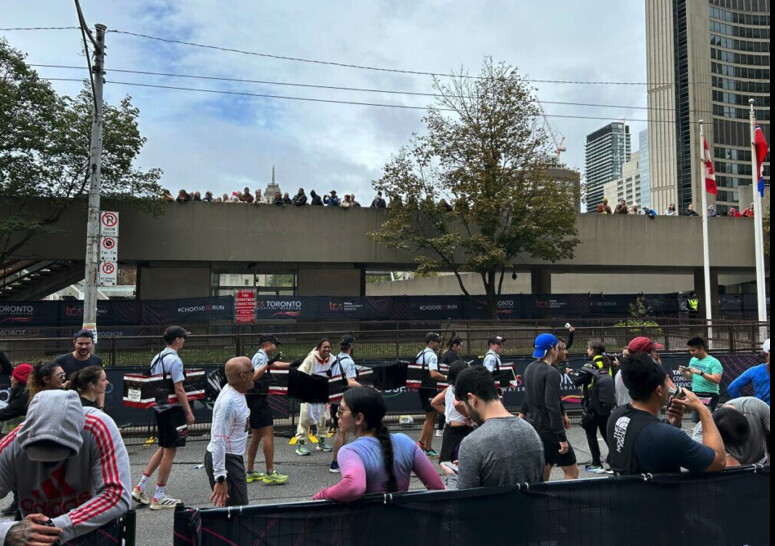
The idea for this unique project came from Brooks, who had previously set a Guinness World Record for running a 100-miler in a penguin costume for charity. Chui said, “He brought the group costume idea to us, and we wanted to pay homage to the city that we know and love. We ended up picking the TTC streetcar.”
Chui and Brooks said in a post-race interview that the five of them did not practise in the costume before race day, relying on “a few warmup kilometres” as their preparation.
Setting a Guinness World Record was not the only achievement the quintet aimed for. They aimed to raise over $1,000 for a local cat rescue shelter in Toronto’s Annex community. Brooks shared, “As a team, we have three rescue cats, one coming from Annex Cat Rescue. They do fantastic work in our community, and we hope we can inspire others to support them.” Currently, they have raised more than $1,300 and counting.
“Toronto man runs entire subway system in cool challenge” — Canadian Running Magazine
The five-person costume half-marathon record was one of 11 Guinness World Records set at the 2023 TCS Toronto Waterfront Marathon.
Experience the 2023 TCS Toronto Waterfront Marathon live from downtown Toronto on Oct. 15. Get the latest race news, updates and live results from Canadian Running with the support of ASICS Canada. Follow us on Twitter and Instagram for all the action.
by Running Magazine
Login to leave a comment
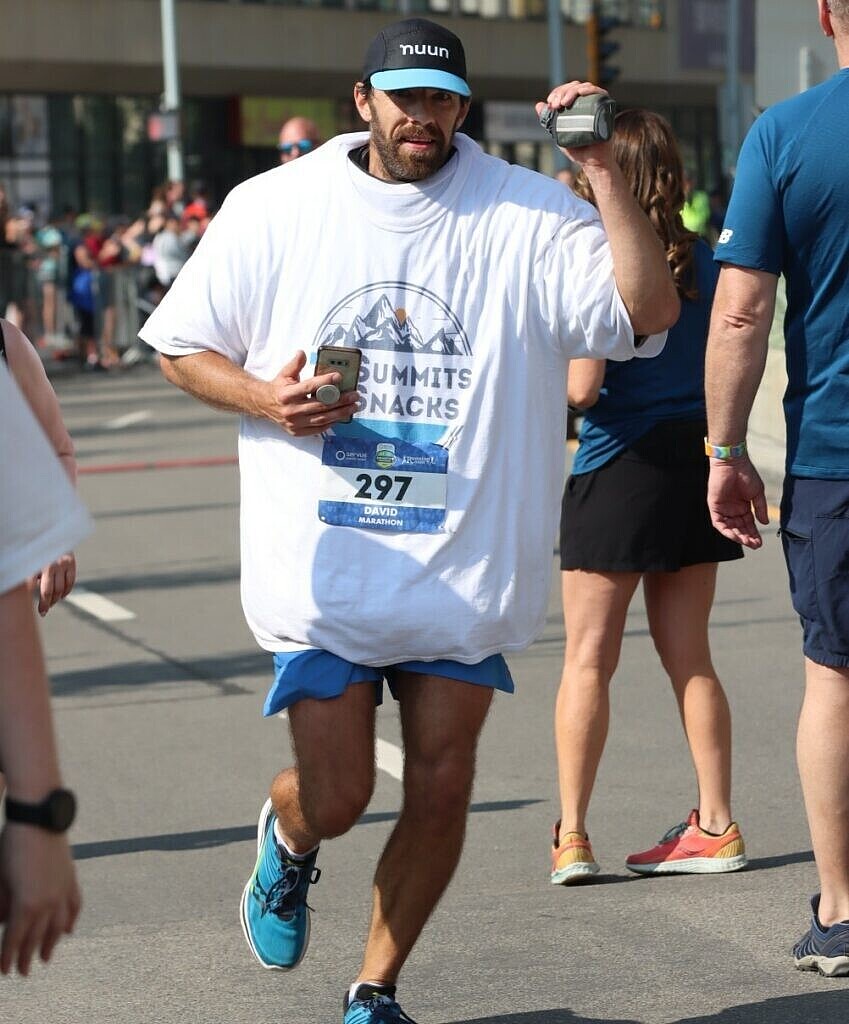
Edmonton runner breaks world record for most T-shirts worn in a marathon
David Eliuk celebrated a top-heavy triumph at the Servus Edmonton Marathon on Sunday, setting a world record for the most shirts worn while completing a 42.2-km race.
The Edmonton man sported 78 running shirts as he crossed the finish line in 5:01:50, absolutely smothering the official Guinness World Record of 54 shirts set by British runner David Smith in 2022.
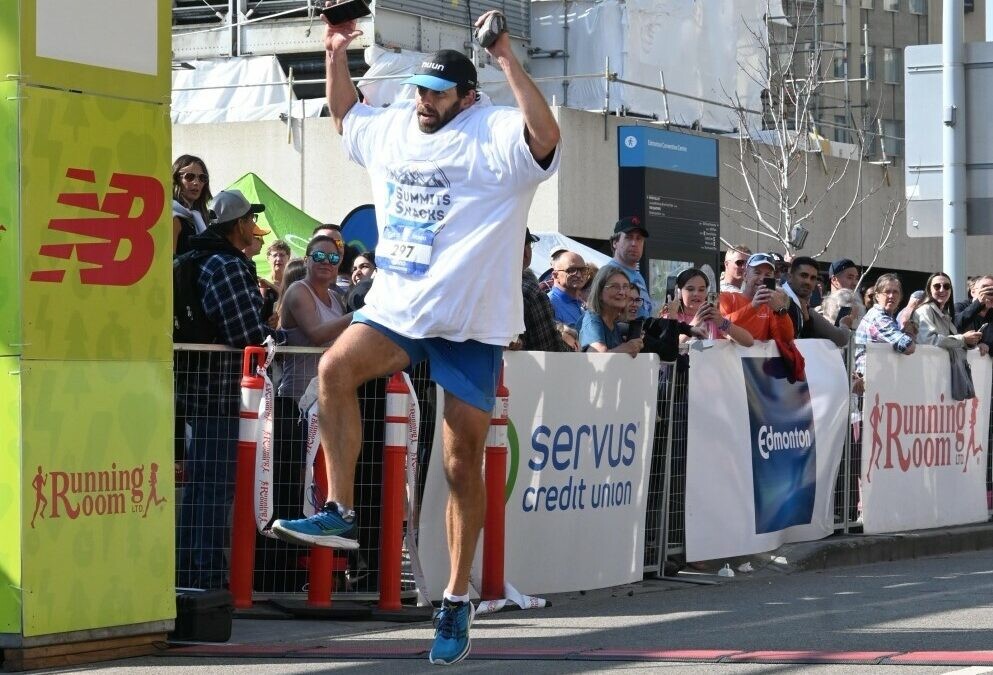
His new marathon crown, which has yet to be ratified by Guinness World Records, will be a familiar fit for Eliuk (and certainly a more comfortable one than his race outfit on Sunday), who previously held the Guinness World Record of 120 for the most shirts worn in a half-marathon.
While being encased in scores of T-shirts may look comical to outsiders, it’s a different story altogether on the inside, Eliuk told Canadian Running on Tuesday.
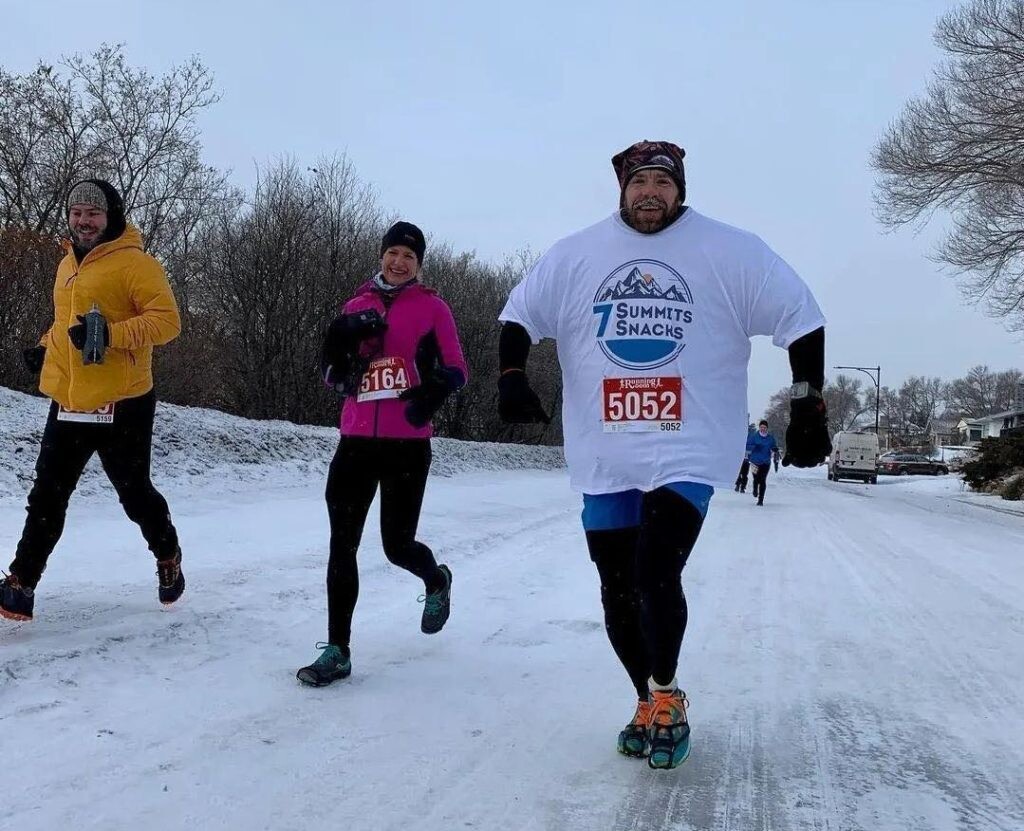
“It hurt. It actually caused restriction of blood flow to my hands and my lower arms,” Eliuk said of his effort at this year’s Hypothermic Half Marathon in Edmonton, where he officially set the half-marathon record.
He said his marathon attempt Sunday was originally part of his bid to simultaneously hold both the half-marathon and marathon titles. However, his half-marathon record fell in May to American Dan Harvey, who sported 127.
Eliuk said while Sunday’s shirt count of 78 was much less constricting and painful than his three-digit total for the half, his run at the Servus Edmonton Marathon presented a different set of challenges—not the least of which were the temperatures of a summer race.
“While I’m wearing fewer shirts and I don’t have the restriction and I don’t have the mobility issues, I also have to be very aware of my body temperature and sustaining myself through hydration and fuel for five hours,” he said. “It was still uncomfortable, still almost 30 pounds of shirt, and the weight on my shoulders and my back especially was really, really hard.”
Fortunately, race organizers allow runners who expect to take longer than six hours to finish to set out an hour before the usual 7 a.m. start time, which helped allay Eliuk’s concerns over heat.
“I was able to talk with the race director and the race crew and was allowed to enter that wave. So I actually started an hour before the regular marathon. I think it was about 8 C at 6 a.m. Being able to start out running in 8 C temperatures instead of 15 C makes a huge difference when I’m doing what I’m doing.”
Weighing on Eliuk, besides the shirts, was the clock. Guinness World Records rules require that record attempts for the most T-shirts worn in a marathon be completed within six hours.
“My morning was really solid and really good,” he said. “I was able to keep moving for the majority of it and I hit the half at around two hours and 11 minutes, so I had almost four hours to complete the second half of the race.”
Eliuk said he’s content just to appreciate his latest accomplishment, and doesn’t plan on chasing his former goal of holding both the marathon and half-marathon T-shirt records at the same time.
“I know how hard it is at 120 shirts, so for this other guy to go to 127, he’s just at a different level. I’ve been in his shoes before. I know how uncomfortable he was, so I’m happy letting the half-marathon record go.”
Next on his race calendar is the New York City Marathon in November, which he and his girlfriend will be running in support of Think Pink Rocks, a campaign supporting genetic testing for the detection of breast cancer.
“I’ll just be wearing the one shirt in New York,” he said.
This year’s Servus Edmonton Marathon was won by Meng-Tsung Chu from Colorado Springs, in 2:22:54 (one of the fastest times in the race’s 32-year history) and Janelle Bykowski of Lethbridge, Alta., in 2:51:53–and it was her very first marathon.
by Paul Baswick
Login to leave a comment
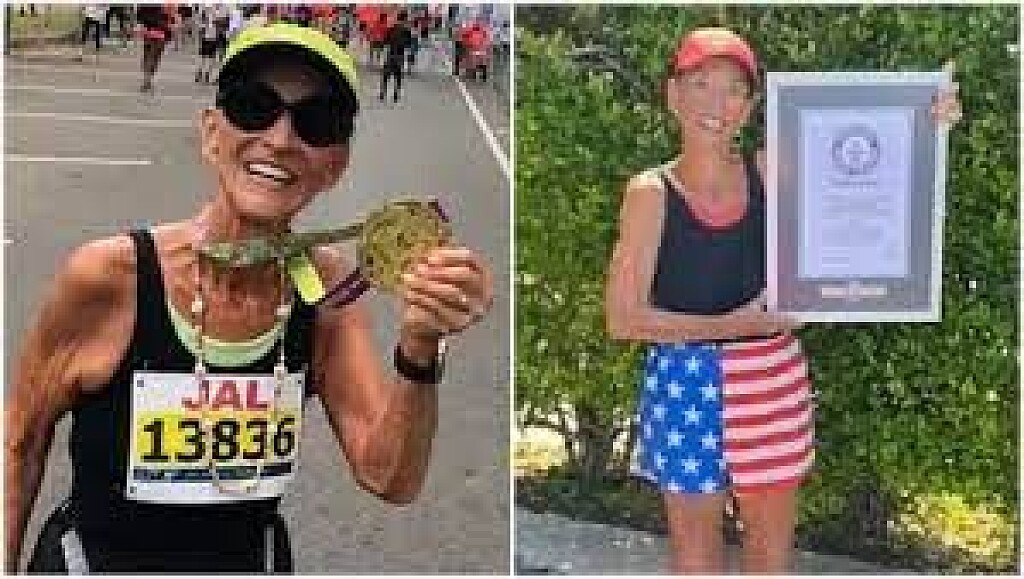
It’s Official! 92-Year-Old’s Marathon World Record Finally Approved
Mathea Allansmith now holds the Guinness World Record as the oldest woman to have completed a marathon.
In December 2022, 92-year-old Mathea Allansmith crossed the Honolulu Marathon finish line, becoming the oldest woman to have ever completed a 26.2-mile race. She surpassed the former record holder, Harriette Thompson, by over three months. Half a year later, after a thorough ratification process, Guinness World Records has given their nod of approval, making the record official.
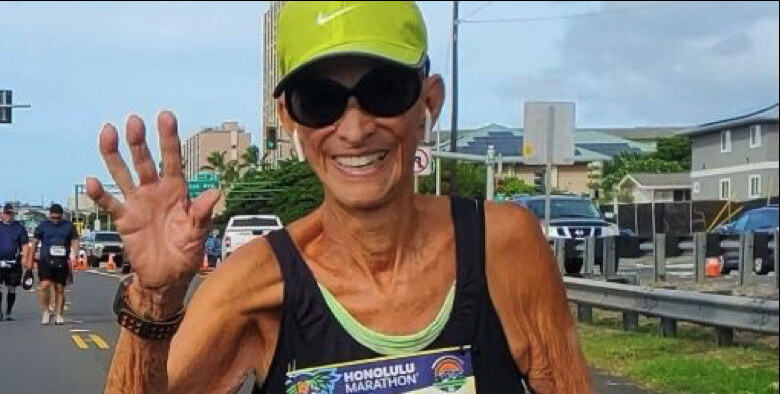
Rain or shine, Allansmith, now 93, runs six days per week all throughout the year, maintaining a training volume of about 36 weekly miles, even on vacation, and steadily increasing her mileage about 18 weeks prior to a marathon.
The retired doctor lives in Koloa, Hawaii, and didn’t start her running journey until she was 46 years old, after a colleague suggested running two miles per day. “I took up running in 1977 and fell in love with the feeling of exercising outside,” she told GuinnessWorldRecords.com. She credits her healthy running lifestyle with her high quality of life, and while her stamina has decreased over time, she’s making the most of what she’s got at any given moment. “I see the direct connection between moving and health,” she said.
The 1982 Boston Marathon was her first experience racing 26.2 miles, but the Honolulu Marathon is her favorite, partly because the race organizers don’t have a time cutoff, so even slower runners have an opportunity to complete the course.
“It’s one of the best-executed races,” she said to Guinness. “Fantastic registration, set up and management makes it a joy to participate in.”
On the day of her world record, Allansmith’s six children surprised her by wearing matching T-shirts denoting their mother’s achievement. “I felt an enormous sense of accomplishment and joy,” she told Guinness.
Allansmith plans to continue running marathons for as long as possible, and hopes to nab some other world records along the way, for other distances like the 10K and half marathon.
by Runner’s World
Login to leave a comment
92-year-old grandmother becomes oldest woman to finish a marathon
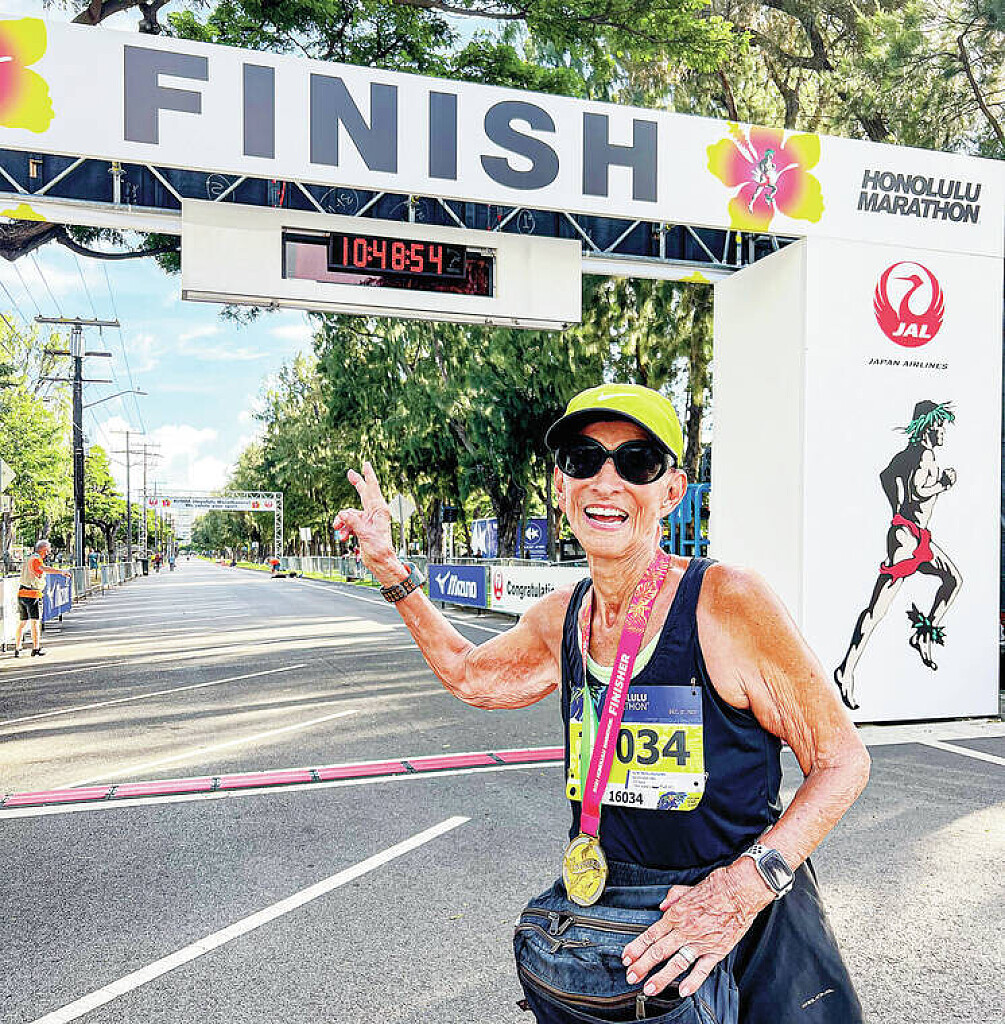
A grandmother has officially run her way into the Guinness World Records as the oldest woman to complete a marathon. Mathea Allansmith of Koloa, Hawaii, has had her record-breaking run at December’s Honolulu Marathon ratified, an effort that saw her complete the 42.2-km distance in 11 hours, 19 minutes and 49 seconds minutes at the age of 92 years and 194 days. She completed the course in 10 hours and 48 minutes at age 91 the previous year.
Allansmith, who has since turned 93, told Guinness World Records this week that she hasn’t slowed down since her record-breaking run in Hawaii. “I train year-round but increase the mileage starting 18 weeks before a marathon,” she said. “
The pace and number of miles per training day are going to shift around but no matter what, I’ve got my running shoes on and I’m out the door six days per week. These days, on average, I run 36 miles per week.”
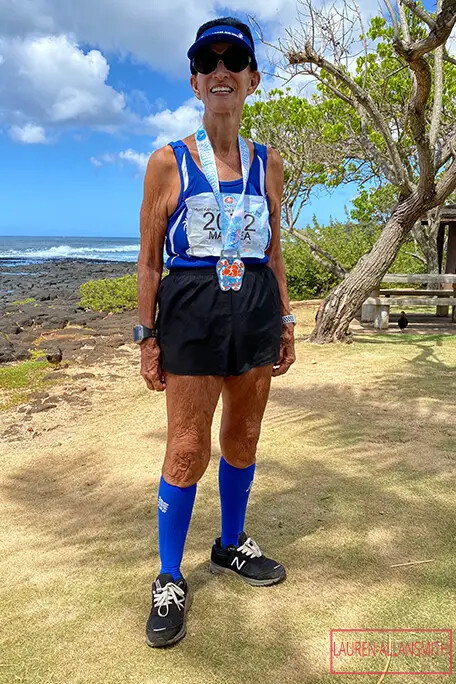
The retired doctor, who began running at age 46, noted her career as a physician drove home the benefits of a healthy diet and an active lifestyle on body and mind. “I see the direct connection between moving and health. … I’d say that my healthy lifestyle has allowed me to maintain a very high quality of life,” she said.
Adding to the thrill of breaking the world record, she said, was being able to do it on a course she so enjoys. “The Honolulu Marathon is my favourite marathon, partly because they don’t close the gate at a certain time, which allows even the slowest runners to finish the race. It’s one of the best-executed races. Fantastic registration, set up and management makes it a joy to participate in,” said Allansmith.
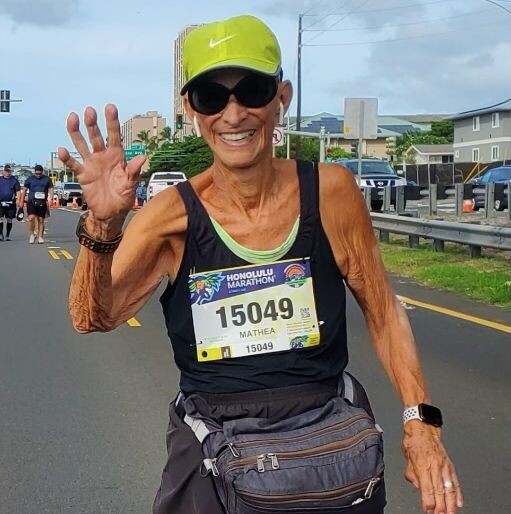
“There were several groups of people filming and cheering me on, even though I crossed the finish line some 11 hours after the start of the race. I felt an enormous sense of accomplishment and joy.”
Allansmith said she plans on running marathons for as long as possible. She added she hopes her recent world record won’t be her last, noting she plans on attempting to break the records for the oldest person to complete a 10K (female) and the oldest person to complete a half-marathon (female) within the year.
by Paul Baswick
Login to leave a comment

Honolulu Marathon
The Honolulu Marathon’s scenic course includes spectacular ocean views alongside world-famous Waikiki Beach, and Diamond Head and Koko Head volcanic craters.The terrain is level except for short uphill grades around Diamond Head. ...
more...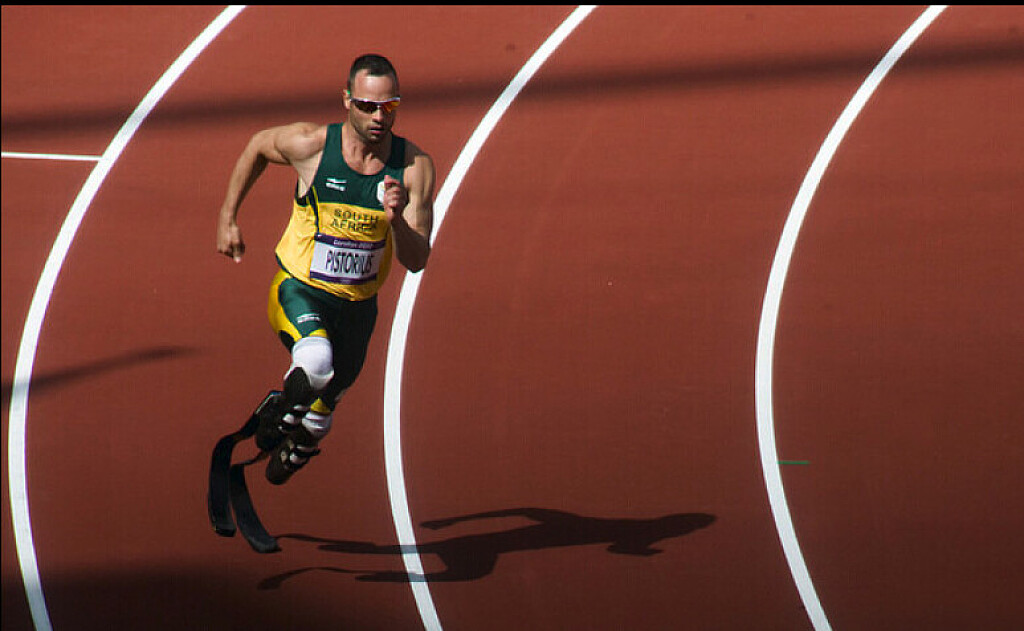
Study finds blade runners do not have a competitive advantage
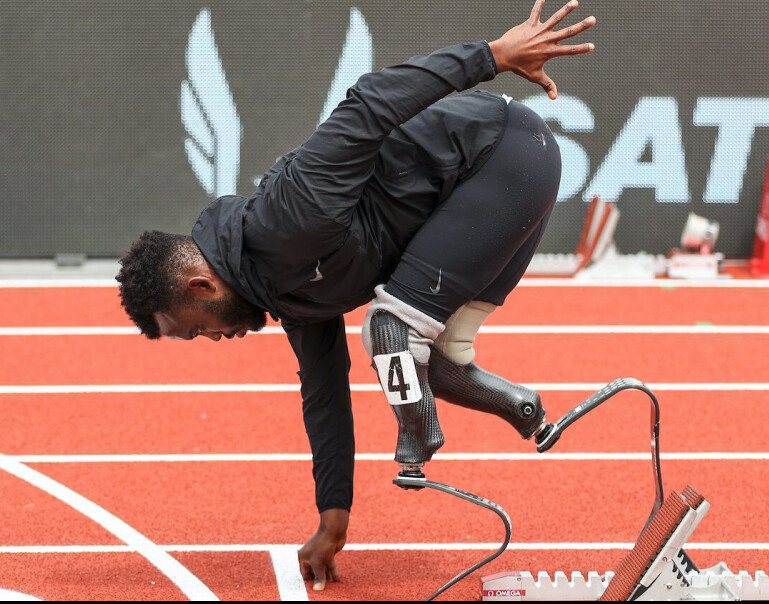
Are prosthetic, “man-made” limbs more efficient or powerful than biological legs? This has been debated in track and field circles for years, but recent research suggests what amputee runners have known all along–they aren’t. At least, not over 400 metres.
A recent study from the University of Colorado at Boulder found that blade runners, including the world’s fastest 400-metre sprinter, Blake Leeper of Tennessee, have no competitive advantage over non-amputee runners. Instead, they likely have a significant disadvantage.Prosthetic limbs, particularly those designed for athletic performance, have come a long way since Terry Fox made his inspiring, yet at times painful-looking, journey across Canada.
In the last decade, we’ve seen amputee runners run ultramarathons and set Guinness World Records, and many of us recall Oscar Pistorius, the double-amputee blade runner from South Africa who became the first to win a non-disabled medal at the 2011 World Track and Field Championships (he won silver in the 400m). Pistorius was later convicted of murder in the death of his girlfriend, Reeva Steenkamp, and remains in prison today.
Back in 2011, Pistorius had to take legal action against the IAAF (now World Athletics) to allow him to compete in the World Championships, since the governing body of track and field claimed his prosthetic limbs gave him an advantage over his competitors.
Leeper, who is also a double-amputee and the fastest blade runner over the 400m distance today, has faced similar rejection. He was ruled ineligible to compete at the 2020 Tokyo Olympic Games due to the perception that his “blades” gave him an unfair advantage.
The study
As it turns out, two legs do appear to be better than none, despite the incredible technology behind today’s prosthetic limbs. The study, published in the journal Royal Society Open Science, collected performance data from Leeper, Pistorius and six other bilateral amputee sprinters and compared that to the best non-amputee sprinters in the world across five performance metricLeeper also visited the researchers’ lab for a series of tests to measure his acceleration out of the starting blocks, maximum speed along straightaways and around curves, velocity at aerobic capacity and sprint endurance (all-out effort). This information was also compared to available data from elite non-amputee runners.
The research found that runners using prostheses were 40 per cent slower out of the starting blocks, had 19 per cent slower velocity at aerobic capacity and were one to three per cent slower around curves, compared to non-amputees.
“We found that no athlete with prosthetic legs has ever performed better than elite non-amputee athletes in lab-based experiments in any measure that relates to sprinting performance,” said first author Owen Beck.
The researchers presented their preliminary findings to the Court of Arbitration for Sport in 2020 in a bid to get Leeper to an Olympic start line, but the athlete was yet again deemed ineligible–the court ruled that his prostheses made him too tall. (The same researchers had found in a previous study that height did not provide an advantage when it comes to maximum sprinting speed, but Leeper was still ruled ineligible.)
While their results didn’t help Leeper this time, the researchers hope their work will change the conversation to provide more opportunities for amputee runners.
“A lot of assumptions have been made about running prostheses and performance with no data to support them,” said senior author Alena Grabowski, associate professor of integrative physiology at CU Boulder. “I hope this will get people to really question rules being put into place that keep athletes with disabilities from competing even when they have shown with science that they can compete fairly.”
by Running Magazine
Login to leave a comment
Yuki Kawauchi snags second BMO Vancouver Marathon victory
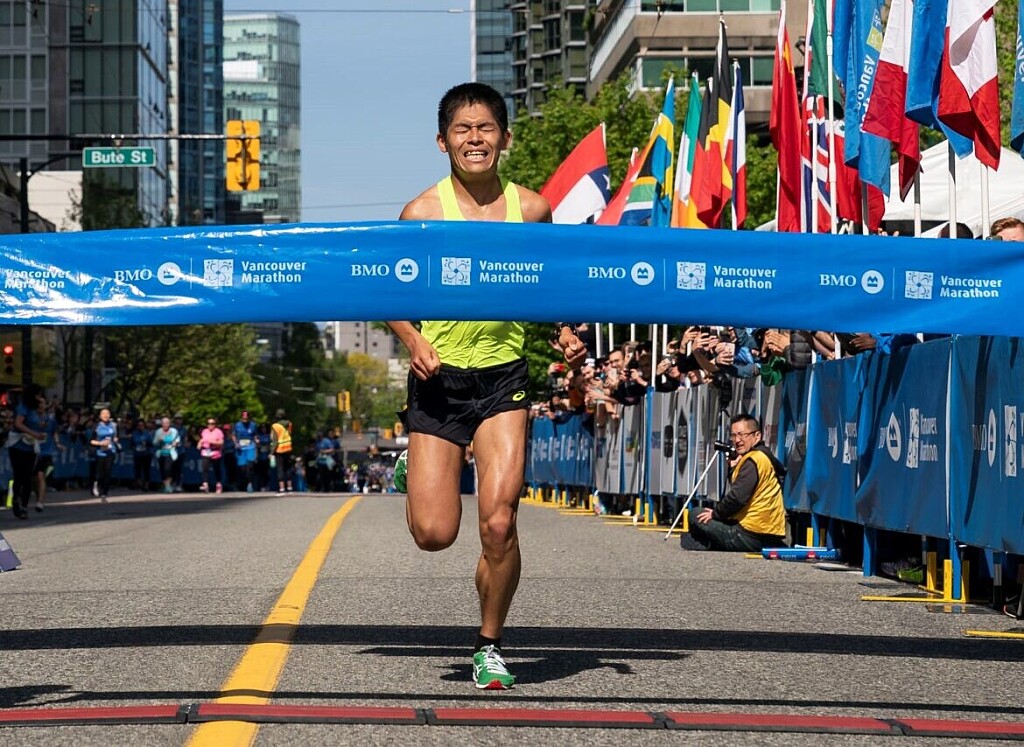
Japan’s Yuki Kawauchi claimed his second BMO Vancouver Marathon title on Sunday, finishing in 2:17:05–just over two minutes slower than his course-record-setting time of 2:15:01 in the 2019 marathon, and good enough to secure the 36-year-old a decisive victory against Toronto’s David Mutai (20:20:05) and Mississauga’s Sergio Raez Villanueva (2:23:21). Vancouver was just one of a number of marathons in Canada and Europe on Sunday.

With his latest victory, Kawauchi adds to an impressive list of accomplishments as a marathoner. The 2018 Boston Marathon champion was recognized by the Guinness World Records in 2021 for becoming the first person to run 100 sub-2:20 marathons.
Vancouver’s own Dayna Pidhoresky won the women’s marathon in 2:34:27, ahead of fellow Canadian Rozlyn Boutin (2:48:09) and U.S. marathoner Callahan McKenzie (2:49:28). Highlights of Pidhoresky’s running resume include winning the Canadian Olympic Trials Marathon in 2019 and being a four-time winner of the Around the Bay 30K race in Hamilton, Ont.
by Paul Baswick
Login to leave a comment

BMO Vancouver Marathon
The BMO Vancouver Marathon is one of Vancouver’s most iconic marathon events. The event features a full marathon, marathon relay, half marathon, 8k run, and streets lined with thousands of spectators. Runners can expect to experience a little bit of everything that Vancouver has to offer as they run a straight course that starts at Queen Elizabeth Park, and finishes...
more...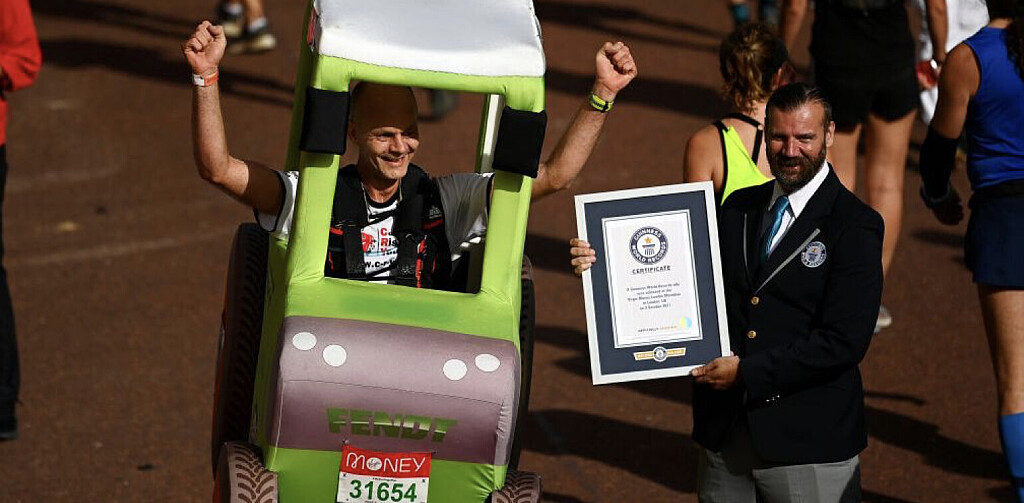
Here Are the 10 Most Hilarious Guinness World Records Being Attempted at the 2023 London Marathon
So far, 2023 has already given us so many memorable, slightly useless Guinness World Records—from the man who ran a half marathon while wearing 120 t-shirts to the J.K. Rowling fan that ran the fastest half marathon time while dressed as a witch and the man who crushed a half-marathon while in ski boots. Luckily, if you’re a fan of watching such feats, one of the premier events in the running world for setting wacky world records—the London Marathon—is here.
Last year’s event saw 18 records broken out of a possible 34 attempts, including the one completed by Kellie Clark, who, with her Snickers bar outfit, became the speediest female dressed as a candy confectionery item with a time of 4:24:06 and who could forget David Jones, who finished in 2:47:15 while wearing his pajamas.The number of attempts is no coincidence, as the race is entering its 16th year of collaboration with Guinness to bring creative and inspirational runners to the race to raise awareness for specific charities and organizations.
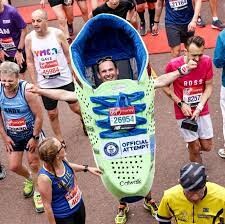
Guinness World Records adjudicators will be present at the start and finish lines of the TCS London Marathon to evaluate costumes, verify runner times, and certify any successful participants as official Guinness World Record holders, entitling them to be featured in the next installment of the book released in September 2023.
“It will be all my birthdays, and Christmases come at once! I used to get a copy of the Guinness World Records book every year under the tree and pore over it, gobsmacked by all the weird and wonderful records. So, to be included in there would absolutely be a dream come true,” said Jack Glasscock, who spoke to marathon organizers about the prospect of becoming the fastest man dressed as a Domino’s Pizza garlic and herb dip. Eliud Kipchoge may never be able to claim that.
While Glasscock, who is running to raise funds for the Teenage Cancer Trust, is one of the many costumed record hopefuls raising money for the charity of their choice, others, like Radio 1 DJ Adele Roberts, are hoping to break a record without an outfit. Roberts is just 18 months removed from surgery to remove her bowel and hopes to become the fastest marathoner with an ileostomy. She will do so to raise money for Attitude Magazine Foundation, which supports LGBTQ+ communities.
The 2023 edition of the race will be even more exhilarating, with a whopping 73 records set to be challenged this time. We’ll spare you the details of all 73, but we will share 10 of this year’s absolute dumbest records being attempted. Strap on your favorite candy-bar costume and get ready to be inspired:
Fastest marathon dressed as a three-dimensional dinosaur (male)
Fastest marathon dressed as a three-dimensional aircraft (male)
Fastest marathon dressed as a three-dimensional aircraft (female)
Fastest marathon dressed as a knight (male)
Fastest marathon in a full-body inflatable costume (male)
Fastest marathon carrying a household appliance
Fastest marathon dressed as a savory food (female)
Fastest marathon dressed as a gingerbread person
Fastest marathon dressed as a crustacean (female)
Fastest marathon dressed as a piggy bank
by Runner’s World
Login to leave a comment

After 113 straight ultramarathons, Candice Burt still isn’t done
American ultrarunner and race director Candice Burt completed a 50K on Sunday morning. She did the same thing on Saturday, and also on Friday, and for 110 days before that. In November, Burt, who hails from Boulder, Colo., decided to shoot for the Guinness World Record for most consecutive ultramarathons.
The previous record was 23 days, a total Burt surpassed about three months ago, and she’s still going, with a whopping 113 consecutive ultramarathons to date.

When Burt started her ultramarathon record attempt, the number to beat was 11 days. The total has reportedly been changed on multiple occasions since Burt set out to break the record, and it currently sits at 23 days on the Guinness World Records site. The record Burt was chasing and has since beaten is listed as a female and non-binary mark, but she has also smashed the male record of 21 days.
As Burt noted on her website, she can’t recall exactly what sparked her desire to chase this record, but she said it could have been after she saw ultrarunner Jacky Hunt-Broersma run 104 marathons in a row in 2022, or Alyssa Clark, who ran 95 straight marathons in 2020.
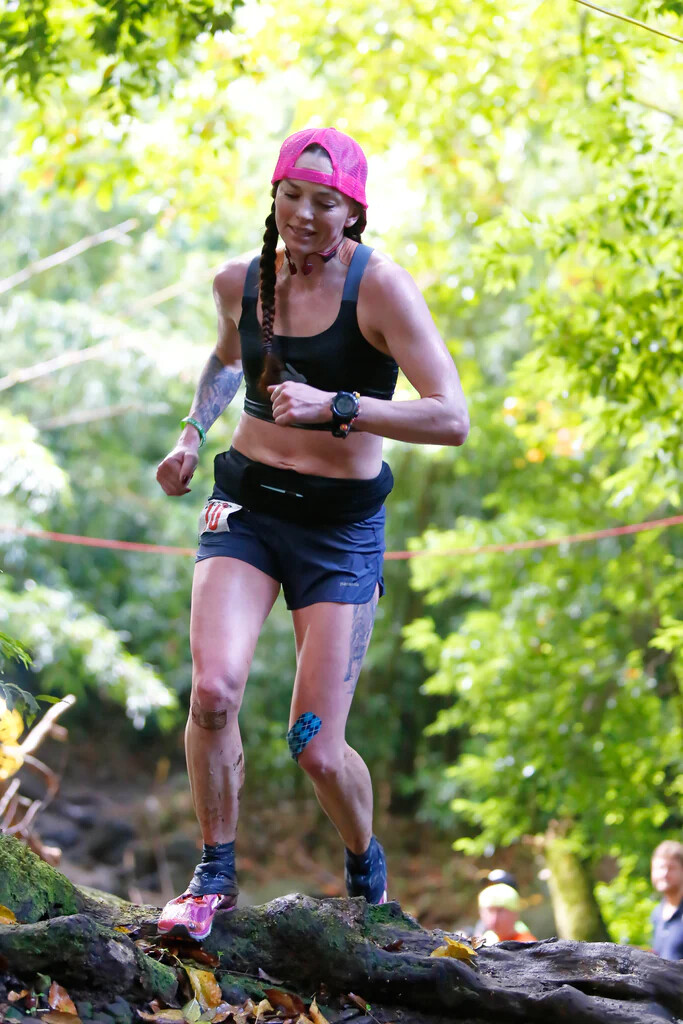
Burt added that it may have been her own previous hiking and ultrarunning feats that convinced her she could complete a challenge as big as an ultramarathon streak. But it looks like she could keep going for a while.
While Burt has now produced an incredible streak of more than 100 days, she wrote that she wasn’t even sure if she could make it to the record. “From the very start of considering the streak I just wanted to be open to doing it for as long as my body would hold up,” she wrote. “I wasn’t sure if that would even be the record-breaking 23 days, but I wanted to try.” Despite this uncertainty, she said that her goal was to go “much, much bigger” than 23 days, and even early in this journey, a result in the triple digits was on her radar.
Burt is the race director of popular ultras like the Moab 240 and Bigfoot 200.
by Ben Snider-McGrath
Login to leave a comment
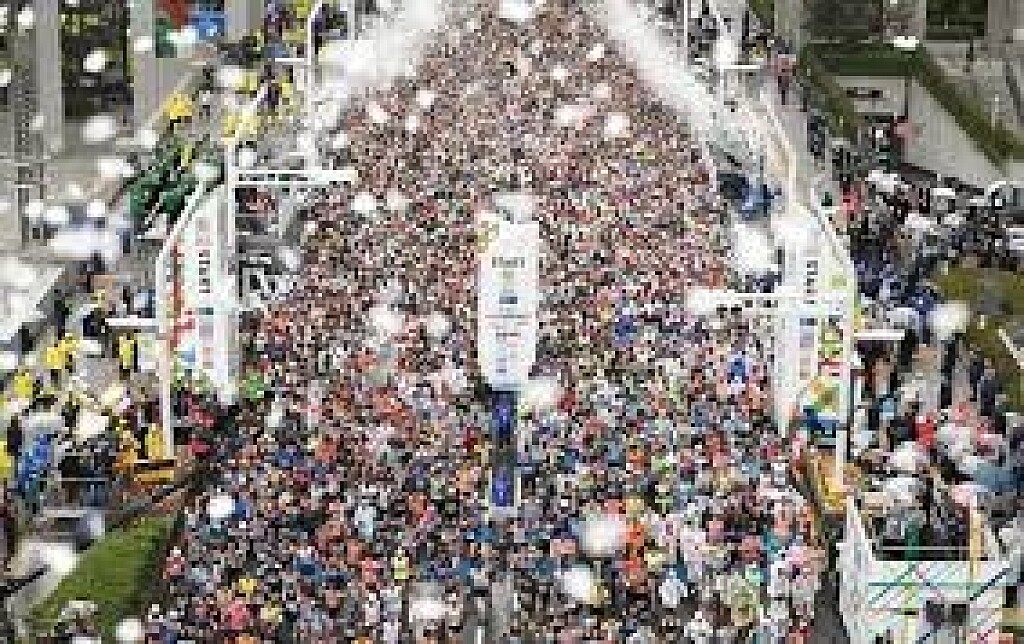
2023 Tokyo Marathon Six Star Finishers going for GUINNESS WORLD RECORDS
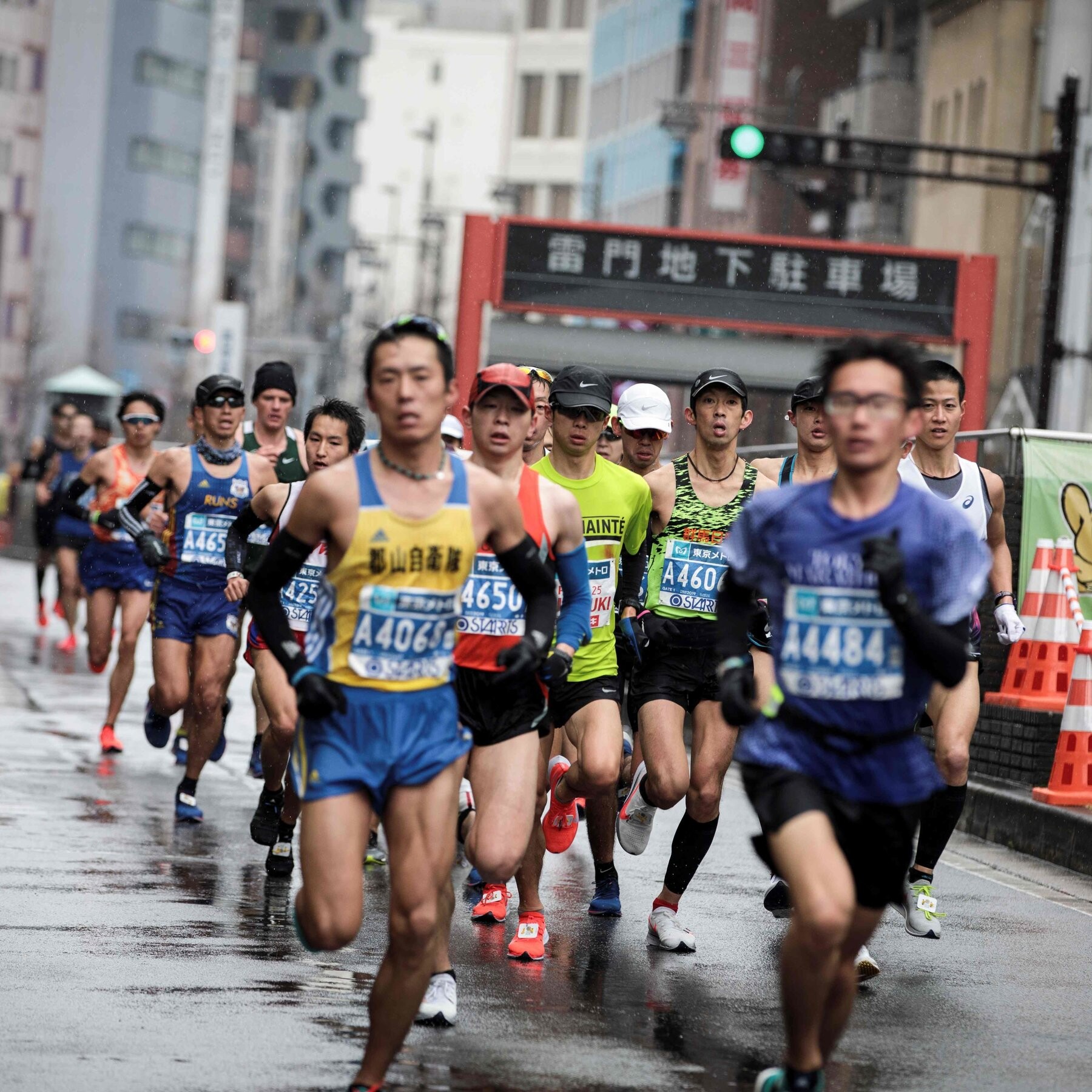
On Sunday March 5, more than 3,000 participants in the Tokyo Marathon will be aiming to complete their AbbottWMM Six Star journey and achieve a GUINNESS WORLD RECORDS title in the process.
Going for the record of the ‘most people to earn a Six Star Medal at a single marathon’, runners in the Six Star program will contribute to the record attempt by completing the Tokyo Marathon and collecting their Six Star medal after crossing the finish line. This race signals the final Major of their journey which also includes the Boston, TCS London, BMW Berlin, Bank of America Chicago and TCS New York City Marathons.

Tokyo will mark a major milestone for the Six Star program as the total number of finishers since the program began will pass 10,000. The previous largest contingent of Six Star finishers at a single Major was 732 at the Tokyo Marathon in 2019. It was only back in 2019 when the 5,000 Six Star finishers mark was reached at the Boston Marathon, showing the increased interest and appetite for this global challenge in recent years.
Dawna Stone, CEO of Abbott World Marathon Majors said, “We are thrilled that the Tokyo Marathon is back in full force this year and is once again able to welcome international runners. We will see an unprecedented number of Six Star finishers in Tokyo, and we are delighted to be able to celebrate this moment in partnership with the Guinness World Records and the Tokyo Marathon.”
Katie Forde, SVP Brand & Digital at Guinness World Records added: “It’s our privilege to be working with World Marathon Majors and to be attending the Tokyo Marathon to verify an achievement which, due to the pandemic, is at least three years in the making. Good luck to all participating runners, we’ll see you at the finish line.”
To celebrate their additional race-day achievement, a commemorative medal is on sale now, giving Six Star runners a chance to show off an impressive three medals post-race [Tokyo Marathon, Six Star and Guinness World Records]. Once the record has been ratified on race day, an official presentation will be made to the Tokyo Marathon Foundation.
by Running USA
Login to leave a comment

Tokyo Marathon
The Tokyo Marathon is a world-renowned annual marathon held in Tokyo, Japan. As one of the prestigious Abbott World Marathon Majors, it attracts elite and amateur runners from around the globe. The race holds World Athletics Platinum Label status, recognizing its high competitive standards, top-tier organization, and international appeal. Sponsored by Tokyo Metro, the Tokyo Marathon has grown into one...
more...
Some of running’s weirdest world records
On Feb. 5, Edmonton’s David Eliuk broke the Guinness World Record for most T-shirts worn while running a half-marathon. Racing the Hypothermic Half Marathon in Edmonton, Eliuk donned a whopping 120 t-shirts, breaking the previous record of 111, and crossed the finish line in two hours and 45 minutes. This record is odd, but it’s far from the only unorthodox running record we’ve seen over the years. There are so many strange feats out there; here are the top five weird–but real–running records.
Anything joggling
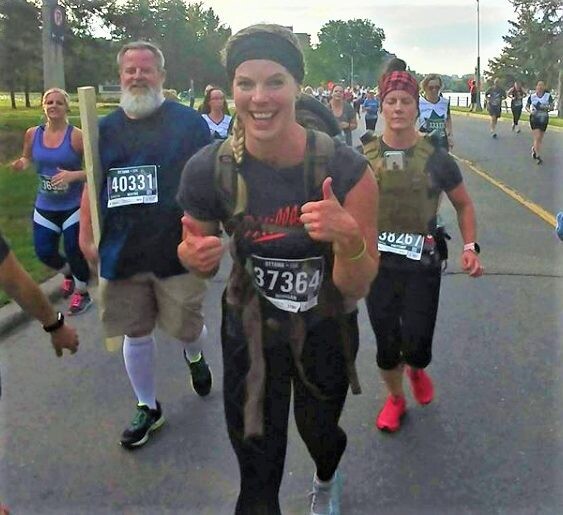
Joggling (juggling while jogging) is surprisingly popular in the running community, and there are world records from the 100m up. Unlike some Guinness World Record running feats, joggling results tend to be extremely quick, with the record breakers running times that many non-juggling runners wouldn’t even be able to hit. Take P.E.I.’s Michael Bergeron, a runner who owns joggling world records in the 5K (16:50), 10K (34:47) and half-marathon (1:17:09)–or Port Hope, Ont.’s Michal Kapral, who still holds the joggling world record in the marathon (2:50:12), which he set at the Toronto Waterfront Marathon in 2007.
American David Rush is another joggling world record holder, although he added yet another twist to the feat (as if running while juggling wasn’t already tough enough). In 2021, Rush broke the world record for the fastest 100m while juggling blindfolded, covering the distance in 16.29 seconds.
10K carrying 100 lbs
American Erin Grindstaff owns what sounds like an extremely arduous record: fastest 10K while carrying 100 lbs. Grindstaff ran Las Vegas 10K with a backpack weighing 100 lbs, and she crossed the finish line in 1:26:49. If this sounds more like a military training method than a running event, it’s because that’s how Grindstaff got the idea. As she told the Guinness World Records team, she is an American Air Force veteran, and she had plenty of experience “rucking,” which is walking, hiking or running with a weighted backpack.
“I wanted to set this Guinness World Records title to show normal, everyday people that you do not have to be an elite or full-time athlete to do something physically extraordinary,” Grindstaff said. “With hard work, a solid plan, and true unwavering commitment, anything is possible.”
Backwards mile
In 2020, a Kansas man named Aaron Yoder took to the quiet country roads of his hometown and ran a 5:30 mile… while running backwards. That’s right, Yoder ran a backwards mile faster than most people can run going straight ahead. That works out to an average pace of 3:25 per kilometre, and it beat the previous world record of 5:54, which not-so-coincidentally also belongs to Yoder.
Golf running
In 2021, Swiss athlete Jürg Randegger played a ridiculous 252 holes of golf in 12 hours, breaking the world record for the most holes in a 12-hour period. He covered 93K in this mind-boggling world record, carrying just a 7-iron for the entire day. He took a total of 1,348 strokes and managed to hit five birdies (one under par). Not bad for a sport in which calmness, patience and taking one’s time are of the utmost importance.
by Ben Snider-McGrath
Login to leave a comment
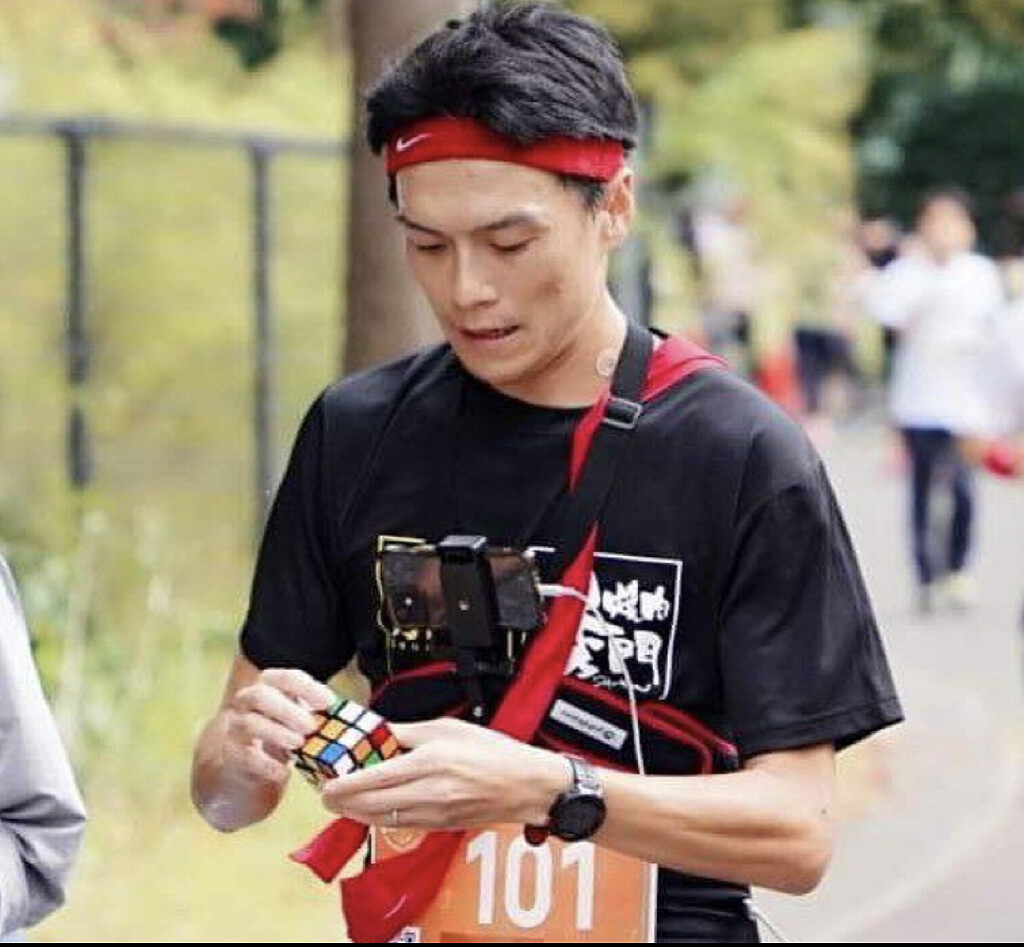
Japanese runner solves 420 Rubik's cubes during marathon
The Rubik’s cube is known as one of the toughest puzzles, which can be unscrambled in millions of ways. Kei Suga of Japan made deciphering the puzzle a little harder, solving a mind-blogging 420 cubes while he ran a marathon in his hometown of Kashiwa City, Chiba Prefecture.
Suga had a time limit of five hours to break the previous Guinness World Record of 254 cubes. He took four hours and thirty minutes to finish the marathon while completing a Rubik’s cube every 100m.
“I have been training for this record for 10 years,” says Suga. When he began running with Rubik’s cubes, he found he was able to solve one in 30 to 50 seconds. Since 2013, Suga has competed in several marathons each year.
Suga solved the Rubik’s cube for the first time in 2006. In the same year, he competed in his first World Cube Association event.
“My goal for the marathon was to solve and collect one every 100m on the course,” says Suga. He had a friend filming the challenge, as well as someone running beside him and passing him 30 different Rubik’s cubes on rotation. Suga used 60 cubes in total and ran 14.5 laps of a three-kilometre course.

“At the end of each lap, I exchanged 30 solved cubes for 30 scrambled cubes,” says Suga.
The previous record of 254 cubes was set by New Zealand’s Blair Williamson at the 2017 Christchurch International Marathon.
“I know I can’t solve the Rubik’s cube as fast as others but I question if I am the fastest runner among people who can solve Rubik’s cube,” Suga said on his motivation behind the record.
Suga’s new world record is currently unofficial and pending certification from Guinness World Records. According to Suga, the record is scheduled to be certified in early 2023.
by Running Magazine
Login to leave a comment
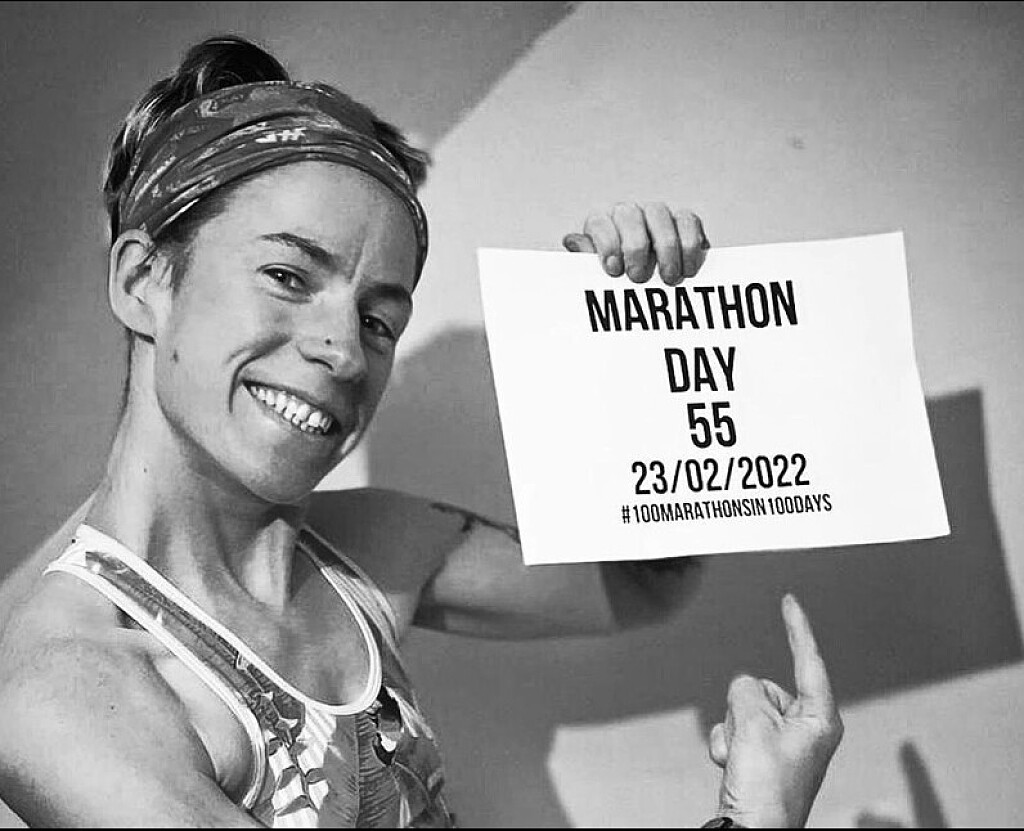
British woman runs 106 marathons in 106 days with fractured knee
Kate Jayden of Derbyshire, U.K., who set the world record of 106 marathons in 106 days, completed in April 2022, has had her record verified by Guinness World Records. Although 106 straight days of running a marathon is an incredible feat in itself, Jayden revealed on her social media that she ran her last 60 marathons on a fractured knee.
Jayden began to feel discomfort in her knee after her 46th marathon, when she struggled to put weight on it and thought she had developed an injury. But the 35-year-old carried on for the last 60 marathons.
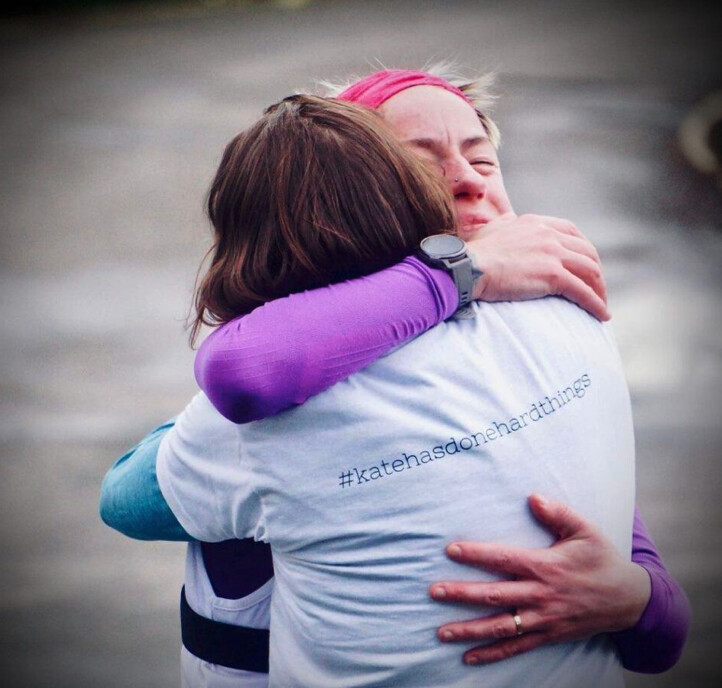
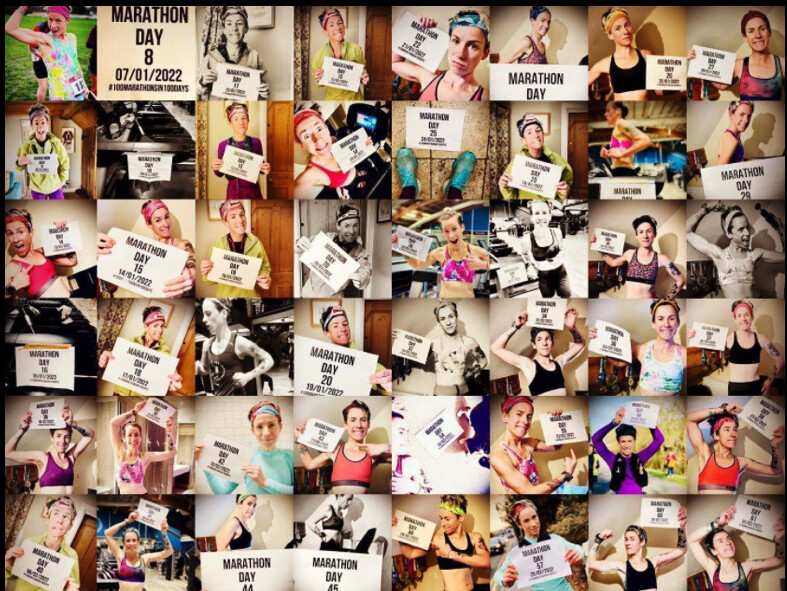
She started her challenge for charity on Dec. 31, 2021, and finished on April 15, 2022. Jayden got an MRI on her knee soon after finishing, and a scan revealed she had fractured her knee and may not be able to run again.
“I did not realize that day 106 was going to be my last long run,” Jayden told the BBC. “But if you could have planned it to be, it was an excellent way to go out.”
Jayden plans to have surgery on her knee and hopefully take up cycling in the future.
She initially set out to beat American runner Alyssa Clark’s record of 95 marathons in 95 days, which was set in November 2021. Several runners have since been inspired by Clark’s and Jayden’s records, and have set out on their own.
During her challenge, Jayden raised over CAD $50,000 for three charities: the Refugee Council, Trussell Trust and The Hygiene Bank.
by Running Magazine
Login to leave a comment
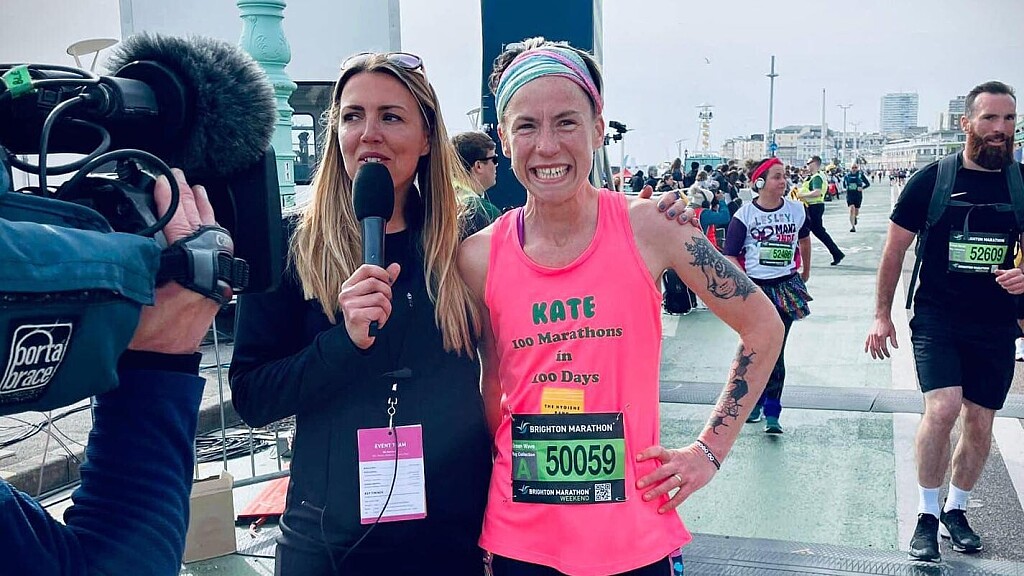
Ultra-runner Kate Jayden set astonishing marathon world record with broken knee
Kate Jayden of Derbyshire, U.K., who set the world record of 106 marathons in 106 days, completed in April 2022, has had her record verified by Guinness World Records. Although 106 straight days of running a marathon is an incredible feat in itself, Jayden revealed on her social media that she ran her last 60 marathons on a fractured knee.
Jayden began to feel discomfort in her knee after her 46th marathon, when she struggled to put weight on it and thought she had developed an injury. But the 35-year-old carried on for the last 60 marathons.
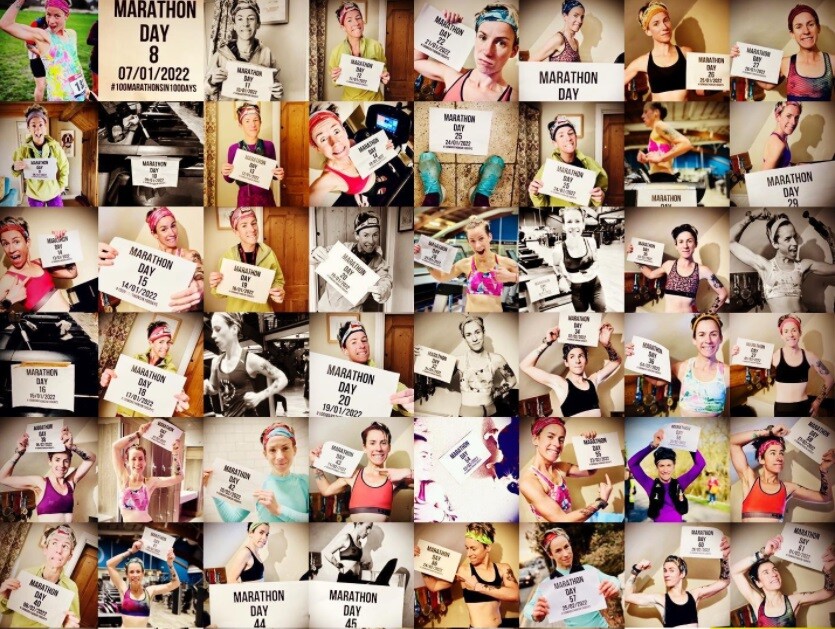
She started her challenge for charity on Dec. 31, 2021, and finished on April 15, 2022. Jayden got an MRI on her knee soon after finishing, and a scan revealed she had fractured her knee and may not be able to run again.
“I did not realize that day 106 was going to be my last long run,” Jayden told the BBC. “But if you could have planned it to be, it was an excellent way to go out.”
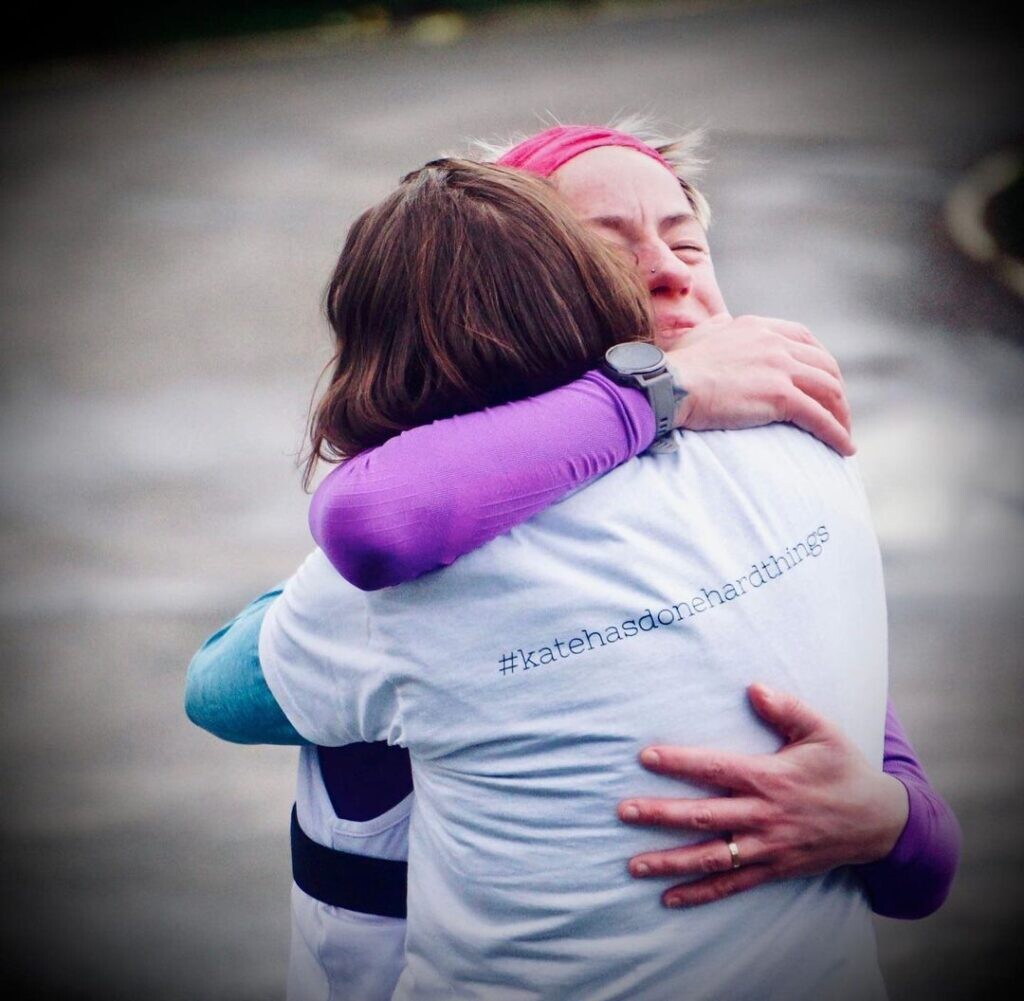
Jayden plans to have surgery on her knee and hopefully take up cycling in the future.
She initially set out to beat American runner Alyssa Clark’s record of 95 marathons in 95 days, which was set in November 2021. Several runners have since been inspired by Clark’s and Jayden’s records, and have set out on their own.
During her challenge, Jayden raised over CAD $50,000 for three charities: the Refugee Council, Trussell Trust and The Hygiene Bank.
by Running Magazine
Login to leave a comment
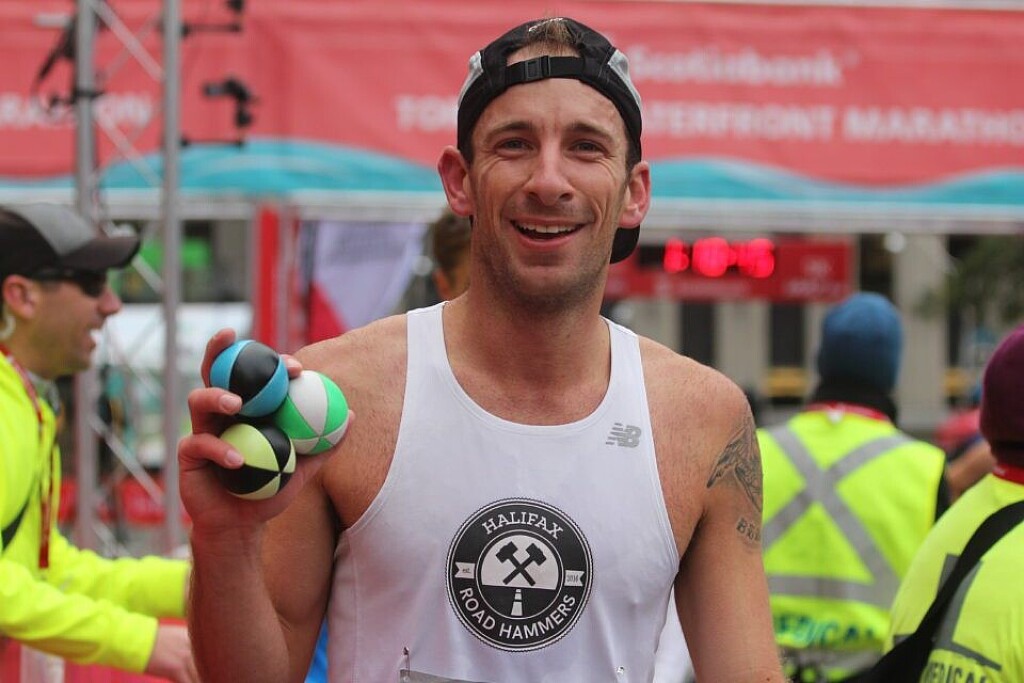
Michael Bergeron runs 34:47 10k while juggling a world record
Michael Bergeron of Cavendish, P.E.I. Canada, has broken the 10K joggling world record he has been chasing for the last four years. Bergeron covered 10K in 34 minutes and 47 seconds while juggling three balls around 25 laps of the University of Prince Edward Island Athletics Track.
He previously attempted the 10K record in 2018, but his time was not ratified by Guinness World Records since it was done on an uncertified course. The previous record is held by Toronto’s Michal Kapral in a time of 36:27.
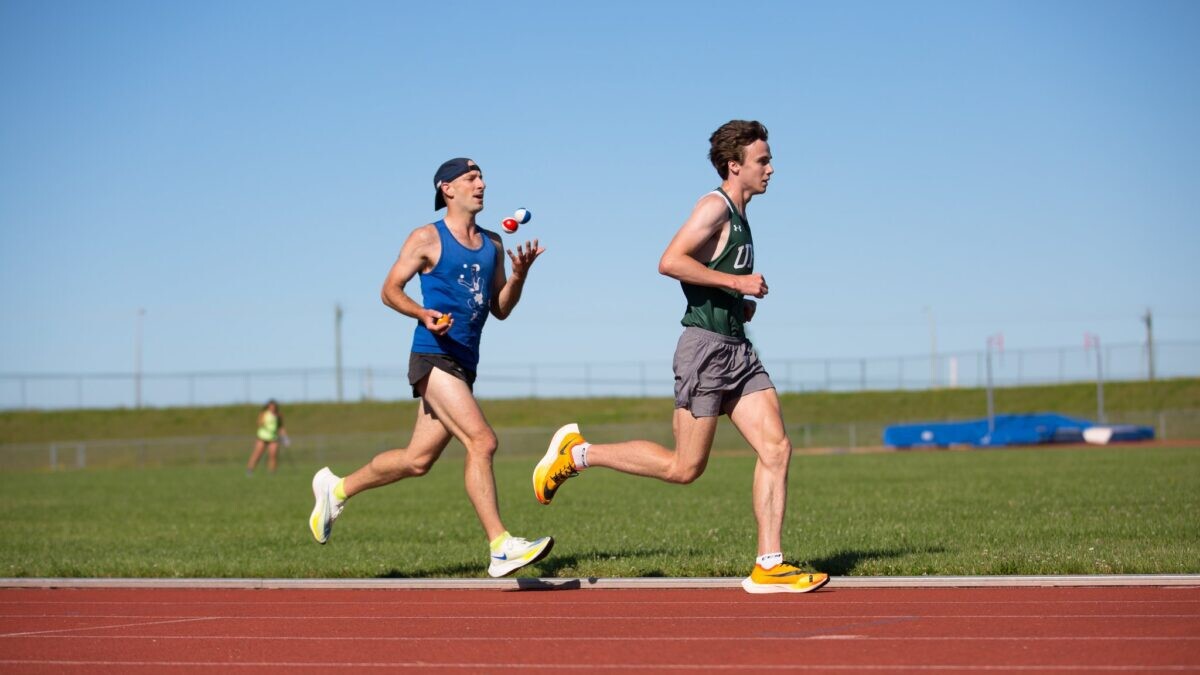
A Guinness World Record doesn’t happen by accident. In order to verify the event, there must be video evidence and two witness statements. Bergeron had several pacers in the race, while his friend Amber MacLeod recorded the race from the infield and his wife Jennie called splits for every 400m lap. “I am ecstatic about this record,” Bergeron says. “Breaking this record kept me motivated to train during the pandemic.”
This record isn’t Bergeron’s first; he currently holds the Guinness World Record for the fastest half marathon while juggling, 1:17:09 at the 2018 Toronto Waterfront Half Marathon.
Bergeron began running track when he was 13 and learned to juggle in high school. He brought his two hobbies together as a dare by a friend in university. He did his first juggling race in 2014 at a local 5K.
by Running Magazine (Marley Dickinson)
Login to leave a comment
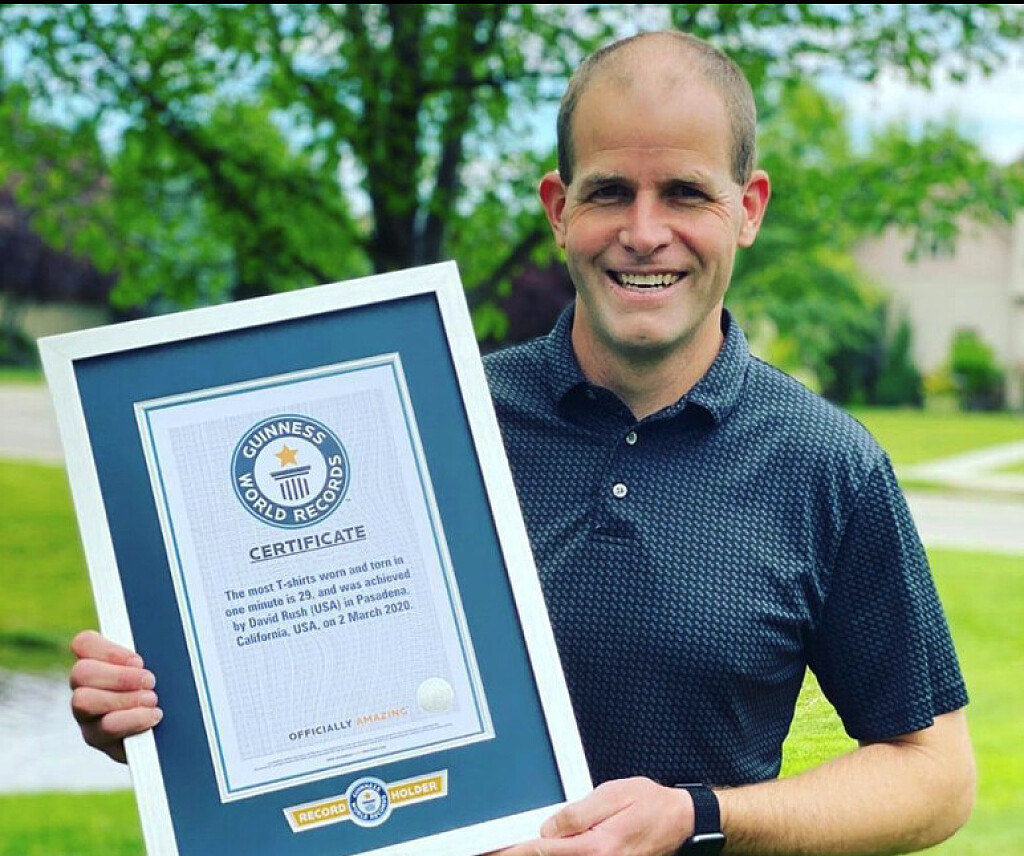
David Rush breaks T-shirt half marathon record with 111 shirts
On May 14, an Idaho man broke one of the oddest Guinness World Records out there by running a half-marathon while wearing more T-shirts than anyone else ever has. David Rush, who has broken more than 200 Guinness World Records so far, wore 111 T-shirts at YMCA Famous Idaho Potato Half Marathon, completing it in 2:47:55, 12 minutes under the three-hour time limit set by Guinness World Records.
The T-shirt half marathon record has now been transferred from one David to another David, to another David, as the previous record of 90 shirts was held by Edmonton’s David Eliuk, at the Hypothermic Half Marathon in February. Before that, the record of 82 was set by British runner David Smith in November 2021.
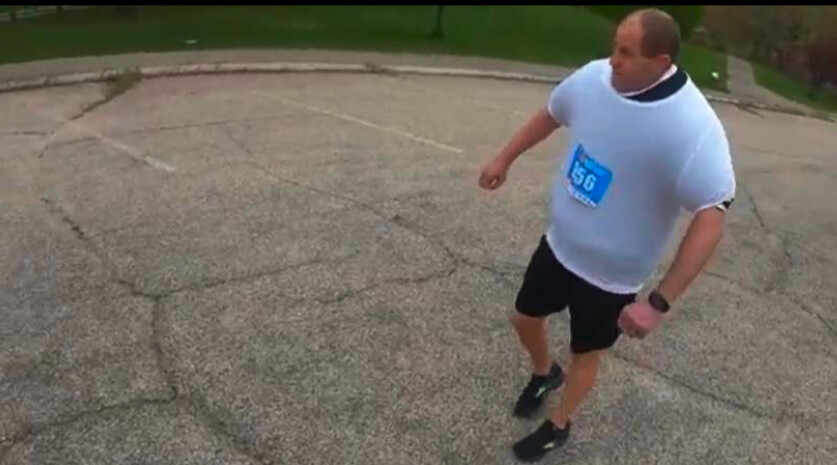
If your name is David, this unique Guinness world record could be your calling.
Rush makes a hobby of chasing Guinness World Records to promote STEM education. “We need more boys and girls to grow up with a passion for science, technology, engineering, and math.” Rush says.
“We have a shortage of trained engineers, programmers and scientists to fill the jobs of today and tomorrow.”Rush also holds the Guinness World Record for fastest man to run 100m while juggling blindfolded (16.29 seconds) and fastest mile while juggling blindfolded (7:54).According to local news, it took Rush and his support team 25 minutes to dress him, and he struggled with the 40 pounds of extra weight he had to carry around.
Although the cool race conditions helped him, his arms and hands ballooned and went numb due to the lack of blood circulation from the 111 T-shirts.
by Running Magazine
Login to leave a comment
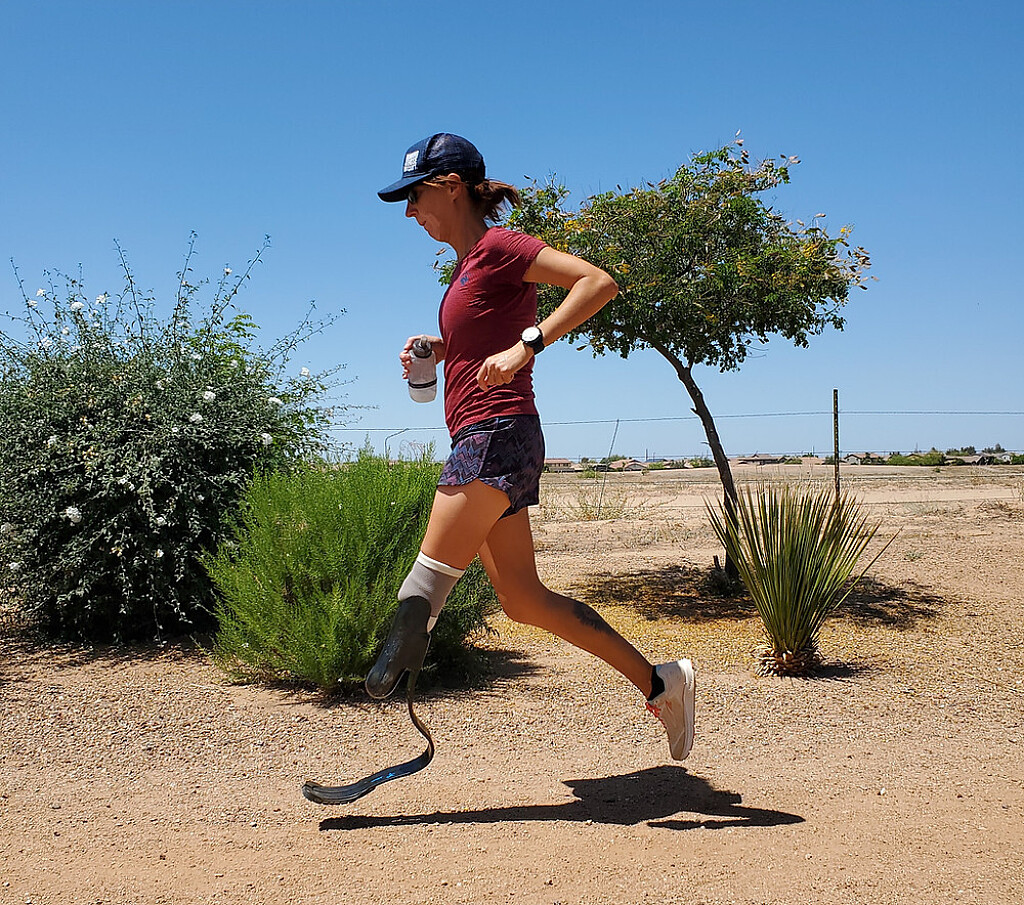
Amputee runner Jacky Hunt-Broersma completes 102 marathons in 102 days
As Forrest Gump in the Oscar-winning 1994 film of the same name, lead actor Tom Hanks abruptly trots to a halt after more than three years of nonstop running and tells his followers, "I'm pretty tired. I think I'll go home now."
Jacky Hunt-Broersma can relate. On Thursday, the amputee athlete achieved her goal of running 102 marathons in as many days, setting an unofficial women's world record.
And she can't stop/won't stop, saying she will run two more for good measure and wrap up her challenge Saturday with 104.
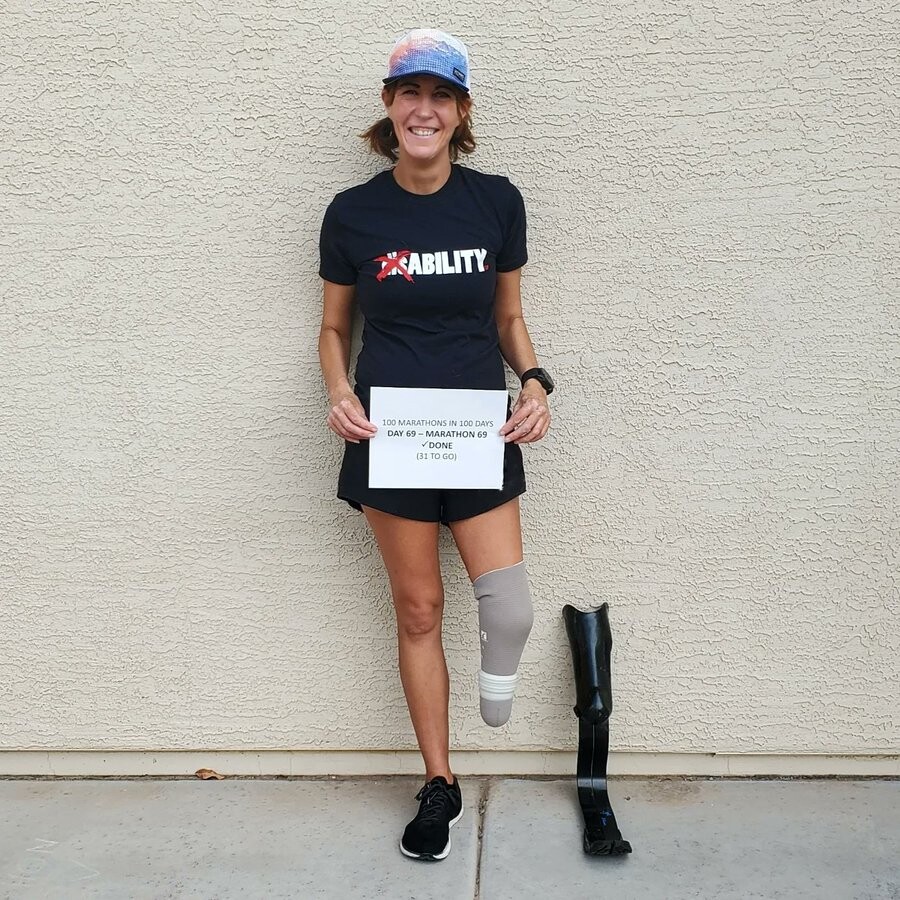
"I might as well end April with a marathon," she told The Associated Press.
Britain-based Guinness World Records did not immediately respond to an email requesting comment. Guinness lists the men's record for consecutive daily marathons as 59, set in 2019 by Enzo Caporaso of Italy. It can take up to a year for the organization to ratify a world record.
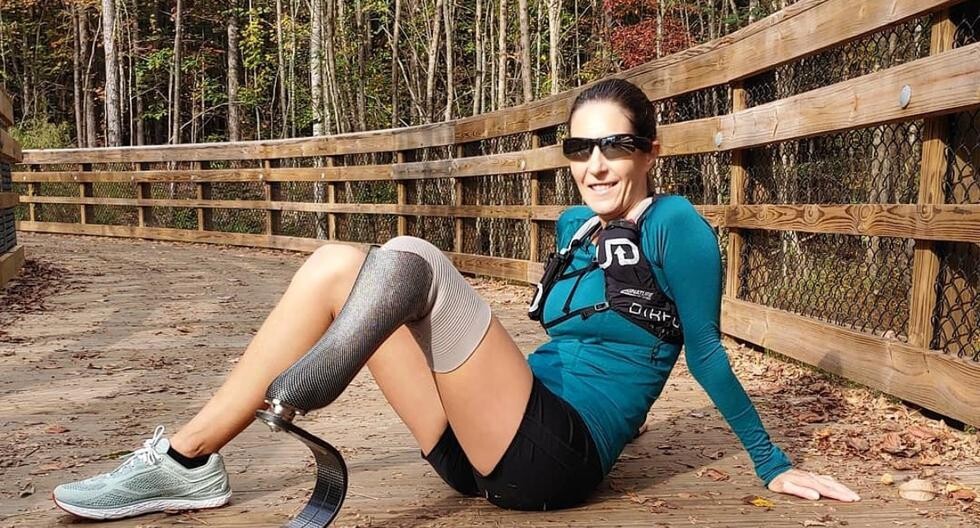
"I'm just happy that I made it. I can't believe it," Hunt-Broersma said. "The best thing was the incredible support I've received from people around the world who've reached out, telling me how this has inspired them to push themselves."
Hunt-Broersma, 46, began her quest Jan. 17, covering the classic 26.2-mile marathon distance on a loop course laid out near her home in Gilbert, Arizona, or on a treadmill indoors. Since then, it's been "rinse and repeat" every day for the South Africa native, who lost her left leg below the knee to a rare cancer and runs on a carbon-fiber prosthesis.
Her original goal was to run 100 marathons in 100 days so she would beat the record of 95 set in 2020 by Alyssa Amos Clark, a nondisabled runner from Bennington, Vermont, who took it on as a pandemic coping strategy. But earlier this month, after nondisabled British runner Kate Jayden unofficially broke Clark's record with 101 marathons in 101 days, Hunt-Broersma realized she would need to run at least 102.
On foot, day in and day out, she has covered 2,672 miles -- the equivalent of running from her Phoenix suburb to Cape Cod, Massachusetts, or from New York City to Mexico City.
Along the way, Hunt-Broersma gained a huge social media following and raised nearly $27,000 to help fellow amputee blade runners get the expensive prostheses they need. Health insurance typically doesn't cover the cost, which can exceed $10,000.
Hunt-Broersma, who ran her 92nd at this month's Boston Marathon, hopes her quest will inspire people everywhere to push themselves to do hard things.
What's next for the endurance athlete? A 240-mile ultrarace to be staged over mountainous terrain in October in Moab, Utah.
Login to leave a comment
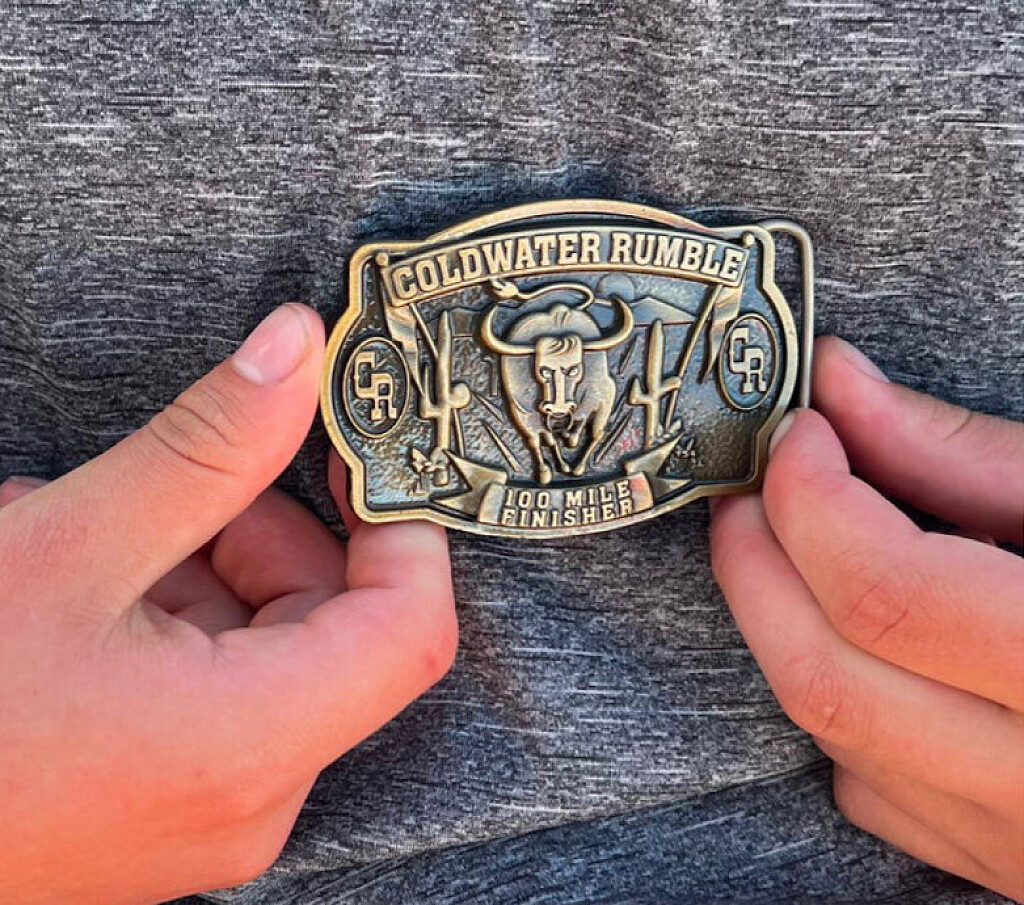
Zach Bates' 100 Mile Dream
Zach Bates loves statistics. Ever since he was a kid, he's scoured Guinness world records for longest, shortest, fastest, coldest or hottest. He could recite the Scoville rating for every hot pepper. Being autistic, that's how his mind has always worked. He loved to focus on specific topics, and the numbers called to him.
That might be why he fell for running. He joined the cross country and track teams his junior year of high school, memorizing his teammates' PRs and paces. Eventually, his sights turned to the pros. From Usain Bolt to Zach Bitter, he studied all of their career numbers. He also got the itch.
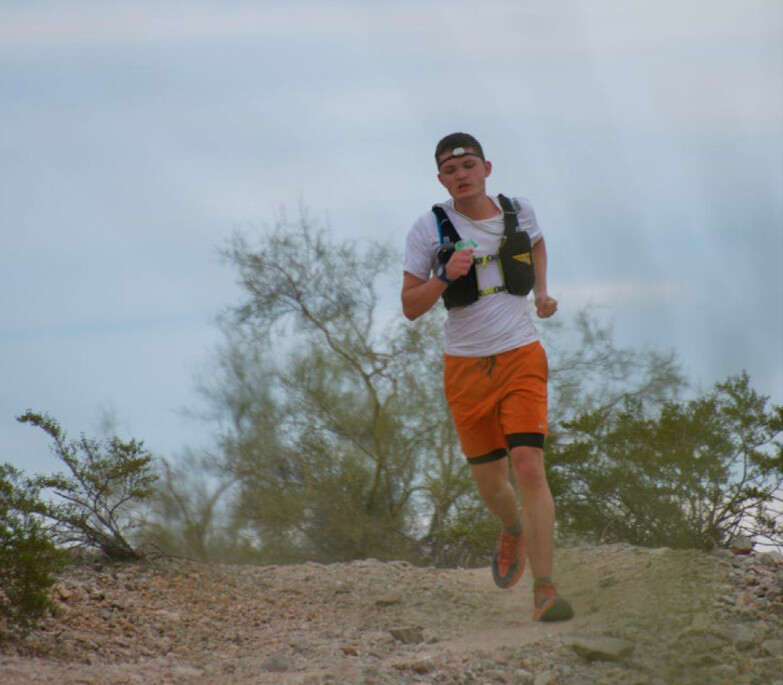
"He didn't want to just know these times, he wanted to do it, too," says Rana Bates, Zach's mother. "He begged me to sign him up for a marathon during his senior year. He was really interested in the longer stuff in track. He wanted to go even farther."
Because of the pandemic, most marathons during his senior year had been cancelled. So the 19-year-old waited patiently until graduation day in May 2021. That day, he turned to his mom and said, "I want to do a 100 miler before I turn 20."
Rana was thrown off by the request. No one in their family ran. Not his father, his mother, his sister or his twin brother. Now Zach wanted to run triple-digits in less than 10 months. She let the idea sit for a few days before Zach followed up. "Did you sign me up for a 100-mile race yet?"
"He's really mild tempered and doesn't ask for much," Rana said. "When he does ask for something, he really means it and we take him seriously. So, I bought some books."
A Crash Course
Rana found herself whisked into the world of her son's dreams, researching and formulating a plan for Zach to be able to run 100 miles in a safe and healthy way. With Zach unable to plan himself, Rana had to take a broader approach, acting as his coach and instructing him on every logistical necessity for training.
"All of the thinking end stuff, I do," Rana said. "Zach does the running."
Rana's crash course worked smoothly for the first few months, but books only went so far. One of the first things she learned about distance running was the generosity of the community. The more she mentioned the goal to people, the more people came into Zach's life.
First, there was John Hendrix, a local ultrarunner. He offered knowledge about injury prevention, gear and nutrition for ultradistance running. But more than anything, he shared knowledge of the local trail systems and became an occasional running partner for Zach.
When it came to training, Zach and Rana had a process for each new trail. First, they had to hike it together so Zach could familiarize himself with the route and what landmarks to look for. Then, Rana would tag along in the car, driving between trailheads to meet Zach and field calls in case he got lost.
It's a lot of work, but Rana wants to live out the message she and Zach want to share.
"There's a list of things you do when you find out your child has autism," Rana said. "But we need to be careful not to let those things become the priority of what our children want. We need to listen to them, hear their dreams. Zach wanted to run so badly, he just didn't have the resources to find routes, sign up for a race, or things like that. You can't just say, it's too hard for us. We need to respect them as individuals and help them reach their dreams."
As Zach started to race, more and more people noticed him. By October, he'd finished the High Mountain Half, the Beaver Canyon Marathon, and the Do-Wacka-Do Trail Run 50 miler. He made friends everywhere he went, astonished at someone his age running the distances he was. At races, autism wasn't the defining feature of who he was.
The Rumble
There's an infinite number of variables in a 100-mile race; often, things simply go well until they don't. For Zach, the first roughly 80 miles went smoothly. He was far way ahead of the cutoff when he picked up de la Rosa as a pacer for the final 20 miles. But he started to get quiet, only occasionally breaking the silence.
"If my legs could talk, they would say, 'Whyyyyyyy!" de la Rosa recalls Zach saying.
Then a problem arose at mile 88. A hip flexor tweak forced Zach into a limp. They tried stretching, but that only worked momentarily. The limp lingered, but they pressed on.
De la Rosa could see the teenager doing calculations in his head, watching his time goals get further and further away. It was a place de la Rosa had been many times since he started running ultras in 2008. In that moment, captured on video, de la Rosa thought of what he would've wanted to hear if it were his teenage self.
In the next miles, Zach slowed to a painful trudge, about 45-minutes per half mile. Finally, a stroke of luck found them at mile 94: a runner with two Tylenol. The pain wasn't gone, but Zach started running again, dropping three straight 12-minute miles. With that, finishing under the 32-hour cutoff was assured.
"That's called a comeback!" de la Rosa hoots in the video. "That's called rallying! Woohoo!"
Runners treated him like anyone else. For one 40-mile training run, Zach was supposed to pace Hendrix for the Javelina Jundred. Hendrix dropped out at mile 60, but word got around in the crew area that Zach was willing to pace.
"There was such an openness and willingness from runners," Rana said. "He paced one guy from Boulder, Colorado, and the guy came back stoked, saying this was the most fun he had with a pacer. Another guy from California picked him at mile 80 and Zach paced him to a sub-24 finish. It's the coolest thing ever to have a support system like this. These runners have stayed in touch with us and offered help. It's amazing."
After finishing the 50, Zach signed up for the Coldwater Rumble 100 in January and started TikTok and Instagram accounts (@running.farther) to share his progress. That left three months to prepare, but Zach was feeling burned out. Rana was out of her depth for guiding him, so they sought a professional coach. With a reference from Run Flagstaff, they connected with Nickademus de la Rosa.
"You can always tell if there is a deep, intrinsic reason someone does a 100 miler, and that often proves if they will do whatever it takes," said de la Rosa. "Zach had a deep reason to be there. You see it in his eyes when he talks."
They dropped Zach's mileage down to get him healthy, mentally and physically, then began ramping it slowly back up. The biggest week came four weeks before race day: 10, 20, and 30 mile runs back to back to back.True to form, Zach hit all his splits on the dot.
At the finish line, the Bates family waited. Zach's watch had died in the night, leaving them reliant on texts from de la Rosa to track his progress. Finally, the final text came in. Zach was moving slower again, but they were a mile away.
Rana rallied a friend who rallied the entire 250-yard string of tents along the final stretch. When Zach arrived, a massive cheer tunnel awaited him. Zach looked at de la Rosa, as if to ask permission to run through it.
"You've got this," de la Rosa said.
Alone, beneath the roaring crowd, Zach ran. He stopped when he crossed the finish and embraced his family. His time was 28:06:36, good for 38th overall.
'I'll cherish that moment forever," Rana said. "Our family will never be the same."
Zach's royal entrance was completed with a camping-chair throne and a parade of well-wishers. Unable to stand when it was time to leave, Zach was lifted by his father and uncles over the crowd and carried like a king to the car.
The limited mobility lasted a few days. After a long postrace nap, Zach eventually made it to the bath, an endeavor so challenging he made a TikTok of himself easing up the stairs set to the "Mission Impossible" theme song.
By a week later, he was moving better, already eyeing what's next. He's got the Canyons 100K and Javelina Jundred on the calendar for 2022, but it doesn't stop there. He also wants to do the Cocodona 250, but that's for down the road. For now, he's back to running and chasing his dream.
"Even if Zach never ran again, the last eight months have changed us as a family," Rana said. "The outpouring of love from everyone, everywhere, for this kid chasing his dreams and making them come true. Not everyone is able to. Because of everyone, Zach did."
by Trail Runner Magazine
Login to leave a comment
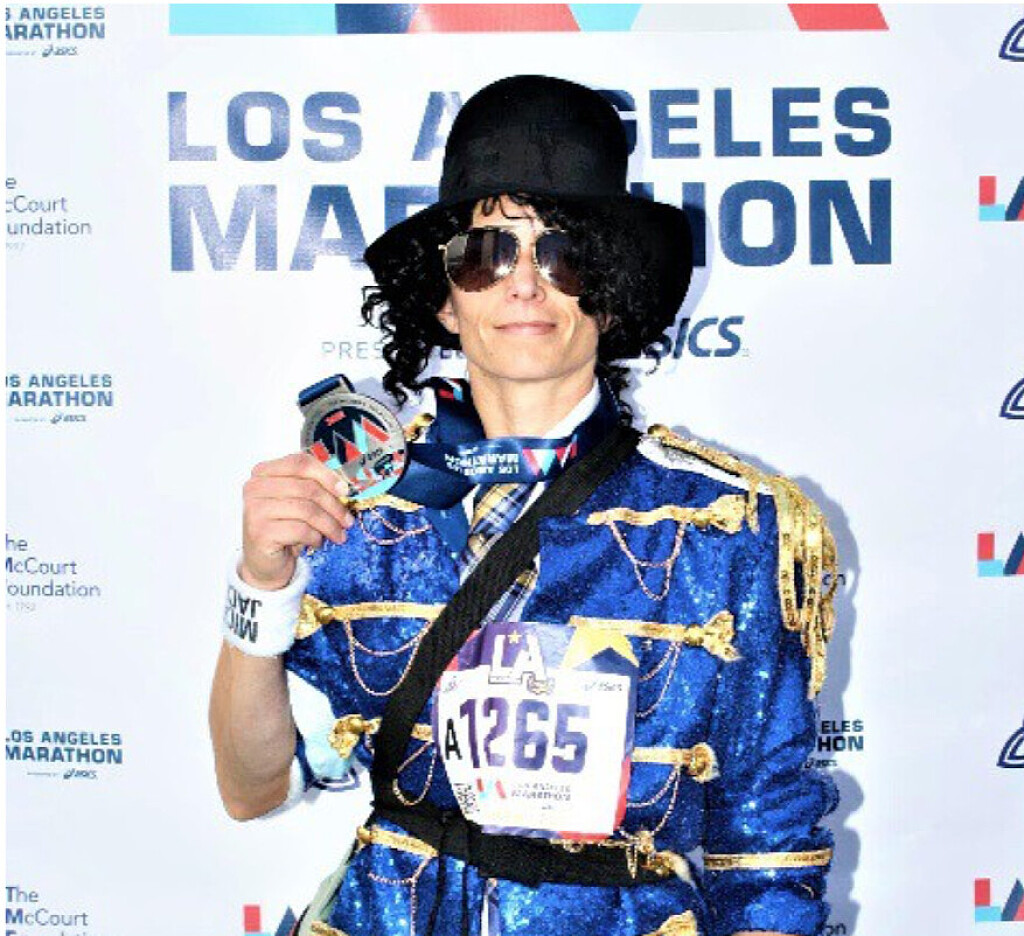
Toronto woman sets Guinness World Record at L.A. Marathon
On November 7 at the L.A. Marathon, Toronto-based runner Bridget Burns set the record for the fastest marathon dressed as Michael Jackson. This brings her total number of Guinness World Records up to seven since she set her first one dressed as a boxer in 2014.
Running in costume
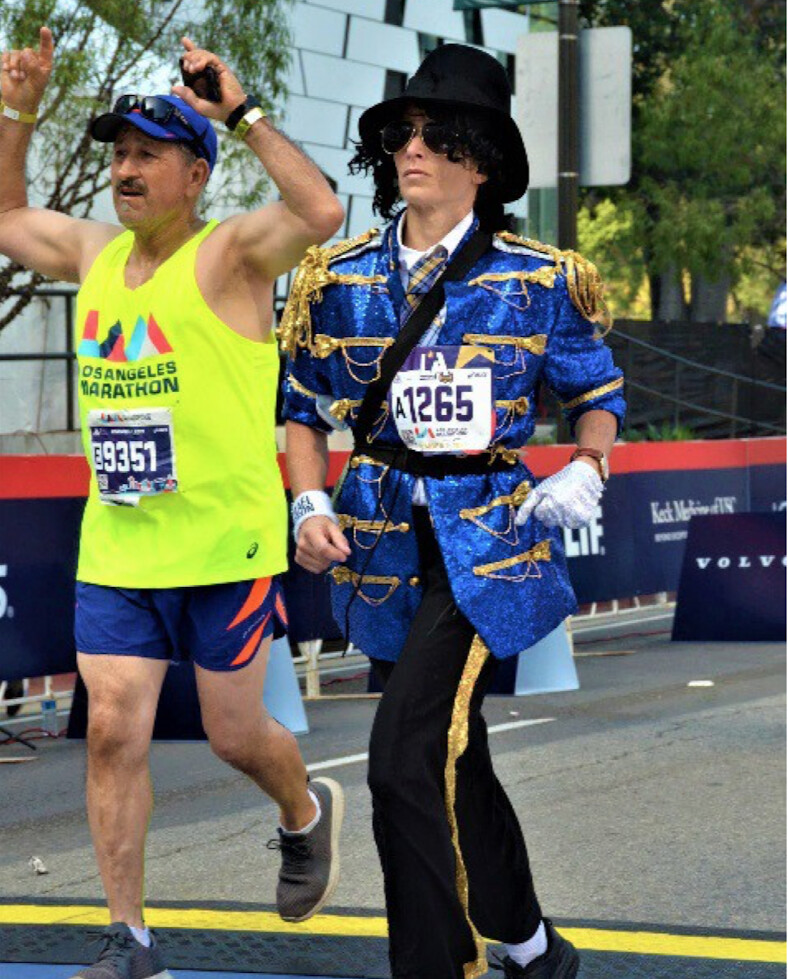
Burns was introduced to costume running when she was an extra in a Nike commercial, where she saw someone running in a banana outfit in her hometown of London, Ont. Costume running hadn’t really taken off in London, but when she moved to Toronto she began to see more people dressing up at local road races, including Canada’s joggling sensation and multiple Guinness World Record-holder, Michal Kapral. “I was inspired by him,” she says.
Burns chooses her costumes based on what interests her, and it was her love of the Rocky movies that inspired her to dress up as a boxer for her first record attempt at the 2014 GoodLife Fitness Toronto Marathon, which she ran in 3:52:27. She also has an interest in exotic animals and zoos (she has three parrots of her own and one domesticated pigeon), so for her second record, she dressed as a zookeeper at the Scotiabank Toronto Waterfront Marathon later that year in October, where she ran 4:08:17.
She went on to set four more records, including the fastest half-marathon dressed in an animal costume (which has since been broken), the fastest half-marathon in motocross gear (2:14:34), the fastest half-marathon dressed as a zookeeper (2:04:46) and she was part of a group who set the record for the largest number of runners to complete a 10 kilometre run in 24 hours this September. “If there’s something I find interesting, I’ll see if anyone has a record in that and then I’ll attempt it,” she says.
A record-setting run in L.A.
“Over the summer I downloaded some Michael Jackson on my iPod, and wondered if anyone had set a record in that,” says Burns. She found out that one person had done it before but no entry to the Guinness World Record was conducted, so she decided to give it a shot.
Her attempt was successful, bringing her total up to seven, but this one had a few more challenges on the way. Burns battled a bad case of bursitis in her knees for two months before the race, requiring her to take Prednisone for two weeks to decrease inflammation to allow her to run. Prior to the marathon, she worked five night shifts in a row (Burns works the night shift at the Etobicoke HomeSense so she can train during the day and be home with her 10-year-old daughter), went immediately to the airport and took a seven-hour flight to Los Angeles.
Aside from her costume, she packed only a couple of pairs of socks and underwear, her toothbrush and a map and travel book about the city. Despite her knee issues, she still managed to finish the race in 5:07:18 and set the record for the fastest marathon dressed as Michael Jackson.
More records on the horizon
For her next Guinness World Record attempt, Burns has her eyes on the 2022 Philadelphia Half Marathon, where, fittingly, she’ll be running dressed as Rocky Balboa. If the Scotiabank Toronto Waterfront Marathon is bringing the GWR program back again, she says she’ll likely do something for that as well, but she hasn’t decided which record she’ll attempt yet.
In the meantime, keep your eyes open for Burns at your next road race, because you never know — she may go running by as your favourite film character.
by Running Magazine
Login to leave a comment
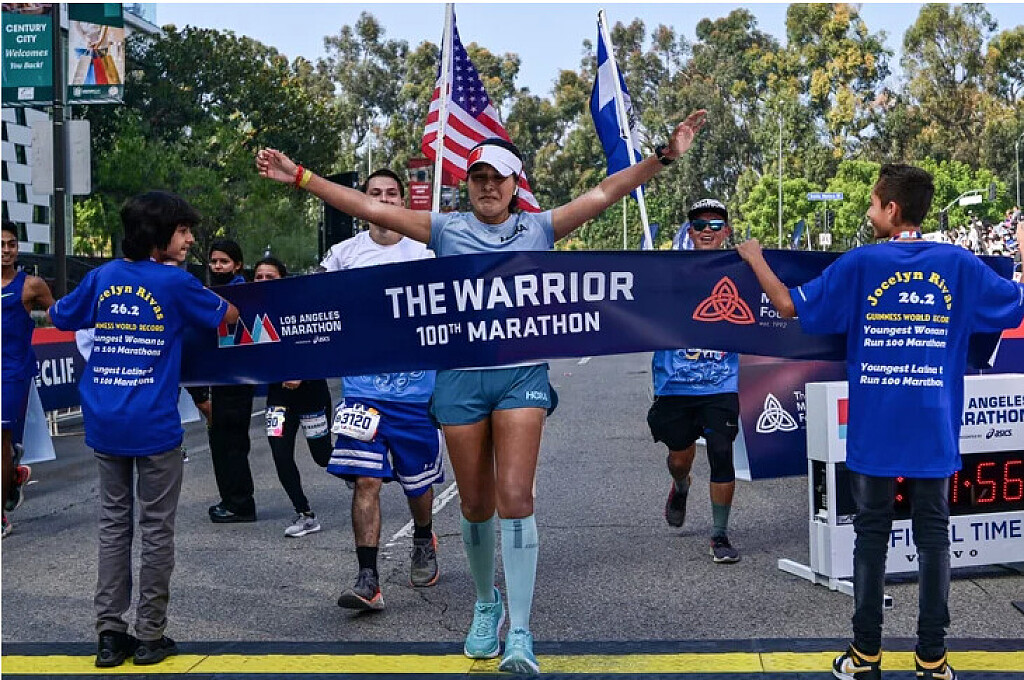
Jocelyn Rivas Just Ran Her 100th Marathon—All Before She Turned 25
Now the youngest person to run 100 marathons, Dreamer Jocelyn Rivas recently finished her hundredth at the Los Angeles Marathon.
Jocelyn Rivas has been running marathons since she was 17. On Sunday, the 24-year-old ran her 100th at the Los Angeles Marathon. This makes her the youngest runner to complete 100 marathons, pending verification by Guinness World Records. It also makes her the youngest Latina to accomplish this feat—something she’s proud of, as a Dreamer who came to the U.S. from El Salvador when she was six.
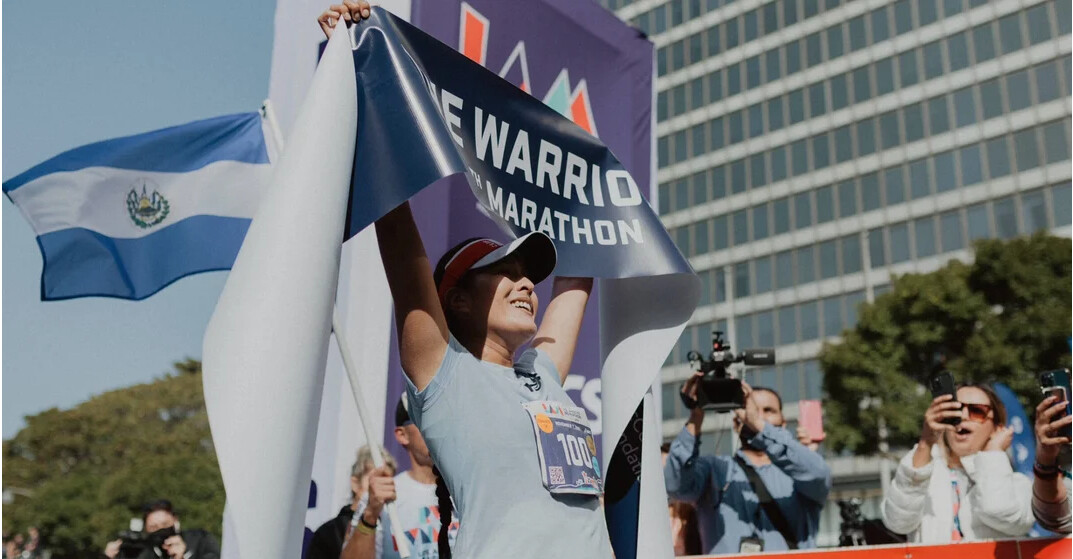
Rivas was born in El Salvador with health problems so severe her mother was told she would never walk normally. She never found out what exactly the cause was, but she did start walking normally when she was a kid, and then she took up marathon running when she was in high school, as part of the Students Run LA program.
Since then, she has run marathons in 19 states, and she once ran six marathons in nine days. Her first marathon was the Los Angeles Marathon, so running it again as her 100th marathon has been coming full circle.
Rivas spoke with Women’s Running about how she got into running, why she decided to take on 100 marathons, and what it was like to cross the finish line in Los Angeles.
Women’s Running: You ran your first marathon with Students Run LA when you were in high school, but were you a runner before that?
Jocelyn Rivas: When I started with Students Run LA, it was the first time I had run. You could say I had done the one mile because that’s required for [Los Angeles Unified School District] high school kids. That was the only thing I had done.
The reason I started running was I came out to the 2013 L.A. Marathon to support my friends who were running. I saw everyone running, from kids to adults who are in their 70s, and I was like, why am I not out there? What’s preventing me from being out there? I got inspired by those people, complete strangers, and then I was like, I want to run a marathon.
WR: What was it like to go from no running to training for such a long distance?
JR: Students Run LA helps high school students train for a marathon in six months. In the beginning, it was a bit difficult because my mom didn’t want me to run a marathon. The reason was because I was born with a broken back, neck, and feet. So I have always had a lot of back pain and neck pain, and she just didn’t want those things to become worse. But I wanted to run a marathon. I knew I could do it.
Essentially, I was like: You know what, I’m gonna do this, just to prove her wrong, just to prove I could run a marathon. But when I crossed that finish line, I realized I love running. My mom was the motivation, but I ended up falling in love with running.
WR: How did you recover from those injuries as a young child?
JR: The resources in El Salvador were kind of limited. My mom was also very poor—she barely even had money to feed me, so she wasn’t able to take me to a specialist. But she took me to physical therapy that was free. My feet were completely turned around to the outside, instead of straight, and then my back, my spinal cord, was not straight at all. I was like that for several months until, I guess with therapy and everything, my body started to get back together little by little. My mom says it was a miracle, because they told her I most likely wouldn’t be able to walk normally. My sister says it took me a while to start walking. I was slower than most kids. And she says after three or four years, I was fine.
WR: Have you had to deal with that back and neck pain in your running?
JR: Yes. I actually asked my teammates: Are you feeling back pain? They said no, we’re not feeling anything at all. That’s how I realized, with my back pain and my neck pain, I was going to have to dedicate a lot of myself to running. I do a lot of recovery. After every single run, I do scraping, I do tape, I massage myself. Sometimes I do cryotherapy.
WR: What inspired you to run 100 marathons?
JR: In 2017, I was in a very bad place. I’m a Dreamer—I’m a DACA [Deferred Action for Childhood Arrivals] recipient. The Trump administration had just announced that they were going to take it off, meaning that I’d lose the potential of renewing, I would be undocumented again, and I would definitely lose my job and not be able to continue going to college. I was going to lose everything I had worked so hard for, and I really wanted to do it to showcase that Dreamers are here to do something good. We love this country as much as every American—we just don’t have the papers. We came here as young kids, and we grew up in American culture. My biggest thing was, I don’t think many people could put a face to Dreamers. They think negative things about us. I wanted them to see the face of a Dreamer and be like, this is just one Dreamer, and there’s thousands of Dreamers just like her, just wanting to follow their dreams. So it started with that.
But in 2019, at marathon 25 [after the Trump administration’s efforts were blocked], I needed a new “why”—something that would carry me through when I’m in my darkest places, when I’m running those marathons and I just feel like I can’t keep going anymore. And that’s when it came to me: I want to do this to inspire my community, to inspire women. Growing up, I never had anyone to look up to, athletic-wise, who I could identify as a Latina who could do this. I was just like: I want to be that person, or at least inspire my community to get out there to chase their dreams, or start the journey, whatever that is. Running all these marathons has made me realize that nothing is impossible in this world. If you want something in life, go chase it, go get it.
WR: What challenges have you faced along the way?
JR: When I was running these marathons, I was trying to get a PR, I was trying to run faster every single time. And I was getting injured. I had a lot of shin splints on both legs, and then here and there, I sometimes deal with IT band injuries. How am I going to make it if I’m so injured and I’m barely in my early 20s? That’s when I reached out to Julie Weiss, who had done 52 marathons in 52 weeks, so she had a lot of knowledge. She said, you’ve gotta go slower. I told her the times I was finishing, and she’s like, no, you’ve gotta run an hour slower than what you typically run. Just take it easier. Enjoy the
journey. Take photos. Forget about PRs right now—you can do PRs after.
That took me to 100. If I would have kept running fast, fast, fast, trying my best to PR, there’s no way I would have made it to 100. I took her advice to take it slow and enjoy the races more and not to be so hard on myself.
WR: You’re running marathons so frequently, what is your training like?
JR: I really do not train like a normal person who’s training for a marathon. Since I’m running a marathon every weekend, I consider it my long run on Sundays. Monday and Tuesday, I take off completely, I just stretch and rest, and I do my usual thing—I work. Wednesdays after work, that’s when I go for my first run, like a 5k. Thursdays, I do maybe a 5k to 6 miles, depending on how my body’s feeling. On Fridays, I do another maybe four miles, and then Saturday, I do a 5k or don’t run at all. It’s very low mileage, roughly in the 40s with the marathon included.
WR: Do you have any advice for other young women who want to go after big running goals?
JR: All it takes is for you to believe in yourself. I always say, the only person that could stop you is you. I truly got inspired by my community, so this didn’t happen by itself. But if you believe in yourself, you know what you can do, and you know how far you can go in life.
WR: What kind of reaction have you gotten from people in your community?
JR: It’s been amazing, they’re all super supportive—I’m representing South Central L.A. I grew up very poor, with very limited resources. But I got lucky with Students Run LA. And I think they saw me as a 17-year-old, and then they just kept seeing me going and going, and now I’m at 100. There’s so many Students Run LA kids here, and I think they’re also getting inspired, with all the girls who have reached out to me. I honestly can’t even believe it. I’m still trying to process it.
WR: Overall, what would you say you get out of running?
JR: I found my passion. Whenever I’m having a stressful day, I just know if I go for a run, I come back and I am the happiest person ever—it releases all my stress. It makes me feel so confident, so empowered, so strong, and makes me feel beautiful and alive. It is like nothing else. I’m still someone who’s very young, still learning about the world, and still trying to grow in every aspect of life. And having that sense that I could be 100% myself and love myself when I’m running, it definitely has helped me so much in my personal life and in my career.
WR: The Los Angeles Marathon was your first marathon as well as your hundredth. How do you feel about that?
JR: I love the L.A. marathon. This whole time, I’ve been doing back-to-back marathons so I could get L.A. to be my hundredth marathon. And so having accomplished this, after how many flights got canceled, how many marathons, how much I cried and stressed, knowing that I was able to get to 100 at L.A. is literally a dream come true. I wanted to finish here, in the community that molded me to who I am today.
WR: How did the L.A. Marathon go?
JR: I felt like it’s just another marathon until I got to the starting line and thought, oh my god, this is my hundredth. I teared up a bit. Throughout the race, again, I thought, oh, it’s just another marathon. And once I hit mile 23, that’s when I started feeling it. So many people were out there cheering me. It was amazing. At the finish line, they had a ribbon that said “The Warrior—100th Marathon” for me.
WR: What’s next? Are you going to take a break from marathon running?
JR: I want to, but I am doing a marathon the following weekend. I will try to PR, and we’ll see if it happens. I’m gonna try to do a few more marathons just to make sure that the record stays with me, because I’m still getting certified. All the races I did were USATF certified—that was one of the requirements from Guinness World Records. I have everything documented, but I’m just going to do maybe five or eight more marathons to make sure the title stays with me.
After that, I am going to take a break. Probably five or six months into physical therapy, I’ll try to get my body to come back stronger. Because the end goal is I want to run a 100 miler—I do want to become an ultramarathoner. And if I do that 100 miler and I crush it, or at least I survive, I want to try to go for maybe Badwater.
by Women’s Running
Login to leave a comment
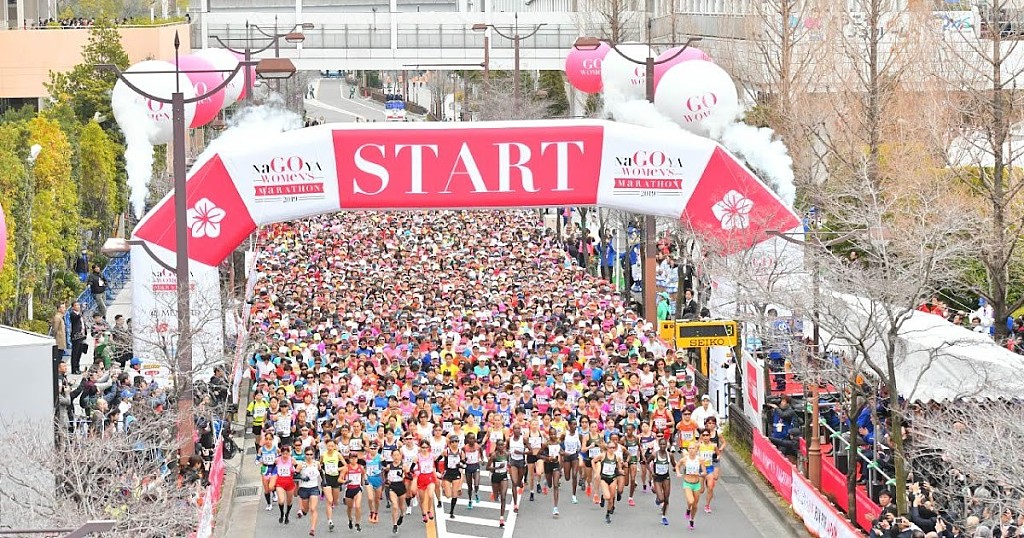
Nagoya is preparing a safe road race for 2022
The Nagoya Women’s Marathon is pleased to announce its plan to hold the Nagoya Women’s Marathon 2022 with 22,000 participants, on the same scale as before the Covid-19 pandemic started, in Nagoya city, Japan on Sunday, March 13, 2022.
Launched in 2012, the Nagoya Women’s Marathon is the world’s largest women’s marathon certified by Guinness World Records and the only women’s race granted a World Athletics Platinum Label.

The event hosted 21,436 runners in 2019, but due to the Covid-19 outbreak, it only staged the elite race with 110 athletes in 2020. The 2021 race on March 14, 2021, was held as the first mass participation road race held in Japan after the Covid-19 pandemic started and welcomed 4,704 domestic runners (In the virtual marathon held in parallel with the in-person race, 4,800 runners participated from around the world). The post-event investigation found no cases of infection among event participants within two weeks after race day. The 2021 race was recognized for setting an example of ‘new-normal’ distance race with all suitable measures against infection delivered and advice of medical professionals and local government officials followed.

The Nagoya Women’s Marathon has been paving the way for the organization of safe road racing during the pandemic by holding races with gradually increased numbers of participants of only elite athletes in 2020 and nearly 5,000 runners in 2021. Using the knowledge and expertise in infection prevention and control practice accumulated in the past two years, the organizers are determined to make thorough preparations and develop further anti-infection measures for the 2022 race to safely host 22,000 women runners.
To keep the event safe and secure for runners, volunteers, and all concerned, the organizers will establish an infection control office within the organizing committee with medical professionals and local government officials and form a precise infection control plan. All participants will be required to cooperate with the infection measures, such as wearing a mask at all event sites (except for runners while running in the race), temperature check on every site arrival, Covid-19 testing at number pickup, and submission of health condition sheet for 7 days before and 14 days after race day. If the event is forced to be downsized or canceled due to the state of emergency or event restrictions issued by the Japanese or local governments, participation in a virtual marathon will be offered as a substitution. The virtual participation option will be also offered to international runners if they cannot come to the event due to travel restrictions.
The organizers will continue monitoring the infection status closely and make the utmost effort to stage the world’s largest women’s marathon in the best and safest way possible.
Koji Kitano, Race Director of the Nagoya Women’s Marathon comments: “Due to the Covid-19 pandemic, we have not been able to welcome 22,000 women runners and support their marathon challenge for the past two years. As a runner myself, I understand how running fans around the world are waiting for mass races to return. We will use our experience from the past two races held during the pandemic to act in best practice to ensure the health and safety of 22,000 runners. The race entry will start in November and we are looking forward to receiving applications from many runners.”
Login to leave a comment
Nagoya Women's Marathon
The Nagoya Women's Marathon named Nagoya International Women's Marathon until the 2010 race, is an annual marathon race for female runners over the classic distance of 42 km and 195 metres, held in Nagoya, Japan in early March every year. It holds IAAF Gold Label road race status. It began in 1980 as an annual 20-kilometre road race held in...
more...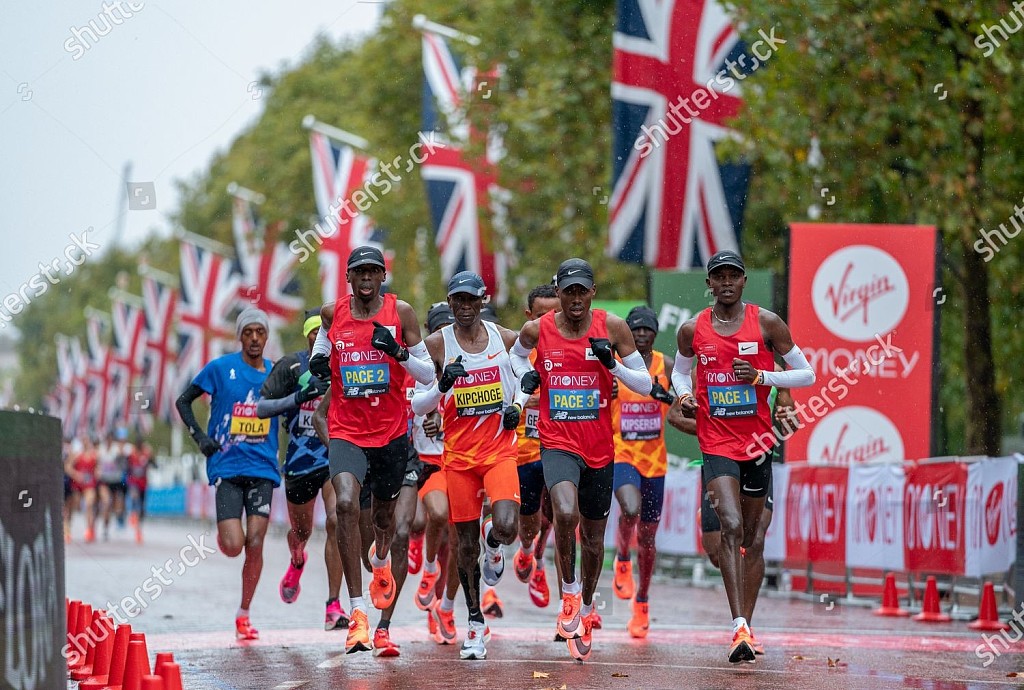
London Marathon new date confirmed
The London Marathon has been given the green light to go ahead and it’s been confirmed that the famous run will take place on October 3 in a route across the city.
A record 50,000 people are expected to run the 26.2 mile route after coronavirus has led to postponements.
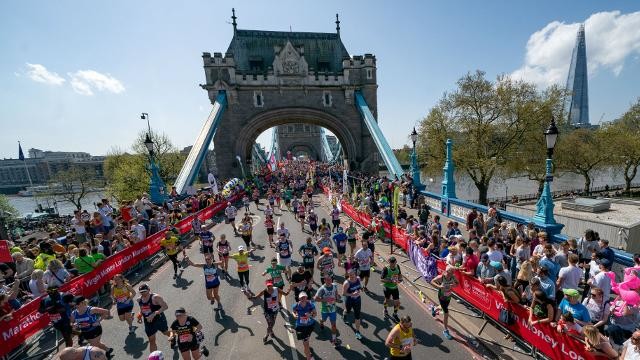
Organizers of mass participation running events have welcomed the news after the government confirmed England would move to Step 4 from July 19, allowing outdoor events to resume.
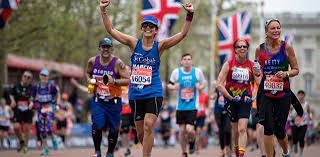
Last year’s Virgin Money London Marathon was postponed from April to October due to the pandemic, and then changed to a virtual event where most participants completed the distance from home.
Hugh Brasher, Event Director of London Marathon Events, said: “It is wonderful to confirm that our great mass participation events are returning across the country.
“The UK’s event organisers have worked together to ensure the safe return of mass participation sports events outdoors by participating in the government’s Events Research Programme and collaborating on a range of protocols that ensure our events will be safe and Covid-secure.”
A total of 37,966 finished the virtual event in 2020 giving it an official Guinness World Records title for the “most users to run a remote marathon in 24 hours”.
by Isabella D'Emilio
Login to leave a comment

TCS London Marathon
Since its inaugural edition on March 29, 1981, the TCS London Marathon has grown into one of the world's most prestigious road races, blending elite competition with an extraordinary charitable legacy. Founded by former Olympic champion and journalist Chris Brasher alongside Welsh athlete John Disley, the event has been staged every year and has been held in the spring annually...
more...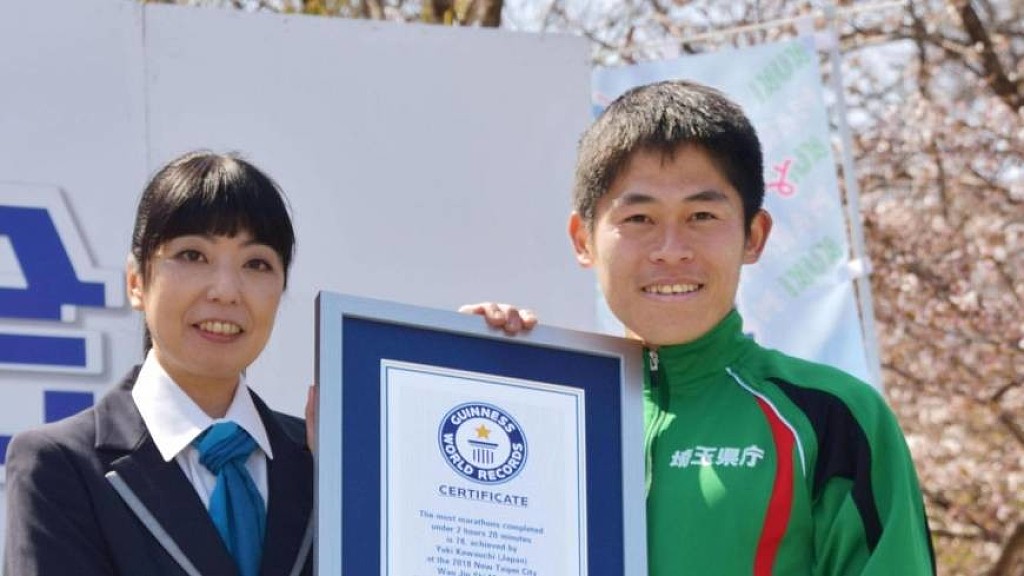
Japanese Yuki Kawauchi has become the first person to run 100 sub-2:20 marathons
Guinness World Records (GWR) has recognized Japanese marathoner Yuki Kawauchi for becoming the first person to run 100 sub-2:20 marathons. Kawauchi hit triple digits at Japan’s Hofu Marathon in December, where he ran to a second-place finish in 2:10:26, and he recently posted his 101st sub-2:20 result after running a PB of 2:07:27 at Sunday’s Lake Biwa Mainichi Marathon in Otsu, Japan, where he finished 10th.
GWR awarded Kawauchi a certificate in 2018 after he ran the 78th sub-2:20 marathon of his career and overtook American Doug Kurtis for the most in history. That same year, Kawauchi won the Boston Marathon (crossing the line in 2:15:58), and in 2019, he ran the 100th marathon of his career. At that point, he had broken 2:20 94 times.
Due to the pandemic, Kawauchi didn’t race as much as he normally would last year, but he did manage to run four marathons (for comparison, he ran 10 in 2018 and eight in 2019). He broke 2:20 at each of his races in 2020, and he is currently on a 15-race streak of marathons in which he has broken that barrier.
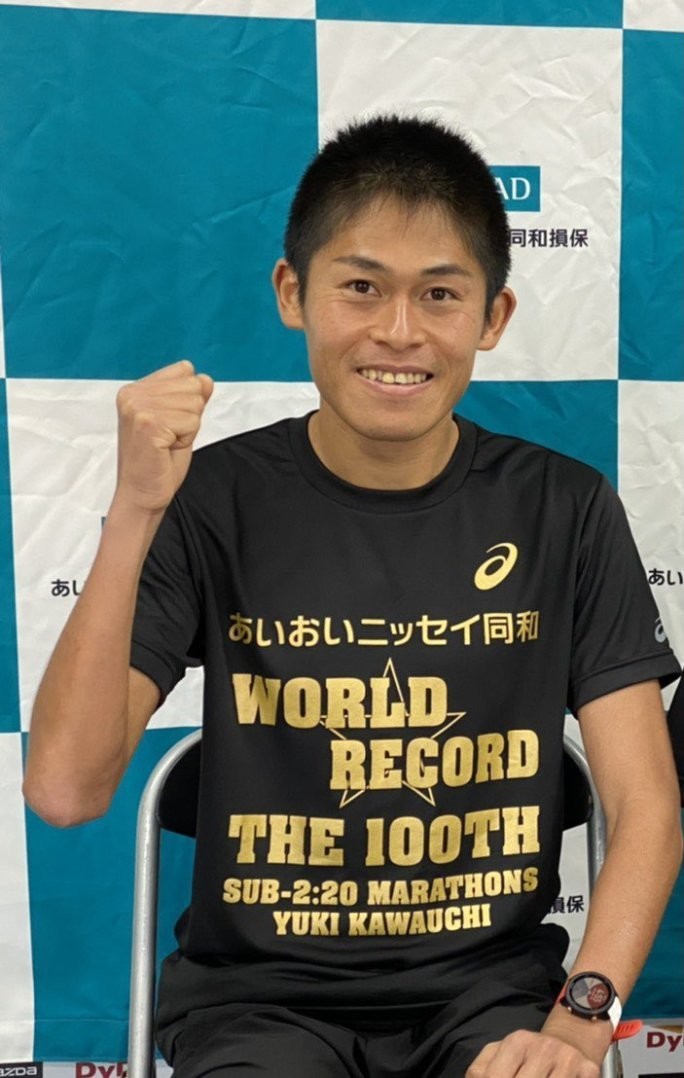
Kawauchi´s last marathon over 2:20 came in October 2018, when he ran 2:27:43 at the Venezia Marathon in Italy. Amazingly, he has run a whopping 109 marathons in his career, meaning he has only failed to break 2:20 on eight of those occasions.
"It might not to be difficult to run under 2:20 once,” Kawauchi said at an online press conference. “But even if it’s easy to achieve it once, in order to achieve that 100 times, you have to be able to continue the sport for a long time, you have to be able to participate in a lot of races, and more than anything you have to stay healthy. Otherwise, you can’t make it happen.”
He continued, adding modestly, “With that said, I’m not the fastest in Japan, I’m not the strongest in Japan. But I’ve diligently continued this since I was six years old and it’s resulted in this record.”
Kawauchi turns 34 on Friday, and although he’s getting older, he is still capable of running PBs, as he showed at the Lake Biwa Marathon. He touched on this in the press conference, and he said he is confident he can continue to run this quickly for many years to come.
by Ben Snider-McGrath
Login to leave a comment
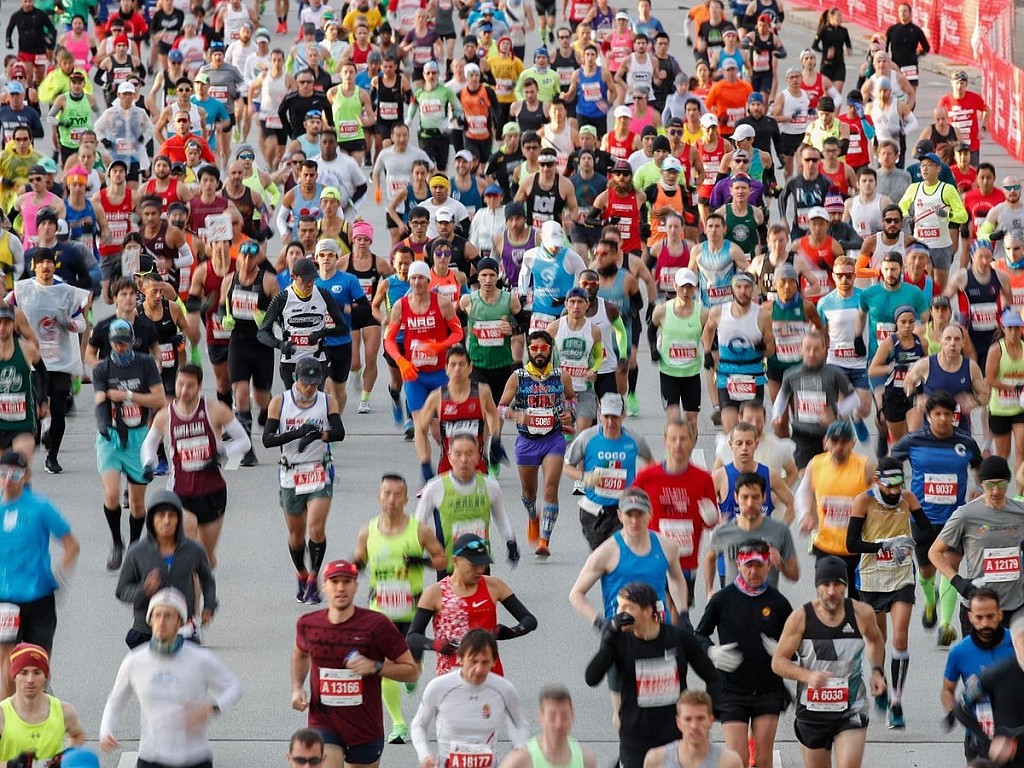
Virgin Money tickets go on sale for second virtual London Marathon
The organizers of the marathon are releasing 50,000 virtual tickets which, combined with the 50,000 in-person participants, would make it the largest marathon ever.
Last year’s marathon was awarded a Guinness World Records title for the most users to run a remote marathon in 24 hours with 37,966 finishers.
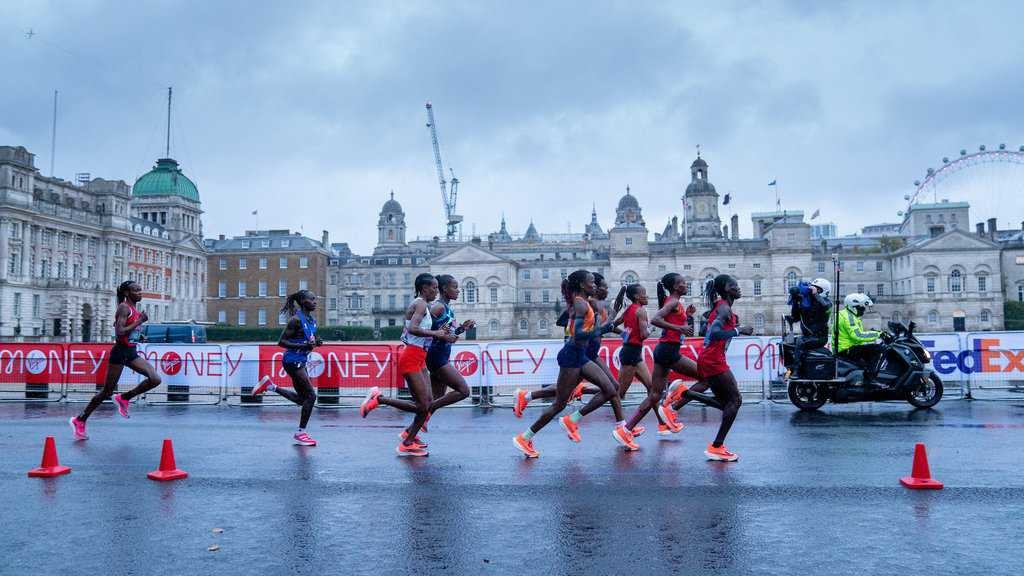
It was also the most inclusive marathon in the forty-year history of the event, with participants able to complete the marathon at any time on the day.
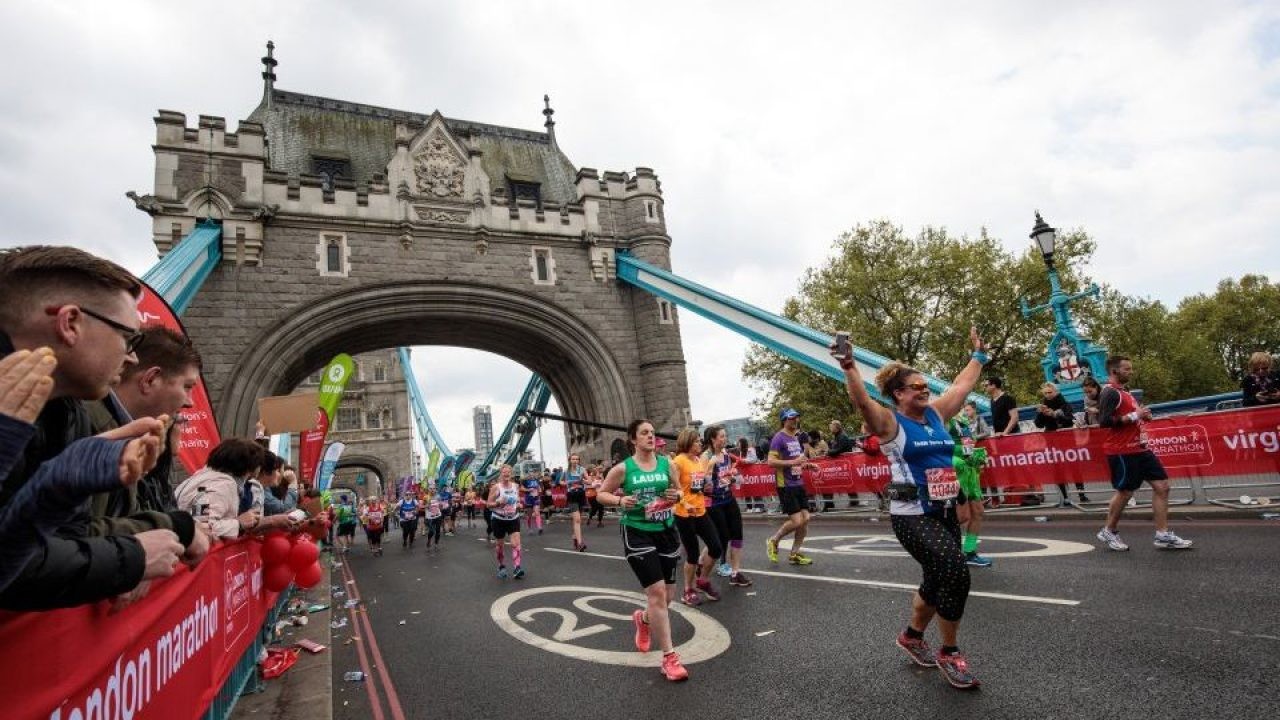
Hugh Brasher, event director of the Virgin Money London Marathon, said: “Our first virtual Virgin Money London Marathon last year was a real eye-opener for us.
“Everyone did the marathon their way: some ran the whole way, others walked, while some broke up the distance into manageable parts over the day and night. It was an incredible, inclusive day when the spirit of the London Marathon brought everyone together in a unique way.”
All finishers, whether virtual or in-person, will be sent an official medal and a New Balance finisher’s T-shirt.
by Tom Saunders
Login to leave a comment
TCS London Marathon
Since its inaugural edition on March 29, 1981, the TCS London Marathon has grown into one of the world's most prestigious road races, blending elite competition with an extraordinary charitable legacy. Founded by former Olympic champion and journalist Chris Brasher alongside Welsh athlete John Disley, the event has been staged every year and has been held in the spring annually...
more...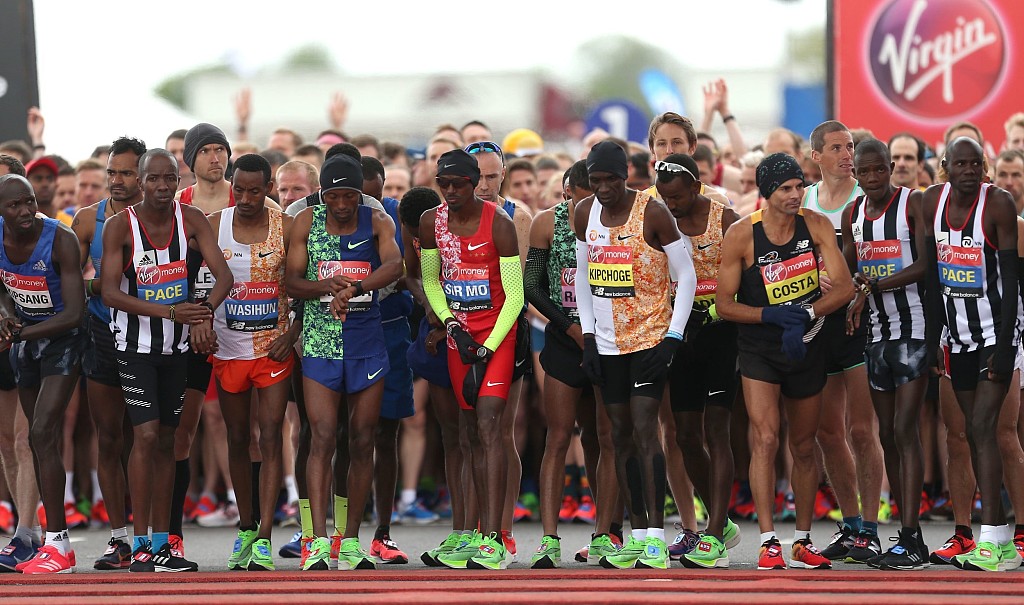
London Marathon is planning for 100,000 people to take part in its 2021 event, split between mass race runners and virtual participants
Virgin Money London Marathon hopes to host a record 50,000 runners on the traditional course and another 50,000 in a virtual event in October.
While last year’s event saw elite-only races take place in the UK capital as well as the inaugural virtual edition, organisers are hopeful that the action on October 3 can include a mass race featuring a record 50,000 participants on the traditional course from Blackheath to The Mall, an increase of more than 7000 on the previous finisher record.
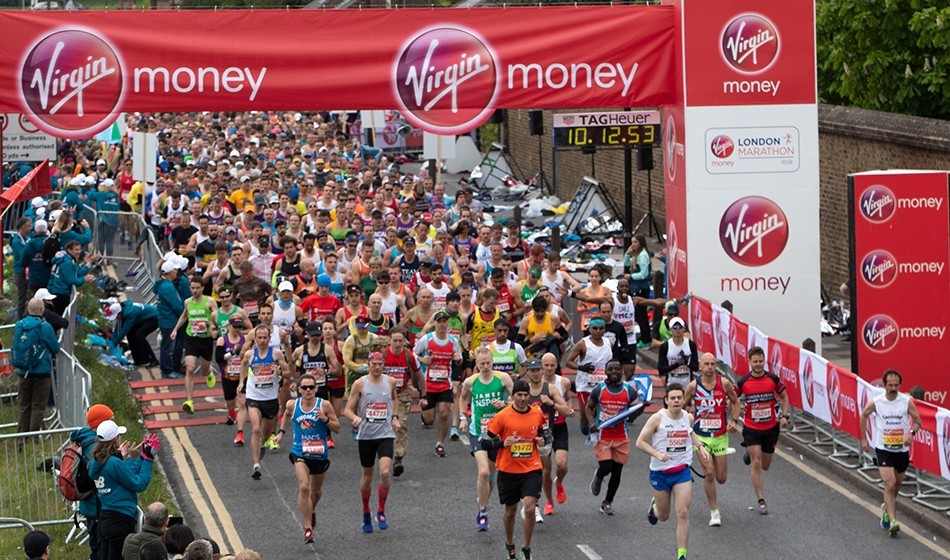
A further 50,000 places will also be available in the second Virtual Virgin Money London Marathon, which will see participants take on 26.2 miles over the course of their choice between 00:00:00 and 23:59:59 on race day.
A total of 37,966 participants completed the 2020 virtual event and it has been awarded a Guinness World Records title for ‘most users to run a remote marathon in 24 hours’.
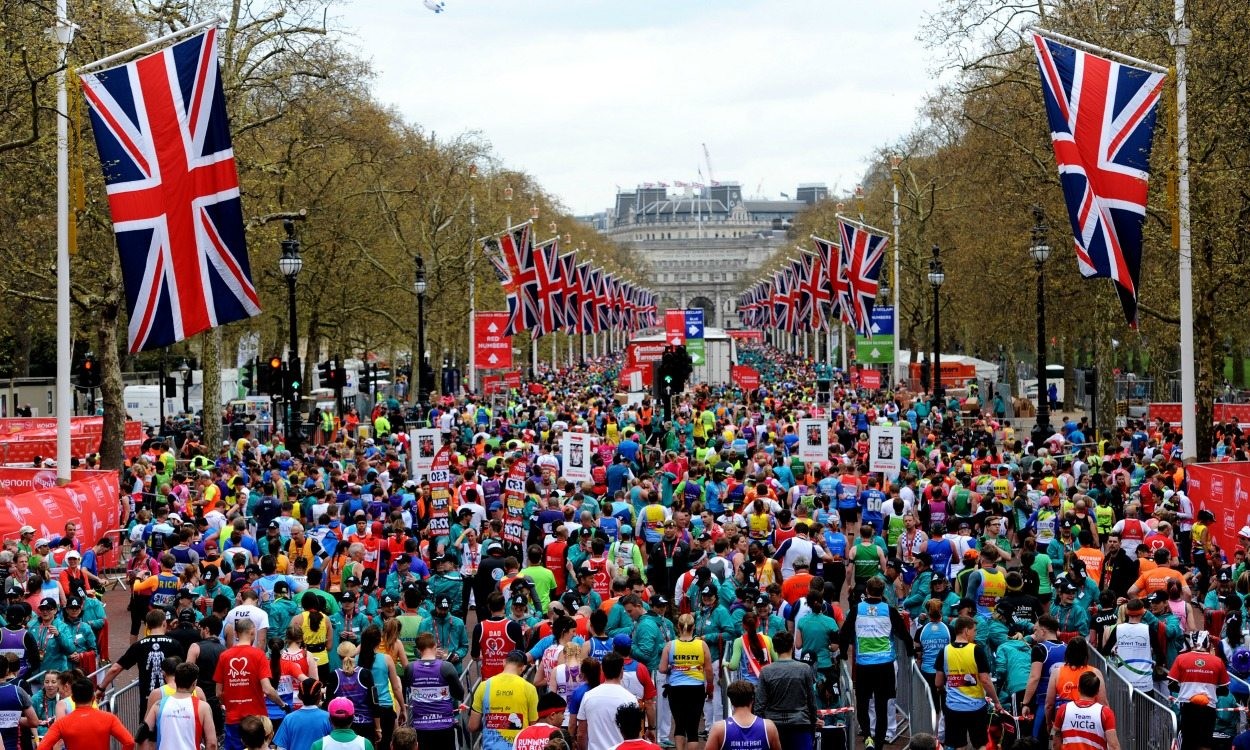
“With a national vaccination programme underway, we hope to see an unprecedented 100,000 people take part in this year’s Virgin Money London Marathon on Sunday 3 October,” said event director Hugh Brasher.
“The London Marathon is a wonderful example of sport as a force for good while raising millions for charity. It’s all about communities and people coming together and one of our founding pillars is ‘to have fun and provide some happiness and a sense of achievement in a troubled world’.
“The world record-breaking success of the virtual event in 2020 and the incredible stories from participants across the globe showed how the world’s greatest marathon brought light and hope in the darkness of the pandemic. We want to offer that again and we have also accelerated the plans we have been working on for some years to increase the number of finishers on the streets of London to 50,000.
“People can run wherever they are in the world, they can run for charity, they can run for their mental or physical health or run for the sheer enjoyment of it – whatever the reason, they will be part of a unique day in the history of the London Marathon on Sunday 3 October.”
Also returning to the streets of the capital on October 3 is the Virgin Money Giving Mini London Marathon alongside the Virtual Virgin Money Giving Mini London Marathon for primary schools nationwide. More than 110,000 schoolchildren took part in the first virtual event last year.
Ballot results for the 2021 London Marathon are set to be released on February 8. Unsuccessful applicants will then have an exclusive window to enter the virtual event.
General entries, costing from £28, will open on February 16 on a first-come, first served basis.
by Athletics Weekly
Login to leave a comment

Tokyo 2020 Olympic Games
Fifty-six years after having organized the Olympic Games, the Japanese capital will be hosting a Summer edition for the second time, originally scheduled from July 24 to August 9, 2020, the games were postponed due to coronavirus outbreak, the postponed Tokyo Olympics will be held from July 23 to August 8 in 2021, according to the International Olympic Committee decision. ...
more...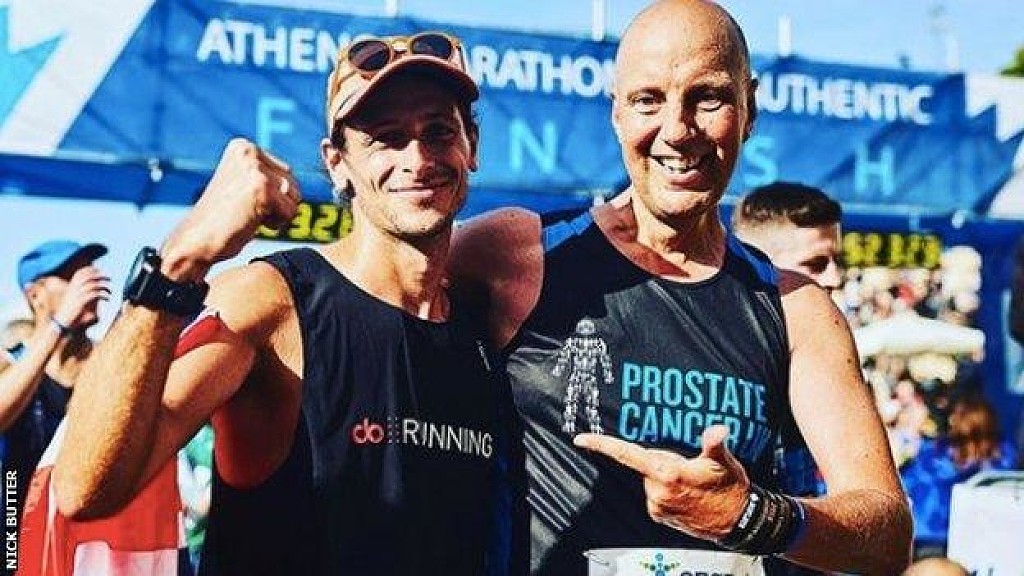
The man who ran a marathon in every country in the world
"All of a sudden, I had this horrendous pain in my shoulder and chest. You know what the tell-tale signs are, but when you feel it yourself, it's very certain what's going on."
Nick Butter suffered a minor heart attack two miles from the finish line of a marathon on the Polynesian island of Samoa. This was the 182nd marathon of a trip in which, over the course of 674 days, he ran one in every country in the world. He's the first person to achieve such a feat.
By this stage of the challenge, he'd already been shot at, mugged at gunpoint and attacked by dogs. It was one more obstacle to overcome. And the way it came about is quite typical of his habit of, well, taking a lot on.
Butter often had a taxi driver, motorcyclist or cyclist with him, who would provide help with navigation, water and safety. On this occasion, a man from his hotel, Sani, had volunteered.
Unfortunately, it turned out that Sani hadn't ridden a bike for 20 years.
With eight miles left for Butter to run, Sani was in some pain and had to dismount. Rather than stop, or ask for help, Butter decided to run the rest of the marathon while pushing the bike and water himself.
"It was uphill, in 45C-plus heat, when I suddenly I had this pain," Butter says.
Without anyone around and no phone signal, he took a break by the side of the road and waited it out. Eventually, Sani caught up and took the bike back so that Butter, determined to finish, could hobble through the last section.
Afterwards he spoke to doctors and family friends who worked as medics. They all confirmed the symptoms of a heart attack. That didn't stop him flying to New Zealand to run another marathon just two days later. It's also worth mentioning he has a family history of heart problems.
"The medical answer is that I should have slowed down after that, but the actual answer is that I didn't," says Butter. He completed 211 consecutive marathons around the world - 193 in member countries of the United Nations, plus 18 more for "future-proofing".
It was in 2016 that a 26-year-old Butter had the idea. The goal was to raise money for Prostate Cancer UK.
"I wanted it to be big," Butter says. "It had to involve running and travel and it had to invoke something that Kev had said to me, which was 'don't wait for a diagnosis'."
A simple internet search for 'has anyone ever run a marathon in every country?' brought a negative answer.
"I couldn't believe it," he says. "We've put people on the moon! Of course, now I know why it's not been done before - it's very, very difficult."
After telling his family and friends, Butter started planning.
"I registered with Guinness World Records, spoke with some adventurer and runner friends and then I started to understand that I needed to contact media outlets, embassies, running clubs around the world. Hotels, people to do my safety, people to do my visas, working out a route, understanding the weather conditions, what my body would need to go through."
He says that beyond raising money, the goal was to spread awareness.
"I did something like 140 live TV appearances in different countries," Butter says. There were personal testimonies too.
"We had people come to us who previously hadn't any idea of prostate cancer, but, after speaking to us, got tested and discovered that they had it. Because they caught it early, they were fine."
Since finishing the trip, he has been doing speaking tours (lockdowns permitting), using his story to help educate. He's also published a book, Running The World.
Butter, writing in the closing chapter about his final leg of the 196-marathon trip, which began in Marathon, Greece, describes Webber turning up to run with him.
Five years on from Webber's terminal prostate cancer diagnosis, in which he was given an estimated two years to live, he and Butter crossed the finish line in Athens hand-in-hand.
The pair still talk regularly, and Butter says his friend is still running and still smiling.
by Ciaran Varley
Login to leave a comment
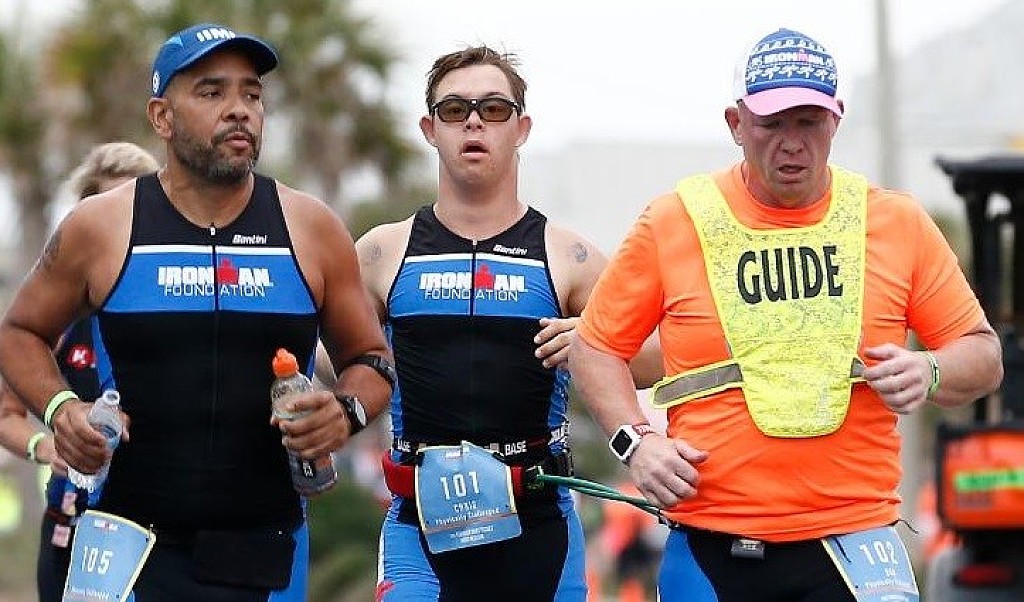
Chris Nikic has made history becoming the first person with Down's syndrome to finish an Ironman triathlon
A 21-year-old triathlete from Florida has become the first person with Down's syndrome to finish an Ironman event - swimming 2.4 miles, cycling 112 miles and running a 26.2-mile marathon.
Chris Nikic crossed the line in 16 hours 46 minutes nine seconds - less than 14 minutes under the official cut-off time at the Visit Panama City Beach Ironman in Florida - to earn official recognition from Guinness World Records.
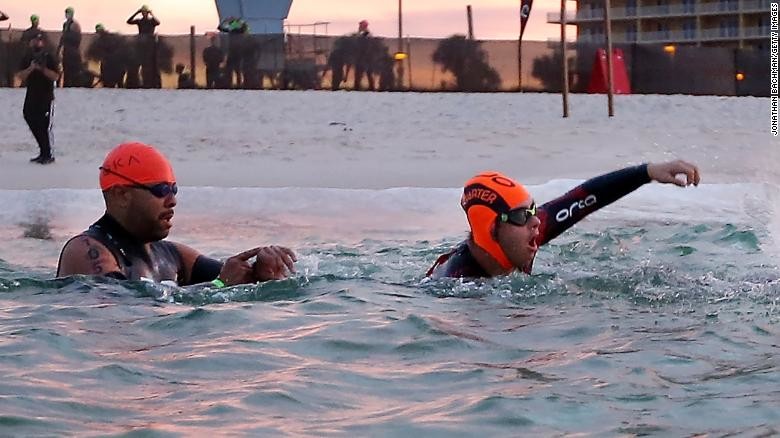
"You have shattered barriers while proving without a doubt that anything is possible," the official Ironman account tweeted.
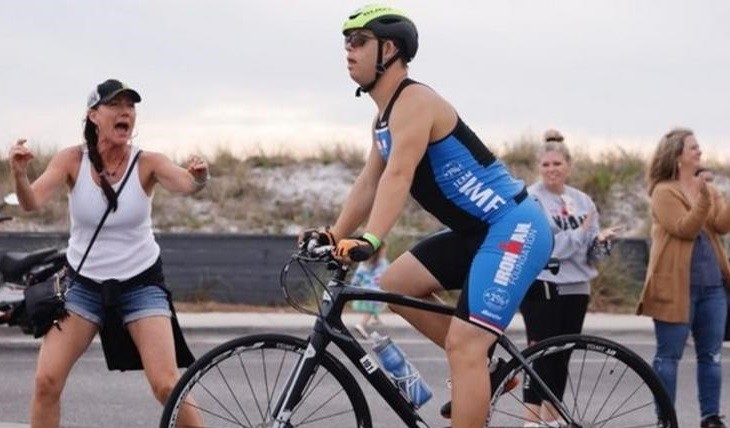
Chris Nikic begins the swimming portion of the Ironman Florida.
"Ironman. Goal set and achieve," said Nikic in a post to Instagram. "Time to set a new and Bigger Goal for 2021."
Nikic completed the race in 16 hours 46 minutes and 9 seconds -- 14 minutes under the 17-hour cutoff time.
Nikic fell off his bike and was attacked by ants at a nutrition stop, but he pushed on to finish the competition, the Special Olympics said in a release.
"We are beyond inspired, and your accomplishment is a defining moment in Ironman history that can never be taken away from you," the Ironman Triathlon organization said in a post to Twitter.
The organization documented the historic race with a series of updates to social media on the day of the competition. The final two miles of Nikic's run were streamed live on Ironman's Facebook page.
Chris Nikic competes in the bike portion with his guide, Dan Grieb, during Ironman Florida.
Nikic and his father Nik developed the "1 percent better challenge" to stay motivated during training. The idea is to promote Down syndrome awareness while achieving 1% improvement each day, according to Nikic's website.
"To Chris, this race was more than just a finish line and celebration of victory," Nik Nikic said. "Ironman has served as his platform to become one step closer to his goal of living a life of inclusion and leadership."
Nikic's accomplishment earned him congratulatory messages from celebrities, such as tennis great Billie Jean King and runner Kara Goucher, and people around the world, including 33,000 new followers on social media, according to Nikic.
After his record-setting achievement, Nikic will focus on competing in the 2022 Special Olympics USA Games and continuing to raise money for Special Olympics, Down syndrome and RODS (Racing for Orphans with Down Syndrome) through his platform.
"I achieved my goal and now I want to help others like me," he wrote to Instagram.
by Kelsie Smith, CNN
Login to leave a comment
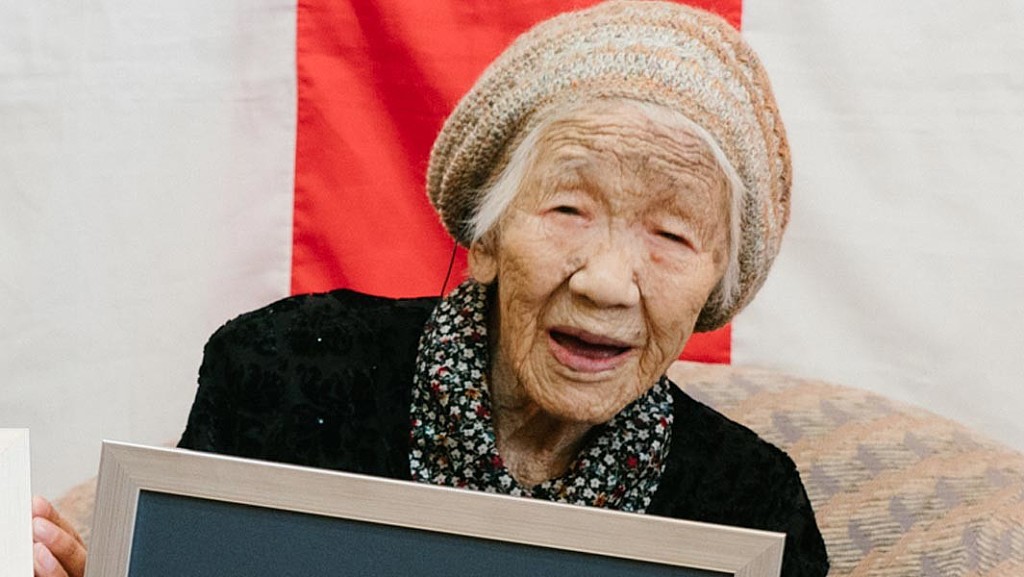
Japan's Kane Tanaka 117-year-old set to carry Olympic torch ahead of Tokyo Games
Kane Tanaka, the world’s oldest person, will take part in the Olympic torch relay ahead of the Tokyo Games, according to a report in the Japanese newspaper the Mainichi Shimbun. At 117, Tanaka is officially recognized by Guinness World Records as the oldest person alive.
She was already scheduled to carry the torch in the 2020 relay, but those plans were put on hold when the Games were postponed due to COVID-19. Tanaka’s new date to carry the Olympic flame is set for May 11, by which time she will be 118 years, 129 days old.
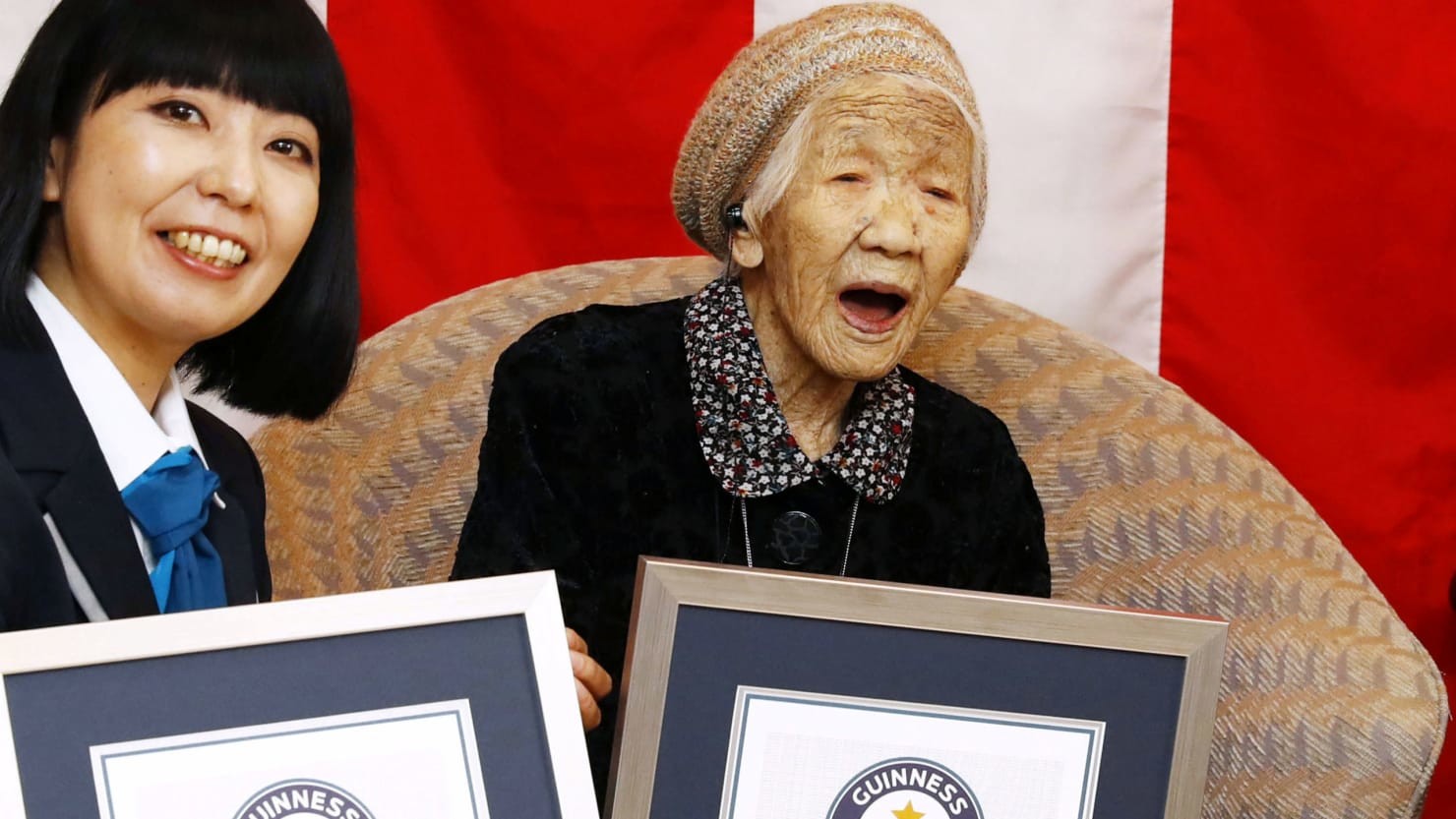
Tanaka was born in Fukuoka, Japan, on January 2, 1903, just seven years after the first modern Olympics in Athens. Now, more than a century later, she is ready to play a role in the 2021 Olympics. At her care home in Fukuoka, Tanaka will be pushed in a wheelchair for 200m as she carries the Olympic flame. She was added to the relay lineup when Nippon Life Insurance Co., a Japanese company that has sponsored the 2021 Olympics and Paralympics, suggested it to organizers. The Nippon team said they “wanted her to send a positive message about this time of long-living.” Tanaka’s 61-year-old grandson accepted on behalf of his grandmother, saying his family wants “people to see Kane happily carrying the Olympic flame.”
The Mainichi Shimbun report says Tanaka is in good shape, but notes that the plans may be cancelled if she isn’t feeling well on the day of the relay. Because of this, the torch relay is going to be a surprise event for Tanaka, who has not been informed of the plans. “When we were first approached about her doing it, we worried what might happen given her age, but we were getting worked up over nothing,” her grandson told the Mainichi Shimbun. “We’ll be happy if the people who see her holding the torch up and looking well can think, ‘There’s hope in going on living.'”
The last time the Olympics were held in Tokyo (which was in 1964), Tanaka was 61, as old as her grandson is now and almost half her current age. In her lifetime, she has lived through a total of 49 Olympics (both summer and winter editions), and the 2021 Games will be the 50th.
by Ben Snider-McGrath
Login to leave a comment
Tokyo 2020 Olympic Games
Fifty-six years after having organized the Olympic Games, the Japanese capital will be hosting a Summer edition for the second time, originally scheduled from July 24 to August 9, 2020, the games were postponed due to coronavirus outbreak, the postponed Tokyo Olympics will be held from July 23 to August 8 in 2021, according to the International Olympic Committee decision. ...
more...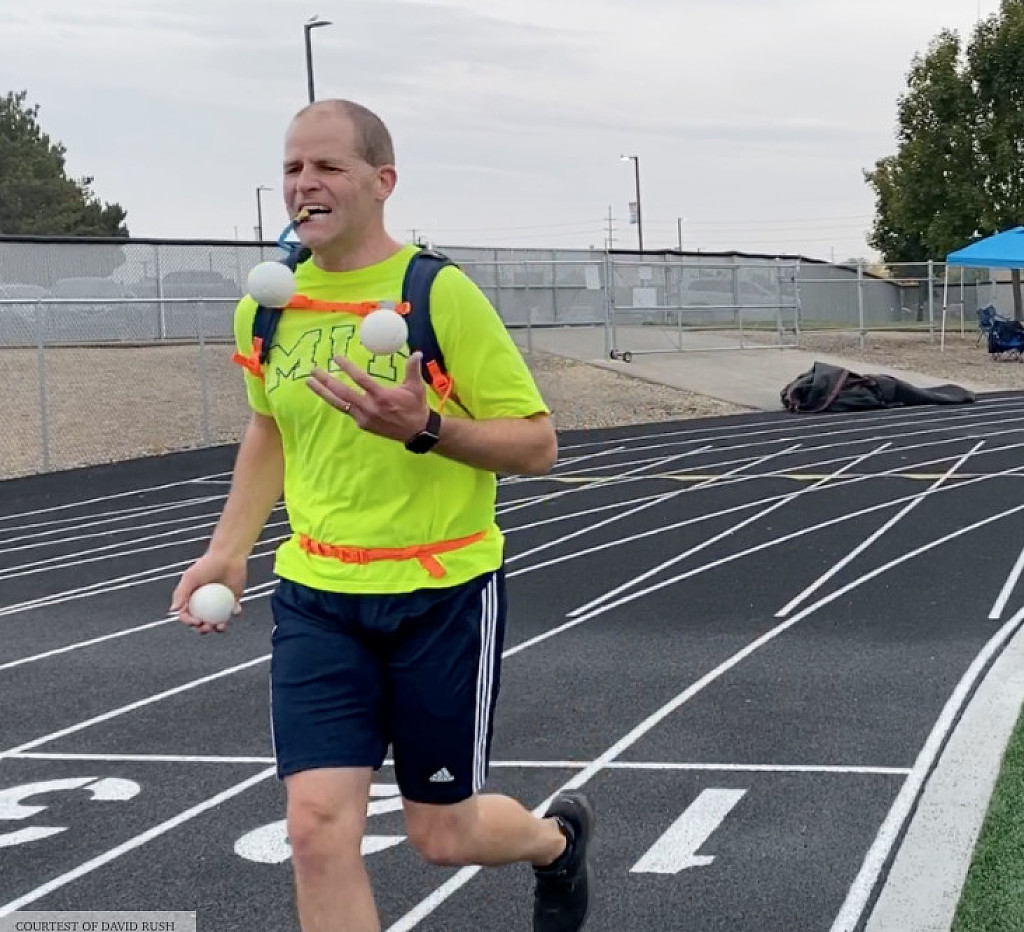
Meet the runner who set the Guinness World Record for distance run while juggling
Five hours, 21 minutes, and 23 seconds. 117 laps around a track. Zero balls dropped.
David Rush is no stranger to Guinness World Records. He’s been going after them for years as a way to boost his efforts promoting STEM education in schools—he thought kids would be inspired if they saw a world-record holder.
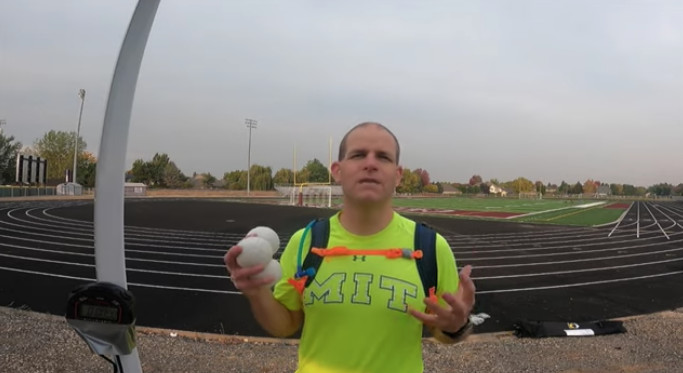
Rush, a longtime juggler, holds records in things like fruit sliced in the air by juggled knives and the most Oreo cookies stacked in 30 seconds. However, joggling—running while juggling—was always at the forefront of his mind after going to school with longtime joggling record-holder Zach Warren.
'The main purpose of these records is to show kids that if you believe in yourself, you can accomplish anything,' Rush told Runner’s World. 'Even though some records still stand, you shouldn’t give up if you miss it. You can become anything you want.'
He started running around 2005, when he got competitive with his brother, who was doing a Thanksgiving half marathon that year. Since 2014 though, he really picked up his running efforts, especially when he started to get into joggling more.
Knowing he didn’t necessarily have the speed to capture various speed records, he decided to focus on the joggling distance record—which meant he had to run 15.5 miles while juggling without dropping a single ball.
Most joggling records—which are generally the fastest time covering a certain distance—are fairly lenient when it comes to drops. As long as a joggler returns to spot of a drop before continuing, the record is valid. But the distance record is different. If there’s a drop, the attempt is over, whether that’s one mile in or 20 miles in.
Another tricky element of this attempt is that a runner cannot accept outside assistance, including being given food or drink, during the attempt. And when your hands are occupied with juggling, nutrition becomes tricky.
'I figured I could go 20 miles without food or water,' Rush said. 'My goal, though, was a marathon if I could do it, so I had to think of a way to get something without breaking the rules.'
With this in mind, Rush opted to wear a Camelbak for the duration of the run, and he tied the tube to his face so he could drink the mix of Gatorade G2 and water he had without using his hands. That meant the straw was in his mouth for the entire run.
Rush’s record attempt, on October 10, went off smoothly. With a camera filming the action and two friends watching as witnesses, he made his way around and around the Centennial High School track in Boise, Idaho.
The juggling didn’t slow down Rush; instead, the bouncing of the Camelbak forced him to shorten his stride and average a 11:19 mile. Still, he cruised through the distance record in 2 hours and 32 minutes, and he just kept going from there.
After over five hours and more than 100 laps, Rush started to wear down. He passed the marathon distance, but a few miles later, a ball finally hit the track, ending his attempt.
Not only did Rush complete his first ultramarathon, but he also crushed the world record by running 29 miles in 5 hours, 21 minutes, and 23 seconds.
'This is one I would consider doing again,' Rush said. 'I was thrilled with 29 miles, but now I’m wondering, How much farther could I go?'
Rush ended up with only one wound from the race. As he ran, the Camelback straw repeatedly bumped into his mouth, causing a blister to form in his mouth that bled a bit during his run.
Despite the usual soreness from running such a distance followed, Rush has since attempted two more world records—the number of times spitting a ping pong ball at a wall and catching it in his mouth, and fastest blindfolded juggling. He also has plans for more joggling attempts, potentially before the end of the year.
by Runner’s World
Login to leave a comment

Beers, Bomb Suits and Blue Jeans: The Weirdest Mile-Run Records Known to Man-13 baffling ways humans have covered 5,280 feet
The running and drinking communities have long shared an unlikely Venn diagram. In the 1930s, some athletes would bring beer along for lengthy workouts, believing that its hearty grains might propel them to longer distances. For decades, at the end of the Berlin Marathon, runners who’ve made the podium are given medals and enormous boots of Erdinger. And these days, running clubs like Toronto’s RUNTOBEER start and finish at breweries around the city. Hell, there’s even a craft brewery in Chico, California, called Sufferfest that’s operated by lifelong runners and makes light, low-calorie ales designed for the highly active beer drinker.
Still, there is no greater (nor less subtle) collision of these two disciplines than the infamous Beer Mile, a concept that is arguably more popular than any internationally sanctioned event in the entire sport of track and field. It’s an irresistible blend — the familiarity of elementary-school gym class with the low-class hijinks of college — and it’s at the forefront of an unofficial, utterly unasked-for movement in both the amateur and professional running circles: run four laps hard, but make it weird.
In the last five months, runners have set two new, preposterously specific mile-run records: one while handcuffed, and one while wearing a pair of blue jeans. It would be tempting to laugh these efforts off, if only they weren’t so fast. (The jeans miler rumbled in at an unholy 4:06.) And really, at the end of the day, it’s fun to embrace these races, which wed the appeal of an old, oft-forgotten sport with stunts and gimmicks that thrive on social media.
Which is exactly what we’ve done. Below, find the 13 weirdest mile-run records known to man — including the fastest miles ever run in a bomb suit, with a dog and under the influence of chocolate milk.
Fastest Beer Mile
Corey Bellemore, 4:33
Bellemore actually ran a 4:24 about a year after his 4:33 mark, but got disqualified for leaving a combined 4.5 ounces of beer in his “empties.” Those judges are serious. As is his running ability; he’s an Adidas-sponsored athlete with a personal best of 3:57 to his name. Which is a crucial theme in the world of wacky mile records: always eager for a challenge, the pros inevitably hijack the bonkers creations of layman runners. Just six years ago, for instance, the running world had celebrated its first sub-five beer mile. Check out the full catalogue of all-time bests here, including stats on the favored beers. (Budweiser is currently in the lead, though Bellemore, a Canadian, prefers the craft stuff from Ontario’s Flying Monkeys Brewery.)
Fastest Mile in Jeans
Johnny Gregorek, 4:06
This past May, Asics athlete Johnny “The Jet” Gregorek ran a blistering 4:06 in a pair of Levi 501s. It was enough to beat Dillion Maggard’s former record time of 4:11, and horrify millions across the internet who think wearing jeans on a plane should be a “criminal offense.” Gregorek, who is a middle-distance star with a silver medal from the 2019 Pan American Games, trained for his record by running 100-meter sprints in the blue jeans to break them in. On race day, he also managed to raise $31,000 for the National Alliance on Mental Illness, in an homage to his late brother. Levi’s donated $5,000.
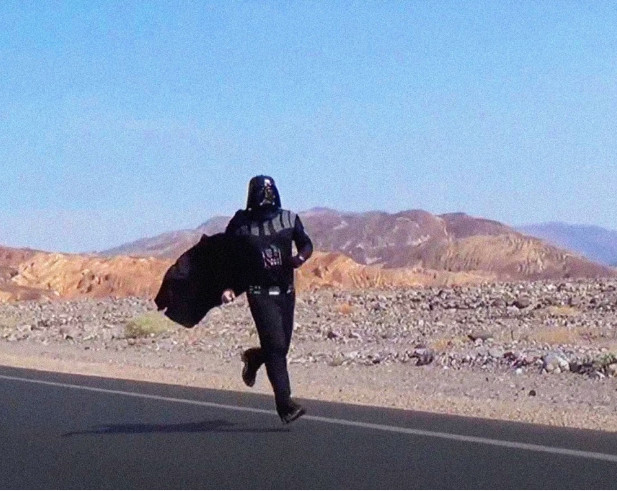
Fastest Walking Mile
Tom Bosworth, 5:31
Of all the feats listed here, this is the only one that doesn’t actually involve running. And yet, it’s also the only one you’re likely to find at a legitimate track meet. Racewalking is very much a sport, despite the fact that it looks like several minutes of that “This one is serious” dash people make for the bathroom after eating bad shellfish. The only rule? Keep one foot in contact with the ground at all times, which distinguishes it from the leaps and bounds of running. Distances usually start at 3,000 meters, and hike all the way up to 100 kilometers (that’s 62 miles), but mile races have some popularity, too. At the 2017 Diamond League in London, British race walker Tom Bosworth clocked in at 5:31, to the delight of a very excited commentator.
Fastest Mile Downhill
Mike Boit, 3:27
We recently covered a virtual, March Madness-style running tournament called “Survival of the Fastest,” in which runners were pitted against each other each week to race a new, specific distance. Downhill racing was allowed in the competition (even encouraged) and by the time the bracket had been whittled down to a final four, every runner involved was hitting start on Strava from the top of a mountain in order to ensure the most competitive time possible. It really does make an absurd difference. Hicham El Guerrouj has holds the official world record for the mile run (3:43), but Mike Boit’s performance in 1983, when he sprinted down a hill through the center of Auckland to a 3:27 finish, is the fastest a human being has ever covered 1,600 meters on his own two feet.
Fastest Mile in Alaska
Ben Blankenship, 3:57
“An Alaskan Mile” was an official selection for the Flagstaff Mountain Film Festival in 2018, and it chronicles an effort by eight elite runners — with Oregon and Olympian pedigrees among them — to become the first to break the four-minute barrier on Alaskan soil. As Trevor Dunbar (one of the runners, the event organizer and from Kodiak, himself) points out, Alaska only has three months where such an accomplishment would be remotely possible, and even then, high winds or even frost could arrive right before the gun goes off. It’s worth the 20-minute watch if you’re interested, but just know that Alaskans were amped to see Minnesotan Ben Blankenship go well under four, setting a new state record.
Fastest Mile on a Treadmill
Anthony Famiglietti, 3:58
It’s Anthony Famigletti’s party, and he’ll run a 3:58 mile on a treadmill if he wants to. A former Olympian who competed in the 3,000-meter steeplechase in Beijing, Famiglietti recruited the fastest American miler ever, Alan Webb (3:46), to help him start breaking four-minute miles into his forties. It worked. This is Famiglietti late last year, on his 41st birthday, running at a 3:58 pace for a full mile on his treadmill. Forget anything you’ve heard about treadmills juicing performance; that’s irrelevant here. Him staying on that machine is akin to deftly canoeing through Class V rapids. And better yet, he got to do it at his own Reckless Running store in Mooresville, North Carolina, which he owns with his wife.
Fastest Mile with a Dog
Anthony Famiglietti, 3:59
More Famigletti. Another impressive sub-four — this one a year earlier, at age 40 — but all credit here goes to Bailey the dog, who casually rolled out of bed to brush against the pinnacle of human athletic achievement, and wanted more. Famigletti affixed Bailey to his waist via a hands-free “bungee” leash (which doesn’t exactly square with our dog running tips, by the way) and ran hard to earn his time. But the fact that Bailey basically dragged an adult 5,280 feet and didn’t once chase a squirrel is the real takeaway here.
Fastest Backwards Mile
Aaron Yoder, 5:54
The Guinness World Record for fastest backpedaled mile ended with the following exchange:
Fastest Chocolate Milk Mile
Mars Bishop, 4:56
On paper, it’s the PG-rated beer mile. But subbing chocolate milk for beer is no joke, and arguably more likely to end in puke penalties. At the 2nd Annual Chocolate Milk Mile in Cranston, Rhode Island, runners slugged cups of the good stuff from East Providence’s Munroe Dairy Farm. A number of runners had to run shame laps for spewing, but runner Mars Bishop torched the track to the tune of 4:56. Because the rules to the Chocolate Milk Mile are exactly the same as the Beer Mile, beermile.com has apparently decided to include the results in its database. (Under beer of choice, they put a chocolate milk logo.) With all respect to Bishop, this record — from 2017 — seems ready to be broken again.
Fastest Mile While Handcuffed
Jeremy Greenwald, 4:52
Save your “running from the cops” jokes, YouTube’s finest have already handled that. Besides, we’re legitimately interested in this from a physical standpoint. Despite the amount of long-distance runners you see without much meat on their arms, the mile is a bang-bang event, where many competitors rely on a dramatic, arm-pumping “kick” in their last lap. To break five with those arms rendered useless is a real challenge. It’s clear from the video that Greenwald, a former Division 1 runner at Georgia Tech, had to rely heavily on his core muscles while keeping his shoulders straight and back; after all, if he fell, the whole thing was over. The previous record for this “event” was 6:37.
Fastest Mile in a Bomb Suit
Daniel Glenn, 8:57
Advanced Bomb Suits weigh 80 pounds, and are reinforced with Kevlar ballistic panels that can withstand blasts traveling at supersonic speeds of over 1,600 m/s. If you’ve seen The Hurt Locker, you have an idea of how serious they are: soldiers routinely get heat exhaustion from just walking around a few paces in one, so for Lt. Daniel Glenn to complete a full mile in one is unheard of. But to do so at the clip of an average American mile time (nine to 10 minutes) is staggering. Even more impressive: he did it in Florida.
Fastest Mile While Juggling
Zach Prescott, 4:43
Yeah, you were probably going to get through your entire life without discovering that “joggling” existed, and you would’ve been just fine. Sorry. Joggling is running while juggling three objects in time, and for decades, Kirk Swenson was the undisputed king of the sport. He joggled a 4:43.8 way back in 1986. Then Boston University runners Zach Prescott came along, and threw three lacrosse balls around en route to a buzzer-beater 4:43.2 victory. Guinness World Records is still in the process of verifying the new record.
Fastest Mile in Death Valley While Wearing a Darth Vader Suit
Jonathan Rice, 6:13
This happened and and there is NOTHING any of us can do about it.
Login to leave a comment
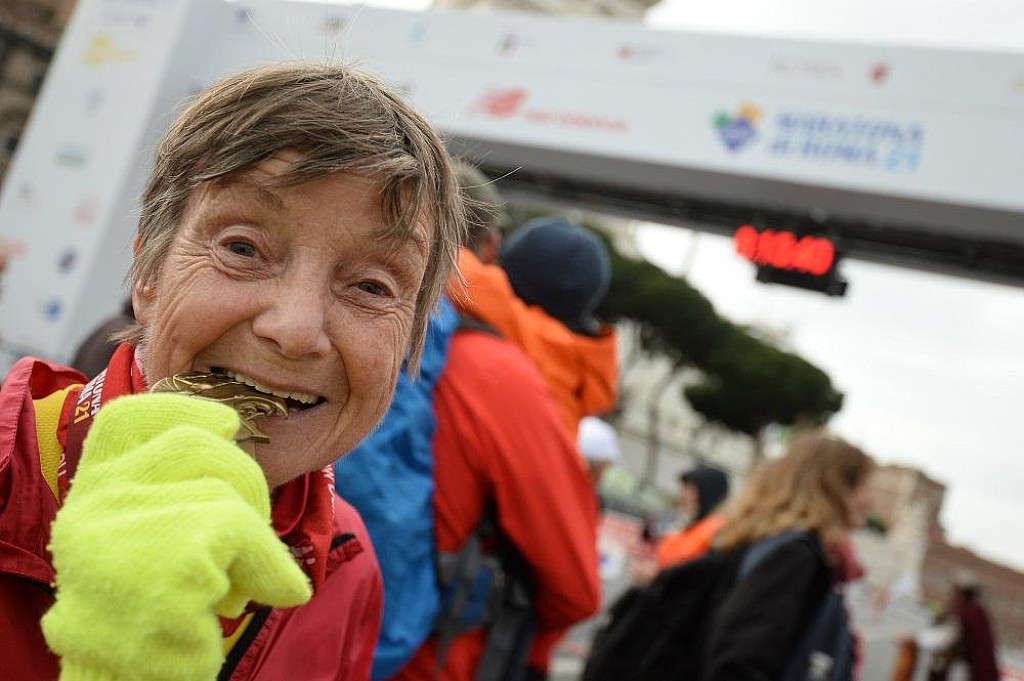
Berlin resident Sigrid Eichner, 79, has run 2,200 marathons and she didn’t start running until age 40
Kathrine Switzer meets a lot of runners. The 261 Fearless founder (who was the first woman to run the Boston Marathon with an official bib, back in 1967) travels the world, promoting women’s empowerment through running. But even she was shocked, during her visit to the Berlin Marathon last month, to meet a woman who has run 2,200 marathons which quite possibly is more than any other woman alive.
Born in 1940, Sigrid Eichner’s running began metaphorically–as an infant, she “ran” from Allied bombs, and from the Russians, with her family. Her passion for physical activity was born after the war, when, as a talented gymnast, she was sent to a boarding school for athletes. It wasn’t until she was a working mother of 40 that she started running, to take time for herself and escape domestic life (and possibly an unhappy marriage), according to one report.
After the fall of the Berlin Wall in 1989, running became a way for her to explore the world.
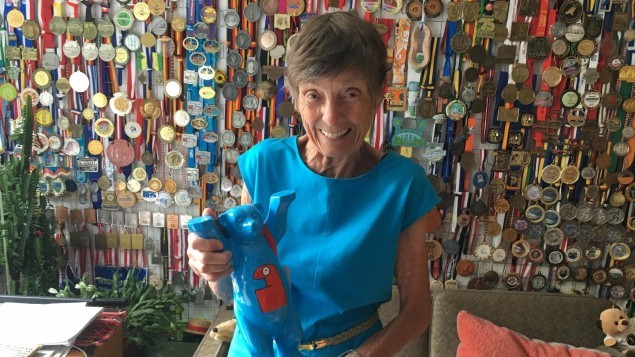
When we tried to verify the number, we found her entry on the Association of Road Racing Statisticians (ARRS) site, which shows 681 marathon results between November 29, 1981 and October 31, 2017, and includes the 2003 Niagara Falls Marathon and New York City Marathon during her only visit to North America.
(The ARRS site has been in limbo since the death of its driving force, Ken Young, in 2017.) The German ultramarathon site D-U-V.com lists between one and 23 ultra results for Eichner every year between 1981 and the present. It’s fair to say that Eichner has done more running than anything else, with the possible exception of breathing, during the last 40 years of her life.
Her children now grown, she admits she runs to escape loneliness. She has a literal curtain of race medals in her home, a room full of trophies from her younger days, and a closet full of race shirts.

It is sometimes suggested that people who race a lot must have money in order to afford the constant travel and race entries, but this does not appear to be the case for Eichner, most of whose races nowadays are in her native Germany.
She favors hostels over hotels, and has occasionally slept on the floor of the race expo to save money. Last year she spent just over 3,000 euros ($3310US) on 88 races, including travel and accommodation. She spoke of contacting the Guinness World Records organization in the hope of attracting a sponsor, but so far there is no official Guinness record.
She is rarely injured, though one report says she was once badly hurt in a car accident, and now has four screws in her back.
Occasionally running multiple marathons in a single weekend, Eichner says, “The first 30 minutes are the hardest.”
by Anne Francis
Login to leave a comment
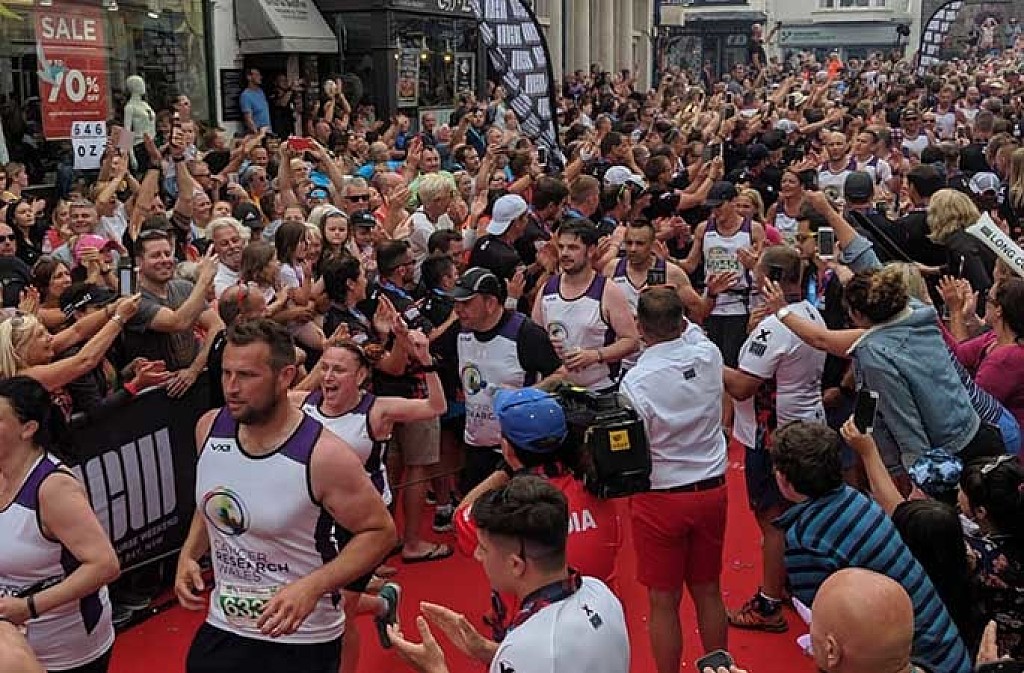
A group of 122 people broke the record for the most runners linked to complete a marathon
Last Sunday (July 7 2019) hundreds of people descended on Tenby, Wales, to take part in The Wales Marathon 2019.
Amongst the runners were a group of 122 people hoping to break the record for the most runners linked to complete a marathon.
Running for Cancer Research Wales, the participants were linked with more than just rope, with each of the runners having been affected by cancer in some way.
Organiser Neal Gardner, a Royal Mail employee, was no stranger to this record. He organised an attempt in 2009, securing the title with 30 linked people completing The Wales Marathon in Newport.
"My mum sadly lost her fight to cancer in 2002, at just 48," he said the day before this latest attempt.
"I began fundraising and it eventually led me to a Guinness World Records title. We first broke this world record in London 2009 with 30 runners. The very same record that we will be attempting to win back tomorrow.”
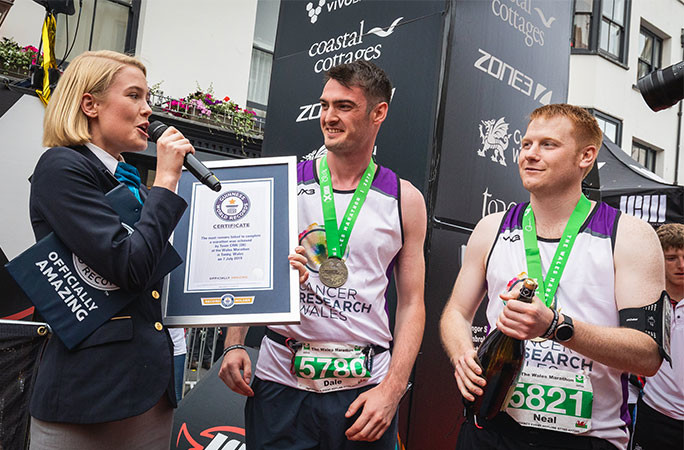
Since then, the record has grown and grown, and has been held by participants from marathons held in Cologne, London, Paris, Milwaukee, Würzburg and Calgary.
However, after a hearing that a friend of his had been diagnosed with cancer, Neal decided to reclaim the title, 10 years after his first attempt.
"In October [2018] I received the sad news that a very good friend and work colleague, Pip Morgan, had been diagnosed with stage four cancer. It was time to do it all again!"
The successful attempt included many of Neal’s fellow Royal Mail colleagues and Dale Evans, Cancer Research Wales Events Manager, who helped to organise the attempt.
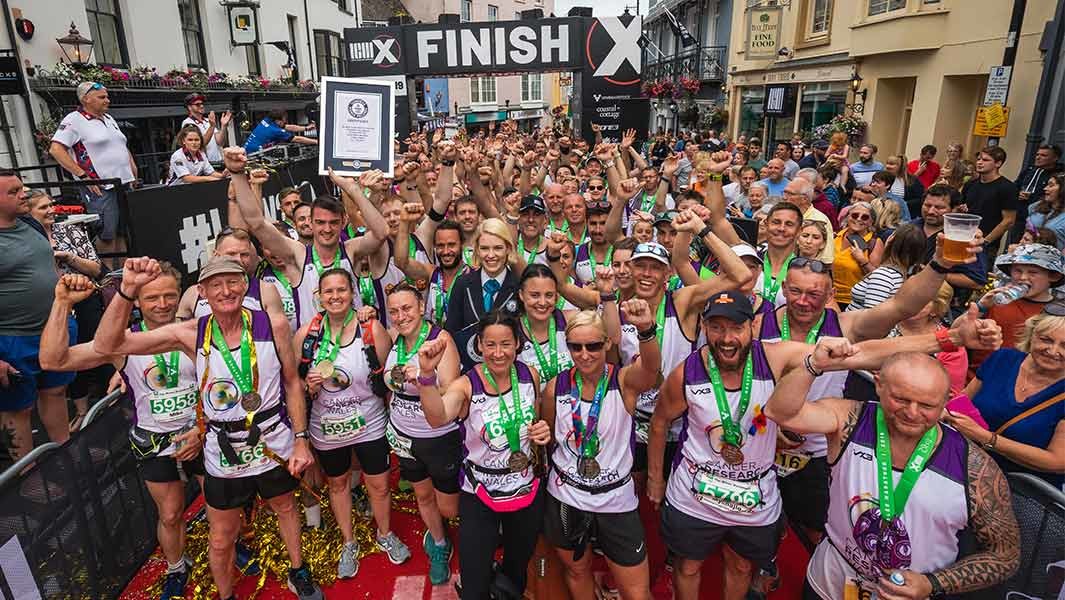
Organised into 30 rows of four runners, the team were successful, with the last person crossing the line in 6 hours and 47 minutes.
Record-breaking participant Cath Diment said afterwards: "Hope you are still buzzing like me, I haven’t stopped talking about what we achieved!"
"Many of our runners have been affected cancer in some form. Hearing each person’s reasons for running was incredibly inspiring and really did provide the motivation to dig deep."
"As well as breaking a Guinness World Records title, our runners’ efforts are also helping to fund important research into the prevention, early diagnosis and better treatment that will benefit cancer patients in Wales and beyond."
by Connie Suggitt
Login to leave a comment
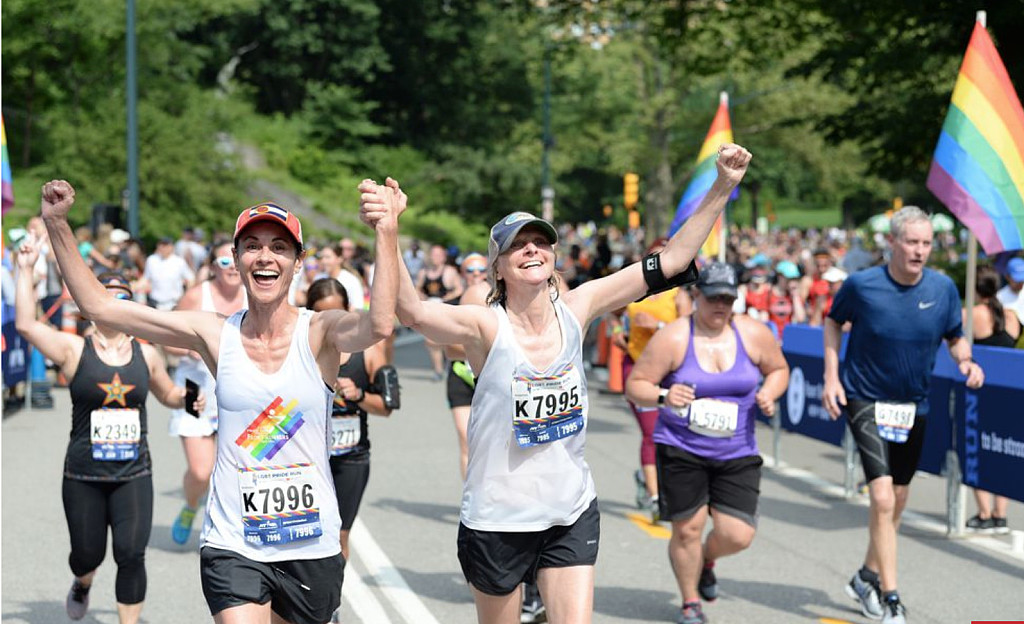
The Guinness World Record for the Largest Pride Charity Run Has Been Shattered
The streets of New York City were undeniably colorful this weekend: On Saturday, June 29, the New York Road Runners (NYRR) and Front Runners New York (FRNY) teamed up to host the 38th annual five-mile LGBT Pride Run.
This year, they had a special mission in mind: to set the Guinness World Record for largest Pride charity run.
To break the Guinness Record, more than 6,000 participants had to compete in the race. As of Thursday, the amount of people registered for the race—which sold out—was around 10,000, according to a press release issued to Runner’s World from NYRR.
Then on Saturday, NYRR announced that 10,236 people completed the race, shattering the record. There was a Guinness World Records adjudicator onsite to verify the record once the final finisher crossed the line, a spokesperson for NYRR told Runner’s World.
The race served as a finale for LGBTQIA+ Pride Month, officially recognized in June. It also complemented WorldPride, an international event hosted by New York City that welcomed LGBTQIA+ members from around the world to engage in special events, parties, and performances throughout the month of June.
This year is especially noteworthy for the LGBTQIA+ community, because it marks the 50th anniversary of the Stonewall riots, a series of protests in Manhattan in 1969 that initiated the gay rights movement in the United States.
Each year, an LGBT charity organization is chosen to be beneficiary for the funds raised from the Pride Run. This year’s recipient was The Center (The Lesbian, Gay, Bisexual & Transgender Community Center) located in the West Village, which provides career advice, family guidance, as well as health support to the gay community in New York City.
The five-mile race began on the East Drive at 67th in Central Park, ran north around the park’s upper loop, then finished on the 72nd Street Transverse. Early birds who made it before the 8:30 a.m. were treated to a special surprise: limited-edition rainbow pairs of Goodr sunglasses, which were sold until they ran out.
While there were only a limited number of sunglasses, all participants received a rainbow-themed technical tank along with their race bib. Prizes were also awarded to the top four men and women, as well as the five largest participating teams. The men’s winner was Kedir Figa of Ethiopia, who finished in 25:19. The women’s winner, Lindsey Scherf of New York, finished in 28:06.
For those who couldn’t make it to New York City for the race, the NYRR Virtual Pride Run 5K continues until Sunday, June 30. So far, more than 5,000 runners from across the world have completed the virtual Pride race, according to a press release from NYRR.
by Runner’s World
Login to leave a comment

Front Runners New York LGBT Pride Run
The annual Front Runners New York LGBT Pride Run is a 5 mile race in Central Park that will draw in more than 5,000 runners and thousands of fans from across the country. This event, organized by Front Runners New York (FRNY) in collaboration with New York Road Runners, is an official qualifier for the TCS New York City Marathonand...
more...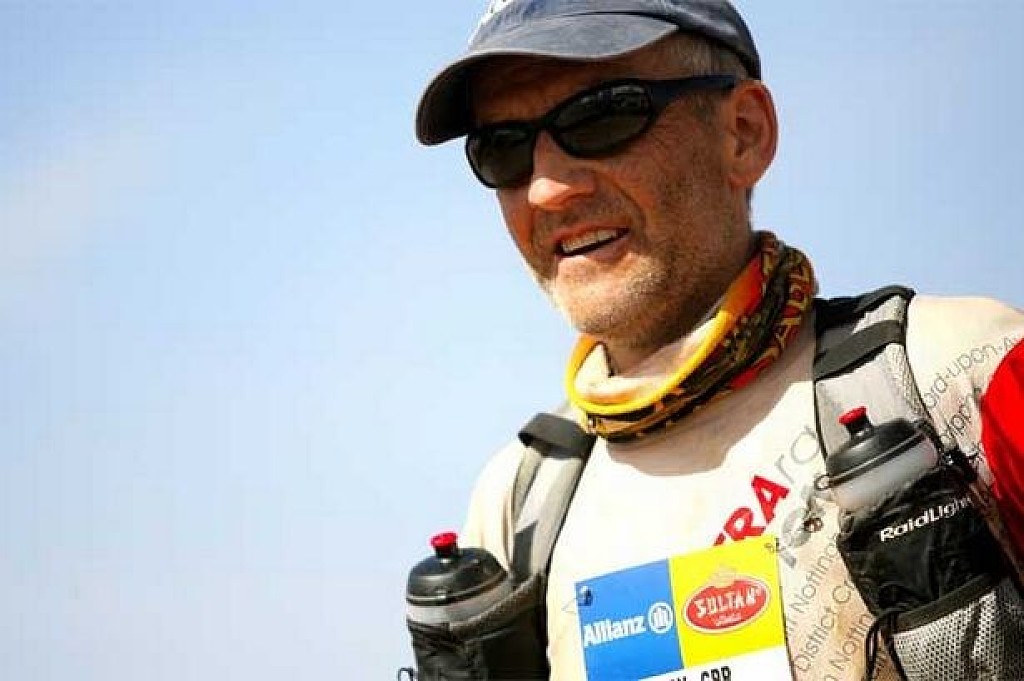
There is something magical about 26 miles 385 yards say Rory Coleman who has done it 1000 times
Login to leave a comment
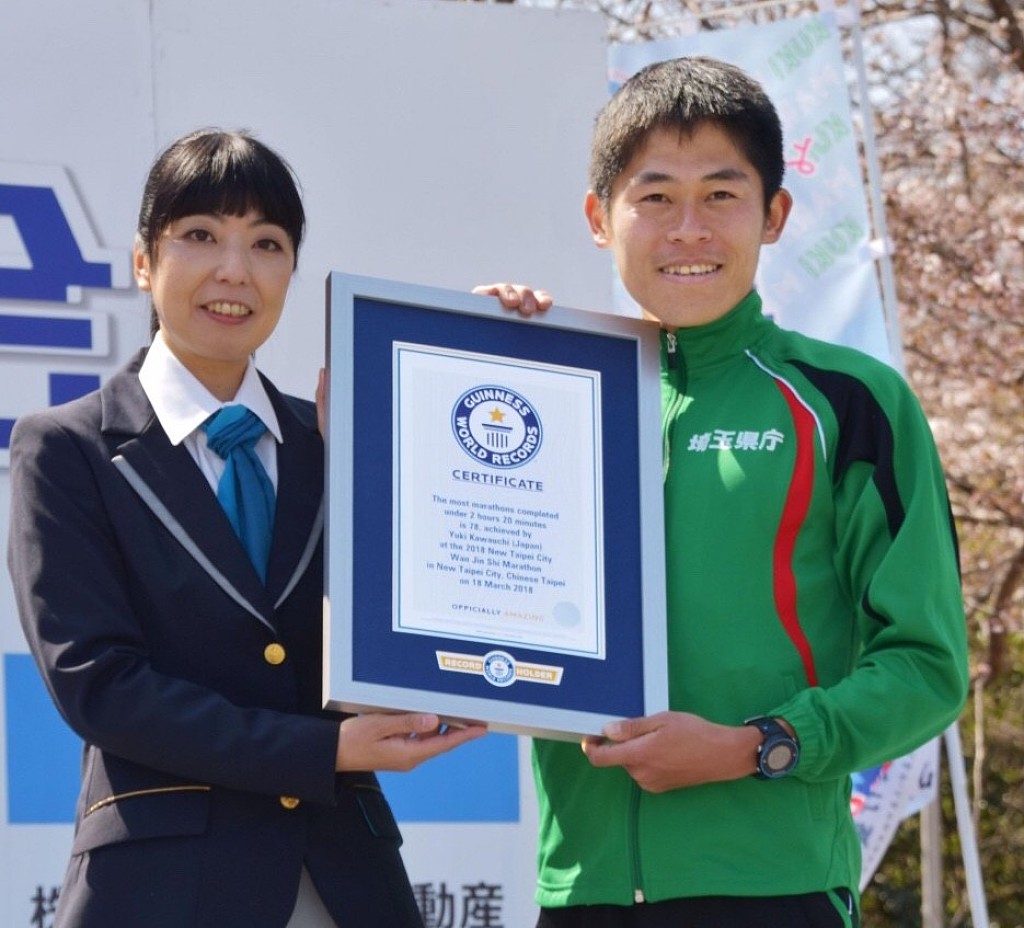
Japan’s Citizen Runner, Yuki Kawauchi was officially recognized by Guinness
Login to leave a comment
