

Running News Daily
Running News Daily is edited by Bob Anderson and team. Send your news items to bob@mybestruns.com Advertising opportunities available.
Index to Daily Posts · Sign Up For Updates · Run The World Feed
Articles tagged #D.C.
Today's Running News
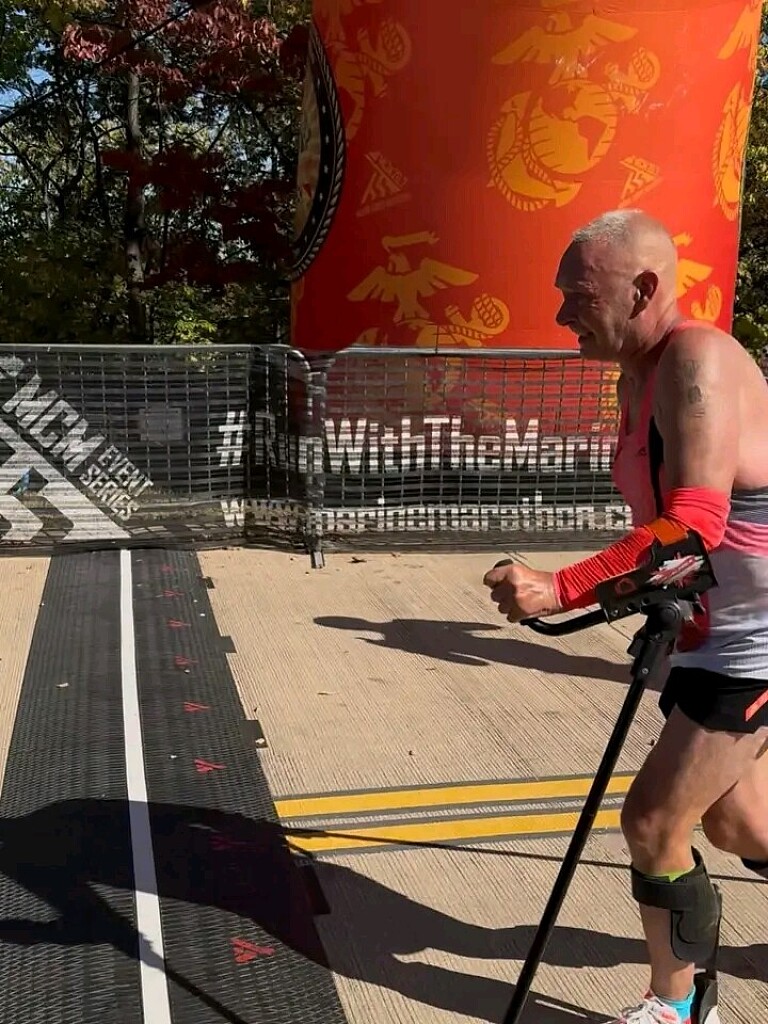


Mick Marshall Makes History With World Record For Fastest Marathon Completed On Crutches In Washington, D.C.
Australian endurance athlete Mick Marshall has achieved an extraordinary milestone at the 2026 Marine Corps Marathon in Washington, D.C., setting a world record for the fastest marathon completed on crutches after crossing the finish line in an incredible 5:35:50.
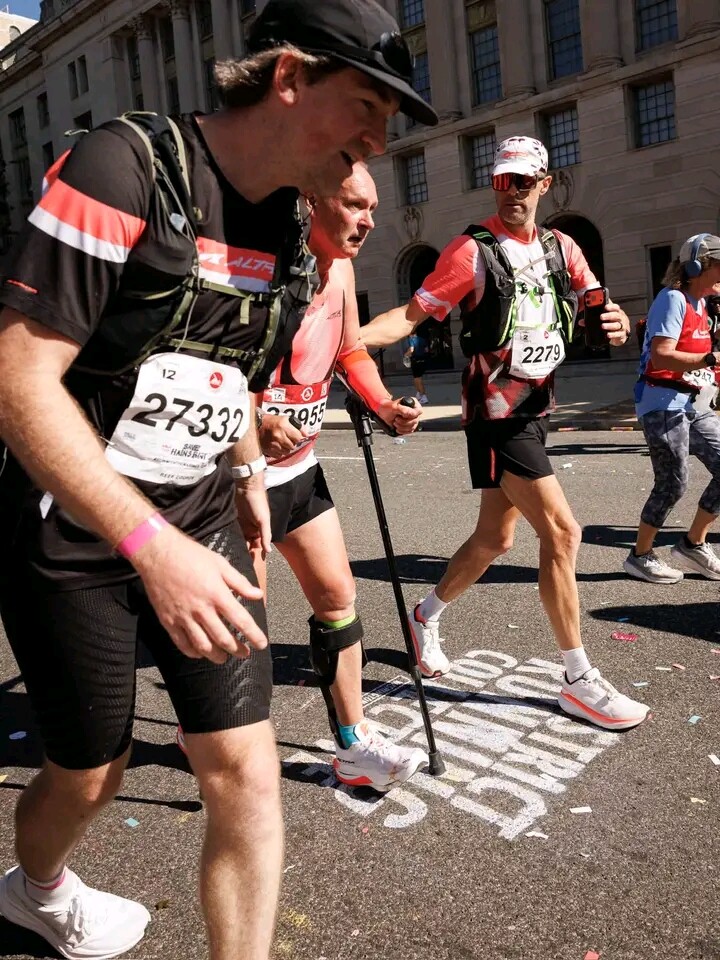
Representing Altra as an elite athlete, Marshall demonstrated remarkable determination and perseverance throughout the 26.2-mile (42.195-kilometre) race, turning one of the world's most celebrated marathon events into a stage for an inspiring display of human resilience.
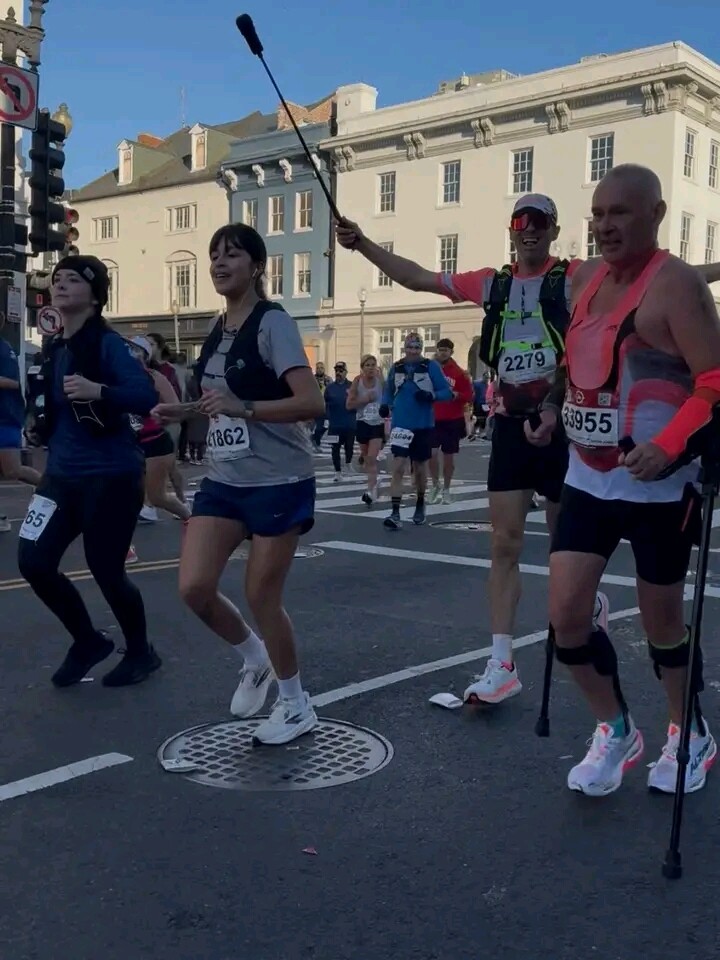
Completing a marathon is a demanding physical challenge for any athlete, requiring months of preparation, mental strength and the ability to push through fatigue. Covering the same distance on crutches presents a different set of challenges, placing considerable demands on the upper body, coordination and endurance. Marshall's achievement highlights the dedication required to overcome obstacles and pursue goals that many might consider beyond reach.
The Marine Corps Marathon, renowned for its patriotic atmosphere, enthusiastic spectators and scenic course through the nation's capital, provided a memorable setting for the record-breaking performance. As thousands of runners pursued their own finish-line goals, Marshall carved out a special place in the event's history with his remarkable effort.
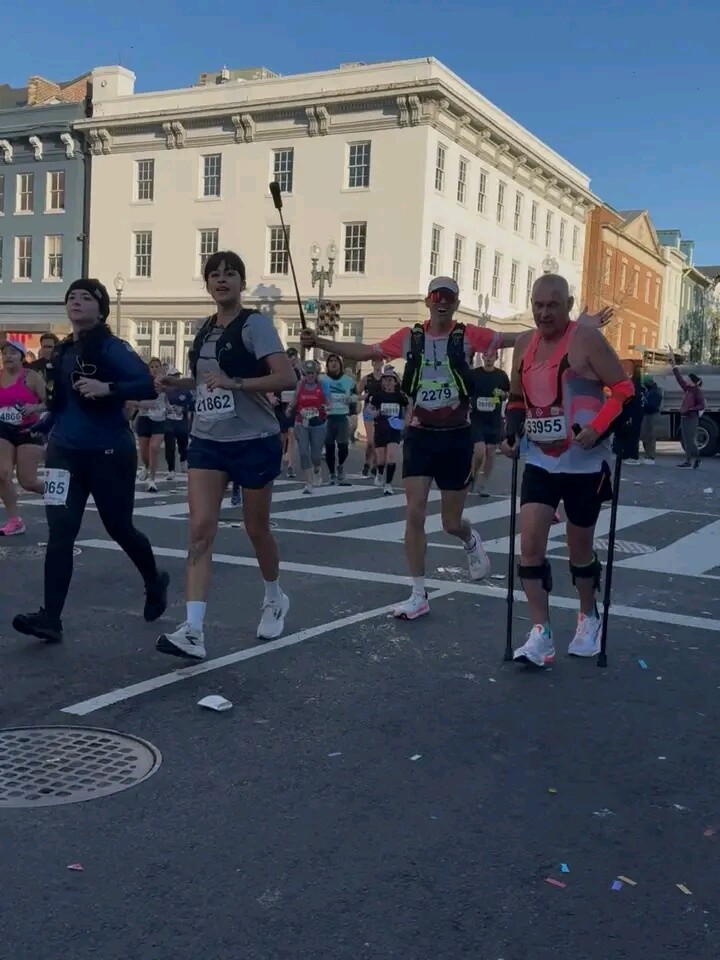
Beyond the record itself, Marshall's achievement carries a message that resonates far beyond the running community. Every movement toward the finish line required determination, patience and an unwavering commitment to the challenge before him. His performance is a reminder that greatness is not measured solely by how quickly someone reaches a destination, but also by the courage it takes to pursue a goal despite the difficulties along the way. For aspiring athletes and anyone facing personal challenges, his accomplishment offers a powerful lesson in perseverance, self-belief and the importance of refusing to give up when the journey becomes difficult.
His performance also serves as a reminder that marathon running is about far more than finishing times and podium positions. It is a test of courage, commitment and the willingness to redefine personal limits. Marshall's accomplishment demonstrates that the spirit of distance running extends beyond conventional expectations, inspiring athletes and spectators alike to reconsider what is possible through determination and hard work.
Marshall's remarkable run also reinforces the inclusive spirit of distance running, where the finish line belongs to everyone willing to take on the challenge. Whether competing for a championship, chasing a personal best or simply striving to complete the distance, every runner has a story worth celebrating. By setting a world record on crutches at one of America's prominent marathon events, Marshall has added an unforgettable chapter to that story, encouraging others to look beyond perceived limitations and pursue their ambitions with renewed confidence.
For Marshall, the 5:35:50 finish represents more than a time on the clock. It marks an extraordinary personal achievement and a moment that celebrates perseverance, resilience and the determination to keep moving forward. His performance has brought renewed attention to the remarkable possibilities within endurance sport and the many different ways athletes can challenge expectations.
Marshall's achievement at the Marine Corps Marathon stands as a powerful testament to the human spirit, demonstrating that success is not always about having the easiest path, but about finding the strength to keep going. His 5:35:50 performance is a reminder that the finish line can represent much more than the completion of a race: it can symbolise courage, possibility and the extraordinary things people can accomplish when they refuse to give up.
by Erick Cheruiyot for My Best Runs.
Login to leave a comment
Marine Corps Marathon
Recognized for impeccable organization on a scenic course managed by the US Marines in Arlington, VA and the nation's capital, the Marine Corps Marathon is one of the largest marathons in the US and the world. Known as 'the best marathon for beginners,' the MCM is largest marathon in the world that doesn't offer prize money, earning its nickname, “The...
more...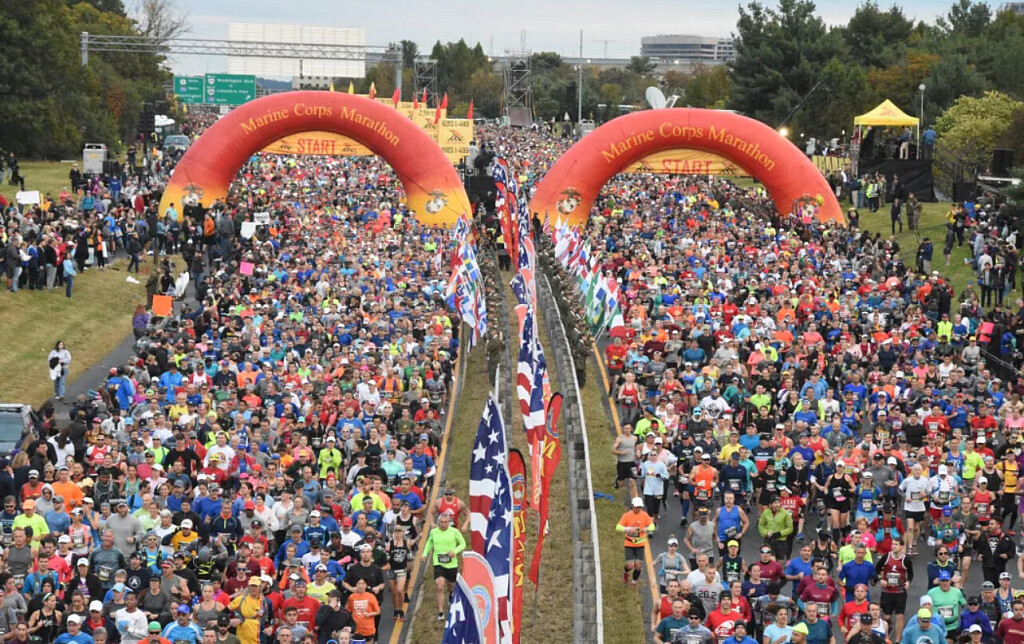
The 50th Marine Corps Marathon Celebrates 50 Years of Pride and Perseverance
This Sunday, October 26, 2025, the Marine Corps Marathon will celebrate its 50th anniversary, marking half a century of inspiring runners to “run with purpose and finish with pride.”
Affectionately known as “The People’s Marathon,” the Marine Corps Marathon (MCM) stands apart from the world’s other great races. It offers no prize money, focusing instead on participation, community, and service. For fifty years, it has united civilians, service members, and runners from around the world in one of the most patriotic and emotionally charged marathons on the planet.
A Legacy Born in 1976
The first Marine Corps Marathon was held in 1976, founded by the U.S. Marine Corps to promote physical fitness, community goodwill, and the Marine tradition of excellence. Over time, it grew into one of America’s largest marathons, famous for its inclusivity and purpose-driven mission.
Unlike most major races, the MCM awards no cash prizes to top finishers. Instead, it honors every participant who crosses the line, from first to last. This spirit of equality earned it the nickname “The People’s Marathon.”
This year’s event is completely sold out, with more than 40,000 registered runners from all 50 states and dozens of countries. Despite uncertainty surrounding the ongoing government shutdown, organizers confirmed the race will go on as planned.
The Course: A Run Through History
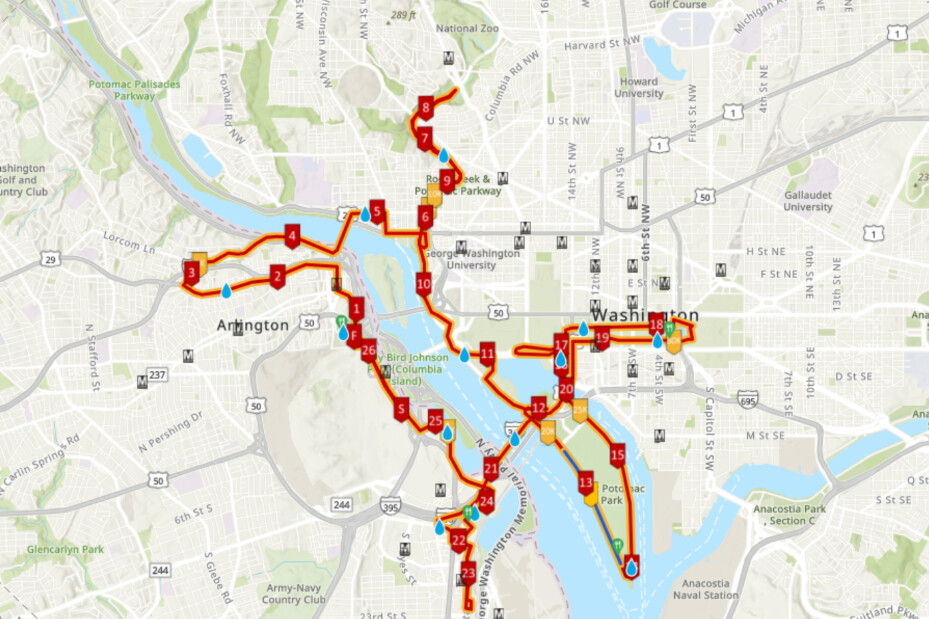
The Marine Corps Marathon offers one of the most scenic and symbolic marathon routes in the world. The race begins in Arlington, Virginia, just steps from the Pentagon, before leading runners into the heart of Washington, D.C.
Participants cross the Key Bridge into Georgetown, pass through Rock Creek Park, and continue along the Potomac River, circling the Jefferson and Lincoln Memorials. They run past the Washington Monument, the U.S. Capitol, and the National Mall before heading back into Arlington.
The final miles take runners alongside Arlington National Cemetery before the course finishes at the Marine Corps War Memorial — the iconic Iwo Jima statue. The short but steep “Victory Hill” leading to the finish line has become legendary, offering one of the most emotional finishes in the sport.
Course Records and Champions
Over five decades, the Marine Corps Marathon has witnessed remarkable performances. The men’s course record of 2 hours, 14 minutes, and 1 second was set in 1987 by Jeffrey Scuffins of the United States. The women’s record of 2 hours, 37 minutes, was set in 1990 by Olga Markova of Russia.
Notable champions over the years include two-time winner Darrell General in the 1990s and Augustus Maiyo, representing the U.S. Army World Class Athlete Program, who won in 2012. In 2024, Marine officer Kyle King claimed victory in 2 hours, 25 minutes, and 6 seconds.
Though these times stand out, the marathon’s true spirit lies not in record books but in its participants — from elite athletes to first-time marathoners, from active-duty Marines to civilians running in honor of loved ones.
The 50th Anniversary Edition
This year’s golden anniversary promises to be the largest and most memorable in race history. More than 40,000 participants will line up at dawn, cheered on by tens of thousands of spectators. Security will be heightened, and logistics finely tuned to handle the largest field ever.
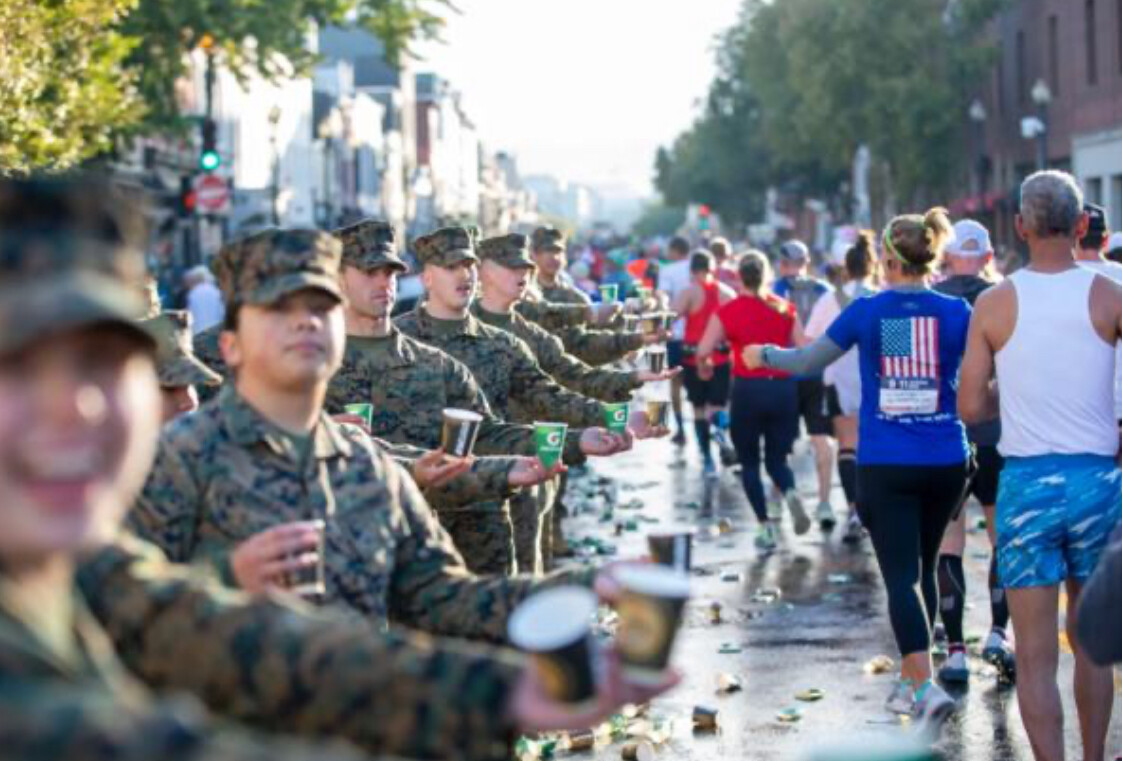
The Marine Corps Marathon remains a race about pride, not paychecks. Each runner earns a medal from a uniformed Marine at the finish line — a simple, powerful gesture that captures the spirit of the event.
Why It’s One of the World’s Best Runs
Few marathons can match the Marine Corps Marathon for emotion and meaning. The course passes the monuments of American history, but its greatest monument is the collective spirit of the runners themselves.
It’s a race that demands effort — the rolling hills early on and the final climb to Iwo Jima test every runner — but it rewards every step with purpose. To finish here is to be part of something larger than sport.
The Marine Corps Marathon is more than a race. It’s a salute — to endurance, to courage, and to the shared belief that running can unite people in pride and purpose.
Final Word
As the Marine Corps Marathon celebrates 50 years, it reminds us why we run. We run to test our limits. We run to honor service and sacrifice. We run to connect — with others, with history, and with something greater than ourselves.
This Sunday, tens of thousands will run those 26.2 miles through the capital of freedom, cheered on by Marines and crowds waving flags. And when they reach the finish line beneath the shadow of Iwo Jima, every runner will know: they didn’t just finish a marathon — they became part of history.
by Boris Baron
Login to leave a comment
Marine Corps Marathon
Recognized for impeccable organization on a scenic course managed by the US Marines in Arlington, VA and the nation's capital, the Marine Corps Marathon is one of the largest marathons in the US and the world. Known as 'the best marathon for beginners,' the MCM is largest marathon in the world that doesn't offer prize money, earning its nickname, “The...
more...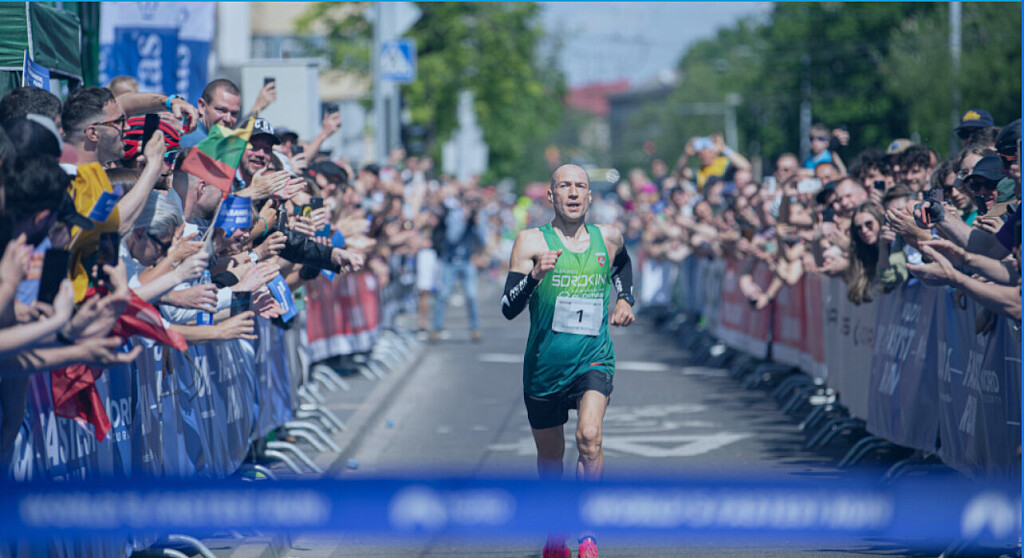
Did You Know? No One Has Come Close to Sorokin’s 24-Hour Record Since 2022
Did you know that Aleksandr Sorokin’s legendary 24-hour world record—set in 2022—is still untouched, and no one has even come particularly close?
At the 2022 IAU 24-Hour European Championships in Verona, Italy, Lithuanian ultrarunner Aleksandr Sorokin ran a staggering 198.598 miles (319.614 kilometers) in a single day. That’s the equivalent of running from New York City to Washington, D.C.—and then some—all in just 24 hours.
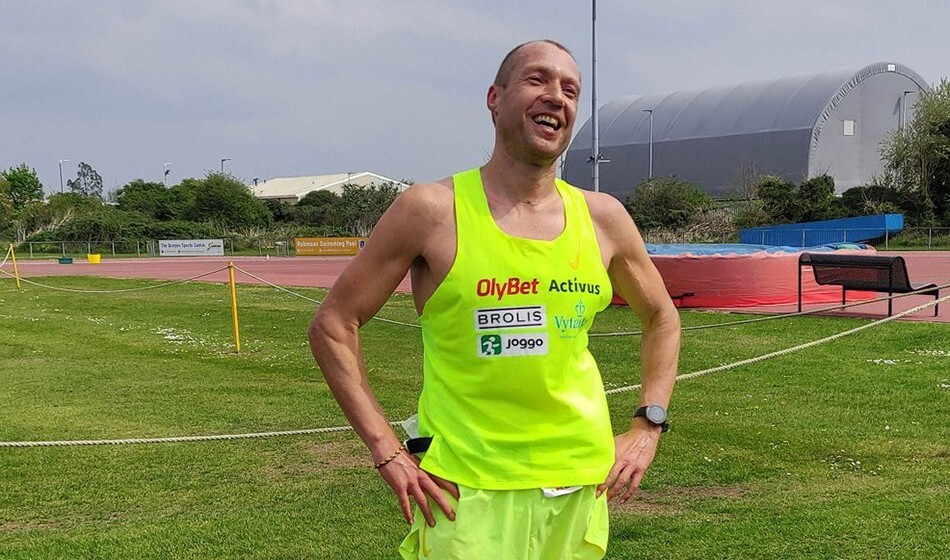
Even more impressive: Sorokin averaged a 7:15-per-mile (4:30/km) pace the entire time. That’s a tempo most runners struggle to hold for a 10K—let alone for nearly 200 miles.
What’s Happened Since?
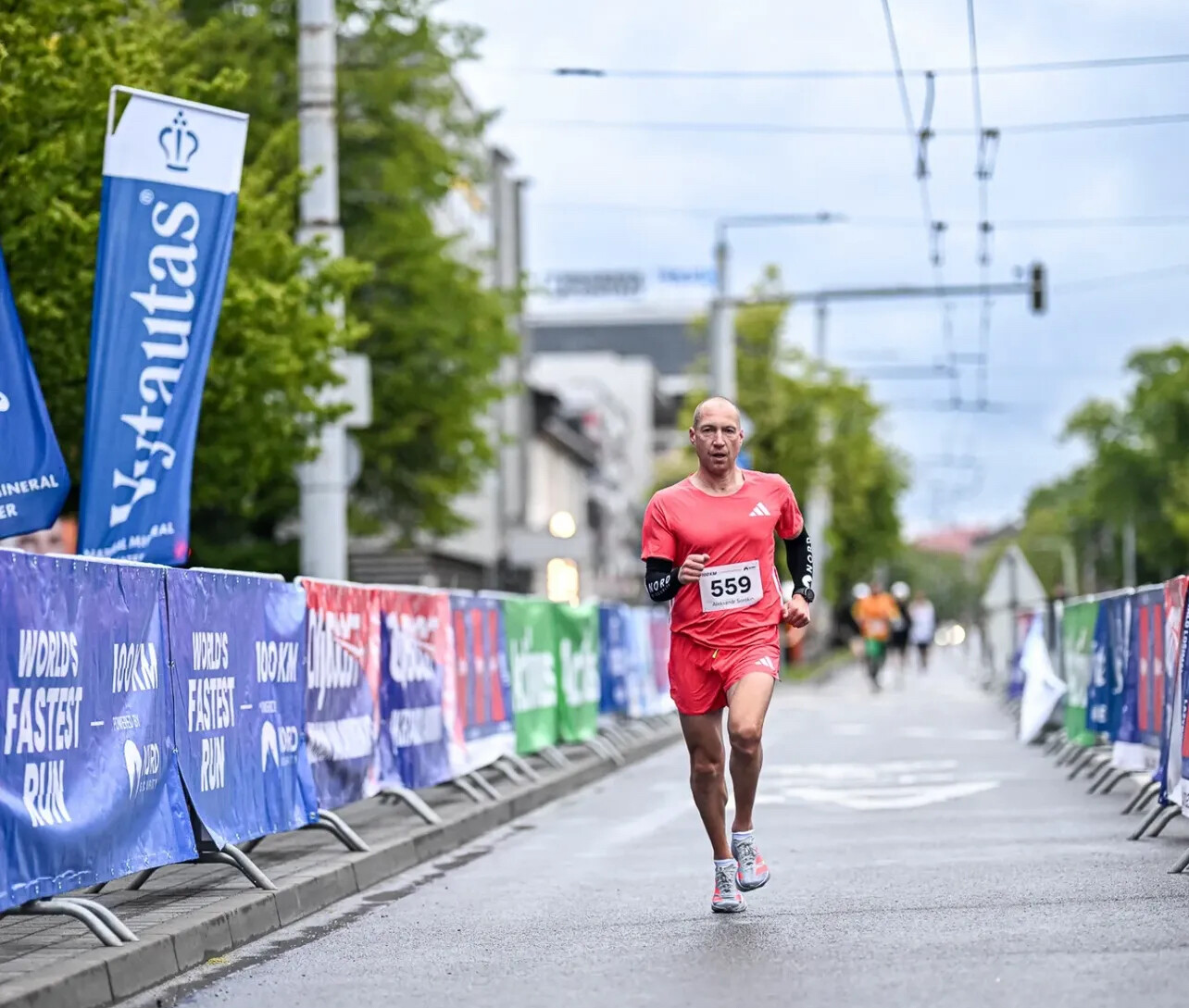
At the 2023 IAU 24-Hour World Championships, Sorokin competed again and covered 301.790 kilometers—an outstanding performance, but still nearly 18 kilometers short of his own world record.
No other male athlete has even broken the 300 km barrier since.
Meanwhile, on the women’s side, Japan’s Miho Nakata set a new world record in 2023, covering 270.363 km, which is phenomenal—but still nearly 50 km less than Sorokin’s historic run.
Top 24-Hour Running Performances (All-Time)
|
Runner |
Gender |
Year |
Distance (km) |
Gap to Sorokin (km) |
|
Aleksandr Sorokin |
Male |
2022 |
319.614 |
0.00 |
|
Yiannis Kouros |
Male |
1997 |
303.506 |
16.11 |
|
Aleksandr Sorokin |
Male |
2023 |
301.790 |
17.82 |
|
Tamas Bodis |
Male |
2023 |
295.290 |
24.32 |
|
Haruki Okayama |
Male |
2023 |
289.420 |
30.19 |
|
John Stocker |
Male |
2021 |
285.300 |
34.31 |
|
Miho Nakata |
Female |
2023 |
270.363 |
49.25 |
|
Camille Herron |
Female |
2019 |
270.116 |
49.50 |
|
Patrycja Bereznowska |
Female |
2022 |
263.660 |
55.95 |
The Legacy
More than two years later, Sorokin’s record remains the gold standard in ultrarunning. His 2022 performance wasn’t just a world record—it redefined what humans can do in a single day.
Whether you’re a weekend warrior or an elite endurance athlete, one thing is clear: nobody’s chasing Sorokin. He’s still out in front—by miles.
by Boris Baron
Login to leave a comment
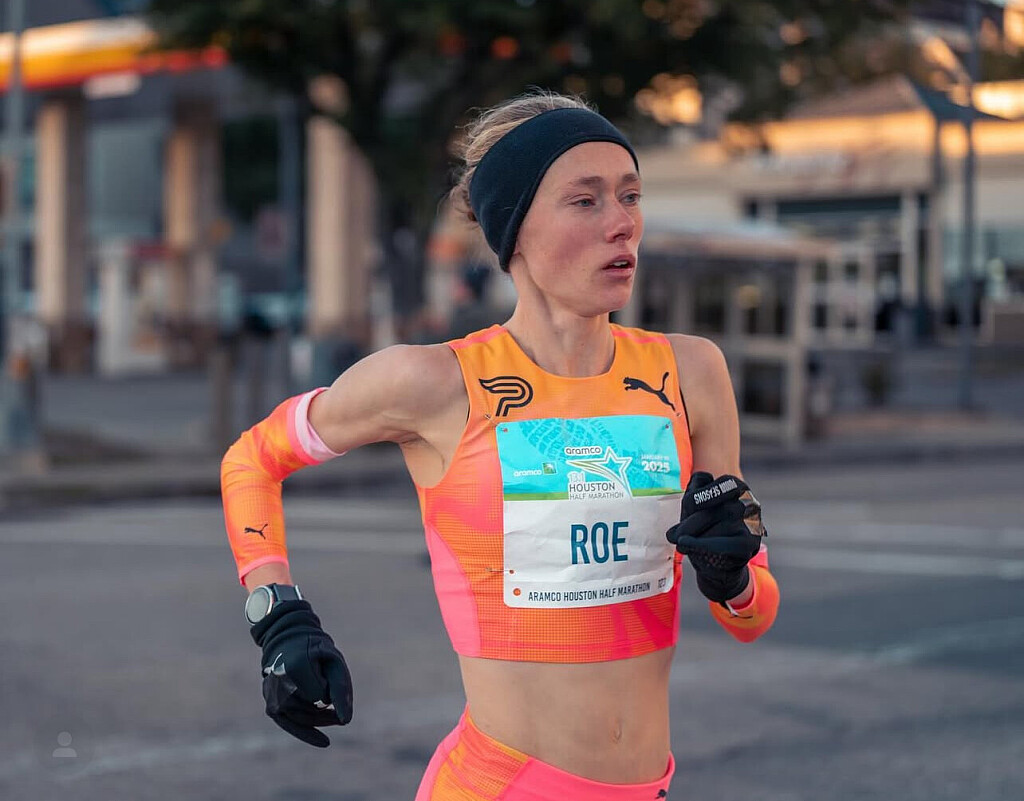
Taylor Roe’s Record Breaking Rise from NCAA Star to American Road Racing Powerhouse
In just over a year, Taylor Roe has gone from a promising collegiate standout to one of the brightest stars in American distance running. Her 2025 campaign has been nothing short of historic—national titles, American records, and international recognition are stacking up fast for the 24-year-old from Lake Stevens, Washington.
From Washington to the NCAA Podium
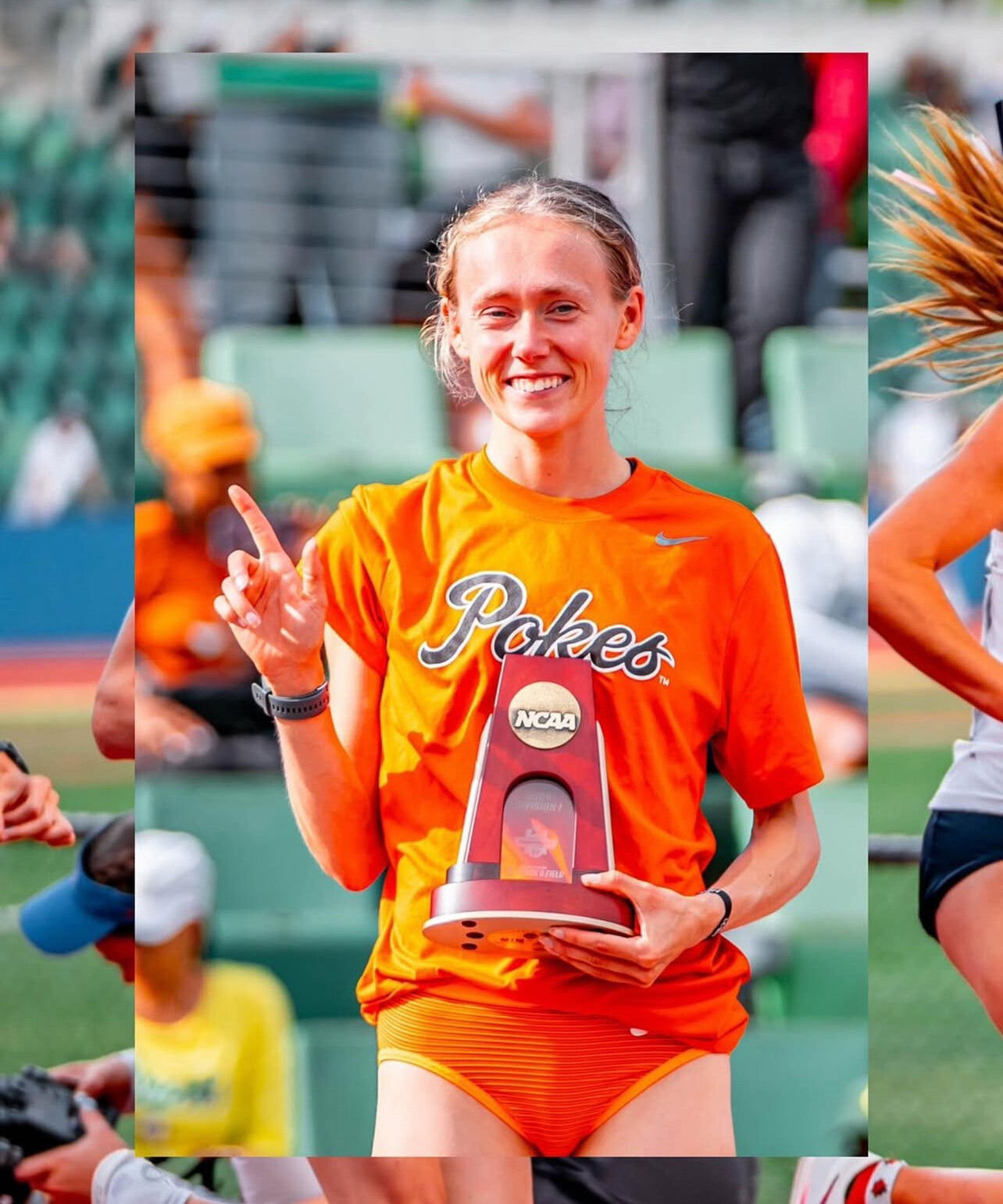
Roe began her running journey in Lake Stevens, where she collected nine individual state titles in cross country and track. At Oklahoma State University, she continued to shine, winning the NCAA Indoor 3000m title in 2022 and placing second at the 2020 NCAA Cross Country Championships. Her final collegiate season in 2024 saw her finish third in the 10,000m and sixth in the 5,000m at the NCAA Outdoor Championships.
Breakout Year on the Roads
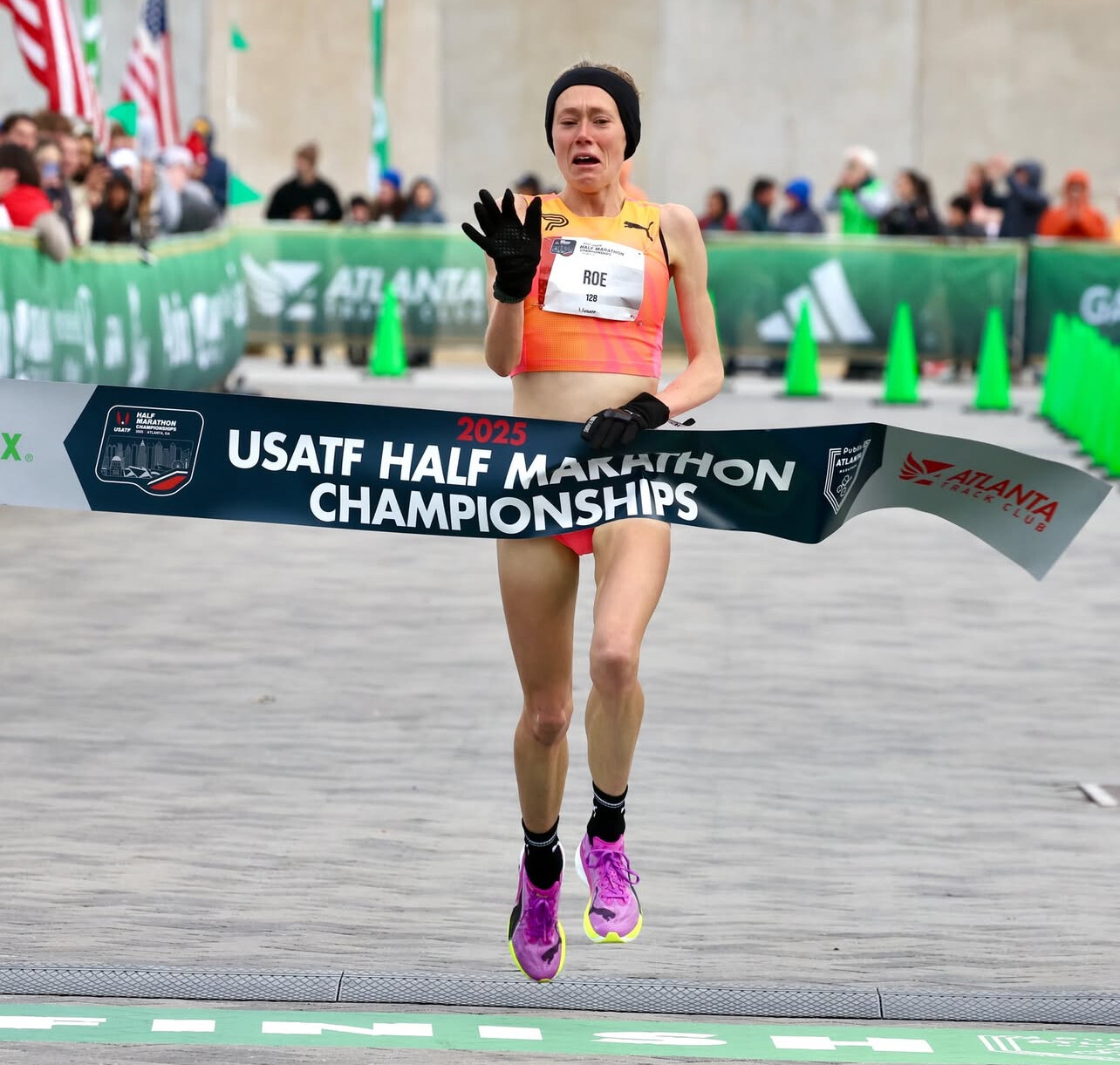
Turning pro in mid-2024 with Puma, Roe wasted no time making her mark. She won the USATF Half Marathon Championships in March 2025 in a personal best of 1:07:22. The win not only earned her a national title but also secured her a spot on Team USA for the World Athletics Road Running Championships.
Rewriting the Record Books
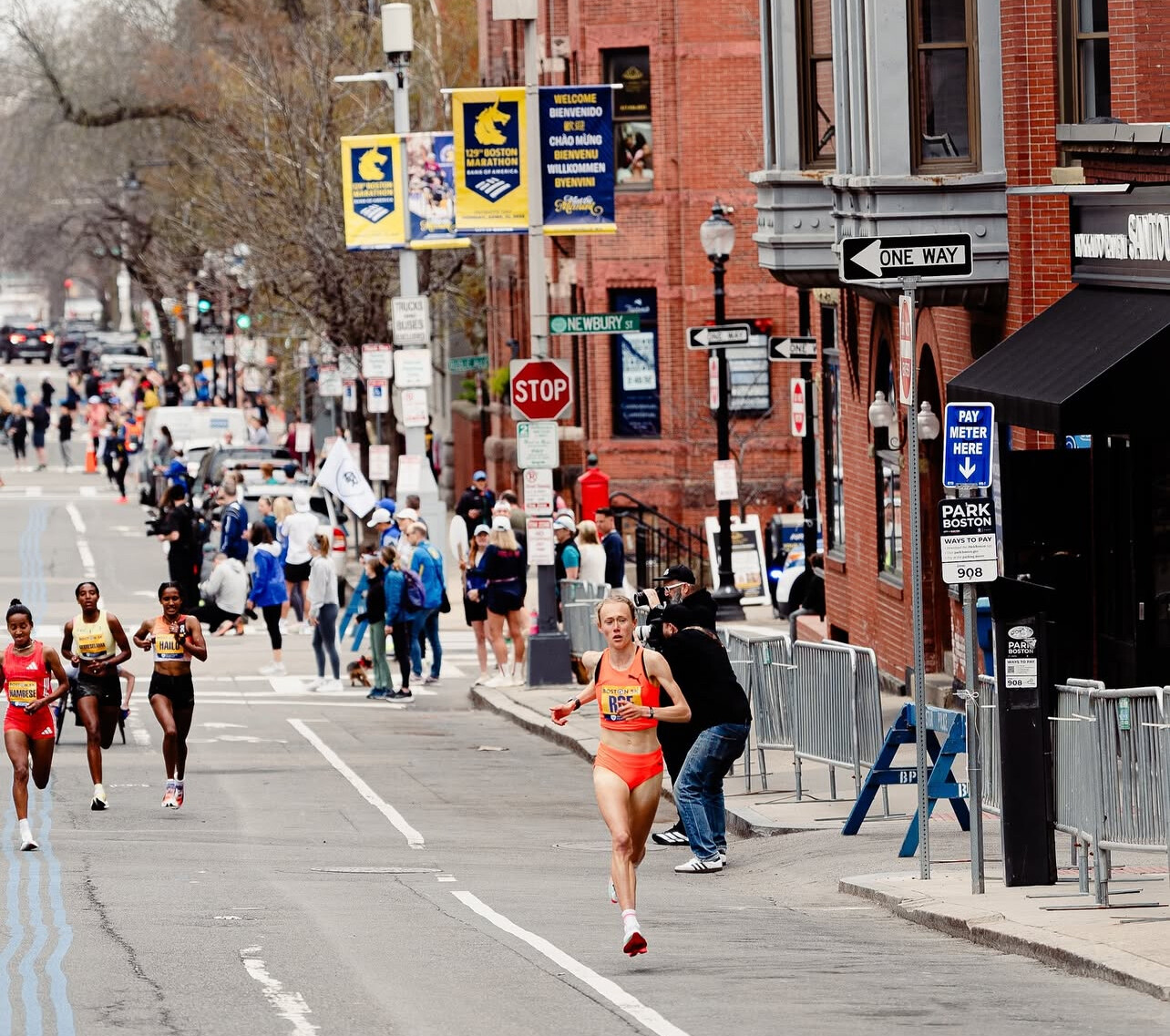
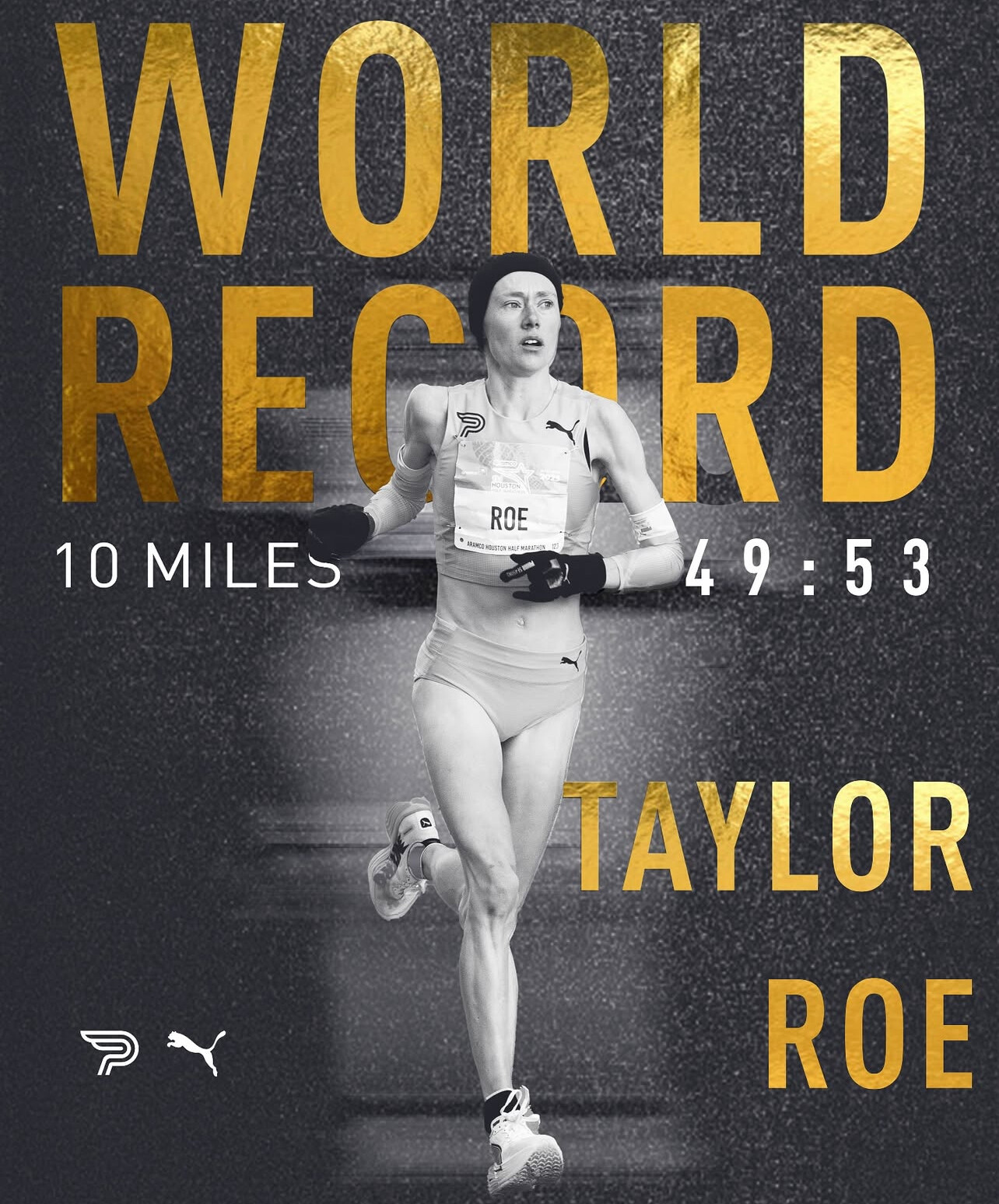
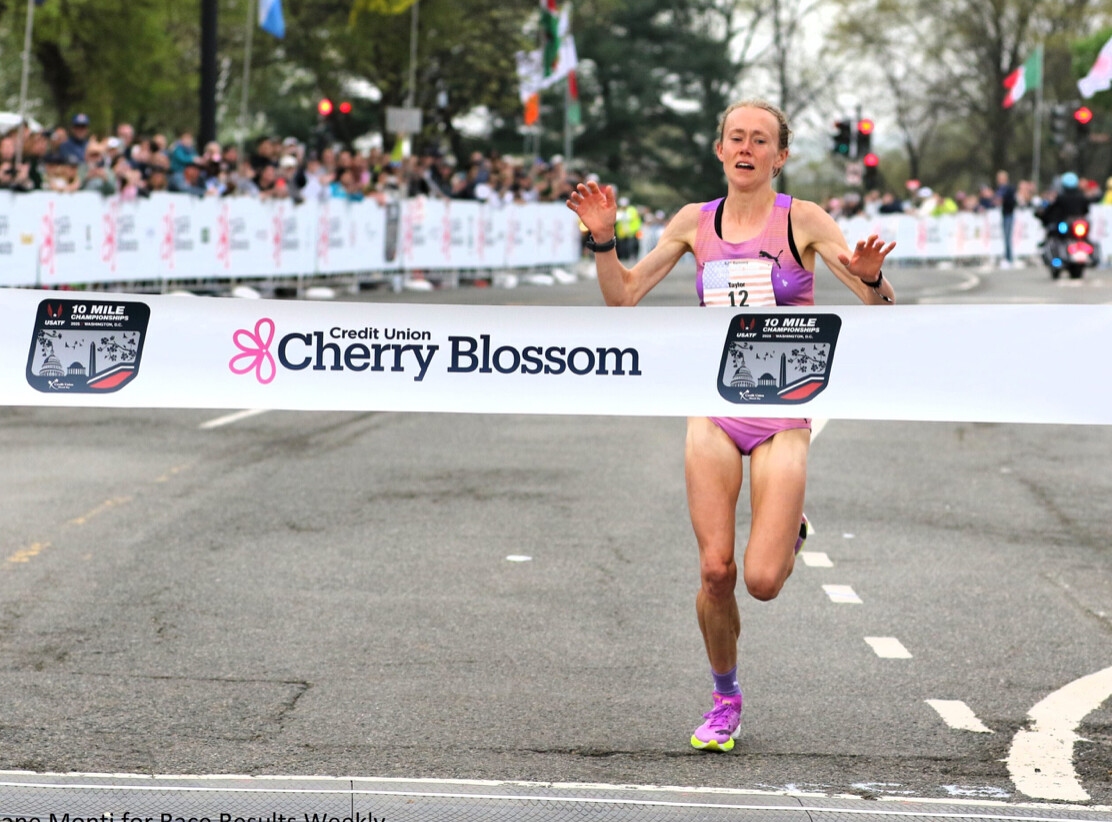
Just a month later, Roe delivered one of the most impressive road racing performances in recent memory. At the USATF 10 Mile Championships in Washington, D.C., she became the first American woman to break 50 minutes for the distance, finishing in 49:53 which is the world best for in an all woman race. On her way to the win, she also set new American records for the 10K (30:56) and 15K (46:24), earning her USATF Athlete of the Week honors.
Breaking down the world best time ever for ten miles in an all woman's race: Looking Ahead
Taylor Roe’s rise has been fast, fierce, and inspiring. As she builds on this foundation, fans of American distance running have plenty to be excited about. With her blend of speed, endurance, and race-day poise, Roe is now firmly on the radar for global championships and Olympic teams. At just 24, she’s entering her prime years with the momentum of a seasoned veteran. If 2025 is any indication, she could soon be the face of American distance running.
Taylor Roe’s 2025 Highlights
• USATF Half Marathon Champion – 1:07:22 (March 2025)
• USATF 10 Mile Champion – 49:53 (April 2025)
• American Records:
• 10K – 30:56
• 15K – 46:24
• 10 Miles – 49:53
• Selected for Team USA – World Athletics Road Running Championships
Taylor Roe’s rise has been fast, fierce, and inspiring. As she builds on this foundation, fans of American distance running have plenty to be excited about.
by Boris Baron
Login to leave a comment
Emily Durgin Has the Tools to Be a Force in Distance Running
A Profile of Grit, Versatility, and Untapped Potential
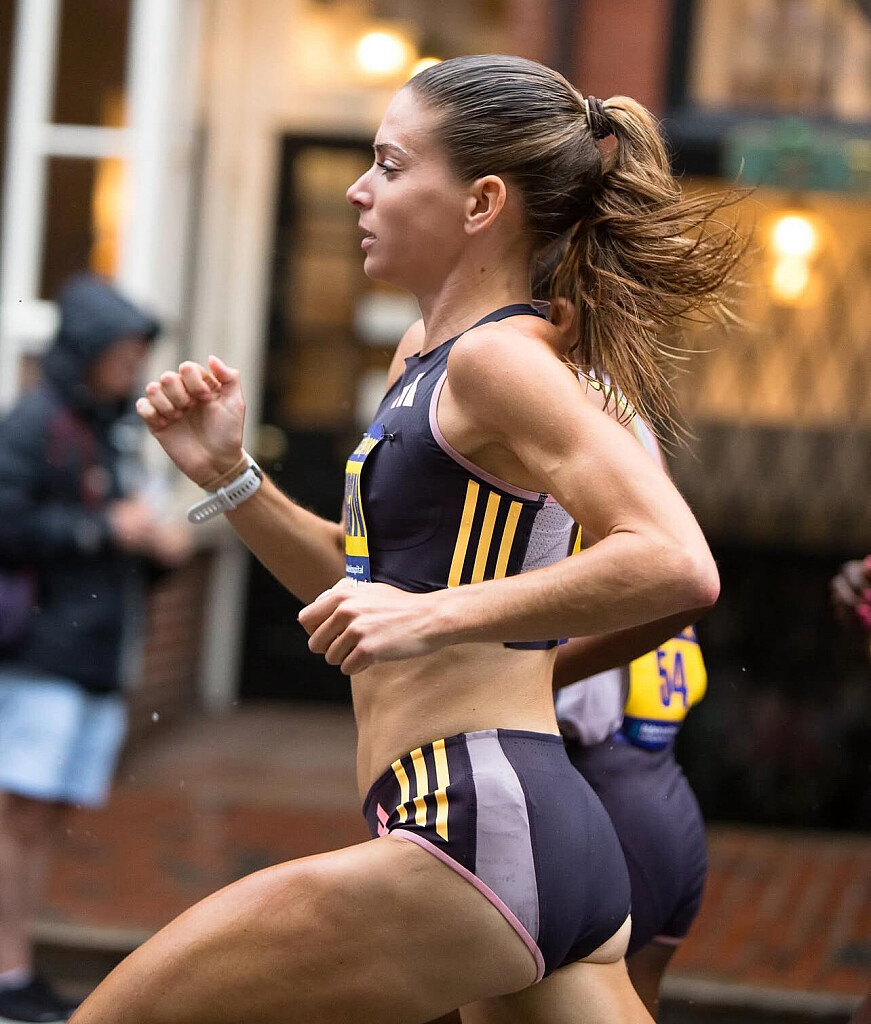
Emily Durgin’s name may not yet be a household one in global distance running, but among those who follow American road racing closely, she has earned deep respect for her steady rise, racing range, and professionalism. With standout performances in the 10K, half marathon, and marathon, Durgin has shown she possesses the tools to become a lasting force in the sport.
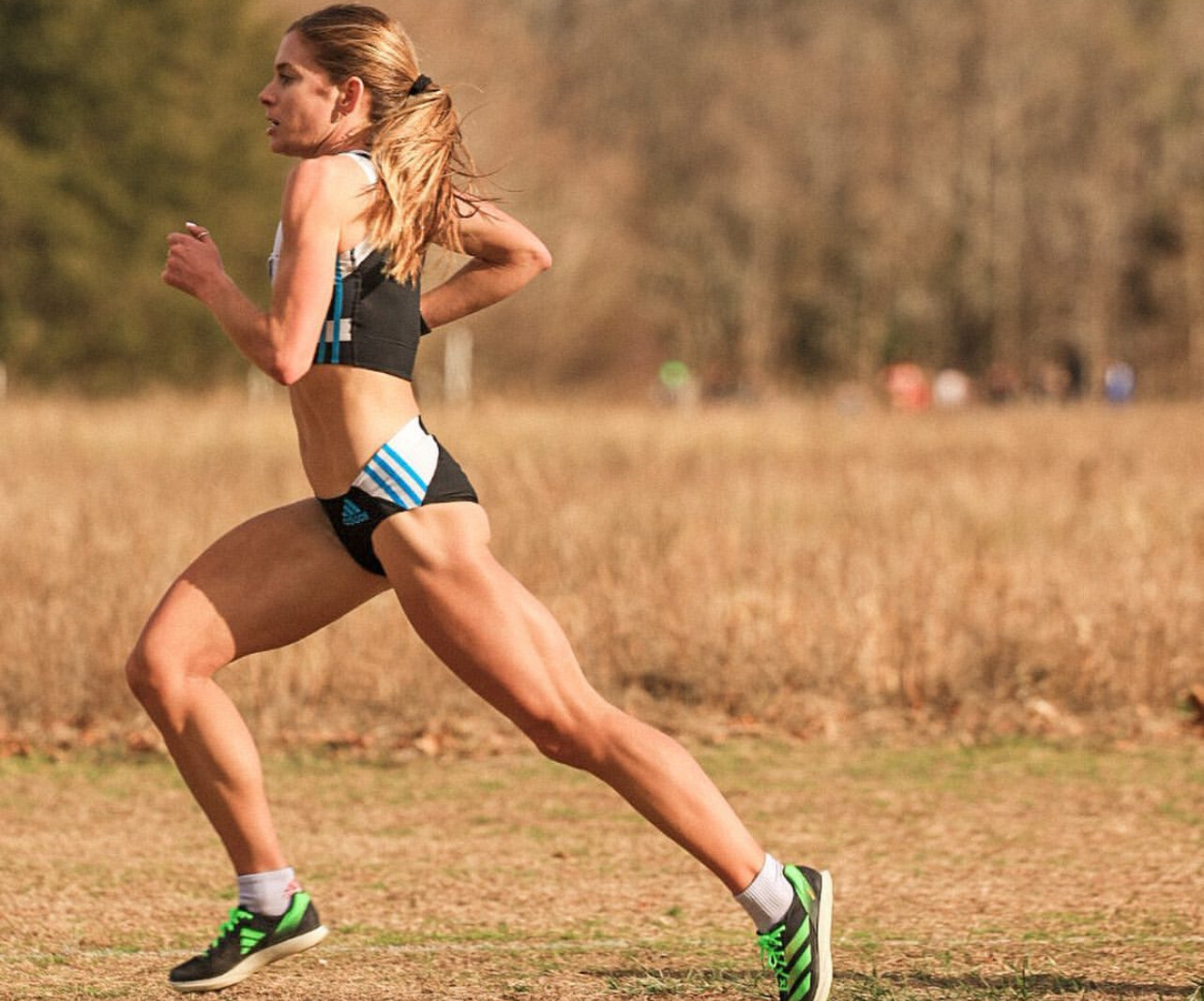
Originally from Maine, Durgin was a nine-time conference champion at the University of Connecticut before making a name for herself on the professional circuit. Her breakout year came in 2022, when she ran 1:07:54 for the half marathon in Houston — one of the fastest times ever by an American woman. She followed that up with a marathon personal best of 2:26:46 at the Toronto Waterfront Marathon in 2023, finishing as the top American.
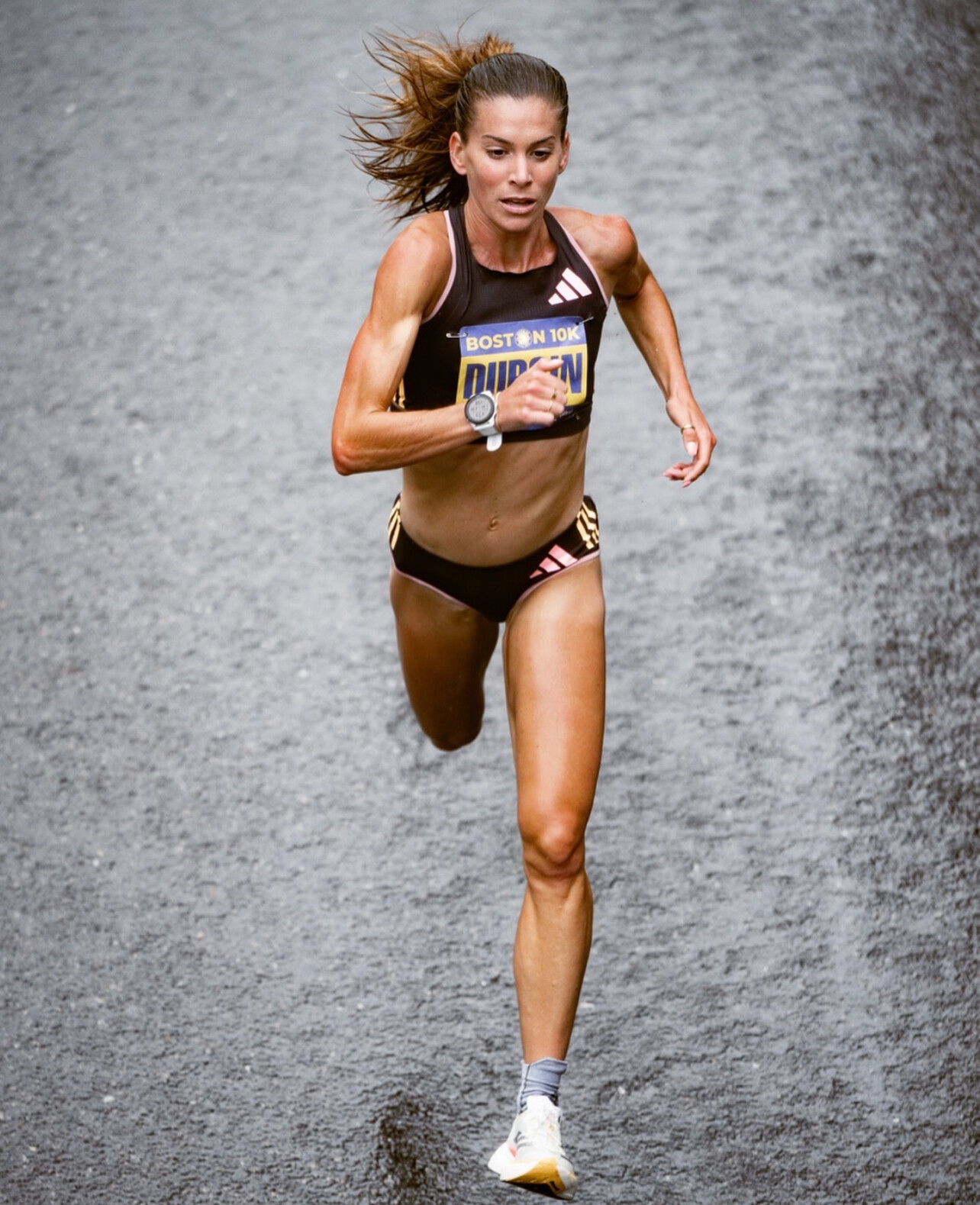
In early 2024, she placed ninth at the U.S. Olympic Marathon Trials and went on to win the USATF 10-Mile Championship in Washington, D.C., with a blazing 51:26 — the fastest time ever by an American in a women-only race at that distance.
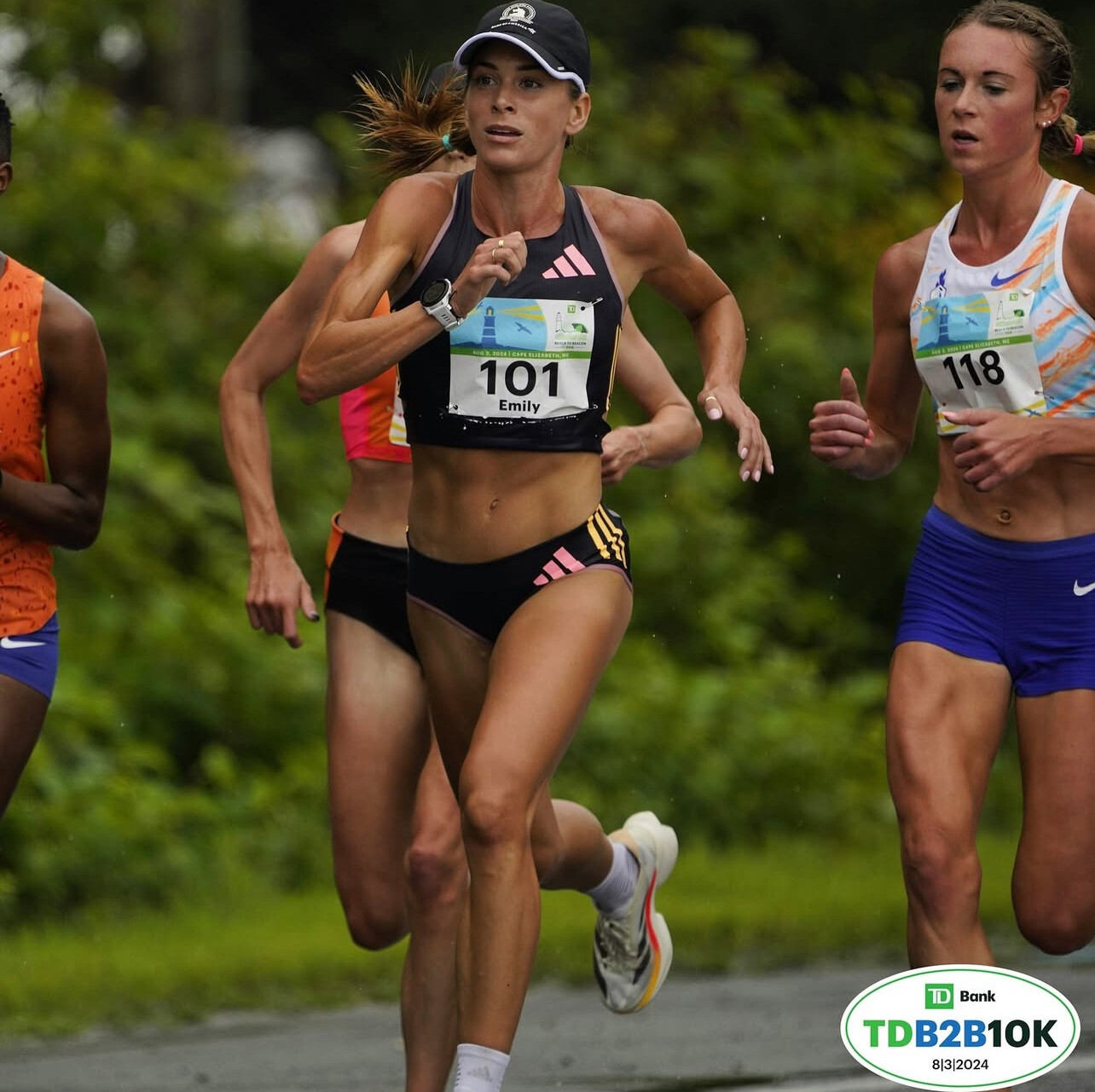
While she had planned to run the Valencia Marathon in December 2024, Durgin did not start the race due to a hamstring issue and a problem sleeping. In a recent social media post she feels she is putting these issues behind her and plan on racing again soon. But she says she is listening to her body and do not want to come back until her body is ready to race at the elite level.
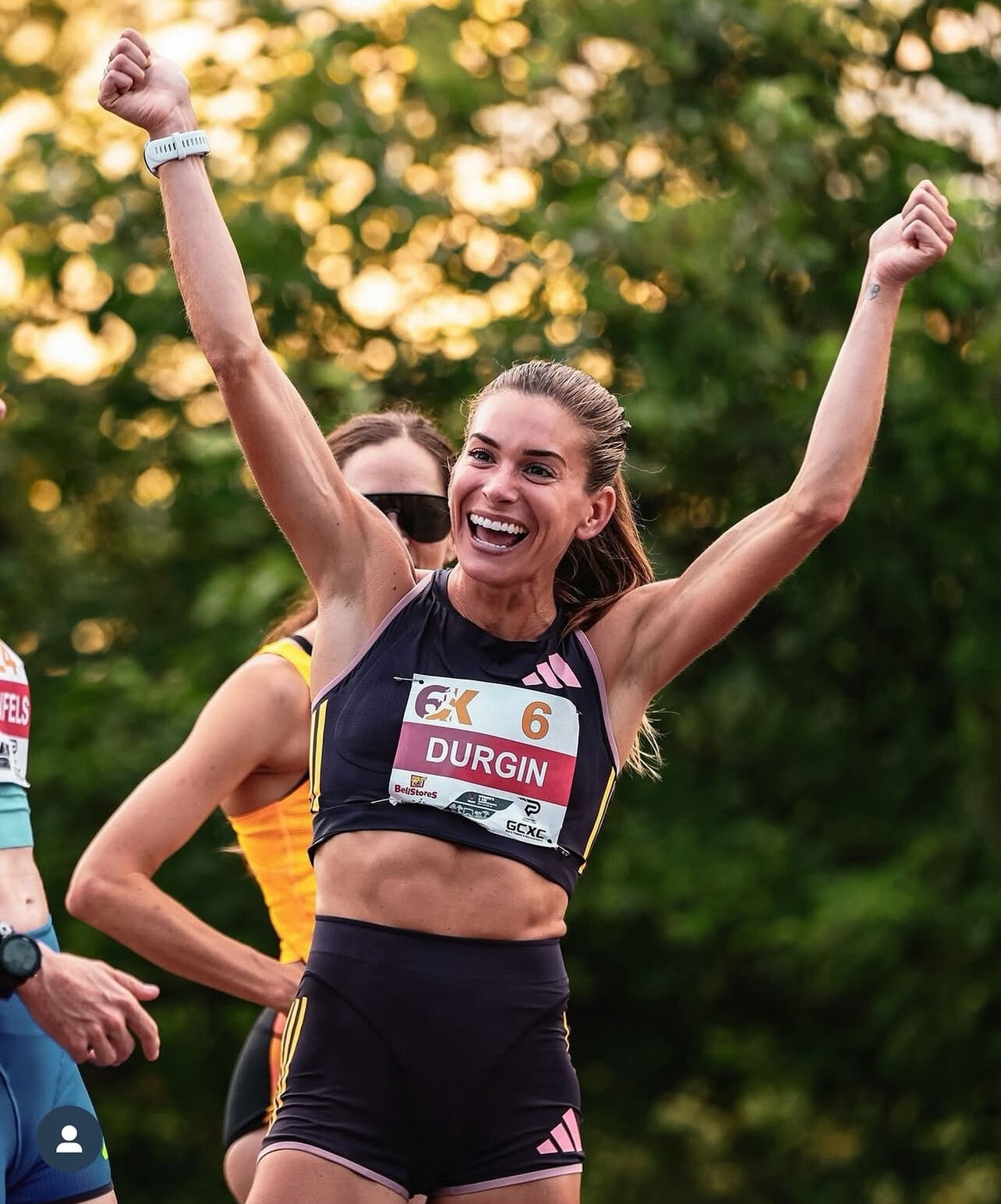
At age 30, she’s in the prime years for a distance runner — and with her ability across distances and proven toughness on the roads, Emily Durgin remains a name to watch.
by Boris Baron
Login to leave a comment
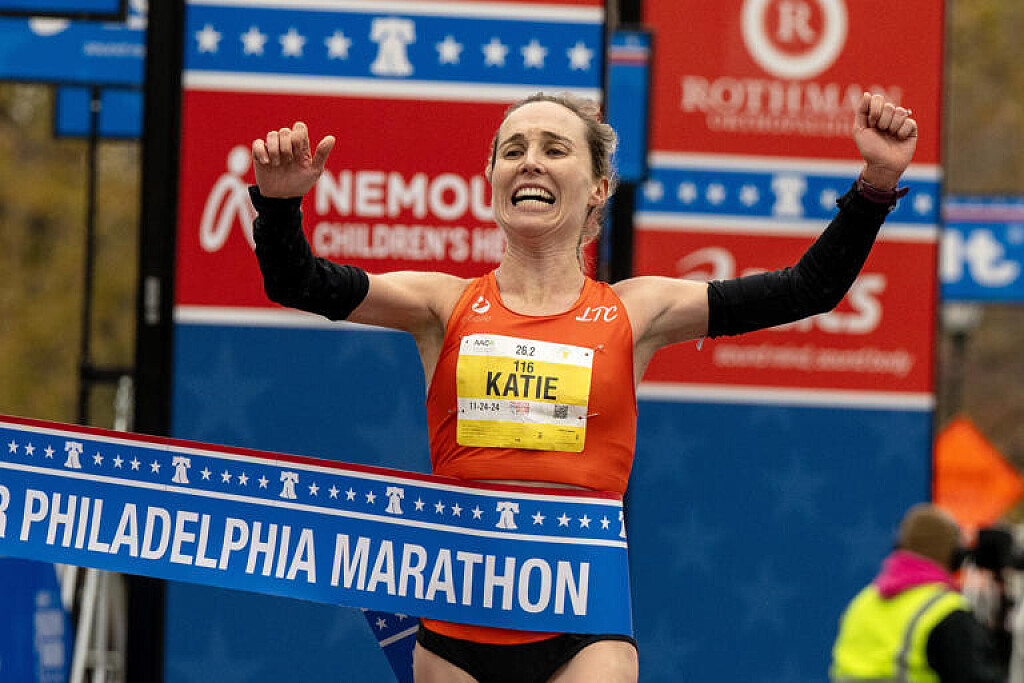
Katie Florio, William Loevner win 2024 Philadelphia Marathon elite races
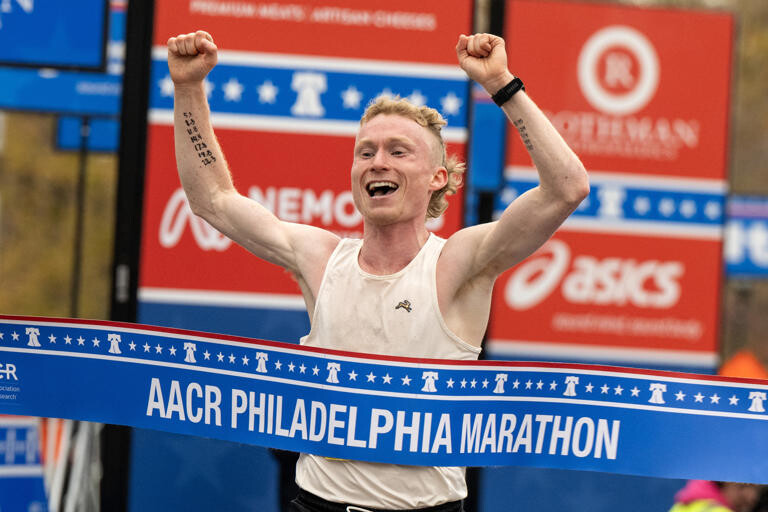
William Loevner, 27, of Pittsburgh, won the Philadelphia Marathon men's race in 2:16:12 on Sunday.
Mulgeta Birhanu Feyissa, of Washington, Alabama, was second in the 26.2-mile race in 2:16:38, and Rahal Bouchfar was third in 2:16:55, according to unofficial results.
In the women's race, Katie Florio, 31, of Philadelphia, won in 2:32:42. Aberu Mekuria Zennebe, of Washington, D.C., was second in 2:33:26, and Elizabeth Chikotas was third in 2:35:28.
Florio runs for Liberty Track Club, a Philadelphia-based elite running team sponsored by Oiselle, an apparel brand.
"It feels amazing, I'm honestly still in shock," Loevner said after the race. "I can't believe it, but I'm just proud of all the hard work I put in, and I ran to the best of my ability, and that was the win today, so I couldn't be happier."
The top Philadelphian on the men's side was David Troy, who finished in 2:22:58.
by Laura Fay
Login to leave a comment
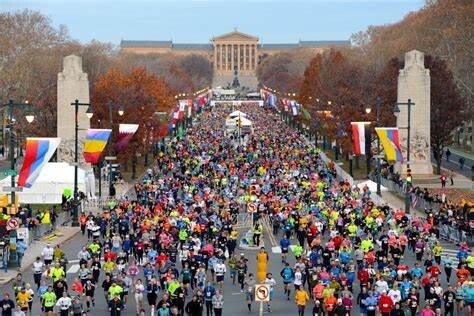
Philadelphia Marathon and Half
Have the time of your life in 2022 completing 13.11 miles! Runners will start along the Benjamin Franklin Parkway in the cultural Museum District and wind through Philadelphia’s most scenic and historic neighborhoods. From the history-steeped streets of Old City, through one of the liveliest stretches of Center City, across the Schuylkill River...
more...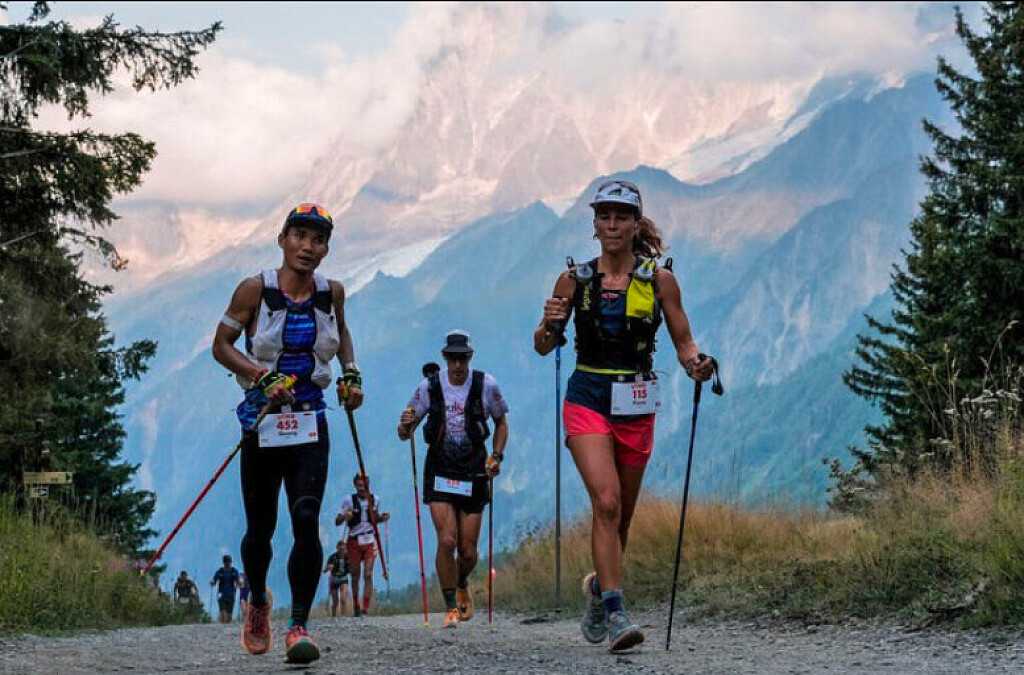
How Recreational Runners Get Through UTMB: 'It's All About Digging Deep into Yourself'
Wearing purple shorts, a blue and white tie-dyed T-shirt, a bright pink hat, a light blue Salomon hydration pack, fluorescent yellow-rimmed Oakley sunglasses, and a pair of Hoka Speedgoat 5 shoes, Chaiwen Chou was a vibe as she crossed the finish line of Ultra-Trail du Mont-Blanc (UTMB) on Sunday afternoon in Chamonix, France.
Chou, who had also freshened up the pink and purple tint of her hair before the race, stood out among the numerous other dusty and weary runners clad in more traditionally colored trail garb as they took their final strides in the epic 106-mile race around the Mont Blanc massif.
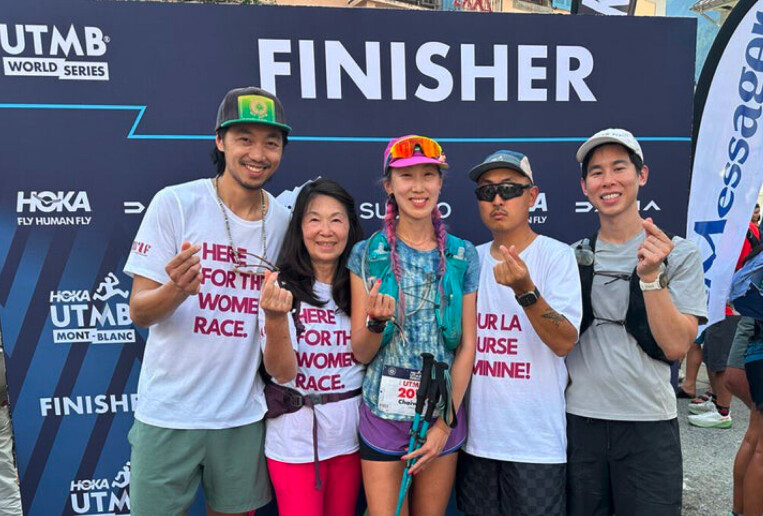
But what was most remarkable about the 41-year-old software developer from New York City was the huge smile on her face and expression of pure joy that emanated from her. When she arrived at the finish line after 45 hours and 15 minutes of running-about 75 minutes before the cutoff-she was beaming ear to ear and greeted with big hugs from her mom, brother, partner, and a good friend who helped crew her on her journey.
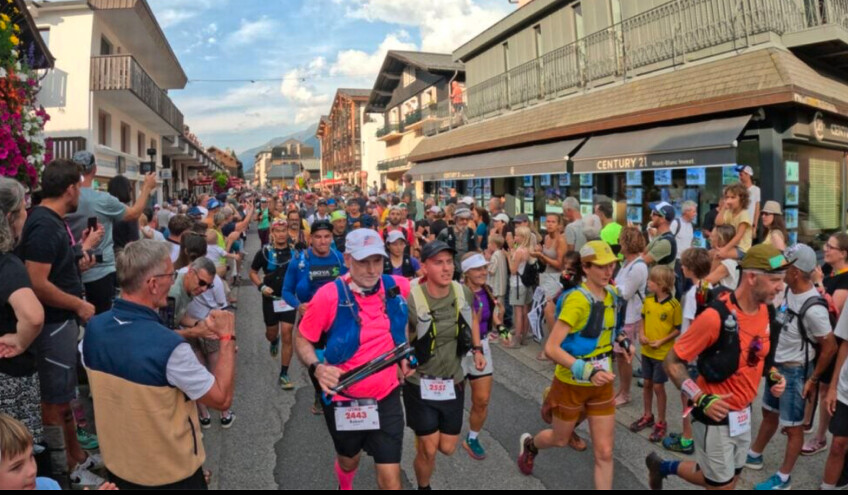
While her interest in running started on a bit of a whim a decade ago, her continued passion and progression have led her to run more than 30 trail running races, including the biggest and most celebrated one in the world. On Sunday, she was one of 95 American runners to complete the grueling UTMB course.
"So when I turned 30, I had this typical New Year's resolution, like, I want to get fit, I want to learn how to run," said Chou, who grew up in Massachusetts. "And then I met a friend who ran, and I started running with him and doing group runs. And then we started running trails, and we specifically entered The North Face Endurance Challenge, and that's where I ran my first marathon, and fell in love with trail running and then learned about ultrarunning and this whole world that I never even knew existed."For many recreational ultrarunners from around the world like Chou, UTMB sits at the top of their lifelong bucket list. It means starting at the same time as the elite professional runners on Friday evening in Chamonix, and maneuvering through the same rugged and aesthetic 106-mile loop with a daunting 32,000-feet plus of climbing and descending. It's historic, and the crowds and the energy around it are unparalleled.
It's also a monumental challenge to complete.
Trail Running's Infectious Buzz
Ultra-trail running is having a moment right now-especially since the end of the Covid pandemic-but it probably started a decade ago as the urge to run beyond the marathon gained mainstream traction and destination races around the world started to become desirable goal races for recreational runners.The North Face Endurance Challenge began as a singular 50-mile championship-style trail race near San Francisco in 2006 with a $30,000 prize purse, but it evolved into a multi-distance race weekend (from 10K to 50 miles) aimed at encouraging runners of all abilities to immerse themselves in the sport. After a few successful years of the event in Mill Valley, California, it expanded to several locations across the U.S.-upstate New York, Madison, Wisconsin, and Washington D.C., among others-and around the world.
Although The North Face pulled the plug on the series in late 2019 with a suggestion that it was going to reimagine the event format, nothing ever materialized after the Covid-19 pandemic temporarily disrupted the world-and specifically running events-in 2020. But those events played a big role in introducing runners and non-runners alike to the unique aspects of trail running, and many of those who caught the bug-like Chou-have continued to chase their passion in global events like the UTMB World Series.
Chou and her friends returned to The North Face Endurance Challenge four years in a row and she upped the ante each time, going from the marathon to the 50K and finally to consecutive finishes in the 50-miler. She competed in the 50-mile race in San Francisco in 2017 and 2019 and then started traveling to other races around the U.S. and eventually around the world. By 2020, she had completed the Madeira Island 115K race in Portugal and the Tarawera Ultramarathon 100-miler in New Zealand.
Once Covid subsided, Chou set her sights on trying to get into UTMB, which she did by collecting running stones and finishing seventh at the Grindstone 100 amid torrential rain storms last September in northwest Virginia. Her training for UTMB was interrupted in February when, just a week after she found out she secured an entry into UTMB through the lottery, she broke her ankle. Then once she got to Chamonix a week before the race, she smashed her left knee on a shakeout run and it swelled up pretty badly.
As such, her UTMB experience was rougher than she had hoped-the 80-degree heat and the 32,000 feet of vertical gain and descent pushed her to her limits-as she had challenges fueling consistently and also got sick several times. But she persevered and reached her primary goal of finishing.
Officially, she was the 1,542nd finisher out of 1,760 runners who completed the full loop. (A total of 1,001 runners started but did not finish.) She did whatever it took and she crossed the finish line.
"So this is the first time I've been in the Alps, and I'm just blown away by how beautiful it is," she said. "Even though I was in pain pretty much the whole race because the climbing and the elevation gain here are insane compared to the East Coast! But it was just so beautiful everywhere. It's pretty crazy. But you get to be out there all day though, so that's fun."Every Runner Has a Story
Becky Convery only started running four years ago in the middle of the Covid lockdown. What started as short, occasional runs turned into a passion for trail running that was fueled, in part, by doing group runs with the Virginia Happy Trails Running Club.
Like Chou, Convery also qualified for UTMB through the Grindstone 100. The 58-year-old Washington D.C. attorney almost quit that race, but she dug deep to finish. During UTMB, Convery dealt with GI issues from early on in the race and couldn't keep any food down. It was so bad, she almost dropped out at the 51.5-mile aid station in Courmayeur, Italy. But then she thought of Wayne Chang, a running buddy from Virginia, who did just that last year and immediately regretted it. With her friend's experience top of mind as she struggled, Convery persevered and finished in 45:27 with an hour to spare."I wanted to quit at Grindtone last fall. I was miserable and just wanted to go to bed, but he wouldn't let me quit," Convery said. "He's like, 'Look, I quit UTMB and I woke up a couple hours later, and I was like, 'Oh my God, what have I done?' So when it got hard out there (during UTMB), I thought of Wayne, and even though I couldn't keep food down, I said to myself, 'What would Wayne do?' He'll kill me if I quit, so I knew I couldn't quit. So I just kept going."
As much as UTMB gets considerable international notoriety for the livestream and media coverage around the elites-and understandably so, it draws many of the world's best runners-at the heart, UTMB is a personal journey of courage, commitment, and hope for most of the 2,800 runners who toe the starting line.
And really, that's what the entire sport of ultra-trail running is all about and what differentiates it from road racing. For many, it's not about racing at all-competing against other runners or even the clock-it's about challenging yourself and the natural terrain in pursuit of a dream that might seem like it's on the realistic edge of your abilities.
"It's all about digging deep into yourself," Convery said. "With this race, it's so international and there are so many nations represented, it's just an amazing time up there. Even though most people don't speak each other's language, everybody gets it. Everyone is pulling for each other. It's a great environment out there. I'm glad I made it."
Going the Distance
That's always been the case for 67-year-old Mike Smith, a retired resident of Santa Fe, New Mexico, who reached the finish line 15 minutes after Convery. It was Smith's second year in a row finishing UTMB, and because he won his age group at the Canyons 100K in April, he'll likely be back next year.
"The best part about it is always the people," Smith says. "But, oh gosh, chasing the time cutoff at that last aid station, that hike up to the La Flegere ski area, that's always a challenge."Smith relishes in those kinds of ultra-trail challenges. By reaching the finish line in Chamonix, he recorded the 224th 100-mile trail race finish of his career dating back to the mid-1990s. According to an ultrarunning history site, he ranks No. 2 in the world in all-time 100-mile finishes and first among 100-mile trail races. (Last year's UTMB was his 205th finish, which means he completed 18 100-mile ultra-trail races in the interim.
"This is always a spectacular finish," said his wife, Sandra, who wrote a book about what it's like to crew her husband at races. "This is one of the most exciting finish lines there is. The finish lines at smaller races are exciting because there's such a close community of people, but here, there are so many people from around the world, and that's just wonderful."
In all, 2,761 runners started this year's UTMB and 1,760 finished, including 95 U.S. runners who reached the finish line (out of 152 American starters) under the cutoff. Frenchman Vincent Bouillard was the overall winner in 19:54:23 on Saturday afternoon, but 20 hours later there were still about 1,000 runners moving toward the finish line and trying to beat the 46.5-hour cutoff on Sunday afternoon. Among the 95 U.S. finishers, 41 completed the course after the 40-hour mark.
Lamont King, 51, a runner from Roseville, California, has watched and been inspired by runners finishing in the golden hour of the Western States 100 as a fan and as a board member of the race for years. So finishing UTMB on his first try in 45:59-about 30 minutes before the cutoff-was a special moment for him.
"The race was very, very tough. We just don't have that kind of vertical in California where I'm from," said King, who has been trail running for 20 years. "But it's just amazing to be in this scenery in the mountains. It's just fantastic, and it makes up for a little bit of pain. I did have to push a little bit more than I probably would've liked, but I got it done. Coming in with all those people cheering for you in that final finish is almost overwhelming. It's just beautiful."
by Trail Runner Magazine
Login to leave a comment
U.S. Olympic Marathoners Will Race the Bolder Boulder 10K as a Pre-Paris Tune-Up
Conner Mantz, Clayton Young, and Leonard Korir will run in the International Pro Team Challenge on May 27.
Memorial Day is always an exceptional celebration for runners in Boulder, Colorado, but this year, it will have some extra special Olympic flair.
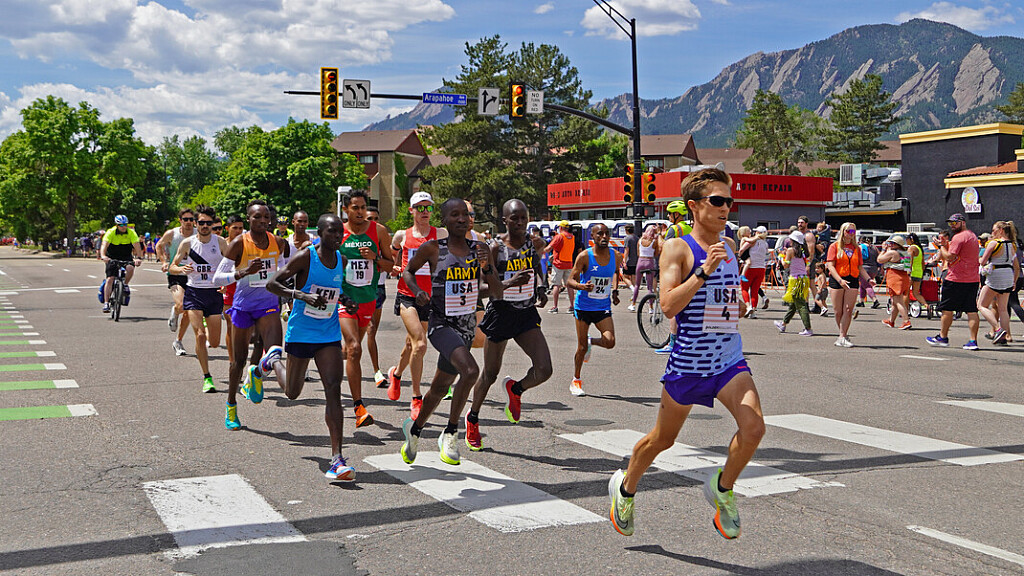
On Monday, May 27, more than 40,000 runners will run through the city that’s known for the iconic Flatirons rock formations, the Pearl Street pedestrian mall, and an exceptionally active population in the annual Bolder Boulder 10K. Now in its 44th year, it’s been one of the top road running races in the U.S. since its inception, and this year will serve as one of the final tune-ups for the men’s U.S. Olympic marathon squad before racing in the Paris Olympics later this summer.
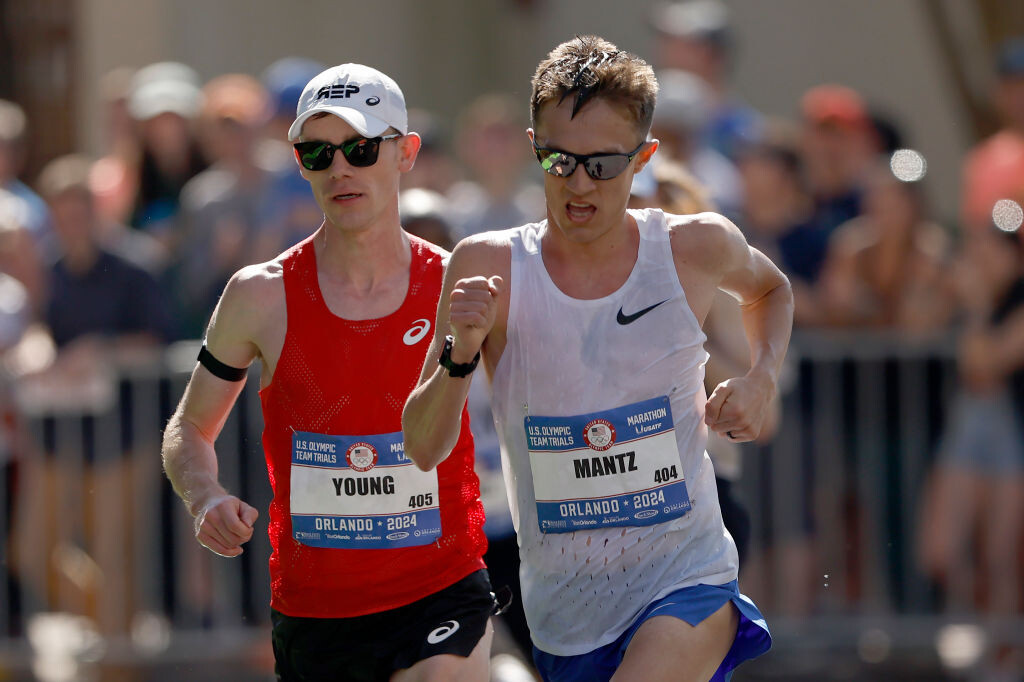
Conner Mantz, Clayton Young, and Leonard Korir, the top three finishers in the 2024 U.S. Olympic Trials who will be racing the marathon in the Paris Olympics on August 10, will be competing as Team USA Red in the Bolder Boulder’s International Pro Team Challenge that follows the citizen’s races. (Korir is expected to officially be named to the U.S. team in early May based on final pre-Olympic international rankings.)
The pro race, which has a prize purse of $83,700 before potential bonuses, is one of the things that makes the Bolder Boulder so unique. After all the runners in 98 citizen waves have completed the race, professional men’s and women’s international teams from more than a dozen countries compete on the same course for team and individual titles. The races feature a staggered start, with women beginning 15 minutes before the men so the winners of each race will finish about 10 minutes apart inside the University of Colorado’s Folsom Field football stadium.
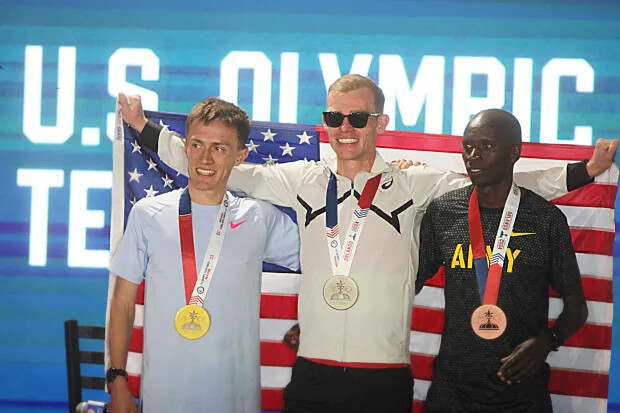
The finishing moments are among the thrilling spectacles in American running. By that point, the stadium is filled with a near-capacity crowd of roaring runners, family, and friends who have been watching the action play out on the massive video screens.
“The finish in the full stadium is like nothing else in the sport,” says Mantz, 27, who won the men’s race last year in 29:08 with a thrilling late-race surge to pass Kenya’s Alex Masai in the final 200 meters before the finish. “It was pretty electric. It took away all the pain you’re feeling mid-race. I was like, ‘Just race as hard as you can.’”
Team USA Red will have plenty of competition, from Team USA White, the secondary American team of Jared Ward, Futsum Zienasellassie, and Sam Chelanga, as well as teams from Kenya, Ethiopia, Mexico, and Rwanda. Teams are scored like a cross country race, with points awarded on the basis of finishing place, which means the team with the lowest combined score for all three runners is the winner. Ties are decided by the positions of the third-place finishers.
The women’s Team USA Red team will be led by defending champion Emily Durgin, along with Sara Hall and Boulder native Nell Rojas. Durgin finished ninth at the U.S. Olympic Trials in February and won the USATF 10 Mile Championships on April 7 in Washington D.C. At last year’s Bolder Boulder, she stormed to victory in 33:24, winning by 24 seconds over Kenya’s Daisy Kimeli.
Hall placed fifth in the U.S. Olympic Trials Marathon on February 3 in a U.S. master’s record (2:26:06) and 15th in the Boston Marathon on April 15. The women’s Team USA White roster will be composed of an all-University of Colorado alumnae squad—Makena Morley, Sara Vaughn, and Carrie Verdon.
“I can’t wait to be back in Boulder for the best day of the year,” says Durgin, 29, who will compete in the U.S. Olympic Trials 10,000 meters on the track in late June with the hopes of making the U.S. Olympic team. “Competing with Nell and Sara will make the experience even better.”
The women’s U.S. Olympic marathon team of Fionna O’Keefe, Emily Sisson, and Dakotah Lindwurm were invited to race in the Bolder Boulder but each runner declined, citing scheduling timing conflicts or a disinterest in racing at Boulder’s lofty altitude (5,430 feet). All of the runners who are racing for the U.S. teams in Boulder live at 4,500 feet or higher.
An Olympic Legacy
Boulder is known as one of the top running meccas in the U.S., in part because elite-level American and international runners have made it their training base since Olympic gold medalist Frank Shorter arrived in the early 1970s. Emma Coburn, Jenny Simpson, Yared Nuguse, Joe Klecker, Jake Riley, Hellen Obiri, and Edna Kiplagat are among the many top-level runners who are currently training in Boulder. Shorter, the 1972 marathon gold medalist, was a co-founder of Bolder Boulder 10K in 1979, and helped it grow into one of the country’s largest races.
Since then, numerous U.S. Olympians have raced in the Bolder Boulder, including Deena Kastor (a three-time women’s champion), Aliphine Tuliamuk (the 2022 women’s winner), Alan Culpepper, Elva Dyer, Ryan Hall, Abdi Abdirahman, Jorge Torres, Shalane Flanagan, Amy Cragg, Magdalena Boulet, and Libby Hickman, as well as Korir (who won it in 2022), and Ward (who was fourth in 2022).
Thanks to Boulder’s robust running community and the prestige of the race, the Bolder Boulder has also always featured fast sub-elite runners competing in the early citizen waves. Yet, the race has also celebrated dedicated middle-of-the-pack runners, as well as the first-time runners and walkers in the later waves. It was one of the first races to have bands playing along the course (as well as belly dancers and other entertainers), runners dressed up in costumes, elite wheelchair races, and in recent years, it has been known for a mid-race slip-and-slide and unofficial bacon aid station.
For the past 25 years, the Bolder Boulder has organized a special Memorial Day tribute—one of the largest in the country—that honors military veterans and new cadets.
The U.S. men’s Olympic marathon team competing in this year’s Bolder Boulder will be a legacy moment for the race, says Bolder Boulder race director Cliff Bosley.
“Having the three men that will represent our country in the marathon at this summer’s Paris Olympic Games is something we are extremely proud of,” Bosley says. “All three ran here last year, and to have them back is just incredible for the race, the city of Boulder, and the sport of running.”
by Brian Metzler
Login to leave a comment
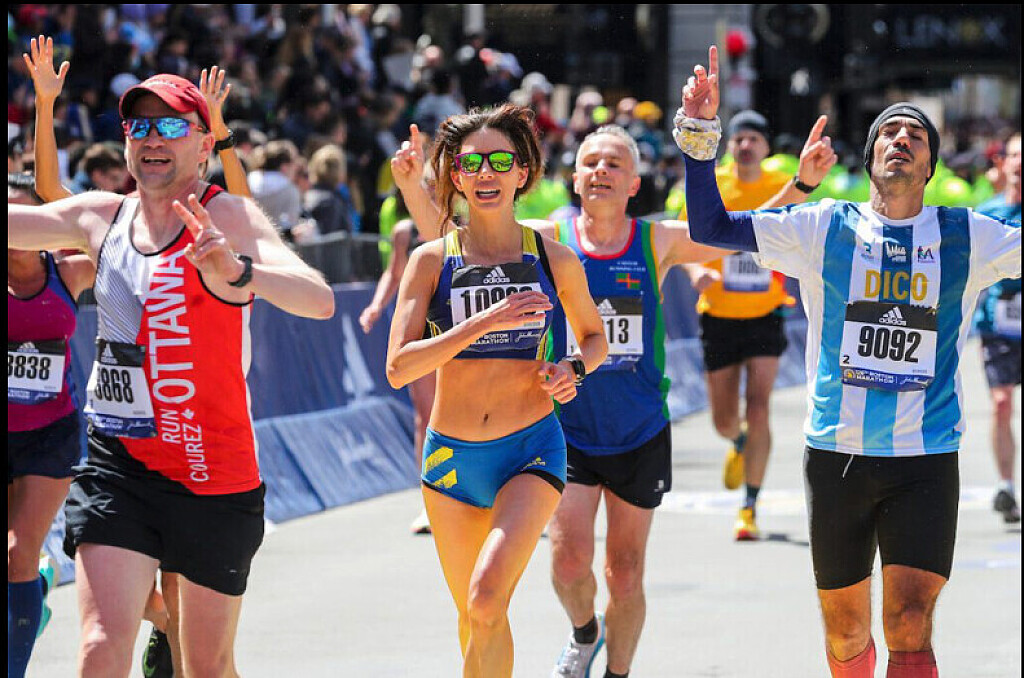
October the biggest month for marathons: Apple Heart and Movement Study
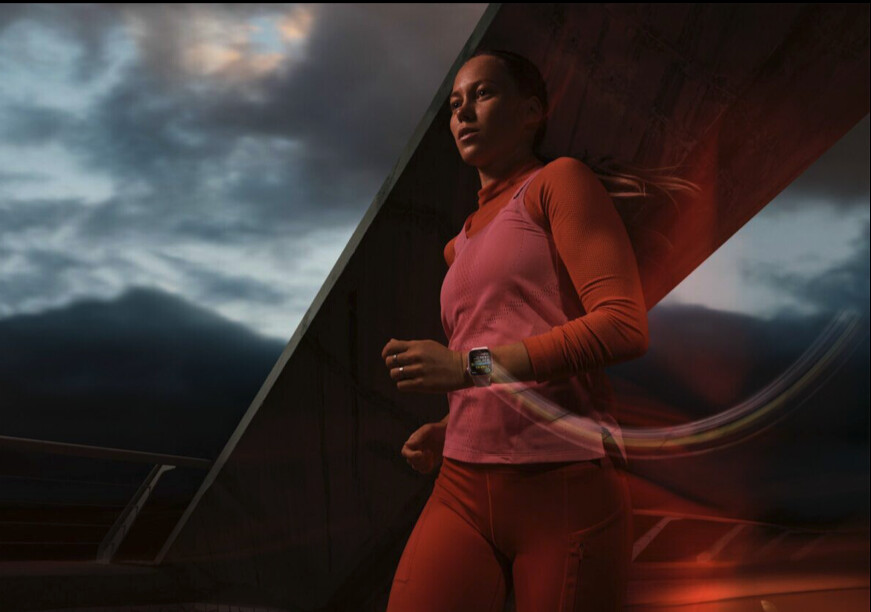
Apple has released an update on users’ walking and running workouts from the Apple Heart and Movement Study, which is based at Brigham and Women’s Hospital in Boston.
The study found October to be, by far, the most popular month for marathons in the U.S.; more marathon-length workouts were run by Apple Watch users in October than any other month–but, surprisingly, every month of the study yielded at least five marathon workouts, even during the pandemic. November was the next most popular month, followed by April.
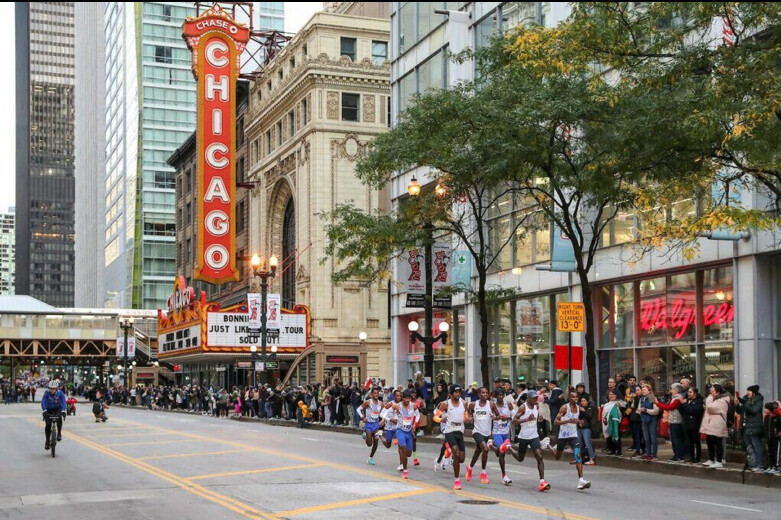
This makes sense, when you consider that three of the U.S.’s biggest marathons (Chicago, the Marine Corps Marathon in Washington, D.C. and the Portland Marathon) are all in October, November has the country’s biggest (New York City), as well as the Philadelphia Marathon and April has Boston (the third largest U.S. marathon).
More on the study
Between November 2019 and Jan. 1, 2024, almost 200,000 U.S. Apple Watch users recorded at least one walking workout and almost 100,000 users recorded at least one running workout. One workout in five years may not sound like much, but it’s enough for researchers to identify people who exercise (as distinct from the general population who either do not exercise, or who don’t record their exercise on their Apple Watch) and to use their data for research purposes. All users in the study gave permission for their data to be collected and analyzed.
More than half of those almost 300,000 users did at least one 5K walking or running session during the study period. The study notes that the 5K distance is popular with those who are new to running, because it can be accomplished over a relatively short period and does not require the same time commitment or fitness as longer endurance events, such as the marathon.
As one might expect, for the highest percentage of people, their longest logged workout was 5K, and the percentage decreased steadily for the 10K, half-marathon and marathon; for less than two per cent of runners (defined as people who logged at least one running workout during the study period), the marathon was their longest logged workout. The study found that 1,507 participants ran a total of 2,623 marathons during the five years of the study.
Login to leave a comment
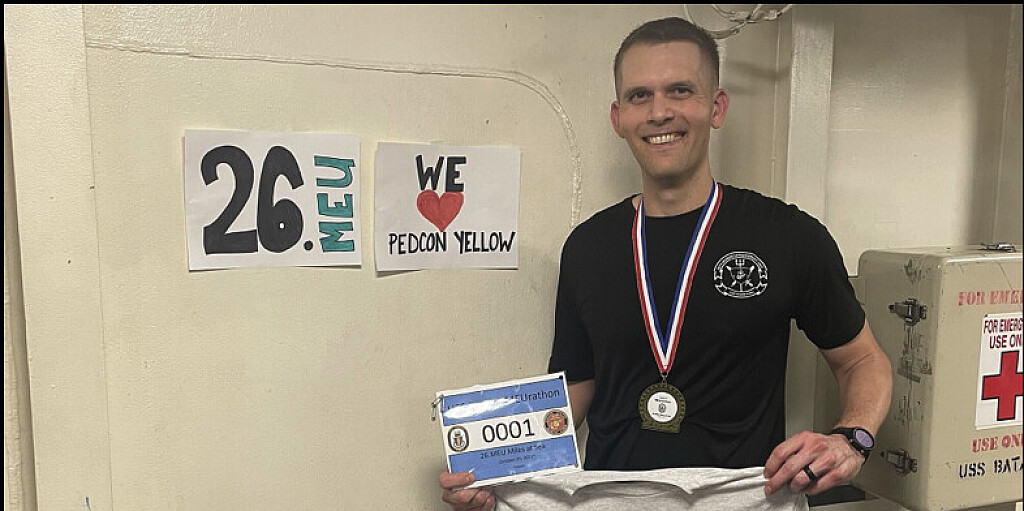
A Navy Dentist Trained for and Ran a Marathon While Out at Sea—All on a Treadmill
For 16 weeks, he followed Runner’s World’s training plan while deployed and ending up breaking four hours.
I always despised the treadmill. I was never able to run on it, partially because I was afraid that if my foot slipped too far off left or right, I would end up face-planted. Plus, what I love about running is being out in the wilderness and not having to run in a perfectly straight line, which is everything the treadmill isn’t: It’s confined and claustrophobic.

But I didn’t always love running the way I do now. As a kid, I played baseball and golf, so when I pivoted to running in high school, it was quite demanding physically and mentally at first. I ran both cross-country and track, and because I was part of a successful team—we won the state championship in track in 2003, and cross country in 2004 and 2005—it was challenging and took a lot of hard work. But even then, I enjoyed the mental challenge of pushing myself hard: No one can make you run, no one can force you, it’s all on you.
And for that reason—because I love to challenge myself—part of me always wanted to conquer my fear of the treadmill. Plus, when my buddy said I could not possibly train for and run a marathon on a treadmill during our back-then-upcoming deployment out at sea, it just made me want to do it all the more. But above all, there was one special person who motivated me to train: My wife, Jessee, and her recent BQ.
Jessee and I were both runners long before we met in college. We take the sport with us wherever we move with the Navy, joining group runs, and even racing together. But while Jessee has been getting faster, in late 2022, I was diagnosed with osteoarthritis, followed by months of rehab and uncertainty about whether I’d ever run another marathon again. However, I was determined to fully recover, following my physical therapist’s recommendations to a T.
While I was healing, Jessee was training for the Wilmington Marathon in February 2023, following the Runner’s World break 3:30 plan, hoping to beat the 3:35:00 cutoff for her age group and make it her Boston qualifier. Her final time was 3:31:33. I was there for the race, spectating, and the whole experience—from training to the race—awakened new determination in me. Could I qualify for Boston as well?
By then, I already knew I would be deployed in July 2023. As I slowly started to feel better, getting back to some easy runs, a plan formed in my head: I would commit to the same training plan Jessee had followed for her BQ—except my training would be solely on a treadmill on the Navy ship.
To qualify for Boston in 3:05:00 for my age group, I knew I’d have to gradually improve my time from my existing PR of 3:58:17. I started training on the first day of our deployment, which set my treadmill marathon date for October 28, 2023.
It was not an easy training block for sure. There had been a handful of days where the ship was rocking and pitching, which brought some surprising, unintentional hill workouts to my treadmill runs. There are no windows, so you just have to be aware and try to anticipate the next move.
In the end, running in a straight line was the least of my worries—the toughest stage was handling the hot days while we were in the Persian Gulf. The heat index was 120 to 130 Fahrenheit outside, and the ship was very hot as well. But one of my favorite quotes is: “Smooth seas don’t make skilled sailors.” I knew that come marathon day, I’d be able to look back on those runs for motivation, knowing that I can do hard things.
In general, I don’t listen to music while running; I like to know what’s going on around me. But the treadmill doesn’t provide much excitement, so I came up with a plan. I read some Runner’s World articles that mentioned the physiological benefits of listening to music while running. I thought if I get through about 16 miles without music and then run the last 10 miles with music on, that should give me a good boost. I practiced it first for a few miles at the end of each long training run, figuring out what songs I wanted on my marathon playlist.
On the day of the marathon, the gym was 76 degrees, about 20 degrees more than all my previous marathons, so I expected the temperature to be a factor going into it. Around mile 18, I started to feel that heat seep in. And then, at mile 22, I felt a sharp pinch in my left groin, so I backed off a little bit. I was hoping for 3:30, but in the end, I finished at 3:43:58 (pure run time, as I had to restart the treadmill every 60 minutes). I ran almost 15 minutes faster than my previous PR though, and was now 15 minutes closer to Boston.
Overall I discovered this marathon training block supported my mental health. Out at sea, it can feel like Groundhog Day—every day is the same. Having a goal helped bring structure to my days. Having a plan gave me a focus and direction. The Runner’s World training plan included a description of what to do each day, running tips, nutrition, and sometimes a little pep talk. I didn’t have to think about it; I was just following what it prescribed.
Since the marathon, I’ve been running three or four times a week, focusing more on strength training, and figuring out what could be next.
Besides Boston, Jessee and I also hope to eventually run a marathon on every continent. We will be moving to Washington D.C. soon, so for now, I hope to run the Marine Corps Marathon this fall and keep shaving time off my PR.
While I’m glad I conquered the treadmill, I doubt I’ll do another treadmill marathon—I’m very much looking forward to running outdoors again, as soon as I return from my deployment.
These tips have made my running journey a success:
1. Work foam rolling into your routine
After my injury following the London Marathon, my physical therapist showed me some foam-rolling techniques for my quads and calves. Before and after every run, I get things loose and warmed up, and it really made a huge difference. By the time I did the treadmill training block, the injury was essentially nonexistent. It’s definitely changed the way I approach running.
2. Make yourself a playlist to boost your mood
Music is quite personal so I’d recommend checking out RW playlists and Spotify playlists, then make your own based on your taste. All genres—rock, rap, pop—can give you a boost in a different way.
3. Find a training plan
Even if you have never run competitively or are brand new to running, Runner’s World can help you figure out the smartest and safest way to start so you don’t do too much too soon and help avoid injury.
4. Find your running people
Googling “local running club” can help you find a community of like-minded people near you. This is a great way to make friends and learn more about running. My wife and I always find a running community every time we move with the Navy. We have made some lifelong friends and look forward to meeting more runners wherever the Navy takes us!
Mike's Must-Have Gear
→ Garmin Forerunner 55: I try to keep my running minimalistic, so I only use the watch for pace, time, and heart rate. There are probably a million other things the watch can do, but that’s enough for me.
→ Brooks Sherpa 2-in-1 running shorts: The boxer brief lining makes these the most comfortable running shorts I’ve ever worn. It’s kinda pricey, so I have only one pair that I wear on my long runs (maybe I'll invest in a second pair one day). The waistband is also very comfortable and the pockets are a perfect storage for my needs.
→ Balega socks: My wife got me a couple of pairs for this deployment, and I absolutely love them. They are a little pricey but so worth it.
Login to leave a comment
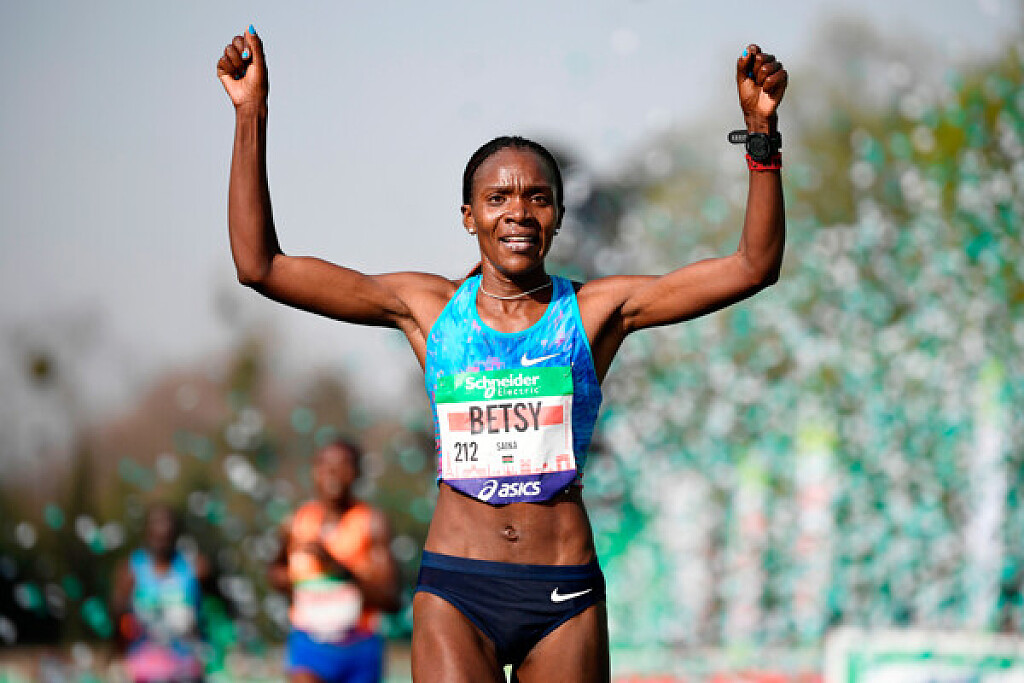
For Betsy Saina, the U.S. Olympic Trials Marathon Presents a Chance to Represent Her Son
For much of last year, Betsy Saina had a plan. She would race the Chicago Marathon in October, eager to run alongside Emma Bates (who placed fifth at last year’s Boston Marathon in a new personal best of 2:22:10) in pursuit of breaking Emily Sisson’s American record of 2:18:29, set the previous year at that same race.
Saina, 35, a naturalized U.S. citizen who represented Kenya in the 2016 Olympics in Rio de Janeiro—she placed fifth in the 10,000 meters 30:07.78—had reason to be confident. Last spring, she set a new personal best of 2:21:40 with her fifth-place finish at the Tokyo Marathon, which wound up being the fastest marathon by an American woman in 2023 and made her the eighth-fastest U.S. female marathoner of all-time, solidifying her position as a top U.S. Olympic marathon team contender.
The Chicago Marathon had assured Saina’s agent, Tom Broadbent, that she was in for the race. But when the elite field was announced in August, Saina learned she had not been accepted, which not only threw a wrench in her fall training plans, but made for a lot of stress as she was planning her U.S. Olympic Marathon Team Trials buildup.
“I was shocked and spent three days looking at myself and trying to find any mistakes I made to not make the field, especially after running 2:21 in Tokyo,” Saina says. “I had never been rejected from a race before, and never got a response or an explanation as to why I didn’t make it. Being denied to run in Chicago honestly was one of the most disappointing things I’ve experienced in my career.”
Saina looked into entering the Berlin Marathon the following month, but had no such luck getting in with it being so late in the game. She was ultimately accepted into the Sydney Marathon (which shares its sponsor, ASICS, with Saina) on September 16. Unlike Chicago—with its fast, flat course that ended up having ideal racing conditions with temperatures in the 40s—Sydney has a hilly course and race-day weather was on the hotter side, with a starting temperature of 68 degrees.
Despite the conditions, Saina proved herself once again, winning the race in 2:26:47. This sealed her confidence as she began to look ahead to the Olympic Trials in Orlando on February 3. If she’s one of the top three finishers in the women’s race in Florida, she’ll earn a spot on the U.S. team that will compete in the marathon at the Paris Olympics on August 11.
“Challenges make people strong, and running a good marathon on a harder course made me come back feeling motivated,” she says. “[Even though it wasn’t the faster time I originally wanted], it didn’t stop me from being a better version of myself.”
Transcendent Transplant
Despite her impressive performances in 2023, Saina has remained largely under the radar in terms of media coverage and fan predictions leading up to the Trials in Orlando, similarly to what fellow Kenyan-born marathoners Aliphine Tuliamuk and Sally Kipyego (both of whom made the last Olympic marathon team) experienced in 2020. The lack of attention relative to her competitors hasn’t fazed Saina, however.
“I know how to deal with pressure, having been in the sport since 2013, so as long as my training is going well, I don’t pay too much attention to what people say,” Saina says. “I’m just more excited to see many of the U.S. women [who are also] my friends, like Emily Sisson, Sara Hall, and Keira D’Amato, and to be racing so many amazing U.S. athletes for the first time.”
Saina’s result in Tokyo was only about a minute faster than her debut at the distance at the 2018 Paris Marathon, which she won in 2:22:56 (after dropping out of the 2017 Tokyo and New York City Marathons). It was also a confidence boost for Saina because it was also her first marathon since giving birth to her son, Kalya, now two, in December 2021, after previously running 2:22:43 and 2:31:51 at the 2019 Toronto Waterfront and Honolulu Marathons, respectively.
Saina—who originally came to the U.S. to attend Iowa State University where she trained alongside Tuliamuk and was a three-time individual NCAA champion and 11-time NCAA All-American—has remained in her hometown of Iten, Kenya, for the majority of the time since having her son, as her husband, Meshack Korir, is a doctor completing his postgraduate education there.
Although Saina became a U.S. citizen in late 2020 and has a home base in Colorado Springs, she made the decision to return to Kenya to have additional family support and childcare as she worked to come back from pregnancy and childbirth to prepare for the Olympic Trials, which she’ll return for just a few days before the race. Saina also keeps busy managing a couple of guesthouses, which she regularly rents out to visiting athletes and tourists. She also works with Cross World Africa, a nonprofit that sponsors underprivileged children in pursuing secondary and higher education.
“Before I came from Kenya, my family was struggling and we had to fundraise for my flight ticket to come to the U.S. Being here has changed my family in a different way—I have two sisters who are now nurses in the U.S., and my parents can now more easily fly to visit us, and while it is not where I began running, the U.S. where I began competing at such a high level,” she says. “My son also gives me so much motivation and is my inspiration. When I see him, I see beauty in myself and see myself getting better when I’m running. So I am excited both to compete and represent my son, and to hopefully wear the U.S. uniform because it has so much meaning for me.”
Back in Iten, Saina has been training in a group with personal pacemakers alongside 2019 New York City Marathon champion Joyciline Jepkosgei, which she describes as game-changing for her progress in the marathon. Both Saina and Jepkosgei, who is also the former world-record holder in the half marathon and Saina’s best friend from high school, are coached by Jepkosgei’s husband, Nicholas Koech.
“Sometimes you will train with people who don’t want to help someone else get better, but [Jepkosgei], who has run 1:04 [in the half marathon] and 2:17 [in the marathon] is unique in that she has sacrificed a lot, which I don’t think a lot of women will ever do for each other, and I don’t think I would either,” Saina says. “But she has been pushing me a lot since the first day I joined her, and I think that’s the reason I came back and I’ve had better races. I have someone to chase and it’s like competition in training, but in a good way.”
American Original
Saina returned to the U.S. twice last year, to race the USATF 25K Championships in Grand Rapids, Michigan, (where she took the win in 1:24:32 for her first U.S. title, narrowly beating D’Amato) and to be inducted into Iowa State’s Athletics Hall of Fame in September. Saina had planned to do some shorter U.S. races, including the Bolder Boulder 10K in May and the NYRR Mini 10K in June, following her national championship title in the 25K. However, she ultimately decided she couldn’t bear to be away from her son any longer.
“As a mom, when you’re away, you are so worried because you’re like, ‘How is he doing right now? How can I handle the pressure, being away from him?’” Saina says. “This year, it’s really different for me because the only race I want to travel to without Kalya is the Olympic Trials. He is growing now and getting better, so I want to travel with him afterward to compete in the USATF circuit. That’s the biggest goal for 2024, to travel with my son.”
Later this year, Saina hopes to also run the April 7 Cherry Blossom 10-Miler in Washington, D.C., the Mini 10K on June 8 in New York City, and a fast spring half marathon to pursue the current American record (which was broken yet again by Weini Kelati on January 14 in Houston), before running another marathon in the fall. In the meantime, she noted that she is especially eager to compete in one of the deepest fields ever assembled for the Trials.
Although Bates withdrew from the Trials, Saina figures to be one of the favorites in Orlando along with Sisson, Hall, Tuliamuk, D’Amato, and Seidel. However, Lindsay Flanagan (ninth in last summer’s world championships), Sara Vaughn, Susanna Sullivan, Gabriella Rooker, Dakotah Lindwurm, and Nell Rojas are all sub-2:25 marathoners, and thus top contenders, too.
“The U.S. is no longer small and non-competitive. Look at Molly Seidel. She got bronze at the Tokyo Olympics, and I remember when Amy [Cragg] was a bronze medalist at the 2017 World Championships. If you put that in perspective, it has changed even more right now compared to that time,” she says. “The competition [to make the U.S. team] is no longer as easy as the way some people [thought], and I’m super excited to be competing with a lot of solid women. There is no difference between the U.S. and other countries right now—it’s not just to go compete at the Olympics; they’re going to compete for the medals, just like other countries.”
by Emilia Benton
Login to leave a comment

2028 US Olympic Trials Marathon
Most countries around the world use a selection committee to choose their Olympic Team Members, but not the USA. Prior to 1968, a series of races were used to select the USA Olympic Marathon team, but beginning in 1968 the format was changed to a single race on a single day with the top three finishers selected to be part...
more...
New Chipotle and Strava challenge offers a year's worth of free bowls
We’re only a few days into 2024, and the fast-food chain Chipotle Mexican Grill and Strava have already released the collaboration of the year. Runners, brace yourselves for a potential year-long supply of free Chipotle Lifestyle Bowls–all it takes is to become a Local Legend on a few Strava segments.
Chipotle spilled the beans in a recent study, confirming that nearly seven out of 10 consumers are avid runners who make Chipotle their go-to post-training treat. Joining forces with Strava, they’ve rolled out “Chipotle segments” –exclusive stretches of roads and trails where athletes can compete for glory, chasing the fastest times and efforts on the leaderboard. Here’s the twist–the athlete who holds the Local Legend title in six U.S. cities will receive free Chipotle Lifestyle Bowls for a year.
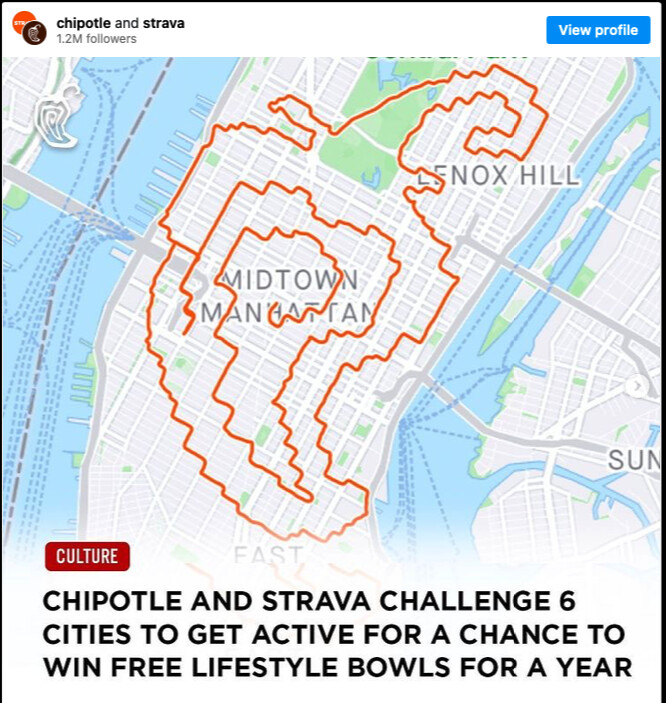
Local Legends are Strava’s nod to dedicated athletes. They crown the person running a particular segment the most times in a rolling 90-day window. It’s not about pace or speed; it’s about pure dedication.
“Runners chase popular Strava segment in Denver airport” — Canadian Running Magazine
This sizzling promotion lights up in New York, Los Angeles, Chicago, Washington D.C., Denver and Columbus, Ohio. But fear not, Canadian runners! Let’s crank up the buzz on Chipotle socials and try to bring this epic challenge to cities across Canada. The race is on from Jan. 2 to 31, 2024.
If you don’t live in, or aren’t visiting, any of the six cities anytime soon, Chipotle has come up with another contest for everyone with the “No Quitters Challenge.” Launching on Strava on Jan. 15, this worldwide streak-based challenge rewards fans committed to healthy habits post-Quitters Day, Jan 12. Completing the challenge earns you a shot at a free side of guac, redeemable at any Chipotle Mexican Grill, if you can log at least 40 minutes of activity each week on Strava from Jan. 15 through Jan. 28.
by Running Magazine
Login to leave a comment
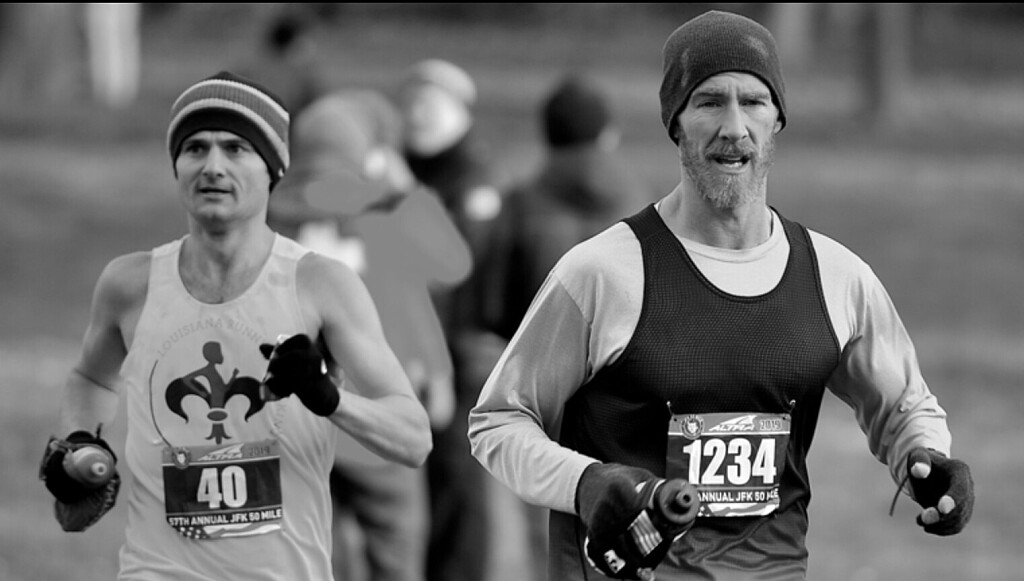
America’s Oldest Continuously-Held Ultramarathon Is Only Looking Forward
After 60 years, the JFK 50 Mile Race is sticking to its community-centered approach, and people keep showing up
Mike Spinnler cries nearly every time he recounts memories as a runner and long-time race director of the JFK 50, the oldest continuously run ultra in the country.
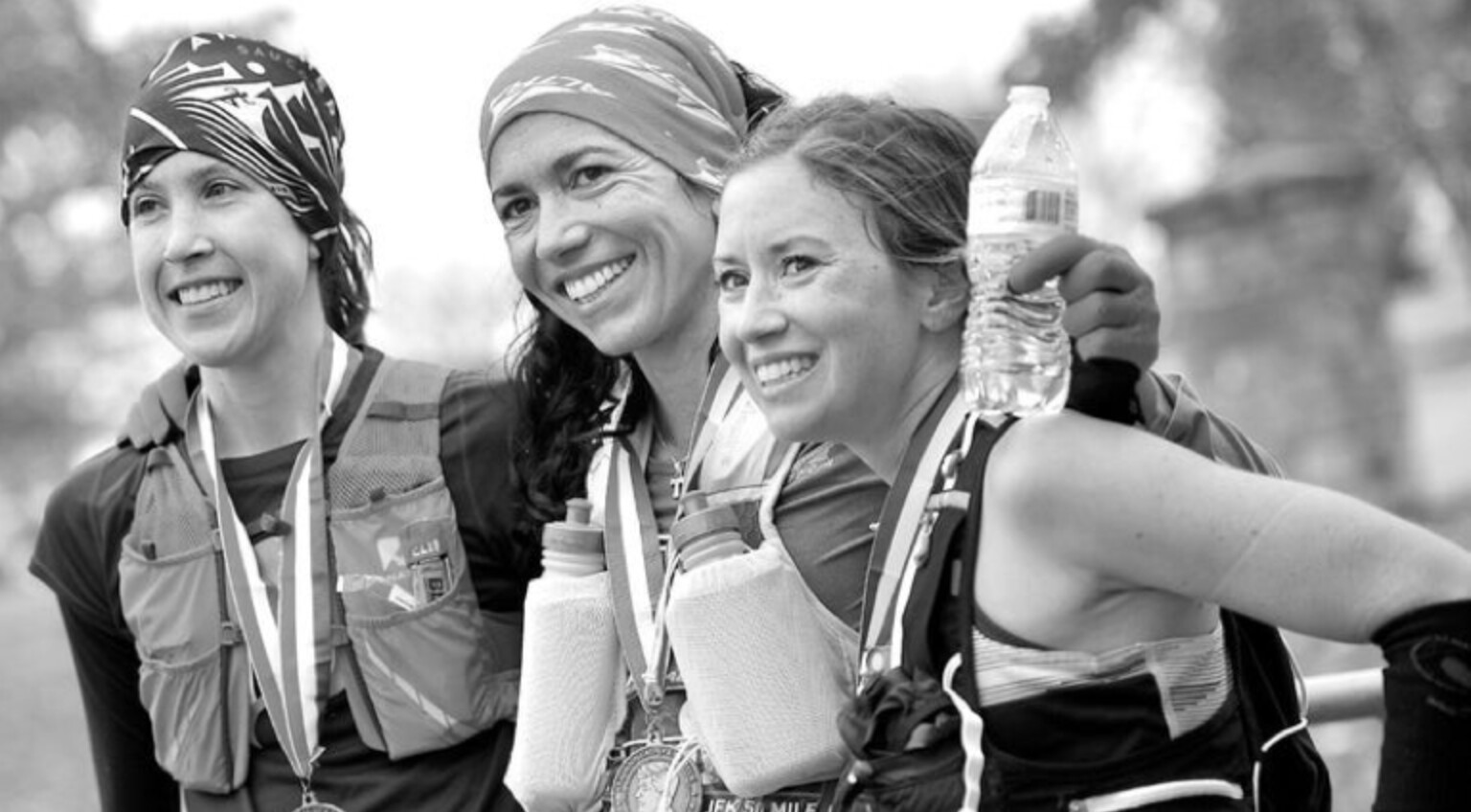

Such memories include the time he first ran the iconic Maryland race when he was 12 years old, or the year he cheered on his 60-year-old wife as she crossed the finish, or memories of watching his two sons racing. For him, this race is a member of the family.
In 1993, five years after his tenth JFK finish, Spinnler became the race’s second race director, where he’s been ever since. By then, he’d set the course record (5:53:05) in 1982, and added another win in 1983, for a total of five top-five and six top-ten finishes.
Thirty years later, it’s still his pride and joy. He’ll immerse in the magic of the event again on Saturday, November 18, as more than 1,000 runners take the journey through the historic route that’s so dear to his heart.
“It just keeps growing in its prestige,” he says.
The JFK 50 started in 1963, the same year President John F. Kennedy was assassinated. The president had instituted a public health program to improve the nation’s fitness, supporting the launch of a series of 50-mile races around the country. But as years went on, the only one that stuck around was the JFK 50.
“Kennedy’s mission was this: Improve your physical fitness, improve your lifestyle, improve your country,” says Spinnler. “We heeded his call and have been doing it for 60-plus years.”
The JFK 50 course is located about an hour northwest of Washington D.C., covering traditional lands of the Indigenous Massawomek and Shawandassee Tule (Shawanaki/Shawnee). One of the race’s primary appeals is that it’s a horseshoe-shaped, point-to-point course with three distinct sections: The Appalachian Trail (miles 0-15), the Canal/Tow Path (miles 15-42), and the rolling finish (miles 42-50).
The race starts in Boonsboro, Maryland, follows a few miles of paved roads before connecting with the Appalachian Trail (AT), where the course climbs more than 1,000 vertical feet in five miles, crests to the high point, and follows rocky singletrack before dropping 1,000 vertical feet halfway into the race (mile 14.5), to connect with a flat marathon distance along the C&O Canal Tow Path. The last several miles are rolling country roads, where it finishes at Springfield Middle School in Williamsport.
In 2019, Seth Ruhling, an unsponsored athlete, showed up to the JFK 50, slept in his car the night before, and won the race in a blistering 5:38:11, his debut 50-miler. Within hours of winning, he sealed a sponsorship with The North Face.
Ruhling, 29, now lives and trains in Boulder, Colorado, and he’ll be returning for his second JFK 50. Since Ruhling’s 2019 win, he has made a name for himself with a sixth place finish at the Pikes Peak Marathon in 2021, second place at Montana’s Rut 50K, first place at the Broken Arrow Skyrace 46K, and most recently, sixth at CCC 100K during the week of UTMB in Chamonix, France.
In 2020, JFK 50 was one of the only races in the country that didn’t shut down with the pandemic. Ruhling had planned on racing, but got injured. “I always wanted to go back,” he says.
Ruhling was particularly drawn into this year’s race because of its deep field of registered elites, which had at one point included 2023 Western States winner Tom Evans, Matt Daniels, Adam Merry, and Sean Van Horn—all of whom have since dropped.
His strategy for the mixed course, which requires technical trail chops as well as fast road turnover, is to attack every single section. He says that, while the JFK 50 is known more as a “track race,” it’s a mistake to discount the early trail miles. “The record is going to happen on the towpath, sure, but only if it’s set up with efficient running on the AT section,” he says.
by Outside Online
Login to leave a comment
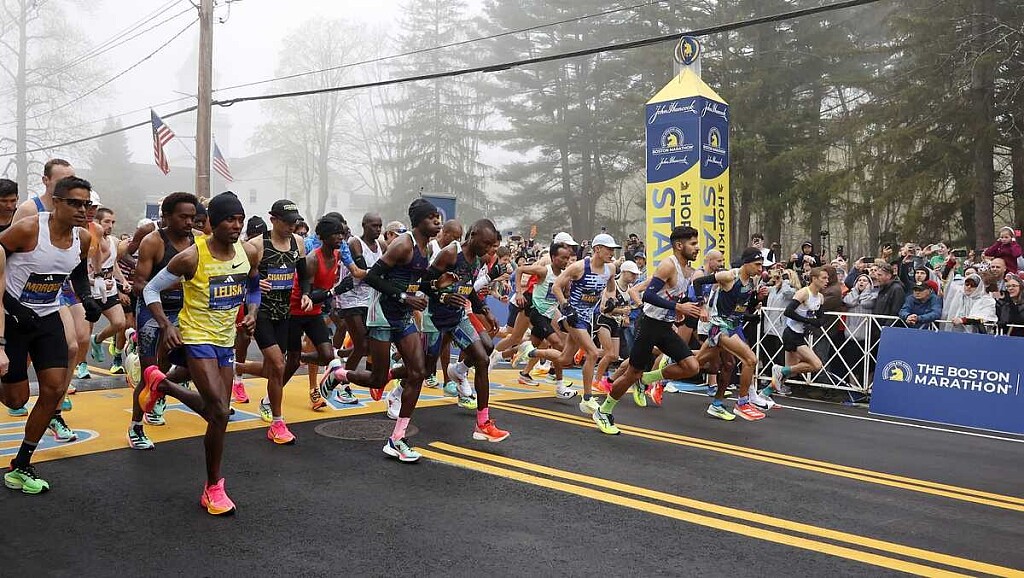
Record-breaking registration numbers reported for 2024 Boston Marathon
The 128th Boston Marathon presented by Bank of America has set a remarkable record as it closed its qualifier registration window on Friday, Sept. 15. An astounding 33,000 applications were received by the Boston Athletic Association (B.A.A.) surpassing the previous record of 30,458 entries in 2019.
The applications for the 2024 Boston Marathon came from runners from 127 different countries and all 50 U.S. states, along with Washington, D.C. Qualifying athletes earned their spots in more than 528 races worldwide, showcasing the event’s international appeal. Impressively, applicants ranged in age from 18 to 82, underlining the race’s inclusivity and ability to inspire athletes of all ages.
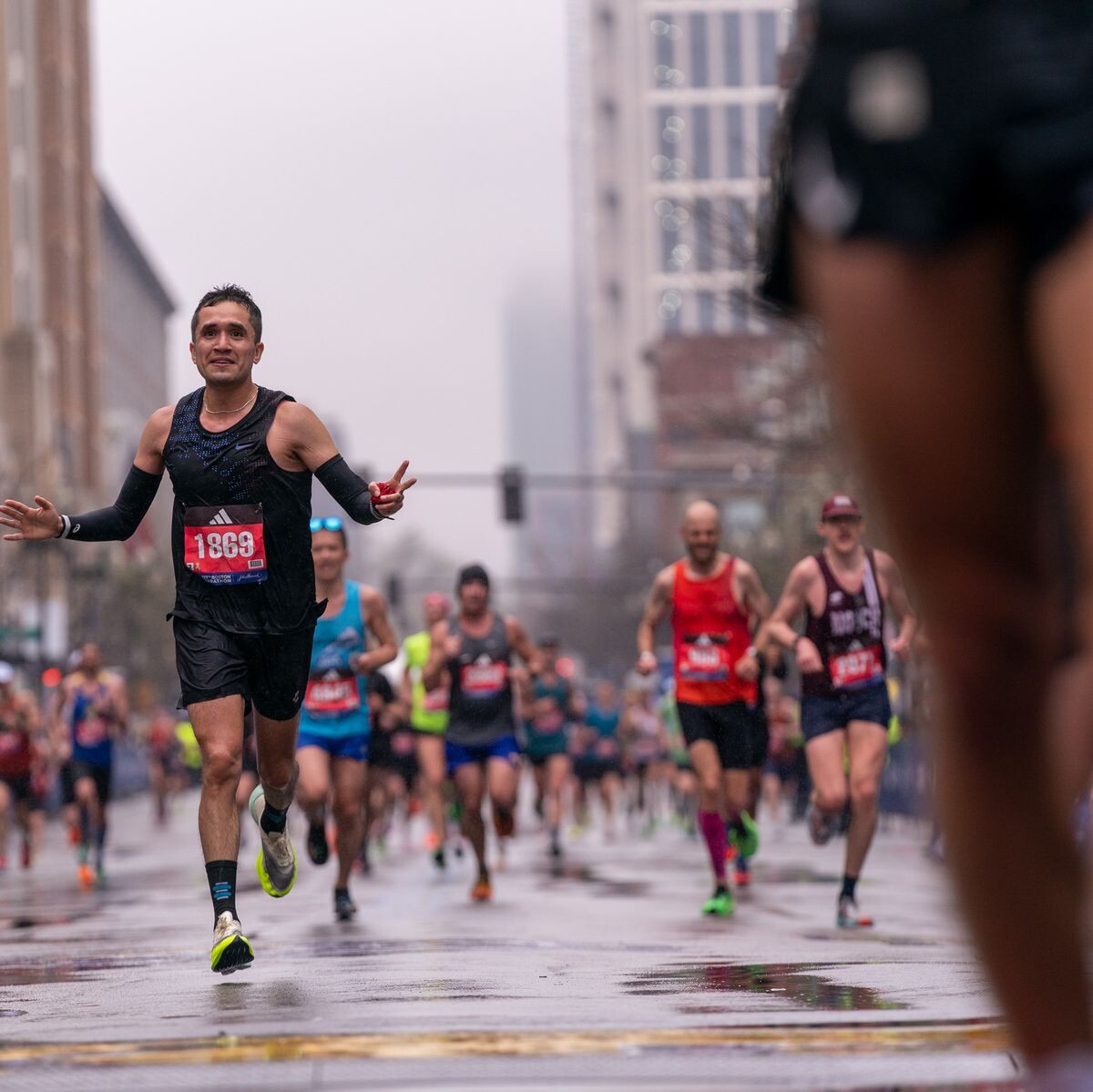
Despite the surge in applications, not all qualifiers will secure a spot in the 128th Boston Marathon. The B.A.A. is currently verifying all qualifying times and will notify applicants of their acceptance or non-acceptance within the next three weeks.
To maintain transparency, the organization has not speculated on a “cut-off” time for entry and requests athletes’ understanding and patience during this verification process.
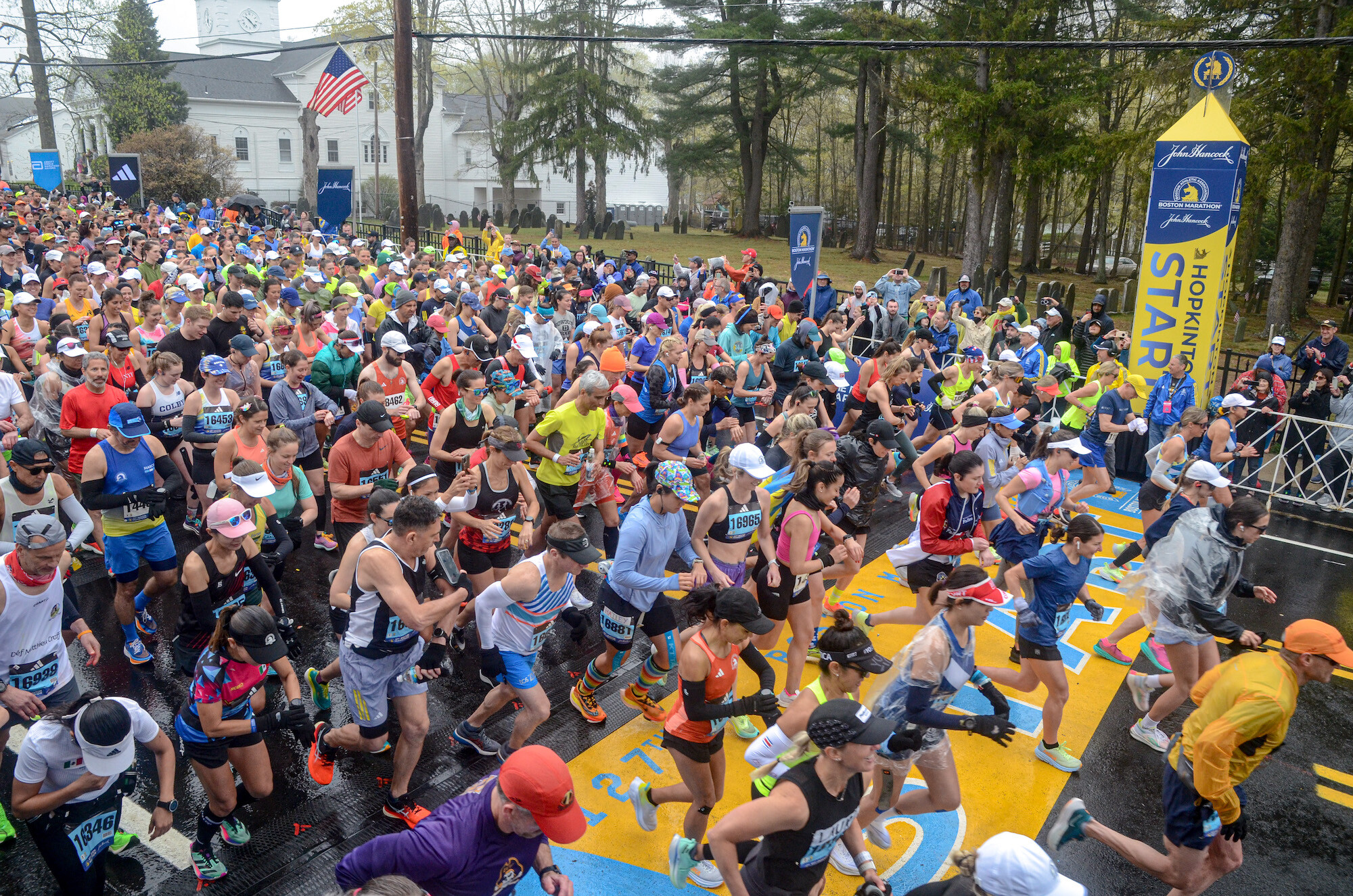
Jack Fleming, President and CEO of the B.A.A. commended the global running community’s passion and commitment to participating in the iconic race. Fleming stated, “Receiving a record number of applications is a testament to the strength of road racing around the world and speaks to runners’ commitment to taking on the challenge of earning a Boston Marathon qualifying time with the goal of reaching the start line in Hopkinton.”
For individuals who do not make the cut or lack a Boston Marathon qualifying time, there’s still an opportunity to participate through the Bank of America Boston Marathon Official Charity Program. This program includes 160 non-profit and charitable organizations that have begun accepting applicants for the upcoming event.
Login to leave a comment
Boston Marathon
Among the nation’s oldest athletic clubs, the B.A.A. was established in 1887, and, in 1896, more than half of the U.S. Olympic Team at the first modern games was composed of B.A.A. club members. The Olympic Games provided the inspiration for the first Boston Marathon, which culminated the B.A.A. Games on April 19, 1897. John J. McDermott emerged from a...
more...
Jenny Simpson, U.S. mile legend, to race Olympic marathon trials
Jenny Simpson, the most decorated U.S. female miler in history, is moving up in distance and plans to race the 2024 Olympic Marathon Trials on Feb. 3 in Orlando, near where she grew up.
“It’s an easy decision for me to run the marathon Trials in Orlando,” she wrote in an email after making the announcement in an Instagram live video with the Orlando Track Shack. “For a long time I’ve flirted with the idea of going the full distance and with Orlando hosting the Trials, I just can’t miss the chance to go back home.”
Simpson, 36, announced last October that she was shifting focus from the track, where she was a world champion and Olympic bronze medalist in the 1500m, to longer races on the roads.
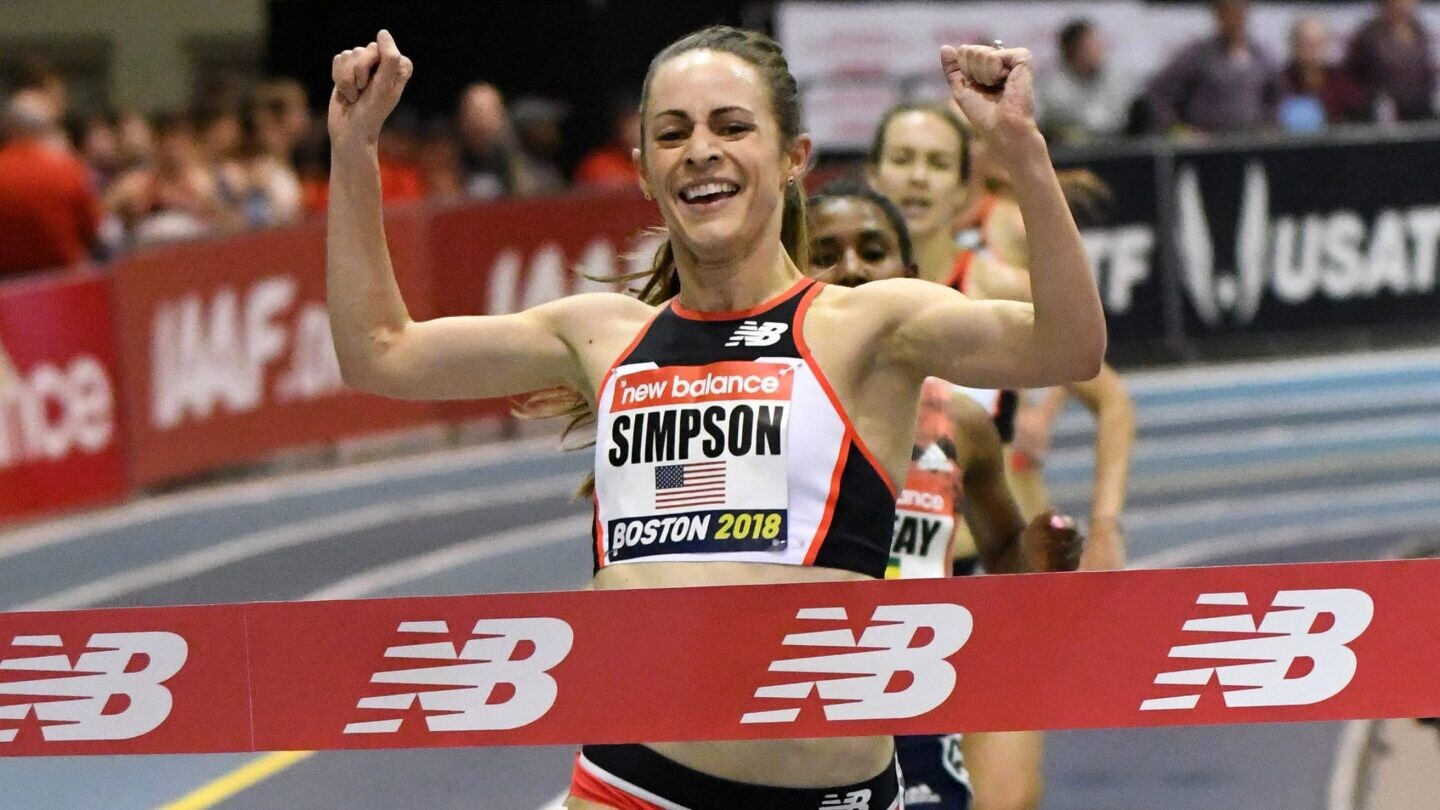
Typically for distance runners that accomplished, it means an eventual move all the way up to the marathon. Simpson messaged then that her chances of racing over 26.2 miles were “51% :).”
A month later, Orlando was announced as the host of the 2024 Olympic Marathon Trials. Simpson’s family moved to Florida when she was in third grade, and she went to high school in Oviedo, which is 15 miles northeast of Orlando.
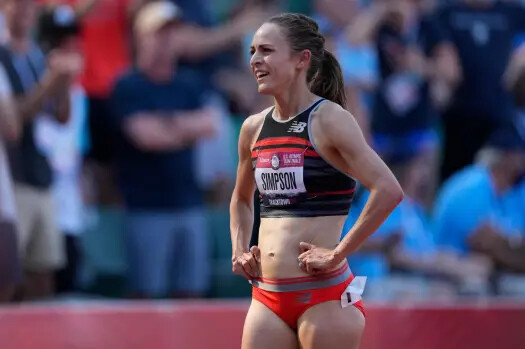
“It’ll be fun to literally come back to the beginnings of my running and take in the scenery of the place where I ran my first few races,” Simpson said in Tuesday’s video.
Simpson’s last track race was at the Tokyo Olympic Trials, where she was 10th in the 1500m final. It was her first time not placing in the top three at a U.S. outdoor championships since 2006 and first time not being on an Olympic team since 2004.
In September 2021, Simpson ran the Cherry Blossom 10-mile road race in Washington, D.C., nearly three times as long as the farthest distance she had raced as a pro up to that point.
She then focused much of her time in 2022 helping her Colorado community heal and rebuild from a late December 2021 fire.
She ran 5km and 10-mile road races late in 2022, then on Jan. 15 of this year placed ninth in the Houston half marathon in 70 minutes, 35 seconds to beat the Olympic Trials qualifying time of 72 minutes. That was her most recent race, according to World Athletics.
Simpson attended the 2020 marathon trials to watch husband Jason run. Jason has not qualified for next year’s trials yet but is still hopeful.
One U.S. woman has made Olympic teams in both the 1500m and the marathon in her career -- Francie Larrieu-Smith, who made her first team in the 1500m at age 19 and her last in the marathon at 39, according to Olympedia.org.
Simpson hasn’t said whether she will race a marathon in the fall or if the trials will be her debut at the distance, “but the next six months will be all about getting ready to go the extra 25.2 miles,” she wrote.
The list of marathon trials qualifiers already includes nine of the 15 fastest American women in history. The top three finishers on Feb. 3 will likely make up the Olympic team.
“As I get older, I didn’t want to run out of really good years to give to something that was so intriguing to me for so long,” Simpson said of the marathon. “I’ve accomplished a lot already, and now I can do something that I want to do, not necessarily something that’s going to just objectively, absolutely pay off.”
by Nick Zaccardi
Login to leave a comment
2028 US Olympic Trials Marathon
Most countries around the world use a selection committee to choose their Olympic Team Members, but not the USA. Prior to 1968, a series of races were used to select the USA Olympic Marathon team, but beginning in 1968 the format was changed to a single race on a single day with the top three finishers selected to be part...
more...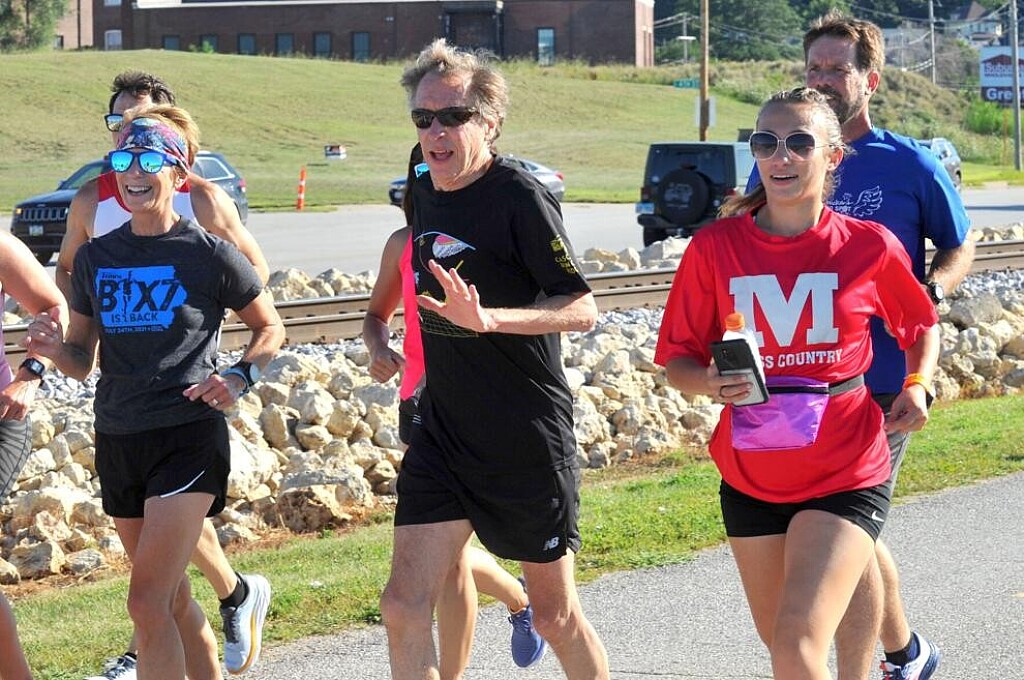
Bill Rodgers is set to run his 43rd Quad-City Times Bix 7
In 1978, Bill Rodgers entered 30 road races and amazingly, astonishingly, he won 27 of them.
Over the course of his running career, he won 22 marathons, all during a thoroughly incredible 10-year period from 1974 to 1983.
He doesn’t win anything anymore, not even in his age group, but the 75-year-old Boston resident is still running, and he will be coming back to run the Quad-City Times Bix 7 for the 43rd time on July 29.
Rodgers said he thought he had done the Falmouth Road Race on Cape Cod about 35 times and the Cherry Blossom 10-miler in Washington, D.C., perhaps 30 times.
He never has entered any race as frequently as he has the Quad-City Times Bix 7, which is holding its 49th event this year.
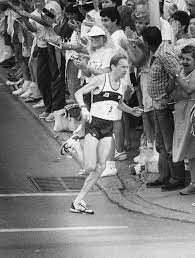
“And the Bix is probably the most challenging of them all,’’ Rodgers said. “But it’s a race I remember so well from that first time in 1980. I was still young and I could duke it out and I could race. Now I just try to hang on.’’
A man who once logged hundreds of miles in training each week now jogs 25 to 30 miles a week. He has done about 10 races this year, including Cherry Blossom. He said he now just went back to some of the old events he did during his heyday.
“But I’m back in the pack,’’ he said. “I’m way back in the pack because I’m 75 years old. It’s like a whole different thing. My strength used to be that I was a marathoner and I could do high mileage. I was a high-mileage runner. I wasn’t as quick as some runners, but I could do the mileage.’’
Not anymore. During the COVID-19 pandemic, Rodgers had a chance to sift through almost 50 years of running logs and he calculated that he has done more than 1,500 races and run at least 190,000 miles in his lifetime.
Most automobiles don’t last that long. And Rodgers hasn’t had the benefit of having a change of tires or periodic oil changes.
His body is feeling the effects of all that mileage. When he enters races now, he frequently finds himself trailing runners of a similar age who have fewer miles on their personal odometers.
“What I’m seeing is I see a lot of these runners who are in their 60s and 70s and they’re all ahead of me, but they just started running pretty recently or something,’’ he said.
He steps up to a new age group this year but doesn’t figure on being a contender to win it. The Quad-City Times Bix 7 course record for men ages 75-79 is 54 minutes, 58 seconds. Rodgers’ finishing time a year ago was 1:08:43.
Despite that, he still enjoys running.
“Now when I do 30 miles a week, I feel like when I was doing 100 miles a week,’’ he said. “I feel good, relatively speaking. No complaints with regards to running. I think it’s a great way to live.’’
Rodgers won the Quad-City Times Bix 7 the first two times he came here, in 1980 and 1981, and finished in the top 10 on seven occasions.
However, he is remembered almost as much for other years.
In 1995, he paused as he was coming down Kirkwood Boulevard to catch women’s leader Olga Appell just as she collapsed from heat exhaustion. He made sure that Appell received medical attention before jumping back into the race.
Login to leave a comment

Bix 7 miler
This race attracts the greatest long distance runners in the world competing to win thousands of dollars in prize money. It is said to be the highest purse of any non-marathon race. Tremendous spectator support, entertainment and post party. Come and try to conquer this challenging course along with over 15,000 other participants, as you "Run With The Best." In...
more...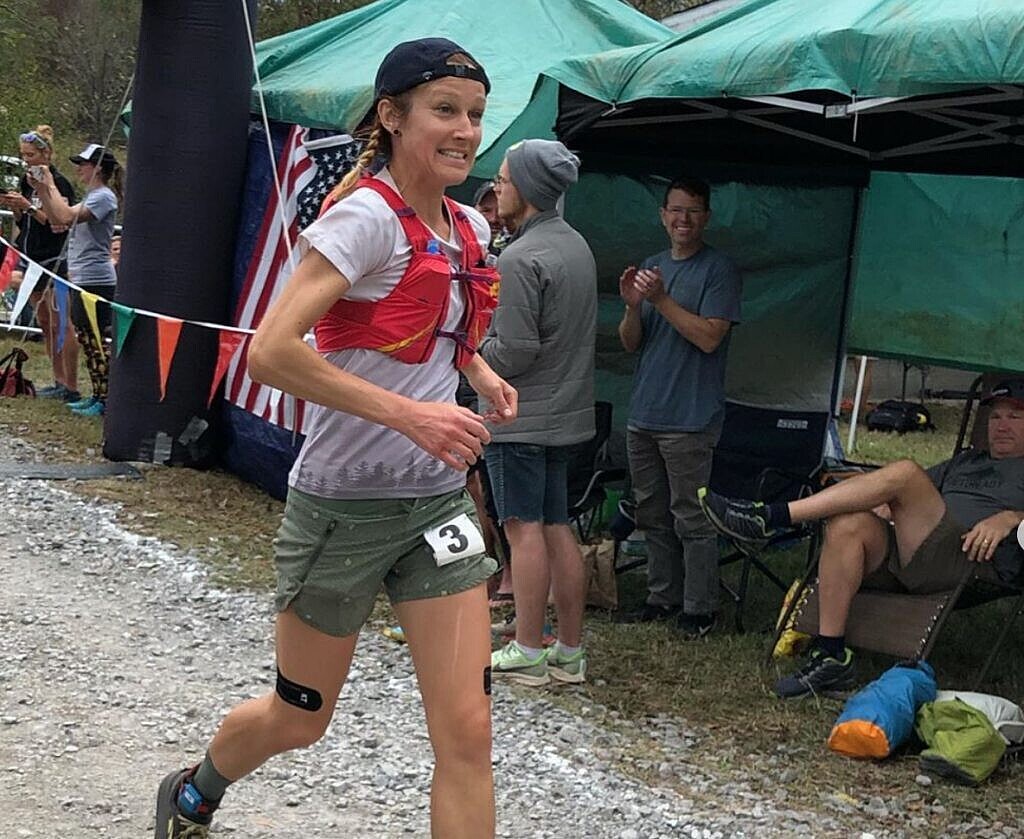
U.S. ultrarunner breaks Courtney Dauwalter’s backyard ultra world record
American ultrarunner Jennifer Russo has set a new women’s backyard ultra world record by completing 496.21 km at the Capital Backyard Ultra in Lorton, Va. The 57-year-old mother of three from New Richmond, Ohio, finished the multi-day race Tuesday after running 74 yards—or 74 laps of the 6.706-km course—in a contest that began Saturday.
The backyard ultra race format requires participants to start one “yard” (loop) every hour on the hour, until only one runner remains. (Backyard racing is designed so that theoretically, runners can complete the 100-mile distance in 24 hours.)
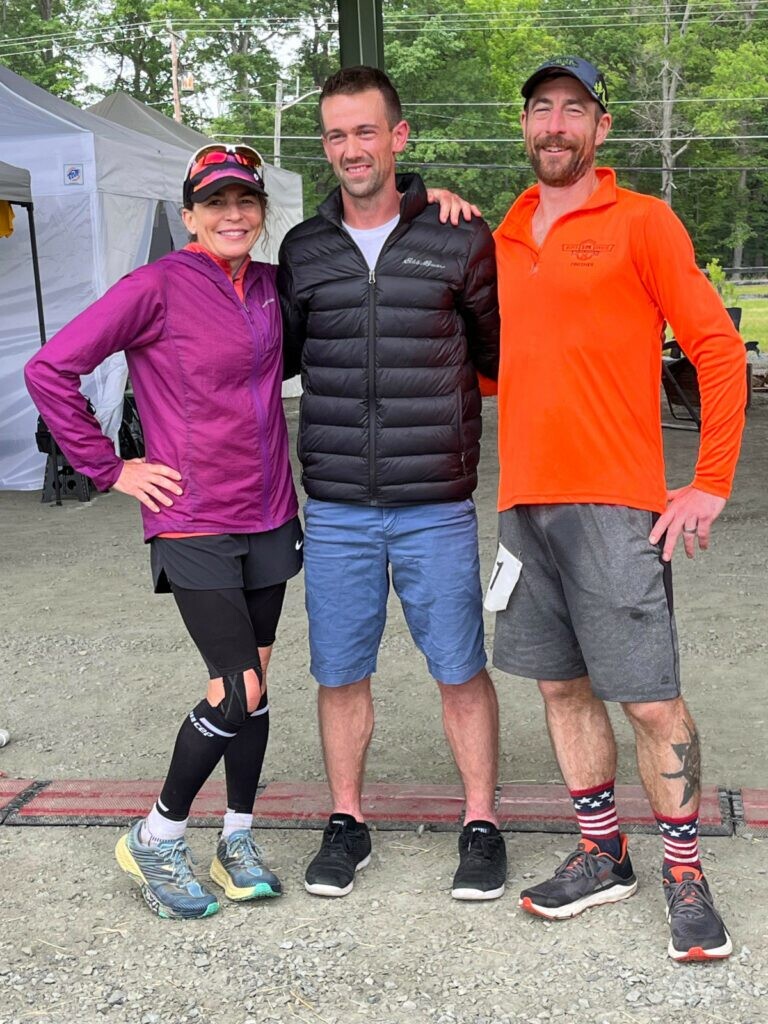
Russo’s latest effort tops the previous women’s world record of 68 yards set by American Courtney Dauwalter at Big’s Backyard Ultra in Bell Buckle, Tenn., in 2020. With this week’s race in Lorton, a suburb of Washington, D.C., Russo also becomes the first American female to reach 300 miles (482.8 kilomtres) within 72 hours in any race format. Her 74 yards also puts her in a four-way tie for 16th for the longest distance ever covered in the backyard ultra format.
These achievements came at the end of a gruelling standoff between Russo and Scott Snell of New Jersey. The pair battled alone on the course for almost half a day after Levi Yoder of Dundee, Ohio, who finished with the third-highest total of yards, couldn’t complete his 64th lap. Snell ultimately outlasted Russo in the showdown, winning the event by running 75 yards, or just under 503 km.
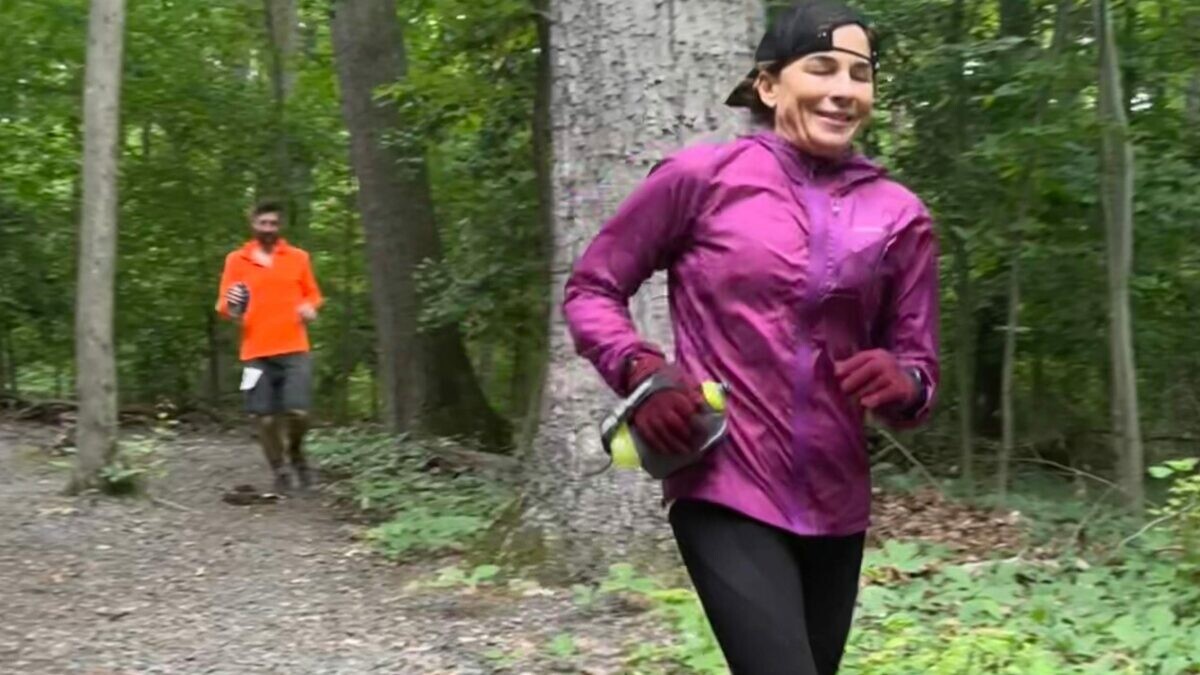
The race also saw an outstanding effort by Canada’s Viktoria Brown. The runner from Whitby, Ont., racked up the second-highest number of yards among the race’s six female competitors, completing 49 yards and finishing the race in the top six. Brown, who in March broke her own 48-hour Canadian and 72-hour world records at the GOMU (Global Organization of Multi-Day Ultramarathoners) six-day world championships in Policoro, Italy, came just seven laps short of the women’s Canadian backyard ultra record set by Amanda Nelson of Woodstock, Ont., earlier this month at the Race of Champions-Backyard Masters in Rettert, Germany.
Fellow Canadian Justin Wright also cracked the top 10 at the Capital Backyard Ultra. The runner from Leamington, Ont., completed 36 yards—241.4km—to finish 10th overall in the field of 31 competitors.
by Paul Baswick
Login to leave a comment
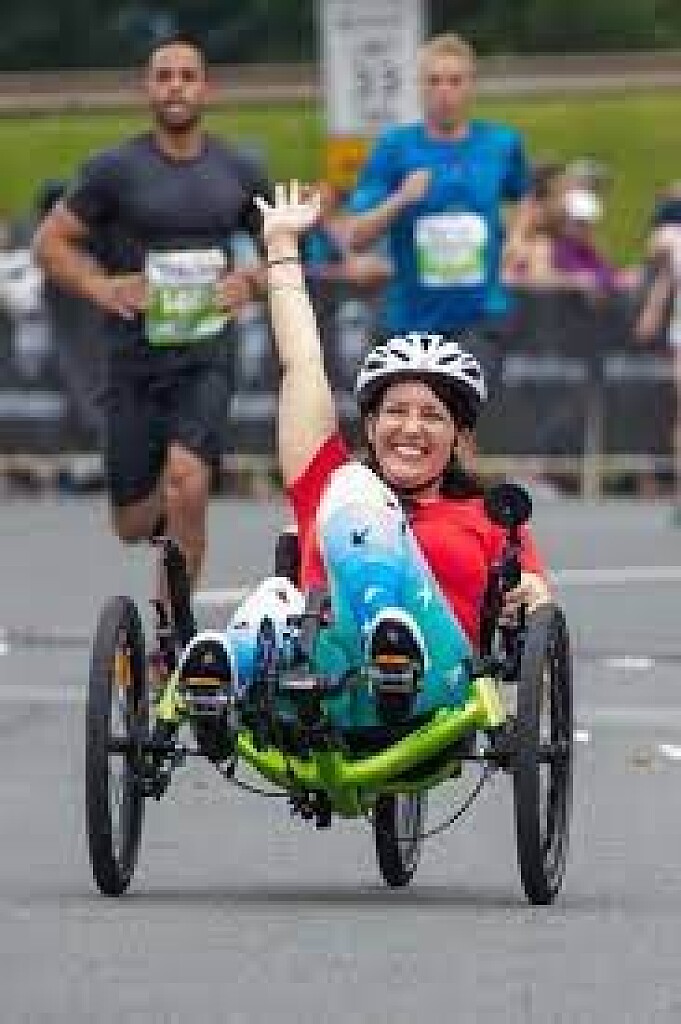
ALS Hasn’t Stopped This Woman from Running a Marathon in All 50 States
“The powers of hope and community propelled me forward and got me across every single finish line.”
Reason for Running: ALS takes away my ability to use my muscles, so I will be out there as long as possible to celebrate what my muscles can still do.
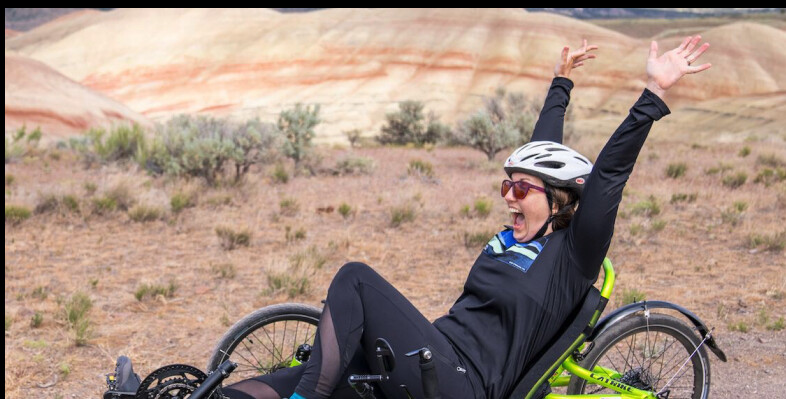
“Don’t worry,” my new husband, David, said in 2009 when I moved from Atlanta to Washington, D.C., to begin our married life. “It never snows here.” But then we were hit by three blizzards in six weeks! I got tired of being cooped up in our tiny apartment, so I found the treadmill in the basement. Fifteen minutes later, sweating and gasping for air, I felt awake and alive in a way I never had before. Add in the goal of training for a race just a bit outside my comfort zone and I was hooked.
My first race was the St. Patty’s Day 8K in downtown D.C. in 2010. I was so distracted by the scenery—running down Pennsylvania Avenue, crossing the National Mall in front of the Capitol—that I forgot to be nervous! After that, I used running as a way to explore my newly-adopted city, which was also useful for my job as an urban planner for the federal government.
In two years, I worked up to my first marathon: the 2012 Yuengling Shamrock Marathon in Virginia Beach. By then, I’d gotten into triathlons too and my first 70.3 (a.k.a. a half Ironman) was the 2013 Carolina Half at my alma mater in Davidson, North Carolina.
However, while training for the 70.3, my run and bike times were slowing down, and my hamstrings were incredibly tight. During the race, I had to walk a lot of the downhills because I felt like I was going to trip over my toes. I assumed I was overtraining or had a weird race injury, but the physical therapist I went to said, “your muscles just don’t seem strong enough for someone who just did that long of a race.” She referred me to a neurologist.
My blood tests, MRIs, spinal tap, CT, and first electromyography (EMG) all came back normal, but my symptoms kept getting worse. In just six months, I went from finishing the 70.3 to walking with a cane after falling in the middle of a D.C. intersection. My fifth neurologist re-did the EMG and diagnosed me with probable ALS in May 2014, which was confirmed in August. I was 33 at the time.
ALS is a death sentence—the average life expectancy is only two to five years. In that time, the person loses the ability to walk, talk, eat, move, and eventually breathe. The only approved drugs extend life expectancy by less than a year.
But everyone is different. My “brand” of ALS seems to respond positively to low-impact, gradual, strength building. I am convinced that swimming, Pilates, weight machines, and riding a trike have all helped me live more than nine years with this disease.
When I reached the fifth anniversary of my ALS diagnosis (a milestone that only 20 percent of people live to see), I realized that I was still waiting for the disease to catch up with me—which isn’t truly living. Living means making long-term plans, striving toward future goals, and believing that tomorrow will be better than today if you’re willing to put in the effort.
So I decided to set the craziest goal I could think of: a marathon on a trike in all 50 states. Through our foundation, the Team Drea Foundation, we decided to film a documentary to raise awareness and funds for ALS research. To date, we’ve raised $1 million!
We began filming in May 2019, and I was at state number seven on my marathon list. Our plan was to film for a year, through Alaska (state 21), and get the film out as quickly as possible so people could actually run with me in some of the remaining states. Then of course, the pandemic hit. No one knew how long races would be canceled or if I would be strong enough to continue. So we decided to keep filming.
I hate to spoil the ending of the film, but yes, I made it! Go On, Be Brave follows my journey to become the first person with ALS to do a marathon in all 50 states. The documentary turned out more beautiful and inspiring than I could have ever imagined—and I was there! The powers of hope and community propelled me forward and got me across every single finish line.
As grateful as I am for the 50-state marathon journey, I am also enjoying the pressure of being off.
Over the next year, my husband David and I will be traveling to more than 50 planned film screenings and book events for my soon-to-be published (September 2023) memoir, Hope Fights Back, with co-author, Meredith Atwood. That doesn’t leave a ton of time for training, but we hope to partner with races along the way. I love exploring new places on the trike so I will be out there as long as I have the strength.
I never knew how truly magnificent the human body was until mine started failing me. When you think “I want to take a step,” there’s instantaneous signaling through your motor neurons and your muscles respond. It’s miraculous. When you are running, take a moment to appreciate what your body can do.
Because I move frustratingly slowly through the world on a walker, freedom is the best word to describe how I feel on the trike. When I’m training or in a race, I travel at a runner’s pace and it reminds me that I am an athlete. Breathing hard, working my muscles, these are all things I should no longer be able to do with ALS, but I can! I will never take for granted what my body is still able to do.
These three tips have made my running journey a success:
1. Live your life
Time will pass either way, whatever your mood. When I was diagnosed with a terminal illness, of course I went through a grieving process. But I realized that all I could control was my attitude.
2. Remember that tomorrow is not promised
Every day that I am out there is a good day. Whenever I start getting in my head about the weather or my knees hurting, I remember that, one day, I will no longer be able to do this. So many of my friends have died or no longer have the ability to move—that snaps things back into perspective really quickly.
3. Keep putting one foot in front of the other
When that’s too much—stop, rest, reset, and find the right motivation to keep fighting. Any forward progress is enough. One hard day, hope will fight its way right into becoming belief.
Andrea’s Must-Have Gear
→ Catrike Folding Trail: I couldn’t get anywhere without my Catrike recumbent trike. It’s great for people with back problems, balance issues, or other medical issues. Even runners must have other folks in their lives who could use some exercise but can’t run. It’s like Mario Kart for adults!
→ Rabbit EZ Tights in Gibraltar Sea Mountain: I may have a teeny obsession with fun, colorful leggings and rabbit’s buttery soft EZ Tights are absolutely the softest around. Also, my husband and I have to negotiate which color of their Jogalongs we’re going to wear—otherwise we’re liable to be twinning!
→ CLIF BLOKS Energy Chews Tropical Punch: My go-to fuel during a race. Six chews times 50 marathons equals 300 of these addictive little suckers I have consumed!
by Runner’s World
Login to leave a comment
Run Commuting Could Benefit Your Training
First, it was the check engine light in my car.
Then it was the rear derailer on my bike.

With my two primary modes of transportation out of commission, I decided to take to the streets and try run commuting to work.
It seemed like the perfect way to boost my mileage and revamp my training with new routes. So I laced up my shoes, invested in some dry shampoo and hit the road.
Besides its obvious transportation value, run commuting has many benefits for even the most road-averse trail runners.
"I definitely believe that run commuting helps my trail running," says ultra-champ Michael Wardian, of Washington, D.C. "It takes planning, carrying a load, perseverance and dedication."
Much like packing and planning for a big trail run or race, commuting takes a bit of prep. I cross-referenced Google Maps and Strava for routes that balanced efficiency and less traffic. Find out how long your commute should take you, then give yourself extra wiggle room for clean up. Your office mates will thank you.
"Make sure you can shower at work and have a place to store clean and stinky clothes," says Sharman. "As well as a determination to run rain or shine."
I typically found myself trying to travel as fast and light as possible-just carrying the clothes (and deodorant) that I'd need for the day. However, there were several less-than-ideal trips that found me slogging either a gallon of milk, a laptop or one very unfortunate casserole. As good as most running packs are, I have yet to find one that can accommodate a lasagna.
Carrying a laptop takes some getting used to, as well. After an unfortunate incident involving my computer and some salad dressing, I began to wrap everything in ziploc bags. Because of all the jostling involved in run commuting, I discovered that foods like salads and grain bowls were much more portable than sandwiches, which are prone to disassembly en route.
"I think the attitude needed is just one of adventure and determination," says Wardian. "There will be obstacles that try and derail your run commute, but if you are committed it will be one of the best things ever."
Get in more miles
Run commuting is also an effective way to squeeze in extra miles by breaking up training into bite-sized chunks throughout the day. A three-mile run to and from work made logging consistent double-digit miles much easier than trying to bang out a half marathon right before work.
"Volume is important for training, and in cities it can be difficult to squeeze in enough miles, especially with most professional jobs," says Ian Sharman, four-time Leadville Trail 100 winner. Sharman, who used to run commute in London, believes that run commuting can be hugely beneficial to any trail runner's training with a little bit of planning and a sense of adventure.
"Although the terrain was typically not even remotely hilly, I included running around parks by taking a less direct route home," he says. "That factored in some grass and dirt."
Save gas money and add it to your running fund
Besides investing in a comfy pack and military-grade deodorant, run commuting is cheap. I didn't buy gas, and my legs required less upkeep than my bicycle. Run commuting is also one of the greenest ways to get around, and I found that starting my day with a peaceful jaunt to work was much more pleasant than sitting in traffic.
"Run commuting has opened my eyes to the fact that you don't have to drive everywhere," says Wardian. "There are so many errands that can be done on foot and under your own power, and I love that."
While run commuting is generally mood and energy boosting, it's not without its challenges. I endured rain, wind, hail and plenty of less-than-stellar hair days. However, with minimal gear and a good attitude, I found the benefits of run commuting far outweighed both the scorching heat and sogginess.
Despite several slip ups like forgetting shoes and having to rock my sneaks with a little black dress, or arriving to work hours late after taking a wrong turn, I loved run commuting. I got to know the most efficient and scenic routes from my house to just about everywhere in town. I loved the moments of solitude it granted me at the beginning and end of every day.
Mike Wardian's best advice for newbie run commuters?
"Just start"
Plan Your Run Commute
Gear up, size down. Travel-sized soaps, shampoos or wipes help save space and weight, and leave you feeling fresh after your morning commute. Dry shampoo or baby powder can help alleviate sweaty hairlines. I learned how to blow-dry bangs in a hand dryer.
Map it. Google Maps, Map My Run and Strava are great resources for in-town routes. Be sure to check for construction and account for morning traffic.
Dry-run. Practice your route the night before to work out the kinks, and find coffee along the way.
Pack tetris. Pack heavier items like a laptop towards the bottom and back of your pack, leaving room on top for lighter items or things that you'd rather not smush-like lunch.
Bag it. Protect the things that matter-your laptop, your clothes-from liquid assault, be it in the form of rain or stray salad dressing. Wrap your computer in a plastic grocery sack and put your clothes in plastic baggies.
Cool it. Give yourself plenty of time to cool off before stepping into the office. Stretch, drink water, take five minutes to breathe-or else you'll find yourself sweating right through your shower.
Early Bird: A stress-induced PR is no way to start the day. Map your route and imagine running your slowest splits, hitting every red light and getting shin splints. Add two minutes to that for every mile. Arrive on time, or better yet, early.
Login to leave a comment
Top 10 most popular running stories of 2022
Tt’s time to recap the most popular running stories. This year, the running community saw a lot of firsts and controversies. It was the first time we were made aware of a 6-year-old running a marathon; it was also the first time we saw a runner who chain-smoked during a marathon. As many of us returned to our favourite races and conquered new goals, we can’t ignore some of the mind-boggling stories.
Here is a countdown of the top 10 most popular running stories of the year.
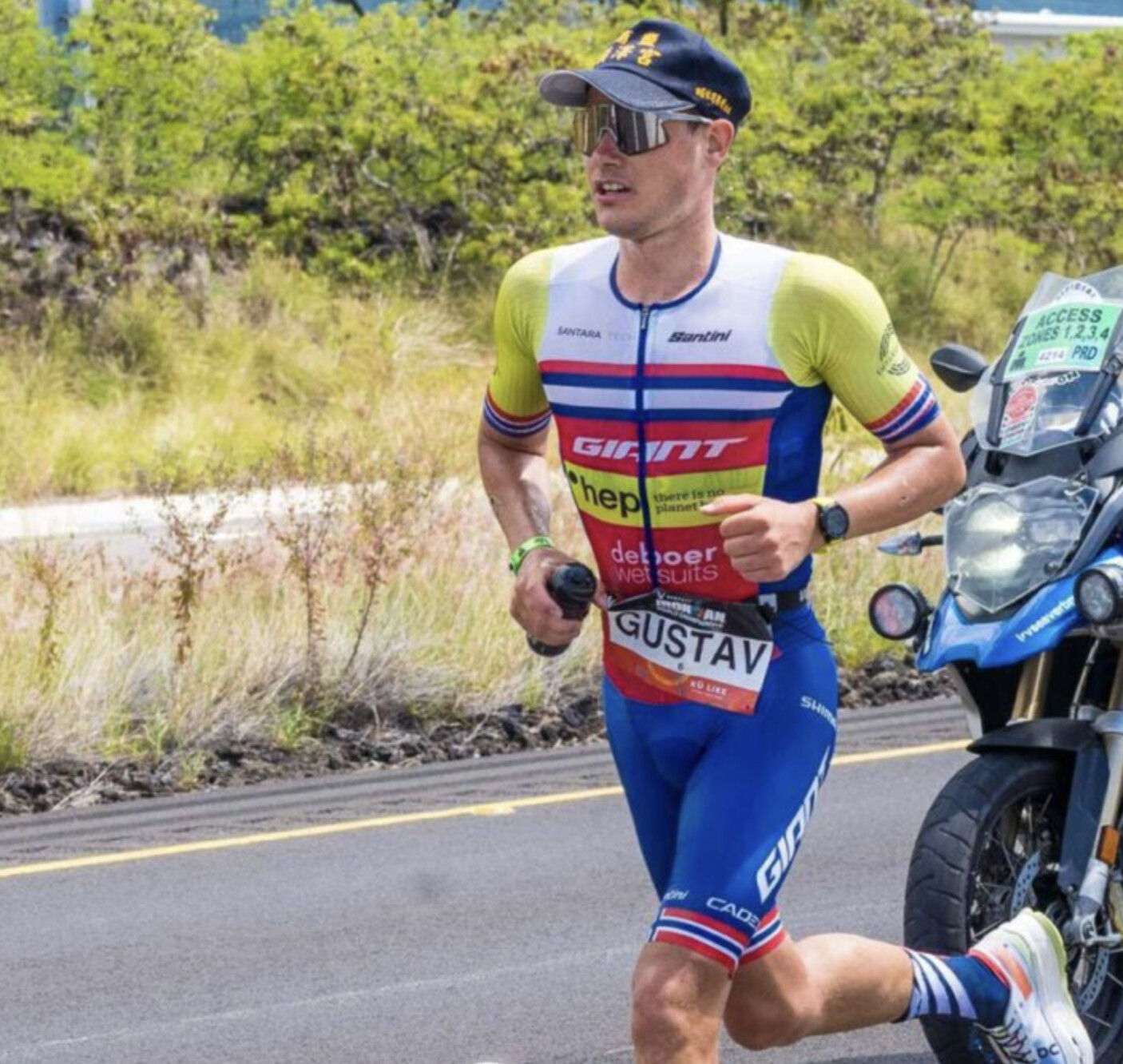
10) Ironman World Championship champion’s “chunky” shoes spark controversy
In October, Norway’s Gustav Iden made headlines as he ran a 2:36 marathon after a 180-kilometre bike and 3.8 km swim, earning his first Ironman world championships title. It wasn’t only his wild time that turned eyes, but the On Cloudboom Echo 3 carbon-plated running shoes that he wore, which have a reported stack height of 50 mm (legal for Ironman races).
9) Six-year-old’s marathon sparks controversy on social media
In May at the Flying Pig Marathon in Cincinnati, Ohio, a family of eight from Bellevue, Ky., all completed the 26.2-mile race together in eight hours and 35 minutes, including two children aged 12 and six. The family took on tons of criticism over the advisability of allowing a six-year-old to cover the marathon distance. Many experienced marathoners and coaches, including Lee Troop and Kara Goucher, have weighed in online, stating that six is too young for the marathon.
8) Turkey trot runner takes out his competitor at finish line
In November at a local 10K turkey trot, Xavier Salvador of Washington, D.C., impeded the line of Jack Huber of Delmar, N.Y., with 50 metres to go, after noticing Huber threatening to pass him on the right. Instead of checking if Huber was OK after the fall, Salvador made sure his GPS watch was stopped.
7) Barkley Marathons ends with no finishers (again)
In March, for the fifth straight year, the Barkley Marathons in Frozen Head State Park near Wartburg, Tenn., came to an end with zero finishers, after the only remaining two competitors, Karel Sabbe and Greig Hamilton, bowed out on their fourth loop (of five) of the 20-plus mile course. Sabbe’s fourth loop was one for the history books, as he was found off-course in another town, chatting with a garbage can who he thought was a person.
6) ‘Ultramarathon man’ Dean Karnazes attacked by coyote during 150-mile race
In August, acclaimed ultrarunner and author Dean Karnazes posted a video that he was attacked by a coyote during Headlands 150-mile Endurance Run, held outskirts of San Francisco. Karnazes said was OK, but that he had several cuts on his face and body from the attack.
5) “Poopgate” continues as Arizona high school bans track use
In February, human feces were found under the bleachers at the Red Rock High School track in Sedona, Ariz., which resulted in a ban on public use. In the aftermath, there was plenty of buzz and finger-pointing on social media about the ghost pooper’s possible identity, using the hashtag #poopgate. To this day, it is still a mystery who did the deed.
4) California man runs an ultramarathon in roundabout
In November, a runner from Healdsburg, Calif., was getting tired of his usual running routes, so he went out on a six-hour, 58-kilometre run around the local roundabout, never once switching directions. The best part is that, a week later, he did it again, in the opposite direction.
3) WATCH: Florida high school runner gets sucker punched mid-race
In March, we saw a candidate for “wildest video of the year” when a high school runner at a Florida track meet was sucker punched and knocked to the ground by another athlete during a 1,600m race.
2) Colorado runner wins all four races at Disney Marathon weekend
In January, Brittany Charboneau of Colorado climbed to the top of the podium on four occasions during the Disney Marathon Weekend in Orlando, Fla. She won the 5K, 10K, half-marathon and marathon over four days, while dressed as her favourite Disney characters. Simply amazing!
1) Chinese man runs a 3:28 marathon while chain-smoking
In November, we witnessed one of the wildest running stories ever, when Uncle Chen went viral for chainsmoking cigarettes during the Xin’anjiang Marathon in Jiande, China. It is well known that smoking cigarettes hinder running performance, but that didn’t seem to bother 50-year-old Uncle Chen, who clocked an impressive three hours and 28 minutes.
by Running Magazine
Login to leave a comment
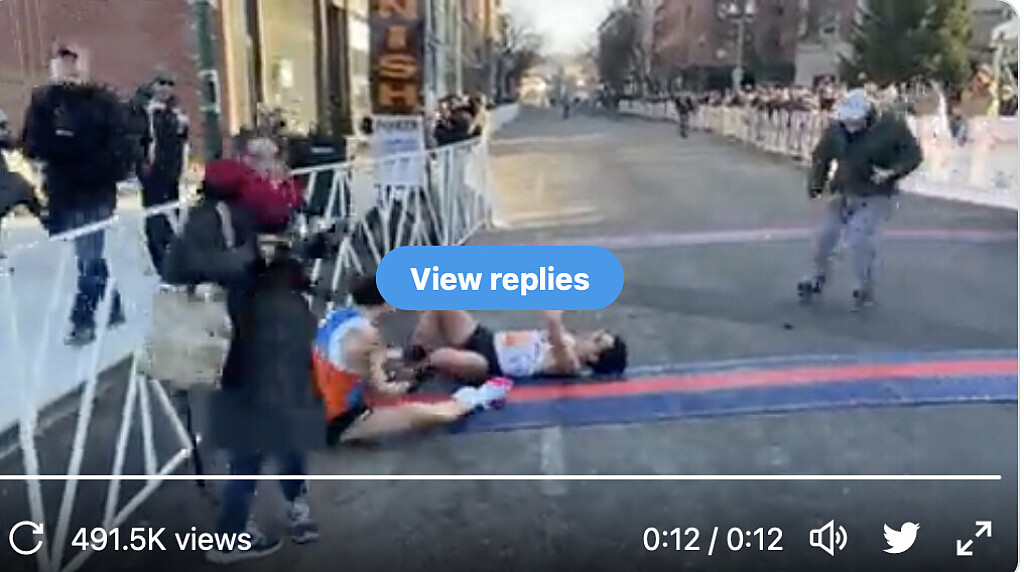
Turkey trot runner takes out his competitor at finish line
Nothing says “Happy Thanksgiving” like taking out your opposition in a sprint to the finish at a fun run. When one runner at a 10K turkey trot in Troy, N.Y., noticed that the runner behind him was going to outsprint him, instead of duelling it out, he cut him off, forcing him into a roadside barrier.
In the video, the crowd and race announcer were shocked as the two runners bailed into the finish line. The perpetrator, Xavier Salvador of Washington, D.C., impeded the line of Jack Huber of Delmar, N.Y., with 50 metres to go, after noticing Huber approaching on his right.
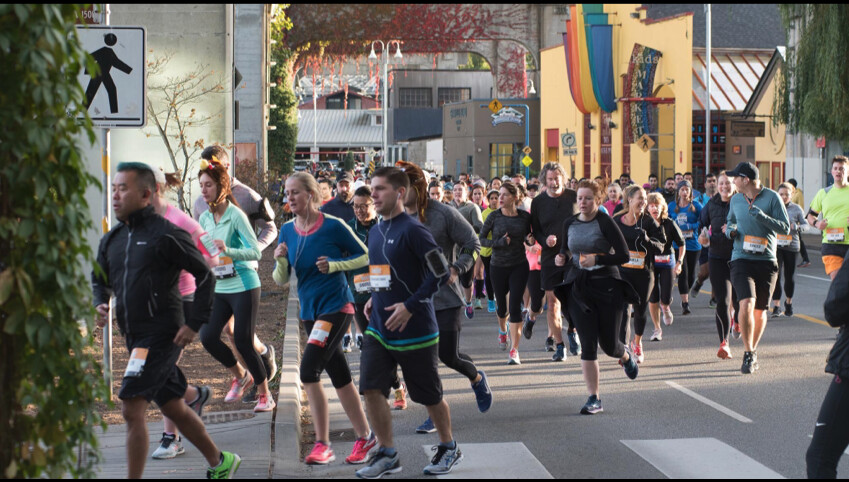
Salvador was given fourth place (31:46) ahead of Huber (31:47), and was not disqualified. Instead of checking if Huber was OK after the fall, Salvador made sure his GPS watch was stopped.
There was prize money for the top three finishers, but the battle between Salvador and Huber was for fourth place. According to a post-race forum thread, Huber spoke to race officials, but since it was for fourth and fifth place and out of the prize money offerings, they chose not to disqualify Salvador.
Turkey trots are the epitome of a fun run and are a common U.S. Thanksgiving tradition many families participate in before eating turkey.
by Running Magazine
Login to leave a comment
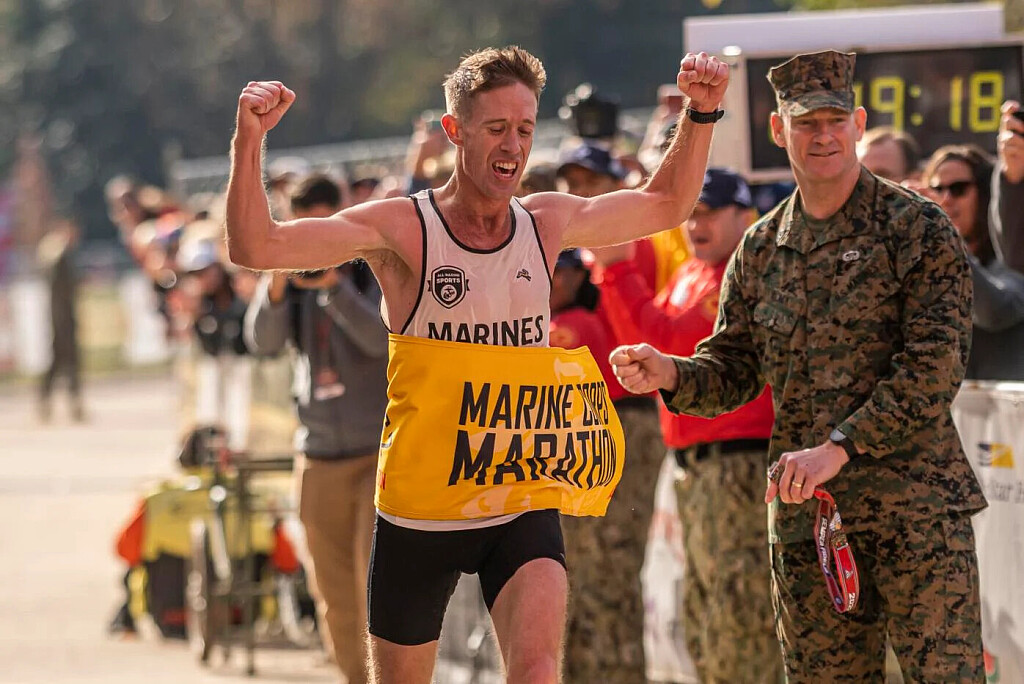
Capt. Kyle King wins one for the home team at the Marine Corps Marathon
Capt. Kyle King had been hoping to compete in the Marine Corps Marathon for years. With runners back on the course Sunday morning for the first time since 2019, the Marine stationed in Twentynine Palms, Calif., achieved his goal and then some, winning the event’s 47th edition in 2 hours 19 minutes 19 seconds.
“That was a little emotional coming to the finish line,” he said. “I’ve wanted to run this race for so long.”
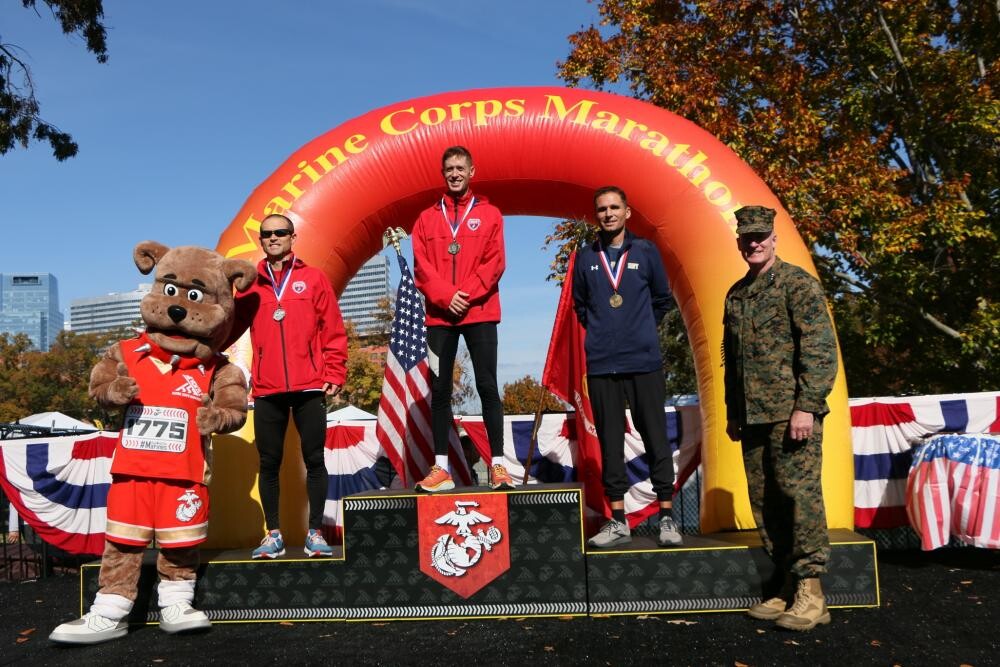
King, a 33-year-old artillery officer, finished 3 minutes 27 seconds faster than runner-up Jonathan Mott of Lakeland, Fla. England’s Chelsea Baker was the first woman to finish the race, completing the course in 2:42:38. Cara Sherman of Clifton Park, N.Y., was second, 4:30 behind.
King, who grew up in Washington state, has run competitively since high school, including a stint at Eastern Washington University. After taking a hiatus when he joined the Marines, he gravitated back toward the sport when he was stationed in Denver in 2018. In 2019, he won the Eugene (Ore.) Marathon, allowing him to qualify for the 2020 Olympic trials, at which he finished 47th in 2:18:20.
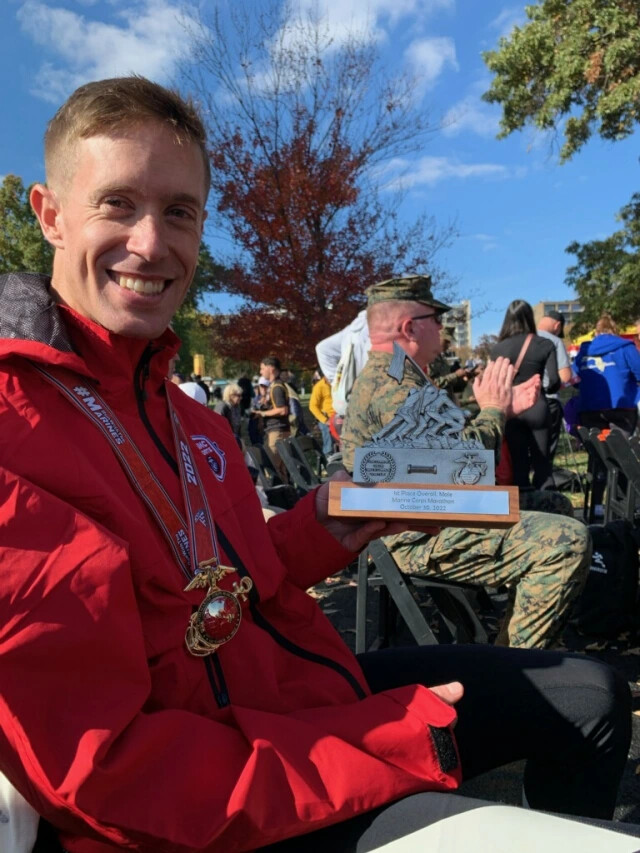
King prepared intensely for each of those opportunities, but his top goal was always the Marine Corps Marathon.
“I’ve been wanting to do this marathon for a while — just the work schedule and racing schedule [made it difficult],” he said. “This is the first time it actually happened.”
Chilly temperatures accompanied the start of the race through Arlington and D.C., but conditions improved as the morning unfolded. King found the weather beneficial to an extent.
“It was super cold. Honestly, I prefer cold over hot,” he said. “I wouldn’t say it really affected me. I honestly thought it was about perfect conditions. Pretty much no wind, nice and chilly, didn’t have to worry about getting too dehydrated.”
The power of the crowd was prominent Sunday, along the course and at the finish line. With friends, family and service members lining the way, runners called the energy infectious. King said the cheers of his fellow Marines provided an extra boost during difficult stretches.
“It’s really special doing it with all the Marines out there,” he said. “It was awesome to run in front of them and bring in the win for the home team.”
The previous two marathons were conducted remotely amid the pandemic, with participants running independently and submitting their times online. The virtual marathon setup failed to capture the camaraderie of the event, competitors said.
Gen. David H. Berger, the 38th commandant of the Marine Corps, was glad to be back in person, too. In 2019, he became the first commandant to run this marathon, finishing in 5:29:38. Running the race in person again this year, he emphasized his desire to compete alongside the community.
“This is not about the Marine Corps. It’s about the people. And although we organize it [and] it has our name, it’s really about the people,” said Berger, who finished in 5:46:36. “The emphasis should be [on] the people — the active duty, the reserved people, the civilians. This is definitely the people’s marathon.”
“Every individual who’s running has their own story, and every story has that mission that got them there to the start line,” Nealis said. “When they come across the finish [line] … they earned the right to be part of the few, the proud, the Marine Corps Marathon finishers.”
by Michael Charles
Login to leave a comment
Marine Corps Marathon
Recognized for impeccable organization on a scenic course managed by the US Marines in Arlington, VA and the nation's capital, the Marine Corps Marathon is one of the largest marathons in the US and the world. Known as 'the best marathon for beginners,' the MCM is largest marathon in the world that doesn't offer prize money, earning its nickname, “The...
more...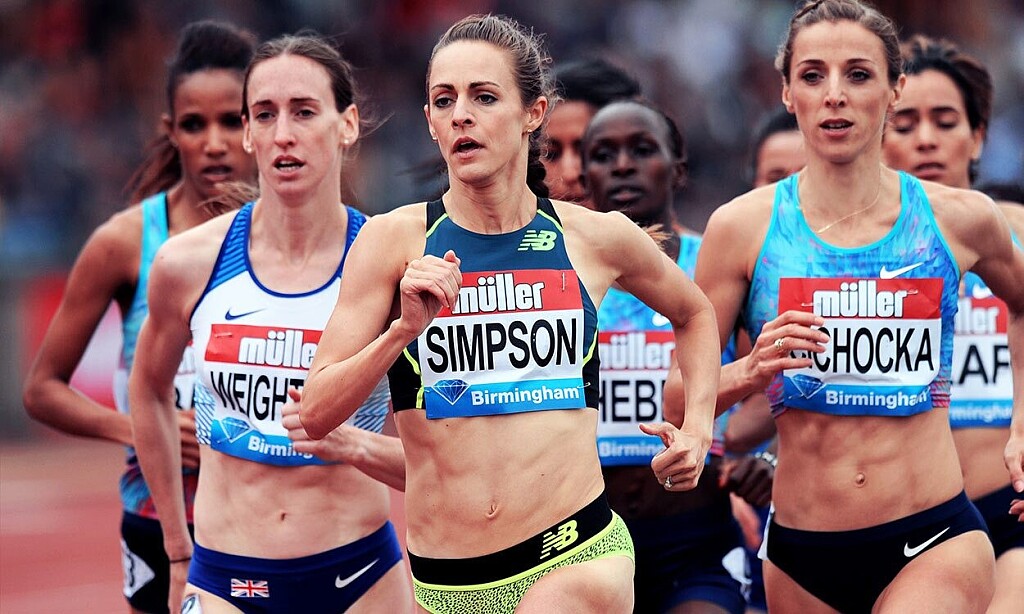
Olympic 1,500m medalist Jenny Simpson is moving to the roads
One of the fastest U.S. milers in history is taking on a new challenge, according to her Instagram. The 2016 Olympic 1,500m bronze medallist, Jenny Simpson, may have hung up her spikes on the track, but will shift her focus to road races with her new sponsor, Puma.
“She’s ready to answer the call of the roads,” Puma’s Instagram reads. “Welcome to the FAM, Jenny. We are excited to see where this next challenge leads.”
Simpson, whose last race (according to World Athletics) was the Cherry Blossom 10-mile road race in Washington, D.C. in September 2021, will run what she called “a little rust-buster” at the Army Ten-Miler in Washington on Oct. 9.
The Cherry Blossom 10-miler was Simpson’s first race longer than 5,000m. Although she has made the shift to distance running, the 36-year-old hasn’t hinted at whether she plans on moving up to the marathon distance.
Simpson made her first Olympic team in 2008 in the 3,000m steeplechase, then in 2012 and 2016, she ran the 1,500m, earning a bronze medal in Rio behind Faith Kipyegon and Genzebe Dibaba. She is the only female U.S. athlete to win both a world championship title and an Olympic medal in the 1,500m.
She holds career PBs of 14:56 in the 5,000m, 4:16 in the road mile and 3:57.22 over 1,500m.
Throughout her career on the track, Simpson had a lot of success in road miles, winning eight NYC 5th Ave. Mile titles, including seven consecutive titles between 2013-2019.
Simpson focused much of her time through the pandemic helping her Boulder, Colo. community rebuild from a December 2021 fire. She is also a volunteer coach at the University of Colorado for the track and field and cross-country team.
by Marley Dickinson
Login to leave a comment
Some races are down since the pandemic took charge of road racing for a couple of years but there is some good news
Even marquee events have seen declines of 25 percent or more between 2019 and 2022.
Across the country, many road races are returning after the COVID-19 pandemic forced them into a two-year hiatus. But runners haven’t yet come back to those events in the same numbers as they were turning out in 2019.
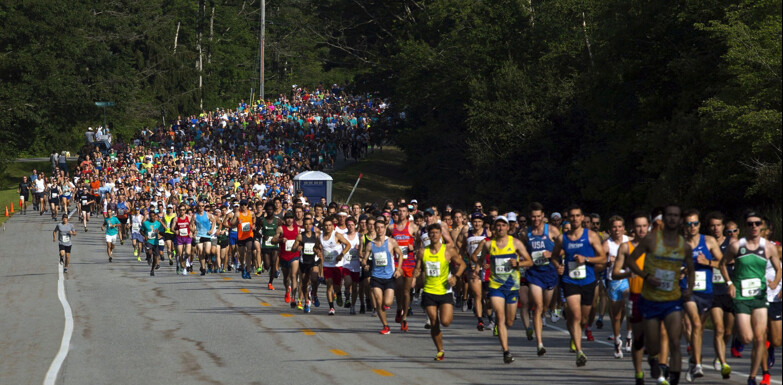
A few examples from the first eight months of 2022:
The BAA 10K in June had 5,144 finishers, down from 8,003 in 2019, a decrease of 35 percent.
The Utica Boilermaker 15K in July had 5,848 finishers, which was up from 2021, when it had 3,480, but down from the 2019 tally of 11,194, for a three-year decrease of 47 percent.
In Colorado, the Cherry Creek Sneak, a 5K, 5-miler, and 10-miler in Denver, had its final running in 2022 after 40 years. Combined participation in the three events had already been falling before the pandemic, and it fell an additional 38 percent between 2019 and 2022 (from 3,390 finishers to 2,092).
Larger, well-known events haven’t been immune from the declines. The Cherry Blossom Ten Mile Run in April in Washington, D.C., had 2,700 fewer runners, for a decline of 15 percent.
The Falmouth Road Race in Massachusetts and the Beach to Beacon 10K in Cape Elizabeth, Maine, two popular destination summer road races, saw declines of 24 percent and 16 percent, respectively. The town of Falmouth reduced the field size of the race to 10,000 runners this year (from its usual 12,800) but only 8,610 finishers appear in the results.
Jean Knaack, CEO of the nonprofit Road Runners Club of America, wrote in an email to Runner’s World, “We are seeing a slow recovery in 2022, and we are tracking with participation data showing about 84 percent return.”
Why aren’t runners coming back to events? Industry experts cited many theories:
The economy: “I think inflation will be a factor for 2023 as events plan and people pick what events they can afford to run,” wrote Knaack. The cost of travel to races—for flights, hotels, rental cars, gas—has gone up. So, too, have race entry fees for many events, especially for runners who wait until the last minute to register.
Competing events: Long-postponed weddings are back on. So are family vacations. The annual road race might need to take a back seat this year.
COVID concerns: Many runners worry about contracting COVID at a race, or they get sick at an inopportune time, keeping them from the starting line.
Shifting priorities: Erin Vandenberg, 42, for years raced at least monthly, often more, at distances from 5K to the marathon. Running a race with coworkers and then getting drinks after in downtown Chicago was a common occurrence. But she always felt a certain pressure to be training hard and performing well, worried what the time read on the clock at the finish.
Since the pandemic, she has taken a new approach to running. “I want to enjoy it; not stress myself out about it,” she said. “I don’t know that getting up at 5 a.m. to hit a certain pace and worry whether I’m fueling correctly is how I want to spend my time.”
Vandenberg has run three races in 2022—including one with her dog.
Not every race is down. Michelle La Sala, president of race management company Blistering Pace, says two of the events her company works on—the Big Sur Marathon and the Napa Marathon—have emerged largely unscathed from the pandemic. Big Sur was down only 240 runners (6.8 percent) and registration is tracking strongly for 2023. Same for Napa, which “should grow significantly this year,” La Sala said.
The bigger “bucket list” marathons, with a few exceptions, are not having any problems at all, she said, while smaller, regional races, without a compelling point of differentiation, are “on the struggle bus.”
Grandma’s Marathon along Lake Superior in Minnesota was off only 6.4 percent in 2022 from its 2019 tally, and well up from 2021. The Eugene Marathon, in May in Oregon, and the Missoula Marathon, in June in Montana, were both well ahead in finisher numbers, although many might have been deferred entries from the cancellations of 2020 and 2021. Vandenberg has a deferred entry from the Chicago Marathon in 2020, and she plans to use it in 2023.
John Mortimer, owner and founder of Millennium Running in Bedford, New Hampshire, sounded an optimistic note as well. Millennium has 30 of its own events of varying distances, manages and times others, and it has a running store. Sales are strong at the retail location, showing him that people continue to walk and run, even those who took it up during the pandemic.
And race participation in Millennium events continues to be robust, in part, because the company developed a time trial start system during the pandemic as an alternative to a mass start race. For many months, they had the only events happening in New England.
The company kept in frequent contact with runners and tried to make the race experience safe and convenient for them. They continue to offer the option to make any race a virtual race, up until the last minute, if runners would otherwise have to be a no-show at an event—thereby ensuring the runners would at least be mailed their tee shirts and medals.
That policy will continue, Mortimer said. “Every week we’re shipping out apparel and medals and bibs,” he said. “We’re trying to make it easy for the participant to be a part of the running community.”
The effort aimed at keeping relevant has paid off, Mortimer said, and registrations for most of the company’s events haven’t declined. The same can’t be said, he knows, for races that have been off for two years.
For them, “It’s out of sight, out of mind,” he said. “People have moved on.”
by Runner’s World
Login to leave a comment
How Keira D’Amato became America’s best ever woman marathoner
Keira D'Amato is currently at the top of the American women's distance running scene. She holds multiple American records — in the 10-mile and the marathon, the latter of which had stood for nearly 16 years before D'Amato smashed it in January — and has racked up win after win this year at everything from 10Ks to 7 milers. But just two years earlier, the real estate agent and mom of two was mostly unknown, quietly putting in miles near her home in Midlothian, Virginia.
That's not to say D'Amato's success came out of nowhere — before starting her real estate career and her family she was a standout runner, a four-time All-American, at American University in Washington, D.C.
"My life then was to eat, sleep, breathe and run. That was all I knew and all I wanted to do," D'Amato, 37, tells PEOPLE. "It was my whole world." She planned to pursue professional running after graduation, but her dreams were quickly derailed by a series of injuries. When her insurance denied a needed ankle surgery, D'Amato was "kind of forced out" of the sport.
"It was a weird breakup. It really felt like running was breaking up with me," she says. "It was heartbreaking. All of sudden I was Keira the runner who doesn't run."
D'Amato ended up meeting her husband Anthony, getting her real estate license and having two kids, Thomas, now 7, and Quin, 5. Her running at that time was very casual — she picked it up again to get back in shape after the two pregnancies and for a dose of sanity while at home with young kids and a military husband, who at times was deployed for more than a year.
"That was a really, really hard time for me," she says. "Just two kids under 2 and being at home alone. I felt lonely and I felt a little trapped." D'Amato would hire a babysitter for an hour, just so she could get out and run.
"I needed something that was mine and that I controlled and something that was just slow and peaceful. Then as soon as I walked back in the door, I was feeling really proud that I'd accomplished something for me that I could go right back to being a mom," she says. "It just helped me cope during that time."
D'Amato also started jumping into a races — a local 5K, or a long weekend in Nashville with a friend for a half marathon. "It was totally for fun and it taught me how to love running without needing to be fast or have goals."
Her real return to running started as a prank — she kindly gifted Anthony with an entry to the 2017 Shamrock Marathon for Christmas one year, and feeling bad about it, decided to sign herself up too.
Thinking she'd run it in around 3 hours and 30 minutes (an impressive time for the average runner, but nothing outstanding), D'Amato ended up easily covering the 26.2 miles in 3:14:54. Eight months later, she decided to train for the Richmond Marathon, and shockingly finished in 2:47:00 — two minutes short of the Olympic Trials qualifying time.
"That's when the fire started because I was like, 'Oh, two minutes in a marathon. That's four seconds per mile. I can do that.' "
With the help of her old college coach, Scott Raczko, D'Amato qualified, and then came in 15th at the 2020 Olympic Trials, ahead of around 450 other women, including several professional runners. A few weeks later, the COVID-19 pandemic shut down the world, and races.
But for D'Amato, "running wasn't canceled," she says. "I think a lot of other pros thought, 'Well, there are no races. This is a really natural time to take a break.' For me, I'm like, 'Hey, they're taking a break. I'm putting the pedal to the metal and I'm going to really catch up.' I trained really, really hard during COVID."
She started making some headlines after running a speedy 5K on her local track, and then even more in Nov. 2020 after she organized a 10-mile race where she broke the American women's record. Four months later, D'Amato signed her first-ever professional running deal with Nike.
"That was really cool," she says. "I think for Nike to bet on someone that wasn't a right-out-of-college national champion, it was some mom in a smaller town — for them to see what I saw in myself is really powerful."
D'Amato had already been relying on Nike for her running shoes, and appreciated that unlike other brands that require their runners to join teams in Arizona or Oregon, she could continue training at home in the Richmond area.
"They support people like me that are trying to be the best in the world, but they're also really supportive on an individual level of everyone finding their own best," she says. "They really build up the sport from youth programs to professional athletes and everything in between. I feel like they've created shoes for all runners to be their own best."
D'Amato ticked off more goals from there, coming in 4th at the Chicago Marathon — her first World Marathon Major as a pro — and winning the 2021 U.S. Women's Half Marathon title.
Then, in Jan. 2022, she went after the American marathon record, a record that had stood since 2006, despite years of the top female marathoners in the country trying to bring it down. It was D'Amato, on a windy day in Houston, who was finally able to do it in a time of 2:19:12.
"On the starting line that day, I was thinking I'm either going to get the record or I'm not. If I get it, that would be wild, but if I don't, I'm going to be right where I am right now and that's cool too. I'm happy," she says.
D'Amato thinks that the way she found her way to professional running — going from a standout college career to her "elaborate halftime show" to getting back in the game — helped her to her record-breaking runs.
And D'Amato isn't done now that she has the American record. She got to knock off another goal in June when she got a last-minute call-up to compete at the World Track and Field Championships and donned a USA uniform for the first time.
Despite having just 17 days to train for a marathon (D'Amato had been racing speedier 10Ks when she got the ask to join the team), she went out fast and finished eighth in the world. In September, she'll toe the line at the Berlin Marathon — known for its flat and speedy course — and has her mind set on lowering the American record again.
"I'm in this really beautiful spot where I feel like I have nothing to lose, but just everything to gain," she says. "I'm putting everything out there, my heart, my soul, my running shoes and just going for it with every opportunity."
by Julie Mazziotta (People Magazine)
Login to leave a comment
Tim Murphy founder of San Diego Elite Racing Inc has died at age 77
Tim Murphy, founder of San Diego’s Elite Racing, Inc., the man who reinvented running, not once but three times, succumbed to pneumonia Wednesday night (August 17, 2022) passing in hospice care at his home in San Diego, California. He was 77 years old.
Today, though smaller than it once was, the Rock ‘n’ Roll Marathon Series remains the largest purveyor of running events in the world, with 29 events in 16 U.S. states, Washington D.C., and seven foreign countries. But a quarter century ago, who knew what lay ahead in the wild open spaces of the first Rock `n` Roll Marathon?
Some observers even questioned the concept of rock bands strung along the marathon course altogether. What does rock`n` roll have to do with San Diego, much less with running a marathon, the ultimate test of endurance?
Well, on June 21, 1998 the world got its answer. With the snarl of a blistering guitar solo, the tight syncopation of a snare drum, and the slap of millions of accompanying footfalls, the second-wave running boom announced its arrival in San Diego with a carnival of music, endorphins, and sweat. It’s like Tim turned over the calendar two years early to introduce the new century.
“We created a theme marathon without intending to,” said Tracy Sundlun, Tim’s long-time partner at Elite Racing.
NEW DEMOGRAPHICS
No new major marathon had sprung up in the U.S. or the world since the Los Angeles Marathon arrived in 1986. In its first year, LA registered 10,787 runners, making it the largest inaugural marathon in history. Instantly, that number became Tim‘s goal for San Diego to beat LA.
Even before its first steps were run, though, there was the feel of a major marathon about the Rock ‘n’ Roll Marathon. Tim had conceived the idea years before while running the final lonely miles of the Heart of San Diego Marathon out along Friar’s Road to Qualcomm Stadium in Mission Valley. Wishing there were some kind of support along the road to help out, Murphy thought, wouldn’t it be great to have music to run to.
It took a long time for his idea to gestate, but the seed had been planted.
After a decade of developing his reputation as an event innovator, beginning in 1986 with the Carlsbad 5000 just north of San Diego – the event that proved runners in a then 10k / marathon focused world would run a 3.1 mile race, while introducing “spectator running” where the professional field followed age and gender specific races over the same tight-looped course – Murphy’s idea of a musical marathon came to life, born out of two separate, but catalyzing events.
“When they opened the Rock & Roll Hall of Fame in Cleveland (1995), there was so much hype about it,” Tim told San Diego YuYu in 2004. “So I was running along one morning and I thought, “If I lived in Cleveland I would do a marathon that would start and finish at the Rock & Roll Hall of Fame and do a big concert afterwards.”
One year later 273 San Diegans were among the record 38,000 entrants at the 100th anniversary of the Boston Marathon.
“Afterwards, they had this get together and all they could talk about was why there wasn’t a major marathon in San Diego. And all the runners, some of them pretty important, just wouldn’t leave me alone about it. So I essentially dusted off the old idea I had for Cleveland and started.”
With the backing of a set of investors, led by Hollywood A-list producers Frank Marshall and wife Catherine Kennedy – “Jurassic Park”, “Indiana Jones” , “Jason Bourne” – along with celebrity ambassadors like basketball Hall of Famer Wilt Chamberlain, Tim promoted his concept relentlessly at race expos around the country, touting his new baby with posters and ads that said, ‘You missed the first Boston. Don’t miss the first Rock ‘n’ Roll!’
No longer a simple feat of speed endurance, the grueling marathon had been reinvented as a rollicking 26-mile long block party through America’s Finest City.
Despite a 37-minute delay at the start due to some perceived traffic issues on the course – which led to a water-dousing through the first aid station – the high-spirited music rocking the sidelines caused an immediate sensation.
Nearly 20,000 entrants from 30 countries and all 50 states passed the word, ‘You gotta try this one!” And that was before they got to the post-race concert that night featuring Huey Lewis and the News, Pat Benatar, and the Lovin’ Spoonful!
The makeup of year one’s field proved historic, as well. 50% of the field was women, far and away the largest such percentage of any co-ed road race of any distance to date, and a pivot-point in the history of the sport. Before RnR San Diego, the largest percentage of women in a major marathon had been just 23% at New York City. Most road races had only 10% to 15% women at the time.
Rock ‘n’ Roll’s runners were also slightly older than the norm, slightly wealthier, and slightly slower than the average marathon runners.
At a time when road race courses were designed to be minimally visible and impact their communities as little as possible, the initial Rock ‘n’ Roll Marathon layout was designed to be an infomercial for the city, regardless of the potential inconvenience for some.
When city officials asked how long they would have to keep the streets closed, Tim based his projections on the New York City Marathon, saying, ‘we might have 50 or 60 runners who will take longer than six hours 30 minutes. But we’ll just direct them onto the sidewalk, so you can reopen the streets.’ As it turned out, 1500 runners took over seven hours to complete their 26.2 mile journey.
But Tim Murphy wasn’t just in it for the large participation numbers, important as they were. He always had his eye on top talent, too, and urged elite athlete coordinator Mike Long to pull in a world-class field, like he did every year for the Carlsbad 5000 where so many world records were set.
Mike Long, the late Elite Racing athlete recruiter with Rock `n` Roll 1999 champs Tarus & Bogacheva
Nobody knew how fast RnR could be run until young Kenyan, Philip Tarus, busted a 2:10 opener for the men, with Russian women Nadezhda Ilyina and Irina Bogacheva battling just nine seconds apart at the finish for the women in 2:34. That told the athletes of the world, ‘This one is worth having a go,” especially after all the Suzuki products and prize money checks were handed out.
Not since the New York City Marathon’s first five-borough extravaganza in 1976 had a marathon come on the calendar with such dramatic impact: The largest first-time running event in history; the most ingenious show along the sidelines and at the finish ever produced; $18.6 million (net) raised by and for The Leukemia & Lymphoma Society’s Team In Training charity – the largest amount ever for a single-day sporting event; and to cap it off, world-class performances by its champions.
Though the race lost over $1 million in its first year, it instantly became the number one economic impact event in Southern California, generating $39.3 million in its inaugural year, as two-thirds of its entrants came from outside the region. With Murphy’s persistence and the continued backing of his investors, Rock ‘n’ Roll eventually broke even in year three. Thus was the foundation set for what has become a global phenomenon, the so-called second-wave running boom.
Born and raised with two sisters in Denver, Colorado, Tim attended high school in Nebraska where he competed in the 880-yard run and threw the discus. He then spent the first part of his professional life toiling in the health care industry, selling hospital supplies on the road while moving across the country time and time again. Finally, in the late 70s, he decided to abandon the rat race and settle in San Diego where his two sisters lived.
Though he ran track in high school, he wasn’t a distance man. But once in San Diego and introduced to the area’s vibrant running community, like so many before him, he got hooked on the sport. Tim often trained up to 10 miles a day, which led him into the race organization business and the founding of Elite Racing in 1988.
Always more of a behind the scenes workaholic than a flashy frontman, Tim did serve as interim race director for the troubled Chicago Marathon in 1989. But mostly he focused like a laser on the business side of Elite Racing. Tracy Sundlun, former head of New York City’s Metropolitan Athletics Congress, and a former collegiate and club track coach, joined as Tim’s partner in 1997, taking on the role of political go-between and liaison with the sporting world.
Through it all, Tim used his marketing and sales skills to build his race business from a fledgling local concern into the most successful for-profit organization in running.
“We have lost someone who – I don’t think many of the insiders even grasp his importance, his significance,“ said Tracy Sundlun. “Besides Fred Lebow in New York City, Tim was the best retail marketer the sport has ever known. It makes me happy all the people who’ve reached out from all over the world when they heard news of his passing. Tim would’ve felt good knowing the people recognized what he built, what he reinvented.”
Beginning with the Carlsbad 5000 in 1986, Tim bucked the conventional norms of the sport. Nobody thought people would pay to run a 5K. Running at the time was a 10K and marathon trade. But Tim turned it into a 5K and half marathon business and the sport soon followed along.
Ethiopian great Tirunesh Dibaba breaks another world record at Carlsbad 2005 (14:51)
The success of the Rock ‘n’ Roll Marathon in San Diego changed Murphy’s fortunes for good. Over the next several years, Tim developed the brand into a seven event juggernaut that spread from San Diego to Virginia Beach, Nashville to Phoenix, San Jose, California to San Antonio, Texas.
Elite Racing was the first organization to stage more than one marathon in a year, and the first to put on events outside their own home city. Designed as a for-profit company in a not-for-profit industry, Elite Racing was the first organization to build a brand in the sport, though, initially they didn’t realize they were doing it. They were also the first to buy events and the first to sell to private-equity.
When the City of Virginia Beach, VA wanted to start a new marathon on Labor Day weekend in 2001, Tim made a site visit. He realized that with the heat and humidity of late summer in Virginia Beach, and not wanting to conflict with the fall marathons which had been so supportive of his races in San Diego in the summer and Nashville in the spring, there was no way that a full marathon would work. So Tim convinced VB to create the first destination half-marathon, The Rock ‘n’ Roll Virginia Beach Half Marathon. Until then, half marathons were just local training races for marathons.
“Just like with Carlsbad in the 5K, nobody thought people would travel to run a half marathon,“ remembered Sundlun. “When we proposed Virginia Beach, we were one of Runner’s World Magazine‘s biggest advertisers. We said we were going to sell out at 12,000 for the Labor Day weekend race. People at Runner’s World said we were nuts. At the time, the largest half marathon was the Philadelphia Distance Run at 6000, the largest inaugural half marathon was on Long Island at 2900.
“Runner’s World bet us a full, center-spread, double page ad that we wouldn’t hit our number. They didn’t even think vendors would come to a Labor Day weekend race in Virginia Beach. But we sold out by July and eventually got 14,990 entrants. Getting that check back from Runner’s World, that was really something.”
Deena Kastor headlined the inaugural Rock ‘n’ Roll Virginia Beach Half Marathon in 2001, setting an American debut record as a prep race for her marathon debut in New York City that fall. Kenyan superstars Martin Lel and Paul Tergat both tuned up for fall marathon victories with wins in Virginia Beach.
Records were always important to Tim. He would often have side bets with Mike Long about the outcome of races. Two-time Olympic champion and multiple-time world record holder Haile Gebrselassie of Ethiopia broke the half marathon world record at Rock ‘n’ Roll Arizona in 2006 (58:55). And with 16 World Records / Bests and 11 American Records, Carlsbad was always recognized as The World’s Fastest 5K.
“Tim felt if you created special events with a team of people who were passionate about the space they were in, the money would follow,” Sundlun told me. “He also understood that an event was only as good as its weakest link. So he was laser-focused on every aspect of the event, from the expo to the medal to the course to the elite athletes to the give-a-ways to the ads to the water stations, you name it.
“We never had a meeting about what to cut, just about how to improve. Tim understood you had to invest and promote relentlessly. He was tireless in his pursuit of greatness. Good people would join him and he empowered them and got out of their way. But he refused to take no for an answer, and had a single-minded focus.”
Tim even bought television’s Road Race of the Month from Salmini Films in 1991, the series that aired on ESPN for over a decade featuring the best races in the country and around the world. Tim understood that with television as a promotional arm, he could sell more advertising and attract more runners.
The string of happy days ended abruptly in July 2007, however, when Elite Racing’s beloved athlete recruiter Mike Long died suddenly of a heart attack. Mike’s passing seemed to take the spark out of Tim.
Later that year he sold the business to Falconhead Capital for more than $40 million. Elite Racing essentially became the event division of the new Competitor Group, Inc., and Tim moved on. Eventually, after Tracy also left, CGI abandoned the elite aspect of running altogether, before leaving San Diego, as well.
At times, Tim could be a volcanic boss, as his business was his life’s passion. Yet he engendered a deep dedication and respect from his Elite Racing family, out of which 17 marriages were spawned (including my own with Toya), growing families, and lifelong friendships. Tim’s final years were spent quietly, visiting with friends and his two sisters who were with him at the last.
R.I.P., Tim. You were a true visionary who has left a legacy that moved us all both body and soul.
by Toni Reavis
Login to leave a comment
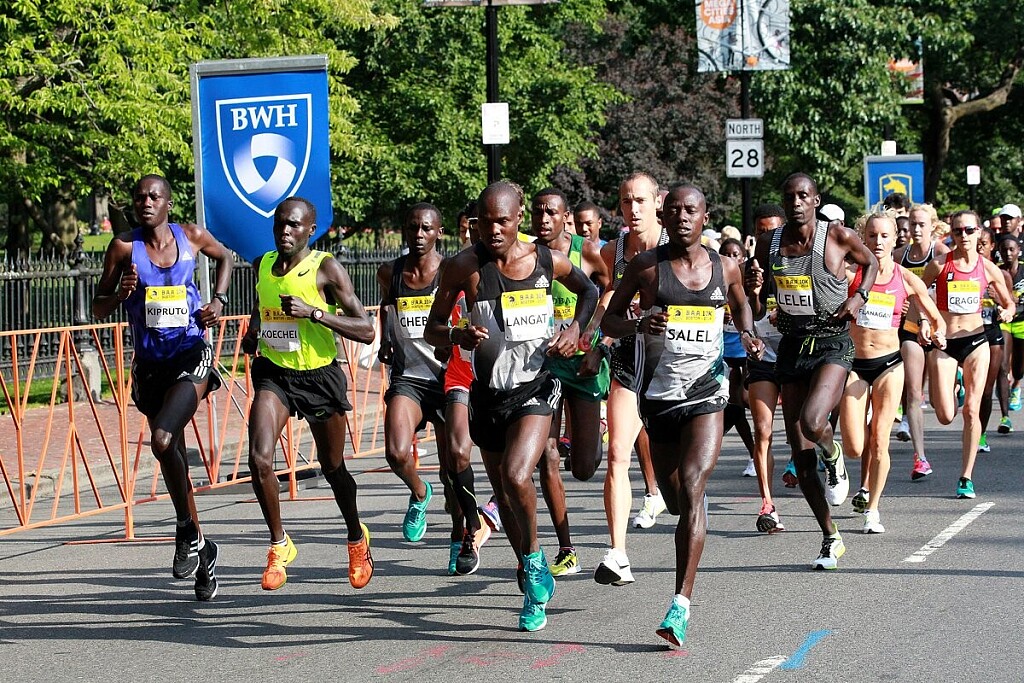
Boston Marathon Champions & National Record Holders Headline Professional Field for 2022 B.A.A. 10K
The Boston Athletic Association (B.A.A.) has announced a star-studded field for the 2022 B.A.A. 10K, presented by Brigham and Women’s Hospital, to be held on Sunday, June 26. Evans Chebet, the 2022 Boston Marathon men’s open division champion, will return to Boston, while recently crowned American half marathon record holder Emily Sisson will lead the women’s field on the roads of Back Bay. Four-time B.A.A. 5K champion and American 5K record holder Ben True will also make his B.A.A. 10K debut.
The B.A.A. 10K starts and finishes on Charles Street adjacent to Boston Common and Boston Public Garden, and is widely regarded as one of the fastest 10K races in the world. Registration remains open at www.baa.org, while athletes interested in supporting Brigham and Women's Hospital, the B.A.A. 10K’s presenting sponsor and exclusive fundraising partner, are encouraged to visit www.runbwh.org/10k.
“We’re excited to continue to showcase the world’s most accomplished runners at our B.A.A. events,” said Mary Kate Shea, the B.A.A.’s Director of Professional Athletes and Technical Support. “We’re looking forward to cheering on all participants as they race towards the finish.”
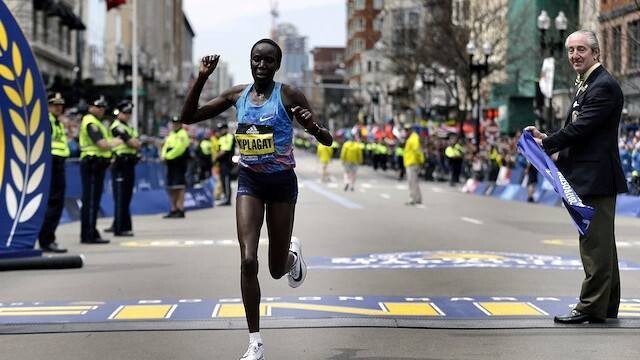
The B.A.A. 10K women’s race brings together Boston Marathon champions Des Linden (2018) and Edna Kiplagat (2017), American record holder Sisson, 2017 B.A.A. 10K winner Joan Chelimo Melly, 2022 Boston Marathon top American Nell Rojas, 2016 USA Olympian Marielle Hall, and USA 15K runner-up Emily Durgin.
Sisson, a Providence College graduate and 2021 Olympian, ran 1:07:11 on May 7 to win the USATF Half Marathon Championships in a new national record. She’s also the defending USA 15K champion.
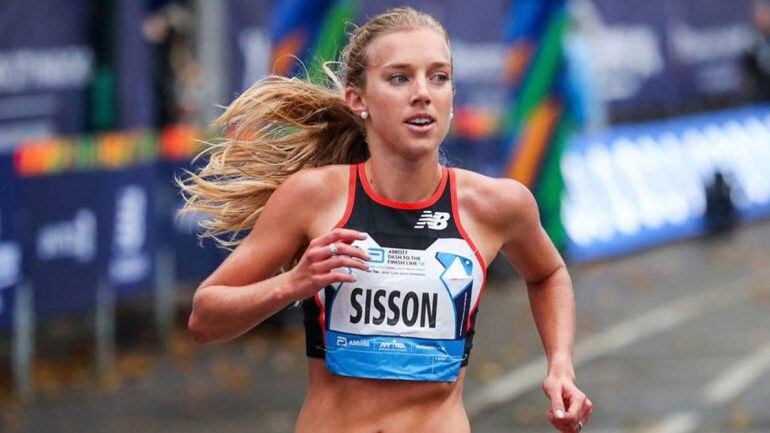
“Breaking the American record in the half marathon was very exciting and I'm now looking forward to switching things up and racing different distances,” said Sisson. “The 10K is a fun and different challenge and I always love racing in Boston.”
Additional international entrants include Biruktayit Degefa of Ethiopia, who has won a quartet of American road races this spring, and Kenya’s Sharon Lokedi, who placed third at the 2022 B.A.A. 5K in April. From the B.A.A. High Performance team are Erika Kemp and Abbey Wheeler; Kemp is a two-time national champion.
In the men’s race, Chebet looks to become only the second Boston Marathon champion to win the B.A.A. 10K, joining the likes of 2011 winner and course record holder Geoffrey Mutai. Chebet stormed to his first Boston Marathon victory in 2:06:51 on April 18.
“After winning the 2022 Boston Marathon, I’m excited to return to the city to run the B.A.A. 10K with a world class field,” said Chebet. “Boston feels like a second home to me now.”
Challenging Chebet from Kenya are David Bett, the reigning 2019 B.A.A. 10K winner; Kennedy Kimutai, the fastest man in the field with a 27:09 lifetime best; Bravin Kiptoo, the 2019 African junior 10,000m champion; and Nicholas Kosimbei, winner of this year’s Cherry Blossom 10 Miler in Washington, D.C. Brothers Jake and Zane Robertson, a dynamic pair from New Zealand who have lived and trained in Kenya, will also race. Recent Iowa State graduate and NCAA champion Wesley Kiptoo will make his Boston road racing debut.
Maine-native Ben True will return to familiar territory, having won the B.A.A. 5K four times, including a national-record setting run of 13:20 in 2017. Fellow American contenders include Olympians Leonard Korir and Shadrack Kipchirchir, Princeton, Mass.-native Colin Bennie, and a quartet of B.A.A. High Performance Team members in Jerrell Mock, Matt McDonald, Jonas Hampton, and Paul Hogan. Korir enters the B.A.A. 10K hot off a pair of national title wins at the USATF Half Marathon and USATF 25K Championships in May.
In the wheelchair division, Jenna Fesemyer, the 2022 B.A.A. 5K women’s winner, Susannah Scaroni, the 2022 Boston Marathon runner-up, and 2020 Paralympian Yen Hoang are entered. Scaroni earned a gold medal on the track at the 2021 Paralympic Games in the 5000m, and is the fastest women’s wheelchair marathoner in U.S. history. James Senbeta and Hermin Garic are the top men’s wheelchair entrants.
For the first time in race history, Para Athletics Divisions will be offered for athletes with upper-limb, lower-limb, and visual impairments. Among the entrants confirmed include Marko Cheseto Lemtukei, Chaz Davis, and Liz Willis, each of whom won Para Division titles at April’s 126th Boston Marathon. Jacky Hunt-Broersma, who ran 104 marathons in 104 consecutive days for a Guinness World Record, and local Para athlete Adrianne Haslet are also entered.
In addition to racing, top professional athletes will participate in the first-ever B.A.A. 10K Fest & Field Day on Saturday, June 25, one day prior to the race. From 2:00 p.m. to 6:00 p.m. at Boston Common, 10K Fest & Field Day will feature youth fitness activities, games, appearances by professional athletes, running clinics, and more. Participants will also be able to pick-up their participant shirts and bib numbers at 10K Fest. Additional details will be available on baa.org in the coming weeks.
Registration for the 2022 B.A.A. 10K, presented by Brigham and Women’s Hospital, is currently open through the B.A.A.’s online platform Athletes’ Village. All participants who enter will receive an adidas participant shirt, unique bib number, and finisher medal. Additional participant information can be found on baa.org. The race will start at 8:00 a.m. ET on Sunday, June 26 on Charles Street adjacent to Boston Common and Boston Public Garden.
Brigham and Women's Hospital, the B.A.A. 10K’s presenting sponsor and exclusive fundraising partner, will again field a team of fundraising runners. Since 2016, more than 2,100 runners and 180 teams have raised $1.2 million to fuel life-giving breakthroughs at Brigham and Women’s Hospital. Learn more and register at www.runbwh.org/10k.
On June 1, the B.A.A. will celebrate Global Running Day with a special pop-up location at the Boston Marathon Finish Line between 3:00-6:00 p.m. Runners can take a picture with the Boston Marathon trophy, receive giveaways, refreshments, and more! RSVP for the free event on our Facebook page, and log miles throughout the day as part of the Abbott World Marathon Majors Global Running Day Challenge. Visit https://bstnmar.org/GRD22 to sign up for free, track your miles, and print a bib to wear as you join a global community of athletes around the world logging miles.
2022 B.A.A. 10K WOMEN’S FIELD (NAME, COUNTRY, ROAD 10K PB)
Joan Chelimo Melly, Romania, 30:14^
Edna Kiplagat, Kenya, 31:06*
Sharon Lokedi, Kenya, 31:06
Mary Munanu, Kenya, 31:20
Biruktayit Degefa, Ethiopia, 31:23
Emily Sisson, USA, 31:47
Emily Durgin, USA, 31:49
Diane Nukuri, USA, 31:49
Lanni Marchant, Canada, 31:49
Vibian Chepkirui, Kenya, 31:49
Nell Rojas, USA, 31:52
Erika Kemp, USA, 32:18
Laura Thweatt, USA, 32:20
Elaina Tabb, USA, 32:40
Rachel Schneider Smith, USA, 32:47
Abbey Wheeler, USA, DB (32:53.50 10,000m)
Grayson Murphy, USA, 32:55
Fiona O’Keeffe, USA, 32:57
Katie Kellner, USA, 33:05
Des Linden, USA, 33:06*
Taylor Werner, USA, 33:35
Marielle Hall, USA, 33:36 (31:05.71 10,000m)
Allie Hackett, USA, 35:17
Jesca Chelangat, Kenya, DB (15:16 5K)
Courtney Hawkins, USA, DB (37:59.99 10,000m)
^ = Previous B.A.A. 10K Champion
* = Previous Boston Marathon Champion
2022 B.A.A. 10K MEN’S FIELD (NAME, COUNTRY, ROAD 10K PB)
Kennedy Kimutai, Kenya, 27:09
Bravin Kiptoo, Kenya, 27:12
Philemon Kiplimo, Kenya, 27:23
Zane Robertson, New Zealand, 27:28
Jake Robertson, New Zealand, 27:28
Wesley Kiptoo, Kenya, N/A (27:37.29 10,000m)
Ben True, USA, 27:51
Nicholas Kosimbei, Kenya, 27:52
John Dressel, USA, N/A (27:57.51 10,000m)
David Bett, Kenya, 28:08^
Dominic Korir, Kenya, 28:08
Leonard Korir, USA, 28:09
Shadrack Kipchirchir, USA, 28:12
David Nilsson, Sweden, 28:13
Tsegay Tuemay, Eritrea, 28:13
Bethwell Yegon, Kenya, 28:24
Reuben Mosip, Kenya, 28:28
Paul Hogan, USA, N/A (28:49.55 10,000m)
Johannes Motschmann, Germany, 28:51
Alex Masai, Kenya, 28:53
Colin Bennie, USA, 28:55
Futsum Zienasellassie, USA, 29:03
Matt McClintock, USA, 29:02
Jacob Thomson, USA, 29:07
John Raneri, USA, 29:19
Evans Chebet, Kenya, 29:30*
Jerrell Mock, USA, 29:36
Aaron Dinzeo, USA, 29:37
Matt McDonald, USA, 29:38
Diego Estrada, USA, 29:41
Fabiano Sulle, Tanzania, 29:53
Jonas Hampton, USA, 30:15
Tim McGowan, USA, 30:17
Connor McMillan, USA, 30:20
Josh Kalapos, USA, N/A (14:33.88 5,000m)
^ = Previous B.A.A. 10K Champion
* = Previous Boston Marathon Champion
Login to leave a comment

B.A.A. 10K
The 6.2-mile course is a scenic tour through Boston's Back Bay. Notable neighborhoods and attractions include the legendary Bull and Finch Pub, after which the television series "Cheers" was developed, the campus of Boston University, and trendy Kenmore Square. ...
more...
Flying Pig Marathon Weekend Celebrates Hometown Marathon Winners
The 24th running of the Cincinnati Flying Pig Marathon powered by P&G celebrated two Greater Cincinnati runners earning their first Flying Pig marathon wins.
The men’s division winner was 29-year-old Zac Holtkamp of Alexandria, Kentucky, in a time of 2:27:18. Holtkamp won this year’s Heart Half Marathon and in 2020 finished second in the Mesa Marathon with a time of 2:22:29. “I waited until after the Heart Half to sign up for the Flying Pig,” said Holtkamp. “After the Heart Half I thought, OK I can do it.”
This was Holtkamp’s first Flying Pig after moving back to the area from Arizona. “I held off for years doing the Flying Pig,” he said. “So many people out there cheering me on, people that I knew, people that I didn’t know at all. For me, personally, that’s what keeps me going, every person who cheers for me, it’s like a mini aid station, it keeps me going.”
Second in the men’s division was 24-year-old Will Cadwell of Covington, in a time of 2:28:11. Cadwell won last October’s Fall Flying Pig Toyota 10K and also won the FCC 3 in July 2021. Third was 37-year-old Jeremy Wysocki of Miamisburg, Ohio with a time of 2:35:19.
In the women’s division, 34-year-old Grace McCarron of Loveland, Ohio won with a time of 2:50:00 in her first Flying Pig. McCarron won the Glass City Marathon in Toledo, Ohio in 2021. “The atmosphere, the crowd, is just amazing. Often when you do a marathon there are some quiet spots, but here people are cheering all the time,” she said. “You’re out there, you’re working so hard, and to hear those cheers makes all the difference.”
Second in the women’s division was 26-year-old Madeline Dawson, who won the Heart Half Marathon earlier this year. Her time in the marathon was 2:52:51. Pacing third was two-time Flying Pig Marathon winner Anne Flower of Covington, who finished in 2:54:04. Flower won the Big Sur Marathon in California just last weekend.
In the Paycor Half Marathon, Cincinnati native Caitlin Keen, a two-time winner of the Cincinnati Flying Pig Marathon (2018, 2021), won her first Paycor Half Marathon in a time of 1:21:08. The 29-year-old ran a half marathon in Waco, Texas, near her home in Fort Worth, last weekend, but because of a wrong turn, the course was shortened by two miles for the leaders. She made a last minute decision to return to Cincinnati this weekend for the half.
“The experience here is something I never expected. People stop me on the street here and say, ‘You’re Caitlin, I know you, congratulations on winning the Pig.’ I want to be here because that’s how much the people here mean to me.”
Second in the women’s division was 28-year-old Katarina Smiljanec from Covington in a time of 1:24:57. She also placed second in Friday night’s Fifty West Mile elite division. Third in the half was 24-year-old Aimee Piercy from Cincinnati in 1:25:53, who was third in Friday’s Fifty West Mile.
On the men’s side of the Paycor Half Marathon, 43-year-old Josh Whitehead from Huntsville, Alabama, won in a time of 1:12:14. Whitehead has made a remarkable recovery from a bicycle accident in 2020, when he was hit by a car and suffered a broken back, dislocated shoulder and partially collapsed lung.
Second in the men’s division was 30-year-old Eric Gruenbacher of Loveland, Ohio in 1:12:56 and third was 28-year-old Kyle Klingler of Cincinnati in 1:13:14.
The 24th annual Cincinnati Flying Pig Marathon weekend powered by P&G began Friday night with sub 5:00 miles in the newly-configured Fifty West Mile, part of the TQL Beer Series.
This year the elite “dash for cash” mile started inside Cincinnati’s Transit Tunnel off Pete Rose Way and ended at the traditional finish line on Mehring Way. The fastest male among the elites was 22-year-old Andrew Taylor of Hilliard, Ohio, in 4:23. In a near photo finish, second place was 23-year-old Jack Cordonnier from Morrow, Ohio, in 4:25 and third was 28-year-old Charlie Michel of Cincinnati in 4:26.
Among the female elites, 27-year-old Gina McNamara from Washington D.C. won in a time of 4:59. Second among the elites was 28-year-old Katarina Smiljanec from Covington, Kentucky in 5:04 and third was 24-year-old Aimee Piercy from Cincinnati in 5:11.
Saturday’s slate of events began with the Toyota 10K, won by two-time Cincinnati Flying Pig Marathon winner Jack Randall of Cincinnati. The 27-year-old won in a time of 31:45. In another close finish, second place was 29-year-old Logan Barrett of Jeffersonville, Kentucky, just one second behind at 31:46. Third was 23-year-old Walter Ramsey of East Lake Center, Georgia, in 35:46.
In the women’s division of the Toyota 10K, 42-year-old Shawanna White of Columbia, South Carolina, won in a time of 39:35. Second was 31-year-old Ashley Case of Angola, Indiana, in 40:45 and third was 31-year-old Kaitlin Budke from Blue Ash, Ohio in 40:51.
In the sold-out Tri State Running Company 5K, 24-year-old Jakob Mueller from Monroe, Ohio, was the winner in 16:07, with 31-year-old Anders Ludvigsen of Cincinnati second in 17:04 and 38-year-old Bryan Wagner of Lawrenceburg. Indiana third in 17:22.
For the women, 22-year-old Meredith Grace Gieske from Fort Mitchell was the winner in 18:57. Second was 45-year-old Amy Parker of Dublin, Ohio, in 19:26 and third was Abby Mace in 19:32.
Also held Saturday was the First Watch Flying Piglet, Cincinnati Children’s 26th Mile, PigAbilities presented by Goodwill Industries, and the Flying Fur.
by Running USA
Login to leave a comment
Cincinnati Flying Pig Marathon
This beloved race found it's name from Cincinnati's pork history which dates back to the early 1800's. Cincinnati is also known as "Porkopolis."Our weekend line up of events are designed to welcome athletes of all abilities from the Diaper Dash to the full Marathon and everything in-between, we truly have something for everyone. We even added a dog race several...
more...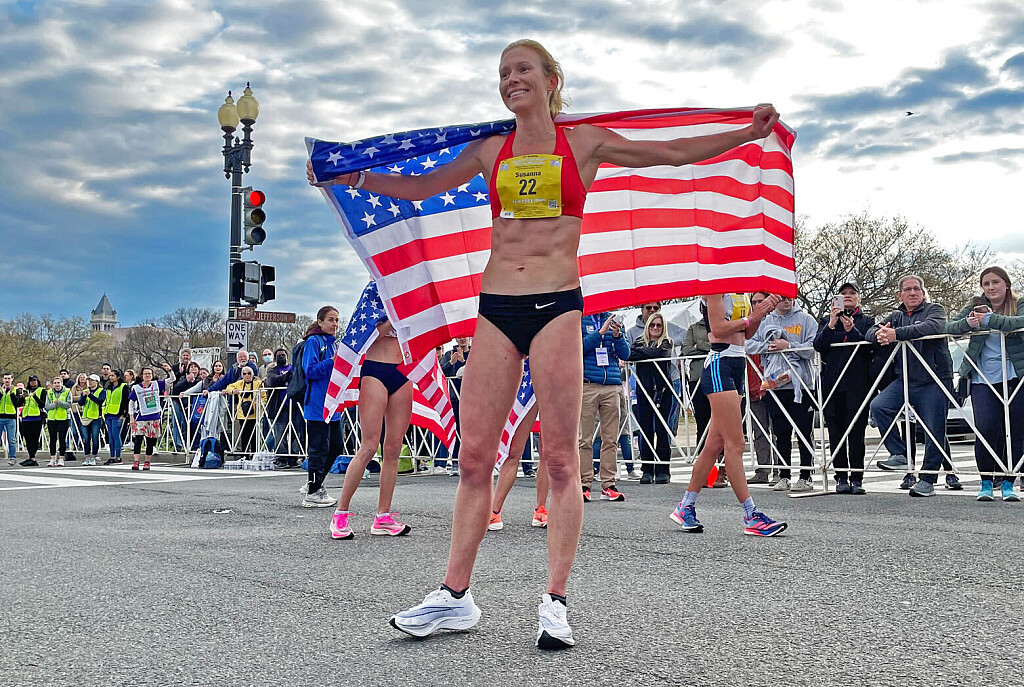
Sunday marked the first Cherry Blossom Ten Mile Run since 2019
A local runner won the Cherry Blossom Ten Mile Run for the first time since 1983.
Susanna Sullivan of Reston, Virginia, won the elite women’s race on Sunday.
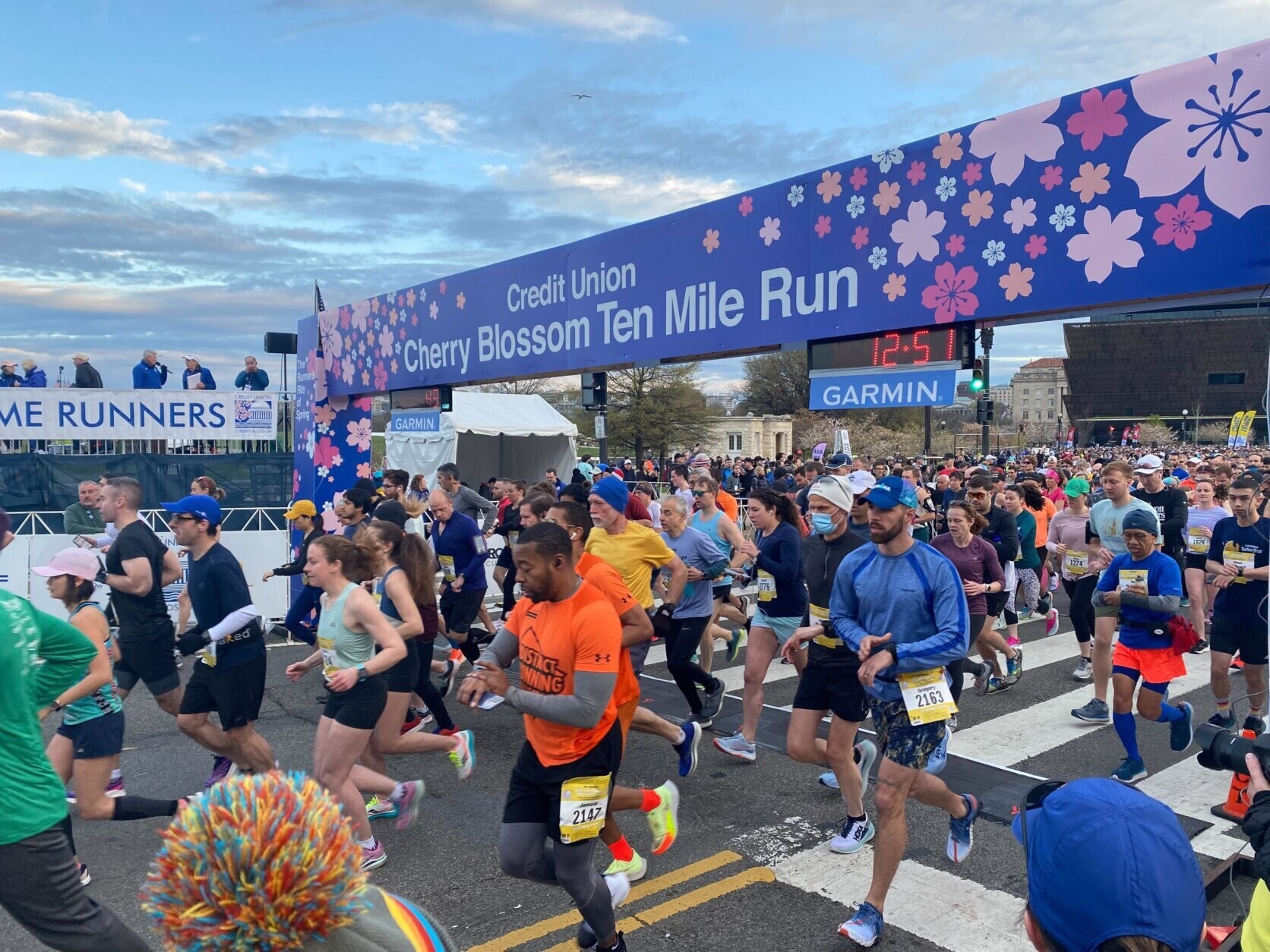
“It’s indescribable, I mean, I dreamed of this and it just kind of came together,” Sullivan told WTOP shortly after crossing the finish line. “I felt great coming into the race, training’s been going well, I run these roads every weekend. Crucial. The conditions were perfect. I had close friends and teammates out on the course. So it was just amazing.”
Her unofficial time clocked in at 52 minutes and 32 seconds, making it a personal record for the long distance athlete who is also a fifth grade teacher at Haycock Elementary School in Fairfax County.
“It’s almost a two-minute PR. And that doesn’t happen when you’re 31,” said Sullivan “I feel like I’ve gotten a lot stronger in the last few years. I think the pandemic gave me time to really focus on not racing and building a really strong base. And they’re just doing more strength stuff. And that’s really helped.”
Nicolas Kosimbai of Mill Valley, Kenya, won the elite men’s race and tied the course record with a time of 45 minutes and 15 seconds.
Sullivan and Kosimbai were joined by 17,000 other eager runners on the chilly April morning. The course and weather made for a lot of personal best times for many of the amateur racers.
“I knew I did well, because I had nothing left when I crossed the finish line and I wanted to collapse,” said Alex Crisafulli, who lives in Washington D.C.
Login to leave a comment

Cherry Blossom Ten Mile Run
The Credit Union Cherry Blossom is known as "The Runner's Rite of Spring" in the Nation's Capital. The staging area for the event is on the Washington Monument Grounds, and the course passes in sight of all of the major Washington, DC Memorials. The event serves as a fundraiser for the Children's Miracle Network Hospitals, a consortium of 170 premier...
more...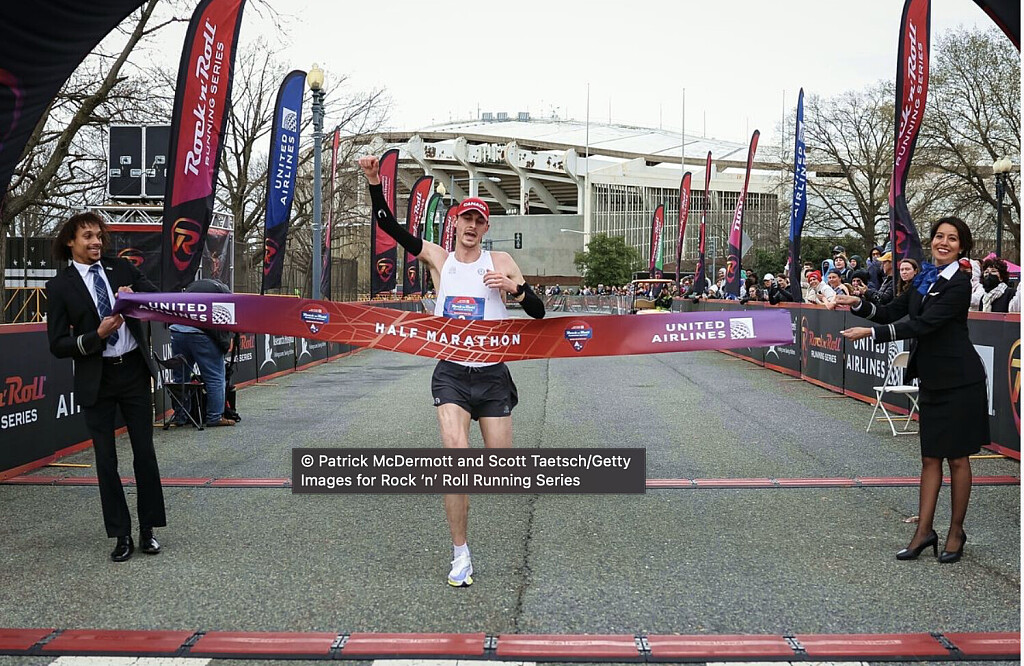
Rock N Roll DC Recap
More than 12,000 registered participants took to the streets of the Nation’s Capital on Saturday celebrating the 10th running of the United Airlines Rock ‘n’ Roll Running Series Washington D.C.
The musically-themed event provided runners and walkers alike with an unforgettable running tour of the District showcasing some of its most iconic scenery, including the National Mall, the White House, the Capitol Building, the Lincoln Memorial, and much more before passing down an electric finish at RFK Stadium all during peak cherry blossom season.
The second event in the Rock ‘n’ Roll Elite™ half marathon series took part at Rock ‘n’ Roll Washington, D.C., it was Justin Kent (Burnaby, British Columbia, Canada) and Hirut Guangul (New York, N.Y.) claiming victories.
The winners
The Rock ‘n’ Roll Elite half marathon series offered a shared $10,000 elite prize purse and Elite Beat Rankings (EBR) points to the top three male and female finishers including in his second straight victory, Justin Kent of Burnaby, British Columbia, Canada took top honors in the men’s race, earning 50 EBR points with a finishing time of 1:03:56 and cementing his #1 ranking, with 100 total points in the new series. Collecting 44 EBR points was Benjamin Preisner of Vancouver, British Columbia, Canada with a finishing time of 1:05:01, and John Borjesson of Boulder, Colo. followed in third place finishing at 1:05:49 and scoring 39 points. Hirut Guangul of New York, N.Y. took the top spot in the women’s race earning 50 points with a finishing time of 1:14:01. Emiline Delanis of Cary, N.C. followed Guangul in second for the women’s division with a finishing time of 1:14:24, earning 44 points, while Jane Bareikis of Crestwood, Ill. rounded out the podium with a time of 1:14:31, earning 39 points. The new Rock ‘n’ Roll Elite half marathon competition offers world-class runners the opportunity to showcase their talents in eight cities in North America, culminating with a grand finale at the 2023 edition of Rock ‘n’ Roll Running Series Las Vegas.
Several local bands, including Enviro Drum, Ocho de Bastos, Prettier in Person, BATALIA, and School of Rock performed live on band stages along the route interspersed with crowd support. The party wasn’t only on the course – runners were treated to the sounds of local favorite White Ford Bronco whose lead singer, Gretchen Gustafson ran the half marathon just before taking the stage at the Finish Line Festival at the Armory Mall just outside RFK Stadium.
Login to leave a comment

Rock 'n' Roll Washington D.C.
Experience a VIP running tour of the Nation’s Capital when you run the United Airlines Rock ‘n’ Roll Running Series Washington DC. Our impressive, award winning courses boast postcard worthy views of the most iconic monuments in the district such as the White House, the Capitol Building, the Lincoln Memorial and MORE. Earn your (stars and) stripes when you cross...
more...
The 2022 Rock ‘n’ Roll Running Series New Orleans Returns Feb. 5-6
The 2022 Rock ‘n’ Roll Running Series New Orleans returns to the Big Easy on Saturday, Feb. 5 and Sunday, Feb. 6. Race weekend kicks off on Friday, Feb. 4 with the Health & Fitness Expo at the New Orleans Morial Convention Center. On Saturday, Feb. 5 race day returns with the 5K and on Sunday, Feb. 6, the participants will take on the half marathon and 10K distances all starting and finishing at the University of New Orleans.
Elite runners from around the world will contest the Rock ‘n’ Roll Running Series New Orleans , Anne-Marie Blaney (USA), Megan O’Neil (USA) and Maura Tyrrell (USA) in the women’s field, and Wilkerson Given (USA), John Börjesson (SWE) and Mo’ath Alkhawaldeh (JOR), who most recently took the overall win at the 2021 Rock ‘n’ Roll Washington D.C. Half Marathon, in the men’s field.
Schedule:
Friday, Feb. 4
12:00 p.m. – 7:00 p.m. – Health & Fitness Expo – New Orleans Morial Convention Center
Saturday, Feb. 5 – Race Day
9:00 a.m. – 4:00 p.m. – Health & Fitness Expo – Phoenix Convention Center
7:40 a.m. – 5K – University of New Orleans
Sunday, Feb. 6 – Race Day
7:40 a.m. – 10K Start – University of New Orleans
7:40 a.m. – Half Marathon Start – University of New Orleans
9:00 a.m. – 1:00 p.m. – Encore Entertainment – James Martin Band – University of New Orleans
*All times listed are in CST
Login to leave a comment

Rock N Roll New Orleans
Want a fun and brag-worthy way to burn off all that king cake and booze you’ll be consuming this Mardi Gras season? Rock ‘n’ Roll is a fun race for all levels, from the elite athlete to the tutu-wearing, beer-chugging walker. So, whether you’re doing it for the glory, for the medals, or for the free shots and mimosas along...
more...
Why You Should Be Skeptical About Your Wrist-Based Heart Rate
Every week or two, I'll open an athlete's training log and it seems like a blood-curdling scream leaps off the page.
"My body is being weird! My heart rate was way too high on this run!"
Or . . .
"My body is being weird! I couldn't get my heart rate up on this run!"
As Edgar Allan Poe could tell you, little is more disconcerting than a screwed-up heart beat. And sometimes these athletes' hearts seem very screwed up, a telltale sign of a major issue. Maybe they sustain 190 heart rate at a moderate effort. Or maybe it peaks at 120 on a sprint. When I first saw these issues a few years ago, worried about arrhythmia or other health crisis, I would ask them to go to the doctor immediately.
But, then, I would look at the data and notice discrepancies. Lots of studies came out that saw discrepancies too. There seemed to be a problem of faulty measurement, rather than faulty hearts. So, now, I have a standard one-question response.
"Are you using a wrist-based optical heart-rate monitor?"
Simply put, for some athletes, wrist-based heart rate is not accurate during intense activity like running, though it varies a ton. And many athletes have no idea. Let's dig down into some of the data.
Heart-Rate-Measurement Basics
Most wrist-based heart-rate monitors rely on photoplethysmography, a word that I assume is real. Photoplethysmography involves using light to measure blood flow. That's why your watch may have a bright LED light that shines against your skin. Light refracted off the blood flowing beneath the surface of your skin is fed into algorithms that use it to spit out a heart-rate number.
Chest straps, meanwhile, use sensors on the strap to record signals from the heart beat. This process requires some moisture, which is why you may notice readings that are off when you start a run and haven't worked up a sweat.
Problems Wrist Monitors Face
The chest strap has the advantage of being a semi-direct measurement of heart rate. A good chest strap will be close to 100% accurate. Which makes sense, because it's essentially reaching into your chest cavity and recording each beat with a clipboard.
As we'll see later, many wrist monitors are not as accurate. For some, it could be as simple as not being placed correctly on the wrist, since being too loose generate a faulty reading, and being too tight can impede blood flow.
Other athletes may have physiology that is not as conducive to the technology, possibly due to locations of blood vessels or bodyfat percentage. On top of that, vigorous exercise jostles everything around, like turbulence on an airplane. You might be looking at a beautiful sunset out the window when you hit a rough patch, and now you're looking at the sky, now the clouds, now the sun and now you're throwing up in a bag.
Wrist-Monitor Accuracy Data
I currently have 18 windows open to different studies on wrist-based heart rate conducted since the start of 2017, and my computer fan just turned on loudly in protest. If my browser had a heart, it would currently be at VO2 max.
Most of the data from the studies has overlap, even if the conclusions vary. A January 2017 research letter in the Journal of the American Medical Association Cardiology had 50 healthy adults test four different wrist monitors and a chest strap at rest, 2 mph, 3 mph, 4 mph, 5 mph and 6 mph. While the chest strap had a 0.99 correlation with electrocardiograph readings, the wrist monitors varied between 0.83 and 0.91 correlation. That study had a conclusion that we'll see a lot: "In general, accuracy of wrist-worn monitors was best at rest and diminished with exercise."
An August 2017 study in the Medicine & Science in Sports & Exercise Journal had even more disheartening findings. Fifty athletes spent time on the treadmill, elliptical and stationary bike, and correlation varied from 0.75 to 0.92. As that study concluded: "Electrode-containing chest monitors should be used when accurate HR measurement is imperative."
"That sounds pretty good," someone might say. "It's not imperative to be exactly right, just close." That perspective is backed up by the conclusion of some studies. For example, a 2018 study in BMC Sports Science, Medicine, and Rehabilitation came to the conclusion that wrist-based heart rate is "acceptably close" across a broad range of activities. Looking a bit deeper into the data, that study found that during running, the heart rate numbers were within 10 beats per minute of actual heart rate 95% of the time, with around three beats per minute average error. In other words, on a one-hour run, a few minutes will be spent with a heart rate monitor giving a number that is 10+ beats off.
You think that was a lot of studies? Well you ain't seen nothing yet. A 2018 study in the journal Digital Health found absolute error of 1% to 8% depending on device and intensity level. A 2017 conference paper found that the tested watches accurately measure up to 89% of beats accurately at rest, and less during activity. A 2019 study in the Journal of Sport Sciences found error rates between 2.4% and 13.5%.
Here's the most fascinating one to me. A 2018 study in the BMJ Open Sport and Exercise Journal found absolute error values of 3.3% to 6.2%, but using a "10% equivalence zone," concluded that the watches were accurate. You can see why that is a problem for athletes if you think about using the heart-rate monitor to stay below aerobic threshold (AeT). Imagine a hypothetical athlete with an AeT of 150. At 150 heart rate or below, they know they can achieve the desired training stimulus, or excel in an ultra race. A 5% error rate could mean that their heart rate is actually 157 (which would lead to lack of recovery in training or a bonk in racing).
But here's the big problem-the errors are not consistent. If it was always 5% low or 5% high, we could use that information (you're probably having flashbacks to the accuracy v. precision distinction from high-school science class). Instead, it's all over the place, and since 5% is an average, sometimes it might read 190 or something that makes an athlete write a panicked entry in their training log.
It's kind of like Michael Cohen testimony. First it says one thing, then it says another, so even if it's right one time, how can you trust it? In this analogy, I'm not sure if I'm CSPAN or Alexandria Ocasio-Cortez.
Put It All Together
When it comes to wrist-based heart rate, it's not an obvious answer for every athlete. A 2018 commentary in the Journal of Medical Internet Research pointed out that there is no consensus, partially due to lack of uniformity in evaluation (the same data can be used to reach different conclusions based on methodology, as we were talking about with the "10% equivalence zone" above). The gold standard of product testing, D.C. Rainmaker, has found some optical sensors that work well for him (with variation), and his tests are as rigorous as any study protocol. Anecdotally, some athletes can use certain wrist monitors and return with beautiful heart-rate graphs that track effort, while others can use the same watch and do the same workout and return with a garbly mess of incomprehensible noise.
In addition, every watch is different, and some are more accurate than others. The technology is constantly improving, and it's possible that newer, high-quality watches have overcome some of the technological hurdles uncovered by the studies. If I were a betting person, I'd guess that wrist-based heart rate will be effective relatively soon.
If you want to do some home testing, and you think your watch might be right, do 6 x 1 minute intervals hard with 2 minutes easy recovery on your next run (or similar hard effort). Does your watch return heart-rate peaks that are as stunning as the Matterhorn, lining up with how you feel? That's good, it probably works. Calibrate it with a chest strap to be sure.
However, if you're like some of the athletes I have seen, the heart-rate graph will look like it was created by a random-number generator. If that's you, there's a good chance your wrist monitor is still accurate at rest and during certain activities, so it can still be useful. But using it for intense running would be like entrusting your timekeeping to one of those broken clocks that is still right twice a day.
by Trail Runner Magazine
Login to leave a comment
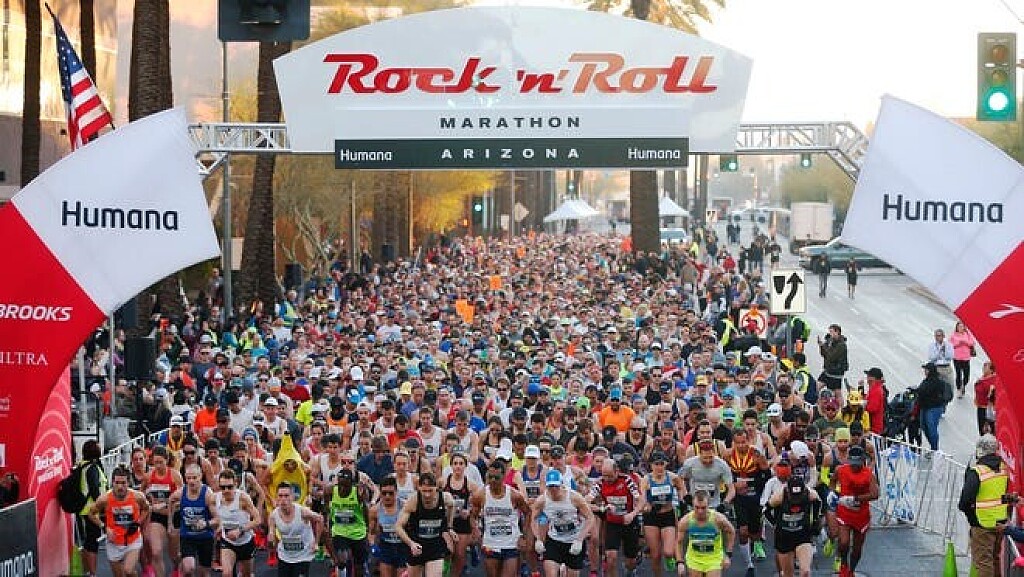
2022 Arizona Rock ‘n’ Roll Marathon set to return to metro Phoenix in January
Get those running shoes ready as the Arizona Rock ‘n’ Roll Marathon returns to metro Phoenix next month.
One of the Valley’s signature events to kick off the new year, the Arizona Rock ‘n’ Roll Marathon will take place Jan. 15-16.
Distances available include the full marathon, half marathon, 10K and 5K.
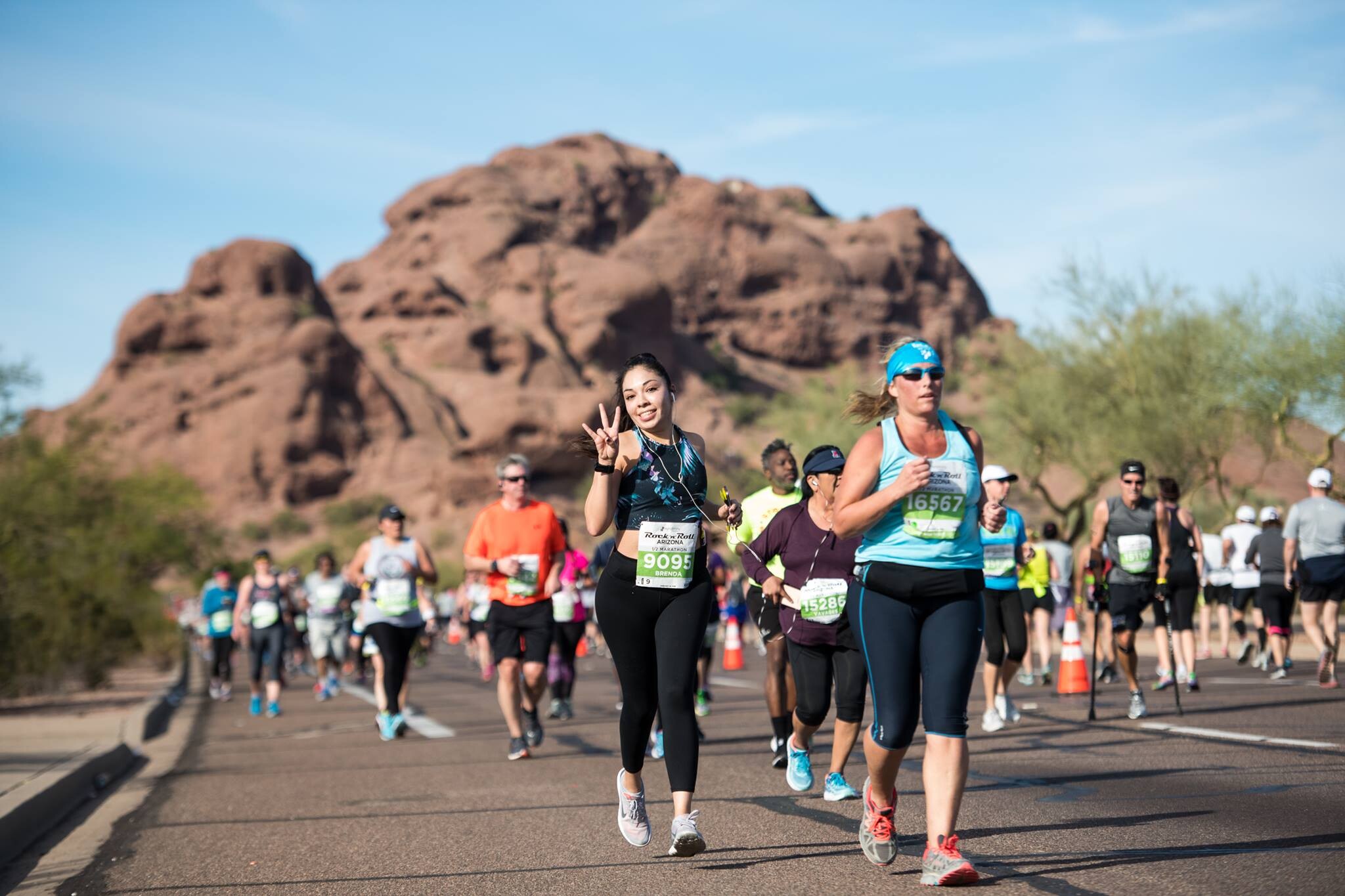
“Our Rock ‘n’ Roll Arizona ambassador team has been attending group runs and events, and we have seen the excitement our community has for the return of Rock ‘n’ Roll to the Valley,” Rock ‘n’ Roll Arizona Ambassador Jeremy Heath said in a press release.
“Runners are ready to experience everything Rock ‘n’ Roll has to offer once again, and they’re itching to get to the start line.”
A winter sale takes place Wednesday and will last for only one day, offering discount registration prices. Regular registration prices for the event run from $49 for the 5K and up to $129 for the full marathon.
Runners enjoy scenic views of the greater metro Phoenix area, including the red rocks of Papago, along with music and entertainment.
The marathon in the past has drawn more than 25,000 runners to the area and tens of thousands of spectators.
The 2021 Arizona Rock ‘n’ Roll marathon was canceled due to the COVID-19 pandemic.
Phoenix serves as the kickoff to the Rock ‘n’ Roll Running Series, the world’s largest running series, with races also taking place in cities around the country and world including Las Vegas, Washington D.C., New Orleans, Nashville, Estado de México and Madrid.
Login to leave a comment

Rock N Roll Arizona Marathon
The Marathon and Half-Marathon courses or the new Mini- Marathon or Bike Tour courses take you through the three host cities of Phoenix, Scottsdale and Tempe! The Marathon and Bike Tour start at CityScape in downtown Phoenix, while the Half-Marathon and Mini-Marathon are loop courses launching from downtown Tempe. All the courses end in Tempe at ASU’s Sun Devil and...
more...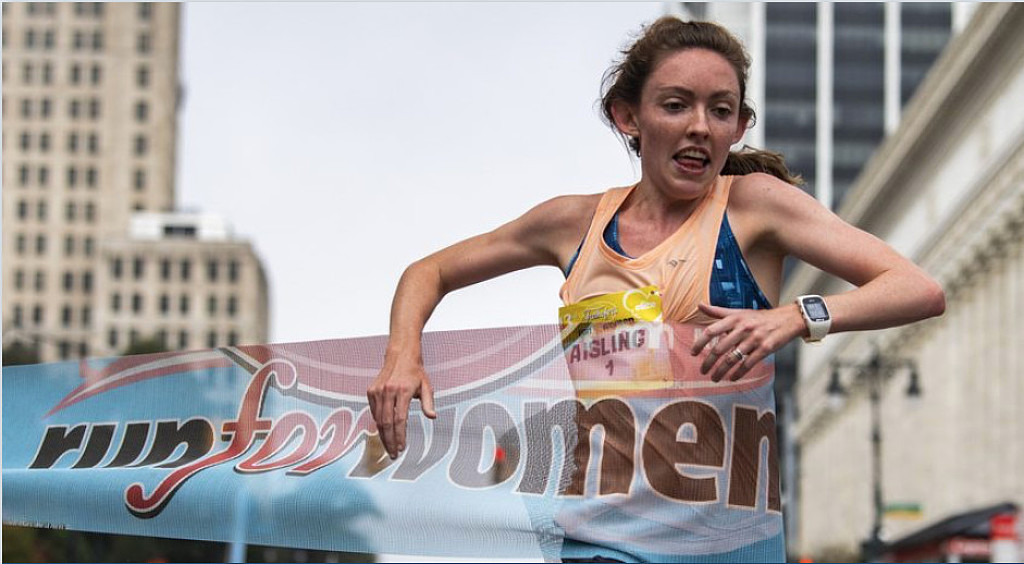
Cuffe runs away from the field in 43rd Freihofer’s Run for Women
The only reason Aisling Cuffe didn’t get lonely during the 43rd Freihofer’s Run for Women 5k on Saturday is that the race course doubles back on itself.
As she turned right off Sprague Place onto Washington Avenue just before the 4k mark, she allowed herself a smile as she was greeted warmly by a long line of walkers headed in the other direction, having just passed the 1k mark.
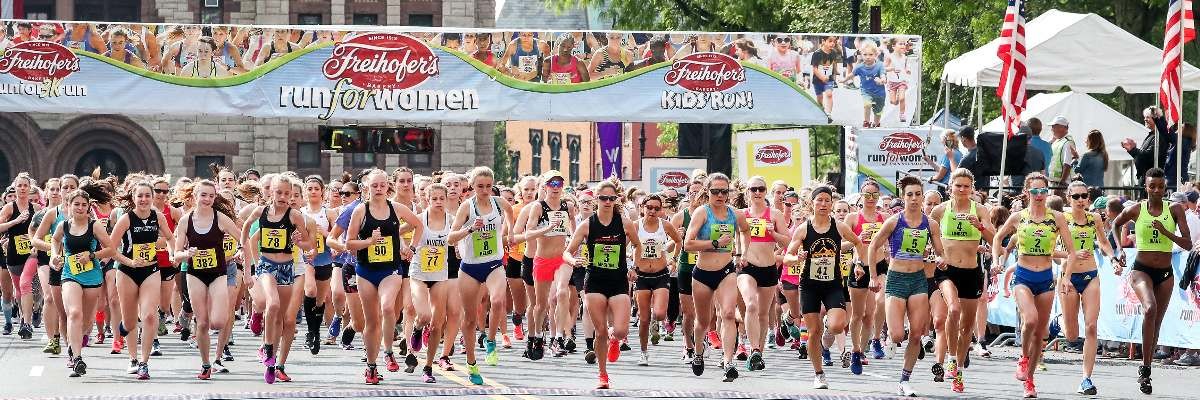
By the time the 28-year-old Cuffe passed Henry Johnson Boulevard a long city block later, no runner had appeared turning the corner on Sprague, and that was that. Cuffe polished off the downhill on Washington to the finish and won the Freihofer’s Run in 16:34, a whopping 40 seconds ahead of runner-up Cara Sherman.
A two-time New York State high school champion in cross country for Cornwall Central in 2009 and 2010 who went on to run for Stanford University, Cuffe has raced pretty much everywhere in the state except for the Capital Region, and she made her Freihofer’s Run debut a smashing success by putting the field away early.
“I have a tendency to not start fast enough, so by a half-mile in, I was like, ‘Oh, I don’t think I’m starting fast enough for the pace I want to do,’” she said. “Normally I rely on the field to drag it out of me, and I didn’t feel like the field was doing that, so I thought, ‘I’m going to have to go.’
“And I was super-nervous somebody was going to come back and start kicking it in, so I kept looking and probably shouldn’t have been looking as much as I did.”
The Freihofer’s Run usually is held in early June, but was moved to September for this edition after being contested as a virtual race last year because of the COVID-19 pandemic.
A total of 1,024 runners finished the in-person 5k in comfortably cool, sunny conditions on Saturday, after a thick fog lifted an hour or so before the 9 a.m. start.
The clear conditions didn’t help the elite field find Cuffe, as she got 10 meters of separation by Lark Street a half-mile in and pretty much put the race away with a 5:32 first mile shortly after entering Washington Park.
Cuffe ran the second mile in 5:27 for a 10:59 split and spent as much time watching her step through the rolling hills and twisting turns in the park as anything else.
“It got quieter all of a sudden when I started pushing, and I thought, ‘Oh, did I make a gap already?’” she said. “You can tell sometimes how many people are around you just by hearing, but it wasn’t what I thought. So I was like, ‘What?’ And it thinned out so much … ‘Wow. OK.’ I kept having to press at that point.
“I fell asleep a little bit in the second mile, but that’s also where the course is at its hilliest, so it’s tough to say. But I do think I fell asleep a little in that middle mile. When I’m a little more relaxed, I start looking at potholes a lot more and getting a little picky about my steps.”
“I thought about it [making a push to close the gap], but I was already pressing a little bit early, so I figured I should stay within myself and be patient,” Sherman said.
A two-time runner-up in the 5,000 meters at the NCAA Championships while at Stanford, Cuffe has been training for longer distances this year and said she felt “a little rusty at the 5k distance.”
Besides winning two cross country state meets for Cornwall, she also won the state Federation meet and Foot Locker National Championship in 2010.
At Stanford, she was coached by former Section II star Liz Maloy of Holy Names, who hosted Cuffe at her Loudonville home this weekend. Among their shared memories is having run in the state meet, where runners compete in t-shirts color-coded to their section.
“We used to get cotton t-shirts at the state meet, so she had maroon, and I had royal blue, and we were talking about running one of your biggest meets in high school in a cotton t-shirt. We love that,” Cuffe said.
“Oh, my God, they’re my favorite t-shirts. I can’t wear them too much because they’re starting to wear a little thin, so I have to preserve them for my children and grandchildren.”
Sherman, who has run in the colors of Mohonasen High School and the University at Albany, wanted to use the Freihofer’s Run as a stepping-stone to the MVP Stockade-athon 15k, another popular road race that will return to in-person competition on Nov. 14.
The 2019 Stockade-athon winner completed the Freihofer’s Run 10 seconds ahead of third-place finisher Annika Sisson.
“I was a little surprised to finish so far up, but I hit the time I was shooting for. I thought I’d be around 17:15,” Sherman said. “I’m training for the Stockade-athon right now, so I was using this as my first test effort, sort of. So I just wanted to see where I was at.”
It wasn’t long ago that Sisson was running in the Capital Region, as she was second to another former UAlbany standout, Hannah Reinhardt, at the 2018 America East Conference cross country championship meet, while Sisson was at Stony Brook.
“My coach Kurt Benninger, Molly Huddle’s husband, he knew of this race and thought it would be a good opportunity to test my fitness, see where we’re at heading into the fall,” Sisson said. “And it was great, I had so much fun. I knew Aisling was coming in, so that was fun. We were like, we’re probably going to have to let her go.”
Sascha Scott of Syracuse won the masters division while finishing 10th overall in 18:17.
Under a reconfigured prize structure that offered a deeper distribution, Cuffe earned $3,000 for the victory.
She said she especially appreciated the women-only race, though, for some of its other touches, like running into the walkers on the way back and the fact that race director Kristen Hislop announced to the field before the start that the age range in the race ran from 9 to 93.
“I love races like this, especially when you get to see other people in the race doing it as well,” she said. “Even at the start, when Kristen was announcing the race and the oldest person and the youngest. I love that stuff, I could listen to that all day long, the number of people that come out and share in the sport of running and racing having fun together. It’s so motivating and inspiring.”
TOP 50
1. Aisling Cuffe (28, Concord, Mass.), 16:34; 2. Cara Sherman (24, Schenectady), 17:14; 3. Annika Sisson (25, Pawtucket, R.I.), 17:24; 4. Caitie Meyer (30, Albany), 17:34; 5. Kerry Allen (33, Washington, D.C.), 17:39; 6. Karen Bertasso Hughes (37, Selkirk), 17:42; 7. Tricia Longo (31, Waterford), 17:50; 8. Sarah Danner (28, Gowanda), 17:57; 9. Elizabeth Debole (36, Albany), 18:02; 10. Sascha Scott (46, Syracuse), 18:17.
11. Suzie Clinchy (32, Brooklyn), 18:26; 12. Nicole Moslander (34, Rotterdam), 18:28; 13. Abbi Wright (24, Delmar), 18:31; 14. Leonni Griffin (14, Watervliet), 18:37; 15. Meghan Mortensen (36, Glenville), 18:50; 16. Marisa Sutera Strange (58, Millbrook), 18:56; 17. Renee Tolan (46, Clifton Park), 18:57; 18. Laura Kline (44, Syracuse), 18:59; 19. Erin Lopez (40, Ivoryton, Conn.), 19:01; 20. Kaleigh Higgins (15, Watervliet), 19:08.
21. Gina Pardi (23, Falmouth, Me.), 19:21; 22. Charlotte Dunkel (14, Latham), 19:43; 23. Kaitlyn Phillips (24, Rome), 19:51; 24. Brina Seguine (32, Rensselaer), 20:00; 25. Ciara Bullington (17, Cohoes), 20:02; 26. Lauren Scarupa (30, Clifton Park), 20:03; 27. Marta Dauphinee (43, Glenville), 20:13; 28. Kirsten McMichael (24, Clifton Park), 20:13; 29. Diana Tobon-Knobloch (40, Schenectady), 20:26; 30. Birtu Diefenderfer (16, Albany), 20:33.
31. Kaitlin Bogucki (14, Rensselaer), 20:31; 32. Jennifer Richardson (41, Albany), 20:48; 33. Sarah Harris (46, Sunderland, Vt.), 20:50; 34. Elizabeth Koa (15, Watervliet), 20:53; 35. Katie Johnson (40, Delmar), 20:55; 36. Lilla Korniss (16, Watervliet), 21:00; 37. Aroline Hanson (41, Sunderland, Vt.), 21:03; 38. Alyssa Caiano (14, Cohoes), 21:04; 39. Lori Kingsley (55, Wysox, Pa.), 21:03; 40. Julianne McCarthy (39, Albany), 21:06.
41. Anne Benson (56, Clifton Park), 21:08; 42. Natalie Bennett (16, Latham), 21:10; 43. Alyssa Risko (55, Schenectady), 21:14; 44. Rebecca Miceli (24, Troy), 21:15; 45. Colleen Brackett (60, Albany), 21:17; 46. Katherine Durrant (47, Ithaca), 21:17; 47. Shannon Church (40, Watervliet), 21:19; 48. Kim Lagasse (27, North Attleboro, Mass.), 21:25; 49. Lauren Williams (31, Troy), 21:32; 50. Judy Guzzo (54, Niskayuna), 21:34.
Login to leave a comment

Freihofer's Run For Women
Freihofer's, a leading baker of wholesome products, is committed to fostering the growth and recognition of women in sports and inspiring all generations of women to experience the benefits of exercise and good nutrition. That's why we're proud to sponsor the annual Freihofer's Run for Women 5K -- one of the world's largest and most prestigious all-female road races. TheRace...
more...
If You’ve Had Panic Attacks While Running, You’re Not Alone
A mental health expert provides techniques to manage your brain and body’s reactions to anxiety.
For many people, running is the tool they use regularly to help alleviate symptoms of anxiety. But what happens when the activity that usually gives rise to a euphoric rush of endorphins seemingly begins to elicit a completely different response?
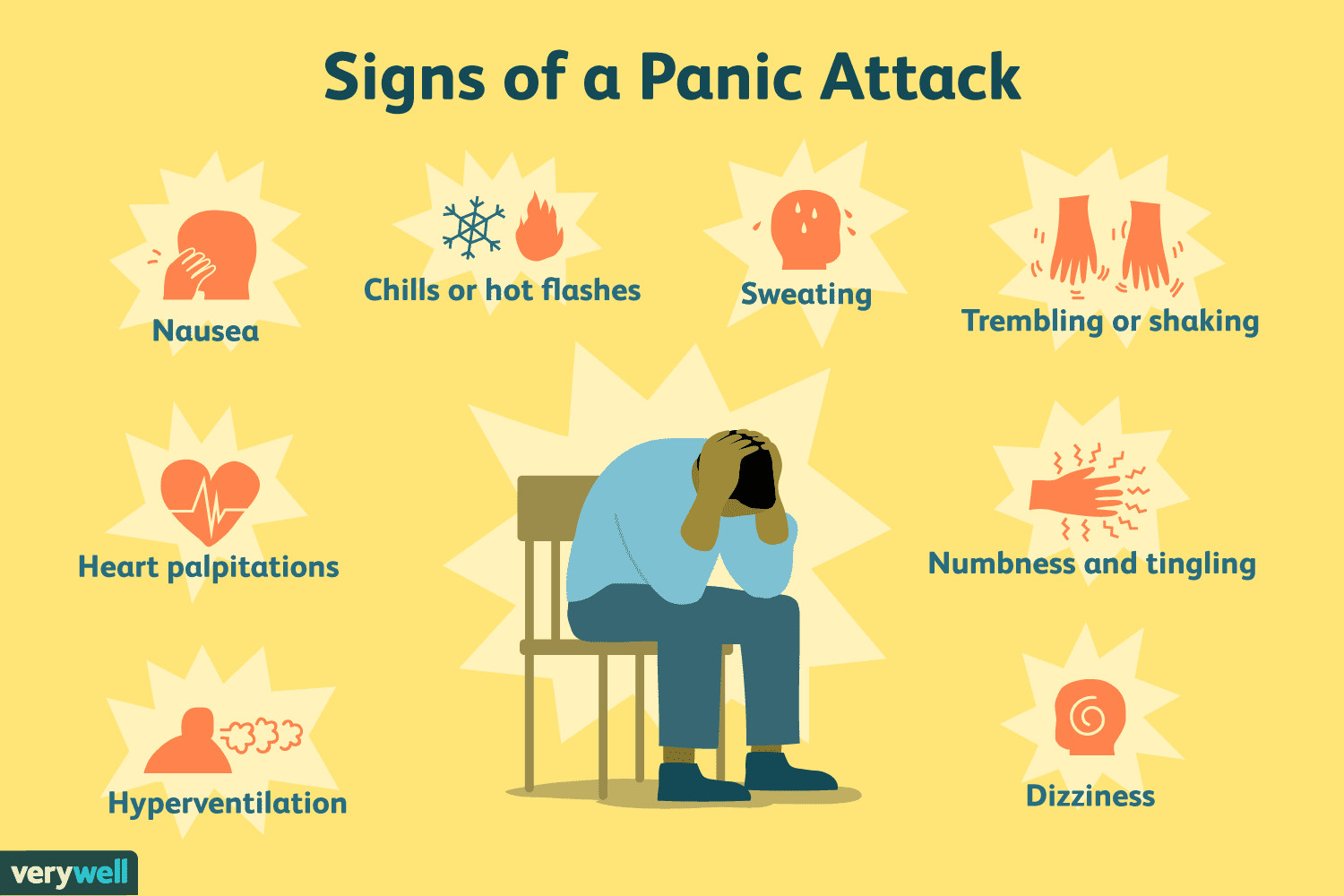
The truth is when you’re going through a stressful period of time in your life, particularly one that prompts anxious feelings in sporadic intervals, running may not be enough to make you immune to intense moments of panic. In fact, you may even find yourself experiencing a panic attack while running.
For longtime runner Ellen Isaac, panic attacks have just recently begun to occur while on runs—and often. As a former Division I athlete for Ohio University’s (OU) cross-country and track teams, Isaac is no stranger to stressful situations and is someone who genuinely looks forward to competition. However, it wasn’t until after she took her state board exam for physical therapy school this past April that she realized intense bouts of fear could immobilize her while running.
She was on a run with her boyfriend, Nick, when she started feeling overwhelmed with thoughts about whether or not she passed her exam.
“It got to the point where I literally just stopped in the middle of the towpath and was uncontrollably sobbing,” Isaac says.
She was able to identify that she was having a panic attack, so she immediately found a rock to sit on so that she didn’t fall down.
“Breathing while you’re running isn’t the easiest thing in the world, even when you’re running slow,” Isaac adds. “When you start to have those panic attacks, you’re short of breath from that, you’re short of breath from running, and it just completely spirals out of control. I just remember feeling totally out of control of what was going on in my life and out of control of what was happening with my body at that point in time.”
Michele Kerulis, Ed.C., L.C.P.C., who’s certified with the Association for Applied Sport Psychology and a professor of counseling at the Family Institute at Northwestern University, explains that panic attacks are caused by intense fears, concerns, or anxiety. And while these feelings are perpetrated by the mind, they can result in equally intense physical symptoms—like increased heart rate, breathing, and sweating—much like the ones Isaac experienced.
"Running in and of itself does not cause someone to slip into a panic attack—it’s more likely the runner’s thought process quickly snowballs from a small uncomfortable thought into a full-blown panic attack,” Kerulis tells Runner’s World. “For example, if someone has a fear of dogs and sees a dog on their running route, that person might have an automatic thought such as, ‘that dog is going to attack me,’ which leads to feeling intense fear, which can result in a panic attack.”
She points out that from a psychological perspective, when someone experiences a panic attack, it’s the body’s primitive response saying, “I feel like I really need to protect myself right now, I’m scared.” This reaction can then spearhead a physiological response that mimics the one that occurs while you’re running.
“At that point, you experience increased respiration, you’re breathing harder, your heart rate goes up, you’re sweating, [you have] increased blood flow to your muscles—those are the exact same things that happen when you’re running. It’s the exact same physiological response as a panic attack,” says Kerulis. “So you’re having those same, almost ‘alert type’ of neurotransmitters in your brain, telling your body to accelerate. Even though the circumstances are very different, physiologically we’re experiencing those same things.”
→ Join Runner’s World+ today for exclusive access to more expert health and running tips!
While Isaac says very few things will help her get out of a panic attack once one ensues, she has one method that seems to, at the very least, stabilize her symptoms and prevent them from exacerbating any further.
“When it happens, a lot of times what I end up doing is I usually end up counting all of the seconds until I calm down [while still running]. Sometimes I end up counting seconds for three miles. And then I’m like, okay, I’m fine now,” she says. “I do that during races, too. If I’m starting to freak out and get to that part of the race where I don’t know if I can keep going, I count seconds.”
As Kerulis points out, running might reduce some symptoms of anxiety, but it won’t eliminate the thought process that triggers anxious reactions. Still, there are some elements that are learned from running that may soothe you in moments where you begin to feel frightened.
"Running has helped a lot of people develop skills to control their physiological symptoms, which can help them with body-to-mind relaxation techniques that are helpful when they feel as if they will experience a panic attack,” says Kerulis.
Despite how terrifying these panic attacks are when they occur while running—not to mention the uncertainty of when they will happen during her run—Isaac remains grateful for the sport.
“If running kind of stirs up some anxiety for me, on one hand, yeah it’s unfortunate that it’s plaguing a part of my life that’s always been such a big stress relief for me,” she says. “But, if it takes some anxiety and panic attacks on runs for me to realize that there are things in my life that I need to address that I’m trying to shove under the rug, then I’m kind of okay with that.”
For those who experience regular bouts of anxiety, there are ways you can consciously restructure your own physiology while running so that you can better prevent slipping into that panicked state. Kerulis says that mental health providers often use mind-to-body as well as body-to-mind techniques to help people manage their cognitive (mind and thoughts) and physiological (body) reactions to anxiety.
What is a mind-to-body technique?
“In the example above where a runner sees a dog on their route, once they notice their automatic thought, ‘that dog is going to attack me,’ they can work to stop the thought from snowballing by saying ‘stop!’ to themselves. Then [they can] rationalize the situation with a new, restructured thought like, ‘I know I’m scared right now, but that person seems to have control over their walk with their dog—I am safe,’” says Kerulis. “This will allow the person to slow down their thoughts and refocus on enjoying their run.”
She adds that picking up a meditation practice is another way you can gain control of your thought processes, as it can produce a calming effect.
What is a body-to-mind technique?
Kerulis explains that this method encourages people to address their physiological symptoms of a panic attack head-on and allows them to focus on de-escalating those physical feelings. So, once someone can identify what they feel in their body—both when they're having a panic attack and when they’re running—they can begin to separate the two sensations and regain a sense of control.
“When someone is sprinting, for example, they will have heavy breathing and need to learn how to manage breath control to gain skills as a sprinter,” says Kerulis. “The same breath control can be used when someone feels a panic attack coming on. This way, people can focus more on their bodies and less on their minds at that moment. Once the wave of anxiety passes, they can re-evaluate the situation that triggered the anxious feelings.”
The bottom line
Consciously employing both mind-to-body and body-to-mind techniques while running may be the answer to staving off the onset of a panic attack. As Kerulis notes, regular exercise can help you understand your body’s responses to stress.
“Once you have a familiarity with your body’s responses, you can learn ways to slow down these responses, which will also help you gain a sense of control,” she says.
by Runner’s World
Login to leave a comment
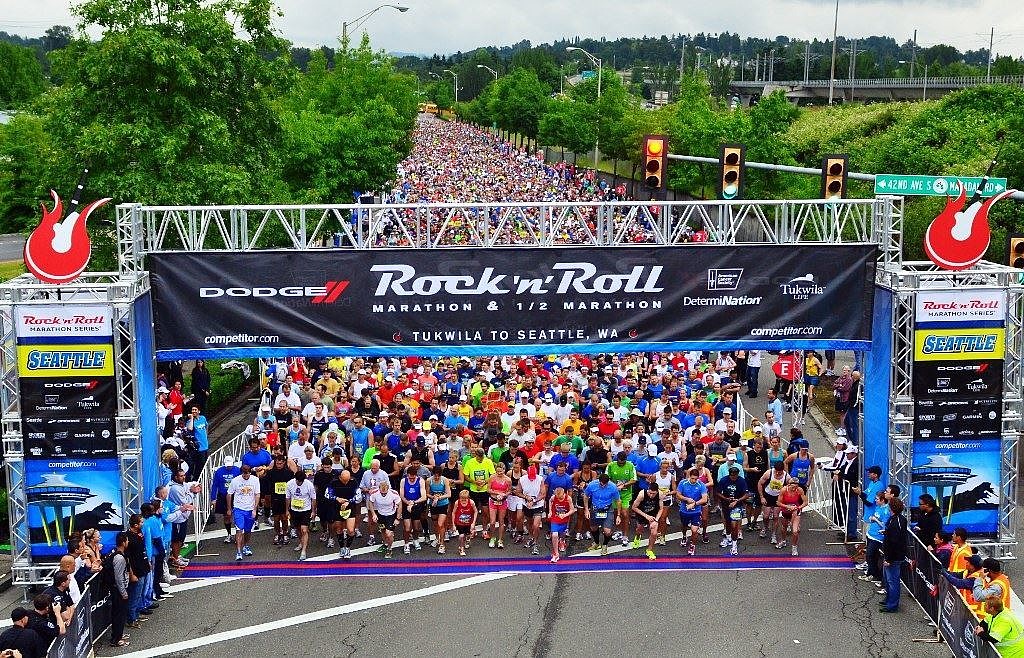
Seattle Rock ‘n’ Roll Marathon cancelled for 2021
Put your running shoes and guitars away. The Seattle Rock ‘n’ Roll Marathon has been cancelled.
The organization notified Seattle participants of the cancellation in an email Wednesday, citing constraints with “local law enforcement resources and the strain any additional events could have in negatively affecting the community.”
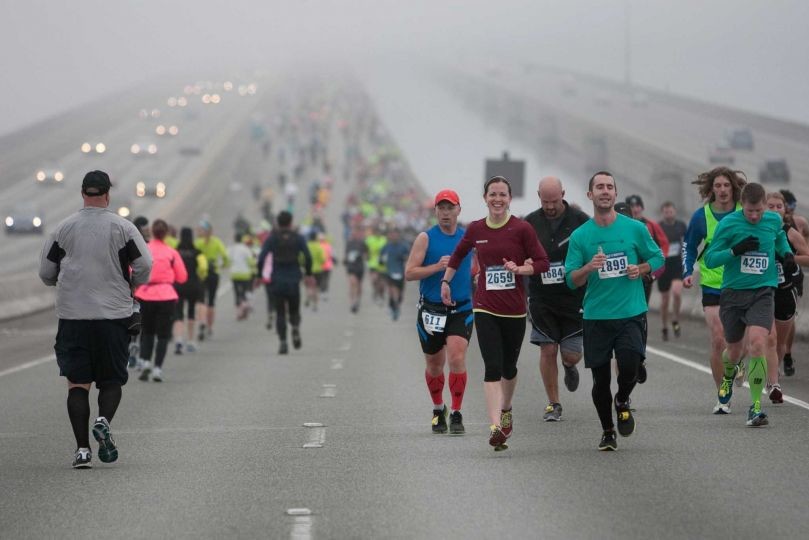
The next Rock ‘n’ Roll Marathon in Seattle is slated for June 12, 2022.
“This is certainly not the news any of us wanted and we recognize that this latest setback is a significant disappointment after multiple event updates,” the organization wrote.
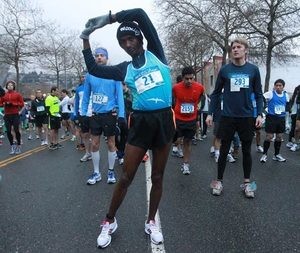
The 2020 Rock ‘n’ Roll Marathon, which local rap legend Sir Mix-A-Lot was slated to headline, was delayed due to the pandemic. This year’s event was initially scheduled for June 12-13 before it was postponed to Aug 21-22.
There is no refund option.
Anyone registered for the Seattle 2021 Rock ‘n’ Roll running series will be automatically registered for the 2022 event. Participants can also transfer their registration for a different event or location by Aug. 4.
Other Rock ‘n’ Roll events are currently scheduled to be held this year in Virginia Beach, Virginia; San Jose, California; San Diego; Savannah, Georgia; San Antonio; Nashville, Tennessee; and Washington, D.C.
by Amanda Zhou
Login to leave a comment

Rock 'n' Roll Seattle
Seattle is such a fun city and one that we love coming back to year after year,” said Lyndsi Weichert, Event Manager. “This race is a great way for participants to see Seattle’s famous sights and beautiful scenery as they take on their 13.1 or 26.2 mile journey. We encourage all runners to grab a friend, start training and sign...
more...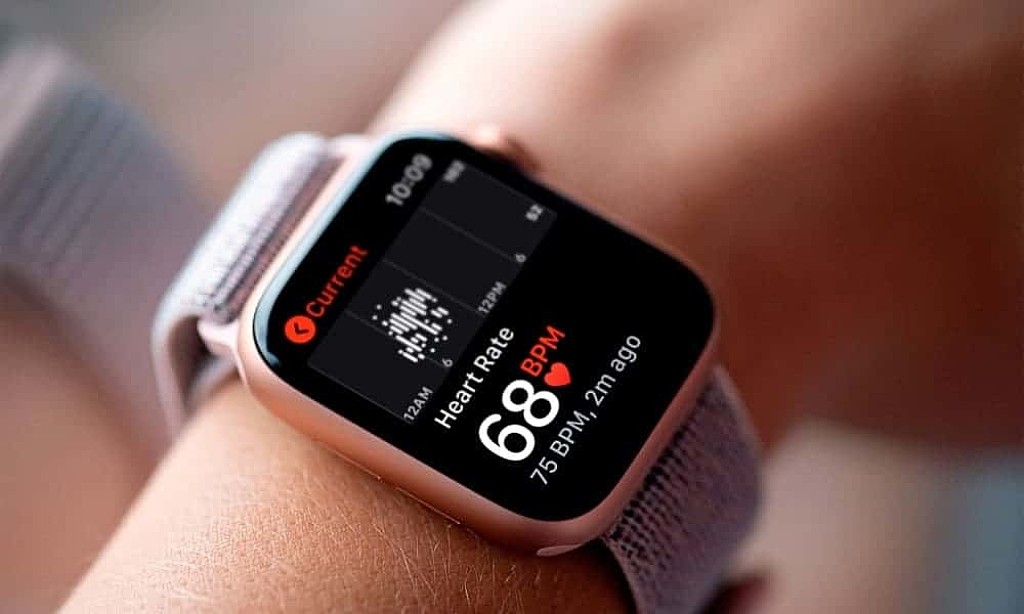
Why You Should Be Skeptical About Your Wrist-Based Heart Rate
Every week or two, I’ll open an athlete’s training log and it seems like a blood-curdling scream leaps off the page.
“My body is being weird! My heart rate was way too high on this run!”
Or . . . "My body is being weird! I couldn’t get my heart rate up on this run!”
As Edgar Allan Poe could tell you, little is more disconcerting than a screwed-up heart beat. And sometimes these athletes’ hearts seem very screwed up, a telltale sign of a major issue. Maybe they sustain 190 heart rate at a moderate effort. Or maybe it peaks at 120 on a sprint. When I first saw these issues a few years ago, worried about arrhythmia or other health crisis, I would ask them to go to the doctor immediately.
But, then, I would look at the data and notice discrepancies. Lots of studies came out that saw discrepancies too. There seemed to be a problem of faulty measurement, rather than faulty hearts. So, now, I have a standard one-question response.
“Are you using a wrist-based optical heart-rate monitor?”
Simply put, for some athletes, wrist-based heart rate is not accurate during intense activity like running, though it varies a ton. And many athletes have no idea. Let’s dig down into some of the data.
Heart-Rate-Measurement Basics
Most wrist-based heart-rate monitors rely on photoplethysmography, a word that I assume is real. Photoplethysmography involves using light to measure blood flow. That’s why your watch may have a bright LED light that shines against your skin. Light refracted off the blood flowing beneath the surface of your skin is fed into algorithms that use it to spit out a heart-rate number.
Chest straps, meanwhile, use sensors on the strap to record signals from the heart beat. This process requires some moisture, which is why you may notice readings that are off when you start a run and haven’t worked up a sweat.
Problems Wrist Monitors Face
The chest strap has the advantage of being a semi-direct measurement of heart rate. A good chest strap will be close to 100% accurate. Which makes sense, because it’s essentially reaching into your chest cavity and recording each beat with a clipboard.
As we’ll see later, many wrist monitors are not as accurate. For some, it could be as simple as not being placed correctly on the wrist, since being too loose generate a faulty reading, and being too tight can impede blood flow.
Other athletes may have physiology that is not as conducive to the technology, possibly due to locations of blood vessels or bodyfat percentage. On top of that, vigorous exercise jostles everything around, like turbulence on an airplane. You might be looking at a beautiful sunset out the window when you hit a rough patch, and now you’re looking at the sky, now the clouds, now the sun and now you’re throwing up in a bag.
Wrist-Monitor Accuracy Data
I currently have 18 windows open to different studies on wrist-based heart rate conducted since the start of 2017, and my computer fan just turned on loudly in protest. If my browser had a heart, it would currently be at VO2 max.
Most of the data from the studies has overlap, even if the conclusions vary. A January 2017 research letter in the Journal of the American Medical Association Cardiology had 50 healthy adults test four different wrist monitors and a chest strap at rest, 2 mph, 3 mph, 4 mph, 5 mph and 6 mph. While the chest strap had a 0.99 correlation with electrocardiograph readings, the wrist monitors varied between 0.83 and 0.91 correlation. That study had a conclusion that we’ll see a lot: “In general, accuracy of wrist-worn monitors was best at rest and diminished with exercise.”
An August 2017 study in the Medicine & Science in Sports & Exercise Journal had even more disheartening findings. Fifty athletes spent time on the treadmill, elliptical and stationary bike, and correlation varied from 0.75 to 0.92. As that study concluded: “Electrode-containing chest monitors should be used when accurate HR measurement is imperative.”
“That sounds pretty good,” someone might say. “It’s not imperative to be exactly right, just close.” That perspective is backed up by the conclusion of some studies. For example, a 2018 study in BMC Sports Science, Medicine, and Rehabilitation came to the conclusion that wrist-based heart rate is “acceptably close” across a broad range of activities. Looking a bit deeper into the data, that study found that during running, the heart rate numbers were within 10 beats per minute of actual heart rate 95% of the time, with around three beats per minute average error. In other words, on a one-hour run, a few minutes will be spent with a heart rate monitor giving a number that is 10+ beats off.
You think that was a lot of studies? Well you ain’t seen nothing yet. A 2018 study in the journal Digital Health found absolute error of 1% to 8% depending on device and intensity level. A 2017 conference paper found that the tested watches accurately measure up to 89% of beats accurately at rest, and less during activity. A 2019 study in the Journal of Sport Sciences found error rates between 2.4% and 13.5%.
Here’s the most fascinating one to me. A 2018 study in the BMJ Open Sport and Exercise Journal found absolute error values of 3.3% to 6.2%, but using a “10% equivalence zone,” concluded that the watches were accurate. You can see why that is a problem for athletes if you think about using the heart-rate monitor to stay below aerobic threshold (AeT). Imagine a hypothetical athlete with an AeT of 150. At 150 heart rate or below, they know they can achieve the desired training stimulus, or excel in an ultra race. A 5% error rate could mean that their heart rate is actually 157 (which would lead to lack of recovery in training or a bonk in racing).
But here’s the big problem—the errors are not consistent. If it was always 5% low or 5% high, we could use that information (you’re probably having flashbacks to the accuracy v. precision distinction from high-school science class). Instead, it’s all over the place, and since 5% is an average, sometimes it might read 190 or something that makes an athlete write a panicked entry in their training log.
It’s kind of like Michael Cohen testimony. First it says one thing, then it says another, so even if it’s right one time, how can you trust it? In this analogy, I’m not sure if I’m CSPAN or Alexandria Ocasio-Cortez.
Put It All Together
When it comes to wrist-based heart rate, it’s not an obvious answer for every athlete. A 2018 commentary in the Journal of Medical Internet Research pointed out that there is no consensus, partially due to lack of uniformity in evaluation (the same data can be used to reach different conclusions based on methodology, as we were talking about with the “10% equivalence zone” above). The gold standard of product testing, D.C. Rainmaker, has found some optical sensors that work well for him (with variation), and his tests are as rigorous as any study protocol. Anecdotally, some athletes can use certain wrist monitors and return with beautiful heart-rate graphs that track effort, while others can use the same watch and do the same workout and return with a garbly mess of incomprehensible noise.
In addition, every watch is different, and some are more accurate than others. The technology is constantly improving, and it’s possible that newer, high-quality watches have overcome some of the technological hurdles uncovered by the studies. If I were a betting person, I’d guess that wrist-based heart rate will be effective relatively soon.
If you want to do some home testing, and you think your watch might be right, do 6 x 1 minute intervals hard with 2 minutes easy recovery on your next run (or similar hard effort). Does your watch return heart-rate peaks that are as stunning as the Matterhorn, lining up with how you feel? That’s good, it probably works. Calibrate it with a chest strap to be sure.
However, if you’re like some of the athletes I have seen, the heart-rate graph will look like it was created by a random-number generator. If that’s you, there’s a good chance your wrist monitor is still accurate at rest and during certain activities, so it can still be useful. But using it for intense running would be like entrusting your timekeeping to one of those broken clocks that is still right twice a day.
by Trail Runner Magazine
Login to leave a comment
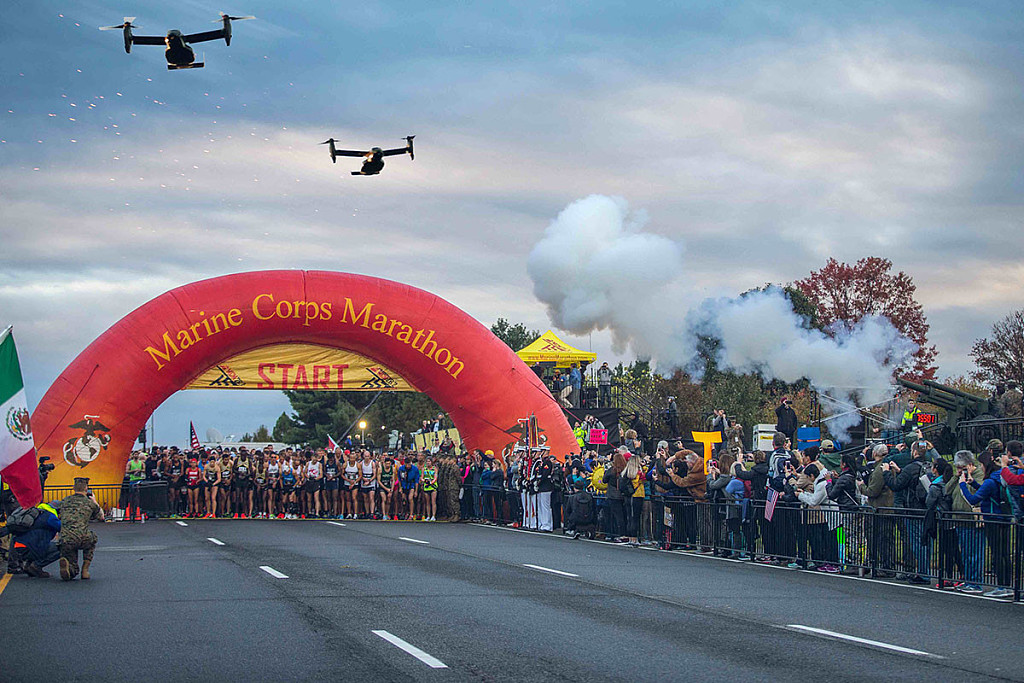
2021 Marine Corps Marathon races will be held in person
Lace up those running shoes, because the Marine Corps Marathon is returning live and in-person.
The event’s races, hosted annually in D.C. and Arlington, will be held in-person from Oct. 29 to Oct. 31 after it ran as a virtual-only event last year.
Race Director Rick Nealis told WTOP that despite not holding a physical marathon in over a year, organizers have “adapted” in hosting smaller events with similar layouts. With that experience along with his military logistics background, Nealis said the event will go off without a problem while working together with local officials to ensure everyone’s safety.
“You almost have to pinch yourself when you realize it will be two years since we’ve had that many runners come across the finish line, as we’ve transitioned through a real tough year in 2020,” said Neails.
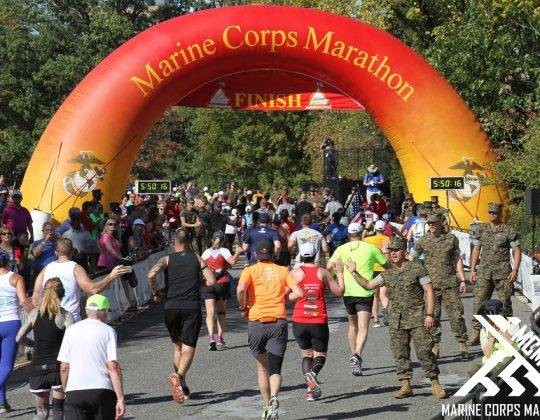
Health and safety measures will be in place adhering to local guidelines, including a reduction in the size of the field and dividing runners into scaled and socially-distanced start times. Nealis said he expects the race to have two-thirds of its usual field of runners, about 15,000 participants, because of restrictions.
The races usually generate about $100 million for the region. While that may not happen this time, they will bring some necessary aid to local businesses impacted by the pandemic.
“The fact that it’s Halloween just makes it even kind of more magical that it’s a treat,” said Nealis. “There’s no trick in what we’re doing. This is all about treats.”
Those who are currently registered for a virtual run or deferred from the 2020 events will have the first opportunity to switch to the live event. All three races have a virtual option. They can be run from Oct. 1 to Nov. 11.
Access to the virtual event is closed at this time. General entries will be made available to the public at noon on Wednesday, May 26.
Despite the allure of running in the event, Nealis said there may be “little trepidation” from some runners about coming back. For those who do participate this year, organizers hope the races run as smoothly and safely as possible.
by Abigail Constantino
Login to leave a comment
Marine Corps Marathon
Recognized for impeccable organization on a scenic course managed by the US Marines in Arlington, VA and the nation's capital, the Marine Corps Marathon is one of the largest marathons in the US and the world. Known as 'the best marathon for beginners,' the MCM is largest marathon in the world that doesn't offer prize money, earning its nickname, “The...
more...
American 10-mile record holder Keira D’Amato has signed her first professional contract with Nike
Ten-mile American record holder and rising marathon star Keira D’Amato has officially signed a pro contract with Nike. The 36-year-old real estate agent was essentially unknown before this past year, but despite the COVID-19 pandemic, she had the season of her life in 2020. She announced her partnership with Nike on Tuesday via Twitter.
D´Amato has raced several times over the last year, and it seems she keeps getting better every time she toes the line. In June she ran a blazing 5,000m PB in a time of 15:04, and followed that up by winning a 10,000m in July in 32:33.44. She then went on to win the Michigan Pro Half-Marathon in another personal best time of 1:08:57 in October, followed by a 5K road win in 15:08, which was also a PB for the Virginia runner.
Her arguably biggest successes came in her final two races of the year, when D’Amato won the Up Dawg 10-Miler in Washington, D.C., in November, beating Olympic Marathon Trials second-place finisher, Molly Seidel.
D’Amato ran an incredible 51:23, breaking the American 10-mile record by 49 seconds and finishing more than two minutes ahead of Seidel.
Finally, in December D’Amato had the race of her life at The Marathon Project in Arizona, where she ran to an enormous 11-minute PB of 2:22:56.
In a turbulent year, D´Amato has proven to the world that she is the real deal. While she won’t be competing as a part of the Olympic Marathon team in Tokyo this summer, she has certainly positioned herself as one of the best American distance runners to look out for in 2021, and with this new pro contract backing her up, we expect to see big things from her this year.
by Brittany Hambleton
Login to leave a comment
North Carolina runner reclaims basketball mile world record in 4:33.73
Dylan Sorensen beat the previous record by just .02 seconds
In May, University of North Carolina (UNC) track coach Dylan Sorensen broke the world record for the fastest mile while dribbling a basketball. He ran an impressive 4:37 to beat the record by 15 seconds. In the months following Sorensen’s run, his record was lowered twice, and heading into his attempt on November 18, the time to beat was 4:33.75. He managed to win the record back, but he cut it close, running a 4:33.73, just 0.02 seconds quicker than the previous mark. Sorensen used his run as a chance to raise money for the FORevHer Tar Heels program, a UNC nonprofit for female student athletes.
A popular challenge
Since former U.S. Olympian Nick Symmonds ran a world record time of 5:29 in August 2019, the basketball mile has become really popular. Not long after Symmonds’s run, a runner from California Polytechnic State University named Thomas Schauerman became the first person to break five minutes in the event, completing the mile in 4:52. Sorensen was the next to beat the record with his 4:37 in May.
A couple of months later, Sorensen’s mark was beaten by former OFSAA 3,000m champion Tennessee Tremain of Guelph, Ont., who ran 4:33.9. In September, the record was lowered once more when Yale University cross-country runner Thomas Cirrito posted a 4:33.75, just barely bettering Tremain’s time. Now, the record is back in Sorensen’s name, but at the rate this event is contested, it might not be his for long.
The women’s basketball mile has also been a popular challenge this year, and it has been lowered on several occasions, including once in July when Sydney Masciarelli ran 5:08.5. Masciarelli recently signed with UNC, so she will be coached by Sorensen, meaning the two will have plenty of chances to work together to run more basketball miles. The current women’s record sits at 4:58.56, and it belongs to BYU’s Whittni Orton.
Sorensen’s run
Sorensen ran at Georgetown University in Washington, D.C., and while still competing, he posted PBs of 3:47.28 for the 1,500m 4:06.27 for the mile. These are quick times, and Sorensen’s experience in the world of elite track has clearly served him well with his record attempts. His 4:33.73 basketball mile result works out to a blazing-fast pace of 2:50 per kilometre. As he said after the run, “the record is a very small part of this,” noting that his main focus was to raise money for FORevHer Tar Heels. He has yet to post how much money he fundraised, but his run garnered a lot of attention, so the final tally could be quite high.
by Running Magazine
Login to leave a comment
Keira D’Amato destroys American women’s-only 10 mile record
Keira D’Amato‘s magical year of running continued this morning when she smashed the American record for 10 miles in an all-women’s competition at the specially-arranged Up Dawg Ten Miler in Washington, D.C. Running on a multi-loop, certified course in Anacostia Park and against a backdrop of still-vibrant fall foliage, D’Amato soloed to a 51:23 finish time, smashing Janet Bawcom‘s record of 52:12 set at the Credit Union Cherry Blossom 10-Mile in April, 2014.
“I didn’t really have anything prepared to say,” said a tearful D’Amato to the small crowd of officials, volunteers, family members and media gathered at the race finish line. She continued: “Thank you to all the volunteers and everyone for coming out and helping. I actually really don’t know what else to say.”
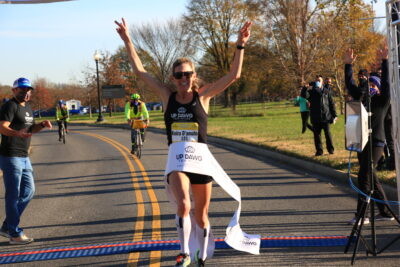
D’Amato, 36, attacked the record from the start. She needed to average 5:13 per mile, and hit the first mile in 5:10. She had already separated herself from the four other women who were competing, including 2020 USA Olympic Trials Marathon runner-up Molly Seidel. She held a level pace through 4 miles (20:40), but picked it up with a 5:05 fifth mile.
Although the weather was clear and windless for the 8:00 a.m. start, temperatures were cold (the limited group of officials and spectators wore winter clothes). Nonetheless, D’Amato threw off her headband in the fifth mile, and her arm warmers in the seventh reflecting how hard she was working. She clocked 5:03 for mile six and 5:07 for mile seven, building a good cushion on the record.
About 48 minutes into the race, D’Amato got a stitch on her right side. She could be seen on the broadcast rubbing her ribs next to her bib number, and raising her right arm to lift her rib cage, a common technique to relieve stitch pain. Although her final mile was her slowest (about 5:23), the record was never in doubt.
While D’Amato’s mark fell short of the absolute (mixed-gender) American record of 50:52 set by Molly Huddle en route at the 2018 Aramco Houston Half-Marathon, it was remarkably close given the fact that she did not have the benefit of any runners near her to help with the pace or to create a draft. She ran the entire course today with only the lead cyclists for company.
Today’s record was only one of several great performances by D’Amato this pandemic year, a full-time realtor from Midlothian, Virginia, who does not have a kit sponsor. Before the pandemic in January and February she ran personal bests for the half-marathon and the marathon of 1:10:01 and 2:34:24, respectively, but really began to shine over the summer. She clocked 32:33.44 for 10,000m on the track in July, blasted a 1:08:57 solo half-marathon in October, and a lonely 15:08 road 5-K (course not certified) earlier this month. She used all of these performances, she said, to tune-up for today’s race which she helped fund out of her own pocket.
by David Monti
Login to leave a comment
Keira D’Amato Is Trying to Break the American 10-Mile Record on Monday. It Could Cost Her Thousands of Dollars.
Since 2011, Keira D’Amato has been part of the race committee for the Credit Union Cherry Blossom Ten Mile Run, the famous Washington, D.C. road race held along the banks of the Potomac River. She’s held a few different roles over the years; recently she’s been responsible for coordinating speakers for clinics at the race expo. This year, Molly Huddle was one of the scheduled speakers, and D’Amato told her she believed Huddle could break the women’s-only American record of 52:12, set by Janet Bawcom at Cherry Blossom in 2014 (coincidentally, D’Amato held the finish line tape for that race). After telling Huddle about the record, D’Amato realized something: I can run that fast too.
Over the following six months, as D’Amato has risen from obscurity to one of the best distance runners in the United States, that statement has become blindingly obvious. After running a personal best 2:34:24 to finish 15th at the Olympic Marathon Trials in February, the 36-year-old has spent the summer and fall demolishing her pbs, from a 15:04 time trial 5,000 on the track in June to a 32:33 10,000 at the MVMNT Race Series in July to a 68:57 to win the Michigan Pro Half Marathon on October 28.
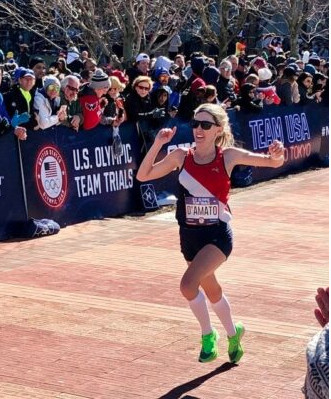
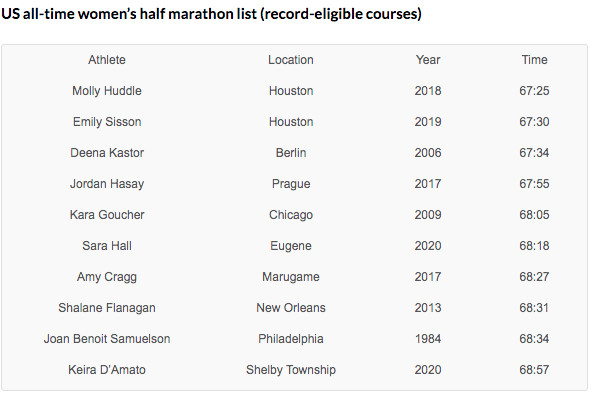
On Monday, D’Amato will try to back up her claim from the spring: she’s going for Bawcom’s record at the Up Dawg Ten Miler, where she’ll face a five-woman professional field that includes Olympian Molly Seidel. And that leads into one of the oddest statistics of a very odd year.
If D’Amato had broken the record at Cherry Blossom in April (which cancelled its 2020 edition due to COVID-19), she would have earned a $10,000 bonus.
If D’Amato breaks the record on Monday — or even if she doesn’t — she could end up out around $8,000.
That’s because D’Amato is covering most of the costs of the Up Dawg Ten Miler, which will take place in an undisclosed location in the DC area. Even though D’Amato is staging a race for five athletes rather than Cherry Blossom’s typical 17,000, several key expenses remain: getting the course USATF-certified and measured, securing park permits and road closures. It can add up quickly.
And then there is drug testing. USATF rules state drug testing is only required to ratify American records in events for which World Athletics recognizes an official world record. Since 10 miles is a “world best” distance, that means drug testing isn’t required to ratify an American record at the Up Dawg Ten Miler — but D’Amato is leaning toward including it anyway to avoid all doubts. However, based on the quote she received from USADA, it would run her an extra $3,000-$3,500. She hasn’t made a final decision yet.
There is an online store selling race merchandise to help offset the cost of the event. And around 20 members of the CUCB organizing committee have also chipped in a total of $2,000 — and, more importantly, their time — so that D’Amato can chase the record.
“If there was a way to measure intensity per person, this race would be much more intense [than the Cherry Blossom Ten Mile Run],” says CUCB event director Phil Stewart. “We’re not dealing with getting 17,000 people entered in the race and moving them around or ordering as many porta potties or things like that, but this is a group of special individuals. I’ve spent a lot of time being consumed by making sure that we have all of the conditions set for the record to be accepted if the record is broken. If Keira or anybody breaks the record here, the worst nightmare would be that there was some little USATF rule that I didn’t know about that was required for an American record to be set.”
Stewart knows that feeling all too well; last year, Stanley Kebenei thought he had broken Greg Meyer‘s American 10-mile record at Cherry Blossom, only for it to be revealed that a set of cones had been improperly placed, making the course 240 feet short (CUCB still paid Kebenei the $10,000 bonus).
With no mass race entries to fund the Up Dawg Ten Miler, CUCB will lose money on the event. But it’s worth it to Stewart to support D’Amato, whose meteoric rise he has followed first-hand — Stewart was among a group of CUCB committee members who traveled to Atlanta to support her in the Trials in February.
“One of the things that has been fun about [this event] is that in a time when there’s so much downbeat news, I think a lot of people have gotten excited about working on something that’s upbeat,” Stewart says.
And D’Amato? Well, in keeping with her carefree, laid back demeanor, she’s trying not to think about the cost and electing to focus on the positives. Five fast women (Susanna Sullivan, Bethany Sachtleben, and Emily Durgin round out the field) are gathering on Monday at 8 a.m. to race 10 miles. There will be a free live stream, with commentary, on the CUCB Facebook page. This should be fun, right? No. This will be fun.
“For me, it’s not about the money at all,” D’Amato says. “Right now when everyone’s starving for motivation and opportunity, I felt like this would be a service to the running community. And it fell in line really perfectly with my training too.”
Keira D’Amato’s return to competitive running began with a joke. Which, if you know anything about D’Amato, could not be more fitting.
D’Amato loves all things humor. The name of Monday’s race, Up Dawg, was her idea — a nod to a joke from The Office. When D’Amato joined Strava a few years ago, she began using jokes or puns to title her runs. Sample entry: November 16. My cousin, a magician, decided to incorporate the use of trapdoors in his shows. But I think it’s just a stage he’s going through. She used to rely on her children’s popsicle sticks for material or by asking her Amazon Alexa, “Tell me a joke.” As she amassed Strava followers (she’s over 2,600 now), she began receiving suggestions from fans — which delights her to no end.
“You have no idea how awesome it is that when people hear a funny joke, they think, Oh, I need to send this to Keira,” she says.
D’Amato’s impishness was on display during Christmas 2016, when she decided to gift her husband, Anthony, an entry to the 2017 Shamrock Marathon, held in March in Virginia Beach.
“Who gives someone a gift of a marathon entry?” D’Amato says. “Because that means you have to start training a lot. It’s kind of a backhanded compliment gift, I guess. But then I felt a little bad, so I signed up too.”
D’Amato was no stranger to running. A four-time All-American at American University under coach Matt Centrowitz, she finished 6th at the 2005 NCAA XC champs as a senior, ahead of future stars Amy Cragg, Molly Huddle, and Jenny Simpson. She remains friendly with the Centrowitz family, and is even in a fantasy football league with Olympic 1500 champ Matthew Centrowitz — let’s just say both D’Amato and Centro are better runners than fantasy football managers.
“I think at one point, I was in second-to-last and he was dead last,” D’Amato says. “But I also think Centro does a whole bunch of them, so maybe in his other leagues he’s doing better. But it was either the first or second week, I played him, and I crushed him.”
After graduating in 2006, D’Amato (then known as Keira Carlstrom) spent a few years running for DC Elite, a post-collegiate group coached by Scott Raczko — better known as the coach of Alan Webb. By 2008, she had lowered her 1500 personal best to 4:22, but was in constant pain, beset by a series of stress fractures and ankle pain. Her issues were the result of a condition known as a tarsal coalition — an abnormal bridging of bones in the foot — but the surgery to correct it was not covered by her insurance.
So D’Amato “retired” and got a job at mortgage giant Freddie Mac. Even after undergoing surgery to correct her condition in 2009 (her new job had better insurance), D’Amato ran sparingly for the next seven years. In her first run back after giving birth to her daughter, Quin, in August 2016 (she also has a six-year-old son, Tommy), D’Amato couldn’t make it through a three-minute run without walking. Yet she steadily built up ahead of Shamrock, and despite hail, sleet, and brutal winds on race day, D’Amato blew past her pre-race goal of 3:25.
“I couldn’t run slow enough to do that pace,” says D’Amato, who ran 3:14.
D’Amato felt there was a lot left in the tank, and took her next marathon, in Richmond in November, more seriously. After running 2:47 there — just two minutes off the Olympic Trials standard — she knew it was time to return to serious training. She reunited with Raczko, and steadily dropped her times while balancing running with her career as a realtor. When she ran a pb of 2:34 to finish 15th at the Trials at age 35, it looked like the culmination of a remarkable three-year journey.
In reality, D’Amato was just getting started.
Since the Trials, D’Amato has run personal bests over almost every distance. Her 15:04 5,000 doesn’t officially count because it came in a time trial rather than a race, but it’s faster than the Olympic standard of 15:10 and would have ranked her 6th in the US during the 2020 outdoor season.
Her most impressive performance came in last month’s Michigan Pro Half Marathon, where she clocked 68:57, 47 seconds ahead of runner-up Emma Bates, a 2:25 marathoner who finished 7th at the Olympic Trials. That made D’Amato the second-fastest American half marathoner on the year, behind Sara Hall, and 10th on the US all-time list. She is now in very elite company.
by LetsRun
Login to leave a comment
Dr. Jill Biden is a runner and in fact has run a marathon
The Second Lady is still active in the Komen Race for the Cure.
It was a charity race that got you started running, wasn’t it?
I started running after Joe and I were asked to kick off a Komen Race for the Cure in the early ’90s. After sounding the horn, we ran to get out of everyone’s way, and I got so winded that I said, “I’m going to start running.” My first run was around my neighborhood in Delaware—about a third of a mile. I kept increasing the distance until I got the bug.
What did you like about it?
It was such a feeling of freedom. I love running outside. It was a good feeling. I mean, I felt good about myself, and so that’s why I continued. I started when I was, what, 40, so I’ve been running almost 20 years. And I’ve been pretty consistent with it. I mean, I’ve had things in my life happen where I’ve had to slow down a little bit, but I’ve always gone back to it.
How many Susan G. Komen races have you participated in?
Oh, I’m not sure about the exact number—probably a handful or so. Over the years I’ve also completed several 5K, 10K, and half-marathon races for other cancer charities.
Why are you participating in the Komen race this year?
This year, I am serving as the Honorary Chair for the Washington D.C. Race for the Cure along with Joe. It’s the second year in a row we’ve done this, and we are honored to continue the tradition. On the eve of race day, Joe and I will host breast-cancer survivors for a special reception at our home. It’s a really special event and gives us a chance to spend time with survivors and their loved ones before the race. We’re really looking forward to it.
In addition to your work with Susan G. Komen Race for a Cure, you’ve been very involved in breast-cancer awareness. Why is it such an important issue for you?
Back in the early ’90s, I had several friends who got breast cancer. One died. I felt like I had to do something, and I couldn’t just sit by. Being an educator, I thought, Well, maybe there’s something I could do in education. So I started the Biden Breast Health Initiative, and I have health-care professionals go to high schools in Delaware, and we talk to them about good health practices, breast self-examination, and early detection. So not only is that awareness created for them, but they take that message home to their moms and grandmoms, and they start a dialogue. We’ve reached more than 10,000 young women.
What’s typical for a daily workout? Where do you usually run and how many miles?
Well, you know, my goal is five miles at a nine- to 10-minute pace five days a week. But between teaching and administration responsibilities, I barely make that any more. Like, for instance, this morning I had a breast-cancer event here [at the house, the Vice President’s Residence at the United States Naval Observatory in Washington, D.C.] at breakfast. I knew I was limited for time, so I did a little over four miles on the treadmill. I try to adapt my workout to where I am—I could be in another city or country—so it often depends on what I’m doing. I also try to incorporate a little bit of weight training, because I think that’s really good for your bones. That’s my basic workout.
How do you change your training when you’re preparing for a race, as you are now?
When I’ve done races, I’ve been pretty disciplined about setting up a plan for myself and then following that plan on a daily basis. That’s how I got ready for the 1998 Marine Corps Marathon, which is the only one I’ve done. I’ve done several half-marathons and 10-mile races. In the next couple months, I would love to train for the Army 10-Miler [in Washington, D.C.], and so I feel like I could work up to that.
You’re pretty close to the race in the beginning of June, so what are you aiming for now? Are you still doing five miles or are you trying to ramp it up?
Usually because of time, I can’t go over five miles—sometimes maybe I could do six or seven, and sometimes I could just do three. Because, you know, my days are pretty filled, so I have to run in the morning or whenever I have time, and then I’ve got to build in that time to get back and showered and changed and read my briefing for an event. I have to factor all of those things in.
So what’s your best time?
My best time was my only time [the Marine Corps Marathon]. I finished in 4:30:32. My goal was 4:30, so I feel like I met that goal and I was ecstatic. I have to say it was one of the highlights of my life. I saw my family at several spots along the way. And I tell you, at the end of that race, I felt like I could run five more miles. My adrenaline was through the roof.
Would you consider running another marathon?
I always said I only wanted to do one marathon, but I’ve also learned to never say never!
So now do you run with the Secret Service?
Oh, yeah. That’s another big change in my life now—I usually have someone ahead of me and someone behind me. But they’ve been great. I just say to them, “I need to pretend you’re not here,” because I love to run by myself, and they’re pretty respectful of that.
Are the Secret Service in cars or are they actually running?
No, these guys are runners. I mean, these guys are fit, and they’re good runners.
You said you love to run by yourself. Why is that? Is it because you use that time to think or is it meditative for you?
I think that running creates a sense of balance in my life. And it really calms me down. It’s a great feeling to just get out and lose myself in a run. I think that’s why I continue to run because, as you know, once you get that, you kind of crave that time for yourself.
So I guess you don’t exercise with your husband?
Sometimes Joe runs with me, but he’s not a runner. He’s an athlete, and he does a lot of exercise. Like last night, he was playing football out on the front lawn with our granddaughter who loves to play football. So he likes to do a lot of sports, but I think once you’re a runner, you really stick with it.
But I have heard you do run with some of your staff.
A lot of people on my staff run, so that’s nice. If we get time and we’re in a different city, we’ll go out and do a run.
Obviously this is a very fit administration. Is it motivating? The President and First Lady are known for it. Do you ever run with either the President or First Lady?
You know, I really love what Michelle is doing with Let’s Move! Let’s face it, we really did need something like this in this country to fight childhood obesity. I see Michelle at events or we pass one another on the way to meetings, but life is a little too hectic. I mean, that would be great, but it just isn’t reality that we would have time to do that.
So do you feel more pressure to perform well as a runner now that everyone knows you?
Well, when I’m out running, people don’t recognize me, which is great. I don’t feel pressure; I’m not out to beat anybody or hit a certain time. I just do it for the enjoyment of it. I’m doing it for myself.
How do you make the time to run? How do you carve that time out?
Well, I definitely make it a priority. That’s not always possible, but my office knows that it goes first on the list. It’s really an important part of my life, and I try to be pretty true to it.
Do you have a preferred workout outfit?
I don’t have a workout outfit. The usual, you know, black pants and a T-shirt.
Do you listen to music when you run?
Oh, yeah, I do.
Can I ask what’s on your iPod?
What’s on my iPod? Well, certainly Bruce Springsteen. [Biden was born in New Jersey.] I don’t know what else. My kids are runners, by the way. I have two sons and a daughter and two daughters-in-law, and they’re triathletes, my two sons and their wives. So if they hear something good, they’ll say, “Oh, Mom, let me put this on your iPod.”
by Runner’s World
Login to leave a comment
16-Year-Old Rheinhardt Harrison Trying To Become The Youngest Runner In History To Break The 4-Minute Barrier At The Atlanta Track Club Classic
An attempt to become the youngest runner in history to break the four-minute mile barrier headlines Saturday night's Atlanta Track Club Classic. Start lists for the middle distance-focused meet, which will be held at an undisclosed high school facility in Atlanta, were released today.
Rheinhardt Harrison is already the fastest 16-year-old in American history. Last month, the Florida high school junior ran 4:01.34 at the Music City Distance Carnival in Nashville. On Saturday, he will attempt to become just the 12th American high school runner to break four minutes in the mile and the first junior to do so since Jim Ryun's historic run in 1964. Harrison would also become the youngest person ever to run under four- minutes at 16 years, 6 months and 28 days old. Jakob Ingebrigtsen of Norway was 16 years, 8 months and 18 days old when he broke four-minutes at the Prefontaine Classic in 2017.
Harrison will be joined on the start line by former Florida State standout Kasey Knevelbaard (3:58.08). Multiple pacemakers have been assigned to the race with a goal pace of 1:59 through 800m for Harrison.
The District Track Club's Edose Ibadin leads the men's 800m having run a season's best of 1:44.81 last month in Washington D.C. Teammate Alex Amankwah (1:44.80) and Atlanta Track Club's Abraham Alvarado (1:46.62) will challenge Ibadin for the victory.
The women's 800 includes two women on the cusp of breaking two minutes. New Balance's Hannah Segrave (2:00.18) and The District Track Club's Jazmine Fray (2:01.18) lead a field that will also include high school national record holder Sammy Watson (Adidas) and former NCAA runner-up Allie Wilson (Atlanta Track Club).
The Atlanta Track Club Classic will kick off with a series of masters races including a men's and women's 100m and a men's mile. Elite races will be streamed on Atlanta Track Club's Instagram account (@atlantatrackclub) beginning with the men's 800m at 7:45 p.m. EST.
Atlanta Track Club will follow strict COVID-19 safety protocols as required by USA Track & Field's sanctioning requirements to ensure the safety of the athletes, coaches and staff. All athletes must submit two negative COVID-19 tests within seven days of the event. Wellness checks will be administered on site. No spectators will be permitted inside the venue.
Login to leave a comment
Nick Willis, Emma Coburn, Cory McGee, Ce’Aira Brown And Morgan McDonald Among Those Competing At The Music City Distance Carnival
Putting on an invitational track meet in the United States is hard in the best of times, but is nearly impossible during the current COVID-19 pandemic. Meeting the USA Track & Field requirements for a COVID-safe meet are very difficult, never mind getting adequate sponsorship in the middle of a recession, attracting the attention of top athletes who are hunkered down at home just trying to stay safe, and having to stay within state and local regulations for in-person gatherings. Large crowds aren’t permitted anywhere, so you can forget about revenue from ticket sales.
But Dave Milner of the Nashville Track Club is an especially determined meet director. The 49 year-old coach and former athlete, originally from Leeds, England, was determined to hold the 18th edition of the Music City Distance Carnival this year, and do it at a high level despite the crisis. After several delays, countless hours of work, and a little bit of good luck, his meet is set to go this Saturday in Nashville and will feature top-level athletes with Olympic or World Championships credentials like Ben Flanagan of Canada; Nick Willis of New Zealand; Edose Ibadin of Nigeria; Morgan McDonald of Australia; and Emma Coburn, Cory McGee, and Ce’Aira Brown of the United States.
Milner started the process of re-thinking the meet when the COVID crisis first struck in March.
“The meet is typically end of May, beginning of June,” Milner told Race Results Weekly in a telephone interview today. He continued: “When all of this stuff happened in early March I was still optimistic that I could get it done that weekend. Nobody knew then how bad it was going to be.”
But as the virus spread in the United States, especially in the south, keeping the meet on it’s normal date became impossible. Milner first tried for a one-month delay, thinking at the time that it would be adequate.
“I pushed it back to the end of June, still thinking, yeah, we can have the meet,” Milner said. He was in communication with USA Track & Field about the new requirements for battling the spread of COVID and thought that staging the meet was doable in that time frame. He had a core set of training groups which had traditionally sent athletes to the meet including Team Boss in Boulder, the Atlanta Track Club, and the Under Armour District Track Club in Washington, D.C., and he felt he could count on those athletes for 2020.
But Milner had another big problem: securing a venue. The meet had usually been staged at Vanderbilt University, but that wasn’t an option this year.
“I was having a hard time trying to find a venue,” Milner said. “Vanderbilt, where the meet usually is, didn’t really want to have anything to do with it. I foresaw that early and started speaking to other venues as early as April.”
Eventually, Lipscomb Academy agreed to host the meet, and Milner decided to push the date back much further to increase the chances that athletes would be in shape and that he wouldn’t have to delay it again. He also wanted his meet to fall into a sequence with the two other meets planned for the southern region, Sir Walter Miler in Raleigh, N.C., (scheduled for August 7, but ultimately cancelled), and the Ed Murphey Classic in Memphis (scheduled for August 22).
Milner also caught another break. Swiss shoe company On, which just launched a new USA training group in Boulder under coach Dathan Ritzenhein, decided to come on board as a sponsor. To give his new sponsor the best exposure, Milner wanted the meet to have a free, live broadcast. Working with timing and meet production consultant Cody Branch from PrimeTime Timing, the meet will be broadcast live via YouTube with commentary (link to be posted on the meet website at runmcdc.org).
“We really felt there was an opportunity to hit this out of the park from a production stance,” Milner said enthusiastically. He added: “It will be live and free, which I think people will be thrilled about.”
On Saturday, access to the track will be tightly controlled. The athletes (except high school athletes) have to demonstrate that they have had two negative COVID tests since August 8 in order to compete, and the tests have to be at least 24 hours apart. Athletes must present proof of the negative tests before they will be allowed to compete, and most are emailing those results in advance of their arrival to the track at Lipscomb. Event staff and officials will have to wear masks at all times, and the athletes will have to wear masks while they are not warming up, competing or cooling down. The races are spaced out wider than usual on the schedule because competitors must leave the track completely before athletes running the next race are allowed onto the track. Milner also has to follow state guidelines to control the total number of people who are in the stadium.
“As far as the total number of people at the event, we’re allowed 250 at any given time,” Milner said. “We’re asking people not to show up for their event more than 90 minutes beforehand. And we’re asking people after they run to leave, please. We’re not encouraging people to stick around and watch the meet.”
Milner has organized some excellent races for Saturday, despite the lack of prize money. Many athletes will be trying to earn qualifying marks for next year’s USA Olympic Team Trials (standards are here: https://bit.ly/3kDXDlb). The two 1500m races may be the best with top athletes like McGee, Yolanda Ngarambe of Sweden, Coburn, Katie Mackey and Emily Lipari in the women’s section, and Abraham Alvarado, Willy Fink, Sam Prakel, Ollie Hoare and McDonald of Australia, and Carlos Villarreal of Mexico in the men’s. Milner is hoping for the fastest time on U.S. soil for this year (currently 3:34.53 by Britain’s Josh Kerr in Newberg, Oregon, on July 31).
“That race is stacked,” said Milner of the men’s 1500m. “We’re pacing it for 3:33-high pace.”
by Let’s Run
Login to leave a comment
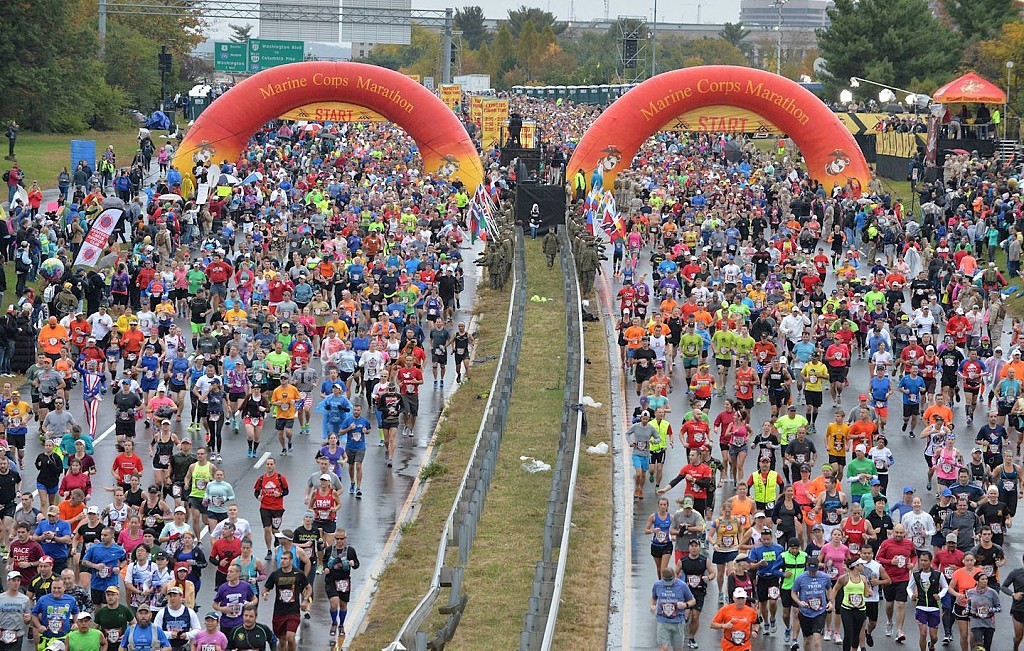
For first time in 45-year history, Marine Corps Marathon has been cancelled due to the pandemic
The COVID-19 pandemic has claimed yet another event for long-distance running enthusiasts.
The Marine Corps Marathon, with its picturesque course that takes runners through some of the most historic parts of Arlington, Virginia, and Washington, D.C., will not be held in person in 2020 for the first time in its 45-year history. The main event had been scheduled for Sunday, Oct. 25.
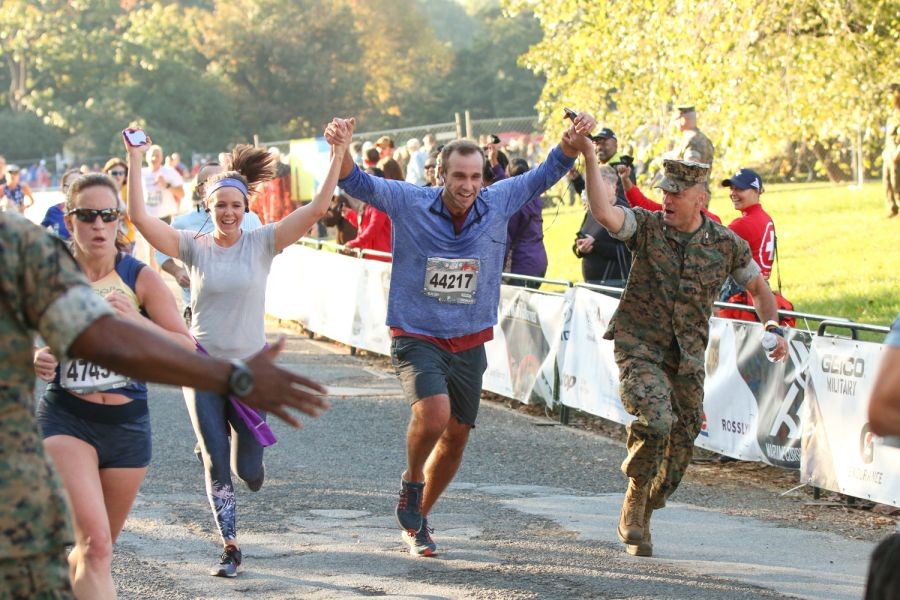
“We explored various approaches to safely execute a live event and held numerous meetings with Marine Corps leadership, local government and public health officials,” said Rick Nealis, director of the Marine Corps Marathon Organization (MCMO) in a statement. “We understand this is disappointing news for many, but we could no longer envision a way to gather together in compliance with safety guidelines.”
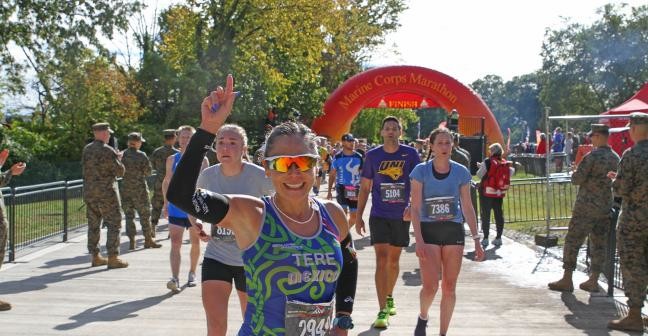
Race organizers will instead offer participants opportunities to register and complete distances for certification via the Marine Marathon website.
“Health and safety are our top priorities during this challenging time,” said Libby Garvey, Arlington County Board Chair. “The Marine Corps Marathon is a treasured event and tradition in our community that Arlingtonians look forward to each year. As we celebrate the race’s 45th anniversary this year, we will be enthusiastically and virtually cheering on each runner. We can’t wait to welcome these dedicated athletes and fans back to Arlington in person in 2021.”
by Eddie Timanus
Login to leave a comment
Marine Corps Marathon
Recognized for impeccable organization on a scenic course managed by the US Marines in Arlington, VA and the nation's capital, the Marine Corps Marathon is one of the largest marathons in the US and the world. Known as 'the best marathon for beginners,' the MCM is largest marathon in the world that doesn't offer prize money, earning its nickname, “The...
more...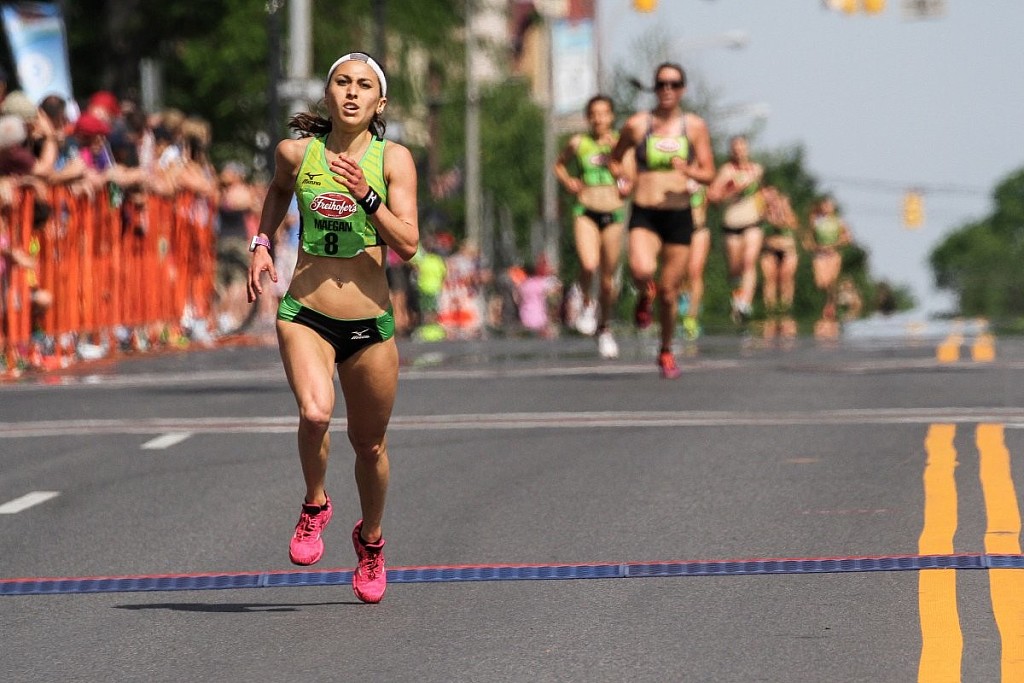
Maegan Krifchin And Recent Georgia Tech Grad Avery Bartlett Join Atlanta Track Club Elite
As the Olympic year approaches, Atlanta Track Club Elite announced Friday that it has added a middle distance star and a marathon standout to its team of Olympic hopeful athletes.
Recent Georgia Tech graduate Avery Bartlett will begin his professional career in Atlanta starting with the 2020 indoor track and field season. Bartlett is the 2018 ACC Champion in the 800m. He holds the second fastest 800m and 1500m times in school history. His 1:47.54 set in 2019 trails only Atlanta Track Club Elite teammate Brandon Lasater (1:47.38, 2015) on the Yellow Jacket all-time list.
Bartlett was born in Atlanta but grew up in Tallahassee, Florida. He returned to Atlanta to study at Georgia Tech, the school from which both his parents, his grandfather and great grandfather all graduated.
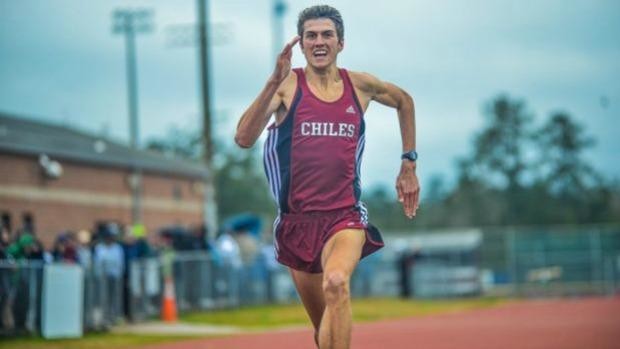
“This city has always meant a lot to me. I see putting on an Atlanta Track Club singlet as my way to fully contribute to the city’s success,” said Bartlett. “Atlanta Track Club gives me the opportunity to train with some of the best and put my limits to the test.”
Bartlett joins a talented group of middle distance men in Atlanta which includes Lasater and Abraham Alvarado, the 1,000m runner up at the 2019 USATF Indoor Track & Field Championships.
With just 11 weeks until Atlanta hosts the 2020 U.S. Olympic Team Trials – Marathon, veteran marathon star Maegan Krifchin has returned to Atlanta to train with Atlanta Track Club Elite. Krifchin, who placed 7th in the 2016 Trials, comes to Atlanta after training in Washington D.C. She previously ran with the Club in 2017. The Long Island, New York native and Syracuse University alum holds a personal best of 2:32:47 in the marathon and 1:09:51 in the half marathon.
“I came to Atlanta Track Club to be part of a community where I can support others and they can support me,” said Krifchin. “I thrive in this kind of environment and I am excited to see what we can do together.”
Krifchin is one of eight Atlanta Track Club athletes qualified for the Trials which will be held on February 29. Bridget Belyeu, Laurie Knowles, Lacey Krout, Morgan VanGorder, Wilkerson Given and Matt McDonald are also qualified for the race.
“Avery and Maegan each bring new talent, experience and personality to Atlanta Track Club Elite,” said Coach Amy Begley. “We look forward to seeing Avery compete with the nation’s best this season and to have Maegan join the hometown team competing for a spot in Tokyo.”
Founded in 2015, Atlanta Track Club Elite is sponsored by Mizuno USA and coached by Amy and Andrew Begley.
Login to leave a comment
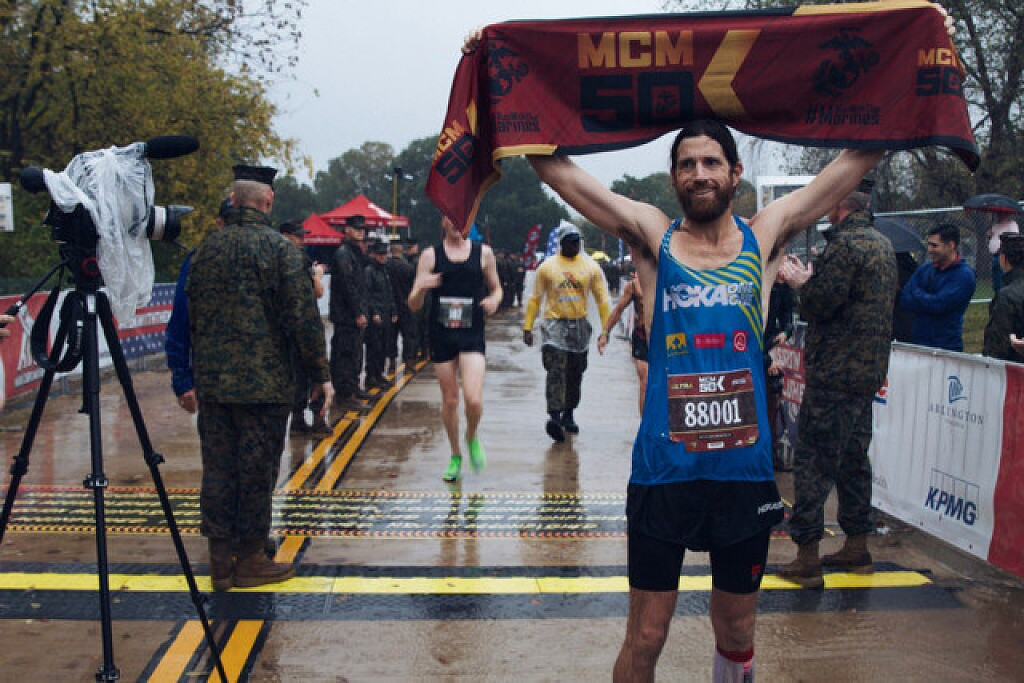
Ultrarunner Legend Michael Wardian Wins Inaugural MCM50K
The 45-year-old Arlington resident added another title to his name, while women's champion Liz Kakouris Ozeki of Rockville won her first big race in the area.
Okay, tough guy. If running a marathon isn’t hard enough, try adding a steady downpour, stretches of shin-deep flooding, and unpredictable gusts of wind. And, how about adding another 4.87 miles, making it an even 50 kilometers (31.07 miles)? Just for fun.
Any takers?
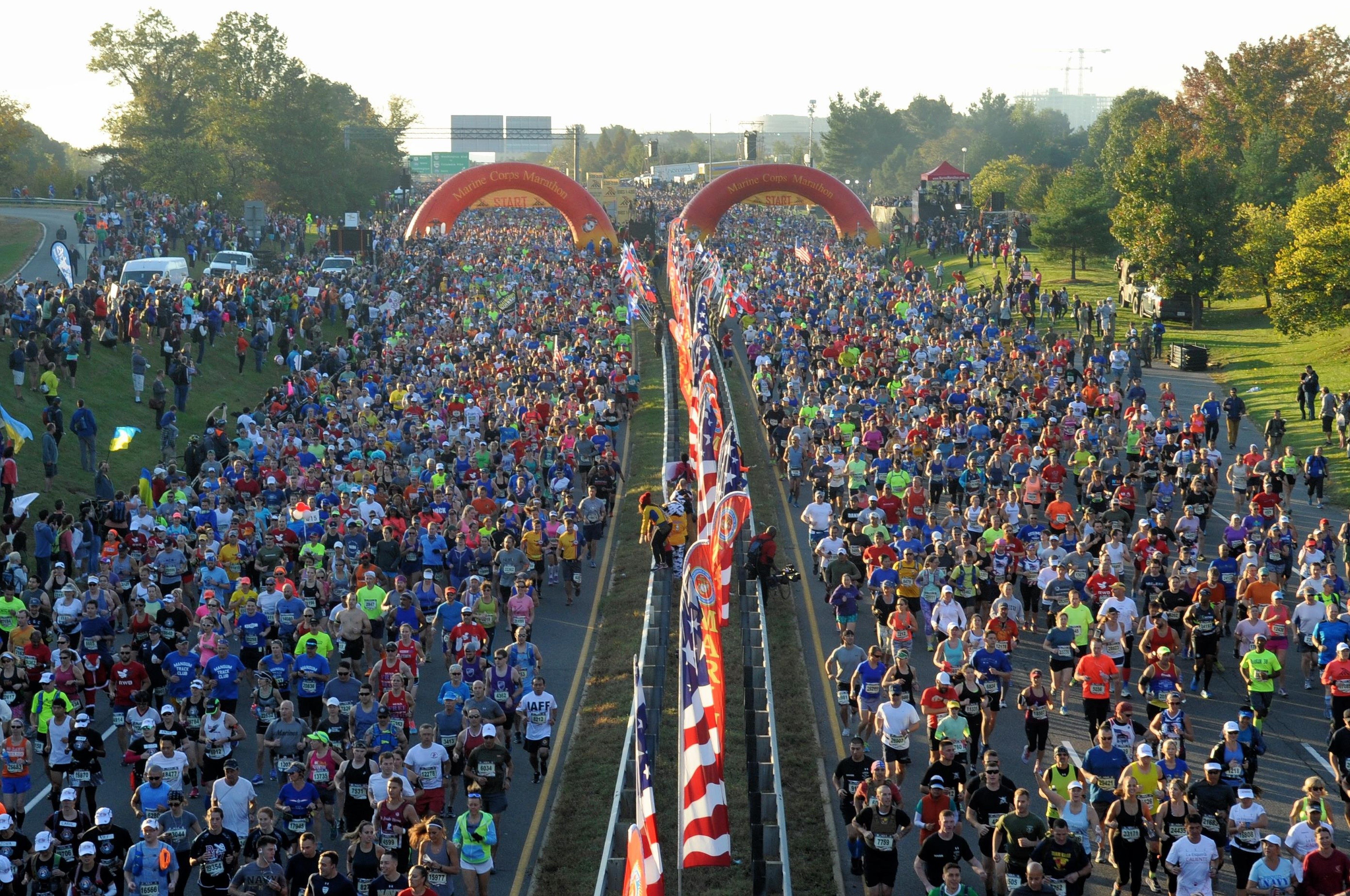
Almost 1,700 runners stepped up to the challenge and the start line on Sunday morning in the inaugural MCM50K, hosted by the event organizers for the Marine Corps Marathon. In its first year, the MCM50K sold out in less than an hour, and instantly became the largest ultramarathon in the United States.
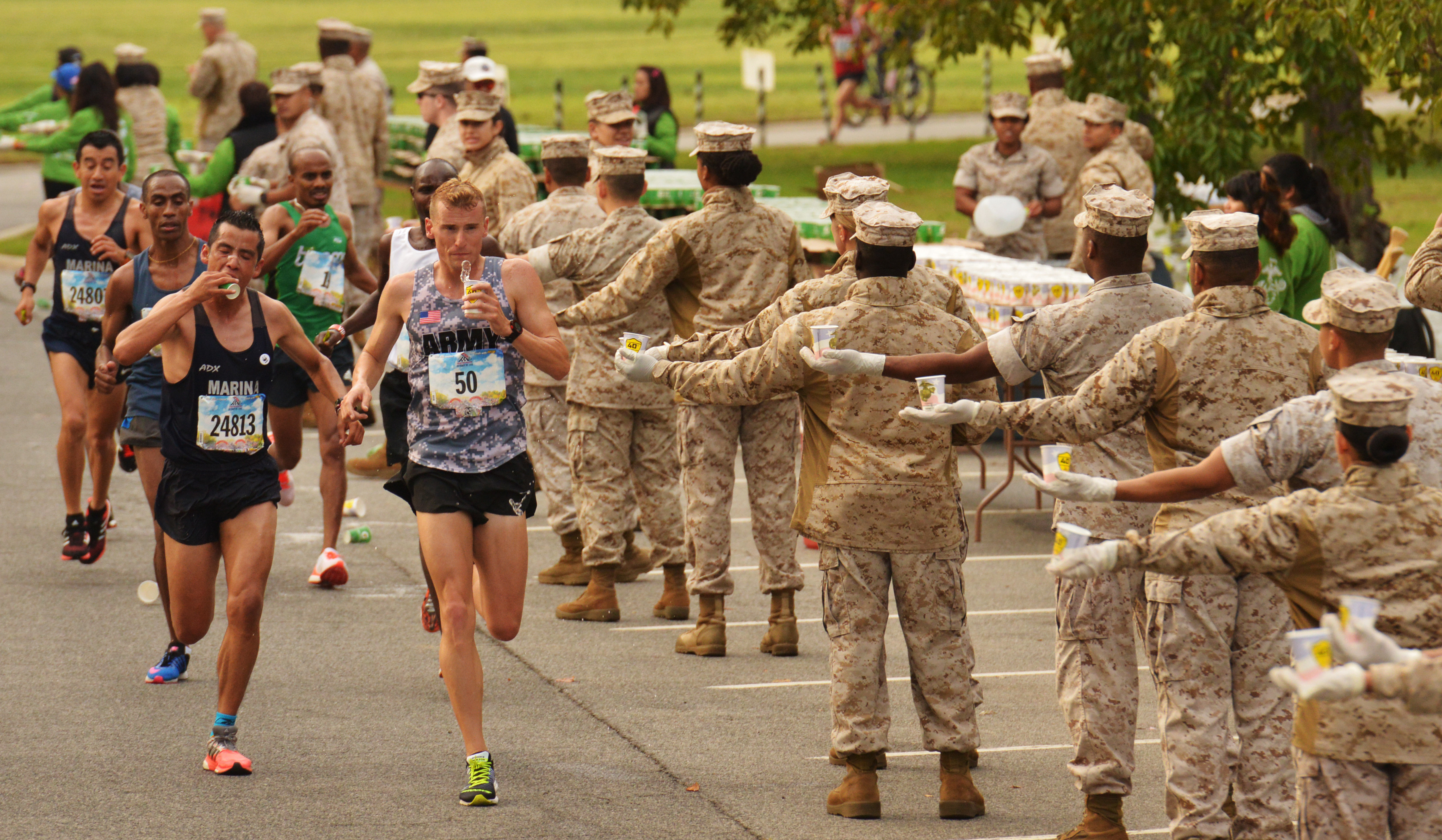
Two accomplished local runners who have made a name for themselves in the D.C. running community claimed the titles on Sunday. In the men’s race, 45-year-old Michael Wardian of Arlington finished with a time of 3 hours, 11 minutes, and 52 seconds (6:10 per mile pace). In the women’s race, 31 year-old up-and-comer Liz Kakouris Ozeki of Rockville won in a time of 3:42:04 (7:08 per mile pace).
Both Wardian and Ozeki seemed unfazed by the weather. They took the rain in stride—quite literally—and just executed their strategy, no excuses.
Wardian, a celebrity in the ultramarathoning world, was characteristically upbeat and positive about the race conditions and his preparation.
“I’m lucky because I’ve run in so many conditions, so I was prepared for the things you have to be worried about when you’re getting that kind of exposure," he said. "We’re lucky in that it was dumping [rain] but wasn’t really cold. So, I didn’t have a lot of issues.”
Ozeki also felt prepared for the weather, having been tested in prior races, including the 2018 Boston Marathon, which she likened to a monsoon.
“I ran my first two marathons in the pouring rain," she said. "I’ve done it before, so I was confident it wouldn’t affect me. I think it might actually have helped because the rain cooled me off.”
The MCM50K was Ozeki’s second race at the 50K distance, and also her second win (she set the women’s course record at the Algonquink 50K in the spring). “I knew 50K was a distance I could be competitive in,” she said. “Initially, I wanted to finish top 10. Then, I thought a podium finish would be nice. But then, a bunch of friends kept encouraging me, saying, ‘Liz! You could probably win it!’”
Ozeki tested a risky strategy, deliberately going out faster than her marathon pace, so that she wouldn’t get caught behind larger crowds when the 50K course linked back up with the Marine Corps Marathon course in Georgetown. “I kept looking at my watch and thinking, ‘I should probably should slow down,’ but I just kept hanging on,” she said.
The strategy pushed Ozeki to the brink. “I think I paid for it later in the race. My hamstrings and calves kept cramping and spasming," she recalled. "I was scared I was going to DNF. But I just kept telling myself to keep running while you can. Just get to the finish line, it doesn’t matter what place you’re in.”
With the win, it’s clear that Ozeki’s risk paid off. She had never won a big race in the D.C. area.
"So this was really incredible," she said. "And the trophy is really sweet. I’m going to cherish that for a while.”
by Kelaine Colochan
Login to leave a comment
Marine Corps Marathon
Recognized for impeccable organization on a scenic course managed by the US Marines in Arlington, VA and the nation's capital, the Marine Corps Marathon is one of the largest marathons in the US and the world. Known as 'the best marathon for beginners,' the MCM is largest marathon in the world that doesn't offer prize money, earning its nickname, “The...
more...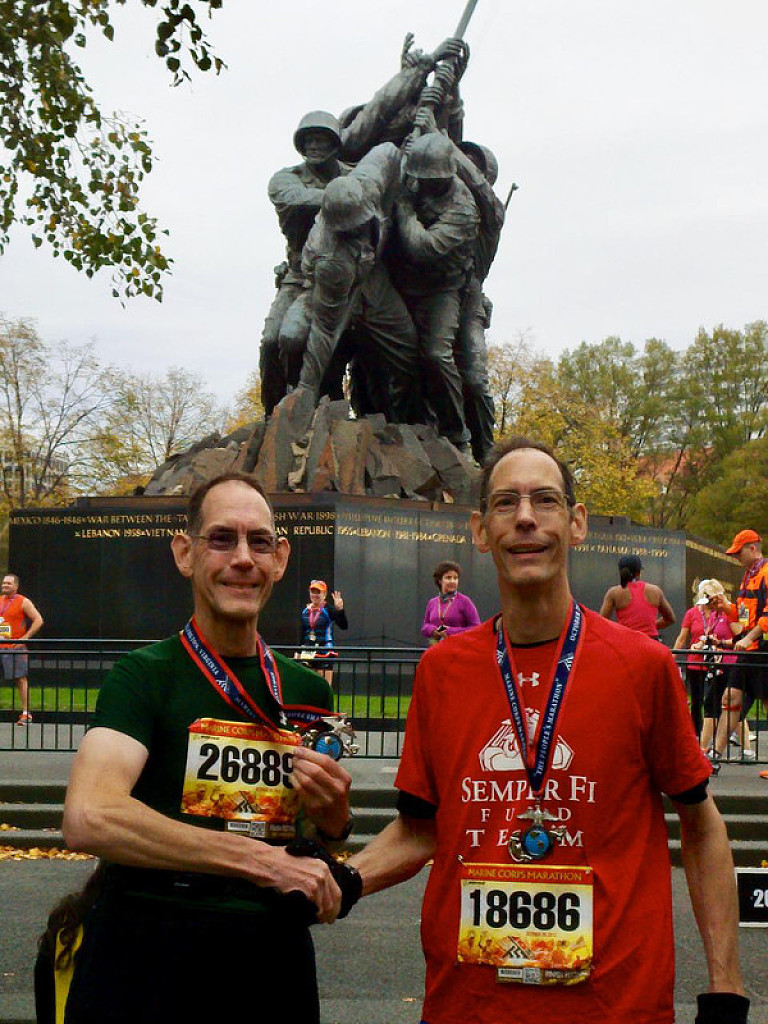
Despite Injury, Navy Veteran Michael Frank Still Plans To Cross the Finish Line at the Marine Corps Marathon
Michael Frank is raising funds to help support a veteran’s charity says he won’t let a recent stumble stop him from crossing the finish line.
Michael Frank is preparing for his 8th straight run in the Marine Corps Marathon, set for October 27th in Washington D.C. However, the Navy veteran says while on a lunchtime training run, he tripped, fell, and rolled, fracturing his left shoulder socket in the process.
He called it a “minor break” that only requires his arm to stay in a sling for six weeks. And while he can’t do any additional training until a follow-up x-ray on October 21st, he says the orthopedist said he should be able to jog/walk the Marine Corps Marathon.In light of that, he’s revised his goal for the event from a 4 hour 30 minute finish to just finishing the marathon.
As he has for the past seven years, Frank is running for the Semper Fi Fund, which benefits combat wounded, critically ill, and catastrophically injured members of all the armed services.
While many of the immediate needs of the veteran might be being met, the Semper Fi Fund specializes in helping with the ancillary needs. Frank says the fund is one of only two A+ rated veterans charities.
Despite the medical setback, he’s still doing what he can, including a fundraiser October 10th at the Buffalo Wild Wings in Howell.
by Manfred Mann
Login to leave a comment
Marine Corps Marathon
Recognized for impeccable organization on a scenic course managed by the US Marines in Arlington, VA and the nation's capital, the Marine Corps Marathon is one of the largest marathons in the US and the world. Known as 'the best marathon for beginners,' the MCM is largest marathon in the world that doesn't offer prize money, earning its nickname, “The...
more...
The 35th Anniversary edition of Army Ten-Miler is this Sunday
The 35th Anniversary edition of Army Ten-Miler (ATM) is this Sunday, Oct. 13 at 8:00 a.m. EDT in Washington, DC. The 10-mile road race starts and finishes at the Pentagon, traversing a scenic course that takes the 35,000 runners through downtown Washington, D.C.
Race Weekend officially kicks off this Friday, Oct. 11 with the ATM Expo presented by Navy Federal Credit Union (NFCU), at the DC Armory (2001 E. Capitol St., SE), offering deals on clothing, shoes, accessories and other health and fitness items. All runners must collect their bib and race packet at packet pick-up which takes place during the ATM Expo. There is no packet pick-up on Sunday/race day.
Free and open to the public, the ATM Expo highlights include Interactive Military Displays, presented by the U.S. Army Special Operations Recruiting Battalion (SORB) booth and on the lawn outside of the DC Armory.
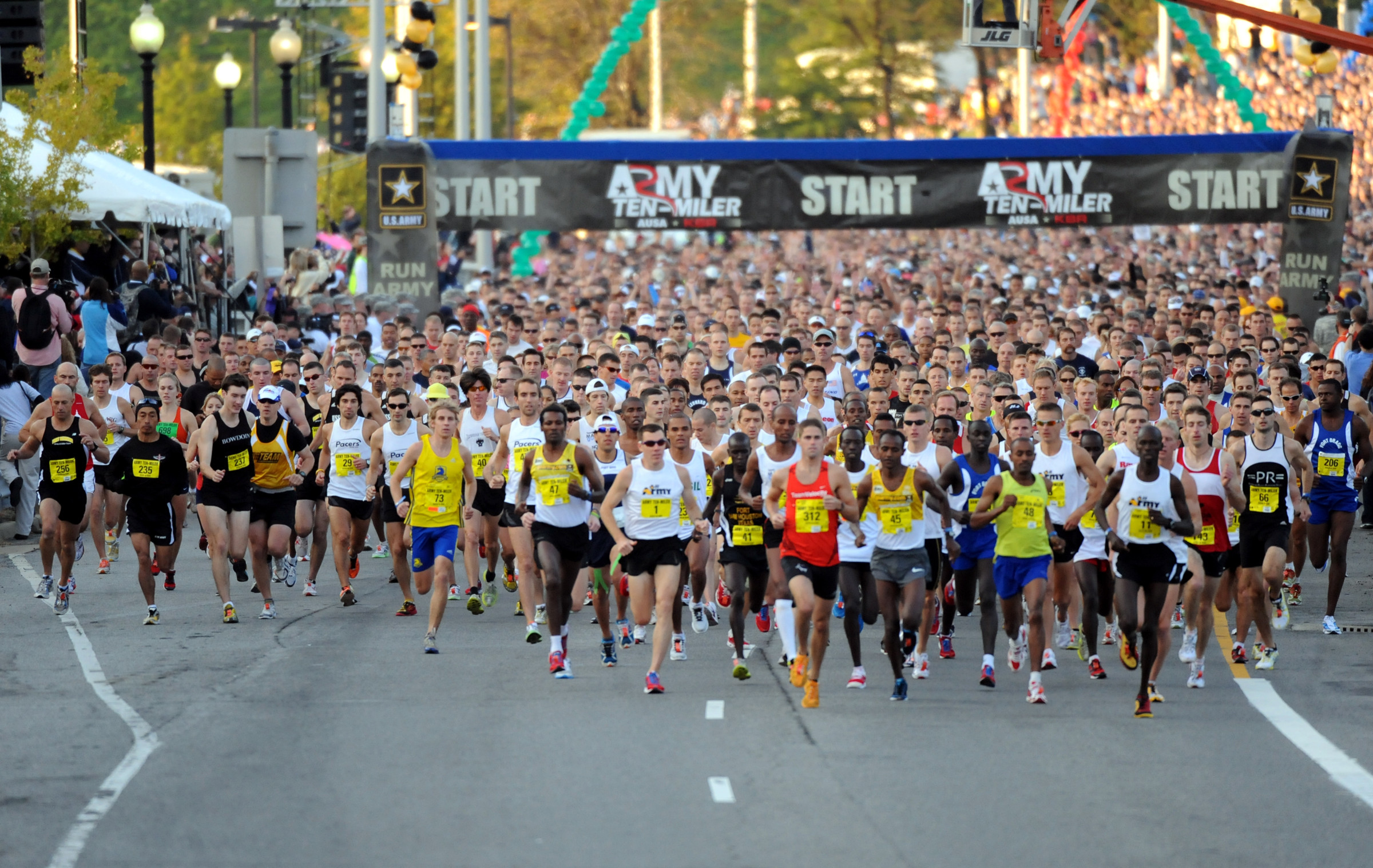
SORB displays will feature the debut of ARMYCON’s live eSport gaming tournament, helicopters, 18-foot simulator trailer, Special Operations equipment and more. Open from 10 a.m. until 6 p.m. on Oct. 11-12, the Expo is accessible by Metrorail, taking the Blue, Orange or Silver Line and exiting at the Stadium/Armory Station, or, by car, park for free in Lot 3 at the Armory. U.S. Military or Civilians with CAC/USID may access the Expo at 8:30 a.m. both days.
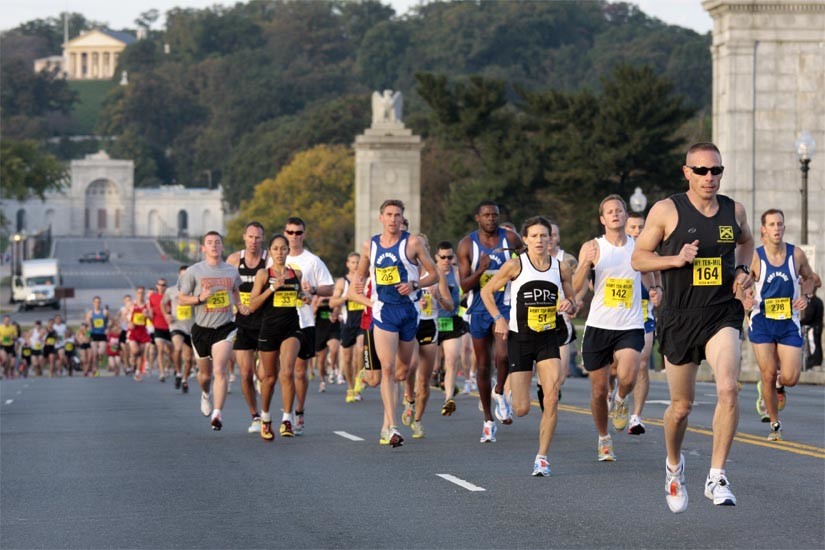
The Washington Metropolitan Area Transit Authority (WMATA) will open Metrorail one hour early, at 7:00 a.m., on race day. Runners and spectators are advised to utilize the Trip Planner function at www.wmata.com to plan their trip to the Pentagon City Metro Station.
Login to leave a comment

Army Ten-Miler
The Army Ten-Miler is the second largest ten-mile race in the United States. It is held every October in Arlington, VA and Washington, DC, sponsored by the U.S. Army Military. Each year tens of thousands of runners and spectators come to Washington, DC to join in this race classic. The Army Ten-Miler proceeds support Army Morale, Welfare and Recreation, a...
more...