

Running News Daily
Running News Daily is edited by Bob Anderson and team. Send your news items to bob@mybestruns.com Advertising opportunities available.
Index to Daily Posts · Sign Up For Updates · Run The World Feed
Articles tagged #Boston Athletic Association (B.A.A.)
Today's Running News
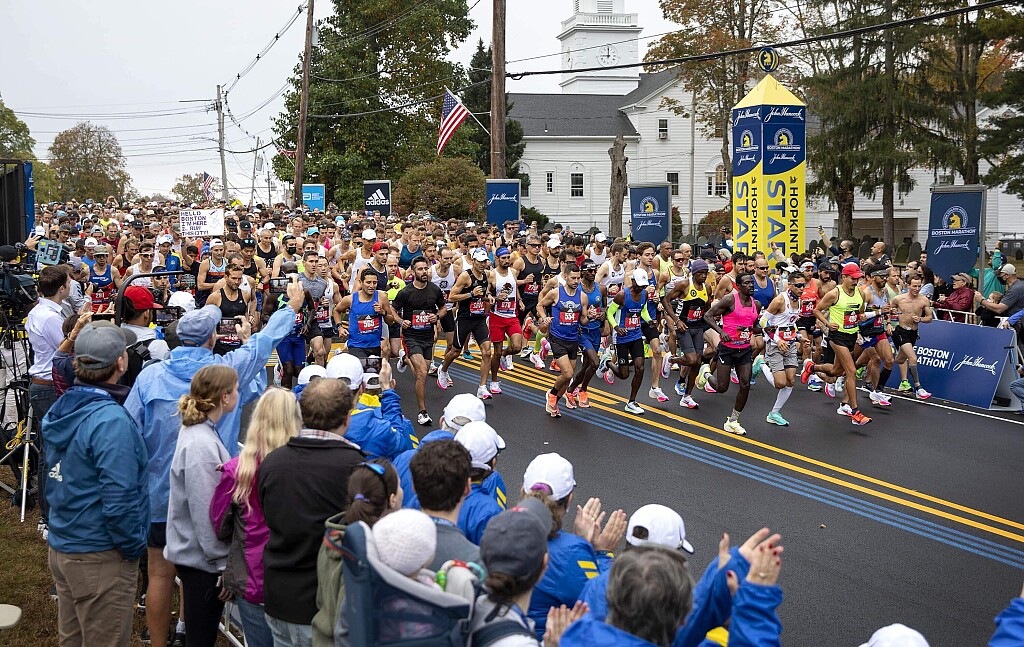


Boston Marathon Opens 2027 Registration With New Lifeline For Runners Who Miss The Cut-Off
Registration for the 2027 Boston Marathon opened today, September 14, giving thousands of runners who have achieved the official qualifying standards their chance to apply for one of the most coveted places in road racing. The registration window will remain open through Friday, September 18, at 5:00 p.m. Eastern Time.
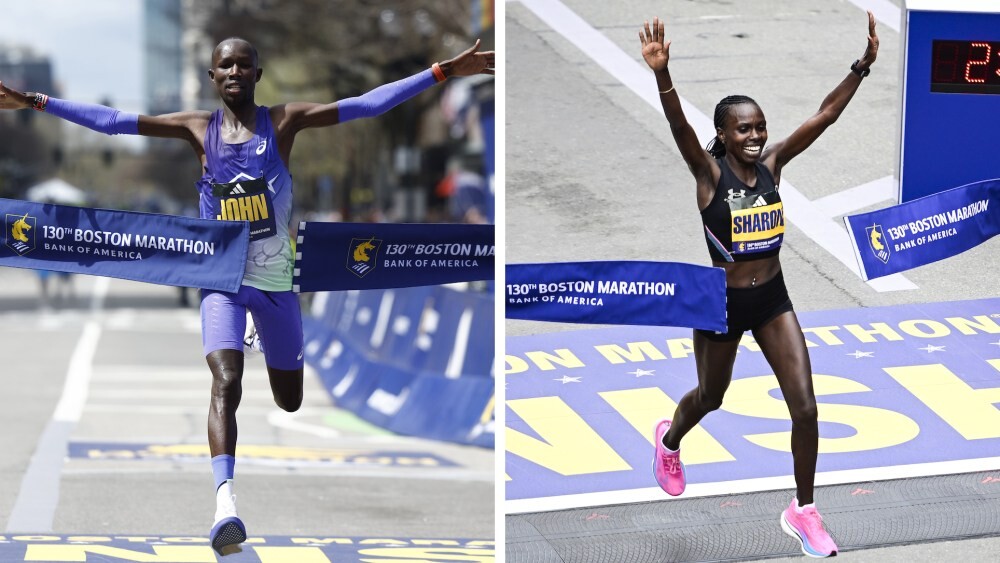
The 2027 edition of the Boston Marathon will bring a major change to the qualification process. For the first time, runners who meet their age-group qualifying standard but finish outside the eventual cut-off will have an additional opportunity to gain entry through a new Boston Qualifier Selection.
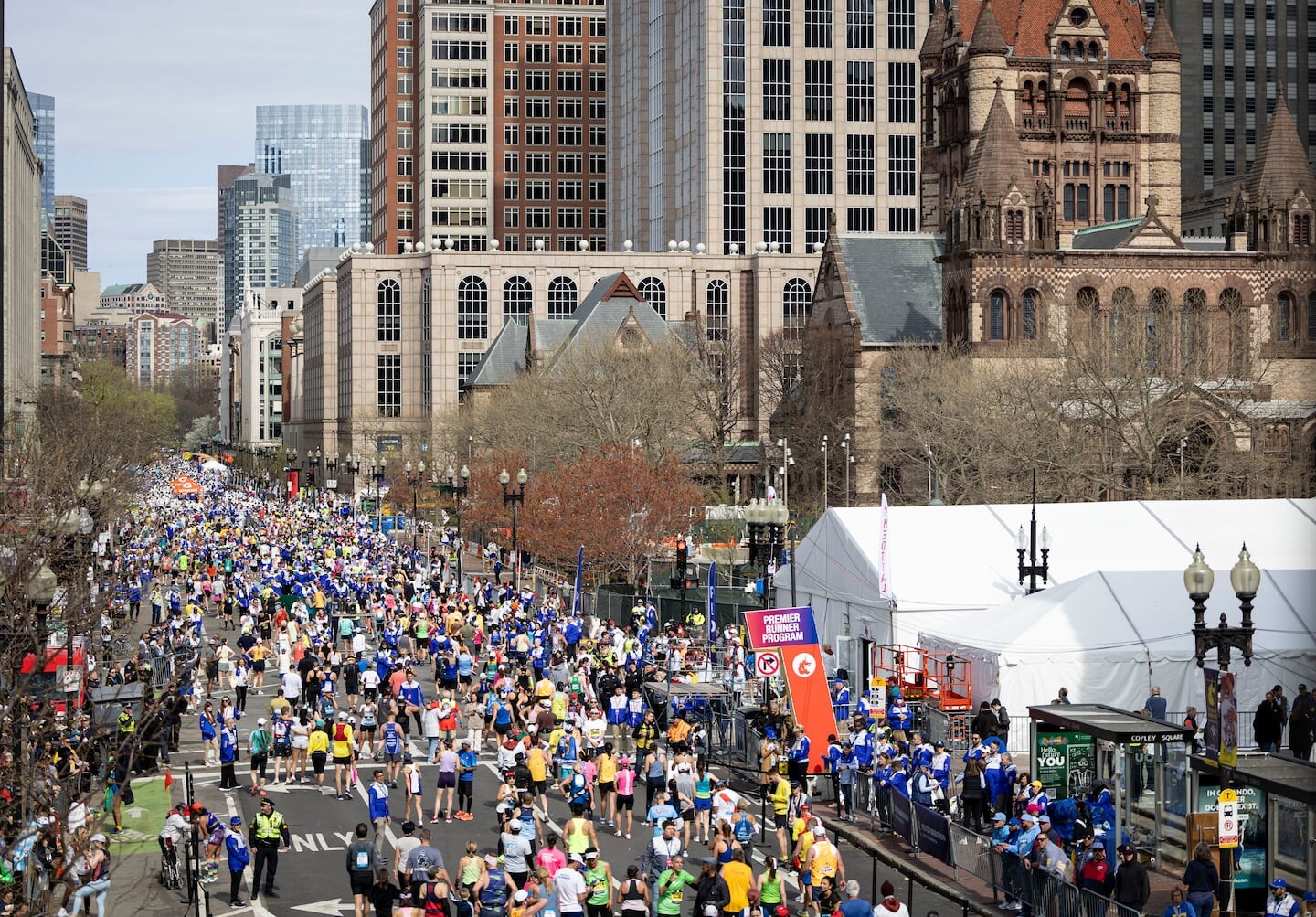
After registration closes, the Boston Athletic Association (B.A.A.) will verify performances and rank applicants according to how far they finished under their respective qualifying standards. The fastest qualifiers will be accepted first, with their performances determining the cut-off for each age and gender group.
But this time, missing that cut-off will not necessarily mean the end of the dream. Approximately 1,000 runners whose qualifying performances are not fast enough to secure automatic entry will be randomly selected through the Boston Qualifier Selection. Those athletes will automatically be included in the pool for the additional draw.
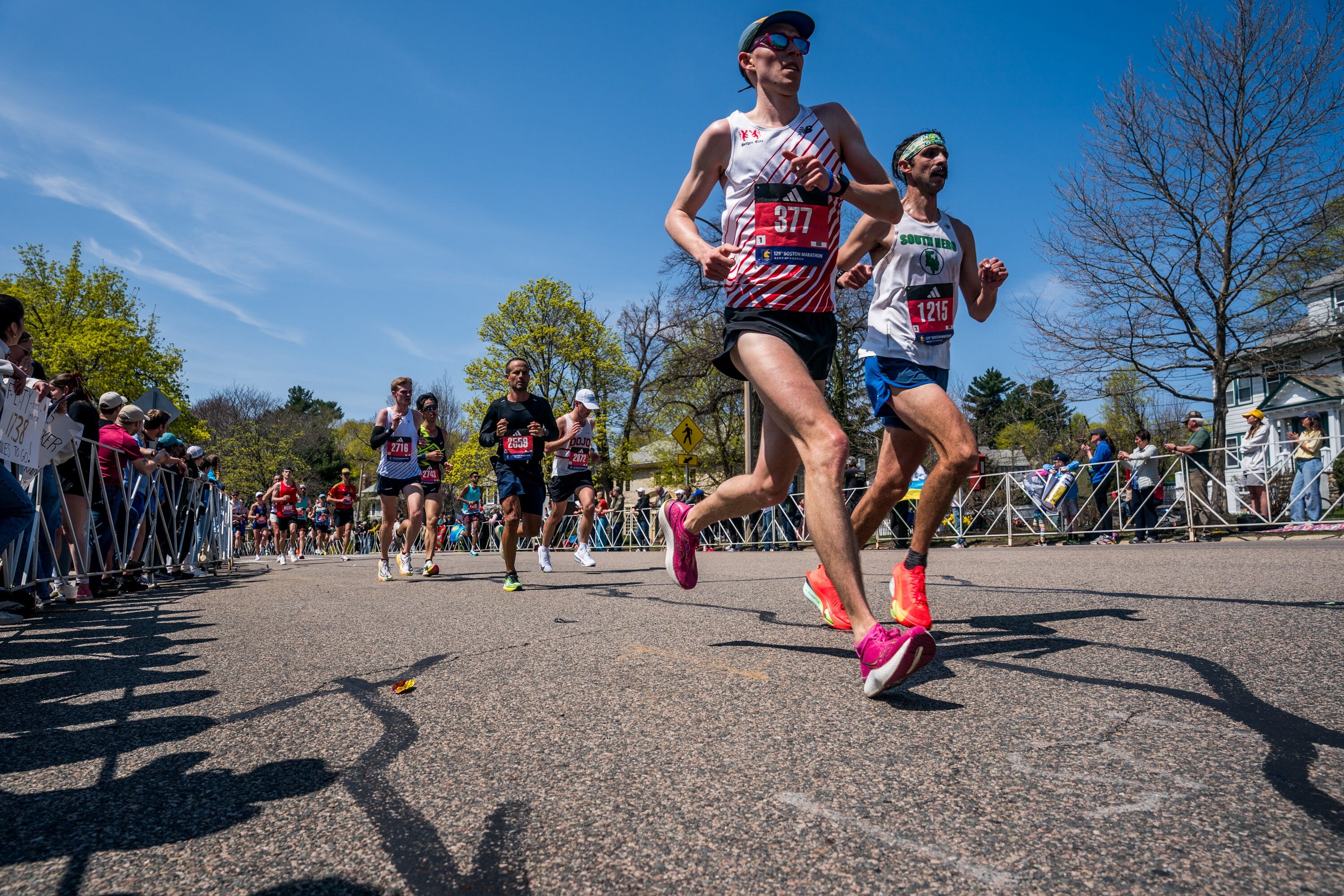
The new system comes as demand for Boston continues to outpace the number of available qualifying places. In recent years, simply achieving the published standard has increasingly failed to guarantee entry. For the 2025 Boston Marathon, 12,324 qualified applicants were not accepted, while another 8,887 missed out for the 2026 race after the qualifying field produced a cut-off of 4 minutes and 34 seconds faster than the applicable standard.
That reality has transformed Boston qualification into a race within the race. A runner may finish under the official standard and still need to be several minutes faster to secure a place, depending on the strength and size of the applicant pool.
The new random-selection component therefore offers a small but significant second chance to runners who have already done what Boston asks of them: beat the qualifying standard for their age and gender. The B.A.A. says the change reflects the increasingly fast pace of marathon running and the growing global demand for places in the historic race.
There is another important change for the 2027 registration cycle, and it could have a major impact on runners choosing where to chase their qualifying times.
The B.A.A. has introduced a net-downhill adjustment for qualifying performances. Any verified qualifying time recorded on a course with a net elevation drop of at least 1,500 feet will receive an adjustment when submitted for Boston consideration. Courses with a net drop of 1,500 to 2,999 feet will receive a five-minute addition, while courses dropping 3,000 to 5,999 feet will receive a 10-minute addition. A course with a net downhill of 6,000 feet or more will not be accepted as a Boston qualifying course.
The rule means a runner's official finishing time may not necessarily be the time ultimately used by Boston for qualification purposes. For example, a 2:45:30 performance on a course with a 2,000-foot net descent would be assessed as 2:50:30 after the five-minute adjustment.
The B.A.A. says the policy is intended to account for the significant advantage provided by courses with substantial net elevation loss and to create a more consistent standard for athletes qualifying around the world.
Despite the changes, the published 2027 qualifying standards remain unchanged. Men aged 18–34 must run 2:55:00, while women and non-binary runners in the same age group must run 3:25:00. The standards gradually increase across the older age groups, with runners aged 80 and above required to run 4:50:00 for men and 5:20:00 for women and non-binary athletes.
Importantly, qualifying standards are based on a runner's age on race day, April 19, 2027, and qualifying times must be official net times from eligible certified marathon courses. Meeting the standard still does not guarantee entry because the size of the qualifying field remains limited.
For runners chasing Boston, the message is clear: running under the standard remains the first hurdle, but running significantly faster can still make the difference between receiving a bib and watching from home. The new Boston Qualifier Selection, however, gives approximately 1,000 additional qualifiers a chance that did not previously exist.
The 131st Boston Marathon, will be held on Monday, April 19, 2027. Qualifier applicants are expected to receive their acceptance or non-acceptance notifications by early October.
Boston, long regarded as one of the hardest major marathons to enter through qualification, is changing with the times. As runners get faster and the global appetite for the race continues to grow, the road to Boylston Street is becoming more competitive—but for around 1,000 runners who fall just short of the cut-off, the dream will now remain alive a little longer.
by Erick Cheruiyot for My Best Runs.
Login to leave a comment
Boston Marathon
Among the nation’s oldest athletic clubs, the B.A.A. was established in 1887, and, in 1896, more than half of the U.S. Olympic Team at the first modern games was composed of B.A.A. club members. The Olympic Games provided the inspiration for the first Boston Marathon, which culminated the B.A.A. Games on April 19, 1897. John J. McDermott emerged from a...
more...
The Boston Marathon Trap: Why A “BQ” May Still Not Be Enough
For thousands of marathon runners around the world, qualifying for the Boston Marathon is more than a race goal — it is a badge of honour, a symbol that months and sometimes years of disciplined training have finally paid off.
But there is an important distinction every aspiring Boston runner needs to understand: running under the official Boston qualifying standard does not automatically guarantee a place on the starting line.
That reality has caught out countless runners who believed that crossing the finish line a few seconds inside their qualifying mark meant their Boston dream was secured.
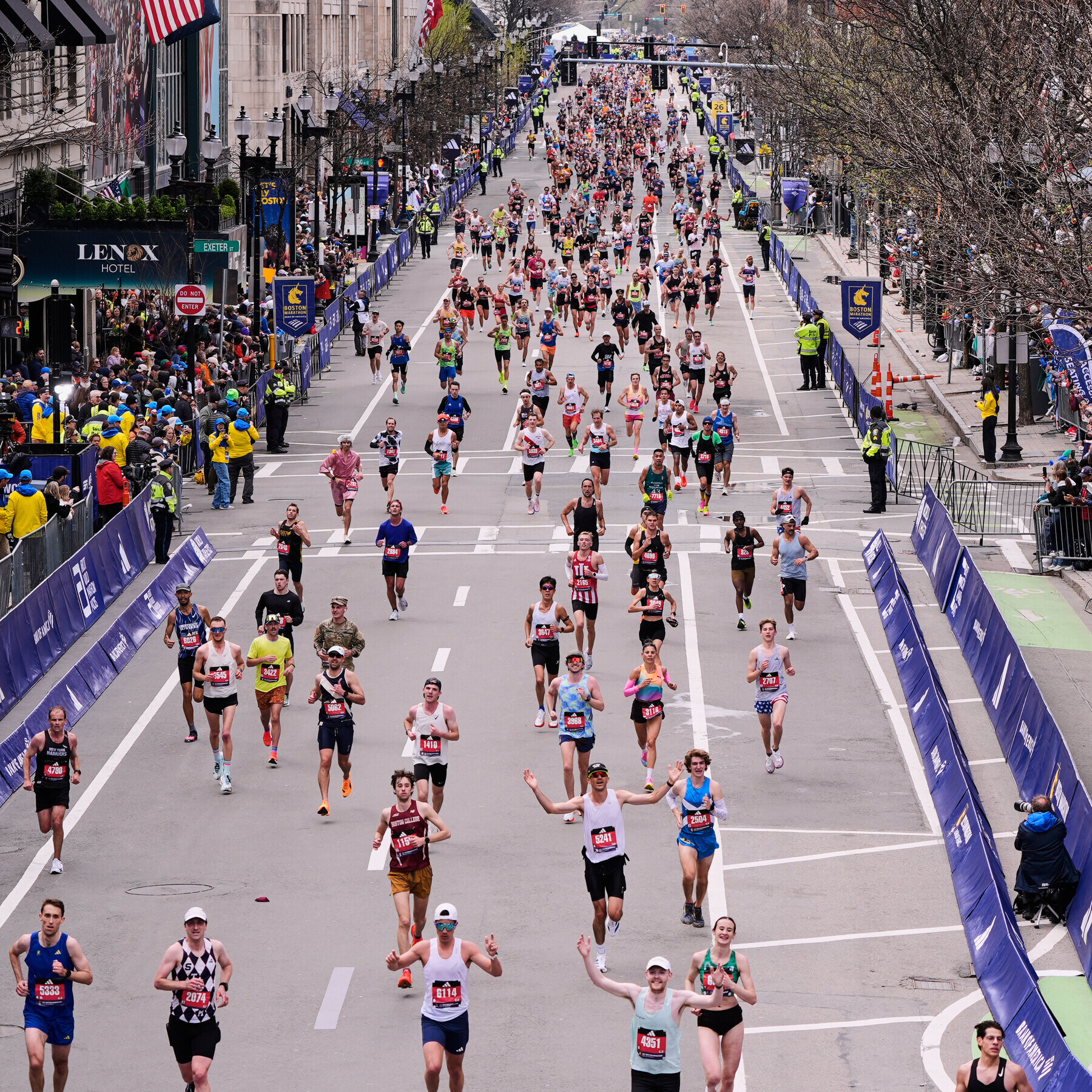
It does not.
The Boston Athletic Association (B.A.A.) sets qualifying standards according to age and gender, but the race also has a limit on the number of participants. When the number of qualified applicants exceeds the available places, the fastest runners within the qualifying pool are given priority. In other words, simply achieving the published standard gives you the opportunity to apply — it does not guarantee acceptance.
The Cutoff Is The Number That Really Matters
This is where the famous Boston “cutoff” comes into play.
The cutoff represents how much faster than the official qualifying standard a runner needed to be in order to gain entry that particular year. And it can change significantly depending on how many runners apply and how fast the qualifying field is.
The numbers tell the story.
For the 2024 Boston Marathon, the cutoff was 5:29. For 2025, it climbed sharply to 6:51. For the 2026 race, the cutoff settled at 4:34, meaning accepted qualifiers needed to be at least four minutes and 34 seconds faster than their applicable age- and gender-based standard.
That means a runner who finishes a marathon just 30 seconds under the published qualifying standard can technically be a Boston qualifier — yet still miss out on an actual place.
And that is where the heartbreak begins.
Imagine spending months building mileage, sacrificing weekends, surviving brutal workouts and finally producing the race of your life. You cross the line, look at your watch and discover that you have beaten the Boston standard.
For a moment, you believe you are going to Boston.
Then registration closes.
And you discover that the field was faster than expected.
Don't Train For The Bare Minimum
For runners serious about making the journey to Hopkinton, Massachusetts, the lesson is straightforward: don't make the official qualifying standard your ultimate target.
Make it your starting point.
If your age-group standard is 3:00:00, for example, training specifically to run 2:59:59 may leave almost no margin for the realities of Boston qualification. A stronger strategy is to set a substantially faster personal target, giving yourself a buffer against an unpredictable cutoff.
A five-minute cushion is often discussed among Boston hopefuls as a sensible ambition, but runners should understand that there is no guaranteed “safe” buffer. The cutoff is determined after registration based on the qualifying pool, and even a five-minute margin cannot promise entry in every year.
The smartest approach is therefore to aim as far under your standard as your training and ability realistically allow.
Boston Is Getting Faster
The growing difficulty of earning a place reflects the popularity and competitiveness of the marathon.
The B.A.A. has acknowledged that demand for Boston has increased while marathoners have continued to get faster. For the 2026 race, the organisation tightened qualifying standards by five minutes for runners aged 18–59, yet the race still received far more qualifying applications than available places.
For the 2026 Boston Marathon, the B.A.A. received 33,249 qualifier applications. Of those, 8,887 applicants were ultimately not accepted, despite having achieved the official qualifying standard.
Those numbers provide a powerful reminder: Boston qualification is no longer simply about beating a published time. It is about beating it by enough.
And There Is Another Detail Runners Must Watch
For the 2027 Boston Marathon, the B.A.A. has also introduced time-index adjustments for qualifying performances on courses with more than 1,500 feet of net elevation drop.
Depending on the amount of net downhill, a qualifying performance can receive a five- or ten-minute adjustment during the registration review process. That makes course selection an increasingly important part of the Boston qualification strategy.
So runners chasing Boston should not only ask, “Can I run the qualifying time?”
They should also ask:
“Can I run significantly faster than it — on a course that meets Boston's qualification rules?”
The Dream Is Boston. The Goal Should Be Faster Than Boston.
Qualifying for Boston remains one of the most prestigious achievements in recreational marathon running. But the difference between qualifying and getting accepted is now more important than ever.
The official standard gets you into the conversation.
Your margin gets you closer to the starting line.
So if Boston is the dream, don't build your entire training cycle around scraping under the qualifying mark by a few seconds. Give yourself room. Chase a faster marathon. Choose your qualifying race carefully. Prepare for the possibility that the cutoff may move.
Because the ultimate goal isn't simply to say:
“I qualified for Boston.”
It is to wake up on Patriots' Day, make your way to Hopkinton, and finally hear the words every Boston hopeful has dreamed about:
“You're going to Boston.”
by Erick Cheruiyot for My Best Runs.
Login to leave a comment
Boston Marathon
Among the nation’s oldest athletic clubs, the B.A.A. was established in 1887, and, in 1896, more than half of the U.S. Olympic Team at the first modern games was composed of B.A.A. club members. The Olympic Games provided the inspiration for the first Boston Marathon, which culminated the B.A.A. Games on April 19, 1897. John J. McDermott emerged from a...
more...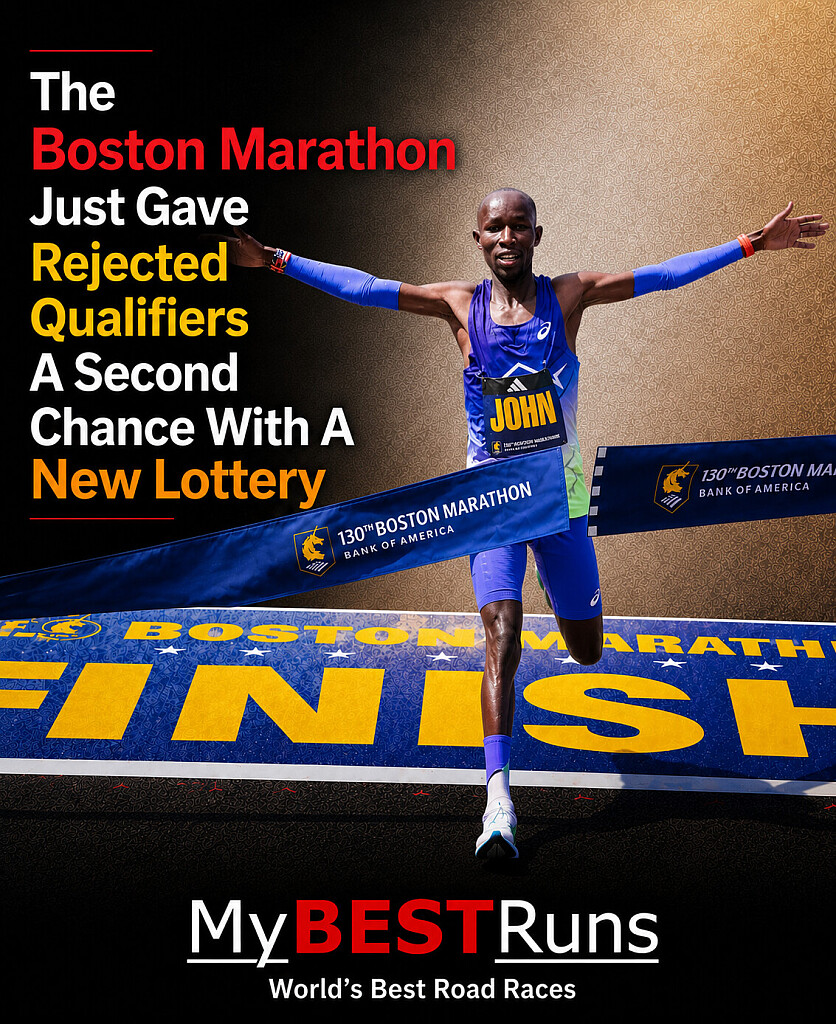
Boston Marathon Opens a New Door: Historic Lottery Gives Rejected Qualifiers a Second Chance in 2027
For generations, earning a place at the Boston Marathon has been one of the toughest achievements in distance running. Unlike most of the world's major marathons, Boston has always stood by one uncompromising principle: meet the qualifying standard—and beat everyone else who qualified—or miss out. That long-standing tradition is now evolving.
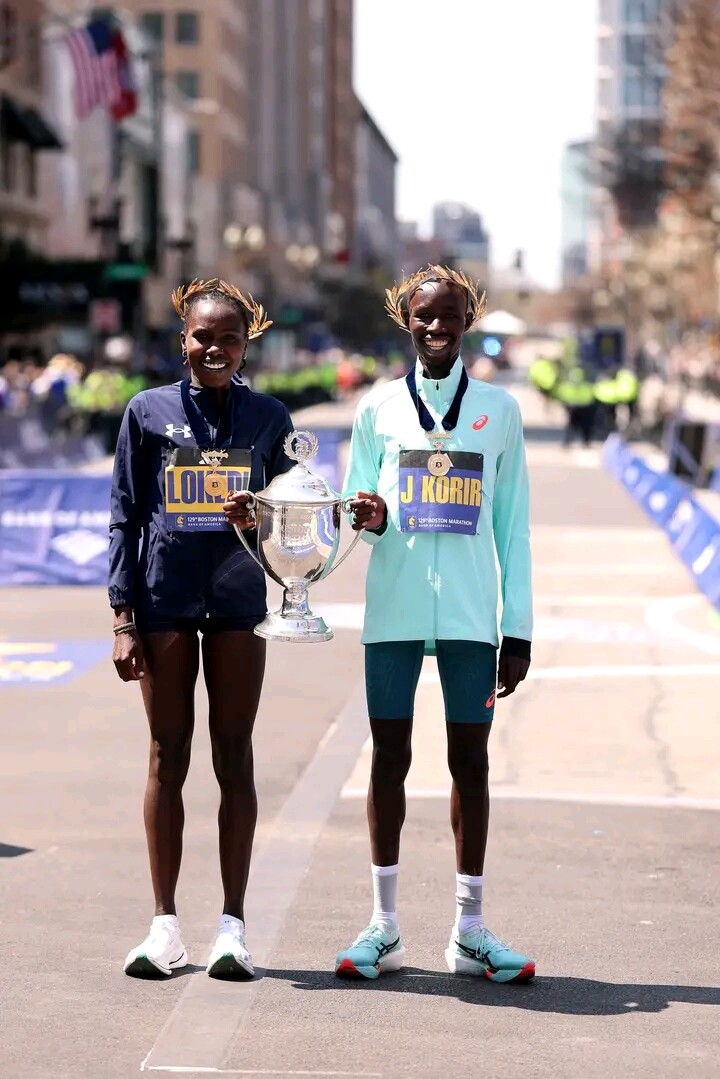
In a landmark announcement, the Boston Athletic Association (B.A.A.) has confirmed that the 2027 Boston Marathon will introduce a new lottery system, giving approximately 1,000 runners who achieve a Boston qualifying time—but narrowly miss the annual entry cut-off—a second opportunity to reach the iconic starting line in Hopkinton.
The move marks one of the most significant changes to Boston's qualification process in decades, while preserving the race's elite qualifying standards.
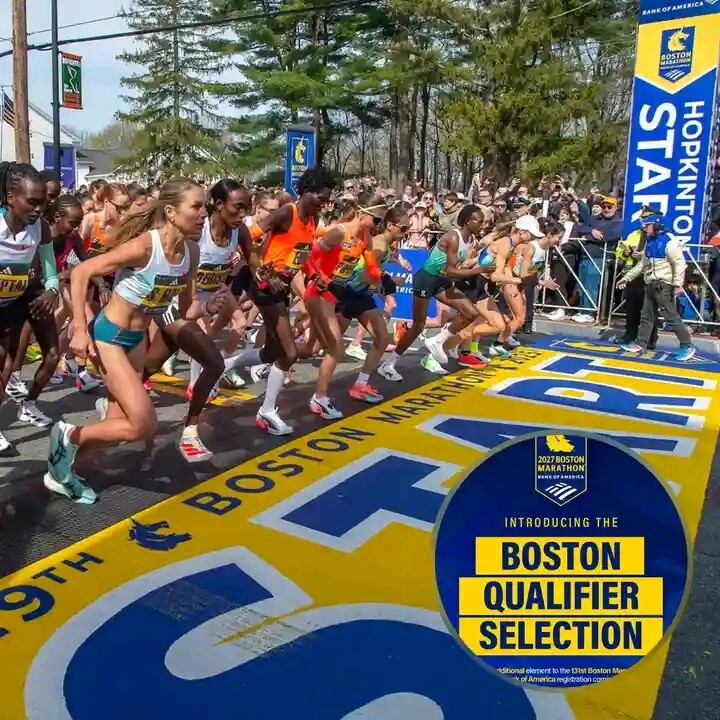
The new system will not replace Boston's traditional selection process. Instead, all applicants will continue to be ranked according to how much they exceeded the official qualifying standard for their respective age group and gender. After race times are verified, the fastest qualifiers will receive guaranteed entry until the field reaches capacity, establishing the annual cut-off time.
What changes in 2027 is what happens next.
Rather than ending the process there, the B.A.A. will randomly select around 1,000 additional runners from the pool of qualified athletes who fell below the cut-off. Any runner who meets the qualifying standard but is not initially accepted will automatically be entered into the draw, with no separate application required.
The announcement comes after several years of record-breaking demand.
More than 11,000 qualified runners were denied entry for both the 2024 and 2025 editions despite posting official qualifying performances. In 2024, 11,039 qualifiers missed out, while that number climbed to a record 12,324 for the 2025 race. Even for the 2026 Boston Marathon, approximately 8,900 qualified applicants were left disappointed after 33,249 runners applied for just 24,362 available places.
Under the new format, the additional 1,000 lottery entries would have provided an opportunity to roughly one in every nine to twelve rejected qualifiers based on recent registration figures.
B.A.A. President and Chief Executive Officer Jack Fleming said the initiative reflects the increasingly competitive nature of marathon running.
"With the increasingly fast times in our sport, our random Boston Qualifier Selection gives all those who have met the standard for their age group a chance to run Boston," Fleming said.
The decision also brings Boston closer to the registration models used by its fellow Abbott World Marathon Majors. While Boston has traditionally relied almost exclusively on qualifying performances, races such as London, New York City, and Chicago have long allocated significant portions of their fields through public lotteries.
Alongside the lottery announcement, the B.A.A. also confirmed another notable update for the 2027 qualifying process. For the first time, qualifying performances achieved on courses with more than 1,500 feet (457 metres) of net elevation loss will be adjusted through a downhill indexing system, ensuring a more consistent comparison of performances across different marathon courses.
Registration for qualified runners will take place from September 14–18, 2026, with all applicants expected to receive their acceptance status in early October.
While Boston's qualifying standards remain among the most demanding in the sport, the introduction of a lottery offers hope to thousands of runners whose dreams have previously been decided by mere seconds. For the first time in the race's storied history, qualifying alone may no longer guarantee disappointment for those who narrowly miss the cut—because chance will now have a place alongside speed on the road to Boston.
by Erick Cheruiyot for My Best Runs.
Login to leave a comment
Boston Marathon
Among the nation’s oldest athletic clubs, the B.A.A. was established in 1887, and, in 1896, more than half of the U.S. Olympic Team at the first modern games was composed of B.A.A. club members. The Olympic Games provided the inspiration for the first Boston Marathon, which culminated the B.A.A. Games on April 19, 1897. John J. McDermott emerged from a...
more...
Boston 10K Set for Thrilling Showdown as International Stars Assemble in Massachusetts
The countdown is on for the 2026 Boston Athletic Association (B.A.A.) 10K, and the men's elite race is shaping up to be one of the most competitive road contests of the season.
Scheduled for Sunday, June 21, in Boston, Massachusetts, the prestigious event has attracted a deep international field featuring proven performers from Africa, Europe, and North America. With several athletes boasting personal bests under 28 minutes, fans can expect a fierce battle from the opening kilometers to the finish line.
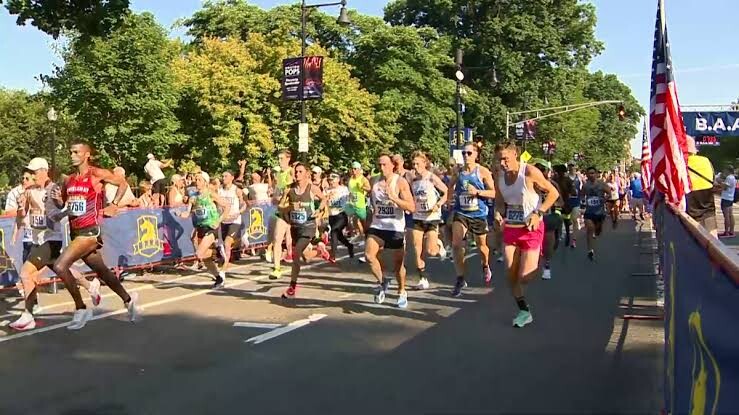
Leading the entries is Eritrea's Dawit Seare, whose impressive personal best of 27:21 makes him the fastest athlete on paper. The Eritrean will arrive as one of the leading contenders, but he faces strong opposition from a group of hungry challengers eager to make their mark on the historic Boston roads.
Kenya's Simon Mutula, carrying a lifetime best of 27:23, headlines a powerful Kenyan contingent that includes Alexander Mutiso, Patrick Kiprop, and Alex Masai. With Kenya's rich tradition of distance-running excellence, the trio will be aiming to continue the country's dominance on the global road racing circuit.

South Africa's Adriaan Wildschutt enters the race with a personal best of 27:28 and could prove to be one of the most dangerous competitors in the field. Known for his strength and tactical awareness, Wildschutt has consistently demonstrated his ability to challenge the world's best over long distances.
Ethiopia will also be strongly represented through Hagos Gebrhiwet, while Morocco's Mohamed El Aaraby and Spain's Pablo Alba add further international quality to an already stacked lineup. American hopes will rest largely on Andrew Colley, who will be looking to deliver a memorable performance in front of a home crowd.
Beyond the impressive statistics, the race promises an intriguing clash of styles, experience, and ambitions. With several athletes separated by mere seconds on personal bests, strategy, pacing, and finishing speed could ultimately determine who stands atop the podium.
The B.A.A. 10K has built a reputation for producing fast times and exciting competition, and the 2026 edition appears poised to uphold that tradition. As the world's distance-running spotlight turns toward Boston, spectators can look forward to a high-quality contest featuring some of the finest road runners currently competing on the international stage.
With national pride, valuable rankings points, and victory on the line, all signs point to a captivating morning of racing in Massachusetts. The only certainty is that the battle for the B.A.A. 10K crown will be anything but predictable.
by Erick Cheruiyot for My Best Runs.
Login to leave a comment

B.A.A. 10K
The 6.2-mile course is a scenic tour through Boston's Back Bay. Notable neighborhoods and attractions include the legendary Bull and Finch Pub, after which the television series "Cheers" was developed, the campus of Boston University, and trendy Kenmore Square. ...
more...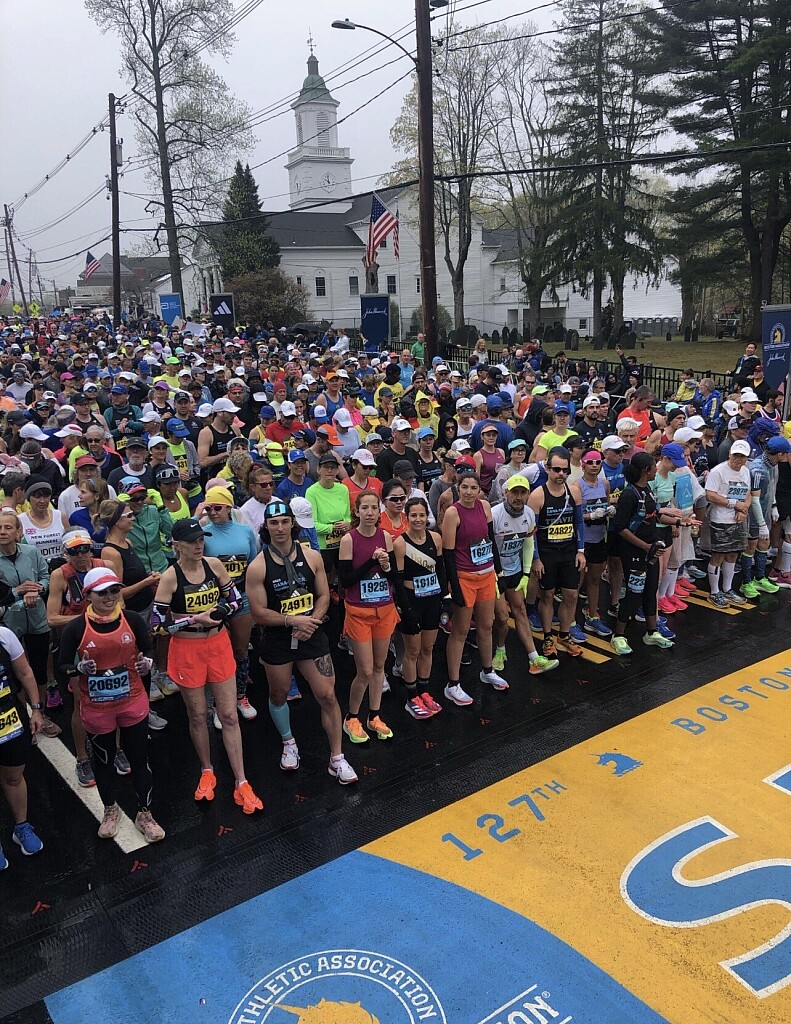
Boston Marathon Expands to Six Start Waves Beginning in 2026 to Ease Crowding
If you’ve ever run one of the marathon majors, you know how crowded the start lines can be. Thousands of runners are all trying to find enough road space to settle in. It can be chaotic, and the Boston Athletic Association (B.A.A.) has recognized that by introducing two new start waves for the 2026 race and beyond.
In a recent press release, the B.A.A. confirmed that the Boston Marathon will move from four start waves to six. The overall field size will remain at 30,000 runners, but the additional waves are designed to improve the flow of athletes from the start in Hopkinton to the finish near the Boston Public Library.
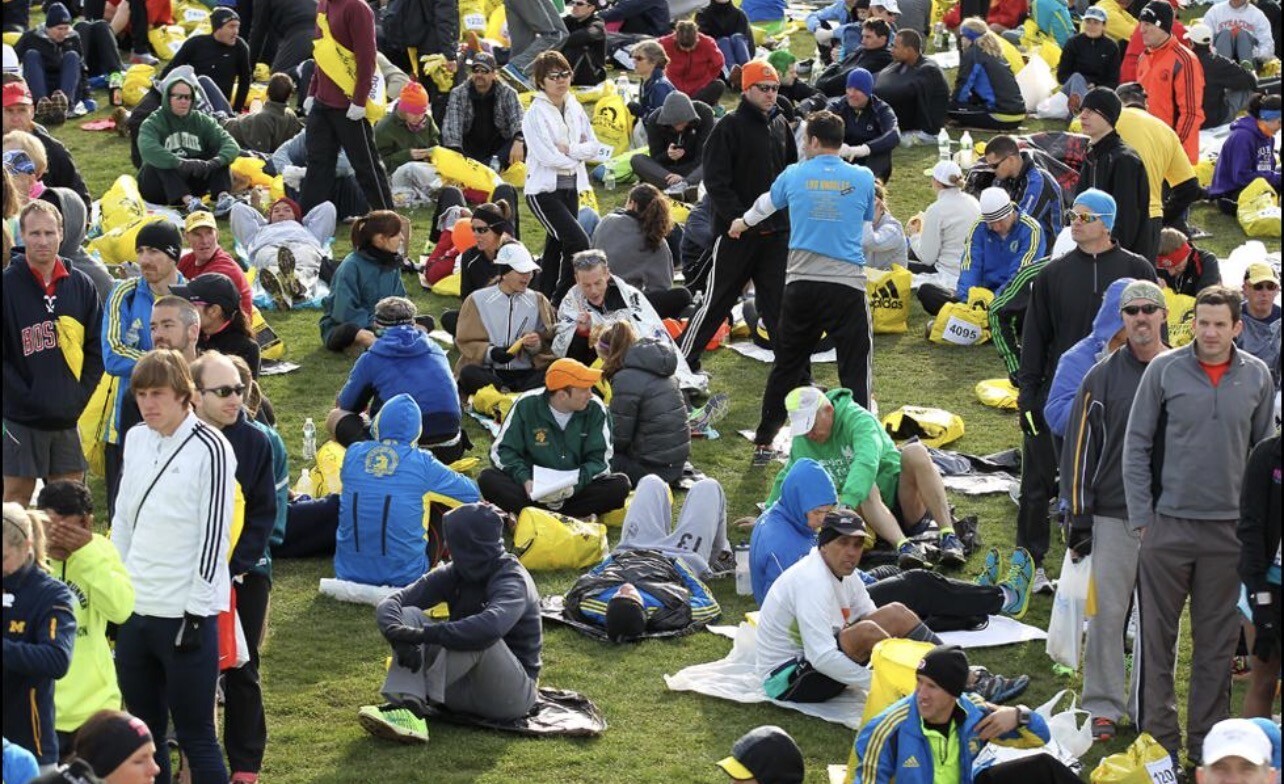
For years, Boston runners have been required to arrive three to four hours before their start time at the southwest corner of Boston Common. From there, they board school buses—often packed with 50 runners each—for the ride to a schoolyard in Hopkinton. With only four waves in the past, the system could feel congested, with overlapping groups of runners creating long lines for buses, gear check, and pre-race porta-potties.
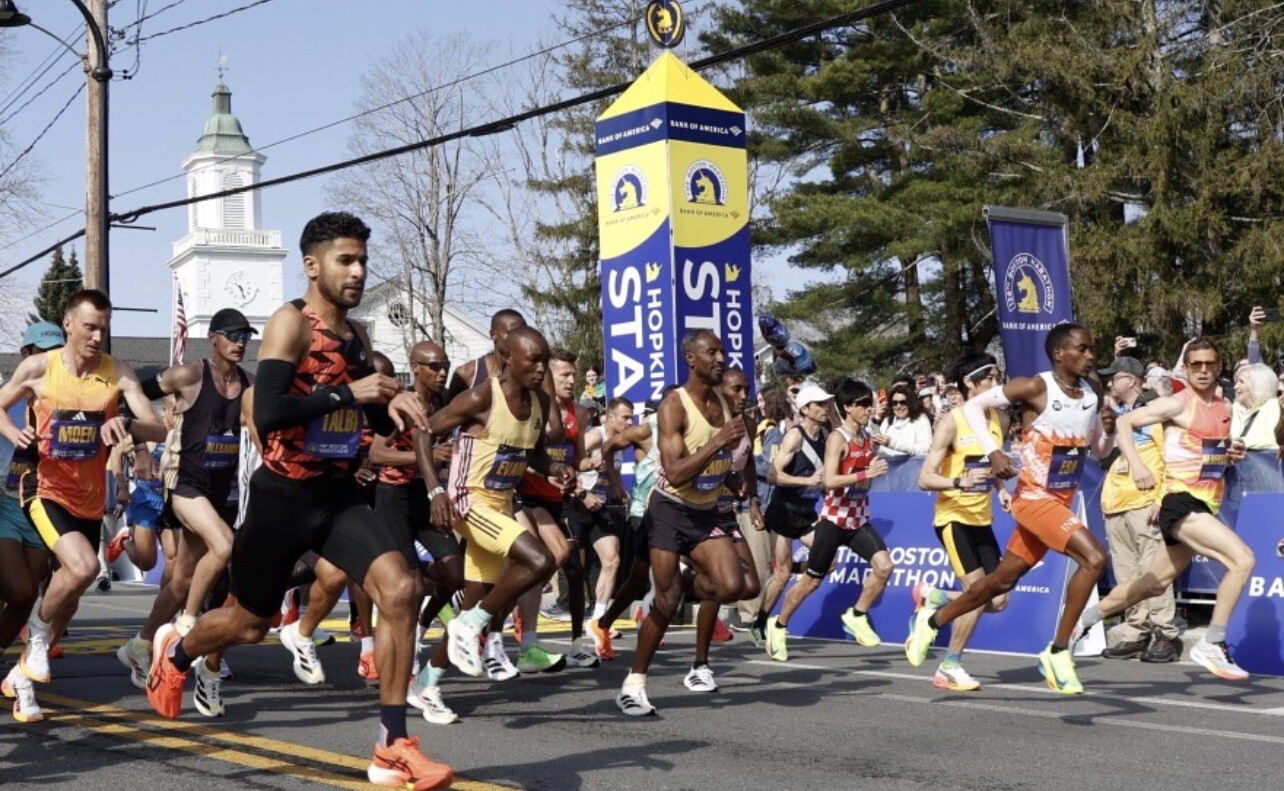
With two additional waves, organizers hope to reduce congestion and create a smoother race-day experience. Runners should encounter shorter lines and a more relaxed buildup before the race—leaving more time to focus on preparation and fueling.
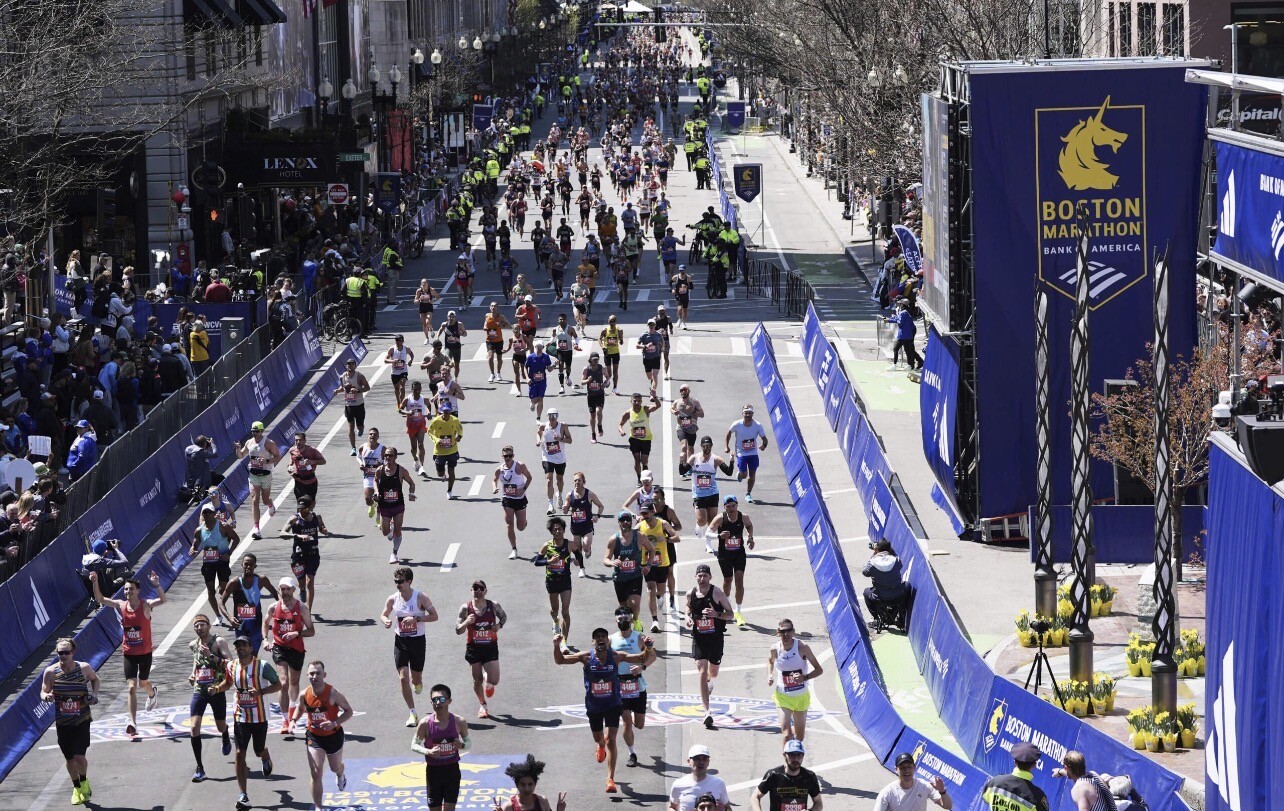
According to the B.A.A., the change follows an extensive review of race-day logistics. Crowd scientists studied athlete density throughout last year’s race and concluded that the entire start process—from gear check and bus loading to the athletes’ village and the Hopkinton starting line—would benefit from a more continuous flow of athletes.
Under the new system, wave sizes will range from approximately 3,200 to 7,100 runners, depending on qualifying times and projected finish times. In recent years, each of the four waves typically included around 7,500 runners, which contributed to the congestion.
“The new six-wave start system is aimed at enhancing each participant’s experience,” said Lauren Proshan, the B.A.A.’s Chief of Operations. “All athletes are anticipated to be across the starting line before 11:30 a.m., like previous years, and will have the same amount of time to complete the course as in 2025, with the finish line closing at 5:30 p.m. in Boston.”
The B.A.A. also announced that bib numbers, corral assignments, and start times for the 130th Boston Marathon will be released later. The race will take place on Patriots’ Day, April 20, 2026.
For many runners, the Boston Marathon start has always been part of the experience—long bus rides, crowded staging areas, and thousands of athletes waiting together in Hopkinton. With the addition of two more start waves, the B.A.A. hopes the journey from Hopkinton to Boston will begin a little more smoothly for everyone.
by Boris Baron
Login to leave a comment
Boston Marathon
Among the nation’s oldest athletic clubs, the B.A.A. was established in 1887, and, in 1896, more than half of the U.S. Olympic Team at the first modern games was composed of B.A.A. club members. The Olympic Games provided the inspiration for the first Boston Marathon, which culminated the B.A.A. Games on April 19, 1897. John J. McDermott emerged from a...
more...
2026 Boston Marathon Qualifying Standards Among the Most Demanding Ever Issued
The Boston Athletic Association (B.A.A.) has confirmed new qualifying standards for the 2026 Boston Marathon, scheduled for April 20, 2026, and they are among the most demanding ever issued in the event’s 130-year history. For runners aged 18 to 59, the time standards have been made five minutes faster than those used for the 2025 race — a reflection of both the extraordinary growth in marathon participation and the deepening field of competitive age-group runners.
These updates reinforce the B.A.A.’s commitment to maintaining the Boston Marathon as the pinnacle of achievement for amateur and professional runners alike. With more applicants qualifying each year than the race can accept, meeting the standard no longer guarantees entry — runners must often exceed the qualifying mark by several minutes to secure a bib.
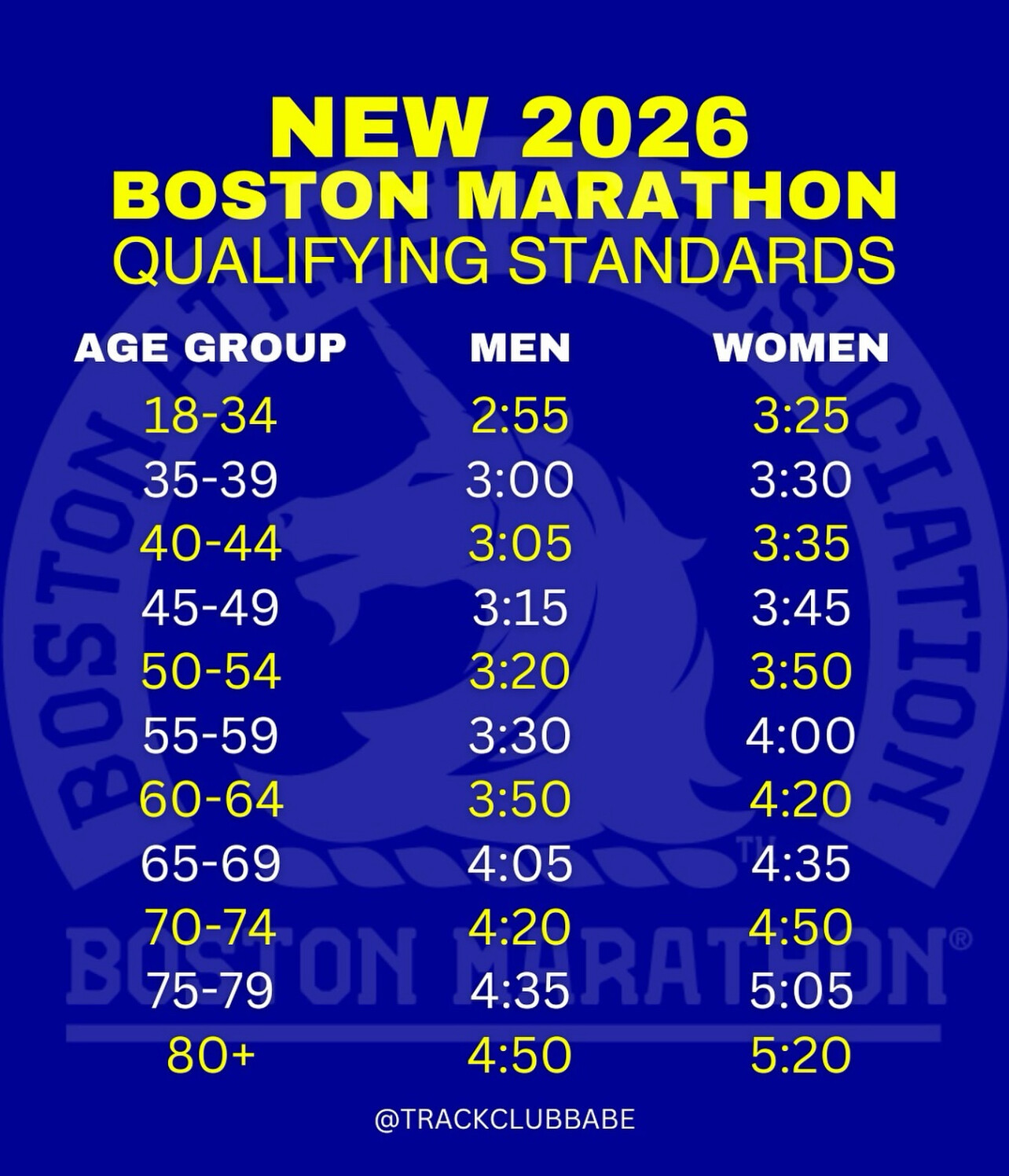
2026 Boston Marathon Qualifying Standards
Age Group – Men – Women
18–34 – 2:55:00 – 3:25:00
35–39 – 3:00:00 – 3:30:00
40–44 – 3:05:00 – 3:35:00
45–49 – 3:15:00 – 3:45:00
50–54 – 3:20:00 – 3:50:00
55–59 – 3:30:00 – 4:00:00
60–64 – 3:50:00 – 4:20:00
65–69 – 4:05:00 – 4:35:00
70–74 – 4:20:00 – 4:50:00
75–79 – 4:35:00 – 5:05:00
80+ – 4:50:00 – 5:20:00
These standards closely match the official 2026 qualifying table published by the B.A.A. Standards for runners aged 60 and above have changed little or remained consistent with prior years, while younger age divisions (18–59) now face significantly faster requirements.
Meeting these times makes a runner eligible to apply for registration, but acceptance depends on the number of applicants. For the 2025 Boston Marathon, runners needed to be 6 minutes and 51 seconds faster than the posted standard to gain entry. For the 2026 edition, the cutoff narrowed but remained steep — 4 minutes and 34 seconds faster than the standard.
Elite Field Entry
The B.A.A. does not publicly post official qualifying times for elite athletes. Instead, entries are extended by invitation to runners who have recently achieved world-class performances. While not formalized, typical benchmarks for consideration are around sub-2:20 for men and sub-2:45 for women, depending on the depth of the field and prior race results.
Course Adjustments Coming for 2027
Beginning with the 2027 Boston Marathon, new rules will redefine which marathon courses count toward qualification. Races with net-downhill profiles will face time “indexing” to ensure fairness:
• Courses dropping 1,500–2,999 feet: +5 minutes added to finishing time
• Courses dropping 3,000–5,999 feet: +10 minutes added
• Courses dropping 6,000 feet or more: will no longer count as qualifiers
These adjustments, already confirmed by the B.A.A., are designed to standardize qualifying efforts across all marathon courses and eliminate advantages from steep downhill profiles.
What This Means for Runners
For competitive marathoners worldwide, the 2026 standards mark one of the most significant tightening periods in recent memory. The message from the B.A.A. is clear:
• Run faster than ever before.
• Choose a certified, fair course.
• Don’t aim to meet the standard — aim to beat it decisively.
The Boston Marathon remains the benchmark for excellence in distance running. With the 2026 standards now in place and additional adjustments ahead for 2027, the pursuit of a Boston Qualifier (BQ) remains one of the most respected — and challenging — achievements in the sport.
by Boris Baron
Login to leave a comment
Boston Marathon
Among the nation’s oldest athletic clubs, the B.A.A. was established in 1887, and, in 1896, more than half of the U.S. Olympic Team at the first modern games was composed of B.A.A. club members. The Olympic Games provided the inspiration for the first Boston Marathon, which culminated the B.A.A. Games on April 19, 1897. John J. McDermott emerged from a...
more...
Boston Marathon Eliminates Qualifying Times for 2027-2028
If you’ve ever dreamed of running the Boston Marathon but felt shut out by strict qualifying standards, there’s exciting news on the horizon. In a sweeping and historic change, the Boston Athletic Association (B.A.A.) announced Tuesday morning that qualifying times will be eliminated for the 2027 and 2028 races—ushering in a new era of inclusivity for one of the world’s most iconic marathons.
For decades, qualifying times have been the cornerstone of the Boston Marathon. Introduced in 1970 to manage growing participation and maintain a high level of competition, these benchmarks have pushed runners to achieve excellence. Yet while they have inspired elite performances, they have also left countless passionate runners on the outside looking in.
The decision to remove qualifying times comes on the heels of a record-breaking applicant pool for the 2025 race. In a candid statement, B.A.A. officials explained that the change is driven not only by a commitment to making the event accessible to a broader audience but also by the undeniable demand from the running community. By opening the race to a wider field, the organization aims to celebrate the diverse spirit of marathon running and redefine what it means to be part of this legendary event.
Under the current system, prospective runners must meet stringent time standards based on their age group. For instance, the current qualifying benchmarks for the upcoming race season are as follows:
Men
• Ages 18–34: 2 hours 55 minutes
• Ages 35–39: 3 hours 00 minutes
• Ages 40–44: 3 hours 05 minutes
• Ages 45–49: 3 hours 15 minutes
• Ages 50–54: 3 hours 20 minutes
• Ages 55–59: 3 hours 35 minutes
• Ages 60–64: 3 hours 50 minutes
• Ages 65–69: 4 hours 05 minutes
• Ages 70–74: 4 hours 20 minutes
• Ages 75–79: 4 hours 35 minutes
• Ages 80 and over: 4 hours 50 minutes
Women
• Ages 18–34: 3 hours 25 minutes
• Ages 35–39: 3 hours 30 minutes
• Ages 40–44: 3 hours 35 minutes
• Ages 45–49: 3 hours 45 minutes
• Ages 50–54: 3 hours 50 minutes
• Ages 55–59: 4 hours 05 minutes
• Ages 60–64: 4 hours 20 minutes
• Ages 65–69: 4 hours 35 minutes
• Ages 70–74: 4 hours 50 minutes
• Ages 75–79: 5 hours 05 minutes
• Ages 80 and over: 5 hours 20 minutes
For many runners, these time cutoffs have represented nearly insurmountable hurdles, forcing them to either settle for smaller local races or abandon the dream entirely. With the new open-entry format, the Boston Marathon will no longer serve as an exclusive club for the fastest runners; instead, it will become a celebration of perseverance, community, and the sheer joy of running.
Critics have argued that removing qualifying times might dilute the race’s competitive legacy, while supporters contend that it will invigorate the event by welcoming a richer diversity of participants. The B.A.A. remains confident that this transformative change will not only boost participation but also cement the Boston Marathon’s status as a truly inclusive sporting event.
For runners who have long trained in vain to meet the rigid standards, this decision is a game changer—a symbolic moment that recognizes passion and perseverance over arbitrary numbers. As the running community braces for the upcoming races under this new model, one thing is clear: the Boston Marathon is set to redefine itself, embracing the idea that the spirit of competition can coexist with a commitment to accessibility.
Stay tuned to My Best Runs for further updates and in-depth coverage as we track the unfolding impact of this bold new chapter in marathon history.
by Boris Baron
Login to leave a comment
Boston Marathon
Among the nation’s oldest athletic clubs, the B.A.A. was established in 1887, and, in 1896, more than half of the U.S. Olympic Team at the first modern games was composed of B.A.A. club members. The Olympic Games provided the inspiration for the first Boston Marathon, which culminated the B.A.A. Games on April 19, 1897. John J. McDermott emerged from a...
more...
Internet reacts to 2025 Boston Marathon celebration jacket
The Boston Athletic Association took a gamble with their design for the 2025 marathon jacket.
The Boston Marathon celebration jacket from Adidas has been a cherished tradition at the race since 1991, becoming a symbol of accomplishment for runners who conquer the course each year. This year’s jacket, however, has the running world up in arms after the Boston Athletic Association (B.A.A.) decided to move away from the iconic stitched B.A.A. logo to a printed Bank of America-centric crest on the front and back.

While the jacket boasts sustainable credentials as the first made entirely from recycled polyester material, many runners are more focused on the design. Bank of America, which became the race’s presenting sponsor in 2023 after nearly four decades under insurance company John Hancock, is being criticized for its branding. The jacket’s “Lucid Blue” design, paired with the B.A.A.’s traditional royal blue base, has also drawn mixed reviews. Some see it as a vibrant refresh, while others seem to have wanted a more timeless esthetic.
Reactions to the jacket have been making their circles on social media. “I have been extremely disappointed in the branding since Bank of America came into play,” wrote one user on Facebook. “First messing with the unicorn, now barfing corporate branding all over everything,” Another commenter wrote, “For 2026, are we going to see how many Bank of America logos we can fit on people? Nothing says tradition and prestige like Bank of America.”

The 2024 Boston Marathon celebration jacket was the first edition in which Bank of America was featured, with the bank’s logo screen printed below the traditional B.A.A. crest. In addition to the jacket’s sustainable footprint, the logos on the front and back are entirely reflective, along with the three stripes on the sleeve and the “Boston is my victory” idiom on the left cuff.
Despite the backlash, the 2025 Boston Marathon jacket remains a hot commodity. For runners eager to get their hands on one, it’s available online for CAD $160. Whether you love it or hate it, the jacket remains a badge of honour for thousands.
Login to leave a comment
Boston Marathon
Among the nation’s oldest athletic clubs, the B.A.A. was established in 1887, and, in 1896, more than half of the U.S. Olympic Team at the first modern games was composed of B.A.A. club members. The Olympic Games provided the inspiration for the first Boston Marathon, which culminated the B.A.A. Games on April 19, 1897. John J. McDermott emerged from a...
more...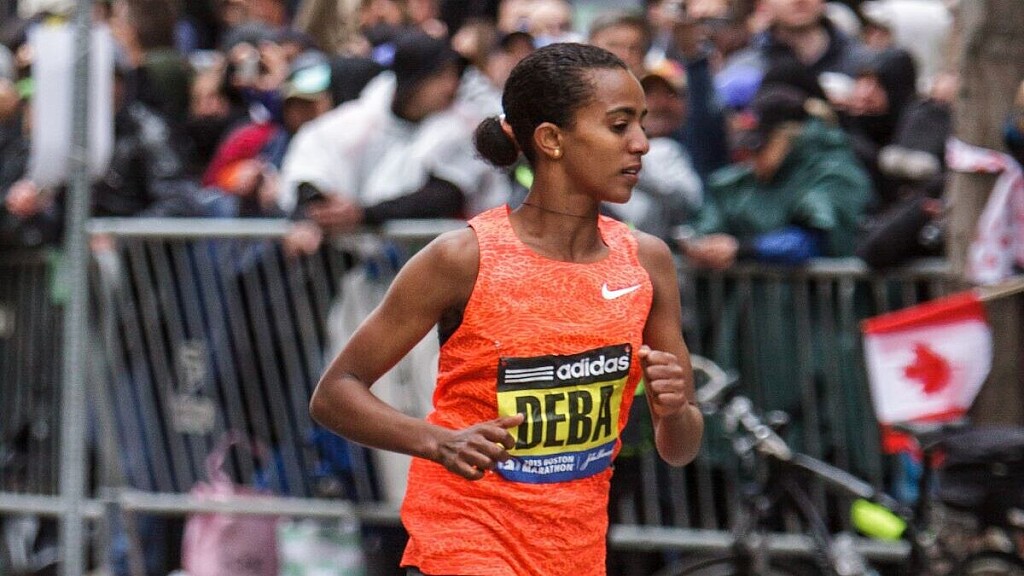
2014 Boston Marathon winner to finally receive prize money
10 years after setting the course record, Ethiopia's Buzunesh Deba will be awarded her prize money through the B.A.A.'s new voluntary payments initiative.
On Tuesday, the Boston Athletic Association (B.A.A.), which organizes the Boston Marathon, announced new plans to address prize money discrepancies caused by doping offences over the past 40 years. Starting in January 2025, the B.A.A. will begin issuing voluntary payments to athletes whose results were re-ranked due to disqualifications, dating back to 1986—the year prize money was first introduced.
This announcement is significant for Ethiopian runner Buzunesh Deba and Kenyan athlete Edna Kiplagat, who were both elevated to first place after Kenya’s Rita Jeptoo (2014) and Diana Kipyokei (2021) were disqualified for doping. In Deba’s case, she was originally awarded the second-place prize, but was later recognized as the winner of the 2014 race; she also set the course record of 2:19:59. Despite this, Deba has waited nearly a decade to receive the USD $100,000 owed to her: $75,000 for first place and $25,000 for the course record.
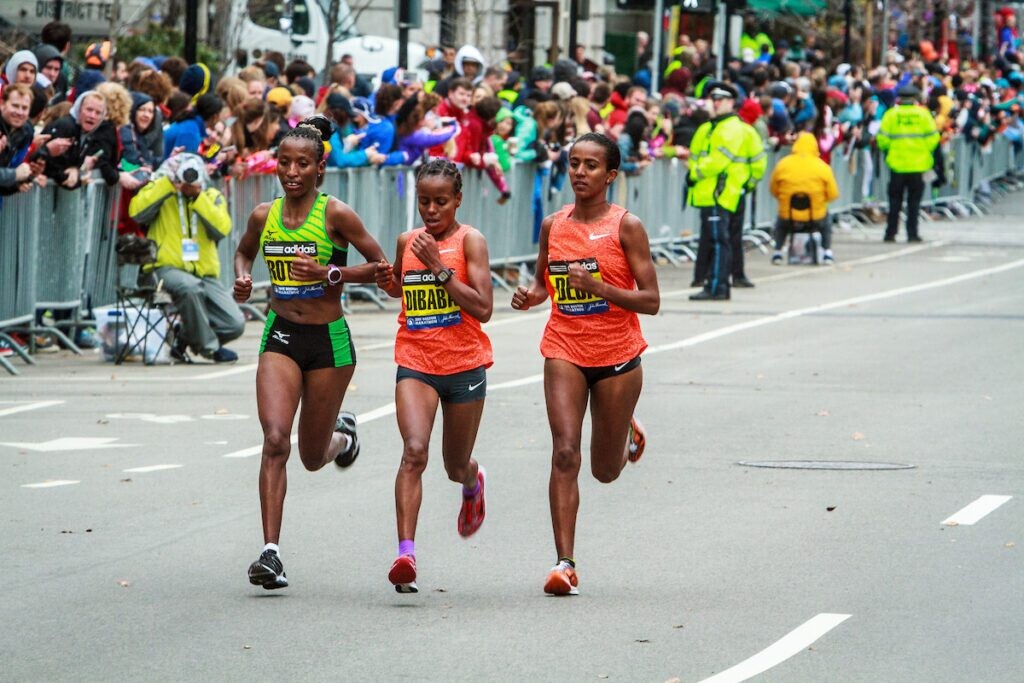
Deba’s payment, set to be issued in January, will be the largest compensation under the B.A.A.’s voluntary payout program. Earlier this year, a Wall Street Journal article put a spotlight on the B.A.A., sharing Deba’s 10-year wait for the prize money. The story caught the attention of Philadelphia businessman Doug Guyer, who sent Deba a USD $75,000 cheque to cover the difference between the first- and second-place prizes.
Jack Fleming, B.A.A. president and CEO said in a press release, “Our initiative aims to ensure that clean athletes are compensated appropriately. While the process to reclaim and redistribute prize money has been challenging, it remains essential to uphold fair competition.”
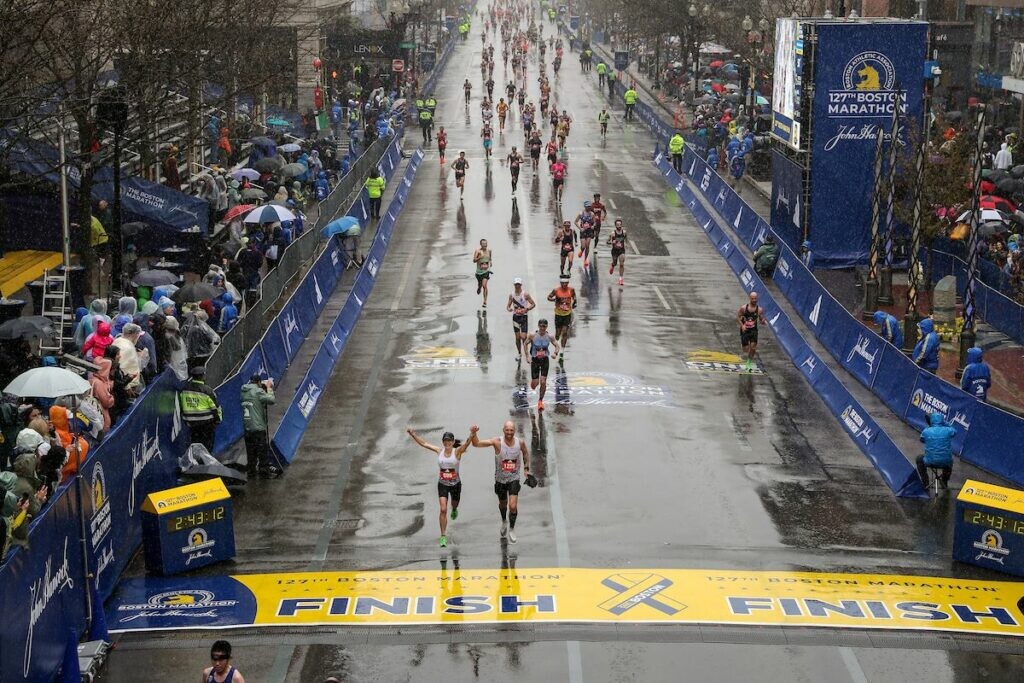
Eighty runners from eight Boston Marathons and nine participants from the Boston 5K event are eligible to receive payments totalling USD $300,000. Athletes found guilty of doping offences at any time will be ineligible for compensation. The B.A.A. says it will seek to reclaim payments from any recipient later disqualified.
The B.A.A. collaborates with global anti-doping organizations, including the Athletics Integrity Unit (AIU), the World Anti-Doping Agency (WADA) and the U.S. Anti-Doping Agency (USADA), to ensure a level playing field at its events. Notably, no male Boston Marathon champion has been stripped of their title for doping.
by Marley Dickinson
Login to leave a comment
Boston Marathon's logo refresh leaves some unhappy
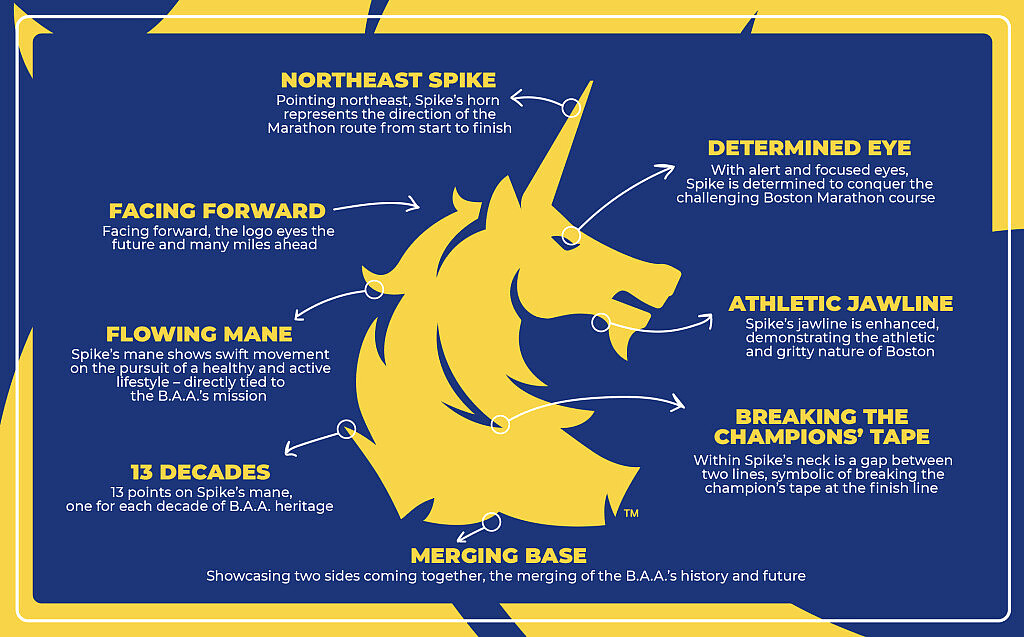
Back in 1890, the Boston Athletic Association chose the mythical unicorn to be its symbol. Later named Spike, that unicorn saw several redesigns in the ensuing century, before eventually finding its way to prominent placement on the Boston Marathon medal. For years, Spike faced leftward, its horn jutting into the banner type of Boston Athletic Association (B.A.A.). Then in early June, Spike changed course.
The B.A.A. unveiled a new logo for the Boston Marathon, and people are not happy about it.
On its face, the redesign is small: Spike’s orientation is flipped, and he’s made a bit more menacing. The marathon logo, along with the new Spike, sports a fresh Bank of America sponsorship tag. Despite the small tweaks, the community response has been staggering: a recent Boston.com reader poll found 55% not liking the new logo, compared to just 14% loving it and 32% expressing indifference.
Why the backlash? The B.A.A. proves just how hard it is to stay fresh (and funded) while maintaining a sprawling, legacy-minded audience. Change, for some proud marathoners, is hard.
SMALL CHANGES, BIG REACTIONS
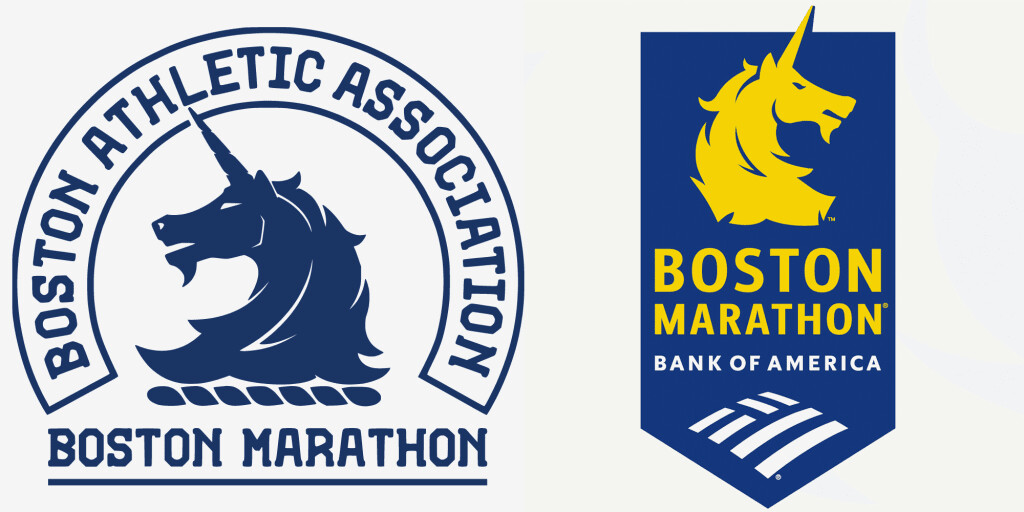
The most obvious change in Spike’s design is his orientation. Where the unicorn mascot used to look left, now he looks right. The B.A.A. calls this looking “forward,” pointing towards the miles ahead.
“We are looking forward, looking towards the future of the Boston Marathon, looking towards the future of running in general,” says Scott Stover, chief marketing officer at B.A.A. “Turning Spike around seemed natural as we were entering this next era.”
More controversial is Spike’s “athletic jawline,” which curves into the chin where it previously ran smooth. It creates the brief illusion of muscles—which the B.A.A. says represents the “athletic and gritty nature of Boston.” Coupled with a more “determined eye,” the unicorn may just be a fiercer version of his former self. Alex Cyr, a sports journalist covering marathons, finds this change laughable.
“The unicorn looks like it went from Pony[ta] to Rapidash,” Cyr says, referencing the Pokemon evolution. “You just see a unicorn that’s gotten a lot meaner.”
Stover contests the claim that Spike has gotten meaner, instead noting that they instituted these design changes to make Spike “serious and intentional.”
THE QUESTION OF CORPORATE BRANDING
Alongside the redesigned Spike, the new Boston Marathon logo also features a stamp of corporate marketing: the big “Bank of America” subtext, as well as the bank’s logo. While the fiercer appearance has some runners confused, the corporate branding has incited more anger.
Back in 1890, the Boston Athletic Association chose the mythical unicorn to be its symbol. Later named Spike, that unicorn saw several redesigns in the ensuing century, before eventually finding its way to prominent placement on the Boston Marathon medal. For years, Spike faced leftward, its horn jutting into the banner type of Boston Athletic Association (B.A.A.). Then in early June, Spike changed course.
The B.A.A. unveiled a new logo for the Boston Marathon, and people are not happy about it.
On its face, the redesign is small: Spike’s orientation is flipped, and he’s made a bit more menacing. The marathon logo, along with the new Spike, sports a fresh Bank of America sponsorship tag. Despite the small tweaks, the community response has been staggering: a recent Boston.com reader poll found 55% not liking the new logo, compared to just 14% loving it and 32% expressing indifference.
Why the backlash? The B.A.A. proves just how hard it is to stay fresh (and funded) while maintaining a sprawling, legacy-minded audience. Change, for some proud marathoners, is hard.
Alongside the redesigned Spike, the new Boston Marathon logo also features a stamp of corporate marketing: the big “Bank of America” subtext, as well as the bank’s logo. While the fiercer appearance has some runners confused, the corporate branding has incited more anger.
Just look at the Instagram comments under the announcement: “The big difference is adding Bank of America to the logo which clearly no one likes,” comments one marathoner. “Makes me less likely to bank with BoA,” comments another. Clearly, there is some ire for this emblazoned corporate sponsorship.
“Bank of America is invested in helping us continue to make the Boston Marathon and all of our events greater and greater every year,” Stover says. “So we’re proud of that partnership, and it is also very standard in sports marketing for brands to be included.”
This isn’t the first time the B.A.A. found themselves in hot water for the Bank of America branding. Back in April, the Boston Marathon debuted a new medal, featuring the bank’s logo on each and every medallion. The criticism was immediate.
Cyr was in Boston for the new medal’s premiere, and notes that there were “a few complaints.” He chalks this up to the race’s legacy: “[When] a race that’s been around for a long time, comes out with a rebrand, it is met with a bit of resistance by the traditionalists.”
The challenge that comes with rebranding an institution as beloved as the Boston Marathon is. balancing pride with progress. Marathoners complain of Spike’s fiercer look not because of any apparent flaw, but because they’ll have outdated tattoos. They complain of the Bank of America-themed logo not because they want to run the B.A.A. dry, but because they want to keep it pure. Eventually, the redesigned logo will become a piece of the Boston Marathon’s legacy; until then, the B.A.A. might have to endure some angry comments.
by henry Chandonnet
Login to leave a comment
Boston Marathon
Among the nation’s oldest athletic clubs, the B.A.A. was established in 1887, and, in 1896, more than half of the U.S. Olympic Team at the first modern games was composed of B.A.A. club members. The Olympic Games provided the inspiration for the first Boston Marathon, which culminated the B.A.A. Games on April 19, 1897. John J. McDermott emerged from a...
more...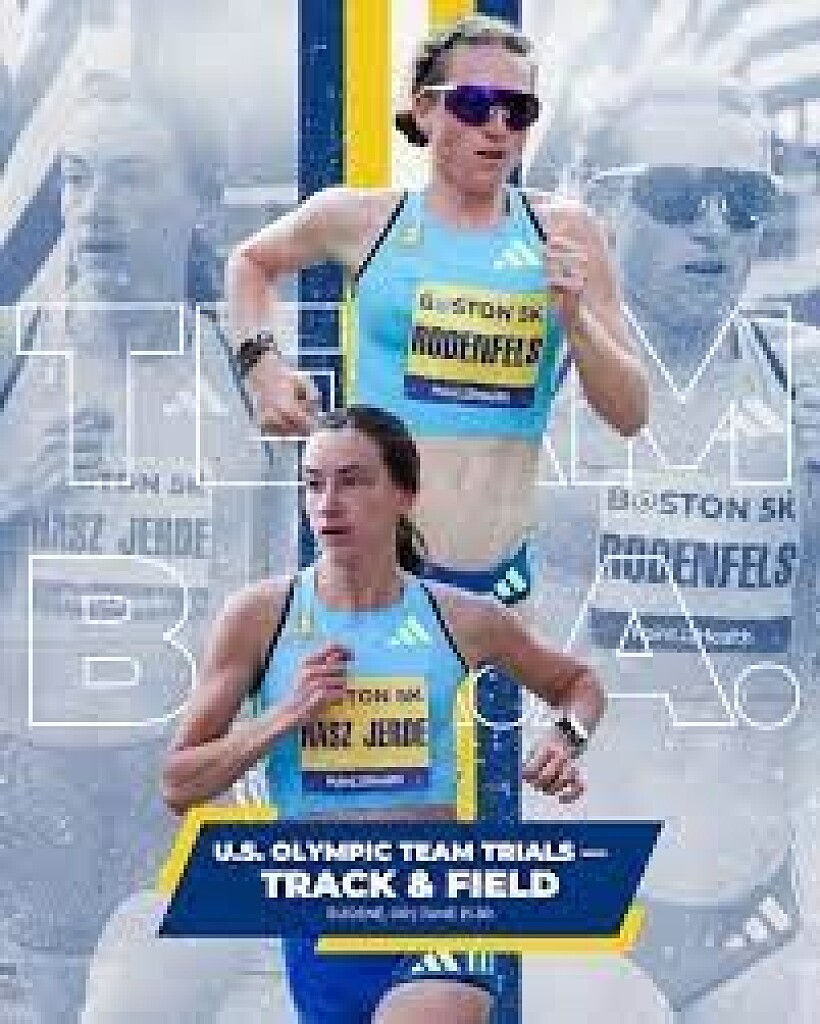
Two B.A.A. Athletes Qualify For U.S. Olympic Team Trials
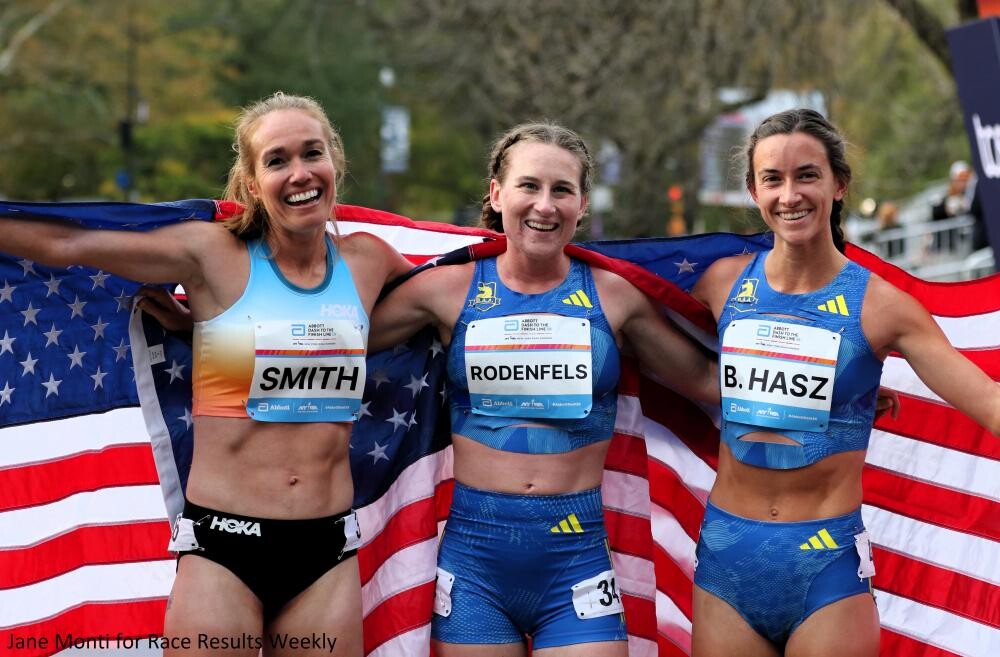
The Boston Athletic Association (B.A.A.) today announced that B.A.A. High Performance Team members Annie Rodenfels and Bethany Hasz have earned spots on the starting line for the U.S. Olympic Team Trials – Track & Field, to be held later this month in Eugene, Oregon from June 21-30.
Rodenfels will compete in the women’s 3000m steeplechase (preliminary round June 24/final on June 27), while Hasz will toe the line in the women’s 5000m (preliminary round on June 21/final on June 24).
The Trials will be held at historic Hayward Field in Eugene, Oregon, with top three finishers in each event slated to qualify for the Paris Olympic Games (so long as athletes have met the Olympic standard or earned enough qualifying points).
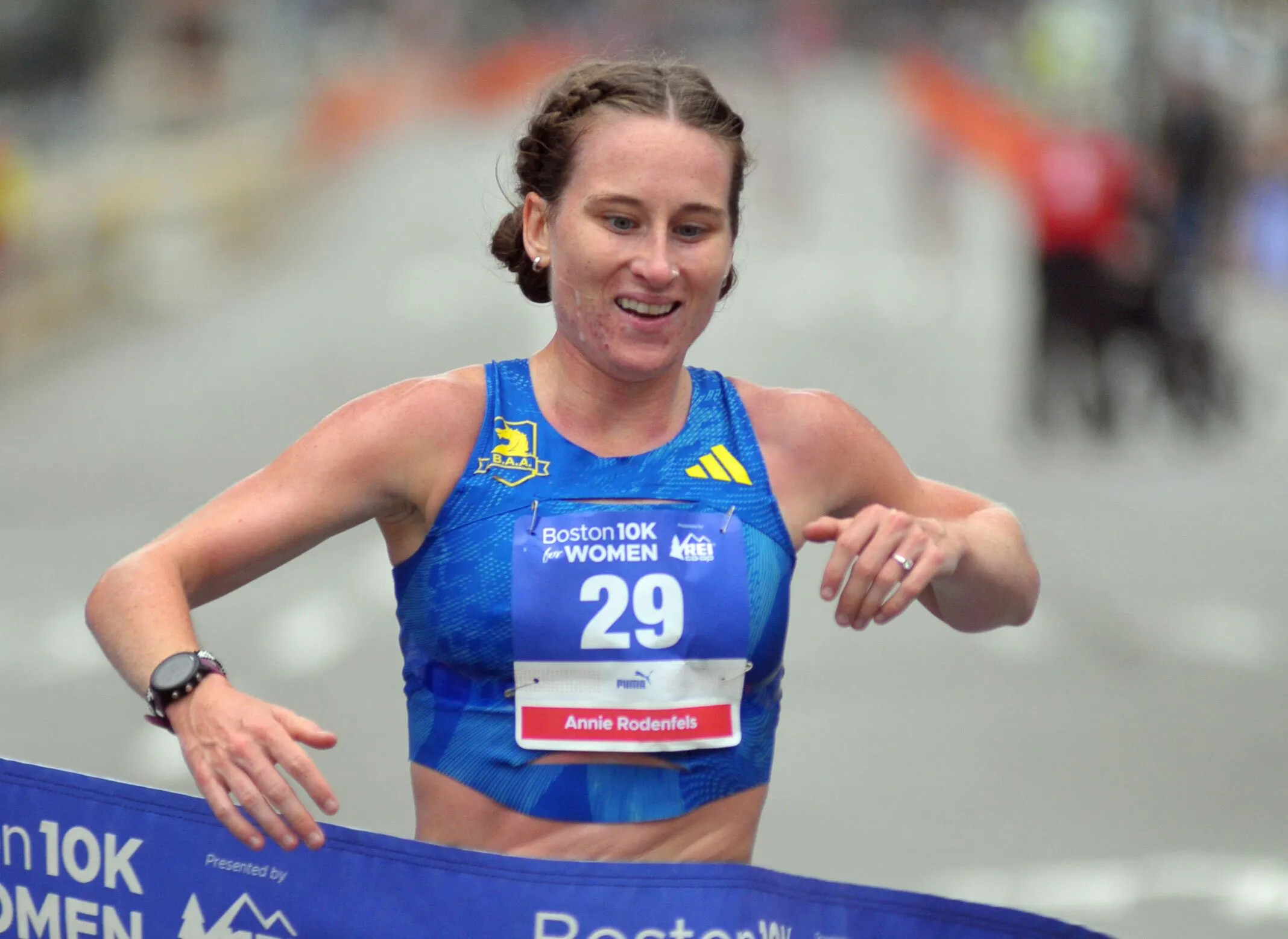
Rodenfels’ personal best in the steeplechase is 9:25.48, set last year. She won the steeplechase at the Drake Relays this year (9:31.03), was fourth at the Boston 5K in April, and clocked 15:03.97 indoors for 5000m in December 2023. Last fall she won the USATF 5K National Championship on the roads in New York City.
Hasz is coming off a 5000m lifetime best of 15:05.80 set May 17 in winning the Drake Relays 5000m. This year she’s also recorded personal bests in the road 5K (15:30), road 10K (32:03), and mile indoors (4:39.24). She earned a bronze medal at the 2023 USATF 5K National Championships, finishing third just behind Rodenfels and Olympian Rachel Smith.
The B.A.A.’s High Performance team supports runners on their way towards making international teams, with the goal of competing at the highest level: the Olympic Games, World Athletics Championships, and Abbott World Marathon Majors. The B.A.A. is sponsored by adidas, which provides comprehensive support for the organization’s High Performance team, running club, and mass-participatory events.
B.A.A HIGH PERFORMANCE TEAM ROSTER:
Eric Hamer
Bethany Hasz
Megan Hasz
Josh Kalapos
Barry Keane
Matt McDonald
Annie Rodenfels
Abbey Wheeler
ABOUT THE BOSTON ATHLETIC ASSOCIATION (B.A.A.)
Established in 1887, the Boston Athletic Association is a non-profit organization with a mission of promoting a healthy lifestyle through sports, especially running. The B.A.A. manages the Boston Marathon, and supports comprehensive charity, youth, and year-round programming. The 129th Boston Marathon presented by Bank of America is scheduled to take place on Monday, April 21, 2025. The Boston Marathon is part of the Abbott World Marathon Majors, along with international marathons in Tokyo, London, Berlin, Chicago, and New York City. For more information on the B.A.A., please visit www.baa.org.
by B.A.A.
Login to leave a comment

U.S. Olympic Team Trials Track And Field
Eugene, Oregon has been awarded the 2024 U.S. Olympic Team Trials - Track & Field, USA Track & Field and the U.S. Olympic & Paralympic Committee announced today. From June 21 to 30, Hayward Field at the University of Oregon will be home to one of the biggest track and field competitions in the country, as the U.S. Olympic Team...
more...
Boston Marathon qualifying standards to remain the same for 2025
After much speculation, the Boston Athletic Association (B.A.A.) says marathon qualifying times will not change.
On Monday, the Boston Athletic Association (B.A.A.) announced that it will not raise the entry standards for the 2025 Boston Marathon. This news will be a sigh of relief for many runners who have already achieved a Boston qualifying time for next year.
According to the B.A.A., the qualifying standards across all age brackets will remain the same as they were for the 2024 Boston Marathon. However, achieving a qualifying standard does not guarantee entry into the marathon. If applications exceed capacity, those applicants who exceed their qualifying time standards by the smallest margins may not be accepted.
At the 2024 Boston Marathon, there was a cutoff time of five minutes and 29 seconds per age group, one of the largest since time cutoffs were introduced in 2012. There were more than 33,000 applicants last year, with more than 11,000 athletes turned down despite hitting qualifying times.
Due to the large number of athletes being turned down in 2024, there was much speculation about whether the B.A.A. would raise the entry standards for 2025. The field size for the 129th Boston Marathon will remain at 30,000 participants and the race will take place on Monday, April 21, 2025.
For those who have hit a qualifying time for 2025, mark your calendars and set a reminder. Registration will open on Monday, Sept. 9, 2024 at 10:00 a.m. ET, and will close on Friday, Sept. 13, 2024 at 5:00 p.m. ET. The 2025 Boston Marathon qualifying window opened on Sept. 1, 2023, and will close at 5:00 p.m. ET on Friday, Sept. 13, 2024. Any athlete who has achieved a qualifying time in this window may submit a registration application.
The qualifying window for the 130th Boston Marathon, scheduled for April 20, 2026, will open on Sept. 1, 2024. Registration details for the 2026 race will be announced following the 2025 Boston Marathon.
by Marley Dickinson
Login to leave a comment
Boston Marathon
Among the nation’s oldest athletic clubs, the B.A.A. was established in 1887, and, in 1896, more than half of the U.S. Olympic Team at the first modern games was composed of B.A.A. club members. The Olympic Games provided the inspiration for the first Boston Marathon, which culminated the B.A.A. Games on April 19, 1897. John J. McDermott emerged from a...
more...
Registration dates for the 129th Boston Marathon announced
The Boston Athletic Association (B.A.A.) announced Monday that registration for the 129th Boston Marathon will take place over five days, from Sept. 9–13 at www.baa.org
The field size for the 129th Boston Marathon, to be run on Monday, April 21, 2025, will be 30,000 participants.
Qualifier registration will open on Sept. 9 at 10 a.m. and will close on Sept. 13, at 5 p.m. Any athlete who has achieved a currently valid Boston Marathon qualifying time may submit a registration application during registration week.

Applications will be accepted until 5 p.m. on Sept. 13. The 2025 Boston Marathon qualifying window began on Sept. 1, 2023, and will close at 5 p.m. on Friday, Sept. 13. If space is still available after the conclusion of registration week, registration will re-open on Sept. 16.
Qualifying standards across all divisions will remain the same as they were for the 2024 Boston Marathon.
by Andrew Clark
Login to leave a comment
Boston Marathon
Among the nation’s oldest athletic clubs, the B.A.A. was established in 1887, and, in 1896, more than half of the U.S. Olympic Team at the first modern games was composed of B.A.A. club members. The Olympic Games provided the inspiration for the first Boston Marathon, which culminated the B.A.A. Games on April 19, 1897. John J. McDermott emerged from a...
more...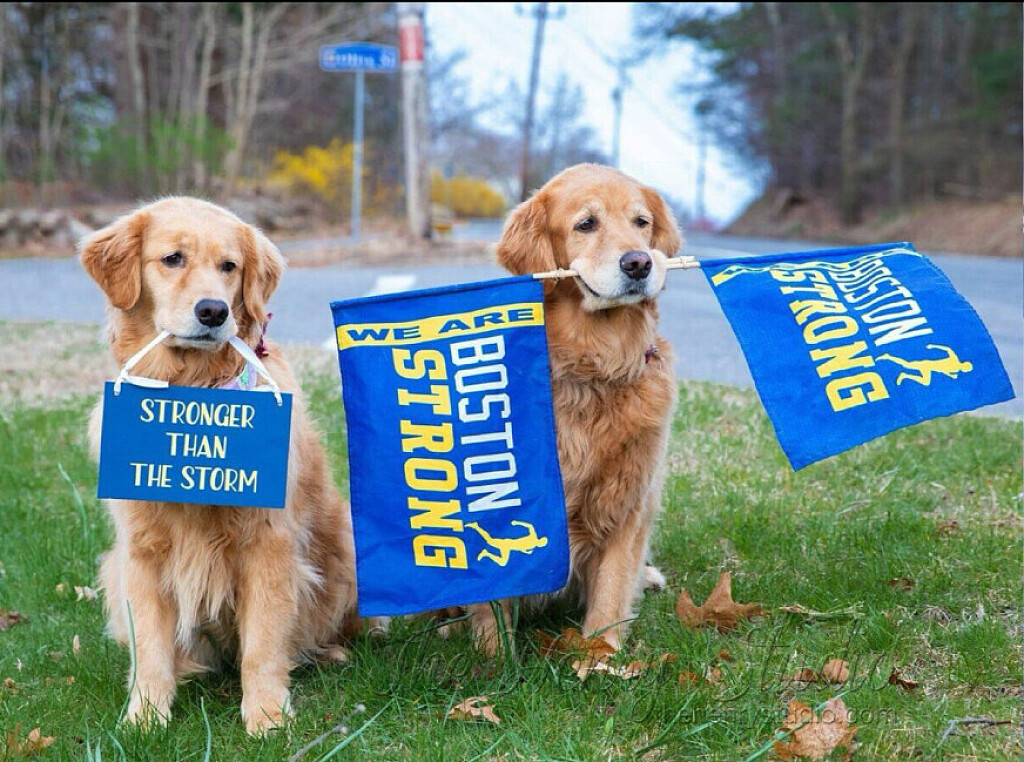
Boston Marathon dog Spencer honoured with statue on race route
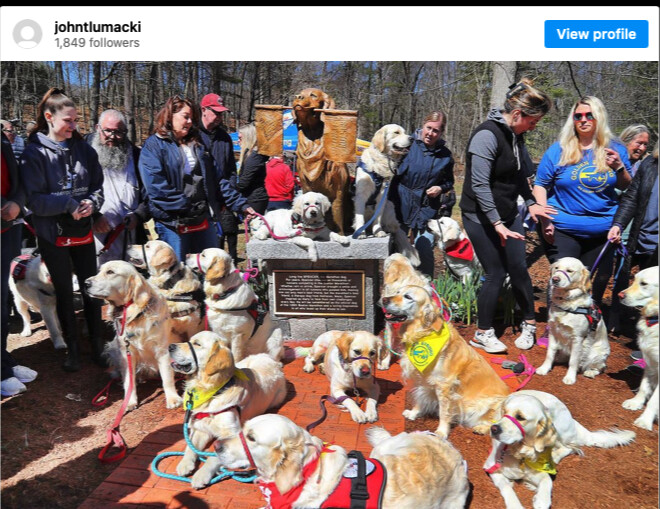
In a heartwarming tribute to the “official dog” of the Boston Marathon, a statue of Spencer the golden retriever was unveiled in Ashland, Mass., on the weekend, CBS News reported. Spencer’s presence along the marathon route was legendary as he stood for hours, rain or shine, to bring joy to thousands of passing runners.
The beloved furry ambassador died of cancer in 2023 after a three-year battle, with his sister, Penny, dying only days later. In a 2022 ceremony, the Boston Athletic Association (B.A.A.) named Spencer the marathon’s official dog; they unveiled a portrait of Spencer in 2023 before he died.
Spencer’s story goes beyond being a marathon spectator–he is also a symbol of resilience and compassion. From carrying the Boston Strong flag after the 2013 bombings to excelling in his role as an official therapy dog, Spencer offered encouragement to many.”We had lines of people when Spencer was with us, lines of people,” Spencer’s owner, Rich Powers, told CBS News. “Not talking like three or four people, it was like 20 people deep waiting to take a picture. They’re stopping the marathon to take a picture with Spencer, and he loved every second of it!”
The idea to immortalize Spencer with a statue came from runners and community members. After some local fundraising, sculptor Jeff Buccacio meticulously crafted a tribute that captures Spencer’s essence. Though denied a place on town property, Spencer’s statue found a home on private land, graciously offered by local residents, that overlooks the route where Spencer once stood. Powers is now training two pups, called Jimmy and Jade, to step into Spencer’s shoes and carry on his tradition along the sidelines of the race every April. “Thank you to all that helped to make this happy,” Powers said at the statue reveal. “Spencer is back on the marathon route.”
by Running Magazine
Login to leave a comment
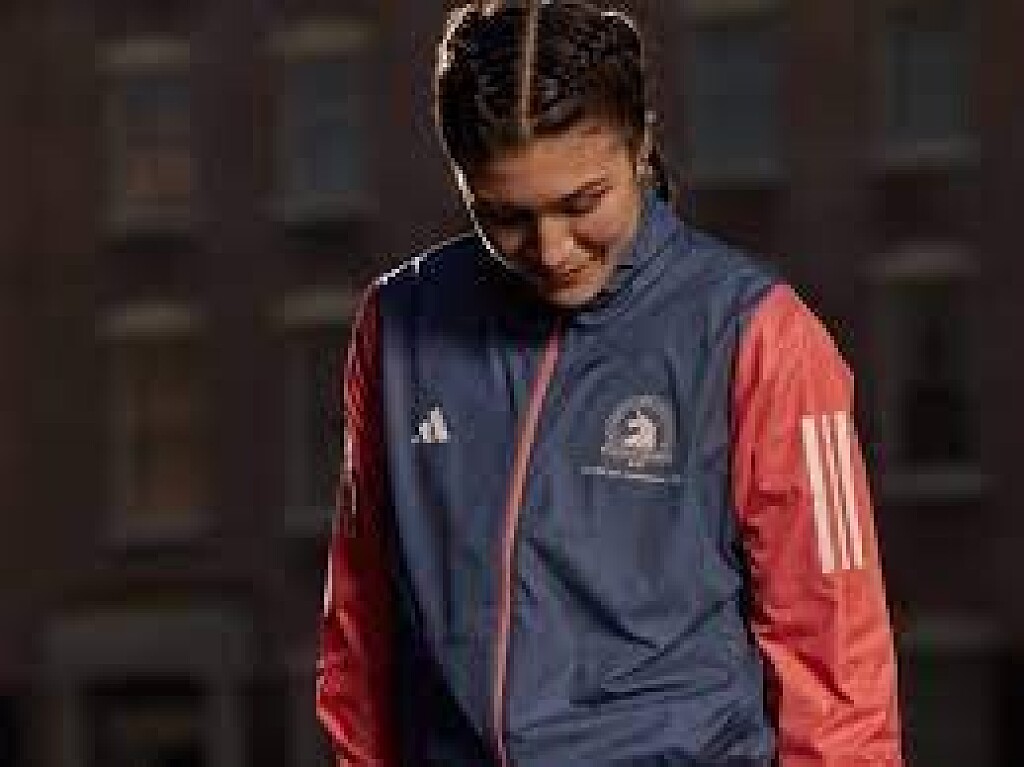
Boston Marathon unveils Olympic-inspired 2024 Celebration Jacket
On Friday, Adidas and the Boston Athletic Association (B.A.A.) unveiled the highly anticipated Celebration Jacket for the 2024 Boston Marathon. And as they say, beauty is in the eyes of the beholder.
The jacket, designed by Adidas, is a tribute to the historic marathon and holds symbolic significance for the 2024 Olympics in the French capital. According to the B.A.A., the colour scheme is a harmonious blend of red, white and blue, drawing inspiration from the French flag and the upcoming Paris Olympic Games in August.
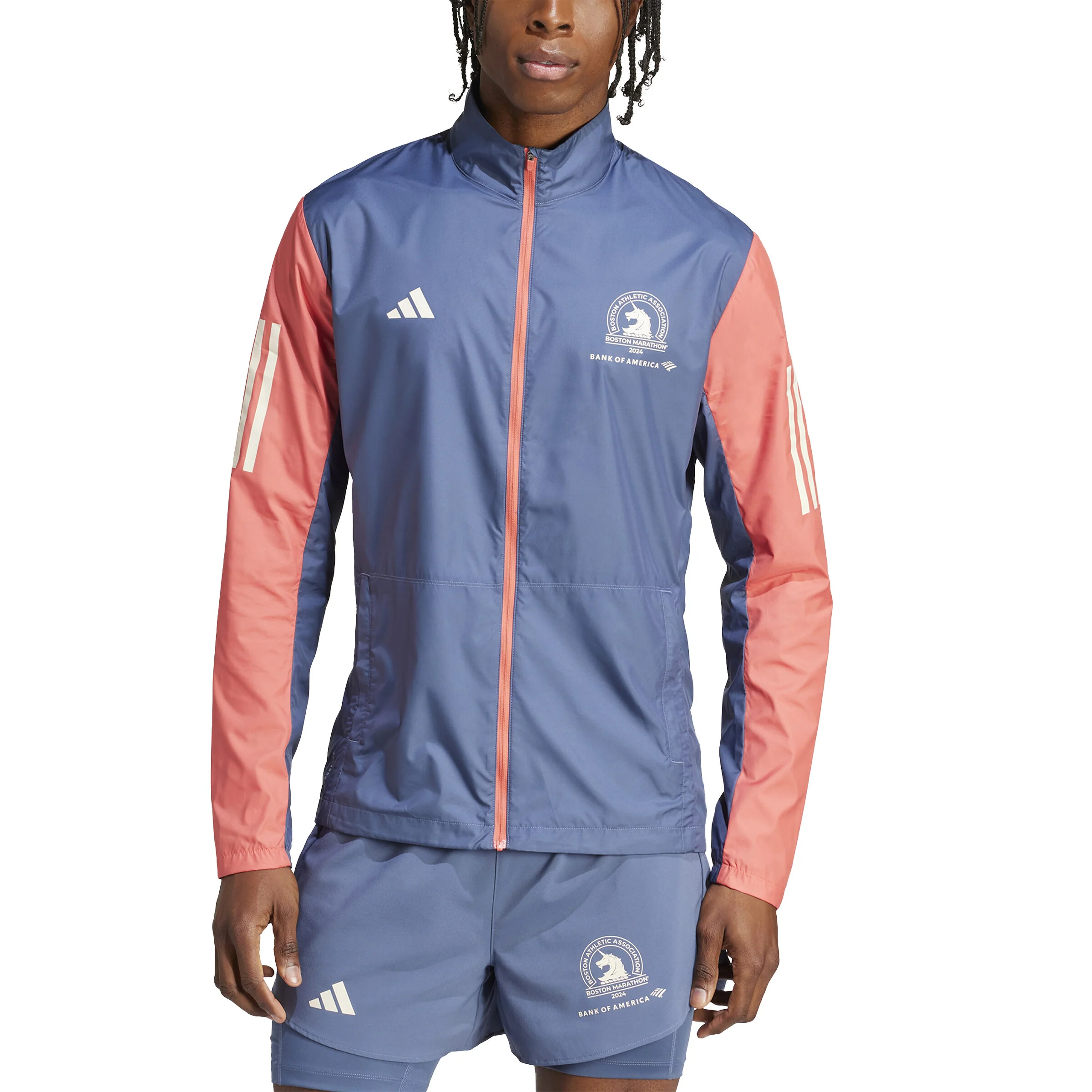
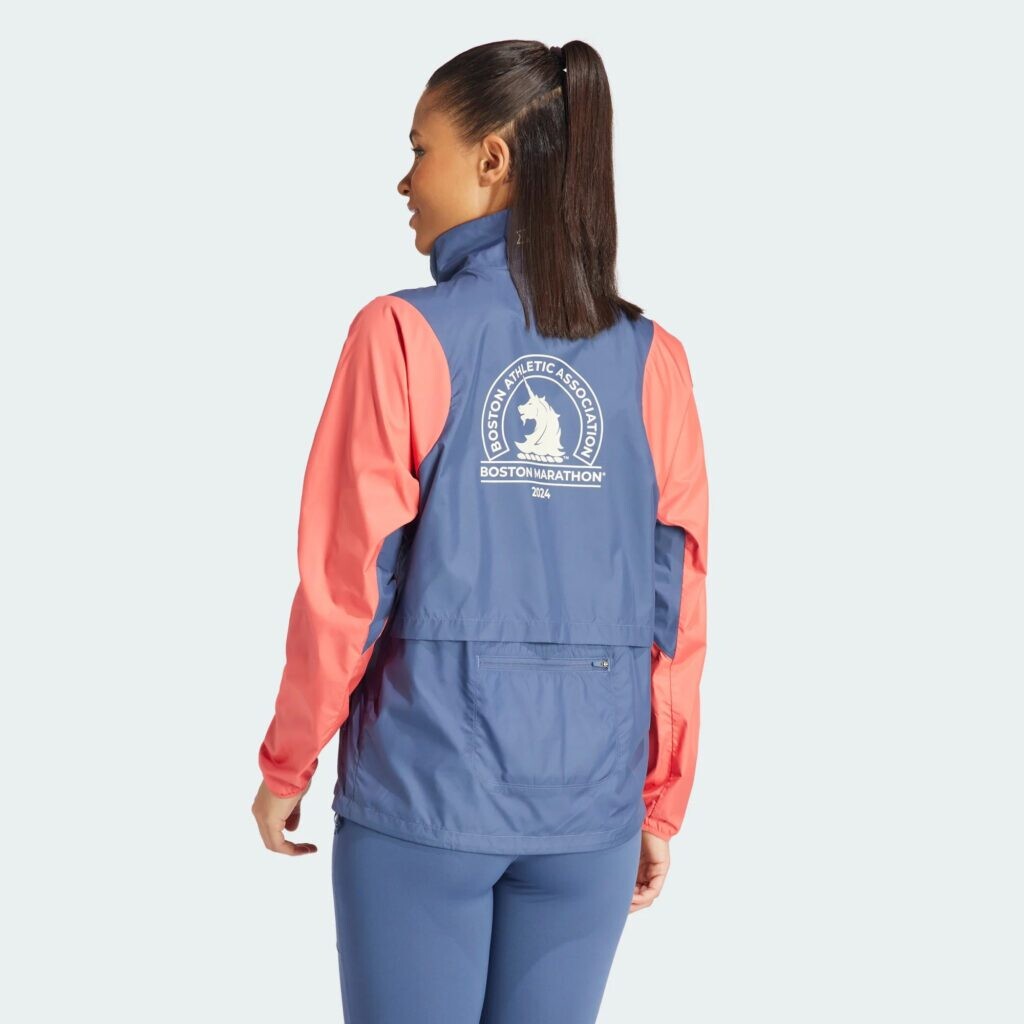
The 2024 jacket is different than some of the more recent and traditional Boston Marathon designs with its unconventional tri-colour look, showcasing two contrasting colours on the sleeves and body. Rather than drawing direct inspiration from the French flag or the upcoming Paris Olympics, we think the jacket bleeds the vibrant styles of the 80s. This is also the first year the new title sponsor, Bank of America, is featured on the jacket–below the B.A.A. logo crest.
Adidas points out that they’ve incorporated softer shades of red and blue, complemented by the B.A.A.’s distinctive blue and gold colours. This infusion of Boston-centric colours adds a “local touch” to the design, celebrating the achievements of the marathon runners. The Celebration Jacket will be released online exclusively at www.adidas.com on December 15 (U.S. only).
“The Boston Marathon is a pinnacle moment in the sports world,” Jennifer Thomas, VP of global sports marketing at Adidas. “We wanted to honour the marathon while nodding to what will undoubtedly be a pinnacle moment in not just running but sport this summer, as thousands of athletes make their way to Paris.”
We are almost four months from the 128th running of the prestigious Boston Marathon, scheduled for Patriot’s Day on Monday, April 15. An astounding 33,058 qualifiers applied to get into the 2024 race, setting a new record, which led to the largest cutoff time in Boston Marathon history (in a non-pandemic year), at five minutes and 29 seconds.
by Marley Dickinson
Login to leave a comment
Boston Marathon
Among the nation’s oldest athletic clubs, the B.A.A. was established in 1887, and, in 1896, more than half of the U.S. Olympic Team at the first modern games was composed of B.A.A. club members. The Olympic Games provided the inspiration for the first Boston Marathon, which culminated the B.A.A. Games on April 19, 1897. John J. McDermott emerged from a...
more...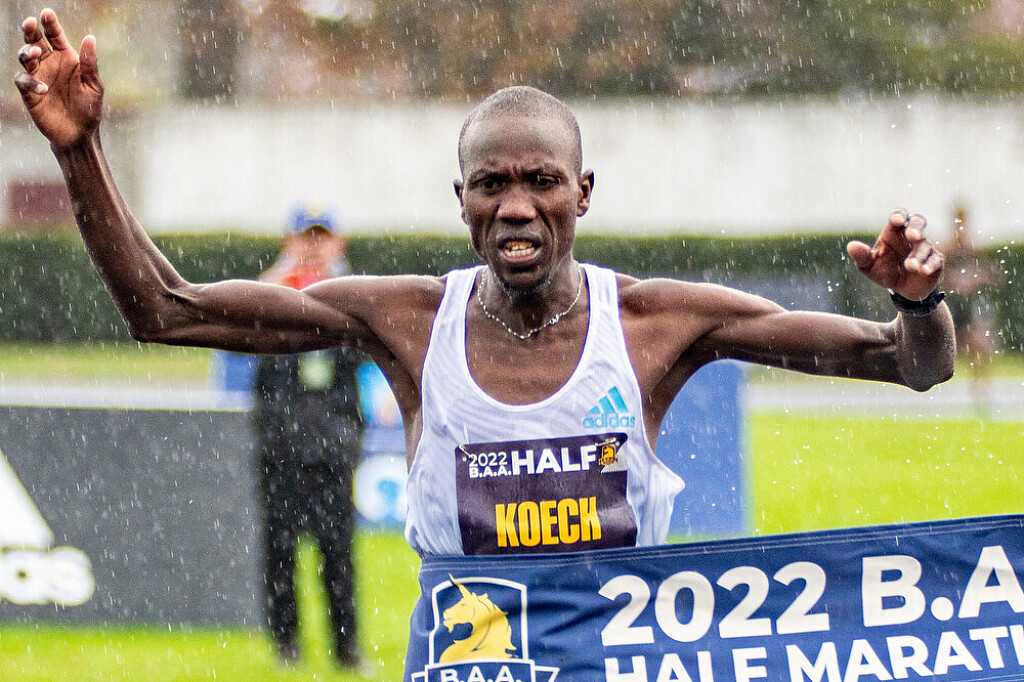
Defending Champions, American Record Holders & Global Stars Highlight 2023 B.A.A. Half Marathon Professional Field
The Boston Athletic Association (B.A.A.) announced today a star-studded professional field for the 2023 B.A.A. Half Marathon presented by Dana-Farber Cancer Institute and the Jimmy Fund. Defending champions Viola Chepngeno, Geoffrey Koech, and Jenna Fesemyer all return, while American half marathon record holder Keira D’Amato will take on the challenging course for the first time on Sunday, November 12. The B.A.A. Half Marathon starts and finishes at Franklin Park and runs along the Emerald Necklace Park System.
“As one of the most competitive half marathons in the country, we’re eager to bring many of the best open, wheelchair, and Para athletes in the world to Boston for November’s B.A.A. Half Marathon presented by Dana-Farber Cancer Institute and the Jimmy Fund,” said Jack Fleming, President and CEO of the B.A.A. “Nearly 9,000 athletes will take to the roads, led by some of the fastest and most decorated competitors in event history.”
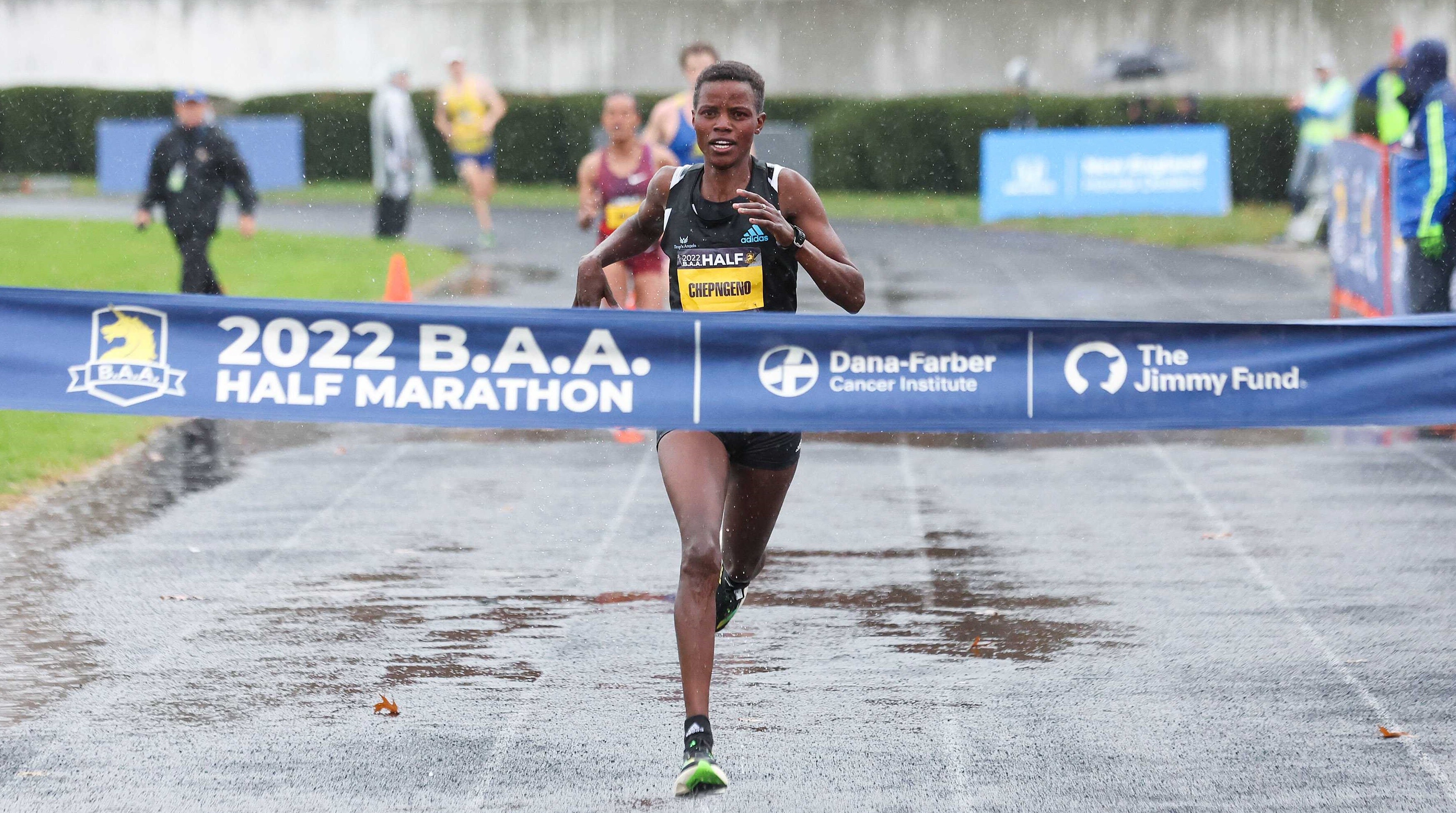
In 2022, Chepngeno (Kenya), Koech (Kenya), and Fesemyer (USA) won the women’s open, men’s open, and women’s wheelchair divisions, respectively, while Marko Cheseto and Jacky Hunt-Broersma (both USA) persevered through rain to finish atop the podium in the Para Athletics Division. To repeat the feat, all will square off against a field that includes national record holders and global medalists.
Senbere Teferi of Ethiopia, the 2022 B.A.A. 5K champion and three-time world championships medalist, looks to continue her winning ways in Boston. She’ll battle Tokyo Marathon champion Rosemary Wanjiru, 2019 B.A.A. 10K winner Fancy Chamutai, world cross country silver medalist Tsigie Gebreselama, last year’s runner-up Bosena Mulatie, and two-time B.A.A. Half Marathon second place finisher Cynthia Limo.
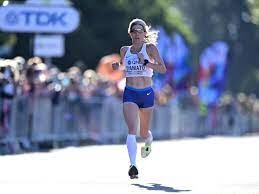
Four Americans who competed at the World Athletics Championships in Budapest in August will toe the line, including D’Amato, Lindsay Flanagan, Susanna Sullivan, and Natosha Rodgers. D’Amato set the national half marathon record of 1:06:39 at this year’s Gold Coast Half Marathon in Australia, and along with Flanagan and Sullivan made up Team USA at the World Championships Marathon. Rodgers raced the 5,000m and 10,000m on the track in Budapest, finishing 14th in the latter event. Rachel Schneider Smith, a 2021 Olympian at 5,000m for Team USA, will be making her B.A.A. Half Marathon debut.
Ten men with sub-61 minute personal bests will line up for the B.A.A. Half Marathon. Abel Kipchumba owns the fastest lifetime best in the field (58:07), while Shadrack Kimining of Kenya, second fastest in the field, placed fifth in 2022. Mohamed El Aaraby (Morocco), Yemane Haileselassie (Eritrea), Pat Tiernan (Australia), and Amanuel Mesel (Eritrea) bring international expertise. The fastest American men’s entrants are Nadir Yusuf (1:03:23), Kevin Koski (1:03:35) and Ryan Cutter (1:03:54) and sub-2:10 marathoner Ian Butler.
Dedham, Mass.-native Brian Reynolds, who set a world record at last year’s B.A.A. Half Marathon in the T62 (lower-limb impairment) category, returns, as does Marko Cheseto (T62) who ran 1:24:54 in 2022. Jacky Hunt-Broersma, last year’s women’s T62 champion, and Liz Willis, a three-time Boston Marathon T62 winner, will compete as well.
In the wheelchair division, Fesemyer set a course record 59:50 in 2022 to become the first women’s wheelchair athlete ever to break one hour in race history. Fellow 2022 women’s wheelchair podium finishers Yen Hoang (second place) and Michelle Wheeler (third) return as well.
James Senbeta and Hermin Garic, veterans of many B.A.A. events, headline the men’s wheelchair field. Garic was victorious at this year’s B.A.A. 10K.
The B.A.A. Half Marathon course runs along the picturesque Emerald Necklace Park System, past landmarks such as the Arnold Arboretum, Jamaica Pond, and Franklin Park Zoo, before finishing at White Stadium in Franklin Park. The B.A.A. Half Marathon is a family-friendly event for athletes and spectators of all ages. Free youth events will be offered on race morning within Franklin Park, including races and medals for all.
Dana-Farber Cancer Institute and the Jimmy Fund has partnered with the B.A.A. Half Marathon since 2003 as the race’s presenting sponsor and exclusive charity team. Through this relationship, Dana-Farber runners have collectively raised more than $8 million to support groundbreaking cancer research, and enabled Dana-Farber scientists and clinicians to positively impact the lives of cancer patients around the world. In advance of the 2023 event, 640 Team Dana-Farber athletes have raised $375,000 to date.
Login to leave a comment
B.A.A. Half Marathon
Dana-Farber and the Jimmy Fund have partnered with the B.A.A. in the Half Marathon for 13 years as the race’s presenting sponsor. Through this relationship, team members have collectively raised more than $5 million to support groundbreaking cancer research, and enabled Dana-Farber scientists and clinicians to positively impact the lives of cancer patients around the world. Dana-Farber runners often participate...
more...
The 2024 Boston Marathon Acceptance Letters have Arrived. Here’s What the Data Tells Us.
A record-breaking number of qualified applicants registered for 128th running of the world’s oldest annual marathon
The 128th Boston Marathon presented by Bank of America just began informing qualified applicants of their status this morning, and the numbers are as fascinating as they are fast.
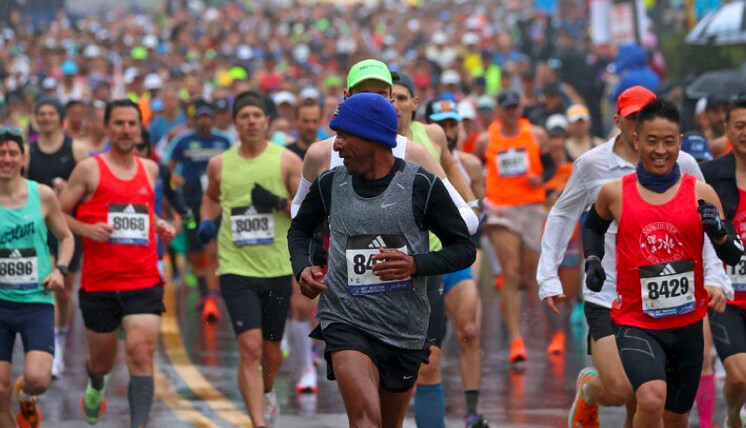
After 33,058 qualifier applications came flooding in during registration week earlier this month to run next year’s race—taking place on April 15, 2024—22,019 applicants were accepted (pending final verification).
“This year’s registration week resulted in the highest number of qualified applicants in race history, a testament to the strength of the marathon community,” said David Tyrie, Chief Digital Officer and Chief Marketing Officer for Bank of America.
To gain entry into the Boston Marathon requires each runner to have an official qualifying race prior to applying, with finishing times established by both gender and age. However, with such high demand for the race by qualified runners, the unofficial “cut-off” times for being accepted into the race are often minutes faster than the official qualifying standards.
For the 2024 Boston Marathon race, this year’s “cut-off” time needed to gain acceptance was 5 minutes, 29 seconds or faster than the official qualifying time. For example, say you are a 40-year-old male applicant. The official B.A.A. qualifying standard for this age/gender is 3 hours, 10 minutes. But in order to be accepted into next year’s race, any qualifying times slower than 3 hours, 4 minutes, 31 seconds would not be accepted.
This stout benchmark translated this year to more than 11,000 applicants not being accepted into next year’s Boston Marathon.
Looking into the 22,000-plus runners who were just notified of their acceptance—with ages ranging from 18 to 82—here’s how the numbers break down: 12,535 men, 9,440 women, and 44 non-binary athletes from all 50 states. In addition, automatic entry is offered to those who’ve finished 10 or more previous Boston Marathons, and 660 of these applicants were granted entry.
What’s also interesting is that over one-third of the entire field at next year’s Boston Marathon will be newbies—11,391 of the accepted applicants will be running Boston for the first time.
The Boston Athletic Association (B.A.A.) was established 1887, and has become a non-profit organization that manages the Boston Marathon and supports comprehensive charity, youth, and year-round programming. The Boston Marathon is part of the Abbott World Marathon Majors, along with international marathons in Tokyo, London, Berlin, Chicago, and New York City.
Athletes interested in running next year’s race as part of a fundraising effort, affiliated with select charity programs, are invited to contact the nonprofit or organization to see what opportunities there are. Read more about the race’s charity program.
The 2025 qualifying window has already begun on September 1, 2023, and further registration information will be announced following the conclusion of the 128th race. Stay tuned—and keep training.
by Outside Online
Login to leave a comment
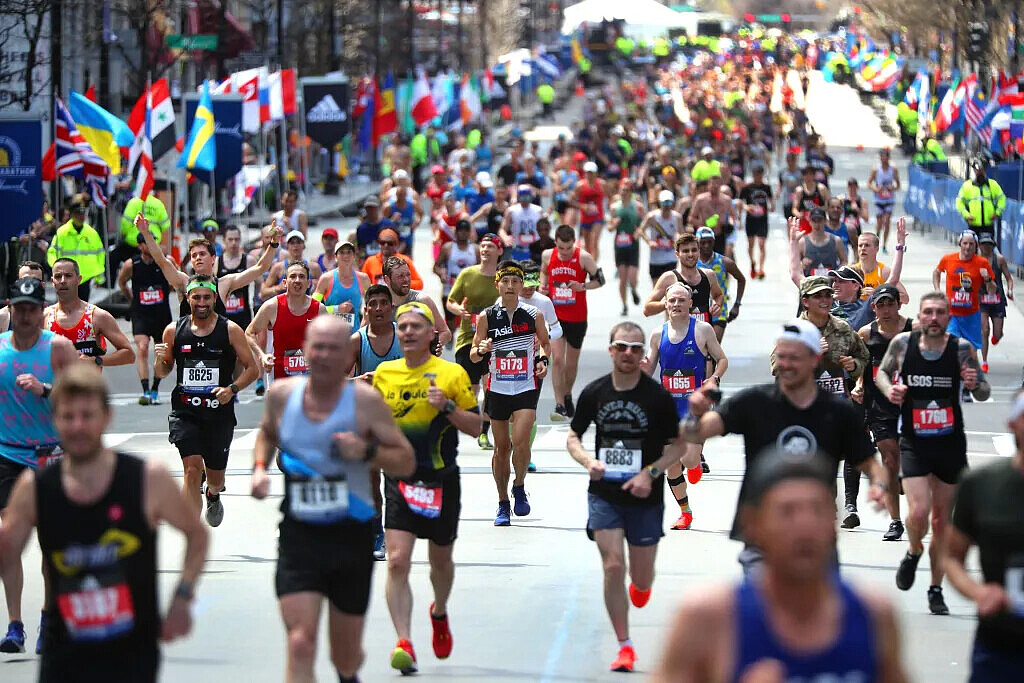
Boston Marathon has a cutoff once again, runners had to run 5:29 faster than the qualifying time for their age and gender to gain entry into the 2024 race
The Boston Athletic Association (B.A.A.) announced on September 28 that the cutoff for the 2024 Boston Marathon is 5:29.
In other words, it wasn’t enough for applicants to run a qualifying time for their age group and gender. They had to be significantly faster than their time standard.
According to race officials, 11,039 runners who qualified were unable to be let into the race.
This reverses the trend from the past two years, coming out of the pandemic, when there was no cutoff time. Everyone with a valid qualifying time who applied for the 2022 and 2023 races got in.
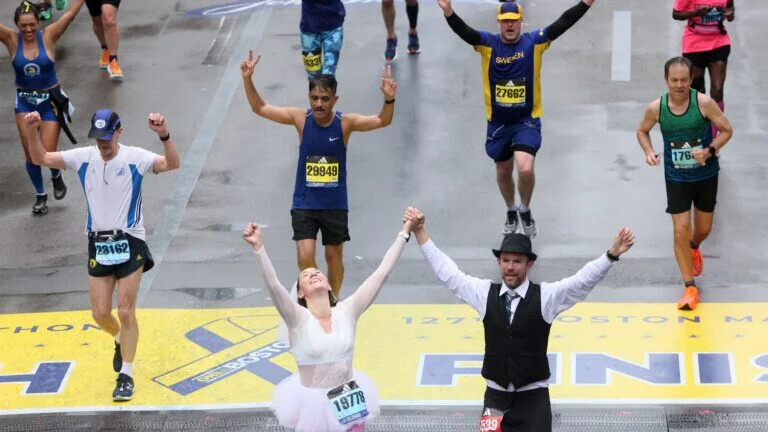
The 2021 race, which was held in October that year, had a cutoff of 7:47, because the field size was much smaller—only 20,000 runners—coming out of COVID. The 2020 edition of the Boston Marathon was canceled.
The B.A.A. announced on September 15 that for the 2024 race, there had been 33,000 applicants during the one-week registration period, a record. The field size is set at 30,000 and about 73 percent of those—this year, 22,019 runners—are time qualifiers. The other 8,000 entrants run for charities or receive invitational entries.
The previous record for applications was 30,458 in 2018 for the 2019 race. That number of applicants resulted in a cutoff of 4:52. Also in 2018, the race tightened the qualifying times by five minutes across every age group.
“Just four years after we adjusted the race’s qualifying standards by 5 minutes for all ages and divisions, more than 33,000 athletes earned Boston Marathon qualifying times,” said Jack Fleming, the B.A.A.’s president and CEO, in a written statement. “While we’re unable to accept all into the field, we applaud and recognize the many athletes who circled the 128th Boston Marathon on their calendar as a goal race to strive towards.”
The B.A.A.’s early announcement of the record number of applicants helped some Boston hopefuls brace for the news they wouldn’t gain entry into the race. Across social media, runners prepped for disappointment.
Robert Wang, founder of the World Marathon Majors Challenge Facebook group, which closely tracks the ins and outs of getting into various races, said he was hoping to establish a streak of 10 consecutive years of running Boston, after which he would no longer have to worry about the cutoff time; qualifying would give him automatic entry. (He was up to four.) He had already booked refundable hotel rooms in Boston for April 2024.
He was shocked to see the B.A.A.’s announcement of the number of applicants on the evening after registration closed. “It was the first time in recent memory the B.AA has released an estimate of the number of applicants with the close of registration,” said Wang, 50, of Canton, Ohio. “I knew immediately that I was not getting in with my 2:54 with 33,000 applicants.”
Road racing appears to be emerging from a slump that began during the pandemic, when most events were canceled, and extended through 2021, even as races returned to the calendar. Now many races are seeing registration numbers that match or exceed their pre-pandemic totals.
The qualifying period for the 2024 marathon ran from September 1, 2022, through the last day of registration, September 15, 2023.
by Sarah Lorge
Login to leave a comment
Boston Marathon
Among the nation’s oldest athletic clubs, the B.A.A. was established in 1887, and, in 1896, more than half of the U.S. Olympic Team at the first modern games was composed of B.A.A. club members. The Olympic Games provided the inspiration for the first Boston Marathon, which culminated the B.A.A. Games on April 19, 1897. John J. McDermott emerged from a...
more...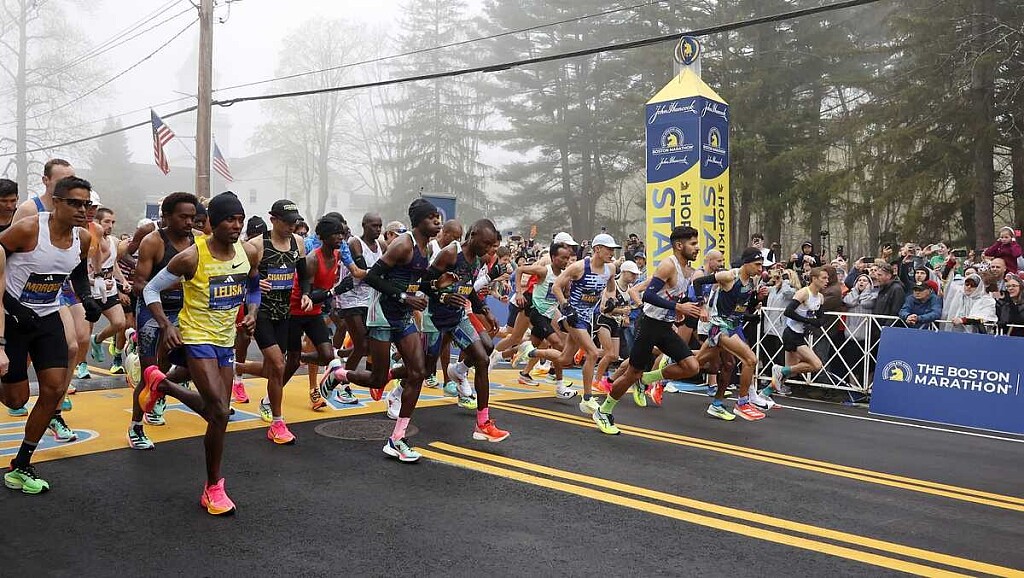
Record-breaking registration numbers reported for 2024 Boston Marathon
The 128th Boston Marathon presented by Bank of America has set a remarkable record as it closed its qualifier registration window on Friday, Sept. 15. An astounding 33,000 applications were received by the Boston Athletic Association (B.A.A.) surpassing the previous record of 30,458 entries in 2019.
The applications for the 2024 Boston Marathon came from runners from 127 different countries and all 50 U.S. states, along with Washington, D.C. Qualifying athletes earned their spots in more than 528 races worldwide, showcasing the event’s international appeal. Impressively, applicants ranged in age from 18 to 82, underlining the race’s inclusivity and ability to inspire athletes of all ages.
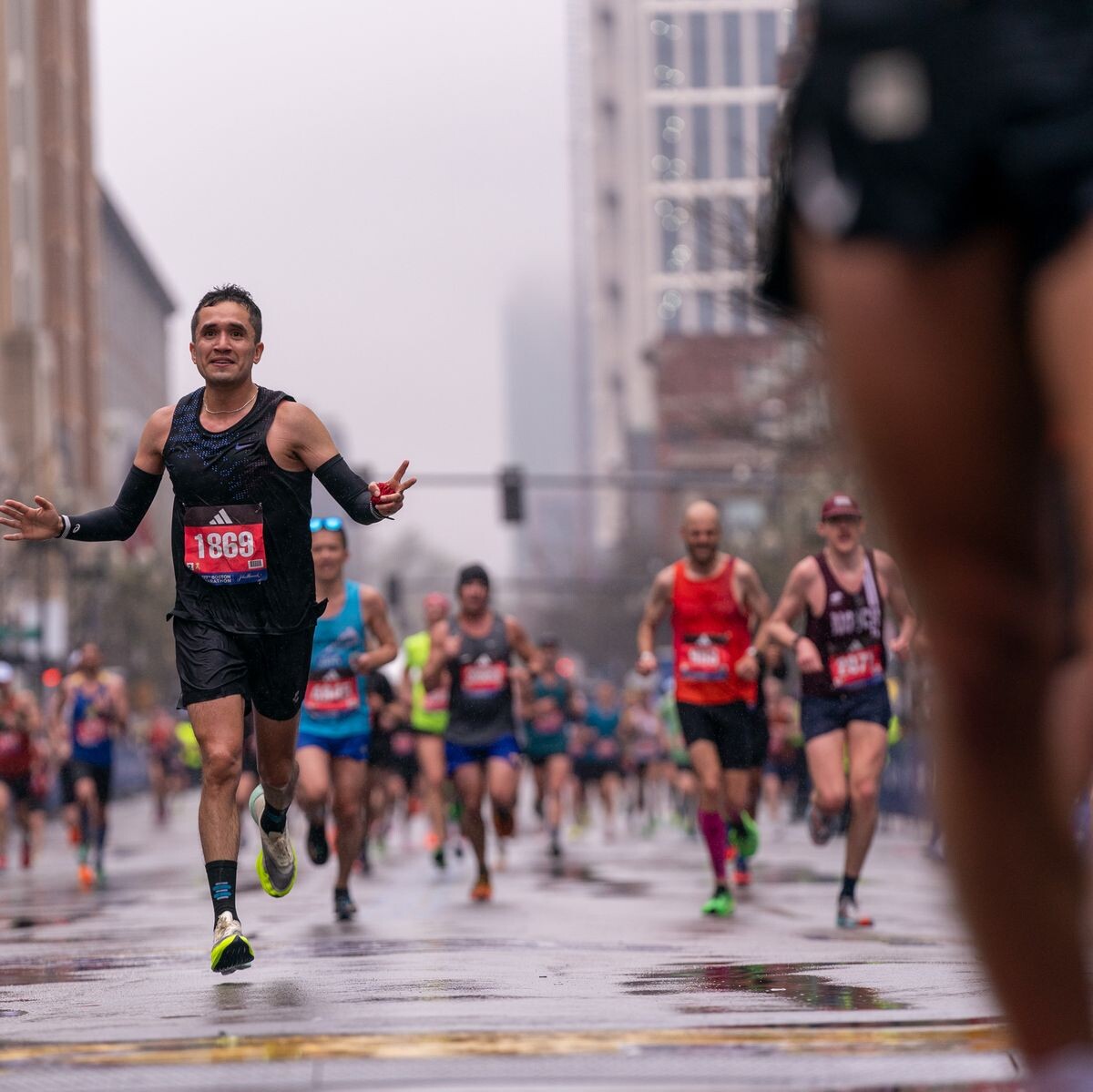
Despite the surge in applications, not all qualifiers will secure a spot in the 128th Boston Marathon. The B.A.A. is currently verifying all qualifying times and will notify applicants of their acceptance or non-acceptance within the next three weeks.
To maintain transparency, the organization has not speculated on a “cut-off” time for entry and requests athletes’ understanding and patience during this verification process.
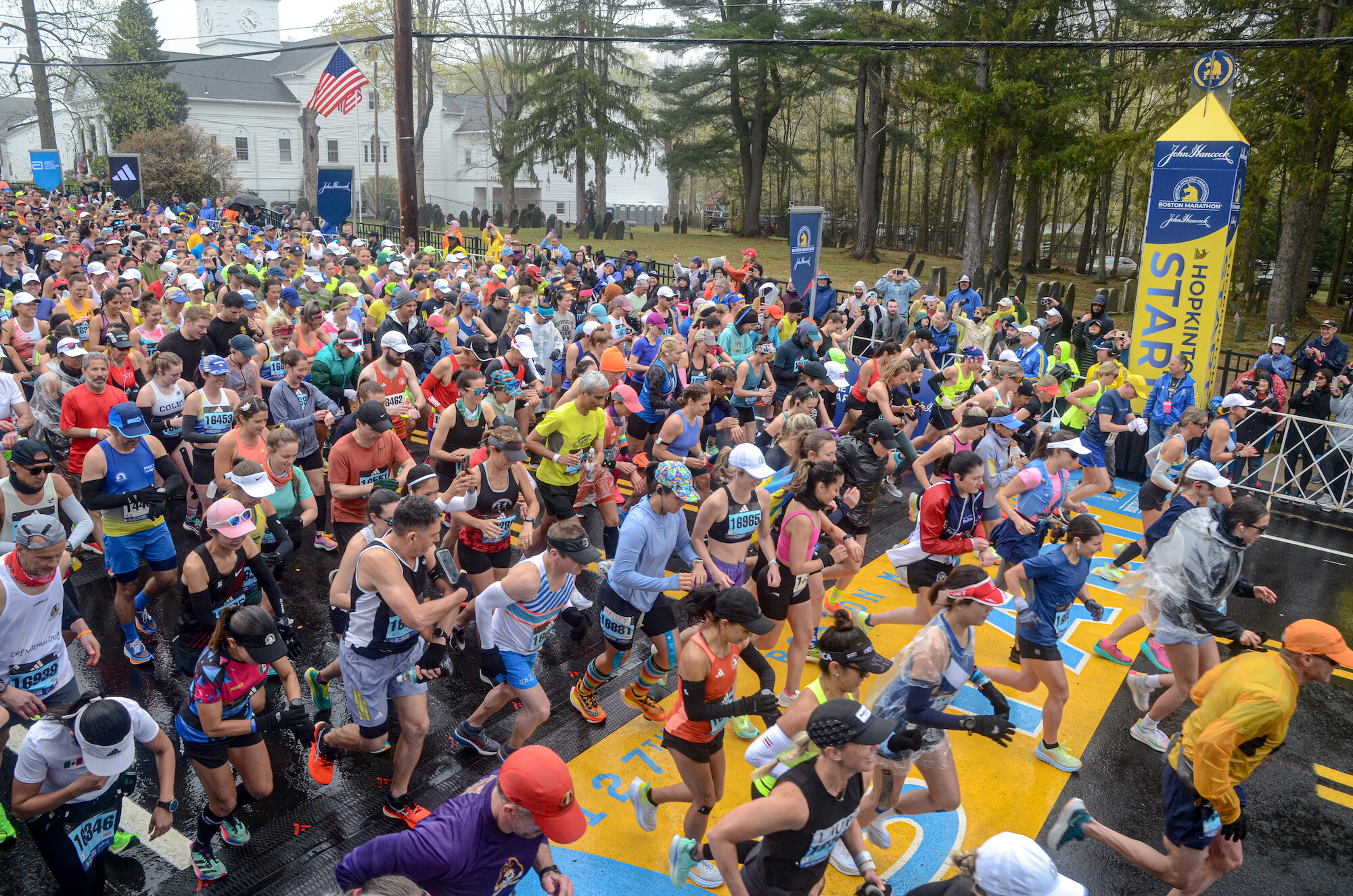
Jack Fleming, President and CEO of the B.A.A. commended the global running community’s passion and commitment to participating in the iconic race. Fleming stated, “Receiving a record number of applications is a testament to the strength of road racing around the world and speaks to runners’ commitment to taking on the challenge of earning a Boston Marathon qualifying time with the goal of reaching the start line in Hopkinton.”
For individuals who do not make the cut or lack a Boston Marathon qualifying time, there’s still an opportunity to participate through the Bank of America Boston Marathon Official Charity Program. This program includes 160 non-profit and charitable organizations that have begun accepting applicants for the upcoming event.
Login to leave a comment
Boston Marathon
Among the nation’s oldest athletic clubs, the B.A.A. was established in 1887, and, in 1896, more than half of the U.S. Olympic Team at the first modern games was composed of B.A.A. club members. The Olympic Games provided the inspiration for the first Boston Marathon, which culminated the B.A.A. Games on April 19, 1897. John J. McDermott emerged from a...
more...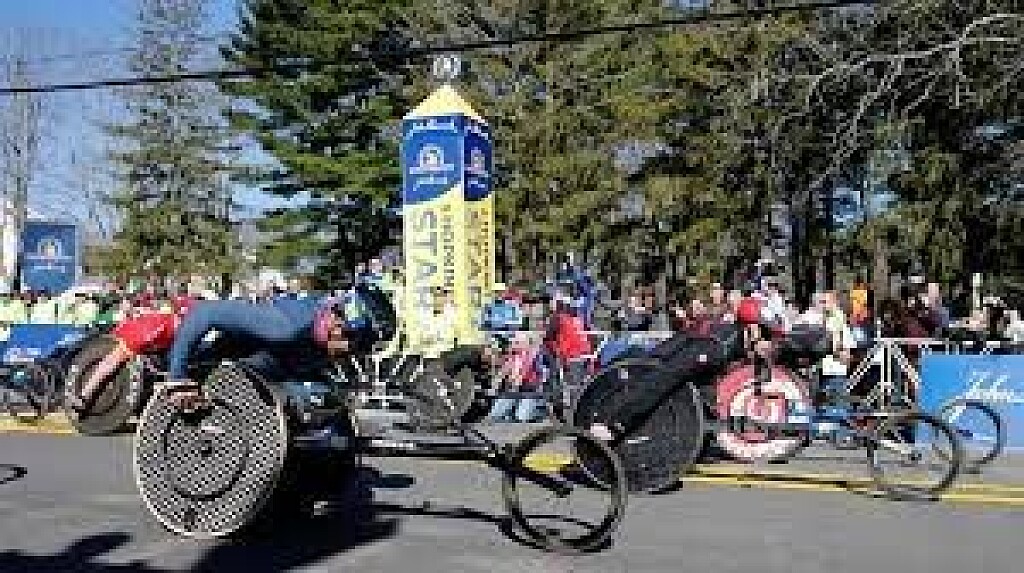
B.A.A. Announces Expanded Para Athletics Divisions and Enhanced Prize Money Awards for 2024 Events
The Boston Athletic Association (B.A.A.) today announced plans for an enhanced prize money structure across B.A.A. events in 2024, as well as the introduction of two new Para Athletics Divisions for athletes competing with coordination impairments (T35-T38) and intellectual impairments (T20) as well as more inclusive upper and lower limb impairment divisions. The changes will provide greater financial rewards for athletes across multiple divisions and expanded opportunities for athletes within the Para Athletics Divisions and Wheelchair Divisions.
“We are always looking at ways to celebrate and reward athletic excellence,” said Jack Fleming, B.A.A. President and CEO. “With these changes, we are recognizing top finishers and aspiring athletes in our Wheelchair and Para Athletics Divisions, while also expanding opportunities for new groups of athletes to be recognized and included in our B.A.A. events.”
He continued, “Boston is a running city, and we’ve made it our goal to elevate Para athletes as they train and compete for the podium at our events, from the 5K through to the marathon.”
“This creates an enormous positive impact for Para athletes and shows how the B.A.A. is leading the way towards greater inclusivity in sports,” said John Jordan, head of The Academy and executive co-sponsor of the Disability Action Network, Bank of America. “As we look across our involvement in sports around the world, we’re committed to help broaden the possibilities available to athletes competing at all levels.”
New prize structures highlights:
The Boston Marathon presented by Bank of America will now feature a cumulative prize fund of more than $1 million.
Wheelchair champions [T53/54/34] at the Boston Marathon presented by Bank of America will now receive a first-place prize of $40,000 (increased from $25,000), and places 2-10 will also receive increases in awards compared to recent years. Wheelchair athletes with T51-T52 classifications will receive awards for places 1-3.
The total wheelchair prize for 2024 will be $313,500 for men and women (previously $125,000). This includes $50,000 each for a course record (equal to the Open course record award)
The top three finishers in all seven Para Athletics Divisions at the Marathon will receive prize money of $2,500; $1,500; $1,000, respectively.
Additional increases in the Wheelchair Division and Para Athletic Division prize money will be offered for the B.A.A. 5K, B.A.A. 10K, and B.A.A. Half Marathon. The B.A.A. Half Marathon will also feature increased open division prize money for podium finishers.
Para and Wheelchair prize money divisions at the Boston Marathon adhere to World Athletics and World Para Athletics rules of competition. Athletes competing in the Para and Wheelchair divisions must be nationally or internationally classified to be eligible.
Overview of new Para Athletic divisions:
Seven Para Athletics Divisions will now be offered at the Boston Marathon presented by Bank of America, with newly established divisions for athletes with coordination impairments [T35-T38 and intellectual impairments [T20].
Additionally, the T61/63 lower limb impairment will now add the T43 classification, and the T62/64 lower limb impairment division will now add T42/T44 classifications.
The seven divisions are an increase from five divisions offered in 2023 (vision [T11/T12, T13], upper-limb [T45/T46], and lower-limb impairments [T61/T63, T62/T64]).
A Para Athletics Division for athletes with coordination impairments will be offered at the B.A.A. Half Marathon, B.A.A. 10K, and B.A.A. 5K from 2024. Each of these events will now feature four Para Athletics Divisions namely vision, upper-limb, lower-limb, and coordination impairments.
Athlete Quotes
Marko Cheseto - Kenyan All-American athlete who holds the world record for a double lower leg amputee in the marathon said, “This increased recognition [from the B.A.A.] gives athletes with disabilities more public attention, and we can perform at a higher level given these opportunities.
“Now that we have the world’s oldest marathon leading the way [with prize money for Para divisions] all other marathons should be inclusive. It's about diversifying the sport and creating more avenues for people with disabilities to compete, so we continue to grow the sport for future generations.”
Daniel Romanchuk, US Paralympian and two-time Boston Marathon winner said, “The B.A.A. has championed the wheelchair division for many decades and continues to build on that tradition by including more Para-athlete divisions, allowing an ever-increasing number of athletes to compete.
“Increased prize money makes it possible for emerging athletes to attend elite-level races as well as helping them afford the costly equipment and repairs that are necessary to compete in Para-athletics. The B.A.A. is continually finding ways to elevate the sport, and it's incredibly exciting to imagine the future of Para-athletics!”
Reigning Boston Marathon Champion, and multi-World and Paralympic Champion from Switzerland, Marcel Hug said, “To see how the sport of wheelchair racing has developed in recent years is very gratifying and it is also a credit to the Boston Athletic Association. It is not only about the financial support which enables us to train and compete at a higher level, but it is also about the increased recognition and inclusion of Para-sports.
“As top athletes we try to perform at our best and inspire other people with or without disabilities so the support of the B.A.A. and the entire Abbott World Marathon Major series is more than just rewarding top performing athletes, it shows that we are an equal part of society.”
Tatyana McFadden, 21-time Abbott World Marathon Major winner from America said,“I’m proud to see how far we have come. I’m thankful for past, and for current athletes who have raised their voices to help create change. Change takes more than just one person, it takes a village, and takes people who believe in us. The B.A.A. has been part of that, so I am very thankful.
“The prize money is so important to support the elite Para divisions. The more support, visibility and education we can bring to the sport, the better it can be for all the athletes.”
Susannah Scaroni, Paralympic Gold medalist and the 2023 Boston Marathon Champion from America said, “The legacy of the Boston Marathon and its support of the wheelchair division has impacted me in so many ways.
“As a person with a disability, the legacy of the original 1970 wheelchair athletes has enabled myself and all other Para-athletes of my generation to perceive ourselves and to be perceived publicly, as professional athletes. I cannot express how much this has meant for all of us.
“The provision of prize money indicated that the B.A.A. truly recognized that wheelchair racers are elite athletes, and this support has enabled the sport to grow and improve and subsequently gives more people with disabilities exposure to role models.”
Liz Willis, Paralympian and three-time Boston Marathon Para Champion said, “The support of the B.A.A. for Para divisions is vital to expanding the Para movement. Just as the Boston Marathon was the first Abbott World Marathon Major to open the doors of possibility for women, they are doing the same for amputees and visually impaired athletes.
"It takes time and recognition to build a program, and the B.A.A. is the ONLY reason I currently run marathons. The Boston Marathon allows others to see their impossible become possible. It has forever impacted my life by breaking down the walls of discrimination and providing pathways for all to push their limits of what's possible.”
by B.A.A. Communications Department
Login to leave a comment
B.A.A. Half Marathon
Dana-Farber and the Jimmy Fund have partnered with the B.A.A. in the Half Marathon for 13 years as the race’s presenting sponsor. Through this relationship, team members have collectively raised more than $5 million to support groundbreaking cancer research, and enabled Dana-Farber scientists and clinicians to positively impact the lives of cancer patients around the world. Dana-Farber runners often participate...
more...
Registration for 128th Boston Marathon presented by Bank of America Begins September 11
With nearly one month to go until registration opens for the 128th Boston Marathon presented by Bank of America, the Boston Athletic Association reminds athletes of what to expect during registration week, September 11-15. The 128th Boston Marathon will feature a field size of 30,000 athletes and will mark the first Boston Marathon with Bank of America as presenting partner.
REGISTRATION TIMETABLE
Qualifier registration will open on Monday, September 11 at 10:00 a.m. ET and will close on Friday, September 15, 2023, at 5:00 p.m. ET. The B.A.A. will use the same registration process for qualified runners as it used for the 2021, 2022, and 2023 races, allowing any athlete who has achieved a currently valid Boston Marathon qualifying time to submit a registration application during Registration Week, September 11–15.
Registration will be held within the B.A.A.’s online platform Athletes' Village. Registration is not on a first-come, first-served basis – all applications will be accepted until 5:00 p.m. ET on Friday, September 15 and treated in the same manor regardless of when they are submitted during the application period.
PRE-VERIFY YOUR QUALIFYING TIME
To enhance the Boston Marathon registration experience, the B.A.A. is offering a special pre-verification period for 128th Boston Marathon qualifying times. Athletes who plan to register for the 128th Boston Marathon between September 11-15 may take part in this pre-verification, helping to expedite their registration application in September.
Please note that verifying a qualifying time during the pre-verification period does not enter you in the Boston Marathon. Rather, it simply allows us to confirm and verify one’s qualifying time early so that when applying between September 11-15, the athlete’s qualifying information is already in our system.
Pre-verification submission is open within Athletes’ Village through August 23. Additional information is available here.
QUALIFYING WINDOW & STANDARDS
The 2024 Boston Marathon qualifying window began on September 1, 2022, and will close at 5:00 p.m. ET on Friday, September 15, 2023. If space is still available after the conclusion of Registration Week, registration will re-open on Monday, September 17.
Qualifying standards for the 128th Boston Marathon can be found here. Achieving a Boston Marathon qualifying standard does not guarantee acceptance into the event. Those who are fastest among the pool of applicants in their age and gender group will be accepted.
ENTRY FEE
The entry fee for accepted qualifiers will be $230 USD for United States residents and $235 USD for international residents. Participants will have the opportunity to purchase registration insurance at the point of registration. Entry fees will only be processed once an athlete is accepted into the Boston Marathon.
129TH BOSTON MARATHON
The qualifying window for the 129th Boston Marathon, scheduled to take place on April 21, 2025, will begin on September 1, 2023. Registration details for that race will be announced following the 2024 Boston Marathon.
ABOUT THE BOSTON ATHLETIC ASSOCIATION (B.A.A.)
Established in 1887, the Boston Athletic Association is a non-profit organization with a mission of promoting a healthy lifestyle through sports, especially running. The B.A.A. manages the Boston Marathon, and supports comprehensive charity, youth, and year-round programming. The Boston Marathon is part of the Abbott World Marathon Majors, along with international marathons in Tokyo, London, Berlin, Chicago, and New York City. Starting in 2024, the Boston Marathon’s presenting partner will be Bank of America. The 128th Boston Marathon is scheduled to take place on Monday, April 15, 2024. For more information on the B.A.A., please visit www.baa.org.
Login to leave a comment
Boston Marathon
Among the nation’s oldest athletic clubs, the B.A.A. was established in 1887, and, in 1896, more than half of the U.S. Olympic Team at the first modern games was composed of B.A.A. club members. The Olympic Games provided the inspiration for the first Boston Marathon, which culminated the B.A.A. Games on April 19, 1897. John J. McDermott emerged from a...
more...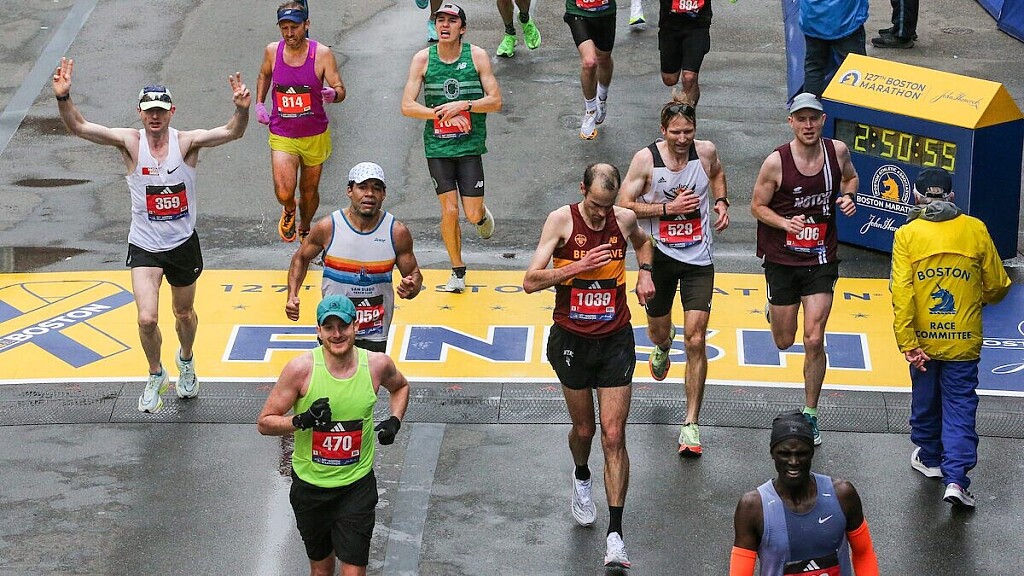
2024 Boston Marathon entry standards are out
On Monday, the Boston Athletic Association (B.A.A.) announced the entry standards and registration window for the 128th Boston Marathon presented by Bank of America, which is set to take place on Monday, April 15, 2024. The world’s most prestigious marathon will host its traditional field size of 30,000 participants.
The registration period will span five days, from Sept. 11 to 15, 2023. Registration will open on Monday, Sept. 11 at 10 a.m. E.T. and close on Friday, Sept. 15, 2023, at 5 p.m. E.T. The registration process will follow the same format used for the previous three races, allowing qualified runners with valid Boston Marathon qualifying times to submit their applications during the designated registration week.
The qualifying standards for the 128th Boston Marathon will remain the same as those for the 2023 edition. Participants who have achieved their qualifying times can submit their applications during the registration window. This will also be the second year the marathon features non-binary qualifying standards.
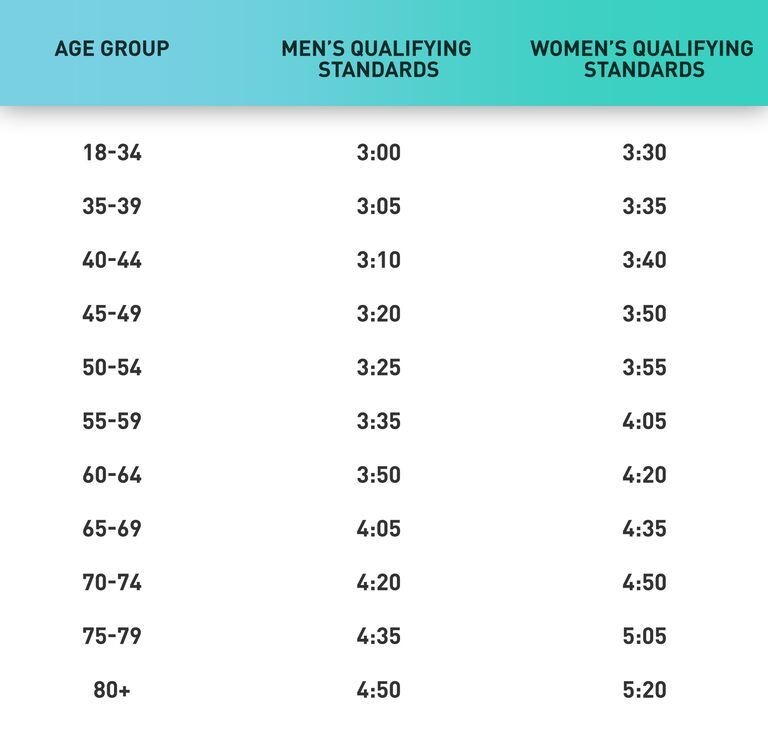
However, meeting the qualifying standard does not guarantee acceptance into the marathon. Selections will be based on the fastest applicants within each age and gender group. In the last two editions of the race, there have been no cut-off times inside the qualification standards.
Those wanting to run the marathon must use a marathon time from the qualifying window of Sept. 1, 2022 to Sept. 15, 2023.
Additionally, athletes with active finisher streaks of 10 or more consecutive Boston Marathons will receive early registration between Aug. 28 and Sept. 1, 2023. Further details regarding this exclusive registration period will be communicated to eligible participants in the coming months.
If space remains available after the registration period, it will re-open to the public on Monday, Sept. 17, until the race is full.
by Marley Dickinson
Login to leave a comment
Boston Marathon
Among the nation’s oldest athletic clubs, the B.A.A. was established in 1887, and, in 1896, more than half of the U.S. Olympic Team at the first modern games was composed of B.A.A. club members. The Olympic Games provided the inspiration for the first Boston Marathon, which culminated the B.A.A. Games on April 19, 1897. John J. McDermott emerged from a...
more...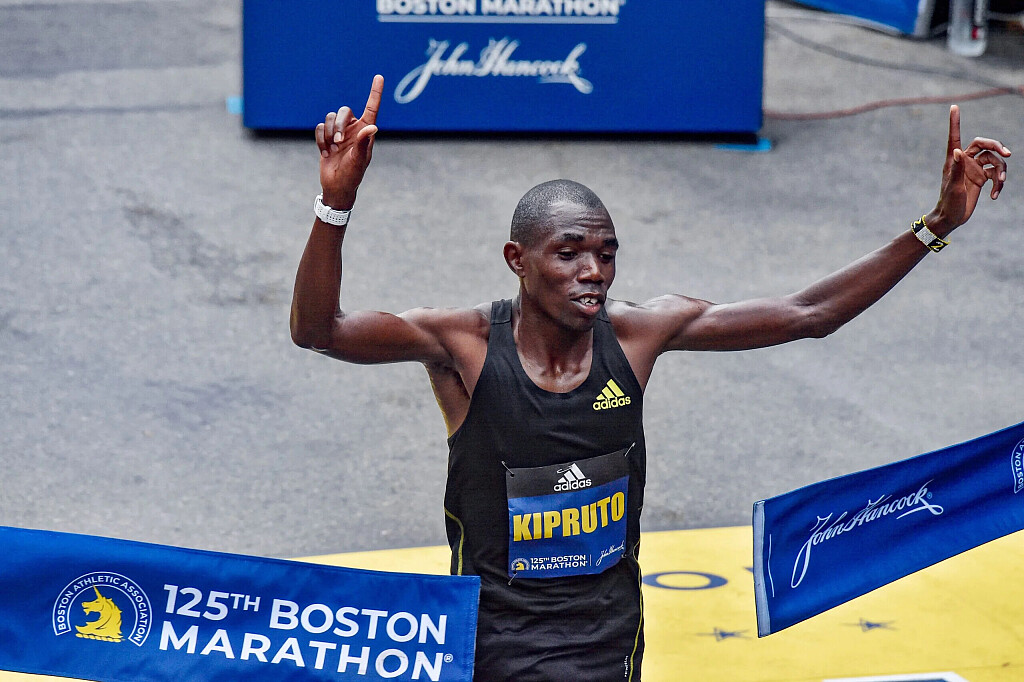
Boston champions and U.S. record holders return for 2023 B.A.A. 10K
The Boston Athletic Association (B.A.A.) has announced professional fields for the 2023 B.A.A. 10K presented by Brigham and Women’s Hospital, to be run on Sunday, June 25 through Back Bay. Among the challengers set to compete are Boston Marathon champions Hellen Obiri (2023) and Benson Kipruto (2021), defending B.A.A. 10K winner Leonard Korir, as well as national record holder Emily Sisson. Complete field lists can be found below.
The B.A.A. 10K presented by Brigham and Women’s Hospital will be the second event of the 2023 B.A.A. Distance Medley, a year-long series featuring the B.A.A. 5K (April), B.A.A. 10K (June), and B.A.A. Half Marathon (November). Registration remains open with limited spots remaining.
“Many fan favorites and global stars return to Boston for this year’s B.A.A. 10K, including Boston Marathoners, American record holders, Olympians and Paralympians,” said Mary Kate Shea, Director of Professional Athletes for the B.A.A. “The B.A.A. 10K course is flat, fast, and –most importantly—fun for our top contenders. We look forward to kicking off summer with a memorable competition on June 25.”
Obiri, a two-time Olympic silver medalist, won April’s Boston Marathon in her Boston debut, and will return to the roads hoping to extend her winning streak. Her 30:15 personal best at 10K is fourth fastest among the field, only trailing Sheila Chepkirui (Kenya, 29:46), Vicoty Chepngeno (Kenya, 30:14), and Joan Chelimo Melly (Romania, 30:14). Chelimo Melly won the B.A.A. 10K in 2017, while Chepkirui placed fourth at last month’s TCS London Marathon.
Korir, the reigning B.A.A. 10K champion, is fresh off a win at the USA 25K National Championships on May 13, and looks to become the fourth man to win back-to-back B.A.A. 10Ks. Sisson, the current American record holder in the marathon and half marathon also will return, joined by Olympic Marathon bronze medalist and former Boston resident Molly Seidel.
Among the international field squaring off are Boston Marathon winners Kipruto (2021), Edna Kiplagat (2017 and 2021), and Caroline Rotich (2015), all of Kenya. Gabriel Geay (Tanzania) will return after a runner-up finish at April’s Boston Marathon, and previously won the B.A.A. 10K in 2018.
Geoffrey Koech, winner of last year’s B.A.A. Half Marathon, will compete, as will Callum Hawkins of Great Britain, twice the fourth-place finisher at the World Championships marathon, plus decorated road racers Edward Cheserek (Kenya), a 17-time NCAA champion, and Zouhair Talbi (Morocco), most recently fifth at the Boston Marathon. From Team B.A.A. are Matt McDonald, Paul Hogan, Jonas Hampton, and Eric Hamer.
Mary Ngugi of Kenya, a two-time B.A.A. 10K winner and two-time Boston Marathon podium finisher, will aim for title number three, as fellow Kenyan Sharon Lokedi, the 2022 TCS New York City Marathon champion, looks for her first B.A.A. event victory. Team B.A.A.’s Annie Rodenfels, third place and top American at the 2023 B.A.A. 5K, will make her debut at the 10K distance leading a full contingent of Boston-based B.A.A. teammates including Bethany Hasz, Megan Hasz, and Jenna Magness.
Hermin Garic, the 2022 B.A.A. 10K winner, returns in the men’s wheelchair division, while Yen Hoang, third place at the 2021 Boston Marathon, leads the women’s wheelchair division. Brian Reynolds and Liz Willis will compete in the T61-64 (lower-limb impairment) division having already earned podium placings at the Boston Marathon in April. Reynolds, a Massachusetts native, set a world best 1:25:46 at the 2022 B.A.A. Half Marathon. Local Para athlete and last year’s T61-64 women’s winner, Adrianne Haslet, will also compete. Additional 2023 Boston Marathon Para division winners Andrew Thorson (T11-T13 vision impairment) and Atsbha Gebre (T45/T46 upper-limb impairment) are racing. The B.A.A. 10K presented by Brigham and Women’s Hospital has been certified by World Para Athletics as a record-eligible competition, paving the way for Para Athletes to set world and national records this year.
Media members interested in covering the B.A.A. 10K, presented by Brigham and Women’s Hospital, may apply for credentials here.
Registration for the 2023 B.A.A. 10K presented by Brigham and Women’s Hospital, is currently open through the B.A.A.’s online platform Athletes’ Village. All participants who enter will receive an adidas participant shirt, unique bib number, and finisher medal. Additional participant information can be found on baa.org. The race will start at 8:00 a.m. ET on Sunday, June 25 on Charles Street adjacent to Boston Common and Boston Public Garden.
Brigham and Women's Hospital, the B.A.A. 10K’s presenting sponsor and exclusive fundraising partner, will again field a team of fundraising runners. Since 2016, more than 2,100 runners and 180 teams have raised $1.2 million to fuel life-giving breakthroughs at Brigham and Women’s Hospital. Learn more and register at www.runbwh.org/10k.
Login to leave a comment
B.A.A. 10K
The 6.2-mile course is a scenic tour through Boston's Back Bay. Notable neighborhoods and attractions include the legendary Bull and Finch Pub, after which the television series "Cheers" was developed, the campus of Boston University, and trendy Kenmore Square. ...
more...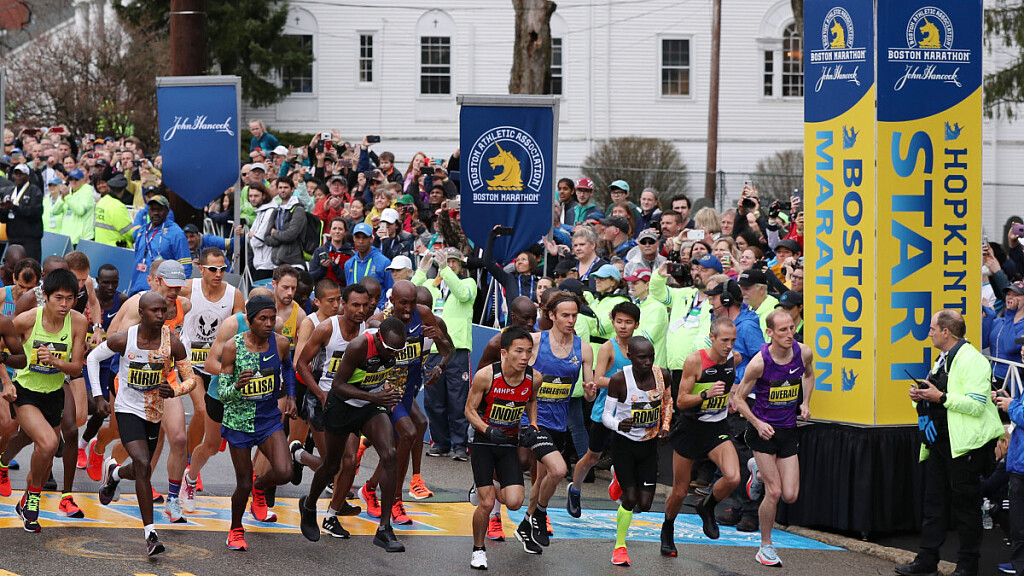
127th Boston Marathon Raised $40.2 Million For Non-Profit Organizations
The Boston Athletic Association (B.A.A.) has announced that $40.2 million was raised for more than 200 non-profit organizations through this year’s 127th Boston Marathon, held on Patriots’ Day, Monday, April 17.
The fundraising total marks the highest amount raised surrounding a single Boston Marathon, breaking the previous mark of $38.7 million set in 2019. Combined, the B.A.A. Official Charity Program and John Hancock Non-Profit Program have raised $500.2 million since the charity program’s inception at the 1989 Boston Marathon.
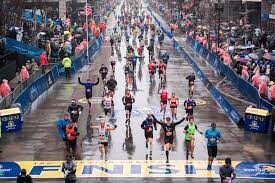
“Philanthropic and fundraising efforts surrounding this year’s Boston Marathon hit record highs in 2023, a testament to the hard work and dedication of all participants running for greater causes,” said Nicole Juri, B.A.A. Director of Development. “More than 200 charities and non-profit organizations will benefit thanks to the efforts of our fundraising participants.”
The $40.2 million raised this year includes donations raised through the B.A.A.’s Official Charity Program, the John Hancock Non-Profit Program, and from other qualified and invitational runners. 2,537 participants ran as fundraising athletes at the 127th Boston Marathon. Further details can be found on the Boston Marathon’s fundraising page through GivenGain.
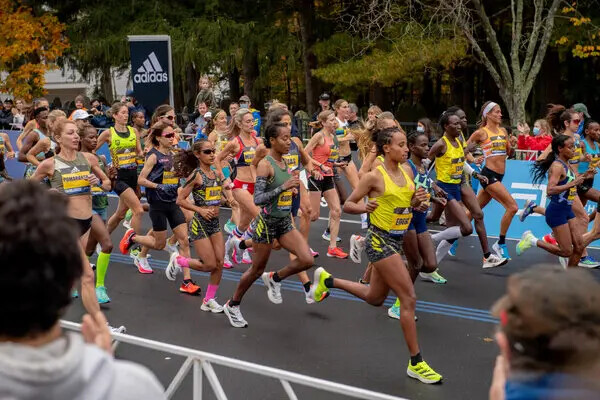
“We are proud to cap our 38-year principal sponsorship by setting a new fundraising milestone this year,” said Tom Crohan, VP & Counsel, Global Head of Community Investment at John Hancock and Manulife. “Thank you to every runner, volunteer, donor, and non-profit partner who contributed to these record-setting results. It’s an honor to have helped build a legacy of impact, and we are proud of our collective efforts to help make lives better for those served by our community partners.”
Leading up to Boston Marathon race day, the B.A.A. and John Hancock hosted a variety of fundraising giving initiatives to support athletes running for causes, including Boston Marathon Giving Day on March 15. Through Boston Marathon Giving Day, $1,041,766 in donations was raised over a 24-hour period.
The B.A.A. has annually provided non-profits associated with the B.A.A. Official Charity Program and John Hancock Non-Profit Program with invitational entries into the Boston Marathon. Each non-profit organization directly manages its own application process, athlete selection, and fundraising minimums, deadlines, and requirements.
The B.A.A. will notify non-profit organizations who have been selected to participate in the 128th Boston Marathon as part of the B.A.A. Official Charity Program this Summer. More information can be found on the B.A.A. Official Charity Program.
The next B.A.A. event is the B.A.A. 10K presented by Brigham and Women’s Hospital on Sunday, June 25. Registration is currently open.
Login to leave a comment
Boston Marathon
Among the nation’s oldest athletic clubs, the B.A.A. was established in 1887, and, in 1896, more than half of the U.S. Olympic Team at the first modern games was composed of B.A.A. club members. The Olympic Games provided the inspiration for the first Boston Marathon, which culminated the B.A.A. Games on April 19, 1897. John J. McDermott emerged from a...
more...
Boston Marathon icon Rick Hoyt dies at 61
On Monday, the Hoyt Family announced the death of Boston Marathon icon Rick Hoyt at age 61. Hoyt was a longtime staple of the Boston Marathon, who was pushed to the Boston Marathon finish line in his wheelchair by his father, Dick, for 32 years between 1980 and 2014.
“It is with profound sadness that the Hoyt Family announces the passing of our beloved brother and uncle, Rick, this morning. Rick was 61 years old. Rick passed away due to complications with his respiratory system,” the family said in a statement. “As so many knew, Rick along with our father, Dick, were icons in the road race and triathlon worlds for over 40 years and inspired millions of people with disabilities to believe in themselves, set goals and accomplish extraordinary things.”
Hoyt had cerebral palsy, which left him a quadriplegic. In 1977, he told his father, Dick, that he wanted to take part in a charity run for a lacrosse player who was paralyzed in an accident. Dick pushed his son for the race, and after, he told his father, “When I’m running, I don’t feel handicapped.”
The duo’s participation in marathons, triathlons, and endurance events showcased that physical disabilities should never limit one’s aspirations. Hoyt’s presence on the Boston Marathon course symbolized courage and the belief that anything is possible.
Dick died in March 2021 at age 80. The same year his son retired from marathons.
The Boston Athletic Association (B.A.A.) released a statement in memory of Hoyt:
Rick Hoyt will always be remembered as a Boston Marathon icon and for personifying the “Yes You Can” mentality that defined Team Hoyt. We are fortunate to have been able to call Rick a friend, mentor, pioneer, and Boston Marathon finisher. His legacy will live on through the Rick & Dick Hoyt Award, which is presented each April around the Boston Marathon to someone who exhibits the spirit of Team Hoyt through advocacy and inclusion.
Our thoughts go out to the Hoyt family, Rick’s many friends, and all who were touched by his positivity.
The B.A.A. has continued to honour Hoyt’s legacy at the Boston Marathon, establishing the Rick & Dick Hoyt Award in 2021. The award annually recognizes individuals who promote inclusivity and advocate for others in the community.
by Marley Dickinson
Login to leave a comment
Boston Marathon
Among the nation’s oldest athletic clubs, the B.A.A. was established in 1887, and, in 1896, more than half of the U.S. Olympic Team at the first modern games was composed of B.A.A. club members. The Olympic Games provided the inspiration for the first Boston Marathon, which culminated the B.A.A. Games on April 19, 1897. John J. McDermott emerged from a...
more...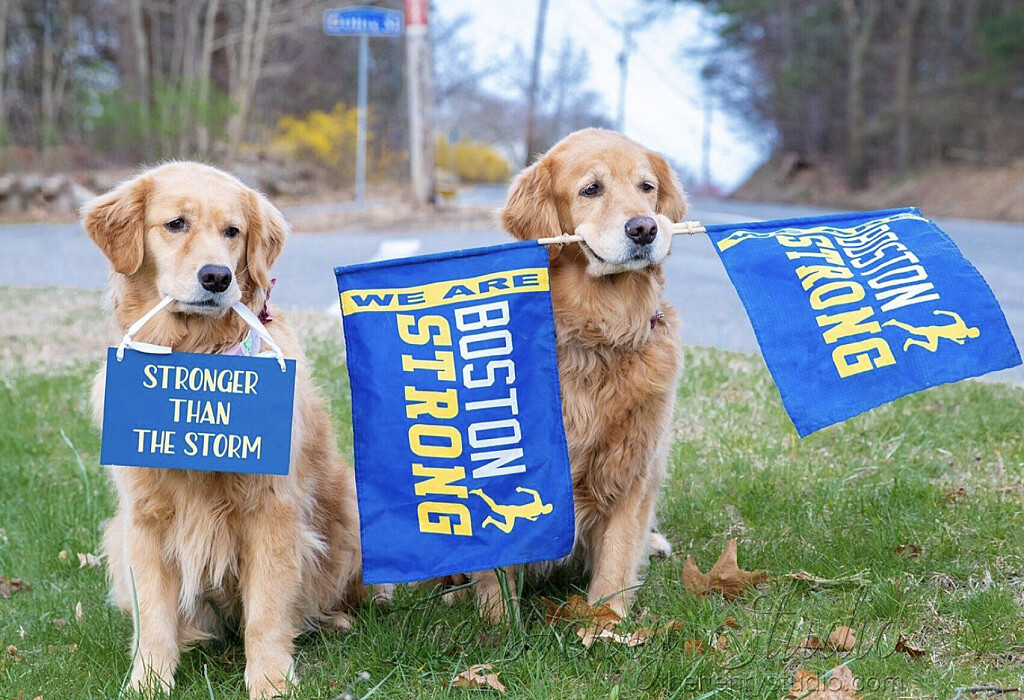
Hundreds of dogs to run at Boston Marathon to honour late pups
On April 16, hundreds of furry friends will take to the 127th Boston Marathon course to honour Spencer and Penny, the official Boston Marathon dogs who died of cancer in February.
More than 100 golden retrievers and their owners are expected to attend and walk to the finish line in a special one-mile event organized by a regional group called MA Golden Meetups. The doggo parade will be the day before the world’s most prestigious marathon on Patriots Day, April 17.

In 2018, Spencer went viral after he was seen in a video holding “Boston Strong” flags in his mouth, cheering on the marathoners racing past him in the rain. Since 2014, Spencer has watched the marathon near Ashland State Park (around the five-mile mark on the Boston course), and Penny, who was three years younger, was often seen by his side.
This year’s race will be the first marathon Spencer and Penny will not attend since 2013. The two golden retrievers will also be commemorated on a billboard in Ashland, Mass., with the slogan “Forever Boston Strong.”
Boston Strong was a slogan created to empower the community after the 2013 Boston Marathon bombing. This year marks 10 years since the catastrophic event.
“We miss you and are proud to call you a friend and forever the ‘Official Dog’ of the Boston Marathon,” the Boston Athletic Association (B.A.A.) said in a tweet.
The dog walk will start at 10 a.m. outside the Boston Common and end at the Boston Marathon finish line on Boylston St. “In memory of Spencer and Penny, the Boston Marathon Goldens, and so many of our beloved furry members who have battled canine cancer,” the website states.
Login to leave a comment
Red Sox icon David Ortiz named 2023 Boston Marathon Grand Marshal
On Friday, the Boston Athletic Association (B.A.A.) announced that MLB Hall of Famer and Boston Red Sox legend David Ortiz will serve as Grand Marshal for the 127th Boston Marathon on Monday, April 17.
The three-time World Series champion will serve as the 2023 Grand Marshal, kicking off the race with a speech in Hopkinton, before the 30,000+ entrants from 122 countries make the 42.2km journey down to Boylston Street. Ortiz will ride in the lead vehicle, and will reach the finish shortly before race champions break the finish tape out front of the Boston Public Library.
This year’s race marks the 10th anniversary of the Boston Marathon bombing. In the wake of the 2013 bombing, Ortiz gave a memorable speech to Bostonians at Fenway Park before the Red Sox game. He took on the role of a leader on the Red Sox from 2003 to 2016, embodying the spirit of the city on and off the field.
Ortiz, 47, won’t be the only former Boston sporting legend taking part in this year’s race; former Boston Bruins captain Zdeno Chara, who led the Bruins to a 2011 Stanley Cup, will be running the marathon for The Hoyt Foundation. This will be Chara’s first marathon.
The 127th Boston Marathon has many storylines, but the most interesting one will be how the greatest marathoner in history, Eliud Kipchoge, fares in his Boston debut. The 38-year-old marathon world record holder is on a quest to win all six Abbott World Marathon Majors; he currently has four wins, missing only Boston and New York. (He is also a two-time Olympic gold medallist.)
by Running Magazine
Login to leave a comment
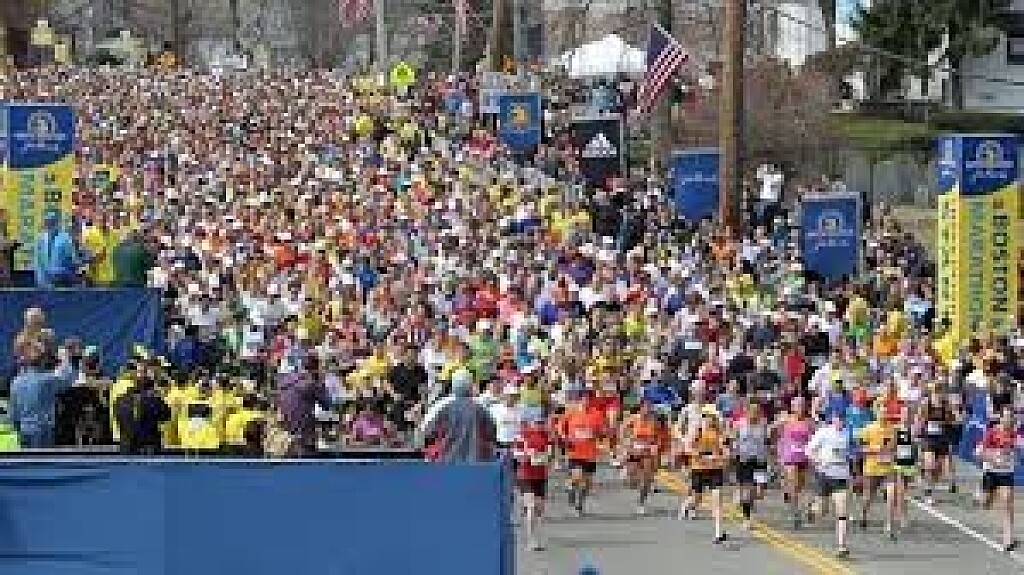
B.A.A. announces pregnancy deferral accommodations for all B.A.A. events, including Boston Marathon
The Boston Athletic Association (B.A.A.) announced today accommodation enhancements pertaining to runners who are expecting or have recently welcomed a child into their families. Pregnancy and postpartum deferrals of entries will now be available for registered participants at all B.A.A. events, including the Boston Marathon (April), B.A.A. 5K (April), B.A.A. 10K (June), and B.A.A. Half Marathon (November).
“In listening to our participants and stakeholders, the desire from mothers and expecting mothers to participate in our races –particularly the Boston Marathon—while also focusing on building a family was clear,” said Jack Fleming, President and Chief Executive Officer of the B.A.A. “Women who are entered in a B.A.A. race and want to expand their family will be able to do just that without giving up a chance to participate at a future B.A.A. event.”
Any athlete who is a registered entrant in a B.A.A. event and is or becomes pregnant prior to race day and chooses not to participate due to such circumstances will be eligible to receive a deferred entry into one of the next two subsequent future races. The new pregnancy and postpartum deferment policy is effective immediately, and includes athletes who are entered in the Boston Marathon by way of qualifying time or invitational entry.
Athletes seeking a pregnancy or postpartum deferral may submit a request in writing to registration@baa.org any time between receiving confirmation of acceptance into the event and up to 14 days before race day. Upon receipt of a pregnancy or postpartum deferment request, the B.A.A.’s Athlete Services team will be in contact with the athlete and will request confirmation of pregnancy from a physician, registered midwife, or other medical professional.
“We at the B.A.A. are always looking for ways to improve the participant experience starting at the point of registration, and have been collaborating to create this policy for many months,” said Susie Cleary, the B.A.A.’s Director of Athlete Services. “This new deferral accommodation has been implemented with the goal of supporting mother runners along their journey at all our events, from the 5K distance through the marathon.”
If an athlete becomes pregnant again during a pregnancy or postpartum deferral period, they may request a second consecutive pregnancy or postpartum deferral. This would permit the athlete to defer their race entry for a subsequent two-year period. The B.A.A. will allow up to two consecutive pregnancy deferral requests per athlete. Policy details will be posted on www.baa.org soon.
The pregnancy deferral opportunity is an accommodation in addition to the registration insurance currently offered to Boston Marathon participants, which covers refunds for a variety of situations, including pregnancy. All other rules and requirements for race entry after a pregnancy or postpartum deferral will apply, including payment for future registration entry fees.
In addition to deferrals, the B.A.A. will be enhancing accommodations for recent mothers on race weekend. For more than a decade, mothers have been provided the opportunity to utilize designated tents at the start and finish of the Boston Marathon for lactation pumping. In response to the overwhelming support of this program and the accompanying medical device transport program (where race officials transport devices such as breast pumps from the start to finish), the B.A.A. plans to share additional accommodations as race day approaches. The B.A.A. is currently consulting a group of mother runners to help facilitate best practices at our events. More information will be shared with participants over the coming months.
ABOUT THE BOSTON ATHLETIC ASSOCIATION (B.A.A.)
Established in 1887, the Boston Athletic Association is a non-profit organization with a mission of promoting a healthy lifestyle through sports, especially running. The B.A.A. manages the Boston Marathon, and supports comprehensive charity, youth, and year-round programming. The Boston Marathon is part of the Abbott World Marathon Majors, along with international marathons in Tokyo, London, Berlin, Chicago, and New York City. Since 1986, the principal sponsor of the Boston Marathon has been John Hancock. The 127th Boston Marathon is scheduled to take place on Monday, April 17, 2023. For more information on the B.A.A., please visit www.baa.org.
by Boston Athletic Association
Login to leave a comment
Boston Marathon
Among the nation’s oldest athletic clubs, the B.A.A. was established in 1887, and, in 1896, more than half of the U.S. Olympic Team at the first modern games was composed of B.A.A. club members. The Olympic Games provided the inspiration for the first Boston Marathon, which culminated the B.A.A. Games on April 19, 1897. John J. McDermott emerged from a...
more...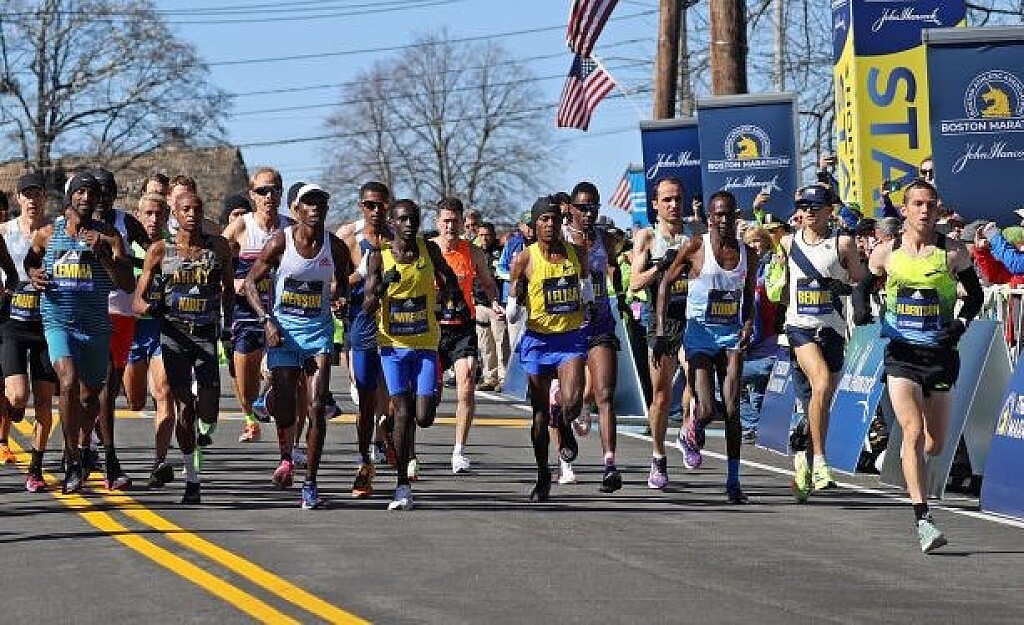
Boston Athletic Association announces 2023 Boston Marathon men´s field
The Boston Athletic Association (B.A.A.) announced today the men’s professional field for the 127th Boston Marathon, featuring 15 men who’ve run under 2:07 for the marathon distance, as well as multiple Abbott World Marathon Major race champions, Olympic and Paralympic stars.
Today’s announcement expands upon four previously announced men’s entrants including world record holder and double Olympic gold medalist Eliud Kipchoge, reigning Boston Marathon champion Evans Chebet, 2021 winner Benson Kipruto, and two-time victor Lelisa Desisa. A total of 109 men’s athletes from 21 countries are in this year’s professional field across the men’s Open, Wheelchair, and Para Athletics Divisions.
“The Boston Marathon is known for its competitiveness, with many races decided in the final meters on Boylston Street,” said Mary Kate Shea, B.A.A. Director of Professional Athletes. “This year’s field brings together athletes who’ve excelled at both speed and championship-style racing. Combined with the women’s professional field announced on Monday, this will be the fastest and most decorated Boston Marathon across all of our divisions in race history.”
Behind Kipchoge and Chebet, the fastest man in the field will be Tanzanian national record holder Gabriel Geay, who finished runner-up at the Valencia Marathon last month in 2:03:00. Geay has had success racing on the roads of Boston, winning the 2018 B.A.A. 10K, placing fourth at last year’s Boston Marathon, and finishing in second and third at the B.A.A. Half Marathon in 2019 and 2018, respectively.
“I am excited to be returning to the Boston Marathon this year,” said Geay. “I fulfilled a dream by racing in Boston last year, but my goal is to one day win the race, and I hope that 2023 will be my year. Thank you, Boston for the opportunity!”
Joining Geay will be past Abbott World Marathon Majors winners including Albert Korir of Kenya (2021 New York City champion), Ghirmay Ghebreslassie of Eritrea (2015 World Championships gold medalist and 2016 New York City champion), and Shura Kitata of Ethiopia (2020 London Marathon champion). Brazilian Olympian and national record holder Daniel Do Nascimento will make his Boston debut, as will Ethiopia’s Herpasa Negasa, a 2:03:40 marathoner.
Last year’s seventh-place finisher and top American, Scott Fauble, returns for his fourth Hopkinton-to-Boston race, and will be joined by 50K world record holder CJ Albertson. After a 2:08:16 marathon debut in Chicago last year, Conner Mantz will take on the Boston course for the first time. He is coached by Olympic marathoner Ed Eyestone.
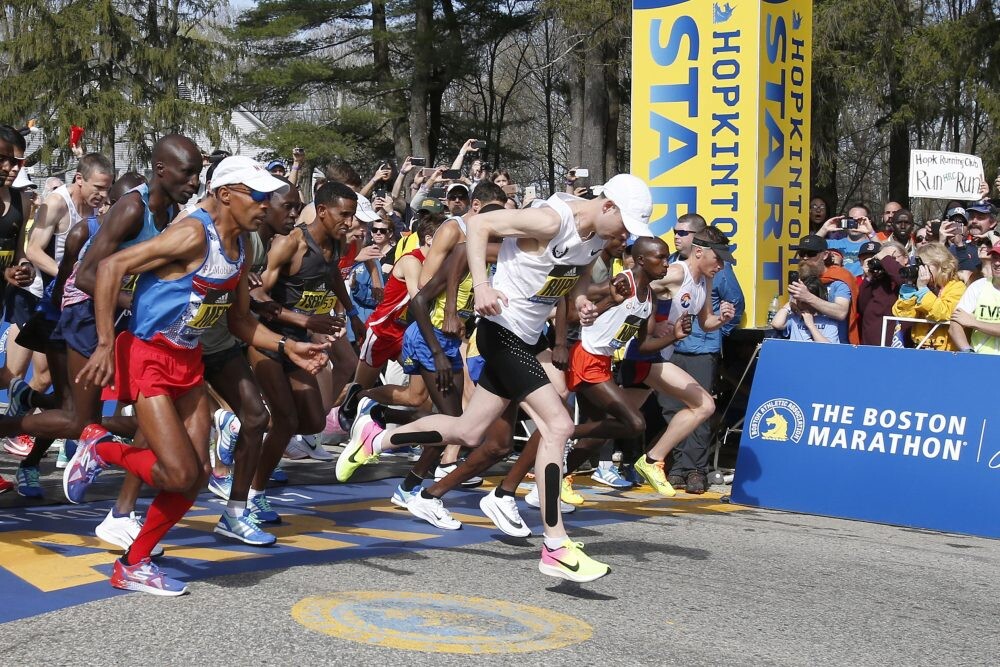
“I love the Boston Marathon. It’s one of the greatest sporting events in the world,” said Fauble. “It has a way of bringing the best out of people.”
"Boston is such a historic marathon, and I want to be a part of that history,” said Mantz. “I love the aspect of racing with no pacers and hills that break up rhythm, and Boston has both of those. When you add in the competition Boston is bringing this year with Eliud Kipchoge and many others, it makes the race so exciting!"
Ben True, a Maine native and four-time winner of the B.A.A. 5K, also is part of the American field. B.A.A. High Performance Team members Matt McDonald, Paul Hogan, and Jonas Hampton will have the hometown edge; McDonald set a new B.A.A. club record and lifetime best of 2:09:49 in Chicago last fall.
American Daniel Romanchuk will return as defending champion in the wheelchair division, coming off a 1:26:58 victory last April. Romanchuk also won Boston in 2019 (1:21:36), though he looks to be challenged by wheelchair marathon world record holder and reigning Paralympic marathon gold medalist Marcel Hug. Hug returns in search of his sixth Boston Marathon title and holds the Boston course record of 1:18:04. In 2022 the Swiss ‘Silver Bullet’ won the B.A.A. 5K in 10 minutes, 5 seconds, a course record time.
“Nothing can compare with the excitement and anticipation at the Boston Marathon,” said Romanchuk. “I’m incredibly excited and honored to be part of what should be a great race through the hills and all the way to Boylston Street.”
Aaron Pike, last year’s wheelchair division runner-up, and Ernst van Dyk, a ten-time Boston winner, are also racing. A $50,000 course record bonus is available to any open division or wheelchair division athlete who breaks a course record.
Paralympians Matthew Felton and Atsbha Gebre Gebremeskel lead the Para Athletics Division in the T46 classification (upper-limb impairment). American record holder and Massachusetts native Chaz Davis will look to defend his T12 (vision impairment) Para title.
Headlining the T62 and T63 classification are Marko Cheseto Lemtukei and Brian Reynolds. Cheseto Lemtukei earned a victory in 2:37:01 last year, while Reynolds set a pending T62 world record of 1:25:46 at the B.A.A. Half Marathon in November.
“A perfect society is one that sees diversity of its members as her strength,” said Cheseto Lemtukei, who returns as a two-time Boston Marathon Para Athletics Division champion.
The 127th Boston Marathon will be held on Monday, April 17, 2023 – Patriots’ Day in the Commonwealth of Massachusetts—and will feature 30,000 participants.
by Boston Athletic Association
Login to leave a comment
Boston Marathon
Among the nation’s oldest athletic clubs, the B.A.A. was established in 1887, and, in 1896, more than half of the U.S. Olympic Team at the first modern games was composed of B.A.A. club members. The Olympic Games provided the inspiration for the first Boston Marathon, which culminated the B.A.A. Games on April 19, 1897. John J. McDermott emerged from a...
more...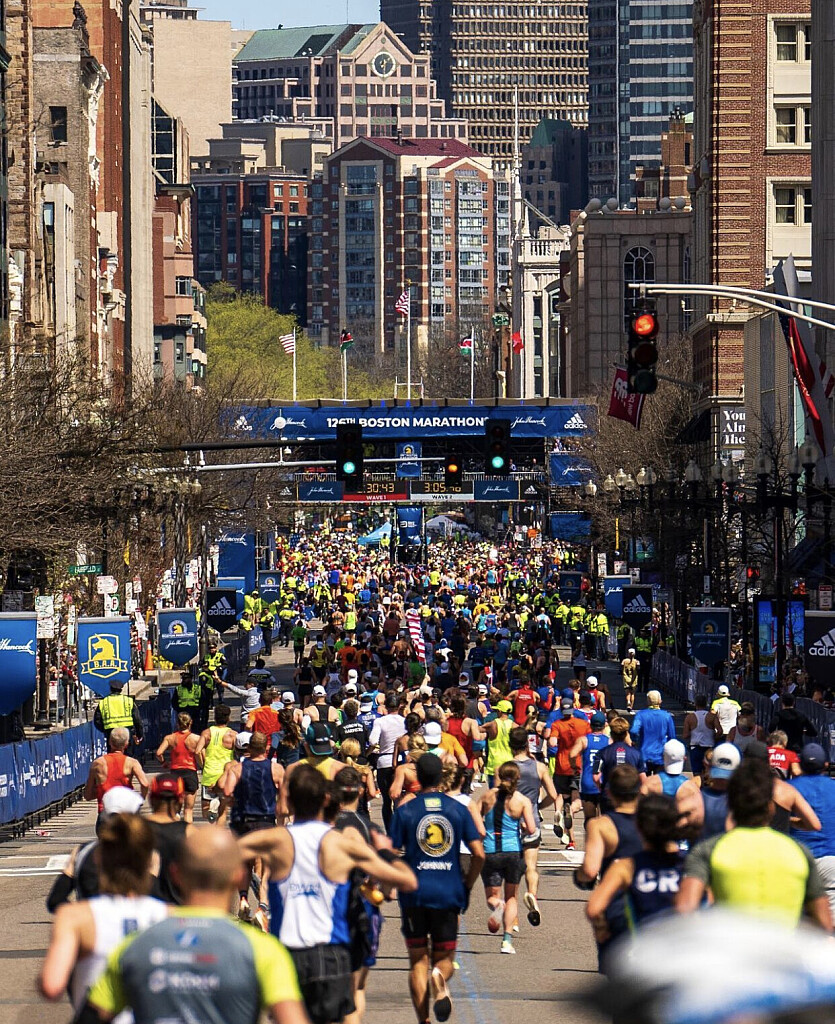
Did You Know the Boston Athletic Association Has a Membership?
Joining isn’t as simple as you might think.
The 1983 Boston Marathon champion Greg Meyer is a member of the Boston Athletic Association (B.A.A.). So is Bobbi Gibb, women’s champion during the “pioneer era” of the marathon in 1966, ’67, and ’68.
But Kathrine Switzer, who made headlines in Boston in 1967, is not. Nor is Meb Keflezighi, the 2014 champion.
Tom Grilk, the CEO who retired in April, has been a member since 1987. The new CEO, Jack Fleming, is not.
Michael O’Leary, M.D., a surgeon at Brigham and Women’s Hospital and chairman of the B.A.A.’s Board of Governors (which is essentially the same as a board of directors) has been a member of the B.A.A. since 1989. All 13 Governors (10 men, three women) are members—they have to be, in order to be picked to serve on the board.
Scott Peterson, a Miami-area corporate finance professional, is a member, and he has his membership listed prominently on his LinkedIn profile. When asked by Runner’s World about it, Peterson, a marathon veteran, called the group “like-minded people who support the running community.” He said, “It’s a real honor for me and anyone to be part of the membership of B.A.A.”
But what is this selective group, exactly? Who are they? And how are they chosen?
A local mystery
Information about membership on the B.A.A. website is scant, which cloaks the group—intentionally or not—in secrecy. Several people who are deeply involved in the Boston-area running community told Runner’s World they did not know such a group existed. (There is also a B.A.A. Running Club, which is open to runners in the Boston area, but it is different from the membership.)
Chris Lotsbom, a B.A.A. spokesperson, answered multiple questions from Runner’s World about the membership via email. He said the group currently has 174 people.
He also explained that the membership model goes back to the B.A.A.’s founding in 1887. The marathon started 10 years later, in 1897.
The organization had, in its earliest days, a building with a pool, indoor track, bowling alley, and boxing room, among other amenities, like a golf club, for its dues-paying members. The B.A.A. was similar to other athletic clubs across the country, most notably the New York Athletic Club, which still exists.
In the 1930s, during the Great Depression, the B.A.A. lost its headquarters building and its other properties. All that remained was the marathon, the bylaws of the organization, and a small group of members.
The members kept the B.A.A. and the marathon going. And they remain to this day, written into the organization’s bylaws to promote “the common good and the health and welfare of the general public and the encouragement of the general public to improve their physical condition.”
Tom Derderian, executive producer of Boston: The Documentary and author of Boston Marathon: Year-by-Year Stories of the World’s Premier Running Event, takes a skeptical view of the leadership back in the day.
“The B.A.A. expected that their investments in the 1920s would continue to grow,” he wrote to Runner’s World. “The stock market crash and Depression and World War II removed all B.A.A. assets, leaving the Association with only its name, an indoor track meet, the Boston Marathon—and the founding attitude that only B.A.A. members could know what was best.”
The modern-day membership
Today, as with any group, some members are actively engaged in day-to-day matters of the organization, attending meetings, voting, lending expertise, or volunteering at B.A.A. events. Others are not involved at all.
“For us today, membership is a valuable asset when tapped into,” Fleming said in a call with Runner’s World. “There’s still work to be done, but leadership and staff rely on the members for a variety of things. They serve on committees. They provide guidance in areas, their expertise. So finance, real estate, of course, running, community, the professional side, technology.”
For example, when the B.A.A. wanted to buy a building in Hopkinton near the marathon starting line, the organization got real estate advice from some of the members during the process.
They have also helped with recent diversity initiatives.
“Several B.A.A. members were significant in the establishment of the Boston Running Collaborative, which seeks to increase the fitness and participation of minorities in running,” Lotsbom wrote. “In this respect, membership is a resource which complements the staff’s day-to-day work.”
The way the bylaws are written, the Board of Governors are nominated from the membership. So the 174 members influence the direction of the B.A.A. through the Governors, who oversee the CEO.
The B.A.A. doesn’t track the demographic makeup of the membership, but Lotsbom wrote that, since 2010, the group has attempted to improve its diversity.
Thaddeus Miles, who founded the Run to Wellness 5K in Roxbury several years ago, was invited to join the membership two years ago by Tom Grilk. Miles recently showed up at his first in-person membership meeting post-pandemic. He counted only one other Black member among what he estimates were 50 attendees, plus Adrienne Benton and Keith McDermott, who are on the Board of Governors.
Three people who are familiar with the membership said that many members work in the medical professions or financial services industry in the Boston area.
There is a family component as well, according to the B.A.A. O’Leary’s father, also a physician, was a member of the B.A.A. who was responsible for the physicals administered to marathon runners in Hopkinton during the race’s earlier years. A descendant of Walter Brown, who founded the Boston Celtics and was the B.A.A. president from 1941–64, still starts a division of the marathon to this day.
Members pay a nominal fee—$50—each year to belong. In exchange, they get one waiver each year into the marathon. They still have to pay the entry fee ($375), but they can run themselves without qualifying, transfer the waiver to a friend or family member, or donate the number to a charity.
Miles, who is on the steering committee of the Boston Running Collaborative, gives his waiver for a marathon entry every year to a runner of color who otherwise wouldn’t be able to qualify for the race.
For the thousands of runners every year who try to qualify but fail, or who fundraise for one of the charity teams as a way of gaining entry to Boston, the existence of a small membership group might rankle. Lotsbom said fewer than 180 entries are allocated for members annually (out of a field size of 30,000) and less than half are ultimately used.
“The B.A.A. gets to choose whom they want to invite to run the race, and the B.A.A. decides the terms by which it will invite people to participate in its iconic annual event,” said Robert Wang, the founder of the World Marathon Majors Challenge group on Facebook. (The group’s 18,000 runners are seeking to run all six of the Abbott World Marathon Majors, but they have no official affiliation with that organization.)
“If the B.A.A. wanted to invite everyone whose last name starts with ‘Y’ to run the Boston Marathon, that would absolutely be the organization’s prerogative,” Wang said.
I’d love to be a member. How do I sign up?
There’s the rub. Right now, no such sign-up mechanism exists. You have to know a current member or someone on the Board of Governors.
“Potential members are traditionally nominated by a board member or another current member, and apply with a résumé along with specific comments as to why they wish to join the B.A.A.,” Lotsbom wrote. “From there, the nominees are seconded by a Governor, and voted on by the board. The membership is made up of those who have expressed an interest in the B.A.A., B.A.A. activities, and its mission.”
Fleming acknowledged that the relative obscurity of the membership and the lack of clear guidelines for becoming a member could be improved.
“We should make it known more,” he said. “And we should have more public ways of making it easier to have their interest become known. Raise your hand. We should make it easier for that to occur.”
In an era when running’s leaders are trying to make the sport more inclusive, how does the B.A.A.’s membership fit into the landscape? Is it a quirky echo of the organization’s past? Or an impediment to diversity in today’s world? Does a quiet group of invitation-only members pass the sniff test in 2022?
Tiffany Chenault, a sociology professor at Salem State University who is an ambassador for the Boston chapter of Black Girls Run and part of the Boston Running Collaborative, said in a call that she didn’t recall hearing about the membership, and she wondered how much influence the group holds.
“I’m curious,” she said. “I have questions.”
John Hanc, a longtime Runner’s World contributing editor and author of The B.A.A. at 125: The Official History of the Boston Athletic Association 1887-2012, knew of the group’s role in the B.A.A.’s founding, but he didn’t realize it still existed.
“Today we know the B.A.A. for the marathon and its other major running events,” Hanc said.
“But we have to remember that its history is rooted in the 19th century. Back then, it was very much an athletic club, with all of the exclusivity and, by 21st century standards, perhaps unnecessary and stuffy protocol that came with institutions like it at the time. Over the decades, the organization has morphed into a powerful force in the modern running movement. But some vestiges of that past still remain. While we of course want to see greater diversity in every aspect of the sport, this remnant of the old B.A.A. strikes me as fairly harmless.”
The B.A.A. in 2022 is facing very modern challenges, however. John Hancock, the longtime marathon sponsor, announced that 2023 would be its final year. Will a company want to replace Hancock? And critics have said the B.A.A. has been slow to embrace diversity in its ranks and events. Where does the membership group fit into that?
Does a leadership structure that evolved from the 19th century, and with a Board derived from a membership group, still serve the organization?
Derderian isn’t certain.
“It is a human tendency for those in charge to conclude that only they know enough to be in charge, since they have always been in charge,” he wrote, “and to keep things from changing, they have to continue to exclude control from outside.”
by Runner’s World
Login to leave a comment
Jack Fleming has been named President and Chief Executive Officer of the Boston Athletic Association
The Boston Athletic Association (B.A.A.) announced today that Jack Fleming has been named President and Chief Executive Officer of the organization, effective immediately. Fleming brings more than three decades of experience at the B.A.A. to his new leadership role. His appointment follows a five-month-long national search.
“After a thorough process featuring a group of diverse candidates from across the country with various backgrounds, our Board decided that Jack was the best person for our organization based on his in-depth knowledge of the industry, the B.A.A. in particular, our athletes, and the communities we serve,” said Dr. Michael P. O’Leary, Chairman of the B.A.A. Board. “We are confident in Jack’s ability to take on this next challenge and thrive, moving our mission forward.”
“It is an honor to guide the Boston Athletic Association as we embark together on our next chapter, building upon our 135-year history,” said Fleming, who had been serving as acting Chief Executive Officer since May 1, 2022. “The B.A.A. has long been a leader in the sport of running and within Greater Boston. I have witnessed the unifying power that running can have in our community and look forward to a renewed and reenergized focus on our events, community initiatives, and programming. The entire B.A.A. team is committed to finding new and innovative ways we can lead and grow the sport as one.”

Prior to serving as acting Chief Executive Officer, Fleming was Chief Operating Officer of the B.A.A. from 2017 through 2022. Since 1992 Fleming has held a variety of roles within the organization, most notably within the communications, marketing, and sponsorship departments. As COO Fleming was responsible for managing the day-to-day operations of the B.A.A. and built a strategy that centered around the organization’s vision statement: Committed to a world where all people can access and benefit from running and an active lifestyle.
O’Leary added, “Jack’s contributions to the organization have been unprecedented, and we fully appreciate and understand his dedication and commitment to the B.A.A. as a whole. We have witnessed Jack’s continued growth since 1992, and his vision, enthusiasm, and knowledge make him perfect for this role.”
Prior to Fleming, Tom Grilk served as CEO/Executive Director from 2011 through 2022 as well as President from 2020-2022, while Guy Morse was Executive Director from 2000 through 2010.
ABOUT THE BOSTON ATHLETIC ASSOCIATION
Established in 1887, the Boston Athletic Association (B.A.A.) is a non-profit organization with a mission to promote a healthy lifestyle through sports, especially running. The B.A.A. is committed to a world where all people can access and benefit from running and an active lifestyle. The B.A.A. advances its mission and vision in a variety of ways, such as organizing mass-participatory running events like the Boston Marathon (the world’s oldest annual marathon), creating and supporting community fitness events, and sponsoring a running club that serves the greater Boston area.
The B.A.A. believes that everyone—no matter their race, gender, or background—should be able to advance their well-being safely and without fear or discrimination of any kind. The organization is committed to fostering a workplace and community that is diverse, equitable, inclusive and promotes a sense of belonging for all.
Login to leave a comment
Boston Marathon
Among the nation’s oldest athletic clubs, the B.A.A. was established in 1887, and, in 1896, more than half of the U.S. Olympic Team at the first modern games was composed of B.A.A. club members. The Olympic Games provided the inspiration for the first Boston Marathon, which culminated the B.A.A. Games on April 19, 1897. John J. McDermott emerged from a...
more...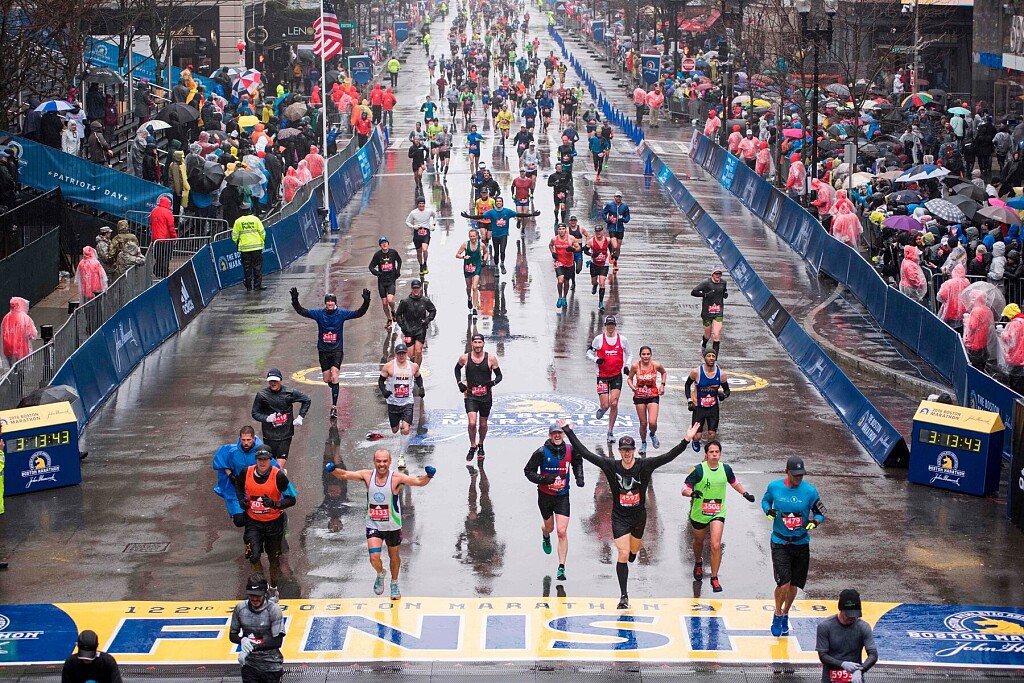
For the second year in a row, all runners who applied to run the Boston Marathon will be accepted into the race, as long as they have a valid qualifying time
For the second year in a row, everyone who qualified for and applied to the Boston Marathon will get to run.
The Boston Athletic Association (B.A.A.) announced on September 21 that there is no cutoff time for the 2023 race. Applicants who ran a verified qualifying time for their age group and gender during the qualifying period will be accepted into the race, which will be held on April 17, 2023.
The field size of the race is 30,000 runners, which will make the race the same size as the 2022 edition—and almost back to pre-pandemic levels. In 2020, before the pandemic canceled the race, the field size was set at 31,500.
But runners have been slow to return to road racing—even as COVID-19 cases have dropped, vaccines and boosters have become widely available, and races have returned to the calendar.
Athletes cite the expense of race entry fees and the high cost of travel required to get to events, wariness about COVID-19, and shifting motivations as reasons why they’re not racing as frequently as they did in 2019 and the early days of 2020.
It appears even the Boston Marathon is not immune from these trends.
Usually 80 percent of the field, or roughly 24,000 spots, are reserved for time qualifiers. The other spots go to elite runners, those running for charity, and special invitational entries.
According to the B.A.A., the race had 23,267 applicants during this year’s registration period. The field of 2023 qualifiers is made up of 13,315 men, 9,930 women, and 22 nonbinary athletes.
In 2019, the B.A.A. received 27,288 applications for the 2020 Boston Marathon (which never happened, due to the pandemic). Application numbers have declined 14.7 percent from pre-pandemic levels.
The drop is in line with what other races are seeing across the U.S.—but somewhat surprising given Boston’s status as the Holy Grail among many marathoners.
Since the 2014 Boston Marathon, running a qualifying time has been no guarantee of entry into the race. Those who beat their qualifying times for their age and gender by the largest margins get in, while those who just squeak by with a qualifier have often been shut out.
Every year, runners eagerly await the announcement of the “cutoff” time—the margin by which you had to beat your qualifying time in order to gain entry into the race. In 2018, that cutoff reached 4:52 for the 2019 race, and more than 7,000 qualified runners who applied did not get in.
That September, the B.A.A. announced it was tightening the entry standards by 5 minutes across all age groups and genders.
Today’s announcement that there is no cutoff could also affect charities. In the past, many qualifiers who didn’t hit the cutoff ran the race for a charity. But with all verified applicants accepted, that reduces the pool of runners seeking bibs—and doing the required fundraising—for nonprofit organizations.
The 2023 race will be the 10th anniversary of the Boston Marathon bombings.
“On Patriots’ Day, the determination, passion, and unity of marathoners will be on display, bringing our community together in the spirit of athletics and our heritage,” said Jack Fleming, acting Chief Executive Officer of the B.A.A., in a release. “We are very much looking forward to the 127th running of the Boston Marathon in just seven months.”
by Sarah Lorge Butler
Login to leave a comment
Boston Marathon
Among the nation’s oldest athletic clubs, the B.A.A. was established in 1887, and, in 1896, more than half of the U.S. Olympic Team at the first modern games was composed of B.A.A. club members. The Olympic Games provided the inspiration for the first Boston Marathon, which culminated the B.A.A. Games on April 19, 1897. John J. McDermott emerged from a...
more...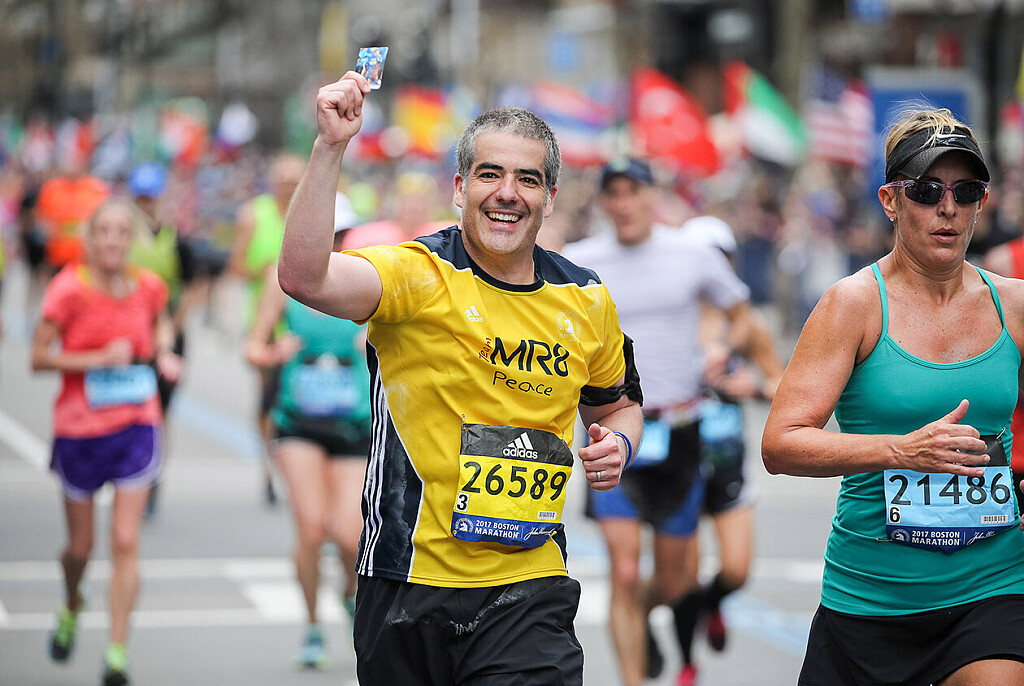
John Hancock dropping Boston Marathon sponsorship after 2023 race
Insurance company John Hancock is saying goodbye to its role as sponsor of the Boston Marathon after nearly four decades.
It's a relationship that the company said helped to raise $426 million for charity over 37 years. The contract will end after the 127th running of the iconic marathon, which is scheduled for April 17.
"Our contract with the Boston Athletic Association (B.A.A.) was expiring in 2023 and after careful review we have chosen not to renew our principal sponsorship of the Boston Marathon after next year’s race," a John Hancock spokesperson said in a statement. "We are honored to have served as a steward for this historic race and thank the B.A.A. for their continued partnership over the years. We are looking forward to the 2023 race as principal sponsor and will work with the B.A.A. to ensure a smooth transition to its next partner."
"The B.A.A. thanks John Hancock for 37 years of partnership, and we continue to work hand in hand in advance of next April’s 127th Boston Marathon," BAA officials said in a written statement. "We're excited to find our next Boston Marathon principal sponsor, and look forward to partnering with an organization who shares our passion for athletic excellence, community engagement, and growing the Boston Marathon to new heights."
John Hancock is also on the verge of ending another decades-long partnership with an iconic Boston institution. The company's lighted sign over the Fenway Park outfield will be coming down at the end of this season, as that 30-year partnership comes to an end.
Starting in 2023, coverage of the annual Massachusetts Patriots' Day race from Hopkinton to Boylston Street will be handled locally by WCVB Channel 5 and nationally by ESPN.
Full statement from the BAA:
"John Hancock has served as principal sponsor of the Boston Marathon for nearly four decades, helping to make the Boston Marathon the global and iconic race it is today. Together with the B.A.A., John Hancock has helped elevate all aspects of our event, from world-class professional athletes to fundraising for hundreds of non-profit programs. The B.A.A. thanks John Hancock for 37 years of partnership, and we continue to work hand in hand in advance of next April’s 127th Boston Marathon.
"At the B.A.A., our commitment to expanding events and creating more running opportunities has never been greater. We're excited to find our next Boston Marathon principal sponsor, and look forward to partnering with an organization who shares our passion for athletic excellence, community engagement, and growing the Boston Marathon to new heights. For 126 years, the Boston Marathon has been the world’s preeminent and most historic marathon. We're enthusiastically eager to embark on the next generation of Boston Marathon partnership."
Login to leave a comment
Boston Marathon
Among the nation’s oldest athletic clubs, the B.A.A. was established in 1887, and, in 1896, more than half of the U.S. Olympic Team at the first modern games was composed of B.A.A. club members. The Olympic Games provided the inspiration for the first Boston Marathon, which culminated the B.A.A. Games on April 19, 1897. John J. McDermott emerged from a...
more...
ESPN and WCVB has signed a deal with the Boston Athletics Association to provide exclusive year-round coverage for all their events including the Marathon
The Boston Athletic Association (B.A.A.) announced today that ESPN and WCVB Channel 5 will serve as the exclusive national and local broadcast partners, respectively, for the Boston Marathon beginning in 2023. WCVB will also provide exclusive year-round coverage for all B.A.A. events including the B.A.A. 5K, B.A.A. 10K, and B.A.A. Half Marathon.
“We’re honored to partner with ESPN and WCVB Channel 5, respected market leaders who bring a spirit of innovation and thoughtful storytelling that will propel the mission of the B.A.A. and legacy of the world’s oldest annual marathon forward,” said Jack Fleming, acting Chief Executive Officer of the B.A.A. “Both have established a tradition of broadcasting world-class athletic events, and we are excited to build on this tradition together into the future.”
“The Boston Marathon is one of the world’s most recognizable and best-known sporting events and we’re proud to be able to bring it to ESPN viewers for years to come,” said Burke Magnus, President, Programming and Original Content, for ESPN. “We look forward to working with the B.A.A. and WCVB to present the stories and athletic achievements of this classic race.”
“The B.A.A. and the Boston Marathon are esteemed around the world and beloved by our community, and to be launching this exclusive partnership as WCVB marks 50 years in broadcasting and service to the community is especially fitting,” said Kyle I. Grimes, WCVB Channel 5 President and General Manager. “WCVB has a proud history of covering the market’s marquee events, and the Boston Marathon is the perfect addition to Channel 5’s signature, local programming. We also look forward to working with the B.A.A. year-round to highlight their many other athletic events as well as the great work they do in the community.”
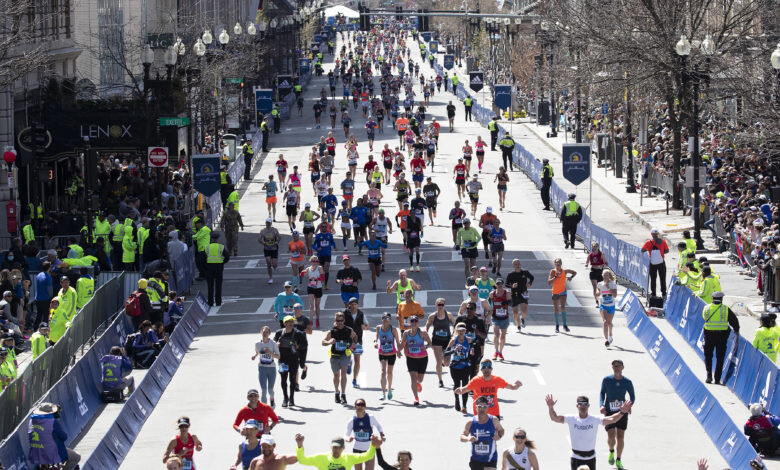
ESPN will broadcast the 127th Boston Marathon, scheduled to take place on Monday, April 17, 2023, on its flagship channel from 8:30 a.m. ET until 1:00 p.m. ET. In addition, ESPN will also have coverage of the race within SportsCenter before the live coverage and later in the day, as well as coverage appearing on other ESPN shows and platforms.
Live coverage of the Boston Marathon will air on WCVB beginning at 4:00 a.m. ET through 8:00 p.m. ET. The race will be exclusively simulcast regionally on WCVB Channel 5’s Hearst Television owned sister-stations WMUR (Manchester, NH), WMTW (Portland/Auburn, ME), and WPTZ (Burlington, VT/Plattsburgh, NY). WCVB and all of its television partners will provide coverage of the marathon on their digital platforms and mobile apps. The Boston Marathon will also be live streamed on Very Local Boston, and the streaming platform will host year-round content featuring the B.A.A. WCVB will also serve as the first-ever exclusive broadcast partner for the B.A.A.’s Distance Medley races and will provide year-round coverage of the B.A.A. and its races, with a focus on the Boston Marathon.
The partnership marks the return of the Boston Marathon to both ESPN and WCVB, with ESPN having aired the world’s most prestigious road race in the early 1980’s and then from 1997-2004. WCVB provided wire-to-wire coverage of the marathon from 1982 through 2006, including the largest Boston Marathon in history—the centennial Boston Marathon in 1996 featured 35,868 finishers.
Login to leave a comment
Boston Marathon
Among the nation’s oldest athletic clubs, the B.A.A. was established in 1887, and, in 1896, more than half of the U.S. Olympic Team at the first modern games was composed of B.A.A. club members. The Olympic Games provided the inspiration for the first Boston Marathon, which culminated the B.A.A. Games on April 19, 1897. John J. McDermott emerged from a...
more...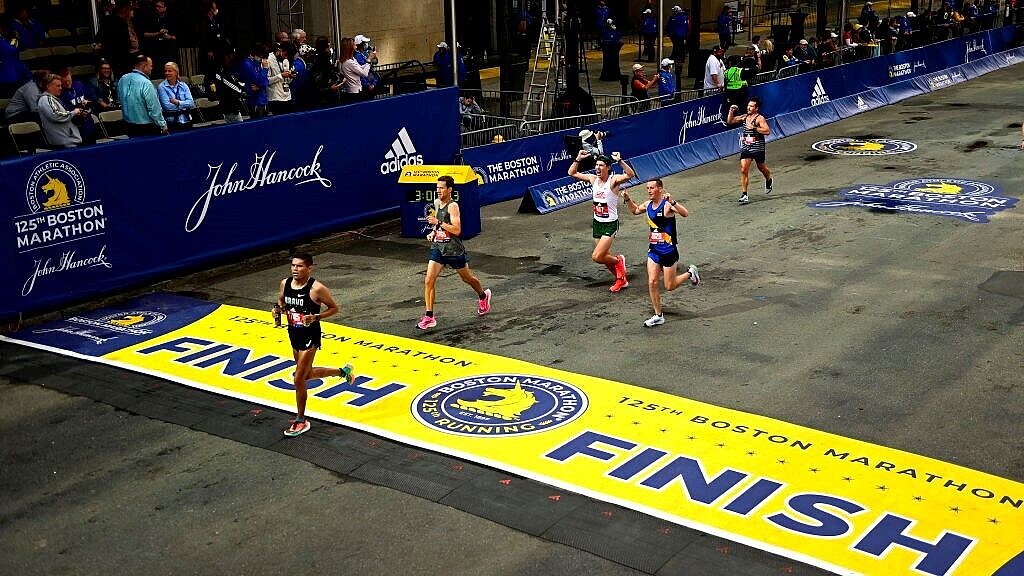
127th 2023 Boston Marathon Field Size Established as 30,000 Participants and Registration to be held September 12–16, 2022
The Boston Athletic Association (B.A.A.) announced today that the field size for the 127th Boston Marathon, scheduled to take place on Monday, April 17, 2023, has been established as 30,000 participants. Registration will take place over five days, September 12–16, 2022.
“The 127th Boston Marathon will be another significant moment in B.A.A. history, as we recognize and honor the tenth anniversary of 2013,” said Jack Fleming, Acting Chief Executive Officer of the B.A.A. “On the third Monday in April 2023, athletes from around the world will gather with the resilience and spirit that has distinguished the Boston Marathon as the premiere event in road racing.”
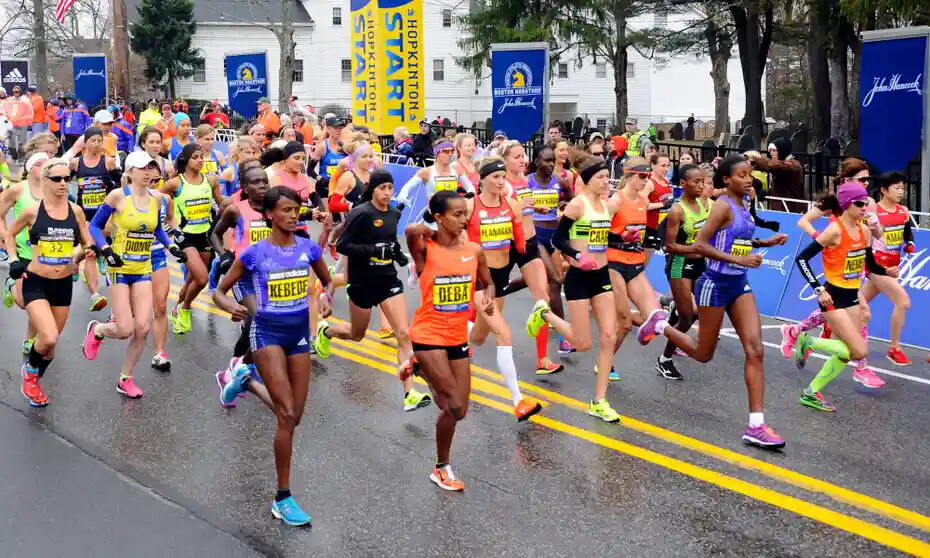
Registration will open on Monday, September 12 at 10:00 a.m. ET and will close on Friday, September 16, 2022 at 5:00 p.m. ET. The B.A.A. will use the same registration process for qualified runners as it used for the 2021 and 2022 races, allowing any athlete who has achieved a currently valid Boston Marathon qualifying time to submit a registration application between September 12–16, 2022 through the B.A.A.’s online platform, Athletes' Village.
Registration is not on a first-come, first-served basis and applications will be accepted until 5:00 p.m. ET on Friday, September 16. The 2023 Boston Marathon qualifying window began on September 1, 2021 and will close at 5:00 p.m. ET on Friday, September 16.
Qualifying standards for the 127th Boston Marathon can be found here. Qualifiers may submit an application at any point during the registration window. Achieving one’s qualifying standard does not guarantee acceptance into the Boston Marathon. Those who are fastest among the pool of applicants in their age and gender group will be accepted.
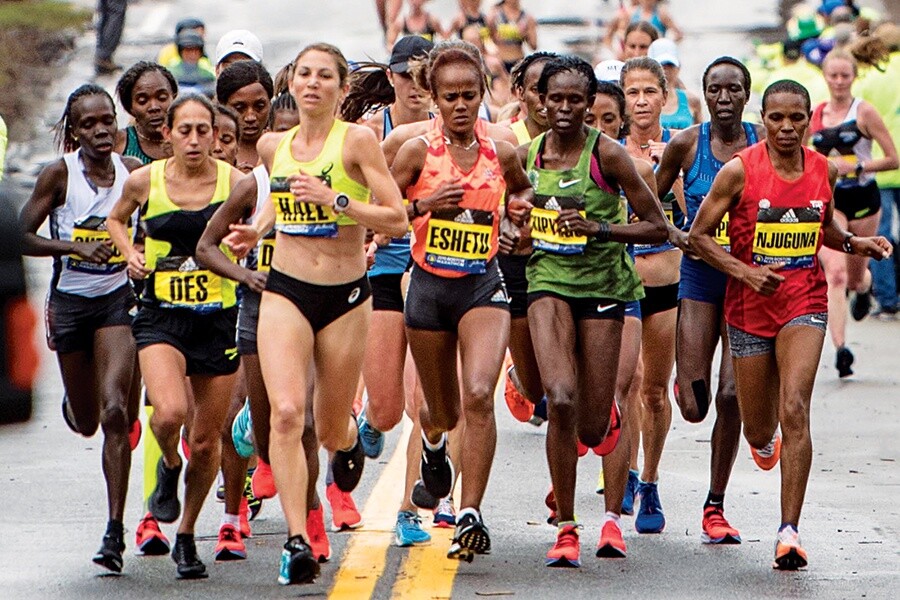
Entry fees and information on health and safety guidelines, including any COVID-19 policies, will be announced in the coming weeks. For the third straight year, participants will have the opportunity to purchase registration insurance at the point of registration.
The qualifying window for the 128th Boston Marathon, scheduled to take place on April 15, 2024, will begin on September 1, 2022. Registration details for that race will be announced following the 2023 Boston Marathon.
The next B.A.A. event is the B.A.A. 10K presented by Brigham and Women’s Hospital on Sunday, June 26.
Login to leave a comment
Boston Marathon
Among the nation’s oldest athletic clubs, the B.A.A. was established in 1887, and, in 1896, more than half of the U.S. Olympic Team at the first modern games was composed of B.A.A. club members. The Olympic Games provided the inspiration for the first Boston Marathon, which culminated the B.A.A. Games on April 19, 1897. John J. McDermott emerged from a...
more...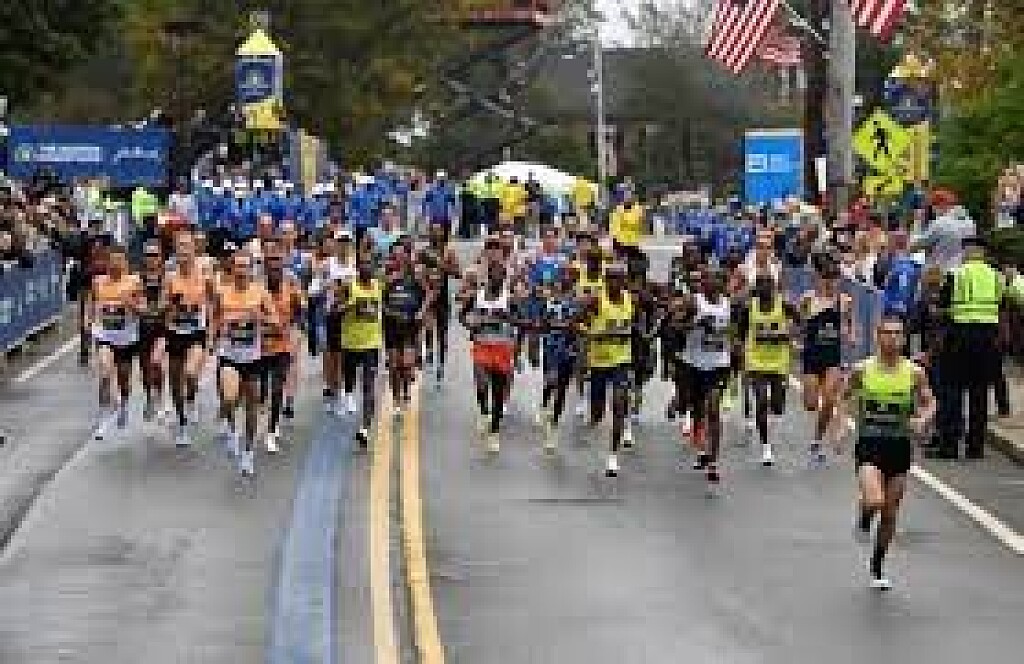
126th Boston Marathon Raises $35.6 Million For Area Non-Profits
The Boston Athletic Association (B.A.A.) has announced that $35.6 million was raised for more than 200 non-profit organizations through this year’s 126th Boston Marathon on Monday, April 18. The B.A.A. Official Charity Program and the John Hancock Non-Profit Program have combined to raise more than $460 million since the charity program’s inception at the 1989 Boston Marathon.
The $35.6 million raised this year includes donations raised through the B.A.A.’s Official Charity Program, the John Hancock Non-Profit Program, and from other qualified and invitational runners. A total of 2,566 participants ran as fundraising athletes at the 126th Boston Marathon. Further details can be found on the Boston Marathon’s fundraising page through GivenGain.
“The non-profit community across Greater Boston is resilient, and, as a non-profit itself, the B.A.A. takes great pride in being a catalyst for more than 200 charitable organizations to raise critical funds in support of their missions,” said Nicole Juri, the B.A.A.’s Director of Development. “The return to our full field size and traditional Patriots' Day date enabled our non-profit partners to raise even greater funds for a variety of meaningful causes.”
“It is outstanding to see the funds raised by this year’s Boston Marathon participants, all in support of non-profit organizations that are a driving force for our community and carry personal meaning for so many,” said Marianne Harrison, president and CEO of John Hancock. “We are committed to making lives better by empowering sustained health and well-being, and we are grateful to help bring that mission to life through the John Hancock Non-Profit Program. Thank you to everyone who worked so hard to make this year’s race so inspiring and impactful.”
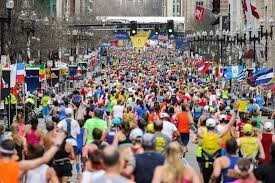
Earlier this year, the B.A.A. and John Hancock held the first-ever Boston Marathon Giving Day, which resulted in more than $1.1 million in donations over a 24-hour period to the 200 non-profit programs affiliated with the 126th Boston Marathon. Boston Marathon Giving Day was the second largest single day of donations to non-profits connected to the race, behind 2018 #GivingTuesday.
The B.A.A. annually provides non-profits associated with the B.A.A. Official Charity Program and John Hancock’s Non-Profit Program with invitational entries into the Boston Marathon. Each non-profit organization directly manages its own application process, athlete selection, and fundraising minimums, deadlines, and requirements.
The 126th Boston Marathon marked the first Patriots’ Day race since 2019 and featured a 98.4% finish rate, with 24,918 athletes from 111 different countries and all 50 states earning their unicorn medals.
The B.A.A. will notify non-profit organizations who have been selected to participate in the 127th Boston Marathon as part of the B.A.A. Official Charity Program in Summer 2022. More information can be found on the B.A.A. Official Charity Program and the John Hancock Non-Profit Program.
The next B.A.A. event is the B.A.A. 10K presented by Brigham and Women’s Hospital on Sunday, June 26. Athletes can register online and compete with Boston Marathon champions and Olympians.
Login to leave a comment
Boston Marathon
Among the nation’s oldest athletic clubs, the B.A.A. was established in 1887, and, in 1896, more than half of the U.S. Olympic Team at the first modern games was composed of B.A.A. club members. The Olympic Games provided the inspiration for the first Boston Marathon, which culminated the B.A.A. Games on April 19, 1897. John J. McDermott emerged from a...
more...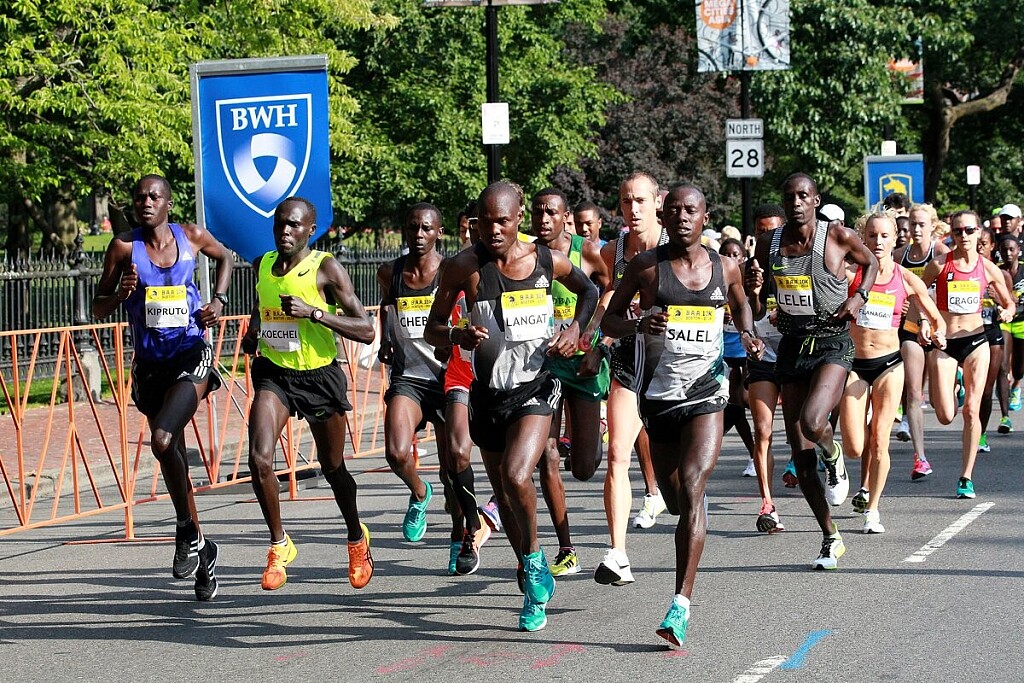
Boston Marathon Champions & National Record Holders Headline Professional Field for 2022 B.A.A. 10K
The Boston Athletic Association (B.A.A.) has announced a star-studded field for the 2022 B.A.A. 10K, presented by Brigham and Women’s Hospital, to be held on Sunday, June 26. Evans Chebet, the 2022 Boston Marathon men’s open division champion, will return to Boston, while recently crowned American half marathon record holder Emily Sisson will lead the women’s field on the roads of Back Bay. Four-time B.A.A. 5K champion and American 5K record holder Ben True will also make his B.A.A. 10K debut.
The B.A.A. 10K starts and finishes on Charles Street adjacent to Boston Common and Boston Public Garden, and is widely regarded as one of the fastest 10K races in the world. Registration remains open at www.baa.org, while athletes interested in supporting Brigham and Women's Hospital, the B.A.A. 10K’s presenting sponsor and exclusive fundraising partner, are encouraged to visit www.runbwh.org/10k.
“We’re excited to continue to showcase the world’s most accomplished runners at our B.A.A. events,” said Mary Kate Shea, the B.A.A.’s Director of Professional Athletes and Technical Support. “We’re looking forward to cheering on all participants as they race towards the finish.”
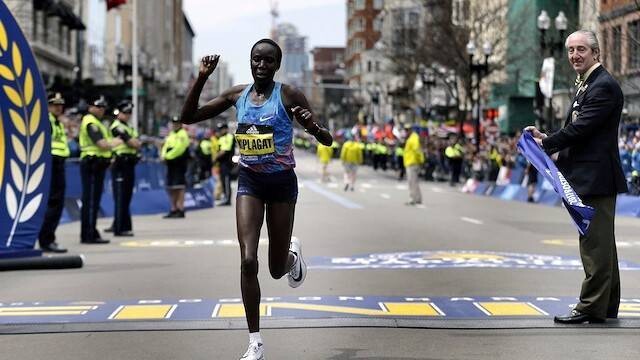
The B.A.A. 10K women’s race brings together Boston Marathon champions Des Linden (2018) and Edna Kiplagat (2017), American record holder Sisson, 2017 B.A.A. 10K winner Joan Chelimo Melly, 2022 Boston Marathon top American Nell Rojas, 2016 USA Olympian Marielle Hall, and USA 15K runner-up Emily Durgin.
Sisson, a Providence College graduate and 2021 Olympian, ran 1:07:11 on May 7 to win the USATF Half Marathon Championships in a new national record. She’s also the defending USA 15K champion.
“Breaking the American record in the half marathon was very exciting and I'm now looking forward to switching things up and racing different distances,” said Sisson. “The 10K is a fun and different challenge and I always love racing in Boston.”
Additional international entrants include Biruktayit Degefa of Ethiopia, who has won a quartet of American road races this spring, and Kenya’s Sharon Lokedi, who placed third at the 2022 B.A.A. 5K in April. From the B.A.A. High Performance team are Erika Kemp and Abbey Wheeler; Kemp is a two-time national champion.
In the men’s race, Chebet looks to become only the second Boston Marathon champion to win the B.A.A. 10K, joining the likes of 2011 winner and course record holder Geoffrey Mutai. Chebet stormed to his first Boston Marathon victory in 2:06:51 on April 18.
“After winning the 2022 Boston Marathon, I’m excited to return to the city to run the B.A.A. 10K with a world class field,” said Chebet. “Boston feels like a second home to me now.”
Challenging Chebet from Kenya are David Bett, the reigning 2019 B.A.A. 10K winner; Kennedy Kimutai, the fastest man in the field with a 27:09 lifetime best; Bravin Kiptoo, the 2019 African junior 10,000m champion; and Nicholas Kosimbei, winner of this year’s Cherry Blossom 10 Miler in Washington, D.C. Brothers Jake and Zane Robertson, a dynamic pair from New Zealand who have lived and trained in Kenya, will also race. Recent Iowa State graduate and NCAA champion Wesley Kiptoo will make his Boston road racing debut.
Maine-native Ben True will return to familiar territory, having won the B.A.A. 5K four times, including a national-record setting run of 13:20 in 2017. Fellow American contenders include Olympians Leonard Korir and Shadrack Kipchirchir, Princeton, Mass.-native Colin Bennie, and a quartet of B.A.A. High Performance Team members in Jerrell Mock, Matt McDonald, Jonas Hampton, and Paul Hogan. Korir enters the B.A.A. 10K hot off a pair of national title wins at the USATF Half Marathon and USATF 25K Championships in May.
In the wheelchair division, Jenna Fesemyer, the 2022 B.A.A. 5K women’s winner, Susannah Scaroni, the 2022 Boston Marathon runner-up, and 2020 Paralympian Yen Hoang are entered. Scaroni earned a gold medal on the track at the 2021 Paralympic Games in the 5000m, and is the fastest women’s wheelchair marathoner in U.S. history. James Senbeta and Hermin Garic are the top men’s wheelchair entrants.
For the first time in race history, Para Athletics Divisions will be offered for athletes with upper-limb, lower-limb, and visual impairments. Among the entrants confirmed include Marko Cheseto Lemtukei, Chaz Davis, and Liz Willis, each of whom won Para Division titles at April’s 126th Boston Marathon. Jacky Hunt-Broersma, who ran 104 marathons in 104 consecutive days for a Guinness World Record, and local Para athlete Adrianne Haslet are also entered.
In addition to racing, top professional athletes will participate in the first-ever B.A.A. 10K Fest & Field Day on Saturday, June 25, one day prior to the race. From 2:00 p.m. to 6:00 p.m. at Boston Common, 10K Fest & Field Day will feature youth fitness activities, games, appearances by professional athletes, running clinics, and more. Participants will also be able to pick-up their participant shirts and bib numbers at 10K Fest. Additional details will be available on baa.org in the coming weeks.
Registration for the 2022 B.A.A. 10K, presented by Brigham and Women’s Hospital, is currently open through the B.A.A.’s online platform Athletes’ Village. All participants who enter will receive an adidas participant shirt, unique bib number, and finisher medal. Additional participant information can be found on baa.org. The race will start at 8:00 a.m. ET on Sunday, June 26 on Charles Street adjacent to Boston Common and Boston Public Garden.
Brigham and Women's Hospital, the B.A.A. 10K’s presenting sponsor and exclusive fundraising partner, will again field a team of fundraising runners. Since 2016, more than 2,100 runners and 180 teams have raised $1.2 million to fuel life-giving breakthroughs at Brigham and Women’s Hospital. Learn more and register at www.runbwh.org/10k.
On June 1, the B.A.A. will celebrate Global Running Day with a special pop-up location at the Boston Marathon Finish Line between 3:00-6:00 p.m. Runners can take a picture with the Boston Marathon trophy, receive giveaways, refreshments, and more! RSVP for the free event on our Facebook page, and log miles throughout the day as part of the Abbott World Marathon Majors Global Running Day Challenge. Visit https://bstnmar.org/GRD22 to sign up for free, track your miles, and print a bib to wear as you join a global community of athletes around the world logging miles.
2022 B.A.A. 10K WOMEN’S FIELD (NAME, COUNTRY, ROAD 10K PB)
Joan Chelimo Melly, Romania, 30:14^
Edna Kiplagat, Kenya, 31:06*
Sharon Lokedi, Kenya, 31:06
Mary Munanu, Kenya, 31:20
Biruktayit Degefa, Ethiopia, 31:23
Emily Sisson, USA, 31:47
Emily Durgin, USA, 31:49
Diane Nukuri, USA, 31:49
Lanni Marchant, Canada, 31:49
Vibian Chepkirui, Kenya, 31:49
Nell Rojas, USA, 31:52
Erika Kemp, USA, 32:18
Laura Thweatt, USA, 32:20
Elaina Tabb, USA, 32:40
Rachel Schneider Smith, USA, 32:47
Abbey Wheeler, USA, DB (32:53.50 10,000m)
Grayson Murphy, USA, 32:55
Fiona O’Keeffe, USA, 32:57
Katie Kellner, USA, 33:05
Des Linden, USA, 33:06*
Taylor Werner, USA, 33:35
Marielle Hall, USA, 33:36 (31:05.71 10,000m)
Allie Hackett, USA, 35:17
Jesca Chelangat, Kenya, DB (15:16 5K)
Courtney Hawkins, USA, DB (37:59.99 10,000m)
^ = Previous B.A.A. 10K Champion
* = Previous Boston Marathon Champion
2022 B.A.A. 10K MEN’S FIELD (NAME, COUNTRY, ROAD 10K PB)
Kennedy Kimutai, Kenya, 27:09
Bravin Kiptoo, Kenya, 27:12
Philemon Kiplimo, Kenya, 27:23
Zane Robertson, New Zealand, 27:28
Jake Robertson, New Zealand, 27:28
Wesley Kiptoo, Kenya, N/A (27:37.29 10,000m)
Ben True, USA, 27:51
Nicholas Kosimbei, Kenya, 27:52
John Dressel, USA, N/A (27:57.51 10,000m)
David Bett, Kenya, 28:08^
Dominic Korir, Kenya, 28:08
Leonard Korir, USA, 28:09
Shadrack Kipchirchir, USA, 28:12
David Nilsson, Sweden, 28:13
Tsegay Tuemay, Eritrea, 28:13
Bethwell Yegon, Kenya, 28:24
Reuben Mosip, Kenya, 28:28
Paul Hogan, USA, N/A (28:49.55 10,000m)
Johannes Motschmann, Germany, 28:51
Alex Masai, Kenya, 28:53
Colin Bennie, USA, 28:55
Futsum Zienasellassie, USA, 29:03
Matt McClintock, USA, 29:02
Jacob Thomson, USA, 29:07
John Raneri, USA, 29:19
Evans Chebet, Kenya, 29:30*
Jerrell Mock, USA, 29:36
Aaron Dinzeo, USA, 29:37
Matt McDonald, USA, 29:38
Diego Estrada, USA, 29:41
Fabiano Sulle, Tanzania, 29:53
Jonas Hampton, USA, 30:15
Tim McGowan, USA, 30:17
Connor McMillan, USA, 30:20
Josh Kalapos, USA, N/A (14:33.88 5,000m)
^ = Previous B.A.A. 10K Champion
* = Previous Boston Marathon Champion
Login to leave a comment
B.A.A. 10K
The 6.2-mile course is a scenic tour through Boston's Back Bay. Notable neighborhoods and attractions include the legendary Bull and Finch Pub, after which the television series "Cheers" was developed, the campus of Boston University, and trendy Kenmore Square. ...
more...
Des Linden is going to be running the 2022 BAA 10K
The Boston Athletic Association (B.A.A.) announced today that 2018 Boston Marathon champion and two-time Olympian Des Linden will return to compete in the 2022 B.A.A. 10K, presented by Brigham and Women’s Hospital, on Sunday, June 26. The B.A.A. 10K is the second event of the 2022 B.A.A. Distance Medley, a three-race series which also includes April’s B.A.A. 5K and November’s B.A.A. Half Marathon.
Earlier today, Linden announced on Instagram her participation in the upcoming event.
In 2018 Linden won the Boston Marathon, the first time an American woman claimed the open division title in 33 years. She has placed in the top five at the Boston Marathon five times and last ran the B.A.A. 10K in 2018 when she ran among the masses and finished hand in hand with B.A.A. runner Katsuhiro Togami.
Registration for the 2022 B.A.A. 10K, presented by Brigham and Women’s Hospital, is currently open through the B.A.A.’s online platform Athletes’ Village. All participants who enter will receive an adidas participant shirt, unique bib number, and finisher medal. Additional participant information can be found on baa.org. The race will start at 8:00 a.m. ET on Sunday, June 26 on Charles Street adjacent to Boston Common and Boston Public Garden.
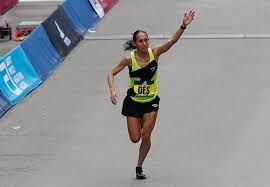
Athletes interested in supporting Brigham and Women's Hospital, the B.A.A. 10K’s presenting sponsor and exclusive fundraising partner, are encouraged to visit www.runbwh.org/10k. Since 2016, more than 2,100 runners and 180 teams have raised $1.2 million to fuel life-giving breakthroughs at Brigham and Women’s Hospital.
Linden will also be participating in the first-ever B.A.A. 10K Fest & Field Day on Saturday, June 25, one day prior to the race. From 2:00 p.m. to 6:00 p.m. at Boston Common, 10K Fest & Field Day will feature youth fitness activities, games, appearances by professional athletes, running clinics, and more. Participants will also be able to pick-up their participant shirts and bib numbers at 10K Fest. Additional details will be available on baa.org in the coming weeks.
ABOUT THE BOSTON ATHLETIC ASSOCIATION
Established in 1887, the Boston Athletic Association is a non-profit organization with a mission of promoting a healthy lifestyle through sports, especially running. The B.A.A.’s Boston Marathon is the world's oldest annual marathon, and the organization manages other local events and supports comprehensive charity, youth, and year-round running programs.
Since 1986, the principal sponsor of the Boston Marathon has been John Hancock. The Boston Marathon is part of the Abbott World Marathon Majors, along with international marathons in Tokyo, London, Berlin, Chicago, and New York City. For more information on the B.A.A., or the B.A.A. club, racing team, and High Performance Team, please visit www.baa.org.
Login to leave a comment
B.A.A. 10K
The 6.2-mile course is a scenic tour through Boston's Back Bay. Notable neighborhoods and attractions include the legendary Bull and Finch Pub, after which the television series "Cheers" was developed, the campus of Boston University, and trendy Kenmore Square. ...
more...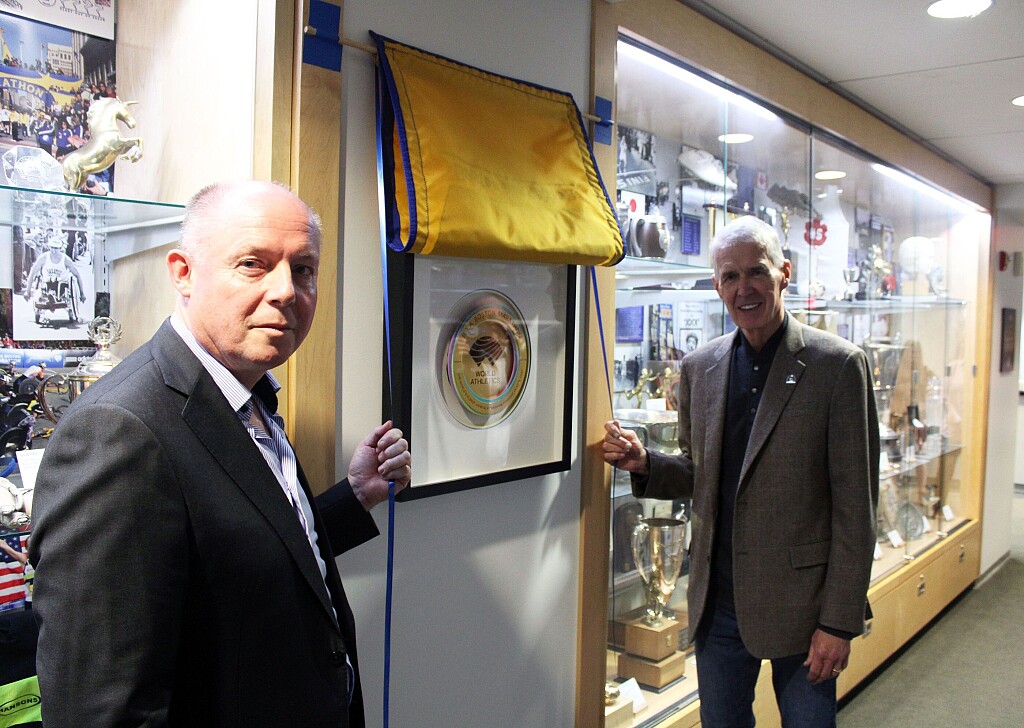
Boston Marathon's unique running history honored with World Athletics Heritage Plaque
The Boston Athletic Association (B.A.A.), which organizes the B.A.A. Boston Marathon (1897), the world’s oldest annual marathon, officially unveiled the World Athletics Heritage Plaque awarded to the race in 2019.
The World Athletics Heritage Plaque is a location-based recognition, awarded for 'an outstanding contribution to the worldwide history and development of the sport of track and field athletics and of out-of-stadia athletics disciplines such as cross country, mountain, road, trail and ultra-running, and race walking'.
The official presentation of the plaque by World Athletics Heritage, which had been on hold due to the pandemic, took place in the race museum at B.A.A.’s HQ on Dartmouth Street, Boston, Massachusetts, where the plaque will be permanently displayed, and is adjacent to the finish line of the race.
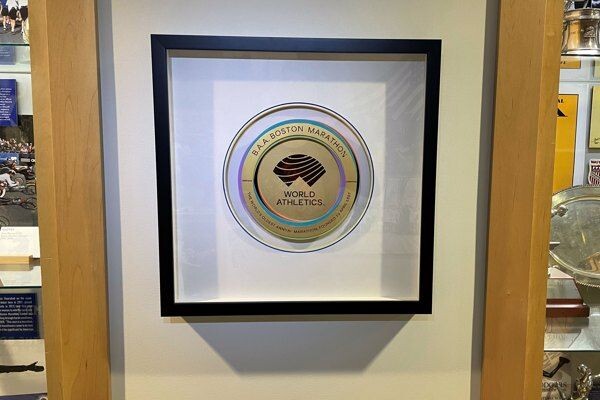
The plaque was unveiled by Thomas S. Grilk, B.A.A. President & Chief Executive Officer, and World Athletics Heritage Director Chris Turner, in the company of Jack Fleming, B.A.A. Chief Operating Officer, and fellow colleagues from the B.A.A. organization.
The tough one
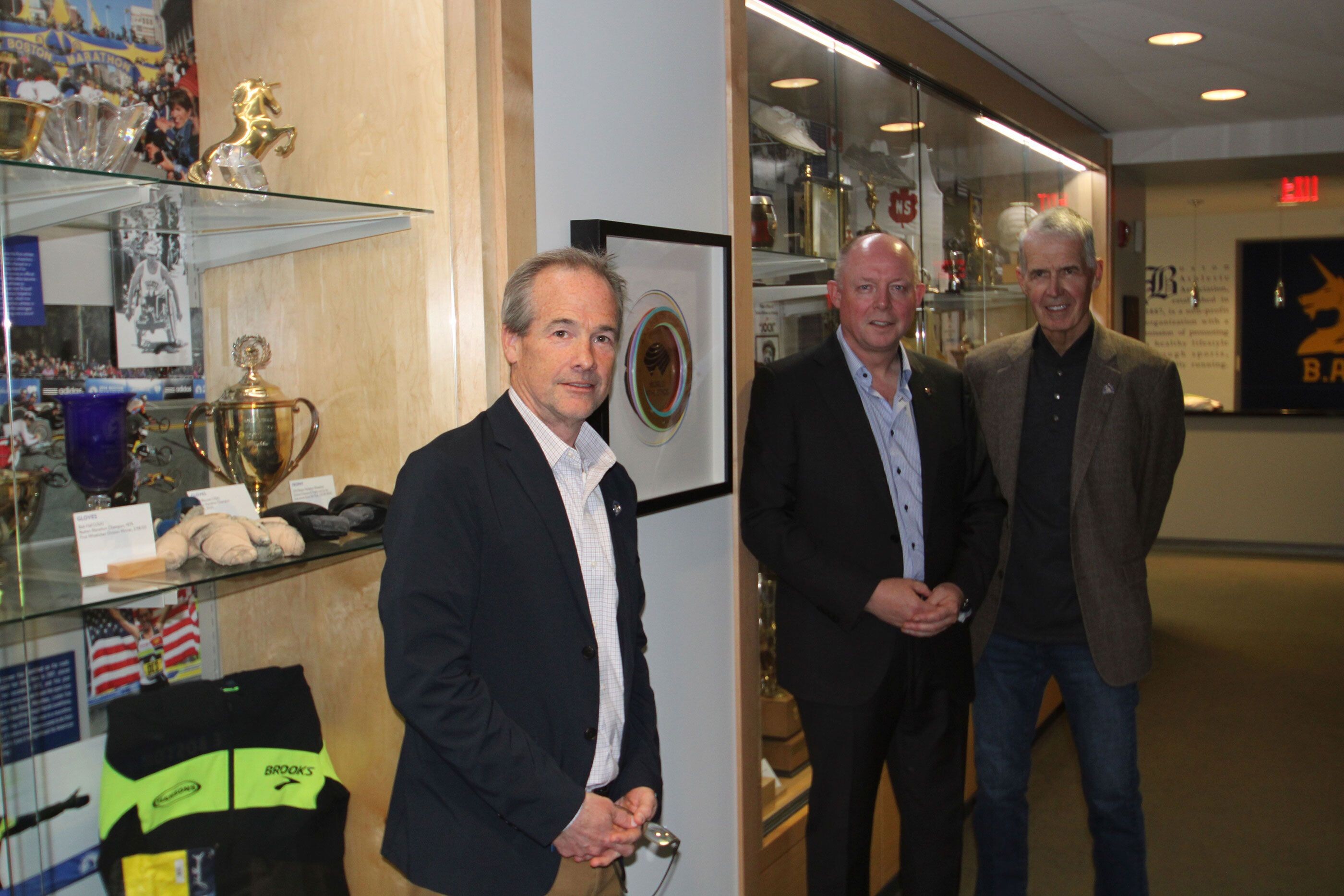
Boston’s notoriously demanding course, with its final incline ‘Heartbreak Hill’ 20 miles into the race that has gone down in marathon folklore, has floored many a world beater.
Amby Burfoot, the 1968 Boston Marathon champion, confirmed on Boston.com that the challenge is also “the downhill from the top of Heartbreak Hill to Cleveland Circle. This is called ‘Cemetery Mile’ for two good reasons: Evergreen Cemetery to the runners’ right, and the way the steep downhill deadens the legs, specifically the quadriceps muscles.”
Notably, despite the stature of the race, only five Olympic champions have ever managed to win in Boston.
Four women, firstly two-time Boston victor Joan Benoit (1979, 1983), who won the 1984 Olympic title in Los Angeles, and two three-time winners in Ethiopia's Fatuma Roba (1997, 1998, 1999), the Atlanta 1996 champion; Portugal's Rosa Mota (1987, 1988, 1990), who took the Olympic title in Seoul in 1988; and Kenya's 2022 Boston winner Peres Jepchirchir, who was the Olympic victor in Tokyo.
The sole male runner so far to accomplish the rare double is Italian Gelindo Bordin (1990), the Seoul 1988 Olympic champion, who took first place in Boston two years later.
The ‘American Marathon’
The racing singlets, running shoes, medals and trophies and hundreds of pieces of historic memorabilia in the B.A.A.'s museum pay tribute to the city’s famous marathon, which was inspired by and founded a year after the running of the inaugural Olympic marathon at the 1896 Games in Athens.
The B.A.A. itself had been established 10 years before. It was one of the association’s members, John Graham, who, as USA team manager at those 1896 Games witnessed the marathon race, proposed creating a similar long distance race in Boston.
The race, originally called the American Marathon, has an annual Monday date which makes it unique among elite international marathons. The Boston Marathon has always been held on the holiday commemorating “Patriots’ Day”, which since 1969 has become officially recognized as the third Monday in April.
The B.A.A., which has a mission to promote a healthy lifestyle, especially through running, has its HQ and museum virtually located at the finish line of the marathon.
Running treasure trove
The plaque, which is mounted on a wall in its own showcase in the museum, has joined a verifiable treasure trove of distance running artefacts associated with the race’s storied history.
The B.A.A.’s collection of memorabilia and its archive is always growing. In fact, they recently received a gift of a rare finisher medallion from the 1903 Boston Marathon. The competition bib number of last week’s Boston winner Jepchirchir is the very latest acquisition.
The perpetual Champions’ Trophy, which the winners receive immediately following the Boston Marathon, and the second place award (mounted plaque) from the first B.A.A. Boston Marathon in 1897 are standout exhibits.
Poignantly, the 2013 champion's medallion won by men’s victor Lelisa Desisa of Ethiopia was gifted back to the City of Boston in the summer of 2013, shortly after the notorious bombings which occurred on marathon day that year.
The collection, which contains hundreds of artefacts and thousands of images, has recently been renamed as the Gloria G. Ratti Collection in posthumous recognition of their long-time archivist and historian. Ratti was a B.A.A. Vice President on the Board of Governors.
by World Athletics
Login to leave a comment
Boston Marathon
Among the nation’s oldest athletic clubs, the B.A.A. was established in 1887, and, in 1896, more than half of the U.S. Olympic Team at the first modern games was composed of B.A.A. club members. The Olympic Games provided the inspiration for the first Boston Marathon, which culminated the B.A.A. Games on April 19, 1897. John J. McDermott emerged from a...
more...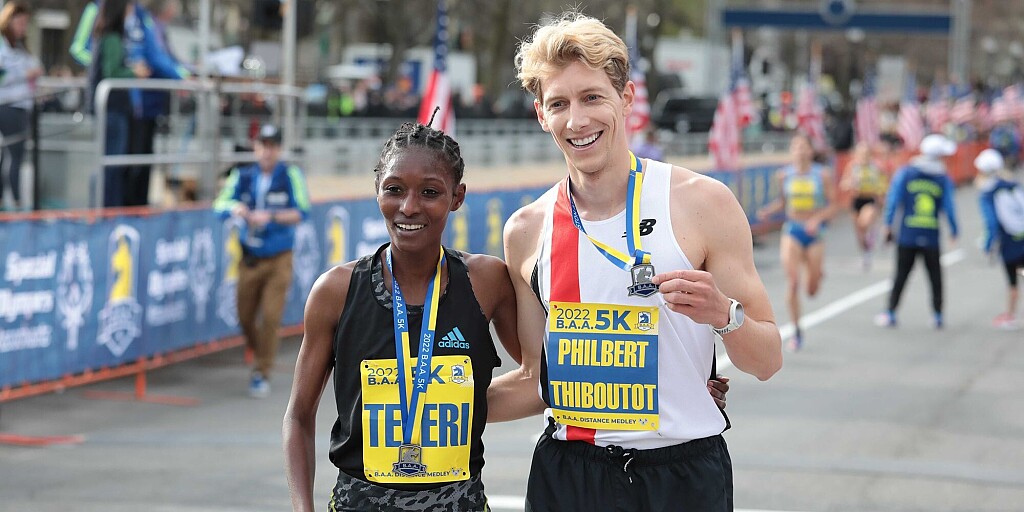
Canada’s Charles Philibert-Thiboutot wins B.A.A. 5K while ethiopia’s Senbere Teferi breaks the course record
The Quebec native ran 13:35 and broke the Canadian 5K road record in the process.
Canada’s Charles Philibert-Thiboutot kicked off the Boston Marathon weekend in style this Saturday, winning the Boston Athletic Association (B.A.A.) 5K in 13:35. His time took one second off the previous Canadian 5K road record, set by Paul Williams in Carlsbad, California in June 1986.
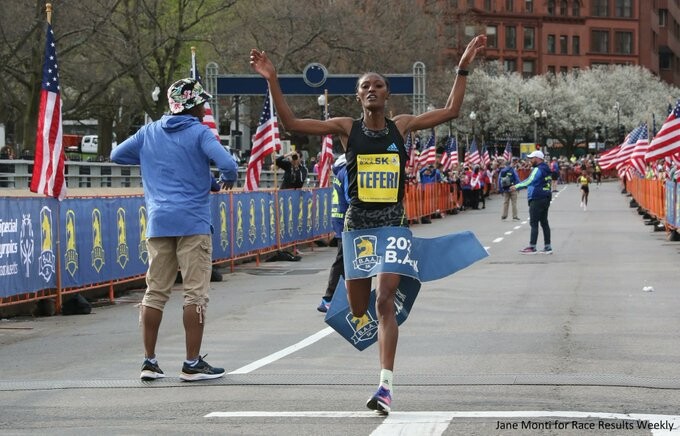
Philibert-Thiboutot ran a strong race from start to finish, but the win wasn’t handed to him. New Zealand runner Geordie Beamish and Zouhair Talbi of Morroco unleashed a couple of hard kicks in the final metres of the race in an attempt to overtake C.P.T., but fell short to finish second and third, both in 13:36.
“I’m really happy,” he said in an interview with Radio-Canada. “Honestly, it’s not the strongest Canadian record that existed, but it’s still my first Canadian record.”

Ethiopia’s Senbere Teferi breaks course record
The Women’s-only 5K world record-holder, Teferi, broke the tape in the women’s race in 14:49, taking one second off Molly Huddle’s previous course record from 2015. Unlike in the men’s race, Teferi had a commanding lead over the rest of the field, with Weini Kelati, who holds the American women’s-only 10K record, finishing second in 15:04. Kenya’s Sharon Lokedi rounded out the podium in third in 15:16.
by Running Magazine
Login to leave a comment
B.A.A. 5K
The B.A.A. 5K began in 2009, and became an instant hit among runners from far and wide. Viewed by many as the “calm before the storm,” the Sunday of Marathon weekend traditionally was for shopping, loading up on carbohydrates at the pasta dinner, and most importantly- resting. But now, runners of shorter distances, and even a few marathoners looking for...
more...
Kenenisa Bekele and Sara Hall drop out of the Boston Marathon
The Boston Athletic Association (B.A.A.) has announced updates to the professional fields at the 126th Boston Marathon in two weeks. Previous headliners Kenenisa Bekele, Titus Ekiru and Sara Hall have all announced that they will not be running, due to ongoing injuries. Ethiopia’s Sisay Lemma and Birhanu Legese have both been added.
Hall posted on her Instagram that her knee tendon has been aggravated since she tripped on a run in February, landing on a rock. She insists that she has done everything to make it to the line in Boston but does not want to risk the chance of a setback before the World Championships in Eugene, Ore. this July.
Among other big names to drop out of the women’s field are: 2019 Valencia Marathon champion Roza Dereje (ETH); 2019 Ottawa Marathon winner Tigist Girma (ETH); 2021 NYC Marathon sixth-place finisher Kellyn Taylor (USA) and sub-2:20 marathoner Zeineba Yimer (ETH).
Kenya’s Ekiru was the second-fastest elite male in the field, behind Bekele, running the fastest marathon time of 2021 (2:02:57 in Milan). Ekiru has struggled to come back from an ongoing injury he suffered at the RAK Half Marathon in February, which forced him out.
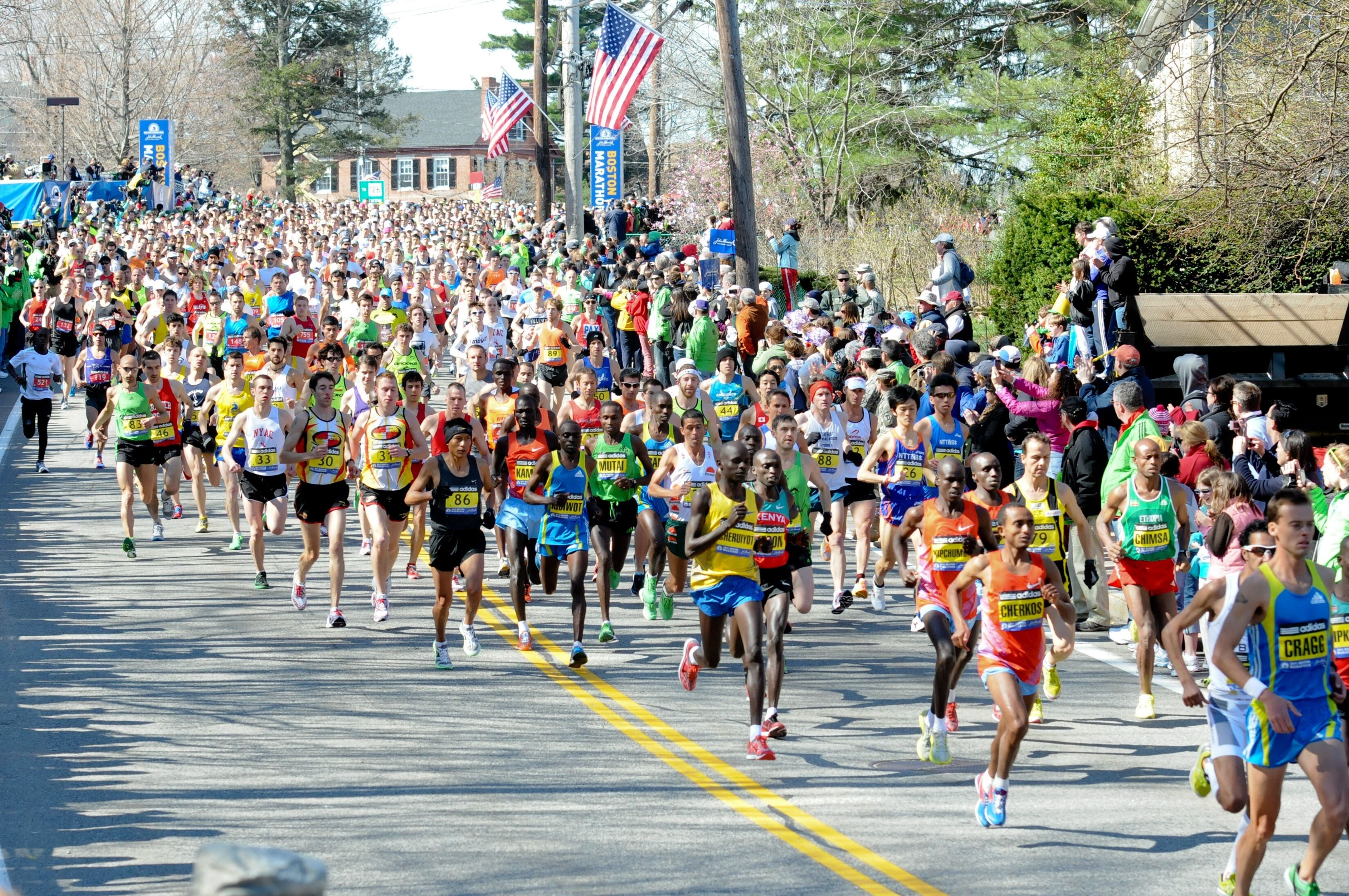
Bekele has been very silent on social media since his sixth-place finish at the 2021 New York Marathon. The reasoning for his Boston withdrawal has not been announced; the former four-time world-record holder continues to fight Father Time, turning 40 this June.
Legese of Ethiopia has been added to the men’s field. He is a two-time Tokyo Marathon champion with a personal best of 2:02:48. Lemma is the other addition to the men’s field: he won the 2021 London Marathon and has previous wins in Berlin and Tokyo and a PB of 2:03:36.
For the first time in almost three years, the prestigious Boston Marathon will return to its traditional Patriots’ Day date of April 18.
by Marley Dickinson
Login to leave a comment
B.A.A. Unveils Honorary Women’s Team for 126th Boston Marathon
On the occasion of International Women’s Day, the Boston Athletic Association (B.A.A.) today announced a team of eight women who will participate in April’s 126th Boston Marathon, running in honor of the original eight finishers from the first official women’s field in 1972.
The honorary team is comprised of eight women who have made a powerful impact in areas from athletics to human rights. Among the eight women is Valerie Rogosheske, one of the original eight finishers in 1972, who returns 50 years later to once again cross the finish line on Boylston Street.
“I am so looking forward to returning to Boston this year with my daughters to celebrate 50 years of women being welcomed into the Marathon,” said Rogosheske. “In 1972, the students at Wellesley yelled ‘Right on, sista!’ On the 25th anniversary the students looked like my daughters, and this year they could be my granddaughters! I celebrate the progress through the generations as women claim their places on the start line.”
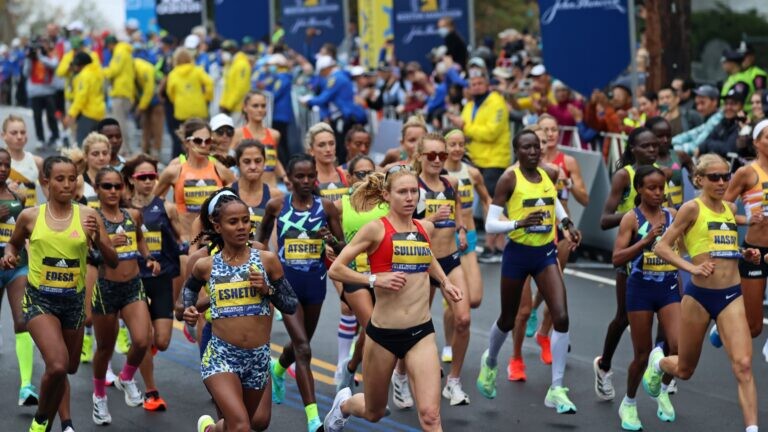
Joining Valerie on the Honorary Team are Mary Ngugi, Manuela Schär, and Melissa Stockwell, each of whom will be competing at the front of the race as part of the John Hancock Professional Athlete Team. Football and soccer star Sarah Fuller, U.S. national women’s soccer team alum Kristine Lilly, Guinness world record holder Jocelyn Rivas, and running activist Verna Volker round out the Honorary Team set for this year’s race.
Information on each of the Honorary Team members can be found below. The Honorary Team will be celebrated throughout race weekend at various Boston Marathon events and activities.
BOSTON MARATHON HONORARY WOMEN’S TEAM
Valerie Rogosheske is one of the original eight finishers from 1972. Valerie is from Minnesota and placed in the top ten at the Boston Marathon three times, taking sixth in 1972 (4:29:32), ninth in 1973 (3:51:12), and eighth in 1974 (3:09:38). This year, instead of lining up among eight female entrants, she’ll be supported and surrounded by 14,000 other women set to complete the 26.2 mile course, including her daughters Abigail and Allie.
Beyond being a world-class athlete, Mary Ngugi has been a vocal leader in spreading awareness against domestic violence. Following the death of professional athlete Agnes Tirop last year, Mary helped found the Women’s Athletic Alliance and led countless discussions —including with political leaders— to continue the fight against domestic abuse and inequalities. Mary placed third at last year’s Boston Marathon, and is a previous B.A.A. Distance Medley winner.
Manuela Schär is one of the most dominant wheelchair racers in recent history, having won three Boston Marathon titles and the last three Abbott World Marathon Majors series crowns. At the Tokyo Paralympics, Schär earned five medals (including a pair of golds) in distances from the 400 meters to marathon. She’s the current marathon world record and Boston course record holder (1:28:17), and remains the only women’s wheelchair athlete ever to break the 1:30 barrier.
One month after being deployed to Iraq as a Second Lieutenant in the United States Army’s transportation corps, Melissa Stockwell became the first female American soldier to lose a limb in active combat after her vehicle was hit by a roadside bomb. Melissa was later honored with a Purple Heart and a Bronze Star for her service. Four years later, she became the first Iraq War veteran to qualify for the Paralympic Games, competing in swimming at the 2008 Beijing Paralympics. Melissa competed in Paratriathlon at both the Rio de Janeiro and Tokyo Paralympics, and is a Paralympic bronze medalist. She’ll take to the Boston Marathon’s Para Athletics Division (T63) for the first time, looking to add another title to her impressive resume.
Sarah Fuller has been a fierce athlete since the age of five, when she first started playing soccer. She made history in 2020 as the first woman to suit up for a SEC football game as a student-athlete while at Vanderbilt University. Two weeks later, she made history again as the first woman to play in and score in a Power 5 football game, notching a pair of extra points for the Commodores. She studied Medicine, Health, and Society at Vanderbilt, and is currently pursuing her Masters at the University of North Texas where she is also a goalkeeper for the soccer team. This summer she’ll play for Minnesota Aurora FC of the USL W League. This will be Fuller’s first Boston Marathon.
Kristine Lilly played 23 years for the U.S. Women’s National Soccer Team, is a two-time World Cup Champion, two-time Olympic Gold Medalist, and has played more international soccer games than any other player –man or woman—in the world (354). Lilly played professionally in the Boston area for the Boston Breakers from 2001-2003 and 2009-2010. She is one of the most celebrated athletes in women’s soccer history, and was inducted into the U.S. Olympic Hall of Fame in 2012 and U.S. Soccer Hall of Fame in 2014. She is also the co-author of Powerhouse, a book about teamwork. A resident of Massachusetts, Lilly will take on her second Boston Marathon having run ten years ago in 2012.
Jocelyn Rivas is a proud Dreamer (DACA recipient) who came to the United States from El Salvador when she was six years old. In El Salvador, she was told she would most likely not be able to walk, but with physical therapy and a continued focus on recovery, she has proven that prediction wrong. She was inspired to run after watching friends in the 2013 Los Angeles Marathon, and soon made it her goal to finish 100 marathons. In November 2021, she completed her 100th marathon at the age of 24, making her the Guinness World Record holder for the youngest woman to run 100 marathons and the world record holder for youngest Latina to ever do so. Boston will be her 112th marathon.
Verna Volker is the founder of Native Women Running, whose mission is to build and nurture a community that features and encourages Native women runners on and off the reservation. A mother of four, member of the Navajo Nation, and brand ambassador, she balances family, running, and community activism. Verna created Native Women Running to bring more visibility to Native women runners across North America. She is part of the leadership team for the Running Industry Diversity Coalition, which focuses on improving inclusion, visibility, and access for Black, Indigenous, and people of color within the sport. Verna is running on behalf of Wings of America.
Login to leave a comment
Boston Marathon
Among the nation’s oldest athletic clubs, the B.A.A. was established in 1887, and, in 1896, more than half of the U.S. Olympic Team at the first modern games was composed of B.A.A. club members. The Olympic Games provided the inspiration for the first Boston Marathon, which culminated the B.A.A. Games on April 19, 1897. John J. McDermott emerged from a...
more...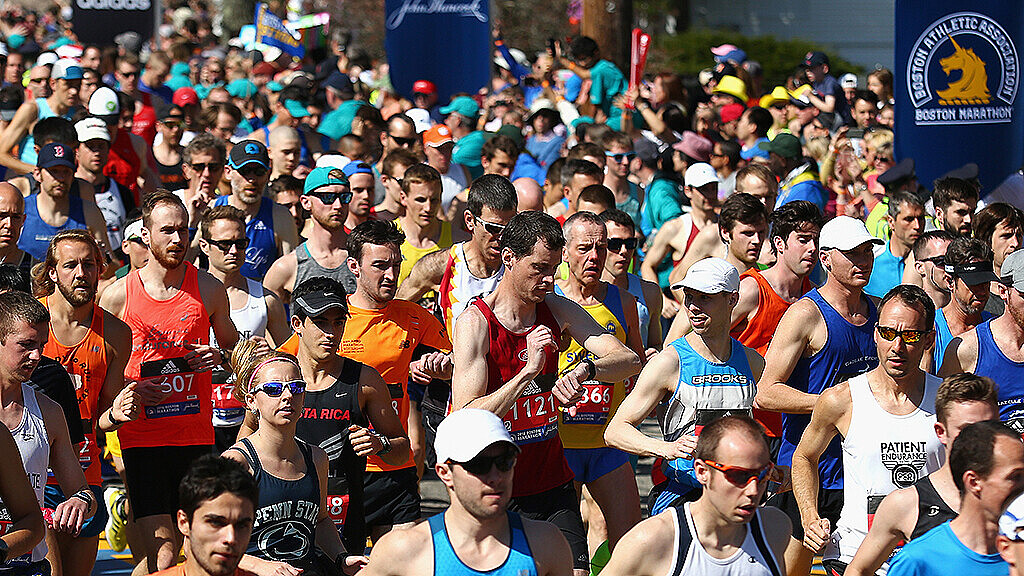
Boston Athletic Association Announces 2022 Boston Marathon Official Charity Program Members
The Boston Athletic Association (B.A.A.) has announced that 43 organizations have been selected for the B.A.A.’s Official Charity Program for the 2022 Boston Marathon. Five new organizations are joining the B.A.A.’s Official Charity Program for the 126th running, to be held on Monday, April 18, 2022, the first Patriots’ Day edition of the race in three years.
Entering the 33rd year of the Official Charity Program, the B.A.A. provides select nonprofit organizations with entries into the Boston Marathon, which are used to raise millions of dollars for worthwhile causes. A total of $14.2 million was raised through the B.A.A. Official Charity Program this year, with an average of more than $10,000 raised per entry. Combined with the John Hancock Non-Profit Program and other qualified and invitational participants, $26.6 million was raised for nonprofits surrounding the 2021 race. The B.A.A. Official Charity Program and the John Hancock Non-Profit Program have combined to raise more than $426 million since the charity program’s inception at the 1989 Boston Marathon.
The five new organizations joining the B.A.A.’s Official Charity Program for the 2022 Boston Marathon include America Scores New England, Boston Bulldogs Running Club, Play Ball Foundation, The BASE, and The Hoyt Foundation. A total of 38 organizations will return as members of the B.A.A.’s Official Charity Program. A complete list of B.A.A. Official Charity Program members can be found below. (Click on each organization for more information.)
261 Fearless, Inc.
America Scores New England*
American Liver Foundation, N.E. Division
American Red Cross of Massachusetts
B.A.A. Charity Team
Back on My Feet
Boston Bruins Foundation
Boston Bulldogs Running Club*
Boston Celtics Shamrock Foundation
Boston Children’s Hospital
Boys & Girls Clubs of Dorchester
Brigham and Women’s Hospital
Camp Shriver at UMass Boston
Community Rowing
CYCLE Kids, Inc.
Dana-Farber Cancer Institute
Doug Flutie Jr. Foundation for Autism, Inc.
Dream Big!
Esplanade Association
Girls on the Run Greater Boston
Good Sports, Inc.
Hale
Herren Project
IMPACT Melanoma
Massachusetts Association for the Blind and Visually Impaired
MEB Foundation
MetroWest YMCA
Michael Lisnow Respite Center
Multiple Myeloma Research Foundation
National MS Society, Greater New England Chapter
New England Patriots Foundation
Play Ball Foundation*
Red Sox Foundation
Semper Fi Fund
Spaulding Rehabilitation Hospital
Squashbusters
TB12 Foundation
Tedy’s Team
The BASE*
The Hoyt Foundation*
Thompson Island Outward Bound
Trinity Boston Connects
Tufts Medical Center
*Indicates New B.A.A. Official Charity Program Member in 2022
B.A.A. official charities will begin to accept registration submissions on Monday, December 6. For more information about the B.A.A. Official Charity Program, and to apply to participate in the 2022 Boston Marathon as a member of one of their teams, please visit www.baa.org.
The B.A.A. annually provides non-profits associated with the B.A.A. Official Charity Program and John Hancock’s Non-Profit Program with invitational entries into the Boston Marathon. Each non-profit organization directly manages its own application process, athlete selection, and fundraising minimums, deadlines, and requirements.
For the fourth consecutive year, the Boston Athletic Association will field its own fundraising team for the Boston Marathon. B.A.A. Charity Team members fundraise to help expand the B.A.A.’s youth and community initiatives, bringing the benefits of running and healthy lifestyles to the greater Boston community. Applications will be accepted for 2022 B.A.A. Official Charity Team beginning on December 6.
The B.A.A. is committed to a world where all people can access and benefit from running and an active lifestyle.
Login to leave a comment
Boston Marathon
Among the nation’s oldest athletic clubs, the B.A.A. was established in 1887, and, in 1896, more than half of the U.S. Olympic Team at the first modern games was composed of B.A.A. club members. The Olympic Games provided the inspiration for the first Boston Marathon, which culminated the B.A.A. Games on April 19, 1897. John J. McDermott emerged from a...
more...
All athletes running the 2022 Boston Marathon must be fully vaccinated
The Boston Athletic Association (B.A.A.) announced today (Nov 2) that the field size for the 126th Boston Marathon, scheduled to take place on Monday, April 18, 2022, has been established as 30,000 participants. All athletes must be fully vaccinated in order to participate in the race.
“As we look to return to the traditional Patriots’ Day date for the first time since 2019 and allow for as many athletes to participate as safely as possible, we know that a fully vaccinated field is the appropriate requirement to implement,” said Tom Grilk, President & Chief Executive Officer of the B.A.A. “We had a 93% vaccination rate among our 125th Boston Marathon participants and want to do our part to continue to mitigate the spread of COVID-19 as we continue our return to racing.”
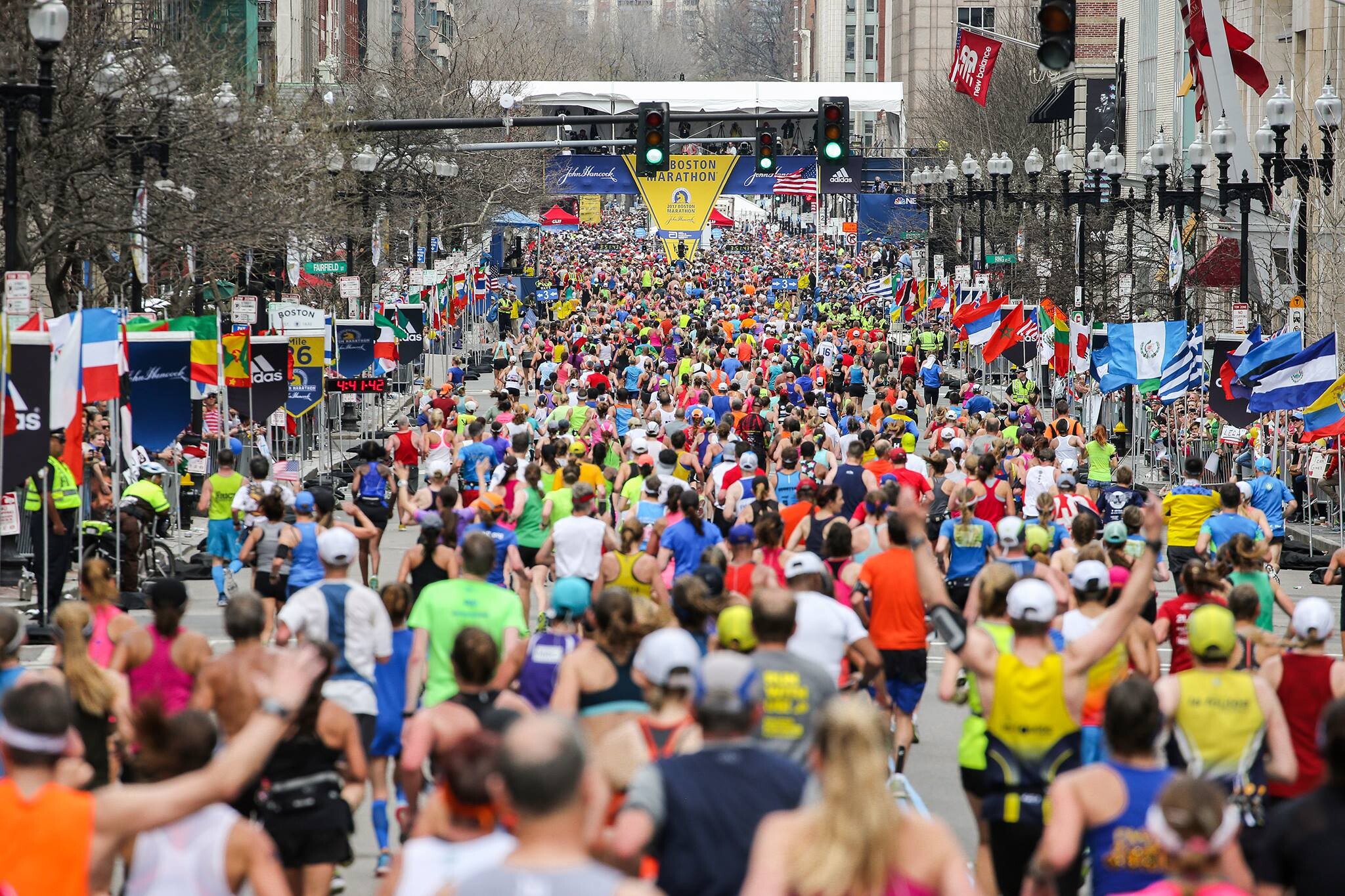
Participants will need to provide proof of vaccination prior to participating in the April 18, 2022 race. To be considered fully vaccinated participants must have completed a vaccination series of a World Health Organization-certified vaccine prior to bib number pick up (Friday, April 15). Any registered athlete who cannot provide proof of vaccination will not be allowed to participate in the race. Entries will not be deferred, refunded, or transferred to a future race. Requests for a medical exemption will be reviewed individually.
Registration for the 2022 Boston Marathon will take place over five days, opening on Monday, November 8 at 10:00 a.m. ET and closing on November 12, 2021 at 5:00 p.m. ET. The B.A.A. will use the same registration process for qualified runners as it used for the 2021 race, allowing any athlete who has achieved a currently valid Boston Marathon qualifying time to submit a registration application between November 8-12, 2021 through the B.A.A.’s online platform, Athletes' Village. Registration is not first come, first served and applications will be accepted until 5:00 p.m. ET on Friday, November 12. The qualifying window began on September 1, 2019 and will close at 5:00 p.m. ET on Friday, November 12.
Qualifying standards for the 126th Boston Marathon can be found here. Qualifiers may submit an application at any point during the registration window. Achieving one’s qualifying standard does not guarantee acceptance into the Boston Marathon due to field size limitations. Those who are fastest among the pool of applicants in their age and gender group will be accepted.
The entry fee for qualifiers will remain $205 USD for United States residents and $255 USD for international residents. For the second straight year, participants will have the opportunity to purchase registration insurance at the point of registration.
The qualifying window for the 127th Boston Marathon, scheduled to take place on April 17, 2023, began on September 1, 2021. Registration details for that race will be announced following the 2022 Boston Marathon.
Login to leave a comment
Boston Marathon
Among the nation’s oldest athletic clubs, the B.A.A. was established in 1887, and, in 1896, more than half of the U.S. Olympic Team at the first modern games was composed of B.A.A. club members. The Olympic Games provided the inspiration for the first Boston Marathon, which culminated the B.A.A. Games on April 19, 1897. John J. McDermott emerged from a...
more...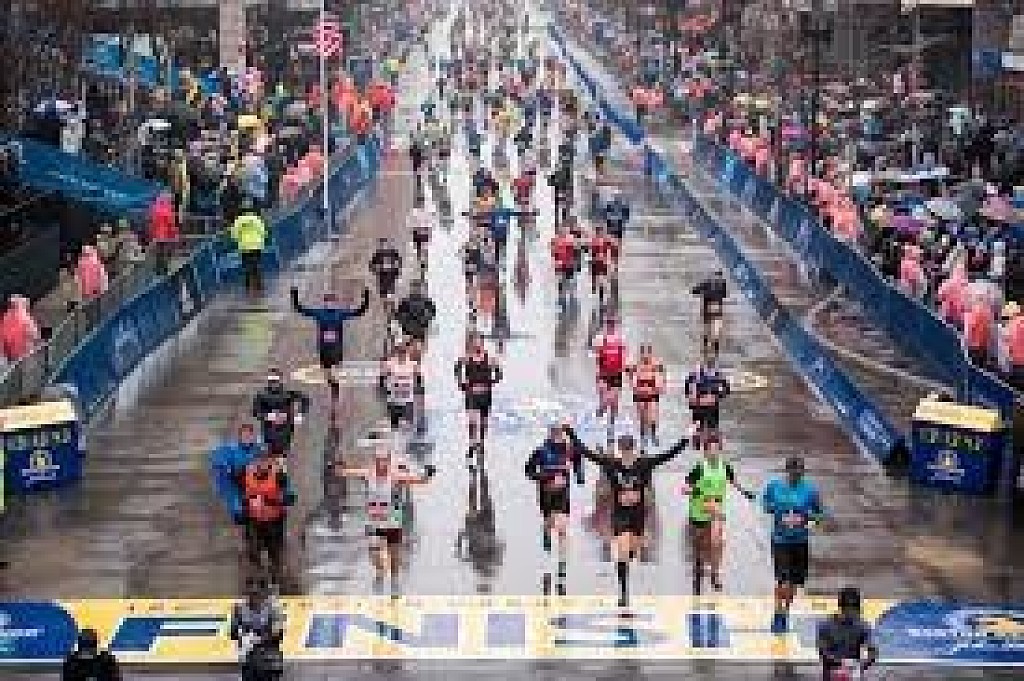
Boston Marathon runners must be vaccinated or have a negative COVID-19 test
Runners in this year's Boston Marathon will need to provide proof of vaccination or produce a negative COVID-19 test in order to participate, race organisers said on Thursday.
The Boston Athletic Association (B.A.A.) said in a statement that all participants will be required to take either step prior to bib number pick-up ahead of the Oct. 11 race.
The B.A.A. said it was working with a third-party testing provider to conduct tests no earlier than 72 hours before participant start times.
Anyone who tests positive for COVID-19 will not be allowed to take part and will be refunded their entry.
Masks will not be required for runners during the race but the B.A.A. said they will be enforced on race-day buses and in other areas in accordance with local guidelines.
Organisers previously said this year's Boston Marathon will be limited to 20,000 entrants, or about 33% below the typical number of runners in the race, in a bid to allow greater social distancing throughout the course given the COVID-19 pandemic.
The Boston Marathon, which is usually held in April and generally draws over 30,000 runners from all over the world, had been held annually since 1897 until it was cancelled for the first time last year because of COVID-19.
The global pandemic also forced organizers to push back the date for this year's race.
by Ed Osmond
Login to leave a comment
Boston Marathon
Among the nation’s oldest athletic clubs, the B.A.A. was established in 1887, and, in 1896, more than half of the U.S. Olympic Team at the first modern games was composed of B.A.A. club members. The Olympic Games provided the inspiration for the first Boston Marathon, which culminated the B.A.A. Games on April 19, 1897. John J. McDermott emerged from a...
more...
Two-time Boston Marathon Winner & Reigning World Champion Lelisa Desisa will return to Boston Marathon
The Boston Athletic Association (B.A.A.) has announced that two-time Boston Marathon champion, reigning World Athletics Marathon champion, and 2:04:45 marathoner Lelisa Desisa of Ethiopia will compete in the 125th Boston Marathon on Monday, October 11. Desisa joins 13 previously announced Boston Marathon champions who are racing as part of the John Hancock Professional Athlete Team.
“Boston has become my second home and I truly cherish my time when I am there,” said Desisa. “I return to compete still chasing my third victory in the Boston Marathon. Thank you, Boston; I look forward to putting on a good show for you on Marathon Monday!"
Desisa, who broke the tape first in 2013 (2:10:22) then again in 2015 (2:09:17), returns to Boston for the seventh time. In 2019, Desisa finished runner-up by a mere two seconds behind winner Lawrence Cherono. In addition to Boston and the 2019 World Championships, Desisa has previously won the 2018 TCS New York City Marathon, 2013 Dubai Marathon, and earned silver at the 2013 World Athletics Championships Marathon. His lifetime best of 2:04:45 ranks third in this year’s field, featuring nine men who have run 2:06:00 or faster.
Additionally, 2020 Houston Marathon champion and 2:05:56 marathoner Kelkile Gezahegn will compete for top honors in October. Gezahegn has won marathons in Houston, Ljubljana, Frankfurt, and Lanzhou since 2017, with four additional wins in 2016. Gezahegn’s personal best of 2:05:56 was set en route to a third-place finish at the 2018 Rotterdam Marathon. This will be his Boston Marathon debut.
by B.A.A. Communications Department
Login to leave a comment
Boston Marathon
Among the nation’s oldest athletic clubs, the B.A.A. was established in 1887, and, in 1896, more than half of the U.S. Olympic Team at the first modern games was composed of B.A.A. club members. The Olympic Games provided the inspiration for the first Boston Marathon, which culminated the B.A.A. Games on April 19, 1897. John J. McDermott emerged from a...
more...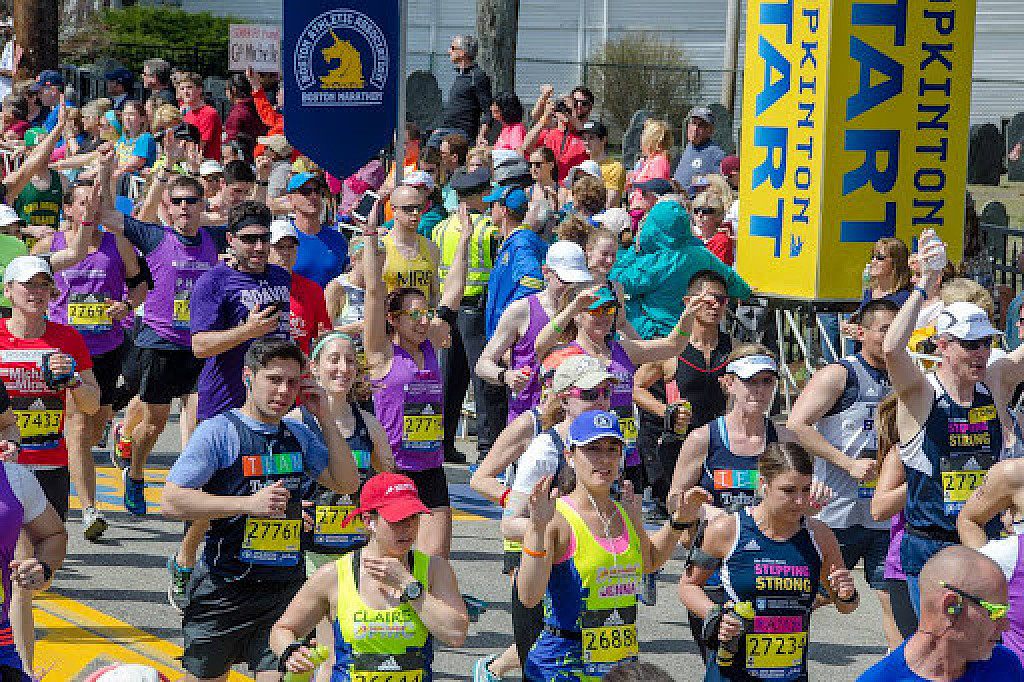
Boston Athletic Association Partners with Maurten as Exclusive Gel Nutrition Sponsor of the Boston Marathon
The Boston Athletic Association (B.A.A.), organizer of the Boston Marathon, has partnered with Maurten to enhance participant nutrition and fueling at the Boston Marathon and B.A.A. Half Marathon. Maurten, the Swedish-based hydrogel sports fuel company, and the B.A.A. have agreed to a multi-year partnership which designates Maurten as an Official Sponsor, Exclusive Gel Nutrition Partner, and Official Hydrogel provider of both signature B.A.A. events.
“We at the B.A.A. are always looking for ways to enhance our participants’ race experience, especially in the area of nutrition,” said Tom Grilk, President and C.E.O. of the B.A.A. “We are proud to partner with Maurten, as both of our missions focus on the promotion of athletic excellence, health, and fitness.”

Maurten’s caffeinated and non-caffeinated Gels, Gel 100 and Gel 100 CAF 100, will be available in three locations along the Boston Marathon course (miles 11.6, 17, and 21.5) and one location at future B.A.A. Half Marathons. Maurten will also be featured throughout event programing, including in race training clinics. Boston Marathon and B.A.A. Half Marathon participants and followers will receive tips on best nutrition practices to prepare for long-distance running through digital campaigns led by Maurten.
“We’ve always said that we support the best runners in the world. That wasn’t entirely true, since we haven’t had the chance to support all Boston runners out there. So, we’re very happy that that’s about to change and that we level the playing field by making sure all runners in Boston, not only the elite, gets access to the same hydrogel based fueling technology,” said Olof Sköld, C.E.O at Maurten.
Maurten and its hydrogel based sports fuel line has revolutionized fueling in endurance sports. The Swedish company set out in 2015 to find a way to minimize the risk of gastric distress while consuming carbohydrates during races and in training. Today, Maurten is an official sponsor of other world-class endurance events including the Berlin Marathon and IRONMAN, and also supports numerous professional athletes including U.S. Olympian Molly Seidel, world record holder Eliud Kipchoge, and Boston Marathon champions Worknesh Degefa, Des Linden and Geoffrey Kirui. The latter two athletes will compete as part of the John Hancock Professional Athlete Team at the 125th Boston Marathon in October.

Maurten can be found for purchase online at maurten.com and through running specialty stores.
Due to the COVID-19 pandemic, the 2021 Boston Marathon was moved from its traditional date of the third Monday in April to Monday, October 11. The fall race will feature a field size of 20,000 participants, as well as a rolling start for the first time.
Login to leave a comment
Boston Marathon
Among the nation’s oldest athletic clubs, the B.A.A. was established in 1887, and, in 1896, more than half of the U.S. Olympic Team at the first modern games was composed of B.A.A. club members. The Olympic Games provided the inspiration for the first Boston Marathon, which culminated the B.A.A. Games on April 19, 1897. John J. McDermott emerged from a...
more...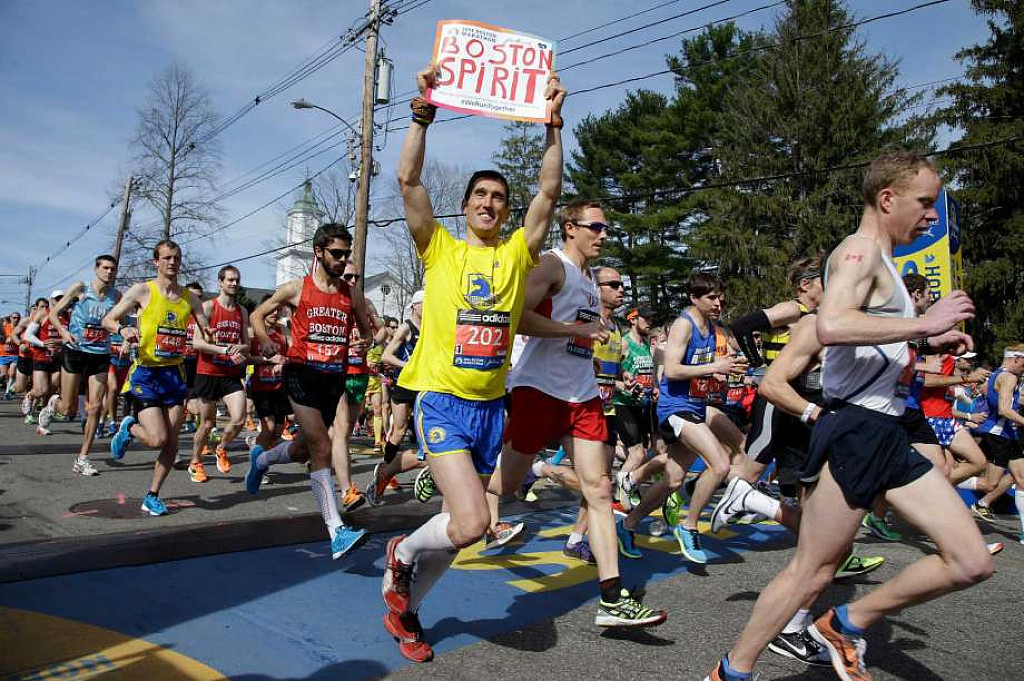
2021 Boston Marathon field with biggest time cutoff in event history
Qualifying for the Boston Marathon was harder than ever this year, as the Boston Athletic Association (B.A.A.) announced on Tuesday that runners hoping to compete in the famous race had to run seven minutes, 47 seconds faster than their age group qualifying times. This is a huge cutoff time, coming in a whopping six minutes faster than the cutoff of one minute, 39 seconds that the B.A.A. set ahead of the 2020 race.
This year’s cutoff has led to 9,215 runners receiving the unfortunate news that they have not been accepted for this year’s event despite having run under the original qualifying standard.
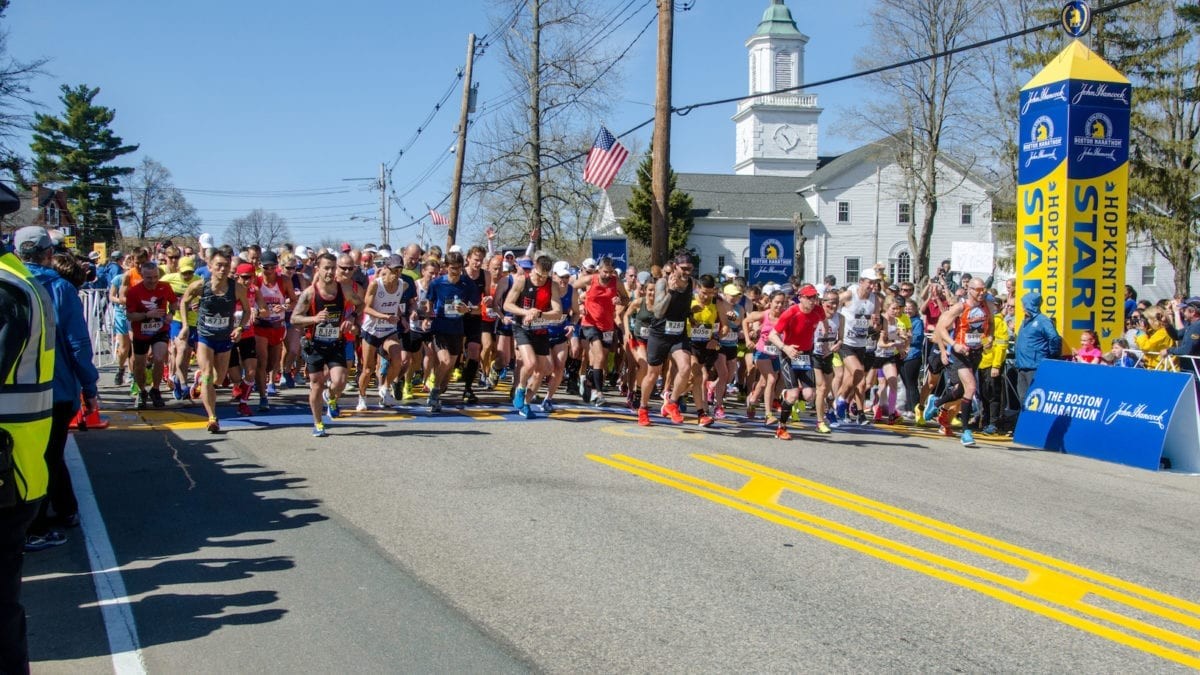
It’s already tough to get into the Boston Marathon, and the B.A.A. continues to lower age group qualifying times as demand for the storied race increases. In 2013, qualifying standards were lowered by five minutes per age group, and these times stood until 2019. Then, ahead of the 2020 race, the bar was lowered (or raised, seeing as qualifying got tougher), by another five minutes.
Over the previous 10 races, despite quickening qualifying times, cutoffs were still necessary, as there were thousands more qualified runners than the race capacity. From 2012 to 2017, the time cutoff wasn’t too big, and Boston hopefuls only had to run a maximum of two minutes, 28 seconds faster than their age group qualifying time. Even so, these cutoffs led to thousands of runners left out of the race each year, with more than 4,000 qualified athletes missing out in 2016.
In 2018, the cutoff jumped to three minutes, 23 seconds, and more than 5,000 runners were left off the start list. The next year, 7,200 runners missed the cutoff, which had been raised to close to five minutes. There was a dip in 2020, and the cutoff dropped to one minute, 39 seconds, but it shot right back up to seven minutes, 47 seconds, setting the bar higher than ever before for anyone hoping to race in Boston.
The pandemic is a big reason for this huge cutoff time. In the past decade, the smallest Boston field size has been 27,000 runners, and that was in 2011 and 2012. Since then, the field hasn’t been smaller than 30,000 runners. This year, due to COVID-19, the field has been reduced to just 20,000 runners — a field size the race hasn’t seen since the early 2000s. With demand for the race as high as ever, that meant the B.A.A. had to make the tough call to implement an unprecedented cutoff time, resulting in close to 10,000 runners not being accepted.
The B.A.A. accepted 14,609 runners who met the cutoff, and the additional few thousand spots will be filled by elites and invited athletes who are running as part of the Boston Marathon’s Official Charity Program and John Hancock’s Non-Profit Program.
by Ben Snider-McGrath
Login to leave a comment
Boston Marathon
Among the nation’s oldest athletic clubs, the B.A.A. was established in 1887, and, in 1896, more than half of the U.S. Olympic Team at the first modern games was composed of B.A.A. club members. The Olympic Games provided the inspiration for the first Boston Marathon, which culminated the B.A.A. Games on April 19, 1897. John J. McDermott emerged from a...
more...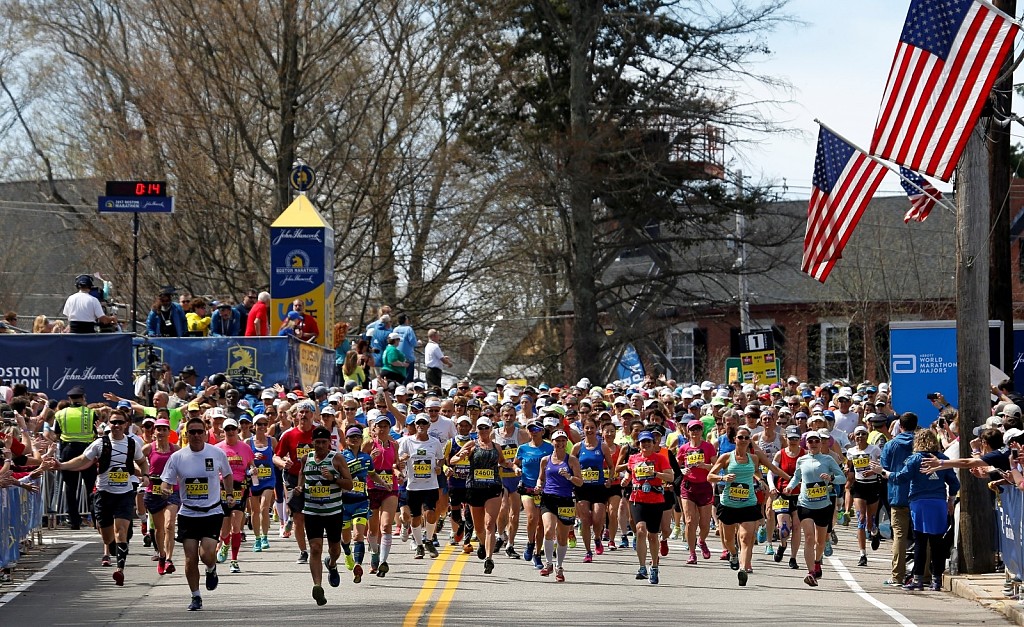
Adidas and Boston athletic asocciation extend official sponsorship through 2030
The Boston Athletic Association (B.A.A.) announced today that the organization has extended its longstanding official sponsorship with adidas through 2030. The Patriots’ Day announcement marks more than 40 years of partnership between the athletic organizations.
“adidas has been an official sponsor of the Boston Marathon for more than three decades, and we are delighted to extend our partnership, furthering our dedication to community initiatives as well as athletic performance,” said Tom Grilk, President and C.E.O of the B.A.A. “adidas has supported all aspects of our organization, from mass participatory events to the B.A.A.’s running club and High Performance team. Our collective missions align in the promotion of health and fitness, and this extension solidifies our combined commitment to the sport and running in the community.”
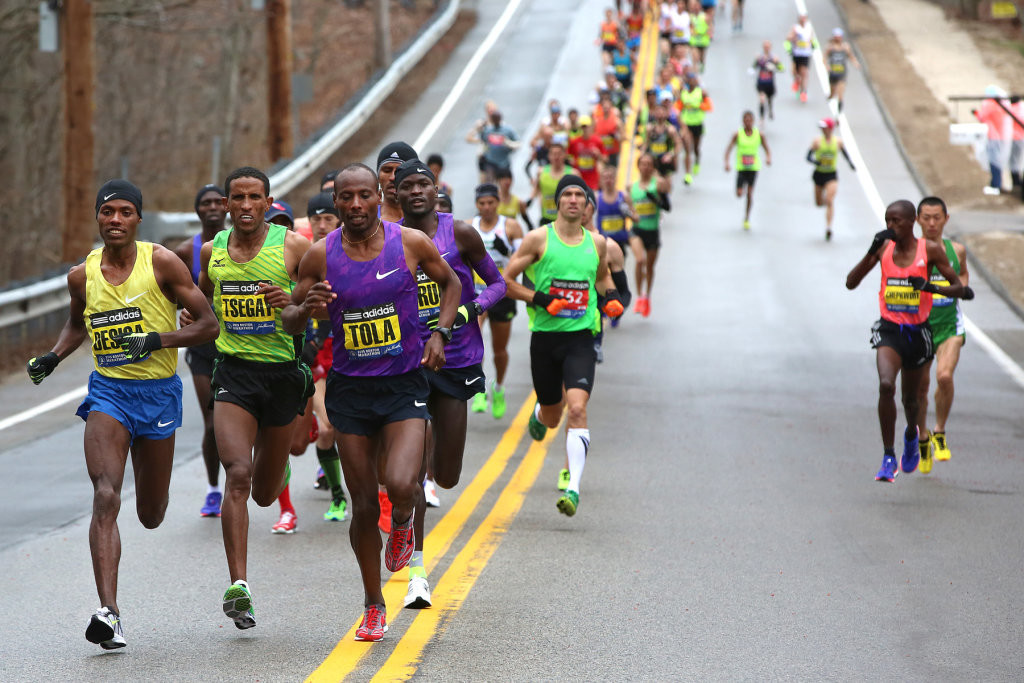
adidas has been a sponsor of the Boston Marathon since 1989, increased its support to include the B.A.A. Running Club in 1991, and since 1994 has sponsored all B.A.A. running events, clinics and youth programming, and initiatives including the B.A.A. 5K, the B.A.A. 10K, and the B.A.A. Half Marathon. Together, the B.A.A. and adidas have developed year-round programming designed to promote health and fitness among Boston-area youth, which has yielded participation from more than 35,000 students.
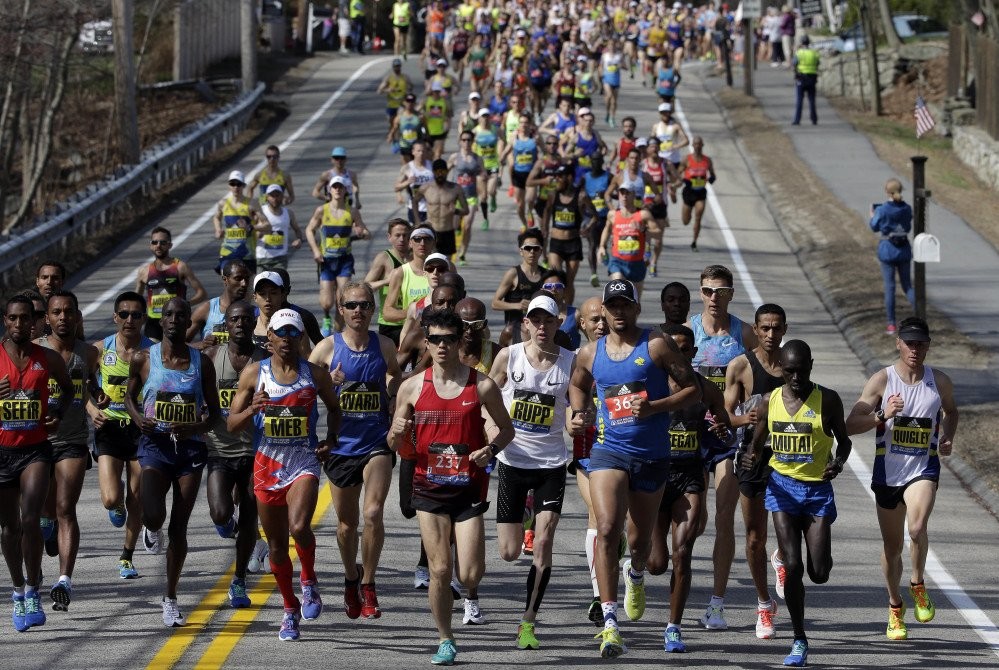
“Adi Dassler founded adidas inspired from the passion for running and for supporting and enhancing athletic performance. Our partnership with the B.A.A. allows us to bring to life our belief, that through sport we have the power to change lives,” said Alberto Uncini Manganelli, General Manager of adidas Running, Global.
In addition to being the official athletic footwear, apparel, and accessory sponsor of the Boston Marathon, adidas will continue to support all of the B.A.A.’s road races, the organization’s running club and High Performance Team, and many youth events. The B.A.A. and adidas are committed to developing new community initiatives, programs, and events that provide opportunities for athletes and runners of all abilities.
“The B.A.A. and Boston Marathon are synonymous with athletic excellence for the athletes, and a role model for touching people in their journey of physical and mental betterment, and driving a positive impact to communities. In this journey we are extremely proud to support the B.A.A. and athletes from across the globe with their pursuit of athletic achievement and we look forward to advancing our commitment to and celebration of the running community,” said Uncini Manganelli.
The B.A.A. and adidas announced the sponsorship extension on Patriots’ Day, the traditional date of the Boston Marathon and America’s most historic running day. In honor of Patriots’ Day, the B.A.A. and adidas have unveiled the 2021 adidas Boston Marathon Celebration Jacket, which is a badge of honor for runners worldwide. The smooth woven construction includes a breathable mesh lining and reflective details shine bright through low-light conditions. The product is made with Primeblue, a high-performance recycled material made in part with Parley Ocean Plastic. For the 125th anniversary, the jacket’s design focuses on the traditional Boston Marathon colors of blue and yellow. Special elements, including a special edition 125th Boston Marathon logo, are highlighted in a gold metallic embroidery to celebrate the anniversary year. The 125th Boston Marathon Celebration Jackets will be available for purchase beginning on Friday, May 7.
adidas is a global leader in the sporting goods industry. Headquartered in Herzogenaurach/Germany, the company employees more than 62,000 people across the globe and generated sales of €19.8 billion in 2020.
Registration for the 125th Boston Marathon opens Tuesday, April 20 at 10:00AM ET, through the B.A.A.’s online platform Athletes’ Village. Registration for qualified athletes will remain open through 5:00PM ET on April 23. The selection process will remain consistent with prior years: applications and qualifying times submitted between April 20 and April 23 will be verified and ranked by the B.A.A. based on the amount of time an athlete has run under their respective qualifying standard. Applicants will be notified of acceptance or non-acceptance once the B.A.A. has verified all applications in early May.
Login to leave a comment
Boston Marathon
Among the nation’s oldest athletic clubs, the B.A.A. was established in 1887, and, in 1896, more than half of the U.S. Olympic Team at the first modern games was composed of B.A.A. club members. The Olympic Games provided the inspiration for the first Boston Marathon, which culminated the B.A.A. Games on April 19, 1897. John J. McDermott emerged from a...
more...
Notre Dame’s Anna Rohrer and 2:12 Marathoner Jonas Hampton Join Team B.A.A.
The Boston Athletic Association (B.A.A.) today announced the addition of Anna Rohrer and Jonas Hampton to the B.A.A. High Performance Team. Rohrer, an eight-time All-American at Notre Dame, and Hampton, the eighth place finisher at February’s U.S. Olympic Trials – Men’s Marathon, will be coached by B.A.A. High Performance Coach Mark Carroll in Boston. The B.A.A.’s High Performance Team is sponsored by adidas.
“With Anna and Jonas joining our team, we add great experience and strong competitors to the B.A.A. High Performance Team,” said Coach Carroll. “Anna comes to us after a highly successful collegiate career where she was at the front of most NCAA races she competed in. Jonas joins us as a road racing specialist with a breakthrough performance at the 2020 Olympic Marathon Trials. We welcome them to the B.A.A. family and look forward to both competing in the B.A.A. uniform for their professional careers.”
Rohrer joins the B.A.A. after graduating from the University of Notre Dame, where she was an eight-time NCAA All-American in cross country, indoor, and outdoor track. Specializing in the 5,000-meters and 10,000-meters, Rohrer has lifetime best times of 15:29.83 (5,000-meters, indoors) and 31:58.99 (10,000-meters, a school record). She most recently finished sixth at the 2019 NCAA Outdoor Track & Field Championships 10,000m. Rohrer was a 5-time ACC conference champion, and twice won the Foot Locker Cross Country National Championship in high school.
“I am thrilled to join the B.A.A. High Performance Team to continue my career and take my running to the next level,” said Rohrer, a native of Mishawaka, Indiana. “As someone who aspires to move up to the marathon in the coming years, I can’t think of a better place to be than in the city that is home to one of the most renowned marathons in the world.”
Hampton returns to the B.A.A. following a career-best eighth place finish at the 2020 U.S. Olympic Trials – Men’s Marathon in February. On the challenging Olympic Trials course in Atlanta, Hampton clocked a personal best marathon time of 2:12:10. Hampton is a two-time Olympic Trials Marathon qualifier and has run under 2:16 in the marathon four times, including a 2:14:19, 15th-place finish at the 2018 Chicago Marathon. A graduate of the University of Hartford, Hampton is the 2015 Hartford Marathon champion.
“I am happy to be back with the B.A.A. family again and working with Coach Carroll and a great group of teammates,” said Hampton. “Boston and New England has a strong history of marathoners, and I am excited to see if I can be a part of that history and put Boston back on the map for having some of the best marathoners in the country.”
The B.A.A.’s High Performance team supports American runners on their way towards making international teams, with the goal of competing at the highest level: the Olympic Games, World Athletics Championships, and Abbott World Marathon Majors. The B.A.A. is sponsored by adidas, which provides comprehensive support for the organization’s High Performance team, running club, and mass-participatory events.
Personal bests for both Rohrer and Hampton, can be found below, along with a complete list of B.A.A. High Performance Team members.
by Lets Run
Login to leave a comment
