

Running News Daily
Running News Daily is edited by Bob Anderson and team. Send your news items to bob@mybestruns.com Advertising opportunities available.
Index to Daily Posts · Sign Up For Updates · Run The World Feed
Search Results for Ultra
Today's Running News



What is the UTMB? Meet trail running’s most difficult race
We answer all of your questions about this hellacious footsport event
If you’re starting to dip your toes into the crazy sport of ultrarunning, a couple of things will happen. First, you’re going to need several pairs of the best trail running shoes in rotation at any given time to put up with all those miles pounding rocky trails, and second, it won’t be long before you hear mention of the UTMB.
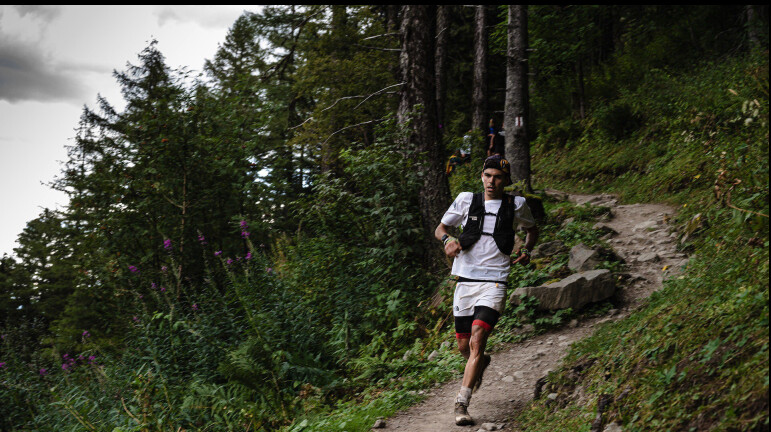
In fact, I recently attended the Arc’teryx Alpine Academy in Chamonix which holds a number of trail running clinics, and over the course of four days it was rare to have a conversation where the UTMB didn’t come up. Other participants in the academy wanted to know if our mountain guides had run it, how many times and whether they liked it (they don’t, considering it a tourist event) and mountain guides were keen to complain about how busy it made their favorite running trail.
But what is the UTMB exactly? Is it the ultimate goal for all trail runners? Why is it so hard? Here, we answer all of your questions about this hellacious footsport event.
What is the UTMB race?
UTMB stands for Ultra-Trail du Mont Blanc and is considered one of the world's premier trail ultra marathons. This demanding annual event follows the route of the Tour du Mont Blanc, a classic long distance hiking trail which circles the Mont Blanc Massif over 106 miles and passes through France, Switzerland and Italy. The UTMB begins and ends in Chamonix and is regarded as one of the most difficult races in the world.
The race takes place on the last weekend of August or first weekend of September and is today the ultimate in a series of events that take place around the world. Runners from all over the world aspire to compete in the UTMB. In the first year of the race, there were 700 participants, but these days, participation is capped at around 2,300 runners and other events have been created to allow for more participation.
The maximum cutoff for the race is 46.5 hours. In 2022, Kilian Jornet became the first to complete the UTMB in less than 20 hours (check out his race data to find out how he managed it) but most mere mortals can expect to have to run for two days and two nights to complete the race. Better bring some running gels then!
How does the UTMB race work?
Due to the event’s extreme popularity, you need to qualify to run the UTMB. That involves accumulating points through qualifying trail races over a two-year period. Qualifying races take place all over the world, from elsewhere in the Alps to Snowdonia, California, Mexico, Hong Kong and Australia. So if you’re serious about participating, you’ll have lots of time to train.
For each event you participate in and complete you’ll receive one running stone, which you can then enter into the lottery to be selected. You can enter the lottery at the UTMB website.
Why is UTMB so hard?
Besides the fact that at over 100 miles, it’s very long, competitors in the UTMB are also looking at 32,940 feet of elevation gain. In comparison, over roughly the same distance you could run the Leadville 100 in Colorado and gain only 11,000 feet (though at much higher altitude) or the West Highland Way in Scotland where you’d gain 10,300 feet.
The highest point of the route is 8,743 feet, which you’ll reach twice, in both Switzerland and France. That’s not extremely high altitude and it’s unlikely you’d experience altitude sickness at that height, but you’ll definitely notice shortness of breath and more challenging conditions, especially if you’re not already used to this altitude.
What you can also expect is more extreme conditions that come with trail running in the Alps. The altitude combined with the season means that the days might be swelteringly hot, while the temperatures at night could drop down around freezing at night.
How much does it cost to enter UTMB?
In 2023, the UTMB itself cost €335 to enter, plus administration fees. Of course, you’ll also have to pay registration fees for your qualifying events too. Your race will also include the cost of traveling to and from Chamonix, and accommodation while you’re there, but on the plus side the aid stations will be on hand to feed you during the race so you can save a little on those pricey Chamonix restaurants.
How many people have died in UTMB?
Sadly, deaths do occur in ultrarunning events and it’s perhaps more remarkable that for 17 years, no fatalities occurred during the UTMB, which not only places runners’ under extreme physical stress but entails a lot of night running. There have now been two deaths of runners in the UTMB, occurring in 2021 and 2022, both as the result of falls.
Do people sleep during UTMB?
Some runners somehow manage to do the UTMB without sleeping at all while others do sleep, but they’re not carrying a bivy sack and grabbing eight hours if that’s what you’re wondering. Sleeping during the UTMB looks like cat napping, and according to a 2015 study of 17 UTMB runners, the average time spent resting was between 12 and 17 minutes in total, and hallucinations were a common complaint, understandably.
Can you walk the UTMB?
Can you walk the UTMB? Well, yeah you could. Since the race is 106 miles and you have 46.5 hours to complete it, you technically could walk at a 2.3 mile per hour pace without any breaks and make the cutoff. Obviously though, you could just walk it at a time when the race isn't going on, save yourself €335 and enjoy far fewer people on the trail.
In all seriousness though, if you don’t already know, ultrarunning is actually hiking, and you’re not going to be running at the same pace you do on the tarmac back home. Even Jornet ran at an adjusted pace of around five miles per hour which isn’t exactly turbo speed (though it is if you maintain that for 20 hours). You’ll most likely walk the uphills and slow down or walk for rest periods, making up time on the downhills. And sorry, there aren’t many flats to speak of.
(07/23/2023) ⚡AMP

Feeling out of shape? Maybe you should run up and down a mountain three times.
It’s a perfectly normal question to ask someone, I just wasn’t the right person to ask. I had been chugging up the trail at about mile 22 or so of the race, trying to push myself but also pace myself, and in my own head because I’d only seen three or four people in the last 45 minutes or so. The guy was hiking downhill, getting out before the Saturday heat really warmed things up, and I had made a little room as I passed him hiking the other direction, trying to get up Tiger Mountain for the last time. We’d said hello, and then he asked,
“How far to the Section Line Trail?”

I rounded the switchback and confidently said, “Oh, I don’t know,” and he seemed a little surprised that I didn’t know, pausing for a second with a somewhat quizzical look on his face. So I added, “This is my first time here,” hoping that would help him understand. It was true, kind of. If I’d felt like I had more time to stop and chat, I might have added a few more bits of information:
> I am participating in an ultramarathon trail race called the Tiger Claw 50K > I have never set foot on this mountain before today, May 13th, 2023 > This is my third trip to the summit of West Tiger #2, and finally, > Hey man, I’m just following these pink flags till I see people with pitchers of electrolyte drink and trays of Oreos standing under an EZ-up at the top. I’m not paying attention to the trail names, the distances, or the intersections, I’m barely looking at the scenery. My goals today are:
a) Survive this race despite the 88-degree temperature and 70 percent humidity and b) Produce urine that isn’t the color of a No Passing Zone sign by midnight tonight
I hope that man found his way and is not still out there looking for the Section Line Trail.
Another question someone asked me, the day before the Tiger Claw: “Why did you pick that race? Isn’t it just kind of a local thing?”
I got really out of shape in 2022—spinal disc injury, new baby, sleep deprivation from helping take care of a new baby, and another back/hip injury. I was starting to wonder if at 43, I was hitting some sort of downhill slope in life. I turned 44 this winter, and was determined. Not to return to any sort of athletic glory, no, but to avoid going to the emergency room again after herniating a disc while picking up a dog because I sit on my ass 40 hours a week, and inside my regular-sized middle-aged man body is a smaller man who loves to eat emotionally and is also super fucking lazy.
So I started looking on UltraSignup for 2023 races near western Montana, and thought
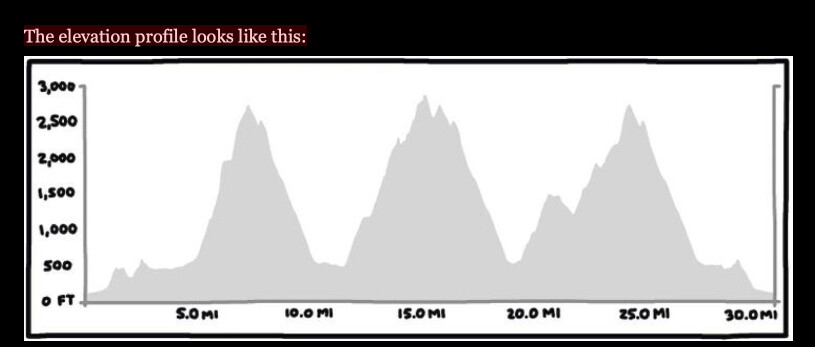
Three summits of West Tiger #2 (elevation 2,757 feet), returning to the High Point Trailhead (elevation 527) each time. For a total of “nearly 9,000 feet of elevation gain,” per the Tiger Claw website. If you are looking for a fast, flat race to help you get your PR for the 50K distance, the Tiger Claw is not it.
This, I was afraid, would call for drastic measures: I was going to have to learn to do something I have always been terrible at doing: drink a responsible amount of fluids. This was almost too much to ask, I thought. Maybe I should bail. DNS: Did Not Start. Reason: Not good at drinking water.
The White Loop was the steepest. Ethan’s final email to participants the previous day had said the Pink Loop would stay in the shade into the afternoon. I had decided to go White (steepest, least fun) first, Yellow (longest, most meandering) second, and Pink (afternoon shade). I chugged down a 17-ounce water bottle in the final minutes before the start and stuffed it in my vest.
The first 4.6 miles wound around in the forest with a couple ups and downs, gradually climbing a few hundred feet to get us to the lower aid station, where we’d split up into our respective loops and go on our way. I had put a small drop bag at the lower aid station, as we’d all return here after each of our three ascents and descents of West Tiger 2. I packed my drop mag pretty minimally because after I finished my final lap, I planned to stuff whatever was left of it into my vest for the final three miles to the finish line, so I didn’t have to drive back to get it after the race.
I filled one water bottle at the aid station and ran on, splitting off to do the White Loop, 2.8 miles, 2,800 feet of climbing to the upper aid station/turnaround. I had no ambitions to do a fast first lap, but ran some of the less-steep sections and hiked the rest. Less than a mile into the White Loop, I was alone in the forest, so I pulled over to pee. Just as I was finishing, Krissy Moehl, who is a very famous ultrarunner, hiked past a few feet away, which is sort of an awkward moment to introduce yourself, but I did it anyway, because we have a mutual friend, and then we ended up hiking together for the rest of the ascent. This is not to say that I am as fast as a person who won the UTMB in 2003 and 2009; more like Krissy was not in a hurry on the race course.
With a couple other guys, we jogged a few short sections of the trail, but mostly hiked at a good clip to the upper aid station, arriving at about 1 hour and 45 minutes. I got my water bottles refilled and started heading down. The top of West Tiger 2 had been logged a few years back, and the good news was we could see Mt. Rainier, Mt. Baker, the buildings of downtown Seattle, and the Puget Sound. The bad news was there was no shade at the top, and it was already sunny and warm at 8:45 a.m.
The 2.2-mile route back down to the lower aid station, which we’d all do a total of three times during the race, was steep and technical for about a half-mile, and then just steep. I made myself drink two 17-ounce bottles of fluid as I ran downhill, and made a mental note to do this each time I ran the descent. I had drunk two bottles on the way up, and my shirt was completely drenched in sweat, front and back, by the time we hit the summit.
At the lower aid station, I grabbed my drop bag, stuffed a couple packages of Clif Bloks into my sweat-soaked vest, filled up three water bottles, and started jogging back up the trail, looking for the turnoff for the Yellow Loop—5.5 miles, 3,000 feet of elevation gain.
The Tiger Claw is sort of a multiple-loop race, in that you run multiple loops, and pass through the same checkpoint (the lower aid station) at the end of each loop—but that checkpoint is still three miles from where you parked your car at the start/finish, so maybe it’s less tempting. (you could call someone and ask them to pick you up at the aid station, though, since it’s about 150 feet from a parking lot that’s only a mile from I-90)
But I was definitely not thinking, “Man, I hate loops, I can’t believe I have to come back to this aid station two more times”—I was thinking, “Jesus it’s hot already.”
I was alone for most of the loop, running when possible, hiking the steeper parts, and chugging water and Skratch electrolyte drink. About two-thirds of the way up, Krissy Moehl passed me, and we chatted for a few minutes. Through the forest, I had been forcing myself to chug water—three 17-ounce bottles by the time I got to the top of the climb. Mileage-wise, I was past the halfway mark by my second summit of West Tiger 2, and had drunk 7 bottles of liquid, or about 119 ounces.
With only the Pink Loop to go, I only had 2,700 feet of elevation gain to climb. I could feel a slight dehydration headache forming, but maybe if I kept forcing water down I’d be able to keep it at bay. At the Upper Aid Station, I refilled two bottles and drank both of them as I navigated the downhill.
If you look a map of the course with all three loops on a map, you could see why they called it the Tiger Claw:
A solid mile and a half from the upper aid station, I started to hear a dog howling. Or some animal. I kept plugging away, slowly passing a couple other runners, every once in a while scanning the trees above my head for the top of the ridge, the end of my final climb. Eventually, I ran out of trees, hitting the north edge where the trees had been clear cut. I went from hints of sun to full-blast afternoon white heat as I chugged up the trail, finally seeing the howling dog, which turned out to not be a dog at all, just a really psyched volunteer wooing so loudly and so often that I thought there was no chance he’d have his voice tomorrow. I thanked him and walked to the aid station, got my water bottles refilled, grabbed a handful of potato chips and a couple Oreos, and headed down.
On each of my three descents of the trails to the lower aid station, I was elated to not be climbing. I was also reminded that there was, also today, a race called the Tiger Claw Double, a 50-mile version of this same race I was doing, but with THREE EXTRA LAPS to the summit of West Tiger 2. As I ran downhill, I’d pass by a 50-mile racer heading uphill, and I’d say something like “Good job,” but what I was thinking was, “Look, I am a person of questionable judgment and intelligence, who is spending their Saturday doing a steep-ass 50K race with almost 9,000 feet of climbing in 88-degree heat and 70 percent humidity, but you, Runner, are a FUCKING MANIAC. I salute you. Also I’m really glad I didn’t sign up for that race instead.”
At this point, midway through my final descent, the hot spots on the instep sides of my big toes had turned into full-on blisters, and my toenails were sick of the cumulative effects of being pushed backwards by my shoes every one of the thousands of downhill steps so far.
My strides had shortened, and I wasn’t grunting or wincing with pain every step, but I definitely wasn’t smiling. I glanced down at my watch to check my pace, just out of curiosity: 12-minute miles. I was pretty ready to be done.
I hit the lower aid station, grabbed my drop bag, shoved it into the back pocket of my vest, and started jogging down the road in full sun. Every piece of fabric on my body was soaked through with sweat, including the inside of my vest and the outsides of my shoes.
The route meandered through a short section of forest, and the final three-quarters of a mile was a wide, paved, shaded multi-use path. I started running faster, because on flat ground, my blisters didn’t hurt, and I was ready to get it over with. And I think I remembered them saying something about pizza at the finish line.
I jogged under the finish arch, gave Ethan a very soggy, gross hug, took my finisher medal, and felt the relief of No More Exercising Today slowly roll over me. Mark Griffith, who had been out on the course taking photos all day and working as hard as the racers, directed me to the pizza and cold beverages, and I asked him if he was able to take care of himself at all in the heat. He said he eventually was able to rehydrate at the upper aid station, but at one point, the sweat was just rolling down his head into his eyes. “My eyebrows stopped working,” he said. And I thought, Same, man. I had drunk approximately 225 ounces of water and Skratch electrolyte drink in 7 hours and 39 minutes, and I still felt like a piece of beef jerky that had been left out in the sun for a week.
It had been hot, for sure, but I finished, and as I sat down with a can of sparkling water, it seemed like I had a good chance of surviving the day. I thought a little bit about my friend’s question as to how I decided to sign up for the Tiger Claw, since it was kind of a local race on a local mountain. I am not sure if I could draw a flow chart of how I, and maybe other runners too, decide to run whichever races we run. I don’t know, it sounded fun? It sounded not fun? I heard good things about it? It was close to where I live, or close to some place I wanted to travel to, or it was flat, or it was steep, or whatever.
As far as I know, ultramarathon races basically work like this:
I had assumed that Ethan and Kim could put on a pretty good race because they do other things well, and I am not in the business of reviewing races, but I have to say, I was right. It was fun. Although parts of it were not fun.
Fortunately, there’s plenty of steep terrain very close to where I live. Unfortunately, lots of that steep terrain was still covered in snow and ice until the first week of April. But, I have microspikes, and enough of it melted out in time for me to get in some steep uphills. I did laps on Mt. Sentinel, sort of our local Tiger Mountain, with a ~2,000-foot climb via several different trails. At one point, I wondered: “Am I spending too much time on really steep terrain? What if the course is more gradual, or rolling?”
(Answer below)
I honestly hadn’t given it any thought until he asked. I had just focused on the big numbers: 31 miles, 8,000-something feet of elevation gain. But now I was thinking about it. And it did sound kind of nice to run the loops in whatever order they would be least crowded. But how would I know?
(07/22/2023) ⚡AMPby Outside Online

Australian ultrarunner Scott Richmond dribbles soccer ball 320 km to new world record
An Australian ultrarunner has set a new world record for the longest distance run while dribbling a soccer ball. Scott Richmond, who lives in the Greater Sydney Area, completed the novel feat of endurance Thursday after dribbling a soccer ball non-stop for seven days from Canberra to Sydney, reaching his 320 km goal and breaking the former record by 20 km.
A children’s entertainer known locally as “Ozzie,” Richmond took on the challenge to raise funds for partner organizations Sports Access Foundation and Fair Game, with money raised going toward sporting equipment and programs for children living in Australia‘s remote and underpriveleged areas, as well as expanding sports opportunities for children with disabilities.
Being an experienced ultrarunner, Richmond was confident he had the legs for the challenge, which kicked off July 14 in Canberra. However, he told news.com.au during the homestretch of his attempt that he didn’t feel as surefooted when it came to keeping control of the ball. “I don’t have a soccer background … so I had to adapt my fitness and build up confidence to tackle this challenge. But I’m hoping this can prove that if you train hard enough, you can achieve anything.”
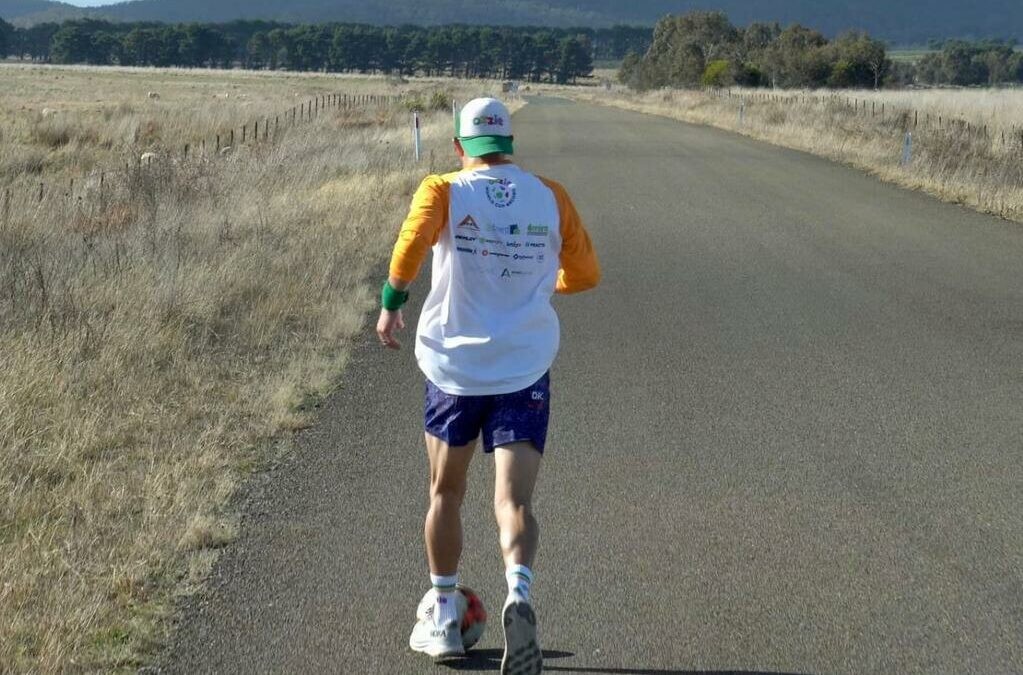
Although the run didn’t always go according to plan—detours caused by construction work added 8 km to his planned distance on the fifth day of his run, and there were the odd brushes with traffic that were too close for comfort—Richmond said the experience was “everything I expected and more.”
A video posted to Richmond’s Instagram page on Thursday showed the runner receiving a boisterous reception at Seymour Sharp Park in Miranda, a suburb of southern Sydney, which served as the finish line to Richmond’s days-long dribble.
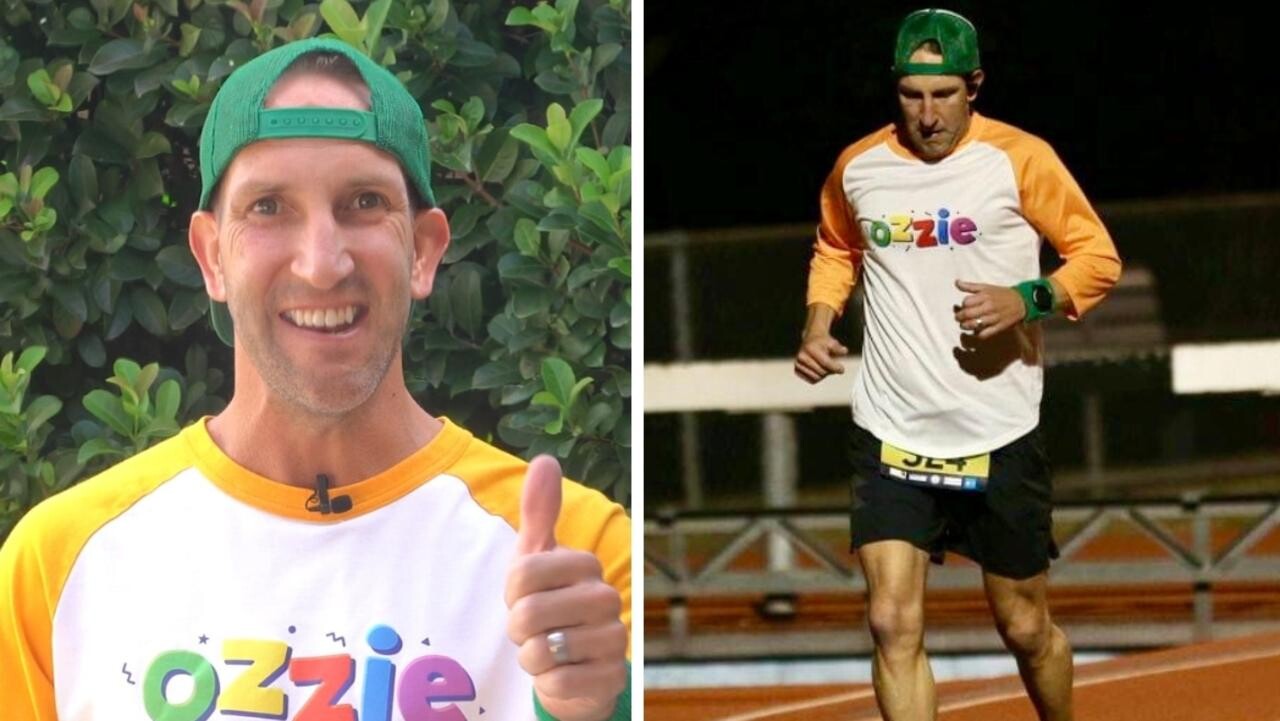
His reaching the park didn’t mark the end of Richmond’s efforts, however. Upon his arrival, the runner took part in a second world-record attempt—the most people simultaneously dribbling a soccer ball for five minutes—which was organized as another fundraiser to benefit the same youth sports organizations. There wasn’t any word from Richmond’s fundraising team Thursday on whether participants at the park were successful in breaking the record of 2,067 simultaneous dribblers, or whether the fundraising goal of AUD$100,000 between both record attempts had yet been reached.
(07/21/2023) ⚡AMPby Paul Baswick

Canadian ultrarunner still snagging podiums at 66
Trishul Cherns has firmly staked his place in the history of Canadian ultrarunning. But at age 66, the endurance athlete has shown with his recent ascents to the podium that he has no desire to dwell on past successes—nor should other runners who have entered their senior years. The Hamilton native, who lives in Kingston, N.Y., with his wife and crew leader, Käären Schilke-Cherns, has recently racked up no fewer than three podium finishes at ultras around the U.S., including second overall at the 144-hour 3 Days at the Fair road race in Augusta, N.J., in early May, covering 677. 53 km; third overall at the 33-hour Centurion Ultra Trail Event–Blue Buckle in Connecticut in June, completing 183.304 km; and earlier this month, Cherns won the 48-hour event at the Notchview Ultra in Windsor, Mass., covering 229.332 km on trails.
Cherns is best known as a multi-day racer, and throughout his career, has represented Canada in many international competitions. He has broken more than 110 Canadian ultrarunning records and has racked up tens of thousands of kilometres in events as short as 50K and as long as 1,600 km on roads, trails and the track. Altogether he has accumulated more than 300 ultra finishes during his career.
Cherns says beyond being personal accomplishments, these latest results speak assertively to the strength and potential of runners over the age of 65.
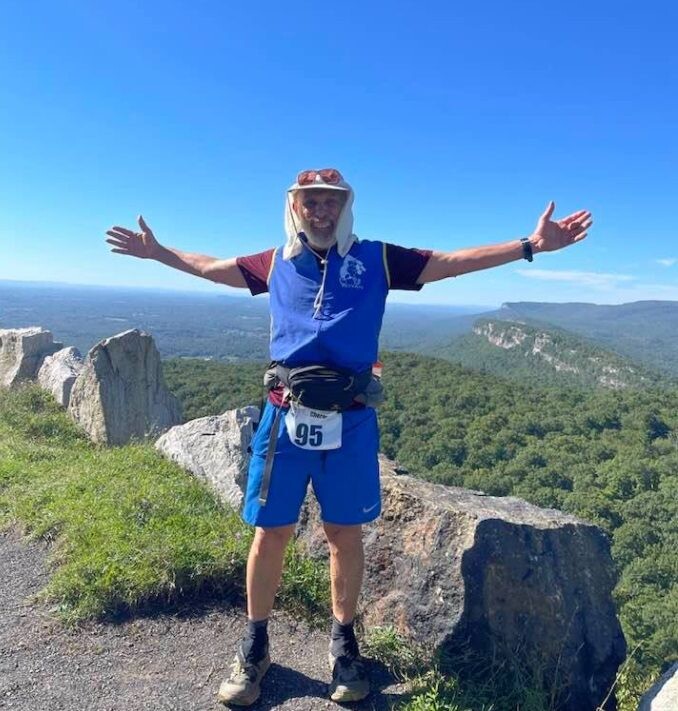
“Age is not a limit,” Cherns tells Canadian Running. “I still feel 30 inside, and I’m beating guys that are 20, 30, 40 years younger than me. So I think the message is, no matter what your age is, keep going and keep doing what you’re doing.”
Although age does offer runners the benefit of experience, running success in older life doesn’t just happen. Cherns says choosing healthy foods and cultivating a positive mental attitude have been crucial to his continuing to be a strong competitor.
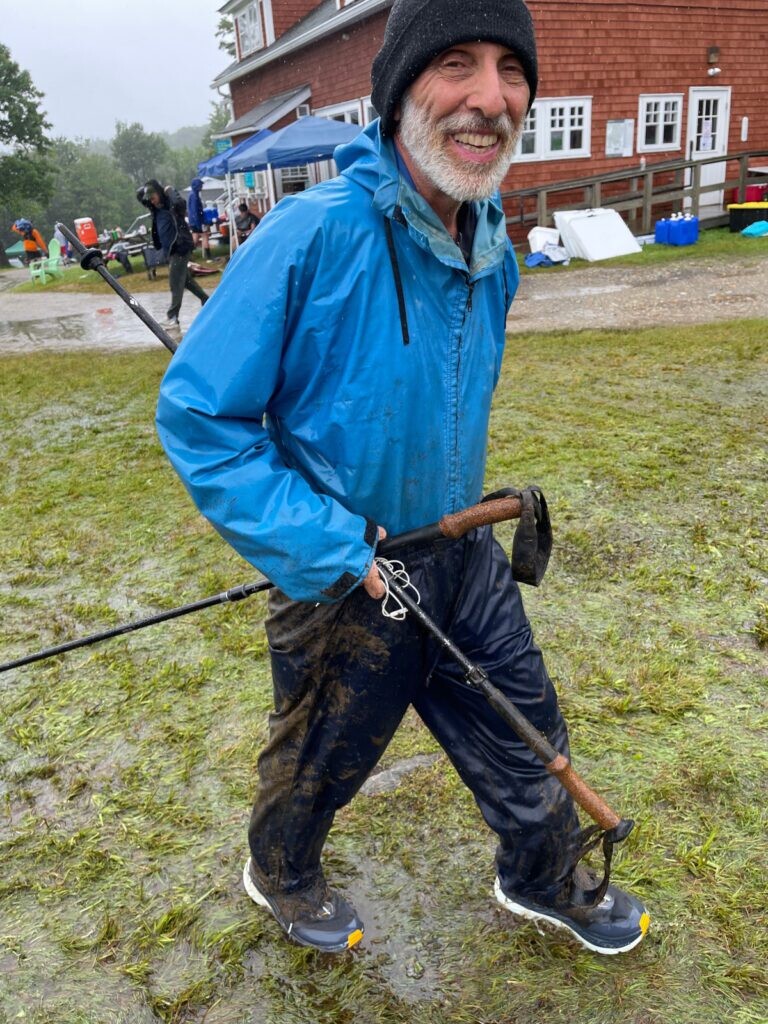
“My success definitely comes from my diet,” he says. “I’m a vegan, and that’s an anti-inflamatory diet. I’m trying to prevent inflammation in my body because these are stressful (running) events, so I’m trying to make it as easy as possible.”
He says meditation and approaching running as a spiritual practice have been key to maintaining a positive mindset during challenging races.
“Meditation and spirituality give me fortitude. Inner peace and stillness give me strength. I can do things that others can’t because of my inner fortitude, which supports my being very, very mentally strong and very, very emotionally strong,” says Cherns, who was a student of the late endurance athlete and spiritual teacher Sri Chinmoy.
Another key ingredient to continued success and joy in running is to continue to look ahead, says Cherns, and always to set one’s sights high. “My ideas are always self-transcending. I want to be prolific. I want to keep pushing my goals so that running is all a new adventure for me. I’ve run more than 300 ultras—in the next five years I’d like to bring that to 500. Ultimately, can I do 1,000 ultra marathons in my lifetime? You know, that’d be cool,” he says.
“I’m trying to go for the stars. There’s no reason why you can’t go for the stars, no matter what age you are.”
(07/19/2023) ⚡AMPby Paul Baswick

Three things ultra beast Courtney Dauwalter can teach all runners
Courtney Dauwalter has been stunning the ultratrail world over and over: not only does she keep winning every race she runs, but she’s been obliterating course records and beating almost all of the men. On Sunday, the Leadville, Colo.-based athlete annihilated the Hardrock 100 course record, finishing an incredible fourth place overall, only three weeks off setting a blistering new Western States 100 record. Here’s what you can learn (no matter your distance of choice) from the way Dauwalter trains and races.
1.- Run with joy and gratitude
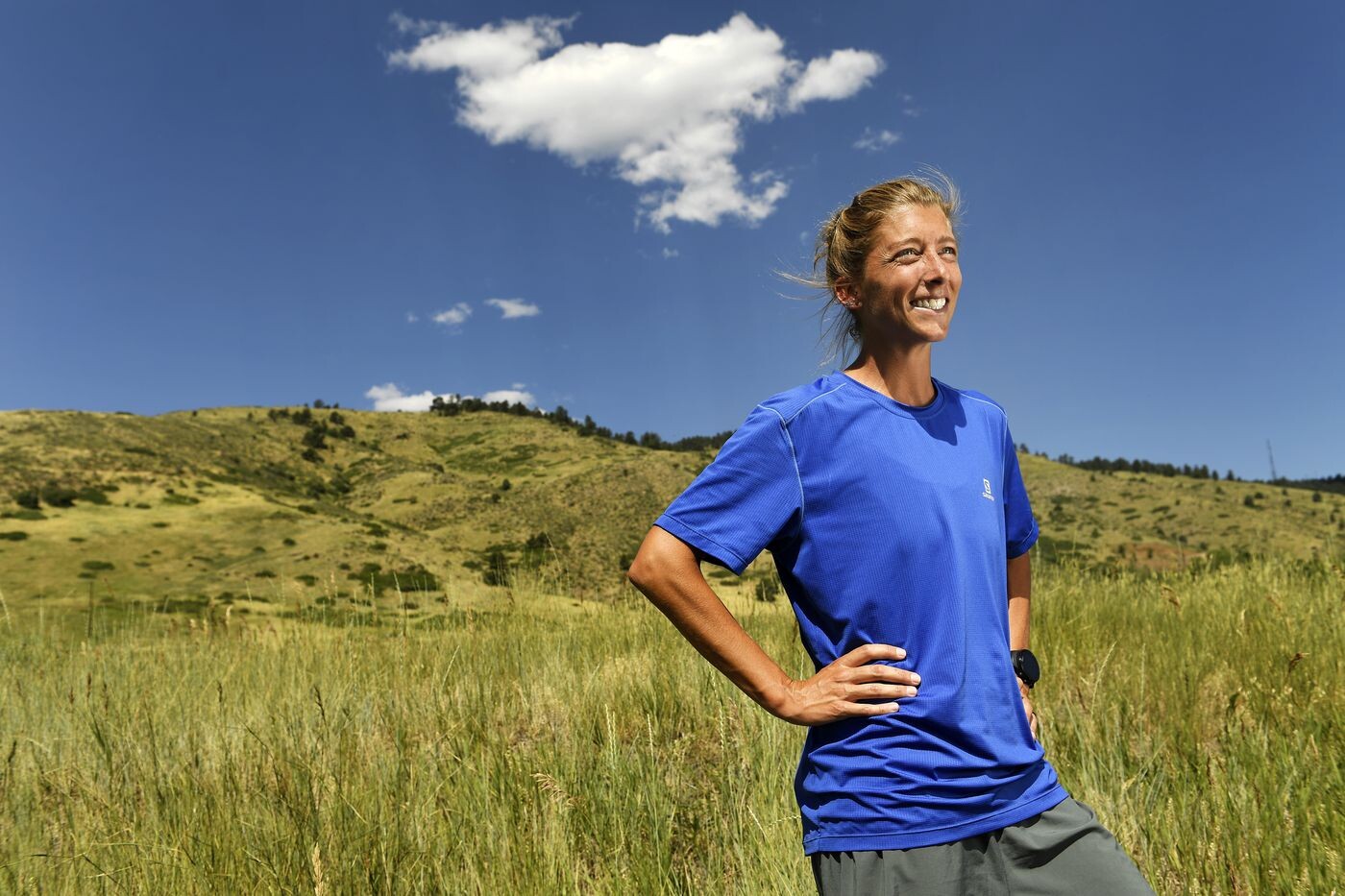
It sounds simple, right? Running and racing should make us happy, but training can all too easily get filed as a chore on an endless to-do list. Dauwalter exudes joy and gratitude when she races, no matter the day or situation. Dauwalter is known by competitors and fans alike for the big smile she shares with everyone on the course.
She effusively thanks volunteers and takes time to ask how her crew is doing. She high-fives all the little kids. On the Some Work All Play podcast, coach and ultrarunner David Roche asked Dauwalter what she would like her legacy to be. The trail phenom answered with her trademark humility and graciousness: “In general? That I made people smile and laugh and have a good time.”
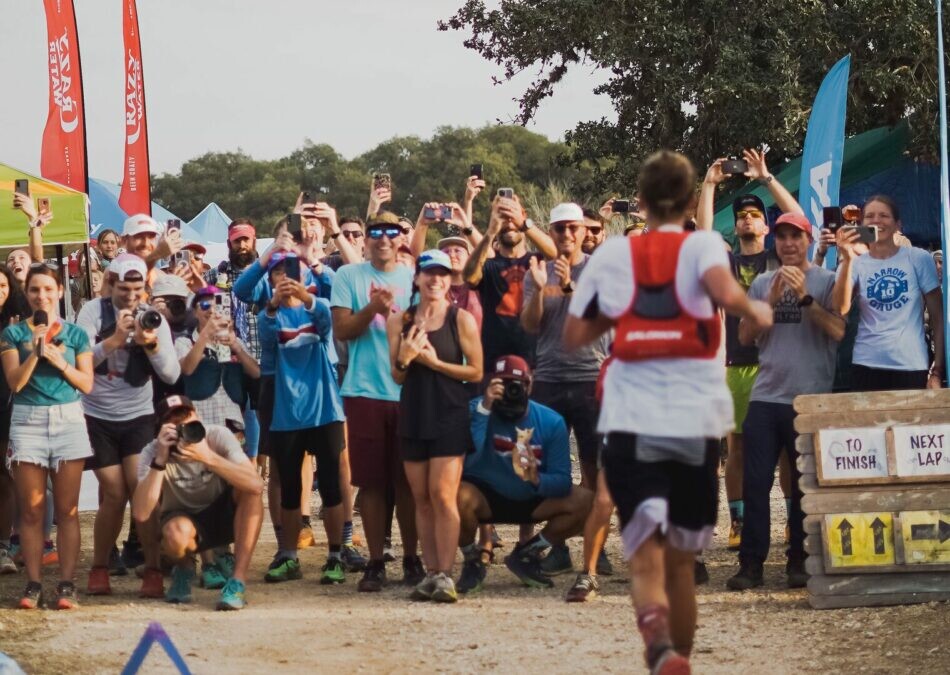
Most of us won’t win a course record at a world-renowned event, but we can embody Dauwalter’s attitude in our own training and races. Checking in with others, savouring the fun of moving our bodies, and that simple thing, smiling, will make everything feel a little bit easier and a lot more fun.
2.- Adjust your training according to how you are feeling
Dauwalter has no coach, doesn’t follow a strict training plan, and goes by feel. She’s clearly perfected the art of self-awareness over time, but there’s a takeaway there for all of us. Even though it can be incredibly helpful for runners to follow a program or have guidance while they train, keeping a reserve of flexibility and using self-check-ins can help the regular runner optimize their performance.
“There are so many ways to train, enjoy, and go after running goals. Having a training plan, using devices and analyzing data, or not doing any of those things, are all great options,” Dauwalter recently explained to trailrunnermag.com “I think it depends on the person and how they find joy. But I also think there is no downside to occasionally leaving the watch at home and heading out the door for a run where you just listen to your body and not worry about metrics.”
Keep things loose, and be willing to adjust your plans if you feel the need for a data-free jaunt or when you note that your body is needing more rest.
3.- Eat with exuberance
Dauwalter is known for her sweet tooth and habit of fuelling long races with cheese quesadillas. She’s often heard asking for her post-race beer, and even her Instagram tagline declares her a lover of long inseams and candy. Dauwalter told Roche that she refuses to restrict what goes into her body: “If it sounds good, if it tastes good, if it fulfills a craving, then it’s exactly the thing that I’m eating.” Eating makes her happy.
Eating has a complicated dynamic for some, and runners come from a wide array of nutritional needs and preferences. Whatever your relationship with food and fuel, bringing Dauwalter’s enthusiastic spirit into your kitchen or food choices can make food more fun.
(07/17/2023) ⚡AMPby Keeley Milne

2023 Hardrock 100 Women’s Race
If it wasn’t for Courtney Dauwalter (pre-race interview) running the Western States 100 just three weeks prior, crushing the women’s record there, and potentially being a bit worn out at the start line of the Hardrock 100, it would have been hard to find someone to bet against her winning the race this year. But if she were to falter, there were several women who were ready to jump at the opportunity.
For the first part of the race, it seemed like France’s Anne-Lise Rousset Séguret was going to do just that. While Dauwalter led in the very early miles of the course, Rousset opened up a sizable gap coming through Maggie Gulch at mile 15.5 and was moving with enthusiasm toward Pole Creek, the next aid station. She came into Sherman at mile 30 in seventh overall in 6:29, looking strong. Dauwalter was just six minutes behind, and Annie Hughes (pre-race interview) came in next, 52 minutes off the lead. With still many miles to run, it was still anyone’s race. Frenchwoman Claire Bannwarth (pre-race interview) came through just seven minutes later and was followed by Japan’s Kimino Miyazaki (pre-race interview), who was 1:22 off the lead but looking spry and happy.
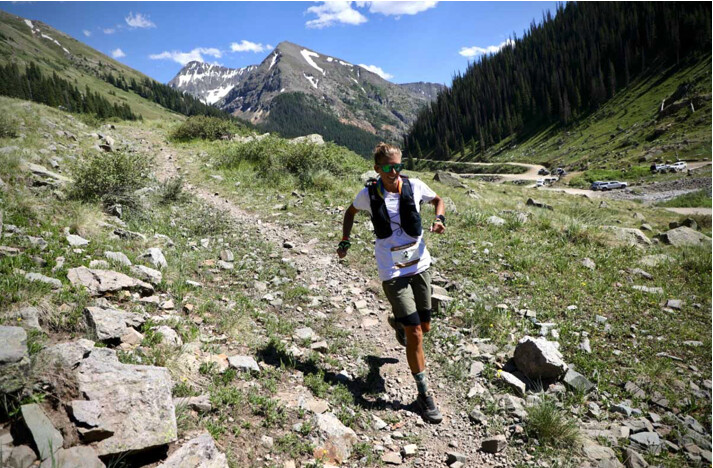
The top-two women came back together through Grizzly Gulch at mile 36 with Hughes trailing them at just under an hour back. When Rousset led Dauwalter into Grouse Gulch, mile 43.5, by nearly 10 minutes after traversing Handies Peak, the course high point, it seemed like maybe the Western States 100-Hardrock 100 double was going to be too much for Dauwalter to handle.
But it’s never a good idea to bet against the most dominant female trail ultrarunner of this generation. By mile 50, she’d closed the gap to four minutes, and in Ouray at mile 58.5, it was down to two minutes. When it came to the climb out of Ouray, Dauwalter made her move, and the elastic to Rousset finally snapped over the top of Virginius Pass. Dauwalter never looked back.
Meanwhile, Hughes stayed steady in third place while dealing with stomach issues and the rest of the women’s pack, including Miyazaki, Bannwarth, Christina Bauer, Whitney Mickelsen, Darla Askew, Becky Bates, and last-minute waitlist entrant Emily Halnon, who only got into the race the morning before, continued to chase — all within close proximity to each other.
Dauwalter ran into Telluride at mile 74.5, her pace still hovering just a few minutes over course-record pace, but now 23 minutes ahead of second-place Rousset, and executed the fasted crew stop of the Telluride aid station, getting in and out in under three minutes. She was on a mission.
Just 10 miles later, she was well below course-record pace, crushing the Bear Creek Trail climb out of Telluride and moving herself into third overall as some of the lead men began to falter. Rousset also continued her relentless march, and while she was 48 minutes back on Dauwalter at mile 84, she was only three minutes up on course-record pace.
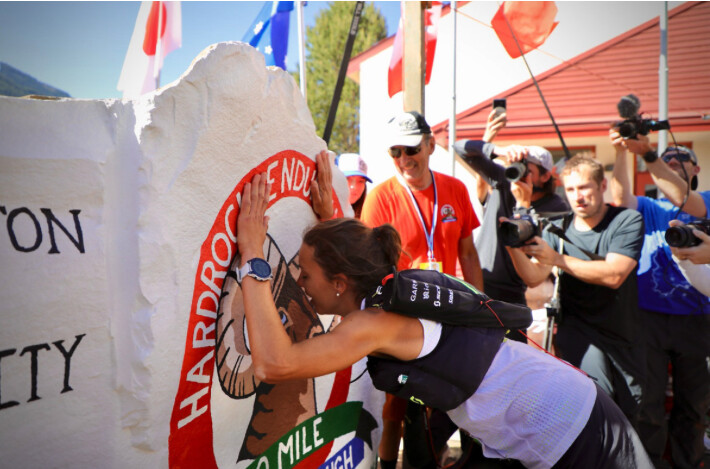
In the end, there was no catching Dauwalter as she ran back to Silverton to kiss the rock with a new women’s counterclockwise course record of 26:14:08, besting the one set by the legendary Diana Finkel in 2009, and finishing fourth overall. She also set a new overall women’s record, beating her old time of 26:44:36, which she set last year.
Not only that, she set a new overall record for the Western States 100-Hardrock 100 double with a combined time of 41:43:42, beating Jeff Browning’s old record of 42:12:43 that he set in 2016.
Rousset would finish second after a gutsy run with a time of 27:29:55, which registers as the fifth-fastest time in event history, and Hughes would hold onto third with a time of 32:13:03 after spending nearly 100 miles battling stomach and breathing issues.With large gaps between the first, second, and third women, all eyes turned to the competition between fourth and 10th where the time gaps were tight and the women were often in the aid stations together in the back half of the race. Miyazaki and Bannwarth ran in close proximity to each other battling for fourth and fifth, while Mickelsen, Halnon, Bates, Askew, and Bauer seemed to maintain the same overall pace as the miles ticked by.
(07/16/2023) ⚡AMPby Eszter Horanyi -I run far

Hardrock 100
100-mile run with 33,050 feet of climb and 33,050 feet of descent for a total elevation change of 66,100 feet with an average elevation of 11,186 feet - low point 7,680 feet (Ouray) and high point 14,048 feet (Handies Peak). The run starts and ends in Silverton, Colorado and travels through the towns of Telluride, Ouray, and the ghost town...
more...
How to Properly Prepare for Hot-Weather Races
Ah, summertime! It's one of the best seasons for long trail runs, but it's also the hottest and one of the most difficult times to train.
As temperatures and UV indices climb, runners in many regions can feel the dew point explode, and that can make it seem like any semblance of fitness gained over the winter and spring is suddenly gone. We can all recall an early summer run that makes us not only question our confidence, but whether we're going to make it through the next few months.

There are notoriously warm races on the horizon, and there's a lot of talk about heat and how to mitigate it: sauna training, layering, topical cooling-all the tools to get amateur and elite athletes alike through challenging conditions. Many of the runners who just raced the Western States 100 had relied on mid-afternoon runs when temperatures were at their highest, as well as sauna or hot water immersion training. The race, as with many other summer and early fall races, typically boasts soaring high temperatures along sections at lower elevations.
For decades, the three most-watched sporting events worldwide-the Summer Olympics, FIFA World Cup, and the Tour de France-are typically held during the hot summer months of the Northern Hemisphere. However, prior to 2012, most of the scientific literature on heat acclimation for athletes was based on laboratory testing and controlled environments, and not from real competitions in scorching conditions. With eight of the hottest years in recorded human history having been logged since 2015, global sport organizations such as the International Olympic Committee have finally placed enormous emphasis on providing up-to-date guidelines and recommendations in order to keep athletes safe.
The COVID-19-delayed Tokyo Olympics in 2021 were the hottest Games in modern history with temperatures soaring into the mid-80s and humidity hovering at 82 percent during the women's marathon. The good news is that it sparked considerable discussion and hypothesizing in sport-science communities about best ways for the athletes and their teams to prepare and endure heat. Ultrarunners everywhere watched as the world's best distance runners implemented topical cooling techniques such as pre-competition ice vests and bags of ice during the marathon-a relatively new or at least a more aggressive tactic to attenuate the impact of heat before and during competition.
Heat is considered an equalizer, an element that everyone has to manage, no matter if you're attempting to train or race through it. But does it have to be a performance-sapping equalizer? Can heat training (potentially year round) be viewed as an opportunity to improve fitness, tolerance, and mental strength for challenging race day conditions?
How Heat Impacts Performance
First up, let's discuss what happens when athletes exercise in the heat. Blood flow to the skin, as well as sweat rate, increase to promote heat dissipation. While aimed at keeping the human body safe, these processes increase physiological strain and the chance for dehydration in prolonged endurance events, leading to a subsequent increase in cardiovascular strain. This creates a chain reaction that negatively impacts aerobic performance. Researchers globally agree that the most salient way to lessen the strain that heat imposes is to perform a heat acclimation period ahead of race day.
Improvements in aerobic performance and thermal comfort achieved through heat acclimation are bolstered by these processes, as outlined in a 2011 scientific article from the U.S. Army Research Institute of Environmental Medicine.
Heat Acclimation
Let's dive even further into what the science says about heat acclimation, when and how to implement it, and what athletes of all levels can do to mitigate heat stress before, during, and after exposure to a hot endurance event.
A study published in the British Journal of Sports Medicine in 2015 provided the first-of-its-kind, gold-standard consensus recommendations for heat acclimation, and remains one of the most cited pieces of recent literature regarding training and competing in heat, along with Julien Periard's comprehensive review from 2021 for the American Physiological Society. In both reviews, the authors discuss heat acclimation, hydration, and cooling strategies as the pillars of successfully competing in the heat.
The authors report that most adaptations happen within the first week and more slowly within the following ten days. In order to achieve near complete adaptations to fully optimize aerobic performance, athletes need to plan for two weeks of focused acclimation. A pre-Tokyo Olympics study from 2020 suggests following the gold standard of 10-14 days of long-term heat acclimation followed by a shorter five-day reacclimation period just ahead of competition (during the taper period) in order to get the most out of "peak weeks" of training without compromising the health of the athlete with the added stressor of heat training.
It is important to note that the average loss of heat acclimation is roughly two-point-five percent per day following 48 hours without exposure to heat. But reacclimation happens quickly. The rate of decline varies from individual to individual and typically occurs at a slower rate than induction to heat acclimation.
The literature favors training in the same environment as the upcoming race, and if that isn't possible, training indoors in a heated room is the next best option. These once-a-day sessions should last at least 60 minutes, at an easy effort, while keeping a close eye on heart rate (preferably at about 75 percent of max heart rate). Athletes should expect to see their heart rate decrease as adaptations continue to occur, and as such, the duration or intensity of the session should be increased in order to maintain the training stimulus.
What if you don't have access to the same outdoor environment nor the set-up to train in a heated room? A study from 2007 demonstrated that 12 sessions of post-exercise sauna bathing at approximately 190 degrees Fahrenheit for 30 minutes at a time over the course of three weeks enhanced endurance performance.
What about dry heat versus humid heat and acclimating to either? The science demonstrates that acclimating to dry heat improves exercise in humid heat and vice versa. But acclimating in humid heat evokes higher skin temperatures and circulatory adaptations. In other words, the stereotypical dad statement: "But it's a dry heat!" holds somewhat true.
Are there benefits to heat acclimation when your race is in temperate or cool environments? A study from 2010 on cycling performance demonstrated a five percent increase in VO2max in cool conditions versus an eight percent increase in hot; a six percent improvement in time-trial performance in cool conditions vs. an eight percent improvement in hot; and an equal increase in power output at lactate threshold in both cool and hot conditions of five percent.
Hydration
Training in hot conditions increases sweat rate, which leads to progressive dehydration (if fluid intake is not increased), causing a similar cascading effect that is essentially the reverse of what happens during heat acclimation: decrease in plasma volume, evaporative heat loss, and cardiac filling all leading to a reduction in capacity to tolerate the effort in the heat.
A 2015 study in the British Journal of Sports Medicine underscores the importance of starting training or competition in the heat in a well-hydrated state with sodium supplementation before and during the event, minimizing body water mass losses during prolonged exercise in the heat, and being sure recovery hydration regimens include sodium, carbohydrates, and protein.
A 2010 study published in the Journal of Applied Physiology demonstrated enhancement and acceleration of heat adaptations, as well as further increases in blood plasma volume by taking in a protein-carbohydrate mix (0.3g of protein/kg of body weight and 3.6kcal of carbohydrate/kg of body weight) within 10 minutes of heat training.
Cooling Strategies
Numerous studies underscore that cooling strategies implemented immediately before, during, or after competition should be used in addition to heat acclimation, not as substitutes. Cooling strategies provide the most benefit during sustained exercise, but should not be used for sprinters. They include both external methods like ice bandanas and saturated towels, cold water immersion, fanning, topical menthol sprays, and internal options such as the ingestion of cold fluids or ice slurries. (Did someone say post-run slushies?!)
Ice bandanas and saturated towels demonstrate the ability to lower skin temperature (without lowering muscle temperature and risking injury) and effectively lower cardiovascular strain. Ice slurries have been shown to be more effective at cooling athletes than cold fluid ingestion, as the latter has also shown reductions in sweating and evaporation. The literature encourages combining techniques (external and internal), as doing so has a higher cooling capacity than the same techniques used in isolation.
A meta-analysis from 2020 found that topical menthol spray caused cooler thermal sensation and improved thermal comfort, but no significant differences in sweat production, core temperature, or heart rate were demonstrated. Findings showed external application, warmer environment, and higher body mass indices as improving menthol's effects on endurance performance without compromising the body's response to the heat.
How to Apply This in Training?
For athletes targeting a warm or hot race, we have a few options in how to structure heat acclimation. As a coach, I recommend against adding in heat acclimation as a novel stimulus without an anticipated hot race on the calendar, because most athletes still have a lot of other low-hanging fruit to grab first. (Looking at you, quality sleep!). If you are a highly trained athlete, chat with your coach prior to initiating heat acclimation in the absence of a warm-weather event on your schedule.
If you have a history of RED-S (Relative Energy Deficiency In Sport), work closely with your coach and medical team to be absolutely certain you aren't adding in too much stress to your training all at once. Taking body weight measurements can be a part of hydration monitoring, but it's important to contemplate the pros and cons of doing so. Another consideration is making sure you have a clear picture of your iron/ferritin status prior to initiating a robust heat acclimation protocol, as iron is lost through sweat.
(07/15/2023) ⚡AMPby Trail Runner Magazine
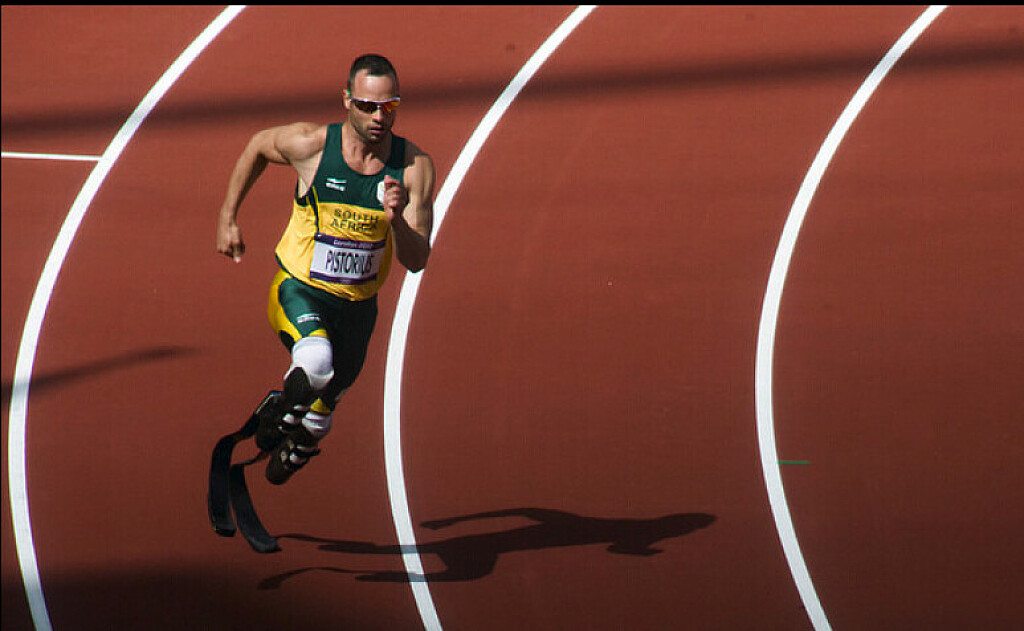
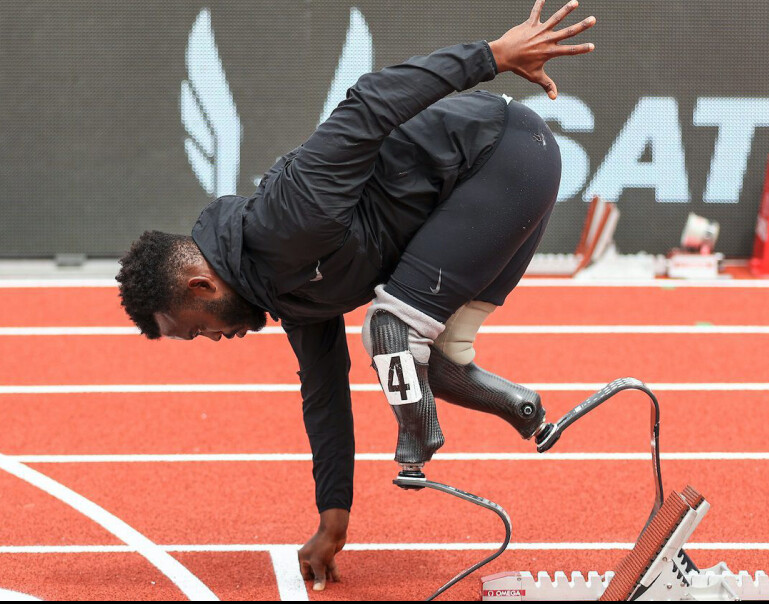
Study finds blade runners do not have a competitive advantage
Are prosthetic, “man-made” limbs more efficient or powerful than biological legs? This has been debated in track and field circles for years, but recent research suggests what amputee runners have known all along–they aren’t. At least, not over 400 metres.
A recent study from the University of Colorado at Boulder found that blade runners, including the world’s fastest 400-metre sprinter, Blake Leeper of Tennessee, have no competitive advantage over non-amputee runners. Instead, they likely have a significant disadvantage.Prosthetic limbs, particularly those designed for athletic performance, have come a long way since Terry Fox made his inspiring, yet at times painful-looking, journey across Canada.
In the last decade, we’ve seen amputee runners run ultramarathons and set Guinness World Records, and many of us recall Oscar Pistorius, the double-amputee blade runner from South Africa who became the first to win a non-disabled medal at the 2011 World Track and Field Championships (he won silver in the 400m). Pistorius was later convicted of murder in the death of his girlfriend, Reeva Steenkamp, and remains in prison today.
Back in 2011, Pistorius had to take legal action against the IAAF (now World Athletics) to allow him to compete in the World Championships, since the governing body of track and field claimed his prosthetic limbs gave him an advantage over his competitors.
Leeper, who is also a double-amputee and the fastest blade runner over the 400m distance today, has faced similar rejection. He was ruled ineligible to compete at the 2020 Tokyo Olympic Games due to the perception that his “blades” gave him an unfair advantage.
The study
As it turns out, two legs do appear to be better than none, despite the incredible technology behind today’s prosthetic limbs. The study, published in the journal Royal Society Open Science, collected performance data from Leeper, Pistorius and six other bilateral amputee sprinters and compared that to the best non-amputee sprinters in the world across five performance metricLeeper also visited the researchers’ lab for a series of tests to measure his acceleration out of the starting blocks, maximum speed along straightaways and around curves, velocity at aerobic capacity and sprint endurance (all-out effort). This information was also compared to available data from elite non-amputee runners.
The research found that runners using prostheses were 40 per cent slower out of the starting blocks, had 19 per cent slower velocity at aerobic capacity and were one to three per cent slower around curves, compared to non-amputees.
“We found that no athlete with prosthetic legs has ever performed better than elite non-amputee athletes in lab-based experiments in any measure that relates to sprinting performance,” said first author Owen Beck.
The researchers presented their preliminary findings to the Court of Arbitration for Sport in 2020 in a bid to get Leeper to an Olympic start line, but the athlete was yet again deemed ineligible–the court ruled that his prostheses made him too tall. (The same researchers had found in a previous study that height did not provide an advantage when it comes to maximum sprinting speed, but Leeper was still ruled ineligible.)
While their results didn’t help Leeper this time, the researchers hope their work will change the conversation to provide more opportunities for amputee runners.
“A lot of assumptions have been made about running prostheses and performance with no data to support them,” said senior author Alena Grabowski, associate professor of integrative physiology at CU Boulder. “I hope this will get people to really question rules being put into place that keep athletes with disabilities from competing even when they have shown with science that they can compete fairly.”
(07/15/2023) ⚡AMPby Running Magazine
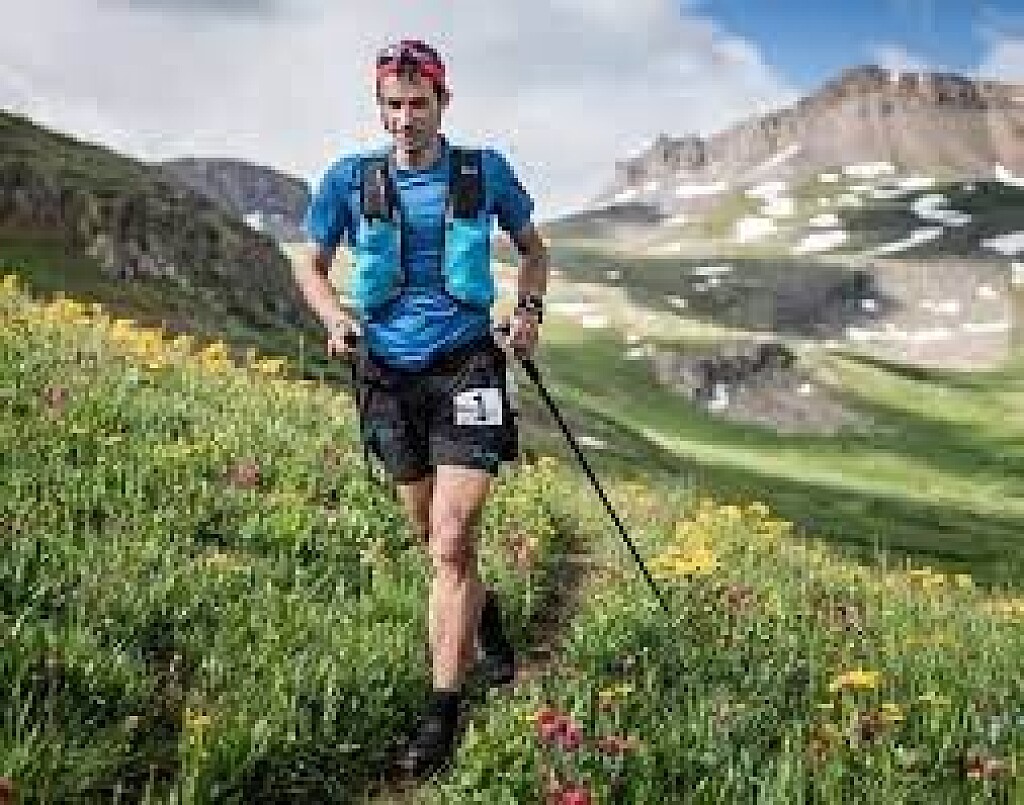
Kilian Jornet confirms UTMB plan with entry into Eiger Ultra Trail
Kilian Jornet has confirmed he plans to be in Chamonix at the end of August to defend his UTMB title.
And he will race at this weekend’s Eiger Ultra Trail with the aim of securing the single running stone he needs to qualify for UTMB.
Return from Himalayas
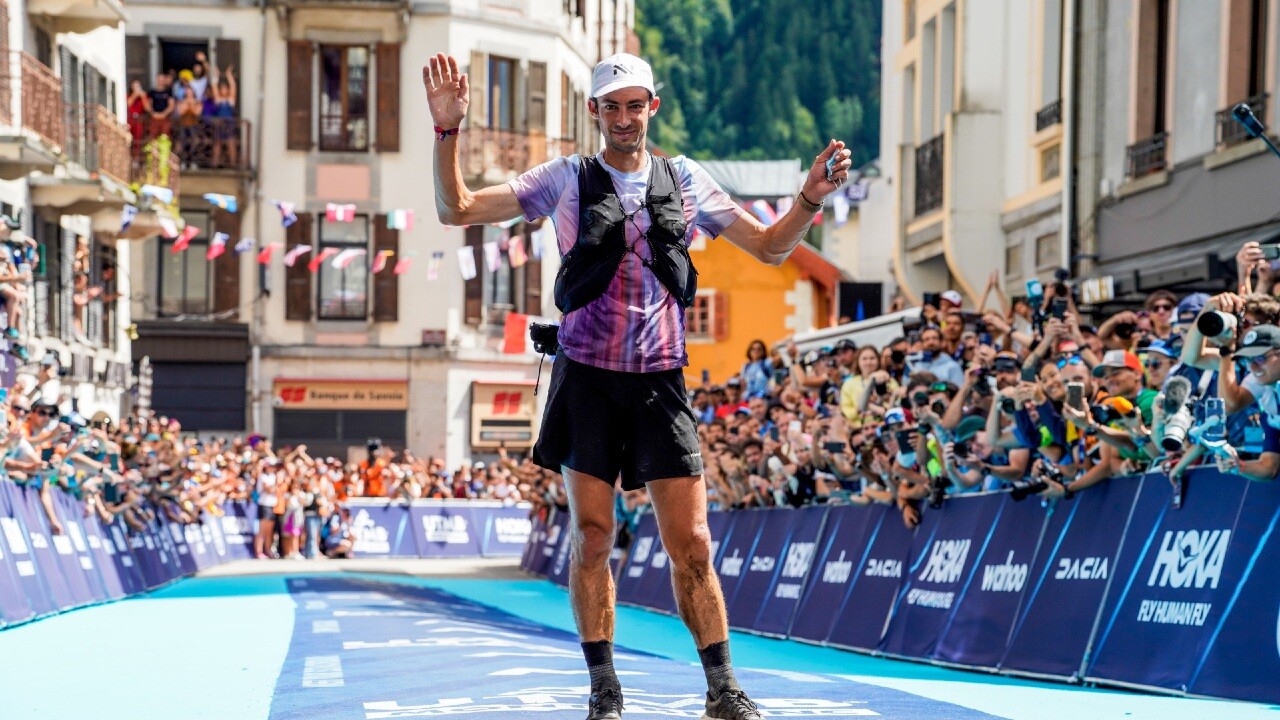
Kilian Jornet is only recently back from a trip to the Himalayas, a trip that saw him survive an avalanche that carried him for 50 metres during a solo attempt on the West Ridge of Everest, and the legendary trail runner and mountaineer has told his Instagram followers that he wanted to be sure he was fully recovered.
”I wanted to see how I was feeling, how I was in my body [after the trip to the Himalayas],” he said.
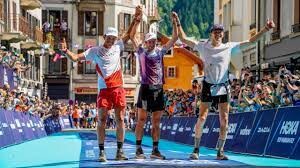
‘’I have mentioned I wanted to do some long distance at the end of the season and actually I am kind of looking like I would like to do UTMB.
‘‘But I need to classify first and I need to have some points so I will try to get them this weekend at Eiger and see if I can be at Chamonix at the end of August.’’
Eiger E16 Pleasure Trail
Jornet will be taking on the E16 Pleasure Trail race on Saturday – a 16k race that is described by the UTMB as ‘perfect for short distance specialists, and for those wishing to enjoy a shorter trail at their leisure.’
Although that race may not be the most likely to feature a runner of Jornet’s calibre, as one of the top-three UTMB finishers last year he has a priority for registration for this year’s event, but he must have at least one running stone and he has chosen Eiger to achieve it.
Last year’s UTMB saw Jornet at his very best as he took his fourth race victory, set a new course record and became the first person to cover the famous course in under 20 hours.
When Jornet announced his 2023 schedule earlier in the year, the only defined race was a return to Sierre-Zinal on August 12th – a race he’s won nine times, setting the course record of 2:25:36 in 2019.
Alongside a ‘trip to the Himalayas’ Jornet said he was considering a ‘Long-distance project/race’ later in the season. That race now looks most likely to be UTMB.
(07/14/2023) ⚡AMPby Chris Buckley

North Face Ultra Trail du Tour du Mont-Blanc
Mountain race, with numerous passages in high altitude (>2500m), in difficult weather conditions (night, wind, cold, rain or snow), that needs a very good training, adapted equipment and a real capacity of personal autonomy. It is 6:00pm and we are more or less 2300 people sharing the same dream carefully prepared over many months. Despite the incredible difficulty, we feel...
more...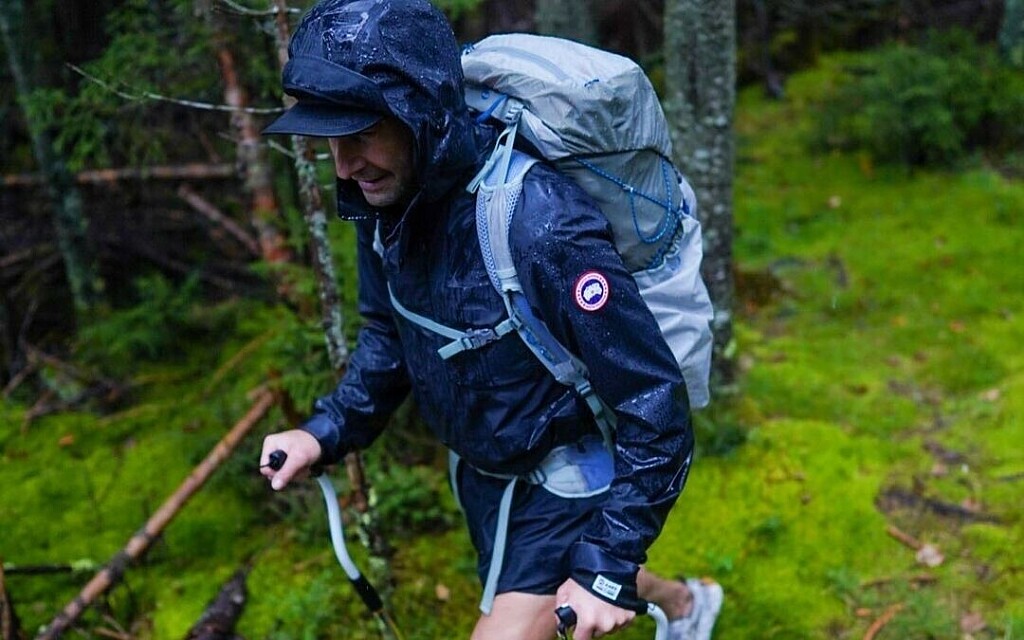
What to pack for long-distance trail runs
Renowned ultrarunner and adventurer Ray Zahab shares his advice on packing for multi-day hikes, emphasizing the importance of traveling light while carrying the essential items.
Embarking on a long-distance trail run can be exhilarating, but before you set foot on the trails, these runs require careful preparation to ensure a successful and safe experience. One critical consideration is deciding what to pack for the journey. From essential gear to nourishing fuel and hydration, the right items can make all the difference. Whether you’re a seasoned trail runner or heading out on your first hike, knowing what to pack can help you stay prepared and safe on your run.
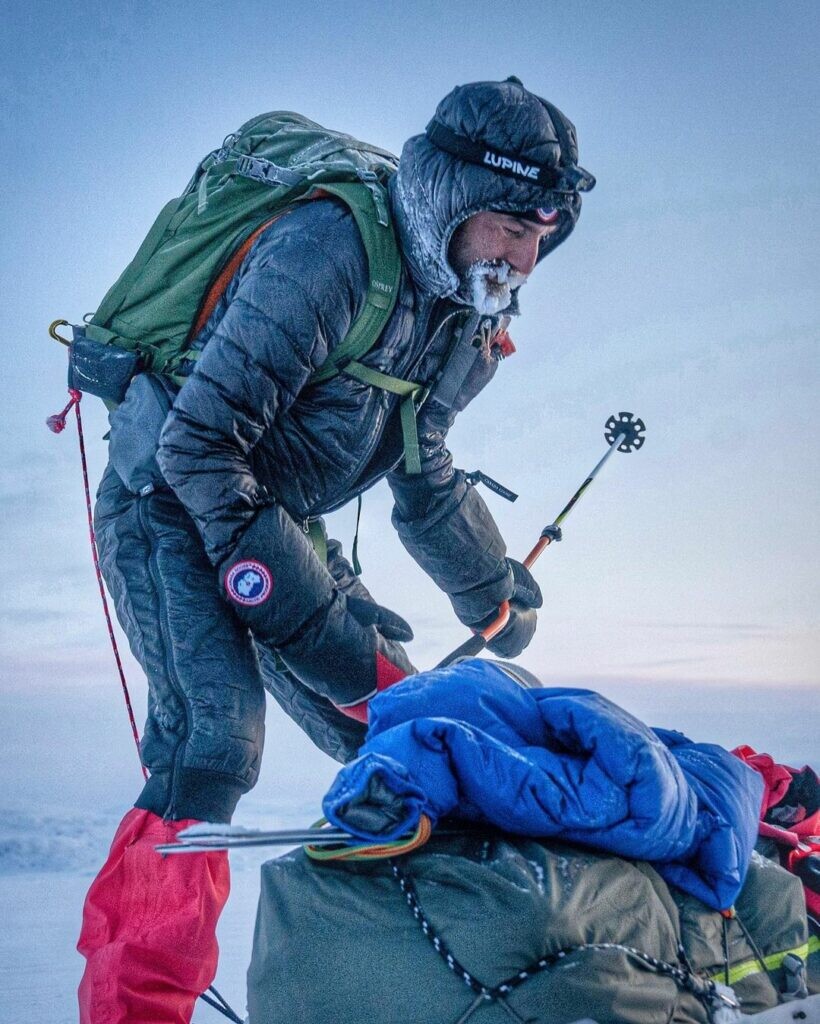
Canadian ultrarunner and adventurer Ray Zahab has been a part of some incredible endurance feats, challenging the world’s toughest landscapes and terrains that humans had never crossed. Zahab’s most notable accomplishment is his successful completion of the Sahara Desert Crossing in 2007. Alongside two other runners, he covered a distance of approximately 7,500 km (4,600 miles) in 111 days, running the equivalent of two marathons per day.
Zahab has gained international recognition for his achievements and is an expert when it comes to packing for long-distance trail runs. With numerous expeditions under his belt, Zahab knows that the right gear can make or break your adventure.
Six hours or less
When packing for short trail runs where you’re not going to be out overnight, Zahab focuses on efficiency, carrying only the essentials. But while the distance may be relatively short, the need for preparedness and comfort on the trail is just as great as for longer trips.
Zahab suggests starting with a hydration pack like Osprey’s Duro 6L to ensure proper hydration. Osprey’s Duro 6L is Zahab’s favourite choice for daily trail runs, and its 1.5-litre water reservoir is perfect. “Staying hydrated is crucial regardless of the distance, and having a convenient way to carry water allows for easy access and quick sips along the trail,” he says.
He also advises packing moisture-wicking clothing to keep you dry and comfortable, along with a lightweight, breathable jacket in case of unexpected weather changes. “In case you run out of water or encounter an emergency, it’s great to pack a LifeStraw water filter, a small first aid kit, and a small multi-purpose pocket knife,” adds Zahab. For nutrition, he suggests carrying easily digestible snacks like energy gels, bars, or trail mix. These portable options provide a quick boost of energy when needed and are convenient to consume during short breaks on the trail.
Six to 24 hours
If you’re out on the trails for a day-long hike, packing extra safety essentials and food is crucial. “Packing for medium-length runs can be tricky,” Zahab points out. “You want to pack the essential items but keep the load manageable.”
Similar to shorter trail runs, you can limit your nutrition to easily digestible snacks like energy gels, bars, or trail mix. You’ll want to pack weather-appropriate clothing for the warm afternoons and damp or cold evenings, including lightweight, breathable layers and a jacket or shell for rain.
In addition to the previous essentials, you should bring navigation tools like a map, compass or GPS device. “I bring my Garmin Inreach with me everywhere,” says Zahab. “It’s good to have a fully-charged mobile phone for emergencies, but if there’s no cellular signal, the Inreach can still communicate.” Other essential items are a small first aid kit, sunscreen, a headlamp, a pocket knife and safety gear, like a whistle and an emergency blanket.
With more items, you’ll need a bigger vest pack to hold it all. The Osprey Duro 15 is designed for your most committed trail-running pursuits. As the miles pass and support fades further into the background, you need a reliable pack that’ll go the distance. With its 2.5-litre water reservoir and ample room for food and gear, yet a slim and stable design, the Duro 15 was designed to push the limits. The pockets are conveniently located on the hip and harness areas to give you easy on-the-move access to your snacks and gear without sacrificing your pace.
Over 24 hours to multi-day
Despite being out there for a longer duration, Zahab still believes in packing light. If you are travelling solo or in a group, you’ll need a compact and weatherproof tent or shelter and a warm and lightweight sleeping bag.
Zahab recommended packing nutrient-dense food such as energy bars, dehydrated meals and trail mix. “These food options are designed to be portable and lightweight, making them easy to carry during the run without adding excessive weight to your pack,” says Zahab. Also, pack a LifeStraw water filter or other water purification system to ensure you stay well-nourished and hydrated on the trail.
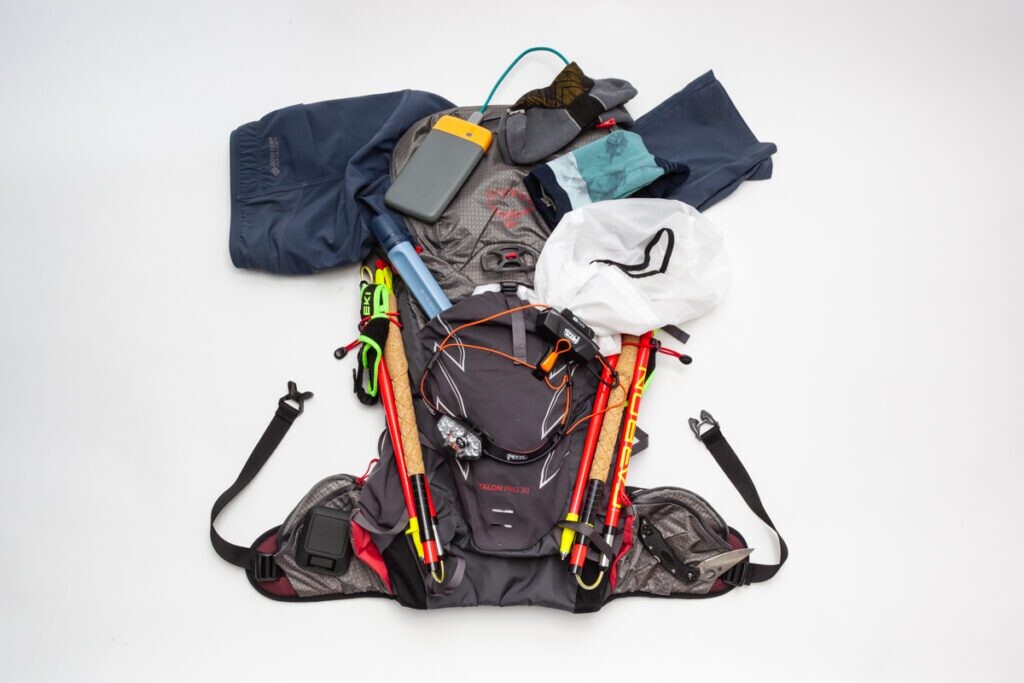
“No matter your time out there on the trail, it’s good to pack appropriate clothing for various weather conditions, including quick-drying layers, a waterproof jacket, insulated layers, and, most importantly, several pairs of socks,” stresses Zahab. Some other necessities in Zahab’s multi-day pack are a multi-use tool, a headlamp for nighttime navigation and hiking poles to help with stability.
“Other items that many of us don’t think to carry are personal items like sunscreen, insect repellent, sunglasses, a hat, toiletries, a lightweight towel and a portable wireless phone battery,” Zahab says. “Packing efficiently and prioritizing the essentials for longer hikes, you will ensure you have the necessary equipment to tackle the challenges of a multi-day hike.”
For multi-day adventures, Zahab’s go-to pack is the Talon Pro 30 from Osprey, which has 30 litres of storage for all your essentials and even extra room for additional gear for that overnighter. The Talon Pro is a lightweight pack that prioritizes comfort and dynamic movement during longer hikes on technical terrain.
(07/13/2023) ⚡AMPby Running Magazine
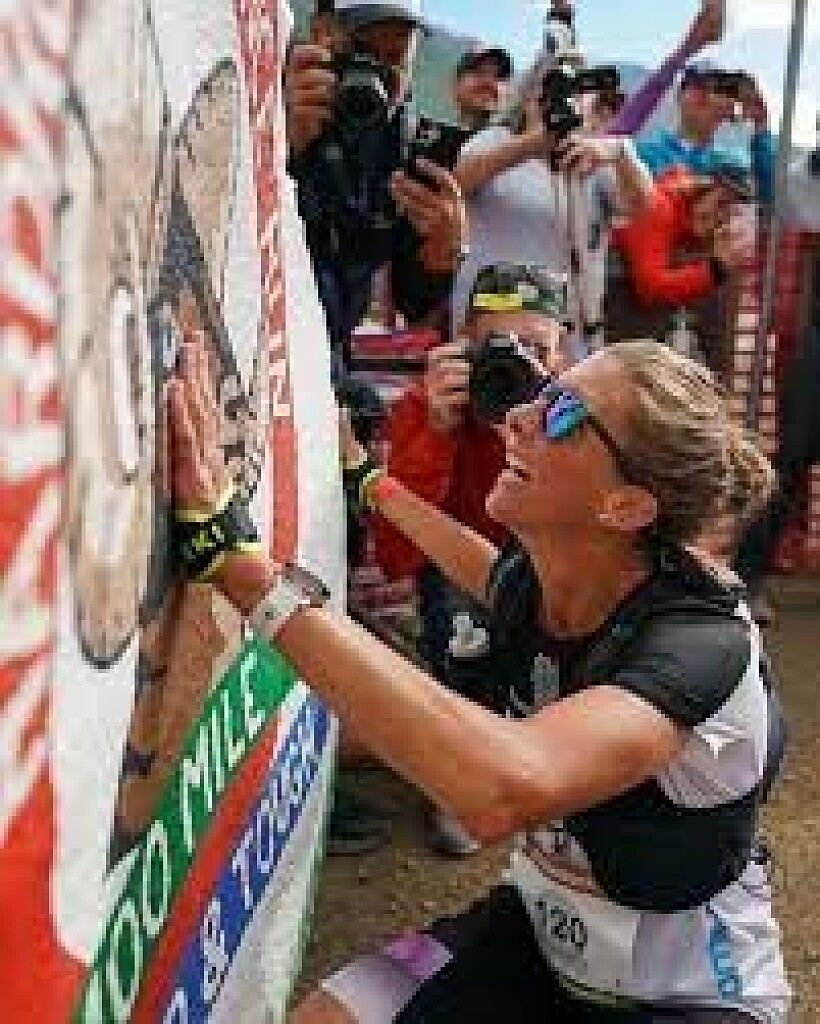
Hardrock 100 preview: will Courtney Dauwalter do it again?
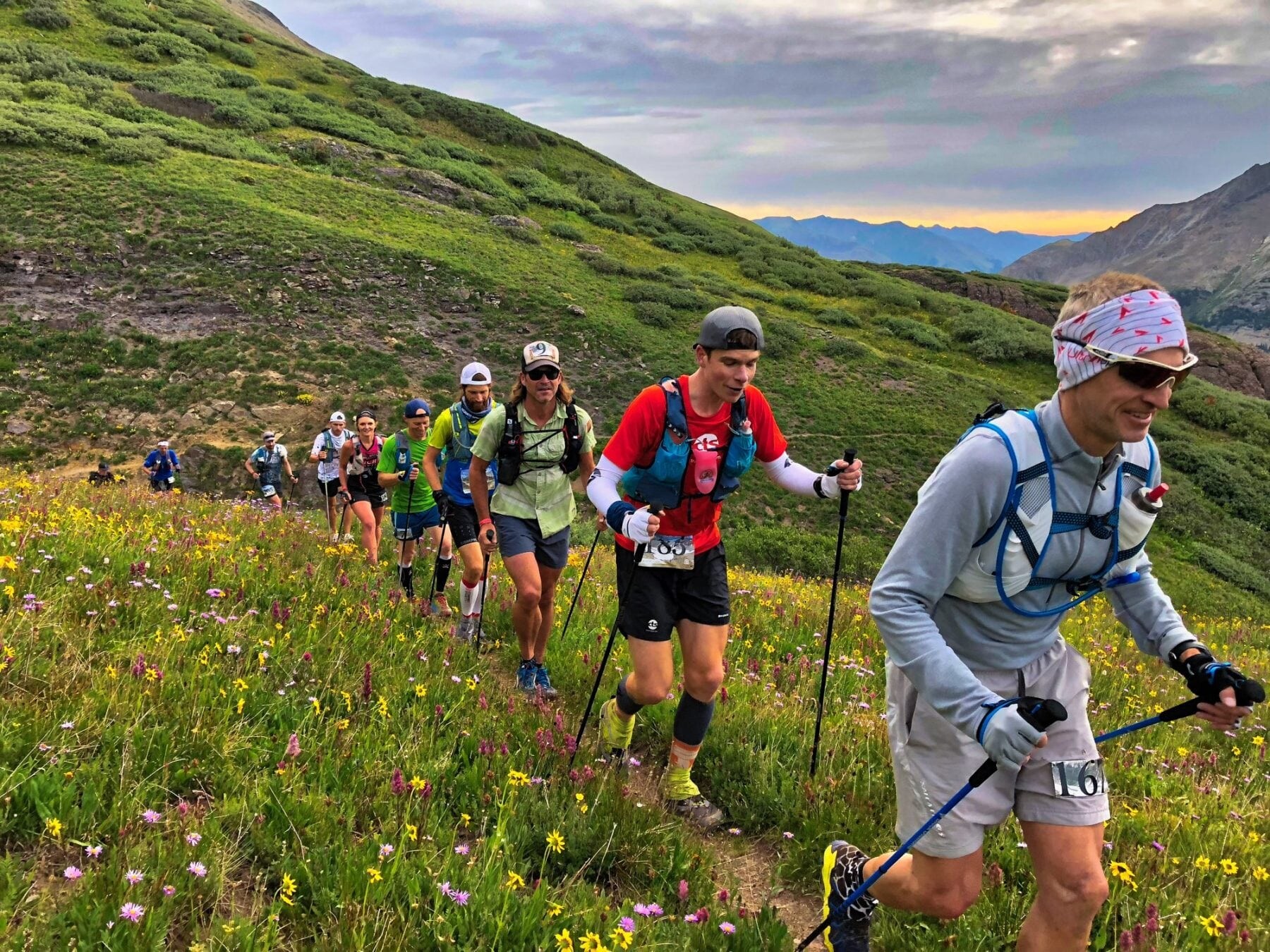
The Hardrock Hundred Mile Endurance Run (HR100), known for its high altitude, deep elite field and challenging entry process, begins Friday at 8:00 a.m. E.T. This year’s event, the first ever to be live-streamed, promises to be a thriller. Runners will encounter over 10,000 metres of elevation gain while facing extreme weather conditions, navigating treacherous terrain and attempting to avoid altitude sickness.
Only 140 participants get to line up at Hardrock each year, and this year’s contenders include the remarkable Courtney Dauwalter, fresh off a jaw-dropping performance and course record at the Western States 100, and other well-known elites. The race will be live-streamed on the Run Steep Get High YouTube channel. Here’s what you need to know to follow along.
HR100 both begins and ends in Silverton, Co., and athletes are above 3,300 metres elevation for much of the race. It was founded in 1992 as a tribute to the miners who used to follow “their mules and instincts, prospecting the San Juans for gold, silver, and other metals,” the race website explains. With a finishing cutoff time of 48 hours, athletes know they are in for a long haul. The course switches directions every year, and this year runners are moving counter-clockwise around the looped course.
The women’s race
All eyes are on the phenomenal Dauwalter this year (but when are they not?) after a stunning performance three weeks ago at Western States, where she set a blistering new course record (78 minutes faster than Canadian Ellie Greenwood’s from 2012) and placed fifth overall. Canada’s Stephanie Case, who was second last year, has withdrawn from this year’s event. 60-year-old legendary ultra machine Pam Reed of Jackson Hole, Wyo., will be tackling the third part of her WSER/Badwater 135/HR100 triple this year.
Leadville, Colo.-based Dauwalter holds the course record for HR100 in the clockwise direction (26:44) from 2022; this year runners will move counter-clockwise, and that course record is 27:18 for women, set by Diana Finkel in 2009, and Dauwalter will most certainly be looking to challenge that time. Will her legs be tired? Will she win the entire thing? We can’t wait to find out.
Also from Leadville, 23-year-old trail phenom Annie Hughes won the Run Rabbit Run 100-Miler and High Lonesome 100 Mile in 2022, and the Leadville 100 Mile in 2021. She’s a high-altitude ultrarunning champ, and has also compiled some wins in really long races–she won the Cocodona 250 Mile in 2022 and Moab 240 in 2021.
If you haven’t heard of France’s Claire Bannwarth, it’s time to brush up: she was the first woman in the 432-kilometre 2022 Winter Spine Race (by more than 24 hours), and will be making her North American racing debut at HR100. Bannwarth races prolifically and runs long–she will be jumping into the Tahoe 200 Mile race a week after HR100.
Colorado’s Darcy Piceu, fresh off the waitlist, is a veteran of HR 100, with the 2023 edition being her 10th running. Piceu boasts three wins and five second-place finishes, and she was fourth in 2022.
The men’s race
With Kilian Jornet, last year’s winner (and course record holder in the clockwise direction) not returning this year, the podium seems up for grabs. None of the other top four men from 2022 will be headed to the San Juans, but a very accomplished group of athletes will be lining up and fans will be eager to see who holds up to the HR100 test.
Ohio’s Arlen Glick is a master of the 100-mile distance, running 12:57 to win the Umstead 100-miler in April and taking a speedy third at October’s Javelina 100. Like Dauwalter, Glick raced at WSER last month. He placed 14th, while he took third in 2022. Glick will be a hot contender and fascinating to watch at HR100.
California-based Dylan Bowman is a Hardrock veteran, placing second at the 2021 edition. Bowman has had a lower racing profile in the past year while working on Freetrail, a media business and trail running community. He’s been training in the San Juans pre-race and is eager to showcase his ability.
France’s Aurélien Dunand-Pallaz has over 10 years of ultrarunning success, but gained notoriety in 2021 when he took second at UTMB and won Spain’s Transgrancanaria. He missed the 2022 edition of HR100 for the birth of his child and is a favourite in his debut this year.
Oregon-based trail running legend Jeff Browning will be taking on his sixth Hardrock at age 51. Browning won in 2018, and finished fifth the past two years. In October, Browning won the Moab 240 in 57 hours, and more recently, he showcased his fitness by winning the Bighorn 100.
(07/13/2023) ⚡AMP
by Keeley Milne
Hardrock 100
100-mile run with 33,050 feet of climb and 33,050 feet of descent for a total elevation change of 66,100 feet with an average elevation of 11,186 feet - low point 7,680 feet (Ouray) and high point 14,048 feet (Handies Peak). The run starts and ends in Silverton, Colorado and travels through the towns of Telluride, Ouray, and the ghost town...
more...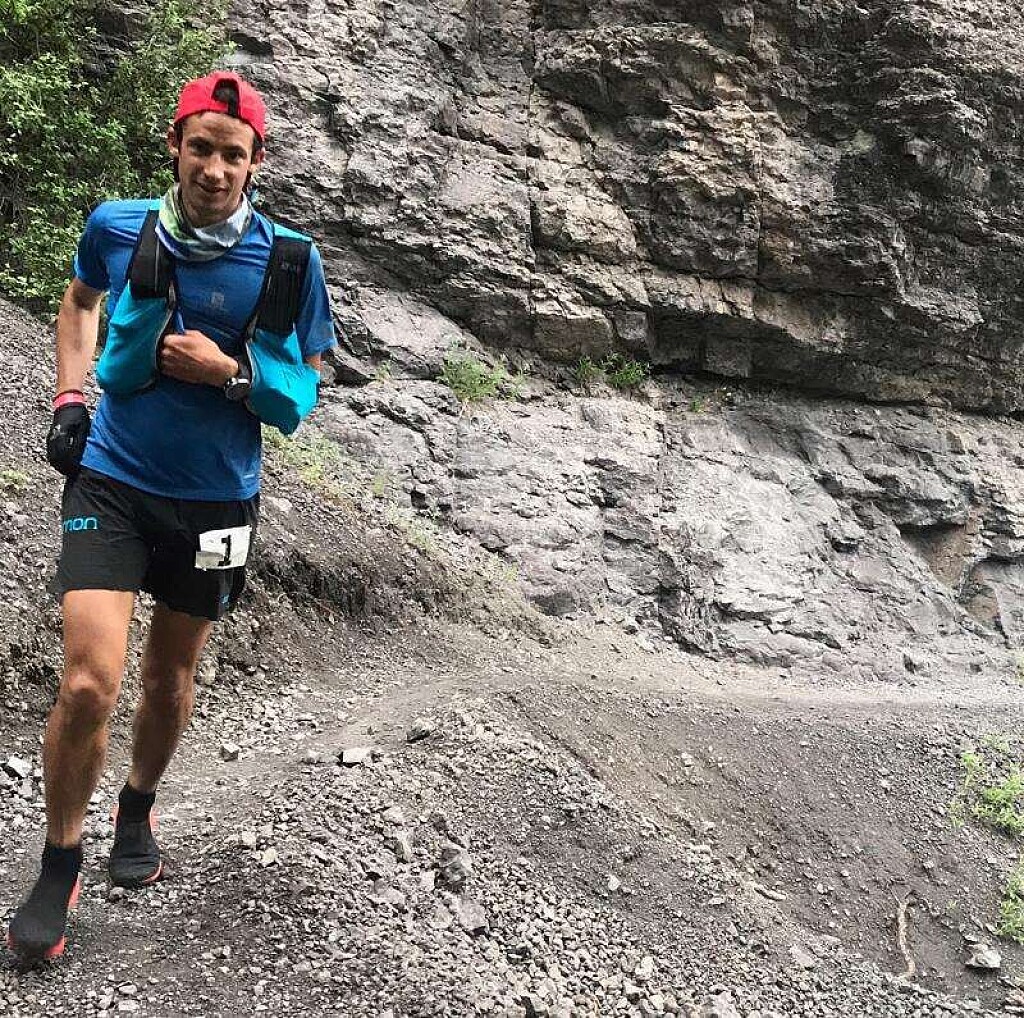
Five wins, a dislocated shoulder and the course record – Kilian Jornet at Hardrock 100
Kilian Jornet has dominated several races throughout his career and Hardrock 100 is one of the many where he has left a significant impression.
The Spaniard, widely regarded as mountain running’s GOAT (Greatest Of All Time), has triumphed five times at the iconic 102.5-mile race in the San Juan Mountains in Colorado, USA.
Jornet is the joint-most successful runner in Hardrock 100 history – which dates back to 1992 – alongside Karl Meltzer and Betsy Kalmeyer. He has won the race each time he has entered, with his first triumph coming in 2014.
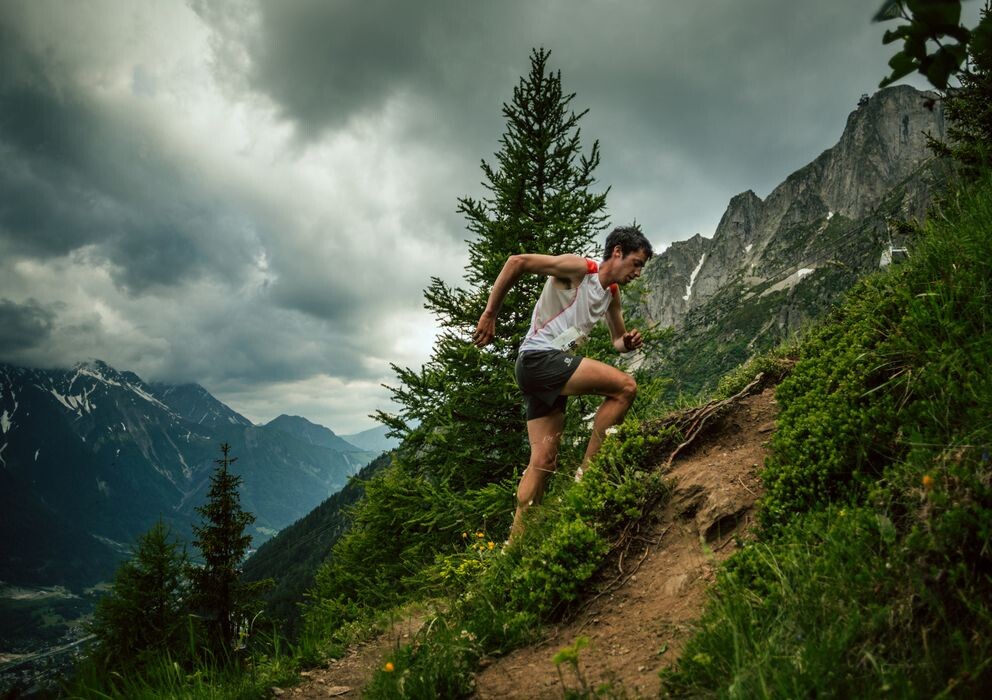
Four-time Ultra-Trail du Mont-Blanc (UTMB) winner Jornet also holds the course record at Hardrock 100, completing the clockwise route in 21:36:24 last year.
Having been raised in the Spanish Pyrenees, Jornet has thrived at high-altitude races, and that ability has been apparent at Hardrock 100, which features a total elevation gain of 33,195ft and boasts a highest point of 4,048ft.
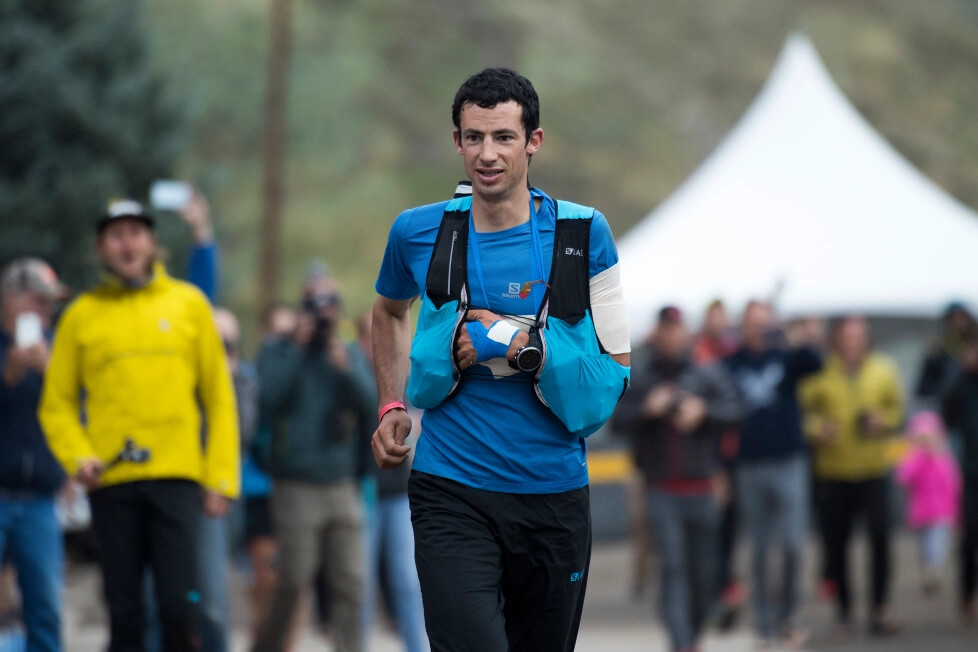
Instant impact
Jornet debuted at Hardrock 100 almost a decade ago, coming into the race off the back of wins at Zegama-Aizkorri and Marathon du Mont-Blanc in the two months prior.
He would lay down an instant marker as he romped to victory in a clockwise-record time of 22:41:00, finishing nearly two and a half hours clear of France’s Julien Chorier, the 2011 winner.
It was the first time a runner had managed sub-23 hours at Hardrock 100, with USA’s Kyle Skaggs having recorded the previous best of 23:23:10 in 2008.
The next year, Jornet claimed victory again – this time more than two hours ahead of USA’s Mike Foote – eclipsing the counter-clockwise course record on that occasion. He clocked 23:28:00, shaving just under an hour off Frenchman Sebastien Chaigneau’s 2013 effort.
He made it three in a row in 2016, sharing the title with Jason Schlarb after an incredible duel with the American. Having worked together and battled for hours, the pair agreed to finish together, coming home in 22:58:28.
Dislocated shoulder
2017 would bring a fourth successive Hardrock 100 victory for Jornet, but it was far from straightforward as he took a fall and suffered a dislocated shoulder around 14 miles into the race.
He powered on regardless, popping his joint back into place before medics wrapped his damaged limb in a sling later on in the day.
Incredibly, despite being forced to use a single trekking pole and facing a vicious hail storm, Jornet clinched the win again as he finished in 24:32:20, 23 minutes clear of Foote.
Record obliterated
Jornet didn’t race at Hardrock 100 for five years after his four back-to-back victories, and France’s Francois D’Haene beat both his overall and counterclockwise records when he put up a staggering 21:45:50 in 2021.
But a sensational return came last year as Jornet improved the record further, finishing in 21:36:24 and overcoming second-place D’Haene by around 15 minutes.
Weird and wonderful
Jornet has often spoken of his affection for Hardrock 100, hailing its remarkable setting and quirky traditions, a trait shared with some of the world’s craziest ultramarathons.
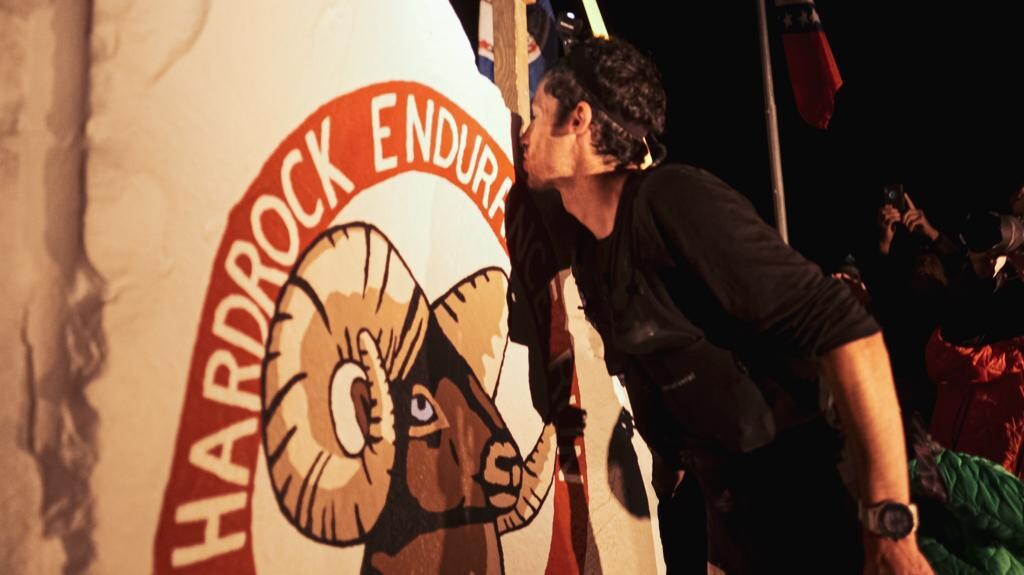
To complete the event, runners are required to ‘kiss the Hardrock’, a picture of a ram’s head painted on a large block of stone mining debris – a nod to the origins of the race.
“Leaving a rock with a mountain goat painted on it, to run around the San Juan mountains with a bunch of other runners, aiming to get back to that rock to give it a kiss,” Jornet wrote in an Instagram post.
“Ultra running can be as weird as beautiful and I love it!”
The Rocky Mountains provide a stunning landscape for Hardrock 100, and Jornet, who is dedicated to environmental sustainability, has spoken of his affection for the area and the people who make the race possible.
“The wilderness and landscapes of San Juan Mountains are so breathtaking,” he added in another post. “I feel so fortunate to know this part of the world.
“The race is attractive because of its beautiful landscapes and the hardness of the challenge – high elevation, several times above 4,000m, the route often on steep narrow trails.
“What makes one want to come back it’s its community. The volunteers, the crewing and pacers, the people doing trail work, and the runners celebrating together the love for trail running and this mountains.”
(07/12/2023) ⚡AMPby Olly Green
Hardrock 100
100-mile run with 33,050 feet of climb and 33,050 feet of descent for a total elevation change of 66,100 feet with an average elevation of 11,186 feet - low point 7,680 feet (Ouray) and high point 14,048 feet (Handies Peak). The run starts and ends in Silverton, Colorado and travels through the towns of Telluride, Ouray, and the ghost town...
more...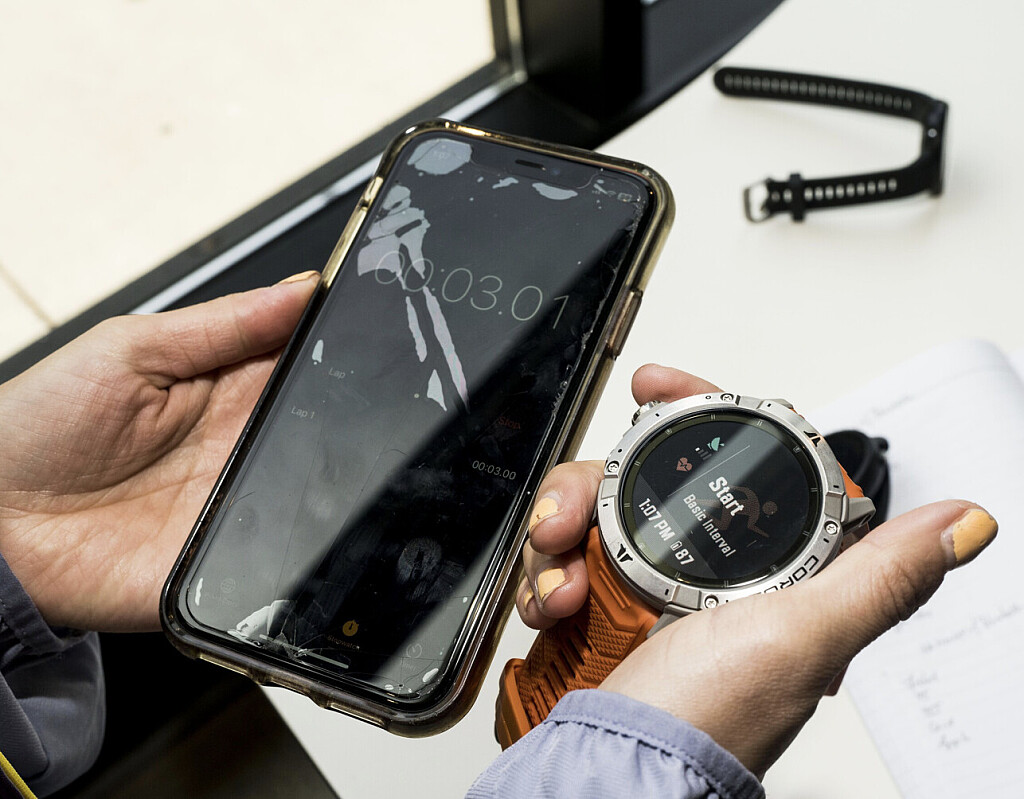
How to Get a Faster GPS Signal on Your Smartwatch
We tested affordable and high-end watches to see which located satellites quickest, and asked Garmin and Apple for their best troubleshooting tips.
Raise your hand if you’ve ever tried not to look awkward on the curb waiting for your smartwatch to get a GPS signal before a run. Like you, I’ve had my fair share of feigning interest in cloud formations, overstretching my quads, or just holding my wrist up to the sky while crossing the street with the faintest hope that maybe reaching for a satellite will make it engage with my watch.

During the winter months when I lived in a city apartment surrounded by tall buildings, I used to risk theft instead of freezing before my run. I’d leave my watch on the sidewalk, hoping an opportunist wouldn’t snatch it as I bundled up inside. Sometimes it’d get a signal. Mostly, I’d still be standing outside, shivering, waiting for one. Nobody ever stole my watch because no one was crazy enough to be outside on days I ran (every day, every season).
Those days are far behind me. My current watch, the Garmin Forerunner 955 Solar, gets a signal when I’m wearing it around my apartment in Pennsylvania’s Lehigh Valley. It’ll give me the green light even when I’m in my windowless bathroom or foyer.
My previous Garmin watches were the Forerunner 10, 45, 345 Music, and 745 Music. Considering this history, I wondered if a higher model number correlated with getting a quicker GPS signal. Or was it just my move outside the city to a skyscraper-free valley? Or, maybe enabling the watch’s Bluetooth connection to my smartphone helped me get a signal more easily. Wanting to find answers—and get a few tips— I contacted Apple and Garmin with troubleshooting questions. I also tested several watches to see which found GPS signals fastest.
GPS Signal Test—and Bust
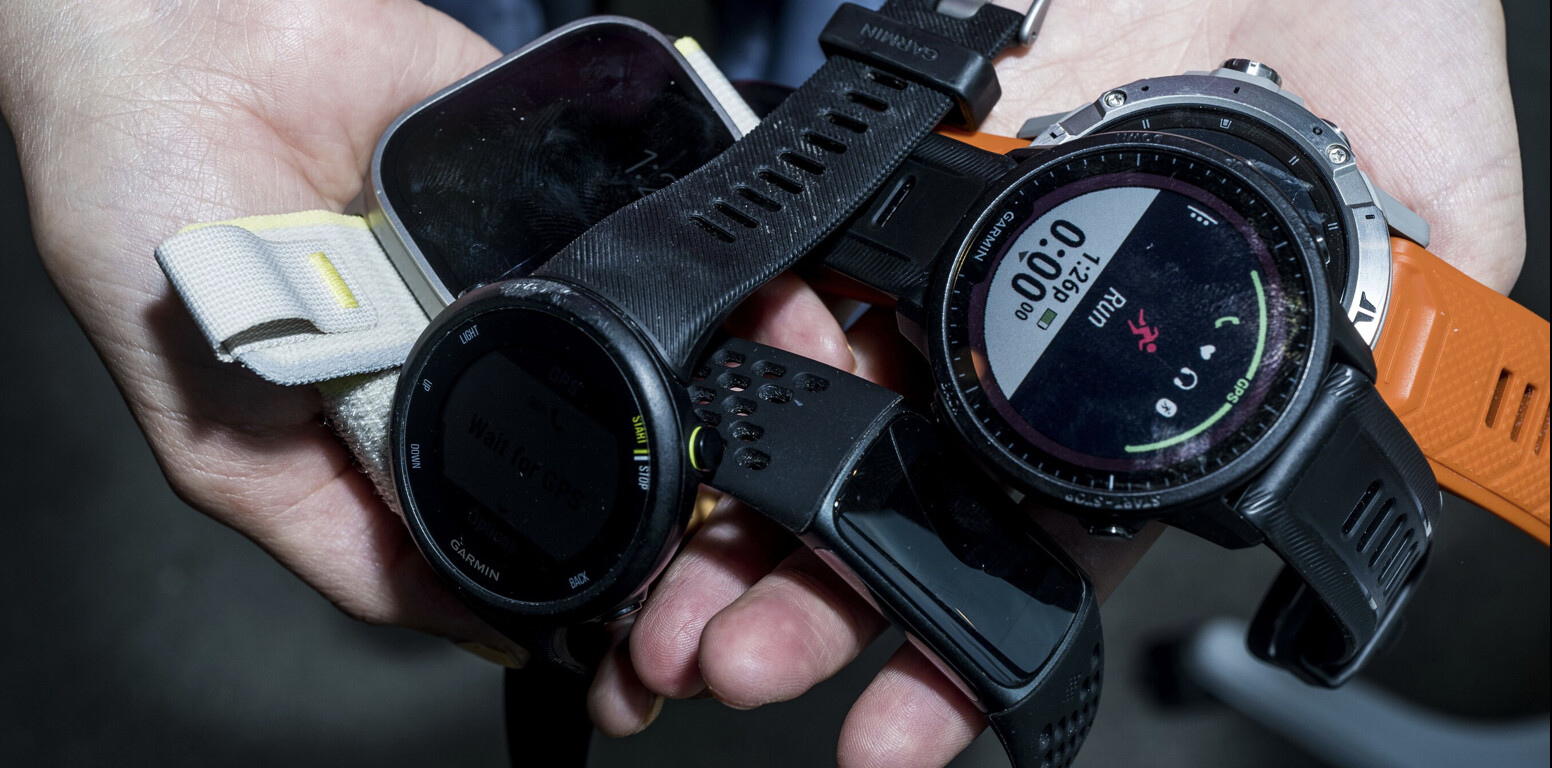
To compare the times it takes different smartwatches to get a GPS signal, I asked the RW test team to relinquish their models. (Fools.) The watches tested included:
For my “lab” setup, I reset each watch to its factory settings (with the blessing of my coworkers) and synced it to my phone. After flitting through app download upon app download and creating user profiles for each one, I then used my phone’s timer to measure how long each took to get a signal in four different situations:
Indoors next to a window, with Bluetooth connection to my phone
Indoors next to a window, without Bluetooth connection to my phone
Outside with Bluetooth connection to my phone
Outside without Bluetooth connection to my phone
Testing was...frustrating. Results were everywhere. I recorded at the office and at home. There were lots of outside variables and other issues that led to mixed outcomes.
For example, ideally I would test the watches at different altitudes, in an open field, in the middle of Times Square, beneath an overcast sky on one day and cloudless skies on another. But time and travel had me abbreviate testing conditions. And in the end, it seems all of the above wouldn’t have mattered anyway.
By chance, I was able to do the window test on both a cloudy and sunny day, and results varied—for each watch. For instance, the Coros Vertix 2 clocked 01:16.64 by an office window with Bluetooth on a cloudy day. On a clear and sunny day, it found a signal in 00:15.89. Just minutes later on that same day, in that same position, it located a satellite in 00:09.78.
The $700 Coros Vertix 2 also took longer to get a signal, both with and without Bluetooth, compared to the more affordable Garmin Forerunner 45. The fastest times from my Coros and Garmin tests are compared below:
The Garmin Forerunner 955 Solar performed as expected, beating the Forerunner 45 by approximately two seconds in both trials.
What could cause a high-end smartwatch like the Coros Vertix 2 to underperform? And how does a $130-Garmin get a signal faster than Usain Bolt’s world record-breaking 100-meter dash (00:09.58)?
On Coros’s support webpage, users are advised to download GPS satellite location data and send it to their watch before their runs. Data validity depends on the watch model and will last three to seven days. When location data expires, the watch can take over two minutes to receive a signal. Usually, the data updates automatically if the watch is synced with the Coros companion app on your smartphone. However, sometimes you will need to perform this update manually.
Talking With Garmin
Joe Heikes, who is Garmin’s international product manager, said the model number and price of a watch will sometimes have an effect on the time it takes to get a signal. “Higher end models have additional satellite reception technologies that can improve performance. For example, the Forerunner 255, 265, 955, and 965 all have multi-band satellite receivers, whereas our entry-level Forerunner 55 does not.”
To get a faster signal, syncing your watch with your phone is the number one most important thing a user can do.
“Through that phone sync in the background, we send the watch satellite data that helps tremendously with the speed of signal acquisition—and accuracy, too,” said Heikes. “To be clear, you don’t have to always be connected to the phone, and you certainly do NOT have to take the phone along on the run to get the benefit. However, if you are normally connected to the phone on a daily basis, then the watch will have the best, most up-to-date satellite data to work with when you do head out the door for your run.”
Heikes also confirmed that tall buildings do block satellite signals. But when it comes to congested areas—say, a race corral—the amount of time for your watch’s GPS to kick in is in no way delayed due to the crowd of runners also waiting for a signal.
“It’s not like cellphones where everyone is vying for a channel,” said Heikes. “All the watches can listen to the satellites at the same time, just like all the cars on the freeway can be listening to the same FM radio station at the same time.”
Going Ultra
Out of the five tested, the one watch that made using a timer obsolete was the Apple Watch Ultra. This is because the watch doesn’t alert you before a workout when it has acquired a GPS signal. It features a precision dual-frequency GPS system—the watch already has a signal and provides data (pace, time, map, etc.) postrun. The standard system on smartwatches is a single L1 GPS frequency band, which can go wonky when tall buildings or dense foliage block satellites. The Ultra uses both L1 and L5 frequency GPS, allowing it to have the most accurate GPS in dense areas.
Additionally, L5 combined with Apple’s map-matching software greatly improves accuracy for city workouts. For example, if you’re running the Chicago Marathon, Apple Maps data is used in combination with data from Apple Watch. This gives you an accurate route map, as opposed to showing that you’re running in the river.
This system, however, has its flaws. Jeff Dengate, Runner-in-Chief and director of product testing, found the Apple Watch Ultra’s distance measurements a little off, cutting his runs shorter compared to the Garmin Fenix 7X Sapphire Solar. (Dengate ran with both watches simultaneously to test their accuracy on a USATF distance-certified racecourse.) You can use the Precision Start feature, which omits the “3-2-1 Ready!” countdown before your run and lets you know when it locks a GPS signal on the top left of the watchface. It’s an ideal shortcut when you’re toeing a race’s start line.
Dual-frequency and Precision Start are major pluses for the Apple Watch Ultra. But there are other features to consider when choosing a smartwatch besides which one gets GPS the quickest. (Battery life, weight, and ease of navigation are especially important for runners.) However, if your patience costs $800—well, I’ll leave you to make that decision on your own.
(07/08/2023) ⚡AMPby Runner's World
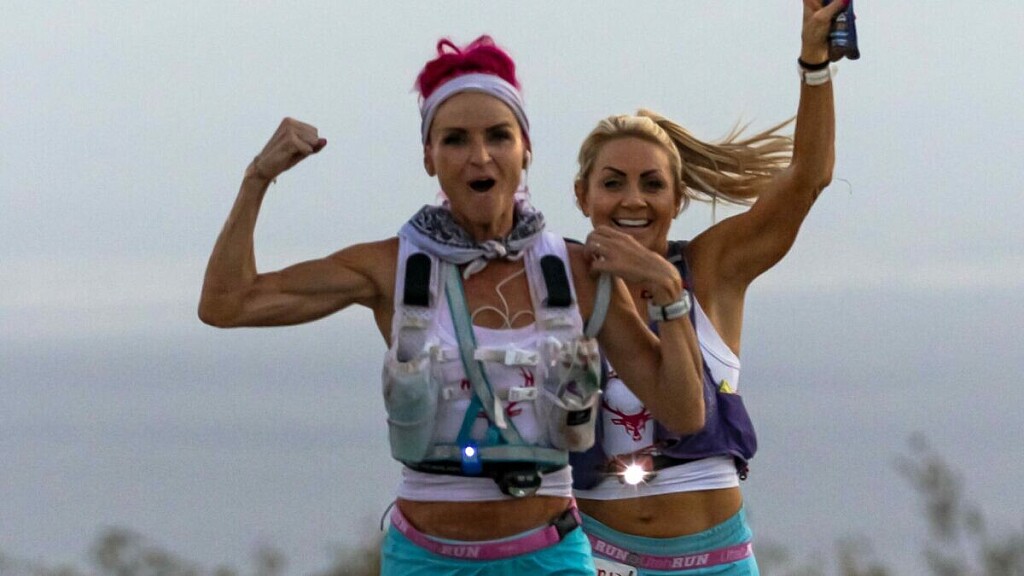
Ashley Paulson wins Badwater 135, smashing her own course record
The defending women's champion chopped nearly two-and-a-half hours off last year's time to finish first overall.
Defending Badwater 135 women’s champion Ashley Paulson has smashed the women’s course record she set last year, chopping nearly two and a half hours off her 2022 time to finish first overall at this year’s race.
Paulson, of St. George, Utah, completed the course—an infamously hot and gruelling 135-mile (217-km) run through California’s Death Valley to Mount Whitney—in 21:44:35. In doing so she not only demolished the women’s record she set last year (24:09:34) but finished more than 20 minutes ahead of this year’s men’s champion, Simen Holvik of Norway (22:28:08). Temperatures during the race have been known to soar well above 100 F (37 C).
Placing second in the men’s category and third overall was last year’s winner, Yoshihiko Ishikawa of Japan (23:52:29), who has two Badwater 135 victories under his belt. He was followed by fourth-place finisher and second-place women’s runner Sonia Ahuja of Thousand Oaks, Calif., who trailed Paulson by nearly two hours, finishing the course in 25:42:51. Rounding out the top five finishers was 2021 champion Harvey Lewis of Cincinnati, who completed his 12th Badwater 135 in 27:26:49, finishing third among the men. Rounding out the women’s podium was Maree Connor of Lambton, Australia (27:49:24).
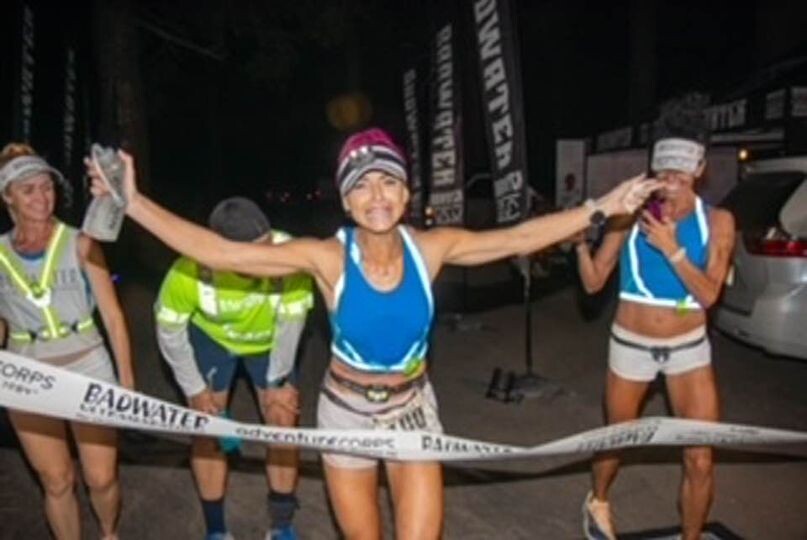
Viktoria Brown, the only Canadian in the field of 100 runners, finished strong, running 30:11:52 to place fourth among women and claim 13th place overall. It’s been a stellar year for the Whitby, Ont., ultrarunner, who in March broke her own 48-hour Canadian record and 72-hour world record while competing at the GOMU (Global Organization of Multi-Day Ultramarathoners) six-day world championships in Policoro, Italy.
With her commanding victory this year, Paulson becomes the first woman to win back-to-back races at Badwater since Japan’s Sumie Inagaki won the event in 2011 and 2012.
Paulson’s win last year came amid some controversy. In 2016, the professional runner and triathlete accepted a ruling from the United States Olympic Committee National Anti-Doping Policies (USADA) banning her from competition in triathlon events for six months, the result of an anti-doping rule violation. She had a positive result for ostarine, a selective androgen receptor modulator (SARM), during a random sampling.
Follow-up tests found ostarine in a contaminated supplement the athlete was taking. In an analysis of Paulson’s GPX files and other data, Derek Murphy, who runs the site marathoninvestigation.com, concluded that her Badwater data was clean and showed no evidence of cheating.
This year’s race, which started Tuesday at 8 p.m. PDT, and lasts 48 hours, marks the 46th running of the Badwater 135. Considered by many to be the world’s toughest foot race, the ultramarathon begins at 85 metres below sea level—the lowest elevation in North America—and takes runners up to 2,548m of altitude.
(07/06/2023) ⚡AMPby Paul Baswick

Badwater 135
Recognized globally as "the world’s toughest foot race," this legendary event pits up to 90 of the world’s toughest athletes runners, triathletes, adventure racers, and mountaineers against one another and the elements. Badwater 135 is the most demanding and extreme running race offered anywhere on the planet. Covering 135 miles (217km) non-stop from Death Valley to Mt. Whitney, CA, the...
more...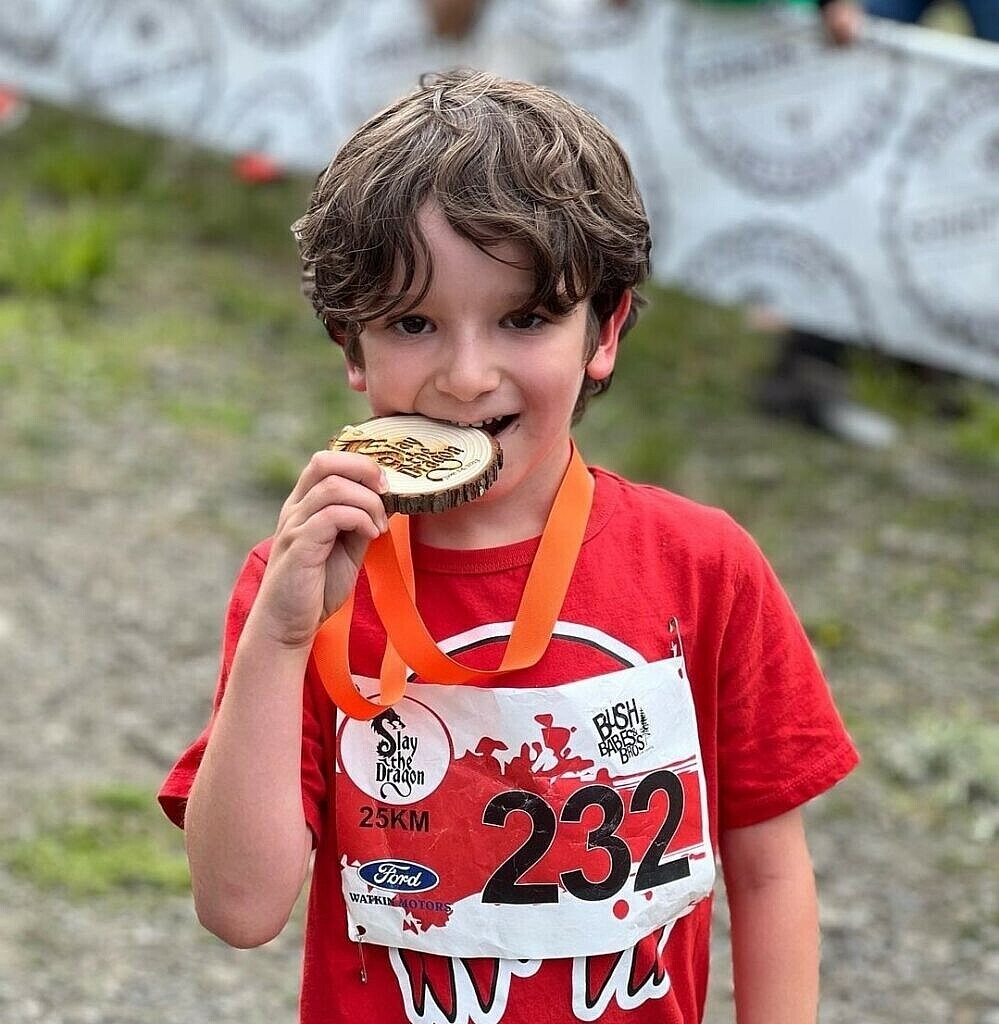
Six-year-old competes 25K trail race in British Columbia
Jake Hishon and his six-year-old son, Emmett, needed a reason to escape the hustle and bustle of downtown Toronto and explore the outdoors. Jake booked a week-long adventure to British Columbia’s Okanagan region, where the two engaged in water sports, hiking and a 25K trail race.
While Jake was looking for things to do with his son at Silverstar, resort, he stumbled upon the Slay The Dragon 25K on ultrasignup.com. “I saw the race had a generous cut-off time, and the course didn’t seem too crazy,” says Jake. He told us that he has been wanting to get more into trail running, and has done many 5K races with his young son in the past. “25K seemed like a gentle distance for Emmett and me, and running has been a sport he has always liked,” says Jake.
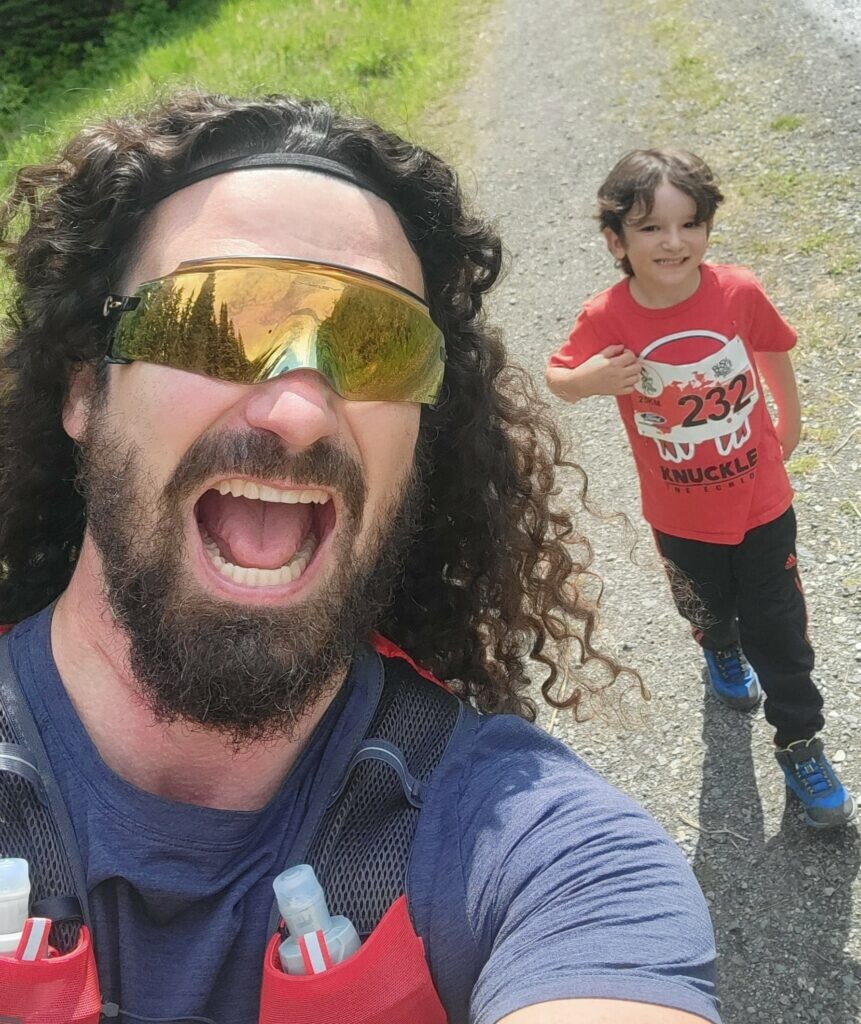
Jake chatted with the race director before signing up, and explained their situation. “Our goal was to try it, and if we get tired, we’ll stop,” says Jake. “We were not trying to win–just to try it, see how we do, and take it from there.”
The 38-year-old entrepreneur and father of two fell in love with trail running because it provided a refreshing change to Toronto’s urban running environment. “There are so many different aspects to running in the trails that you don’t get to experience in the city,” Jake says. He believes his frequent trips out west with his wife and children provide an opportunity to immerse themselves in nature and find joy in being outdoors.
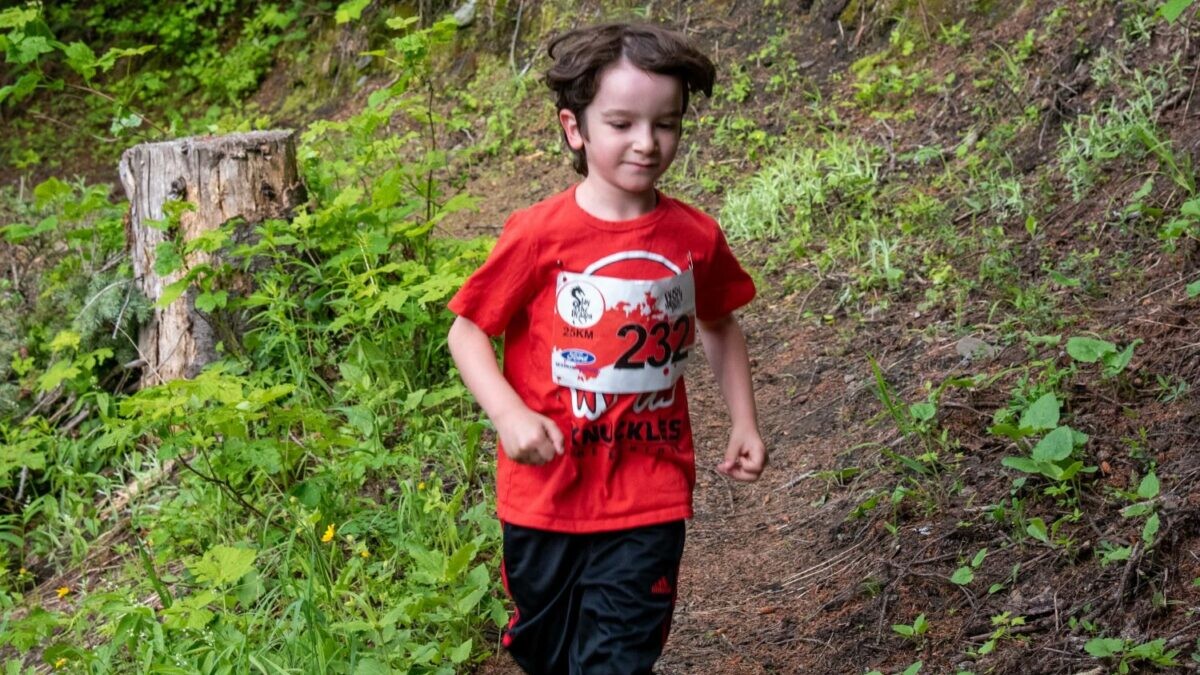
Heading into the 25K, Jake said Emmett was nervous, but they prepared for the race by hiking five kilometres the day before. Starting from the back of the pack, the duo maintained their pace throughout the race, embracing the occasional fall (no injuries reported) and aid stations filled with treats for Emmett. They completed the 25K trail race in six hours and 23 minutes, finishing last of all 84 participants.
Jake said the two took a lot of breaks, but stressed that he did not have to carry Emmett at any point. “I carried all the supplies. I was the pack mule,” says Jake. “Emmett never wanted to quit. He was excited to reach the aid stations, where they had snacks for him.”
Once the two returned to the village after covering 25 kilometres with 561 metres of elevation gain, Emmett was keen to receive his medal and show it off to everyone. When Emmett was asked what he had learned from the race, he said, “It was pretty fun.”
“I wanted it to be something he could look back on and be proud of,” says Jake. “Emmett would receive encouragement from total strangers, and it was a neat opportunity to see him receive gratitude.”
Jake was wary of the discouragement he might get from doing this activity with his son, but he found everyone at the race to be supportive. “We both looked at it as a fun way to spend a day outdoors,” says Jake.
The positive and encouraging environment inspired Jake and Emmett to plan future races. Emmett is eager to participate in the 6 km kids’ run at the Canadian Death Race in Grand Cache, Alta., this August, while Jake aims to tackle the 124K.
Reflecting on their adventure, Jake couldn’t help but recognize Emmett’s enthusiasm for the outdoors. “Even the next day, Emmett asked me if we could head out on another hike,” Jake laughs. “You give a kid an option to explore, and, odds are, they’ll take it.”
(07/05/2023) ⚡AMPby Marley Dickinson
When you consistently stress the body and the mind, you are changing your chemical makeup. Here’s what the latest science tells us about burnout
Kieran Abbotts is a PhD student at the University of Oregon, studying human physiology. He earned his master’s degree in Metabolism and Exercise Physiology at Colorado State University. The lab where he now works studies exercise and environment and stressors on physiology. In other words, he’s an expert on how the chemicals in the body work during exercise, and what happens when things get out of whack.
“Essentially, there are two kinds of training. There’s functional overreaching, which means you stress the body with hard workouts and long runs. Then you provide adequate time to recover, and you induce adaptations,” Abbotts said. This kind of training is ideal—your body is getting stronger. “You want to be functionally overreaching as an elite athlete—so that you’re making progress and becoming a better runner, but also giving yourself adequate recovery.”
And then there’s non-functional overreaching, which can feel the same to many athletes, but it’s very different. “With non-functional overreaching you’re essentially doing the same thing—big workouts, stressing the body—but not giving yourself enough time to recover. And so you start doing damage.” That damage might take a long time to show itself, Abbots said, but it eventually will.
This might be the most important thing to know about being an athlete at any level. Non-functional overreaching is exactly the same as very healthy training, except without enough rest. And rest is different for everyone, which makes it exceptionally easy to slip from functional overreaching into damaging non-functional overreaching without realizing it. Without adequate rest, the body begins to break down instead of build stronger.
Stress Is Stress

Professional ultrarunner Cat Bradley, 31, living in Hawaii, has experienced fatigue and burnout in various forms, including just after she won Western States in 2017.
Winning a big race is great, but it also means all eyes are on you—the pressure is high to stay on top. “After winning Western States, I took a month off, but I was still running at a high level. And for lack of a better term, I felt like I had a gun to my back,” Bradley said. “I wanted Western States so badly, and after I won, so many things happened and I never shook that gun-to-the-back feeling. After a while, it led to burnout. I had to take a mental break.”
For many athletes, finding success can be the stress that makes non-functional overreaching feel necessary. How can you take an extended break when you’re winning and signing new sponsor contracts?
A second version of burnout for Bradley came when she went through an especially stressful situation outside of running. She was dealing with such extreme daily emotional stress in her personal life that everything else was affected, including running and training. When the body is enduring stress, it doesn’t know (or care) what the cause is. We can’t put our life into silos. If there’s stress in one’s life, everything else needs to be adjusted. It doesn’t matter if that stress is “just work” or illness, or relationships.
When you’re overtraining or chronically overstressed, your body is creating higher levels of “catecholamines,” hormones released by your adrenal glands during times of stress like epinephrine, norepinephrine, or adrenaline. “Having those chronically high levels of overstimulation and not enough recovery, you wind up with a desensitization,” Abbotts said. “Overstimulation also causes decreased levels of plasma cortisol. Cortisol is the stress hormone, and it plays a very important role in your physiology.”
When you’re exercising or stressing the body, cortisol will go up, to help the body deal with the stress. But if you’re constantly requiring lots of cortisol, your body will eventually down-regulate. It will adapt and then you’ll have low levels of cortisol. This means trouble dealing with physical and mental stress.
In February, Bradley experienced her most recent version of burnout, and it happened mid-race. Bradley was running the Tarawera 100-miler in New Zealand. Besides training for such a big race, she was also working full-time and planning and preparing for her wedding, which was just days after the race. On top of everything, travel to the event was incredibly stressful.
“I was in fourth place, I could see third, and at mile 85, I passed out and hit my head on a rock,” Bradley said. “We can talk about the reasons that I fainted, but I really think my brain just shut down—it was too much.”
For Bradley, reaching burnout has a lot more to do with outside stressors than the actual running. But now she’s aware of that—she continues to work on not reaching the “gun-to-the-back” feeling. The need to please others. The fear of losing fitness in order to take care of her body. It’s an ongoing process, but an important one.
Overdoing Is the American Way
Professional ultrarunner Sally McRae said, based on her observations, Americans are really bad at taking time off. “I’ve traveled the world and Americans are really bad at resting,” she said. “It’s part of our work system. You go anywhere in Europe and everyone takes a month-long holiday. You have a kid and you take a year off. We’re not conditioned like that in America. It’s like you get one week and then after you work a decade, you get two weeks of vacation.”
For McRae, avoiding burnout and overtraining has a lot to do with creating a life that’s sustainable. She started working when she was 15-years-old, so she realized earlier than most that life couldn’t just be working as hard as possible to count down to retirement.
“Perspective is massive when it comes to burnout. My goal every year is to find the wonder and the beauty and the joy in what I do. Because it’s my job, but it’s also my life,” McRae said. “And I really believe we’re supposed to rest—it should be a normal part of our life. Whether that’s taking a vacation or taking an off-season. I take a two-month offseason and I have for a long time.”
One of the most important parts about rest and not overstressing the body is that everyone is different. An overstressed body can lead to hormonal imbalances, which in turn affects everything.
“When you’re overtraining, you tend to get mood changes and have trouble sleeping,” Abbotts said. “Two of the big things that stand out are, you’re exhausted but you can’t sleep. And the other is irritability—mood swings, and depression.” When you get to the point that you’ve overstressed your body for so long that the chemicals are changing, pretty much everything starts falling apart.
And even though everyone is different, you’d never know that from looking at social media. “I know social media makes it seem like ultrarunners are running 40 miles a day, doing a 100-mile race every other weekend,” McRae said. “And that’s insane. You’ve got to be in touch with yourself. It’s very different to wake up and feel sore or tired, but if you wake up and feel like you have no joy in the thing you’re doing, you need a real break from it.”
How Can the Running Community Do Better?
Elite ultrarunner and running coach Sandi Nypaver wants runners to get more in touch with how they’re feeling and less concerned about numbers or what anyone else is doing.
“I have to have honest talks with people I’m coaching. I need them to feel like they can tell me how they feel, because sometimes they think they have to stick to the training plan for the week no matter what,” she said. “But the plan is never set in stone. It’s meant to be adjusted based on how you’re feeling. Some weeks we might feel great and not need to change anything, while other weeks we might have to totally crash the plan and do something else.”
It’s easy to judge ourselves against everyone else, especially when results and reactions are so public and available.
“It’s easy to say, ‘if that person only took three days off after a big race, and now they’re already back to training, that must be what you’re supposed to do,’” she said. “But even at the highest level, training is different for everyone. Resting is different for everyone.”
“Something that’s really, really hard for many runners to understand is that once you’re not sore anymore, that you’re still not recovered,” Nypaver said. “A lot of research says that things are still going on in your body for up to four weeks after, for certain races, depending on the distance.”
Sometimes it’s difficult to be aware of subtle signs when the soreness is gone. “Convincing people that they need to chill out for a while, even past the soreness, can be really difficult.” But after a huge effort, and before the next, people rarely end up saying things like, “I really wish I hadn’t rested so thoroughly.” Part of it is actually having a recovery plan. Putting rest days on the calendar, focusing on foam rolling and mobility on days that you’re not “doing.”
“And, actually just relaxing. Taking it easy. It’s not just a running model, we live in a culture where we’re always being asked to do more,” Nypaver said. “I wish instead of always thinking about doing more, we’d focus on how we want to be more. A lot of us want to be more relaxed and less stressed and happier and enjoy our lives. We need to put our attention on that instead of trying to do so much. It’s something I struggle with all the time.”
We don’t get validation for resting, relaxing, and being present because there’s no tangible thing to show for it. There’s no “be really calm often” challenge on Strava. But the bigger rewards are great. You just have to trade in immediate dopamine hits for a much more balanced, happier life.
Simple, right?
“One thing I’m doing, and asking my athletes to do, is to write down your intentions,” Nypaver said. “One of my intentions is to chill out more this summer and enjoy it. I grew up thinking it’s all about running, and I have to go all-in on running. But having other outlets, other things that I like to do, is so important.”
When you’ve reached burnout—an extended period of non-functional overreaching, prolonged rest is the only way to let the body fix itself.
“Once you are overtrained, you need to stop training,” Abbotts said. “It’s just kind of the bottom line. Maybe some people can get away with greatly reducing their training load, but most of the time you need to stop. You need an extended amount of time off.”
There’s nothing glamorous about rest. There’s no prize money in relaxing. But it’s the absolute key ingredient in extended performance, and in a much healthier, happier life.
(06/29/2023) ⚡AMPby Outside Online
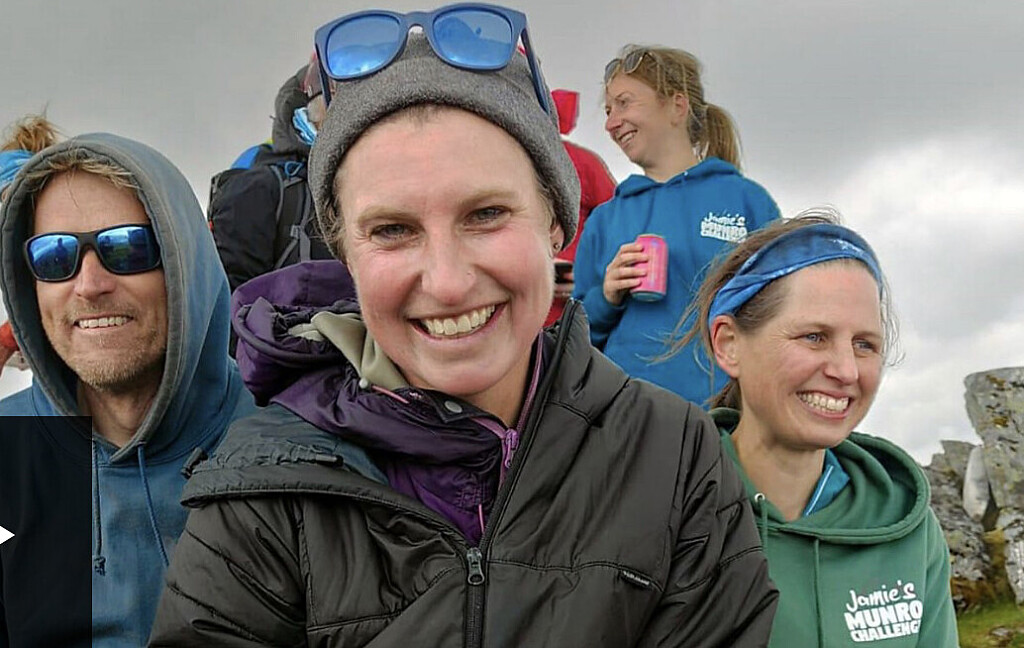
A woman has set a new time record for scaling all the mountains in Scotland higher than 3,000 feet
Ultra-runner Jamie Aarons finished the challenge in 31 days 10 hours and 27 minutes, breaking the previous record by more than 12 hours.
There are 282 mountains that meet the benchmark and they are known collectively as the Munros.
The challenge saw Aarons ascend 459,000 ft, the equivalent of climbing Mount Everest 16 times.
She also ran, cycled and kayaked between each of the Munros, covering a total of around 932 miles (1,500km) on foot and about the same distance by bike.
(06/27/2023) ⚡AMP
Courtney Dauwalter breaks record at Western States 100 by almost 80 minutes
Ultramarathon runner Courtney Dauwalter crushed the women’s course record at the Western States 100-mile race in California, taking more than an hour off the previous best time.
Dauwalter finished the Western States 100 – the world’s oldest 100-mile race – in 15 hours, 29 minutes and 34 seconds, almost 80 minutes faster than Ellie Greenwood’s record set in 2012. The race was first run in 1974.
“I just kept asking [my legs] to do one more mile for me and they kept responding, so I was very thankful for that,” Dauwalter told iRunFar about the last 20 miles of the race.

“I was definitely, though, deep in the pain cave and really focused on every single step, every single second.”
Cooler weather contributed to faster times at this year’s Western States 100, which started in the early hours of Saturday morning in Olympic Valley, California.
Snow covered much of the initial stages of the course before runners descended into a recently unshaded section scorched by last year’s Mosquito Fire.
After running with fellow American Katie Schide, Dauwalter started pulling away around the 30-mile mark, steadily eating away at Greenwood’s course record.
Covering 18,000 feet of climbing and almost 23,000 feet of descent across Californian trails, the race finishes on a high school running track in the city of Auburn in Placer County.
“I couldn’t believe when the track suddenly showed up and you make that turn, I was like: We did it! We’re here!” Dauwalter told iRunFar.
“Because that was the moment where I let myself actually believe that we had finished and we were about to be able to stop moving.”
Dauwalter, who is set to defend her title at the Hardrock 100 in Colorado in three weeks’ time, also won the Western States 100 in 2018, though her time this year was nearly two hours faster.
Most people’s idea of fun wouldn’t involve running for hours on end through brutal, undulating terrain – but ultra-marathon sensation Courtney Dauwalter is no ordinary person.
While an ultra-marathon is technically defined as any race longer than 26.2 miles, Dauwalter’s exploits tend to take place at distances far greater than that, usually between 100 to 250 miles.
The 38-year-old’s list of achievements is almost interminable. Dauwalter, a four-time ‘Ultra Running Magazine Ultrarunner of the year,’ holds multiple course records for the obscenely long races around the US and abroad.
Dauwalter’s breakout moment came at the Moab 240 – an annual 240-mile race in Utah. At the 2017 edition, shortly after making the decision to become a full-time ultra-runner, Dauwalter completed the course a scarcely believable 10 hours ahead of all other competitors – male and female.
The Transgrancanaria event on February 24 – Dauwalter’s most recent escapade - resulted in her 15th straight race win by gender dating back to March 2021, according to results database Ultrasignup.
The Minnesota native completed the grueling 128km course (79.5 miles) – including over 7000 meters of elevation gain - around the Canary Island in a course record 14 hours 40 minutes: over 90 minutes ahead of her closest competitor.
(06/26/2023) ⚡AMP

There’s a Six-Day Ultramarathon Happening Inside a Speed Skating Rink
Runners have been logging miles around a 443-meter running track all week. Last year’s winner ran 437 miles.
While summer racing heats up, some ultra athletes in Milwaukee are keeping on their layers as they race ’round the clock at the Six Days in the Dome ultramarathon. Held inside the Pettit National Ice Center, which houses two full-sized hockey rinks and a speed skating track nestled inside the 443-meter running track, the facility’s temperature is kept at a steady 55 degrees year-round.
That’s the point in this competition, which originated in 2014 at the Alaska Dome in Anchorage—where Joe Fejes broke the then American record for six days by running 580 miles. Eventually, the race relocated to Milwaukee for its second running in 2019. Whereas many ultra competitions feature rough terrain, brutal conditions, and require an “expect anything” mindset, the original race director, Steve Durbin, wanted to create an ultra race in a fully-controlled environment.
But just because the environment is carefully calibrated for racing success doesn’t mean the great distances require any less mettle than ultras that are contested in rugged outdoor settings. Ultramarathon running requires a great deal of planning—runners schedule their sleep, kit changes, showers, and fueling, and must stay on top of the unavoidable blisters, chafing, and other small aches and pains that can end their race if not tended to.
“The thing about ultra-running, the finish is not a guarantee,” race co-director Mike Melton told UrbanMilwaukee.com. “That’s part of the challenge. How deep into yourself will you go? How deep into the pain cave can you handle? How can you manage the sleep deprivation, the miles you want to do? Everyone’s motivation is something different, something unique.”
As Saturday night looms, athletes are nearing the end of the nearly weeklong competition, which began on June 18. The stakes are high, as those who place in the top six will secure their place on the U.S. 24-Hour National Team. As of Wednesday afternoon, Romania’s Nicolae Buceanu and Sandra Villines-Burruss from Florida were in the lead, at 268.268 and 243.243 miles, respectively.
Canadian Viktoria Brown took the win last year with a total of 457.4135 miles, setting two Canadian records and one world record in the process, but she didn’t return to defend her title, so the multi-day competition is anyone’s game at this point.
In addition to the six-day competition, there are 12, 24, 48, and 72-hour categories, and several attempts at records have been pursued. New Delhi’s Meenal Kotak was cheered on Wednesday afternoon as she completed her 72-hour attempt, recording just over 235 miles and setting a women’s record for India.
(06/25/2023) ⚡AMPby Runner’s World
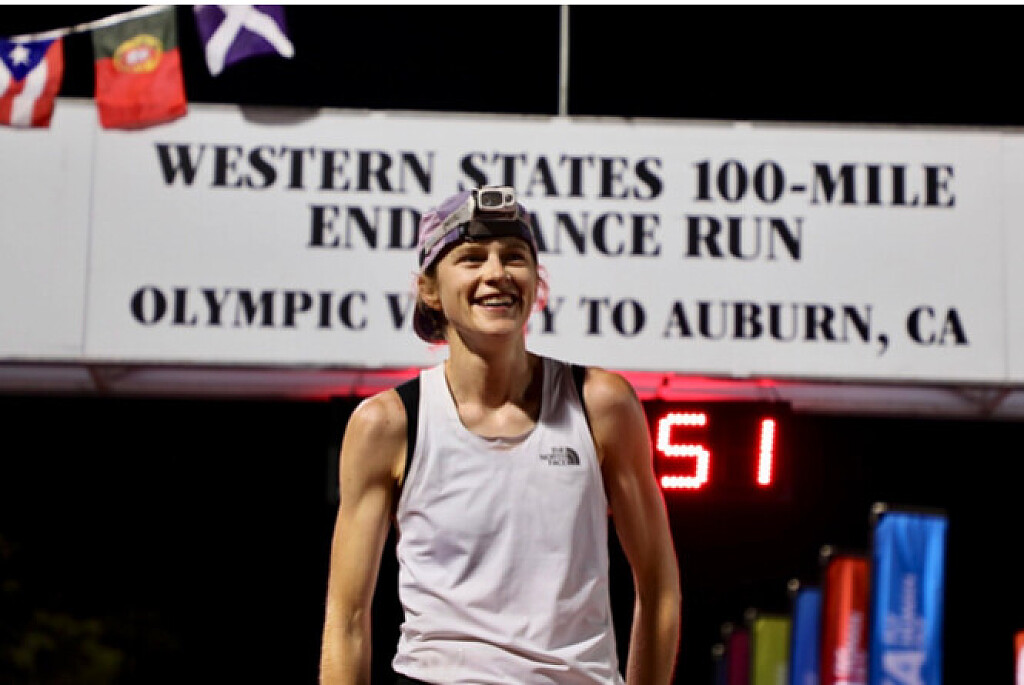
2023 Western States 100 Women’s Race
None of the first four women from last year’s race — Ruth Croft, Ailsa MacDonald, Marianne Hogan, Luzia Buehler — returned. That made Zimbabwe’s Emily Hawgood (pre-race interview) the highest returning finisher from 2022. Hawgood’s pretty much a race local now too, living in nearby Roseville, California. But it was 38-year-old Courtney Dauwalter (pre-race interview) that came into the race as a favorite. She won here in 2018 in 17:27 and was looking to avenge a late drop at the 2019 race.
Dauwalter was first up the Escarpment. At 2,500 feet, it’s the race’s biggest climb and it happens right away in the first three miles. But 2022 UTMB winner Katie Schide (pre-race interview) was right there too. Schide, an American who’s lived in France for the past seven years, hit the top in 46 minutes with Dauwalter and the two dropped into the Granite Chief Wilderness together. Already Dauwalter and Schide, age 31, had a three-minute lead on third-place Ida Nilsson (pre-race interview) from Sweden.
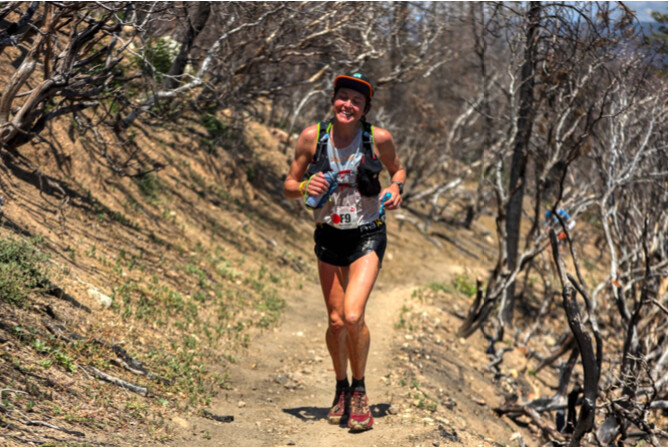
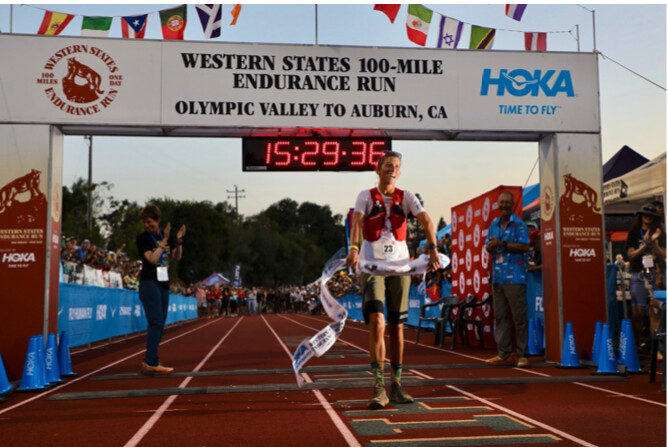
By mile 11, Lyon Ridge, Dauwalter and Schide’s lead on third-place Nilsson had ballooned to eight minutes. And then it got even bigger as the two completely broke away from everyone else. At mile 16, Red Star Ridge, no one was within 14 minutes of the front two. Nilsson, Hawgood, 2023 Black Canyon 100k winner Keely Henninger (pre-race interview), Taylor Nowlin, professional triathlete-turned-ultrarunner Heather Jackson, Canada’s Priscilla Forgie and Jenny Quilty, and 2022 sixth-place finisher Leah Yingling (pre-race interview) all ran inside the early top 10.
The Mosquito Fire limited crew access this year and everyone met their crews for the first time at mile 30, Robinson Flat. Dauwalter was in at 5:07 and out within a minute, and still on her 2019 splits. Schide took a longer break and changed shoes, exiting the aid station three minutes behind the leader. The two had completely broken open the women’s race. Nilsson, in her 100-mile debut, had been alone in third to this point, but was now joined by Henninger, Hawgood, and Nowlin.
At mile 34, Miller’s Defeat, the course record watch started. Dauwalter and Schide were under Dauwalter’s own 2019 splits and Ellie Greenwood’s 2012 course record pace. Dauwalter was five minutes up on Greenwood’s splits, and Schide was three minutes faster. Even more, the two were over 30 minutes in front of third-place Hawgood at mile 38. Dauwalter and Schide were out front for the win and the course record, and the other contenders grouped behind them.
Dauwalter was red hot up the Devil’s Thumb climb at mile 48, but Schide hadn’t given up much time. She took longer in aid and left six minutes after Dauwalter. Hawgood, Nowlin, and Henninger came in together next, now 40 minutes behind second-place Schide.
At Foresthill, Dauwalter was 25 minutes up on record pace. Schide conceded only another two minutes over the last stretch and was 11 minutes behind Dauwalter. While Dauwalter and Schide were still off the front, the race dynamic was heating up behind. The third- through eighth-place women were all in Foresthill together with only three minutes separation. Hawgood was there first among the chase group, but Hungarian living in Hong Kong Eszter Csillag quickly jumped from eighth at mile 52 to fourth at mile 62. Nilsson was fifth, and Henninger, Katie Asmuth, and Nowlin were all there too.
Dauwalter ran 2:10 from mile 62 Foresthill to mile 78 at the American River. Only the men’s winner would run a quicker split on this day, and only eight men have ever run a faster split in the race. Dauwalter was five levels better than everyone else, and she was boldly racing without a pacer too. Schide stayed comfortably in second, but fell further behind Dauwalter’s quickening pace and river conditions necessitated that everyone cross the American River in a boat this year.
From Foresthill to the river, Katie Asmuth vaulted into third, past Eszter Csillag and Ida Nilsson. Asmuth was seventh at Foresthill and picked up four spots on the downhill Cal Street stretch, outrunning common expectations in coming back from injury. All three women split faster from Foresthill to the river than Schide did and even if the front two were gone, the women in general were running really fast. There’s bound to be some bad luck in a 100 miler though, and Henninger fell just before the river and dislocated her shoulder. She would then drop from the race at mile 80, Green Gate, due to that injury.
Dauwalter’s incredible second half and incredible race brought her to the Placer High School track finish in 15:29. Dauwalter completely shattered the record books and set a new standard that is likely to last for a lifetime. Ellie Greenwood’s 16:47 course record had stood since 2012. Dauwalter will next race the high altitude 2023 Hardrock 100 in Silverton, Colorado, on July 14. Dauwalter is the Hardrock course record holder, too, but Western States plus Hardrock will certainly be a challenging double.
Schide challenged Dauwalter early, and outpaced the rest of the women’s field in doing so. Schide was in second for much of the day, ultimately finishing as runner up in 16:43. That was also under the old course record.
Csillag, who was fifth at the 2022 UTMB, had a remarkable second half to finish third in 17:09. It is the race’s fourth-fastest run ever. And she just edged out Asmuth, who moved up from last year’s ninth-place run to finish fourth in 17:21. Asmuth’s time was just inside of Ruth Croft’s winning time from last year, and is the race’s fifth-fastest ever.
Hawgood earned a second straight fifth-place finish. In 2022 she was able to finish fifth in 18:16 and in this year’s faster race Hawgood was fifth in 17:26. That time ranks eighth-best ever and is just faster than what Dauwalter ran to win in 2018.
Taylor Nowlin improved her finish place by one from prior year, but like Hawgood greatly improved her finish time. Nowlin was sixth in 17:40. One-hundred-mile debutante Ida Nilsson was seventh in 17:43, and Priscilla Forgie was just minutes back in eighth at 17:46. Leah Yingling was a repeat top-10 finisher in ninth at 17:49. For perspective, no year had seen more than three women finish under 18 hours before. But this year nine women finished under 18 hours. It is the new standard for women’s racing at Western States.
The 25-year-old Meghan Morgan took the prized 10th-place finish in 18:11, thereby guaranteeing a chance to automatically return next year.
(06/25/2023) ⚡AMPby Justin Mock I Run Far

Western States 100
The Western States ® 100-Mile Endurance Run is the world’s oldest and most prestigious 100-mile trail race. Starting in Squaw Valley, California near the site of the 1960 Winter Olympics and ending 100.2 miles later in Auburn, California, Western States, in the decades since its inception in 1974, has come to represent one of the ultimate endurance tests in the...
more...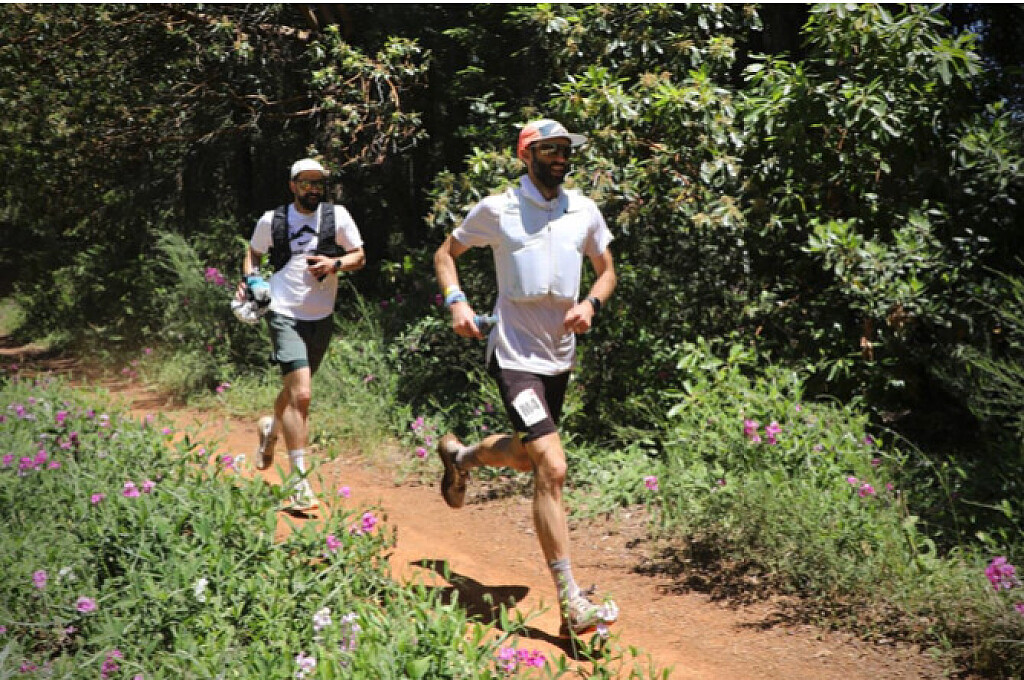
2023 Western States 100 Men’s Race
There’s nowhere to go but up at the start of the Western States 100, and Jia-Ju Zhao from China charged the opening climb. Despite snow, Zhao hit the top in 42 minutes. Slower to the top, Frenchman Mathieu Blanchard (pre-race interview) and Brit Tom Evans (pre-race interview) turned to greet the brilliant sunrise together.
Zhao won the Ultra-Trail Mt. Fuji 100 Mile in April 2023 and is a two-time winner of the Doi Inthanon by UTMB 100 Mile in Thailand. He pushed his early lead to five minutes at Lyon Ridge, mile 11, while 2022 fourth-placer Tyler Green led the early chase group. Green had finished as high as second here before, in 2021, but was running more aggressively toward the front earlier than ever before.From mile-15 Red Star Ridge to mile-25 Duncan Canyon, the chase group started to make up time on Zhao. Tom Evans, Chinese runner Jia-Sheng Shen, and Dakota Jones (pre-race interview) were among a group that cut four minutes from Zhao’s lead over just nine miles. Evans was third here in 2019 in 14:59, and Jones had just biked 680 miles from his home in Utah to the race start.
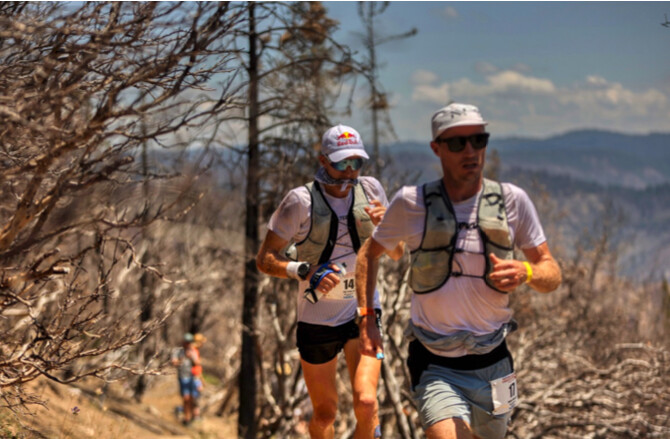
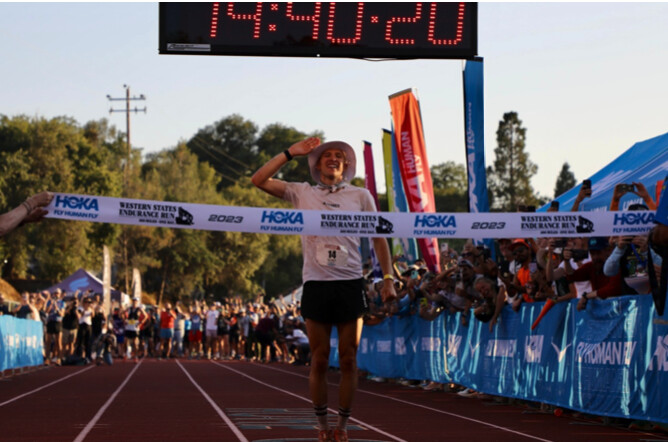
Zhao was quickly swallowed up in the next five miles to Robinson Flat, mile 30, and soon fell out of the top 10. A lead trio of Tom Evans, Dakota Jones, and Jia-Sheng Shen came into aid at 4:45, meeting their crews for the first time. At mile 30 and with Zhao falling backward, Anthony Costales (pre-race interview) was fourth, and then he was with Tyler Green at mile 38 in fourth and fifth. The two would barely separate the rest of the race.Evans and Jones dropped Shen on the climb to Devil’s Thumb, mile 48, and the two leaders came into aid together in 7:03. Four minutes back Costales had caught Shen on the big climb, and Tyler Green, Jeff Colt, New Zealand’s Daniel Jones, Ryan Montgomery, Mathieu Blanchard, and 47-year-old Ludovic Pommeret were inside the top 10. Those six were 14 minutes apart. 2022 third- and second-place finishers Arlen Glick (pre-race interview) and Hayden Hawks (pre-race interview) were back in 11th and 16th, respectively. After earlier moving up, Hawks had just lost several places and would later drop with injury at mile 55. Other top-10 finishers from 2022 Cody Lind, Scott Traer, and Alex Nichols were all noticeably outside the top 10 too.
As the race shifted to its mile-62 Foresthill hub, Evans gained some separation on Jones and entered the aid station first, but as Evans changed shoes and socks, Jones didn’t wait and exited first. Jones was now in the lead by himself for the first time and he was overheard voicing his intention to break Evans. Some 11 minutes back of those two leaders, Green and Costales were again together and in third and fourth. Shen and Jeff Colt were just minutes back of those two, and Colt was remarkably almost an hour faster than a year ago when he finished 11th.Jones and Evans separated leaving Foresthill and anticipation ran high for their next steps. The two had been together for nearly the entirety of the race to this point. Jones wanted to make a move and Evans wanted to keep up with (the) Jones. The duel ended quickly and dramatically though. Tom Evans dropped a 5:54 downhill mile and hit Cal 2, mile 71, in 10:12. That surge pushed Jones eight minutes back at mile 71. It was just nine miles from Foresthill to that split on Cal Street, but the front two had shattered and moved in opposite directions the rest of the race.
Evans ran alone to the river crossing at mile 78, and ultimately to the finish. Tyler Green, Anthony Costales, Jeff Colt, and Jia-Sheng Shen all overtook Dakota Jones on the way to the river too. Forget about Elm Street, Jones was having a bit of a nightmare on Cal Street.
Evans, the 2022 UTMB third placer, continued to put time on the field the rest of the way. He finished in 14:40 and that’s the race’s fourth fastest finish ever. The mark trails only Jim Walmsley and Jared Hazen in 2019, and Walmsley’s 2018 mark too. Evans was a runaway winner, but the rest of the top 10 was much more closely packed.Tyler Green pushed on in second, and held off an Anthony Costales chase over the last 15 miles. Green finished in 15:04. It was his second runner-up finish and a big personal best for the course. He was able to finish with his baby boy on his shoulders. Green’s 15:04 was the race’s 11th-fastest finish ever. Costales was third in 15:09, the race’s 13th-fastest finish ever.
Jia-Sheng Shen and Daniel Jones both finished fast. Shen clocked 15:19 and Jones was fifth in 15:22. Mathieu Blanchard and Ryan Montgomery both overtook Jeff Colt late. Those three — Blanchard, Montgomery, and Colt — finished in 15:37, 15:38, and 15:42, respectively. Local runner Cole Watson bettered his 2022 14th-place finish with a ninth-place 15:54.
In 2019 the top 10 all went under 16 hours. This year’s 10th-place man Janosch Kowalcyzk from Germany just missed matching that feat. He finished in 16:09.
Seven of last year’s top 10 returned, but only Tyler Green was able to again make the top 10. The 2022 top 10 finishers Ludovic Pommeret, Arlen Glick, Scott Traer, Cody Lind, and Alex Nichols finished 12th, 13th, 15th, 16th, and 28th this year, respectively. As earlier mentioned, 2022 runner-up Hayden Hawks dropped.
After running near or in the lead through Foresthill, Dakota Jones finished 17th in 17:00.
Early leader Zhao’s high risk, high reward start ended with a drop at Michigan Bluff, mile 55.
(06/25/2023) ⚡AMPby Justin Mock I Run Far
Western States 100
The Western States ® 100-Mile Endurance Run is the world’s oldest and most prestigious 100-mile trail race. Starting in Squaw Valley, California near the site of the 1960 Winter Olympics and ending 100.2 miles later in Auburn, California, Western States, in the decades since its inception in 1974, has come to represent one of the ultimate endurance tests in the...
more...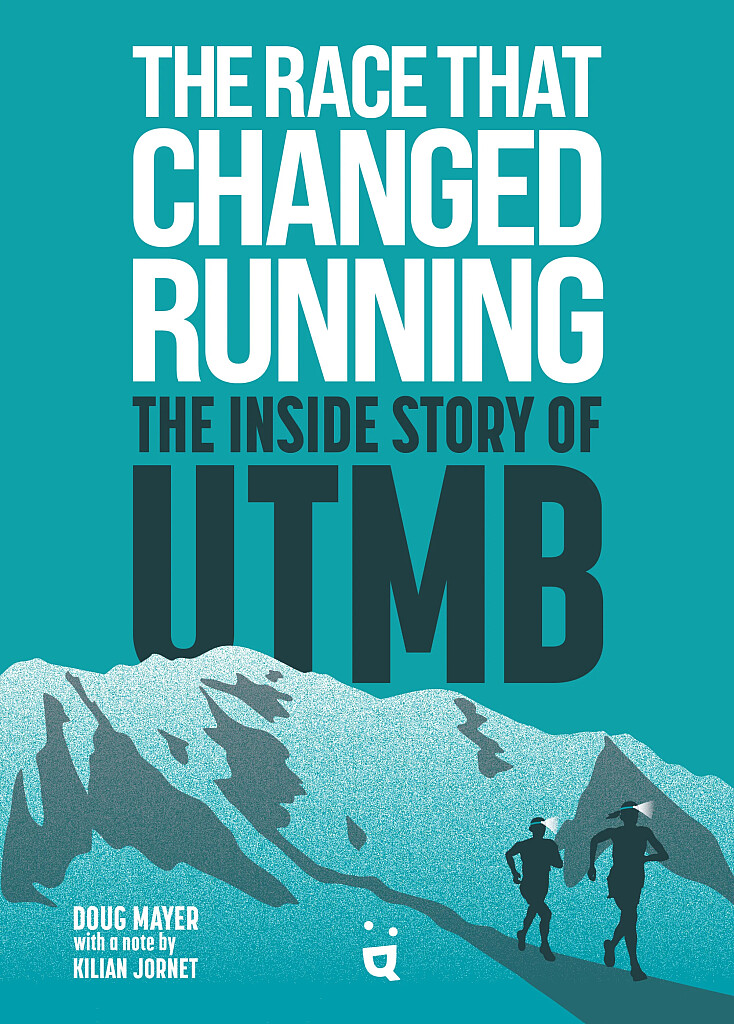
UTMB book reveals the history of the famous event delving into controversy over prize money and the people behind the race
A new book to mark the 20-year anniversary of the Ultra Trail du Mont Blanc (UTMB) highlights the human story behind the event, contextualising controversies such as prize money.
“I don’t always agree with the founders’ decisions personally but I always found the answers very interesting and it gave me more perspective and understanding,” said Doug Mayer, 58, the book’s author.
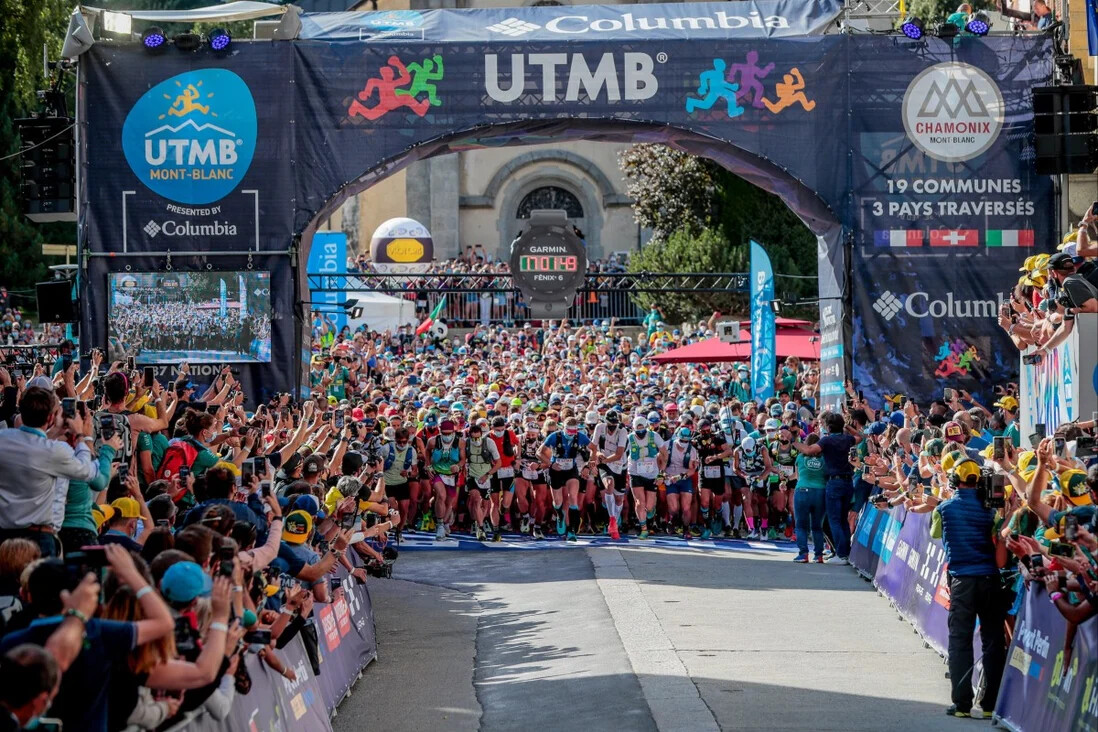
The book – The Race that Changed Running: The Inside Story of the Ultra Trail du Mont Blanc – details the history of the UTMB with interviews with the founders Michel and Catherine Poletti.
The race is the most high-profile event in trail and ultra running. The main event is the 171km race from Chamonix, all the way around the Mont Blanc Massif, through Italy and Switzerland and back to Chamonix in France.
During the week, there are also other races: the 145km TDS, the 100km CCC and the 56km OCC.
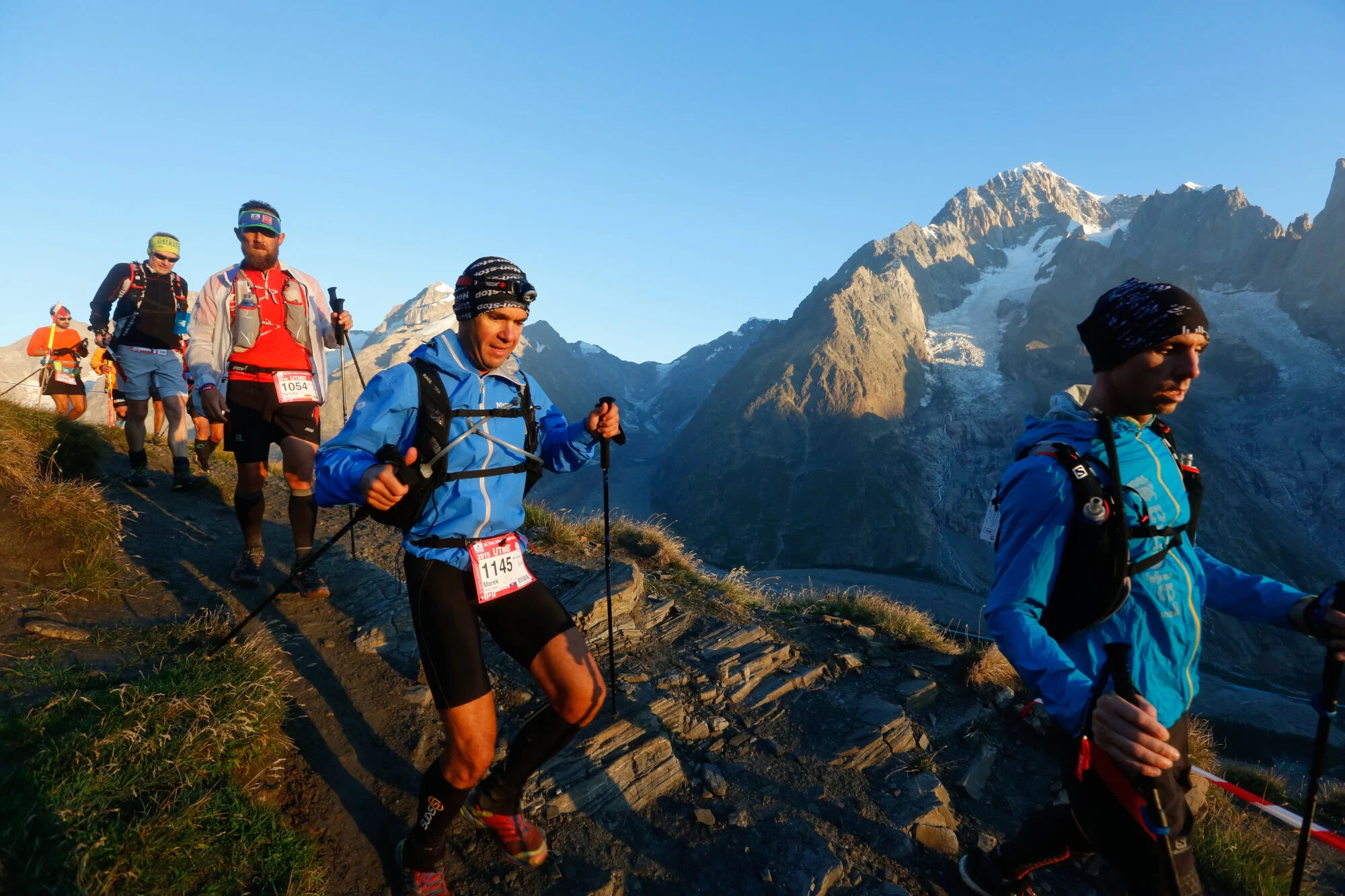
The UTMB has often been criticised for being too commercial. They have expanded to different countries with races “by UTMB” and recently partnered with Iron Man to make a world series, through which runners can qualify for the main event in Chamonix.
The founders of the UTMB check the book for accuracy, but they were not allowed to change anything, and had no editorial control.
He did not shy from asking controversial questions. Some of his critical views of the race have been softened by the human side of the answers.
For example, the UTMB seemed to be making money, but offering little or no prize money to its runners, attracting a lot of controversy.
“It turns out that Catherine had been the treasurer of the Marathon Mount Blanc [a different race] many years ago at a time when East African runners were winning and she was writing cheques out to their managers,” Mayer said.
“She knew exactly what was going on – the money wasn’t going to the athletes, it was going to the managers. That horrified her. When she talks about that today, you can hear the indignant tone in her voice.
“That informed their thinking about prize money. For years, they saw prize money as corrupting.”
Since then, trail running has become increasingly professional. Runners and critics, including the Post, called for the UTMB to offer prize money. In 2018, they did. There were calls to give more than a token amount, to recognise that the athletes are professional runners who need to make a living.
Major publications like Outside Magazine had headlines such as “UTMB and ultrarunning’s amateurism problem”.
As of 2022, the UTMB offered US$10,400 to the winners of the UTMB, CCC and OCC, around US$5,200 for second place and US$3,125 for third. Fourth and fifth places got around US$1,500, while sixth to 10th earned US$1,000.
“I think one of their human faults is that they’re slow to change,” Mayer said, adding that he hoped people would be more forgiving of it.
One of the sources of the problems is that people have suggested the Polettis are in it for the money. In the book, the Polettis pointed out that they could have cashed out years ago. They said they wanted to pass the race on to their children.
Even the 40 per cent sold to Iron Man was not the 40 per cent they owned. It was sold to Iron Man by Group Telegram, although Iron Man did buy 5 per cent from the Polettis.
Mayer is American, but lives in Chamonix and speaks French. He has interviewed the Polettis many times but even he was taken on a journey.
“I learned a lot about them and that made them more human,” he said. “They’ve had their struggles, like all of us.”
Michel grew up in Chamonix. After university, he went to Paris to become a computer programmer.
“And he was miserable about it,” Mayer said. “A friend of Catherine said, ‘Well, you guys have a choice. It’s Paris and antidepressants, or it’s back to Chamonix.’ And they went back to Chamonix and moved into the garage of his father.”
They renovated the chalet, and it’s where they still live.
“They’re not the people that a lot of people think they are,” Mayer said. “The race is not entirely the race we think it is.”
(06/23/2023) ⚡AMP
Tips for returning to speedwork after injury
Returning to running after injury can spark intense feelings of both joy and fear. Any runner who has been sidelined for a seemingly endless stretch of weeks or months has felt the elation of finally being able to slip back into their running shoes, head out the door, stretch their legs and feel their spirit soar. But a rebound from injury can also be riddled with doubts: is it too soon to start running again? Am I going to retrigger the injury? Can I ever get back to being the runner I was before I got hurt?
Uncertainty and uneasiness tend to ramp up in step with training intensity, making a return to speedwork that much more of a mental challenge. With speedwork being an important part of training for any distance, from track events to ultramarathons, the time eventually comes for the fully recovered runner to get back up to speed by reintroducing some intervals into their training. If you’re an injured runner on the road to recovery, or if you’ve recently returned to action but find yourself stuck in a slower gear, consider these tips for safely reintroducing speedwork into your training.
Let your caution be your guide
It’s important to remember feelings of apprehension you may have about upping the intensity of your runs are natural, and are likely serving you well. Erring on the side of caution is key when returning to running, especially when the focus is on speed. Appreciate the uneasiness about returning to speedwork as the inner voice of wisdom that it is, instead of mischaracterizing it as irrational worry. Your instincts to be very careful about speedwork are supported by science: a recent study, for example, found adding too much speed in training too quickly is more likely to lead to stress fractures than is running tough uphills and downhills. As the researchers of that study noted, the lesson for runners isn’t to stop doing speedwork, but to approach it with the appropriate patience and care.

Consult a health-care professional
Before resuming any intense training or speedwork after an injury, it’s crucial to consult with a health-care professional, such as a physiotherapist or sports medicine specialist. They can evaluate your condition and provide specific guidance tailored to your injury and recovery progress.
Begin with a proper warm-up
Begin each speedwork session with a thorough warm-up to prepare your body for the increased intensity. Incorporate dynamic stretches, light jogging and mobility exercises to gradually raise your heart rate and loosen up your muscles. This helps reduce the risk of further injury and may enhance your performance.
Start with short intervals
When reintroducing speedwork, start with shorter intervals rather than long, intense efforts. For example, instead of jumping straight into 800-metre repeats, begin with shorter intervals like 200 or 400 metres. This allows your body to adapt gradually to the increased pace and intensity.
Allow for adequate recovery time
Intense speedwork places significant stress on your body, so it’s essential to incorporate adequate recovery time between sessions. Give yourself at least 48 hours of rest or easy running between speedwork sessions to allow for muscle repair and adaptation. This helps prevent overuse injuries and promotes a safer progression.
Listen to your body
Pay close attention to any warning signs or pain during and after speedwork sessions. If you experience sharp or worsening pain, discomfort, or unusual fatigue, it’s important to back off and allow your body more time to recover. Pushing through pain can lead to further injuries and setbacks. Be patient and gradually increase the intensity and volume as your body allows.
(06/22/2023) ⚡AMPby Paul Baswick
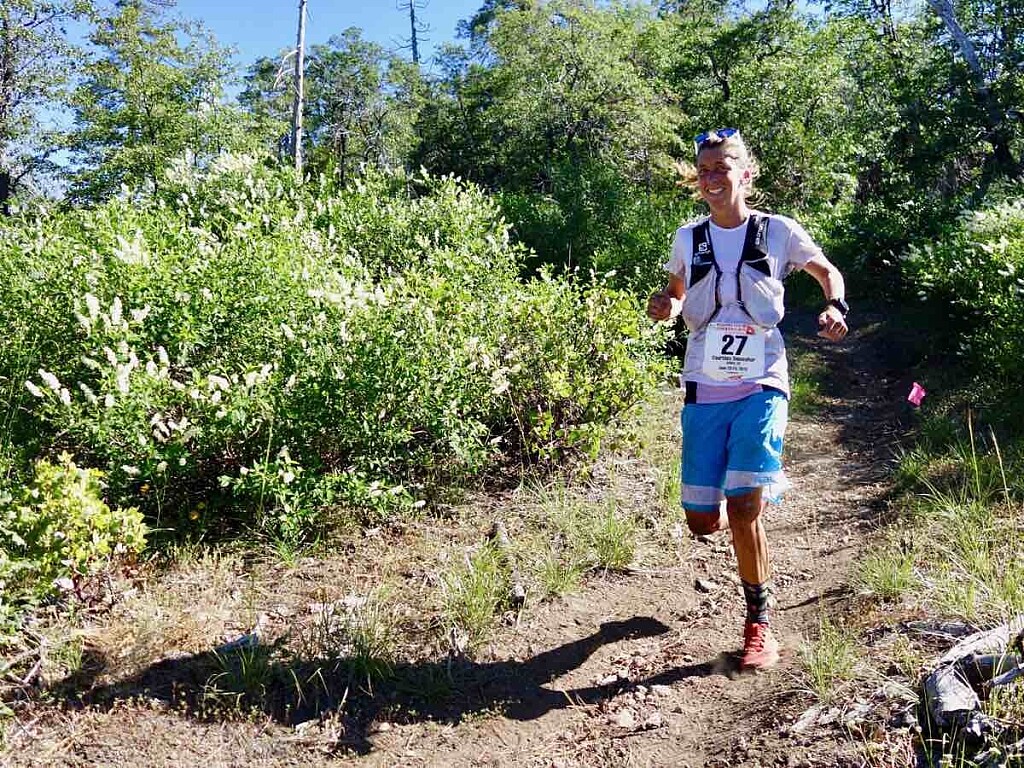
2023 Western States 100 Women’s Preview
The 2023 Western States 100 is just around the corner and we’re here to take a look at the pointy end of this year’s women’s field. Before we get started, in case anyone needs a reminder of this unique, point-to-point, net downhill course, here are the stats for the standard course: 100.2 miles, 18,000 feet of climbing, and 22,000 feet of descending.
At the time of writing this, we don’t know if the huge snows of this winter or last year’s wildfire on the course will necessitate any significant course modifications for this year’s running. However, we know the race organization is doing everything they can to host the race on the normal course. We also know that those conditions will likely play into the competition, with snow present on the first 25 miles of the course for a spicy warm-up, as well as miles of wildfire-exposed course that’s likely to make the middle miles feel more severe than normal. And, also, we are expecting the normal race-day heat.
Last year’s race further showed how much faster the Western States women’s field has gotten in recent years. While Ellie Greenwood’s 2012 course record of 16:47 has remained untouched, 15 of the 24 fastest women’s times at the race have been logged in just its three recent races — 2019, 2021, and 2022 — with those 15 times logged by 13 different women. Ruth Croft’s 2022 winning time of 17:21 was the third-fastest women’s time ever while fifth-place Emily Hawgood’s 18:16 would have won the women’s race in all but 10 other years.
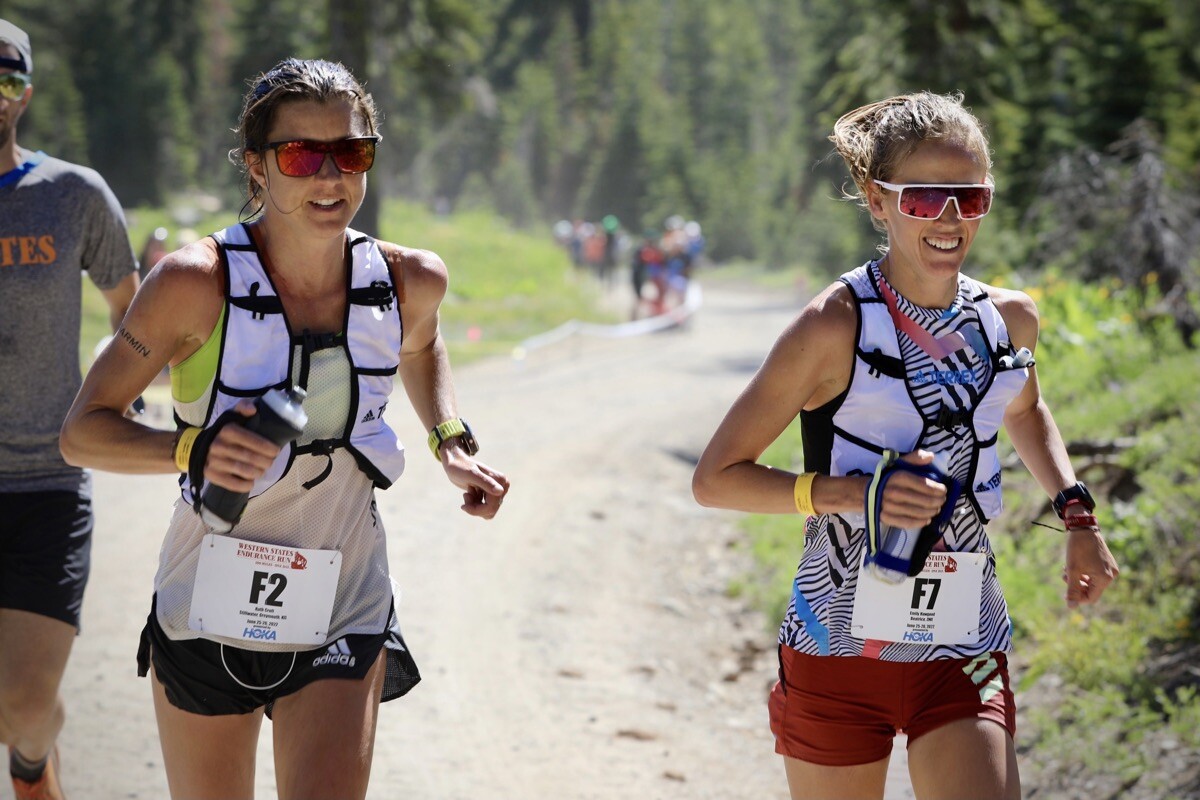
We’re in for one heck of an exciting women’s race at this year’s Western States 100. None of last year’s top-four women are returning while everyone who finished between fifth and ninth will be returning. Lining up aside those five will be another half dozen women, each of whom could make a push for the podium, including a couple of the world’s best 100-mile racers at the moment. Another dozen strong women will add to the excitement in running for the top 10.
As you’d guess, iRunFar will be there to report firsthand on all the action as it unfolds starting at 5 a.m. U.S. PDT on Saturday, June 24. Stay tuned!
A special thanks to HOKA for making our coverage of the Western States 100 possible!
Emily Hawgood – 5th, 18:16:02
Well, look at that, Zimbabwe’s Emily Hawgood comes into the 2023 Western States 100 as the top returning women’s runner after her fifth-place finish last year. That fifth place is no fluke as over the past two years, Hawgood has been seventh at the 2021 Western States 100 as well as taking 10th and sixth at the past two UTMBs. Living over here in the U.S., she ran and won the same local 50k both last year and this February.
Leah Yingling – 6th, 18:32:31
After many years of quieter success, Leah Yingling made herself known with a great 2022 season. In addition to taking sixth at Western States in 2022, she was third at the Bandera 100k, third at the Transgrancanaria Advanced 60k, second at the Canyons 100k, and 19th at the Trail World Championships 80k. She’s started her 2023 just as strong with a second place at the Way Too Cool 50k in March and a win at the Bull Run Run 50 Mile in April.
Taylor Nowlin – 7th, 18:46:42
Although she’s run ultras since at least 2016, I’d have to say that 2022 was Taylor Nowlin’s best season to date. Not only did she take seventh in her 100-mile debut at Western States, she also took fourth at the Black Canyon 100k and ninth at CCC. We can’t find any race results for Taylor so far this year, so we’ll have to wait until race day to find out what kind shape she’s in.
Camille Herron – 8th, 18:51:54 (2022 post-race interview)
What a journey it’s been for Camille Herron at Western States! She DNFed in both 2017 and 2019 before finishing in 27:28 in 2021. She kept at it last year, finishing eighth in 18:51. I’d hypothesize that what’s sure to be a snowy course in 2023 could challenge that inspiring progression, but she’ll surely come into the race fit if her recent racing is any indication. In December she clocked 13:02 for 100 miles at the Desert Solstice races before setting the 48-hour world record of 270.5 miles this March.
(06/15/2023) ⚡AMPby Bryon Powell
Western States 100
The Western States ® 100-Mile Endurance Run is the world’s oldest and most prestigious 100-mile trail race. Starting in Squaw Valley, California near the site of the 1960 Winter Olympics and ending 100.2 miles later in Auburn, California, Western States, in the decades since its inception in 1974, has come to represent one of the ultimate endurance tests in the...
more...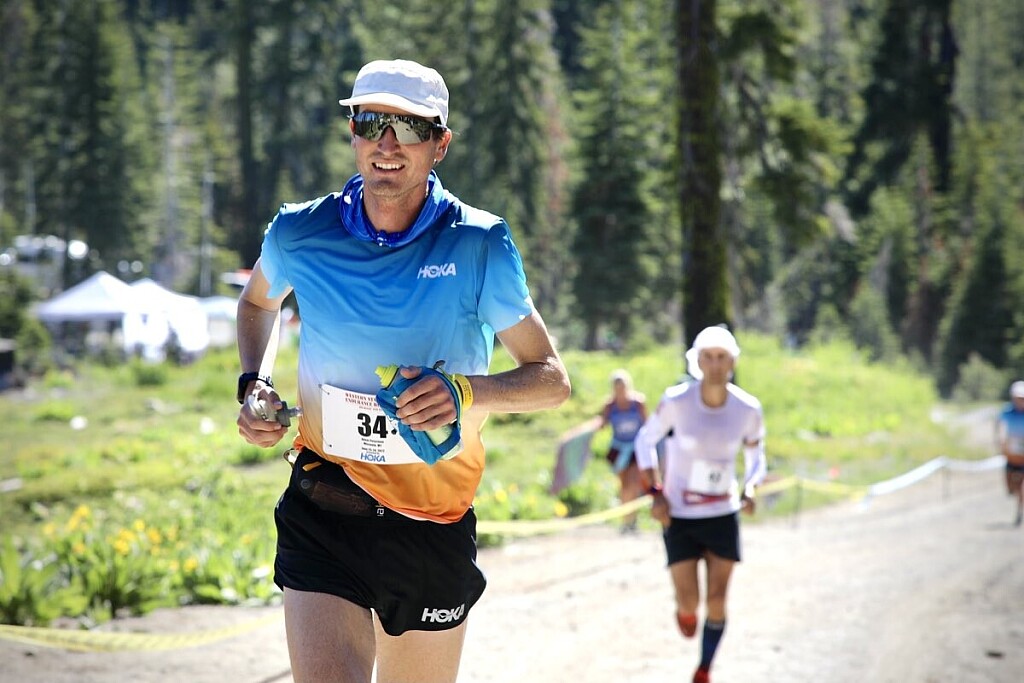
2023 Western States 100 Men’s Preview
The Western States 100 is set for 2023. The iconic point-to-point, net-downhill course takes in 100.2 miles, 18,000 feet of climbing, and 22,000 feet of descending, as it starts at the Palisades Tahoe ski resort in Olympic Valley, California, and finishes at Placer High School in Auburn.
Environmental conditions will play into the race’s competitive story this year. With record snowfall throughout the upper elevations of the Sierra Nevada, the mountain range through which the race travels, runners will encounter plenty of snow over the course’s first quarter, along with numerous high water crossings lower down as all that snow melts.
Some 16 miles of the course were burned over by last fall’s Mosquito Fire, leaving miles of shade-less terrain. And of course, there will probably be weather at play, with the event’s notorious heat likely to encompass the middle and lower elevations of the course.
The men’s race at last year’s Western States 100 was sharp, with just 50 minutes separating the first and 10th finishers. Seven of that stellar line-up are back this year, as well as some serious additions like the U.K.’s Tom Evans, French-Canadian Mathieu Blanchard, and Dakota Jones.
Although there are notable absentees including reigning champion Adam Peterman and course-record holder Jim Walmsley, the depth of this men’s field suggests it could be an even tighter race this year.
As you’d guess, iRunFar will be there to report firsthand on all the action as it unfolds starting at 5 a.m. U.S. PDT on Saturday, June 24. Stay tuned!
A special thanks to HOKA for making our coverage of the Western States 100 possible!
Be sure to check out our in-depth women’s preview to learn about the women’s race and, then, follow our live coverage on race day!
The top 10 runners in the 2022 race were invited to return for 2023. Unfortunately, reigning champion Adam Peterman is out with injury, and seventh-place Vincent Viet of France has opted not to return. It also looks like fifth-place Drew Holmen has withdrawn, as he just finished fifth at the Trail World Championships 80k, held in Austria 15 days before Western States.
Hayden Hawks – 2nd, 15:47:27
Last year’s second-place man, Hayden Hawks, was pretty jovial in his post-race interview about not being able to best race winner Adam Peterman. But without the reigning champion present on the start line, this could be Hawks’s year. Despite struggling with the heat last year, his finish time knocked two hours off his eighth-place finish from 2021, and there are lots of indicators that he could have more to offer on this course.
Some of his previous top performances include a 5:18 win at the 2020 JFK 50 Mile and a win at the 2018 Lavaredo Ultra Trail. So far this year, he’s warmed up by winning the Canyons 50k and taking second at the Tarawera Ultramarathon 100k.
Arlen Glick – 3rd, 15:56:17
Arlen Glick surpassed a lot of people’s expectations when he took third at Western States last year. Although he went into the race with bag of form in the 100-mile distance — having won the Javelina 100 Mile, the Mohican 100 Mile and the Burning River 100 Mile all in 2021 — this was his initiation into mountainous ultrarunning. He took to it very well, running a stormer to place third, and has since logged more mountain miles, taking second in the Run Rabbit Run 100 Mile later in 2022, before returning to the 2022 Javelina 100 Mile to place third.
Tyler Green – 4th, 15:57:10
Tyler Green took fourth at Western States last year, and forced third-place Arlen Glick into an uncomfortable sprint finish as he closed on him in the race’s final moments. In terms of placing, he was back from his second-place finish in 2021, but improved his finish time by about 14 minutes in his third go at the race. In 2019, he placed 14th in a time of 16:51, in what was a very fast year.
Following on from Western States last summer, he had a below par run at the 2022 UTMB, making it just inside the top 50, but showed he is back on form with a third-place finish at the 2023 Transgrancanaria. Last year in his pre-race interview he spoke about stepping back from his day job of teaching to focus more on track coaching and his own running, so that may have allowed him to come into this year’s race with better preparation than previous years.
Ludovic Pommeret (France)
Ludovic Pommeret, sixth at last year’s Western States, went on to inspire veteran racers everywhere with a commanding win at the 2022 TDS at age 47 — almost an hour clear of second place on the demanding route. Some of his other top performances include a win at the 2016 UTMB, where he also took fourth in 2021, and a win at the 2021 Diagonale des Fous.
He’s probably at the other end of the spectrum of Arlen Glick, in that his best performances have been on courses more mountainous than this one, but he’s still not to be underestimated.
Not many ultra-trail runners have made Kilian Jornet sweat to the degree that French-Canadian Mathieu Blanchard did at last year’s UTMB. The two battled it out all day for a close finish, in which Blanchard took second place — under the existing course record — thus earning his Golden Ticket into Western States. He’s been mixing it up a lot this year, taking second in the 146-mile Coastal Challenge Expedition Run stage race in Costa Rica, third in the Marathon des Sables, and running 2:22 in what looked like a fairly casual effort at the Paris Marathon.
(06/14/2023) ⚡AMPby Sarah Brady
Western States 100
The Western States ® 100-Mile Endurance Run is the world’s oldest and most prestigious 100-mile trail race. Starting in Squaw Valley, California near the site of the 1960 Winter Olympics and ending 100.2 miles later in Auburn, California, Western States, in the decades since its inception in 1974, has come to represent one of the ultimate endurance tests in the...
more...
81-year-old bricklayer becomes Comrades Marathon’s oldest finisher
An 81-year-old bricklayer has become the oldest person to complete South Africa’s storied Comrades Marathon, finishing this year’s 87.7-km run from Pietermaritzburg to Durban in 9:26:10.
Sunday’s history-making run by Johannes Mosehla, who hails from the South African city of Polokwane, marked the 10th time the speedy senior has completed the Comrades Marathon, the world’s largest ultra-marathon. According to comments Mosehla made at Monday’s awards breakfast at Durban’s Elangeni Hotel on Monday, this year’s Comrades won’t be his last.
“I feel strong,” South Africa’s news24 reported Mosehla as saying. “I could run it again!” he added, confirming that he plans to return to Comrades in 2024.
He told those at the breakfast that there are no shortcuts to becoming Comrades’ oldest finisher: “My secret is to train. You can’t win without training,” said Mosehla, who has been running since 1963 and continues to train three times a week, covering distances from five to 32 km.
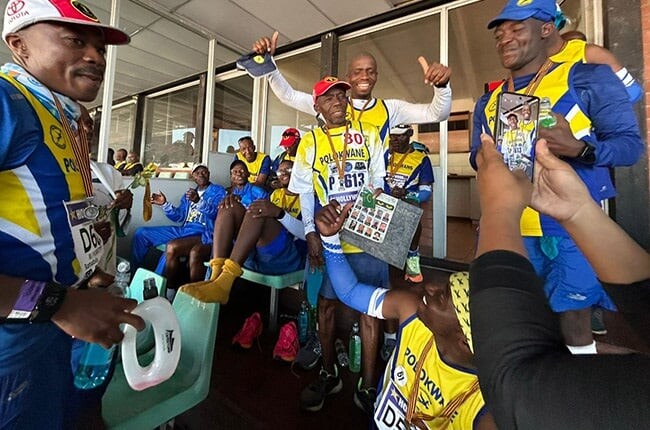
Comrades alternates between the “down” course, which was run this year and is so-named for its relative descent in elevation, and the “up” course, which begins in Durban and ends in Pietermaritzburg.
Noting he was proud to pull off his record-breaking effort “for the whole country,” Mosehla said he hopes his run sends the message that people “must not look for a number or age. I am 81, but I must not look at that number. I must be controlled by my body. When I am still strong, I must not look at my age.”
Mosehla’s run broke the decades-old record set by Comrades legend Wally Hayward, who at age 80 crossed the finish line of the 1989 Comrades Marathon less than two minutes before the 11-hour cutoff time.
Hawyard’s wasn’t the only record to fall at Sunday’s race. Last year’s winner, Tete Dijana of Rustenburg, South Africa, defended his Comrades crown in 5:13:58, shaving more than four minutes off the “down” record set by David Gatebe in 2016.
Gerda Steyn ran this year’s course in 5:44:56, breaking the women’s “down” record set by fellow South African runner Frith van der Merwe in 1989 by nearly 10 minutes.
(06/13/2023) ⚡AMPby Paul Baswick

Comrades Marathon
Arguably the greatest ultra marathon in the world where athletes come from all over the world to combine muscle and mental strength to conquer the approx 90kilometers between the cities of Pietermaritzburg and Durban, the event owes its beginnings to the vision of one man, World War I veteran Vic Clapham. A soldier, a dreamer, who had campaigned in East...
more...
Steph Catudal shares how ultrarunning husband's terrifying illness sparked transformation
Steph Catudal felt her world unravel in 2020 when her husband, famed U.S. ultramarathoner Tommy Rivers Puzey (a.k.a. Tommy Rivs), was diagnosed with a rare form of lung cancer that put him into a medically induced coma for 84 days. The crisis forced Catudal, who was born and raised in Montreal, to face not only an uncertain future, but also pent-up anger and unprocessed grief from her own past.
The author explores the heights and depths of her years-long journey to self-acceptance in Everything All At Once , which comes out May 30. From the tragedy of losing her father to cancer to her supporting Puzey on his road to remission and his being declared free of the disease, the memoir shares lessons Catudal says required time and patience to fully grasp.

“I started writing this book about 10 years ago actually, long before Rivs was diagnosed with cancer. I wanted to tell the story of my adolescent grief of losing my father—it was a story that affected me so deeply and throughout my life,” says Catudal. “I wanted to connect to other people who similarly experienced grief. But it never felt finished. The book never felt done even though I had typed the last words, so I kind of left it on the back burner.”
“When Rivs got sick, I went through an entire self-transformation, and I realized part of the reason why my book didn’t feel finished was because my healing journey still wasn’t finished, and I hadn’t learned all the lessons that I needed to, that I ended up learning through Rivs’ illness. When he was sick, I wrote a lot and posted my writing on social media, and what I wrote resonated with a lot of people and it made me feel a lot less lonely during a lonely time–that human connection in a really isolated time in my life. So I think I wrote the book to further that connection, to broaden the network of those who have experienced grief, which everyone has experienced in life, no matter what the situation is.”
Catudal, who lives with Puzey and their three daughters, says that while writing the memoir was cathartic, she hopes the book can be an aid to others as they navigate their own unique challenges.
“Mostly I hope that it helps people learn self-acceptance,” she says. “It was a long road for me to accept myself. It’s important to accept all of who you are—the brokenness, the anger and also the gratitude and the joy—and just know that you’re OK wherever you’re at.”
“Another hope I have for what people take from this is that no matter what we’re going through, there is love all around. It’s woven into every human experience, and you just have to look to see it. Even if you feel like you’re in the depths of loneliness, there is always love there.”
She says sharing her story with readers has given her a new opportunity to practise acceptance.
“It’s both really exciting and, in a way, nerve-racking to put so much of your life, your feelings and your introspection into a book that people can take and they could either love it or they could hate it. I just have to be OK with letting it go out into the world.”
The publication of Catudal’s memoir also comes with the satisfaction of seeing a long, gruelling challenge to the very end—a feeling her ultrarunning husband knows very well.
“Rivs tells me that this is my own ultramarathon—the daily deposits of writing a page if I could, whenever I had the time,” says Catudal.
“I did it through newborn babies and grad school and sleepless nights, so there’s definitely a sense of pride and accomplishment.”
Look for our review of Everything All At Once in the July/August 2023 issue of Canadian Running.
(06/10/2023) ⚡AMPby Running Magazine
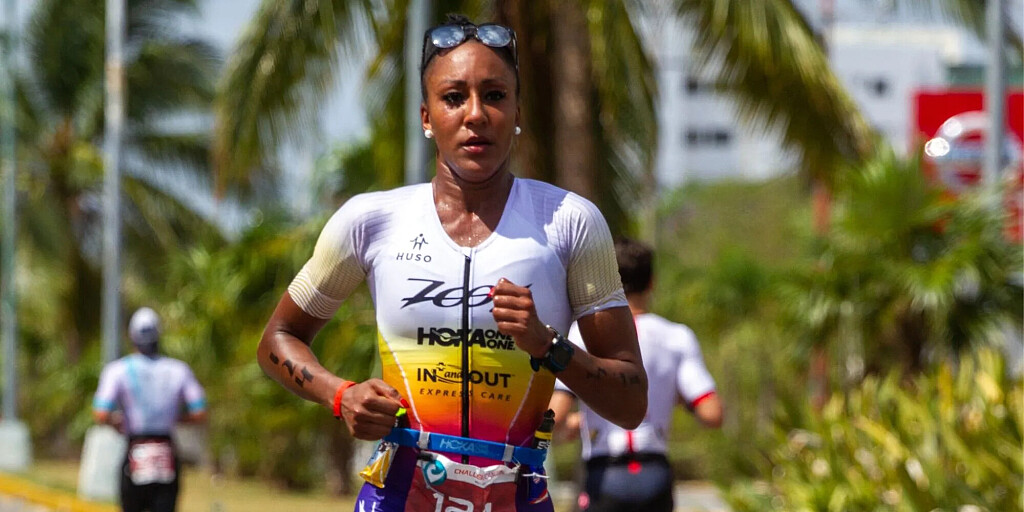
Professional triathlete Sika Henry will compete at Comrades Marathon
The pro triathlete believes she may have found a new sweet spot with ultra distances.
Sika Henry has never shied away from new challenges. After spending several years working to qualify for her pro card and becoming the first Black American woman to do so in May 2021, she shifted toward a new focus of ultramarathons.
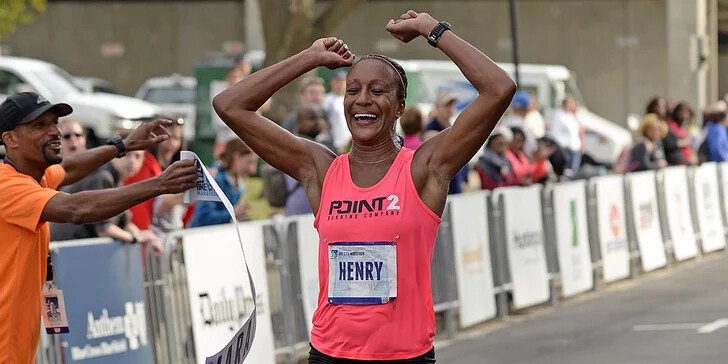
Henry’s first was the 2021 JFK 50 Mile in Maryland, where she finished as the second overall woman. Nearly a year later, after deciding to take a break from triathlon, she set a record of 8:34:20 with her win at the Dismal Swamp 100K in Chesapeake, Virginia.
It seems the endurance built from triathlons—with its back-to-back-to-back swim, cycle, and run—work better for Henry than a straight-up marathon.
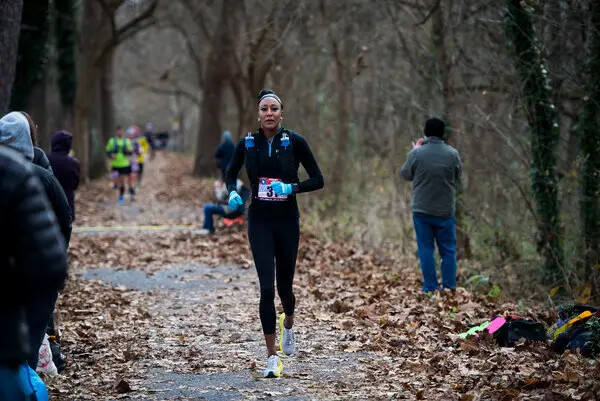
“I think I’m more mentally strong and can endure a lot for a really long period of time, which I think I developed from triathlon,” Henry tells Runner’s World.
Henry’s success at Dismal Swamp set the stage for her next ultramarathon endeavor: the Comrades Marathon, a 90-kilometer race and the world’s oldest ultramarathon in South Africa, taking place on June 11. (The race course, which alternates between Durban and Pietermaritzburg each year, will be run “down” this year.) Henry will be racing as an elite with the Durban-based Phantane Athletics Club, a partnership that came after she met some athletes at last year’s Ironman World Championship in Kona, Hawaii. In addition to the fact that the club will provide her with bottle and fluid support at the race, Henry was also enthused about representing them after learning about how they work to identify talent and give back to underprivileged athletes in South Africa.
Henry’s buildup for Comrades included the Dismal Swamp 100K and an early 2023 marathon at Houston. Next up was the Boston Marathon, where she received a special invitation to race as part of a team along with Alisa Harvey, Ingrid Walters, and Shawanna White to represent Marilyn Bevans, who is known as a pioneer for women’s distance running as the first Black American woman to have broken 3 hours in the marathon.
“[Bevans] has been a bit of an idol of mine for quite some time—one of the reasons why I chased a sub-3-hour marathon was to be part of ‘The List’ [of Black American women who have hit the milestone],” Henry says. “So to come back years later and have all these other races and everything under my belt, it was an honor to get to represent her.”
Henry ended up finishing Boston in 3:08:30 after going in with the plan to use the race as a training run for Comrades by holding a 7:15 to 7:30 pace. Henry found that she was nailing it until she hit mile 21, where Pioneers Run Crew and TrailBlazHers Run Co. were stationed. Henry went on to run the last miles at 6:30- to 6:40 pace, negative-splitting the race by 3 minutes.
(06/08/2023) ⚡AMPby Emilia Benton
Comrades Marathon
Arguably the greatest ultra marathon in the world where athletes come from all over the world to combine muscle and mental strength to conquer the approx 90kilometers between the cities of Pietermaritzburg and Durban, the event owes its beginnings to the vision of one man, World War I veteran Vic Clapham. A soldier, a dreamer, who had campaigned in East...
more...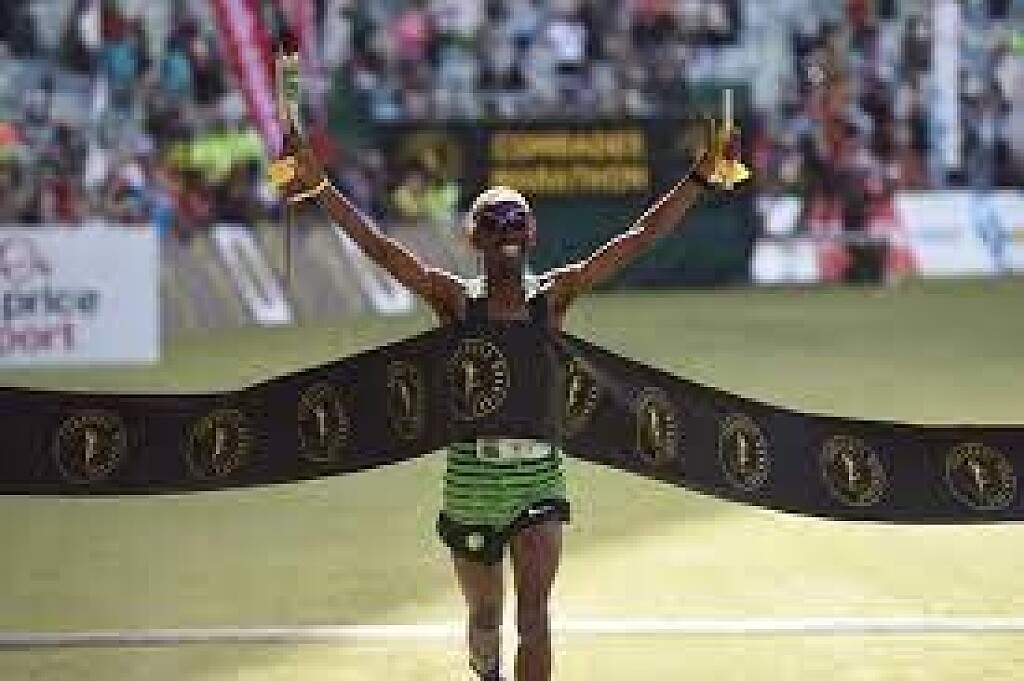
Tete Dijana looks to defend his crown at Comrades Marathon
The 2023 Comrades Marathon is nearly upon us, with thousands preparing to take on the down route from Pietermaritzburg to Durban.
This year’s race has an official race distance of 87.7km, as competitors race for victory in a number of prize categories – the men and women’s winners earning over €20,000.
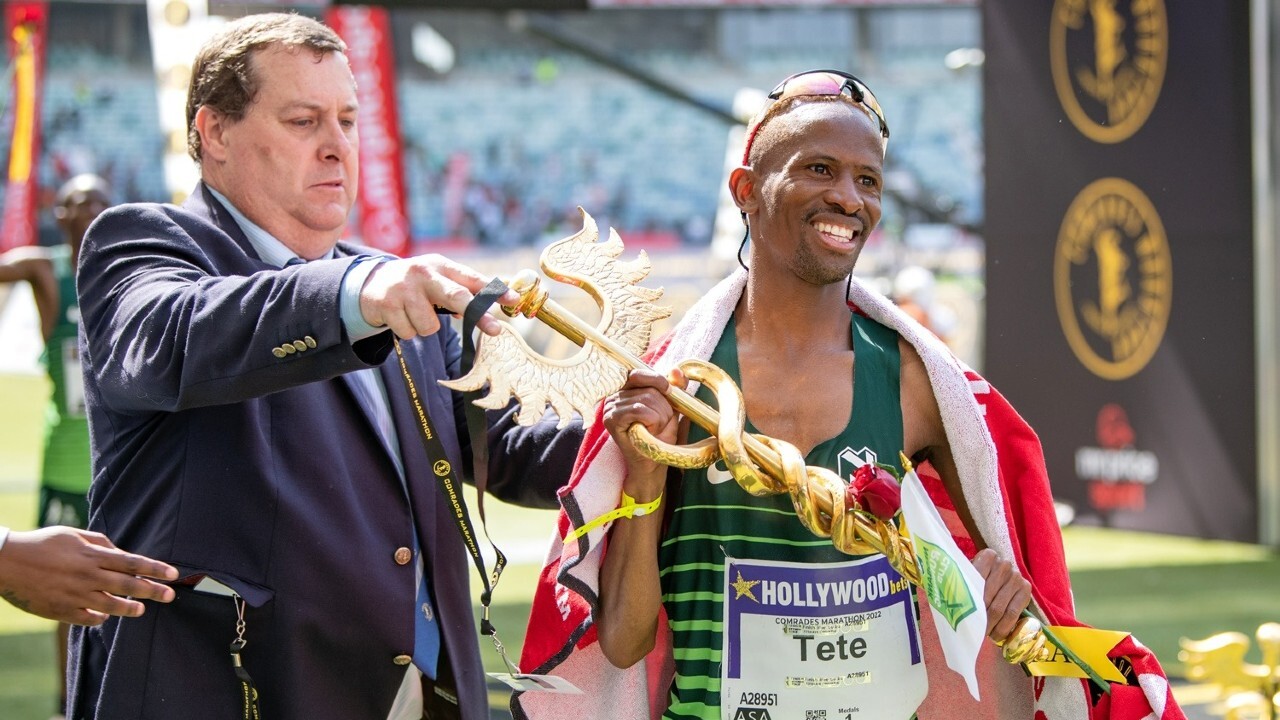
The men’s field this year features a number of past winners – as does the women’s – and promises to be an exciting race from start to finish.
Dijana aims to crown Nedbank again
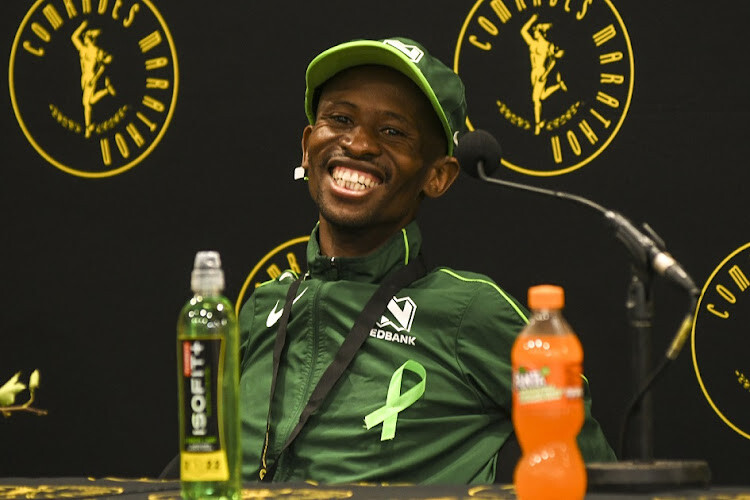
Last year saw five of the top seven finishers all come from the Nedbank running club, but it was Tete Dijana who proved chief amongst them.
He won last year’s race in a time of 5:30:38, with clubmate and 2019 winner Edward Mothibi three minutes behind him and Dan Matshailwe, another Nedbank runner, a further three minutes behind Mothibi.
Expect all those names to feature near the top three, with Nedbank set to work together once more to assert dominance over South Africa’s most famous ultra.
Perhaps the chief non-Nedbank competitor will be 2018 winner Bongmusa Mthembu. Fourth last year, he was the fastest non-Nedbank runner and has set himself more preparation time for the race this year, competing in the Om Die Dam 50km, which he won in 2:56:33.
He is a three time-winner at the Comrades Marathon, his first in 2014 when he was registered with Nedbank, and his other two coming in back-to-back wins in 2017 and 2018 for his current team Arthur Ford.
International talent
The last non-South African to win the race was Stephen Muzhingi, the Zimbabwean taking three titles in a row between 2009 and 2011, and it seems a tall order to expect anyone other than local runners to take the title.
But regardless, there are those who will be competing. British runner Shane Cliffe has finishers in the Lakes in a Day and The Grand Tour of Skiddaw to his name.
There’s also Simon Brown, who has run the Marathon des Sables and qualified for the cancelled Western States 100 in 2020, and experienced runner and coach Ian Sharman.
(06/07/2023) ⚡AMPby Olly Green
Comrades Marathon
Arguably the greatest ultra marathon in the world where athletes come from all over the world to combine muscle and mental strength to conquer the approx 90kilometers between the cities of Pietermaritzburg and Durban, the event owes its beginnings to the vision of one man, World War I veteran Vic Clapham. A soldier, a dreamer, who had campaigned in East...
more...
World-record holder Camille Herron lands a bird feeder after ruling the roost in her final long-distance race before Western States
U.S. ultrarunner Camille Herron broke the men’s course record at a trail marathon in Texas over the weekend, confidently capping off her last long-distance race ahead of the 100-mile Western States Endurance Run at the end of the month.
Herron finished Saturday’s 42.2-km race at the Texas Trail Running Festival in 3:49:47, beating the men’s course record by 1:41 and the women’s course record by almost 29 minutes. She completed the four-loop course at the Grelle Recreation Area trail system in Spicewood, Texas, more than 40 minutes before this year’s top men’s finisher and more than an hour before the marathon’s second-place women’s finisher. There were 10 runners in the women’s category of this year’s race and 57 competitors overall.
Herron proudly displayed her first-place prize—a bird feeder in the shape of a Texas Longhorn—in social media posts over the weekend. “It was a great course and good prep for Western States,” Herron wrote. “I won a really sweet bird house. Thank you @trejatrails for putting on a fun event.”
Herron, who lives in Oklahoma, wrote that it had been a few years since she’d run in Texas and that it was good to be back: “They have a great trail community—I’ll have to come back for more.”
Amid the many congratulations posted in her Instagram feed, Herron was asked if Saturday’s race will be her final long run before Western States, which kicks off in California’s Olympic Valley on June 24. “Yep,” she replied, “ready to roll.”
A “roll” is exactly what Herron has been on at events large and small in 2023. The runner, who has set world records in 50-mile, 100-mile, 100-kilometer, 12-hour and 24-hour events, set the 48-hour women’s world record in Canberra, Australia in March by running 435.336km. If she’s to add to her impressive string of ultrarunning records at this year’s Western States, Herron will have to best the 16:47:19 run by Vancouver’s Ellie Greenwood in 2012. Herron cracked the top 10 in the women’s field at last year’s Western States, running 18:51:54 to place eighth.
Looking beyond Western States, Herron will be among 10 women athletes to compete in Lululemon’s recently announced Further six-day ultramarathon next March.
She noted she’ll also need to fit hanging a birdfeeder into her busy schedule, and that she’s curious to see who flocks to her newest racing trophy. “Can’t wait to see who becomes our new neighbor.”
(06/06/2023) ⚡AMPby Paul Baswick
Western States 100
The Western States ® 100-Mile Endurance Run is the world’s oldest and most prestigious 100-mile trail race. Starting in Squaw Valley, California near the site of the 1960 Winter Olympics and ending 100.2 miles later in Auburn, California, Western States, in the decades since its inception in 1974, has come to represent one of the ultimate endurance tests in the...
more...
Lululemon launching six-day ultramarathon for women in 2024
Lululemon will launch a six-day ultramarathon next year–a step into new territory for the athleticwear brand that it says is aimed at promoting and better understanding the potential of women in endurance sports.
The company says the Further six-day ultra will kick off on March 8—International Women’s Day—on a certified looped course at a location to be announced. Ten athletes are slated to compete in the event: Camille Herron, Devon Yanko, Kayla Jeter, Leah Yingling, Mirna Valerio, Montana Farrah-Seaton, Stefanie Flippin, Vriko Kwok, Xiaomeng Jia and Yoon Young Kang.
“Women are continuing to redefine what’s possible,” says Herron, the American ultrarunner who set the 48-hour women’s world record in Canberra, Australia in March by running 435.336km. “It’s important we have the platform and opportunities to showcase what we’re capable of. Further represents this to me. I’m honoured to join this phenomenal group of athletes, elevate women’s running and celebrate our human potential.”
The multi-day event will give the runners the chance to run the furthest distance of their careers with the opportunity to set world records, says the company.
Lululemon says it will be partnering with Canadian Sport Institute Pacific to conduct research studies on athletes during training and the ultramarathon itself to better understand female endurance performance and human endurance performance in general. Each athlete will have access to sport science and medicine support to inform personalized training programs spanning physical, mental and emotional support. Findings from the research are expected to be published at the beginning of March.
“Women are continuously setting new ultramarathon records, with the difference between male and female performance appearing to get smaller the further humans run,” says Trent Stellingwerf, senior adviser of innovation and research at Canadian Sport Institute Pacific. “However, there is limited research in this space, which creates a biased understanding of human endurance as women are heavily under-represented in sports science.”
Lululemon cites an an audit of select sports science and sports medicine journals that found only four to 13 per cent of published studies were female-only. The new research is intended to address the “limited knowledge around female athletes while bringing awareness to the need for additional research,” says the company.
“Women are historically underserved when it comes to opportunities to compete, research devoted to the pursuit of their goals, and product innovations built with them in mind, yet they continue to push the boundaries of human possibility in sport regardless of the inequities they face,” says Nikki Neuburger, Lululemon’s chief brand officer. “Further is grounded in our purpose at lululemon to unlock greater possibility and well being for all, and we see it as an opportunity to better serve women, solving for their specific unmet needs. With Further, we aim to inspire belief in what is possible for women when they’re supported with resources typically reserved for men.
Canadian multi-day ultramarathoning pioneer Trishul Cherns tells Canadian Running that while organizing a multi-day race may seem to some as unusual territory for Lululemon, he sees many positives in the Further project.
“From my perspective, it puts the spotlight on something close to my heart, multi-day running. The goal of the Global Organization of Multi-Day Ultramarathoners (GOMU) is to make multi-day running mainstream,” says Cherns, who adds the Further project “puts a spotlight on women in multi-day running. Ultramarathons are not just 100 mile trail runs; they are diverse–10-day, 1,000-mile, 3,100-mile races on tracks on roads—just like the group of women that make up this project.”
He applauds Lululemon’s effort to invest more resources and attention to women’s sports. “Their focus is on data capture to further sports science and research on women’s endurance. Brava!” says Cherns. “It’s very true that women are sorely under-represented in the research data and the science of female performance is marginalized or non-existent … Only recently has the discussion of women’s menstrual cycles on sports performance even been openly talked about by women athletes, let alone the subject of serious study.”
Along with its announcement of the Further multi-day ultramarathon, Lululemon unveiled the Blissfeel Trail, the company’s first road-to-trail running shoe. The company says the insights it gains from the Further project will help the company expand on products designed to support women as they go further on their runs.
(06/04/2023) ⚡AMPby Running Magazine
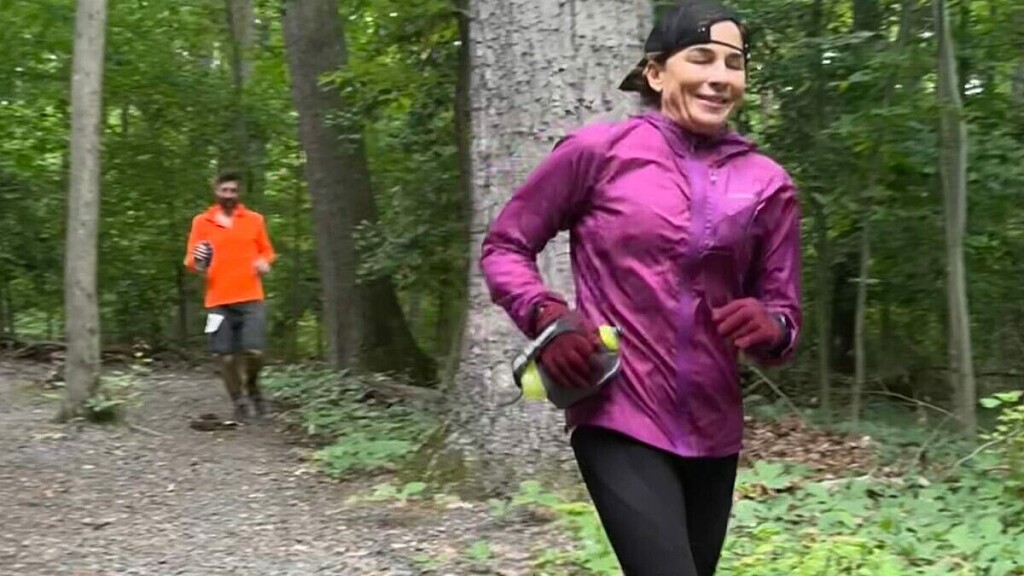
Jennifer Russo Shatters Courtney Dauwalter's Backyard Ultra World Record
The 57-year-old’s new record also makes her the first American female to cover 300 miles in 72 hours.
A mom of three, the 57-year-old from New Richmond, Ohio, completed the multi-day race, which began on Saturday and finished with 74 laps (also called “yards”) of the course, totaling a whopping 311 miles. In the backyard ultra race format, runners must run one 4.167-mile loop, or yard, every hour until one runner is left.
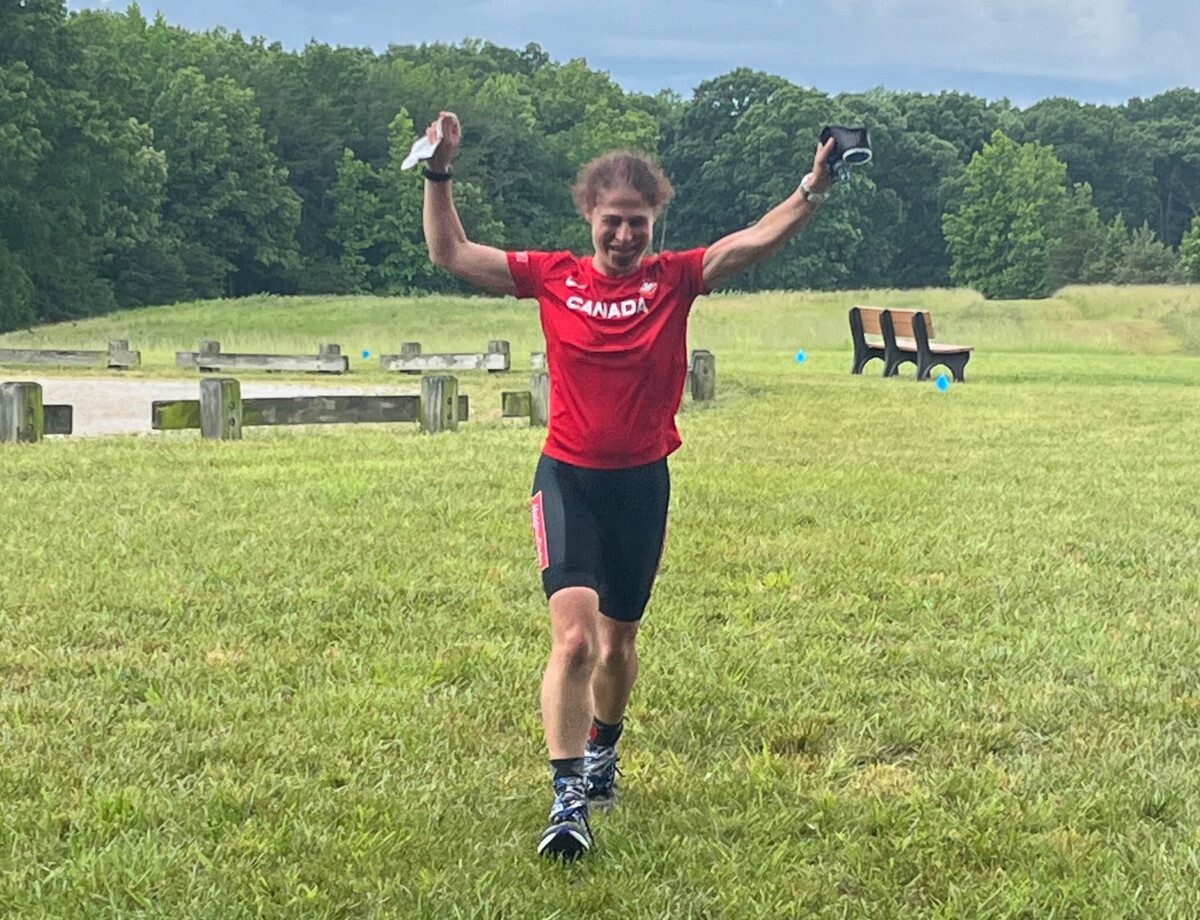
Russo’s new record makes her the first American female to cover 300 miles in 72 hours in any race format, a record that unfortunately won’t be ratified since the course was not USATF-certified. Russo’s performance also ties her for 16th place in the all-time longest distance covered in the backyard ultra format, surpassing the former record of 68 yards set by fellow American ultramarathoner Courtney Dauwalter at Big’s Backyard Ultra, in Bell Buckle, Tennessee, in 2020.
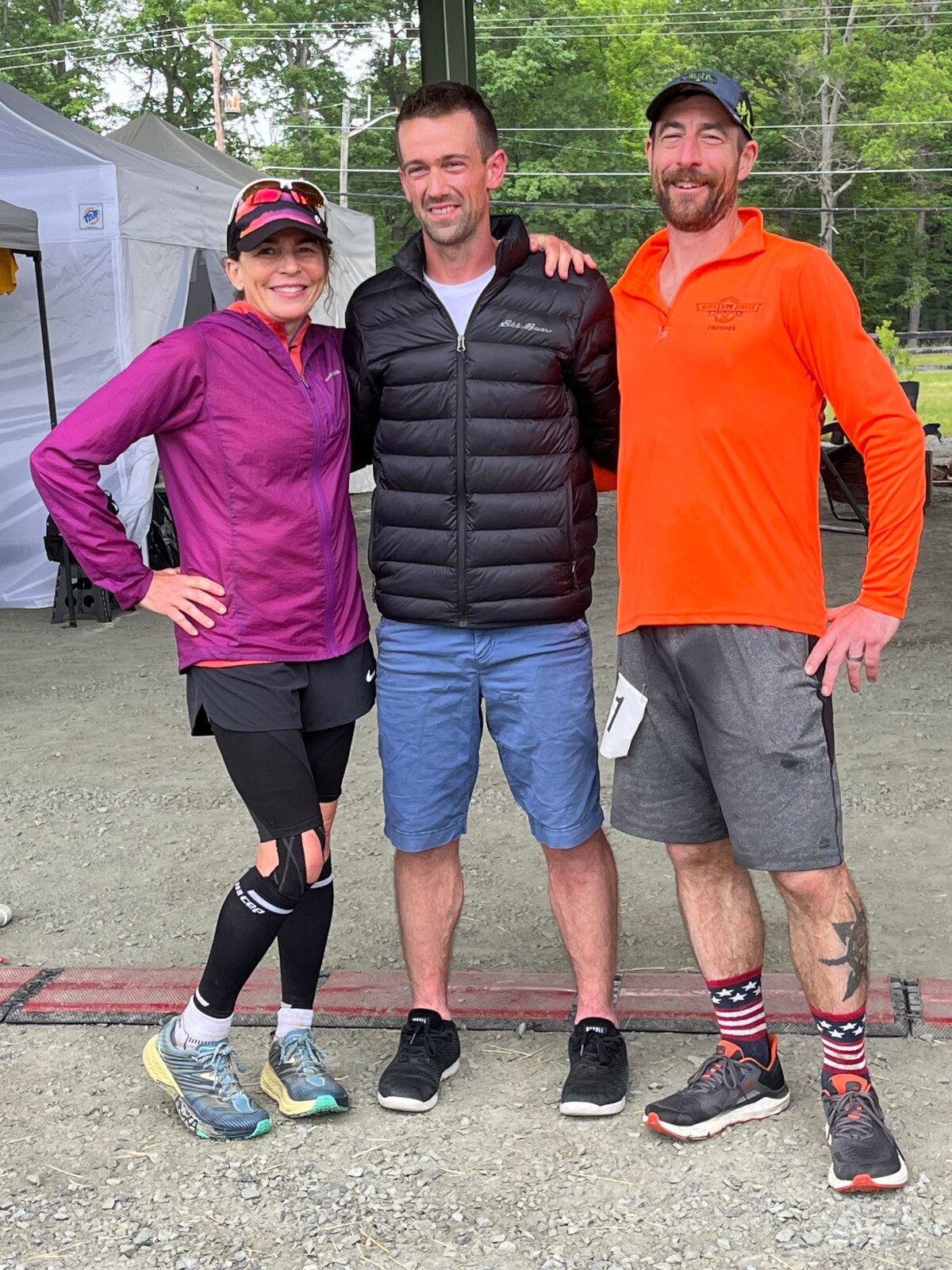
After nearly six hours of competition between Russo and New Jersey’s Scott Snell, Snell emerged as the victor, running 75 yards. Levi Yoder of Dundee, Ohio, finished in third with 63 yards but couldn't complete his 64th.
Elsewhere in the competition, Canada’s Viktoria Brown of Ontario picked up the second-highest number of yards among the six female racers, with 49, finishing the race in the top six. She fell seven laps short of Amanda Nelson’s women’s Canadian backyard ultra record set in Rettert, Germany at the Race of Champions-Backyard Masters.
In addition to (clearly) logging loads of miles, Russo herself is also a race organizer and co-founder of Empower Ultras, which puts on multiple ultra and endurance races throughout the country.
(06/03/2023) ⚡AMPby Runner’s World
Five ridiculous workouts from ultrarunner Aleksandr Sorokin
Lithuania’s Aleksandr Sorokin has five ultrarunning world records to his name, and it is his grueling training sessions and mileage that set him apart from other endurance athletes. Leading up to his recent 100km world record in Vilnius, Lithuania, the 41-year-old averaged 300 kilometers per week, with some ridiculous training sessions. Here’s a glance at a few of them.
1.- 40 reps of 1,000m with 1-2 minutes’ rest
Kilometer repeats can feel long for most runners; now imagine doing 40 of them. This workout from Sorokin is mind-boggling. He averaged three minutes and 28 seconds per kilometer over the 40 reps. According to his Instagram post about the workout, he told his long-time coach Sebastian Białobrzeski that he wanted to cry after finishing rep #20. (Sania, we don’t blame you.)
2.- Three reps of 10K progressions off 1K
Adding progression runs to your training is a great way to improve your endurance and help your body adapt to running longer distances and sustaining higher intensities. It also plays a role in building mental stamina. In Sorokin’s case, this 30K progression workout is to help him get familiar with world record paces when fatigued. This can be a good session for someone training for a marathon, but the workout would be way too much mileage for any distance under 30K.
3.- Five reps of 5K with three minutes’ rest
In the lead-up to the 2023 Seville Marathon in Spain, Sorokin threw down this wild 5K session, averaging 3:15-3:20 per kilometer off three minutes’ rest between reps. The 41-year-old ended up placing 118th overall in a time of 2:25:33.
If you switch the workout to three or four reps with the same amount of rest, it can be a good workout for those training for a half-marathon or marathon, as it simulates your race effort.
4.- 10 reps of 2K, off 1K float
This might be the least ridiculous Sorkoin workout of the five, but it’s still 30 kilometers of volume and done at a fast pace. Similar to the 5K workout above, this can be done at your goal half or marathon pace. The thing about float rest is, you have the ability to mark the workout as hard as you want. The faster you float (faster than a jog), the harder the workout will be, and vice-versa.
5.- 42-kilometer steady run
A week after breaking his 100K record by six seconds in 6:05:35, the Lithuanian star celebrated his achievement on his Strava in typical ultrarunning fashion, heading out for a casual 42.2-kilometer steady run in two hours and 50 minutes.
Sorokin hasn’t always been a runner; he did not start until 2013, at 32. In a 2021 interview with Canadian Running, Sorokin told us that he began running to get in shape, when he weighed 100 kg (220 lb.). “At the time I wasn’t playing any sports, just drinking and smoking a lot,” he said. After a few months of training, he entered a half-marathon, and a few weeks after that, he saw an advertisement for a 100 km race in Lithuania and began his ultrarunning career. (And the rest is history.)
(06/02/2023) ⚡AMPby Marley Dickinson
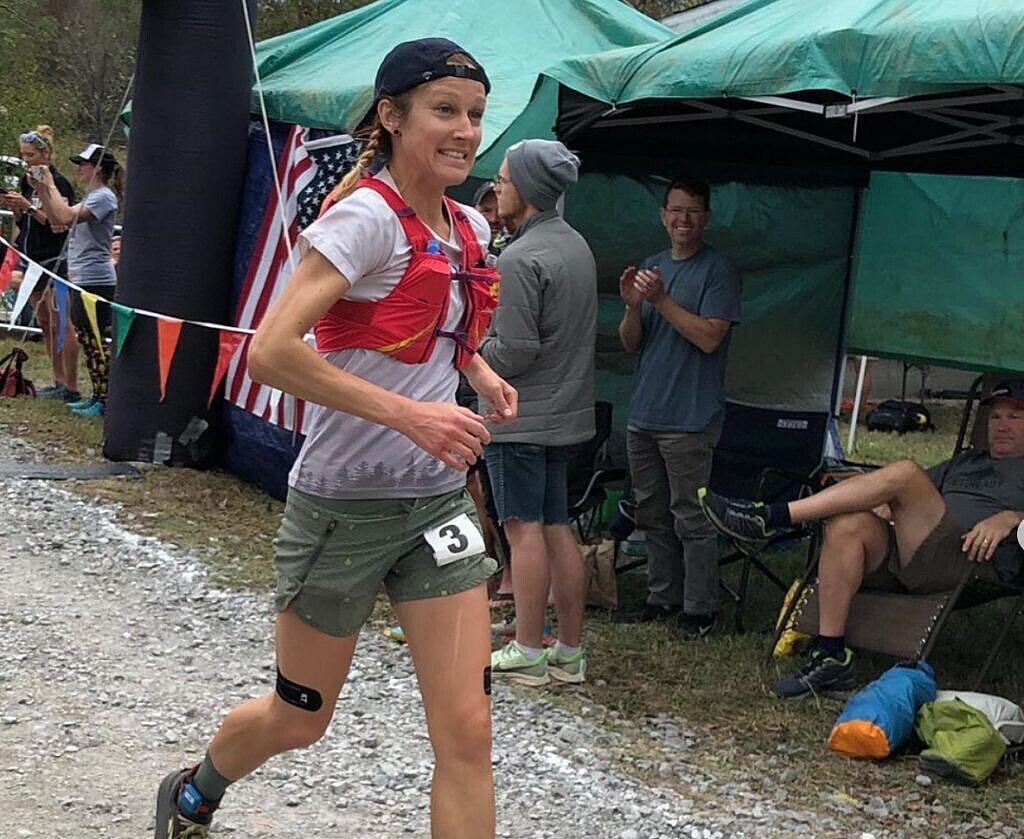
U.S. ultrarunner breaks Courtney Dauwalter’s backyard ultra world record
American ultrarunner Jennifer Russo has set a new women’s backyard ultra world record by completing 496.21 km at the Capital Backyard Ultra in Lorton, Va. The 57-year-old mother of three from New Richmond, Ohio, finished the multi-day race Tuesday after running 74 yards—or 74 laps of the 6.706-km course—in a contest that began Saturday.
The backyard ultra race format requires participants to start one “yard” (loop) every hour on the hour, until only one runner remains. (Backyard racing is designed so that theoretically, runners can complete the 100-mile distance in 24 hours.)
Russo’s latest effort tops the previous women’s world record of 68 yards set by American Courtney Dauwalter at Big’s Backyard Ultra in Bell Buckle, Tenn., in 2020. With this week’s race in Lorton, a suburb of Washington, D.C., Russo also becomes the first American female to reach 300 miles (482.8 kilomtres) within 72 hours in any race format. Her 74 yards also puts her in a four-way tie for 16th for the longest distance ever covered in the backyard ultra format.
These achievements came at the end of a gruelling standoff between Russo and Scott Snell of New Jersey. The pair battled alone on the course for almost half a day after Levi Yoder of Dundee, Ohio, who finished with the third-highest total of yards, couldn’t complete his 64th lap. Snell ultimately outlasted Russo in the showdown, winning the event by running 75 yards, or just under 503 km.
The race also saw an outstanding effort by Canada’s Viktoria Brown. The runner from Whitby, Ont., racked up the second-highest number of yards among the race’s six female competitors, completing 49 yards and finishing the race in the top six. Brown, who in March broke her own 48-hour Canadian and 72-hour world records at the GOMU (Global Organization of Multi-Day Ultramarathoners) six-day world championships in Policoro, Italy, came just seven laps short of the women’s Canadian backyard ultra record set by Amanda Nelson of Woodstock, Ont., earlier this month at the Race of Champions-Backyard Masters in Rettert, Germany.
Fellow Canadian Justin Wright also cracked the top 10 at the Capital Backyard Ultra. The runner from Leamington, Ont., completed 36 yards—241.4km—to finish 10th overall in the field of 31 competitors.
(05/31/2023) ⚡AMPby Paul Baswick
Top Four Endurance Races for Amateurs in the World
Participating in the top leagues and renowned racing events might require professional training. Experience is also an added advantage as it gives contestants an edge in the competitions. Such requirements can frustrate amateurs from participating in races due to the fear of being outshined by the experts.
Fortunately, there are various races around the world that are suitable for amateurs. These amateur races allow inexperienced sportspersons to rate and build their skills. In this article, we explore the best four endurance races for amateurs.
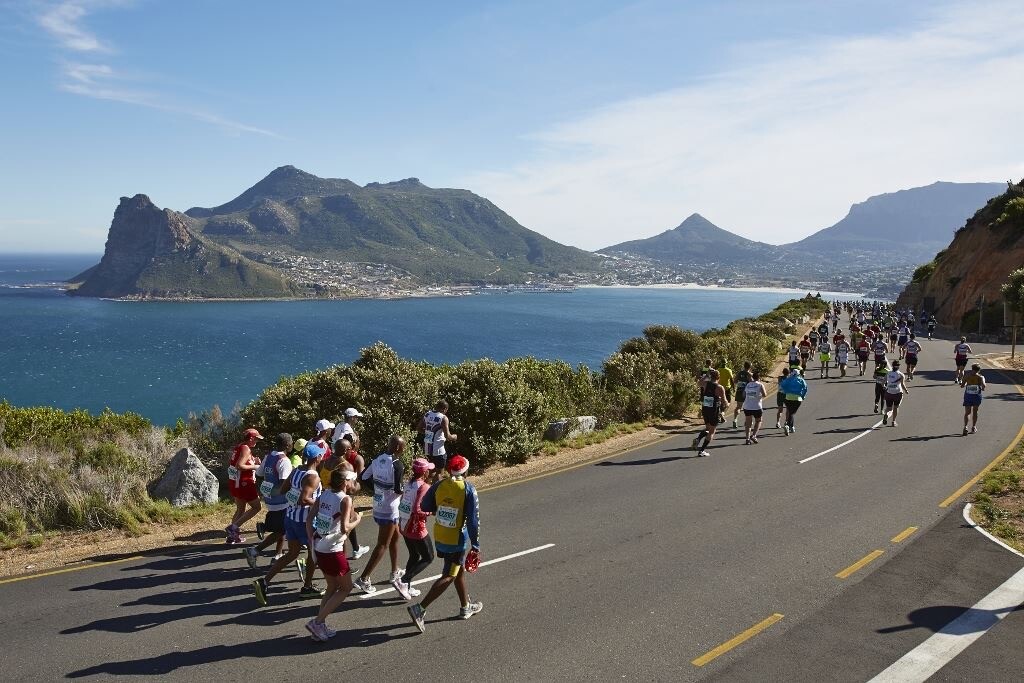
Amazon River International Raft Race
This race is hosted every September in Peru, in a city that is only accessible by water or air. The Amazon River International Raft Race isn’t known widely due to its non-operational Facebook page and poor-quality website. Because of this, it doesn’t appeal to professional paddlers. Despite its downsides, this race offers the perfect gruesome challenges for amateur contestants.
The race comprises teams of four participants that build balsa wood rafts and use them to paddle 180 kilometers down the Amazon River from Nauta Town to Peru City. The Amazon River International Raft Race has been recognized as the longest raft race in the Guinness Book of World Records. Participants are advised to carry mosquito repellants, A535s, and some sunscreen. If you join this race, expect to compete with more than 30 inexperienced contestants.
The Canadian Mini Indy
This race is more enjoyable and also challenging for contestants. The Canadian Mini Indy hosts over 100 amateurs and professionals. The contestants have to be aged between 8 to 65 years to participate. It is an arrive-and-drive rookie race, where contestants are provided with a go-kart that can reach a top speed of 80 km/hr. This 6-hour race poses a gruesome challenge where speed won’t guarantee success. Racers need patience, consistency, and strategy to finish it.
The thrill in this amateur race can also be enhanced by online wagering. Nothing beats the joy of predicting the success of your favorite contestant and getting it right. If you are in Alberta, with the guidance of reliable web sources, you can safely place your alberta bets OR alberta sports betting predictions on a trusted wagering platform. Through these top-rated platforms, you can also bet on all other popular sports.
Wulong Mountain Quest
This race always takes place in the beautiful Wulong County in Southern China. It is a prominent amateur adventure race that provides several obstacles for the participants. This entire race has 3 phases which last for 3 days. It also has around 20 to 25 participating teams, each with around 4 contestants. The first day is fast-paced as contestants will be engaged in much cycling, paddling, and running.
Navigation in this race is easier due to the properly marked roads. The scenery, including the limestone formations and a UNESCO World Heritage Site, also gives racers and spectators a great outdoor experience. The closing and opening ceremonies are unique and exciting, especially for visitors.
Two Oceans Marathon
This 45-year-old race provides a 56 km challenge for contestants in Cape Town, South Africa. Two Oceans Marathon is a globally reputable ultra-running race. It has the most appealing scenery because the competitors will be running on gorgeous roads, including Chapman’s Drive. Besides the massive elevation gain and loss, the heavy winds pose an enormous obstacle for the runners.
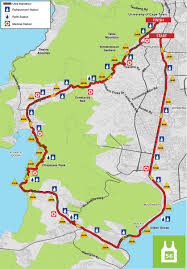
Since the Two Oceans Marathon is known worldwide, it typically attracts over 100,000 contestants. This race provides a perfect ground for amateurs to perfect their skills. (See photos)
Conclusion
You don’t have to get to the professional level before participating in races. There are many renowned races for amateurs. However, some allow both professionals and amateurs to compete in the same quest. Such races offer an opportunity for inexperienced contestants to match up their skills with professionals and learn from them. Participating in such races is a great way to develop your racing skills.
(05/30/2023) ⚡AMP
Candice Burt tapering off after 200 ultras in 200 days
Candice Burt completed her 200th ultramarathon in 200 days earlier this week and says her body is holding up well after the staggering feat.
The American is set to claim the Guinness World Record once her endeavour is verified, with the previous best for consecutive days running an ultra marathon standing at 22.
Burt, whose company Destination Trail is behind the Triple Crown of 200s – Tahoe 200, Bigfoot 200 and Moab 240 – covered over 6,400 miles after setting off on November 5, 2022.
She even ran the HURT 100 in Hawaii to continue her streak on days 71 and 72, a brutal race David Goggins has taken on four times, failing to finish in 2012.
Mental resilience
“Every morning I woke up and got it done no matter what,” she wrote on Instagram after finishing her final ultramarathon. “Thank you to the men and women who set the bar before me!”
“Records inspire us to find within ourselves courage and discipline to advance humanity
“This run has been about me trusting my body & adapting to every demand I encountered along the way. It is a personal quest, one in which I looked to satiate my curiosity about endurance, my body, running and the mind.
“That fire has only grown.
“My heart is content and I’m excited about my future adventures and spending the summer with my kids exploring Colorado.
“It’s truly incredible how good my body feels, although I’ll be the first to admit it’s changed a lot of the past 200 days. Some changes are good, some are not.”
Easy marathon
Burt is now in the process of winding down after her eye-watering schedule, but still ran a typical marathon – 26.2 miles – the day after her 200th ultra, undeterred by an “epic” thunderstorm in the latter stages.
“One thing that is really surprising to me is that a marathon today felt way easier than doing an ultramarathon,” she wrote in another Instagram post.
“I don’t have much fatigue running even 20 miles, but as I taper off the world record, part of me seems to be allowing myself to think, ‘my legs feel tried today’ instead of having to box that up and file it away.
“When you’re running a 50k a day no matter what, your feelings don’t really matter. Pain or tension in the body is used to indicate where to focus on any rehab/PT rather than to feel sorry for myself or shorten the run.
“This allowed me to grow, adapt and achieve a higher level, but it came at some cost.
“What’s the cost? There’s a bit of a disconnect between my feelings and sensations and the run. Those sensations — at least the pain or immobility ones—are saved for after the run and only for the context of treatment. My feelings, when negative, were filed away completely because they weren’t needed or helpful.
“I think learning to do this is very helpful in many endeavours. But to live in the world outside the runs I sometimes need to access these things more readily. Just an observation – one that I hope to delve into a bit more at some point.”
Flexibility decrease
Burt reiterated that her physical condition is remarkably solid, aside from some understandable stiffness following her relentless running effort.
“Let’s talk about my body: physically I feel great. There are times I’m not sure if its as great as I think or if I just got used to a high level of tension. I will get up and I can tell my muscles are sharp and ready.
“My flexibility has been significantly reduced in favor of stability and propulsion. This serves me well when running, but can make other daily tasks harder.
“For example, I cannot sit on my heels with my toes under me stretching the bottom of my feet. My feet simply don’t stretch like that anymore.”
Burt is eyeing more record-breaking runs in the future, but for now, she is enjoying a return to normality and spending time at home with her children.
(05/27/2023) ⚡AMP
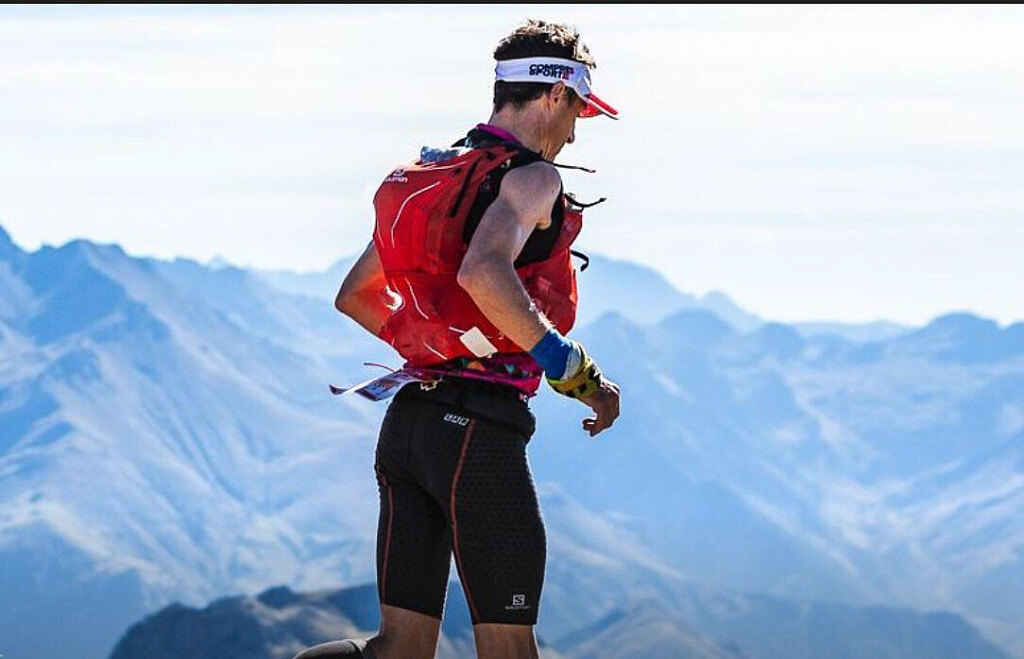
Canfranc to host 2025 World Mountain and Trail Running Championships
The third edition of the World Mountain and Trail Running Championships (WMTRC) will take place in Canfranc-Pirineos, Spain, between 25-28 September 2025.
The awarding of the event to Canfranc in the Pyrenees follows a successful bid by the Government of Aragon, the Canfranc Town Council, the Huesca Provincial Council, the Higher Sports Council and the Royal Spanish Athletics Federation (RFEA) to event partners the International Association of Ultrarunners (IAU), the International Trail Running Association (ITRA) and the World Mountain Running Association (WMRA), alongside World Athletics.
As well as the four-day elite race programme, the event will include a summer-long cultural and leisure festival to promote the Pyrenees Mountain Range.
Around 1700 athletes from 70 countries are expected to meet in September 2025 in Canfranc-Pirineos, which takes over from Innsbruck in Austria – host of the next edition of the championships, taking place this year between 6-10 June.
The race programme will feature uphill mountain running, classic up and down mountain running, short trail, long trail and U20 classic up and down mountain events.
“On behalf of the LOC, we are thrilled to be hosting the 2025 World Mountain and Trail Running Championships in our country and look forward to welcoming the best mountain and trail runners from all corners of the globe,” said RFEA President Raul Chapado.
“As a team, we express our deep satisfaction and appreciation to World Athletics and its partners WMRA, IAU and ITRA for choosing our beautiful region of Canfranc and the stunning Aragonese Pyrenees as the venue for this world-class event.
“The championships offer a unique opportunity for fans to witness the best mountain and trail runners from around the world compete in an unparalleled natural environment. We are excited to collaborate with the public administrations, sponsors and volunteers to leave a permanent legacy and create an unforgettable experience for all participants.”
The Aragonese proposal was backed by great experience in the organisation of sporting events such as the Canfranc-Canfranc, an annual event that features two Gold level Valsir Mountain Running World Cup races.
Canfranc-Pirineos offers a superb sporting environment, which will allow each athlete to perform to the best of their ability and create a complete competitive experience for athletes, teams, federations and international associations. That is proven by the list of world champions who have run and won at the Canfranc-Canfranc: from Kenya’s Joyce Muthoni Njeru to USA’s Grayson Murphy and Britain’s Charlotte Morgan, as well as Spain’s Oihana Kortazar, Manuel Merillas, Luis Alberto Hernando and Daniel Osanz.
In 2024, the Canfranc-Canfranc will host the World Masters Championships, before the region welcomes athletes for the World Mountain and Trail Running Championships in 2025.
Events due to take place as part of the associated festival include a series of awareness days, with emphasis on respectful use of the environment, and a natural running congress on the technical history and future convergence between the disciplines of athletics in nature: cross country, mountain running and trail running.
“It is our great pleasure to see the joint initiative to organise the World Mountain and Trail Running Championships continue its great momentum and we are excited that the third WMTRC will take place in Canfranc, Spain, in 2025 in the beautiful Pyrenees – a paradise for mountain and trail running,” said ITRA President Janet Ng, IAU President Nadeem Khan and WMRA President Tomo Sarf in a joint statement.
“It will be the second time that the championships have been held in Europe. The initial event took place in Chiang Mai, Thailand, and was a huge success. We are confident that the second edition in Innsbruck and Stubai will build on that in the coming days and that the third edition in Canfranc will reach even greater heights.
“We would like to thank the bidding committee, the Spanish athletics federation and World Athletics for all the cooperation and support during the application process to host the championships. The bidding committee worked extremely hard to prepare a compelling and impressive bid and we are all very much looking forward to being in Canfranc with the world’s best athletes in 2025.”
Innsbruck-Stubai entries confirmed
A total of 1122 athletes from 67 member federations are entered to compete in the next edition of the World Mountain and Trail Running Championships, taking place in Innsbruck-Stubai in Austria between 6-10 June.
That number includes 506 athletes entered into 574 women’s events and 616 athletes entered into 710 men’s events, with the programme featuring uphill mountain running, classic up and down mountain running, short trail and long trail. U20 men and women will compete in classic up and down mountain running.
USA’s Allie McLaughlin and Adam Peterman, Kenya’s Patrick Kipngeno, Norway’s Stian Angermund, Romania’s Denisa Dragomir and Blandine L'Hirondel of France were among the winners at the inaugural World Mountain and Trail Running Championships, held in Chiang Mai, Thailand, in November.
(05/27/2023) ⚡AMPby World Athletics
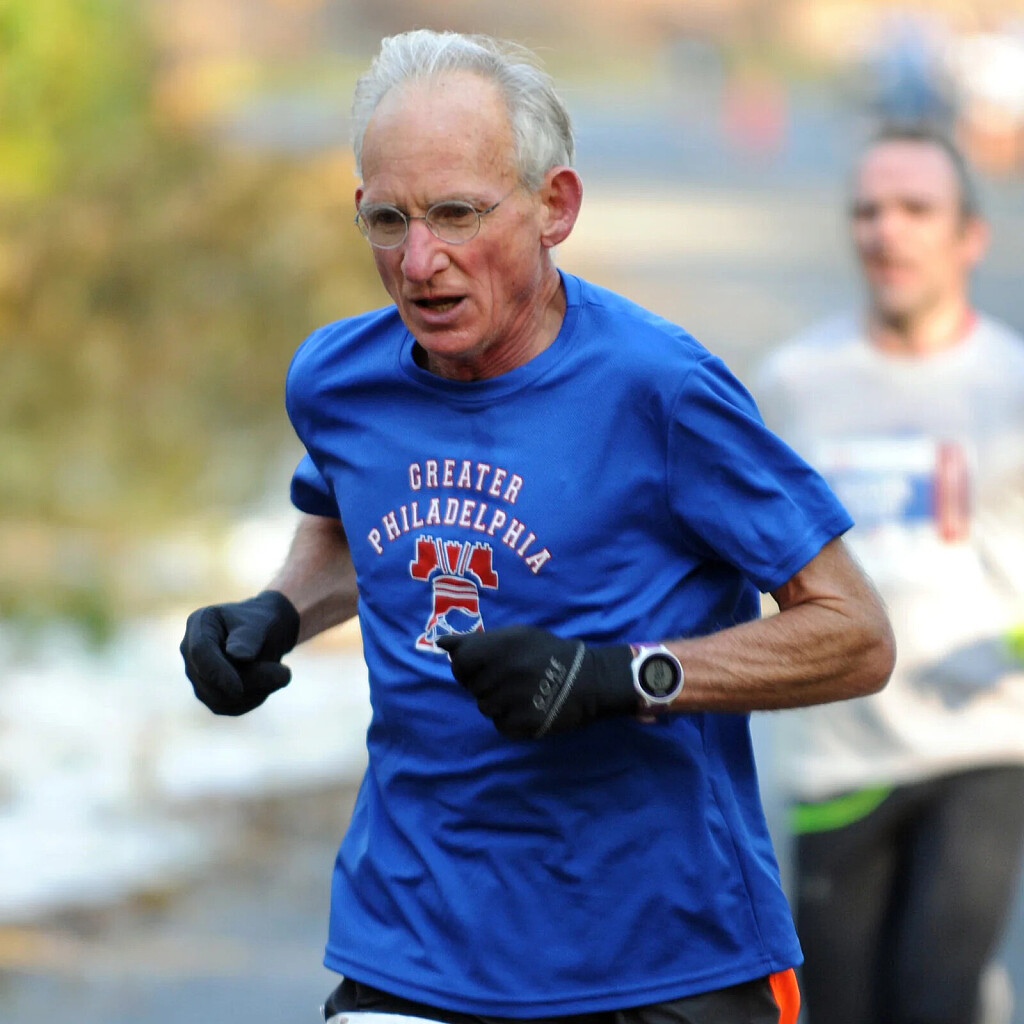
Gene Dykes, 75, sets seven U.S. masters records
Accomplished ultrarunner Gene Dykes, 75, looks to have set no fewer than seven U.S. masters records at a 12-hour race in his home state of Pennsylvania over the weekend, surprising himself as he pushed past health issues to pass the 100-km mark with 400 metres to spare.
The records, which have yet to be ratified by USA Track and Field, include the fastest outdoor track times in the U.S. men’s 75-79 category for 25K (2:48:33), 30K (3:24:08), 50K (5:40:39), 20 miles (3:41:28), 50 miles (9:25:10) and 100K (11:56:26), and the longest distance run in that category for a 12-hour period (100,481 metres). Dykes set the records during his 12-hour overnight effort at the Dawn to Dusk to Dawn Track Ultras in Sharon Hill, Pa., on May 13-14.
The 100K record was the most surprising to Dykes, who has broken multiple records since he took up competitive racing in his 60s. “I didn’t think I had a prayer,” he says. “It’s hard running 100K at my age. I only made it by four minutes.”
Making his latest effort even more remarkable was the fact he was battling a host of health issues on race night.
“I told people I’m battling the three C’s out here,” says Dykes. “Two weeks ago I contracted COVID, and I also had cold symptoms going into the race. Six months before I had been diagnosed with blood cancer, and that’s been really hurting my fast pace, but I have this theory that it doesn’t affect ultra paces and that seems to have really been borne out here. The only symptom I have is that I can’t breathe hard enough when I run fast, but when you’re running 12 hours, you’re never running hard. I was really happy to be able to get through 12 hours with all those health problems.”
Dykes says although he has been sitting out races recently due to health challanges, it was important for him to step up to the starting line over the weekend, as he prepares to make history next month as the oldest finisher of the 100-mile Western States Endurance Run.
“I kind of had to take a chance, because the really big race is next month,” says Dykes. “That’s a big deal. I’ve got a sponsor, and everybody’s expecting me to become the oldest-ever finisher there. So I thought, If I can’t run for 12 hours, how am I going to run for 30 hours?”
The self-described “ultra geezer” says his race on the weekend—his longest since receiving his cancer diagnosis—is a good confidence booster ahead of Western States.
“When you haven’t done something that like in a while, doubts creep in. A lot of things could have gone wrong. I could have got nauseated, I could have bonked, running out of glycogen, in which case you’re going to slow down no matter how much you want to run faster. None of those things happened. You get in this strange mindset where you just kind of dial out misery and keep on going.”
Reflecting on his latest effort with humility, Dykes says many of the U.S. masters records he set on the weekend were “low-hanging fruit,” saying he could “think of a half a dozen 75-year-olds out there” who could have set records in the 25- and 30-km distances “if they had the mind to.”
He adds, however, that he was proud to have hit the 100-km distance under the wire. “At 50 km I asked my crew to find out the new pace I would have to run over the next 50 km for the 100 km. I had to pick up from my comfortable pace. I thought I don’t care if I have no chance—I’m going to run the pace I need and keep doing it until I can’t do it anymore.’ Somehow, for seven hours I managed to keep pushing myself right up to the ending bell.”
Dykes is now looking forward to bringing that same determination to Western States on June 24-25. “It’ll be fun trying,” he says. “There are just so many ways to enjoy running. I’m really fortunate.”
(05/17/2023) ⚡AMPby Paul Baswick
Western States 100
The Western States ® 100-Mile Endurance Run is the world’s oldest and most prestigious 100-mile trail race. Starting in Squaw Valley, California near the site of the 1960 Winter Olympics and ending 100.2 miles later in Auburn, California, Western States, in the decades since its inception in 1974, has come to represent one of the ultimate endurance tests in the...
more...
NHL legend Zdeno Chara crushes 50K ultra-trail race
Three weeks after finishing the Boston Marathon, the former 6'9" foot defencemen took on a 50K ultra-trail race, finishing eighth overall.
Zdeno Chara may have found his new hobby: ultrarunning. On May 13, the 46-year-old completed his first ultra-trail race at the Watuppa Trail 50K in Fall River, Mass., and performed admirably.
“I tried a new distance today,” Chara wrote on his Instagram. “I can’t thank my team enough for their incredible help and support for my first ultra trail race.”
Despite lacking ultra experience, the former 6’9 foot defencemen finished the 50K in eighth overall, in 5:07:29, and even took second place in his 40-54 age category.
Since retiring from the NHL in 2022, Chara has found an interest in distance running. He completed the 2023 Boston Marathon in a very respectable time of 3:38:23; he also raised USD $33,333 for The Hoyt Foundation during his campaign.
Chara holds the all-time NHL record for most games played by a defenceman, with 1,680. He played for four teams over his 20+ year career, starting with the New York Islanders, Ottawa Senators, Boston Bruins and Washington Capitals.
Chara entered the race with his friend and training partner Becca Pizzi, who won the 50K outright in 3:59:11. Pizzi also helped pace Chara for his first marathon last month.
We think it’s only a matter of time until we see the big man take on a 100-miler.
(05/16/2023) ⚡AMPby Marley Dickinson
Lithuania's Aleksandr Sorokin Improves His Own 100km World Record
Aleksandr Sorokin broke the world 100km record at the Nord Security World’s Fastest Run in Vilnius on Sunday (14).
His winning time of 6:05:35, pending ratification, is an improvement of three minutes and 39 seconds on the previous official world record of 6:09:14, set by Japan’s Nao Kazami in 2018. Sorokin had clocked 6:05:41 in a 100,000m race on the track last year but it was not ratified as a world 100km record.
Competing in a field of 30 international ultra-runners on a 1.644km circuit in the Lithuanian capital, Sorokin ran his own race in a bid to break the record. He covered the marathon distance in about 2:32:30, just seven minutes shy of the PB he set for that discipline in Seville earlier this year.
He maintained that rhythm as he reached half way in just under 3:02, putting him well on course to break Kazami’s record. With temperatures now at 19C – the race having started at 6am local time – Sorokin’s pace barely dropped in the second half as he crossed the finish line in 6:05:35.
“I am extremely happy that I managed to break a world record and that I did so in my native city,” said the 41-year-old. “Vilnius is the city where I started running and it’s my great pleasure to thank it by making history right here.”
(05/16/2023) ⚡AMPby World Athletics
This Ultrarunner Is Living in a Glass Box for 15 Days
During the experiment, Krasse Gueorguiev will have only a bed and a treadmill
Krasse Gueorguiev, a Bulgarian ultramarathon runner, will spend 15 days in a glass box in a park in Sofia, Bulgaria, to raise money to help young people battling addiction.
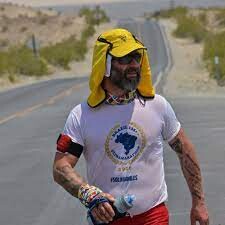
Gueorguiev, a motivational speaker and charity ambassador, has run nearly 30 ultramarathons worldwide, from the Arctic to Cambodia, including the 135-mile Badwater Ultramarathon in Death Valley, California.
"I want to challenge myself," Gueorguiev told Reuters. "I want to show when you put someone in the box how psychologically they change."
Proceeds from the stunt will be used for several projects aimed at preventing addiction for children under 18, not just for drugs and alcohol—the runner also hopes to help teens avoid addiction to things like social media and energy drinks.
On Sunday, the runner was placed in a box with three glass walls on a pedestal in front of the National Palace of Culture in Sofia (Bulgaria's capital). During the experiment, Gueorguiev will have only a bed and a treadmill, with no access to books, a computer, or a phone. He will only be allowed to speak to members of the public for 30 minutes each day.
"This is not a physical experiment; it is a psychological experiment," he said.
If the stunt sounds familiar, you may remember magician David Blaine undertaking a similar experiment in 2003. The illusionist spent 44 days in a glass box suspended over the River Thames in London.
The stunt was met with much public outcry, though, unlike Gueorguiev, Blaine's time in the box was for entertainment purposes only. He endured drumming from the crowd in the evening hours and having eggs and other items hurled at his temporary home. The magician seemingly took it all in stride. "I have learned more in that box than I have learned in years. I have learned how strong we are as human beings," Blaine told reporters after emerging from the box. Upon completing the 44 days, Blaine was noticeably thinner, with depleted muscle mass and a thick beard.
Only time will tell if a similar fate inside the box will befall Gueorguiev.
This is also not the ultrarunner’s first attempt at performing a stunt in the name of goodwill. In 2019, Gueorguiev ran about 750 miles through Bulgaria, North Macedonia, and Albania to urge the governments to build better infrastructure, and in January of 2018, Krasse ran for 36 hours straight on a treadmill at a Sofia shopping mall.
(05/06/2023) ⚡AMPby Runner’s World

Setting running goals when you’re slowing down
Time waits for no one, as those of us who obsess over chip times know too well. Much of the thrill and focus of running boils down to besting ourselves, and that usually means covering the same courses and distances faster than we ever have before.
But there comes a time when we are no longer able to outrun ourselves. Age catches up, and at some point it becomes painfully clear that our fastest days are behind us.
But slowing down doesn’t mean all our PBs are suddenly set in stone or that we’re unable to achieve new firsts as runners. As we mature as runners, so too can the nature of our goals. Stop the clock and consider these alternatives to time-centric goalsetting
Go the distance
Running to set a personal best based on distance can add depth and variety to goalsetting. Going farther than you ever have is a challenge equally suited to longtime runners who have been building their fitness and endurance over years and decades, and fledgling runners who are taking up the activity later in life. The beauty of distance-based goalsetting is that it invites creativity. You might want to challenge yourself to finish your first ultra. Those more inclined to stick to shorter routes might find weekly, monthly or yearly distance goals a better fit. Runners in their retirement years who may now have more opportunities to travel can try smashing their record for most miles run outside Canada in a single year. Couples who have more time to connect can strive for new records for distances run together. Distance goals can be tailored to meet just about any runner’s strengths and schedule.
Get on a hot streak
Being consistent is both one of running’s greatest virtues and steepest challenges. Aiming to see a streak through to a new PB can really test your mettle, but it’s a goal that’s accessible to runners of all abilities. Streak-setting doesn’t exclude the super-speedy, like New Zealand’s Nick Willis, who last year marked his 20th straight year of running a sub-four-minute mile. That said, successful streaks can be a well-earned source of pride for runners who stick with running 1 km every day for a month, or 10 km every month of the year. Like distance-focused goals, streak targets are limited only by a runner’s imagination.
Consider non-performance goals
Slowing down offers us an opportunity to reflect on our relationship with running and to consider ways to make it deeper and more meaningful. An option worth considering is making the shift to a more supportive role. This might mean crewing a friend or family member’s attempt at an ultra-marathon, or dispensing water or medals as a volunteer at an upcoming half-marathon. Volunteering can also be a pathway to becoming a vital part of a world-famous race you always wanted to experience in-person but never got the chance to as a competitor.
(05/02/2023) ⚡AMPby Paul Baswick
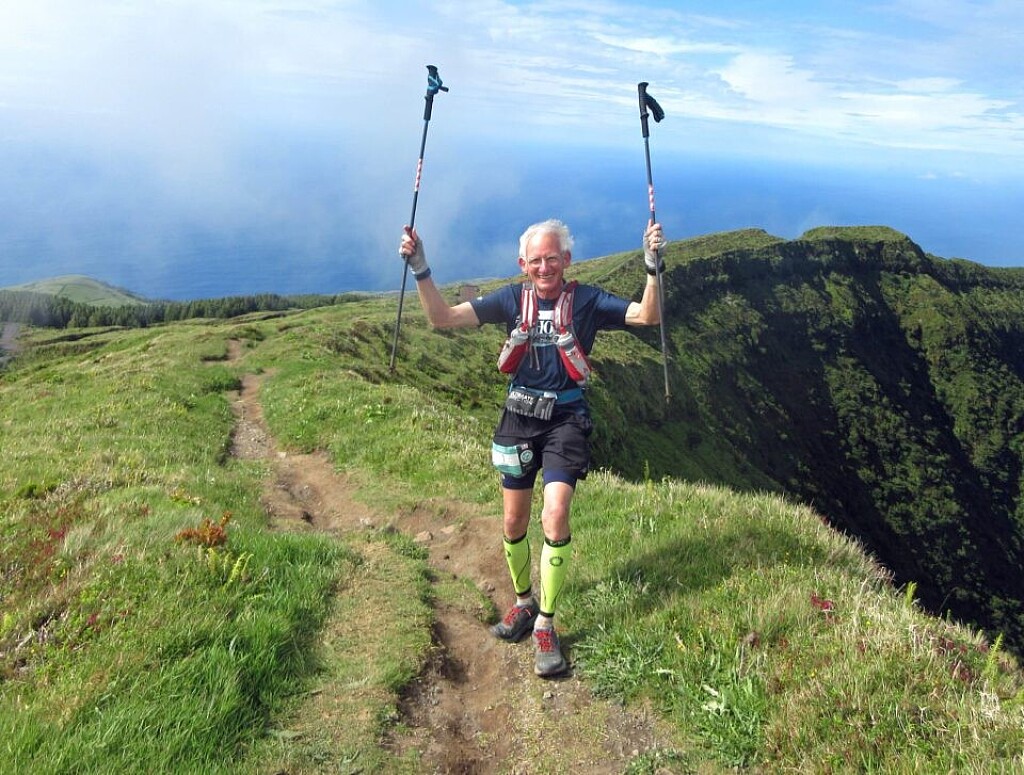
Gene Dykes hopes to become oldest Western States finisher
Gene Dykes, the record-setting 75-year-old ultrarunner from Philadelphia, will hit the trail this summer in a bid to become the oldest finisher in the history of the 100-mile Western States Endurance Run.
This year’s event, which takes place June 24-25 in Auburn, Calif., will mark the race’s 49th year.
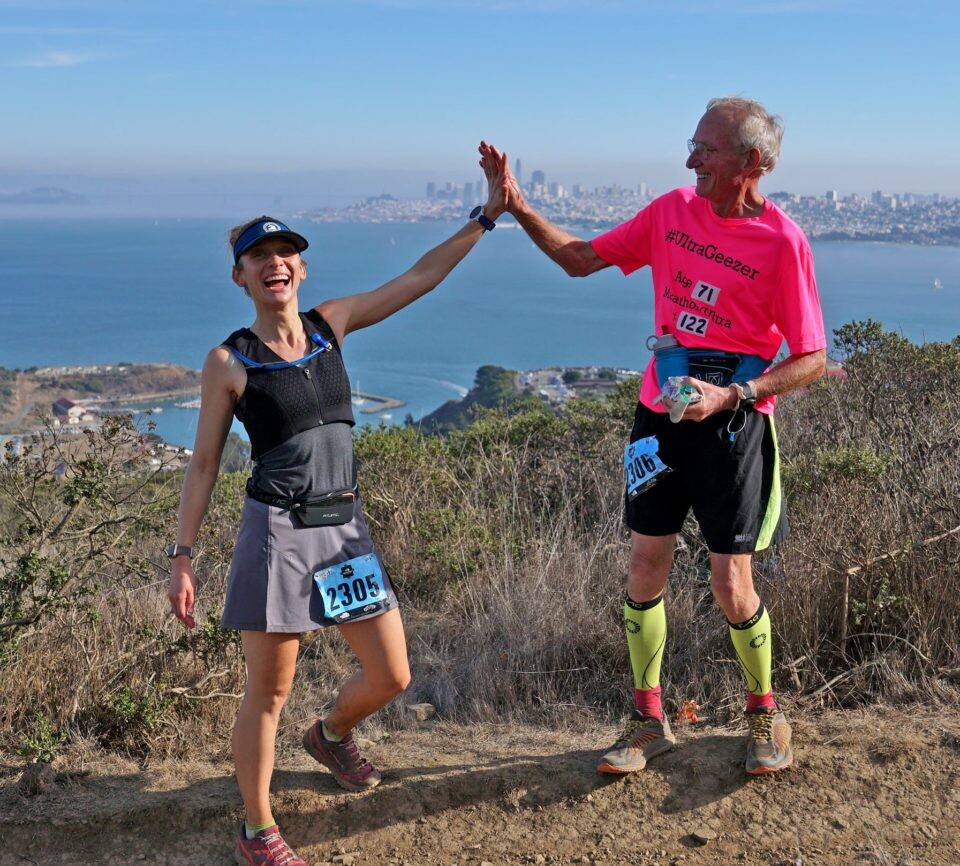
The current oldest finisher is Nick Bassett of Cheyenne, Wy., who finished the 2018 race in 29:09. (The cutoff for all finishers is 30 hours.) Bassett was 73.
A self-proclaimed “ultra geezer,” Dykes started competing in races when he was in his 60s and has since broken multiple records for his age group. In 2021, he broke the M70 50K world record at the USATF national 50K road championships in East Islip, N.Y., crossing the finish line in 3:56:43 and beating the previous record of 4:15:55, set by Germany’s Wilhelm Hofmann in 1997, by nearly 19 minutes. Dykes broke the M70 100-mile and 24-hour track records at the Dawn 2 Dusk 2 Dawn 24-hour ultramarathon in Sharon Hill, Penn., in 2019.
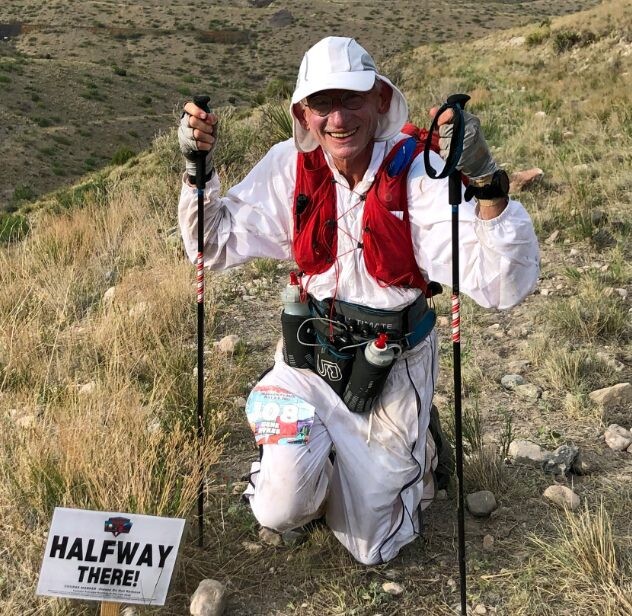
In 2018, Dykes ran his fastest marathon time—2:54:23—at age 70 at the Jacksonville Marathon in Florida. The result would have seen him take the world M70 marathon title from former record holder Ed Whitlock, but Dykes’s final time was not ratified due to the race not being a USATF-sanctioned event.
In total, Dykes has run 157 marathons and ultras since 2006. His daughter Hilary will pace him at this year’s WSER.
Dykes is being sponsored in his latest effort by Calgary-based Stoked Oats. As part of their support, the company has kicked off its Breakfast with Gene series on Instragram and YouTube. The series will feature guests including Vancouver-based WSER female record holder Ellie Greenwood, three-time WSER racer Michael Wardian and race director Craig Thornley.
In 2016, 72-year-old Wally Hesseltine made a valiant and heartbreaking attempt to break the “oldest finisher” record, but missed the 30-hour cutoff by two minutes.
“We are thrilled to be supporting Gene on his journey to WSER,” says series host and Stoked Oats founder Simon Donato. “Running 100 miles is a tall order for professional runners, let alone someone in their 70s. What Gene is trying to accomplish is truly remarkable and we’re looking forward to supporting him every record-setting step of the way.”
Western States, first run in 1974, is the world’s oldest 100-mile trail race and one of the most prestigious. Each June, 369 runners from across the United States and around the world embark from the start line in Olympic Valley, Calif., to tackle a challenging course to the coveted finish line at Placer High School in Auburn.
(04/26/2023) ⚡AMPby Paul Baswick
Western States 100
The Western States ® 100-Mile Endurance Run is the world’s oldest and most prestigious 100-mile trail race. Starting in Squaw Valley, California near the site of the 1960 Winter Olympics and ending 100.2 miles later in Auburn, California, Western States, in the decades since its inception in 1974, has come to represent one of the ultimate endurance tests in the...
more...
Run Commuting Could Benefit Your Training
First, it was the check engine light in my car.
Then it was the rear derailer on my bike.
With my two primary modes of transportation out of commission, I decided to take to the streets and try run commuting to work.
It seemed like the perfect way to boost my mileage and revamp my training with new routes. So I laced up my shoes, invested in some dry shampoo and hit the road.
Besides its obvious transportation value, run commuting has many benefits for even the most road-averse trail runners.
"I definitely believe that run commuting helps my trail running," says ultra-champ Michael Wardian, of Washington, D.C. "It takes planning, carrying a load, perseverance and dedication."
Much like packing and planning for a big trail run or race, commuting takes a bit of prep. I cross-referenced Google Maps and Strava for routes that balanced efficiency and less traffic. Find out how long your commute should take you, then give yourself extra wiggle room for clean up. Your office mates will thank you.
"Make sure you can shower at work and have a place to store clean and stinky clothes," says Sharman. "As well as a determination to run rain or shine."
I typically found myself trying to travel as fast and light as possible-just carrying the clothes (and deodorant) that I'd need for the day. However, there were several less-than-ideal trips that found me slogging either a gallon of milk, a laptop or one very unfortunate casserole. As good as most running packs are, I have yet to find one that can accommodate a lasagna.
Carrying a laptop takes some getting used to, as well. After an unfortunate incident involving my computer and some salad dressing, I began to wrap everything in ziploc bags. Because of all the jostling involved in run commuting, I discovered that foods like salads and grain bowls were much more portable than sandwiches, which are prone to disassembly en route.
"I think the attitude needed is just one of adventure and determination," says Wardian. "There will be obstacles that try and derail your run commute, but if you are committed it will be one of the best things ever."
Get in more miles
Run commuting is also an effective way to squeeze in extra miles by breaking up training into bite-sized chunks throughout the day. A three-mile run to and from work made logging consistent double-digit miles much easier than trying to bang out a half marathon right before work.
"Volume is important for training, and in cities it can be difficult to squeeze in enough miles, especially with most professional jobs," says Ian Sharman, four-time Leadville Trail 100 winner. Sharman, who used to run commute in London, believes that run commuting can be hugely beneficial to any trail runner's training with a little bit of planning and a sense of adventure.
"Although the terrain was typically not even remotely hilly, I included running around parks by taking a less direct route home," he says. "That factored in some grass and dirt."
Save gas money and add it to your running fund
Besides investing in a comfy pack and military-grade deodorant, run commuting is cheap. I didn't buy gas, and my legs required less upkeep than my bicycle. Run commuting is also one of the greenest ways to get around, and I found that starting my day with a peaceful jaunt to work was much more pleasant than sitting in traffic.
"Run commuting has opened my eyes to the fact that you don't have to drive everywhere," says Wardian. "There are so many errands that can be done on foot and under your own power, and I love that."
While run commuting is generally mood and energy boosting, it's not without its challenges. I endured rain, wind, hail and plenty of less-than-stellar hair days. However, with minimal gear and a good attitude, I found the benefits of run commuting far outweighed both the scorching heat and sogginess.
Despite several slip ups like forgetting shoes and having to rock my sneaks with a little black dress, or arriving to work hours late after taking a wrong turn, I loved run commuting. I got to know the most efficient and scenic routes from my house to just about everywhere in town. I loved the moments of solitude it granted me at the beginning and end of every day.
Mike Wardian's best advice for newbie run commuters?
"Just start"
Plan Your Run Commute
Gear up, size down. Travel-sized soaps, shampoos or wipes help save space and weight, and leave you feeling fresh after your morning commute. Dry shampoo or baby powder can help alleviate sweaty hairlines. I learned how to blow-dry bangs in a hand dryer.
Map it. Google Maps, Map My Run and Strava are great resources for in-town routes. Be sure to check for construction and account for morning traffic.
Dry-run. Practice your route the night before to work out the kinks, and find coffee along the way.
Pack tetris. Pack heavier items like a laptop towards the bottom and back of your pack, leaving room on top for lighter items or things that you'd rather not smush-like lunch.
Bag it. Protect the things that matter-your laptop, your clothes-from liquid assault, be it in the form of rain or stray salad dressing. Wrap your computer in a plastic grocery sack and put your clothes in plastic baggies.
Cool it. Give yourself plenty of time to cool off before stepping into the office. Stretch, drink water, take five minutes to breathe-or else you'll find yourself sweating right through your shower.
Early Bird: A stress-induced PR is no way to start the day. Map your route and imagine running your slowest splits, hitting every red light and getting shin splints. Add two minutes to that for every mile. Arrive on time, or better yet, early.
(04/22/2023) ⚡AMP
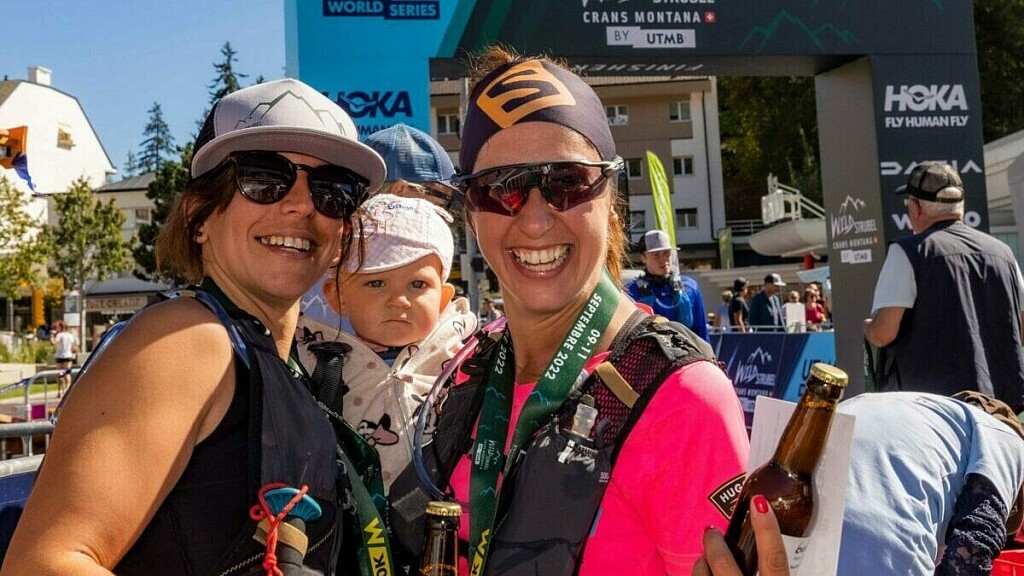
UTMB World Series introduces new pregnancy policy
Organizers of the UTMB World Series—billed as the world’s ultimate trail-running circuit—say they have committed to supporting mothers and their partners by introducing a new pregnancy policy that will apply to UTMB World Series events in the 2023 season.
The policy (which includes deferral and priority entry guidelines for athletes who are pregnant, athletes with a partner who is pregnant and athletes who are adopting or birthing via surrogacy) encourages runners to return to the trails in a safe way and within a timeframe that is considerate of individual circumstances following birth.
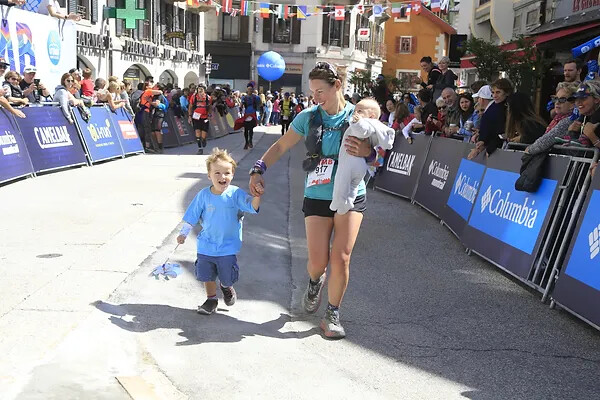
For events with an entry lottery, including UTMB Mont-Blanc, Lavaredo Ultra Trail by UTMB and Eiger Ultra Trail by UTMB, the policy states women will be given a full refund and priority entry to be used within five years for races in the 50K, 100K and 100M categories, and within two years for 20K races.For all other events, the policy allows for women who become pregnant after registration to defer their entry for up to two years for the same race, or receive a full refund.
Partners of pregnant women as well as parents who are adopting or birthing via surrogacy will have the option to defer their entry for up to two years or receive a full refund.
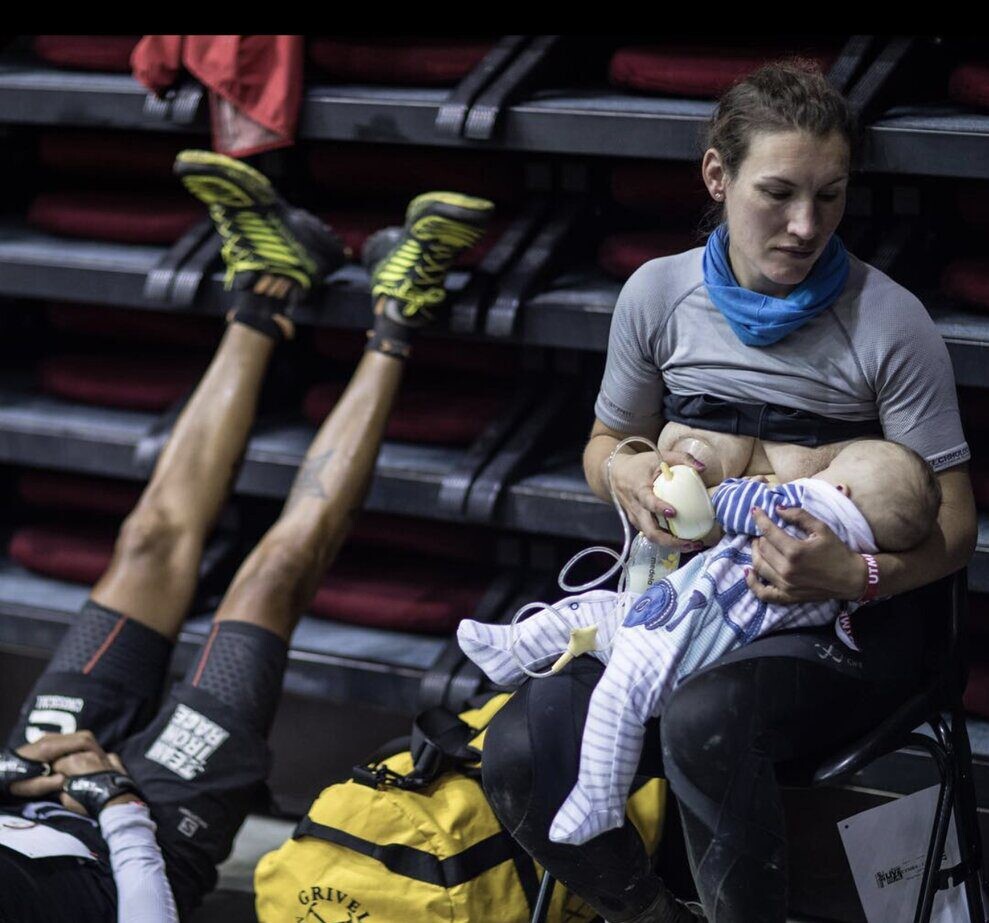
Organizers say the policy was created following a lengthy consultation process, which included gathering expertise from sports and medical professionals, the Pro Trail Runners Association, and athletes such as Sophie Power, who made headlines in 2018 when a photo of her breastfeeding midway through UTMB went viral.
“I’m delighted that UTMB World Series is launching a world-leading pregnancy deferral policy that supports all women to return to racing when they are ready,” said Power, founder of SheRACES. “At SheRACES we look forward to continuing to work with UTMB World Series going forward, sharing our insights to ensure more women from all backgrounds participate in these iconic events.”
UTMB World Series organizers say the new policy comes as part of an effort to encourage more women into the sport and to build on UTMB Group’s commitment to equal opportunities. In line with the actions put in place in previous years, in 2023, male and female elite athletes will be equally represented on the start line of all three UTMB World Series Finals races at the sports pinnacle event UTMB Mont-Blanc, thanks to the new sports system, which sees elite athletes qualify through a series of events throughout the year.
UTMB World Series adds it also remains committed to equal media coverage and representation on communication platforms including UTMB Live, as well as equal prize money for male and female athletes.
UTMB is one of several prominent races—including Western States, the London Marathon and the Calgary Marathon—to have recently introduced policies aimed at supporting mothers and pregnant athletes.
(04/20/2023) ⚡AMPby Paul Baswick
North Face Ultra Trail du Tour du Mont-Blanc
Mountain race, with numerous passages in high altitude (>2500m), in difficult weather conditions (night, wind, cold, rain or snow), that needs a very good training, adapted equipment and a real capacity of personal autonomy. It is 6:00pm and we are more or less 2300 people sharing the same dream carefully prepared over many months. Despite the incredible difficulty, we feel...
more...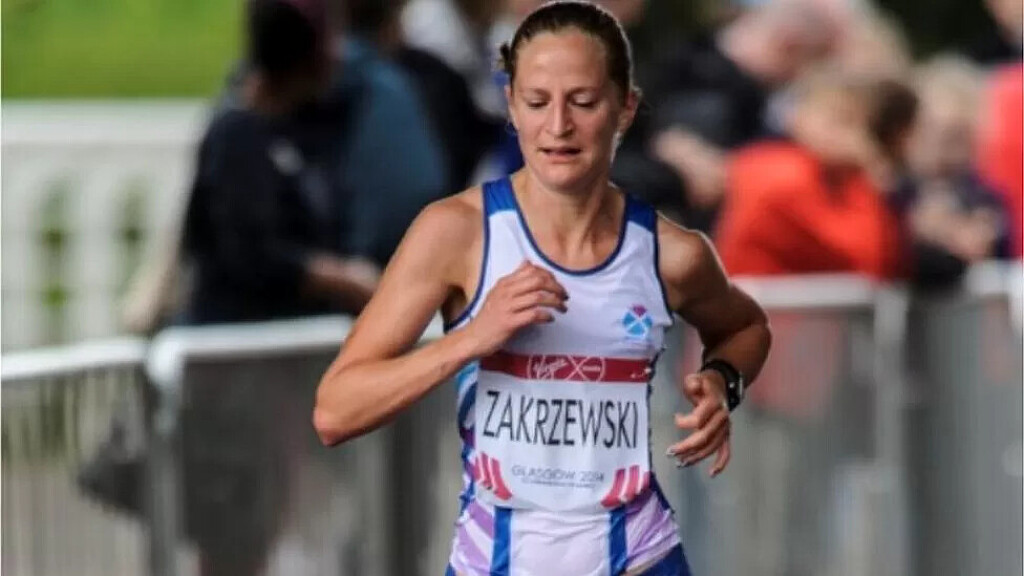
Former world record holder disqualified for taking a car during 50-mile race
Scottish ultrarunning record holder Joasia Zakrzewski has been stripped of a recent third-place finish at a British 50-miler after it was discovered that she rode in a car for about two and a half miles mid-race. Zakrzewski told the BBC that while she did hitch a ride with a friend, her decision to do so “wasn’t malicious.” Zakrzewski is the owner of multiple Scottish and British ultrarunning records, and she ran the 48-hour world record in February (although her distance was bettered by Camille Herron in March).
Zakrzewski lives in Australia, and she reportedly travelled last-minute to the U.K. for the April 7 Manchester to Liverpool ultramarathon, arriving the night before the race. As she told the BBC, she got lost on the course halfway through the race, at which point she began dealing with leg pain that eventually became too much to handle. She saw a friend on the sidelines and decided to pull out of the run, hopping in his car and riding to tell the race marshals she was done for the day.
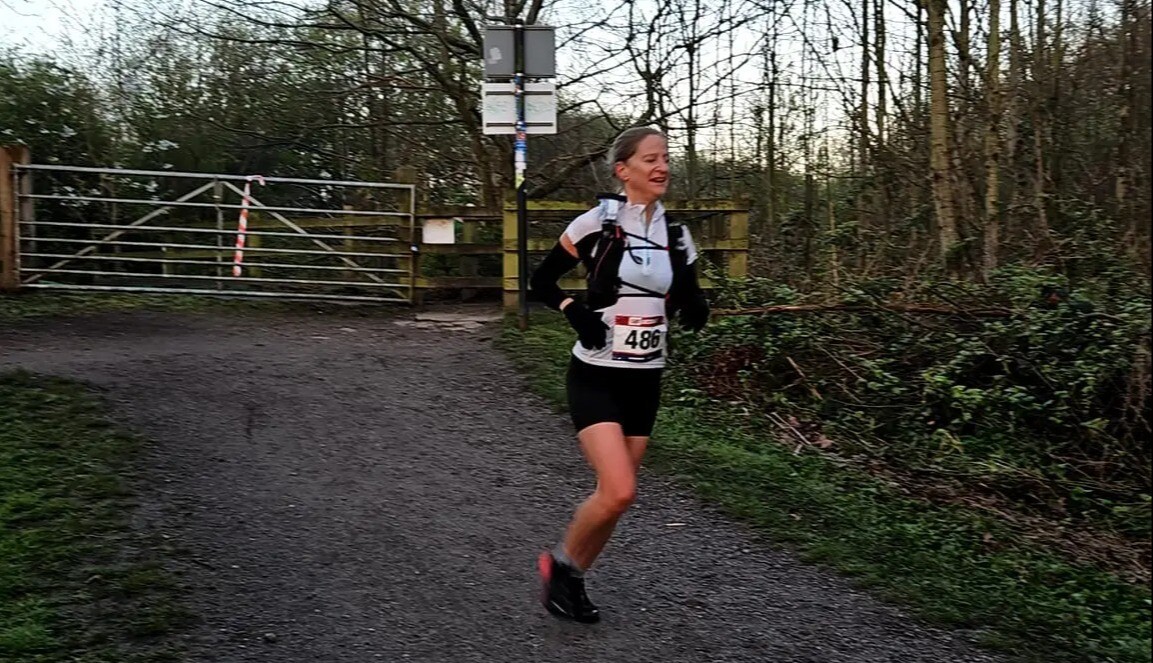
“When I got to the checkpoint I told them I was pulling out and that I had been in the car,” Zakrzewski said. “They said, ‘You will hate yourself if you stop.'” Zakrzewski agreed and carried on, later telling the BBC that she only planned to finish the race non-competitively.
After crossing the line in third place, however, Zakrzewski was given a medal, a trophy and she was asked to pose for podium pictures. She didn’t stop to let anyone know she had cut the course, but Zakrzewski said that was not intentional.
“I made a massive error accepting the trophy and should have handed it back,” she said. “I was tired and jet-lagged and … I was feeling unwell and spaced out and not thinking clearly.” Zakrzewski’s car ride blip was not noticed immediately, but race director Wayne Drinkwater was eventually tipped off that she had received an “unsporting, competitive advantage during a section of the event.”
Drinkwater and his team checked the race tracking data and took statements from other competitors, before moving forward with Zakrzewski’s disqualification. As The Guardian reported, a GPS file shows that Zakrzewski covered a mid-race mile in one minute and 40 seconds.
With Zakrzewski disqualified, a runner named Mel Sykes is the new third-place finisher at the race. “I’m an idiot and want to apologize to Mel,” Zakrzewski said. “I would never purposefully cheat.”
(04/19/2023) ⚡AMPby Ben Snider-McGrath
Running 900 km to the Boston Marathon2
On Tuesday night in Toronto’s Parkdale neighborhood, it was business as usual for community builder Quinton Jacobs. Jacobs and his team of 13 runners departed on their four-day, 904.5-kilometer journey from Toronto to the historic Boston Marathon finish line on Boylston St.
The team left Toronto on April 11, at 8 p.m. and plan to arrive in Boston on Saturday–two days before the start of the 127th Boston Marathon.
Jacobs’s Escape project started out as a ridiculous idea with his friend Anoke Dunston on a 2019 trip to New York. “We saw the first Escape to NYC as a challenge,” he says. But Jacobs ended up tearing his Achilles playing basketball before the journey started, so he did not get to run in New York City.
After Escape to NYC, Jacobs and Dunston knew that the project had the potential to turn into something extraordinary. In 2021, the two men ran to Chicago for the Chicago Marathon with a team of 12 runners from different backgrounds. “We decided that Chicago was our canvas, and we wanted to create something entirely new,” says Jacobs.
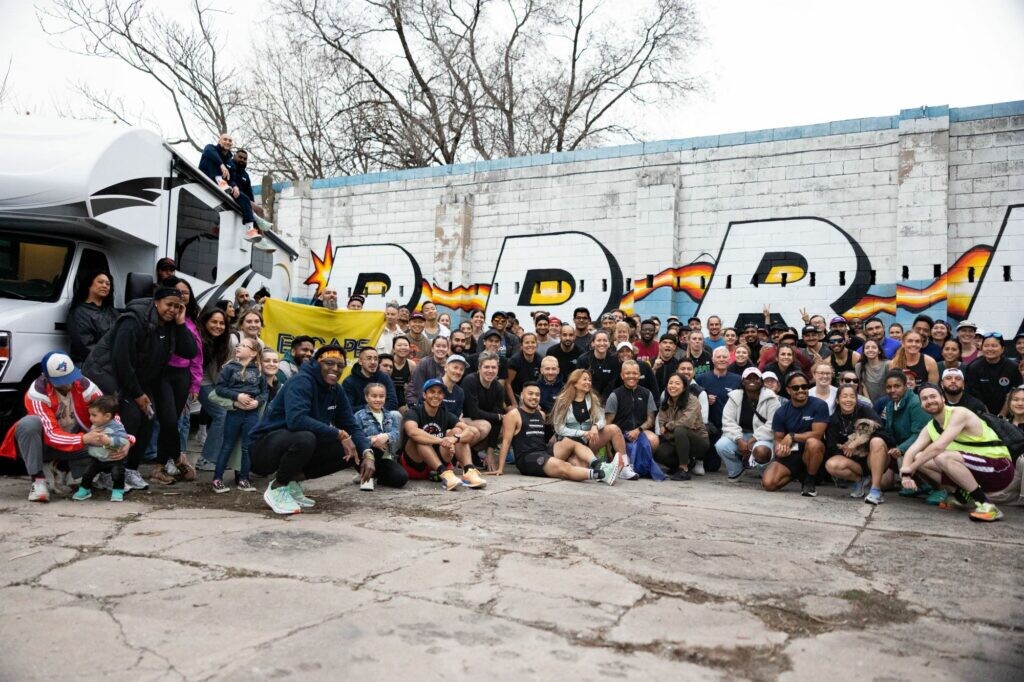
Their past two destination ultras to New York and Chicago have been done in the fall, and Boston is their final major, facing their hardest Escape route to date, encountering the Appalachian Mountains of upstate New York and western Massachusetts.
“Escape is about celebrating the diversity of our running community,” says Dunston. “Our goal is to bring people together, no matter their background.”
The team aspect is special for Jacobs, who met his teammates through volunteering in the running community. “We have a team of people from Toronto, Montreal, New Orleans and Chicago,” says Jacobs. “People are all tapped into our ground for all different reasons–it’s special.”
Jacobs is a familiar face to many in the Toronto running scene, as he has been giving back to the city as a volunteer for seven years. He was named community builder of the year by Canadian Running in 2021.
This year Jacobs, Dunston and Hamilton’s Andre Morgan launched their own not-for-profit charity, Ubuntu, which gives back to underprivileged communities in Toronto. Ubuntu is a Zulu word meaning that we are all connected and that one’s sense of self is shaped by relationships with others. “I love to bring people together, where they can enjoy each other’s company.”
Toronto filmmaker and videographer Jason Dam of Tenfold Productions will accompany Jacobs, Dunston and the 11 other runners, capturing all the emotions and moments from their Boston journey into a documentary.
“Running isn’t the hard part,” says Dunston. “The hardest part is battling your body on sleep deprivation and trying to be the best version of yourself for the team.”
“There’s a beauty and a struggle to all our Escape challenges,” Dunston says. “But I think the triumph to battle through means everything.”
You can follow their journey from Toronto to Boston via their Instagram page, @escape_to___. The Escape to Boston team is projected to arrive in Boston on the morning of April 15, and is hosting a panel discussion at the Boston Marathon expo on Saturday at 4 p.m. on how ultra running is changing.
(04/14/2023) ⚡AMPby Marley Dickinson

Boston Marathon
Among the nation’s oldest athletic clubs, the B.A.A. was established in 1887, and, in 1896, more than half of the U.S. Olympic Team at the first modern games was composed of B.A.A. club members. The Olympic Games provided the inspiration for the first Boston Marathon, which culminated the B.A.A. Games on April 19, 1897. John J. McDermott emerged from a...
more...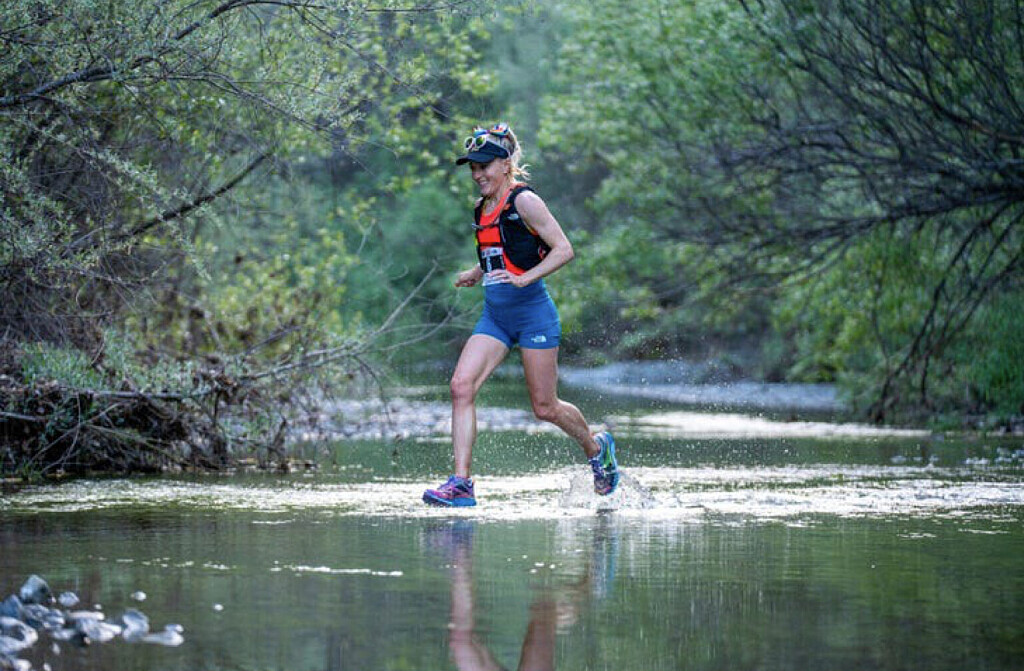
Competition Is Stacked at This Year's Lake Sonoma 50
The Lake Sonoma 50 is one of the fastest and most competitive 50-milers in the U.S., and it's turning up the notch on competition in its 16th year.
Set in the rolling foothills near Healdsburg, California, the hilly course is known for its smooth singletrack and more than a dozen creek crossings. For the first time, Lake Sonoma will be the 50-mile selection race for Team USA, and all runners who race their way onto the podium will get an automatic invitation to run for Team USA in the long-format race in this year's World Mountain and Trail Running Championships set for June 6-10 in Innsbruck-Stubai, Austria.
While Lake Sonoma has always been a competitive event (previously a Golden Ticket Race), that invitation has certainly encouraged a high level of competition.
"I'm super psyched for Lake Sonoma to be a USA Selection Race," says Gina Lucrezi, race director and founder of Trail Sisters, a non-profit that supports women in the trail space. "This event has been a top 50-mile race in the U.S. since its inception. John Medinger, Lisa Henson, and Skip and Holly Brand have created a sought-after course and event, and I'm proud to continue their legacy of keeping it a barn burner event, pulling in top talent to test their fitness and abilities." Lucrezi represented the U.S. at several USATF MUT Championship events, and she's excited that her event will extend that opportunity to a new generation of ultra athletes. "It's both an honor and privilege to host this opportunity for runners vying to represent the USA," says Lucrezi.
The event is Trail Sisters certified, which means there will be equal podium spots, awards, women's specific race swag, menstrual products at aid stations, and equal space for women on the start line. Lake Sonoma races are held within the Native lands of the Southern Pomo. The Southern Pomo are part of the Federated Indians of Graton Rancheria, a federally recognized tribe. The race has also partnered with a local charity, The Children of Vineyard Workers Scholarship, which provides education funding to the kids of agricultural workers in the area.
"In terms of diversity, equity, and inclusion, when hosting the lottery, we split the field 50/50 male/female. (Non-binary folks were grouped in the field that they noted as their gender assigned at birth). We then utilized gender-specific waitlists if participants cancel or defer, but we extinguished our waitlists and then allowed for open registration to fill our vacant spots. In the lottery form, we requested race and ethnicity information," Luzrezi told Trail Runner in an interview. "This provided insight into the diversity of signups and helped us make sure the starting line could be as diverse as possible."
Sweet Sixteen
In its 16th year, Lake Sonoma has ushered a generation of ultrarunners onto the scene, and many are returning to reconnect with those fond memories at an event that epitomizes the grassroots appeal of trail races, with an internationally competitive field.
Ultrarunner Devon Yanko is competing in the marathon after her win and earning a Hoka Golden Ticket at Javelina Jundred, says she feels a deep connection to the race after winning it early on in 2010. Building up to Western States in June, Yanko says her primary objective is to feel healthy and enjoy the race.
"I have been a part of Lake Sonoma almost since its inception and have been a spectator/crew for most of its biggest years," says Yanko, who formerly lived in San Anselmo, California. "It was an extension of my local community and always had the best vibes. I'm mostly looking forward to seeing friends, supporting the race, and helping keep the tradition of Lake Sonoma alive."
Many runners have long histories with the buttery, grass-lined trails. Lake Sonoma was one of the first ultras OCR athlete and ultrarunner Amelia Boone ever knew about more than a decade ago. But, a broken femur derailed her initial attempts at the 50-mile event, and she's been looking for an opportunity to get back to Lake Sonoma's start line ever since. She says the high level of competition and community vibe were big draws as well.
"I'm looking to run strong in a competitive field. It's been a while since I've run a race with a super deep field, so I'm looking to put the ego aside and have some faith in myself. My ultimate reach goal would clearly be top 3 to qualify for the U.S. World team, but that'd just be a bonus," says Boone. "Oh, and give as many high fives on the trails as possible."
Brett Hornig, a coach and athlete from Ashland, Oregon, hopes that the third time's the charm. He's run the race twice, and hasn't had the day he wanted.
"LS50 was one of the premier 50-mile races in the world when I was first introduced to trail and ultrarunning around 2014, so the allure of competing against the best has always been there for me," says Hornig. "That initially drew me to the race, and the competition is still there, but it is the community who puts on the race that keeps me coming back. The race directors (both past and current), the volunteers, sponsors, and fans of the sport put on an incredible event that everyone should check out for themselves at least once."
Ryan Miller, the winner of the 2022 Gorge Waterfalls 50k and Bandera 100k, from Vero Beach, Florida, says he's excited by the fast and smooth Sonoma trails.
"The primary allure of Lake Sonoma 50 has to be the trails themselves. Have you seen the videos and pictures of this place?! It's absolutely stunning. I'm most looking forward to the competitive racing with big stakes as it tends to bring the best out of everyone," says Miller.
The proximity to wine country doesn't hurt either.
"Throw in a deep competitive field, prize money, my wife's excitement to go to California wine country, and an opportunity to earn a spot on the World Championship team, and it's a no-brainer for an athlete like me focusing on the 50K-100K distances."
Miller, like others, is gunning for a podium finish that would earn an invitation to race for Team USA at the World championship.
The race field is chock full of talented runners, including the women's field with Abby Levene, Anne-Marie Madden, Allison Baca, Tara Fraga, Sarah Keys, Megan Drake, Sarah Biehl, Erin Clark, Natalie Sandoval, Erin Viehl, Amelia Boone, Anna Kakis, Catrin Jones, Mercedes Siegle-Gaither, Sarah Cummings, Kristina Randrup, Jackie Merrit and Hannah Osowski.
The men's race includes Miller, Hornig, Drew Holmen, Seth Ruhling, David Kilgore, Drew Macomber, Preston Cates, Terence Copeland, Reed Breuer, Aubrey Myjer, Charlie Ware, Ryan Sullivan, Caleb Olsen, Chris Myers, Jason Schlarb, Erik Sorenson, Matthew Seidel, Morgan Elliot, Addison Smith, and Travis Lavin.
"The overall Lake Sonoma race event is focused and centered on community," says Lucrezi. "I'm really excited about our new start and finish location and the celebration vibe we are creating. No matter your pace, experience, or what place you finish, Lake Sonoma is an event that welcomes all runners and fosters friendships made through the event and on the trails."
(04/08/2023) ⚡AMP

Lake Sonoma 50
The race is held on the rugged trails at Lake Sonoma, about 10 miles northwest of Healdsburg. The course is 86% single track and 9% dirt roads, with the first 2.4 miles on a paved country road.The race starts at 6:30 a.m. and has a 14-hour time limit. ...
more...
Yes, Zone 2 Training Is Important. (Just Don't Forget the Other Stuff.)
Right now in the fitness community, the hottest topic is Zone 2 training.
Everywhere you look, both coaches and runners are extolling the benefits of running at a Zone 2 effort, while advising runners to be wary of running too hard on easy days.
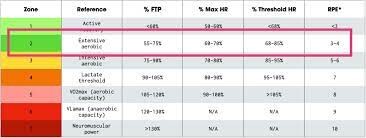
Make no mistake: there are great reasons for running most of your mileage at an easy effort around Zone 2. No coach worth her salt will tell runners that easy running isn't advantageous. In fact, a lot of easy running is the key to racing faster and building a strong body that's resilient against injuries.
But with all this focus on Zone 2, are we ignoring other zones? What about Zone 1? Or what about Zone 3 (which seems to have become the boogeyman of running efforts)? Despite the baggage of Zone 3, and most athletes ignoring Zone 1, these zones still have value.
In fact, every zone has a place in a well-designed training program. Let's get into the weeds, explore the nuance, and discover each shade of gray about zone training.
What is Zone 2 Running?
Zone 2 running is best defined as easy running where you're still able to hold a conversation with a friend. The effort usually corresponds to about 60-70 percent of maximum heart rate.
This zone is part of the 5-zone system:
Zone 2 is often considered the lowest intensity that produces meaningful training adaptations. It's receiving a lot of attention in the running community because it has a lot of benefits with very little risk of over-training or injury. But this is not new. Runners have been married to the idea of easy running since the 1970s, when US marathoner Bill Rodgers was winning major marathons while running up to 180 miles per week-nearly all at an easy effort.
We've called long runs LSD ("Long Slow Distance"), short runs "recovery jogs," and bemoaned our training partners for not running at "conversational pace." In Boulder, Colorado, there's a weekly "fun run" at such an easy effort it's called "soft hour."
There's no denying that Zone 2 is a key pillar of any endurance runner's training-in fact, it's likely the most important intensity zone for every runner-but that doesn't mean it's the only actor in the play.
Runners know and understand the value of easy, comfortable running. It's just currently being rebranded into something new called "Zone 2 training" (just like, a decade ago, we heard all about High Intensity Interval Training-or hard track workouts).
Zone 2 is Just One Piece of the Puzzle
There's no denying that Zone 2 is a key pillar of any endurance runner's training-in fact, it's likely the most important intensity zone for every runner-but that doesn't mean it's the only actor in the play. While it's vital, it's just one piece of the puzzle.
Zone 1 running can be enormously helpful for base building, especially with longer efforts that last multiple hours. A four-plus hour fast hike at altitude up a mountain is a good example of beneficial Zone 1 training.
However, Zone 1 isn't as productive at producing endurance adaptations, so it's usually reserved for cross-training, very long efforts, or just parts of certain runs (where most of the effort is Zone 2). A good example is a short recovery run where the first 10 minutes might be at a Zone 1 effort before gradually transitioning to a Zone 2 effort.
And while Zone 3 is often presented as a "danger zone" or the "gray zone" of training, it also has its place. High-level, competitive athletes have the talent to spend more time during an easy run at these moderate intensities. And beginners who are running low mileage can also do a fair amount of Zone 3 running because their volume is low, and they likely won't make as many adaptations without it.
Just be careful with too much Zone 3 running: if more than 40-50 percent of your mileage is at this intensity, it presents a higher injury risk due to additional mechanical stress and less recovery due to higher intensities.
Of course, any performance-oriented runner with goals of running a certain finish time will want to spend time in both Zones 4 and 5, too, which we can consider "workout zones." Race paces of 10K and faster fall into these zones and can be used for structured workouts for approximately 15-20 percent of total weekly volume.
An example week with mileage levels, workouts, and zones illustrates this concept:
In this example, the athlete is running 80 percent of their total weekly volume at a Zone 1 or Zone 2 effort, 10 percent of their effort in Zone 3, and 10 percent in Zone 5.
As we think about the complete training program over the course of a season, we can see that many intensities (like Zone 2) will remain constant throughout the season. Some intensities will have a stronger presence during the base phase, like Zone 1, while others will be prioritized late in the season (like Zone 5).
Just like a delicious soup, every ingredient has its place.
The Bottom Line
Clearly, I'm a Zone 2 stan. It's an integral intensity zone for any runner, whether you're a professional track and field athlete, frequent half marathoner, or a first-time ultramarathoner. If I was forced to choose the single-most important zone for running, I'd choose Zone 2.
But it's not the only party in town. Every runner should strive to be a well-rounded athlete who's capable at every intensity zone. Simply put: Zones 1-3 build capacity while Zones 4 and 5 sharpen your existing fitness. Any good training program should include a healthy mix of all zones because these energy systems all contribute to an athlete's ability.
Ultimately, good runners have range at a variety of distances because they don't ignore any zones or over-prioritize a specific zone. And that range-the ability to run well at the 5K, half-marathon, and ultra distances-is a testament to preparing every energy system during training.
(04/08/2023) ⚡AMPby Trail Runner Magazine
Viktoria Brown breaks 72-hour world record, 48-hour Canadian best in Italy
Earlier in March, Whitby, Ont., runner Viktoria Brown broke her own 48-hour Canadian record and 72-hour world record while competing at the GOMU (Global Organization of Multi-Day Ultramarathoners) six-day world championships in Policoro, Italy. Brown ran 364 km over 48 hours and 475 km after 72, beating her two previous records by 11 km and 8 km, respectively. She finished the six-day event with a grand total of 684 km to take home the women’s individual gold medal.
The event in Italy marked the first six-day world championship organized by GOMU, which was founded in 2021. Brown is a vice president, as is Greek ultrarunning legend Yiannis Kouros; Canadian ultrarunning pioneer Trishul Cherns is president. The organization held its first world championship event—a 48-hour competition—in New Jersey in September 2022, and Brown and the team are looking to add 72-hour and 10-day races into the mix in the near future.
Canada didn’t send a team to the GOMU worlds, so Brown competed for Hungary, where she also holds citizenship. She helped lift the Hungarian women to the team world championship to pair with her individual gold medal. Going into the event, Brown’s Canadian 48-hour record stood at 353 km, which she ran in June 2022 at the Six Days in the Dome event in Wisconsin. After two days of running in Italy, she had eclipsed her PB to add another 11 km to her national record, which now stands at a whopping 364 km.
Up next was the 72-hour mark, and Brown had her eyes on her world record of 467 km. She ran that amazing result at the same race where she posted her 48-hour best last June. Just like she did in Wisconsin, Brown charged forward after securing her 48-hour record, and eventually toppled her 72-hour best, too, with a tally of 475 km.
At that point, Brown already had two records in the books, but she was still only halfway through the six-day race. She carried on for another three days, eventually finishing with a phenomenal winning result of 684 km. That’s an amazing total, but even more incredible is the fact that it’s more than 50 km shy of Brown’s six-day PB (and, you guess it, another Canadian record) of 736 km. As with her 48- and 72-hour marks, Brown ran that result at the Six Days in the Dome last year.
Brown says the next race on her schedule is the Badwater 135 ultramarathon in California, but since that isn’t until July, she may take another shot at the 72-hour record with hopes of improving her world record once again.
(03/28/2023) ⚡AMPby Running Magazine
