

Running News Daily
Running News Daily is edited by Bob Anderson and team. Send your news items to bob@mybestruns.com Advertising opportunities available.
Index to Daily Posts · Sign Up For Updates · Run The World Feed
Articles tagged #scissors
Today's Running News
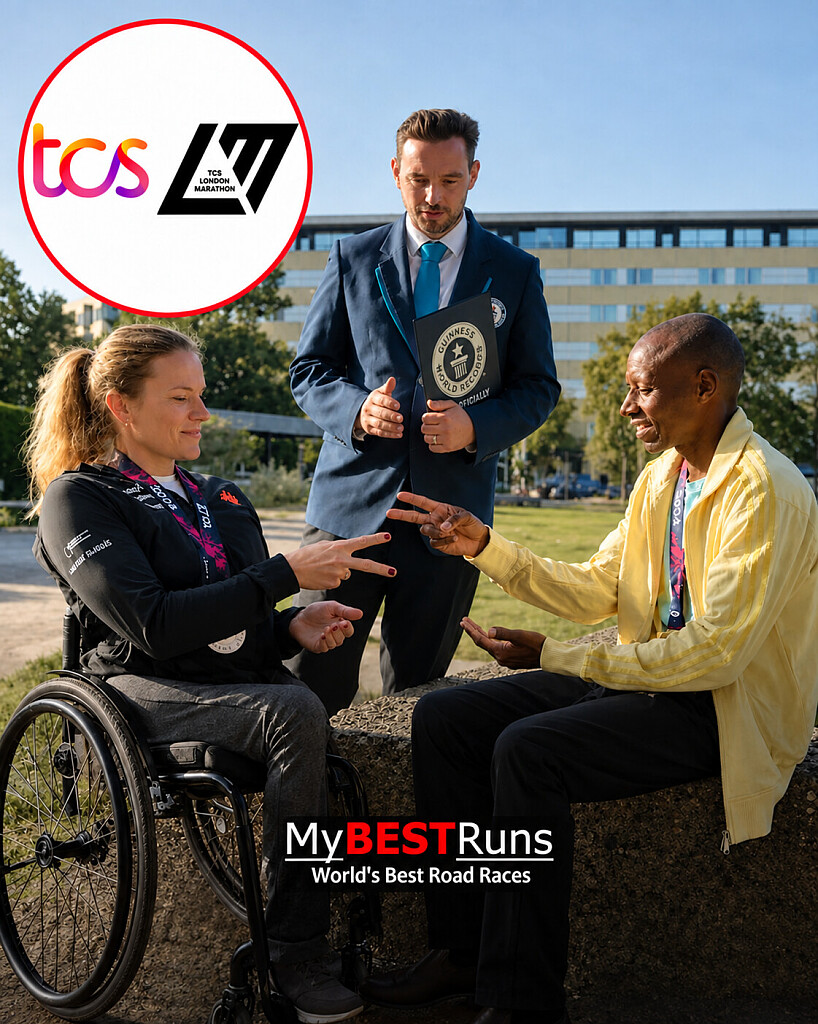


London Marathon’s 2027 Elite Schedule Decided By Rock, Paper, Scissors
The 2027 TCS London Marathon has found a remarkably unconventional way to settle one of its biggest questions — with a game of rock, paper, scissors.
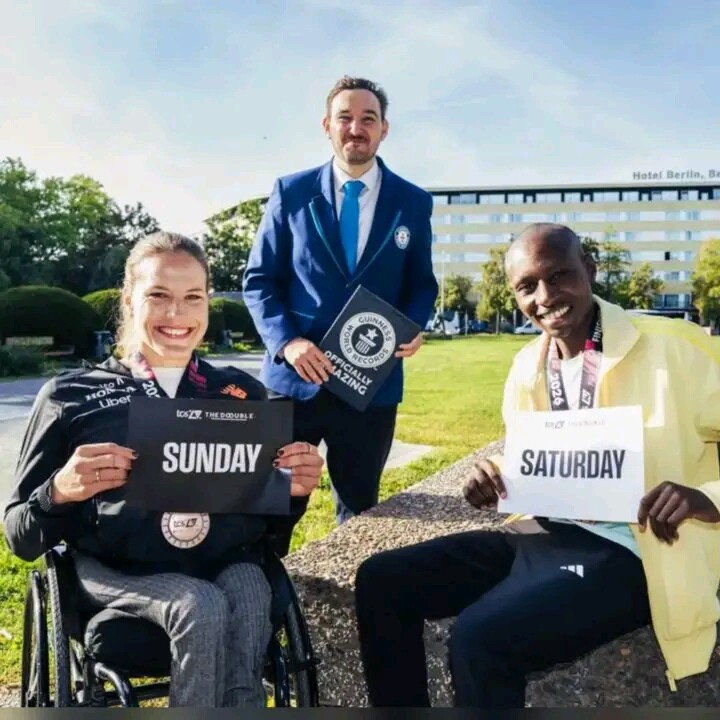
Kenyan marathon star Sabastian Sawe and Swiss wheelchair champion Catherine Debrunner, the reigning London Marathon champions in their respective races, went head-to-head in a contest overseen by an official Guinness World Records adjudicator.
Debrunner emerged victorious, securing Sunday, April 25, 2027, for the elite women’s and women’s wheelchair races. As a result, the elite men’s and men’s wheelchair races will open the historic weekend on Saturday, April 24.
The unusual showdown has also earned its place in the record books, with Guinness World Records recognising it as the first elite marathon race start ever decided by a game of rock, paper, scissors.
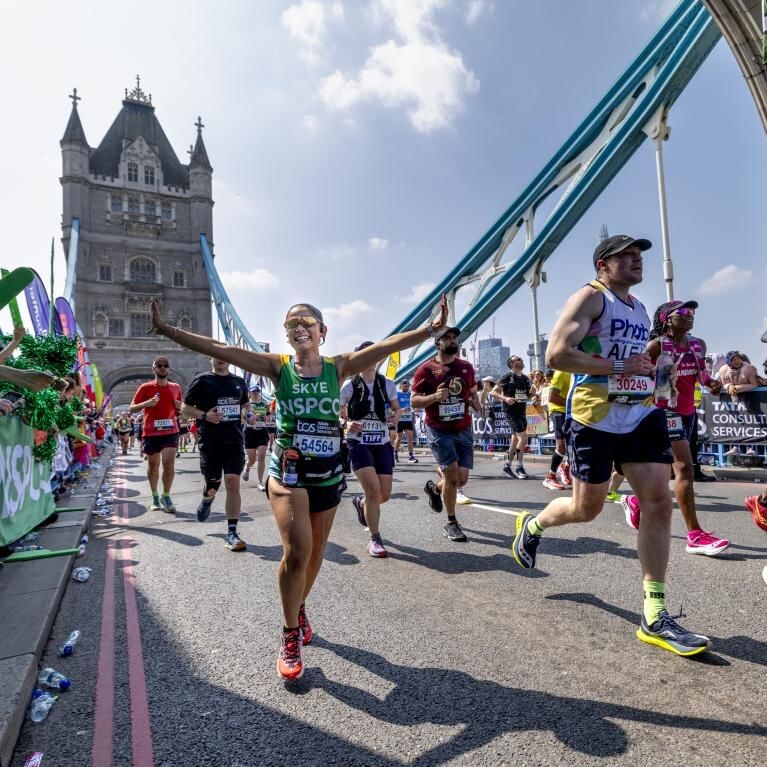
The decision adds another memorable chapter to what will already be an extraordinary edition of the London Marathon. For 2027 only, the race will be staged across two days, creating the Double TCS London Marathon, with around 100,000 participants expected to take part across the weekend.
Sawe enters the story as one of the defining figures of the 2026 London Marathon. The Kenyan made history by clocking 1:59:30, becoming the first athlete to run a sub-two-hour marathon in a record-eligible competitive race.
Debrunner, meanwhile, is a four-time London Marathon wheelchair champion, making her one of the most successful athletes in the event’s history. Her victory over Sawe means the women’s elite and women’s wheelchair races will retain the traditional Sunday spotlight.
The 2026 London Marathon also produced another landmark performance on the same course, with Ethiopia’s Tigst Assefa setting a women’s-only marathon world record.
The unprecedented two-day format was introduced following extraordinary demand for places. A record 1.33 million people applied for the 2027 London Marathon ballot, surpassing the previous record for any marathon.
With approximately 100,000 runners expected to finish on The Mall over the weekend — close to twice the size of the 2026 field — London is preparing for one of the biggest marathon weekends ever staged.
London Marathon Events chief executive Hugh Brasher added a playful warning after the rock-paper-scissors showdown, suggesting that while Sawe and Debrunner could settle the schedule with a game, the atmosphere would be considerably more competitive once the racing begins.
And so, before the first elite athlete has even reached the start line, the 2027 London Marathon has already made history — with its schedule decided not by the clock, but by rock, paper, scissors.
by Erick Cheruiyot for My Best Runs.
Login to leave a comment
Take a Sneak Peek into 'Born to Run 2'
Thirteen years after the publication of Christopher McDougall's popular book, Born to Run, the author teams up with renowned running coach Eric Orton for Born to Run 2: The Ultimate Training Guide, a fully illustrated, practical guide to running for everyone from amateurs to seasoned runners, about how to eat, race, and train like the world's best. Born to Run 2 will be available on December 6, 2022, but you can read this excerpt from the book.
Chapter 8: Form - The Art of Easy

Eric promised he could teach running form in ten minutes. If I had to estimate, I'd guess he was miscalculating by a factor of at least 7,000 percent, so I subjected his proposition to lab testing and gave it a try myself:
I hit Pause and checked my watch. Then I tried it again. Each time, I found Eric's estimate to be wildly exaggerated. It wasn't even close to ten minutes. More like five.
One song. One wall. Three hundred seconds. If someone had only shared this secret with Karma Park, it could have saved her a world of misery.
Karma was such a disaster, the Navy honestly couldn't tell if she was a terrible runner or a terrific actor. How she even made it into boot camp was a mystery.
The strange thing was, running was her only weakness. Chuck her out of a boat at sea? No problem. Pull-ups, push-ups, crunches? Piece of cake. Karma was a competitive swimmer and varsity wrestler growing up, so two-hour workouts were in her blood. But ask her to run a mile and a half? In under thirteen minutes? Not a chance. Over and over she tried, and every time she ended up walking, grabbing her ribs from stitches and wincing from aches in her legs.
"I'm pretty sure the recruiter fudged the numbers on my Physical Readiness Test so she could get me in," Karma believes. "I finished the run and thought, Oh crap, I'm a minute too slow, and she's like, 'No, no, you're good.' "
When Karma got to basic training, she gritted her teeth and did her best. The Navy was her ticket to a dream life, so there was no way she was giving up. Karma was twenty-five at the time, with a wife in law school and hopes of becoming a surgeon. The surest path toward financing their future was a career in the military. Besides, she had a debt to pay back. Karma came to America from South Korea at age eleven, and while, yeah, maybe Alabama wasn't the most welcoming place for a foreign kid with budding gender issues, Karma was still deeply grateful for the life her family was able to create there.
"I really wanted to serve this country," she says. "But in boot camp I was in and out of sick bay all the time." Karma chanted the drill instructors' mottoes to herself-Pain is only skin deep! Heel to toe! Heel to toe!-but the harder she pushed, the more she broke down. "At first maybe they were checking that I wasn't dogging it," Karma recalls. "I can see how I would be suspected because I feel that other recruits faked it to get out of running, but I was in so much pain, they knew something else was going on."
Finally, Navy doctors diagnosed Karma with chronic hip displacement. She was ordered to report to the long-term sick bay, where she'd be stuck for as long as it took-a month, six months, a year-for her to either heal or quit. Those were her options: get better, get faster or get out.
Karma was crushed, but privately vindicated: ever since she was young and her mom would sign the whole family up for local 5Ks as a way of assimilating into their new home, Karma knew she couldn't run. "My dad and I would walk at the back of the pack, and I thought, This is the most ridiculous thing ever. We have cars and bikes, why are we running? I was really fit in all the other aspects of PE, but with running, I tried and tried and never got any better."
Back in civilian life, Karma struggled. She put her own education on hold and began managing a Subway so her wife could finish law school. She began putting on weight, but when she tried to exercise, her old leg injuries flared up and she finally discovered the real cause of her pain was rheumatoid arthritis. The medication made her lethargic and bloated, and her body ached so badly she needed a cane to walk.
Karma was in a bad spiral that nothing could stop. Except her wife's lover.
"My wife had an affair with a guy who was really fit," Karma says. "When I confronted her, she told me I was fat. That hit me really hard." So hard that after she and her wife separated, Karma decided to punish herself with the thing she detested most. "I decided to drown my emotional pain by subjecting myself to physical pain," she says. "When I left the Navy I swore off running-I hate it hate it hate it, never running again. This time, I decided to run myself ragged into an early grave. I hated myself and hated running, so this is what I'll do."
For once, Karma's injuries came to the rescue. Her legs seized up before her heart, and while she was searching for a new way to beat on herself, she had the enormous good luck to meet Sheridan. With that amazing woman by her side, parts of Karma that she hadn't even realized were hurting began to heal. For the first time, she had the confidence and support to face her gender identity and begin transitioning to the self that had always been buried.
She also resolved, once again, to get back into shape.
If you're keeping score at home, by now Karma has struck out three times as a runner. Over the years, I've heard a lot of stories like this from busted ex-runners-and lived one myself-but this is the first instance where I thought, okay, maybe it's time for the mercy rule to kick in and let it go for good. But against those odds, Karma stepped up again. When Sheridan gave birth to their first son, Karma set her jaw and decided their baby wasn't going to grow up with a parent hobbled with a cane or gone before their time.
"That's how I began my journey into learning how to run properly," she says.
This go-round, Karma attacked the problem from a different angle: What if her brain was the problem and not her body? Karma is a math whiz and comes from a medical family, so she was a little annoyed at herself for not realizing sooner that if your equation keeps giving you the wrong result, adding the same numbers isn't going to help. Rather than running harder, she thought, maybe there was a way she could run smarter.
Her eureka! moment occurred soon after, when she noticed that her legs hurt more on downhills than ups. That's when it hit her: What if she treated the entire planet like a hill? Get up on her forefoot, in other words, instead of heel-toe, heel-toeing it like she'd always been told.
"When I mentioned this to a friend, she immediately said, 'Haven't you read Born to Run? That's what it's all about.'"
Karma picked up a copy, and there, on page 181, she found the role model who would change her life. Not Ann Trason, the courageous science teacher who nearly outran a team of Raramuri runners in the Leadville Trail 100. Not Scott Jurek, the gracious and unbreakable hero who rose from a rough Minnesota childhood to become the greatest ultrarunner of all time. Karma didn't even see herself in Jenn Shelton, that patron saint of human fireballs, or Caballo Blanco, the lovelorn loner who used running to heal a broken heart.
Nope. When Karma looked into the mirror, grinning back at her was Barefoot Ted.
I'm not happy about this now, but when Caballo Blanco and I first met Ted McDonald, we were ready to Rock-Paper-Scissors over who was going to clunk him on the head and chuck him into the canyon. Ted likes to say "My life is a controlled explosion," which only confirmed my conviction that he has no idea what "control" means.
I was slow to see what Jenn and Billy Bonehead and Manuel Luna liked about Ted. It took a few clashes before I finally got it, including a toe-to-toe shouting match in the middle of Death Valley, where I threatened to leave Ted by the side of the road to die while he was yelling in my face, "I don't care how big you are! I'll fight you!"-at the very moment, by the way, when we were supposed to be crewing for Luis Escobar in the Badwater Ultramarathon.
But I couldn't miss the fact that lots of other people really enjoy him. Ted is a lot on a slow day, but he's also a huge-hearted friend and his own kind of genius. When I sent word to Ted that a group of my Amish ultrarunning buddies were traveling through Seattle en route to a Ragnar Relay, he immediately threw open the doors of his Luna Sandal shop and made them at home in an improvised bunkhouse. Nearly every year, Ted travels back down to the Copper Canyons and hands a wad of cash to Manuel Luna, the Raramuri artisan who taught him how to make huaraches. Not because they're partners; because they're friends.
Still, it was gratifying to see that Luis had as much steam shooting out of his ears as I did after we invited Ted to join us in Colton for our photo shoot. For forty-eight hours we couldn't get a yes or no out of the guy, which would have been fine if he'd just stayed silent as well. Instead, Luis and I kept getting cryptic little teaser texts, like digital art smiley faces that dissolved from our phones a few seconds after appearing. It felt less like waiting for a friend to show up (or not) and more like being stalked by the Zodiac Killer.
Then lo and behold, an Amtrak train pulls into San Bernardino station and out pops Barefoot Ted, a big Santa Claus backpack full of sandal-making supplies over his shoulder. He'd spent six hours getting there, and immediately began hand-crafting a gorgeous pair of custom sandals for each of our volunteer models. While his hands were busy, so was his mouth: Ted cut loose with a thirty-minute spoken-word performance that left us all slack-jawed in astonishment as he prattled on, fluently and kind of brilliantly, about everything that had been rattling around inside his skull while he was captive on the train. ("Turning everything you see into food is a superpower. Do you have it?" is the only line I remember.) Soon after finishing a dozen sandals he was gone, grabbing a lift back to Santa Barbara that same night because, unbeknown to us, he'd had a pressing commitment there all along. What a guy.
As a runner, Ted was a true revolutionary. He was so far ahead of the pack when it came to minimalism, the rest of the country took years to catch up. Not that he didn't make a compelling argument from the start. It's just that in typical Ted fashion, the story took a direction only a man who calls himself The Monkey would follow.
If you recall, Ted only began running in the first place because he dreamed of becoming America's Anachronistic Ironman. Which meant, for reasons known only to Ted, he wanted to spend his fortieth birthday completing a full triathlon (2.4-mile ocean swim, 112-mile bike ride and 26.2-mile run) but only using gear from the 1890s. If Ted has one quality greater than his raw athleticism it's his absolutely bulletproof self-confidence, so when he found he could handle the swimming and cycling but not the running, the problem couldn't be his body: it had to be the running.
Close: it was actually the running shoes. The first time Ted ran barefoot, his planetary axis shifted. "I was totally amazed at how enjoyable it was," Ted says. "The shoes would cause so much pain, and as soon as I took them off, it was like my feet were fish jumping back into water after being held captive."
On a barefooter's blog, he found the Three Great Truths:
Change the way you run That was the opposite of everything Ted had ever been told about running, but everything Ted had ever been told about running wasn't working. Besides, it immediately made sense. No decent basketball player just heaves the ball in the air and hopes for the best. No serious tennis player slashes their racket around like a club. Ted had spent a few years as a teacher in Japan, and he knew that sushi chefs and martial artists spend years perfecting the basic steps of their craft. In the world of movement, form and technique reign supreme.
Ted didn't know any barefoot runners in person, only online, so he set off on this quest for reinvention on his own. He found himself in the same predicament as a Czech soldier he'd heard about who, during the Second World War, spent his long nights on guard duty dreaming of Olympic glory. Rather than stand and shiver, the soldier began running in place, lifting his knees high to clear the snow and, to avoid being heard, landing as silently as possible in his heavy boots.
Back home after the war, the soldier replaced slippery snow with wet laundry: he washed his clothes by running on top of them in a bathtub full of soap and water. (Get a load of that, Mr. 100 Up: one sloppy stride in a sudsy tub and you're not starting over, you're heading to the emergency room.)
Those weird home experiments paid off spectacularly. Coached only by his own ingenuity, Emil Zatopek pulled off the most stunning track performance in Olympic history: at the 1952 Games, he won gold in all three distance events, including the first marathon he ever attempted.
Despite how fast he ran, Emil took a ton of crap about how awful he looked. Upstairs, Zatopek was a horror. He'd get this grimace on his face, one sportswriter said, "as if he'd just been stabbed through the heart." Zatopek's head lolled around and his hands clawed his own chest like he was birthing an alien baby through his rib cage. But what sportswriters missed was that below the waist, Zatopek was a machine: rhythmic, precise, impeccable.
Ted never did get around to his Anachronistic Ironman-not yet, at least-but otherwise, he was unstoppable. Once he realized that running was a skill to be mastered and not a punishment to be endured, he became a Monkey on a mission.
Before long, he'd ripped out a marathon quick enough to qualify for Boston, and then ran Boston quick enough to qualify for the next one, and from there it was onward and literally upward, as he shifted from long roads to high-mountain ultramarathons.
But what Karma envied most wasn't Ted's remarkable twenty-five-hour finish at the Leadville Trail 100, or his out-of-left-field world record for skateboarding (242 miles in twenty-four hours). She didn't care if she ever ran as fast as Ted. She just wanted to be as healthy. She wanted to follow his footsteps from Hurt Ted to Happy Ted.
"I made a conscious decision to fully embrace forefoot running," Karma says.
Maybe embrace isn't the right word. Since May 3, 2014, Karma hasn't missed a single day of running. Every evening, no matter what kind of storm is blowing through Birmingham, Alabama, no matter if she's fighting a cold or dealing with craziness at the medical office she manages, Karma pulls on her sandals and heads out the door.
Her eight-year-and-counting streak began in true Barefoot Ted fashion: bizarrely. Less than a year after changing her form, the woman who swore she'd never run again was bringing home her first marathon medal. Gone was the cane, forgotten was the specter of crippling arthritis. By changing the way she moved, Karma discovered she could change the way she felt. She soon ramped up from a marathon to a 50K, and that's when things took off. The day after that first ultramarathon, Karma decided to test her soreness by jogging an easy two miles. She was surprised to find her legs actually felt better after that run, so she went out again the next day and the next and thus a streak was born.
To maintain her daily running streak, Karma logs at least one mile a day, but that's just her baseline. During her first year of streaking she also tackled three ultramarathons, and then began creating streaks within her streak: she ran five miles a day for a full year, seven miles a day for ten months, and three miles a day for 1,300 days. Despite all these clicks on her odometer, Karma still felt she needed to borrow one more hack from Barefoot Ted: as a reminder to remain smooth and light, she always runs in a pair of his Lunas.
Karma had never actually met Ted in person until the day he hopped off the train in San Bernardino and blew into our photo shoot like a grinning bald tornado. Ted is usually quick on his feet, but when he came eye to eye with Karma, it took him a few beats to get his bearings.
The person who'd reached out to Ted years ago had never felt at home in her body and was facing two frightening transformations. The Karma in front of Ted today had made it through to the other end. In the past, Karma had looked to Ted for hope and guidance. Now, she deserved something very different. Ted understood, and delivered.
"If you have any questions, ask Karma," Ted said, as he addressed the circle of very experienced and accomplished ultrarunners hanging on his every word about the art of minimalist running. "She knows as much as I do."
This is an excerpt from Born to Run 2: The Ultimate Training Guide by Christopher McDougall and Eric Orton, available on December 6, 2022 by Alfred A. Knopf, an imprint of The Knopf Doubleday Publishing Group, a division of Penguin Random House LLC. Copyright 2022 by Christopher McDougall and Eric Orton.
by Trail Runner Magazine
Login to leave a comment

The opening ceremony for the 2020 Tokyo Olympic Games is just one year away
The last time that Tokyo hosted the Olympic Games is now 55 years ago, but the next time is just 365 days away as the Japanese capital commemorates one year to go to the 2020 Games opening ceremony.
When the Games came to Tokyo in 1964, 82 countries competed in athletics, no man had broken 10 seconds for 100m, the high jump was won with the straddle (men) and scissors (women) techniques and the longest women’s event was 800m. Abebe Bikila became the first man to win two Olympic marathon gold medals, Al Oerter won the third of his four consecutive discus gold medals and Betty Cuthbert won the first Olympic women’s 400m title to add to her 100m and 200m titles in 1956, completing a still unique sprint treble.
More than half a century later, athletics has changed and so has Tokyo but the Japanese city is preparing once again to welcome the world’s best athletes.
In the heart of Tokyo, the reimagined 1964 Olympic stadium, designed by Japanese architect Kengo Kuma, is almost complete.
Swathed in greenery and featuring wooden lattice screens reminiscent of traditional Japanese temple design, the three-tiered stadium will become the stage for the world’s finest athletes to perform at their very best.
Like almost every aspect of the preparation for the 2020 Olympic Games, it will feature the characteristics of both tradition and regeneration. The Games venues are divided into two main zones in the Japanese capital: the Heritage zone (where athletics will take centre stage) and the Tokyo Bay zone, which represents modern Japan and will host the athletes’ village, the Main Press Centre and International Broadcast Centre, and an urban sports venue.

The Japanese intend to break with tradition in one respect, by placing the Olympic cauldron, not at the main stadium, but on the waterfront at the Yume-no-Ohashi Bridge, near the urban sports cluster.
A second temporary cauldron will be in place at the stadium for the opening and closing ceremonies.
The 1964 Olympic stadium which originally stood on this site and which borders the wooded gardens of Tokyo’s spiritual home, the Meiji Shrine, has been gutted and rebuilt as a modern, sustainable 60,000-seat stadium.
Fans and misting systems have been installed to cool the covered stadium by as much as 10C from the outside temperature, the last seats are going in, the Mondo track is about to be laid and the Japan Sport Council is planning a grand opening with a full house on December 21 this year.

The stadium test event will be held on 5-6 May next year to ensure that the venue and officials are ready to welcome athletes from more than 200 countries.
By the time of the Games, the stadium will be a vertical garden, with plants fringing the covered walkways that encircle the building.
That will be the view of the stadium that the marathon runners will have as they approach at the end of 42 gruelling kilometres that will take them through both historic and modern Tokyo.
The marathon route starts and finishes at the stadium, passing the landmarks of Kaminarimon (the Thunder Gate, which is guarded by the deities of wind and thunder), the Imperial Palace, home of Japan’s new emperor Naruhito, Tokyo Station, the Zojoji temple, Tokyo Tower and the Nihombashi bridge.
by Nicole Jeffery
Login to leave a comment

Tokyo 2020 Olympic Games
Fifty-six years after having organized the Olympic Games, the Japanese capital will be hosting a Summer edition for the second time, originally scheduled from July 24 to August 9, 2020, the games were postponed due to coronavirus outbreak, the postponed Tokyo Olympics will be held from July 23 to August 8 in 2021, according to the International Olympic Committee decision. ...
more...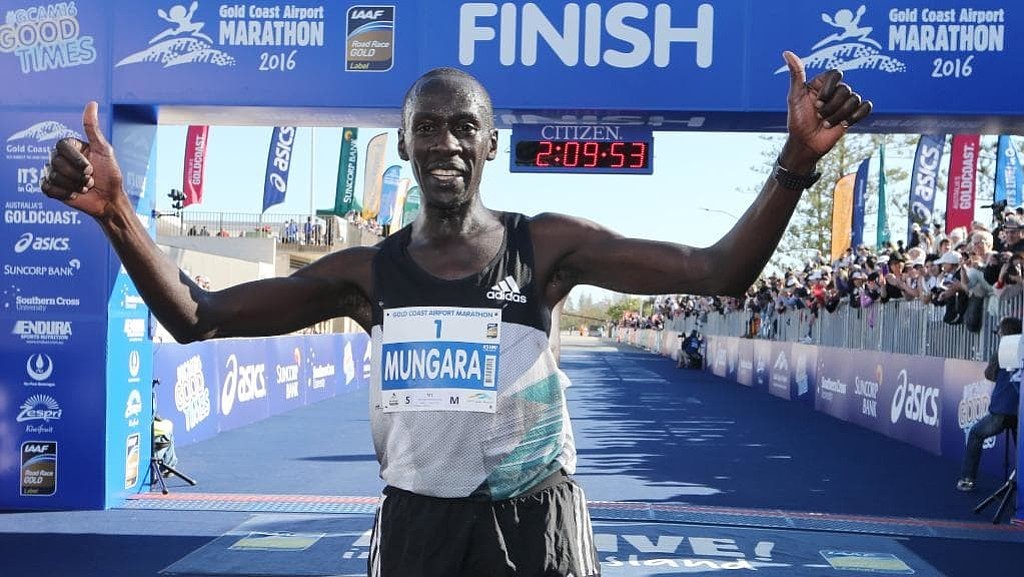
Master Runner Kenyan´s Mungara knows the course well and hopes to win the Commonwealth Games Marathon
Login to leave a comment
