

Running News Daily
Running News Daily is edited by Bob Anderson and team. Send your news items to bob@mybestruns.com Advertising opportunities available.
Index to Daily Posts · Sign Up For Updates · Run The World Feed
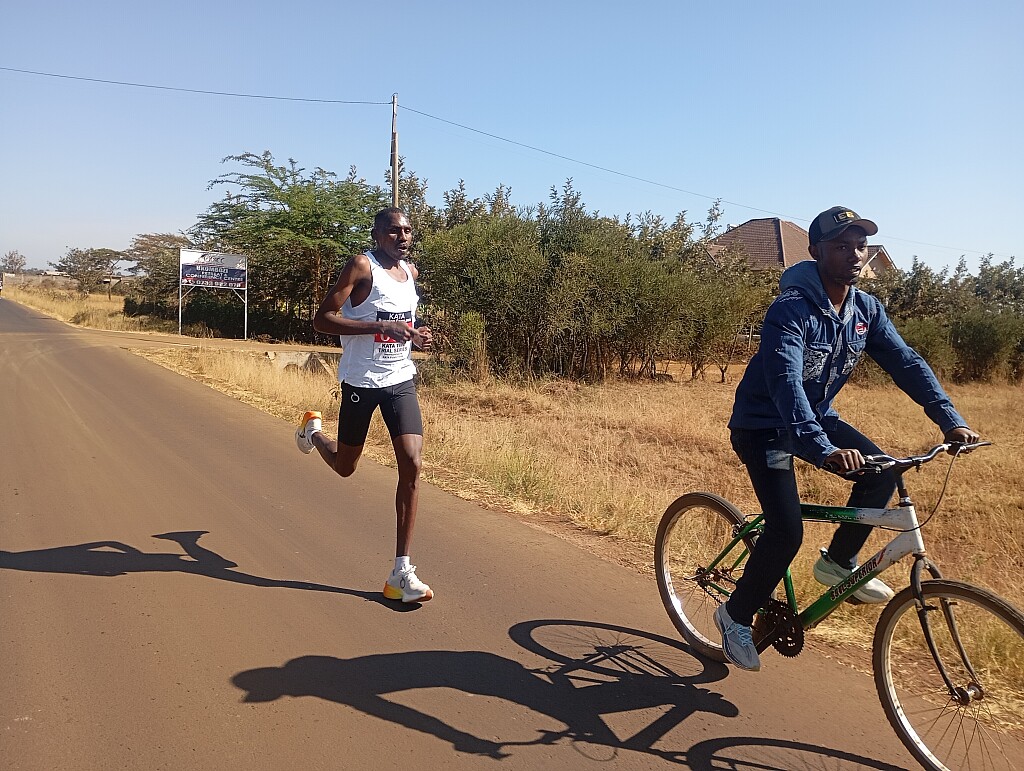


KATA Time Trial Series Reaches 59th Edition as Runners Chase Breakthroughs in Testing Conditions

There was plenty of energy, ambition and competitive fire at the 59th edition of the KATA Time Trial Series today, as athletes returned to the familiar challenge of testing their fitness, sharpening their race rhythm and measuring just how far their training has taken them.
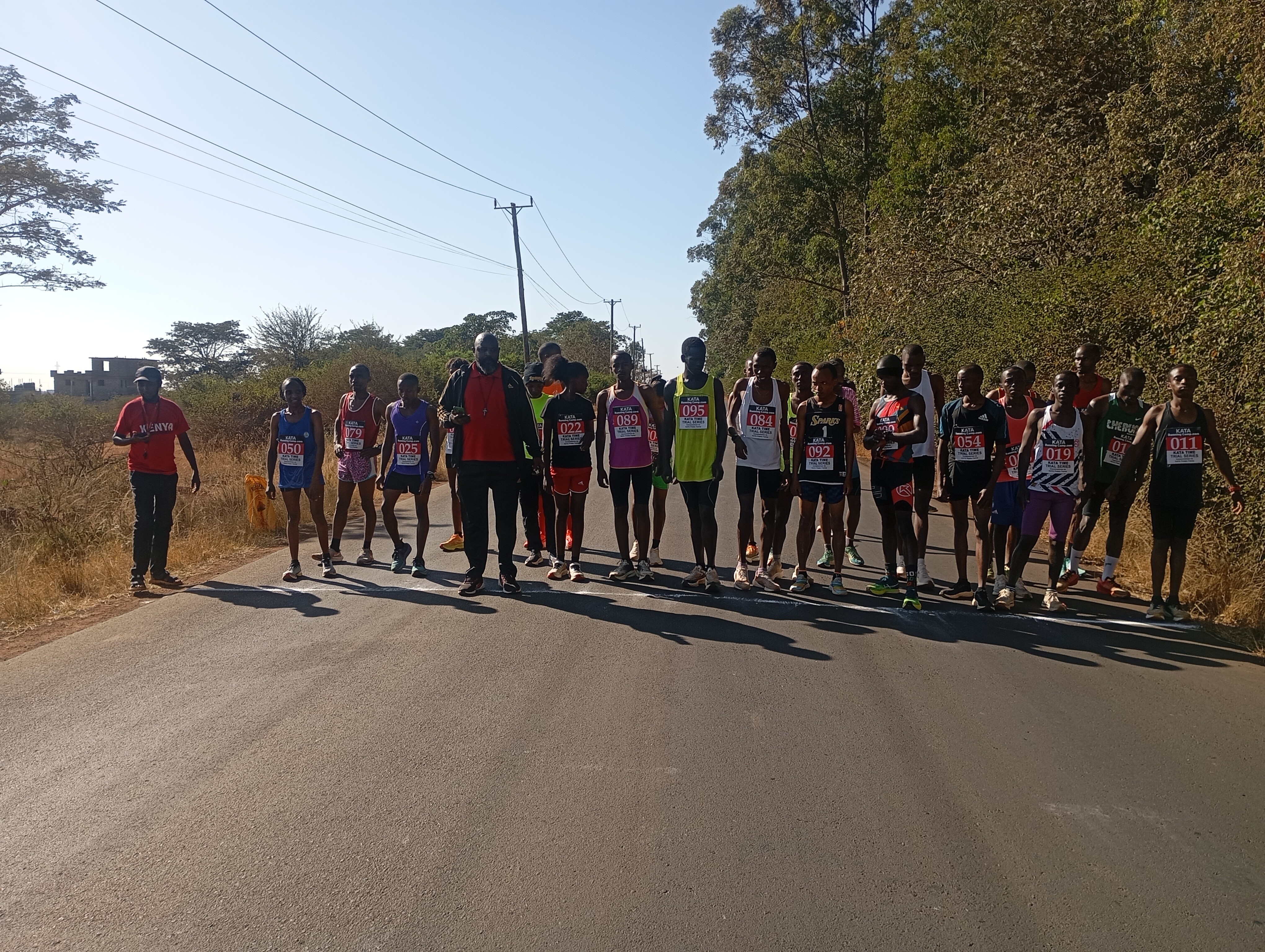
The latest edition brought together runners across the 5km and 10km distances, creating another rewarding morning of competition. The weather was generally favourable for racing, although temperatures were quite high, adding an extra layer of difficulty to an already demanding test of endurance.
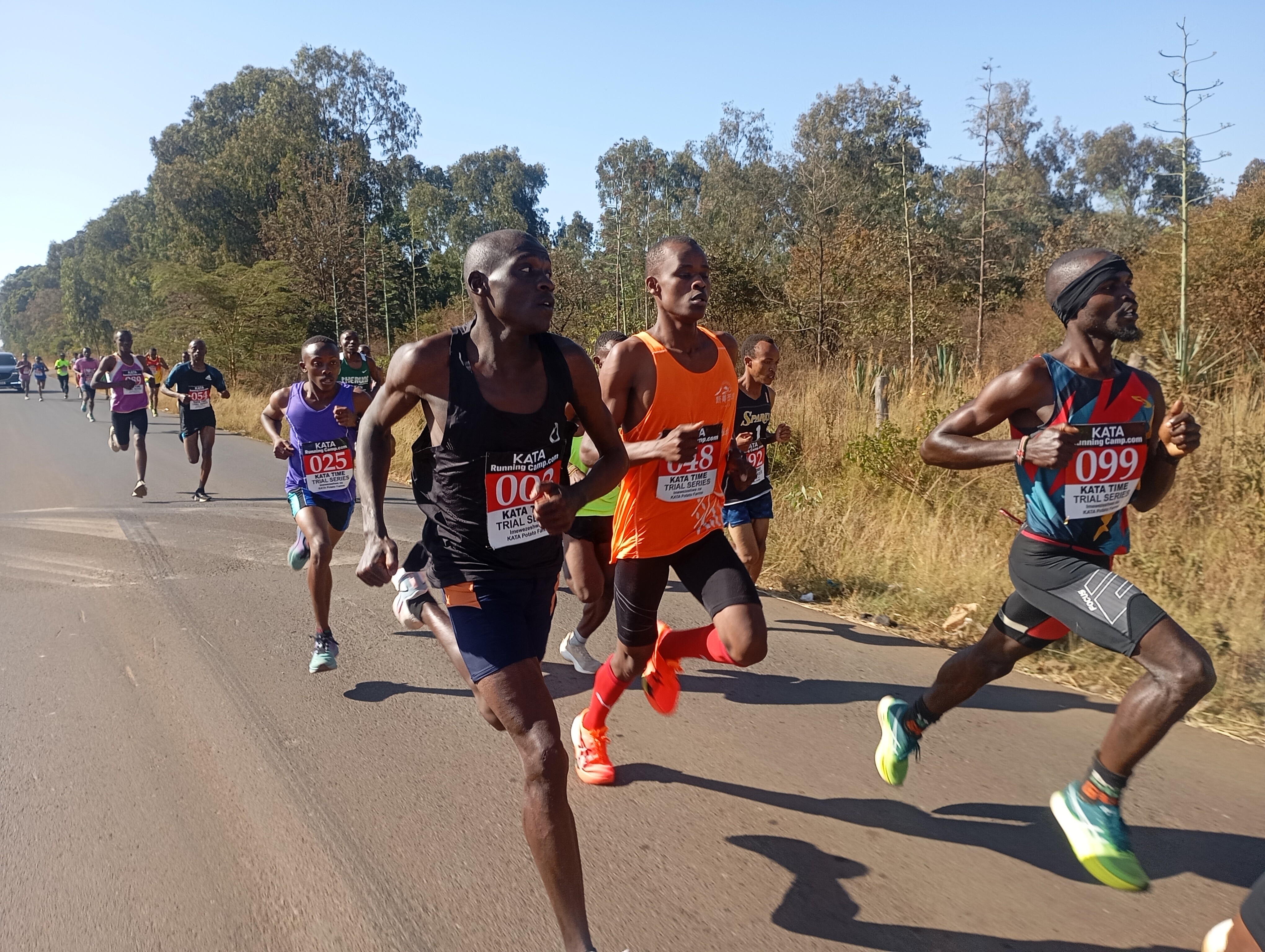
From the opening kilometres of the 10km races, the runners moved as tightly packed groups, carefully gauging one another while pushing a strong and controlled pace. The leaders remained close together through the early stages, each athlete seemingly unwilling to surrender precious ground. As the kilometres rolled by and the heat gradually began to make its presence felt, maintaining that rhythm required patience, discipline and a willingness to suffer.
Eventually, the sustained pace began to stretch the field. The compact groups slowly fractured, with the strongest runners beginning to establish their advantage and the battles for the leading positions becoming increasingly intense. Every surge mattered, every gap carried significance, and each athlete had to find the delicate balance between ambition and conserving enough strength for the decisive kilometres.
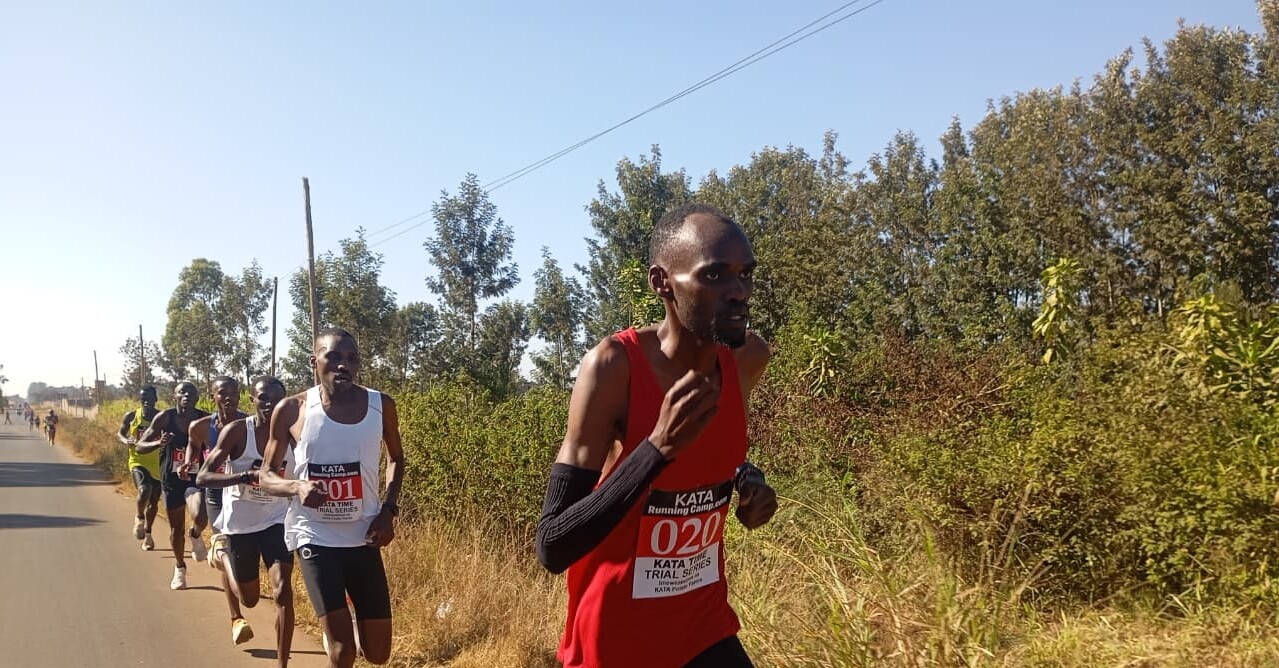
In the men’s 10km, Peter Wanyoike produced the standout performance of the day, powering to victory in 30:36. He was closely followed by Robin Musa, who crossed the line in 30:51, while Charles Wanjora completed the podium in 31:01.
Erick Cheruiyot was only two seconds further back, finishing fourth in 31:03, with Vincent Kiprotich rounding out the top five in 31:28. Justus Nyamai followed in 31:38, ahead of Fredrick Wambua in 32:23 and Ismael Mburu in 32:44.
The field remained competitive deeper into the results, with Martin Mambo recording 33:39 and Francis Maina finishing in 33:48. Anthony Kariuki crossed the line in 34:21, followed by Andrew Kimanzi in 35:21, Lewis Kamau in 35:29, Eric Mwaura in 36:24, Eugene Wambua in 37:48 and Simon Ngereza in 38:08.
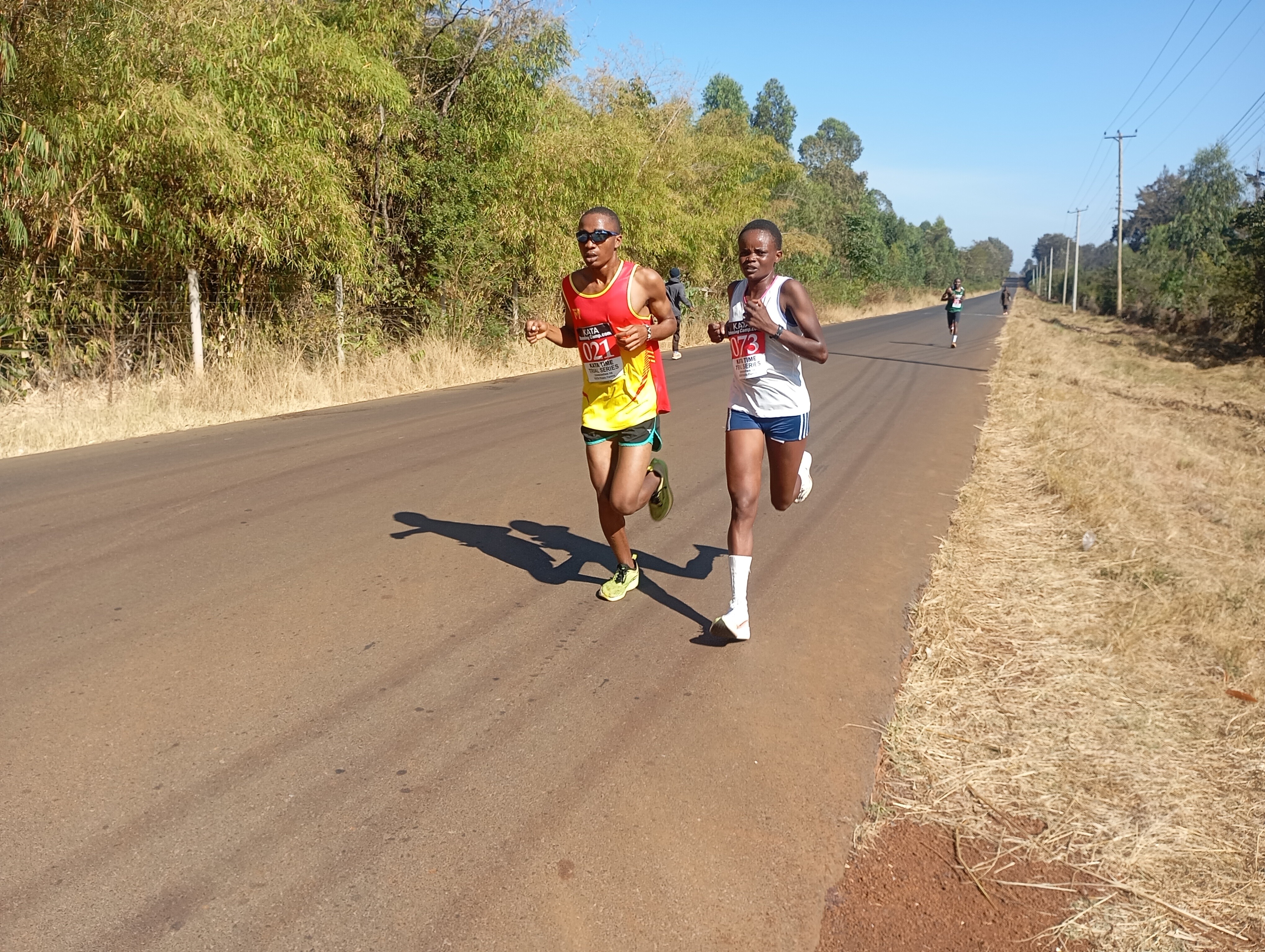
The women’s 10km also delivered an impressive display of determination, with Felister Maina leading the way in 37:37. Naomi Wambui Muriuki was a close second in 37:52, while Felister Mbatha completed the top three in 47:40.
The shorter races provided their own moments of excitement. In the men’s 5km, Edwin Muasa set the pace from the front to win in 16:17, with John Mutuku taking second in 16:54. Jason Wambua finished third in 17:52, while John Nzioka was fourth in 19:22.
The women’s 5km was won by Rachel Njeri, who stopped the clock at 22:21. Winfred Mueni followed in 24:05, with Janet Thuguri completing the podium in 25:43.
For some athletes, the morning brought the sweetest reward of all—a new personal best. After weeks of disciplined training and countless kilometres, seeing a new mark appear on the stopwatch offered a special reminder that patience and persistence eventually bear fruit. Others stepped onto the KATA Time Trial stage for the first time, embracing the excitement of making their debut and adding a fresh spark to the competition.
But not every runner walked away with the performance they had hoped for. Some found the pace, the heat or simply the demands of the day more challenging than expected, finishing without quite reaching their personal targets. Yet those performances should not be viewed as setbacks without value. Every race has its lessons, and an unexpected result can often become the starting point for renewed determination, smarter training and a stronger performance the next time around.
That mixture of breakthroughs, debuts, lessons and unfinished ambitions is what makes the KATA Time Trial Series so meaningful. Whether an athlete leaves with a personal best, a podium finish, a first taste of competition or a result that leaves them hungry for more, everyone gains another piece of experience to take back into training.
The relatively high temperatures demanded composure and careful effort, but the athletes continued to fight for every second until the finish. For many, the 59th edition was not simply about where they finished—it was another important chapter in their individual journeys.
The KATA Time Trial Series continues to provide a valuable platform for athletes to challenge themselves, measure progress and turn hard training into tangible performance. With the 59th edition now in the books, the stopwatch has delivered another set of stories—of breakthroughs, perseverance, first steps and lessons learned.
And as the runners return to training, one thing remains certain: the next opportunity to run faster is already waiting.
*5k men*
1. Edwin Muasa 20 25 16:17
2. John Mutuku 16 54 16:54
3. Jason Wambua 18 89 17:52
4. John Nzioka 17 33 19:22
*5k women*
1. Rachel Njeri 14 04 22:21
2. Winfred Mueni 15 22 24:05
3. Janet Thuguri 15 13 25:43
*10km women*
1. Felister Maina 37 73 37:37
2. Naomi Wambui Muriuki 42 50 37:52
3. Felister Mbatha 19 12 47:40
*10km men*
1. Peter Wanyoike 01 28 30:36
2. Robin Musa 18 84 30:51
3. Charles Wanjora 24 03 31:01
4. Erick Cheruiyot 30 20 31:03
5. Vincent Kiprotich 24 95 31:28
6. Justus Nyamai 18 94 31:38
7. Fredrick Wambua 21 96 32:23
8. Ismael Mburu 26 99 32:44
9. Martin Mambo 34 30 33:39
10. Francis Maina 20 11 33:48
11. Anthony Kariuki 28 29 34:21
12. Andrew Kimanzi 21 92 35:21
13. Lewis Kamau 38 79 35:29
14. Eric Mwaura 19 19 36:24
15. Eugene Wambua 21 21 37:48
16. Simon Ngereza 25 16 38:08
by Erick Cheruiyot for My Best Runs.
Login to leave a comment

KATA Time Trial Series
Welcome to the KATA Monthly Time Trial Held at the Kenyan Athletics Training Academy in Thika, Kenya, the KATA Monthly Time Trial is a unique and inclusive event designed to support runners of all levels in achieving their goals and showcasing their fitness. This event offers both 10K and 5K distances on an accurate, certified course, providing participants with...
more...Latest Running News

Allyson Felix Launches ‘Project Six’ With Eyes On Historic LA28 Comeback
Allyson Felix is preparing to write another extraordinary chapter in her remarkable career, with the American sprint legend targeting a return to competition and an unprecedented sixth Olympic appearance at the Los Angeles 2028 Games.

Felix, now 40, retired from elite competition after the 2022 season, bringing an illustrious career to a close after six Olympic Games and 11 Olympic medals. She is now embarking on what she has called “Project Six” — an ambitious attempt to return to the track and put herself in contention for the United States mixed 4x400m relay pool for LA28.
The comeback is expected to begin with a return to structured training under her longtime coach Bobby Kersee, with Felix targeting a return to racing in 2027. Rather than simply revisiting the past, the project represents a completely new challenge for an athlete who has already achieved almost everything possible in the sport.
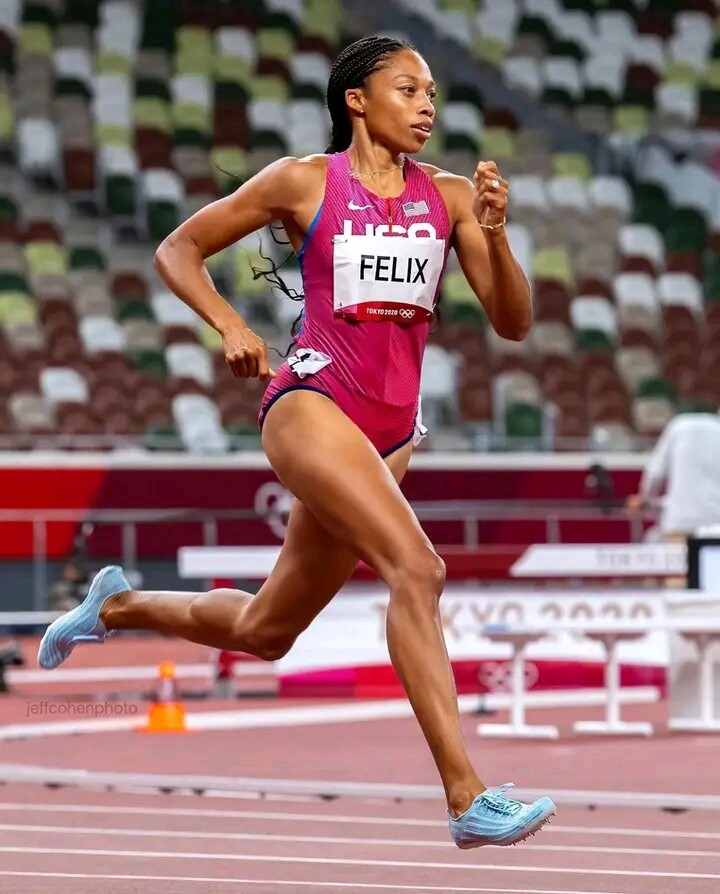
Felix has described the journey as a “live experiment in human potential,” framing the comeback not only around medals or records but around the experience of pursuing something difficult and uncertain. With her two children watching, she sees the project as an opportunity to demonstrate what it means to commit to a dream even when the outcome is far from guaranteed.
Her proposed route back to the Olympic stage is particularly intriguing. Instead of attempting to rebuild a full individual programme, Felix is targeting the United States mixed 4x400m relay, an event in which her experience over one lap could become central to her hopes of making the Olympic team.
If she succeeds, Felix would compete at the Olympics at the age of 42, potentially becoming the first American track and field athlete to appear at six Olympic Games. That would add another remarkable milestone to a career that already includes 11 Olympic medals and a place among the most decorated athletes in the history of the sport.
The location makes the potential comeback even more significant. Los Angeles is Felix’s hometown, while the LA28 athletics programme will be staged at the historic Los Angeles Memorial Coliseum, creating the possibility of an extraordinary homecoming on the Olympic stage.
For Felix, the prospect of returning to that setting would bring her career full circle — from an 18-year-old Olympic debutant in Athens in 2004 to a veteran mother attempting one final journey toward an Olympic team more than two decades later.
Nothing about the road to LA28 will be guaranteed. Felix will first have to rebuild her competitive form, navigate the demands of elite training at 40 and beyond, and ultimately earn her place against a new generation of American 400m runners.
But that uncertainty is precisely what makes Project Six so compelling. After a career defined by longevity, resilience and repeated reinvention, Allyson Felix is once again testing the boundaries of what is possible.
And this time, the finish line could be waiting in Los Angeles.
by Erick Cheruiyot for My Best Runs.
Login to leave a comment

Agnes Ngetich Rewrites Peres Jepchirchir’s Record: Two Historic Half Marathons, One Second Apart
Kenya’s Agnes Jebet Ngetich has added another remarkable chapter to the country’s extraordinary half-marathon history, breaking the women-only world half-marathon record in Copenhagen on Sunday, September 20, 2026.
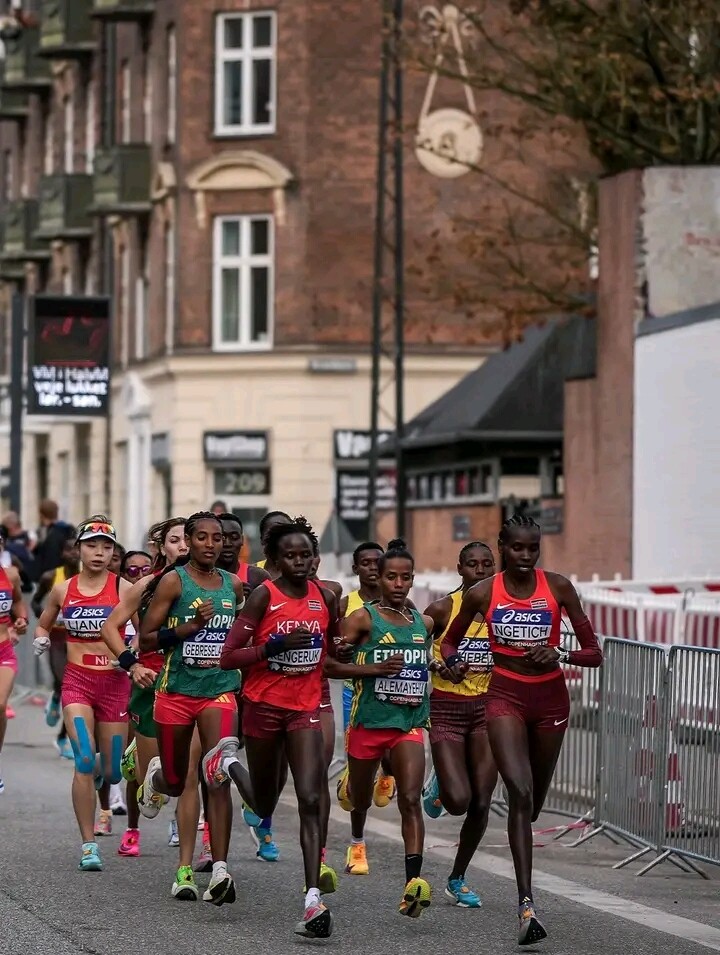
Ngetich clocked 1:05:15 to win the women’s half marathon at the World Athletics Road Running Championships, lowering the previous women-only world record of 1:05:16 set by fellow Kenyan Peres Jepchirchir in Gdynia, Poland, in 2020.
Jepchirchir originally established the record on October 17, 2020, when she won the World Athletics Half Marathon Championships in Gdynia in 1:05:16. That performance came just weeks after she had first broken the women-only record in Prague with 1:05:34 on September 5, 2020.
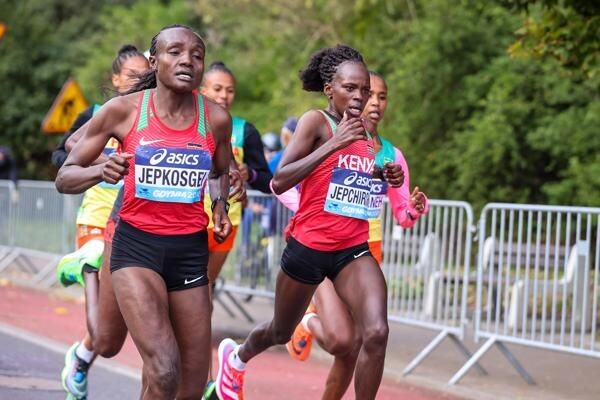
Five years later, Ngetich finally moved the mark forward—but by the narrowest possible margin.
The Copenhagen race also provides an intriguing statistical contrast between the two record-breaking performances. Their final times are separated by only one second, yet their races unfolded in noticeably different ways.
Ngetich attacked from the beginning, passing the opening 5km in 15:12. She then maintained remarkable consistency, reaching the next 5km in 15:27, followed by 15:38 and 15:39 for the subsequent 5km segments. With the final section covered in 3:19, she stopped the clock at 1:05:15.
Jepchirchir’s 2020 record followed a different rhythm. She passed the corresponding stages in 15:20, 15:27, 15:37 and 15:40, before producing a dramatically faster final section of 2:36 to complete her historic run in 1:05:16.
The split comparison highlights the contrasting ways in which the two Kenyans reached almost identical finishing times. Ngetich established her advantage early and maintained it through the middle kilometres, while Jepchirchir gradually built her race and delivered a particularly powerful closing section.
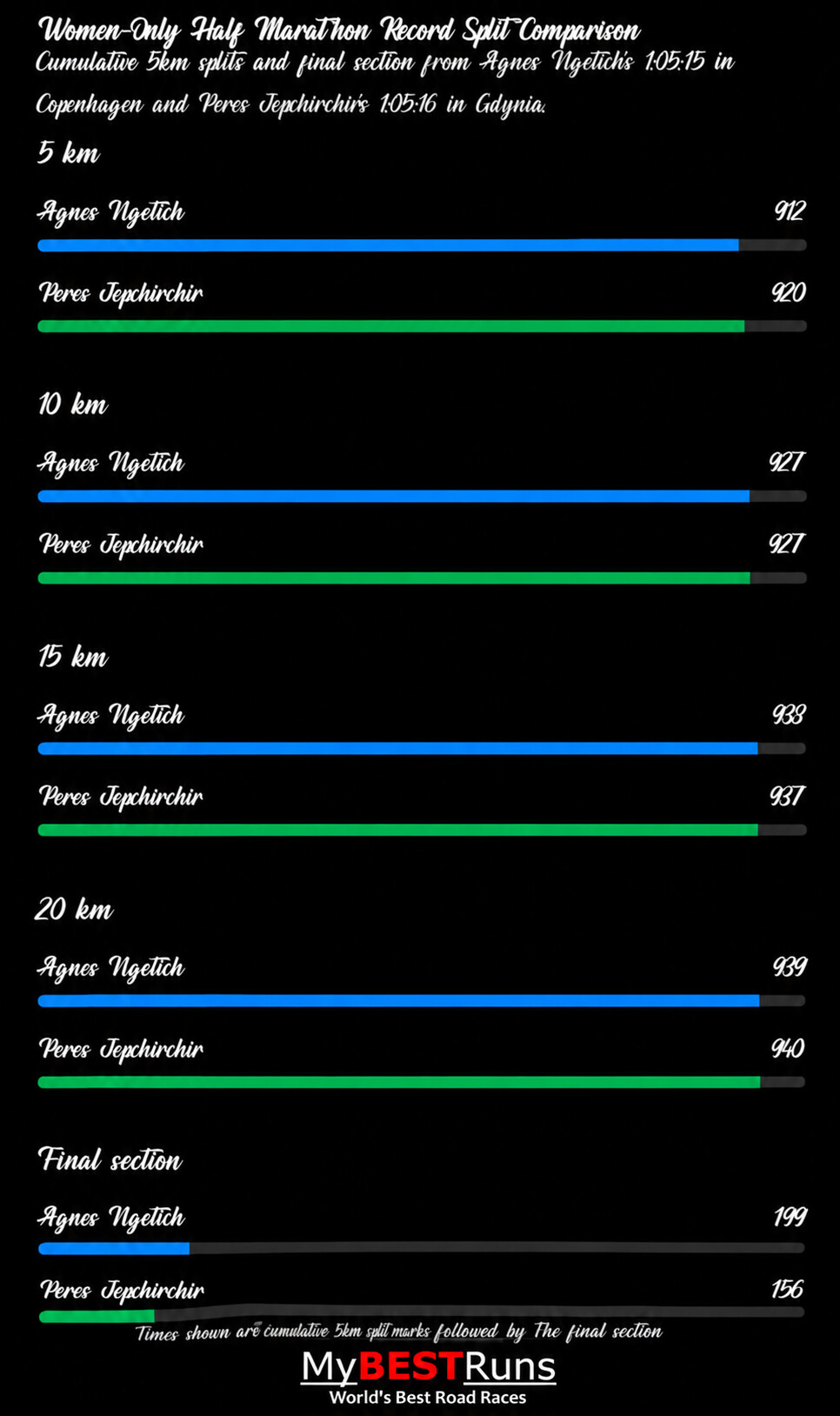
That is what makes the comparison so fascinating. Ngetich’s 1:05:15 and Jepchirchir’s 1:05:16 were produced five years apart, in different races and under different circumstances, yet the two performances sit almost perfectly together in the record books.
The split comparison is not a direct race between the two athletes, but rather a look back at how two Kenyan champions produced historic performances through contrasting pacing strategies. Ngetich’s performance was built on an exceptionally fast opening and sustained consistency, while Jepchirchir’s record was characterized by a stronger acceleration toward the finish.
For Jepchirchir, the 1:05:16 in Gdynia represented a defining moment in 2020. For Ngetich, the 1:05:15 in Copenhagen marked the moment she finally moved that record forward.
One second separates them. Five years separate the performances. Together, the two times provide a striking statistical snapshot of two historic Kenyan half-marathons.
by Erick Cheruiyot for My Best Runs.
Login to leave a comment
Women’s 800m Delivers A Season For The Ages In 2026
The women’s 800 metres has produced one of the most compelling storylines of the 2026 athletics season, with extraordinary times, fierce rivalries and a remarkable emergence that has transformed the event into one of the most closely followed races on the track.
At the centre of it all has been Switzerland’s Audrey Werro, who turned an already competitive event into a breathtaking display of speed and consistency. Werro finished the outdoor season unbeaten and established herself as one of the leading forces over two laps.
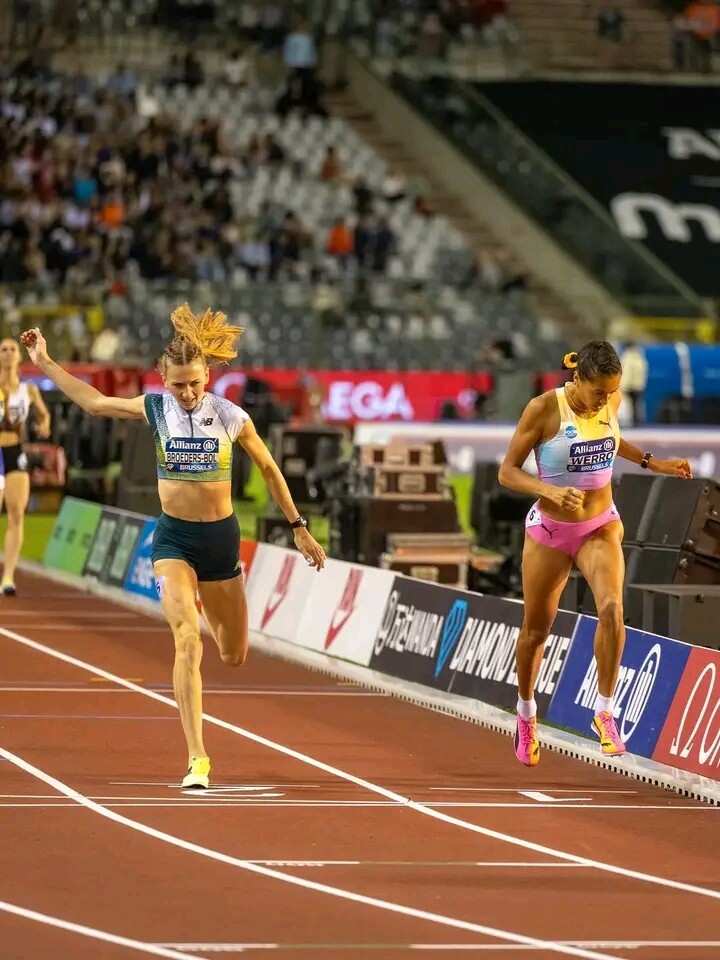
Her breakthrough reached another level in Stockholm in June, when she ran 1:53.98 to become only the third woman in history to break 1:54. She later improved to 1:53.80 in Paris before producing an astonishing 1:53.70 in Zurich in August. That performance moved her to third on the all-time list, behind only Jarmila Kratochvilova and Nadezhda Olizarenko.
Yet Werro was not the only athlete rewriting the story of the event.
Britain’s Keely Hodgkinson began the year in spectacular fashion by breaking the world indoor 800m record with 1:54.87 in Liévin. She followed that with victory at the World Indoor Championships, winning the title in a championship record of 1:55.30.
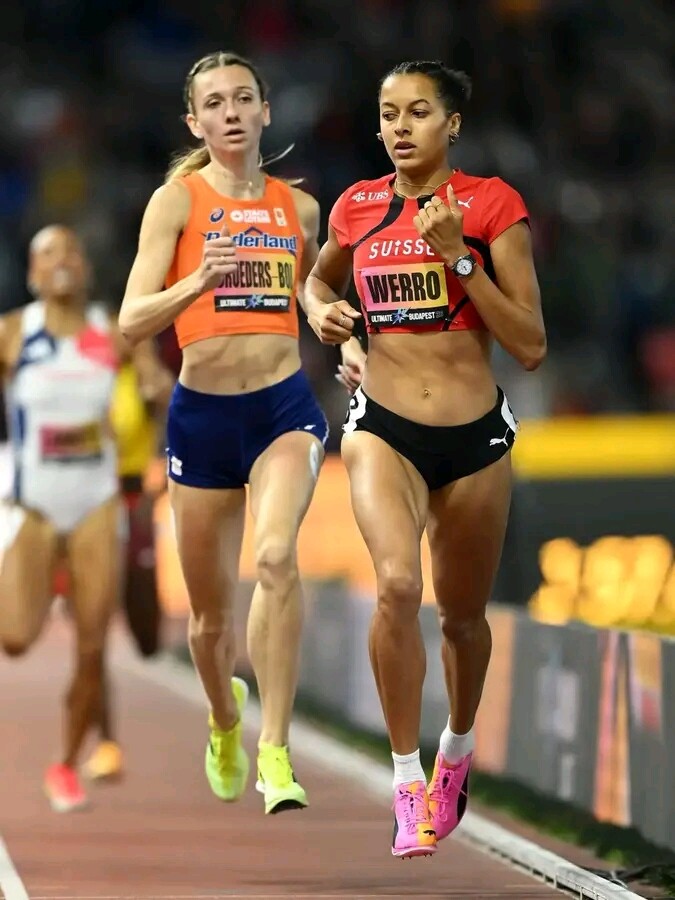
Hodgkinson also produced one of the season’s most memorable outdoor races when she ran 1:54.33 in Stockholm, finishing behind Werro but setting a British record and recording one of the fastest 800m performances ever run by a non-winner. The two athletes pushed each other deep into territory rarely seen in the event.
Then came one of the most unexpected developments of the season: Femke Broeders-Bol’s transformation.
The Dutch star, already a two-time world champion in the 400m hurdles, made the switch to the 800m in 2026 and rapidly established herself among the world’s best. What initially looked like an ambitious experiment quickly became a genuine championship challenge.
Broeders-Bol ran 1:55.54 to take bronze behind Werro and Hodgkinson at the European Championships in Birmingham, matching the Dutch record. She later improved to 1:54.71 in Zurich, becoming one of the fastest women in history at the distance.
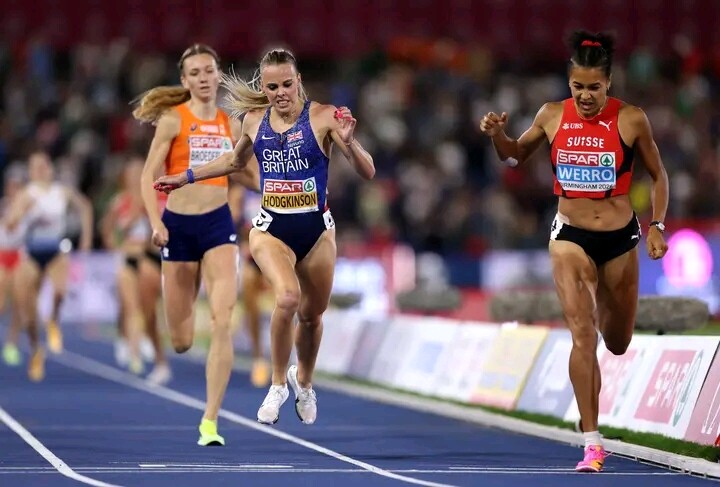
The European final provided another glimpse of just how deep the event had become. Werro won in a championship-record 1:54.81, Hodgkinson followed in 1:55.01, while Broeders-Bol took third in 1:55.54.
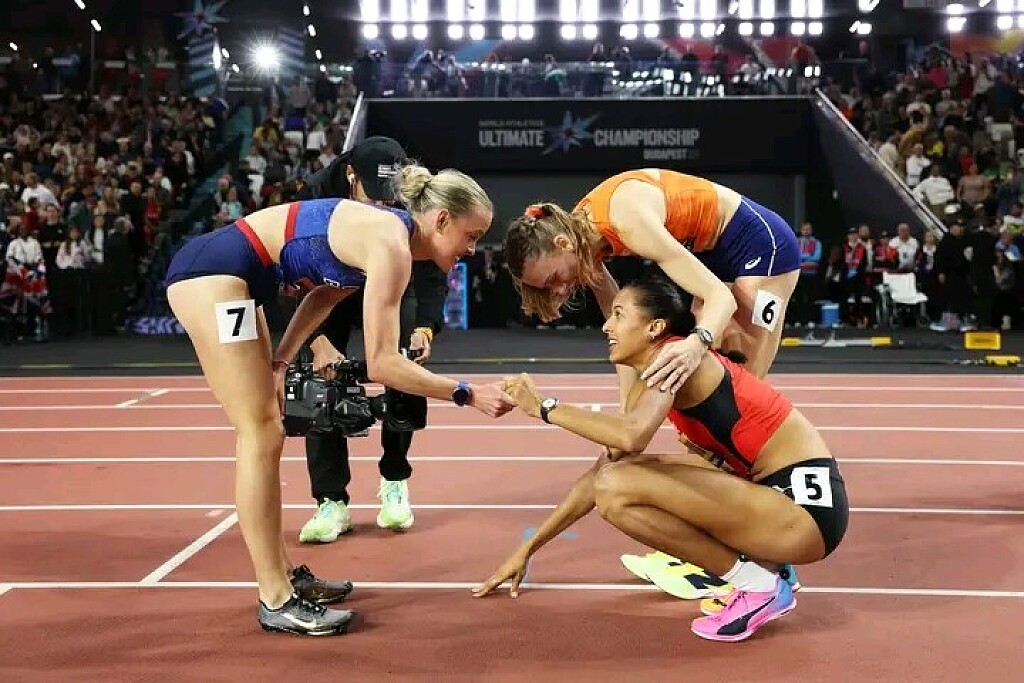
Their rivalry continued into the inaugural World Athletics Ultimate Championship in Budapest, where the three again shared the spotlight. Werro produced another controlled performance to win the final in 1:55.88, ahead of Hodgkinson in 1:56.26 and Broeders-Bol in 1:56.74.
What made the 2026 women’s 800m particularly remarkable was not simply the number of fast times, but the different storylines unfolding at the same time. Werro’s explosive rise, Hodgkinson’s record-breaking indoor campaign and championship pedigree, and Broeders-Bol’s extraordinary transition from the 400m hurdles created a three-way battle that repeatedly produced world-class racing.
And behind them was an increasingly deep field, making the event far more than a contest between three athletes. With multiple runners capable of breaking two minutes and pushing the leaders, every major championship race carried the possibility of another breakthrough.
For Werro, 2026 became the year she moved from emerging talent to a dominant outdoor force. For Hodgkinson, it was another season of record-breaking performances and championship experience. And for Broeders-Bol, it was the beginning of an entirely new chapter.
Together, they made the women’s 800m one of the defining events of the 2026 season — a year in which records fell, rivalries intensified and the two-lap race produced drama almost every time the gun went off.
by Erick Cheruiyot for My Best Runs.
Login to leave a comment
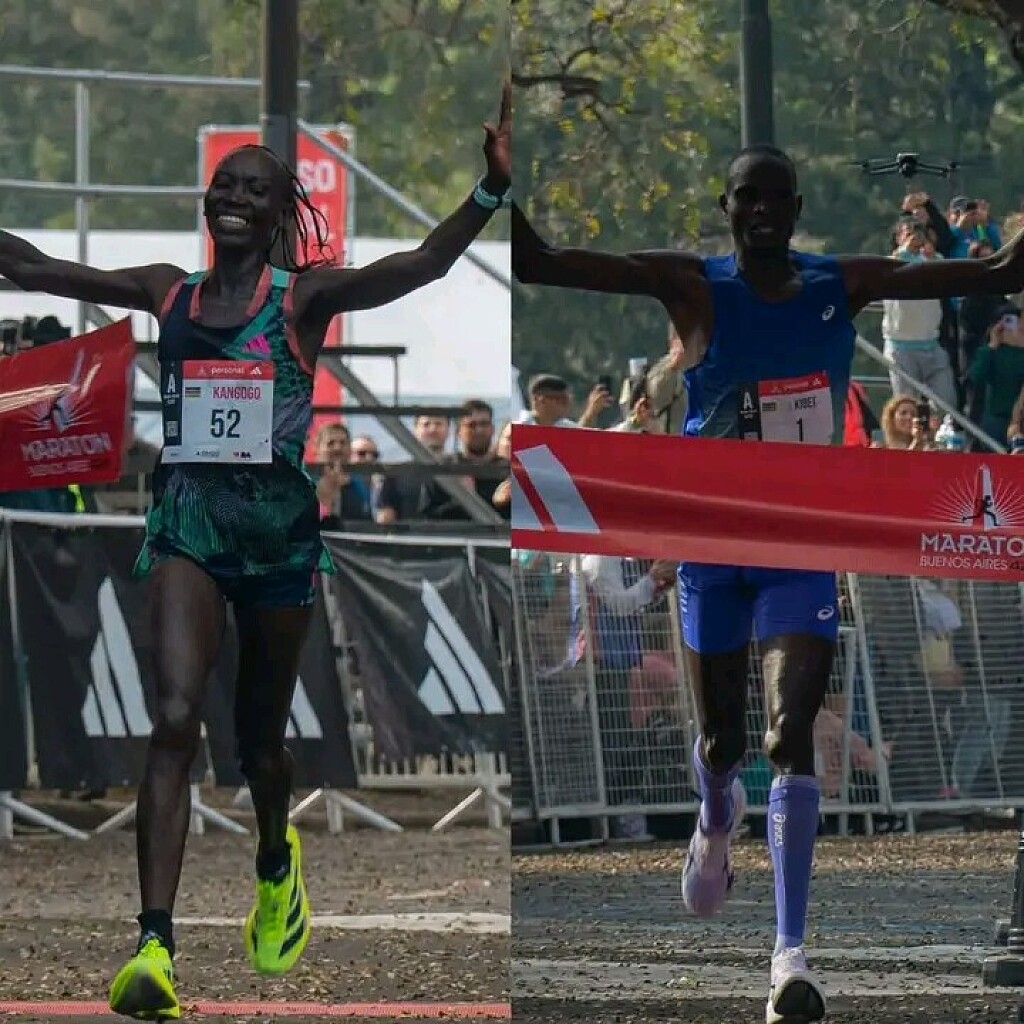
Bethwel Kibet Chumba And Rebecca Kangogo Chesir Lead Kenyan Triumph At Buenos Aires Marathon
Kenya produced a spectacular double triumph at the 2026 Buenos Aires Marathon on Sunday, September 20, dominating both the men’s and women’s races as Bethwel Kibet Chumba claimed the men’s title and Rebecca Kangogo Chesir shattered the women’s course record.
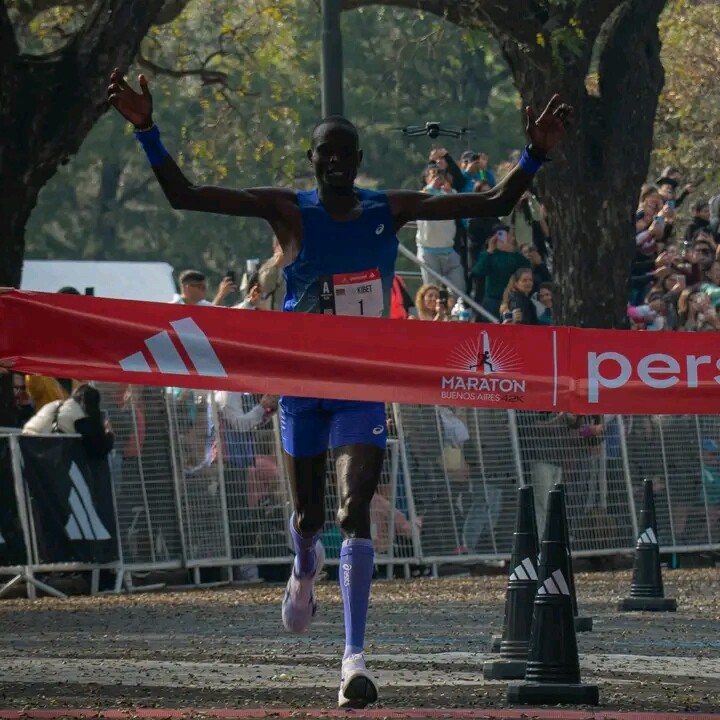
On the men’s side, Chumba delivered a commanding performance to conquer the streets of Argentina, crossing the finish line in 2:08:28 and securing a memorable victory on the home turf of football legend Diego Armando Maradona.
The race unfolded under challenging conditions, with temperatures around 18°C and humidity approaching 90 percent placing considerable demands on the runners throughout the 42.195-kilometre course.
Earlier in the race, a fierce lead group featuring four Kenyans and one Rwandan pushed the pace aggressively, reaching halfway in a remarkable 1:02:48. At that point, the pace appeared fast enough to threaten the 2:05:00 course record, but the demanding second half would prove considerably more difficult.
As the kilometres passed and the humid conditions began to take their toll, Chumba maintained his strength and composure to emerge as the strongest runner in the closing stages. He eventually secured the victory in 2:08:28.
Rwanda’s John Hakizimana produced an outstanding performance to finish second in 2:08:39, just 11 seconds behind Chumba, while Kenya’s Felix Kiptoo Kirwa completed the men’s podium in 2:10:24.
Kipkemo Kiprono followed in fourth in 2:10:49, with Vincent Kibor Raimoi fifth in 2:11:50. Ethiopia’s Embay Goitom Dimtsu finished sixth in 2:12:28, while Chile’s Ricardo Rojas was seventh in 2:14:47.
Colombia’s David Gómez González placed eighth in 2:15:23, followed by Argentina’s Ignacio Erario in 2:16:42 and compatriot Ignacio Reyes, who completed the men’s top 10 in 2:21:46.
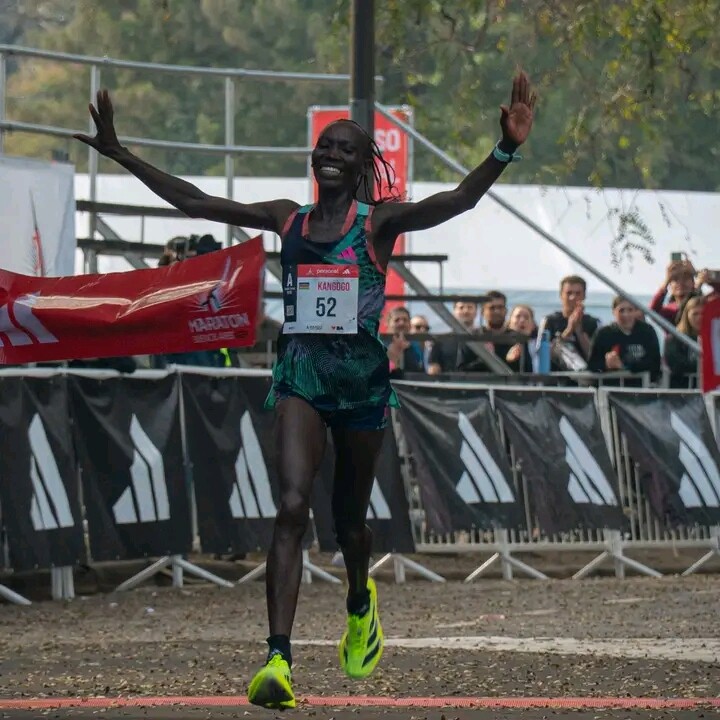
The women’s race provided another remarkable Kenyan celebration, with Rebecca Kangogo Chesir leading a clean sweep of the podium while producing the performance of the day with a new course record of 2:23:36.
Kangogo Chesir controlled the women’s race through the streets of Buenos Aires to claim victory and rewrite the course record. Her winning time was 1 minute and 16 seconds faster than the previous mark of 2:24:52, set by fellow Kenyan Rodah Jepkorir Tanui in 2023.
The victory also represented a major personal breakthrough for Kangogo Chesir. Entering the race with a personal best of 2:24:25, she improved substantially to 2:23:36, breaking the 2:24 barrier for the first time in her career.
Behind her, Tanui produced another strong performance to finish second in 2:24:49, while Emmah Cheruto Ndiwa completed the all-Kenyan podium in 2:26:55, giving Kenya gold, silver and bronze in the women’s race.
The result was particularly significant for Tanui, who returned to the Buenos Aires podium after winning the race in 2023. Her runner-up performance in 2026 was also faster than the 2:24:52 winning time she recorded three years earlier.
Ethiopia’s Sintayehu Hailemichael finished fourth in 2:29:53, followed by compatriot Agere Tamir in 2:30:19. Lomi Muleta Tefera, also from Ethiopia, placed sixth in 2:32:15.
Argentina’s Chiara Mainetti was the leading home runner in seventh place with 2:38:25. Anahi Castaño followed in 2:44:21, while Mercedes Piredda finished ninth in 2:48:11. Laura Ortegon completed the women’s top 10 in 2:50:32.
The demanding weather conditions added another layer of difficulty to both races, with the warm temperatures and exceptionally high humidity testing the endurance of the international field over the full marathon distance.
For Kenya, Buenos Aires became a celebration of distance-running strength, with Chumba taking the men’s title in 2:08:28 and Kangogo Chesir breaking the women’s course record in 2:23:36. The women’s podium sweep added another highlight, as Kenya once again demonstrated its depth on the international marathon stage.
by Erick Cheruiyot for My Best Runs.
Login to leave a comment

Buenos Aires Marathon
The Maratón of Buenos Aires is an annual marathon foot-race which takes place in Buenos Aires, Argentina, during the Southern Hemisphere's Spring, usually in October. The 21st edition of the Buenos Aires Marathon started on October 9, 2005 at 7:30 at the 9 de Julio Avenue and Córdoba Avenue in the Recoleta neighborhood, being the start also the end point. ...
more...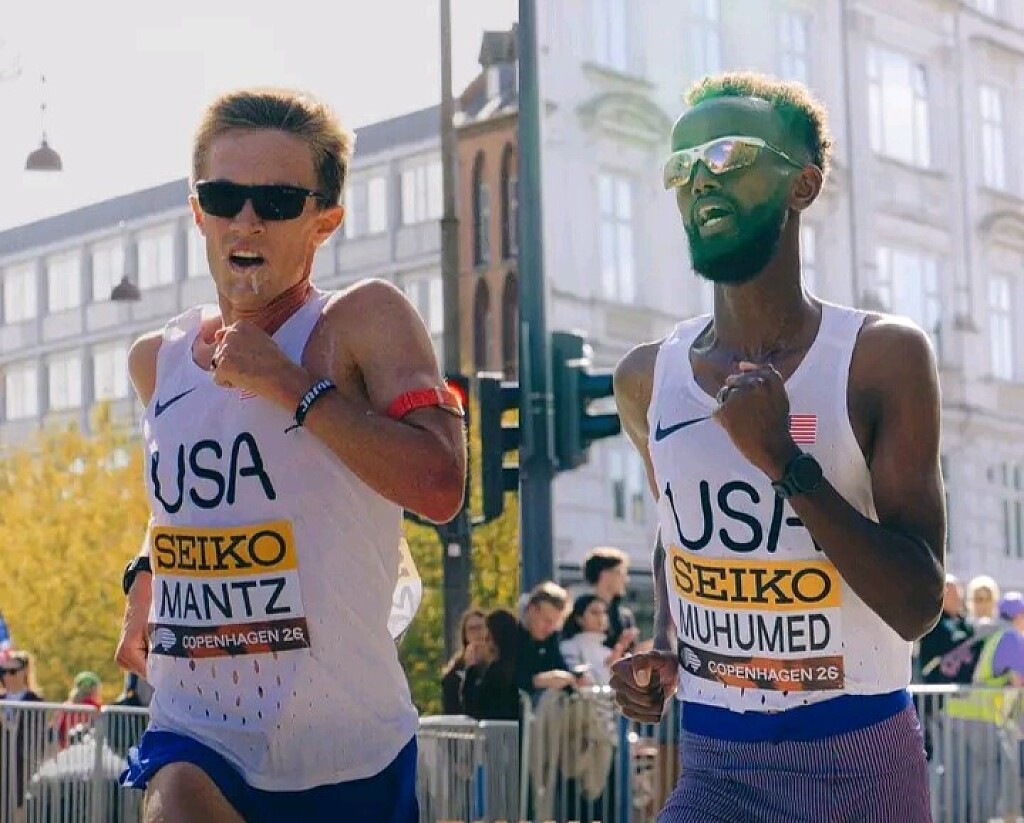
Team USA Makes History With Double Half Marathon Team Medals In Copenhagen
The United States enjoyed a remarkable day at the 2026 World Athletics Road Running Championships in Copenhagen, Denmark, securing team medals in both the men’s and women’s half marathon competitions.
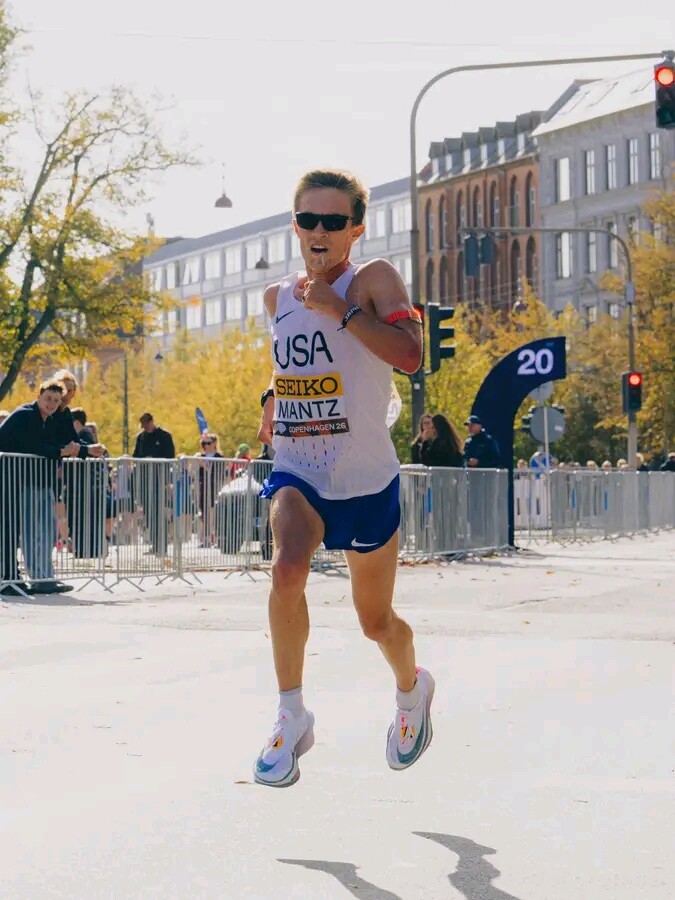
The American men claimed bronze in the team standings, while the women produced a historic performance to win silver and secure Team USA’s first-ever women’s team medal at the World Road Running Championships.
Leading the way for the American men was Conner Mantz, who finished 12th individually in 1:00:08, clocking a season’s best to spearhead the American challenge over the 21.1-kilometre distance.
For Mantz, the performance carried added significance as he continues his comeback from injury. His 1:00:08 season’s best provided a strong return to championship-level competition and an important tune-up as he prepares to take on the New York City Marathon in November.
Mantz’s performance also proved crucial to Team USA’s team medal effort, with his 12th-place finish providing the foundation for the Americans to secure bronze in the men’s standings.
Ahmed Muhumed followed closely in 13th place, crossing the finish line in 1:00:15. The performance marked a significant breakthrough for Muhumed, who lowered his previous best by 48 seconds in a major championship setting.
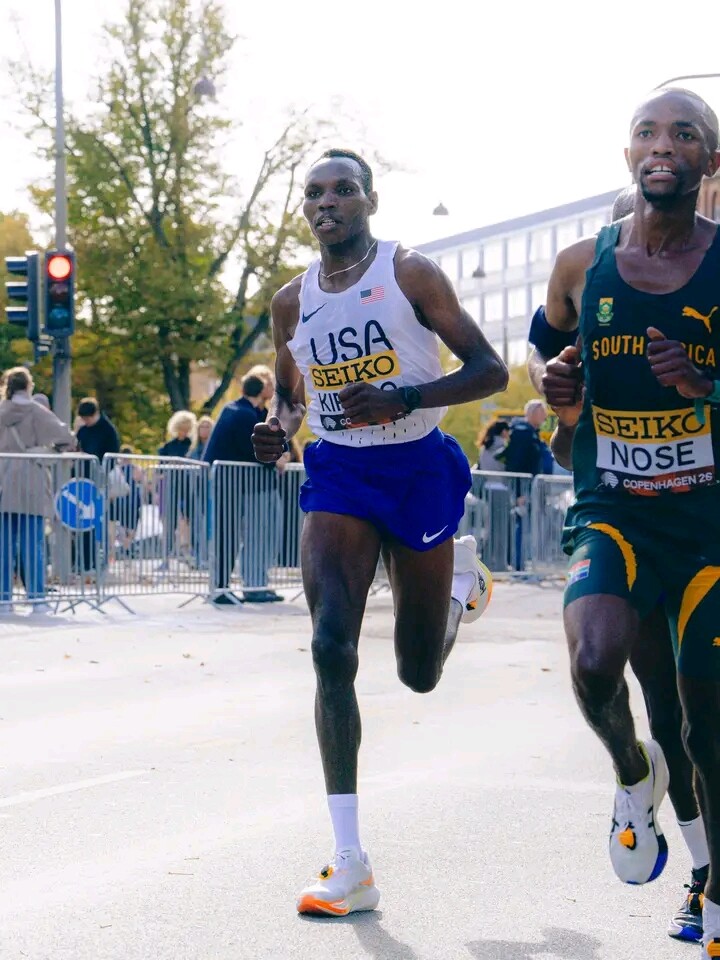
Wesley Kiptoo completed the American scoring trio, placing 23rd in 1:01:11. Kiptoo also produced a season’s best, contributing another important performance to the United States’ team effort.
The combined performances of Mantz, Muhumed and Kiptoo were enough to place the United States third in the men’s team standings, securing a hard-earned bronze medal in Copenhagen.
For Muhumed, the race was one of the biggest breakthroughs of the day, with his 1:00:15 representing a 48-second improvement on his previous best. Kiptoo’s season-best 1:01:11 further strengthened the American challenge and helped convert three individual performances into a place on the global podium.
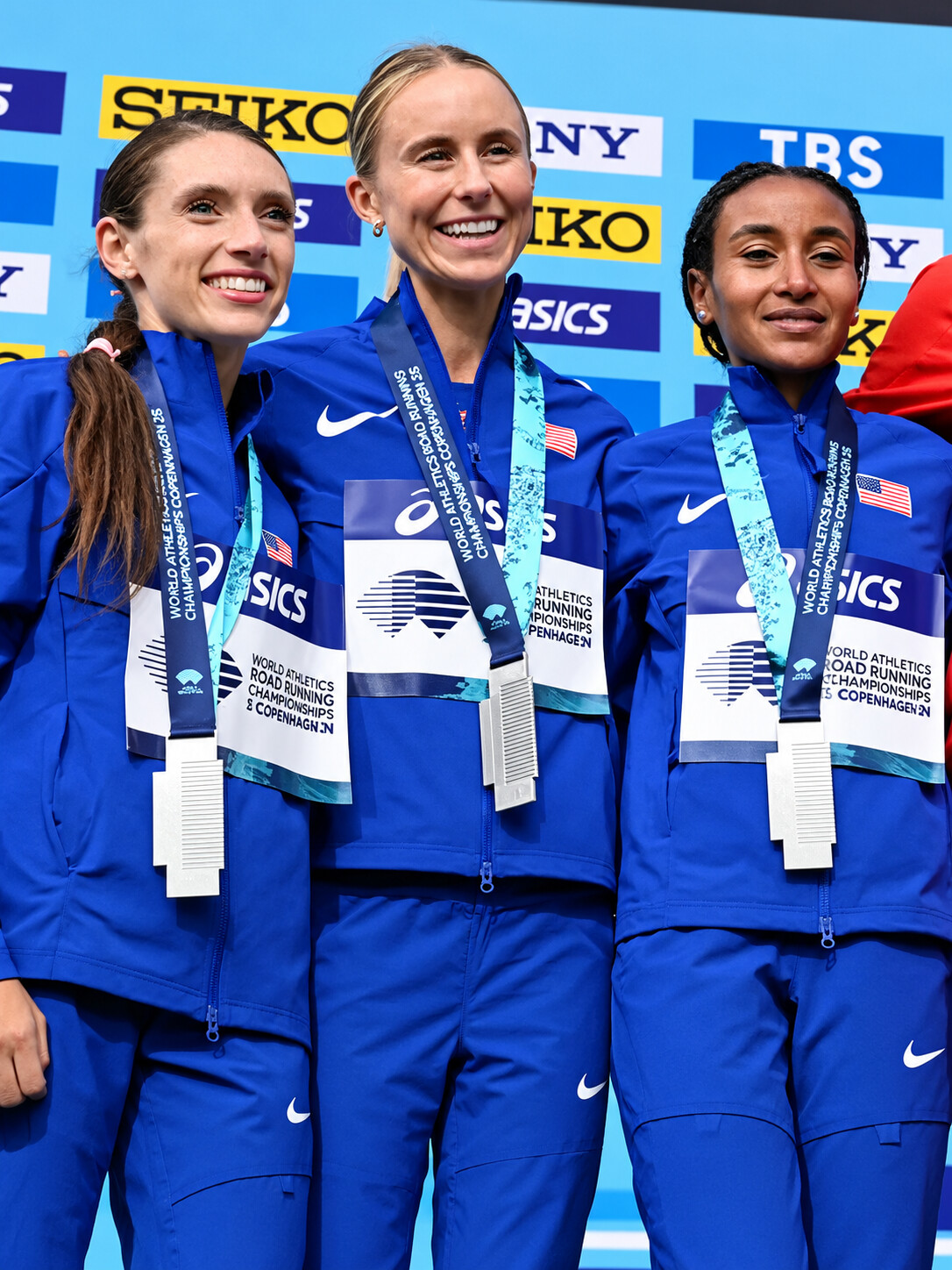
On the women’s side, Team USA made history by placing three athletes inside the top seven, earning its first-ever women’s team medal at the World Road Running Championships.
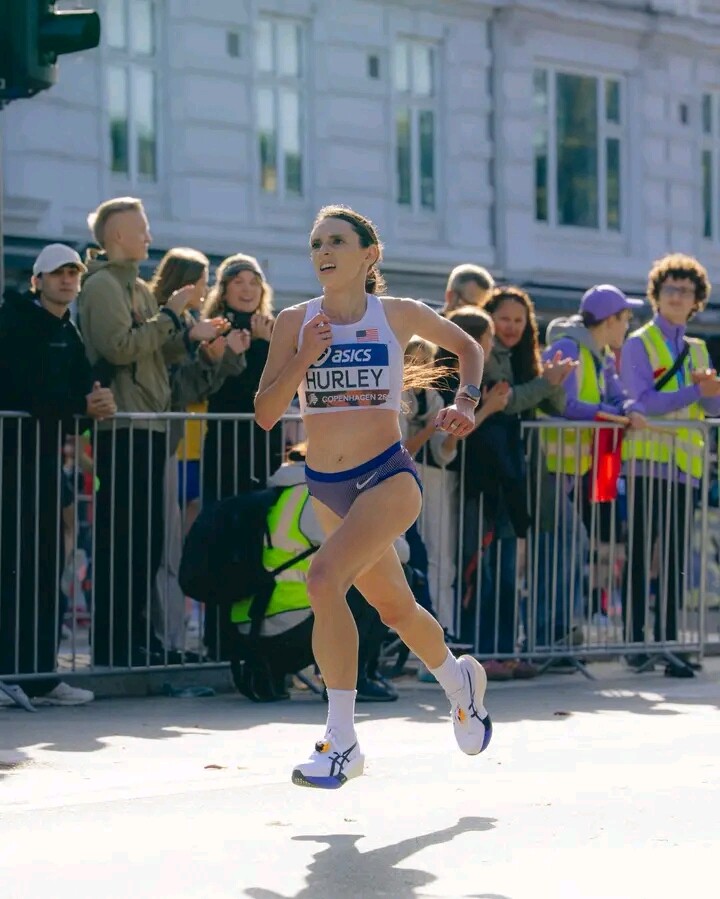
Emma Grace Hurley led the American women with a sensational fifth-place finish in 1:06:23. The performance was a huge personal best, taking more than a minute off her previous best of 1:07:35 and moving her to No. 3 on the U.S. all-time half marathon list.
Hurley also finished as the first American across the line, delivering one of the standout performances of the championship for the United States.
Weini Kelati Frezghi followed in sixth place, clocking 1:06:35 and ensuring that Team USA had two athletes inside the top six. Jessica McClain completed the scoring trio in seventh, stopping the clock at 1:06:53.
McClain’s performance represented another major breakthrough. She entered Copenhagen with a half marathon personal best of 1:08:37 but improved that mark by nearly two minutes, producing a remarkable 1:06:53 and moving to No. 6 on the U.S. all-time list.
With Hurley, Kelati Frezghi and McClain all finishing inside the top seven, the American women combined their individual performances to secure a historic team silver medal.
The achievement gave Team USA a remarkable double podium finish in the half marathon team competitions, with the men taking bronze and the women claiming silver.
Beyond the medals, Copenhagen provided a showcase of individual breakthroughs for the American distance runners. Hurley moved into the top three on the U.S. all-time list, while McClain made an equally significant leap into sixth, as Mantz added another season’s best during his return from injury.
For Mantz, the Copenhagen race now serves as an important stepping stone toward the New York City Marathon in November, giving him a competitive test and a confidence-building performance as he continues his return to top-level racing.
It was a memorable championship outing for Team USA, with strong individual performances translating into two team medals and a landmark first for the American women at the World Road Running Championships.
by Erick Cheruiyot for My Best Runs.
Login to leave a comment
