

Running News Daily
Top Ten Stories of the Week
10/8/2022
These are the top ten stories based on views over the last week.


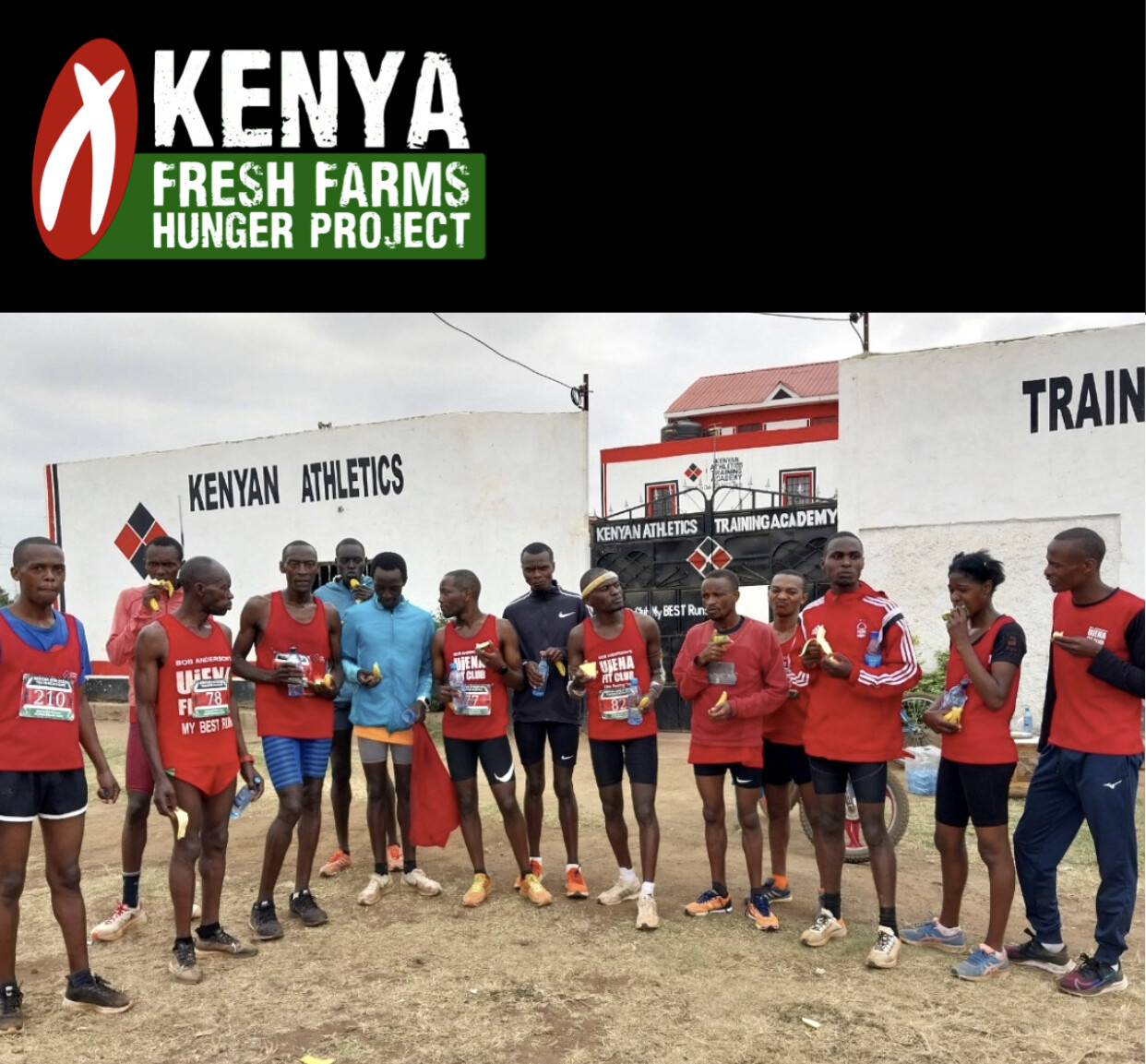
The Kenyan Athletics Training Academy in Thika just launched today the KATA hunger project helping potential pro runners from poor families
KATA (Kenyan Athletics Training Academy) announced today (Oct 4, 2022) it has launched a new project. The KATA Hunger Project is going to help potential Pro runners from poor families. Additionally the project will help struggling women farmers to be better more efficient farmers year around.
"Our Kenya Fresh Farm Hunger Project (KATA Hunger Project) is going to provide 8.8 pounds (four kilos) of home-grown fresh fruits and vegetables weekly to Kenyans in Need for 13 weeks," says KATA director Bob Anderson, MBR publisher and founder of Runner's World Magazine (1966-1984).
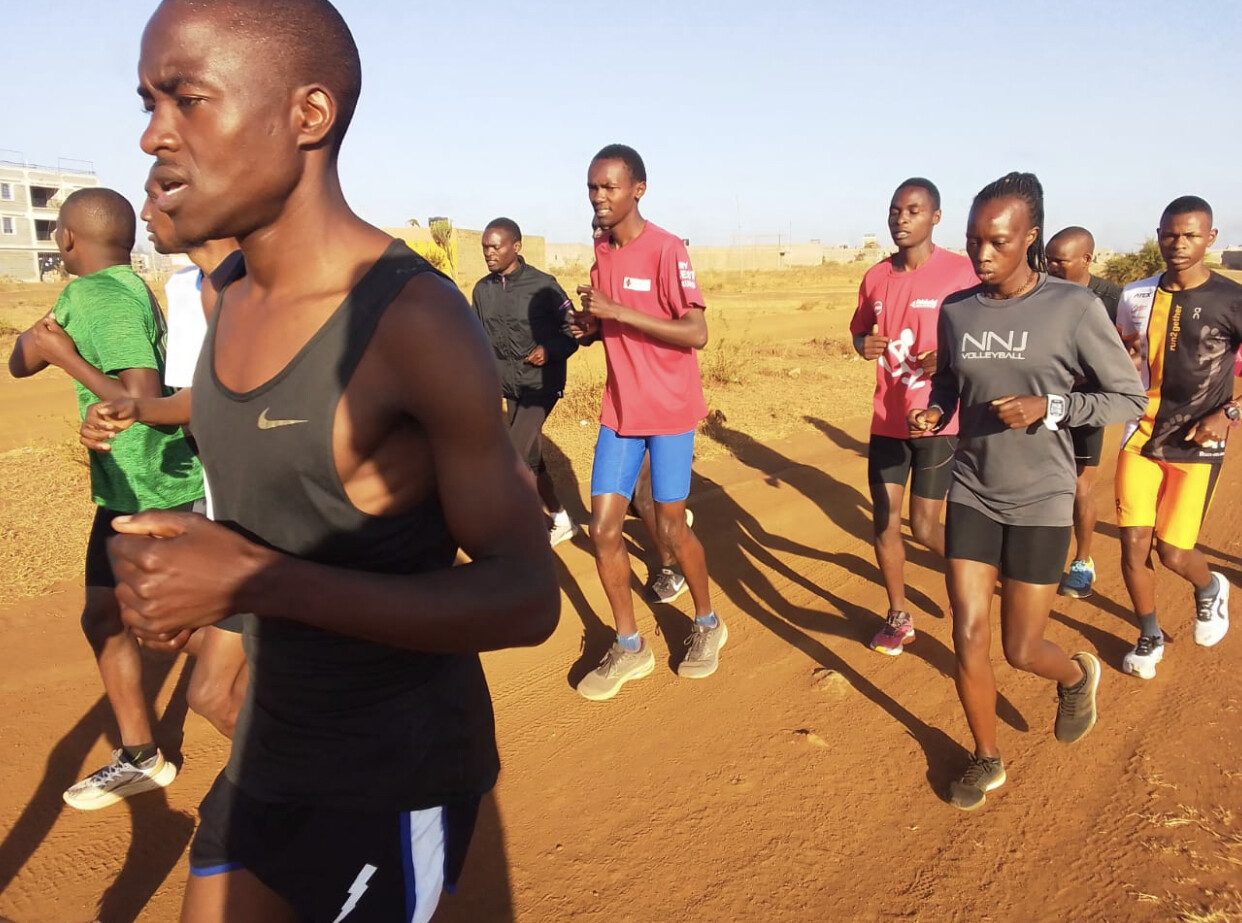
Bob and his wife Catherine built and financed the Kenya Athletics Training Academy located in Thika Kenya. The 23- room academy was officially opened Sept 4, 2021.
KATA is a one-of-a-kind facility and its focus is on training runners to become pro runners. KATA does not manage runners and does not ask its athletes to share any of their prize money.
Kenyan athletes are not charged to live, eat and train at KATA. "We mostly seek out runners who need our help," says head coach Joseph Ngure, a senior coach with over 30 years of experience.
As an example, Peter Njeru Mwaniki was one of the first potental pro runners who came to KATA for help. His family did not believed he could make distance running a career. They basically kicked him out of their house. He then moved in with his brother but that was not working either.
“He had run a 32:30 10k but his hope of making a career out of running was slim," says coach Joseph. "We took him in, feed him and trained him. Within just a few weeks we knew he had great potential."
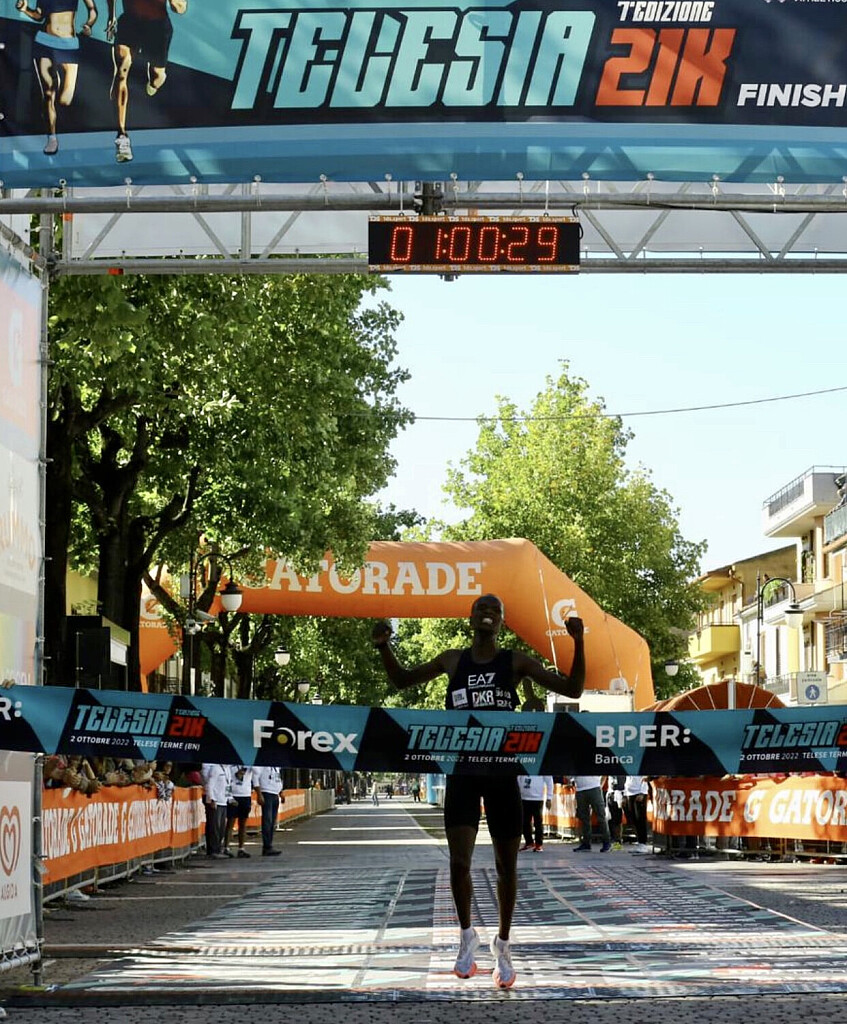
On Oct 2, 2022 Peter won the Telesia half marathon in Italy clocking 1:00:29. It was a good pay day for Peter and his new KATA family made it happen for him. "We are very proud of Peter and all our KATA athletes," says Bob.
"It would be almost impossible to train hard without enough to eat," says KATA manager Florence Kimiti, as a junior ran 1:59 for 800m. "A 32:30 10k is not bad for a recreational runner but not for a pro runner. A lot of Kenyans make a living from distance running, the most famous being Eluid Kipchoge who is making millions for his efforts. He is our hero. The goat."
Peter will be running several more races in Italy before coming back to KATA to keep up his training and to help support our Kenya Fresh Farms Hunger Project.
"All KATA athletes staying at our academy put in 20 hours per week of work," says operations manager Elam Wangwero, a top runner himself and who have known Bob and Catherine since 2014.
"The work might be cleaning, painting, working on My Best Runs website (posting results, checking links, photos, etc) and now KATA Hunger Project. But of course the training always comes first along with three meals daily."
"It seems to me that doing something other can training, eating and sleeping is helping our athletes run so well," says Bob. "So much of running is mental and you need a sharp mnd."
"Without the support of KATA,"wrote Peter from Italy, "my dream would not have come true. I am feeling the happiest ever. I never thought of running such a time at this age."
The KATA Hunger Project was officially started August 1, 2022 but unofficially started in 2020. "Since we are going to provide home-grown fresh fruits and vegetables for our potential pro runners we needed to set up our own farm," says Florence.
Bob leased two acres of land outside of Embu on August 1. It was idle land but it did have 40 fruits trees (banana and mango) that just needed care. Additional land can be easily leased when needed.
Vegetable beds at KATA's Fresh Farm have already been planted. "We dug a well for water, we set up solar and are building a barn, thanks to Brock Hinzmann (2:19 marathoner back in the 80’s and 90’s) contribution," says Florence.
Runners can also train with the team by just coming to KATA and soon other locations. And when approved, will be given four kilos of Fruits and vegetables at the end of the week starting Dec 23. After or during the 13-week program the athletes with the most potential will be asked to live at KATA at no expense for them.
Potential pro runners outside of Kenya will be able to join the program starting November 1, 2022. "Our guest runners will receive all the benefits as our Kenyan athletes," says Bob. "Same food, same training, same duties with one difference. Our guests can have their own room."
Minimum stay is one month. Cost which covers everything is $1000 not including airline ticket and visa.
"A single month is not a lot of time," says coach Joseph, "but at least you will see what we do here. Our program is more than going for runs and doing some speedwork. We can get you ready to set new PR's."
"Our KATA Hunger Project is a keeper. We want to reach a lot of Kenyans in need but we need your help," says Catherine. "This is how the program works: for every one US dollar contributed, one pound of home-grown Fresh fruits and vegetables will be provided to a Kenyan in Need. 8.8 pounds weekly."
"There is so much talent here in Kenya," says Elam. "I am glad Bob and Catherine have set up these programs.
(10/04/22) Views: 179Lisa Wall
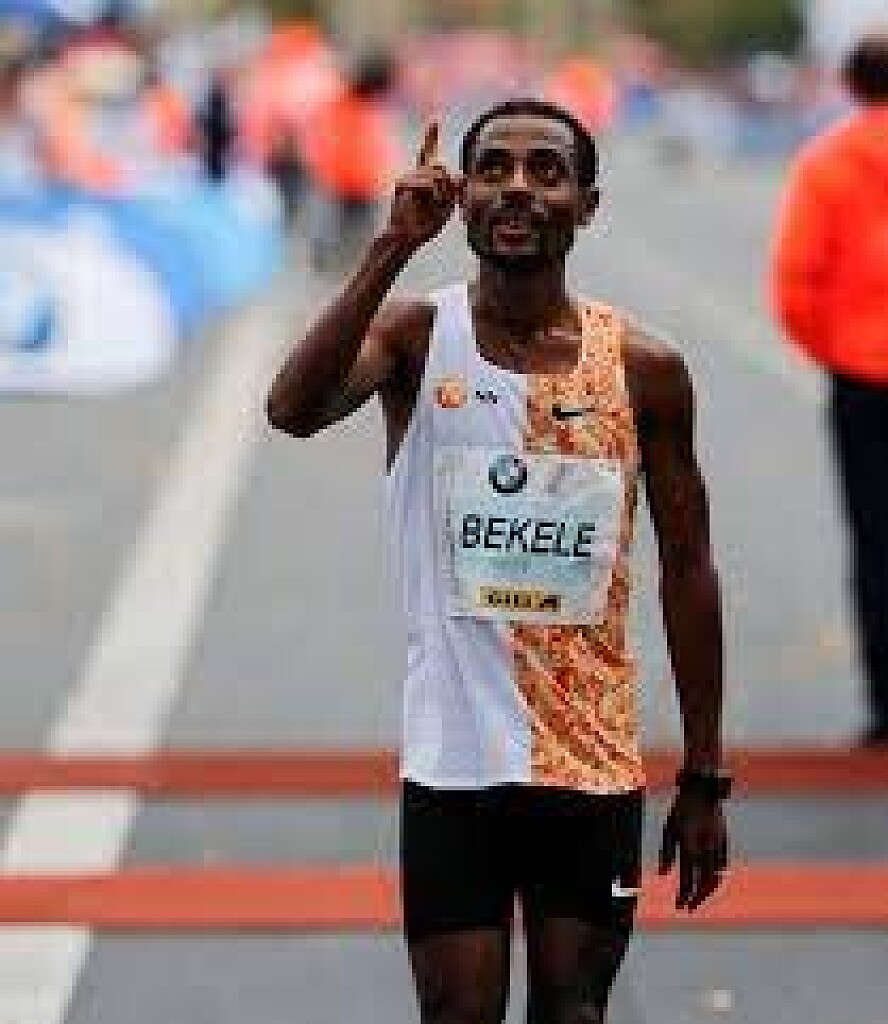
I’m still the best, insists Kenenisa Bekele before London Marathon
Kenenisa Bekele insists he still deserves to be considered the greatest distance runner in history despite Eliud Kipchoge’s brilliant world marathon record in Berlin last week.
The 40-year-old Bekele, who will run the London Marathon on Sunday, paid tribute to his great rival’s achievements over 26.2 miles but he also made it clear that if performances on the track, cross-country and world records were taken into account, he should be considered without equal.
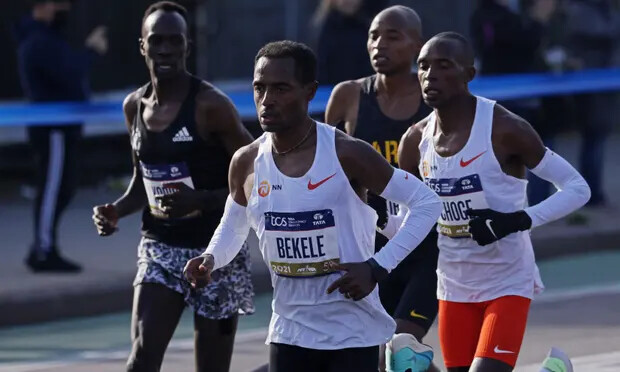
During his storied career, Bekele has won an extraordinary three Olympic gold medals, 17 world titles over cross-country, track and road, and held the world 5,000m and 10,000m records for 15 and 16 years respectively – until the arrival of “super spikes” allowed Ugandan Joshua Cheptegei to finally break them in 2020. However even now the legendary Ethiopian remains the second quickest athlete ever over 5,000m, 10,000m and the marathon.
Asked about whether Kipchoge’s 2hr 1min 9sec run in Berlin made the Kenyan the greatest, Bekele replied: “From my side, I don’t want to put in myself [in the conversation]. But what I did in world championships, Olympics, cross countrys and the world records – for those competitions of course I am the best.

“With the marathon I couldn’t achieve what everybody hoped,” he added. “Somehow I failed with some marathon races. But, on the other hand, my marathon times also tell you something. I am second overall behind Eliud Kipchoge. And it was very close. It was only two seconds until last week.
“So this tells everyone: it doesn’t matter if I win a marathon 10 times or 20 times, how many athletes can run this time? Of course I’m not perfect. I’ve not really achieved all the spectators or my fans wanted from me. But, on the other hand, those results were not easy to achieve.”
Bekele has not produced many sparkling performances in recent years, but his marathon personal best of 2:01.41 came in Berlin in 2019 after a similar spell of mixed results.
And he appeared optimistic ahead of Sunday’s race, telling reporters: “My fitness is really good now and I am expecting to get a good result. Of course, I am here to win. You never know because this is not an easy race, but my wish and plan is to win the race.”
He also dismissed suggestions that it could be his last race, adding: “My mind tells me not yet. I follow the feeling in my mind. Someday maybe my mind will tell me this is enough, stop here, but now is not my time.”
Bekele offered his sympathies to Mo Farah, who was forced to pull out of the London Marathon this week due to a hip injury. “I faced many years of injuries and I know how it feels, especially at his age,” he said. “It’s not easy to come out from that, but if he is mentally and physically strong, especially mentally, I am sure he will do better in the future, for a couple of years.”
(10/01/22) Views: 117Sean Ingle
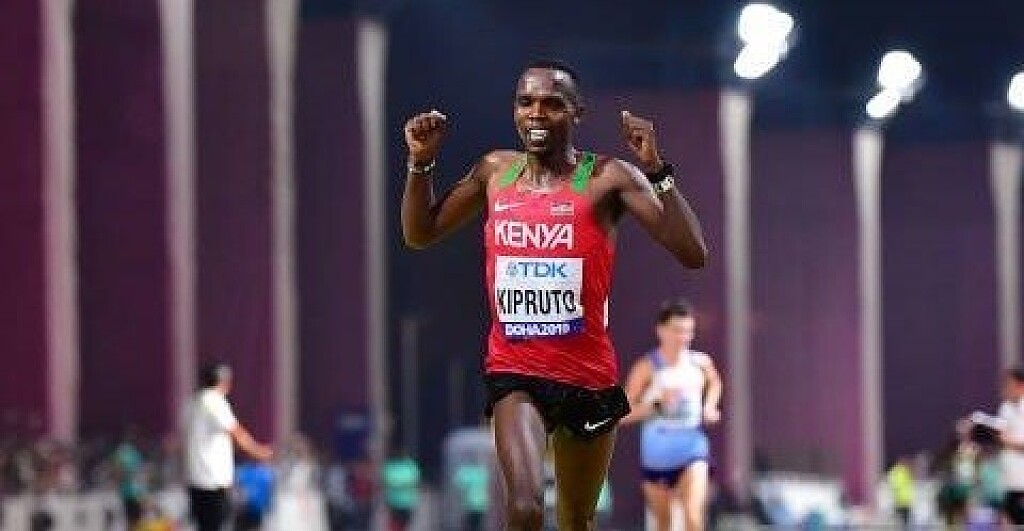
2019 Doha World Athletics Championships marathon bronze medalist, Amos Kipruto, will be seeking his first major title
The 2019 Doha World Athletics Championships marathon bronze medalist, Amos Kipruto, will be seeking his first major title when he lines up for the London Marathon race on Sunday.
He has been on the podium at major marathons twice, but wants to bag top honors this time round.
Nation Sport tracked Kipruto at Nandi Hills in Nandi County where he was doing a long run of 36 kilometers.

Kipruto together with his training mates crisscrossed through tea plantations.
The London Marathon will be his second major marathon race this year after finishing second in Tokyo Marathon in March.
Freshly minted world record holder Eliud Kipchoge, who clocked 2:01:09 at Berlin Marathon on Sunday, beat Kipruto in Tokyo.
“From Tokyo, I relaxed a bit. I intensified my training for London Marathon in the middle of Ma, and so everything has been going well. I have a good group behind me and my coach is also helping so much,” Kipruto said.
“Marathon is becoming tricky because competition is high. You need to prepare carefully so that you don’t burnout,” he explained.
Having competed in Tokyo Marathon twice and Berlin Marathon once, Kipruto is a man in a mission.
“It is a great honour for me to be given an opportunity to compete in London, and I don’t take it for granted. The reward that I can give it to myself is to run well in London and set the bar high,” he said.
In the elite athletes’ start list, Kipruto is the fourth fastest with a time of 2:03:13 behind Ethiopians Kenenisa Bekele, Birhanu Legese and Mosinet Geremew.
Kipruto will be the only Kenyan in the elite race after his teammate Vincent Kipchumba withdrew due to injury.
(09/30/22) Views: 111Bernard Rotich
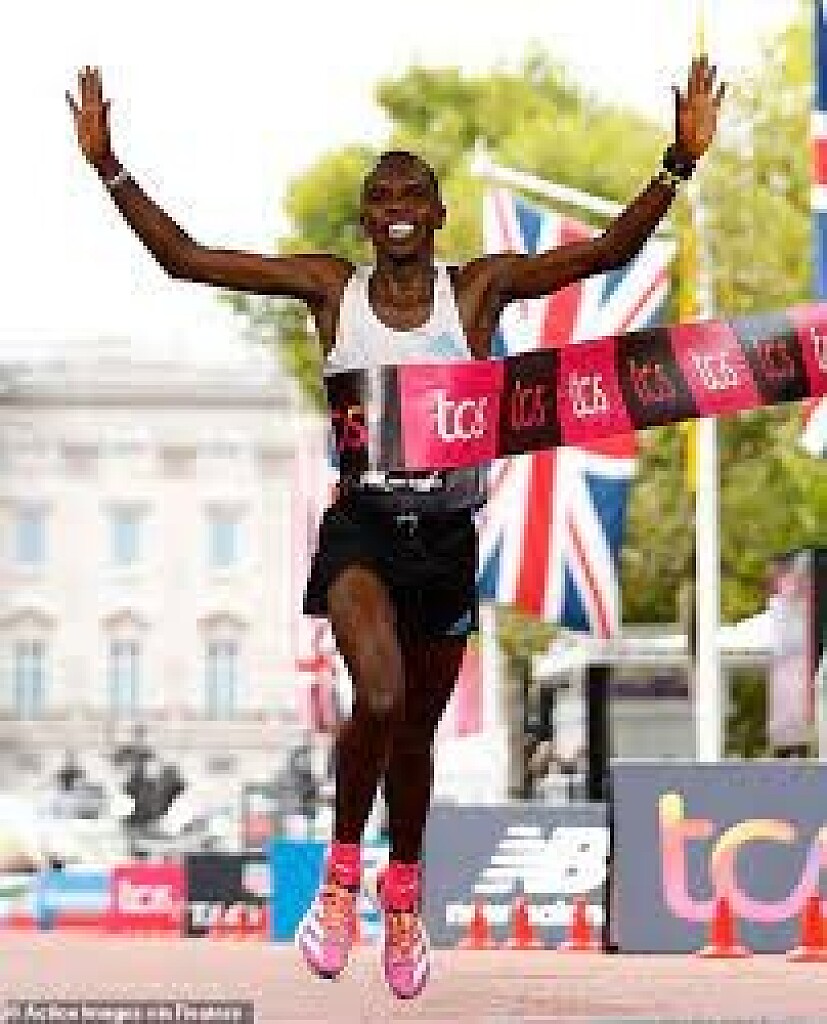
Yehualaw and Kipruto cruise to convincing wins at London Marathon
In just the second marathon of her career, Yalemzerf Yehualaw overcame a heavy fall to win the women’s race at the TCS London Marathon, while Kenya’s Amos Kipruto made a decisive move with two miles to go to take the men’s title at the World Athletics Elite Platinum road race on Sunday (2).
Yehualaw won in 2:17:26 – the third-fastest time ever achieved on the streets of London – while Kipruto’s closing speed brought him home in 2:04:39.

The opening pace in the women’s race was swift, as it often is on the slightly downhill section of the course. The lead pack of eight women – including Yehualaw and defending champion Joyciline Jepkosgei – passed through the first 5km in 16:01 and they reached 10km in 32:18. That early pace suggested a finishing time of 2:16:15 – well inside the women-only world record of 2:17:01 – but the tempo soon started to drop.
The same eight women were still together through 15km (48:51) and at half way, which was reached in 1:08:46. Hiwot Gebrekidan was unable to stay with the pack for much longer and the lead group was reduced to seven women by 25km (1:21:29), the pacemakers having now dropped out.
Asefa Kebede started to push the pace as the lead group embarked on the second half, with Yehualaw biding her time near the back of the pack. Jepkosgei and Joan Chelimo Melly, meanwhile, looked comfortable in the middle of the pack.
With about 10km to go, Yehualaw tripped on a bump in the road and fell hard, just as she had done at the 2020 World Half Marathon Championships where she went on to take bronze. She quickly got back up on her feet and rejoined the lead pack a minute or two later.
Melly and Ashete Bekere were next to drop off the pace, followed by Kebede, leaving just four women in the lead pack: Jepkosgei, world silver medallist Judith Jeptum, Alemu Megertu and Yehualaw. They reached 35km in 1:54:30, their predicted finishing time now outside 2:18:00, but the real racing was just beginning.
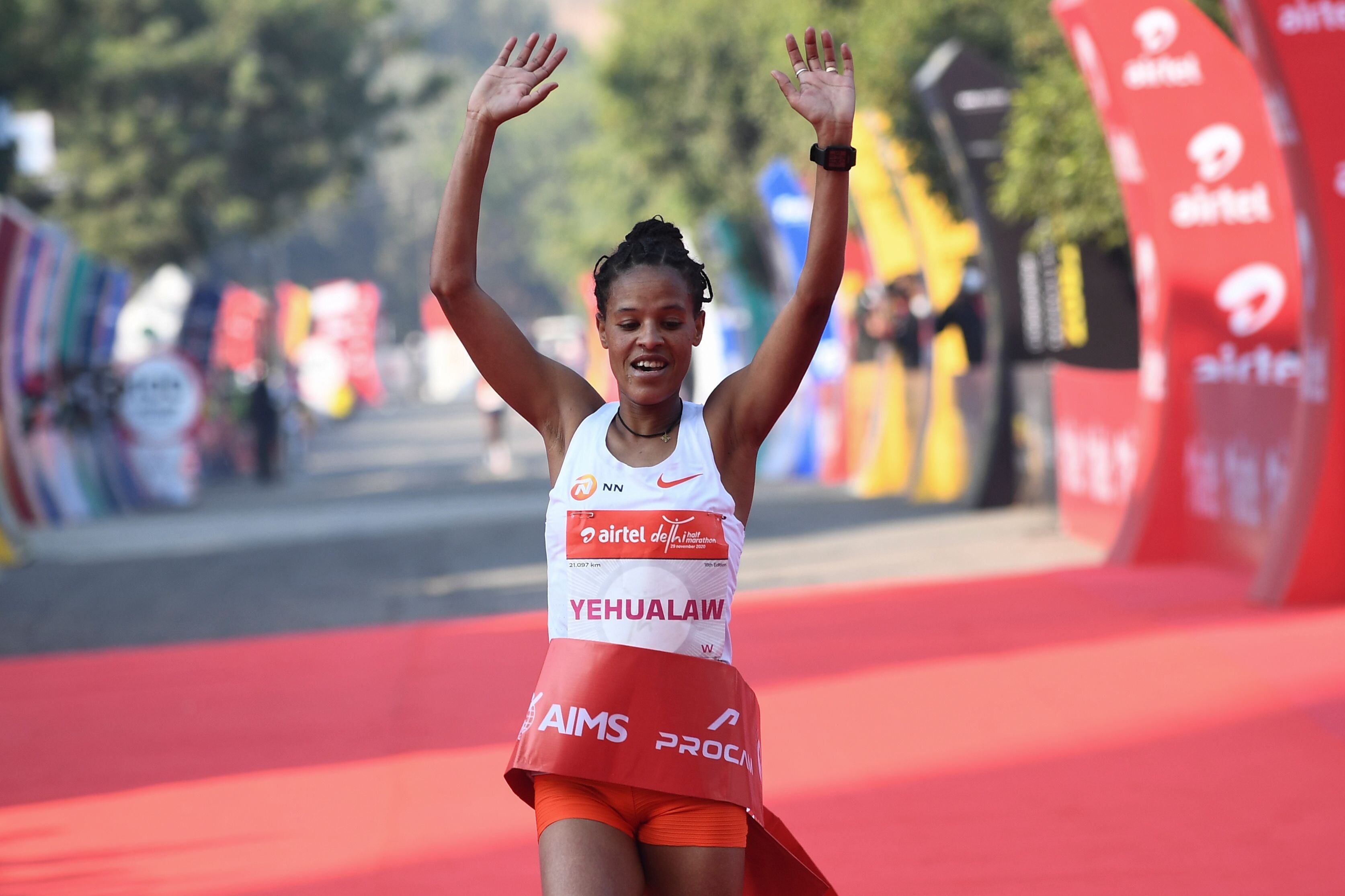
After two hours of running, Yehualaw started to increase her pace. A sizzling 4:43 split for the 24th mile broke up what was left of the lead pack, and within a couple of minutes the Ethiopian had a clear lead over Jepkosgei with Megertu and Jeptum further behind.
Showing no ill effects of her earlier fall, and running with the confidence of a seasoned marathon runner, Yehualaw continued to forge ahead in the closing stages and went on to win by 41 seconds in 2:17:26, just three seconds shy of the PB she set on her debut in Hamburg earlier this year. It’s also the third-fastest time ever recorded in London, behind the world records set by Paula Radcliffe (2:15:25) and Mary Keitany (2:17:01, women-only).
"I am so happy to win here in London," said Yehualaw. "I have worked very hard to prepare for this race and to take the victory is amazing."Jepkosgei held on to finish second in 2:18:07 and Megertu completed the podium in 2:18:32, a PB by 19 seconds. For the first time ever, six women finished in 2:19:30 or quicker.
Kipruto conquers quality field for first world marathon major
The opening pace in the men’s race was more steady and consistent than the women’s race, but the race unfolded in a similar fashion with a group of seven men running together through the early checkpoints. They covered 5km in 14:45, 10km in 29:26 and 15km in 44:20, suggesting a finishing time inside 2:05.
Kenenisa Bekele featured prominently in the lead pack, while defending champion Sisay Lemma held back slightly near the rear of the group. World and Olympic bronze medallist Bashir Abdi and Kenya’s Amos Kipruto were also in contention.
They reached 25km in 1:13:41, still on course for a finishing time just outside 2:04 and with the same seven men still running together. At about 33km, Bekele started to fall off the pace of the lead pack, but he stayed in the race and kept the leaders in sight.
About 15 minutes later – and at roughly the same part of the course where Yehualaw made her move in the women’s race – Kipruto accelerated away from the rest of the pack, opening up a significant lead within a relatively short space of time. A 4:21 split for the 25th mile proved decisive and it soon became clear that victory would be his.
He went on to win by more than half a minute, crossing the line in 2:04:39 to achieve his first victory in a marathon major, following three podium finishes in Berlin and Tokyo in recent years. Ethiopia’s Leul Gebresilase came through to take second place in 2:05:12, seven seconds ahead of Abdi.
Kinde Atanaw was fourth in 2:05:27, followed by Bekele in fifth in 2:05:53, his fastest time for three years. He also becomes the first 40-year-old to run a marathon faster than 2:06.
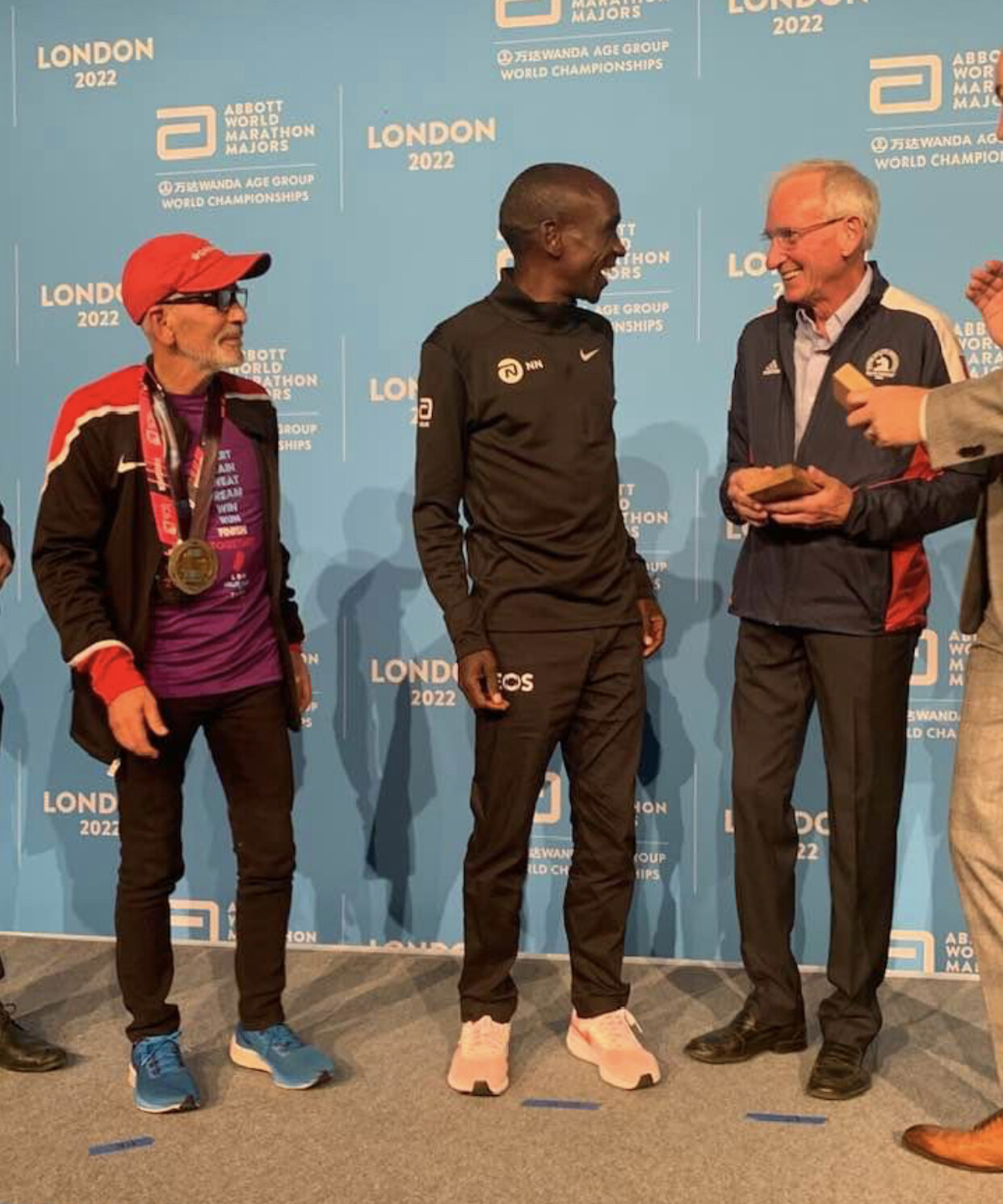
third photo: Gene Dykes on podium after winning the 70-74 age group with Eluid Kipchoge, the Goat!
(10/02/22) Views: 110Jon Mulkeen (World Athletics)
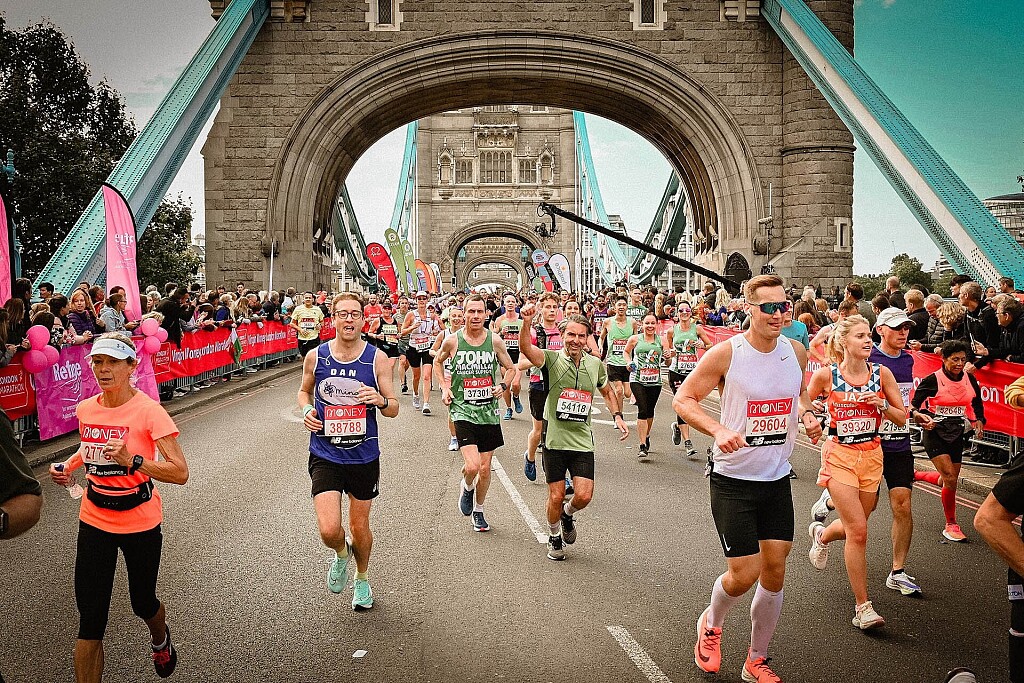
London Marathon preview: will we see two course records broken?
For the third straight year, the TCS London Marathon is set to take place on the first Sunday of October (Oct. 2). Many of the world’s top marathoners have made their way to London for a shot at USD $55,000, plus added incentives for time bonuses and course records.
If anyone were to break Eliud Kipchoge’s world record of 2:01:09 in Berlin last weekend, they would earn a huge payday of USD $400,000+, between prize money and bonuses.
A number of the top athletes have scratched from the marathon this week due to injury, including the British Olympic champion of years past, Mo Farah, who is out with a hip injury; 2022 world championship silver medallist Mosinet Gemerew; and the women’s world record holder, Brigid Kosgei, who suffered a hamstring injury in the lead-up to the race.

Both the men’s and women’s fields are still loaded with former Olympic medalists and Abbott World Marathon Major champions. Ethiopia’s Kenenisa Bekele headlines the men’s race, returning to London for the first time since 2018, after second-, third- and sixth-place finishes in his past three attempts. Bekele, 40, has not been in top form since he ran the second-fastest marathon of all time to win the 2019 Berlin Marathon (2:01:41).
His challenges will come from his Ethiopian compatriot and defending champion Sisay Lemma and two-time Tokyo Marathon winner Birhanu Legese, who holds a personal best of 2:02:48 and is the third-fastest man in history.
Another name not to ignore is Bashir Abdi of Belgium, who earlier this year became the first Belgian to win a medal at both the world championships and the Olympics in the marathon. Abdi won bronze in Tokyo and followed it up with another bronze in Eugene.
Amos Kipruto of Kenya has been quiet this season after his PB and second-place finish to Kipchoge at the Tokyo Marathon in March.
Women’s preview
With the two-time London Marathon champion and world record holder Kosgei out, her compatriot, Joyciline Jepkosgei, is the favourite. Jepkosgei brings experience and consistency to the field, having won this race last year in 2:17:43.
The dark horse is Ethiopia’s Yalemzerf Yehualaw, who previously held the half-marathon world record and ran the fastest debut marathon in women’s history, clocking 2:17:23 at Hamburg in April. She has gone undefeated in her last four road races and reached the podium in her last seven.
Ashete Bekere of Ethiopia also has the experience, winning Berlin in 2019 and finishing third in London last year. Earlier this year, she was second to Kosgei at the Tokyo Marathon, where she ran her personal best of 2:17:58.
Judith Jeptum Korir of Kenya, the 2022 world championship silver medallist and reigning Paris Marathon champion, was originally planning to pace the leaders on Sunday, but has been a late addition to the elite list. London will be Korir’s third marathon in six months, but she has reached the podium in her last two.
(09/30/22) Views: 101
Marley Dickinson
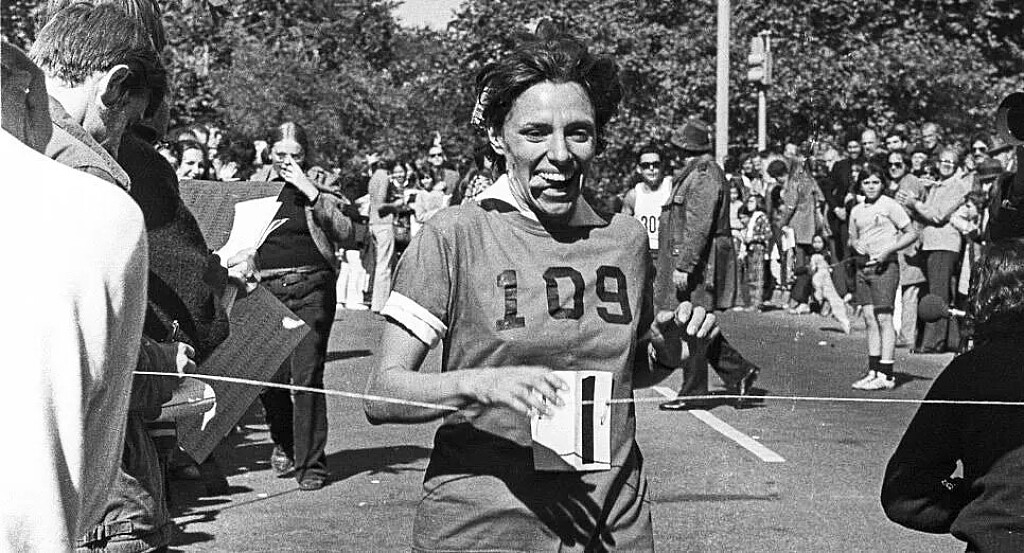
Nina Kuscsik to Receive Abebe Bikila Award at 2022 TCS New York City Marathon
Nina Kuscsik, a trailblazer for women’s running, will receive the Abebe Bikila Award this year, an honor which is presented each year from New York Road Runners (NYRR) to an individual who has made an outstanding contribution to the sport of distance running. The award will be presented to Kuscsik at NYRR’s Night of Champions during TCS New York City Marathon race week.
“I am very proud. It was such a long time ago when I was advocating for more opportunities in women’s running; it just seemed like the right thing to do,” Kuscsik said. “I attended all the meetings of the AAU in person, and I learned how to file appropriate legislation.

I also had other men and women helping me so that we could get the rules changed, so myself and other women runners would have the right, and be eligible, to run marathons. It is so wonderful to see the results of it all today.”
Kuscsik transformed the sport of running by breaking through the “boys’ club” barrier to change the rules so they included women. After she ran the 1969 Boston Marathon — unofficially, as women weren’t allowed to enter — she presented a proposal to the Amateur Athletic Union, asking for an end to the ban on women entering races. The committee agreed to raise the maximum distance of AAU-sanctioned events for women from five to 10 miles and added that “certain women” could run marathons. The rules still required a separate women’s start.
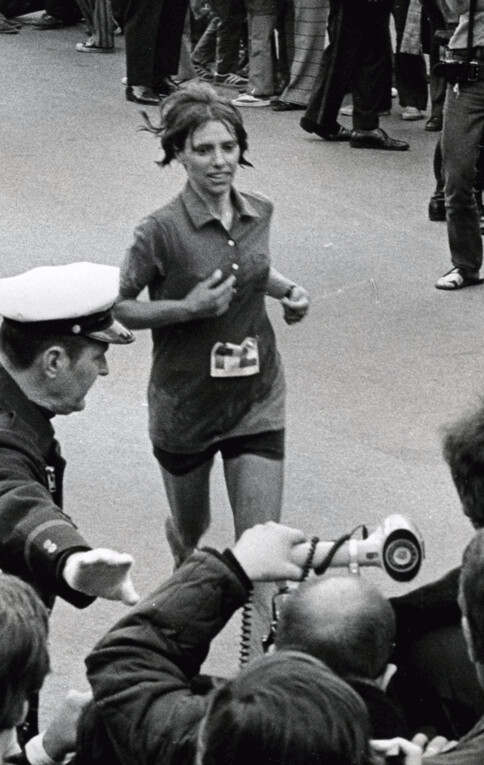
On June 3, 1972, together with NYRR president Fred Lebow and Kathrine Switzer, Kuscsik helped launch the Crazylegs Mini Marathon, the world’s original women-only road race now known as the Mastercard New York Mini 10K.
Four months later, on October 1, 1972 at the New York City Marathon, Kuscsik and five other women huddled together just before the Central Park start. When the gun went off, they sat down, protesting the women’s separate-start status. After the press got their story, the women got up and started with the men’s start. Kuscsik won the race, becoming the first woman to triumph in New York and Boston in the same year. Those six women — Lynn Blackstone, Jane Muhrcke, Liz Franceschini, Pat Barrett, Cathy Miller, and Kuscsik — are known around the world today as the “Six Who Sat.” This Saturday will mark exactly 50 years since their actions changed the trajectory of women’s running for the generations that followed.
Kuscik would return to New York in 1973 to win the marathon once again, and in 1977, she completed the annual NYRR 50-Mile in Central Park in 6:35:53, an American record. She was then among the group that successfully lobbied for a women’s marathon to be added to the 1984 Olympics.
(10/01/22) Views: 100Running USA
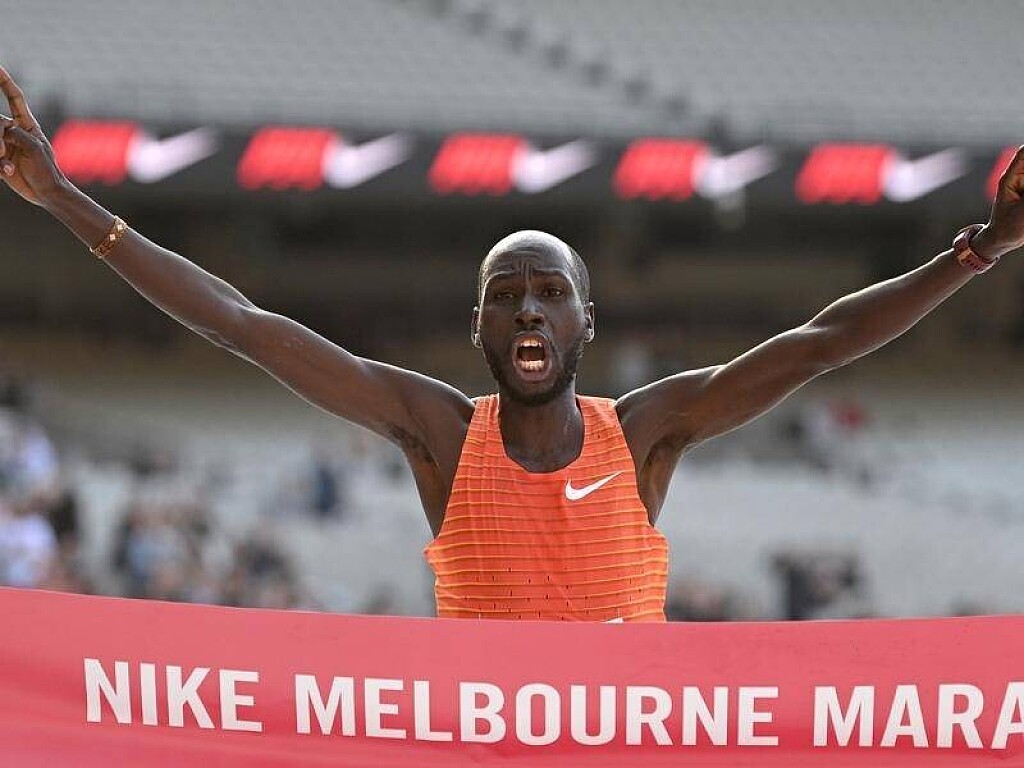
Kenyans Timothy Rono and Beatrice Cheptoo bag Melbourne Marathon titles
Timothy Rono and Beatrice Cheptoo bagged the men's and women's titles at the Nike Melbourne Marathon in Australia on Sunday.
Rono clocked 2:09:12, smashing Dominic Ondoro's course record by one minute and 30 seconds set in 2013.
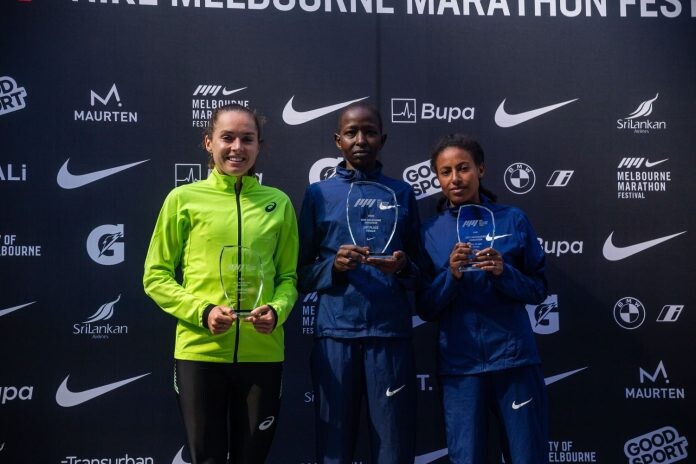
Compatriot Cornelius Kibet came second in 2:10:24 as Australia's Reece Edwards rounded the podium places in 2:14:41.
An ecstatic Rono was delighted with the victory in warm conditions in Australia's second-largest city.
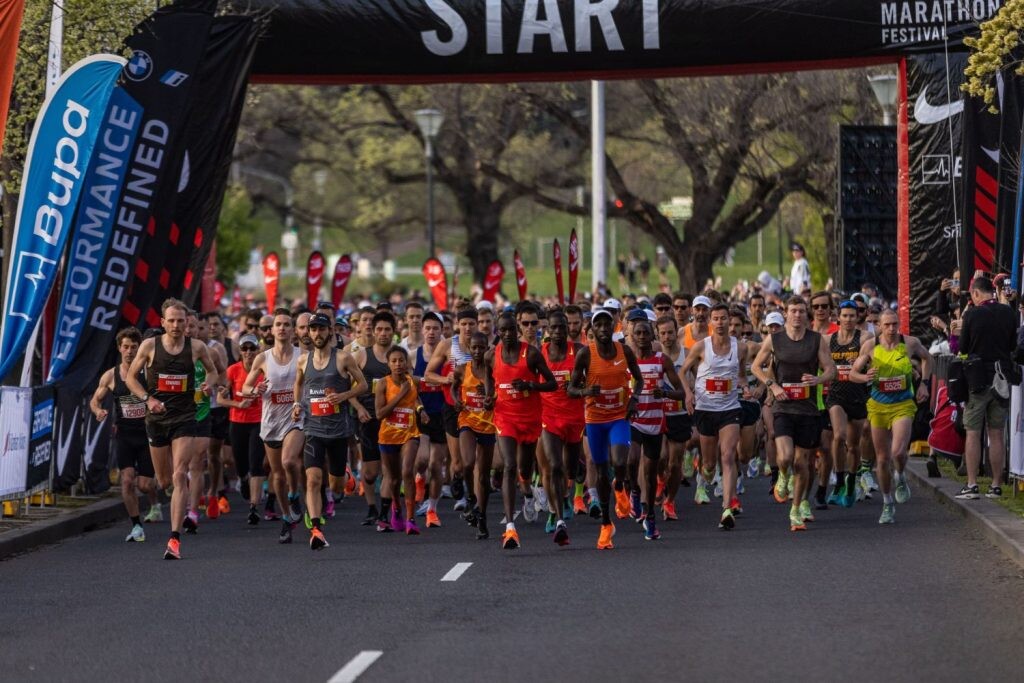
"It was a good race. The conditions were good, a bit cloudy but not too hot and not too cold. I had prepared for it from the start and I kept going until the end," added Rono.
Rono broke away with six kilometers to go after being pushed close by Kibet.
"I timed my race quite well. I know Kibet. I knew I have a stronger kick and that allowed me to increase the pace in the final few kilometers," said Rono.
Following the win, Rono has set his eyes on the bigger city marathons like Boston, New York, London come next year.
“I'm looking at participating in the big ones next year, God willing. I want to test myself against the best and I am relishing the challenge,” he added.
For the win Rono bagged a cool Sh3 million.
In the women's category, Cheptoo ran a superb race in a time of 2:27:58 on her debut on Australian soil .
Australia's Izzi Batt Doyle finished second in 2:28:10 with Maru Ejigu of Ethiopia third in 2:28:54
For the win Cheptoo bagged Sh2 million.
Australia's Jack Raynor won the men's half marathon in 1:02:16 while the women's category went to Jess Stenson in a time of 1:12:22.
Festival Director Marcus Gale, commented: “Congratulations to the winners and everyone who got involved in the 2022 Nike Melbourne Marathon Festival."
"Whether you were tackling the 42.195km for the first or 44th time, soaking up the city’s sights on the 3km track or cheering from the MCG grandstand, it was incredible to see the Australian running community out in full force and an honour to deliver another successful event for the city."
(10/03/22) Views: 97William Njuguna
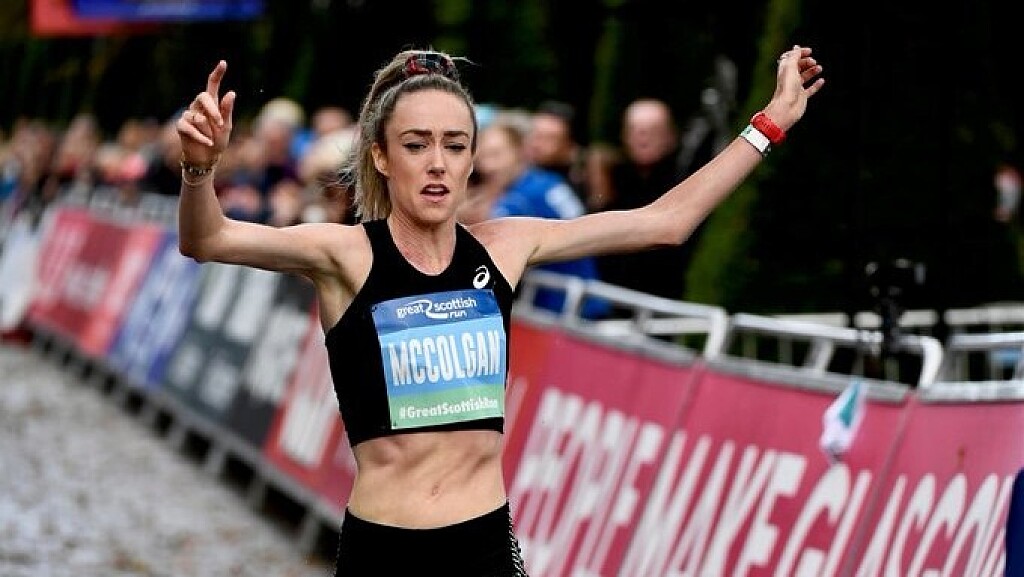
Eilish McColgan and Callum Hawkins triumph at Great Scottish Run
Eilish McColgan and Callum Hawkins secured home victories at the Great Scottish Run.
Commonwealth champion McColgan set a new British record and surpassed her own European mark by finishing in 30 minutes 18 seconds.
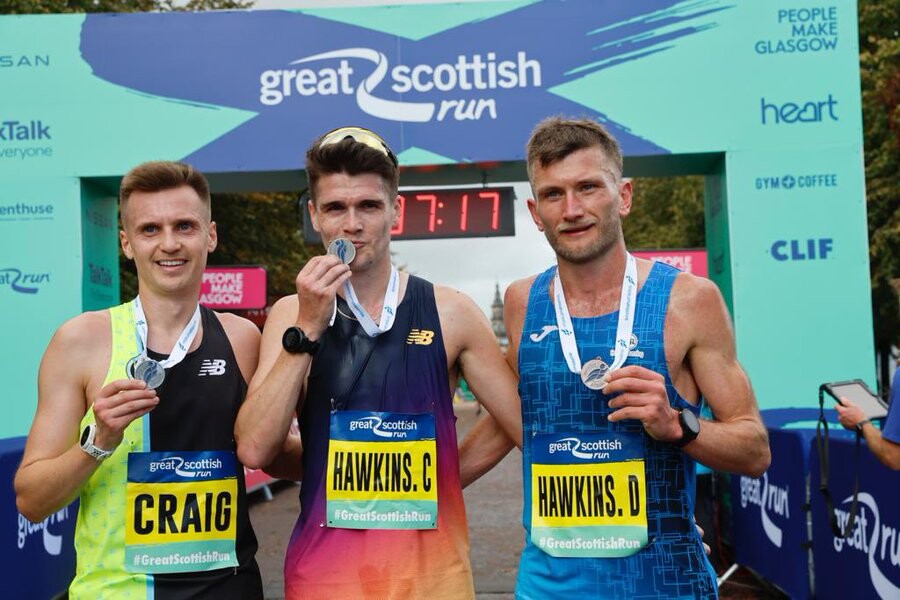
Fellow Scot Hawkins won the men's half marathon in 1:03:35 ahead of Adam Craig and Callum's brother Derek.
Irish athlete Michelle Finn won the women's half marathon in 1:12:33 and Lewis Hannigan won the men's 10k.
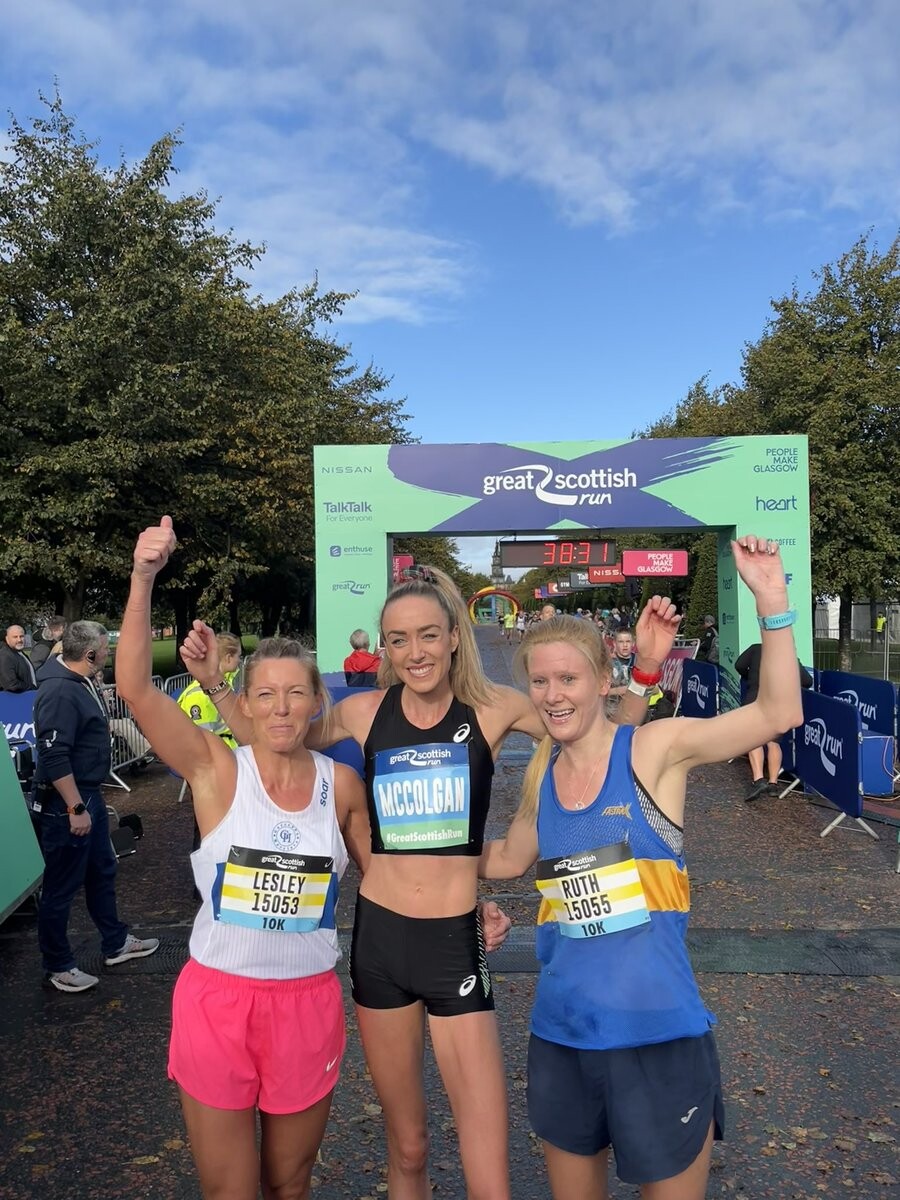
The Scotsman crossed the finish line in 29:33.
There was another Scottish winner in the women's wheelchair 10k, with Sammi Kinghorn's time of 26:40 more than two minutes faster than closest rival and compatriot Mel Woods.
Luke Deighton beat Kyle Brotherton to first place in the men's wheelchair 10k.
(10/03/22) Views: 93
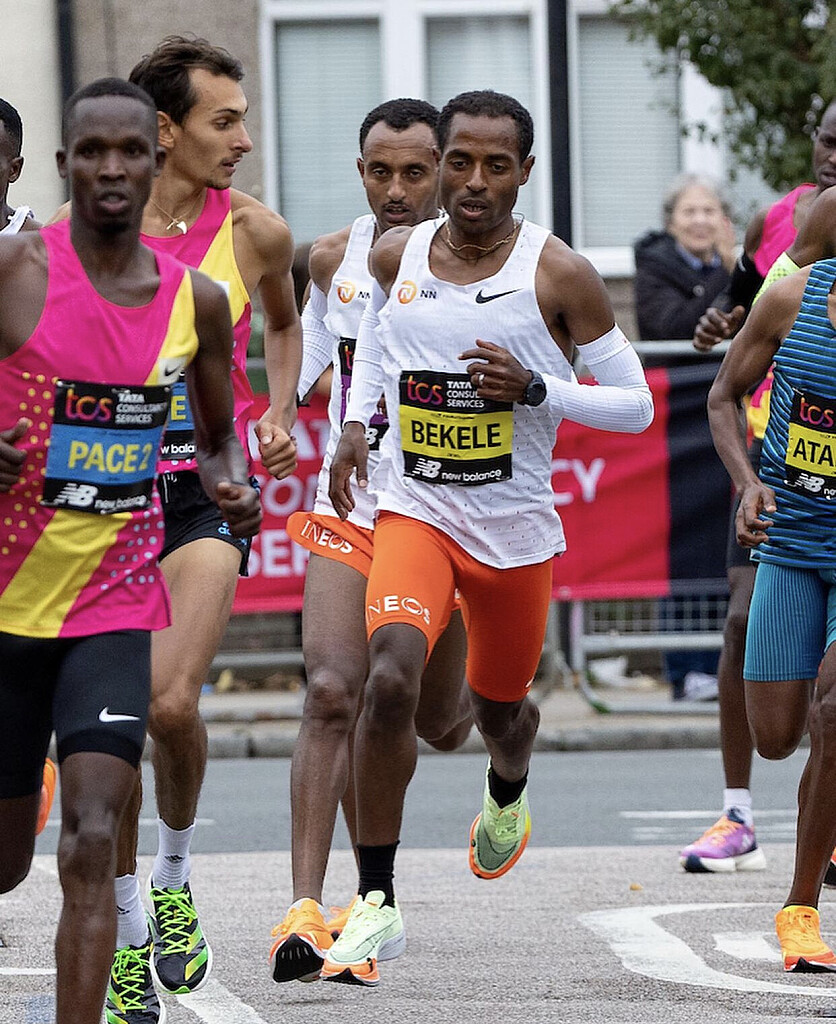
Kenenisa Bekele set new Marathon World Record for Masters but says he can run faster
Kenenisa Bekele made headlines last week by declaring “of course I am the best” long distance runner ever. But the Ethiopian was fifth-best at Sunday’s London Marathon, finishing 74 seconds behind Kenya’s Amos Kipruto.
Bekele, 40, clocked 2:05:53, the fastest-ever marathon by a runner 40 years or older. He was with the lead pack until being dropped in the 21st mile.
But Bekele estimated he could have run 90 to 120 seconds faster had he not missed parts of six weeks of training with hip and joint injuries.
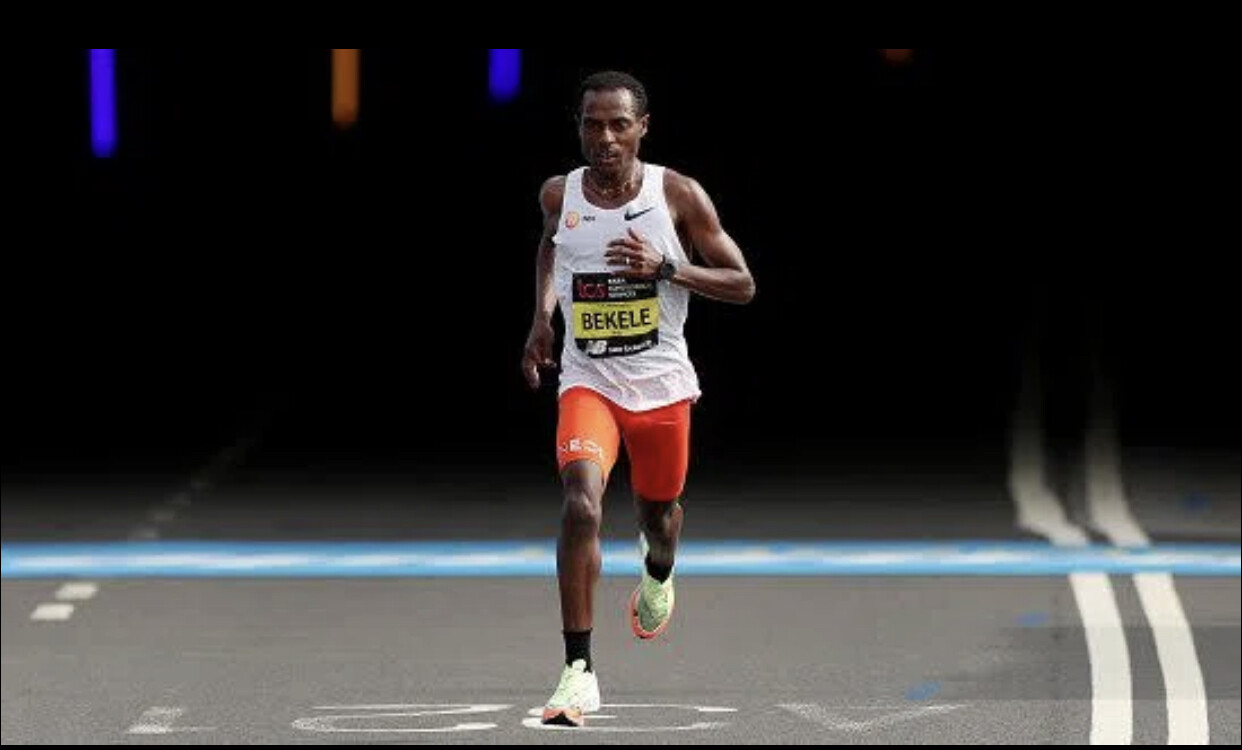
“I expect better even if the preparation is short,” he said. “I know my talent and I know my capacity, but really I couldn’t achieve what I expect.”
Bekele is the second-fastest marathoner in history behind Kenya’s Eliud Kipchoge, who broke his own world record by clocking 2:01:09 at the Berlin Marathon last week.
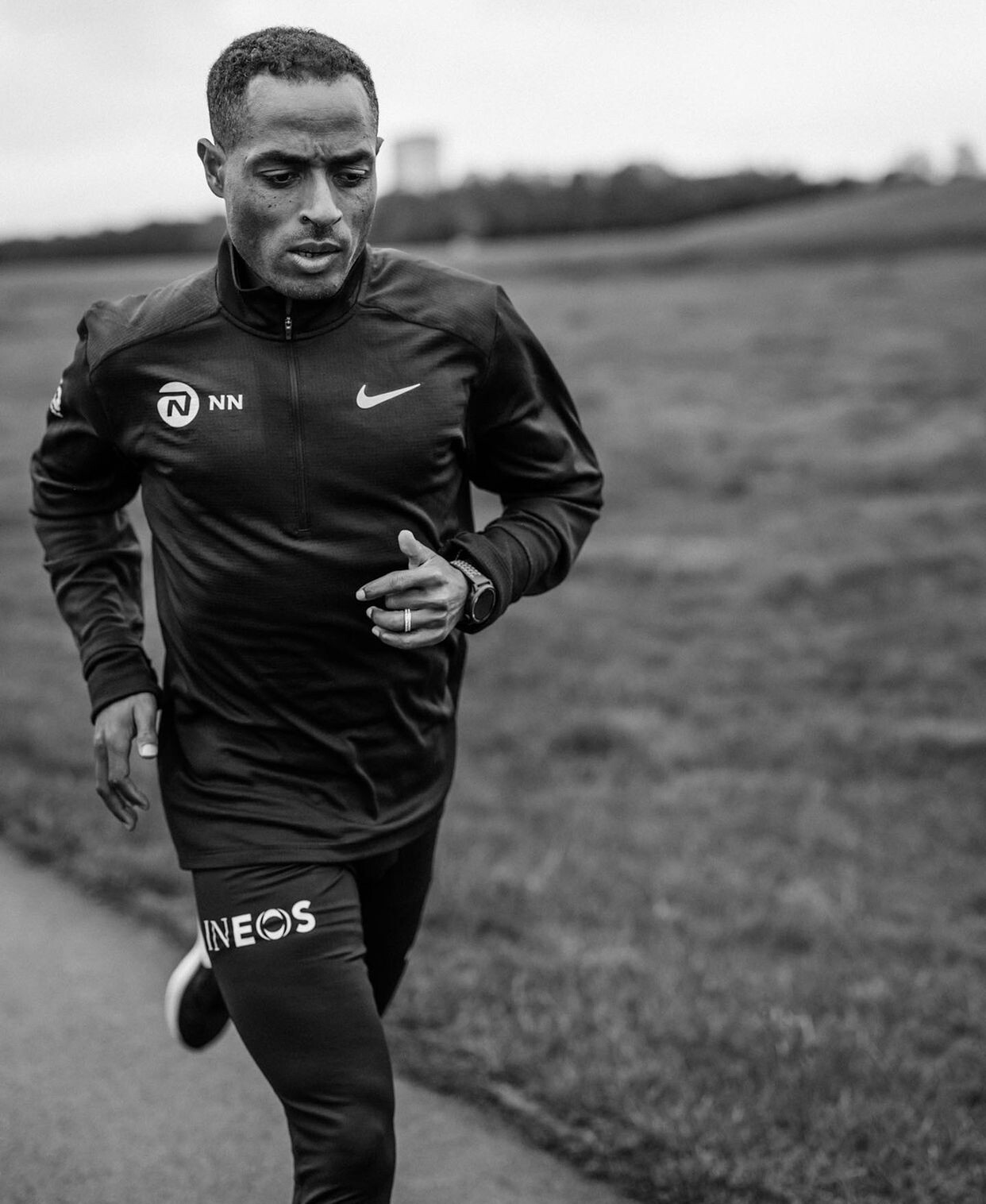
“I am happy when I see Eliud Kipchoge run that time,” Bekele said. “It motivates all athletes who really expect to do the same thing.”
Bekele’s best time was within two seconds of Kipchoge’s previous world record (2:01:39). He described breaking Kipchoge’s new mark as the “main goal” for the rest of his career.
“Yes, I hope, one day it will happen, of course,” Bekele said. “With good preparation, I don’t know when, but we will see one more time.”
Nobody has won more London Marathons than Kipchoge, a four-time champion who set the course record (2:02:37) in 2019. But the two-time Olympic marathon champion did not run this year in London, as elite marathoners typically choose to enter one race each spring and fall.
Bekele does not know which race he will enter in the spring. But it will not be against Kipchoge.
“I need to show something first,” Bekele said. “I need to run a fast time. I have to check myself. This is not enough.”
Kipchoge will try to become the first runner to win three Olympic marathon titles at the Paris Games. Bekele, who will be 42 in 2024, has not committed to trying to qualify for the Ethiopian team.
“There’s a long time to go before Paris,” Bekele said. “At this moment I am not decided. I have to show something.”
So who is the greatest long distance runner ever?
Bekele can make a strong case on the track:
Bekele Four Olympic medals (three gold)Six World Championship medals (five gold)Former 5000m and 10,000m world-record holder
Kipchoge Two Olympic medalsTwo World Championship medals (one gold)
But Kipchoge can make a strong case on the pavement:
Bekele Seconf-fastest marathoner in historyTwo World Marathon Major victories
Kipchoge Four of the five best marathon times in historyTwo-time Olympic marathon champion12 World Marathon Major victories
(10/03/22) Views: 92
How to condition your legs to run further
Often, runners concentrate on racking up the miles at the expense of all other training. At some point, your body will scream “no more!” and protest by breaking down with a knee, calf, or ankle-based injury, side-lining you for weeks or even months. But with the right steps you can build up your legs’ strength and carry yourself further on your runs.
All of which would certainly come in handy ahead of the Wings for Life App Run on Sunday, May 7, 2023, which will see runners across the world raising vital funds for the Wings for Life Foundation, as they try and outrun a virtual Catcher Car via an app on their phone (sign up here!). So if you truly want to bulletproof your lower limbs for a test of pure distance, this is the one to sign up for.
Without further ado, here are the pointers you need...
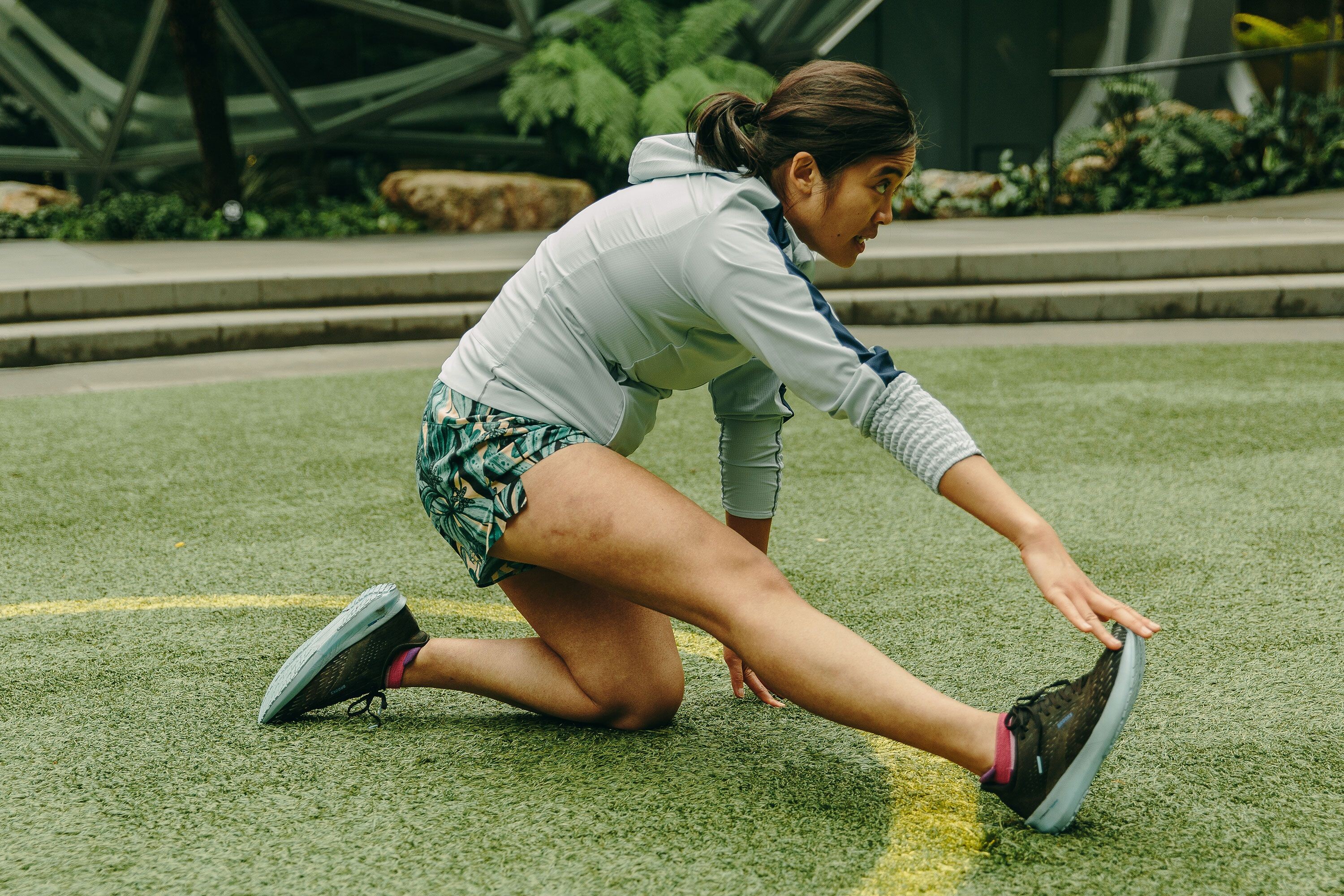
1. Always stretch.
A simple one to start, but one often neglected by runners. Stretching your calves and quads is key to building leg strength for running. “The idea is to improve movement of the ankle and knee joints before running,” says Pat Gillham, specialist musculoskeletal physiotherapist at Pure Sports Medicine. “This will help prevent over-loading of the joints by the repetitive nature of running.” Gillham also advises doing stretches before you run will give increased range of movements to the joints.
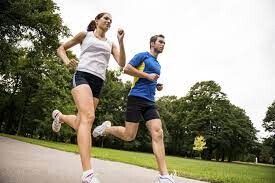
Calves can be stretched off a step and quads by holding your heel to your bum while standing or kneeling. Stretches should be held for 60 seconds at a time, and Gillham advises doing stretches before you run, “but not to the point of complete muscle fatigue otherwise your muscles won't be able to cope with running,” he adds.
2. Use a foam roller
Many runners see the foam roller as an instrument of torture, designed to reduce grown adults to tears. But, says Gillham, using a foam roller is key for helping your legs run further. “A foam roller can be the perfect way to give yourself soft-tissue release instead of, or in addition to, stretching.” And if you are going to target one area? Go for the outer hip. A Pulseroll vibrating roller is a good place to start.
3. Choose the right shoes and socks
Another simple tip, but one that can easily be overlooked when you enter a running shop and your mind becomes overwhelmed at the sheer size of the selection on offer. Most reputable running shops now have treadmills in store, where staff can watch you run, check your gait and suggest appropriate shoes. And Brooks and Saucony even have their own proprietary analysis systems. Also, consider compression socks, too. “They can reduce irritation to the fascia in your calves by reducing vibrations that come from the landing,” says Gillham.
4. Increase your leg-strength work
Gillham stresses the importance of building your legs’ strength through regular gym work. "Single-leg deadlifts/single-leg bridges/high step-ups/single-leg heel raises [seated and standing]/side planks – all these exercises are great for adding to your workout to increase your legs’ power," he says. “High reps are ideal, until fatigue with or without weight. This type of programme should be done ideally three to four times per week for a duration of six to eight weeks to see any benefit.”
Below are two exercises you can easily incorporate into your weekly strength and conditioning programme, or just do at home when you have five minutes...
5. Romanian deadlifts
“Your average Joe tends to ignore muscles they can't see,” says Richard Tidmarsh, strength and conditioning coach and founder of Reach Fitness. “Your hamstrings are key for running performance and they are hiding at the back of your legs and so are often ignored. Romanian deadlifts will strengthen your posterior chain, making you a more powerful and effective athlete.”
6. Monster walks
“Most people's glutes retired themselves from active duty years ago,” says Tidmarsh. “This is the modern-day curse of a desk job. But to be a good runner and to avoid injury, you need your glutes to fire up. The elastic bands you see in a gym that nobody ever uses? They’re your friend. Every training session, strap a band around your thighs, settle into a half squat and then walk side to side with little steps. It's called a monster walk for a reason; you should feel your glutes on fire. This will prime them ready to work when you are running.”
7. Get plenty of rest
And finally, what everyone wants to hear. “Put your feet up,” says Tidmarsh. “Runners often become obsessed with mileage. The more you do the better, right? Wrong. Running puts a huge amount of stress on your body’s major joints, particularly if you are out pounding the streets. So learn to take a rest, and focus on the quality of your training rather than the quantity. Space out your training runs throughout the week, have weekly sports massages and try to use running tracks or trails rather than roads, as the surface is more forgiving.”
(09/30/22) Views: 91Howard Calvert
