

Running News Daily
Running News Daily is edited by Bob Anderson and team. Send your news items to bob@mybestruns.com Advertising opportunities available.
Index to Daily Posts · Sign Up For Updates · Run The World Feed
Search Results for Ultra
Today's Running News
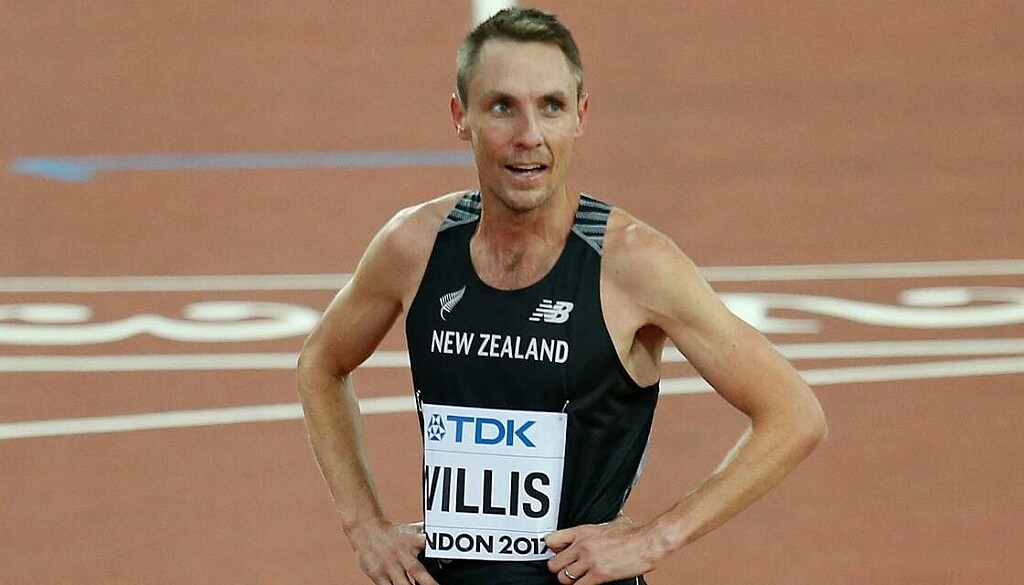


Two-time Olympic medalist Nick Willis’ advice to injured runners
New Zealand’s Nick Willis is a two-time Olympic medalist whose elite running career has lasted more than 20 years and is still going strong. With a resume like that, it’s safe to say the guy has probably had a few injuries throughout his time as a runner, so when he offers his advice on how to deal with the aches and pains that come with the sport, runners everywhere would do well to listen up.
Recently, he took to Twitter to do exactly that, and his advice is something runners of all levels should take to heart.
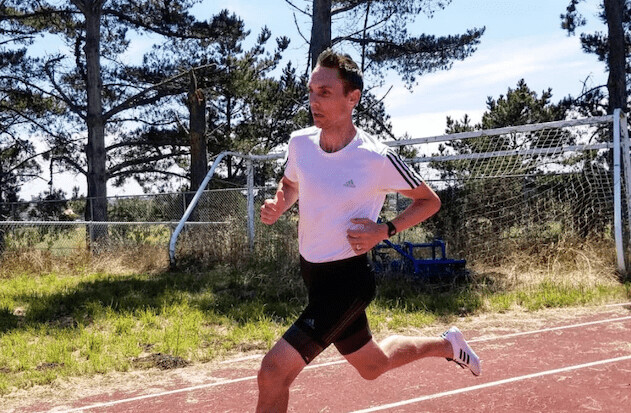
Through a series of Tweets, Willis described a recent calf injury he sustained while running on a slippery path in the rain. When dealing with an injury, most runners’ first instinct is to foam roll, stretch and massage right away, but that’s not what the running veteran did: instead, he stopped running immediately and started doing strength work.
More specifically, he began doing three sets of 20 calf raises, three times per day. He began with just his body weight, eventually adding weight as he got stronger. During that time, he began running every second day, stopping as soon as he felt his calf cramping up again, which was at the 15-minute mark for his first run. As he continued to diligently do his calf raises, he was able to increase the length of his run every time he hit the road by 10 minutes, until after 10 days, he was able to do a full 60-minute run.
Here is where the important part comes in: it was not until after 12 days that he finally went and got some massage done, which he knew would act as a diagnostic tool to see how far his injury had improved. If the pain was too much during the massage, he knew there was still inflammation there and he wasn’t yet in the clear.
Fortunately for him, the pain subsided and the massage helped a lot, and he believes that waiting nearly two weeks before getting any massage done was the key to his success. Any earlier, he believes, would have been counter-productive. Biomechanist and ultrarunner Geoff Burns weighed in on the thread, wholeheartedly agreeing with Willis. He points out that a big mistake many runners make is overly treating an injury in the first few days it appears, and stretching, poking, testing and massaging something that hurts will likely only increase whatever structural damage has already occurred. In other words, “wait for the snake to stop hissing,” he says.
Of course, not every injury can be solved in a couple of weeks by doing calf raises, but the takeaway here is that often, when injury strikes, we tend to panic and want to do everything we can to fix it right away. While this is understandable, we’re better off calming down, giving our bodies a break and taking things one step at a time. In most cases, this will ultimately speed up the recovery process and get you back on the road sooner.
(11/05/2021) ⚡AMPby Brittany Hambleton
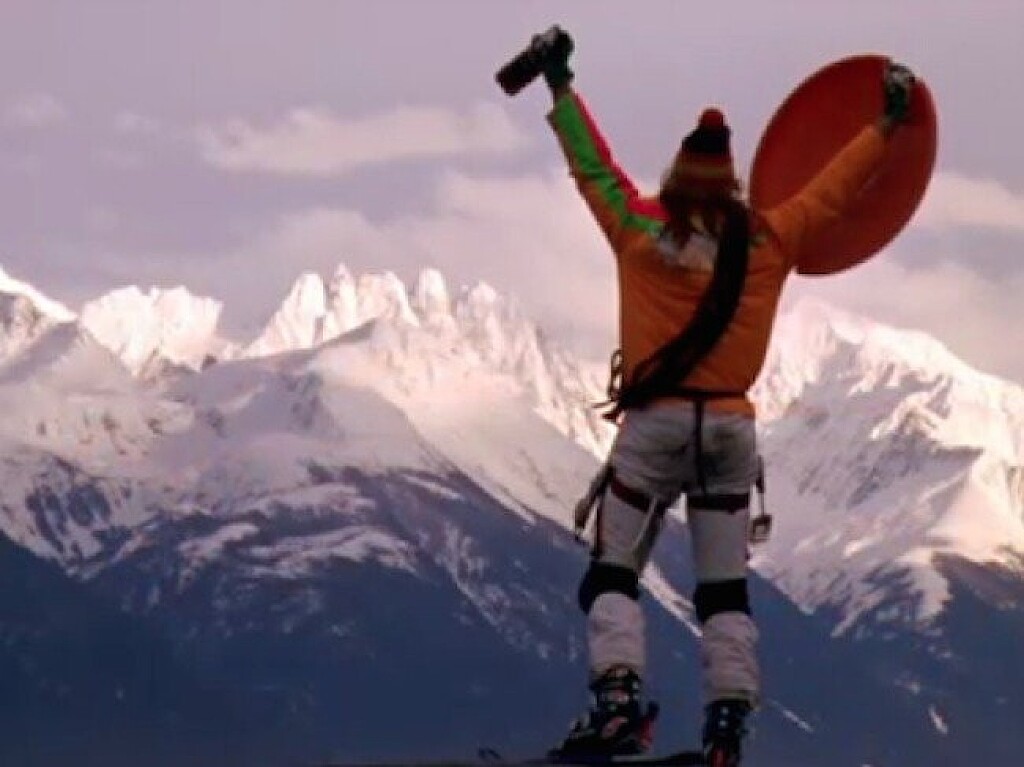
Last Minute Halloween Costumes For Trail Runners
Need something for your kiddo's trick-or-treating? Mandatory office Halloween soiree? First post-covid social engagement? Try one of these easy-to-assemble trail running Halloween costumes!
Basic Trail Bro: Don a Ciele hat, and rock some bright Goodr's with a confusingly non-technical button-up shirt and jorts if you're feeling spicy. BYOB - a super dank IPA (the hazier, the better) swaddled in a coozy you got in a race swag bag. You're probably from Boulder. Or Flagstaff. (Portland variation: add a rain jacket and a slightly better beer.) Make sure to track your trick-or-treat excursion on Strava and don't stop talking about your podcast.
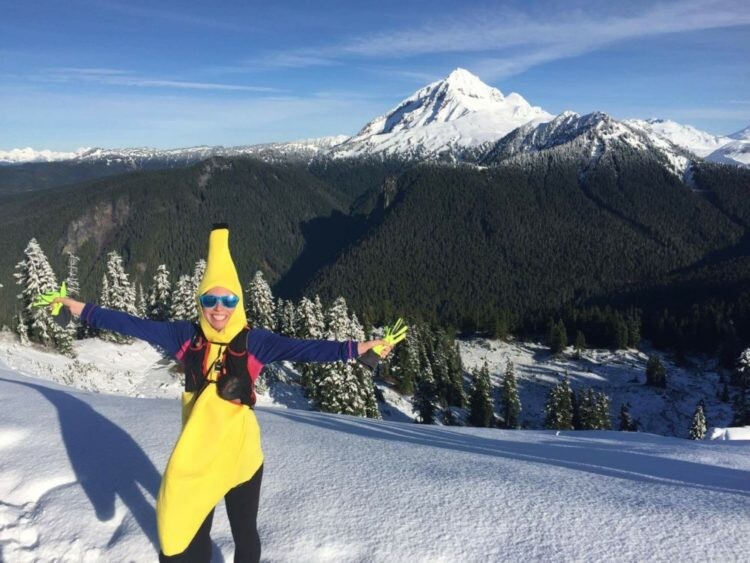
The Courtney: Throw on a tee-shirt and your comfiest basketball shorts and BYO candy corn. Nachos optional.
The Ultra Ultra Runner: Grab your trekking poles, headlamp, gaiters, neck gaiter, waist-light, UPF hat with sunshade, taped-seam windbreaker, sunglasses, clear glasses, 12-liter vest, hip-belt, flasks, bladder, body glide, ramen noodles, gels, spare socks, spare shoes, space blanket, sunscreen, arm sleeves and wind pants. Though you may be dressed like you're about to run the Marathon Des Sables, you could also just be out for a casual jog. You're a human drop-bag: ready for anything.
The Crewmate: Same as above, but carry everything around in your arms the entire night and try to hand everybody you see quesadillas and Skratch.
The Emelie: Grab your S/O and dress entirely in S/Lab, or skimo suits with a babybjorn. Still be faster than everyone.
The Rookie Trail Racer: Grab some long shorts, a sleeveless Nike shirt, and blast the tunes in your Beats By Dre headphones (around your neck, so everyone can hear). Forget the hydration pack, just bring a good ol' Gatorade bottle and be sure to ask everyone "How many miles is 25k????".
The Harvey: Just circle your block 354.2 times while trick-or-treating
Sexy Minimalist Trail Runner: Just split shorts and a handheld. That's it.
The Influencer: This costume is #Sponsored. Flip up the brim of your colorful hat, and snap a pic with your favorite beet-based energy bar or isolated cricket protein, preferably while gazing out at the ocean, or from a summit. Keep your phone and significant other at the ready for any potential photo ops. Bonus points if you have a cute dog who knows a TikTok dance. Make sure all product logos are visible at all times.
Sexy IPOS: Nothing but a gravel bike and KT tape.
The Media Mogul: POV: Your YouTube channel is just about to go viral. Grab your go-pro and lace up your trail runners, because you're about to get a lot of B-roll. Wear a Sony TX90000 BD around your neck, and be sure to periodically change lenses for no particular reason. You're a human steady-cam who'll do anything to get the shot.
The Local Legend: To embody the low-key vibe of the frustratingly-fast unsponsored hometown hero, pull on a of worn-out trail runners and tattered shorts. Wait, is that a Team USA Shirt? Who is this runner? How many FKT's do they have? OOOPS! Someone just stole your CR!
(10/31/2021) ⚡AMP
by Trail Runner Magazine
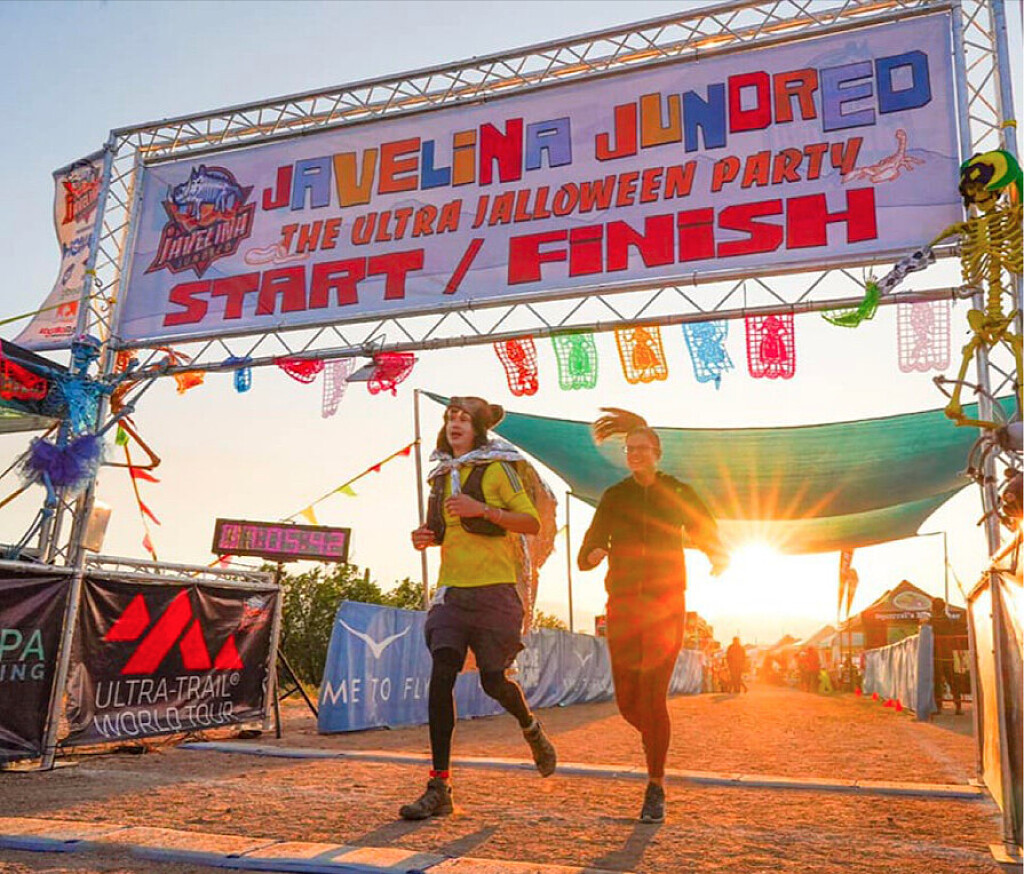
Javelina Jundred is the Ultimate 'Jalloween' Party
There's going to be one hell of a Halloween party held on the outskirts of the Phoenix metro area this weekend.
Part authentic endurance running race and part freak show with costumed trail runners constantly in need of rehydrating, the Javelina Jundred trail running races and post-race party are the stuff of legend. As the race producers at Aravaipa Running proclaim from the start, "it will test your endurance and challenge your sanity."
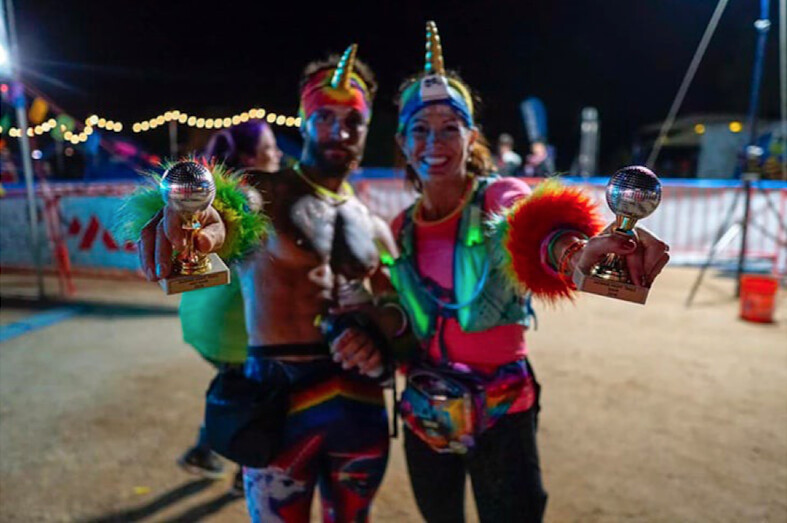
The 19th annual Javelina 100-mile and 100km races begin Saturday at 6 a.m. and send runners out on a mostly flat and fast multiple- loop course through the desert terrain of McDowell Mountain Regional Park. And while fast running isn't discouraged - the women's 100-mile winner usually finishers under 16 hours and the men under 14 hours - costumers definitely are encouraged. There's also a nighttime race called the single-loop Jackass Night Trail 31km that finishes as the Saturday night party is starting to rev into high gear.
Javelina is a trail running party that really wants to be an all-night rave. As much as it offers great fall racing opportunities (with 2022 Western States 100 Golden Ticket qualifying spots for the first time), it's really more about being a massive Ultra Jalloween Party for the ultrarunning community. The races draw both elite pros, middle-of-the-packers and novice runners alike, but it's the colorful costumes, free candy at aid stations, all-night music, spontaneous dance parties, fire dancing, misfit parade for waitlisted runners and other festive craziness that runners remember the most.
The race was started in 2003 by Phoenix ultrarunner Geri Kilgariff as an irreverent, party-oriented fun run on a multi-loop course and eventually later taken over by Aravaipa Running in 2008.
"She created this event to basically troll everyone, and thought that it would be funny," Matt Feldhake said during the race's video preview released this week. "And it's turned out to be this incredible, fun event in the desert. She created something great and we've been grateful to continue to put it on since 2008."
How wild is it? Put it this way, no other race has an aid station with the nickname of Boner. (It's a skeleton figure you'll encounter at the Jackass Junction aid station.) There's also a "Best Ass Award" at this desert party, which coincides with the adult-themed "R" rating Aravaipa brandishes on its website.
As for the racing, there are plenty of talented runners among the 588 entrants in the 100-mile field. That includes Devon Yanko (39, San Anselmo, California), Camille Heron (39, Oro Valley, Arizona), Brittany Peterson (35, Pocatello, Idaho), Meredith Edwards (37, Durango, Colorado), Lisa Robert (42, Tucson), Tessa Chesser (34, Flagstaff, Arizona) and Lotti Zeiler (25, Austin, Texas) on the women's side and Dave Stevens (39, Canada), Adam Dalton (27, San Diego), Michael Demarco (34, Baton Rogue, Louisiana), Zach Merrin (36, North Canton, Ohio), Charlie Ware (36, Tucson) and Joe "String Bean" McConaughey (30, Seattle) among the top men.
Also in the field are 13-time finisher Susan Donnelly (58, Oak Ridge, Tennessee) and 11-time finisher Fred Roberts (61, Tucson). And then there's Ed Ettinghausen (59, Murietta, California), a six-time Javelina finisher who has made a name for himself by taking on the Javelina Jundred in a full suit and heavy jester hat.
In the 100K, Tyler Andrews (41, Concord, Massachusetts) leads a strong men's field, while Cat Bradley (29, Boulder, Colorado) is one of the top entrants among the women's field.
"It's definitely a one-of-a-kind race," says Phoenix trail runner John Byrne. "But even if you don't run fast or well or very long, it's an amazing party."
(10/30/2021) ⚡AMPby Trail Runner Magazine
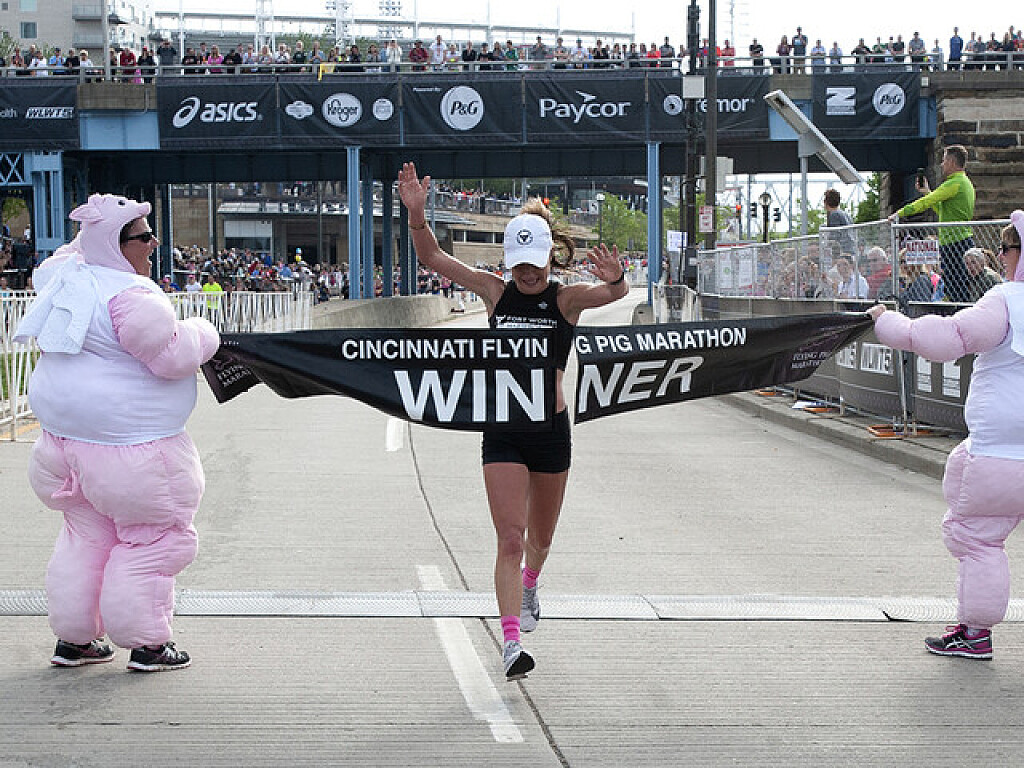
Women´s 2018 flying Pig Marathon winner Caitlin Keen is the 2021 favorite
If all goes according to plan, the women's winner of the Cincinnati Flying Pig Marathon will celebrate with a cold beer and a burger at Zip's Cafe in Mount Lookout.
Sometime around 10:30 a.m. Sunday, after hurrying by the Halloween harriers, 29-year-old Caitlin Keen hopes to join the exclusive club of two-time winners of Porkoplis pride.
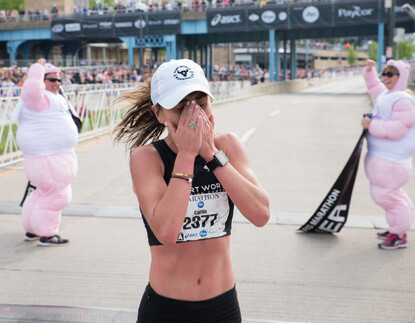
Keen, who spent her elementary school years in Hyde Park (St. Mary's), has been training in sweltering Fort Worth, Texas, and is looking forward to a Sunday morning start with a chill in the air.
She breezed to her first Flying Pig win in 2018, then was outkicked at the end of the 2019 race by Anne Flower to finish second the last time this race was run. Where most participants are happy to finish, Keen's eye is on the prize, even though her last marathon was in Feb. 2020 at the Olympic Trials.
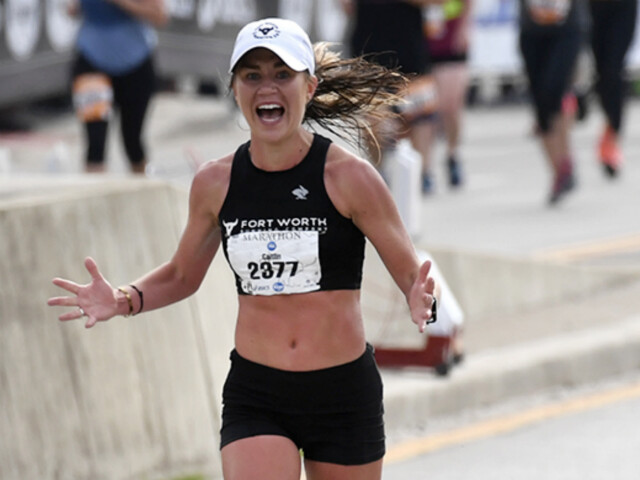
"I'm coming off of a lot of running without racing," Keen said. "I've been training all summer when it was hot. You're just dragging yourself through it, picking yourself up every day. I think it's probably going to be for my benefit. The weather looks pretty good."
In the previous 22 trots of 26.2 miles, there has only been a trio of female winners who have crossed "The Finish Swine" as champion twice. In the second and third years of the race, Becky Gallaher won in 2000 and 2001 back-to-back. Amy Robillard also went back-to-back in 2014 and 2015. Flower, the 2019 champ, is the most recent.
No autumn Flower
On a whim, Anne Flower put in a month's worth of training while working as an emergency room resident and won in 2016. The Anderson Township native, now a full-fledged doctor, repeated in 2019, which technically makes her defending champ since the coronavirus pandemic halted the "live" race in 2020.
Flower is skipping this year's Pig and running in a marathon in Indianapolis the following week. That leaves Keen, now a Fort Worth resident, as a heavy favorite.
Flower, who is hoping to get a PR on a fast course at Indy Nov. 6, is gravitating toward longer races having recently competed out west in events at Moab, Crested Butte and Pike's Peak.
"I've started running ultra marathons in the past few years and have had similar success," Flower said. "Marathon distance is starting to feel too short and fast for me to keep up!"
She plans on cheering this weekend and points toward Keen, whom she outdueled in 2019 as a runner to watch.
"Caitlin Keen is super fast!" Flower said. "Cincinnatus Elite and Columbus Running Company Elite also have very talented teams. Of course, there are always the 'not yet known' runners who could perform well and finish first."
(10/28/2021) ⚡AMPby Scott Springer
Cincinnati Flying Pig Marathon
This beloved race found it's name from Cincinnati's pork history which dates back to the early 1800's. Cincinnati is also known as "Porkopolis."Our weekend line up of events are designed to welcome athletes of all abilities from the Diaper Dash to the full Marathon and everything in-between, we truly have something for everyone. We even added a dog race several...
more...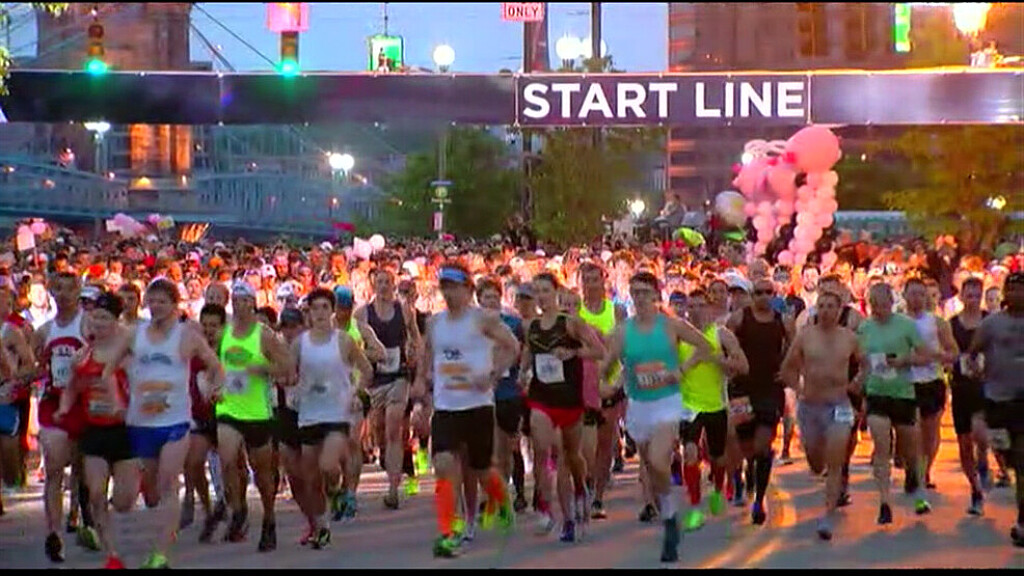
Pacers of Flying Pig Marathon are ready to help participants reach their goals
Thousands of people will be running the Flying Pig Marathon this weekend and will have help available to help them reach their race goals.
“The Pig is my favorite race in the whole world,” explains ultra-marathon runner and Flying Pig pacer Harvey Lewis, “Honestly it is an iconic event. Where else do pigs fly? And you’ve got all these people out cheering people along.”
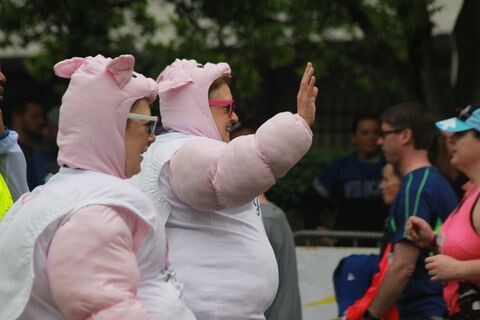
Lewis is one of the famous Flying Pig Marathon streakers which means he has run every Flying Pig Marathon dating back to the first in 1999.
Lewis is also part of the pace team, coordinated by Chris Cavanaugh.
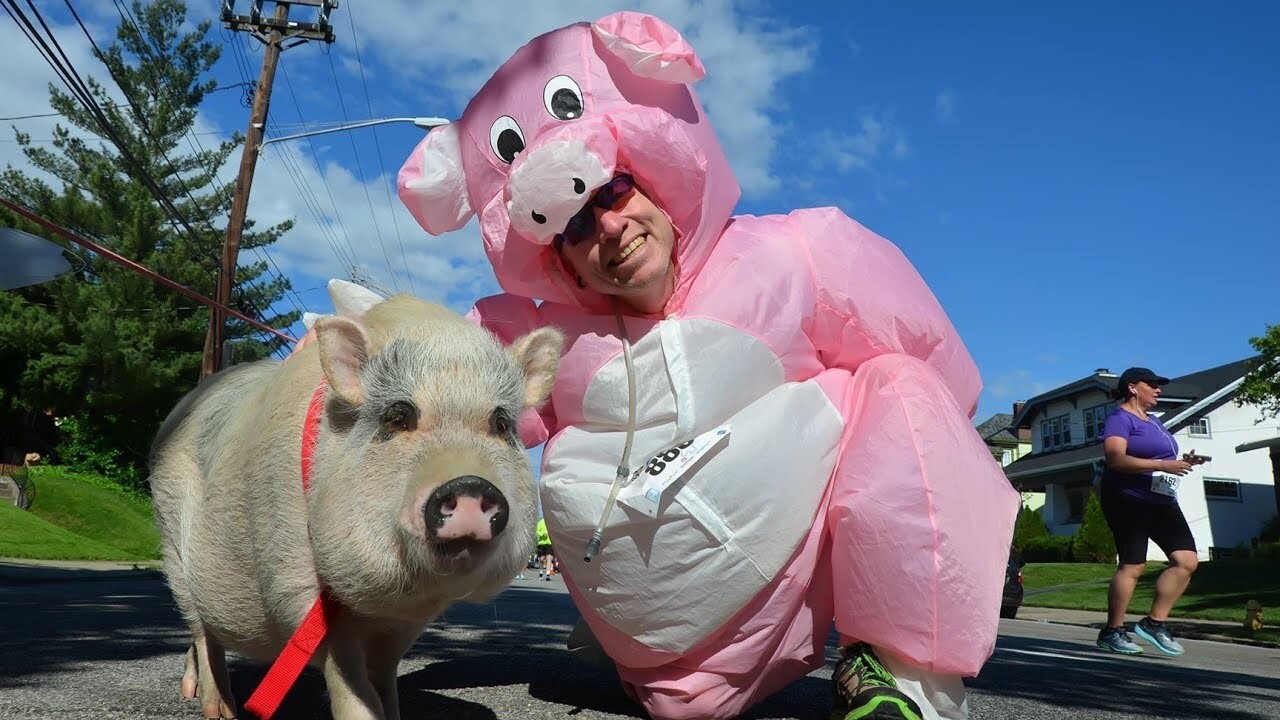
“Our job is to help you execute a smart race,” explains Cavanaugh. “We’ve made all the mistakes already, so if you want to run a smartly executed race, you have a time goal for four hours, three and a half hours, link up with one of our teams and they’ll kind of help take you through it. There’s enough stress in a race already, you put in all the work, and you want to execute, and we can help you do that.”
“I’m psyched about the opportunity,” says Lewis who is leading the 4:45 marathon group, “Having a chance to share that with others. I get so much more from this race, by doing that, than I would by racing at my very fastest.”
Cavanaugh will also run the Flying Pig Marathon just 20 days after he ran the Boston Marathon.
In an unusual year, that is normal.
The Boston Marathon is traditionally the third Monday in April, and the Flying Pig Marathon is the first Sunday in May.
“The Pig is kind of a celebratory run,” explains Cavanaugh, “You’ve done the work so as long as you can recover fairly well, you’ve got a couple of weeks to do that, and you can turn around and do both.”
Lewis, a Cincinnati School for Creative and Performing Arts school teacher, is back from breaking a world record at the Big Dog’s Backyard Ultra Run in Tennessee.
Lewis received many hand-written notes of support from his students at the Cincinnati School for Creative and Performing Arts.
Now, it’s his turn to pay it forward and help the runners on Sunday reach their own goals.
You will have a chance to meet the pacers at the Flying Pig Marathon expo Friday and Saturday.
The hours are 12 p.m. to 7 p.m. on Friday and 10 a.m. to 4 p.m. on Saturday.
On race day, just look for the pink balloons and big signs that say what time the pacers are representing.
(10/27/2021) ⚡AMPby Ashley Smth
Cincinnati Flying Pig Marathon
This beloved race found it's name from Cincinnati's pork history which dates back to the early 1800's. Cincinnati is also known as "Porkopolis."Our weekend line up of events are designed to welcome athletes of all abilities from the Diaper Dash to the full Marathon and everything in-between, we truly have something for everyone. We even added a dog race several...
more...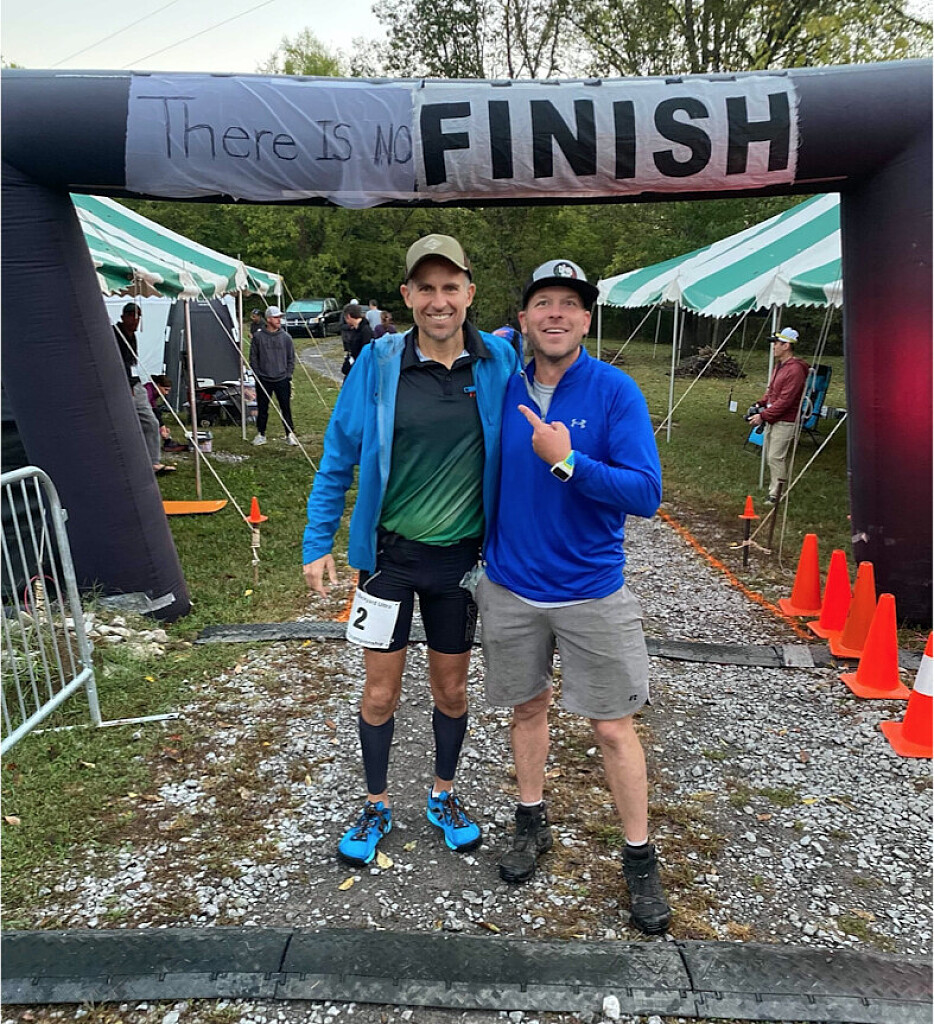
Harvey Lewis Breaks the Big’s Backyard Ultra Record By Running More Than 350 Miles in 85 Hours
He ran a 4.1667-mile loop every hour for 85 hours.
The third time was the charm for Ohio’s Harvey Lewis at the 2021 Big’s Backyard Ultra. After finishing as the assist in 2017 and 2020 (meaning, he is the second-to-last runner left in the race), the 45-year-old was finally the last runner standing in Bell Buckle, Tennessee. In total, Lewis ran 350.0028 miles in 85 hours/laps, making him the undisputed backyard ultra world-record holder.
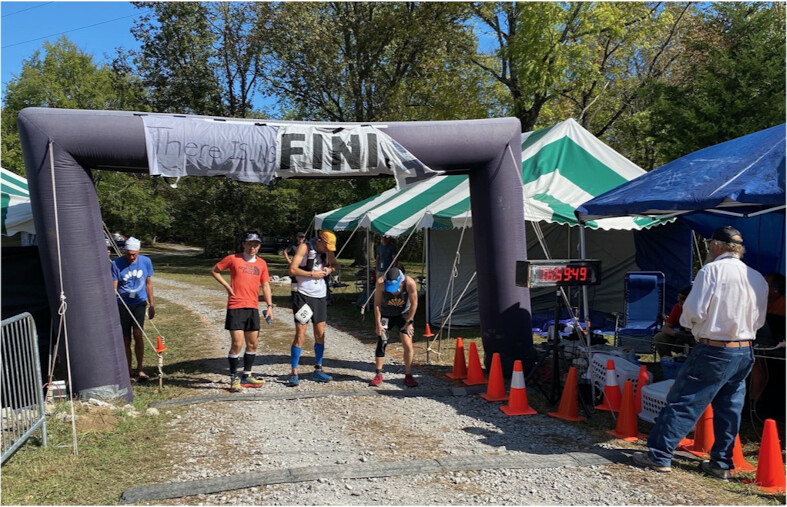
The backyard racing format has grown in popularity recently, with pop-up races happening all over the world. The rules, put simply, are: run a 4.167-mile loop at the top of every hour until one runner has done at least one more lap than the second-to-last runner. If both runners stop at the same time, then no winner is declared. At Big’s, runners complete a trail loop during the day, and a road loop at night.
The 2020 race was a virtual event, with runners in more than 20 countries competing simultaneously in standalone races. As a result, the 2021 race was anticipated to be one of the most stacked fields in race history. While some international runners were still unable to make the trip due to pandemic-related travel restrictions and concerns, several top runners made it to the start line. This included 2019 champion Maggie Guterl, 2020 champion Courtney Dauwalter, Big’s regular Dave Proctor, Michael Wardian, and Steve Slaby.
The race started at 6 a.m. ET on Saturday, October 16, and only three runners of 35 starters total dropped out within the first 24 hours (100 miles). But after that, runners seemed to drop almost every hour. Nine completed 48 hours, a large pack for reaching the third day of the race.
Lewis’s Big’s experience paid off as he and his crew chief Judd Poindexter troubleshooted any issues that arose. He fueled well and got five- to 10-minute naps when he could during the night, a big change from not sleeping at all in 2017.
One the race hit the 72-hour mark, it headed into uncharted territory with just three runners still standing: Lewis, Missouri’s Chris Roberts, and Japan’s Treumuchi “Mori” Morishita. Only two known backyard races in the world have hit the fabled fourth day before. This was the first time it had ever happened at Big’s.
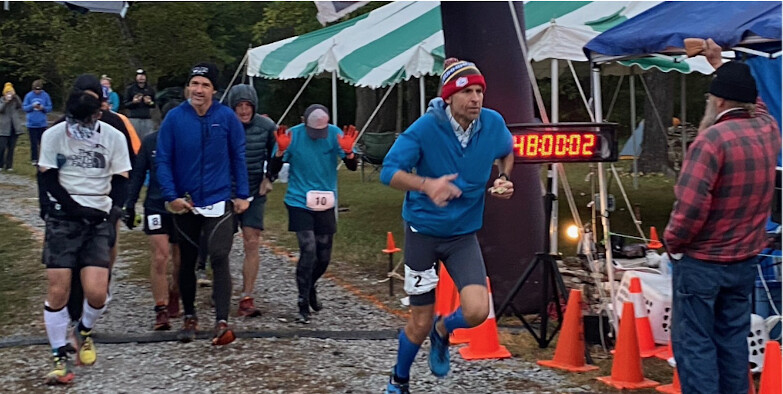
“We all wanted it so bad,” Lewis told Runner’s World. “We had lasted so long out there, which takes incredible willpower. It definitely helped. I wouldn’t have been out there without a reason to keep going, so I really enjoyed the challenge of running with them for so long together.”
The trio battled from lap 63 on, all quietly competing against one another. Each runner had their own style; Lewis and Morishita would sprint out of the corral at the start of some laps, which was a fan favorite.
“At the start and in certain areas, we just started sprinting,” Lewis said. “Morishita would sprint through the woods and yell, and then I would sprint through the woods and yell. It was a good move, so I hope Morishita didn’t mind I was doing it as well.”
Roberts struggled a lot before dawn, fighting off an injury that had him leaning sideways and coming in with few minutes to spare on laps. But as the sun rose, he recovered for a strong day.
Issues arose late in the game for Lewis and Morishita. Both runners fell on lap 81, which caused Morishita to miss the cutoff by 30 seconds, ending his day and leaving just Lewis and Roberts in the race. Lewis fell on the final hill and left him with an unknown (at the time) hand injury. Because his legs were okay, he ignored it and kept moving.
“As we got to the night, I thought for sure we’d be going to 400 [miles], so I mentally prepared myself for that,” Lewis said.
Many anticipated another complete night—that is, until lap 85, when Roberts surprisingly returned to camp soon after starting. Lewis, still on his loop, didn’t know this. Even though he didn’t see Roberts on the way back, he still wasn’t convinced he won until he got back to camp.
There, Lewis was greeted to roaring applause from the crowd that was still there. Lewis was finally a Big’s champion, capping off an incredible year of winning three major races: Badwater 135, Ohio’s Backyard Ultra, and now Big’s. He also earned the undisputed world record for most yards ever completed in a backyard race, taking the title from John Stocker who ran 81 yards with his assist, Matt Blackburn at the Suffolk Backyard Ultra in June 2021.
“It was an incredible experience,” Lewis said. “It has been one of my dreams to win this race, and to have it come to fruition was pretty mind-blowing for sure. I was super psyched.”
Lewis was so overcome with joy and exhaustion that he spent little time enjoying his win, opting to head to his tent shortly after finishing.
“When I finished, whatever armor I developed in my mind that told me I wasn’t going to submit went away,” he said. “I was really tired. I didn’t care where I slept. There was a cot in my tent 40 meters away, and it felt like the Taj Mahal. I fell asleep with half a plate of rice and beans on me.”
The next day, Lewis got a ride back to Cincinnati. When he arrived around 11 p.m., he kept his run streak alive by getting a mile in with minutes to spare. Then, a friend instructed him to go get his hand checked out in the emergency room after midnight. Harvey was diagnosed with a clean break in the fourth metacarpal of his right hand, and he was told should heal in a few weeks with just a splint.
Lewis told Runner’s World that he got a few hours of sleep in the ER before going home briefly and run commuting to work—he’s a social studies teacher at School for Creative and Performing Arts. Lewis wasn’t supposed to work because he had taken the day off. However, because of a shortage of substitute teachers at the moment, he literally ran in teach anyways.
“A couple times a year, I’ll take off to recuperate,” he said. “As long as I’m not hurting myself, I do the commute with human power.”
Big’s is likely the last race of the year for Lewis, though he plans to run the Flying Pig Marathon easy on October 30. His next big adventure will be the Barkley Marathons in 2022, which he now has entry to because of his Big’s win. Cantrell let Lewis know his thoughts on that.
“My biggest memory was turning to [Big’s and Barkley Marathons creator Gary ‘Lazarus Lake’ Cantrell] at the end and saying, ‘The winner gets an entry to Barkleys,’” Lewis said. “He couldn’t say no, so he went along with it. The next day, he told me that I’d be the sacrificial lamb.”
(10/23/2021) ⚡AMP
by Runner’s World
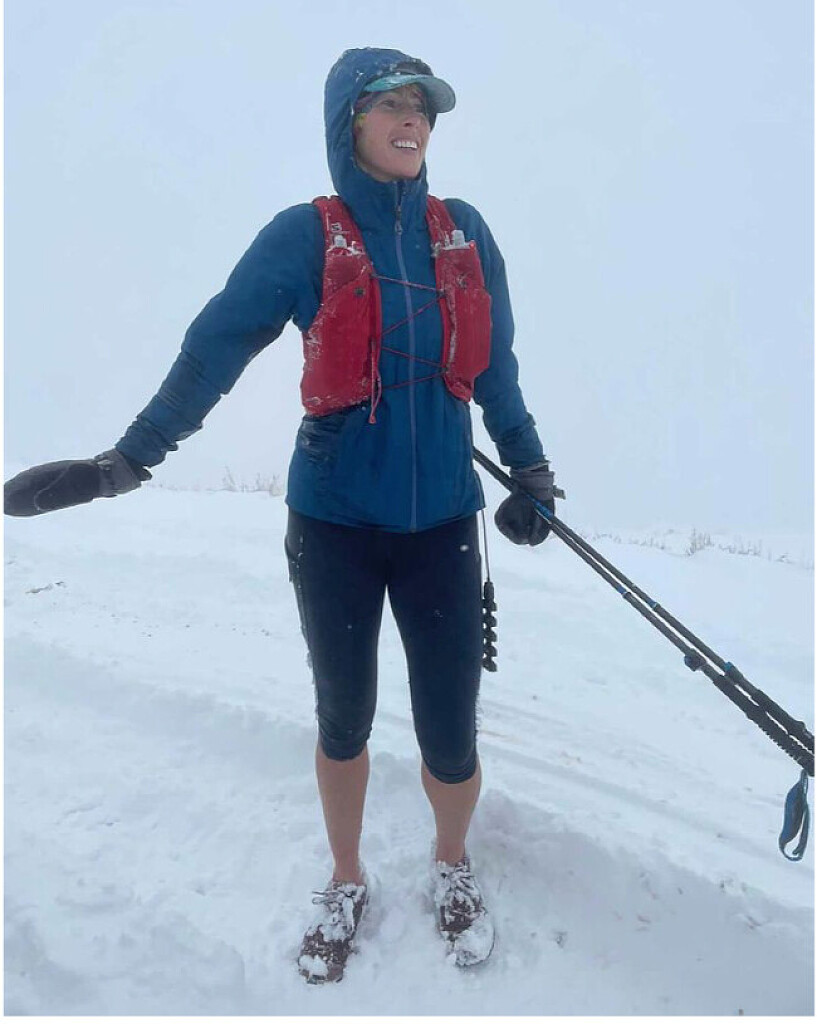
Caught in blasting snow ultrarunners stuck together for safety, all 87 participants were rescued in the mountains of Utah
When snowflakes started falling a few miles into a 50-mile ultramarathon through the Utah mountains, Annie Macdonald was not worried. As an experienced long-distance runner, she had expected some snow.
But then the stray flakes turned into a near whiteout, lashing participants of Saturday’s DC Peaks 50 race with winds of up to 40 miles per hour and erasing the path through the desolate terrain. The temperature dropped and Macdonald, who wore a rain jacket over a shirt, with tights, mittens and running shoes, became “just miserably, miserably cold.”
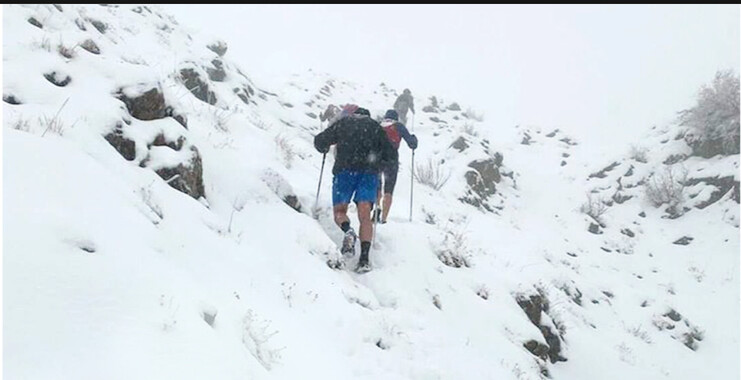
The race was in its first year as a new arrival to the increasingly popular ultramarathon scene. Ultramarathons stretch longer than the 26.2 miles of a marathon, covering grueling distances of 50 miles or more.
At about seven miles into the race and six miles from the first station, there was little choice for Macdonald but to keep going. With the path gone and the snow blasting into her face, she could only follow the footfalls of the runner ahead of her, pushing on nearly five hours to the station.
“I just kept thinking, okay, be smart. Don’t get injured, because if you get injured, then you can’t keep moving, and you have got to keep moving,” Macdonald said in an interview on Sunday. “And so that was what I kept telling myself. But even then, it was still scary for me, because I’ve never been that cold. And you just think, how can I be this cold?”
The 46-year-old, a friend of the race organizers who lives in the last house outside the canyon where the ultramarathon began, was one of 87 runners caught in the rugged mountains of northern Utah when extreme weather brought on up to 18 inches of snowfall. All were rescued in an hours-long operation that included the Davis County Sheriff’s Office, first responders, search and rescue volunteers and the organizers of the ultramarathon, who called off the event once they grasped the extreme conditions.
Rescuers “covered the entire course on foot, as well as with 4x4s and snowmobiles, for several hours to assist runners off the mountain,” the sheriff’s office said. A few were treated for hypothermia and one for a minor injury from a fall. They were released at the scene.
“It certainly, without a doubt, could have ended up much worse for many of those participants,” said Davis County Sheriff Kelly V. Sparks said. “We had serious concerns … if somebody hadn’t been able to get to them quickly and get them rewarmed, they could have been in great jeopardy.”
Unlike marathons that send runners across big city streets, ultramarathons typically start in small towns and carve through lengthy trails. They usually draw smaller groups of runners, although ultrarunning has been growing in popularity in recent years. The extreme activity saw tragedy in May, when 21 people died in the cold during an ultramarathon in China.
The Utah race was plotted to take runners on a “tough course” that was more than 70 percent trails and 24 percent service roads, up peaks and through canyons with 12,000 feet of vertical gain. Organizers promised adventure and impressive views of the Utah landscape.
Jake Kilgore, one of the race directors, is himself an ultramarathoner who said that he lives five miles from the trailhead. He said that he and fellow race director Mick Garrison started planning the event two years ago and initially considered July. “As ultra athletes, we would never ask our runners to do something we would never do,” he said. He and Garrison live a mile a part, and “run on these trails every day,” and so in July 2020, Garrison ran the course with Kilgore to test it out. “It was nearly 100 degrees that day, 95 to 100 degrees … It was unbearably hot and he could not go any further at mile 40,” he said. “So we went back to the drawing board.”
They ended up choosing October. The course traversed five cities, and he checked forecasts for those locations, and other areas along the course such as Francis Peak. “Everybody knew it was going to be raining, some snow … an inch or two max,” he said. Sparks said that at 7,000 feet, snow was not unexpected. At that elevation, there was a “storm cell that had been active for a couple of days, so it was not a quick moving storm or anything.”
The race featured live technology meant to predict and track the runners’ locations and provide a stream of the course, Kilgore said. Most runners started at 5:30 a.m., with about 20 runners beginning at an early 4:30 a.m. After 7:30 a.m., when the live feed came online from the first aid station — located at Francis Peak at just over 9,000 feet, 13.5 miles into the race — “that’s when we saw truly how bad it was,” Kilgore said. There were cross winds of up to 40 miles per hour and 18 inches of snow.
That is when Kilgore and Garrison called off the race. The decision was relayed to all the aid stations, and volunteers were told to head to the first station to wait for runners and get them off the mountain.
Up on the course, Macdonald said, runners decided to stay in groups to reach safety. She said they slowed to a walking speed, unable to continue running. Icicles hung from her jacket and from the long hair of a fellow runner. Macdonald could no longer feel her face. “We were just yelling to each other making sure everybody was still with us and that we didn’t drop anybody,” she said. The trip, she said, “felt like forever.”
Kilgore said he ran home to put on ski goggles, gloves and gear. He shuttled up as high onto the mountain as he could to get onto the course and help get runners down. He said contingency and safety plans allowed them to jump into action, with the help from more than 100 volunteers who were stationed throughout the course, to get everyone to safety.
By 2:45 p.m., about five hours after organizers called the sheriff’s office for assistance, all of the runners had been accounted for. By about 7 p.m., all the rescuers — a team made up of the volunteers who work and train with the county — had also made their way down the mountain.
The sheriff said authorities plan to speak with the organizers: “Our goal being to educate them and help them understand better how to get better information and better contact with us before a race begins.”
But Macdonald credited the race organizers with helping to prevent a dire situation that could have been “incredibly tragic for people.” Without quick work to account for all the racers and shuttle them down the mountain, the tough race day could have ended differently, Macdonald said.
Instead, Macdonald welcomed a crowd of runners into her home, where they sipped hot chocolate and traded stories. She said she has frostbite on her legs, yet plans to run the race again next year given the chance.
“As soon as I can sign up, I’ll do it,” she said. “I’ve got to finish it.”
(10/23/2021) ⚡AMP
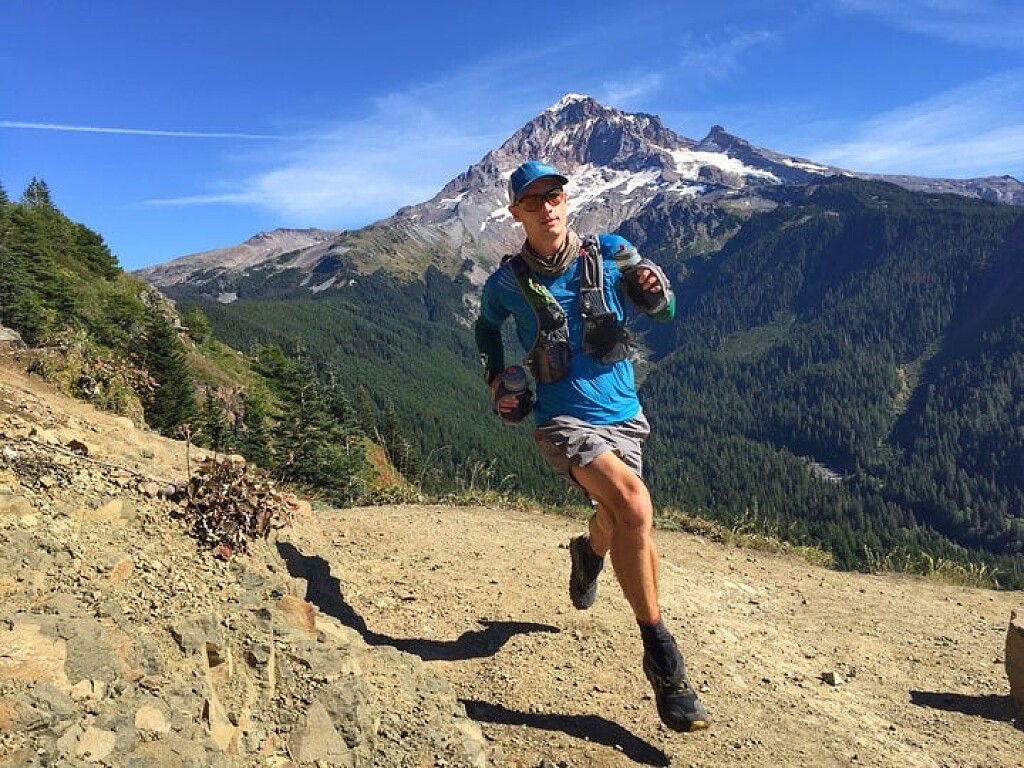
If you want to run an ultramarathon, here are six things to consider about going over 26.2.
As athletes, we are constantly searching for the next challenge – what new boundaries will you set for yourself this year? More and more people are turning to ultramarathons as the next frontier. If you too find yourself curious about the world of ultrarunning, here are some things to consider about going over 26.2.
1. Mental Capacity
Any grizzled old ultrarunner can attest to the power of your mind when running longer than most people care to drive. This is likely the most important aspect to consider. It takes a certain amount of toughness, both mental and physical (is there a difference?) to run ultramarathons. Discomfort, doubt and fear are often part of the game. But every time you enter the “pain cave” you come out the other end less frightened by subsequent visits. If your 50 km experience is a positive one and you aspire to try your hand at 50 miles, or even a 100 mile race, then the ratio of risk vs. reward is increased on both sides of the equation. The longer you run the higher your propensity is for experiencing these “tough spots”, but with that also comes an increase in satisfaction and feeling of accomplishment. This is the lure of ultrarunning.

2. Running History
Let’s start with the basic assumption that it’s best to use races as stepping stones to the next, further distance. Therefore your journey to ultrarunning should use each successively longer distance as a stepping stone to the ultramarathon. Taking this measured approach means you’ll take the smallest possible jump in distance from where you are comfortably running now. So if you’ve been doing 5 km races, train for a 10 km race. From 10 km go to a half marathon and so on, until you’ve finished a marathon injury-free. At this point you are ready an ultramarathon distance. There are few exceptions to this rule and most attempts at breaking it result in a broken body.
Let me say it again: If you have successfully finished a marathon injury-free, you can in fact most likely run an ultramarathon. The logical step up in distance from a marathon would be a 50 km race (31.1 miles), at just five miles longer than the marathon. Know that moving up in distance will take a bit more time and fortitude. But the longer your running history the the easier this transition, or addition in miles, will be.
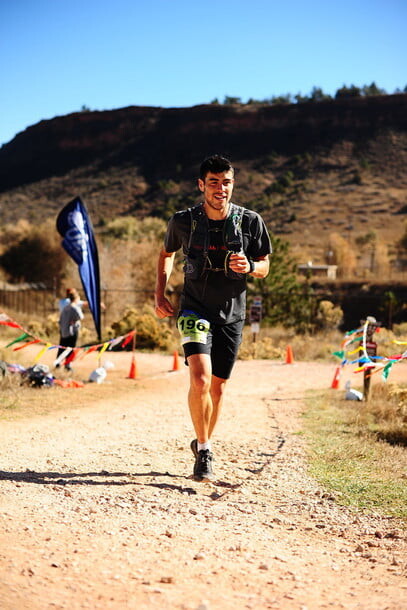
If you thought training for a marathon was a chore, then you might want to reconsider training for an ultra. There are certainly ways to mitigate the time commitment (like having a training plan), but it can’t go unnoticed that a certain “addiction to miles” and the time required to feed that addiction only helps your cause.
As your distance goals increase, there is generally less focus on pacing and more focus on overall volume/miles/time on foot. Training for an off-road ultramarathon brings with it training on trails, which means pace becomes a less effective way of measuring effort. So as your training moves to the trails, your training schedule will change to perceived exertion or heart rate guided, time-based runs.
3. Eating and Drinking
Ultramarathons are long, so you are going to have to figure out a solid nutrition and hydration strategy. Failure to do so often results in failure to finish. Your body has stored energy in the form of muscle and liver glycogen. This is the energy reserve that allows you to run for 1.5-2 hours without taking in any fuel. This is adequate for short distances, but won’t serve you well when your race is a 4-7 hour long 50 km. So buy some gels and start figuring out what your stomach can handle during your long runs.
There isn’t anything different happening to your metabolism rate once you pass the 26.2 mile mark; however you are definitely running low on your body’s stored energy (glycogen). So from the start of the race this means consistently consuming calories. Karl Meltzer, who has won more 100 mile ultramarathons than anyone else, fuels almost exclusively with energy gels in a 100-mile race. For most of us however the thought of eating 65 gels during a race is repulsive. So variety is key. Get most of your calories from what works best and is easily digestible, which is usually gels or powders. Then supplement that with other tasty treats like fruit, energy waffles and bars. For the longer ultras some real food options become very appealing. Two of my favorites are baked yam/apple, and avocado wrapped with turkey. Make sure to test your fueling strategy out during your long training runs, to mitigate the unexpected.
As for hydration I think Dr. Timothy Noakes (The Lore of Running) has it right regardless of the distance: “Drink to thirst, that’s it”. However the longer the race, the more time there is for you to develop hydration issues. So be smart and consistent and don’t allow yourself to get behind. You can usually come back from a bonk, but true dehydration or hyponatremia could end up in a hospital ride.
4. More Gear
The free-spirited 5K or 10K runner who heads out with only a pair of short shorts might find the required equipment for ultrarunning a bit daunting. The gear is in fact improving leaps and bounds year to year (check out UltrAspire). The unfortunate fact though is that at some point while training or racing you’ll have to carry calories and water with you. This will require a hydration backpack or what we ultrarunners call “handhelds”, which are simply bottle holders that attach your bottle to your hand.
At some point in your progression, like a Jedi and his light-saber, you will not be able to leave the house without taking your handheld with you. At this point, “You are almost ready, young Jedi”.
5. Terrain
Most ultramarathons are run on trails as opposed to roads. This change of scenery brings with it a natural antidote to the boring monotony of road running the concrete jungle. It also means hilly undulating terrain, worse footing, mud, and wonderfully technical trails. Fret not if you come from a road background and have an aversion to exposure, there are plenty of ultramarathons on flat tracks and bike paths. However, my bet is that you will at some point fall in love with the rugged remoteness of “real” trail runs. You aren’t entirely alone out there either. All ultramarathons have aid stations where there is usually food, water and first aid. It’s just not available as often as during a road race and depending on the location, might not have as much variety.
6. Finally, the most important thing…
Ultrarunning is in fact a labor of love. Truthfully, the only real prerequisite for an aspiring ultrarunner is a love of running. Being able to cover vast distances on your own strength is simply one of the most empowering feelings there is. The accomplishment will open doors for you mentally, proving the limitless capacity of perseverance and determination. After all, once you’ve run that far – is there anything you can’t do?
(10/18/2021) ⚡AMPby Matt Hart
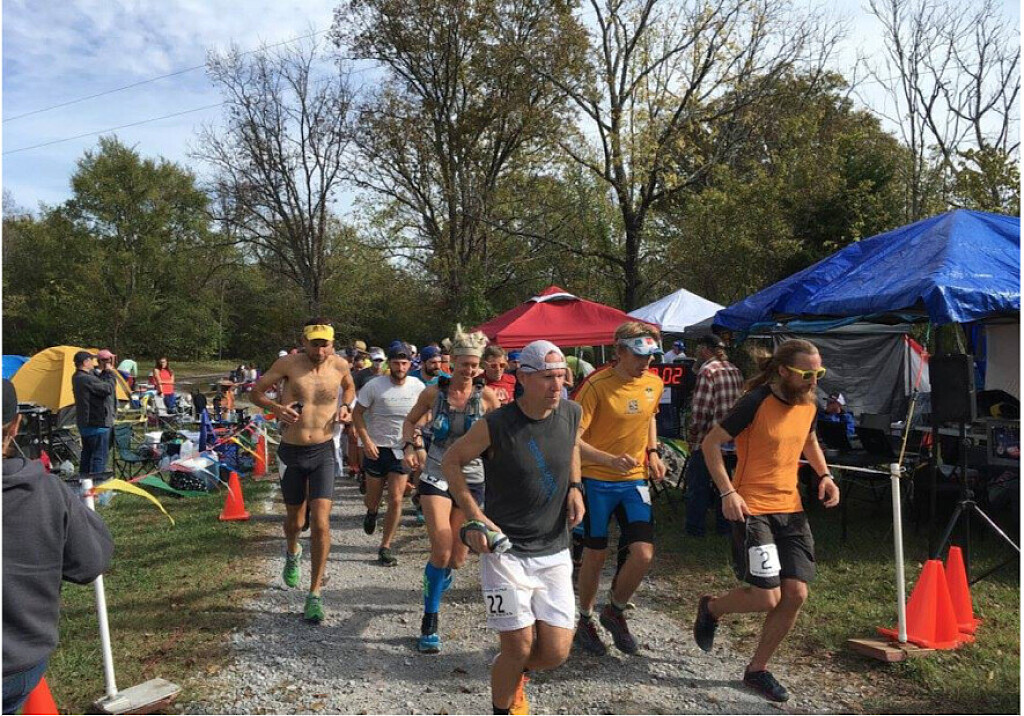
Big's Backyard Ultra World Championship has begun
Big’s Backyard Ultra World Championships, Laz Lake’s infamous last-person-standing ultra, started at 7 a.m. Central this morning in Bell Buckle, Tenn. with 36 runners from 10 countries qualified at backyard races around the world to toe the line today. Watch for Canadians Dave Proctor, Stephanie Simpson, Matt Shepard, Eric Deshaies and Terri Biloski, with the action likely to continue until Monday.
The rules are simple: the course is a 4.1667-mile (6.7 km) trail loop (a.k.a. yard), which switches to a road loop at night. (The rationale for the length of the loop is that using this formula, 100 miles takes exactly 24 hours.) A new yard starts every hour on the hour. Runners must complete each loop under the one-hour cutoff and be ready on the start line for the next yard. A warning whistle is blown at three, two and one minute before the cutoff. If you fail to finish before the hour is up, it’s a DNF. If you fail to start (and make forward progress) at the top of the next hour, that’s a DNF. This continues until only one runner is left.
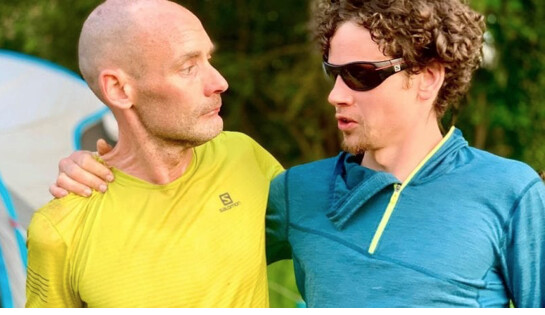
In the early hours of the race, most runners have time to spare after finishing each yard, and they use this time to refuel, use the bathroom, tweak their gear and rest. As the hours wear on and their pace gets slower, they have less and less time before lining up for the next yard.
As the race goes on and fatigue sets in, the dilemma becomes, where is the sweet spot between expending as little energy as possible while maximizing rest time between yards? In other words, the faster you complete the yard, the more rest time you get before the next yard – but you also fatigue more quickly.
This year’s starting list
This year’s competitors include seven women, two of whom are former Big’s champions Courtney Dauwalter and Maggie Guterl. Courtney holds the record for the most yards run at the Big’s course in Tennessee (68). The world record for the backyard format was set by John Stocker of the U.K. in June 2021, with 81 yards, eclipsing Karel Sabbe’s previous WR of 75 yards, set at last year’s Big’s world championships, on his home course in Belgium.
Here are this year’s contenders, with their country, age and qualifying number of yards. (Unfortunately, due to travel restrictions, most runners from Europe were not able to participate this year.)
Courtney Dauwalter, USA, 36 (68 yards – i.e., 455.6 kilometres over 68 hours)
Harvey Lewis, USA, 45 (67 yards)
Gavin Woody, USA, 44 (64 yards)
Michael Wardian, USA, 47 (63 yards)
Maggie Guterl, USA, 41 (60 yards)
Amy Masner, Ireland, 47 (59 yards)
Steve Slaby, USA, 40 (57 yards)
Chris Roberts, USA, 36 (56 yards)
Jennifer Russo, USA, 55 (54 yards)
Yukinori Yushida, Japan, 52 (54 yards)
Terumichi Morishita, Japan, 41 (53 yards)
Dave Proctor, Canada, 40 (52 yards)
Jon Noll, USA, 36 (50 yards)
Jacob Conrad, USA, 36 (49 yards)
Katie Wright, New Zealand, 34 (49 yards)
Gabe Rainwater, USA, 33 (48 yards)
Sarah Moore, USA, 33 (48 yards)
Chris Murphy, Australia, 37 (46 yards)
Stephanie Simpson, Canada, 35 (43 yards)
Ron Wireman, USA, 40 (43 yards)
Fanny Jean, France, 41 (42 yards)
Matthew Shepard, Canada, 34 (42 yards)
Hisayuki Tateno, Japan, 50 (42 yards)
Shawn Webber, USA, 47 (42 yards)
Mathieu Weiner, USA, 54 (42 yards)
Piotr Chadovich, USA, 43 (41 yards)
Morton Klingenberg, Denmark, 36 (39 yards)
Chris Boyle, USA, 42 (38 yards)
Andres Villegran, Ecuador, 37 (38 yards)
Will Rivera, USA, 51 (37 yards) (DNS)
Eric Deshaies, Canada, 48 (35 yards)
Vincent Barrientos, USA, 40 (34 yards)
Haim Malki, Israel, 44 (34 yards)
Terri Biloski, Canada, 45 (33 yards)
Jason Bigonia, USA, 44 (32 yards)
Mark Begg, USA, 47 (26 yards)
(10/17/2021) ⚡AMPby Running Magazine
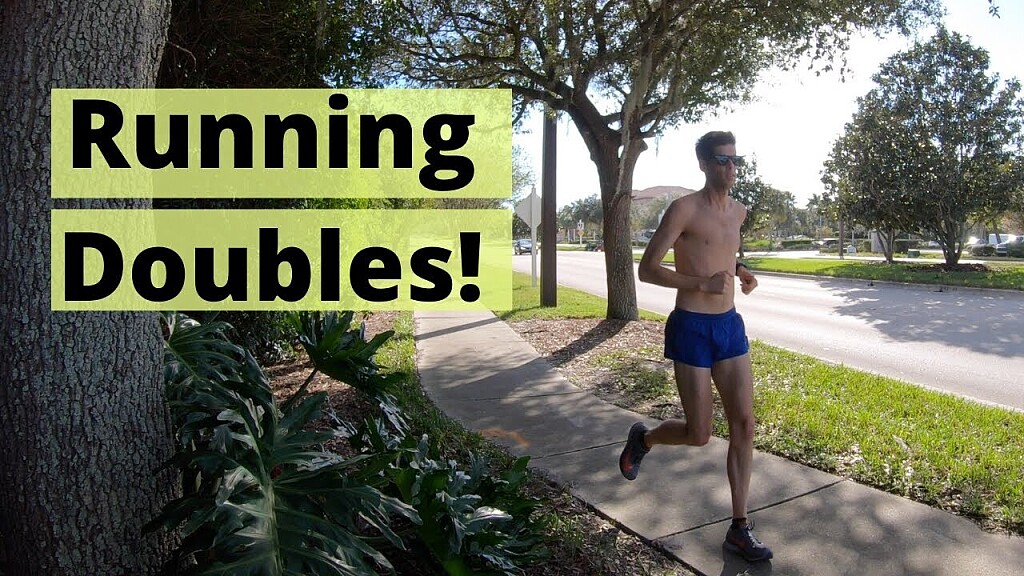
The Performance-Enhancing Power Of Easy Doubles
The hardest part of running training theory is that every athlete is their own N=1 study. We have individual inputs-training volume, intensity, etc. We have individual outputs-time to exhaustionp, VO2 max, race results. But the line connecting input to output will always be a best guess, because we have way too many confounding variables (age, stress, training background, muscle fiber typology) and no way to look under the hood to see exactly what's happening (humans prefer not to be dissected).
Even for a single athlete using different training interventions over time, there is not enough data to reliably infer what causes what. That training plan could have caused a world championship. Or it could have been the base built in that lower-intensity approach a year ago, mixed with better fueling, all combined with an optimal day in the menstrual cycle.
So how do we know what works?
Well, we do have a baseline understanding of physiology. While humans vary substantially, we're all a similar assortment of semi-organized chemical interactions that love the show Ted Lasso. But that still raises the measurement problem-how can we actually know what training is best with this deluge of uncontrollable variables? It's enough to make any coach pull their hair out, which may itself be an advantageous adaptation. Receding hairlines are built for aerodynamic speed, I tell myself.
While we may never be able to know the optimal approach for each individual, we can hypothesize what works across the population. N=1 sucks. But add up thousands of Ns, and we're getting somewhere. Bad for scrabble, good for training theory. Nn-nn-nn-nnn, hey hey heyyy, good science.
And when you add up all those Ns in running, looking at training logs of top performers, you'll notice something curious. Doubles. Lots and lots of doubles.
Doubles in Practice
A 2019 study in the Journal of Strength and Conditioning Research looked at 85 elite athletes over their first seven years of serious training to draw conclusions about the type of runs associated with top performance. Volume of easy runs had the highest correlation with performance, from 0.72 at 3 years to 0.68 at seven years. These findings were backed up by a 2020 study in the European Journal of Sports Science. Neither of those studies discuss doubles specifically, but I'd bet the dog and the car (as implied by the first thing, a Subaru) on some of that volume being accumulated with multiple runs in a day.
For example, a 2019 study on the Ingebrigtsen brothers indicated that they accumulated 150 to 160 kilometers a week onget this13-14 separate sessions. They sometimes do multiple harder workouts in a single day. And brother Jakob won the 1500 meter gold medal in Tokyo.
The same goes for athletes coached by Renato Canova, famous for his "block" training days of two hard workouts, plus countless easy doubles. Before medaling in the Olympic Marathon, Molly Seidel did 6 doubles most weeks. I bet there are more running Olympians who do triples (used in some East African training camps) than train solely with singles.
Last week's article on cross-country ski training cited many studies (an excessive number of studies) about the high proportion of extremely easy training at the top end of that sport. Some of the greatest champions do 90%+ of their training at low heart rates! As outlined by a 2010 study in the Scandinavian Journal of Medicine & Science in Sports, skiers (and runners) accumulate aerobic volume to increase in mitochondrial content and capillaries around muscle fibers, improve metabolic function at both high and low intensities, and encourage a more economical use of oxygen to power performance at all intensities as well. All of that corresponds to faster race performances, even in events that are just a few minutes long.
But if it was just about volume, why aren't we seeing top runners rely more on massive singles? That's what bikers do for the most part: several tiny espressos, one big ride. Meanwhile, swimmers do tons of doubles, as do skiers. That's interesting! So what connects running and swimming and skiing, but not biking? My guess is that it's related to the biomechanical demand of the sport varying significantly at slow paces, plus injury risk. Biking is the same if you do it with low power or high enough power to mine Bitcoin in an environmentally responsible way (quads will save the rainforests?). For running, meanwhile, overload those biomechanical patterns and athletes may get inefficient, even if they are able to avoid injury.
So we're trying to add up to a big aerobic number (adjusted for individual background), while balancing overall stress for long-term adaptation. But overemphasizing long singles may have diminishing returns due to the demands of running.
Doubles help solve the math equation.
But is it just about the extra volume? I doubt it.
Doubles may provide a hormonal stimulus that enhances adaptation, they may increase adaptation markers and protein expression associated with better performance, they may improve glycogen replenishment, they may even have some fascinating relationship to epigenetic signaling. A 2012 study on mice found that 3 x 10 minute runs in a single day led to the same adaptations as a 30 minute run, but possibly with slightly larger increases in expression of one protein (TSP-1). What would that type of study look like in humans? Unfortunately, finding out would require dissection. And that's the type of lopsided trade that would only appeal to the New York Mets.
Whatever the exact reasoning, thousands of world-class athletes have come to the conclusion that doubles are key on the track and roads. However, they're sometimes less common in trails and ultras. I have two theories for the cause of that offset.
First, trail running relies heavily on resilience to fatigue from variable musculoskeletal loading patterns. The track is an aerobic system contest, the trails involve the same aerobic pathways with a wrinkle-it doesn't matter how strong your aerobic system is if your legs are Jello. Musculoskeletal damage (and thus, potential adaptation after recovery) accrues over longer runs, so perhaps the long singles create resilient monsters (assuming an athlete doesn't break first).
Two, the margins in trail running are not as narrow as on the roads and track. Our sport is messy, full of rocks and roots and airplane arms, so the champions don't need to find every single possible advantage. A 0.1% improvement in aerobic power might be swallowed up by a 10% improvement from not eating sh*t on a descent. (That also gives me hope that doping is less common in trail running than in a sport like cycling.
How To Add Doubles
While doubles work for pro athletes, I have seen in coaching that they can work for almost anyone, subject to a few disclaimers. First, the body knows stress, not miles. A double can be counterproductive if it adds even an ounce too much to the stress scales. Only double if you have the time, energy, and life force to spare.
Second, increasing volume increases injury risk. It's hard to run a PR with an achilles that sounds like a creaky doorway.
Third, adaptation is a high-stakes game. Overloading stress in moderation followed by recovery can lead to breakthroughs. But overloading a bit too much can lead to stagnation and regression. Some world-class athletes are likely chosen partially because they are genetic anomalies with adaptation under high chronic stress loads. So make sure you're always listening to your body.
Given those risks, my co-coach Megan and I introduce doubles with five guidelines. This will be the next topic for "Sexy Science Corner" on our podcast, so listen when that comes out for more info.
One: Keep it very easy-up to 2x your 5k pace
If the goal is the aerobic stimulus while balancing stress, almost no pace is too slow. I personally do my doubles without a GPS watch, partially because it may auto-pause due to how slow I go. If your normal easy pace is 8 minutes per mile, you can make it 9 or 10 minutes per mile, especially to start. Molly Seidel often does them at 8+ minute pace, with a marathon pace in the mid-5s. I have seen some pro runners in Boulder doing them at what looks like 10 minute pace. Glorious prancy ponies! Just focus on good form-light on your feet with quick strides.
Two: Keep it short-20 to 30 minutes is plenty
There is some evidence that the productive hormonal stimulus of running rises most rapidly in the first half-hour, before leveling off (and sometimes reversing, though it's debated and individual-dependent). Many athletes describe feeling refreshed after a quick afternoon shake-out. For trail runners, we really love doing some of these sessions on the "treadhill" to reduce impact and get climbing-specific biomechanical loading.
Three: At least a few hours after your first activity
Glycogen replenishment is a key element in doubles, so some fun food and a few hours is plenty. Canova blocks sometimes involve tinkering with glycogen levels for elite male athletes, but we have seen that backfire.
Four: Add them on workout days first, aerobic days next
Easy doubles on workout days may maximize adaptation benefits, plus there is a greater endurance stimulus. Once an athlete is adapted to the approach, we'll occasionally have them run more moderately on some workout-day doubles or treadhills (sometimes even with structured workouts like Canova blocks, but that's a training element you should only add at the direction of a coach due to the high risk of injury and overtraining). Don't double on long run days, which may overwhelm glycogen replenishment and increase breakdown rates. Any double could be replaced by easy cross training as well, which should accumulate aerobic adaptations at similar rates, with lower injury risk.
Five: All doubles are optional
There is no such thing as a mandatory double for our athletes. The main training session is what matters most, and tons of our team members have won some of the biggest races in the world without any doubles at all. So listen to your body. Are you dreading it? Skip. Do you have any niggles, even the smallest whisper from a gnat's ass? Chill. Affect sleep, family, work? Bag it. Does it slow down your recovery for the next day? It's OK to give it a couple weeks for adaptation, but if that persists, nix doubles until you wake up the next day feeling as strong or stronger than you would otherwise.
Many athletes we coach will see this general weekly structure on their peak build weeks, when life stress is low, and health is perfect. Peak ultra builds usually involve fewer (if any) doubles, in order to maximize the musculoskeletal adaptation stimulus, as described above.
Monday: rest and recovery
Tuesday: easy run and hill strides (6-12 miles)
Wednesday: workout (8-13 miles) and optional double/treadhill (2-4 miles)
Thursday: easy run (6-12 miles) and optional double/treadhill (2-4 miles)
Friday: easy run and optional hill strides (3-8 miles) or x-train/rest
Saturday: Long run (10-25 miles)
Sunday: easy run and hill strides (6-15 miles) and optional double/treadhill (2-4 miles)
The big thing to remember: doubles are 100% not necessary. But then again, running isn't really necessary either, in the big scheme of the universe. Doubles, like run training in the first place, is all about exploring the limits of your potential by doing something that seems moderately unreasonable.
(10/16/2021) ⚡AMPby Trail Runner Magazine
Marathon des Sables Wrapup
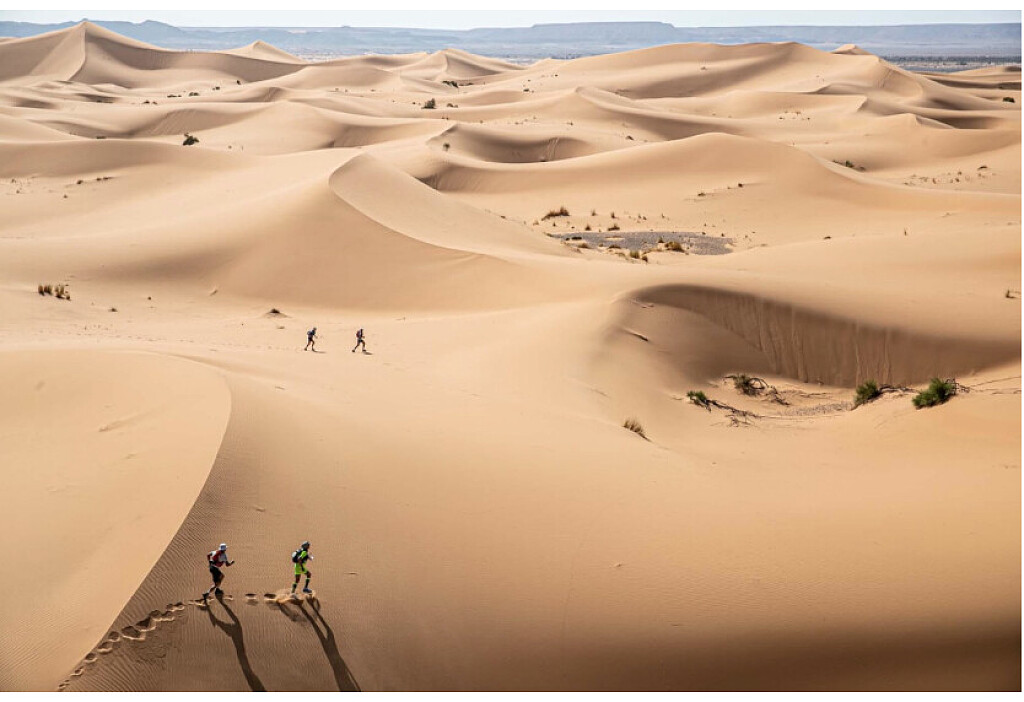
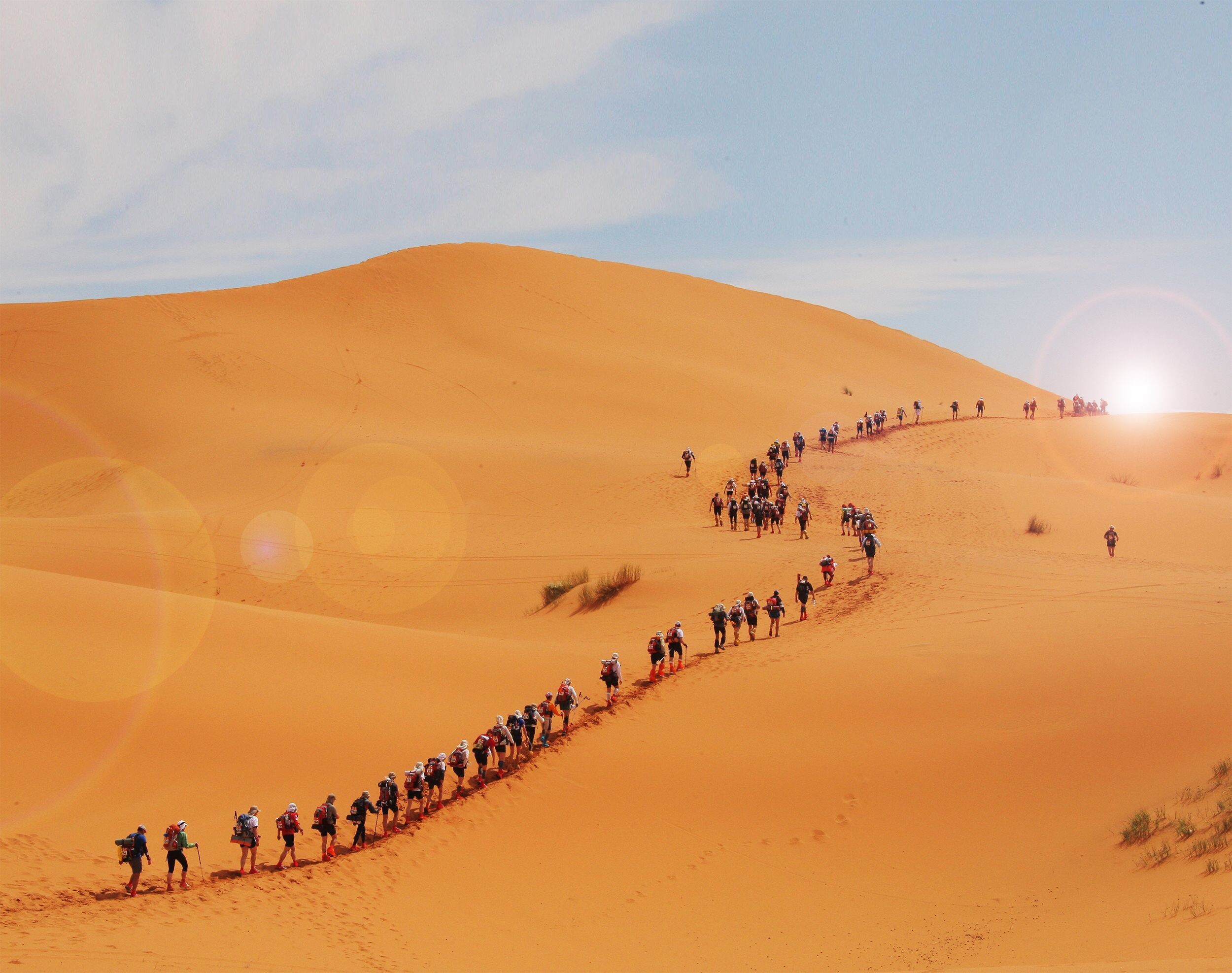
After a 2.5-year break due to the COVID-19 pandemic, it was with great anticipation that the 2021 Marathon des Sables took place this week. The famous desert race, which runs in the Sahara Desert of Morocco, travels 155 miles (250 kilometers) over seven days, traversing sand dunes and stone-filled plains in an arid climate where mid-day temperatures easily reach 120 degrees Fahrenheit (48 degrees Celsius).
Each day, a mobile bivouac is erected in the desert, which serves as the day’s finish line, campground for the night, and the following day’s starting line. There are six stages total, and five of them are competitive stages. The final stage is an untimed charity stage. Participants must carry their own equipment including food, camping materials, and survival gear along with water rations supplied by the race organization.
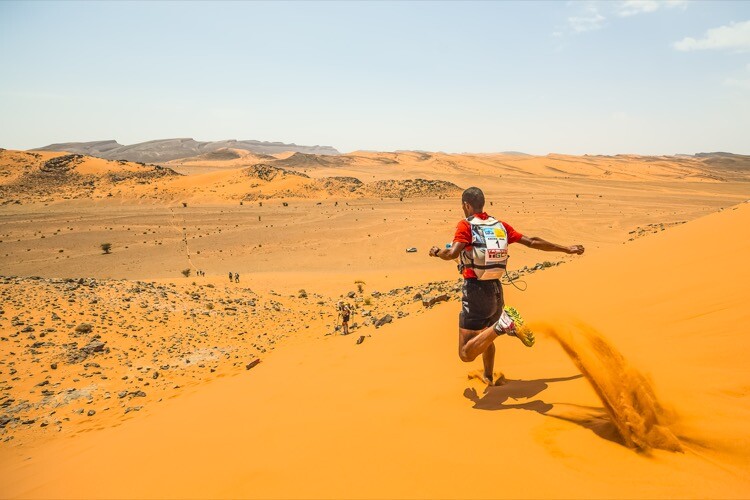
Typically, the race takes place in April, which is spring in the Sahara Desert. This October edition was said to be hotter and drier than usual for this race and this time of the year. In addition to the heat, a stomach virus ravaged many of the participants. By the end of the week, dropouts amounted to over 40% of all starters, an unusually high drate for this particular race.
Sadly, the race claimed the life of one runner due to cardiac arrest. The French man, in his fifties, was an experienced ultrarunner who had met the medical requirements necessary to start the race. iRunFar covered this story earlier in the week.
For the first three days of the 2021 edition, it looked like parity might define the race. Moroccan brothers Rachid El Morabity and the younger Mohamed El Morabity ran close together, leading the rest of the men’s field by just minutes. On the women’s side, Morocco’s Aziza Raji held a bigger, but not insurmountable, half-hour lead over Aicha Omrani (France) and Hassna Hamdouch (Morocco) in second and third.
The stage was set for shakeups in the grueling 50-mile Stage 4. However, Raji and the El Morabity brothers were about to render the outcome academic. At the end of Stage 4, just 15 minutes separated Rachid and Mohamed El Morabity from each other in first and second overall — but the rest of the field lagged behind by over an hour. Meanwhile, Raji had built her lead over the women’s field from less than an hour to a mind-boggling four-plus hours.
In the end, Rachid El Morabity took the win, finishing with a time of 21:17:32. Mohamed took a narrow second in 21:32:12, less than 15 minutes behind his older brother. This marks Rachid El Morabity’s eighth win of this iconic sand race, and Mohamed El Morabity’s fourth 2nd place behind his brother.
Merile Robert (France) was the lone non-Moroccan on the men’s podium, a position with which he’s familiar. This marks his fifth Marathon des Sables finish, with his top previous finish also third behind the El Morabity brothers in 2018.
Aziz Yachou (Morocco) took fourth place, less than two minutes out of podium position, in what was an incredible breakout performance. According to his social media, Yachou received an hour’s penalty during the race due to losing an item of his required kit, which makes this podium near miss even more fascinating. (Required kit and the penalties for missing or losing items are clearly communicated by the race organization before the race.)
Mathieu Blanchard (France, lives in Canada) rounded out the top five, though he was a distant two hours and 20 minutes behind fourth place. He said on social media he suffered the stomach virus during Stage 4. Blanchard has had quite the 2021, following up his third place at the 2021 UTMB with this performance.
Notably, 10-time Marathon des Sables winner and Moroccan sand running legend Lahcen Ahansal finished ninth in the age 50-59 category with a time of 38:16:32.
Aziza Raji demolished the women’s field with a winning time of 30:30:24. It was Raji’s first win. She was second at the last edition and had a few top-five finishes before that. She’s only the second Moroccan woman in the history of the race to win it, after two-time women’s champion Touda Didi.
Tomomi Bitoh (Japan) took second in 34:39:17, moving up in the cumulative standings during the 50-mile Stage 4 and marathon-distance Stage 5 through a well-paced week of racing.
Aicha Omrani finished third in 35:47:48; remarkably, she finished the 2011 Marathon des Sables in nearly the double the time it took her finish this edition.
Hassna Hamdouch and Elise Caillet (France) rounded out the top five.
(10/16/2021) ⚡AMP

Marathon Des Sables
The Marathon des Sables is ranked by the Discovery Channel as the toughest footrace on earth. Seven days 250k Known simply as the MdS, the race is a gruelling multi-stage adventure through a formidable landscape in one of the world’s most inhospitable climates - the Sahara desert. The rules require you to be self-sufficient, to carry with you on your...
more...
Brighton marathon organisers apologise to runners after making course ‘too long’
The event was 568m too long
Runners who took on the Brighton Marathon nearly went the extra mile - after organisers said the course was too long.
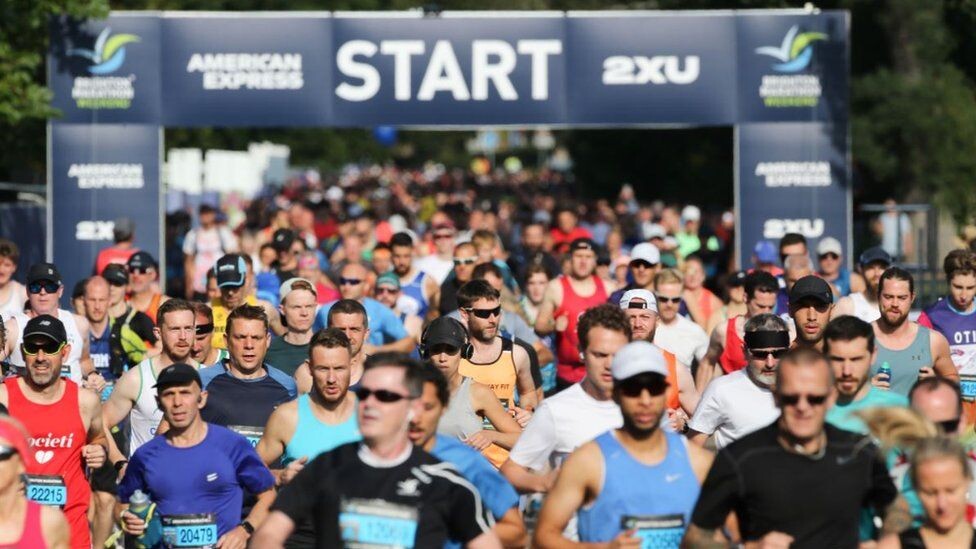
Sunday’s 26.2 mile event started at Preston Park in the city and finished near the Brighton Pier with Neil McClements crossing the line first in two hours and 33 minutes.
But organisers later said there had been a mistake with the course measurement.
In a statement on Facebook, they said: “We would like to apologise to our marathon participants that the course today has measured 568m too long.
“We are wholly disappointed that this has affected our runners & hope that it hasn’t marred the experience, at what has been a fantastic comeback event after 18 months.”
Many of the replies to the post made light of the situation, with some suggesting they had just finished their first ultramarathon - a catch-all term for races longer than marathon distance.
(10/09/2021) ⚡AMP
Man dies while competing in grueling, multi-day race across the Sahara Desert
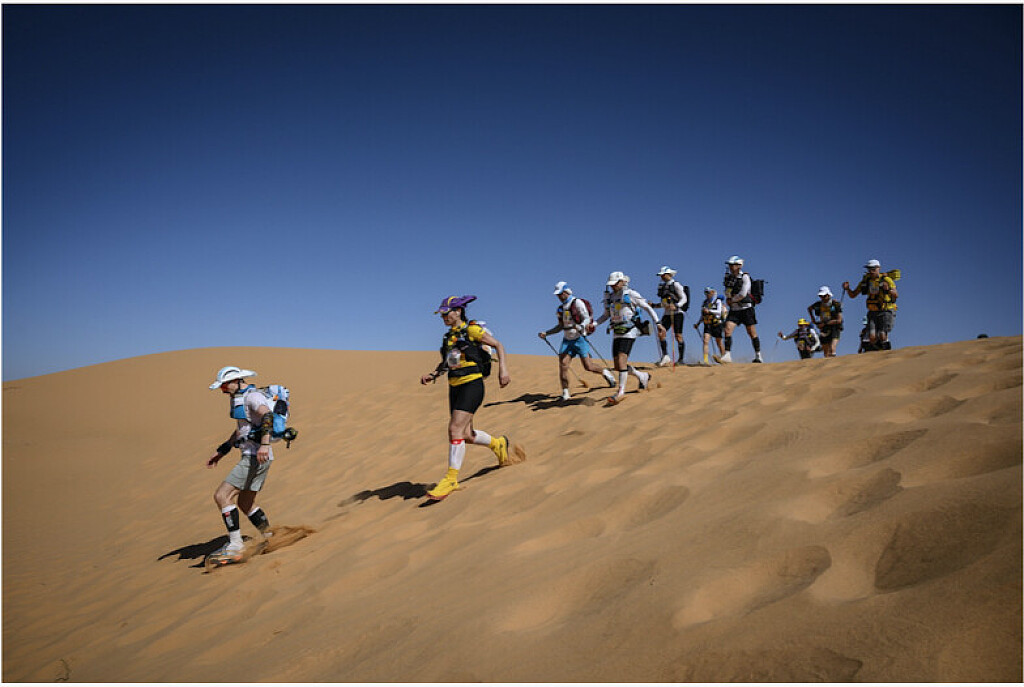
An unnamed competitor in the 2021 Marathon des Sables died on Monday, marking the third fatality in the race's 35-year history.
Known as one of the most difficult footraces in the world, the Marathon des Sables takes place each year in Southern Morocco's Sahara Desert. The race covers approximately 250 kilometers (about 155 miles) over a period of about seven days.
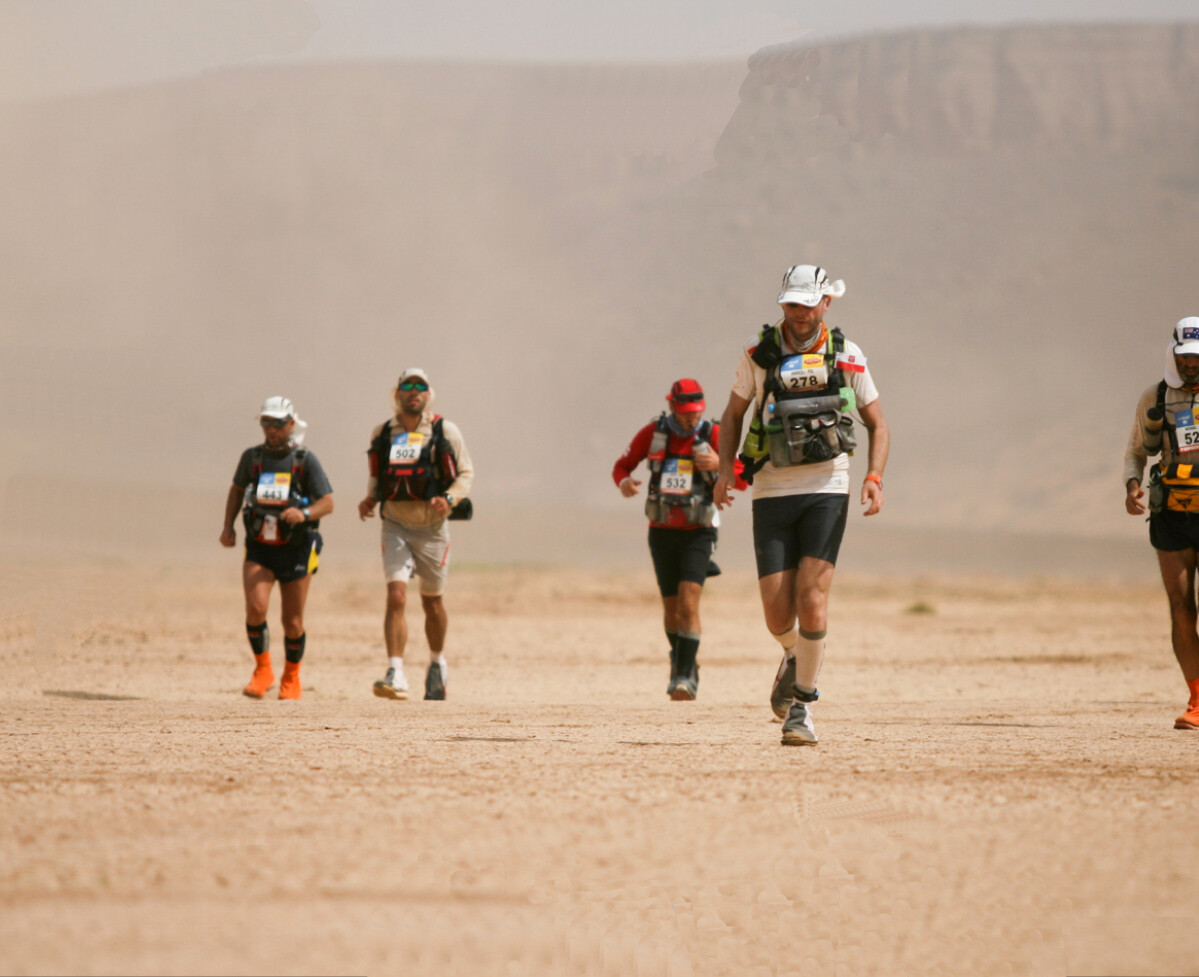
Because it exceeds the traditional marathon distance of 26.2 miles, the Marathon des Sables qualifies as an "ultramarathon." The level of prolonged exertion to complete an ultramarathon, particularly when combined with extreme environmental conditions, can take a severe toll on one's body, causing potentially dangerous physical and psychological issues.
The Marathon des Sables reported the tragic incident on Monday, noting that the competitor suffered "cardiac arrest in the dunes of Merzouga" following "a fainting spell."
They added that the man was "in his early 50's and had fulfilled all the medical requirements for the race." He had already completed the first stage of the competition "without the need for medical assistance" at the time of the incident.
"After he collapsed, he was immediately rescued by two other competitors who are also doctors, who triggered the SOS button on his beacon and started the heart massage protocol," said officials from the event.
The Marathon des Sables Medical Director arrived at the site "within minutes by helicopter and took over from the participants." However, despite "45 minutes of resuscitation," the competitor was pronounced dead by medical staff.
The man's identity has been kept secret "out of respect" for his family, who has reportedly been informed of his passing.
Following the incident, Race Director Patrick Bauer broke the news to participants, leaving "staff and competitors...extremely affected."
While the race is planned to continue despite the tragedy, competitors will participate in a minute of silence before the beginning of the third stage.
As noted by The Conversation, ultra-endurance activities put a range of stresses on the body, physically and psychologically. "As growing numbers of competitors look to push themselves to their absolute limit, and [organizers] seek new challenges to enable them to do so, there is always going to be some risk," wrote the publication.
However, "the main cause of death during ultramarathons...is actually sudden cardiac death." Consisting of 43 percent of ultramarathon deaths, these cardiac arrests are usually sustained by those with unknown heart conditions.
Other potential dangers include environmental conditions, psychological stress, sleep deprivation, water and sodium loss and tissue damage.
In order to participate in the Marathon des Sables, competitors must provide "a medical certificate issued by the organization stating their ability to participate and a resting ECG report." Throughout the race, each individual is responsible for providing and carrying their own food, sleeping equipment, and other gear.
(10/09/2021) ⚡AMPby Newsweek
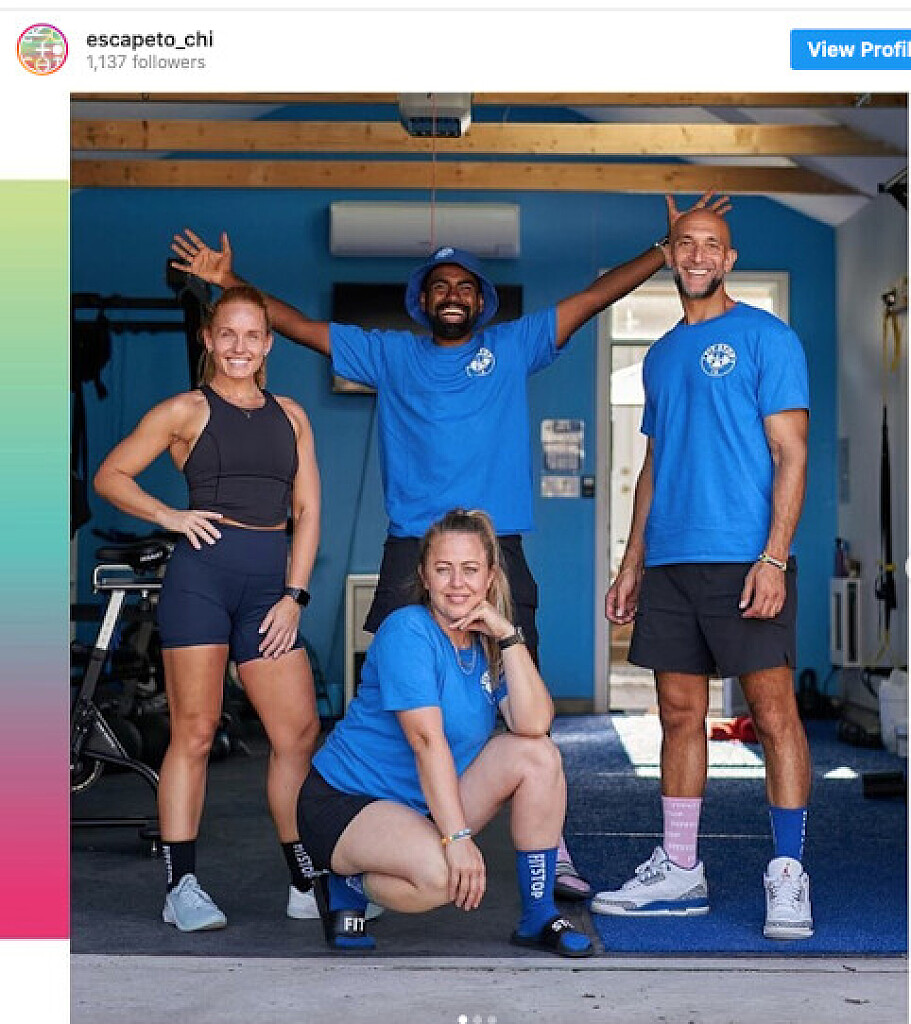
A team of Canadian runners is running to Chicago for the Chicago Marathon
With the U.S. land borders closed to automobiles, 12 runners are on their way by foot from Toronto to Chicago for the 2021 Chicago Marathon this Sunday.
On Tuesday, Oct. 5, the group of runners departed from the base of the CN Tower at dawn. They plan to travel 850 km to Chicago over three days and three nights. Their adventure is a non-stop ultra-relay, consisting of 83 legs, where each runner will have to cover between eight and 13 kilometres each leg
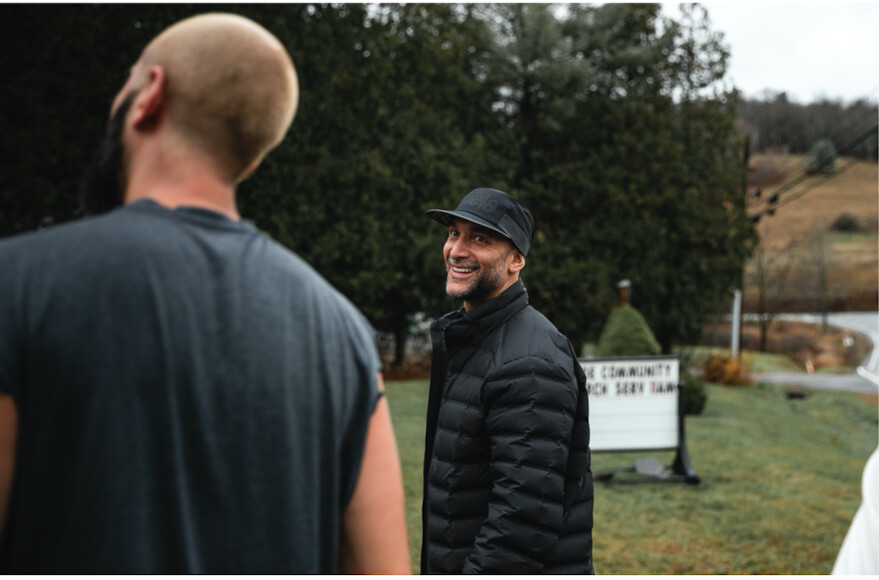
This run was orchestrated by Lululemon ambassador Quinton Jacobs, who made a similar journey from Toronto to New York in 2019. After completing New York, Jacobs approached his friend Anoke Dunston with an epic proposition to run to the 2020 Chicago Marathon. Unfortunately, due to the pandemic, they had to postpone their journey until 2021. Still, with the U.S. land borders closed to automobiles, it has created a logistical flurry for the group.
The two friends rounded up four Canadians and six Americans to join them on their Escape to Chicago challenge. “We have one RV, two support vehicles and a Sprinter van,” says Jacobs. “When Anoke and I reach London, Ont., we will drive back to Toronto’s Pearson airport to meet our American contingent travelling with us now in Detriot.”
When the group reaches Detriot, they have another van waiting for them to get the group to Chicago. “The pandemic has been a hiccup in the planning of our event, but we are making it work,” says Dunston.
Jacobs was first inspired to start this challenge by a run to Montreal, which he did with friends a few years ago. “We built this challenge around vibes, and to put a spotlight on the people who are leaders in our community,” says Jacobs. “Our goal is to raise money for charity and showcase our team of inspiring people doing inspiring things.”
Lululemon has sponsored their run and invited the Toronto, Detriot and Chicago running communities to join in on cheering the Escape to Chicago team during their journey – hosting run celebration parties at the stores as the runners pass through each major city.
The group is completing this challenge in support of the St. Felix Centre, a non-profit organization supporting homelessness and food insecurity in Toronto. They are also fundraising for local kids’ charities in Detriot and Chicago.
(10/09/2021) ⚡AMPby Running magazine
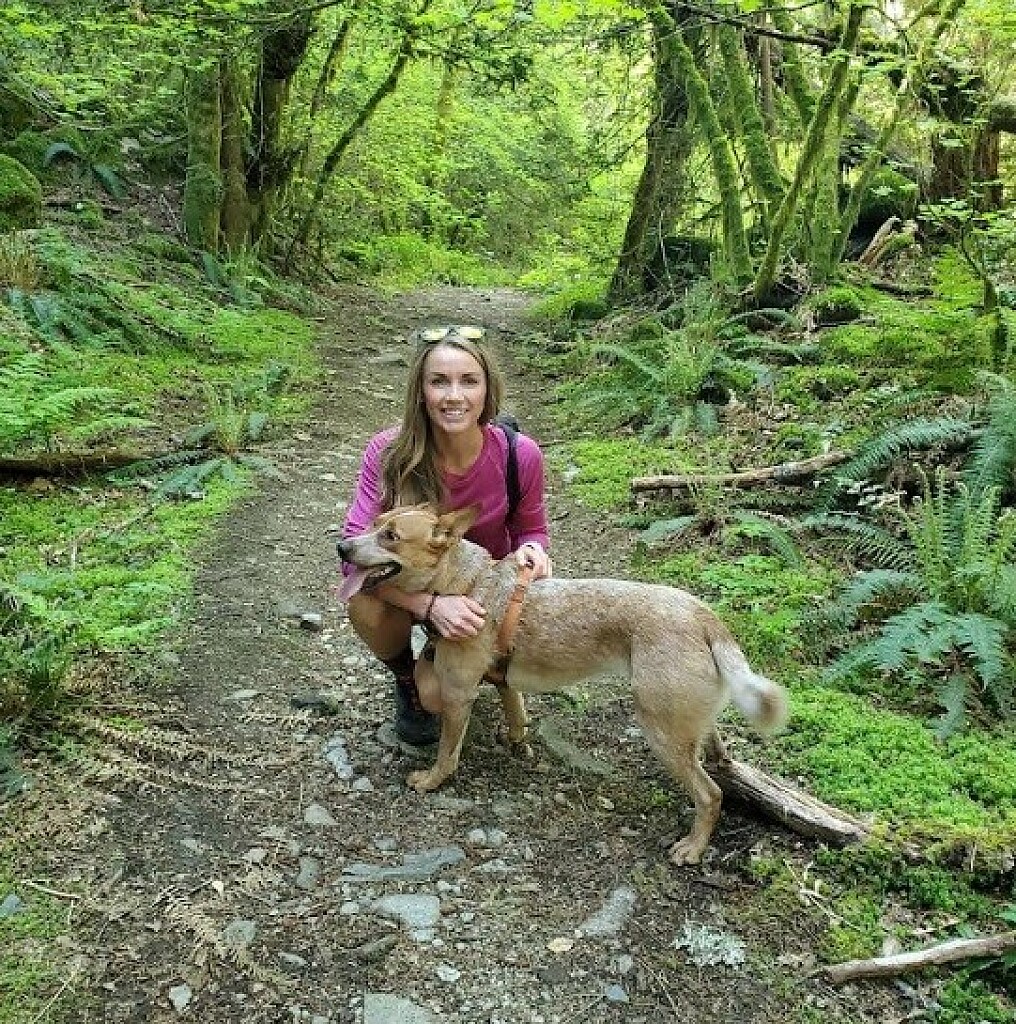
Ultra trail runner and psychotherapist Cassie Smith explains how the combination of running and nature can boost your mood
The mental health benefits of running are well documented, and there’s a large body of research demonstrating the mood-boosting effects of getting out for even a short jog around the block. There are also a number of studies that show the positive impact nature can have on our mental health.
Trail running is the perfect combination of exercise and nature, and while it isn’t a panacea for mental illness, its positive impact on mental health cannot be denied. We spoke with ultratrail runner and psychotherapist Cassie Smith about how runners can maximize the mental health benefits of their daily miles.
Smith is an accomplished ultratrail athlete. The Smartwool-sponsored runner has several podium finishes to her name from races in Canada and around the world. She’s also a psychotherapist who works as a counselor at the University of British Columbia, which gives her a unique insight into the positive and negative aspects of running as they pertain to mental health. She explains that in addition to the combined effects of nature and physical activity, trail running also promotes being in a more present mindset or a “flow state,” which can help individuals cope with everyday stress and anxiety.
“A lot of mental health issues result from our minds going backward and thinking about the past, or going forward and worrying about the future,” she explains. “When you’re in that flow state, you’re not doing either of those things. You’re focused on the task in front of you, and the mechanisms in your brain that pull you in those other directions aren’t operating.”
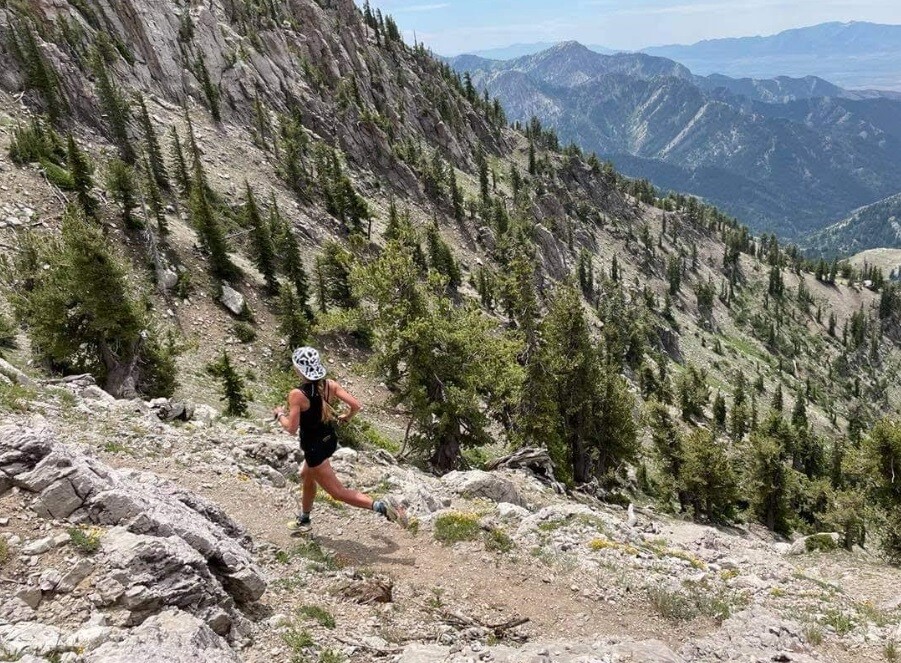
She adds that while you can also enter this flow state on the roads, trail running is more effective in this way because you have to be more mentally engaged in what you’re doing to navigate uneven terrain and avoid tripping on a rock, root or other obstacle.
On the flip side, trail running does tend to lean toward the extreme end of the sport, and Smith admits that if you’re not careful, running can start to have the opposite effect on your mental health, particularly if it takes you away from other important parts of your life, like spending time with friends and family. Smith adds that many trail runners (and runners in general) also risk tying up too much of their identity in the sport, which sets them up for trouble if they have a bad run or race, or if something happens that prevents them from training.
“I encourage people to paint a picture in their minds of the healthiest version of themselves,” she says. “What do you look like when you’re sleeping eight hours each night, eating healthy meals, connecting with friends and moving well without pain?”
She goes on to explain that anything you do, including trail running, should promote that healthy version of yourself and be one aspect of it — not the entire picture. If you’re neglecting your relationships, sacrificing sleep or beating your body up without proper recovery in order to focus on running, you’re likely taking it too far. “You have to ask yourself if trail running is still serving its purpose,” she says, which is to make you a healthier, happier person.
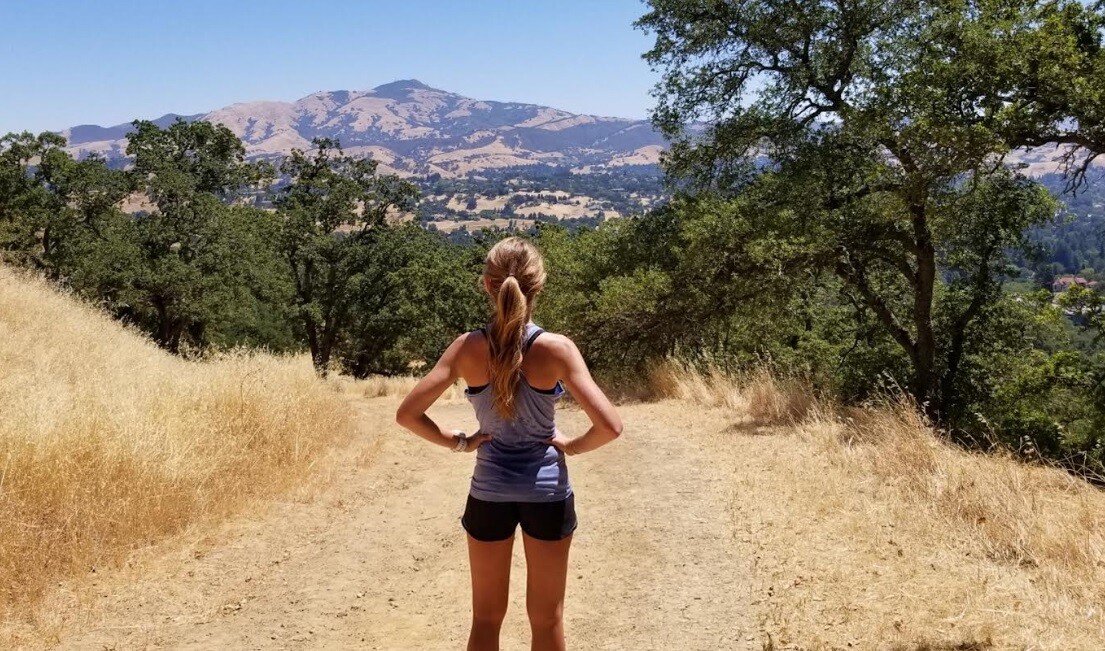
Smith points out that finding the right balance can be difficult for people who have a naturally competitive drive. Making the conscious decision to laser-focus on training in the last couple of weeks leading up to a big race is fine, but it’s easy for runners to forget that they have value outside of their performance.
Smith’s advice for runners
While running is an excellent tool for coping with stress, anxiety and depression, Smith warns that it shouldn’t be the only way runners manage their mental health. She reminds us that running is still both a physical and mental stressor, so she encourages runners to be mindful of their other needs and to prioritize them as well. She adds that if you’re struggling with your mental health, it’s important to talk to someone about it. Friends and family and mental health professionals serve different functions in this way, and she says both play key roles in supporting someone who’s struggling.
Finally, Smith reminds runners to be gentle and to have compassion for themselves. It’s easy to get caught up in negative self-talk when a run or workout goes south, and this can lead to a downward spiral in which running is doing more harm than good. In the same way, if you are struggling with your mental health, she encourages you to treat it the same way you’d treat a physical injury — with time, patience and care.
“If you sprained your ankle, you wouldn’t go out and try to run on it the next day, you’d go easy on it and wait for it to heal,” she says. “When we’re struggling with a mental health issue we don’t always have the same compassion for ourselves.”
Trail running (and running in general) has a lot of mental health benefits, and it can be an excellent tool to help you cope with the stressors of daily life. The key is to balance it with other parts of your life to ensure you maximize its benefits, rather than detracting from them.
(10/04/2021) ⚡AMPby Brittany Hambleton

London Marathon's never-ending race towards sustainability continues
Since launching 40 years ago, the London Marathon has become firmly established as one of the world’s leading mass participation events and is embedded as an iconic occasion in the international road running calendar.
It has been the scene of several world records, most notably in 2005 when Paula Radcliffe reset the boundaries of women's endurance running by clocking 2:15:25, roared on by a packed and passionate British crowd.

Fast forward to 2021, on the eve of this Sunday’s World Athletics Elite Platinum Label event, Virgin Money London Marathon organisers have broadened their world-leading ambitions to include environmental sustainability.
“We recognise we have a responsibility as a high-profile mass participation event to set a higher standard,” says Megan Hunt, head of sustainability at London Marathon Events (LME), which also hosts 12 other hugely popular events with more than 200,000 annual participants.
This weekend alone, up to 50,000 participants will take to the London streets to tackle the classic distance, cheered on by an estimated 750,000 spectators lining the route, and a further 50,000 are expected to take part ‘virtually’ by running, jogging or walking the 42.195km distance in their own communities across the world.
By any estimate, it is a huge operation, involving massive numbers of people, and with that comes the potential for a large environmental impact. It is an obligation they take very seriously, both in terms of their events and the role they play in influencing the behaviour of hundreds of thousands of people.
‘We are in a unique position, and we can do something about it’
“Environmental sustainability is one of our company-wide objectives, it’s a really important pillar of what we do, it’s something that needs to be in the DNA of every organisation across all aspects and the LME recognises that,” says Hunt.
“As we organise mass participation events, we have a responsibility to try and reduce our environmental impact and create collective action amongst our partners and participants. We are in a unique position, and we can do something about it.”
Since 2019, the London Marathon has experimented with and activated several environmental innovations to reduce its impact. With last year’s event reduced to an elite-only field in London, 2021’s event presents a first opportunity to roll out more eco-friendly practices.
This includes printing numbers at the event registration rather than posting them in pre-race packs, which – it is estimated – will result in 1000 less numbers being printed. Following testing in 2019, this year will also see a clothing donation system in place at the start, with a charity on hand to collect all discarded clothing for re-use or recycling. At another LME event, 55% of clothing was reused and the remainder was recycled.
Plastic water bottles are an almost unavoidable feature of any mass participation event, and this is another area in which race organisers have taken big strides forward.
Every water bottle used is made from recycled material and is 100% recyclable. To support this, #DrinkDrainDrop messaging to all runners is designed to encourage the proper draining of bottles and for them to be dropped in the assigned sacks to enable a closed loop system of recycling. In addition, there will also be compostable cups used on site for sports drinks and runners are being urged to use bottle belts to reduce overall use of plastic bottles. The latter, it is estimated, can reduce the demand for water bottles by 40%.
Creating a positive conversation around environmental sustainability
For fuel emissions, organisers have also made changes to reduce carbon, switching to Hydrotreated Vegetable Oil fuel over red diesel for their power generators and deploying electric lead vehicles ahead of the elite field. When it comes to waste, a system of general waste, food and recycling will be in place to reduce litter and landfill. At the end, runners’ finisher bags are made from sugarcane, also with a lower carbon footprint.
The environmentally-friendly face of the event has been welcomed by participants. “We’ve had good feedback, we’ve had positive feedback, but we know we can do more,” says Hunt, who hopes the experience of the London Marathon has a ripple effect.
“The aim is to create a positive conversation around environmental sustainability and create behaviour change for when participants go into other running events. But we are always looking for feedback to see how we can improve and how we can do better.”
The event continues to evolve year on year, but not every environmental experiment has worked.
“We’ve been honest. We’ve trialled things and if they don’t work, that’s fine. At least we’ve tried it,” Hunt admits. “So, one example, in 2019, was capes. We picked 500 participants and the aim of those capes was to reduce discarded clothing at the start and the number of kit bags used. But we decided in the end not to continue with them because the environmental impact in the production of those capes and washing them, outweighed the waste reduction benefits.”
Organisers are conscious that the influence of the London Marathon goes well beyond Sunday and also beyond the UK, and so they take acollaborative, long-term and international view.
“We’ve been working closely with other mass participation events in the UK and also our Abbott World Marathon Majors partners to share learnings and create best practice, so the behaviour change and good environmental behaviours are taken at all events. With environmental sustainability and climate action, working together and working collaboratively is the way you will gain positive change. I think everyone recognises that you can’t do it alone,” she says.
As well as working with their partners at the Berlin, Tokyo, Boston, Chicago and New York marathons on environmental sustainability, London organisers are also seeking to make a difference in the home countries of their elite athletes.
“We wanted to support projects that had a link with where our elite athletes are from. A lot of the elite athletes are positive and endorse taking climate action. So, one of the things we are trying to do is invest in carbon balancing and carbon offsets and those projects will be based in Kenya. One example is community reforestation in Kenya,” reveals Hunt.
As for the future, Hunt is ultra-keen for London to continue to be a leader in environmental innovation and for improvement year on year. “One big area that we want to do is reduce the emissions from our own operations (aside from the events),” she says. “Being able to decarbonise those and switch to renewable forms of power and electrifying our fleet (of vehicles). Waste is another key area, so transitioning and increasing the amount of circularity in our products too.”
When it comes to climate action, London Marathon is in it for the long run.
(10/02/2021) ⚡AMPby World Athletics
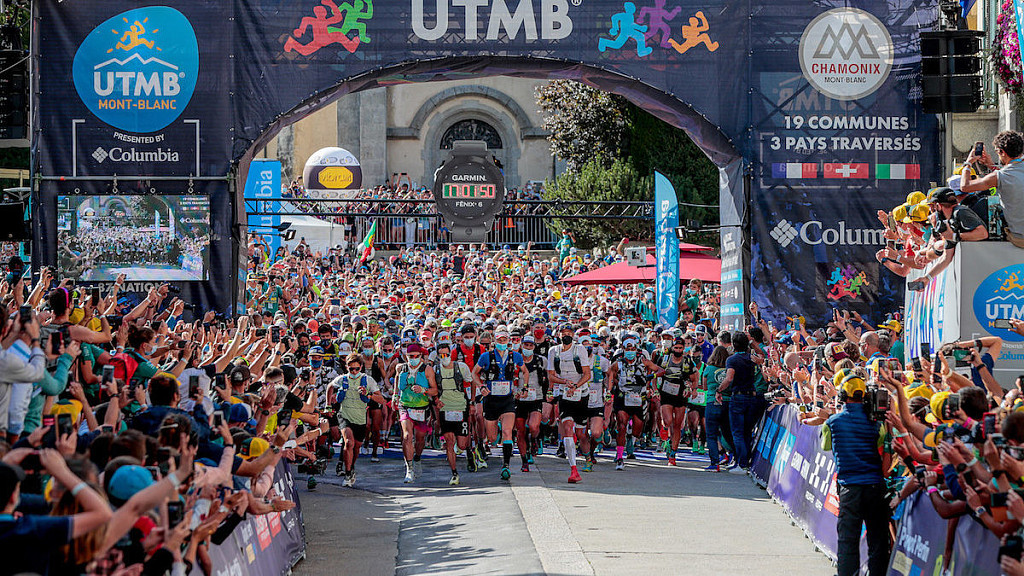
UTMB bans painkillers at all events including ibuprofen, before or during any UTMB races
The organizers of the Ultra-Trail du Mont-Blanc (UTMB) World Series will be banning the use of painkillers within 24 hours and during all races. This includes all non-steroidal anti-inflammatories (NSAIDs), such as ibuprofen. The announcement was made after the UTMB’s Quartz Event health program carried out post-event drug tests for the first time this year and three athletes’ samples contained NSAIDs.
The Quartz Event health program was set up in 2008 to protect the health of participants and contribute to clean sport. The rules of the program align with the banned substance list set out by the World Anti-Doping Agency (WADA) but goes a couple of steps further. Under the Quartz medical rules, athletes must not compete in any race if they have violated any of the following regulations:
Within 60 days before the start of the competition and during the competition:
Intravenous iron infusions
Within 7 days before the start of the competition and during the competition:
Intravenous infusion
Gas inhalation
Substance subject to a Therapeutic Use Exemption (TUE) according to the WADA Prohibited List
All glucocorticoids regardless of the mode of administration
Thyroid synthesis hormones except in case of partial or total removal of the thyroid or hypothyroidism of medical origin.
Within 24 hours before the start of the competition and during the competition:
All beta-2-agonists regardless of the mode of administration
All painkillers including Tramadol and Non-Steroidal Anti-Inflammatory Drugs (NSAIDs) regardless of the mode of administration
All substances included in the WADA Monitoring Program
After the 2021 UTMB final, three athletes out of 30 who were tested had NSAIDs in their samples. The organizers did not disqualify the athletes because the rules were only implemented this year, it was their first violation and there was an assumed lack of knowledge of the new regulations. Moving forward, however, all races will be employing the Quartz Event program and any athletes found in violation of the rules will be automatically disqualified.
Why are painkillers being banned?
According to Doctor Patrick Basset, the medical director of Dokever, the company that manages the medical teams at all UTMB events, these regulations have been put in place to protect athletes from the dangers of self-medicating. “the most frequent type of self-medication seen is to treat two types of symptoms: osteoarticular pain and digestive problems,” he explains on the UTMB website. “As a consequence, the main medicines concerned are non-steroidal anti-inflammatory (NSAID), anti-diarrhea or anti-vomiting medicines.”
He continues to explain that in the context of a long-lasting endurance race, taking anti-inflammatories could be toxic to the kidneys and cause rhabdomyolysis, which is the excessive breakdown of muscle tissue to dangerous levels, potentially leading to renal insufficiency. This is even more likely to happen when combined with dehydration, hypoxia (lack of oxygen) and hypotension (a drop in blood pressure).
Many athletes are criticizing the ban as going too far since the Quartz program refers to these new rules as “legal doping,” and NSAIDs are not banned by WADA.
(09/23/2021) ⚡AMPby Brittany Hambleton

North Face Ultra Trail du Tour du Mont-Blanc
Mountain race, with numerous passages in high altitude (>2500m), in difficult weather conditions (night, wind, cold, rain or snow), that needs a very good training, adapted equipment and a real capacity of personal autonomy. It is 6:00pm and we are more or less 2300 people sharing the same dream carefully prepared over many months. Despite the incredible difficulty, we feel...
more...
How To Avoid Stomach Cramps When Running
There is nothing worse than a rumbling stomach while you are out on a run. Whether you have a side stitch (side cramps) or feel the need to rush to the nearest porta-potty, stomach issues can really cramp your running style. Learn how to avoid stomach cramps when running with these tips.
Warm Up
A cramp in your side (side stitch) is—just like it sounds—a severe pain in your side body. It typically occurs right below the rib cage. It is not actually related to your stomach or digestive system. While the exact cause of side stitches is unknown, some theories suggest that it could be related to blood flow to the liver, spasms in the diaphragm, or stretching of the ligaments.
To prevent side stitches, warm up properly. This gives your body time to accommodate to faster breathing and adjust to stretching ligaments.
Hydrate
Do you skip drinking fluids during a run because you worry they will cause sloshing and cramping? It is time to adjust your strategy. This can lead to dehydration, which actually exacerbates stomach issues.
When you are exercising at an intense level, your body diverts blood away from the stomach in order to supply your muscles with much needed oxygenated blood. This means that digestion can be negatively affected.
Drink adequate fluids in the days leading up to your training session or race, and remember to drink throughout your run.
Practice Fueling
When you train for a long-distance race, you put in hours of running each week to gradually build your muscular and cardiorespiratory endurance. However, just like training your legs for those long runs, you also need to train your gut.
Often, newer athletes skip fueling during training but attempt to use a sports drink or gel during their first long race. The result? Stomach cramps, thanks to a belly that has never practiced processing fuel under such circumstances.
Luckily, the fix for this is easy. Simply practice your fueling strategy during training.
This will help teach your stomach how to process fuel under conditions of decreased digestive blood flow along with the jostling motion of running.
Do Not Over-Fuel
It can be tricky to nail down the correct amount of fuel to take in during a long run. But one thing is certain: trying to replace every calorie you burn is a recipe for disaster. Instead, aim to take in around 30 to 60 grams of carbohydrates (about 120 to 240 calories) per hour on runs lasting longer than one hour and 15 minutes.
If you are training for a long-course triathlon or ultra-marathon, you might bump that range up to 30 to 90 grams of carbohydrates per hour. As you start experimenting with fueling, start at the lower end of this range. If you feel like you need more energy, you can gradually work your way up to the higher end of the range on subsequent runs and see how your stomach tolerates this.
Minimize Fat
Fat is a satiating nutrient. It slows down digestion and helps us feel full longer. While this is great for everyday life, it is not ideal before a training session. You do not want to start running with a belly that is still feeling full and risk cramping. Low-fat, low-fiber breakfast ideas include:
Cereal with milk and a banana
Toaster waffle topped with peaches
Bagel with a small amount of cream cheese
Rice with a poached egg
Sandwich with a small amount of peanut butter, banana, and honey
The exception to this tip is if you are a fat-adapted athlete who is practicing the keto diet. In that case, you should follow your normal routine, as foods outside of that could cause stomach cramping. For most athletes, however, a standard moderate carbohydrate diet will lead to the best performance.
Know Your Lactose Tolerance
Lactose is sugar that is found in dairy products. Some people lack enough of the digestive enzyme known as lactase to properly break down this sugar. This is what is commonly known as lactose intolerance. If you have this condition, eating certain amounts of dairy can cause stomach cramping and diarrhea.
Interestingly, you can develop lactose intolerance later in life, even if you previously were able to tolerate dairy. Lactase production decreases over time for certain people based on genetic factors. For others, a gastrointestinal infection or inflammatory bowel disease may cause secondary lactose intolerance.
Digest Before Running
Most experts recommend eating a meal about one to four hours prior to running, though this is very individualized. Some runners have iron stomachs that allow them to eat a burger 30 minutes before a jog, while others might need two hours to process a small sandwich and some fruit.
If you often experience stomach cramps when running, try eating about three to four hours prior to your training session or event. Allowing more time between eating and running gives you more flexibility for the type and amount of food you can eat, as your body has ample time to digest.
Avoid NSAIDs
Ibuprofen and naproxen are NSAIDs (non-steroidal anti-inflammatory drugs). While some athletes might take these medications prior to or during a run to stave off any muscle soreness, this practice increases the risk of stomach upset and cramping.
In addition, overusing NSAIDs on long runs has been shown to increase the risk of hyponatremia (a dangerous diluting of blood sodium levels) and kidney damage, and could impair muscle recovery. It is wise to avoid these medications before or during a run unless a doctor has advised you to take them.
Rule Out Medical Conditions
In some cases, stomach cramps could indicate a food sensitivity or intolerance, irritable bowel syndrome, celiac disease, or another digestive complication. It is best to consult with a healthcare professional.
(09/06/2021) ⚡AMPby VeryWell Fit
10 Of The Worst Training Tips You Hear In Running
Bad Tip One: Your body needs to look a certain way or weigh a certain amount.Being an athlete is all about finding your strong. Every runner that has long-term growth and success fuels their body adequately. For some athletes, that leads to complying with that formula espoused by Mr. Crap-Face. For other athletes, it means a body that looks different and weighs more or less. All are equally valid. And here's the biggest point of all: all are optimizing what they are capable of given their unique genetics and backgrounds.
The problem is that a formula might be interpolated from an outlier, a person that won an Olympic medal or Western States. Interpolating from outliers is crap science, and it's crap physiology. Athletes that try to fight against their unique genetics and backgrounds will not adapt to training stimuli efficiently, and will almost always get slower with time. That time might not be tomorrow, but trying to fit into someone else's clothes or onto their scale is a ticking time bomb for athletic growth.
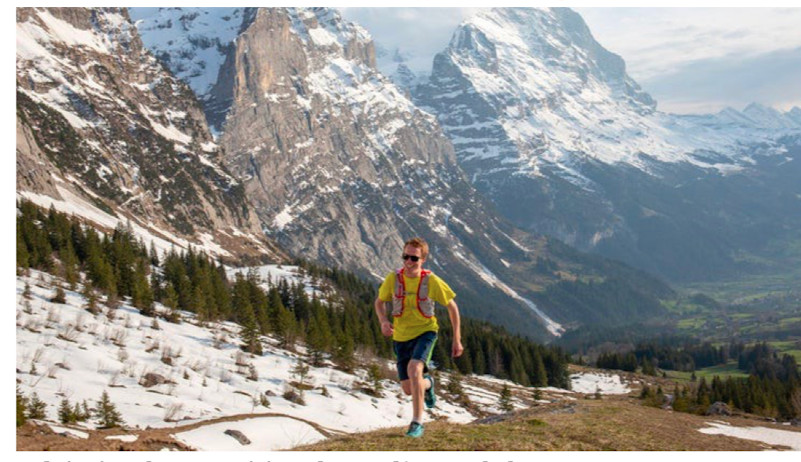
Three years ago, the New Zealand rowing team had a reckoning. A survey indicated that all but one athlete was at risk of low energy availability. Doctors, nutritionists, and coaches worked with athletes to change the culture and approach to fueling. Rower Brooke Donoghue summarized the wisdom that they applied leading up to the Olympics: "Now I understand being lean isn't a priority, being strong is," she said. "It doesn't matter what I sit at on the scales. It's opened us up to understand it's not about a number but more about a good feeling, knowing we're fuelling well."
In Tokyo, Donoghue won a silver medal, and the whole team had breakthrough successes. Low energy availability from a focus on body weight can hurt the endocrine system and overall health. The New Zealand rowing team learned something else. Eating enough can fuel better performance, recovery, and adaptation. Food can act as a natural, legal, fun PED.
Move, eat, love, repeat. You found your strong. And your strong is perfect.
Bad Tip Two: Easy runs need to be at a certain heart rate all the time.
The body does not work in cordoned-off physiological zones, where exceeding aerobic threshold is a crime scene for athletic growth. When you feel good, your easy runs can be a bit faster. When you feel tired or are not recovering rapidly, your easy runs can put snails to shame. The art and science of easy running require that an athlete listens to their body, not to a calculator.
This tip is grounded in the truth that easy runs can be very easy, and often should be very easy. The aerobic system should be built from the ground up. Just make sure that focusing on the aerobic system doesn't neglect the musculoskeletal, biomechanical, and neuromuscular systems. You have to go faster to get faster, in moderation.
Bad Tip Three: To be a pro, you have to do doubles/100 miles a week/complicated workouts
This is the general catch-all heading for tips that you might hear from an elite athlete talking about their own training. The problem is that all of these tips are overwhelmed by confounding variables, and sometimes people get the lines of causation mixed up. Doubles are an important feature of some pro athlete training, but also coincide with athletes that have the time and physiology to handle them. High-volume weeks can be a proxy variable for stress and adaptation, but the cells don't give a single frick about a week, and only care about a mile in association with the chemical context that goes along with it (we went into detail on our podcast here). Big double-threshold workouts or supercompensation hill sessions could help growth, but are also just a part of training for athletes that are tough as nails and have big dreams.
Successful athletes can likely be successful using multiple approaches, but we can't prove a negative. So we are left adding up a bunch of N=1 experiments. Don't feel obligated to mimic the specific approach that works for someone else. General principles are your friend (doubles/100-mile weeks = consistent and frequent chronic stress, workout design = efficient and strategic acute stress). Specific rules can just be dogma.
Bad Tip Four: It's all about time on feet.
This tip is mostly for the ultra crowd. Time on feet may be helpful if it involves moving efficiently on trails, including hiking, with plenty of time for recovery and adaptation. But there is no evidence and little physiological theory that chronic weekly totals of dozens of hours on feet will help an athlete move more efficiently (or be healthier). While that stuff may work for some people, you can be fast and healthy by spending time in the morning doing your activity, then living your life normally (periodically mixing in some bigger acute stresses along the way), even when training for races that take 12-24+ hours.
Bad Tip Five: The more training volume and/or vert, the better.
Connected to the last two points, volume and vert totals are proxy variables for stress. But they are not actual stress as experienced by the cells and body systems that drive performance. A 10-mile run might just be a 10-mile run. Or it might act a bit like a 20-mile run if you've been up all night with a kid, are dealing with a mental health lull, or are preparing a work presentation. One of the hardests things to internalize for an athlete is that the body can actually adapt to the lower volume just as well as higher volume as long as stress is calibrated appropriately for their unique context.
The body doesn't know miles, it knows stress. And more stress is not always better, particularly when some champions are specifically chosen due to being genetic anomalies when it comes to managing chronic training stress.
Bad Tip Six: You should hike a hill in training if you'd hike it in racing
Specificity is important sometimes, just don't go overboard with it. I see so many athletes sell themselves short by hiking every uphill because they read that tip in an ultra running article, or heard it from a friend. The problem is that it's very hard to level up if your brain is constraining you in advance of your body saying it needs constraints.
If you hike all of the time, that is awesome and valid. But if you are healthy enough to run, try to run a couple steps more on your next run. It can be so freaking exciting to see where this athletic journey goes when we take off the constraints that were holding us back.
Bad Tip Seven: You can always get all of the nutrition you need from food and sunlight
Maybe you can! But through coaching and research, my wife/co-coach Megan and I see a lot of bloodwork, and there are many athletes that can't. Pay special attention to ferritin and vitamin D. Sometimes, leafy greens and UV rays don't cut it, and that's OK. If you're unsure, get blood tests from your doctor or a company like Inside Tracker.
Bad Tip Eight: You can't lose fitness in a taper
True, your aerobic system won't undergo a fundamental remodeling in a couple weeks. But blood volume, VO2 max, cardiac output, and neuromuscular efficiency all can detrain rather quickly. It's important to rest more, but don't shut down like you're a bear in November. Most of our athletes maintain their normal frequency at 30-50% lower training volume, with a rest day or two more for ultras, plus a bit of intensity too.
Bonus Tip: Minimal shoes are better for health and/or performance
I don't think people say this piece of advice anymore, but it's worth addressing just in case someone went into a coma after reading Born To Run. First, to that coma person, did you like The Apprentice? You won't now.
Second, for the love of all that is good in this world, wear shoes that are comfortable for you, not shoes that are comfortable for someone who may or may not have a functioning achilles tendon in a few years. Different things work for everyone.
Bad Tip Nine: Death before DNF
Running is not a test, it's a celebration.
As Dani Rojas said in Ted Lasso, "[The sports psychologist] helped me remember that even though futbol is life, futbol is also death. And that futbol is futbol too. But mostly that futbol is life!"
(09/05/2021) ⚡AMP
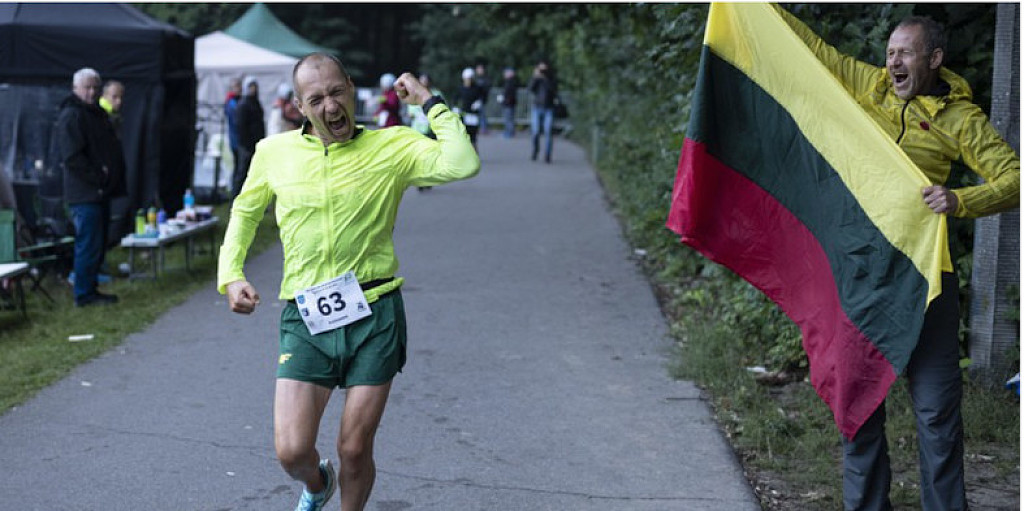
This Lithuanian Runner Broke the 24-Hour World Record that Stood Since 1997
The Lithuanian runner averaged a 7:29/mile pace for a full day.
Sania Sorokin has claimed another world best in 2021, breaking the 24-hour record set by legendary Greek ultrarunner Yiannis Kouros in 1997.
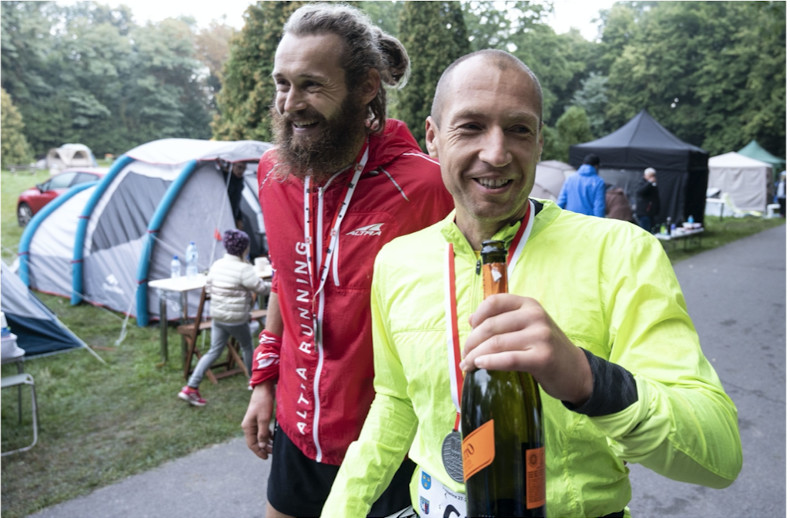
Kouros’s mark (303.4 kilometers or 188.52 miles for a 7:38/mile pace) remained elusive until August 30, when Sorokin lined up at the UltraPark Weekend 24-hour race in Poland. The 39-year-old Lithuanian runner averaged a 7:29-per-mile pace for the entire day on his way into the history books. His official distance was marked at 309.4 kilometers (192.25 miles).
“[The world record] was my dream for about five years,” Sorokin told Runner’s World. “It was an almost perfect race, but I know I can do better.”
Though unsponsored, Sorokin is no stranger to high-level performances such as this. His accolades include three 24-hour world championships since 2015, winning the famed Spartathlon ultra in 2017, and breaking the 100-mile and 12-hour world records in April this year.
His initial plan after his April success was to go for the 24-hour world record at the 2021 World Championships in October. However, the race was canceled in June due to the pandemic, so Sorokin chose the UltraPark Weekend 24-hour race in nearby Poland to go for his record attempt.
“Poland is not far from me,” Sorokin said. “This is a very high standard race, Poland has very strong ultrarunners, and the track is very good. I thought it was good to go for the 24-hour world record.”
In preparation for a record run, Sorokin increased his mileage for this training block. His weeks ranged from 142 miles at their lowest to 173 at his peak. He included speed work, while also doing cross-training, such as weightlifting, cycling, and swimming.
Sorokin lost his job as a dealer at a casino in January because of the pandemic, so he’s had more time to “train like a pro.” He credits this for his success and why he showed up in peak form to his record run.
Though he was on pace for the entire run, he did run into issues during the night.
“The conditions, the weather, the track, the organization, everything was perfect,” Sorokin said. “There was some crisis at night with my stomach. It stopped working well for a few hours, but then began to work again, and I really didn’t know if the record was to be or not to be until 21 hours of running.”
In those final three hours, Sorokin routinely crunched the numbers in his head. Finally, with 40 minutes remaining, he reached the 300-kilometer mark. Two more laps would give him the record. He did that and then some, breaking the world record by six kilometers.
Since breaking the record, Sorokin returned to Lithuania and has been inundated with interview requests. He has a couple ideas for what he wants to do next, but he said his focus right now is finding a sponsor for 2022.
“I need to find a sponsorship for next year because soon I need to be back to work,” Sorokin said. “I am in peak form, so I feel like I can still do better. I don’t exactly know what’s next for me. Maybe the 48-hour record.”
That record currently stands at 473.49 kilometers (294.21 miles), or put simply, a 9:47/mile pace for two days straight. It was set in 1996 by Kouros.
(09/05/2021) ⚡AMPby Runner’s World
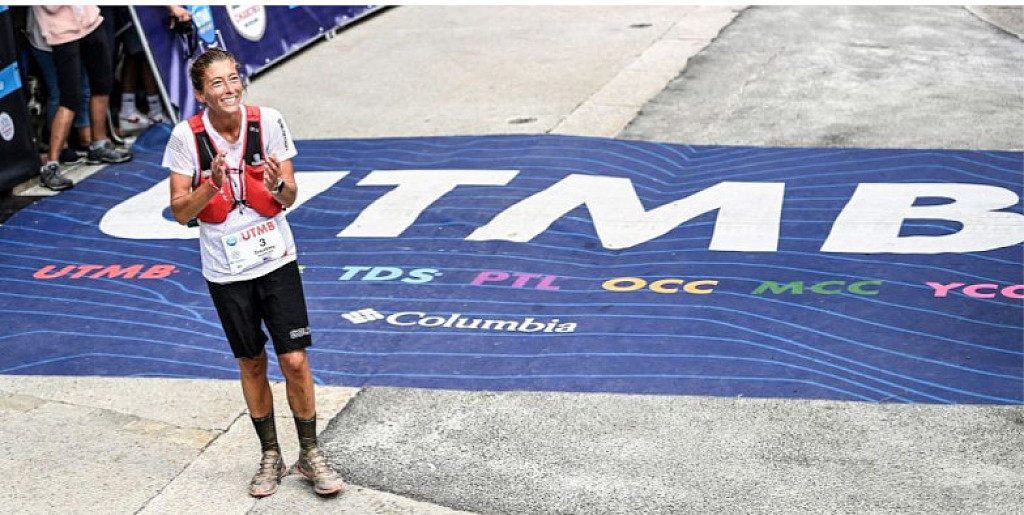
Courtney Dauwalter Smashed the Women’s Record at UTMB and Knocked Over 2 Hours Off Her Previous Best
In her second appearance at the French race, she knocked over two hours off her previous best and placed 7th overall.
Courtney Dauwalter returned to the 106-mile Ultra-Trail du Mont-Blanc (UTMB) to defend her 2019 crown and did not disappoint in her second appearance in Chamonix, France.
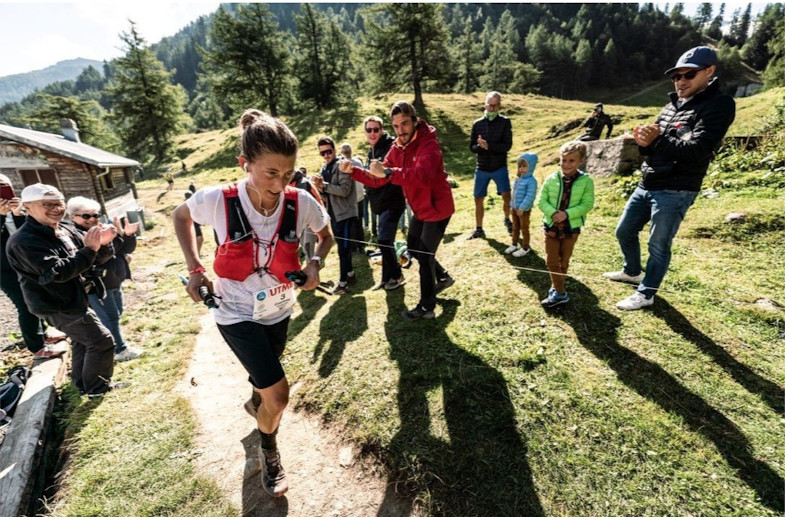
The 36-year-old from Golden, Colorado, led wire to wire in the women’s race, running into only a few minor issues along the way to set a new course record in 22:30:54 and finish seventh overall.
“It was an incredible experience again, and we were so excited to be back, immersed in that community,” Dauwalter told Runner’s World. “I didn’t know what to expect from the race, but I knew that I was lining up healthy and physically and mentally as ready as I could be.”
UTMB was a redemption race for Dauwalter, who was forced to drop out at mile 62 of the Hardrock 100 in July because of stomach issues.
Since then, Dauwalter said she has been tweaking her fueling strategy with her husband and crew chief, Kevin Schmidt. With solid foods causing issues at a certain point, she found that she should take in liquids only.
What happened at Hardrock turned out to be a blessing for her second time through the Alps. Similar problems arose around mile 50 at the Courmayeur aid station. Dauwalter was well ahead with only Mimmi Kotka of Sweden near her, but solid food wasn’t going down. Though she initially planned to switch to liquids only at mile 70, she and Schmidt opted to make the change earlier.
This meant Dauwalter relied on drinking a lot at aid stations and only fueling with the single liter she carried with her between aid stations.
“Climbing out of Courmayeur and coming to the top, I lost my lunch a little bit,” Dauwalter said. “But once it happened, it never happened again and I felt fine. I don’t know if my body was rejecting the fluids I put into it, but it ended up not being a big deal.”
Dauwalter then opened up a massive lead in the women’s race, picking off male competitors one by one. She said there were still low points in the latter part of the race—her legs felt shredded with each climb—but in those moments, she turned to her old friend, the iPod Shuffle.

“It literally has just the play button,” Dauwalter said. “It’s the best. Helps occupy my brain space with upbeat music. It basically has a playlist that started in 2010 and has just been added to since. So an eclectic mix of country music, Michael Jackson, Prince, some early 2010s pop and rap, and Taylor Swift.”
Dauwalter led the women’s race by over an hour as she made the final climb out of Vallorcine at mile 93 and descended back into Chamonix. Dauwalter found herself overjoyed upon seeing the mass of spectators welcoming her back into town.
As she ran through the streets and across the line, Dauwalter said she had no idea her time of 22:30:54 had set a new course record. Her time bested fellow American Rory Bosio, who set the previous record in 2013 (22:37:26) on a course that was three kilometers shorter.
“I feel very happy to have made the entire loop,” Dauwalter said. “After DNFing Hardrock, I wanted to finish UTMB no matter what it took. I’m grateful to my legs, my body, and Kevin and I were able to make the whole 100-mile adventure together. It’ll make for another great memory.”
Not only did Dauwalter make history with her time, she also finished seventh overall in the race. The rest of the women’s podium rounded out with French runner Camille Bruyas taking second (24:09:42) and Kotkas taking third (25:08:29). You can find the full results here.
“It’s a very cool time in the sport,” Dauwalter said. “There’s a lot of women pushing the limits and seeing what is possible. I feel lucky to be in this sport right now and sharing miles with those women and sharing races with these women.”
Dauwalter celebrated at the finish with Schmidt and her Salomon team. Having a beer was her top priority, so she grabbed a light beer that was handed to her. The next event on her race calendar is Big’s Backyard in October.
In the men’s race, French runners took the top five spots, led by now four-time champion Francois D’haene (2012, 2014, 2017, and 2021), who finished in 20:45:59.
American men continued their struggles at the event with Jim Walmsley and Tim Tollefson dropping out. The top American male was Luke Jay, who finished as the second American and 34th overall in 25:54:40. No American man has ever won UTMB.
(09/05/2021) ⚡AMP
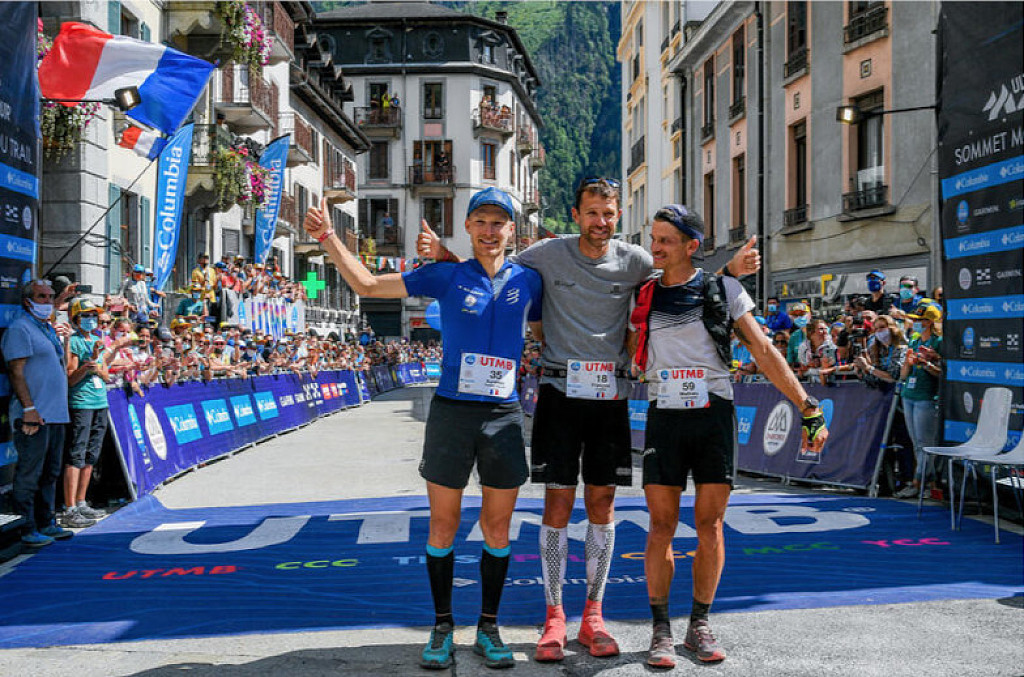
The world's best finish lines
Whether you are running your first or 50th race, there is no better feeling than crossing the finish line. We appreciate all finish lines in life no matter your goals, but we take a look at some of our favourite finish lines in races across the running world.
Boston Marathon (U.S.)
It would be hard to leave the finish line of the prestigious Boston Marathon off the list. Right on Hereford, left on Bolyston and you can see the finish line, with 500m to go. It’s a memory Boston marathoners remember forever. To hear fans, family members and Bostonians screaming at you as you run toward the line certainly gives you a final push to the finish.
Ultra de Trail Mont-Blanc (France)
This UTMB finish line sits right in the heart of Chamonix, surrounded by picturesque views of the French Alps. Ultrarunners descend from the mountain into the village after 171 km of racing, and hear the roar of the crowd as they run through narrow cobblestone streets toward the finish.
Olympic Marathon (Various)
The Olympic marathons always take place on the final two days of athletic events at the Games. Although fans were not allowed in the stadium in Tokyo, there were people lining the marathon course in Sapporo, which was one of the advantages of it being moved to that city. The raw emotion of athletes celebrating as they complete the Olympic marathon is a moment like no other.
Around the Bay 30 km (Canada)
Canada’s Around the Bay 30 km road race has a unique finish line, in which runners finish go through the lower level of a hockey arena to finish at centre ice of Hamilton’s FirstOntario Centre. Friends and families sit inside the arena to watch runners cross the line. Spectators will also sit inside to avoid the freezing temperatures of the March race.
Melbourne Marathon (Australia)
Similar to Canada’s Around the Bay race, the Melbourne Marathon finishes inside one of the world’s top 10 largest stadiums: the Melbourne Cricket Ground (MCG). The MCG has a seating capacity of 100,000 people and is home to the AFL Grand Final and Australia’s cricket team. Runners enter the MCG after completing 41 kilometres around the streets of Melbourne, to finish the marathon at midfield.
Great Wall Marathon (China)
The Great Wall of China Marathon starts and finishes inside the village of Huanyaguang’s Yin & Yang Square. Despite the steep climbs on the iconic Great Wall of China, runners are rewarded by the breathtaking views along the course. In the last two kilometres, as you reach the village from the wall, spectators will be cheering as they have a traditional festival for runners.
Comrades Ultra Marathon (South Africa)
The Comrades Marathon is a point-to-point 90 km ultramarathon in South Africa, starting at City Hall in Pietermaritzburg and finishing at the Sahara Kingsmead Cricket Stadium in Durban. Race spectators wait at the finish in Durban in front of a big screen, waiting for entrants to cross the line. The race has a challenging time limit, as runners must complete the distance in less than 12 hours.
(09/04/2021) ⚡AMP
World record-holder Eliud Kipchoge says that he wants to try an ultramarathon
As we’ve watched Eliud Kipchoge win race after race, break records and defy human limits, many fans have likely wondered what the marathon legend could do in a race longer than 42K. The great news is, one day we may have a chance to find out.
In a recent interview with Rob Steger in the Training for Ultra Podcast, the marathon world record-holder revealed his next goal after he finishes his marathon career: to tackle an ultra.
“After leaving the marathon, I want to run the ultramarathons just to feel how it is,” he told Steger. “Running for more than four or five days, or even run at once for 70 kilometers. I really want to feel the pain of running for a long time.”
While he hasn’t narrowed down any specific races he’d like to do, Kipchoge expressed interest in many of the Ultras in North America and South Africa, which gives him a long list to choose from. The ultrarunning community appears to be prepared to welcome the Olympic gold medalist with open arms, including fellow running legend, Spanish mountain runner Kilian Jornet.
Throughout the rest of the interview, Kipchoge talks about the pain of training (yes, running hurts for him, too… don’t let his smile fool you), who inspires him (hint: it’s not who you might think), how he motivates himself on days when he doesn’t feel like training and what kind of legacy he hopes to leave behind. The interview is short but not lacking any of Kipchoge’s endearing charm, and will likely have you itching to tie up your shoes by the end.
We may have to wait a while before we see Kipchoge out on the trails, however. To the delight, and perhaps the relief, of running fans everywhere, the GOAT of marathon running hasn’t made any indication that he’s retiring any time soon, and we will still have the pleasure of watching him make history for at least a few years yet.
(09/02/2021) ⚡AMPby Brittany Hambleton
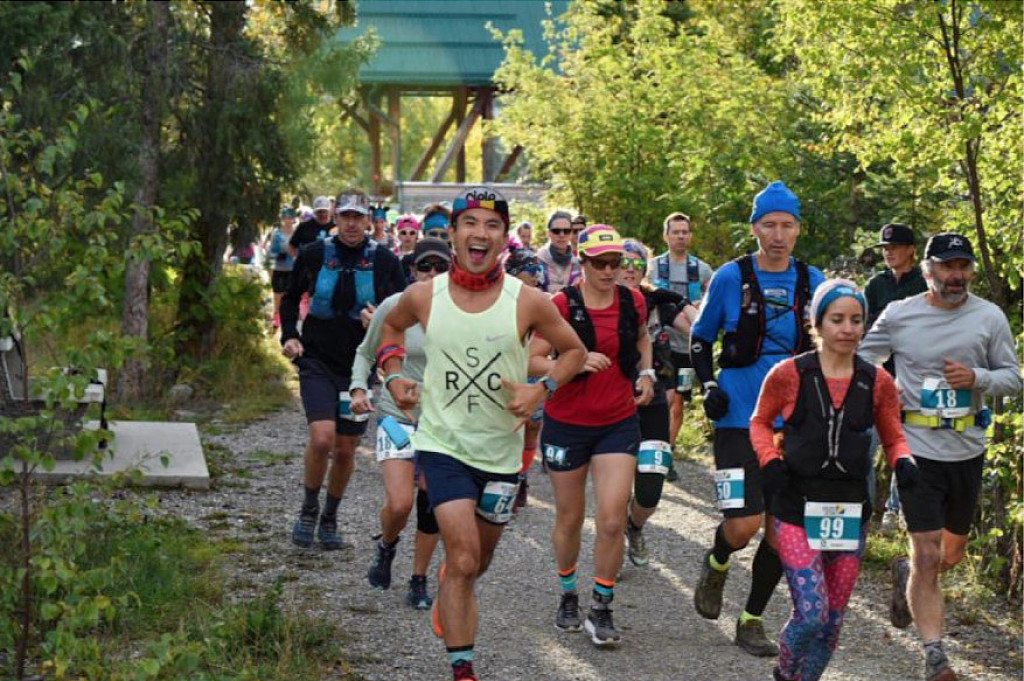
The TransRockies Golden Ultra cancelled
The TransRockies Golden Ultra race, one of Canada’s toughest trail races, has been cancelled this year due to the mandating of organized events set by the British Columbia government.
The Golden Ultra was supposed to take place on Sept. 17-19 in Golden, B.C. but as of Aug. 23, the B.C Interior Health Region stated that all outdoor organized events will be limited to under 100 people for one month to stop the spread of COVID-19.
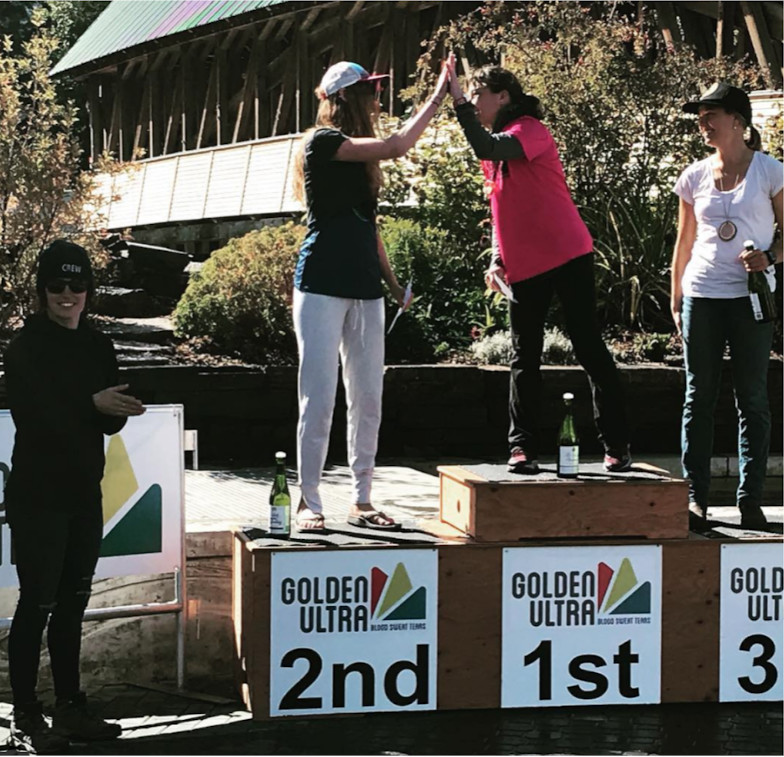
Race organizers did everything they could to try to make this event happen, but the public health mandate does not allow large gatherings, and this event cannot operate without all its volunteers and athletes.
Information on the 2022 event will be updated over the next couple of days. All of the 2021 registrants will be deferred to the 2022 event with no penalty.
(08/29/2021) ⚡AMPby Running Magazine
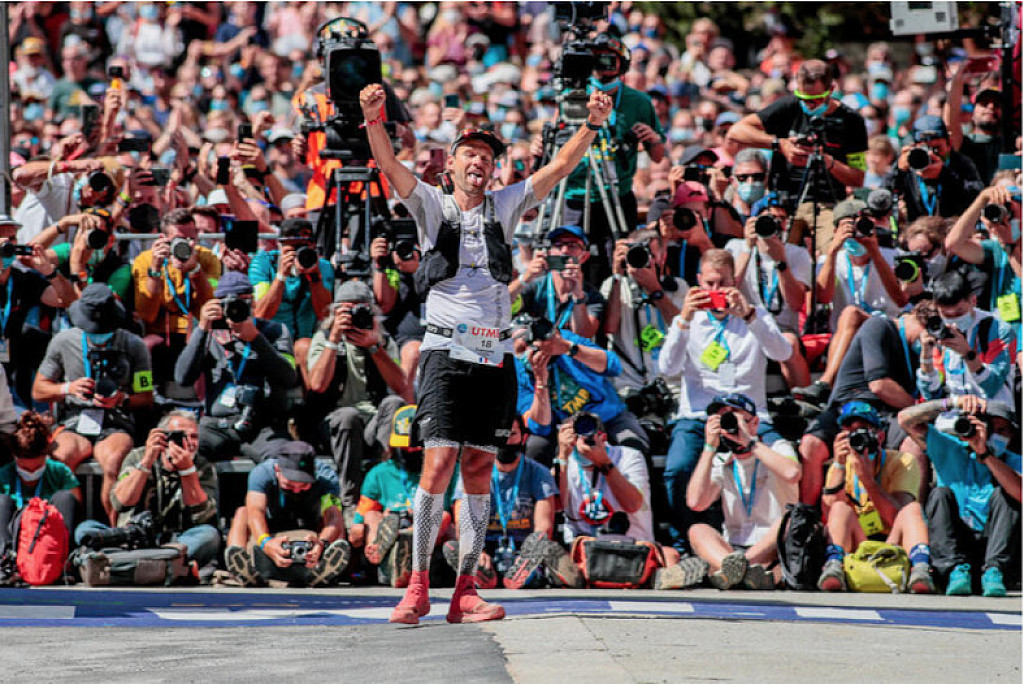
Francois D'haene claims his fourth victory at UTMB
Frenchman Francois D’haene delivers once again in the Alps, achieving his fourth victory at Ultra-Trail du Tour Mont Blanc. D’Haene finished in 20 hours and 45 minutes to cover the 170km course, climbing over 10,000m up and down the valleys of Mont Blanc.
This is D’haene’s fourth win in his fourth attempt at UTMB. He now single-handedly holds the record for most wins since the race began in 2003, passing Spain’s Kilian Jornet who holds three.
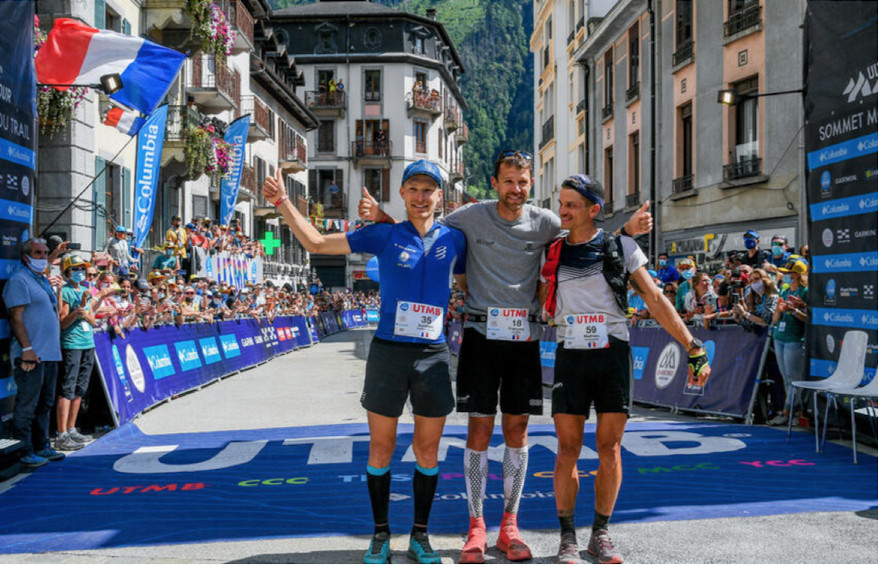
D’haene lead since the first breakaway and started a second breakaway group with American Jim Walmsley, as they began the climbing in Italy, D’haene dropped Walmsley and charged on towards the finish line. Walmsley dropped out of the race after failing to stay on pace with D’haene.
French-Canadian, who lives and trains around Montreal but was born in France, Mathieu Blanchard finished third to round out the podium. This marks the highest finish by a Canadian ever at UTMB. Aurélien Dunand-Pallaz of France was second to round out the French sweep of the podium, for the first time in history at UTMB.
In the women’s race, it was American Courtney Dauwalter who rose to glory. Dauwalter won the previous edition of the race, becoming the third woman to successfully defend her title on the hills of Mont Blanc. Dauwalter broke fellow American Rory Bosio’s course record finishing in 22 hours and 30 minutes. Dauwalter finished seventh in the overall standings, the highest finish ever by a woman.
(08/28/2021) ⚡AMP
North Face Ultra Trail du Tour du Mont-Blanc
Mountain race, with numerous passages in high altitude (>2500m), in difficult weather conditions (night, wind, cold, rain or snow), that needs a very good training, adapted equipment and a real capacity of personal autonomy. It is 6:00pm and we are more or less 2300 people sharing the same dream carefully prepared over many months. Despite the incredible difficulty, we feel...
more...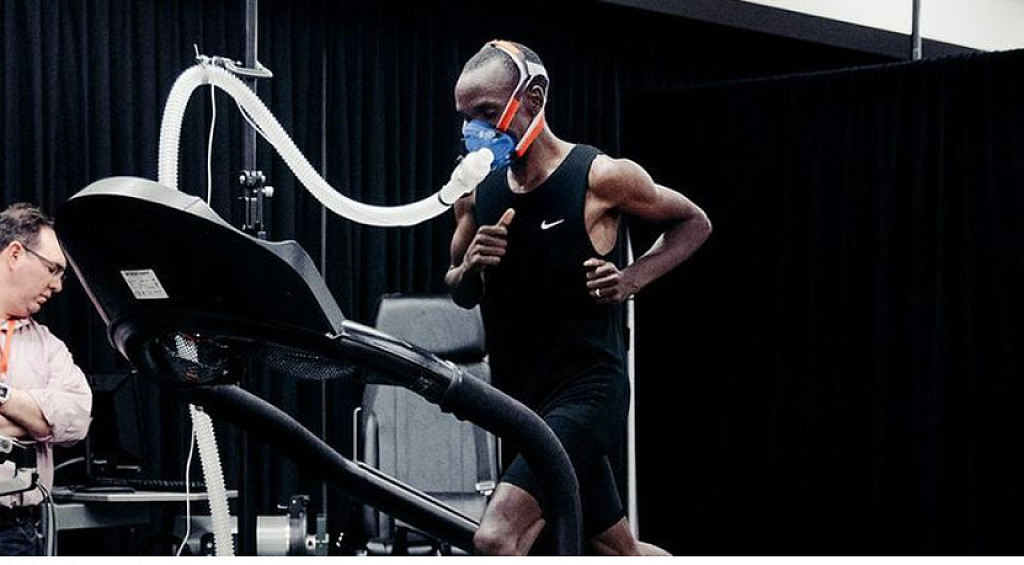
Kipchoge reveals his next goal after leaving marathons
Kipchoge has been recognised the world over as the epitome of limitless possibilities.
Marathon legend Eliud Kipchoge has revealed that he intends to push his body further than the 42km marathon which he has won over 10 times.
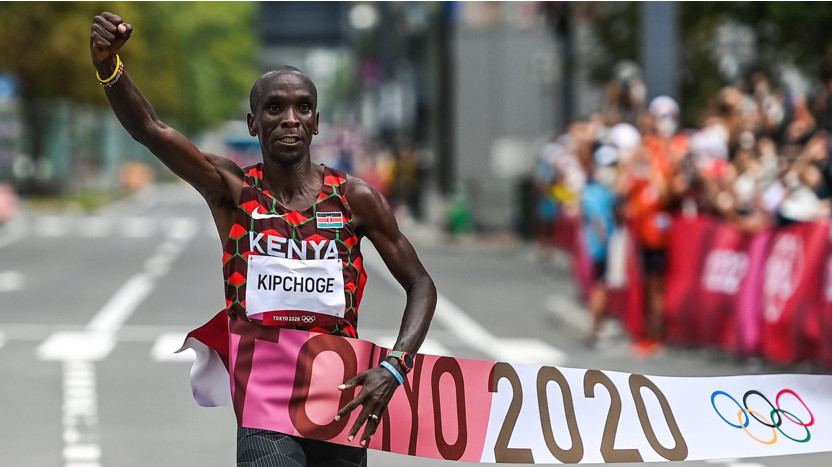
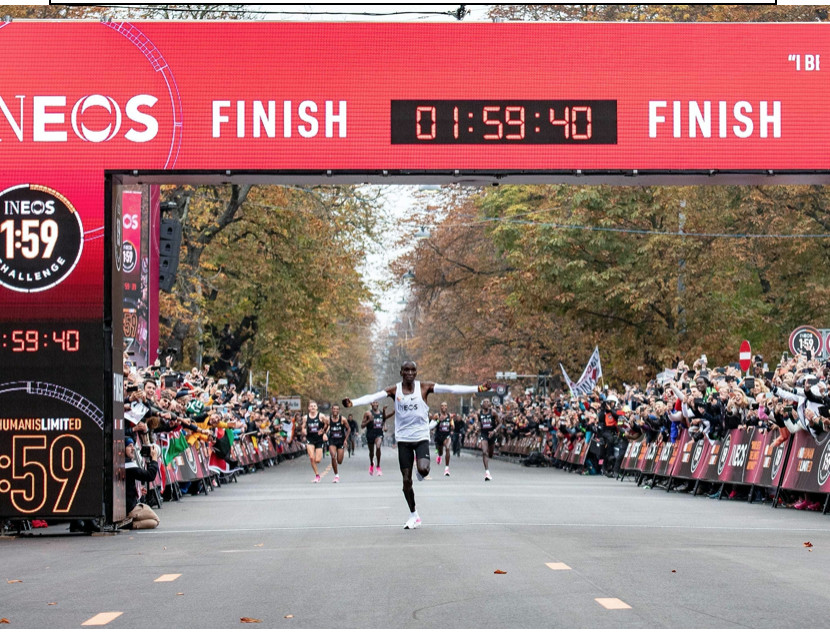
In a recent interview with author and athletic enthusiast Rob Steger, Kipchoge said his next goal after leaving marathons would be the ultra marathon.
"After leaving the marathon, I want to run the ultramarathons just to feel how it is. Running for more than 4 or 5 days or even run at once for 70 kilometres. I really want to feel the pain of running for a long time,” Kipchoge said.
The 36-year-old has been recognised the world over as the epitome of limitless possibilities, having beat the sub-2-hour mark in 2019.
Kipchoge’s timing of 1:59:40 isn’t officially recognised as a world record as the conditions—a straight and even track, a battery of world-class pace-setters and special shoes, among others—were carefully chosen to propel him towards it.
But it takes nothing away from a feat that transcends the realm of mere statistics and accomplishes what was once considered invincible.
He recently asked Kenya to embrace the use of technology in training to keep performing wonders at international competitions.
“If we don’t embrace technology then we are not moving... I know regulations will be there but technology should take centre stage.
“Let all athletes have top technology, have top innovation. That’s the only way to think and actually try to improve your performance,” Kipchoge told Reuters.
His incredible form was now been turned into a movie called Kipchoge: The Last Milestone.
The film portrays Kipchoge as a tireless athlete with a work ethic, a contemplative attitude and a fundamental modesty.
The legend uses hypoxic training which helps his body adapt to reduced oxygen intake to prevent him from running out of breath.
His muscles have high capability to self-contract to enhance the smooth movement of his limbs
An excerpt from his training manual reads that in 2018, he completed an entire session in under 80 minutes with no time between warm-up, workout, and cool-down. Later the same day he ran 12km in less than 50 minutes.
(08/28/2021) ⚡AMP
So You Want To Run UTMB. Here's How To Qualify.
The trail and ultra world was rocked this spring when the Ultra-Trail du Mont-Blanc announced a partnership with Ironman, the global triathlon brand. Aside from the inevitable financial questions that pop up with such an acquisition, many trail runners were left wondering how am I going to get into UTMB?
To compete at the UTMB World Series Finals in Chamonix, runners must compete in at least one of the 30 UTMB World Series Events or one of the three UTMB World Series Majors, where they can collect Running Stones for use in the lottery or be rewarded for their performance with direct access. Men's and women's champions will be crowned for each of the three key distances of the UTMB race week in Chamonix: the OCC (50K), CCC (100K) and UTMB (100 miles).
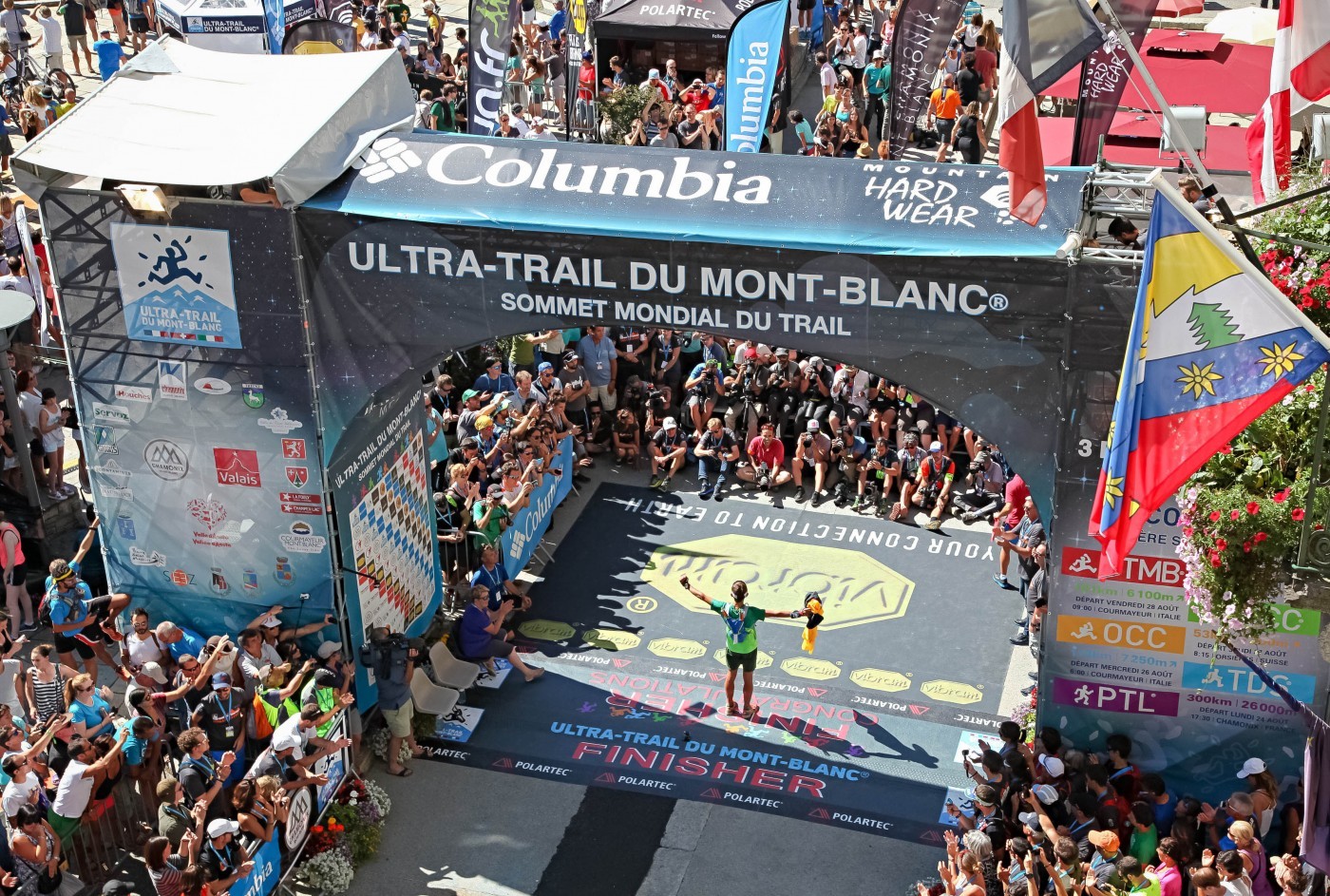
The full UTMB World Series calendar will be announced sometime this fall, including several UTMB World Series Events and one UTMB World Series Major in the U.S.
"Trail running was born in the USA [but] it's not easy for a French company to develop something [there]," said UTMB Co-Founder and Co-Owner Michel Poletti, in an interview with Trail Runner columnist Doug Mayer. "That's part of our decision to partner with Ironman, is that it will be easier for them to develop the sport in the U.S. than for us in France." Poletti noted they are talking with "many other races in the world, including the United States."
What The Heck Is A Running Stone?
A Running Stone is like a lottery ticket. It's your entry into the lottery to compete at UTMB, CCC, TDS and OCC. If you have seven stones, that means your name is in the lottery seven times, giving you a higher chance of being selected than someone with only three stones.
You can earn stones by competing in UTMB associated races. For example, competing in a 50k+ race "by UTMB" will earn you nine stones. Competing in an Ultra-Trail World Tour (UTWT) race over 50k will earn three stones. Western States Endurance Run finishers and Javelina Jundred runners can earn three stones. UTMB is now a Western States Golden Ticket Race, as is Javelina. You can see the full list of qualifying races here.
UTMB, CCC, TDS and OCC do not earn runners Running Stones.
UTMB Qualifying Points
Runners who haven't collected Running Stones can enter the lottery if they have the required number of qualifying points from no more than two races.
Elite Runners
UTMB races save spots for elite runners according to the number of ITRA points a runner has. For men, anyone with an ITRA score over 880 can skip the lottery and entry fee. Elite men with scores between 800-880 can skip the line but still pay an entry fee. Women with an ITRA score over 760 get free entry and no lottery, while women with a score between 760 and 675 skip the lottery, but pay the entry fee. The top three runners from any given country get in free. Easy!
All Roads End In Chamonix
UTMB is calling its new global race series the "UTMB World Series," which breaks down into four categories of races: World Series Qualifiers, Events, Majors and Finals. Qualifier races, whose numbers will apparently be in the thousands, give "privileged access" to World Series Events and World Series Majors, both of which feature 50K, 100K and 100-mile distances. Each World Series race gives a participant one lottery entry (UTMB calls them "stones") to the finals in Chamonix. The World Series Majors are the flagship races on each continent, with two entries to the Chamonix lottery. Between the Majors and Events categories, UTMB expects to have 30 to 40 races take part.
Everything points toward Chamonix and the World Series Finals-and the only way to get there will be through the new race series. To get to Chamonix, runners will also need to finish a race of comparable difficulty in one of the other UTMB race series.
(08/28/2021) ⚡AMPby Trail Runner Magazine
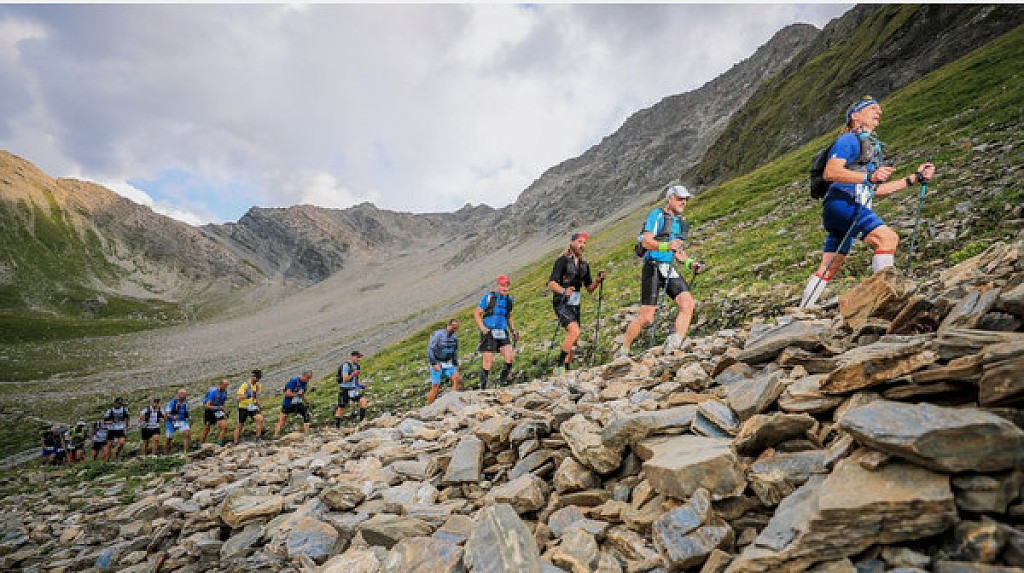
Czech Runner Dies from Falling During UTMB’s TDS Race in Chamonix
It is believed to be the first death in the 19-year history of the Ultra-Trail du Mont-Blanc races in and around Chamonix
There was sad news coming out of Chamonix, France, early on the morning of August 25.
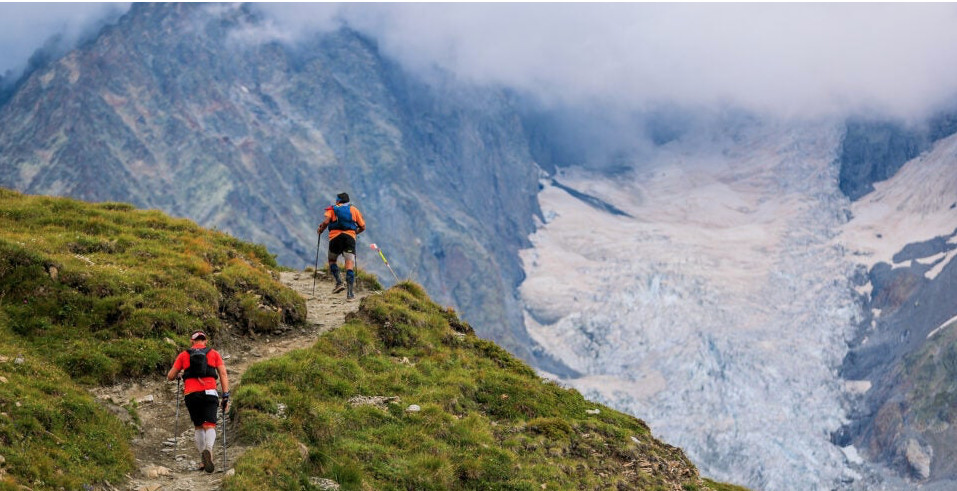
The Ultra-Trail du Mont-Blanc race organization reported that a male runner from the Czech Republic competing in the 145-km TDS race died after suffering a bad fall and serious injuries. The accident occurred at the 62.3 km mark on the descent of the Passeur de Pralognan, an 8,421-foot mountain pass west of Chamonix, France.
It is believed to be the first death in the 19-year history of the Ultra-Trail du Mont-Blanc races in and around Chamonix.
A spokesperson for the race said the UTMB race organization is deeply saddened and wished the international trail running community to join in offering condolences to the family and friends of the victim.
When the accident occurred at 12:25 a.m. CET, the rescue team stationed on the course responded to the scene immediately and additional emergency personnel was called into action via helicopter support. Despite life-saving treatments, the runner (who is being kept anonymous until all family members have been notified) succumbed to his injuries. Because of the remote and complex nature of the rescue operations, the race was partially halted and the runners located at the Passeur de Pralognan, and further back, were instructed by the race committee to turn around and go back down to Bourg Saint-Maurice, where they were met and transported back to Chamonix.
The race began on Tuesday afternoon in Courmayeur, Italy, and runners experienced clear skies and cool temperatures through the night and into the early morning. The 293 runners who had already run through Passeur de Pralognan were allowed to continue on to finish the race, but the remainder of the approximately 1,200 runners who were turned back will not be able to continue.
Norway’s Erik-Sebastian Krogvig was the eventual winner of the TDS, making it back to Chamonix after 18 hours, 49 minutes, 58 seconds. The TDS race, officially known as the Sur les Traces des Ducs de Savoie, is the most technically challenging race during the UTMB week, with several craggy climbs and descents that require precise footing and balance.
“This is a tough section of the course,” reports Trail Runner Magazine contributor Doug Mayer, who lives in the Chamonix area. “You’ve just climbed 2,000 meters in about 10 km, then need to hold on to chains on the other side. They have a rescue group right there at this spot, always. It’s the most technical moment of the race.
(08/28/2021) ⚡AMP
North Face Ultra Trail du Tour du Mont-Blanc
Mountain race, with numerous passages in high altitude (>2500m), in difficult weather conditions (night, wind, cold, rain or snow), that needs a very good training, adapted equipment and a real capacity of personal autonomy. It is 6:00pm and we are more or less 2300 people sharing the same dream carefully prepared over many months. Despite the incredible difficulty, we feel...
more...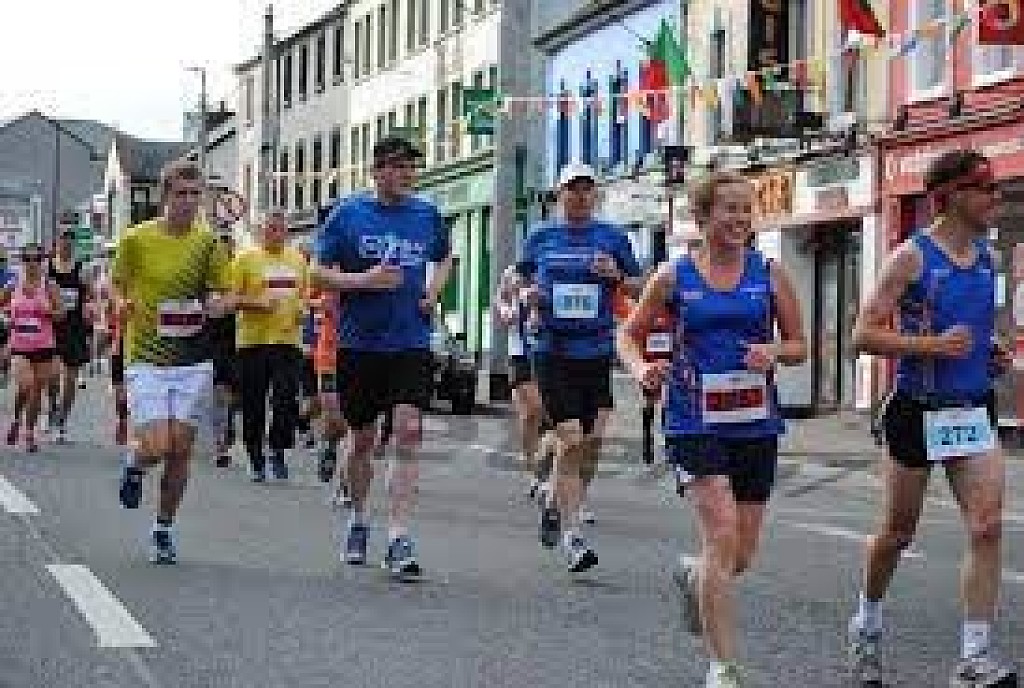
2021 longford marathon goes virtual
Despite the best efforts of all involved with the organisation of the Abbott Longford Marathon, unfortunately it is not possible to go ahead with the in-person event in Longford this year due to the ongoing Covid-19 pandemic.
As a result, the committee has made the decision to go virtual.
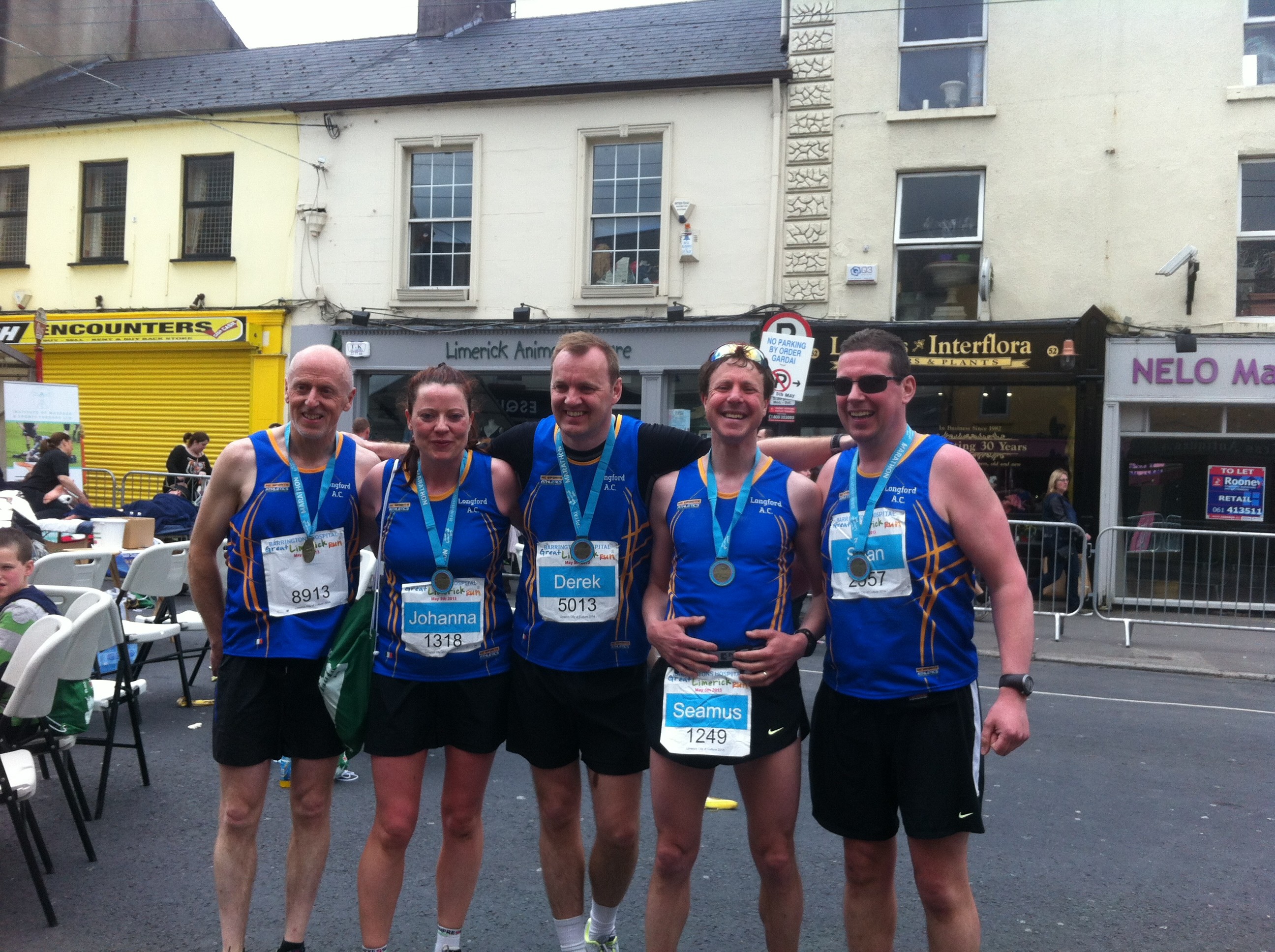
The 2021 Virtual Abbott Longford Marathon will take place between Sunday, August 29 and Thursday, September 30. Participants can take part in a 5K, 10K, Half Marathon, Marathon or 39.3-mile Ultra Marathon and complete the distance at a time and location of their choosing between those dates.
Registration for the 2021 Virtual Abbott Longford Marathon is now open at: http://www.longfordmarathon.com/enter/
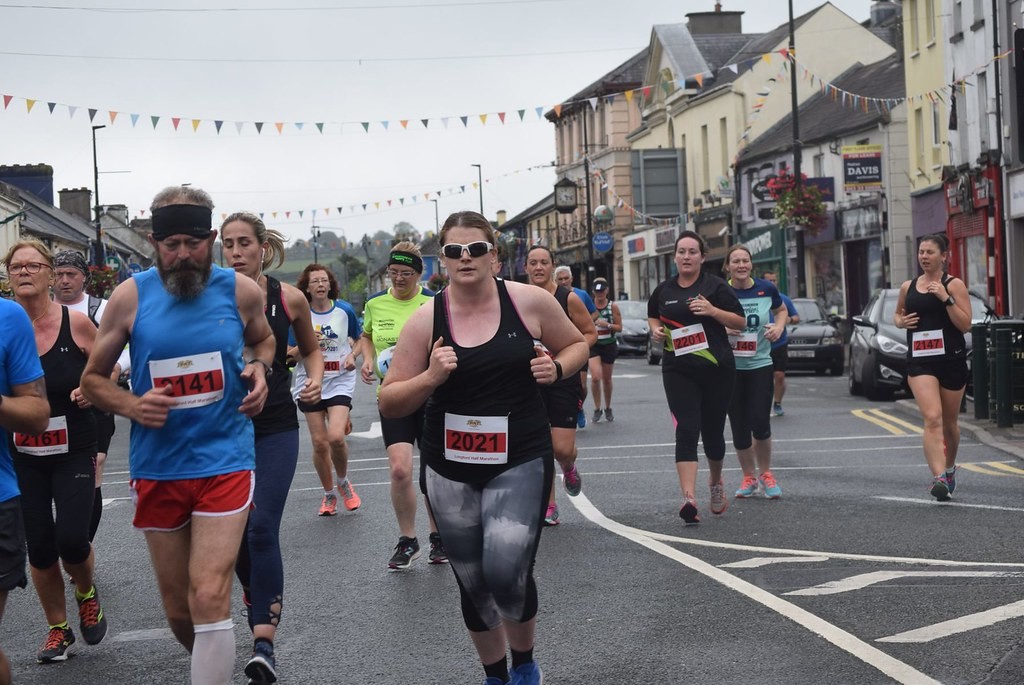
2021 Finishers Medal
Entry in any distance will cost €15, and all runners will receive a specially commissioned 2021 finishers medal by post.Announcing the virtual race, John Sheehan, vice-chairman of the organising committee said,
"While we are of course disappointed not to be able to go ahead with our event again this year, we are delighted that with the support of our main sponsors Abbott, we can bring our event to the virtual world, and I encourage everyone to get involved and take part over the month of September."
Mr Sheehan outlined that the virtual event will help to raise vital funds for charity partners, St Christopher's Services in Longford, at a time when funding for their services is most needed.
He concluded, “We look forward to 2022 with hope and optimism and are planning for the Abbott Longford Marathon at the end of August.
“We hope to see you all soon. In the meantime, keep safe, keep running and enjoy the 2021 Virtual Abbott Longford Marathon.”
(08/25/2021) ⚡AMP

Longford Marathon
The Friendly Marathon in the Heart Of Ireland. Ireland's friendliest marathon has a reputation for being one of Irelands best organised events, with a flat course, through the beautiful countryside of Longford, Roscommon and Leitrim beside the River Shannon. Take a place,its an ideal run for anybody training for the Dublin City Marathon in October. Organised by runners, for...
more...
As runner should you be worried about hyponatremia?
Hydration is important for runners, particularly during the hot summer months. Not surprisingly, the conversation surrounding hydration typically revolves around encouraging runners to drink more water, not less, but it is possible to drink too much water. Hyponatremia is a potentially dangerous result of over-hydration, and it’s something for runners to keep in mind when they’re out on a hot run.
According to the Mayo Clinic, hyponatremia occurs when the concentration of sodium in your blood is abnormally low. Sodium is an electrolyte that helps regulate how much water is in and around your cells. Drinking too much water can cause the sodium in your body to become diluted, which causes your body’s water levels to rise and your cells begin to swell. This can cause mild to life-threatening health problems. Symptoms include:
Nausea and vomiting
Headache
Confusion
Loss of energy, drowsiness and fatigue
Restlessness and irritability
Muscle weakness, spasms or cramps
Seizures
Coma
There are many possible reasons someone might develop hyponatremia other than drinking too much water. Still, runners who are participating in long events like marathons, ultras and triathlons are at higher risk because they are more likely to over-consume water in an effort to stay hydrated.
How can you prevent hyponatremia?
Unfortunately, it’s impossible to say how much water is too much, because every individual’s hydration needs are different, but in general, runners should aim to take in only as much fluid as they lose during a race. For most people, thirst is a good guide to determine how often and how much they need to drink.
Another effective solution is to choose a sports drink during a run or race instead of water. This way, you’re replacing electrolytes (like sodium) while you drink, which will help to maintain your sodium balance.
Just remember to practice using these types of beverages during your training runs before using them during a race because, for some, they can cause gastrointestinal upset.
Finally, even when you’re not running, you should avoid excessive water intake. The color of your urine is usually a good indicator of your hydration status, and you should aim for it to be pale yellow in color. Clear pee is a sign you’re drinking too much and you should set the water glass down.
(08/25/2021) ⚡AMPby Brittany Hambleton
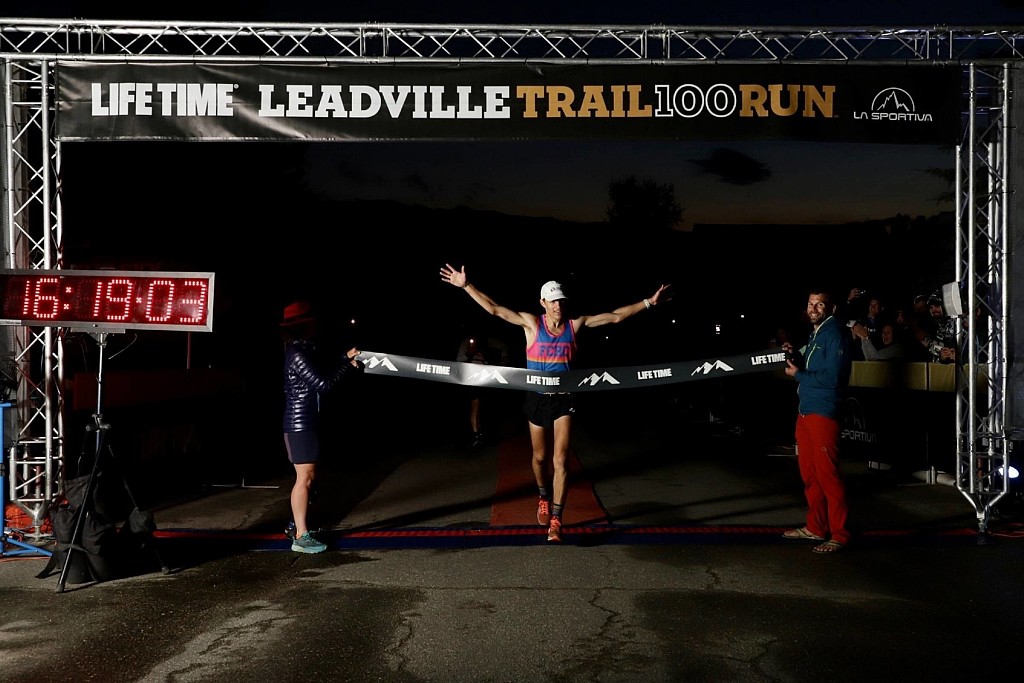
Annie Hughes and Adrian Macdonald win Leadville Trail 100
The world-famous Leadville Trail 100 Run presented by La Sportiva race returned to Leadville this weekend, the pinnacle finale event of the 2021 Leadville Race Series which is comprised of more than 15 mountain bike and trail running events each year. Event owner Life Time welcomed a field of 681 runners ranging in age from 19 to 78 years old, representing all 50 states and 13 countries, who toed the line at 4 a.m. with the ultimate goal of completing the 100-mile “Race Across the Sky” in under 30 hours. Of the 681 starters, 321 finished.
“I want to extend my sincere congratulations and thank you to every single athlete, spectator, and member of the community who collectively made this event so successful,” said first-time Race Director and previous Leadville Trail 100 MTB finisher, Tamira Jenlink. “As a Leadville resident, I understand first-hand how this event changes lives. The entire Life Time team is already looking forward to 2022!”
In the women’s division, Annie Hughes, 23, of Leadville, Colo., finished first with a time of 21:06:58. Genevieve Harrison, 34, of Eagle, Colo., finished with a time of 22:06:59. Third place was secured by Blake Wageman, 36, of Conifer, Colo., who crossed the line at 22:25:20.
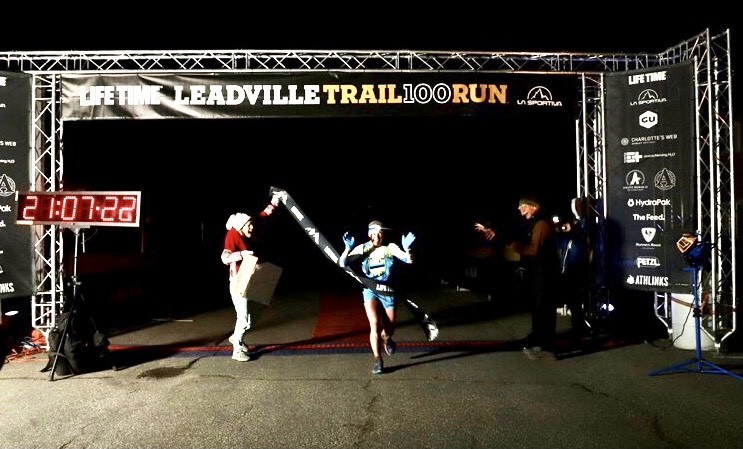
Hughes noted about her win, “Living in Leadville, getting to experience altitude and having access to the course year-round was really helpful. I’m so thankful for my pacers and crew, who taught me so much.”
For the men, Adrian Macdonald, 32, of Fort Collins, Colo., finished first with a time of 16:18:19. Matt Flaherty, 36, of Bloomington, Ind., secured second with a time of 16:59:38. Two-time previous winner Anton Krupicka, 38, of Boulder, Colo., placed third with a time of 17:07:55.
Describing his first 100-mile race, Macdonald noted, “I felt great all day — my legs and breathing all felt good. It’s just sort of crazy and insane. I told myself I was just going to go out and run all day and I did.”
Proving themselves to be ultra-endurance champions, three women earned the incredibly respectful title of Leadwoman and 40 men earned the title of Leadman following the event after successfully completing five events within the Leadville Race Series throughout the summer including the Leadville Trail Marathon, Silver Rush 50-mile run or mountain bike race, 100-mile mountain bike race, and Leadville Trail 10K.
The famed course brings runners through 13,000 feet of net gain, topping out at 12,424 feet. Notably, 31 Leadville citizens proudly represented their hometown, for which the race series is well known and beloved, in the participant field.
This year, 66 athletes across the 100 MTB (Aug. 14) and 100 Run (Aug. 21) have exceeded the goal of collectively raising $150,000 for the Life Time Foundation, which will be allocated to Lake County Public Schools schools to keep highly-processed food out of meals, while increasing the amount of fresh and simply prepared foods for students. Additionally, Leadville local Rodrigo Jimenez, who started the race 2.5 hours after the official start, raised more than $72,000 for the Leadville Trail 100 Legacy Foundation after passing 660 of the 681 runners on-course, receiving fundraising pledges for each.
To view all of the Life Time athletic events after August, please visit: https://my.lifetime.life/athletic-events.html
The Leadville Trail 100 Run presented by La Sportiva is owned and produced by Life Time, the premier healthy lifestyle brand. It is among more than 30 premier athletic events owned by the company, including the Stages Cycling Leadville Trail 100 MTB, Garmin UNBOUND Gravel, Verizon New York City Triathlon, Chicago Triathlon, and Miami Marathon.
About the Leadville Race Series
Started with only 45 runners as the Leadville Trail 100 Run in 1983, the Leadville Race Series now consists of seven running events and four mountain biking events, plus six events in the Leadville Qualifying Series. The Race Series stretches across three months, and hosts thousands of racers on foot and on mountain bike in some of the world’s most iconic events. Endurance athletes worldwide now make the pilgrimage to Leadville, Colo., with the single goal of competing in “The Race Across the Sky.” Visit www.leadvilleraceseries.com for more information.
(08/23/2021) ⚡AMPby Colorado Runner

Leadville Trail 100 Run
The legendary “Race Across The Sky” 100-mile run is where it all started back in 1983. This is it. The race where legends are created and limits are tested. One hundred miles of extreme Colorado Rockies terrain — from elevations of 9,200 to 12,600 feet. You will give the mountain respect, and earn respect from all. ...
more...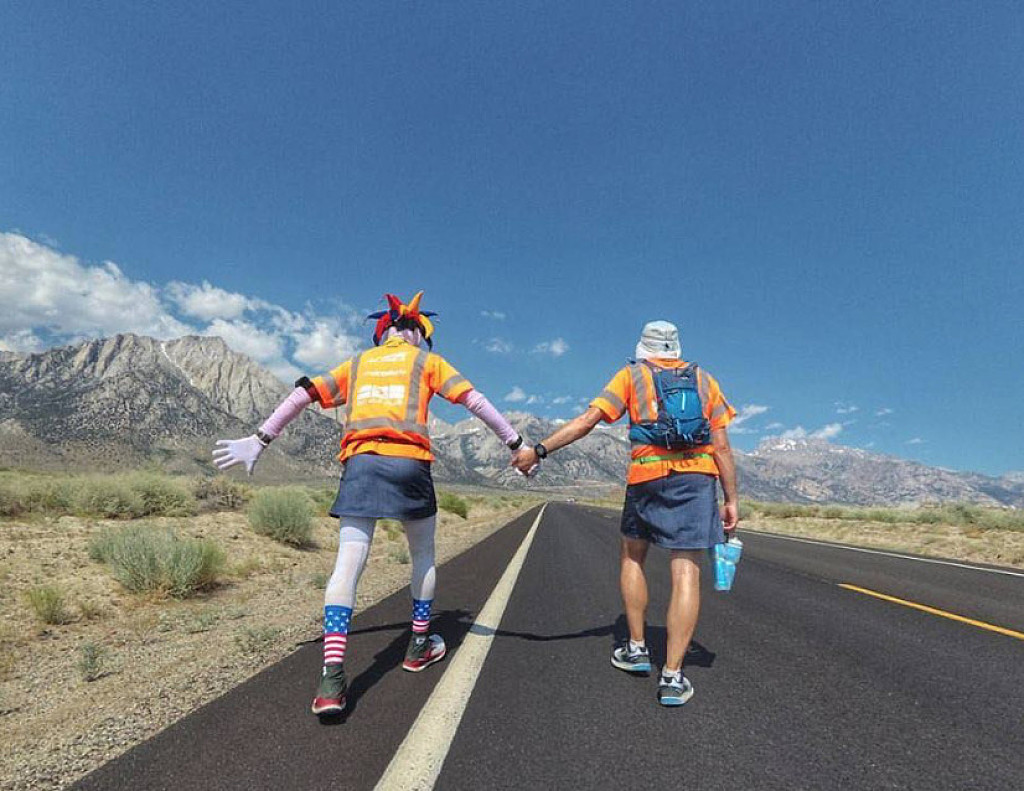
The “Two-Hundred 100 Milers Club:†Sandra Brown and Ed Ettinghausen Rack Up Impressive Number of 100-Mile Finishes
In terms of ultrarunning milestones, Sandra Brown and Ed Ettinghausen are a few 100 milers ahead of the pack.
Brown, a 72-year-old woman from England, said she knew long-distance events were for her as soon as she completed her first 100-mile event, a linear cross-country course on an old pilgrimage route in Southern England finishing in Canterbury.
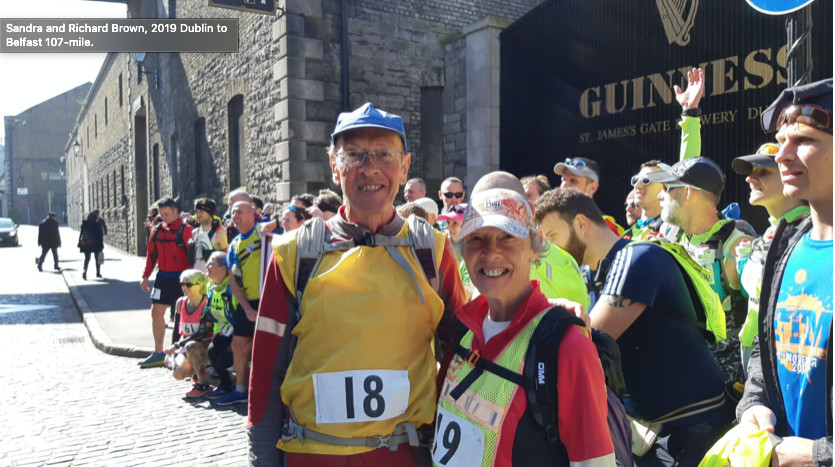
“I heard about the Centurions — those who have race walked 100 miles in under 24 hours — and I wanted to be a Centurion, perhaps all the more as these events had only recently been opened to women. So I entered and successfully completed that year’s UK 100 Miles Race Walking Championship, a Centurion qualifying event. I was on the slippery slope familiar to all ultra-distance athletes,” said Brown.
Not only did she join the Centurions, but she later went on to complete her own record-setting accomplishment. On March 30, 2019, Brown became the first person to join the “Two Hundred 100 Milers Club,” tallying her 200th 100-mile finish at the Dublin 2 Belfast 107-mile race.
“My 200th 100-mile plus event was a friendly event that [my husband] Richard [Brown] and I did together, and that felt very special. It was a milestone. But at the same time, when I finish every event, I’m also looking forward to future events,” said Brown.
She didn’t stop there. Brown most recently completed her 208th 100 miler on July 23, finishing the Kennet & Avon Canal 145-Mile Race which ran from London to Bristol. Brown, who does a mix of race walking and running, finished the event in a time of 43 hours and 55 minutes, which averages out to an 18:10-minutes-per-mile pace.
Not to be left behind, 59-year-old Ed Ettinghausen, who lives in Murietta, California and is known as the Jester for his colorful race-day attire, completed his 209th 100 miler on August 1 at the Southern Discomfort 30-hour race, edging into the lead over Brown for the time being. Ettinghausen was not far behind Brown in breaking the 200-mark, with his 200th 100-mile finish coming at the Jackpot Ultra Running Festival on April 23, 2021.
Ettinghausen, who said he got bit by the ultrarunning bug when he crewed for a friend at the Badwater 135 in 2010, has been chasing records since finishing his first Badwater in 2011. As he looked into the records, Ettinghausen set his sights on racking up one hundred and forty-five 100-mile finishes to beat the record which, at the time, he thought was held by German doctor Hans-Dieter Weisshaar.
“I reached that and thought I’d broken some record till someone said, ‘Wait, no, have you heard of Sandra Brown? She’s done so many more!’ I found out through [ultrarunning historian] Davy [Crockett] she’d done 180 or so at that point, so I had my sights set on catching her,” said Ettinghausen. “When I found out she had done 205 in 2019, that became my goal.”
As to who is keeping track and how all these 100 milers are tallied, Brown and Ettinghausen are in a league all their own where the numbers are so astronomical that keeping tabs falls largely to them and their fan base in the ultrarunning community. However, one major resource that tracks these endurance legends is the Ultrarunning History website, run by Davy Crockett.
Brown said that for her, keeping tally is more about personal achievement than holding the top place.
“I wish Ed, and all ultra athletes, all the very best in their personal quests and goals. I don’t feel and have never felt that this is rivalry or competition. For me, it’s a personal interest, and I do events for fun and the great satisfaction they give.” said Brown. “The challenge is a personal one – seeing what you can do. I was well over 100 completions of 100 miles or more, and so was Richard, before we even knew that Davy Crockett was keeping records of such completions. Davy does a fantastic job with his ultra-distance history website, which I love reading.”
Only 19 ultrarunners including Brown and Ettinghausen have joined the “100×100 club” with the achievement of running 100 or more 100 milers. Brown’s husband, Richard, is also part of this elite group.
And don’t think that the total mileage Brown and Ettinghausen have accrued is “only” 20,800 and 20,900 miles, respectively. Many of the events they are completing are over 100 miles, as evidenced by Brown’s 145 miler in July and Ettinghausen’s 105 miles at the Southern Discomfort.
When asked how their spirits (and knees) are holding up to the mileage, they had this to share:
“My knees are perfect, in better shape than ever, I did the right training and took care of myself,” said Ettinghausen. “I have a whole bunch of goals. To have 70 wins before I hit 60 years old. Then I have a whole ‘nother goal list.”
“I love every event and confess to complete addiction. I have been very lucky in avoiding significant injuries. I think that mixing race walking and running helps,” said Brown.
At present, both ultrarunners are the only two to break into the “Two Hundred 100 Milers Club,” though up-and-coming ultrarunners are sure to be inspired to chase after their achievement. Apparently, neither one is eyeing retirement after this milestone either, with Ettinghausen aiming at the Angry Owl Ultramarathons 24-hour race next.
“I have the Angry Owl 24-hour race coming up. Last year I took second at the race and hoping to take the win. It will be my 61st 100-mile win,” said Ettinghausen.
Brown, who noted her local events calendars is still recovering from COVID-19 cancelations, hopes to find one or two more events in the fall. “[I] look forward to what 2022 will bring,” said Brown.
Undoubtedly, 2022 will see both Brown and Ettinghausen adding a few more 100-mile finishes to their collection.
(08/22/2021) ⚡AMP

5 Things To Know About This Year's Leadville 100 Run
After being canceled in 2020 for the first time in its 39-year history, the Leadville Trail 100, a,.k.a., "The Race Across the Sky," returns Aug. 21-22 with the same rugged, mountainous spirit it has had since inception.
An eager field of 687 runners will toe the starting line in Leadville, Colorado, trying to survive the high-altitude, out-and-back course over 12,532-foot Hope Pass and back. There are a few minor changes this year - most notably the pre-race athlete meeting and the post-race awards ceremony will be held outside on the Lake County High School football field and no pacers or crew will be permitted at the 50-mile turnaround point at Winfield - but otherwise this fabled race born out of the hardrock miner vibe of the resilient 1880s mining town remains the same as it ever was.
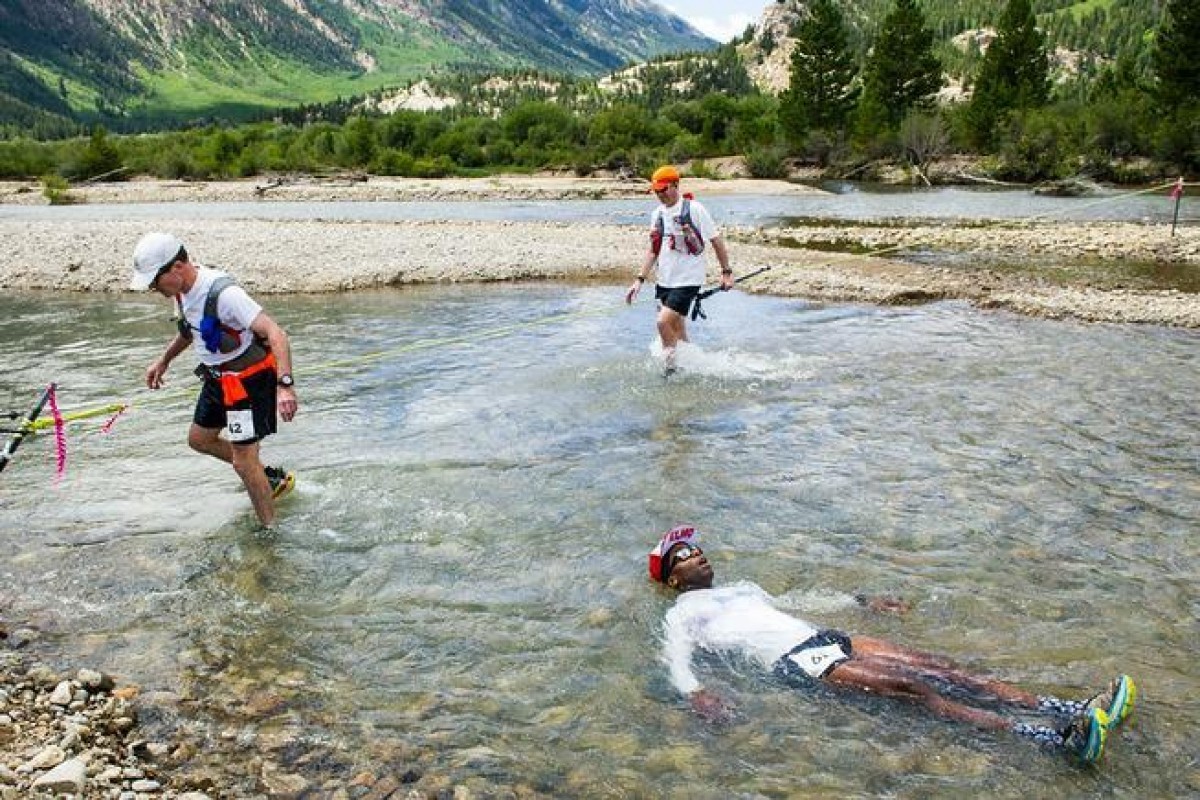
"It's Leadville, so it's all about getting to Winfield in good shape and then it's all about guts and strength and toughness on the way back," says Don Reichelt, one of the top contenders in the men's race this year. "If you've blown your quads coming down the back side of Hope Pass and then have to deal with the mental aspect knowing you have to go back up and over it, it can be a make-or-break moment of the race. It will be fun to see how it all plays out."
Here are a few things you should know about this year's Leadville 100.
The Course
First things first, the race is officially 99 miles in length with 15,734 miles in elevation gain. The out-and-back course starts and finishes at an elevation of 10,160 feet in Leadville, dips down to a low point of 9,219 feet near Turquoise Lake and tops out at 12,532 feet on Hope Pass at the 45- and 55-mile points. It's a unique course with two rugged climbs in each direction (Hope Pass and Sugarloaf Mountain/Powerline) and a lot of flat, fast entirely runnable sections on dirt roads and paved roads, as well as epic singletrack sections on the Colorado Trail. The men's course record of 15:42:59 was set by Pikes Peak Marathon legend Matt Carpenter in 2005, while the women's course record of 18:06:24 dates back to Ann Trason's astonishing 1994 effort.
Women's Race Contenders
Among the top women in this year's race is North Carolina's Ashley Arnold, 34, who was the women's champion in 2013 and third-place finisher in 2010. Although she has raced sparingly since 2019, she's been staying in Leadville and Buena Vista for a few weeks and training on the course and should be a contender based on her experience and track record. Although she won three 50K races in 2019-2020, her strong third-place effort at the Power of Four 50K in Aspen on July 31 is a good testament of her fitness.
Vermont's Aliza Lapierre is coming off a fourth-place effort at the Catamount 50K (4:59:19) in June and a win at the Infinitus 88K race in May (9:33:16) in her home state, as well as a victory at April's Ultra Race of Champions 100K (10:18:57) in Virginia. Leadville local Annie Hughes, 23, has only been trail running since 2019, but she's won a 50-miler each of the past three years (Jemez Mountain, Indian Creek, Collegiate Peaks) and has a third (Bryce Canyon, 2020) and a first (Mace's Hideout) in her two 100-milers. She also has a few high-mountain FKTs to her credit, including her 61-hour, 19-minute effort on the 167-mile Collegiate Loop in 2020.
There are several other top women from Colorado, starting with Maddie Hart, 24, of Boulder, who won the 2019 Tahoe Rim Trail 100-miler, and Kim Dobson, 37, of Eagle, a six-time Pikes Peak Ascent winner who has won all three of the 50K/50-mile races she has entered since 2018, including the Crown King Scramble 50K (4:31:44) in Phoenix in March.
Blake Wageman, 36, who has raced consistently at 50K and 50-mile race for the past several years (including a runner-up showing at the Silver Rush 50 on July 10 in Leadville); Carrie Stafford, who was fourth in the Leadville 100 in 2019; Becky Kirschermann, 48, a three-time top-five finisher at the Run Rabbit Run 100; Tara Richardson, 30, who is making her debut at 100 miles after running strong at Aspen's Power of Four 50K race in late July; and Becky Lynn, 28, who has been a strong runner at 50K and 50 miles.
On August 20 at 1 p.m. MT, Trail Sister's founder Gina Lucrezi will be emceeing a "Ladies of Leadville" roundtable discussion at the race expo with a diverse group of seven of this year's Leadville 100 participants - Arnold, Dobson, Lapierre, Grace Sims, Kate Tsai, Jolene Sandoval and Sawna Guadarrama. The goal of the event, which will be broadcast via Instagram Live, is to provide insight and inspiration from their unique perspectives and various backgrounds, to celebrate and empower women trail runners of all abilities and to promote diversity within the sport and longer ultra-distance races.
Men's Race Contenders
Among the favorites in the men's race is Ian Sharman, 40, of Bend, Oregon, who is a four-time Leadville winner (2013, 2016, 2017), and the fastest finisher of the Grand Slam of Ultraunning (69:49:38 combined time for finishing Leadville, Wasatch, Western States and Vermont 100-milers in 2013). Sharman, who placed second in the McDonald Forest 50K on May 8 in Corvallis, Oregon, has numerous ultrarunning wins and podium finishes under his belt and a 16:22 personal best on the Leadville course.
Another top contender is Tyler Andrews, even though he hasn't raced this year and doesn't have a lot of ultra-distance race experience. However, the 31-year-old runner from Massachusetts has set some pretty serious FKTs on high-altitude trails in Chile, Ecuador and Peru as part of a journey he dubbed the Los 10 FKT Project. He's also a two-time U.S. Olympic Trials Marathon qualifier who owns a 2:15:52 personal best for 26.2 miles on the roads.
Colorado's Don Reichelt, 35 brings a lot of very good ultrarunning race experience with him, especially from the past couple of years. Most notable are a third-place finish at the Badwater 135 in 2018, a win at the Lean Horse 100-miler in South Dakota in 2019 and a blazing 13:16 third-place effort at the Tunnel Hill 100-miler in Illinois last November. Reichelt has continued to improve into his mid-30s and lives in Fairplay, Colorado, and regular trains in the mountains around Leadville.
Cody Reed, 30, of Mammoth Lakes, California, has said on Instagram he'll be gunning for the win in a course-record time. This is the third year in a row Reed has been registered for the Leadville 100 but he got hurt in 2019 and the race was canceled last year. After recovering from a knee injury in 2019, he went on to win the Ultra Trail Cape Town 100K in South Africa. He has a lot of good to very good results since 2016 and certainly should be a runner to watch. He tuned up for the race by winning the six-day TransRockies Run.
Although he has vowed to run more conservatively than in his previous five starts, Anton Krupicka is not only a Leadville 100 legend but also an icon in the sport of ultrarunning. The two-time Leadville winner (2006, 2007) was trail runner's first social media star, and, although he admits he doesn't love the gratuitous attention he can attract, he's still a legit athlete and should be among the top five in the men's race based on his stout summer of training on his feet and on his bike.
Other runners to watch include David Kilgore, 29, New York City, a former University of Colorado runner and 2:27 marathoner who won the 340-mile The Speed Project multi-day race from Los Angeles to Las Vegas in May; Hannes Gehring, 34, of Denver, who set the Never Summer 100K course record (11:47:06) and placed sixth at the Run Rabbit Run 100-miler in 2019; Jackson Cole, 25, of Alamosa, Colorado, who has run several fast 50K races but hasn't raced anything longer than 38 miles; and Adrian Macdonald, 32, from Fort Collins, Colorado, who won the Antelope Island 50-miler in Utah this spring.
Leadman/Leadwoman runners and savvy veteran racers
There are 67 athletes remaining in the Leadman/Leadwoman challenge (of the original 109 starters back in June), but each one has to complete the Leadville 100 under 30 hours to become an official finisher. The Leadman/Leadwoman competitors have already completed at least four of the five Leadville Race Series events: the Leadville Trail Marathon, Silver Rush 50 Silver Rush run and/or mountain bike (competitors can chose one or both events), Leadville Trail 100 Mountain Bike Race and the Leadville 10K. Rodrigo Jimenez is currently in 8th in the standing and will start in dead last on Saturday, competing in the Back of the Pack challenge to raise money for the Leadville Trail 100 Legacy Foundation.
There are four runners over the age of 70 entered in the Leadville 100: Gordon Hardman, 70, Chuck Cofer, 70, and Marlin Weekley, 70, and Marge Hickman 71. Hardman has been running ultras since the late 1980s, has three previous Leadville finishes to his credit (1989, 1998, 2010) and is one of only 23 runners two have completed the Grand Slam of Ultrarunning twice (1989, 1998). Weekley has apparently only been running ultras in his 60s, but has more than two dozen race finishes over the past seven years. Cofer has 12 previous Leadville 100 finishes dating back to 1996, but is back for the first time since 2015. Hickman, a longtime Leadville resident, is one of the most accomplished women runners in the race's history. She's a 15-time Leadville 100 finisher who won the women's race in 1985 (26:57:50) and finished as the runner-up four times (1984, 1986, 1991, 1995). She also wrote an authoritative book on about the race.
Robbie Belanger's Endurance Feats
Robbie Belanger is a plant-based endurance athlete known for running across the U.S. in 75 days in 2019 and setting a world record for the Central Park Loop Challenge (16 laps, just under 100 miles) during the park's official opening hours. Most recently, he created a new challenge for himself focused on exploring Colorado and his affinity for the Leadville Race Series. In 2019 he moved to Denver and did the Silver Rush 50. In light of COVID, he started thinking about what he could do locally, within Colorado, so came up with the Colorado Crush Challenge, using the Leadville Race Series as a framework for his larger effort. His challenge started with the Leadville Marathon on June 19, followed by running the Colorado Trail in 11 days, and then completing the the Silver Rush 50 on July 10. Between Silver Rush and the Leadville 100 run, he reached the summit of all 58 of the Colorado 14ers, completing that epic feat on August 16 when he reached the peak of Missouri Mountain. That's 58 peaks in 38 days with nearly 300,000 feet of vertical gain.
(08/21/2021) ⚡AMPby Trail Runner Magazine
Leadville Trail 100 Run
The legendary “Race Across The Sky” 100-mile run is where it all started back in 1983. This is it. The race where legends are created and limits are tested. One hundred miles of extreme Colorado Rockies terrain — from elevations of 9,200 to 12,600 feet. You will give the mountain respect, and earn respect from all. ...
more...
Beat The Burn With These Tips for Running in Heat and Humidity
With summer in full effect, you may have noticed that your runs have begun to feel different. As in...why does my easy pace now feel like I'm running in mud and I'm working so hard to get nowhere fast?
Summer running can make it feel like you need gills rather than lungs. If you are doing heart rate training, good luck. The warmer the weather, the harder your body has to work to keep you cool. Your heart rate will be higher and breathing more difficult. The reason why is your body is directing blood to the skin to cool you off through sweating. That means there's less blood available to transport oxygen to your muscles. What would usually be an easy-paced run feels more like a max all-out effort.
If you don't like running in the heat or humidity, you don't need to retreat inside for the next few months. There are plenty of things to try to make it a little bit more comfortable. And if you do have to hit the treadmill, no biggie. Do what works for you.
Less Is Best
Wear as little clothing as legally possible. If you are the sports bra only or shirtless kind of person, do that. Stick to light-colored, loose, wicking materials. Now is not the time for wearing all black or cotton. No matter what fabric you are wearing, Body Glide can be a life saver for preventing chafing.
Don't Forget the Sunscreen
Even if it's early morning or partly cloudy, protect yourself from skin cancer and other skin damage by using sunscreen before every run. Just be sure it's sweat proof. No runner needs to feel the pain of sunscreen and sweat in their eyes.
Wear a Hat or Visor
A hat or visor will not only protect your skin from the sun, but it will also help to keep your face shaded. Soaking the hat or visor in cold water before heading out the door can help to lower body temp and feel cooler as well.
Start Slow and End Slow
A warm up prior to a run should always be done (try one of these dynamic warm ups!), but even more so when the temperatures are high. You want to gradually increase your heart rate rather than starting out too fast. Same thing for the end of the run. Do a gradual slow-down that includes some time for a slow walk. It will help regulate your heart rate and cool your body a bit.
Run Early
Morning temperatures are usually the coolest during the summer. It also will give you a break from the strongest hours of sunlight. The humidity can sometimes be high in the morning, but at least you won't have the blazing sun on you. And you may even get the treat of a gorgeous sunrise. You want to be sure to avoid the middle part of the day, which will be the hottest.
Run Late
If you aren't a morning person, wait until the late evening when the sun is starting to set. The temps will be better than mid-day, and the humidity may dip, too. Just like running early, you'll probably get the treat of a gorgeous sunset.
Slow Down
Your body has to work extra hard in the heat and humidity running at a "normal" pace, and when you try to pick up the pace, even more so. Run for time and effort rather than distance and pace. Save the hard pace workouts for a day when the temp and humidity are lower or when you can go early in the morning when the day is coolest.
Hit the Trails
When the temperatures rise, asphalt and concrete absorb heat and radiate it back into your face. Trail running usually offers shade from trees unless you are going above the tree line. It also forces you to slow down. Bonus if the trail has the perfect place to jump in a lake or river post run!
Drink up
If you are running more than 75 to 90 minutes, carry a hand-held water bottle, hydration belt or hydration vest with you. Or stash water bottles along your intended route ahead of time if you don't like carrying anything in your hands. For an extra dose of cooling relief, freeze your water bottles before your run. By the time you need it, enough ice has melted for you to drink up some icy cold water. Planning your route along accessible drinking fountains is not a bad idea either. You may also opt for adding electrolytes to your water to help balance the extra sodium and potassium lost through increased sweating.
Ice It
Ultraruners use this trick all the time while racing in the heat. Stuff a bandana full of ice and tie it so the ice is at the back of your neck. Or fill up your hat with ice before putting it on your head. As the ice melts, it will keep you cool.
Run With Friends
Just like running on frigid cold mornings in January, having friends to commiserate with while you slog through the heat makes it more tolerable. If you are joining a larger group run, there's high probability that water, Gatorade or fuel will be out on the route. You won't have to worry about having enough water with you.
Take It Inside
If it's really hot and humid and your only option to run is during the hottest part of the day, take it inside to the treadmill, preferably to a treadmill in an air-conditioned room.
(08/20/2021) ⚡AMPby Angela Bekkala
Beat the heat of the afternoon when air quality is at its worst-Lousy air quality days, get that jog or walk done earlier in the day.
You've probably heard it time and time again during this run of exceptionally bad air quality in Denver and along the Front Range – get that exercise and/or outdoor activity done during the early morning hours to escape bad air quality.
But, you might not know why air quality tends to be best during the early morning – and worst during the afternoon.
Let's start with the basics:
When Denver has poor air quality, it's usually because of ground ozone – though it's often mixed with or directly from wildfire smoke.
Ground ozone forms from a combination of car exhaust, other forms of pollution and warm temperatures.
Because car traffic peaks in the morning and evening and temperatures usually maximize in the afternoon, that's when conditions are typically at their highest for creating ground ozone.
That ground ozone, however, also dissipates fairly quickly after dark. Because sunlight is a critical ingredient to ozone's formation, ground ozone dissipates quickly after dark. Ground ozone levels at night are typically very low, even if they're really high during the day.
By the way, you might also notice us saying "ground ozone" as opposed to just "ozone." That's because ozone itself can be a very good thing – after all, it's what comprises the ozone layer about 20 miles above the surface. The ozone layer shields us from the majority of the sun's ultraviolet radiation.
Ground ozone, on the other hand, creates smog and pollution at the surface.
So long story short – when you know that lousy air quality might be in the forecast, get that jog, walk or outdoor activity done during the early morning hours or at night after the sun goes down.
These simple routine changes will spare you the worst air quality-related impacts!
(08/14/2021) ⚡AMP
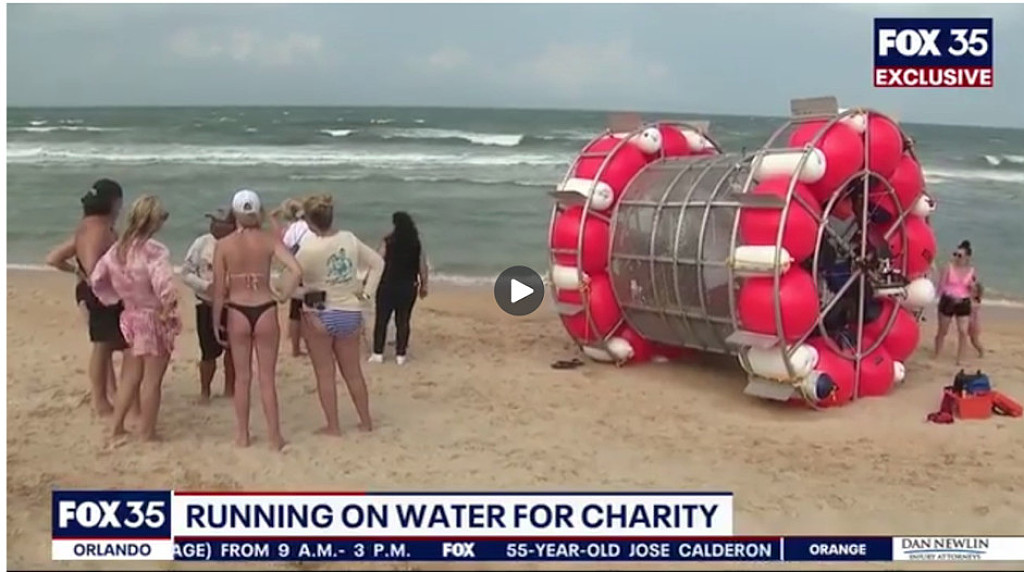
Man drifts ashore while trying to run from Florida to Bermuda inside 'bubble'
An ultramarathon runner who is trying to trek on foot from Florida to Bermuda in a strange floating device drifted ashore Saturday along the coast of the Sunshine State, a report said.
Reza Baluchi — and his so-called bubble, which allows him to navigate on the top of the water — ventured ashore in Flagler County, Fox 35 reported.
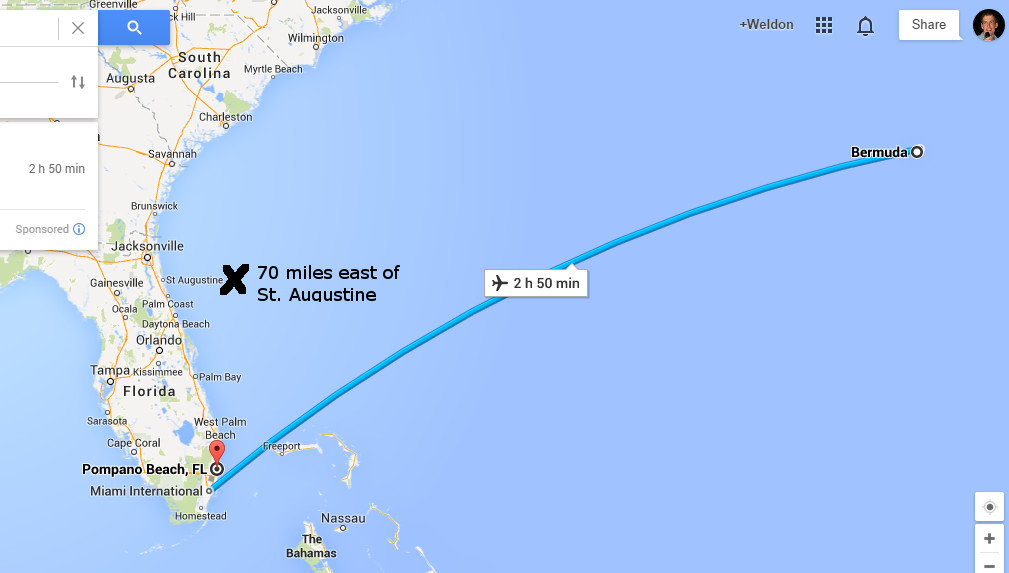
Baluchi is attempting the daring sea voyage to raise money for charity and to encourage people to follow their dreams.
“I will show people anything you want to do, do it,” he told the news outlet. “Don’t listen to anyone. Chase your dreams.”
Baluchi said his goal is to raise money for homeless people, the Coast Guard and police and fire departments.
The endurance runner has tried similar aquatic travels in the past.

In 2014, he was rescued by the Coast Guard while trying to reach Bermuda in a homemade floating “Hydro Pod.” He had been suffering from fatigue at the time.
“I’ll never give up my dream,” he told Fox 35. “They stop me four or five times but I never give up.”
(08/14/2021) ⚡AMP
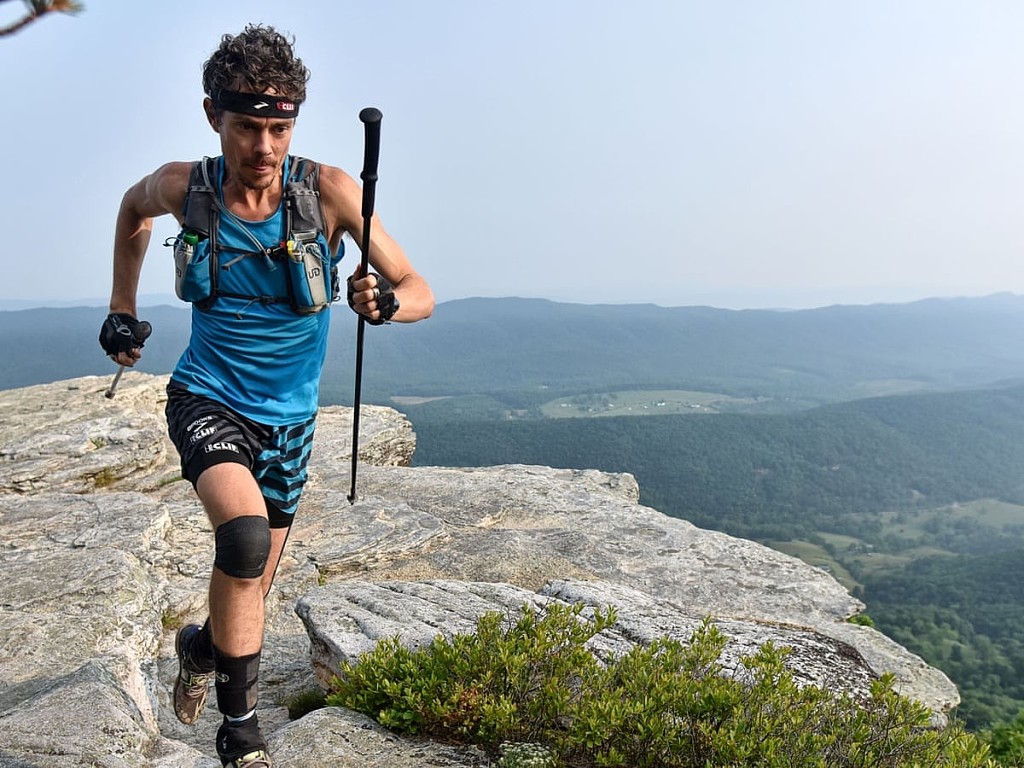
Scott Jurek Halts Appalachian Trail FKT Attempt-Injury forces ultra legend Scott Jurek off the trail
After just one week on the trail, Scott Jurek was forced to terminate his Appalachian Trail Fastest Known Time attempt.
About four days into his run, he developed a quad issue similar to the one that plagued him in 2015. Unlike his injury six years ago, he was unable to push through or walk it off.
After months of silence on social media, the trail runner from Boulder, Colorado, unveiled his summer plans for a record-setting run on the Appalachian Trail this week. As per AT tradition, he adopted a trail name — “Webwalker” — which was given to him by thru-hikers during his 2015 speed attempt.
As of late Tuesday, Jurek, 47, was already seven days and several hundred miles into a southbound trek on the trail, not far from the Maine-New Hampshire border. His goal was to complete the 2,193-mile trail from Mount Katahdin, Maine to Springer Mountain, Georgia, in 40 days or fewer.
That would have not only lowered his only personal record on the AT by six days, but it would also have surpassed Utah ultrarunner Karl Meltzer’s current supported Fastest Known Time of 45 days, 22 hours and 38 minutes set in 2016. Jurek set the northbound supported FKT (46 hours, 6 hours, 7 minutes) six years ago, but Belgian ultrarunner Karel Sabbe lowered it by five days (41 days, 7 hours, 39 minutes) with an amazing effort in 2018.
“I haven’t forgotten the suffering, but sometimes you have to go back to the hard places and do the hard things,” Jurek said via social media this week. “I still have so much to learn, and I still have more to give.”
(08/14/2021) ⚡AMPby Outside Online
Running After 40: Time to Get Smart
As you get older, setting goals—and reaching them—will look a little different
Your forties: the decade when it all goes to hell. You get injured more. Your 5K time doubles. Recovery takes forever. At least that’s what everyone tells you will happen when you turn 40. And they’re (kind of) right. After 30, people can lose up to 5 percent of their muscle mass per decade, and VO2 max also tends to drop by 10 percent per decade. The result? Runners tend to get slower.
“You can expect to see a 1 percent decline in speed per year after you hit 40,” says Scott Murr, founder of the Furman Institute of Running and Scientific Training at Furman University. “And that assumes you’re training properly. If you’re not, you can expect bigger declines.”
But plenty of runners have been successful well into their forties, particularly endurance runners. “I was probably the most successful in my forties,” says Karl “Speedgoat” Meltzer, a professional ultrarunner best known for winning the most 100-mile trail races of any runner in history (38). But he wasn’t winning because he was becoming a faster runner as he aged. Instead he did it by running smarter. We’re not saying that by adhering to the following tips you’ll magically start winning 100s, but they will keep you running strong straight through your mid-life crisis years.
Welcome to the No Mistakes Zone
“Aging athletes have to adjust their expectations, otherwise they’ll get frustrated and potentially hurt,” Murr says. “I’m 57 years old. I can’t do what I could when I was 37 or 47. I can’t even run as fast as I could when I was 55.”
There are certain physiological truths that can’t be denied, but Pete Magill, a masters runner, coach and author of a series of books about running (including Build Your Running Body), says that training right can go a long way to improving performance as you age. “You can still do amazing things in your forties, but you have to do everything right,” Magill says. Loss of muscle mass, increasingly brittle connective tissue, and decreasingly dense bones are a recipe for injury. “When you enter your 40s, you’re in a no mistakes zone. You can’t go out the first day and run 30 minutes as fast as you can like you did when you were 20.”
Recover, Recover, and Recover Some More
The main reason masters runners get injured, according to Magill, is that they underestimate their need for downtime. “Our recovery requirements expand as we get older, and it’s hard for us to adjust,” Magill says. “We feel good and think we’re ready to run hard again, but feeling good is not a green light to push it.”
When you train hard too soon after a big day, you’re not giving your body the chance to finish rebuilding muscle, which is what makes you stronger and faster. “It takes more time than we think it does,” Magill says. “If you feel good two days after a hard run, wait a third day before doing a difficult workout again, otherwise eventually your body will break down.”
Meltzer didn’t start running ultras until he was 29 and he didn’t learn the importance of recovery until he was in his forties. “It took me a while, but I learned to run less and rest more,” Meltzer says.
But that doesn’t mean you should just sit on the couch. Magill says that runners need to adopt active rest—Meltzer, for example, gardens and hikes on down days. It also means incorporating mellower workouts into your training plan. “The trouble is that most runners turn every day into a medium day,” Magill says. “If you have difficult days, you have to have easy days. Most runners run their distance days faster than they need, which sabotages their hard workouts.”
Get Swole
Strength training will help combat that natural loss in muscle mass and bone density. Murr says there’s no one-size-fits-all formula for strength training, as long as you’re working all the major muscle groups.
Magill recommends a basic regiment that includes squats, deadlifts, and Nordic curls. It’s a program designed to strengthen your muscles in the way they’ll be used when you run to help prevent injury.
“The best way to get fit is to train without interruption, without taking breaks for injuries,” Magill says. “Injuries sideline your ability to improve. If you can go a few years without an injury break, something magical happens; your body begins to function in a way you never thought possible. Everything reaches a peak.”
Chill the F—k Out
Meltzer is proof that runners can stay successful in their forties and beyond, and he says he didn’t personally change his goals as he aged. He still wanted to run long distances and for a long time he wanted to win races. He coaches a lot of masters runners who come to him with lofty goals, which he says is fine as long as they keep their aging bodies in mind while training for those goals.
“You can only get so much out of your body, but if you treat it properly you’ll get the most out of it,” Meltzer says, adding that treating your body properly often means runners need to learn how to relax. “I developed a better attitude about running as I got older. I realized that I’m a better runner when I’m doing what I enjoy. I like to be in the mountains and run up 3,000 vertical feet, so that’s how I train.”
According to Meltzer, if masters runners need to change anything as they age, it’s in their mindset. Don’t be so hard on yourself. “Take it as it is. Enjoy it. Don’t get stressed about losing your speed in your forties,” he says. “Just enjoy what the decade brings you.”
(08/08/2021) ⚡AMPby Outside Online

Why The Rocky Mountain Slam Is The Toughest Race Series In Ultrarunning
Almost every year, Leland Barker creates trophies for runners who complete the Rocky Mountain Slam, an annual test of endurance, fitness, perseverance, altitude and logistics.
To claim one of Barker's trophies, a big hunk of chainsaw-cut wood burned with the athlete's name, date and races, runners must complete four out of five designated 100-mile trail races over a 3-month span. Since the first completed slam in 1999, it has been accomplished just 59 times by 30 runners. Some years, as many as eight runners have earned the prize. However in other years, it's been zero.
"It's definitely a feeling of accomplishment," says Andrew Barney, 44, of American Fork, Utah, who's done it four times. "I know a lot of runners who say they only run one 100 a year, and that's big enough for them."
The only runner who hasn't collected the big wooden trophy is Barker himself. He completed the Slam in 2003 but never gave himself the award.
"I meant to," he says, laughing. "I had a piece of wood saved to make an award for me and I never got around to making it."
That's just fine with him, though. The 59-year-old resident of Smithfield, Utah, has gotten all he's wanted out of the Slam-and more.
Barker is the race director of the annual Bear 100 Mile Endurance Run. The race, which crosses the Utah-Idaho border, was founded in 1999. Barker wanted a way to attract more runners to his race. He's not certain of the date, or who actually came up with the idea, but says the Slam sprouted from a discussion between himself, Roch Horton, Hans-Dieter Weisshaar and Errol Jones. The idea was inspired by the Grand Slam of Ultrarunning, which has been around since the 1980s and challenges runners to complete the nation's four oldest and most prestigious 100-milers in a calendar year.
To complete the Rocky Mountain Slam, men and women have to finish four out of five annual races in the Rockies: the Bighorn 100 in Montana in June, the Hardrock 100 in Colorado in July, the Leadville Trail 100 in Colorado in August, the Wasatch Front 100 in Utah in early September and the Bear 100 in late September. Leadville and Wasatch are also part of the Grand Slam of Ultrarunning.
"We wanted the Bear to be the final race," says Barker.
It's an informal fellowship. Runners don't have to register, notify anyone of their intentions or pay any special fees. The only requirements are to finish the two mandatory races-Hardrock and Bear-along with two of the other three. Then, Barker recognizes those runners at the awards ceremony. They earn Barker's wood trophy and, sometimes, a T-shirt.
It's so informal that the first runner to complete the Rocky Slam in 1999 was grandfathered in. James Ballard of Montana ran the Hardrock, Leadville, Wasatch and Bear races the year before Barker and his buddies had even come up with the idea.
Nobody earned the Slam in 2000. Betsy Kalmeyer of Colorado was the lone qualifier in 2001. In 2002, no one earned the trophy. Then, in 2003, Barker was one of five slammers, a group that included Weisshaar, a 63-year-old from Germany who would go on to be a six-time slammer, the most ever.
"He was amazing," says Barker. "He was doing it when he was my age. I'm no longer doing 100-mile races. Actually, he was older than me when I started doing it. He didn't go real fast, he was one of the last finishers usually. But he really enjoyed doing 100-mile races. He'd come to the United States and do one every weekend all summer long."
Most judge Hardrock as the toughest race of a difficult bunch. "It's an amazing amount of climb and descent," says Barker.
In fact, it's more than 66,000 feet of elevation change at an average elevation of 11,000 feet. Each race has its challenges. Leadville is run at high altitude, with a 30-hour time limit. The Wasatch ("100 miles of heaven and hell," is its slogan) has big climbs and descents, as do the Bear and Bighorn. To Barney, the five races all share Rocky Mountain character of steep terrain, unpredictable weather, high altitude and beautiful scenery. He says there's a "ruggedness" of rocky trails.
"It's a lot of steep climbing," says Barney. "And all kinds of weather conditions. Even in summer, you can have snow. I've dealt with all kinds of conditions, from heat to downpours to blizzards."
Barney completed his first Slam in 2009 and his fourth in 2016. In a perfect scenario, he would probably do four of the Rocky 100 races every year. However, he could not get into the Hardrock race this year. But he did run Bighorn and will be doing Wasatch and the Bear.
That's one of the logistical challenges making the Rocky Mountain Slam more difficult. As the number of ultrarunners surges, races become more impacted and many adopt lotteries. Hardrock, Leadville and Wasatch now have lotteries. Bear and Bighorn fill up quickly, so it's important to register early.
Barney acknowledges that doing four 100-milers in a summer is physically challenging, especially in years when the Wasatch and the Bear are within a couple of weeks of one another.
But, like other ultrarunners, he loves the mountains, trail running and being with friends. He enjoys pursuing the Slam and the feeling of accomplishment. He admits getting "a sort of empty feeling" when he can't get into a race like Hardrock. Plus, there's a spiritual pull to running 100 miles through the wilderness.
"At Hardrock, in the middle of the night, I had a chance to just lay down and turn my light off and look at the stars at 13,000 feet," he says. "You don't get to do that very often. Just enjoying being out there and the moment, seeing sunrises and sunsets and sunrises again in the course of one race, it's somethingIt let's me think about my place in the world and the universe and where I fit in."
(08/07/2021) ⚡AMPby Trail Runner Magazine
Luxury' race will be among most expensive on earth
Ultramarathon competitors are used to "roughing it" in races, sometimes sleeping in bivvy bags at the side of muddy trails or even running through several nights.
They set themselves incredible long-distance challenges, often running through remote and difficult terrain.
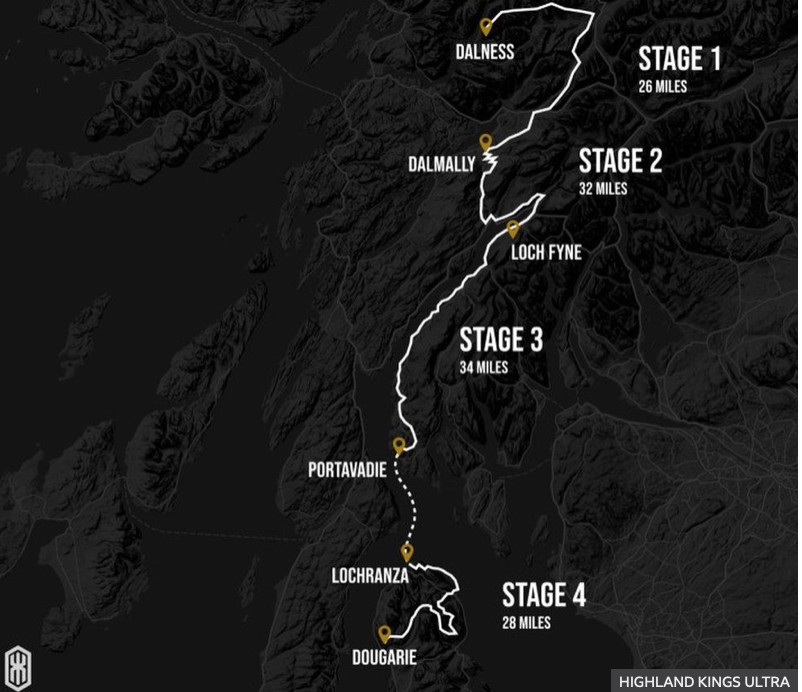

But now a new ultramarathon race is being launched which gives them luxury few could afford - including butlers, hydrotherapy pools, speed boats and Michelin-star chefs.
Highland Kings Ultra, a four-day camping race covering 120 miles on the west coast of Scotland, costs £15,499 per person to enter.
In contrast, the 95-mile West Highland Way Race costs just £120.
The organisers of the Highland Kings Ultra are calling it "the most exclusive, luxury ultra-run experience on the planet".
Race director Rebecca Silva told BBC Scotland the idea was for the runners to "race like a warrior but recover like a king".
She said: "The luxury element makes it very different to other races.
"It's aimed at professionals, who can afford it, who want a sense of adventure but want an element of luxury off the beaten track, in the wild and not in the typical places people explore."
The organisers of the Highland Kings Ultra are calling it "the most exclusive, luxury ultra-run experience on the planet".
Race director Rebecca Silva told BBC Scotland the idea was for the runners to "race like a warrior but recover like a king".
She said: "The luxury element makes it very different to other races.
"It's aimed at professionals, who can afford it, who want a sense of adventure but want an element of luxury off the beaten track, in the wild and not in the typical places people explore."
The race starts in Dalness in Glencoe, with a mountainous marathon to Dalmally in Argyll and Bute, two miles east of the tip of Loch Awe.
This is followed by 32 miles through hilly forest terrain to Loch Fyne, then 34 miles to Portavadie on the west coast of the Cowal peninsula, and finishing with 28 miles on the Isle of Arran.
Competitors then spend a night in a luxury campsite, followed by a gala dinner with explorer Sir Ranulph Fiennes.
The event is being run by outdoor adventure business Primal Adventures, led by an ex-forces Ayrshire man, Matt Smith, and managing director Rebecca Silva.
Ms Silva said: "We were asked by a group of French clients to organise a luxury running trip from the Isle of Aran to Inverness in 2018 and that planted the seed because the event was so successful.
"We have been arranging primal bush craft and adventure courses for years, so this has been an extension of that."
Ian Beattie, chairman of Scottish Athletics and race director of the 95-mile West Highland Way ultramarathon race, said he had never heard of a more expensive race.
"It will be interesting to see if there is demand for this event," he said.
"There is an element of criticism for commercial races, but people will decide what they want."
He said ultramarathon races organised by running groups and/or experienced runners were much cheaper because of the number of volunteers involved.
He added: "My advice would be to join a local running club as there are always qualified coaches there and people with a wealth of experience and knowledge."
(07/31/2021) ⚡AMP
by BBC
Timothy Olson (Probably) Just Nabbed the FKT on the PCT
After 2,652 miles, 400,000 feet in elevation gain, and more than 51 days, the ultrarunner finished his PCT thru-hike.
Fifty-two days, eight hours, and twenty-five minutes. As of Thursday evening, that’s the record Timothy Olson appears to have beat running from border to border, Mexico to Canada, on the Pacific Crest Trail. Once Olson’s own time is confirmed, he will have completed the PCT faster than anyone ever before. According to his Instagram account, his unconfirmed time is 51 days, 16 hours, and 55 minutes.
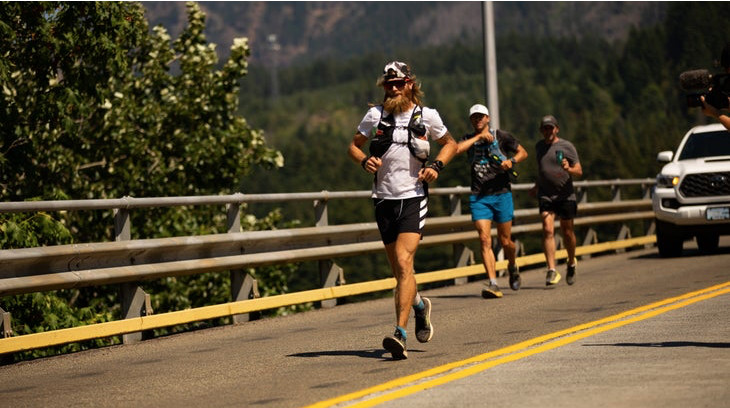
When Olson arrived at the northern terminus of the PCT at 10:48 P.M.on Thursday, he seemingly surpassed the record held by Karel Sabbe from Belgium since 2016. An FKT on the PCT, which winds through 2,652 miles of rugged mountain terrain in California, Oregon, and Washington, is one of the most prized speed records in thru-hiking and ultra-running. And for good reason: Olson averaged more than 50 miles a day for seven weeks straight for this record, often at alpine altitudes, gaining more than 400,000 feet in elevation. Not to mention another 400,000 feet of elevation loss.
Olson wore a GPS tracker for the length of his run, and once the data is confirmed, the official time will be released. (The complete tracker data has yet to be made public.) He started his journey in Campo, California, on June 1, which suggests he beat Sabbe’s time by less than 24 hours. The record comparison is complicated by the fact that trail adjustments, closures, and above all, seasonal wildfires, mean that the Pacific Crest Trail varies in route and length every year. This means that Olson, along with every thru-hiker, had to improvise: at least once, Olson ran up to a trail closure, turned around, ran back to a trailhead, and was driven to the other side of the closure. The extra added miles approximately equaled the distance of the closure, so even if Olson could not run every mile of the trail, he likely ran as many miles, if not slightly more.
Olson is not an amateur athlete, and this isn’t his first ultrarunning record. He once held the record for the Western States 100-Mile Endurance Run, which he won in 2012 and 2013. But running the PCT is a fundamentally different challenge, physically and logistically.
Many FKT attempts on the country’s “triple crown” of thru-hikes, which also includes the Appalachian Trail and the Continental Divide Trail, end in failure, often due to injury, inclement weather, or sheer exhaustion. Olson was supported by a team of seven following along in two RVs, rendezvousing with Olson as he passed through trailheads, and handling logistics like food and laundry. Most nights, Olson slept in an RV. But in several especially isolated sections, such as the Sierra Nevada, Olson spent the night alone, sleeping on the ground along the trail Sweetening the moment of victory for Olson is that his wife and fellow ultrarunner, Krista Olson, is eight months pregnant with their first daughter. “Each step of the journey, I am connected to my family,” Olson wrote on his Instagram as he ran through Snoqualmie Pass in Washington. Krista and both of his sons, Tristan, 8, and Kai, 5, were active members of his support team, meeting him at trailheads and assisting with logistics. Sometimes, his sons even joined him for brief sections of trail.
In addition to record-chasing, trail running has helped the Olsons cope with loss—in particular, two miscarriages they experienced before their current pregnancy. As part of the FKT attempt, they’ve been raising money for Return to Zero: H.O.P.E., a non-profit that supports families going through pregnancy loss or baby loss.
Thru-hiking the Pacific Crest Trail is an elite physical challenge, even at a normal pace. In 2019, the Pacific Crest Trail Association issued 5,441 thru-hike permits, and another 2,437 permits for section hikes. Of those, only 1,181 people self-reported as having completed the entire PCT. Typically, thru-hikers finish in five to six months, carrying their own food and gear, and sleeping in tents each night. Completing the trail in less than two months, and the logistics needed to make an FKT attempt possible, registers on an altogether different scale of magnitude.
“In a normal year, only around one-fifth of the people who set out to hike the entire PCT actually succeed,” says Scott Wilkinson of the Pacific Crest Trail Association. “To travel the entire trail in a single season is remarkable. To do it faster than anyone ever has? It’s mind-boggling.”
The number of thru-hikers grows each year, as does the number of competitive ultrarunners. For those reasons, Olson’s FKT attempt certainly won’t be the last. But for now, he can rest easy knowing that he is very likely the fastest known PCT thru-hiker of all-time.
(07/24/2021) ⚡AMPby Back Packer
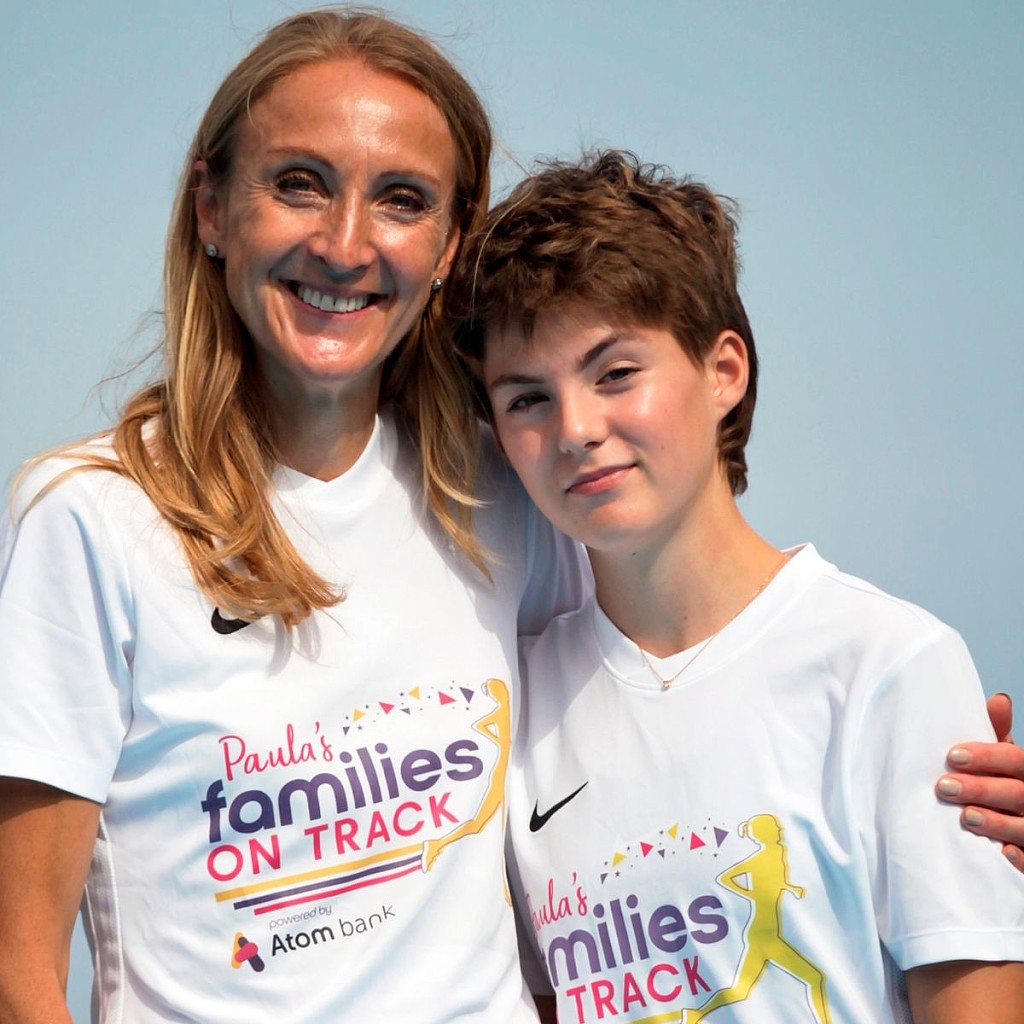
Long-distance running legend Paula Radcliffe was devastated when her daughter was diagnosed with a rare tumor last year
Paula Radcliffe experienced the full range of highs and lows during her glittering running career. From smashing world records on the streets of the capital, winning the London Marathon three times, to sitting forlornly on the roadside in Athens with her Olympic dream in tatters, she tasted it all.
But nothing could have prepared her for the moment last year when a doctor broke the news that Isla, her 14-year-old daughter, had a tumor growing on one of her ovaries.

“After Isla had undergone a battery of hospital tests, I hoped it would still be something benign even though we had been sent to the oncology department,” recalls Paula.
“But I was given the diagnosis that nobody wants to hear when the doctor said Isla had cancer. The doctor had asked Isla to sit in the waiting room before telling me what it was.
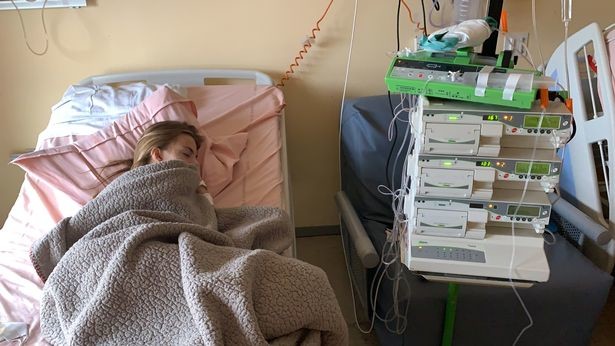
“I burst into tears but had to stop crying and pull myself together before Isla came back into the room a few minutes later. The doctor then explained the diagnosis to Isla.”
It was a shattering blow for Paula, 47, and husband and former coach Gary Lough, who live with Isla and their 10-year-old son Raphael, in Monaco.
Small signs that something might be amiss with Isla’s health had begun a few months earlier.
“In March last year Isla started her period, which was a little more painful than I remember, but we didn’t really think anything of it,” says Paula.
“But by July Isla said she was getting out of breath when having underwater swimming races with Raph in the pool.
“She also didn’t want to go on their trampoline as it gave her a pain in her bladder. After the diagnosis we realized this was because the tumor was bouncing on it.”
By late August, Isla was suffering unexplained bleeding between periods. Paula knew something was wrong so made an appointment with a paediatrician. The next day, at a hospital in nearby Nice, Isla underwent an ultrasound scan and other tests. When the results came in the family were devastated.
Isla had a malignant germ cell tumor, which grows in the cells that form the eggs in the ovary. They are rare and affect roughly one in 200,000 women. In men they can develop in the testicle where the sperm is formed.
“It was hard to take in as everything had happened so fast,” says Paula.
“But the care was phenomenal. A week later, Isla was starting chemo.”
For Isla, having a clear diagnosis was helpful. “A lot of the time leading up to the diagnosis I didn’t feel right, but I didn’t expect it to be cancer,” says Isla. “I thought it would be something like an allergy or an intolerance.
“I didn’t take it in that we were going to a cancer department, and only realized that afterwards. When I went back into the doctor’s room after being examined, mum was crying – although she had been crying a lot the day before that. Then the doctor started to explain it was cancer and I think I was just in a state of shock.”
Because of ongoing Covid restrictions, it was decided Paula would be mostly with Isla at the hospital while Gary took care of Raphael.
“We made a decision which was best for our family,” explains Paula. “I probably cope better with stress and I don’t think he could have seen his little girl going through all this in hospital on a daily basis. But he could still come in every day and cheer her up.”
When Gary visited, Paula would either spend time with Raphael or go for a short run, which she still does most days. “When we were over the initial shock and the medical team had explained everything, having that sporting background helped,” says Paula. “We had a treatment plan – like all the training plans I have followed over the years, and it was something we could stick to and see things improving.”
The prognosis was good with a high chance of it being successfully cured with surgery, and in Isla’s case, chemotherapy too, which started in September, just as she was starting a new school term. The drugs were delivered intravenously five days in a row, taking seven hours each time.
(07/20/2021) ⚡AMPby Adrian Monti

9 Tips To Make Your Body Feel OK When Traveling
If they ever figured out wormholes or teleportation or time travel, I would be the last person to sign up. I can't imagine how I'd feel traveling to another dimension when short plane flights make me feel like such a piece of soggy garbage.
Or that's how I used to feel. Then, over the last few years, I saw how expert traveling runners do it. I asked them about their secrets. And I learned a few things that have helped me feel a bit less like a lazy parasite after travel.

In 2018, Cat Bradley went from Europe to the U.S. to Europe in the week before a top-10 finish at UTMB. A few weeks ago, Zach Ornelas traveled from Michigan to South Africa just a day before a top-10 at the Two Oceans Ultramarathon. So it's definitely possible to do almost any trip and excel physically. From talking to Cat, Zach and many others, I came up with a list of nine things that I have seen among many good travel-runners. The science in this area is not settled, so pick and choose what works for you.
If I'm doing the calculations correctly, that means drinking a swimming pool before touching down in Paris. But after my own struggles racing internationally, I tried approximating that hydrating formula, and I felt significantly better on future trips.
Hydrate Adequately, Especially on Planes
Lauren Fleshman, an amazing athlete, coach, writer, parent and entrepreneur (the EGOT of running), wrote a wonderful article on jetlag and athletes back in 2011. She recommended eight ounces of fluid every 45 minutes on a flight. If I'm doing the calculations correctly, that means drinking a swimming pool before touching down in Paris. But after my own struggles racing internationally, I tried approximating that formula, and I felt significantly better on future trips.
There's no need for a set formula (8 oz every 45 min may be excessive for many people), just don't dehydrate yourself in planes or cars. Plus, the extra bathroom breaks make for a solid excuse to move. I recommend some electrolyte mix in water to possibly support absorption (a complicated sub-question that depends on many variables-see this 2015 article from Nutrition Reviews for details). And make sure you don't overhydrate either, which can have its own nasty health effects. Hydration is hotly debated, with legendary exercise scientist Tim Noakes even publishing a book called Waterlogged that argues that overhydration is a major problem, so find what works for you.
Eat Like a Normal Person
Spending the trip subsisting on Smartfood popcorn and Werther's candies will probably make you feel crappy when you get where you are going. Trust me, I've done some real-world experiments, and I may or may not be typing this with fingers coated in cheese-like powder.
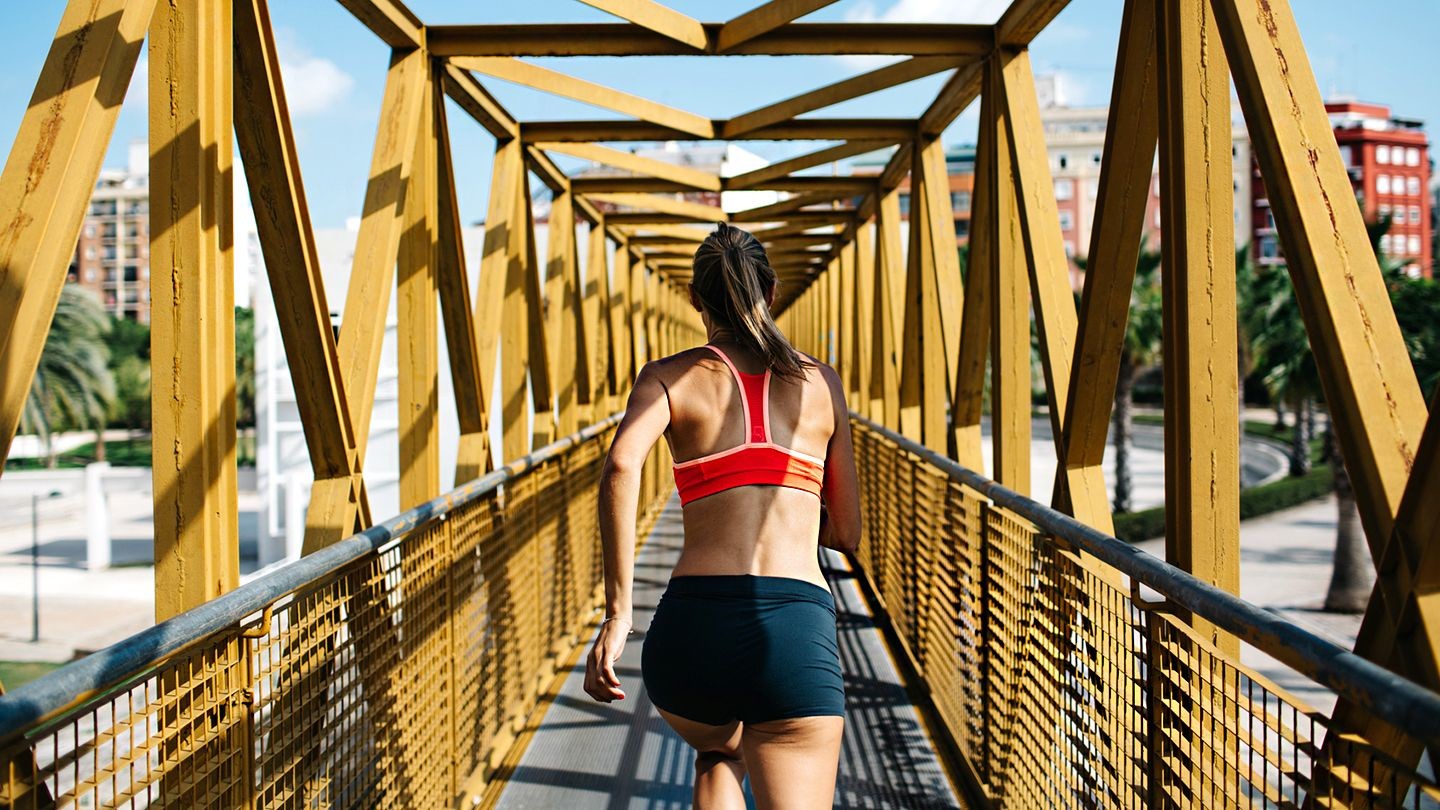
Don't overthink it, just make sure you fuel well. Pack healthy snacks like nuts, fruit and whole-food energy bars, and keep eating. Avoid fake sugars (and gum unless you know it doesn't bother you), too much alcohol and food that makes you feel like crap about yourself. Powdered cheese-like substance feels good in the moment, but note to self 10 servings of it usually isn't the best long-term life decision.
Consider Wearing Compression Tights/Socks on Your Trip
The science behind compression gear during travel is not settled, but there is some evidence that it could help prevent blood clots in susceptible people, and some athletes who travel frequently say that the circulation effects can make long trips go over easier on the body.
I like athletes to consider wearing graduated compression tights or socks if they have a pair, but not to worry about it too much one way or the other. Plus, compression socks are like calf-muscle Spanx.
Move as Much as Is Reasonable
Recommendations vary, but many sources say to move five to 10 minutes every hour. That is pretty difficult unless you want to be the worst seat-mate possible. Could you imagine if everyone on the plane did that? It'd be mass hysteria.
But as much movement as possible is good, even if you aren't playing musical chairs every few minutes. Stand up, do some light squats, maybe some stretching. During drives, walk around the gas station a few times and do some push-ups. There are benefits to circulation, and it's always good for sanity to avoid impersonating a human pretzel for too long.
After Sitting for an Extended Time, Go on a Walk and Do Mobility Work and/or Stretching
When you get where you're going, push back against the stationary inertia and get moving, even if you are really tired. I have seen athletes excel with a couple-mile walk, followed by doing whatever mobility/stretching they usually enjoy. For me, that means a walk followed by some comically poor yoga poses.
Consider Elevating Your Legs (or Using Compression Boots)
There is some evidence that elevating legs (against a wall or similar) can improve circulation and stop pooling of fluid that can happen in legs during travel. My feet usually look like sad little sausages after being on a car or plane, and elevation seems to help them regain some semblance of normal.
If you're really lucky, Normatec boots or similar air-compression methods seem to be really helpful, but that's a luxury that most travelers probably won't have. This bullet point won't make or break the trip, and some of the benefit that I see in athletes might just be taking the time to relax, rather than leg elevation or sexy space boots.
If Your Sleep Schedule Is Off, Still Give Yourself Restful Time
I have heard that for some athletes there is no more frustrating advice given all the time in the running world than "sleep more." I am guilty of saying it too. Sleep is good for recovery, hormones and performance. Never underestimate the power of performance-enhancing snoozles.
But for many athletes, it's not that simple. It is totally normal to suffer from issues with being able to get to sleep or stay asleep. If you're one of the athletes who has sleep struggles, I promise you that you're not alone. So many of the athletes I coach might not be captured in a study on insomnia, but have persistent problems with sleep. Sometimes, it even becomes a source of daily anxiety.
Those problems are especially evident during travel. Jason Schlarb just finished 2nd at the Maxi Ultra Race in France, and on the phone afterward I asked about his travel schedule. Jason would never make an excuse, so I had to press him on his sleep. He estimated that he slept around three hours in the few days before the race, which started at midnight local time.
While the travel made sleep difficult, Jason still gave his body plenty of rest, which let him perform really well anyway. What I like athletes to do is carve out eight to 10 hours at night when they'll be in bed, lying down without any screens or social stimulation. A book is OK (and make sure you always have two-plus amazing books in your bag), but lying there and meditating peacefully is even better. If that results in a solid trip to dreamland, awesome. If it means no sleep, that's OK too. Just try to avoid spirals where worrying about sleep makes the restful time full of anxiety about being awake, rather than mindful relaxation.
I have seen tons of athletes excel off almost no sleep (especially the night before races), so cut yourself slack and let your brain shut off, knowing that it's OK if you get an eight-hour session of gratitude instead. Some athletes swear by melatonin to help reset their natural sleep cycles, but everyone is different, so make sure you don't do anything for the first time before a race.
Use Caffeine Strategically
Caffeine is a blessing and a curse during travel. It can help you feel like a normal, functioning human being. But it can also prevent your body from falling into a new pattern in a new time zone.
There are no set rules that work for everyone, but the best advice I have heard is to stick to your normal schedule for short trips (ideally with no caffeine after the morning), and to consider abstaining entirely before and during long plane trips. Then, a little bit of caffeine as the sun comes up can jump start your system and your bowels (another problem that many athletes struggle with on long trips).
Accept Feeling Like Crap, and Do a Few Fast Strides to Jump-Start Your Body
Even if you do everything right, there's a solid chance your body will feel all wrong. And that feeling is OK. Accept it, embrace it and laugh at it if you can. There is great power to be had in understanding you don't have complete power over how you feel.
I like athletes to do a few strides on their first run after travel to give their neuromuscular and aerobic systems a jump start. Something like 4 to 6 x 20 seconds fast on slight uphills after an easy run will get the heart pumping and often helps athletes feel way better. At the very least, it usually shows them that while they might not feel normal, their bodies are still strong and powerful.
Travel is fun. Running is fun. Mixing the two can sometimes be where fun goes to die. So be patient with your body, giving it the grace and space to adjust. After all, every legendary adventure requires an epic journey.
(07/19/2021) ⚡AMPby Trail Runner Magazine

Exercising Outdoors Doesn’t Boost Your Melanoma Risk—as Long as You Take Precautions
New research suggests you don’t need to hit the treadmill on super sunny days. But you do need sunscreen
Exercising outside doesn’t raise your risk of melanoma, as long as you follow sun-smart strategies, new research suggests.
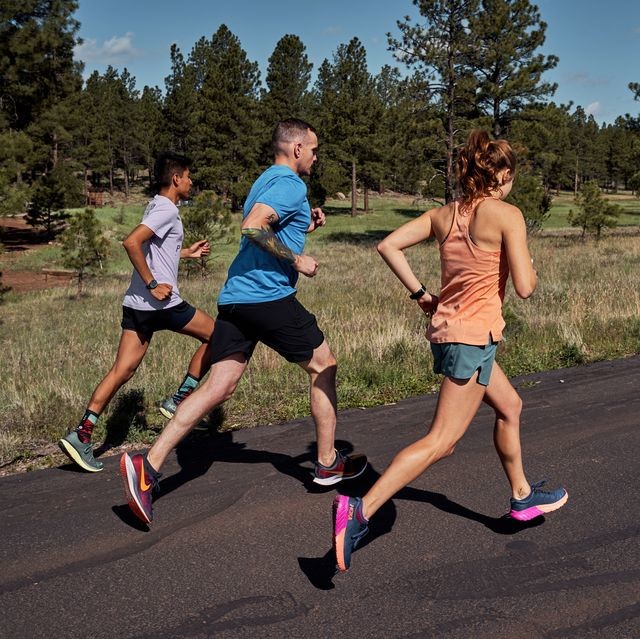
Using sunscreen (a minimum of SPF 15 or 30 is recommended), covering your skin, and taking advantage of shady spots when you can all lower your chances of getting a sunburn—if you get too many sunburns over time, they can lead to melanoma
The long route you’re about to run is all sunshine and no shade. Does that mean you’re putting yourself at higher risk for skin cancer? A recent study in the journal Preventive Medicine suggests you can lace up and get outside without worry—as long as you follow sun-smart strategies.
Norwegian researchers looked at over 150,000 women ages 30 to 75 who participated in a large-scale study on cancer done over nearly 20 years. They examined whether participants who exercised outdoors reported more incidents of melanoma, which is considered the deadliest type of skin cancer. Previous studies have suggested this is the case, in part because those who spend more time outside are at higher risk of sunburn, which is a contributor to skin cancer.
However the researchers found no increased melanoma risk among participants. Particularly surprising, those results held for the arms as well, which tend to be the most exposed during activity, said co-author Flavie Perrier, Ph.D., research fellow in the Institute of Basic Medical Sciences at the University of Oslo.
She told Runner’s World that focusing on Norway is notable here, since the country has the third highest incidence of melanoma in Europe, but the highest mortality rate from the disease. Also, people in Norway tend to have light skin and many enjoy sunbathing in the summer, which both increase melanoma risk.
That means finding ways to lower incidence is especially important for the country, but the results can apply anywhere. She did add that they were unsure if the results would apply to men, since only women were included in the study, but that it was likely the sunburn connection would be relevant for them as well.
“We found that a large proportion of women didn’t get sunburns compared to those who were less active, and this might be due to taking more precautions,” she said.
Previous research suggests that it doesn’t take many sunburns to become problematic. One study, published in the journal Cancer Epidemiology, Biomarkers & Prevention, found women who had at least five “blistering” sunburns before age 20 had an 80 percent increased risk for melanoma.
Sunburn is an inflammatory reaction to the ultraviolet radiation experienced during prolonged sun exposure, according to The Skin Cancer Foundation. For people with less melanin—a pigment that gives skin its color—skin cells become red and swollen, and that damage alters a tumor-suppressing gene so that cells are less able to repair themselves. That can cause cancer to both form and spread.
To protect yourself, experts recommend using a sunscreen with at least a factor of SPF 15—which has been shown to reduce melanoma risk significantly—but the researchers in the recent Norwegian study suggest SPF 30 as a starting point. Also, The Skin Cancer Foundation’s sun protection guide provides useful guidance, such as covering your skin, taking advantage of shady spots when you can, and choosing the right sunscreen.
You won’t find any reef-harming chemicals in this sunscreen. What you will get is a thick, protective barrier of zinc oxide.
(07/18/2021) ⚡AMP
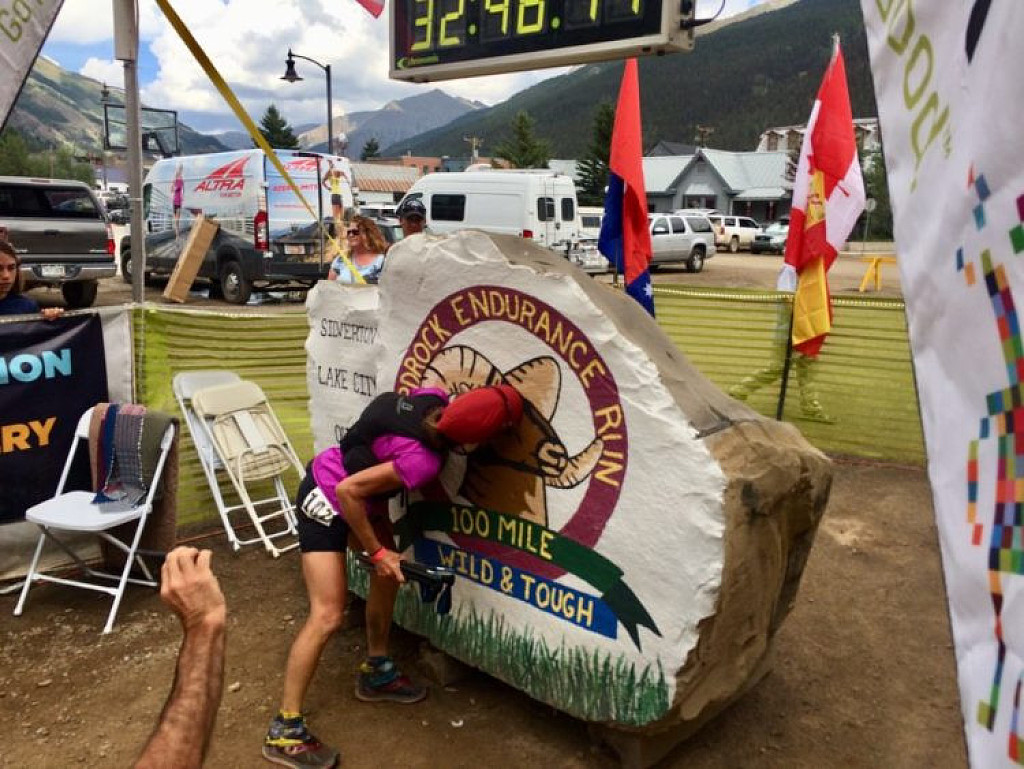
François D'haene, Sabrina Stanley win first Hardrock 100 in three years
After two successive cancellations (one due to snowfall and one to COVID), the Hardrock 100 took place in Colorado’s San Juan mountains on Friday, and it was worth the wait. French ultratrail superstar and three-time UTMB winner François D’haene was strong from the start, and powered through to a 21:45:51 finish early Saturday – the fastest time anyone has run the course, counterclockwise or overall (both records were held by Kilian Jornet, who did not run this year).
Defending champion Sabrina Stanley of Silverton, Colo. (where the looped-course race starts and finishes) won the women’s race in 27:21:48 – the second fastest women’s finish ever, and her second time racing Hardrock. Stanley was sixth overall, and was on pace for a course record until approximately mile 80.
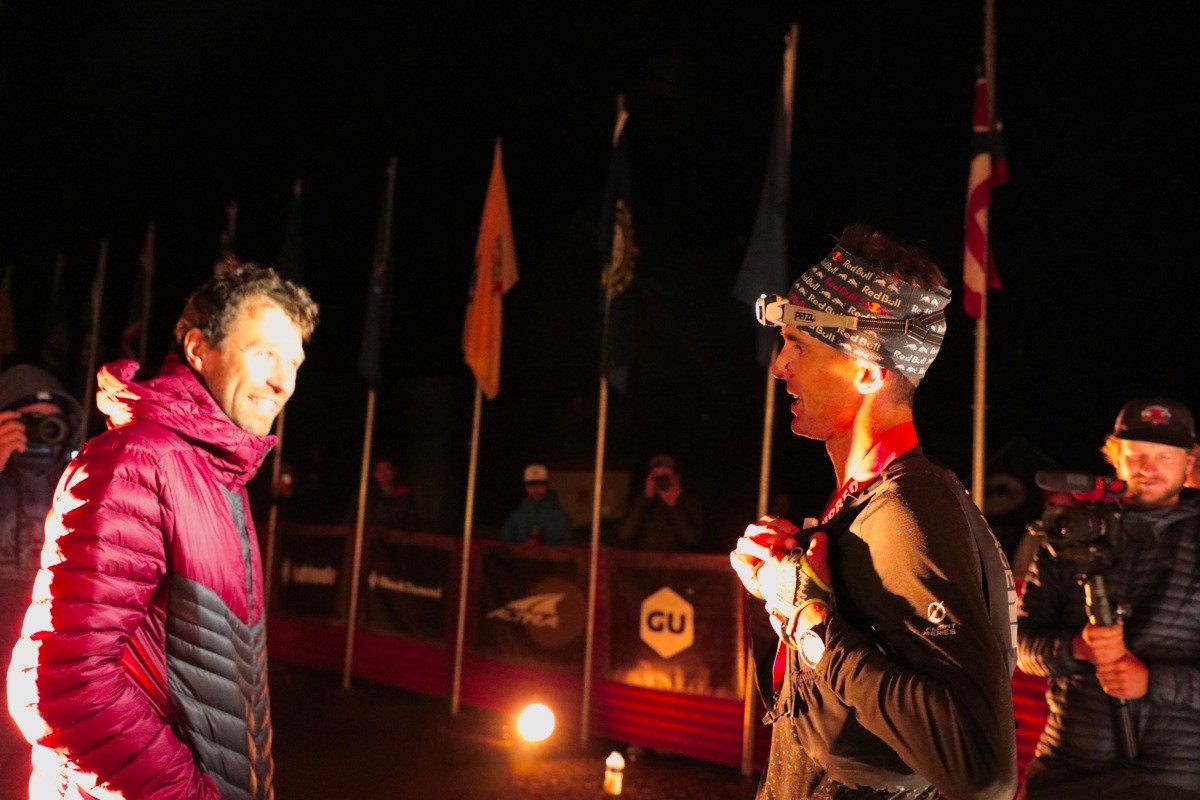
Dylan Bowman of Portland, Ore. took second place, exactly one hour behind D’haene, in 22:45:50. and Ryan Smith of Boulder, Colo. was third, in 23:24:29. All three finished faster than Jornet’s counterclockwise course record of 23:28:00, set in 2015, and D’haene bettered Jornet’s overall record of 22:41:33 from 2014.
Darcy Piceu of Boulder was the second woman to finish, in 32:08:17. Piceu has finished first or second in all eight of her Hardrock finishes. Meghan Hicks of Moab, Utah finished third, in 33:04:59.
D’haene is a three-time UTMB winner (2012, 2014 and 2017), among other titles, and Bowman has twice won the Ultra-Trail Mount Fuji, in 2016 and 2019. Both are Hardrock first-timers. D’haene was paced for the 30-mile section from Grouse to Telluride by Jim Walmsley, who won his third consecutive victory at Western States just three weeks ago and is now training for UTMB.
The second First-timer and favourite Courtney Dauwalter did not finish, dropping out at mile 62. Mike Wardian finished in 26th place, in 36:00:25.
Mario Festival of Calgary, who also dropped out at Ouray, appears to be the only Canadian entry.
Top 10 men
François D’haene 21:45:50
Dylan Bowman 22:45:50
Ryan Smith 23:24:29
Julien Chorier (2011 winner, 2nd in 2014) 25:56:57
Jeff Browning (2018 winner) 26:58:16
Nick Pedatella 28:27:47
Troy Howard 28:33:51
Trevor Fuchs 29:19:42
Kevin Shilling 30:33:20
Mick Jurynec 30:33:20
Top 10 women
Sabrina Stanley 27:21:48
Darcy Piceu 32:08:17
Meghan Hicks 33:04:59
Olga Nevtrinos 36:35:26
Heather Brooks 38:09:00
Betsy Nye 39:36:00
Pam Reed 41:56:00
Barbara Olmer 43:22:00
Marta Fisher 45:21:47
Betsy Kalmeyer 45:47:17 her second time racing Hardrock. Stanley was sixth overall, and was on pace for a course record until approximately mile 80.
(07/18/2021) ⚡AMPby Running Magazine
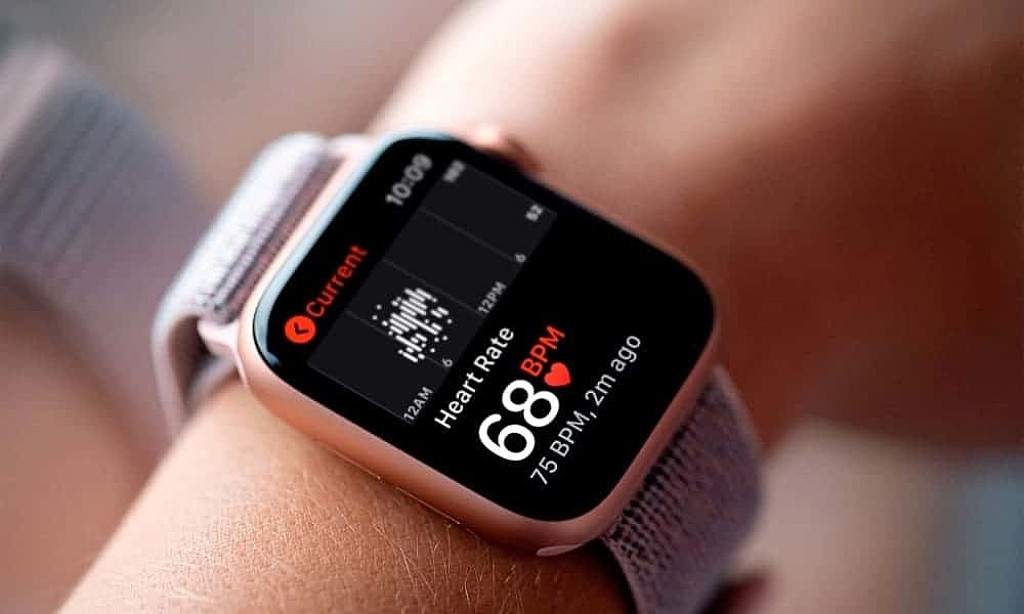
Why You Should Be Skeptical About Your Wrist-Based Heart Rate
Every week or two, I’ll open an athlete’s training log and it seems like a blood-curdling scream leaps off the page.
“My body is being weird! My heart rate was way too high on this run!”
Or . . . "My body is being weird! I couldn’t get my heart rate up on this run!”
As Edgar Allan Poe could tell you, little is more disconcerting than a screwed-up heart beat. And sometimes these athletes’ hearts seem very screwed up, a telltale sign of a major issue. Maybe they sustain 190 heart rate at a moderate effort. Or maybe it peaks at 120 on a sprint. When I first saw these issues a few years ago, worried about arrhythmia or other health crisis, I would ask them to go to the doctor immediately.
But, then, I would look at the data and notice discrepancies. Lots of studies came out that saw discrepancies too. There seemed to be a problem of faulty measurement, rather than faulty hearts. So, now, I have a standard one-question response.
“Are you using a wrist-based optical heart-rate monitor?”
Simply put, for some athletes, wrist-based heart rate is not accurate during intense activity like running, though it varies a ton. And many athletes have no idea. Let’s dig down into some of the data.
Heart-Rate-Measurement Basics
Most wrist-based heart-rate monitors rely on photoplethysmography, a word that I assume is real. Photoplethysmography involves using light to measure blood flow. That’s why your watch may have a bright LED light that shines against your skin. Light refracted off the blood flowing beneath the surface of your skin is fed into algorithms that use it to spit out a heart-rate number.
Chest straps, meanwhile, use sensors on the strap to record signals from the heart beat. This process requires some moisture, which is why you may notice readings that are off when you start a run and haven’t worked up a sweat.
Problems Wrist Monitors Face
The chest strap has the advantage of being a semi-direct measurement of heart rate. A good chest strap will be close to 100% accurate. Which makes sense, because it’s essentially reaching into your chest cavity and recording each beat with a clipboard.
As we’ll see later, many wrist monitors are not as accurate. For some, it could be as simple as not being placed correctly on the wrist, since being too loose generate a faulty reading, and being too tight can impede blood flow.
Other athletes may have physiology that is not as conducive to the technology, possibly due to locations of blood vessels or bodyfat percentage. On top of that, vigorous exercise jostles everything around, like turbulence on an airplane. You might be looking at a beautiful sunset out the window when you hit a rough patch, and now you’re looking at the sky, now the clouds, now the sun and now you’re throwing up in a bag.
Wrist-Monitor Accuracy Data
I currently have 18 windows open to different studies on wrist-based heart rate conducted since the start of 2017, and my computer fan just turned on loudly in protest. If my browser had a heart, it would currently be at VO2 max.
Most of the data from the studies has overlap, even if the conclusions vary. A January 2017 research letter in the Journal of the American Medical Association Cardiology had 50 healthy adults test four different wrist monitors and a chest strap at rest, 2 mph, 3 mph, 4 mph, 5 mph and 6 mph. While the chest strap had a 0.99 correlation with electrocardiograph readings, the wrist monitors varied between 0.83 and 0.91 correlation. That study had a conclusion that we’ll see a lot: “In general, accuracy of wrist-worn monitors was best at rest and diminished with exercise.”
An August 2017 study in the Medicine & Science in Sports & Exercise Journal had even more disheartening findings. Fifty athletes spent time on the treadmill, elliptical and stationary bike, and correlation varied from 0.75 to 0.92. As that study concluded: “Electrode-containing chest monitors should be used when accurate HR measurement is imperative.”
“That sounds pretty good,” someone might say. “It’s not imperative to be exactly right, just close.” That perspective is backed up by the conclusion of some studies. For example, a 2018 study in BMC Sports Science, Medicine, and Rehabilitation came to the conclusion that wrist-based heart rate is “acceptably close” across a broad range of activities. Looking a bit deeper into the data, that study found that during running, the heart rate numbers were within 10 beats per minute of actual heart rate 95% of the time, with around three beats per minute average error. In other words, on a one-hour run, a few minutes will be spent with a heart rate monitor giving a number that is 10+ beats off.
You think that was a lot of studies? Well you ain’t seen nothing yet. A 2018 study in the journal Digital Health found absolute error of 1% to 8% depending on device and intensity level. A 2017 conference paper found that the tested watches accurately measure up to 89% of beats accurately at rest, and less during activity. A 2019 study in the Journal of Sport Sciences found error rates between 2.4% and 13.5%.
Here’s the most fascinating one to me. A 2018 study in the BMJ Open Sport and Exercise Journal found absolute error values of 3.3% to 6.2%, but using a “10% equivalence zone,” concluded that the watches were accurate. You can see why that is a problem for athletes if you think about using the heart-rate monitor to stay below aerobic threshold (AeT). Imagine a hypothetical athlete with an AeT of 150. At 150 heart rate or below, they know they can achieve the desired training stimulus, or excel in an ultra race. A 5% error rate could mean that their heart rate is actually 157 (which would lead to lack of recovery in training or a bonk in racing).
But here’s the big problem—the errors are not consistent. If it was always 5% low or 5% high, we could use that information (you’re probably having flashbacks to the accuracy v. precision distinction from high-school science class). Instead, it’s all over the place, and since 5% is an average, sometimes it might read 190 or something that makes an athlete write a panicked entry in their training log.
It’s kind of like Michael Cohen testimony. First it says one thing, then it says another, so even if it’s right one time, how can you trust it? In this analogy, I’m not sure if I’m CSPAN or Alexandria Ocasio-Cortez.
Put It All Together
When it comes to wrist-based heart rate, it’s not an obvious answer for every athlete. A 2018 commentary in the Journal of Medical Internet Research pointed out that there is no consensus, partially due to lack of uniformity in evaluation (the same data can be used to reach different conclusions based on methodology, as we were talking about with the “10% equivalence zone” above). The gold standard of product testing, D.C. Rainmaker, has found some optical sensors that work well for him (with variation), and his tests are as rigorous as any study protocol. Anecdotally, some athletes can use certain wrist monitors and return with beautiful heart-rate graphs that track effort, while others can use the same watch and do the same workout and return with a garbly mess of incomprehensible noise.
In addition, every watch is different, and some are more accurate than others. The technology is constantly improving, and it’s possible that newer, high-quality watches have overcome some of the technological hurdles uncovered by the studies. If I were a betting person, I’d guess that wrist-based heart rate will be effective relatively soon.
If you want to do some home testing, and you think your watch might be right, do 6 x 1 minute intervals hard with 2 minutes easy recovery on your next run (or similar hard effort). Does your watch return heart-rate peaks that are as stunning as the Matterhorn, lining up with how you feel? That’s good, it probably works. Calibrate it with a chest strap to be sure.
However, if you’re like some of the athletes I have seen, the heart-rate graph will look like it was created by a random-number generator. If that’s you, there’s a good chance your wrist monitor is still accurate at rest and during certain activities, so it can still be useful. But using it for intense running would be like entrusting your timekeeping to one of those broken clocks that is still right twice a day.
(07/17/2021) ⚡AMPby Trail Runner Magazine
Does ultrarunning make you smarter?
There are plenty of reasons why ultrarunners do what they do: to challenge themselves mentally and physically, to explore a new area and to enjoy the great outdoors are just a few of the more common ones. Thanks to a group of scientists, ultrarunners everywhere can add one more item to that list: it’s good for your brain.
The authors of the study, which was published in June in the scientific journal Medical Science Monitor, wanted to find out how ultrarunning affects brain tissue. Specifically, they wanted to investigate if running long distances had an impact on brain volume. To do so, they recruited 23 healthy males runners, who they classified as either short-trail or ultra-trail endurance runners. They then had the short-trail group run a 38.6K mountain race, while the ultra trail group ran a 119.8K mountain race.
The researchers took MRI scans of the brains of each participant both before and after their races. They found that the volume of gray matter in the brains of both the short trail and long trail runners had significantly increased after their races.
The gray matter in your brain plays a role in memory and executive function, which affects your cognitive performance, balance and co-ordination. Additionally, studies have shown that having more gray matter in your brain is linked to a greater level of intelligence. As we age, we tend to lose brain volume and gray matter, which leads to age-related cognitive diseases like dementia.
The authors of this study concluded that endurance running may help prevent a loss of brain volume and gray matter as you age. It appears that ultrarunners experience the most significant effects, but even runners who go out for 50 kilometres or more can reap the brain-boosting benefits of running. As for whether ultrarunning makes you smarter, the authors didn’t say, but boosting your brain volume certainly won’t do the opposite.
(07/11/2021) ⚡AMPby Running Magazine

2021 Hardrock 100 Preview
Come the morning of Friday, July 16, 146 lucky runners will set off for 100 miles of beauty and challenge through southwestern Colorado’s San Juan Mountains in the Hardrock 100. Along the way, they’ll climb (and descend) 33,000 feet, all at elevations of up to 14,000 feet. The course switches direction with each event edition, and 2021 sees the route run in a counterclockwise direction.
Despite the insistence of some that it’s a ‘run’ rather than a ‘race,’ there’ll certainly be some at the front of both fields going for the win or another top position. This year’s edition will feature strong women’s and men’s races for the win, even if there’s not the competitive depth that the larger fields of other events allow. In the women’s race, we’ll see defending champ Sabrina Stanley challenged by Hardrock newcomer Courtney Dauwalter and three-time winner Darcy Piceu. The men’s returning champion, Jeff Browning, may have even taller task in holding off a pair of talented Hardrock first timers in François D’haene and Dylan Bowman. We dive into the details of each field below!

2021 Hardrock 100 Women’s Preview
Despite only 16 of the 146 runners slated to start this year’s Hardrock at the time I’m writing this, it wouldn’t surprise me if three of this year’s overall top 10 were women. In fact, we could see a pair in the top five if things play out just so.
It’s also worth keeping Diana Finkel’s course record of 27:18:24 from 2009 in mind. She set the course record traveling in the counterclockwise direction, the same direction as this year’s event. It’s also fun to note that the three-fastest ever women’s times at Hardrock were run in this counterclockwise direction.
Although she’ll be a Hardrock rookie, Courtney Dauwalter has to be the women’s favorite at this year’s race. In recent years, she’s won the 2019 UTMB, 2019 Madeira Island Ultra Trail, 2018 Western States 100, and 2018 Ultra-Trail Mount Fuji 100 Mile. Just a few week ago, she set a new course record at the San Juan Solstice 50 Mile, run not far to the east of the Hardrock course. What’s more, Courtney now bases herself up at 10,200 feet in Leadville, Colorado, so she’s plenty accustomed to the thin air she’ll find along the Hardrock cour
Sabrina Stanley returns to Hardrock as the defending women’s champion, having won the 2018 race in 30:23. Since then, she’s won the Hurt 100 Mile (2019) and Diagonale des Fous (2019) along with the shorter Mount Cheaha 50k in February 2020 and Quest for the Crest 50k this May. Last year, Sabrina managed to set the women’s supported FKT for Nolan’s 14—twice. A resident of Silverton, Colorado, she’s fully acclimated to the altitude and knows the course well.
If there’s a current Queen of Hardrock, it’s Darcy Piceu with her three Hardrock wins (2012-14) among her seven finishes while she continues to be a near lock for the women’s podium any given year. Indeed, she finished second in 2015 and 2017, her two most recent runs at the race. More impressively, she has twice as many sub-30 hour Hardrock finishes (six) than another other woman (Diana Finkel has three), and, as far as consistency, Darcy has finished all seven of her Hardrocks between 28:57 and 30:15!? Back in 2018, Darcy won both the Andorra Ultra Trail and Angeles Crest 100 Mile. Darcy did battle a serious injury earlier this year, but bounced back with a win at the Jemez 50 Mile in late May and a second at the Squaw Peak 50 Mile in mid-June.
Meghan Hicks has a pair of Hardrock finishes, with a rough 39-hour finish in 2015 and an improved 34:25 in taking fifth in 2016. In 2016 and again in 2020, she set the then women’s supported FKT for Nolan’s 14. This spring, she took third at Scout Mountain 50 Mile. More important, she’s been living and training on the course since March.
2021 Hardrock 100 Men’s Preview
While this will be his first time running the race, that makes France’s François D’haene no less of a favorite to win this year’s Hardrock. Why? He’d be on a very short list of best mountainous 100-mile trail runners in the world with three wins at UTMB (2012, 2014, and 2017) and four wins at Diagonale des Fous (2013, 2014, 2016, and 2018). Without Kilian Jornet, Xavier Thevenard, or, maybe, Jim Walmsley (he knows these mountains well) here, it’s François’s race to lose outside of the San Juan Mountains and the challenges they hold taking it from him. After a light 2020, François tuned up for Hardrock in taking third at the 112k Ultra Cabo Verde Trail in May. It’s worth noting that when snow canceled Hardrock in 2019, he came over and spent a few weeks training on the Hardrock course anyway and he’s back in the area acclimating and scoping the course for at least two weeks again this year.
After trying to get in for seemingly forever, Dylan Bowman will be another Hardrock rookie challenging for the men’s win. Bowman’s damn good at mountainous 100 milers and spent plenty of years living and training in the Colorado Rockies. Among the reasonably recent results that show his chops in the mountains are a third at Transgrancanaria in 2020, wins of Ultra-Trail Mount Fuji in 2016 and 2019, and a seventh at UTMB in 2017. While he lives in Portland, Oregon these days, he’s been living at altitude in Mammoth Lakes, California and training in the Sierra Nevada for much of the past month.
Jeff Browning returns to Hardrock as the defending champion, from winning in 26:20 back in 2018 following the disqualification of Xavier Thevenard. Among his three other Hardrock finishes, he took fourth in 25:42 in 2016 and fourth in 26:58 in 2014. Earlier this year, he won the Zion 100 Mile. Late last month, Browning dropped out midway through the Western States 100 due to dead quads and wanting to save something for Hardrock. In 21 years of running ultras, it’s only the second time he’s DNFed a race, with the other being due to a sprained ankle at UTMB 2015. Browning will be 49 years old on race day.
High-altitude 100 milers seem to suit Ryan Smith, who won Leadville in 2019 and High Lonesome in 2018. Going back a few years, Smith was ninth at UTMB in 2015 and 22nd there the following year. Other top results include fifth at the shortened to 47k Ultra-Trail Mount Fuji in 2016 and 16th at the 85k Trail World Championships at Penyagolosa in 2018.
One shouldn’t underestimate Trevor Fuchs on a mountainous 100-mile course. He’s won the Hurt 100 mile in 2020, taken second at the Bear 100 Mile in 2019, and won the Wasatch 100 Mile in 2016 and 2017. I’m looking forward to finally seeing Trevor race in person.
Although it’s been quite a while, Julien Chorier has twice run Hardrock, winning in 2011 in 25:17 and taking second to Kilian Jornet in 2014 in 25:07. This Frenchman may no longer be able to run that fast of a time, but he continues to have success, placing ninth at TDS and seventh at Ultra Pirineu in 2018 and finishing fourth at Transgrancanaria and 17th at UTMB in 2019. Earlier this year, Chorier took 13th at Transgrancanaria.
If you’re going to follow this year’s Hardrock, you should know Troy Howard, who finished third in 2018 after finishing second in both 2009 and 2013. One could be worried that he took 14th at the relatively small San Juan Solstice 50 Mile in late June, but he was 12th there in 2018 ahead of his third place at Hardrock. Troy simply knows what he needs to do for a good finish at Hardrock. I should add that Troy will be 48 years old on race day. That goes along with Browning at age 49, Smith at 42, and Chorier at 40. That’s a solid masters field right there!
(07/11/2021) ⚡AMPby I Run Far
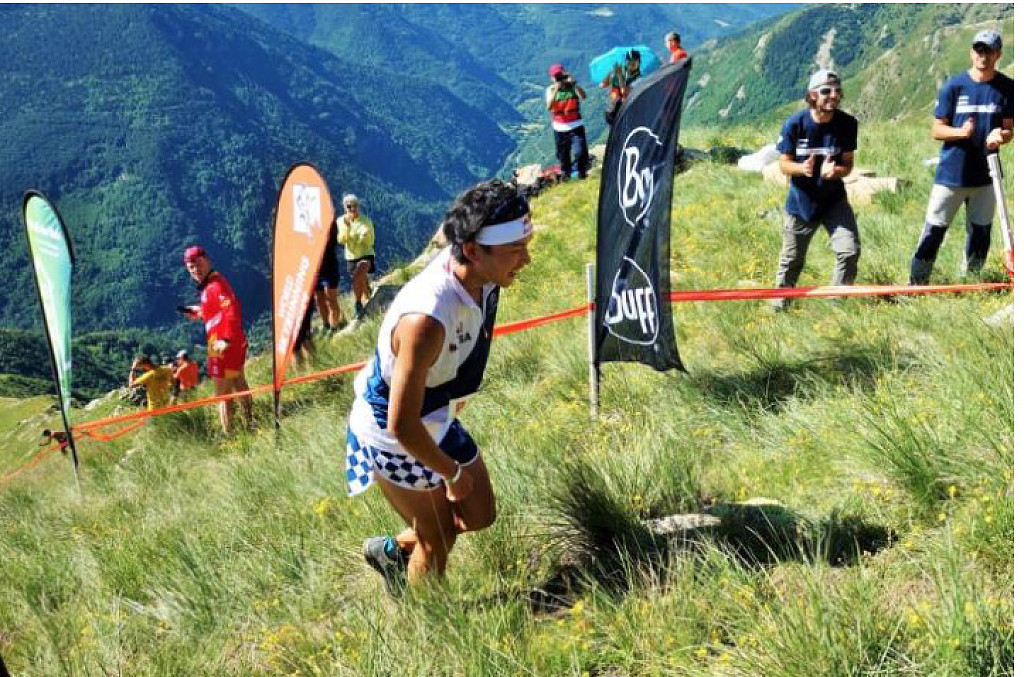
Ruy Ueda Wins Skyrunning World Championships Vertical Kilometer
Even after the sport came to a standstill for a year, Japan's Ruy Ueda has continued his climb up the ranks. The Skyrunning World Championships kicked off July 9 in Catalunya, Spain, as part of the BUFF Mountain Festival. Going head to head with Europe's best, Ueda crowned the first day of the Championships by winning the vertical kilometer race. It was his first individual world title since being named the 2019 Syrunner World Series champion, and he aims to make it a double crown in Sunday's Sky Race.
The vertical race at this year's World Championships climbs 1000 m over a 2.8 km course from town of Barruera. Immediately going to the front of the field of 33, Ueda had a 7-second lead by the 2.2 km checkpoint after 481 m of climb. He held his lead from there, crossing the finish line in 35:06 to claim the world title. In 2016 he was 10th on the same course in 36:27 at that year's World Championships.
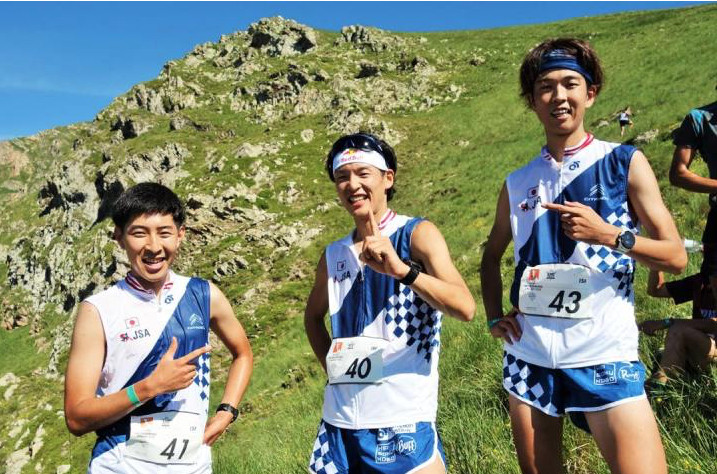
32 seconds back in 2nd was Spain's Daniel Osanz Laborda, 23, the 2018 and 2019 Youth World Championships gold medalist and 2019 Vertical Kilometer World Circuit champion. Switzerland's Roberto Delorenz was 3rd another 17 seconds back, also 23 and likewise a division champion and the 2017, 2018 and 2019 World Youth Championships.
While the men's race was close, Czech runner Marcela Vasinova easily dominated the women's field of 20, winning by more than two minutes in 41:00. Last year Vasinova won the Swissalpine Davos 68 km and Matterhorn Ultraks 25 km and was 7th in the Golden Trail Championships in the Azores. Just last weekend she took 5th in the Marathon du Mont-Blanc. 2nd in 43:14 was Spain's Oihana Kortazar Aranzeta, 3rd at last month's Olla de Nuria. France's Iris Pessey was 3rd.
Among the other members of the Japanese national team, Ryunosuke Omi was 7th and Masato Kamishohara 19th in the men's race, with Suzuha Kusuda 15th and Ayaka Ueda 17th in the women's race. The Skyrunning World Championships continue Saturday with the 68 km Sky Ultra Race, then wrap up Sunday with the 42 km Sky Race. Ueda is entered in the Sky Race, aiming for a second world title to go with his Vertical title on the opening day and the combined title.
Vertical Kilometer results:
Women
1. Marcela Vasinova (Czech Republic) - 41:00
2. Oihana Kortazar Aranzeta (Spain) - 43:14
3. Iris Pessey (France) - 44:26
4. Lina ElKott Helander (Sweden) - 45:18
5. Silvia Lara Dieguez (Spain) - 45:46
-----
15. Suzuha Kusuda (Japan) - 52:04
17. Ayaka Ueda (Japan) - 52:56
Men
1. Ruy Ueda (Japan) - 35:06
2. Daniel Osanz Laborda (Spain) - 35:38
3. Roberto Delorenzi (Switzerland) - 35:55
4. Manuel Da Col (Italy) - 36:05
5. Oscar Casal Mir (Andorra) - 36:52
-----
7. Ryunosuke Omi (Japan) - 37:44
19. Masato Kamishohara (Japan) - 41:59
(07/11/2021) ⚡AMPby Japan Running News
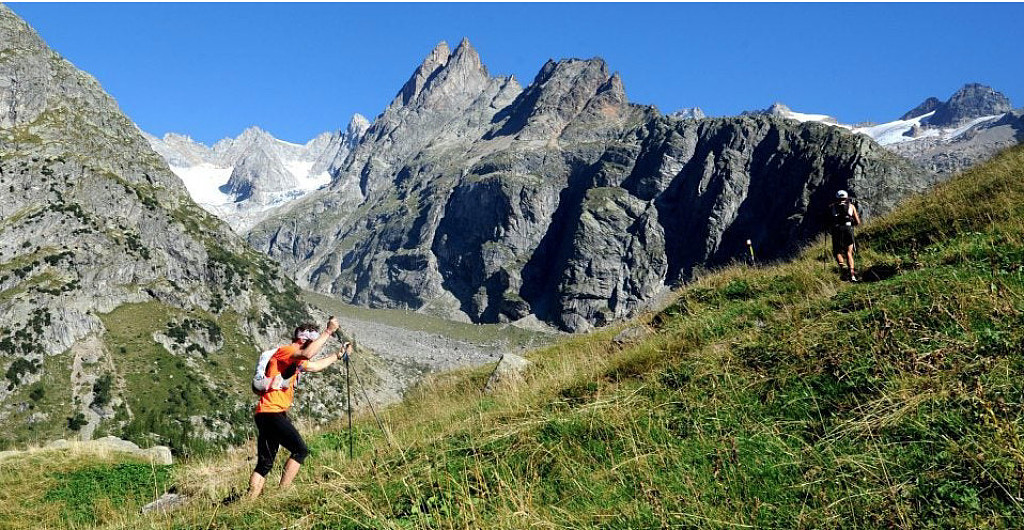
What It Takes to Run a Mountain-Ultra-Trail Race
The physiology of events like the Ultra-Trail du Mont-Blanc is radically different from “short” events like the marathon
Immediately after stumbling across the finish line of the 2019 Ultra-Trail du Mont-Blanc, the legendarily punishing mountain-ultra-trail event, 56 runners hobbled over to the National Ski and Mountaineering School in the French resort town of Chamonix. Waiting there was a team of scientists with a roomful of lab equipment to measure the precise physiological toll of their exertions. The problem: one of the tests required them to run on a treadmill for four minutes while their breathing was measured. Many of the super-fit ultrarunners couldn’t stay on the treadmill for that long, so the scientists altered the protocol on the fly and shortened the treadmill run to three minutes.
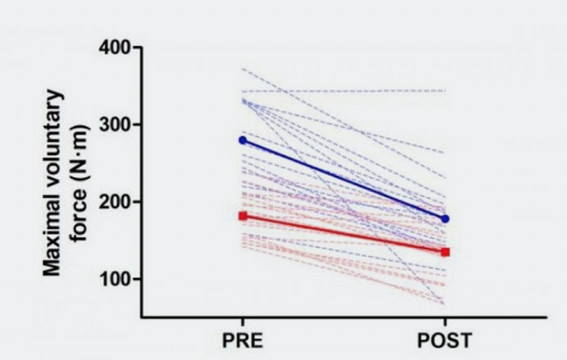
Running ultras is hard; so is studying them. Can you really get volunteers to run on a laboratory treadmill for 24 hours? Well, yes, you can—and Guillaume Millet, a researcher at the Université Jean Monnet Saint-Etienne in France (and himself an accomplished ultrarunner) has been there, done that, and published the paper. But you get more plentiful and realistic data by studying ultrarunners in the wild. So Millet and his colleagues recently published the sixth in a series of studies from that 2019 UTMB. Here are some of the insights from those studies about what it takes to run through the mountains for hours on end, and how your body responds to the challenge.
Long and Short
This year, about 10,000 runners will participate in seven different UTMB races over the course of a week in late August. The runners studied in 2019 ran one of two “short” distances (25 and 34 miles) or three “long” ones (62, 90, and 105 miles). The distance is just part of the story: the longest race, for example, also includes almost 33,000 feet of climbing and descending. The men’s winning time in 2019 was over 20 hours.
The range of distances provided a perfect opportunity to test how leg muscle fatigue responds to different durations of running. It’s pretty obvious that your quadriceps and calves will be weaker right after you run 100 miles. But it’s less clear where that fatigue originates. Is it your muscles? Your brain? The signaling pathway along your spinal cord that sends messages from the brain to the spinal cord? Millet and his colleagues put the runners through a series of neuromuscular strength tests before and after the races. There was a test of voluntary strength, but they also used magnetic stimulation of the brain and electric stimulation of the nerves to elicit involuntary muscle contractions, in order to tease out exactly where strength was lost.
After the long races, voluntary quad strength decreased by 38 percent, compared to just 27 percent in the short races. Part of the fatigue arose in the brain: even though the subjects were trying to push as hard as possible, the outgoing signal from their brains was smaller. The muscles themselves were also weaker: for a given level of electric stimulation, they produced less force. (The spinal cord played only a minor role.) In the quads, the difference between short and long races was explained by more muscle fatigue, rather than more brain fatigue.
Surprisingly, though, calf strength declined by 28 percent after both the short and long races: in this case, the extra distance didn’t seem to make a difference. When you compare these results to previous ultrarunning studies, a somewhat confusing picture emerges. Beyond a certain point—about 15 hours of racing, the data suggests—longer races don’t seem to make your muscles more tired. That may be because you can go faster in shorter races, and intensity is a key cause of fatigue—particularly if you’re hammering down quad-busting mountainsides. The scientific picture remains murky, but if you happen to run one of these races, you might want to adopt “After 15 hours, it won’t get any worse!” as an encouraging mantra.
Men and Women
Ultrarunning is one of the rare sports where top women sometimes beat top men—a feat that always prompts discussion about the physiological differences between sexes, and whether women have ultra-friendly characteristics that help them overcome the edge in muscle strength and red blood cell count that men get from testosterone. That’s a long and involved debate, but one of the hypotheses is that women’s muscles fatigue more slowly than men’s. It does appear that women have, on average, a higher proportion of endurance-linked slow-twitch muscle fibers, and better blood flow to feed those fibers.
In the UTMB data, women did indeed seem to show less muscle fatigue after the race. Here, for example, is the individual (dashed lines) and average (solid lines) data for quadriceps strength in men (blue) and women (red), before (PRE) and after (POST) the races:
The men were stronger before the race and stronger after the race—which makes sense because they had to propel bigger and heavier bodies through the mountains—but they had a bigger strength decline. This fits with previous research showing better muscular endurance in women.
There’s a twist, though. The researchers also asked each runner to rate their “competitive intentions” on a scale of 0 to 10, with 0 corresponding to “I tried to do the best time possible” and 10 corresponding to “Fun mode: my only goal was to finish the race.” Here’s what those scores looked like in the short and long races:
In this case, the men seemed to be more focused on their time, particularly in the short races—which, it turns out, is where the differences in muscle fatigue were most pronounced. This opens a different can of worms regarding potential sex differences in competitiveness. On one hand, this idea seems irrelevant to the question of why top women can compete with top men in ultra races, because the women who win races are clearly not in “fun mode.” On the other hand, women have repeatedly been shown to pace themselves better in endurance events, an observation that may be linked to overly competitive (or, to use the technical term, “stupid”) early pacing by men.
Millet’s new data can’t answer these questions, but it adds to the evidence that patterns of fatigue tend to be different in men and women. The elephant in the room, though, is participation rates. Only 257 of the 2,543 starters in 2019 were women. Until the numbers are more even, it’s risky to draw any general conclusions about sex differences.
Flat and Hilly
There have been numerous attempts to figure out which physiological traits predict how you’ll do in an ultra trail race. For ordinary road marathons, the three key parameters are VO2 max (the size of your aerobic engine), lactate threshold (which roughly tells you how much of your engine capacity you can use over a long period of time), and running economy (the efficiency of the engine). But those three factors are less useful in trail ultras: a study I wrote about a few years ago found that standard lab tests had decent predictive ability over 50K, less value over 80K, and no use at all over 160K.
Two of the things that make trail ultras so different are (as the name suggests) the terrain and the distance. It’s one thing to measure running economy on a treadmill in the lab. But how much does your running economy change when you’re climbing a steep hill? Or when your legs are rubberized by 20 hours of running? Millet and his colleagues explored both those questions: they tested running economy on a level treadmill, and also at an uphill gradient of 15 percent, before and immediately after the races.
Here again there was a counterintuitive result: running economy got worse (meaning the runners had to spend more energy to cover a given distance) after the short races, but not the long races. Previous research has shown that both intensity and duration of exercise can hurt running economy, but there seems to be a threshold where if you’re going slow enough, your running economy won’t suffer no matter how long you’re out there. In fact, an earlier study found that running economy actually improved after the 200-mile Tor des Géants race, perhaps because an ordeal that brutal trims any wasted motion from your stride.
As for the effect of slope, previous research has found that the most efficient runners on level ground aren’t necessarily the most efficient going uphill: running up mountains is a unique and specific skill. But the new data found that post-race changes in efficiency on level ground were strongly correlated with changes in uphill efficiency, which suggests that the underlying cause—mostly likely stride-altering fatigue in the muscles, rather than changes in your metabolism—affects your stride whatever the terrain.
For better or worse, none of this makes UTMB any easier. Millet even co-wrote a whole book called How to Succeed at UTMB (the English translation is unfortunately out of print), collecting the accumulated scientific research and practical wisdom from runners and coaches who specialize in mountain trail ultras. It’s a hefty read, and drives home the point that, from a physiological point of view, these races are not simply extra-long marathons. “It’s more complicated,” Millet told me at a conference a few years ago. “That’s probably why I like it so much: it’s more interesting.”
(07/10/2021) ⚡AMP
by Outside Online
