

Running News Daily
Running News Daily is edited by Bob Anderson and team. Send your news items to bob@mybestruns.com Advertising opportunities available.
Index to Daily Posts · Sign Up For Updates · Run The World Feed
Search Results for Ultra
Today's Running News



Race nutrition for every distance
Race nutrition is tricky, and knowing exactly what type and how much fuel to take in during a race can take some trial and error. Sports nutritionist Anne Guzman addressed this in a recent blog post, and while her guidelines focused on cyclists, they are very applicable to runners. So, whether you have a 5K or a marathon on the schedule, take a look at her advice to perform your best on race day.
30 min — one hour
The first category in Guzman’s infographic can be equated to a 5K-10K race for most runners. For these short races, just drinking water will likely be enough, provided you’ve eaten well the night before and the morning of the race to ensure your glycogen stores have been topped up.
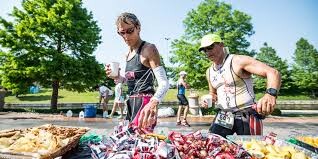
If you’re running a 5K on a temperate day, for example, simply drinking some water before the race and re-hydrating afterward will be adequate — no mid-race drink necessary. On a hot day, you may want to consider grabbing a few sips of water from the aid station, but even then, as long as you’re well-hydrated going into the race, you likely won’t need much while you’re running.
As your race gets longer (up to an hour), Guzman says carbohydrate mouth rinses can help “lower our perception of pain and/or send messages to muscles leading to additional recruitment of muscle fibers,” although, she admits, the mechanism behind how this works is still somewhat unclear.

Similarly, she says consuming a small amount of carbohydrates in the form of a sports drink or a gel with water can help improve performance as your race gets a bit longer. Still, if your race is less than one hour, this extra carbohydrate isn’t crucial to your performance, and runners should be careful to only do what they’re comfortable with/what they have practiced, to prevent stomach issues.
10K — half-marathon
If your race is lasting longer than an hour, taking in carbohydrates during the race becomes more important for delaying fatigue and improving performance. While Guzman makes a few different suggestions for cyclists, runners completing these distances should probably stick to sports drinks and gels, since running can be a bit harder on your stomach than cycling.
Guzman suggests taking in 30-60 grams per hour, from either a single carbohydrate source (like glucose) or a mix (like glucose, sucrose and fructose). Whatever carbohydrate source you choose, make sure you eat it earlier in the race so your body will be able to use it in the latter stages when fatigue is starting to set in.
Marathon and up
As experienced marathon runners know, your mid-race fuel can make or break your performance, since runs of this duration surpass the amount of carbohydrates your body can store. To have success in events lasting longer than two hours, it’s crucial that you go into the race with a fuelling plan, and that you are strict about sticking to that plan.
Most experts recommend taking in about 60 grams of easy-to-digest carbohydrates per hour during a marathon. Again, unlike cyclists, marathoners should stick to drinks, gels and chews to get their carb fix, since those tend to be easier on your digestive system (not to mention they’re easier to carry with you, as well). Of course, once you move up into the world of ultrarunning, you’re going to need even more carbohydrates to get you to the finish line, and runners in these events can start to add denser foods, like potatoes, waffles and energy bars into the mix.
The fuelling strategies for marathoners and ultramarathoners often look quite different, but they have one thing in common: runners must practice them before their race. Stomach issues can ruin your performance on race day, so it’s important to practice ahead of time to know what works and doesn’t work for you.
(03/10/2022) ⚡AMPby Brittany Hambleton
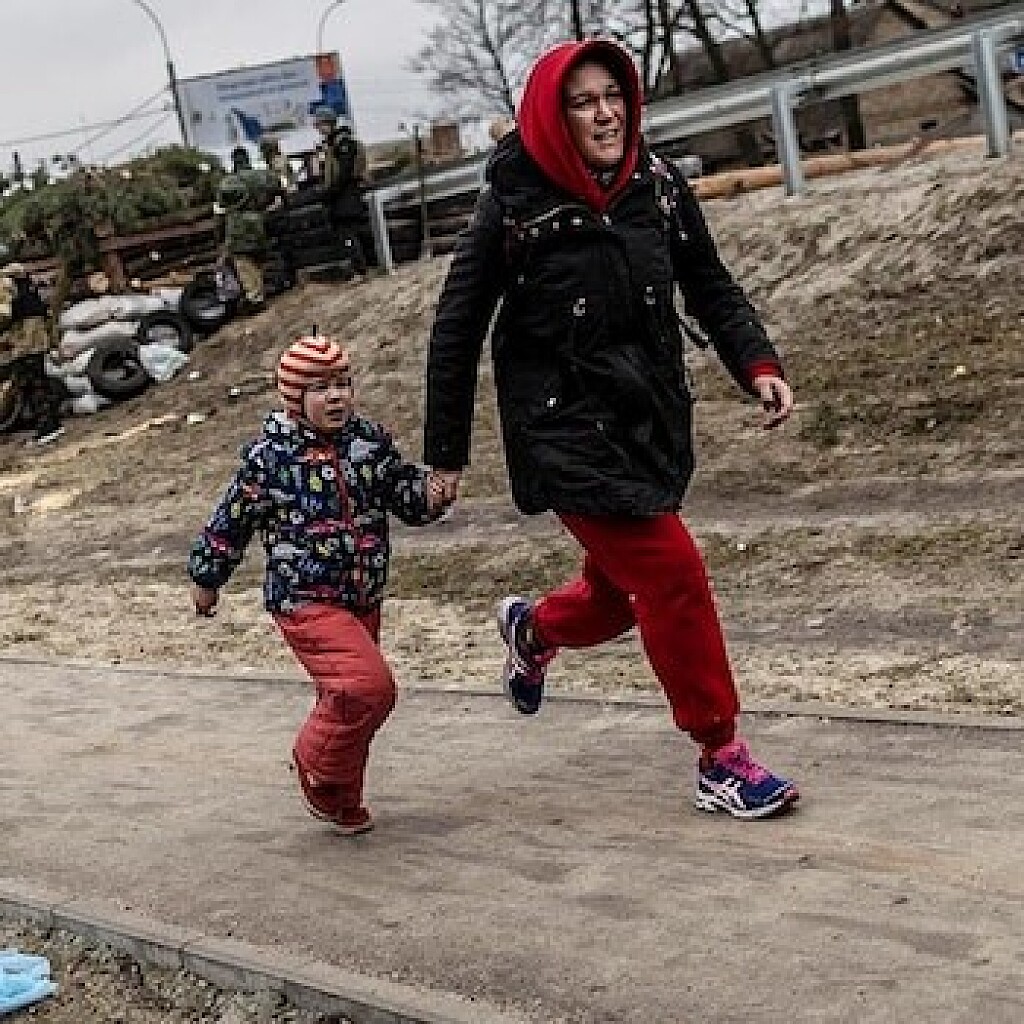
Inside the War: Dispatches From a Ukrainian Race Director
On February 24, after Russian forces invaded Ukraine and ignited one of the largest conflicts Europe has seen since 1945, Trail Runner Magazine reached out to the country's running community in support, to learn more about what's happening on the ground, and provide a platform in solidarity.
(My Best Runs wanted to share this with our readers. What is happening is terrible and we must tell the world what is going on there.)
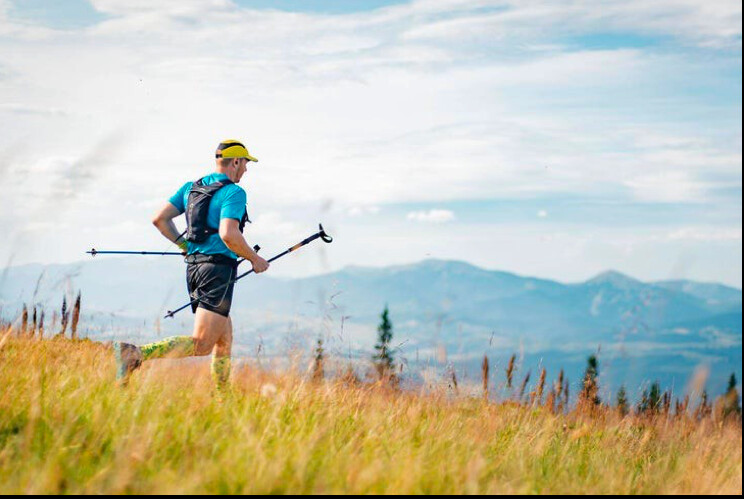
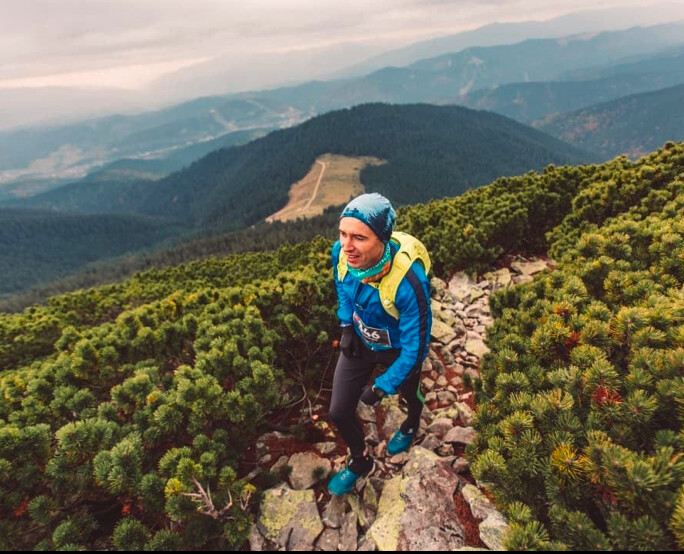
We quickly connected with Yaroslav Turenko in Lviv, western Ukraine, who is the race director for one of the country's largest trail races, the Lviv Ultra-Trail series. Turenko is a passionate trail runner, volunteer, and photographer. Here's what he had to say:
Nicholas Triolo for Trail Runner: Can you tell us what it's like on the ground where you are? What is the general sentiment of the Ukrainian people right now?
As you've likely heard, the worst-case scenario in Ukraine is unfolding. We are facing horrible acts of Russian aggression. They have invaded our country and have started to kill innocent people, bombing our cities, military, and civilian infrastructure. Their military is using the most inhumane methods: local populations used as human shields, women and children dropped off when attacking armored vehicles. The occupiers have killed children, shooting them at point blank.
These are war crimes. Crimes against humanity using tactical weapons of mass destruction, prohibited weapons, and ammunition. Many people in the world think this war is far from Central Europe, but a Russian missile was just dropped on a Ukrainian military base, located 24 miles (40 km) from the European Union border.
We've lost unique Ukrainian works of art in fires, along with the largest plane in the world - Ukraine's Antonov-225 cargo plane - destroyed by Russian strikes outside Kyiv.
But Ukraine is united like never before; all of our internal political disagreements are in the past. All the Ukrainians inside the country and abroad are doing everything possible to stand up and give a proper fight to Russian forces. We ask the international community to stand with Ukraine. But we need international support. We need shelter for our families. We need to close off air traffic from Russia. We need equipment for our defenders and sanctions for Russia.
Andrii Tkachuk, the world record holder in the 48-hour treadmill race and the national record holder in 24- and 48-hour ultramarathons, is currently defending the country in the Ukrainian Armed Forces.
TR: The city of Lviv, where you are, is located in the western part of Ukraine, far from the Russian border. Are you in any immediate threat? Are you in touch with people in Kyiv and other places currently under fire?
We are supporting each other, yes. Everyone in Ukraine can find shelter here in Lviv (pronounced "Luh-VEEV"). However, there is no guarantee that Lviv is a safe place, but right now we see a significant difference between Lviv and other cities in central and eastern Ukraine.
Lviv is a hidden gem of Europe. It's a charming, bohemian city, a UNESCO World Heritage site. It's the city of cafes and pubs, and some surprisingly awesome trail running. There will be no more Lviv Ultra-Trail until the enemy is defeated. Lviv is amazing, remarkably inexpensive by European and international standards, and I sure hope that the Lviv Ultra-Trail will take place again.
TR: Are you turning to your local trail running community for support right now? What can trail and mountain running do to help promote peace and understanding in the world?
We sent all the money from the Lviv Trail Running Club bank account to raise funds for the Ukrainian Armed Forces. Other organizers and trail communities have done the same. All volunteers involved in initiatives related to this development are working with refugees, blood donation, first aid, and cooking food for large groups of people.
Andrii Tkachuk, the world record holder in the 48-hour treadmill race and the national record holder in 24- and 48-hour ultramarathons, is currently defending the country in the Ukrainian Armed Forces.
We are kindly asking the International Skyrunning Federation (ISF) and International Trail Running Association (ITRA) to ban all Russian race evaluation and certification. As far as we know, the Lviv Ultra-Trail banned Russian runners after the annexation of Crimea, and the war in Donbas and Luhansk regions. We are calling for the ban of all Russians from international events like the UTMB World Series, the Golden Trail series, and others sponsored by ISF and ITRA.
TR: Pivoting away from the invasion for a moment: How would you describe trail running in Ukraine to someone who doesn't know much about your country?
Trail running in Ukraine has been developing extremely fast. Every year, the number of events and participants has grown. Among the most popular trail running events are the Tvoya Prygoda Series, Fun Carpaty, Lviv Ultra-Trail, and Ukrainian Trail League series.
Ukraine is a beautiful country with extraordinary nature and breathtaking landscapes, which makes it possible to run trails in nearly every part of our land, year round. The best place for trails, in my opinion, are the Carpathian Mountains, with some peaks above 6,500 feet (2000m) above sea level, with high humidity in every season. (Mount Hoverla is Ukraine's highest peak at 6,762 feet).
Serhii Popov is considered one of the fastest trail runners in Ukraine. He has won national trail and long distance mountain running championships almost every year since 2015, and took part in nine world championships. He is also an ultrarunner with the best national performance time in the Men's 40+ age group for 50K and 100-mile road races.
On February 24, Popov planned to fly to Spain, to take part in a six-hour ultrarunning event in Barcelona, with the goal to set another national record. But in the morning, he woke to bombing sounds from the Boryspil airport, where he was planning to depart a few hours later.
"The first night we spent in the basement of our friends in Irpin, near Kyiv," said Serhii. "It is right next to the Hostomel airport where fighting with the Russians just started. Explosions were so loud that the walls shook. This continued in the morning and we decided to reach the city of Zhytomyr, where my wife's parents were, and our car. As soon as we got to the city, we realized the return trip was not possible, so we decided to stay there and do what we could.
"I could not join the local defense forces. They are only taking people with appropriate combat experience, which I don't have. So we went to shops and carried food and water to block posts," Serhii said.
"The city of Zhytomyr is preparing to meet the enemy. Everybody in the city is trying to help - building fortifications, collecting all the army needs. We often will hear sirens and sometimes the sounds of explosions. But mostly people are calm and ready to stand up for their land."
(03/06/2022) ⚡AMPby Trail Runner Magazine
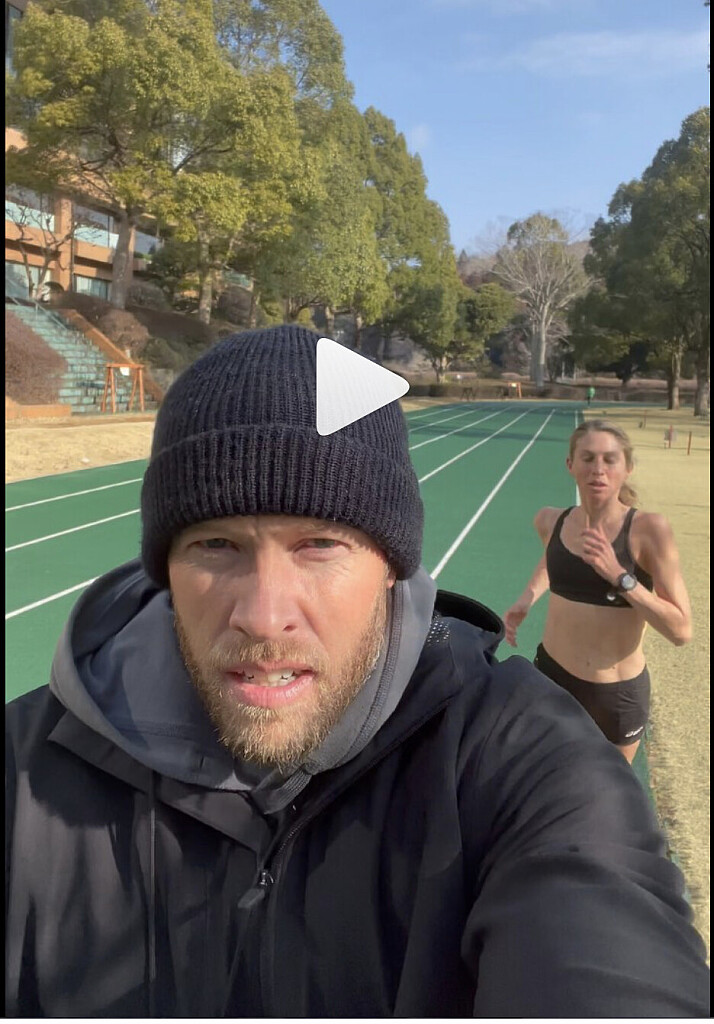
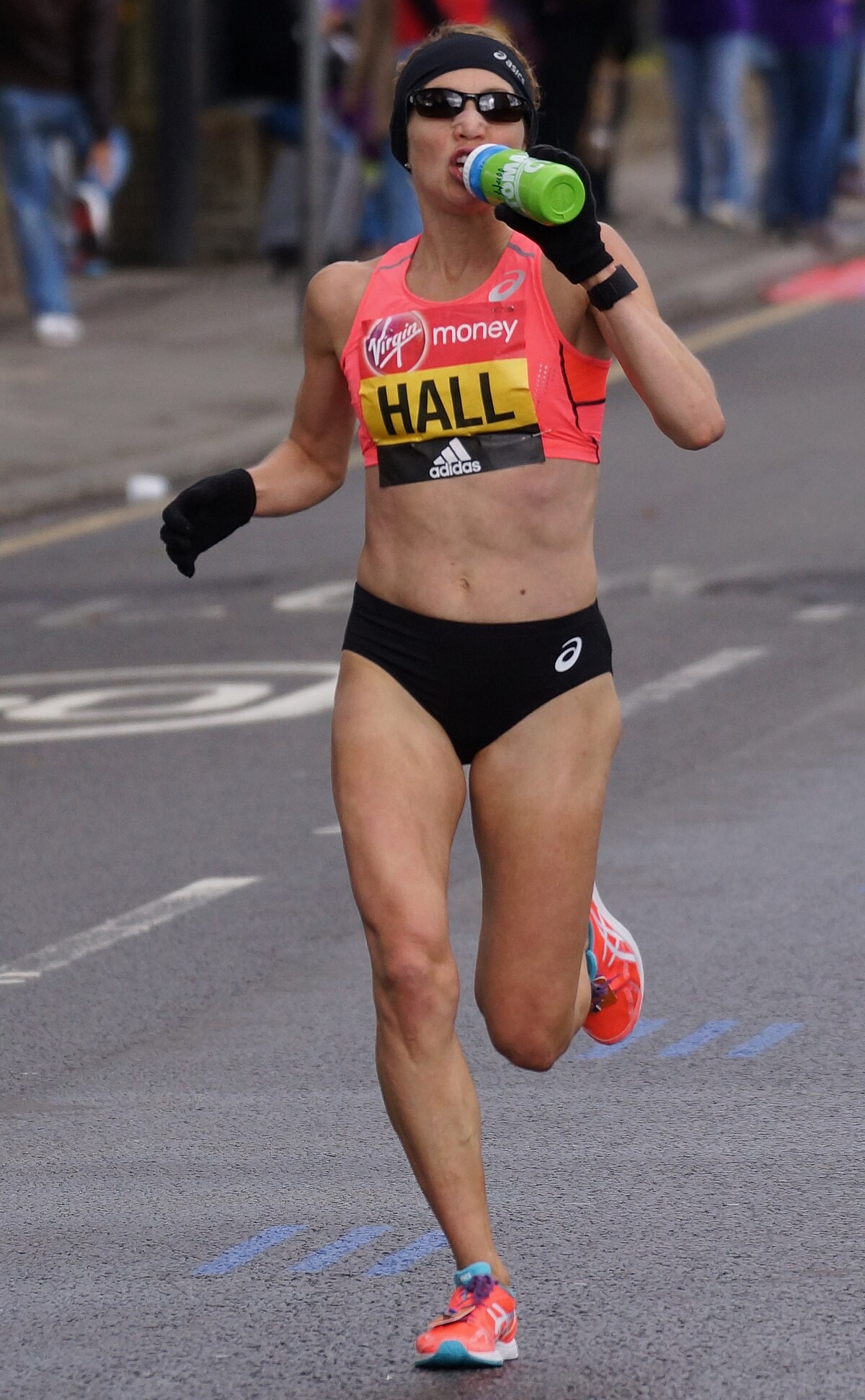
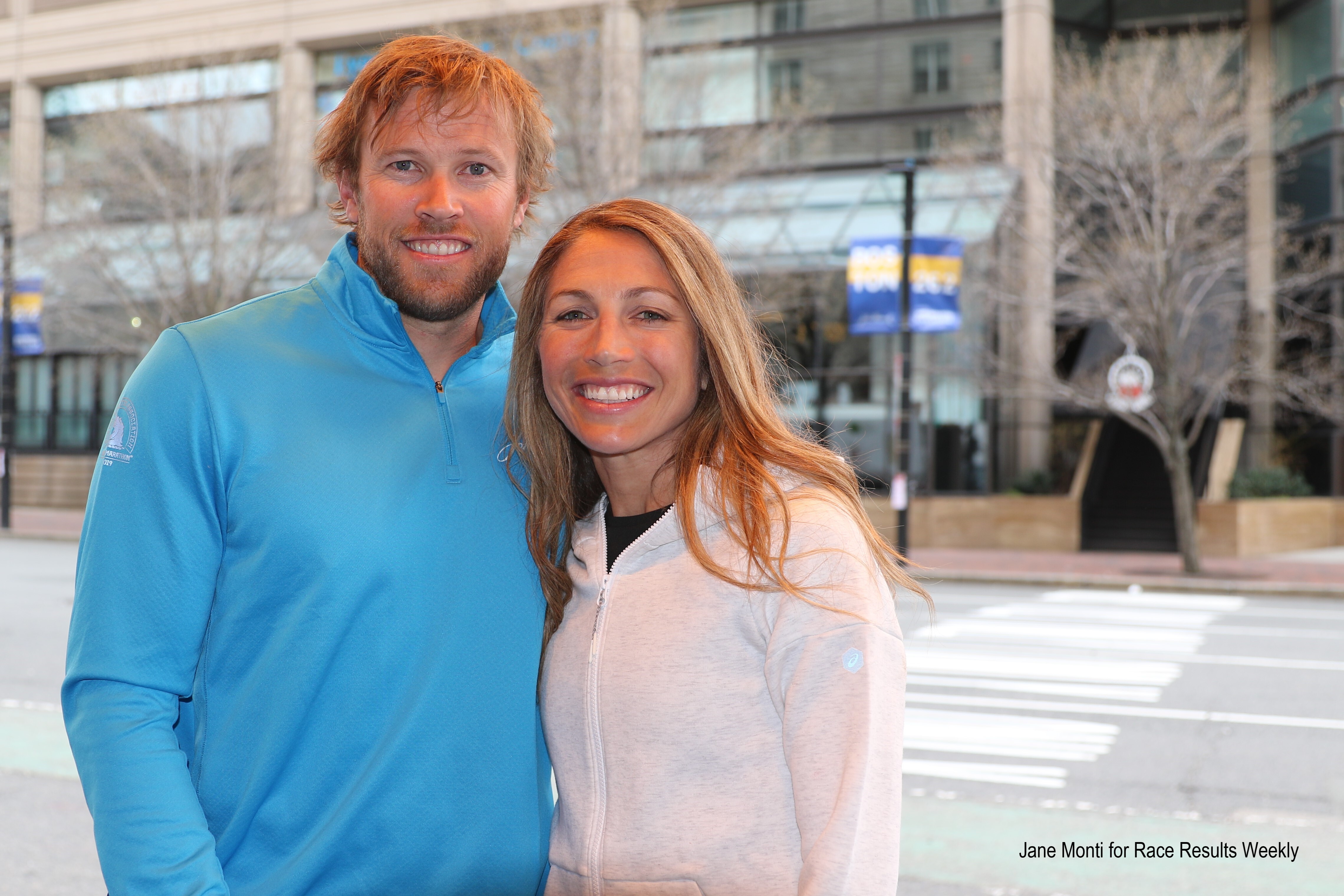
Olympian Ryan Hall Shared His Best Advice for Working Out Before a Big Race
The record-breaking marathoner offered his tips for optimizing your pre-race routine, as well as some common mistakes to avoid.
Former Olympic athlete Ryan Hall might have packed on the muscle and set his sights on mastering feats of strength since retiring as a professional long distance runner, but he still holds the American record for fastest marathon and the world record for fastest half-marathon. All of which is to say, if you're preparing for a race yourself, there are worse people to turn to for advice.
In the lengthy caption to a new Instagram post, which sees him coaching his wife and fellow ultrarunner Sara through her last training session prior to the Tokyo Marathon this coming Sunday, Hall shared his top tips on what to do—and what is best avoided—while working out before a big race day.
Hall notes that it can be tempting to go hard in order to try and and "prove" your fitness to yourself as you approach the big day, but that you need to resist this urge, as it can have a detrimental effect on your performance when it really matters. "This is where I see the most mistakes made," he says. "Whether it’s easy running or light workouts, the point is to show up to the starting line fresh and hungry rather than depleted and having left your best stuff in training."
If you're unsure of how intensely you should be running in the days leading up to a race, Hall suggests threshold running with long strides. In other words, running at a constant pace that does not cause lactic build-up in the muscles. "Most athletes come out of threshold workouts feeling much better compared to MVO2 max/interval workout," he says.
"Stick to what works for you," he also writes. "The only way to find out what that is is through experimentation. Play with the workout timing and components."
Preparation for a race is not just physical, though: Hall speaks about the psychological aspect as well, saying: "It’s most important that you believe in what you’re doing. Confidence is of utmost importance prior to a race."
(03/05/2022) ⚡AMP
by Mens Health
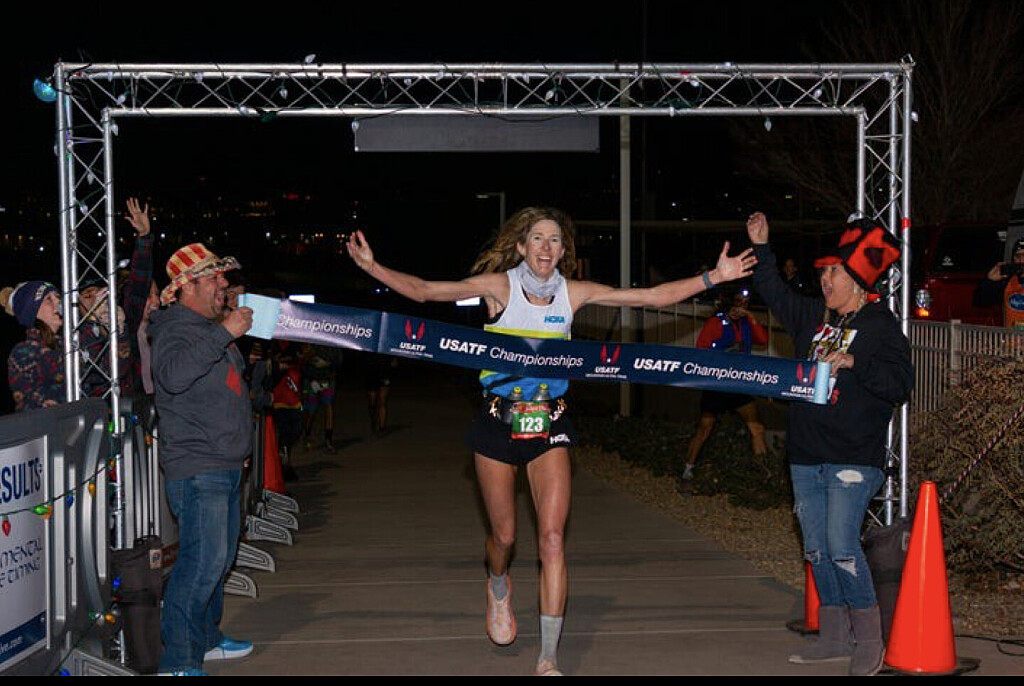
Camille Herron Breaks Her Own 100-Mile World Record- And Then Some
"What a difference a year makes."
That was the first thing Camille Herron had to say when she reflected on her latest record-breaking run at the Jackpot Ultra Running Festival on February 19. Herron, a new addition to the master's division (as of December 2021), opened her 2022 campaign with a commanding performance.
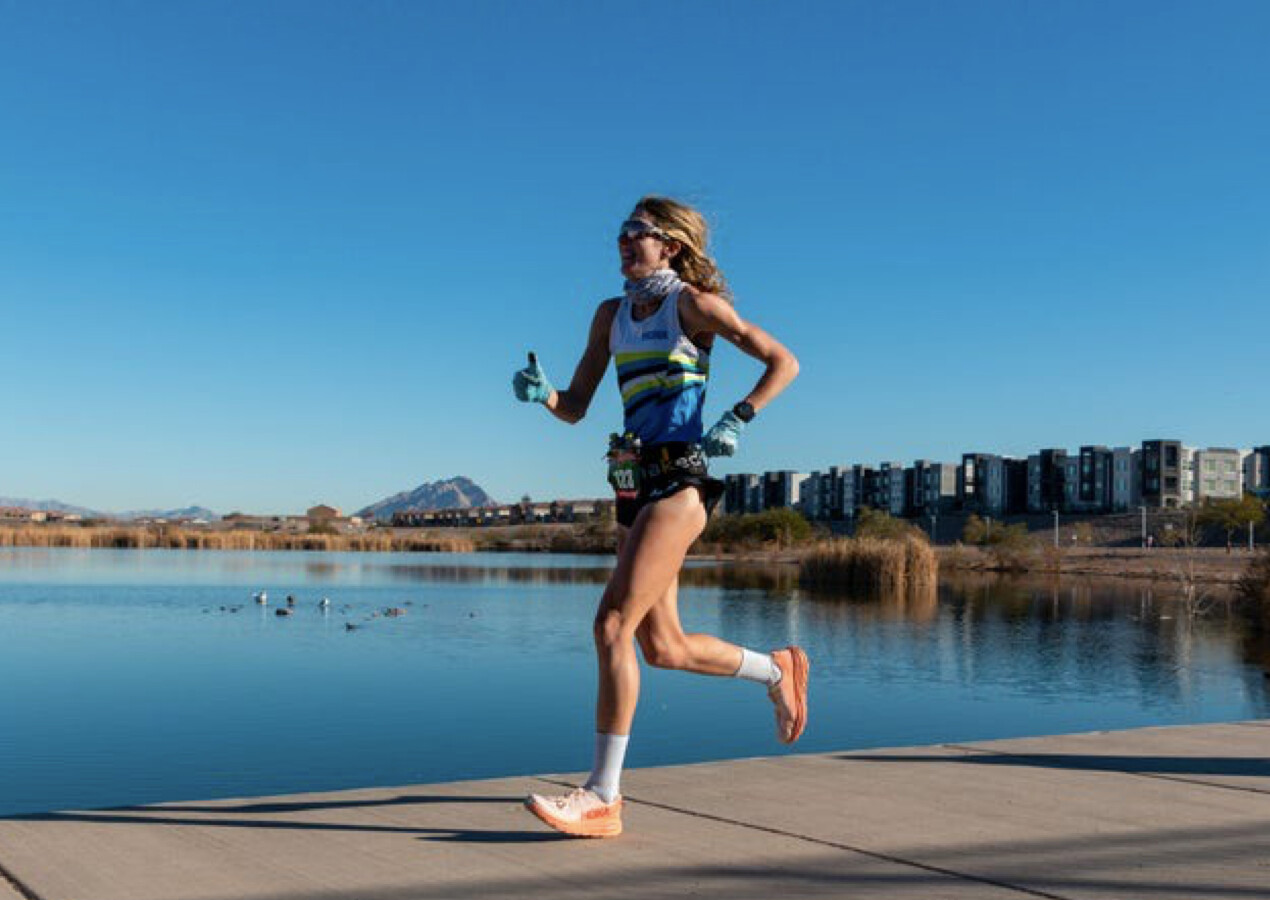
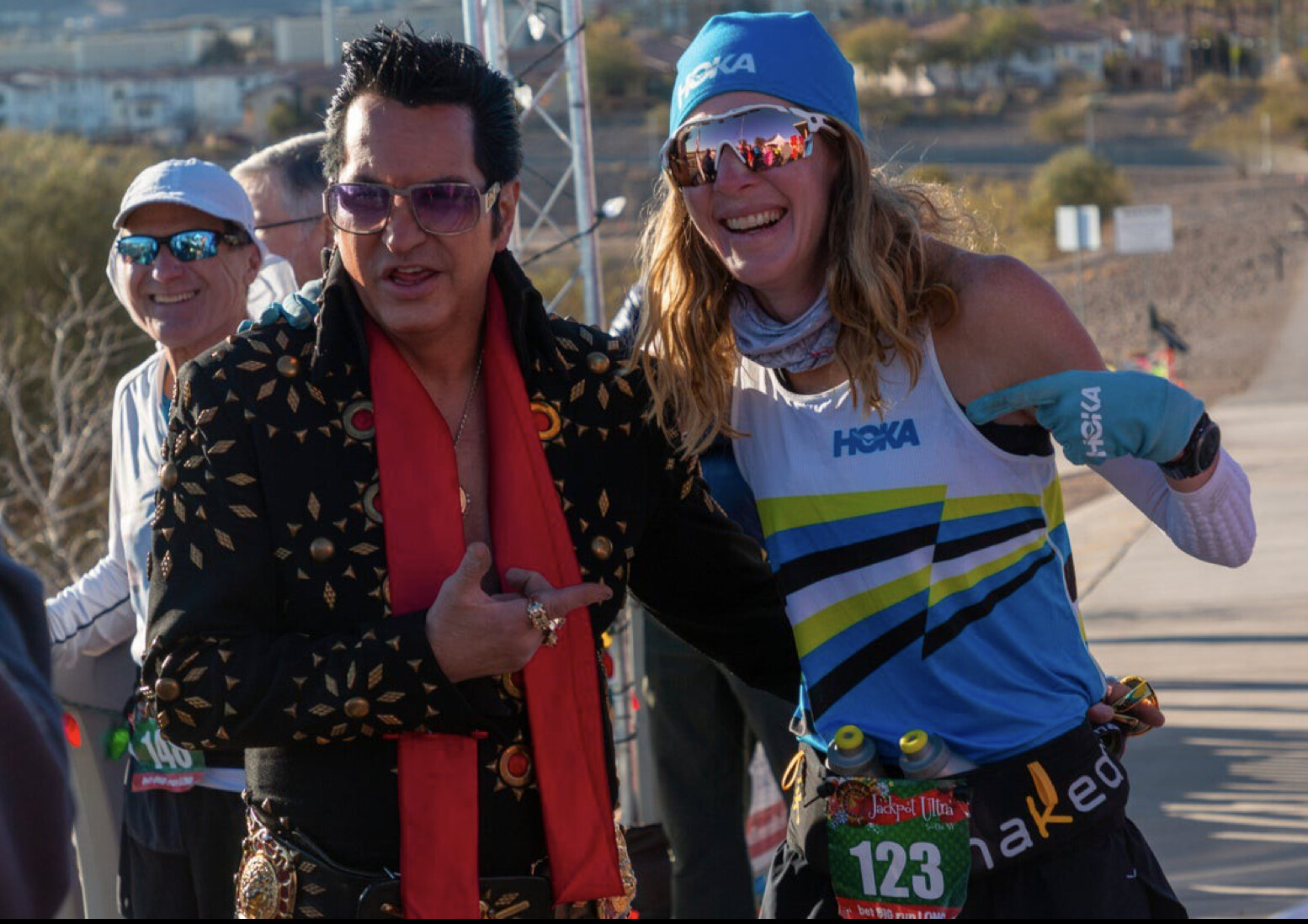
She was the outright winner of the 100-mile race and the USATF 100-mile national champion; she set a 50-mile age group world record (6:08:24), a 12-hour world record (94.5 miles), and a 100-mile world record (12:41:11, breaking her own previous record of 12:42:40 from the 2017 Tunnel Hill 100).
For Herron, this performance, coupled with dominant wins last fall at the Javelina Jundred and Desert Solstice, is just what the doctor ordered after a tough 2021.
"I ran the Jackpot 100 last year and I just didn't feel good during that race," Herron says. "It was the fourth race that I just didn't feel right. I'd hit 40 miles and want to lie down and sleep. That followed me to Western States."
That tired feeling turned out to be a result of high iron levels and low levels of magnesium and vitamin B12. The iron overload was the main culprit, which she learned from InsideTracker data. Most endurance athletes commonly have low iron levels. The result of Herron's iron excess was anemia-like symptoms.
"I was feeling so bad. My breathing was heavy, I was extremely tired, and it wasn't normal race fatigue," Herron says. "It was pretty scary."
To normalize her iron, Herron worked with her longtime friend and dietitian, Jackie Dikos. Together, they mapped out a plan starting in July. By mid-August, Herron "had [her] mojo back and was feeling energized."The jumpstart catapulted Herron back into training, hitting paces she hadn't seen in years. That's when she got the bug to go after her 2017 100-mile record.
The record was something she'd contemplated for 2020 before the pandemic hit. She nearly went for it after feeling better in 2021 at a race in Hungary, but food poisoning pulled her from the start. That was after a hip flexor injury cost her a six-day race in Germany.
Fast forward to Javelina Jundred and Desert Solstice, Herron was looking for redemption.
"Going into Javelina, I was fired up," Herron says. "I was overdue for a good race. I broke the course record by like 49 minutes. I wanted to keep that fire going."Hitting the Jackpot
A week and a half after moving home to Oklahoma after three years in Arizona, Herron was on a plane with her husband and coach, Conor Holt, to Las Vegas for the Jackpot 100. Most of all, she wanted redemption from her 2021 outing there. Breaking 13 hours sounded good, but if her record was in reach, she wanted it.
That's where she found herself at the 50-mile mark. Her 6:08:24 split was enough for the 40-44 age group world record, and that had her on pace for the 100-mile record. She kept her foot on the pedal.
"Between the elevation gain and the heat, it was much more fatigue than I felt in previous world records," Herron says. "I was trying to assess how my body felt at 50, and I was feeling quite a bit of fatigue. I had to wrap my head around having to endure the second half of the race."
Battling minor issues from the heat and a nosebleed, Herron troubleshot everything the race threw at her. Around mile 75, she caught race leader Arlen Glick.
Herron saved time by only stopping once during the entire race. That lone,15-second break came around mile 70, when she shotgunned a non-alcoholic beer: an Upside Dawn Golden from Athletic Brewing."You know when you do long runs and you have a craving for a beer? Because of the iron overload, I've had to cut out alcohol. So, I've been hooked on non-alcoholic beer," Herron says. "I've never done a beer mile, but I guzzled it pretty fast."
With three laps to go of the 85 total, Herron had already secured the 12-hour record. Doing the math, she realized she was 20 seconds under her 100-mile world-record pace. There was no margin for error. With three miles to go, Herron dropped the hammer.
"I went into beast mode," she says. "I thought about Keira D'Amato chasing down Deena Kastor's marathon record. [Keira] powered through those last miles. I channeled that and thought back to what my high school track coach would say, 'Lift your knees. Drive your arms.'"
Holt cheered Herron on until she came across the line in 12:41:11 for the new world record and the outright win. In the final three miles, she went from a 20-second cushion to break the record by almost 90 seconds. Her final mile was 7:08, and her average pace over the full 100 was 7:37.
"As a woman, you can't be afraid that you could win the race," Herron says. "I've done it a few times now. It was added motivation as I was going after [eventual men's winner] Arlen Glick. Everything worked out. Pretty much, every goal I had, I achieved. I was overjoyed."Eyes on the Prize
Herron is back to the top of the 100-mile ranks as she enters her Western States training block. At 40, she's more fired up than ever to deliver the best performances of her career.
"I can remember hitting my 30s and thinking I'm on some downward slope," Herron says. "We need to shift that mindset. When I look at my training logs from 10 years ago, it's crazy. I used to do long runs every Sunday. As I've gotten older, I've taken better care of myself. If I do one or two long runs a month, that's good enough for me. I've said, women ultrarunners age like fine wine. What I may not have in leg speed anymore, I make up in physical and mental strength to keep going."
Herron credits changes in her diet and training, and the addition of a squat rack, for her continued strength as she enters into the master's ranks. These are the tools she plans to use in preparation for Western States. If all goes to plan, she will be a force to be reckoned with come June.
"I just feel like I have to keep going back and try to have a magical day there," Herron says. "Now that I've run the entire course, it's gonna be fun to go back and push my human limits. I'm hoping to have that dream day."
(02/26/2022) ⚡AMPby Trail Runner Magazine
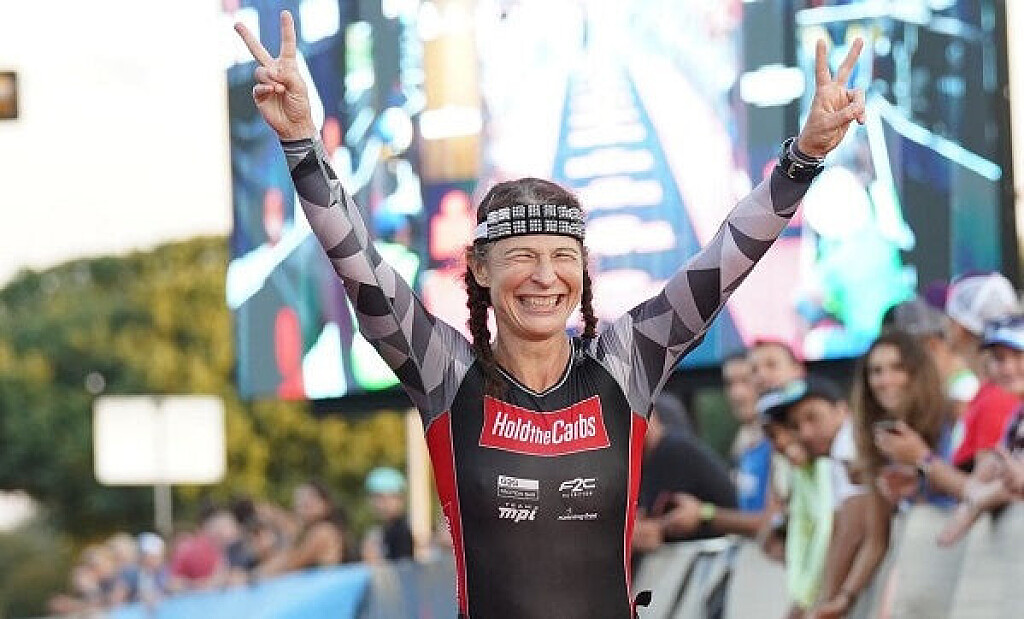
Canada’s Viktoria Brown breaks the 72-hour world record, she ran 464 kilometers over three days
Canada’s Viktoria Brown has done it again. The Whitby, Ont. native ran 464 kilometers in 72 hours at the Jackpot Ultra Festival in Henderson, Nevada over the weekend, breaking the previous record that was set 32 years ago.
The previous record was held by New Zealand’s Sandy Barwick, who ran 460 kilometers over 3 days in 1990 on her way to setting the six-day world record, which still stands to this day at 883 km. Brown’s record has yet to be ratified, but once it is, this will be her first world record. She already has three Canadian records, including the 48-hour record (346 kilometers), the 72-hour (440 kilometers) and most recently, she became the first Canadian woman to run 100 miles in under 15 hours at the Desert Solstice 24-hour and 100-mile Track Invitational, setting a new Canadian record in 14:57:13.
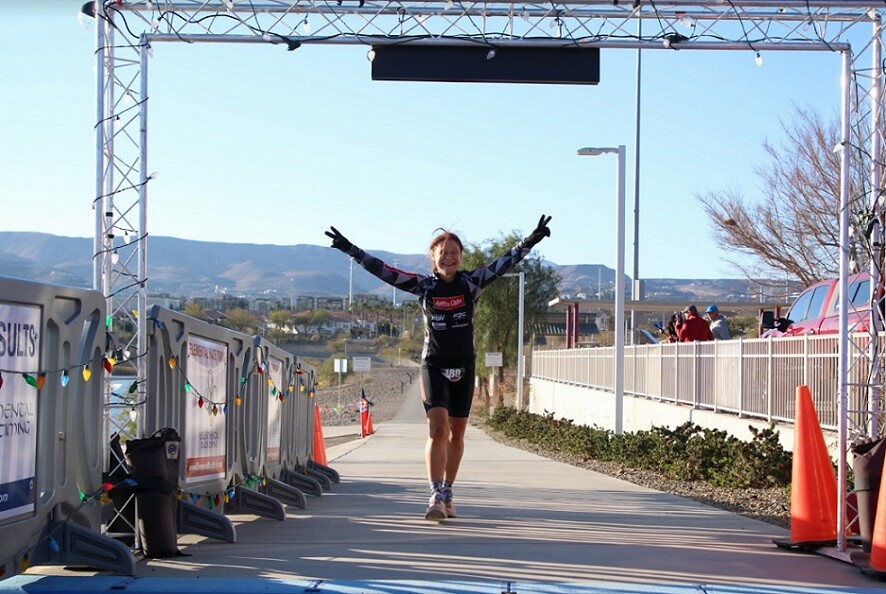
“My main goal was to go 3 days deep once more before I attempt a 6-day race and try to find solutions to logistical, gear and nutritional issues as well as handling my asthma for such long races,” says Brown. “The course itself wasn’t flat or easy which made this a harder challenge than I had expected.”
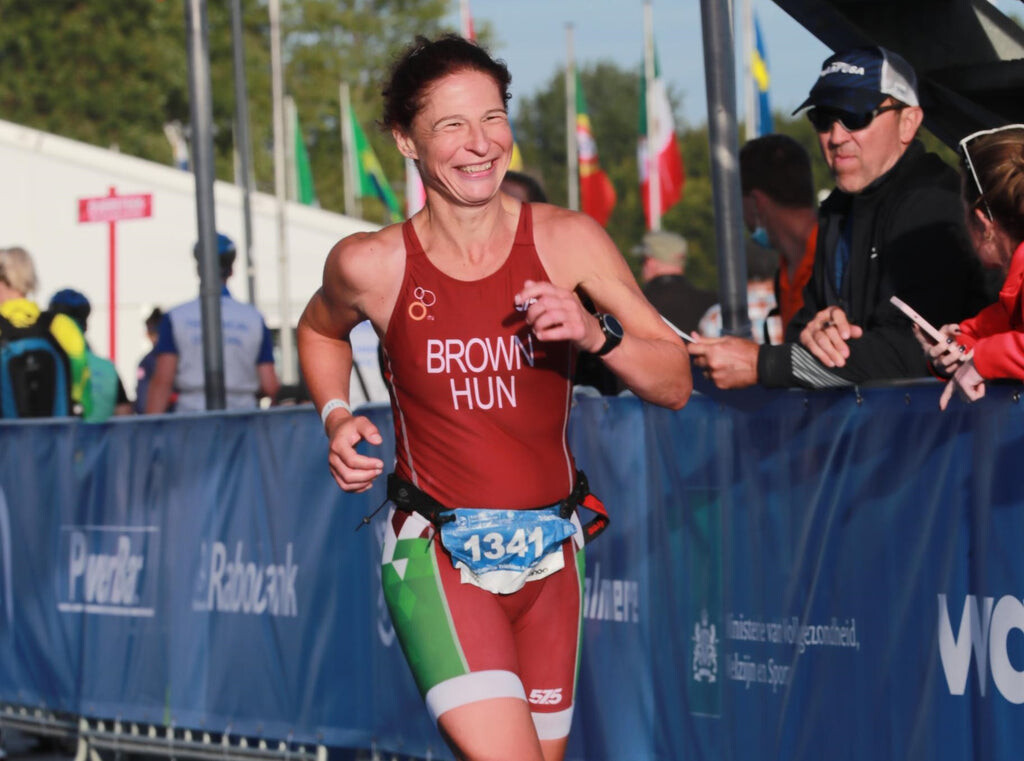
To make matters more challenging, her crew chief’s flight got canceled due to storms and was unable to make it to the race, so her friend had to step up and fill his shoes, barely sleeping for the entire 72 hours. Still, they managed to pull it off. By the third day, Brown knew she was very close to the record, but if she wanted to surpass Barwick’s distance, she couldn’t afford to take any walk breaks. “I’m very happy with the result, but I believe I can do better on an easier course, and I also know that if I want to go after the six-day record, then I will have to do better for the first three days,” says Brown.
With yet another record under her belt, Brown shows no sign of slowing down, and Canadian ultrarunning fans will be watching to see what she does next.
(02/24/2022) ⚡AMPby Brittany Hambleton

Carbs, fats, proteins: what’s the best diet for runners? Researchers say a balanced diet is best for runners looking for better performance
Advice for runners about performance nutrition can be confusing and often contradictory. Should you eat more fat and restrict carbs to increase fat burning? Or should you increase your carbohydrate intake so you always have a quick source of fuel? New research suggests that for most runners, the best diet is one that contains a balance of fat and carbohydrates for optimal performance.
Fat oxidation and performance
When you exercise, your body primarily uses carbohydrates (glucose) and fat for energy. Your body will always use the easiest energy source first, which is usually blood glucose. From there, it will draw upon your glycogen stores to use for fuel, but this process takes a bit longer because you have to convert glycogen to glucose before you can use it.
The problem with glucose and glycogen, however, is that your body only has so much of it, so it needs to be replaced by taking in exogenous carbohydrates (think gels, sports drinks, etc.). Fat, on the other hand, is stored in the body in much greater quantities, and provides more energy per gram than carbohydrates. The problem with fat, unfortunately, is that your body needs oxygen to burn fat for fuel (a process called fat oxidation), which means you have to slow down enough so that you can get the oxygen you need for this process to happen.
This isn’t helpful for short-distance runners like sprinters, or runners competing in races like the 800m or the mile, but fat is a valuable fuel source for long-distance athletes. As long as you can get enough oxygen to use fat, you could presumably run for hours while burning fat for fuel.

Over the years, researchers, coaches and athletes have experimented with high-fat, low-carbohydrate diets during training to “teach” your body to burn fat more efficiently for fuel, but is this really necessary, or effective? That is the question researchers recently attempted to answer.
The study
The authors of the study, published in the journal Frontiers in Physiology, had 28 competitively-trained male distance runners (who ran half-marathons, marathons and ultras) complete an incremental exercise test to exhaustion, as well as three three-hour runs, each with a different carbohydrate-feeding protocol. Throughout the experiment, participants were consuming a balanced macronutrient diet of approximately 57 per cent carbohydrates, 21 per cent protein and 22 per cent fat.
After the endurance tests, the researchers found that the participants were able to achieve a high level of fat oxidation despite consuming a mixed macronutrient diet and consuming carbohydrates during their run. They also found that runners who consumed the highest amounts of carbohydrates during their run were the most likely to experience GI distress, highlighting the importance of moderating your mid-run carb intake to maximize performance while minimizing stomach troubles.
The bottom line
If you’re wondering whether you should consider using a low-carbohydrate, high-fat diet to maximize your body’s ability to burn fat for fuel, this research says it’s likely not necessary. Runners who consume a diet that has a balance of carbohydrates, fats and protein are able to use fat for fuel efficiently during a long run.
Of course, the runners in this study were well-trained athletes, which means their bodies are able to use all types of fuel very efficiently. So how can less-experienced runners improve their rate of fat oxidation? Simply by training. By training consistently, your body will become more and more efficient at using both carbs and fats for fuel, which will allow you to run faster and longer.
(02/21/2022) ⚡AMPby Brittany Hambleton
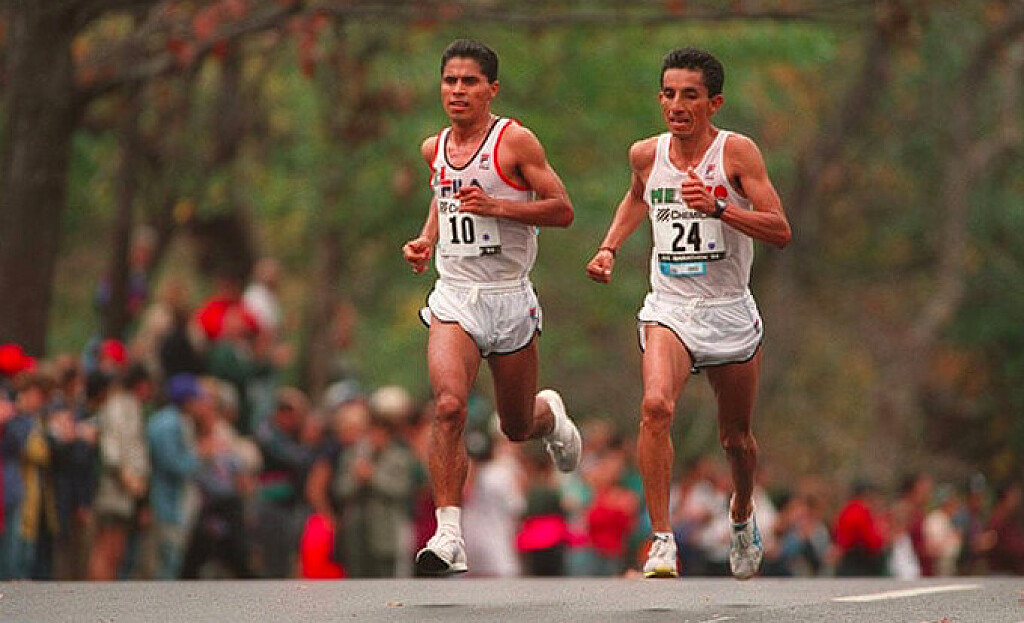
NYC Marathon Champion Germán Silva Makes Ambitious Run Across Mexico
What do you do when you’ve already won the New York City Marathon (twice), competed in the Olympics multiple times and won a silver medal at the IAFF World Half-Marathon Championship?
For Germán Silva, who grew up in Veracruz, Mexico, the answer went far beyond marathons or even ultramarathons. He opted to run across the entirety of Mexico. A new article by Kevin Sieff at The Washington Post documented Silva’s genuinely epic journey.
Sieff notes that the run encompassed 3,134 miles, which Silva — now 54 — estimated would take him four months to complete. (That’s a little over 119 marathons, for those keeping track.) His journey began in Tijuana on November 5, and is slated to end in Tulum later this month.
For the bulk of his journey, he’s been running 30 miles a day. As Sieff — who joined Silva on the road for parts of his journey — writes, Silva’s goal for this run is to alter the public image of Mexico and reveal some of the country’s regions that are less in the spotlight.
His journey is being documented for a film to further this goal. That’s not the only educational component of his run. He’s also had his quadricep biopsied before his run, and will again afterwards, to get a sense of how such a feat changes the human body.
As for what he’s eating on the road, Sieff writes that Silva’s diet is predominantly cacao, ground maize and mineral water. Doesn’t sound like a bad combination at all.
(02/20/2022) ⚡AMPby Inside Hook
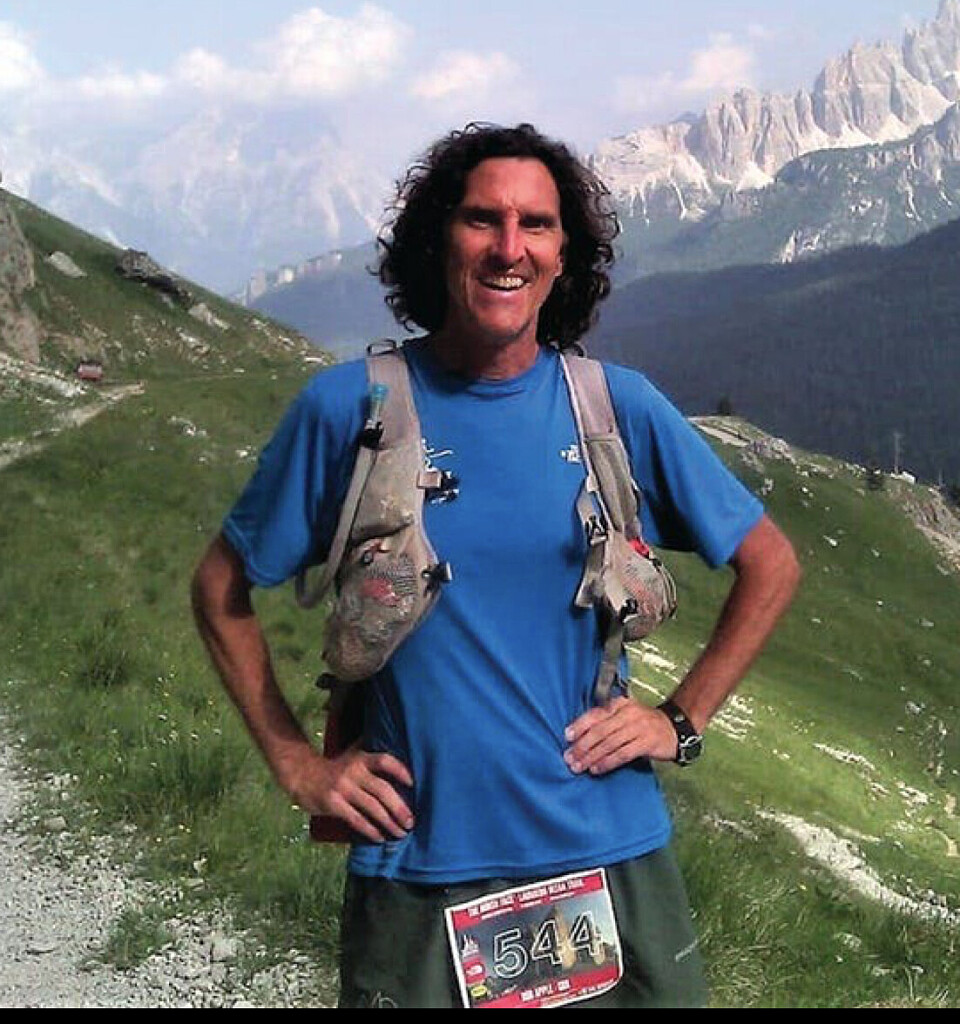
The Man Who's Finished 761 Ultras
Rob Apple ran three ultras in 2020. With only four slated for 2021, he's in trouble. Well, kind of.
Since 1990, Apple, now 59, of Murfreesboro, Tennessee, has averaged 24 ultras a year. If that number seems absurd, well, meet Rob Apple. Sucking on a peppermint candy as he bounces along a greenway near Stones River Battlefield, he's the jolliest runner you're likely to meet. With his headlamp on and his buds blaring AC/DC, you'd never imagine this guy was the most prolific ultrarunner in history.
For starters, he laughs a lot. No, really a lot! "If we knew you did all these ultra runs," his boss once told him, "we would have drug tested you." Apple lets out a chuckling, jocular laugh. It starts deep in his gut and builds up through the chest and echoes out from his wide smile like a megaphone.
He looks more like a hairband rocker from the '80s than a grizzled, sinewy athlete. His bright, glowing eyes and massive head of hair offset an enormous, gleaming smile. Many approach him and ask if his teeth are real. "Never even had braces," he says. "My mom gave me these."
If running ultras is any measure, it's easy to see why Apple is so happy: he has completed a whopping 761 of them. 761! That's over 23,560 miles from trail to road to timed track events lasting days. Add up the totals for Yiannis Kouros, Camille Heron, Courtney Dauwalter and Scott Jurek and you still wouldn't reach half the ultra miles Apple's run. And he's competed in the biggest: Leadville, Western States, Wasatch, Massanutten, Vermont, Catalina and UTMB, most multiple times. He's even run the Boston Marathon. "Yes, I've actually done regular marathons, too," he says, laughing.
Since 1976, Apple has completed a total of 903 races, including 69 marathons. His seven Western States completions are impressive, but his other race repeats are downright nuts: 18 Mountain Mist 50Ks, 21 Strolling Jims and 28 Howl at the Moon 8-hours. He has run an ultra each year since 1982 and has logged a grand total of 185,310 lifetime miles. Each race and training run is meticulously detailed in a journal he's kept since he was 16. He includes his time, the weather, what he wore and who he talked to. On top of that he loads the data into spreadsheets! An accountant by day, Apple is a numbers freak.
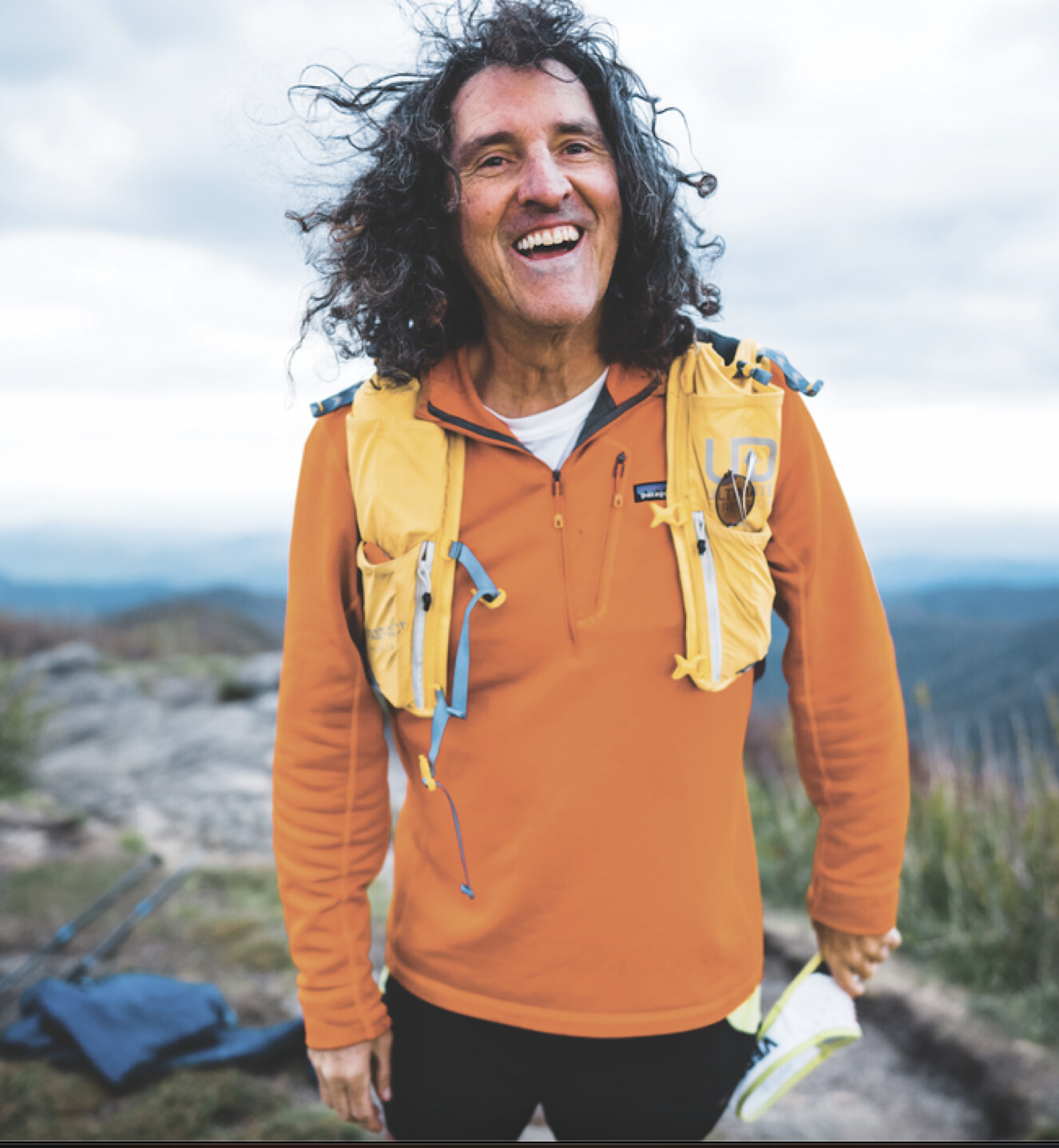
His biggest enemy now that he's 59, he says, is time. He admits he's getting slower, and DNFs due to missing time cutoffs in longer races have forced him to focus on 50Ks and European events where cutoffs are more manageable. At this point he doesn't care about improving his pace; he just wants to be out there as long as possible.
"It's not about how fast you go; it's how many pictures you take along the way," he says. But don't think he's lost his ambition. Quite the contrary. He sees himself as an astronaut on the fringe of running. His goal? To become the first in history to reach 1,000 ultra finishes.Known as the Main Street of America, Route 40 stretches from Delaware to Utah and becomes Cumberland Avenue in the tiny village of Lewisburg, Ohio. Rob Apple grew up in a small u-shaped cul-de-sac on its southern side. For him, the great highway was like the mighty Mississippi; it made him dream of taking it as far as it would go.
Something was always off about Lewisburg. A Children of the Corn kind of atmosphere. The local barber that cut his hair also burned crosses in his yard on Friday nights.
"I always knew I was going to get out of there, somehow, someway," he says.
Ironically, there was little laughter in the Apple home, and affection was rare-no hugging, no kissing. Being an only child in a poor neighborhood, he learned quickly to find his own fun. His earliest adventures were roaming around his mother's flower garden. Intoxicated by the smells and colors, he memorized their names and wrote them down, a habit he continues to this day. (He has spreadsheets for those, too.)
His mother, Ruth Ann, loved seeing people travel through. She often left food out for hoboes. As a result, they marked the telephone pole in front of her house to signal to others that they could get food there. When the famous breatharian, Barbara Moore, walked across the United States in 1960, she followed the marks and wound up at the Apple home. She left behind a food wrapper, which made its way into the family scrapbook along with a picture of Moore walking in her work boots. Ruth Ann idolized women like Moore and Grandma Gateway. She was a homebody but dreamed of someday getting out and exploring the world. According to Apple, it just wasn't in the cards. So, he wanted to do it for her.
By 13 he was the hippie kid with long hair, looking for a way out. His uncle owned a motorbike shop and turned him onto motocross, and perhaps his ticket to a large world.
"The bikers were a lot like ultrarunners," he says. "They were openminded, free, carried no judgement."
When a bad spill upended his Honda XR75, his racing career came to an abrupt halt. The gangly teen was distraught and became a roaming figure around the track. He'd show up to watch, desperate to be around it. But it wasn't the same; he needed more.
Of all the places a running career can start, the local library is an odd one. The year was 1976, and two things captured the young Apple's imagination: the Guinness Book of World Records and a black-and-white copy of a popular running magazine. It was the nation's bicentennial, and the magazine was promoting an unusual campaign. If you ran 285 miles in a year and documented it, you got a certificate. So, Apple set up a three-tenths-of-a-mile circuit around Crescent Drive and did just that. By the time the certificate arrived in the mail, he was hooked.
He ran track his freshman and sophomore years but wasn't good. His PR in the mile was a meager 5:30. He opted for trade school his junior and senior years, where he learned to draw. After graduation, Apple took a job designing school buses during the day and went to Wright State at night, where he studied accounting. Money was tight. It had always been tight. In the 10 years it took him to graduate, he'd get married, divorced and discover the one thing in life he wanted to do more than anything else: run ultras.
In another two years, he got his masters in sports physiology. A better paying job in accounting would follow, and weekends became an obsession to travel and race. Though he swore he'd never marry again, he would, and again he'd get divorced, but running would eventually take him, not only out of Lewisburg, but all over the world. In the 1980s, Apple was known as "the heartthrob of ultrarunning," says Gary Cantrell, aka Lazarus Lake. The former Trans-Am race director Jesse Riley likened him to a Greek statue. "He was just so damned good-looking, like he was carved out of marble."
He was a real chatterbox and a fun guy. Back then, he and Lake enjoyed tapping kegs post-race and watching people go to church. Lake has enough anecdotes about Apple to fill a healthy-sized book. One involves the Oak Mountain 50K, a dodgy motel with one bed, beer, weed and waking up to find trees snapped and patio furniture tossed in every direction. The two had slept through a tornado.
Lake later introduced Apple to who would become his second wife, Pam Jordan. At "Strolling Jim," she asked, "Who was that man that passed me?" Lake answered before she even finished her sentence: Rob Apple. Running finally took him from Lewisburg to Tennessee where Jordan lived.
Back then, the slim, six-foot two runner was not only handsome, but he was also fast.
"Oh, he could move," Lake says, citing a 1989 performance. At Lake's 41.2-mile Strolling Jim race in Wartrace, Tennessee, Todd White was crewing top competitor Dink Taylor when around mile 30 he looked back. "Dink, I don't know who's coming, but he's coming hard," he said. Taylor turned around just in time to see Apple fly past on his way to finishing in 4 hours 58 minutes, making the top 10. In the '80s, Apple recorded a 34-minute 30-second 10K, a 6-hour 26-minute 50-miler and logged 122 miles in 24 hours. In Richmond, Ohio, he got revenge on his high-school nemesis, the mile. In the costume themed race, he ran a 5:06 dressed as Don Johnson from Miami Vice: linen suit, teal tee underneath.
The ultrarunner and professor Dr. Thomas Mueller says Apple's attitude is everything, "He never met a person that wasn't his friend." After qualifying for Boston with a 3:06, in the race, he stopped at mile 23 to drink a cold one with a talkative spectator. He finished in 4:09. For someone dedicated to numbers, Apple is surprisingly more about the journey. He has developed a simple philosophy toward running long term: speed kills.
"If you want to be in it for 40 years, you gotta let that go," he says. The realization was sudden. Not like the inevitable giving up the ghost many experience when the body starts rebelling with age, Apple's breakthrough actually came when he was running his fastest times.
It was fall of 1990 and the 100K World Championship was coming to the Edmond Fitzgerald road race in Michigan. Apple was hyped. Just a few years before, he'd run an 8:28 and was hoping to place in the top 20. At that time, Apple was still an undergrad, and when a midterm was suddenly moved, it prevented him from participating.
Dejected, he found a closer race on the same Saturday, Virginia's Mountain Masochist 50-miler. Still, Apple couldn't get motivated, couldn't get his mind right but managed to finish feeling OK. So, for the next day, he found another race near Columbus, the Wolfpack 50K. Apple finished again, and fell in love with "weekend doubles." That weekend was a Eureka moment.
Trail running was just starting to boom, and there were now more racing opportunities than ever. And Apple started ripping them off. The Texas Trail 50K-17 finishes. The Ice Age 50K-17 finishes. The JFK 50-miler-15 finishes. The Rattlesnake 50K-15 finishes. The Vermont 100-seven finishes. Five Massanutten 100s and two Leadville 100s. And the list goes on and on and on. In 2002 alone, he ran a total of 44 ultras.
Usually a fixture at the back of races, Apple has managed a podium finish. In 2000 he was running Illinois' Howl at the Moon's half-trail/half-road ultra for the eighth time. He didn't feel particularly good starting out and didn't know what to expect. Around the halfway point, things turned around. He was feeling better and surprised that he was only down six minutes to the leader. Apple remembers thinking, "Hey, I've got a shot at this." He made a move, felt more and more energized as his pace increased. Then, he was suddenly in the lead. "I was just hoping to hang on," he says. Nervous at his prospects, he kept repeating to himself, "I want it to be over now!"That was over 20 years ago. Now, his lack of speed is his biggest impediment in reaching 1,000 finishes. In 2013, he had five DNFs, and in 2014 couldn't finish the Mountain Mist 50K, a race he's run 18 times. Apple combats the hard cutoffs of longer races by focusing on 50Ks and trail runs in Europe. While they may be technical and more difficult, the cutoff times tend to be more generous. But it's a gamble.
In 2018, he made two long trips to Europe, but weather and tough conditions resulted in two DNFs and four non-starts. His yearly output slipped to seven races, and his pocketbook took a big hit. Apple funds these adventures on his own dime. He's never had a sponsor but says he regrets nothing.
"No car or house could replace what I've spent on running," he says, a solemn tone to his voice.
Last December, Apple was looking forward to completing ultra #760 at the Bloodrock 50K outside of Birmingham, Alabama. The website describes the UTMB qualifier as "likely the hardest 50K you have ever run." With over 18,400 feet of elevation change, it is renowned as both technical and treacherous. Parts are so steep, they have ropes.
Apple had a rough go.
"I did the first loop and got back to the aid station and was going to have to do the next one backwards, which meant I would have to go down those ropes in the dark," he says. "I wasn't going to die out there, so I decided to go back to my hotel."
But yet another DNF hasn't gotten him down. Apple is so positive you expect rainbows to shoot from his eyes. He says even if time does eventually catch up with him, he's found a lot more to running trails than just the finish. In the past few years, the most important factor for him in choosing a race is location. His motto: "Never waste good meniscus on a bad view."However, when his runs began taking him to England, France, Switzerland, Scotland, Ireland and New Zealand, his second marriage also succumbed to his dedication to racing. And he's not bitter about it. Single and in great shape, he is not currently dating. He says he can't afford it, and it's too much hassle.
Apple rarely looks back. Of the 903 races he's completed, he doesn't have a single medal on his wall. Instead, he leaves them on his mother's tombstone back in Ohio. When her son would toss his medals into a corner or dump them in the closet, she would take them out and mount them on the wall. "I usually go up there every few years with about 10 pounds of medals," he says. His thick laugh trails off a little quicker. The small cemetery doesn't have anyone to clean off the stones, so Apple's medals form a sizable memorial to his biggest inspiration-the mother that taught him to dream big.
On the cusp of 60, Apple still has a lot to do. He won't say where he's planning his 800thrun, but he doesn't deny it's in Patagonia. At heart, he's an adventurer, in it for the people, the journey and the laughs. But don't tell him the finish line doesn't matter, because everyone knows he's counting.
"You don't wanna be that guy that dies at 799," he says with a wild howl. "I have fun running ultras, and it's up to me to make the party happen."
(02/20/2022) ⚡AMPby Trail Runner Magazine
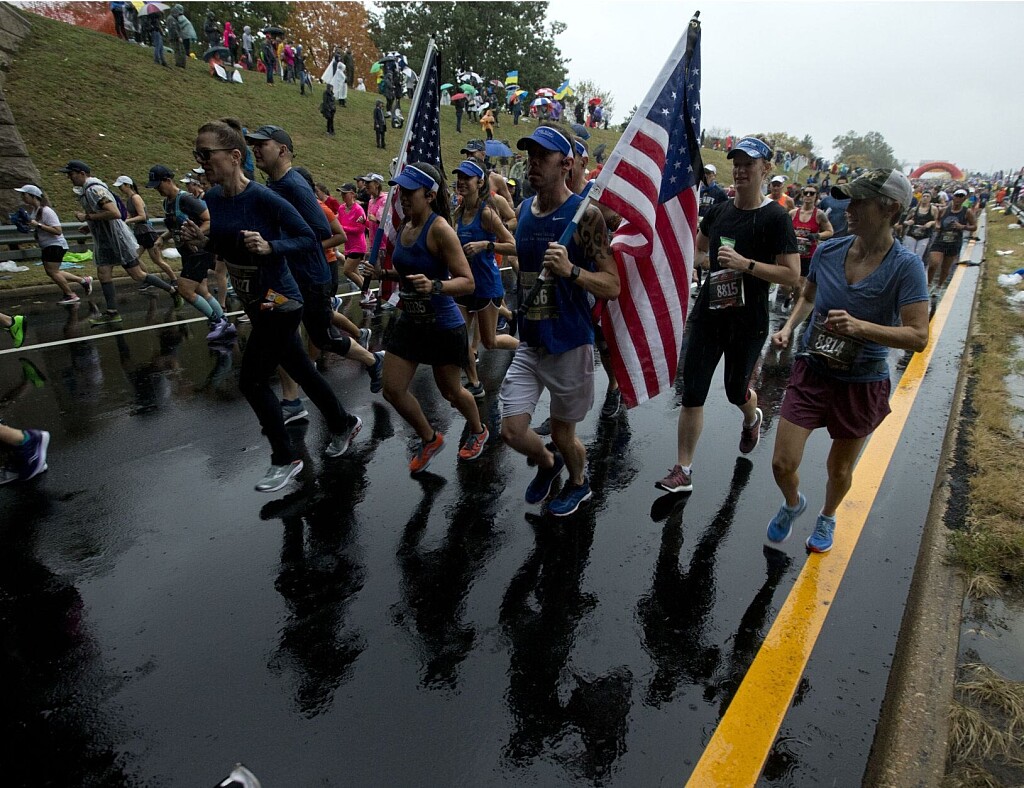
2022 Marine Corps Marathon Registration Open for In-Person Race
Calling all runners! Registration is now open for the Marine Corps Marathon, which will be held in person this fall for the first time in two years.
The 47th Marine Corps Marathon, 50K, and 10K will be run live and in-person on Sunday, Oct. 30 as part of the 2022 Marine Corps Marathon weekend, organizers said Wednesday.
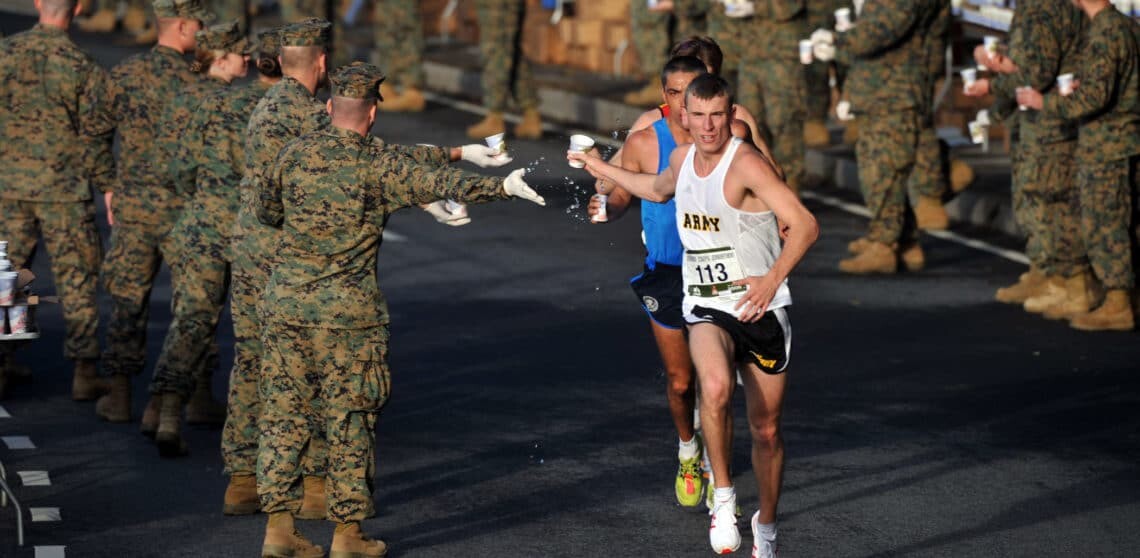
The marathon is open to anyone 14 and older and costs $200. The 50K is $220 for people 18 and up. Registration for the 10K will open on April 6 and is $65 for people 7 and up.
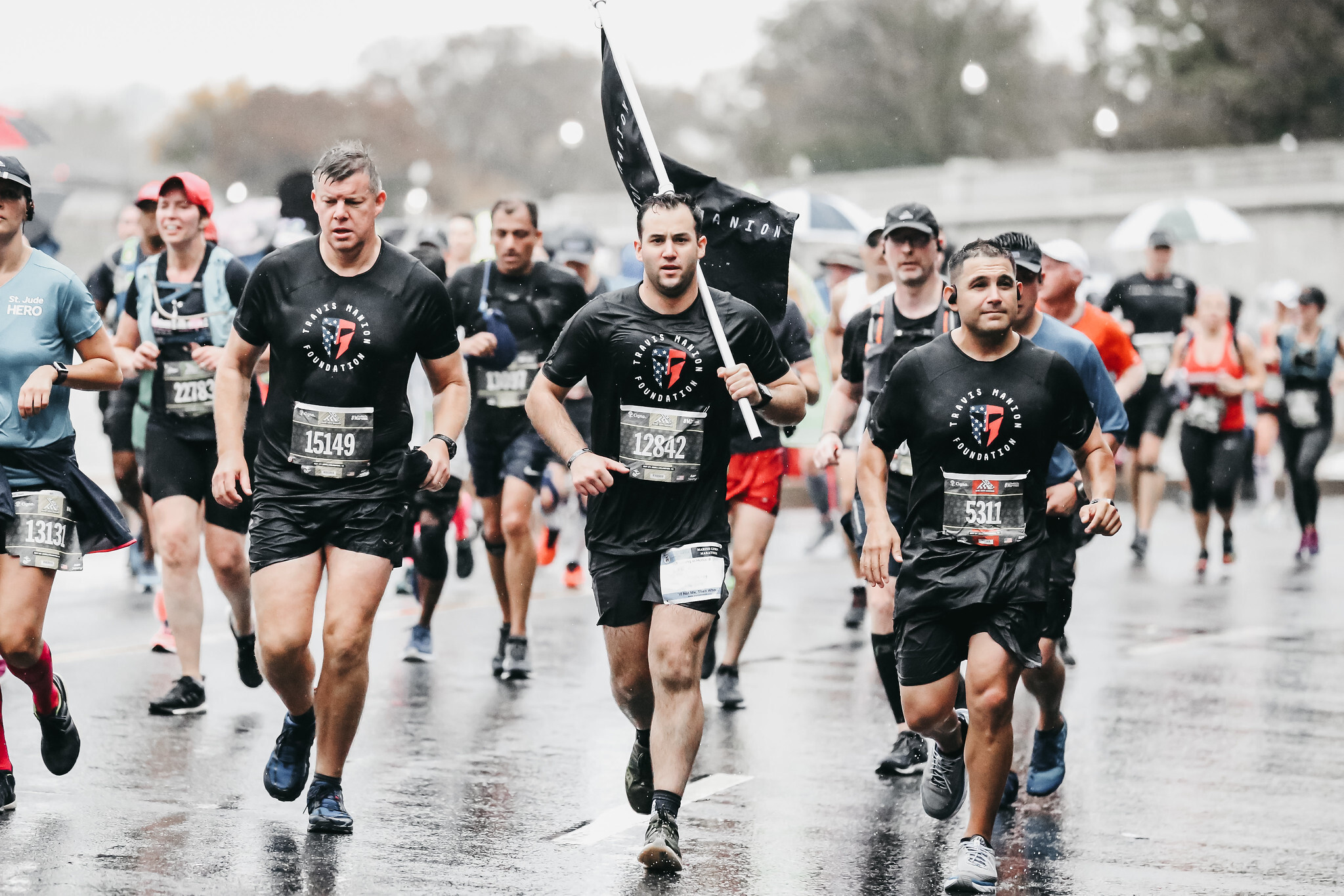
In 2020, marathon organizers offered only virtual events, citing public health concerns amid the COVID-19 pandemic and the guidelines of local governments. In 2021, they again found “the opportunity to safely operate and execute a live event [was] just not feasible,” Director Rick Nealis said in a statement.
Runners can participate virtually, with a limited number of virtual entries for both the marathon and ultra.
Runners can also sign up for the Semper Fidelis Challenge, a two-day event including either the Marine Corps Historic Half or the Devil Dog Double on May 22.
(02/17/2022) ⚡AMPby Ayanna Martinez
Marine Corps Marathon
Recognized for impeccable organization on a scenic course managed by the US Marines in Arlington, VA and the nation's capital, the Marine Corps Marathon is one of the largest marathons in the US and the world. Known as 'the best marathon for beginners,' the MCM is largest marathon in the world that doesn't offer prize money, earning its nickname, “The...
more...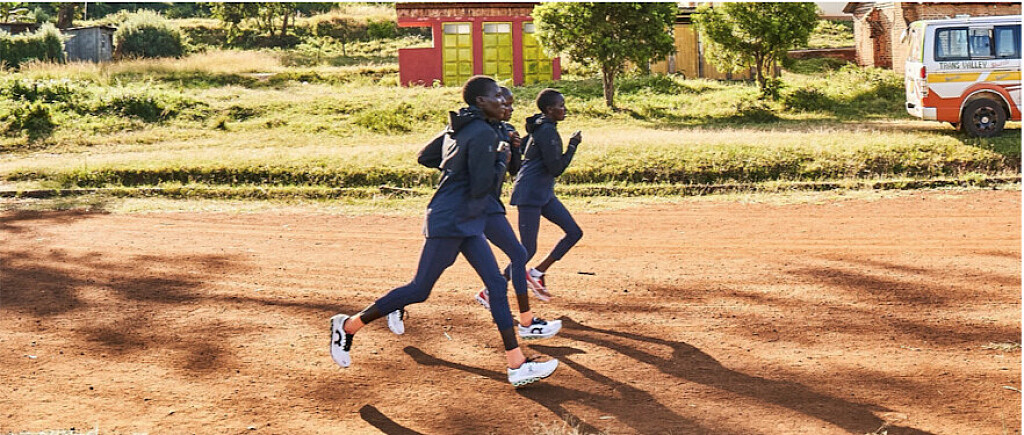
On launches new Kenya-based trail running team
Swiss running company On has tapped into a new market with the launch of The Milimani Runners, an elite trail running team based out of Iten, Kenya.
Kenyan runners are among the elites at most major international road races, but the story isn’t the same at trail races. Trail running has grown in popularity with the rise in global competitions and funding behind the events.
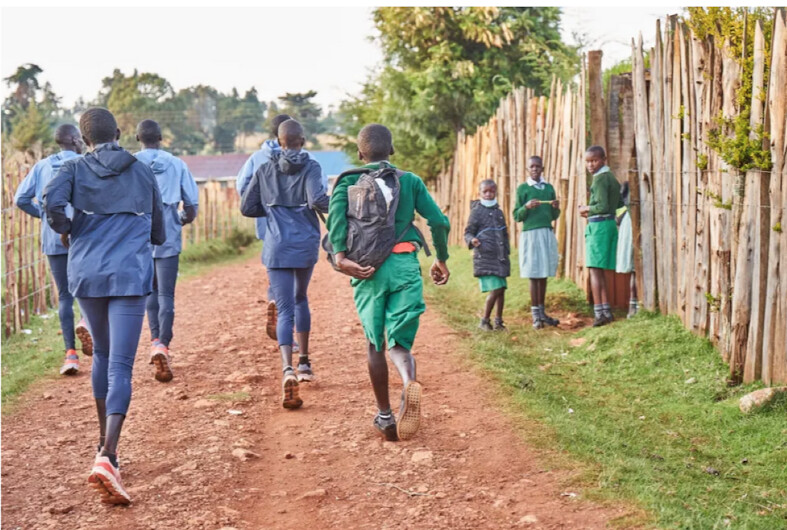
Most Kenyan runners have the goal of standing on top of the Olympic podium or following the footsteps of Eliud Kipchoge. A 2020 study from the ITRA found that almost 65 per cent of trail runners are from Europe or North America, lacking the star-power and diversity that African runners bring to races.
The On-sponsored Milimani Runners group was founded to shake things up on the trails and have currently been training on the expansive Iten trails to prepare for their debut this summer’s Sierre-Zinal and Ultra-Trail Monte Rosa races.
“For Kenyan runners to make it to the big European races, they need to be sponsored to make the trip,” says Milimani Runners coach Julien Lyon. “Our project could open the doors to undiscovered talent and give more opportunities to East African runners.”
The team is loaded with talent who have already recorded some impressive performances on the roads. The men’s team is led by Mark Kangogo, who smashed the course record at the 2018 Luxembourg Marathon with a 2:12:12 finish. The veteran talent of Rose Jepchumba leads the women’s team. Her career has been set back by injuries, she was ninth at the World Cross Country Championships in 2005 and ran a 2:29 marathon in 2016.
(02/13/2022) ⚡AMPby Running Magazine
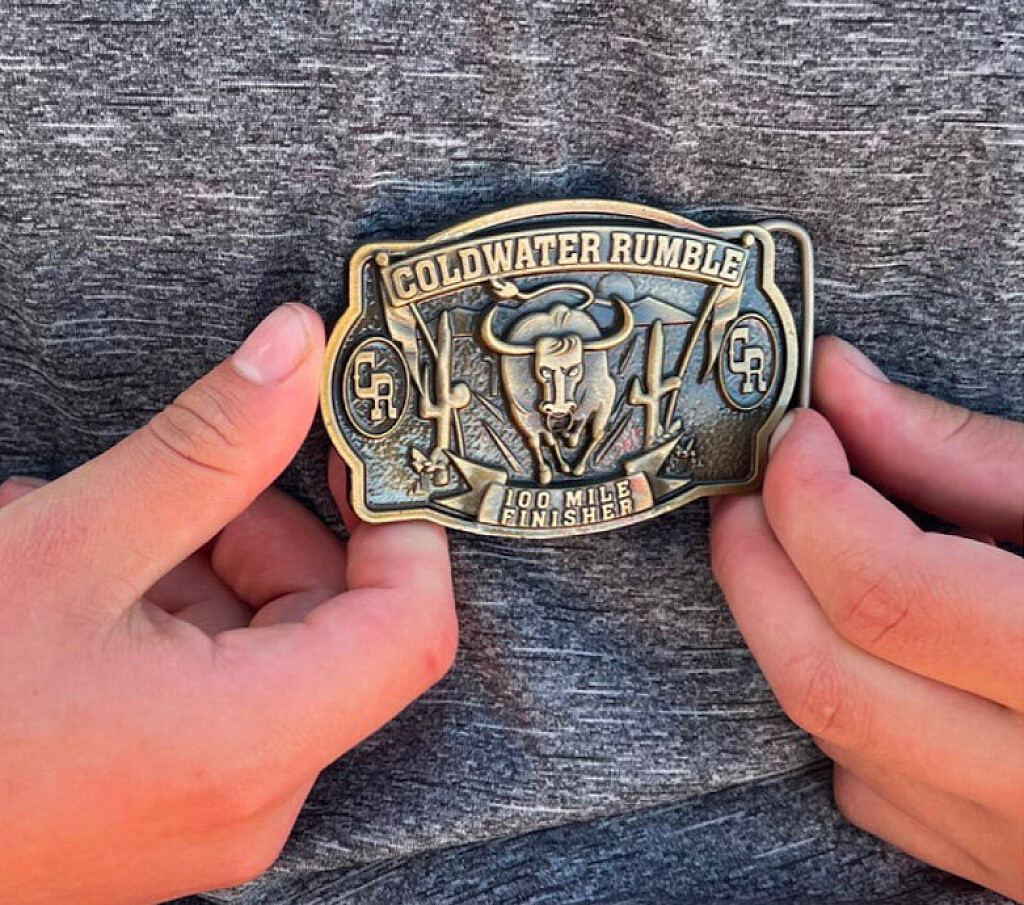
Zach Bates' 100 Mile Dream
Zach Bates loves statistics. Ever since he was a kid, he's scoured Guinness world records for longest, shortest, fastest, coldest or hottest. He could recite the Scoville rating for every hot pepper. Being autistic, that's how his mind has always worked. He loved to focus on specific topics, and the numbers called to him.
That might be why he fell for running. He joined the cross country and track teams his junior year of high school, memorizing his teammates' PRs and paces. Eventually, his sights turned to the pros. From Usain Bolt to Zach Bitter, he studied all of their career numbers. He also got the itch.
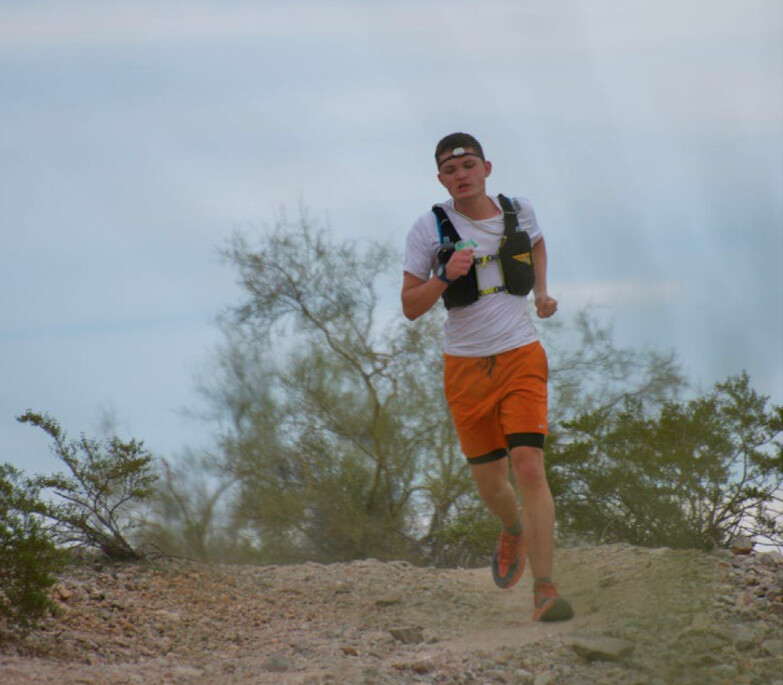
"He didn't want to just know these times, he wanted to do it, too," says Rana Bates, Zach's mother. "He begged me to sign him up for a marathon during his senior year. He was really interested in the longer stuff in track. He wanted to go even farther."
Because of the pandemic, most marathons during his senior year had been cancelled. So the 19-year-old waited patiently until graduation day in May 2021. That day, he turned to his mom and said, "I want to do a 100 miler before I turn 20."
Rana was thrown off by the request. No one in their family ran. Not his father, his mother, his sister or his twin brother. Now Zach wanted to run triple-digits in less than 10 months. She let the idea sit for a few days before Zach followed up. "Did you sign me up for a 100-mile race yet?"
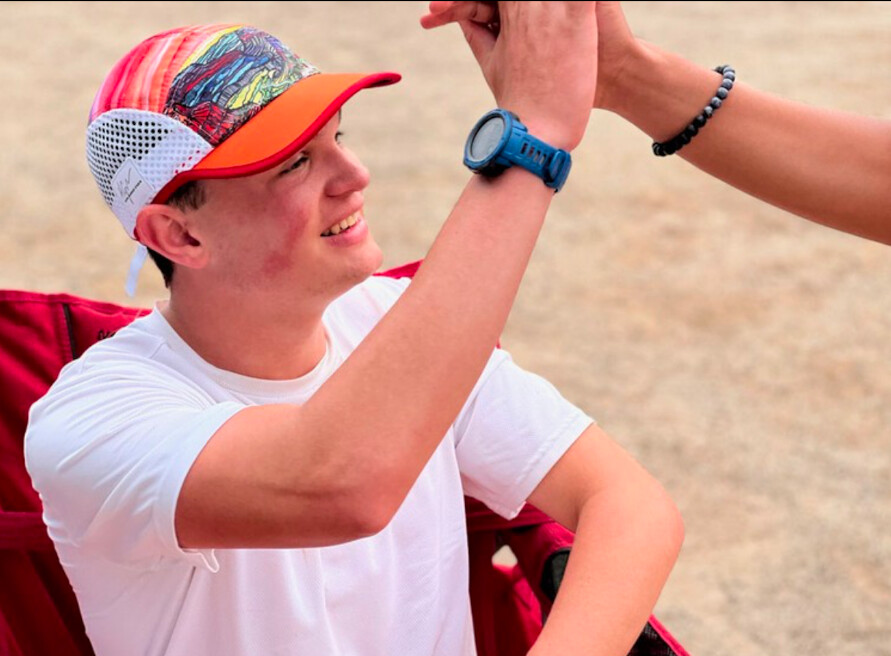
"He's really mild tempered and doesn't ask for much," Rana said. "When he does ask for something, he really means it and we take him seriously. So, I bought some books."
A Crash Course
Rana found herself whisked into the world of her son's dreams, researching and formulating a plan for Zach to be able to run 100 miles in a safe and healthy way. With Zach unable to plan himself, Rana had to take a broader approach, acting as his coach and instructing him on every logistical necessity for training.
"All of the thinking end stuff, I do," Rana said. "Zach does the running."
Rana's crash course worked smoothly for the first few months, but books only went so far. One of the first things she learned about distance running was the generosity of the community. The more she mentioned the goal to people, the more people came into Zach's life.
First, there was John Hendrix, a local ultrarunner. He offered knowledge about injury prevention, gear and nutrition for ultradistance running. But more than anything, he shared knowledge of the local trail systems and became an occasional running partner for Zach.
When it came to training, Zach and Rana had a process for each new trail. First, they had to hike it together so Zach could familiarize himself with the route and what landmarks to look for. Then, Rana would tag along in the car, driving between trailheads to meet Zach and field calls in case he got lost.
It's a lot of work, but Rana wants to live out the message she and Zach want to share.
"There's a list of things you do when you find out your child has autism," Rana said. "But we need to be careful not to let those things become the priority of what our children want. We need to listen to them, hear their dreams. Zach wanted to run so badly, he just didn't have the resources to find routes, sign up for a race, or things like that. You can't just say, it's too hard for us. We need to respect them as individuals and help them reach their dreams."
As Zach started to race, more and more people noticed him. By October, he'd finished the High Mountain Half, the Beaver Canyon Marathon, and the Do-Wacka-Do Trail Run 50 miler. He made friends everywhere he went, astonished at someone his age running the distances he was. At races, autism wasn't the defining feature of who he was.
The Rumble
There's an infinite number of variables in a 100-mile race; often, things simply go well until they don't. For Zach, the first roughly 80 miles went smoothly. He was far way ahead of the cutoff when he picked up de la Rosa as a pacer for the final 20 miles. But he started to get quiet, only occasionally breaking the silence.
"If my legs could talk, they would say, 'Whyyyyyyy!" de la Rosa recalls Zach saying.
Then a problem arose at mile 88. A hip flexor tweak forced Zach into a limp. They tried stretching, but that only worked momentarily. The limp lingered, but they pressed on.
De la Rosa could see the teenager doing calculations in his head, watching his time goals get further and further away. It was a place de la Rosa had been many times since he started running ultras in 2008. In that moment, captured on video, de la Rosa thought of what he would've wanted to hear if it were his teenage self.
In the next miles, Zach slowed to a painful trudge, about 45-minutes per half mile. Finally, a stroke of luck found them at mile 94: a runner with two Tylenol. The pain wasn't gone, but Zach started running again, dropping three straight 12-minute miles. With that, finishing under the 32-hour cutoff was assured.
"That's called a comeback!" de la Rosa hoots in the video. "That's called rallying! Woohoo!"
Runners treated him like anyone else. For one 40-mile training run, Zach was supposed to pace Hendrix for the Javelina Jundred. Hendrix dropped out at mile 60, but word got around in the crew area that Zach was willing to pace.
"There was such an openness and willingness from runners," Rana said. "He paced one guy from Boulder, Colorado, and the guy came back stoked, saying this was the most fun he had with a pacer. Another guy from California picked him at mile 80 and Zach paced him to a sub-24 finish. It's the coolest thing ever to have a support system like this. These runners have stayed in touch with us and offered help. It's amazing."
After finishing the 50, Zach signed up for the Coldwater Rumble 100 in January and started TikTok and Instagram accounts (@running.farther) to share his progress. That left three months to prepare, but Zach was feeling burned out. Rana was out of her depth for guiding him, so they sought a professional coach. With a reference from Run Flagstaff, they connected with Nickademus de la Rosa.
"You can always tell if there is a deep, intrinsic reason someone does a 100 miler, and that often proves if they will do whatever it takes," said de la Rosa. "Zach had a deep reason to be there. You see it in his eyes when he talks."
They dropped Zach's mileage down to get him healthy, mentally and physically, then began ramping it slowly back up. The biggest week came four weeks before race day: 10, 20, and 30 mile runs back to back to back.True to form, Zach hit all his splits on the dot.
At the finish line, the Bates family waited. Zach's watch had died in the night, leaving them reliant on texts from de la Rosa to track his progress. Finally, the final text came in. Zach was moving slower again, but they were a mile away.
Rana rallied a friend who rallied the entire 250-yard string of tents along the final stretch. When Zach arrived, a massive cheer tunnel awaited him. Zach looked at de la Rosa, as if to ask permission to run through it.
"You've got this," de la Rosa said.
Alone, beneath the roaring crowd, Zach ran. He stopped when he crossed the finish and embraced his family. His time was 28:06:36, good for 38th overall.
'I'll cherish that moment forever," Rana said. "Our family will never be the same."
Zach's royal entrance was completed with a camping-chair throne and a parade of well-wishers. Unable to stand when it was time to leave, Zach was lifted by his father and uncles over the crowd and carried like a king to the car.
The limited mobility lasted a few days. After a long postrace nap, Zach eventually made it to the bath, an endeavor so challenging he made a TikTok of himself easing up the stairs set to the "Mission Impossible" theme song.
By a week later, he was moving better, already eyeing what's next. He's got the Canyons 100K and Javelina Jundred on the calendar for 2022, but it doesn't stop there. He also wants to do the Cocodona 250, but that's for down the road. For now, he's back to running and chasing his dream.
"Even if Zach never ran again, the last eight months have changed us as a family," Rana said. "The outpouring of love from everyone, everywhere, for this kid chasing his dreams and making them come true. Not everyone is able to. Because of everyone, Zach did."
(02/12/2022) ⚡AMPby Trail Runner Magazine
Why can´t I lose those last few pound?
“I can’t lose weight like I used to. I must be eating too many carbs”
“Do you think a keto diet is a good way to drop a few pounds?”
Judging by the phone calls I get from potential clients, an increasing number of runners of all ages are complaining, “Why can’t I do something as simple as shed a few pounds???” They are frustrated and at a loss about what to do to lose undesired body fat.

Speaking at the annual meeting of the American College of Sports Medicine (June 2021; www.acsm.org), Kevin Hall PhD explained that fat loss is far from simple. Dr. Hall works at the National Institutes of Health. His laboratory investigates how metabolism and the brain respond to a variety of changes in diet and exercise. His research has helped identify the complex mechanisms that regulate weight.
Weight loss is not simple

You’ve likely heard, “A pound of fat equates to 3,500 stored calories. To lose one pound of body fat a week, you can simply knock off 500 calories a day—or burn off 500 calories more than usual, or some combination of the two.” Hall explained the “simple” approach to weight loss just doesn’t hold true. Runners who are chronic dieters would have shriveled up and disappeared by now. Not the case.
Weight loss is not simple because our bodies adapt to “famines” by conserving energy. When food is scarce, be it a famine or a diet, the body conserves energy (metabolism slows, spontaneous movement lessens) and simultaneously appetite increases. Hence, eating less (dieting) takes persistent effort. The greater the energy deficit and the greater the weight loss, the greater the increase in appetite. Losing weight becomes more and more challenging. Hence, most runners end up unwilling or unable to sustain for a long time a diet with a calorie reduction of 25%. For a typical female runner who maintains weight at about 2,400 calories, that’s an 1,800-calorie reducing diet. Based on my experience, runners inevitably self-imposed a 1,200 – 1,500 calorie reducing plan. No wonder their diets fail! The stricter the diet, the hungrier the dieter, the bigger the backlash. The runner ends up devouring way too much ice cream, too many cookies, chips…
The bottom line: Runners who diet commonly end up heavier. You want to learn how to eat competently by working with a registered dietitian (RD) who specializes in sports nutrition (CSSD).
Is keto the answer?
So often I hear frustrated runners ask, “What if I just do keto (or Paleo or another trendy diet) for a bit and then go back to eating “normally?” Ha! When runners have managed to successfully lose weight, they can’t go back to eating like they used to eat. These dieters need fewer calories to support their lighter body. For each kilogram (2.2 lb) of weight lost, a dieter requires about 25 fewer calories/kg per day. Hence, runners who lose 10 kg. (22 lbs.) need about 250 fewer calories per day to maintain their new reduced weight. Unfortunately, appetite-regulating hormones nudge them to want to eat more than that. This gets to be a tiring fight, and most folks lose the battle of the bulge.
The bottom line: Preventing weight gain in the first place might be simpler than trying to reclaim a former physique!
Are carbs the problem?
What if you could lose weight by cutting carbohydrates but not calories? Diet gurus have promised this for years, as do today’s keto supporters. Anti-carbers claim high-carb diets lead to excess insulin secretion, hunger, excessive eating, and fat gain. Low-carb/keto diets are touted to reduce insulin, hunger—and promote easy fat loss.
Not so simple. Despite popular belief, simply knocking off starches (bread, pasta, grains) and sugary foods does not guarantee fat loss—unless it creates an energy deficit. That is, eliminating a serving of rice from dinner can knock off 200 calories. But does the hungry dieter then indulge in a pint of sugar-free ice cream or a keto-bomb? The carb-free = calorie-free attitude can easily wipe out the deficit created by cutting out carbs.
Hall’s research does not support the carb-insulin theory that carbs are fattening. He closely monitored subjects in a metabolic ward who ate as much as they desired of high (75%) carb/high-glycemic diet designed to spike blood glucose and trigger high levels of insulin. The subjects did not gain body fat. In fact, every single subject eating the high carb/high insulin/low fat diet ate, on average, about 700 fewer calories/day less than when they ate the high fat/low carb/low insulin keto diet.
The bottom line: Carbs are NOT inherently fattening. (If carbs were fattening, then people in Asian countries who eat bowlfuls of rice would be obese. Not the case.)
If carbs aren’t fattening, what is?
The increase in obesity in the US correlates well with the increased intake of ultra-processed foods. Hall is pointing his finger at foods such as Oreos, soda, instant ramen noodles, chicken nuggets, etc. He has researched the impact of two weeks of an ultra-processed convenience food diet vs. two weeks of a homemade, natural foods diet. The menus were very carefully designed to be equally tasty. The subjects reported no differences in pleasantness between the two diets. They ate as much as desired.
With the ultra-processed diet, the subjects consumed about 500 more calories a day compared to the unprocessed diet. They gained weight during those two weeks—and lost weight (without trying to do so) with the unprocessed diet. Because both diets offered the same amount of sugar, carbs, and fat, those nutrients did not drive the weight change.
What’s going on? Hall is currently looking at why ultra-processed foods easily lead to weight gain.
The bottom line: Until we know more, your best bet is to limit ultra-processed foods. Fret less about sugar/carbs, and more about the processing. Somehow, find time to prepare meals. As a parent, please teach your kids to cook. Hopefully you’ll all enjoy the eat-well, stay lean diet!
(02/08/2022) ⚡AMPby Colorado Runner
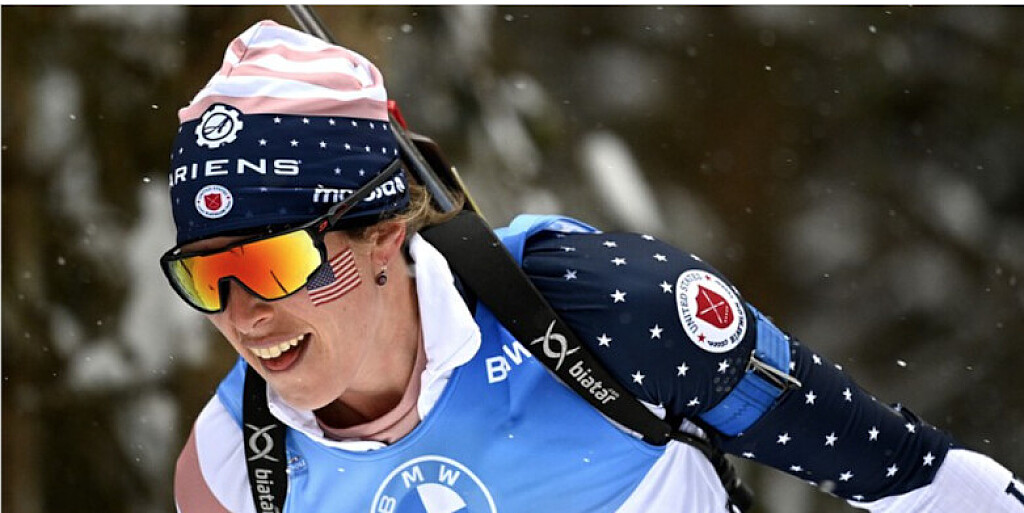
After the Beijing Olympics, This Biathlete Is Retiring and Returning to Her Running Roots
She’ll hang up her rifle and skis to be the new running director of the Craftsbury Outdoor Center in Vermont.
The 2022 Winter Games will be the last time three-time Olympian Susan Dunklee competes for Team USA; the 35-year-old professional biathlete has announced that she will retire after Beijing. But the end of her career, highlighted by two world championship medals and several World Cup podium finishes, marks the beginning of a new chapter that’s familiar territory for the Craftsbury, Vermont native.
This spring, Dunklee will hang up her rifle and skis to assume a full-time role as the running director for the Craftsbury Outdoor Center. She’ll be leading a program that’s supporting future generations of elite runners, while promoting sustainability in the same community that helped her develop into a dynamic athlete.
In an interview with Runner’s World, Dunklee shared how running continues to fuel her love for exploration and why she’s looking forward to supporting fellow athletes in their Olympic pursuits.
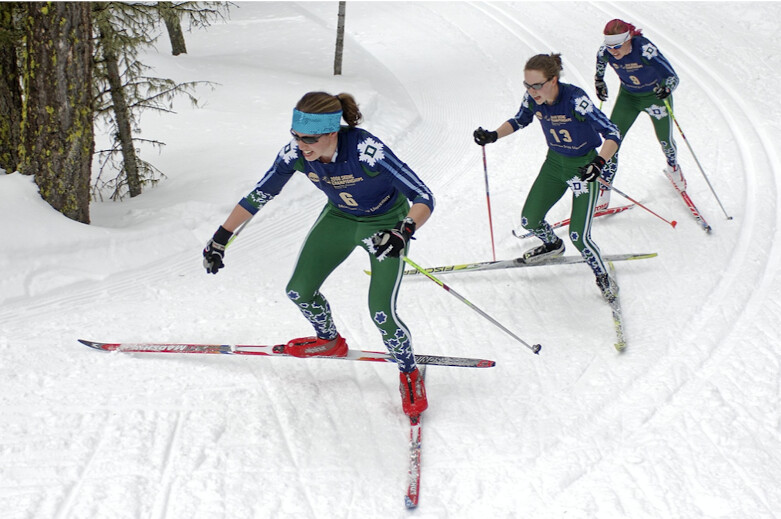
“I’ve been so immersed in biathlon for a long time, but running is really the place that I started out when I was younger and meant a lot to me for a very formative part of my life,” Dunklee said. “And I’m really excited to get back into it.”
Finding the Crossover Between Skiing and Running
While growing up in Barton, Vermont, Dunklee picked up skiing shortly after she learned how to walk, thanks to her family. Her dad, Stan Dunklee, competed in cross-country skiing at the 1976 and 1980 Olympic Games and now coaches cross-country skiing and track and field at the high school level.
At 5 years old, Dunklee started competing in cross-country ski races in Barton, which is known for producing top winter athletics talent, including Olympic cross-country skier Ida Sargent and Olympic biathlete Hannah Dreissigacker. Dunklee also thrived in that high level athletic environment.
“Sometimes you get these pockets of talent where kids are just doing something because it’s fun and it’s social, but you have enough of a group in one place that you have this threshold of momentum, and it just builds, you know?” Dunklee said. “You push each other, you train with each other, you have fun with it, you feel motivated, and it can take you places.”
When she was in first grade, Dunklee started tagging along on trail runs with her dad’s high school track team and loved the experience of exploring terrain on foot. “I remember the older high-school kids teaching me how to run down a mountain and just trying to learn how to bounce off the rocks and roll with gravity,” Dunklee recalled.
In high school, Dunklee shifted her primary athletic focus from skiing to running, because she enjoyed the traditions and atmosphere of running cross-country at the state level in Vermont. She appreciated how her St. Johnsbury Academy high-school coach worked to instill a level of commitment and consistency in the team’s training, and she felt that many of the cross-country courses where she races, which were “gnarly” and filled with hills, provided a unique “crossover between skiing and running.”
“Vermont cross-country really helped make me tough and resilient, so that was pretty cool,” she said.
In 2004, Dunklee was recruited to run for the cross country and track team at Dartmouth College. She embraced the opportunity because she wanted to compete in running and skiing at the NCAA level—and Dartmouth offers both athletic programs.
In the fall, she trained with the cross-country team in season, and would also jump into the ski team’s workouts once a week, which provided a unique cross-training dynamic. For example, she’d join the ski team on roller skis for an “over-distance” workout of 3-4 hours in the nearby Adirondacks or the White Mountains, a training session that remains her favorite form of exercise. In the winter, she trained full-time with the ski team in its NCAA season.
“It’s so empowering to feel like you could just keep going forever and to be up in these beautiful places, just really peaceful and nice,” she said.
Learning a New Sport
During her senior year, Dunklee received an email from U.S. Biathlon—the governing body for the sport that combines cross-country skiing and rifle shooting—in an attempt to recruit her. Her college ski teammate made the transition to biathlon after she graduated, so Dunklee was somewhat familiar with the sport, but she hadn’t participated in it before. The invitation also came at an ideal moment for the senior, who, like millions of other college students at the time, was facing the challenge of graduating during the Great Recession.
“It was hard to find jobs, and I still loved skiing and wasn’t quite ready to be done with it,” she said.
Growing up as the daughter of an Olympic cross-country skier, Dunklee also liked the idea of choosing her own journey in a new sport she could call her own. “There was something appealing about learning how to shoot and learning a new element that he had never done and had no experience with because I wasn’t just following in his footsteps,” she said. “I was going one step further and finding my own path.”
In the summer of 2008, she moved to Lake Placid, New York and jumped into U.S. Biathlon’s development program. However, learning a new sport that requires high levels of mental and physical focus wasn’t an easy task. Shooting was completely new to Dunklee and created a “fascinating challenge” that forced her to hone different strengths. She explained that athletes need to be disciplined with their pacing in order to have enough energy and focus to shoot accurately.
“I’ve always been one of those athletes who could just dig incredibly deep, push myself into the pain cave, and just fight through a race and gut it out. I’m scrappy, I’m tough, but with biathlon, to be able to shoot well, it’s a very different skillset,” she said. “I had to learn a little bit more discipline with that, but also the element of shooting itself requires this amazing ability to control your emotions.”
Dunklee has since become the most successful U.S. female biathlete in history, according to NBC Sports. She is the only American female biathlete with an individual world championships medal (silver in 2017 and 2020). So far at the Olympics, her best individual finish is 11th in the mass start at the 2014 Sochi Winter Games.
Returning to Running
Throughout her biathlon career, Dunklee kept running. During the height of the pandemic lockdowns in 2020, she ran every road in Craftsbury, where she’s been living and training since 2010, as a personal challenge. She still runs for an hour or two at a time three or four times a week, a routine that’s kept her balanced, she said.
“I see so many young athletes burning out, getting too specialized at too young of an age and investing too much of that identity just on one aspect of who they are,” Dunklee said. “And I'm just really glad that I didn't burn myself out as a young skier. And part of that was because I had this passion for running.”
In August 2021, after spending a decade as a member of Craftsbury’s Green Racing Project biathlon team, Dunklee was named running director of the Craftsbury Outdoor Center, an outdoor nonprofit organization and sportscenter for the local community with running, sculling, skiing, biathlon, and cycling programs.
Now she’s leading the running program, which includes annual camps, community running events, races, weekly track workouts, and fundraisers for local nonprofits, among other offerings. Recently, the organization formed a new team of elite runners for the Green Racing Project. In the remote-based club program, post-collegiate runners who compete in events ranging from the 800 meters to ultra races are provided with individualized coaching, gear, on-site training camps, and travel support, among other services, with Craftsbury as the primary sponsor.
“Now I get to stay at the outdoor center in a different role and also help really shape this new program we have … which is still very Craftsbury,” Dunklee said. “It has that same spirit of Craftsbury of being an athlete, reaching a high level, but also contributing to your community and promoting sustainability in lifelong sport.”
Looking ahead to Beijing as her final Olympics—the biathlon competition kicks off on February 5—Dunklee is at peace with closing this final chapter of her biathlon career in favor of starting the next phase of her life. After catching the flu upon arrival at the 2018 Pyeongchang Games and experiencing disappointment in her performances as a result, Dunklee said she realized that you can spend a lifetime preparing for a big moment, but there will always be factors outside of your control and it’s important to accept it in order to move forward.
“This time I just want to be able to go and try to stay focused on my process and take it all in, be flexible and see what happens,” she said. “I mean, I think I still have the capacity if I hit the peak fitness right, and I get a little bit lucky with how the wind is on the range when I come in and how other people do, I can still have a top result. But I don’t need to have that top result to validate my career.”
MORE FROM RUNNER'S WORLD ON APPLE NEWS
(02/06/2022) ⚡AMPby Runner’s World
The craziest active streaks in running
On Jan. 29, New Zealand’s Nick Willis ran another sub-4 minute mile at the NYC Millrose Games for the 20th consecutive year. This achievement is something only a few runners have come close to, which has sparked us to find the craziest active running streaks.
Nick Willis – 20 years of sub-4 minute miles

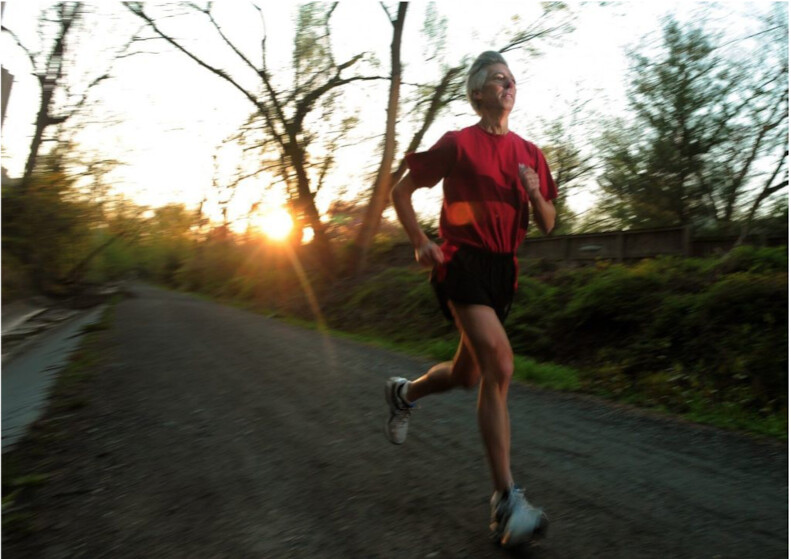
Willis first ran sub-4 during his undergrad at the University of Michigan in 2003 (3:58.15). At last weekend’s Millrose Games, Willis broke four minutes for the 63rd time in his career (3:59.71), which marked the 20th consecutive year he has run sub-4 miles. Willis is New Zealand’s only two-time Olympic medallist in the 1,500 metres, winning a silver medal in Beijing and bronze in Rio. In 2020, Willis passed his countryman, Sir John Walker, who previously held the consecutive sub-4 mile record of 18 years.
Simon Laporte – 46 years of running every day
At 46 years, the Notre-Dame des Prairies, Que. runner holds the longest active run streak in Canada. Laporte began his streak on Nov. 27, 1975, and hasn’t missed a day since. The 70-year-old run streaker has no plans to stop anytime soon, and he is planning for his streak to reach 50 in 2025. The longest active streak in the world is held by Jon Sutherland of Utah. Sutherland’s run streak of 52.7 years recently passed the legendary record set by Ron Hill (52.1) last year.
Streak Runners International (SRI) says for runs to qualify as a streak, they must cover at least one mile (1.61 kilometres) each day. The run may occur on the road, track, trails, or treadmill, but a minimum of one mile must be completed.
Lois Bastien – 41.8 years of running every day
Bastien holds the longest-standing women’s run streak record, at 42 years. She is now 79 and still runs every day in her home state of Florida.
Ben Beach – 54 consecutive Boston Marathons
Although Beach does not have the record for most Boston Marathon finishes (58), the 72-year-old marathoner does have the record for most consecutive Boston Marathons (54). Beach ran his first Boston in 1967 when he was 18. This year, Beach completed his 54th consecutive Boston Marathon, finishing in 5:47:27.
Allyson Felix – Five straight Olympic Games with a medal in track and field
U.S. sprinter Allyson Felix is one of the greatest female Olympians ever. She has not only represented her country at five straight Olympic Games, but she has also medalled at all of them (seven gold, three silver and one bronze) – a feat that no other female athlete has accomplished in track and field. Although Felix intended that Tokyo would be her last Olympics, her streak will remain active until Paris 2024, where Jamaican sprinter Shelly-Ann Fraser-Pryce will get the chance to equal her at five consecutive Olympics with a medal.
Karl Meltzer – a 20-year streak of winning a 100-mile race
Meltzer, 54, has been on the elite ultramarathon scene for more than 20 years. With his most recent win this year at the Beast of the East 100-miler, he has won a 100-miler for 20 consecutive years, bringing his career total to 45 wins over 100 miles. This is an unprecedented number, and the only person who can top it (for now, at least) is Meltzer himself.
(02/05/2022) ⚡AMPby Running Magazine
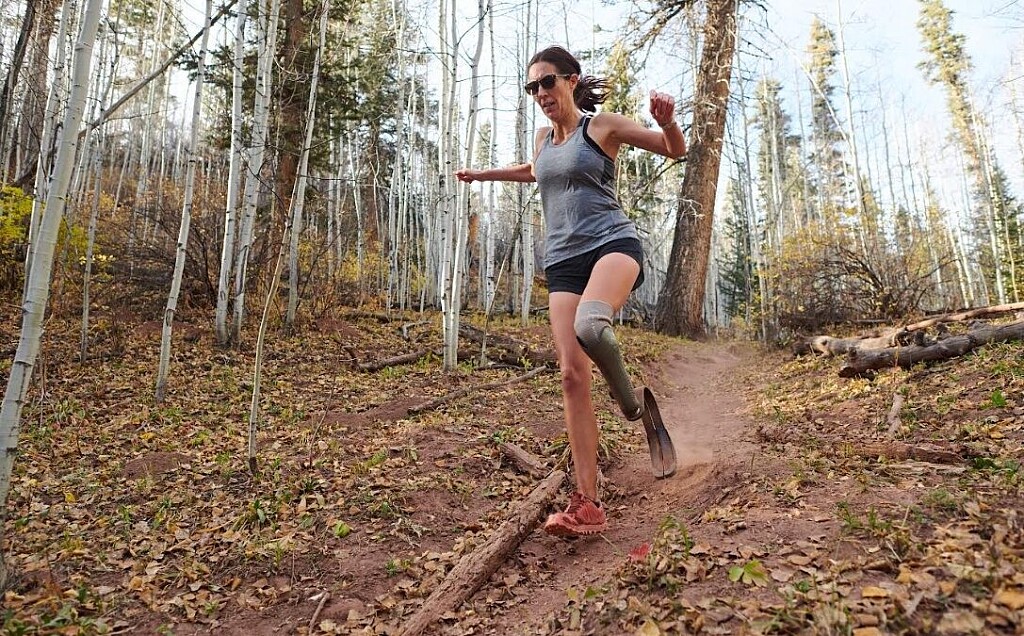
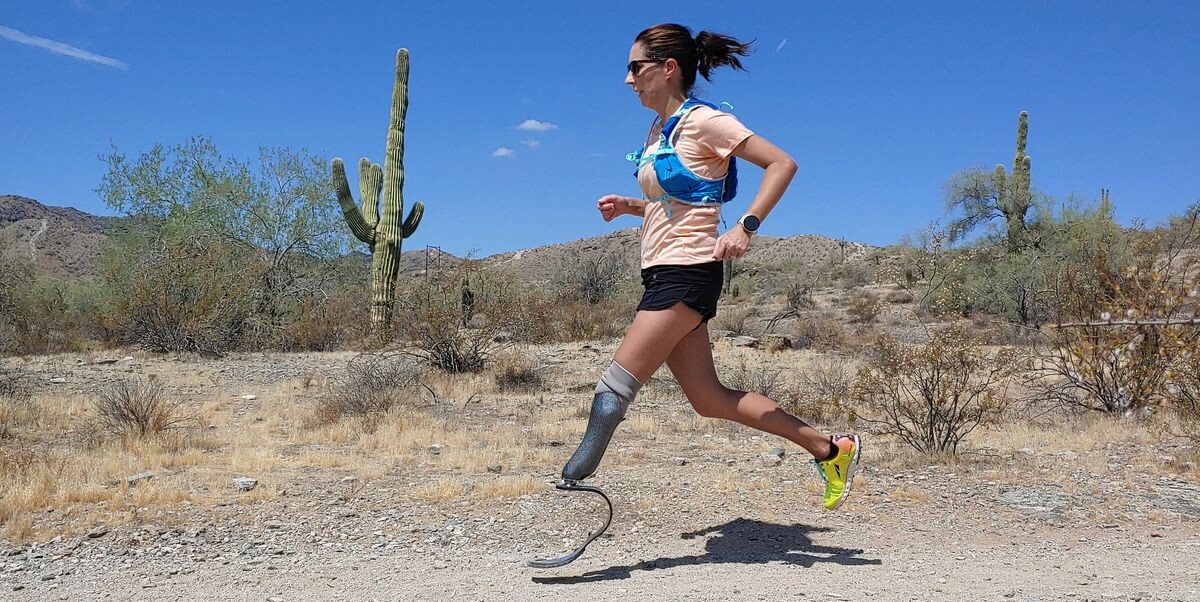
Bladerunner Jacky Hunt-Broersma, is aiming to complete 100 marathons in 100 days
This year, Jacky Hunt-Broersma is looking to add another record to her name. The multiple-time ultramarathon finisher and world record-holder has committed to running 100 marathons in 100 days, to break the Guinness World Record for most consecutive marathons.
Broersma got the idea after she saw Alyssa Clark of Vermont set the record last year at 95 days. Clark had been aiming to hit 100 marathons but was forced to cut her challenge short after contracting COVID-19. “This got me thinking, maybe this is something I could take on and it would be a great way to start the new year and help me build up a great base for The Moab 240 race in October,” says Broersma.
Being an experienced ultramarathoner, Broersma is well-equipped to handle a challenge of this magnitude. She finished a 100-mile race at the beginning of January, and although she says she hadn’t fully recovered by the time she started her marathon streak, she says this challenge is more mental than physical. For this reason, staying positive through each of her runs has been the most important key to her success thus far.
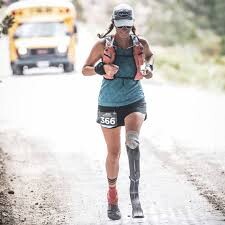
When we first spoke with Broersma, she had completed 10 marathons, and by the time of publishing that number had grown to 14. She tells us her biggest challenge is getting enough sleep to recover. “I am amazed at how incredible our bodies are,” she says. “The first five marathons were tough because my body was adjusting to the distance, but slowly my body started adapting.” She adds that her shin is hurting and her knee feels a bit sensitive, but her stump is holding out very well.
Broersma says she’s taking each day as it comes and trying her best to listen to her body. “Some marathons are slower than others and some are faster, it just depends on how my body feels in the morning,” she says. “I am making sure I use my massage gun every day on any tight muscles, eating well so I can recover and icing my stump if it is needed.”
Running for a reason
Aside from trying to break the Guinness World Record, Broersma is using her challenge to raise money for Amputee Blade Runners, an organization that provides running blades for amputees. She explains that running-specific blades can cost between $10,000 and $20,000, and in the United States they’re not always covered by health insurance so many amputees don’t have the opportunity to run the way she has.
“When I became an amputee one of the biggest challenges for me was accepting the way I looked and it can be a really tough journey,” says Broersma. “Running changed that for me, it gave me confidence in my body and confidence to be who I am. Running makes me feel strong and fearless and grateful for the body I have, even when part of it is missing. This is what I want for all amputees.”
So far, Broersma says she has had incredible support from around the world, with people sending messages of encouragement every day. She’s also received messages from people with disabilities who’ve been inspired by her to start running and hiking, which was her ultimate goal to begin with. “I hope by doing this that it will inspire people to get out of their comfort zones, even if it is to have the courage to take on their first 5k race,” she says. “We are always more capable than we think.”
If you’d like to support Broersma and follow along with her journey, you can keep up-to-date with her on her Instagram or Twitter pages where she posts daily updates, and you can donate to her cause on her GoFundMe page.
(02/01/2022) ⚡AMPby Brittany Hambleton

Study: watch out for these predictors of multiple injuries
Despite how common injuries are among runners, we still know relatively little about what specific factors cause them, or how to prevent them. We know even less about why some runners suffer multiple injuries in a season, while others seem to be able to run forever with next to no issues. Recently, researchers in South Africa tried to understand what causes some runners to experience multiple injuries, and their findings may surprise you.
The study
The study, which was published in the Journal of Sport and Health Science, collected running-related injury data from 75,401 race entrants across four years (2012-2015) at the annual Two Oceans 21.1 km and 56.0 km races in South Africa. The average number of injuries for each runner every year was calculated by taking a runner’s race entry history and injury history into account and categorizing entrants into four multiple injury risk (MIR) categories — high, intermediate, low and very low.
The researchers used odds ratios (multiple logistic regression modeling) to determine which factors predicted a high risk of multiple injuries. The factors they considered included demographics, training and racing, chronic-disease history and history of allergies.
The results
Interestingly, the results showed that less than 10 per cent of the runners surveyed experienced an injury over the four years, and only 0.4 per cent of them experienced multiple injuries during that time. This, the researchers admitted, is relatively low compared to other studies, which have previously reported between 19.4 per cent and 79.3 per cent of runners experiencing at least one injury every year, and warrants further investigation.
The study determined three independent risk factors that seemed to predict a higher instance of multiple injuries. These included older age (more than 40 years old), a longer history of recreational running (more than 20 years) and running longer distances, like ultramarathons. Counter to what you may think, neither weekly running mileage nor any other training-related risk factors were predictors of a high rate of multiple injuries.
Chronic disease and injuries
The researchers also identified two novel risk factors for multiple injuries: a history of chronic disease or a history of allergies. Nearly 19 per cent of all runners involved in the study reported at least one chronic disease, and these people accounted for 26 per cent of runners with multiple injuries. If the number of chronic diseases in a runner increased from one to two, their odds for having multiple injuries increased by a factor of 2.2 per cent. If they went from two to three, those odds went up another by a factor of 4.7.
The authors of the study note previous studies have shown that chronic diseases are common among endurance runners. They also point out that other studies have reported a link between chronic diseases like diabetes mellitus and hypercholesterolemia are associated with injury. They believe that one reason for this association is that runners with chronic diseases are likely on a number of medications, which could influence their risk for injuries. “There is also evidence that medications used to treat chronic diseases can be associated with increased risk of tendinopathies, ligament injuries and bone-stress injuries,” the researchers say.
Allergies and injuries
The study also found that runners with a history of any form of allergies had significantly higher odds of experiencing multiple injuries than those who didn’t. “Runners with allergies are likely to be taking antihistamines, especially because endurance running is an outdoor activity,” the researchers concluded. “One of the oral sedating H1 antihistamines, Promethazine, has been associated with severe tissue injury.”
The bottom line
Injuries are complicated and often multi-faceted, and scientists are still learning what causes some people to become injured more than others. This study has a few specific limitations, including the self-reported nature of the data, and the fact that none of the injuries were confirmed by healthcare professionals.
The results of this study were also correlations, not causations, and cause-effect relationships between the risk factors couldn’t be confirmed due to the cross-sectional design of the study. The researchers also didn’t address risk factors that could potentially play roles in multiple injuries among runners, like body mass index, specific medications, type of training/surface or biomechanics, among others, and they did not account for recurrent injuries in their data.
Still, runners with allergies or chronic diseases should take note of this study, and take extra precautions with their training. Particularly if you’re taking medications for your condition, you should talk to your doctor about the potential side effects and how you can lower your risk for injuries and train safely.
(01/30/2022) ⚡AMPby Running Magazine

American Jim Walmsley will be taking another stab at UTMB
The 2022 edition of the Ultra-Trail du Mont-Blanc (UTMB) is seven months away, but the elite fields have been made official. Although he has never done better than fifth (and that was back in 2017), American Jim Walmsley will be gunning for a podium finish again on Aug. 28, along with seven of Canada’s top ultrarunners, including last year’s third-place finisher, Mathieu Blanchard. Check out the top athletes who will be racing this year.
UTMB — men
Blanchard, who is from France but lives and trains in Montreal, is among the top men who will be competing this year. Going into the race, Blanchard says his goal is to win the race, and he’ll have two main focuses for his training: “the first will be to prepare myself mentally, to visualize, to accept this possibility of a big goal because I still have trouble believing it today,” he says. “The second will be to build a logical race path to prepare for this race, choices of reason rather than choices of the heart.”
Last year’s second-place finisher, Aurélien Dunand-Pallaz of France will be returning, along with 2019 UTMB winner, Pau Capell of Spain. Walmsley, whose top finish was fifth in 2017 but who has won the Western States 100 for three consecutive years (2021, 2019, 2018) will also be challenging for a podium spot, as will France’s Xavier Thévenard, who has won UTMB three times (2018, 2015, 2013) and placed second in 2019. Nine other recent top-five finishers will also be joining them on the start line.

Notably absent from the start list is last year’s winner, François D’Haene and three-time UTMB champion, Kilian Jornet.
UTMB – women
Canadian ultrarunning fans will have plenty to cheer about in the women’s race in August. Three top Canadians will be on the start line, including Montreal’s Marianne Hogan, who won the 2022 Bandera 100K and placed second at the Ultra-Trail Cape Town 100k. Toronto’s Claire Heslop, Canada’s top finisher in 2021, will be joining Hogan, along with Alissa St. Laurent of Moutain View, Alta., who placed fifth in the 2018 UTMB TDS 145K in 2018 and sixth at UTMB in 2017.
“My dream result would be a top 10 at UTMB,” says Hogan, “so I will definitely shoot for that. A lot can happen come race day, so I will make sure to show up to the start line as ready as possible.”
Other top contenders on the women’s side include Camille Herron, who won the 2021 Javelina Jundred Mile (and broke the course record) in 2021 and set the 24-hour world record in 2019, Anna Troup, who won the 2021 Lakeland 100 Mile and the 2021 Spine Race Summer Edition 268 Mile, Sabrina Stanley, two-time winner of the Hardrock 100 and Beth Pascal, winner of last year’s Western States and two-time top-five finisher at UTMB.
There will be five other recent top-five finishers on the start line as well, but running fans will be disappointed to hear the two-time winner Courtney Dauwalter, 2019 third-place finisher Maite Maiora, among several other past winners, will not be in Chamonix on August 28.
CCC — women
There will be three elite Canadian women in the 100K CCC, including Victoria’s Catrin Jones, who placed in the top-10 at the 2019 Comrades Marathon 90k and holds the Canadian 50-mile and six-hour records. She will be joined by Ailsa MacDonald of St. Albert, Alta., who won the 2020 Tarawera 100 Mile and the Hoka One One Bandera 100K, and placed sixth in the CCC in 2019. Rounding out the Canadian squad will be Vancouver’s Kat Drew, who was third at the 2019 Bandera 100K, first at the Canyons 100K and eighth at Western States in 2019.
Other notable runners in the CCC include New Zealand’s Ruth Croft, who won the 2021 Grand Trail des Templiers 80k, placed second at the 2021 Western States 100 and won the UTMB 55K OCC in 2018 and 2019. France’s Blandine L’hirondel will also be looking to land on the podium after winning the OCC last year.
(01/28/2022) ⚡AMPby Brittany Hambleton

North Face Ultra Trail du Tour du Mont-Blanc
Mountain race, with numerous passages in high altitude (>2500m), in difficult weather conditions (night, wind, cold, rain or snow), that needs a very good training, adapted equipment and a real capacity of personal autonomy. It is 6:00pm and we are more or less 2300 people sharing the same dream carefully prepared over many months. Despite the incredible difficulty, we feel...
more...
How does Aleksandr Sorokin train for 100-mile world records?
Aleksandr Sorokin of Lithuania became the first man to break the 11-hour barrier for 100 miles. After breaking the 100-mile record, he broke his 12-hour world record, covering 177.4 kilometres (approximately 4:04/km) at the 2022 Spartanion race in Tel Aviv, Israel.
To put Sorokin’s performance in perspective, his time is equivalent to running 35 straight 5Ks in 20 minutes and 15 seconds each, which is a very good 5K time for any runner.
He broke his previous 100-mile world record by 23 minutes and his 12-hour record by seven kilometres. We spoke with Sorokin after he set his world records to get a grasp of his training and what’s next for the Michael Jordan of ultrarunning. So how does he train for speed above 50 miles?
“I am just following my running plan,” Sorokin says. “My coach, Sebastian Białobrzeski, has shown me the importance of the long run. We will often do 40-50km runs during training to build up my pain tolerance.” Sorokin’s base mileage sits around 200 kilometres per week, with his peak training weeks hitting 300 kilometres.
“After that, you just need to trust your training and pray everything else will be OK,” says Sorokin.
In the lead-up to his Spartanion race, Sorokin spent several weeks at altitude in Kenya’s renowned Rift Valley, which stands at 2,500m above sea level.
Sorokin fuels his body with junk food during his races. (i.e., chips, chocolate, candy and pop). He does this to keep his sodium and energy levels high during ultra races.
When we previously interviewed Sorokin, he mentioned that his decision to go after the 24-hour world record came after the 24-hour European Championships were cancelled in 2021. In 2022, the championships are back on and scheduled to take place in Verona, Italy in September. Sorokin has his eyes on the prize: “My main goal for the past two years has been winning the European 24-hour Championships,” Sorokin says. “I do want to do races in North America, but in the pandemic, it’s hard to make concrete plans.”
Sorokin also mentioned that he wanted to try some shorter distances in cooler climates over the next couple of months, but when we asked if he would be tackling any five or 10K races, he laughed, “I don’t run anything less than 10K.”
We may not be seeing Sorokin in a 5,000m race on the track anytime soon, but the 40-year-old ultrarunner carries an impressive 5K personal best of 15:45, which he ran last year in his hometown of Vilnius, Lithuania.
(01/22/2022) ⚡AMPby Running Magazine

Canadian Reid Coolsaet signs with Salomon
Since making the jump from the roads to the trails, Canada’s Reid Coolsaet has already begun making a name for himself and brands have taken notice. The two-time Olympian announced Thursday he had signed a sponsorship agreement with Salomon heading into the 2022 ultra-trail racing season.
Coolsaet is one of Canada’s most successful distance runners. He represented Canada twice in the Olympic marathon (London 2012 and Rio 2016) and has competed on the track at multiple World Championships and international competitions. In 2011, he ran the second-fastest marathon by a Canadian athlete at the time, finishing third in the Toronto Waterfront Marathon with a time of 2 hours, 10 minutes, 55 seconds. Today, he still holds the fifth-fastest Canadian marathon time in history.
Even after his Olympic days had come to a close, Coolsaet continued his career, turning his attention to master’s records. In June 2020, he ran 14:39 over 5K for the Canada Running Series virtual Spring Run-Off, breaking the Canadian M40 5K record of 14:42 held by Steve Boyd. His time was not ratifiable, but demonstrated he was still competitive in the sport.
Recently, he’s pivoted yet again, this time to the ultra-trail running scene. In August 2021, he won his debut ultra-trail race, placing first at the Quebec Mega Trail 110K in 14:24:16 despite taking a wrong turn and running 10K more than the rest of the field. Thanks to his partnership with Canadian company Stoked Oats, he was granted entry to this year’s Western States Endurance Run, and will be lining up in Olympic Valley, California on June 25.
“We are thrilled to announce that Reid Coolsaet is joining our Salomon Canada elite running team,” says Sr. Marketing Manager at Salomon Canada Virginie Murdison. “Reid is a prominent figure in the Canadian running scene, a well-regarded coach, and exemplifies Salomon’s values of inclusivity, clean sport, encouraging every individual to get outside and play. We are excited to partner with Reid as he takes on new adventures on and off the trails.”
Running fans across the country have been excited to see Coolsaet back on start lines (and podiums), and with this new sponsorship, Canadians everywhere will be excitedly waiting to see what he does next.
(01/21/2022) ⚡AMPby Brittany Hambleton
Why You Should Be Skeptical About Your Wrist-Based Heart Rate
Every week or two, I'll open an athlete's training log and it seems like a blood-curdling scream leaps off the page.
"My body is being weird! My heart rate was way too high on this run!"
Or . . .
"My body is being weird! I couldn't get my heart rate up on this run!"
As Edgar Allan Poe could tell you, little is more disconcerting than a screwed-up heart beat. And sometimes these athletes' hearts seem very screwed up, a telltale sign of a major issue. Maybe they sustain 190 heart rate at a moderate effort. Or maybe it peaks at 120 on a sprint. When I first saw these issues a few years ago, worried about arrhythmia or other health crisis, I would ask them to go to the doctor immediately.
But, then, I would look at the data and notice discrepancies. Lots of studies came out that saw discrepancies too. There seemed to be a problem of faulty measurement, rather than faulty hearts. So, now, I have a standard one-question response.
"Are you using a wrist-based optical heart-rate monitor?"
Simply put, for some athletes, wrist-based heart rate is not accurate during intense activity like running, though it varies a ton. And many athletes have no idea. Let's dig down into some of the data.
Heart-Rate-Measurement Basics
Most wrist-based heart-rate monitors rely on photoplethysmography, a word that I assume is real. Photoplethysmography involves using light to measure blood flow. That's why your watch may have a bright LED light that shines against your skin. Light refracted off the blood flowing beneath the surface of your skin is fed into algorithms that use it to spit out a heart-rate number.
Chest straps, meanwhile, use sensors on the strap to record signals from the heart beat. This process requires some moisture, which is why you may notice readings that are off when you start a run and haven't worked up a sweat.
Problems Wrist Monitors Face
The chest strap has the advantage of being a semi-direct measurement of heart rate. A good chest strap will be close to 100% accurate. Which makes sense, because it's essentially reaching into your chest cavity and recording each beat with a clipboard.
As we'll see later, many wrist monitors are not as accurate. For some, it could be as simple as not being placed correctly on the wrist, since being too loose generate a faulty reading, and being too tight can impede blood flow.
Other athletes may have physiology that is not as conducive to the technology, possibly due to locations of blood vessels or bodyfat percentage. On top of that, vigorous exercise jostles everything around, like turbulence on an airplane. You might be looking at a beautiful sunset out the window when you hit a rough patch, and now you're looking at the sky, now the clouds, now the sun and now you're throwing up in a bag.
Wrist-Monitor Accuracy Data
I currently have 18 windows open to different studies on wrist-based heart rate conducted since the start of 2017, and my computer fan just turned on loudly in protest. If my browser had a heart, it would currently be at VO2 max.
Most of the data from the studies has overlap, even if the conclusions vary. A January 2017 research letter in the Journal of the American Medical Association Cardiology had 50 healthy adults test four different wrist monitors and a chest strap at rest, 2 mph, 3 mph, 4 mph, 5 mph and 6 mph. While the chest strap had a 0.99 correlation with electrocardiograph readings, the wrist monitors varied between 0.83 and 0.91 correlation. That study had a conclusion that we'll see a lot: "In general, accuracy of wrist-worn monitors was best at rest and diminished with exercise."
An August 2017 study in the Medicine & Science in Sports & Exercise Journal had even more disheartening findings. Fifty athletes spent time on the treadmill, elliptical and stationary bike, and correlation varied from 0.75 to 0.92. As that study concluded: "Electrode-containing chest monitors should be used when accurate HR measurement is imperative."
"That sounds pretty good," someone might say. "It's not imperative to be exactly right, just close." That perspective is backed up by the conclusion of some studies. For example, a 2018 study in BMC Sports Science, Medicine, and Rehabilitation came to the conclusion that wrist-based heart rate is "acceptably close" across a broad range of activities. Looking a bit deeper into the data, that study found that during running, the heart rate numbers were within 10 beats per minute of actual heart rate 95% of the time, with around three beats per minute average error. In other words, on a one-hour run, a few minutes will be spent with a heart rate monitor giving a number that is 10+ beats off.
You think that was a lot of studies? Well you ain't seen nothing yet. A 2018 study in the journal Digital Health found absolute error of 1% to 8% depending on device and intensity level. A 2017 conference paper found that the tested watches accurately measure up to 89% of beats accurately at rest, and less during activity. A 2019 study in the Journal of Sport Sciences found error rates between 2.4% and 13.5%.
Here's the most fascinating one to me. A 2018 study in the BMJ Open Sport and Exercise Journal found absolute error values of 3.3% to 6.2%, but using a "10% equivalence zone," concluded that the watches were accurate. You can see why that is a problem for athletes if you think about using the heart-rate monitor to stay below aerobic threshold (AeT). Imagine a hypothetical athlete with an AeT of 150. At 150 heart rate or below, they know they can achieve the desired training stimulus, or excel in an ultra race. A 5% error rate could mean that their heart rate is actually 157 (which would lead to lack of recovery in training or a bonk in racing).
But here's the big problem-the errors are not consistent. If it was always 5% low or 5% high, we could use that information (you're probably having flashbacks to the accuracy v. precision distinction from high-school science class). Instead, it's all over the place, and since 5% is an average, sometimes it might read 190 or something that makes an athlete write a panicked entry in their training log.
It's kind of like Michael Cohen testimony. First it says one thing, then it says another, so even if it's right one time, how can you trust it? In this analogy, I'm not sure if I'm CSPAN or Alexandria Ocasio-Cortez.
Put It All Together
When it comes to wrist-based heart rate, it's not an obvious answer for every athlete. A 2018 commentary in the Journal of Medical Internet Research pointed out that there is no consensus, partially due to lack of uniformity in evaluation (the same data can be used to reach different conclusions based on methodology, as we were talking about with the "10% equivalence zone" above). The gold standard of product testing, D.C. Rainmaker, has found some optical sensors that work well for him (with variation), and his tests are as rigorous as any study protocol. Anecdotally, some athletes can use certain wrist monitors and return with beautiful heart-rate graphs that track effort, while others can use the same watch and do the same workout and return with a garbly mess of incomprehensible noise.
In addition, every watch is different, and some are more accurate than others. The technology is constantly improving, and it's possible that newer, high-quality watches have overcome some of the technological hurdles uncovered by the studies. If I were a betting person, I'd guess that wrist-based heart rate will be effective relatively soon.
If you want to do some home testing, and you think your watch might be right, do 6 x 1 minute intervals hard with 2 minutes easy recovery on your next run (or similar hard effort). Does your watch return heart-rate peaks that are as stunning as the Matterhorn, lining up with how you feel? That's good, it probably works. Calibrate it with a chest strap to be sure.
However, if you're like some of the athletes I have seen, the heart-rate graph will look like it was created by a random-number generator. If that's you, there's a good chance your wrist monitor is still accurate at rest and during certain activities, so it can still be useful. But using it for intense running would be like entrusting your timekeeping to one of those broken clocks that is still right twice a day.
(01/08/2022) ⚡AMPby Trail Runner Magazine
Looking at the details of the 100 miles under 11 hours feat
Sania Sorokin became the first human to run 100 miles in under 11 hours. Here is how his record setting performance translates to some popular race distances.
Approximate stats running for 12 hours:
6 minutes 30.99 seconds per mile
4 minutes 2.95 seconds per kilometer
9.21 miles/hour
14.82 kilometers/hour
246.97 meters/minute
4.12 meters/second
At this pace, here are the times for popular race distances:
1K 4:03 1 mile 6:31
3K 12:09 3 miles 19:33
5K 20:15 5 miles 32:35
10K 40:29 10 miles 1:05:10
Marathon 2:50:51 ½ Marathon 1:25:26
400 meters 1:37 800 meters 3:14
Sorokin also holds the 24 Hour World Record with 192.2 miles (309.4 kilometers) set at UltraPark Weekend 24 Hour event in Poland on August 28 and 29, 2021.
Data complied by Ron Romano
Photo: Noora Honkala
(01/07/2022) ⚡AMP
Aleksandr Sorokin sets two world records at 12-hour race in Israel, becoming the first human to break the 11-hour barrier for 100 miles
The greatest distance runner in Lithuanian history, Aleksandr Sorokin, has done it again, smashing two of his world records at the Spartanion 12-hour race in Israel. Sorokin completed 122 laps of a 1.46-kilometer loop to equal 177 kilometers of running in 12 hours – an average of 4:03/km.
To put his performance in perspective, his time is equivalent to running 35 straight 5Ks in 20 minutes and 15 seconds each. When Sorokin started the race, his goal was to break the 12-hour record. It wasn’t until after halfway that he realized he was on pace to shatter his previous 100-mile record of 11:14.56.
He broke his previous personal best by 23 minutes, running 10:51:39, a whopping eight-second improvement per kilometer.
Sorokin is the first human to break the 11-hour barrier. There are no words to describe this performance besides remarkable. Even the 11:30 barrier has been untouched by many ultrarunners.
Sorokin raced again in the Nike Alphaflys. “A friend of mine gave me pair of Alphafly’s to try in August. I liked the softness of the shoe. Then I took the risk of wearing it during the race,” he says. “I find that cushioning is important for recovery when running long distances.”
Sorokin told us in a previous interview that he dreams of continuing his running career and pushing boundaries further. “I hope to compete at the world 24-hour championships this year and run a race in the U.S,” he says.
(01/07/2022) ⚡AMPby Marley Dickinson

Aoyama Gakuin University breaks on course record for sixth Hakone Ekiden win
Riding the momentum of its Hakone Ekiden Day One win, Aoyama Gakuin University broke the Day Two and overall course records to take its sixth Hakone title in eight years.
With all sixteen men on his entry roster having broken 29 minutes for 10000 m and even leaving some recent 62-minute half marathoners off, head coach Susumu Hara had plenty of material to work with on the five-stage 109.6 km Day Two return trip from the mountain town of Hakone to central Tokyo. Handling the 20.8 km descent on the day's first leg, 4th-year Yuki Takahashi was the weakest link in the Day Two lineup in terms of finishing time on his individual stage, running only 8th-fastest, but even so he added a valuable 41 seconds to AGU's initial lead of 2:37.
And from there it was a total blowout. Hironori Kishimoto was the only runner to break 63 minutes on the 21.3 km 7th leg, taking the lead to 4:51. Issei Sato lost 19 seconds to Juntendo University's Masaki Tsuda but was still 2nd-fastest on the 21.4 km 8th leg. Yuito Nakamura blew the race apart with a 1:07:15 course record on the 23.1 km 9th leg, 46 seconds off the old record dating back to 2008 and putting AGU ahead of Juntendo by 7:56. Anchor Hironobu Takakura backed that up with a 1:07:50 course record on the 23.0 km 10th leg, 50 seconds under the old record.

AGU broke the Day Two record in 5:21:36 and took almost 2 minutes off its own record for the full 10-stage, 217.1 km course, finishing 10:51 ahead of 2nd in 10:43:42 with the biggest margin of victory since 1988. That works out to 2:57.9/km including the two mountain stages. How dominant is that? The same pace for 100.0 km, the distance run at Jan. 1 at the 7-stage New Year Ekiden corporate men's national championships, would give AGU a time of 4:56:30. That would have put them in 12th out of 37 teams, not evening taking into account that they were running more than twice as far as the corporate leaguers, only one stage at the New Year Ekiden is as long as what every runner at Hakone does, or that Hakone includes two stages with elevation changes of 837 m. Take those into account and AGU's best 7 could probably be giving New Year winner Honda, who averaged 2:54.6, a run for it, even without a Kenyan. Coach Hara might get it wrong every now and then, but at this point his development program is pretty close to untouchable at the collegiate level.
Behind AGU, the overall race was as complex as expected given how close most of the teams were in ability, way too much to recap. From 2nd to 13th, almost every team changed position on almost every stage. There were as many brilliant days in the sun as devastating setbacks, as many as you could hope for. 2020 Yosenakai qualifier winner Juntendo continued its forward movement after a slow start on Day One, moving from 5th to 3rd thanks to a stage best from downhill runner Keito Makise, then 2nd after another stage best from 8th man Tsuda. Tsuda, a second-string senior, delivered one of the biggest runs of the day, taking out Komazawa's #2 man Mebuki Suzuki to put Juntendo into 2nd, where they stayed. Komazawa fell to 6th as Suzuki faltered, but fought back to 3rd.
Last year's 3rd-placer Toyo University struggled to stay in the top 10, then caught Komazawa for 3rd in the anchor stage home straight before dropping to 4th in the final sprint. 2021 Izumo Ekiden winner Tokyo Kokusai University bounced between 7th and 4th before landing in 5th. Yosenkai runner-up Chuo University made it as high as 3rd on the 8th leg before falling back to 6th, its first time in the top 10 in ten years. Last year's Hakone runner-up Soka University went from 8th to 5th to 9th to 7th. Koku Gakuin University dropped from 4th to 10th over the first three stages of the day. A stellar run from first-year Kiyoto Hirabayashi took them back to 5th on the 9th leg, but anchor Ryomei Aizawa dropped again to 8th. Teikyo University started in 2nd after an uphill win at the end of Day One by Shoma Hosoya but spent Day Two sweating it out as they fell back as far as 10th on the 9th leg before anchor Shoma Nishiwaki took them back to 9th.
A top 10 placing in Hakone gets you a return trip the next year and an invitation to October's season-opening Izumo Ekiden. 2019 Hakone winner Tokai University clawed its way up to 10th on the Day One 5th leg, then to 8th over the first four stages of Day Two. But anchor Yuta Yoshitomi ran into trouble and dropped, and coming off Nihonbashi with 1 km to go he was caught by Hosei University's Yuki Kawakami. It's a sign of how much trouble Yoshitomi was in that he ultimately finished 52 seconds behind Kawakami, sending Tokai back to the Yosenkai with Hosei getting into the top 10 for the first time in 3 years. Waseda University, Japan's University of Oregon, looked like they might break into the top 10 with good 7th and 8th leg runs from Soshi Suzuki and Ryunosuke Chigira, but they couldn't quite close it up and were caught just before the finish by Kanagawa University.
Even further back there was just as much action throughout the day. The Kanto Region Select Team recorded its best-ever time, finishing 14th overall but not counting in team scoring. 2021 Yosenkai winner Meiji University fought back from a disastrous Day One to overtake top 10 contender Kokushikan University for 14th. Chuo Gakuin University overcame a Day One time handicap to beat Yamanashi Gakuin University and Nittai University for 16th. The debuting Surugadai University, last on Day One, likewise outran its handicap to knock Senshu University down to 20th.
Altogether it was a truly great edition of the world's greatest race, one with more plot lines happening simultaneously than even the ultra-competent Nippon Television production team knew what to do with. That's a direct product of the constantly increasing level of collegiate men's distance running in Japan. AGU and coach Hara may be showing what's possible, but with so many teams raising the average ceiling at once it created the right conditions for tense and exciting racing throughout all 11 hours of action over Hakone's two days. That's good for the athletes, good for the broadcaster and their sponsors, and good for the fans. Japan is losing elite-level races at a rate that should be ringing some alarm bells, but in the lead-up to Hakone's 100th running in 2024 it was a reassuring sign that this one, at least, is only getting better.
(01/04/2022) ⚡AMPby Brett Larner

hakone ekiden
Hakone Ekiden, which is officially called Tokyo-Hakone Round-Trip College Ekiden Race, is one of the most prominent university ekiden (relay marathon) races of the year held between Tokyo and Hakone in Japan on 2 and 3 January. The race is telecast on Nippon Television. Only men take part in the competition, meaning there is greater investment in the men's ekiden...
more...
7 Things That Happened When I Ate Beets for Two Weeks
The wondrous root vegetable is supposed to be a godsend for endurance athletes
Beets are all the rage right now, especially for runners. As I started dipping my toe back into marathon training, I wanted to find out why. Is this miracle vegetable really going to make my running that much better?
The research in recent years is convincing. The basic premise is that beets are an excellent source of nitrate, which is shown to decrease blood pressure. Essentially, what a 2013 study by Andy Jones, a professor of applied physiology at the University of Exeter and go-to expert on beets and performance, showed is that the amount of oxygen you need to sustain exercise decreased after consuming beet juice. In other words, it took less energy to run the same pace.
According to the research, which was performed with cyclists, the athletes were tested about 2.5 hours after ingesting beet juice. The highest dose of juice (four doses), which was in concentrated 70 mL shots, produced the best results—a 3 percent decrease in oxygen consumption.
In an interview with Asker Jeukendrup, a sport nutrition scientist who writes at MySportScience.com, Jones said the evidence is strong that beets have an effect on sport performance.
“I don’t think there’s much doubt that nitrate has physiological effects,” he said. “The evidence for dietary nitrate reducing resting blood pressure, and therefore potentially impacting positively on cardiovascular health, is really robust. The key now is to find out in which populations and sporting events it may be most effective in improving performance.”
A newer study in 2016, led by Lex Verdijk at the Maastricht University in the Netherlands, was conducted on soccer players. The players who drank two concentrated beet shots per day, on average, covered a 3.4 percent greater distance in a series of sprints at progressively faster paces. Their heart rate was also lower than those taking placebo.
Race results aside, we know that beets are good for us. If they make running a little bit easier, all the better. And besides, it’s a well-known fact that Eliud Kipchoge, the Olympic gold medalist and owner of the 2:00:25 marathon from the Breaking 2 experiment, is a beet believer. If it’s good enough for him, I’m willing to give the red root vegetables a try.
Here’s what I experienced during 14 consecutive days of beet consumption.

Yes, bathroom visits can be alarming to the uninitiated beet consumer. I already knew that urine and bowel movements would turn a shade of red that might otherwise have caused me to rush to the emergency room. The pigment, called betanin, turns urine and feces an unusual hue for most people and it can last 48 hours depending on how many beets are consumed. Interestingly though, I discovered that it wasn’t always the case for me. It just depended on how I prepared the beets and how much I ate. A big bowl of beet soup had a bigger, uh, impact, than a bowl of chopped beets with greens. Either way, there’s no cause for panic. Bonus: You’re still getting all the fabulous nutrients like Vitamin C, folate, and potassium.
I felt full, though sometimes bloated. Beets are filling. One cup, which is what I used as one serving, contains 3.8 grams of fiber (about 14 percent of the recommended daily allowance), according the USDA. Most days I combined that serving with other vegetables or fruits, in a smoothie, for example, which kept me satiated far longer than my normal meals. That was a bonus, though to be honest some days it felt like too much. I was bloated and that was uncomfortable, especially while running. The bloat went away after the first few days, though the fullness factor remained, which meant I didn’t do my usual constant grazing throughout the day like I typically do. One smoothie in the morning was enough to power me through until lunch. My recipe of choice was the “Can’t Beet Me” smoothie from Run Fast, Eat Slow , which includes blueberries, coconut water, almond milk, a banana, and almond butter (I also used it as a post-long run recovery drink).
Powdered beet drink mix made me gag. I had access to a variety of different beet products marketed to athletes, so I gave them a whirl. One day when I was pressed for time, I tried a powdered version that was supposed to be mixed with water and consumed 30 to 60 minutes prior to exercise. It wasn’t good. It almost made me vomit, in fact. So, that was the last time I tried a mix. It tasted kind of like chemical beet-flavored cough syrup.
Then I tried a liquid “beet performance supplement,” which is like a shot of beet juice the equivalent of three beets. As advertised, it’s supposed to improve “stamina, oxygen intake, and cardiovascular health,” and should be consumed about an hour before activity. This had a much better taste and went down easier. Was it the jet fuel it promised to be? I would like to think it was, but it’s hard to say for sure, and most of my runs at this early stage in my training felt challenging no matter what. At $5 per 2 ounces, I probably wouldn’t make it a habit either way. In a pinch, however, the shots were a great way to get a serving of beets checked off the to-do list and tasted just fine.
Preparing beets is easier than I had thought. I’m fairly adept in the kitchen, but I had never tackled beets mostly because they looked like a pain in the rear. I was proven wrong. The easiest way to work beets into your diet is to roast a bunch of them at the beginning of the week and then put them in the fridge. All you have to do is preheat the oven to 375°F, cut off the greens, wrap in aluminum foil, put them on a baking sheet, and let them roast for 60 minutes.
Okay, so peeling them is slightly annoying and your hands definitely turn bright red, but it’s easily washed off, and you only have to go through this chore once a week. Chop the beets as needed for the next five days. I found that when I had them already prepared, I could just throw them on a salad or mix with balsamic and sprinkle with goat cheese whenever I needed another serving.
Forcing beets upon myself upped my overall nutrition game. Although well-meaning friends sent me recipes for a dessert or two that used beets as an ingredient (red velvet brownies, anyone?!), I didn’t try them. Coming off a couple months of an unusually low activity level, I’ve been making a conscious effort to limit the sweets and get my fitness back. What I noticed, however, is that the challenge of incorporating beets into my meals increased the overall nutritional value of meal planning.
My favorite source of dinner recipes came from my good friend Christina Bauer’s blog called Feeding the Frenzy. She happens to be married to ultrarunner extraordinaire Rob Krar and they are vegetarians—and Bauer is an incredible cook. For my final dinner of the two-week challenge, I made her beet borscht, which is packed with vegetables. Top it with a little sour cream, pair it with some crusty bread, and it’s filling enough to be a meal all on its own.
I got creative. A beet cocktail? Don’t mind if I do. Just because I skipped the brownies doesn’t mean I didn’t indulge—beets are fun like that. Case in point: I’m a big believer in Friday happy hour. At the end of my first week of beet consumption, I found myself on an impromptu girls’ night out with two of my BFFs. I realized that I needed to eat some beets to finish off the day.
It was then that “the Beeting” came into my life, which is a cocktail offered at the McMillan, a downtown Flagstaff joint. (Side note: It’s fun to tell your server, “I’ll take a Beeting.”) This adult beverage combines a roasted beet puree, gin, St. Germain, ginger syrup, and fresh lemon muddled with cucumber and basil. It’s beautiful. Did it count as a full serving of beets? I guess that depends on how many you order (I limited myself to one—there was a long run to contend with in the morning, and besides, I doubt this is how Kipchoge consumes his beets).
The first two weeks of marathon training went better than I'd imagined. After a prolonged period away from running due to work deadlines, travel, and other assorted life circumstances, I was understandably worried about how I’d feel ramping up mileage and intensity in my training. While workouts are still a struggle, I can get those long runs done without too much pain. Are the beets the reason why? I doubt they are the sole reason, but they certainly don’t hurt. After a year of catching every flu and cold going around, I’ve remained healthy for a month and I can’t help but think my cleaner diet—anchored by beets—is to thank.
(01/01/2022) ⚡AMPby Runner’s World
Crush a New Distance By Busting Through Your Mental Barriers
Your first 5K? Making the leap from marathons to ultras? These tricks can help you anticipate and overcome any hurdles
After two disappointing races—in the 5,000 and 10,000 meters—at last year’s U.S. Olympic Track and Field Trials, pro runner Erika Kemp had to take a step back in order to move forward with the rest of her season.
She took a week and a half off from running, and her coach, Mark Carroll, issued a challenge that he hoped would reignite Kemp’s spark for competing—a jump up in distance to 20K for her next race.
With a refreshed mindset, Kemp not only took the top honors in the USATF 20K Championships in New Haven, Connecticut, but also placed second at the 25K championships the following month, which was the longest distance she’d ever run or raced. “It was nice because whenever you do a new event, there’s just nothing else to compare it to without a previous benchmark,” Kemp says. Another bonus: It’s an automatic personal best.
Whether you’re eyeing your first 5K, upping your training volume, or making the jump from marathons to ultras, getting over the mental hurdles of attempting something that’s longer and more physically demanding is just as important as improving your fitness.
Here’s how you can anticipate and overcome those barriers, with the help of top runners and coaches who’ve taken the leap to new distances.
Practice proper pacing, visualize the unknown
While she may have found her sweet spot in racing longer distances, Kemp says she has to mentally break those longer efforts into chunks based on how she typically feels over 2 miles, 5K, or 10K.
Dakotah Lindwurm, a professional runner with Minnesota Distance Elite who also coaches recreational runners, shares that sentiment. Longer-than-normal runs shouldn’t hurt if you’re pacing yourself properly, she says.
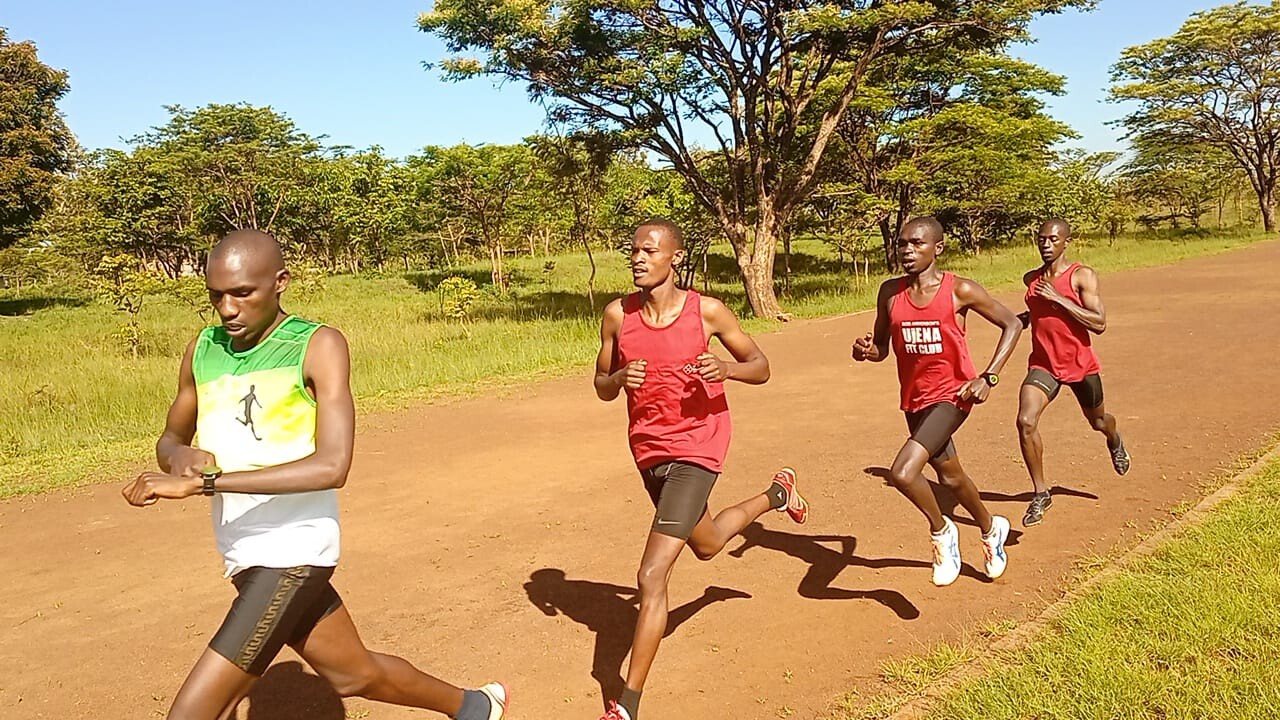
You’ll probably still enter an unfamiliar pain level when you creep up in distance, though, which is why visualizing how you’re going to feel in those later tough parts is important even in your ordinary runs.
“Everybody’s been extremely tired when they’re running, whether they’re a brand new runner or not,” Lindwurm says. “I use visualization every day while training for my marathons by thinking about how exhausted I’m going to feel and how I’m mentally going to overcome that.”
This can also be key for figuring out where you usually start to hurt physically or mentally, a process that should begin prior to your longer event, says Lennie Waite, 35, a 2016 Olympian in the 3,000-meter steeplechase and a Houston-based sports psychology consultant. Waite says it’s rare to feel amazing for the entire duration of a race, but it’s possible to identify where things usually go south so you can work on your mental toughness when you need it.
That way you’ll be less shocked if it happens and less likely to question whether you can finish, Waite says. Then you can shift back more quickly to a positive mindset and focus on the final miles ahead.
Test yourself when the pressure is off
With a lack of racing in 2020, CJ Albertson, threw together an event to attempt to break the world record for a 50K on the track. It was his first attempt at the distance, and while he wouldn’t have had it on his race calendar during a normal year, Albertson managed to break the previous record with a time of 2:42:30. The run also served as a confidence-boosting workout for the Marathon Project race six weeks later, where he set his current 26.2 PR of 2:11:18.
Veering from your scheduled plan can be beneficial if you’re in a good spot with training. For example, running 13 miles several weeks before your first official half marathon can break up your routine and prove you can do the distance.
Albertson says that once he does a trial run in practice—even if he’s unfamiliar with it at first—it allows him to look forward to a race of that length when it fits into his schedule.
Find a distraction
If you watched this year’s Boston Marathon, you probably saw that Lindwurm led for much of the first 10 miles. You may have also noticed the smile on her face while she was doing it.
“Even if I may not be smiling on the inside,” she says, “I’m smiling on the outside because I’m tricking my brain into thinking that this is great, even when it hurts.”
According to a new study published in the Journal of Motor Learning and Development, tactics that draw your attention away from negative internal thoughts—how much longer you have to run, for instance, or your legs feeling heavy—may help you improve your endurance, performance, and even running economy.
Any type of external distraction could help you get out of a funk in a race. Try looking at the cheering crowd or funny race signs, or chat with the person next to you to take your mind away from tough moments.
Embrace your goals
Waite says it’s easy for recreational runners to minimize goal setting if they run strictly for pleasure. And she’s found that when this kind of person starts striving to run better at a distance or reach a new milestone, this mindset can sometimes become a mental roadblock and make it difficult to find success.
If this sounds like you, working with a coach or sports psychologist can help you identify what might be holding you back—mentally or physically—and give your training added purpose. Because even if you aren’t running for a spot on the podium, the work you put in is still important.
And you can empower yourself by repeating positive affirmations, such as “This is important to me, I trained for this, and I belong out here,” the next time you lace up for a longer run or race that seems daunting.
Bust Out of Your Rut
You can shift your mindset before or during a long, hard workout or race with a mantra or fun mental distraction. Here, some top runners reveal their favorite fixes.
→ Dakotah Lindwurm writes “strong, fast, and last” on her hand before a marathon to remind her of her motto: “I am strong, I am fast, my speed will last.”
→ CJ Albertson tells himself to run as if he’s looking good, even if it’s not true. He says this helped him after the pack caught up to him at the 2021 Boston Marathon, where he led through 20 miles.
→ Before those challenging long runs, Erika Kemp reminds herself that training is hard, but racing is the reward, and sports are supposed to be fun.
→ Lennie Waite encourages runners to do a quick body scan—from head to toe— to make sure they don’t waste energy by holding any unnecessary tension in their brow, jaw, shoulders, or hands.
(01/01/2022) ⚡AMPby Runner’s World

New Year's Resolutions For Trail Runners
You know what the internet looks like right now. Just like every year, social media is awash in advice about what you should or shouldn't be doing as we head into 2022. Eat this, not that. Download this app. Buy this piece of gear. Try this productivity hack.
This article does not contain that kind of advice. Instead, we want to kick off the new year by living in a way that aligns with our values and prioritizes what's important to us, rather than what sells more shoes, diet apps or newfangled recovery products.
Here's how to run happier, healthier and more fulfilled in 2022.
1. Fuel for running and life
The human body is a miracle. It can transform pizza into the energy to run ultramarathons. It's amazing! Treat it as such!
The point of your body is not to shrink to its smallest form. The point is to give you the energy to show up for everything in your life, from a run, to grocery shopping, to vacation with your family, to setting a PR on the Sunday crossword puzzle. Rather than focusing on counting macros or restricting calories, focus on fueling in a way that makes you feel good and gives you the energy to go after your goals. Want to be a stronger athlete? A better parent? A more caring community member? There's an app(etizer) for that!
Stop focusing on what you should and shouldn't eat, and focus on eating enough. No one wants to go to their deathbed wishing they had eaten one more pizza bagel.
2. Buy less gear
Over 10 percent of global carbon emissions come from the apparel industry - more than all international flights and maritime shipping combined.
Aside from choosing clothes and gear made in countries with stricter environmental regulations, like Canada, the E.U. and the U.S., you can keep clothing out of landfills and reduce your environmental impact by following the three R's: Reduce, Reuse, Recycle. And recycling should be the last resort. More and more brands are instituting repair programs for just this reason, so before you replace something, see if it can be fixed instead.
BUY. LESS. GEAR.
The priority should be to reduce the amount of gear that gets made and contributes to environmental degradation by using precious resources and producing waste. The single biggest contribution you can make is to buy less, and only buy what you need.
3. Forget what you think "strong" is supposed to look like. Strength train for health and function, not looks.
If you already do a bit of functional strength and mobility, disregard this paragraph and use your extra time for Resolution #7.
Forget six-pack abs and cantaloupe biceps. If you don't currently have a strength program you like, we recommend this beginner cheat sheet, or this regimen for injury prevention. Both are designed with the movement patterns and injury risks of trail runners in mind.
The best strength program is the one you can complete consistently without feeling excessively tired or sore, and ideally, one you enjoy. Strength training should support your running, not take away from it. It should make you a better, stronger, happier runner. You don't need to get #swoll or get a six-pack to be strong. Focus on feeling good and staying healthy, not looking a certain way.
4. Start a training log
One of the biggest changes you can make to level up in your training is to start seriously recording and tracking what you're doing. While activity and health apps like Strava and Whoop have benefits, taking time offline to record your runs and track more subjective information can spur intimate reflection on how you're really feeling.
Instead of, or along with, training data, record how you feel, how you slept, your perceived effort on a run, if you saw a cool animal or a rainbow or something you're grateful for. When you have a paper training log, you're in charge of what you pay attention to.
Our favorite thing about offline training logs is that they're just for you. You don't have to show anybody else, and there's no comparison like you might find on Strava (which is why our assistant editor avoids the app entirely). Be honest and vulnerable. You're the only person who will ever see it! Accept the bad days along with celebrating the good ones, knowing that everyone experiences both. Putting pen to paper (or cursor to word doc) gives some distance from the data and allows us to reflect on what matters to us. Paying attention to patterns in energy and fatigue can help identify potential injury precursors and will help you stay more consistent and healthy. You can see our favorite training log here.
5. Focus on activity level, not weight
Brace yourself: inboxes are about to flood with emails insinuating that January 1 is a great time to recommit to a restrictive diet (it'll work this time, we promise!!) and lose the Covid 15. DON'T LISTEN.
Research shows that people who focus on being more active rather than losing weight end up improving their cardiovascular health and reducing all-cause mortality. Most people who use diets or weight loss regimens fail, and emphasizing fitness and activity rather than weight creates a more sustainable and attainable goal - with better health outcomes overall.
Throw away your scale (unless a medical professional has advised otherwise) and stop counting calories. Focus on moving your body in a way that feels good and brings you joy.
6. Prioritize mental health
If you've read this far on a list of health-related New Year's resolutions, you probably have a demonstrated interest in health and performance. But one of the most overlooked aspects of health, for athletes particularly, is mental health.
The brain is a body part, and mental health struggles should be treated just like physical injuries. If you got a stress fracture, you wouldn't tell your femur to just get over it. You'd give it TLC, allow it to rest and come back slowly, showing some extra love to the injured area. Make sure you're giving your brain the same love and judgment-free attention. This year, double down on taking care of your mental health. Meditation, journaling or any other mindfulness practice is great mental health pre-hab.
While running and exercise are great tools to ease and prevent some aspects of mental illness, they're not the whole toolbox. Invest in other methods of self-care and mental wellbeing like therapy with a professional. Mental and physical wellbeing are deeply interconnected, and when you prioritize the brain, the body will follow.
7. Listen to your body
Just like speed or endurance, the ability to listen to your body is a skill that can be cultivated. In 2022, make listening (and responding!) to your body a priority. If you're tired, rest. If you're hungry, eat. If something hurts, don't run. Make a habit of listening and responding to your body's natural cues, rather than pushing through.
And don't forget, as our friend, coach and columnist David Roche says: the body knows stress, not miles. When you have a hard day and the big workout you had on your training plan just seems like too much, give yourself some grace. If the idea of running inspires dread and not joy or motivation, make a change.
Forcing a run when you're tired, hungry or hurt isn't a sign of strength. Making intentional, informed decisions about what's going on in your body, is. 8. Rest intentionally
Most of us face a bias toward action and productivity. We overemphasize doing hard workouts and super long runs just like we do working longer hours and getting more done. But remember: the most important training adaptations happen when we're resting.
Without rest, your body can't adapt to the stimulus you're giving it. Stress+rest = adaptation. Stress+stress+stress, with no rest = disaster (injury and overtraining). Work and rest are equally important in training, even if rest doesn't get you any kudos on Strava.
Stress+rest = adaptation. Stress+stress+stress, with no rest = disaster (injury and overtraining).
Make resting intentionally a part of your training. Write your rest days in your training log! (See Resolution #6.) Celebrate the days you intentionally spend on the couch. Resting before you're hurt or overtrained is what allows you to stay consistent in the long term and adapt over time.
9. Invest in your community
Around the start of the year, many people draw up ambitious running goals: a new race distance, a PR, a new mileage or vert record. Racing is fun, and is a great way to find community through competition. But, without a deeper "why" behind your running, that connection may become unfulfilling. This year, reallocate time and energy toward something that gives back to your community - wherever your heart may be.
Last year, I started volunteering with Runners For Public Lands, a climate-justice non-profit that helps connect runners around the U.S. with environmental and social justice initiatives in their area. Now, I have an opportunity to represent an organization I'm passionate about, and that gives running a deeper resonance.
Find something that you care about and dig in. Maybe it's a local initiative to conserve public lands or increase outdoor access. Maybe you can spend a little extra time building trails or picking up trash. Volunteer to crew a friend at their big race, or contact a local race director to help mark or clean up a course.
Running can feel mostly self-centered, but there are countless ways to use it as a platform for good. Find one that resonates with you, and invest in it. Supporting others and connecting with your community isn't just good for others, it may help improve your performance too!
10. Have more fun!
I love this quote from A Summer Day by Mary Oliver: "Tell me, what is it you plan to do with your one wild and precious life?".
This article won't give you the steps to PR your marathon or get six-pack abs. But we hope it helps you live in a way that recognizes we're only here for a short time. At the end of my life, there's no way I'll wish I had spent more time on Twitter or checking after-hours emails. Most of my regrets will be about the summits I wish I'd reached, or the cheesecake I wished I had eaten.
This year, get serious about having more fun. Resist the temptation to over-optimize in ways that prioritize productivity to the detriment of fun-ductivity. We only have this one wild and precious life, and I want to freaking send it, even if that means missing a few emails, slowing down to enjoy the view and weathering cheesecake-induced GI issues. We want you to send it too.
Fun isn't the opposite of focus in an athletic life. It's a critical part of one, allowing us to laugh at the fact that we love and want to get better at something that feels as silly as trail running. If not for the fun of it, why do we do this in the first place? I always write and run my best when it's coming from a place of fun, not forced seriousness.
Each year, one of my favorite writers, Brendan Leonard, re-publishes a blog post he first wrote in 2011, "Make This Year The Year of Maximum Enthusiasm." Each year, it rings true.
"Your life, even the bad parts, is fucking amazing. And most of the small things that make up your life are amazing, too - mountain bike rides, rock climbs, ski runs, sunsets, stars, friends, people, girlfriends and boyfriends, dogs, songs, movies, jokes, smiles hell, even that burrito you ate for lunch today was pretty phenomenal, wasn't it?"
Don't just think about what you can do to have more fun, think about what you already have that is fun as hell. This life is wild and precious, and you get to decide what to do with it. So many resolutions passed down by influencers and magazines like our own emphasize getting fit, losing weight, buying stuff, being productive or emphasizing some exterior achievement to the detriment of a fulfilled life, whatever that looks like for you.
The most important thing you can do this year is to have more fun. 2022, let's do this!
(01/01/2022) ⚡AMP
Want to prevent injuries? Wear cushioned shoes, a recent study found that runners who wore more cushioned footwear experienced fewer injuries
The highly cushioned shoe versus the minimalist shoe debate has been a topic of conversation among runners for years, but it appears the pendulum is swinging in the direction of cushion. In a recent study, researchers found that runners who wore more cushioned shoes experienced lower rates of injuries than those who wore harder shoes.
The study
The study, published in the American Journal of Sports Medicine, aimed to determine how shoe cushioning influenced injury risk in recreational runners, and whether the association depends on the runner’s body mass. To find out, they gave 848 recreational runners one of two shoe prototypes: one that had soft cushioning, and one that did not. Participants were also classified as either light or heavy and were followed for six months regarding their running activity and injury rates.
The researchers found that the runners who received the harder shoes had a higher risk for injuries compared to the runners in the softer shoes. Interestingly, their data indicated that the lighter runners experienced higher injury rates in harder shoes, while the heavier runners did not, causing them to conclude that the relative protective effect of cushioned shoes was only present for lighter runners.
What does this mean for runners?
This study used a large pool of participants, which makes it a more credible source of information. That being said, there are many reasons why a smaller or lighter runner might experience a higher rate of injuries beyond what type of shoe they wear. Still, this study does seem to make a case for some runners to wear highly-cushioned shoes in order to prevent injuries.
There is a wide range of shoes available on the market today, that range from ultra-cushioned to barely-there, and it may take some trial and error to figure out which shoe is best for you. If you’re having trouble finding your perfect shoe, check out these tips when shopping for your next pair.
(12/24/2021) ⚡AMPby Brittany Hambleton
British runner Russell Bentley breaks winter Paddy Buckley Round fastest known time
American ultrarunner John Kelly and British ultrarunner Russell Bentley set out to complete midwinter Paddy Buckley Rounds, starting out in the same place and running opposite directions to meet each other back at the finish. Bentley had a fantastic day, and ended up setting a new FKT (fastest known time) on the 100K route, finishing in 20:15:49.
The Paddy Buckley Round is an extremely challenging course in Wales that takes runners over 47 summits throughout the 100K route for a total of 28,000 feet of elevation gain. According to fastestknowntime.com, it was first completed in 1982 by Wendy Dobbs. The winter FKT on the course was previously held by British runner Damian Hall, who completed the loop on January 29, 2020, in 21:30:06.
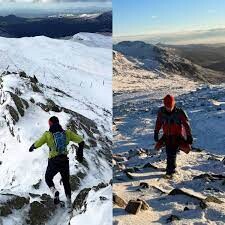
Bentley’s time smashed Hall’s record by nearly one hour and fifteen minutes, and Hall himself made a point of congratulating Bentley on his accomplishment.
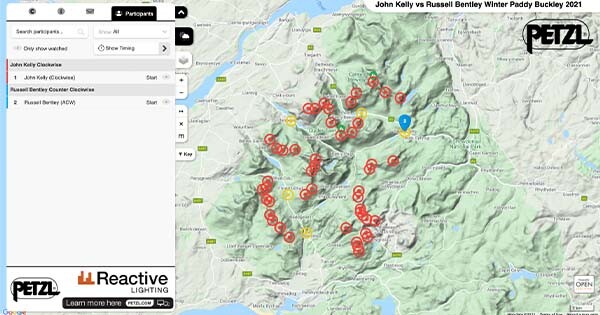
Bentley ran the course unsupported, counter-clockwise, while Kelly ran the route clockwise. Unfortunately, Kelly made it as far as the Llanberis checkpoint in 14:49:29 before throwing in the towel. This was Bentley’s second attempt at the winter Paddy Buckley Round after his first try in December 2020, which he completed in 22:45.
Bentley is a UK Athletics-qualified coach and is sponsored Noble Pro VJ Sport Vroom Nutrition. He has a marathon personal best of 2:20:20 from the Berlin Marathon, and has only begun tackling longer runs since the COVID-19 pandemic began.
(12/22/2021) ⚡AMPby Brittany Hambleton
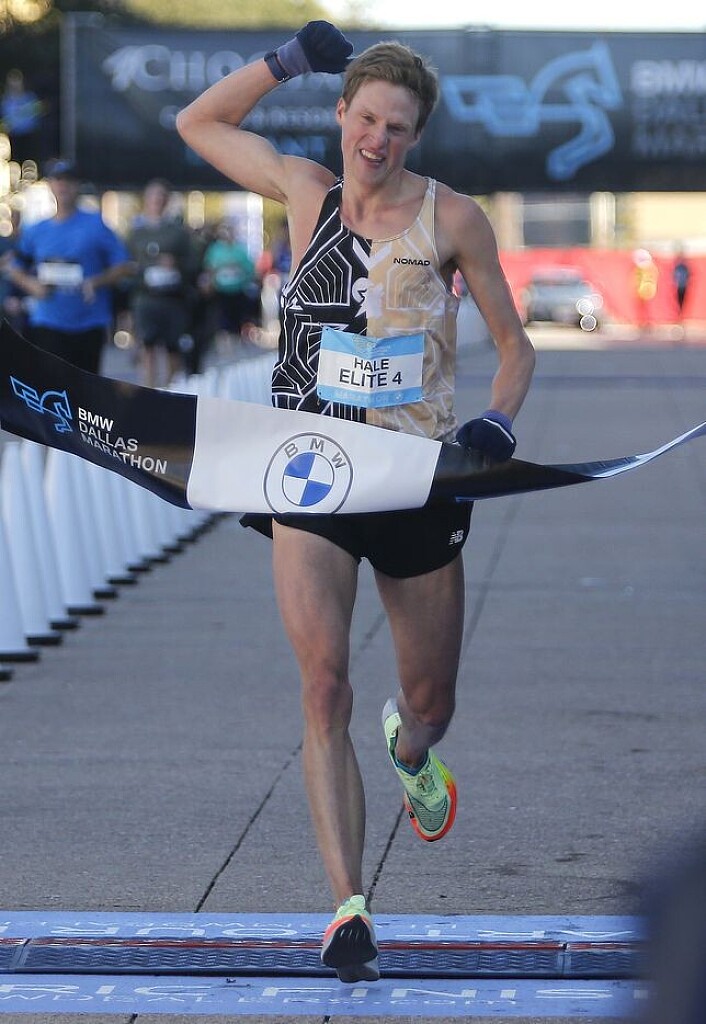
Joseph Hale and Yanet Castro Aguilar won the men’s and women’s marathons, respectively
Most of Sunday’s runners at the BMW Dallas Marathon had been waiting two years to feel the euphoria of crossing the finish line in front of city hall.
Joseph Hale had three years of waiting under his belt after finishing fourth in 2018 and not running the race in 2019.
So when the Dallas resident crossed the finish line to win the 50th Dallas Marathon with a time of 2:28:42, he pumped his fist and let out a celebratory yell.
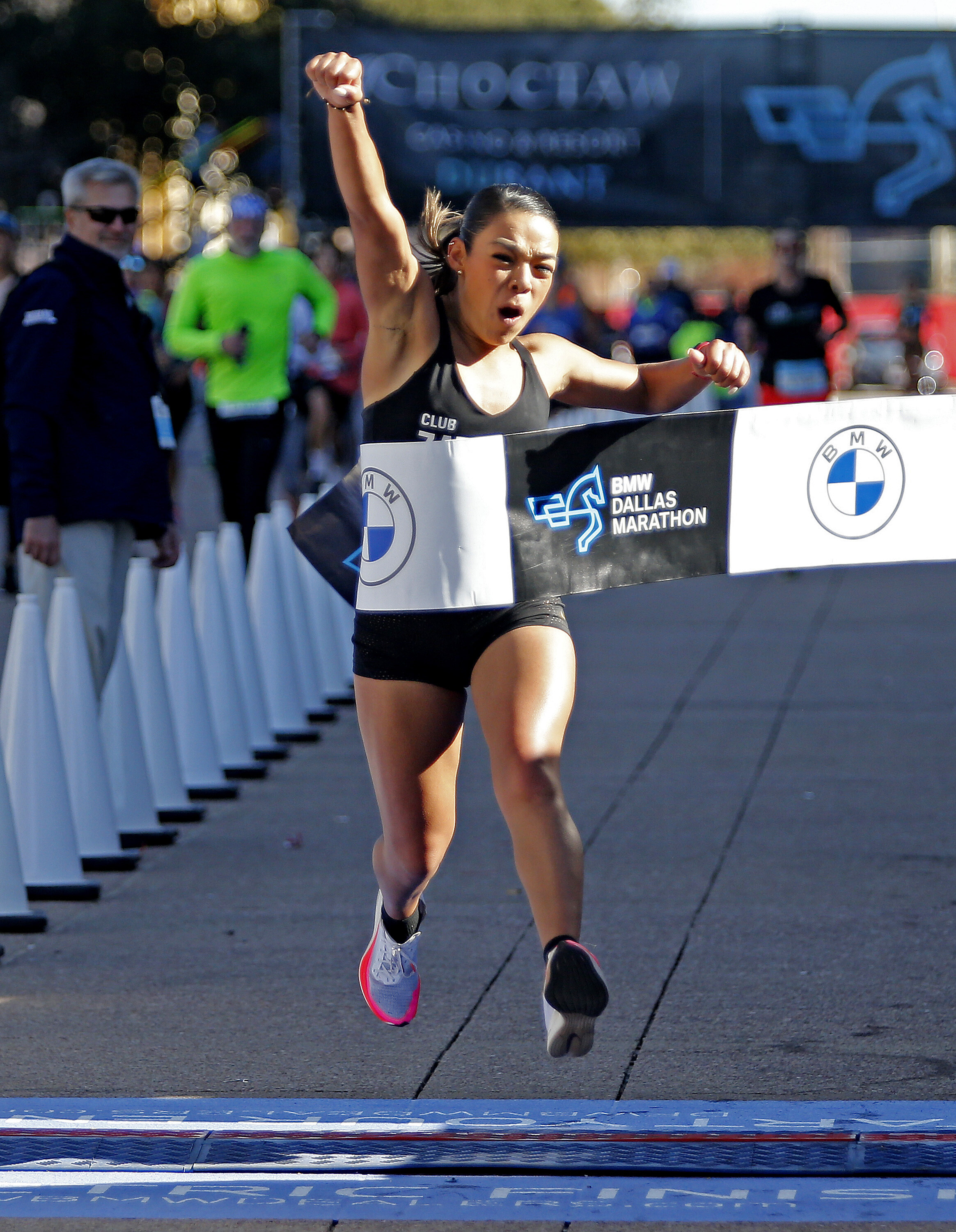
“It’s literally more than a life goal,” Hale said. “I don’t get emotional very often, but I’m going to get emotional about this.”
Joseph Hale crossing the finish line with a time of 2:28:42 to become the winner of the 50th Dallas Marathon.“I’ve literally dreamed of running that corridor for the last three years,” he said.
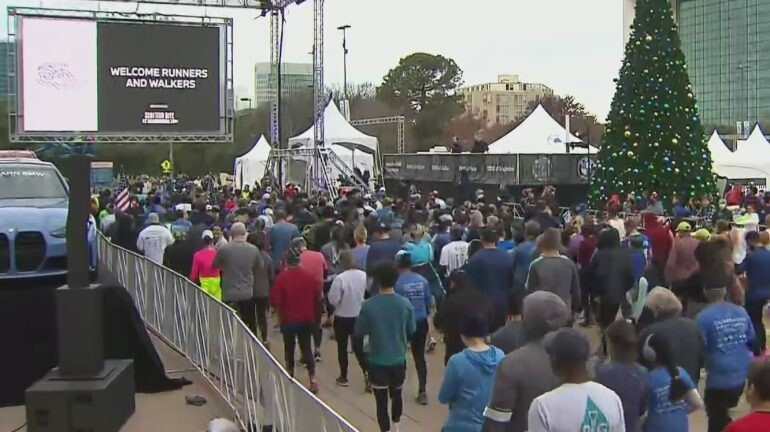
He just edged runner-up Joseph Darda of Fort Worth, who was about 20 to 30 seconds behind for the last 12 miles of the race. Darda crossed the finish line with a time of 2 hours, 29 minutes, 14 seconds.
Hale said having someone right behind pushed him to go harder but also forced him to be strategic.
This was the second straight weekend Hale finished a marathon.
He ran the California International Marathon the previous Sunday in Sacramento, Calif., finishing with a time of 2:26:44. He said he felt the mileage in his legs by the 10th or 11th mile.
“I wasn’t going for time; that’s what my race last week was about,” Hale said. “I actually don’t really know my time. I don’t really care. I won.”
More than 17,500 runners competed in Sunday’s races, and over 26,000 people competed over the entire weekend, which set a record.
The women’s winner was Solyenetzitl Selene Yanet Castro Aguilar of Zacatecas, Mexico, who finished with a time of 2:52:20.
She spent the first part of the race pacing with another competitor but, unbeknownst to her, the other runner was running the half marathon and soon split off in a different direction.
Castro Aguilar said she has been dealing with injuries over the past few years. She has spent the past three months training very hard for Sunday, and she took full advantage of the opportunity.
“I’ve been waiting three years to run this,” she said through a translator. “I was very happy and smiling all the way.”
It was the first marathon for Bradley. She ran at Baylor and was an NCAA cross country championship individual qualifier in 2017.
“This is kind of a full-circle moment because I went through some injuries that at the time I thought were career ending,” Bradley said. “To be able to run a marathon, it’s like all my dreams coming true.”
It was a banner year for first-time competitors. Both half marathon winners, Mitch Ammons and Kelsey Bruce, and women’s ultra marathon winner Megan Smyth were running at the event for the first time.
Bruce and Hale are best friends, meeting each other when they were both runners at Dallas Baptist from 2011-15.
They even ran the first few miles of Sunday’s race together before embarking on their own separate, winning journeys.
Bruce won the half marathon with a time of 1:14:35. She moved to Wichita Falls earlier this year after being hired as the head coach of Midwestern State’s cross country and track teams. Being able to come back to her hometown of 10 years and win the half marathon in front of her friends, family and coach was special.
“It’s always fun to hear your name on the course from people you love,” Bruce said.
So with her friend still on the road, Bruce stuck around after receiving her medal and award, joining the cheering brigade for Hale.
And as Hale entered the final length of his winning run, one voice stood out amid the crowd cheering him on.
“With 600 to go, she was there telling me that you got it,” Hale said. “She knows how I finish. She knows I can finish terribly. So when she said that I had it, I knew I had it.”
(12/13/2021) ⚡AMPby Peter Warren
BMW Dallas Marathon
The BMW Dallas Marathon is the result of the efforts of a pioneering group of brave Dallas runners, who had the foresight to establish an annual 26.2-mile race more than 40 years ago. In 1971, Tal Morrison – the official founding father of the marathon – placed a $25 ad in Runner’s World beckoning runners from around the country to...
more...
Nike Tries to Ban Imports of Adidas Knit Shoes, Accusing It of Copying Designs
Nike Inc. is asking a U.S. trade agency to block imports of a wide range of Adidas AG Primeknit shoes, saying they copy the Oregon company’s patented inventions for a knitted fabric that reduces waste without any loss in performance.
The complaint, filed Wednesday at the International Trade Commission in Washington, seeks to ban imports of shoes, including Adidas by Stella McCartney Ultraboost, Pharrell Williams Superstar Primeknit Shoes and Terrex Free Hiker hiking shoes. Nike also filed a patent-infringement suit in federal court in Oregon making similar allegations.
The patents cover Nike’s FlyKnit technology, which uses specialized yarn from recycled and reclaimed materials to create a sock-like fit in the upper part of the shoe. Nike said it was the result of more than $100 million and a decade of research -- almost all done in the U.S. -- and “represented the first major technology innovation in footwear uppers in decades.”
FlyKnit was first introduced before the 2012 London Olympics and has been adopted by “basketball great LeBron James, international soccer superstar Cristiano Ronaldo, and world record marathoner Eliud Kipchoge,” Nike said in the complaint.
“Unlike Nike, Adidas has forgone independent innovation,” Nike said in a court filing. “Instead, Adidas spent the past decade unsuccessfully challenging several of Nike’s patents directed to FlyKnit technology -- all while using Nike’s patented technology without permission.”
Nike said it was “forced to bring this action to defend its investments in innovation to protect its technology by halting Adidas’ unauthorized use.”
Adidas said it’s analyzing the complaint and “will defend ourselves against the allegations.”
“Our Primeknit technology resulted from years of dedicated research and shows our commitment to sustainability,” Mandy Nieber, an Adidas spokeswoman, said.
Several of Nike’s patents, including two of the six in the ITC complaint, have been the target of regulatory challenges by companies including Adidas. Nike said they were filed only because it refused to pledge not to sue the German company.
The civil suit, filed in Portland, Oregon, accuses Adidas of infringing those six patents and three others related to FlyKnit technology. It seeks unspecified damages and asks that any award be tripled for the intentional copying. It’s also seeking an order to halt sales.
Nike has been aggressive in protecting its FlyKnit and other shoe inventions. A lawsuit against Puma SE settled in January 2020 and ones against Skechers USA Inc. settled in November.
The U.S. trade agency is a popular forum for companies looking to derail rivals in the world’s biggest market. The commission works more quickly than most courts, with final decisions typically in 15 to 18 months. Not only can it block products at the U.S. border, it can halt sales of products already brought into the country, an order that’s harder to get in district court.
The cases are In the Matter of Knitted Footwear, 337-3580, U.S. International Trade Commission (Washington) and Nike v Adidas, 21-1780, U.S. District Court for the District of Oregon (Portland).
(12/12/2021) ⚡AMP
Five books to make you rethink your running
At moments, running can be a monotonous sport. The same routes traversed time and again over a long winter block of training. Sometimes all it takes to relight that fire is a good book.
Here are five that will inspire you to get the trainers on once more.

Out of Thin Air by Michael Crawley
Michael Crawley is a talented marathon runner who has competed internationally for Scotland, but it was his trip to Ethiopia that made him fall back in love with the sport. Living with some of the nation’s best athletes, Crawley provides a fascinating insight into one of running’s most fabled heartlands.
From travelling to altitudes where it is difficult to breathe all in search of almost mythical mountain air, to zig-zag runs through dense forests, Crawley introduces us to the almost spiritual association Ethiopia has with the sport.
An awe-inspiring, uplifting read, Out Of Thin Air will bring purpose to those daily runs and a spring in the step for anyone hoping to follow in their footsteps.
Coasting by Elise Downing
Elise Downing’s book starts with the familiar conundrum. A university graduate finding her feet in the working world, Downing faces up to the reality of what her future holds. Her solution, however, is not the typical.
Deciding to run the coast of Britain, Coasting follows her journey round the nation’s shores. It charts the highs and lows of the entire 5000-mile journey, the people she meets along the way and the truths she discovers about herself.
Coasting serves a fitting reminder of how running can provide a great platform to unwind your thoughts, to reflect and ultimately to move forward in a better place than when you headed out the door.
Born to Run by Christopher McDougall
An injury to his foot has McDougall in pursuit of a fix. But in searching for an answer, the author draws us to what many see as the birthplace of North American endurance: the Tarahumara tribe and their incredible ultra-running exploits.
The book follows McDougall in his attempt to complete a 50-mile race in Tarahumara territory and sees him try to answer how humans are capable of such extraordinary feats.
A mixture of high-level sports science and nostalgic romanticism will see you plodding along wondering whether you were born to do this.
Feet in the Clouds by Richard Askwith
Richard Askwith is, by his own admission, no fell-running superstar but his book on the sport provides a compelling illustration of just why so many find the sport so special. One in which the sport’s best and the rest face the same trials and tribulations.
Along his journey trying to complete the Bob Graham Round, a fell-running endurance challenge in the UK’s Lake District, Askwith tells the story of fell-running’s understated stars.
If a book can summarise what it means to be out on the fells, plotting your path, this is probably it.
Feet in the Clouds will have you searching for the tallest hill and making it your mission to climb it.
The Passion Paradox by Brad Stulberg & Steve Magness
In pursing your running goals, it can often feel like you lose balance in your life. When you don’t quite achieve what you are looking for, then it can have a big impact on how you feel. Not just about your running but also about your self-worth.
Stulberg and Magness tackle the notion of passion, how it is important for success but how it needs to be harnessed so as to avoid becoming something obsessive. They talk about the warning signs, how an element of imbalance is necessary but ultimately how you can channel it to your advantage.
Although this book isn’t just about running, it is for all those who feel they’re stuck in a rut and looking for something to freshen up their perspective to their passions.
(12/12/2021) ⚡AMPby World Athletics
British mountain guide James Gibson becomes first winter runner to complete Wainwright’s 214 peaks
On Dec. 1, James Gibson from Ambleside, U.K., set out to become the first person to run Wainwright’s 214 peaks in the winter. After 200 hours of running in blistery conditions, Gibson arrived back in the town of Keswick, U.K. on Dec. 9, to finish his journey and become the first man to complete this feat in the middle of winter. Gibson finished his record-setting journey in eight days, six hours and 44 minutes.
Here is the history behind the run: The Wainwrights consist of 214 mountain peaks inside Britain’s Lake District National Park – all peaks are taller than 1,000 feet (304 meters), except one.
Traversing all the Wainwright’s in one consecutive run involves 523 kilometers of distance and ascending 36,000 meters. Since Alfred Wainwright’s Pictorial Guide to Lakeland Fells was published in the 1950s, summiting these peaks has become a goal for many British ultrarunners.
The rules of the Wainwrights record are simple: runners must start and finish in the town of Keswick, a town located in the national park, and they can take any route they like, as long as they summit each of the 214 peaks.
What made Gibson’s journey unique was the wind, rain, snow and ice he had to endure. A wicked snowstorm hit the coastal mountain range on the sixth day of his journey, resulting in him descending back to the valley. As the storm blasted through, Gibson and his crew resumed, trekking through a foot of snow. As Gibson reached the last peak, he celebrated with a beer before returning to Keswick to finish.
When he finished in Keswick, the previous Wainwright record-holders Steve Birkenshaw and Paul Tierney, who both ran this challenge in the summer, were there to greet him in the village. Gibson was supported by over 60 friends and local businesses that offered hospitality to him on the route.
(12/11/2021) ⚡AMPby Marley Dickinson
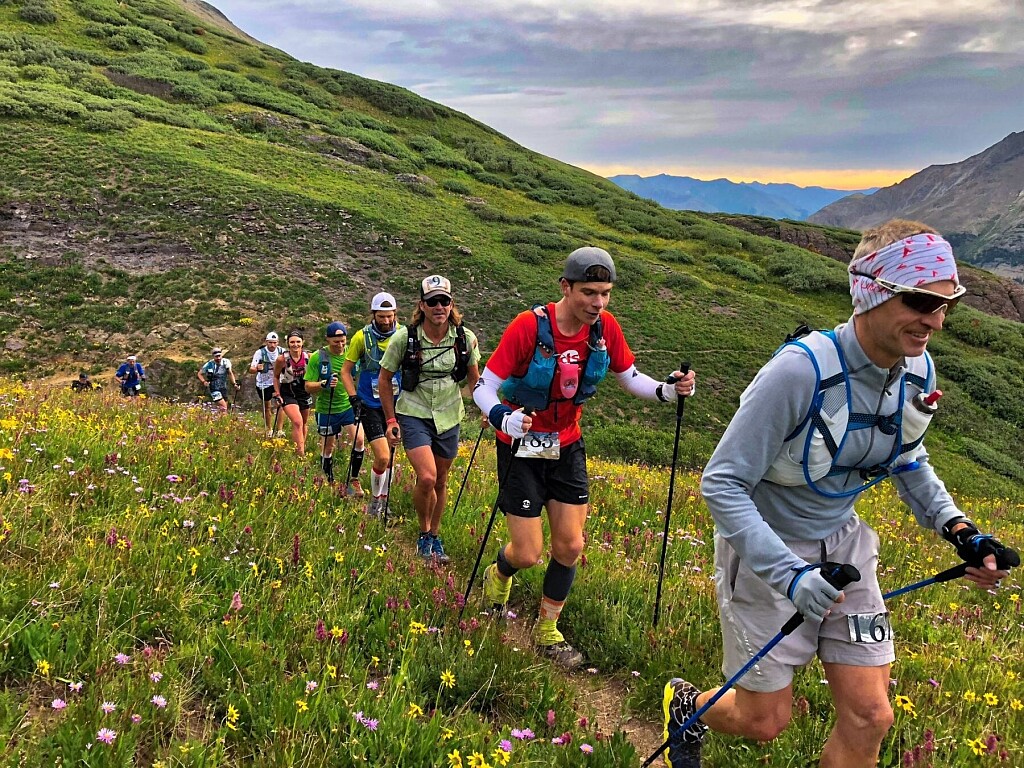
Strong field will be competing in 2022 Hardrock 100, with a lottery narrows field to 145
The Hardrock 100 ultramarathon held its lottery on Saturday to select runners to fill out its field of 145.
The race had 1,916 runners apply from 46 states and 50 foreign countries this year, which is slightly down from the roughly 2,200 applicants in 2019. The ages of the applicants ranged from 19 to 73, and the largest group was 40 to 49 years old, or 43% of the total.
New this year is a gender-equity provision, guaranteeing the percentage of women in the field at least equals the percentage of women who applied. So, since 345 women applied, representing 18% , 27 women were selected to participate.
“I thought the gender equity worked out well,” said race director Dale Garland. “The lottery is designed for gender equity and also to make it accessible to new runners and people who have been here before. Both are important.”
Because of COVID-19, international runners who were chosen for the previous year’s event but were unable to travel in 2021 gained an automatic entry for the 2022 race, which includes 16 men and two women.
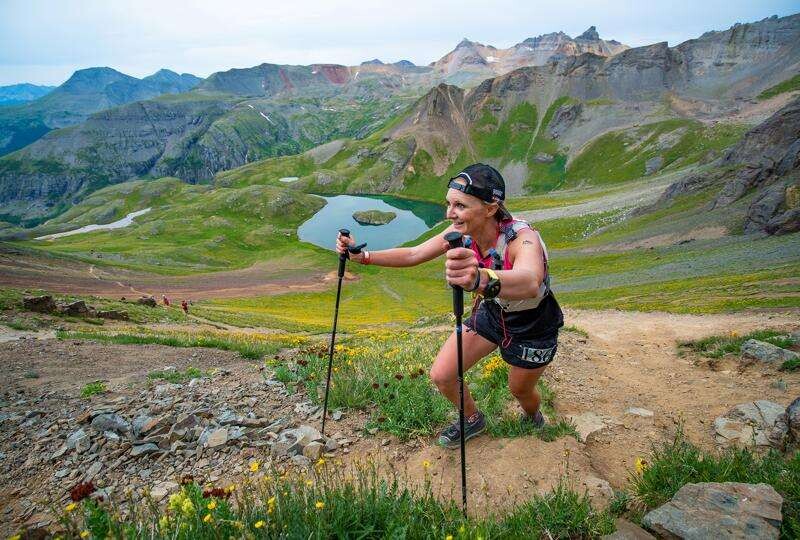
Automatic entry goes to last year’s winners – Sabrina Stanley, a two-time champ, and Francois D’Haene, who set a course record last year. D’Haene also won the Ultra Trail du Mont Blanc last year in Chamonix, France.
Garland also got to choose six entries, which are kept secret. He said, however, that his picks this year are elite runners, some runners who have provided service for the event and two with good storylines.
After that, 119 runners were selected in the lottery. To be eligible for the lottery, the athletes had to complete one of 30 qualifiers around the world that are all at least 100 miles long.
“I’m really happy with it,” Garland said this year’s field of athletes. “There’s some interesting competitive story lines, some competitive longevity story lines, and we’re seeing some people who have run in 10 or 15 Hardrocks.
Killian Jornet, a four-time Hardrock champion, will race again this year. Aurélien Dunand-Pallaz, who finished second at the Ultra-Trail du Mont-Blanc last year, also is expected to compete for the title.
In the women’s race, Courtney Dauwalter, an Ultra Trail du Mont Blanc winner in 2019 and 2021, will challenge Stanley. “It will be an interesting dynamic to have those two run,” Garland said.
Darcy Piceu, an eight-time Hardrock finisher with three wins, also will be in contention, as will Meghan Hicks, a top-three finisher from last year who lives in Silverton, like Stanley.
Neal Matosky of Durango and Durango High School graduate Dakota Jones also will compete.
“I wouldn’t be surprised to see (Jones) in the top 10,” Garland said.
The race takes place July 15-17. It will start at 6 a.m. on July 15, and the runners will have 48 hours to complete the race. It will start at Silverton and go to Telluride first this year, then Ouray, close to Lake City and finish in Silverton. The first race was held in 1992 and this will be the 27th running of the event. Snow and fires caused a few to be canceled.
Volunteers are needed for the event. For information, visit hardrock100.com.
(12/10/2021) ⚡AMPby Cody Olivas

Hardrock 100
100-mile run with 33,050 feet of climb and 33,050 feet of descent for a total elevation change of 66,100 feet with an average elevation of 11,186 feet - low point 7,680 feet (Ouray) and high point 14,048 feet (Handies Peak). The run starts and ends in Silverton, Colorado and travels through the towns of Telluride, Ouray, and the ghost town...
more...
The easiest gifts for runners this Christmas
If there is a runner in your family who hasn’t sent you their Christmas list yet, don’t worry, we have you covered. You shouldn’t stress about buying Christmas gifts for runners, as they are the easiest demographic to shop for. Here are a few ideas.
Stance performance socks
Runners can never have too many pairs of socks. Stance socks are made of a performance polyester called ‘FEEL360,’ a sewn fibre that reacts to your body’s temperature for high-performance comfort. They also feature moisture-wicking technologies guaranteed to keep you feeling fresh and dry in the summer heat and warm in the winter. A bonus is that these socks can be purchased in unique colours and designs, such as, Wu-Tang Clan, Forrest Gump and Bob Marley styles. Stance socks range from $25 to $45 per pair and can be purchased online at MEC.
A nice pair of running gloves
A runner truly appreciates a nice pair of running gloves to get them through the winter. The run liner gloves from Under Armour are a great base layer for your hands. They’re form-fitting, light and stretchy, with the right warmth when temperatures are below zero. These gloves have water and wind-resistant panelling on the front and a plush interior for the right amount of warmth. They’re also touchscreen-friendly, allowing you to use your phone without having to take your gloves off.
Smartwool merino men’s sport boxer brief
Men, it’s time to upgrade your running underwear this Christmas. These performance-style briefs are designed to help you operate in comfort regardless of the conditions. They feature a double front panelling designed to provide extra support down low, and sewn with a flatlock seam to eliminate chafing. These briefs are made to help keep you cool and dry while you’re out for a long winter run. Smartwool boxer briefs can be purchased online at MEC.
Petzl Bindi headlamp (200 lumens)
Light up the night sky with the Bindi headlamp from Petzl. This headlamp is ultra-compact and ideal for training in everyday urban environments. The headlamp has a range of 40 metres and is convenient to charge via a micro USB port. The Bindi headlamp is minimalist, yet functional, combining style and performance. The headlamp retails at MEC for $59.95.
Hydration is important all year for runners. They need an electrolyte mix to replace the nutrients lost in sweat during exercise. Skratch sports mix has a light, easy-drinking taste. The Skratch powder is non-GMO, non-dairy and gluten-free, so it will be easy on the stomach during or after a run. You can purchase Skratch online or at your local independent running retailer or MEC, prices ranging from $19.99 to $69.99
(12/09/2021) ⚡AMPby Marley Dickinson
Toronto’s Bernard Abarquez completes 42 marathons in 42 weeks
Abarquez began the challenge on his 42nd birthday in February 2021 and averaged 3:17 marathons for 42 straight weeks.
Forty-two weeks ago, Toronto’s Bernard Abarquez began the remarkable challenge of running 42 marathons in 42 weeks to celebrate his 42nd birthday. On Sunday, Dec. 5, Abarquez completed his challenge in the heart of Toronto, running 17 2.5-kilometer loops around Exhibition Place, joined by many members of the Toronto running community.
Instead of approaching running from a competitive perspective, Abarquez’s journey led him to a new source of fulfillment: inspiring others to look past limitations through running. Abarquez got the idea for Project42, having run ‘birthday mileage’ on his previous birthdays.
His goal for his 42nd birthday was to run a sub-three-hour marathon, but his planned races were postponed due to the pandemic. After chatting with some of his friends in his Everyday Fit Social Club, Abarquez started Project42.
At the start of his project, Abarquez was only running once weekly for his marathon, but as weeks passed, he gained fitness and started to add a few shakeout runs and workouts into his weekly mileage. Abarquez changed up the scenery on a few of his runs, completing marathons in towns across Ontario in Sauble Beach, Hamilton and Brighton.
As races began to open up with the easing of the pandemic restrictions, Abarquez completed three in-person marathons, achieving his Boston qualifying time and sub-three-hour goal at the Muskoka Marathon in October.
“At the start of the challenge, running 42 marathons was daunting,” Abarquez says. “I began to approach every run with excitement and told myself to take things one marathon at a time.” As he began sharing his journey on social media, many runners in the Toronto community started to get behind his project. “Every run I would show up at, people were genuinely excited for me, which kept me positive throughout my challenge.”
Abarquez began running seriously in 2015, but since then, the unofficial Toronto running ambassador has completed multiple marathons and run as a pacer for several more. An accomplishment he’ll never forget is when he finished his first 100-miler. “The ultra community taught me to be optimistic – everyone in an ultra race wants you to succeed,” says Abarquez.
“I had fears of course, and at the start, I wasn’t sure if I could do this,” says Abarquez. “There was never a day I didn’t want to be out there, running.” Several sponsors were on board alongside Abarquez for Project42, including Rally Beer, Nuun Hydration, Reebok, Undefined (socks) and Endurance Tap fuel. His friend Saul Weiss supported Abarquez on the bike for 36 of his 42 marathons and ran the entire distance himself on two occasions.
Throughout the project, Abarquez supported Hospice Toronto, a non-profit organization providing palliative care for terminally ill patients. He also contributed towards the Scarborough Health Network, which helped his cousin beat cancer 11 years ago.
In terms of what’s next for Abarquez, he plans on changing his running shoes to snowshoes this winter as he plans to run a self-supported snowshoe marathon.
(12/09/2021) ⚡AMPby Marley Dickinson
Canadian Reid Coolsaet set to run the 2022 Western States 100
The lotteries for the 2022 Western States 100 and Hardrock 100 took place this weekend, and Canadian Olympian Reid Coolsaet got his name on the Western States list. With over 8,000 applicants vying for only 340 lottery spots (221 for Western States and 119 for Hardrock), runners without automatic entry have a slim chance of having their names pulled, but 34 lucky Canadians got a spot on the start lines.
Western States
Of the top 10 male finishers at last year’s race, eight will be making their return to Olympic Valley, Calif., including second- and third-place finishers Tyler Green and Drew Holmen. Jim Walmsley, who won the race in 2018, 2019 and 2021 (the race was canceled in 2020 due to COVID-19), has not elected to return for the 2022 race. The top three podium finishers from last year’s race, Beth Pascall of the UK, Ruth Croft of New Zealand and Ragna Debats of the Netherlands, will all be returning, as will six more of the top 10 women from 2021.
Canada’s Ailsa MacDonald received automatic entry, thanks to her 13th-place finish at the 2019 Western States and first-place finish at the 2020 Tarawera 100 Mile. Other fast runners who have received automatic entry include Sébastien Spehler (second at Ultra Trail Cape Town this year), Tom Owens (fourth at UTMB in 2019), Cole Watson (third at the Javelina Jundred), Stephanie Auston (third at the 2020 Black Canyon 100K and second at the 2019 Tarawera 100K) and Zoë Rom (third at the 2021 Rio del Lago 100 Mile and third at the 2021 Tillamook Burn 50 Mile), among others.
Coolsaet will be one of the top Canadians in the race, despite being relatively new to the ultramarathon scene. In August, he won his first-ever ultra, the Quebec Ultra Trail 110K, despite missing a turn and having to run an extra 10 kilometres. He will be joined by several other Canadians, including:
Leo Fung, Calgary
Jesse Hulley, Calgary
Mike Jollie, Calgary
Kevin Jansen, Calgary
Rohan Aurora, Vancouver
Steve Day, North Vancouver
Adam Harris, Squamish, B.C.
Patrick Humenny, Kimberly, B.C.
Ricardo Tortini, Port Moody, B.C.
Dawson Mossman, New Maryland, NB
Aytug Celikbas, Oakville, Ont.
Matt Lowe, Hamilton
Derek Mulhall, Tecumseh, Ont.
Norman Nadan, Orangeville, Ont.
James Swartz, Toronto
Vincent Gauthier, St-Zotique, Que.
Fanny Barrette, Calgary
Tara Chahl, Edmonton
Chelsey Topping, Lethbridge, Alta.
Kelly Haston, Toronto
Karen Holland, Kimberly, Ont.
Hardrock 100
Hardrock is particularly difficult to get into, because the only way to gain automatic entry into the race is by winning it the previous year. A unique addition to this year’s lottery: entrants who were chosen for last year’s race but were unable to travel because of COVID-19 were given automatic entry for 2022, which included 16 men and two women.
There are some big names on the 2022 start list, including Courtney Dauwalter, Sabrina Stanley, Magie Guterl, François D’Haene, Kilian Jornet, John Kelly, Luke Nelson and Jeff Browning. Canada’s Stephanie Case, who was the first woman (and third overall) at the 450km Tor des Glaciers race in Italy, will also be on the start line.
Other Canadians who received entry into Hardrock include:
Suzanne Johnson, North Vancouver
Dana Samis, North Vancouver
Joanna Ford, Calgary
Larry Kundrik, Lethbridge, Alta.
Ken Legg, Powell River, BC
Randy Duncan, Victoria, BC
Christopher Aubrey, Sherwood Park, Alta.
Nathaniel Couture, Fredericton, NB
Matthew Fortuna, Oyama, BC
Leo Fung, Calgary
(12/06/2021) ⚡AMPby Brittany Hambleton

Western States 100
The Western States ® 100-Mile Endurance Run is the world’s oldest and most prestigious 100-mile trail race. Starting in Squaw Valley, California near the site of the 1960 Winter Olympics and ending 100.2 miles later in Auburn, California, Western States, in the decades since its inception in 1974, has come to represent one of the ultimate endurance tests in the...
more...
After a two-year hiatus, Dallas Marathon is coming back, celebrating its 50 anniversary
The 50th anniversary of the Dallas Marathon was always going to be a special event.
But then the race was canceled last December for only the second time ever because of the pandemic. The makeup race in May suffered the same fate.
A pandemic-induced cancellation won’t happen a third time. And Paul Lambert, the president of runDallas, the organization that puts on the marathon, said the yearlong wait is going to make the marathon’s golden jubilee even more special.
“We’re actually putting a video together and the theme song is ‘Back to Life,’” Lambert said. “If you would ask me how it feels, it’s a combination of truly back to life; not only for, hopefully, a lot of our runners and the feeling that they get out in these massive public community running events, but also for us as a management team.”
The BMW Dallas Marathon will take place next weekend with the 50th running of the marathon scheduled for next Sunday. Ten races will take place throughout the weekend, plus a Health and Fitness Expo at Kay Bailey Hutchison Convention Center on Friday and Saturday.
The first Dallas Marathon, then called the White Rock Marathon, was held on March 6, 1971. Far from the major weekend event it is now, the race had 82 participants and the course was only around White Rock Lake.
“The changes are really something else,” said Annabelle Corboy, the first female winner of the Dallas Marathon. “The changes in 50 years are incredible. ... There’s so many things that are different between now and then.”
Registration for the original 50th anniversary date opened in April 2020, and runDallas saw strong early participation numbers compared with other races across the country. Lambert said it was because the Dallas Marathon was “probably the first major race to come out with a defined contingency message.”
That plan was if the race couldn’t be held in person in December 2020, runners could either run a virtual race or push their registration back to a backup date in May 2021. And when the backup event was cancelled, the organization offered the same option to run virtually or push registrations to December.
The uncertainty that hung over the organization weighed on its small staff. Despite the contingency messages, it was difficult to do much planning for anything more than three months in advance. And without knowing when the next big race was coming, the team had to make sure it could maintain its financial viability.
But the extra time did give runDallas the opportunity to refine and fine-tune the event, as well as further grow and strengthen relationships with its partners. It has also resulted in extraordinary growth of runners.
Marcus Grunewald, the executive director of runDallas, said the weekend is reaching record participation.
“I think there’s a real pent-up demand to have a big event like this,” Grunewald said. “In fact, our numbers are a bit unusual for the industry as a whole.”
About 15,000 runners participated in the events included in the 2019 marathon. With about a week to go before the first race on Friday, over 23,0000 people have signed up to participate across the 10 different events. RunDallas expects that number to be about 25,000 by race weekend. More than 2,500 people have also signed up to volunteer.
Participation in the ultra marathon, a 50k race added to the program in 2018, sold out weeks ago. The marathon and half marathon are also approaching sellout status, and Grunewald believes they may sell out before race day.
“I think this will be a highlight of the last two years for almost everybody involved with the entire weekend,” Lambert said.
It will be for Logan Sherman, for whom the marathon is almost always a yearly highlight.
He first participated in the Dallas Marathon as part of a relay team in high school over 20 years ago. He has since won the half marathon three times and the 2015 marathon with a time of 2:27:28.
Sherman is now a current member of the runDallas board, and isn’t running any long races this year, instead focusing on volunteering at the event. He is hopeful the 50th anniversary is going to take the event to the next level.
“This is gonna be so much fun,” Sherman said. “I guarantee you there’s gonna be a lot of smiles and emotion that people are going to have at the finish line when they get back to City Hall. I don’t plan on leaving right after the start. I plan on staying up there and just watching the smiles and the emotions that come through.”
(12/06/2021) ⚡AMPby Peter Warren

Bored on Your Long Run? Here’s Why You Feel That Way—and How to Embrace It
We talked to a psychologist and a professional ultrarunner to understand why you you feel this way—and how to embrace it.
It’s Sunday morning. You roll out of bed, head downstairs, pour yourself a cup of coffee, and munch on a protein bar. Yup, it’s that time of week again—long run day.
Long runs are a staple of training, whether for a 5K or a marathon. But let’s be frank: Despite the benefits, long runs can be pretty boring. While you might normally rely on the company of others—or perhaps even music or a podcast—during your normal runs, those simple escapes just don’t cut it when you’re trotting along for twice as long. Conversation becomes agonizing, pop bangers non-motivating, and true crime dramas stale.
So why, even though it’s one of your most cherished activities, do you sometimes feel overcome with boredom when long running?
According to Erin C. Westgate, Ph.D., director of the Florida Social Cognition and Emotion Lab at the University of Florida, boredom is an emotion characterized by lack of meaningfulness and engagement.
“So, what you’re doing needs to feel meaningful to you personally, otherwise you’re bored,” Westgate tells Runner’s World. “… [and] you need to be able to pay attention to what you’re doing. That means if you’re doing something that’s too easy or too hard, you’re going to struggle to pay attention.”
Long runs are hard. You run farther than you would any other day of the week, which is mentally and physically taxing. No wonder it leads to boredom.
So, what actually is boredom?
Scientists previously considered boredom a neutral state, Westgate says, so it did not meet the criteria to be considered an emotion. However, recent research suggests that boredom is an emotion—and not a neutral one.
“It’s actually pretty unpleasant and aversive,” Westgate says. “People don’t enjoy experiencing it.”
During a graduate school study, Westgate had subjects sit in an empty room. The first part of her research measured pleasant versus unpleasant experiences. Would a patient pay to come back and look at the same beautiful painting again? Yes, for $5. Would a patient pay to not experience pain from a shock device? Also yes, for $2.
During the final part of the study, she asked participants to sit alone in an empty room and entertain themselves with their thoughts for 10 to 20 minutes. There were only two rules: stay in the chair and don’t fall asleep. Each subject was also told that if they wanted to, they could use the shock device from the earlier part of the study. Sixty-seven percent of the men and 25 percent of the women shocked themselves, preferring pain to the monotony of sitting with their thoughts.
While this paints a poor portrait of boredom, Westgate says the emotion shouldn’t be seen as inherently positive or negative. It’s simply information, which can tell you a lot about how you’re feeling.
Here’s why you might be bored on a run—and what to do about it
Katie Asmuth—who is a professional ultrarunner for Saucony—believes that boredom can teach you something about yourself. Depending on the training cycle, she might run for up to five hours at a times—a distance many folks would find mind-numbingly boring. To her, it's the furthest thing from it.
“To be bored while running doesn’t have to do with the act of running, but with the mindset behind the action,” she says. “If you are bored, you are not engaged with the process.”
The emotion is a symptom of something bigger, whether lack of motivation, mental burnout, or something else entirely. “Boredom is sort of like a dashboard light letting you know something is off,” says Westgate. “It gives you an opportunity to fix that.”
If you’re bored because your long run doesn’t feel challenging enough, you can add in a few pickups to keep it interesting. Or, if you’re bored because your run doesn’t feel meaningful to you in the moment, you can remind yourself that this run is valuable to your long-term goals.
Tuning into why you feel bored teaches you how to motivate yourself in the future. After you complete the big marathon that you trained four months for, it might be difficult to become excited about training again—those 20-minute runs might mentally feel like a long run now, when a month ago a long run flew by like it was only 20 minutes.
Westgate says that’s it’s okay to feel this way. After all, you can’t be die-hard motivated all the time. Using a distraction—such as music or a podcast—to get through mentally challenging runs isn’t a bad thing.
“It’s almost like comfort food,” says Asmuth. “… sometimes you need that initial trigger that excites you to get out the door.” But such as with comfort food, it’s healthiest in moderation.
You don’t have to completely suppress your feelings of boredom. Embrace them instead!
You can easily distract yourself too much. Instead of getting to the root of your boredom, you put on music just to push through it. In the long-term, this can reduce the activity’s meaningfulness.
“Suppression strategies are not a healthy way of dealing with the feelings we have,” says Westgate. “Part of that is because they don’t actually solve the underlying problem.” She likens coping this way to pulling out your phone every time you’re bored at work; by doing so, you’re not dealing with the hard truth that the work makes you feel bored.
It’s important to keep in mind, though, that everyone is different, and one person’s suppression could be another person’s positive experience. Asmuth loves to warm up with a good podcast, a “rocking playlist,” or audiobooks—not because she’s trying to distract herself from her run, but because listening to those things adds to her enjoyment. Once she gets far enough along, she’ll usually turn the sounds off.
“I prefer listening to my body, my breath, and my footsteps—letting my mind wander,” Asmuth says. “I disconnect from what I’m doing after the run and reconnect with my present self. I often think about what I’m grateful for and appreciate the silence.”
Studies have found that the silence and disconnect that Asmuth mentions can lead to measurable positives. A study in the journal Academy of Management Discoveries found that some people feel a boost of creativity after performing a boring task. Alicia Walf, Ph.D., a senior lecturer of cognitive science at Rensselaer Polytechnic Institute, told Forbes that boredom can also improve social connectivity.
So, don’t be afraid to embrace boredom—just like Asmuth does. After giving birth to her first son, she made sure running stayed a priority; it was important to have alone time to go outside and explore.
“That boredom is a gift. I have the time and space to listen to my body, to scan from head to toe and ask, ‘what do I need?’” Asmuth says. “I take what the trail gives me and need nothing more.”
(12/05/2021) ⚡AMPby Runner’s World
Omicron variant complicates travel home for Canadian ultrarunners Remi Poitras and Jean-Francois Cauchon in South Africa
Running 100 kilometers was something Remi Poitras always wanted to accomplish, so when he had the chance to compete at the Ultra-Trail Cape Town 100K last weekend in South Africa, he could not pass up the opportunity.
Poitras finished 26th out of the 237 runners who started the race, in 13:26:56. Although he had a great result in his 100K debut, the toughest part for Poitras has been trying to get home.
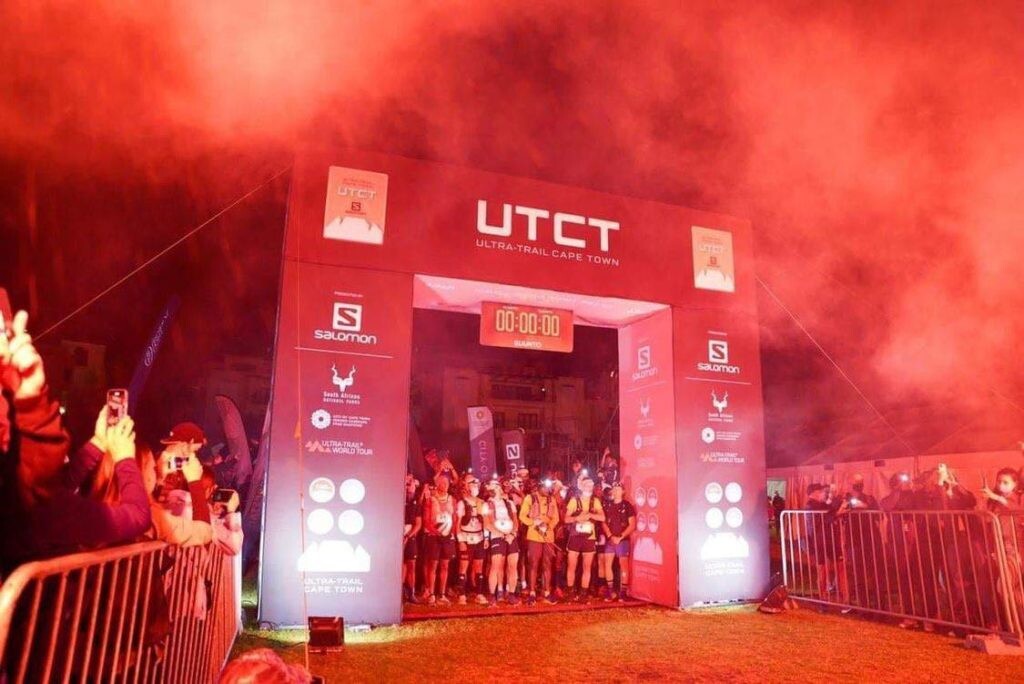
Poitras, a Moncton, N.B., native, always wanted to visit Cape Town to race internationally, but when he found out that international borders were closed to tourists, he was stuck in South Africa with fellow Canadian ultrarunner Jean-François Cauchon, who finished sixth overall at UTCT, seeking answers.
“In Cape Town, I didn’t notice anything out of the usual regulations we had in Canada,” Poitras says. “Locals were more concerned about the closures of the tourism industry.”
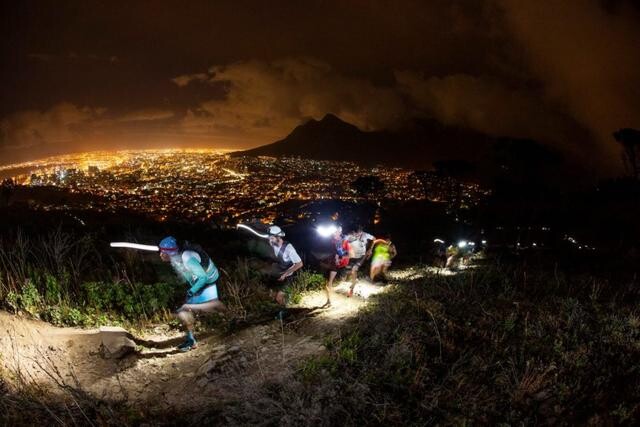
Since there are no direct flights to Canada from South Africa, there are only a few ways to travel. One option is to travel through Europe, but many major airlines such as Air France and KLM have stated that they will carry EU passengers only. The only city in North America that connects with Johannesburg is Atlanta, Ga., but again, U.S. citizens only. Another option to get back to Canada is to fly through Addis Ababa, Ethiopia, a country currently dealing with a civil war between the government and rebel groups.
Flights out of South Africa have reached high prices for tourists, and the airports are packed with tourists from Europe and North America looking to get home. “I tried connecting with the Canadians Abroad emergency hotline to see what they know and what they could do,” says Poitras. “After six days of no news or communication from the Canadian government, I decided to take matters into my own hands and book a flight to London.”
Unfortunately, there aren’t many PCR testing centres in South Africa, yet both Canada and Great Britain require negative results upon entry. “Keeping us all here is only prolonging our exposure,” says Poitras. “Everyone is scrambling trying to find a way home, the government isn’t helping us.”
Update: On Dec. 2, Cauchon and Poitras left South Africa on a flight to London, England, where they both await the results of their PCR tests to return to Canada. Poitras looks back on his first Ultra-Trail race as an unbelievable experience and hopes to conquer more ultras in 2022.
(12/03/2021) ⚡AMPby Marley Dickinson
Canada’s Trishul Cherns completes his 300th ultra, Cherns's ultrarunning career has spanned more than 43 years
On a cool Saturday morning in West Orange, New Jersey, Canadian ultrarunning legend, Trishul Cherns, completed his 300th ultramarathon at the Squatchy Leftovers Maple Leaf 50K. At 64, Cherns’s ultrarunning career has stretched over 43 years and he has no intentions of stopping anytime soon.
We sat down with him to talk about his 300th run, his storied career and his plans for the future.
The Squatchy Leftovers Maple Leaf 50K consisted of 10 five-kilometer loops through the trails, and was named both for the group that organized the event (the Sassquad Trail Runners) and for Cherns himself (the maple leaf is a nod to his Canadian roots). While you would expect someone to feel sore and tired after the day after running 50 kilometers, Cherns spoke as though he’d merely jogged around the block. “I recover very fast, and so that’s the blessing,” he says. “I could go and do it again today.”
Of course, anyone who knows Cherns’s history in the sport would not be surprised to hear that. He is best known as a multi-day racer, and throughout his career, he has represented Canada in many international competitions.
He has broken more than 110 Canadian ultrarunning records and has accumulated more than 73,000 kilometers in ultras, which have included events as short as 50K and as long as 1,000 miles (1,600 km) on the roads, trails and track. “That’s just ultramarathon racing kilometers — that doesn’t mean training or marathons,” he says.
Cherns has been on the podium at dozens of races over the years. “I’ve been first, second and third, and have even placed last in some races, so I’ve done it all,” he says. Out of all of the races he’s done, his most memorable was a 24-hour race in Burlington, Ont. He won, but that wasn’t the reason it holds such a special place in his memory. It’s because his parents were on the sidelines. “There’s something special about winning a race and having your parents there to watch,” he says.
Throughout his career, Cherns has watched the world of ultras change dramatically. Manual timing has been replaced with timing chips, cotton T-shirts have been ditched for technical materials and runners can listen to music now from their phones, rather than carrying around a cassette player. “The technology has been fantastic,” he says. “It’s made the progress of ultrarunning much better and made it more visible.”
Cherns is excited about the growing popularity of ultra events, particularly in the women’s field. “There are more and more women doing the sport, and that’s fantastic,” he says. That growth has fuelled a rapid improvement in performances as well, and over the past several years, records have fallen time and time again. “Before at an ultra race you’d have maybe 20 people coming out,” says Cherns. “Now you have 150 people coming out.”
Cherns attributes a lot of this growth to the spiritual side of ultrarunning that you don’t get with any other sport or running distance. “When you go these great distances, whether it’s 100K, 200K — more than the marathon — it becomes much more of a spiritual journey,” he says. “You feel more alive when you do an ultra, you feel more vibrant.” He explains that because you’re left with yourself during an ultra, you have more of an opportunity to connect with yourself on a mental, emotional and spiritual level.
“When you run a 5K or 10K, it’s a physical effort,” he says. “When you run 50K or 100K, 10 times the distance, it becomes much more than just physical. It becomes an emotional test, a mental test, it becomes a journey.”
He also credits the ultra community for fuelling the growth of the sport, noting that unlike a marathon or other road races, ultras are less about the competition and more about the camaraderie between yourself and other runners. You’re no longer running against people, you’re running with them.
As he nears his 65th birthday, Cherns notes that he no longer has a 30-year-old body (even if his mind thinks he does). His goals have shifted as he’s gotten older, from performance and placing to getting across as many finish lines as he can. “I no longer run to compete, I run to complete,” he says. “But if I can compete, then great.”
Cherns’s goal is to have the longest ultrarunning career in history. The record is 59 years, which means he’ll have to continue competing in ultras at least until he’s 81. “I did my first ultra at 21 — can I do this for 70 years until my 90s?” he says. “That’s what I’m after.” Cherns also has his eye on crossing the 100,000 km mark in ultra races, and completing more than 500 (or 600, or 700) ultras.
“I enjoy each and every journey. Each race is different and presents a different challenge,” he says. “But to me, from the goal point of view, that’s what I’m after.”
(11/30/2021) ⚡AMPby Brittany Hambleton
The Fine Art of Balancing Running and Parenting
By now, just about everyone has seen the videos on TikTok or Instagram with a hiker in the backcountry using the same audio clip. All their friends are getting married and having kids, but not them - they're adventurers. The obvious flaw with these videos is that those inspired by the outdoors can still have kids, get outside and have epic days.
Do you have less time and other constraints? Sure, but getting out there could be more important than ever for parents. The benefits of the outdoors and exercise are proven to have a positive impact on anyone's life. With the new stresses of becoming a mom or dad and everything that goes into parenting, it can be even more of a necessity.

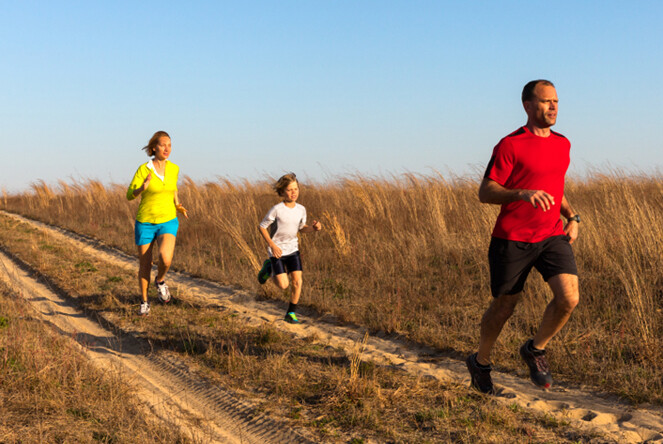
"I feel like trail running has been so beneficial because I like being in the outdoors. I am a type of person that likes to be alone to run, I think because I have four kids, which can be chaotic so it's kind of like my peace," says Verna Volker, a trail runner, mother, and advocate whose work with her own indigenous community has helped elevate her voice. "I feel like it's helped me get outside and just to be a better parent, a better mom to my kids and kind of release all my stress, and it feels like coming home."
Volker just completed her first ultra race, the 100K at the Javelina Jundred in Arizona. More than 60 miles is a challenge for anyone, but can be even trickier while raising four children.
"I was excited to accomplish the 100K, but at the same time, it was like the drive and the motivation behind it was just very spiritual for me," says Volker. "I think in that way it's been really beneficial. It also keeps me goal-oriented, because as a mom we oftentimes put our kids before ourselves. And so it really has driven me. This is my time, this is my goal."
Volker isn't alone in feeling that way. The science supports that running can help parents better navigate their lives.
"We say a lot that running makes you a more patient parent for sure. It makes you a more productive worker. It makes you a more loving spouse," says Dimity McDowell, the co-founder of Another Mother Runner, an online running group aimed at mothers and women, in general, to help provide resources for runners of all levels. "Basically, when you run you get out and do the thing that brings you joy and makes you feel competent and powerful."
McDowell's organization has created a community through social media and podcasts to reaffirm the benefits of running and how it can dovetail with all the challenges of parenting.
Keep Moving
Lack of sleep, poor eating habits and a host of other issues can impact new and longtime parents. It's easy to see how these lifestyle changes and demands can stifle an active lifestyle.
It also creates a new contradiction of being exhausted even though they haven't even stepped outside. A University of Pittsburgh study highlighted this paradox, following different groups of people to see how life changes led to lower levels of activity. The study found that single and married people more or less kept the same level of activity, but once people became parents, their activity level slowed.
Analysts found that many parents had an all-or-nothing approach, so if they couldn't be all in on their activities, they would opt for skipping them altogether. However, research shows that even a little bit of exercise can be beneficial, even if it's not as much as you hope to get.
"Running is obviously one of the most efficient forms of exercise. You can get out for a 20-minute run and feel great and you can leave from your front door. There's minimal equipment," says McDowell. "It gives you time to process things that may have happened, as far as trying to figure out a situation with your partner or with your kid. I mean, kids can be really challenging, right?"
The good news is that going for a run is more than just a healthy activity for a parent; it also provides an opportunity to be a role model for your children. Multiple studies show that more active parents raise more active children and instill a passion for getting into the outdoors that will make any outdoor-loving parent proud.
Getting Out There
With any lifestyle change there are new stress factors. Facing that stress is necessary to staying mentally healthy. Most of us have experienced the stress relief brought about by a great run, and that's not just in your head. The pandemic led to a surge in people getting outdoors for comfort and created plenty of data to back this up.
Outside Magazine highlighted one study that showed how nature positively impacts your body's chemicals, reduces stress hormones and lowers blood pressure. In the long term, it helps decrease the anxiety associated with significant life changes.
While not every runner has quick access to trails, those who can make time for it can benefit from being in nature.
"If it's available to you, go in without headphones and just really tune into the powerful being that you are and what you're feeling," says McDowell. "I think it's so grounding and so helpful and mind-clearing. I also think it's good for beginning runners. It can be really beneficial because you have to be focused on the trail in front of you."
Preparing for Uphill Challenges
When it comes to being an active parent, simplicity is key. Whether that's running down the road or training for an ultra, time can be one of the biggest challenges. And for many, that means early mornings, working with their partners to find time or even hiring a babysitter.
"It can be hard if you have a partner or a spouse who does not understand your need to run or your interest in running," says McDowell. "Running is more time away from family, so it's important to sit down and have a family meeting and say these are my workouts for the week. It's especially important if you are training for something that requires more time."
"My husband's really great about taking the kids. When they were younger, he would come home at lunch for me to run," says Volker. "Also, when they were younger, I would wake up early, like 4:00 a.m. Now, I still like waking up early and having time to run for me. Then I can get home in time for anything else."
As a parent, time spent running may be more exclusive, but at the same time, you get to enjoy new trail days with a small companion who's seeing the epicness of the outdoors for the first time.
"I think that it's just really fun when your kids start to join you and start running," says Volker. "Just give yourself grace. I always tell people I started running in the midst of motherhood, and I had three little boys, so you're tired, but somehow you make it through."
(11/28/2021) ⚡AMPby Trail Runner Magazine
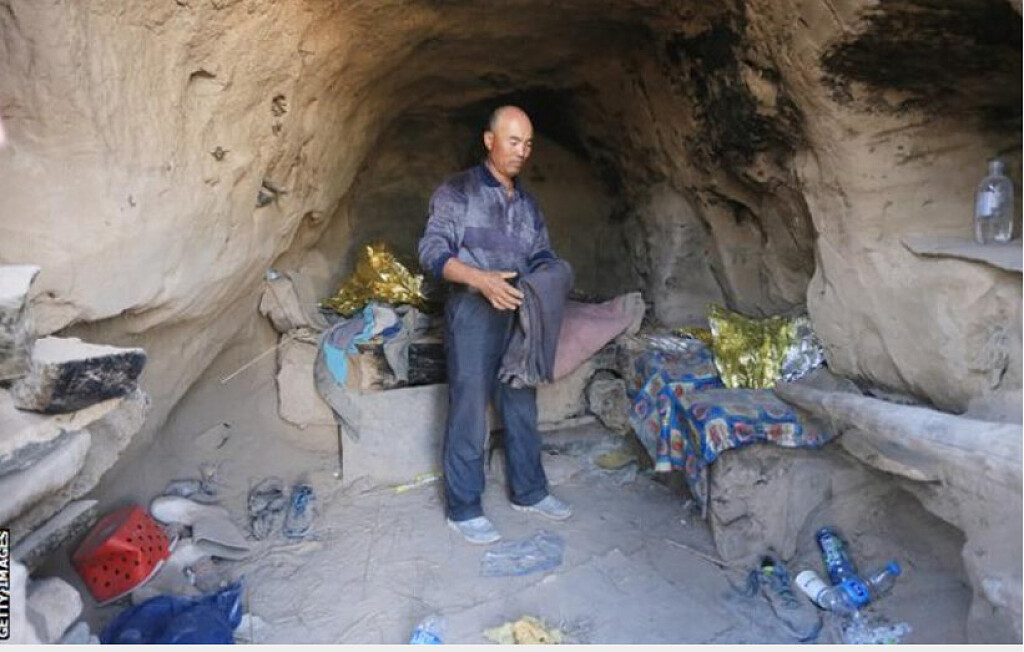
China's ultramarathon tragedy and the survivors threatened for speaking out
When Zhang Xiaotao woke up he was in a cave and somebody had lit a fire to keep him warm. He had no idea how he'd got there.
Zhang's frozen unconscious body had been found by a passing shepherd who'd wrapped him in a quilt and carried him over his shoulders to safety. He was one of the lucky ones.

In May this year, 21 competitors died at an ultra-running event in northern China hit by extreme weather conditions: hail, heavy rain and intense gales caused temperatures to plummet, and nobody seemed prepared for it.
Only a small number felt comfortable talking about what happened - and some have been threatened for doing so.
The sun was out on race day in Baiyin, a former mining area in China's Gansu province. Some 172 athletes were ready to run 62 miles (100km) through the Yellow River Stone Forest national park.
The organisers were expecting good conditions - they'd had mild weather the previous three years. They had even arranged for some of the competitors' cold-weather gear to be moved forward along the course so they could pick it up later in the day.
But soon after Zhang arrived at the start line, a cold wind began to blow. Some runners gathered in a nearby gift shop to take shelter, many of them shivering in their short-sleeved tops and shorts.
Zhang started the race well. He was among the quickest to reach the first checkpoint, making light work of the rugged mountain trails. Things started to go badly wrong just before the second checkpoint, some 20km into the course.
"I was halfway up the mountain when hail started to fall," he later wrote in a post on Chinese social media. "My face was pummelled by ice and my vision was blurred, making it difficult to see the path clearly."
Still, Zhang went on. He overtook Huang Guanjun, the men's hearing-impaired marathon winner at China's 2019 National Paralympic Games, who was struggling badly. He went across to another runner, Wu Panrong, with whom he'd been keeping pace since the start.
Wu was shaking and his voice was trembling as he spoke. Zhang put his arm around him and the pair continued together, but quickly the wind became so strong, and the ground so slippery, that they were forced to separate.
As Zhang continued to ascend, he was overpowered by the wind, with gusts reaching up to 55mph. He'd forced himself up from the ground many times, but now because of the freezing cold he began to lose control of his limbs. The temperature felt like -5C. This time when he fell down he couldn't get back up.
Thinking fast, Zhang covered himself with an insulation blanket. He took out his GPS tracker, pressed the SOS button, and passed out.
Closer to the back of the field, another runner, who goes by the alias Liuluo Nanfang, was hit by the frozen rain. It felt like bullets against his face.
As he progressed he saw somebody walking towards him, coming down from the top of the mountain. The runner said it was too cold, that he couldn't stand it and was retiring.
But Nanfang, like Zhang, decided to keep going. The higher he climbed, the stronger the wind and the colder he felt. He saw a few more competitors coming down on his way up the mountain. His whole body was soaking wet, including his shoes and socks.
When he finally did realise he had to stop, he found a relatively sheltered spot and tried to get warm. He took out his insulation blanket, wrapping it around his body. It was instantly blown away by the wind as he'd lost almost all sensation and control in his fingers. He put one in his mouth, holding it for a long time, but it didn't help.
As Nanfang now started to head back down the mountain, his vision was blurred and he was shaking. He felt very confused but knew he had to persist.
Halfway down he met a member of the rescue team that had been dispatched after the weather turned. He was directed to a wooden hut. Inside, there were at least 10 others who had decided to withdraw before him. About an hour later that number had reached around 50. Some spoke of seeing competitors collapsed by the side of the road, frothing at their mouths.
"When they said this, their eyes were red," Nanfang later wrote on social media.
Zhang, meanwhile, had been rescued by the shepherd, who'd taken off his wet clothes and wrapped him in a quilt. Inside the cave, he wasn't alone.
When he came to, about an hour later, there were other runners also taking refuge there, some of whom had also been saved by the shepherd. The group had been waiting for him to wake up so they could descend the mountain together.
At the bottom, medics and armed police were waiting. More than 1,200 rescuers were deployed throughout the night, assisted by thermal-imaging drones and radar detectors, according to state media.
The following morning, authorities confirmed that 21 people died, including Huang, who Zhang overtook, and Wu, the runner he'd kept pace with at the start of the race.
A report later found that organisers failed to take action despite warnings of inclement weather in the run up to the event.
As news of the deaths broke on social media, many people questioned how the tragedy could have happened. Some competitors, such as Zhang and Nanfang, chose to write about their experiences online to help people understand what it was like.
But Zhang's post, written under the name 'Brother Tao is running', disappeared shortly after it was published.
When Caixin - a Beijing-based news website - re-uploaded his testimony, a new post appeared on the account a week later, begging the media and social media users to leave him and his family alone.
It later transpired that Zhang had suspended his account after people questioned his story. Some accused him of showing off for being the sole survivor at the front of the pack, others had sent him death threats.
"We don't want to be internet celebrities," he wrote online, adding that the man who saved him had also faced pressure from the media and "other aspects".
"Our lives need to be quiet," he wrote. "Please everyone, especially friends in the media, do not disturb me and do not question me."
The survivors weren't the only ones to find themselves put under pressure.
One woman, who lost her father in the race, was targeted with social media abuse on Weibo after questioning how her father was "allowed to die". She was accused of spreading rumours and using "foreign forces" to spread negative stories about China.
Another woman, Huang Yinzhen, whose brother died, was followed by local officials who she claimed were trying to keep relatives from speaking to each other.
"They just prevent us from contacting other family members or reporters, so they keep monitoring us," she told the New York Times.
In China it's typical for relatives of those who have died in similar circumstances - where authorities face blame - to have pressure placed on them to remain silent. For the government, social media attention on any possible failings is not welcome.
A month after the race, in June, 27 local officials were punished. The Communist Party secretary of Jingtai County, Li Zuobi, was found dead. He died after falling from the apartment in which he lived. Police ruled out homicide.
Short presentational grey line
The Baiyin marathon is just one of many races in a country that was experiencing a running boom. Its tragic outcome has brought the future of these events into question.
According to the Chinese Athletics Association (CAA), China hosted 40 times more marathons in 2018 than in 2014. The CAA said there were 1,900 "running races" in the country in 2019.
Before Covid hit, many small towns and regions attempted to capitalise on this by hosting events in order to bring more tourism into the area and boost the local economy.
After what happened in Baiyin, the Chinese Communist Party's Central Commission for Discipline Inspection accused organisers of some of the country's races of "focusing on economic benefits" while they are "unwilling to invest more in safety".
With Beijing's hosting of the 2022 Winter Olympics just months away, China has suspended extreme sports such as trail running, ultramarathons and wingsuit flying while it overhauls safety regulations. It is not yet clear when they will restart. There have been reports that not even a chess tournament managed to escape the new measures.
But without events like these, people wishing to get involved, perhaps even future star athletes, are finding themselves frustrated. In some cases, as Outside Magazine points out, athletes could take matters into their own hands, venturing into the mountains without any regulation whatsoever and putting themselves at risk.
Mark Dreyer, who runs the China Sports Insider website, wrote on Twitter: "If this incident has removed the top layer of the mass participation pyramid - as seems likely - there's no telling what effect that would have at the lower levels.
"The long-term effects of this tragic - and avoidable - accident could also be significant."
(11/21/2021) ⚡AMP

Judy Sheppard took up running in her seventies – and has even completed an ultramarathon
AS FAR AS 76th birthday presents go, an entry into a 50K ultramarathon is fairly unconventional. But that’s exactly what Judy Sheppard, now 78, received from her daughter Liz Sheppard. More remarkably, she completed it and, at the time of writing, was preparing to run the London Marathon having achieved a Good For Age (GFA) place.
Liz has form with this kind of thing, having encouraged her mum to join her on a half marathon in Cyprus back in 2016. Judy, 72 at the time and with no previous running experience, didn’t think that she would be up to it but decided to find out. She was – and she’s been running ever since.
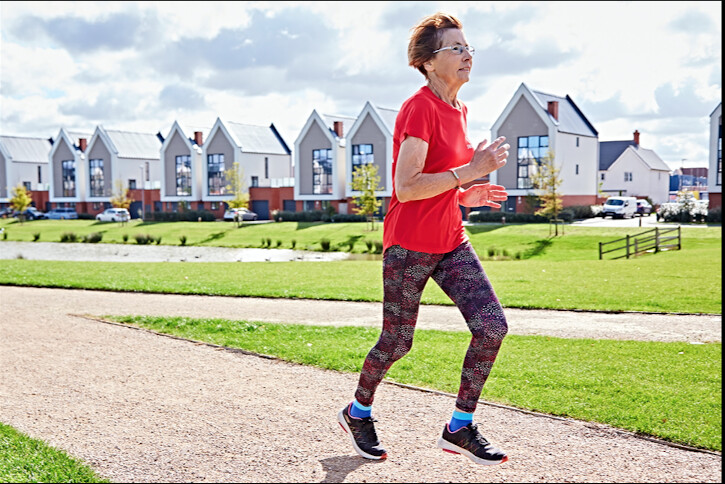
‘I got addicted to it,’ she says. ‘After a race, I get such a sense of achievement that I’ve done it at my age. And because there aren’t many runners in my age group, I’ve won a lot of trophies. It gives me a buzz to know I can do it.’
Speaking about the previously mentioned birthday present, Race to the Stones, Judy says: ‘The first 20 miles went quite well, but then it all went downhill. I felt a bit tired and sick, but I did at least finish it.’ A pretty standard ultramarathon experience, then, albeit infinitely more impressive given her age.
So what’s the secret to Judy’s current remarkable running success? ‘Most people are winding down in their seventies, but I’ve always been energetic as I have to take the dogs walking,’ she says. Alas, it seems that her four-legged friends do not make for the best running companions. ‘There’s no way I would run with them as they’d be dragging me into the bushes!’
She’s keen to encourage more septuagenarians to take up running, too, and believes that you’re never too old to get active. ‘Just go for it,’ she says. ‘I honestly didn’t think I’d be any good at running. If anybody in their seventies wants to run but thinks that they can’t do it, well, they can. Because if I can do it, anybody can.’
To date, Judy has run three marathons and an ultramarathon, all accompanied by her daughter, who says that running has helped bring them even closer together. ‘It’s given us a real bond,’ says Liz. ‘I think it’s amazing what she’s doing. You don’t get a lot of runners doing marathons and beyond in their late seventies. Mum is so determined. Once she fell over at the start of the race but got back up and made it to the finish. I think she is a real inspiration to older runners.’
Along with her new collection of finisher’s medals, Judy has also found a ready-made group of friends, many of whom are part of the Slinn Allstars, the running group she joined in 2017. ‘They’re fantastic and very inclusive,’ says Judy. ‘I never imagined I’d get the support I’m getting. I have a top with my name on it when I’m racing and have found a lot of people cheering me on.’
Like many others, Judy had to make do without any crowd support for the past 18 months as Covid kiboshed all big city races. Having secured a GFA place for London back in 2018, she had to requalify last year for the virtual London Marathon. ‘I scraped it!’ she says. ‘It was absolutely tipping down all day. The GFA time for women of my age was 6:15, and I think I ran 6:14.’
Liz’s London Marathon journey hasn’t been quite so lucky, though. Having secured a charity place for this year’s event, she had planned to run with her mum, but a badly sprained ankle put paid to that. ‘I’d hoped it would have healed by now, but there’s been very little progress,’ she says. ‘It’ll be my mum’s first big race without me. I feel bad, but I also know that she’ll have a great adventure.’
This may, however, be the end of their mother-daughter marathon running. ‘I think London will be my last marathon,’ says Judy. ‘I’ve heard it’s so well supported – the atmosphere and everything – so it’s something I wanted to experience, but I’ll concentrate on 10Ks and half marathons after this.’
Liz isn’t convinced by this retirement talk, though. ‘No way! She says that, but I know what she’s like. She’ll definitely do it again.’
It would make for quite an 80th birthday present, after all.
(11/20/2021) ⚡AMP

New and familiar faces vie for JFK 50-Mile Titles This Weekend
This weekend's JFK 50-Mile in Hagerstown, Maryland, will see Thanksgiving-like temperatures between the 20s and 40s, in keeping with many past editions of the race. But that's where the similarities between the 2021 JFK and previous races end.
Over 1,000 athletes will descend upon Hagerstown on Saturday with every possibility that a new champion will be crowned in both the men's and women's races.
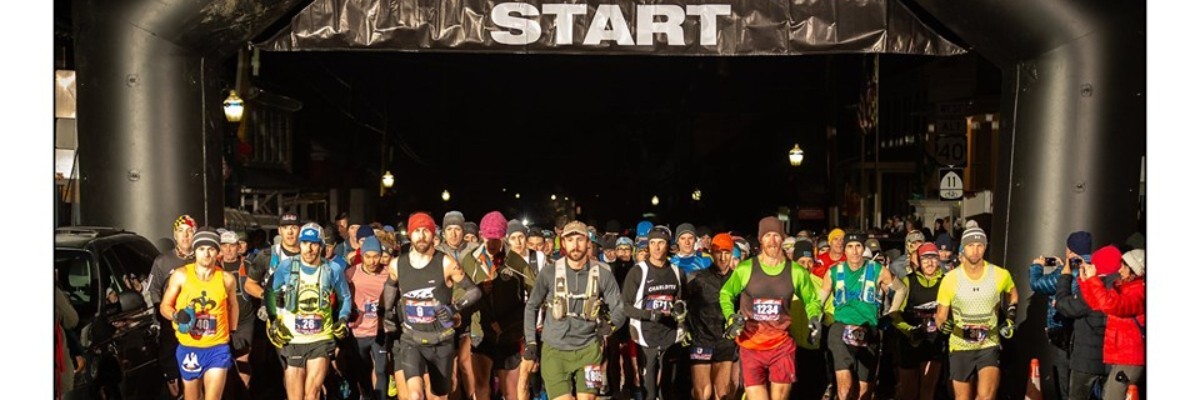
On the men's side, the most recent champion to return to JFK is David Riddle, who won in 2011. It might be 10 years since his victory, but he's fresh off a win at the Super Bull Trail Championships 50K in Wooster, Ohio and has won Alabama's Mountain Mist 50K a whopping nine times, most recently this January.
JFK has a brand-new course record set last year by Hayden Hawks (a blistering 5:18:40), and a stacked field of lesser-known names will see how close they can come. Ultra newcomer Adam Peterman, who was second at this year's Pike's Peak Marathon and won the Speedgoat 50K in July, will look to make his mark on the men's field. The top returner is Anthony Kunkel, who was fourth last year. Other names to watch include Ben Quatromoni, who won the Kilkenny Ridge 50-miler in September and the Algonquin 50K in February; Jared Bassett, who won the Rogue Gorge 50K in October; and Sean Van Horn, fresh off a second-place finish at the Grand Traverse 40-miler and third at the 2020 Javelina Jundred 100-mile.
But it's on the women's side where things get really interesting. Like the men, the women have only one of the past two decades' champions returning in the form of Devon Yanko, who claimed the crown in 2009. Yanko is also one of nine women in the field to have raced in the U.S. Olympic Marathon Trials back in February 2020. Others from that road marathon include Sarah Cummings, Anna Kacius, Sarah Biehl, Starla Garcia, Jeanne Mack, Rachel Viger, Karen Dunn and Caitlyn Tateishi.
nna Mae Flynn will make her JFK debut this year. The 2019 champ at both the Speedgoat 50K and the Lake Sonoma 50-Mile will be one of a slew of athletes chasing Ellie Greenwood's course record from 2012 of 6:12:00. Also watch for Kimber Mattox and Kristina Randrup. Mattox won the 15-mile Smith Rock Ascent in Oregon in May (where she was 5th outright) as well as the 2020 Way Too Cool 50K. Randrup won the American River 50 Mile in California in May by nearly an hour, and was third at the Lake Sonoma 50 Mile in September.
And the stories at JFK won't end with those vying for the win. Watch for Carolyn Showalter, who will be looking to extend her record of 34 JFK finishes. The 67-year-old also holds two other JFK records: she's tied for most wins by a woman with six AND most consecutive finishes with 22, a streak she held from 1982-2003.
No matter what, one thing is for sure: this year's JFK will be one of a kind.
(11/20/2021) ⚡AMP

Woman sets Guinness World Record for running the most consecutive marathons
When lockdown began in March 2020, Alyssa Clark, an ultrarunner from Burlington, Vt., was living in Italy, where everyone was directed to stay inside. She hopped on her treadmill and decided to run a marathon every day until the lockdown was supposed to end — a period she thought would be only two weeks. Fast-forward more than three months, and the 28-year-old ended up logging a total of 95 consecutive marathons before, ironically, the COVID-19 virus forced her to stop.
March 31 was Clark’s first marathon of the challenge, and she wasn’t able to move her runs outside until the beginning of May. She had already completed 25 consecutive marathons when she learned the Guinness World Record for women was 60 marathons in 60 days, so she decided she could surpass that mark. She set her sights on 75 marathons in 75 days, which she accomplished on June 13.
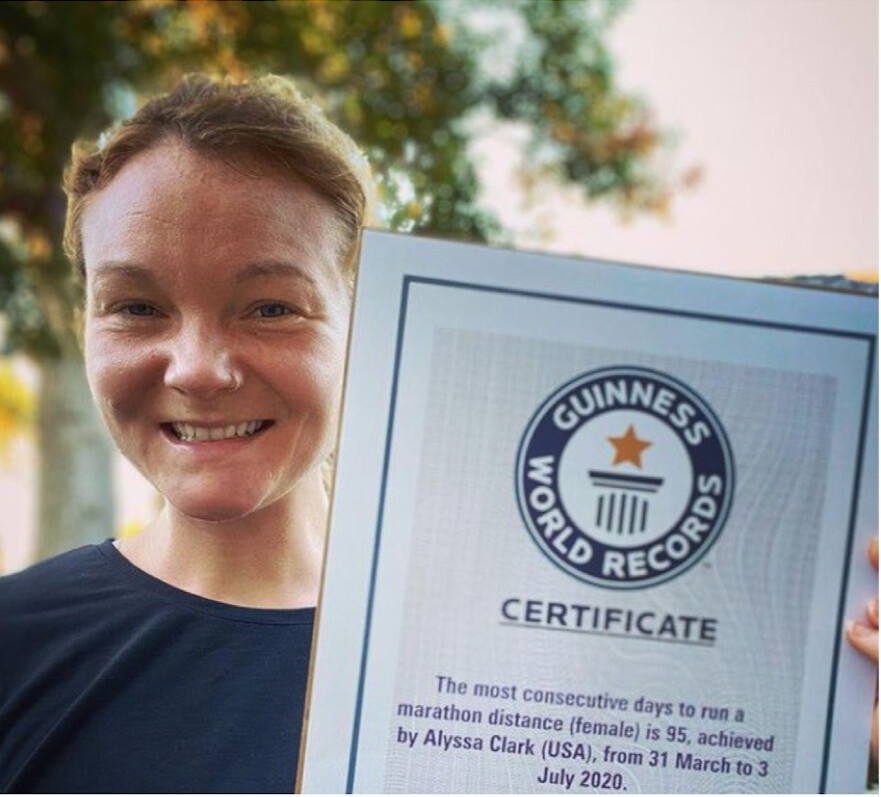
Canadian Running caught up with Clark last June, when she was 64 marathons into her journey. At that time, the marathons had begun to take their toll. “This started out being really fun, and it’s getting less fun now,” she said to us.
Despite this, she continued lacing up her shoes every day for another 31 days. Clark completed most of her marathons in about four hours, sometimes faster when she was feeling good, sometimes slower if the weather was bad. During that time, she and her husband moved from Italy to Panama City Beach, Florida.
Eventually, she decided to set her sights on 100 marathons in 100 days. In early July, however, Clark noticed the marathons had gotten significantly more difficult, but she wasn’t sure why. She had begun experiencing tightness in her chest while she was running, and doctors diagnosed her with an upper respiratory infection. Finally, on July 4, after 2,489 miles, 95 marathons and 95 days, Clark decided the best decision for her health was to call it quits. Two weeks later, it was confirmed that she and her husband had contracted the COVID-19 virus.
Being only five marathons away from hitting 100, Clark was disappointed to have to stop, but was thankful she was able to continue as long as she did. “Marathons at 100 degrees. Marathons in the middle of the night. Marathons on treadmills alone. Marathons with the best friends and company of which I could ask. Thousands of messages of love and support. A journey I will remember forever,” she wrote on her Instagram page.
Finally, more than a year after she completed her last marathon, Clark had her world record ratified by Guinness, and her name is officially in the books as the one to beat. In an interview with CNN, she said she’s not looking to break another world record because of the lengthy, tedious process required to have the first one ratified, but that doesn’t mean she doesn’t have more goals on the horizon. Up next, she will attempt to set a new FKT on the Pinhoti Trail, which stretches 335 miles from Alabama to Georgia.
(11/20/2021) ⚡AMPby Running Magazine

Jocelyn Rivas Just Ran Her 100th Marathon—All Before She Turned 25
Now the youngest person to run 100 marathons, Dreamer Jocelyn Rivas recently finished her hundredth at the Los Angeles Marathon.
Jocelyn Rivas has been running marathons since she was 17. On Sunday, the 24-year-old ran her 100th at the Los Angeles Marathon. This makes her the youngest runner to complete 100 marathons, pending verification by Guinness World Records. It also makes her the youngest Latina to accomplish this feat—something she’s proud of, as a Dreamer who came to the U.S. from El Salvador when she was six.
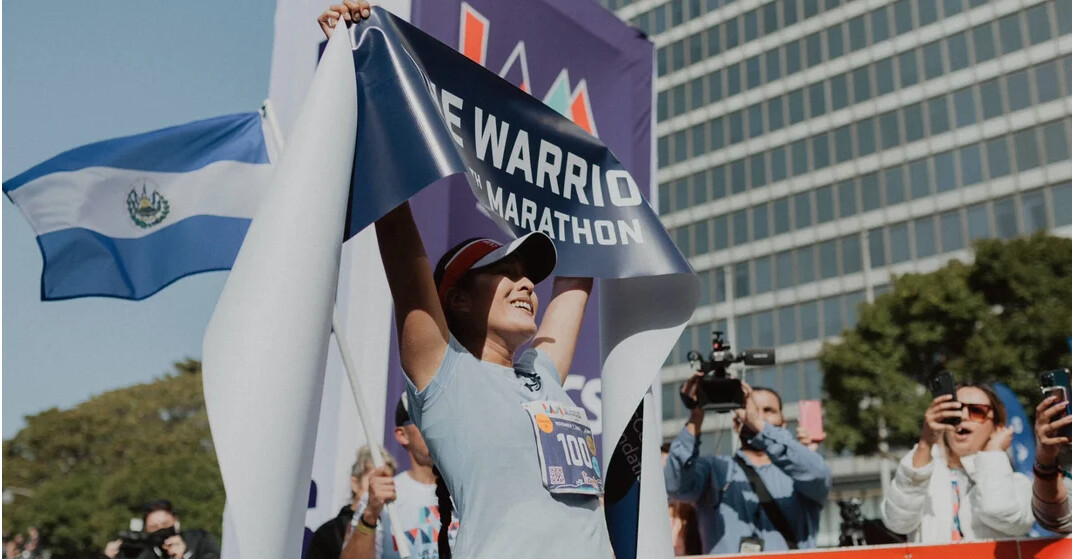
Rivas was born in El Salvador with health problems so severe her mother was told she would never walk normally. She never found out what exactly the cause was, but she did start walking normally when she was a kid, and then she took up marathon running when she was in high school, as part of the Students Run LA program.
Since then, she has run marathons in 19 states, and she once ran six marathons in nine days. Her first marathon was the Los Angeles Marathon, so running it again as her 100th marathon has been coming full circle.
Rivas spoke with Women’s Running about how she got into running, why she decided to take on 100 marathons, and what it was like to cross the finish line in Los Angeles.
Women’s Running: You ran your first marathon with Students Run LA when you were in high school, but were you a runner before that?
Jocelyn Rivas: When I started with Students Run LA, it was the first time I had run. You could say I had done the one mile because that’s required for [Los Angeles Unified School District] high school kids. That was the only thing I had done.
The reason I started running was I came out to the 2013 L.A. Marathon to support my friends who were running. I saw everyone running, from kids to adults who are in their 70s, and I was like, why am I not out there? What’s preventing me from being out there? I got inspired by those people, complete strangers, and then I was like, I want to run a marathon.
WR: What was it like to go from no running to training for such a long distance?
JR: Students Run LA helps high school students train for a marathon in six months. In the beginning, it was a bit difficult because my mom didn’t want me to run a marathon. The reason was because I was born with a broken back, neck, and feet. So I have always had a lot of back pain and neck pain, and she just didn’t want those things to become worse. But I wanted to run a marathon. I knew I could do it.
Essentially, I was like: You know what, I’m gonna do this, just to prove her wrong, just to prove I could run a marathon. But when I crossed that finish line, I realized I love running. My mom was the motivation, but I ended up falling in love with running.
WR: How did you recover from those injuries as a young child?
JR: The resources in El Salvador were kind of limited. My mom was also very poor—she barely even had money to feed me, so she wasn’t able to take me to a specialist. But she took me to physical therapy that was free. My feet were completely turned around to the outside, instead of straight, and then my back, my spinal cord, was not straight at all. I was like that for several months until, I guess with therapy and everything, my body started to get back together little by little. My mom says it was a miracle, because they told her I most likely wouldn’t be able to walk normally. My sister says it took me a while to start walking. I was slower than most kids. And she says after three or four years, I was fine.
WR: Have you had to deal with that back and neck pain in your running?
JR: Yes. I actually asked my teammates: Are you feeling back pain? They said no, we’re not feeling anything at all. That’s how I realized, with my back pain and my neck pain, I was going to have to dedicate a lot of myself to running. I do a lot of recovery. After every single run, I do scraping, I do tape, I massage myself. Sometimes I do cryotherapy.
WR: What inspired you to run 100 marathons?
JR: In 2017, I was in a very bad place. I’m a Dreamer—I’m a DACA [Deferred Action for Childhood Arrivals] recipient. The Trump administration had just announced that they were going to take it off, meaning that I’d lose the potential of renewing, I would be undocumented again, and I would definitely lose my job and not be able to continue going to college. I was going to lose everything I had worked so hard for, and I really wanted to do it to showcase that Dreamers are here to do something good. We love this country as much as every American—we just don’t have the papers. We came here as young kids, and we grew up in American culture. My biggest thing was, I don’t think many people could put a face to Dreamers. They think negative things about us. I wanted them to see the face of a Dreamer and be like, this is just one Dreamer, and there’s thousands of Dreamers just like her, just wanting to follow their dreams. So it started with that.
But in 2019, at marathon 25 [after the Trump administration’s efforts were blocked], I needed a new “why”—something that would carry me through when I’m in my darkest places, when I’m running those marathons and I just feel like I can’t keep going anymore. And that’s when it came to me: I want to do this to inspire my community, to inspire women. Growing up, I never had anyone to look up to, athletic-wise, who I could identify as a Latina who could do this. I was just like: I want to be that person, or at least inspire my community to get out there to chase their dreams, or start the journey, whatever that is. Running all these marathons has made me realize that nothing is impossible in this world. If you want something in life, go chase it, go get it.
WR: What challenges have you faced along the way?
JR: When I was running these marathons, I was trying to get a PR, I was trying to run faster every single time. And I was getting injured. I had a lot of shin splints on both legs, and then here and there, I sometimes deal with IT band injuries. How am I going to make it if I’m so injured and I’m barely in my early 20s? That’s when I reached out to Julie Weiss, who had done 52 marathons in 52 weeks, so she had a lot of knowledge. She said, you’ve gotta go slower. I told her the times I was finishing, and she’s like, no, you’ve gotta run an hour slower than what you typically run. Just take it easier. Enjoy the
journey. Take photos. Forget about PRs right now—you can do PRs after.
That took me to 100. If I would have kept running fast, fast, fast, trying my best to PR, there’s no way I would have made it to 100. I took her advice to take it slow and enjoy the races more and not to be so hard on myself.
WR: You’re running marathons so frequently, what is your training like?
JR: I really do not train like a normal person who’s training for a marathon. Since I’m running a marathon every weekend, I consider it my long run on Sundays. Monday and Tuesday, I take off completely, I just stretch and rest, and I do my usual thing—I work. Wednesdays after work, that’s when I go for my first run, like a 5k. Thursdays, I do maybe a 5k to 6 miles, depending on how my body’s feeling. On Fridays, I do another maybe four miles, and then Saturday, I do a 5k or don’t run at all. It’s very low mileage, roughly in the 40s with the marathon included.
WR: Do you have any advice for other young women who want to go after big running goals?
JR: All it takes is for you to believe in yourself. I always say, the only person that could stop you is you. I truly got inspired by my community, so this didn’t happen by itself. But if you believe in yourself, you know what you can do, and you know how far you can go in life.
WR: What kind of reaction have you gotten from people in your community?
JR: It’s been amazing, they’re all super supportive—I’m representing South Central L.A. I grew up very poor, with very limited resources. But I got lucky with Students Run LA. And I think they saw me as a 17-year-old, and then they just kept seeing me going and going, and now I’m at 100. There’s so many Students Run LA kids here, and I think they’re also getting inspired, with all the girls who have reached out to me. I honestly can’t even believe it. I’m still trying to process it.
WR: Overall, what would you say you get out of running?
JR: I found my passion. Whenever I’m having a stressful day, I just know if I go for a run, I come back and I am the happiest person ever—it releases all my stress. It makes me feel so confident, so empowered, so strong, and makes me feel beautiful and alive. It is like nothing else. I’m still someone who’s very young, still learning about the world, and still trying to grow in every aspect of life. And having that sense that I could be 100% myself and love myself when I’m running, it definitely has helped me so much in my personal life and in my career.
WR: The Los Angeles Marathon was your first marathon as well as your hundredth. How do you feel about that?
JR: I love the L.A. marathon. This whole time, I’ve been doing back-to-back marathons so I could get L.A. to be my hundredth marathon. And so having accomplished this, after how many flights got canceled, how many marathons, how much I cried and stressed, knowing that I was able to get to 100 at L.A. is literally a dream come true. I wanted to finish here, in the community that molded me to who I am today.
WR: How did the L.A. Marathon go?
JR: I felt like it’s just another marathon until I got to the starting line and thought, oh my god, this is my hundredth. I teared up a bit. Throughout the race, again, I thought, oh, it’s just another marathon. And once I hit mile 23, that’s when I started feeling it. So many people were out there cheering me. It was amazing. At the finish line, they had a ribbon that said “The Warrior—100th Marathon” for me.
WR: What’s next? Are you going to take a break from marathon running?
JR: I want to, but I am doing a marathon the following weekend. I will try to PR, and we’ll see if it happens. I’m gonna try to do a few more marathons just to make sure that the record stays with me, because I’m still getting certified. All the races I did were USATF certified—that was one of the requirements from Guinness World Records. I have everything documented, but I’m just going to do maybe five or eight more marathons to make sure the title stays with me.
After that, I am going to take a break. Probably five or six months into physical therapy, I’ll try to get my body to come back stronger. Because the end goal is I want to run a 100 miler—I do want to become an ultramarathoner. And if I do that 100 miler and I crush it, or at least I survive, I want to try to go for maybe Badwater.
(11/14/2021) ⚡AMPby Women’s Running

Tommy Rivers Puzey has been fighting for his life and on November 7 completed the New York City Marathon
In July 2020, the ultrarunning community was shocked to find out that Tommy Rivers Puzey had been diagnosed with primary pulmonary NK/T-cell lymphoma, a rare and aggressive cancer. Since then, Rivers Puzey, or Rivs, as his friends like to call him, has been fighting for his life, and it appears that he is winning. On Sunday November 7 the beloved ultramarathoner completed the New York City Marathon in 9:18:57, barely one year after taking his first steps after treatment.
Aside from being a well-known ultrarunner, Rivers Puzey is a father to three young girls and husband to his wife, Stephanie Catudal. He had been struggling with COVID-like symptoms for several weeks in an Arizona hospital when he finally received his diagnosis.
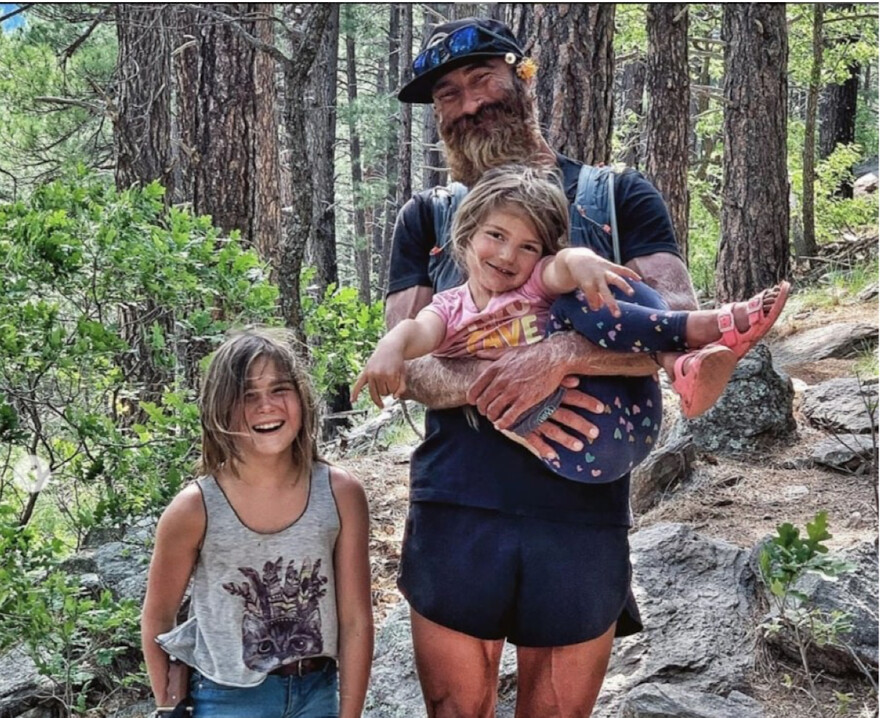
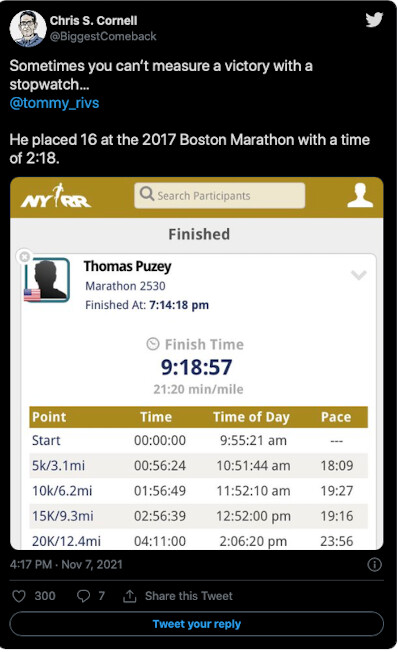
His condition deteriorated quickly, and by October, he had lost 70 pounds and was deemed ineligible for a bone marrow transplant because he was too frail. According to his Instagram, where he has been very open about the struggle he has gone through over the last year, his doctors did not expect him to make it. He spent five months in the hospital, underwent multiple surgeries, ventilatory intubation, an open-lung biopsy, collapsed lungs, internal bleeding, acute liver failure, deep vein thrombosis, ulcers, lung infections, septic blood infections and several other dangerous side effects. He had to re-learn how to talk, swallow, chew and move his limbs. After six rounds of chemotherapy, he was told by doctors that his cancer was in remission.
One year later, Rivers Puzey surprised his loyal followers when he announced he’d signed up for the New York City Marathon. He slowly made his way through the city’s five boroughs, smiling and high-fiving spectators as he went, and crossed the finish line in Central Park in complete darkness, after most of the crowd had already gone home. Once an aspiring U.S. Olympic Trials marathoner, he called completing the marathon “the single most difficult athletic achievement” he’s ever accomplished.
Rivers Puzey’s fight is not over yet. According to his Instagram, doctors have given him a 90 per cent chance that his cancer will return without a bone marrow transplant, so he is now working on building up his strength so his body will be able to handle another four to six rounds of chemotherapy, followed by a bone marrow transplant. For runners wishing to support him and his family, you can visit the GoFundMe page set up by his brother, Jacob Puzey, and others.
(11/13/2021) ⚡AMPby Running Magazine

How Gene Dykes Became the World's Fastest 70-Year-Old
Gene Dykes is a heck of an athlete. In his serious bowling days, he four times rolled a perfect score (300). On the golf course, he has recorded a best round of 68 on a par 70 layout. And a little less than three years ago, Dykes ran the fastest time ever by a 70-year-old in a certified, out-and-back marathon (2:54:23 in December 2018).
What's he been up to since that marathon record? Quite a bit, especially when you consider his prolific race and ultramarathon schedule. But a bit less than planned, given a broken shoulder in 2019 (trail run fall), Covid restrictions in 2020, and a hamstring injury from August this year.
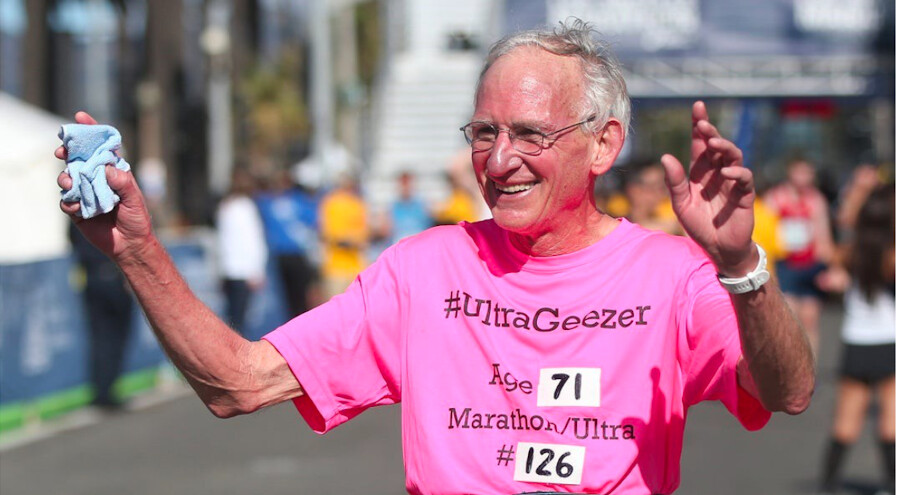
Dykes, now 73, had hoped for peak 2021 races to come at the WADA WMM Age Group Championships in London in early October, followed 8 days later by a fifth consecutive in person, age-group win at Boston. His hamstrings didn't cooperate, however. He had strained them in August at the Hood To Coast Relay.
As late as 24 hours before London, Dykes figured he wouldn't run. But he's irrepressible when it comes to starting lines, so he was there the next morning, and eventually hobbled and walked to the finish in 5:37:56.
At Boston, he hoped to continue his four-year age-group victory streak (65-69 victories in 2016 and 2017, 70-74 in 2018 and 2019). His legs felt a bit better, so he decided to aim for 3:30 pace, which he calculated would give him a 50/50 chance of winning his age group.
His math proved remarkably good, but he ended up on the short end of the 50/50. Dykes hit the tape in 3:30:02, just 28 seconds slower than Mike Wien's first-place 3:29:34.
"If I had known I needed 30 seconds, I could certainly have found them in the last 5 miles," Dykes says.
Other 70-somethings have broken 3 hours in the last month, including Jo Schoonbroodt in Amsterdam (2:56:37) and Michael Sheridan in London (2:59:37). Dykes will turn 74 next April. If he wants to remain atop his age-group, he'll face serious competition for the first time.
To get ready, and to heal an ailing body, Dykes plans a full month of no running from mid-November to mid-December. He and his wife will be cruising the waters around Antarctica and chasing a solar eclipse. He hopes to return to competition at the Naples (FL) Half Marathon in January.
Here, Dykes answers questions about his remarkable past three years of running and what he has learned along the way. His coach, John Goldthorp, adds more information about Dykes's training routine.
Q &A with Gene Dykes
Why did you run London and Boston if you were injured?
Before London, my coach didn't want me to run, my family didn't want me to run, my wife didn't want me to run, but I felt like my Facebook friends were all saying: "Run, run, run." I thought I'd drop out after 6 or 7 miles, but I kept going even though my hamstrings wouldn't allow anything under 10:15 pace. Then I didn't run a lick before Boston, but I could tell that my legs were a little better.
You were already running strong in your mid-60s when you hired a coach for the first time. How did that change things?
It was like night and day. I was a 3:29 marathon runner before, and six months later I ran 3:09 at Boston. When I coached myself, I pretty much ran all long, slow miles with occasional 800-meter repeats on the track. If I was sore after a workout, I figured it was best for old guys like me to rest. John had me out there working my ass off 6 days a week. Sure, a couple of those were recovery runs, but he had me doing lots of miles about a minute per mile faster than before.
I found that when a coach set expectations for me, there was no way I wasn't going to suffer to get the workout done. Needless to say, I discovered I had much more ability locked away than I had realized. I only needed the expertise and accountability that a coach provides.
I've read that you were mostly running around 45 to 50 miles a week. That seems low for your fast race times.
That's the trouble with averages. They hide a lot of variation. I ran close to 2800 miles in 2016, 2017, and 2018, which comes out to about 53 miles a week. But I did so many ultra-marathon races, that my training average was probably 45 to 50. When peaking for a specific, important marathon, I was in the low- to mid-60s.
You run a lot of ultras, and also race frequently. Is that to build endurance first, and then speed?
I'll probably never have another year like 2018. I ran 43 races that year. Hey, only seven of those were ultras! Because I raced almost every weekend, the race substituted for one of the week's harder speed workouts, yes, but I also trained pretty hard between races.
This year is instructive: You dropped out of a 256-mile trail race, ran a world best for 50K, did a road mile, then a 100-mile, then won three track races at USATF Masters, then jumped into Hood to Coast in late August. And these were only a few of your races in 2021. My question is: Is this a racing plan or a kid running amok in a candy store?
I guess there really is no grand plan most of the time. Every November I go through the list of races that pique my interest, either for fun or competition, and pencil the most important ones into the calendar. So many races, so little time! The most fun I have is when I'm running a long distance on trails. Even though I hate the 5K and shorter, any race is fun. Once upon a time, I figured that I would perform better if I didn't race so often. But in 2018, I raced 16 straight weeks and got faster every week. So why not go with it?
If 2021 had gone perfectly, what would have been your realistic goals at London and Boston?
At the beginning of the year, the dream was to set a world record at London and win at Boston. So, timewise, that would have been a 2:54 and, say, 3:07. As it turned out, absolutely nothing about that was realistic. After a 2020 filled with injuries and no races, I was off my game from the get-go in 2021. I realized pretty early that I wouldn't be setting a record in London, but I still thought I could win both London and Boston, at least until the hamstring injury.
What have you learned about yourself and running since your big year in 2018?
Don't run a bunch of fast legs at Hood to Coast on a body that's already tired! Otherwise, I'm not absolutely sure I've learned anything yet. I have some theories that I'll test out next year. I'll probably give myself more recovery time after ultras, and maybe stop doing the 200-milers. I might race less often, but I'm hoping I can still perform well at road races week after week.
Maybe I've learned two things: 1) Injuries are weird; and 2) Maurten is a game-changer for me.
What makes injuries so weird is you don't know when you're going to get one, or when it will get better. Every injury is different. Some only hurt when you run, and some don't hurt when you run, but they hurt around the house and yard. Some go away in a couple of days, but are suddenly replaced by others. You never know what's coming next.
Hamstring injuries really worry me. This is my third. The first one kept me from running for six years! The second knocked me out for six months. I'm hoping that this one is only six weeks (and the fourth one only six days).
Maurten has become an absolutely essential fuel for me in long races. It's more important than carbon shoes. It lets me get in more calories than ever before, and it eliminates nausea. When I'm feeling fatigued in a long effort, and then get some Maurten, my body feels happy again. [Note: Dykes has filmed a promotional video for Maurten, and might become a sponsored athlete.]
Have you changed your training over the years?
I don't think much about my training, I just do what my coach tells me.
What's in your future?
Sometimes I think I should just retire from trying to beat records. Maybe I should just have fun, and to hell with what everybody else thinks. I did set out to beat the marathon record in 2018, but I didn't do it for the attention. I just needed a good goal to motivate me for a couple of years.
I'll probably try to get back in shape and run fast next year. Then in 2023 when I'm 75, I'll try to repeat what I did in 2018. I'll prioritize whatever age-group records I think I can get, and the big championship races.
ohn Goldthorp answers questions about Gene Dykes's training
What kinds of workouts seem to work best for Gene? Which don't?
Every athlete is an N=1. Gene is fond of 'general aerobic' runs that are 60 to 90 seconds slower than his current 5K race pace, and he certainly loves long runs. Often we combine stamina training and short hills to make a longer session. We can tick off a lot of boxes in one day that way. Then he jogs very slowly the next day to recover.
Gene does so many ultras and other races, what role does recovery play in his training plan?
It's true that older athletes may need more time to recover, but sometimes a 70-year-old retiree can recover faster than a busy professional with young children. My marathoners aim for 2 harder workouts per week with everything else being very easy. Gene tends to run 5 to 6 days a week, depending on his gardening and golfing plans.
What about paces for intervals, tempo, long runs, etc.?
I prefer to help my athletes train by perceived effort instead of pace. Gene is unique in his ability to run marathons at a pace only about 35-40 seconds per mile slower than his 5K pace, where others are often 50 or 60 or more seconds slower. So we target many of our hard workouts close to his marathon effort. Gene's very good at not forcing things. Early in a workout, he's often convinced he won't be able to complete the planned session. But as he warms up, he usually finds that he can.
Anything else?
Gene's a master at listening to his body and doesn't hesitate to take a day off if necessary. On the other hand, I can't tell you how many times I gave him a light session only to learn later that he felt good and went out for a 23-miler instead.
How about Gene's racing schedule?
To say Gene's racing schedule is unorthodox would be putting it mildly. In 2017, he ran three 200-milers in three months and often raced the other weekends. But maybe this has contributed to his success. Running ultramarathons early in a training block allows him to develop tremendous endurance. Then, for about 8 weeks, he'll use shorter races and faster long runs to develop his threshold and efficiency.
I assume Gene's racing doesn't fit your ideal. How do you keep him under control?
At the end of the day, we have one life and we need to do what brings us joy. Gene loves going on adventures, challenging himself, and seeing the world via running. He's made a lot of friends and inspired a lot of people. If I were to say, "No, you must stick to one way of training and racing," I wouldn't be taking a client-centered approach to coaching.
I'm here to support Gene's journey. Sometimes that means getting out of his way. Other times, I try to gently nudge him back onto the path.
(11/13/2021) ⚡AMPby Trail Runner Magazine
Powered by plants: elite athletes on the impact of a vegan diet
Changing what you eat might not seem like an obvious solution to environmental sustainability. It doesn’t have the immediacy of plastic reduction or avoiding fossil fuels. But there is increasing evidence that a shift to a plant-based diet can hugely reduce an individual’s impact on the climate, primarily with less energy required in food production from meat and dairy products.
A study from the University of Oxford found that people can cut their carbon footprint from food by up to 73% by switching to a vegan diet. Furthermore, the reclaiming of global farmland used for agriculture would revitalise wildlife conservation and hugely reduce extinction.
All of which makes fascinating reading for any ecological-minded athlete. But what are the implications on athletic performance? Nutrition is a fundamental element of performance at the highest level, so is it possible to help the environment and still succeed as an elite athlete on a vegan diet?
More international athletes are making the change and are proving that it is.
Kaylin Whitney, who ran world U18 100m and 200m bests in 2014, is one such athlete who is now relying upon plants to power her to international success. She switched to a vegan diet in the lead up to the US Trials and Tokyo Olympics, while also transitioning to the 400m from the short sprints.
Whitney reached her first Olympics and left with two medals: gold from the women’s 4x400m having run the opening leg in the heats and bronze in the mixed 4x400m where she ran the third leg.
The US sprinter followed in the vegan spike marks of Morgan Mitchell, who was a member of the Australian 4x400m quartet that finished seventh at the Rio Games. Mitchell has since started to make her mark in the 800m, representing Australia at the Tokyo Olympics on a plant-based diet.
Middle distance runner Andreas Vojta has been representing Austria in major championships for over a decade, including the 2012 Olympic Games, five European Championships and six European Indoor Championships.
He first turned to veganism in May 2018, driven by a passionate belief in animal rights and addressing climate change. “I went vegan for ethical and environmental reasons,” he says. “I was learning more and more about animal agriculture and quickly found out that I could not unite my ethical views with the cruel industries I was actively supporting every day. So, I aligned my morals with my actions and went vegan.
“I suddenly felt like I was doing the right thing, which really frees up your mind. The least I could do was go vegan for the animals, our planet and also my own body. I actually went vegan without any considerations from the health side, but I experienced some benefits from a health and performance standpoint. I started feeling a faster recovery after intense workouts and competitions and also needed less sleep.”
His shift aroused the curiosity of his fellow athletes, particularly as he has set his personal bests over 3000m (7:49.75) and 5000m (13:24.03) and a national 5km road record (13:48) while vegan.
“Even though most people know what veganism is, they don't have a lot of practical experience with it and are curious to know how it works, especially as an athlete,” he explains.
“Like every change in your life, it might be unfamiliar the first weeks, but then it just becomes part of your everyday life. Nearly everyone I talk to already understands the massive ethical issues that come along with animal farming, so as a next step I am trying to help and inform everyone who wants to know how they can easily integrate a vegan lifestyle into their lives.”
For ultra runner and international masters age-group marathon runner Fiona Oakes, veganism has been a way of life since she was a child. The British runner holds the women's world record for the fastest aggregate time to complete a marathon on all sevens continents (23:27:40). But it is through her role as co-founder of the running club Vegan Runners where she has drawn most attention to veganism.
“I had qualified for the championship start of London (Marathon) in 2004 and realised it was an amazing opportunity to promote veganism in a positive way to a captive audience who were already invested in their health and wellbeing,” she says.
“It was an opportunity to wear a 'billboard' promoting the word vegan and run through the closed roads of the capital while spectators, press and media looked on. We went for it, and this is how Vegan Runners was born.”
Since then, the club has grown exponentially and is now the UK’s fastest growing running club, with nearly 3000 members.
“As the years have passed, I have obviously sought and gained much more information on how veganism not only benefits the animals but the planet, the environment, individual and global health. The real beauty is I am constantly learning more about its comprehensive positive universal impact on a daily basis.”
Her most recent project is seeing her create a new endurance event, the Running for Good Ultra, to champion positive change, including environmental sustainability.
“For me, my running has always been about building a positive platform from which to speak about and promote an issue which I am passionate about," she says. "That issue being the positivity of veganism for so many reasons.
“I honestly believe that having an 'ulterior' motive – or at the very least an 'extra' motive – rather than just running races for times, trophies and medals, has enhanced my ability to keep motivated and inspired over many years and to train hard and maintain focus.
“It's truly my belief that when you are out there either training or racing, the idea that there is a deeper reason and that others may be influenced or inspired by your presence, commitment, actions and achievements, is just the tonic you require to keep invigorated and excited at the prospect of your next run.”
For Oakes and many other vegan athletes, going green has become even more important than winning gold.
(11/07/2021) ⚡AMP
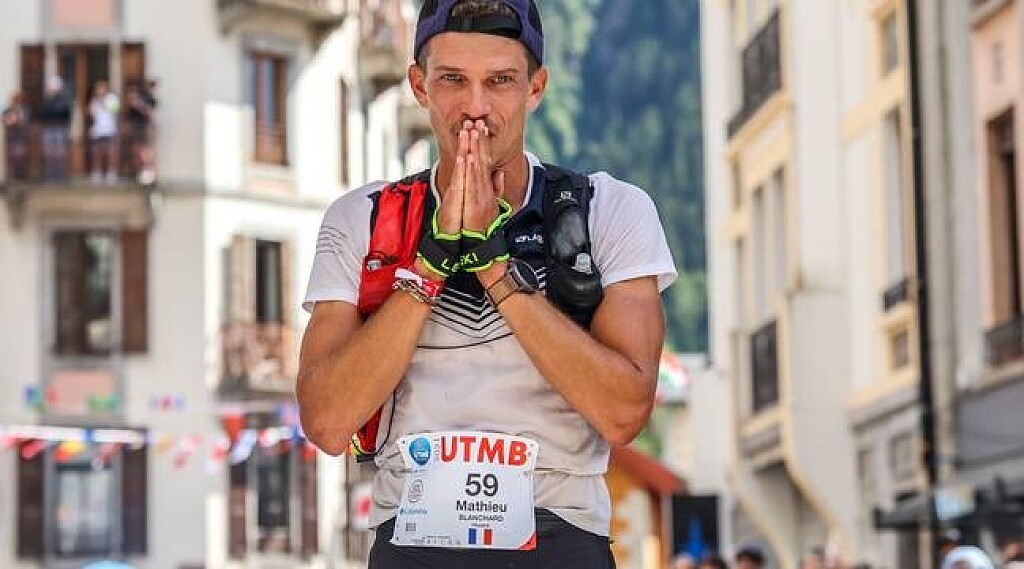
Elite Canadian marathoners Dayna Pidhoresky and Rachel Cliff and ultramarathoner Mathieu Blanchard offer their tips to help runners fuel their training
Nutrition is one of the pillars of athletic performance, and its importance for runners cannot be understated. Put simply, if you want to run well day in and day out, you have to fuel your body properly so you can perform to your maximum potential in workouts and races. Elite Canadian marathoners Dayna Pidhoresky and Rachel Cliff and ultra-marathoner Mathieu Blanchard understand this all too well, and they sat down with Canadian Running to offer their advice to runners who want to fuel properly to maximize performance.
Blanchard explains that runners need to be very attentive to the fuel they are taking in, because it helps their bodies prepare for their training load. It also allows them to maintain intensity during workouts and races and assists in recovery afterward. “Poor nutrition could also make our tissues more inflamed,” he says, “and therefore cause injuries, or even cause gastric disorders during exercise and low energy.”

Cliff agrees and adds that any athlete competing at a high level is following a healthy, balanced nutrition plan. She says that means eating enough calories to support your training, as well as getting a good balance of carbohydrates, fats, protein, vitamins and minerals. As a predominantly plant-based athlete (though not fully vegetarian), Cliff says getting enough protein is her biggest struggle. To improve her intake, she tries to find little ways to include protein-rich foods into every meal and snack.
“A smoothie is a great way to get more protein in because you can add a lot of things like chia seeds, hemp hearts and yogurt,” she says. Cliff also really likes using the Näak Nutrition cricket protein powder, which provides a lot of protein with a low environmental footprint. And before you ask, Cliff says no, the cricket powder doesn’t taste like you’re eating bugs.
“That’s one of the things I love about Näak, that they find ways to sneak protein into food in a way that you can’t taste it, but it’s there,” she says. “The great thing about the cricket powder is that it’s a complete protein.”
Minh-Anh Pham, co-founder of Näak Nutrition, says they understand not everyone is ready to eat crickets yet, which is why the company has also developed a line of plant-based bars and powders. “Our mission is to make sport nutrition more sustainable,” he explains. “We want to give you maximum nutrition with a minimum impact on the environment.”
“I love this stuff,” says Pidhoresky. “The taste, texture, what they strive for as a company as they aimto be kinder to the environment…and if you are scared of crickets you can opt for the vegan protein powder or bars!”
Like Cliff, Blanchard also says adequate protein intake is a priority in his nutrition plan, and if cricket protein really isn’t your thing, he enjoys Näak’s vegetarian products, like their protein bars and powders, to help him meet his needs. Both the cricket products and vegetarian products have a smooth brownie texture, no gastro-intestinal discomfort and long-lasting energy. “I love the recovery protein powder because it is vegetarian and digests very well,” he explains. “I have never had an upset stomach like with other protein powders.”
When asked what nutrition advice she would give to recreational and competitive runners, Cliff says the most important thing is to be aware of your training volume and be really cognizant that you don’t put yourself into an energy deficit. “Don’t try to cheat your body out of the nutrients and calories it needs to recover,” she says. “In the long run, it will pay off.”
In a similar vein, Pidhorseky says runners need to respect the 30-minute window after a workout and fuel appropriately. “You will recover so much better and achieve so much more,” she adds.
Näak Nutrition holds the values of sustainability and community close, and the company donates three per cent of their profits to the B.C. Parks Foundation, which manages the parks in both B.C. and Alberta. To learn more about the Näak products or the company’s sustainability and community initiatives, head to ca.naakbar.com.
(11/06/2021) ⚡AMPby Brittany Hambleton
