

Running News Daily
Running News Daily is edited by Bob Anderson and team. Send your news items to bob@mybestruns.com Advertising opportunities available.
Index to Daily Posts · Sign Up For Updates · Run The World Feed
Articles tagged #Cam Myers
Today's Running News
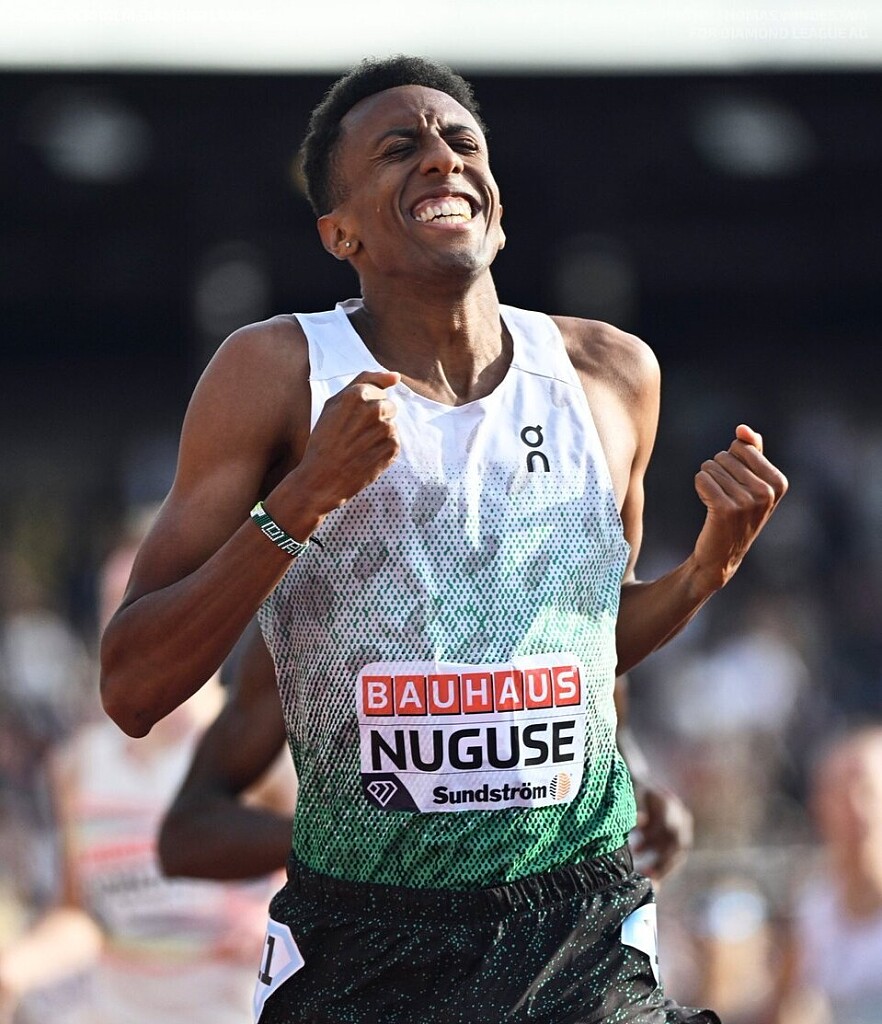


Twice as Nice: Nuguse Strikes Again with Brilliant Stockholm Triumph
Yared Nuguse's remarkable Diamond League campaign continued in style on Sunday as the American star claimed his second 1500m victory of the season, producing a devastating late surge to win in Stockholm in 3:30.11.
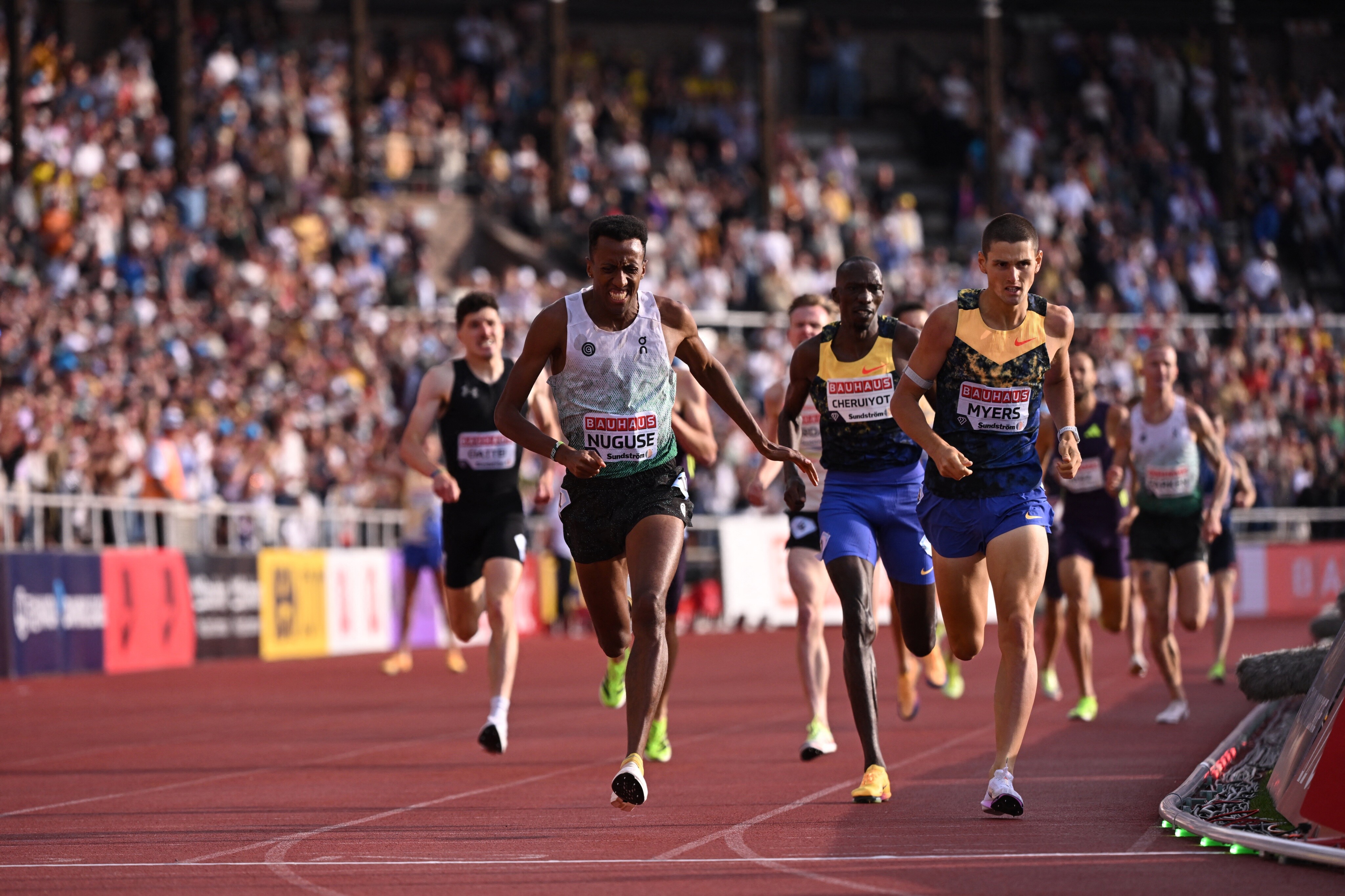
Just one week after dictating the pace from the front in Rabat, Nuguse demonstrated an entirely different dimension to his racing arsenal in the Swedish capital. This time, the 27-year-old was forced to chase down Australia's rising star Cam Myers, who had positioned himself perfectly and appeared poised to pull off a breakthrough Diamond League victory.
For much of the race, Myers looked in control as the field navigated the final lap. But Nuguse remained composed, patiently biding his time before unleashing a powerful finishing kick on the homestretch. With every stride, the American reeled in the young Australian before sweeping past him in the closing metres to secure another impressive win on the international circuit.
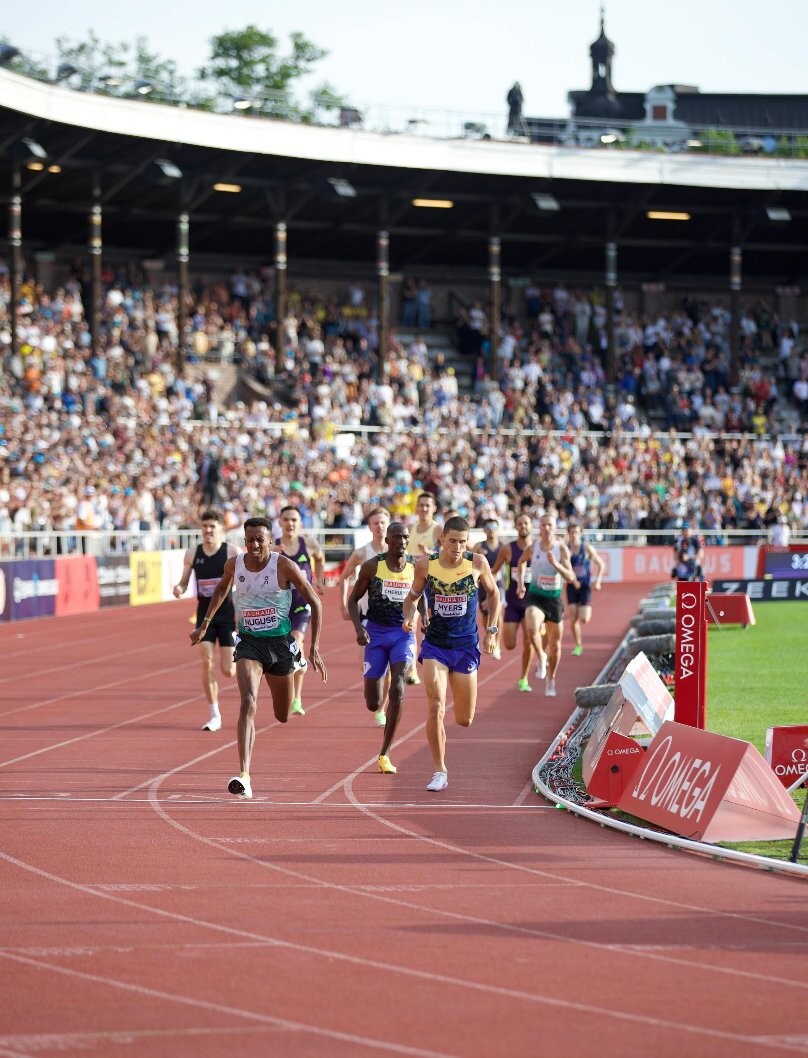
The victory underlined why Nuguse has become one of the most complete middle-distance runners in the world. In Rabat, he showcased his strength and confidence by leading from the front and daring the field to catch him. In Stockholm, he displayed tactical discipline and explosive speed, proving he can win races in more than one way.
That versatility could prove crucial as the season progresses toward the major championships. Elite 1500m racing often demands athletes to adapt to unpredictable scenarios, and Nuguse is increasingly showing that he possesses every weapon required to thrive in championship-caliber fields.
For Myers, the race offered further evidence of his immense potential. The Australian pushed the pace and came agonizingly close to a career-defining victory before being denied by one of the sport's finest closers. Despite finishing second, his performance reinforced his status as one of the brightest young talents in global middle-distance running.
As for Nuguse, the result adds another prestigious Diamond League trophy to his growing collection and sends a clear message to his rivals. Whether setting the pace from the gun or hunting down leaders in the final straight, the American is proving exceptionally difficult to beat.
Two Diamond League victories. Two completely different race strategies. The same result.
Yared Nuguse is making winning look effortless.
by Erick Cheruiyot for My Best Runs.
Login to leave a comment

Roared Home in Melbourne: Teenage Sensation Cam Myers Ignites the 1500m with a World-Leading Masterpiece
Under the charged atmosphere of a packed Lakeside Stadium in Melbourne, Australia’s rising star Cam Myers produced a performance far beyond his years, storming to victory in the men’s 1500 metres at the prestigious Maurie Plant Meet with a breathtaking time of 3:30.42.
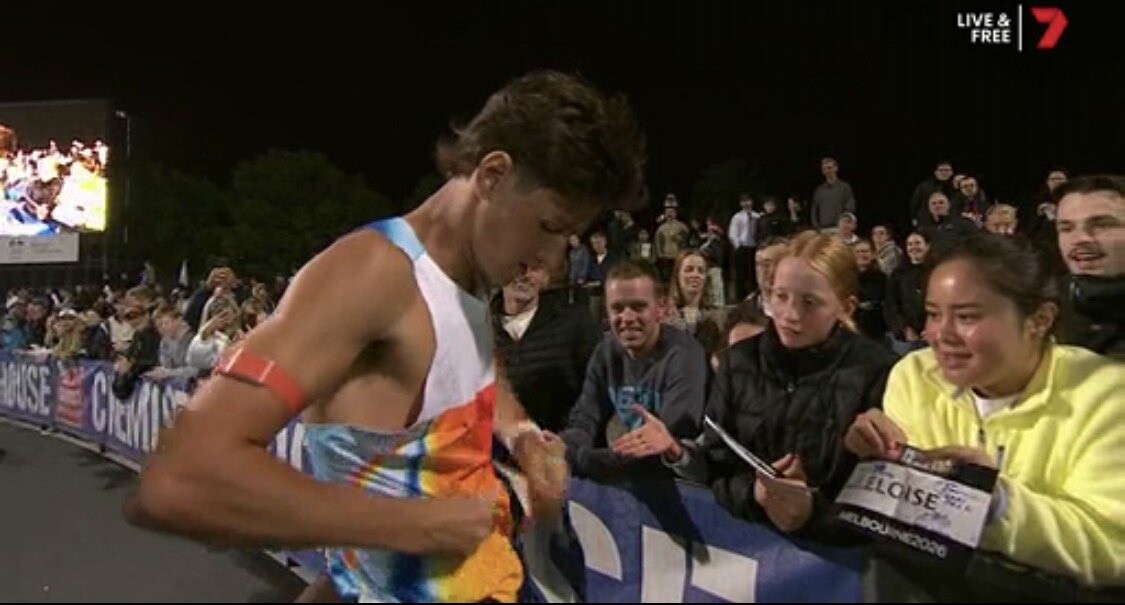
At just 19, Myers continues to redefine the limits of junior excellence, delivering a run that not only set a world-leading mark for the season, but also established a new Oceanian all-comers record. The time now stands as the second-fastest of his young career, narrowly behind the remarkable 3:29.80 Oceania U20 record he set in Ostrava last year—a performance that first announced his arrival on the global stage.
The race itself unfolded with controlled intensity before erupting into brilliance over the final lap. As the bell rang, Myers made his move with fearless conviction, unleashing a decisive kick that instantly created separation from the field. Adam Spencer, fresh off his podium finish at the World Indoor Championships in Toruń, gave chase but could not match the teenager’s surge. Myers powered away down the home straight, carried by the roar of the home crowd, while Spencer settled for second place in 3:37.51.

Speaking after the race, Myers reflected on the moment with calm confidence: “I had the crowd behind me, and it felt good. I just kept pushing onwards.”
This victory is more than just another win—it is a statement. In an era where middle-distance running is experiencing a global resurgence, Myers is emerging as one of its most exciting young protagonists. His composure, tactical awareness, and devastating finishing speed point to an athlete not only of immense promise, but one already capable of competing at the very highest level.
Under bright lights in Melbourne, before an inspired home crowd, Cam Myers did not simply win a race—he delivered a performance that signals the dawn of a new force in world middle-distance running.
by Erick Cheruiyot for My Best Runs.
Login to leave a comment

Historic World Records Dominate 2025 Millrose Games
The 117th Millrose Games, held on February 8, 2025, at New York’s Armory—a venue renowned as “The Fastest Track in the World”—delivered an unforgettable spectacle of middle-distance racing. Athletes shattered world records, national marks, and personal bests across events from the 800m to the 3000m, cementing this edition as one of the most electrifying in the meet’s storied history. Below, we break down the standout performances.
Records Fall in Mile, 3000m, and 800m
1. Wanamaker Mile: Yared Nuguse Rewrites History
Yared Nuguse (USA) stormed to a world indoor mile record of 3:46.63, eclipsing Ethiopian Yomif Kejelcha’s 2019 mark (3:47.01) . In a race missing world champion Josh Kerr (withdrawn due to illness), Nuguse led wire-to-wire, splitting 3:31.74 for 1500m—a North American record—before surging past a fierce challenge from Hobbs Kessler (3:46.90, also under the previous WR) . Australian teen Cam Myers stunned with a world U20 record of 3:47.48, while France’s Azeddine Habz (3:47.56) set a national record.
2. Men’s 3000m: Grant Fisher Outduels Olympic Champion
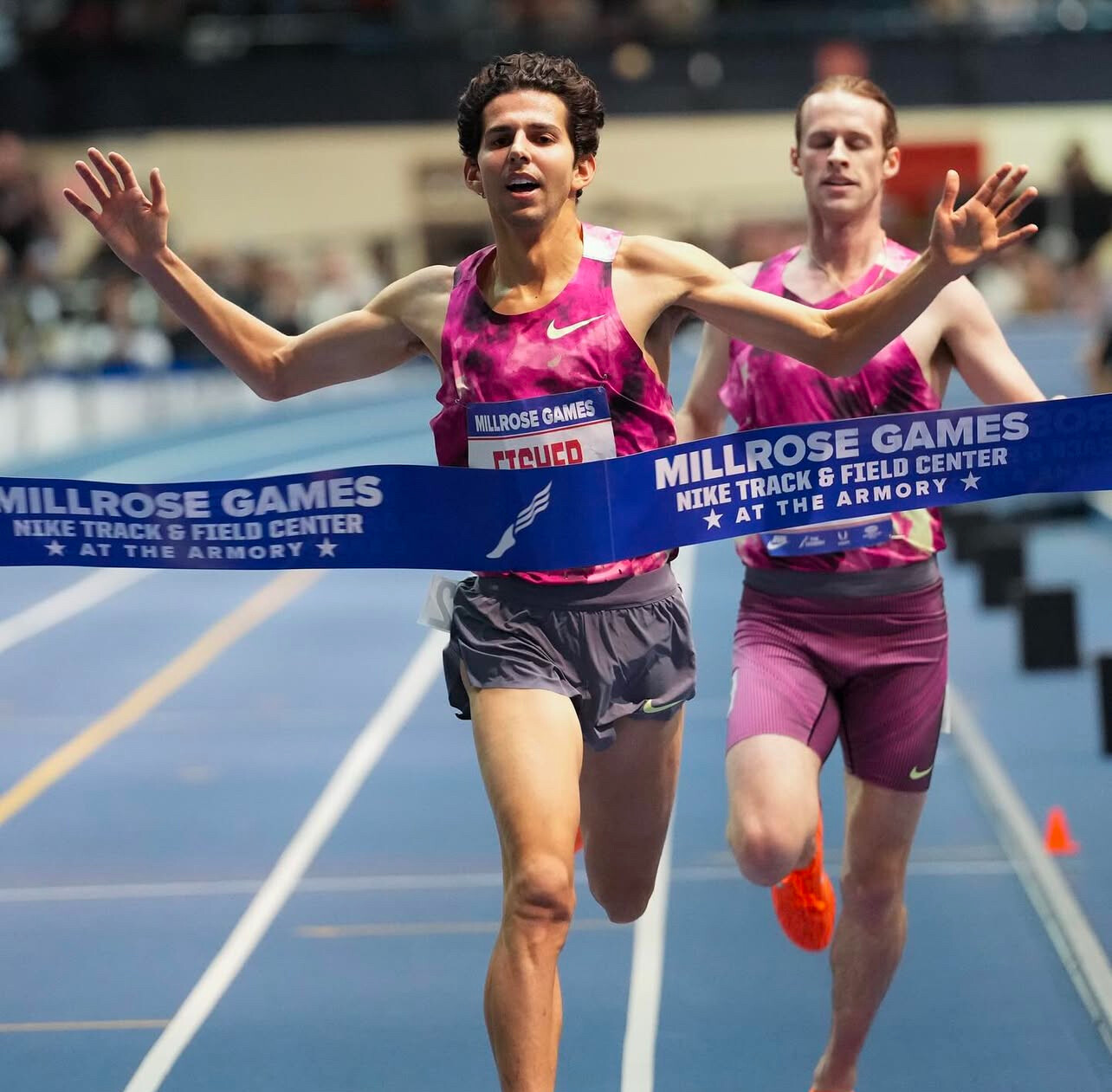
Grant Fisher (USA) and Cole Hocker (USA)—the Olympic 10,000m bronze medalist and 1500m gold medalist, respectively—collided in a tactical masterclass. Fisher’s 7:22.91 broke Lamecha Girma’s world indoor record (7:23.81), with Hocker (7:23.14) also surpassing the old mark . Fisher’s final 200m in 27.50 sealed the win, while France’s Jimmy Gressier (7:30.18) and Australia’s Ky Robinson (7:30.38) set national records .
3. Men’s 800m: Josh Hoey’s American Record Triumph
Josh Hoey (USA) dominated the 800m in 1:43.90, breaking Donovan Brazier’s American indoor record (1:44.21) and holding off Bryce Hoppel (1:44.19 PB) . Sixteen-year-old Cooper Lutkenhaus (1:46.86) smashed the high school record, previously held by Hoey himself .
Women’s Events: Breakthroughs in Mile, 3000m, and 800m

1. Women’s Wanamaker Mile: Georgia Bell’s Tactical Mastery
Georgia Bell (GBR), the Olympic 1500m bronze medalist, edged a stacked field to win in 4:23.35, outkicking Heather MacLean (USA, 4:23.41) and Nikki Hiltz (USA, 4:23.50) . Bell navigated a slow early pace (67.12 for the first quarter-mile) before unleashing a 61.97 final lap, crediting her composure in a “hard and messy” race .
2. Women’s 3000m: Whittni Morgan’s Commanding Victory
Whittni Morgan (USA) surged late to win in 8:28.03, a personal best, ahead of Josette Andrews (USA, 8:29.77) and Sarah Healy (IRL, 8:30.79 NR) . Ethiopia’s Tsigie Gebreselama (8:33.13) and Australia’s Jessica Hull (8:30.91) added depth to a fiercely competitive race .
3. Women’s 800m: Shafiqua Maloney’s Dominance
Shafiqua Maloney (VIN) claimed victory in 1:59.07, fending off a late charge by Addy Wiley (USA, 2:00.14) . Olivia Baker (USA, 2:00.02 PB) and Kaela Edwards (USA, 2:00.14) rounded out the podium in a race showcasing tactical grit .
With world records in the mile (Nuguse) and 3000m (Fisher), plus a slew of national and age-group marks, the 2025 Millrose Games underscored the rising global standard in middle-distance running. As athletes shift focus to outdoor seasons, these performances set the stage for a thrilling 2025 World Championships.
by Boris Baron
Login to leave a comment

NYRR Millrose Games
The Pinnacle of Indoor Track & Field The NYRR Millrose Games, first held in 1908, remains the premier indoor track and field competition in the United States. The 2025 edition will once again bring the world’s top professional, collegiate, and high school athletes to New York City for a day of thrilling competition. Hosted at the New Balance Track &...
more...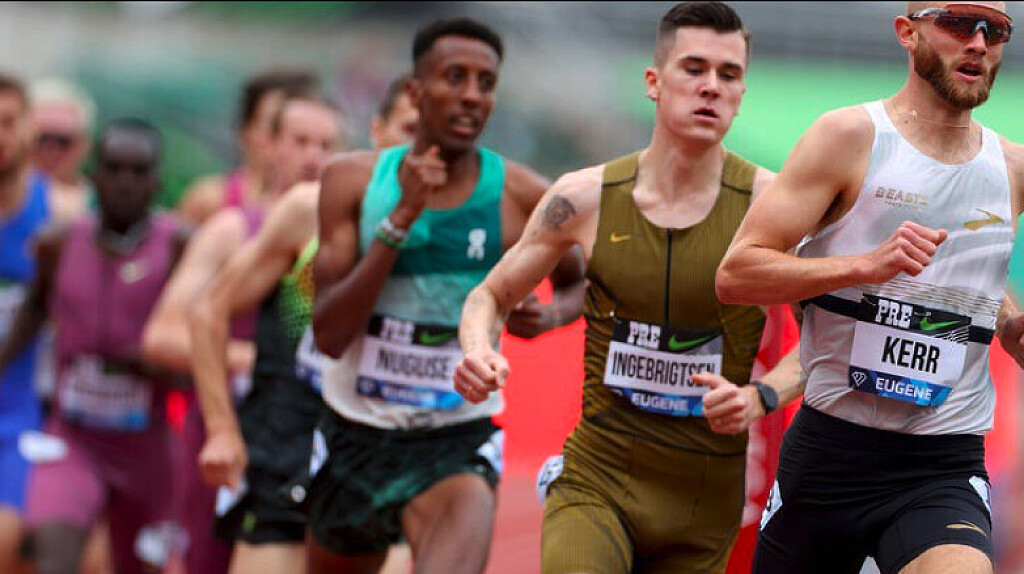
Why the "Norwegian Method" Training Craze Is Here to Stay
In a highly anticipated race at the 2024 Prefontaine Classic, Jakob Ingebrigsten pitted his revolutionary "Norwegian method" of training against some of the best milers in the world.
The “Mile of the Century”—of the twentieth century, that is—was a duel between John Landy and Roger Bannister at the 1954 Empire Games in Victoria. The two men were, at the time, the only two sub-four-minute milers in the world: Bannister had beaten Landy to the punch by 46 days, but Landy was the reigning world record holder. Their end-of-season clash was as heavily anticipated as any heavyweight boxing duel. Landy led until the final bend, at which point he famously glanced over his left shoulder at precisely the moment that Bannister surged past on his right.
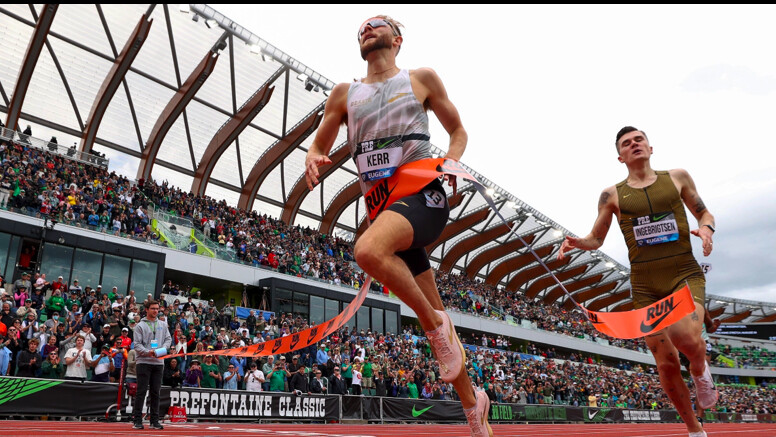
The mile of the current century, at least in terms of pre-race hype and intriguing storylines, took place on Saturday at the Prefontaine Classic track meet in Eugene. It was a gigantic multidimensional grudge match between Jakob Ingebrigsten, the blunt-speaking Norwegian wunderkind who won the 2021 Olympics at the tender age of 20 and whose training methods have sparked wholesale upheaval in the endurance world, and almost every runner who has beaten him or come close to it in recent years—most notably Josh Kerr, the Scotsman who upset him at last summer’s World Championships and has been engaged in an increasingly testy war of words with him ever since.
What gave the race an extra layer of significance, beyond the usual battle for personal supremacy, was that clash of training ideas. Ingebrigtsen is the foremost exponent of what has come to be known as the “Norwegian method” of endurance training. Its hallmark is carefully controlled workout intensities, pushing just hard enough to stimulate adaptation without incurring fatigue that would compromise the next workout. In Ingebrigtsen’s hands, that involves twice-a-week double threshold sessions: workouts like ten times a kilometer with one minute recovery in the morning and evening, with regular ear pricks to check lactate levels and keep the intensity in the right zone, on Tuesdays and Thursdays.
A similar approach has also taken Norwegians to the top of the podium in other sports like triathlon and cross-country skiing, and athletes from other countries have begun emulating it. Norwegian-style training is “the big, sexy thing,” as U.S. miler Hobbs Kessler put it. It might even be “the next step in the evolution of distance running training,” as a group of sports scientists suggested in an academic paper last year (which I wrote about here). It’s very hard to do controlled studies of entire training philosophies, as opposed to specific workouts. So the best litmus test, I suggested, would be clashes on the track leading up to the Paris Olympics. Saturday in Eugene was the first such test.
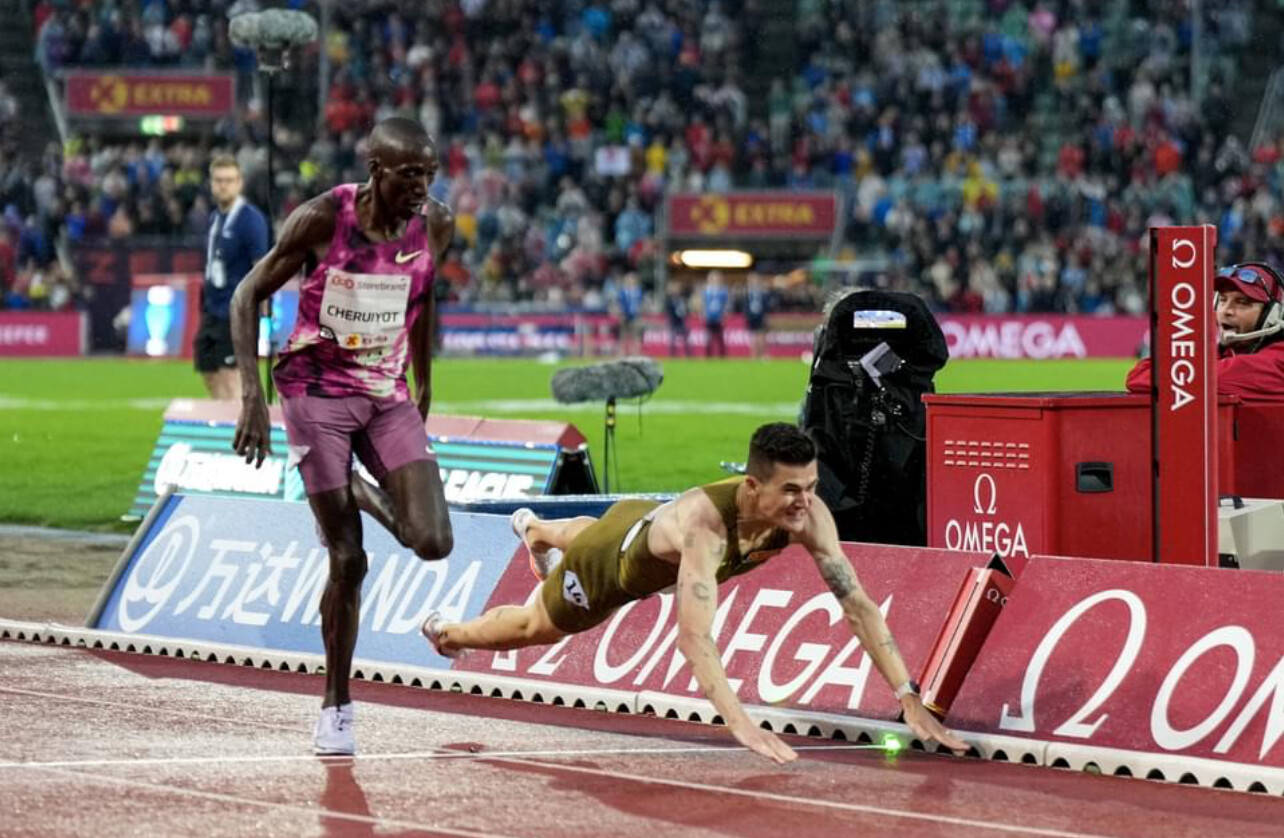
Sexy new things don’t stay sexy and new forever, and it’s fair to say that some of the shine of Norwegian training has worn off since last year. The most notable reputational hit was Kerr’s 1,500-meter win at last summer’s World Championships, kicking past Ingebrigtsen in the final lap after the Norwegian had led most of the race. One loss could be blamed on bad luck, but that made three times in a row: another Scottish runner, Jake Wightman, had outkicked Ingebrigtsen in strikingly similar fashion at the 2022 World Championships, and Ethiopian star Samuel Tefera did the same at the 2022 World Indoor Championships. That starts to look like a systemic flaw in the training approach. While Ingebrigtsen was carefully monitoring his moderate-intensity threshold intervals, Kerr and Wightman and Tefera were presumably ripping off all-out sprints—and they had a racing gear that he seemed to lack.
In Eugene, a rabbit led the field through a quick first half-mile. When he stepped off, it was Kenyan runner Abel Kipsang who pushed onward, with Ingebrigtsen following patiently behind. This was already a surprise: Ingebrigtsen is usually the one pushing the pace. Then, with a lap and a half still remaining, it was the fast finisher Kerr who surged into the lead and made an early bid for victory. Each man, it seemed, was playing the other’s game. The last lap ticked by in slow motion, Kerr unable to pull away and Ingebrigtsen unable to close the gap. That’s how it finished: Kerr in 3:45.34, Ingebrigtsen in 3:45.60, and then seven more men under the once-impregnable 3:50 barrier. In 11th place was Cam Myers, a 17-year-old from Australia, with a time of 3:50.15—two seconds faster than Ingebrigtsen himself ran at Pre as a 17-year-old in 2018.
It would be as foolish to give up on Norwegian training based on a few individual losses as it would be to anoint it the “next step” on the basis of a few individual wins. But if Ingebrigtsen keeps losing, that’s going to reinforce doubts about whether his approach is as effective for head-to-head racing as it is for time trials. There are plenty of caveats: for example, an Achilles injury disrupted Ingebrigtsen’s training for several months over the winter. But there are also other questions. What has happened to his older brothers Henrik and Filip? Both were world-class milers in their own right, but both have been struggling in recent years, as have other prominent Norwegian athletes like Olympic triathlon champion Kristian Blummenfeld, raising questions about the sustainability of the Norwegian approach.
And then there’s the fact that, despite all the hype about the mile, the real marquee event at Pre turned out to be the women’s 10,000 meters, where Kenya’s Beatrice Chebet became the first woman to dip under 29 minutes with a world-record clocking of 28:54.14. Kenyan runners (and their Ethiopian rivals) have been at the top for so long that it’s easy to take their dominance for granted. When I was in college in the 1990s, we were all fascinated by “the Kenyan Way.” That was the subtitle of Toby Tanser’s 1997 book, Train Hard, Win Easy. The secret, of course, was that there was no secret. There was a famous (and almost certainly apocryphal) anecdote about a Kenyan coach who was asked what separated his top runners from the merely good ones. All of them had grown up running to and from school each day, he explained; the champions also went home for lunch.
Part of the current fascination with the Norwegian training method is the suggestion that there is, in fact, a secret—a quantifiable formula, expressed in milimoles per liter of lactate in your blood, to optimize your training, rather than simply an admonition to work hard. But that’s a reductive view of what Ingebrigtsen and his Nordic peers are aiming for. The underlying philosophy of Norwegian training is that a harder workout isn’t always a better one, because it will take too long to recover from. This is hardly a new insight, but in the great merry-go-round of training fads, it was perhaps overdue for a resurgence.
In fact, the original Mile of the Century had a similar subtext. Bannister was the light-training amateur who ran on his lunch hour; Landy was a workout hero with “an insatiable appetite for interval running,” as Bannister wrote. “The great contrast in our training methods was not lost of the Press.” Bannister won the race, but it’s Landy’s training approach that proved to be more influential on subsequent generations. As Ingebrigtsen’s final showdown with his rivals in Paris looms, that’s worth remembering: even if he loses, and even if we decide that lactate meters are unnecessarily complicated, we might still have something to learn from his unorthodox training.
by Outside Online
Login to leave a comment
