

Running News Daily
Top Ten Stories of the Week
1/5/2019
These are the top ten stories based on views over the last week.



My Love Affair with Central Park started 40 years ago tonight - Larry Allen on Running File 5
If you want a useful guide for running in Central Park this isn’t that. There is plenty of concise information available online and all of it will do a far better job telling you exactly how to go for a run in New York City’s favorite 840 acre backyard.
If you want to know about beginning a long term relationship with New York City and running in Central Park, this is my story.
My first run in the park was on December 29, 1978. I was in college on the GI Bill and had taken my slightly unreliable but fun-to-drive MGB from Maine to Florida over Christmas break.
I didn’t want to think about the trip back north. Hitchhiking was still an option in those days if my car gave out but it surely was not what I wanted.
I was already a veteran of two marathons and was ramping up my mileage for the Boston Marathon the following April. I had a glorious couple of weeks of running in the technicolor light and warmth of south Florida and while there even managed to meet Frank Shorter.
I ran twice a day including a couple of two hour runs, went to empty beaches to bask in sunny 60 degree days while bundled up locals looked on, amused and mystified.
All in all it was a great time, went quickly and too soon I was starting the long drive back to Maine.
A couple of uneventful days on the road brought me back to the NJ turnpike two days before New Year Eve. In the fading light of a cold, clear winter afternoon I pulled into a service plaza for gas.
My plan was to continue driving on through the night for the last 500 plus miles vs. spending money I didn’t have for a roadside motel room. A “you are here” map in the foyer of the restroom surprised me with my close proximity to NYC.
The next thing I remember is rummaging through the stuff in my car for an address book with the phone number of a longtime summer friend from Maine who spent the balance of his life on upper west side of New York.
I searched between the seats for change to make a call on a pay phone and was fortunate that my friend even answered. He graciously said I could crash for the night.
I’d never even been into NYC proper and the prospects for the evening were exciting if not a little intimidating.
I finally made it safely down from the high bridge over the Hudson River into the city and found a place to park near Grant’s Tomb on Riverside Drive, a few blocks west of my friend’s apartment not far from Columbia University.
I made the wise choice to schlep all of my stuff to the apartment for fear that the patched convertible top and dodgy locks of my car wouldn’t deter anyone in 1970s NYC, from breaking in looking for anything of value.
I said a quick hello and thank you to my friend on arrival but needed a run before I could eat or do anything else. He understood and gave me directions to Central Park and showed me how to buzz myself back into his high rise building.
Running down Broadway entailed dodging and weaving along hopelessly crowded evening sidewalks, scents from all manner of ethnic food wafting as I made my way through the 20 red lights, one per block, for a mile.
Eventually a left turn, to the east for a few more blocks to enter the park around 100th St at Central Park West.
The park was dark and cold, full of energy but it oddly felt peaceful too. The air was filled with different smells; diesel bus fumes, horse manure, musty fallen leaves, street pretzels, roasted nuts and yes, adrenaline, some of it mine.
Traffic hadn’t been banned from the park drives in the evening yet so it was full of yellow cabs and giant 70s era sedans moving slowly in heavy evening traffic.
I looked around for a landmark, something to remember so I could find my way back out of the park onto the same street in hopes of finding my way back to my friend’s place through what felt like barely contained chaos on the city streets.
I took note of a broken, graffiti covered park bench in this far less than gentrified version of the city. It seemed memorable enough and I guess it was.
Inside the park there was a lane for running. Parallel were two traffic lanes around what I’d been told was a six mile loop circling the park just inside the perimeter.
In spite of the hummock and pot-hole filled streets, particularly in the nearly bankrupt version of the city at the time, I recall the park drives being remarkably smooth pavement.
I turned right, running downtown on the west side. The rolling hills also seemed more downhill than up too, something I confirmed in years and miles to come.
At first it was a gentle contained pace, working out the stiffness in my legs and back after a day long drive from North Carolina on a bad suspension and the hard seats in my car.
The grade of the rolling hills and gently winding turns in the park seemed worn-in to the landscape. It felt perfect for running, almost carved into the city like the equivalent of glacial wear but from the mass of some number of the eight million city residents using the park day after day.
Making my way down the west side for a mile offered peeks through the leafless trees and scenic overlooks of the lights and architecture of pre war apartment buildings forming what appeared to be a tall, impenetrable wall along the avenue fronting the park.
Periodically there were glimpses further downtown to the iconic skyscrapers in midtown. The Empire State Building and Chrysler Building most familiar amongst a forest of others that seemed just as big if not as well known.
I simply didn’t want to stop running, the pull was almost magnetic, my tempo gradually increasing around the next corner or over the next hill, all just to see what was ahead.
It was all a bit like a party that you didn’t want to leave for fear of missing something good that might happen.
Just before reaching a first opportunity to choose between veering left from the main park drive or continuing straight toward the high rises of midtown; I went by what, in a few years, would be renamed Strawberry Fields. It was in honor of John Lennon; murdered not far away at the entrance to his building, the Dakota, which overlooks the park here.
The park is a perfect rectangle, slightly off of an exact north to south axis extending from 110th St to 59th St., 2.5 miles on each side and slightly over .75 mile between 5th Avenue on the east side and Central Park West on the other.
Years later I learned that the cutoff (or shortcut) I had seen and gone by at 72nd St and another I hadn’t reached yet at 102nd St made for a seemingly endless variety of options for creating and running multiples of loops of 2, 4, 5 miles and of course the full 6 mile circuit.
The New York Road Runners used the counterclockwise 6+ miles of the full park four times plus the slightly less than two mile loop from the bottom of the park to 72nd St for the 26 miles 385 yards for the 55 finishers of first New York Marathon in 1970.
The marathon still uses the park, but only about half of it for part of the final three miles of the race.
I read somewhere that 20,000 people run in Central Park on an average day. There are days and seasons during the year when that number seems high but other days and times during the year when it is certainly low. I guess that’s what they mean by average.
There are over 30 races in Central Park every year. Most hosted by the New York Road Runners Club and a few by other organizations.
Nearly all have thousands of participants, racing distances ranging from a 1 mile kids race to a 60k ultra marathon. Some with top invited international and American stars, some simply very large competitive local races. Every one a variation in the options for running loops in the park.
I continued running through the park, next past a big open meadow on the left, learning later that it was the 15 acre Sheep’s Meadow.
It has been a historic spot for protests over the past 100 years, up to 30,000 sunbathers on a nice day and 150,000 for a Barbra Streisand concert in the 1960s and yes sheep, from the 1860s until the 1930s.
Adjacent to the finish line of the marathon at Tavern on the Green the meadow also was a post race staging area for a few years.
22 months after my first run in the park I was back here, finishing my first marathon in New York. My last run up the hill to that familiar finish line was 32 years later.
The buildings along the southern edge of the park loom up just a few hundred yards away from the marathon finish. Columbus Circle marks one of the four corners of the park here and is a block from where I lived for 10 years when I finally moved to the city.
Almost every day was a 15 minute walk home from work at MoMA for me, dogs out for a walk and then into the park for an evening run. Sometimes clockwise, up the westside, the opposite direction of my first run.
Often I ran the same counterclockwise direction I was running that night. Across the bottom of the park to the east side, the legendary Plaza Hotel, the Central Park Zoo and the Wollman Skating rink anchoring the corner on that side.

I saw the familiar sign for the Essex House hotel along the way on my first run in the park that night and invariably still take a glance up at it on every run 40 years later.
Turning back north on the east side of the park led me up a gentle hill through dramatic exposed rock outcroppings of Manhattan’s bedrock schist. Apparently something which allowed New York to more easily build foundations for it’s famous skyscrapers over the last century.
I ran past playgrounds, the 100 year old children’s carousel and about a mile beyond Columbus Circle, to the other end of the 72nd St cutoff.
In years ahead it became a familiar corner. Nearby is the start and finish for the New Years Eve 4 mile race in the park, starting at the stroke of midnight with fireworks.
The corner is also near the start of one of the bigger hills in the park, this one known among local runners as “cat hill”. Midway up the 1/4 mile climb is a sculpture of a life sized and menacing mountain lion, seemingly ready to pounce from a natural stone overhang directly over the runner’s lane.
It was too dark to see the cat that night but is familiar enough now. Cat hill is a popular place for training for some of the dozens of running clubs that meet up and use the park for weekly group training sessions.
A couple of minutes more led me past what I didn’t know at the time was the back of the massive Metropolitan Museum of Art. Around it and closer to 5th Avenue for another half mile brought me near a building I did recognize, Frank Lloyd Wright’s landmark cylindrical Guggenheim Museum.
The nearby entrance to the park would become familiar later as the place where the marathon enters the park for the last 2.5 miles of the race headed back in the direction from which I’d just come.
The summer after my first NY marathon and having entering my 2nd, there was a fundraising appeal in my race confirmation. The NYRR was trying to raise money to purchase a six story Beaux Arts townhouse just opposite the Guggenheim for one million dollars.
They were successful and for 36 years it served as headquarters, clubhouse and place to pick up bibs for their many races. It was listed for sale this past year for 25 million dollars as they apparently need something fancier and/or bigger.
Nearby is a statue of the late, charismatic leader of the NYRR, Fred Lebow. His vision arguably responsible for the explosive growth of urban marathons around the world for decades. His likeness stands looking at a stopwatch, appearing to be silently calling out time splits to runners just inside the park.
The entrance of the 1.5 mile long reservoir running path is there too, named for Jacquelin Kennedy Onassis, a nearby resident for decades, she was known to jog on the scenic cinder path and reportedly was even seen wearing long white formal evening dress gloves on cool days.
At the reservoir it felt like I had run between 5-6 miles, I knew it was six around the park but then maybe 10 minutes more to and from my friends place.
I was moving along briskly, feeling good but thinking I should get back but had reached the point where it made more sense to continue on vs. turning back. Maybe three miles to go.
Just 1/4 mile past the flat straight section along the reservoir the drive started down a hill and turned toward the center of the park from the perimeter. I felt a change. There were fewer street lights, less traffic and not as many people around. It all seemed a bit more ominous.
A half mile further brought me to the 2nd cutoff between the east side and the west. This one at 102nd St. It was very dark, narrow and almost foreboding.
In 1989 this section of the park, down the hill from the reservoir to the 102nd St cutoff became notorious as the site of a series of “wilding” gang assaults on a number of runners and pedestrians over one hour on a frightening night that April. It culminated in the vicious assault and rape of the “Central Park jogger” on the cutoff road I was passing.
Even 11 years prior to that night it felt dangerous. Today most runners and running clubs practice a buddy system when running at night in the park as a result of what happened in 1989.
There is a prominent police presence in this area and thankfully crime in the city and the park has declined precipitously too.
In all of my thousands of miles in the park over the years, many at night, I’ve never personally experienced a threat or even witnessed one and I’m grateful for that.
The almost kaleidoscopic park quickly changes again at the far north end. The park drive quickly snakes through a steep S shaped descent with high bluffs overhead on one side and an open high view of Harlem on the other; the Meer waters and the Conservatory Gardens in the foreground.
The far north end of the park remains the most natural with unspoiled ravines, dramatic rock faces, waterfalls and streams all tucked away.
On runs here I’ve seen families of raccoons crossing the road at night and hawks swoop down for unsuspecting squirrels during the day but nothing of the sort on this particular night.
Midway down the hill brought me past a large skating rink outfitted for youth hockey. I learned later that it does double duty as a community pool in the summer.
Now at the north edge of the park I could see into Harlem. I made the turn, running to the west. Just outside the park were dilapidated tire changing shops, gas stations, boarded up windows, burned out cars and a trash can with a makeshift bonfire offering warmth to a few men huddled around.
Continuing on, anticipating a turn to the south to complete my circuit of the park it quickly became evident that I was going to climb a good hill.
Runners in NY refer to this climb with some dread as THE Harlem Hill, it climbs about 150 ft in half a mile and then just as quickly drops down again. I wasn’t far beyond where it leveled out again and suddenly on my right, there it was!
The familiar broken, graffiti covered bench that I’d decided to use as part of my trail of bread crumbs when I entered the park.
Not much had changed on the surface. Traffic had lessened somewhat as the evening rush was concluding. The smells were the same but had become permanently imprinted in my brain vs. something new to experience.
I slowed my pace for the few blocks back toward Broadway and a final right turn north for the last mile up toward Columbia.
After less than an hour on foot I felt like I understood New York to some extent....and I liked it. The prospects for the evening seemed exciting enough when I decided to spend the night but I had no idea.
Even before I finished the run one big thing had changed. I knew or at least hoped that I’d spend part of my life in the city.
My wife, step daughter and I have been fortunate to have lived the last 21 years of our life together in New York and adjacent to Central Park, 10 years on one corner of the park and the last 11 years a few blocks from the far opposite corner. In part, all due to one unforgettable run around Central Park on a cold December night 40 years ago tonight.
(Larry Allen on Running is an exclusive My Best Runs Running News Daily feature. Additionally Larry is doing the Run The World Challenge for the third time.)
(12/28/18) Views: 251Larry Allen

72-year-old Liang Huguo might be the fastest Marathoner 70 plus in China clocking 3:57
Liang Huguo took up running at age 70. He’s run a sub-4-hour marathon. What’s this Chinese senior’s secret?
He never smoked or drank and did a lot of swimming. He took up cycle racing after retirement, and hiked to Everest base camp
Two years ago, the 72-year-old from Yunnan switched to running, and has since finished 23 marathons. He tells us about his simple diet and training.
He is following an old-school recipe for improving as a runner and leading a full life – a simple diet, no-frills training, travel, and stimulating company.
He has already run a sub-four-hour marathon, dominates in his age group in China, and is enjoying it all immensely.
“I don’t run to just finish. In every marathon I want to beat my PR. If I am far off my personal record I feel really disappointed with myself. I am like this with everything, I want to do everything the best I can,” he explains.
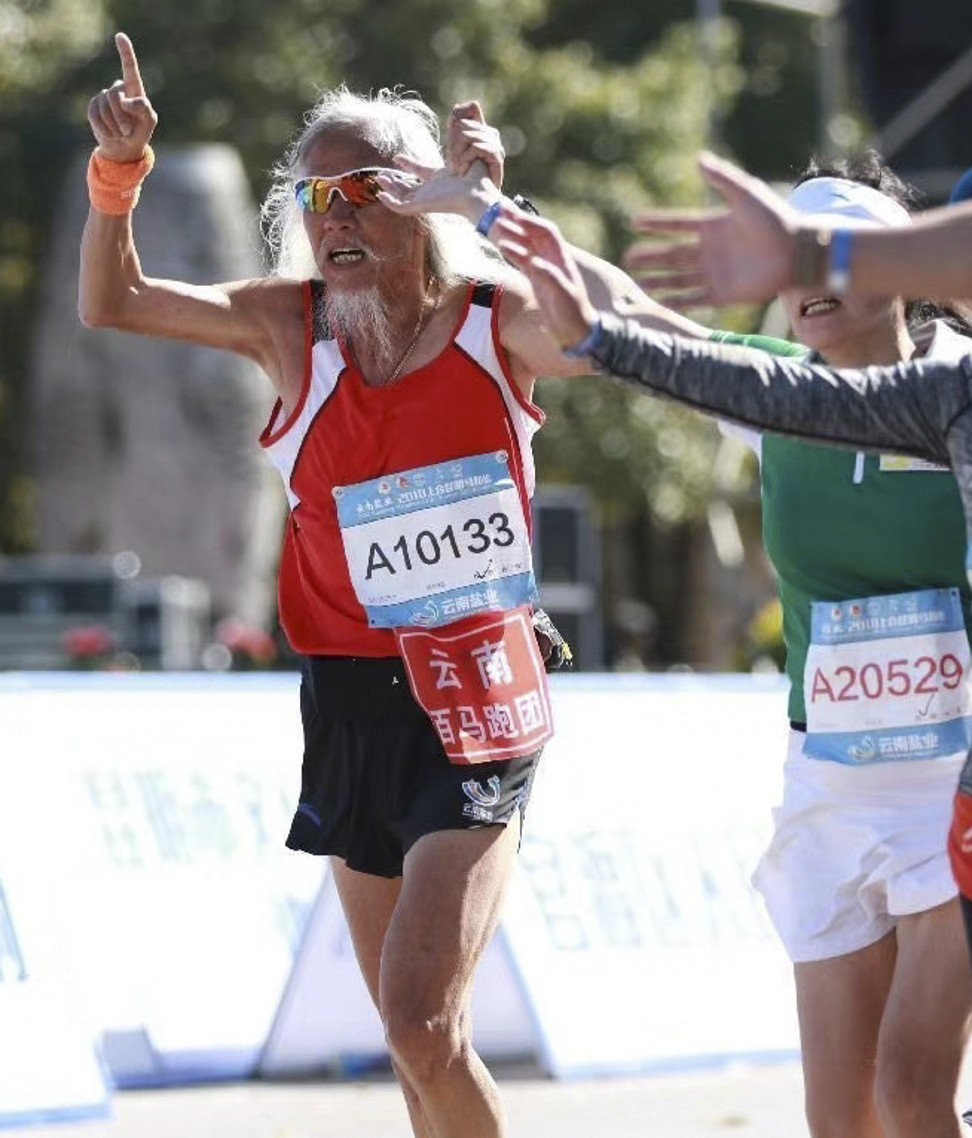
His current PR is three hours and 57 minutes. It qualified him for his age category for the Boston Marathon, and he is going to the United States to take part in it.
“Are you going to run Boston? I cannot speak English, it would be good if we can go together,” he says excitedly.
“We can share a room – you don’t smoke! Whenever I used to go to a race and share a room with Chinese runners, they smoked and they are really noisy. Now I always get a single room just for me. I did this in Berlin this year.”
Liang paid an arm and a leg for a running package tour to the Berlin Marathon, currently Chinese marathoners’ favorite overseas race, but it was worth it, he says.
It was here he set his personal best, and he was left impressed and encouraged by the number of people of his age running.
The official world marathon record in the 70-75 age group stands at two hours, 54 minutes and 48 seconds, set in 2004 by the legendary Ed Whitlock of Canada. Liang is in awe of both the man and the age-group records the late Whitlock set.
“My goal now is to run a 3:30 marathon,” he reveals.
But drawing comparisons between Liang and Whitlock would be unfair. Liang first donned his running shoes at the age of 70, while Whitlock had been an elite cross-country runner in his youth who applied that residual fitness base to train for marathons in his forties.
We will never know what Liang could have done with his talent had he been discovered and received proper coaching as a youngster.
I don’t eat much … I eat mainly vegetables, not much meat.
“I don’t get injured,” he shrugs. “Once my hamstring felt a little tight after a marathon, and it bothered me for a while. Then it just went away.”
He may well be the fastest Chinese runner in his age category, but he says he does not think anyone keeps statistics for that in China. As he is clearly thrilled by the thought of possibly being a national record-holder.
Liang does not get hung up on dietary fads and eats sensibly. “I don’t eat much, but I eat whatever there is. I eat mainly vegetables, not much meat. Every day I drink half a litre of milk, half a litre of yogurt, one egg, one banana and one spoonful of honey,” he explains.
“I try to sleep as much as I can, but now my sleep quality is bad. After five hours I cannot sleep any more. I know this is not good for your health.”
Despite his gregariousness, Liang is a solitary runner. “I run about 80km [50 miles] a week, always on my own, unless I run with my apprentice – she is 47, and has just started running.”
Every weekend he takes a bus for an hour to travel across Kunming to do his long run – at least 20km (12 miles) on the newly laid running paths along Dianchi Lake.
The runners we come across there recognize and greet Liang warmly, including a running couple who happen to work for Yunnan Television.
“They interviewed me recently,” Liang says proudly. “Everyone knows me.”
(01/01/19) Views: 170

Crazy Rich Asians star Constance Wu runs six miles a day to stay in shape when she is not working
Constance Wu (36) is bringing Asian Americans to the forefront in Hollywood with her starring role in the box office hit, Crazy Rich Asians. Having also starred in ABC’s Fresh Off The Boat, Wu has become a role model for Asian American females, an under-represented group in mainstream media.
How does she manage to stay fit and healthy even with a busy schedule? Wu has trained herself to stay in shape in between shoots with her favorite go-to workout–running. “When I’m not working, I run, like, six miles a day.” she revealed in an interview with Health.
It’s easy to understand why Wu has made running part of her lifestyle. “Running has multiple benefits to both our physical and mental health,” she said. “It burns calories, improves cardiovascular health, builds strength and releases hormones that help fight depression.”

We particularly love Wu’s philosophy on eating to stay healthy. She believes knowing the difference between eating for pleasure or stress is key. “One piece of chocolate is pleasure. Ten pieces of chocolate is stress,” she says.
So if you’re looking to get leaner, lift your mood, or simply find more balance in your life, try Wu’s go-to workout. Put on your headphones, play your favorite tunes (in Wu’s case, Broadway musicals) and hit the ground running!
This weekend Wu will be attending the Golden Globe awards as she was nominated as best actress for the film Crazy Rich Asisans. She is up against stiff competition however including Lady Gaga in the lead roll of A Star Is Born but Wu was very excited just to be nominated. The Golden Globes are this weekend, January 6.
(01/03/19) Views: 107

2018 Boston Marathon Winner Desiree Linden will run the Louisiana Half Marathon in January
The first American female to win the Boston Marathon in 30 years, Desiree Linden, will compete in The Louisiana Half Marathon on Sunday, January 20, 2019.
She will use the race as a tune-up as she prepares for the 2019 Boston Marathon, taking place on Monday, April 15, 2019. Runners and spectators can meet Linden during the Shipt Louisiana Marathon Expo on Friday, January 18, and during a Q&A session with Linden on Sunday, January 20, at The Louisiana Marathon Finish Fest.
The full marathon boasted the highest percentage of Boston Qualifiers for January races last year. There are four distances including the half marathon.
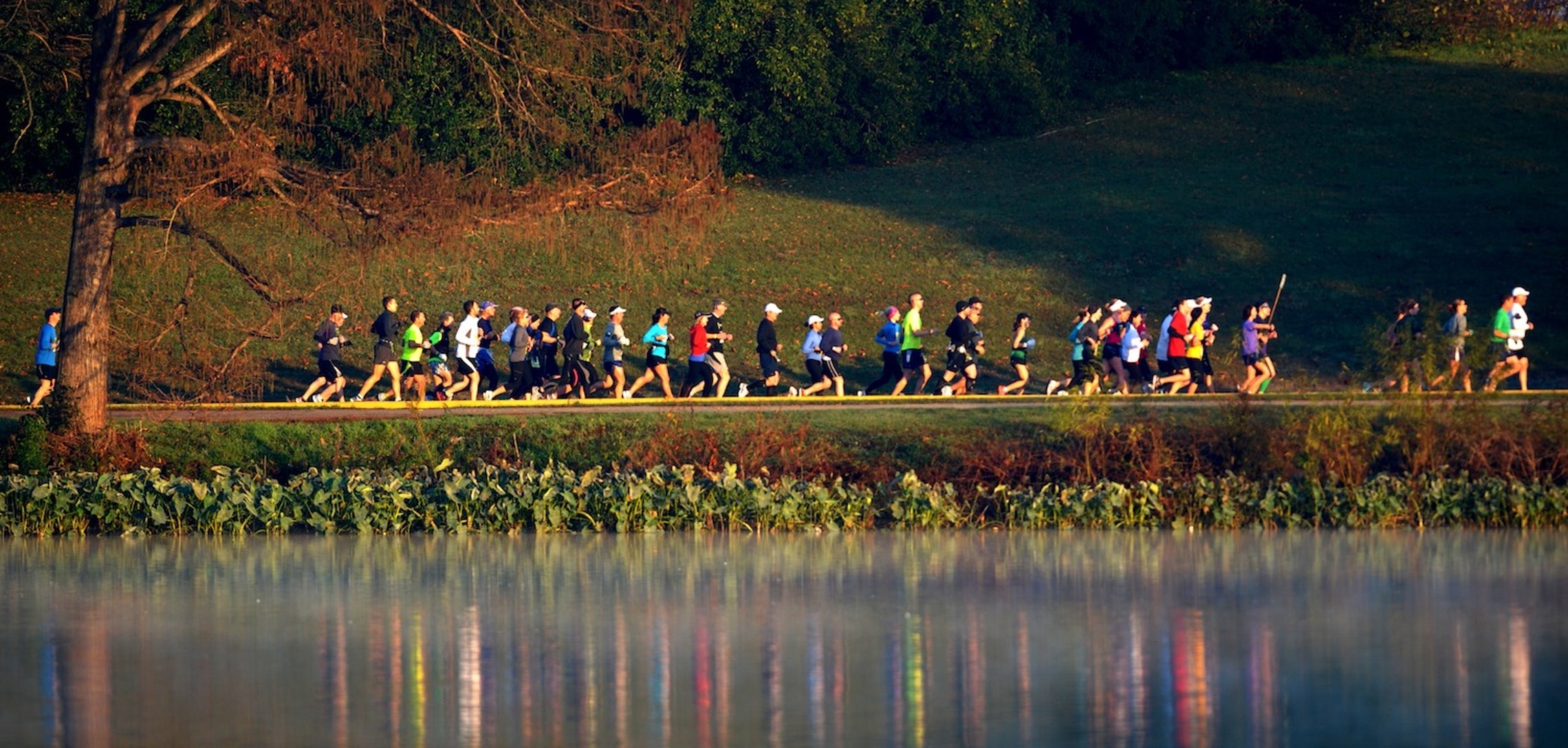
“We are thrilled to have Des Linden join us for the 2019 race weekend. As she prepares to defend her Boston title by running The Louisiana Half Marathon, she will experience our fast and flat course, winding through downtown Baton Rouge, historic neighborhoods and LSU’s campus,” said The Louisiana Marathon Strategic Partnerships Director Craig Sweeney.
The three-day running festival, culminating with the nationally-recognized Finish Fest, is a culturally rich event that celebrates both running and the unique culture that defines Louisiana.
(12/30/18) Views: 81

Bracha Deutsch a mother of five is Israel’s most unlikely marathon runner
Clad in a modest skirt and headscarf, Bracha Deutsch, a mother of five from Jerusalem, was first across the finish line at the National Half Marathon Championships, and now she has her sights set on the Olympics.
Israel's most unlikely marathon runner spends her Thursday preparing food for Shabbat. For that's what you do when you are the first female Haredi marathon runner in the country and you have a race Friday morning.
It may sound improbable, perhaps preposterous, but 29-year-old Bracha "Beatie" Deutsch is the real deal. The first female Haredi athlete shocked everyone by winning Israel's National Half Marathon Championship in December, with a personal best of 1 hour, 19 minutes and 51 seconds.
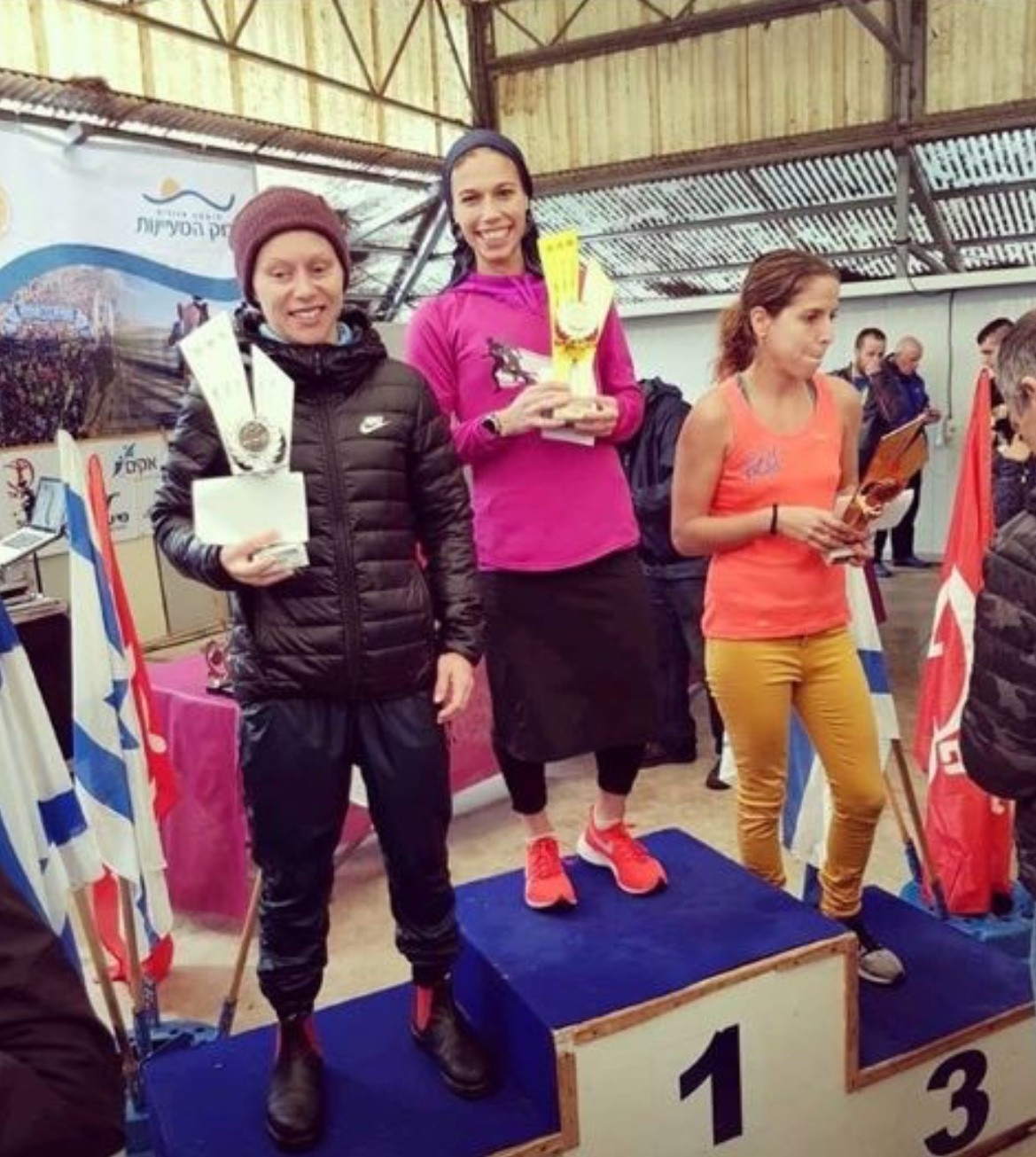
Deutsch is keeping things in perspective. "It's much harder to mother five children than to run a marathon," she says. "Running is a piece of cake compared to potty training."
Indeed, her Instagram seems to reflect her two loves - her children and running, and is filled with photos of both. Her user name, perhaps unsurprisingly, is "marathonmother."
"Although my children are small, before I compete, they ask me 'mommy, are you going to win?' The trophy I won at the Half Marathon Championship started a war between my children, they each wanted it for themselves!"
On January 4, Deutsch will compete in the Tiberias Marathon, where she hopes to place on the podium. And after that, she dreams of the Olympics. And while she is still very far from reaching that goal, she is definitely optimistic.
"I have patience," she says. "I've only been running for three years. I hope to be the first ultra-Orthodox Jewish athlete at the Olympics.
(12/31/18) Views: 73

2012 Boston Marathon Champion Wesley Korir is returning this year in hopes of winning the 122nd Annual Marathon
After spending five years in politics, the 2012 Boston marathon champion Wesley Korir is now fully concentrating on his athletics career with reclaiming the Boston title his major focus in 2019.
The 36-year-old served in the National Assembly as a Member of Parliament of Cherangany from 2013-2017 and had a quiet stint in the sport after politics took the better part of his time thus failing to replicate his earlier form.
Prior to joining politics, Korir had won back- to-back titles at the Los Angeles Marathon in 2009 and 2010 before finishing as the runners up at the 2011 Chicago Marathon and thereafter winning the Boston Marathon a year later.
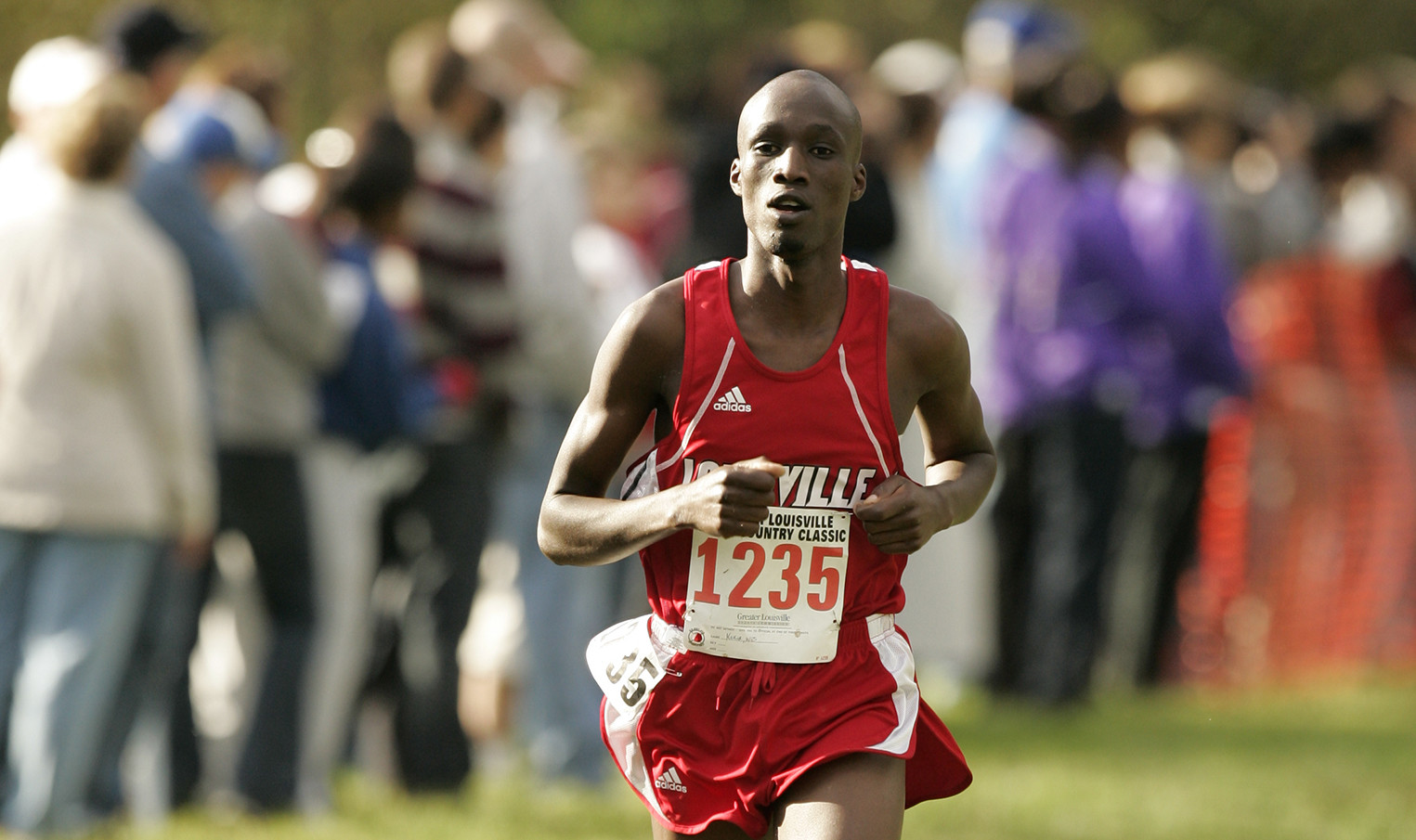
Although he made it to Team Kenya in the 2016 Rio Olympics, Korir failed to finish the race after the mix up in the drinks saw him develop stomach upsets and subsequently dropped out at the 30km mark.
Apart from his young family, Korir dedicates much of his time managing his Transcend Running Academy.
The academy aims at unlocking the potentials of young talents in athletics, with youngsters between the ages of 14-16 the major target.
After his 2012 Boston win, Korir has failed to make it to the podium in three years he returned, finishing fifth in 2013 and 2015 before settling for the fourth position in 2016.
Having competed at the Beirut Marathon last November, Korir is now aiming to make a comeback at the Boston this time round with the aim of reclaiming the victory.
Although the veteran athlete finished the Lebanon race seventh in a time of 2:14.17, he is upbeat of improving on the performance more so after shaking off a long term injury.
“I have been fighting with injuries since I left Parliament and so I was going to Beirut to test my recovery and I am happy that I am fully fit now. I am now looking forward to participating in a couple of races in 2019 with my main target being the Boston Marathon,” said Korir.
(01/02/19) Views: 69

Records set at the annual San Silvestre Vallecana 10k as Kenya’s teenager breaks Kipchoge course Record
Uganda's Jacob Kiplimo and Kenyan runner Brigid Kosgei established new men's and women's records in the annual San Silvestre Vallecana 10K race.
Kiplimo, 18, completed the course through the Vallecas neighborhood in 26:41 here on Monday, besting what was thought to be the unassailable mark of 26:54, set in 2011 by Eliud Kipchoge of Kenya.
On a pleasant night with the thermometer reaching 50F (10C), the race kicked off at a frantic pace as an eight-man pack covered the opening two kilometers in 5:24, with Kiplimo and Kenya’s Solomon Boit taking charge of the rhythm. Spain’s Toni Abadía was the only non-African among them.
The in-form Ugandan then upped the tempo, averaging a terrific 2:35 over the subsequent three kilometers to reach halfway in 13:12, well on schedule to improve on the course record. By then only Ethiopia’s world cross country bronze medallist Abadi Hadis and Eritrea’s Abrar Osman managed to remain on Kiplimo’s shoulder with Uganda’s Mande Bushendich and Tanzania’s Agustino Sulle following.
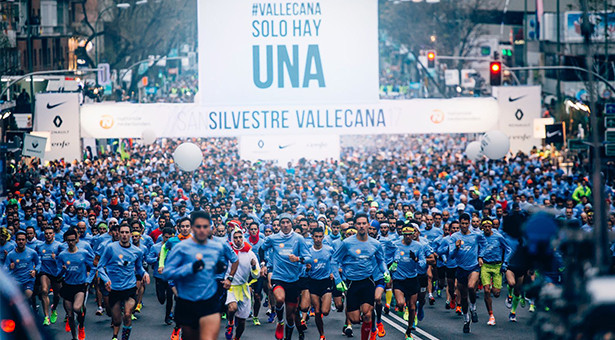
The second half witnessed Kiplimo and Hadis’s magnificent display as the pair kept knocking off kilometers at a record-breaking pace.
Ethiopian competitor Abadi Hadis finished second with a time of 26:54, while Kiplimo's countryman Mande Bushendich completed the podium.
In the women's race, Kosgei picked up her second Vallecana trophy in three years with a time of 29:54, nearly a minute faster than Gelete Burka's previous record of 30:53.
Kenya's Helen Obiri, world champion in the 5,000m, came second, just five seconds behind the winner. Tirunesh Dibada of Ethiopia, an Olympic gold medalist, had to settle for third.
A total of 42,500 people took part in the event, which features an amateur "fun run" before the professional race.
(01/01/19) Views: 54

The former member of the International Olympic Committee, Charles Mukora dies at 83
National Olympic Committee of Kenya President Paul Tergat has described his late predecessor Charles Mukora as the man responsible for the firm entrenchment of Kenya into the Olympic movement.
Mukora, 83, died on Thursday after a long illness.
The former member of the International Olympic Committee (IOC) will also be remembered as one of the forces behind Kenya’s breakthrough into international track and field as pioneer coach, nurturing the careers of Kenyan legends Naftali Temu and Kipchoge Keino, among many others.
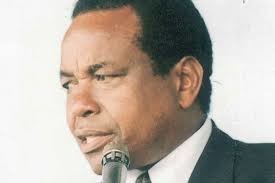
“Charles was one of the founding pillars of the National Olympic Committee of Kenya (Nock) and his tenure saw Kenya firmly established in the global Olympic movement,” said Tergat, an Olympic silver medallist and former world marathon record holder, in his condolences statement.
Athletics Kenya President Jack Tuwei paid tribute to Mukora, who also served as Laikipia East Member of Parliament, as a “dedicated sports leader.”
(12/28/18) Views: 38

Brent Imonen is the new race director and owner for the Kona Marathon
After months of speculation and rumors of new ownership for next year’s Kona Marathon Events, the word is finally out — it is true.
This week Sharron Faff, who has been at the helm for the popular running events over the last decade, confirmed that she has finally “passed the torch” and is now able to publicly talk about it.
“I feel very good about passing the Kona Marathon on to someone who I feel is very capable of being able to take it to new levels,” Faff said. “And also, to someone young and who has a lot of ambition to really put a lot of energy behind it.”
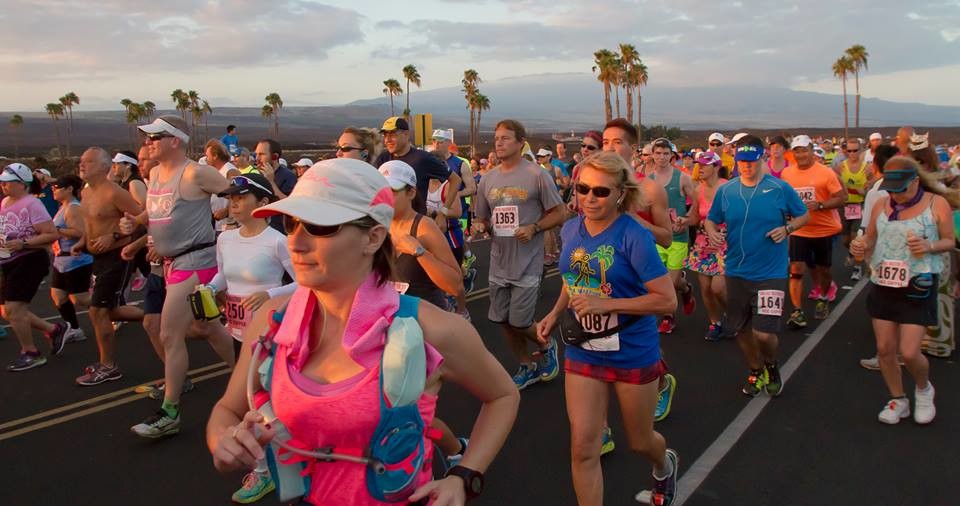
Entering as the new race director and owner for the Kona Marathon, which is typically held in the month of June, will be Brent Imonen.
For Imonen, a former Hawaii professional triathlete, competitive swimmer and elite runner, taking the reins for the Kona Marathon Events won’t be a new endeavor or his only stint – he brings plenty of expertise with him from Oahu.
(12/29/18) Views: 22

World U20 10,000m silver medallist Jacob Kiplimo will be the man to beat at Vallecana 10k race
In the men's race, world U20 10,000m silver medallist Jacob Kiplimo will start as the man to beat. The Ugandan teenager, still 17, is unbeaten in four races this autumn season: a 10km event in Trento in October and three IAAF Cross Country Permit races in the Spanish cities of Atapuerca, Soria and Alcobendas.
Kiplimo clocked 28:17 at the Giro al Sas in Trento, his best 10km on the roads, a performance he will likely improve upon Monday in his quest for the win. However, the reigning world U20 cross country champion will face dangerous rivals including Ethiopia’s Abadi Hadis, the reigning world cross country bronze medallist and Kenya’s Benard Ngeno. Both competed at the Valencia Half Marathon in October, Hadis finishing third in 58:44 and Ngeno sixth in 59:22, massive PBs for both. Hadis, 21, also finished fourth in Atapuerca.
Watch out too for Uganda’s Mande Bushendich, a 21-year-old who improved his 10km PB to 28:01 in Durban in October. Eritrea’s Abrar Osman will also looking for a top-three spot after his recent 42:34 15km career best in Nijmegen while Kenya’s Solomon Boit, a creditable fourth (27:57.44) at the World U20 Championships over 10,000m, Ethiopia’s Mogos Tuemay, a 27:48:41 10,000m specialist and Tanzania’s Agustino Sulle, a 2:07:46 marathoner, should also fight for a top-five spot.

Spanish hopes rest on Adel Mechaal, fresh from an eighth place finish at the European Cross Country Championships in Tilburg and Toni Abadía, the national record holder for the distance with a 27:48 clocking set in Laredo last March. The 28-year-old came 14th in Tilburg and will defend the third place he managed here the last two years. Javier Guerra, an accomplished road athlete with 1:01:38 and 2:08:36 half marathon and marathon credentials, will also be on show.
The race is held on a slightly downhill 10km point-to-point course and starts alongside Real Madrid’s Santiago Bernabeu stadium before finishing on the pitch of another football team, Rayo Vallecano, in Madrid’s southern suburbs.
Forecasters predict a mild night on Monday with temperatures ranging between 8-10C and no rain expected when the gun sounds the start of the last IAAF Label road race of 2018.
(12/29/18) Views: 20
