

Running News Daily
Top Ten Stories of the Week
9/29/2018
These are the top ten stories based on views over the last week.
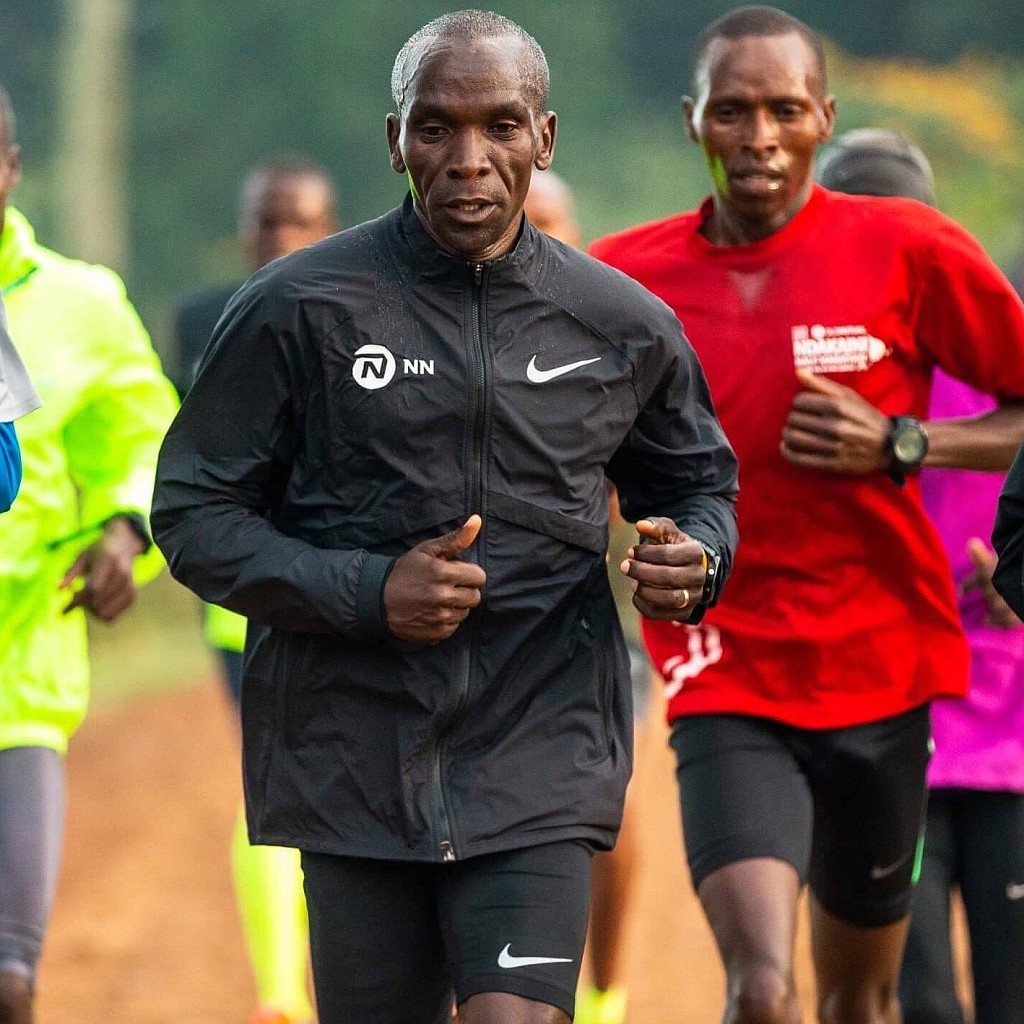


Eliud Kipchoge is a simple man who helps others - Part three of a three part series on the King of the Marathon
The King of The Marathon Part Three: an inside look into the life of Kenya's Eliud Kipchoge.
When Eliud Kipchoge passed the first 10k mark in 29:01 on September 16 in Berlin everyone was excited because he was nine seconds ahead of world record pace.
Actually this was his slower 10k split of the day. He picked up the pace and his second 10k split was 28:55, third 28:49 and fourth 28:47 clocking 2:01:39 to smash the world marathon record.
So how did he do this? It is not drugs! He has never failed a drug test.
Besides doing some unbelievable workouts (as detailed in part 2) he pays close attention to his diet. His favorite meal is ugali, kalenjin traditional milk called mursik which nutritious and energetic, traditional veggies (such as; socha, saga, mborochet, chepkerta and mitiat). These are herbal and they build the immune system and adds to the blood.
He eats roasted maize for carbohydrates. How does he relax? During leisure time he likes reading at least two or three inspirational books every month. This is where a man full of wisdom and maturity adds to his knowledge.
One quote he likes, "The impossible is possible and imitation is limitation.” by John Manson.
Eliud is a dairy and tea farmer and when he is at home he looks after cattle. His last born kid son started running so he can follow in his father's foot steps.
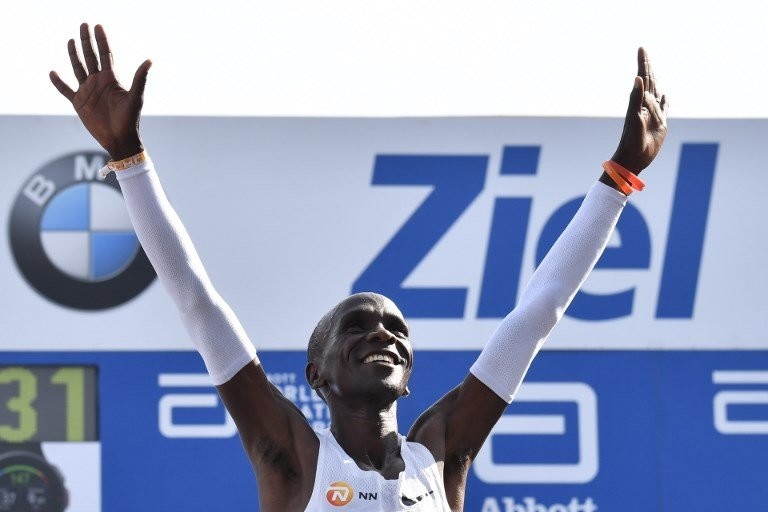
After smashing the World Marathon Record in Berlin, Eliud is expected to get $50,000 for winning and $69,000 for breaking the world record. This is 12 million Kenyan Shillings. In additon, truck manufactures, Isuzu East Africa, which Kipchoge is a Brand Ambassador, will give him a D-max luxury double cabin vehicle.
There are also gaming companies which will reward him. Eliud has involved himself in charity work too. He helps raise funds for dispensaries, pay school fees for unable kids, he helps upcoming athletes with housing and hospitals bills.
He pays for airline tickets for students going abroad on scholarship. He helps to motivate young Kenyans on the importance of hardwork. Kenya has been very proud of Eliud Kipchoge and since he smashed the world record the whole country is behind him.
(Editor’s note: Part one and two of these series were published the last two days on My Best Runs.)
(09/22/18) Views: 3,365Willie Korir reporting from Kenya
Eliud Kipchoge says he handles pain by smiling - Part two of a three part series on the King of the Marathon
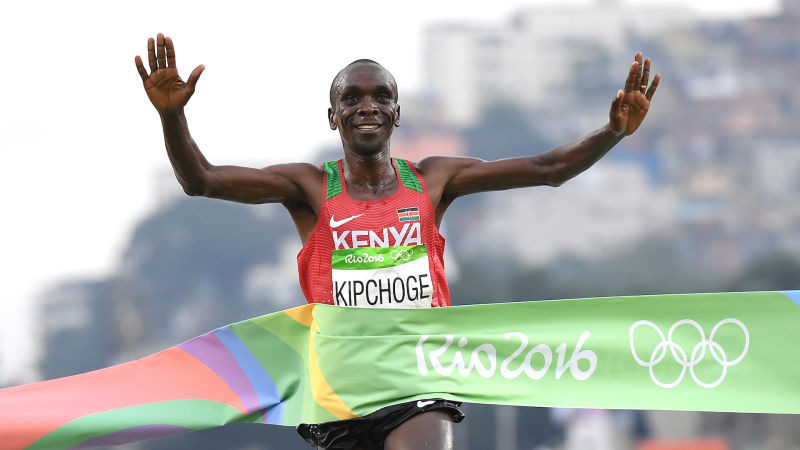
The King of The Marathon Part Two: an inside look into the life of Kenya's Eliud Kipchoge. He began his move into road running in 2012 when he clocked 59:25 for the half marathon. In 2013 Eliud ran his first marathon when he won the Hamburg Marathon clocking 2:05:30, setting a new course record.
In 2016 he won the gold medal in the marathon at the Rio Olympics. He has won 10 out of the 11 marathons he has run. Wilson Kipsang beat him in 2013 in Berlin when setting the world record.
We Eliud trains in Eldoret, the home of Champions. His humbleness is seen when training with athletes. Eliud keeps a low-profile and even does house chores in camp like washing toilets, utensils, cutting grass and cleaning the dining hall. He uses public buses or bodaboda to travel despite having good cars.
He has earned a lot of prize, bonus and sponsorship money from running especially since he moved to the road. However, money hasn't changed his character. He says, "An athlete with 50 million Kenyan shillings ($500,000US) in his bank account can brag, but a farmer who uses the same amount to plant wheat is not even noticed as he walks around town."
Eliud loves the simple life and when he travels he arrives without many people realizing it. He loves his Nike shoes and is comfortable with NN running and with his mentor and neighbor Patrick Sang. During the Nike project, he almost broke the two hour mark clocking 2:00:23 for the full Marathon. Yes, the conditions were perfect and he was paced like in a time trial but his body ran the distance.
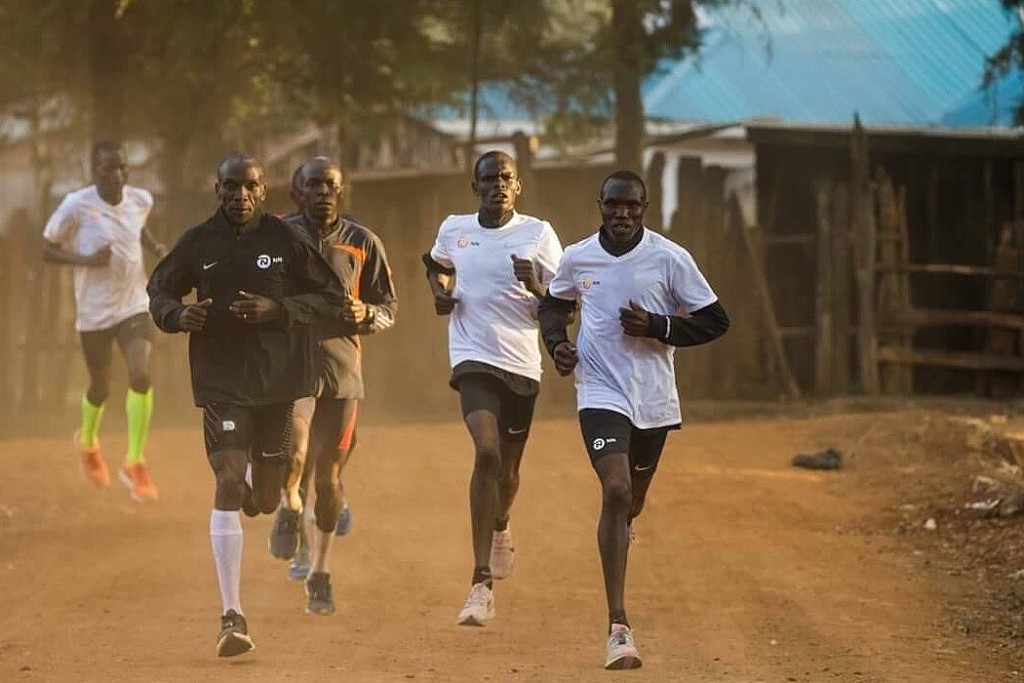
He puts in a lot of hardwork, discipline and good training. He also eats a healthy diet. Before he lined up to run the Berlin Marathon this was the kind of workouts he was doing. 8x1600 (recovery 1:30) + 10x400m (recovery 45 seconds) in Eldoret altitude 2200m (7200 feet) above sea level. His 1600m times were: 4:35, 4:33, 4:32, 4:34, 4:33, 4:32, 4:33, 4:33. His 400m times were: 62, 63, 63, 62, 62, 62, 61, 62, 61, 60.
He always does speedwork on the track wearing racing shoes with other fast athletes like Kamworor, Brimin kipruto and Conselsius. "You can't train alone because you need others to push you higher to reach your best limit," Kipchoge told me last month at Kabarak university. No marathoner has been more dominant in the marathon than Kipchoge.
The 5'6" 115 pound Eliud has never sustained a serious injury because he listens to his body and eats a healthy diet. Even the greatest runners have days when they have a strained muscle or an upset stomach kept them from winning but not Kipchoge.
He actually has a winning formula: Motivation plus disipline equals consistency. Pain, he says, is nothing more than a mind set so he distracts himself with other thoughts such as the joy of running and the finish line ahead, then the pain fades with a smile on his face. He has a habit of smiling whenever pain sets in.
Tomorrow in part three of this series we look closer at Eliud’s healthy diet and at the day he broke the world Marathon record. We talk about the prize money and how Eliud wants to help others.
(09/21/18) Views: 2,077Willie Korir reporting from Kenya

The Chicago Marathon was not always a first class marathon like it is today
The annual marathon in Chicago is one of the biggest and most competitive marathons in the world, but in its early years, the event was a far cry from the glamorous and star-studded race it is today. Held on Sept. 25, 1977, Chicago’s first modern-day race was originally named the Mayor Daley Marathon. It drew some 4,200 participants who paid $5 to run in the inaugural event—which got off to a rocky start when a ceremonial cannon misfired, injuring two spectators. Meanwhile, the race’s top marathoners struggled to get around slower runners on the out-and-back course. These days, race officials and lead vehicles clear the way for the fastest runners, but that wasn’t the case four decades ago. The men’s winner Dan Cloeter recalled in a 2002 Chicago Tribune article. In 1978, organizers changed the start time from 8 a.m. to 10:30 a.m. and doubled the entry fee to $10, prompting uproar from runners. To protest the changes, many wore black armbands on race day. Concern about the later start and warm temperatures rang true when scores of runners wound up being treated for heat-related illnesses. The next year, organizers moved the marathon to October when the weather is typically cooler. But race day turned out to be hot and humid, and Cloeter, the 1977 champion, collapsed from dehydration after winning the race a second time. The race gained prominence in 1982 when organizers began awarding prize money to the men’s and women’s champions, who each took home $12,000 that year. One of the most exciting performances in the event’s history came in 1985 from American Joan Benoit Samuelson. Not only did the 1984 Olympic marathon gold medalist win and beat the marathon world record-holder at the time, she also set an American and course record in The Windy City. But the marathon would soon face hard times. In 1987, after losing its title sponsor, Beatrice Foods, the event was changed to a half marathon. The marathon returned the next year with Old Style, a beer brewing company, as its new financial supporter, but that relationship would fizzle out by 1990. The event lost its key sponsor, but gained a new race director. At 33, Carey Pinkowski took the helm of the struggling race in 1990, making him the youngest marathon director in the U.S. at the time. Pinkowski, 61, has been the race director ever since. The race also attracted the world’s best marathoners, including Khalid Khannouchi, who would win the race four times with record-breaking performances between 1997 and 2002. Great Britain’s Paula Radcliffe would also deliver a stellar performance that year, running 2:17:18 to smash the women’s world marathon record and win the race. Fast forward, this year's race could produce the fastest marathon time run on US soil this year. A sub 2:06 is very possible depending on the weather. US's Galen Rupp (last year's winner) is set to battle some of the best runners in the world including Mo Farah. (09/26/18) Views: 284

Run The World Challenge 2 Profile: Romance got Carmen Gair hooked on running
Romance got Carmen Gair interested in (and eventually hooked on) running! "At school I was a bookworm, the academic type, not the athletic type and certainly not the running type," remembers 34-year-old Carmen. "That was until I met my high school sweetheart, a very experienced runner. I started tagging along to races with him just to have the chance to socialize with him afterwards." At first she just entered 10K fun runs but that soon changed. "I was soon bitten by the running bug and progressed to the half marathon. The high school romance is now long forgotten but I am still very much in love with running," she says. This love for running is why Carmen Gair entered the Run The World Challenge 2 and has already logged 94 miles in 30 days. Lize Dumon (pictured with Carmen in the white hat), the South African Run The World Challenge team leader told her about the challenge and Carmen signed up right away. Carmen pledged to run and log 25k (15.5 miles) weekly and at this point she has been doing 22 miles weekly. "I wouldn’t dream of not reaching the amount of k’s I pledged," she says. "The Run The World Challenge is fun. I love the social aspect, the people taking part, posting and commenting in the runner feed. And it is very motivating, I’ve certainly increased my usual mileage due to the challenge," says Carmen. Running is a very important part of her life. "At university I discovered just how much I needed regular running to clear my head and keep stress levels in check. To this day I cherish this precious me-time," Carmen says. "I also love the social aspect and the wonderful friends and connections I have made through running." Running keeps her fit, healthy and happy and she says she will continue to run for a long time! Asked about her goals? "At the moment I have got my sights set on running my first full marathon. The Run The World Challenge has contributed to that a lot by significantly increasing my mileage." Her husband and Carmen live high up on a beautiful mountain in a small village near the world famous Kruger National Park in South Africa. "I am a dietitian by profession and like most dietitians I love all things food-related, including cooking and eating," Carmen says. (09/27/18) Views: 95Bob Anderson

Mimi Belete from Bahrain will debut at Scotiabank Toronto Waterfront Marathon
As marathon debuts go, Mimi Belete’s might have gone unnoticed in Hamburg last March but for the fact she earned herself third place in this world class event in a very good time of 2:26:06. No one was more surprised than her coach Getaneh Tessema, as she had battled a flareup of a nagging hamstring injury for much of the race and would have been well served to drop out. What could she have run if not for her impediment? The world is about to find out as the 30-year-old, who now represents Bahrain, has turned her attention to the Scotiabank Toronto Waterfront Marathon, October 21st, an IAAF Gold Label race. “For a long time I was training for the short distances and now I want to get a good time in the marathon,” she explains. “I have been with Getaneh almost one year and he advises me after training to rest well as well as to keep working hard.” “I was happy with my performance in Hamburg. I could have run faster but I had a hamstring problem. I want to get my best time in Toronto.” Belete’s path to Canada’s largest city has been a circuitous one. Though she was born in the Ethiopian capital of Addis Ababa, she and her younger sister Almensh left their homeland and sought political asylum in Belgium while still in their teens. (09/27/18) Views: 58

Here is the latest 2019 Boston Marathon News, thousands did not make the cut
The Boston Athletic Association (B.A.A.) today continued its notification to applicants of their acceptance into the 2019 Boston Marathon®. In preparation for the 2019 Boston Marathon, the B.A.A. implemented the same registration process for qualified runners as it used in the 2012 through 2018 Boston Marathons, allowing the fastest qualifiers to register first. The 123rd Boston Marathon will be held on Monday, April 15, 2019 and will mark the 34th consecutive year that the event will have John Hancock as its principal sponsor. Qualifiers who were four minutes, 52 seconds (4:52) or faster than the qualifying time for their age group and gender have been accepted into the 2019 Boston Marathon. A total of 23,074 qualified applicants have been accepted to date or are in the process of being accepted, pending verification of their qualifying performance. A total of 30,458 applications were received during the registration time period for qualifiers, a significant increase from recent years. With the increase in applications received, 7,384 qualifiers were unable to be accepted due to field size limitations. In cooperation with the Commonwealth of Massachusetts and the eight cities and towns along the Boston Marathon route, the B.A.A. has set the field size for the 2019 Boston Marathon at 30,000 official entrants. (09/27/18) Views: 57

85-year-old Ruth Black is set to run her 38th Great Race
Ruth Black started running in the late 1960s to keep healthy and stay fit. For this Sunday, Sept. 30, Black will participate in her 38th Great Race. In 1980, at age 47, she competed in her first 10-kilometer run.“The Great Race was an instant favorite,” she said of that first foray into competitive running. “I loved jogging through the city streets, passing through the outskirts and into Oakland, then the excitement of cresting the last hill and seeing Pittsburgh spread out below, with one more mile to go before the end of the race,” she said describing the 6.2-mile course. Now, at age 85, she dominates the distance even though her times have slowed since her first races. Black is a safe bet to take home a prize. In 37 previous runs, she has received 18 total awards for first, second and third places in her division. “Not a bad batting average,” she said. “The nice thing about getting older is that there are fewer runners in your age group. I tell my friends, all you have to do is keep running until there are only a few in your age group. You’ll get a plaque every time.” About eight weeks out, she starts training. She will run Monday through Saturday and chart her distances and where she ran. Come race day, she is ready. “It isn’t always a breeze,” she said, noting that last year’s run was one of the most difficult because of the heat and humidity. “It was unbelievable,” she recalled. “People were passing out along the route. I’m a stubborn runner and under normal circumstances I don’t take a break even for water but last year I had to.” (09/25/18) Views: 54
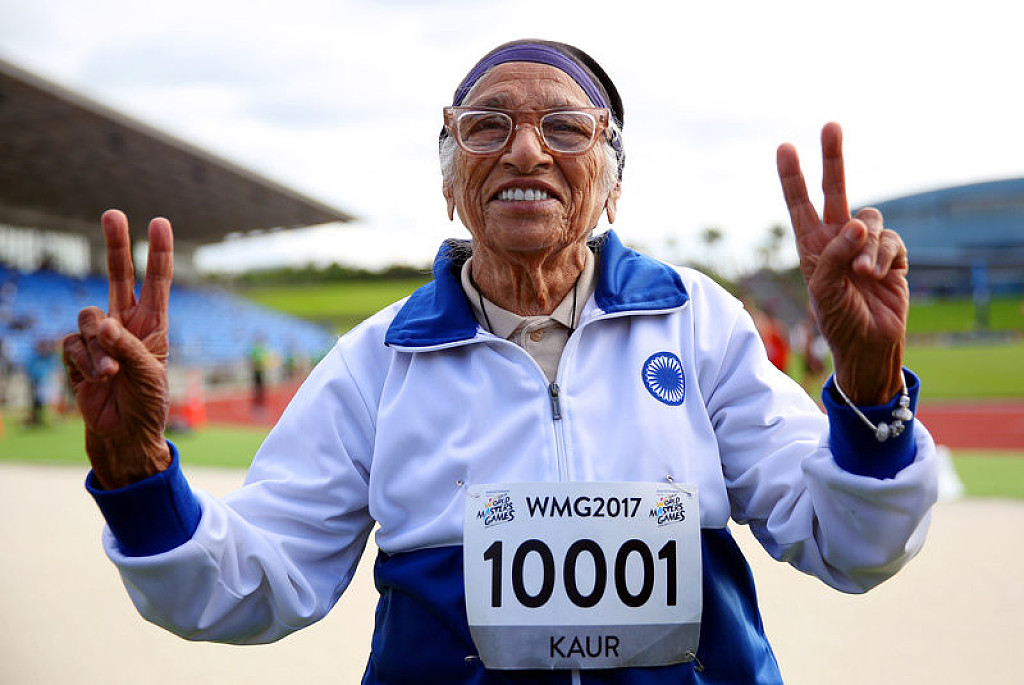
Man Kaur a 102-Year-Old Runner, shares her secrets as she is still running and racing winning gold medals
At 102, Man Kaur is still running — and winning gold medals. The phenomenon from India just nailed the gold medal in the 200-meter race for the 100-to-104 age group at the World Masters Athletics Championships in Malaga, Spain.
She finished in 3 minutes and 14 seconds. Kaur has a message for younger folks: Keep away from junk food and stick to an exercise regimen!
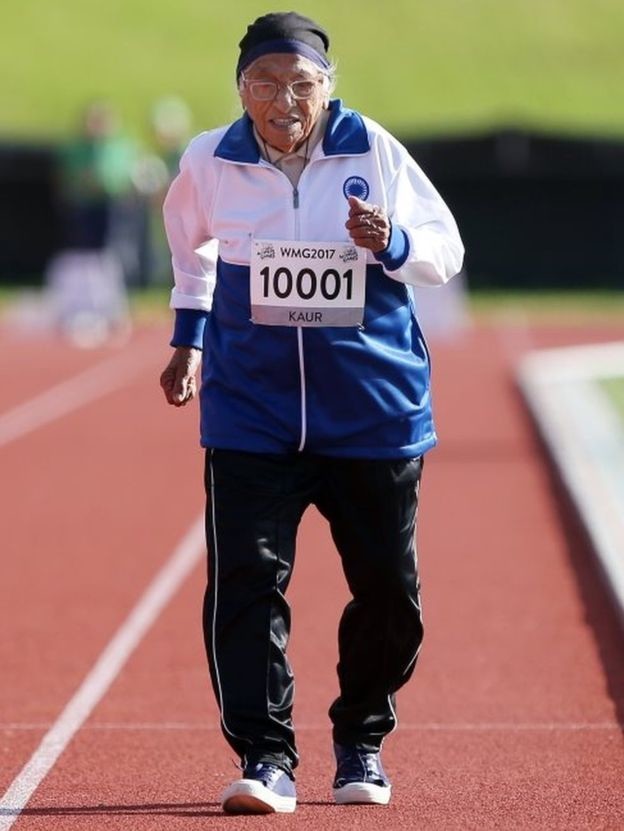
Her own routine is impressive for any age. She wakes up at 4 a.m., bathes, washes clothes, makes tea, recites prayers until about 7 a.m. Sometimes she goes to the Gurdwara, the place of worship for Sikhs, other times she prays at home. And then she goes to the track for an hour of sprinting practice.
The diminutive Kaur hasn't been a lifetime runner. Far from it. She started running in 2009, when her son, Gurdev Singh, who's now 80, urged her to take up track and field.
Singh, the second of her three children, is her coach as well as cheerleader. He also a long-time track competitor: "I was on my college track team and in school, I ran track and I played on the [soccer] team. I have been running in the master level for the last 25 years."
Singh has amassed more than 80 racing medals since 1992. What made him take his then 93-year-old mother to the track? It was mainly a whim, he explains — but also a desire to keep her fit.
"She was very well, with no health problems, and she moved fast. So I took her to the university track with me and asked her to run 400 meters. She did it, slowly, and I thought 'Yes, She can do it.'
"Kaur enjoyed it enough to want to return. She liked running, she said. And quickly she started to improve. Two years later, given how well she was doing, her son registered her for international events he was participating in. Kaur agreed with no hesitation. And she hasn't stopped running.
(09/28/18) Views: 49

Registration for the 43rd Grandma's Marathon Weekend opens October 1
Registration opens for the Grandma's Marathon, Garry Bjorklund Half Marathon and the William A. Irvin 5K at 7pm Central Time October 1. Entries will be taken on a first come, first serve basis until the full marathon reaches 9,000 participants. Those who register to run the 26.2-mile race before December 31 will receive a free commemorative full-zip jacket. After December 31, runners will have the option to purchase the jacket. The entry process for the Garry Bjorklund Half Marathon will no longer include a lottery. Registration will also be first come, first serve until the cap of 7,500 participants is met. Registration for the half is expected to reach capacity very quickly, as last year's registration closed in approximately four hours. The William A. Irvin 5K is limited to the first 2,000 participants. All finishers of the 3.1-mile race will be awarded with a medal and finisher shirt. (09/27/18) Views: 41

Injury has forced Paris Marathon champion Paul Lonyangata to not run Chicago
The former Lisbon marathon champion was supposed to give Olympic champion Mo Farah and last year's runners-up Abel Kirui a run on the Chicago marathon course on Oct. 7. However, a late injury in his training means the 25-year-old will have to bite his time before debuting on the US soil. With the Shanghai marathon coming up on Nov. 18, Lonyangata remains hopeful he will get the nod from both the medical team and the race organizers to return to China where he won in 2015. "The plan was to compete in Chicago, but I then sustained an injury that has made it hard for me to train. My doctors advised me against putting it under pressure in training so I had to ease off," he said Sunday in Eldoret. "Hopefully, I will be back in training soon and be fit to run. I think returning to Shanghai will be a good idea. If invited, I want to go back and win." Already former world marathon record holder Dennis Kimetto (2:02.57) has confirmed participation in this year's Shanghai marathon as he makes another comeback after his initial attempt in Vienna, Austria in April saw him limp out with injury after the 21km mark. In April, Lonyangata became the first man to win back-to-back Paris marathon titles since Steve Brace of Britain in 1989 and 1990. He won the Paris title in two hours, 6 minutes and 25 seconds and failed in attaining his second target that was to improve his personal best, which he had set in 2017 when he finished in 2:06:10. "It was a wonderful experience to win in Paris. But that is in the past. I want to look forward and excel because I want to represent the country in the Olympics and the World Championships," he added. (09/25/18) Views: 40
