

Running News Daily
Top Ten Stories of the Week
10/19/2019
These are the top ten stories based on views over the last week.
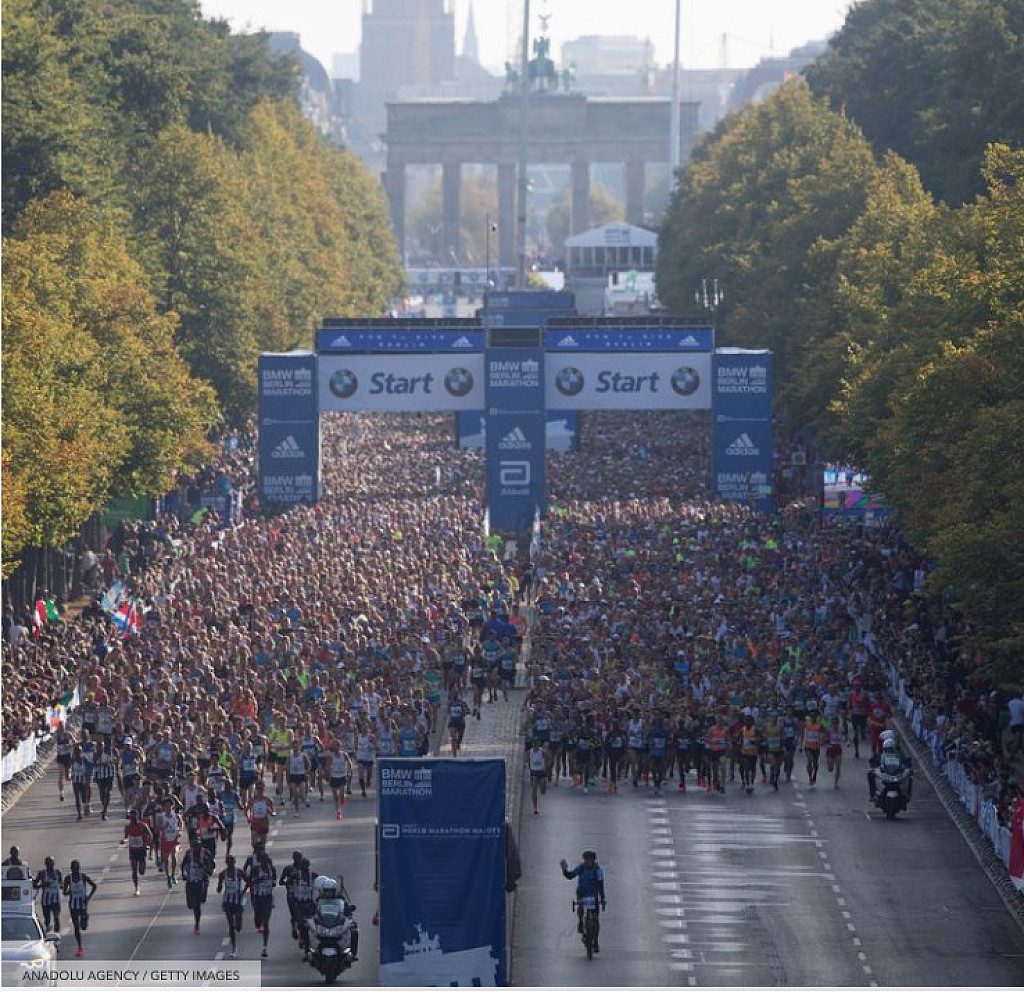


Everything you need to know about running the 2020 Berlin marathon
The fast, flat marathon is known for its record-breaking history
As the home of Kipchoge’s amazing world-record of 2:01:39, Berlin Marathon is known to be one of the fastest marathons in the world, with Kenenisa Bekele missing the world record by 2 seconds at this year's race. Here's what you need to know about entering the 2020 ballot.
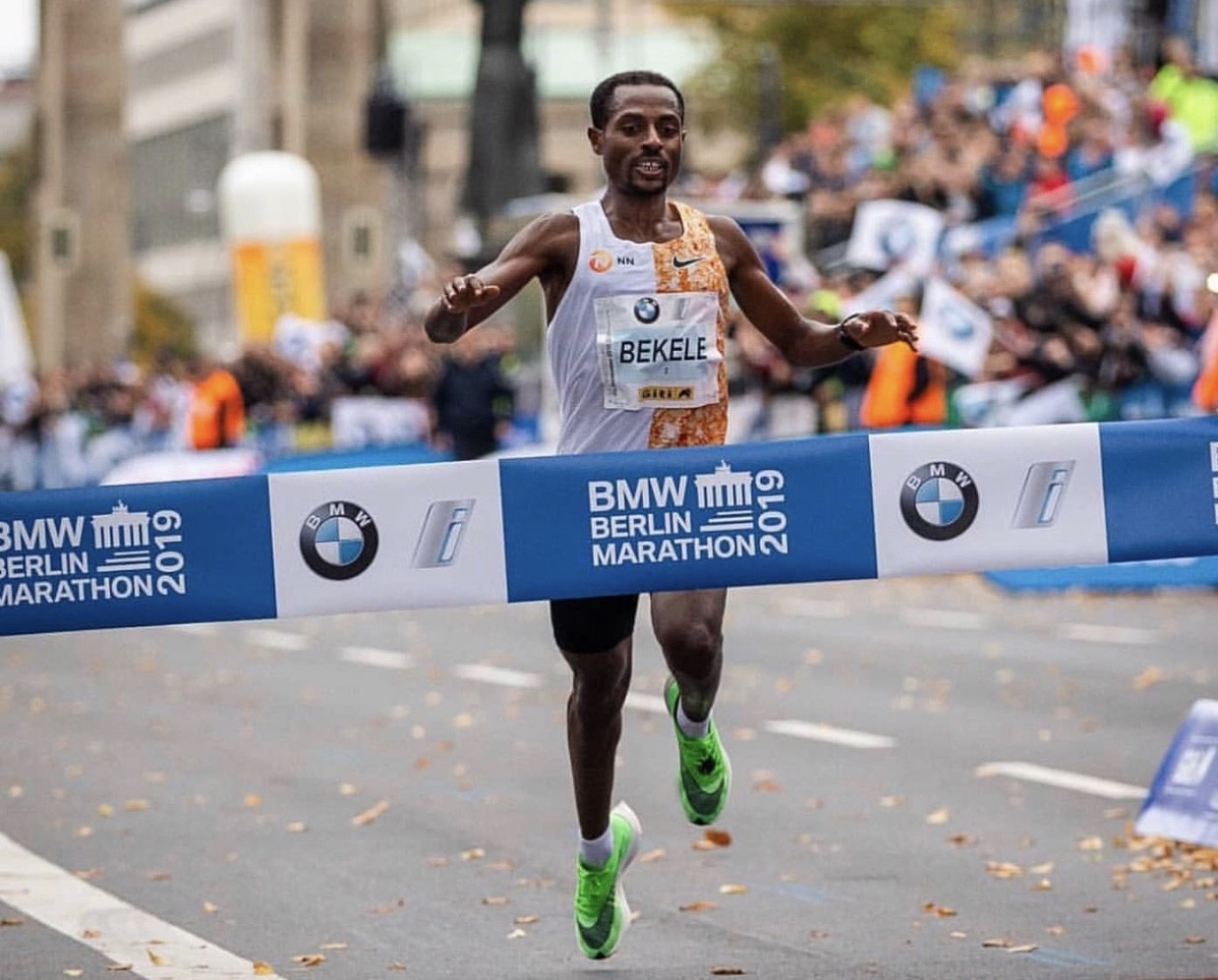
When does the 2020 Berlin Marathon ballot open?
The 2020 Berlin marathon ballot opened on October 1 2019 and will remain open until 31 October 31 2019. With a limit of 44,000 runners, Berlin marathon spots are in high demand. You will receive an email confirming your entry into the ballot straight away.
When will the 2020 Berlin Marathon take place?
The 2020 Berlin Marathon will take place on Sunday September 27 2020.
How much does it cost to run the 2020 Berlin Marathon?
If you are successful in the ballot, the registration fee for the Berlin Marathon is €125 which at the time of writing coverts to £110.13 or $150US.
When will the ballot results be announced?
The results of the ballot will be released from November 27 2019 onwards.
How does the ballot work?
The Berlin Marathon uses the same entry drawing procedure as other marathon events at the Abbott World Marathon Majors Series.
In the single runners entry, you will be required to submit all your relevant data during the registration phase, including your payment details. If you are successful in the ballot, your card will be charged and it will not be possible to transfer or cancel your race entry, so make sure you’re 100% certain before submitting your entry. If you are not successful in the ballot, your payment information will be deleted.
How can you get a guaranteed place for the 2020 Berlin Marathon?
If you’re 100% sure you want to run next year’s Berlin Marathon, you can enter under a guaranteed starting spot.
There are two options when it comes to getting a guaranteed place – entering with a tour operator, or getting a charity place. Tour operators offer race spots as part of a holiday package, which you can often pay for in instalments up to the race.
Similar to other major marathons, charity places are also available, giving you a guaranteed marathon place in exchange for fundraising for a good cause.
What are the Good for Age options at the 2020 Berlin Marathon?
Known as the ‘fast runners’ route, fast runners can secure a guaranteed place for the 2020 Berlin Marathon if they can prove they have finished an AIMS-certified marathon in the last two years (2017/2018) in a certain time. These times are as follows:
Male runners:
18-44 (DOB 2001-1975): under 2:45 hours
45-59 (DOB 1794-1960): under 2:55 hours
60 and above (DOB 1959 and older): under 3:25 hours
Female runners:
18-44 (DOB 2001-1975): under 3:00 hours
45-59 (DOB 1794-1960): under 3:20 hours
60 and above (DOB 1959 and older): under 4:10 hours
The ballot for fast runner places also opened on October 1 2019 and close on October 31 2019.
When will I get my number for the Berlin Marathon?
Similar to other marathons, you will be required to pick up your bib number at the Berlin Marathon expo, which will be open from Thursday September 24 2020 to Saturday September 26 2020.
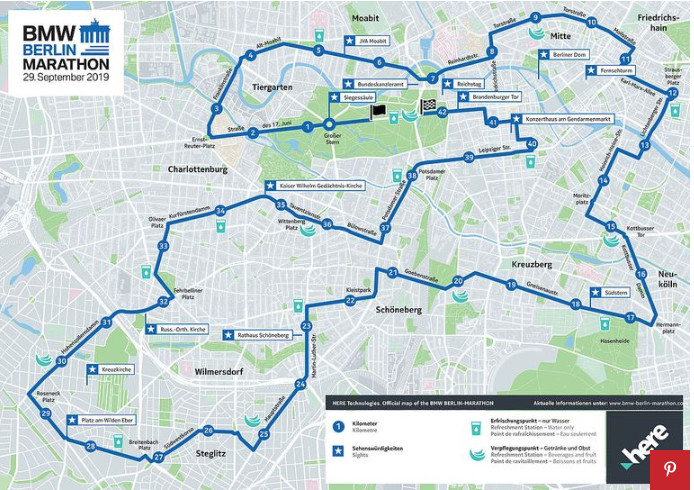
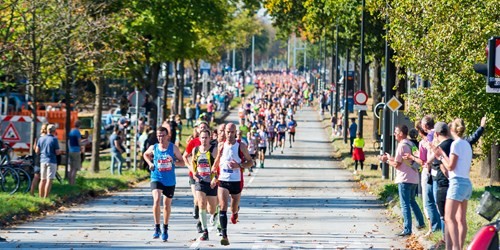
The course is not confirmed but most likely it will be similar to the course run in 2019 (photo).
(10/14/19) Views: 321Runner’s World UK
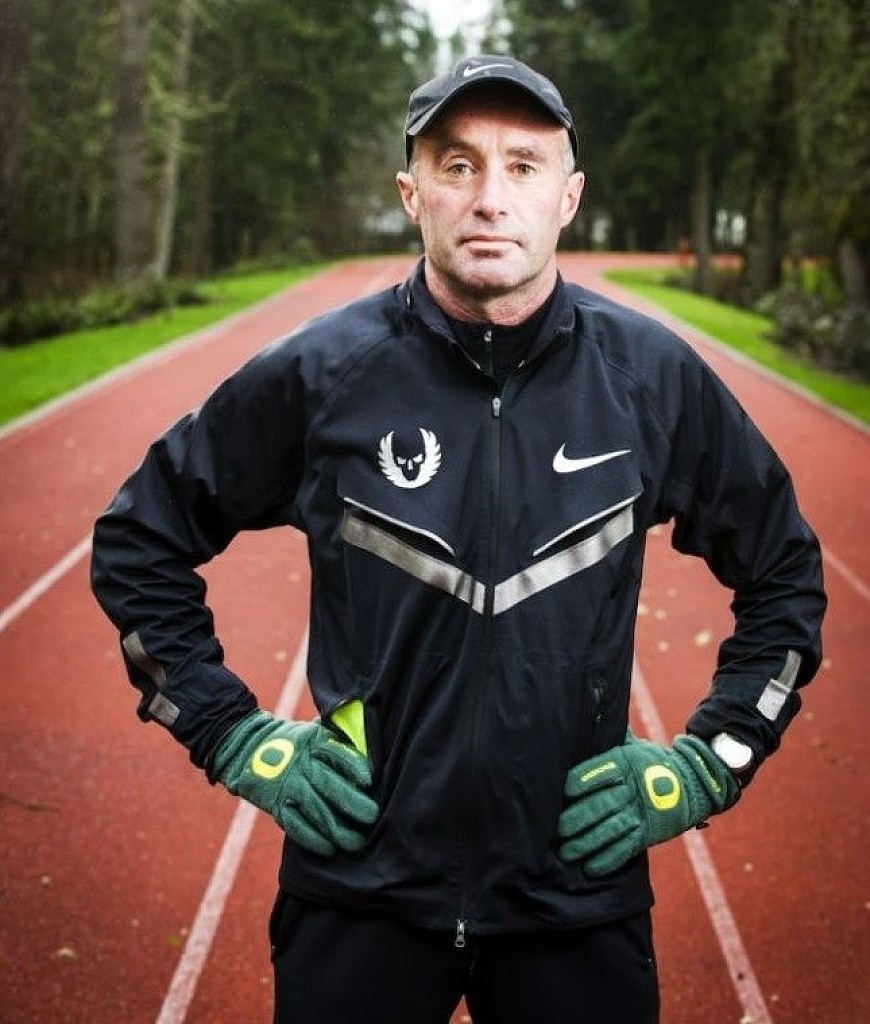
Nike has shut down the Oregon Project after Alberto Salazar was banned for four years for doping violations
Nike has shut down its elite Oregon Project (OP) long-distance running operation less than two weeks after head coach Alberto Salazar was banned for four years, a company spokesperson told CNN.
Salazar was banned for "multiple anti-doping rule violations" following a four-year investigation by the US Anti-Doping Agency (USADA).
Nike says it took the decision to wind down the OP as the situation has become an "unfair burden" on its athletes.
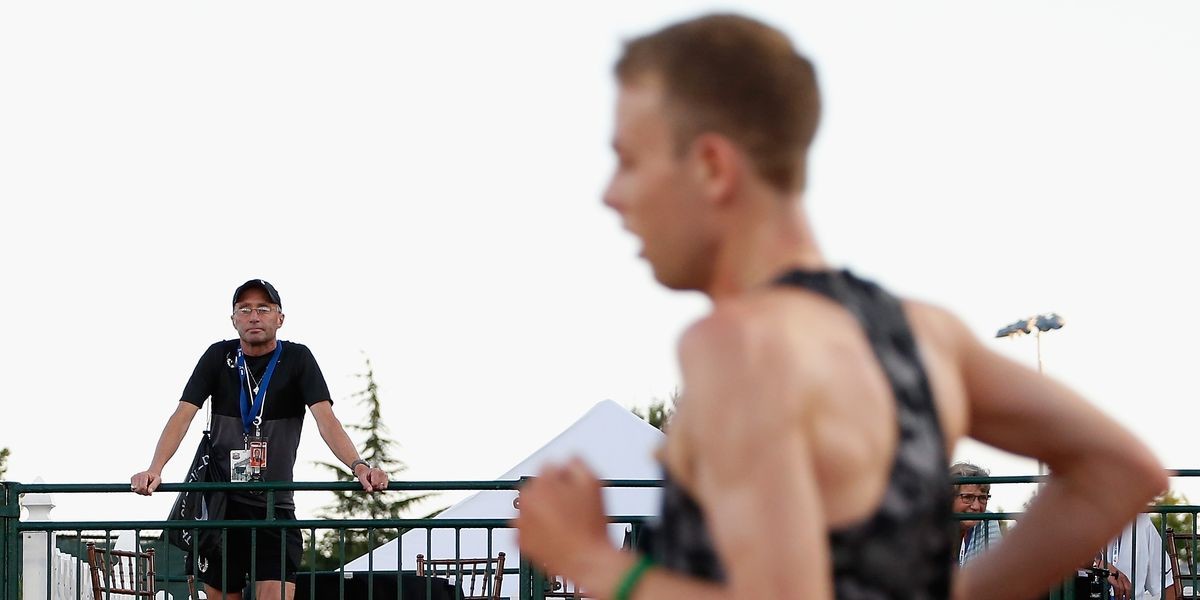
"Nike has always tried to put the athlete and their needs at the front of all of our decisions," a spokesperson told CNN.
"While the panel found there was no orchestrated doping, no finding that performance-enhancing drugs have ever been used on Oregon Project athletes and went out of its way to note Alberto's desire to follow all rules, ultimately Alberto can no longer coach while the appeal is pending.

"This situation including uninformed innuendo and unsubstantiated assertions has become an unfair burden for current OP athletes. That is exactly counter to the purpose of the team.
"We have therefore made the decision to wind down the Oregon Project to allow the athletes to focus on their training and competition needs. We will help all of our athletes in this transition as they choose the coaching set up that is right for them."
The Nike Oregon Project is a prolific training group that has produced some of the world's best athletes, including Mo Farah, who Salazar coached to four Olympic gold medals between 2011 and 2017.
Salazar, 61, and Jeffrey Brown, a consultant doctor for the NOP, were ruled to have trafficked testosterone, tampered with the doping control process and administered a banned intravenous infusion.
Nike told CNN it "will continue to support Alberto in his appeal," which has been taken to the Court of Arbitration for Sport in Switzerland.
”Maybe this confirms that NIKE really did know what was going on and in fact might have been the moving force pushing Salazar to do some things he otherwise would not have done,” wonders Bob Anderson. “However NIKE is too big of a powerhouse for us to ever know the real story. Why would they close this program and leave many elite runners out in the cold?”
(10/11/19) Views: 244
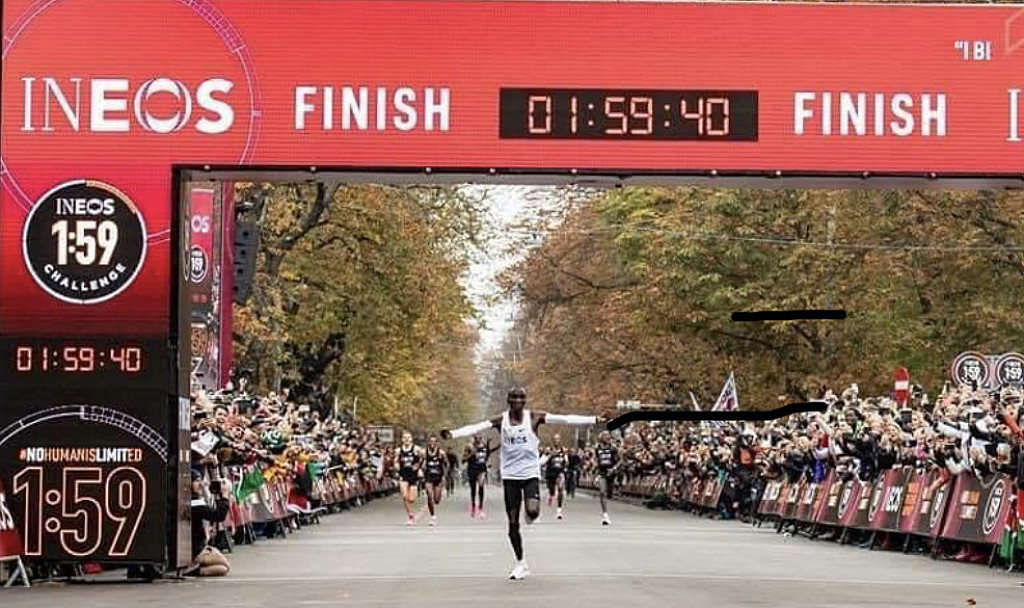
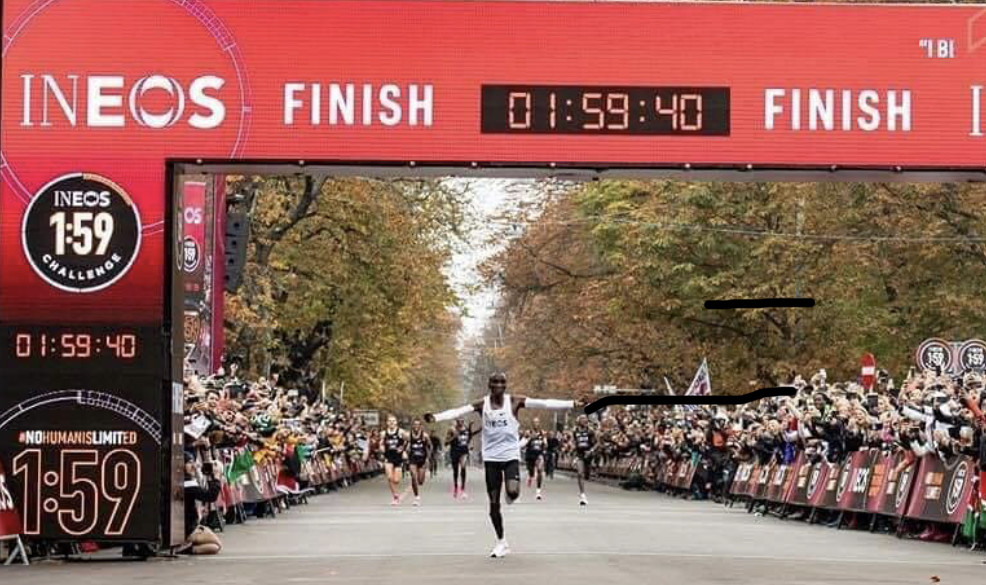
Eliud Kipchoge is now the first man to run 26.2 miles in less than two hours as he clocked 1:59:40 today
Eliud Kipchoge from Kenya and the current world record holder for the marathon made history today by running 26.2 miles in 1:59:40. His splits were amazing. His fastest kilometer was 2:48 and his slowest was 2:52. At least 19 of his splits were 2:50 on the dot.
He hit the first 5k in 14:13 with his pacemakers right out front. He looked relaxed and smooth. Just watching him gave me goosebumps because he makes it look so easy.

The course in Vienna, Austria was 90% flat and straight. The temperature was just under 50F and the humidity 90 percent at the start which was a little higher than expected. But it did not have any visual effects on Eliud.
Eliud said before the start, “I don’t know where the limits are, but I would like to go there.”
I did a poll on Facebook before the start and all but one person thought he could run sub two hours. One thought he could run 1:55 but most thought 1:59 something.
No, this was not a race. It is not a world record because he was the only one racing, he had drinks handed to him from a bike and he had pacers coming in and out. It was a challenge to see if it was possible for a man to run a sub two hour marathon. And he did it.
In watching the event it was distracting to always see the pacemakers out front until the end but they certainly did their job. It was almost like watching a new sport as the pacemakers came in and got in their formation.
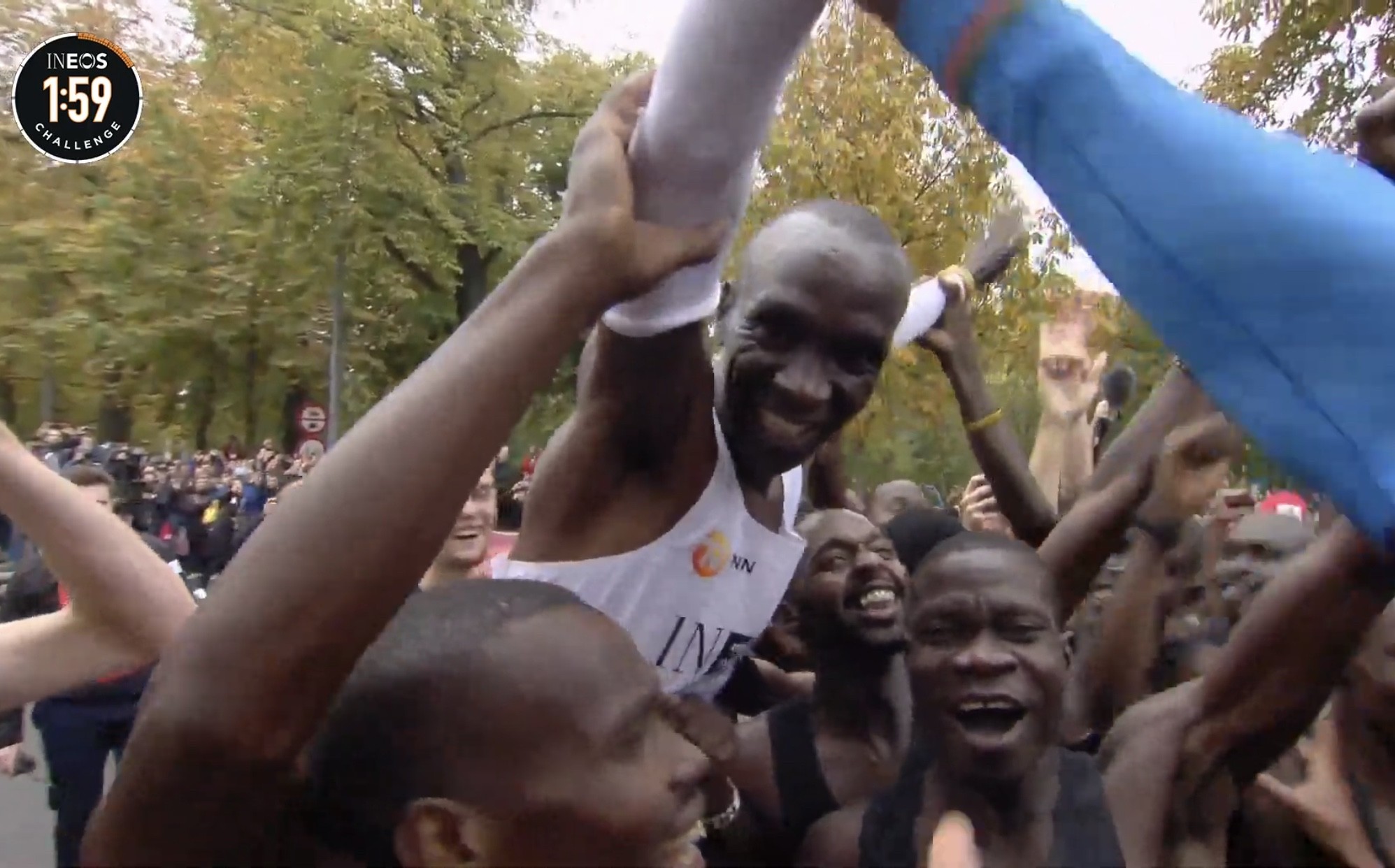
I would have rather have watched Eliud Kipchoge and Kenenisa Bekele battle it out in Berlin where I think one of them would have run sub 2:01 but I did enjoy watching this challenge. Eliud made it look so easy to run 14:10 5k’s.
Eliud was under an hour at the half way point and finished very strong in 1:59:40. The pacemakers helped Eliud run 2:50 kilometers on the dot from 33k to 40k.
Then with about 500 meters to go the pacemakers let Kipchoge go and he sprinted to the finish line. Shalane Flanagan who was one of the hosts of the You Tube broadcast said, “No way in my life time did I ever think I would see a man run a sub two hour marathon.”
We have now seen a man run a marathon in under two hours. His wife Grace and their three children watched him race for the first time. They were all smiles as was Eliud.
Eliud Kipchoge is an Olympic Champion, world record holder clocking 2:01:39 at the Berlin Marathon last September and now the first man to cover 26.2 miles in under two hours.
(10/11/19) Views: 208Bob Anderson
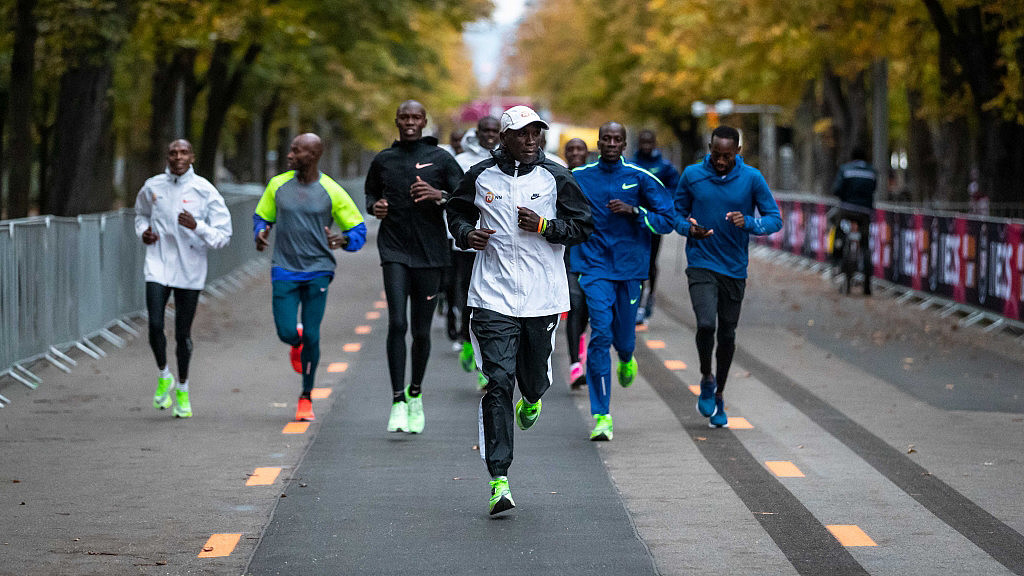
Eliud Kipchoge has an even better chance to break 2 hours in the marathon, according to scientists
A team of respected running scientists from Vienna, Boulder, Sacramento and Houston has just released a paper analyzing the marathon course Eliud Kipchoge will run Saturday morning in Vienna in the Ineos 1:59 Marathon Challenge. The paper concludes that the layout is only 4.5 seconds slower than what would be expected from a perfectly straight, perfectly flat course.
“Our simulation indicates that the Vienna course was well chosen for optimizing performance,” said the researchers in a paper entitled: The effects of course design (elevation undulations and curves) on marathon running performance: an a priori study of the INEOS 1:59 Challenge in Vienna.
Kipchoge’s manager, Jos Hermens, recently told us that Kipchoge is in better shape than two years ago, and that he learned from the Nike event and will benefit from better handling of the pace car and his sports drinks.
Kipchoge hopes to run 1:59:xx early on Saturday, October 12 in Vienna in an unofficial, non-record-eligible time-trial similar to the Nike Breaking2 event he raced in May, 2017, on an auto track in Monza, Italy. There he hit halfway in 59:59, and snapped the tape in 2:00:25—the fastest running time ever for the 26 mile, 385 yard marathon distance.
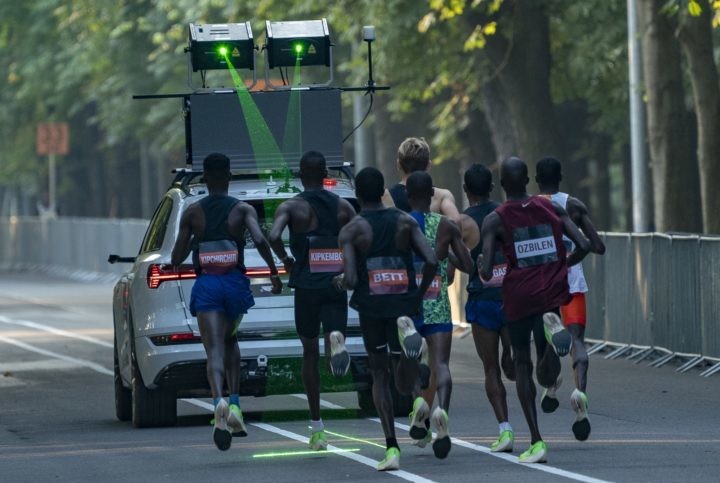
Kipchoge’s performance in Monza did not count as an official world record, because he had a pace car, a large, rotating group of pacers, and received help with his drinks, among other violations of official IAAF competition rules. The Vienna race will follow suit in many ways, and likewise not be eligible for world-record status. That doesn’t lessen the excitement and intrigue among running fans.
Kipchoge and his INEOS sponsors are hoping that better weather and that loud spectator support will help him in Vienna. In Italy, he ran with temps in the upper 50s, slightly humid. According to weather forecasts, Vienna could be 5 to 10 degrees F cooler, with somewhat lower humidity. Wind was not an issue in Monza, and isn’t expected in Vienna.
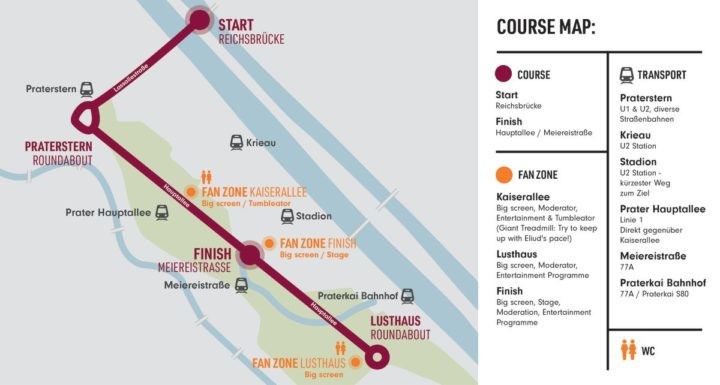
The Vienna course begins on the Reichbruecke Bridge (over the Danube River; also the start of the annual Vienna Marathon) and drops 40 feet in the first 1.4K. It then enters Prater Park for four out-and-back 9.625K loops, mostly on the straight-as-an-arrow, pedestrian-only Hauptallee Road, in the shadow of the iconic Prater ferris wheel. This road has small up-and-down undulations of about 8 feet.
Importantly, the straightaways do not reverse direction with abrupt, momentum-killing U-turns. At both ends, Kipchoge and pacers will take longish, gentle “roundabouts.” One is called the Praeterstern and has a circumference of 870 meters. The other, the Lusthaus, has a circumference of 210 meters.
After the four loops of the Hauptallee and roundabouts, the course begins a fifth loop. This ends 2.3K later at the finish, which is a net 43 feet below the start.
The roundabouts are so easy to navigate that the science team estimates Kipchoge will lose only 0.5 seconds (at 4:34/mile pace) due to cornering. At Monza, they estimate he lost 1.5 seconds on the winding course.
They didn’t have enough data from Monza to estimate time lost to the slight ups-and-downs. In Vienna, this should amount to about 4 seconds.
Two weeks ago, a Danish group named Albatros Adventure Marathons tried to scoop the 1:59 effort with its “World’s Fastest Marathon” near Granada Spain. The open race started at 8,546 feet in the Sierra Nevada mountain range, and dropped 6358 feet to the city finish. A little-known Kenyan named Antony Karinga Maina passed the halfway point in 59:30, but then slower to a winning 2:09:38. Four months earlier, Maina had run 2:22:38 in the Salzburg Marathon.
In recent years, a number of downhill marathons have appeared to help runners qualify for the Boston Marathon. The Revel marathon series includes a handful of marathons with elevation drops of 2000 to 4000 feet. Physiologists believe that long, steep downhills lead to debilitating quadriceps muscle damage, and that half as much drop might be better.
(10/11/19) Views: 195Amby Burfoot

I think the 1:59 Challenge should have been a real race with 12 runners and with no pacemakers. I think Eliud, Kenenisa or someone else would have run better than 1:59:40 today
First of all, well done Eliud and your pacemaker team. You are an amazing runner. However, on reflection I wished this would have been a real race with a dozen runners racing on this same course. No pacemakers and the runners would pick up their own drinks at tables. If this had been done, I think we would now have a new real world record. And I think it would be faster than 1:59:40.
Pacemakers need to go. Eliud and Kenenisa plus ten others could have clocked some amazing times this morning. And all going for the win. Pay the winner two million if they break two and there you go. I am sure more than two million was spent on the pacemakers alone.
No prize money for second. It would be all about racing to win and to run under two hours. No prize money for second and maybe only $100,000 if you win and don’t go under two hours.
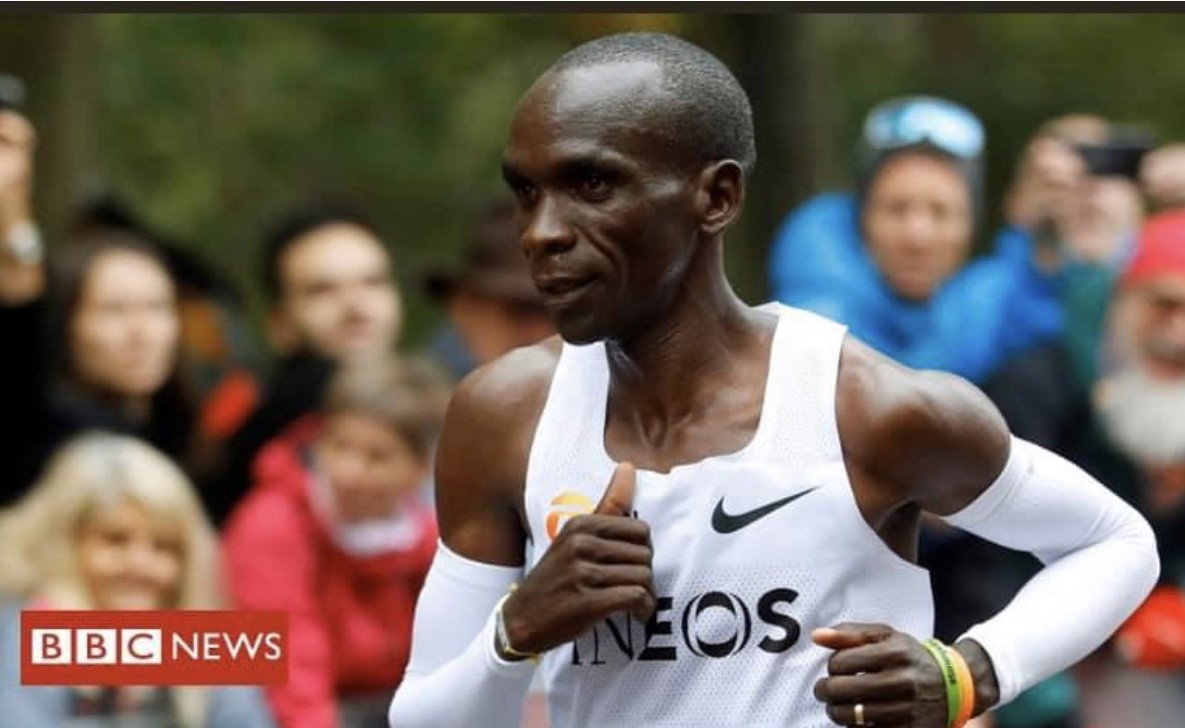
I watch every minute of this 1:59 Challenge. But I must admit I did get tired of watching the pacemakers lead Eliud through the course. Don’t get me wrong, these were amazing runners leading Eliud and I admire them all. But this needed to be a real race with the winner not known before the gun went off.
(10/12/19) Views: 170Bob Anderson
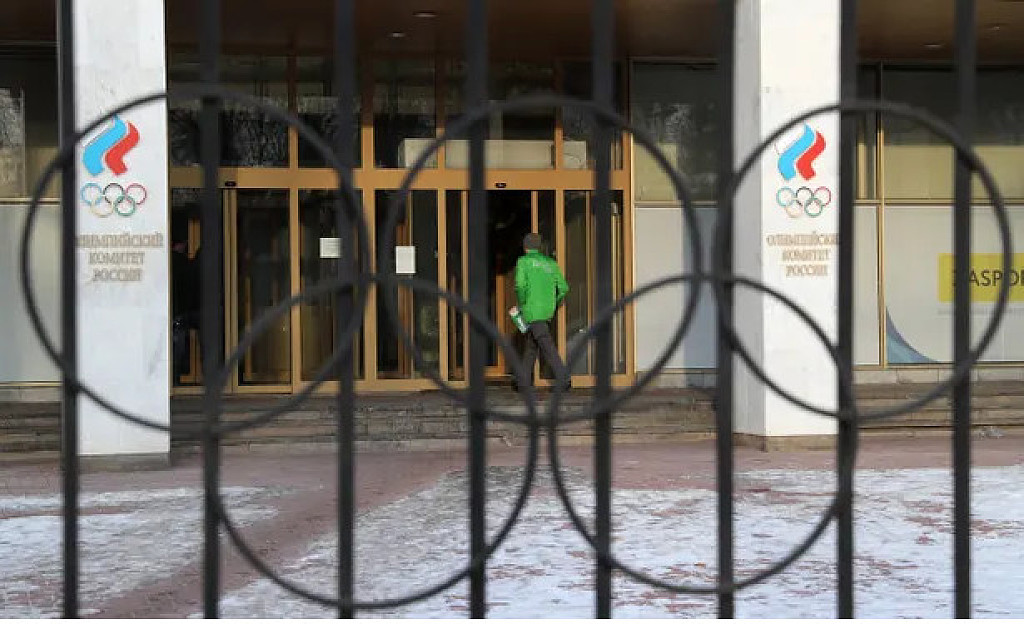
Russia is at risk of not being able to participate in the Tokyo Olympics due to possible doping violations
Vladimir Putin says Russia wants to leave its doping "shortcomings" in the past, even as it faces questions regarding data tampering.
The Russian president tells a televised sports conference that his country is complying with the World Anti-Doping Agency "to the fullest extent."

Russia met the October 9 deadline for responding to questions regarding “inconsistencies” in the data WADA investigators retrieved from a Moscow laboratory in January as part of a massive doping investigation.
The agency said its Intelligence and Investigations Team and independent forensic experts will analyze Russia’s response, adding that “no fixed timeline can be set for this” but that WADA is pursuing the matter “robustly and as quickly as practicable.”
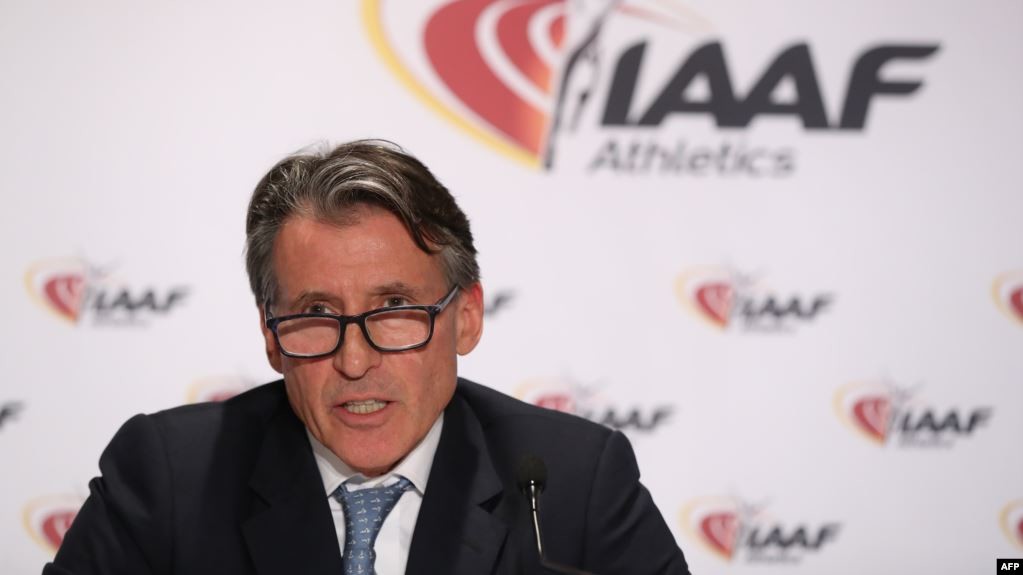
Russia faces the prospect of being banned from next year’s Olympics in Tokyo after the World Anti-Doping Agency gave it three weeks to explain apparent inconsistencies in data from its Moscow laboratory or to suffer the consequences.
Sources close to the situation believe there is now a strong possibility Russia will be banned from the Olympic Games and it is not inconceivable such a punishment could also extend to competitions in any sport signed up to Wada’s code, including the football World Cup.
Stanislav Pozdnyakov, the president of Russia’s Olympic Committee, admitted the situation was “very serious” and could jeopardise Russia’s Olympic participation.
WADA lifted its ban on the Russian Anti-Doping Agency in September 2018, much to the anger of the wider global anti-doping community and athlete groups. Critics said the Russians had refused to accept the findings of the McLaren report that concluded its government was involved in a massive doping conspiracy.
Wada said it had to compromise in order to get the data from the Moscow lab, which it had wanted since 2015, in order to build cases against athletes suspected of being involved in a state-sponsored doping programme.
However, Wada’s board was told that investigators had also found inconsistencies between a data set passed to it by a whistleblower in 2017 and the evidence extracted in January.
Jonathan Taylor, chairman of Wada’s committee tasked with overseeing Russia’s compliance, told the New York Times the Russians needed to “pull a rabbit out of a hat” to avoid new penalties. “There were positive findings that were deleted;
The Russian sports minister, Pavel Kolobkov, said the ministry would cooperate with Wada, adding that experts in the field of digital technology would be involved.
The chief executive of the US Anti-Doping Agency, Travis Tygart, who has repeatedly warned that Wada was being played by Russia, said he was unsurprised by the latest news.
“Let’s hope there are no secret backroom deals but that justice is finally served in an open, transparent and public manner,” he said. “The world, and especially clean athletes, have already been yanked around enough already.”
(10/13/19) Views: 167
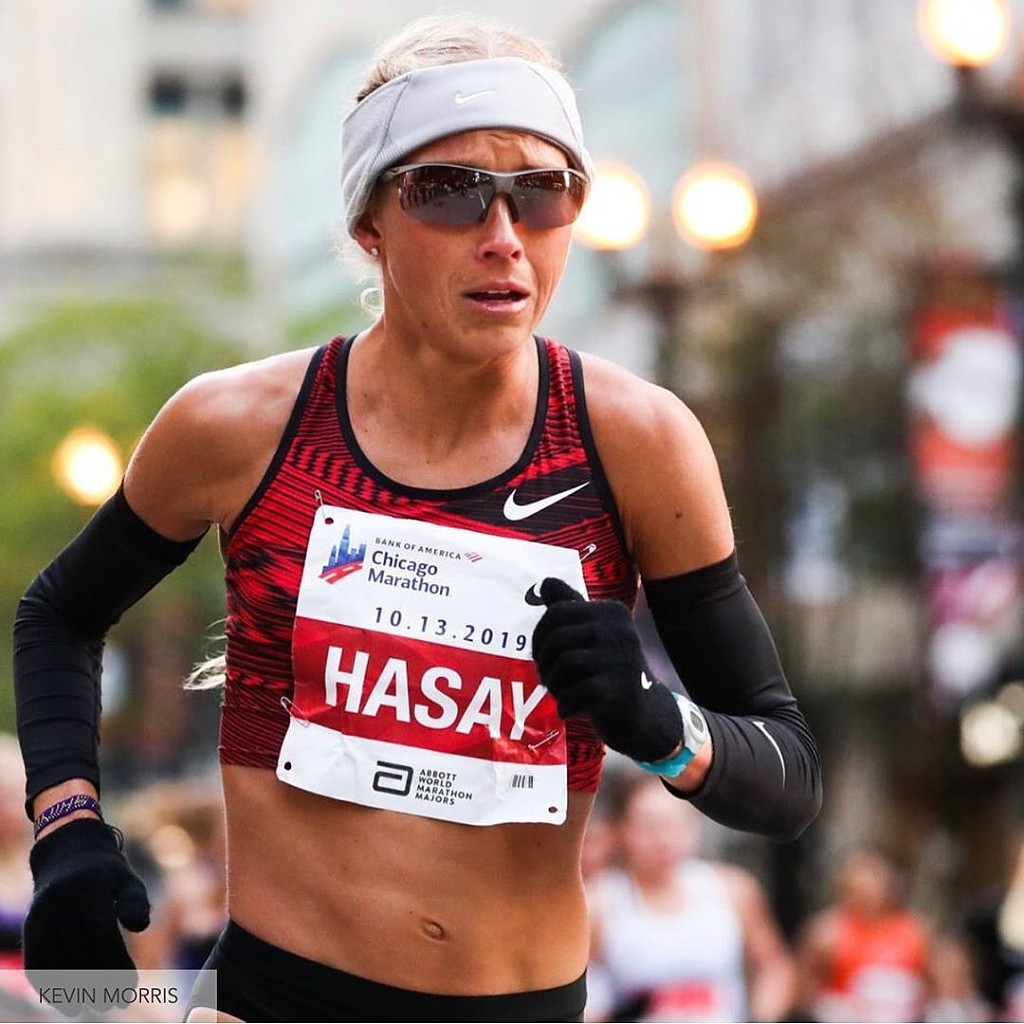
Jordan Hasay suffered an injury during the Chicago Marathon forcing her to drop out
Jordan Hasay suffered an injury while running the Chicago Marathon and couldn’t finish the race. She had placed third at the Boston Marathon.
Jordan said in an Instagram post that she was about two miles into the race when she “felt a sharp pain in (her) hamstring and had to stop.”
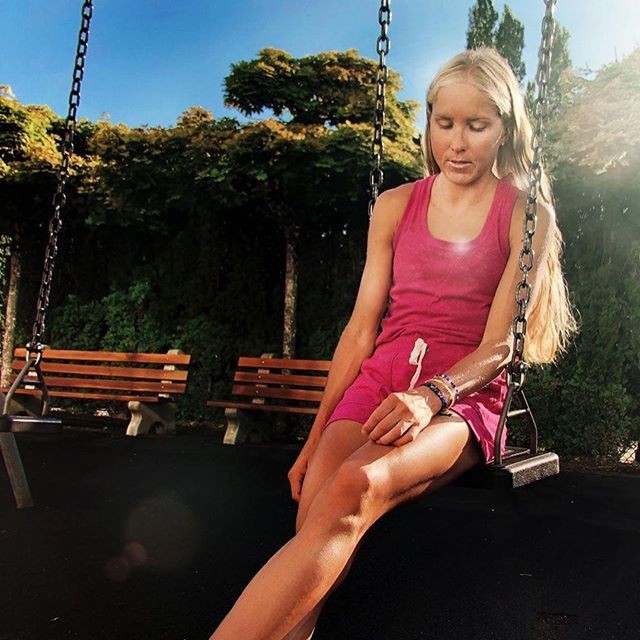
“I stretched and tried to go again but was unable to run,” Hasay, 28, wrote in the post. “The emotions are raw and new but already I know despite the sadness, it’s time to reset, refocus and gear up for the Olympic Trials in February and a big year in 2020.”
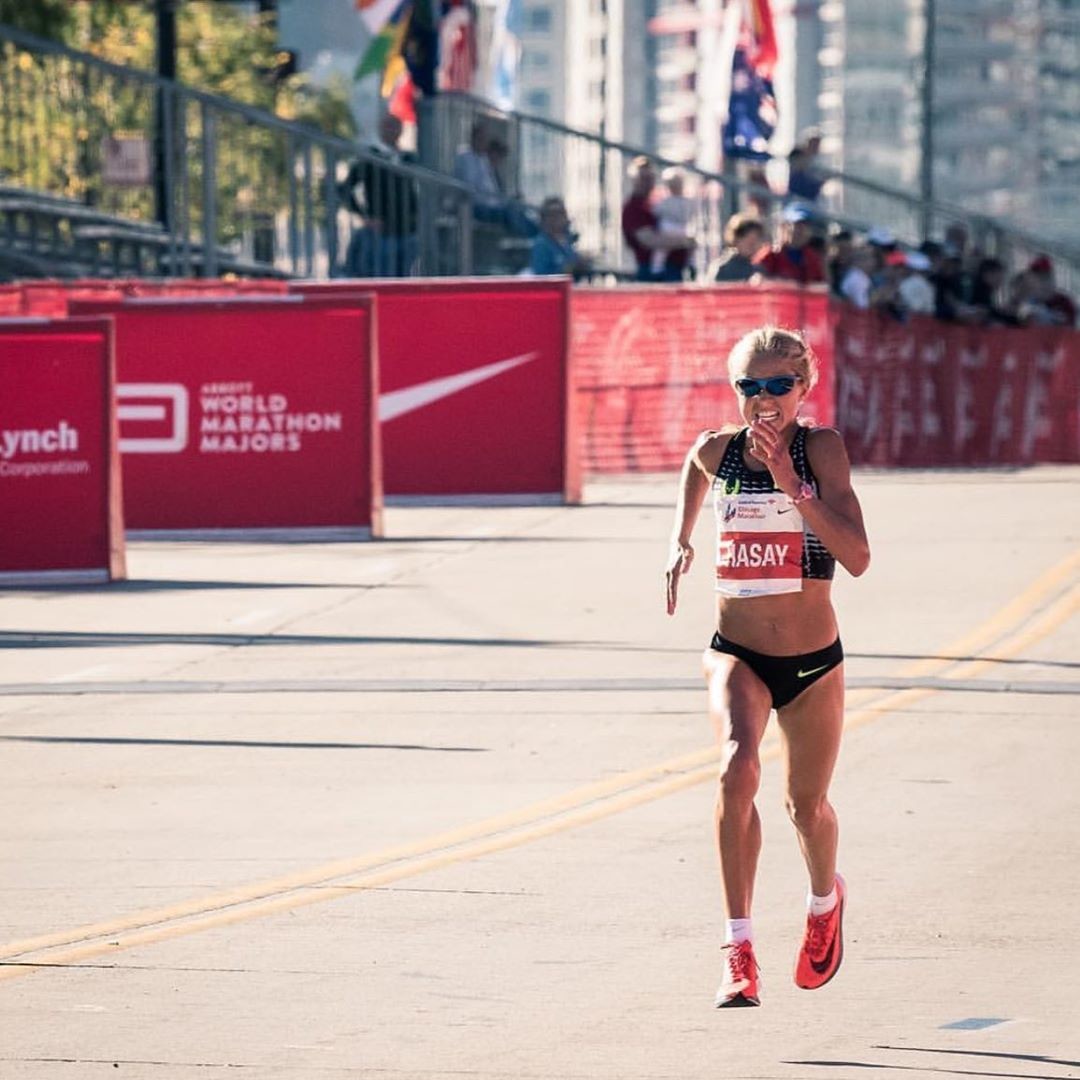
Before the race, Hasay had talked about trying to break the American marathon record of 2 hours, 19 minutes and 36 seconds, which was set by Deena Kastor in 2006.
Hasay’s appearance in April’s Boston Marathon came after a year in which she suffered two significant foot injuries, which forced her to withdraw from both the 2018 Boston and Chicago marathons.
(10/15/19) Views: 124
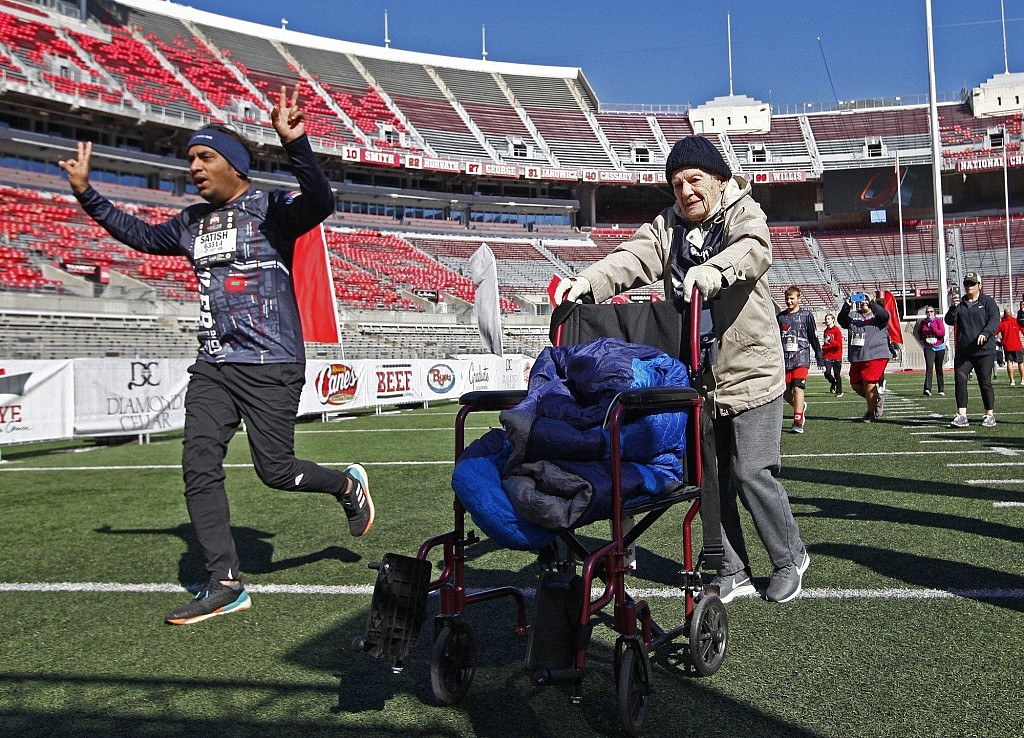
Lois “Marge†Stroebel, age 101, crosses finish line at Ohio State 4 Miler
Amid the crowd of 15,000 walking and running across the campus Saturday, Lois “Marge” Stroebel, 101, of the Dayton area, completed the charity 4 Miler for the second year in a row, with help from her granddaughter and friends. She was the oldest participant in the race ending in Ohio Stadium, but nearly 200 of them were over 70.
When she reached the north end zone inside Ohio Stadium on Saturday, Lois “Marge” Stroebel rose from her wheelchair, shed the sleeping bag she’d been bundled into like the stuffings of a burrito, and, powered by her own determination, headed straight for the 50-yard line.
Now, she wasn’t exactly bee-lining toward the big “O” at the center of the field, and her gray Nike sneakers weren’t leaving any smoke trails, but give her a break. She is 101 years old, after all.

After walking those last 50 yards and crossing the finish line at the seventh annual Ohio State 4 Miler to cheers, high-fives and a special acknowledgement from M3S Sports Race Director David Babner (who mistakenly announced Saturday was her birthday, thought it was in September), Stroebel said she wasn’t even tired.

“I didn’t do anything but sit here,” she said with a laugh as she pointed to her posse. “They did all the work.”
This is the second year that Stroebel has completed the race, the largest of its kind in the country with 15,000 walkers and runners wending their way through the Ohio State University campus and ending up on the Buckeye football field. Stroebel and her granddaughter, Beth Kreger, travel from Vandalia, near Dayton, and Kreger’s friends and co-workers, Scott and Wendy Tharp, come from Lancaster to join in.
Scott Tharp ran the whole 4 miles pushing Stroebel in her transport wheelchair (that means it has small wheels) while his wife and Kreger ran interference.
“Look out! We’ve got Grandma!” they yelled as they zigged and zagged through the sea of people. “Beep beep. Grandma’s coming through!”
The small wheels on the transport chair meant it wasn’t the steadiest thing on the route. Scott Tharp said his hands were numb at the end of the race from gripping it so tightly to keep control.
“It was sure bouncy and bumpy,” agreed Stroebel, who seemed to not understand what all the fuss over her was about. She still lives alone, after all, and she cooks her own meals, dresses herself and never misses her regular bridge game. Until three years ago, she still golfed regularly.
She has been a rabid Ohio State football fan as long as she can remember. But last year when Kreger, a triathlete, suggested her Gram compete in her first-ever race at Ohio Stadium, it surprised her.
“Why, I thought she was crazy!,” Stroebel said of the idea. Now, she has two race medals in her collection. “We have a lot of fun.”
(10/14/19) Views: 105Holly Zachariah
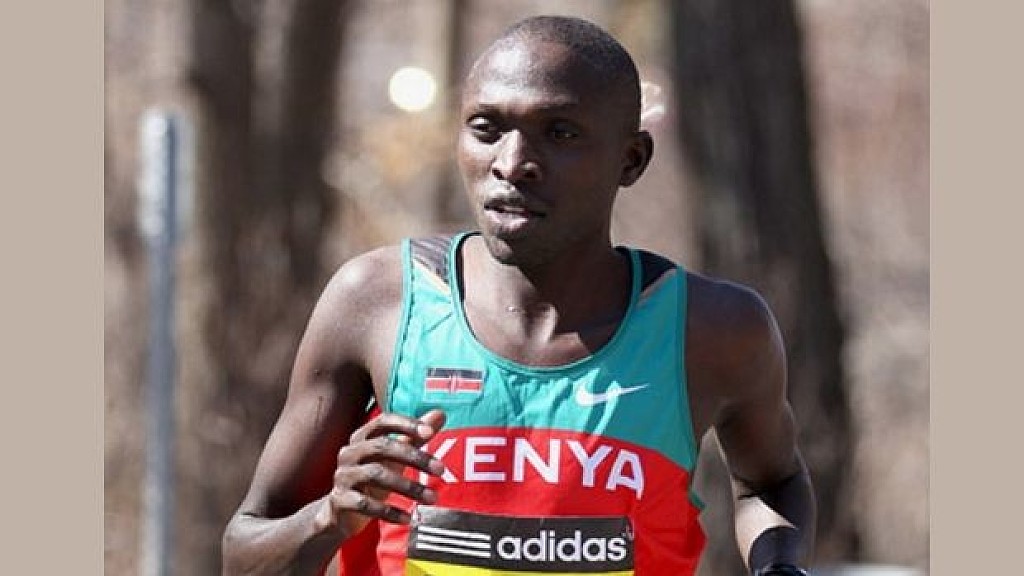
Kenya's Gilbert Yegon and Betty Chepleting will seek the victory at Eindhoven marathon
Kenya's Gilbert Yegon and Betty Chepleting hope to break through and win a big city marathon when they line up at the Eindhoven marathon on Sunday in the Netherlands.
Yegon leads a quartet of Kenyan stars keen to crash the course record and boost their selection prospects to the national team ahead of next year's Olympic Games in Tokyo, Japan.
Yegon, a bronze medalist from the Stockholm marathon, is seeking his first win in 2019. Last year, Yegon won the Dusseldorf marathon and was fifth at the Singapore marathon.
"I hope to run a fast race and boost my personal best time. But the important thing is to win against a strong challenge from Ethiopian and Turk runners. However, my training has gone on well and will be looking forward to a good performance," Yegon said in Nairobi on Friday.
Leading the women's charge will be Chepleting, who hopes to bounce back from a poor showing in China's Dongfeng Wuhan marathon, where she was seventh in two hours, 34 minutes and 26 seconds.
"This will be my third race in 2019. I was seventh in Wuhan and failed to finish in Nagoya. I also won in Tunis in 2018 and hopefully, I will be able to overcome my challenges and fears to stage a good show in Eindhoven and win," said Chepleting.
Race Director Marc Corstjens believes they have top elite runners who can break the two hours and six minutes mark.
"Since 2014, winners of the Eindhoven marathon managed to complete the course within an average time of 2:06:26. But only if all conditions like the weather, are excellent. However, their finishing times ensure Eindhoven's marathon is among the ten fastest marathons in the world," Corstjens said.
On paper, the four Kenyans have the fastest time. Yegon has a fast time of 2:06:18 with Laban Mutai (2:07:38) and Reuben Keiro (2:08:12) in the men's race and Chepleting (2:31:18) in the women's race.
(10/12/19) Views: 103
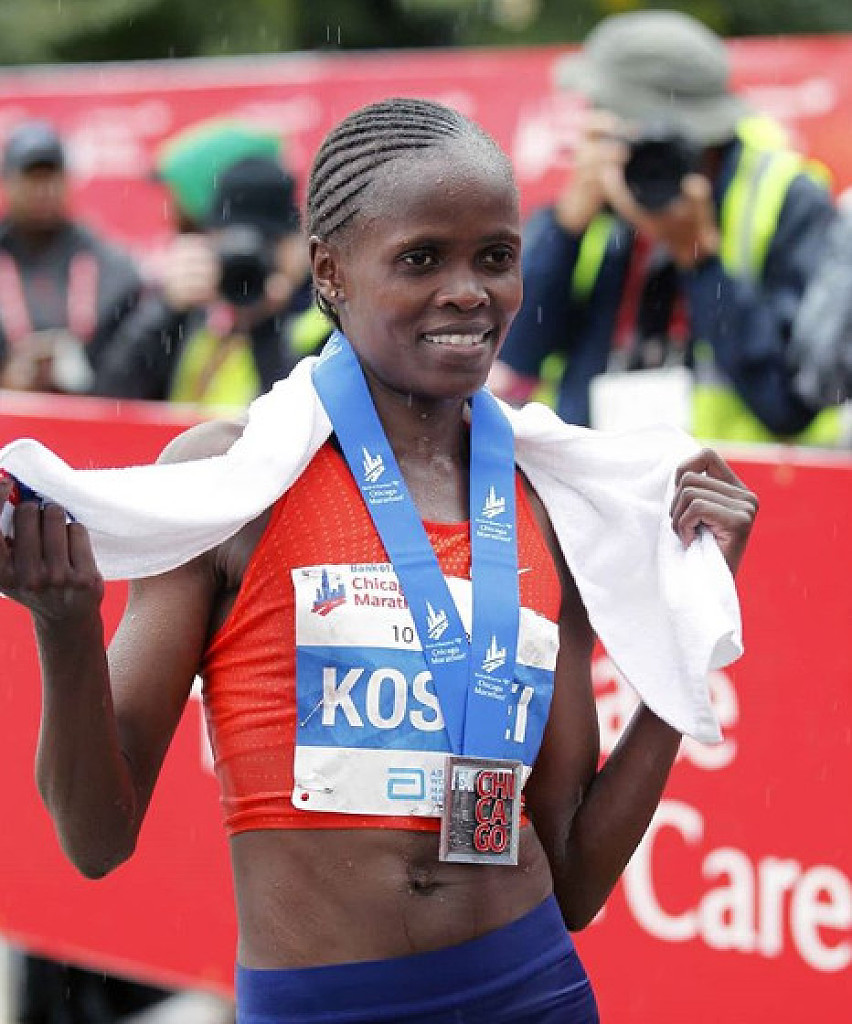
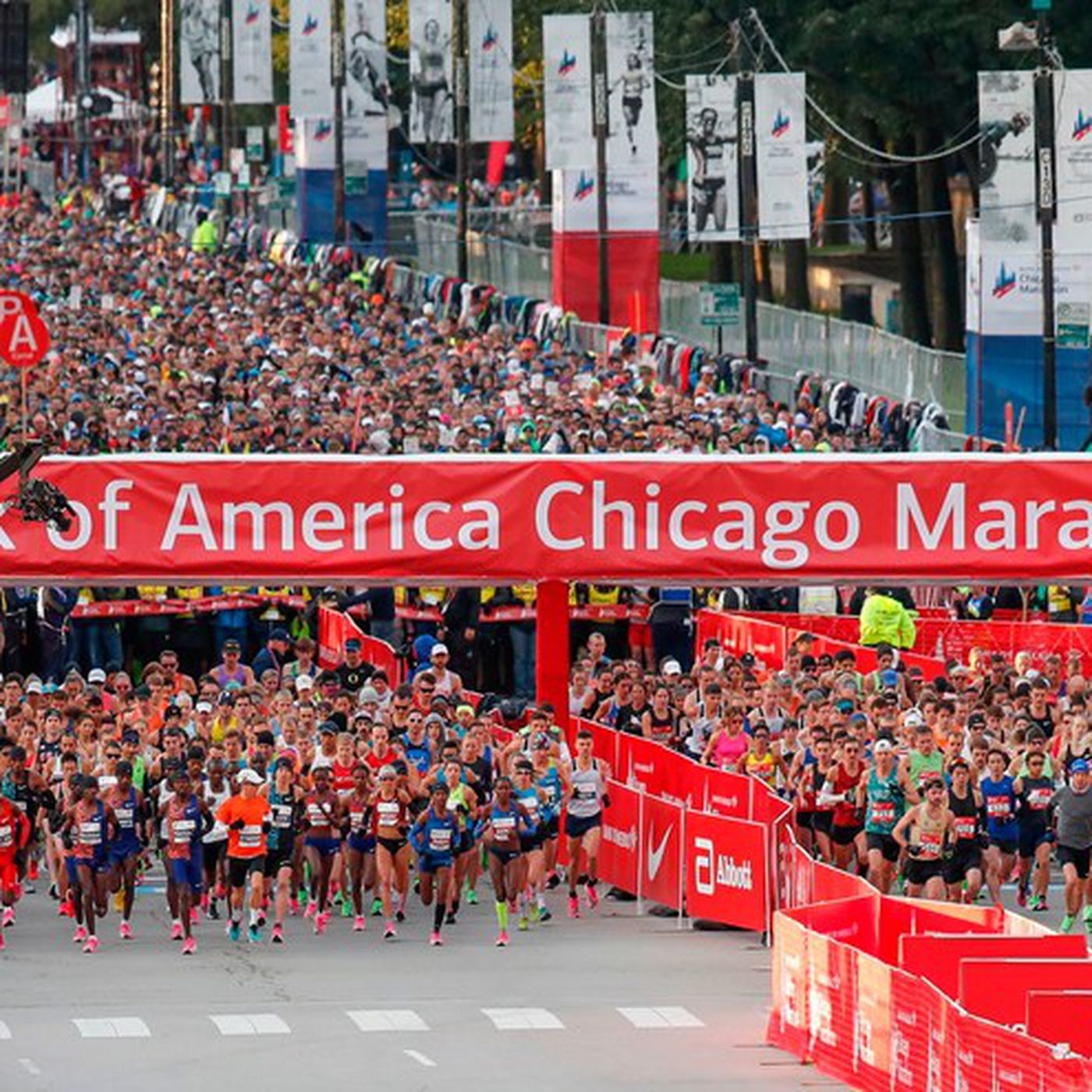
Brigid Kosgei Breaks the World Record at the 2019 Bank of America Chicago Marathon
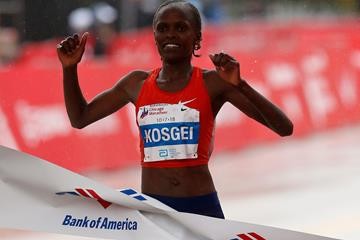
Kenyan Brigid Kosgei shattered a 16-year-old world record in the women’s marathon by 81 seconds, winning the Chicago Marathon in 2:14:04 on Sunday.
Paula Radcliffe had held the record of 2:15:25 set at the 2003 London Marathon. Kenyan Mary Keitany holds the female-only record of 2:17:01 from the 2017 London Marathon. Both Kosgei and Radcliffe, the only women to break 2:17, ran with men in their record races.
Radcliffe’s record was the longest-standing for the men’s or women’s marathon of the last 50 years.
Kosgei did it one day after Eliud Kipchoge became the first person to run a sub-two-hour marathon in a non-record-eligible event in Vienna. She won by a gaping 6 minutes, 47 seconds over Ethiopian Ababel Yeshaneh.
Kosgei, who won Chicago in 2018 and the London Marathon in April, came in highly favored. The 25-year-old tuned up with the fastest half-marathon ever by a woman (by 23 seconds) on Sept. 8 on a non-record-eligible course.
“2:10 is possible,” Kosgei reportedly said after Sunday’s record.
Jordan Hasay, the top U.S. woman in the field, crossed 5km at a slow 22:20 and registered no further timings. Hasay, who was coached by Alberto Salazar before his ban in a U.S. Anti-Doping Agency case, is one of several women in contention for the three Olympic spots at the Feb. 29 trials in Atlanta.
Kenyan Lawrence Cherono won the men’s race by one second over Ethiopian Dejene Debela in 2:05:45.
Galen Rupp, reportedly dropped out in the final miles. He began fading from the lead pack before the 10-mile mark in his first race since last year’s Chicago Marathon. Rupp, who was also coached by Salazar, is coming back from Achilles surgery.
Mo Farah, the defending champion and four-time Olympic track gold medalist, finished eighth in 2:09:58. He also dropped from the leaders before the halfway point.
Kosgei raced her way to an early lead, breaking far away from her pack and continuing on pace to break not just a course but the woman’s world record.
Kosgei has literally been unbeatable in 2019.
Kosgei wowed fans in 2017 with a second-place finish, but she made an even bigger splash last fall when she won the race with third-fastest time in Chicago's history.
(10/13/19) Views: 100
