

Running News Daily
Top Ten Stories of the Week
4/8/2023
These are the top ten stories based on views over the last week.
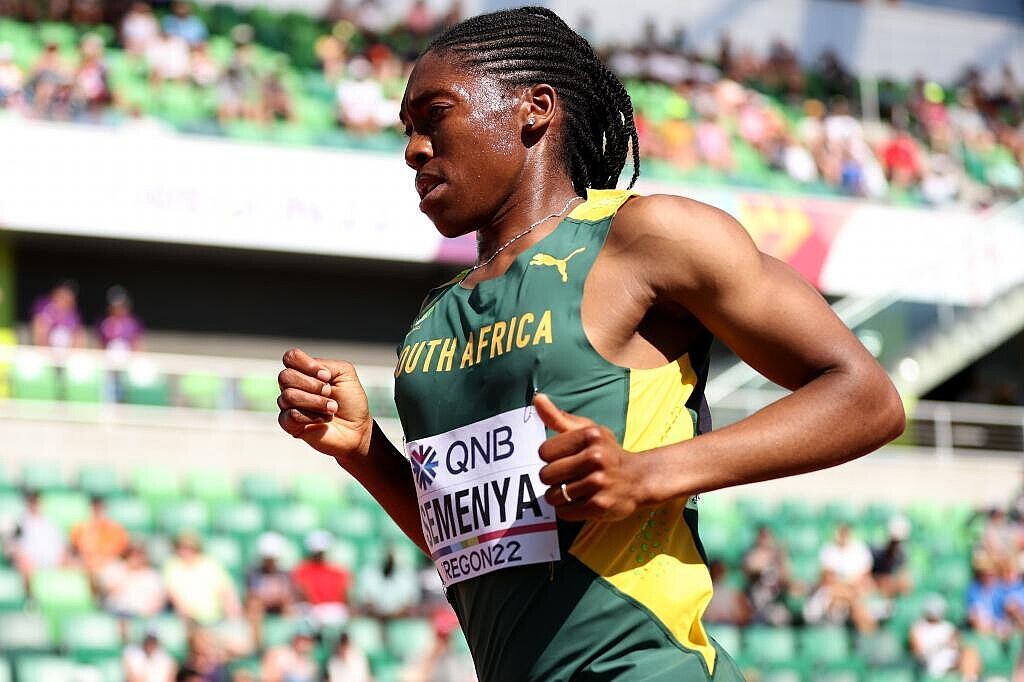


Caster Semenya’s career in danger due to new World Athletics regulation
Caster Semenya’s running career is in danger of being over after not competing at the South African championships on Thursday due to new World Athletics regulations.
Semenya had been entered in the 10 000m race that was scheduled to take place early on Thursday morning, but despite being present at the NWU McArthur Athletics Stadium in Potchefstroom, the former 800m Olympic champion watched from the sidelines as one of her training partners, Glenrose Xaba, won the gold medal in a time of 33 minutes and 2.13 seconds (33:02.13).
That was due to the change in the eligibility regulations regarding athletes who have differences of sexual development (DSD), like Semenya, which was taken by World Athletics last week.

It is the same regulations that prevented the 32-year-old athlete from participating in distances from the 400m to the mile over the last few years unless her testosterone levels are suppressed to below 2.5nmol/L for a minimum of six months, via either medication or surgery.
But the regulations now cover all distances on the track and all field events too, and the time period to reach the required testosterone levels is now 24 months instead of six, which could have a devastating effect on DSD athletes around the world.

Semenya – who won 800m gold medals at the 2012 and 2016 Olympics, as well as the 2009, 2011 and 2017 world championships – has steadfastly refused to take any medical action to reach those levels, and first moved down from the 400m, 800m and 1 500m to the 200m sprint, before setting her sights on the 5 000m.
She was unable to qualify in the long-distance event for last year’s world championships in Eugene, Oregon, and appeared to be targeting the 10 000m this year after entering the national championships in that event in Potchefstroom.
The change in the regulations to include all events on the track and in the field came into effect on Friday, March 31, but while Athletics South Africa have said in a statement that they are taking legal advice on the change in the regulations, they are “duty-bound to adhere to and implement the new regulations”.
“Whilst ASA is considering the new regulations and taking legal advice thereon, in the interim, it is duty-bound to adhere to and implement the new regulations, and as such, cannot allow any of those affected athletes to participate in any world ranking competition or international events in contravention of the said regulations,” the local governing body stated.
“In this regard, ASA is still awaiting the outcome of the legal challenge lodged against the regulations, which is still to be heard and decided upon by the European Court of Human Rights.
“ASA also reaffirms its gratitude to the government of South Africa, UNHRC (UN Human Rights Commission), the WHO (World Health Organization), World Medical Association, different governments around the world, global icons and fellow national federations that have continued to rally behind this noble course of supporting the challenge against these highly discriminatory regulations.”
(03/31/23) Views: 153Ashfak Mohamed
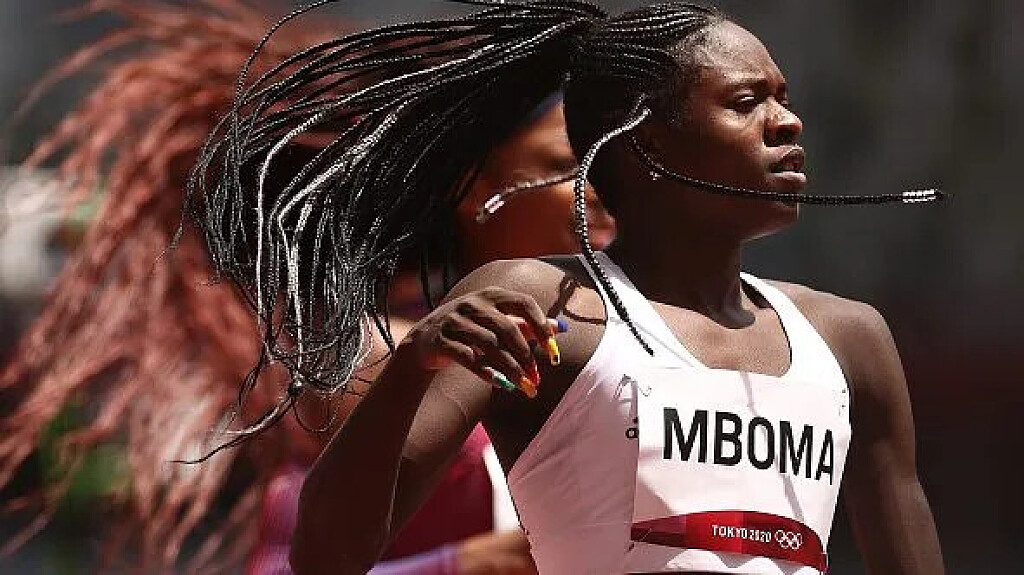
Olympic silver medalist Christine Mboma to undergo hormone therapy
Last week, World Athletics, the global governing body of track and field, announced new regulations to their DSD athletes competition policy, which requires all female athletes with differences of sexual development to reduce their testosterone to not more than 2.5 nmol/L for a minimum of 24 months to be allowed to compete internationally in the female category in any event. According to The Namibian, one such athlete who has achieved prominence, Tokyo 200m Olympic medallist Christine Mboma of Namibia, intends to undergo hormone therapy to continue her career in athletics.
The new rule reduces the acceptable maximum testosterone limit to half of the previous limit, for twice the length of time.

In an extensive interview with The Namibian, Mboma’s coach, Henk Botha said, “We’ve had disappointments and some obstacles in the past. There’s not a lot that we can do as Namibians, we’ll have to take this one on the chin and do our best to get Christine back on the track.”
“The one option is to stop with athletics, and the other is to go to court. Then, the third option is to reduce the levels,” said Botha. “The first two were never on our table, since we don’t have the money to go to court, and halting athletics is not something that Christine wants to do. She’s 19 and has a great career in front of her.”
The harsh alternative DSD athletes are faced with is to quit the sport altogether.
Athletics Namibia said they fully support Mboma, describing WA’s new DSD athlete requirements as “discriminatory, unfair, stigmatizing and not safeguarding all women in sport.”
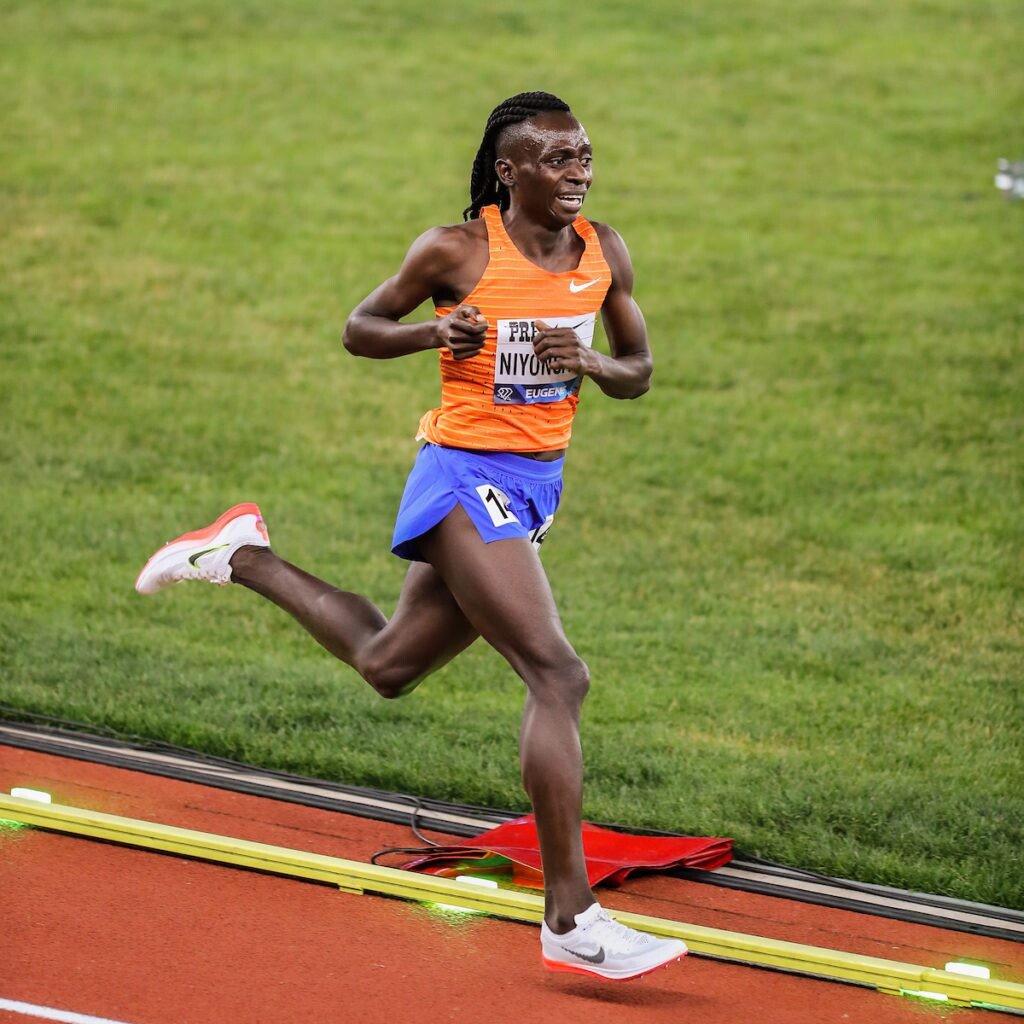
Mboma is one of five prominent DSD athletes who are or were at the top of their event in the last five years. Others are two-time Olympic 800m champion Caster Semenya, 2021 Diamond League champion and 2,000m world record holder Francine Niyonsaba, Nigeria’s Aminatou Seyni and Mboma’s Namibian compatriot, Beatrice Masilingi.
Mboma, who started her career as a 400m runner, has been forced to transition down to the 200m, due to WA limitations barring DSD athletes from racing events between the 400 and the mile.
The new rules will apply across all track events as of April 1, with all five athletes ineligible to compete under the new DSD regulations in major international competitions like the Diamond League and World Championships. All qualified athletes will be eligible for the 2024 Olympic Games provided they are able to maintain their hormone levels over the next 18 months.
Burundi’s Niyonsaba has been quiet on the World Athletics ruling, posting on her Instagram three days after the WA decision, “It’s time to build and achieve progress.” Niyonsaba took the silver medal in the women’s 800m at the Rio Olympics and has since moved up to the 5,000 and 10,000, running her first half-marathon earlier this month in Lisbon in a national record for Burundi of 68:45.
“Every athlete is built differently and has different advantages and disadvantages,” said Botha. “Instead of pointing out our differences, we should be proud that we are all different.”
(04/01/23) Views: 132
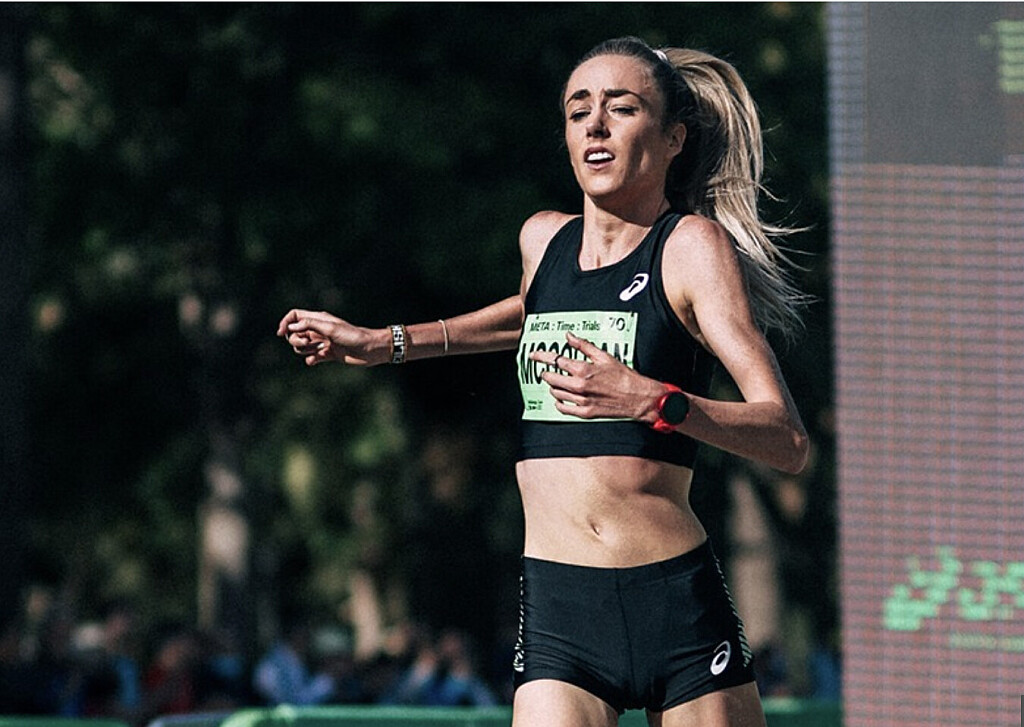
Eilish McColgan smashes UK half-marathon record in Berlin
Victory on the roads of Germany and yet another national mark for the 30-year-old as she continues her London Marathon preparations in style
Eilish McColgan sliced 43 seconds off her own UK half-marathon record of 66:26 as she won the Generali Berlin Half Marathon in 65:43 on Sunday (April 2).

The performance comes just one month after she broke Paula Radcliffe’s long-standing British 10,000m record with 30:00.86 and in Berlin she narrowly missed the fastest-ever half-marathon by a British woman of 65:40 which was set by Radcliffe at the Great North Run – a course that is ineligible for records – in 2003.
That same year Radcliffe ran 2:15:25 to win the London Marathon, so there are natural comparisons with McColgan as she heads toward her marathon debut on April 23 in the British capital.

“I’m really happy,” she told organisers at the finish. “It was a bit breezy and cold but I’m Scottish so I’m used to that weather.
“The pace was super quick at the start so I panicked going through 10km. I got a bit of cramp near the end but I’m glad to get to the finish and run a national record.”
Tsigie Gebreselama had led through 10km in 30:44 with McColgan chasing 12 seconds behind. The Ethiopian, who won silver behind Beatrice Chebet at the World Cross Country Championships in Australia last month, continued to lead by 16 seconds through 15km in 46:24, but soon afterwards McColgan caught and passed her.
Into the closing stages McColgan was away and clear but battling a little cramp in her leg. Slightly worryingly, she was still wearing the same black knee support that she wore during her 10,000m run in California last month. Powering home, she flung her arms up crossing the line as she smashed her best of 66:26 which was set at the Ras Al Khaimah Half Marathon 14 months ago.
McColgan had never run the Berlin Half before but her first European medal had come in the city in 2018 when she took 5000m silver behind Sifan Hassan. The Dutch runner coincidentally holds the European half-marathon record with 65:15 with McColgan now fourth in the European all-time rankings.
Behind McColgan on Sunday, Gebreselama held on for second place in 66:13 as Yalemget Yaregal of Ethiopia was third in 66:27.
Samantha Harrison clocked a 67:19 PB to move into equal fourth place with Jess Warner-Judd on the UK all-time rankings as another Bri, Calli Thackery, shaved a second off her PB with 69:01.
The streets of Berlin almost always see fast times and the men’s race was quick too as Sabastian Sawe broke away from fellow Kenyan Alex Kibet in the closing stages to win in 59:01.
(04/02/23) Views: 123

What Happens When You Walk Every Day
Libby DeLana never misses a day outdoors. Here’s what she’s learned—and here are the shoes that keep her going.
Every single morning for the past 11 years, Libby DeLana has walked out her back door at 5:30 no matter the weather, how tired she may be, or even how sick. “It’s not about the miles or the number of steps,” says DeLana, author of the book Do Walk: Navigate earth, mind, and body. Step by step. and co-host of the podcast The Morning Walk. “This practice is about fidelity to myself and knowing what it is that creates a sense of well-being in my body, and that includes significant time in the outdoors and putting my eyes to the sun and feeling the breeze on my face.”
DeLana, who lives just north of Boston, Massachusetts, walks through all four seasons and regularly covers eight to ten miles per day. Even when she’s sick, she says, she’ll get out for a slow, gentle walk around the block just to move and put one foot in front of the other.
“For me, the walk is like a seated practice of meditation,” says DeLana. “The quiet is revealing. Obviously, there’s the sound of the natural world—the sound of the waves or the wind or the birds, but there are a lot of messages from the quiet.”
Daily movement has been part of human evolution for thousands of years, and DeLana has found that making movement a nonnegotiable part of her own daily routine is good for mind, body, and spirit. But keeping up that consistency, day after day, in all kinds of weather and trail conditions, requires good gear—especially shoes.
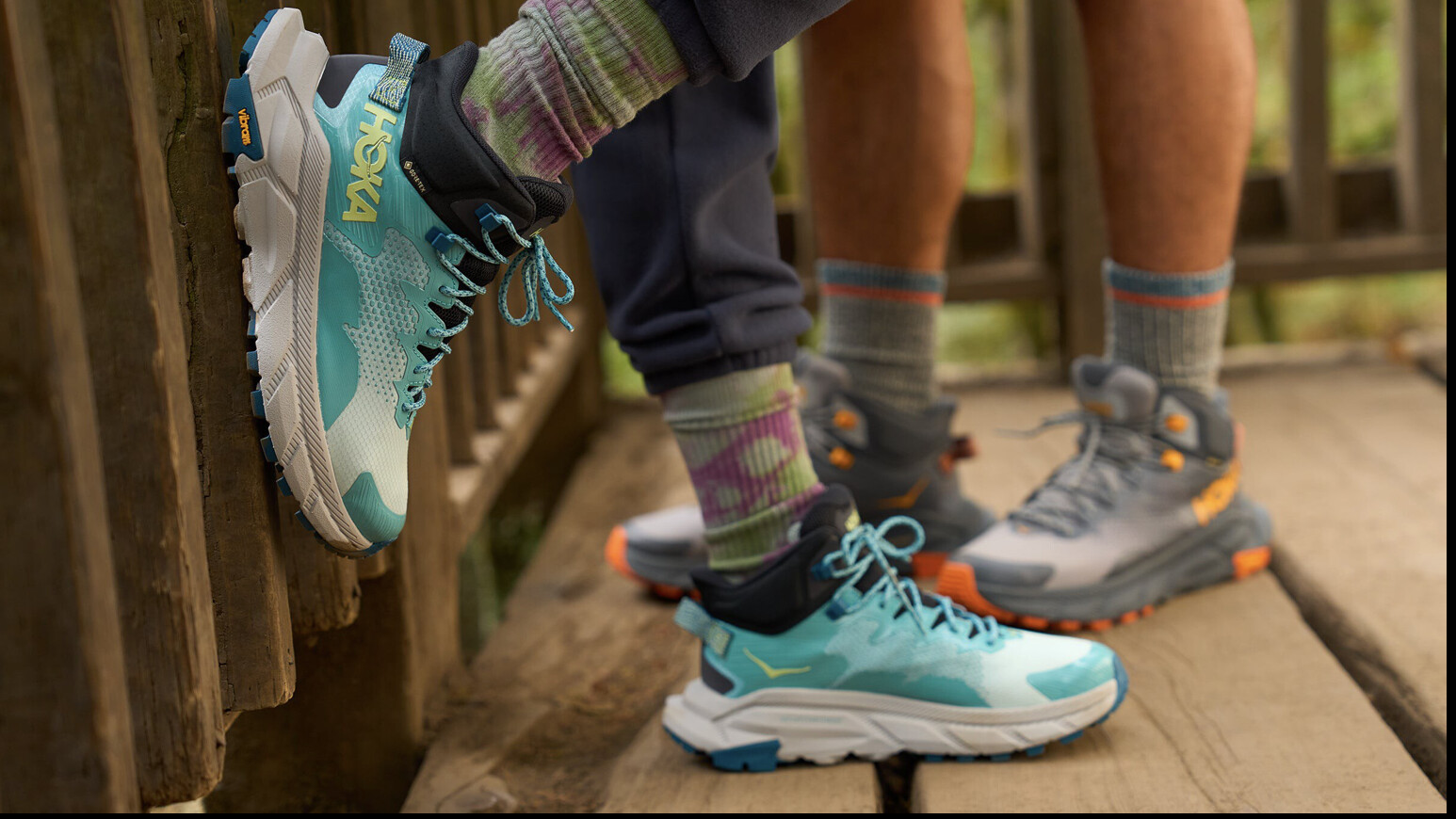
Lately, DeLana has been wearing the new HOKA Trail Code. “They felt supportive straight out of the box, sort of like a hug,” she says. While she also likes to walk in the HOKA Bondi and Clifton, DeLana explains how in the Trail Code, her feet feel particularly “cozy, safe, and just…stable.”
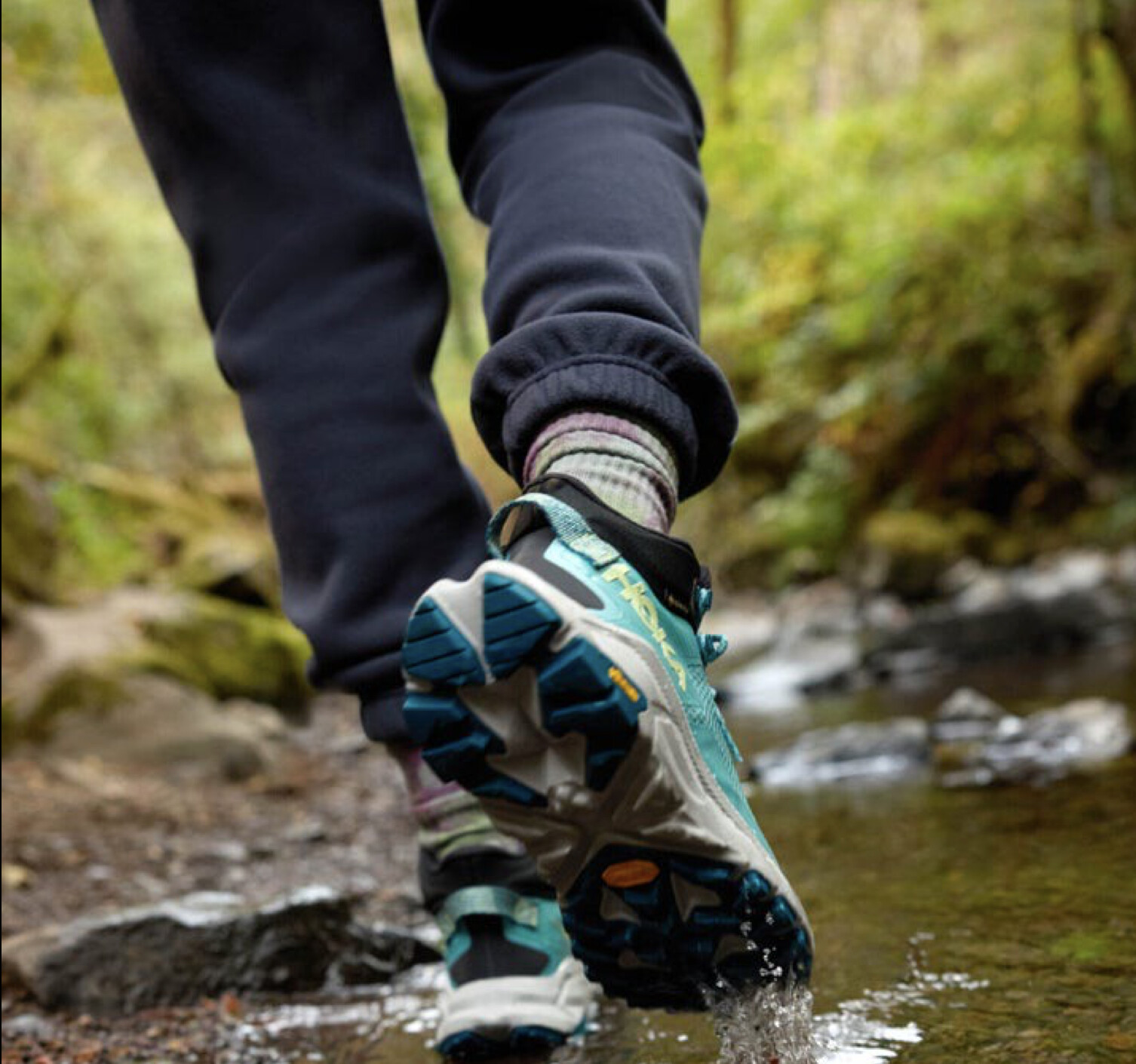
The Trail Code’s compression-molded EVA foam midsole features a Swallowtail extension that protrudes slightly off the back of the shoe. DeLana says this midsole shape contributes to her feeling more secure and confident, “especially on the icy and crusty winter ground.” Adding to the surefootedness, five-millimeter lugs made of Vibram Megagrip provide traction on surfaces from snow and ice to mud and loose dirt while also being able to grip rock and wet surfaces, like concrete sidewalks after a spring rain.
DeLana regularly walks a loop that switches back and forth from sidewalk to country road (where she likes to listen to the wild turkeys and coyotes and sense the changing morning light), and she marvels at the comfort of the Trail Code. She likes that the Gore-Tex-lined upper is watertight and that the shoe keeps her feet warm and dry without overheating. She’s considering taking them on trekking in Bhutan this spring.
The Trail Code’s upper is made from 100 percent recycled ripstop with a gusseted, padded tongue and a high heel collar that enhances stability. Recycled polyester laces wrap easily around metal top hooks to securely, comfortably support the ankles (likely contributing to the gentle “hug” DeLana loves so much). The upper is treated with a PVC-free water-repellent coating, and 3D screen-printed overlays add support and structure without adding bulk.
The Trail Code is a lightweight, cushioned, and nimble alternative to a traditional hiking boot and a more supportive, adventure-ready option than walking or running shoes. “When you have the right gear,” says DeLana, “you just feel more capable and comfortable. It’s almost like you get your brave on because you know the gear is going to support you.”
And when you have the right gear—the right footwear, in particular—you can walk or hike where your heart or mind leads you at any given moment. Walk down a trail, a meandering path, or simply a neighborhood sidewalk. Splash through a puddle. Climb a big rock to sit and marvel at the world. On a quiet walk at any time of day, you may be surprised to find the exploration is not only physical, but mental.
“The outdoors is medicine for me,” DeLana adds. “It’s healing and nurturing and inspiring and creative. My morning walk has become an absolutely nonnegotiable part of my day.”
HOKA empowers a world of athletes to fly over the Earth. With a problem-solving ethos, and a bold approach to footwear and apparel, HOKA empowers all folks to meet their running, walking, fitness and outdoor goals; to feel invited to and welcome in those spaces; and to engage in those activities more easily and more enjoyably than they thought possible.
(04/01/23) Views: 121Outside
Can I Swap Bananas With Plantains? We Ask An Expert
Switching out my daily pre-run ritual for its distant relative
I’ll be honest: I spend far too much time in the produce section of the grocery store browsing the fruits and vegetables I’m unfamiliar with. It’s my version of window shopping. Sometimes I’m bold enough to purchase a star fruit or rambutan, but it wasn’t until this year that I picked up a plantain.

Why plantains? Because I religiously eat a banana before every run, whether it’s five miles or 16. They’re fantastic for simple, quick-digesting carbs and they give me the energy boost I need to kickstart my training. I wondered if this distant cousin of the banana would offer the same benefits.
The first question I asked Elizabeth Shaw, MS, RDN, CPT, nutrition expert and author was, “Well, what’s the difference?” They look similar enough, after all.
“While there are many similarities between plantains and bananas (like their shape, color, and nutrients), the main difference lies in their carbohydrate content and taste,” Shaw says.
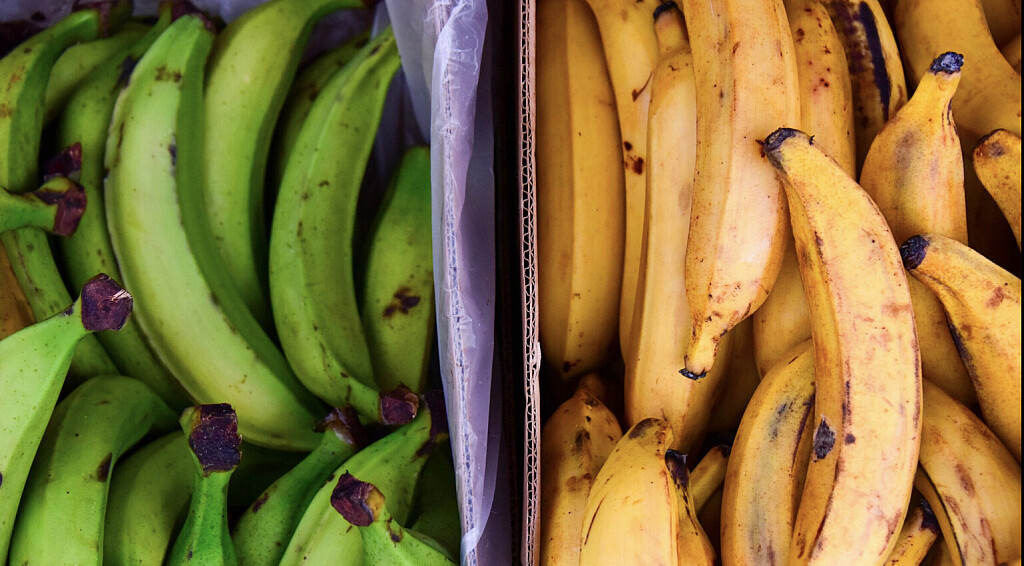
Bananas are naturally sweet and are most commonly eaten raw, whereas plantains have a more starchy taste unless they’re cooked. As far as their nutritional value, the two fruits are fairly similar in all regards except carbohydrates. A 100 gram serving of banana yields 23 grams of carbs and 12 grams of sugar, whereas the same size serving of plantain yields 32 grams of carbohydrates and 18 grams of sugar.
Most people don’t eat plantains raw because of the less-than-sweet flavor profile, but you certainly can.
“The more ripe a plantain (meaning the less green it is), the sweeter it becomes (much like bananas.),” Shaw says. “While there is no problem with eating a plantain raw, you may not get the same enjoyment out of it as you would a banana.”
Grilling them, however, will create a naturally sugary candied taste.
Ingredients
– 2 tsp. butter, melted
– 1 bunch of plantains, yellow and brown
– 2 tsp. cinnamon
Instructions
1. In a bowl, whisk butter and cinnamon.
2. Slice plantains and brush each side with butter mixture.
3. Heat grill or skillet over medium and cook plantains for about 4 minutes per side. Cook until plantains are browned and caramelized.
I finally purchased two yellow, ripe plantains to test out before my runs. At least in my grocery store, there are no plantain bunches, just single plantains. It cost me $1.38 for two, whereas I can get four or five small bananas in a bunch for about $1.25.
Like clockwork, when it came time for my evening run, I reached for a banana. I had to pull back when I remembered this experiment and opted for a plantain instead. The first day, I ate it raw and was totally underwhelmed. The flavor was bland and the texture was that of an unripe banana – a little chewy. Plus, it was much larger than what I’m used to, so I was worried I’d have undigested plantain sloshing around in my stomach while I ran. But my run went without a hitch, so I repeated the process the next day.
This time, however, I cooked it. It was gooey, mapley sweet, and left me licking my sticky fingers. It felt more like a dessert than a pre-run snack. I bounced out the door and had a great, carb-filled six miles.
Long story short – you could realistically swap plantains for bananas if you wanted to. But as a runner who depends on her daily banana, will I be making the swap? No, not likely. Not because cooked plantains aren’t delicious, but because they aren’t nearly as convenient. I’m happy to have tried it though, and certainly plan on topping some dairy-free vanilla ice cream with grilled plantains as a late-night dessert.
(04/01/23) Views: 118Outside
Jamaican sprinter Bouwahjie Nkrumie, 19, runs 100m in 9.99, setting U20 national record
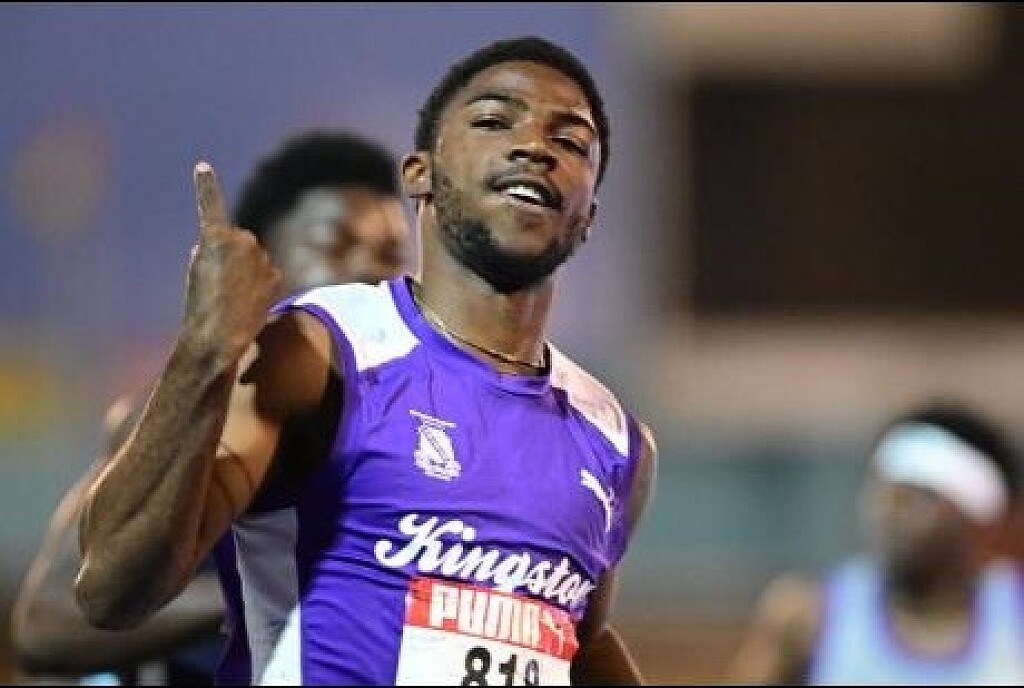
March 29 was quite a day for 19-year-old sprinter Bouwahjie Nkrumie of Kingston, Jamaica. Nkrumie stormed to a U20 national record time of 9.99 seconds (+0.3 m/s) at the Jamaica High School Boys and Girls Athletics Championships, becoming only the third runner in the world to break the 10-second barrier before turning 20.
Nkrumie, 19, nicknamed “Dr. Speed,” became the youngest Jamaican sprinter to break the barrier, which is an incredible feat considering the small Caribbean nation’s rich sprinting history (including Usain Bolt, Asafa Powell and Yohan Blake). The future of the 100m looks bright as Nkrumie joins American Trayvon Bromell and U20 world record holder, Botswana’s Letsile Tebogo, in the U20 sub-10 club.
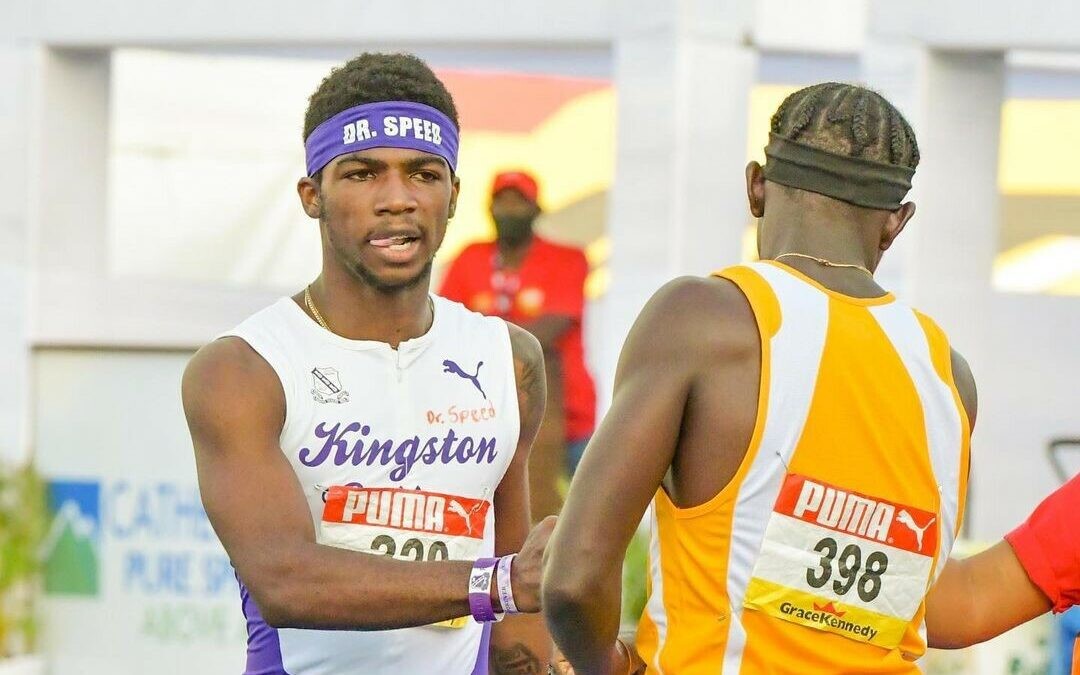
Last year, Tebogo beat Nkrumie in the 100m final at the U20 World Athletics Championships in Cali, Colombia. Nkrumie ran his previous best of 10.02 seconds in the final, but was second to Tebogo, who won in a U20 world record of 9.91 seconds.
Nkrumie’s time of 9.99 was also a 2023 world lead for 100m, but it only lasted a few hours until Akani Simbine of South Africa ran a time of 9.98 seconds (+1.0 m/s) in the men’s 100m heats at the South African Championships.
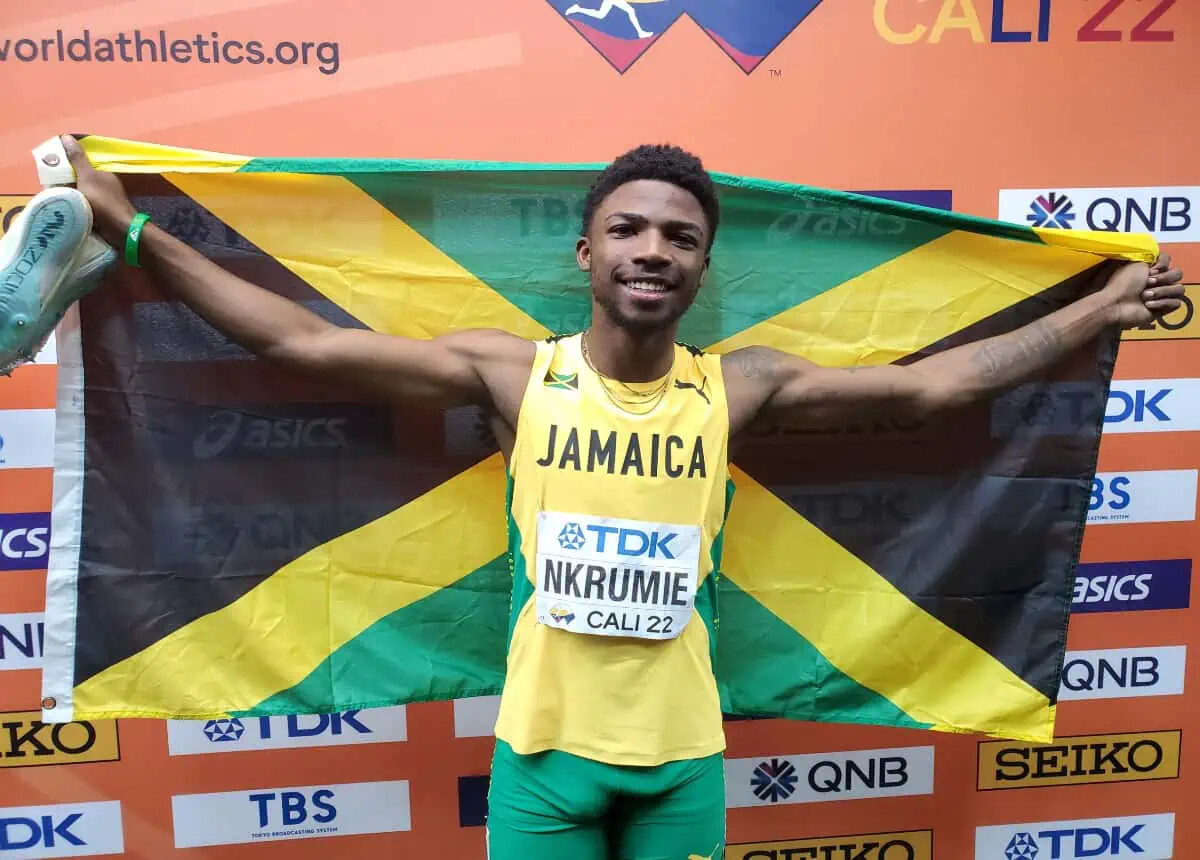
The new Jamaican record holder is in his final year of high school at Kingston College, an all-male sports and academic-focused secondary school in Kingston. We will likely see Nkrumie take on the world’s best later this year at the 2023 World Athletics Championships in Budapest in August.
(03/31/23) Views: 116Marley Dickinson
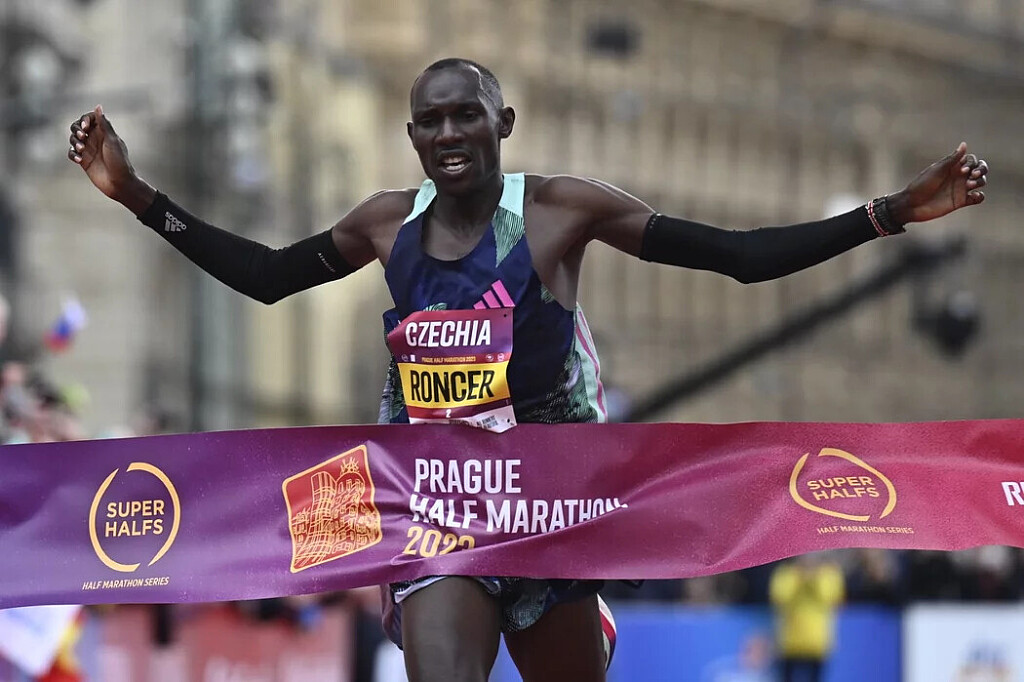
Kenyans Roncer Kipkorir and Irine Jepchumba Kimais dominate in Prague
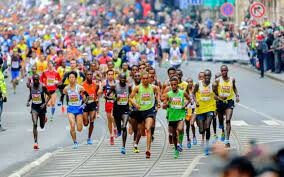
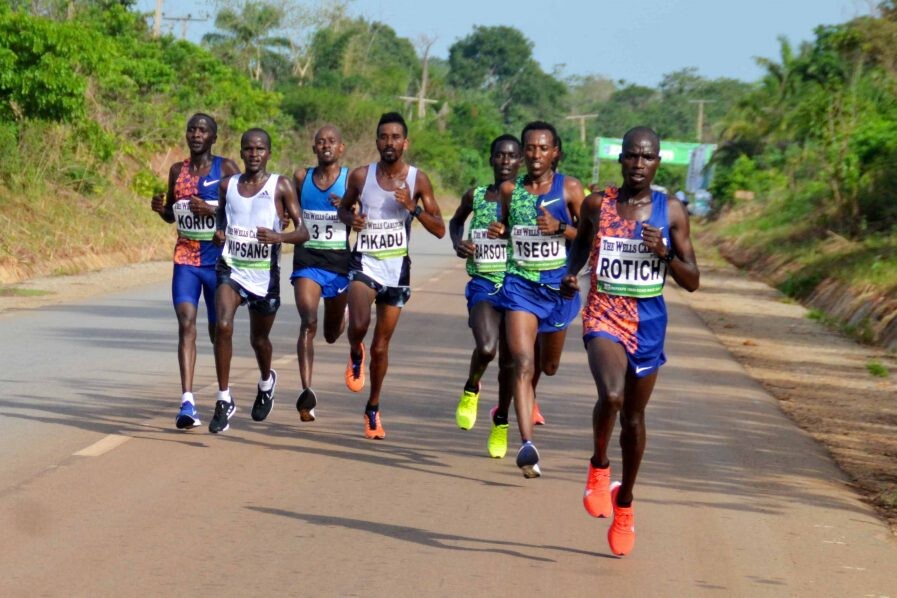
Kenya’s Irine Jepchumba Kimais and Roncer Kipkorir Konga were comfortable winners at the Prague Half Marathon on Saturday (1), winning at the World Athletics Elite Label road race in 1:06:00 and 59:43 respectively.
Conditions were generally good, but the runners faced a strong headwind in the closing stages. Before then, though, the leaders in the women’s race were on for a swift time, having reached 10km in 31:04.
At that point, Kimais ran alongside fellow Kenyans Janeth Chepngetich and Nesphine Jepleting as well as Ethiopian duo Mebratu Tadesse and Zeray Bezabeh.
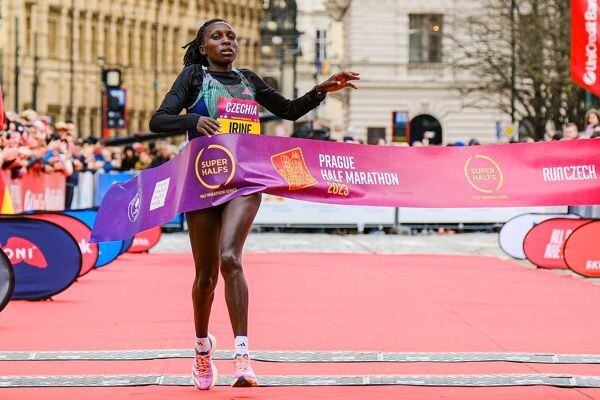
Kimais pushed the pace over the next five kilometres, covering that section in 15:19, which was enough to drop Chepngetich, the last of her opponents. Her pace slowed slightly in the final few kilometres as the strong winds took their toll, but Kimais held on to win in 1:06:00, the second-fastest time of her career after the 1:04:37 PB she set in Barcelona earlier this year.
“It was not a bad race and the course was good,” said the 24-year-old. “There were just some places I had to struggle with. Together with my pacemakers, we were fighting for the victory, and I am happy for this time.”
Chepngetich finished second in 1:06:42 and Bezabeh completed the podium in 1:07:15.
In the men’s race, six men ran alongside the pacemaker as they passed through 10km in 28:03 with Konga near the front of the pack.
Konga then upped the pace slightly and managed to open up a gap on what had now become the chase pack, reaching 15km in 41:51 with a nine-second lead. He extended that over the final few kilometres and, despite taking a wrong turn near the end, reached the finish a comfortable winner in 59:43.
Uganda’s Maxwell Rotich was second in 1:00:06, five seconds ahead of Kenya’s Geoffrey Koech.
"It's definitely a great result for me, I felt good on the course,” said Konga, who was just five seconds shy of his PB. “I'm very happy for a time under an hour. The wrong turn slowed me down, I could have run faster, maybe some five seconds. The wind was also a problem and slowed me down a little bit.”
Leading results
Women
1 Irine Jepchumba Kimais (KEN) 1:06:00
2 Janeth Chepngetich (KEN) 1:06:42
3 Zeray Bezabeh (ETH) 1:07:15
4 Mebratu Tadesse (ETH) 1:08:45
5 Nesphine Jepleting (KEN) 1:10:04
Men
1 Roncer Kipkorir Konga (KEN) 59:43
2 Maxwell Rotich (UGA) 1:00:06
3 Geoffrey Koech (KEN) 1:00:10
4 Laban Kiplimo (KEN) 1:00:13
5 Kelvin Kibiwott (KEN) 1:00:14.
(04/01/23) Views: 106World Athletics
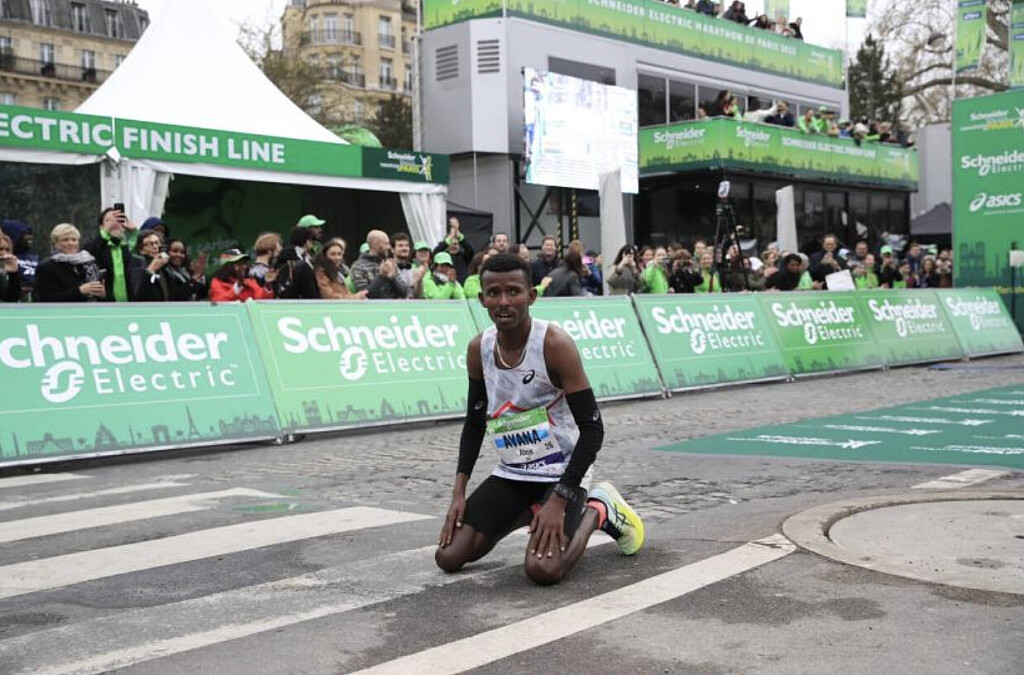
Ethiopian Abeje Ayana wins the Schneider Electric Marathon de Paris
The young Ethiopian Abeje Ayana won the Paris marathon on Sunday, his first race over the distance, in 2h7'15''.
Ethiopian Abeje Ayana won the Schneider Electric Marathon de Paris on Sunday in 2h7'15''. He is ahead of his compatriot Guye Adola (2h7'35''), who was the favourite, and the Kenyan Josphat Boit (2h07'40''). It is the ninth time that an Ethiopian has won the men's race, and the third in the last four editions after Abrha Milaw in 2019 and Deso Gelmisa last year.

At 20, Ayana was competing in his very first race over the mythical distance, he made a masterstroke of it. The young man was however one of the candidates to follow, with a half-marathon record at 59'39'' in Poznan in 2021.
At 35 kilometers, they were still four men in the lead, with also a third Ethiopian, Adeledelew Mamo. Ayana then set off on his own and took a 20-second lead over Adola, his 12-year-old senior, which he maintained until the finish line.
first Frenchman, Amdouni 13th
Contested in the Parisian grayness and in conditions made difficult by the rain and the wind, the race could not allow the athletes to set new records.
The first Frenchman, Mehdi Frère, is 10th in 2h11'5''. Morhad Amdouni, 3rd last year, finished in 13th place in 2h12'45, far from the French record he had set a year ago (2h5'22''). This race did not allow them to achieve the minimum of 2h08'10'' required for the Paris Olympics.
Amdouni was, however, in the recovery phase. Held back by injuries, he was running his first marathon in a year and is aiming for the Budapest World Championships this summer (August 19-27).
(04/02/23) Views: 102
Okpekpe International road race promises to deliver another pacesetting event in 2023
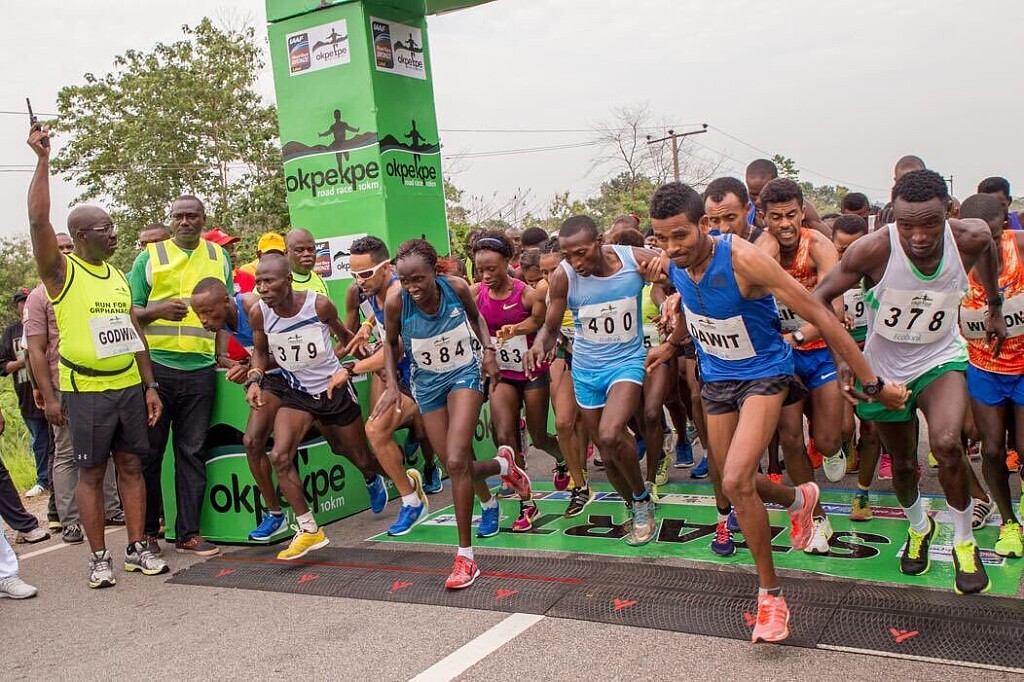
Organizers of the historic and world acclaimed Okpekpe International 10km Road Race have promised to organize another pacesetting event come Saturday, May 27, 2023.
The annual World Athletics Gold Label event returned last year after a two-year, covid-induced break and this year’s edition will be the ninth in the series after it started in 2013 as the first road running event in Nigeria, nay West Africa to have its course measured by a World Athletics/AIMS accredited course measurer and the first to be granted a (bronze) label status in 2015.
Zack Amodu, the Okpekpe Road Race director, says this year’s event will see a lot of improvement on the capacity building for Nigerians in and around Edo state it started last year.
“With the capacity we have displayed over the years in terms of the technical organisation of the race which in the first instance led to the label status we got in 2015, we decided to focus on developing more Nigerians outside those who actually do the running on the road,” said Amodu.
“Last year we organised a technical officiating course for technical officials in Benin for those in and around Edo state to enhance the pool of technical officiating officials we have in the country.
“We also used medical students of the Edo state University in Uzairue to serve as volunteers in the medical committee for the race. This has given them the practical experience needed to become better in their chosen fields.
“This year we are extending this to the students of mass communication and related courses who will serve as media volunteers while those in the physical and health department and related courses will also serve as volunteers in the technical department of the race.
“This is outside the economic benefits that are derivable from the organisation of the race,” said Amodu who revealed there will be seminars for all categories of volunteers that will be used for the race.
Amodu says organisers of the race are delighted to always set the pace for road running events in Nigeria.
“We are delighted to set the pace for road races in Nigeria and to become the first to have its course measured by a World Athletics certified measurer and the first to be granted a label status,” he said.
“We are happy to be the first road race in West Africa to be granted a label status in 2015. Our pioneering effort has had a positive impact on road running in Nigeria with as many 16 having their race courses measured by certified course measurers,” added Amodu.
(04/01/23) Views: 96Guardian Nigeria

Red Sox icon David Ortiz named 2023 Boston Marathon Grand Marshal
On Friday, the Boston Athletic Association (B.A.A.) announced that MLB Hall of Famer and Boston Red Sox legend David Ortiz will serve as Grand Marshal for the 127th Boston Marathon on Monday, April 17.
The three-time World Series champion will serve as the 2023 Grand Marshal, kicking off the race with a speech in Hopkinton, before the 30,000+ entrants from 122 countries make the 42.2km journey down to Boylston Street. Ortiz will ride in the lead vehicle, and will reach the finish shortly before race champions break the finish tape out front of the Boston Public Library.

This year’s race marks the 10th anniversary of the Boston Marathon bombing. In the wake of the 2013 bombing, Ortiz gave a memorable speech to Bostonians at Fenway Park before the Red Sox game. He took on the role of a leader on the Red Sox from 2003 to 2016, embodying the spirit of the city on and off the field.
Ortiz, 47, won’t be the only former Boston sporting legend taking part in this year’s race; former Boston Bruins captain Zdeno Chara, who led the Bruins to a 2011 Stanley Cup, will be running the marathon for The Hoyt Foundation. This will be Chara’s first marathon.

The 127th Boston Marathon has many storylines, but the most interesting one will be how the greatest marathoner in history, Eliud Kipchoge, fares in his Boston debut. The 38-year-old marathon world record holder is on a quest to win all six Abbott World Marathon Majors; he currently has four wins, missing only Boston and New York. (He is also a two-time Olympic gold medallist.)
(03/31/23) Views: 88Running Magazine
