

Running News Daily
Top Ten Stories of the Week
5/14/2022
These are the top ten stories based on views over the last week.



Only three men in the world over the age of 70 have run a marathon in under three hours
History was made at the 2021 London Marathon held in October. Mike Sheridan became the first British runner over the age of 70 to complete the race in under three hours.
The 72-year-old finished the 26.2 mile course in an official time of 2:59.37, to write his name into the history books.
Mike Sheridan (first photo) also became only the third person in the world to achieve this feat.
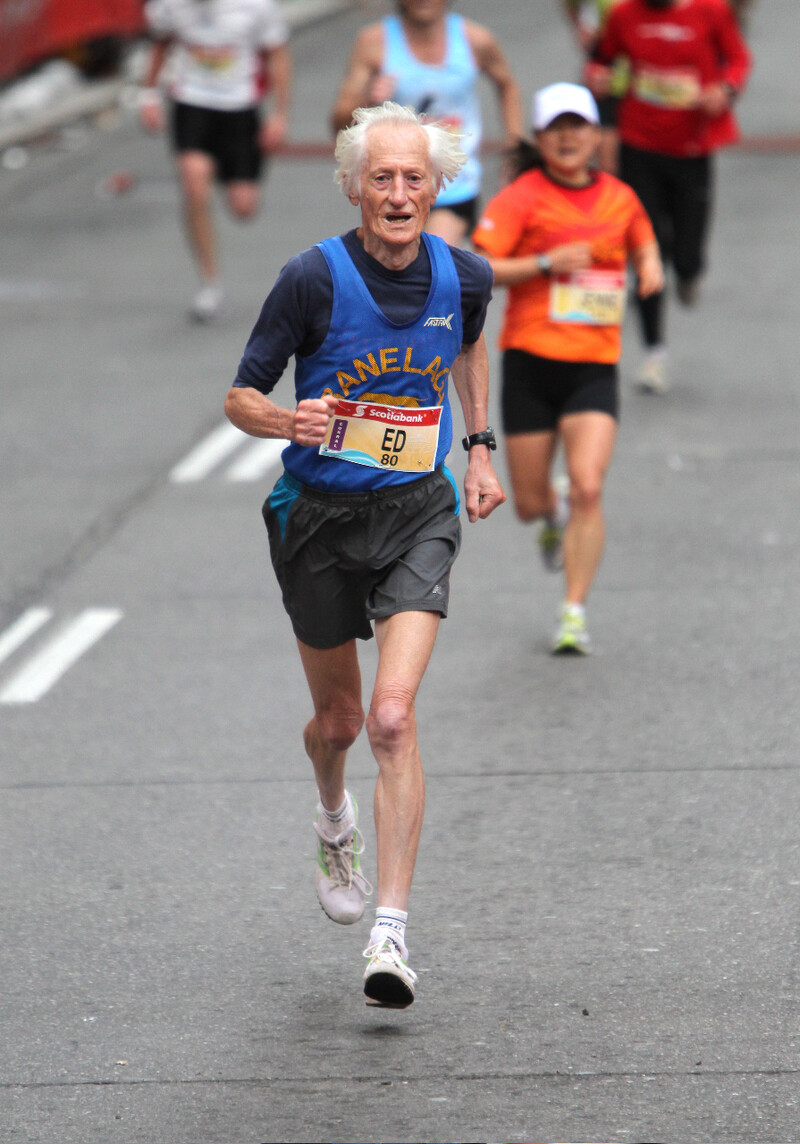
Ed Whitlock (second photo), who died in 2017, and Gene Dykes are the only other two who are on the list of runners over 70 to have completed a marathon in under three hours.
Ed Whitlock was an English-born Canadian long-distance runner, and the first person over 70 years old to run a marathon in less than three hours, with a time of 2:59:10 in 2003.
Whitlock, who ran as a teenager and took up the sport again in his forties, first became the oldest person to run a marathon in less than three hours in 2000, at the age of 69, with a time of 2:52:47. He later extended this record, running a time of 2:58:40 at the age of 74. At 73, he set a world record in the marathon for men 70 to 74, running a 2:54:48, his fastest time after turning 70.

Gene Dykes (third photo) ran his best race, by his own estimation, on December 15, 2018, when he clocked a 2:54:23 at the Jacksonville Marathon. That gave Dykes, then 70, the fastest marathon ever by a 70+ runner. While his time can not be ratified as an official record, because the Jacksonville race was not USATF sanctioned, no one has questioned the legitimacy of the flat, certified, out-and-back course.
Dykes, from suburban Philadelphia, also ran two other sub-3:00s after turning 70 in April, 2018 — Rotterdam and Toronto.
The new member of the 70 plus sub three hour club, Mike Sheridan hit halfway in London in 1:30:16, but got quicker over the second half and his fastest 5km split of 20:41 came from 35km to 40km. He picked up an even faster pace over the last 2km.
The 72-year-old compared running a marathon to ‘physical chess’ as there is a lot you have to take into account.
“A marathon is physical chess,” he said. “You start on the start line, you know you have 26.2 miles to do, but you also know that the human body does not have enough reserves to run the whole thing flat out.
“You have to manage the conditions, other runners, the wind and the rain sometimes.
“You have to manage your own fuel sources and you have to carry gels and you have to top up at the right time.
“You have to eat properly and all of these things come into it and that’s why I call it physical chess.
“You can plan it very well, but if you get a headwind in the last 10 miles then you have a battle on your hands and you have to adapt. It’s why I love it, it is a brilliant distance really.”
(05/10/22) Views: 219

Emily Sisson breaks the American Women half marathon record
Fifteen years after she won a national junior title in Indianapolis on the track, Emily Sisson returned here to set an American record in the women’s half-marathon on the road.
Sisson finished in 1 hour, 7 minutes, 11 seconds in the OneAmerica 500 Festival Mini-Marathon on Saturday.

The 30-year-old runner broke the American record of 1:07:15 set by Sara Hall on Jan. 16.

Sisson was paced throughout by male runner Brian Harvey, who finished in 1:07:12.
It was the first in-person Mini since 2019 after the annual race was twice canceled during the pandemic.
Hall’s time had broken the American record of 1:07:25 set by Notre Dame graduate Molly Huddle in 2018. Sisson twice nearly bettered that – clocking 1:07:30 in 2019 and 1:07:26 in 2020 – and finally secured the record on a breezy morning with temperatures in the low 50s.
Sisson, an NCAA and Big East champion while representing Providence, won the U.S. Olympic Trials at 10,000 meters last year and finished 10th at Tokyo.
In 2007, she won a USA junior title in the 5,000 meters at IUPUI’s Carroll Stadium, just a few blocks from where the Mini finished at Military Park.
Andrew (Kremer) Pomaranski, a Bishop Chatard graduate, finished second to Sisson in 1:13:12.
Pomaranski, 39, a mother of three who now lives in Michigan, broke a 10-year-old personal best. She was 10th in January’s Houston Marathon in 2:33:35, third-fastest ever by a native Hoosier. While at Miami (Ohio) in college, she set an American junior (under-20) record in the steeplechase.
(05/07/22) Views: 161
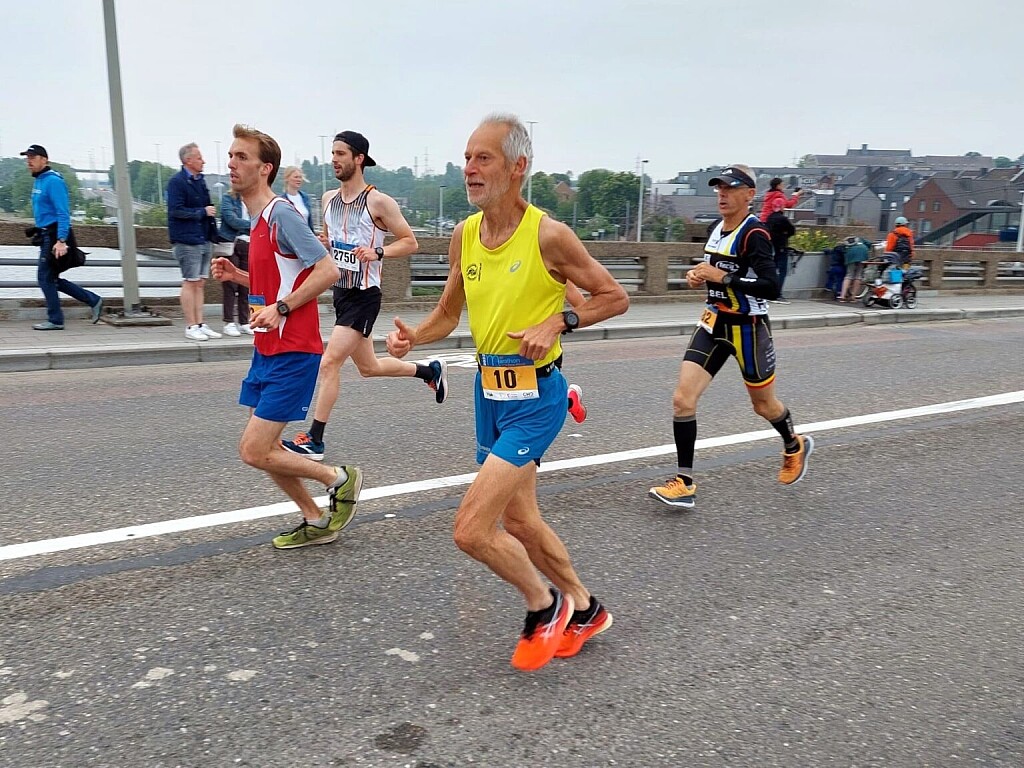
71-year-old Jo Schoonbroodt ran 2:54:19 at Maasmarathon in Belgium to break the M70+ world record by 29 seconds
Over the weekend (May 8, 2022) at the Maasmarathon of Visé in Belboom, Belgium, Jo Schoonbroodt of the Netherlands broke Ed Whitlock’s M70+ marathon world record of 2:54:48 by 29 seconds. Schoonbroodt ran 2:54:19 to win the men’s 70-74 age category (by an hour and a half) and also set the M70+ world record.
Schoonbroodt set out with the a goal of running under three hours to complete the 75th marathon he has run under the three-hour barrier, but he had a slight tailwind in the first half of the course, covering it in 1:26:18. The second half was into the wind, but Schoonbroodt tucked in behind another runner to help mitigate the effect.
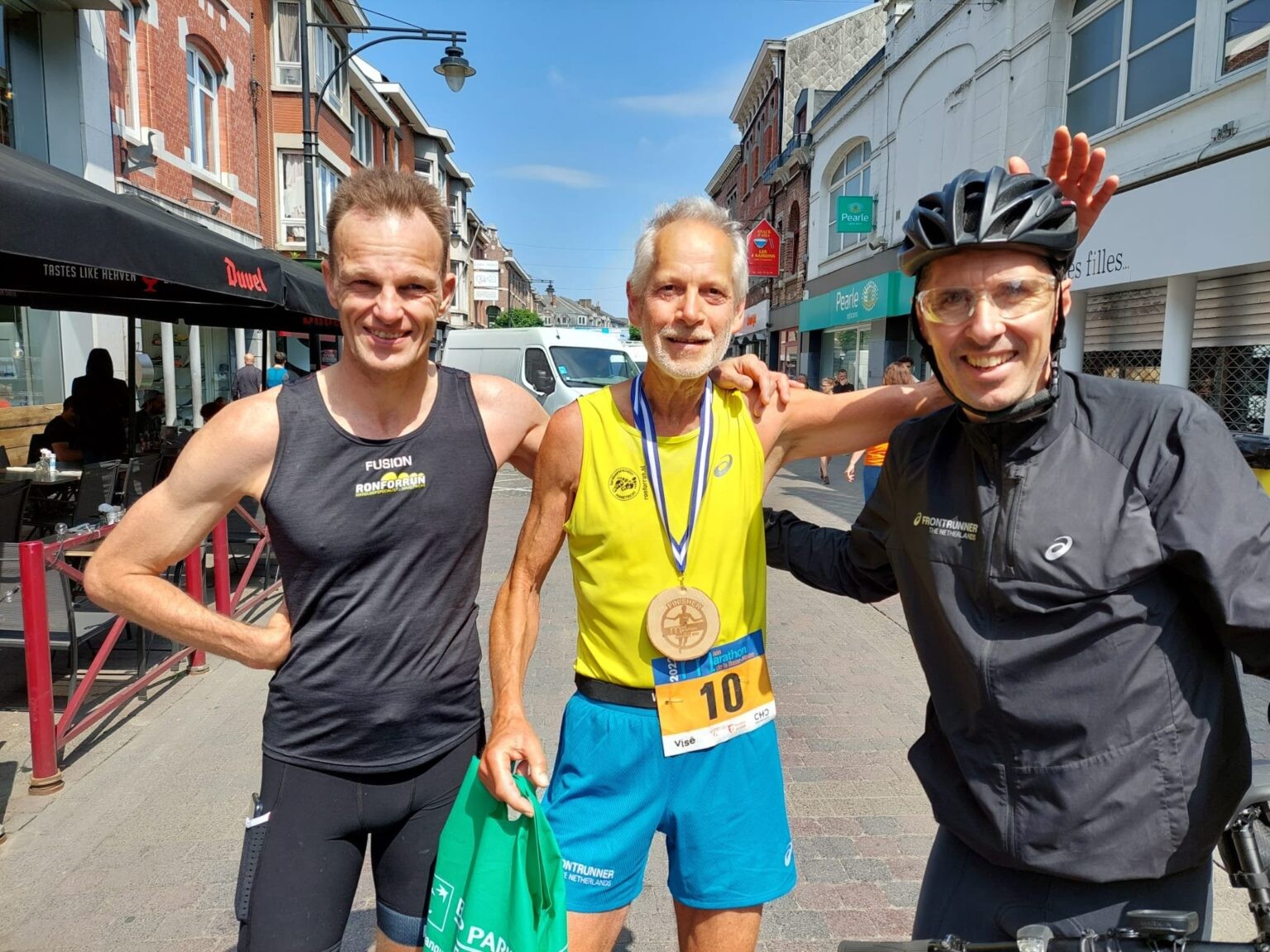
His time not only beat Whitlock’s official record of 2:54:48, but also U.S. masters runner Gene Dykes unofficial record time of 2:54:23 by four seconds; Dykes ran this time at the Jacksonville Marathon in 2018, only to discover the course was not sanctioned by USATF.
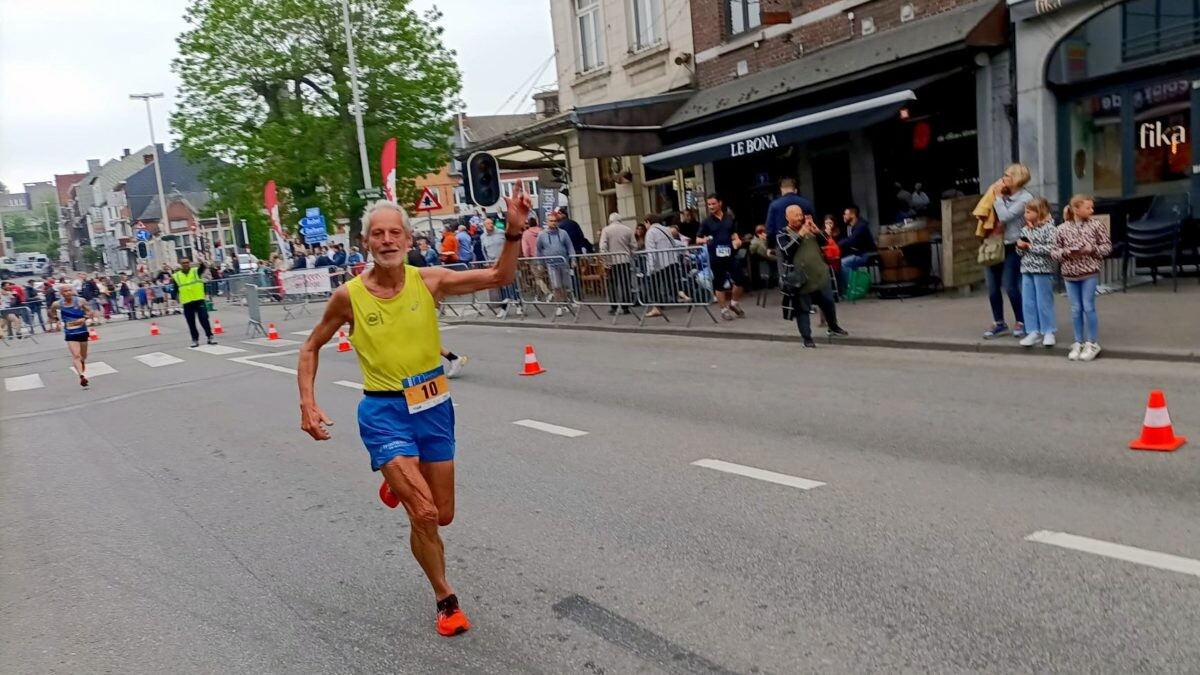
We reached Dykes for a comment: “I’ve been watching with anticipation for Jo to break the record!” he told us in a Facebook message. “My odds of retaking the lead this fall are extremely long–I’m looking forward to tussling with Ed at M75 next year. It would appear that Jacob Nuris going to wipe out the M70 records three years from now.”
According to Strava, Nur is a runner from Elk Grove, Calif. He is 66. And according to USATF, he broke the M65-69 American record in the 10K in November in Sacramento (35:42), as well as the 10-mile American record in 59:11 at the NorCal John Frank Memorial 10-Mile in March.
Schoonbroodt said on his Instagram page that he was not fixated on breaking the record before the race. “A time under three hours was my goal, but I am now happy I can call myself the fastest 70+ runner on the planet.”
This record is not Schoonbroodt’s first, as the Maastrict, Netherlands, resident ran the M60+ six-hour world record in 2012, covering almost 79 kilometres. “I have always been inspired to run by others,” Schoonbroodt says. “Hopefully this record inspires others around my age to start running.”
When the 71-year-old marathoner isn’t running, he is usually playing with his grandkids or hiking in the Dutch countryside. According to his website, he likes to live according to the motto of enjoying every day and being present in the moment.
(05/11/22) Views: 108Running Magazine

Six-year-old’s marathon sparks controversy on social media
On Sunday at the Flying Pig Marathon in Cincinnati, Ohio, a family of eight from Bellevue, Ky., all completed the 42.2 km together in eight hours and 35 minutes. Since then, their family marathon outing has sparked controversy online as two of the children are under 12, and one is only six.
Ben Crawford‘s Facebook post about his family’s marathon finish sparked criticism over the advisability of allowing his six-year-old son, Rainier, to cover the marathon distance. Many experienced marathoners and coaches, including Lee Troop and Kara Goucher, have weighed in online, stating that six is too young for the marathon.

Most experts advise against heavy training for children, whose bones are still developing. Even at 11, growth plate development is not complete; children who run marathons before puberty may be at risk of future musculoskeletal issues. Also, extreme training may also reduce levels of serum HGH (human growth hormone) and testosterone in children who have not yet gone through puberty. Many commenters question whether, even in the absence of long-term physical effects, so much training at such a young age could possibly lead to a lifelong love of the sport. It’s for these reasons that marathons have rules that entrants must be 18 or older.
Crawford posted that “On the marathon course, Rainier knew they usually hand out Pringles around mile 20. He was struggling physically and wanted to take a break and sit every three minutes. After 7 hours, we finally got to mile 20 and only to find an abandoned table and empty boxes. He was crying and we were moving slow so I told him I’d buy him two sleeves if he kept moving. I had to promise him another sleeve to get him in the family pic at the finish line. Today I paid him off.”

Crawford also has a YouTube channel that includes multiple posts with titles like “6 Year Old Runs 6 Miles–NO PROBLEM” and “5-Year-Old Trains for Marathon.”
In their defence, parents Ben and Kami Crawford say they have never forced their children to run and that Rainier begged to join them at this race. “We gave him a 50/50 chance of completing it and were ready to pull the plug at any moment if he requested it,” Crawford says on his Facebook page. “Yes there were tears, and yes he had a fall but every single member of our family has cried during a marathon.
“We go to great lengths to prioritize our kids’ health and experience of the day over sharing it with anyone else. Communicating these stories is a passion project that we do with our children’s co-operation and permission.”
This isn’t the first time the Crawford family has embarked on what some would see as a questionable challenge for a family with a young child; in 2019, he published a book called 2,000 miles Together: The Story of the Largest Family to Hike the Appalachian Trail. (Rainier was three at the time.)
The Flying Pig Marathon issued the following statement:
“Our marathon takes the safety and security of all participants very seriously. We receive numerous requests for special accommodations each year and carefully evaluate each one. Our goal is to provide a positive race experience for all participants while supporting them along the course. The Flying Pig Marathon was founded on the idea of hosting a world-class road race experience and will always strive to do so.”
(05/06/22) Views: 105
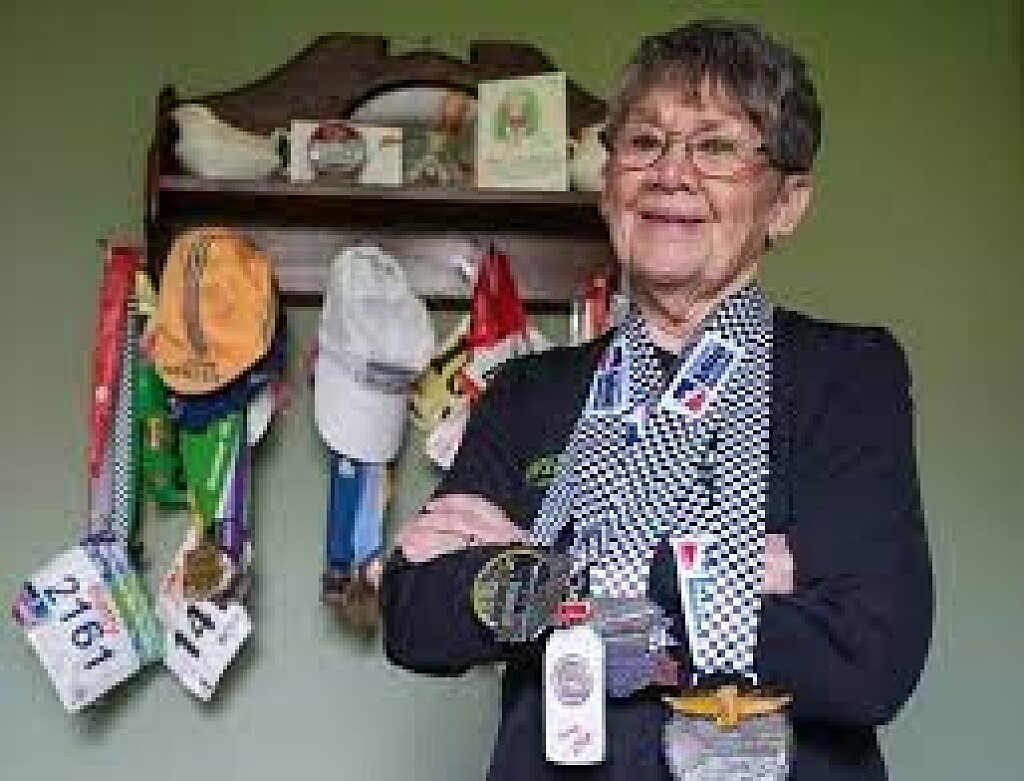
Betty Deer, 80, has been running in marathons across the country since 1986, the Indianapolis Mini Marathon this Saturday will be her last
The running began 48 years ago in a modest neighborhood in New Palestine. Betty Deer was a 32-year-old mother of two girls, a mother who, if truth be told, hoped a jog after dinner might keep those nagging extra five pounds away.
She set out from her driveway that first evening in 1974 and started jogging. A couple of neighbors spotted her and stopped Betty.
"Hey, we'd like to try running, too," they told her.

At first, they kept it short, about a mile and a half from the end of the street down to Sugar Creek.
"And then we'd get down there and it was like, 'Well now, you've got to figure out how to get back,'" said Betty. "How do we get back that mile and a half?"

That was Betty Deer at 32. On Saturday, she will run her 34th Mini-Marathon at 80, a race she has finished in the top three in her age division the past 13 years.
It will be a bittersweet day, an end of an era. Betty has run more than 12 full marathons and too many half marathons and shorter distance races to count.
More than 50 medals hang in the den of her Greenfield home. Others are on the desk still wrapped in plastic. Many have been donated to sick kids at Riley Hospital for Children. Some have gone to Goodwill.
But on Saturday, Betty says she will cross the Mini-Marathon finish line one final time.
"I wouldn't count on it," her husband Larry Deer quickly chimes in. He can hardly believe his wife of 61 years would really give up marathoning. "I don't think so. She might have another in her."
No, Betty says adamantly. When she runs long distances, right hip pain nags at her. The foot pain is there, too, and even the Asics shoes she has sworn by for decades aren't giving her relief.
"This will be my last," she said. "It really will be my last."
The neighborhood jogs turned to running with co-workers after Betty clocked out at Community Hospital East, where she was a patient representative before going back to school to get a degree in social work.
"One of the ladies there said, 'You know Shirley runs the Mini. Why don't you do that?'" Betty said. "That's how it began."
It was 58 degrees, drizzling and overcast in May 1986. Betty drove to Indianapolis Motor Speedway where buses picked up runners and shuttled them downtown for the start of the race.
This was the 10th Mini-Marathon; the race began in 1977. It was Betty's first. She finished that race with the best time of her 33 runs: One hour and 59 minutes.
She was hooked.
In the early days of the Mini, Betty ran the entire race.
"It was a mental thing in the beginning. I thought you had to run it," she said. The only time she would walk was to grab a paper cup of water, drink it quickly, and then start running again.
"But now I find out that I do just as well if I walk some of it," she said. On Saturday, she plans to run five minutes, walk 30 seconds, run five minutes, walk 30 seconds the entire race.
Her times have slowed as the years have passed. But it's all relative. Betty remains at the top of her age group. At 64 years old, she finished fourth in her age group, running the Mini in 2:07. Every Mini-Marathon since, she has finished in the top 3.
In 2019, Betty placed first in the 75-79 age group with a time of 2:41:27, beating the next closest competitor by a full six minutes and the fifth place finisher by 32 minutes.
"But I'm not fast. I'm not fast," she said. "See, I don't consider myself a competitive runner."
If not that, then what is she?
As running goes, Betty has been lucky. At 80, she hasn't had to have surgery on her knees or hip. She did have a thyroid issue and a couple of bouts with cataracts.
In the hundreds of races she has competed in, Betty has crossed the finish line every single time, though there was one Mini where she almost didn't.
It was the 10th mile of the race when she broke the third metatarsal bone in her foot.
"I didn't know what to do and I started walking, but it was painful," she said. "And I decided, 'Well, I might as well finish it.' And so I started running and actually it felt better after I started running. And I finished that race."
Betty doesn't have any rituals for the Mini-Marathon, no carb-loaded spaghetti dinners with garlic bread the night before. "It just depends what I feel like eating that night," she said.
In the morning, she usually has half a bagel with a smidge of peanut butter on the way to the race.
Her training consists of some type of workout six days a week. She runs three days, does spin classes and Pilates classes on two days and walks with a neighbor one day.
Betty saves her long runs for Sundays. To prepare for the Mini this year, she ran eight miles on Sundays in January, nine miles in February, 10 miles in March and 11 or 12 miles in April.
This week leading up to the Mini, she ran nine miles on Sunday, took a spin class and a Pilates class Monday and ran three miles Tuesday. She will rest until Saturday.
Now to run her final Mini-Marathon.
"The thing I've enjoyed most is running with my friends," Betty said. "If I'd stop running with them that would be devastating to me. So I'm going to keep running, just not to this level."
(05/06/22) Views: 95Dana Husinger Benbow

Five excuses for when it’s OK to skip your run
You know the feeling–your run has turned into a slog. You’re underslept, underfuelled, and something hurts (more likely, multiple things hurt). Do you call it a day and go home?
If it’s an easy run, long run or a workout, in most cases you’re better off just gutting it out and finishing. Even if you don’t accomplish what you set out for, the effort you put in is still valuable and will contribute to your mental strength and fitness down the road. But sometimes, bailing on a run can be for the better. Here are a few examples of times when it’s more than OK to cut your run short.

1.- If you have an injury
This is a no-brainer, but you’d be surprised how many athletes push themselves through an injury when they shouldn’t be exercising at all. If you’re injured, try to resist the urge to run until the issue is under control (no pain). If the injury gets worse while you’re running, you need to stop immediately, as pushing yourself through the last few intervals or kilometres could potentially set you back more weeks or even months.

Try to distinguish between the pain associated with an injury and common aches and soreness from running. It’s better to be safe than sorry.
2.- If you are sick
If you have the flu, infection or a virus, take a break from hard training and let your body recover. Hard or long efforts can damage an already weak immune system and open the door for further sickness or delayed recovery. If you insist on running, keep it short and easy. The rule of thumb is that if what ails you is above the neck (such as a sore throat or headache), you can still run, but be cautious. If it’s below the neck (such as in the chest/lungs), you should completely avoid hard training until things clear up.
3.- Mental and physical exhaustion
Running through a bit of physical fatigue is common, especially when you are training for longer distances. The first couple of kilometres are tough on tired legs, but you can shake off a bit of exertion after a few clicks. If you’re drained and lack energy or enthusiasm, it may be necessary to cut the workout short or reschedule the run to another day. Mental stress can carry over, leaving you unmotivated or unable to complete a workout.
Be honest with yourself and evaluate how you feel mentally and physically. If you are struggling and/or are completely exhausted, you might want to push your run to another day.
4.- Emergencies
This is obnious. Some things in life are bigger than you training to lower your marathon PB. In the case of an emergency, you shouldn’t even think about getting mileage in. Whether it’s a family or personal emergency, making sure you are following your training plan should be low on your priority list.
5.- A severe weather warning or natural disaster
Although the weather is usually beyond our control, runners are the first to blame the external conditions. Many old-school coaches will say there’s no such thing as bad weather, just a bad attitude (or bad clothing), but that’s not necessarily true. If there are high wind warnings or a tornado brewing, you may be able to finally use the weather as an excuse. Treadmills were invented for a reason.
(05/06/22) Views: 92Marley Dickinson
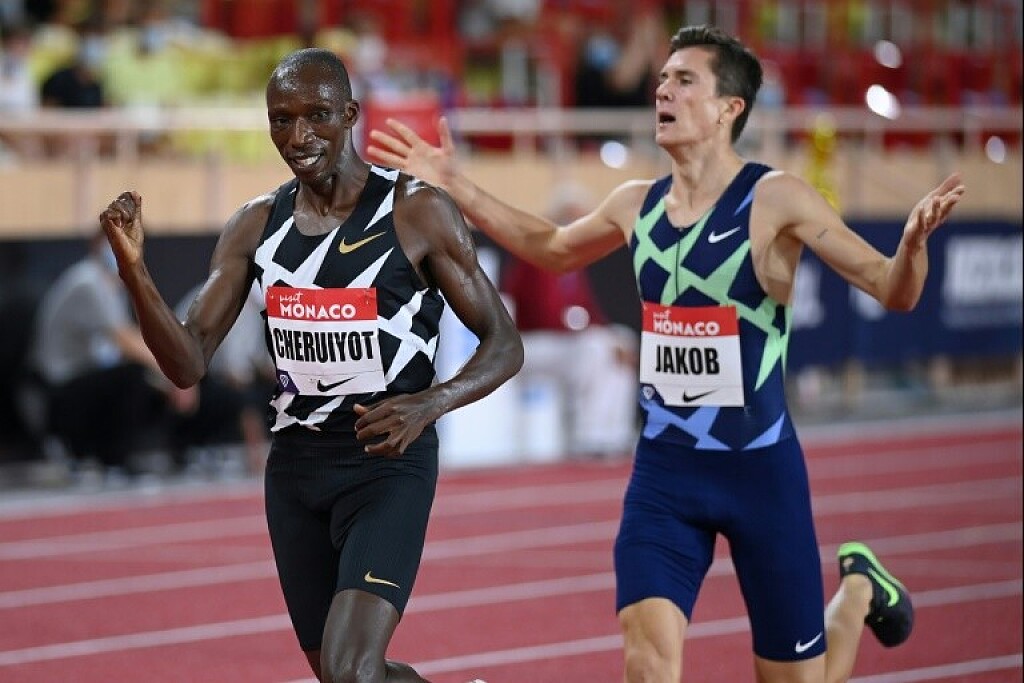
Timothy Cheruiyot and Jakob Ingebrigtsen will resume rivalry in Eugene Mile
Reigning Wanda Diamond League champion Timothy Cheruiyot and Olympic champion Jakob Ingebrigtsen will resume their rivalry in the men's 1500m when they go head to head in the prestigious Bowerman Mile at the Prefontaine Classic in Eugene on May 28th.
Cheruiyot claimed his fourth career Diamond Trophy when he edged out Ingebrigtsen in the final in Zurich last year, just weeks after the Norwegian had beaten him to the gold medal in Tokyo.

Ingebrigtsen, 21, already has a rich history of success in the Bowerman Mile. At the 2017 Pre Classic Ingebrigtsen became the youngest to ever break the four minute barrier, running 3:58.07 at the age of 16. One year later he would lower his time to 3:52.28 and come back again in 2019 with a 3:51.30. In last year’s race, Ingebrigtsen captured his first Bowerman Mile victory, running the fastest time ever on U.S. soil, 3:47.24. After breaking the Olympic record in Tokyo last summer and taking down the indoor 1500 meter world record earlier this year, it’s clear the Norwegian is ready to cement himself further in the record books.

The budding rivalry between Ingebrigtsen and Cheruiyot will add another chapter at the Pre Classic in 2022. After winning the Bowerman Mile and claiming gold at the World Championships in 2019, Cheruiyot took silver at the Olympic games last year. He would ultimately bounce back to beat the Norwegian in Zurich.
The third Wanda Diamond League meeting of the season will also feature a strong field in the men's 5000m, with Canada's Olympic silver medallist Mo Ahmed taking on home hero Paul Chelimo and 2018 Diamond League champion Selemon Barega of Ethiopia.
In the women's discus, meanwhile, 2021 Diamond League champion Valarie Allman will be looking to use home advantage to get valuable points on the board in her bid to defend her title, going up against the likes of Olympic silver medallist Kristin Prudenz and six-time Diamond League champion Sandra Perkovic.
(05/06/22) Views: 89

The Best Running Tips We've Ever Heard
Whether you've been running for a year or a decade, sometimes you hear a tip that makes you say, "Why didn't I think of that?!" We could always use a good hack, so read up on our list and see if there's something that can improve your running routine for the better.
Just Run for 10 Minutes

This one is an oldie but goodie. Not feeling your usual run? Aim to log just 10 minutes (or 1 mile, whichever you prefer). If the issue is inertia, most of the time you'll feel better after a warmup and want to keep going.
Make a Plan

Even if you're running casually, if you want to make sure your runs happen, schedule them out in advance. Look at the week (or month) ahead and decide when you'll be able to run and when it's better to focus on other things.
Better to Be Undercooked Than Overcooked
We'd never suggest toeing the starting line without proper training, but there's a fine line between being prepared and getting burnt out. As you get closer to a goal race, resist the urge to pile on more and more miles. And if you have any nagging aches or pains, a few days off can help get you to the starting line healthy.
Always End a Workout Feeling Like You Could Do a Little More
Whether you have an easy run or an interval workout on tap, it's generally a good idea to leave some in the tank. Giving 110% is a great strategy for race day, but not every day.
Humidity Is the Poor Man's Altitude Training
If you live in an area with warm weather humidity (we see you gulf coast!), your runs are going to feel a lot harder than they would in drier weather. There are plenty of online charts that can help you adjust pace based on the dew point, but keep in mind that if the weather changes later on (and especially on race day), all of that humid training will pay off. Your body has to work harder to cool itself when it's humid, so those physical adaptations (e.g. higher core body temperature and subsequent increased heart rate) will ultimately make you a stronger runner.
Don't Try Anything New on Race Day
You've heard it before, but race day (and the days leading up to it) are the time to stick with your tried-and-true routine. Practice everything from your outfit and your pre-run breakfast to your shoes well in advance. The last thing you need mid-race is an urgent porta potty stop or blisters!
Prioritize Refueling
What happens after a run is almost as important as the run itself. Aim to refuel with a mix of carbohydrates and protein within 30 mins after finishing up your workout. Skimping on post-run fuel can hinder muscle recovery, so it's important not to overlook this step!
Don't Waste Energy up Top
Rather than clenching your fists together, lightly cup your hands (imagine you're holding a handful of potato chips that you don't want to crush!).
Make Every Run Have a Purpose
If you're training for a race, identifying the goal for each day is key. Sometimes the goal will be dialing in on race pace while other days it will simply be recovery. Knowing why you're doing each run can help prevent running unnecessary junk miles or on the flip side, skipping runs.
(05/07/22) Views: 84Megan Harrington

95-year-old Colleen Milliman sets one-mile age group world record
On Saturday afternoon at the Masters Hayward Classic, held at Oregon’s Hayward Field, 95-year-old Oregon resident Colleen Milliman,set a new 95+ age group world record in the mile clocking 13:46.13 (8:34/km).
Milliman doesn’t let her age slow her down her love for running. Like any grandmother, she loves keeping up with her grandkids and making them laugh. So when her grandson challenged her to get on a track in 2017, Milliman bought a stopwatch and surprised herself.

In 2018, she signed up for the Masters Hayward Classic in Eugene, where she ended up setting a world record in the 90+ 800m of 5:44.50 (one minute off the previous record).
“I had no idea I would set a record,” Milliman said in an interview with a Eugene newspaper. “The first time I ran a mile at Hayward Field and it turned out to be a record.”
After breaking her first world record, Milliman joined a masters training group inside of Oregon Track Club. This mile record is her third masters WR, as she also has 90+ age-group world records in the 800m as will as the mile.
(05/10/22) Views: 79Marley Dickinson

How Jo Schoonbroodt smashed the world 70 plus marathon record
At an age where many of his contemporaries are winding down, the man they call the Grey Kenyan is somehow speeding up. On Sunday Jo Schoonbroodt, a 71-year-old from Maastricht, ran a marathon in a staggering 2hr 54min 19sec to become the fastest septuagenarian in history.
A few days later, when the Guardian catches up with him, his achievement is still sinking in. “I only started jogging at 36 because my doctor told me I had high cholesterol,” he says, chuckling. “But last year I ran 7,242 kilometres [4,450 miles], which is more than double what I did in my car.”

It also turns out that Schoonbroodt’s new 70+ world record, set at the Maasmarathon of Visé in Belgium, was inspired partly by an unlikely source: the Flemish crooner Eddy Wally. With a few miles remaining, he knew he was just ahead of the previous best, set by Gene Dyckes in 2018, because a friend was following him on his bike and barking out his lap times. But his legs were starting to get heavier.
“However, my friend had a special trick to keep me on track,” says Schoonbroodt, who was wearing a yellow and blue kit in support of Ukraine. “He picked up his phone and put Eddy Wally’s song Chérie, Chérie on repeat. I’ve always loved it, I don’t know why. It gave me a boost in morale. I overtook one runner after another and, despite getting cramp in the final 500m, I was able to break the record by four seconds.”

Incredibly it was Schoonbroodt’s 75th sub-three-hour marathon, and it came only four weeks after his 74th at the Rotterdam marathon. For good measure, the flying Dutchman also holds a number of ultra running records. He is clearly no ordinary Jo. But the secrets of his success might surprise you.
“Most runners train too hard. I do a lot of my training with groups who run very slowly. And then I build on these basics with some faster interval training. But I don’t do the same stupid distance 10 or 20 times – I prefer to have a lot of fun with my running.”
Schoonbroodt often runs at nine- or 10-minute mile pace, far slower than the 6:38min miles he ran for 26.2 miles to set his world record, but he says the crucial thing is he listens to his body. “A lot of people follow a training plan or coach and push on even when their body is saying: ‘No, this is not a good day to do it.’ But if you go out the door and just do what you feel, it’s easier to keep running and stay injury-free.”
He also dismisses the idea that runners need to do anything special with their diets. “Diet? No, no,” he scoffs. “No diet! I eat double portions, of course, with all these calories I burn. I love pasta and potatoes. But whatever is on the table, I eat it.”
He has a similarly relaxed attitude when it comes to alcohol. “I prefer the French wine and the Belgian beer. Not too much, and mostly on weekends. Wine is just a grape drink, so it’s made from nature. And Belgian beer is special. And if you do all this with your body,” he adds, referring to the 85 miles he still runs each week, “you need to give it something back. And this is what I give back to the body!”
Schoonbrot is a former IT worker and can tell the exact day he started running – 1 January 1986 – and how many kilometres – 120,000 – he has done since. But he stresses he was no natural. At first people called him Jogger Jo, because he was slow. Nowadays he gets called the Grey Kenyan – a nickname given to him years ago by a race announcer as he blasted past athletes a third of his age.
Being a late bloomer, he believes, has actually helped him because his ego never had to worry about chasing faster times of his youth. “Because I started so late, I missed my best years. But that’s no problem. Everything is still new to me.”
Schoonbroodt also cites the new range of carbon-plated “super shoes”, which have swept the running world over the past five years, as a key factor. On Sunday he ran in the Asics Metapeed Sky, and has been an ambassador for the Japanese company for the past four years, preaching the positive benefits of exercise to sceptics and lapsed practitioners.
But while Schoonbrodt’s achievements are exceptional, he is not the only old master to defy conventional wisdom. Several men older than 70 have run a sub-three-hour marathon – the first of whom, Ed Whitlock, who died in 2017, also ran a 3:15 marathon after turning 80.
So what might explain this phenomenon? John Brewer, a sports scientist at the University of the West of Scotland, points out that while we experience a 10% decline in muscle mass every decade as we age, the decline isn’t as sharp for endurance. “The scientific evidence shows that you can maintain your aerobic capacity – your Vo2 max – very effectively into old age,” he says.
“And if you look at where we are now compared to 40 years ago, the advances in nutrition, sports science, recovery and technology, all mean that it is more feasible for people in their 60s and 70s to produce good performance if they follow the right training.”
Brewer, who was also part of England’s backroom staff for the 1990 World Cup, says Schoonbrodt’s story carries another message – that it is never too late. “People think they can’t turn it around after years of no exercise or poor diets,” he says. “Well, actually you can.”
Schoonbroodt, meanwhile, has no plans to put his feet up. “My next marathon is in two and a half weeks, on an old Roman road built 2,000 years ago,” he says, the excitement obvious. It will be his fifth in 2022. And with that he is off. After all, the quest for a 76th sub-three-hour marathon waits for no man. Not even one who is 71.
(05/12/22) Views: 75Sean Ingle (The Guardian)
