

Running News Daily
Running News Daily is edited by Bob Anderson and team. Send your news items to bob@mybestruns.com Advertising opportunities available.
Index to Daily Posts · Sign Up For Updates · Run The World Feed
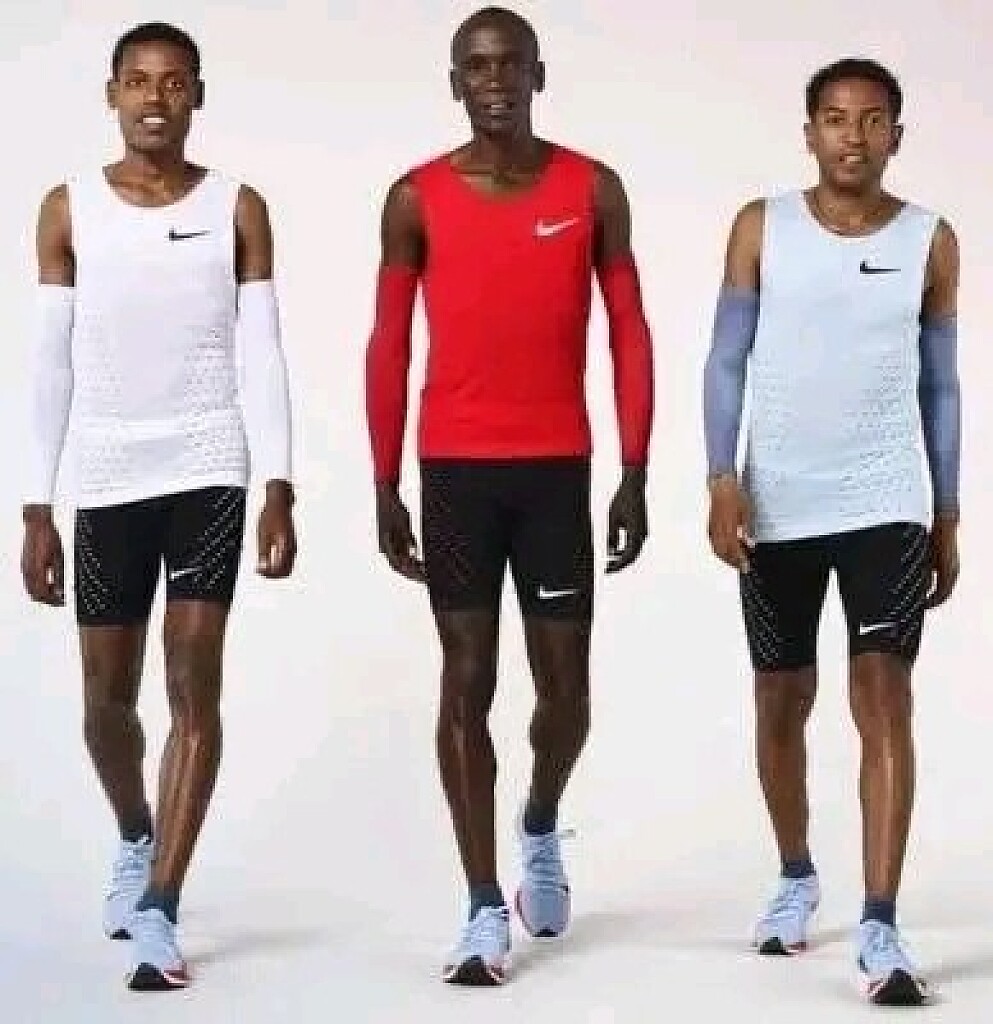


Breaking2: The Day Nike and Eliud Kipchoge Changed Marathon History Forever
On May 6, 2017, the world witnessed one of the boldest and most revolutionary experiments ever attempted in distance running. Under the ambitious Nike Breaking2 project, three elite athletes lined up with a single mission that many believed was impossible — to run a marathon in under two hours.
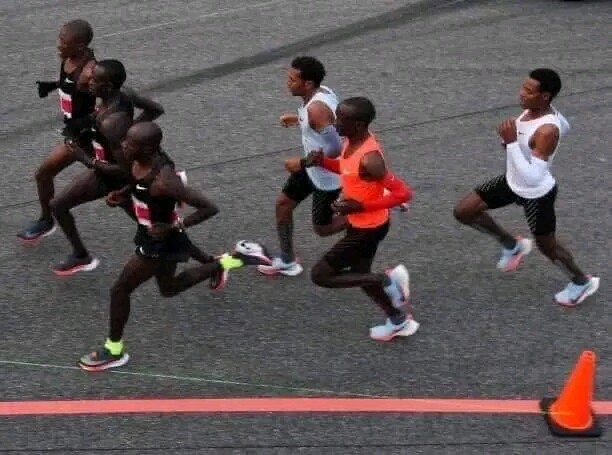
At the time, the official marathon world record stood at 2:02:57, and shaving nearly three minutes from that mark seemed beyond human limits. But Nike was not simply organizing a race. Breaking2 was designed as a complete scientific and athletic operation, bringing together advanced sports technology, physiology, pacing strategy, nutrition, and environmental optimization in pursuit of history.
The challenge took place at the Monza Formula One circuit in Italy, where conditions were carefully selected to maximize speed. Rotating pacemakers shielded the runners from wind resistance, hydration was delivered while moving, and every detail — from temperature and race rhythm to training models and recovery — was analyzed with precision.
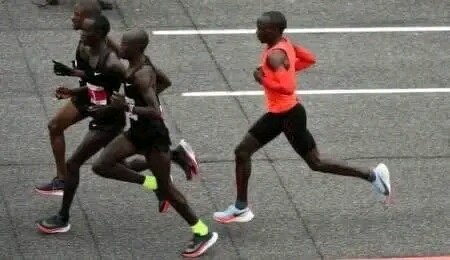
Although the event was not recognized as an official world record attempt because of the rotating pacemakers and mobile aid delivery, it became one of the defining moments in modern athletics.
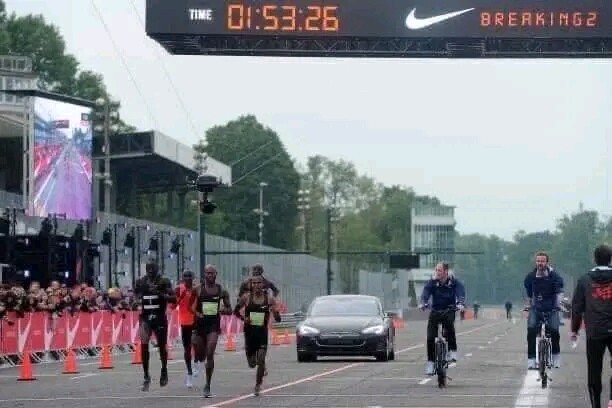
At the center of it all stood Eliud Kipchoge.
The Kenyan superstar produced a performance that stunned the sporting world, crossing the line in an astonishing 2:00:25 — just 25 seconds short of the mythical barrier. Remarkably, he missed the target by roughly one second per mile, proving just how close humanity had come to redefining endurance sport forever.
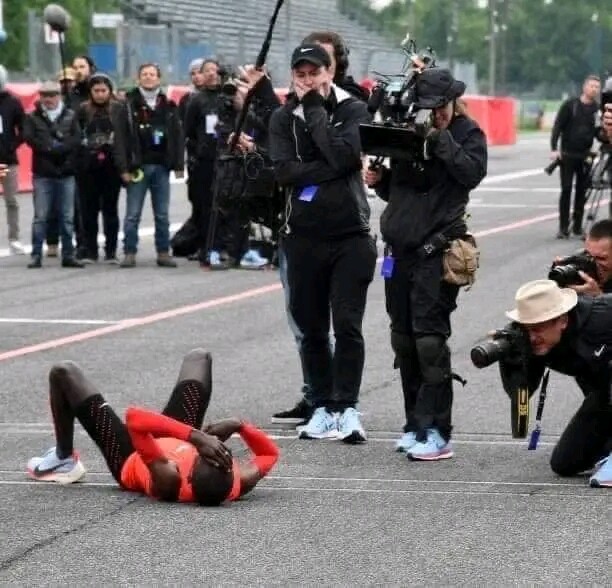
What made Kipchoge’s run even more extraordinary was the calmness and control he displayed throughout the attempt. While the pace demanded near perfection for two straight hours, he maintained remarkable composure, turning the final laps into an unforgettable moment of belief and resilience.
Years later, Kipchoge would finally complete the mission by running under two hours at the INEOS 1:59 Challenge in Vienna, cementing his legacy as the greatest marathon runner of all time. But Breaking2 was the foundation. It was the experiment that shifted human imagination.
The other two athletes in the challenge — Zersenay Tadese and Lelisa Desisa — also delivered courageous performances, though both finished outside the sub-two-hour mark despite all the optimizations provided.
Final Results
1. Eliud Kipchoge — 2:00:25
2. Zersenay Tadese — 2:06:51
3. Lelisa Desisa — 2:14:10
Beyond the stopwatch, Breaking2 transformed the entire sport. The project introduced the revolutionary Nike Zoom Vaporfly Elite, featuring a curved carbon-fiber plate combined with highly responsive Pebax foam cushioning. That innovation sparked the modern “super shoe” era that has since reshaped road racing and distance running worldwide.
For decades, marathon racing shoes were designed to be thin and lightweight with minimal cushioning. Breaking2 changed that philosophy completely. Suddenly, athletes could run with greater energy return, more protection, and increased efficiency without sacrificing speed. The impact has been so profound that marathon performances across the globe have entered an entirely new era.
More importantly, Breaking2 proved something deeper about sport itself: even with cutting-edge technology, ideal pacing, scientific preparation, and world-class talent, running a marathon at such extraordinary speeds remains one of the greatest physical achievements on Earth.
Nine years later, the images from Monza still feel iconic — the clock ticking toward two hours, the pacemakers rotating in formation, and Kipchoge surging toward the finish line with a smile that symbolized possibility itself.
Breaking2 was more than an event. It was the moment marathon running stepped into the future.
by Erick Cheruiyot for My Best Runs.
Login to leave a comment
