

Running News Daily
Running News Daily is edited by Bob Anderson. Send your news items to bob@mybestruns.com Advertising opportunities available. Train the Kenyan Way at KATA Kenya and Portugal owned and operated by Bob Anderson. Be sure to catch our movie A Long Run the movie KATA Running Camps and KATA Potato Farms - 31 now open in Kenya! https://kata.ke/
Index to Daily Posts · Sign Up For Updates · Run The World Feed


The Relentless Flame: Kenenisa Bekele and the Art of Running Beyond Limits
There are athletes who win races, and then there are rare souls whose movement feels almost like poetry — effortless yet powerful, gentle yet unstoppable. On a warm August evening in Brussels in 2001, under the honey-gold glow of stadium lights, a slender Ethiopian teenager floated across the track with a quiet certainty that something extraordinary was unfolding.
The crowd watched, curious at first, then captivated. When the clock stopped at 7:30.67 for 3000 metres at the Memorial Van Damme, applause filled the air. It was announced as a world junior record, but what lingered was not just the number — it was the feeling. The feeling of witnessing hunger wrapped in grace, ambition wrapped in innocence.
The teenager was Kenenisa Bekele, and even then, you could sense he was not chasing applause. He was chasing possibility.
For three and a half years, that junior record stood as a quiet monument to ambition before Augustine Choge eventually lowered it. Records, after all, are built to fall. Yet the resonance of Bekele’s performance lingered — the unmistakable arrival of a force that would soon redefine distance running.
Even before Brussels, his ascent had begun to take shape in unexpected corners of Europe. In the small Dutch town that hosts the Montferland Run, he collected victories in 2000 and 2001 with an almost casual authority. Fifteen kilometres through winter air and narrow streets looked less like competition and more like controlled expression. But nothing about Bekele was ever routine. Beneath the calm exterior was a furnace of ambition.
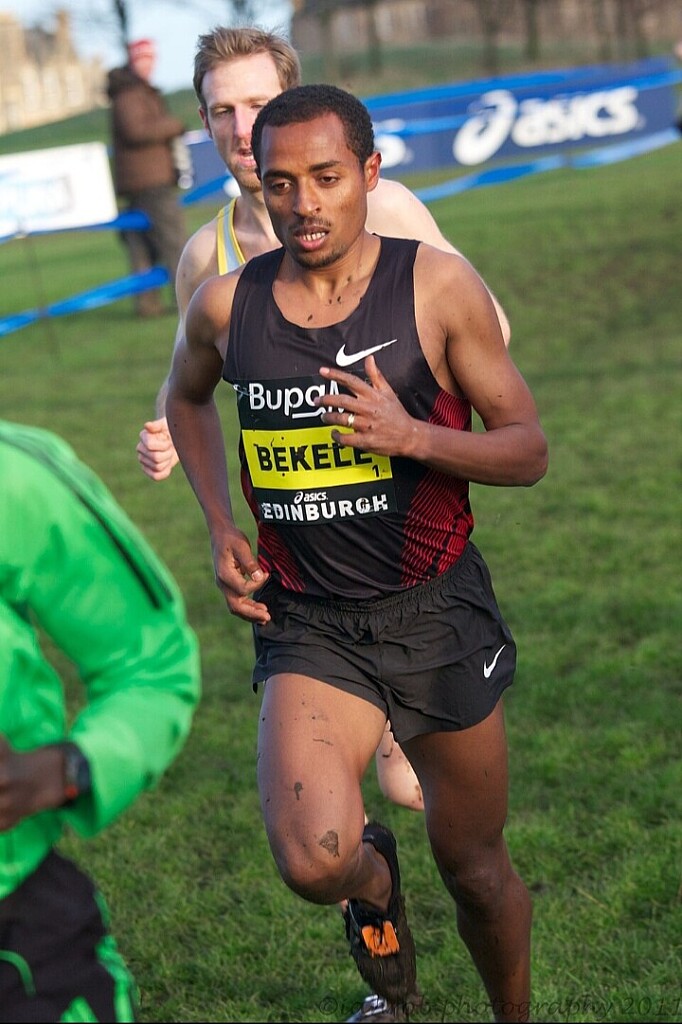
Then came the terrain where legends are forged — mud, grass, cold wind, and pain — the IAAF World Cross Country Championships. Between 2002 and 2006, Bekele achieved something so extraordinary it borders on myth: he won both the short course and long course titles every single year for five consecutive seasons. No athlete before or since has replicated such dominance. The physiological toll alone should have made it impossible — the explosive intensity of the short race followed by the grinding endurance of the long. Yet he returned each year stronger, hungrier, untouchable.
When the short course was discontinued after 2006, he stepped away briefly, then returned in 2008 to claim the long-course crown once more, almost ceremonially, as though closing a chapter he himself had authored. By then his cross-country medal collection had reached staggering proportions — nineteen in total, including eleven senior individual golds. Statistics struggled to contain the scale of his supremacy.
But numbers alone never explained the aura.
On the track, Bekele possessed an almost predatory intelligence. He would sit quietly in the pack, conserving energy with deceptive ease. Then, with laps remaining, something would ignite. At the 2003 Bislett Games in Oslo, he tracked down the Kenyan leader with chilling precision before unleashing a decisive kick to win in 12:52.26. It was not merely speed — it was timing, instinct, and psychological dominance. Rivals knew the surge was coming. They simply could not stop it.
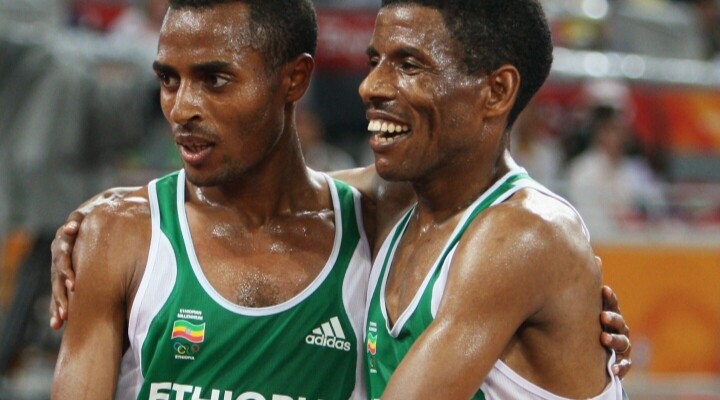
And hovering over his rise was a rivalry that felt almost epic in scale: Bekele against Haile Gebrselassie. The reigning emperor of distance running and the fearless successor. Early encounters favored the veteran, who reminded the young challenger of the existing hierarchy. But by 2003, the balance began to shift. Bekele edged Gebrselassie over 10,000 metres in Hengelo, then continued to outperform him across major championships.
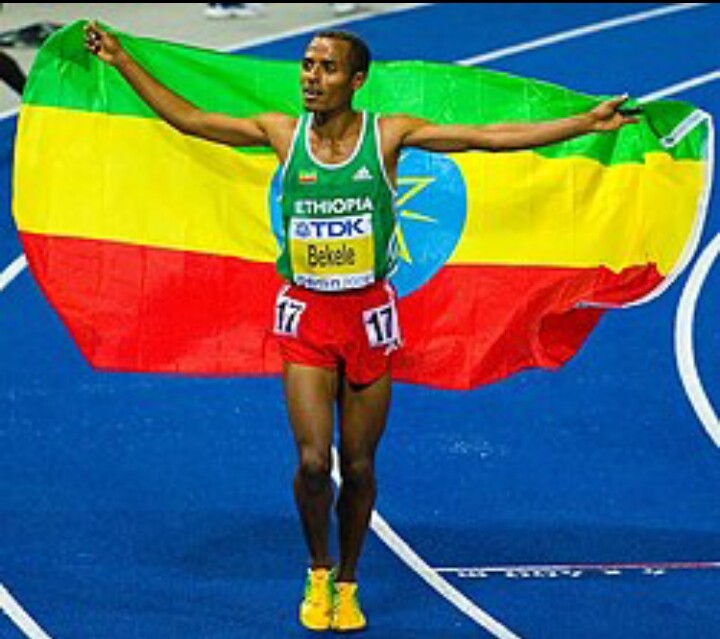
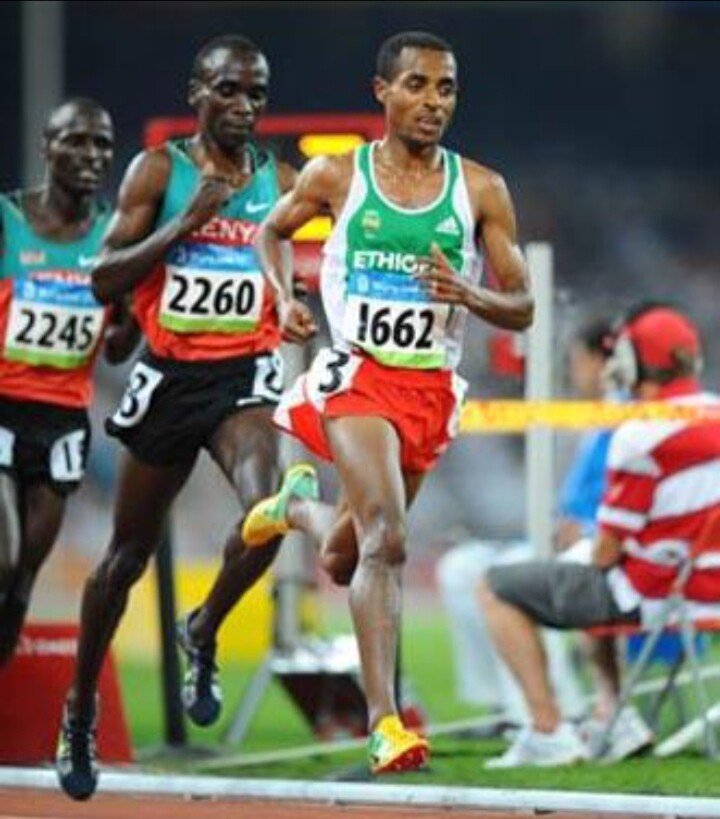
At the 2004 Athens Olympics, Bekele captured 10,000-metre gold while Gebrselassie faded to fifth. Four years later, at the 2008 Beijing Olympics, history repeated itself. The apprentice had become the standard. Even on the roads, including the Great North Run, Bekele would later finish ahead. Their rivalry was not merely competitive — it symbolised the passing of an era.
The year 2004 crystallised his dominance. Within nine astonishing days, Bekele broke the indoor 5000-metre world record, then the outdoor 5000, and finally the 10,000-metre world record — as if impatience with history itself drove him. He swept cross-country titles again, led Ethiopia to team victories, and left Athens with Olympic gold and silver. Distance running had a new gravitational centre, and it was him.
Yet life does not always move in harmony with triumph.
On January 4, 2005, a deeply personal loss entered his world during what should have been an ordinary training morning. Alem Techale — the 1500-metre World Youth Champion of 2003 — was running alongside Bekele in Ararat, a forested, hilly area on the outskirts of Addis Ababa. The two were sharing the familiar rhythm of training when she suddenly collapsed. Bekele immediately carried her to his car and rushed toward the hospital, hoping urgency might change the outcome. But on the way, she passed away. What remained was a silence that no explanation could fully fill — only memories of shared miles, shared dreams, and a companionship that had once felt limitless.
For a time, the noise of competition softened around him. But step by step, he continued — not because pain disappears, but because the human heart has a quiet way of learning to carry both love and loss together.
Because in the end, Kenenisa Bekele’s story is not simply about speed, medals, or records etched into history books. It is about the tenderness hidden inside strength. It is about a young boy who ran with wonder in his spirit, a champion who experienced both luminous joy and quiet sorrow, and a man who kept moving forward with grace. His journey reminds us that greatness is not only measured by how fast someone runs, but by how gently someone keeps going — through seasons of celebration, through moments of silence, through life itself — one faithful stride at a time.
by Erick Cheruiyot for My Best Runs.
Login to leave a comment
