

Running News Daily
Top Ten Stories of the Week
10/30/2021
These are the top ten stories based on views over the last week.
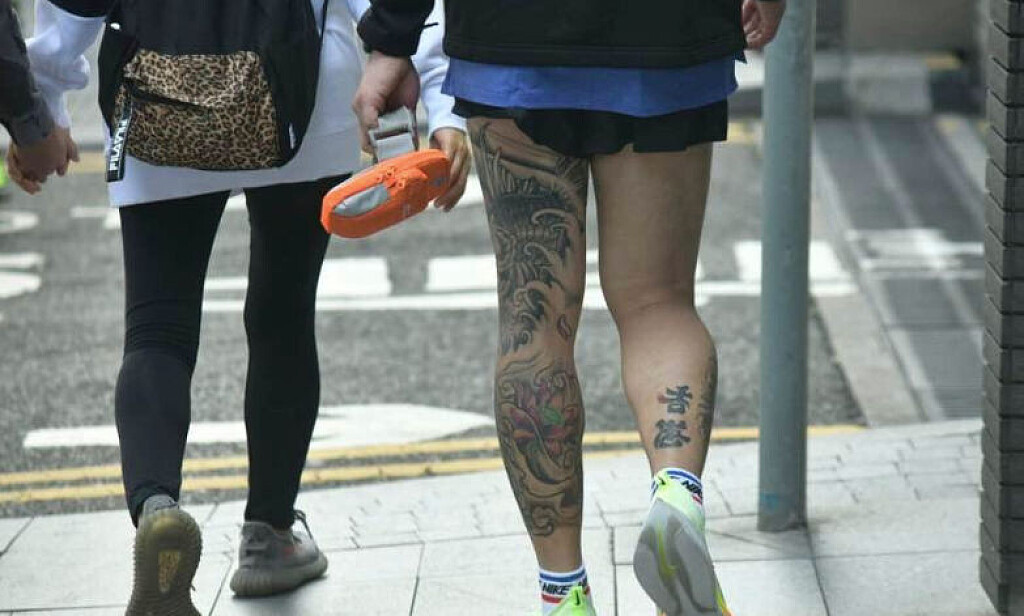


Hong Kong Marathon ordered that tattoos must be covered up, or would not be permitted to run
On Sunday, runners who were registered for the Standard Chartered Hong Kong Marathon were ordered to cover up political slogans and all tattoos on their bodies before being allowed to compete. Fifteen-thousand runners took part in the Hong Kong marathon, which marked the first race on the island since the start of the pandemic.
According to the South China Morning Post, the runners were told to cover up tattoos and political statements or they would not be permitted to run. This rule was created after the 2019 protests in Hong Kong as a way to discourage anti-government and pro-democracy demonstrations that have been running for the last year.
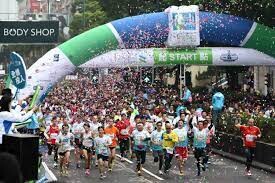
Organizers warned participants during registration to avoid wearing any items of political expression.

“Anyone who uses the Hong Kong marathon as a platform for conveying and promoting political messages will face consequences,” organizers said in a press release. “This is a zero-tolerance approach.” Law enforcement was prepared heavily for the marathon, with police deploying counter-terrorism units on the race route.
The South China Morning Post reported that one runner was escorted to a changing room by police during a security check, and was told to change her shorts because of a printed political slogan on the side. Another man with a tattoo on his calf faced being kicked out of the marathon unless he covered it with a bandage, which he did.
2021 also marked the first year that the race banned costumes that cover the face for security reasons. A runner was told that he couldn’t run in his spiderman costume for personal identification purposes.
(10/26/21) Views: 120Marley Dickinson
Remembering Dos Pueblos High’s 24-Hour Relay Record
In 1972, 10 Distance Runners Completed 1,106 Laps, or 276 Miles
Starting at 10 a.m. on June 9, 1972, Gil Rocha ran a mile, four laps around Dos Pueblos High’s 440-yard track, in five minutes and four seconds. He carried a baton that he handed to Tom Phillips, who also ran a mile, in 4:53. The baton was passed to eight more runners — Dale Nickel, Joe Szerwo, Joe Lambert, Tom Kelsey, Craig Bjorkman, Carl Udesen, Mark Pruner and Doug Hopwood, who finished his mile at 10:49 a.m.
Then it was Rocha’s turn to run again, starting another cycle of miles by the 10 DP distance runners. And so it went for the rest of the day and through the night — with Phillips and Lambert consistently cranking out sub-5:00 miles — until exactly 10 a.m. the next day, as Nickel was rounding the final turn of the team’s 1,106th lap.
The Chargers had run 276 miles, 769 yards — the distance from Goleta to San Jose — breaking the high school record in the Runner’s World 24-Hour Relay. The previous record was 271 miles, 1,217 yards — established in 1971 by a DP team that included nine of the boys who ran in 1972.
“It was the hardest thing we’d ever done,” Hopwood said, “and we did it again.”
Kelsey read about the 24-hour relay in Runner’s World magazine and convinced his teammates that they should go for the prep record at the end of the school year when all were in shape from the track season. They were well trained by their coach, Gordon McClenathen. (The 24 Hour Relay was created by RW founder Bob Anderson. Teams from around the world ran the relay.)
“He taught us all about commitment, hard work that pays off, and so much more,” Phillips said. “I know that I speak for all of us when I say that those life lessons we got from Gordon have gone with each and every one of us as we went our separate ways, and made us the men we are today.”
Assistant coach Bill Trimble arranged a reunion of the men with McClenathen, a runner himself for most of his 87 years, at Stow Grove Park last month. Phillips said the event “rekindled the comradeship we had 50 years ago.”
It also brought back memories of those long, sleepless days and nights of running in circles. “It seemed like my eyes were closed for five minutes before I had to go out again,” Rocha said. Bjorkman recalled that after the 1971 relay, which went from noon to noon, “I went to bed at 2 p.m. and woke up at 8 the next morning” — an 18-hour nap.
Parent shone headlights on the track at night. To Nickel, the uneven track was like a moonscape. “I saw the tops of asphalt bumps,” he said. McClenathen timed every mile while also massaging cramps out of the runners’ legs. June 10, 1972, was the last day of school, and that morning the track was lined by students and teachers who shouted encouragement to the tiring runners, most of whom put in 28 miles. “I’m sure that contributed to the adrenaline they needed to finish the relay,” Trimble said.
The Dos Pueblos record still stands, as far as anyone knows. The 24-hour relay proved too daunting to engender repeated attempts. It has gone the way of the Pony Express, a heroic endeavor from another time.
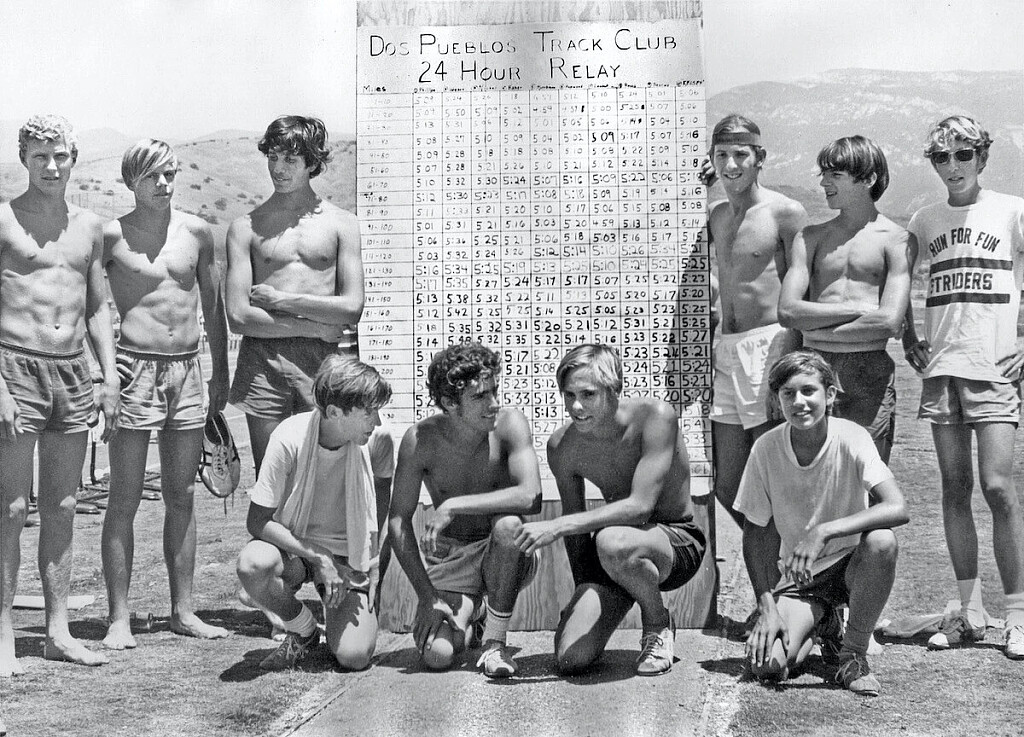
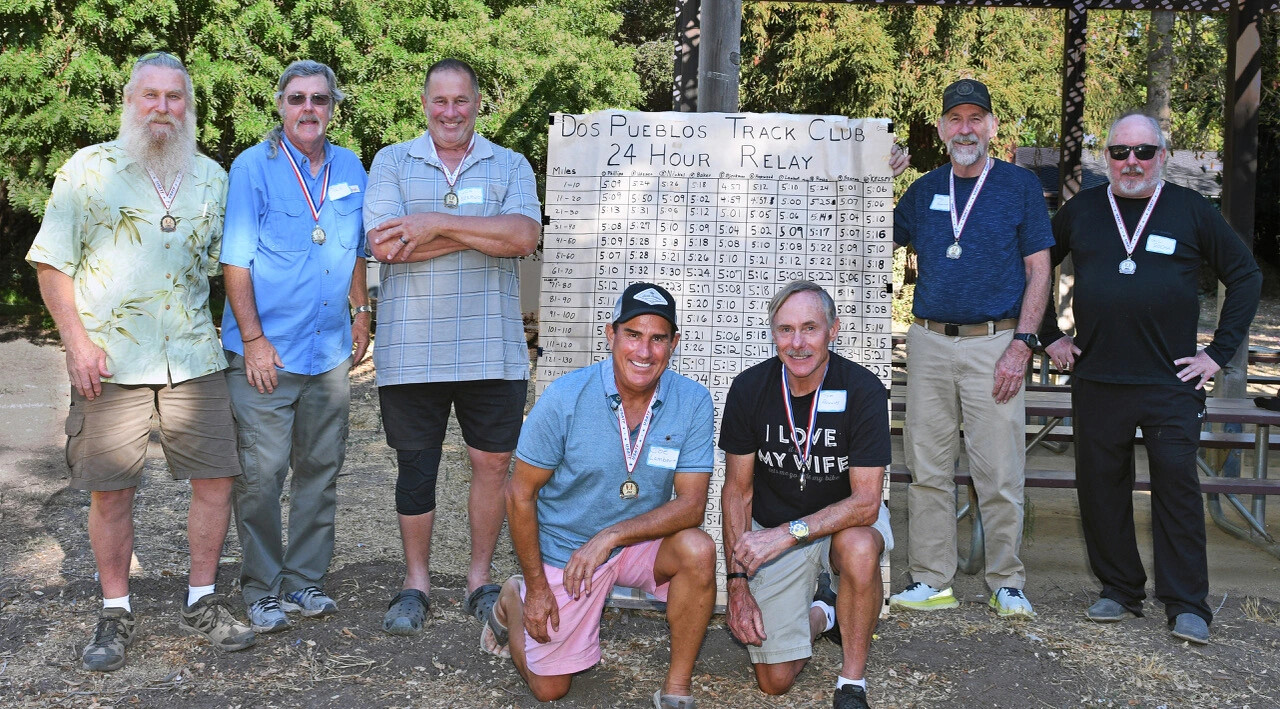
(Photos) THEN AND NOW: Ten runners from Dos Pueblos High posed after setting a national 24-hour relay record in 1971 (top photo). Standing: Dale Nickel, Craig Bjorkman, Joe Szerwo, Doug Hopwood, Terry Baker, and Gil Rocha. Kneeling: Tom Kelsey, Joe Lambert, Tom Phillips, and Carl Udesen. They set a new national record a year later. Seven of them got together recently for the 50th anniversary of their feat (left to right): Nickel, Kelsey, Szerwo, Lambert, Phillips, Hopwood, and Rocha. |Credit: Paul Shanklin
(The third photo was added to this story by MBR. "I put together the 24-Hour Relay Handback in August 1970," says Bob Andetson. "0ur team ran the first one in 1970 at Foothill College in Los Altos Hills California. My editor, Joe Henderson also was on our team. It was such an amazing experience. One I will never forget."

The official rules are simple: 2-10 person teams. Each person has to run one mile on track and pass the baton to the next person. Order must be maintained. A person can drop out but not return. Distance of last runner after 24 hours is measured.
(10/27/21) Views: 120John Zant (Independent.com)
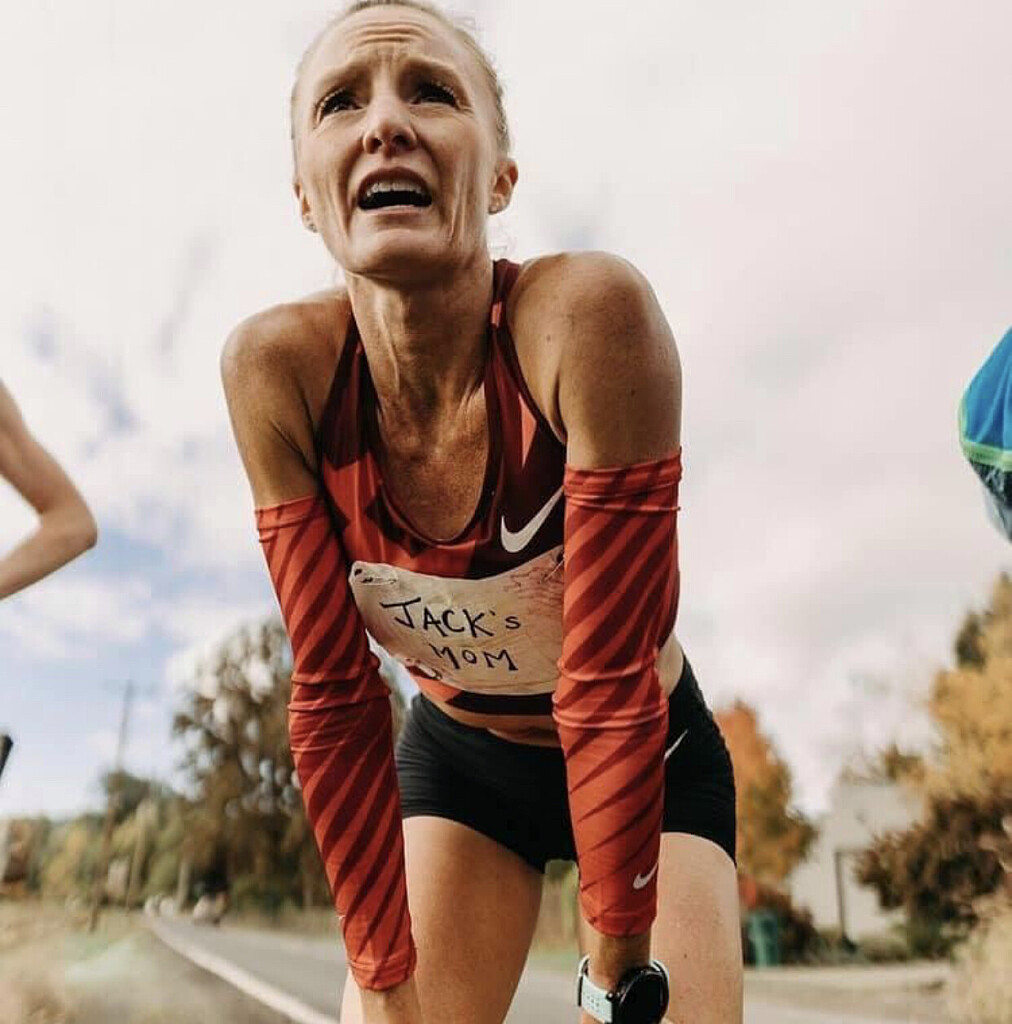
5 Marathons Down, One to Go: Takeaways From Shalane Flanagan’s Fall “Eclipse”
The retired 2017 New York City Marathon champion takes inventory of how her attempt to complete six marathons in seven weeks has gone so far (October 18).
Shalane Flanagan has 131 miles worth of World Marathon Majors down since September 26 and 26.2 miles to go on November 7, at the New York City Marathon, to complete all six races this fall. So far? She’s still in one piece and in good spirits, she said.
This fall, Flanagan embarked on what she dubbed “the eclipse,” what we all hope is a once-in-a-lifetime opportunity to run all the major marathons in one season—and, in fact, just seven weeks—due to the rescheduling of big events during the pandemic. On Monday, Flanagan ran her own version of a Tokyo Marathon, the only in-person event that was canceled due to COVID-19, on a 12.4-mile looped flat course near her home in Portland, Oregon. She feared it might be the hardest one, lacking the energy and enthusiasm of the crowds, but she finished in 2:35:14—far from the “slow” time she predicted three days beforehand.
“I think this one is going to be the toughest to really get after it,” she said on Friday. “I’m going to guess that this will be my slowest one, though it will be fun with some friends and family out there.”
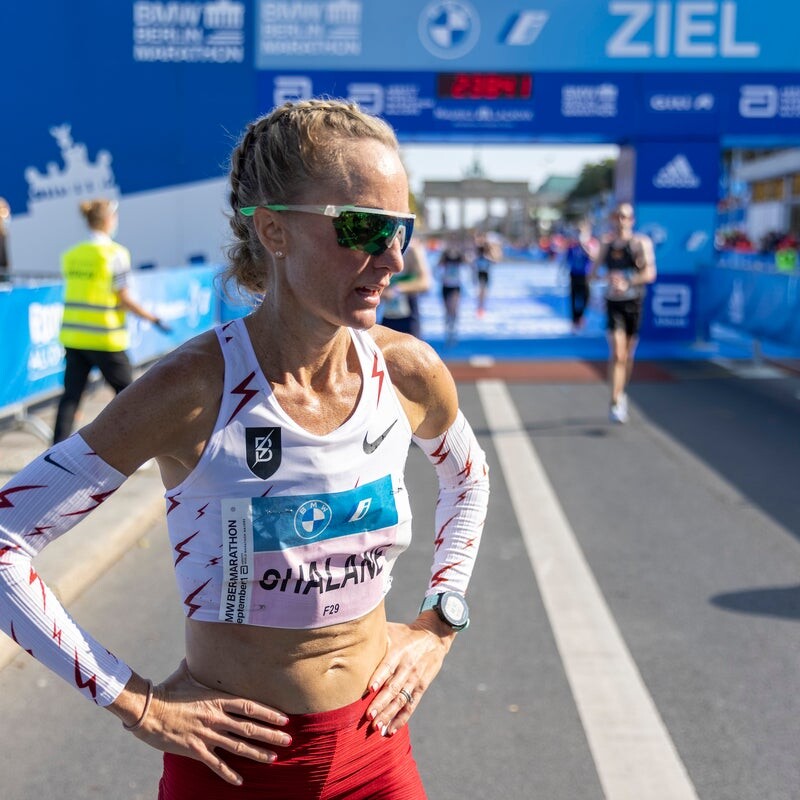
Flanagan, 40, retired from pro running in 2019, but she hasn’t retired from challenging goals, hoping to not just finish the 26.2-mile courses, but clock sub-three-hours on all of them. In addition to her race on Monday, she ran Boston on October 11 in 2:40:34, the day after she had clocked 2:46:39 in Chicago. Prior to that, Flanagan ran 2:35:04 on October 3 at the London Marathon and 2:38:32 on September 26 in Berlin.
Flanagan spoke with Women’s Running on Friday by phone to talk about how she’s measuring her effort, recovering, and learning valuable strategies along the way. Here are a few takeaways before she takes on the grand finale on November 7, at the New York City Marathon, a race she won in 2017.
You can let the pace come to you.
Flanagan has never experienced racing that is solely dictated by how she feels at the starting line. When it was her job to compete, the strategy was not always up to her—it was largely guided by the field.
“It’s fun because we figure out how hard we want to work each day—when you’re an elite, the race and other people are influencing how you run,” she said. “It’s now up to me on the day, how much I want to suffer. It’s a completely different dynamic. It’s like a different sport to me.”
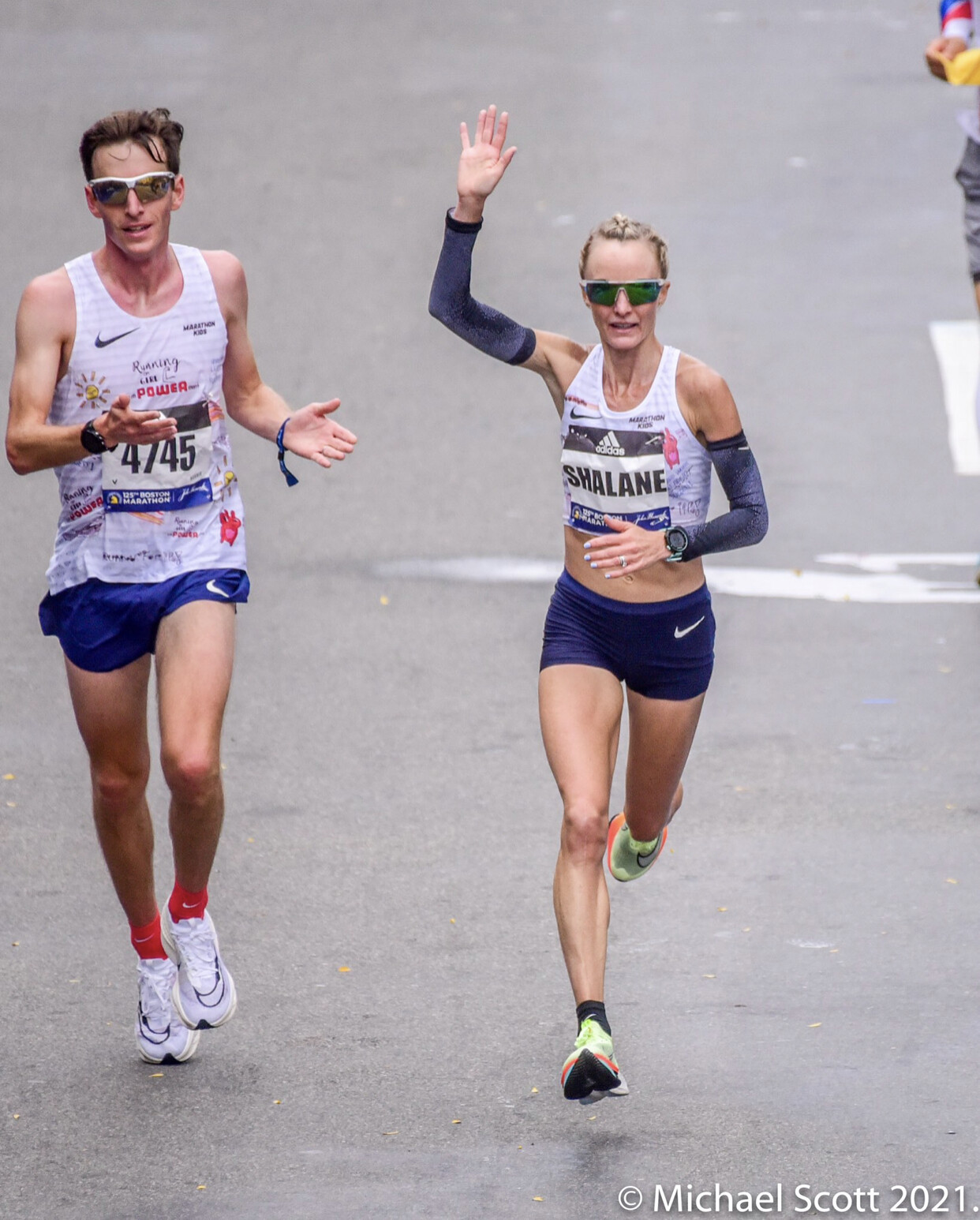
The result? After racing the Boston Marathon five times, 2021 was the most enjoyable one yet. And the recreational athletes running around her are equally thrilled. One even pulled out a phone to FaceTime a friend to show he was racing with Flanagan.
“Normally I never feel in control at Boston. I get to mile 17 and I feel like trash. I never feel full of running, with the exception of maybe my first Boston because it was a kind of slow race. But the other times, the wheels were coming off and I didn’t enjoy it,” Flanagan said. “This was just a completely different experience and it was so fun and refreshing to have that.”
To decide on pace, Flanagan said she’s been looking at the weather, considering if she has a friend to run with that day, and how she feels when she starts. Then she lets the pace reveal itself.
“What feels sustainable, knowing that I’m not going max effort in any one of these?” she said. “Where’s that fine line that I can still recover as fast as possible but still dip my toe into that uncomfortable-ness that I’m craving?”
But even seasoned pros make rookie mistakes.
Although London was only her second race, it took a lot out of Flanagan, mostly because she made a mistake all of us can relate to: she went out too fast. She still finished in 2:35:04, but suffered during the second half (she ran 1:15:04 in the first 13.1 miles and 1:20:00 for the second).
“I had a cold and ran way too hard. That was the low so far,” Flanagan said. “I thought I maybe got myself in a pickle, with the [swollen] ankle, the cold, and all the travel, I was a little bit nervous about the whole thing. But now I can sniff the barn. I’ve physically rebounded.”
It was also the one race that she didn’t have a friend to run with, so she started in the wave with the sub-elite men.
“There was this vibe of competitiveness and of course I’m a competitive person so I fed off of it,” she said. “Then I got to 20 miles and I was like, ‘Uh-oh, You shouldn’t have done that.’ It backfired big for me. I learned my lesson on that one. That’s not the point of what I’m doing.”
Recovery is the name of the game.
Between the marathons, Flanagan pulls out all the old recovery tricks she’s learned along the way. Although unconvinced that ice baths make a big difference, she still did one between the back-to-back Chicago and Boston marathons. The travel and the running produce a lot of inflammation. She gets massages and physical therapy work twice a week after having no body work since stepping away from competition.
During her preparation before the attempt began in Berlin, she tried back-to-back long runs, including a 21-miler on a flat course at 6:40 pace followed by a hilly 21-miler at 6:20 pace the next day. When it came to the real-life scenario, she ended up feeling better in Boston than she did the day before in Chicago (“Which is kind of weird and kind of blew my mind,” she said.)
“I did a really good job hydrating, knowing those two were both going to be pretty humid marathons,” she said. “I think that’s why I came back well in Boston, because I did such a good job fueling and hydrating in Chicago, but I’ve been nonstop hungry since then.”
Reconstructed knees can take it, so far.
After retirement from competition in 2019, Flanagan had surgery on both of her knees and a long rehabilitation period afterward. So far, she hasn’t felt any pain and she’s worked with the Nike Sports Research Lab to have scans of her tendons and knees to monitor any damage through her training a racing.
“When I get back from each segment, they scan them to make sure the tissue in my knees is OK,” Flanagan said. “Anecdotally, I feel nothing and we’re actually seeing a strengthening of my quads—there’s no breakdown, which is incredible. My knees actually feel better than they did a year ago.”
The only hiccups so far occurred after the London Marathon, when she caught a cold and had a bit of an ankle flair up. It looked like she rolled the ankle, but she didn’t.
“London by far was the hardest for me. I didn’t pace myself well, so I had to stop and walk,” Flanagan said. “I was really tentative between London and Chicago. I didn’t run very much. The ankle was a low-level irritation. Maybe I tied my shoes too tight and got a tendon irritation? I have no idea what I would have done, but my physical therapist has been taping it to give it more stabilization.”
The super shoes help.
While the runner still needs to power the body over 26.2 miles, it’s no great secret that the newest models of shoes, like the Nike AlphaFly, can help ease the wear and tear on the legs, absorbing more of the shock as we pound the pavement day in and day out. Flanagan believes that the technology is a nice tool to have to reach her audacious goal.
“I think the foam is definitely a game changer in terms of shock absorption,” she said. “It’s been to my benefit to be able to come back. But at the end of the day, if you still aren’t fit enough to keep up with the shoes, you can still walk like I did in London. But typically my quads are sore after Boston. I have some other soreness but the shoe allows a quicker recovery.”
The New York City Marathon finish line will be a special place, once again.
When Flanagan won the 2017 New York City Marathon, it was the victory of her career. She had always believed she had the ability to win a World Marathon Major but as she edged toward the end of her competitive days, she started losing hope that it might be a box she would leave unchecked.
When she approached the finish line that year, with a fist pump and a “f*ck yes!” the stretch of Central Park by Tavern on the Green instantly became sacred ground. But after completing six marathons in seven weeks, will it be doubly so?
“I think any time people set hard goals and achieve them, yeah I think it’ll be a big celebration with my team who’s helped me do this. We’ve had so much fun and I’ll be sad that it’s over, to a degree because I’ve formed a really great team around me to do this and we’ve had a blast,” Flanagan said. “But it’ll be fun to dream up another adventure. There’s great phases in life to have these crazy things going on and then it’ll be nice to get back to some normalcy, not traveling the world running marathons.”
(10/22/21) Views: 106Erin Strout (Women’s Running)
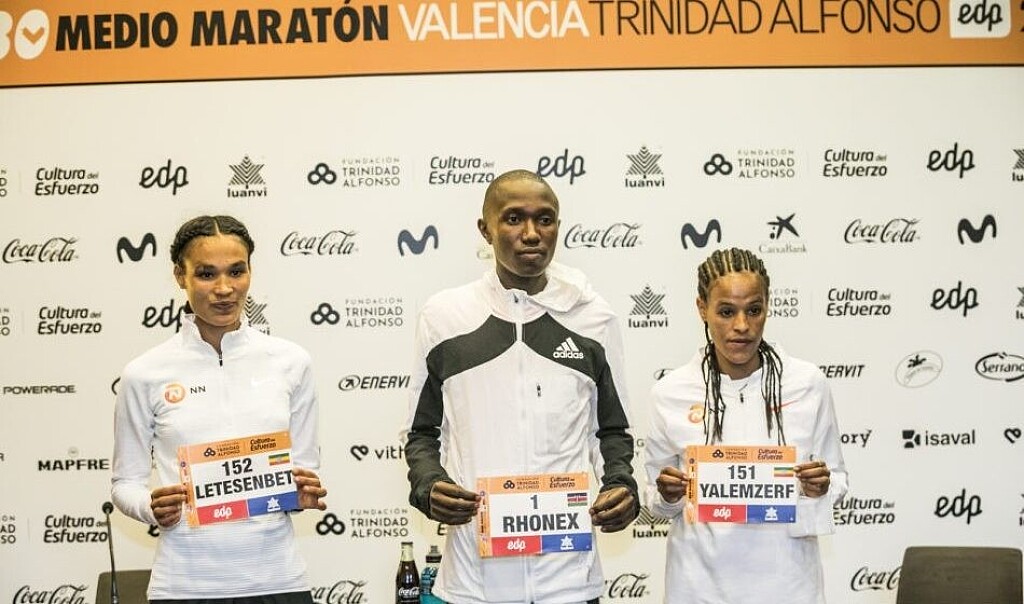
Ethiopians Letesenbet Gidey and Yalemzerf Yehualaw target world half marathon record in Valencia
The Valencia Half Marathon Trinidad Alfonso EDP witnessed a men’s world record last year as Kibiwott Kandie ran a stunning 57:32. This time the women’s world record is the target and organisers have assembled a star-studded line-up for the World Athletics Elite Label road race on Sunday (24).
Ethiopians Letesenbet Gidey and Yalemzerf Yehualaw will clash in a long-awaited showdown. Gidey is the world 5000m and 10,000m record-holder, while Yehualaw ran 1:03:44 in August, and although that time will not be ratified as a world half marathon record the two athletes will now go head-to-head in Valencia as they target the 1:04:02 run by Ruth Chepngetich in Istanbul in April, a mark which is pending world record ratification.
The 23-year-old Gidey has competed sparingly this year but managed to set a world 10,000m record by running 29:01.03 in Hengelo before claiming bronze at the Tokyo Olympics. While the diminutive Yehualaw is an accomplished half marathon specialist, with nine outings over the last three seasons, Gidey will tackle the distance for the first time but her impressive 44:20 world best for the 15km set in Nijmegen in 2019 suggests she might become the first debutante to set a world record for the distance.

Reportedly, each of the Ethiopian aces will be joined by their respective pacemakers – Mebrahtu Kiros and Genetu Molalign – in a battle which promises to be fierce, while the organisers will provide an official pacemaker for the rest of the elite targeting a 1:05 clocking.
That second group looks set to be led by Ethiopia’s Senbere Teferi, the winner in 2019 thanks to a 1:05:32 time; her compatriot Hawi Feysa, fresh from a 1:05:41 PB in Copenhagen last month; Sheila Chepkirui, runner-up last year in a career best of 1:05:39; and her fellow Kenyan Brenda Jepleting, a 1:06:52 performer.

After last year’s climax, when no fewer than four men ran inside the then world record of 58:01, one of them – Rhonex Kipruto – will be the marquee athlete this time. The Kenyan star, who clocked a 57:49 debut last year, also excelled in Valencia in January 2020 when he set the world 10km record of 26:24. He couldn’t place higher than ninth at the Tokyo Olympics over 10,000m but proved to be in top form in September when he recorded 26:43 at a 10km road race in Herzogenaurach.
While a men’s world record assault is not planned on this occasion, the pacemakers are set to go through the opening 10km in 27:30 on the hunt for a sub-58:00 finish time.
In addition to Kipruto, Sunday’s field includes another four Kenyan athletes with PBs under 59 minutes: Philemon Kiplimo, who was fifth last year in Valencia in a career best of 58:11, plus Kelvin Kiptum (58:42), Abel Kipchumba (58:48) and Felix Kipkoech (58:57).
Yet Kipruto’s toughest opposition might come from the two-time world 5000m champion Muktar Edris. The 27-year-old Ethiopian posted a promising debut over the distance last November by clocking 59:04 in New Delhi and should play a key role on Sunday, while the European challenge will be headed by Norway’s Sondre Moen and Spain’s Carlos Mayo.
Weather forecasters predict an ideal morning for running, with a 13ºC temperature and a very slight breeze. After the four records set in Valencia last year – the men’s 10km, half marathon and 10,000m, plus the women’s 5000m – the city could witness another world best on Sunday.
(10/23/21) Views: 93World Athletics
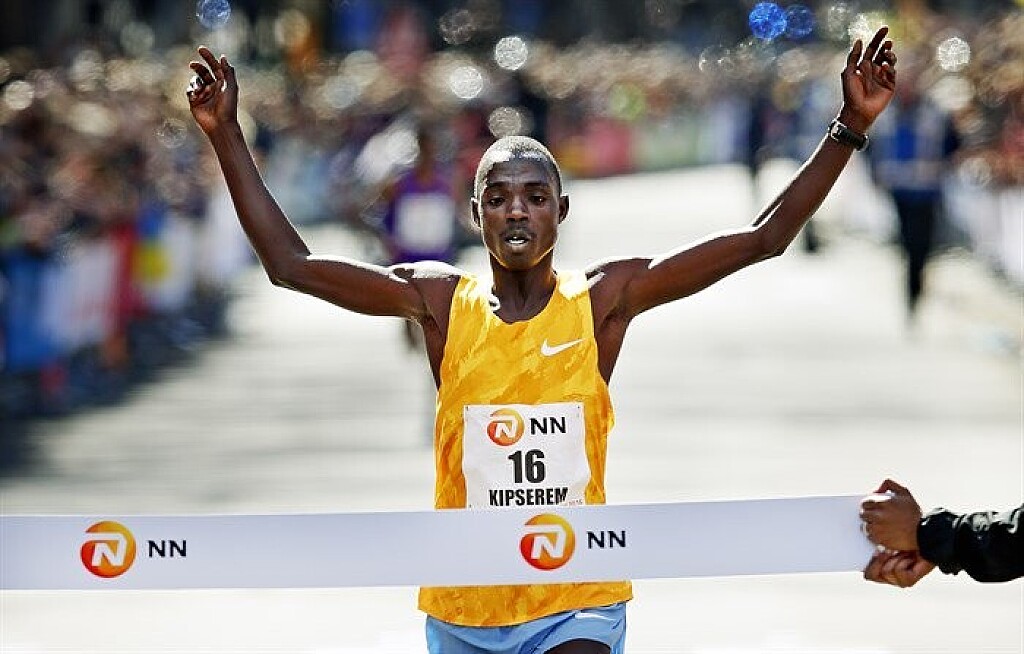
Kenyan Marius Kipserem will be targeting hattrick of titles at Rotterdam marathon
Two-time champion Marius Kipserem will be the man to beat as he chases hattrick of victories at the Rotterdam Marathon on Sunday
Kipserem clinched the 2016 event winning in 2:06:11 and setting the course record two years ago when he posted 2:04:11.
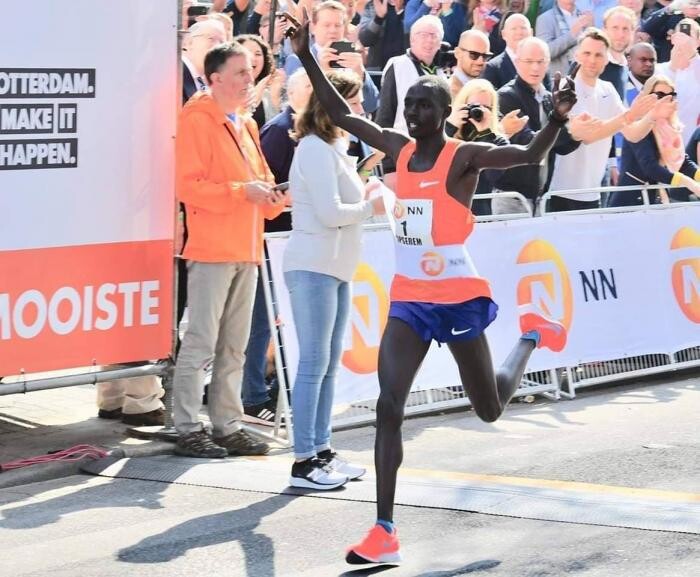
He will have five Kenyans for company in the event, including Emmanuel Saina (2:05:02), Gideon Kipketer (2:05:51), John Langat (2:07.11) Cyrus Mutua (2:10:28) and Titus Kipruto (2:12.43).
The Kenyan contingent faces a herculean task with five Ethiopian athletes in contention. They include Solomon Deksisa, who has a personal best of 2:04:40 alongside Kebebe Wami Tulu (2:06:32), Getachew Yizenagwa (2:06:47), Dawit Wolde (2:06:18) and Asefa Tefera (2:07.47)
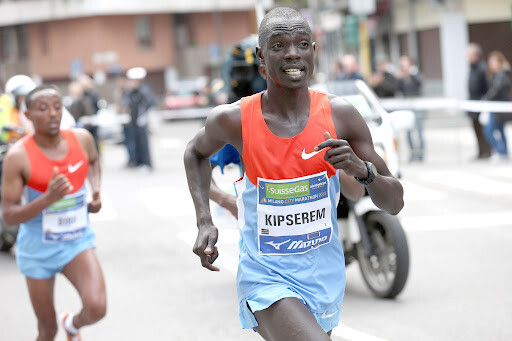
Olympic bronze medalist Bashir Abdi of Belgium (2:04:16) will be seeking to break the European marathon record of 2:04:11.
The men's field looks very impressive with ten men holding PB's inside 2:08 with three having run sub 2:05.
In the women's category, Kenya will be led by Bornes Kitur (2:21:26) and Stella Barsosio (2:23:36).
Other contenders are Nataliya Lehonkova of Ukraine (2:28:58), Norway’s Runa Skrove Falch (2:33:52), and Sweden’s Louise Wiker (2:36:29). Moreover, debutantes Marijke Visser and Jacelyn Gruppen (2:52:17) are expected to run a good marathon.
A second group of 15 athletes will be setting off at a slower pace. These runners include Dutchmen Roy Hoornweg and Floris Willeboordse.
Hoornweg has already made a name for himself as a rabbit and is now making his official marathon debut. Willeboordse is keen to improve his 2:30:01 (New York, 2019).
Abdi Nageeye, who ‘flew’ over the fast Rotterdam course to grab the Dutch record of 2:06:11 in 2019, has opted for the New York marathon this year after his Olympic silver medal.
Nageeye also stood out in Japan by literally and figuratively piloting his Flemish friend Bashir Abdi to grab bronze. However, Bashir will be coming to the Coolsingel.
(10/23/21) Views: 84William Njuguna
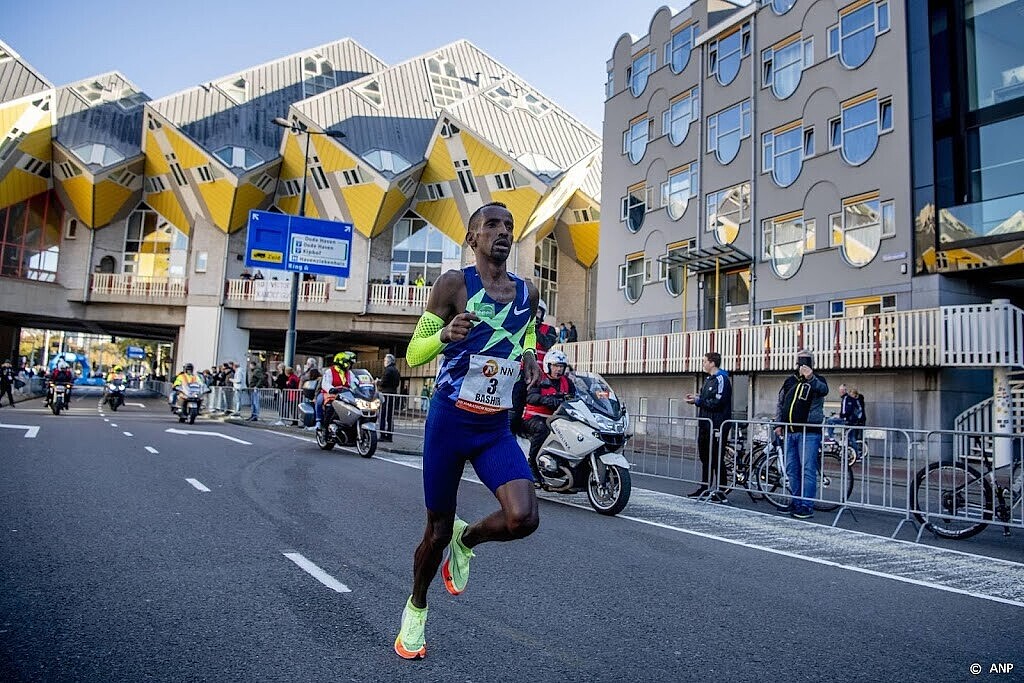
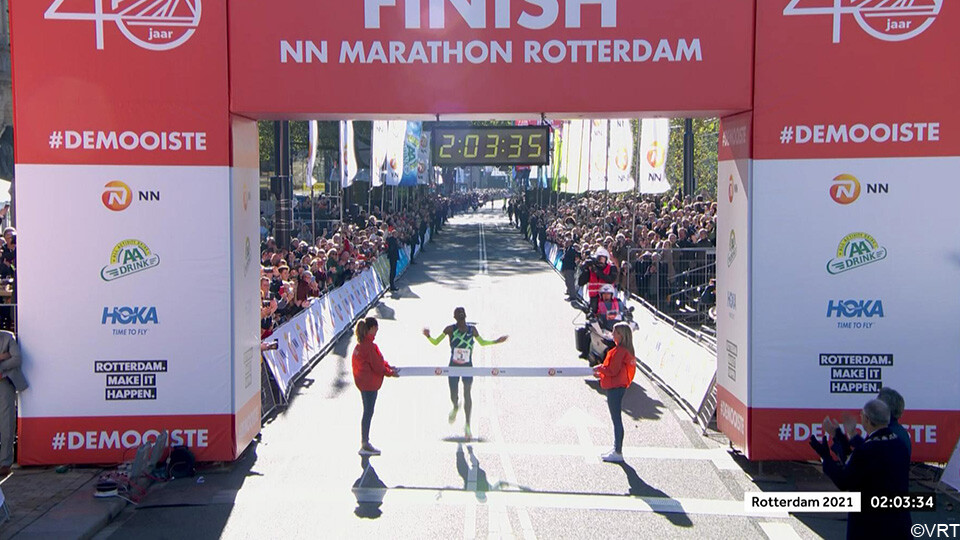
Abdi wins Rotterdam Marathon in European record of 2:03:36
Competing in his first race since taking bronze at the Olympic Games, Belgium’s Bashir Abdi broke the European record to win the NN Rotterdam Marathon on Sunday (24), clocking 2:03:36 at the World Athletics Elite Label road race.
At one point the 32-year-old had looked to be out of contention after two-time Rotterdam winner and course record-holder Marius Kipserem opened up a significant gap with less than 10km to go. But Abdi finished strongly to overtake the Kenyan in the closing stages before going on to win by 28 seconds.
Meanwhile, Kenya’s Stella Barsosio produced a solo effort to win the women’s race in a lifetime best of 2:22:08, improving on her runner-up finish in this race two years ago.
Most of the big contenders in the men’s race ran as a group in the early stages, passing through 10km in 29:17 before reaching the half-way point in 1:01:57, suggesting Kipserem’s course record of 2:04:11 was under threat.
Soon after reaching 25km in 1:13:33, Kipserem forged ahead and broke up the lead pack, hitting 30km with a 12-second lead over Ethiopia’s Dawit Wolde with Abdi a further five seconds in arrears.
But Abdi and Wolde caught up with Kipserem again by 35km, reached in 1:42:33, while Kenya’s Titus Kipruto was 20 seconds adrift of the lead trio.
Soon after, Abdi made his decisive move and broke away from his remaining opponents before going on to win in 2:03:36. His winning time took 40 seconds off the previous European record, set by Turkey’s Kaan Kigen Ozbilen in Valencia two years ago, and places Abdi 14th on the world all-time list.
Kipserem held on for second place in a PB of 2:04:04, inside his former course record, while Wolde took third place in 2:04:27, almost a minute ahead of Kipruto (2:05:22).
In contrast to the men’s race, the women’s contest was essentially a solo effort from Stella Barsosio. The Kenyan had opened up an 18-second lead over compatriot Bornes Kitur by 5km (16:29), which grew to more than a minute by 15km (49:27).
Barsosio’s half-way split of 1:09:33 suggested a sub-2:20 finishing time, but with no competitors to help push her, the 28-year-old’s pace dropped slightly in the second half. Nevertheless, her lead continued to grow and she had a margin of almost four minutes by the time she reached 30km in 1:39:02. Further back, Ukraine’s Natalya Lehonkova was closing on Kitur, who was starting to fade.
Barsosio went on to win comfortably in 2:22:08. Lehonkova overtook Kitur in the closing stages to take the runner-up spot in 2:30:28 while Kitur held on for third place in 2:30:41.
(10/24/21) Views: 84
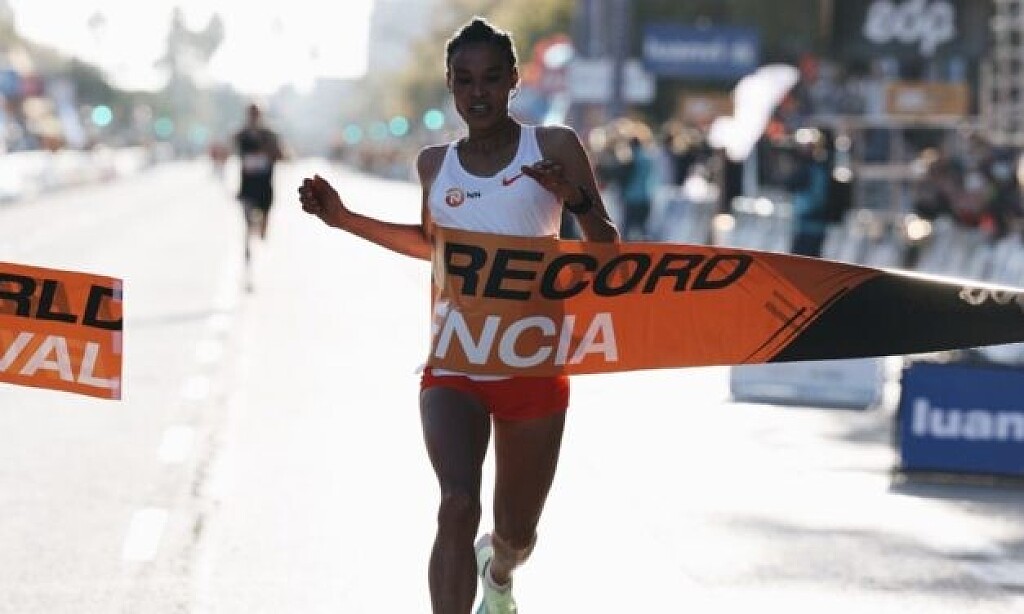
Gidey smashes world half marathon record in Valencia
Ethiopia’s Letesenbet Gidey smashed the world record* at the Valencia Half Marathon Trinidad Alfonso EDP, clocking 1:02:52 on her debut at the distance at the World Athletics Elite Label road race on Sunday (24).
Competing in the same Spanish city where she broke the world 5000m record last year, Gidey took 70 seconds off the previous world record of 1:04:02 set by world marathon champion Ruth Chepngetich earlier this year.

In doing so, 23-year-old Gidey becomes the first woman to officially break the 64 and 63-minute barriers. She’s also the first debutante to set a world record for the distance.
Perfectly paced by her compatriot Mebrahtu Kiros, Gidey went through the opening 5km in 15:00, well inside world record pace, with her compatriot Yalemzerf Yehualaw running five metres down. Yehualaw, whose recent 1:03:44 clocking in Larne could not be ratified as a world record due to the course being too short, drifted further back over the next few kilometres as Gidey reached 10km in 29:45 – the third-fastest clocking in history for the distance and just seven seconds shy of the world record set just a few weeks ago by Kalkidan Gezahegne.
While Yehualaw began to lose ground shortly afterwards, Gidey maintained her relentless rhythm to cover the next 5km segment in 14:44, reaching the 15km point in 44:29, barely nine seconds slower than her own world best for the distance.
Although her pace dropped very slightly in the last quarter of the race, Gidey had done more than enough to ensure victory in a world record time. She crossed the line in 1:02:52, adding a third world record to her name to go alongside the marks she owns for 5000m (14:06.62) and 10,000m (29:01.03).
Underscoring the quality of Gidey’s performance, she crossed the finish line alongside Spain’s Javier Guerra, a 2:07:27 marathon runner.
“I knew I could run this kind of time as my training sessions in the altitude of Addis Abeba have gone very well,” said an ecstatic Gidey, the Olympic bronze medallist and world silver medallist over 10,000m. “In future I’m thinking of competing at the marathon distance but I’m not sure that will come before the Paris 2024 Olympic Games or later.”
Yehualaw finished second in 1:03:51, also inside the previous world record. Kenya’s Sheila Chepkirui bettered her lifetime best by 45 seconds to complete the podium in 1:04:54.
The men’s race may not have witnessed a world record, but it still had record depth with an unprecedented seven men covering the distance within 59 minutes.
The leading group went through the opening 5km in 13:45, right on schedule for a 58-minute finishing time. Kenya’s world 10km record holder Rhonex Kipruto ran comfortably close to the pacemakers alongside compatriots Abel Kipchumba, Philemon Kiplimo, Felix Kipkoech, Daniel Mateiko and Kennedy Kimutai plus Ethiopia’s world 5000m champion Muktar Edris.
Surprisingly, the three pacemakers – Josphat Kiptoo Chumo, Emmanuel Maru and Evans Kipkemei Kurui – dropped out before the seventh kilometre and from then on the main favourites took turns in the lead to keep a swift pace. The 10km checkpoint was reached in 27:35, slightly outside their target, with Kipruto and 58:48 world leader Kipchumba making most of the pacing duties alongside the surprise package Mateiko, whose career best was 59:25 set in Copenhagen last month. At that point, 10 men still remained in the lead pack.
The first serious move came in the 12th kilometre when Mateiko, a training partner of Eliud Kipchoge, tried to break away from the rest but he was soon reeled in by the main contenders, who were now running in single file.
Shortly after reaching 15km in 41:16, Kipchumba moved to the front and only Kipruto could live with his pace. With about half a kilometre to go, Kipruto surged and gained a few metres on Kipchumba, but the latter never gave up and overtook Kipruto in the closing stages to win in a world-leading 58:07 with Kipruto taking second place in 58:09.
Kipchumba’s winning time elevates him to sixth on the world all-time list. Mateiko set a huge PB of 58:24 to secure a Kenyan sweep of the podium places.
(10/24/21) Views: 78
Emeterio Valiente for World Athletics
Are you looking for a coach to take your training to the next level?
Before we jump into whether or not you need a running coach, it’s important to understand that personal coaching can be for everyone. If you’re trying to run UTMB or simply want to run a mile without stopping—there is a coach out there for you.
Whether or not you need someone to coach you to hit those goals (and beyond!) comes down to your desire to step up your training, your personality, and your budget.
How bad do you want it?
Desire is a simple concept. If you don’t truly want to improve as a runner, no coach in the world is going to be able to help you. But keep in mind, your desire doesn’t have to be for any sort of competition. A coach can help you to just keep running in your life. They can help you fit it into your schedule in a way that will create a lifelong love. “You get to start wherever you are and go wherever you want to go,” says Heather Stephens, a coach with Seattle-based Rad Running.
And certainly, if you have big competitive goals, coaches bring that training expertise to the table to help you get there.
Do you need guidance?
Kristin Metcalf, who coaches alongside Stephens at Rad Running, says that most athletes come to them for personal coaching because they want to be held accountable. If you are a person who needs someone to set a schedule for you and get you out the door, a coach provides that. They will check in with you after the workout and, if you falter, help you create a plan to do better next time.
On the flip side, runners who don’t lack motivation but are instead too headstrong may also find a coach beneficial. You may be prone to overtraining or continue to get injured when you go it on your own. Stephens says she sees that fairly often in the athletes she trains. “You just need someone to say, ‘Hey, permission to take the day off. Let’s do it tomorrow.’”
A personal coach will be able to guide you through the balance of training, racing, rest, and recovery. They can be a sounding board as you go through the whole process.
How much are you willing to spend?
Depending on how involved and specialized the training is, coaching tends to range from $100 a month all the way up to $500 or more a month, says Metcalf. A less expensive option is to have a virtual coach.
One such program that is just now starting up is Runner’s Coaching "Be coached the Kenyan Way." Yes, you read that right. You can now be coached by world class English speaking Kenyan coaches.

These are coaches that are based at the Kenyan Athletics Training Academy in Thika Kenya. They train people in person at the Academy as well as virtually around the world. Their virtual training program is just $79US per month. You just need a smart phone and a free runner's app (like Garmin Connect) and you are set.
May you choose in-person or virtual, Metcalf and Stephens recommend that runners try to analyze the costs and benefits from every angle before committing to a coach. Think about how much you might pay for a monthly gym membership or fitness classes. What kind of time is the coach committing to you? What else might they be offering (like access to a physical therapist or nutritionist on their staff)? All of those things can help you determine if the cost is worth it to you.
“It’s kind of like when you go to a restaurant and you sit down and you expect to have a certain experience and a certain level of food,” says Stephens. “Is that valuable to you versus going to the pizza place down the street?” In this analogy, the pizza place is like an online training plan, which is a more affordable, cookie-cutter approach. But in that way, many recreational runners might view personal coaching as an indulgence.
Stephens compares coaching to therapy, which isn’t always treated with the importance it deserves. “There’s this thing in your life that you love,” she says “And if running has the power to help you make other areas of your life go smoother, for me, at least, if I do a hard workout and I nail it, I feel like I set the rest of my day and week up really well.” If that’s true for you, the cost may well be worth it.
There are a lot of options available to you.
(10/22/21) Views: 73
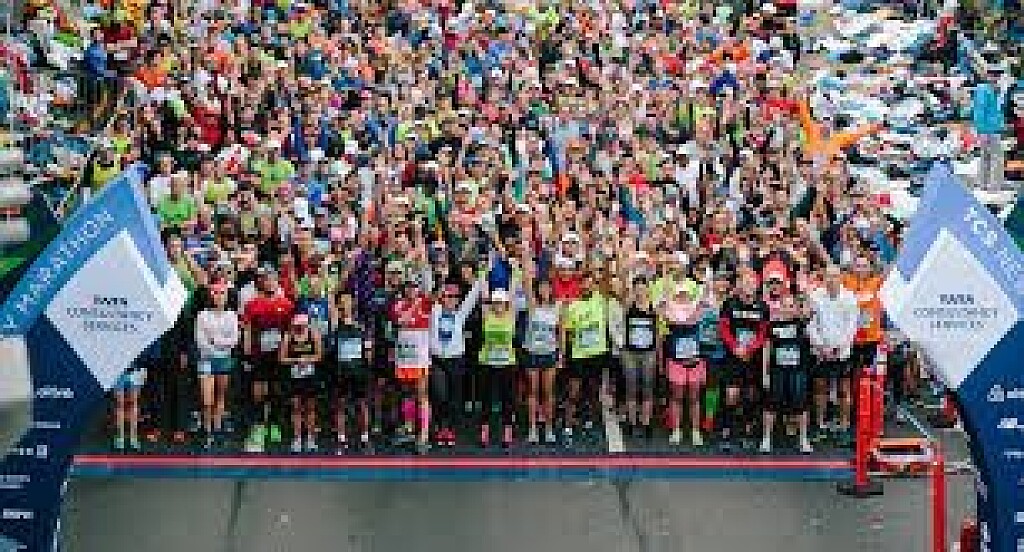
TCS New York City Marathon app lets fans enjoy a hybrid race experience
Tata Consultancy Services a leading global IT services, consulting and business solutions organization and title sponsor of the TCS New York City Marathon, and New York Road Runners (NYRR), the world's premier community running organization, launched the official 2021 TCS New York City Marathon app. For the first time, the new version of the app allows fans to simultaneously track runners on the racecourse as well as those who are competing virtually from anywhere in the world.
The 50th running of the TCS New York City Marathon will take place on November 7 and the Virtual Marathon from October 23 to November 7.
The 2021 TCS New York City Marathon App is a true hybrid platform that enables in-person and virtual runners, along with their supporters and spectators, to share in the marathon experience. Virtual runners will appear on the marathon course map in red and in-person runners will be in blue. Elapsed time and pace will be available for all runners, every 5K of their respective races. In addition, a new Marathon City: 3D Map feature uses Augmented Reality (AR) technology to allow everyone to experience the marathon course map as never before.
Virtual runners can share their GPS location with two spectators, so they can be tracked wherever in the world they are running the marathon. All other spectators tracking virtual runners will see their location that corresponds with the distance they have covered on the TCS New York City Marathon racecourse. For example, virtual runners between miles 16 and 18 will appear to be running up First Avenue in the app.
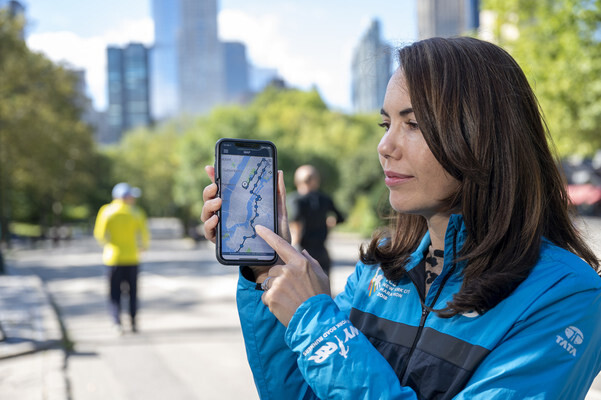
The location and estimated finishing time of in-person runners will be calculated based on performance of training runs and past marathons. This enhanced tracking capability will create the most accurate opportunities for spectators to catch runners live on the course.
"As we return to the iconic TCS New York City Marathon racecourse across the city's five boroughs, we are witnessing the race experience transform like never before," said Surya Kant, Chairman of North America, TCS. "Our 2021 Marathon App is filled with innovations that will help make this year's event a truly global experience, bringing both in-person participants as well as virtual runners across the world together on one platform."
"Together with our title partner TCS, we are looking forward to making the 50th running of the TCS New York City Marathon the most technologically advanced marathon in history," said Christine Burke, Senior Vice President, Strategic Partnerships and Runner Products, NYRR. "This will be a historic year for the event in so many ways, and as we embark on another eight years with TCS, there's no better way to have them engage with our runners than through their most innovative marathon app ever."

The TCS New York City Marathon app features additional enhancements to create a more immersive experience for virtual runners.
At numerous dedicated mile markers in the virtual marathon, the app will automatically play audio files with words of encouragement from past marathoners and iconic sounds from the in-person race. For example, all virtual marathon runners will begin their race with the sound of a cannon going off, simulating a similar experience to what in-person runners hear as their waves begin just south of the Verrazzano-Narrows Bridge.
The app will also allow virtual runners to do an unlimited number of 5K "Practice Runs" prior to their marathon journey to ensure they are comfortable using the app on race day. On race day, virtual runners can restart or pause an unlimited number of times but have 24 hours to complete the 26.2-mile race.
At the finish line, virtual runners will have access to a digital certificate and a selfie filter with an AR medal that can be shared on social media to celebrate their accomplishment.
Marathon City: 3D Map Details
Runners, spectators and fans can explore the TCS New York City Marathon course map in AR through the Marathon City: 3D Map, including:
Points of interest along and around the racecourse
Race day starting times for various groups
Elevation changes along the course
Interactive map showing the Start Village in Staten Island
This new AR experience was created by TCS in a stylized "low-poly" design similar to Marathon City: Sprint to Win and Marathon City: Spin to Win, two inclusive gaming experiences that mimic racing the last 100 meters of the TCS New York City Marathon racecourse through Central Park.
Other Key Features
Share Tracking: This feature on the Runner Details page allows users to share a link that initiates an automatic app download with a specific runner already selected to be tracked during the race.
Optimized Spectator Guides: The app's spectator guide helps fans create an itinerary to navigate New York City, so they're able to see runners on the course. The shareable guide provides a runner's estimated times of arrival, along with transportation directions and recommended viewing locations along the course.
Cheer Cards: Allows fans to support runners using the app to share messages on social media.
Live Pro Athlete Leader Board and Bios: Closely track the race day leaders in real time, as well as have access to bios, records and images of professional athletes running the race.
To download the TCS New York City Marathon App powered by Tata Consultancy Services, go to the Apple App Store or the Google Play Store.
About Tata Consultancy Services
Tata Consultancy Services is an IT services, consulting and business solutions organization that has been partnering with many of the world's largest businesses in their transformation journeys for over 50 years. TCS offers a consulting-led, cognitive powered, integrated portfolio of business, technology and engineering services and solutions. This is delivered through its unique Location Independent Agile™ delivery model, recognized as a benchmark of excellence in software development.
A part of the Tata group, India's largest multinational business group, TCS has over 528,000 of the world's best-trained consultants in 46 countries. The company generated consolidated revenues of US $22.2 billion in the fiscal year ended March 31, 2021 and is listed on the BSE (formerly Bombay Stock Exchange) and the NSE (National Stock Exchange) in India. TCS' proactive stance on climate change and award-winning work with communities across the world have earned it a place in leading sustainability indices such as the MSCI Global Sustainability Index and the FTSE4Good Emerging Index. For more information, visit www.tcs.com.
(10/22/21) Views: 68
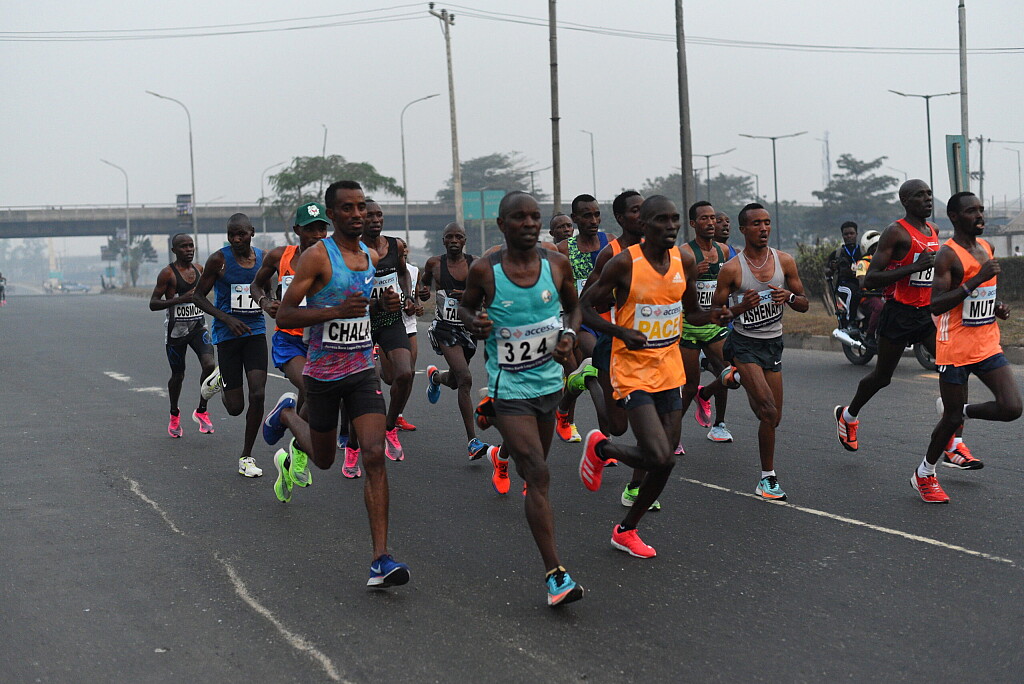
The 2022 edition of Lagos City Marathon will return to full capacity
Organizers of the Access Bank Lagos City Marathon have confirmed the Silver Label race will be returning to full capacity for its next edition billed for February 12, 2022.
This development means the event will join other elite races across the world to return as a full race with about 80,000 to 100,000 runners expected to participate in the full marathon and the 10km fun run.

This was revealed by Yussuf Alli, the General Manager, Access Bank Lagos City Marathon, in an official press statement.
The 2021 edition of the Access Bank Lagos City was an elites only race because of COVID-, with only 300 athletes participating.
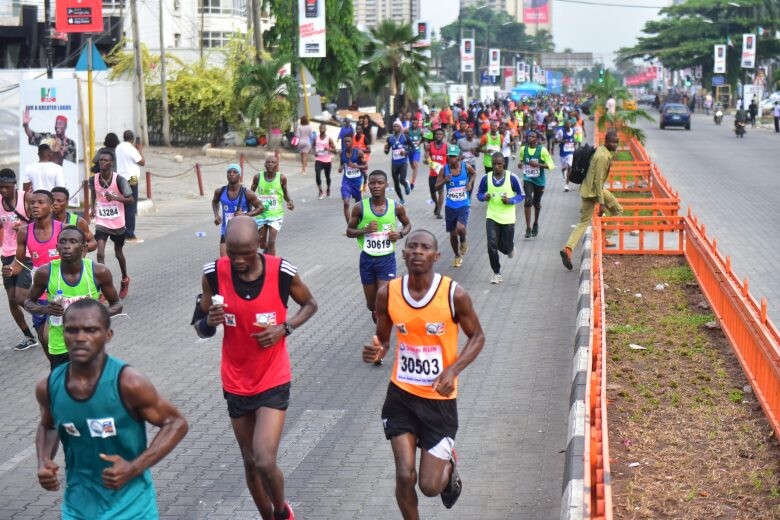
Other elite races like London, Tokyo, and others were also elites only races, while many races were outrightly cancelled.
But since September 2021, label races that were elites only in 2021 or were cancelled, have returned as full races, with thousands of runners.
These include the Berlin Marathon, London Marathon, Chicago Marathon, Boston Marathon, and others.
New York Marathon is slated for November 7, while other races are slated for the latter part of the year. Early in 2022 will be the Amsterdam Marathon, Dubai Tokyo, Paris, Houston, and others.
Mr Alli revealed that the World Athletics and Association of International Marathons and Distance Races (AIMS) are excited that the Access Bank Lagos City Marathon will return as a full race.
“I also want to use this medium to assure our numerous runners, especially the 10km fun runners who came to our office or contacted us on phone, emails, and via our website that on February 12, 2022, we will have a full race and that it will include the 10km race. I appeal to intending runners to step up their training”.
The General Manager also said there will be a world press conference the first week of November 2021 to unveil plans for the 2022 Access Bank Lagos City Marathon.
“This is our 7th edition. We are the first marathon in Nigeria to organize the 7th edition. We are also the first race to win a World Athletics Bronze Label in Africa after two editions and the first in the world to win the prestigious Silver Label after four editions.
“Last year, World Athletics gave us the Elite Road Race Label, we are one of the most sought after elite races in the world, in terms of prize money we rank among the top 10 in the world and in the number of participants we are top five in the world, I could go and on.
“To achieve all these before our seventh edition calls for celebration and the celebration is not just for staff, sponsors and vendors but for the media and thousands of runners that love and throng our race,” added Mr Alli.
(10/22/21) Views: 59Tunde Eludini
